When Sen. Dave McCormick stood on the Senate floor to call for nationwide rules mandating proof of citizenship and photo identification for voters, he invoked a drama that had played out three months earlier in Chester County.
The county had mistakenly left all third-party and unaffiliated voters off the Election Day voter rolls, creating a chaotic scene in which more than 12,000 voters were forced to cast provisional ballots, which take more time to count as officials must verify the eligibility of each voter. A subsequent investigation by a law firm hired by the county attributed the issue to human error and insufficient oversight.
“Every time Americans hear about election problems like Chester County’s, they rightly question the integrity of our electoral process,” McCormick said.
But in his recounting of events, the Pennsylvania Republican gave incomplete and inaccurate information about Chester County’s election error.
What did McCormick say about Chester County?
Americans, he said, overwhelmingly believe there are problems with U.S. elections, and he argued that has been demonstrated for them on multiple occasions, including in November when Chester County omitted more than 70,000 third-party and unaffiliated voters from its Election Day pollbooks.
“Registered voters were turned away at the polls. And an unknown number of unverified voters cast regular ballots,” McCormick claimed.
But there is no evidence that voters were turned away or that ineligible voters cast ballots. McCormick’s office did not respond to questions.
Were voters turned away?
According to county officials, no voter who wanted to vote was turned away.
Instead, for most of the day voters were offered the opportunity to vote by provisional ballot while county and state officials worked to get supplemental pollbooks distributedto polling places across the county.
Some voters did testify at county election board meetings that they voluntarily left their polling place when their name was not in the pollbook but that they returned later in the day when they could vote on machines.
Did unverified voters cast ballots?
There is no evidence that ineligible voters cast ballots. The identity and eligibility of all voters who cast ballots were verified, county officials said.
When the pollbook issue was discovered on Election Day, Chester County officials initially recommended that poll workers ask voters not included in the pollbook to sign the pollbook manually and vote as normal, according to the independent investigation of the incident.
To ensure those voters were eligible to vote, county officials said, poll workers were instructed to follow a detailed process that included verifying voters’ eligibility in the full voter list and verifying their identity with photo identification.
The Chester County Republican Committee has disputed the county’s version of events, contending that photo ID was not checked for all voters who wrote their names into pollbooks and that poll workers were unable to verify voters’ identities using signature matching.
Around 7:40 a.m., less than an hour after polls opened, Pennsylvania Department of State officials recommended the county shift to asking voters to cast provisional ballots to eliminate the risk of an ineligible voter casting a ballot, thereby invalidating the election.
A county spokesperson said there is no evidence that ineligible voters cast ballots during November’s election.
Whether voters wrote their names into a pollbook or cast a provisional ballot, “the identity and eligibility of each individual was verified by the poll workers,” said Chester County spokesperson Andrew Kreider.
Would the SAVE Act have changed anything?
The SAVE Act is a collection of election policies proposed by congressional Republicans that would require proof of citizenship to register to vote and mandate all voters show photo ID at the polls.
Such requirements would not have prevented Chester County’s error, which investigators determined was a clerical error resulting from inexperienced staff with insufficient training and oversight.
“Sen. McCormick was ignoring the facts and feeding into this larger narrative that our elections can’t be trusted and just feeding into the president’s narrative that there’s something wrong with Pennsylvania elections,” said Lauren Cristella, the CEO of the Committee of Seventy, a Philadelphia-based civic engagement and good-government organization.
In addition to Chester County, McCormick pointed to his own experience in close elections — both his 2022 primary loss and his 2024 general election win — as a reason he supports the bill’s proof of citizenship and voter ID requirements.
The policy, which passed the Republican-led U.S. House, still faces an uphill battle in the U.S. Senate, where it would need 60 votes to advance. It has faced significant opposition from Democrats who say it would needlessly make it harder for people to vote.
The proof of citizenship requirement, critics say, would place a higher burden on married people whose last names no longer match their birth certificates.
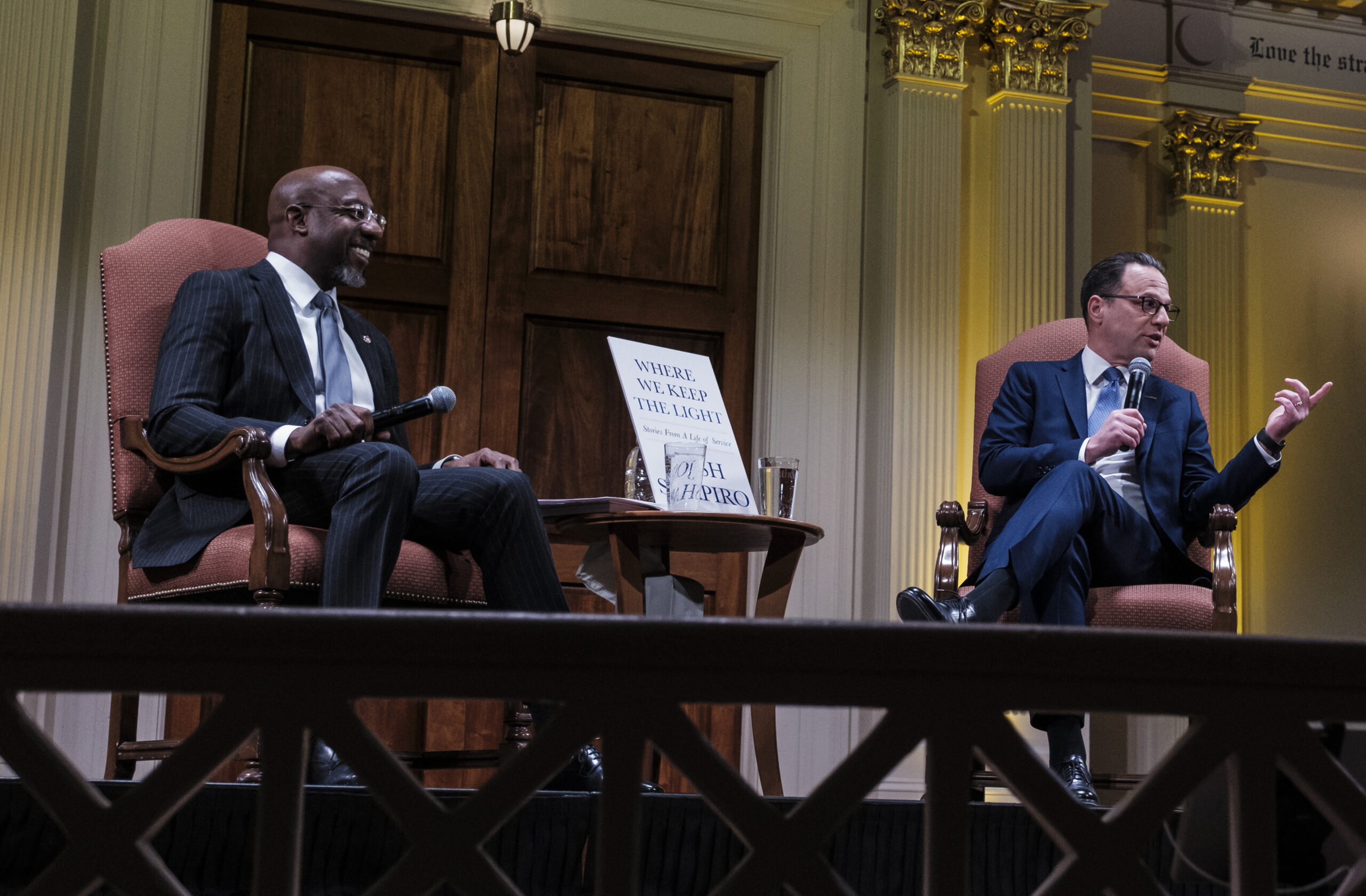
Sitting onstage in an echoeyhistoric synagogue, next to a U.S. senatorand a cardboard cutout of his newly released memoir, Gov. Josh Shapiro reflected on the Pennsylvanians who give him hope.
As he had in other stops on his book tour up and down the East Coast, Shapirooften referred to his book’s title, Where We Keep The Light, and the ways he finds hope in the “extraordinary impact” of Pennsylvanians. Among them, he said, were those who were sexually abused by Catholic priests in crimes covered up by the church until they were illuminated by the victims’ unrelenting quest for justice.
“I find hope in the people I met who were abused over years and years and years,” Shapiro told U.S. Sen. Raphael Warnock (D., Ga.) last month at an event at Sixth and I, a synagogue in Washington, “who still had the courage to show up in a grand jury room to testify and to challenge me to do something to make sure we righted a wrong and brought justice to them.”
The nearly 900-page report was lauded as the most comprehensive review of clergy abuse across a single state and prompted new laws clarifying penalties for failure to report abuse and allowing survivors more time to pursue criminal or civil cases against their abusers.
But a key step in delivering justice to those survivors — establishing a two-year window for the filing of lawsuits over decades-old abuse that falls outside the statute of limitations under existing law — remains unfinished.
The proposal has become one of the most fraught issues in Harrisburg. After a devastating clerical error by Gov. Tom Wolf’s administration killed a proposed constitutional amendment in 2021, lawmakers have been unable to come together on a new path forward. Republicans who control the state Senate have tied the proposal to policies Democrats will not support. All the while, the Catholic Church and the insurance industry have lobbied hard against it.
Nearly a dozen interviews with survivors, their family members, and advocates reveal a deep frustration with the inaction in Harrisburg. Even as Shapiro renews calls for the Senate to act, survivors are divided over whether he has done enough to use his power as governor to advocate for them.
A key pledge in Shapiro’s bid for reelection — and his pitch to a national audience — is that he can “get stuff done” by working across the aisle. But some abuse survivors in Pennsylvania say the unfinished business in getting justice for them brings that record into question.
“He got to where he’s at on the back of victims and survivors, and now he’s forgotten,” said Mike McIlmail, the father of a clergy abuse victim, Sean McIlmail, who died of an overdose shortly before he was supposed to testify in a criminal case against his alleged abuser.
Shapiro, his spokesperson Will Simons said, has fought for survivors “publicly and in legislative negotiations” since 2018. He has promised to sign any bill that reaches his desk establishing the window.
With a reelection campaignunderway and his eyes on flipping the state Senate, the governor renewed that fight earlier this month. He used his budget address to blame Senate Republicans for the inaction thus far.
“Stop cowering to the special interests, like insurance companies and lobbyists for the Catholic Church,” he said, his voice thundering in the House chamber. “Stop tying justice for abused kids to your pet political projects. And start listening to victims.”
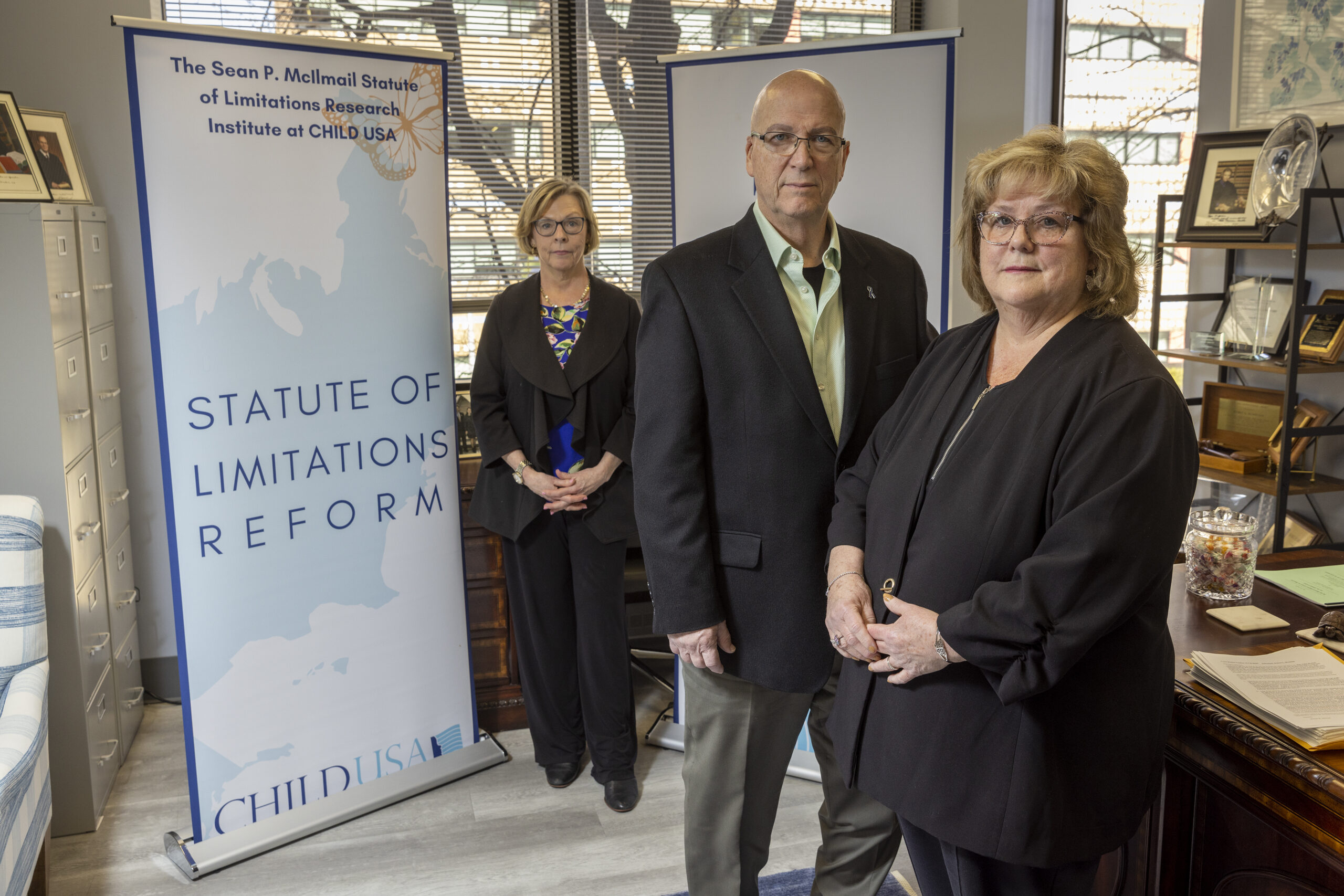
Mike and Debbie McIlmail, parents of Sean McIlmail, in the office of (left) Marci Hamilton, in Philadelphia on March 29, 2022.
For most of the casesin the report, the statute of limitations had passed, leaving no legal recourse for survivors.
The report proposed that lawmakers create a two-year window to allow the filing of civil suits over cases that happened years, if not decades, ago. Despite Shapiro’s advocacy since releasing the grand jury report, the proposal has been trapped in a stalemate for years.
Pennsylvania trails more than 30 other states that have approved similar legislation.
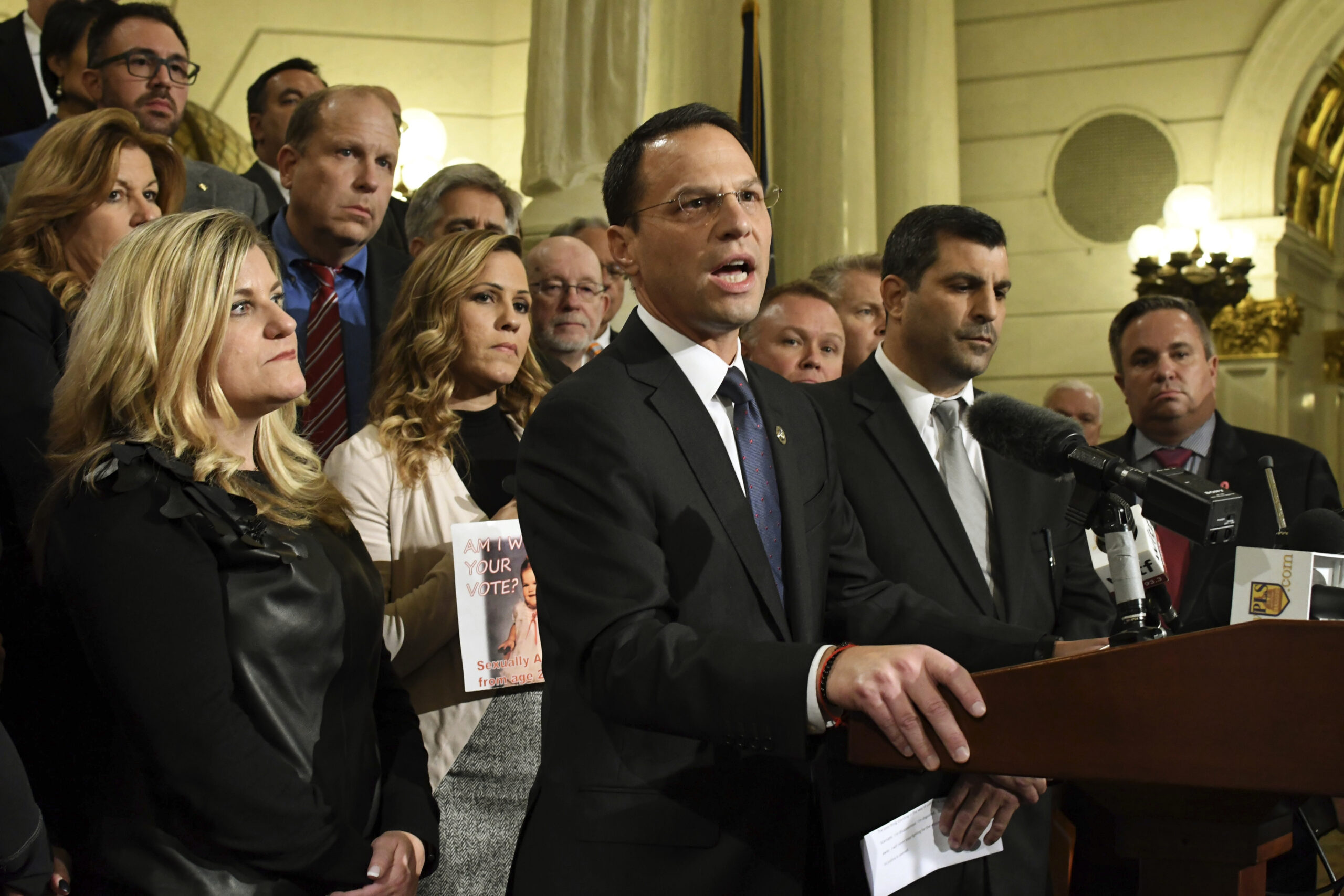
Then-Attorney General Josh Shapiro speaks at a news conference in the state Capitol in 2018 about legislation to respond to a landmark grand jury report accusing hundreds of priests of sexually abusing children over decades stalled in the legislature.
“It’s maddening to have people say, ‘We’re committed to this, this is going to happen, we’re committed to it,’ from both sides of the political spectrum and nothing ever gets done,” said Jay Sefton, who says he was abused by a priest in Havertown as a middle schooler in the 1980s. “It does start to feel like these are lives being used as its own sort of theater.”
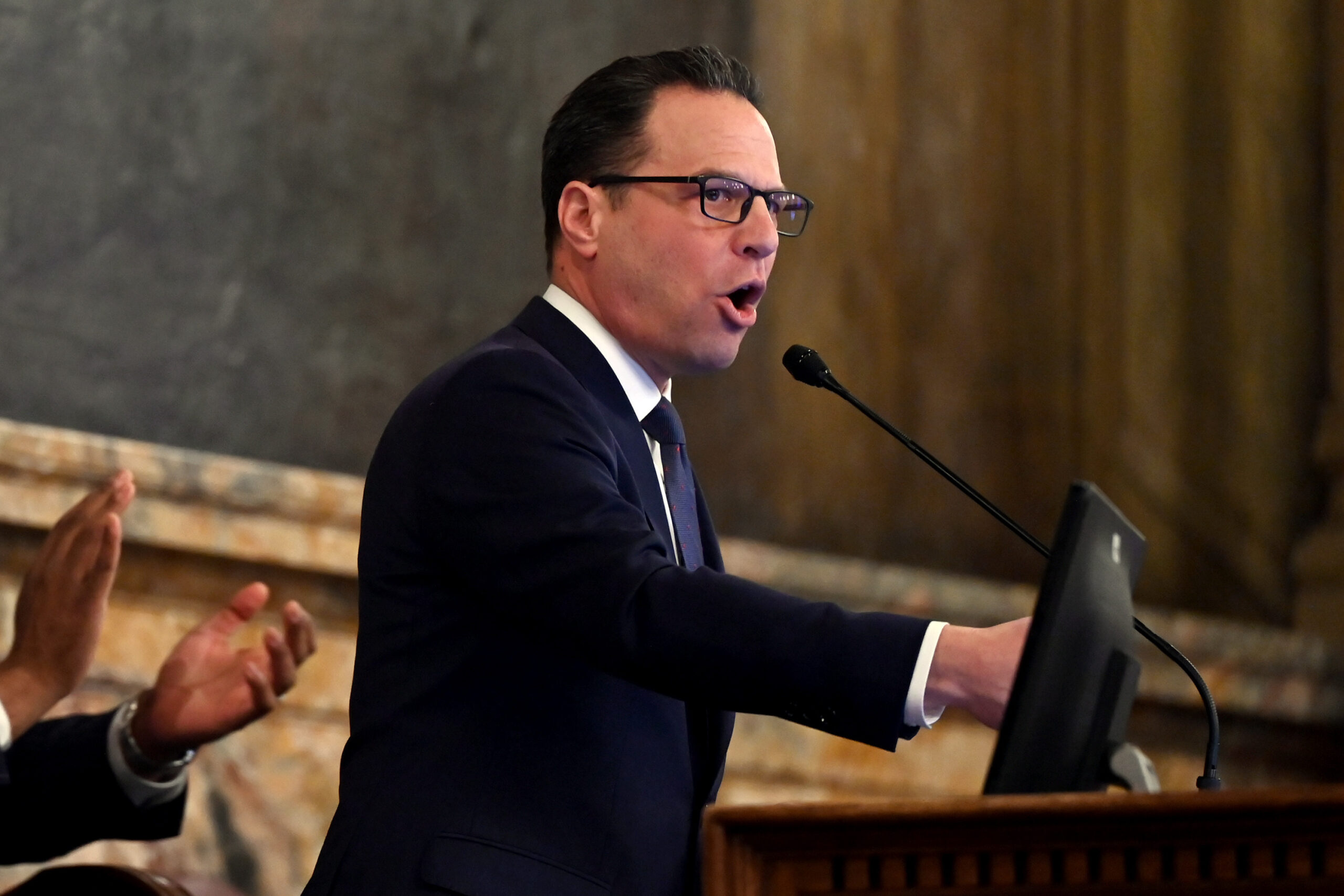
Gov. Josh Shapiro makes his annual budget proposal in the state House chamber Tuesday, Feb. 3, 2026.
Speaking to journalists in Washington days before he targeted Republicans in his budget address, Shapiro tied the window’s prospects to Democrats’ ability to win the state Senate for the first time in more than three decades.
“I’m confident with a Democratic Senate that will be one of the first bills they put on my desk,” Shapiro said.
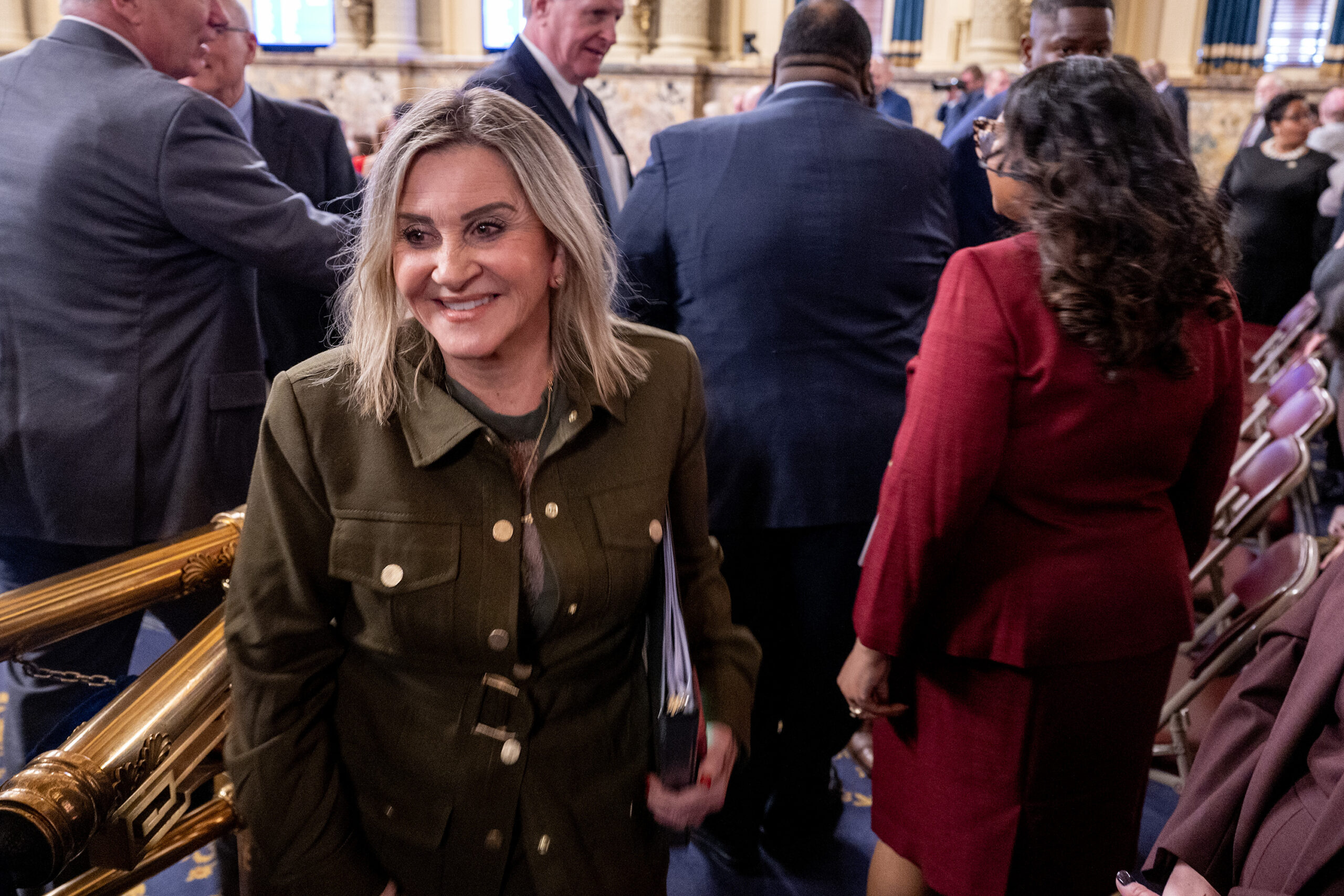
Senate President Pro Tempore Kim Ward, a Republican, leaves the House chamber following Democratic Gov. Josh Shapiro’s annual budget proposal speech in Harrisburg on Feb. 3.
In an interview, Senate President Pro Tempore Kim Ward (R., Westmoreland) noted that the GOP-controlled Senate had approved a constitutional amendment to establish the window several times before, although it ultimately failed to ever reach the voters.
She declined to say whether the state Senate would take up the amendment up this year but said creating the window through legislation, as Shapiro requested, would be unconstitutional.
“He has decided that he’s going to be moral instead of follow the law. Look at his record in his own office,” Ward said, arguing Shapiro has a track record of fighting for some survivors but not others. She pointed to his office’s handling of sexual harassment allegations brought against a former top staffer and close ally. Documents showed that complaints about the staffer were made months before his abrupt resignation.
For some clergy abuse survivors, the blame lands squarely on Ward and her Republican allies as they insist on a constitutional amendment, which requires two votes by both the House and Senate along with a ballot measure.
“It’s the Republicans that are blocking it, and I think they’re blocking it because of the church,” said Julianne Bortz, a survivor who testified before the grand jury and whose experience was featured in the report.
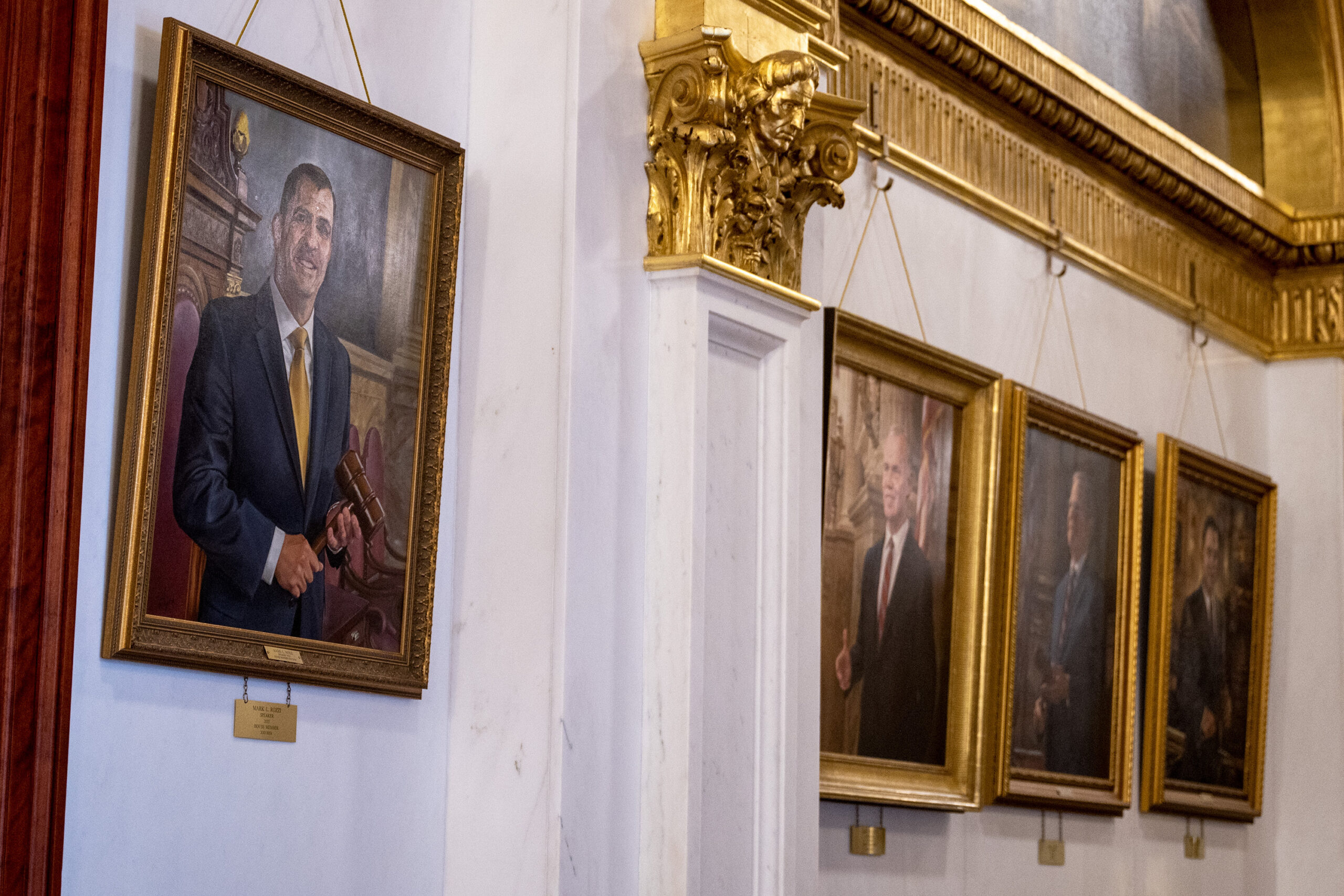
A portrait of former Pa. House Speaker Mark Rozzi hangs alongside painting of other former speakers in hallway at the state Capitol.
Debate among survivors
Despite Shapiro’s recent statements, there is a sense among some survivors that lawmakers, and Shapiro, have forgotten about them.
Former state House Speaker Mark Rozzi, a Berks County Democrat and clergy abuse survivor, said Shapiro “betrayed” survivors and should be playing “hardball” with the Senate to ensure that the bill makes it to his desk.
“Talk is cheap. Unless you come to the table and cut a deal, nothing else gets done,” Rozzi said.
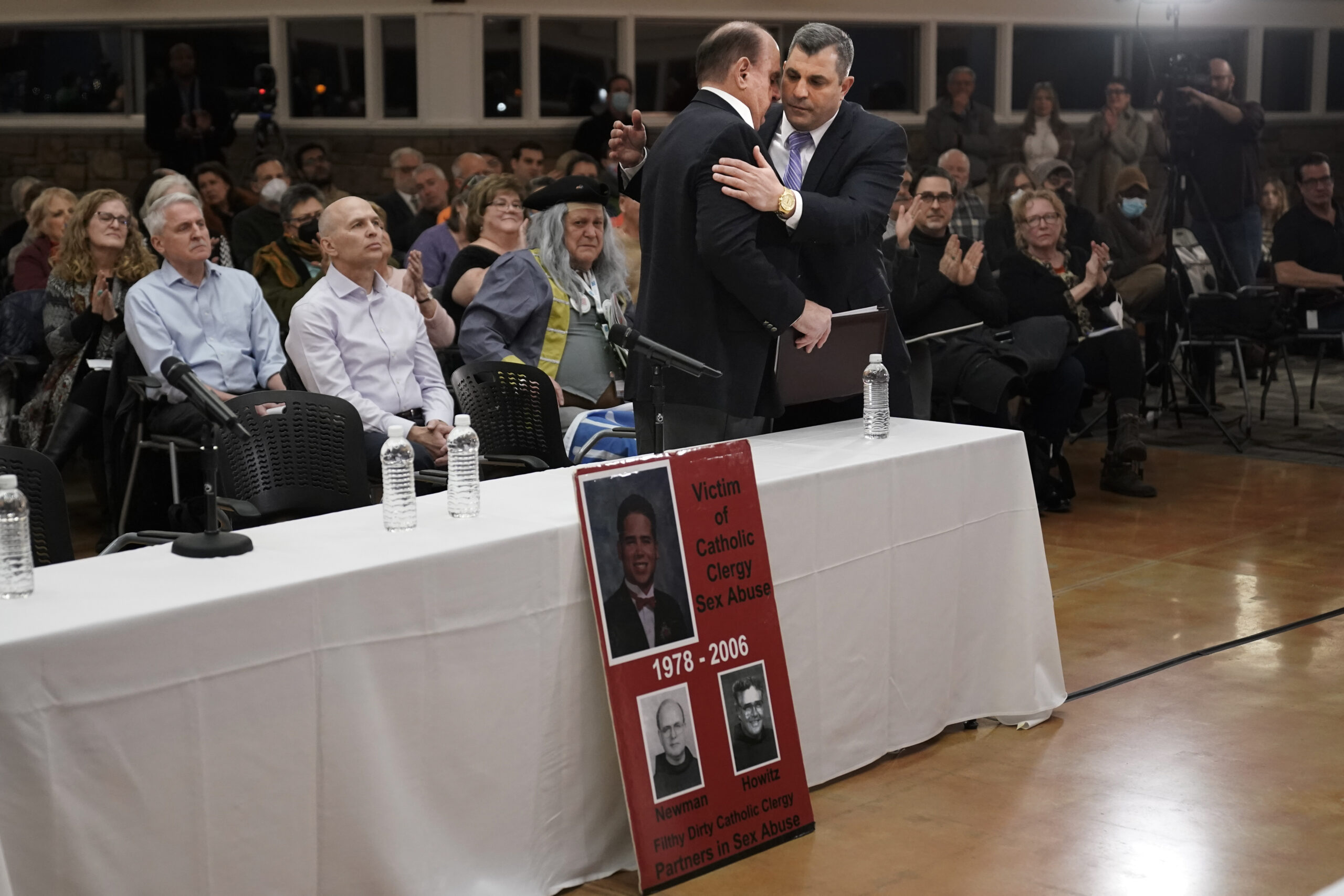
Then-Pennsylvania House Speaker Mark Rozzi, center right, embraces Arthur Baselice, the father of Arthur Baselice III, after he testified at a hearing in Philadelphia on Jan. 27, 2023.
Advocates have spent years pushing lawmakers in Harrisburg and have grown increasingly frustrated with the lack of movement.
“We, being the victims, have always held our end of the bargain. Always. We’ve always shown up when we’ve asked to, we’ve testified when we were asked to, we interviewed, we discussed the worst moments of our lives when asked,” said Shaun Dougherty, who said he was abused by an Altoona-Johnstown priest.
Now, he said, it’s the governor’s turn to get the work done.
Former State Rep. Bill Wachob, a Democrat who worked in politics after leaving elected office in the 1980s, is convinced the governor could make it happen through negotiations if he wanted.
“He and his team have made a calculated political decision that they have gotten as much mileage out of this issue as they’re going to get and they’re not doing anything more,” Wachob said.
In Shapiro’s memoir, however, he wrote he expected that going up against the Catholic Church in pursuing the 2018 report “was likely the end of the road for me politically.”
“I’d made my peace with being a one term Attorney General, if it meant that I could put my head on the pillow at night knowing I did my job and made good for these victims,” he wrote.
“I have no doubt that the governor has been doing what he can,” said Marci Hamilton, the founder of Child USA, which advocates for child sex abuse victims. She blamed the challenges in reaching a deal on Harrisburg’s partisan dynamics.
Recent criticism of Shapiro has driven division within the survivor community in recent weeks, said Mary McHale, a survivor who was featured in a 2022 Shapiro campaign ad.
“He cares. But he also has a state to run. This can’t be the No. 1 issue,” she said.
Diana Vojtasek, who said she was abused by the same Allentown priest as McHale, said she worries frustration is being misdirected at Shapiro instead of Republicans.
“I just don’t see the value in attacking the one who has vowed publicly that he will sign this legislation for us as soon as it’s across his desk,” she said.
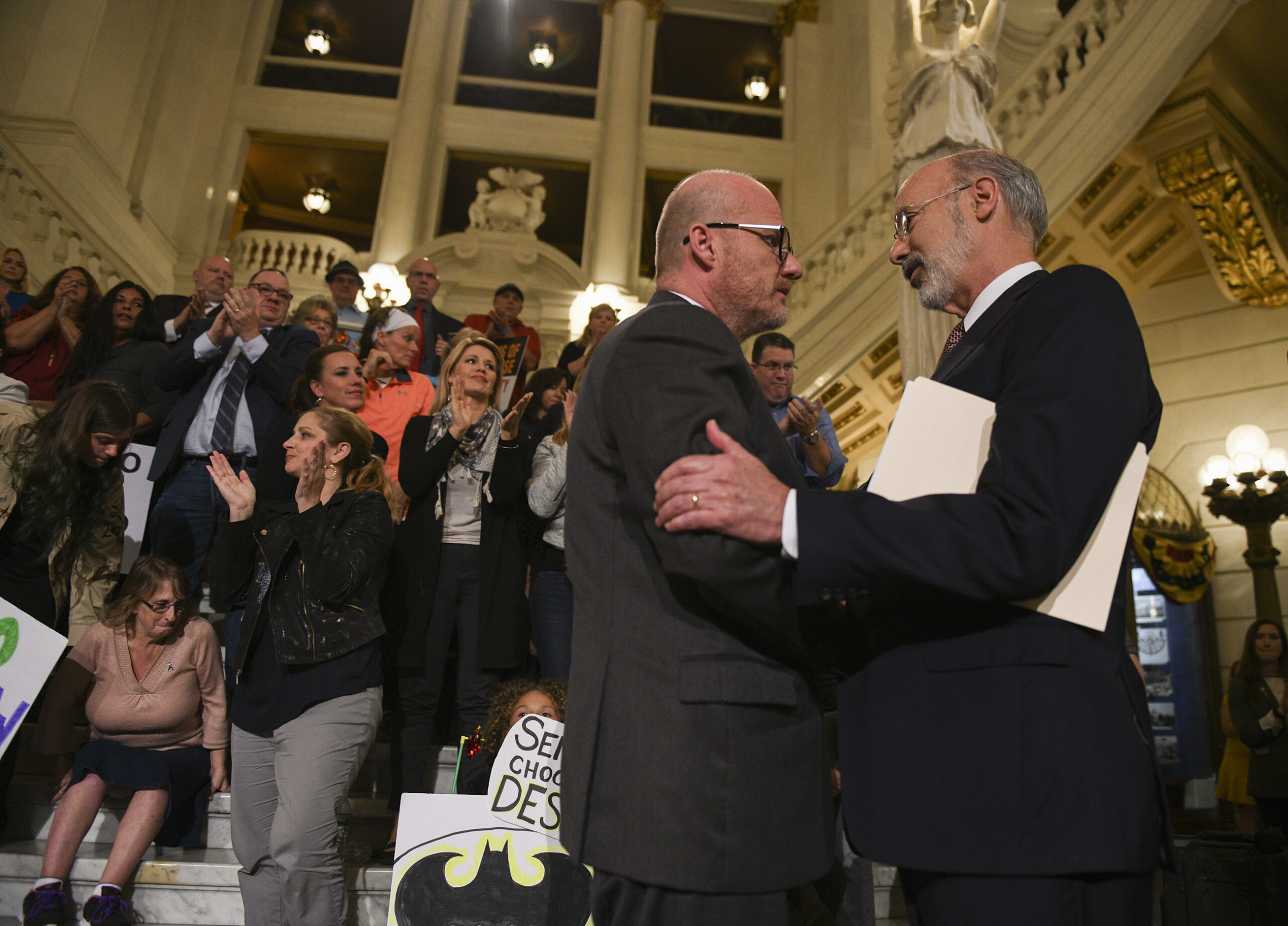
Abuse survivor Shaun Dougherty (left) greets then-Gov. Tom Wolf in the State Capitol on Sept. 24, 2018.
“What the Epstein transparency act showed us is we are finally at a point where the protection of sexual abuse victims is nonpartisan,” Hamilton said. “I fully expect to see that that understanding for victims will happen in Harrisburg.”
Rep. Nathan Davidson, a Dauphin County Democrat who introduced the House legislation to create the window, has scheduled hearings in April to bring renewed attention to the issue.
Sefton, who said he was abused as a middle schooler in Havertown in the 1980s, will perform a one-man show about his experience in a theater just steps from the state Capitol the week of the hearings.
He is done hoping lawmakers will establish the window but said it would make the state safer if they did.
“Nobody is going to give anyone their childhood back. It can’t happen,” Sefton said.
“There’s always going to be a part of me that’s filled with some rage about people blocking the energy here. If that were to go through, it’s a piece of energy that gets finally freed up.”
Gov. Josh Shapiro said Thursday that he will not attend any White House event that excludes another governor ahead of next week’s gathering of the nation’s governors in Washington.
The Pennsylvania Democrat’s comments come after President Donald Trump said he would exclude the Democratic governors of Colorado and Maryland from a White House dinner with members of the National Governors Association during its annual conference in Washington, which will take place from Feb. 19 to 21.
“I want to be very clear: I’m not attending any meeting or any dinner where any governor has been disinvited, where any governor is being excluded,” Shapiro said Thursday. “It’s my hope that all governors will be included and that we can continue the tradition of working together across our state lines to be able to do important work for the people that we represent.”
Trump had initially excluded Democrats from a business meeting at the White House, but as of Thursday all governors were invited to the meeting with the president and other officials, the Washington Post reported.
But the dinner remains a thorny issue. Shapiro and other Democratic governors signed a statement Tuesday promising to boycott the event if all governors were not included.
In a social media post Wednesday, Trump attacked Oklahoma Republican Gov. Kevin Stitt, who chairs the bipartisan NGA, and the two Democrats he is planning to exclude from the dinner, Maryland Gov. Wes Moore and Colorado Gov. Jared Polis.
“The invitations were sent to ALL Governors, other than two, who I feel are not worthy of being there,” Trump said in a post on Truth Social.
Trump criticized Moore over crime in Baltimore and accused him of “doing a terrible job on the rebuilding of the Francis Scott Key Bridge” following its collapse in 2024.
Shapiro referred to Moore on Thursday as a “dear friend.”
The Pennsylvania governor said the NGA’s meetings at the White House are typically productive, as are the governors’ other meetings throughout the conference.
“Governors work really well together across party lines,” he said.
New Jersey Gov. Mikie Sherrill, a Democrat who took office last month, said Monday on CNN that “worse decisions” would be made if some governors were excluded from the week’s events.
“For the president to pick and choose who he is going to have to sort of undermine the very focus of this of coming together to get stuff done for the country just seeds more … chaos,” she said.
Pennsylvania Secretary of State Al Schmidt on Wednesday rejected President Donald Trump’s false claims about voter fraud in the stateas Trump targeted Philadelphia in his push to nationalize elections.
The state’s top election official said Trump’s proposal would violate the Constitution, which he noted clearly gives states exclusive authority to administer elections.
“Pennsylvania elections have never been more safe and secure,” said Schmidt, who served as Philadelphia’s Republican city commissioner in 2020, when the city was at the center of Trump’s conspiracy theories.
“Thousands of election officials — Democrats, Republicans, and Independents alike — across the Commonwealth’s 67 counties will continue to ensure we have free, fair, safe, and secure elections for the people of Pennsylvania,” he said in a statement.
Speaking to reporters Tuesday in the Oval Office, Trump cited Philadelphia, Detroit, and Atlanta as examples of where the federal government should run elections. He singled out three predominantly Black cities in swing states but offered no evidence of voter fraud or corruption to support his claims of a “rigged election.”
“Take a look at Detroit. Take a look at Pennsylvania, take a look at Philadelphia. You go take a look at Atlanta,” Trump said.“The federal government should get involved.”
Philadelphia has been a frequent target of Trump’s false claims of election fraud for several years, going back to his efforts to overturn his loss in the 2020 election. City and state officials have persistently pushed back on those claims, and there is no evidence that elections in the city have been anything but free and fair.
Trump is advocating for taking control of elections in 15 states, though his administration has not named which ones.
“The Republicans should say, ‘We want to take over,’” Trump said in December. “We should take over the voting, the voting in at least many — 15 places. The Republicans ought to nationalize the voting.”
But, Pennsylvania officials and experts noted, he lacks the power to do so unilaterally.
“The president has zero authority to order anything about elections,” said Marian Schneider, an election attorney who was Pennsylvania’s deputy secretary of elections during the 2016 election.
White House press secretary Karoline Leavitt claimed to reporters early Tuesday the president was referring to the SAVE Act, legislation proposed by House Republicans require citizens to show documents like a passport or driver’s license to register to vote.
But Trump didn’t mention the legislationTuesday.
Trump will face an uphill battle in nationalizing elections as even some Republicans in Congress are already pushing back. Senate Majority Leader John Thune (R., S.D.) told reporters Tuesday he disagreed with Trump on any attempt to nationalize elections, calling it “a constitutional issue.”
“I’m not in favor of federalizing elections,” Thune said.
Still, Trump’s comments raised alarm as his administration continues to sow doubt in the nation’s elections.
“This is clearly a case of Trump trying to push the boundaries of federal involvement in election administration because he has a problem with any checks on his power, democracy being one of them,” said Montgomery County Commissioner Neil Makhija, an attorney and a Democrat who chairs the Montgomery County Board of Elections.
Trump’s comments came a week after the FBI seized ballots and voting records from the 2020 election from the Fulton County election hub in Georgia. In a statement, Fulton County Commissioner Marvin Arrington Jr. said the countywill file a motion in the Northern District of Georgia challenging “the legality of the warrant and the seizure of sensitive election records, and force the government to return the ballots taken.”
Lisa Deeley, a Democratic member of the Philadelphia city commissioners, who oversee elections, accused Trump of trying to distract from federal agents killing two civilians in Minnesota last month.
“We all know the President’s playbook by now. His remarks on elections are an effort to change the conversation from the fact that the Federal Government is killing American citizens in Minneapolis,” Deeley said in a statement.
Trump has been making similar claims since 2016, when he erroneously blamed fraud for costing him the popular vote.During a debate with his 2020 opponent, Joe Biden, Trump said, “Bad things happen in Philadelphia, bad things,” viewed at the time as an attempt to sow doubt about the election results and mail voting during the peak of the COVID-19 pandemic.
Despite losing to Biden in Pennsylvania in 2020 by a little more than 80,000 votes, Trump has repeatedly claimed he actually won, lying about mail-in votes “created out of thin air” and falsely stating there were more votes than voters.
“Every single review of every single county in the commonwealth has come back within a very small difference, if any, of the results reported back in 2020,” Kathy Boockvar, who served as Pennsylvania’s secretary of state during the 2020 election, told The Inquirer in 2024.
WASHINGTON — In a string of public appearances since federal agents fatally shot Alex Pretti, Gov. Josh Shapiro has repeatedly decried the federal immigration operation in Minnesota as unconstitutional and called on President Donald Trump to “terminate the mission.”
The centrist Democratic governor leaned heavily into criticism of the Trump administration as he toured the East Coast —andnetwork and cable news shows — to promote his new memoir, Where We Keep The Light, last week.
“I believe this administration in Washington is using [government] for pure evil in Minnesota right now,” Shapiro, who is widely believed to be setting up a presidential run, told Late Show host Stephen Colbert last week. “And it should not be hard to say that.”
Known to be a careful messenger, Shapiro’s approach to the Immigration and Customs Enforcement and Border Patrol operations in Minneapolis evolved over the last week, from his initial decision over the first year of Trump’s second presidency not to aggressively speak out against ICE’s enforcement tactics to a hard-line approach condemning the Trump administration’s mission following the killing of another U.S. citizen by federal agents that became national tipping point.
When ICE agents killed Renee Good in early January, Shapiro issued a statement mourning her death, but made no broader conclusions about ICE and did not mention her by name.
Now, he has honed a clear and authoritative message that the Trump administration’s strategies are eroding trust in law enforcement, violating constitutional rights and making communities less safe. If Trump moves his focus and forces to Pennsylvania, he says, state officials are prepared to push back.
According to polling obtained by Puck News, Shapiro has landed on some of the most effective messaging on immigration in the country.
Governor Josh Shapiro (D-PA) and Sen. Raphael Warnock (D-GA) speak during a talk for his new memoir “Where We Keep the Light” on January 29, 2026 in Washington, D.C
But immigrant rights groups in Pennsylvania say the governor took too long to speak up and has yet to back his rhetoric up with concrete actions in his home state by ending cooperation with ICE.
“Because it is the topic of the day, he’s getting these pointed questions, and his answer to that is to point to what they’re doing wrong in Minnesota. Meanwhile, he’s over here telling us that he’s not going to stop collaborating with ICE,” said Tammy Murphy, advocacy manager at immigrant rights group Make the Road Pennsylvania. “It’s easy for him to point the finger to somebody else, but then what is he doing at home?”
At a roundtablewith journalists in Washington on Thursday, Shapiro said he didn’t view his new outspokenness against ICE’s operations in Minneapolis as a tone shift, but acknowledged that the situation had become more serious in recent days and he “reached a point where it was critically important” to comment on the situation in Minnesota and tell Pennsylvanians his views.
“I think I’ve been in the same place on this to protect our immigrant communities and also make sure that Pennsylvania is safe,” Shapiro said.
“Both [Good and Pretti’s deaths] told me the same story that you had people who were not following proper policing tactics. People who were in the field who seemingly, and it became more clear to me over the last week or two, did not have a clear mission and that the directive that they had clearly was not within the bounds of the constitution.”
“That’s people power right now, and this is a moment where we need to raise our voices,” Shapiro said. (His event was then promptly, but briefly, interrupted by climate protesters)
“It’s always good to cooperate with ICE, especially when they’re doing targeted actions,” Garrity said.
Samuel Chen, a GOP strategist, said Shapiro’s harsh rhetoric would create a clear distinction between him and Garrity while “endearing him to the Democrats should he run in 2028.”
Chen noted that even some Republicans have criticized Trump’s approach to Minnesota, which creates an opportunity for Shapiro to speak out.
“With that being public opinion the governor has a lot of cover to come out even harder,” Chen said. “It’s a win, win, win for him.”
Chalk on the sidewalk reading “Shapiro Stop ICE in PA,” during a protest outside the Free Library as Gov. Josh Shapiro promoted his new book “Where We Keep The Light” in Philadelphia, Pa., on Saturday, Jan. 24, 2026.
Even as he makes the case against ICE’s recent actions, Shapiro is still being careful not to go too far. He frequently mentions that Pennsylvania is not a sanctuary state. In an interview with Fox News last week, he criticized Philadelphia District Attorney Larry Krasner’s comments comparing ICE agents to Nazis as unacceptable rhetoric.
“It is abhorrent and it is wrong, period, hard stop, end of sentence,” Shapiro said.
What is most frustrating to immigrant rights groups is the Shapiro administration’s willingness to cooperate with ICE — even if on a limited basis — while other Democratic governors have taken strong actions against it. Gov. Maura Healy of Massachusetts, for example, banned ICE from state facilities.
Meanwhile, Shapiro’s administration honors some ICE detainers in state prisons and provides ICE with access to state databases that include personal identifying information for immigrants.
“You are still collaborating with the agency that is murdering our people, that you yourself have named as violating the constitution,” said Jasmine Rivera, the executive director of the Pennsylvania Immigration Coalition.
“You know, Parady La’s death was also bad,” said Murphy, who is with Make The Road. “That happened in this state at the hands of federal agents. And he’s silent about that, but then he’s got something to say about Renee Good or Alex Pretti. He’s talking about those people, but not the people here.”
The Shapiro administration says that outside agencies do not have “unfettered access” to state databases but may offer access to federal agents for “legitimate investigations that involve foreign nationals who have committed crimes.”
Furthermore, they say ICE detainers are honored only when a detainee has been convicted of a crime and sentenced to state prison.
In a letter to advocates last month, the administration vowed not to lease state property to ICE and reiterated that State Police are barred from conducting immigration enforcement and that federal agencies must obtain a warrant to access non-public space in state buildings.
Gov. Josh Shapiro speaks with Stephen Colbert last week.
This cautious approach is part of a balancing act Shapiro must handle as he pursues reelection in a politically split state and weighs a potential run for higher office, said Alison Dagnes, a political science professor at Shippensburg University.
“He is spinning plates and juggling flaming torches, all while he’s playing the kazoo,” Dagnes added “That combination is really important to consider as we look at his shifting rhetoric, his carefulness that moved into a louder stance.”
But advocates want Shapiro to take a firmer stance and say they won’t stop pushing until he does.
“Politically, he wants to be seen as ‘both sides,’” Murphy said. “He doesn’t want to be seen challenging Trump or this deportation machine.”
WASHINGTON, D.C. – Gov. Josh Shapiro told national reportersThursdaythat he likes U.S. Sen. John Fetterman (D., Pa.), and still talks to him — citing a meeting several months ago.
It’s long been clear that Pennsylvania’s two top Democrats have a tense relationship, a dynamic Fetterman explained in detail in his memoir, Unfettered, released in November, writing that the two men no longer speak after they butted heads as members of the Pennsylvania Board of Pardons.
Speaking to a roundtable of Washington journalists hosted by the Christian Science Monitor on Thursday, Shapiro said he “of course” likes the commonwealth’s senior senator and still speaks to him.
“We were in a meeting together a few weeks ago with (U.S. Transportation) Secretary (Sean) Duffy, working on an important issue in Pennsylvania. So we all work together, Senator McCormick as well,” Shapiro said. “We’ve got to work together for the people of Pennsylvania.”
That meeting, however, was in November when Shapiro and Fetterman met with Duffy to discuss SEPTA — roughly a week before the release of Fetterman’s book. Mayor Cherelle L. Parker and Sen. Dave McCormick (R., Pa.) also participated in that meeting.
A spokesman for Shapiro did not immediately respond to questions about whether they’ve spoken since.
Though Shapiro and Fetterman’s disagreements date back to the pair’s days on the state pardons board, the senator has increasingly drawn ire from his fellow Democrats in recent months for voting with Republicans and has faced calls for a primary challenge.
Shapiro was mum when asked whether he’d support Fetterman if he sought reelection.
“John will decide if he wants to run for reelection. I appreciate the service,” he said.
Fetterman claims in a chapter of his book titled “The Shapiro Affair” that Shapiro, as attorney general, had been unwilling as a member of the pardons board to recommend the commutation of two men that Fetterman strongly believed should be released.
Fetterman, who was lieutenant governor at the time, even threatened in a private meeting to run against Shapiro for governor if he didn’t support the commutations.
“I told him there were two tracks — that one and the one in which he ran for governor and I ran for the Senate (which was the one I preferred),“ Fetterman wrote in the memoir. ”I had no interest in friction, only in what I felt was justice.”
Fetterman also claimed that Shapiro’s cautionin these cases was about protecting his future political ambitions.
“I believe what drove him to delay and deny applications was not the facts of a given case as much as a fear that someone whose sentence he’d commuted would go on to commit terrible violence on the outside,” Fetterman wrote.
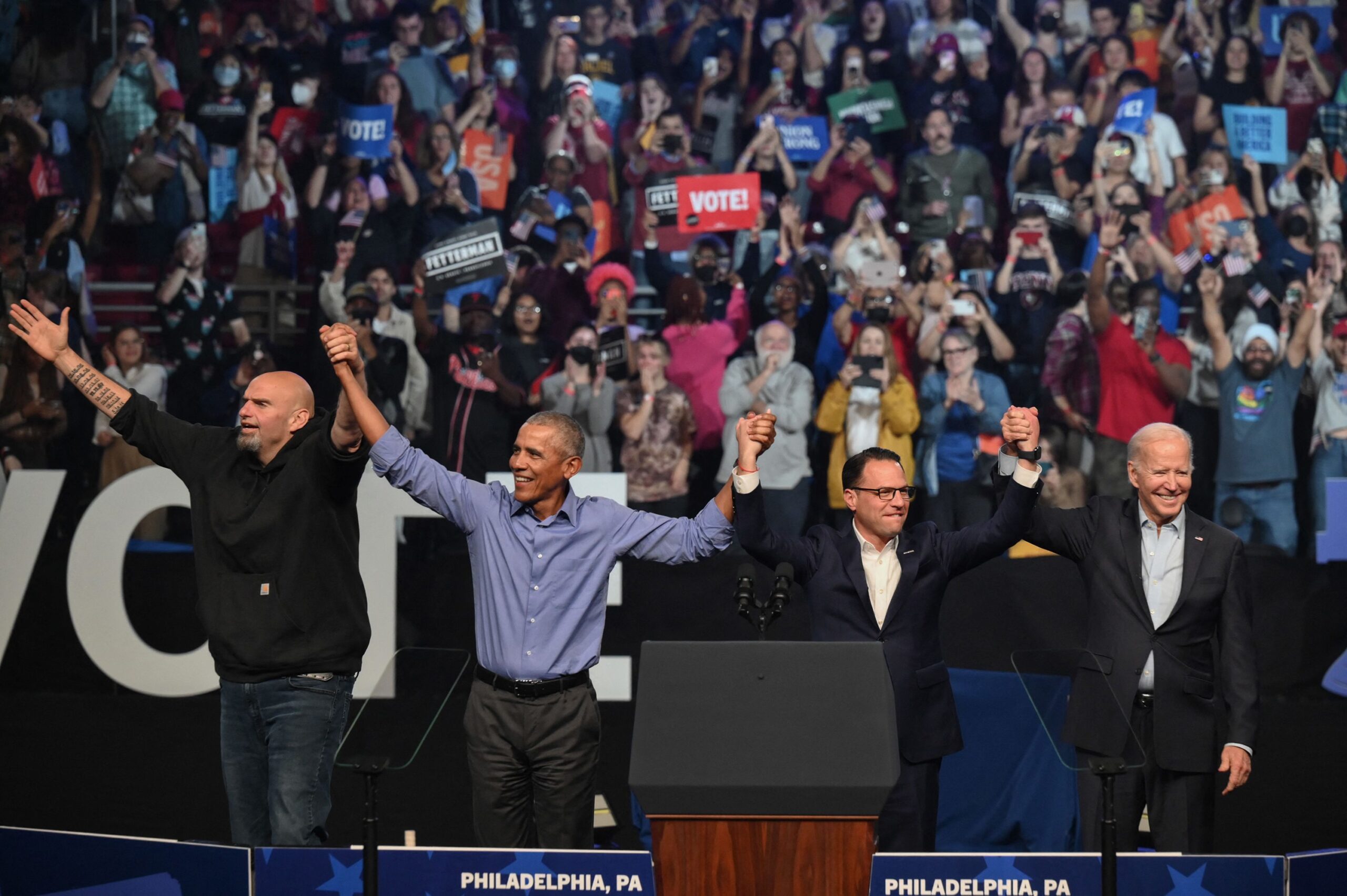
Then-Senate candidate John Fetterman, former President Barack Obama, then-candidate for governor for Pennsylvania Josh Shapiro, and then-President Joe Biden ahead of the 2022 election.
In his own book, Shapiro reflects on agonizing over those decisions including the concern that a commuted individual would go on to harm others. Throughout his book tour he has dodged questions about potential presidential aspirations.
Things got so bad that then-Gov. Tom Wolf had to get involved by meeting with them privately, and Fetterman later got caught on a 2020 Zoom meeting calling Shapiro a “f— asshole,” not realizing that his microphone was still live.
While Fetterman devoted an entire chapter of his 240-page book to Shapiro, the state’s senior U.S. senator only gets two passing mentions in Shapiro’s book.
In one mention, Shapiro notes that he spoke with Fetterman backstage at a 2022 Erie County Democratic Committee dinner when Shapiro debuted a new speech about what “real freedom” means, just days before Fetterman had a stroke in lead up to that year’s primary election.
Shapiro also mentions Fetterman in a chapter about the governor’s history with former President Barack Obama. Shapiro and Fetterman were both on the ballot in 2022 and cohosting a campaign rally, where Obama and former President Joe Biden came to stump for them.
Fetterman is not mentioned in the rest of the book. Shapiro does not delve into the fellow Democrat’s threat to run against him.
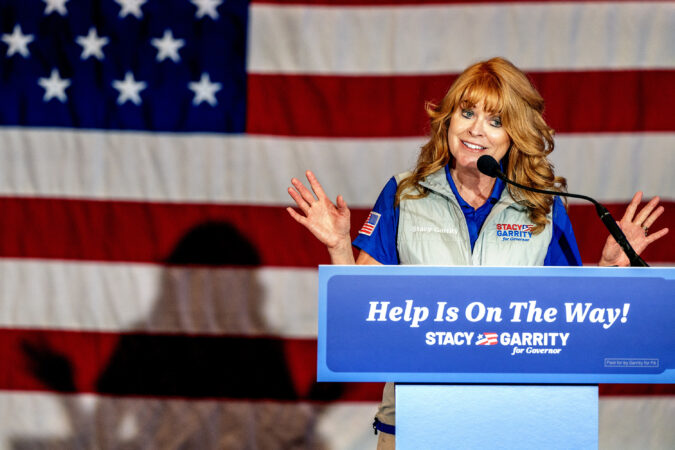
President Donald Trump endorsed Pennsylvania Treasurer Stacy Garrity for governor Tuesday evening, awarding her the coveted nod from the leader of the Republican Party as she tries to unseat the popular Democratic incumbent Gov.Josh Shapiro in November.
In a post on his Truth Social platform, Trump declared Garrity “WILL NOT LET YOU DOWN” and stated that as governor, she would work to grow the economy, strengthen the military, keep borders secure, and safeguard elections, among other priorities.
“Stacy is a true America First Patriot, who has been with me from the beginning,” Trump wrote.
Garrity, the state’s second-term treasurer,has led the low-profile office without controversy and boasts that her staff has blocked nearly $2 billion in improper payments. The retired U.S. Army colonel in 2024 broke the record for highest number of votes received in a state-level race in Pennsylvania, and she quickly earned the support of the state party establishment last year.
In a statement Tuesday, Garrity said she was honored to receive Trump’s endorsement, adding that the president has “been a voice for hardworking Americans who have been left behind.”
“Josh Shapiro is President Trump’s number one adversary, and I am looking forward to working with President Trump and his team to defeat Josh Shapiro this November,” Garrity said.
At right is Pennsylvania Governor Josh Shapiro listening to Stacy Garrity, 78th State Treasurer, Forum Auditorium, Harrisburg, Pa., Tuesday, Jan. 21, 2025.
Garrity is a longtime Trump supporter from rural Bradford County, who in 2022 at a Trump rally repeated his false claim that he won the 2020 presidential election — a position she has since walked back, telling reporters earlier this month that she had gotten carried away in the moment when she said that.
Last summer, Trump said he would support another potential candidate — U.S. Rep. Dan Meuser (R., Pa.) — if he ran.Weeks later, the Northeast Pennsylvania Republican declined to run andannounced he would seek a fourth term in Congress instead. Meuser quickly endorsed Garrity once she formally joined the race, and she continues to capture more GOP officials’ endorsements as Pennsylvania’s May 19 primary election inches closer.
Garrity is currently running unopposed as the Republican candidate for governor, after State Sen. Doug Mastriano announced he would not run again this year after losing by nearly 15 percentage points to Shapiro in 2022. However, Garrity has yet to announce who she wants as her running mate for lieutenant governor, with largely far-right conservatives — including Mastriano — interested in the job.
Still,Trump’s endorsement of Garrity could draw needed eyes and checkbooks to her campaign, as her fundraising in the early months of the race has lagged far behind the $30 million war chest Shapiro has amassed over the last few years. Earlier this month, Garrity announced that her campaign had raised nearly $1.5 million from August through December.
Republicans are hopeful that Garrity can drive enough enthusiasm at the top of the state ticket to motivate GOP voters to come out to vote throughout Pennsylvania, boosting candidates up and down the ballot in a year where control of Pennsylvania’s General Assembly and the U.S. House of Representatives is on the line.
“Pennsylvanians deserve better than a Governor who is nothing more than a rubber stamp for Trump’s chaos and higher costs, and that’s why she will be soundly rejected this November,” Pennsylvania Democratic Party chair Eugene DePasquale said in a statement.
On a below-freezing day in January, Pennsylvania House Speaker Joanna McClinton delivered food to a West Philly home just minutes from her district office and listened as Sheila Alexander discussed the patchwork of care she has created for herself.
Alexander, 67, who struggles to get around on her own, explained that she depends on family often but uses a Medicaid-funded home health aide who helps her in the evening — especially when she needs to get up the steep stairs in her home.
McClinton is advocating for the aides who care for Alexander — and the rest of the roughly 270,000 Pennsylvania workers who make up the home care industry — to earn a higher wage.
Pennsylvania’s home healthcare workers are among the lowest-paid in the region at an average $16.50 per hour, resulting in what the Pennsylvania Homecare Association has called a crisis point for home care, as more and more workers leave the field and seniors struggle to find help. And it’s a crisis that may only deepen in future years, as one in three Pennsylvanians are projected to be 60 or older by 2030.
It’s an issue that McClinton, a Philadelphia Democrat who became House speaker in 2023 when her party took a one-seat majority, has had to contend with in her own life.
McClinton’s 78-year-old mother lost one of her favorite aides because of low pay, she said. The aide had cared for McClinton’s mother for a year, until the aide’s daughter got a job at McDonald’s that paid $3 more an hour. At that point, McClinton said, her mother’s aide realized just how low her pay was.
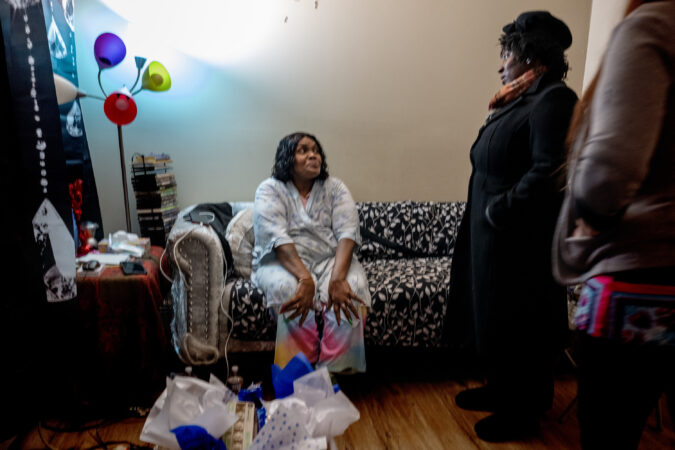
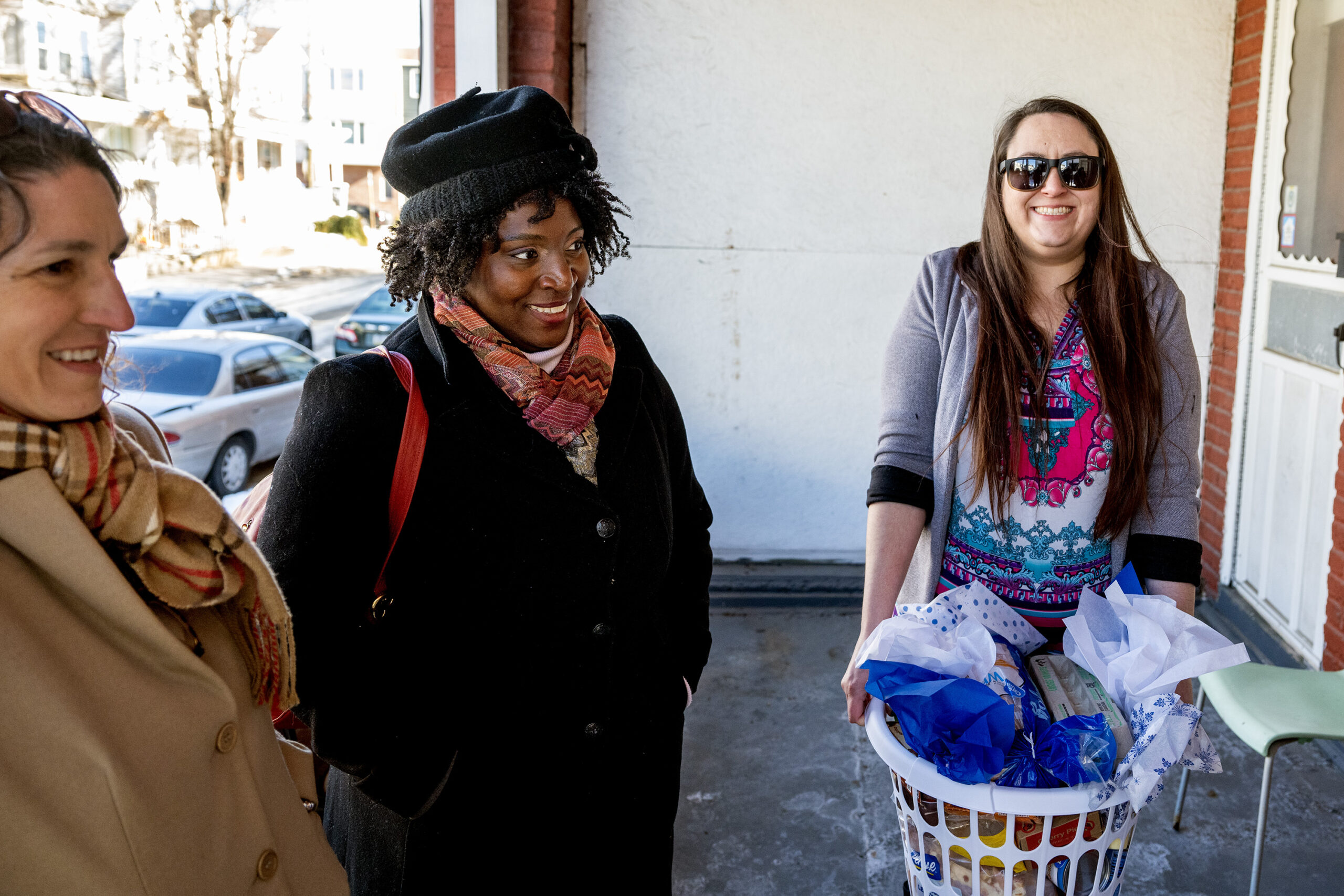
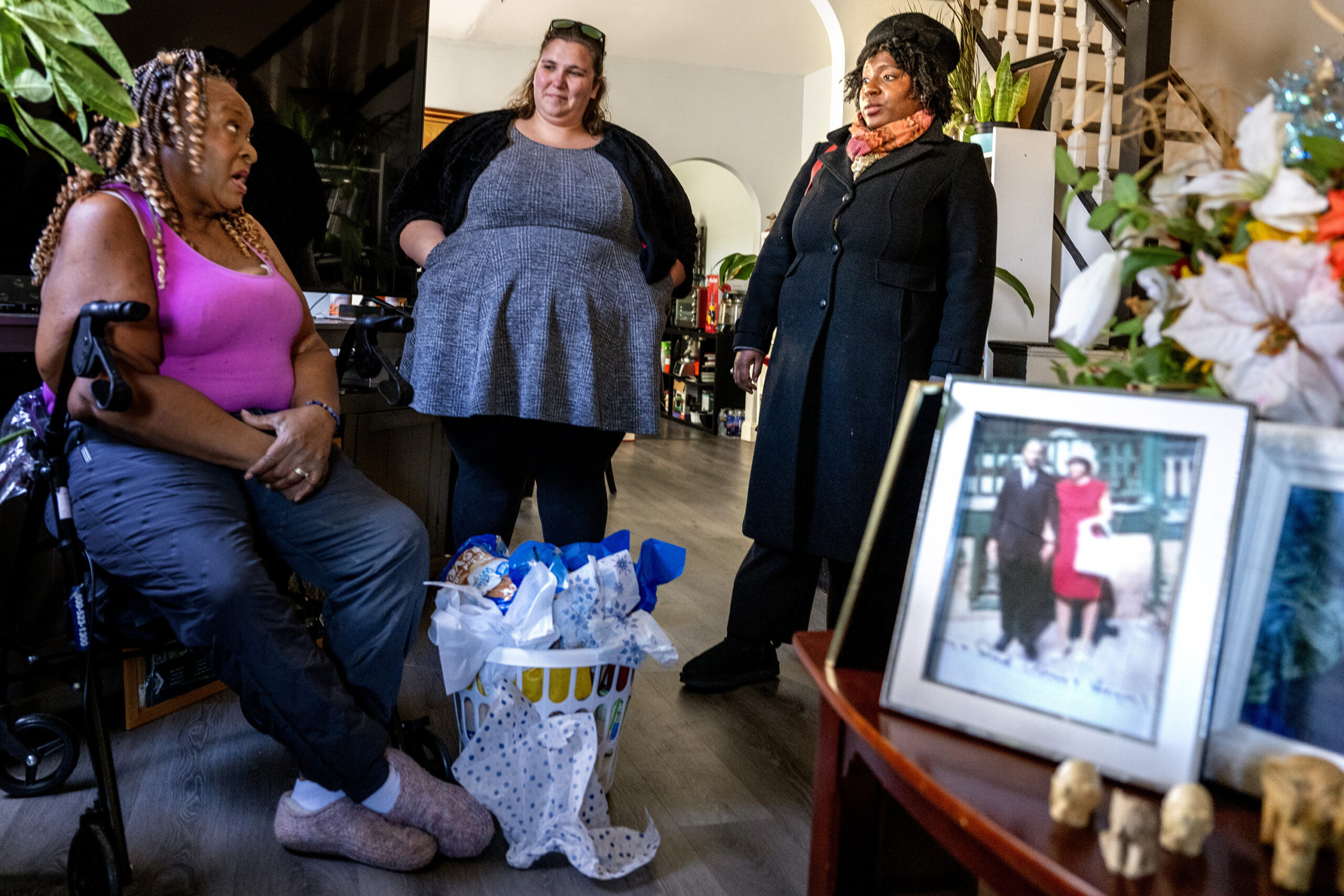
House Speaker Joanna McClinton (center) with her staff member Nicole Reigelman (left) and home care worker Kate McNaughton (right) wait to meet with home care recipient Ronda Gay on Jan. 20 in her West Philadelphia home. McNaughton was bringing a basket of milk, eggs, canned foods, and other necessities.
McClinton said she helps her mother when she can, but she only has so many hours in the day and needs assistance when she’s at the Capitol.
“Many of my colleagues are just like myself, supporting parents who are aging and trying to make sure that they have all the necessities so that when I’m in Harrisburg I’m not thinking, ‘Oh, my God, how’s my mom going to eat or how’s she going to have a bath,’” McClinton said. “It’s because of home health aides and the folks assigned to her that she’s able to thrive. But she’s not unique.”
Until recently, McClinton had taken a more hands-off approach compared with some previous House speakers who would use their position as the top official to push through their personal agendas. Now, she is taking a more active role in pushing for the issues she cares about most, with special attention to the home care wage crisis.
Home care workers are often paid through Medicaid, which provides health services to low-income and disabled Americans and is administered at the state level. Pennsylvania has not increased how much it reimburses home care agencies, resulting in all of the surrounding states paying higher wages to home care workers, including GOP-controlled West Virginia and Ohio.
Describing her leadership approach with a slim majority as “pragmatic,” McClinton says her goal is to find common ground to raise the wages for home healthcare workersbetween Republicans and Democrats, on an issue that impacts residents across all corners of the state.
“We just have to really coalesce and build a movement so that we see things get better and that there’s more care,” she said. “Because when there’s more care, there’s less hospitalization, there’s less ER trips, there’s more nutrition.”
Better pay at Sheetz
Stakeholders recount dozens of similar stories of aides leaving to work at amusement parks, Sheetz stores, orfast-food restaurants because the pay is better. What’s more: Some home health aides will choose to work in a nearby state where wages are all higher than those paid in Pennsylvania.
Cathy Creevey, a home health aide who works for Bayada in Philly, made $6.25 when she started working in the field nearly 25 years ago. Now, she makes just $13.50. She has watched countless colleagues quit to take higher-paying jobs elsewhere, resulting in missed shifts and seniors that go without the care they need.
“We have patients that are 103, 105, and when that aide doesn’t show up their whole world is turned upside down because sometimes we’re the only people that they see to come in, to feed them, to bathe them,” Creevey said.
While Creevey said she stays in the work because she cares about her patients, she said the long hours and low pay are difficult.
Fewer and fewer people being willing to take on the jobs means seniors going without care or being forced intoalready understaffed nursing homes throughout the state.
“Participants are waiting for care that isn’t coming,” said Mia Haney, the CEO of the Pennsylvania Homecare Association.
Haney said she hoped McClinton’s advocacy will help drive the issue heading into the next budget season.
“She has a wonderful opportunity to really influence her peers, but also raise awareness and education about how meaningful and critical these services are,” Haney said.
In addition to McClinton’s advocacy, 69 House Democrats sent a letter to Gov. Josh Shapiro earlier this month, calling for more funding for the struggling industry just as Shapiro is set to make his 2026-27 budget proposal next month.
Older Pennsylvanians prefer to “age in place,” or stay in their homes where they remain connected to their communities, said Kevin Hancock, who led the creation of a statewide 10-year strategic plan to improve care for the state’s rapidly aging population.
“Nursing facilities and hospital services get a lot of attention in the space of older adult services, but it’s home care that really is the most significant service in Pennsylvania,” Hancock said. “The fact that it doesn’t seem to warrant the same type of attention and same type of focus is pretty problematic.”
House Speaker Joanna McClinton (right) meets with home care worker Rachael Gleisner (center) and home care recipient Sheila Alexander in her West Philadelphia home on Jan. 20.
Home care remains popular in Pa.
The fight to increase dollars for home care workers has been an uphill battle in Harrisburgeven with the speaker’s support.
More Medicaid dollars go to home care services than any other program in Pennsylvania due to its popularity among Medicaid recipients, Hancock said. Meanwhile, its critical care workers — a majority of whom are women or women of color — still make low wages for often physically and emotionally demanding work.
A study by the Pennsylvania Department of Human Services last year determined that a 23% increase would be necessary for agencies to offer competitive wages, but the state’s final budget deal did not include it. (The final budget deal did provide increases to direct aides hired by patients, which represent about 6% of all home care workers in the state.)
Home care agencies are asking Shapiro to include a 13% reimbursement rate increase in the 2026-27 budget, which equates to a $512 million increase for the year. The 13% ask, Haney said, was a “reasonable and fair” first step in what would need to be a phased approach to reaching competitive wages.
But neither Shapiro nor Senate GOP leadership has committed to any increases in the forthcoming budget.
Pennsylvania House Speaker Joanna McClinton listens as Gov. Josh Shapiro delivers his budget address to a joint session of the state House and Senate at the State Capitol on Feb. 4, 2025.
In a statement, a spokesperson for Shapiro said the governor understood the need and cited his support for limited increases in last year’s budget and for a proposed statewide minimum wage increase to $15 per hour. (Previous efforts by the Democratic House to increase the state’s minimum wage have stalled in the GOP-controlled Senate.)
Senate Majority Leader Joe Pittman (R., Indiana) said his caucus will put the state’s “future financial stability” before all else. Pennsylvania is expected to spend more than it brings in in revenue this year, setting the stage for yet another tense budget fight.
“While we’ve seen Democrats continually push for more spending within the state budget year after year, any increases require thoughtful consideration as to the impact on hardworking taxpayers of Pennsylvania,” Pittman added.
Senate Majority Leader Joe Pittman, a Republican from Indiana County, is joined by other GOP Senate leaders criticizing Gov. Josh Shapiro’s proposed budget last year.
McClinton, however, was cautiously optimistic that something could be done this year, even as she placed the onus on Senate Republicans, rather than Shapiro.
“We’ve seen Republicans refusing to work, refusing to resolve issues, that’s not acceptable,” McClinton said. “I’ve seen an unwillingness from Republicans to resolve these issues.”
Republicans, she said, should come to the table because staffing shortages harmed their constituents in rural Pennsylvania even more than it harmed hers in Philly.
“We have to get our heads around the fact that we have the lowest reimbursement rates in our area,” McClinton said in an interview after visiting two patients in her district. “We have to make the investment now. We have lots of needs. We have lots of priorities, but we can balance them.”
Independent and unaffiliated voters were left off Chester County’s poll books in November’s election due to human error exacerbated by insufficient training, poor oversight and staffing challenges in the county office, an independent firm has concluded.
In November, more than 12,000 Chester County voters were forced to vote by provisional ballot after the county included just registered Democrats and Republicans in the poll books for the general election. Every voter who wanted towas able to cast a ballot, county officials said, but it resulted in a chaotic scene and the county had to issue an unusually high number of provisional ballots — which require more steps to cast and count.
On Thursday, the county released a 24-page report from a West Chester law firm detailing how the county failed to include more than 75,000 registered voters in its general election poll books, and evaluating the state and county’s response as it scrambled to ensure those voters could cast ballots.
“Importantly, our investigation found no evidence of intentional wrongdoing, misconduct, or bad faith on the part of any of the employees who generated the Poll Books. The error was inadvertent and occurred in the course of performing assigned duties under significant time constraints,” the report, prepared by Fleck, Eckert, Klein and McGarry LLC, said.
“Though the initial selection constituted a human error, the investigation found that the error occurred within a system lacking in: (i) sufficient safeguards, (ii) training, (iii) sufficient supervision, and; (iv) verification controls,” investigators added.
What’s next in Chester County?
The firm’s report detailed more than a dozen recommended steps for the county and Department of State to take to prevent future errors.
In an action plan released Thursday, Chester County officials said they intend to abide by the vast majority of those recommendations, as well as additional steps identified by the county’s Chief Experience Officer.
Chester County Chief Executive Officer David Byerman said in a statement that the recommendations would be completed within a year, with the most critical steps coming ahead of May’s primary election.
The action plan included improved training and more strenuous review processes, reevaluation of Voter Services staff levels and pay, and a review of human resources policies in the department. It did not include personnel changes within its Voter Services Department.
The 25-person department has faced unusually high turnover among staff in recent years, losing 29 employees to resignations, firings and transfers since the current director, Karen Barsoum, took over in 2021.
Barsoum has faced allegations of fostering a toxic work environment, which Thursday’s report acknowledged. However, the firm concluded that those complaints were not connected to the poll book error and said in its report that employees directly connected to the poll book blunder spoke positively about department management.
“Moreover, the various causes of the Poll Book issue that we have identified do not appear to have any causal nexus with the types of concerns raised,” the report said.
How did the error happen?
According to the report, two employees inadvertently chose the wrong selection of Chester County voters when they used the statewide voter roll software to create November’s poll books. Those employees, the report said, were inexperienced and had never been formally trained on the system they were using. While the employees had a copy of written training materials from the Department of State, the report noted that they worked with “little direct supervision” for their level of experience.
After the wrong set of voters were chosen — leaving off third party and unaffiliated voters — the report said no one in the department checked the books until a poll worker noticed the problem shortly before polls opened on Election Day.
The report noted the department’s high turnover, which it said could be the result of the high-pressure environment of election-related work and Chester County’s low pay compared to surrounding counties. That turnover, the report said, created “increased operational risk” which contributed to the error.
Following the incident, the county said it will review staffing and pay levels for the office as well as its human resources policies.
“We know that working in elections is an extremely difficult job – one that involves long hours and many personal sacrifices,” Byerman said. “We are truly grateful for the commitment and dedication of the staff in Voter Services, and want to ensure that we are doing everything we can to provide the resources, tools, and support they need to be successful in their roles.”
The department, the county’s action plan said, will also establish additional approval checks for poll books and other procedures that impact all Chester County voters.
County officials also said they intend to improve training for the department, including working with the Pennsylvania Department of State to implement formal training on the state’s voter roll system.
“The Department always stands ready to assist counties with training of employees on the [Statewide Uniform Registry of Electors] system and other aspects of election administration and is happy to engage Chester further to improve its training process,” the Pennsylvania Department of State said in a statement.
The agency added that its ongoing effort to modernize the statewide voter roll system will include checks and alerts for unusual poll book configurations once completed.
Chester County is scheduled to hold a public meeting Tuesday evening to present its plan to the public. If the forecasted winter storm closes county offices that day, the meeting will be postponed to Feb. 3.
A Pennsylvania Republican state senator doubled down Thursday on remarks denigrating Philadelphia, despite backlash from prominent Philly Democrats.
“Philadelphia wouldn’t be such a shithole” if District Attorney Larry Krasner prosecuted more crimes, StateSen. Jarrett Coleman, a Republican from Allentown, told Fox News on Wednesday.
Asked to elaborate Thursday, Coleman cited Philadelphia’s crime rates, which are higher than the national average.
“My statement stands. The people of Philadelphia deserve better,” Coleman said in a written statement.
“Now just imagine the outcry if I, a Democrat from an urban area, said exactly the same thing about a rural area?” U.S. Rep. BrendanBoyle, a Philadelphia Democrat, posted to X Thursday morning. “But I wouldn’t because I believe all in our society are of equal worth and deserve our respect.”
Coleman’s comments came in a broader piece in which he threatened to use a Senate committee he chairs to push back against Krasner and Philadelphia Sheriff Rochelle Bilal if they interfered with President Donald Trump’s administration’s immigration enforcement.
Coleman criticized the Philadelphia officials Wednesday, narrowing in on Krasner, a progressivewho has been a frequent target of Republican ire since he was first elected in 2017.
State Sen. Tony Williams, a Democrat from Philadelphia, echoed Boyle’s criticism and demanded an apology from Coleman, arguing the senator’s comments had degraded not just Philly but the country.
“He should unfortunately be ashamed of the manner in which he described Philadelphia,” Williams said.
“I have that part in me as well, I just don’t think it’s productive in these times to add fuel to the fire of stupidity,” he added.
State Sen. Nikil Saval, a Philadelphia Democrat, said he would be happy to give Coleman a tour of Philly, which he described as “safe, connected, vibrant.”
“The biggest threat to the safety of Philadelphians is the chronic underfunding perpetuated by Pennsylvania Senate Republicans,” he said.