Ashley Morton stopped posting the hours on the door of her Mayfair boutique. There’s no point, she said. It’s impossible for the business owner to hold consistent opening times when her son is one of Philadelphia’s best high school basketball players. There always seems to be a game or tournament for the mom to attend.
“My customers say, ‘Is the store going to be open?’ I say, ‘Sorry, we got a game’,” Morton said. “So we just do pickups now. People can order online and schedule a pickup. It just became too much.”
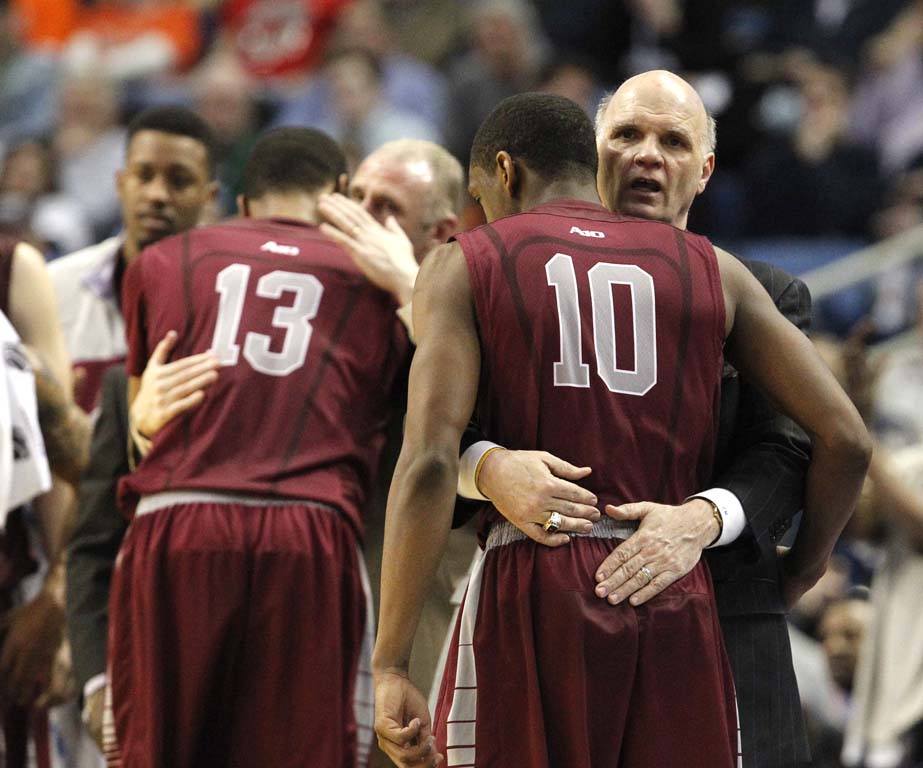
That’s the price you pay when your son — Father Judge’s Derrick Morton-Rivera — is a win away from a second straight Catholic League boys’ basketball title.
“I’m just going to wait until everything is completely finished,” Morton said. “Then we’ll open back up.”
The mom opened Ashley’s Kloset 12 years ago after a dress she made with a Wal-Mart sewing machine and a $2 piece of fabric from Jo-Mar received attention on social media. Morton was self taught — “I went on a wing and a prayer,” she said — and figured it out. She had enough of her job at a men’s suit store and decided to do her own thing. So her mom helped her launch the business in Olney before it moved to Mayfair.
“My mom said, ‘We’re going to get you a store,’” Morton said. “Mind you, I don’t have any money. My mom doesn’t have any money. I’m like, ‘How are we going to get a store?’ Don’t you know she came up with that money and found me a store.”
She put a basketball net in the back of her store for her son, who seemed destined to be a hooper ever since he dribbled a ball when he was just 10 months old.
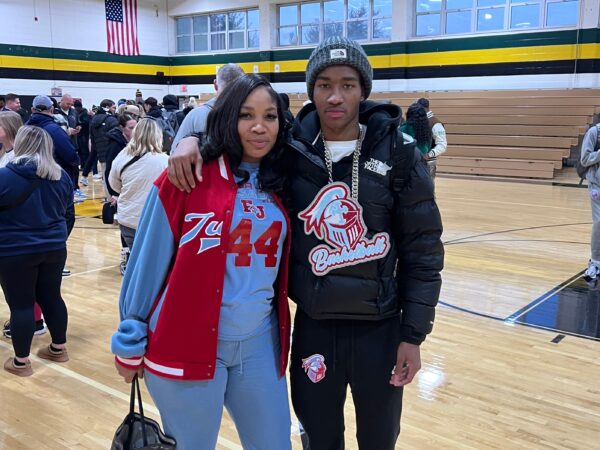
Derrick Morton-Rivera and his mother, Ashley, after his first ever basketball game.
“My mom dropped the spaghetti,” Morton said. “She was cooking ground beef and she was like, ‘Oh my god.’ He was bouncing the ball before he could even walk. You know how they have that little wobble? The ball was bouncing while he was off and then once it stopped bouncing, he fell.”
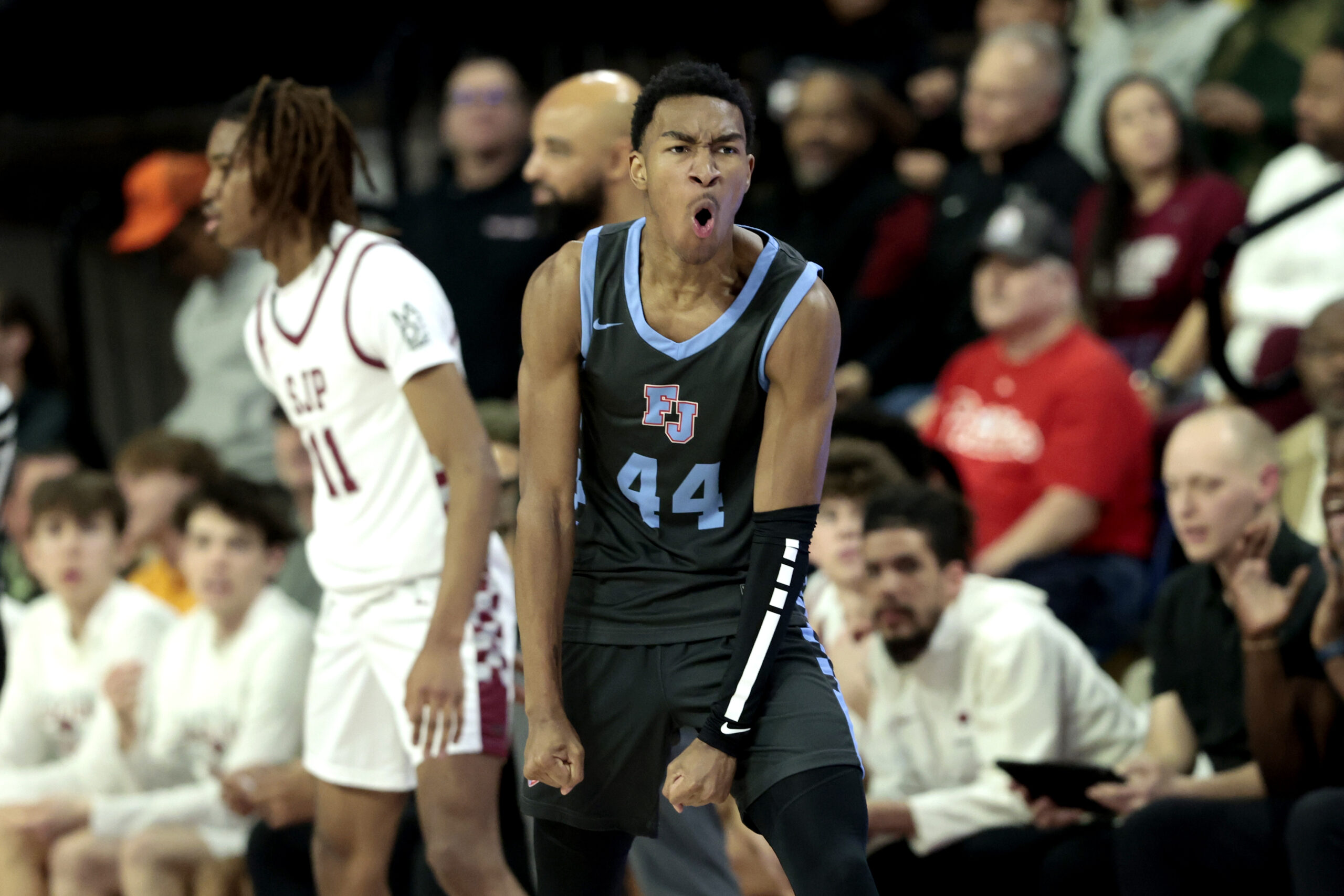
The son is signed to play at Temple and showed why on Wednesday night when he willed Judge back from an early 16-point deficit against Archbishop Wood in the semifinals. He scored 27 points and had the 9,000 fans at the Palestra in the palm of his hand.
Morton was not trying to shape a basketball player when she opened her store. But she did show her son everyday the hard work that comes with chasing a dream. Perhaps that prepared him to chase his own.
“My mom is always working,” said Morton-Rivera. “The only time she really takes off is to see me play. Knowing how hard she works, makes me work even harder.”
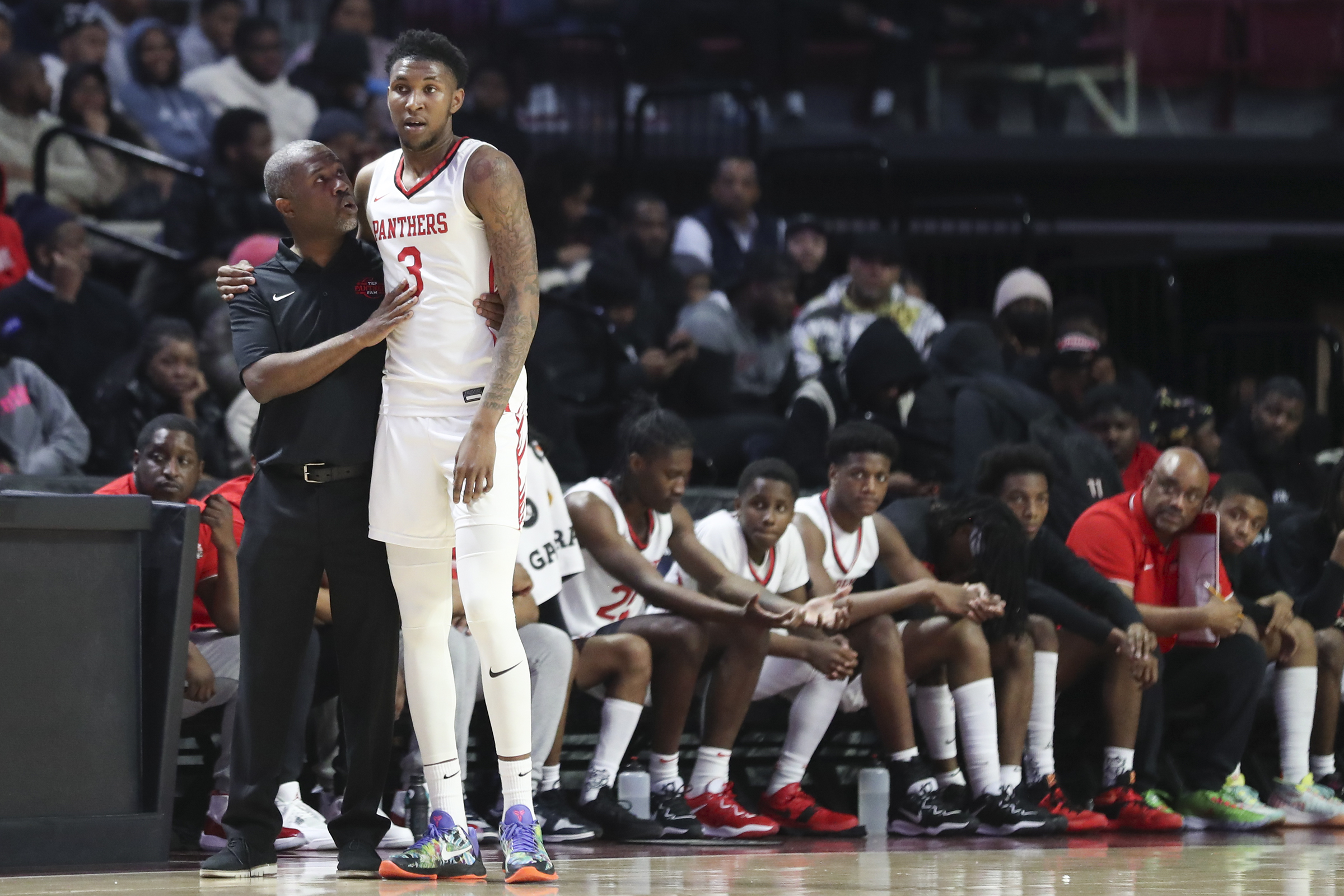
Derrick Morton-Rivera, who will try Sunday to win a second straight Catholic League title, is signed to play at Temple.
The Potato State
Customers asked Morton about her shop’s hours in the summer and she said she had to first check the AAU schedule.
“I don’t have a schedule,” she said. “I just have his. This is going to be the first summer without it. I don’t know what I’m going to do with myself.”
She traveled with her son to basketball tournaments throughout the country, crossing off states she never dreamed of visiting.
“What’s the Potato State? Idaho,” she said. “It was the most boring place ever. Even their downtown was a ghost town. But we can say we’ve been to Idaho, you know what I mean?”
Morton poured everything into her son, even the hours of her own shop. She had help, too. If Morton works late, her mother stops by to cook dinner and do the laundry.
“She even washes my clothes,” Morton said as it took a village to raise a basketball star.
Morton designs and sews all of her own women’s clothing in the ALM Collection, specializing in plus sizes and fashion for taller women. She does enough online orders — the shop ships around the world, she said — that she can close the doors to watch basketball.
Something that started on a whim has grown into a full-time operation. The mom willed her dream into existence.
“I remember one time he was like, ‘Mom, all you do is work.’ And I started crying,” Morton said. “Because he doesn’t know what I’m working for. Every time he turned the light on, the light came on. Anything he asked for, I was able to provide. He’s like, ‘Alls I see is the back of your head because you’re just sewing all the time.’ I said, ‘Mir, you have to understand.’ Now, I think he gets it.”
Derrick Morton-Rivera’s mom owns a boutique in Mayfair, Ashley’s Kloset.
‘Mom, just calm down’
The crowd at the Palestra roared as Judge mounted its comeback on Wednesday. And the fans will be even louder on Sunday when Judge plays Neumann Goretti. But Morton-Rivera, whose father, D.J. Rivera, won a Catholic League title at Neumann Goretti, plays like he can’t hear anything. He handles the frenzy of a sold-out arena the same way he does when Chick-fil-A forgets his sauce.
“I’m like, ‘They forgot the sauce,’” Morton said. “And he’s like, ‘Mom, just calm down. Relax. Ask her for it.’ He calms me down. He inspires me to have patience, be humble, and just breathe.”
The kid who watched his mom spend hours behind the sewing machine seems just as fixated on the basketball court. He followed his dad to gyms as a kid and always found time to work on his shot.
Judge’s coaches organized a practice Friday afternoon but that wasn’t enough for Morton-Rivera, who stayed in the gym with a few teammates for another 90 minutes. Like mom, he’s always working.
“It’s just about ‘How bad do you want it?,’” he said. “We have a lot of guys on our team who want it. Even if they’re tired, they’ll stay after practice to get their shots up. Those are the little things that show when the game starts.”
His mom signed him up to play when he was 3 years old as he was tall enough to play with the 6-year-old kids at the Lawncrest Rec Center. They told the parents to make sure their kids came with a drink. So Morton sent her son with a Capri Sun pouch.
The mom figured it out. It was the start of her son’s basketball journey, one that felt so rapid as he started to dunk as a teenager and played in the Potato State. And now he has a residency at The Palestra with a college scholarship secured.
“My sister was like, ‘Ash, that’s really your son,’” Morton said. “And I say, ‘Yes, it is.’ It’s just been so amazing. I’m so proud of him.”
Judge’s basketball season could extend another month if it marches deep into the state playoffs. Until it’s finished, Morton’s business will be online only.
“I’m getting my inventory ready to be fully stocked,” Morton said.
The Imhotep Charter boys’ basketball team was in Boston a few years ago for a tournament when Andre Noble told his players that they were in his hometown.
“I said, ‘Wait. What?’” said Ebony Twiggs, whose son, Justin Edwards, was one of Imhotep’s stars. “I just thought he always lived here. I didn’t know he wasn’t from Philly.”
Noble reminded Twiggs of the people she knew from West Oak Lane. He had been at Imhotep for more than 20 years. And he was one of the city’s premier high school basketball coaches. He fit in. Of course he was from Philadelphia.
Noble, who can win a sixth straight Public League title and 13th overall on Sunday when Imhotep plays West Philly High, is one of Philly’s all-time coaches.
Unlike the rest, Noble didn’t spend his teenage summers playing at places like Chew, Tustin, and Myers. He didn’t win CYO titles, ride the trolley to watch doubleheaders at the Palestra, or find himself within six degrees of separation from someone who played on the 1954 La Salle basketball team.
Philadelphia has produced great players, coaches, and even referees. And the high school coaches, especially the ones who have won at the rate Noble has, often grew up here. They played for the city high schools, perhaps even stayed for college, and remained a tight-knit crew who stayed home to teach the game.
Speedy Morris still lives in Roxborough, Dan Dougherty was from Olney, Bill Ellerbee grew up on Uber Street, and Carl Arrigale is as South Philly as slowly driving past a stop sign. The guys on the Mt. Rushmore of Philadelphia high school coaches are from the neighborhood who coached kids like them.
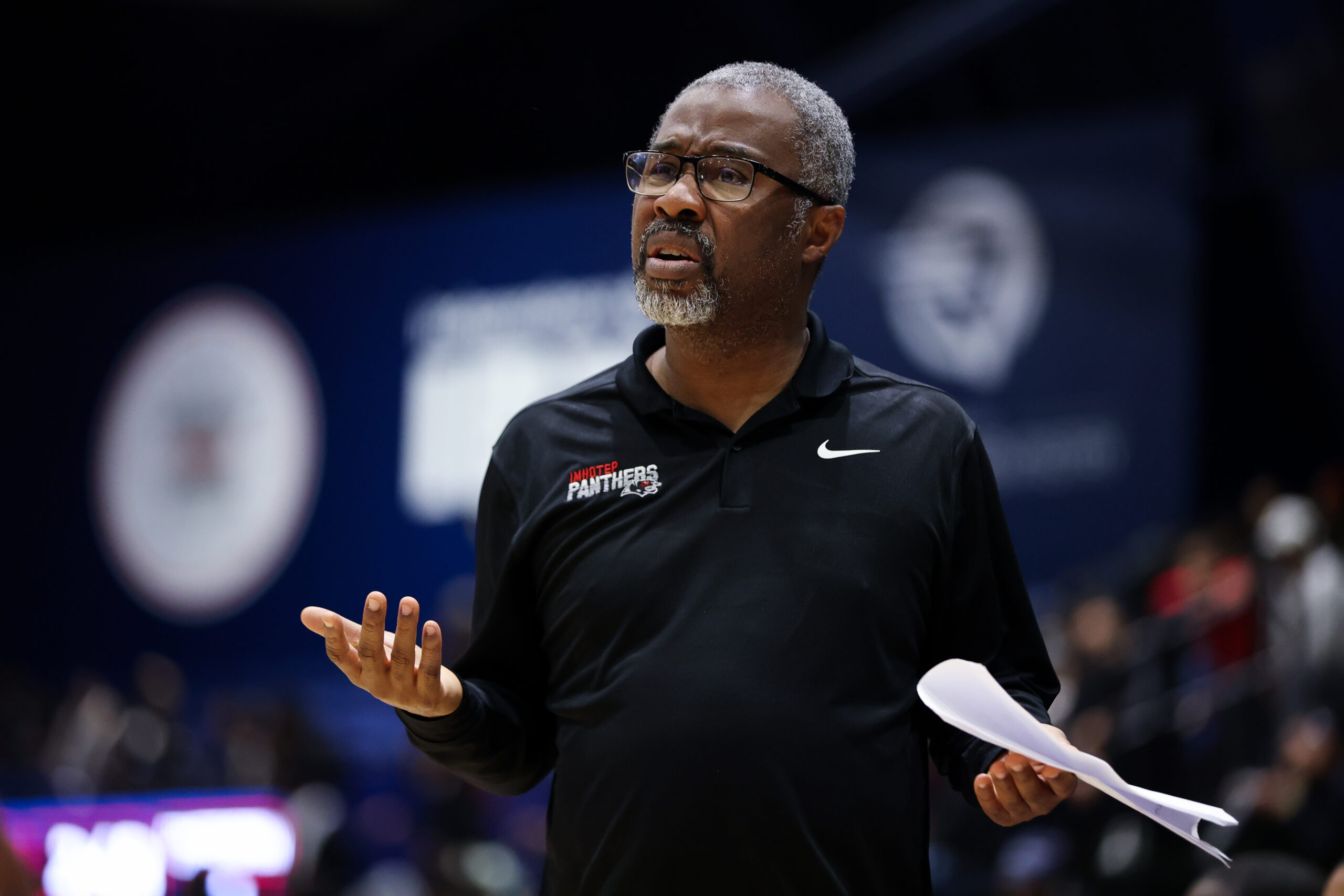
Andre Noble has been at Imhotep for 20 years, but his hometown is Boston.
But Noble grew up in Boston’s Mattapan neighborhood and didn’t even play high school ball. He came to Philadelphia in 2000 after graduating from Lincoln University and taught math at Imhotep, which did not yet have an athletic program.
Noble planned to stay in Philly for a year before moving on. His plans changed, he stayed, and Imhotep became a basketball powerhouse.
The guy from Boston did what seemingly has never been done: become a great Philly high school coach as an outsider.
“I think by the time everyone figured out I wasn’t from Philly, it was too late,” Noble said. “The ball was already rolling down the hill. But I’m definitely a Philly basketball guy. It’s important to me.”
A special guy
Imhotep didn’t have a basketball team when Noble arrived. The school didn’t even have a building.
“We called them modulars, but everyone else said, ‘Yo, that’s the trailer school,’” said Noble, who is now the school’s CEO.
Two students in his algebra class — Briscoe Chew and Marlon Mills — told Noble at the end of the school year that they were transferring. Noble was stunned. Why? Imhotep doesn’t have sports, they told him. So Noble launched a basketball team and kick-started a league with the city’s other charter schools.
Noble didn’t have a playing background to lean on, so he picked the brains of coaches in the area. Rap Curry, Greg Dennis, and Clyde Jones became his mentors. He was on his way. His plan to leave Philly after a year was spoiled, so he began to scour the city for players. He watched games at youth programs in North Philadelphia and hung at playgrounds, hoping he could fill a roster at Imhotep.
“I knew he was from Boston, but then I started seeing him at 25th and Diamond or 33rd and Diamond,” said Kamal Yard, who runs Philly Pride, one of the city’s premier AAU programs. “I’m like, ‘Bro, what are you doing down here? Do you know where you’re at?’ But he was in the mix. He was in the hood. He was in the projects. Nobody goes to the back of the projects at 25th and Diamond, but he did it. He was meeting the kids. That was his intro to Philly, and he was onto something. He got immersed into it.”
Yard met Noble years earlier when they were both students at Lincoln. Yard played ball and Noble watched from the stands. The future coach was studying, Yard said. When students complained about the food in the cafeteria, Noble led the charge as a member of the student government. He led a boycott, filed a petition, called the state, and ordered a review.
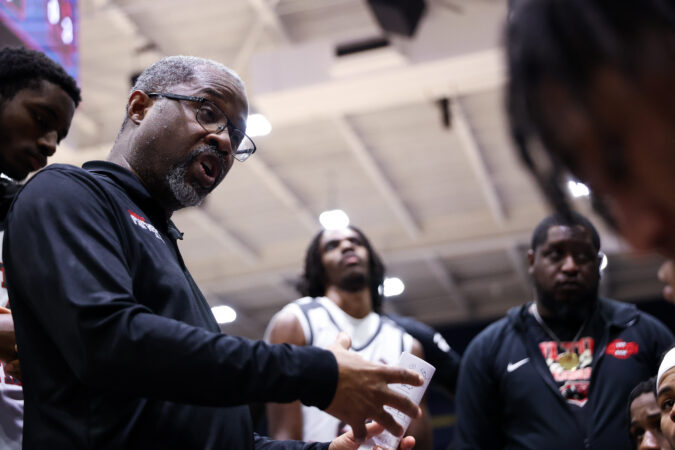
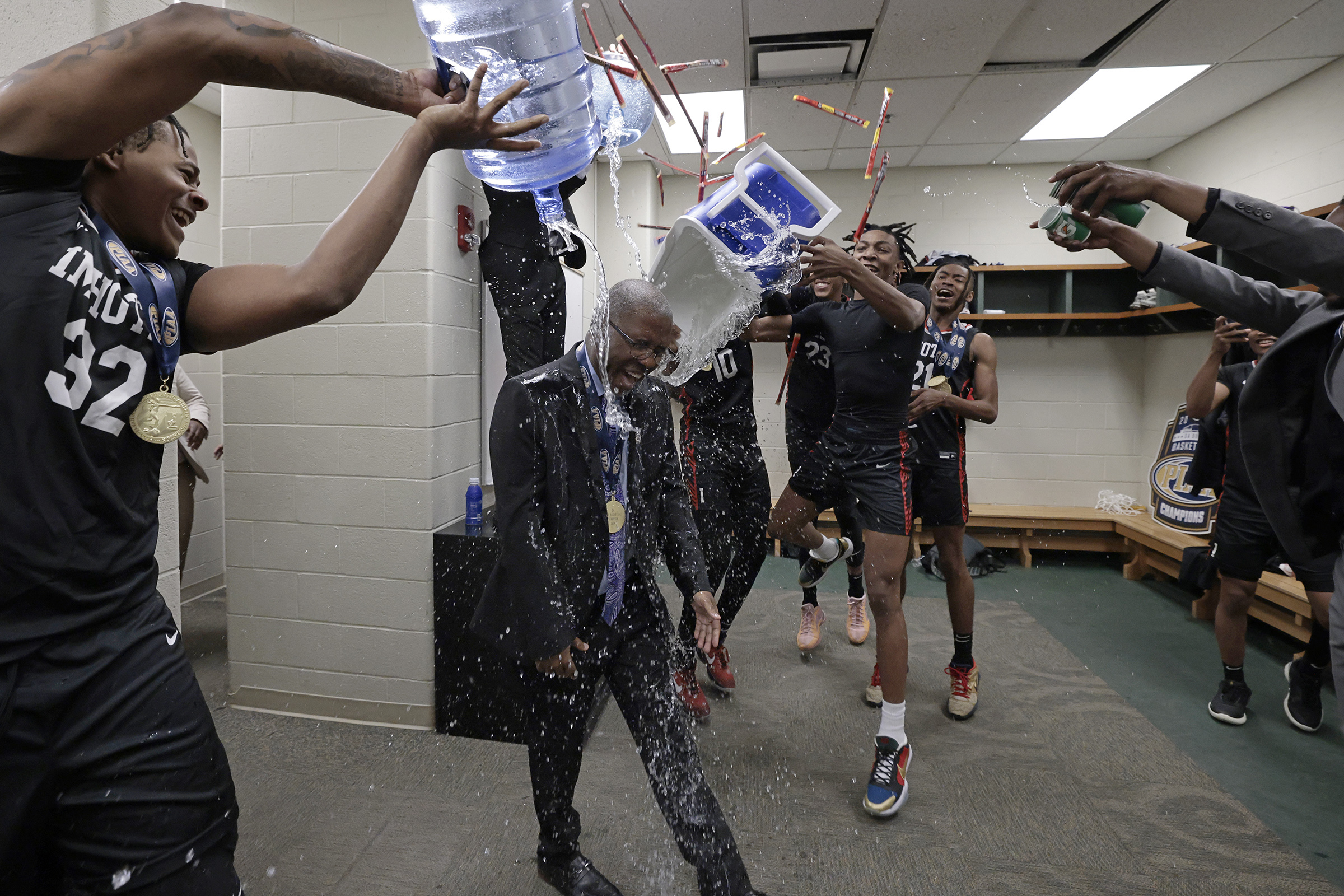
Imhotep players soak head coach Andre Noble after winning PIAA Class 5A boys basketball championship in 2024.
“You blinked and, man, we had a whole new menu,” Yard said. “But the whole point was that he was always about other people. So watching this transition, it’s no surprise. He’s a giver of people. He doesn’t look like a tough guy because he’s mild-mannered, but there’s a lot of toughness and resiliency in that frame. He’s as tough as they come.
“Brother Andre will go into the lion den with a tiki torch and a sword to go help a kid. He might come out scratched up, but he helped his kid. That’s Brother Andre.”
The Panthers, waiting for their gym to be built, practiced at a nearby recreation center and a middle school. It wasn’t ideal, but it worked. Imhotep won the Charter School league before moving in 2004 to the Public League. Five years later, Noble’s team won it all.
The Boston guy had built one of Philly’s finest teams.
“He’s a special guy,” said Fran Dunphy, the quintessential Philly coach. “The biggest asset he brings is just his genuine goodness. He treats the kids well, but there’s no question that he has an accountability for them and needs them to pay attention. They all seem to buy in. He’s remarkable for me.”
A teacher
Noble was a junior in college when he thought about how he was the only kid he grew up with preparing to get a degree. He wondered, how did that happen? And then he thought about his mom, a single parent who worked as an office manager and raised her sons — “Two knuckleheads,” Noble said — in a tough neighborhood.
“I called her and thanked her,” Noble said. “I knew it was that little lady who I thought was crazy but provided the foundation. She was a stickler, a disciplinarian. It was her way or the highway, ‘Hey, this is what you’re doing.’”
It was a big deal when Noble secured admission to the Boston Latin School, a prestigious school near Fenway Park. But his mother asked him to think about it before she sent in his paperwork. She asked her son, would he take his studies seriously? Would he be ready to work hard? Can he commit himself? Noble said he would.
Years later, he found out that his mom already had sent in the paperwork. But Della Noble wanted her son to feel a sense of ownership in his decision. She believed her son could do it. And now Noble empowers and supports the kids at Imhotep the same way his mom did. If a kid on his team wants to visit a college, Noble often is driving the car. If a kid has a problem in school, Noble’s door is open.
Imhotep’s Andre Noble (left) shown with Justin Edwards during the 2023 Public League championship game against West Philly. Edwards now plays for the Sixers.
“You realize that there’s way more important things in life,” Noble said. “If we can get them to be the best young men we can be, then the rest of their lives will be meaningful. There’s so many things you can teach through basketball.”
Becoming one of Philly’s all-time coaches is about more than just breaking a press or drawing up an inbounds play with seconds left. Noble proved that an outsider can do it, too.
“There’s a trust that he has with his players that we all try to search for in relationships with the kids,” Dunphy said. “I think he’s found that secret. To be honest with you, I don’t know if I ever sat down with him and said, ‘Yo, what is your secret?’ I think he would be so humble, and he’d say, ‘I don’t know. I’m just being myself.’ It’s what makes mentorship so important to all of us. You have to be there for the young people.”
Noble has surrounded himself with a crew of assistant coaches who grew up in Philly. He has embraced the city’s basketball history and has now spent more time here than he did in Boston. He’s an adopted Philly guy.
Charles “Shoob” Monroe, who organizes an annual showcase game for the city’s top high schoolers, said Noble knows more about old-school Philly basketball than people who actually lived here. No, he’s not from Philly. But Noble became a part of it.
“Someone always knows someone or knows someone who knows someone,” said Arrigale, who could win his 13th Catholic League title on Sunday when his Neumann Goretti squad plays Father Judge. “He didn’t really have that experience because no one played against him and things like that. But he’s been around long enough that he knows everyone now. He’s had a pretty good run over there.”
A father figure
Twiggs’ son now plays for the Sixers but once was a teenager who didn’t clean his room or finish his homework. And when that happened, Twiggs knew to call the guy from Boston.
“Justin would come home and be like, ‘You told on me,’” Twiggs said.
Twiggs, a single mother who worked two jobs to keep her son’s dream alive, said Noble was like “a father figure” to her son. He wasn’t from Philly but that was OK.
“Justin lacked that growing up,” Twiggs said of a male role model. “Having Brother Andre and the whole coaching staff just be so hands on with Justin took a lot of stress off for me.”
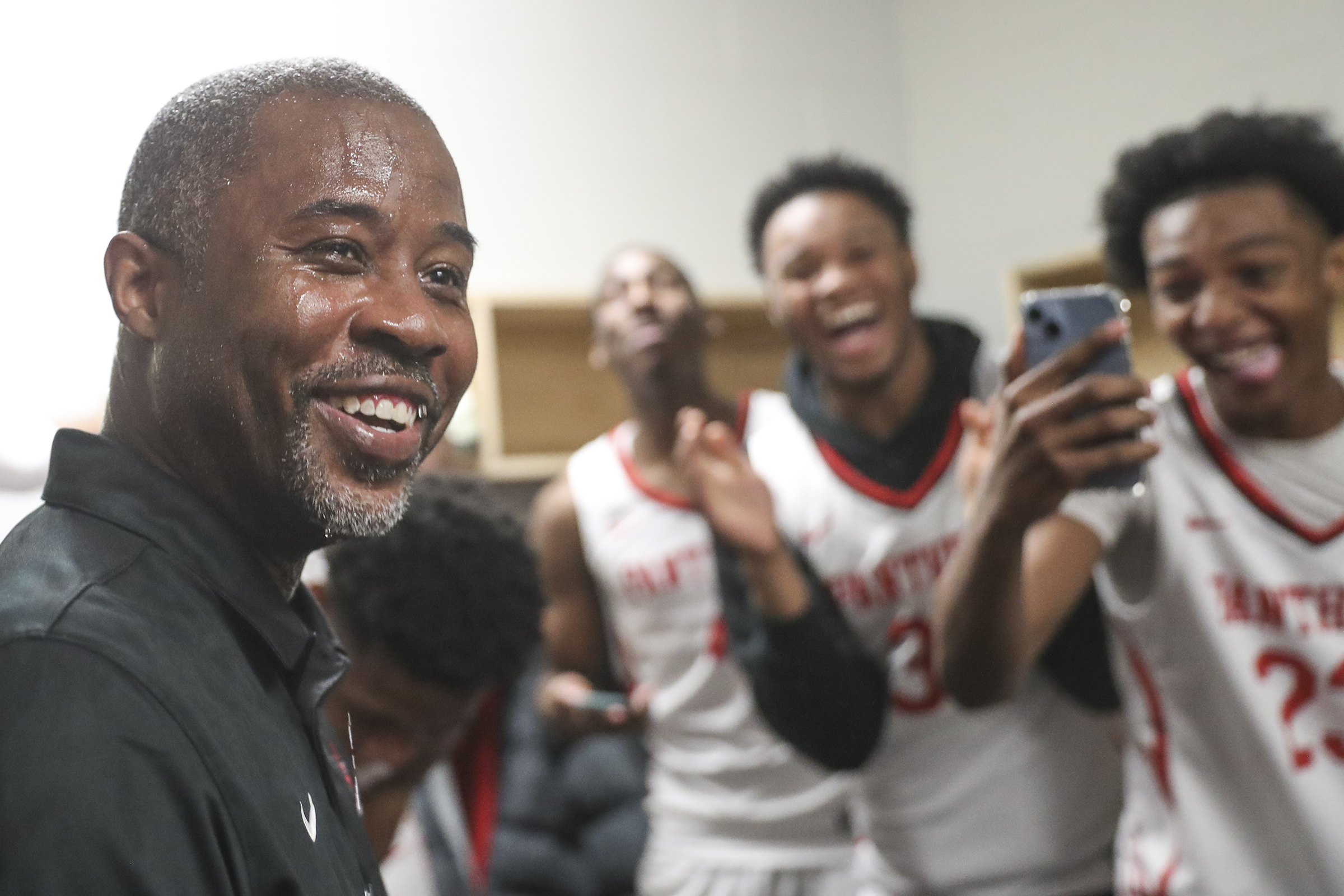
Andre Noble has enough accolades to coach in college. He’s instead decided to stay at Imhotep.
Edwards is one of the many players Noble coached who moved onto a Division I program. By now, the coach who didn’t play high school ball has enough accolades to coach in college. He’s instead decided to stay at Imhotep.
A few years ago, Mills’ son, Timmy, graduated from Imhotep. He brought his son to see Noble and tell the story about how two students triggered Noble to start a team. It was true, Noble said. And that helped the guy from Boston find a home in Philly.
“I love what I get to do,” Noble said. “I love the school. I love serving this community. I don’t see myself anywhere else. I don’t rule anything out, but if I have the opportunity to coach and lead at Imhotep until the rest of my career, that would be a blessing. The one-year plan definitely didn’t work out. I failed in that.”
Carver Engineering & Science’s buzzer-beating attempt to overturn a ban from the Public League boys’ basketball playoffs was swatted away on Tuesday as a common pleas court judge denied the team’s plea for an emergency injunction.
The Engineers seemed to be on track to play Tuesday night in the Public League semifinals until last Thursday’s quarterfinal game was halted after opposing fans ran onto the court. E&S led Constitution by 12 points with 1 minute, 11 seconds remaining when the referee called off the game.
A skirmish started when a Constitution player shoved an E&S player. The situation spiked when fans — the referee said they were from Constitution’s bleachers — stormed the court and moved toward E&S players. The reserves from E&S then left the bench and walked onto the court. There were no punches thrown by players from either team.
The Public League ruled that E&S, despite being 71 seconds from advancing, would forfeit the game since its entire bench entered the court, which league president Jimmy Lynch said is a violation of the league’s unsportsmanlike conduct policy. The league’s rules say that a team must forfeit once their “entire bench” enters the field of play.
Constitution was awarded a 2-0 victory and a berth in the semifinals.
E&S argued that its players only came onto the court after opposing fans did first and were there to make sure their teammates were safe. An appeal to the league fell short on Sunday night so they went Tuesday afternoon to City Hall to take its case in front of judge Christopher Hall, hours before Constitution played Imhotep Charter at La Salle.
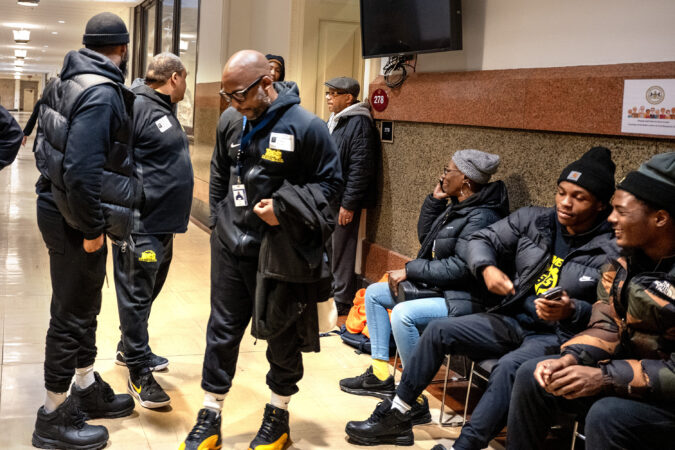
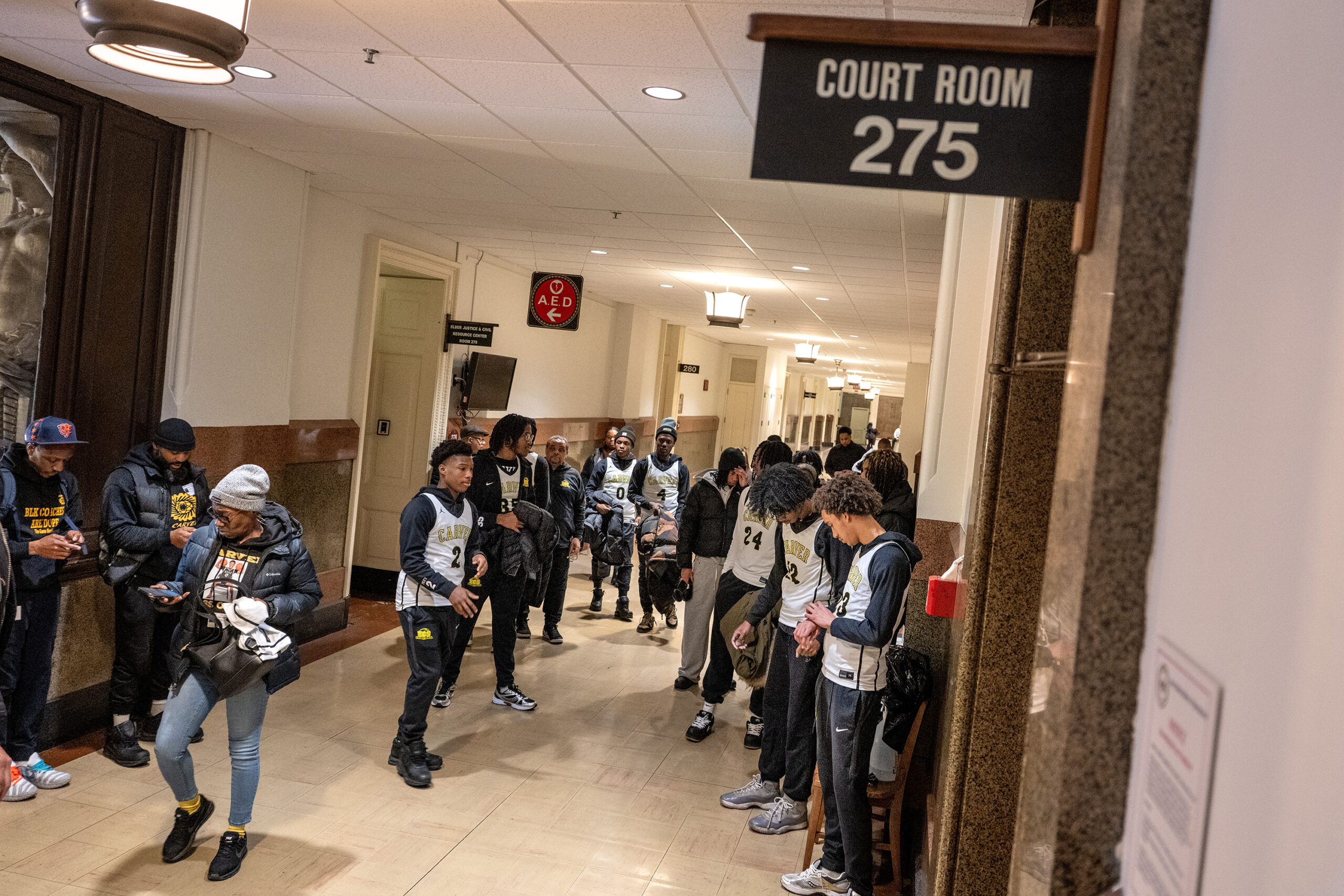
Carver Engineering and Science High School players and coaches wait outside courtroom 275 on Tuesday.
The E&S players wore their uniforms to court and were joined by coaches and alumni. They asked for an injunction to stop Tuesday night’s semifinal and allow them to play Imhotep Charter later this week. A lawyer presented their case.
“Finding a lawyer to argue this in 24 hours was extremely difficult,” said Miya Brown, a mother of an E&S player. “It was not an easy task. We didn’t even start off with all the proper information. We didn’t have the ref’s statement. They did. We didn’t have the full report. They did. We started off at a disadvantage. But the lawyer tried. The judge pretty much explained to the boys that while this is a harsh reality for us, that when you file an emergency injunction, it has to be that this decision causes irreparable harm and damage.”
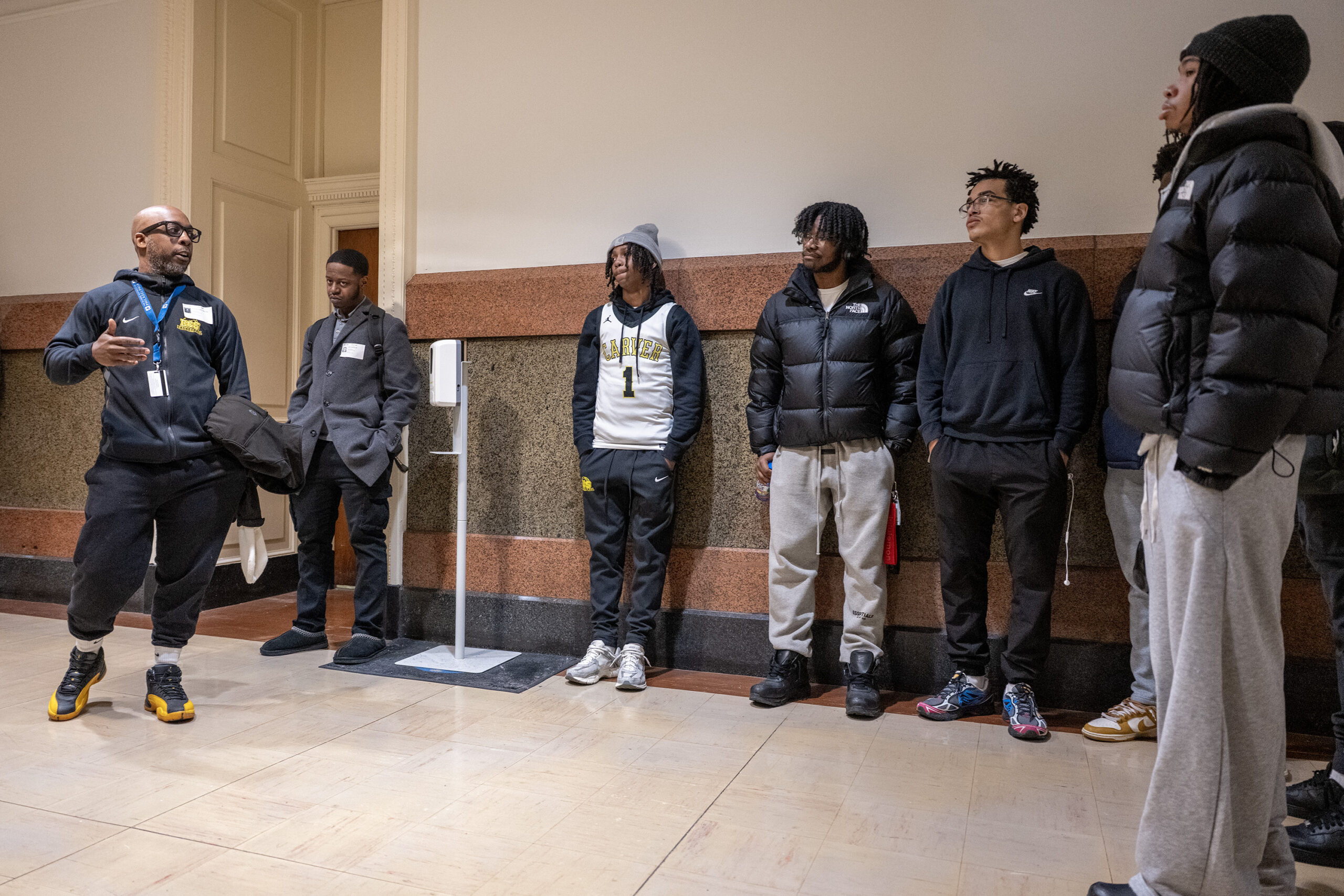
Carver Engineering and Science head boys’ basketball coach Dustin Hardy-Moore (left) talks with his players outside courtroom 275 on Tuesday.
E&S will continue its season later this month in the PIAA District 12 tournament but its bid for the school’s first Public League title ended in City Hall Room 275.
“It’s just a disservice,” Brown said. “Not just for this game but for the safety of the athletes. What are you teaching? What is the Philadelphia Public League representing when it comes to the safety of the student athletes? Our student athletes are still disappointed but we’ll continue to encourage them and continue to support them. We’re going to get them ready for states.”
The boys’ basketball players from Carver Engineering & Sciences who left the bench last week came onto the court after fans from Constitution’s stands rushed the court and surrounded their teammates, according to a report by one of the game’s officials that was submitted to the School District of Philadelphia.
The referee said the altercation in Thursday’s Public League playoff game was started by a player from Constitution, who the ref said pushed the E&S player as the E&S player walked away.
“Then I saw a crowd of people from the [Constitution] spectator area of the bleachers running towards those two players,” the referee wrote. “So, I gradually backed off because I didn’t know what was coming next.”
What came next was the reserves from E&S leaving the bench. They “eased onto the court,” the ref said. And that was enough for E&S to be suspended from the league playoffs.
The Engineers were ahead by 12 points with 1 minute, 11 seconds left when an altercation started by an opposing player was inflamed by opposing fans. And now that opposing team is taking E&S’ place on Tuesday against Imhotep Charter in the Public League semifinals at La Salle University.
Representatives from E&S met Sunday night on Zoom with Jimmy Lynch, the Public League president. Lynch told them the ruling stood. League rules say that a team must forfeit once their “entire bench” enters the field of play.
The PIAA told E&S that the decision stood with the school district. A school district spokeswoman said Monday that the decision would not be changed. Lynch could not be reached for comment.
The representatives from E&S did not argue that their players left the bench but they were hoping that the rule could be applied with the context of the situation: the players came onto the court to protect their teammates once their teammates were surrounded by spectators. The E&S players did not throw a punch or look to fight, the parents said.
“If our students engaged in the on-court incident we would’ve had penalties and suspensions,” said Miya Brown, a mother of an E&S player. “But because we avoided the confrontation, we have been disqualified from continuing on. All of this is so disgusting. It really is. The mission is supposed to be about student safety but they’re ignoring the safety part of this incident.”
“If this brawl happened at the opposing team’s end of the bench and our student athletes ran to the other end of the bench, I could understand. If this happened on center court and our student athletes left the bench, I could understand. But this happened in front of our bench and the crowd is running toward our student athletes. There is no way you can make a just decision based on those facts. It got out of control.”
E&S did not practice Monday but remained hopeful that something would change before tipoff of Tuesday’s semifinal. That seems unlikely.
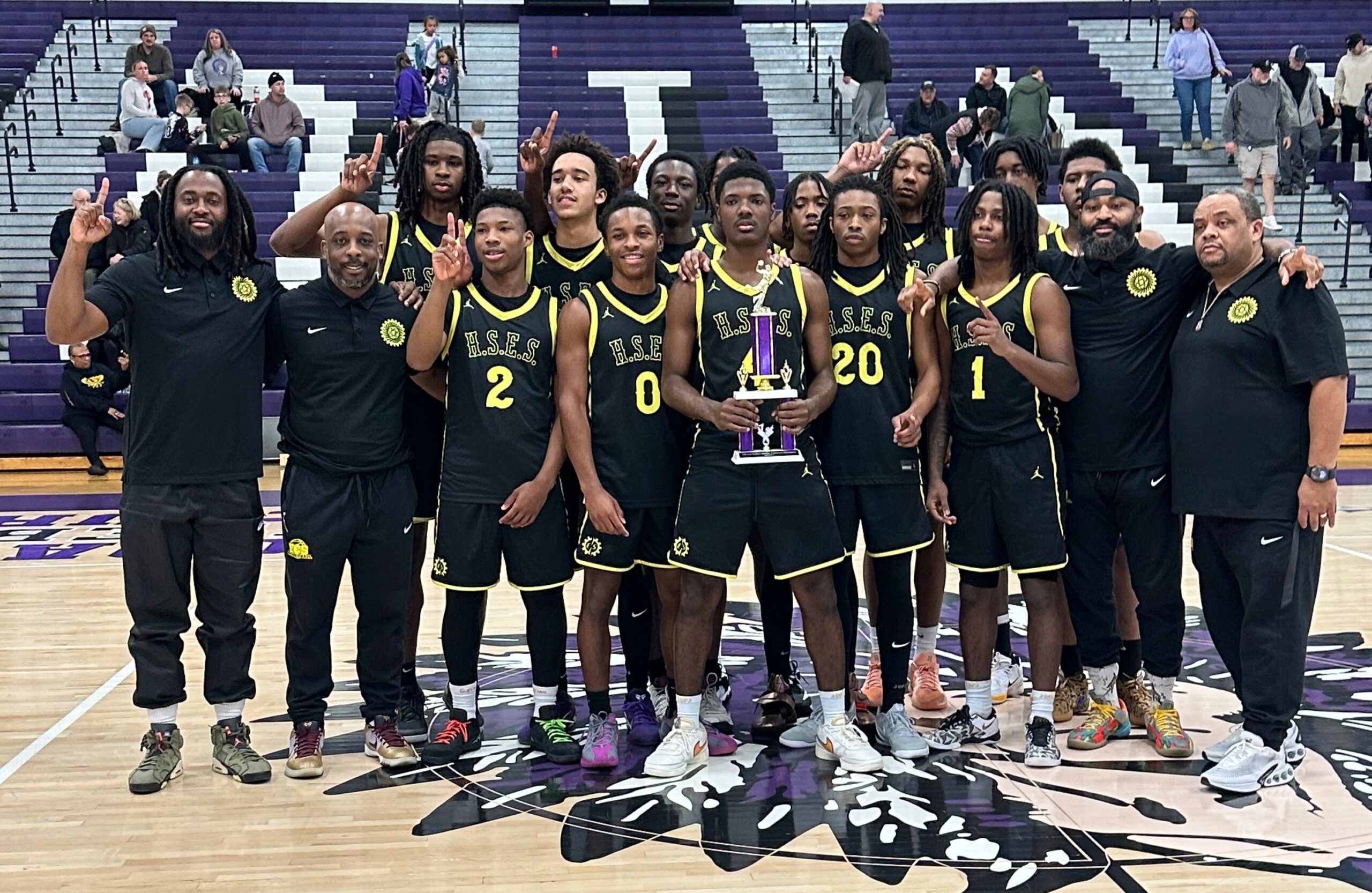
The Carver Engineering and Science boys’ basketball team after winning a tournament earlier this season.
The Engineers were 20-4 this season before the forfeit became their fifth loss. They won a tournament in Northeastern Pa. and took Imhotep — the defending league champions — to overtime in January before losing. They wanted another shot.
“That’s the matchup everyone wants to see,” said Dave McField, a father of an E&S player.
The referee said he asked during the first quarter for security guards to be placed near the Constitution fans because “they were being unruly.” At halftime, he told E&S’ athletic director that he needed more security. He said a security guard stopped the game in the third quarter to warn the fans but the guard did not stay in the area.
“So when everything jumped off,” he wrote. “Those same unruly fans rushed the court.”
The referee said he planned to eject the Constitution player from the game “because he started this chain of events” and “was the only player I saw push or hit any opponent.” The referee stood in the corner of the court as fans overtook the floor. E&S was 71 seconds left from reaching their first league semifinals in 20 years. Instead, their season was about to end.
“I glanced at the [Constitution] bench area where I saw the head coach next to about five of his bench players,” the ref wrote. “At that time, I called the game and walked off.”
Miya Brown was in the crowd Thursday afternoon when a rush of fans stormed the court, surrounded the teenage basketball players, and put a stop to a Public League boys’ basketball playoff game.
She watched her son — a senior captain at Carver Engineering & Science — leave the court and protect his sister, one of the team’s student managers.
“It was terrifying,” Brown said.
The incident started with a Constitution player going nose-to-nose with an E&S player during a stoppage with 1 minute, 11 seconds left in the fourth quarter. Host E&S was ahead, 61-49, and closing in on a trip to the league’s semifinals.
The E&S player raised his hands and walked backward, attempting to de-escalate the situation. The Constitution player followed him before shoving him. By then, two players from Constitution had left the bench and walked onto the court. Fans soon ran onto the floor, and the E&S players left the bench to join their teammates.
No punches were thrown by players from either side, and the situation eventually settled down. The game ended with 71 seconds left. So did the season for E&S.
The Public League disqualified E&S from Tuesday’s semifinal since its entire bench went on the court, which league president James Lynch said is a violation of the league’s unsportsmanlike conduct policy.
Constitution won the game on a forfeit and will play in the semis against Imhotep Charter. Representatives from E&S met Sunday night with Public League officials, who said they would not change the ruling.
“A fair decision should have been made,” Brown said. “If you can’t determine that we were not at fault and we won’t proceed, then no one should proceed. This teaches teams that if you can’t compete, you cheat. That’s not the way to teach these student athletes.”
The league’s rules say that a team will be suspended for the following game if its “entire team leaves their bench area and steps onto the field of play during an incident.” A player will be suspended, but not the team, if he leaves the bench.
Lynch said “several” Constitution players will be suspended for Tuesday’s game. But E&S is challenging the ruling as it said the situation was no longer “a basketball game” once fans ran onto the court and caused an unruly scene.
“The kids didn’t come off the bench when it was just the kids going back and forth,” said Dave McField, a father of an E&S player. “When they saw the mob of fans coming at their teammates, that’s when they came onto the court out of fear to get their teammates to safety. None of the kids were in a fighting stance or throwing punches. They’re very good kids. We’ve never been in this type of situation.”
The game was tense before the incident as players from both teams were issued technical fouls in the first quarter.
“As far as officiating goes, that was the only attempt to get control of the game,” said Nande Hardy, a relative of E&S coach Dustin Hardy-Moore.
The Carver Engineering and Science boys’ basketball team has a 20-5 record this season.
Brown said the referees failed to “keep the temperature of the game at bay.” The final stoppage was a whistle for a foul on Constitution, and the referees did not step between the two players jostling on the court. The situation soon unraveled.
“To look around and see the faces of the parents because they are worried about their kids on the court and the kids in the stands are worried about their safety,” Hardy said. “You have kids running on the court with hands in their jackets and grown adults running onto the court. We had no idea where this thing was going to go.”
The teams met earlier this season, with E&S winning by five points. The players played together in the summer on the AAU circuit, and this was a game with big stakes: a chance to go to the Public League Final Four at La Salle University.
“They worked so hard in the spring and the winter and then for it to end like this is a tragedy,” McField said. “It’s unfair, very unfair. At the least, if we don’t get to go, they shouldn’t get to go. All of the kids are kind of let down. They’re in a shock like, ‘Well, how do they get to go?’ I could see if the game was close. There were 71 seconds left in the game with a 12-point lead and we had the ball. How do they get to go?”
The parents said they emailed Lynch about the ruling and hope it can be reversed before Tuesday. E&S, once a league power, has never won a Public League title, and this season was a return to relevance as the forfeit dropped its record to 20-5. E&S was eyeing a rematch with Imhotep, the perennial power that edged the Engineers last month in overtime.
“It was tough,” Brown said of the loss to Imhotep. “But we lined up, shook hands, said it was a damn good game, came back to the school, and worked on what we needed to do to continue to grow. That’s what we promote at Carver. No violence. We grow. We’ve lost plenty of games in the last four years, we’ve never tried to incite a fight or a riot or any unsportsmanlike behavior.”
McField said an assistant coach from Constitution said his team didn’t want to play Tuesday as it felt the spot belonged to E&S. Now, E&S hopes the league feels the same.
“We did absolutely nothing wrong,” Brown said. “And I say we as in students, coaches, and community. Our students stayed in the stands and our coaches instructed our kids to stay on the bench. But if you were in that audience and you saw the crowd of people swarm those kids, there’s no way that the decision that was made took into consideration that those student athletes feared for their safety.”
Carver Engineering and Science’s quest for its first Public League boys’ basketball title was halted after the Engineers were disqualified following a skirmish in Thursday’s quarterfinal game, where they were 71 seconds away from winning.
E&S led visiting Constitution by 12 points in the fourth quarter when a shoving match paused the game. Video reveals players from both benches staying on the sidelines before fans stormed the court and surrounded players.
The E&S players left the bench while the majority of Constitution’s reserve players remained on the sideline. No players from either team appeared to throw punches.
The game ended with E&S leading, 61-49, but they were later informed that Constitution would advance to Tuesday’s semifinal against Imhotep Charter. James Lynch, the president of the Public League, said the league reviewed the referee’s report and video footage before disqualifying E&S.
“Several players from Constitution have also been assessed suspensions due to their involvement in the incident,” Lynch wrote in an email. “However, the entire Carver E&S team leaving the bench is what resulted in the forfeit loss for that game according to the PPL Unsportsmanlike conduct policy.”
The league’s policy says, “if an entire team leaves their bench area and steps onto the field of play during an incident, the entire team will be ejected from the game, and will serve a one-game suspension for their next contest. The ejected team will be assessed a forfeit for the current contest, and will forfeit their next contest.”
Carver E&S has been disqualified and Constitution will play Imhotep Charter in the PPL final four.
E&S coach Dustin Hardy-Moore posted on social media that his team was disqualified despite “the opposing team and fans inciting a fight.” The coach, who could not be reached for comment, posted a screenshot that showed seven Constitution players on the court when the skirmish began.
“And our bench is still on the bench,” Hardy-Moore wrote.
The Inquirer also reached out to Constitution for comment on Friday, but did not receive a response.
Andrew Kuhn dropped the final score of Ancillae-Assumpta Academy’s seventh- and eighth-grade basketball game into the family group chat last month. He wanted to make sure his 16-year-old son Cole knew that 13-year-old Gavin played well.
The older son responded with an update of his own: a video of him throwing a 101.7-mph fastball.
“New Year’s resolution,” Cole Kuhn texted the family.
Kuhn went to St. Joseph’s Prep on a partial music scholarship — he has played the double bass since the fourth grade — and failed to make the JV baseball team as a freshman. Now he was showing his family that he could throw a fastball harder than most major leaguers.
The teenager from Elkins Park is one of the nation’s top high school pitchers with a scholarship to Duke University and is already being scouted for the 2027 Major League Baseball draft. He’s pitched in just a few varsity high-school games but a triple-digit fastball is enough for scouts to dream on.
And it all happened so rapidly; about as fast as the pitches the 6-foot-6 teenager fires from his right hand.
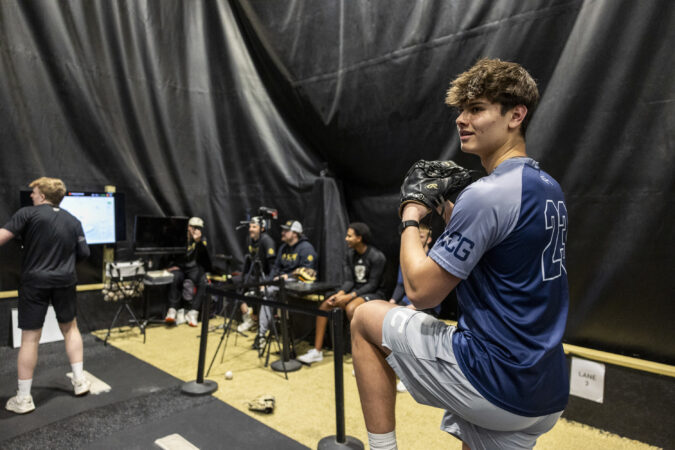
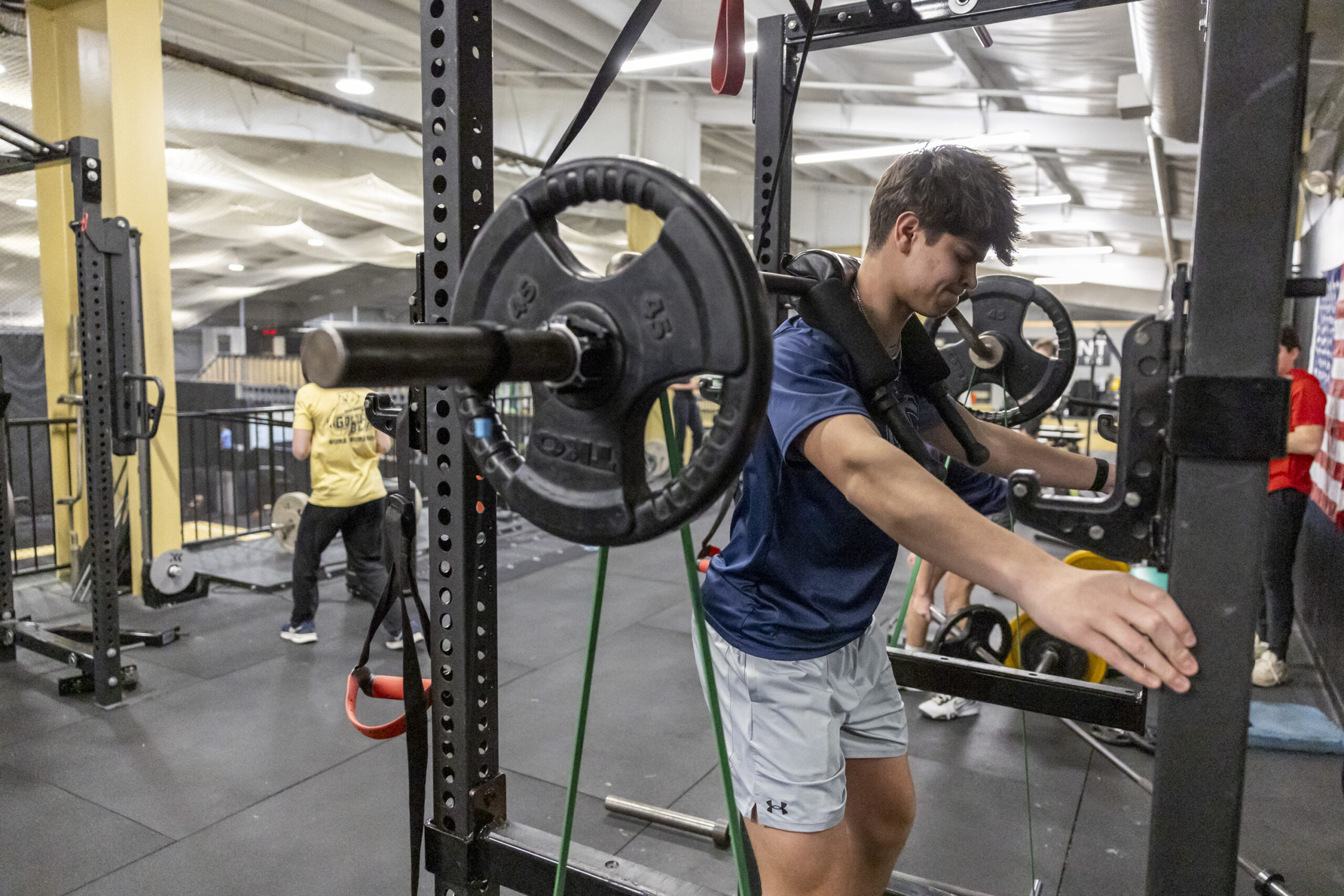
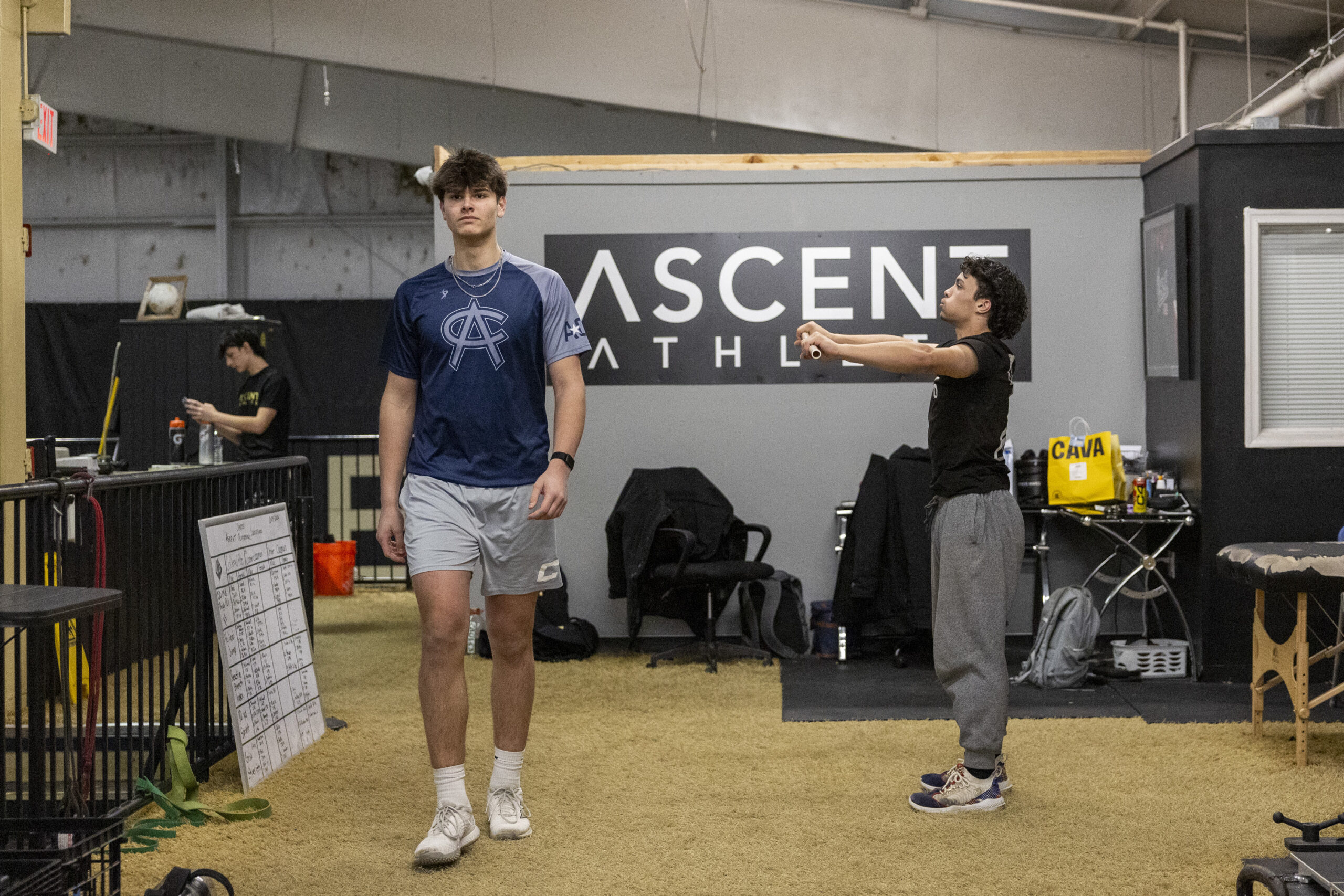
Kuhn was throwing 90 mph in January 2025 when he enrolled at Ascent Athlete, a training center in Garnet Valley that looks like a baseball laboratory. High-tech cameras measure Kuhn’s movements on the mound, a team of coaches studies his mechanics, and he learns in real time how many RPMs his fastball registers. Big league players work out in the morning before high schoolers filter in in the afternoon.
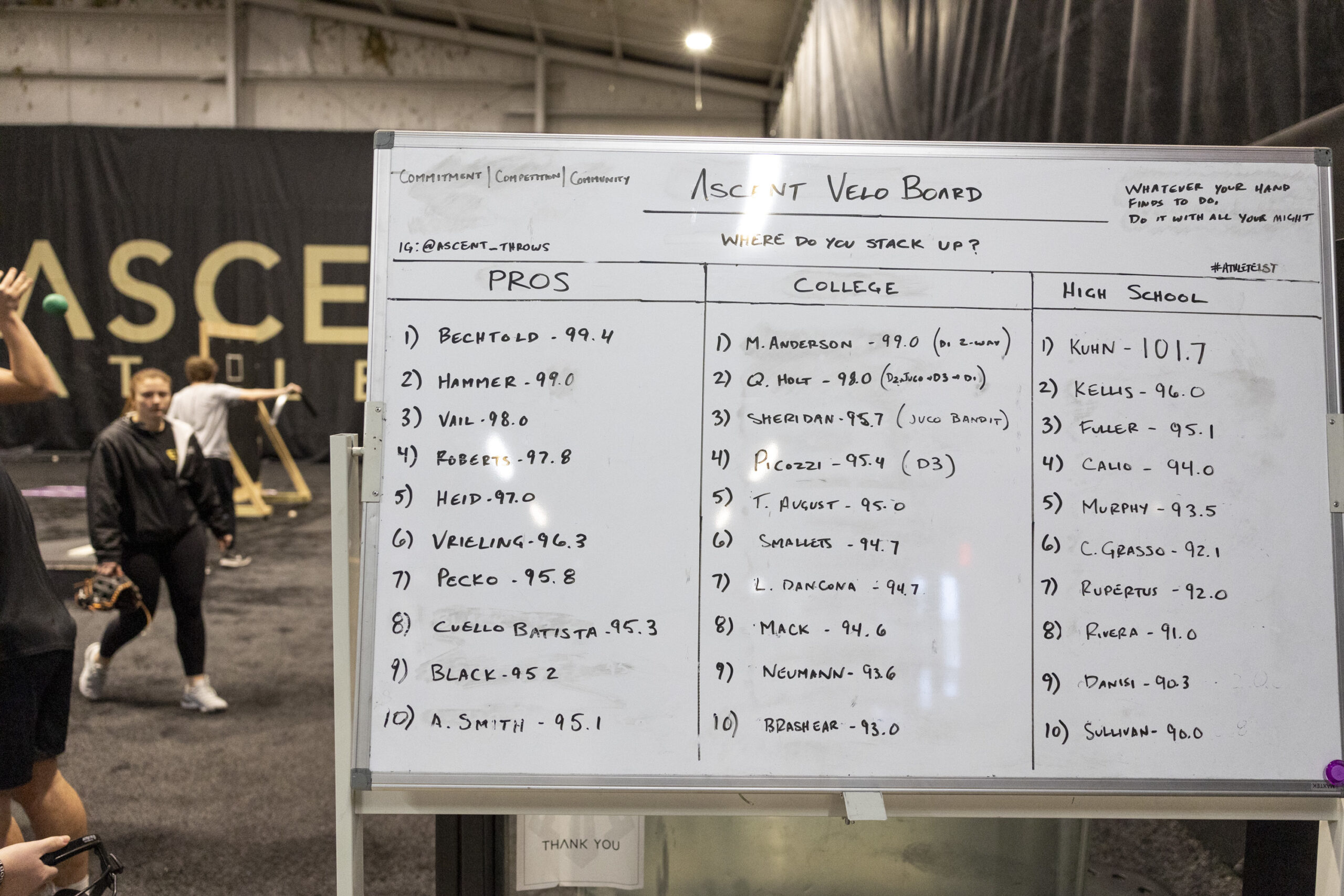
A fitness center upstairs is focused on plyometrics and a computer connected to the batting cages allows a hitter to see how his swings would fare in a big-league park. A dry-erase board near the entrance lists the fastest pitches thrown at Ascent divided into three categories: pro, college, and high school.
“Where do you stack up?” the board says.
A whiteboard shows the top pitching speeds at Ascent Athlete in Garnet Valley, with Cole Kuhn on top at 101.7.
Kuhn, first in the high school column by more than 5 mph, has the fastest pitch.
The facility is open six days a week and Kuhn is there nearly every day, often finding someone on Sundays to unlock the door when the lab is closed. His 101.7-mph fastball did not happen by accident.
“Without question, that place is the single biggest driving force behind his major jumps over the last eight months,” said Kuhn’s mother, Tonya Lawrence. “They’re comprehensive, they’re involved, and they know what they’re doing.”
Scott Lawler, the general manager of Ascent, called Kuhn “a unicorn.” Lawler, who played at Bishop Kenrick High in the 1990s, has never seen a high school arm like this. There is no denying the promise of Kuhn’s right arm, but he is also just a kid who does not yet have a driver’s license.
Andrew Kuhn picked his son up from a friend’s house after Cole threw that 101.7-mph fastball and shook his hand. Two years earlier, Kuhn was nervous to tell his father that he wanted to play winter baseball instead of freshman basketball at the Prep. His parents played college hoops and he thought he’d disappoint them if he didn’t play.
This was not their journey, Andrew told him. This was Cole’s. The son has led the way ever since as he charted his path to that fastball. Dad was proud.
“I said good job,” Andrewsaid. “Then that was about it. Then it’s get home, walk the dogs, have dinner. You’re not all that. You still have chores. Who knows? This whole thing might fall apart at some point. You have to be prepared. You’re not just a baseball player.”
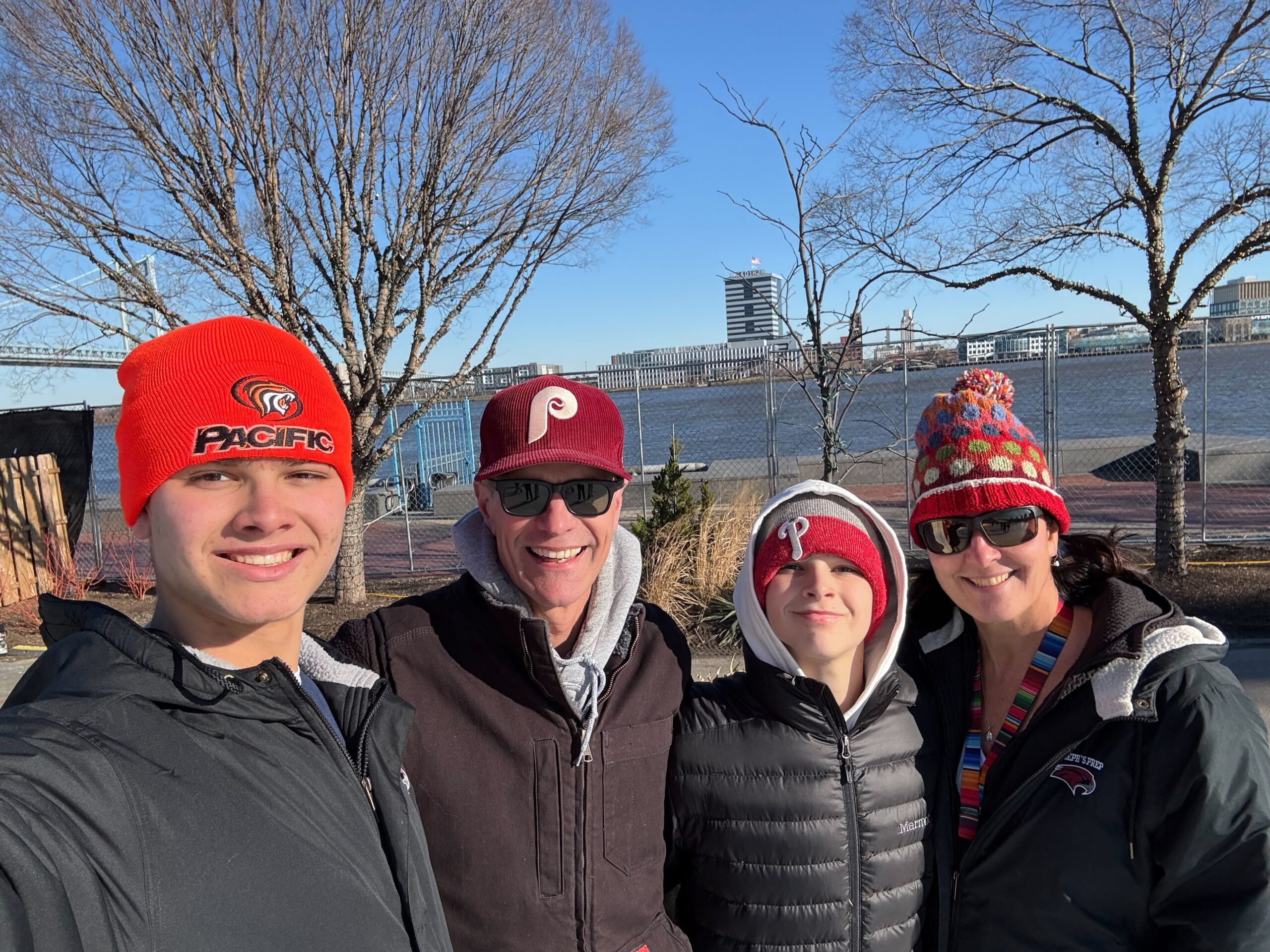
From left: Cole Kuhn with his father, Andrew, brother, Gavin, and mother, Tonya Lawrence.
Ballet to baseball
The letter in Cole Kuhn’s folder as a second grader at Myers Elementary School advertised a ballet class for boys in Jenkintown.
“He was always the kind of kid who if you said, ‘Do you want to try this?’ He would say, ‘Sure,’” Tonya said.
So they signed their son up for ballet at the Metropolitan Ballet Academy where the teachers were strict and timeliness was prudent.
“Six years later, it was clear that he benefited from it,” Tonya said. “Discipline, core strength, grace under pressure. This studio was serious. It was the real deal and we didn’t know that. It just came home in the afternoon packet.”
Kuhn started playing the piano in kindergarten, picked up the double bass in elementary school, and took six years of ballet. He played baseball in the spring, swam in the summer at a public pool, played soccer in the fall and basketball in the winter.
“We tried to get our kids to do everything and then decide what sticks,” Tonya said. “We believe that variety is good for the brain and the body and the mind.”
Andrew and Tonya never intended to build a baseball prodigy. But perhaps keeping him well-rounded — from ballet to baseball — helped Kuhn blossom into the pitcher he is now. He was 15 years old when his fastball reached 90 mph and Tonya said that moment was like an “epiphany” for her son. He now believed he could do this. Kuhn told his parents he wanted to focus solely on baseball.
“It’s not like we’ve been pushing him or somehow training him to hit 90 mph. It wasn’t even on our radar. It just happened,” Andrew said. “In the big picture, it’s really about exercise, friendship, and competition. Then, who knows? Hopefully it’s intriguing enough and interesting enough that kids want to stick with it. We want our kids to be well-rounded and respectful and to try their best.”
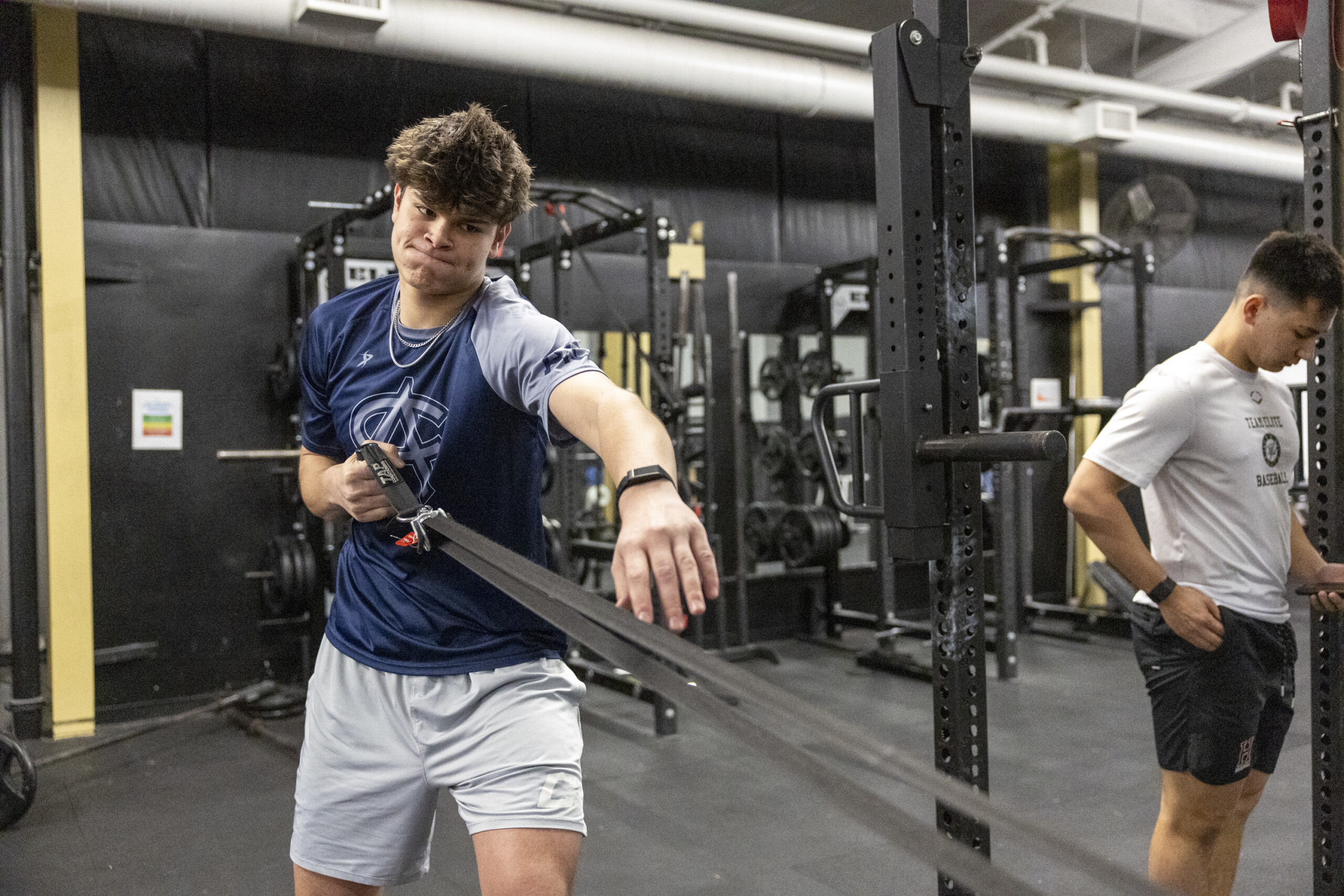
Cole Kuhn trains at Ascent Athlete.
Charting his path
Kuhn told his father last year that he wanted to train at Ascent after meeting Lawler at an event. Many of Kuhn’s Prep teammates were already there and the pitcher thought it was where he needed to be.
Lawler played minor-league ball and coached in college. Jeff Randazzo, Ascent’s owner, was a star at Cardinal O’Hara and is now an agent for major league ballplayers. They have a glistening facility and the connections a player needs to reach the next level.
“This whole world ties together between how you train, who you play for, and who you play in front of,” Lawler said.
Andrew said OK but told his son that he would have to inform his coach in Ambler that he was leaving.
“Ambler did so much for him so you can’t just send a text that you’re leaving,” Andrew said.
So Andrew stood with his son after the team’s final practice and listened to Cole break the news. Andrew played basketball at Franklin & Marshall and Tonya played hoops and lacrosse at Yale before playing basketball professionally overseas. They want their son to make his own decisions, which means working up the courage to explain to someone why you’re leaving.
“That was taking responsibility for the choices you’re making,” Andrew said. “He did it face-to-face. It was hard and emotional for him to leave, but he knew in his own mind that that was the path for him. Cole told him, ‘My dream is to get to MLB and I think the best path for me to get there is to switch to Ascent.’ I was like, ‘Oh, Cole. You sure you want to say all that to this?’”
Kuhn was paired at Ascent with David Keller, the facility’s director of pitching development. Keller pitched at Lock Haven University, where he delved into the data-driven methods that have overtaken baseball since the early 2000s. He put Kuhn on a throwing program and told him that his work upstairs in the weight room was just as important.
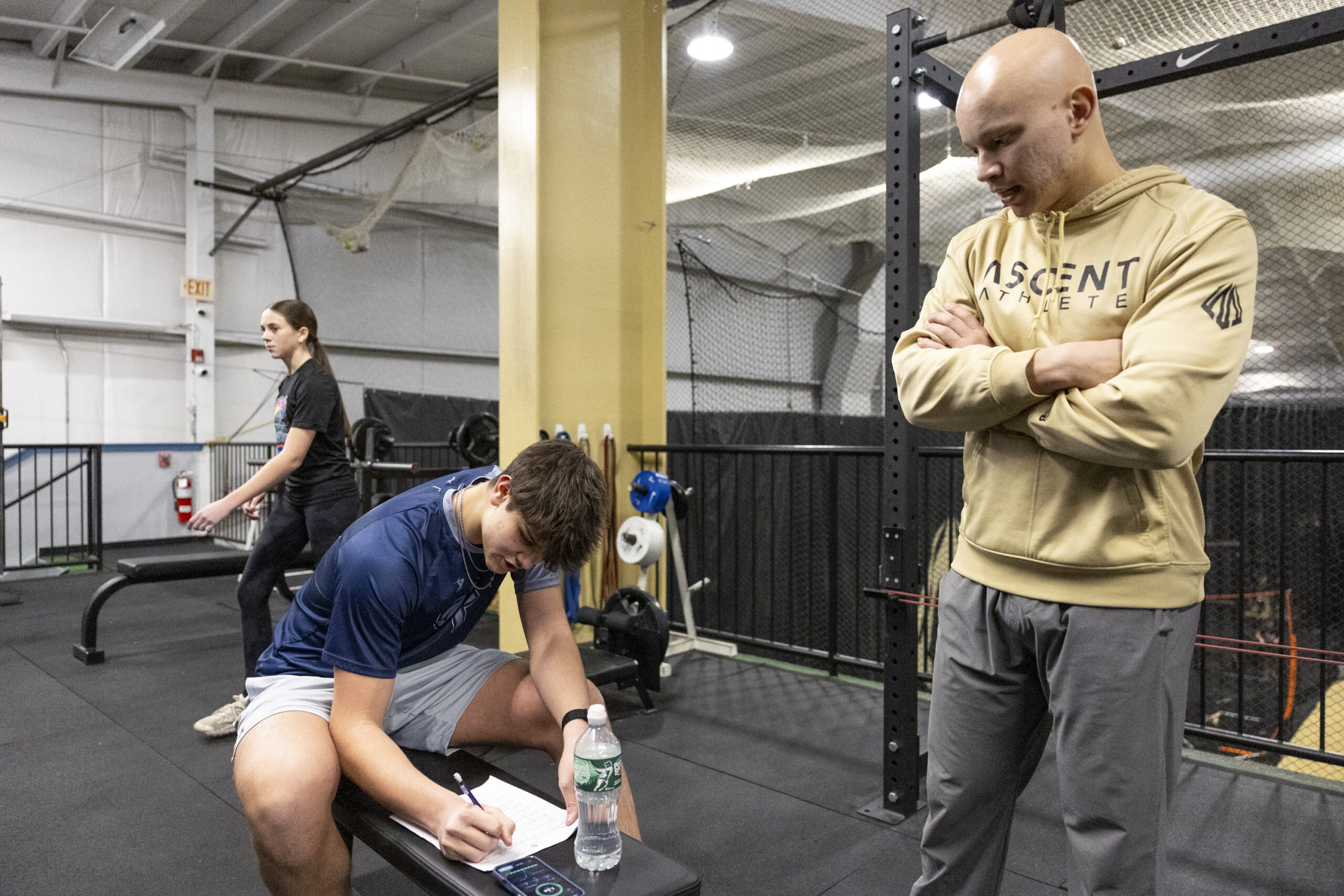
Cole Kuhn works with Francisco Taveras, the assistant director of Sports Performance at Ascent Athlete.
Kuhn gets a ride after school to Ascent from Prep senior Mihretu Rupertus — “I tell him, ‘You treat that dude to anything he wants at Wawa,’” Tonya said — and is given a checklist of exercises to do. He gained 35 pounds from working at Ascent, filling out his towering frame.
Kuhn’s fastball took off as he hit 95 mph last July at an event in Georgia. He pitched six innings, showing he could do more than just light up radar guns. The college coaches watching took notice. The pitcher who studied ballet was suddenly a can’t-miss prospect.
“That was for me when I said, ‘This kid is going to be really, really good,’” Lawler said.
Facing adversity
Kuhn’s phone buzzed exactly at midnight last summer when college coaches were first allowed to contact him. First was Miami. Then Texas Tech. More than 30 schools called that day. A few months earlier, Kuhn was hoping to play college ball at a small school with strong academics. Now the big programs were chasing him. It was a whirlwind.
He flew the next weekend with Tonya to California for the Area Code Games, a premier showcase event for the nation’s top players. It was Kuhn’s chance to show how special his arm was.
“He couldn’t get out of the first inning,” said Andrew, who watched from home on a livestream.
Kuhn, pitching in perhaps the biggest event of his career, struggled. The same coaches who contacted him days earlier were now backing off. Tonya told him afterward to forget about them.
“My line of work may be particularly suited to what was happening, but I am his mom,” said Tonya, who is a child psychiatrist. “It’s hard to watch, but it’s so much part of the game and part of life. I appreciate that that’s what happened. Maybe not at that moment, because seeing your kid struggle is hard. But I knew he was going to be fine. If people see an outing and say they’re no longer going to be behind the kid, then I don’t want my kid playing for that program. That was easy for me. In a weird way, I’m glad it happened. Not only for mental toughness but to kind of weed out people.”
Kuhn returned home, took a few days off, and then returned to Ascent. He kept working. There are going to be some bad days, his father reminded him.
“I always tell him that I’m happy for him when things go well,” Andrew said. “But really I’m only proud of the work that he does on a weekly basis. And because he’s such a grinder, it’s going to work out. And if it doesn’t at some point? Yeah, you can pivot. He has battled through tough things along the way.”
Cole Kuhn’s father, Andrew, says he’s “proud of the work that [Kuhn] does on a weekly basis. And because he’s such a grinder, it’s going to work out.”
Staying healthy
They didn’t measure launch angles or even know how hard an opposing pitcher was throwing when Lawler was playing at Kenrick.
“It was ‘I hit the ball hard. Everyone is swinging and missing against this guy who looks like he’s throwing hard,’” Lawler said. “But we didn’t know how hard it was or how far it went.”
The new ways of instruction are great, Lawler said, as the real-time information provides instant feedback and allows for coaches and players to make corrections in the moment. He can study the movement on Kuhn’s fastball and tell the catcher where to keep his glove. But there’s also a need to manage the information that players see.
“We have to train the kids to not obsess over it,” Lawler said.
Kuhn said he likes to know how many RPMs his fastball has so he knows if he’s generating enough spin on his pitches. But he doesn’t chase the numbers. On the day he threw 101.7, Kuhn was actually working on developing a cutter. The triple-digit fastball just happened. On the mound, he said, he’s focused on the batter and not the data.
Major league evaluators — including Phillies general manager Preston Mattingly — came to Ascent last month to watch Kuhn pitch. Kuhn said it was exciting but the attention didn’t faze him. He’s committed to Duke, but things could change before he’s eligible to be drafted in July 2027. He’ll likely have a choice to make: Go to college or turn pro. First, he has to stay healthy.
“I don’t want him to feel like he has this golden arm and that’s the only thing that matters,” Andrew said. “But it is concerning. The whole thing about how many Tommy John surgeries there are and using the technology input to throw faster and faster, it’s a little worrisome. But it’s just, ‘Slow down.’”
Randazzo said it was no surprise that Kuhn hit triple digits as he has the frame (6-6 and 230 pounds) and arm speed to do so. But it was a slight surprise that it all came together nearly two years before he could get drafted. Now what?
“It’s very common these days with Tommy John surgery and injury in general,” Randazzo said. “You do have to find that balance with still being a normal 16-year-old kid. You want to tread lightly with it, but you also don’t want to put him into a bubble. You just have to be methodical about it with arm care and rest. It’s not a carnival game that this kid is throwing hard. It’s real. There’s no crystal ball with it.”
Cole Kuhn has committed to Duke, but things could change before he’s eligible to be drafted in July 2027.
Kuhn’s fastball has spiked at Ascent, but he said the facility does not simply try to build velocity. The pitcher said it’s instead a result of everything else. He has a nutritionist, follows a workout regimen, and is already built like a major leaguer. The facility limits how often he can throw, knowing that overextending him as a teenager could hurt him in the future.
“You can never 100% prevent injury or setbacks,” Keller said. “But it is important that every day, everything we do contributes to his long-term health. We track all his volume, his intensity, his velocity, and how many times he throws. We want him to get to where he wants to be as safely as possible while also challenging him.”
Big-league dreams
A few days after Kuhn hit 101.7 mph, he marveled to his father how his fastball was nearly as fast as pitches thrown by Phillies closer Jhoan Duran.
“Yeah, it’s cool,” Andrew said. “But it’s not just a carnival trick. You have to make sure you’re doing everything to stay healthy.”
Three years ago, Kuhn failed to make the JV baseball team. And now he’s able to compare himself to big leaguers. It all happened so fast. He’ll pitch this spring for St. Joe’s Prep and spend the summer playing with Ascent’s travel team. He’ll have the chance to prove he can harness his triple-digit fastball. The attention, Kuhn said, has been fun.
“This is like the best part of my life, honestly,” Kuhn said. “It’s only up from here. I’m really excited.”
In just a few years, he could be pitching in the majors. Maybe they’ll even turn the lights off like they do for Duran when Kuhn comes to the mound with a triple-digit fastball. It’s easy to imagine it all when you’re throwing 101.7 mph. First, he has to get his driver’s license. And that will be something he can text the family group chat about.
“He has a lot of supporting characters helping him get to where he’s hoping to go,” Tonya said. “For many boys in the world, it’s MLB, the NBA, or the NFL. I can’t even believe that this might happen. I’m still in awe. I continue to just be incredibly proud of the kinds of things that he’s doing and setting goals and reaching them left and right.”
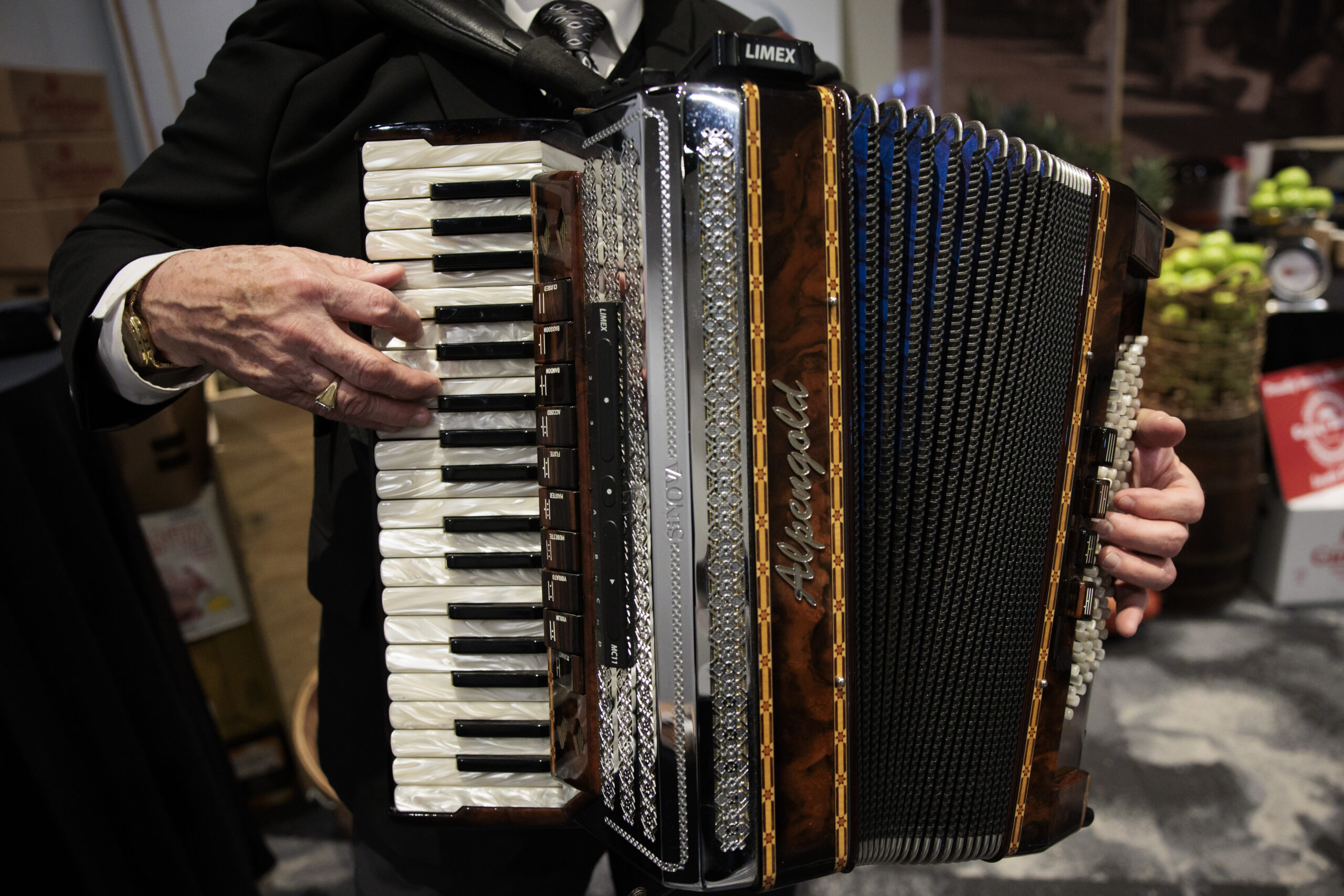
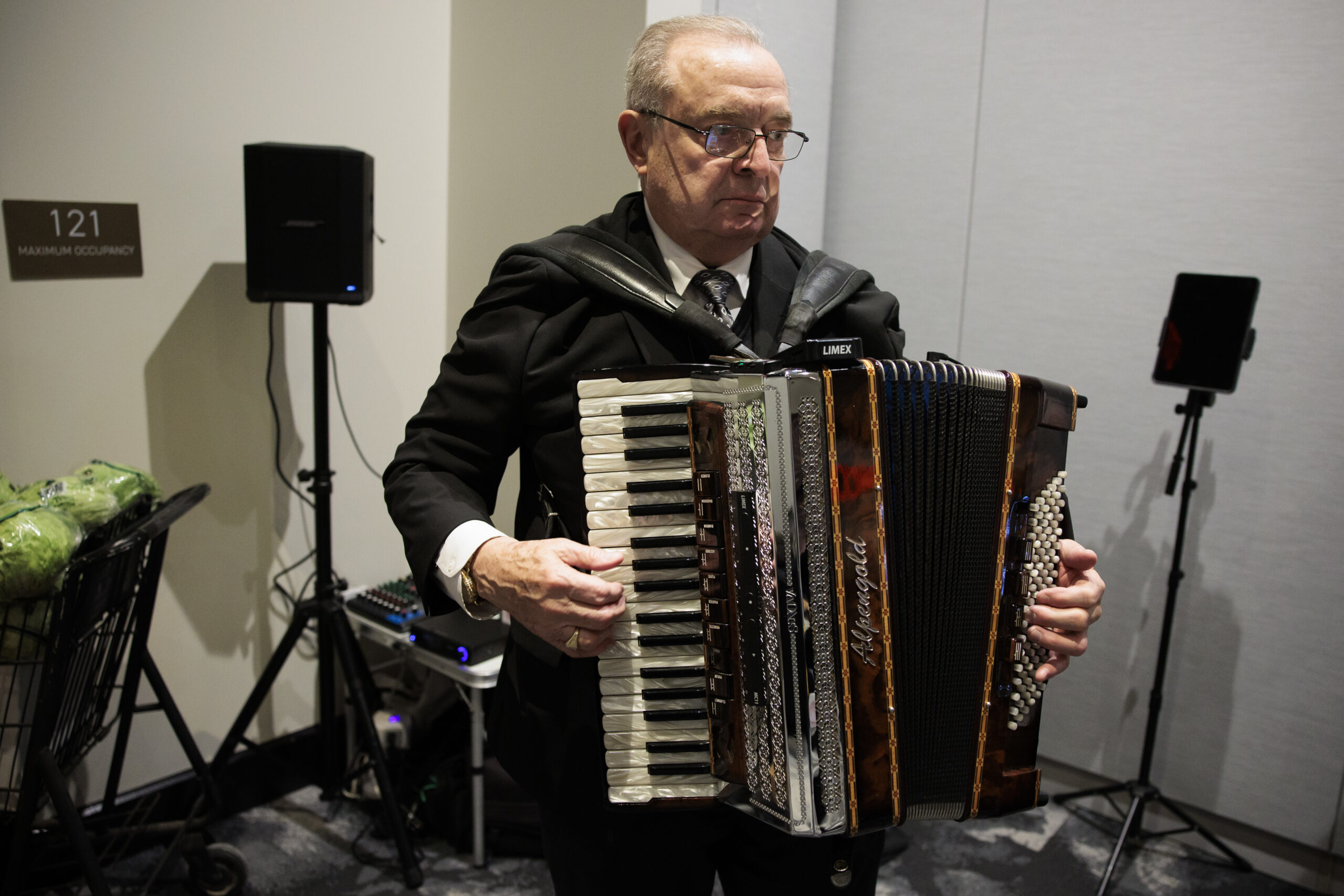
Don Bitterlich’s Chevy Caprice was loaded with everything he needed for his gig that night at an Italian restaurant in Northeast Philly: an accordion, a speaker, and a pair of black slacks.
He learned to play the accordion as a 7-year-old in Olney after his parents took him to a music shop on Fifth Street and he struggled to blow into a trumpet. His father pointed to the accordion, and Bitterlich played it everywhere from his living room on Sixth Street to Vitale’s on Saturday nights.
The owner of Vitale’s — a small restaurant with a bar near Bustleton and Cottman Avenues — paid Bitterlich $175 every Saturday. It was a lot of money for a college student in the 1970s. First, he had to finish football practice.
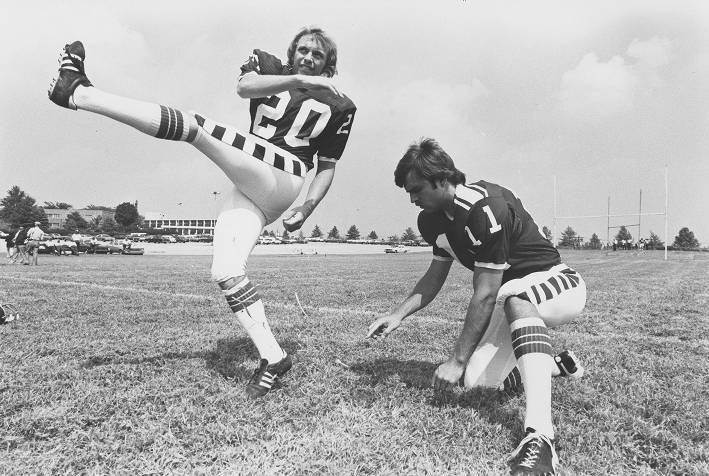
Bitterlich went to Temple on a soccer scholarship before football coach Wayne Hardin plucked him to be the placekicker. He never even watched a football game, but soccer coach Walter Bahr — the father of two NFL kickers — told Hardin that Bitterlich’s powerful left leg was fit for field goals.
Bitterlich went to football camp in the summer of 1973, while also playing soccer for Bahr and trying to keep up with his accordion. He had yet to officially make the football team that August, so there was no use in canceling his 10 p.m. Saturday gig at Vitale’s. Bitterlich was due to play there in 90 minutes, but the Owls had yet to include their kicker in practice. He was hoping to leave practice by 8:45 p.m., and it was almost time.
“I’m watching the clock,” Bitterlich said.
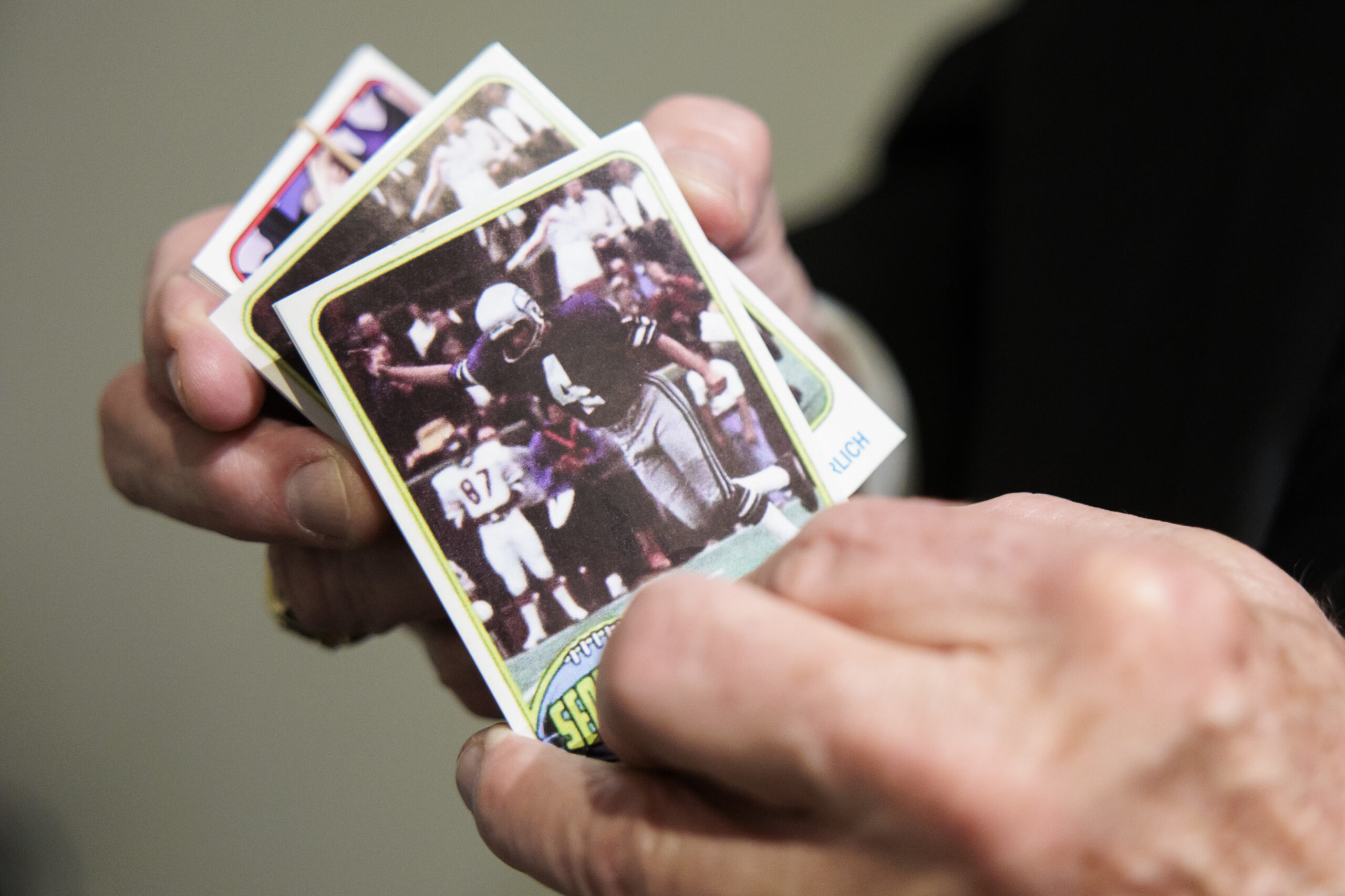
Don Bitterlich holds his Seahawks football card. He scored the first points in Seahawks history as a kicker.
He asked an assistant coach if the team was going to kick, and the coach shrugged him off. A half-hour later, he asked again. He had to go, Bitterlich said.
“He said, ‘Go where?’” Bitterlich said.
Bitterlich set records at Temple, played in an all-star game in Japan, was in his dorm when he was selected in the 1976 NFL draft, and scored the first-ever points for the Seattle Seahawks, who play Sunday in Super Bowl LX against the New England Patriots.
He made it to the NFL despite knowing little about football until he became Temple’s kicker. It was a whirlwind, he said.
He really made his name with the accordion, the instrument he’s still playing more than 50 years after he had to rush to a gig from football practice.
He has long been a regular at German festivals, restaurants, banquets, and even marathons. A German club in the Northeast called Bitterlich “the hardest working accordion player in the world.” He played a gig on Sunday night in South Philly and another on Monday morning near Lancaster.
Bitterlich, 72, who worked as a civil engineer until retiring last year, said he played more than 100 gigs in 2025. Football stopped years ago, but the show rolls on.
“These days,” he says, “most people around hear me playing the accordion, and they don’t know that I kicked in the NFL.”
Becoming a kicker
Bitterlich was home in Warminster — his family moved from Olney just before his freshman year at William Tennent High — when Bahr called. The Temple soccer coach had been a star on the U.S. team that upset England in the 1950 World Cup and was one of the best players to come out of Philadelphia.
“He had this raspy voice,” Bitterlich said. “He smoked cigars during practice and basically chewed and ate half of it as well. He always called me ‘Bitterlich’ but called me ‘Donald’ if I screwed up.”
Don Bitterlich (20) at Temple, likely during the 1975 season.
So Bitterlich figured he was in trouble when his coach called him “Donald” on the phone.
Bahr asked Bitterlich whether he knew who Hardin was. Yes, he said. Bahr said he had just talked to the football coach and told him Bitterlich could kick. The coach had watched Bitterlich since he played soccer for Vereinigung Erzgebirge, a German club his grandfather founded off County Line Road. He told Bitterlich he could do it.
“So I said, ‘No soccer?,’” said Bitterlich, who was also the mascot at basketball games in the winter. “‘No, you’re my starting left midfielder.’ I was thinking, ‘How is this going to work?’”
Bahr told Bitterlich to call the football office, get a bag of balls, and start kicking. He kicked every day at the German club and tried to figure it out. He was soon splitting his day between football camp in Valley Forge and soccer camp at the old Temple Stadium on Cheltenham Avenue in West Oak Lane. Each sport practiced twice a day and Bitterlich found a way to make them all.
He played a soccer game that season in Pittsburgh, flew home with the team, and then took a taxi from the airport to Temple Stadium to kick for the football team. He was studying civil engineering and balancing two sports plus his accordion.
It eventually became too much. Hardin told Bahr that he would give the kicker a full scholarship to play football. That was it.
“With the football scholarship, I got room and board,” Bitterlich said. “So I was living on campus after commuting from Warminster. It was insane. I was so worn out.”
Making history
Bitterlich kicked a game winner in October 1973 against Cincinnati as time expired, made three kicks at Temple longer than 50 yards, and was the nation’s top kicker in 1975. The soccer player made a quick transition.
“Coach Hardin always said, ‘If I yell ‘field goal,’ I expect three points on the board,’” said Bitterlich, who was inducted into the Temple Hall of Fame in 2007. “He expected that. The point of that was that he trusted you. That was his way of saying, ‘I’m not asking you to do anything that I don’t think you can do.’”
Don Bitterlich performs with his accordian on Sunday during The Tasties at Live! Casino.
The coach helped Bitterlich understand the mental side of kicking, challenging him in practice to focus on the flagpole beyond the uprights. Try to hit the flag, he said.
“That had a huge mental impact on me,” Bitterlich said. “You have that image, and then when you do your steps back and you’re set, that’s all you can see. It made all the difference in the world for me. Once you have that image, you zone out any of the noise. You’re just focused on that image.”
It helped him focus in September 1976 when the Seahawks opened their inaugural season at home against the St. Louis Cardinals. They drafted Bitterlich five months earlier in the third round. The Kingdome’s concrete roof made the stadium deafening, but Bitterlich felt like he was back in North Philly practicing at Geasey Field as he focused the way Hardin taught him to.
He hit a 27-yard field goal in the first quarter, registering the first points in franchise history. The Seahawks had quarterback Jim Zorn and wide receiver Steve Largent, but it was the soccer player who scored first.
Bitterlich’s NFL career didn’t last long, as the Seahawks cut him later that month after he missed three field goals in a game. He tried out for the Buffalo Bills, but a blizzard hindered his chances. He signed with the Eagles in the summer of 1977, missed a field goal in a preseason game, and was cut.
He landed a job as a civil engineer in Lafayette Hill. He received a call on his first day from Eagles coach Dick Vermeil, who said the San Diego Chargers wanted to try him out. Bitterlich flew to California the next day but turned down a three-year NFL contract that would pay him only slightly more than his new job back home.
“Plus, the real reason I turned down their offer was that they couldn’t hold for a left-footed kicker,” Bitterlich said. “Their holder just couldn’t get the ball down. I didn’t want to sign that contract. ‘What’s going to happen in two days when that guy can’t get the ball down?’”
A week later, the San Francisco 49ers called. He flew back to California, tried out against another kicker, and was told he won the job. But the 49ers decided to sign Ray Wersching, who had been cut the previous season by the Chargers. Bitterlich turned down the chance to replace Wersching in San Diego, and now Wersching was swooping in for the job Bitterlich wanted in San Francisco.
“I went back home and said, ‘That’s enough,’” said Bitterlich, who played three NFL games. “It started to get disappointing.”
“I love to play,” Bitterlich says of his accordion. “I usually don’t take breaks. Most bands will play 40 minutes on, 20 minutes off. I just play through.”
Still playing
His NFL journey was hard to imagine that day at practice as he watched the clock at Temple Stadium and thought about how long it would take to drive to Vitale’s. Bitterlich told the assistant coach that it was almost time to play his accordion. That, the coach said, was something he would have to talk to Hardin about. Fine, Bitterlich said.
“I didn’t know if I was going to make the team or not, and I knew I was going to play soccer,” Bitterlich said. “So I just went over and told Coach.”
Hardin heard his kicker say he had to leave football practice to play the accordion and laughed.
“He said, ‘Yeah, I heard something about that,’” Bitterlich said.
The coach stopped practice and let Bitterlich get in the mix. He nailed six field goals and the other kicker shanked a few. The job felt like his. He hit a 47-yarder and looked over at Hardin.
“He’s like, ‘Yeah, yeah. Go ahead. Go,’” Bitterlich said.
Bitterlich was soon in his Chevy Caprice, heading down Cottman Avenue on his way to Vitale’s. He wasn’t late to his accordion gig that night. His football career would end a few years later, but the music has yet to stop.
“I enjoy it,” Bitterlich said. “I love to play. I usually don’t take breaks. Most bands will play 40 minutes on, 20 minutes off. I just play through. I really don’t take a break. I love it.”
Chris Coyne had a chance to win $1 million earlier this month, but that wasn’t enough to get him out of reading his son a bedtime story.
His friends were coming over the next afternoon to watch the final slate of NFL games as Coyne neared the prize. So his wife said it was his night to make sure one of their two children was sleeping.
And there was Coyne — a cell phone on his lap so he could follow the Buccaneers-Panthers game on Jan. 3 — reading The Pout-Pout Fish to 2-year-old Charlie.
“I know it by heart now, so I’m just reading it from memory and watching the phone on mute while I’m telling the story,” said Coyne, who also has an infant son named Harrison. “But I have a million dollars on the line. The Bucs missed a field goal, and I’m like, ‘Ahh.’ I had to grit it.”
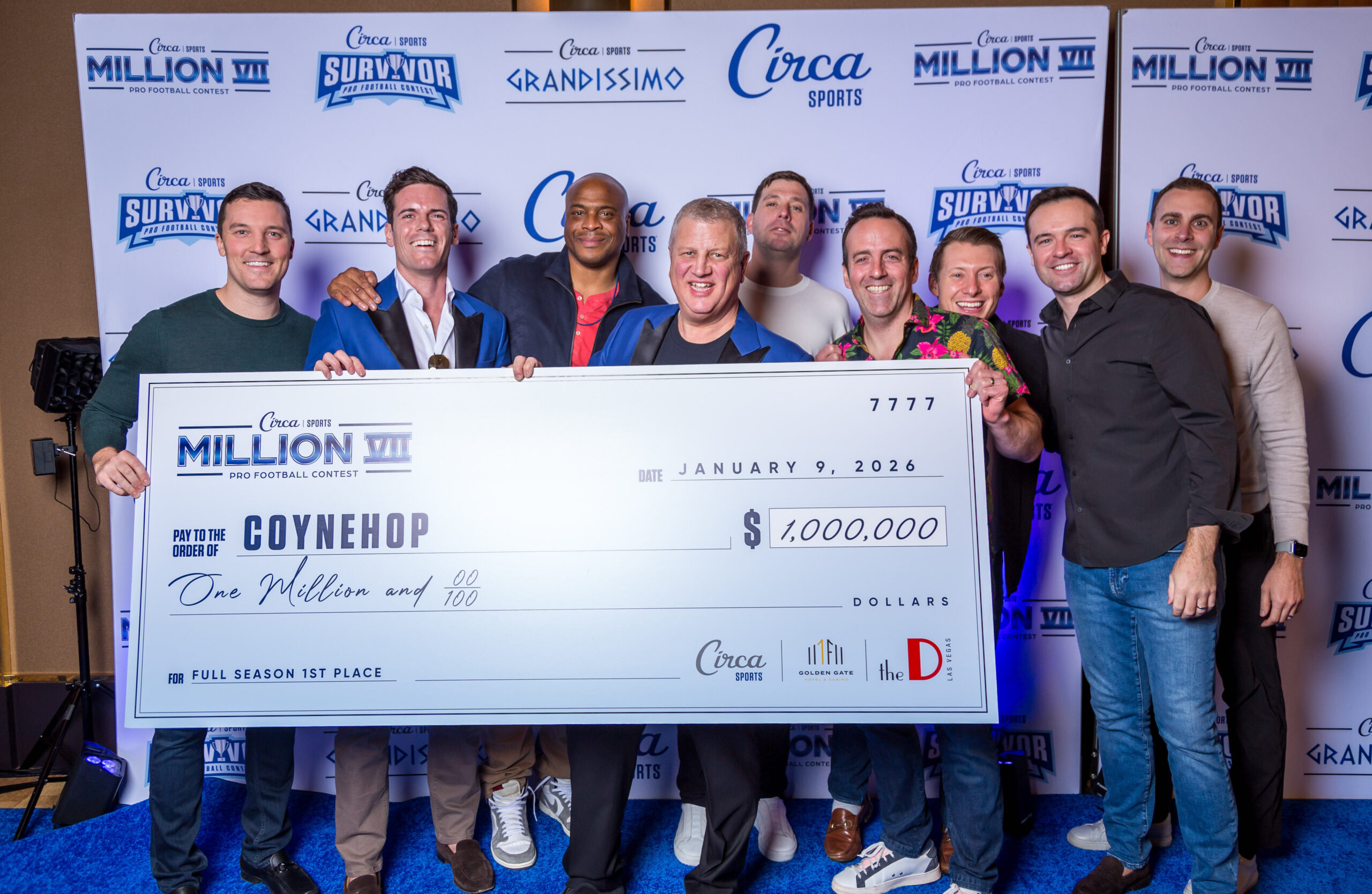
It was the start of an emotional roller coaster of a weekend that ended with Coyne, a 34-year-old former walk-on for Phil Martelli at St. Joseph’s, winning the $1 million grand prize in a season-long NFL pick ’em contest run by a Las Vegas casino with 6,000 participants.
He lost a game in September when the Eagles returned a blocked field goal against the Rams, picked up a win in December when the Raiders kicked a meaningless field goal to lose by 7 points instead of 10, and then pouted through that bedtime story as the Buccaneers faded.
It was a season-long marathon. But it ended with Coyne, who lives in Brooklyn, flying to Las Vegas during the NFL’s wild-card weekend to claim his oversized check and custom blue jacket at the Circa Resort & Casino as the winner of the Circa Million VII.
“I wasn’t as dedicated to it as many others are,” said Coyne, who was at the playground with his kids when he checked his phone to see how Jordan Davis’ sprint spoiled that game against the Rams on Sept. 21.
“I joke that there were no models, no Excel spreadsheets. It’s just me changing diapers and making picks.”
A team photo of the 2012-13 St. Joe’s team with Chris Coyne (first row, third from the left).
Walk-on Hawk
Coyne was cut from the St. Joe’s basketball team as a freshman and sophomore but was certain that his junior year in 2011-12 would be different.
He could have played Division II hoops but came to Philly because his Manhattan high school followed the Jesuit educational model just like St. Joe’s. Coyne played JV ball as a freshman and sophomore for the Hawks and practiced with Martelli’s crew in the offseason.
He rode his bike home from the gym the night before tryouts and thought it was finally his chance to make the team. Then Coyne hit a curb and flew over his handlebars. His palms were gushing blood and his wrists were banged up.
“I had no skin on my hands,” Coyne said. “There it goes. There goes the dream.”
Coyne arrived early to the tryout, hoping that the Hawks athletic trainer could do something. The trainer wrapped Coyne’s hands and sent him on the court.
“I pretty much looked like a boxer,” he said.
It worked as Coyne — shooting like coaches always stressed with his fingers and not his palms — seemed to knock down everything. Maybe he should always play like a prizefighter, he thought.
Martelli called to tell him that his third try was a success: Coyne was a walk-on.
Chris Coyne played for coach Phil Martelli alongside star Langston Galloway (10) during his time with St. Joe’s.
“It was my dad’s birthday and I called him to tell him,” Coyne said. “He was the one who pushed me to see this through and not just play at the D-III level. He said, ‘This is your dream. Whether you get one minute in a game or 30 minutes, go see this through.’ I couldn’t thank him enough.”
He played two years for Martelli, who told the bench players on the “Pinnie Squad” to give it their all in practice against the starters. The reserves were a bunch of guys like Coyne, who could have played elsewhere but stayed on Hawk Hill with Martelli.
So the future $1 million NFL picker battled every day against Langston Galloway, the future NBA player. Martelli assigned his players to read articles about leadership and teamwork and preached the value of family. It was always more than basketball.
“I never felt like I was just sitting on the sidelines getting guys water,” Coyne said. “You were in the mix every day, which was really cool.”
Coyne played just 12 minutes over eight games during those two seasons. But he did knock down a three-pointer at the Palestra, entering the game late against Penn on ESPN for his first NCAA basket.
“It’s funny looking back and thinking, ‘Why would you ever be nervous?’” Coyne said. “But you’re just sitting there, you’re cold, there’s 15,000 people in the stands, and he’s going to call your name but you don’t know when it’s coming or if it’s coming. You’re just thrown out there.
“My parents were there and it was a dream come true. It was years of seeing your dream not play out the way you wanted to and then have that opportunity.”
Chris Coyne making the first and only three-pointer of his St. Joe’s career in 2013 against Penn at the Palestra.
Winning it all
Coyne entered his first football contest in 2019 after his friend Brian Hopkins signed him up during a trip to Vegas. He split that entry with Hopkins, and they met each week at a Manhattan bar after work, scribbling down the five games they liked on napkins.
The pool has a $1,000 buy-in and requires each entrant to pick five games every week against the point spread. A proxy then places the bets for them in Vegas, as more than half the players live outside Nevada.
Coyne and Hopkins decided to each enter the next season, and they developed their own strategies. Coyne stays away from Thursday nightgames as he would have to pick all five games by then instead of waiting until Saturday afternoon. The lines for every game lock on Thursday morning, which sometimes means a line could move before Coyne sends in his picks.
He didn’t watch a full NFL game until the middle of October because he was usually busy on Sundays with his kids. He read articles during the week and listened to podcasts. Picking games, Coyne learned, is less about breaking down game tape and more similar to the sales job he has on Wall Street.
“You’re aware of trends,” Coyne said. “When the public A.K.A. retail is buying a lot of stock, that’s never a good sign. Maybe in the short term it works out, but over the long term, you try to find those overreactions in the market where the public really likes a team. Especially if the public loves a team and the line is going against the public.
“That’s the biggest telltale sign right there. You have to have a process and you have to know what you’re doing, but so much of it is you have to get the breaks sometimes. The breaks went my ways sometimes.”
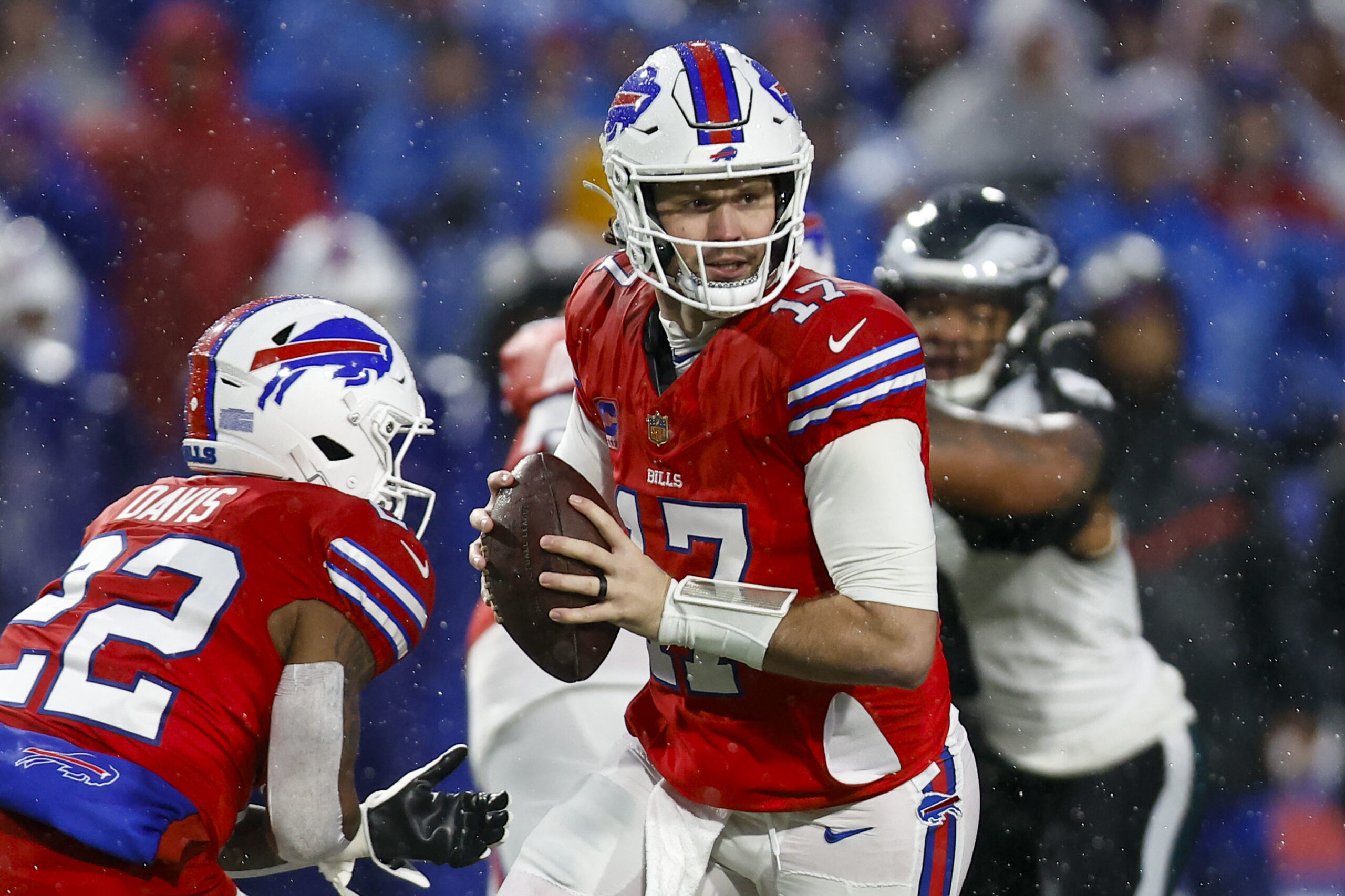
That bedtime story would have been a bit less stressful had the Bills converted their two-point try a week earlier against the Eagles, as Coyne would have entered the final weekend with a three-game lead.
Josh Allen and the Bills’ inability to execute a two-point conversion against the Eagles on Dec. 28 made Coyne’s road to the $1 million a little more stressful.
Coyne was in Berwyn for that game visiting the family of his wife, Maddy, which was rooting for the Birds despite knowing Coyne was in the hunt for big money.
“I’m devastated and I’m like, ‘Can’t you for one week just be on my side?” he said “But Eagles trump all in that household.”
He instead had to sweat it out. He won Saturday night with the 49ers after the Buccaneers lost and then won Sunday with the Giants but lost with the Titans and Dolphins. Coyne said he tends to pick bad teams since he’s often going against the popular choices.
The Steelers won on Sunday night, pushing the second-place entry even with Coyne. He thought they would then split the first and second prizes ($750,000 each) and went to bed disappointed.
“It was a long couple of weeks and I was football fatigued,” Coyne said. “I’m all [ticked] off. But I couldn’t complain. It was still $750,000 and it was a great season, but I didn’t know if I was getting the blue jacket. That’s what I really wanted. It’s like the Masters green.”
Coyne woke up at 5 a.m., checked his phone, and saw he finished in first place on a tiebreaker, because he had more winning weeks than the other entry. The $1 million prize was his. The blue jacket was, too.
Chris Coyne (second from the left) with his friends in Vegas on Jan. 9 after he won the $1 million prize.
Coyne flew to Vegas that weekend with his friends, received his prize, spent 30 hours at the resort, and didn’t take his blue jacket off until he got home.
It was perfect, like a walk-on hitting a three-pointer at the Palestra with his parents in the crowd.
“I spent all of November and December saying, ‘How am I going to screw this up?’” said Coyne, who finished 60-29-1 over 18 weeks. “But somehow I came out on top. It was the weekend of a lifetime.”
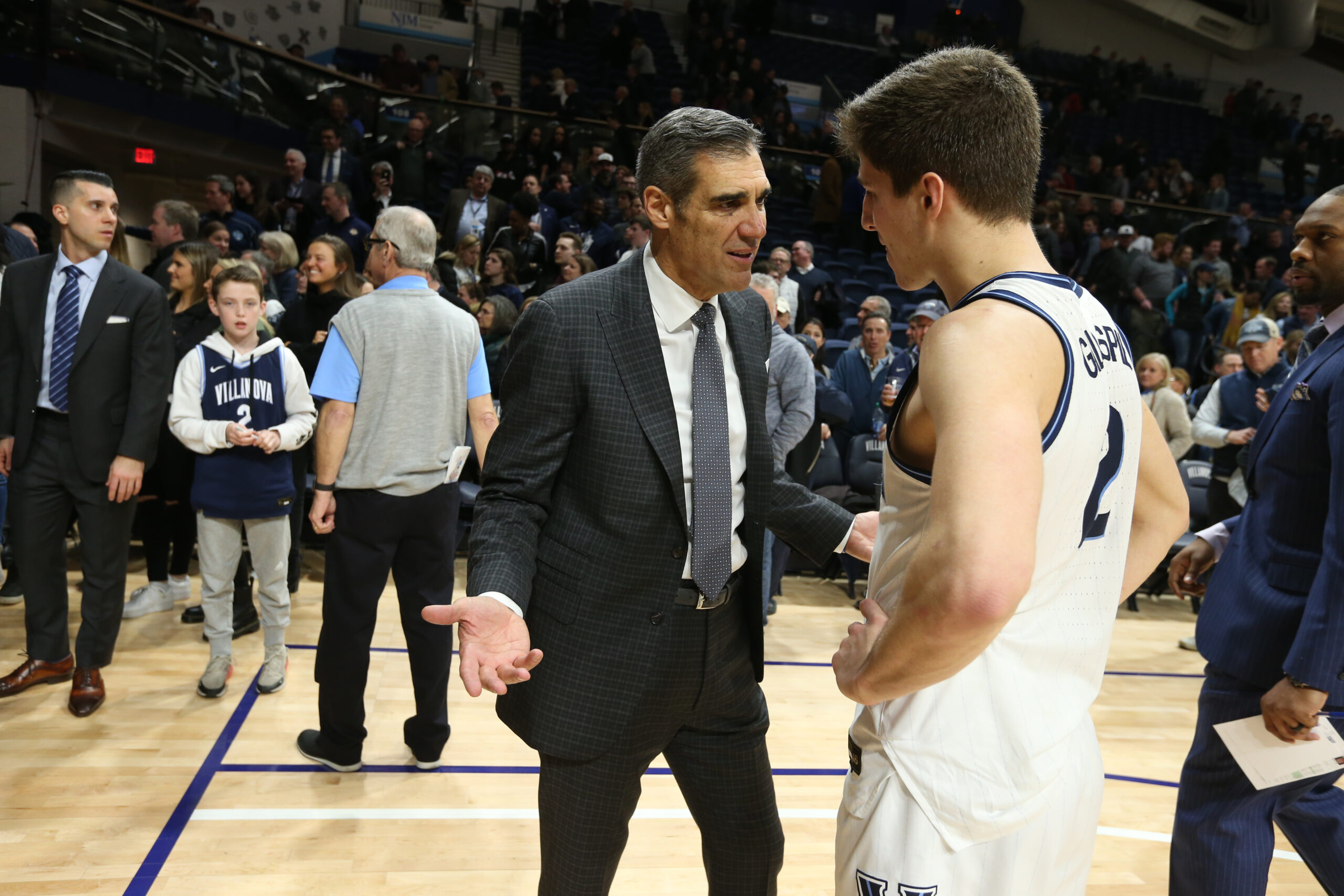
Jay Wright saw enough of Collin Gillespie a few nights before to invite him to Villanova on a Monday in January 2017 and offer him a scholarship. But this was hardly a courtship. Wright told Gillespie that he would redshirt his freshman season, maybe play as a junior, and then have a complementary role as a fifth-year senior.
“I thought he would get his master’s degree and be a great coach one day,” Wright said. “I was thinking ‘I would love to have this guy on my staff.’”
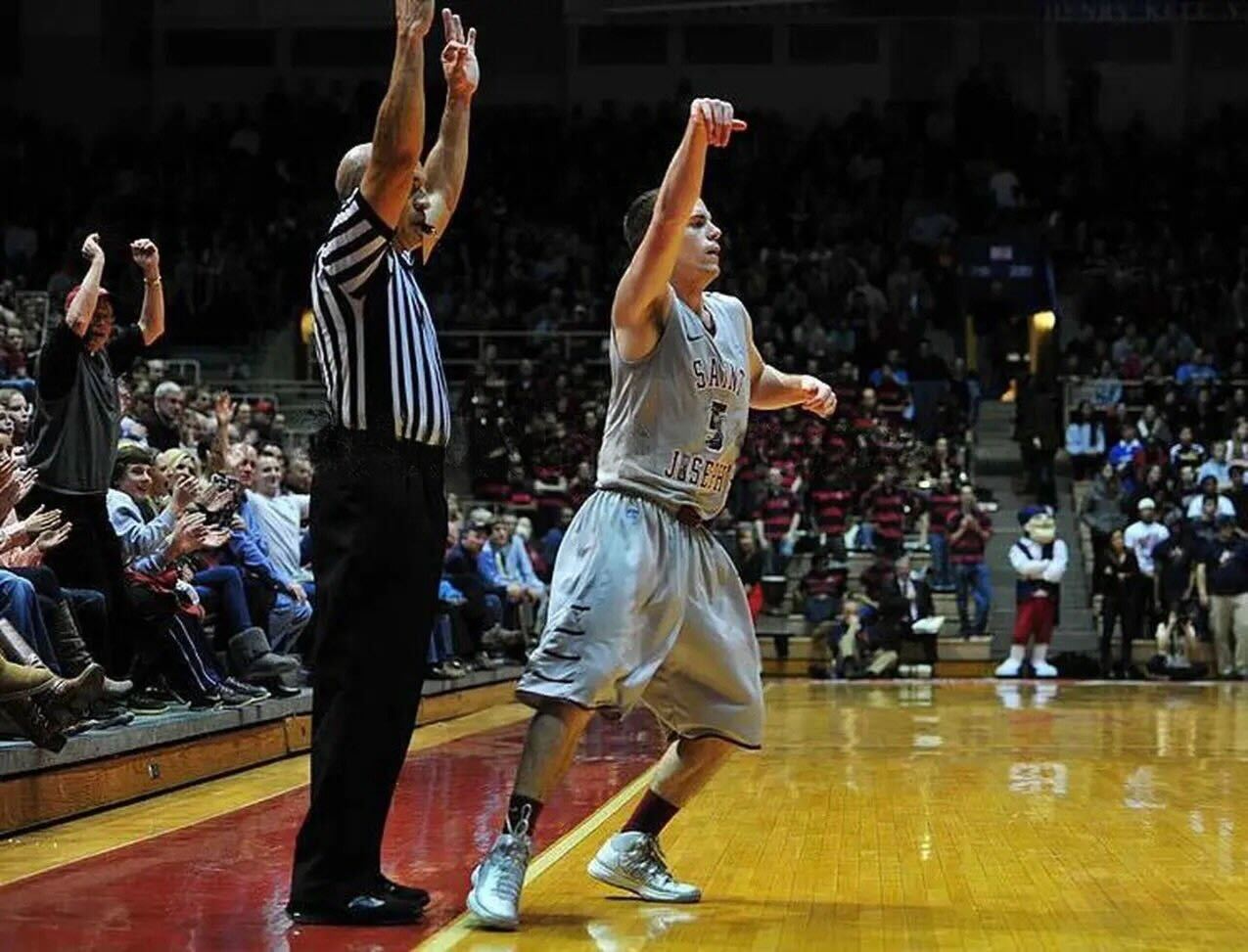
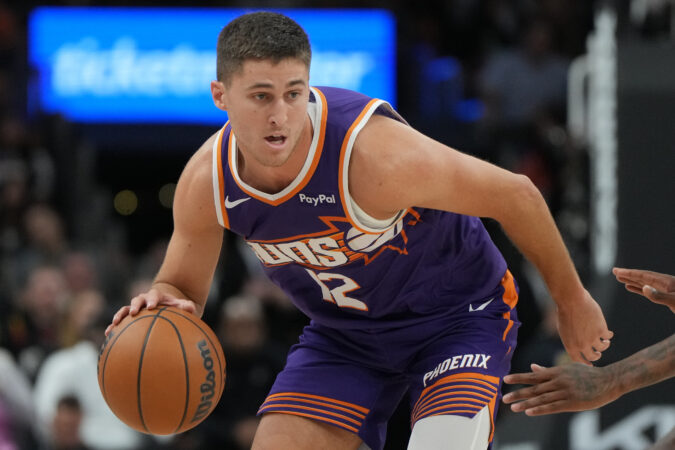
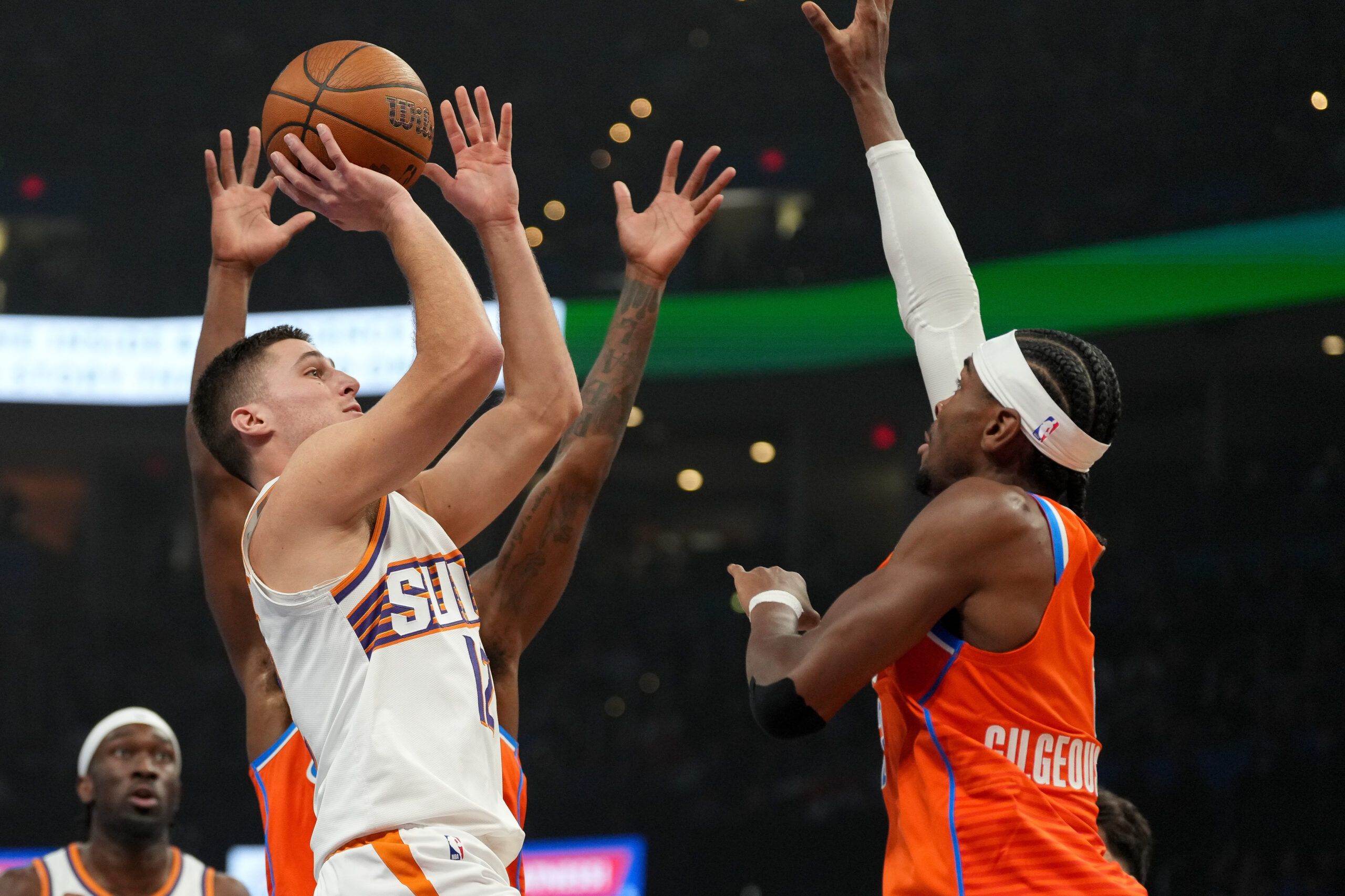
Gillespie — who has molded himself into an NBA starter with the Phoenix Suns after going undrafted in 2022 — nodded along. He didn’t have a Division I scholarship before his senior year at Archbishop Wood and declined to visit Division II schools because he believed bigger programs would eventually see what he already knew: He could play. Redshirt? OK. Bench player? Sure. Coach? Yes, sir.
“I didn’t really believe him,” said Gillespie, who will play against the 76ers on Tuesday night. “I believed in myself. I was just like, ‘Whatever he says, I’ll take it and then prove him wrong.’”
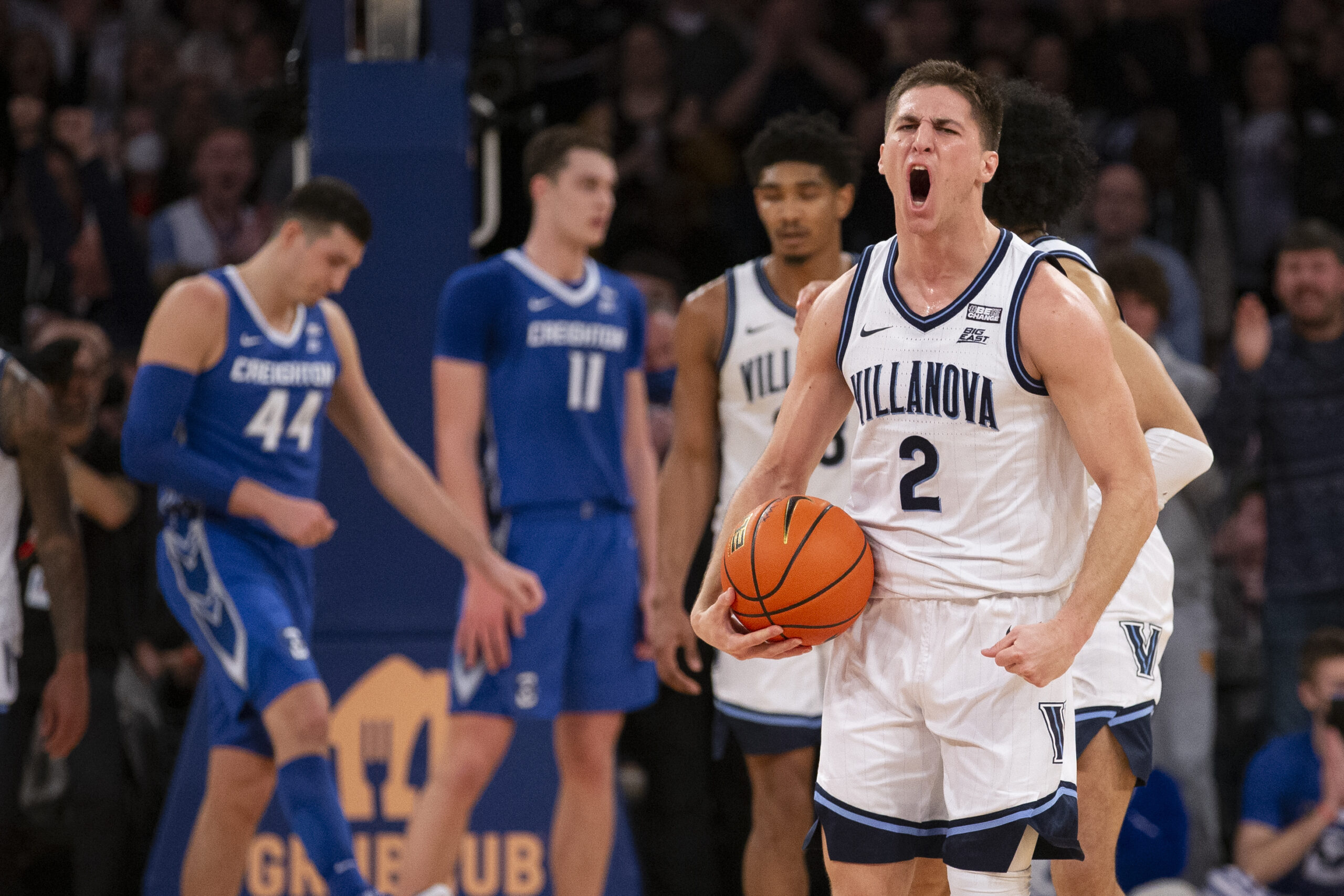
There was Gillespie 15 months later on the court for Wright in the national championship game, taking a charge against Michigan and looking the part. In his fifth year, the kid who had to wait for college scholarships was named the nation’s top point guard in 2022. He went undrafted that June but landed a non-guaranteed contract in July with the Denver Nuggets. He was on track.
Three weeks later, Gillespie suffered a broken right leg while playing in a pickup game at Villanova.
His NBA career — the one that is now flourishing — seemed unlikely then to nearly everyone except the guy who nodded along that day in Wright’s office.
“Everyone has their own journey,” Gillespie, 26, said. “Everyone runs their own race. You just have to stick to what you do, put your head down, and work hard. Don’t compare yourself to anyone else. If you work hard enough, you can probably achieve anything you want to.”
Collin Gillespie (right) became much more than a fifth-year senior role player first envisioned by Villanova coach Jay Wright.
G League to the league
Andre Miller often learned via text messages which players would be flying nearly three hours from Denver to join his G League team that night. He coached the Grand Rapids Gold, the Nuggets’ minor-league affiliate in Michigan that played 1,100 miles from Denver. Those morning flights gave Gillespie a chance to get on the court.
“It wasn’t a good recipe for these guys to be successful, but when he did show up, he didn’t want to come out of the game,” said Miller, who played three of his 17 NBA seasons with the Sixers. “We knew we had to leave him out there because he didn’t have an opportunity with the other team and he took great advantage of it.”
Gillespie feared that the Nuggets would void his contract after he suffered that injury playing at Villanova. That’s the first thing he said to his father, who was in the gym when it happened. But they didn’t. They kept him around that first season while he rehabbed and then split his time the next season between Denver and Grand Rapids.
“There was no ego,” Miller said. “One thing that’s tough to deal with is when your career is in the hands of other people. Some people felt like he wasn’t an NBA player and some people felt like he was an NBA player. The one thing that stood out about him to me is that he’s a competitor. He’s a dog. He’s a guy who enjoys playing basketball. He’s a leader. He plays with a chip on his shoulder.
“I wish I could have coached him more in the G League, but he was an NBA player. I knew that from the first time I saw him on the court with the G League players. I was like, ‘He probably won’t be here much.’”
Gillespie signed before last season with the Suns, again splitting time between the NBA and the G League. The 6-foot-1 guard earned a full-time role this season, starting for the Suns and fitting in with pesky defense and a three-point shot. Just like college, it took time before Gillespie’s game was appreciated.
“You just don’t see it initially. He doesn’t wow you,” Wright said. “But when you see him play over time and you realize this guy is getting to the rim and finishing, he’s elevating on his jumper and shooting over bigger guys, and he’s not getting backed down. You almost need to have time to believe what you’re watching.”
Collin Gillespie is shooting 41.4% from three-point range for the Suns.
Gillespie entered Monday’s game against Brooklyn averaging 13.2 points, 4.9 assists, and shooting 41.4% from three-point range. He hit a game-winner at the buzzer in November, regularly finds ways to create his own shot, and has proved that his game fits in the NBA.
Kevin Durant called him “a dog” and Anthony Edwards said after a loss to the Suns last season that “No. 12 is pretty good at basketball.” Two NBA superstars could see what Gillespie always believed: He belongs.
“He has more heart than talent,” said his father, Jim. “The kid just doesn’t want to lose. When he sets his mind to something, he just does it. And ultimately, he’s a winner. Wherever he’s gone, he’s won. At every level.”
Jay Wright says Collin Gillespie came to Villanova with a “killer mentality and stone face that we try to teach.”
Change of plans
Gillespie was in the stands for a Villanova game as a senior in high school, seated behind the La Salle bench at the Palestra. The Explorers invited him and Gillespie thought a scholarship offer was near.
“But they never offered,” Jim Gillespie said.
Gillespie eventually landed smaller Division I offers as a senior, but he was hopeful a Big 5 school would have a spot for him. None of them did until January when Villanova assistant Ashley Howard urged Wright to watch Gillespie play a game against five-star recruit Quade Green’s Neumann Goretti squad at Archbishop Ryan.
The Northeast Philly gym was packed and the coach couldn’t stay long as he was being hounded. Howard called Wright while he was driving home and told the coach that one kid scored 42 and the other kid scored 31. Wright figured the 42 points belonged to Green, who was already committed to Kentucky. It was Gillespie, the assistant said. Wright was sold.
“Nothing was spectacular, and he’s not bringing any attention to himself,” Wright said. “He just makes the right plays.”
Wright called Gillespie’s father and told him he needed his son at Villanova on Monday. The coach gave Gillespie his pitch that day without any guarantees.
“We left and we were like, ‘What are you going to do?’” his mother, Therese, said. “He said, ‘I’m going to play out my senior [year].’ I said, ‘Collin, it’s Jay Wright.’ He said, ‘Mom, I know what I’m doing.’”
Gillespie committed a week later, simply deciding after a game at Bonner-Prendergast that he had enough of the recruiting trail. He was headed to ’Nova and told a Wood coach without first running it by his parents. Gillespie knew what he was doing.
“He always said, ‘I’ll bet on myself,’” Jim Gillespie said. “He put the work in and the effort in and that’s what he’s always done.”
It took Gillespie just a few weeks to force Wright to rethink the plan that he would redshirt. Every day in practice that June he went up against Jalen Brunson and held his own.
Collin Gillespie (left) got to play in practice against future NBA players Donte DiVincenzo (center) and Jalen Brunson (right) at Villanova.
“He came in with that killer mentality and stone face that we try to teach,” Wright said. “But he came in with that. Then he spent every day with Jalen Brunson and it just became reinforced. It was so obvious. The coaching staff, behind closed doors, was going, ‘This kid is going against Brunson every day. He’s pretty good.’”
Gillespie suffered a minor injury that month and Wright checked with athletic trainer Jeff Pierce to see how the freshman was feeling. He was fine, the trainer said.
“The trainer said, ‘You’re not redshirting this kid,’” Wright said. “I said, ‘Is it that obvious?’ He said ‘Yeah, everyone knows.’ Yeah, it was.”
The guy who nodded along in Wright’s office proved that he belonged. Now, he’s doing it again in the NBA.
“It’s the way I was raised and where I come from,” said Gillespie, who grew up in Pine Valley before moving to Huntington Valley. “My brother is a year older, so I always played a year up. I had to play against older guys and was always smaller. I always had to prove myself and had a chip on my shoulder. My parents always believed in me and my family always believed in me and taught me to believe in myself.”