Author: Melanie Burney

  • Cherry Hill is considering additions at two schools to ease overcrowding instead of redrawing school boundaries

    Cherry Hill is considering additions at two schools to ease overcrowding instead of redrawing school boundaries

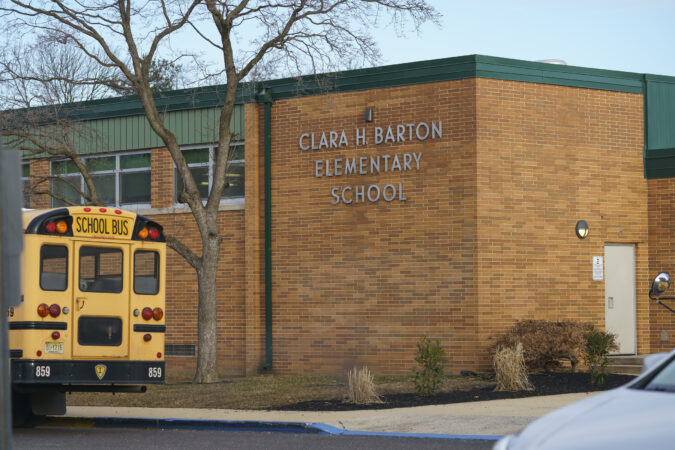
    The Cherry Hill School District has decided against redrawing its elementary school maps to redistribute students and ease overcrowding.

    Instead, the school board will consider adding additions to the two schools with the highest anticipated growth — Clara Barton Elementary and Rosa International Middle School — and continuing to monitor enrollment at four other elementary schools.

    The decision was announced Tuesday night when the district presented a highly anticipated report on rebalancing school enrollment. The South Jersey school system had been considering adjusting the boundaries assigned to each of its 12 elementary schools to handle an anticipated increase in students — a move that sparked opposition from some parents.

    The recommendation is “a huge win,” said Bruck Lascio, whose children attend Barton. “We’ll take their proposal.”

    What does the recommendation involve?

    “The administration is not recommending boundary adjustments at this time,” said George Guy, director of elementary education.

    Guy said both schools now potentially slated for expansion are expected to have a severe shortage of seats by the 2028-29 school year. Clara Barton would be 69 seats short, and Rosa Middle 51 seats, he said.

    The additions, if approved by the school board, would be ready for the start of the 2028-29 school year, Guy said.

    The report also recommends that the district monitor enrollment trends at Horace Mann Elementary, which is also expected to have more students than seats. And it calls for another demographic study in 2026-27 to assess needs at all schools.

    Guy left open the possibility that Mann could also get an addition to ease overcrowding. The district also plans to monitor enrollment at Joyce Kilmer, Richard Stockton, and Woodcrest Elementary Schools.

    Why was rebalancing under consideration?

    A demographic study conducted in 2024 showed that five of Cherry Hill’s 12 elementary schools are expected to have a total shortage of 337 seats in the 2028-29 school year, and prompted the school board to look into rebalancing.

    Cherry Hill began the rebalancing project with a possibility of changing the boundaries for students at five of its 12 elementary schools. Some elementary schools are nearing capacity, and a few have surplus seats.

    In developing a recommendation, Guy had to consider parameters set by the board. It was also important to consider transportation and avoid having students spend longer periods of time on buses.

    Board president Gina Winters said the board basically had two choices: shift students where there were available seats or add more capacity to keep students in their neighborhood schools.

    Rosa International Middle School in Cherry Hill.

    Changing the boundaries would have affected 534 children in the district, which enrolls about 11,000 students, Guy said. Clara Barton and James Johnson Elementary Schools would have faced the biggest impact, he said.

    The sprawling 24.5-mile community of nearly 75,000 is divided into elementary school zones. Most students are assigned to a neighborhood school within two miles of where they live.

    The district also dismissed possible relocation of some special education programs to ease overcrowding because that would further stress students and staff, Guy said.

    Guy said creating new English as a second language (ESL) programs at more schools was also considered, but that option was rejected because it would not have adequately addressed the overcrowding.

    Also under consideration was converting the Arthur Lewis administration building to an elementary school, which could accommodate about 200 students.

    How much would the plan cost?

    Guy said the additions are expected to cost between $5 million and $7 million each. The cost would be funded using interest earnings from the district’s $363 million bond referendum approved in 2022, he said.

    According to Guy, the costs would not affect the property tax rate. Winters said there could be additional budget costs in the future to hire additional teachers and administrators.

    How did parents react to the proposal?

    Parents who had lobbied heavily against having their children moved because they like the convenience of neighborhood elementary schools welcomed the recommendations.

    “We love our school,” said Katie Daw, whose children attend Clara Barton in the township’s Erlton section. “This is the best-case scenario.”

    Marie Blaker said she had braced for bad news Tuesday. She is part of a Clara Barton group that has organized other parents.

    “We didn’t think it was going to go like this,” Blaker said. “I’m thrilled they listened to us.”

    What’s next?

    The nine-member board did not vote on the recommendations Tuesday night. Winters said the board appeared to support the recommendation.

    Winters said public hearings would be held at Barton and Rosa. A final plan is expected by the summer, at which point the board will vote on the proposal.

    Guy has said officials are not yet examining future enrollment needs at the remaining middle schools and high schools.

    “The reality is that we will be faced with very difficult decisions,” board member Renee Cherfane said.


  • Most New Jersey public schools have reopened, and here’s how they’re making up missed days

    Most New Jersey public schools have reopened, and here’s how they’re making up missed days

    After the major snow storm that shut down many New Jersey public schools for at least two days, the big question for students and teachers is how districts will make up missed time.

    Most South Jersey districts reopened Wednesday, many with two-hour delays because of frigid temperatures and icy neighborhood streets and side roads.

    Winslow schools in Camden County remained closed for a third consecutive day, citing ongoing hazardous road and sidewalk conditions. The sprawling 58-square-mile municipality is one of the largest in New Jersey. Parents have complained in social media posts about icy streets and bus stop routes.

    Meanwhile, Eastside High School in Camden was also closed due to icy conditions near the school, while the rest of the district reopened. Camden has many students who walk to school. The district said the day would be made up.

    Late Wednesday, Davida Coe-Brockington, Camden’s acting state district superintendent announced that all city schools would be closed Friday.because of road conditions. She said the district plans to reopen Friday with a two-hour delay.

    School officials consider factors such as road conditions, snow and ice accumulation, and readiness of the campus, sidewalks, and parking lots, said Haddon Heights Superintendent Carla Bittner. Her district used its only built-in emergency closing day.

    “The safety of our students and staff is our absolute priority,” Bittner said.

    With 50 days left of winter and the possibility of another storm looming this weekend, additional snow days may be on the horizon, further disrupting school calendars, parental work days, and vacation plans. And districts must still meet the state requirement of 180 school days.

    How do districts make up snow days?

    Some districts have days built into the calendar for the school year for inclement weather, or tack on additional days as needed at the end of the school year. The state leaves it to local districts decide how many days to set aside.

    In Cherry Hill, where schools were closed for two days this week, the district will use days already designated as holidays. That means students will go to school Feb. 16, President’s Day and March 30, which was supposed to be the first day of spring break.

    If needed, Cherry Hill would use March 31 to make up another snow day, according to Nina Baratti, a district spokesperson. Even with inclement weather days, the last day of school (June 18) has not changed, she said.

    Haddon Heights will convert a March 13 in-service day for teachers into a full instruction day for students, according to its calendar. Additional days would be pulled from spring break in April if needed.

    Woodbury Superintendent Andrew Bell said his district would use two days set aside for professional development for teachers to make up snow days this week.

    How many school days are required?

    The New Jersey Department of Education requires schools to be open for a minimum of 180 days in order to qualify for state funding.

    The school year must align with the state’s fiscal year and end on June 30 or earlier. Most union contracts with local districts require schools to close by June 30. Districts typically try to avoid keeping schools open late into June, when unairconditioned buildings can become unbearable.

    According to Timothy Purnell, executive director of the New Jersey School Boards Association, the number of snow days also can be determined during negotiations between the district and union leaders.

    What about virtual learning?

    Like most states, New Jersey allowed virtual and hybrid instruction when the pandemic shut down schools. However, state law now strictly limits remote learning.

    While Philadelphia and New York City shifted to remote classes because of snow closings, New Jersey only allows virtual instruction under limited circumstances, according to the state Department of Education.

    School districts may seek approval for virtual learning for school closures lasting more than three consecutive days because of a declared state of emergency, declared public health emergency, or a directive by a health agency or officer ordering a public health-related closure.

  • Her adult autistic son was kicked off a cruise ship. Now this South Jersey mother is on a mission to better awareness.

    Her adult autistic son was kicked off a cruise ship. Now this South Jersey mother is on a mission to better awareness.

    While preparing her four sons to take a dream family vacation in the Caribbean last month, Carolyn Piro carefully reviewed every detail to get them ready.

    She also contacted the Royal Caribbean cruise line about accommodations for her children, because her oldest, Sean Curran, has autism, and two other sons also have developmental disabilities.

    The trip ended abruptly when Curran, 31, was kicked off the Celebrity Cruise ship in Cozumel on Christmas Eve after an incident that his family says was mishandled by cruise officials who lacked understanding of his disability.

    “Worst Christmas ever. Horrible,” Curran said. “I’m never going on a cruise again.”

    Piro, a trauma therapist, is now on a mission to increase awareness and acceptance for people with autism. About 1 in 31 children in the United States are diagnosed with autism, according to the Centers for Disease Control and Prevention, and that number is 1 in 29 in New Jersey, according to the group Autism New Jersey.

    “They have a place in our society. They have a place in our community,” Piro said.

    Royal Caribbean, which advertises an “autism friendly” environment, said it had reviewed the incident and “concluded we could have been more sensitive to their needs during the debarkation process.” The company, which owns Celebrity Cruises, will provide additional training for employees, a spokesperson said.

    ‘Just trying to be nice’

    Curran lives as independently as possible at home, Piro said. He participates in job training at Ability Solutions in Westville, has a girlfriend, sings with the Pine Barons Chorus, volunteers at an animal hospital, and enjoys dancing.

    The Cherry Hill family was having a great time on a seven-day Caribbean cruise in December to celebrate Piro’s 60th birthday. It was Curran’s fourth cruise, and he knew the ropes and was allowed to roam unaccompanied.

    Four days into the cruise, Curran was in a pool lounge when, he said, a teenage girl asked him to purchase her a Long Island iced tea. He said he bought the drink, unaware that it contained alcohol. His mother and brothers were not with him at the time.

    According to Curran, the girl touched his chest and stomach, used profanity, and followed him to a hot tub, where he lifted her like Shrek did when he rescued Princess Fiona from a dragon in one of his favorite movies. (Piro said Curran enjoys swimming and playing in the water.)

    The girl’s parents arrived and her mother began screaming, Curran said. Ship personnel escorted Curran to a security office, where he was asked to give a statement, he said.

    “I have autism and I was just trying to be nice,” he wrote in the statement, given to ship personnel and provided to The Inquirer. The statement was only a few sentences of explanation Curran wrote about what happened.

    Piro arrived during the questioning and said Curran offered an apology to the girl’s parents. Curran said he asked for patience and repeated what his mother taught him to say about having autism when he encountered difficulty explaining.

    Curran was given 90 minutes to pack and leave the ship, his mother said. She accompanied him, along with another son. Other passengers gawked and pointed as security escorted them off the ship, she recalled, saying, “Look at them: They’re getting kicked off the ship.”

    “It was just so shameful,” Piro said.

    Piro said she believes ship officials had other options, such as restricting Curran to his room, rescinding his room card that allowed him to buy drinks, or allowing him to disembark at their next port of call, she said.

    “With all of the information about autism, there was no compassion. They treated him as a fully functioning adult,” the mother said.

    Piro said the family was given only a security incident report and told that the FBI and Homeland Security would be notified. She was not allowed to speak with the girl’s family, whose full name she does not know. She said no charges were filed.

    Sean Curran, 31, of Cherry Hill, boarding a Celebrity cruise ship in December for a family vacation. He has autism and was evicted from the ship after a misunderstanding.

    Piro, Curran, and another of her sons who left the cruise were reunited with two other family members several days later when the ship docked in Florida.

    Piro said she accepted an apology from Royal Caribbean after returning home, complaining about the incident, and sharing her story publicly. She also said she had asked to be reimbursed for the $20,000 she spent on the cruise and expenses. Royal Caribbean declined to comment on the request.

    A spokesperson said Royal Caribbean’s additional training for its staff will “ensure this experience doesn’t happen again.” She declined to comment further.

    Stacie Sherman, a spokesperson for Autism New Jersey, declined to comment about the specific incident but agreed there is a need for more awareness. She has had similar experiences as the mother of two on the autism spectrum.

    “Education and awareness is key,” Sherman said.

    Sherman said acceptance is slowly growing. Her daughter used to get nasty looks and comments for making loud noises or having a tantrum in public places, she recalled.

    “I get way more smiles and nods, even praise and offers of help. It gives me hope,” Sherman said.

    Sean Curran, 31, of Cherry Hill, plays with a dolphin during a cruise excursion in Cozumel, Mexico in December.

    Seeking change to the system

    When the family arrived home, Piro said, she reprimanded Curran and limited his activities for a month. Piro said she acknowledges that he did something wrong but said his intent was not malicious.

    Piro said she had selected Royal Caribbean for her first family vacation in a decade because it offered initiatives for families with children who have special needs.

    She said she contacted the cruise line a month before their vacation about her children’s special needs. In addition to Curran, two younger sons have mosaic Down syndrome and fragile X syndrome.

    Piro said she requested special seating, for example, to isolate the family in the dining area from noise and large groups. During an excursion, she rented a cabana away from other guests, she said.

    “We don’t go anywhere where people don’t stare, giggle, or make a comment,” Piro said.

    Piro said she plans to monitor whether Royal Caribbean implements the additional training that it has promised. She wants changes “in the system so that this doesn’t happen again.”

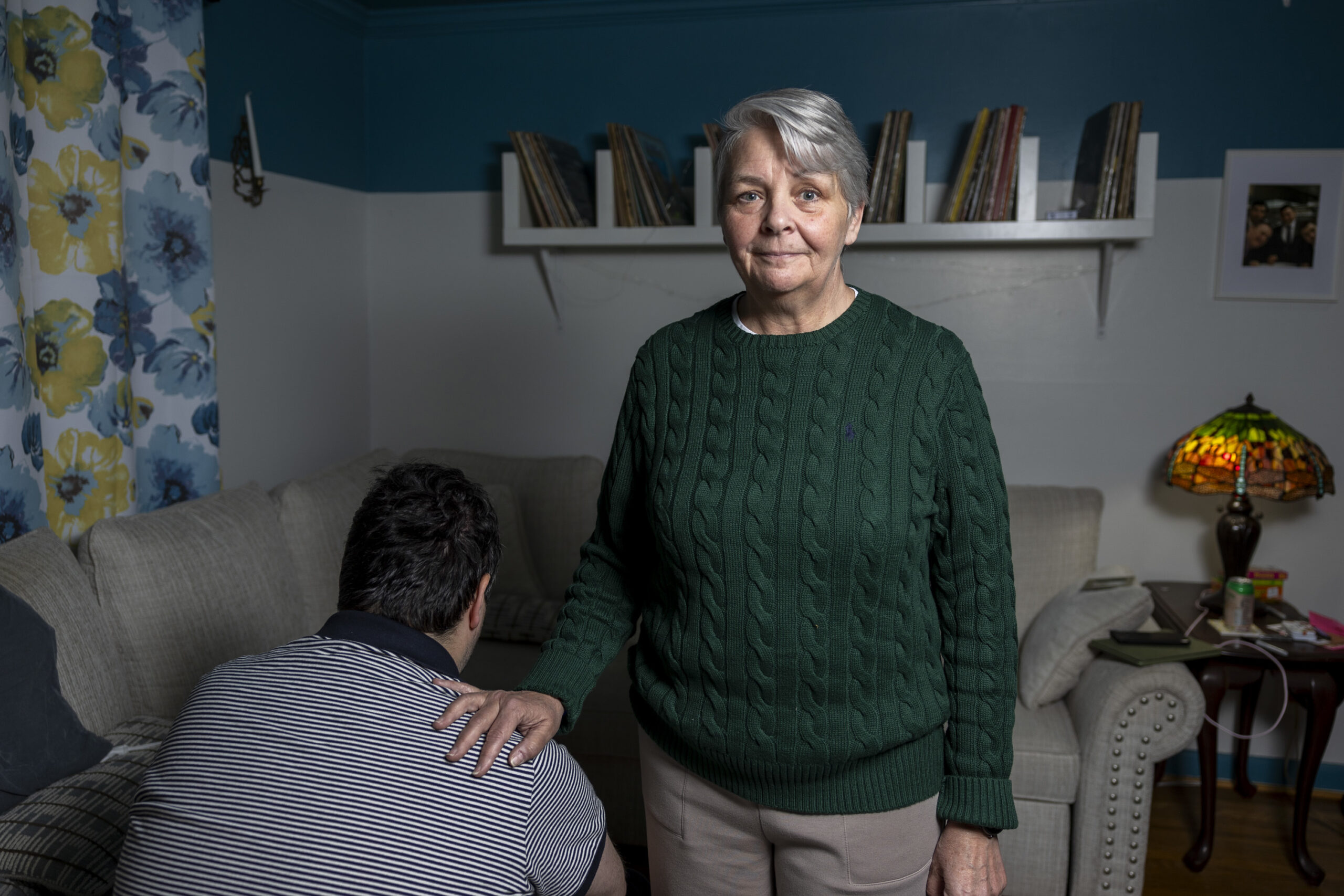
    Carolyn Piro, of Cherry Hill, poses for a portrait with her son Sean, who has autism, in their home this month.

    Curran said telling his story was “making me feel better.” He wants to better advocate for himself and others with autism.

    “I want people to treat other people with dignity and respect, compassion, and kindness,” he said.

  • Camden’s incoming school superintendent says it’s too soon to know if more budget cuts will be needed

    Camden’s incoming school superintendent says it’s too soon to know if more budget cuts will be needed

    Incoming state-appointed Camden school superintendent Alfonso Q. Llano Jr. got a head start Wednesday on his new position running the troubled school system.

    Llano met with Camden Mayor Victor Carstarphen and other key stakeholders at City Hall for a congenial discussion ahead of taking over the district March 1. .

    During a round-table discussion, Llano said his immediate priority will be to provide stability to the district. Camden has been without a permanent superintendent since June 30.

    Llano,currently the school superintendent in the Vineland district, inherits a district of about 5,532 students plagued with declining enrollment, law test scores, chronic absenteeism and a high dropout rate.There have been modest gains since the state seized control of the district in 2013.

    The incoming district leader said it was too early to comment on the district’s budget outlook for the 2026-2027 school year. Last year, the district had a $91 million budget deficit and made cuts affecting nearly 300 positions.

    Llano said he was made aware of recent rumors about possible school closures. He said he had not received data about it and declined further comment.

    In response to another question, he said he would support immigrant families who have grown increasingly afraid to send their children to school because they fear they may be targeted by ICE. About 56% of Camden’s traditional public school students are Hispanic.

    “Schools are a safe place and we want to maintain them as a safe place,” Llano said.

    He delicately side-stepped a question about the changing educational landscape in Camden. Thousands of students have left the city’s traditional public schools for Renaissance and charter schools, which are publicly funded but privately run.

    Enrollment in the Renaissance and charter schools exceeds the traditional public schools. The district has said payments to those schools have increased from $54.9 million in 2013 to $198 million.

    “School choice is important to families. Camden is unique” Llano said. “We want to make sure the public school system is stabilized and innovative in a way that families feel comfortable keeping their children in the public school system.”

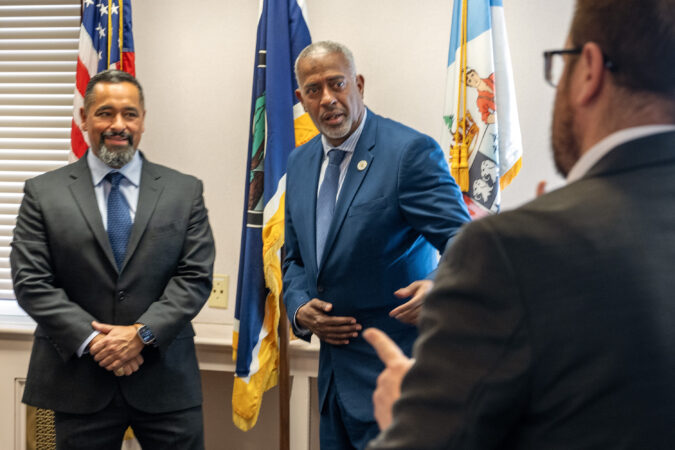
    Camden’s new state-appointed school Superintendent Alfonso Q. Llano Jr. listens as Mayor Victor Carstarphen speaks while Llano makes his rounds Wednesday, Jan. 21, 2026 at City Hall, meeting with other city, county and state officials. Currently the Vineland schools chief, he doesn’t officially begin in Camden until March.

    Llano said he would focus on listening and learning from educators and the community as his introduction to Camden.

    “What does the reality look like? What is every day in the classroom?” he said.

    Llano has been making his rounds in Camden. He was in the city Monday and joined Martin Luther King Jr. Day of Service activities.

    Llano said he was proud to become the first Hispanic tapped to lead the district. He is among only a handful of outsiders to become the city’s schools chief.

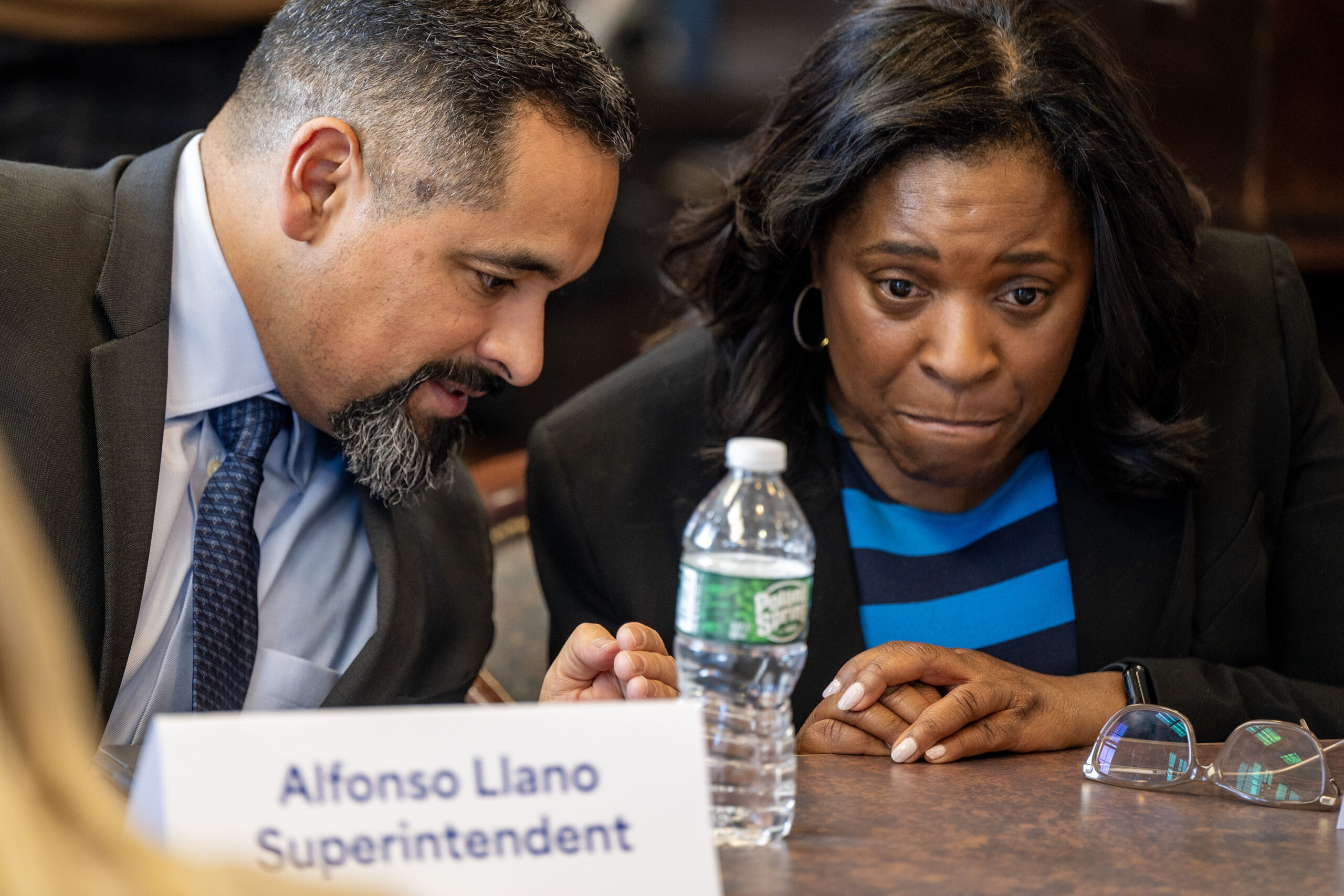
    Camden’s new state-appointed school Superintendent Alfonso Q. Llano Jr. (left) talks with Davida Coe-Brockington, current acting state superintendent, as he makes his rounds Wednesday, Jan. 21, 2026 at City Hall, meeting with city, county and state officials. Llano, currently the Vineland schools chief, doesn’t officially begin in Camden until March.

    Llano will receive an annual salary of $260,000 under a three-year contract, making him among the highest paid superintendents in Burlington, Camden and Gloucester Counties.

    He succeeds Davida Coe-Brockington, a longtime Camden educator who has served as the interim superintendent during a national search. She was not a candidate for the job.

    Coe-Brockington, who will continue as interim chief until Llano arrives, said she was “honored to hold it down” until a permanent superintendent was named. She thanked Llano “for saying yes to Camden.”

    Carstarphen and a group of city leaders cleared the path for the state to appoint a new superintendent. Katrina McComb’s contract was not renewed last year after The group said Camden schools needed “a new vision for leadership.”

    Llano has been superintendent of the Vineland district in Cumberland County since 2021. He previously worked in the Trenton, Readington Township and Howell Township school districts.

  • New Jersey will now require cursive writing for some elementary school students

    New Jersey will now require cursive writing for some elementary school students

    Beginning in September, New Jersey public schools must begin teaching cursive writing to students in grades three to five.

    A bill signed by Gov. Phil Murphy on Monday makes cursive instruction mandatory for some elementary students. The requirements take effect immediately and apply to the 2026-27 school year.

    New Jersey joins Delaware and at least two dozen other states that require cursive writing. Similar legislation proposed in Pennsylvania did not advance.

    In pushing the mandate, New Jersey State Sens. Angela McKnight (D., Hudson) and Shirley Turner (D., Mercer), the bill’s sponsors, have said students should be able to write in cursive to sign legal documents and read personal keepsake letters and historic documents.

    Murphy, who signed the bill on his last full day in office, also cited America’s 250th anniversary this year. Students should also be able to sign a check, he said.

    “We owe it to our students to give them a well-rounded education that ensures they have the tools to fully understand our rich history and become competent leaders,” Murphy said in a statement.

    Experts say cursive writing improves fine motor skill development and eye-hand coordination. It is also believed to boost spelling and writing skills and overall learning and to encourage discipline and patience.

    However, in 2010, cursive writing was eliminated from the state’s common core standards and many districts stopped teaching it. Many Catholic schools in the region have kept the tradition to promote good penmanship.

    Critics believe cursive writing is antiquated and learning should focus more on technology such as AI. They believe incorporating cursive lessons would take valuable time from other subjects.

    Some South Jersey districts like Shamong, Cherry Hill and Winslow never stopped teaching cursive writing. .

    “Handwriting is something that has always been important,” said Nicole Moore, principal of the Indian Mills School in Shamong. “We never got rid of it.”

    Moore said students in her school in Burlington County learn cursive in third and fourth grades. She believes it will be easy to extend the instruction to fifth graders in the middle school.

    The biggest challenge facing schools implementing the new mandate will be funding and finding time in the school day to add another subject, Moore said.

    “You need resources to teach handwriting,” Moore said Tuesday. “That’s just one more thing as schools we have to figure out how to pay for it.”

    Moore said teachers must find creative ways to make learning cursive writing engaging and not simply have students write the same passage several times.

    At Indian Mills School, the school year begins with cursive writing instruction twice a week and then shifts to independent learning later in the year. A program called “Handwriting Without Tears” is used to teach students basic strokes and how to connect letters.

    McKnight has said cursive could be incorporated during writing or spelling lessons. She first introduced the bill several years ago, but it didn’t get traction.

  • N.J. adopts ‘bell-to-bell’ cell phone ban policy for public schools

    N.J. adopts ‘bell-to-bell’ cell phone ban policy for public schools

    Gov. Phil Murphy signed a law Thursday banning cell phones in New Jersey public schools from “bell to bell” in an effort to help students focus on learning.

    New Jersey joins a growing number of states that have enacted tighter cell phone restrictions in schools to remove distractions. Pennsylvania is considering a similar measure, and 17 states have banned the devices in schools, according to ABC News.

    Murphy proposed the restrictions last year during his annual State of the State address. Legislation then won bipartisan support in both houses.

    During a bill-signing event at Ramsey High School in Bergen County, Murphy said the law would promote improved academic performance and student mental health.

    “By getting rid of needless distractions, we are fundamentally changing our schools’ learning environments and encouraging our children to be more attentive and engaged during the school day,” Murphy said. “This is a sensible policy that will make a world of difference for our children.”

    Murphy, who said he refrains from bringing his phone into meetings, borrowed a phone to use as a prop for the news conference because his was locked in his car.

    “That will be locked up until I’m no longer governor,” said Murphy, who leaves office Jan. 20.

    The bill was heavily endorsed by principals and teachers, who said valuable instruction time is lost when they have to direct students to put away the devices during class.

    Experts say cell phones have become a growing distraction and hinder learning. Students have been using their phones to text friends and even to watch movies during class. The devices have also been used for cyberbullying.

    Bans will not go into place in schools around the state, however, until next school year. The law requires the state Department of Education to develop guidelines for districts to draft polices restricting the use of cell phones and devices by students in classrooms and during the school day.

    Local school boards that operate more than 600 districts across the state must then adopt a new policy. The law takes effect for the 2026-2027 school year.

    Many districts in South Jersey, including Cherry Hill, Deptford, Moorestown, Washington Township, and Woodbury, already restrict cell phone use in classrooms, but the policies have not been consistently enforced and punishments vary. Some require students to store their phones in lockers all day, while others allow phones during lunch and breaks.

    Some districts only require students to keep their phones turned off, while others provide locations for the devices to be stored during the school day.

    Under the bell-to-bell approach of the new state law, students will not be permitted to access their phones for the entire school day.

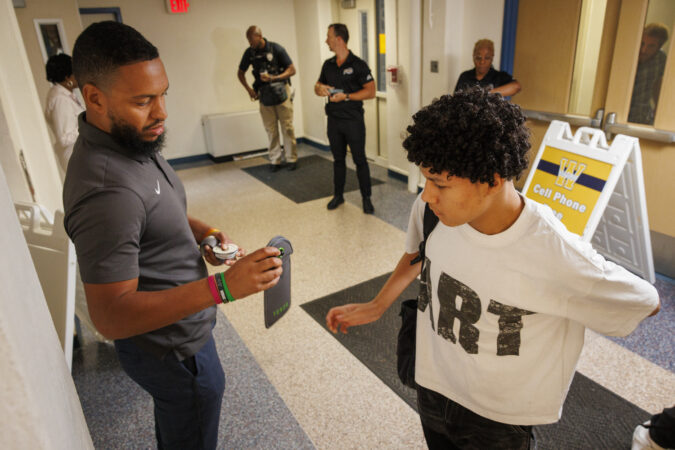
    Lianah Carruolo, a seventh-grade student at Woodbury Junior-Senior High School, unlocks her cell phone pouch in September 2024.

    Woodbury Superintendent Andrew Bell said a cell-phone-free campus policy at Woodbury Senior High School has drastically changed the culture. There are fewer disciplinary issues and students interact more with classmates and teachers, he said.

    “Students are noticeably happier, engaged and present in their classrooms, and connected to one another,” said Dwayne Dobbins Jr., acting co-principal of Woodbury Junior-Senior High School.

    What happens next?

    Districts must adopt policies restricting cell phones during the entire school day. That may require students to lock up the devices when they arrive or secure them in locked pouches.

    In December, the state awarded nearly $1 million in grants to 86 districts under a new Phone-Free Schools Grant Program to help districts implement the policy. Schools had to agree to restrict cell phone use during the entire day.

    In South Jersey, 12 districts in Burlington, Camden, and Gloucester Counties received grants. The grant amounts varied depending on the size of each district.

    window.addEventListener(“message”,function(a){if(void 0!==a.data[“datawrapper-height”]){var e=document.querySelectorAll(“iframe”);for(var t in a.data[“datawrapper-height”])for(var r,i=0;r=e[i];i++)if(r.contentWindow===a.source){var d=a.data[“datawrapper-height”][t]+”px”;r.style.height=d}}});

    Gloucester City Superintendent Sean Gorman said his district used a $10,823 grant to install cabinets in classrooms where students in grades 7-12 must lock up their devices when they arrive for homeroom. Younger students are instructed to leave the devices at home, he said.

    “We know it’s right for kids,” Gorman said. “If you let them bury their head in their phone for a good portion of the day they will.”

    Other districts, like Woodbury, have opted to use locked pouch systems to store students’ phones. They retrieve their phones at the end of the day.

    In Pennsylvania, similar legislation has bipartisan support and advanced out of a Senate committee last month.

    What about parental concerns?

    Not everyone agrees with the bans.

    Some parents have expressed concern that they will not be able to reach their children, especially in the event of an emergency. School officials say parents will still be able to contact their children through the main office.

    There have also been arguments by opponents that states are overreacting with the cell phone bans and that the legislation is unlikely to have the intended impact.

    But groups have parents have also mobilized to speak out against cell phone use, circulating pledges to wait until eighth grade or high school to purchase phones for their children.

    Are there exceptions to the ban?

    Districts will have some flexibility to allow exceptions. For example, some students use their phones for medical conditions such as glucose testing.

    Exceptions may also be made for students with individual education plans or IEPs and use devices such as tablets and ear buds as part of their curriculum.

    Before the law signed Thursday, some districts allowed students to retrieve their phones during breaks, in the hallways between classes or during lunch. The law no longer permits that.

    Will students be penalized?

    It will be left to districts to decide how policy violations should be handled. Some districts with policies already have opted for a progressive discipline approach.

    Gorman said Gloucester City has had 60 violations at its high school since the new policy took effect in September, down from 130 the previous year. The school has 731 students.

    First-time offenders are given a two-day, in-school suspension and their phone is confiscated, Gorman said. A second offense gets a four-day, in-school suspension; three-time offenders are given a three-day, out-of-school suspension and remanded to an alternative program, he said.

    Gorman said students have largely accepted the policy. The school has had fewer disciplinary problems and conflicts typically escalated through text messages have decreased, he said.

    “We barely had any repeat offenders,” Gorman said.

  • Vineland educator is named new Camden superintendent, the first Hispanic to lead the district

    Vineland educator is named new Camden superintendent, the first Hispanic to lead the district

    A veteran Vineland educator has been named the state-appointed superintendent to oversee the Camden school system, state Education Commissioner Kevin Dehmer announced Wednesday.

    Alfonso Q. Llano Jr. was selected after a national search that began in June. He will begin heading the troubled South Jersey school system starting March 1.

    He will be the first Hispanic superintendent to lead the district. Demographics in Camden have shifted in recent years, and 56% of its traditional public school students are now Hispanic, 42% are Black, and 1.2% are white.

    Dehmer made the long-awaited announcement at the monthly state Board of Education meeting in Trenton. The board unanimously approved the appointment.

    “I’m honored for the opportunity to serve the Camden City School District,” Llano said. “Together, we’re going to work through transparency and tough times. We’re going to achieve great things.”

    Llano will receive an annual salary of $260,000 under a three-year contract.

    In Vineland, he was the highest-paid superintendent in Cumberland County with an annual base salary of $206,000.

    Davida Coe-Brockington, a longtime Camden educator who has served as the interim superintendent during the search, will remain in that role until Llano takes over. She was not a candidate for the job.

    Llano succeeds Katrina T. McCombs, whose contract was not renewed after a group of city leaders, including Mayor Victor Carstarphen, called for her ouster. The group said Camden schools needed “a new vision for leadership.” McCombs left Camden in July for a state role after seven years as superintendent.

    Reactions to Llano’s hiring

    Carstarphen and other officials praised Llano’s appointment in a statement released Wednesday. The mayor lauded the state “for identifying someone who will bring meaningful change for Camden’s students.”

    “I am confident he will be an excellent leader who prepares our students for the future and always puts our students’ academic interest first,” Carstarphen said.

    N’Namdee Nelson, president of the Camden City Advisory School Board, said: “We want to ensure that every child in the school district has access to a great school.”

    Others, like former longtime school board member Jose E. Delgado, wished Llano well but were less optimistic. He said the selection of a Hispanic superintendent was “long overdue.”

    “He’s stepping into a very dysfunctional environment that will require a wide array of fiscal, administrative, and educational skills,” Delgado said.

    Llano inherits a district with declining enrollment — it currently has about 5,532 students — low test scores, and a high dropout rate. There have been modest gains since the state seized control of the district in 2013.

    The changing educational landscape in Camden poses the biggest challenge. Thousands of students have left the city’s traditional public schools for Renaissance and charter schools, which are publicly funded but privately run and now lead the district’s enrollment.

    Camden is the only district in New Jersey with three school types. Charters enroll 3,236 students, and Renaissance schools have 6,664 students.

    Last spring, McCombs cited the declining enrollment in part for a $91 million budget deficit. She cut more than 100 positions and laid off teachers and support staff in a massive restructuring.

    Camden Education Association president Pamela Clark, who represents more than 1,000 teachers and support staff, said she hopes to meet with Llano soon to discuss concerns about possible layoffs and school closures.

    “I will continue to advocate fiercely to protect my members’ jobs and school closures, and I hope the new superintendent brings fairness, transparency, and unity to our city,” she said.

    Llano’s past work in Vineland and Trenton

    Llano has been superintendent of the Vineland district in Cumberland County since 2021. His five-year contract was set to expire in June.

    During a meeting in June, the Vineland board was bitterly divided over whether to renew his contract. The board must give six months’ notice if it plans to terminate a superintendent. The motion to not renew it failed, and it was unclear what direction the board would pursue.

    In Vineland, Llano oversaw a diverse district of more than 10,200 students enrolled in 16 schools. About 63% of the students are Hispanic, 14% are Black, and 18% are white. About 17.4% of its students are multilingual learners.

    Vineland has some of the same issues as Camden schools — low test scores and chronic absenteeism. The majority of the students in the sprawling 68-square-mile community are economically disadvantaged.

    Llano also spent 10 years in the Trenton school system, most recently as the interim schools chief for nearly a year prior to moving to Vineland. He previously was the district’s chief academic officer for six months. He also was an assistant superintendent and principal in Trenton.

    According to his LinkedIn profile, Llano also had stints in the Readington Township and Howell Township school districts in a career spanning 27 years.

    He is pursuing a doctoral degree in education at Seton Hall University. He holds master’s degrees from New Jersey City University and Kean University, and a bachelor’s degree from Rowan University.

    Interim State-appointed Camden school Superintendent Davida Coe-Brockington.

    Coe-Brockington said Llano’s reputation precedes him and that she was looking forward to working with him to “focus on the progress we’ve made in the district and focus on creating better outcomes for the students and families of Camden City.”

    It was unclear Wednesday whether Coe-Brockington would remain in the central office when Llano takes over or return to Creative Arts High School, where she has been principal since it opened in 1999.

  • My brother graduated from college 50 years after dropping out of high school. Here’s his inspiring story.

    My brother graduated from college 50 years after dropping out of high school. Here’s his inspiring story.

    Growing up in South Jersey, my siblings and I were often reminded by our mother to seek a college education to better our chances of landing a good job.

    My sister Andrea and I heeded her advice and obtained bachelor’s degrees with honors a few years after high school, and began working in our professional fields.

    It took my brother, William, the oldest, nearly 50 years to believe he could do it, too. We always knew he had the smarts and the grit. He had to believe it.

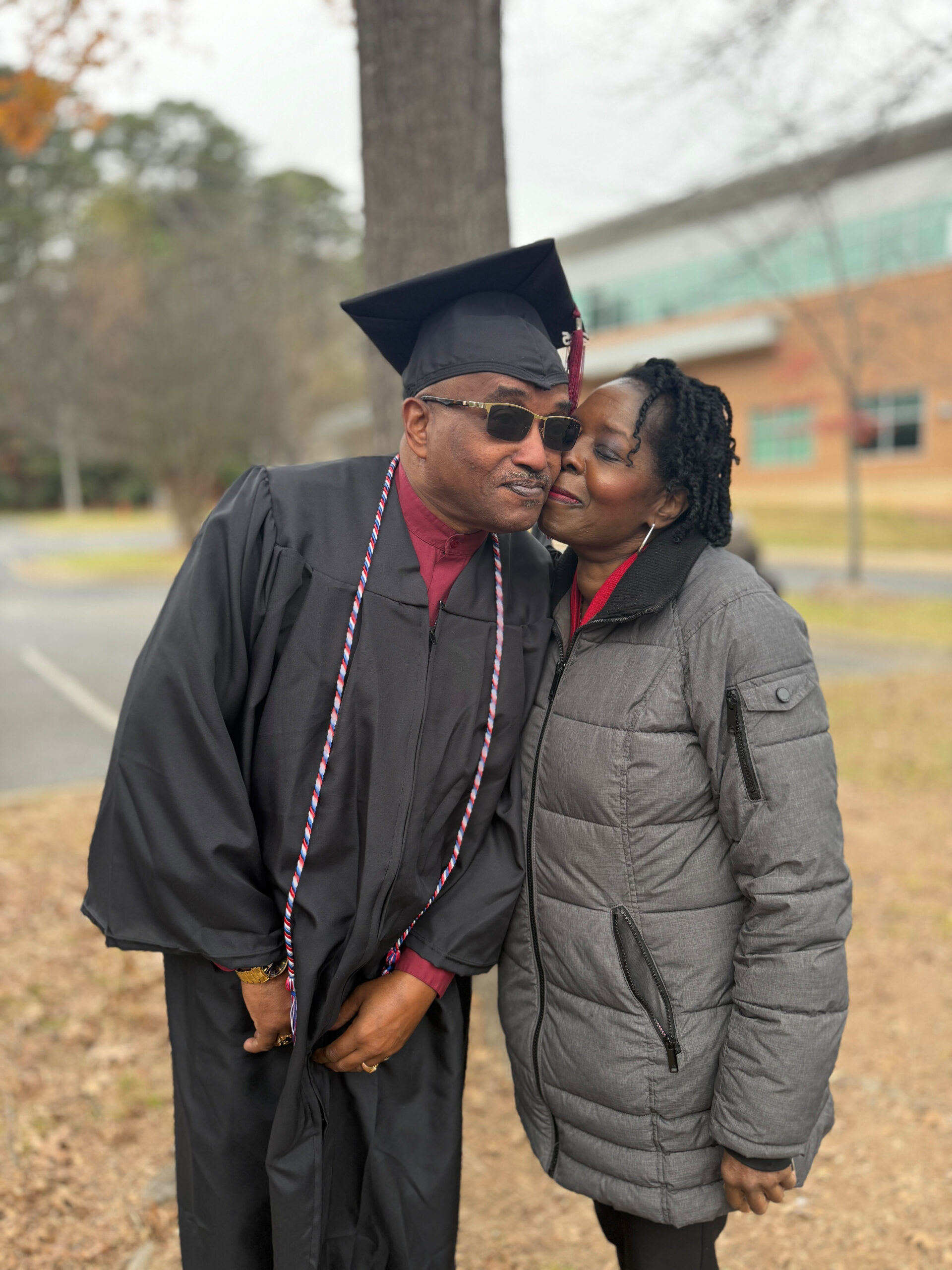
    After a circuitous journey, he proved it by graduating in December from the University of Arkansas at Little Rock at 67. His extended family could not have been more proud.

    ‘I don’t want to give up’

    He attended three colleges and took classes part time for eight years. He enrolled in remedial math, reading, and writing courses, had tutors, and took algebra four times until he finally passed after two years. He missed a semester after a major health scare in 2022, which interrupted his studies.

    “I didn’t want to give up. I was the only one in the family who didn’t have a college degree,” he said. “For me, it was the sky is the limit, and you can do it.”

    An increasing number of learners like Will, 35 and older, are joining younger students in college classrooms. More than four million were enrolled in postsecondary education in 2023, according to an Inside Higher Education report.

    Some older learners, like my brother, are retired and want to pursue a lifelong dream to obtain a college degree. Others want to change careers or increase their earning potential.

    Affectionately called “Willie Will,” my brother dropped out of Bordentown Regional High School his senior year in 1976 to enlist in the U.S. Army. Because he was just 17, our mother, Eva, had to give permission.

    William Burney dropped out of Bordentown Regional High School his senior year in 1976 to join the U.S. Army. He obtained a GED while serving in the military.

    Bored with school and failing most classes, Will decided the military would give him a new start and ease the financial burden on our single mother. During his three-year military stint, he became a medic in the Army and obtained his GED.

    Despite not having a degree, Will always landed good-paying jobs in a variety of fields. He has been a psychiatric technician, a nursing assistant, a retail store manager, a longshoreman on the Camden waterfront, a truck driver, and a corrections officer.

    Along the way, he battled demons and a drug addiction that made him not always make good choices. He eventually sought treatment and has been sober for nearly three decades.

    No regrets

    “I don’t have any regrets,” he said. “I could have been dead three or four times, so to make it to 67, I have made it.”

    Will retired from the Arkansas Department of Corrections’ Wrightsville Unit, where he had worked as a corrections officer for three years after moving to North Little Rock with his wife, Belinda, in 2008. He suffered a light stroke at work in 2015 that left his left side weakened and affected his short-term memory.

    Thinking about his unfinished business, he began taking classes in 2017 at the University of Arkansas — Pulaski Technical College, a two-year college in North Little Rock. He also spent a semester at Arkansas Baptist College.

    Returning to the classroom for the first time in nearly five decades wasn’t easy. He was three times as old as his classmates. The technology was intimidating: He could barely type and had never used a laptop. He took virtual classes during the pandemic.

    His wife, a retired elementary teacher, became his biggest cheerleader, and his college pursuit became a family project. She found him a tutor, reviewed his research papers, and even watched Zootopia, a Disney animation, with him for an assignment.

    “I was on the journey with him,” she said with a laugh. “It was something he set his mind to, and he kept on.”

    He graduated from Pulaski in 2020 with an associate degree. The family proudly watched the commencement, which was held virtually because of the pandemic. We thought that was it.

    William Burney obtained an associate degree from the University of Arkansas — Pulaski Technical College in 2020. A virtual commencement was held due to the COVID-19 pandemic.

    Motivated by his advisers, Will decided to pursue his bachelor’s with a vengeance. He rarely missed class, turned in assignments on time, and sought help from professors when needed to stay on track.

    He missed the spring 2023 semester after undergoing open-heart surgery to replace an aortic valve. He was back in school the following semester.

    When Will informed the family he was finally graduating, I was determined to witness his big day, traveling over 1,000 miles to get there. I wanted to stand in the gap for our mother, who died in 2014. Our sister, a healthcare administrator in Florida and unable to attend, said, “I’m incredibly proud of him and this monumental accomplishment.”

    William Burney holds a portrait of his mother, Eva Moss, that he commissioned. She died in 2014.

    From the moment we stepped on campus with my boyfriend, Jeff, I chronicled every moment, snapping photos and videos, much to Will’s chagrin. I was especially proud when he led his fellow criminal justice major graduates inside as the department’s student marshal.

    “I knew I was real smart, but wasn’t using it,” he said. “It was just a matter of buckling down and doing it.”

    Always a jokester, he couldn’t resist a sibling jab. “We all know I’m the smartest in the family. I had to go the long route to get there.”

    The Burney family, from left, William Burney, Melanie Burney, mother Eva, sister Andrea Robinson, and her children, Jamil and Christopher Robinson (front).

    During my whirlwind visit, we celebrated and reminisced about our childhood and lessons from our mother. I had a chance to learn more about the man my brother had become. It was bittersweet that our mother was not there to share the moment.

    Siblings William and Melanie Burney at his graduation Dec. 13 from the University of Arkansas at Little Rock.

    As we drove around Little Rock, Will pointed to the community garden he helped start in 2011 and served as the manager. He serves on the board of Jefferson Comprehensive Care Service Inc., which operates seven health clinics. He took me to King Solomon Baptist Church, where he was baptized in 2012.

    Inspiring others

    Will — who earned a second associate degree in addition to a bachelor’s — plans to use his experience to encourage others, especially young Black men. He’s currently weighing an offer to join the university’s faculty. He may pursue a graduate degree.

    “If you get the opportunity to become a better person, learn while you can. You have to do the work.”

    After taking classes for eight years, William Burney graduated in December from the University of Arkansas at Little Rock. He wants to encourage others to pursue their dreams.
  • South Jersey students learn mushroom cultivation while getting a lesson in civics

    South Jersey students learn mushroom cultivation while getting a lesson in civics

    Science teacher Michael Green wasn’t sure how his students would feel about the new assignment. Growing mushrooms for South Jersey restaurants had, after all, never been in his curriculum before.

    They loved it, and three years later, the operation at Rancocas Valley Regional High School in Mount Holly is thriving. The project produces more than 1,000 pounds of mushroom varieties annually.

    “It’s super fun,” said sophomore Lilly Sell, 16, an aspiring pediatric nurse or welder. “You don’t really get bored.”

    In the classroom, Green teaches students in his biology and environmental science classes the fundamentals of a mushroom, the fleshy, spore-bearing fruiting body of a fungus. They learn about genetics, cell division, and the growing process.

    “My goal is to do real science,” Green said.

    Students are also learning about the farm-to-table movement by selling the harvest to local eateries and public service by donating mushrooms to a nearby soup kitchen and serving meals to the less fortunate.

    Green makes use of mushroom farming waste – spent mushroom substrate (SMS) – to decorate an archway by the greenhouse. They are producing 1,000 pounds of mushroom varieties – and almost that much waste, which they use for composting in their gardens and orchard and plan someday to sell as compost.

    Outside, the students get hands-on mushroom harvesting experience inside a greenhouse located behind the annex that houses the RV PREP (Personalized Readiness and Education Program). There are also coops on the property for about 19 chickens and a handful of quail also tended by students.

    The student mushroom farmers harvest edible fungi varieties such as lion’s mane, blue oyster, chestnut, black pearl oyster, comb tooth, and shiitake. Their produce has become part of the supply chain for several nearby restaurants and the students’ own families, who are gifted the fungi.

    Green said the operation began several years ago, when the Mycopolitan Mushroom Co. in Philadelphia was looking for a way to get rid of waste — the blocks of mycelium-laced agricultural waste where mushrooms grow. They forged a partnership and Green agreed to regularly pick up a truckload.

    Three weeks after Green picked up the first load of blocks in 2022, students harvested about 20 to 30 pounds of mushrooms. The operation has grown steadily since then, Green said.

    The blocks are stored in plastic bags on shelves in the greenhouse, which is temperature-controlled for the best growing conditions. After a few weeks, the bags are cut open to let in oxygen to grow the mushrooms.

    Green said the blocks sit in the greenhouse in a fruiting chamber during the pinning, or growing, period. Each load of blocks yields about 200 bags of edible mushrooms, he said.

    The bulk of the harvest is sold wholesale to the Robin’s Nest restaurant in Mount Holly and the Vincentown Diner in Southampton Township, Green said.

    The classroom-to-table operation has been profitable for the school. It generates about $7,000 annually, which is reinvested in the school’s environmental science and biology programs, Green said.

    “We use a ton of mushrooms at the restaurant,” said Robin Winzinger, who runs the family-owned Robin’s Nest. “The quality of their mushrooms are fantastic, really top-notch.”

    The mushrooms are featured on the menu as “RV mushrooms,” said Winzinger, a culinary chef. They are used in the restaurant’s wild mushroom soup, quiche, and risotto, among other dishes, she said.

    The school also donates about three pounds weekly to the First Presbyterian Church in Mount Holly for its community lunch program, said Jan Delgado, the director. The program serves about 300 free meals twice a week.

    Delgado said the program’s chef prepares the mushrooms as a side dish sauteed with herbs. The church would not be able to offer the dish otherwise, she said.

    “It’s strictly a delicacy that we are able to serve because of the school,” Delgado said. “We would never purchase mushrooms — that would be too expensive.”

    Students occasionally volunteer at the church to help serve the meals prepared with the fungi — an experience Sell described as “heart-warming.”

    “They love the mushrooms,” Sell said. “They go through the pans in seconds.”

    After donning plastic gloves, Sell and classmate Jordan Griffin, 18, a senior, stepped into the humid greenhouse on a recent morning to inspect the latest batch of shrooms.

    They pointed out different mushroom varieties that typically grow from October to March or April. Students in the school’s Environmental Club also assist with harvesting after school.

    Griffin, who plans to attend a trade school to study welding or HVAC repair, said the hands-on experience piqued his interest. He’s not too fond of sampling mushroom dishes, however.

    “I’m not the biggest fan of them,” Griffin said. “I won’t go crazy over them.”

    Green has asked Winzinger to conduct cooking demonstrations in class, hoping to whet students’ appetites with dishes like chicken mushroom Alfredo and mushroom soup.

    “I don’t know how many students would want to eat a mushroom entree,” Green said.

    Sell said that while she is no fungi fanatic, she enjoys her mother’s mushrooms sauteed with garlic butter.

    “There are many ways to make it to your taste,” she said.

    After opening the plastic bags, Griffin and Sell carefully cut a small harvest and packaged the mushrooms in brown paper bags. The bags would be offered that day free to students and staff.

    After harvest, the spent mushroom blocks are composted on site and applied to the school’s Outdoor Learning space, which includes fruit trees, rain gardens, vegetable plants, and honeybees.

    Lilly Sell harvests enoki mushrooms.

    Green said most of the mushrooms are harvested in bigger quantities and sold to the local restaurants. Whatever is left over is given to the community, he said.

    “My goal is just to get the mushrooms out,” Green said. “The goal is to get mushrooms into people’s hands.”

    Students also get to take home the chicken eggs, Green said. The quail have yet to produce any eggs, he said.

    “Those are a hot commodity,” he said.

  • Google app hiccup jumps the gun before the Eagles-Commanders game with AI-generated victory post

    Google app hiccup jumps the gun before the Eagles-Commanders game with AI-generated victory post

    Hours before kickoff in Saturday’s Eagles-Commanders matchup, a Google app jumped the gun with an AI-generated post that the Birds had won the game.

    The artificial intelligence hiccup, known as a hallucination, had the Eagles winning 27-17 and clinching the NFC East title. It even included made-up game highlights — Jalen Hurts throwing for over 200 yards and Saquon Barkley scoring a key touchdown. (Here in the real world, Hurts threw for 185 yards in a 29-18 Eagles win; Barkley did in fact run for a TD as the Birds became the champs of the NFC East.)

    The false information was easily identified because the game had not started, but that is not always the case with AI hallucinations in legal cases and financial reporting, said Subodha Kumar, a professor of statistics, operations, and data science at Temple University’s Fox School of Business.

    “Sometimes it is so wrong that you can detect it,” Kumar said in an interview Saturday. “Sometimes you cannot.”

    The fake post was captured by Reddit Philadelphia users. Such erroneous AI-generated posts are user-specific and often deleted. A line at the bottom of the post cautioned: “Generated with AI, which can make mistakes.”

    The post linked to an accurately reported 6abc game preview story noting that the Eagles could become the first NFC East team since 2004 to win back-to-back division titles.

    Kumar said the hallucinations typically link to a news article or published reference to give the false information the appearance of legitimacy.

    Eagles fans commented on the error on Reddit. Some immediately recognized it as an AI mistake; others worried that it could be a jinx for the Eagles.

    “Crossing my fingers but jeepers Google kind of jumped the gun this morning,” one wrote.

    “I saw this and thought — did I miss a game?” another commented.

    Another wrote: “‘Generated with AI, which can make mistakes’ is the understatement of the year.”

    Hallucinations occur when a generative AI model confidently presents false or misleading information as a fact, rather than a prediction, Kumar said.

    They are most common in big sporting events, like the 2024 Super Bowl, when two AI chatbots made up statistics when questioned about the game between the Kansas City Chiefs and the San Francisco 49ers. (The Chiefs won in overtime.)

    There have also been false AI-generated election results, financial reports, and legal decisions, Kumar said. The biggest impact may be false financial reports, which can affect the stock market, he said.

    “Clearly, this is a big problem,” Kumar said. “We have to be careful using the results for critical decision-making.”

    Kumar said guardrails currently are not properly designed to prevent such errors, but the technology has improved in recent years.

    More companies have added fact-checking technology to alert the algorithm before it generates erroneous content, he said.

    Asked Saturday afternoon to predict the Eagles game, Kumar quipped: “I will leave it to AI.”