Author: Melanie Burney

  • A record number of N.J. students are earning associate’s degrees with their high school diplomas. Meet three of them.

    A record number of N.J. students are earning associate’s degrees with their high school diplomas. Meet three of them.

    When Jasmine Thach began high school four years ago, she wanted to balance academics and extracurricular activities to pursue her college dreams.

    By sophomore year, Thach was enrolled in her first college course. She began taking as many as five classes a semester — enough credits to obtain an associate’s degree in May from Camden County College.

    Thach picked up her second diploma when she graduated in June as valedictorian from Camden County Technical Schools in Pennsauken.

    “I knew that I could do it,” said Thach, 18, of Pennsauken. “I didn’t know how lucky I was.”

    Thach is among a record group of 367 students enrolled in New Jersey’s 21 county vocational-technical schools who graduated with associate’s degrees this year while attending high school. That amounts to 30 more than the previous year, said Jackie Burke, executive director of the NJ Council of County Vocational-Technical Schools.

    “It’s a great outcome,” said Burke. “This is really an attractive option that more people are looking at.”

    Once considered an option mostly for students to pursue skilled trades, vocational-technical schools have become increasingly competitive and are attracting students who want a different pathway to college or careers.

    In a tough economy, the vocational-technical schools make it easier and more affordable for students to earn credit for college-level work. Many have partnerships with county colleges and other nearby two- and four-year colleges, Burke said.

    “It’s a reflection of students seeing the value of getting a head start,” Burke said. “This is really a way to save on those costs.”

    Of the 367 students graduating this year, 31 are from Camden County Technical Schools, which has campuses in Gloucester Township and Pennsauken. The Gloucester County Institute in Deptford has 17 graduates. Burlington County Institute of Technology has students who earned some credits, but none who obtained the full associate’s degree. Cumberland County Technical Education Center in Vineland had the second-highest in the state, with 60 graduates.

    For the 2024-25 school year, more than 35,000 students were enrolled in New Jersey’s county-vocational schools. The schools are selective; only about 12,000 of the nearly 30,000 who apply annually statewide are accepted.

    Students may study a wide range of disciplines, from traditional vocational fields like cosmetology and construction to engineering and health science.

    Under the Early College Associate Degree (ECAD) program, counselors work with students to meet their high school requirements while earning an associate’s degree and attending some of their classes on college campuses.

    In most cases students earn credits at a significantly reduced cost or free. Students can enter four-year colleges as sophomores or juniors, amounting to big savings in time and money.

    Here are the stories of a few of this year’s graduates:

    Jasmine Thach: Wanted to help fund college

    With two siblings already in college, Thach wanted to help ease the financial burdens for her parents. She volunteered as a tutor and participated in performing arts and the newspaper club, all while maintaining her grades.

    She graduated from Camden County College with an associate’s degree in liberal arts and sciences, and from Camden County Technical Schools in Pennsauken.

    In a nod to her Cambodian heritage, she learned to play the kong thom, a traditional Cambodian musical instrument consisting of gongs, and the violin. Every Sunday she travels with her family to Arlington, Va., to take lessons, part of their quest to preserve their culture.

    Jasmine Thach as she graduated from Camden County Technical Schools’ Pennsauken campus last month. Thach, who also received an associate’s degree from Camden County College, plans to attend Johns Hopkins University as a math major.

    While her mother and sister learned traditional Cambodian dances, Jasmine discovered a passion for music. “I have two left feet,” she quipped.

    Jasmine received a full scholarship to attend Johns Hopkins University where she plans to major in applied math and statistics.

    She wants to become an actuary and eventually obtain a doctorate and become a college professor.

    “I’m very big on math,” she said.

    Yeheira Acosta: `I’m just really grateful’

    Education has become a family affair for Yeheira Acosta, with her parents and younger sister following in her footsteps to make a better life.

    She graduated in June from Cumberland County Technical Education Center in Vineland and picked up an associate’s degree in computer science from Rowan College of South Jersey.

    Yeheira Acosta of Vineland, N.J., (third from left) shown with her family, graduated from Cumberland County Technical Education Center and obtained an associate’s degree in computer science from Rowan College of South Jersey. She plans to attend Vanderbilt University in the fall.

    A first-generation college student, Acosta has inspired her family. A younger sister is also on track to earn an associate‘s degree while in high school. Her father recently enrolled in a DeVry University online cybersecurity program, and her mother is pursuing a GED.

    Acosta, 18, of Vineland, plans to study AI at Vanderbilt University, where she earned a full ride. A Yankees fan, she wants to work in the sports industry.

    Although she is excited about the next chapter, Acosta said she will miss her family and her church, the Life of Faith in Vineland, where she provides technical support.

    “I‘m just really grateful, not everyone has the same opportunity,” she said. “I don’t take it for granted.”

    Max Yeung: An aspiring lawyer

    The youngest of three siblings, Max Yeung has set his sights on becoming a personal injury lawyer and a public service advocate.

    He obtained an associate’s degree in prelaw from Rowan College of South Jersey in Sewell. Yeung said following a computer science track at the Gloucester County Institute of Technology and an internship he got along the way helped him realize that law is his passion.

    Yeung said he landed an internship at an Audubon law firm with assistance from a college professor. His top priority was completing as many credits as possible.
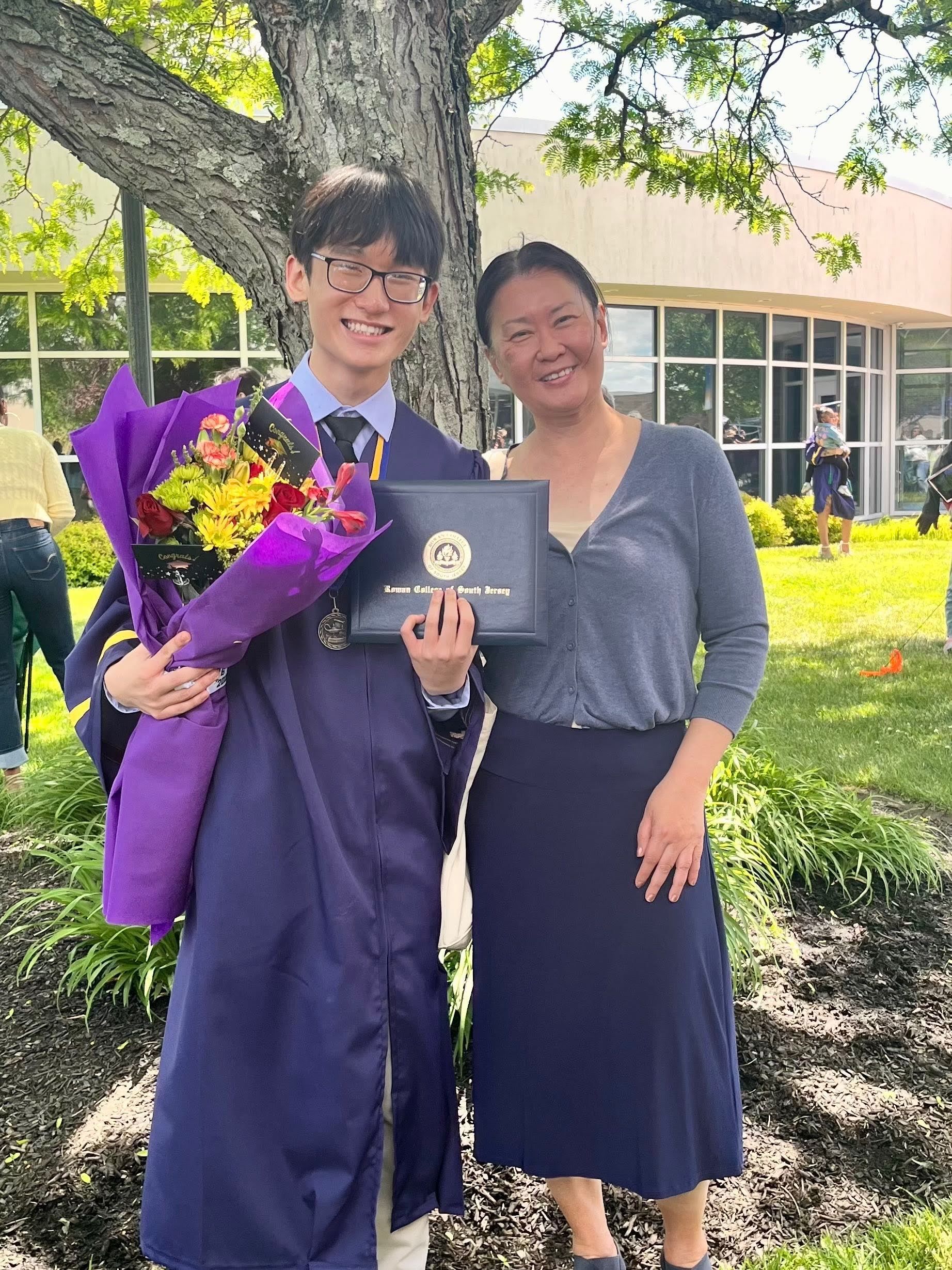
    Max Yeung, 17, of Sewell, poses with his mother, Li Khoo, after receiving an associate’s degree from Rowan College of South Jersey.

    At his high school, Yeung, 17, of Sewell, founded a nonpartisan civics group that registered students to vote. He was also president of the National Honor Society.

    “It was a lot of juggling. There were a lot of moments when I had to huddle down,” he said. “It helped me understand what the college environment looked like.”

    Yeung plans to attend Rowan University as a law justice major. Depending on how many credits transfer, he may graduate in a year or two and then hopes to attend Rutgers-Camden Law School.


  • South Jersey school board again rejects $27K merit pay for its embattled superintendent

    South Jersey school board again rejects $27K merit pay for its embattled superintendent

    Embattled Washington Township school Superintendent Eric Hibbs has lost another battle with the South Jersey school system to get $27,000 in merit pay.

    A motion to award Hibbs the bonus pay for performance failed by a 4-3 vote with two abstentions at a contentious meeting Tuesday night. Five favorable votes are needed for adoption.

    This was the third time since August that the nine-member board has not approved the merit pay, likely setting up another legal showdown between Hibbs and the board. He has a pending whistleblower lawsuit against several board members.

    Hibbs has said he had met four of the five goals approved by the board and listed with his contract for the 2024-25 school year. He earned $220,375 during the 2023-24 school year.

    The board voted on the request, with little public discussion. Hibbs did not comment at the meeting. He did not respond to a message seeking comment Wednesday.

    In order to vote, the board had to invoke a rarely used “doctrine of necessity” because it otherwise would not have a quorum. Six of nine members have a conflict of interest with Hibbs, whom they suspended last year until he was reinstated by a judge. The board remains roiled by infighting over its superintendent.

    Washington Township School Superintendent Eric Hibbs (middle) listens during a school board meeting Tuesday night.

    Here’s what’s to know about the situation:

    Why is Hibbs seeking merit pay?

    Hibbs initially requested the merit pay last August, five months after he was suspended by the board with pay. He was reinstated in July after a judge found that the board had violated the Open Public Meetings Act when it suspended him.

    According to his contract, if he meets goals set by the board, Hibbs is entitled to an annual merit bonus of up to 14.99% of his salary. Hibbs is among the highest-paid school chiefs in South Jersey.

    Interim Executive Gloucester County Superintendent Robert Bumpus approved the merit pay, as required by state law. The board must also give its approval to disburse the funds.

    Tuesday’s motion also would have allowed Hibbs to carry over up to 20 unused vacation days in addition to receiving a $27,000 bonus.

    Hibbs has been superintendent in the Washington Township district since 2023. His contract runs through 2027.

    What were the merit goals?

    Hibbs’ goals, approved by a previous board, include completing Google training presentations, taking online professional development courses, and beefing up security processes.

    He received $25,000 in merit pay for similar goals for the 2023-24 school year, according to district records obtained by The Inquirer under N.J.’s Open Public Records Act.

    The merit pay has been an ongoing issue between Hibbs and the board and has escalated since last year. The dispute has raised questions about his fate when his contract expires. The board must notify Hibbs by December if his contract will not be renewed; otherwise, the contract automatically renews for four years.

    Why was the doctrine of necessity necessary?

    Six board members were deemed ineligible to discuss Hibbs’ employment because of conflicts, board solicitor Nicholas J. Repici said. They either have family members who work for the district or are named defendants in Hibbs’ lawsuit against the district, he said.

    The doctrine of necessity allowed the conflicted board members to participate in the vote. But they were barred from any deliberations in executive session or public discussions.

    Board vice president Terri Schechter chaired a special committee of the board members without conflicts that discussed the Hibbs matter. She brought forward the motion to approve the merit pay.

    “Any discussion?” Schechter asked.

    “We’re not allowed,” board member Julie Kozempel said. She abstained along with board President Pat Blome.

    A petition launched by a parent called for the board to invoke the doctrine and vote on Hibbs’ contract renewal. It asked those who “agree that the district needs a clean break and less expensive contract for its superintendent” to consider signing the petition, which a community member spoke about at the board meeting Tuesday night.

    What is the dispute between Hibbs and the board?

    A complaint filed by local union leaders against Hibbs with the New Jersey School Ethics Commission alleged that the superintendent provided preferential treatment to a board member’s relative by changing a failing grade in September 2023.

    The board suspended Hibbs and hired a conflict lawyer to investigate the allegations. Hibbs was eventually cleared of any wrongdoing.

    In his own ethics complaint, Hibbs accused Kozempel and board member Elayne Clancy of not following procedures when the board hired Insurance Consulting Services LLC in 2021, prior to his tenure as superintendent.

    Hibbs filed a whistleblower lawsuit in May 2025, alleging his suspension was in retaliation for raising questions about the insurance contract. He alleged that the selection procedure was “procedurally flawed.”

    His employment has remained a point of contention among school board members.

    Here are other takeaways from Tuesday’s meeting

    During public comment Tuesday, there were also emotional appeals to the board to reinstate three guidance counselor positions that were cut to help balance the budget for the 2026-27 school year.

    Several school nurses and a student also expressed concern that the district has reduced the workday for several nursing assistants in cost-saving moves. They cited health and equity concerns.

    Board members were surprised to learn that first-level French and German classes were being cut at the high school due to the budget. They were told that the classes would resume next year.

    Hibbs said the district, which enrolls about 7,200 students, faced a $10 million deficit for the upcoming school year. More cuts are likely in future years without additional revenue, he said.

    “This is the reality of where we are,” Hibbs said. “We have no other place to go.”

  • Vineland schools are allowing teachers to wear jeans and dress more casually for the end of the school year

    Vineland schools are allowing teachers to wear jeans and dress more casually for the end of the school year

    Vineland’s public school teachers are having an easier time with the question of what to wear to work — at least for the final days of the school year.

    In a move to boost morale in the South Jersey school system and make teachers’ lives easier this spring during a hectic testing period, the district eased its dress policy to allow denim jeans until the end of the school year on June 25.

    Teachers love it and hope it will continue in September.

    “It’s one small way to make the world of work a little friendlier,” said Vineland Education Association president Louis Russo, a social studies teacher. “It’s one small thing off of their shoulders.”

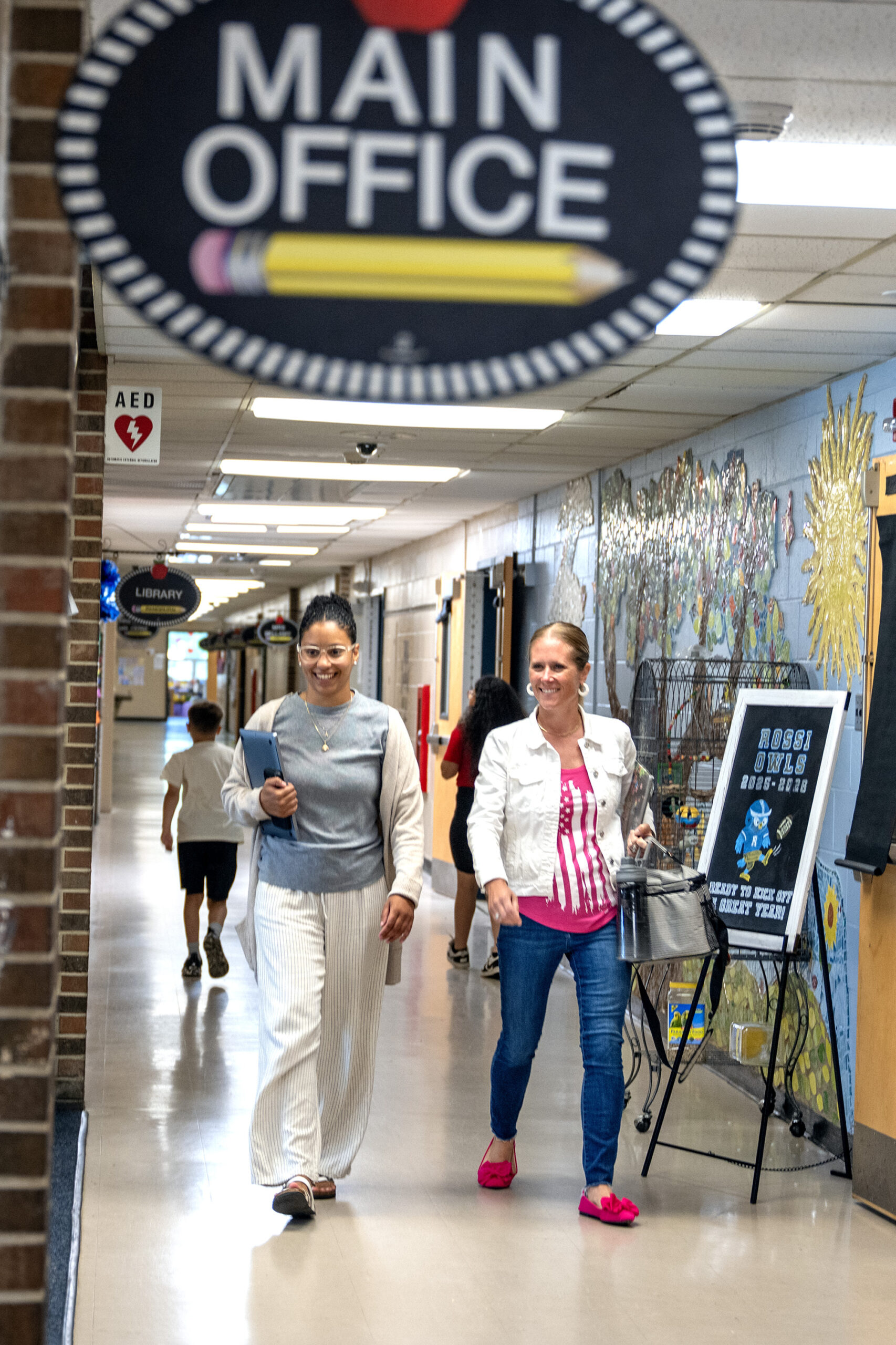
    Teachers Andrea Ruiz (left) and Elaine Petrini (right) at Rossi Elementary in Vineland on June 9. The teachers are allowed to wear jeans until the end of the school year.

    School board president Cedric Holmes said the Cumberland County district notified employees when they returned from spring break in April that they could wear jeans any day of the week under a pilot program.

    Holmes said there had been rumblings among staff because the district — the largest in Cumberland County, with 11,000 students — had to extend the school year to make up snow days. Vineland‘s June 25 last day of school is among the latest in the region.

    The months following spring break are among the toughest with students undergoing standardized state testing, Holmes said. There are also end-of-the year field trips and outings when it makes sense to allow more relaxed clothing, he said.

    “It was important to the board that staff felt that we saw the stress of all of that of this as a practical way to give a morale boost for the end of the year,” Holmes said.

    Teachers typically dress a bit more formally for school. According to Vineland’s policy, female teachers must wear skirts, slacks, skorts, or dresses with blouses or sweaters, or school uniform. The skirt, skort, or dress should not exceed three inches above the knee.

    Male staffers can wear suits or slacks with jackets and ties, sweaters, school uniform, or sports or dress shirts. Deemed unacceptable for both are sneakers, flip-flops, bedroom slippers, combat boots, and work boots. There are exceptions for teachers attending field trips or who work in specialized areas such as health and physical education or arts.

    The district also has a uniform policy for students, but Holmes said that has been relaxed and the board also plans to reexamine that policy.

    New Jersey’s 600 school districts set their own policies for staff and students.

    Steve Baker, a spokesperson for the New Jersey Education Association, which represents 200,000 teachers and support staff, said the union supports the efforts in Vineland “to develop policies that help create a positive learning and working environment for students and staff.“

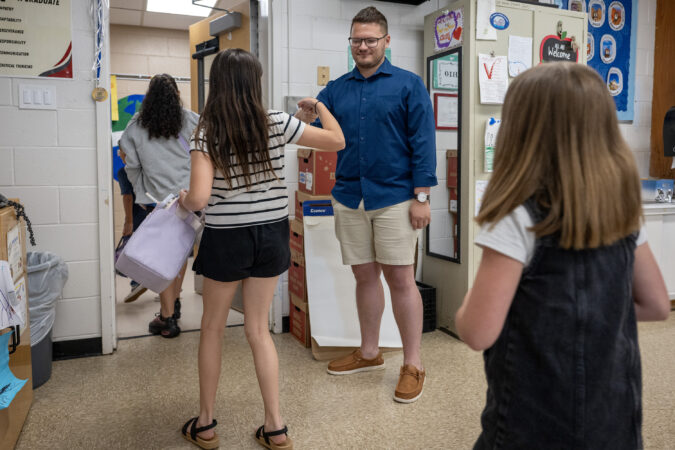
    On a busy morning last week at Anthony Rossi Elementary in Vineland, third-grade teacher Jeffrey Martine stood in front of the class dressed in khaki shorts, a button-down blue dress shirt, and slip-on loafers. As an added bonus, it was a dress-down day, which allowed teachers to wear casual attire beyond jeans.

    Jeffrey Martine, a teacher at Rossi Elementary in Vineland, greets a student at the school last week.

    “If you do your job well, you have to be able to move,” Martine said. “I’m all about comfort.”

    Students in Martine’s gifted and talented class were spread around the room working on a project in small groups. Some sat at desks making posters, while others were stretched out on the floor.

    “I don’t think professionalism and comfort are mutually exclusive,” Martine said. “Teachers should be judged more on how they interact with their students than the pants they select.”

    Holmes acknowledged the dress code was outdated and revisions are needed. The board plans to review the changes implemented this spring and may allow teachers to wear jeans during the new school year, he said.

    “It was time for a change,” said Kaitlynn Rossi, a long-term substitute teacher. “People don’t dress like that.”

    Teacher dress codes have evolved nationally over the years, especially during the pandemic, when more casual attire was the norm.

    Based on responses from teachers around the world, the website We are Teachers in 2024 compiled a list of “16 Ridiculous Dress Code Rules for Teachers You Won’t Believe Are Real.” The list included prohibiting hats, capri pants, pants with pockets, UGGs, hoodies, or dark underwear.

    In Philadelphia, where classes ended last week, there is no system-wide dress code for staff. Arthur Steinberg, president of the Philadelphia Federation of Teachers, which represents about 14,000 teachers, counselors, nurses, secretaries, and other workers, said employee dress typically does not come up as an issue.

    School board president Cedric Holmes at Rossi Elementary in Vineland last week. Holmes said the teacher dress code policy was relaxed in an effort to improve morale at the end of the school year.

    Holmes said teachers have responded well to the changes in Vineland and there have been few infractions, like torn or ripped jeans.

    Before Vineland implemented the pilot dress code, teachers were allowed to wear jeans only for special days. The schools sponsor fundraisers that allow teachers to pay $2 to wear jeans. Students are allowed to wear jeans on dress-down days determined by their school principal, and they do not have to pay.

    Fourth-grade teacher Andrea Ruiz said dressing more casually helps her students see her differently. A sign in her classroom says: “Be the best version of you.” She enjoys sitting with students on the carpet in her classroom or playing kickball on the playground.

    “We’re meeting them where they are,” said Ruiz, who was wearing a gray T-shirt and striped pants. “It’s definitely something different for us.”

    Teacher Kaitlynn Rossi with students at Rossi Elementary in Vineland last week.

    Timothy Purnell, executive director of the New Jersey School Boards Association, said a decision as simple as allowing jeans can have an impact on the learning environment.

    “If jeans support a positive environment during testing, that’s a local call we respect,” Purnell said.

    Russo believes a less-stringent dress code will help attract and retain younger teachers amid a national teacher shortage. He wants them to still dress in a manner that gets respect from students.

    “We just have to find the right balance,” Russo said.

    Staff writer Kristen A. Graham contributed to this article.

  • A Camden preschool teaching assistant is the first-ever from the city to win statewide award

    A Camden preschool teaching assistant is the first-ever from the city to win statewide award

    From the moment her rambunctious preschoolers arrive, instructional assistant Angela Feliciano tends to their every need, doling out lessons and discipline.

    Affectionately known as Miss Angie at the Riletta Twyne Cream Early Childhood Center in Camden, Feliciano has been a classroom assistant for nearly 30 years. She is also working to become a teacher soon.

    Feliciano has received accolades for her dedication and was recently recognized by the New Jersey Education Association as its Educational Support Professional of the Year for 2025-26.

    She is the first instructional assistant from Camden schools to get the recognition. She will represent New Jersey later this month at the National Education Association’s ESP conference in Anaheim, Calif.

    “She’s the first from Camden. It’s a proud moment,” said Camden Education Association president Pamela Clark, who represents about 1,050 teachers and support staff, including secretaries, clerks, bus drivers, custodians, and security officers.

    Clark nominated Feliciano, a childhood friend, for the award. Feliciano is well-liked by students and respected by parents in the community, and puts in extra effort to encourage learning, she said.

    Nominees were considered based on professional practices, advocacy and association involvement, community engagement, personal achievement, and how well they advance the image of support professionals.

    “I’m representing Camden. Not just bad things happen in Camden,” Feliciano said.

    Angela Felicano (center, third from left) celebrates her award with Camden Education Association members.

    Principal Medinah Dyer credited Feliciano with boosting preschool enrollment at Cream from about 120 students to 350 in three to four years. Feliciano attended weekend events to encourage parents to enroll their children.

    Feliciano purchases toiletries and items for students in need, and has been an advocate for children who experienced trauma or have behavioral issues, Dyer said. She is the first to arrive at school, and the last to leave, she said.

    “She is a role model for both students and staff, and her contributions have made our school a better place for everyone,” Dyer wrote in her nomination letter.

    Teaching assistant Angela Feliciano with students in the pre-K classroom of teacher Carey Hiatt at the Riletta Twyne Cream Early Childhood Center in Camden last month.

    During a recent morning at Cream, located in the city’s Centerville section, Feliciano and teacher Carrie Hiatt were in full swing with 15 preschoolers. The students are 3 to 5 years old.

    Feliciano and Hiatt crisscrossed the room, working with small groups of students for music instruction and reading. Feliciano sat on the floor with her charges or in tiny chairs to talk with them at eye level.

    In one corner, Feliciano played a game with a boy, pretending it was her birthday.

    “How old are you?” he asked.

    “I’m 7 years old,” she replied with a smile.

    Teaching assistant Angela Feliciano “spies” students as they clean up in a pre-K classroom at the Riletta Twyne Cream Early Childhood Center in Camden last month.

    Feliciano moved to different stations, engaging in dramatic play with a student, donning miniature clothes. At one point, she used a puppet for a letter exercise.

    “I just come to work and do what I do,” Feliciano said. “They’re my kids from 8:40 a.m. to 3 o’clock.”

    The entire class stood in place for a lively round of “Head, shoulders, knees and toes,” an exercise song that had the giggling preschoolers and Feliciano huffing and puffing.

    “That was so hard,” a preschooler gasped.

    The preschoolers spend the entire day in the classroom with Feliciano and Hiatt. The pair served lunch — chicken, rice, and plantains — while jazz played softly in the background.

    “She goes out of her way to make this place special for the kids,” Hiatt said. “She is excellent, an amazing teammate.”

    Feliciano was born and raised in Camden. After graduating from Camden County Technical School, she worked for two years as a data processor.

    It was always her dream to become a teacher, and she got a chance in 1989 when she joined the district as a paraprofessional. She has worked with older children, but enjoys the little children the best.

    “I love to see them grow,” she said. “I love when they grasp things, and they look at me and smile.”

    Feliciano, 53, now lives in Pennsauken and has acquired the credentials to become a teacher, earning bachelor’s and master’s degrees from Wilmington University.

    She still needs to pass the New Jersey Praxis exam to obtain her teaching certification, which has been a challenge. She has taken the exam three times and failed — the last time by a single point.

    Feliciano plans to take the exam again this spring. She has been studying vigorously and getting coaching from Hiatt. She hopes to inspire other paraprofessionals.

    “We are the core of the building. If it wasn’t for us, teachers wouldn’t be able to teach,” Feliciano said.

    Hiatt said Feliciano has already demonstrated an ability to prepare lessons, manage the classroom, and reach students. She believes she will be a great teacher, but would miss having her in her classroom.

    Married and the mother of two adult sons, Feliciano said she wants to remain in the classroom for many years, hopefully as a teacher.

    “I’m not ready to go. I don’t want to leave the babies yet,” she said.

    Teaching assistant Angela Feliciano helps students eat lunch in her pre-K classroom at the Riletta Twyne Cream Early Childhood Center in Camden one day last month.
  • Former Delsea Regional High student alleges sexual abuse by math teacher in the 1980s

    Former Delsea Regional High student alleges sexual abuse by math teacher in the 1980s

    A former Delsea Regional High School student has accused a math teacher of sexually abusing him years ago and is suing the South Jersey school system for failing to protect him.

    A lawsuit filed in Superior Court in Gloucester County on Friday alleges the former student was subjected to predatory conduct and sexual abuse by former teacher Cheryl Cousin in the 1980s.

    According to court documents, the alleged abuse occurred when the student, David Reeves, was a junior and senior and not yet 18. Cousin was a math teacher in the district, but he was not her student, the lawsuit said.

    Attorney Jeffrey P. Fritz said Cousin groomed Reeves for abuse using her position of power and trust, and district employees who knew or should have known about the abuse failed to stop it.

    “Schools have both a legal and moral obligation to protect children entrusted to their care,” Fritz said in a statement. “When school officials become aware of suspected abuse, the law requires immediate reporting to authorities and decisive action which didn’t occur here.”

    Cousin, reached for comment Monday, said she was stunned by the allegations. She has retired from the district and is not defendant in the lawsuit, though she is named in the complaint.

    “I think I’m in shock right now. I guess I better call a lawyer,” she said, declining further comment.

    Delsea Regional Superintendent Fran Ciolciola did not respond to email and voicemail messages. The school board’s solicitor, Frank P. Cavallo Jr., said the district had not received a copy of the lawsuit Monday and declined to comment.

    Reeves, 55, said he decided to use his name in the case to encourage other child sex abuse victims, especially male victims, to come forward. (The Inquirer does not identify victims in sexual assault cases without their consent).

    The alleged sexual assault occurred between the 1987-88 and 1988-89 school years, Fritz said. There were at least 20 alleged assaults at various locations, the lawsuit alleges.

    David Reeves is shown in his Delsea Regional High School senior year photo.

    Reeves, who is now a health and physical education teacher in Camden public school schools, said in an interview he was afraid to come forward until now.

    “I have nothing to be embarrassed about,” Reeves said. “I am a victim who is standing up and putting my name on it.”

    Married and the father of two, Reeves said the alleged abuse began his junior year when a fellow basketball team member told him that Cousin liked him and gave him her number. Cousin was the girls’ cheerleading coach, he said.

    Reeves said he visited Cousin’s apartment and the two began a sexual relationship that continued into his senior year. Cousin purchased two pairs of Air Jordan sneakers for him and let him drive her Camaro, he said.

    Reeves said the relationship was well-known in the school among students and teachers. Girls refused to date him because they believed he was involved with Cousin, he said.

    “It couldn’t have been any more well-known,” Reeves said.

    According to the lawsuit, the then-school Principal Frank Borelli called Reeves to the office to question him about their suspicions. Reeves said he didn’t want to cause problems for Cousin so he denied that he was involved with her.

    “I was a child. I was scared to death,” he said.

    Borelli later became the district’s longtime superintendent and currently serves on the school board. He is not named as a defendant in the lawsuit, but the school board is listed as a defendant. Borelli did not respond to a message seeking comment.

    The lawsuit also alleges that the district failed to make mandatory reports of suspected abuse to the state’s child welfare agency, according to the complaint.

    It was filed under the 2019 New Jersey Child Victims Act, which extended the statute of limitations to allow child sex abuse victims to sue their abusers and the institutions that protected them until they turn 55. Reeves turned 55 Saturday.

    The law made it easier for child sexual abuse victims to seek justice in civil court. Thousands of cases have since been filed, many of them involving public and private schools and the Roman Catholic Church in New Jersey.

    Experts say victims of sexual abuse often struggle to disclose the trauma they experienced until an older age, often between 40 and 55.

    Reeves said his wife of 16 years, Stacy, encouraged him to come forward with his allegations. He said he has suffered from post-traumatic stress disorder and has battled drug and alcohol addiction.

    He wants to advocate for other victims, especially boys. It is estimated that 1 in 4 girls and 1 in 6 boys experience some form of sexual abuse before age 18, according to Child USA, a Philadelphia-based children’s rights advocacy group.

    “It does not matter if I am male. I was a kid,” Reeves said. “It has affected me a long time.”

  • Cherry Hill is considering additions at two schools to ease overcrowding instead of redrawing school boundaries

    Cherry Hill is considering additions at two schools to ease overcrowding instead of redrawing school boundaries

    The Cherry Hill School District has decided against redrawing its elementary school maps to redistribute students and ease overcrowding.

    Instead, the school board will consider adding additions to the two schools with the highest anticipated growth — Clara Barton Elementary and Rosa International Middle School — and continuing to monitor enrollment at four other elementary schools.

    The decision was announced Tuesday night when the district presented a highly anticipated report on rebalancing school enrollment. The South Jersey school system had been considering adjusting the boundaries assigned to each of its 12 elementary schools to handle an anticipated increase in students — a move that sparked opposition from some parents.

    The recommendation is “a huge win,” said Bruck Lascio, whose children attend Barton. “We’ll take their proposal.”

    What does the recommendation involve?

    “The administration is not recommending boundary adjustments at this time,” said George Guy, director of elementary education.

    Guy said both schools now potentially slated for expansion are expected to have a severe shortage of seats by the 2028-29 school year. Clara Barton would be 69 seats short, and Rosa Middle 51 seats, he said.

    The additions, if approved by the school board, would be ready for the start of the 2028-29 school year, Guy said.

    The report also recommends that the district monitor enrollment trends at Horace Mann Elementary, which is also expected to have more students than seats. And it calls for another demographic study in 2026-27 to assess needs at all schools.

    Guy left open the possibility that Mann could also get an addition to ease overcrowding. The district also plans to monitor enrollment at Joyce Kilmer, Richard Stockton, and Woodcrest Elementary Schools.

    Why was rebalancing under consideration?

    A demographic study conducted in 2024 showed that five of Cherry Hill’s 12 elementary schools are expected to have a total shortage of 337 seats in the 2028-29 school year, and prompted the school board to look into rebalancing.

    Cherry Hill began the rebalancing project with a possibility of changing the boundaries for students at five of its 12 elementary schools. Some elementary schools are nearing capacity, and a few have surplus seats.

    In developing a recommendation, Guy had to consider parameters set by the board. It was also important to consider transportation and avoid having students spend longer periods of time on buses.

    Board president Gina Winters said the board basically had two choices: shift students where there were available seats or add more capacity to keep students in their neighborhood schools.

    Rosa International Middle School in Cherry Hill.

    Changing the boundaries would have affected 534 children in the district, which enrolls about 11,000 students, Guy said. Clara Barton and James Johnson Elementary Schools would have faced the biggest impact, he said.

    The sprawling 24.5-mile community of nearly 75,000 is divided into elementary school zones. Most students are assigned to a neighborhood school within two miles of where they live.

    The district also dismissed possible relocation of some special education programs to ease overcrowding because that would further stress students and staff, Guy said.

    Guy said creating new English as a second language (ESL) programs at more schools was also considered, but that option was rejected because it would not have adequately addressed the overcrowding.

    Also under consideration was converting the Arthur Lewis administration building to an elementary school, which could accommodate about 200 students.

    How much would the plan cost?

    Guy said the additions are expected to cost between $5 million and $7 million each. The cost would be funded using interest earnings from the district’s $363 million bond referendum approved in 2022, he said.

    According to Guy, the costs would not affect the property tax rate. Winters said there could be additional budget costs in the future to hire additional teachers and administrators.

    How did parents react to the proposal?

    Parents who had lobbied heavily against having their children moved because they like the convenience of neighborhood elementary schools welcomed the recommendations.

    “We love our school,” said Katie Daw, whose children attend Clara Barton in the township’s Erlton section. “This is the best-case scenario.”

    Marie Blaker said she had braced for bad news Tuesday. She is part of a Clara Barton group that has organized other parents.

    “We didn’t think it was going to go like this,” Blaker said. “I’m thrilled they listened to us.”

    What’s next?

    The nine-member board did not vote on the recommendations Tuesday night. Winters said the board appeared to support the recommendation.

    Winters said public hearings would be held at Barton and Rosa. A final plan is expected by the summer, at which point the board will vote on the proposal.

    Guy has said officials are not yet examining future enrollment needs at the remaining middle schools and high schools.

    “The reality is that we will be faced with very difficult decisions,” board member Renee Cherfane said.

  • Most New Jersey public schools have reopened, and here’s how they’re making up missed days

    Most New Jersey public schools have reopened, and here’s how they’re making up missed days

    After the major snow storm that shut down many New Jersey public schools for at least two days, the big question for students and teachers is how districts will make up missed time.

    Most South Jersey districts reopened Wednesday, many with two-hour delays because of frigid temperatures and icy neighborhood streets and side roads.

    Winslow schools in Camden County remained closed for a third consecutive day, citing ongoing hazardous road and sidewalk conditions. The sprawling 58-square-mile municipality is one of the largest in New Jersey. Parents have complained in social media posts about icy streets and bus stop routes.

    Meanwhile, Eastside High School in Camden was also closed due to icy conditions near the school, while the rest of the district reopened. Camden has many students who walk to school. The district said the day would be made up.

    Late Wednesday, Davida Coe-Brockington, Camden’s acting state district superintendent announced that all city schools would be closed Friday.because of road conditions. She said the district plans to reopen Friday with a two-hour delay.

    School officials consider factors such as road conditions, snow and ice accumulation, and readiness of the campus, sidewalks, and parking lots, said Haddon Heights Superintendent Carla Bittner. Her district used its only built-in emergency closing day.

    “The safety of our students and staff is our absolute priority,” Bittner said.

    With 50 days left of winter and the possibility of another storm looming this weekend, additional snow days may be on the horizon, further disrupting school calendars, parental work days, and vacation plans. And districts must still meet the state requirement of 180 school days.

    How do districts make up snow days?

    Some districts have days built into the calendar for the school year for inclement weather, or tack on additional days as needed at the end of the school year. The state leaves it to local districts decide how many days to set aside.

    In Cherry Hill, where schools were closed for two days this week, the district will use days already designated as holidays. That means students will go to school Feb. 16, President’s Day and March 30, which was supposed to be the first day of spring break.

    If needed, Cherry Hill would use March 31 to make up another snow day, according to Nina Baratti, a district spokesperson. Even with inclement weather days, the last day of school (June 18) has not changed, she said.

    Haddon Heights will convert a March 13 in-service day for teachers into a full instruction day for students, according to its calendar. Additional days would be pulled from spring break in April if needed.

    Woodbury Superintendent Andrew Bell said his district would use two days set aside for professional development for teachers to make up snow days this week.

    How many school days are required?

    The New Jersey Department of Education requires schools to be open for a minimum of 180 days in order to qualify for state funding.

    The school year must align with the state’s fiscal year and end on June 30 or earlier. Most union contracts with local districts require schools to close by June 30. Districts typically try to avoid keeping schools open late into June, when unairconditioned buildings can become unbearable.

    According to Timothy Purnell, executive director of the New Jersey School Boards Association, the number of snow days also can be determined during negotiations between the district and union leaders.

    What about virtual learning?

    Like most states, New Jersey allowed virtual and hybrid instruction when the pandemic shut down schools. However, state law now strictly limits remote learning.

    While Philadelphia and New York City shifted to remote classes because of snow closings, New Jersey only allows virtual instruction under limited circumstances, according to the state Department of Education.

    School districts may seek approval for virtual learning for school closures lasting more than three consecutive days because of a declared state of emergency, declared public health emergency, or a directive by a health agency or officer ordering a public health-related closure.

  • Her adult autistic son was kicked off a cruise ship. Now this South Jersey mother is on a mission to better awareness.

    Her adult autistic son was kicked off a cruise ship. Now this South Jersey mother is on a mission to better awareness.

    While preparing her four sons to take a dream family vacation in the Caribbean last month, Carolyn Piro carefully reviewed every detail to get them ready.

    She also contacted the Royal Caribbean cruise line about accommodations for her children, because her oldest, Sean Curran, has autism, and two other sons also have developmental disabilities.

    The trip ended abruptly when Curran, 31, was kicked off the Celebrity Cruise ship in Cozumel on Christmas Eve after an incident that his family says was mishandled by cruise officials who lacked understanding of his disability.

    “Worst Christmas ever. Horrible,” Curran said. “I’m never going on a cruise again.”

    Piro, a trauma therapist, is now on a mission to increase awareness and acceptance for people with autism. About 1 in 31 children in the United States are diagnosed with autism, according to the Centers for Disease Control and Prevention, and that number is 1 in 29 in New Jersey, according to the group Autism New Jersey.

    “They have a place in our society. They have a place in our community,” Piro said.

    Royal Caribbean, which advertises an “autism friendly” environment, said it had reviewed the incident and “concluded we could have been more sensitive to their needs during the debarkation process.” The company, which owns Celebrity Cruises, will provide additional training for employees, a spokesperson said.

    ‘Just trying to be nice’

    Curran lives as independently as possible at home, Piro said. He participates in job training at Ability Solutions in Westville, has a girlfriend, sings with the Pine Barons Chorus, volunteers at an animal hospital, and enjoys dancing.

    The Cherry Hill family was having a great time on a seven-day Caribbean cruise in December to celebrate Piro’s 60th birthday. It was Curran’s fourth cruise, and he knew the ropes and was allowed to roam unaccompanied.

    Four days into the cruise, Curran was in a pool lounge when, he said, a teenage girl asked him to purchase her a Long Island iced tea. He said he bought the drink, unaware that it contained alcohol. His mother and brothers were not with him at the time.

    According to Curran, the girl touched his chest and stomach, used profanity, and followed him to a hot tub, where he lifted her like Shrek did when he rescued Princess Fiona from a dragon in one of his favorite movies. (Piro said Curran enjoys swimming and playing in the water.)

    The girl’s parents arrived and her mother began screaming, Curran said. Ship personnel escorted Curran to a security office, where he was asked to give a statement, he said.

    “I have autism and I was just trying to be nice,” he wrote in the statement, given to ship personnel and provided to The Inquirer. The statement was only a few sentences of explanation Curran wrote about what happened.

    Piro arrived during the questioning and said Curran offered an apology to the girl’s parents. Curran said he asked for patience and repeated what his mother taught him to say about having autism when he encountered difficulty explaining.

    Curran was given 90 minutes to pack and leave the ship, his mother said. She accompanied him, along with another son. Other passengers gawked and pointed as security escorted them off the ship, she recalled, saying, “Look at them: They’re getting kicked off the ship.”

    “It was just so shameful,” Piro said.

    Piro said she believes ship officials had other options, such as restricting Curran to his room, rescinding his room card that allowed him to buy drinks, or allowing him to disembark at their next port of call, she said.

    “With all of the information about autism, there was no compassion. They treated him as a fully functioning adult,” the mother said.

    Piro said the family was given only a security incident report and told that the FBI and Homeland Security would be notified. She was not allowed to speak with the girl’s family, whose full name she does not know. She said no charges were filed.

    Sean Curran, 31, of Cherry Hill, boarding a Celebrity cruise ship in December for a family vacation. He has autism and was evicted from the ship after a misunderstanding.

    Piro, Curran, and another of her sons who left the cruise were reunited with two other family members several days later when the ship docked in Florida.

    Piro said she accepted an apology from Royal Caribbean after returning home, complaining about the incident, and sharing her story publicly. She also said she had asked to be reimbursed for the $20,000 she spent on the cruise and expenses. Royal Caribbean declined to comment on the request.

    A spokesperson said Royal Caribbean’s additional training for its staff will “ensure this experience doesn’t happen again.” She declined to comment further.

    Stacie Sherman, a spokesperson for Autism New Jersey, declined to comment about the specific incident but agreed there is a need for more awareness. She has had similar experiences as the mother of two on the autism spectrum.

    “Education and awareness is key,” Sherman said.

    Sherman said acceptance is slowly growing. Her daughter used to get nasty looks and comments for making loud noises or having a tantrum in public places, she recalled.

    “I get way more smiles and nods, even praise and offers of help. It gives me hope,” Sherman said.

    Sean Curran, 31, of Cherry Hill, plays with a dolphin during a cruise excursion in Cozumel, Mexico in December.

    Seeking change to the system

    When the family arrived home, Piro said, she reprimanded Curran and limited his activities for a month. Piro said she acknowledges that he did something wrong but said his intent was not malicious.

    Piro said she had selected Royal Caribbean for her first family vacation in a decade because it offered initiatives for families with children who have special needs.

    She said she contacted the cruise line a month before their vacation about her children’s special needs. In addition to Curran, two younger sons have mosaic Down syndrome and fragile X syndrome.

    Piro said she requested special seating, for example, to isolate the family in the dining area from noise and large groups. During an excursion, she rented a cabana away from other guests, she said.

    “We don’t go anywhere where people don’t stare, giggle, or make a comment,” Piro said.

    Piro said she plans to monitor whether Royal Caribbean implements the additional training that it has promised. She wants changes “in the system so that this doesn’t happen again.”

    Carolyn Piro, of Cherry Hill, poses for a portrait with her son Sean, who has autism, in their home this month.

    Curran said telling his story was “making me feel better.” He wants to better advocate for himself and others with autism.

    “I want people to treat other people with dignity and respect, compassion, and kindness,” he said.

  • Camden’s incoming school superintendent says it’s too soon to know if more budget cuts will be needed

    Camden’s incoming school superintendent says it’s too soon to know if more budget cuts will be needed

    Incoming state-appointed Camden school superintendent Alfonso Q. Llano Jr. got a head start Wednesday on his new position running the troubled school system.

    Llano met with Camden Mayor Victor Carstarphen and other key stakeholders at City Hall for a congenial discussion ahead of taking over the district March 1. .

    During a round-table discussion, Llano said his immediate priority will be to provide stability to the district. Camden has been without a permanent superintendent since June 30.

    Llano,currently the school superintendent in the Vineland district, inherits a district of about 5,532 students plagued with declining enrollment, law test scores, chronic absenteeism and a high dropout rate.There have been modest gains since the state seized control of the district in 2013.

    The incoming district leader said it was too early to comment on the district’s budget outlook for the 2026-2027 school year. Last year, the district had a $91 million budget deficit and made cuts affecting nearly 300 positions.

    Llano said he was made aware of recent rumors about possible school closures. He said he had not received data about it and declined further comment.

    In response to another question, he said he would support immigrant families who have grown increasingly afraid to send their children to school because they fear they may be targeted by ICE. About 56% of Camden’s traditional public school students are Hispanic.

    “Schools are a safe place and we want to maintain them as a safe place,” Llano said.

    He delicately side-stepped a question about the changing educational landscape in Camden. Thousands of students have left the city’s traditional public schools for Renaissance and charter schools, which are publicly funded but privately run.

    Enrollment in the Renaissance and charter schools exceeds the traditional public schools. The district has said payments to those schools have increased from $54.9 million in 2013 to $198 million.

    “School choice is important to families. Camden is unique” Llano said. “We want to make sure the public school system is stabilized and innovative in a way that families feel comfortable keeping their children in the public school system.”

    Camden’s new state-appointed school Superintendent Alfonso Q. Llano Jr. listens as Mayor Victor Carstarphen speaks while Llano makes his rounds Wednesday, Jan. 21, 2026 at City Hall, meeting with other city, county and state officials. Currently the Vineland schools chief, he doesn’t officially begin in Camden until March.

    Llano said he would focus on listening and learning from educators and the community as his introduction to Camden.

    “What does the reality look like? What is every day in the classroom?” he said.

    Llano has been making his rounds in Camden. He was in the city Monday and joined Martin Luther King Jr. Day of Service activities.

    Llano said he was proud to become the first Hispanic tapped to lead the district. He is among only a handful of outsiders to become the city’s schools chief.

    Camden’s new state-appointed school Superintendent Alfonso Q. Llano Jr. (left) talks with Davida Coe-Brockington, current acting state superintendent, as he makes his rounds Wednesday, Jan. 21, 2026 at City Hall, meeting with city, county and state officials. Llano, currently the Vineland schools chief, doesn’t officially begin in Camden until March.

    Llano will receive an annual salary of $260,000 under a three-year contract, making him among the highest paid superintendents in Burlington, Camden and Gloucester Counties.

    He succeeds Davida Coe-Brockington, a longtime Camden educator who has served as the interim superintendent during a national search. She was not a candidate for the job.

    Coe-Brockington, who will continue as interim chief until Llano arrives, said she was “honored to hold it down” until a permanent superintendent was named. She thanked Llano “for saying yes to Camden.”

    Carstarphen and a group of city leaders cleared the path for the state to appoint a new superintendent. Katrina McComb’s contract was not renewed last year after The group said Camden schools needed “a new vision for leadership.”

    Llano has been superintendent of the Vineland district in Cumberland County since 2021. He previously worked in the Trenton, Readington Township and Howell Township school districts.

  • New Jersey will now require cursive writing for some elementary school students

    New Jersey will now require cursive writing for some elementary school students

    Beginning in September, New Jersey public schools must begin teaching cursive writing to students in grades three to five.

    A bill signed by Gov. Phil Murphy on Monday makes cursive instruction mandatory for some elementary students. The requirements take effect immediately and apply to the 2026-27 school year.

    New Jersey joins Delaware and at least two dozen other states that require cursive writing. Similar legislation proposed in Pennsylvania did not advance.

    In pushing the mandate, New Jersey State Sens. Angela McKnight (D., Hudson) and Shirley Turner (D., Mercer), the bill’s sponsors, have said students should be able to write in cursive to sign legal documents and read personal keepsake letters and historic documents.

    Murphy, who signed the bill on his last full day in office, also cited America’s 250th anniversary this year. Students should also be able to sign a check, he said.

    “We owe it to our students to give them a well-rounded education that ensures they have the tools to fully understand our rich history and become competent leaders,” Murphy said in a statement.

    Experts say cursive writing improves fine motor skill development and eye-hand coordination. It is also believed to boost spelling and writing skills and overall learning and to encourage discipline and patience.

    However, in 2010, cursive writing was eliminated from the state’s common core standards and many districts stopped teaching it. Many Catholic schools in the region have kept the tradition to promote good penmanship.

    Critics believe cursive writing is antiquated and learning should focus more on technology such as AI. They believe incorporating cursive lessons would take valuable time from other subjects.

    Some South Jersey districts like Shamong, Cherry Hill and Winslow never stopped teaching cursive writing. .

    “Handwriting is something that has always been important,” said Nicole Moore, principal of the Indian Mills School in Shamong. “We never got rid of it.”

    Moore said students in her school in Burlington County learn cursive in third and fourth grades. She believes it will be easy to extend the instruction to fifth graders in the middle school.

    The biggest challenge facing schools implementing the new mandate will be funding and finding time in the school day to add another subject, Moore said.

    “You need resources to teach handwriting,” Moore said Tuesday. “That’s just one more thing as schools we have to figure out how to pay for it.”

    Moore said teachers must find creative ways to make learning cursive writing engaging and not simply have students write the same passage several times.

    At Indian Mills School, the school year begins with cursive writing instruction twice a week and then shifts to independent learning later in the year. A program called “Handwriting Without Tears” is used to teach students basic strokes and how to connect letters.

    McKnight has said cursive could be incorporated during writing or spelling lessons. She first introduced the bill several years ago, but it didn’t get traction.