Delilah Dee was crying from the moment she woke up on Super Bowl Sunday.
“I’m an emotional person. I just feel things heavily,” said the marketing professional from Mayfair. “And it was more because I knew the impact that this was going to have.”
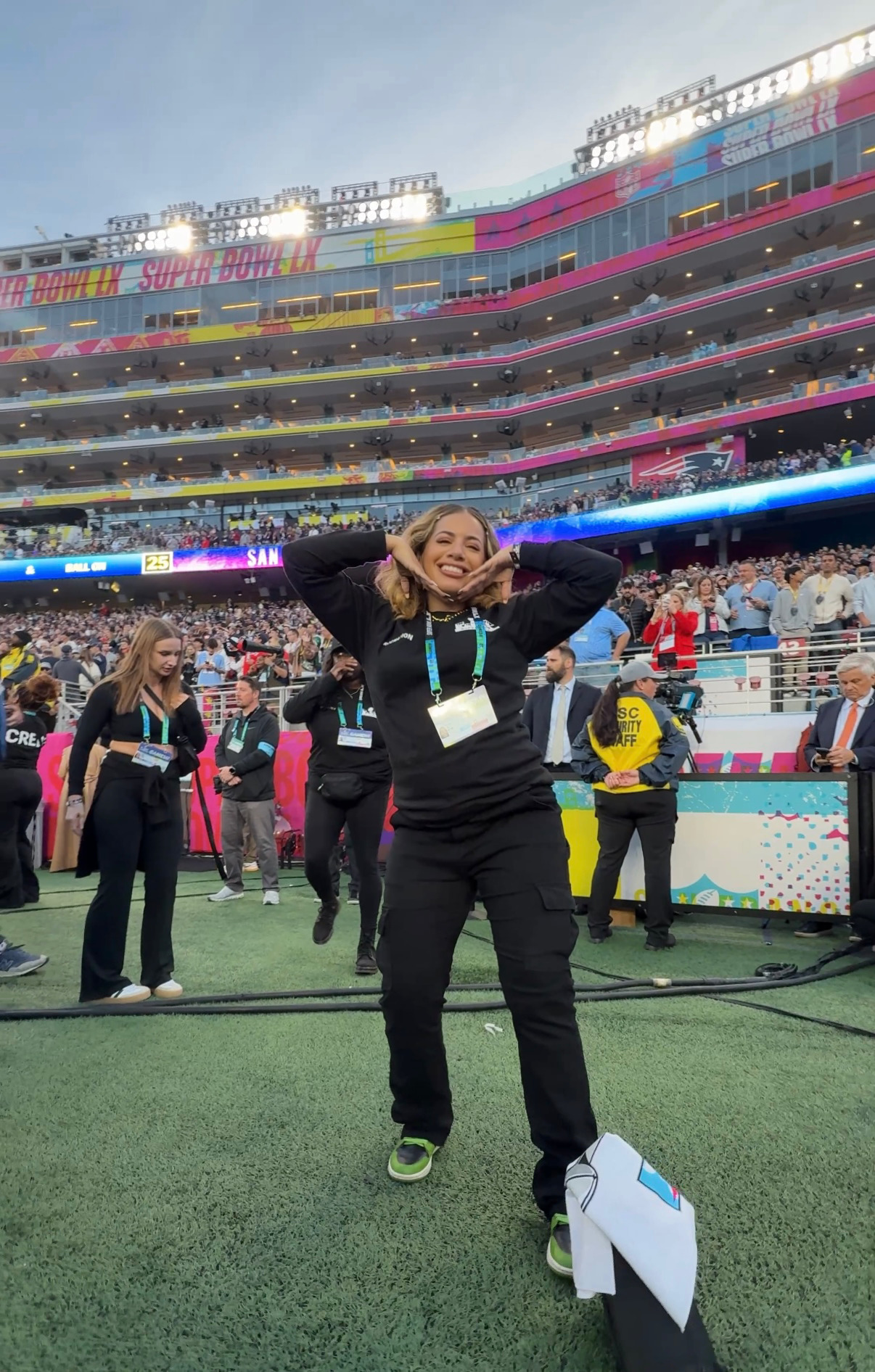
On Sunday night, Dee was one of hundreds of team members who worked behind the scenes of Bad Bunny’s halftime show at Levi’s Stadium in Santa Clara, Calif.
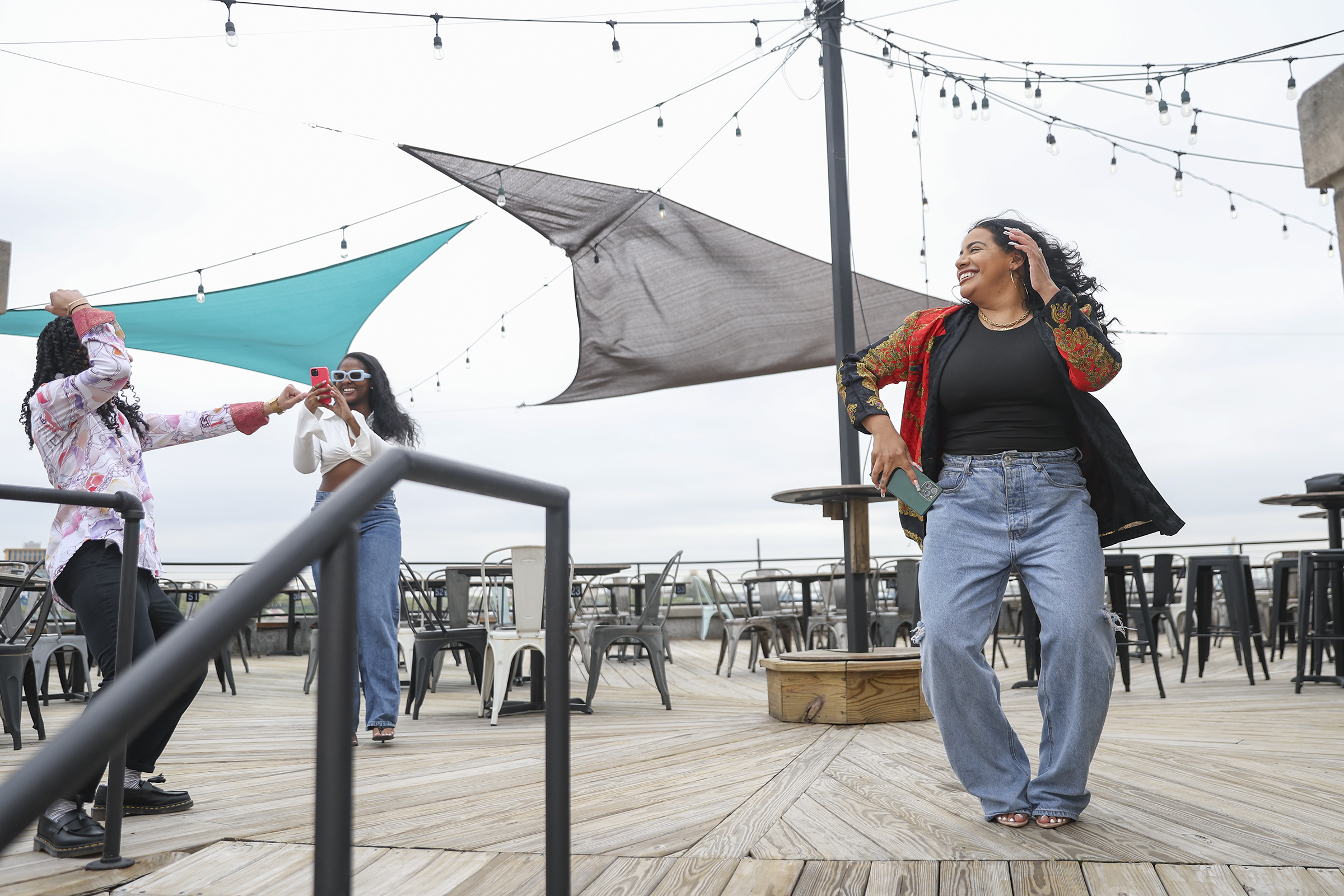
Delilah Dee, right, founder of Jefatona, dances and laughs while DJ Bria G, center, records DJ Flakka before they pose together for a photo on the rooftop of Liberty Point in Philadelphia on Thursday, April 18, 2024. Jefatona, Philly’s reggaeton and Caribbean party created to be a safe space for women, will have their own exclusive space at El Movimiento’s Cinco de Mayo Festivale on the waterfront.
She had just launched La Cultura Front when Bad Bunny began his residency in Puerto Rico last July. So naturally, their first party was Bad Bunny-themed. When he announced his final concert would stream on Amazon, Dee threw a watch party in Northern Liberties’ Craft Hall.
Last September, when Bad Bunny was announced as the Super Bowl halftime show performer, Dee’s friends texted her asking if she’d host a watch party again. She said no.
Northeast Philadelphia’s Delilah Dee walks through Bad Bunny’s halftime show stage at Santa Clara’s Levi’s Stadium, on Feb. 8 2026
“I said, ‘Guys, I know this sounds crazy, and it may be a little bit delusional, but I’m going to be at the Super Bowl.’”
“But you know what’s so funny is that my community was so supportive of me. No one thought I was crazy. They were like, ‘You know what, Delilah? If anyone’s gonna make it to the Super Bowl, it’s gonna be you.”
Thanks to her best friend who lives in Los Angeles and works in the event management industry, Dee applied for a job at the Super Bowl in November. On Dec. 31, she was accepted for a position with the field team.
“I got the email while I was at the gym. I just started to break down. I couldn’t even finish my workout,” said Dee, who was a part of the team that helped dismantle Bad Bunny’s grass and casita-filled stage in less than seven minutes on Sunday night.
For the last two weeks, she has been in Santa Clara, and staying up late for rehearsals and working her job during East Coast hours. Bad Bunny joined the rehearsals last week.
Northeast Philadelphia’s Delilah Dee was a part of the field team that helped break down Bad Bunny’s halftime show stage at Santa Clara’s Levi’s Stadium, on Feb. 8 2026
“We had a full dress rehearsal on the Thursday before Super Bowl, and he made sure to thank everyone. He stopped the rehearsal and he was like, ‘You know guys, this isn’t about me. This is about our culture, our community. All of you guys play a part in this.’”
Having worked in the events space for a long time, Dee is not the one to fangirl over celebrities.
But, she said, fighting back tears as she drove to the San Jose airport for her flight back home, “especially in this political climate we’re in and we feel like we’re constantly under attack for our Latin roots, we need a little bit of healing.”
Bad Bunny and Lady Gaga perform during halftime of the NFL Super Bowl 60 football game between the New England Patriots and the Seattle Seahawks, Sunday, Feb. 8, 2026, in Santa Clara, Calif. (AP Photo/Matt Slocum)
“We need to feel seen, to feel heard. To know that I am playing a part in that … I don’t take it lightly at all,” said Dee, who is of Puerto Rican and Peruvian descent.
The Philadelphia born-and-bred in her was, however, disappointed by the absence of the Birds on the field.
“I wanted it to be an Eagle and Benito Bowl, but I still made the best of it. Go Birds!”
Food may be what Kalaya’s Chutatip “Nok” Suntaranon is best known for, but her real love is spending time with her Pomeranians, Titi and Gingi, whom she lovingly calls “the boys.”
That, and spending time at her Queen Village home. For former flight attendant Suntaranon, who travels to Thailand (where she was born) two or three times a year, her home is her “happy place.” When she is not traveling, this is where she spends most of her time — cooking, eating, taking meetings, gathering friends, and, of course, playing with the boys and their friend, Wolfie.
She lets her routines be flexible and often goes with the flow, keeping two things constant: time with the boys and a daily visit to her Fishtown restaurant named after her mother.
Those are the two things that define her perfect Philly day, and her everyday.
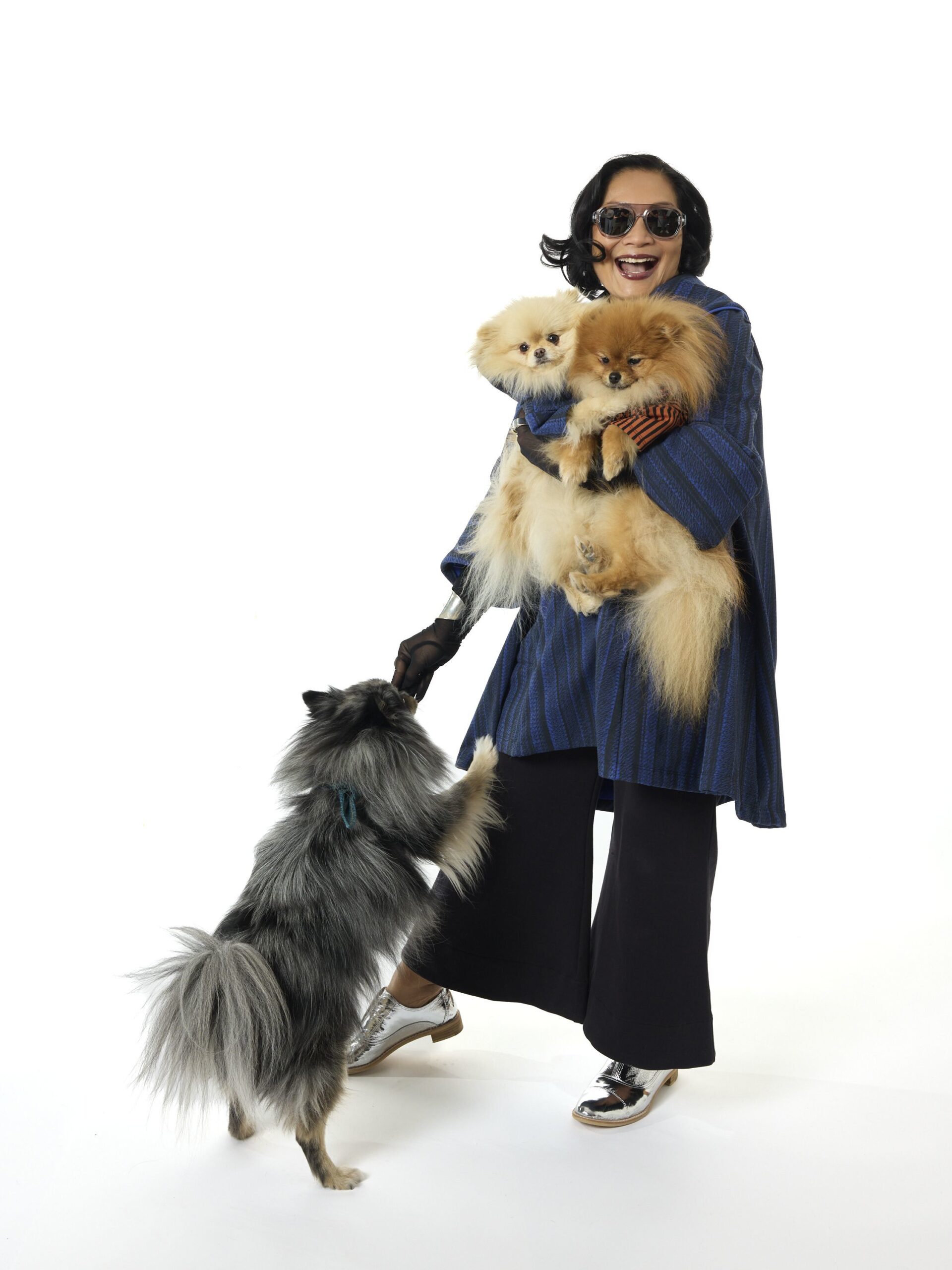
Kalaya’s chef Chutatip “Nok” Suntaranon poses in Lobo Mau’s exclusive Pom jacket. The acclaimed chef collaborated with local designer Nicole Haddad for the jacket. Styled by Nicole Haddad and Miranda Martel; jewelry by Feast and Forge and Finish; shoes by Elena Brennan; Hair and makeup by Tarah Yoder.
7:30 a.m.
I wake up whenever I want to. If I stay up late, I stay in bed until 10:30 a.m. But usually, I wake up at 7:30. The first thing I do is read [Kalaya’s] Resy reviews from the night before. After that, I wake up the boys and play with them on the deck a little bit. Then I either run back to bed and read my emails with them by my side, or go downstairs.
9 a.m.
I go down to the kitchen and feed the boys. Pomeranians are very picky eaters so I make scrambled eggs for them and me. Then, I’ll either make green tea or coffee with beans from McNulty’s Tea & Coffee Co. in New York’s West Village. Some days, it’s espresso. Others, Americano, or flat white.
I often invite my next door neighbor, Yas, to have coffee with me. We just sit on the couch and chat for an hour. Sometimes more than one neighbor stops by. We have our group of women, we live in the same neighborhood, and we hang out all the time. We get coffee, talk, and sometimes we plan lunch together, and then we spread out and do whatever we need to do for our jobs.
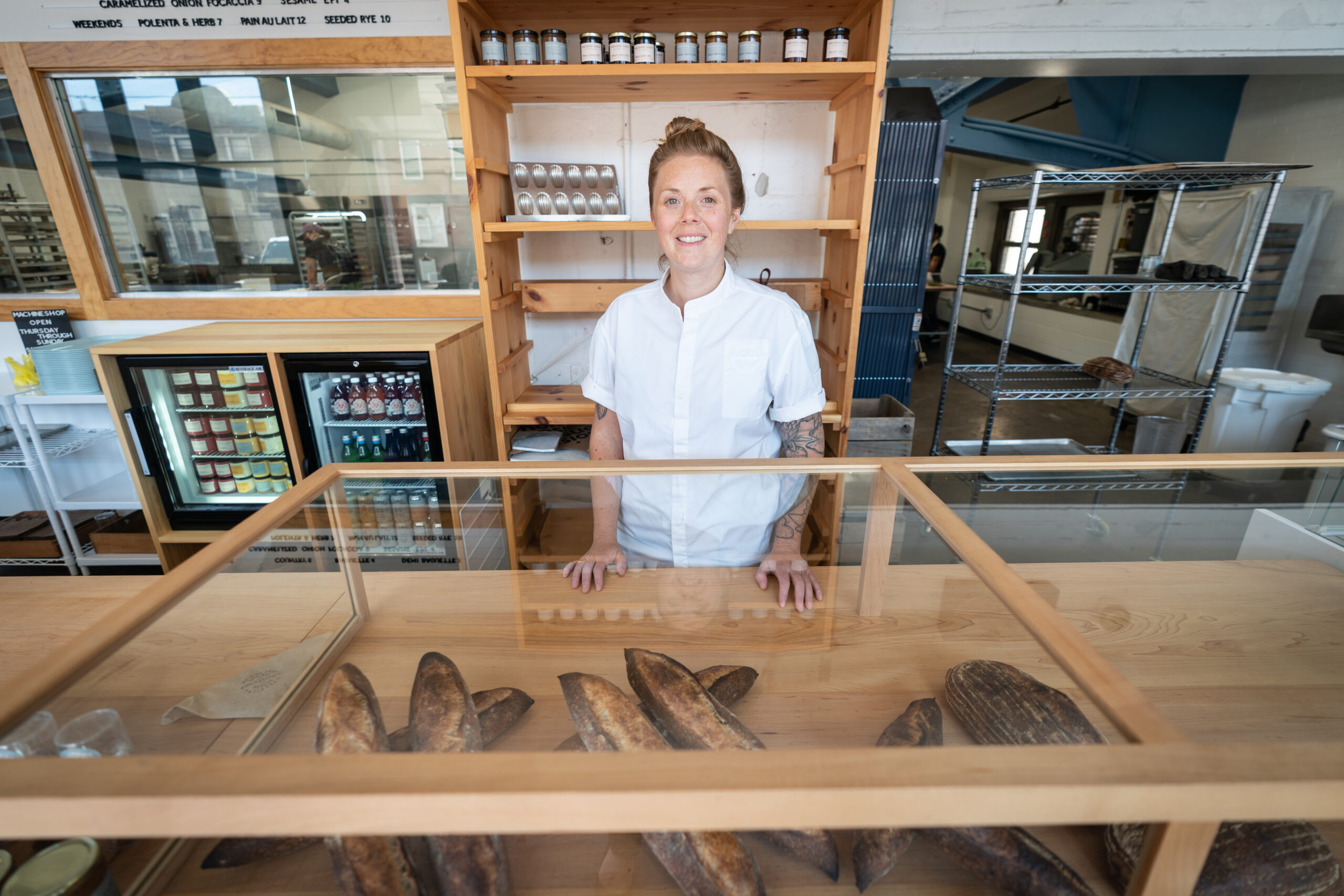
Emily Riddell at the Machine Shop, a bakery, in Philadelphia, Friday, September 9, 2022.
10:30 a.m.
If I don’t drink coffee at home, I love going to Machine Shop with Mike and Lizzy, my good friends who also have a Pomeranian, Wolfie. We coparent our dogs. At Machine Shop, we get coffee and wait for canelé to come out of the oven.
11:30 a.m.
On our way back, the boys and I will take a walk in the neighborhood. We have a community garden that we might stop by. Then I come home and take my morning meetings after I give the boys a turkey tendon treat.
12:30 p.m.
If I can find some time, I go to the gym. I sneak in a Pilates class once a week at Movement Source Pilates Studio in Passyunk or the Sporting Club at the Bellevue. If I need a haircut, I go to Whirligig salon in Queen Village. If I’m not doing any of those things, I will go to Kalaya to check on whatever is going on. I mostly take the boys with me. I leave by 3 p.m. because that’s when they have the staff meal. I come home and fix myself some quick lunch.
The fettucini at Fiore Fine Foods in Philadelphia on Thursday, Aug. 29, 2024.
2:30 p.m.
I prefer to eat at home during the day. Sometimes all my friends who dropped in the morning will come back and we all eat lunch together. I love congee. Usually we will eat that with a simple, healthy vegetable or protein. I also eat lunch at Fiore sometimes because pasta for lunch is a good idea. Then, depending on how busy my calendar is, I will try and sneak a bath in. I love having a bath. Then skincare and getting ready takes about an hour.
4:30 p.m.
I get changed and go back to the restaurant for service. For clothes, I mostly shop online. I rent from Real Real, Rent the Runway, Nuuly. And I have my buyer in Thailand who buys Issey Miyake pieces for me. I get a lot of stuff from Thailand where I have a designer who does custom-made stuff for me. My friend Yas often gets me stuff to wear or my other friend, Michelle, works at Urban Outfitters. It’s a community that is very sweet, because they are always gifting me with very cute stuff to wear.
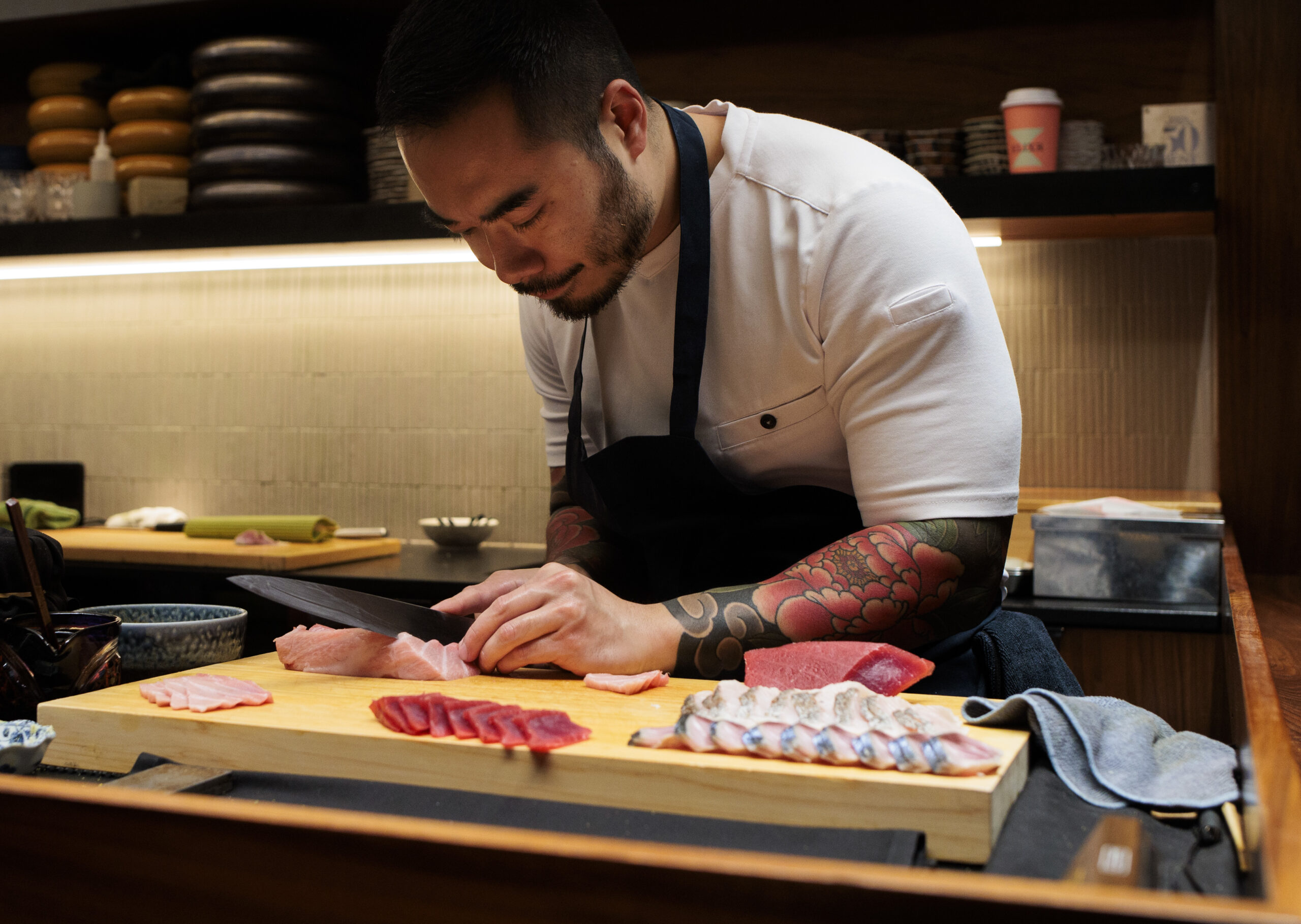
Chef Jesse Ito prepares a course during the omakase at Royal Sushi and Izakaya on Tuesday, Oct. 28, 2025 in Philadelphia.
7 p.m.
On Tuesdays, I usually eat dinner at Royal Sushi & Izakaya. I love his Royal Chirashi, the miso soup. His fried chicken is good, and I love all of his rolls.
Once or twice a week, I order half the menu at Kalaya. I invite friends and we eat, talk about food and our lives. That’s how I inspect the food in the restaurant, and give the team feedback immediately.
Organic produce from Blooming Glen Farm of Perkasie for sale at the Headhouse Farmers’ Market.
On Sundays, I try to cook dinner and have friends over. I buy my produce and organic protein from Headhouse Farmers Market and Riverwards Produce.
Sometimes, my friends and I do Sunday Gravy. Someone makes dessert, I make gravy. I buy the meatballs because you don’t need to make meatballs yourself as long as your gravy tastes good. Someone makes the pasta, and we all eat together. Michelle may make a salad, and Mike brings a bottle of Champagne. So we hang out and chat.
Chef Chutatip “Nok” Suntaranon at her restaurant Kalaya in Fishtown on August 22, 2024.
8:30 p.m.
If I don’t go to the restaurant, I normally get to bed by 8:30 p.m. I groom the boys, hang out with them, watch Netflix or read as they play next to me. I like to be quiet at home. I am a homebody. I would say, 70% of my time is me staying home. That’s kind of pretty much my day.
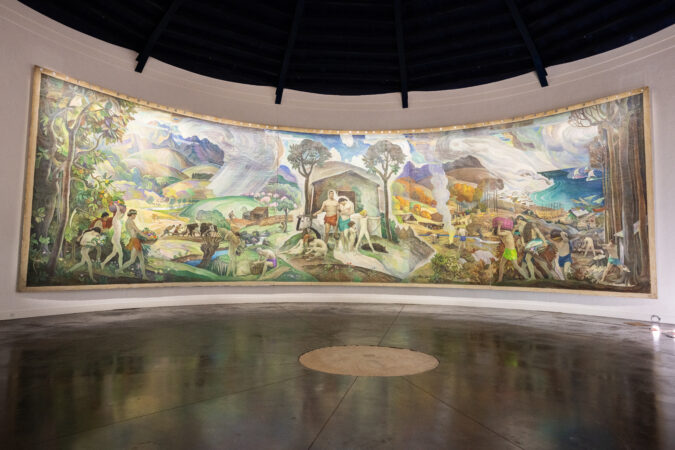
Packed away in 2007, a mural 60 feet long and 19 feet high has been brought back to life and given a swanky new home near Wilmington.
N.C. Wyeth’s colossal 1932 mural, “Apotheosis of the Family,” re-emerges in a gleaming new round barn after years in storage, on Jamie Wyeth’s property near Wilmington, Del.
Artist Jamie Wyeth had to rent a building “the size of an aircraft tanker” to open the rolled-up panels of the five-panel mural Apotheosis of the Family, painted by his grandfather — famed illustrator N.C. Wyeth.
The panels had been in storage for more than a decade, and once unrolled, Wyeth didn’t know what shape they’d be in.
“I didn’t know if I’d see potato chips of paint flying,” he said.
Thankfully, he didn’t.
Instead, in a bid to resurrect the mural from oblivion, he had a “sort of tent thing” built to humidify the panels of what is N.C. Wyeth’s largest artwork ever. “There was a lot of damage to it,” he said, “but certainly not major damage.”
Jamie Wyeth stands in front of his grandfather N.C. Wyeth’s colossal 1932 mural, “Apotheosis of the Family.” The 60-feet-long and 19-feet-high mural is now open for public viewing.
story continues after advertisement
In the late 1920s, while the country reeled under the Great Depression, N.C. Wyeth was commissioned to paint the colossal 60-feet-long and 19-feet-high mural by his friend Frederick Stone, who was the president of the Wilmington Savings Fund Society (now, WSFS). It was the bank’s 100th anniversary and they needed something that would instill some confidence in their clients.
N.C. Wyeth had already painted a 16-by-30-foot mural for New York City’s Franklin Savings Bank, and had added a mural studio to his painting studio in Chadds Ford, Pa. in 1923.
“He was beginning to take the idea of painting murals seriously. It’s a natural progression from illustration to mural painting, because both of them are involved with the painting telling a story, a narrative that really has a specific idea to be conveyed,” said Amanda Burdan, senior curator at the Brandywine Museum of Art, which has the largest collection of N.C. Wyeth paintings and oversees the studios of N.C. Wyeth and his son Andrew.
Jamie Wyeth outside the barn which houses N.C. Wyeth’s colossal 1932 mural, “Apotheosis of the Family”A view of the new round barn from the horse sanctuary built in memory of Jamie Wyeth’s wife, Phyllis
Building a home
Apotheosis was unveiled in January, 1932. Undergoing two restorations, the mural hung on the walls of the Wilmington Savings Fund Society location at Wilmington's Ninth and Market streets until 2007 when the bank sold the building to a developer.
That was when the five humongous panels were rolled away into storage and put under the care of the Historical Society of Delaware.
"Apotheosis" mural installed at Wilmington Savings Fund Society, 9th and Market Streets, Wilmington, DE, circa 1932.Sanborn Studio, Wilmington, DE
“It was all planned how to take it down, and they [possibly, the Historical Society, to whom the mural was donated by the developers and the bank] completely disregarded that, and used a cheaper method of removing it, and then rolled it the improper way,” said Jamie Wyeth, who was born in 1946, a year after his grandfather died from a freak accident where his car was struck by a freight train. N.C. Wyeth was working on a series of murals when he died.
A portrait of N.C. Wyeth around 1930.
When being rolled, the painting side of Apotheosis was supposed to be on the outside to prevent cracking. But it was rolled inside. Chunks of the lead white paint from the wall were still stuck to the panels’ back when they were packed away. For the next 15 years, until 2022, the mural lay forgotten.
In 2021, the Wyeth Foundation for American Art asked the Society for an assessment of the mural’s condition. With restoration estimated at about $903,000, the Historical Society deemed the mural “severely damaged” and its trustees voted to transfer the mural to a proper steward.
In 2022, the ownership of Apotheosis was transferred to the Wyeth Foundation, of which Jamie Wyeth is a trustee.
“And then began the two years of painstaking conservation and restoration,” said Jamie Wyeth who remembers seeing the mural on the bank’s walls several times as a young boy.
The whole project cost close to a million dollars. While the barn was built by Wyeth, the restoration was funded by the Wyeth Foundation for American Art.
A cutout of N.C. Wyeth stands next to a self-portrait of Andrew (right) in N.C.’s studio. Three generations of Wyeth artists have practiced their art in the Brandywine region.Jamie Wyeth stands in front of N.C. Wyeth’s “Apotheosis of the Family.”
“I loved the idea of bringing it back to Pennsylvania. My farm is half in Pennsylvania and half in Delaware. And I thought, ‘Well, this is where the painting was created,’” he said, referring to his Points Lookout Farm and his grandfather’s Chadds Ford studio which are about a mile apart. “And my wife and I thought, ‘What a perfect thing!’ But then we thought, ‘How the hell do we do it?’”
Jamie and Phyllis Wyeth had offered the mural to museums, including the Brandywine, but no one had the space.
“And then the question was, if we build a building, would it be 100-feet-high and 10-feet-wide?”
The answer came from Wyeth’s assistant Caroline O’Neil Ryan. How about building a round barn on the farm?
The new barn on Jamie Wyeth’s Point Lookout Farm near Wilmington, Del.
“And I’ve always just loved round barns. The Shelburne Museum in Vermont has one of the great round barns. Not only was the mural going to be resurrected, but also this structure would be so unique and wonderful, and so in keeping with the farm,” said Jamie Wyeth.
The result is a 62-foot diameter barn with high windows and a slanting roof. Half the curved wall surface holds the mural and the other half remains empty.
When the mural’s first panel was rolled out in the tanker-sized building, conservators Kristin deGhetaldi and Brian Baade could hear the lead white crackling. There was a lot of flaking “along several hundred lines of paint loss,” deGhetaldi said in an email. “We had to then remove the old facing and varnish and stabilize each flake of paint that was lifting.” There were several tears that had to be addressed and each panel “suffered from severe undulations and bulges.”
So before anything could be done, the panels had to be humidified. The conservation team wore protective suits because of the lead and was able to restore the damaged parts.
story continues after advertisement
The panels had to be wrapped around wooden cylinders to be uncurled. Each of them were then glued and mounted onto a custom-made curved frame that matches the curve of the barn. They were then weighed down with sandbags before installing the panels on the wall.
The mural took three years to restore off-site and one week to install.
A small domed cupola stands on the roof of Jamie Wyeth’s new barn while columns guard the entry way. Nearby, retired racehorses neigh within the sanctuary he built in memory of his wife after she passed away in 2019.
The restoration of the mural, however, is not quite finished, wrote deGhetaldi.
For one, the seams that were, as deGhetaldi wrote, “meticulously painted over” by N.C. Wyeth when the mural was installed in 1932, are now visible and need to be fixed. A frame that he had made himself also needs to be re-attached.
The mural spectacle
The five-panelled mural paints a vast picture of a pastoral community.
There are farmers with their cattle, young girls carrying flowers, men carrying multicolored fruits and fish, some chopping wood, sowing seeds, weaving a basket, playing a flute — all spread over a landscape that, valleylike, is nestled among rolling hills, but is also thriving against the seashore.
Details on N.C. Wyeth’s 1932 mural, “Apotheosis of the Family” show people farming and coming together to form a civilization, an optimistic message during the Great Depression“Apotheosis of the Family” is set amidst a varied landscape and shows the passage of all seasons
Woodlands and prairies blend into one another. When the eyes move from left to right, we see a change of seasons. Fruit-laden trees and clear skies transition into an autumnal scenery while winter lurks around in the clouds. A brook streams along as sheep and oxen graze. And in the middle of all the activity, is the artist’s own family.
The father figure, modeled after N.C. Wyeth himself stands bare-torsoed. Beside him, the wife (modeled after his wife Carolyn Wyeth) breastfeeds an infant. There is a toddler daughter holding a doll in her hand — modeled after their daughter, also named Carolyn. Andrew Wyeth—Jamie’s father — is the young boy playing with a bow and arrow. Nearby another daughter, a young Ann Wyeth sits on the ground looking at a sapling and son Nathaniel, carries a bunch of sticks on his back. Several other figures are modeled after the Wyeths’ neighbors.
In the center of N.C. Wyeth’s “Apotheosis of the Family,” is the artist’s own family. The father figure, modeled after Wyeth himself stands bare-torsoed.
“It is showing the most idealized version of life,” said Burdan. “So not everybody is represented faithfully.”
Carolyn Wyeth, the daughter, for example, was well in her 20s when her father painted her as a toddler. In a February 1931 letter to his brother, N.C. Wyeth mentions he weighs 230 lbs., bearing little resemblance to the muscular bare-bodied father in the mural. When N.C. Wyeth pointed out to the almost-naked Andrew to Betsy, Andrew’s future wife, Andrew was rather embarrassed, Jamie Wyeth recalled.
“But still, it was his family that was the center of this mural about the family,” said Burdan. “The family is represented here as the heart of a community of people who are working together to form a civilization.”
A Wilmington Savings Fund advertisement showing a part of the N.C. Wyeth mural, "Apotheosis of the Family." From the 7 Feb 1934 issue of the Morning News(Wilmington, DE)Newspapers.com
“For the family … safety and security,” reads a Wilmington Savings Fund Society ad that appeared on the Feb. 7, 1934 issue of the Morning News.
By this time in his career, N.C. Wyeth had made a name for himself as an illustrator. But even when he illustrated best-selling versions of Treasure Island and Robinson Crusoe, he’d draw them in large sizes which would later be scaled down for the books.
“He wanted the mural to jump out of the page and grab you, they still do. And so the mural was not really that much of a departure to him. He was always thinking on this large scale,” said Jamie Wyeth.
A Wilmington Savings Fund advertisement showing the central motif of N.C. Wyeth’s "Apotheosis of the Family." From the Oct. 18 1933 issue of the Morning Newsnewspapers.comN.C. Wyeth in Chadds Ford studio with the same central panel of the “Apotheosis” mural, undated.Earl C. Roper
“It’s almost like a respite from current time,” said Burdan, “[Like] an encouragement that can build back from the depression.”
A 1920s’ mural commissioned by a bank, she said, would perhaps be very different — “luxuries and cars and millionaires and mansions.” But the stock market crash had sobered the society down and forced artists to look at the roots of what makes a civilization.
Believing the role art plays in recovery from the depression, the American government’s Works Progress Administration started a mural painting program so artists could be employed and the general public could partake of art in their regular surroundings. The artistic medium had already been popularized by the Mexican artists, José Clemente Orozco, Diego Rivera, and David Alfaro Siqueiros.
A logistical home in Brandywine
Just up the river from Jamie Wyeth’s barn is the Brandywine Museum, which will manage the access to the barn. It “is the perfect vehicle for this,” said Jamie Wyeth.
“The land, the barn, and the painting, might all have different owners, but Brandywine is taking on the responsibility of interpreting it and bringing it to the public,” said Burdan.
N.C. Wyeth's art studio on the Wyeth property in Chadds Ford, PA, August 28, 2025. He used the wooden stairway to paint massive murals. On view is Qeth's "William Penn, Man of Vision·Courage·Action."
The museum, home to the Andrew & Betsy Wyeth Study Center, already oversees and conducts tours of the studios of Andrew Wyeth and N.C. Wyeth. In this studio, N.C. Wyeth built a wooden stairway that he climbed to paint Apotheosis — in five panels so that while working on one panel, he has another panel side by side to match colors. He reportedly bore a hole into the floor going up and down the stairs. A door in the studio would lift open and allow for the direct passage of the panels once they were complete.
story continues after advertisement
The William Penn, Man of Vision·Courage·Action mural that Wyeth painted in 1933 still stands in the mural studio.
The Brandywine, therefore, becomes the “logical starting place” for a trip to the barn, said Burdan.
Inside N.C. Wyeth’s studio in Chadds Ford, Pa.Inside N.C. Wyeth’s studio in Chadds Ford, Pa.
The museum owns 350 works of art by N.C. Wyeth, and has just started digitizing a collection of his letters. “So we want to be really good stewards of N.C. Wyeth’s work. And this is his biggest work ever,” said Burdan.
“We want to be the place that people say, ‘If I am interested in NC, Wyeth, I must go there, I must read the archives there, I must see the collection of paintings. And now, his mural.”
The Brandywine Museum is currently sold out for tours happening through March 28, 2026. For information on future availability of tickets,visitbrandywine.org/mural
The article has been updated with added information on the restoration and costs from Kristin deGhetaldi
Staff Contributors
Reporting: Bedatri D. Choudhury
Editing: Kate Dailey
Photography: Jessica Griffin, Charles Fox
Subscribe to The Philadelphia Inquirer
Our reporting is directly supported by reader subscriptions. If you want more journalism like this story, please subscribe today
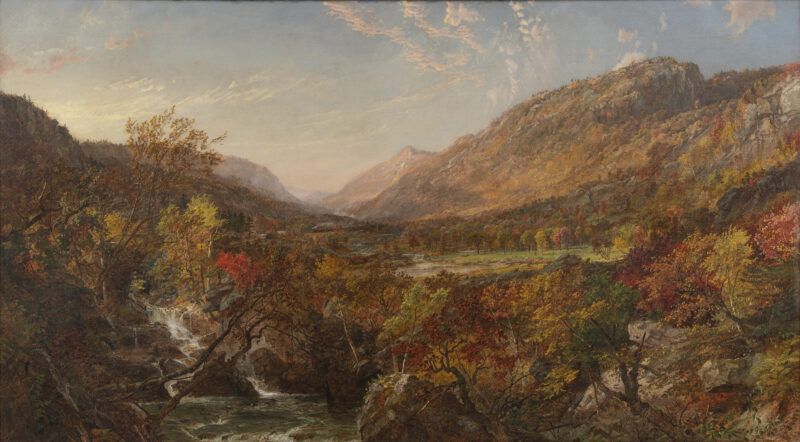
Back in September 1873, the New York Herald announced that the Hudson River School painter Jasper Francis Cropsey had a new painting. Autumn in the Ramapo Valley, Erie Railway, which would be open to public viewing for “only a day or two longer” at the Wall Street office of Charles Day, the article said.
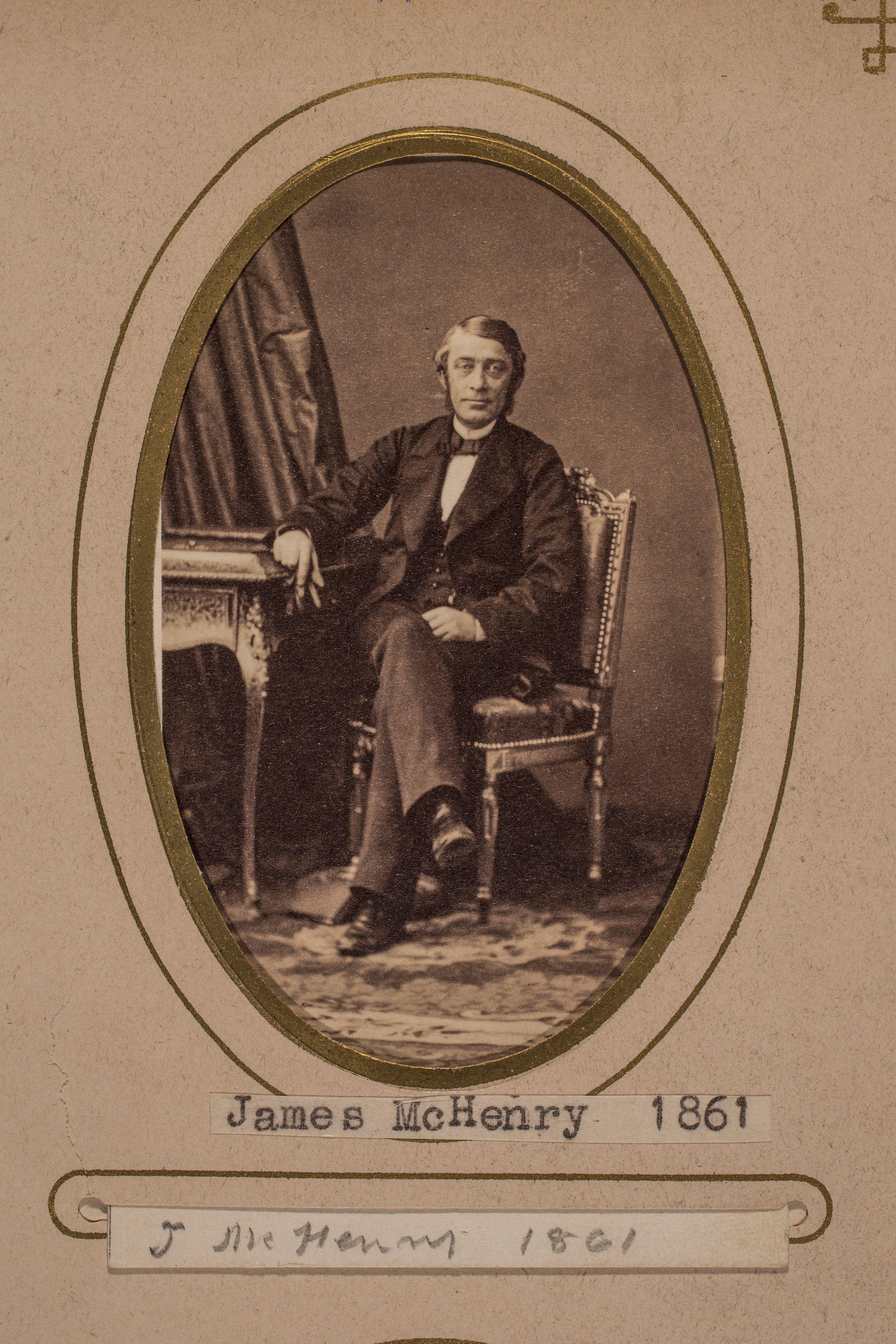
The painting was commissioned by investor James McHenry, who, with Day, was director of Erie Railway. McHenry, who had been a director of the Atlantic and Great Western Railway before that, had his eye set on the Erie Railway, which was founded in 1832.
In 1872, in what is best described as a corporate coup, McHenry ousted the railroad magnate Jay Gould and took full control over Erie Railway. In celebration, he commissioned the Cropsey painting, which, after those few days on Wall Street, made its way to McHenry’s home in London and remained in private collections, away from the public eye since.
Until now.
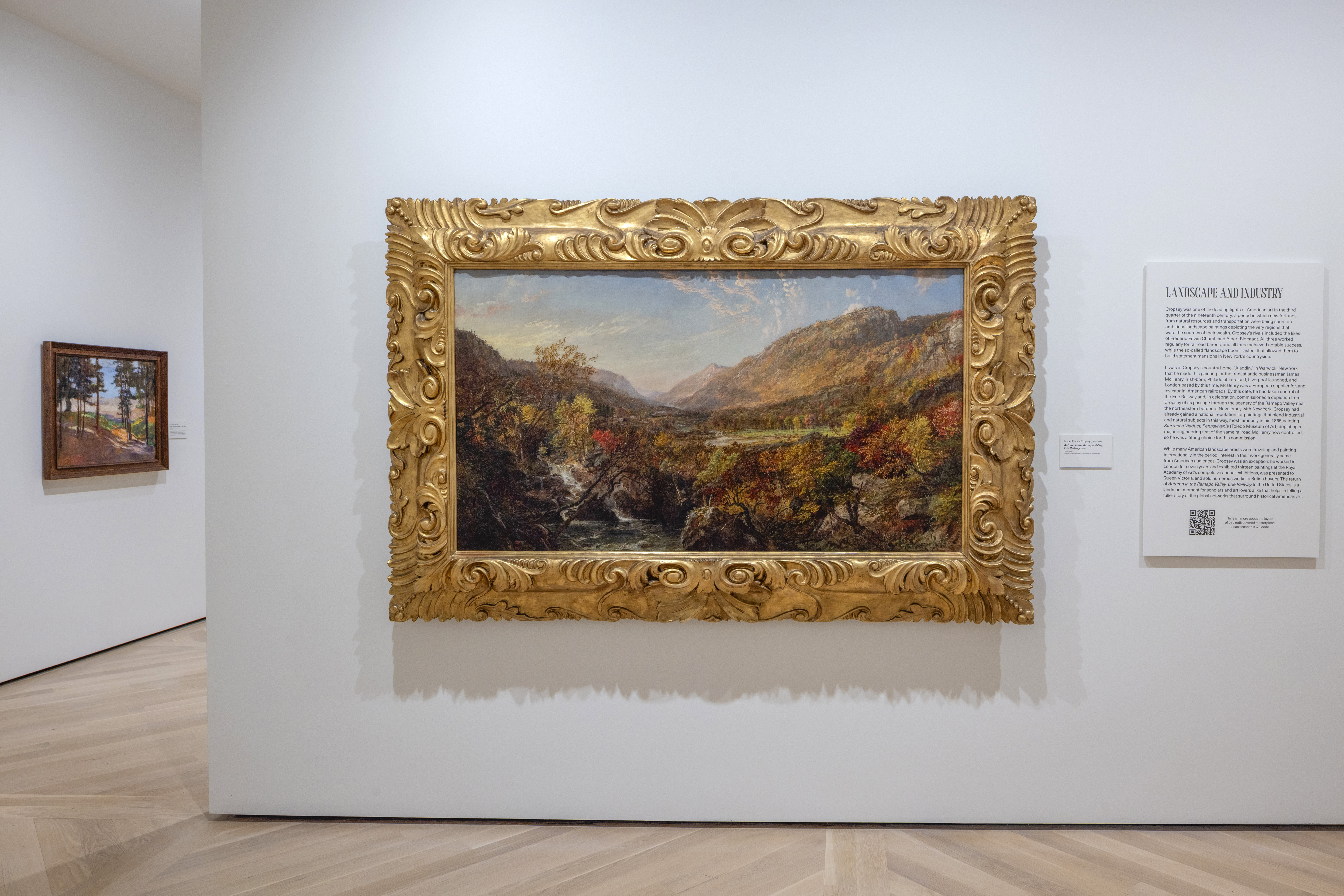
In 2024, philanthropists J. Jeffrey and Ann Marie Fox, who live in Bucks County, bought the painting and brought it back to the United States. It is on view at the Brandywine Museum of Art, some 150 miles away from the original setting of the painting, where flatlands west of the Hudson River meet steep hills near the town of Sloatsburg, N.Y.
Here, it can be seen by an American audience for the first time in 152 years.
The Foxes and American art
J. Jeffrey Fox has built a successful career in finance and education and his wife, Ann Marie, has worked with several nonprofits, often focusing on children with special needs. Together, in 2024, they made a $20 million gift to endow the J. Jeffrey and Ann Marie Fox Graduate School at Pennsylvania State University.
The couple, said Jeffrey Fox, have always been interested in American history.
“We used to collect art as souvenirs. We would go to estate sales and garage sales and sometimes buy a piece of art,” he said. “It wasn’t a collection that was of any significance. So once we got a little bit more money, we wanted to buy one painting that’ll be the centerpiece for the rest of our collection.”
They bought Frederick Childe Hassam’s The Cove, Isles of Shoals (1901) at an auction in 2015.
The discerning eye in the couple has always been Ann Marie’s. She spent 15 years volunteering at the Walters Art Museum in Baltimore, and when the couple lived in Annapolis, Md., she took classes under Matt Herban, a retired professor of art from Ohio State University.
After that first Hassam, the couple wanted a Cropsey. But not just any Cropsey.
“We went to the National Gallery and they had a fabulous Cropsey [Autumn — On the Hudson River (1860)]. It just took our breath away. And we were like, ‘Wow, how could we ever get something that good.’ That’s why it took us this long,” said Ann Marie.
“We were very picky. Every artist has great days, and every artist has OK days. We wanted Cropsey on a great day,” her husband said.
Finding Cropsey on a great day
Last year, the Foxes’ art adviser came to know from a friend in Europe that Autumn in the Ramapo Valley was coming up for auction in London in September. Believing that the painting was best sold to an American buyer, this friend approached the adviser before the painting went under the hammer.
The Foxes had 48 hours to make a decision to buy, never having seen the painting, aided only by a high-quality photograph and a condition report.
Cropsey’s catalog raisonné, put together by the Newington Cropsey Foundation in Hastings-on-Hudson, N.Y., says the painting left the country in September 1873. Documents said the painting has been in an undisclosed buyer’s family since the 1950s.
James McHenry’s carte-de-visite,
1861.
McHenry died in 1891 and “we don’t really know what happened from 1891 to the mid-’50s, but we do know that it never left England,” Jeffrey said. “And we don’t think it was ever shown in England. There are no records that we were able to find.”
Ann Marie said yes, and the couple wrote up a letter of intent.
“We were a bit concerned,” said Jeffrey. Another Cropsey — Richmond Hill in summer of 1862, also owned by McHenry — that came up in an auction in 2013 was deemed a “national treasure” by the U.K. and was not allowed to leave the country.
The clearance for Autumn in Ramapo to leave England took a little over three months.
“The English let that out of England because it was an American artist, and an American scene,” Jeffrey said.
The couple bought the painting in January 2025. Once the artwork arrived in the United States, a restorer found it to be in exceptional condition, exactly as advertised. In March, the conservator finished assessing the painting, and the Foxes traveled to New York to see it in real life.
“It just displayed so much grandeur. I thought it was wonderful,” Anne Marie said. “The autumn colors … just stunning. And the size of it is amazing. The first thing I said when I saw it was, ‘It can’t come to my house. It’s going to tear down my wall.”
Including the frame, the artwork measures 4.75 feet by 7.16 feet.
“Our house isn’t that big, we probably couldn’t get through the door,” Jeffrey said.
The couple couldn’t ship it to their foundation office, either. “We needed a museum that would be willing to show it and buy into the story, because it’s a phenomenal story,” Jeffrey said.
The “Cropsey, Wyeth, and the American Landscape Tradition” exhibition runs through May 31 at the Brandywine Museum of Art.
The painting and the painter
It’s easy to miss the “Erie Railway” part in Autumn in the Ramapo Valley, Erie Railway. Cropsey paints an idyllic fall scene with the Ramapo Valley bathed in yellow, red, and, orange foliage. Bits of green peep out, the sky is clear and a light blue, a waterfall flows gently on the left, the Ramapo River sits still.
The smoke-billowing train chugs through the valley in the distance, but in the center of the painting. Black rails of the railway bridge run parallel to the river and disappear into the leaves.
The setting of the painting falls between what is New York’s Orange and Rockland County, on the western side of the Hudson River, and north of Suffern.
“This painting … really helps in telling a fuller story of the history of American art, and particularly, this brief moment, in the third quarter of the 19th century, when huge sums were being spent on huge paintings,” said William L. Coleman, curator at the Wyeth Foundation and director of the Andrew & Betsy Wyeth Study Center.
“This is part of a larger story with artists like Frederic Church, Albert Bierstadt, and Thomas Moran.”
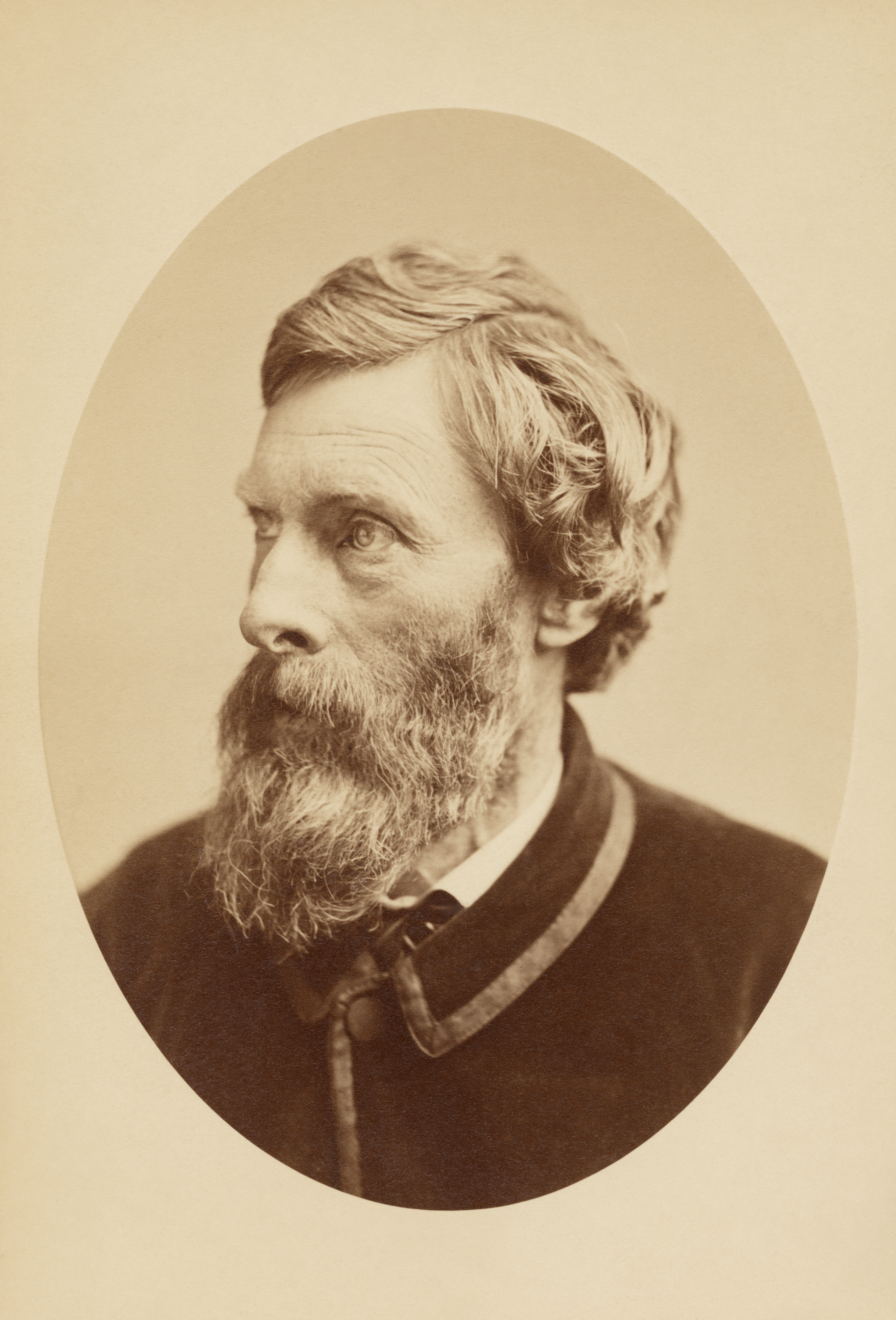
Jasper Francis Cropsey by Napoleon Sarony, circa 1870.
Cropsey, an architect who had designed several railway stations himself, was part of a line of artists who “engaged with the new fortunes being made from the transportation industry, making images of new railroads traveling through the landscapes,” Coleman said.
The artists enjoyed generous patronage and lived well. Cropsey lived in a mansion he built, called Aladdin, less than 10 miles away from the site of the painting. Here he built himself a studio that doubled as a gallery and art marketplace.
The Philadelphia story
Cropsey’s patron James McHenry was born in Ireland in 1817 and was raised in Philadelphia. He moved back to England, living primarily in London, where he made a fortune raising money and investing it in developing railways in America.
His sister remained in Philadelphia until her death.
Jeffrey Fox calls McHenry “notorious,” adding that he often worked against other equally infamous “robber barons” like Cornelius Vanderbilt and Gould.
“He paid $25,000 on a Bierstadt painting in 1865, so he was quite an art collector himself,” Jeffrey said. McHenry, who already owned Richmond Hill in Summerof 1862, perhaps had gotten acquainted with Cropsey when the artist visited England in 1856.
Cropsey had already made a name for himself painting Starrucca Viaduct, Pennsylvania (1865) —where, too, a distant train almost merges into the green slopes of the mountain behind it — when McHenry wanted an artist to commemorate his pushing Gould out of the Erie Railroad directorship in 1873.
“He had already gotten a national reputation for painting part of this exact railroad, and so James McHenry went to the railroad guy,” said Coleman, “and commissioned Autumn in Ramapo.”
Artists like Bierstadt and Sanford Robinson Gifford were also working on similar railroad commissions at the time.
“Most of their stock and trade are images that make use of the aesthetic value of the sublime, the power of the natural world against the small scale of human existence. So they give us that feeling of awe, of wonder,” Coleman said.
Landscape paintings, he said, “tell stories about belonging, about ownership, about your place in a wider society. … And they often risk being underestimated. These are pleasant, old pictures that we see on calendars and postage stamps, but they have a lot to tell us about how we became the nation we are today.”
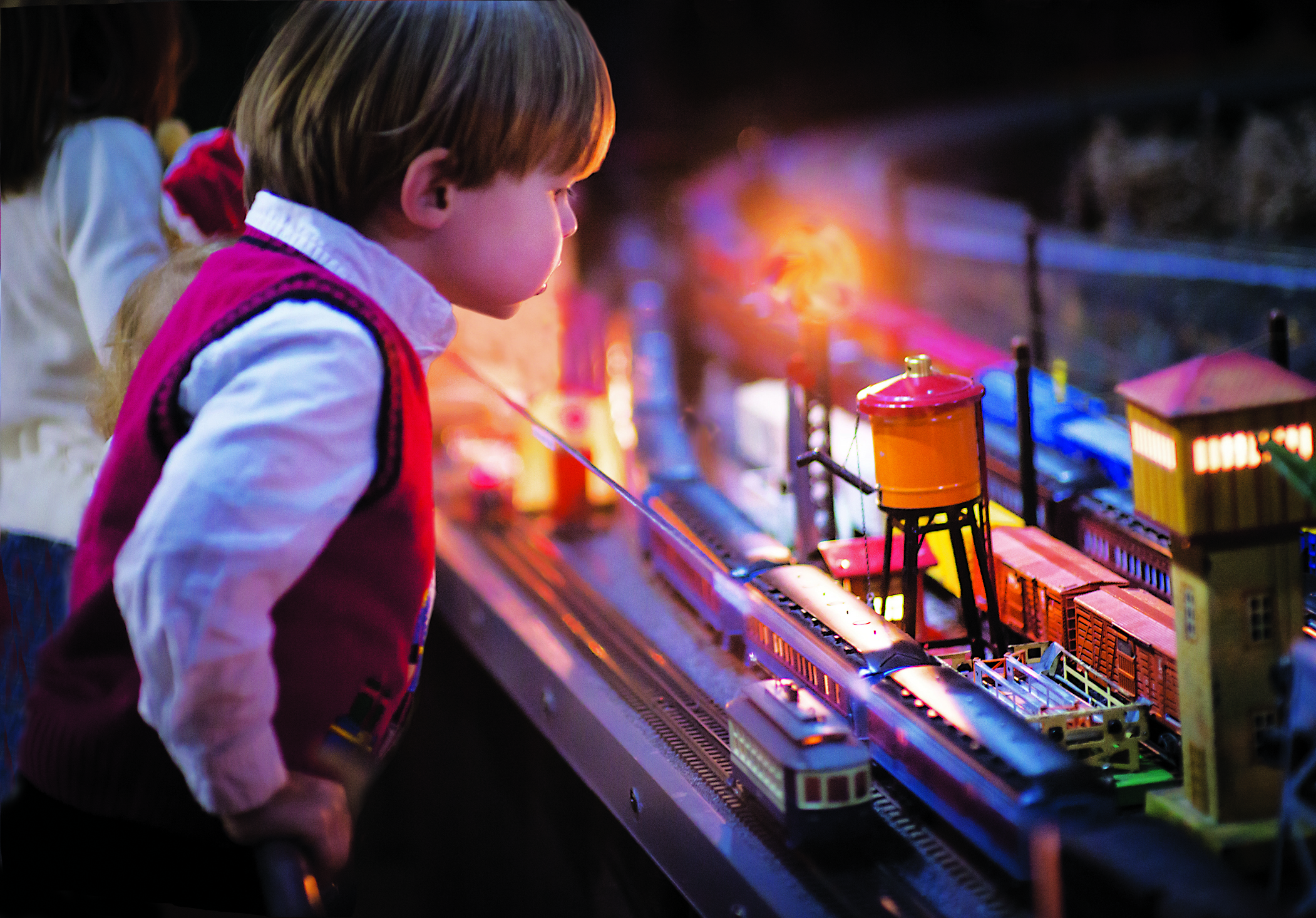
The model train at Brandywine Museum’s holiday showcase in 2018.
An irrelevant cost
At Brandywine, Cropsey’s train speaks to the museum’s beloved holiday train display, posing questions of tradition and modernity as the nation enters its 250th year.
It will stay at the museum through May and then travel to the Dixon Museum in Memphis, Tenn. Then it heads to the Seed Art Museum in Louisville, Ky.;, Rockwell Museum in Corning, N.Y,; University of Georgia Museum of Art in Athens, Ga.; and the Newington Cropsey Foundation.
The Foxes wanted this piece of American history to be witnessed by Americans.
What they paid for it, Jeffrey Fox said, is irrelevant.
“If you put a value to it, that’s what you’re going to talk about, as opposed to the painting,” he said. “We’re a foundation and at the end of the day, we’re not going to sell it. So it doesn’t matter what we paid.”
“Cropsey, Wyeth, and the American Landscape Tradition,” continues through May 31 at the Brandywine Museum of Art, U.S. Route 1 at Hoffmans Mill Road in Chadds Ford, Chester County. Information: brandywine.org or 610-388-2700.
This article has been updated with the correct year of James McHenry gaining control of the Erie Railway. It was 1872.
Greg and Becky Wimmer believe their Christmas tree is the best lit tree in the state.
The confidence, the couple from York, Pa., said over Zoom, comes from Greg spending almost all his life perfecting the art.
He grew up in Lancaster in a single-parent household with his mother, Judy Wimmer, and a sister who was 10 years older. Judy was the executive housekeeper at the historic Yorktowne Hotel, which was founded in 1925 and provided a lot of unique opportunities for the young Greg.
“She was the matriarch of tree decorating,” Greg said of Judy, who died last year. “Leading up to the Christmas season, she would use the basement of the hotel as her staging area, and would put up three 12-foot trees and five eight-foot trees around the property.”
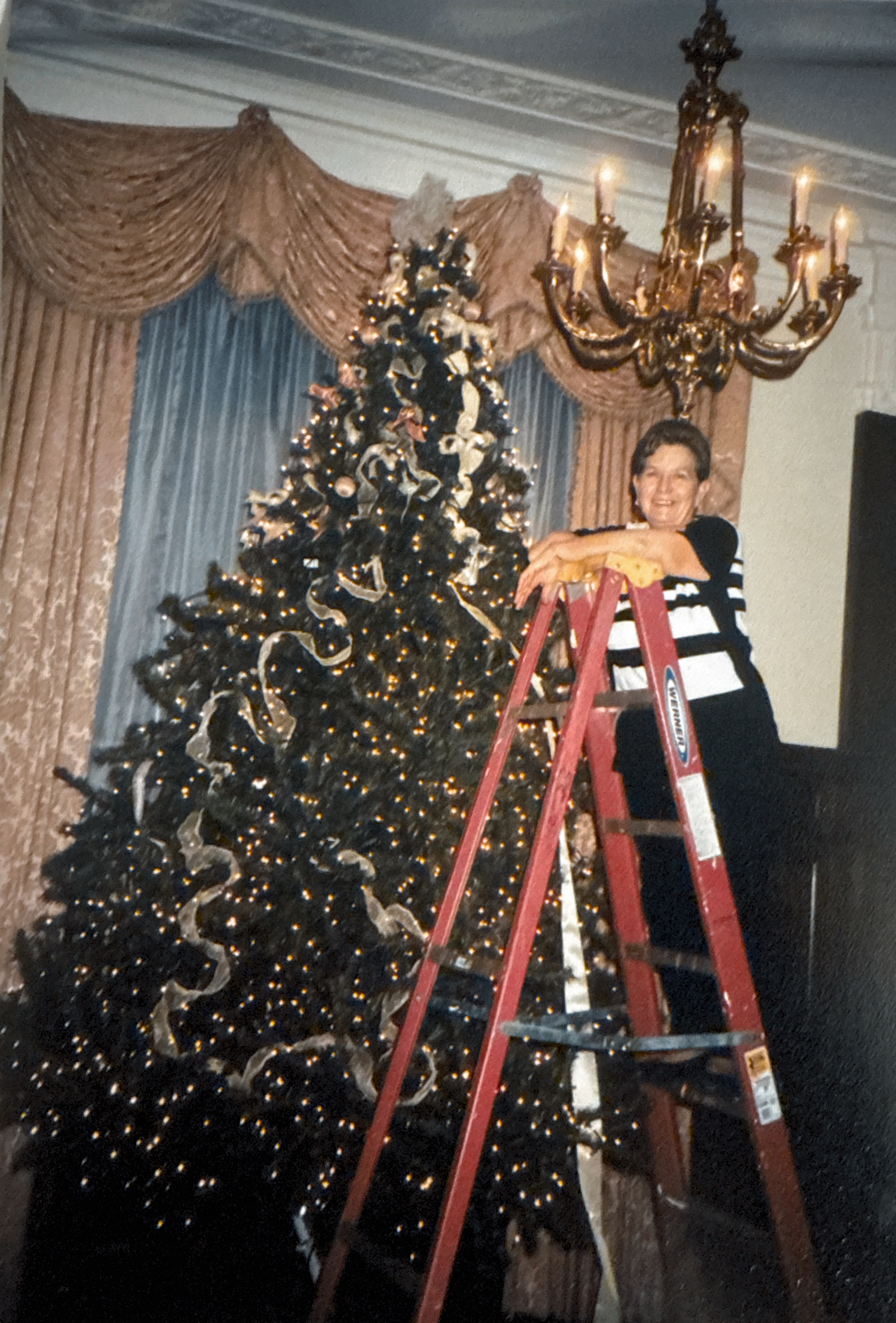
Judy Wimmer atop a ladder decorating a 12-foot Christmas tree at the Yorktowne Hotel in the late 1990s, where she was the executive housekeeper.
Greg and his sister would go up to the hotel on the Saturday after Thanksgiving every year and help their mother decorate. First, they’d take on the 12-foot lobby tree before moving on to the other rooms. They’d work late into the night, stay over, and spend Sunday decorating.
“I became so accustomed to knowing everything, she had me instruct adults by the time I was a teenager,” Greg said.
Becky, 42, who teaches first grade, appeared on Zoom wearing a festive red sweater, weeks before Christmas. (Greg, 45, who teaches social studies to high schoolers, wore a plaid shirt, and their dog Jingle barked in the background.)
“I always loved Christmas,” she said. “I love to have a Hallmark house and feel cozy and comfy. But I was very intimidated by Greg’s mom and her decorating when I became a part of the family.”
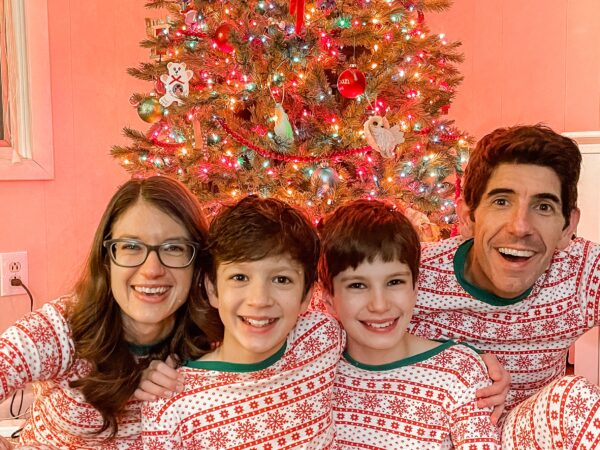
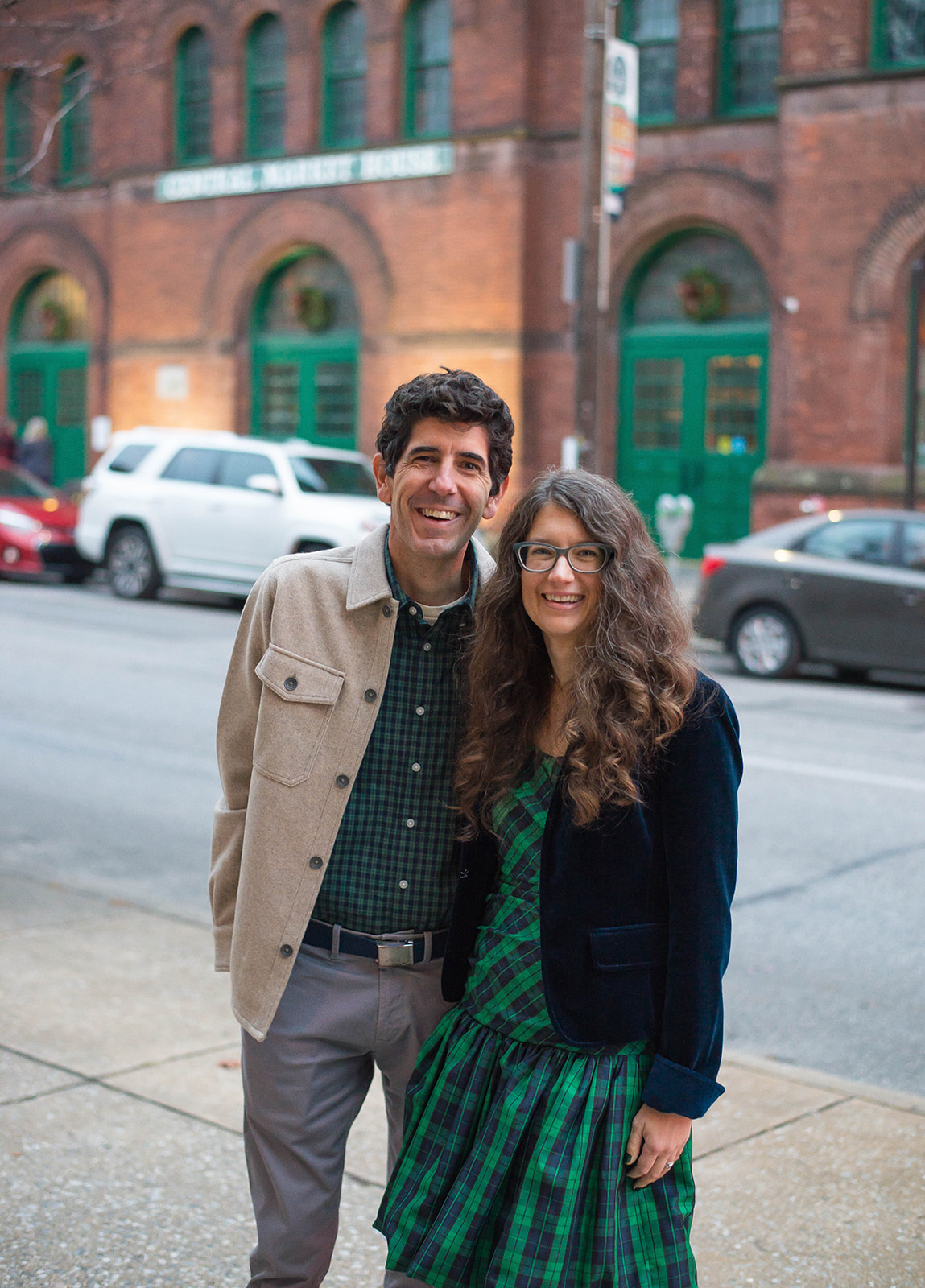
Greg and Becky Wimmer were among the Pensylvannia social media creators invited to Gov. Josh Shapiro’s reception.
The two, both public schoolteachers, met at Elizabethtown College studying for their teaching degrees, and run an Instagram account called the Class Couple. Here, they share content about, of course, holiday decorating but also more serious stuff like voter engagement and clips from them attending a “No Kings” march, anti-ICE protests, and a Kamala Harris rally. Recently, the couple were invited to attend a holiday reception for content creators hosted by Gov. Josh Shapiro.
“We spent quite a few years sharing teaching things, and then COVID hit. We as teachers had to go back to work before the vaccine was out, and because we didn’t get that choice, our kids didn’t, either,” Becky said.
After their oldest son, Grayson, became deaf in his left ear from COVID, “our ‘why’ for sharing online quickly changed,” she said.
They started posting content on health and safety, and sharing Grayson’s journey from hearing loss to cochlear implant to attending a school for deaf students on the campus of Gallaudet University in Washington, D.C.
“We had always been passionate about those types of things, but we felt the need to speak on that a little bit more, especially since it had impacted us directly in such a big way,” Becky said.
Grayson Wimmer was born on Christmas Eve in 2009. He is one big reason behind the family’s knack for going big on Christmas celebrations.
Grayson, who was born on Christmas Eve and is turning 16 this year, is one big reason behind the family’s knack for going big on Christmas celebrations. The family’s first tree goes up on Halloween.
“Only the first one. It’s usually a skinny accent tree,” Greg said.
“Halloween is like the gateway to get us to Christmas. We host Thanksgiving, but by then it’s like a Christmas wonderland,” Becky said. “We have a lot of skinny trees throughout the house.” One of those, she said, belonged to her mother, who is now in hospice with dementia.
“Then there’s the main family tree, two taller skinny trees, and three smaller 3½-foot ones, and a small one in our bedroom.”
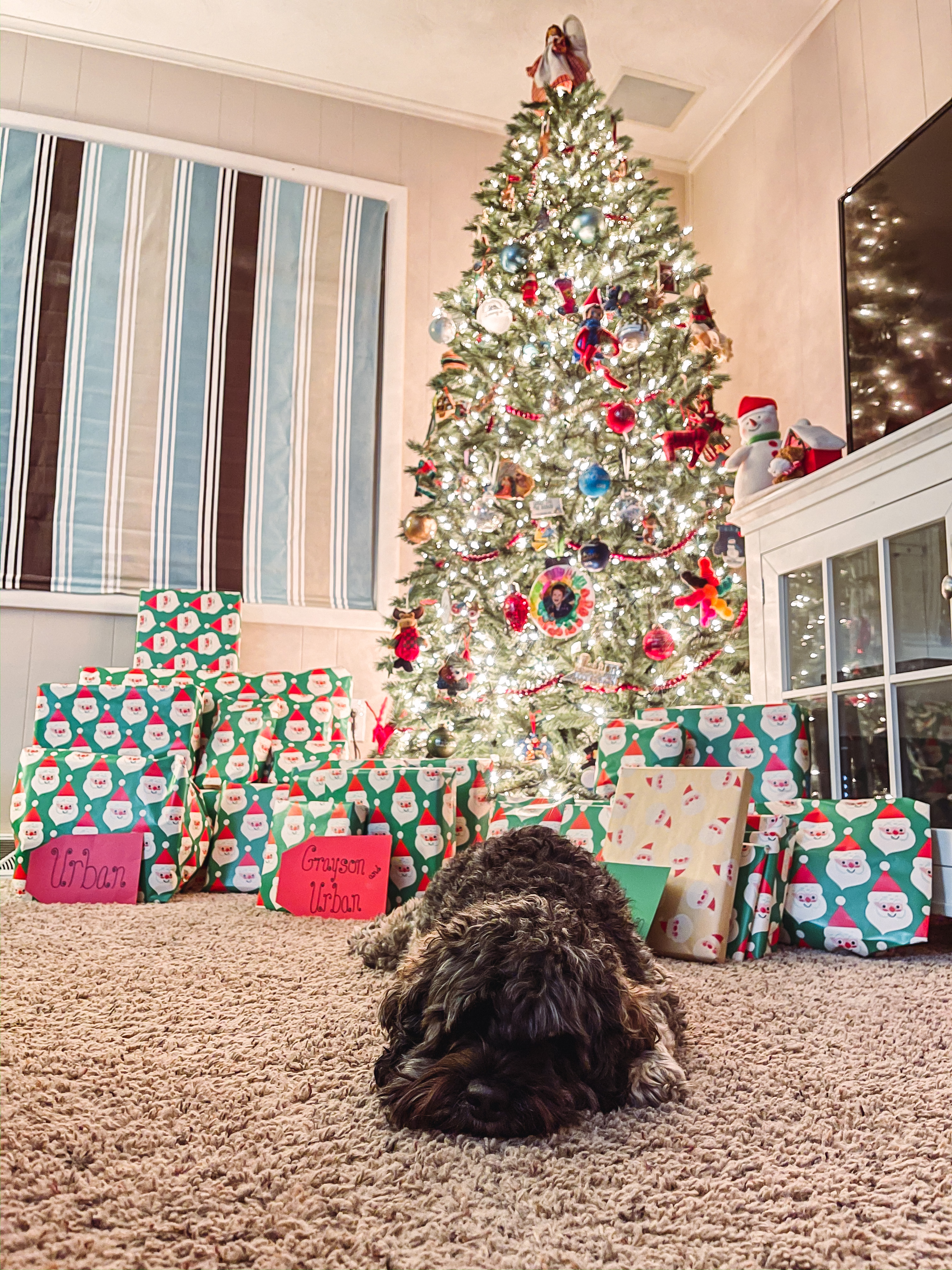
Their younger son, Urban, 13, also has one in his room.
But the Wimmers are not hoarders, Greg insists. “My goal is to always fit everything under the stairs in the basement,” he said.
The family uses plastic trees — Grayson is allergic to real ones — and has been using the same ones for more than five years. Although it’s hard to find plastic trees that are not pre-lit, they are happy to take the trouble of finding those. The couple’s go-to stores are always the local home and garden shops.
Lighting the tree is a bit of an Olympic sport for the household and it falls squarely on Greg’s able shoulders. He uses 1,700 lights (17 strands of 100 lights) and buys them months before Christmas. The claim to having the best lit tree in the state is only half in jest, bolstered by social media comments and a new title bestowed upon Greg by the internet: Christmas Lights Man.
A 2020 photo of the family dog, Huck, inf ront of the family’s Christmas tree in York, Pa.
Every year, Grayson and Urban pick and choose which ornaments to put up.
“That’s the key to Christmas,” said Greg. “How do you make it special for you? For me it’s putting 1,700 lights. But whatever your tradition is, lean into it and embrace what the season is about.”
Here are the Wimmers’ best tips so you can lay claim to having the second-best lit tree(s) in all of Pennsylvania.
Measure your space
“Most importantly, get a tree that fits in your space, don’t overpower your room,” Becky said.
Start at the top
Judy used a ladder; Greg uses a stepladder. “The branches are so close together [on top] that it’s the easiest to go up and over each branch,” Greg said.
Don’t wrap, loop
“Build depth by looping the wire around the individual branches and then work your way out from the base of the branch,” Greg said. “This way, I can control the cord more. Going around the tree. … I don’t see how people do it, because I think that you’re then just dancing around.”
“My mom did this,” Greg said of working in sections and his reasoning behind using 17 strands of 100 lights. “So if a strand went out on the main lobby tree, she could just take the ornaments and lights down in one section and replace the lights, instead of taking everything apart.”
No LED lights
Greg uses “the older incandescent lights because I feel like LEDs just don’t give the same glow.”
Always backlight
Greg puts lights on the back end of the tree because “I don’t want a dark corner. It ends up giving off a really neat glow when the other lights are off in the room.”
Check your extension cords
“They can’t all be on one. Use multiple cords and be aware of your breakers’ capabilities, especially with live trees,” Greg said.
It’s going to take time, that’s OK
Greg said he takes about 90 minutes to light the main family tree, which is seven feet tall.
When Malala Yousafzai hit world headlines in 2012, she was 15 and lying comatose in a hospital in Birmingham, England. She had been shot in the head by Taliban militants while on her way back from school after an exam, in Pakistan’s Swat Valley.
“I was getting defined as a brave, courageous activist, a girl who stood up to the Taliban and fighting for girls’ education. But I had still not opened my eyes and figured out what had happened, where I was supposed to now live and restart my life,” said Yousafzai, 28, whose new memoir, Finding My Way, came out this month.
Malala Yousafzai’s “Finding My Way” is a delightfully candid memoir of her journey through her teen years, finding love, defying expectations, and reconnecting with her mission to empower girls.
The book begins with the words, “I’ll never know who I was supposed to be.”
She thinks about that often.
“Maybe I would have lived a life where I felt less pressure and didn’t have to meet so many expectations. But then, I would be facing so many challenges in my own education, let alone fighting for other girls.”
Earlier this year, the first class of girls graduated from the high school she started in her native village of Mingora. “The first class in the whole village,” she asserted, breaking into a smile on Zoom.
Delightfully candid, the memoir speaks of Yousafzai’s high school years in Birmingham. She struggled to make friends. “By the end of it, I had only made one friend,” she said.
Apparently, a Nobel Peace Prize doesn’t make you cool enough. “Not with friendships anyway,” she said. “Maybe the work you want to do for girls’ education, but not with making friends.”
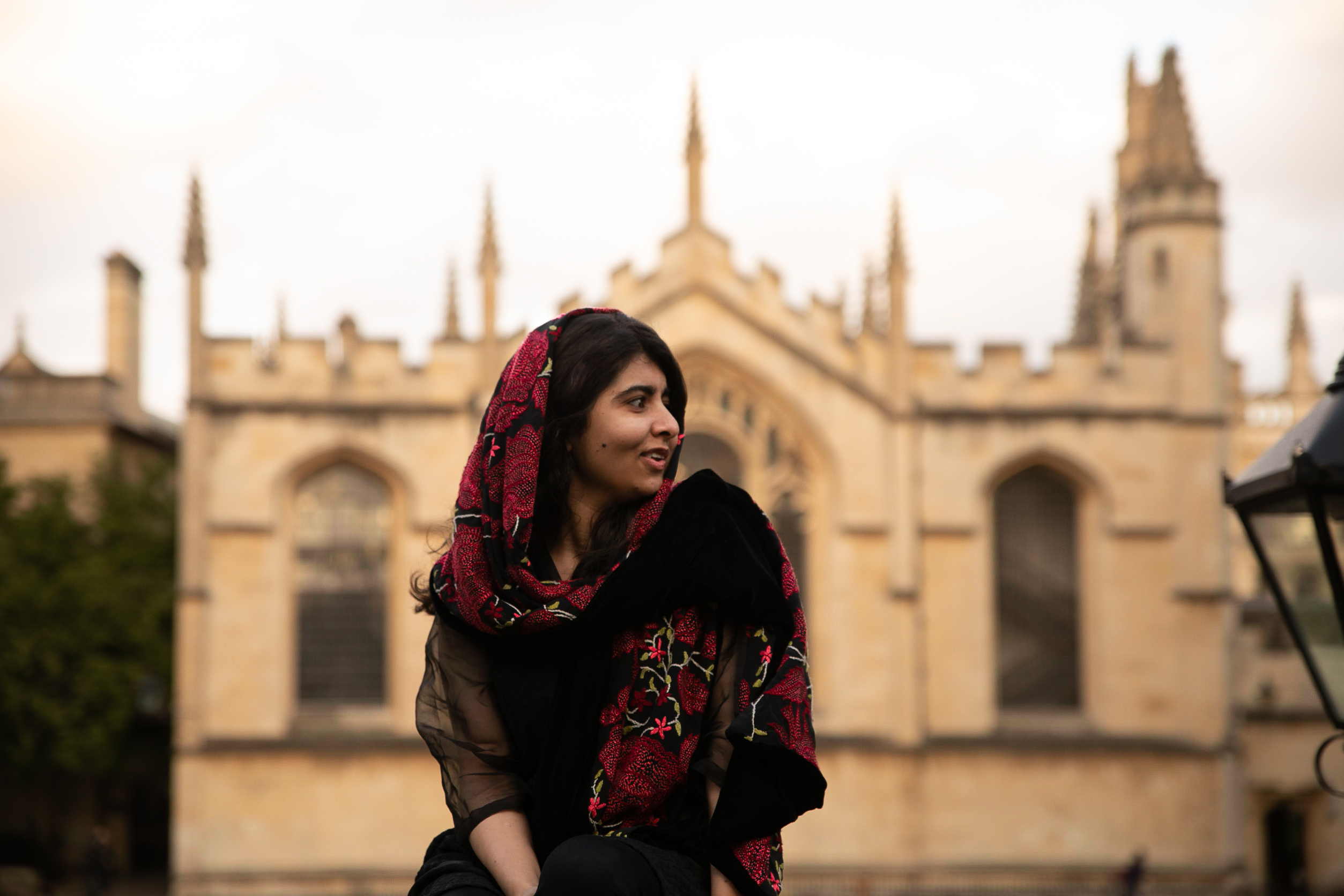
Malala Yousafzai during her years at the University of Oxford, where, in the summer of 2018, she met Asser Malik, her now husband
The memoir details her college years in Oxford, where she nursed heartbreaks, smoked weed, met Asser Malik whom she’d eventually marry, and, yes, made friends.
As one reads on, the eternal image of the 15-year-old in a veil splashed across TV screens and newspapers, slowly begins to shift. Yousafzai has stepped into womanhood, and she has embraced all the heartbreak and hormones that come with it and is not ashamed to talk about it.
“In a way, this is a reintroduction of me,” said the author. “I have talked about my love life, friendships, and mental health. It’s been a wild ride from nearly failing my exams to getting ghosted by my crush, to reconnecting with my mission of educating girls.”
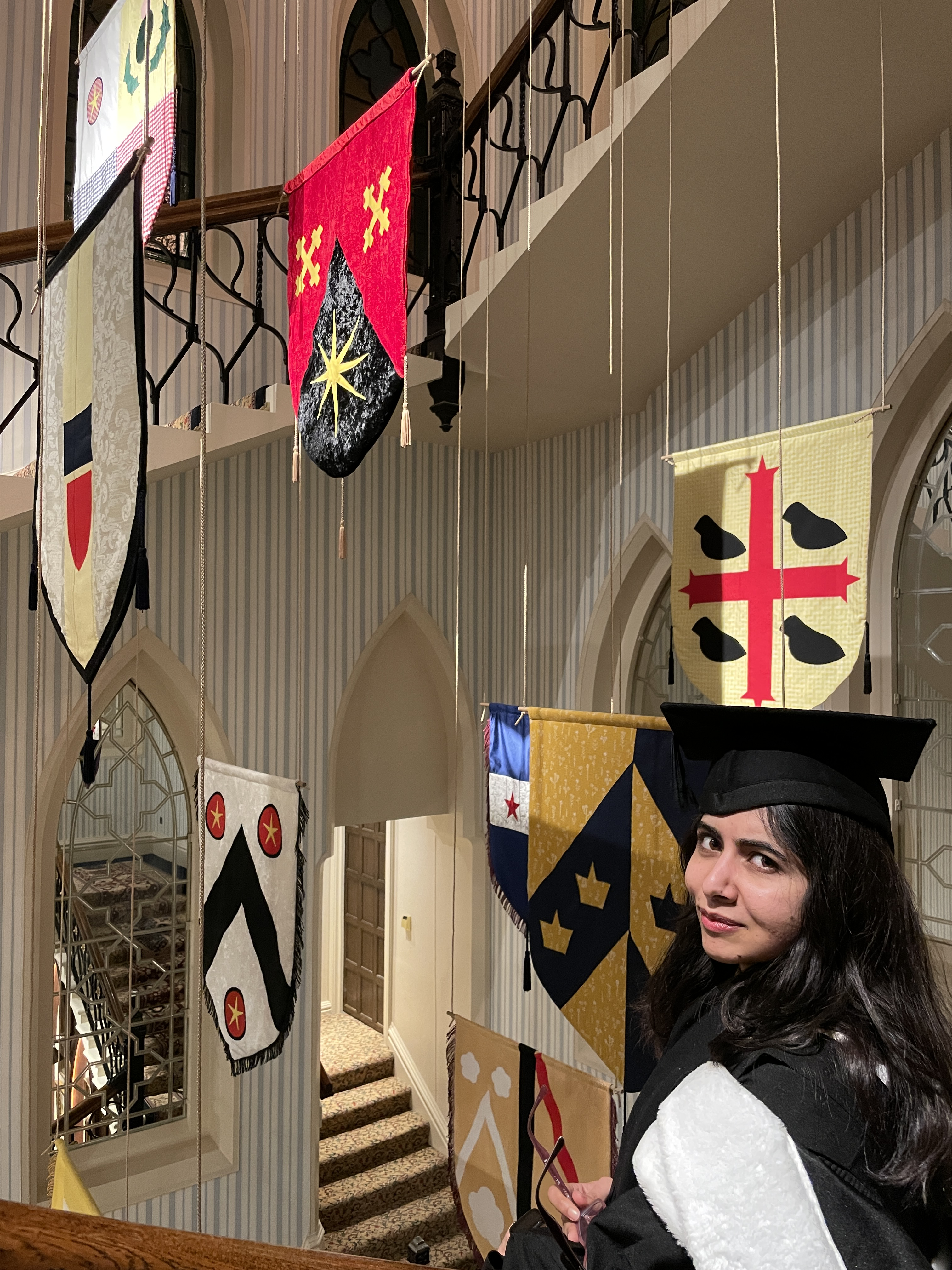
Malala Yousafzai at her matriculation at University of Oxford, where she studied philosophy, politics, and economics at Lady Margaret Hall.
For someone who won a Nobel at 17, topped school in Pakistan, and became a beacon of hope for girls who dream of getting an education, talking about almost failing in college wasn’t easy.
“I realized that I cannot miss this opportunity to prioritize making friends,” she said, recalling sitting in the library and looking outside to see friends sitting in the sun and laughing.
“I realized I wanted to be with them more than anything … It’s not just about having fun and socializing. I think learning from people can be life-changing, and it can stay with you forever.”
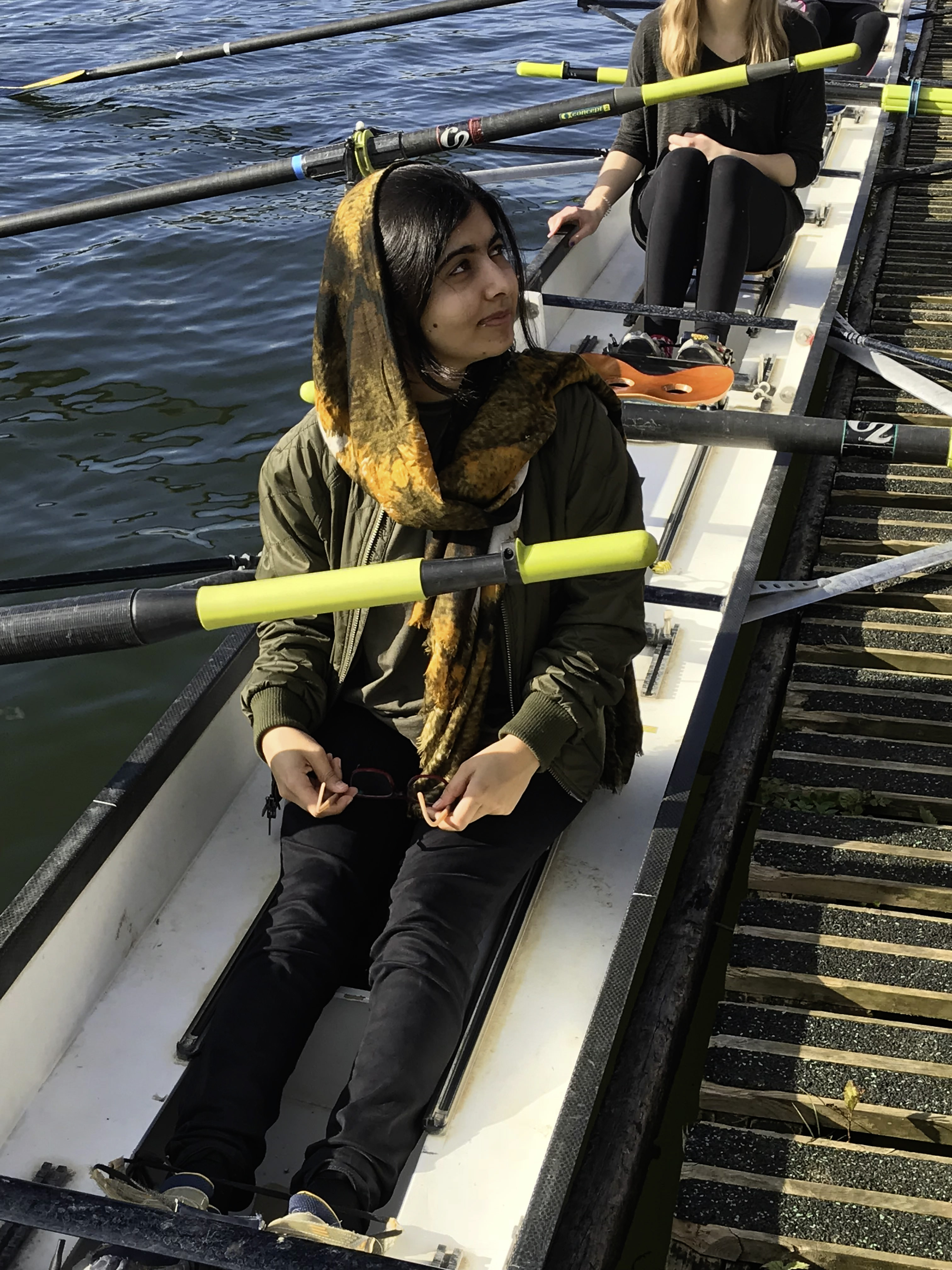
Malala Yousafzai during her years at University of Oxford, where she joined all the societies she could find and took up rowing
At Oxford, she attended Lady Margaret Hall, studied philosophy, politics, and economics, took up rowing, joined every society that she could find, organized social events, and attended parties.
It’s also where, in the summer of 2018, she met Malik through mutual friends and bonded over a shared love for cricket.
After a string of secret dates, a desire to never get married, and an eventual change of heart, she decided to tell her parents.
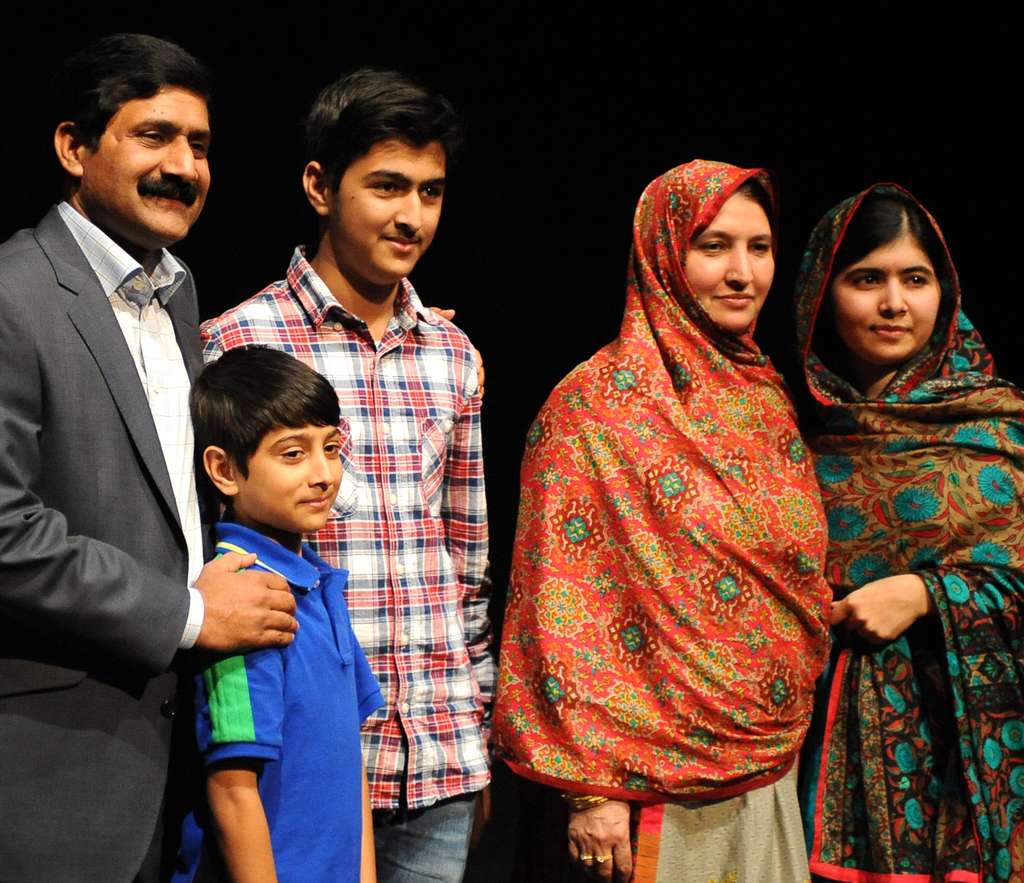
Malala Yousafzai (right) with her family in England on Oct. 10, 2018. From left: Father Ziauddin, brothers Atal and Khushal, and mother Toor Pekai.
She first told her forever cheerleader and father, Ziauddin, who was a schoolteacher back home in Pakistan, and asked him not to tell her mother, Toor Pekai, just yet.
“Because I knew she would freak out.”
Her father, she said, “took no pause and called my mom. I was like, ‘Dad, how could you do this?’ And then my mom told me off.” It felt like a betrayal. But eventually, “after all of that hide and seek, they finally approved us.”
“I love my mom,” said Yousafzai. “Her upbringing, childhood, and experiences were so different from mine. I understand her fears, and that she wants to protect me. We constantly have these conversations. I keep telling her that we have to resist these pressures, so we can make it comfortable for more girls to be able to express themselves.”
Malala Yousafzai visiting a Pakistani classroom as part of the Higher Education Readiness (HER) program.
Toor Pekai, her daughter says, is “a work in progress.”
“She just started reading the book. So we’ll find out how much more work needs to be done on her,” Yousafzai said with a laugh.
She and Malik were married in 2021, but it wasn’t an obvious decision just because they had dated for a while. Yousafzai, running schools for girls in Pakistan and Lebanon, wondered if “embracing love and taking a big decision like marriage” would take away from everything she had achieved.
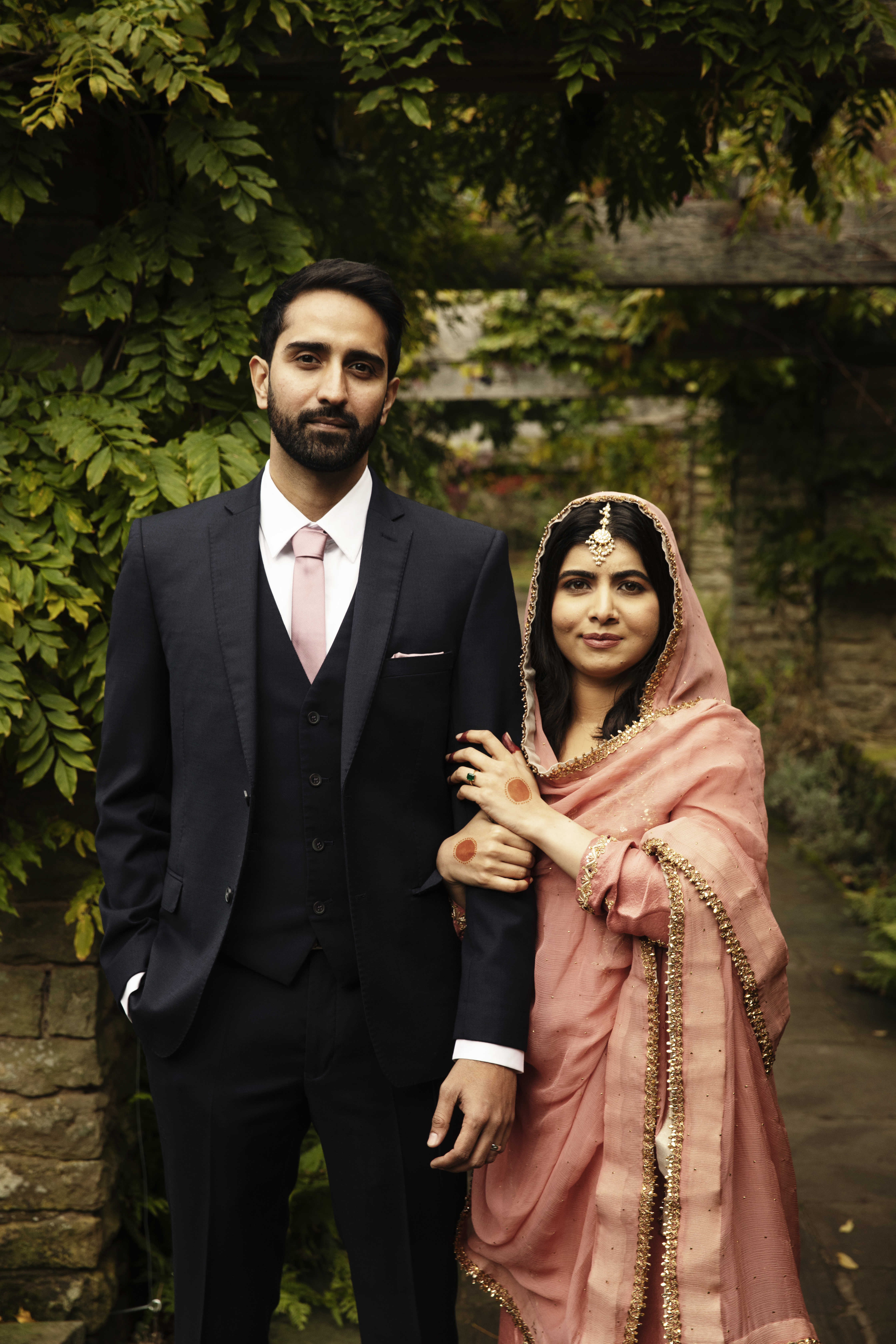
Asser Malik and Malala Yousafzai on their wedding day in November 2021 at her parents’ home in Birmingham, England.
“I had so many questions and doubts about marriage. We all know the issue of forced marriages and child marriage. We also know how, historically, marriage has meant more compromises for women. So I took my time, I did my research, I learned, and more than anything, I asked Asser questions.”
One of them was, “What if I earn more than you?”
“He would say something like, ‘If my wife earns more than me, I’ll be the luckiest husband, and I would love to just sit at home and enjoy my life.’ So I was like, ‘Wow, this guy is funny as well.’”
“We need better men, better boys,” said Yousafzai.
Which she said, makes her Team Conrad, referring to the Prime Video show The Summer I Turned Pretty that she binge-watched with Malik.
For someone who was forced out of her home country, she has now learned to find a sense of belonging. “It is the home that we have in Birmingham now, where my family lives. It is when I’m with my friends, or when I’m with my husband, and we have a moment of joy together. It’s when we’re watching our favorite TV show, or holding hands. All of that is now home to me.”
Her book tour brings her to Philadelphia on Tuesday, where she’ll be in conversation with Kylie Kelce.
“I’m really excited to be in Philadelphia,” said the cricket fan, “and open to going to an Eagles game. I don’t think I’ve been to any of the games.
“What is it called? American football?”
“Malala Yousafzai: Finding My Way Book Tour,” Oct. 28, 8 p.m., the Fillmore, 29 E. Allen St., Phila., livenation.com