Whatever brutally hot designs the weather gods had in store Friday for Philadelphia’s Independence Day celebrations, by 8 p.m. the temperature fell below 90 degrees, and the music on Independence Mall arrived like a balm.
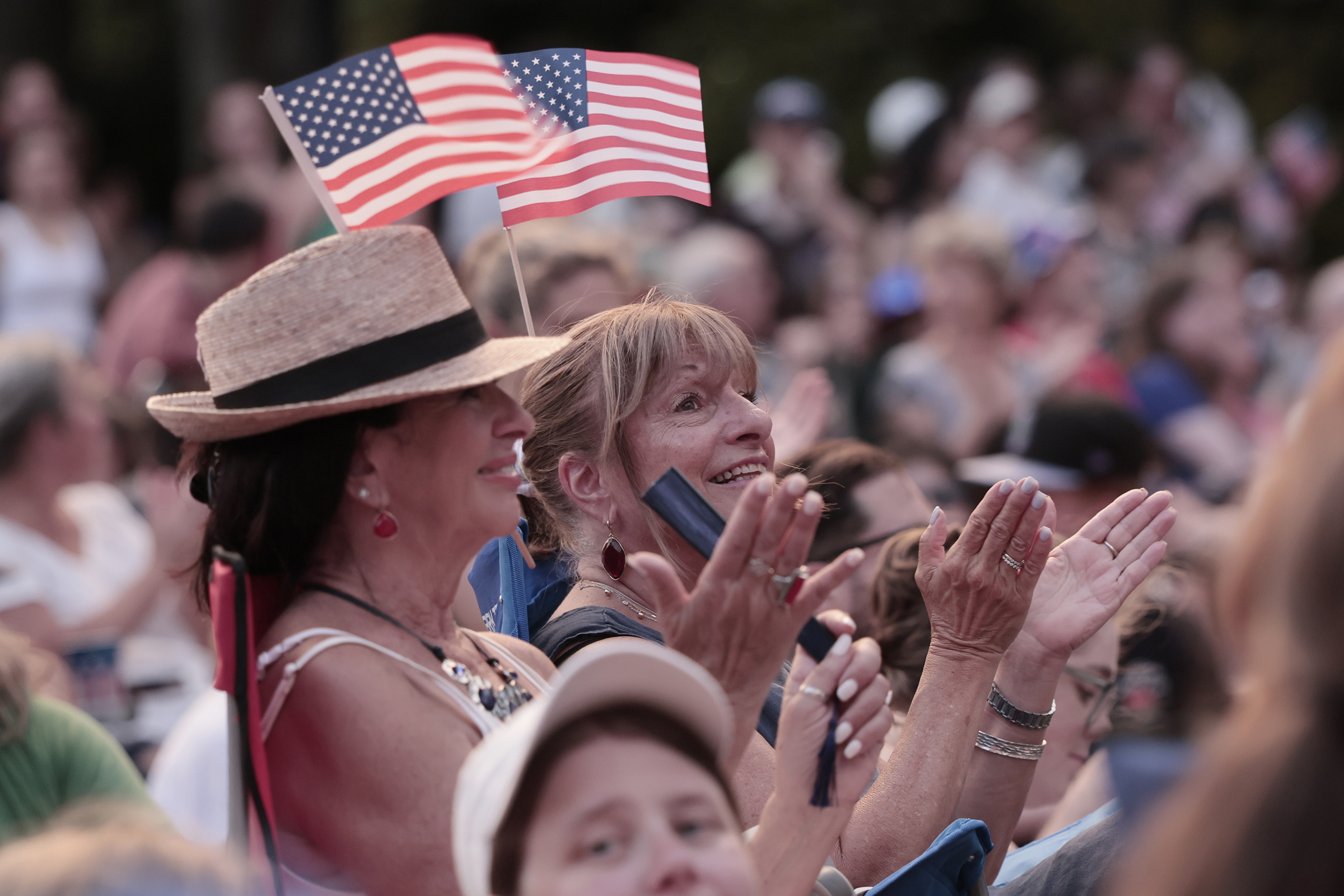
Listeners were stretched across the lawn of the mall fairly solidly from Independence Hall to Arch Street — an estimated 12,000 attendees, according to a Wawa Welcome America spokesperson. Whether drawn by the Philly Pops with tunes patriotic or stirring, or by popular actress-singer Idina Menzel, the crowd was in a mood at once celebratory and relaxed.
The weather posed no threat, at least for the first hour or so.
At Friday night’s Philly Pops concert on Independence Mall.
This annual tradition of “Pops on Independence,” a free Philly Pops concert on the mall, has become a way of taking the national temperature. Last year, a few months into the new presidential administration, there were subtle references to the political moment, with the acting superintendent of Independence National Historical Park speaking to the audience about equal rights of all kinds, including marriage rights, and referencing a nation “built on the struggle for freedom from tyranny, and the principle of liberty for all under the just rule of law.”
Friday night, park superintendent Steven Sims struck a more anodyne note, speaking of the historic setting, the city’s events this week commemorating the 250th anniversary of the nation, and of celebrating with “one of our most universal languages — music.”
The audience seemed only too happy to live inside of this bubble for a while, though to the woman holding up a “Striving for Democracy” sign, you were seen.
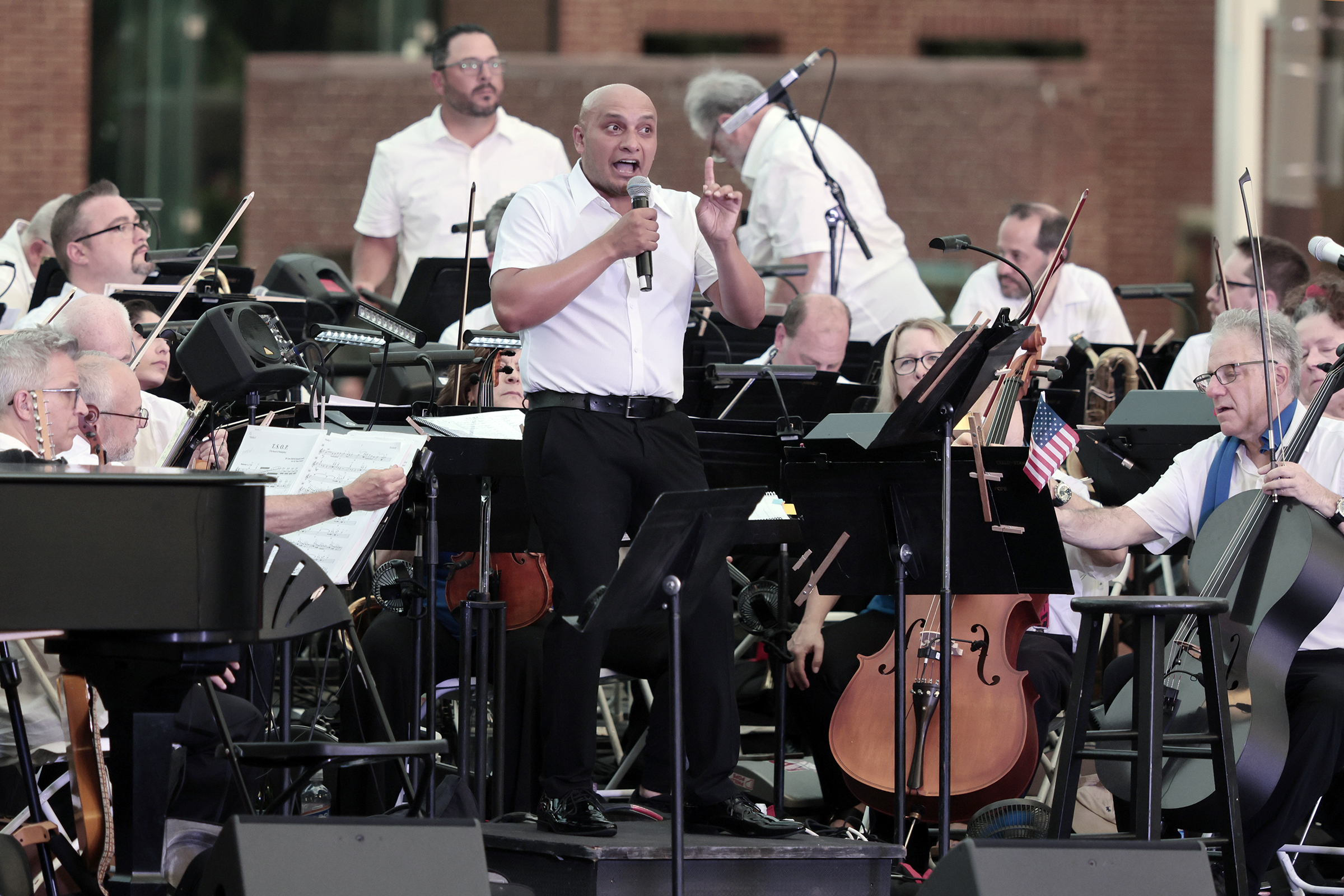
Philly Pops music director Chris Dragon speaking to the crowd during Friday’s “Pops on Independence” concert on Independence Mall.
No one should take for granted the fact that this concert endures. The group performing Friday under the Philly Pops name is a band of survivors, emerging after the demise of the original Philly Pops and much organizational and legal drama. Had the orchestra not reorganized, a 4 ½-decade tradition of hearing music with no less a backdrop than Independence Hall might be gone.
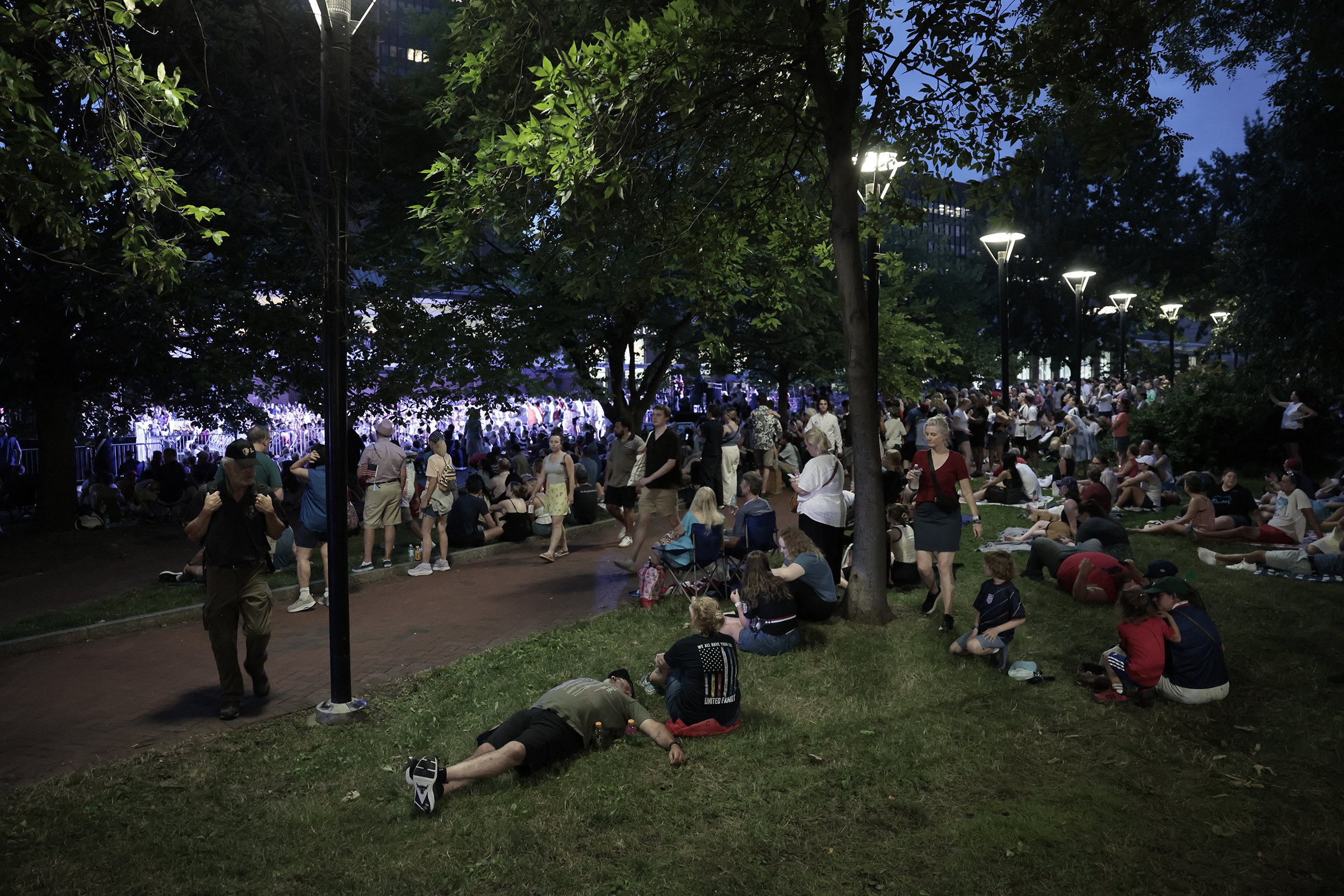
Listening and strolling on Independence Mall Friday night at the Philly Pops concert.
How many other cities can boast as powerful and authentic a resonance between art and setting? When the Pops performed its Armed Forces Salute — having audience members stand as the respective song of the military branch in which they served was played — it made real and human the idea of such service to the nation.
A section has been added to the medley to recognize the U.S. Space Force, established during the first Trump administration; I could be mistaken, but no service member from that branch who might have been in Friday’s audience appears to have stood for this song, called “Semper Supra.”
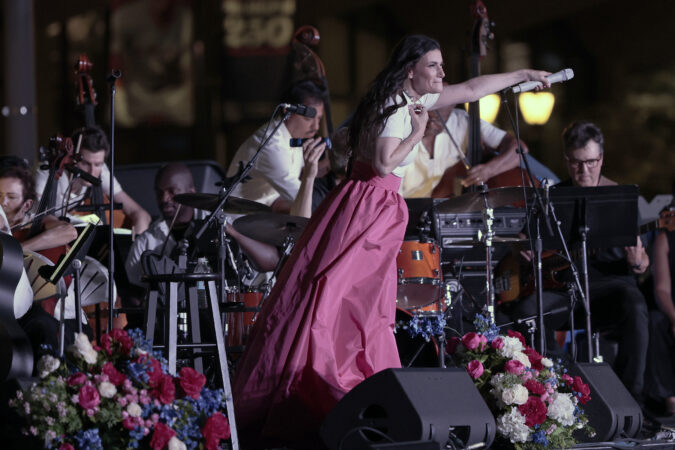
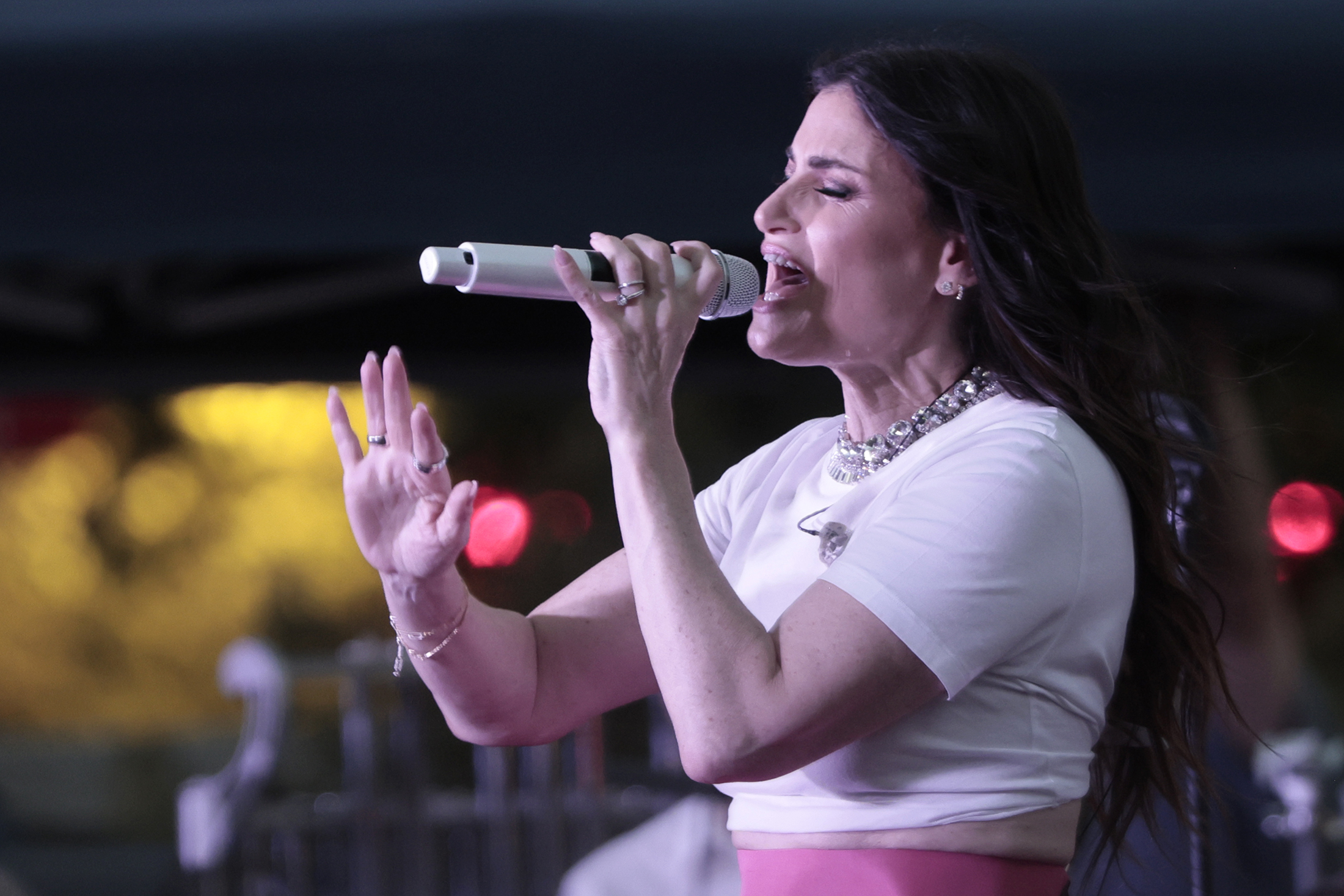
Idina Menzel performing with the Philly Pops Friday night.
Judging by the number of families with young children in attendance, the main attraction was Menzel, and if they came to hear “Let It Go” from Frozen, they were not disappointed. Menzel was a canny choice for this occasion; she is a singer who knows how to send sound and charisma back to the farthest reaches of the audience.
It was not necessarily the best night to appreciate the talents of the Pops and conductor Chris Dragon. The sound system near me, fairly far back from the stage, cut in and out. No sound check had been possible because of the heat, a Pops spokesperson said. And the concert ended earlier than planned after organizers grew concerned by gathering dark clouds and flashes of lightning. The last few pieces that might have showcased the ensemble weren’t played. A loss, for sure.
But the event succeeded on so many other levels, that it didn’t matter.
As the crowd headed off with the music fresh in their ears, downtown buildings were aglow red, white, and blue; young families lingered and took selfies; and Market Street on a Friday night seemed like the lively urban stretch it once was and could be again.
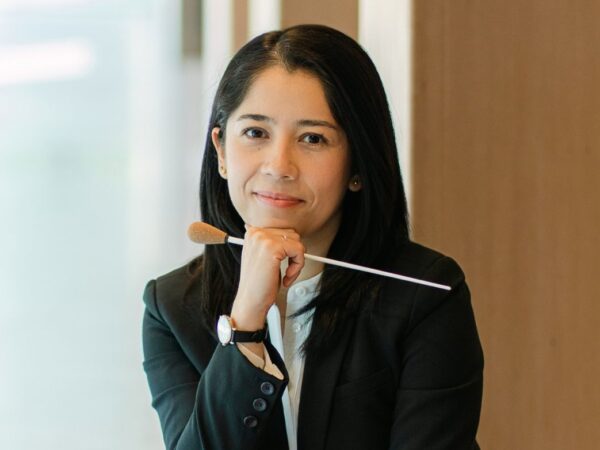
When Sara Aldana auditioned for the coveted Philadelphia Orchestra assistant conductor spot in April, she tried out in front of the ensemble with Copland and Bartok.
For the third piece, she chose an excerpt from Rachmaninoff’s Symphony No. 2. The Russian composer is closely associated with the Philadelphians — he once called the orchestra the greatest in the world — and the second symphony, Aldana said, was close to her heart.
“I was like, whatever happens with the audition, I just want that memory of — wow — doing Rachmaninoff Two with Philadelphia for five minutes.”
Now she’ll be spending many more minutes with the Philadelphians. Aldana won the audition, and is the orchestra’s next assistant conductor, the group announced Wednesday.
The position is a junior one, though it has been a steppingstone to bigger opportunities. Aldana follows Naomi Woo, who has already been engaged as a guest conductor next season.
Aldana studied with Philadelphia Orchestra principal guest conductor Marin Alsop and worked as a cover conductor with the Detroit Symphony Orchestra. As assistant conductor in Philadelphia, she will lead family and special concerts and give pre-concert talks.
One of her biggest responsibilities will be one that the public may never get to see — or that could make her career. She will serve as cover conductor, which means she could be tapped to lead a Philadelphia Orchestra concert at any moment if the scheduled conductor falls ill or is otherwise unable to perform at the last minute.
“I always think it’s like the Formula 1 reserve driver, you know? You might not be driving the car, but you could get a call and you have to get on, driving the car,” she said Aldana.
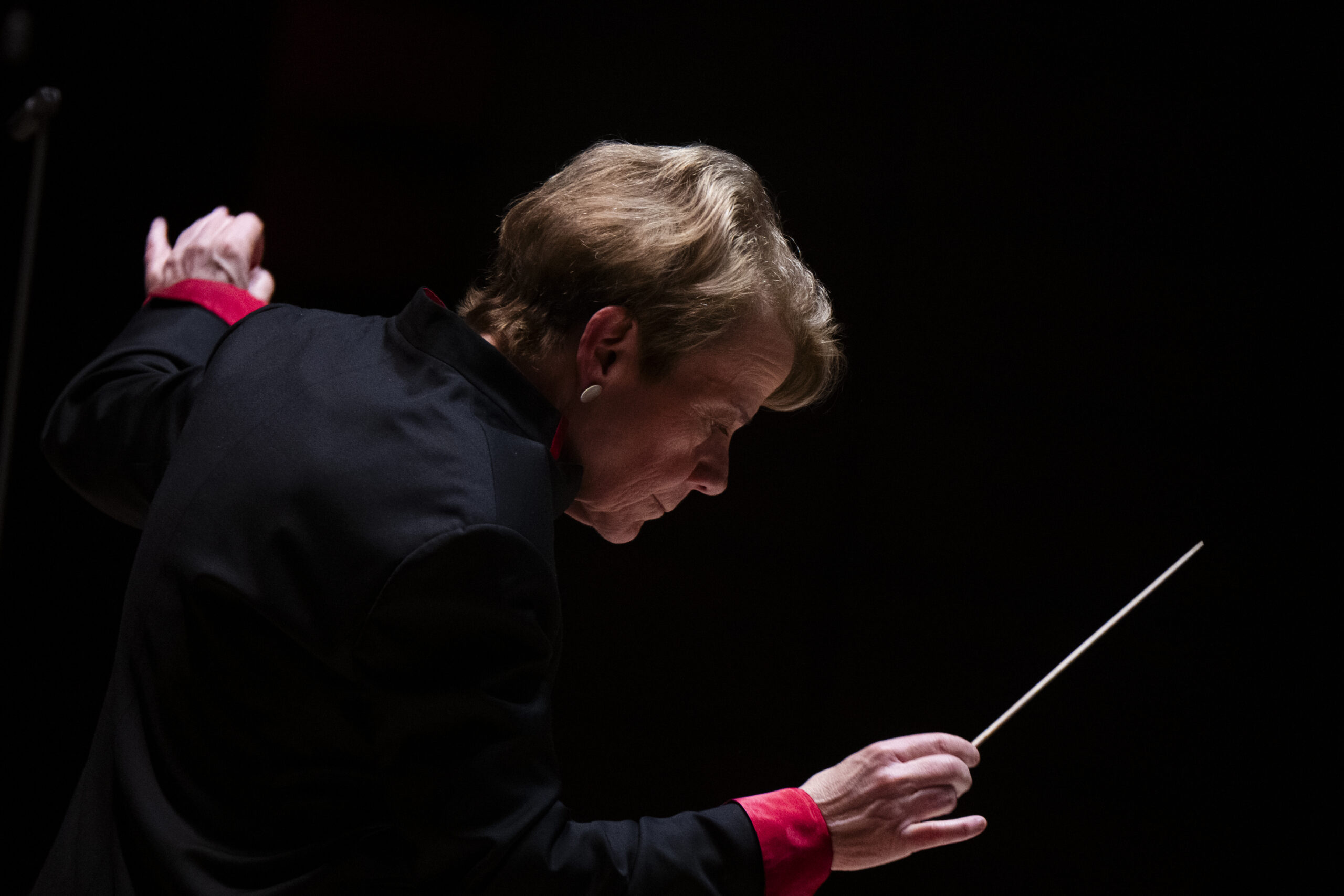
Conductor Marin Alsop — who has worked with Aldana — leading the Philadelphia Orchestra, May 28, 2026, in Marian Anderson Hall.
Aldana, 30, was born in Bogotá, Colombia, and earned an undergraduate degree in violin performance at the University of Texas at Austin. She holds a master’s degree in orchestral conducting from the University of Michigan, where she studied with Kenneth Kiesler, and did further studies with Alsop and Joseph Young at the Peabody Institute of the Johns Hopkins University.
She has served as assistant conductor of the Reno Chamber Orchestra and is a 2026 mentee with the Taki Alsop Conducting Fellowship.
Aldana was at Peabody for a year, but left after winning the Philadelphia audition.
That tryout ended with five finalists for the job. Each had a short time conducting the orchestra, dipping into excerpts of various styles — Copland’s Appalachian Spring, Bartok’s Miraculous Mandarin Suite, and the third piece, which the finalists could choose themselves from among three possibilities.
All five chose the last few minutes of the famously emotive third movement of Rachmaninoff’s Symphony No. 2.
Why this piece?
“I’m a violinist by training, and so I absolutely love Rachmaninoff Symphony No. 2.”
The audition lasted all of 15 minutes.
“Fifteen minutes is a short amount of time, but you realize with Philadelphia, it’s all you need to get a good idea of who they are as an ensemble and the culture that they have as a group. It just happened to be a beautiful connection.”
Although Aldana started out as a violinist, she long harbored, even as a child, an interest in conducting.
“Your instrument is the orchestra, all these colors, and it’s just getting to play with all of them — how you create sound, balance, getting to discover, you’re continuously learning. That’s something that really appealed to me.”
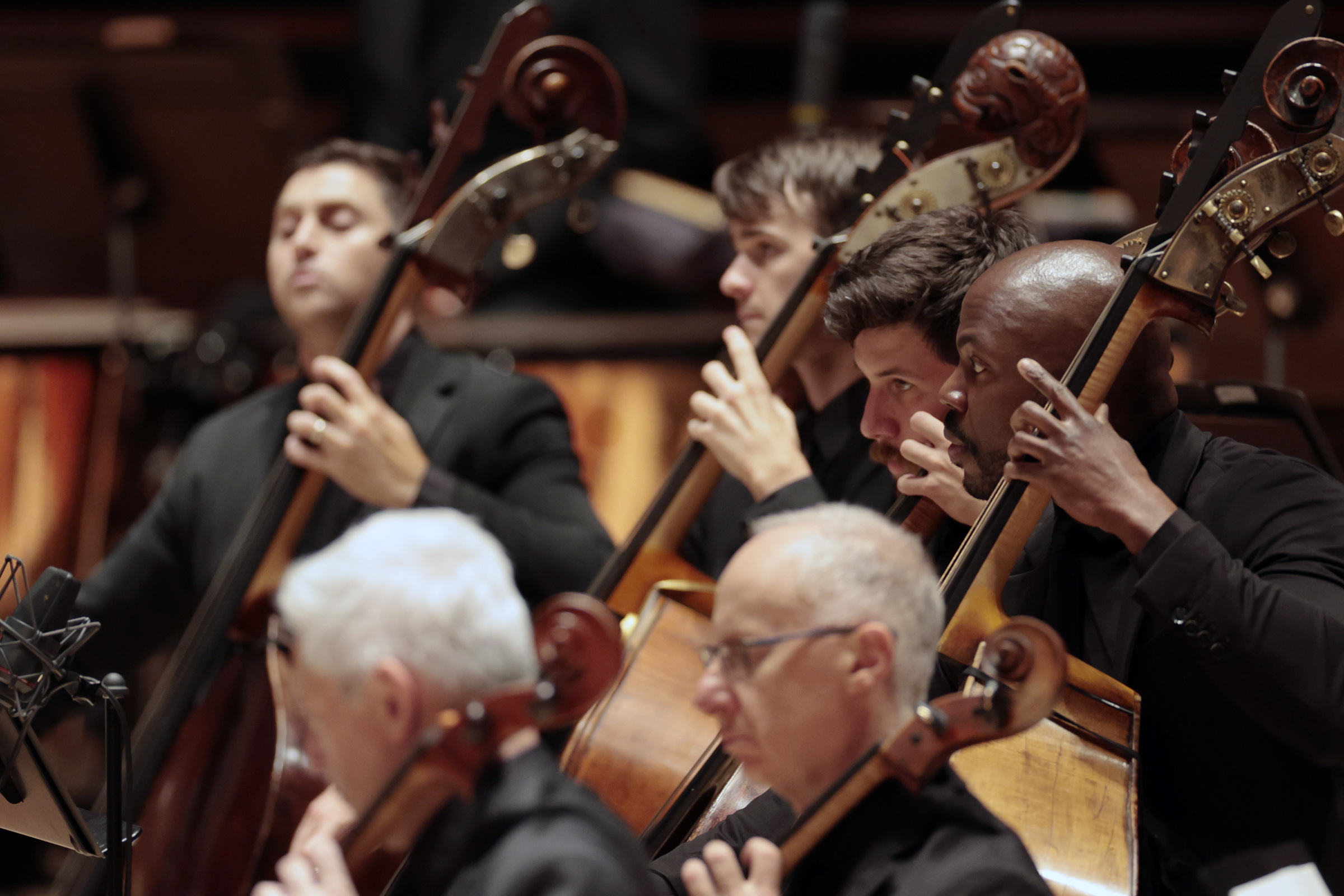
The double bass section of the Philadelphia Orchestra performing on opening night of the 2025-26 season in Marian Anderson Hall, Sept. 25, 2025.
Aldana’s official start is Sept. 1. Her first scheduled concert with the orchestra is a Jan. 2 matinee in Marian Anderson Hall of Strauss family waltzes and other works.
Asked what piece she might dream of someday conducting with this orchestra, Aldana said any Tchaikovsky symphony, but especially the Sixth.
“There was an Ormandy recording that I remember listening to a lot. I was obsessed with this piece — obsessed. I remember that lush of the strings in the most heart-wrenching moments.”
Is there a piece she would find too daunting to conduct?
“Daunting. Hmm. I don’t think so.”
Does that mean she’s musically fearless?
“I am a little fearless,” she said, “when you have one of the best orchestras in the world in front of you.”
In past years, the city’s budget process has followed a certain pattern for Mural Arts Philadelphia and other groups.
The mayor’s proposed budget lists city funding at one level; City Council and others advocate for modifications at a higher level; and the budget goes back to the mayor and is finalized with the higher allocation in place.
This year was different.
Philadelphia’s nationally acclaimed program that puts colorful murals in neighborhoods and provides jobs was hoping for a boost in city funding.
Instead, the budget ultimately agreed to by Mayor Cherelle L. Parker’s administration and City Council cut funding to Mural Arts — from $5.1 million in fiscal year 2026 to $3.7 million in 2027.
Likewise the Philadelphia Cultural Fund. The group — which awards hundreds of grants to arts groups throughout the neighborhoods — was looking for increased funding in the city’s newly approved $7.1 billion budget for the fiscal year starting July 1.
But the arts nonprofit, established by the city recently, learned that it will get substantially less — $3.5 million instead of the $5 million it received from the city for the fiscal year now ending.
As a result, both groups say they will have to make deep cuts to programs.
Philadelphia’s arts and culture sector had greeted the start of Parker’s term 2½ years ago with optimism for increased funding. Today, it is “alarmed” by the cuts to Mural Arts and the Cultural Fund, said Patricia Wilson Aden, president and CEO of the Greater Philadelphia Cultural Alliance.
“We always say that your budget tells a story, and I have to say that the cultural community is disappointed and frustrated with the story being told by this FY27 budget,” she said. “Cutting the budget of signature programs like Mural Arts by 26% or decreasing funding to the Philadelphia Cultural Fund, that’s going to have ramifications throughout the city.”
Parker was not available for comment, a spokesperson said.
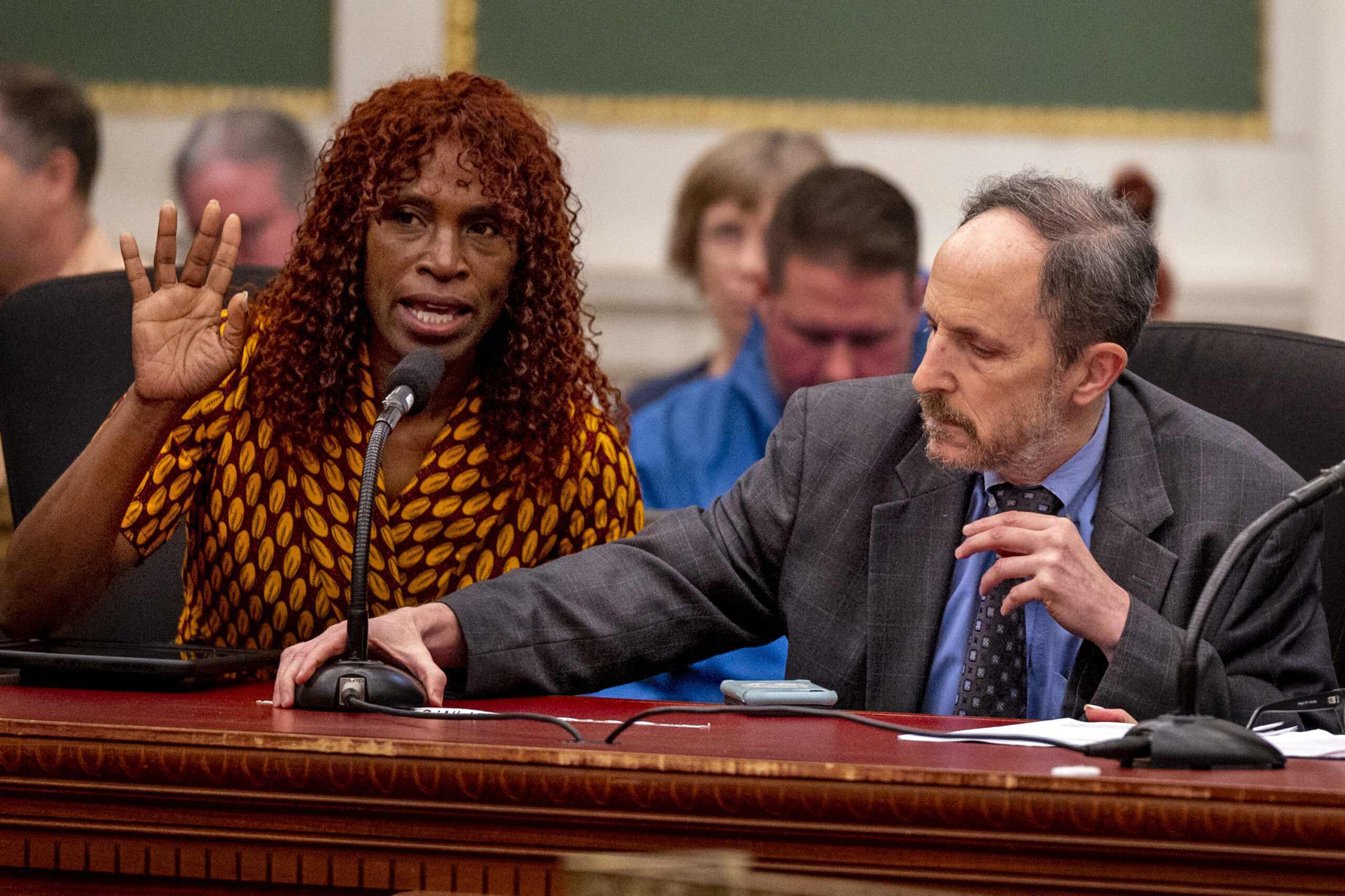
Valerie V. Gay (left) chief cultural officer with the City’s Office of Arts, Culture and the Creative Economy, and finance director Rob Dubow (right) testify at a Philadelphia City Council hearing, Aug. 8, 2024 on the collapse of the University of the Arts.
Valerie V. Gay, the city’s chief cultural officer, said it was the city’s view that funding for the two groups had remained flat from 2026 to 2027, since the base allocation stayed the same and it was only the added amount that did not come through — though she allowed that “absolutely I can see how it can be perceived.”
A ripple effect
The resulting cuts at both groups promise to be substantial. The Cultural Fund will be forced to reduce the number of grants it had been expecting to distribute in the coming year, from 332 to 232. It has changed its eligibility requirements, which will eliminate grants to a pool of midsize organizations currently eligible.
“It’s going to be a ripple effect. People are going to feel it and communities are going to feel it,” said Philadelphia Cultural Fund executive director Gabriela Sanchez.
“An investment in the Philadelphia Cultural Fund is more than a budget line item,” Sanchez wrote in a statement distributed by the group. “Funding to PCF represents how the city values neighborhood theaters, cultural centers, museums, arts education programs, festivals, dance companies, community storytelling initiatives, music programs, and cultural traditions that bring Philadelphians together. These spaces are where young people discover their creativity, where seniors find connection, where communities celebrate their heritage, and where residents gather across lines of difference.”
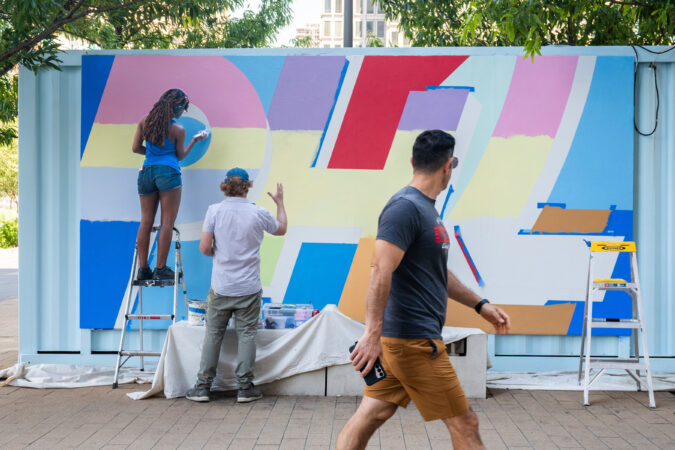
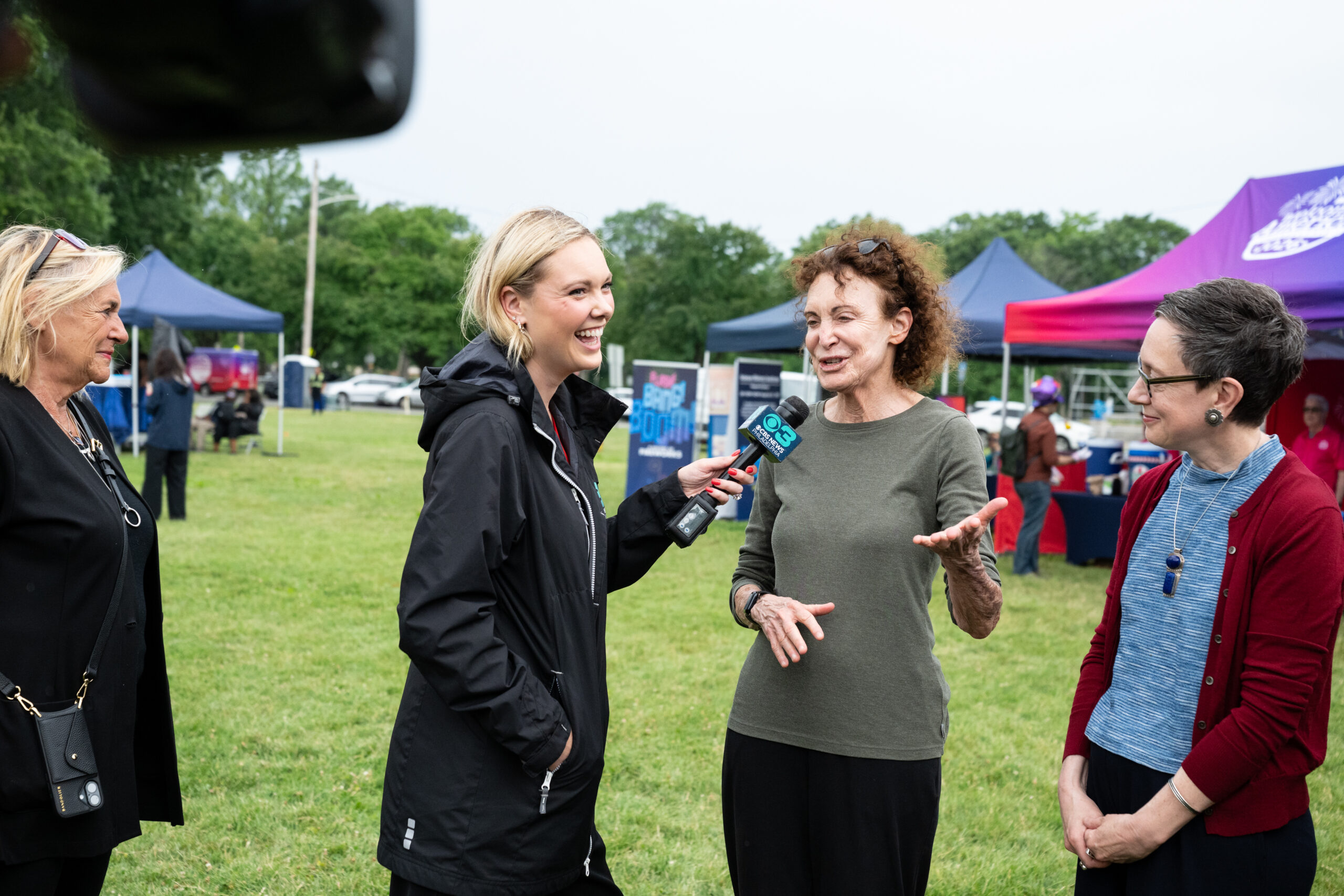
Jane Golden (center right) speaks with press at the Wawa Welcome America media preview for the Philly Fair 250, outside the Please Touch Museum in West Philadelphia, June 18, 2026. Mural Arts held a ceremonial unveiling of a 10-story-high mural replica, originally titled ‘CityKids Speak On Liberty,’ and created by Keith Haring.
Mural Arts director Jane Golden declined to comment, but an initial assessment from the group obtained by The Inquirer says that “hundreds of residents in at least 15 Philadelphia communities will lose the opportunity to develop public art projects,” and that opportunities for paid work, job training, and mentorship through the Mural Arts Restorative Justice program will be reduced by 25%.
Mural Arts will also have to cut by 75% its program of restoring and preserving the city’s murals, “putting at risk community landmarks that took years and significant public investment to create,” the impact statement reads.
Of the program reductions at both groups, Gay said: “I am always sad that any cuts are made or that any organizations are unable to do the work they thought they were going to be able to do. That’s always a sad time for us, and I’m looking forward to when we are a fully funded sector.”
A city spokesperson was unable to provide a full list of groups that in past years had received higher allocations after advocacy from City Council and others, but this year did not.
What’s behind the cuts
Aden says arts and culture has seen some significant recent “wins” from city government. Among them is the advancement of a referendum that, if approved by the mayor and then by voters this fall, would enshrine the city’s office of arts and culture, called Creative Philadelphia, in the City Charter.
The city has approved $500,000 a year to develop and implement a cultural plan for Philadelphia that would document financial needs and could identify potential pathways to establishing funding.
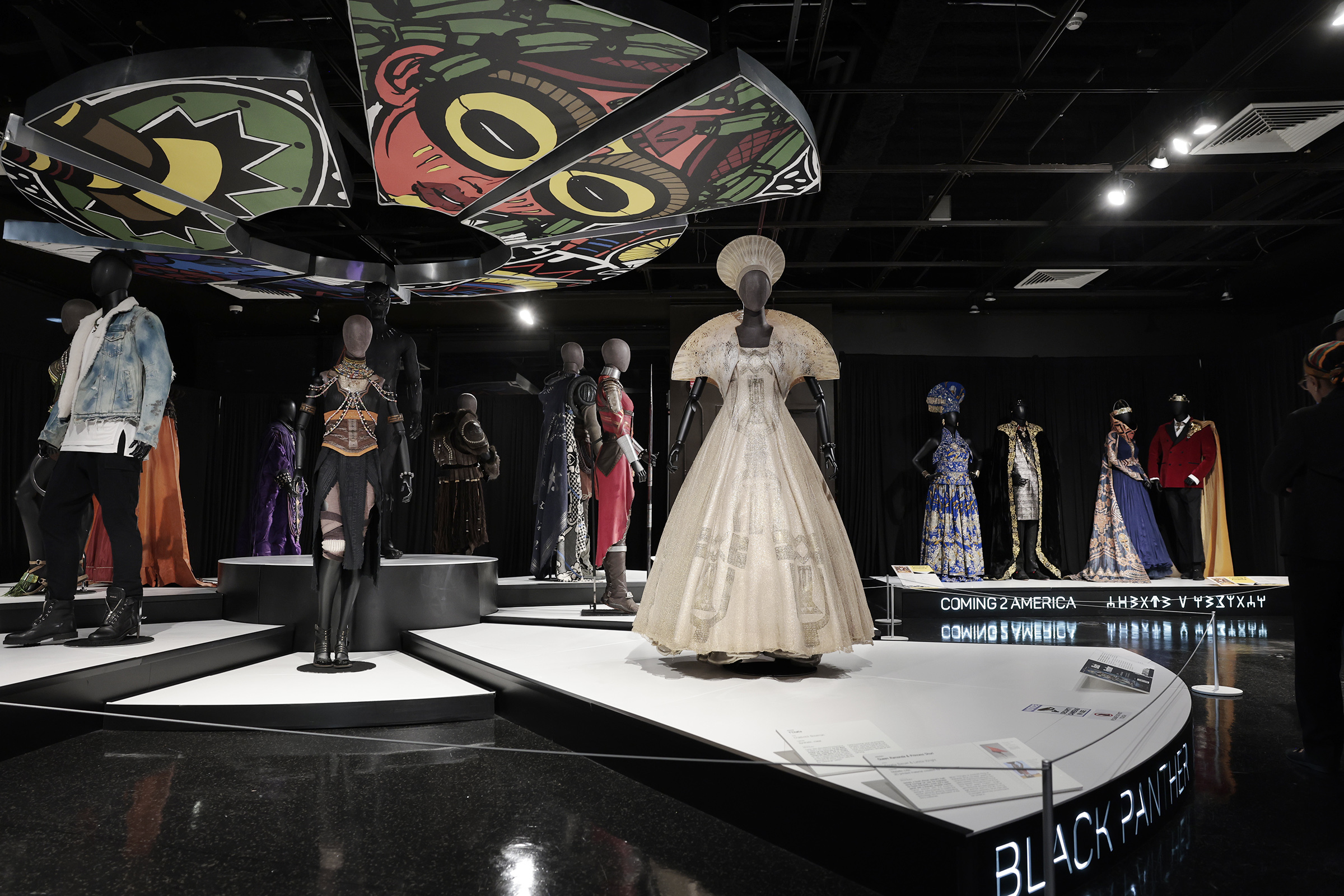
The ‘Ruth E. Carter: Afrofuturism in Costume Design’ exhibition at the African American Museum in Philadelphia, Nov. 1, 2025.
Sometimes the city’s support is for regular operations, and other times it is for specific capital projects. In an unusually large commitment, the city has pledged $50 million to the African American Museum in Philadelphia for its relocation to the Benjamin Franklin Parkway.
The city is providing nearly $32.5 million to arts and culture in FY27, according to a list provided by Parker’s office. While that total includes small items that might seem mundane — paying utility bills at various facilities, for instance — it also shows multimillion-dollar allocations to the Philadelphia Museum of Art, Dell Music Center, and Philadelphia Zoo.
But the arts and culture sector often finds itself fighting for adequate funding in the annual budget process. Arts leaders and others say it has been standard practice in recent memory that funding is listed at one level in the mayor’s proposed budget and after City Council testimony in budget hearings ends up being higher.
This year, the mayor “could have funded [the arts] at a higher amount,” as she did last year, but did not do so, Councilmember Rue Landau said.
The cuts came after a budget that passed without a series of tax increases proposed by Parker, including a $1 tax on rideshare services, after failing to win support from City Council. After Council signaled it would reject Parker’s tax proposals, the administration would not agree to any last-minute line items for new funding requests from lawmakers.
Councilmember Isaiah Thomas, a consistent arts supporter who, like Landau, is an ex-officio Mural Arts board member, said that with the lack of new tax revenue and the city’s extra allocation of $48 million to cover the Philadelphia School District’s budget shortfall, the funding pie for other allocations got smaller.
“This budget year, a lot of attention and advocacy went toward schools,” Thomas said. The funding cuts to Mural Arts and the Cultural Fund were “extremely unfortunate,” he said, “and I wish we could have done something different.”
The need for ‘predictable, stable, reliable’ funding for the arts
While the city’s budget is now final, there is another potential window of opportunity for funding through a midyear budget transfer process in which the city might see expenditures in certain areas coming in lower than expected, and then transfer money from those categories to other areas.
Asked whether funds might be restored through a budget transfer to Mural Arts or the Cultural Fund, Gay said:
“I think anything is on the table, but I also think nothing is guaranteed.”
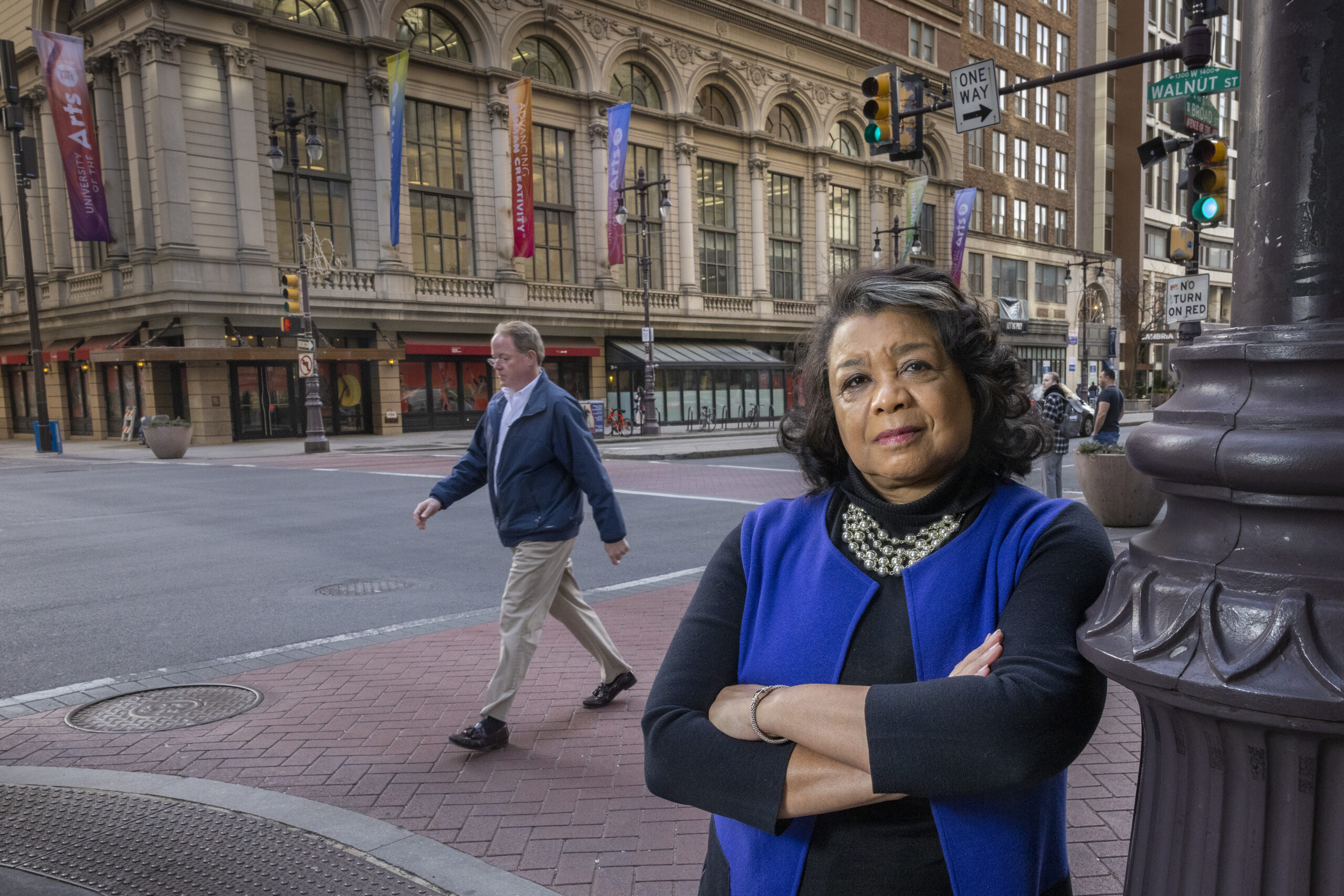
Patricia Wilson Aden, president and CEO of the Greater Philadelphia Cultural Alliance, at S. Broad Street and Walnut along the Avenue of the Arts, Feb. 15, 2023.
Any restoration of funds would happen after arts groups have already put cuts in place, and this kind of unpredictability “makes planning by these organizations very, very difficult,” Aden said.
“The practice of underfunding the arts and having Council and other entities have to go on an advocacy campaign to increase funding is illogical,” Landau said. “It is clear as day that we should be supporting the arts with additional funding every single year, so we don’t have to go through this and it won’t ever be a question mark for them.”
What is really needed, Aden said, is a dedicated arts fund in Philadelphia and the region.
“We’ve seen other regions benefit from this predictable, stable, reliable funding. And instead, here in Philadelphia, each year we have this conversation about increases and decreases and their impact. We are sometimes left to the will and whim of elected officials, and we would like to take the creative economy out of the political realm and put it solidly within our larger civic interest, so that it is stable and has the investment that is required to reach its full potential.”
Staff writer Anna Orso contributed to this article.
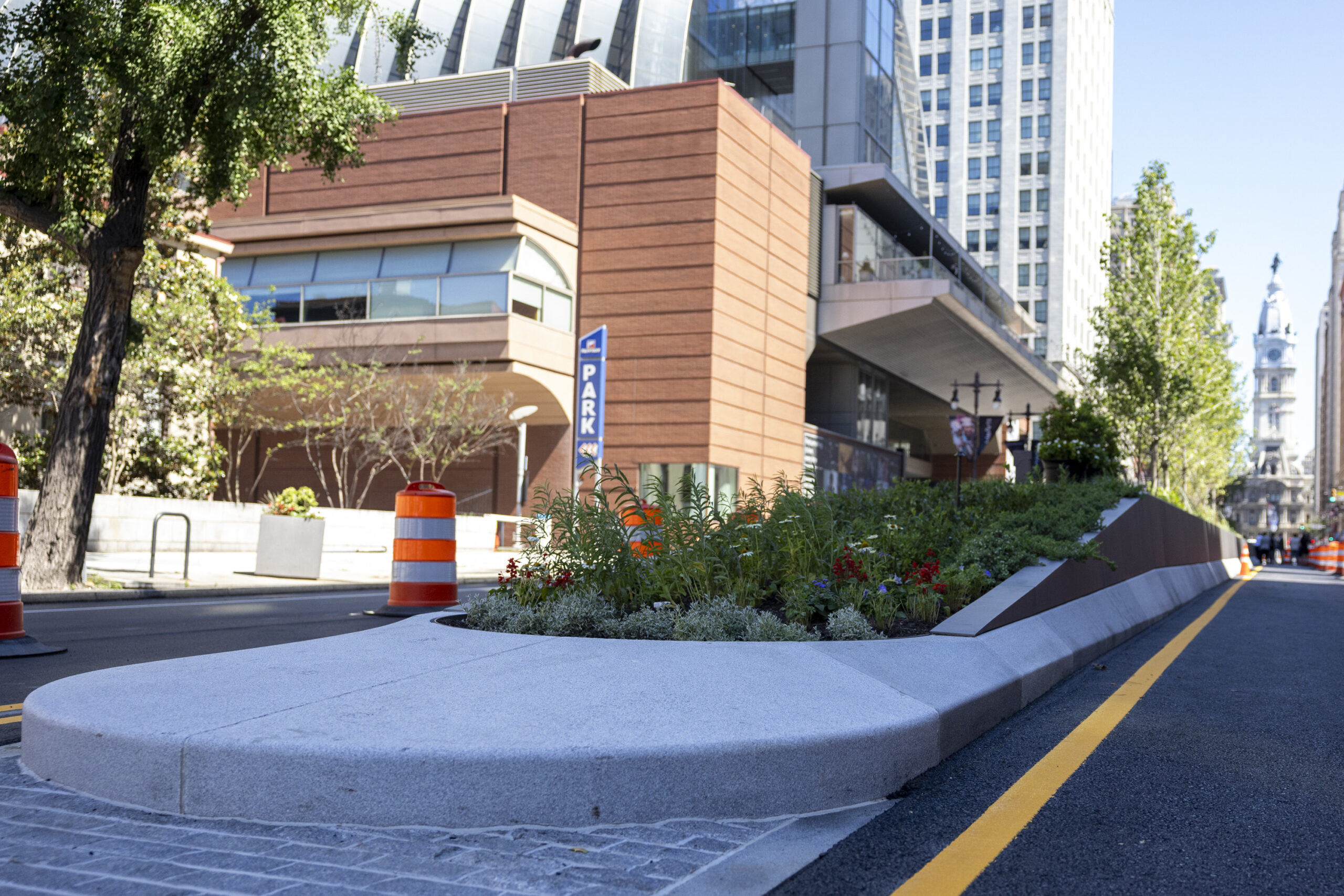
A new landscaped median under construction for months in front of the Kimmel Center has reached completion — the down payment on a promised major redo of the Avenue of the Arts streetscape.
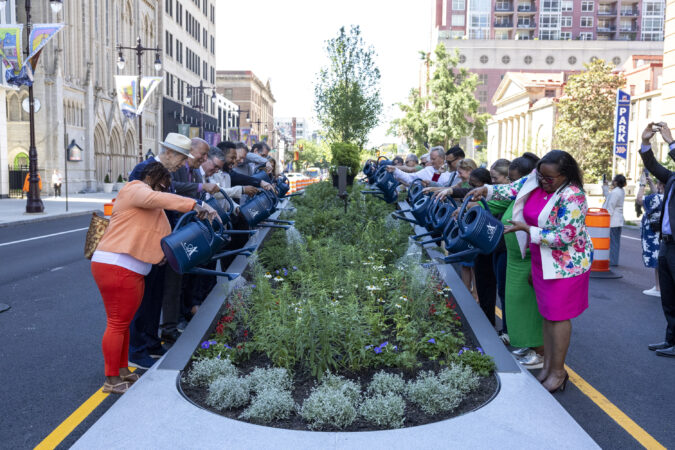
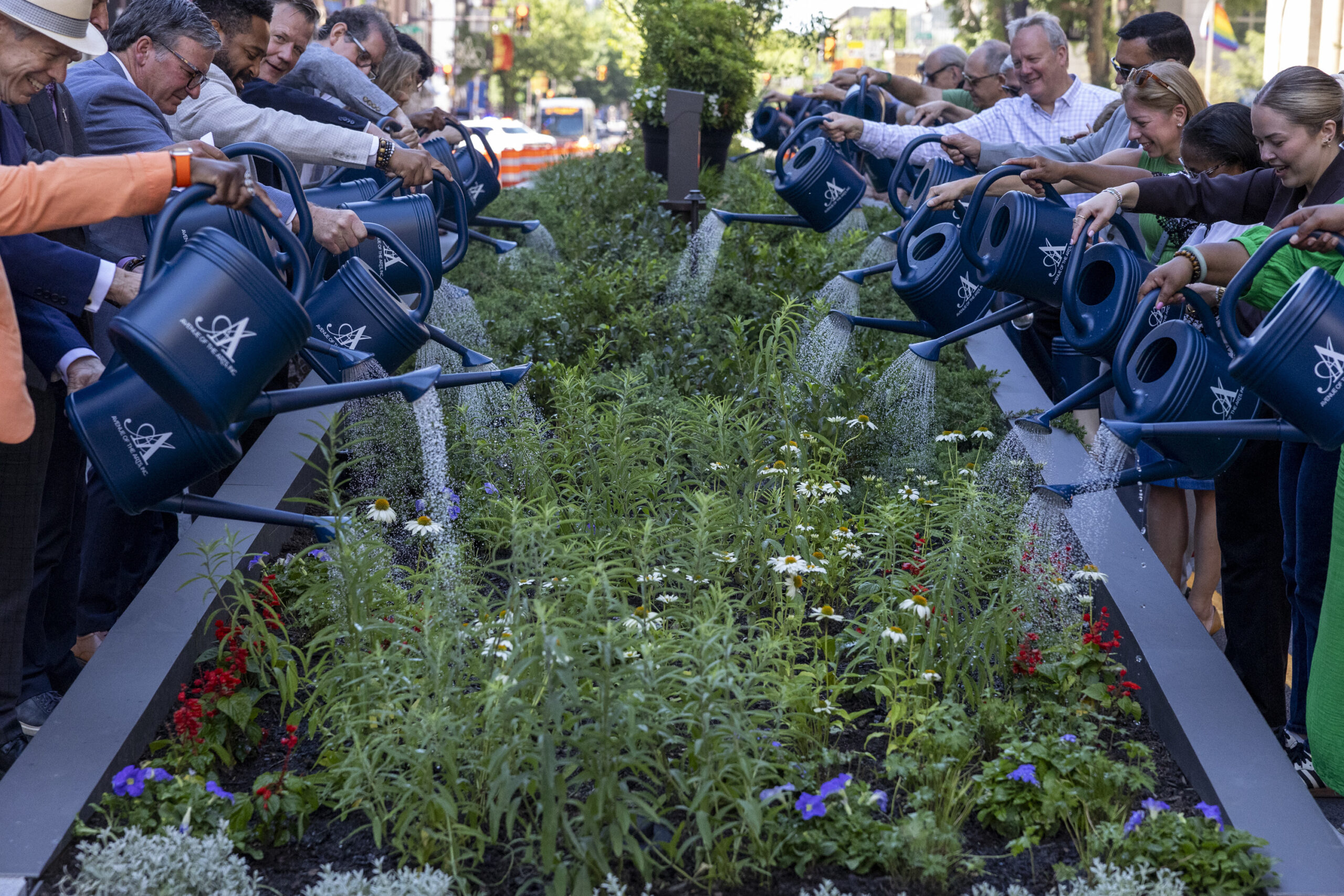
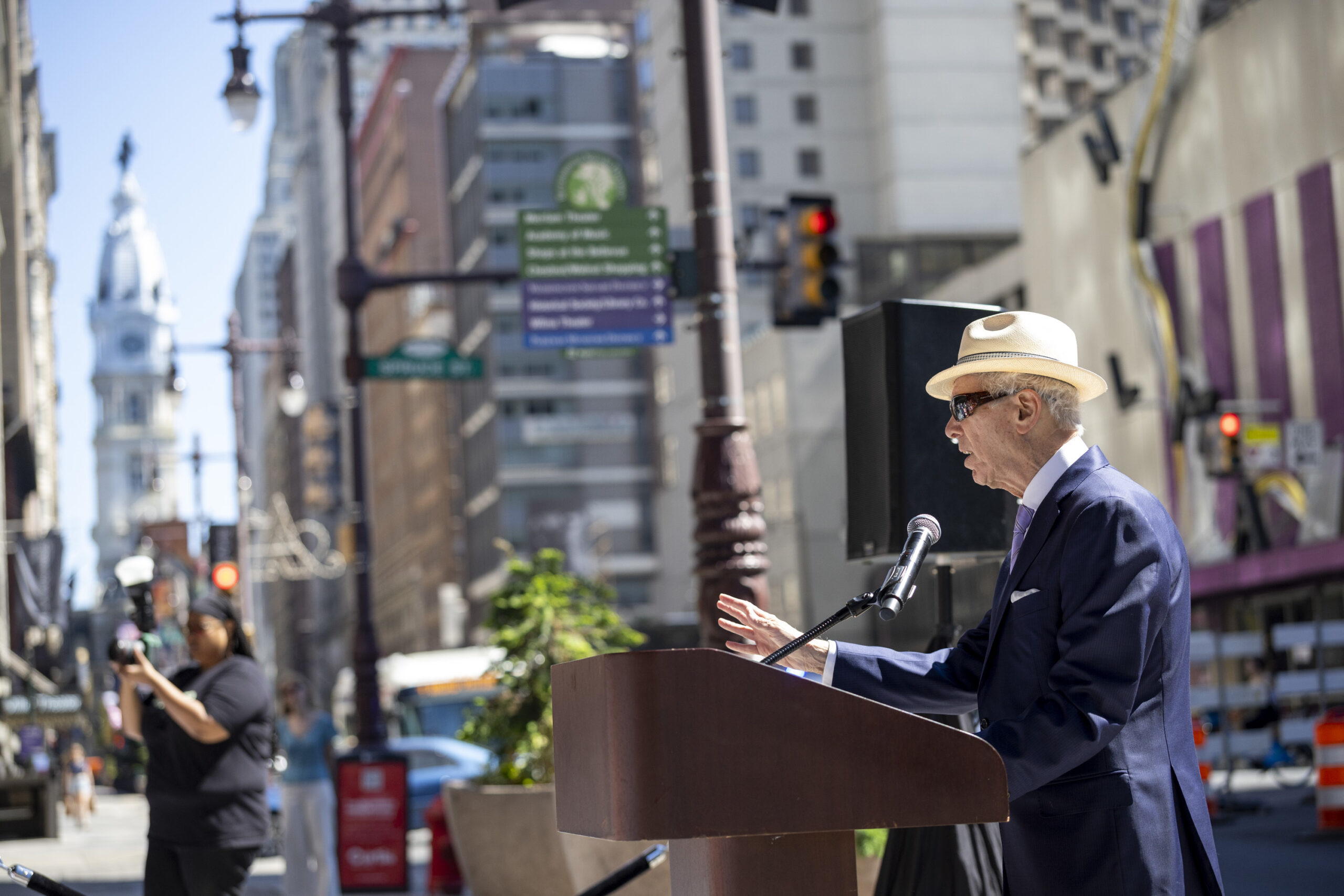
The leafy ribbon down the middle of Broad Street from Spruce to Pine Streets was officially unveiled Wednesday morning with speeches and a ceremonial sprinkling from blue watering cans onto the new plantings.
“We aimed high and we met our lofty expectations, and we’re off and running,” said Carl Dranoff, chair of Avenue of the Arts Inc., which is spearheading the project.
There is a practical, traffic-calming intention behind the raised median: It leaves less space for drivers to make U-turns on the block occupied by the arts center and residences, and creates a barrier to thwart pedestrians jaywalking across Broad Street.
Attendees watering the new redesign of the South Broad Street median outside the Kimmel Center in Philadelphia, Pa., on Wednesday, June 24, 2026.
But the slender, shapely strip of trees, shrubs, and ground cover atop a granite base with metal skirt signals a larger transformation to come.
In spring of 2027, work is expected to begin on an ambitious beautification of the heavily trafficked block. Sidewalks will be landscaped, sculptures installed, and pop-up performance space carved out, creating what planners say will be a markedly different vibe.
That will give the project’s leaders something tangible to point to when raising money for the entire streetscape project, which is envisioned as eventually stretching from City Hall south to Washington Avenue.
“The idea of a beta block was to get everybody on board and excited about what can be accomplished — the doability and to create buzz,” said Dranoff, who said the median was the first step in turning South Broad Street into “one of the great streets of the world.”
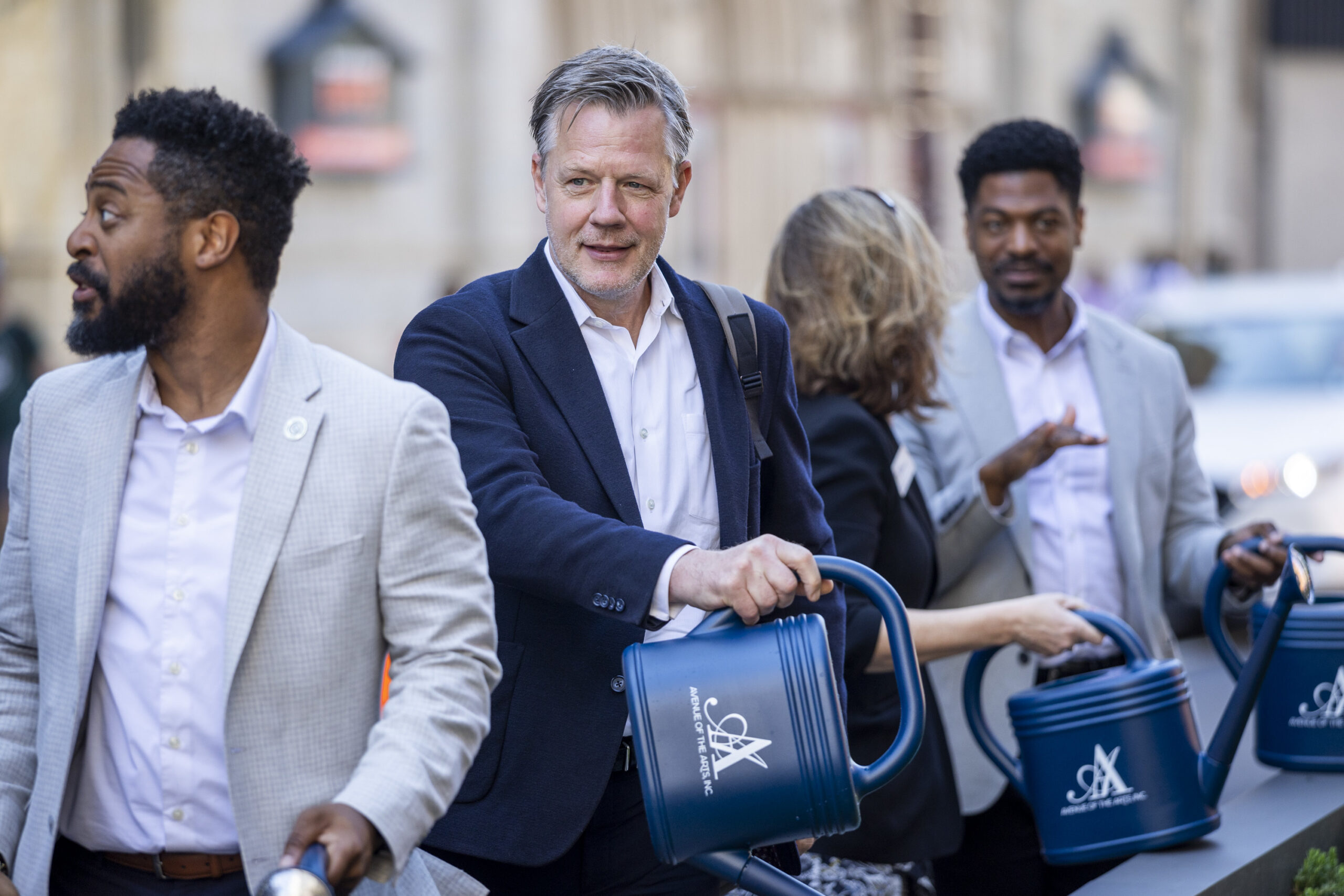
Oliver Schaper, Ubran Designer for the Project with the New York office of Architecture/Design Firm Gensler, waters the plants in the redesign of the South Broad Street median outside the Kimmel Center in Philadelphia, Pa., on Wednesday, June 24, 2026.
That larger, 10-block effort is expected to cost about $150 million and take years to design and complete, with funds anticipated from both government sources and philanthropy.
The design of each segment will vary, said Oliver Schaper, an urban designer for the project with the New York office of architecture/design firm Gensler.
“The requirements of adjacent buildings are different on every block, the left-turn lanes are different, even the length of the median is different from block to block,” Schaper said. “We wanted to make sure that all the design elements can act as a kit of parts and adjust, so each design of a block will be an application of that kit of parts so they feel like cousins, but specific.”
Some design professionals have criticized the median as intrusive to sight lines, but the design and landscaping were chosen to preserve sight lines, Dranoff said.
Carl Dranoff, Chair of Avenue of the Arts Inc., speaks about the redesign of the South Broad Street median outside the Kimmel Center in Philadelphia, Pa., on Wednesday, June 24, 2026.
“All of the trees were specifically selected to have long trunks and very narrow canopies, all the vegetation.” The designs adhere to standards for safety, he said, “so we are very confident that we will not block views.”
The flora — about three dozen kinds of native and adaptive plants — were chosen by OJB Landscape Architecture to withstand “the abuse that they will be subject to in terms of the winters and the salt and all that,” Schaper said.
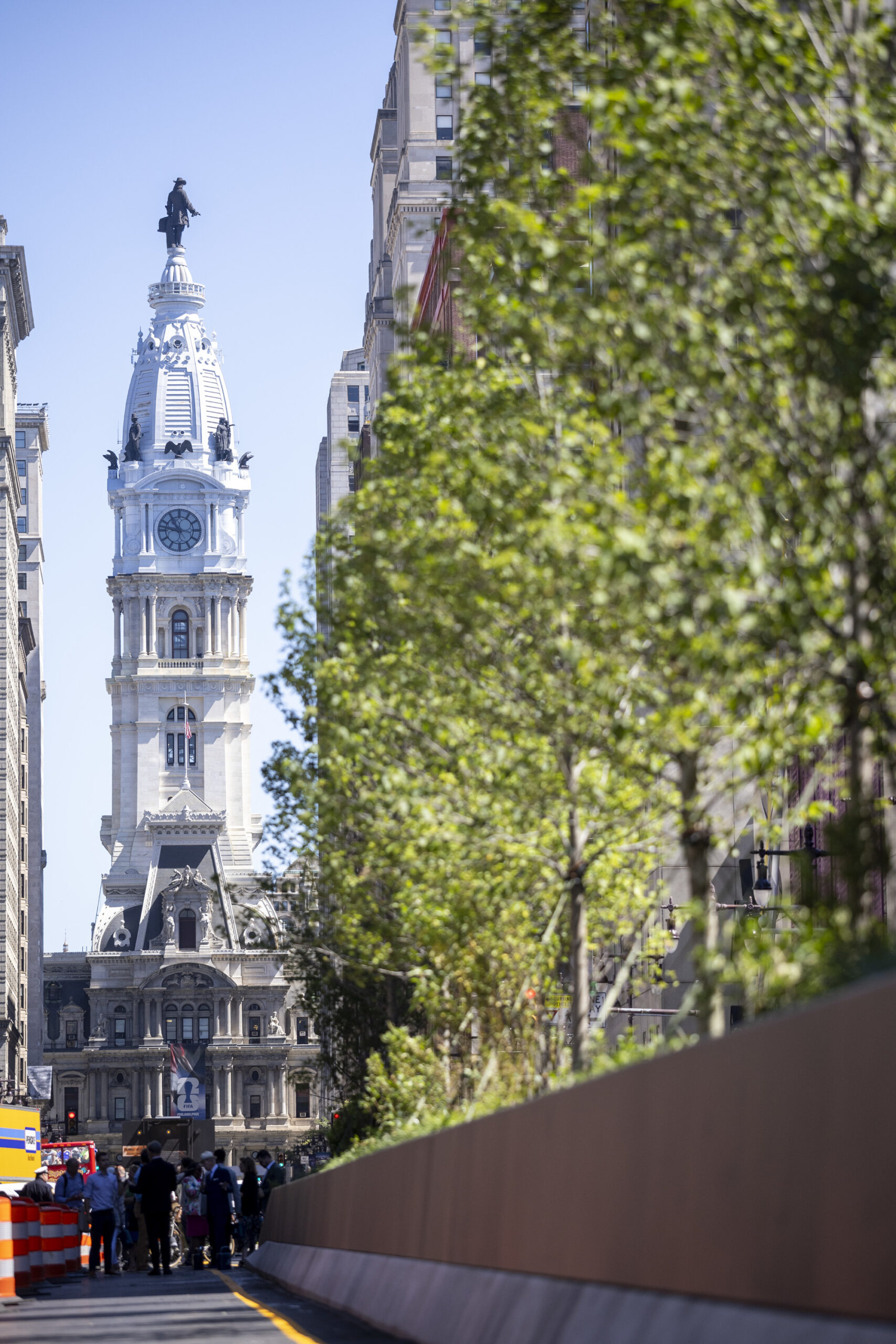
Looking ahead, the blocks farther north from Spruce Street are anticipated as having fewer trees, to preserve the view of City Hall.
“We even designed, as you get closer to City Hall, standing areas for brides and photo ops, so that we’re not taking anything away from people,” Dranoff said. “We have parade areas so that Mummers and other parades have performance areas between the medians.”
City Hall seen in the back near the new redesign of the South Broad Street median outside the Kimmel Center in Philadelphia, Pa., on Wednesday, June 24, 2026.
But more immediate is the work from Pine to Spruce, where Dranoff’s 47-story Arthaus residential condo tower sits. The $5 million needed to pay for the median and work on the infrastructure beneath the street “is accounted for and that was utilized,” Dranoff said, “and of the $10 million for the sidewalks, we have several million lined up and more to go, and we’ll have it all by the end of the year.”
Construction on the sidewalk portions is expected to begin in 2027 and be completed by the end of the year “or thereabouts,” he said.
Schaper said part of the goal is to rebalance the dynamic between pedestrians and other factors.
“I think as designers at some point we take a position, and our position was, ‘Let’s design for pedestrians.’ There are, of course, very specific requirements that we need to adhere to — for example, it’s reflected in conversations that we had with the Kimmel Center about their bus queuing, and we made adjustments to continue to allow that to happen.”
The new redesign of the South Broad Street median outside the Kimmel Center in Philadelphia, Pa., on Wednesday, June 24, 2026.
But, he said, the plan sets out to be “an advocate of the pedestrian experience, and not think that private car access is the model of the future for cities.”
Dranoff said construction of this first median phase, running much of the block from Spruce to Pine, was delayed by the unusually harsh conditions of this past winter, but workers made up for lost time.
“Philadelphia’s going to be a hotbed this summer, and the whole point of this was to show what we can do and be more beautiful and more attractive and more compelling to Philadelphians and to suburbanites and to the world.”
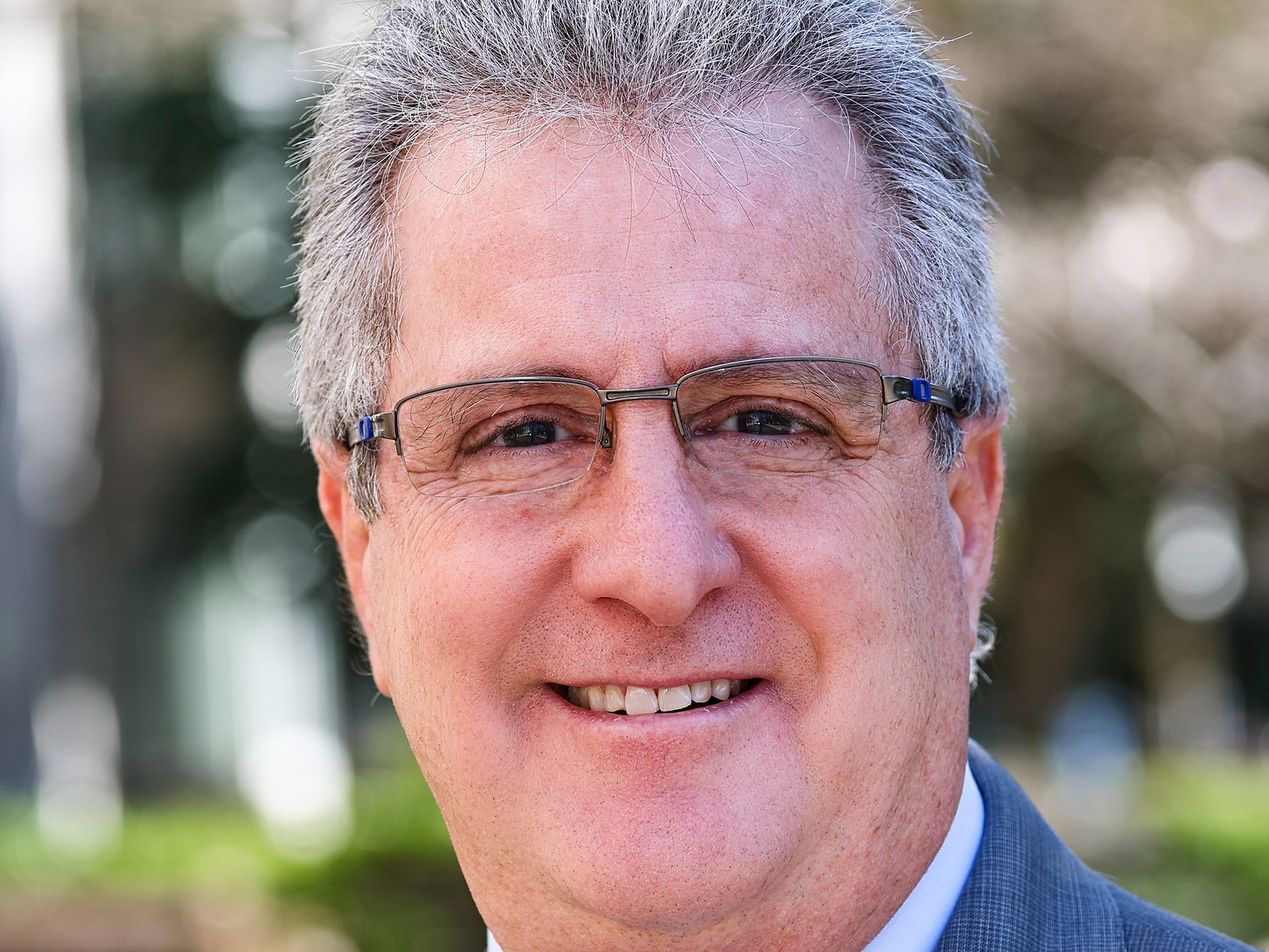
Philadelphia Museum of Art director and CEO Daniel H. Weiss has hired a longtime associate to be the museum’s new executive vice president and chief financial and operating officer.
Mitchell Lee Wein will oversee finances, facilities, operations, risk management, and strategic initiatives, the museum announced Friday.
Weiss and Wein worked together in similar roles when Weiss was president of Haverford College and, before that, at Lafayette College. Wein, 63, has extensive experience on the financial and operations side of nonprofit organizations, but has never worked in a museum.
A Philadelphian for more than three decades, he takes up the new post April 22.
“It’s such an important institution that I’m happy to play a role for as long as I can and leave it better for the future. I think the mission is critical,” said Wein. “When I was in the private sector I thought about how we attract firms to Philadelphia, how people can have a great experience here, and the museum plays a role in that. I smile when I think about the opportunities.”
Mitchell Lee Wein, newly named CFO and COO of the Philadelphia Museum of Art.
Wein is currently senior vice president for finance and COO at the Brookings Institute, the Washington, D.C.-based think tank. He was senior vice president for administration and finance at Haverford College and held a similar position at Lafayette College. Previously, he was managing director in investment banking with UBS Investment Bank/UBS PaineWebber, and, before that, at PNC Capital Markets.
Weiss took over the museum in December and has been making a series of changes in the executive leadership team as he determines how to close the operating deficit and revive attendance. He must decide what to do about paused expansion plans and much-needed maintenance on existing buildings. And he will consider whether to re-open to the public the Ruth and Raymond G. Perelman Building, the museum’s major addition that closed during the pandemic.
Wein says he has been following coverage of the museum’s challenges and reading financial statements in preparation for his start. He said he looked forward to developing a plan for the museum “in support of what Dan has outlined along with other colleagues.”
From the department of weirdly random, gratuitously hurtful actor observations about the world, Timothée Chalamet has informed us that opera and ballet are passé:
“I don’t want to be working in ballet, or opera, or things where it’s like, ‘Hey, keep this thing alive, even though, like, no one cares about this anymore.’ All respect to all the ballet and opera people out there.”
After suggesting that both art forms were wanting for support during a talk with actor Matthew McConaughey at a Variety and CNN town hall in University of Texas at Austin, the American and French actor joked: “I just lost 14 cents in viewership. I just took shots for no reason.”
Chalamet then mimicked an opera singer, the event video shows.
Opera and ballet figures all over have seized on his comments, and Philadelphia — where both opera and ballet fill the hall regularly — would like to have a word with the 30-year-old actor.
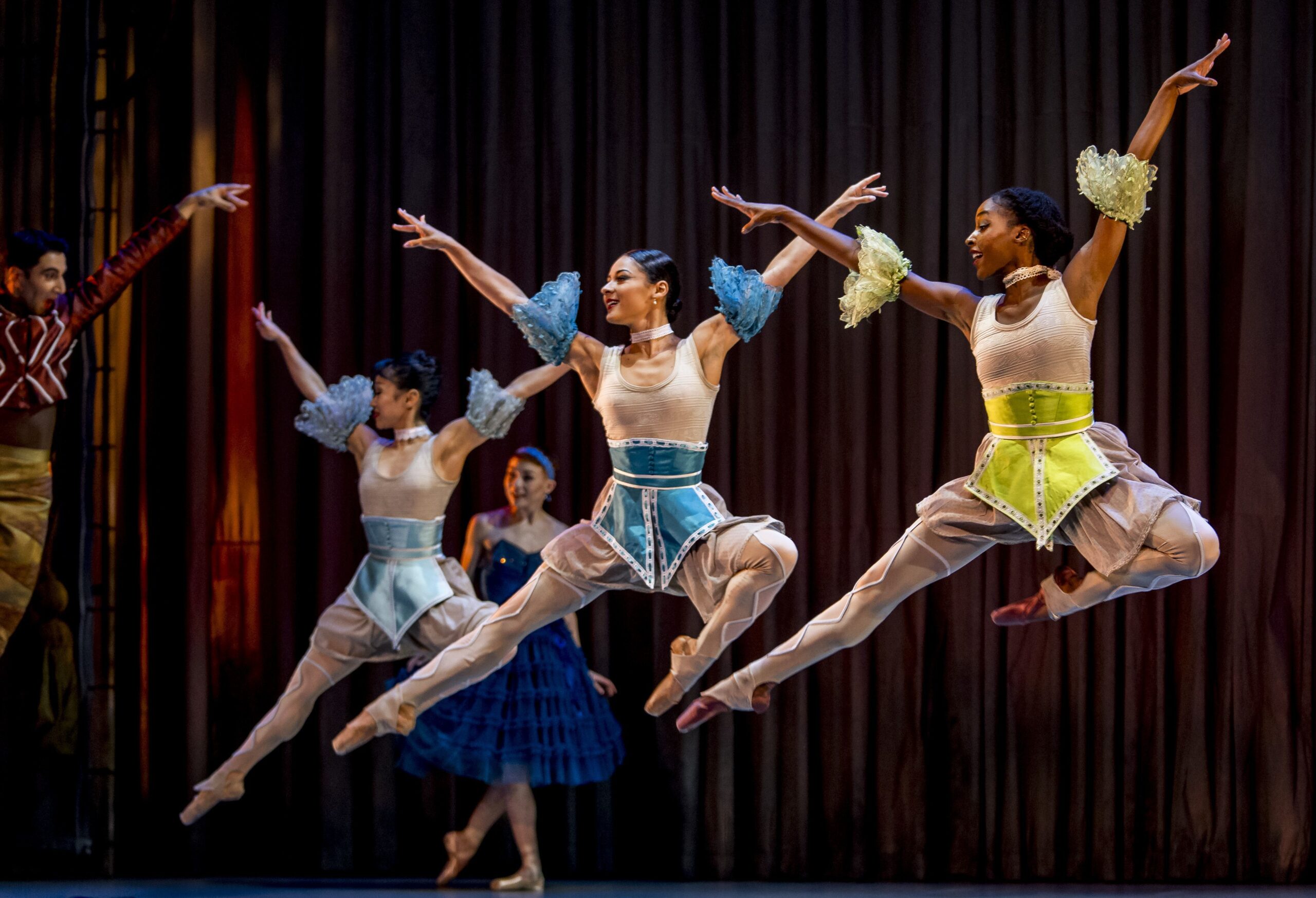
BalletX dancers Ashley Simpson, Itzkan Barbosa, Minori Sakita, and Lanie Jackson (back) in Amy Hall Garner’s “Petrushka.”
“I am a huge Timothée Chalamet fan, and I was shocked,” said Christine Cox, artistic and executive director of BalletX. “It was so dismissive and hurtful of entire industries. I see generations of people coming to this art form. We shouldn’t be putting each other down, we should be lifting each other up.”
BalletX’s spring run of seven performances this month are nearly sold out, Cox pointed out.
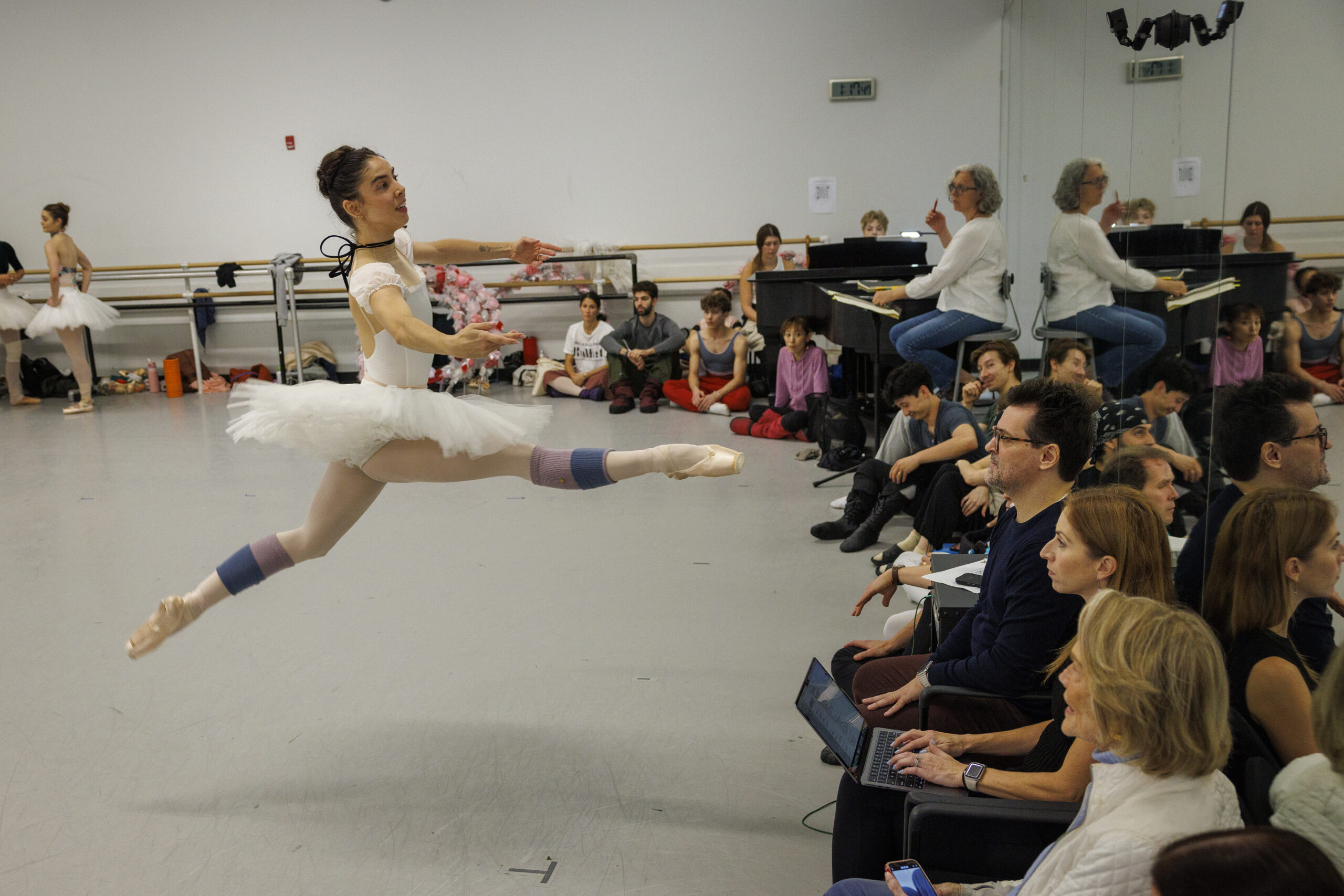
Philadelphia Ballet chief executive officer Shelly Power said that “Mr. Chalamet is obviously living outside the majority of the ballet world and out of touch. If his comments were true, why are our ticket sales and attendance numbers hitting all-time highs? We saw 10,000 more patrons from 2024 to 2025 in The Nutcracker alone.”
Its subscriber base, Power said, has returned to pre-pandemic numbers.
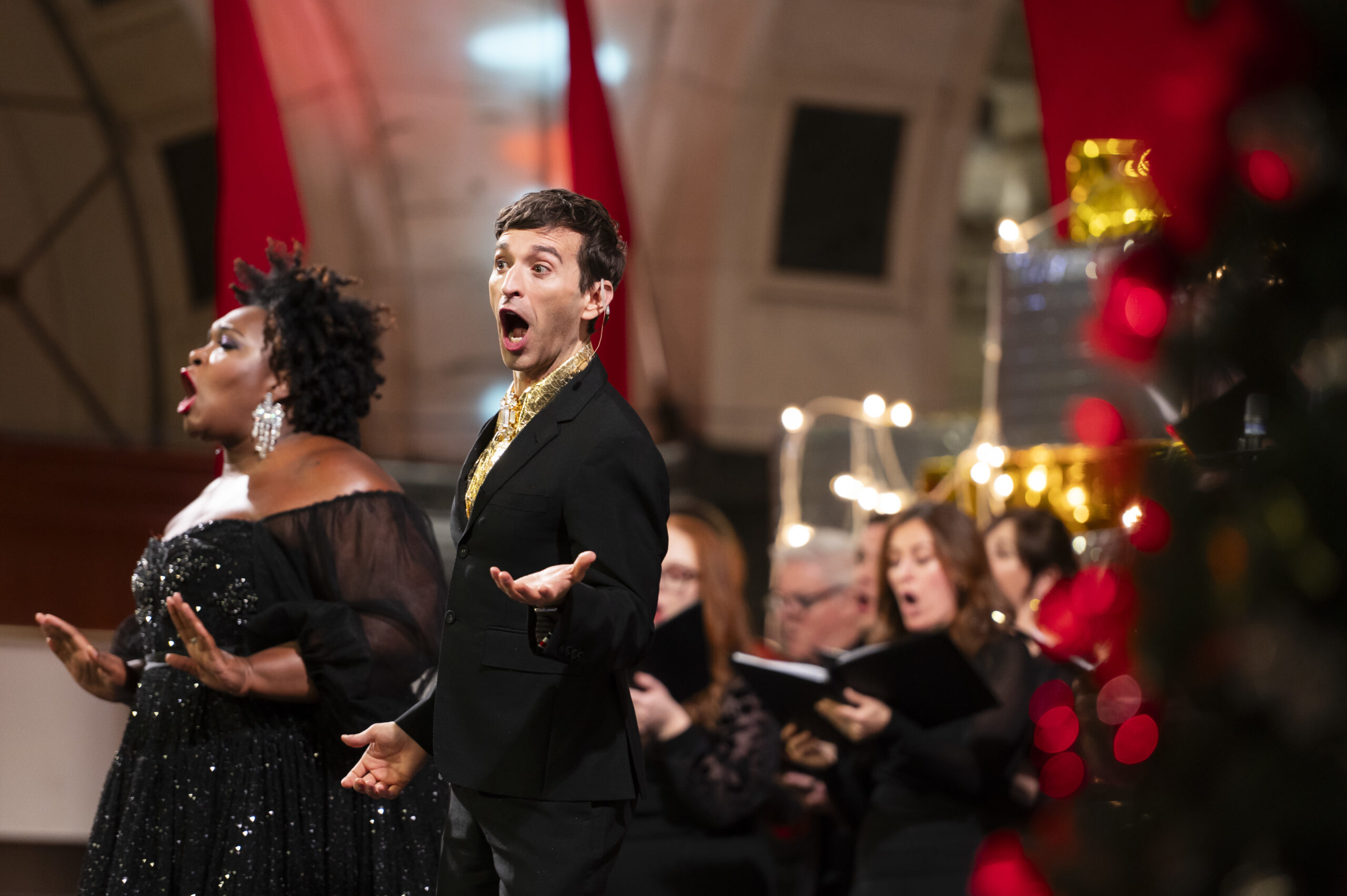
This season, most Opera Philadelphia performances have sold out or sold close to capacity. General director and president Anthony Roth Costanzo said that “in terms of whether I agree that no one cares about it, no, obviously I don’t agree with that as someone who cares about it a lot.”
But Costanzo says he prefers to focus on the underlying question of how to get even more people to care about both opera and film.
Anthony Roth Costanzo (right), countertenor, and Leah Hawkins (left), soprano, perform during ‘Home for the Holidays’, a concert part of Opera Philadelphia’s ‘Pipe Up!’ series at The Wanamaker Building’s Grand Court on Tuesday, Dec. 2, 2025.
“Timothée was talking about making film as relevant as it can be, and in that context, he said that he didn’t want to work in something that wasn’t relevant, to try and make it more relevant, and that’s what I’m doing. So in a way I feel allied. He’s just saying that he doesn’t want to do it in a medium that’s more difficult, so I guess he’s a little bit more of a wimp than I am.”
BalletX’s Cox said that Chalamet’s comments were surprising coming from someone whose mother, Nicole Flender, was a Broadway dancer, and someone who attended a performing arts high school. Chalamet attended New York City’s Fiorello H. LaGuardia High School of Music & Art and Performing Arts.
At left is Dayesi Torriente, playing Gulnare leaps in front of Angel Corella, artistic director, Philadelphia Ballet during rehearsal for “Le Corsaire” at the Philadelphia Ballet, Wood Street, Philadelphia, Wednesday, October 2, 2024.
“I bet you he’s going to be at a ballet soon, because he’s going to have to fix this,” Cox said.
As for Chalamet mimicking an opera singer during his talk with McConaughey, Costanzo has an idea.
“I invite him to star in an opera whenever he wants. Because after he said that, I saw some contrition as he tried to then sing an operatic note. And I thought, ‘Okay, there’s some promise there.’ So if he wants voice lessons, I’m available.”
Broadway stars and orchestral players might lead budding Philadelphia musical talent in master classes, and new college internships could open up at the city’s largest performing arts producer and presenter.
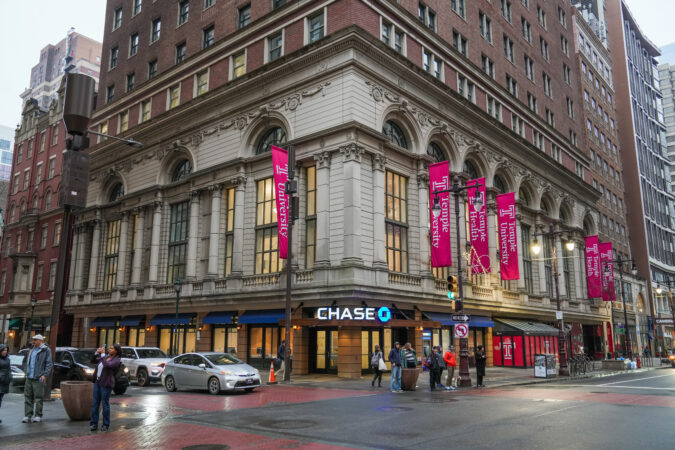
As Temple University prepares to establish an outpost in Philadelphia’s major arts district, the school, and Philadelphia Orchestra and Ensemble Arts have signed a memorandum of understanding for a new partnership, formalizing a dream stage for joint activities already underway.
The new arrangement is expected to benefit not only Temple University students, but also younger students of Temple Music Prep and the Philadelphia School District.
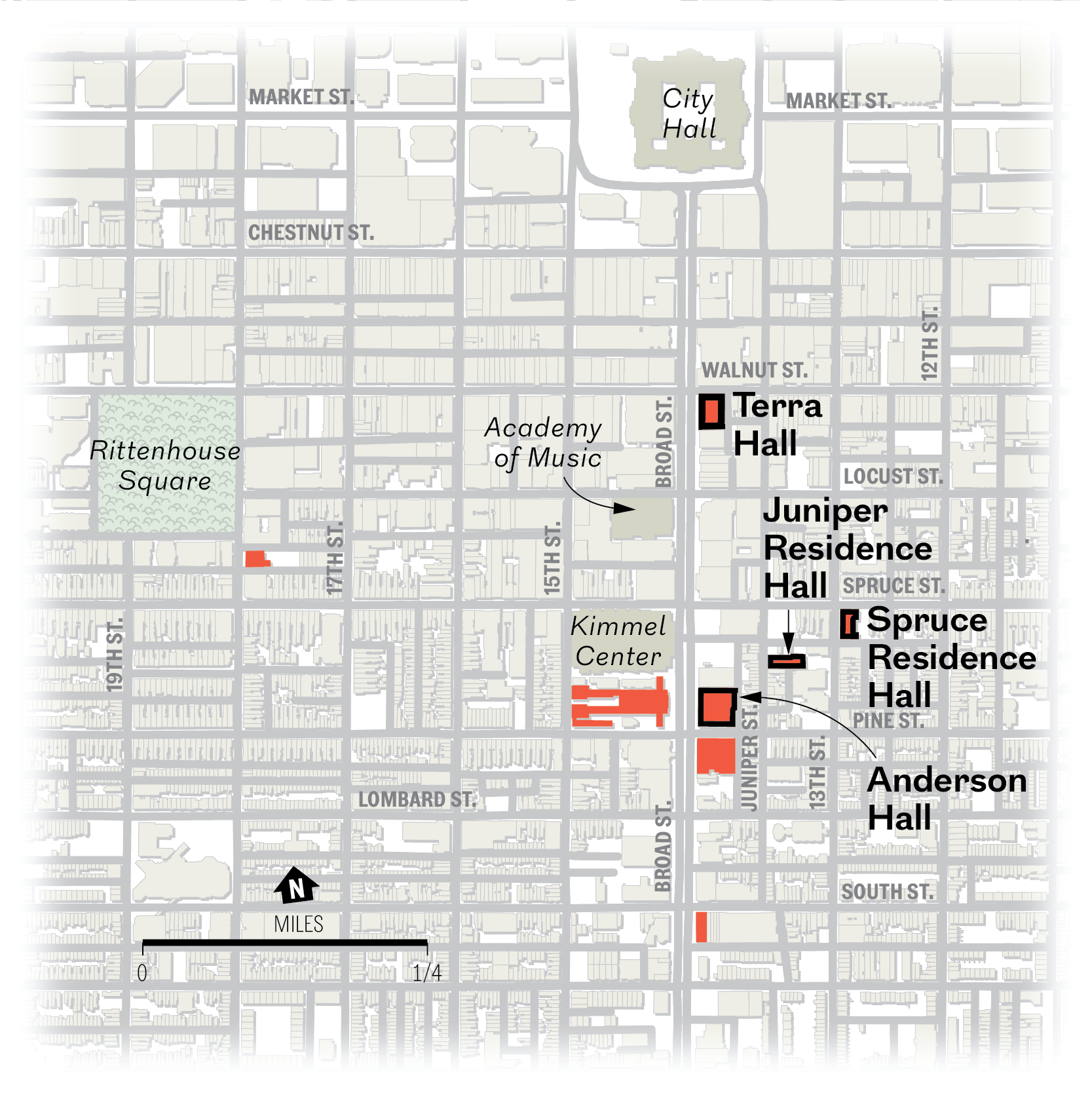
Temple and the orchestra have long partnered on projects, but the university’s purchase of Terra Hall — near the orchestra and Kimmel Center — will allow a deeper level of involvement, leaders said.
In the fall of 2027, for instance, about three dozen Philadelphia Orchestra current and retired musicians are expected to move their teaching studios from Temple’s main campus to Terra. Other collaborations are expected to take shape over the next year and half.
“The gist of it is, Temple University and the Philadelphia Orchestra and Ensemble Arts are committed to working together to build a tangible partnership. It’s aspirational,” said POEA president and CEO Ryan Fleur of the memorandum of understanding, which was signed last month.
“There’s a lot around the exchange of talent and supporting one another,” said Temple president John Fry.
Terra Hall – shown here with other former University of the Arts buildings – is near the Academy of Music and Kimmel Center.
For POEA, the partnership means it will no longer pursue the possibility of building an additional education wing at the Kimmel Center that had been in the early planning stages.
“When I heard Temple was acquiring Terra Hall,” said Fleur, “the priority shifted from the idea of an education wing over the loading dock to how we could work with Temple to deploy the space in Terra Hall. Our greatest strength is not about building things, and if we unite in Terra Hall for the benefit of Philadelphia students, it’s a win for Philly.”
An education annex at the Kimmel might have cost in the neighborhood of $100 million.
“It was a large figure,” said Fleur. POEA is already in the process of raising hundreds of millions of dollars for a variety of needs from endowment to repairing and renovating its facilities, which include Marian Anderson Hall, the Academy of Music, and the Miller Theater.
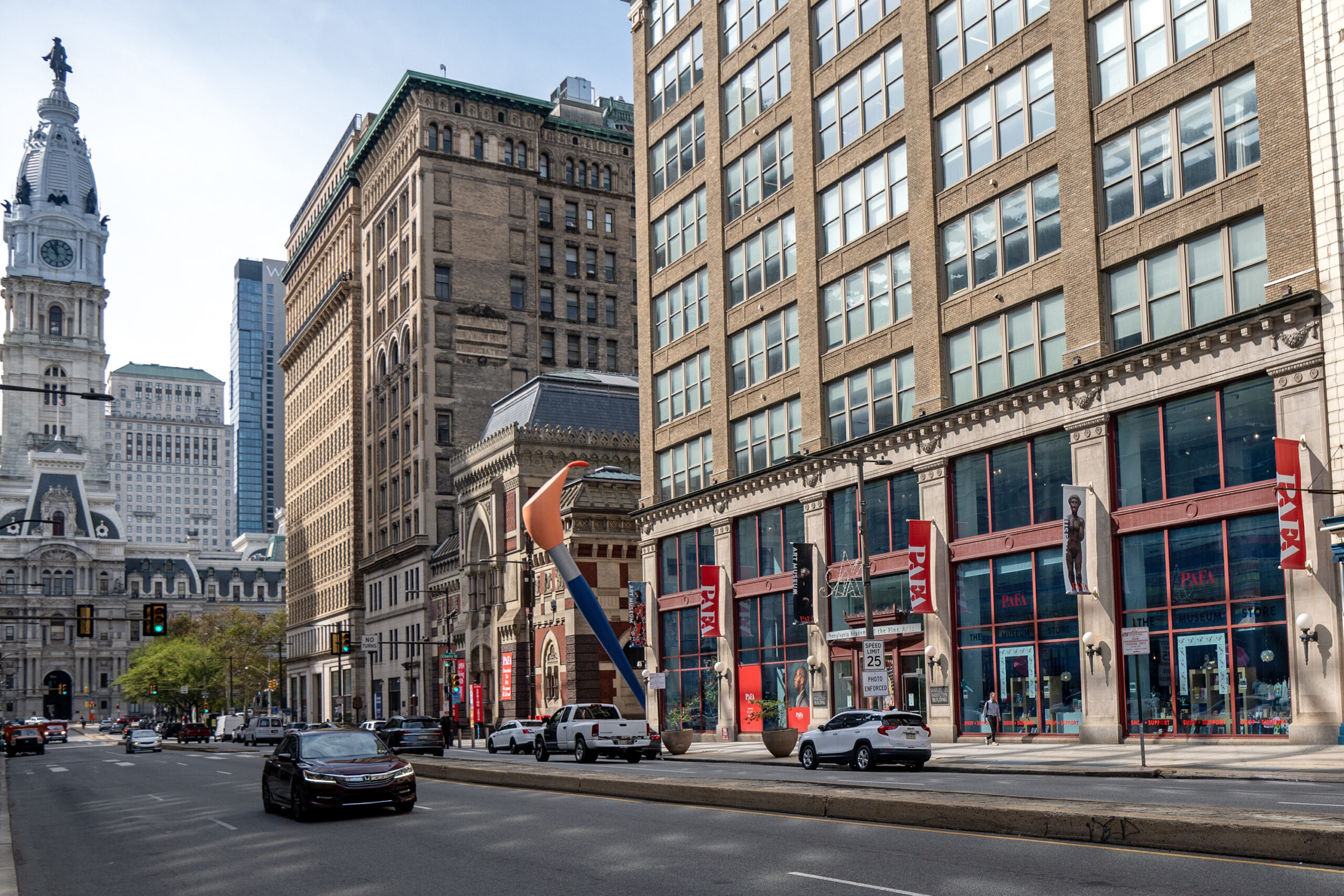
The Pennsylvania Academy of the Fine Arts on North Broad Street, where Temple University has established a presence in PAFA’s Hamilton building (on right).
Temple has been establishing a series of partnerships south down Broad Street from its main North Philadelphia campus. It has leased space at the Pennsylvania Academy of the Fine Arts and is developing programs there, and is in the process of taking over the Library Company of Philadelphia, on Locust Street just east of Broad.
It acquired Terra Hall in 2025 for $18 million after the abrupt bankruptcy and closing of the University of the Arts. Terra was already outfitted with practice rooms, a recording studio, performance space, a dance studio, and classrooms.
Fry said that Temple is currently doing work on the Terra building, with particular attention to the foundation and elevators, and that the major part of renovations would be done by September 2027. But he said that some of the spaces will be usable this fall.
Both POEA and Temple have existing relationships with the Philadelphia School District. Fleur said the next step is “uniting” the efforts among the three. Fry said Temple was in discussions with other arts organizations as potential partners in Terra Hall.
“We want people to think of this as a public resource,” he said, “not a closed academic building just for Temple. Where Temple can play a role, we want to be a part of that.”
A group of special grants from the William Penn Foundation will help ensure continued access to the Please Touch Museum, Franklin Institute, and other Philadelphia nonprofit attractions for patrons of modest means and/or with disabilities.
William Penn has granted a total of $7.6 million to seven groups to underwrite the existing program providing access to $2 tickets.
Ticket prices are an obstacle for many, and arts and culture groups must weigh their desire to be open to all audiences, regardless of capacity to pay, against the reality of balancing their own budgets.
“Our general admission price is around $24 and we believe that’s competitively priced with other peer organizations,” said Please Touch Museum president and CEO Melissa Weiler Gerber. “But we want to make sure that we are committed to having folks come in the door and that not be a barrier.”
The William Penn money — $872,350 per year for each of the next three years — will support that ambition by underwriting the $2 tickets to the children’s museum in Fairmount Park.
The groups receiving the grants, in addition to the Please Touch and the Franklin Institute, are the Academy of Natural Sciences, Morris Arboretum and Gardens, the Philadelphia Zoo, and the Philadelphia Museum of Art, where the grant will support the museum’s restoration of pay-what-you-wish Friday evenings.
The William Penn money is being allotted on top of the regular funding the foundation gives to area arts and culture groups, which is expected to reach $32 million this year.
Art-Reach will also receive a grant. The group administers the program, which began in 2014 and provides $2 admission to area museums, gardens, theaters, musical groups, and other cultural offerings to those with low incomes and/or disabilities.
The six attractions were chosen because they are the most visited participants in the program, which is called Harvey and Virginia Kimmel Family Fund ACCESS Program.
But it’s worth noting that none of the six is a performing arts organization, and the program has about a hundred other groups of various kinds that could also use the support.
“I think that there is a lot of need for the rest of the partners in the program,” said Art-Reach executive director John Orr, adding that he hoped the William Penn action would be “catalytic” in inspiring other donors to support low-cost access to arts and culture groups.
Affordability was cited as a factor in deciding which cultural sites to visit by 91% of participants in a recent survey of ACCESS cardholders, Orr said.
At the same time, cultural groups are being buffeted by multiple challenges, said William Penn Foundation chief philanthropy officer Elliot Weinbaum.
“There have been lots of shifts and uncertainty around myriad funding sources. You think about federal sources — NEA, NEH, IMLS, National Science Foundation — all of them have seen big cuts and big uncertainty,” he said. “These institutions received some money from some combination of those entities. There have been shifts in corporate giving in the past year or so.”
Hence the foundation’s decision to step in with new funding for the work of these organizations.
Said Weinbaum: “We want to strengthen the institutions, support them, and make it clear that for William Penn Foundation it’s important that a population that’s really representative of Philadelphia continues to have access to these great places.”
For more information about how the ACCESS program works, visit art-reach.org.
Philadelphia Museum of Art patrons will once again be able to decide for themselves what to pay at the gate Friday evenings.
The museum, eager to change the message to a positive one after a season of “drama and conflict,” will offer admission on a pay-what-you-wish basis every Friday evening for five months starting April 10.
Regular admission to the museum can be as high as $30 per ticket, and the initiative, announced Friday, recognizes that cost excludes or deters some visitors.
“We wanted to remove the barrier,” said museum director and CEO Daniel H. Weiss.
The program, dubbed “Independent Fridays,” coincides with the nation’s 250th celebrations and the opening of “A Nation of Artists,” an expansive, two-museum exhibition of American works at the PMA and Pennsylvania Academy of the Fine Arts built around the collection of Phillies managing partner John Middleton and his family.
The museum previously had pay-what-you-wish Friday evenings, but, because of the expense, canceled the program in summer 2024, when Sasha Suda was director. To underwrite its reinstatement, the museum put in place special funding from board chair Ellen T. Caplan and her husband, Ron, and the William Penn Foundation.
Caplan said that her own visits to the museum when she was growing up in Philadelphia happened through the pay-what-you-wish program, so to help fund it now “feels like a full-circle moment.”
Although the current funding underwrites pay-what-you-wish Friday evenings only through the Friday before Labor Day, leaders said it could continue.
“I’m hoping this will inspire others to underwrite it going forward,” Caplan said.
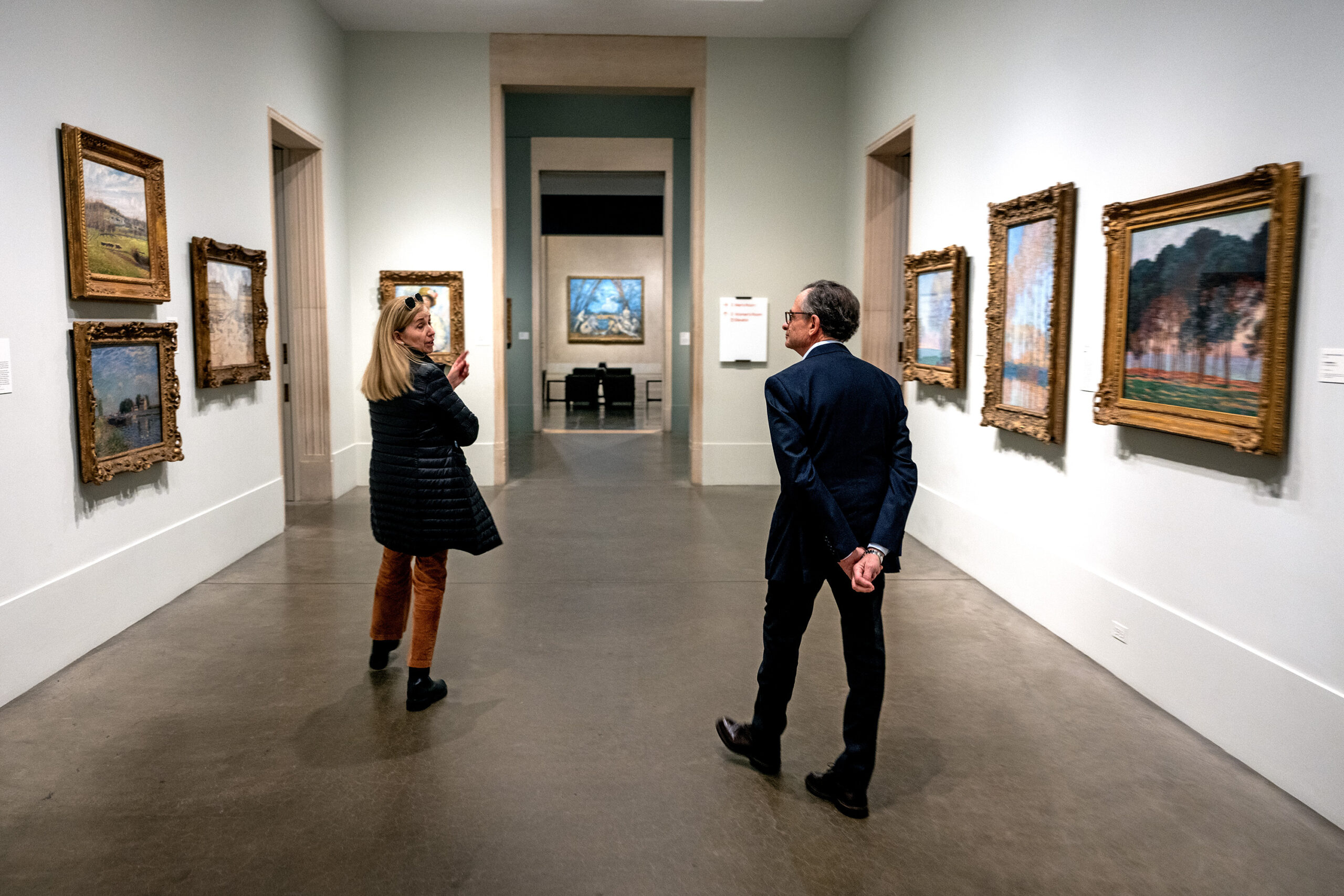
Daniel H. Weiss, director and CEO of the Art Museum, walks through museum galleries with staffer Laura Coogan (left) Jan. 7, 2026.
At the moment, the museum is planning to return to its regular half-off discounted rates on Friday evenings ($15 for general admission), after Sept. 4. Admission on the first Sunday of every month continues to be pay-what-you-wish, and anyone 18 years old or under is admitted free any day, any time.
The public signals coming from Philadelphia’s major, comprehensive art museum in the past several months have mostly been about a controversial name change and rebrand, and the acrimonious dismissal of Suda and the legal wrangling in its aftermath. After several months of calling itself the “Philadelphia Art Museum,” the institution has reverted to its previous, longtime name.
The museum’s dispute with Suda will be settled through arbitration, not through a trial with jury, a Common Pleas Court judge recently ruled.
Weiss said that reinstating pay-what-you-wish Friday evenings was partially about “turning the page. We want people to appreciate the museum for what it has been, not for the drama and conflict.”
Admission income is critical to the museum’s bottom line. In fiscal year 2025, earned revenue accounted for a third of the museum’s income, with the rest covered by contributed revenue, such as donations.
But it’s not clear that offering more pay-what-you-wish spots on the calendar will result in overall lower ticket income. The museum piloted the return of the Friday evening program for the final three weeks of its recent Surrealism show, and admission revenue came in 20% higher than in the previous three weeks.
In the same period, attendance received a boost of 128%, according to the museum.
Of the ultimate net effect of pay-what-you-wish on revenue, “Over the long-term we don’t know,” said Weiss. But, he added: “Having it underwritten allows us to not worry about that.”
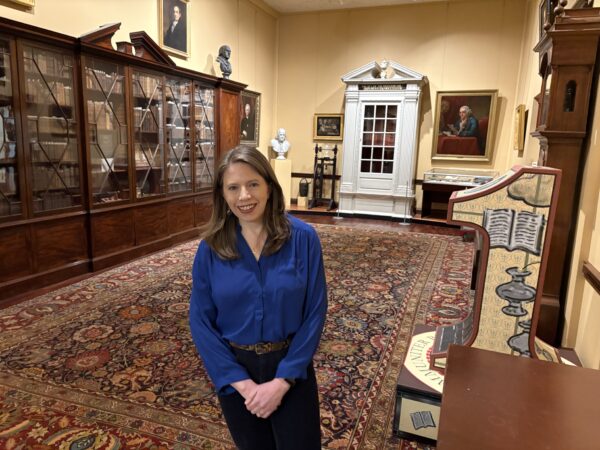
The Library Company of Philadelphia has lined up its next chief. Jessica Choppin Roney will take over the 295-year-old institution as soon as its merger with Temple University is approved by Philadelphia Orphans’ Court, leaders said this week.
Roney has existing ties to both Temple and the Library Company, as director of the program in early American economy and society at the Library Company and as an associate professor of history at Temple. She is also chair of the “integration council” that has been set up to help facilitate the amalgamation of the two groups.
“She’s been working very closely with us, so she was the obvious choice to take on the new role,” said current Library Company director John C. Van Horne, who will continue in his post until Roney takes over. Director and director-designate are already working together on the transition, he said.
Roney said this week that even with the merger, the Library Company’s mission won’t change.
“It continues to be a center of scholarly research and public-facing programming, so we’ve got work in history, in literature, science, and dance and music, and art, and on and on. That all continues and will grow and amplify with our relationship with Temple.”
The group, founded by Benjamin Franklin in 1731, owns more than 500,000 rare books, manuscripts, prints, photographs, works of art, ephemera, and other objects, mostly from the 17th through 19th centuries.
“It has always been America’s library, even before it was America,” Roney said.
The collection will continue to acquire new items, and will explore opportunities for Temple students to “make use of our collections in new ways,” she said.
Roney noted that even though the Library Company has often been powered by women — staff, trustees, shareholders, and donors — it has never had a woman at the helm.
“It’s exciting at a time of change that one of those changes is to have the first woman in charge,” she said.
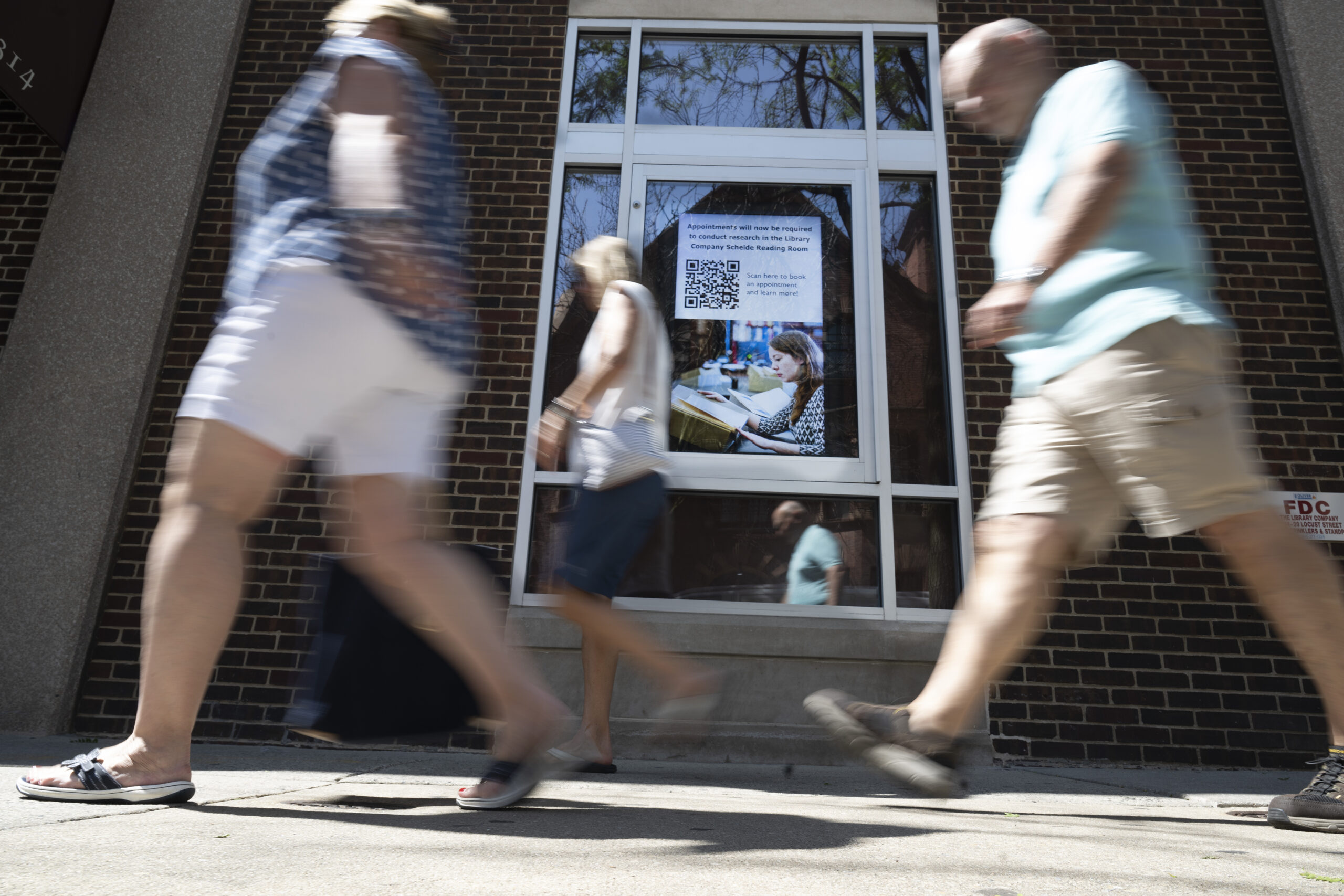
Pedestrians passing the Library Company of Philadelphia in Center City, June 25, 2025.
Facing a string of projected operating deficits, the library began to explore merger opportunities with other groups in 2024. Talks with Temple became public this past June. The boards of both organizations have approved the deal, and in December Library Company shareholders voted 174 to 33 in favor of the merger.
A potential Orphans’ Court approval — which could take weeks to years to receive, said Van Horne — would end nearly three centuries of independence for the library, whose home is on Locust Street just east of Broad, where it will remain.
Roney started as director-designate Jan. 9, and was approved for the post by the Library Company board on Jan. 22, a Temple spokesperson said. Her appointment, however, was not publicly announced until it was included in a newsletter from the group this week. Van Horne said she was chosen without a search, and no other candidates were considered.
“We thought it would be good initially since we’re just getting this relationship off the ground to have a Temple faculty person as the first director [of the merged organization], and it was fortuitous that the early Americanist at Temple was on our payroll,” said Van Horne. “She already had a foot in both camps.”
Roney, 47, earned a bachelor’s degree from Swarthmore College, a master’s from the College of William and Mary, and a Ph.D. from Johns Hopkins University. It was at the Library Company that she conducted research for her first book, Governed by a Spirit of Opposition: The Origins of American Political Practice in Colonial Philadelphia.
Van Horne was director of the Library Company from 1985 until 2014, and then returned in 2024 to help manage its financial difficulties. He has been a strong proponent of the merger, as he was for Roney’s appointment.
“She’s energetic, imaginative, and she has ideas about what we can do with Temple and others,” he said. “I’m very hopeful for the future. I think she’s going to be terrific, and I wasn’t so hopeful for the future a year ago.”