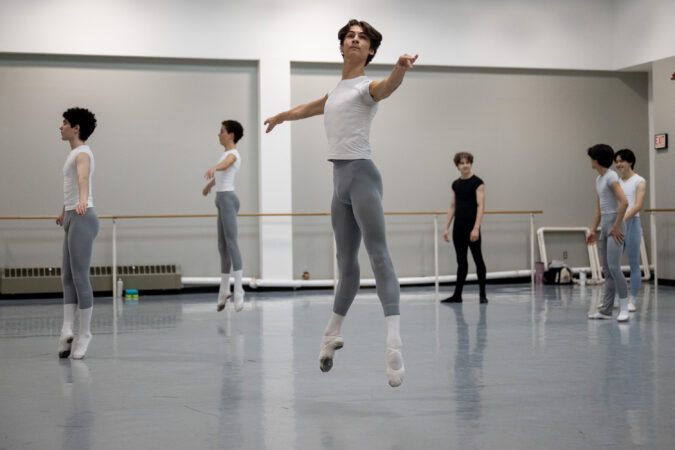
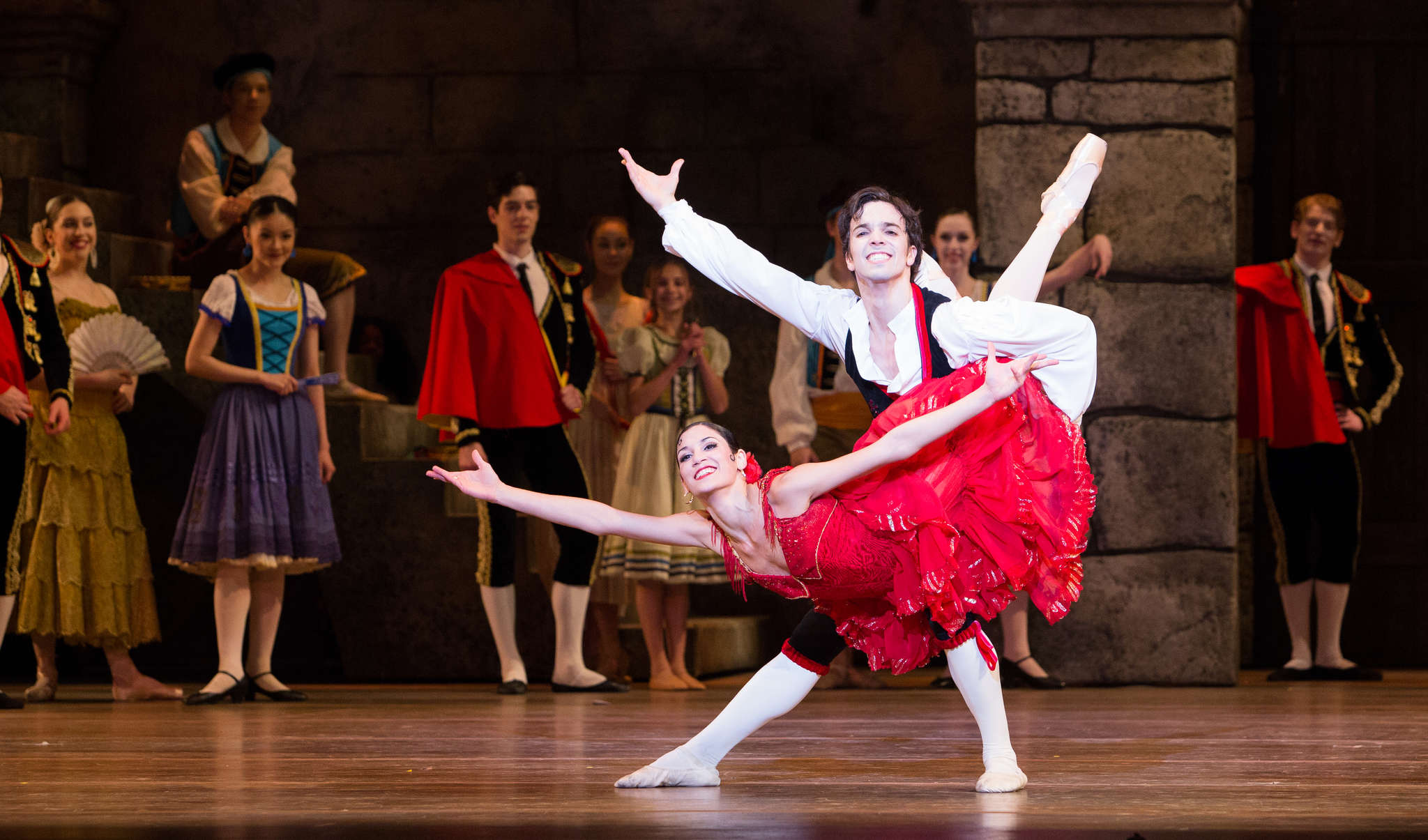
In February, the ballet student at Philly’s Rock School for Dance was one of only 38 boys (81 dancers altogether) from around the world selected to compete at the elite Prix de Lausanne in Switzerland.
He didn’t win a prize at the Prix, but he made the final and got something else valuable: a scholarship to finish his studies at England’s prestigious Royal Ballet School.
But that’s not all. Metcalf also qualified to compete in the Youth America Grand Prix Final in May in Houston.
YAGP, a much bigger competition, attracts thousands of students from 50 countries competing in locations all over the world for months leading up to the final.
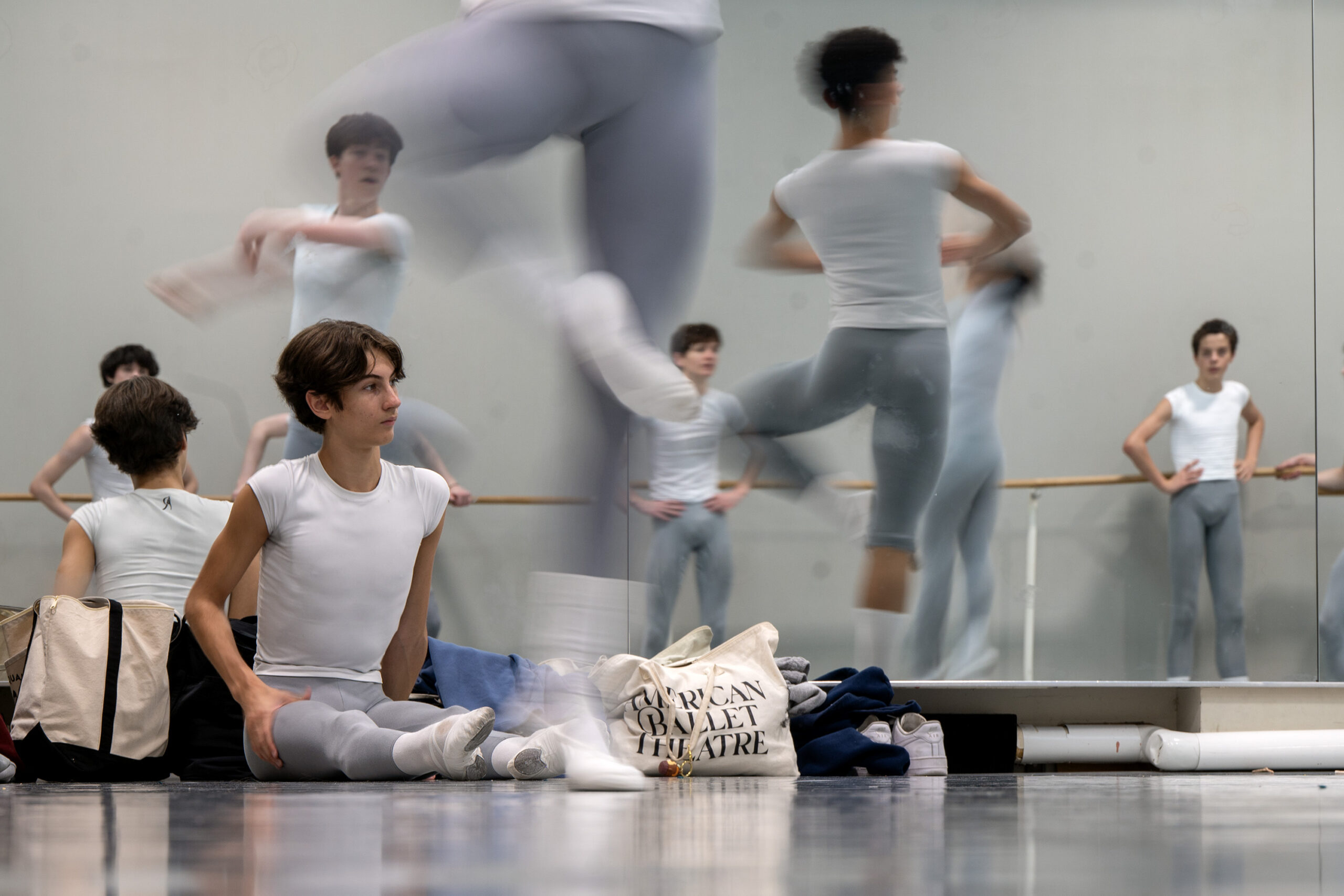
Blake Metcalf stretches and watches his classmates at the Rock School for Dance.
“There was a moment prior to YAGP [Final] where Blake and I spoke,” said Rock president and director Peter Stark, who coached Metcalf, “and I said to him that he didn’t have to do YAGP as he had his plans secured for next year.”
But Metcalf, who grew up in Lake Mary, Fla., and attended many competitions with his mother Sheri’s dance school, Xtreme Dance Studio, wanted to finish out that chapter.
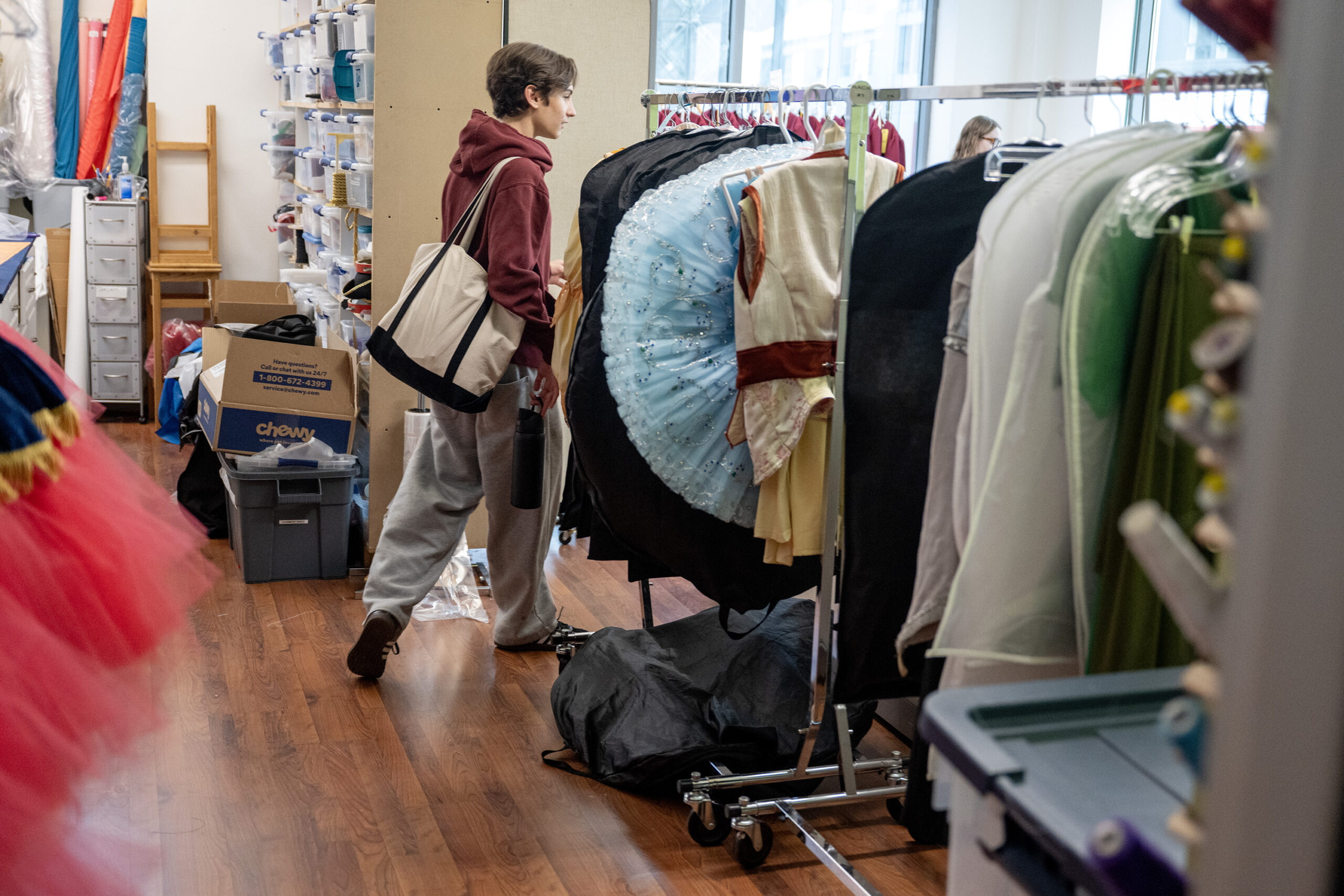
Blake Metcalf in class at the Rock School for Dance.
“I was like, ‘Let me just have fun, I don’t care what happens, just have a good week,’ ” said Metcalf, who recently turned 16. “And then I made it to the final round, I was like, ‘Awesome, that’s great, first-year senior.’”
He was then invited to perform in the gala that closes out the competition, “and that was mind-blowing to me,” he said.
“I was like, ‘Oh my gosh, I’m surrounded by so many people, like professionals I look up to, that I never thought I’d even see in person, dancing on the same stage.’”
When the awards were announced, Metcalf was among the top 12 senior men. His name was the first announced, because he was the youngest, he assumed.
But he had won first place while, he later added, dealing with a cyst in one hip and a muscle strain in the other.
“I look to my right and it’s just these super tall men,” he said.
The YAGP Final turned out well for Metcalf’s classmates as well. In addition to his win, students from the Rock received three second-place awards.
“It was an extraordinary week for the Rock School,” Stark said. “For the second year in a row, we advanced more students to the final round than any other school in the world, and we ended up being the most awarded school at the competition.”
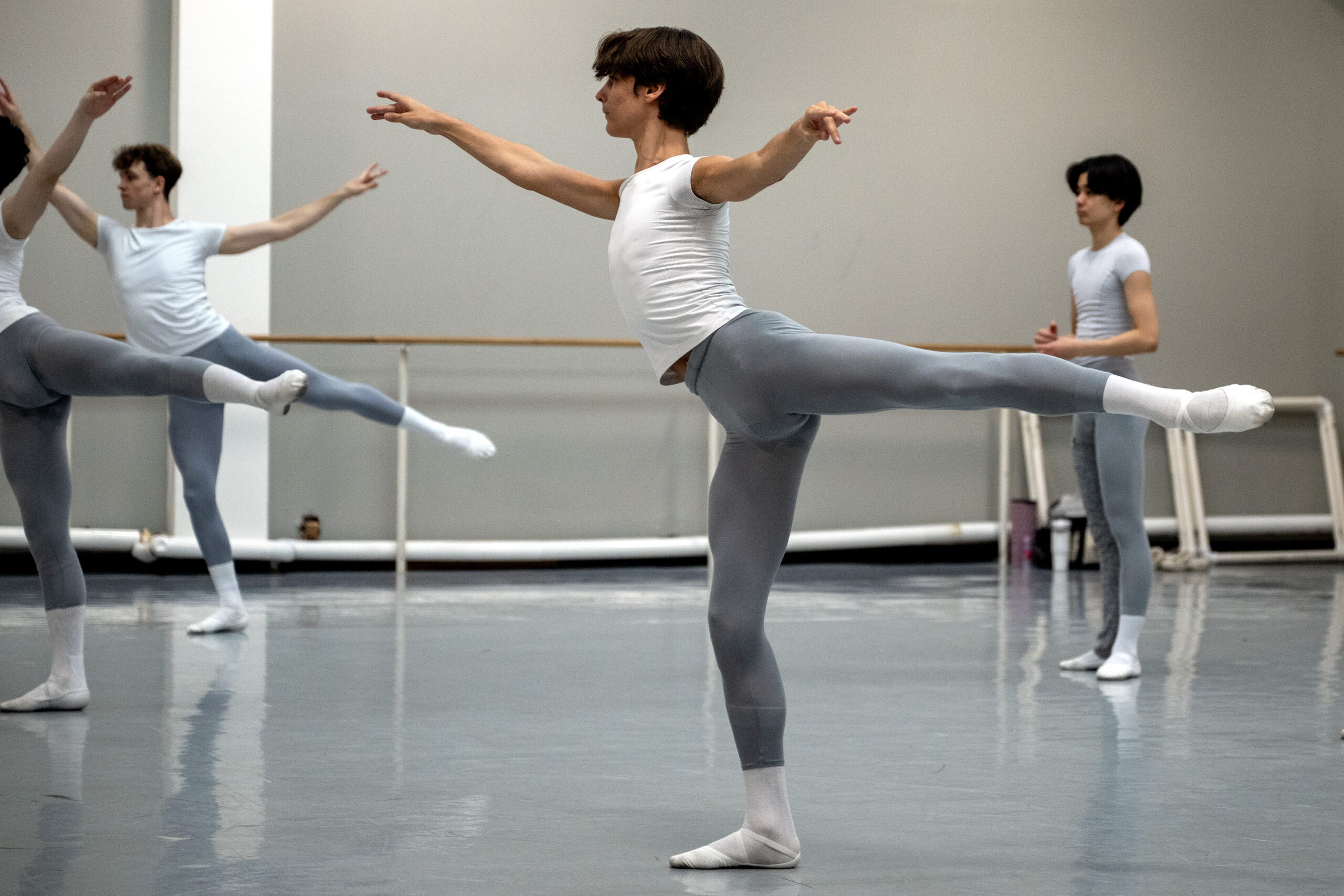
Blake Metcalf in men’s class at the Rock School.
Metcalf, Stark said, “was in a different zone at the finals and it showed in his performances. “Some of the same judges [at the Prix and YAGP final] were especially impressed with his growth.”
“Mr. Stark warmed me up every day for competition, and he took it very slow, didn’t force anything,” Metcalf said, explaining how he succeeded despite the injuries. “I kind of kept it calm and clean, and then saved myself for stage.”
So what changed between February and May?
“I think at Prix de Lausanne, I saw so much incredible talent,” Metcalf said. “I was really inspired, I subconsciously pushed myself more. I came back to Rock, and I was like, ‘alright, let’s do it, like let’s work,’ and I started improving more.”
“Blake has an extraordinary instrument for dance physically with excellent proportion and line with great flexibility and strength,” Stark said. ”However, what really makes Blake special is both his intense focus in class coupled with heartfelt artistry on stage.”
Next year in England, Metcalf expects to work on “my power, my bigger jumps. It’ll come with age,” he said, “it’ll come as I get more muscle. But yeah, I definitely need to work on my strength and my power.”
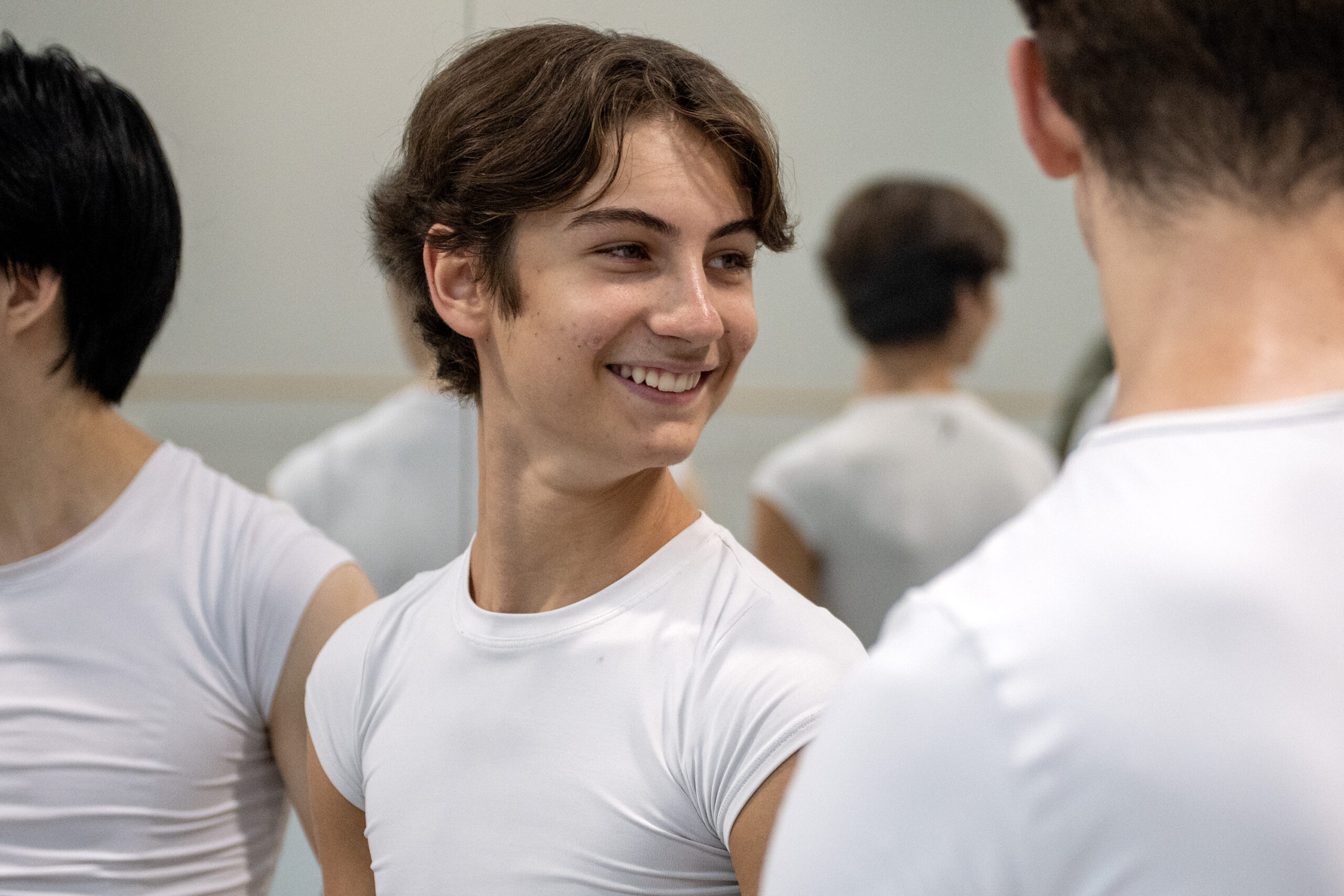
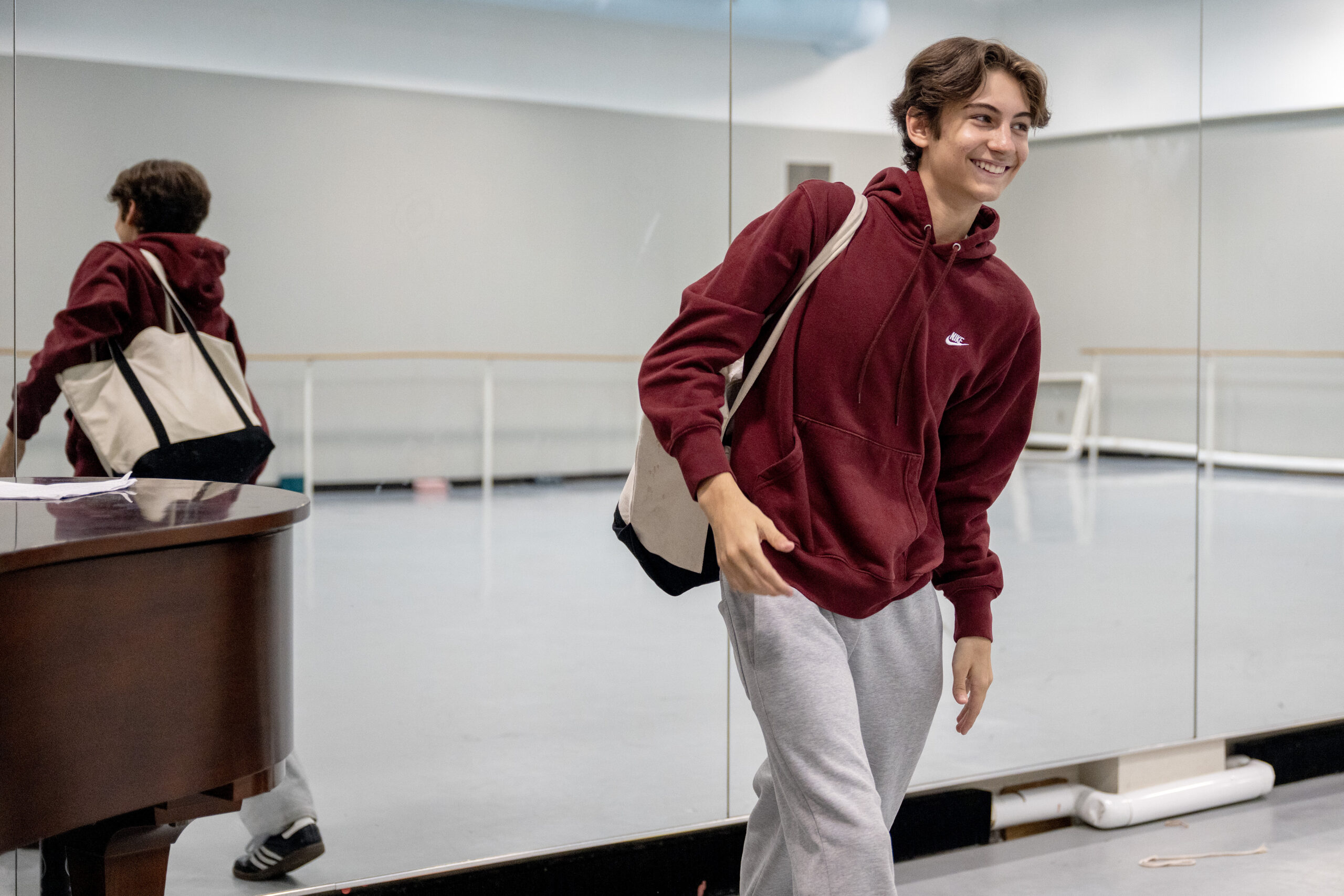
Blake Metcalf leaves the studio after class at the Rock School.
Metcalf started dance when he was 5 or 6, after watching his sister, Ash, (now a New York-based actress) dance and compete with his mother’s school.
“I really wanted to be a dancer, and my mom was like, ‘Alright, Blake, we’ll see, we’ll see.’”
His mother, he said “tried to get me to go into sports because she wanted me to … go to a college, go the academic route. But I would beg my mom every day, because I looked up to my sister a lot as a kid. Ever since then, I just started getting more and more classes, and then I left all the other worlds behind.”
He started with hip-hop. Classical dance didn’t come until he was about 11, when someone at his mom’s studio noticed that he had good feet for ballet.
Soon enough, he’ll get that degree as well. The three-year program at the Royal Ballet School not only prepares its students to join a ballet company, but it also awards its students a bachelor’s at the end.
Blake Metcalf leaves the Rock School after class.
Metcalf had never studied anywhere but his mom’s school when Stark invited him to train at the Rock School two summers ago. He enjoyed it so much that he begged to stay for the year, even though it meant leaving his family and his Boston terrier, Cannoli.
It was Philly where he really began to shine, said Metcalf, who also enjoys drawing, crocheting, knitting, and reading.
“Rock has really refined me as a dancer,” he said. “Rock has also helped me mentally, it has helped me mature, have my own mindset, not worry about what else is going on and just focus on myself.”
If you’re looking to find an artistic escape with your night out, Philadelphia Ballet’s new (to them) The Merry Widow is a good match.
Set in the Belle Époque era in Paris, it is all glittering dresses, tiaras, stunning ballrooms, and beautiful gardens. The main characters change costumes several times. The movement mixes in waltzes and folk dances (from a fictional country), along with pointe work and partnering.
A romantic comedy, period piece, and visual feast, it is sort of the Jane Austen of ballet.
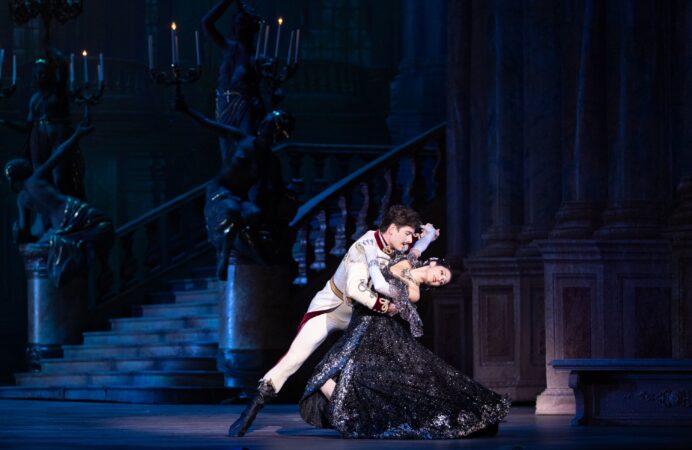
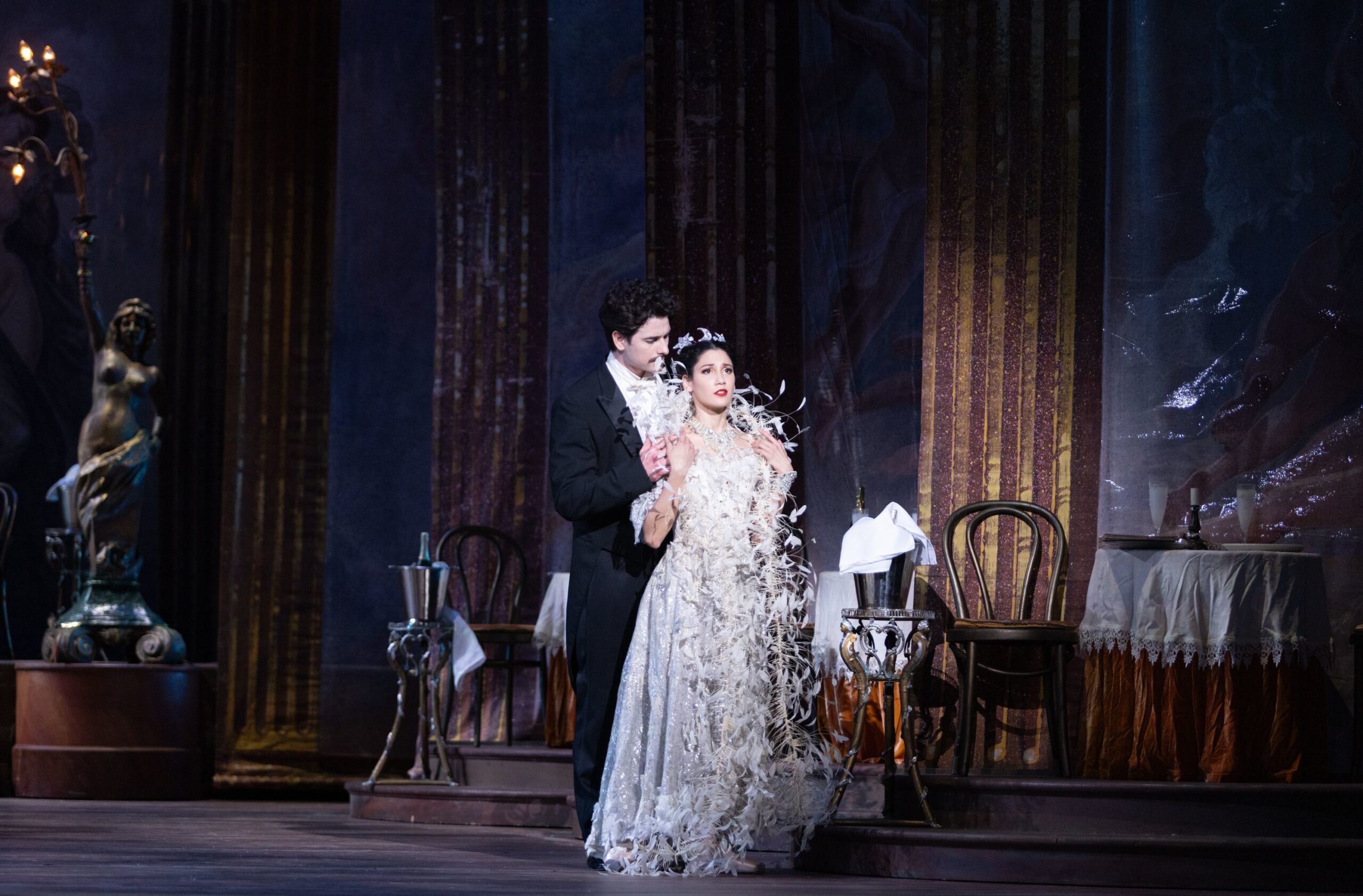
While it’s called The Merry Widow, there are two strong principal couples. On Thursday night’s premiere at the Academy of Music, Mayara Pineiro was Hanna, a rich widow, and Sterling Baca was Danilo, an aristocrat who broke it off with the young Hanna years ago when she was a poor peasant. The leaders of their fictional country, Pontevedro, would like them to marry to keep their homeland afloat.
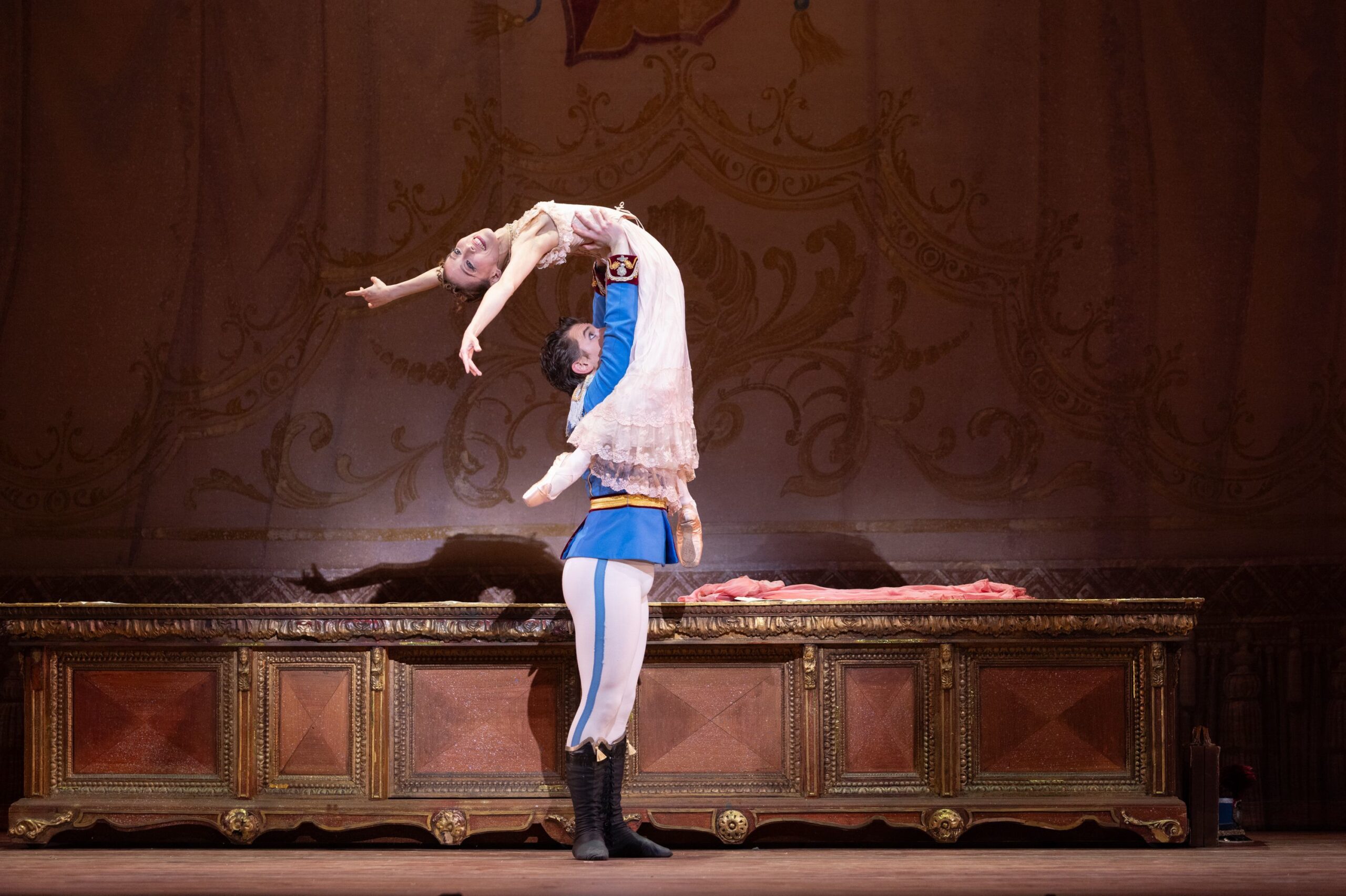
Philadelphia Ballet dancers Yuka Iseda (top) and Ashton Roxander in “The Merry Widow.”
The second couple is Valencienne, danced on Thursday by Yuka Iseda, and Camille, performed by Ashton Roxander. The third wheel in the relationship is Valencienne’s much older husband, Baron Zeta, a character role performed by rehearsal director Charles Askegard.
Iseda was the best surprise of the night. Her reactions and comedic timing were on point and helped move the narrative along.
The partnering from both couples was top-notch, and the dancing as a whole was rich and lush.
The sets and costumes, by Roberta Guidi di Bagno, are reason enough to see The Merry Widow. Occasionally the costume changes make identifying the characters confusing, but all is forgiven when Pineiro enters in a white gown and an impossibly lavish feathered scarf.
Philadelphia Ballet dancers Sterling Baca (left) and Mayara Pineiro in “The Merry Widow.”
Ronald Hynd adapted The Merry Widow in 1975 for the Australian Ballet from the operetta and the Franz Lehár score was arranged for the ballet by John Lanchbery.
The original Danilo for the Australian Ballet, John Meehan, was a répétiteur for the Philadelphia Ballet, along with Steven Woodgate. So the dancers learned the choreography from an original source.
Artistic director Angel Corella said last week that he had wanted the company to perform The Merry Widow since he came to the company in 2014.
“It’s one of my favorite ballets. It’s so much fun,” Corella said. “Great dancing, beautiful music, beautiful story.”
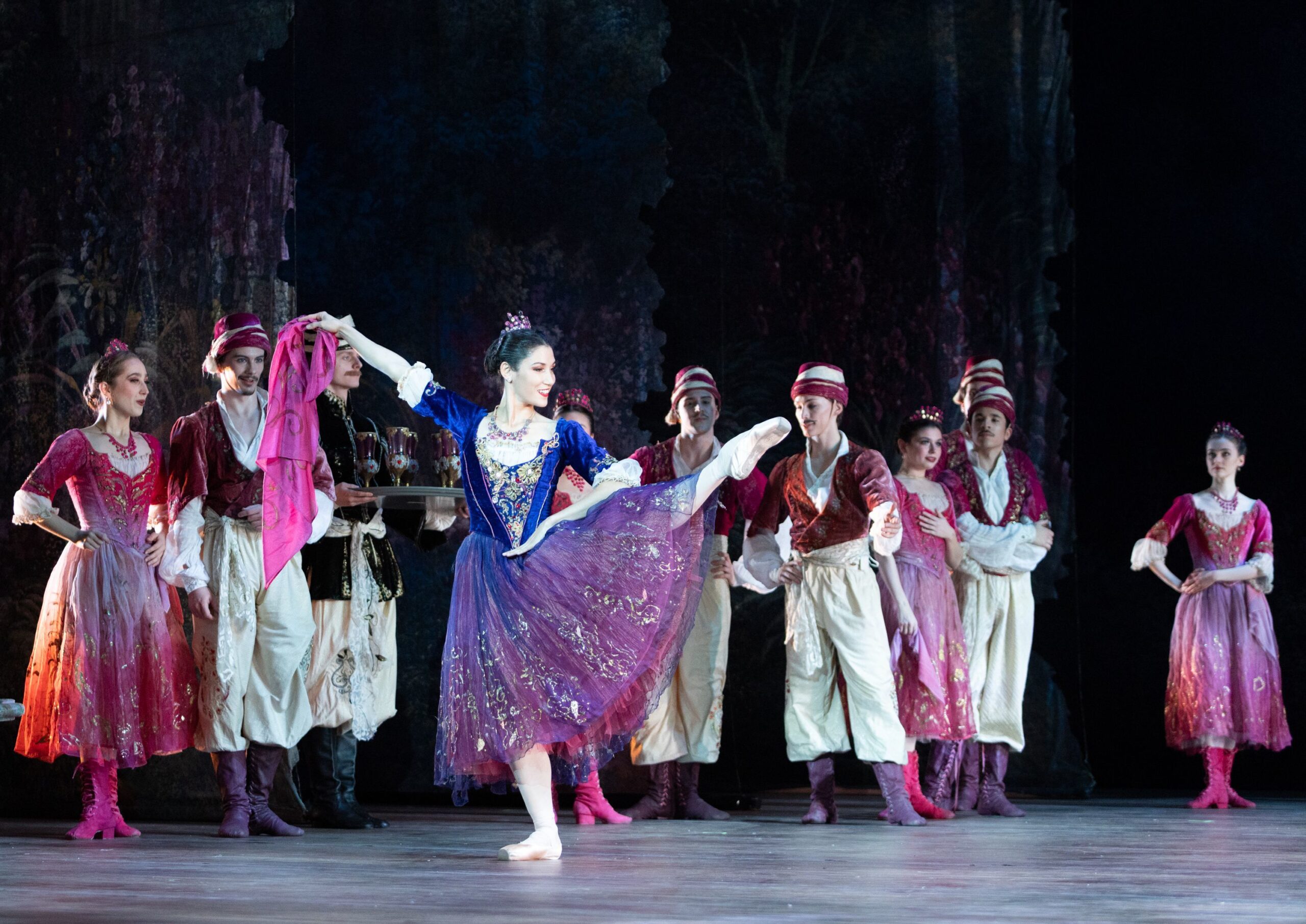
Philadelphia Ballet dancer Mayara Pineiro (center) in “The Merry Widow.”
The group dances add a lot of depth to the ballet — and more stunning costumes. From the ballroom scenes to the folk dances of fictional Pontevedro, a cancan scene, and men performing in tails, the stage nearly vibrates with color and sparkle. The ballet has many dancers to cast, from the advanced levels of the school through the professional ranks, so these large scenes are impressive.
For a fairly recent ballet, there is some Orientalism in the folk dance scenes. But since it is set in a made-up place, any passing likeness to Turkey or the Middle East is easier to take.
Philadelphia Ballet in “The Merry Widow.” Through March 15. Academy of Music. $29-$274.40. 215-893-1999 or ensembleartsphilly.org
The United States is celebrating its Semiquincentennial this year, and Philadelphia Ballet will be bringing the fireworks in its 2026-27 season opener, the company announced Tuesday.
Instead of commissioning new work, the company is leaning into American classics and other favorites, while also finally establishing a home for itself on North Broad Street.
The season will open Oct. 8-11 with a celebratory, all-Americana program called “Stars and Stripes Forever.” It will include Jerome Robbins’ Fancy Free, the concert version of George Balanchine’s Who Cares?, Eliot Feld’s Variations on ‘America,’ and Balanchine’s Stars and Stripes.
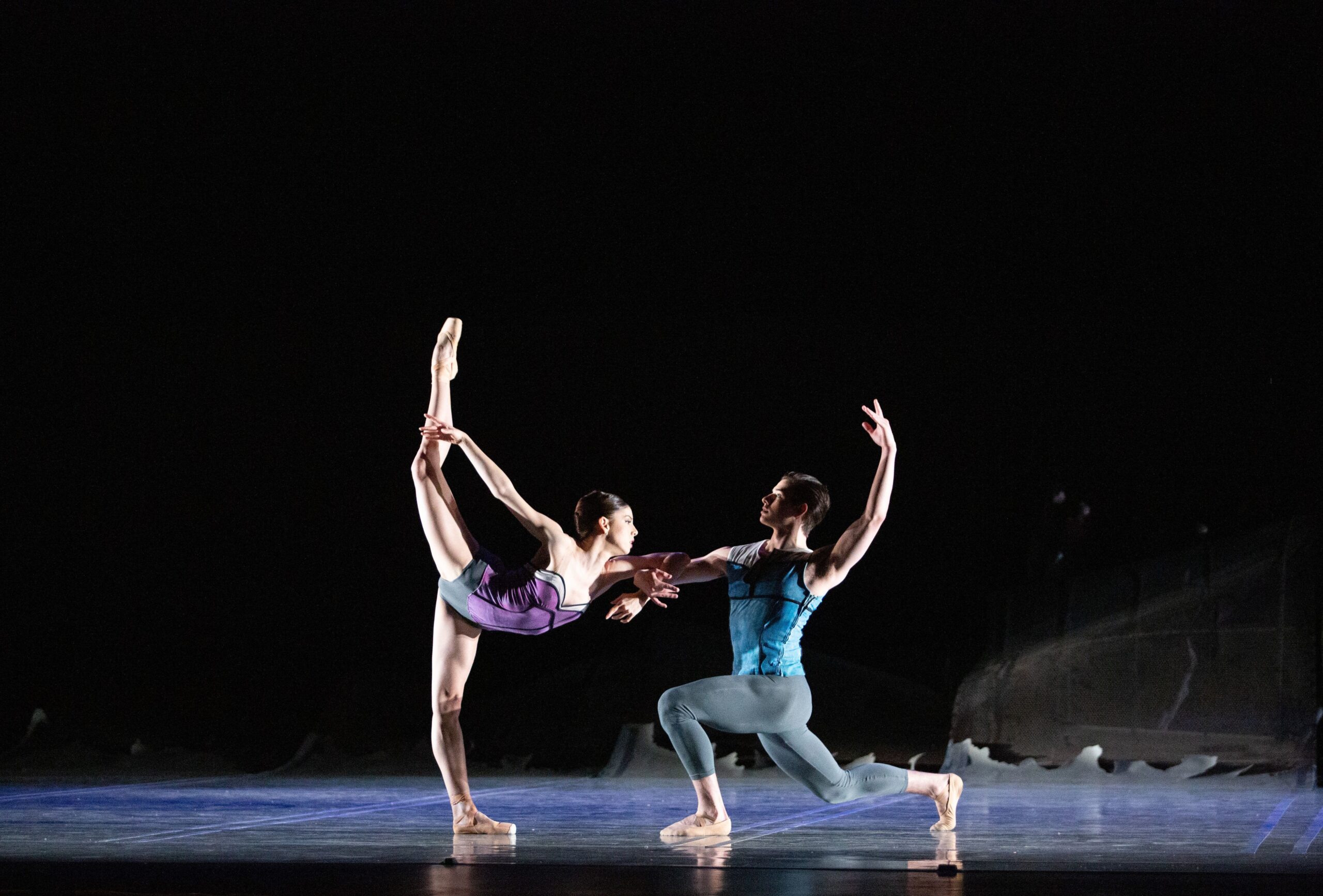
Pennsylvania Ballet dancers Dayesi Torriente and Sterling Baca in Christopher Wheeldon’s “DGV.”
The ballet returns to the Academy of Music the following week with a mixed repertory bill on Oct. 15-18. That program will feature Christopher Wheeldon’s DGV:Danse à Grande Vitesse, Wayne McGregor’s Chroma, and Twyla Tharp’s In the Upper Room.
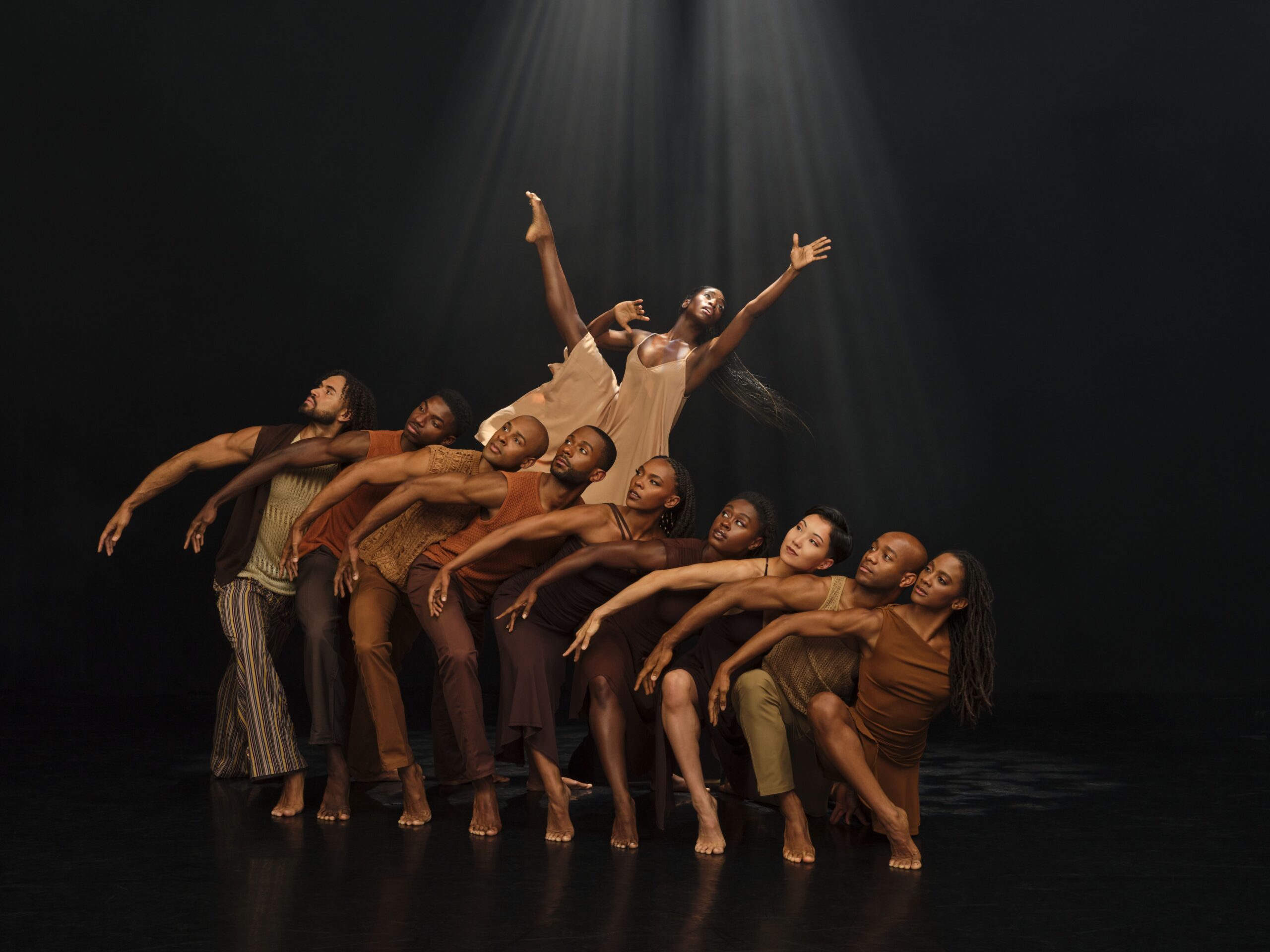
One of the country’s most popular dance companies, Alvin Ailey American Dance Theater, is coming back to Philly this weekend, early in the company’s 20-city U.S. tour.
As of last summer, Ailey is led by Alicia Graf Mack, 47, who was a big star at Dance Theatre of Harlem and then the company she is now directing.
“I am very grateful to be back,” she said. “This year has been a very beautiful homecoming to a company that I love very deeply, and this organization has been part of my North Star since I was a child. [It’s been] part of my thought process about what I want to be when I grow up, and how I want to be, and how I want to express myself.”
Just before this, she was dean and director of the dance division of Juilliard School, where she worked closely with students and commissioned work for them to perform — including pieces by Philadelphia choreographers Rennie Harris and Matthew Neenan.
The tour coming to Philly this weekend also has a new Neenan piece, Difference Between.
“Matthew is someone that I’ve really admired for many years, and I know Matthew Rushing (Ailey’s associate artistic director) shares that same sentiment,” Graf Mack said. While working with Neenan at Juilliard, “I knew what a genius he is.”
Ailey is also bringing Jazz Island, a new work choreographed by Maija Garcia.
“It is a beautiful homage to Geoffrey Holder and Carmen de Lavallade,” both of whom made works for Philadanco. “Carmen basically cofounded this company with her best friend, Alvin Ailey,” Graf Mack said.
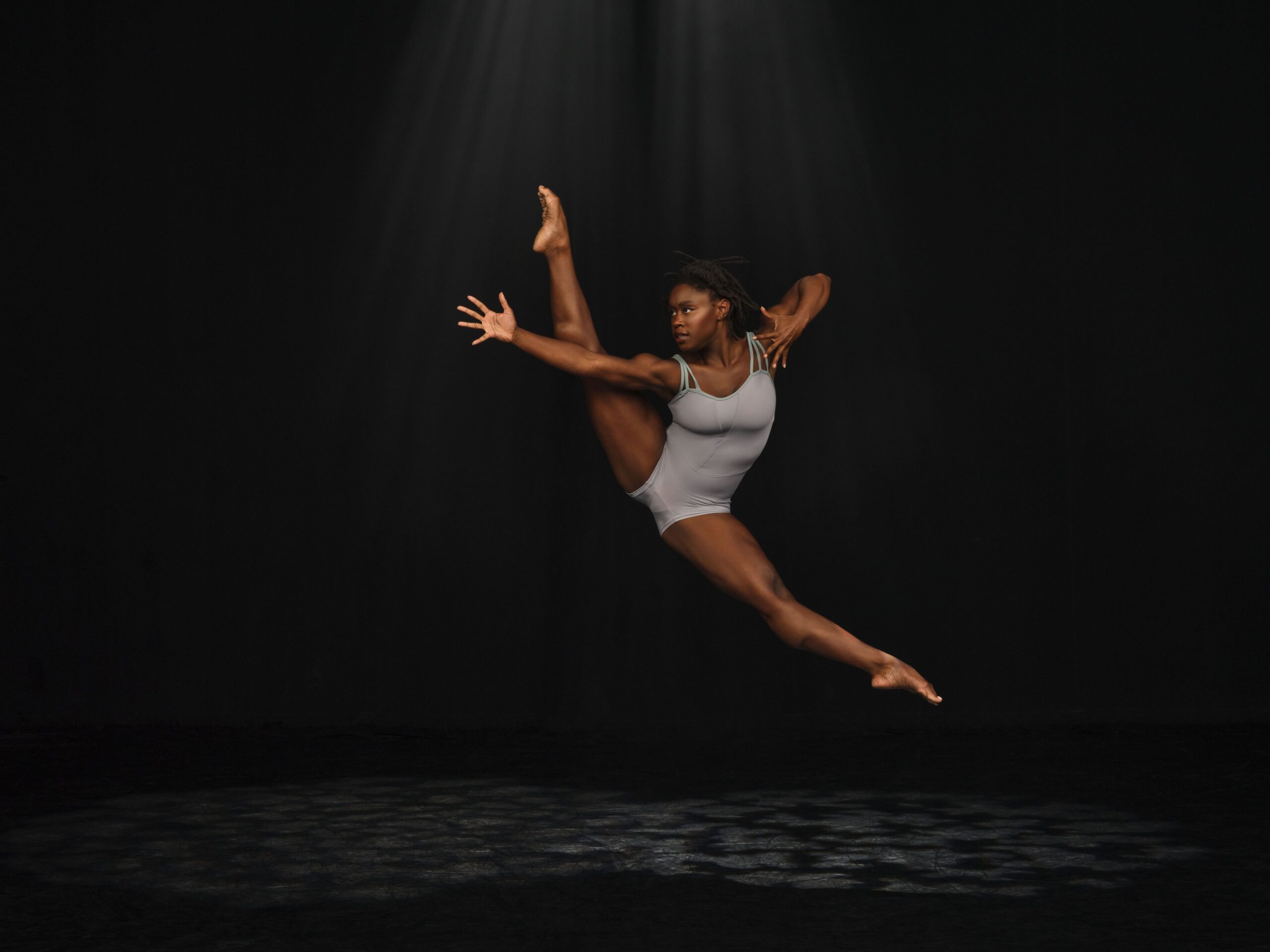
Alvin Ailey dancer Ashley Kaylynn Green.
Graf Mack was born in San Jose, Calif., and grew up in Columbia, Md., about 120 miles south of Philly. Her mother was a professor at Howard University and also a model.
“At home she would exercise and move to music to stay in shape,” Graf Mack said. “I would follow her, and she was kind of like, ‘Wow, she really picks up moves very easily.’”
So at 2 1/2, Graf Mack started dance classes, “and I found my home there.”
Eventually she and her sister, Daisha (who would become a commercial dancer performing with Rihanna, TLC, and Beyoncé), became serious ballet students.
In the summers, Graf Mack would study at New York’s School of American Ballet or the American Ballet Theatre.
“One summer, I participated in international ballet competitions. I went to St. Petersburg, Russia, competed in the Vaganova Prix, and placed in the finals,” she said. “I think I was the only American and certainly the only Black person there.”
Despite an impressive career, Graf Mack met with some roadblocks. Three years after she joined Dance Theatre of Harlem, she developed ankylosing spondylitis, an autoimmune disease affecting her joints.
So she looked at new careers. She applied and got into Columbia University.
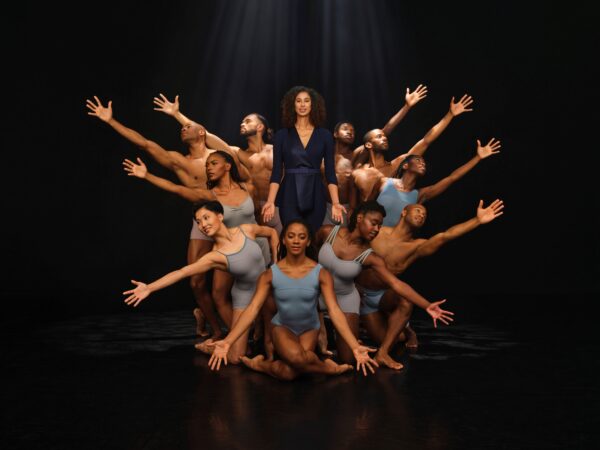
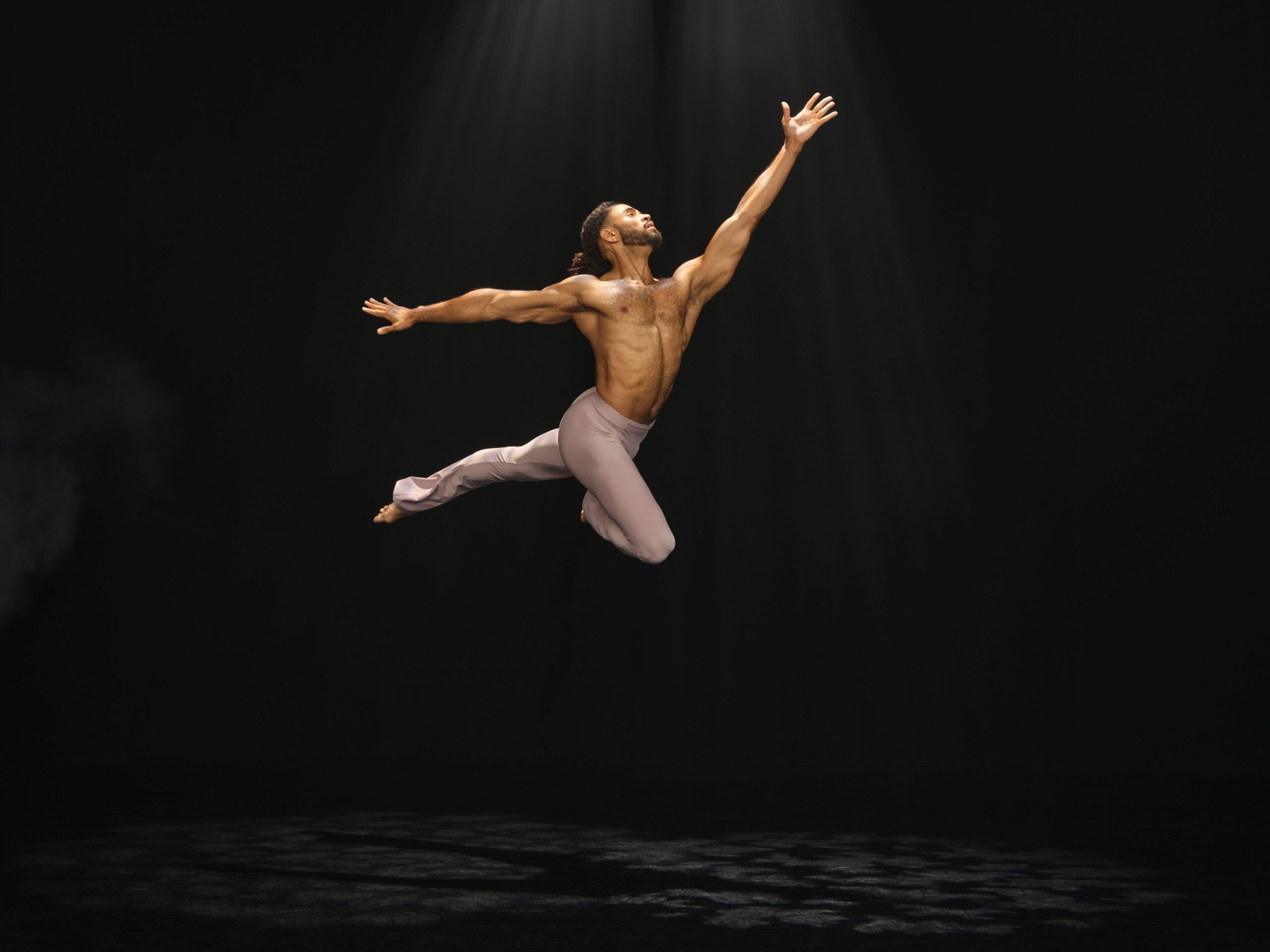
Alvin Ailey American Dance Theater.
She studied history and for three years, interned at JPMorgan, with all intentions of working for a bank. That firm was involved in arts institutions, and Graf Mack said she found her niche.
“That kind of sparked my love for arts administration. But actually after I graduated, I was moving a little bit more, and I thought I should try to dance [again].
“It was Carmen de Lavallade who told me, ‘Alicia, you can work at a bank any time in your life, but your time to dance is now.’ So I went back to Dance Theatre of Harlem for a year, and that’s when the company closed. It left 40-some Black ballet dancers without work.”
For a year, she found freelance work with top companies such as Complexions, Alonzo King LINES Ballet, as well as celebrity gigs with the likes of Beyoncé, John Legend, Andre 3000, Alicia Keys, and Jon Batiste.
In 2005, she joined Alvin Ailey. Three years into her tenure, her illness flared up again.
So she went back to school to earn a masters in nonprofit management from Washington University in St. Louis.
But then Jamison, her former boss and lifelong idol, was retiring from Ailey and asked Graf Mack to dance at her final performance. Battle watched from the wings and wanted her back in the company. She returned for three more years.
In 2014, a back injury finally ended her performance career and started her arts administration career.
“I feel like I have a very lived history of the legacy of the company,” Graf Mack said. “I’m very grateful to now keep the legacy moving forward.”
Alvin Ailey American Dance Theater. Feb. 27-March 1, Academy of Music. $36-$147. 215-893-1999 or ensembleartsphilly.org
MILAN, Italy — A popular stop for Winter Olympics spectators when they’re not at a sporting venue is an opera house.
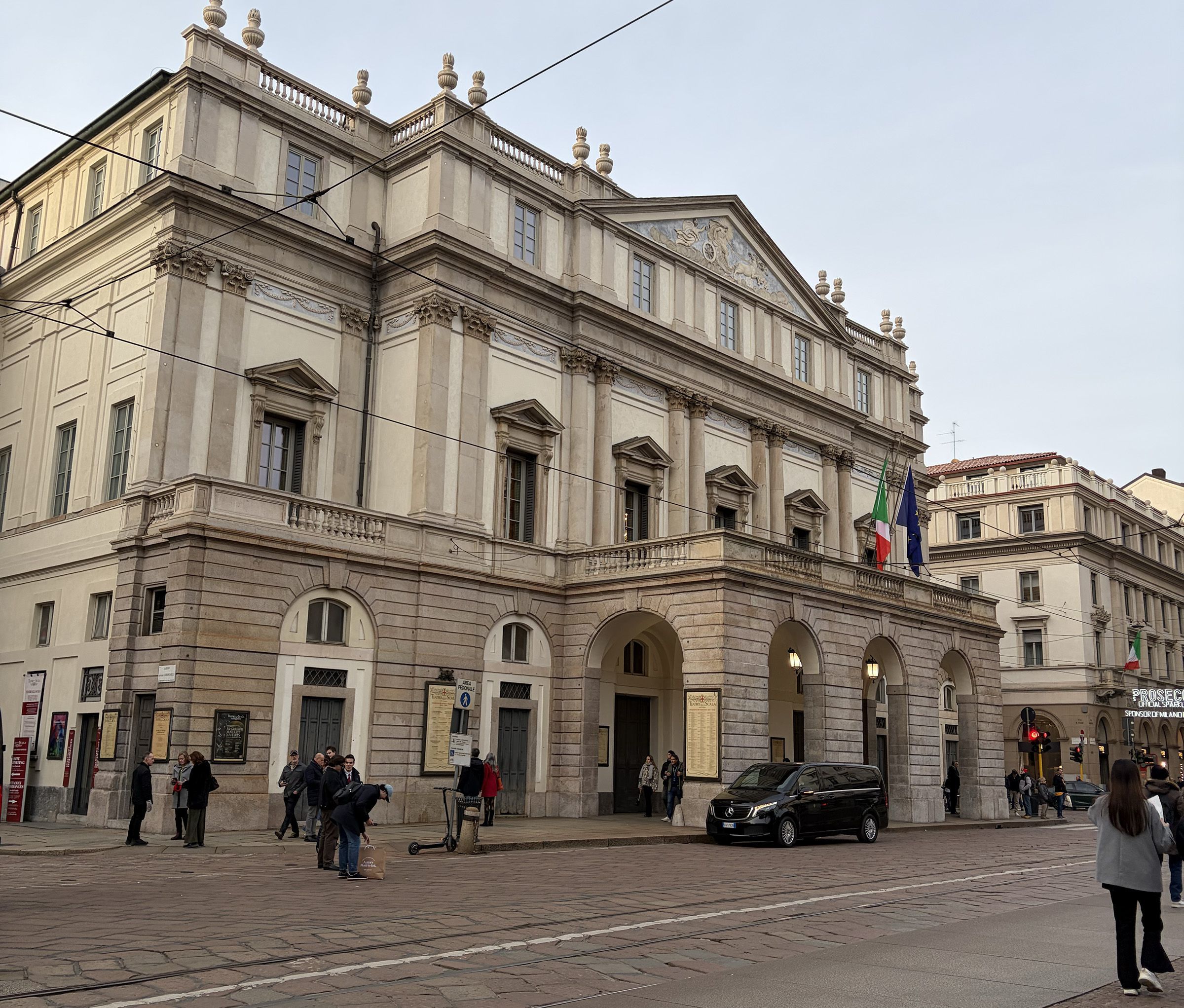
Teatro alla Scala, better known as La Scala, is one of the most famous ones in the world. Maria Callas rose to fame there; Franz Liszt’s piano is in its museum. The opera house, which opened in 1778, is the heart of Italian opera.
And it may feel especially familiar to visitors from Philadelphia: La Scala was the inspiration for the city’s Academy of Music.
The Great Stages Gala reception honoring Marian Anderson was held on the Academy of Music stage in Philadelphia on Saturday, June 8, 2024.
In 1854, a building committee invited architects to submit plans for an opera house in Philadelphia, John Francis Marion wrote in his book, Within These Walls: A History of the Academy of Music. The next year, the committee chose Napoleon LeBrun and Gustav Rungé to design what would become the Academy. LeBrun was sent to Milan to sketch La Scala just four months before ground would be broken on Broad Street.
From the outside, the two buildings look very different.
La Scala is somewhat modest because there were originally homes across the street that a grander building would overwhelm. The Academy of Music was also designed humbly, in the Rundbogenstil (round arch style), inspired by Runge’s German roots, reserving most of the budget for the interior.
Inside both buildings, a red-and-gold-tiered jewel box of an auditorium awaits.
“It’s kind of like an event to go to La Scala,” said Philadelphia Ballet artistic director Angel Corella, who famously danced Romeo and Juliet with Alessandra Ferri in that opera house in 2000. (Their performance was filmed for TV and is available on YouTube.)
“People would go just to see anything, pretty much [at La Scala] because it’s not only the event to go to see ballet or hear opera and see opera,” Corella said, “but it’s also the fact that you’re going to an opera house that has so much history in it.”
Francine Garino, a La Scala tour guide who coaches opera singers in French pronunciation, agrees.
“Some people don’t know anything about opera or ballet. They don’t mind. They want to live this experience.” Sometimes they will leave after the first intermission, saying they feel fulfilled just having experienced the theater.
Philly’s version, which opened in 1857, is equally beautiful but less imposing.
“The great thing about the Academy of Music is that it’s still a big opera house,” Corella said, “but it feels very intimate and close to you when you’re on stage. So it’s a perfect theater.”
The outside of La Scala, the world-famous opera house in Milan, Italy, is fairly humble. But the inside reveals a red-and-gold tiered jewel box. The Academy of Music was designed after La Scala.
Horseshoe shapes and other similarities
The similarities between the two theaters lie “in the position of the theater, the position of the seats, the acoustics,” Corella said.
LeBrun and Rungé replicated La Scala’s horseshoe-shaped seating areas, but they closed it up more for better sight lines.
Like the Academy, La Scala has a huge central chandelier. But the Italian theater is a neoclassical design and somewhat grander than the Philly version. It has six levels above the orchestra to the Academy’s four.
The Academy has more seats (2,800 in Philadelphia and 2,030 in Milan), thanks to its full mezzanine and balconies with boxes on the sides.
The outside of the Academy of Music was designed to look like a marketplace.
At La Scala, the first four levels above the orchestra are made up of lots of small individual boxes that were originally purchased by members of the aristocracy.
They were said to be more expensive than buying an apartment and owners would decorate the boxes as they wished. They’d bring in servants and could come any time they wanted. Here, they’d take business meetings, eat dinner, and go down to where the orchestra seats are now and dance to the music.
“If you owned a box,” Garino said, “it was home for you.”
Today all seats are individually sold as in any theater, with prices going from €10 to €300. Fans stalk the website to buy tickets as soon as they go on sale. They sell out extremely quickly.
La Scala was damaged when it was bombed during World War II.
Paul Miers lowers the chandelier to clean it and replace light bulbs on May 29, 2024, at the Academy of Music in Philadelphia. The large crystal chandelier measures 16 feet in diameter and weighs 5,000 pounds.
Rake vs. no rake
At the time the Academy of Music was built, there were similar academies in other American cities.
“There was an Academy of Music in New York that predated the Metropolitan Opera. The Brooklyn Academy of Music was something that was founded in 1859, inspired by what we had done,” said Ryan Fleur, president and CEO of the Philadelphia Orchestra and Ensemble Arts, which runsthe Academy of Music.
Brooklyn Academy of Music’s original building burned down and was replaced by a Broadway-style theater.
Because of that, “the Academy of Music is truly unique,” Fleur said. “As far as I know, it not only is an oldest continuously operating Opera House [in the country], but it’s the only opera house that still has this configuration of spaces.”
For American dancers, La Scala, and most European opera houses, are a challenge, because they have raked stages. The stage slopes downhill from back to the front, improving the view for audiences.
The Academy is “a perfect venue” for Philadelphia Ballet, said Corella. “Because all the ballets, especially the [older full-length ballets], fit incredibly well, because it’s almost like a continuation from the house into the stage.”
In the United States, he said, the rakes have been fixed and made flat.
“In Europe, there’s a lot of theaters that are still in rake. For the dancers, it’s great for jumping, because when you going down the hill, you feel like you’re flying … but it’s much harder for turning.”
La Scala Ballet étoile Nicoletta Manni thinks the opera house she regularly performs on is the best of both worlds.
“In La Scala, we have a good rake,” Manni said. “It’s not too much. It’s very good for jumps, because it’s helping us to jump even higher. You have to be careful with turns, because you might lose your balance, but you just need to get used to it.”
This month, Manni, 34,
was chosen to be an Olympic torch bearer. Then, she was told she would be the last one and would light the cauldron.
“It’s history, and so being there and have the privilege of doing that was very [much] something to remember. I will have it in my memory forever.”
Another thing she’d like to do is dance on our side of the Atlantic.
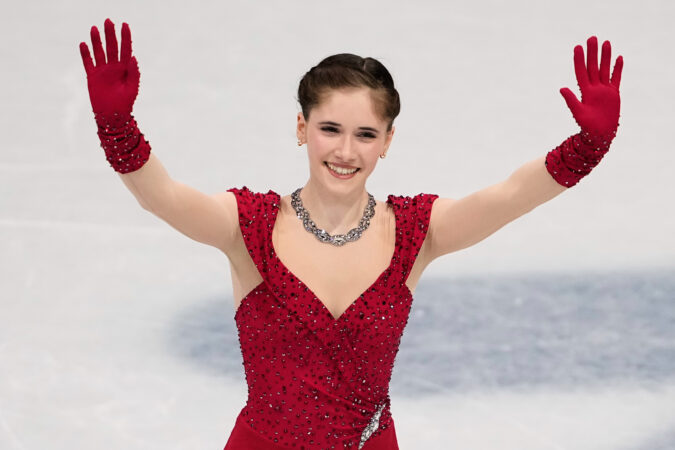
MILAN, Italy — In her first Olympics, in her mother’s hometown and very close to where her grandmother still lives, South Jersey figure skater Isabeau Levito earned a score of 131.96 in the free skate, or long program on Thursday.
The 18-year-old wound up in eighth place in the short program after a score of 70.84 and 13th in the free skate. But scores, rather than placements are what count, so she wound up in 12th place with a 202.80.
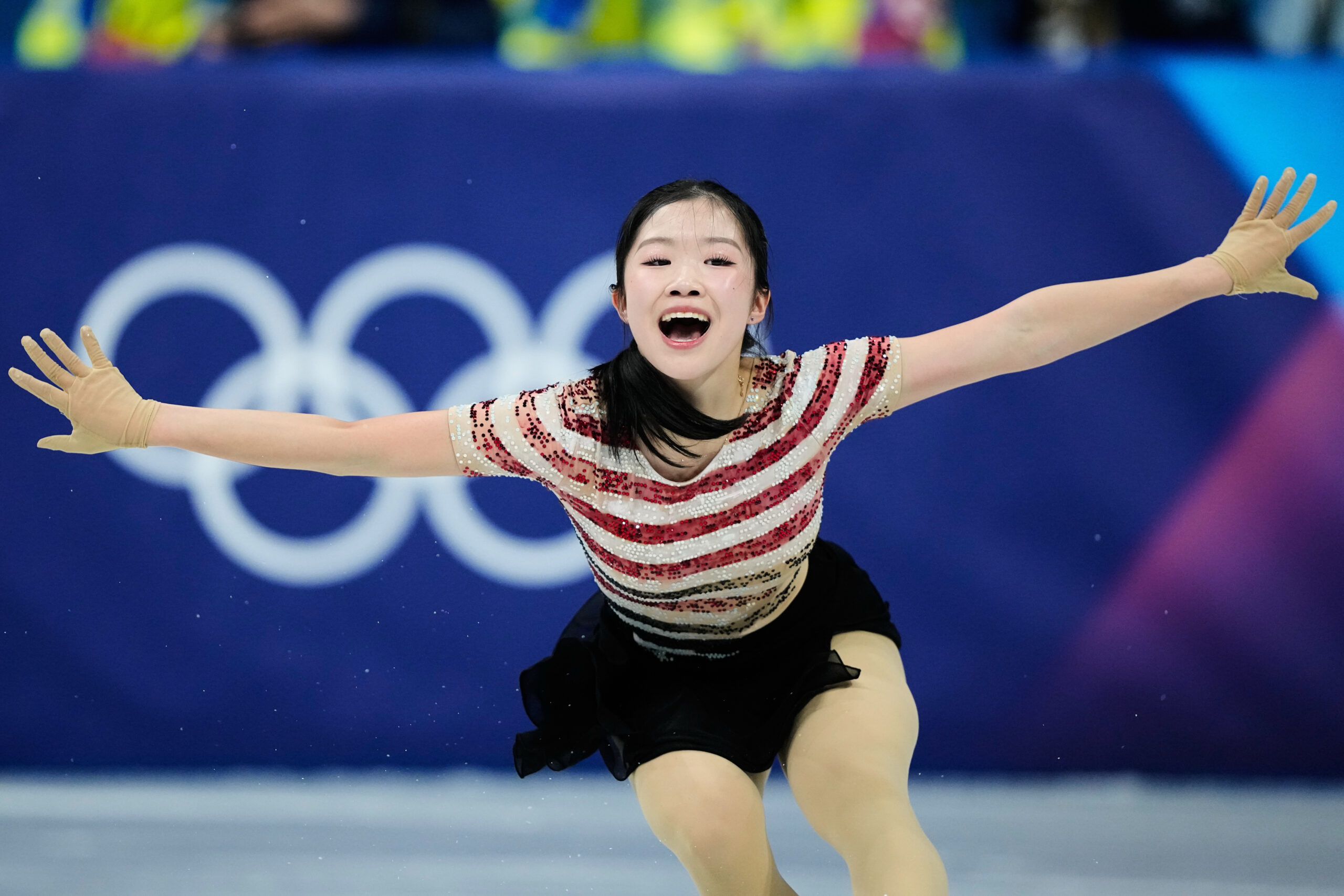
In the end, her teammate, friend, and fellow Blade Angel, Alysa Liu, won her second Olympic gold, after helping win the team event last week.
Liu, 20, scored 150.20 to win the free skate. She was the only skater to have positive grades of execution on all elements. She was third in Tuesday’s short program.
Liu also is the reigning world champion.
Two Japanese skaters earned silver and bronze.
Kaori Sakamoto, the favorite entering the Olympics, earned the silver after winning bronze at the 2022 Games. She was second in both the short and free programs.
Ami Nakai, 17, who won the short program, was ninth in the free skate despite landing one of only two triple Axels on Thursday night. She had won the short program. She earned the bronze medal.
Alysa Liu is the Olympic women’s figure skating champion.
Levito entered the day in eighth place and was in sixth after that skate, with seven more skaters to go.
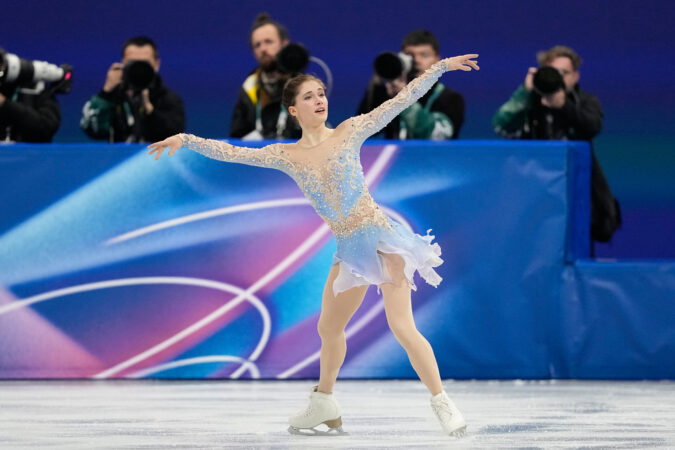
She had an uncharacteristic fall on her opening triple flip, which was supposed to be in combination, but skated with her usual elegant spins and footwork to “Cinema Paradiso” by Ennio Morricone, Italian music for the occasion. Levito was born in Philadelphia, grew up in Mount Holly, and now lives closer to where she trains, in Mount Laurel.
“I did my best” after the fall, Levito said in the mixed zone following her performance. “I just went on autopilot, and the rest went how it usually goes.”
Despite the fall and placement, Levito said she felt better at this competition than at the World Figure Skating Championships, U.S. Figure Skating Championships, or other competitions.
“Honestly, I felt like I had more energy,” she said. “And I don’t know if it’s because consciously I know I’m at the Olympics, or if it’s the crowd. The crowd is very, very energetic and supportive here.”
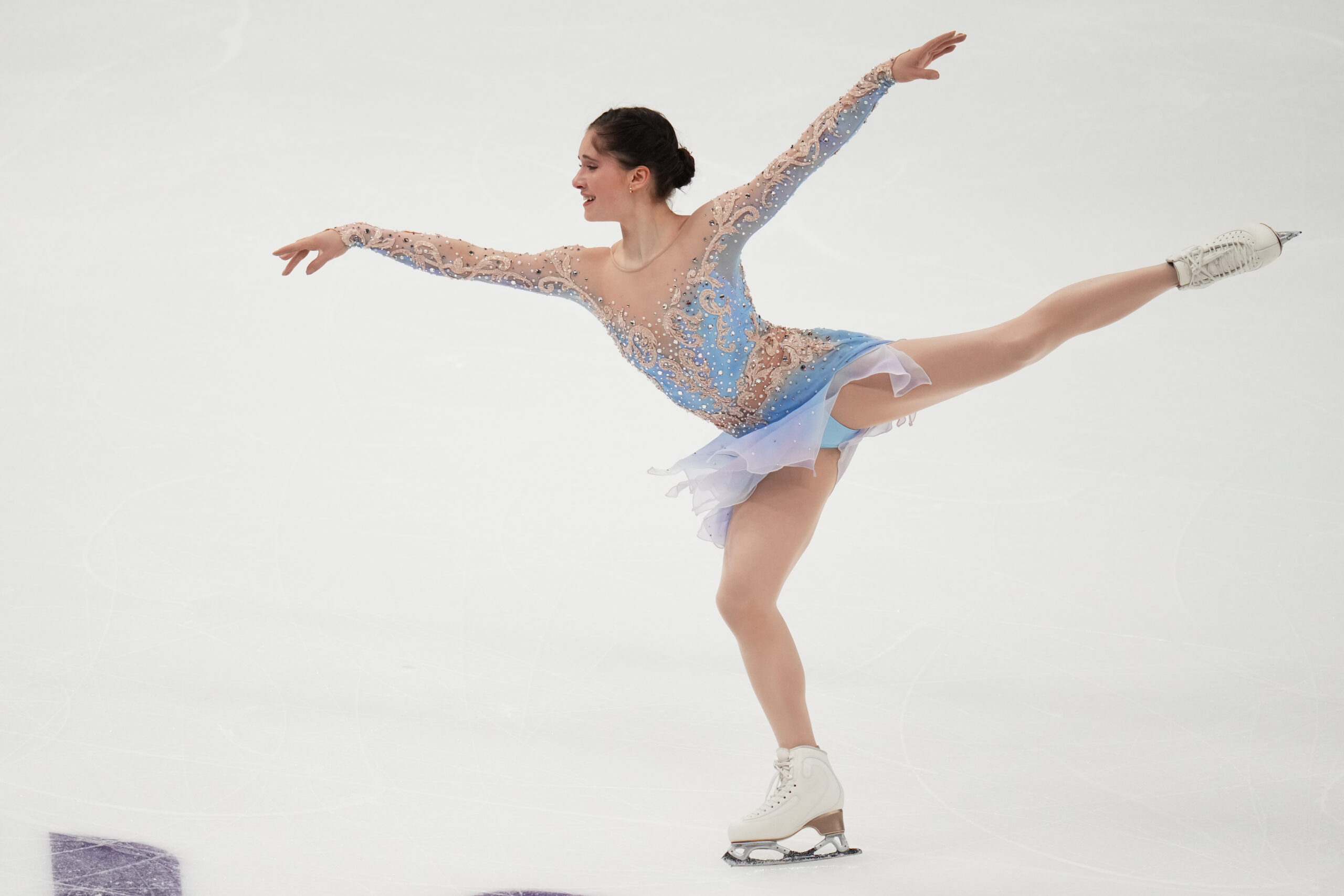
Levito skated in the second-to-last group (the free skate goes in reverse placement order from the short program). She wore a light blue, sparkly dress for the occasion.
After Tuesday’s nearly clean short program, many on social media felt that Levito had been underscored. Some felt that after the free skate as well.
In the previous group, Levito’s fellow Blade Angel, Amber Glenn, skated a far better program than she had in the team event (where she was part of the gold-medal win) or Tuesday’s short program.
She was third in the free skate and fifth overall after finishing 13th in an error-filled short program.
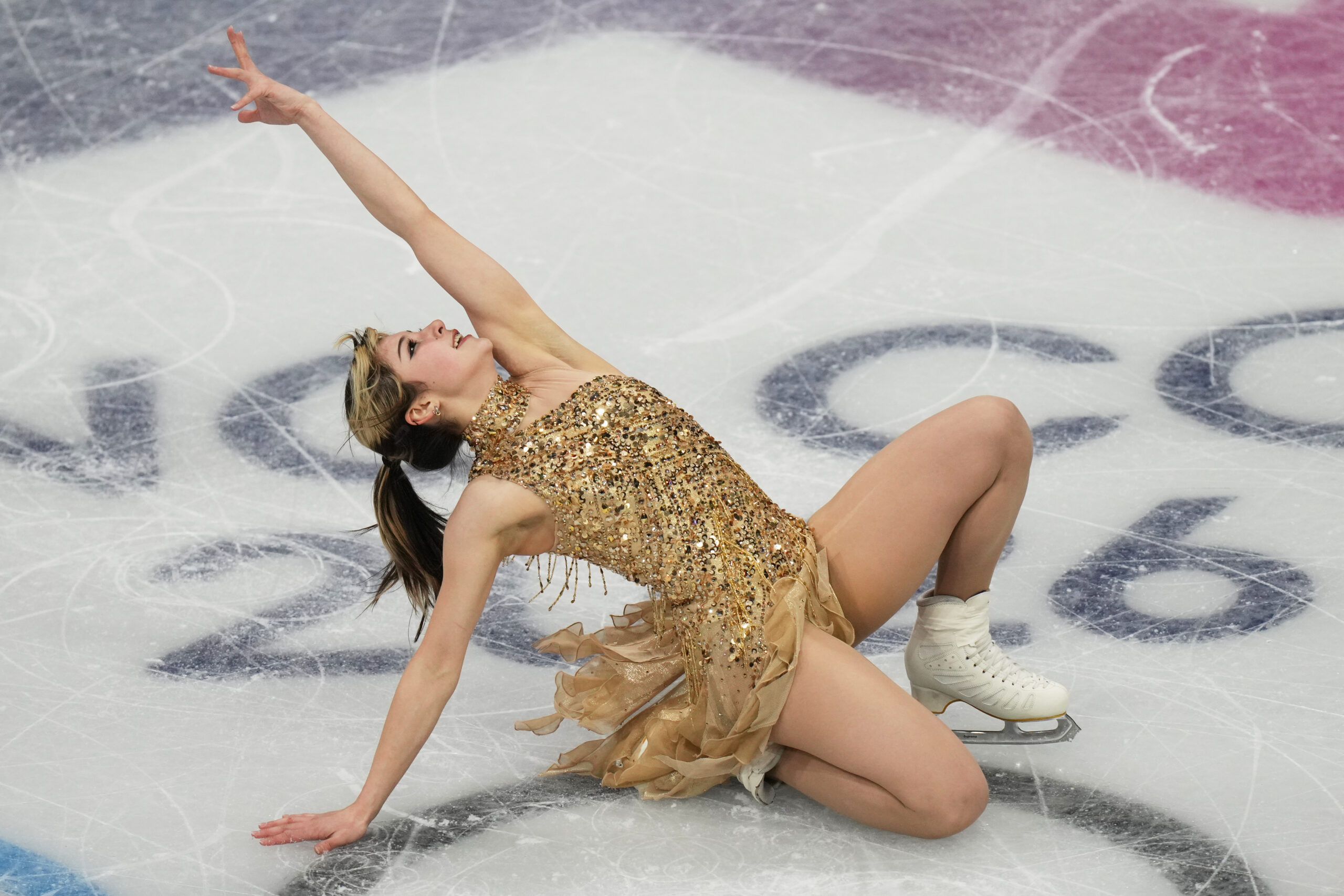
Glenn, the reigning and three-time U.S. champion, opened the free skate with her trademark triple Axel, landing it strongly, and knocked off element after element, only putting a hand down on her triple loop. She earned a season-best score of 147.52, for a total of 214.91.
Glenn gave Levito a standing ovation from the leader’s chair near the kiss-and-cry area.
Adeliia Petrosian, a Russian skater competing under a neutral flag, was seen as a potential medalist as well. She was the only woman to attempt a quadruple jump. She opened her free skate with the quad toe loop but fell on it. She wound up fifth in both the short and free skate and sixth overall.
MILAN, Italy — South Jersey figure skater Isabeau Levito, 18, landed in eighth place in Tuesday’s short program at the 2026 Winter Olympics.
Competing in her mother’s hometown, just minutes from where her grandmother still lives, Levito, who lives and trains in Mount Laurel, started her short program a little tight but landed all of her elements.
“I feel very good,” Levito told NBC after she skated. “I feel like I skated with the elegance I wanted to skate with. And I’m very glad my Olympic debut looked like that. I feel very confident and just very happy with myself right now.”
Levito’s program, to a compilation of sassy songs from Sophia Loren movies, opened with a triple flip-triple toe loop combination. Then she moved on to a double Axel and a flying camel, which got a Level 4, the highest. Her first three elements got positive grades of execution.
Next came her triple loop, which was judged to be a quarter-rotation short. Five of the nine judges gave her a minus-1 grade of execution and one gave her a minus-2.
South Jersey’s Isabeau Levito placed eighth in women’s short program.
The second half of Levito’s program included a step sequence, which was called at a Level 3 rather than the Level 4 she usually has received.
She then skated combination spin that received a Level 4 and grades of execution up to plus-5, the highest available. She wrapped up with a layback spin into a Biellmann that received a Level 4 and plus-3 and plus-4 grades of execution.
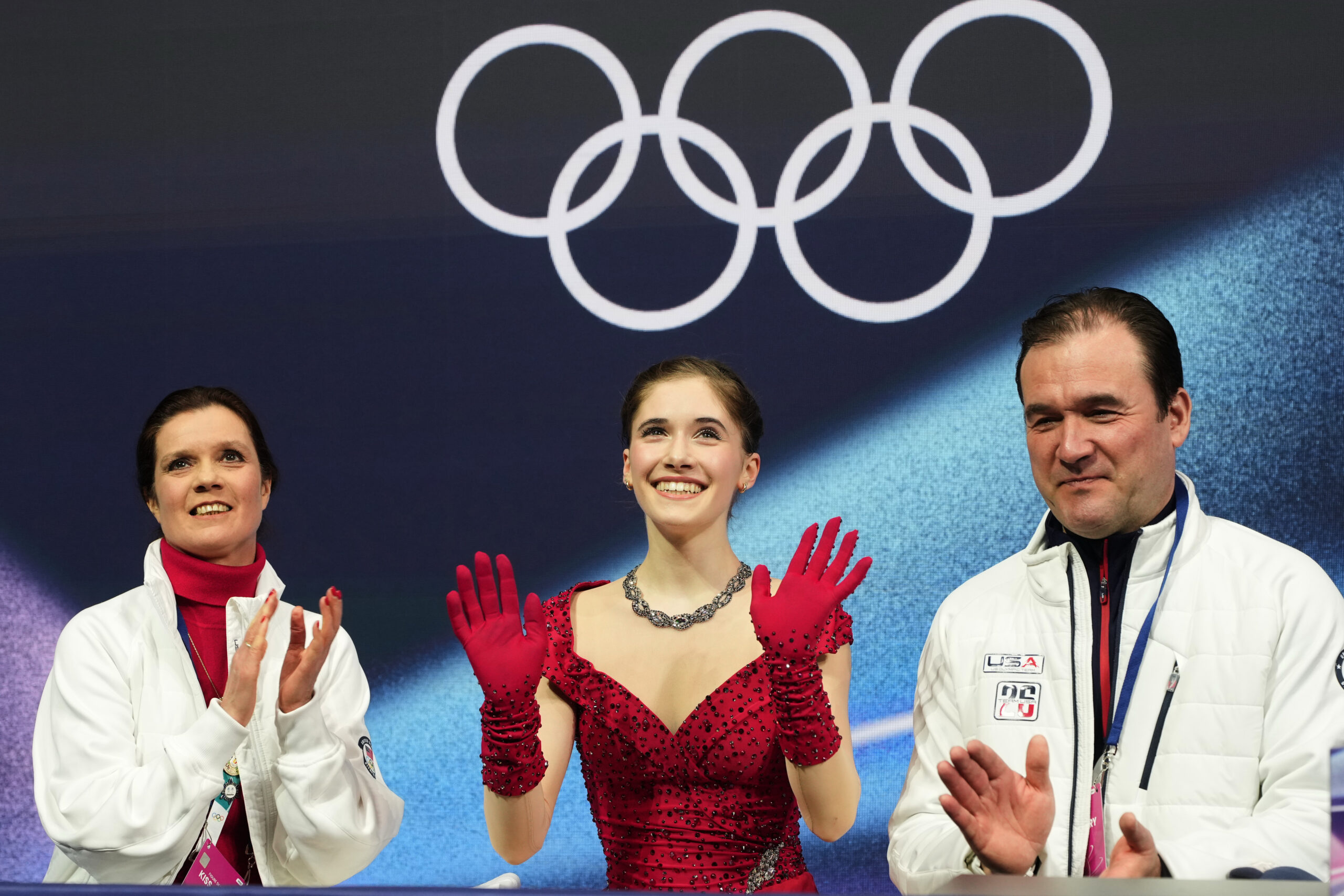
South Jersey’s Isabeau Levito receives her scores following the short program accompanied by her coaches, Yulia Kuznetsova (left) and Slava Kuznetsov.
Her score was a 70.84, nearly three points lower than her season’s best, which she skated at the Grand Prix of France.
However, Levito’s program components (or artistic mark) was the fourth-highest of the night. Only Japan’s Kaori Sakamoto and Mone Chibe and American Alysa Liu placed higher.
Many on social media thought Levito was underscored.
On the technical side, Levito was not alone in the small mistakes. Most of the women had some rotation issues, although most skated fairly clean.
Ami Nakai of Japan won the women’s short program figure skating at the Winter Olympics.
Japan’s Ami Nakai, the youngest skater in the competition at age 17 (which now is the youngest age allowed in international figure skating at the senior level), won the short program. She opened with a clean triple Axel, and she received positive grades of execution on all of her elements, making her the only woman with a clean score sheet. Her step sequence and spins received Level 4 grades of execution. She earned a season-best 78.71.
Sakamoto has been the sentimental favorite this year after placing third in the 2022 Winter Olympics in Beijing (and notably being the only happy one on the medal stand, after much drama with the Russian women over doping allegations and placements). Sakamoto also has won the World Championships three times after being displaced last year by Liu. She helped lead Japan to a silver medal in the Olympic team event for the second time in a row last week.
Sakamoto has said this will be her last year competing, and her short program is to “Time To Say Goodbye,” by Sarah Brightman and Andrea Bocelli.
Kaori Sakamoto of Japan competes is in second after women’s short program figure skating at the 2026 Winter Olympics, in Milan, Italy.
She received an exclamation mark on her opening triple Lutz, meaning it was not clear whether she took off on the required outside edge or had shifted to an inside edge. Her triple flip-triple toe loop combination also was called a quarter of a rotation short.
She is less than a point behind Nakai, earning 77.23 for her short program.
The highest-placing American woman of the night was Liu, who wound up in third place. She repeated last year’s winning short program, to “Promise,” by Laufey. After she skated, she said she was unconcerned with placements but was more excited to have people see her work and to have her siblings and friends in the audience, most of whom had never seen her compete.
Liu received all positive grades of execution, mostly plus-3 to plus-5, except for her triple Lutz-triple loop combination (a particularly difficult one, therefore worth more points), which was called a quarter short. Her score was 76.59.
Amber Glenn, the three-time U.S. champion, started her program (to Madonna’s “Like a Prayer”) strong with a triple Axel that received up to plus-3 grades of execution. (She and Nakai were the only women of the night to attempt the jump.)
Her triple flip-triple toe loop combination was called a quarter short. But she made a big mistake in the middle of the program when she doubled her intended triple loop. A solo triple jump is a required element in the short program, so the double loop received no points. She finished strong with a Level 4 step sequence and two Level 4 spins, but Liu, watching on a monitor in the mixed zone, wondered if Glenn had changed the program on the fly after a mistake.
Glenn’s score was 67.39, well below her season’s best of 75.72, and she was in 13th after the short program.
The short program also included the return of two Russian women, skating under a neutral flag. Viktoriia Safonova was the first to skate and was not among the top 24 (of 29) skaters who qualified for Thursday’s free skate.
The other Russian woman, Adeliia Petrosian, skated second and has been considered a medal contender. She scored a strong 72.89, which would not be topped until the 18th skater performed. That was by Nakai, the eventual winner.
Levito, Liu, and Glenn call themselves the Blade Angels, modeled somewhat on women’s Olympic gymnastics teams, which give themselves names, and somewhat on Charlie’s Angels.
Liu and Glenn shared in last week’s Olympic gold medal in the team event. Only up to two skaters from each team could be chosen for the women’s section. Levito, who has said she has flown somewhat under the radar since suffering an injury last year and missing part of the season (but came back to place fourth at the world championships in Boston), was not selected to compete. Only those who skate share in the medal.
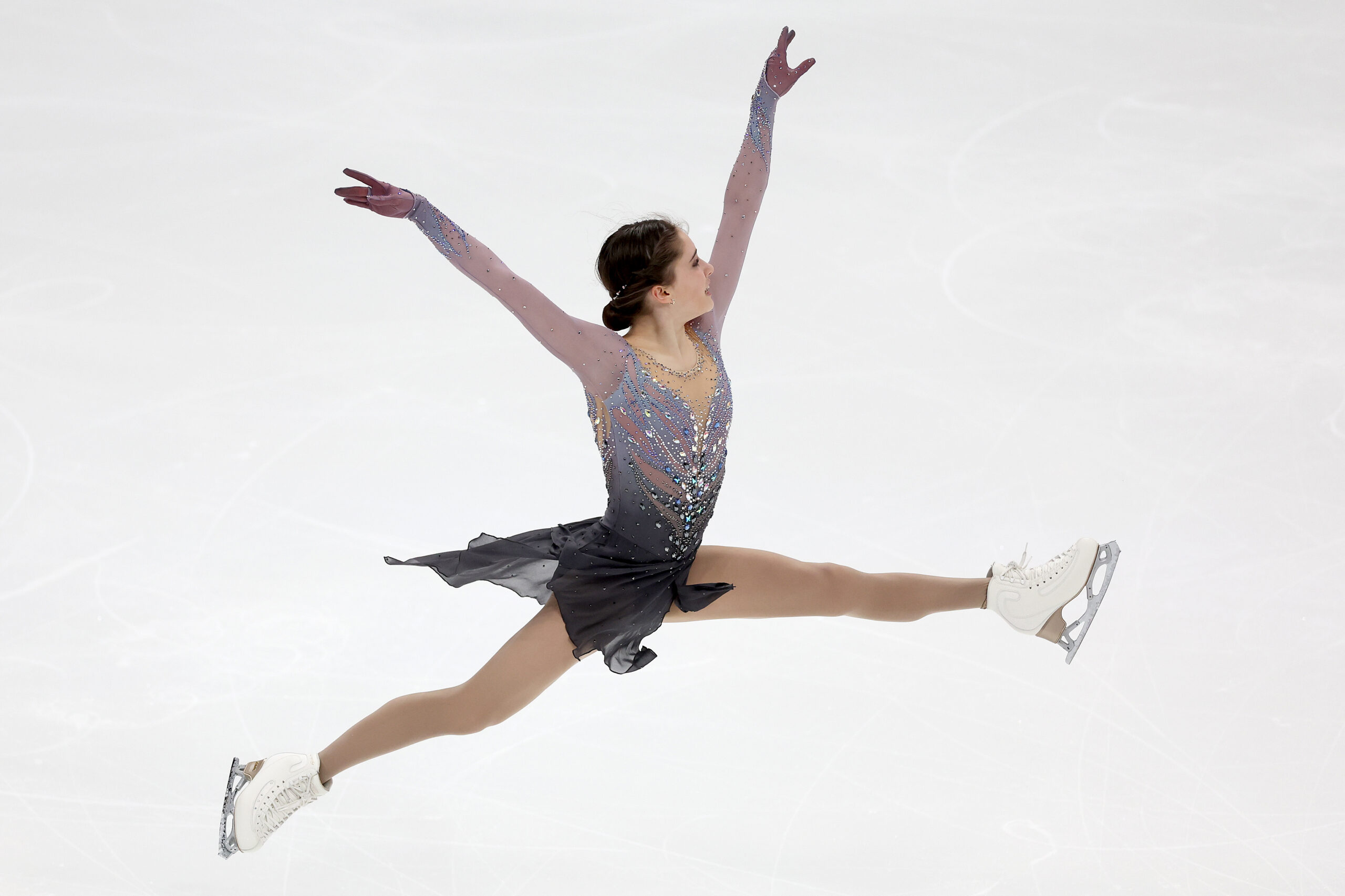
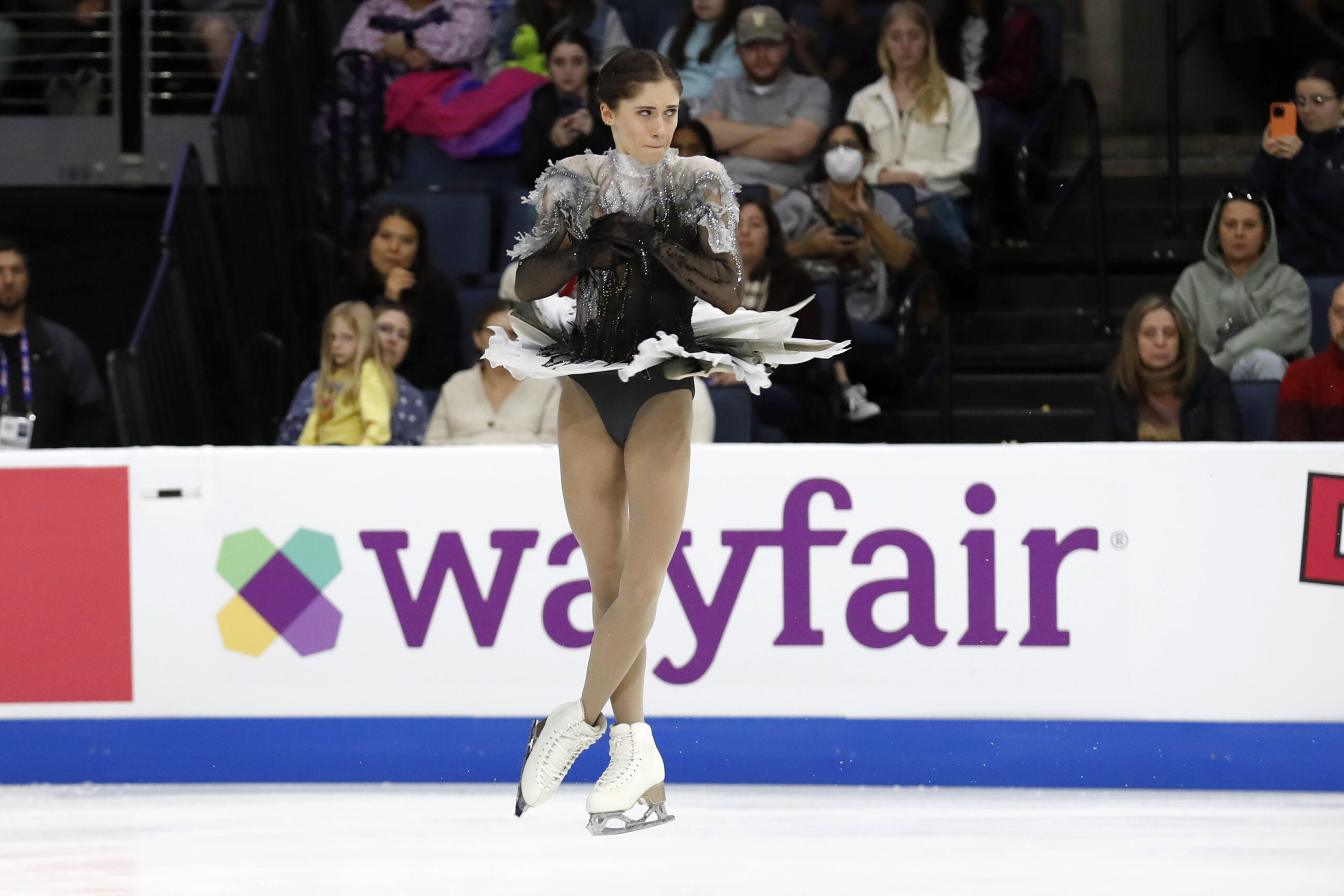
Breaking down Isabeau Levito’s figure skating costumes over the years
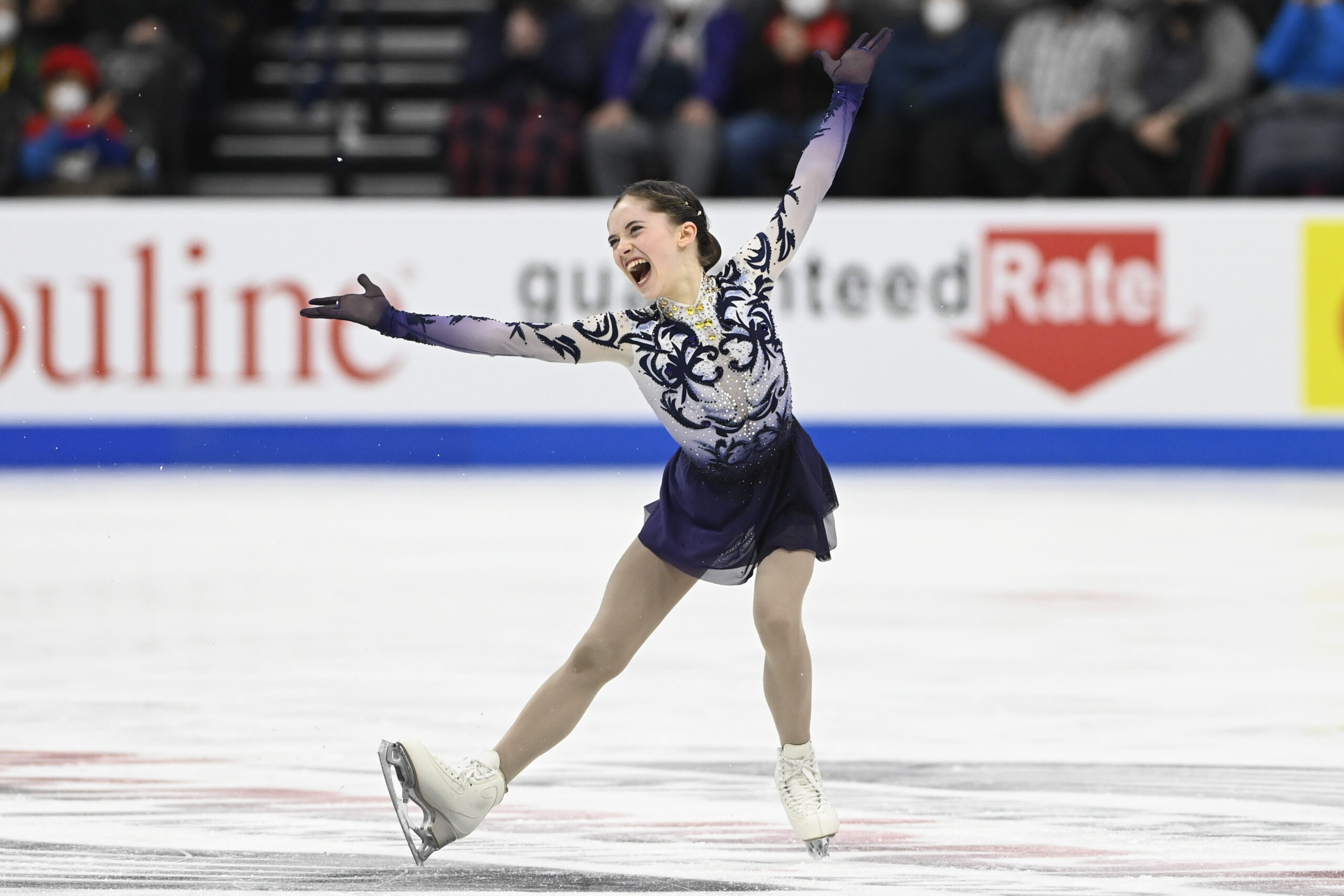
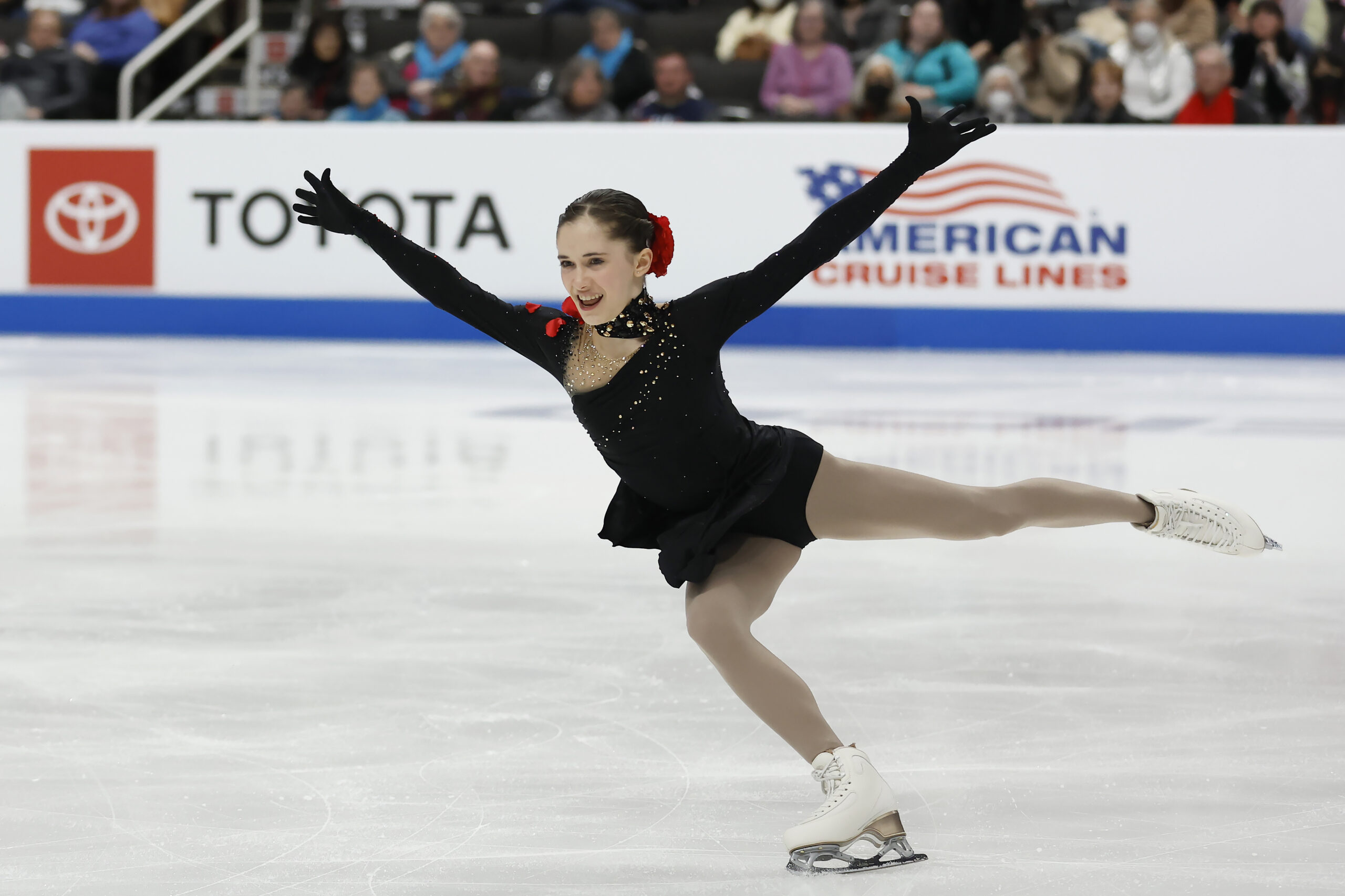
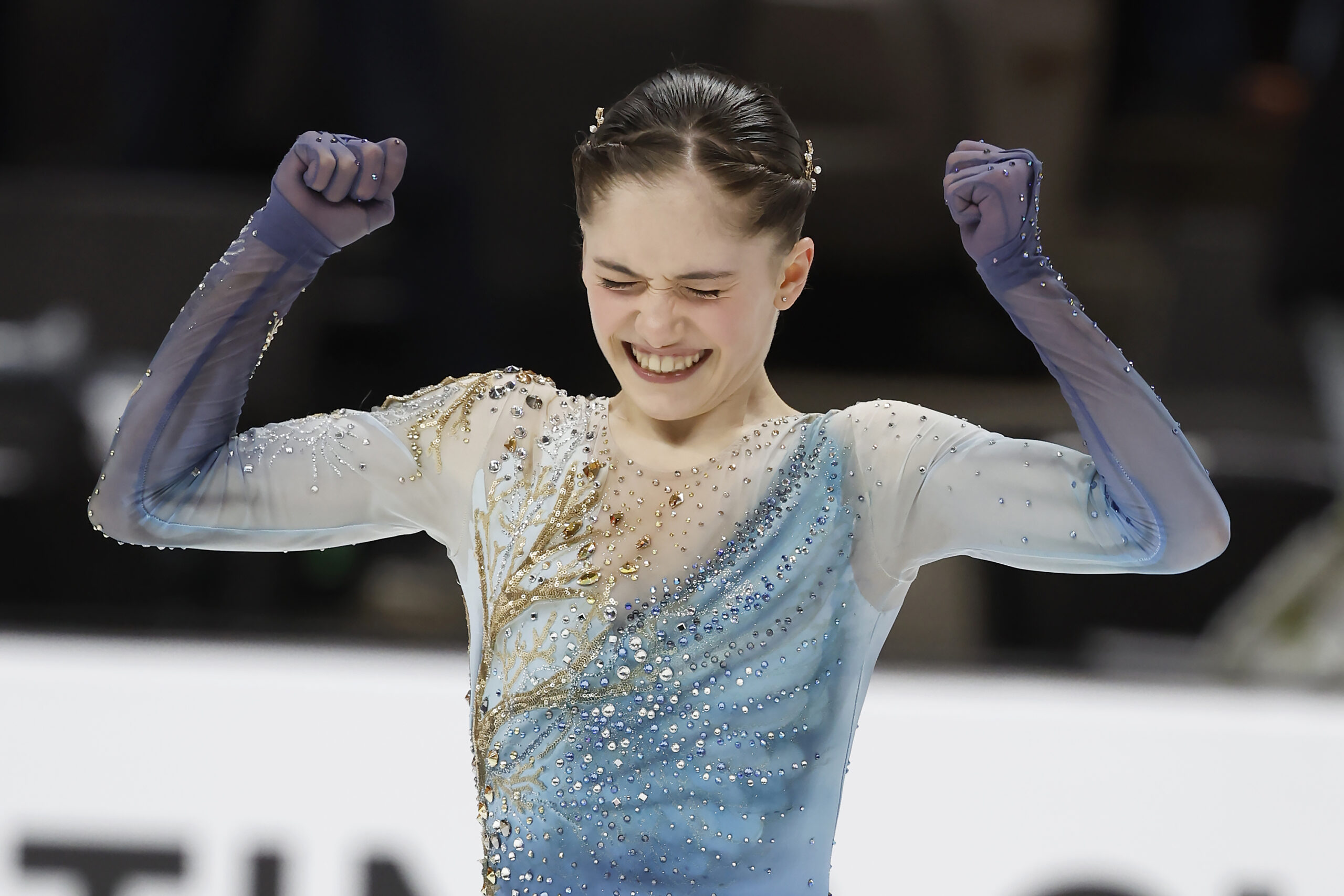
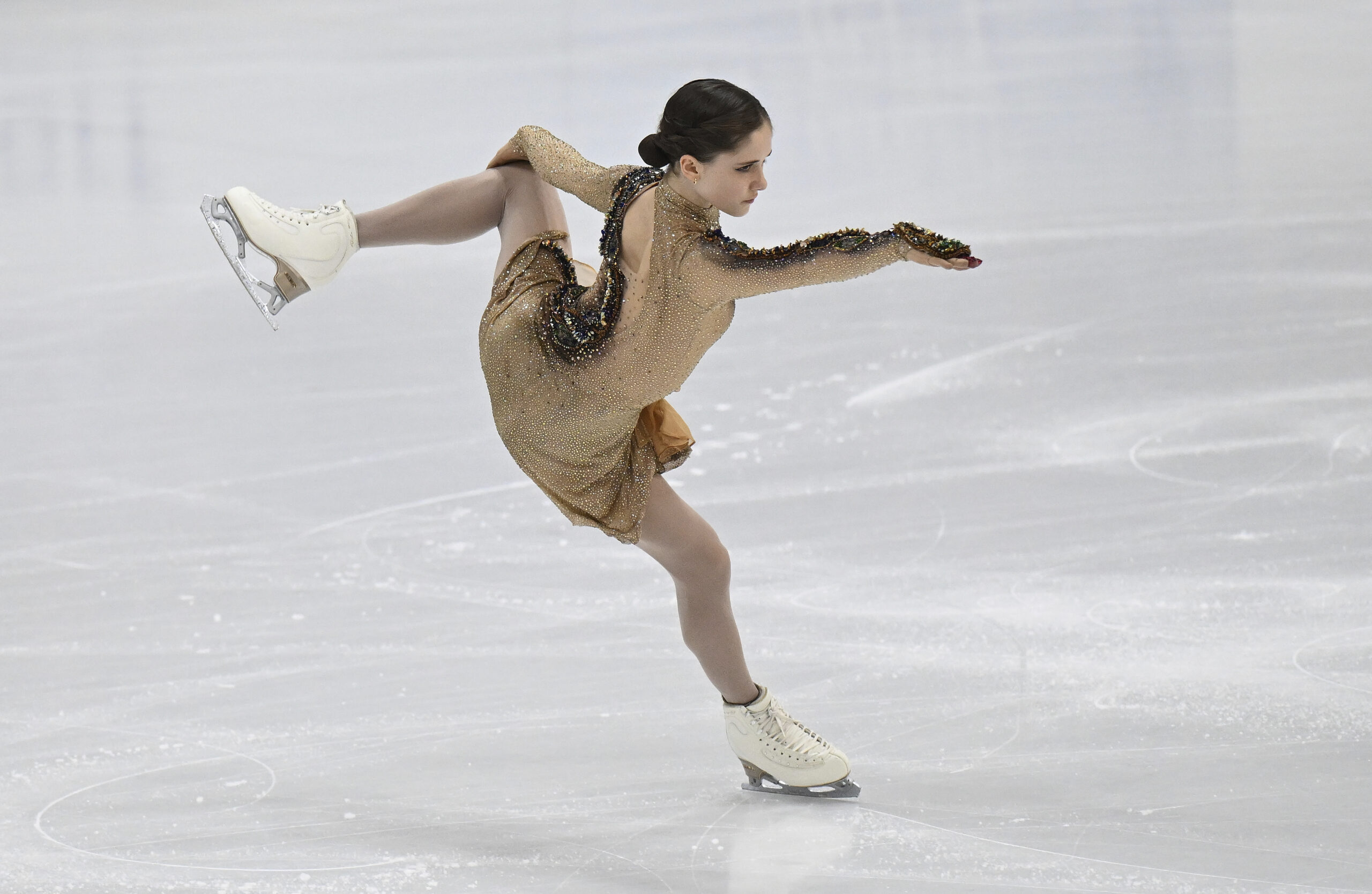
Since 2022, South Jersey’s Isabeau Levito has been one of figure skating’s biggest stars. Ahead of her Olympic debut Thursday in the women’s short program, we took a look back at her costumes since she burst onto the scene at 14 years old.
Isabeau Levito competes during the women’s free skating competition at the U.S. Figure Skating Championships, Friday, Jan. 9, 2026, in St. Louis. (AP Photo/Stephanie Scarbrough)
A star is born
Isabeau Levito, of Mount Holly, competes in the short program at the 2022 U.S. Figure Skating Championships in Nashville. Levito went on to win the bronze medal, but at 14, she is too young to make the Winter Olympics team.
Levito made her senior debut during the 2021-22 season at age 14. She skated her short program to “The Swan,” by Camille Saint-Saëns, performed by Joshua Bell.
Isabeau Levito was too young for the Olympics in 2022, but she won the bronze medal at the U.S. Figure Skating Championships in this dress, made in Russia. She was also named to the World Junior Championships, where she skated to the “Russian Dance” from Swan Lake by Tchaikovsky, and won.
Isabeau Levito competes in the women’s free skate program during the U.S. Figure Skating Championships Friday, Jan. 7, 2022, in Nashville, Tenn. (AP Photo/Mark Zaleski)
Isabeau Levito wore a Spanish-inspired dress for her short program in the 2022-23 season. She skated to “Una noche más” by Yasmin Levy.
Isabeau Levito performs during the women’s short program at the U.S. figure skating championships in San Jose, Calif., Thursday, Jan. 26, 2023. (AP Photo/Josie Lepe)
National champion
Isabeau Levito reacts after her performance during the women’s free skate at the U.S. figure skating championships in San Jose, Calif., Friday, Jan. 27, 2023. (AP Photo/Josie Lepe)
In January 2023, Levito won the U.S. Figure Skating Championships in San Jose, Calif. She went on to place fourth at the World Figure Skating Championships in Saitama, Japan.
Reputation era
21 September 2023, Bavaria, Oberstdorf: Figure Skating: Challenger Series – Nebelhorn Trophy, Individual, Ladies, Short Program. Isabeau Levito from the USA on the ice. Photo by: Angelika Warmuth/picture-alliance/dpa/AP Images
Early in the 2023-24 season, Levito wore a dress with a snake wrapped around her neck and the head on her arm. Ice dancers Madison Chock and Evan Bates had a snake program a few years before, and Chock advised Levito on this program.
Switching gears
COLUMBUS, OHIO – JANUARY 25: Isabeau Levito skates in the Women’s Short Program Dance during the U.S. Figure Skating Championships at Nationwide Arena on January 25, 2024 in Columbus, Ohio. (Photo by Matthew Stockman/Getty Images)
Levito changed her short program midseason in 2023-24. Because of the Russian invasion of Ukraine, Levito stopped getting dresses made in Russia. This one was made by Josiane Lamond in Canada.
Levito wore this layered black, white, and gray dress the first part of the 2023-24 season for her long program, skating to “The White Crow,” by Lisa Batiashvili. After placing third in the short program at Skate America that season, she finished second in the free skate to end in second overall.
Isabeau Levito, of the United States, competes in the women’s free skate program during the Grand Prix Skate America Series in Allen, Texas, Sunday, Oct. 22, 2023. (AP Photo/Roger Steinman)
Silver star
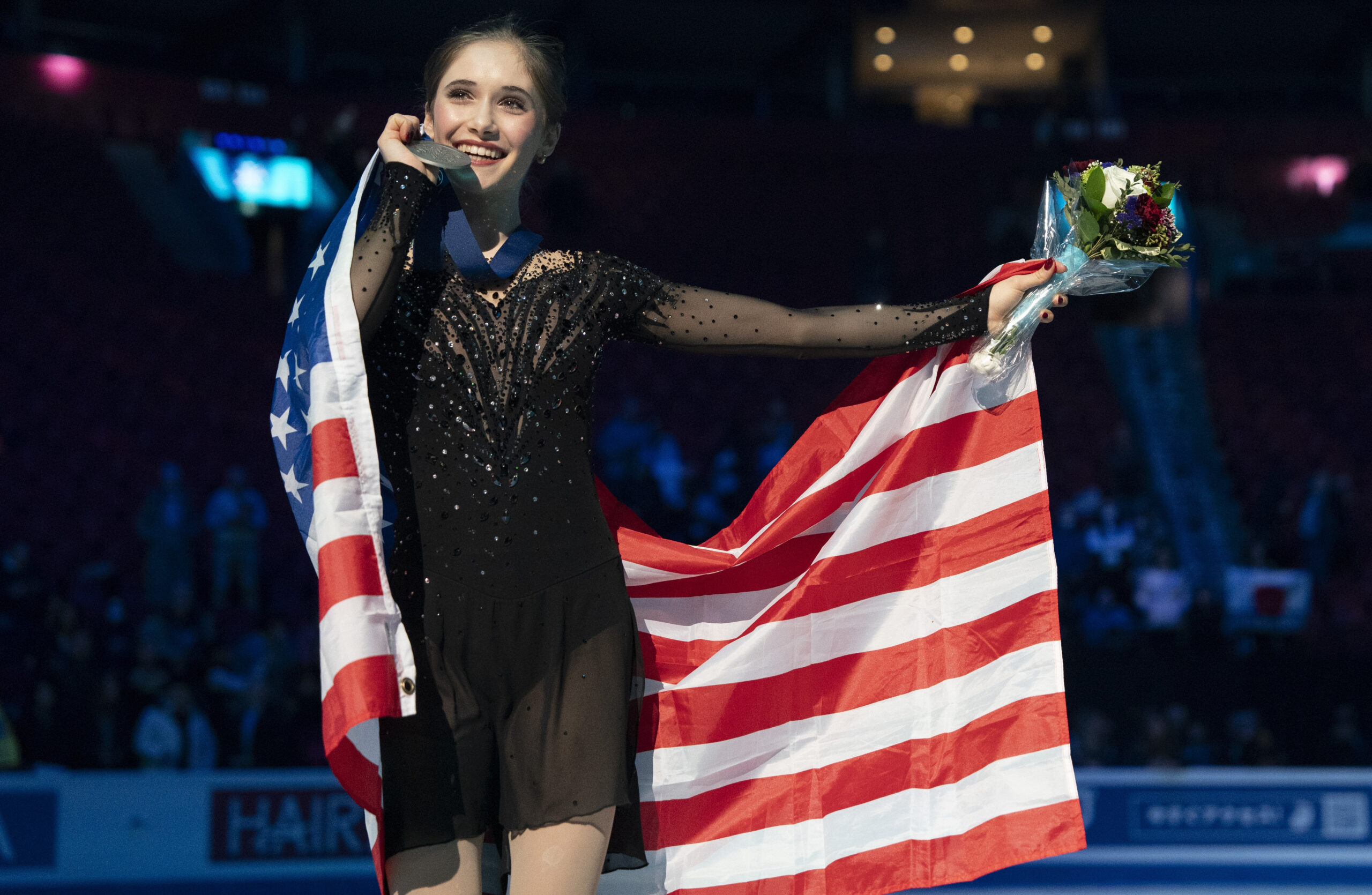
Isabeau Levito, of the United States, poses with her silver medal at the world figure skating championships Friday, March 22, 2024, in Montreal. (Christinne Muschi/The Canadian Press via AP)
Levito won the silver medal at the 2024 world championships in Montreal with this dress by Canada’s Lamond.
Road to Milan
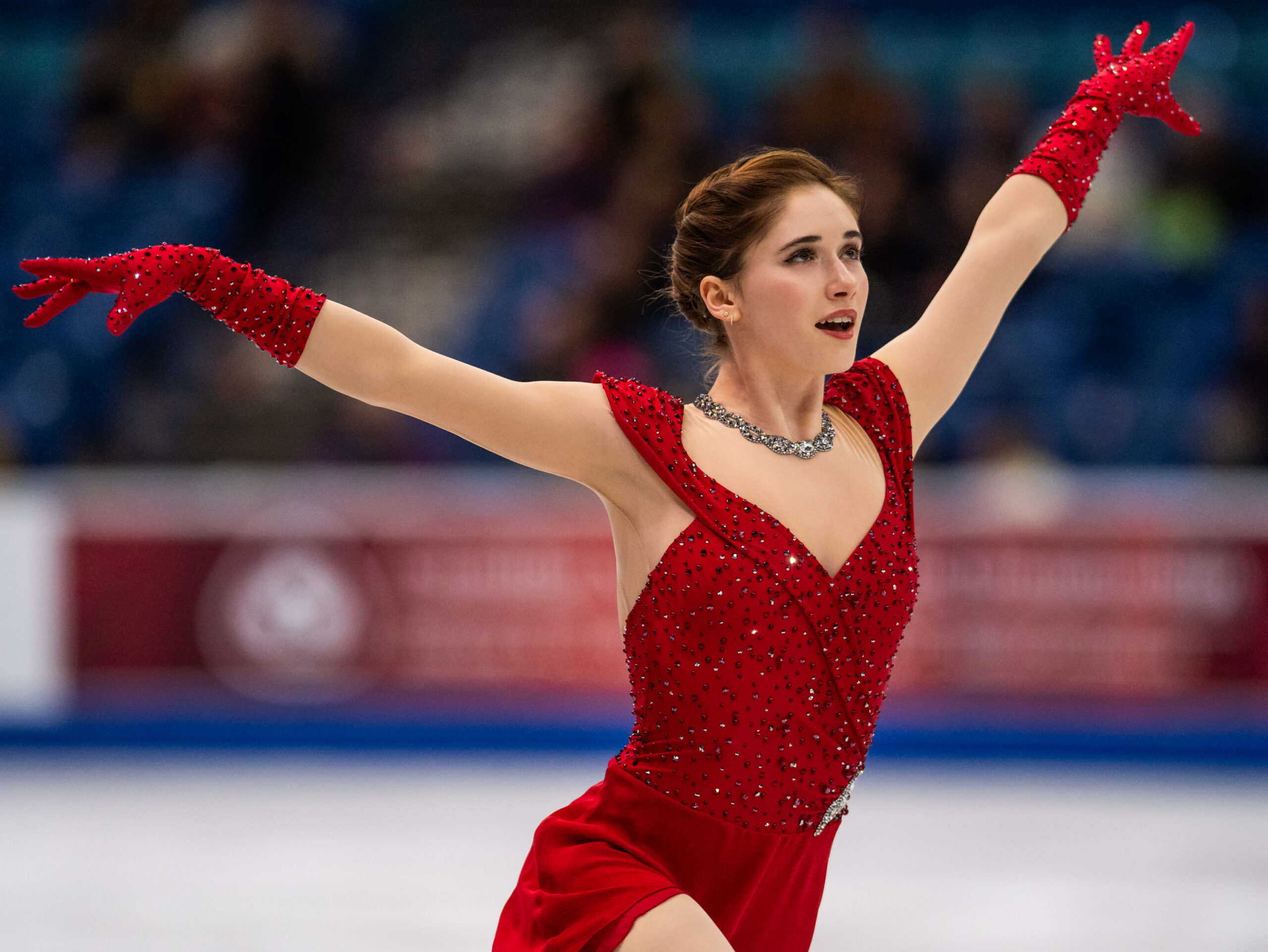
Isabeau Levito of the United States skates in the Women’s Short Program in the 2025 Skate Canada International event in Saskatoon, on Friday, October 31, 2025. (Matt Smith/The Canadian Press via AP)
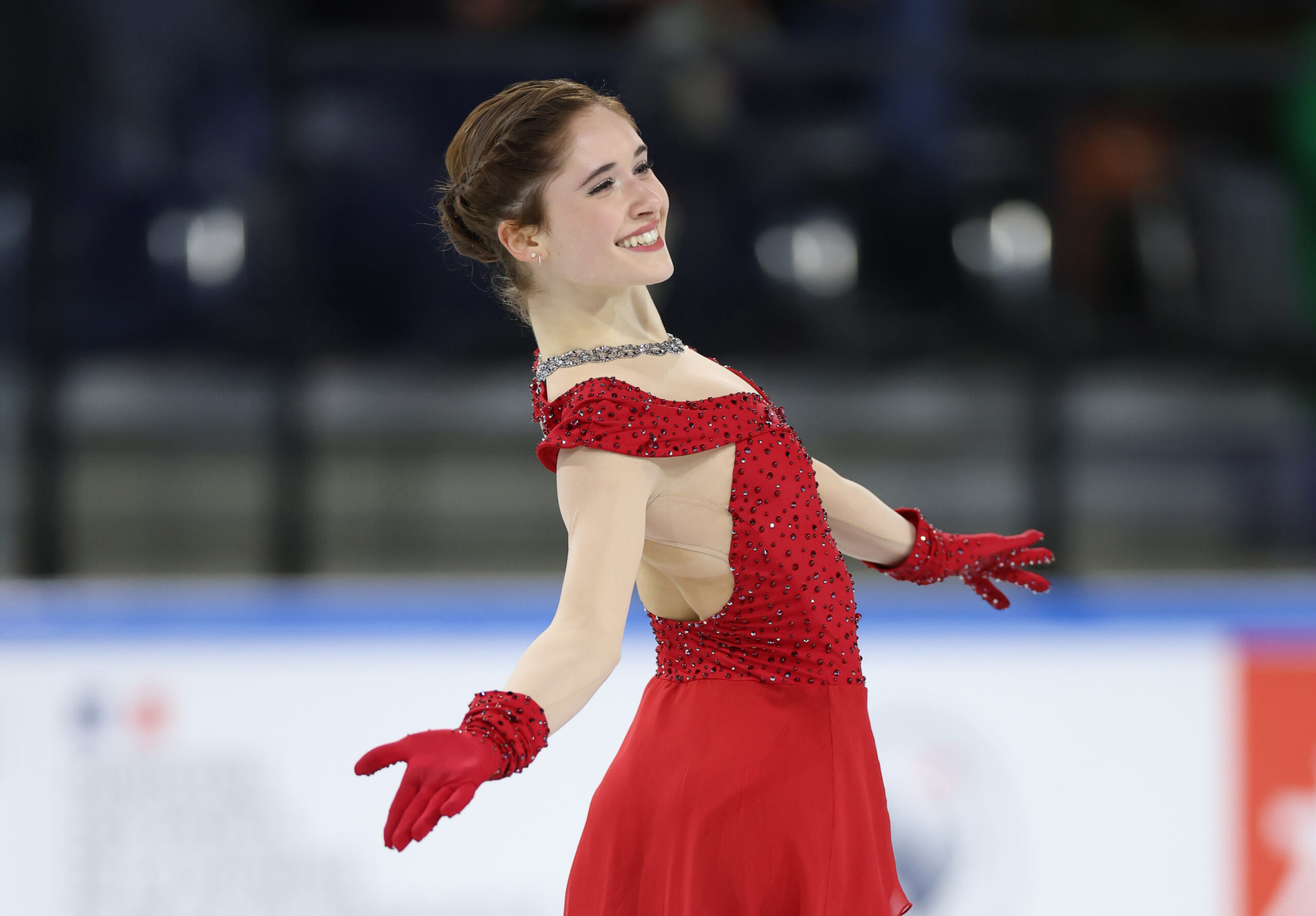
Levito is wearing this red dress by Lisa McKinnon for her short program this Olympic season. She is skating to a compilation of sassy songs from Sophia Loren movies. At Skate Canada, a Grand Prix event, she placed second with this routine.
Ticket punched
Isabeau Levito performs during the women’s free skating competition at the U.S. Figure Skating Championships in St. Louis. She won the bronze medal.
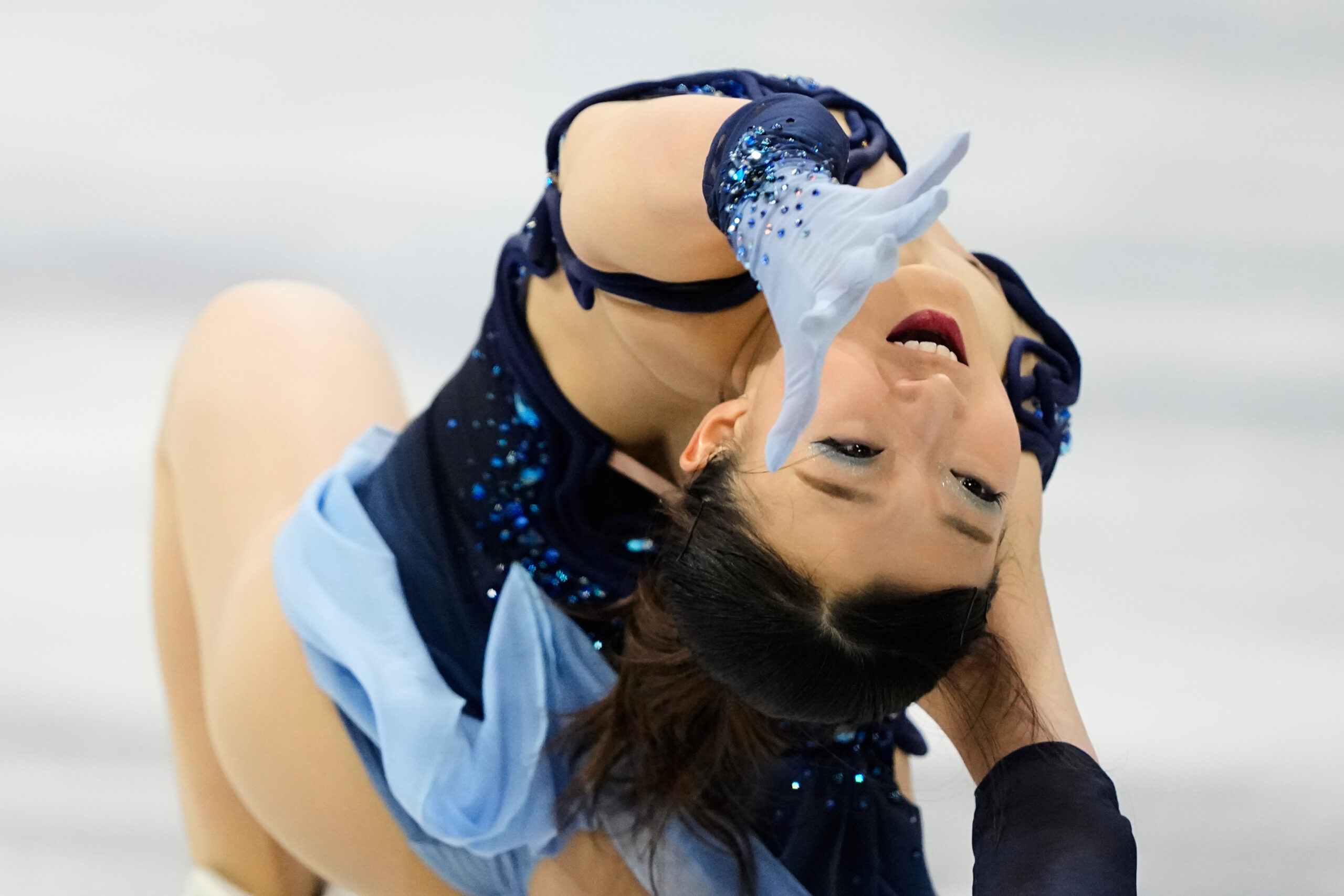
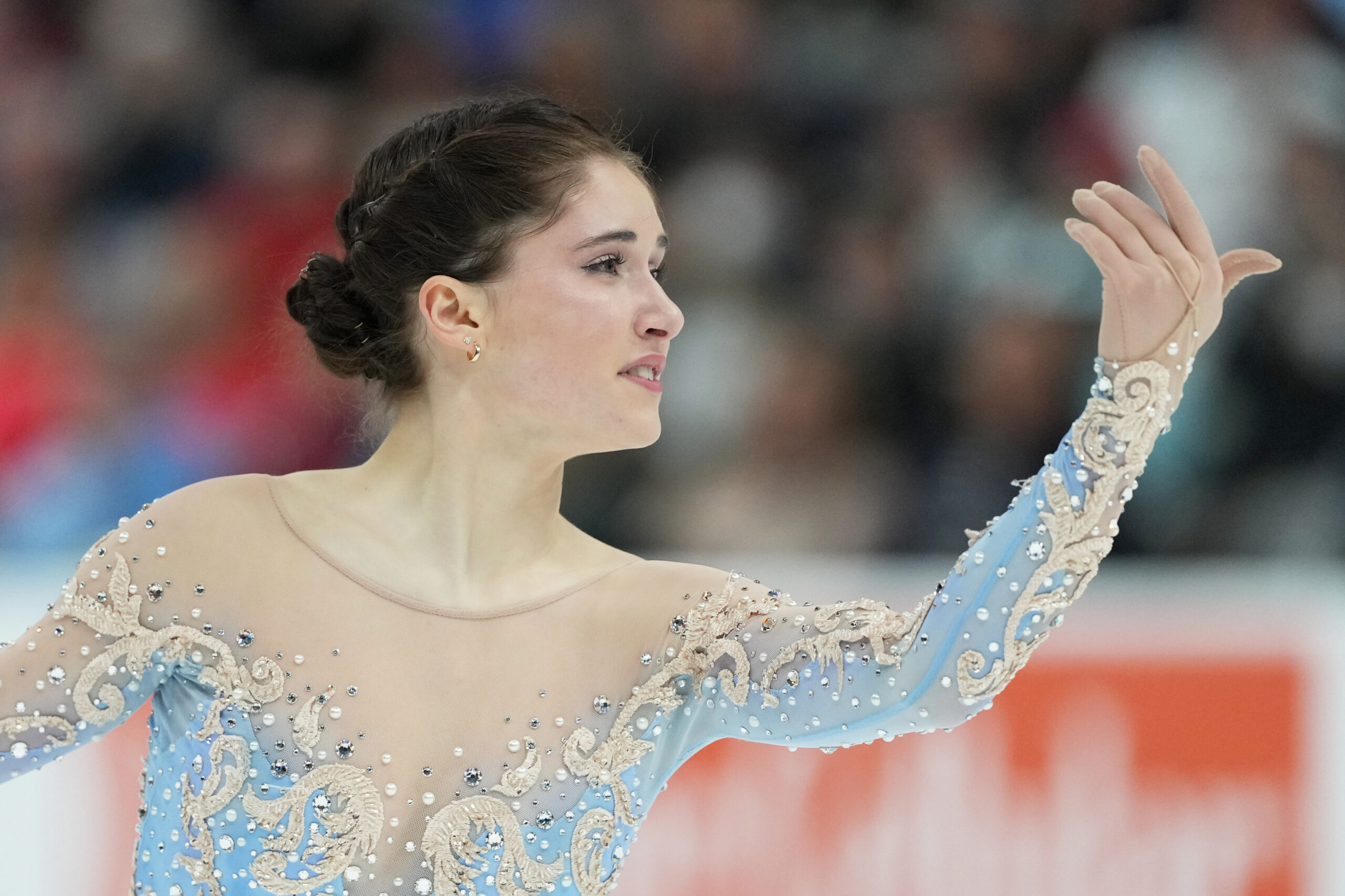
Levito is wearing this blue dress by McKinnon for her free skate (or long program) this season, and skates to “Cinema Paradiso” by Ennio Morricone. She won bronze at January’s U.S. Figure Skating Championships to earn the trip to Milan.
A throwback
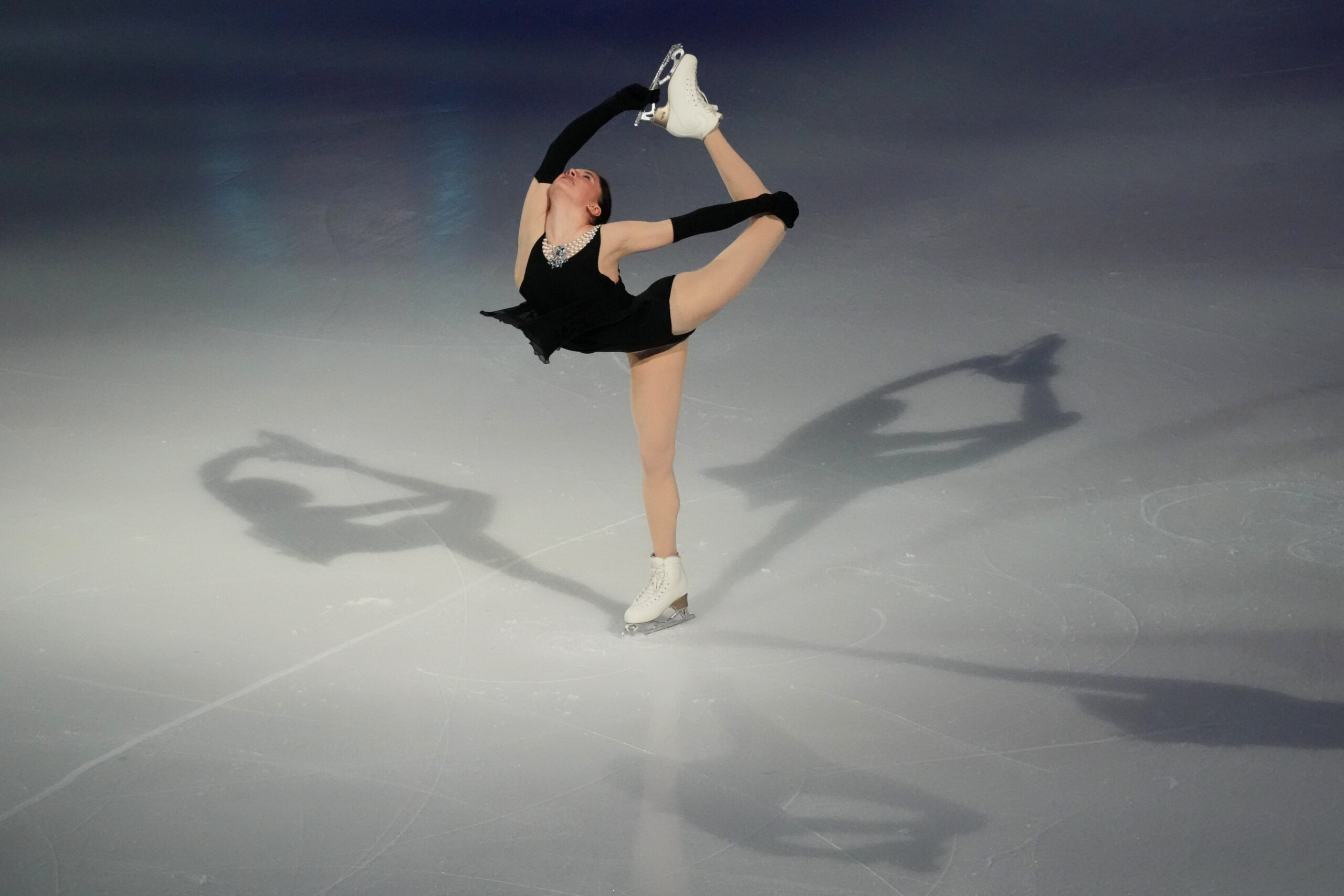
South Jersey figure skater Isabeau Levito was announced as an Olympian on Sunday. She skated during the “Making Team USA” performance following the announcement.
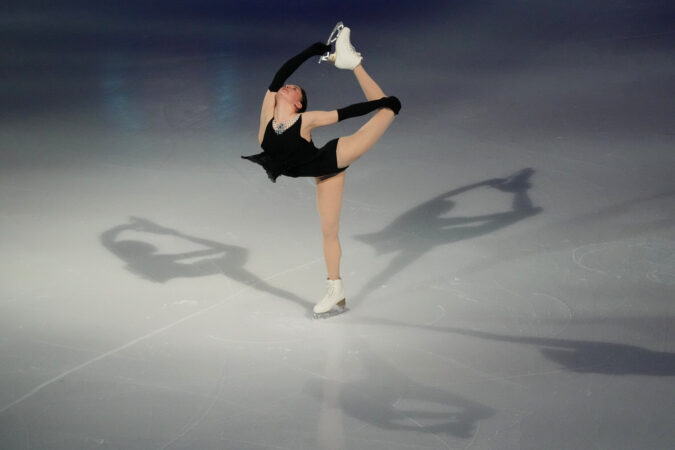
Levito was injured for a chunk of 2024-25 season, so she did not compete at the U.S. championships, but came back to place fourth at worlds. She wore this dress from that year’s program for the exhibition after making the Olympic team.
Flying high
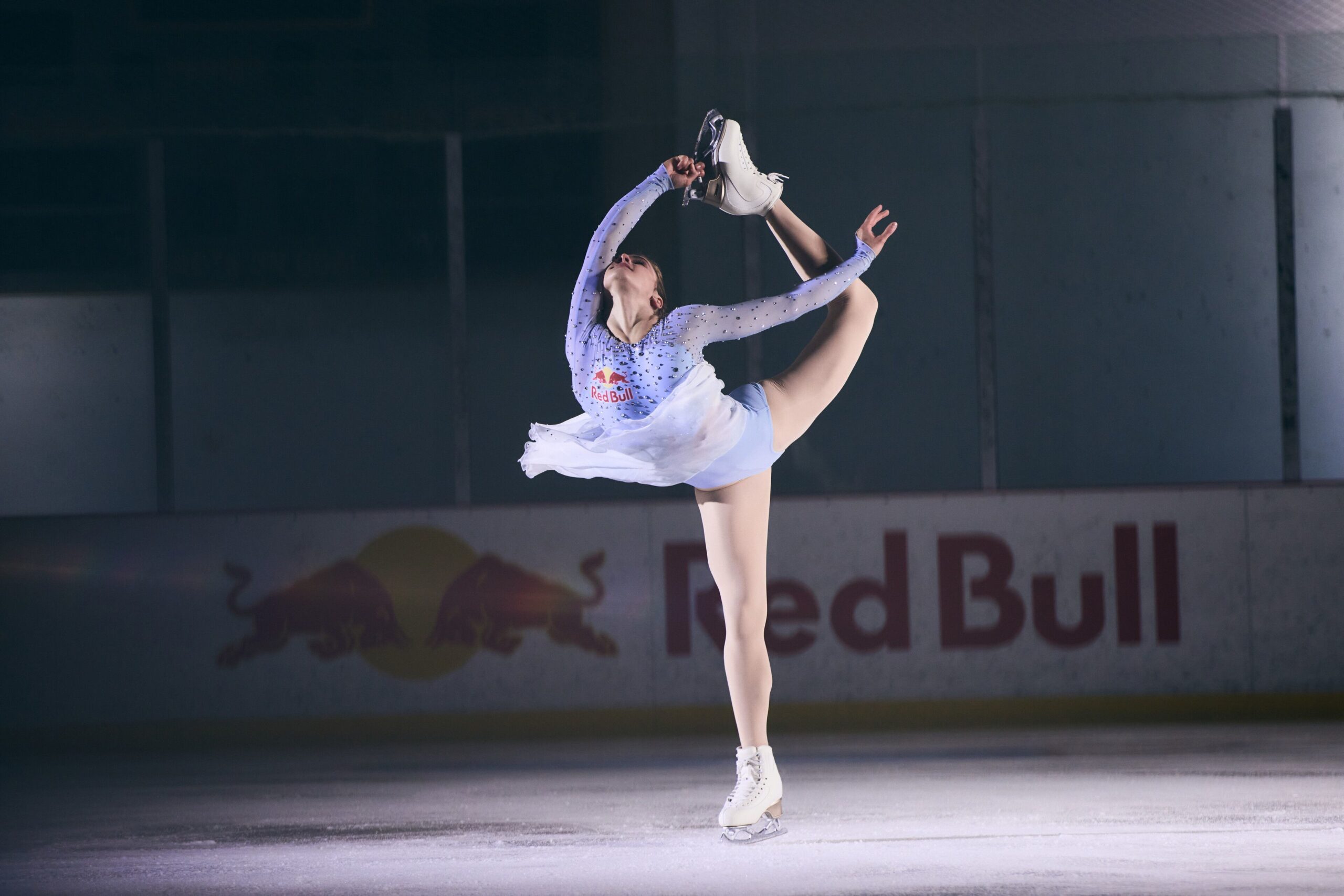
Red Bull commissioned this dress for Isabeau Levito from dressmaker Lisa McKinnon, who made costumes for all three American women in 2026, as well as many of the international competitors. It was featured in an amusing campaign on social media.
Red Bull commissioned this dress for Levito from McKinnon, who made costumes for all three American women in 2026, as well as many of the international competitors. It was featured in an amusing campaign on social media.
At 3, she had watched the 2010 Winter Games on TV and was charmed by the figure skating, mimicking Coatesville native Johnny Weir’s movements on the screen. Her mother, Chiara Garberi, thought they’d try skating and brought her to the Igloo Ice Rink in Mount Laurel. Levito quickly took to it.
The next year, she skated in her first event, the Philadelphia Areas Figure Skating Competition. She won. It was the first of many victories as she moved up the levels.
About five years ago, the 2023 U.S. champion said, it all came into focus. The Olympics could be a reality, and the 2026 Games in Milan and Cortina could be her Games.
With Italy in her sights, both of her programs this year were set to Italian music. The short is to a compilation of sassy songs from Sophia Loren movies. The free skate, or long program, is to “Cinema Paradiso” by Ennio Morricone.
In January, at the U.S. Figure Skating Championships in St. Louis, that goal became a reality. She skated two clean programs with her signature beautiful footwork and spins and won the bronze medal.
“Isabeau Levito is the skater in the snow globe,” NBC commentator and 1998 Olympic gold medalist Tara Lipinski said on the Today show.
“The Olympics is [always] in the back of your mind,” Levito said last month. “Because, technically, everything gets you there — slowly. But the next stop is actually the Olympics. It’s insane.”
Not that she has any plans to retire after this season. Levito said she already is looking forward to the offseason, when she can work on some of the hardest jumps. This season was all about consistency and her best elements.
But as she grew up, these Olympics seemed like the Games to aim for. Her mother grew up in Milan. Her grandmother and other relatives still live there. She knew she would be 18 and would have a few years as a senior competitor under her belt.
Except for some minor bumps in the plans, including an injury that took her out for much of last season, Levito’s timeline worked out. All along the way, her elegant skating earned her medals at almost every important event leading up to this month’s Olympics.
Born in Philadelphia, Levito grew up in Mount Holly and now lives closer to the rink in Mount Laurel, which has been her second home for nearly her entire life.
She was named after Michelle Pfeiffer’s character in Ladyhawke, her mother’s favorite movie.
“As a young, young kid, I was like, ‘Why is this my name?’” Levito said. “I always have to explain it.”
The pronunciation is “ease-a-bow,” Levito said, but she’s fine with people calling her “izz-a-bow.”
Isabeau Levito’s programs this season are set to Italian music, a nod to the Olympics’ location and her mother’s homeland.
She never had to move away from South Jersey to train (“We love Wawa” and she doesn’t love pumping gas, she told Team USA).
She has had the same coach — Yulia Kuznetsova — the whole time. She also works with Kuznetsova’s husband, Slava Kuznetsov, as well as Otar Japaridze, a former Georgian ice dancer, who competed in those 2010 Olympics that caught Levito’s attention. (Japaridze‘s partner was Allison Reed, who now skates with Saulius Ambrulevicius and finished sixth in ice dance, representing Lithuania.)
“I have a really, really good coaching team,” Levito said, “they kind of hit all the spots with me, and I’ve been working with them since the very beginning. I feel like they made me such a well-rounded skater.”
South Jersey figure skater Isabeau Levito skates after being named an Olympian at the 2026 U.S. Figure Skating Championships in St. Louis.
In 2020, she was one of the top two skaters in the eastern sectional at the novice level, so she was invited to skate in juniors at nationals. Most skaters who do that don’t place and need to change their programs midseason to accommodate different requirements. But Levito earned silver that year as well.
After that, she competed as a senior. Her first year, she earned the bronze medal at nationals but, at 14, was too young to make the Olympic team. (That year, both of her 2026 Olympic teammates had to sit out nationals because they had COVID-19. Alysa Liu already was a two-time national champion, so she made the team anyway. Amber Glenn had been the silver medalist the year before, but she was not chosen.)
Over the years, she won six Grand Prix series medals, including the silver at the Grand Prix Final in 2022 and the gold at the Grand Prix of France in 2023. She also was the 2024 World Figure Skating Championships silver medalist.
When she’s not on the ice, she’s decorating her apartment, reading, crocheting, bedazzling her makeup cases, and taking care of her cat.
“I wouldn’t want to do [college] online,” Levito said last March. “I would want to go in person.”
But the run-up to the Olympics has been extra busy.
“I‘m aware that if I want to go to university next year, I need to do the SATs, the college admissions,” she said in December. “So it makes me think that maybe I might wait another year.”
But first comes her Olympic debut. There is talk that the U.S. women — who named themselves Blade Angels — could sweep the podium.
The three are good friends. In December, Liu called Levito “the wittiest person I ever met.”
Glenn is the three-time U.S. champion and 2024 Grand Prix Final champion. Along with her two national wins, Liu is the reigning world and Grand Prix Final champion.
But they’re not the only stars. The Japanese team includes three-time world champion and 2022 Olympic bronze medalist Kaori Sakamoto. Her two teammates also are serious contenders.
Another contender is Adeliia Petrosian, from Russia, who is the only woman competing who is likely to attempt quadruple jumps.
“And obviously skating my best,” she said, “but I can already feel like I will. So that’s really what I’m really striving for.”
How to watch
Women’s short program: Tuesday, Groups 1 and 2, 12:45 p.m. on USA and Peacock. Groups 3, 4, and 5, 2:40 p.m. on NBC Sports Network (NBCSN) and Peacock. (Levito will skate in Group 4 or 5.)
Women’s free skate: Thursday, 1 p.m., on NBC and Peacock, 1:30 p.m. on USA.
Figure skating is one of the most popular events at the Winter Olympics.
But many only follow it every four years, which can make it confusing when the rules change — as they do annually. Most of the names also are new since 2022.
Plus, figure skating is a judged sport, so sometimes the skater you love might get dinged on rules you don’t know and not place as well as you’d expect.
Here is a breakdown of how to watch the Olympic figure skating events:
What are people talking about?
The Blade Angels
The American skaters! Team USA has been a powerhouse off and on, but 2026 is very much an on year.
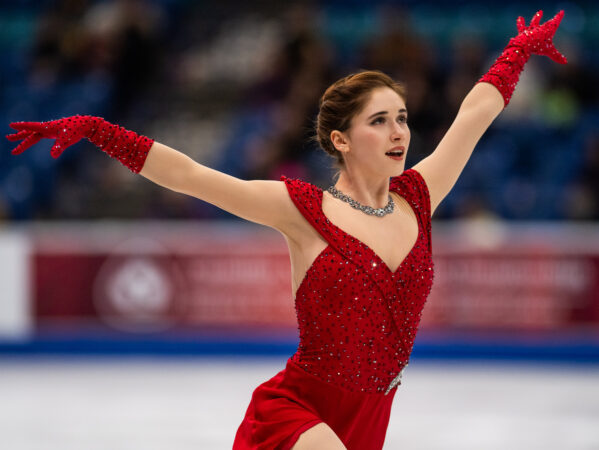
On the women’s side, all three women — who call themselves the Blade Angels — have major titles to their name. South Jersey’s Isabeau Levito is the 2023 U.S. champion and the 2024 world silver medalist. The 18-year-old was born in Philadelphia and lives and trains in Mount Laurel.
Amber Glenn is a three-time U.S. champion and won the Grand Prix Final in 2024.
Alysa Liu is a two-time national champion and the reigning world and Grand Prix Final champion.
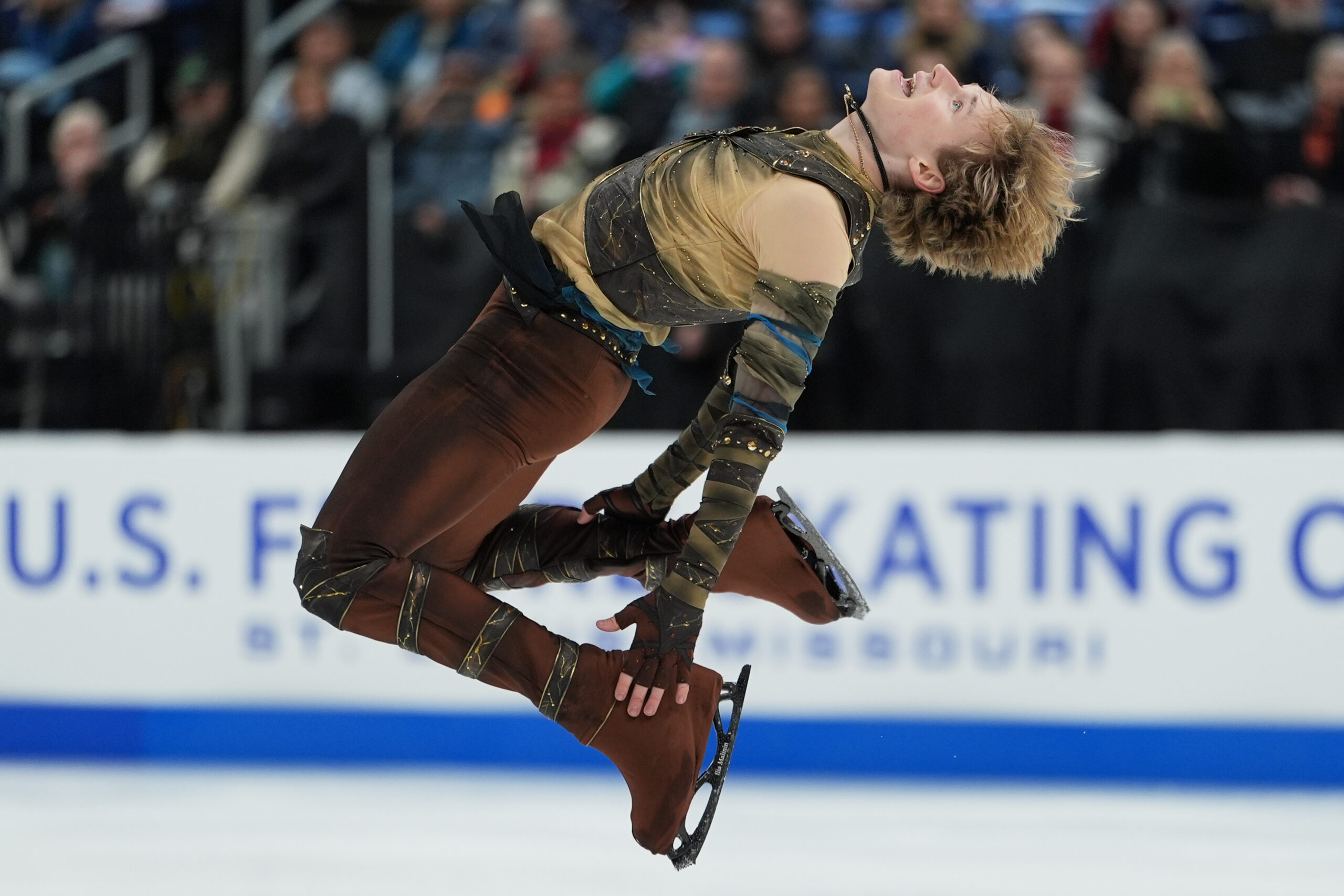
Ilia Malinin skates his program at the U.S. Figure Skating Championships in January in St. Louis.
The Quad God
Ilia Malinin named himself the Quad God early on, and he’s lived up to that name, landing seven triples (the six major jumps plus one in combination at the 2025 Grand Prix Final in December.
He is the only man in the world to land a quad axel in international competition. Sometimes called the quaxel, it is 4½ revolutions in the air with a forward (read: harder) takeoff.
The quad axel was the talk of the 2022 Olympics in Beijing because Japan’s Yuzuru Hanyu was going to attempt it. But he did not land it cleanly.
Malinin has competed it many times since then. Thanks to the difficulty of the move and his consistency, he has not lost a competition he skated in several years.
All three men on the U.S. team are second-generation skaters. Malinin’s parents represented Uzbekistan at two Games.
Andrew Torgashev’s Ukrainian mother, Ilona Melnichenko, competed for the Soviet Union and was the 1987 World Junior champion in ice dancing. His Russian father, Artem Torgashev, was a pairs skater, also for the Soviet Union, and is a two-time World Junior Championships medalist.
Ice dancer Anthony Ponomarenko’s parents, Marina Klimova and Sergei Ponomarenko, are the only ice dancers to have won an Olympic medal of every color. They are the 1992 Olympic champions.
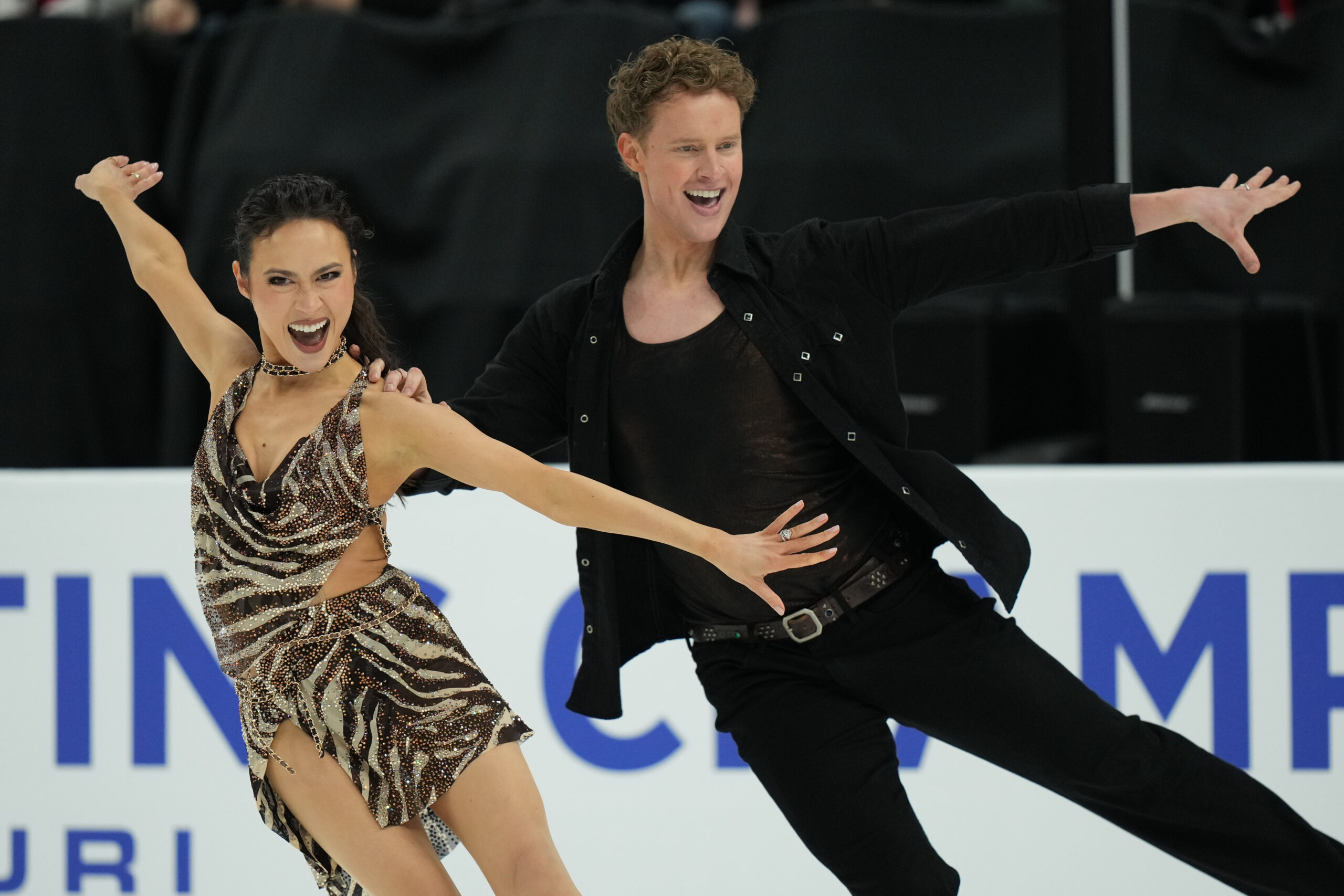
Married ice dancers Madison Chock and Evan Bates are seven-time national champions.
Chock and Bates
American ice dancers Madison Chock and Evan Bates are back for their fourth and fifth Olympics, respectively. The married couple has a team gold medal from the 2022 Winter Olympics. They are seven-time national champions and three-time world champions. The only title they haven’t earned yet is an individual Olympic medal. There are a few other teams who could challenge them for Olympic gold, but they have the edge entering the event.
The oldest competitor and whether she can skate
Deanna Stellato-Dudek is 42 and competed in singles for the United States when she was a teenager. She retired because of injury but came back 16 years later when she realized her unfulfilled Olympic dream. She competed in pairs for Team USA before teaming up with Maxime Deschamps and eventually getting her Canadian citizenship.
After a four-year ban because of the war in Ukraine, Russia was allowed to send a limited number of skaters to an Olympic qualifier competition to compete as neutral athletes. They were not considered if they had shown any support for the war. Two women qualified: Adeliia Petrosian and Viktoriia Safonova. Petrosian is in contention for a medal and likely will be the only woman to attempt quads at the Games.
One neutral Russian man was cleared to compete, Petr Gumennik. No pairs or ice dancers were allowed.
Who else is on Team USA?
The other U.S. dance teams in Milan are Ponomorenko and Christina Carreira, who’s from Canada and recently became a U.S. citizen. They are the 2026 U.S. bronze medalists and medaled twice at the World Junior Championships.
Emilea Zingas and Vadym Kolesnik teamed up in 2022 and quickly found success. They are the 2026 U.S. silver medalists.
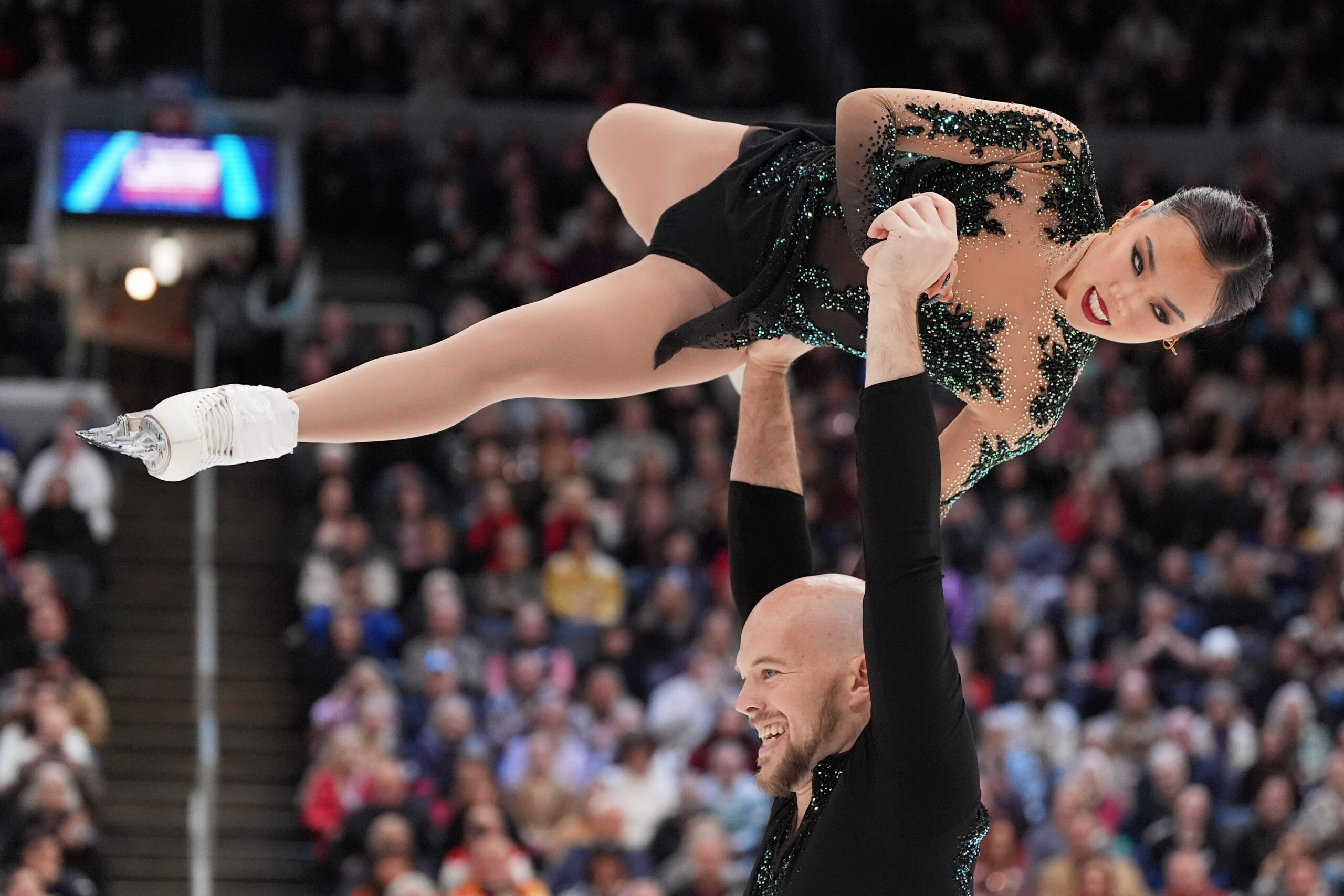
Ellie Kam and Danny O’Shea compete during the pairs free skate in January.
In pairs, Ellie Kam and Danny O’Shea, the 2026 U.S. silver medalists and 2024 champs, are fan favorites because O’Shea competed through three Olympic cycles before he made the team. They are 13 years apart.
Emily Chan and Spencer Akira Howe overcame a rough short program to place fourth (and win the pewter medal) in January’s U.S. championships. They made the team because other top teams’ skaters didn’t share citizenship. Chan and Howe are the 2023 U.S. silver medalists. Howe is in the World Class Athlete Program of the U.S. Army and hopes to become an Army chaplain.
Normally, skaters compete individually or in pairs. In 2014, the team event was added to Olympic competitions. Different skaters can skate the long and short programs for each event (men’s, women’s, pairs, dance), but a team can repeat in two events.
Only the ones chosen to skate win medals, rather than the entire Olympic team.
The team event began with ice dance on Friday and ran through Sunday. Individual events begin Monday, also with ice dance.
In 2022, Russia was poised to win the gold, with the United States right behind it and then Japan. But after 15-year-old Kamila Valieva was found with banned drugs in her system, she was retroactively banned for four years. (That period recently expired, and Valieva is training again.)
In past team events, the United States won bronze in 2014 and 2018. Russia and Canada were the other medalists both years (Russia won in 2014, and Canada in 2018).
Pairs has the big jumps, throws, and lifts. Dance is almost entirely footwork and is based on ballroom dance.
What is the difference between the short program and the long program?
The short program has a set of required elements that the skaters must perform. They have some freedom within those restrictions. For example, if they are told to do a triple jump, they may choose any triple jump. Generally, they choose the harder jumps because they earn more points. But they may also choose the jump they do best.
If skaters miss a required element, they get a zero for it. For example, if a triple jump is required and the skater does a double instead, it is as if he or she didn’t jump at all.
In dance, the short program is called the rhythm dance. A theme is chosen every year. This year, it is “the music, dance styles, and feeling of the 1990s.”
The long program has more freedom, but it still must be a “well-balanced program,” meaning a combination of elements covering the full surface of the ice.
The short program for singles and pairs is 2 minutes, 40 seconds, plus or minus 10 seconds. The rhythm dance is 2:50, plus or minus 10 seconds.
The long program for all is four minutes, plus or minus 10 seconds.
What are the differences between figure skating jumps?
The skating blade looks flat, but it actually is sharpened to a curve with two edges.
Jumps take off from an edge (axel, loop, Salchow) or from the skater tapping in his or her toe (flip, Lutz, toe loop).
The axel is a forward entry but lands backward. All other jumps start and land backward.
The flip and Lutz are very similar toe jumps, but the flip is from an inside edge, and the Lutz from the outside, meaning the Lutz requires slightly more rotation, and thus is given more points.
A common mistake is that a skater will aim to do one but change the edge at the last minute. Commentators often talk about that as a “flutz.”
Another common mistake is a “cheated” jump, meaning the blade lands at least a quarter turn short of rotation. That results in a deduction or sometimes even a downgrade, meaning an intended triple jump is called a double.
Which skaters are expected to do well?
Along with the U.S. women, the Japanese women are very strong. They are led by three-time world champion Kaori Sakamoto, who won the Olympic bronze medal in 2022.
On the men’s side, along with Malinin, the top contenders include Yuma Kagiyama of Japan, who earned the silver medal at the 2022 Olympics and is also a three-time World silver medalist. France’s Adam Siao Him Fa and Kazakstan’s Mikhail Shaidorov are others to watch.
The top ice dancers are Chock and Bates. Canadians Piper Gilles and Paul Poirier earned the silver medal behind Chock and Bates in the last two world championships.
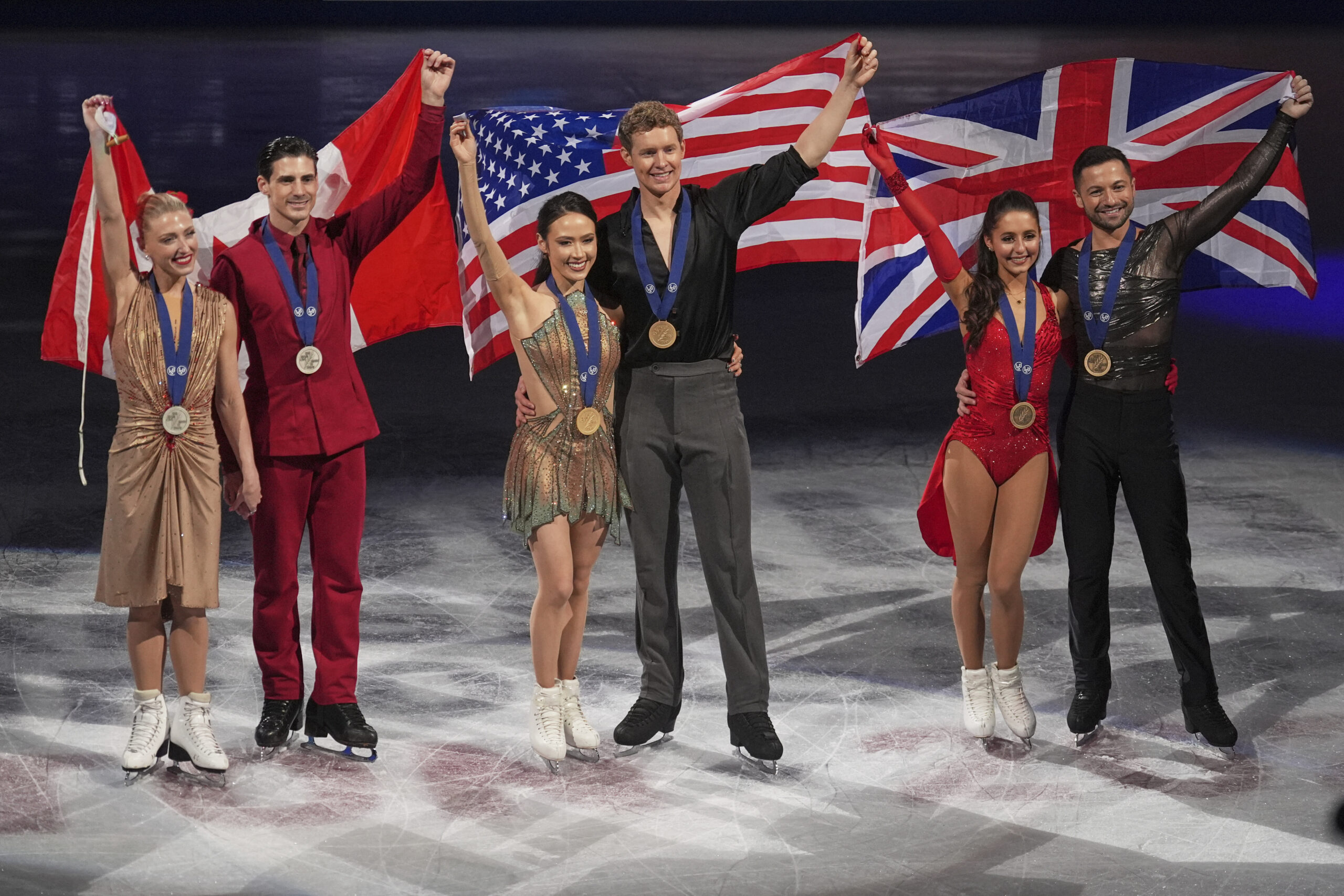
Silver medalists Piper Gilles and Paul Poirier (left), gold medalists Madison Chock and Evan Bates, and bronze medalists Lilah Fear and Lewis Gibson celebrate their medals at worlds in 2025.
The pairs contenders are led by Riku Miura and Ryuichi Kihara of Japan, the reigning world champions. Others include Sara Conti and Niccolò Macii (Italy), Minerva Fabienne Hase and Nikita Volodin (Germany), and Anastasiia Metelkina and Luka Berulava (Georgia).
How is Olympic figure skating judged and scored?
The judging system was changed after the 2002 Salt Lake Olympics judging scandal, when two judges allegedly colluded to make certain skaters champions. The 6.0 system was replaced by IJS, the international judging system, which defines how many points each element is worth.
The officials include judges and a technical panel. The technical panel determines an element — including whether a triple should be downgraded to count as a double — and the judges decide the quality of the element. Skaters may be given a positive or negative grade of execution depended on how the element was performed. They also are given points for skating skills, transitions between elements, and performance. This is how a more artistic skate with fewer big jumps, can still do well. It is also how a skater with lots of impressive jumps but easier footwork may not win.