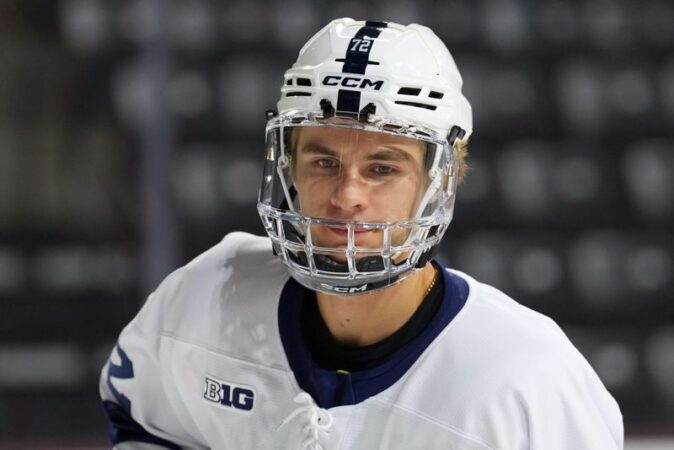
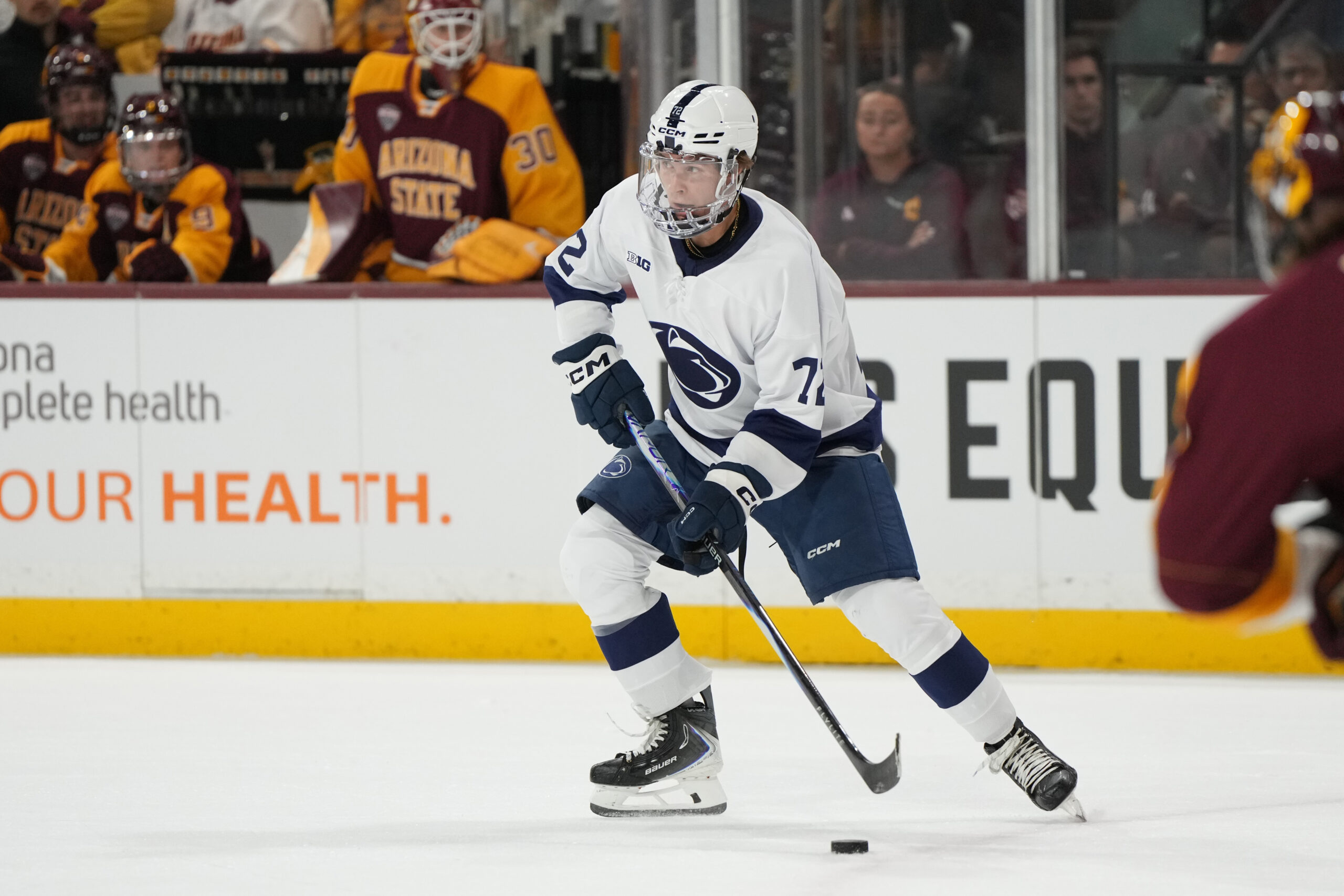
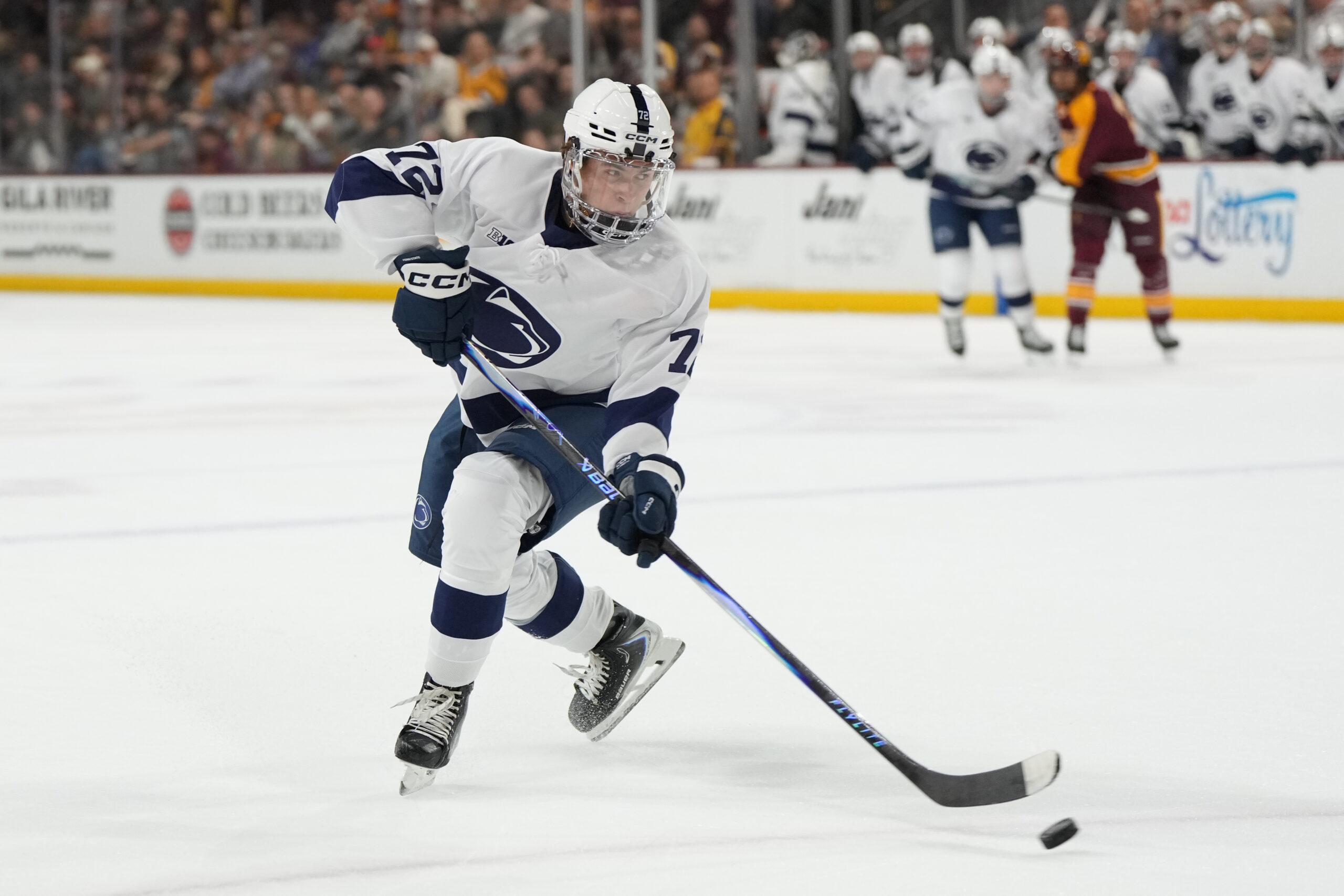
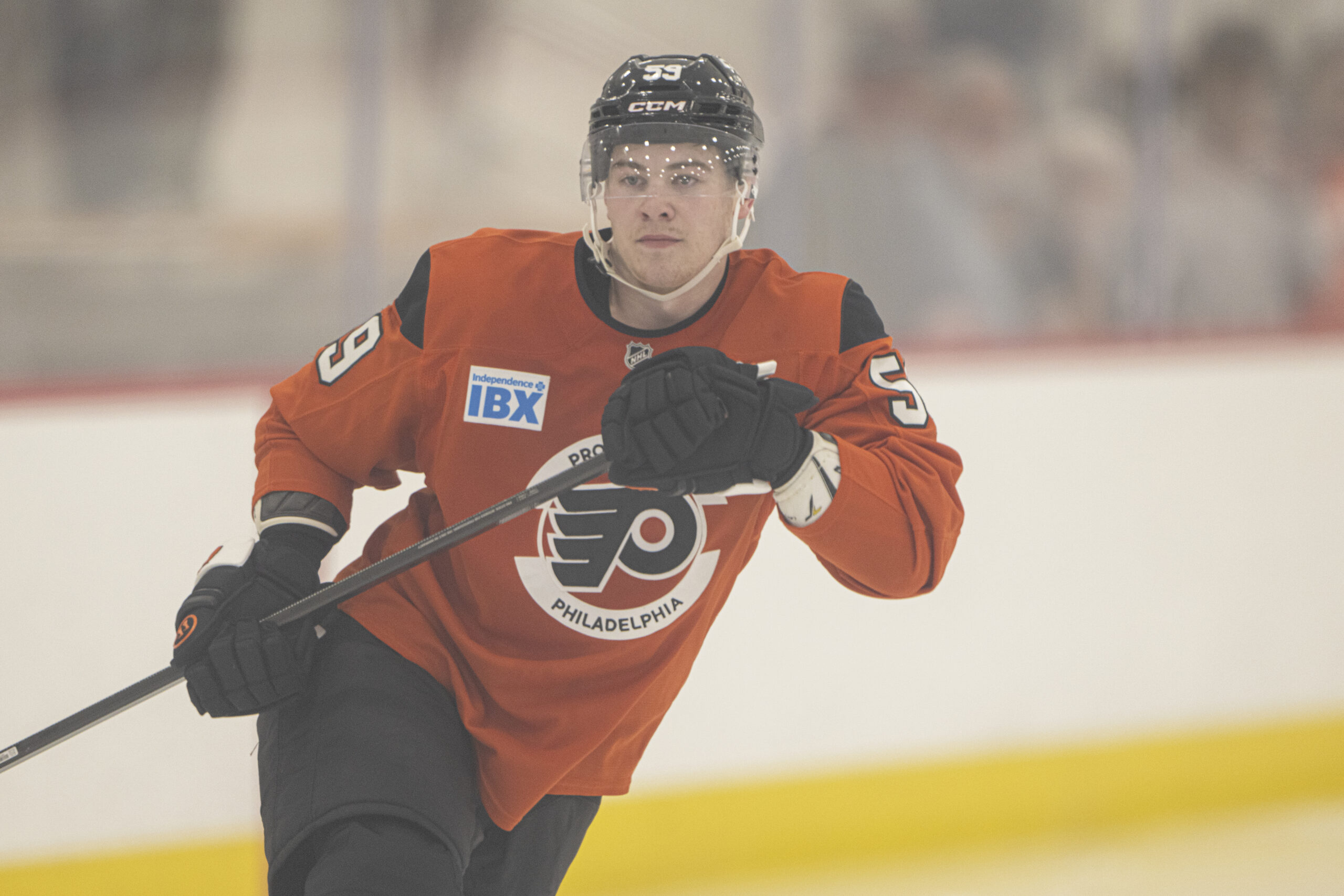
Penn State hockey star Gavin McKenna, the projected No. 1 pick in the 2026 NHL draft, will be due in court next on March 11, according to Centre County Courthouse documents.
McKenna, who is facing three charges relating to an alleged assault in State College on Jan. 31, was initially set to have his preliminary hearing on Wednesday. He is alleged to have punched a 21-year-old man twice in the face, resulting in a fractured jaw that required corrective surgery. According to police, the incident occurred after a verbal exchange between the two on the 100 block of South Pugh Street in the hours after Penn State’s outdoor hockey game against Michigan State at Beaver Stadium.
The preliminary hearing’s postponement comes less than a week after prosecutors dropped an initial felony charge of aggravated assault. The Centre County District Attorney’s Office and State College Police said in a statement that “a review of the video does not support a conclusion that Gavin McKenna acted with the intent to cause serious bodily injury or with reckless indifference to the value of human life,“ which is the standard for probable cause for aggravated assault in Pennsylvania.
McKenna, 18, now faces a misdemeanor charge of simple assault, as well as charges of harassment and disorderly conduct for engaging in fighting. The simple assault charge carries a maximum of two years in prison, while fines are attached to the three charges. He remains released on $20,000 unsecured bail.
With the preliminary hearing postponed, McKenna is expected to play for the No. 6 Nittany Lions on Friday at No. 2 Michigan, a source confirmed to the Inquirer. That game will mark Penn State’s first action since the alleged assault. Penn State’s regular season ends on March 6, with the Big Ten tournament set to commence on March 11, the same day as McKenna’s preliminary hearing.
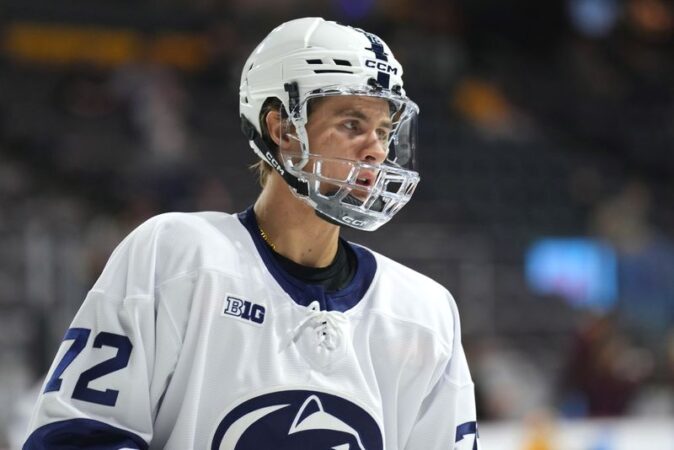
Penn State’s Gavin McKenna, who is projected to be the No. 1 pick in this year’s draft, has 32 points in 24 games so far as a freshman.
“We are aware that charges have been filed; however, as this is an ongoing legal matter, we will not have any further comment,” Penn State said in a statement on Feb. 4.
McKenna’s adviser Pat Brisson has not commented publicly on the matter.
A native of Whitehorse, Yukon, the Canadian winger is ranked No. 1 on the NHL’s 2026 Central Scouting list among North American skaters. After a new rule was passed granting Canadian Hockey League players NCAA eligibility this season, McKenna left the CHL in the summer to play college hockey.
McKenna, a freshman, is one of the biggest recruits to ever play college hockey and one of the faces of the changing landscape of the sport. He has 11 goals and 32 points in 24 games this season for Penn State, which reached its first Frozen Four in school history last season and entered this season as one of the favorites to win the national championship.
We made it, folks. After 12 years, 4,371 days, a global pandemic-enforced false start, and a little late drama about whether the rink in Milan would actually be ready in time, best-on-best men’s Olympic hockey is officially back.
The puck drops Wednesday at Santagiulia Arena with Slovakia playing Rasmus Ristolainen and Finland (10:40 a.m., USA and Peacock), and host Italy facing off with Sweden (3:10 p.m., USA and Peacock) to begin the highly anticipated Milan Cortina Olympic tournament. On Thursday, the other eight nations are in action, including the United States and Canada.
With NHL players back in the Olympics, there are storylines aplenty as the tournament commences. Here are four things we are watching for in Milan.
Flyin’ high
The Flyers weren’t exactly flying high entering the Olympics, having lost 12 of 15 games, but they will still be well represented in Milan.
Defenseman Travis Sanheim will play for gold medal favorite Canada, while Dan Vladař (Czechia), Ristolainen (Finland), and Rodrigo Ābols (Latvia) were named to the rosters for their respective nations. Unfortunately for Ābols, who represented Latvia at the Beijing Games in 2022, he won’t be able to play in Milan after suffering a severe ankle injury in mid-January. Flyers coach Rick Tocchet will also be busy in the homeland of his parents, as he will serve as a jack-of-all-trades assistant on Jon Cooper’s Canada staff.
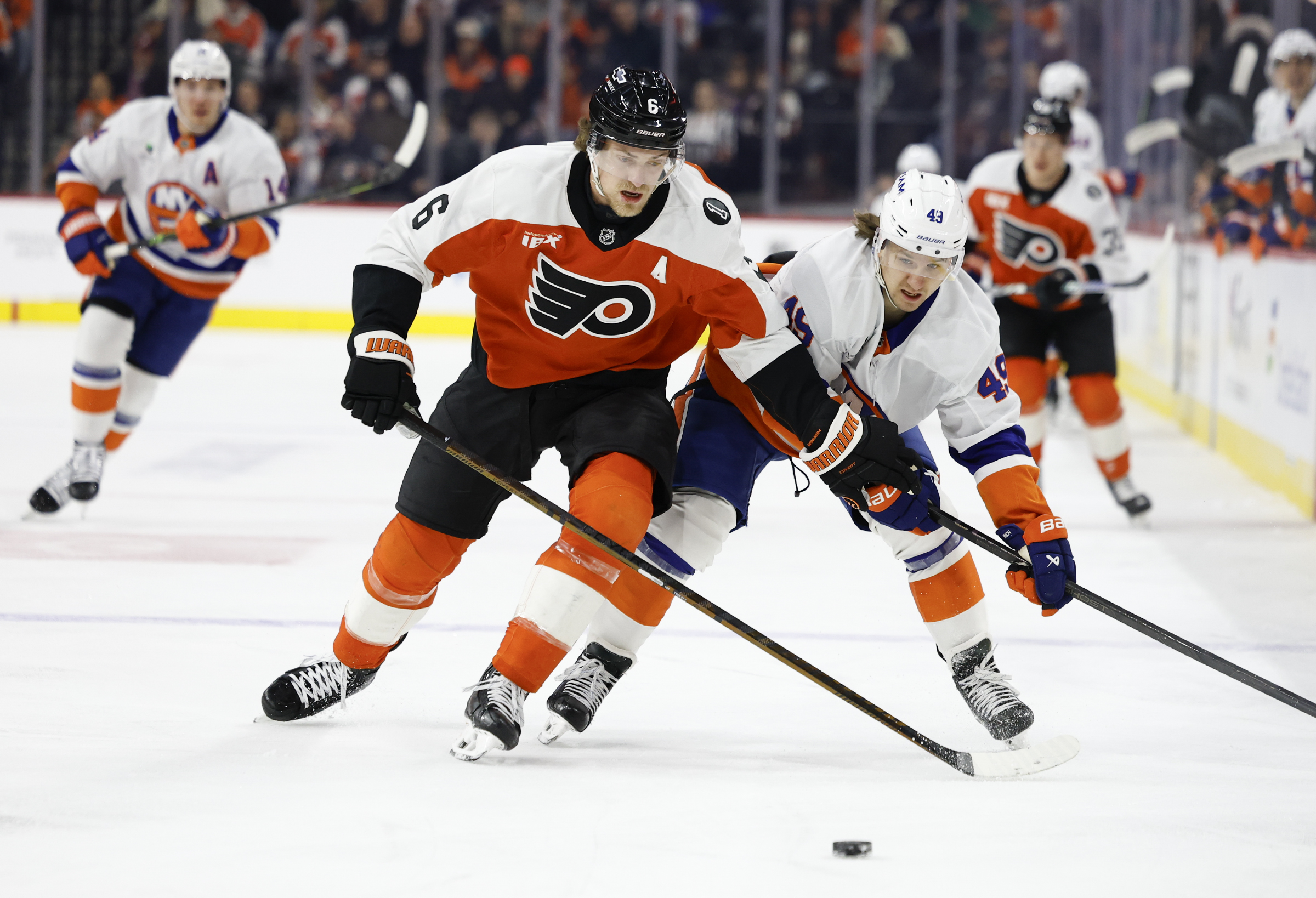
Flyers defenseman Travis Sanheim (left) will play for Canada at the Olympics.
The Flyers connections don’t end there, as some old friends will be participating, some more well-remembered than others. Radko Gudas and Lukáš Sedlák will play alongside Vladař with Czechia, while ex-coach John Tortorella, who was fired in March, will be an assistant with the Americans under Mike Sullivan.
Last but not least, Pierre-Édouard Bellemare (yes, you read that correctly) will be captaining France. Now 40, Bellemare, who made his NHL debut at 29 and played three seasons with the Flyers (2014-17), will be the oldest men’s player at the tournament as France makes its return to hockey after a 24-year wait. France’s most decorated NHL player, Bellemare, told NHL.com the “Olympics are the highlight of a lifetime … by far.”
Simply the best
While Macklin Celebrini, 19, will be making his Olympic debut, and Sidney Crosby, 38, has famously done this before given his Vancouver heroics in 2010, there are so many players in their mid- to late 20s who will be participating in their first Olympics because of the NHL’s lack of recent participation.
That includes stars like Connor McDavid, Nathan MacKinnon, Leon Draisaitl, Auston Matthews, Quinn Hughes, Cale Makar, Mikko Rantanen, David Pastrňák, Jack Eichel, and so many others. Wow.
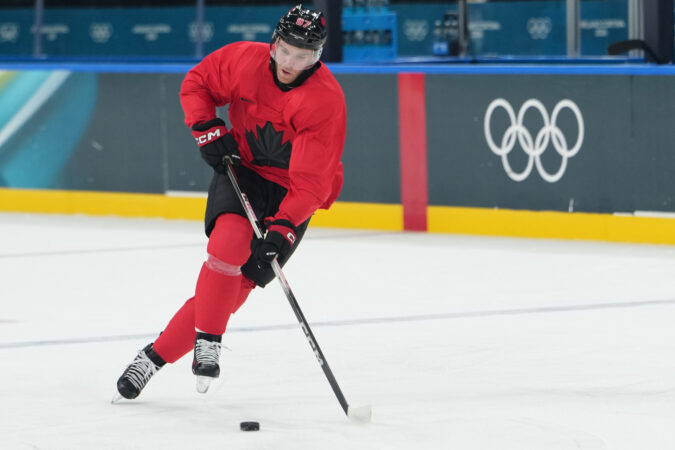
United States forward Auston Matthews takes part in practice Sunday in Milan.
Seeing a mostly full best-on-best tournament for the first time since the 2016 World Cup should provide some exhilarating hockey and drama, especially given how much the players have pushed for this over the past decade. The overall speed and skill the players possess has grown by leaps and bounds since the league last participated in 2014, and that should only enhance one of the top events of any Olympic Games, even with Russia and its star-studded roster led by Nikita Kucherov, Kirill Kaprizov, and Alex Ovechkin notably absent due to the country’s involvement in the war in Ukraine.
Heated rivalry
Last year’s 4 Nations Face-Off was designed to serve as a tasty hors d’oeuvre to the Olympics’ main course, and it left the dinner guests more than satisfied.
The NHL probably felt the tournament could be a modest success and help conjure up interest in the sport a year out from the Olympics. It exploded into something well beyond Gary Bettman’s wildest dreams, thanks in large part to three spirited bouts in nine seconds to begin a preliminary game between Team USA and Canada.
Fight Night at the Bell Centre, however premeditated it was on the U.S. side, and bolstered by the already tense political backdrop between the countries, went viral and put hockey in front of a whole world of eyes that it doesn’t usually reach. Canada would enact revenge in the final in overtime five days later, but a rivalry was renewed and the bad blood was boiled.
That rivalry, and the battle for hockey supremacy, will resume over the next few weeks in Milan as the United States and Canada seem to be on a collision course for the gold medal game. They have always been geographical rivals but never truly equals on the ice. Team USA has closed the gap on its northern neighbor, though, even to the point where a U.S. win could signal a changing of the guard to some. For the last 10 years, everyone has wanted to see the U.S. vs. Canada for all the marbles on the biggest stage. After last year’s two thrilling matchups in the 4 Nations, here’s hoping they get their wish.
United States coach Mike Sullivan skates with the puck during his team’s workout Sunday in Milan.
The American dream
Winners of two of the last three World Juniors and last year’s senior World Championship, and a few Jordan Binnington highway robberies away from 4 Nations glory, USA Hockey is sending its best-ever team to an Olympics and the message is clear: gold or bust.
On the surface, that goal might seem lofty for a U.S. team that hasn’t won gold since 1980’s Miracle at Lake Placid and that hasn’t won gold in the previous five tournaments when NHL players participated. But the Americans have been coming on for some time now and have long wanted a chance to prove they are not only Canada’s equals but have surpassed them at their own game.
After a close call at the 4 Nations, the Tkachuk brothers are back to wreak havoc as they look to unseat Canada as international hockey’s top dog.
Last year’s 4 Nations Face-Off did nothing to quell those ambitions, as the U.S. beat — and beat up — Canada on Canadian soil in the preliminary round before going toe-to-toe with the star-studded Canadiens in a nail-biter of a final. That one ended with a McDavid overtime winner that was probably a bit harsh given the quality of the Americans’ chances and Binnington’s heroics in goal. Add that Team USA’s best defenseman, Quinn Hughes, was unavailable for the tournament, and that one half of the Bash Bros., Matthew Tkachuk, was severely hobbled and mostly relegated to a cheerleader from the bench, and the U.S. has reasons to be confident. Add Canada’s uncertainty in goal and the case for the U.S. gets even stronger.
Canada is still a slight betting favorite thanks to names like McDavid, MacKinnon, Makar, and Crosby, but many think this could go either way, and with the Russians not involved and Finland and Sweden decimated by injuries in the lead-up to the tournament, this seems like the likeliest final.
Can the U.S. team get over the line this time against its archrival and claim hockey’s heavyweight title belt? If it does, there won’t be an underdog movie that begins with an “M” this time around.
Penn State hockey star Gavin McKenna remains in hot water after allegedly assaulting a 21-year-old male last weekend in State College. But the temperature cooled a bit on Friday after prosecutors dropped the felony aggravated assault charge against McKenna, the projected No. 1 overall pick in the 2026 NHL draft.
The decision comes two days after McKenna, 18, was charged with aggravated assault and three other related crimes for allegedly punching a man outside of a parking garage in the 100 block of South Pugh Street in State College. The altercation came hours after McKenna had played and tallied a goal and two assists in No. 6 Penn State’s 5-4 overtime loss to No. 2 Michigan State in the first-ever outdoor hockey game at Beaver Stadium.
“In order to establish probable cause for the crime of Aggravated Assault, the Commonwealth must establish that a person acted with the intent to cause serious bodily injury or acted recklessly under circumstances showing an extreme indifference to the value of human life,“ read Friday’s statement from the Centre County District Attorney’s Office.
”Both the District Attorney’s Office and the State College Police Department have reviewed video evidence of this incident and do not believe that a charge of Aggravated Assault is supported by the evidence. Accordingly, the District Attorney’s Office will be withdrawing the felony count of Aggravated Assault and correcting the record regarding the injuries suffered by the victim. A review of the video does not support a conclusion that Gavin McKenna acted with the intent to cause serious bodily injury or with reckless indifference to the value of human life.”
BREAKING UPDATE | Prosecutors in Centre County say they will be withdrawing the felony aggravated assault charge against Penn State's star hockey player Gavin McKenna.https://t.co/ana1PIzTcbpic.twitter.com/wZYORkx7Rp
According to State College Police, McKenna allegedly punched a man in the face twice Saturday night, resulting in a fractured jaw that required corrective surgery. The altercation came after an exchange of words between the victim and his friends and McKenna. Friday’s statement clarified that the man did not lose a tooth as previously reported and confirmed that the victim is recovering from surgery.
Penn State freshman Gavin McKenna in in the top 20 in the nation in scoring with 32 points.
While the aggravated assault charge was the most severe charge that McKenna faced, and carried a maximum prison sentence of 20 years, he is still facing a misdemeanor charge of simple assault, as well as charges of harassment and disorderly conduct for fighting. The simple assault charge carries a maximum of two years in prison, while fines are attached to the three remaining charges.
McKenna, who was released on $20,000 unsecure bail, is scheduled for a preliminary hearing on Feb. 11 at the Centre County Courthouse in Bellefonte, Pa.
Penn State sent the following statement to The Inquirer after the charges were filed on Wednesday: “We are aware that charges have been filed; however, as this is an ongoing legal matter, we will not have any further comment.”
The Inquirer also attempted to reach out to McKenna’s adviser, Pat Brisson of CAA, but has yet to receive a response.
McKenna, a native of Whitehorse, Yukon, Canada, is ranked No. 1 on the NHL’s 2026 Central Scouting list among North American skaters. The Penn State freshman, who was considered one of the biggest college hockey recruits ever, has 11 goals and 32 points in 24 games this season for the Nittany Lions. McKenna’s playing status is currently unknown, with Penn State’s next game scheduled for Feb. 13 at Michigan.
BOSTON ― Last week’s seemingly galvanizing trip west, which resulted in the Flyers grabbing five of a possible six points against some of the NHL’s best, looks to have been just another false dawn, as the sinking Orange and Black dropped their third straight game at TD Garden on Thursday.
Here are three takeaways from the Flyers’ 6-3 loss to the Bruins, which marked the team’s 10th defeat in the last 12 games.
Travis Konecny leads the Flyers in goals (21), assists (29), and points (50), and is second behind Noah Cates (plus-15) among the team’s forwards with a plus-eight rating. The veteran sniper fired a hat trick in Columbus on Wednesday and followed it up with a goal and an assist in Boston a night later.
But while Konecny has played like an All-Star and led from the front of late, the alternate captain’s raw emotion after Thursday’s game made it clear that he’s only concerned with stacking wins.
“Yeah, it’s frustrating because I’ve been through this so many times. I’m tired of missing the playoffs,” said Konecny, who has seen recent Flyers seasons slip away at this time of the year. “That is kind of all I look at right now, just want to get points for the team, and we need to figure something out.”
Forward Travis Konecny, captain Sean Couturier and defenseman Rasmus Ristolainen met with the media following #PHIvsBOS. pic.twitter.com/xPUaNFJ7ff
The answer was a painfully honest one from a player who has endured a lot of losing in recent seasons and is desperate to return to the playoffs after a five-year hiatus. Flyers head coach Rick Tocchet has talked about wanting guys who care and aren’t going to “accept” losing, and Konecny, who has matured and grown immensely as a leader in recent seasons, is clearly one of those guys who wants to be part of turning things around.
“Some guys spoke after the game, I think everyone knows where we’re at,” said Konecny. “We just got to execute. And like I said, there’s mistakes all over the ice, but you ask any of the leaders, it starts with us. Their second goal, I made a mistake there, and [we] can’t be doing that game after game. I think we all need to look in the mirror.”
There has been much social media debate about the 28-year-old Konecny, who has played 22 career playoff games but none since the 2020 COVID-19 bubble, but the Flyers could use more guys like him, and it’s concerning to think where this team might be without him.
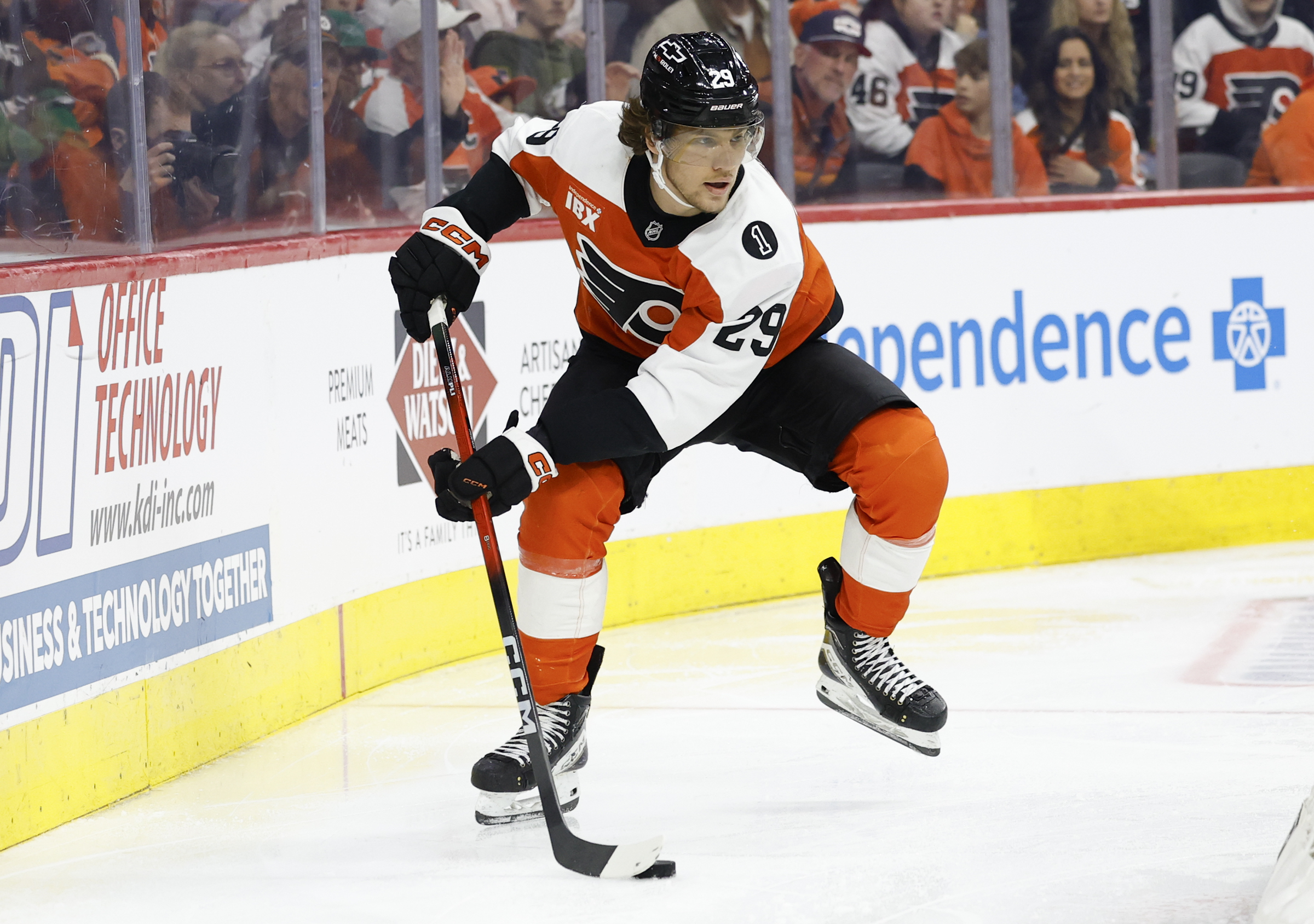
Flyers right wing Travis Konecny has been red-hot with 16 goals and 31 points over his past 28 games.
Sam’s struggles
Sam Ersson’s struggles are well-documented, as the Swede’s .856 save percentage is the lowest among the 56 NHL goalies who have played at least 15 games this season. The analytics are no better, as according to Money Puck, Ersson’s minus-18.1 goals saved above expected is the third-worst mark in the NHL and 25 goals worse than his partner, Dan Vladař.
But Thursday provided a perfect snapshot of the enigma Ersson has been, as his performance showcased why fans have grown so frustrated with the backup netminder, but also featured some flashes of why the Flyers have stood by Ersson for so long despite his struggles.
Ersson started the game brilliantly, shutting down Marat Khusnutdinov from in close just 14 seconds in, followed by a couple of 10-bell saves on Sean Kuraly from point-blank range that showcased the netminder’s athleticism. Ersson, who was always going to need to have a big game given the Flyers’ tired legs on a road back-to-back, was keeping the Flyers in it.
But then the Mr. Hyde side of Ersson reared its ugly head as it has so often over the past two seasons. Ersson was in good position to stop Viktor Arvidsson’s one-timer from 25 feet out, but the shot from the right faceoff circle, which Arvidsson didn’t get all of, snuck through the goalie’s five-hole for Boston’s opener.
The script soon repeated itself, as after Ersson made a few big saves to close the first period, he allowed another soft goal early in the second period. Fraser Minten was the beneficiary this time, as just like on Arvidsson’s tally, his shot beat Ersson five-hole on the ice. The goal served as a backbreaker as the Flyers had begun the second period strongly and were close to halving the deficit.
Ersson’s talent was on display minutes later, as down 3-1, he made a miraculous, toe save on Andrew Peeke, albeit right before Casey Mittelstadt flipped home the rebound.
“I don’t know, it’s not just [Ersson], just some of the goals, weakside stuff that we are giving up, that’s a tough one for any goalie when you give weakside goals up,” said Tocchet.
Ersson, who did not speak with the media post-game after leaving the contest after two periods with a lower-body injury, allowed five goals on 20 shots and was culpable for two tough goals against.
While Ersson has shown flashes and stretches of being an NHL goalie, he has been far too sporadic and unreliable the past two seasons for a Flyers team that needs a steady backup. A restricted free agent at season’s end, his days in Philly look to be numbered.
Grebenkin’s growth
If there was a silver lining from Thursday’s loss, it was the effort of winger Nikita Grebenkin.
The 22-year-old, who has been in and out of Tocchet’s good graces over the course of the season, had one of his best games since being acquired by the Flyers last March in the Scott Laughton trade.
Elevated to the top line for the game alongside Konecny and Christian Dvorak, Grebenkin, who Rasmus Ristolainen said “brings energy every day,” seemed to be directly involved in most of the Flyers’ best moments offensively.
Flyers winger Nikita Grebenkin is starting to play the type of game that Rick Tocchet is looking for from the power forward.
With 12 minutes gone in the first period, Grebenkin pounced on a puck in the neutral zone with speed and carried into the Boston zone. As Tocchet has so often pleaded with the Russian to do, Grebenkin used his 6-foot-2, 210-pound frame to strongly shield the puck from Jonathan Aspirot before shifting it quickly from his backhand to forehand to try and jam one by Jeremy Swayman.
Swayman stopped the initial shot, but a crashing Dvorak slammed home the rebound. While the goal was ultimately disallowed as Grebenkin was ruled to have interfered with the goaltender, it was the kind of power forward-type play teammates enjoy seeing from the youngster.
“I just love how hard he works,” Konecny said of Grebenkin. “He’s trying to learn the details of how to play the right way and he’s a great guy, too, so I love working with him. ”He’s got a lot of skill, too. So I think the more opportunity he gets, he’ll just keep running with it.”
Grebenkin was also involved in the Flyers’ first goal that stood, as directly after he fired a shot on goal, he delivered a big hit on Mark Kastelic that knocked the Bruins’ tough guy off his skates and prevented him from retrieving the puck. Seconds later, Dvorak deflected a clearing attempt from Kuraly into the slot for a wide-open Konecny to score.
Konecny responds! Great work from Grebenkin led to the disallowed goal, story is the exact same here. Having a great game.#LetsGoFlyerspic.twitter.com/QsMKl4Zq26
Grebenkin would be rewarded for his efforts with a goal at the end of the second period, as he was first on the scene to bury a rebound after Konecny’s breakaway and follow-up attempt were both stopped by Swayman. In 13 minutes, 43 seconds of ice time, Grebenkin registered a goal, five shots, and one hit, while leading the team with four scoring chances at five-on-five, according to Natural Stat Trick.
It remains to be seen if Grebenkin retains his spot on the top line come Saturday, but his encouraging performance in Boston suggests he’s earned more ice time and deserves a longer look there.
BOSTON ― Across an arduous 82-game NHL schedule, some games are bound to be uphill battles, particularly back-to-back games on the road.
Thursday night’s matchup against the Bruins was always going to be one of those games, even before the Flyers sat on the tarmac in Columbus due to mechanical issues — after Wednesday’s 5-3 loss to the Blue Jackets ― and were delayed arriving into Boston until past 3 a.m. It proved to be just that as the weary Flyers struggled to find their legs early, dug themselves too big a hole, and were blown out6-3 at TD Garden.
The opening seconds of the contest would foreshadow what would prove to be a long night, as just 14 seconds in, Boston winger Marat Khusnutdinov walked Noah Juulsen and forced Sam Ersson into a big save from in tight. Ersson would make three more athletic stops on Mark Kastelic and Sean Kuraly (x2) in the opening minutes, but the Bruins soon found a way through the Swedish netminder via his countryman, Viktor Arvidsson.
While the Flyers were running around a bit in their own zone in the lead-up to the goal, the shot was one Ersson should have stopped, as Arvidsson didn’t get all of his one-timer from the right faceoff circle following a Casey Mittelstadt feed. But the shot still managed to trickle through the Flyers netminder’s legs to give the Bruins the lead at 9 minutes, 49 seconds of the first period.
Before the Flyers could regroup it was 2-0 Boston, as Pavel Zacha snuck behind the Philadelphia defense to score the Bruins’ second just 41 seconds after their first. The route looked to be officially on, although Ersson made a few big saves to keep things at 2-0.
The Flyers looked to get back into the game midway through the opening period as Nikita Grebenkin, a rare bright spot on the night, barreled into the Boston zone with speed. His initial shot was stopped by Jeremy Swayman but Christian Dvorak was there to fire home the rebound and split the deficit … at least momentarily.
Christian Dvorak does NOT SCORE. It's overturned on a challenge.
The goal would quickly be taken off the board as Boston successfully challenged for goaltender interference, with the situation room in Toronto ruling that Grebenkin’s stick, which was caught in Swayman’s equipment, impeded the goaltender from resetting and making the save. The teams would go to their respective dressing room’s with the score at 2-0.
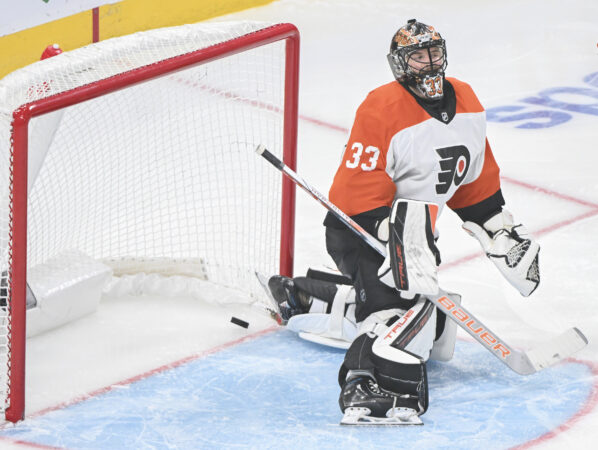
Flyers goaltender Samuel Ersson held off the Bruins as long as he could in a 6-3 loss.
After a more energetic start to Period 2 from the Flyers, Boston made it 3-0 just over two minutes into the frame. Fraser Minten glided down the left wing and beat Ersson five-hole with a shot on the ice. after the Bruins had turned a Bobby Brink turnover into a transition three-on-two. The goal was another that Ersson will feel he should have stopped, especially after he had made a couple more difficult saves just prior.
Travis Konecny, who had a hat trick Wednesday in Columbus but was a game-time decision after taking a puck off the foot, got the Flyers on the board less than a minute later, thanks to great hustle from Grebenkin and Dvorak, which forced a Bruins turnover in their own end. Konecny corralled the loose puck alone in the slot and beat Swayman clean for his 21st of the season.
Konecny responds! Great work from Grebenkin led to the disallowed goal, story is the exact same here. Having a great game.#LetsGoFlyerspic.twitter.com/QsMKl4Zq26
The Flyers then earned a power play and made a bit of a push, only for Boston to increase its lead back to three goals through Mittelstadt. The former Buffalo Sabre flipped a backhander over a sprawling and helpless Ersson, who had just robbed Andrew Peeke on the initial shot, and just under the bar. Tanner Jeannot then would make it 5-2 Boston with a tip on a Peeke point shot at 18:40 of the second. Ersson, who allowed five goals on 20 shots, suffered a lower-body injury at the end of the second period and would be replaced by Dan Vladař for the third.
Grebenkin would finally get a well-deserved goal to wrap up the scoring in the second, hustling in to bury a rebound after Konecny had a breakaway and follow-up attempt stopped by Swayman. The Russian winger, who was the Flyers’ best forward of the night, seemed to be at the center of most of the good things the Flyers did offensively and was praised afterward by his teammates for his energy.
With Boston well in front, the Flyers controlled most of the third period, outshooting Boston 15-7 in the frame and 36-27 for the game, but it would be for naught. The Bruins would stretch their lead to 6-2 with 3:30 remaining in the third, as Khusnutdinov found the empty net after Tocchet had thrown caution to the wind and pulled Vladař.
Matvei Michkov would pull one back on the power play with under two minutes remaining to improve the optics on the scoreboard. Denver Barkey dug the puck loose with some good work in front and a few whacks and, after kicking the puck to his stick, found the Russian at the back post for a tap-in. The goal was Michkov’s 13th of the year, while Barkey notched his ninth NHL point in 19 games since being recalled on Dec. 19.
But it was too little, too late for the Flyers, who dropped their third straight and fell eight points below the playoff line in the Metro and 10 behind Boston in the wildcard.
Breakaways
Rasmus Ristolainen, who was a game-time decision and did not take line rushes during warmups, suited up and played just under 22 minutes. He said he felt good afterward and was frustrated that he left Wednesday’s game after landing awkwardly on a puck. … The Flyers went 1-for-3 on the power play and killed off the lone Boston opportunity with the man advantage. … The Flyers have Friday off and will return to action Saturday at 12:30 p.m against the Los Angeles Kings at Xfinity Mobile Arena (NBCSP).
Losers of seven of their last eight games, Rick Tocchet’s men, who have resided in a playoff spot for most of the season, are in free fall and now sit three points out of both the final spot in the Metropolitan Division and the wild card.
With injuries piling up, the latest suffered by indispensable goaltender Dan Vladař, and a condensed schedule, the Flyers are in real danger of falling out of the postseason race before the March 6 trade deadline.
The recent slide has also made painfully obvious what many already knew: The Flyers aren’t nearly as close to contending as they think they are.
Why?
For all their improvement and the savvy acquisitions of Trevor Zegras, Christian Dvorak, and Vladař, the Flyers have yet to acquire maybe the most important ingredient to any contending hockey team: a No. 1 center.
To make matters worse, they don’t look to have a prospective solution to that problem in their farm system, as Jett Luchanko, Jack Nesbitt, and Jack Berglund all project to top out as middle-sixers.
Florida had Aleksander Barkov. Vegas had Jack Eichel. Colorado had Nathan MacKinnon. Tampa Bay had Brayden Point. The Flyers have … Christian Dvorak? That’s not to say the Flyers are simply a 1C away from doing laps around the ice with a 35-pound silver bowl over their heads, but until they find one, everything else they do is more or less a futile exercise.
That brings us to Robert Thomas, a bona fide top-20 center who some around the league believe could be pried away from St. Louis — he is listed on both the Athletic and Daily Faceoff’s most recent trade boards — for the right price. Thomas, who turns 27 in July, is one of the league’s top playmakers and has tallied 80-plus points in each of the last two seasons.
There’s a lot of speculation that the St. Louis Blues will listen to offers for talented center Robert Thomas.
In addition to his tremendous vision, he’s a sturdy 207 pounds, possesses above-average speed, wins faceoffs (53.4% since 2022-23), and plays a responsible 200-foot game — a trait the Flyers clearly prioritize in their centermen.
In other words, he’s exactly what the Flyers need.
Did I mention he’s already won a Stanley Cup and is signed for five more seasons after this one at a below-market average annual value of $8.125 million?
So is Thomas actually available? That depends on whom you ask, but with the Blues tied for the league’s second-fewest points, it would be surprising if general manager Doug Armstrong wasn’t at least listening on pretty much everybody.
Armstrong all but confirmed that in December when he said, “There’s really no untouchables — not [just] on the St. Louis Blues, [but] there’s really few untouchables in the league. There’s a lot of other guys that, when things aren’t going well, I would say that [trade] list grows.”
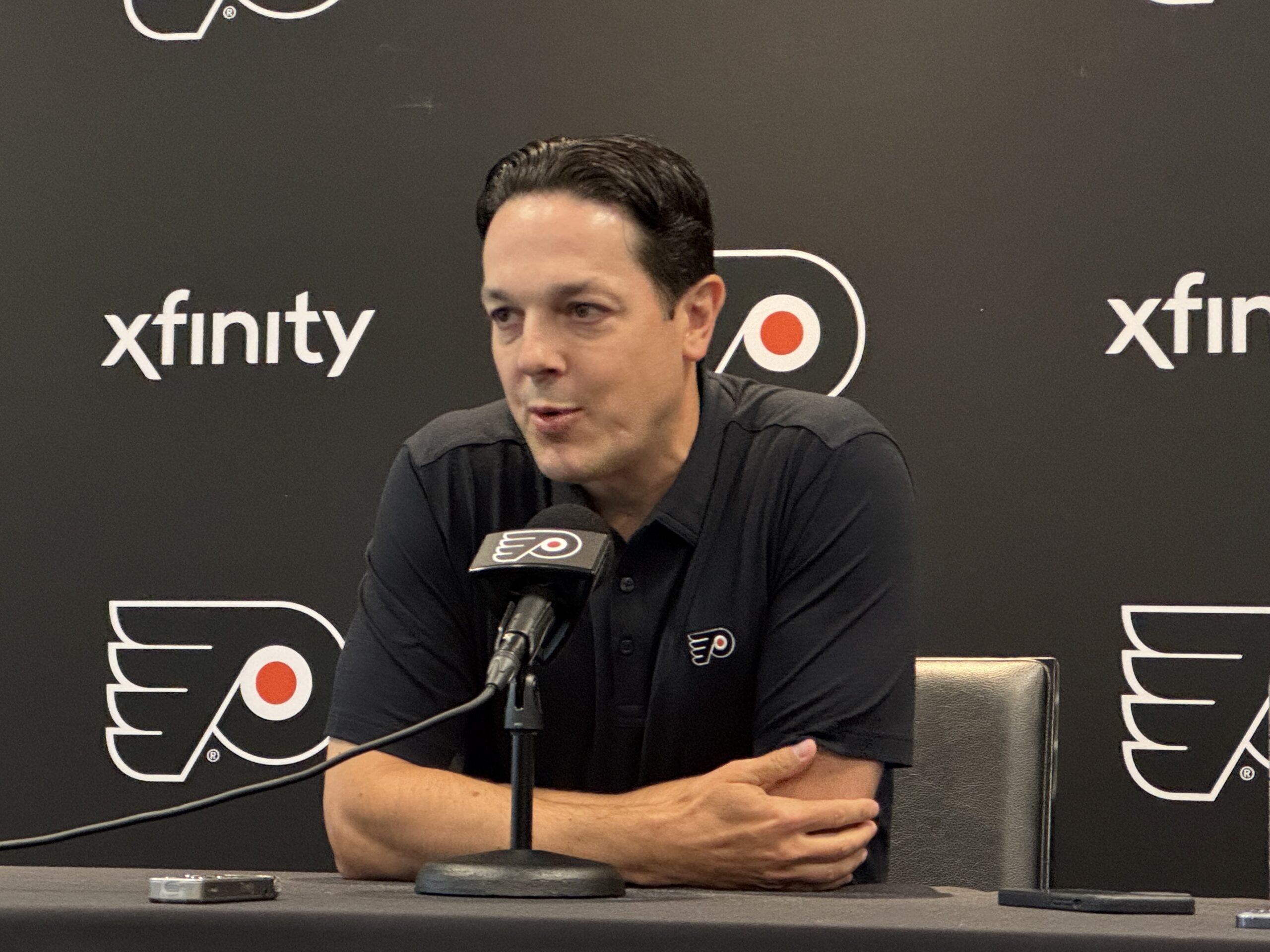
Danny Brière and Armstrong are no strangers, as the two did a deal in 2023 involving Kevin Hayes, and infamously had another deal centered on Travis Sanheim nixed at the 11th hour. So with a gaping hole down the middle and armed with a deep prospect pool and three first-round picks over the next two drafts, why wouldn’t Brière blow Armstrong away with a deal he can’t refuse?
Flyers general manager Danny Briere has acknowledged the team’s need to upgrade down the middle. Could Robert Thomas be the answer?
Assuming that Porter Martone, Matvei Michkov, and potentially Tyson Foerster are off the table, any deal will start with at least one first-round pick in 2026 or 2027, a center prospect, and a combination of one or two more picks, prospects, or young roster players.
The Blues would have their pick of Luchanko and Nesbitt and would likely covet another first-rounder in a 2026 draft — the Flyers would likely prefer to trade a 2027 first since they have two of them — that features three blue-chip prospects in Gavin McKenna, Ivar Stenberg, and Keaton Verhoeff.
It’s worth mentioning that Stenberg’s brother Otto plays for the Blues, and with a closely-contested East and the Flyers’ precarious position at present, St. Louis might gamble that the Flyers’ draft pick would land them a second selection inside the top 10.
St. Louis also is likely to ask for a youngish defenseman to go the other way, which would mean Cam York, Jamie Drysdale, Oliver Bonk, or Emil Andrae.
The Flyers would likely balk at moving York, a key part of their blue line who just signed a five-year extension, while the 23-year-old Drysdale’s value has decreased, not to mention that he’s a restricted free agent at season’s end and would require a new deal. That leaves Bonk and Andrae as the most realistic targets, with the former, a first-rounder in 2023, having the higher upside.
Rounding out the deal would be another draft pick — let’s say a second — or a prospect or young roster player. Would the Blues have interest in Bobby Brink or Nikita Grebenkin as cheap wingers who can play up and down the lineup and have some untapped potential? St. Louis native Shane Vansaghi, a bruising second-rounder from this past June’s draft with a unique skill set, is another player who might intrigue Armstrong.
Flyers defensive prospect Oliver Bonk could be an intriguing player to the rebuilding St. Louis Blues.
The Flyers are in a tough spot, as they need a No. 1 center and are unlikely to have a pick high enough to draft one — 19 of the 27 players I’d characterize as No. 1 centers were top-10 picks, with 15 of them selected in the top three — and there are none available this summer in free agency.
That leaves a trade as the likeliest path, and even those options are largely limited to guys either on the wrong side of 30 or younger, distressed assets looking to rediscover their 1C potential à la Seattle’s Shane Wright.
Thomas represents something different entirely. He’s a proven commodity who not only fits the right age profile but has 5½ years of control. His high-danger passing would also be a tantalizing proposition alongside exciting wingers like Zegras, Michkov, Martone, Foerster, and Travis Konecny. If you have to overpay for someone like that, so be it.
Would a 2026 or 2027 first-rounder, Luchanko, Bonk, and Brink get a deal done? And is that too much for Thomas, who is having a down year with 11 goals and 33 points in 42 games?
The Flyers need to get uncomfortable and take some risks if they are going to address the organization’s biggest need. Until they do, they will be stuck in NHL purgatory, the worst place an organization can be.
It’s been a frustrating year-plus for Carter Amico.
In November 2024, the Flyers prospect suffered a broken kneecap while playing for the United States national team development program. The injury, subsequent surgery, and recovery cost him all but 17 games in his draft year, and contributed to him slipping out of the first round in June’s draft.
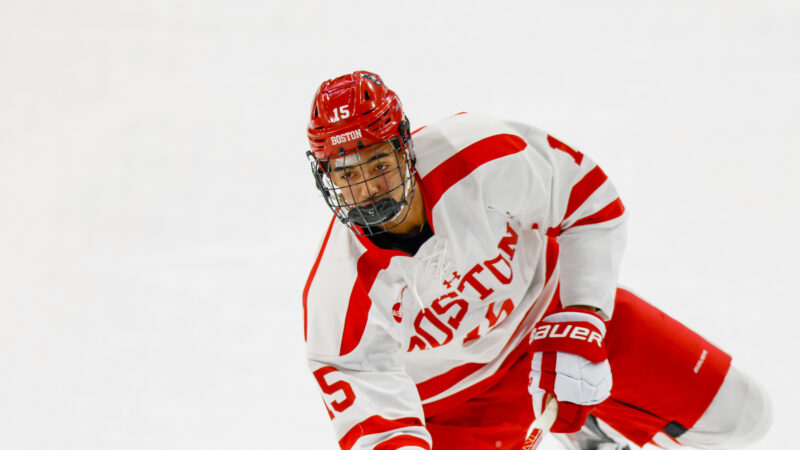
The Flyers ultimately selected the towering 6-foot-5, 225-pound defenseman with the 38th pick and hoped to watch him develop under the tutelage of coach Jay Pandolfo at Boston University. That was not to be, as Amico has left the program halfway through his freshman year to join the Muskegon of the United States Hockey League for the remainder of the season.
Woah!! The Lumberjacks have a big new defenseman in town, and we mean big!
The Maine native had played in 18 of the Terriers’ 21 games this season but was not getting big minutes and did not register a point. Amico was a minus-seven on the season and did not play in any of BU’s three games last weekend.
He will join the reigning USHL champion Lumberjacks, who are currently in fourth place in the Eastern Conference. Last week, Muskegon’s best player and projected top-5 2026 NHL draft pick, Tynan Lawrence, left the Lumberjacks to enroll early at Boston University. In essence, this became a one-for-one swap.
A source told The Inquirer that the move will allow Amico an opportunity to play more minutes as he continues to work back from his injury and added that the defenseman could enroll at another NCAA school next season.
The Flyers remain high on Amico, who is an agile skater for someone his size, brings physicality, and has shutdown potential. The 18-year-old, who missed the team’s offseason on-ice sessions while rehabbing his knee, will hope a fresh start in the USHL will get him back on track.
“He was high on our list,” amateur scout Shane Fukushima said at the draft last year. “He’s a massive body that missed the majority of the year; I think if that had not happened, he would have been selected higher in the draft. We feel that the upside is high and he’s just scratching the surface.”
It’s been about four months since it was announced that pro hockey was returning to Trenton after a 13-year hiatus. On Tuesday, that hockey team officially got a name: the Ironhawks.
The Ironhawks, who will begin play next season in the ECHL, the third tier of North American professional hockey, announced the name and unveiled the team’s logo on Tuesday at CURE Insurance Arena in Trenton. The team, which will serve as the ECHL affiliate of the Colorado Avalanche, landed on the name after a two-month name-the-team contest that featured over 2,000 entries.
After more than 2,000 submissions in a name-the-team contest, the @ECHL's newest team was revealed as the Trenton Ironhawks – a nod to the city's iron industry and its grit and strength.
The @trentonironhawks begin play in October at Cure Insurance Arena in Trenton, NJ. pic.twitter.com/6BgRjOeLlD
“Today marks an important milestone as we officially announce our franchise name, the Trenton Ironhawks, and prepare to bring a new era of professional ECHL hockey to Trenton,” team president Bob Ohrablo said.
“The hawk symbolizes strength and spirit, while the iron industry and its workers remain vital to Trenton’s economy through their grit and determination. By combining these elements into Ironhawks, we honor Trenton and reflect the team we are building, representing the city and the surrounding region, including Central New Jersey and Bucks County, Pennsylvania.”
Trenton was officially awarded the franchise, which was previously based in Utah, in September, with new owner Pro Hockey Partners moving the team. The city was previously home to the Titans, who played in the ECHL from 1999 until they folded in 2013. The Titans won their lone Kelly Cup in 2005.
“The return of ECHL hockey to Trenton is extremely exciting as we welcome the market back to our North Division for the 2026-27 Season amidst new teams and rivalries in the region,” ECHL Commissioner Ryan Crelin said in September. “The original ECHL team served as a catalyst to the opening of CURE Insurance Arena back in 1999 and growing the hockey community in New Jersey, and we look forward to reinvigorating the live entertainment experience in the marketplace with an ownership and operating group that is experienced in developmental league sports.”
The Ironhawks’ primary colors will be blue, gray, and red, while the logo is a silver iron-coated hawk with blue and red accents that is landing on a hockey stick. The hawk’s eyes are red to represent the fire and intensity in his eyes, according to the team’s release.
“The arrival of the Trenton Ironhawks is an exciting moment for our city,” Trenton Mayor Reed Gusciora said. “This team brings new energy to the CURE Insurance Arena and creates opportunities for residents, visitors, and local businesses alike. The name Ironhawks reflects Trenton’s industrial roots and the strength and resilience that define this community. This is a proud new chapter for Trenton sports.”
Every December and January, the World Junior Championship delivers exhilarating hockey, unrivaled drama, and a lot of debate surrounding the sport’s top under-20 prospects, some of whom have been drafted and others who are about to be.
While the 10-day tournament in isolation is far from a perfect way to evaluate prospects, it does provide a snapshot to gauge players’ development and a chance to see how they perform in a best-on-best environment.
“It’s not a be-all, end-all. Especially in Canada, it gets so blown up on the stage, people get crazed if guys don’t make it or make it,” Flyers assistant general manager Brent Flahr recently told The Inquirer of the tournament.
“But the thing that fans don’t understand is that the coaches of those teams and management have different goals than what we have. … There’s been lots of great players who have been cut [or have lesser roles] that go on to have great careers,” Flahr said.
That brings us to the Flyers, who were well represented in Minnesota’s Twin Cities. Amid the team’s ongoing rebuild and the high-end nature and sheer volume of the team’s draft picks in recent years, the Flyers sent six prospects — tied for third-most among NHL teams — to this year’s edition of the tournament.
Here’s a look at how each of the six performed relative to expectations. (These grades are purely based on performance at the World Juniors and are not reflective of prospect rankings or the players’ seasons overall.)
Jack Berglund, C, Sweden
Jack Berglund’s skating has come on over the past year but the rest of his game is well-rounded.
Captain Jack led Sweden to its first World Junior gold in 14 years and only its second in the past 45, and was dominant along the way. Berglund plays well-rounded and winning hockey and is almost impossible to get the puck off of.
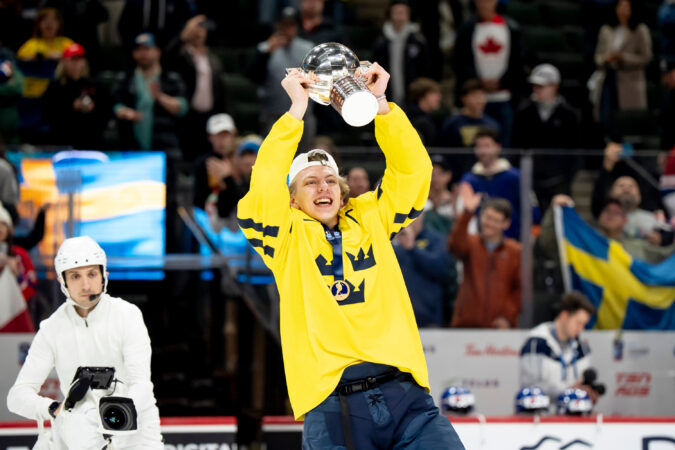
While Anton Frondell scored more goals, and 2026 draft eligibles Ivar Stenberg and Viggo Björck earned most of the headlines, Berglund was the unquestioned heartbeat of Team Sweden and led by example like a captain should from the opening puck drop.
The 2024 second-round pick tallied three goals and a joint team-high 10 points in the tournament and delivered several clutch moments in the knockout rounds, including scoring a do-or-die penalty shot to keep Sweden in the tournament in the semis and delivering assists on Sweden’s first two goals in the gold medal game.
Berglund’s skating and lack of speed will always come under scrutiny, but he plays at his own pace, and his strength and reach at 6-foot-4 and 210 pounds allowed him to get where he needed to go at this level.
Berglund’s a horse when it comes to puck protection and wall work, and after some early skepticism, he has now aced his last three major test: Flyers development camp, the World Junior Summer Showcase, and the World Juniors.
Grade: A
Heikki Ruohonen, C, Finland
Finland center Heikki Ruohonen always seems to save his best for international competition.
Ruohonen, a player the Flyers’ brass has gone out of its way to namecheck the past few years when asked for under-the-radar prospects, backed up that praise in Minnesota with a strong tournament.
For my money Finland’s top player at the event, the 2024 fourth-rounder led Suomi with nine points (three goals, six assists) across seven games and was a plus-six.
Not the flashiest guy, Ruohonen has great hockey sense and always seems to make the right play. He’s also very calm with the puck under pressure and empties the tank shift to shift from a competitiveness perspective.
The Harvard freshman impressed me here with his ability to transport the puck, and I think he has a little more skill and cleverness with the puck than he gets credit for. Though still a few years away, he’s definitely one to monitor.
Grade: B+
Porter Martone, RW, Canada
Canada’s Porter Martone was good but not great at the recent World Junior Championship.
Martone was good: He led the tournament with six goals and had nine points in seven games. But he wasn’t nearly as impressive or impactful as those numbers might suggest while captaining a Canada team that fell short of the expectation of winning gold.
Three of Martone’s goals and five of his points came in 7-1 and 9-1 blowouts of overmatched Slovakia and Denmark, and another one of his goals was an empty-netter against Czechia.
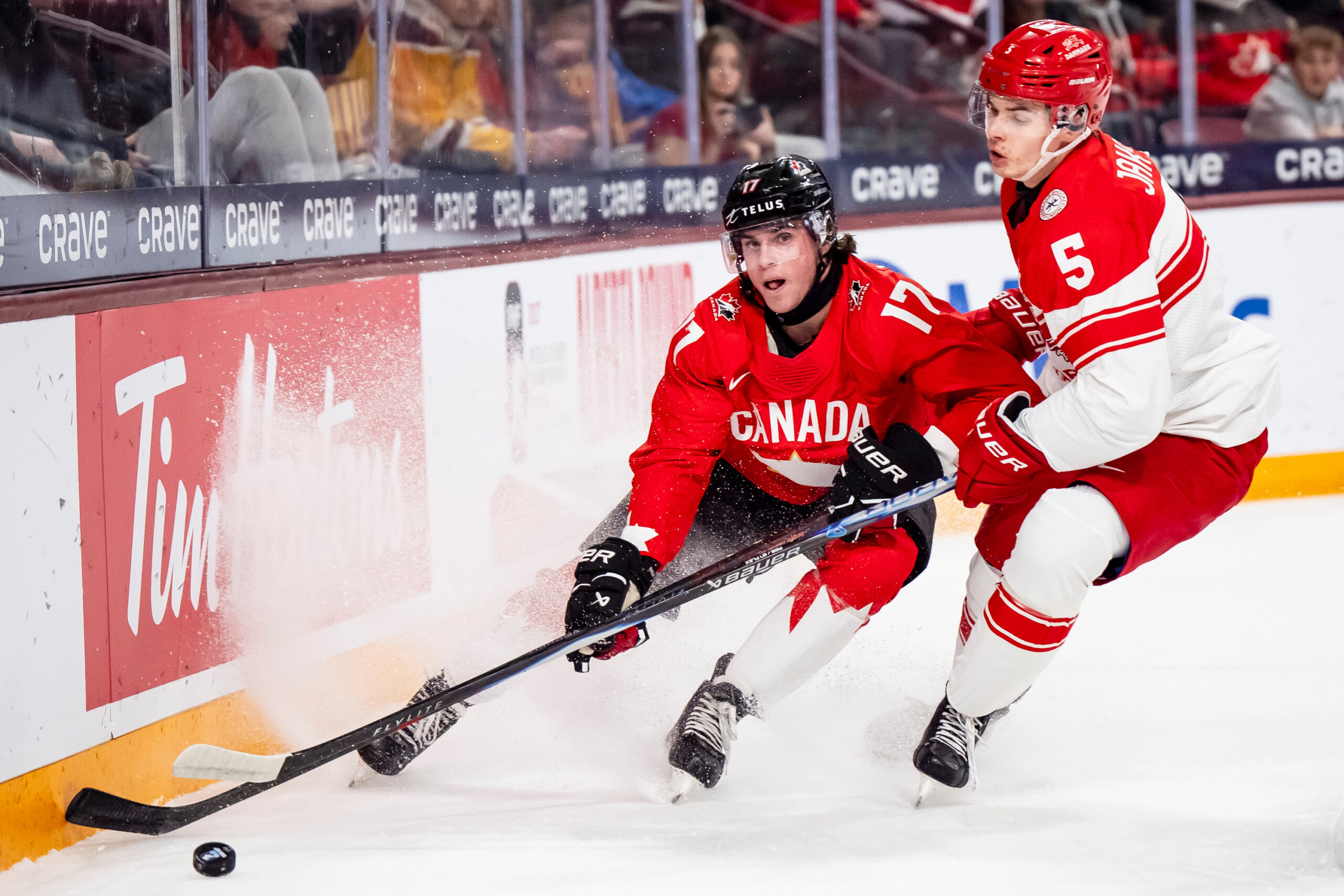
Speaking of that empty-netter, his controversial butt tap of a Czech player afterward earned him a silly unsportsmanlike conduct penalty and ultimately came back to bite him and Canada when Czechia got the last laugh and knocked them out in the semifinals.
Martone did score a clutch tying goal late in that semifinal, which was a huge moment and should not be discounted, but big-time plays in the biggest games were few and far between across the tournament for a player whom many expected to dominate.
This grade might seem a tad harsh, but I thought Martone, who has the potential to be a truly special player given his combination of size, skill, and snarl, disappeared at times and wasn’t the consistent driver Canada needed atop its lineup.
Grade: B
Max Westergård, LW, Finland
Max Westergård has some intriguing offensive skills and already has a fan in former Flyers star and current team adviser John LeClair.
It’s early, but the Flyers might have found something in Westergård, a 2025 fifth-round pick. One of the youngest players in his draft class, Westergård was noticeable on almost every shift and consistently made things happen offensively with his speed, vision, and skill.
Max Westergard might legitimately be my favorite prospect in the organization. He's mesmerizing to watch skate with the puck. Almost got a breakaway goal here off his pure speed.#LetsGoFlyerspic.twitter.com/uW36hYjRyj
Westergård looked threatening in transition throughout and also worked hard below the goal line to retrieve and keep the puck. He had a goal and four points in six-plus games — he probably deserved a few more — before being knocked out of the bronze medal game early after taking a big hit from Canada’s Kashawn Aitcheson.
Relative to expectations, Westergård improved his stock the most in my eyes and should be a leading contributor for Finland at next year’s tournament.
Grade: B
Jett Luchanko, RW, Canada
Canada’s Jett Luchanko (17) underwhelmed for the second consecutive World Juniors.
Flyers general manager Danny Brière was vocal about his disappointment in Luchanko’s use at last year’s tournament, but this year more of the blame has to fall on the 19-year-old’s shoulders. Playing out of position on the wing, Luchanko had an unspectacular tournament while filling a depth role.
In seven games, Luchanko had just one assist — battling in front to dig out a puck in the lead up to Tij Iginla’s opener in the semis — and was a minus-four, including being tagged with a minus-three in that semifinal loss to the Czechs.
Luchanko’s details and speed are real positives, but his play with the puck left a lot to be desired here, as he was largely a non-factor offensively despite being on one of star-studded Canada’s power-play units.
It’s far too early to give up on Luchanko as a prospect, but more was expected in Minnesota. His second half with new OHL team, Brantford, will be intriguing to follow.
Grade: C-
Shane Vansaghi, RW, United States
Flyers prospect Shane Vansaghi wasn’t the physical presence many expected him to be for the United States.
It would be hard to say anything other than Vansaghi had a disappointing tournament. Deployed in a bottom-six role, the Michigan State sophomore averaged a team-low 5 minutes and 11 seconds of ice time and was a healthy scratch in two of Team USA’s five games.
Vansaghi’s hallmarks of grit, physicality, and net-front activity were curiously absent in this tournament, as he was a minus-four despite his limited ice time. He was particularly exposed in a 6-3 loss to Sweden.
Need proof? Look no further than Flyers prospect Aleksei Kolosov.
A year after a season marred by underwhelming play and off-ice drama, the Lehigh Phantoms goaltender has bounced back beyond belief, culminating in him winning the American Hockey League’s Player of the Week award this week. Kolosov went 2-0-0 with a 0.50 goals against average and a .984 save percentage for the Phantoms. He stopped 60 of the 61 shots he faced over the two games, including posting a 30-save shutout of Hershey on New Year’s Eve.
“He is a different player, different personality. He’s really trying to fit in,” Flyers assistant general manager and scouting head Brent Flahr told The Inquirer last month of Kolosov. “He’s very athletic, very competitive, and he’s giving our team a chance to win down there almost every night. He’s a talented kid, so he’s got a chance to be an NHL goalie now. He just skipped a step last year. Now he’s building it back up again here, and we’ll see where it goes.”
Kolosov’s award is the biggest highlight in an impressive season for the 24-year-old netminder. He is now 9-8-1 with a .910 save percentage in 18 AHL games. The Belarusian also looked more comfortable in the NHL than he was last season, stopping 26 of 28 shots (.929 save percentage) over two games in November while Sam Ersson was injured.
This all comes after an offseason where many speculated that Kolosov and the Flyers would part ways. Kolosov famously tried to force a loan move back to his native Belarus before last season and later reported to training camp late. There were reports that he felt isolated and was frustrated with the Flyers’ goaltending hierarchy.
“I think on [Kolosov’s] end, it’s more about he wants to be guaranteed a spot in the NHL. If not, he prefers to stay over there, and that’s not the way we see it,” Flyers general manager Brière said in September of 2024.
“We agreed last year to loan him back [to the KHL] for one year because he wanted to stay home. But at some point, you signed a contract, and we want him here. We want him to start integrating himself with the game the way it’s played here in North America, the smaller ice, and learning the language and all of that. And I guess he doesn’t see it that way at the moment.”
Things didn’t improve during the season as the Flyers inexplicably carried three goalies for large stretches, in part seemingly to accommodate Kolosov, who didn’t want to be in the AHL. The on-ice results weren’t good either, as Kolosov posted a 3.11 goals against average and .884 save percentage in 12 minor league games, and 3.59 and .867 splits in 17 games with the Flyers. During a stretch last January, Kolosov remained up with the Flyers despite not playing in a game for 20 days.
When asked for an update last March, Brière told The Inquirer that the situation was “not ideal, but I’ll leave it at that.”
Aleksei Kolosov seems to be a different person and player than he was last season as a rookie.
But despite expectations that the Flyers would trade the disgruntled goalie or terminate his contract and free him to return to Europe, Kolosov remained a Flyer throughout the summer and was present on the first day of training camp. He’s won back even more good faith since then.
Might it mean a recall to the NHL is imminent?
When asked on Monday if Kolosov could unseat the struggling Ersson (.868) for the backup role, Flyers coach Rick Tocchet said this:
“I think organizationally, the internal competition is huge. There’s guys in the minors, they’re pushing, right? They’re trying to get up. It’s a domino effect, right? So yeah, he’s just challenging the goaltending situation, he’s come into camp really focused, and just from the reports down there, he’s stringing a bunch of good games together, not one good game, one bad, like he’s stacking good games together, and that’s a sign of maturity, and that internal competition helps the organization.”
Kolosov’s turnaround is just one of several promising developments when it comes to the Flyers’ goaltending situation. Free-agent signing Dan Vladař has looked every bit of a No. 1 goaltender through 24 starts with a .910 save percentage, while 2023 draft picks Carson Bjarnason, who has a .912 save percentage as Kolosov’s partner in Lehigh Valley, and Egor Zavragin (.919 SV% in Kontinental Hockey League) continue to come along nicely.
Could the Flyers’ goalie curse finally be over? Well, it might be a little early to go that far just yet.