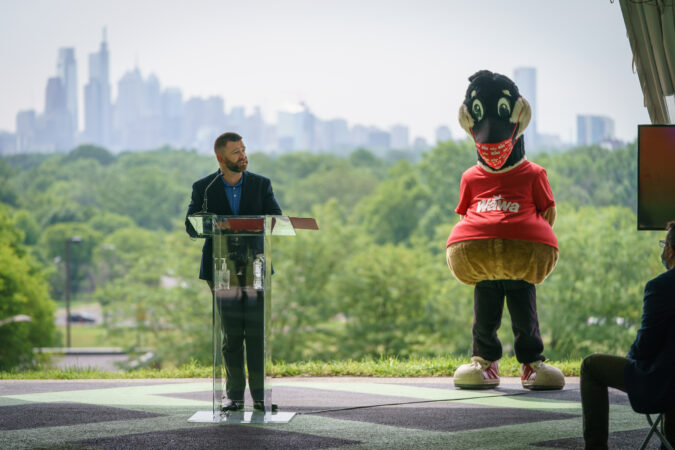
The president and CEO of Welcome America Inc. has resigned. While the reasons were unclear for the departure, Monday’s announcement followed the city’s decision to take over Philly’s Fourth of July concert and fireworks from the group that has been involved with organizing the event since 1993.
In a statement, Michael DelBene said this year’s celebration of America’s 250th birthday — interrupted by a storm that pushed back the fireworks finale to the early hours of Sunday morning — “was a spectacular accomplishment. … I am humbled by what we have accomplished together, and excited about what lies ahead for the organization.”
DelBene had held the role since 2019. In a post to his LinkedIn account on Monday evening, DelBene said he was stepping down, and “as for what’s next? I don’t know yet. And I find that completely exhilarating!”
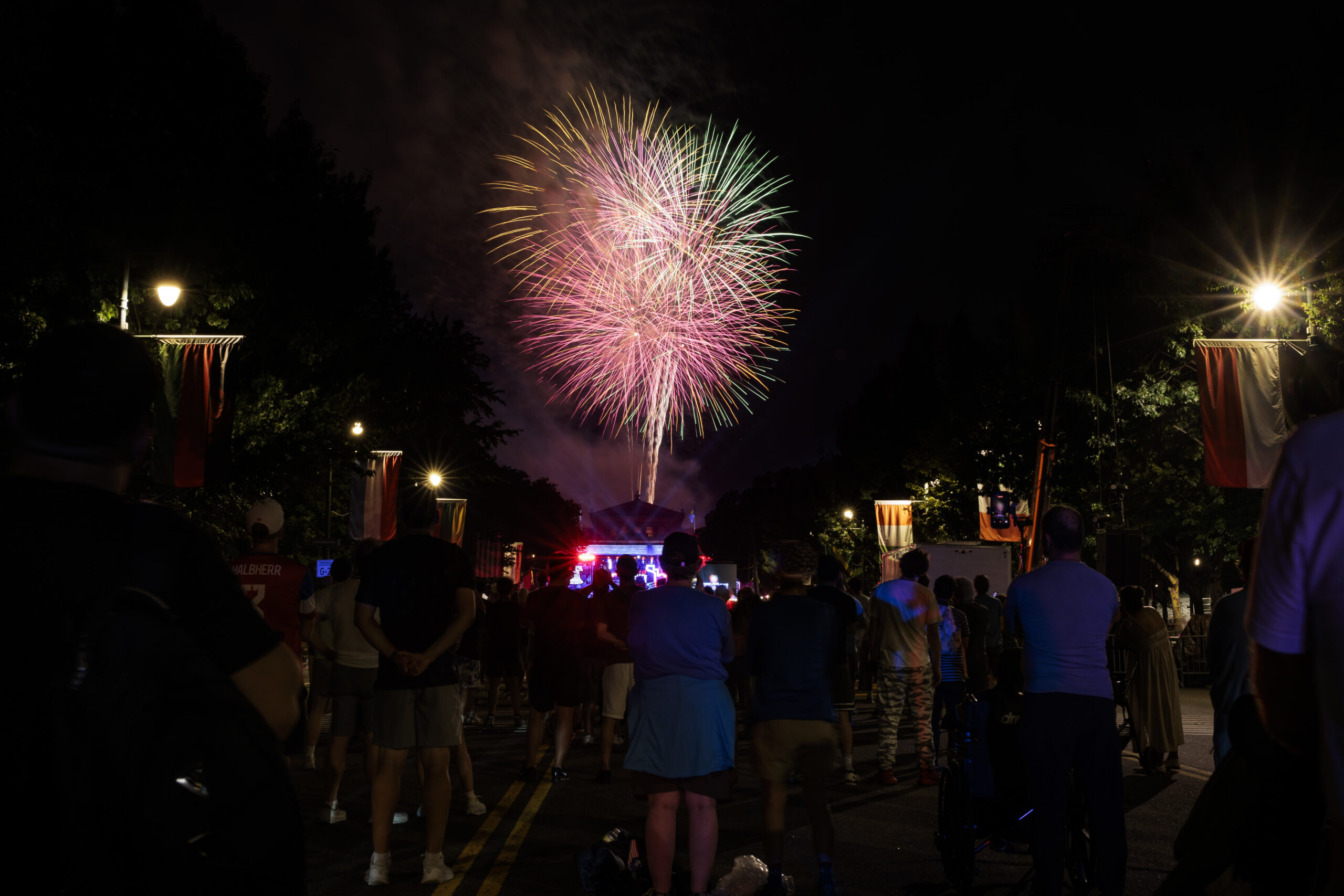
Fireworks fill the sky at the One Philly: Unity Concert for America on the Benjamin Franklin Parkway early Sunday morning.
Welcome America is a public-private partnership that receives city and state funding as well as corporate sponsorships. Mayor Cherelle L. Parker and Councilmember Mark Squilla are board members.
It was uncertain when Welcome America plans to name its next president and CEO. DelBene was the organization’s longest serving CEO, and the only one whose tenure spanned multiple mayoral administrations. DelBene has had a busy summer — he also has been working as an executive producer with FIFA World Cup 26 Philadelphia, overseeing the Fan Festival in Lemon Hill and other parts of the fan experience.
Despite planning Welcome America’s days of programming leading up to the nation’s 250th celebration, DelBene was not involved in the final signature event. This year, Parker’s administration took control of the city’s free concert on July Fourth from Welcoming America, rebranded it as the “One Philly: Unity Concert for America” in reference to her “One Philly: A United City” slogan, and spent significantly more taxpayer dollars in the process.
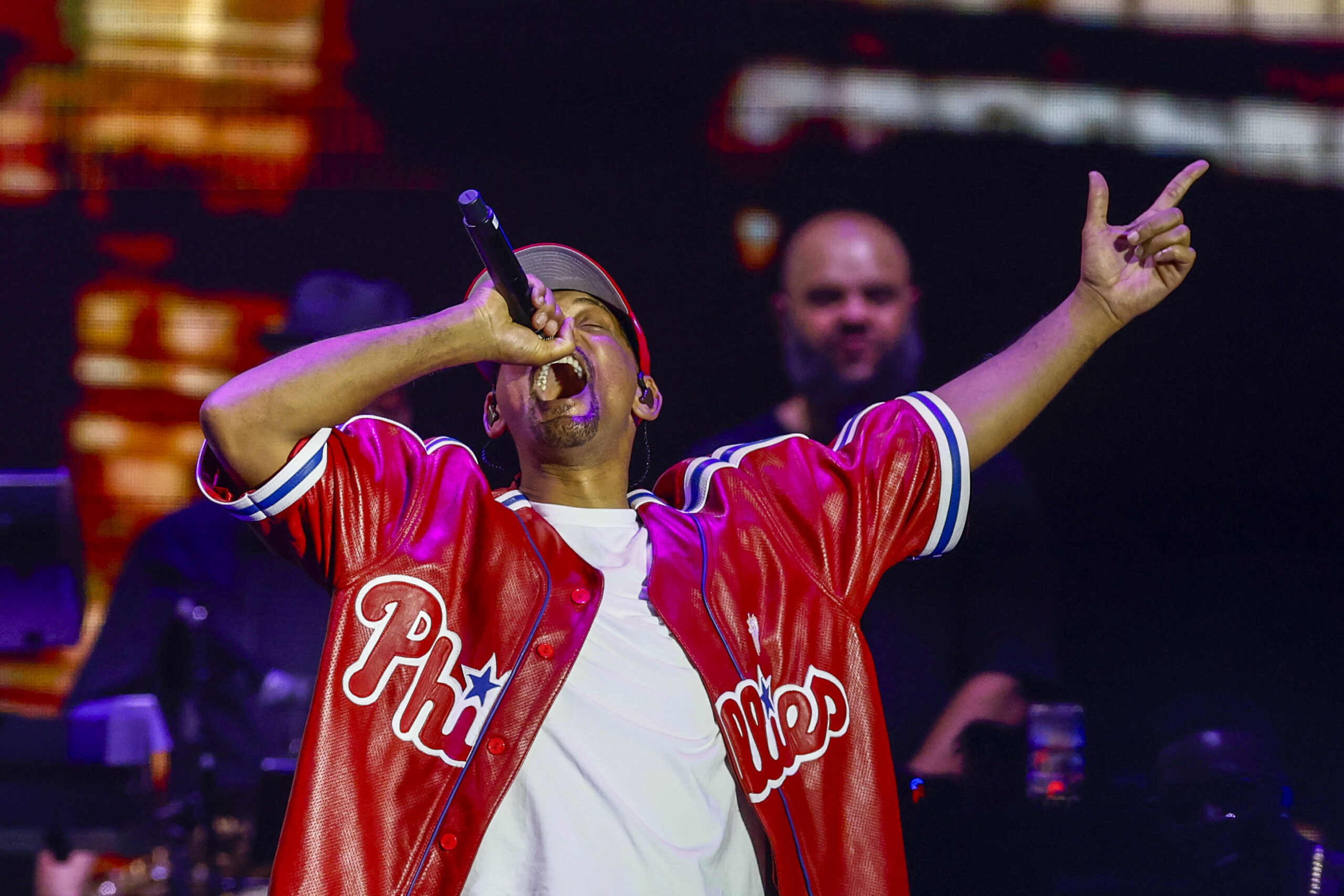
Will Smith performs at the One Philly: Unity Concert for America.
The city hired ESM Productions to put on the 250th anniversary fireworks show and concert for $15.5 million, which cost Welcome America only about $3 million to produce last year.
ESM’s pay was almost triple Welcome America’s $6.6 million budget in 2024, of which $5.3 million came from government grants, according to its federal nonprofit disclosure.
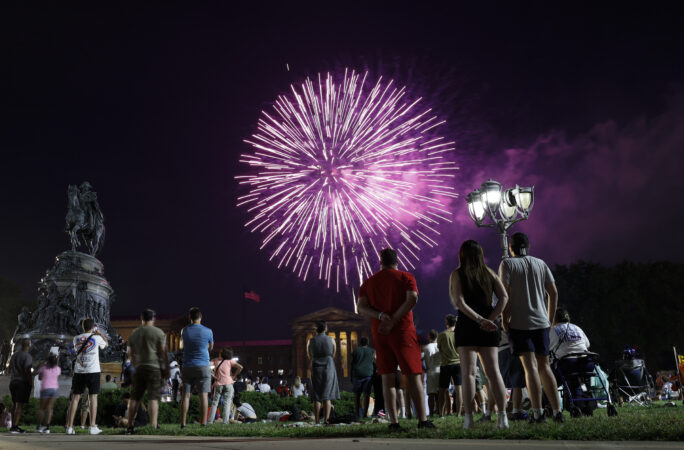
Despite a lengthy storm delay, Philly’s Fourth of July celebration went forward with performances from Will Smith, the Roots, and Meek Mill, and a fireworks show that technically began and ended on July 5 — coincidentally just a few minutes shy of 2:50 a.m.
In 1852 Frederick Douglass famously asked, “What to the Slave is the Fourth of July?” Now on the cusp of the nation’s 250th birthday, some Philadelphians still question if the holiday is meant for them.
Many Black and Indigenous people say they have complicated feelings about celebrating Independence Day, when the holiday did not represent independence or freedom for their ancestors. And their fight for their rights continues in 2026.
When the nation declared its independence,“people like me, we not only did not have rights, but we were literally relegated [to] property,” said Timothy Welbeck, professor and director of the Center for Anti-Racism at Temple University. “So much of this nation’s history has been marked by the struggle for Black people to have a modicum of liberty and equity.”
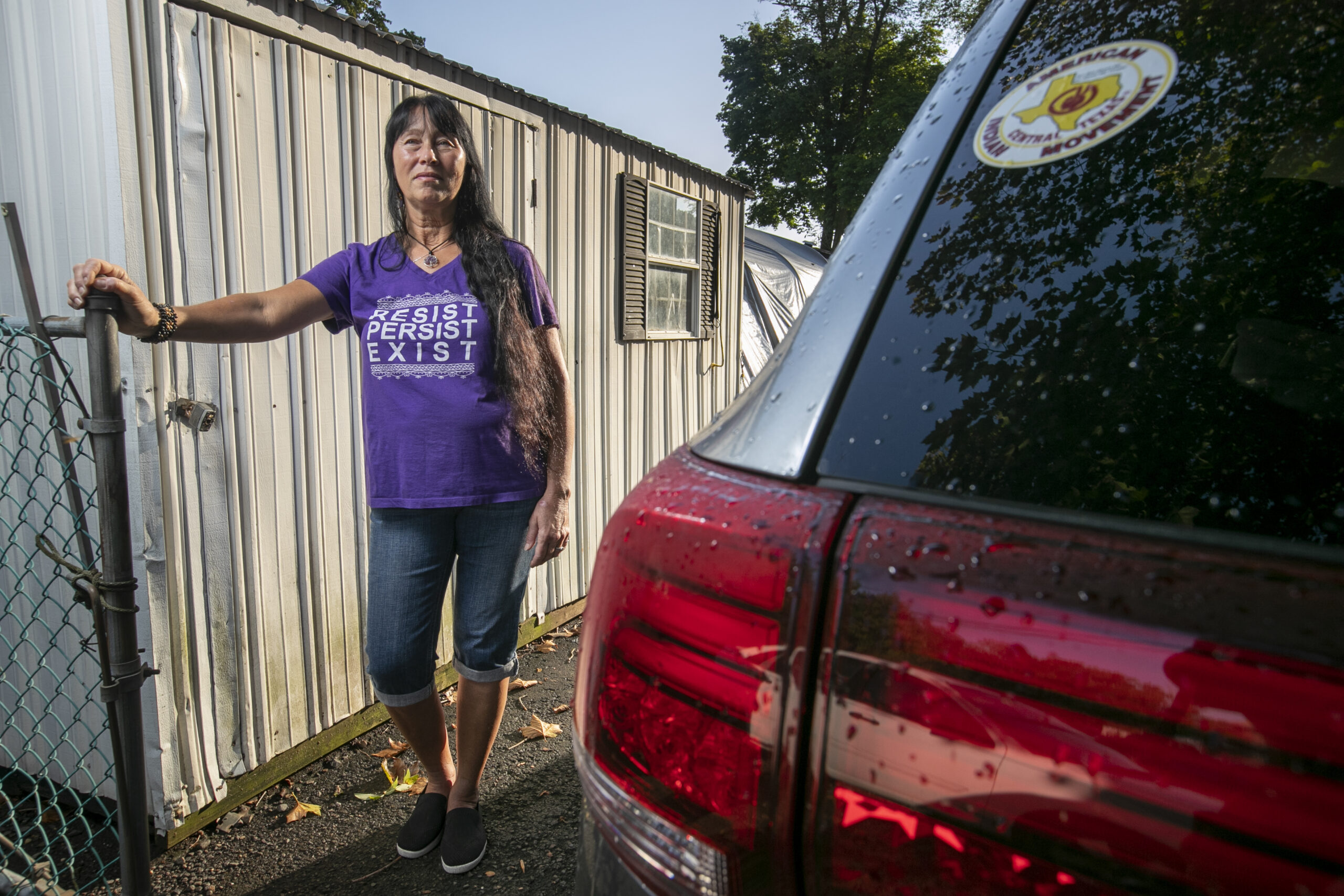
“I belong here. But I certainly don’t take part in their celebration,” said Donna Fann-Boyle, a Bucks County resident of Choctaw and Cherokee descent who led the fight to change the name of Neshaminy High School’s mascot.
Donna Fann-Boyle of Langhorne, PA., is a leader in CNA, the Coalition of Natives and Allies, and has been fighting for years to make the Neshaminy school district drop it’s nickname. Photograph taken at her home on Friday morning September 4, 2020.
She said anytime she hears mention of the semiquincentennial celebration on the TV or radio, she reminds herself that this land and its Indigenous people were here long before 250 years ago.
“I think it’s very hypocritical … only certain people have those freedoms,” she said of the holiday.
It took nearly another hundred years after the Declaration of Independence was signed for slavery to end, and another hundred after that for African Americans to have a say in their nation with the passage of the Civil Rights and Voting Rights acts. And when the new nation announced itself July 4, 1776, Native Americans had already been living on the land for hundreds of years, but were still forcibly displaced from their homes and laterconfined to reservations.
For some, the holiday is not a day to ignore, but a tool. The Rev. Carolyn Cavaness, the pastor of Mother Bethel AME Church in Society Hill, said the Fourth of July is an opportunity to talk about the nation’s contradictions and to argue that Black people should have always been included in its vision of independence.
“We have responsibility to lift up these truths,” she said.
“There is a piece of the brain that says, ‘Well you should sit out.’ But then I also know that when I think about my ancestors, and when I think about the institution that I am called to serve… we have to be out front to show and to celebrate that people of African descent have always been a part of this country,” she said.
In front of a wall of portraits of former bishops, Rev. Carolyn Cavaness greets members of the congregation during a fellowship reception Sunday, Nov. 10, 2024 the day after historic Mother Bethel A.M.E Church appointed her the first woman pastor in its 230-year history.
Freedom not realized
When he was growing up in South Dakota, the Fourth of July was mostly just like any other day for Eugene Black Crow. It wasn’t something he or his community ever celebrated, because it wasn’t their holiday. Black Crow, who is of Oglala Lakota descent, learned more about the country’s Independence Day when he was sent off to a boarding school for Native American children.
“We got beaten into speaking English,” Black Crow, 70, said, havingonly spoken Lakota before then. At the boarding school, he saw Fourth of July fireworks for the first time. He and his classmates learned to recite the Pledge of Allegiance, though they didn’t really understand what the words meant until years later.
Black Crow now lives in the Franklinville section, and over the years, he said he’s noticed more Native Americans celebrating the holiday, even in his South Dakota hometown. He used to take his children to watch fireworks when they were young, but there’s been a dissonant feeling to the experience.
“It was always in the back of my mind — why are we Natives celebrating this?” he said.
Even in the 18th and 19th centuries, people of color made the Fourth of July into a day of protest, and celebrated alternative independence days from other nations instead, said Morgan Lloyd, programming coordinator for the African American Museum in Philadelphia. She believes today, the holiday is a useful moment to consider and reflect on the whole history of the United States, where Black and Indigenous people have helped shape the country despite their exclusion from its loftiest ideals of freedom.
“It is for me, a conversation starter around what does independence and what does full recognition look like,” she said.
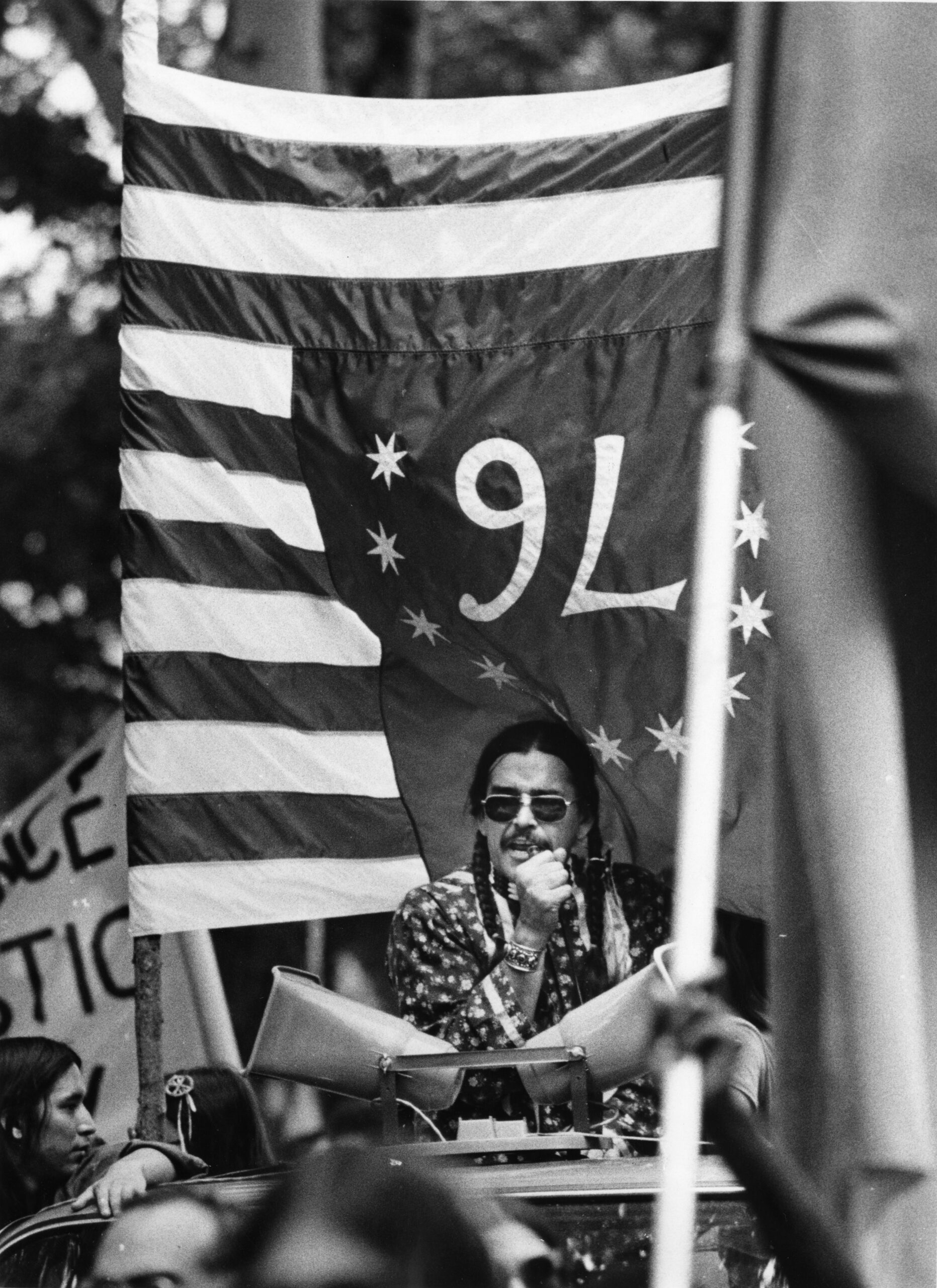
A group of native Americans lead a ‘July the Fourth Coalition’ protest parade at 33rd. & Diamond streets in Philadelphia, on July 4, 1976.
Cavaness thinks about the holiday in a similarly inclusive way, andsaid she plans to speak with her congregation about the nation’s 250th anniversary, representing how freedom is unfinished business.
“There is still freedom not realized. And every generation goes through this notion of what does freedom look like, who is left out, who needs to be brought in,” she said.
From his North Philly home, Black Crow teaches students how to speak Lakota over Zoom. His Lakhota Woglakapo Project is intended to ensure the mostly spoken language doesn’t get lost to time. He plans to visit his old reservation this fall, so he can record other Lakota speakers for posterity.
He attended a pro-immigration rally in Philadelphia this week, just a few days after the U.S. Supreme Court ruled President DonaldTrump‘s administration could revoke protected status for Haitian and Syrian immigrants. Black Crow spoke to the crowd filled with immigrants, expressing his solidarity.
The Pennsylvania House has approved a measure that could help reinstate the rights of parents whose children are in state custody and another that would protect the parental rights of incarcerated people.
The latter bill clarifies that a person’s incarceration status cannot be the sole reason for taking away parental rights.
It gives courts flexibility in parental-right termination cases by allowing them to consider an individual’s efforts to comply with family service plan requirements despite being incarcerated. Also, courts could delay filing for termination when incarceration is the primary reason a child has been placed in foster care.
The Joint State Government Commission’s Task Force on Children recommended the changes in 2011.
The other bill would give parents whose children have been in the custody of the state for at least 15 months, or who are at least 17 years old, a process to reinstate their parental rights. Those parents would now be able to petition the court and demonstrate they are willing and able to properly care for their children.
Both bills, which were passed earlier in the week with minimal opposition, now head to the Senate for consideration.
Democratic State Rep. Rick Krajewski, whose district covers West and Southwest Philly, introduced both bills. Krajewski said that under current law, it is extremely difficult for people whose parental rights have been removed to get them reinstated, and he is interested in providing people second chances.
“It doesn’t mean those parents are any less loving, any less caring, or any less willing to show up for their children. And unfortunately, people make mistakes … people are also not static. People grow, they go through changes,” he said.
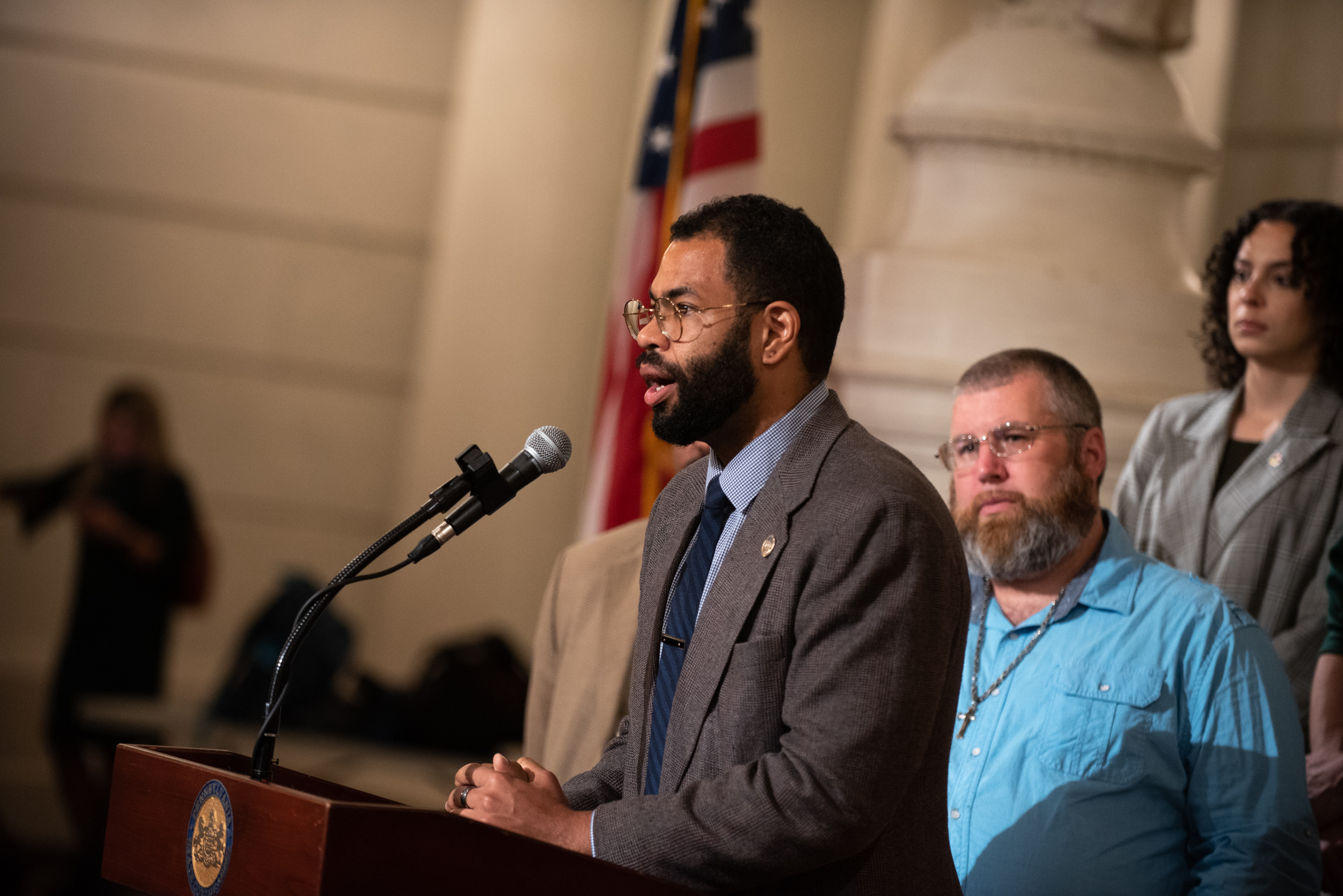
PA Democratic State Rep. Rick Krajewski speaks to people gathered for a protest in 2022.
Krajewski said his personal experience witnessing his stepfather being incarcerated and other family members being involved in the criminal justice system helped him understand how detrimental separating children and parents can be for both parties. He said removing a person’s parental rights solely because of incarceration is cruel.
“This feels like an additional punishment that isn’t relevant to whatever harm they caused. … I don’t think it’s just to add this additional penalty on top,” he said.
Krajewski has also introduced another child-welfare-related bill that would end the practice of intercepting benefits intended for foster children, and instead place the benefits in a savings account. City Council banned the practice in Philadelphia in 2022 following an Inquirer investigation, but the Philadelphia Department of Human Services still kept over $1 million a year meant for foster children and the practice remained common statewide. The bill was passed out of committee on Wednesday and will be considered by the full House.
Local advocates like Community Legal Services Philadelphia and Philly Voice for Change, a nonprofit working to prevent family separation, voiced their support for the parental rights bills after they passed.
“The bipartisan support in the House demonstrates a commitment to families and a recognition that children should not remain in the system when their parents are ready, willing and able to provide safe and loving care,” said Philly Voice for Change cofounder April Lee in a statement.
“This vote is an important step toward keeping families together, promoting reunification and ensuring that children have every opportunity to return home when it is in their best interest,” she said.
To make its best first impression on the droves of visitors expected this summer in Philadelphia, the city has launched an anti-graffiti cleanup campaign. But those cleanup areas do not match up with where Philadelphia residents actually ask for it the most.
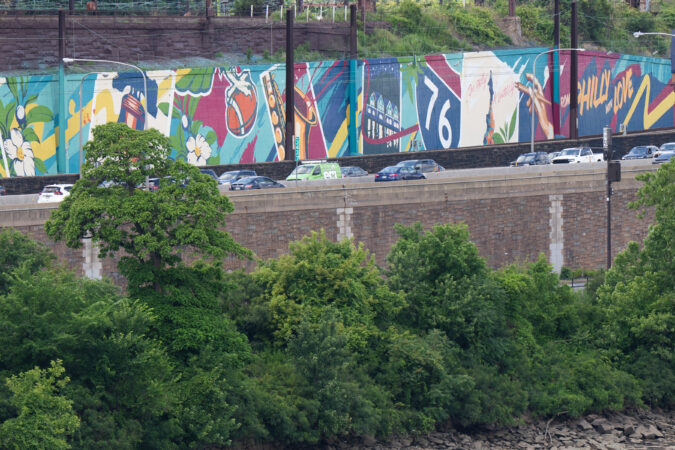
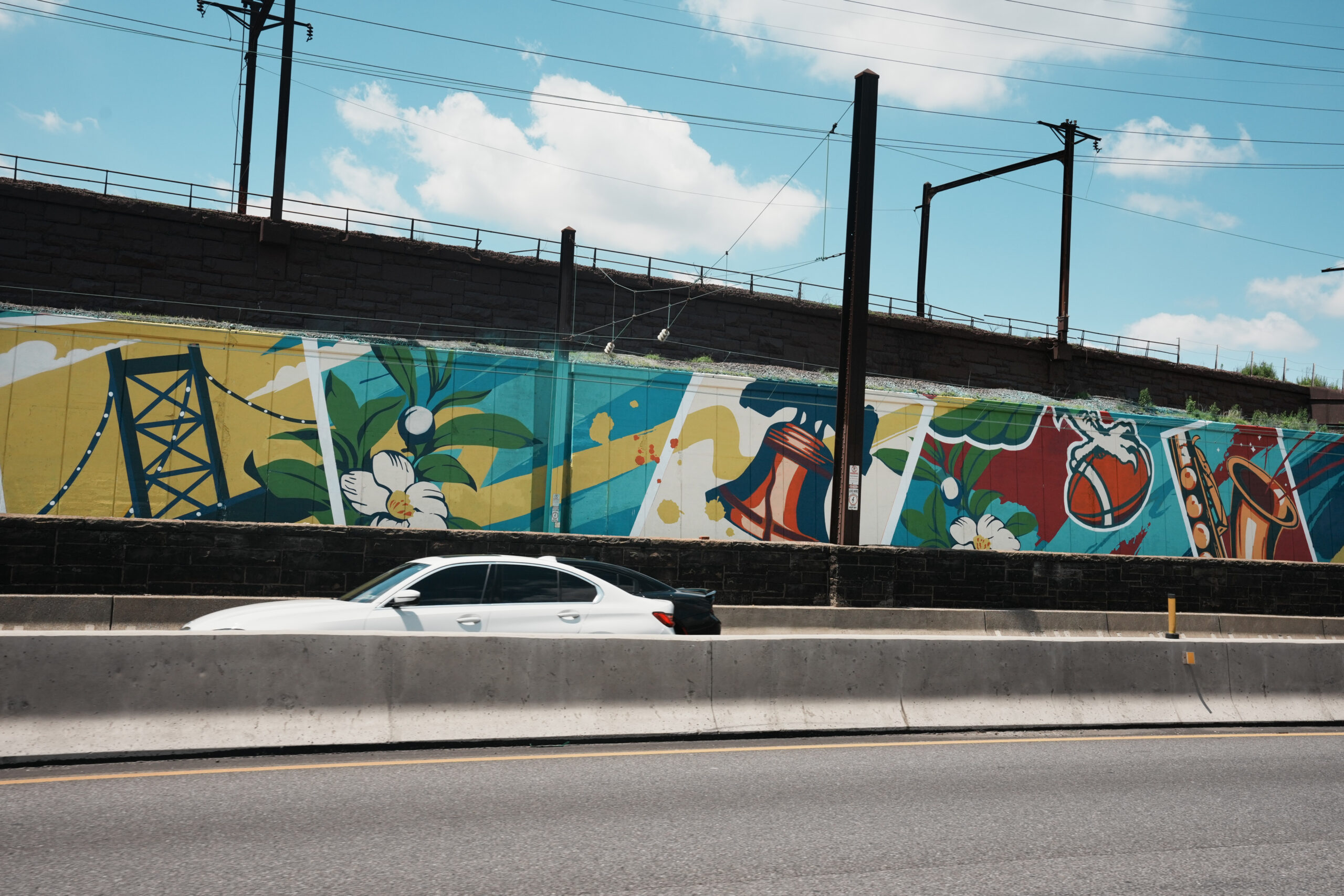
In the fall, the city began an $11.5 million beautification project ahead of this summer’s series of major events — the World Cup, the nation’s 250th celebration, and theMLB All-Star Game— that included new landscaping and graffiti cleanup. The Gateways to Philadelphia project focused on seven major transit areas that could be a visitor’s first glimpse of the city, where new murals and fresh flowers replace sparse medians and graffiti.
Those gateways were:
26th Street Gateway at Penrose Avenue.
South Street Bridge, walls, medians, and ramps.
30th Street Station walls, medians, and ramps.
I-676 interchange at 15th and 16th Streets and Vine Street.
I-676 interchange at Sixth and Eighth Streets and Callowhill/Vine Streets.
I-76 and I-95 interchange at Second and Third Streets and Callowhill/Vine Streets.
CSX/Amtrak wall at Spring Garden Street.
Meanwhile, the hot spots for graffiti cleanup requests through 311 last year were most densely clustered in West Philly, South Philly, and Northern Liberties. Despite three gateway locations being a short distance from high-density areas, they are on the opposite side of the Schuylkill from the hot spots.
In 2025, residents submitted 10,141 requests for graffiti removal, and nearly all of them have since been marked closed. There was a seasonal spike in the spring, with residents filing over 1,100 requests each in March and April.
(function() {
var l2 = function() {
new pym.Parent(‘iframe_test’,
‘https://media.inquirer.com/world_cup_graffiti/iframe_graffiti_wc_map.html’);
};
if (typeof(pym) === ‘undefined’) {
var h = document.getElementsByTagName(‘head’)[0],
s = document.createElement(‘script’);
s.type = ‘text/javascript’;
s.src = ‘https://pym.nprapps.org/pym.v1.min.js’;
s.onload = l2;
h.appendChild(s);
} else {
l2();
}
})();
Sara Lorenz, 45, lives in one of the corridors with a high amount of graffiti cleanup requests, along Baltimore Avenue in West Philly. She said graffiti typically gets cleaned up fairly quickly in the area, particularly near businesses, but sometimes it lingers and becomes an eyesore. Lorenz makes a distinction between artful graffiti and careless markings, and said it would do some good if the city had an initiative targeting the latter on blocks like hers.
Lorenz said she understands the city’s desire to make its best appeal to tourists this summer, but it would be nice if the beautification efforts went toward the typical Philadelphian, too.
“As residents, we also deserve respect,” she said.
The city has painted a new, wide postcard style mural to cover graffiti.
Efficient response time
It could be that some Philly residents also wantgraffiti removed from the city’s chosen gateways, and that people are less likely to contact 311 for what they witness while driving on major roadways. Some other residents living near Lorenz said they had not noticed graffiti much around them and were not bothered about the city’s beautification plans.
The city is clear that the gateways project was prompted by visitors, but there are plans for at least some of it to continue after the guests leave. The beautification project is expected to be completed sometime this summer, and a maintenance plan has been put in place for the new installations, according to Keisha McCarty, a spokesperson for the Philadelphia Office of Clean and Green Initiatives.
“If you want the city to look clean, you want to do it where it’s most visible,” said Fikru Bekele, 75, the owner of multiple properties along Baltimore Avenue, who said he understands the city’s focus on visitors. He said he has gotten used to residents not receiving as much attention as higher-profile projects do.
“It’s not the right thing but it’s the way it is. … Neighborhoods need to be taken care of, too,” he said.
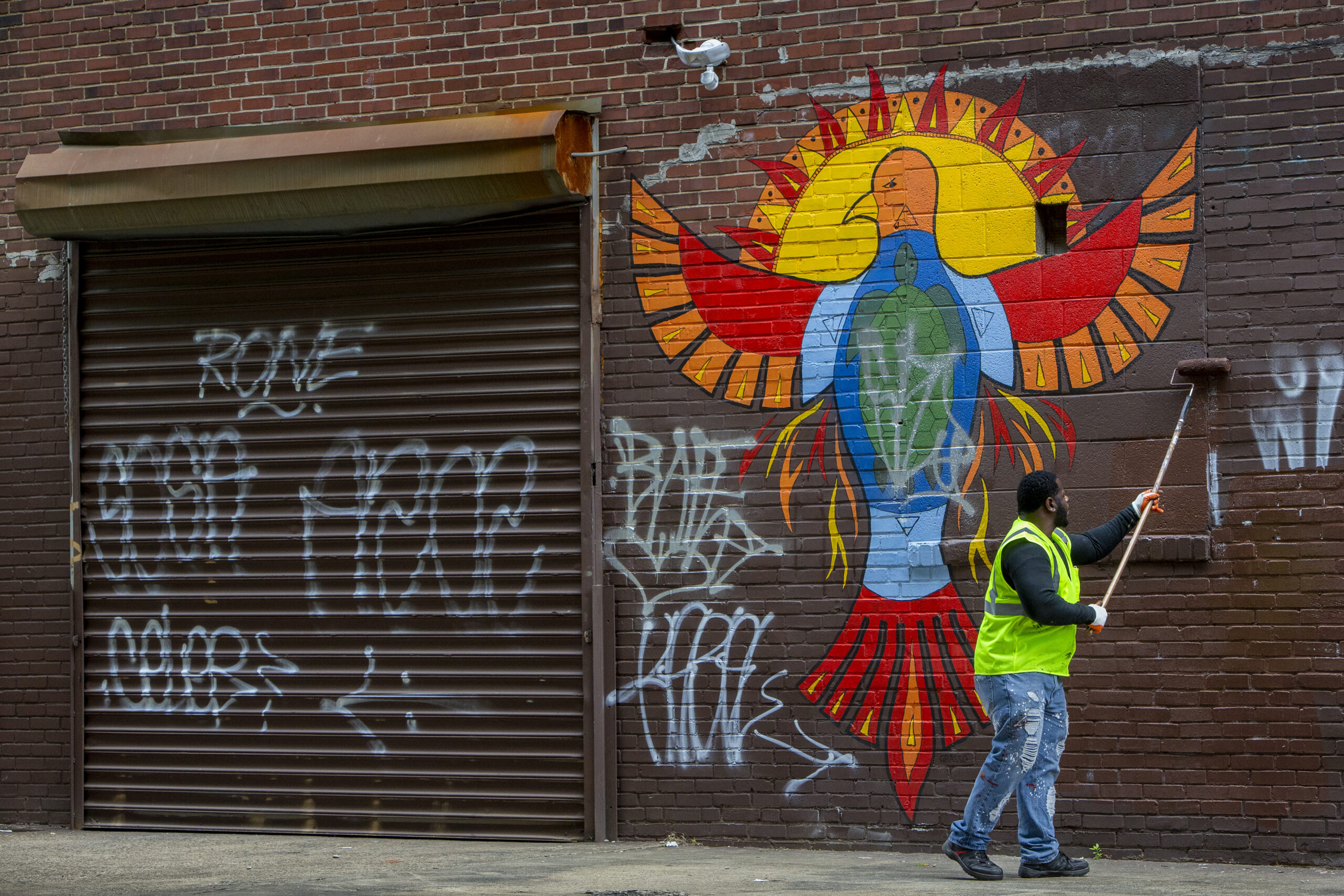
William Scott with the CLIP, Community Life Improvement Program, removes graffiti from wall around a colorful bird along North 9th Street near Jefferson on Tuesday, April 20, 2021.
However, graffiti removal in Philadelphia neighborhoods might not need additional focus, because the city’s existing program appears to be working efficiently. Graffiti removal requests submitted to 311 are passed along to the Philadelphia Community Life Improvement Program, known as CLIP. It took 311 and CLIP crews eight days on average to close graffiti removal requests last year, with five days as the median closure time.
If there is a 311 submission in South Philly, there is a decent chance it’s coming from Joe Eastman. The retired Navy veteran is a 311 neighborhood liaison, part of a city program that trains certain residents how to report issues more effectively. Eastman, 75, goes on walks and reports what he sees in the neighborhood, and often finds himself alerting 311 to the same spots, like a stop sign near Broad Street and Snyder Avenue.
“I’m sure if I go back in two weeks it’ll have graffiti again,” he said.
Eastman is pleased with 311 and CLIP’s responsiveness, and said he has no problem with the anti-graffiti focus on visitors if CLIP continues at its current pace.
“I get what they’re doing. And as long as they are being as responsive as they have been, I think we can all get along with this,” he said.
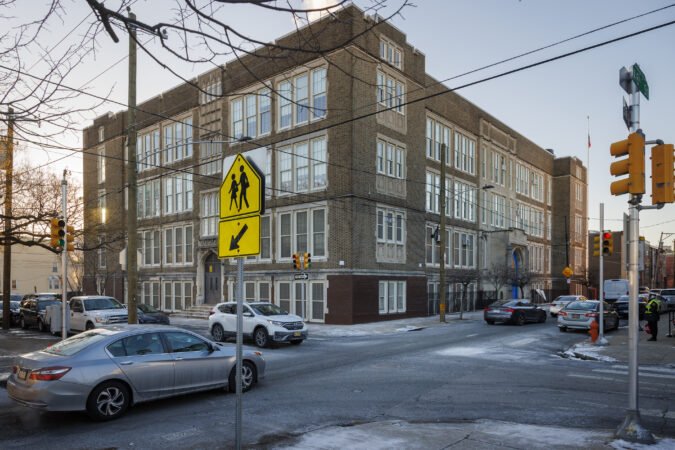
James R. Ludlow Elementary School in North Philadelphia educates a substantial population of special-education students.
And the learning environment for those studentswould be upturned bythe schooldistrict’s recommendation to close Ludlow after next school year, teachers say.
“For our children in special education, that consistency isn’t a luxury, but a requirement for them to learn. If we relocate our students, we aren’t just changing their school address; we’re breaking their routines and undoing their progress,” Vanessa Martin, an autistic support teacher in kindergarten through second grade at Ludlow, said at a community meeting last month with school district officials.
“This building isn’t just a facility. It’s the one predictable place where our students feel safe and supported every single day,” she said.
The district says Ludlow was slated for closure because of an “unsatisfactory” building quality score, a lack of appropriate space for programming, and only utilizing 47% of its capacity. Ludlow has 237 students enrolled across general and special education, of whom 75% are Black and 20% are Hispanic.
The K-8 schoolwill celebrate its 100th anniversary in what could be its final school year of operation. The district, which has proposed closing 18 schools, plans to convey the building at 550 Master St. to the city so it could be converted into affordable housing or used for job creation. Ludlow students would be reassigned to one of three schools: Paul L. Dunbar School, Spring Garden School, and Gen. Philip Kearny School.
‘Severing a lifeline’
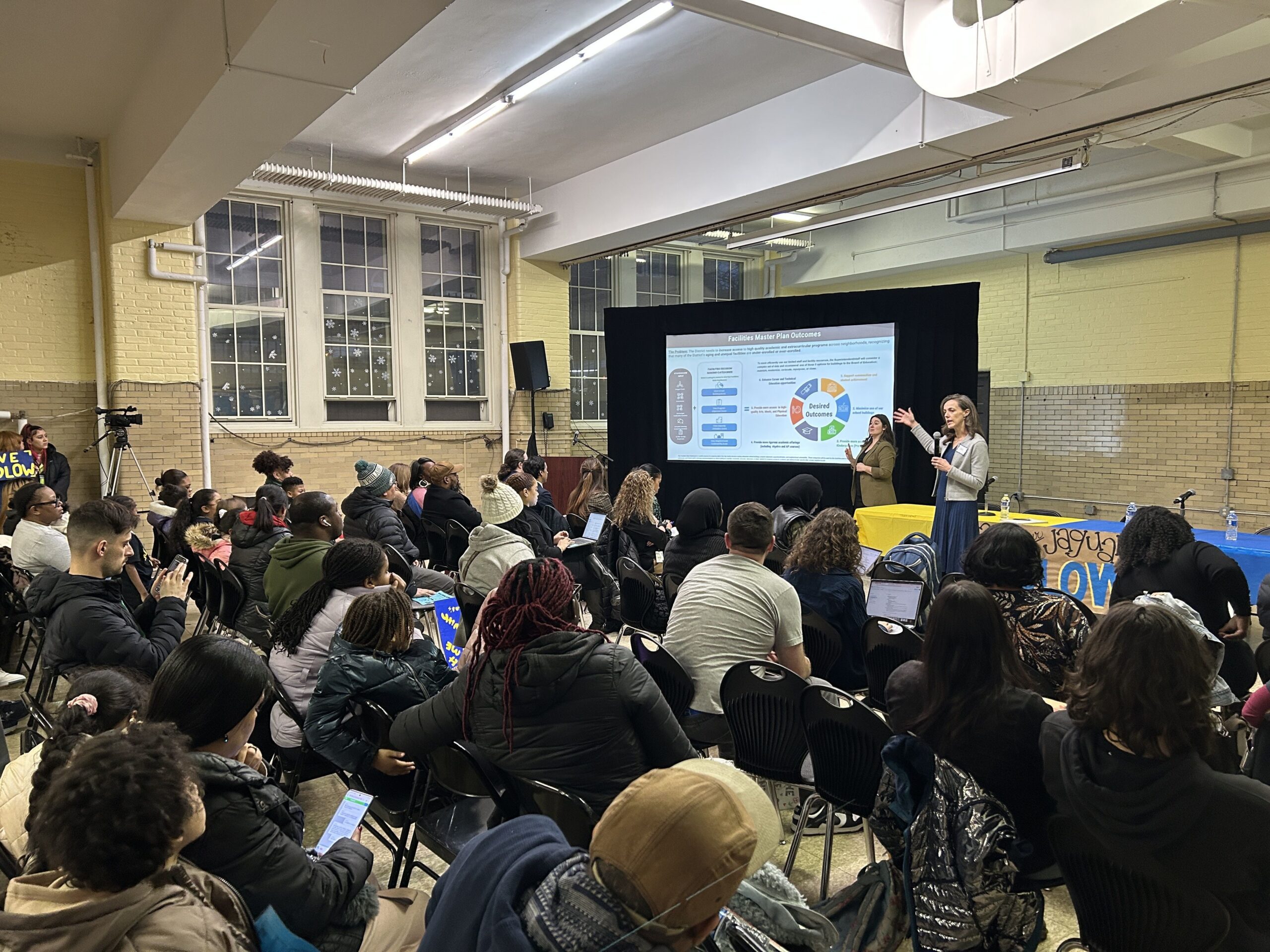
The Ludlow community is strong and connected, and about a hundred people packed the school’s cafeteria for the community meeting on a recentThursday evening to show their support for the school and fight against the district’s plan.
District officials present their plan for closing Ludlow at the February community meeting.
“I felt very angry. I felt upset. I felt like they were taking something away that was a part of me,” said Deilyhanix Vazquez, a Ludlow eighth-grade student who has attended the school since kindergarten. She said her teachers “feel like home,” and she had been planning to continue visiting the school even after she graduates.
“I’m worried that the students will have to travel far just to get an education. Something they have to do on the daily starts to feel like a burden,” said Savannah Lindsay, another Ludlow eighth grader.
Another young studentbroke down into tears as she spoke into the microphone, sayingshe had planned to attend Ludlow for “my whole life.”
If the plan goes forward, she said, she may have to split up from her friends as they get assigned to one of three different schools.
“I don’t want to leave them,” she said, as others inthe room clapped and cheered her on.
Should Ludlow close, the neighborhood and the wider school district would lose a valuable special-education resource andhub. Its offerings include autistic and other learning support for all grades, and emotional support for grades three through eight.
Ludlow often receives student referrals from other schools and catchments across the district, staff members said,including from the schools that would take in Ludlow students in the closure plan. It can feel like the district dumps its most difficult students on Ludlow, Martin said, but those children are accepted and become like family.
District officials have said that in addition to closing buildings that are not operating at full capacity, another goal is focusing on K-8 schools over middle schools to reduce transitions. That goal especially doesn’t square with the plan to close Ludlow, critics said.
“Ludlow is an exceptional school that works. By moving forward with this proposal, the district would be doing more than just closing Ludlow’s doors — it would be severing a lifeline and dismantling a support system that children and families depend on for their stability,” Martin said.
Affordable for whom?
Community members questioned the plan to turn Ludlow into affordable housing. They doubted whether those units would actually be affordable for the people living in the neighborhood, where the annual median household income is about $58,000.
The area sits next to Fishtown and Olde Kensington, where gentrification has made living more expensive for longtime residents.
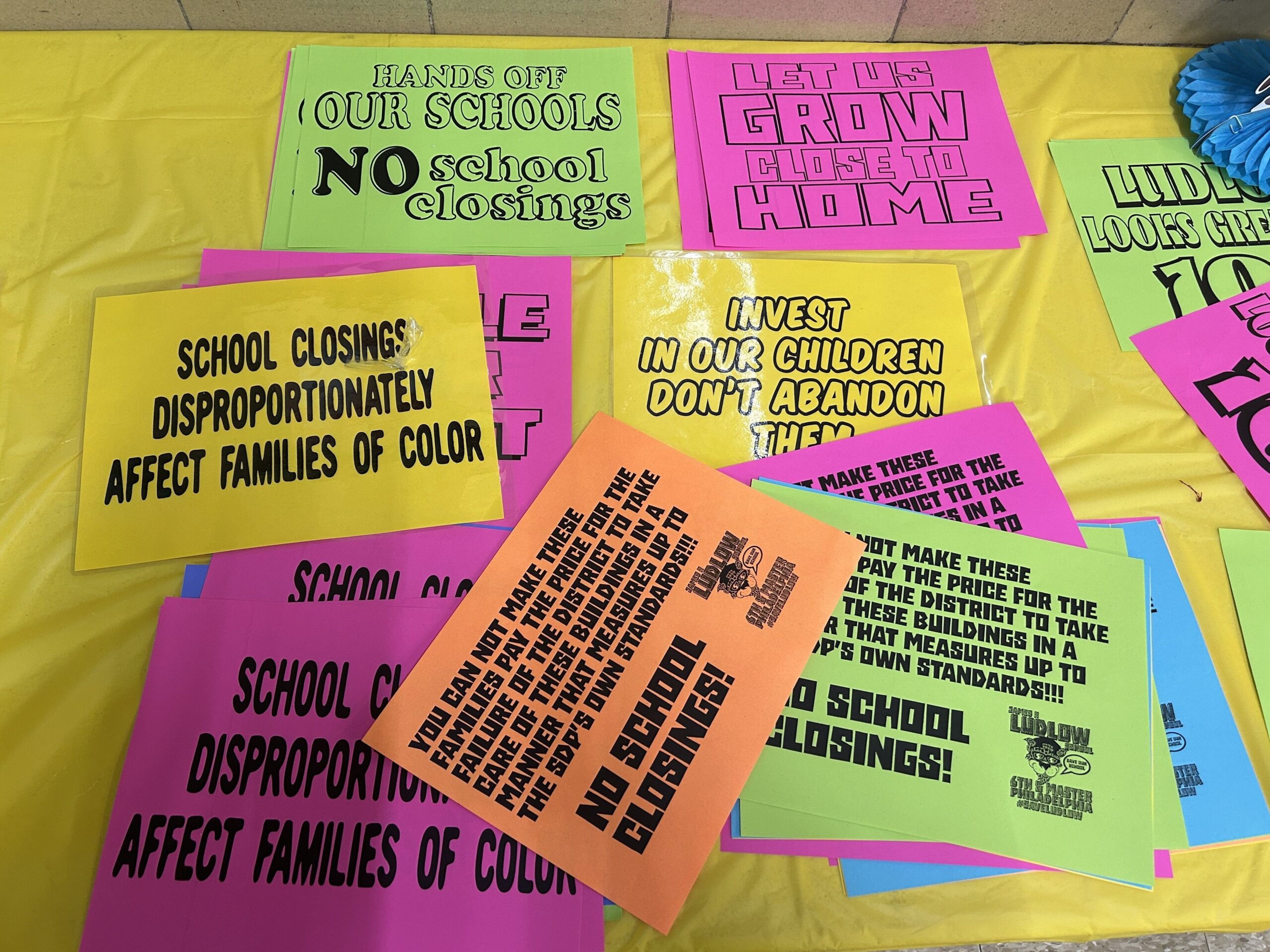
Various signs protesting the closure of James R. Ludlow School, available at a community meeting with district officials in February.
Ludlow community memberssaid they did not want or need more housing. They wished the district would instead invest in the building for learning purposes, and said the district had let it fall into its poor condition.
“It’s money before our kids,” said Valerie Johnson, known better as Valerie Brown, a beloved former Ludlow staff member who worked at the school for more than30 years.
While housing may bring new residents and investment to the neighborhood, the loss of Ludlow could drive some to leave, one mother said.
“I stay in this neighborhood because of Ludlow,” said Darlene Abner, a mother of six whose children have attended the school, including a kindergartner enrolled this school year.
Abner herself was born in the neighborhood, and she said shedoes not want her children to attend any school but Ludlow.
She wears a nearly full face-covering niqab, and credited the school and its teachersfor never letting that be a barrier to building a relationship with herand caring for her children.
Robert Morris School in North Philadelphia has been lauded for improving test scores, and it isthe last elementary school in its immediate neighborhood.
But the school district says not enough neighborhood children want to attend.
At a community meeting last week, district officials said the school’s“severely underutilized” capacity was the driving factor behind their recommendation to close Morris after the next school year.
But community members have questioned why low enrollment alone was enough reason to cut the school — and have voiced concern that the district is closing a school with a majority-Black student population while keeping open a nearby elementary school that has more white students.
“We want the option for our children to be able to walk a block or two or three and get to their school. And it’s not clear to us the reason why that isn’t a possibility,” said Cierra Freeman, co-lead of culture and strategy for the Brewerytown-Sharswood Neighborhood Coalition.
Morris students would be reassigned to Bache-Martin School or William D. Kelley School for fall 2027 under the plan.
The district plans to repurpose the building at 2600 W. Thompson St., which it has categorized as being in “fair” condition, into a hub for its Office of Diverse Learners. Currently, the office operates within district headquarters and has an evaluation center near Central High School.
District officialsalso said theywant to keep the building so it could be reopened as a school in the future should enrollment interest rise.
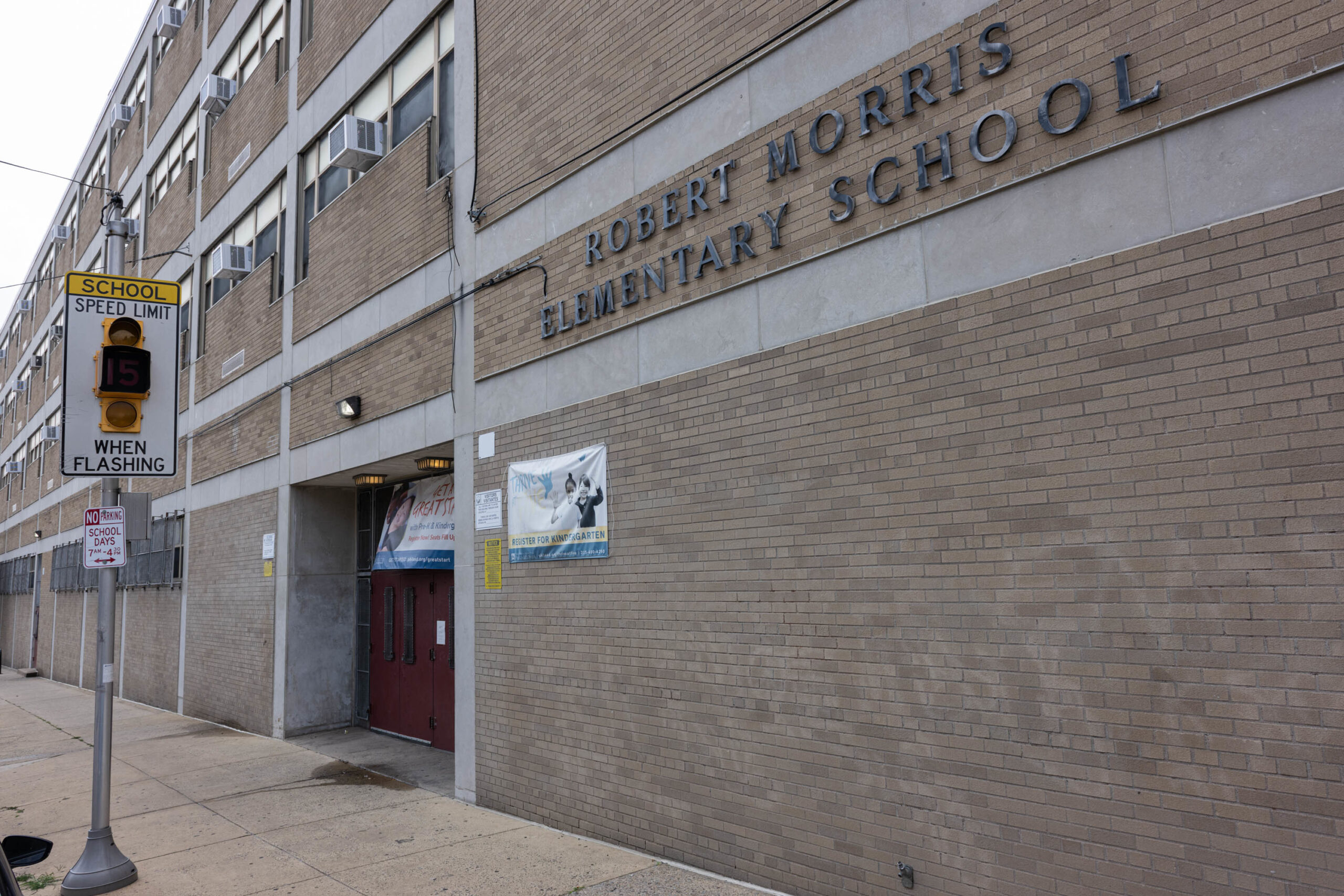
Robert Morris Elementary School in Brewerytown.
‘Punished for being so small’
Morris was honored by the district last year at its Accelerate Philly awards for major improvements in test scores across reading and math. Its third-grade class jumped from 7% proficiency in reading and 14% in math to 48% and 59%, respectively. The district has said it did not consider schools’ academic performance in its facilities plan.
“It seems like Robert Morris is being punished for being so small,” Paul Brown, a school psychologist at Roxborough High School a Youth and Education co-lead for the Brewerytown Sharswood Neighborhood Coalition and a member of Stand Up for Philly Schools, said at the community meeting.
Neighbors said the district has not done nearly enough to retain and attract families to Morris, a “neighborhood gem,” according to Siobahn Neitzel, a local resident and youth and education action team co-lead for Brewerytown-Sharswood Neighborhood Coalition.
“The challenges that the district talks about with regards to Morris … really come from a continued lack of investment on the district’s part,” she said.
If there must be change at Robert Morris, some speakers urged the district to consider colocating the Office of Diverse Learners with the school instead of closing it. District officials said that option would be considered —but it was not reflected in a revised plan Superintendent Tony B. Watlington Sr. presented Thursday that spared two schools originally slated for closure. Morris is still on the closure list, but the school board could make changes before votingon the plan in the coming weeks.
A changing area
Brewerytown and adjacent Sharswood are neighborhoods in flux. The area is experiencing rapid gentrification, with new developments and property values shooting up in recent years, including the $750 million Philadelphia Housing Authority project to clear and redevelop the Norman Blumberg Apartments towers.
In the last round of mass closures in 2013, the district shuttered Meade Elementary School, less than a mile from Morris. Residents within the Morris catchment area have opted for other choices in recent years, including charters and other public schools. District officials said about 16% of students in Morris’ catchment already attend Bache-Martin.
Third grade teacher Brendan Yuhas teaches students Trenton Andersen, left, and Serenity Rose Rhoades, right, at Robert Morris Elementary last year.
Freeman said that is, in part, the district’s fault.
“This school has not been marketed to parents and families in the neighborhood. It has not been made attractive. It has not been pushed up,” Freeman said.
Some residents are frustrated with the plan to instead investmore than $50 million in Bache-Martin to handle an infusion of hundreds more students, including from Laura W. Waring School, and $4.7 million into Kelley. They believe Bache-Martin students deserve that kind of investment, but so do Kelley and Morris students. District officials said Kelley has received more funding in recent years, making a similarly large investment unnecessary.
Residents are concerned the consolidation could result in violence, by putting kids from different neighborhoods and rival gangs suddenly under the same roof at Bache-Martin or Kelley. And some at the community meeting worried that even if the district reopens the Morris building as a new school, it would be as a magnet that excludes local students.
Undergirding many of their concerns is the reality of race. Morris’ student body is 82% Black, and its community members said its potential closure was another indicator of the major impact the district’s plan would have on Black families. Bache-Martin in Fairmount, poised for significant financial support, has only about 34% Black students.
“When closures disproportionately affect minority communities, we cannot pretend race is not a part of this story. … What message are we sending to our students, my fifth- and sixth-grade students, when [the] place that nurtured them is going to disappear?” Adrienne Ramsey, a math teacher at Morris, said at the community meeting.
Freeman insisted that there must be a public education option for elementary school students in the neighborhood. She said she is concerned that charter schools, which are privately run and publicly funded, do not have enoughpublic oversight, and public schools are critical tocommunities.
“Schools are one of the places that the real community building and community weaving starts,” she said.
She said shebelieved interest in a public elementary school in the Brewerytown-Sharswood area would return, particularly as incoming residents occupying the new developments look for places to send their childrenand current neighbors reconsider their education options.
“People want to be part of their communities. They want to be part of their neighborhoods. They want their children to have friends whose home they can walk to,” she said.
Philadelphia School District officials said they considered poverty rates and prior school closings in a neighborhood when weighing which schools to close.
Each school had a score based on its surrounding neighborhood, and only one of 20 proposed closures is in a “very high risk” neighborhood: John Welsh Elementary.
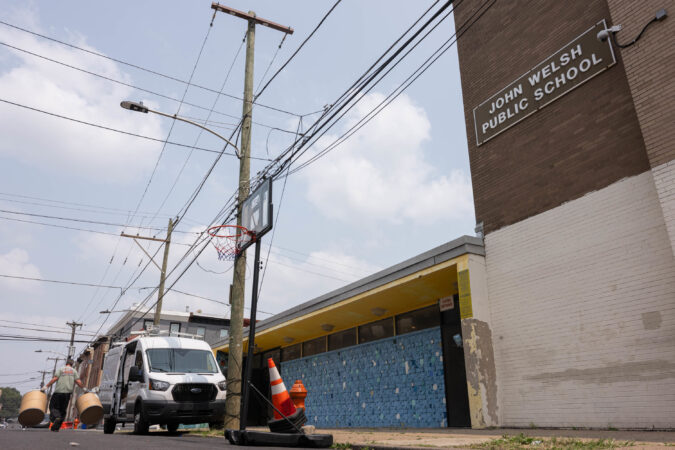
Welsh, on the northern edge of the Norris Square neighborhood, has 185K-8 students and operates atunder a quarter of the building’s capacity. Enrollment has declined over the past several years and the school now holds an average of 20 students per grade, including only 9 second graders. About two-thirds of the students are Latino, and the other third are Black.
While it’s small and its building is not in good shape, it was not necessarily obvious that the district would target Welsh for closure — because so-called neighborhood vulnerability was a factor in officials’ decision-making.
But Welsh parents and studentsargue the school shouldn’t be closed because its students were performing well, despite the lack of investment from the district, as well as the condition of the building and its surrounding neighborhood.
Kareemia Boyd, the parent of a Welsh eighth grader, credited the school with helping her son turn around his grades after he came from a charter school. She transitioned her son to Welsh in fifth grade, when his grades were suffering and he experienced bullying. Now poised to graduate this year, she said he gets A’s and B’s.
“I didn’t expect he would actually grow in so many ways,” she said at a recent community meeting about the closure plan.
The district’s draft plan calls for the Welsh building to be upgraded andconverted into a new year-round high school which would open for the 2029-30 school year.
Pedestrians walk along Susquehanna Avenue in the Norris Square neighborhood in 2022.
Current Welsh students would transition to John F. Hartranft School or William McKinley School. Hartranft and McKinley would receive new ADA investments and other renovations, Algebra I instruction, and pre-K programming, officials said.
Several students asked district officials at the community meeting why they would be transitioned to Hartranft and McKinley, when those schools have performed worse academically than Welsh. About 14% of students at Hartranft and 10% of students at McKinley scored at least a proficient level on state English language arts exams last year, compared to 20% of Welsh students.
District representatives said they did not consider academic performance when deciding whether to close schools. Instead they focused ongetting proper resources to students and schools, they said,which will be more feasible once schools areconsolidated.
Boyd said her son’s teachers at Welsh pushed him to improve, and wouldn’t let him settle for less than what he was capable of. She appreciated how much they cared about him, and said they had “a big impact.”
“I want somebody to care about my kid as much as I do,” she said.
She said she believes the declining enrollment has to do with the school’s neighborhood. Boyd said people are concerned about crime and drugs, and don’t feel safe sending their kids to the school, particularly when school security is limited.
But for those who have stayed, Sary Rodriguez, a parent of current Welsh fifth and eighth graders, said it’s a community where everyone looks out for others.
“We all know each other. We all support each other. So it’s hurting a lot of people,” she said about the district’s plan.
Young people enjoy Norris Square Park in the Norris Square neighborhood, where Welsh Elementary School is slated to close under a proposal from the school district.
Rodriguez also has a 19-year-old daughter who graduated from Welshand works at the school. But Rodriguez said she’s considering moving her children to charter schools if the school closes, in part because of her concerns for the academics at McKinley and Hartranft. No matter where they go, transitions are difficult for all involved, she said, including parents.
“It’s not only the students that have to meet new people and new friends and new teachers, their parents have to start all over [with] a new relationship with teachers and students, the neighborhood … I don’t know nothing about those schools,” she said.
Rodriguez implored the districtofficials at the community meetingto genuinely consider pleas to keep the school open.
“I really have the feeling it doesn’t matter what we say or what we do. It’s just going to be a decision that they’re gonna make,” she said.
Rodriguez said she’s upset that the district hasn’t invested in Welsh, but plans to put resources into a new school at the same location.
“It bothers me that they’re going to spend the money to fix it for a high school and they can’t fix it for our kids,” she said.
Ava Huertas, a sixth grader at Welsh, planned to graduate from the school just like her grandmother, mother, and sister did. She’s been enrolled there since she was in kindergarten, and now would have to move to a new school for eighth grade before transitioning again for high school.
She asked several questions to district officials about why they were planning to close her school, reading off notecards and avoiding eye contact. As she wrapped up her final question, she thanked the officials for listening, but had to be honest about her feelings.
“I hope that the plan doesn’t go through, I’m not gonna lie,” she said.
Time may be a flat circle, but that doesn’t stop us from wondering why. A reader asked through Curious Philly, The Inquirer’s forum for answering questions, why there are so many chicken bones on the sidewalks and streets of Philadelphia.
Two architects appear to bebehind Philadelphia’s chicken-bone temple.
First are animals, who forage through trash looking for the final scraps left on discarded bones. Whether they discover drumsticks by ripping through trash bags on the street or from dumpster diving, these animals likely drop the bones wherever they finish with them.
Theculprits most likely to blame are rats, followed by raccoons and opossums, said Rich Foreman, the owner of Dynamite Pest Control in West Philly.
While it’s unclear if rats have a particular taste for fried chicken, the animals are among the least-picky eaters around and will take advantage of any food source, from human scraps to cannibalism. And Philadelphia is seemingly a good place to be a rat, being declared the eighth-rattiest city in the United States in 2025 by the pest-control company Orkin, measured by tracking its new residential rodent treatments.
Adrian Jordan, Vector Control Crew Chief, works keeping the rat population under control, in Philadelphia, Friday, March 7, 2025.
Foreman sees the chicken-bone problem all over the city, as with some restaurants in Port Richmond that called Dynamite when they saw their trash all over the street. He is confident animals were behind the mess, and said he has “never seen” humans do anything of the sort.
Foreman said the city’s twice-weekly trash pickup initiative has not helped, since it means an additional day of easily accessible trash on the street for animals.
He said the best way for people to prevent critters from going into their garbage for bones is to get large, durable trash cans.
“And make sure you put the lid on it,” he said.
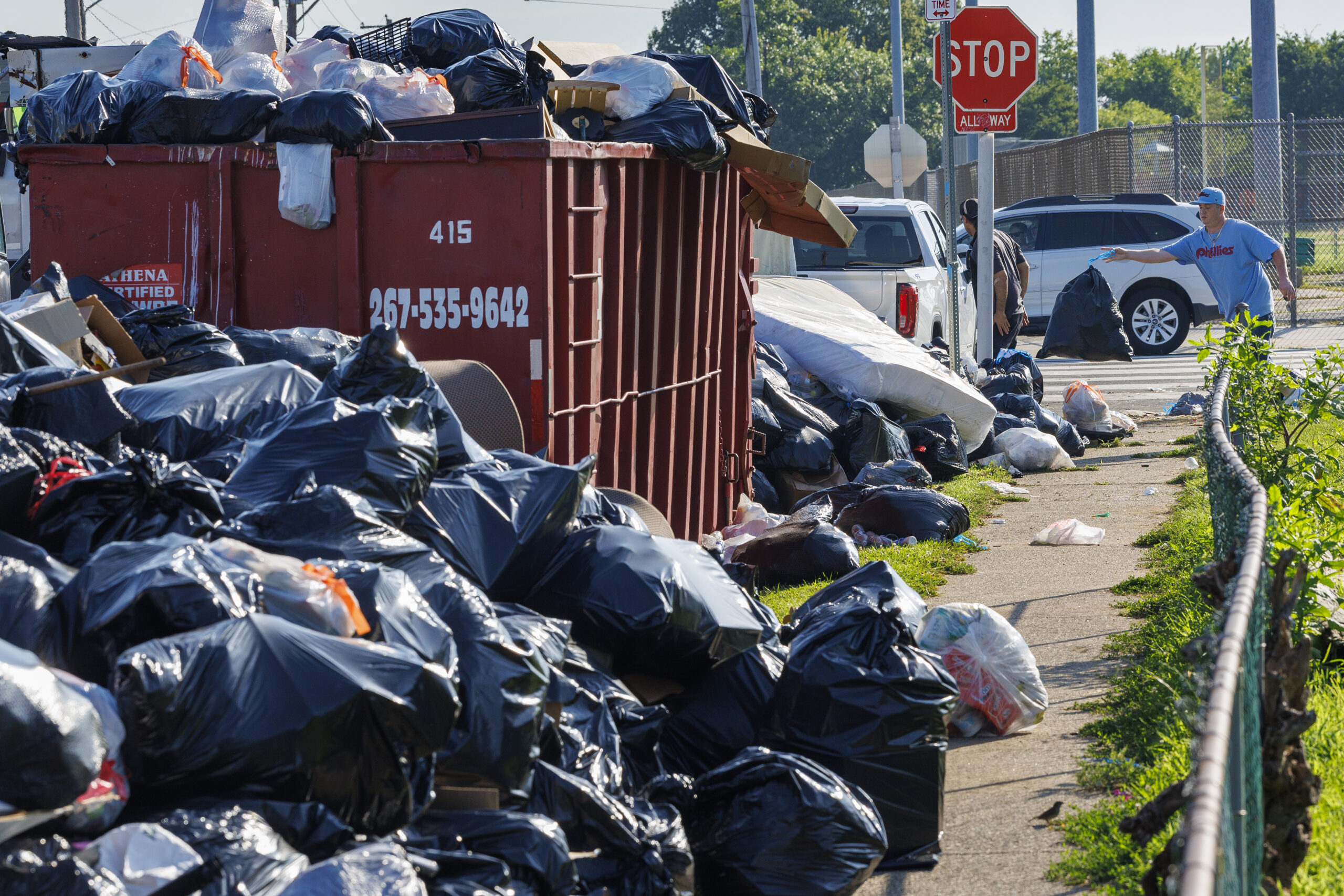
Residents with trash arriving at garbage dump site at Caldera Road and Red Lion Road in northeast Philadelphia. AFSCME District Council 33 workers enter their second week on strike, Tuesday, July 8, 2025.
Scavenging animals was the conclusion that the Search Engine podcast reached in a 2024 episode investigating the cause of the chicken bones littering the streets of New York City. Other cities have reported the same problem, including Chicago, Miami, and Washington.
And yet, anecdotal evidence from residents demonstrates that human activity clearly contributes to the problem.
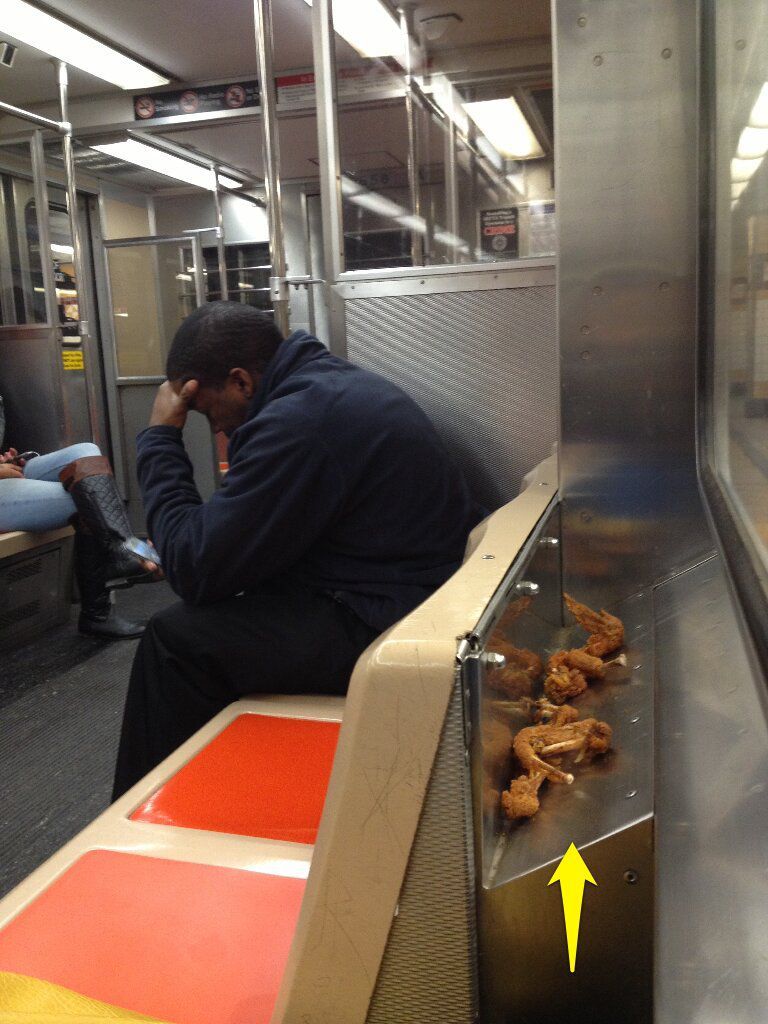
Jessica Griffith has become the David Attenborough of abandoned chicken bones, documenting and appreciating the beauty of what she encounters in the wild. More than 10 years ago, when she lived in South Philly, Griffith, 46, would notice the chicken bones frequently on walks with her dog. She started photographing them and posting the pictures to Facebook, finding the bones everywhere, including a pile on a SEPTA train.
“It was just bizarre to me. Just a phenomenon,” she said.
Jessica Griffith snapped this picture of some discarded chicken bones on the Broad Street Line in 2013.
Her documentation gathered a following, and people started to send their own submissions. Griffith received pictures from all over the globe — people in Seattle, Las Vegas, South Korea, Sweden, and the Dominican Republic all had their own pictures of discarded chicken bones to share.
When Brian Love, 53, walks his miniature pinscher, Ziggy, through the Gayborhood, he often sees other people smiling at his dog. But then he realizes it’s because Ziggy is carrying a chicken bone in his mouth.
Love has complained to his friends about constantly needing to tussle with Ziggy over what the dog sees as a treasure. He has watched people toss chicken bones on the ground, and recently came across a pile of four bones on a mound of snow. Love wishes his neighbors would just use trash bins.
“It’s your food that you’ve literally just had in your mouth. Throw it in the trash,” he said.
Stephanie Harmelin, 43, has the same problem with her dog in West Philly, and she said she accepts the bony sidewalks as part of living in a city. She has seen aggressive squirrels rifling through trash, but also has come across bones at street corners and under park benches that appear to have been dropped by humans.
She said part of the problem is educational. Once, Harmelin pulled her dog away from a bone on the street, and two fellow walkers asked her why.
Harmelin explained how chicken bones are unsafe for most dogs to consume. Cooked bones splinter when a dog chews on them, and the sharp fragments may cause life-threatening damage as they pass through the dog’s digestive track.
One woman was shocked, and said she had not realized chicken bones were potentially dangerous to dogs when she had tossed them to the ground before.
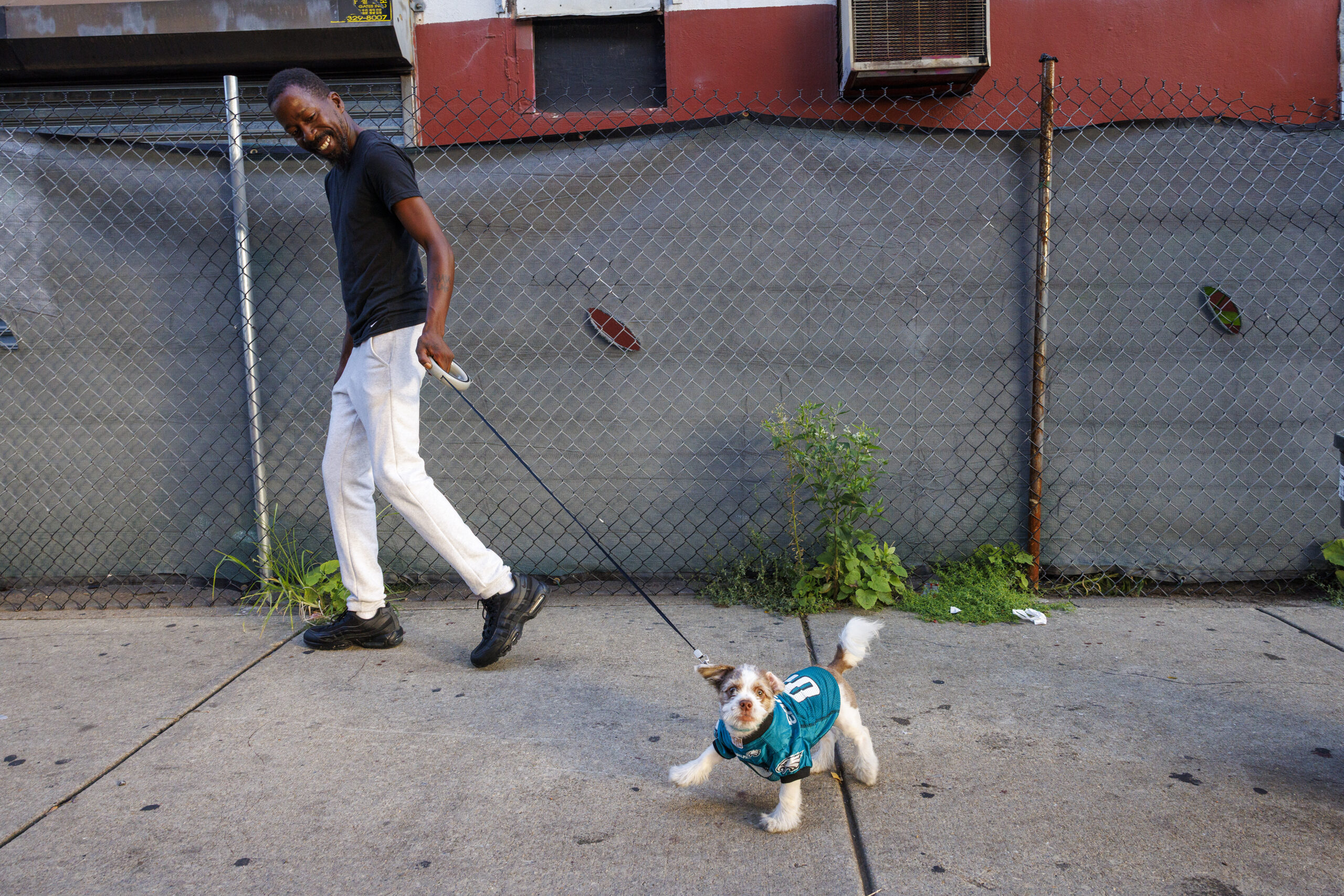
Theo Caraway of Philadelphia walking his dog Cooper, 6 months, Shitzu/Poodle wearing his Eagles jersey along Kensington at Ontario Street on Philadelphia, Friday, September 5, 2025.
Harmelin has had similar conversations with others who were not aware of the hazards bones create. Now, she is less likely to be frustrated at whomever has dropped the chicken bone on her street corner.
“We’re trying to assume what other people know and intend, but we can’t,” she said.
Even if more people get the message, though, it appears you will still be as likely to find a chicken bone on the street as a fallen leaf.
Although they’re a gross nuisance of a sidewalk adornment, Griffith doesn’t really mind them. She said they are more of a curiosity that make Philly what it is, in a small way.
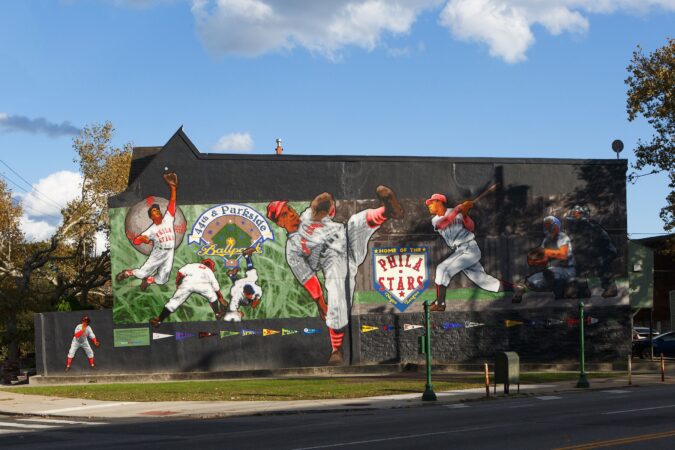
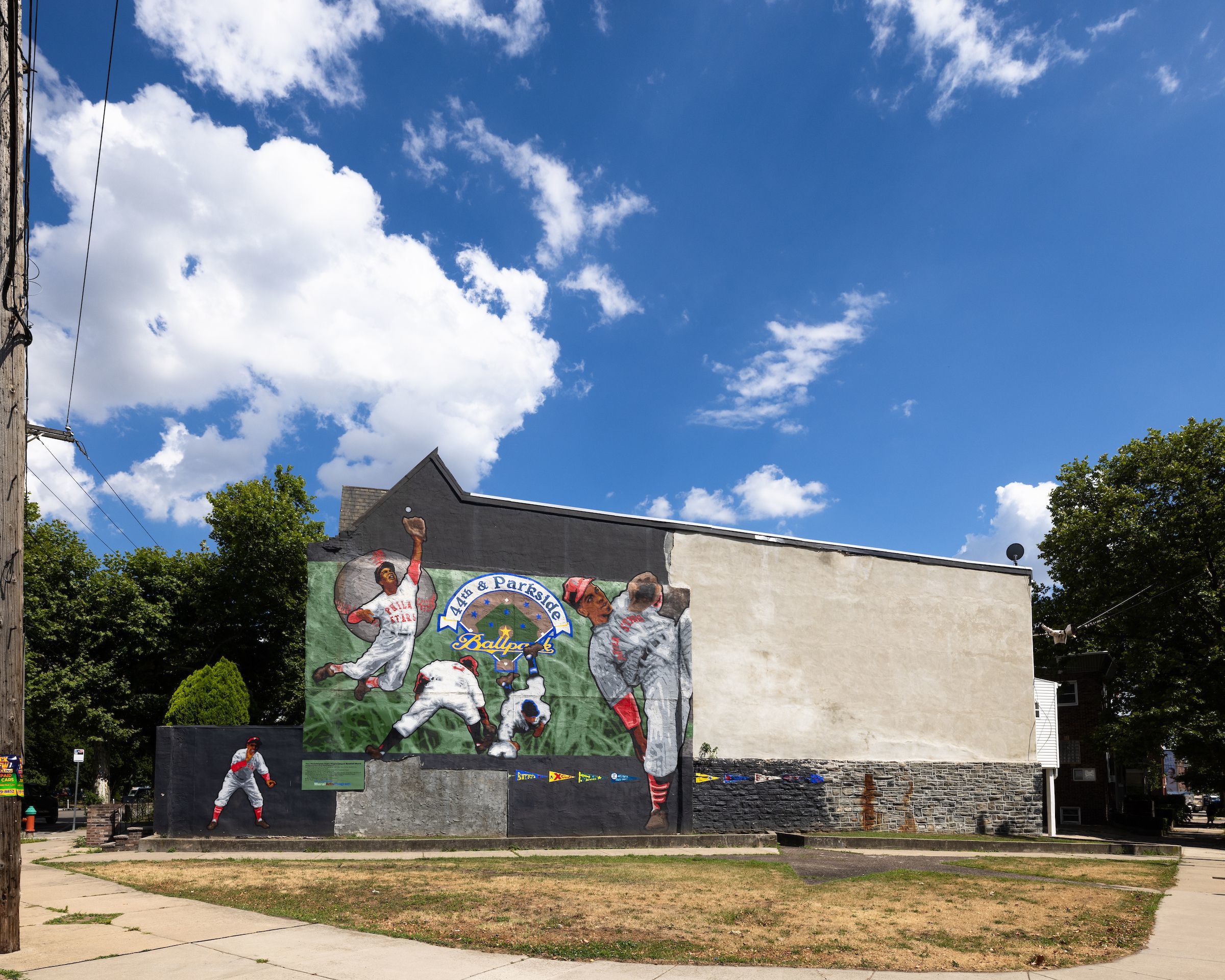
When a West Parkside mural honoring the Philadelphia Stars and Negro Leagues baseball was taken down last month, social media commenters were outraged as the news spread, fearing that Philadelphia had lost one of its iconic odes to Black history.
But the mural at 4304 Parkside Ave. won’t be gone for very long. In a collaboration among Mural Arts Philadelphia, Parkside community members, and the owners of its former building, a new version of the Stars mural will be re-created just across the street.
“It was put up over 20 years ago. We’ve been working really hard to spruce it up for the next 20 years,” said Marjorie Ogilvie, the president emeritus of the West Parkside Business Association, who helped erect the first mural in 2006.
It seemed inevitable that the two-story mural would eventually be brought down. There was roof and wall damage to the home on which it is painted, and the building partially collapsed. Those repairs required the removal of half of the mural a few years ago, and it was never replaced.
And the possibility of development on the plot of land is now closer to being realized. The triangle-shaped grassy lot in front of the mural has been owned by developer Haverford Square Properties for several years, and it acquired the 4304 Parkside building in September.
Half of the mural was previously removed after repairs were needed for the damaged wall and roof of the property. This photo shows what remained of the mural in 2024.
Haverford Square planned to construct a six-story apartment building at the corner, but community members fought back, arguing that it would lead to overcrowding in the neighborhood. Haverford Square president German Yakubov said they have since reached something of a compromise on a smaller-scale development, which will include a baseball-themed coffee shop on the corner.
But Yakubov is helping to secure the long-term future of the mural. Haverford Square has donated $30,000 and design services to the project to create a new version across Belmont Avenue.
“I didn’t want to let it go,” he said of the mural he has been driving past since he was a student at St. Joseph’s University.
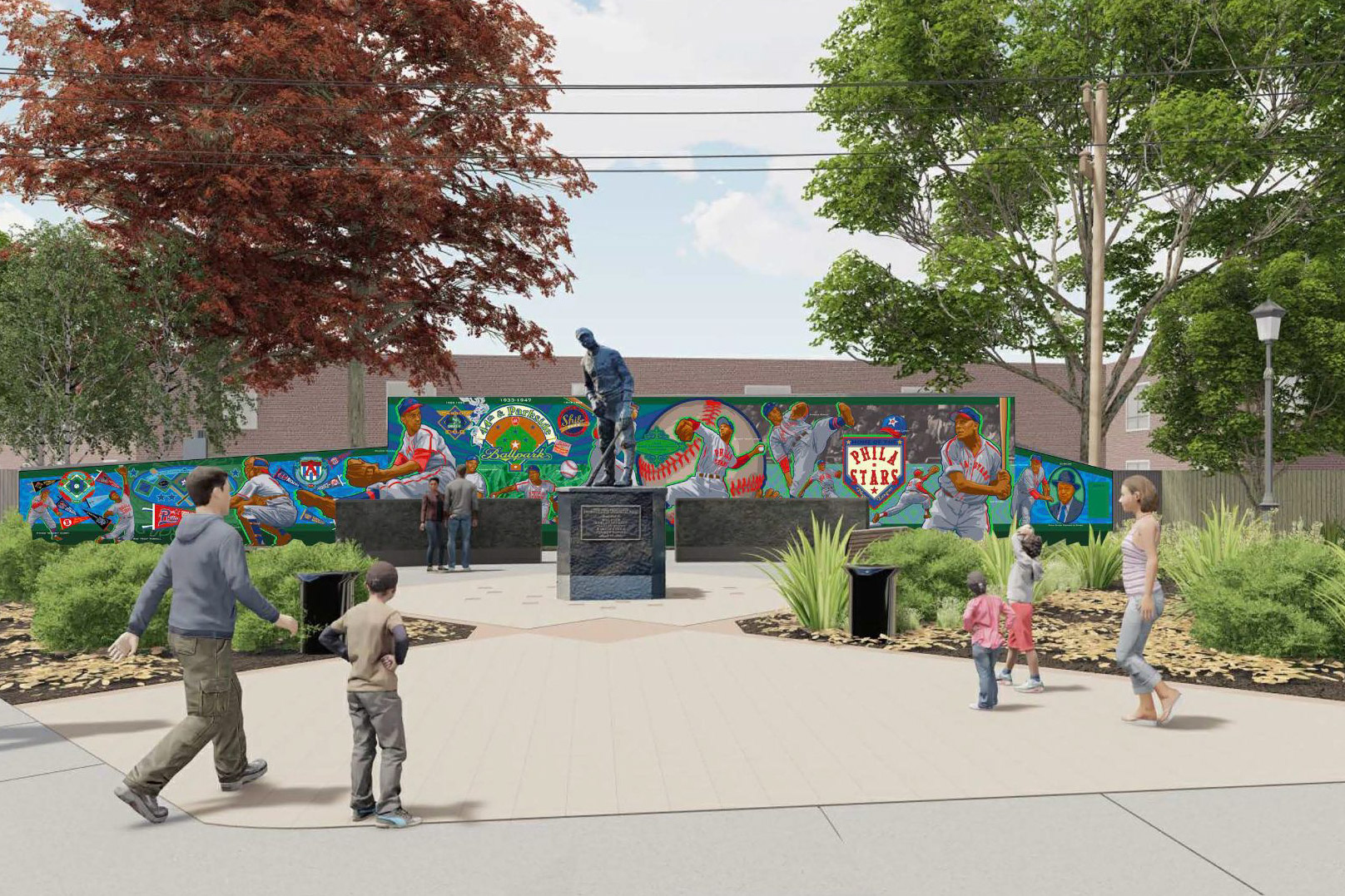
The mural will be painted on a yet-to-be-constructed wall in the Philadelphia Stars Negro Leagues Memorial Park, at the southwest corner of Parkside and Belmont Avenues. It will look slightly different from the previous version, since the new wall will be wider and shorter than the 4304 Parkside wall was. But the designs come from the artist who worked on the original mural, David McShane.
The park features a 7-foot bronze statue of a Negro Leagues baseball player, which was unveiled in a 2003 dedication ceremony at Veterans Stadium by five living Philadelphia Stars players —Bill Cash, Mahlon Duckett, Stanley Glenn, Harold Gould, and Wilmer Harris —before being placed at the park in 2005. The new mural will be raised behind the bronze statue.
A rendering of the proposed mural at the Philadelphia Stars Negro League Memorial Park. The recreated design is by the same artist, David McShane, behind the original mural. The proposed project will include the construction of a new wall behind the 7-foot bronze statue of a Stars player by Phil Sumpter.
“It’s great to see when everyone comes together to ensure that the story of the Negro League[s] and the Philadelphia Stars is not forgotten,” said Mural Arts Philadelphia executive director Jane Golden.
Many people reached out to Mural Arts once they heard in the fall that the mural was going to be removed, Golden said. They were furious and wanted to know what the organization would do to protect it.
Golden said she expects construction to begin early this spring after the project receives Philadelphia Art Commission approval, and for the mural to be completed by summer. Thousands of visitors are expected for numerous events in Philly, including the MLB All-Star Game in July.
The Stars are nearing their 100th anniversary, having played their first games in 1933. They joined the Negro National League the following season and won their first and only pennant, beating the Chicago American Giants in a controversial eight-game series, 4-3-1, after game 7 ended in a tie due to the state’s blue law curfew. Satchel Paige briefly played for the Stars, as did other Negro Leagues legends like Biz Mackey and Jud Nelson.
But after Major League Baseball was integrated in 1947, the popularity of the Negro Leagues dropped, and the Stars disbanded in 1952. They played the majority of their home games at the 44th and Parkside Ballpark, the site where the new mural will rise.
The Black activists and community members who brought the President’s House Site into being are not letting its history be removed quietly.
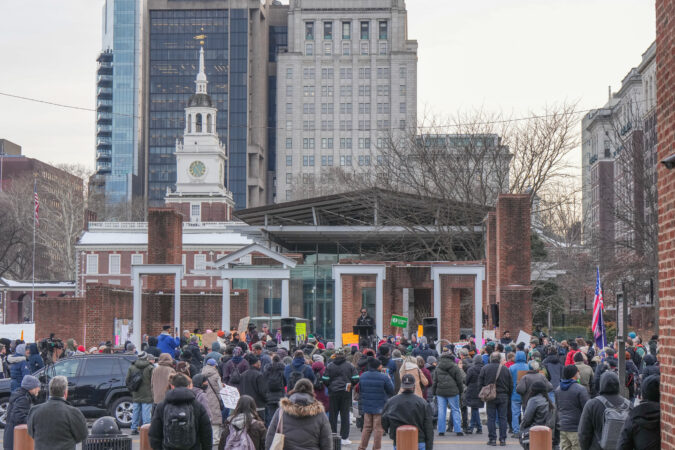
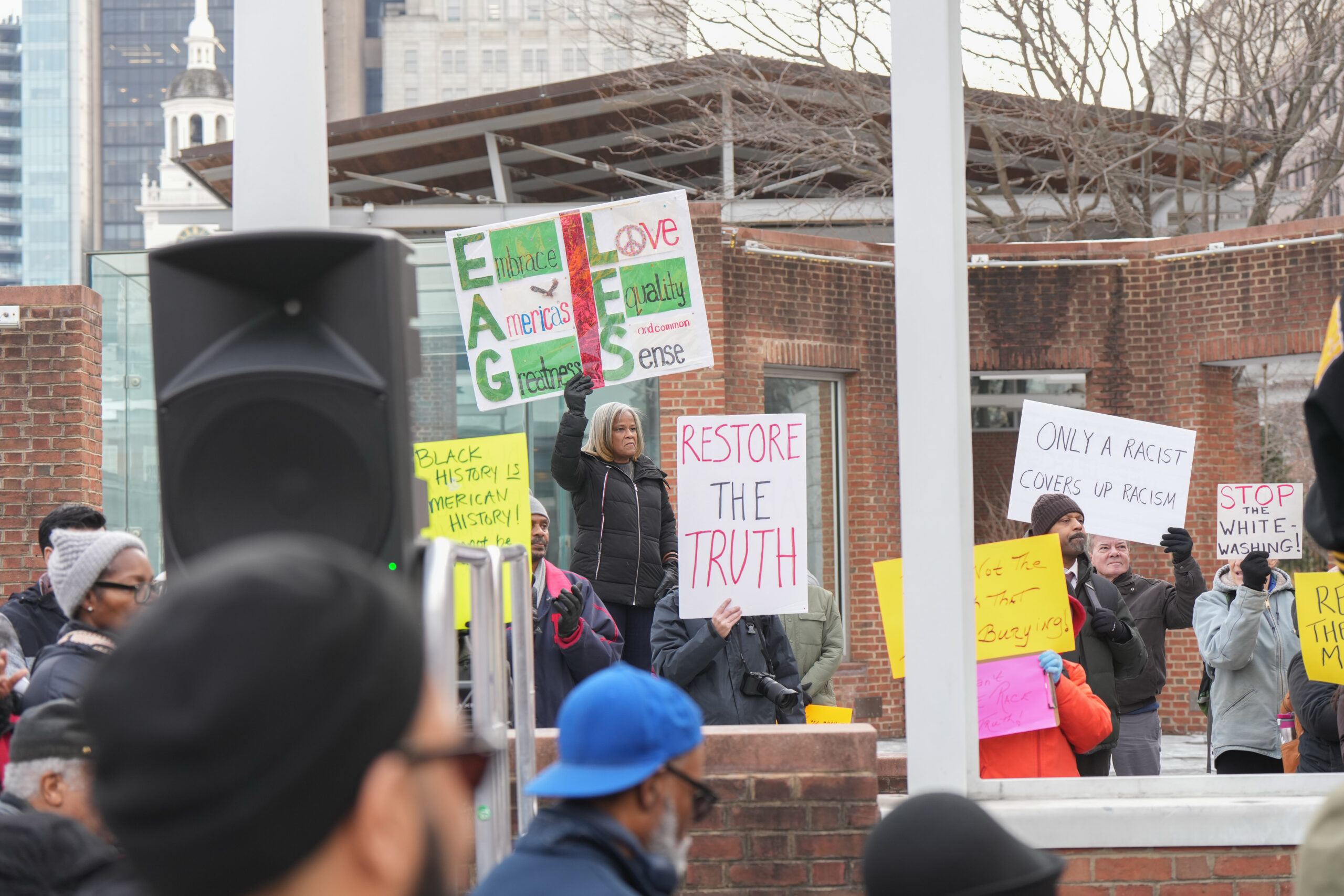
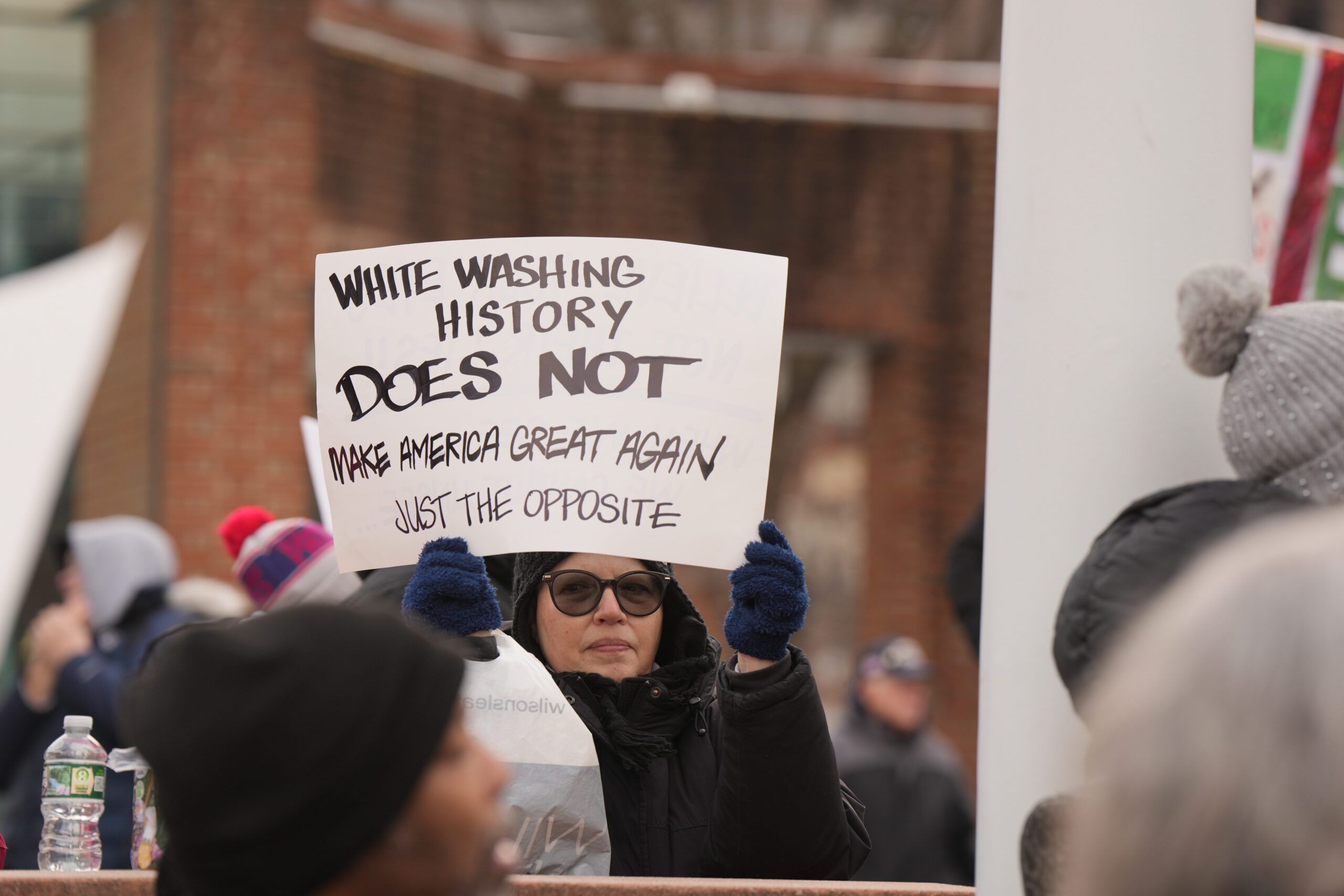
A couple of hundred supporters and local leaders organized by the Avenging the Ancestors Coalition rallied at the President’s House Site on Tuesday afternoon to demand the restoration of its slavery memorial after the National Park Service removed all of its informational and educational materials last month.
“History is not merely a collection of celebrated moments,” said Catherine Hicks, president of the NAACP Philadelphia Branch. “This action is a disservice to our city, our nation and denies future generations in the chance to learn from our history, fostering an environment of ignorance rather than understanding.”
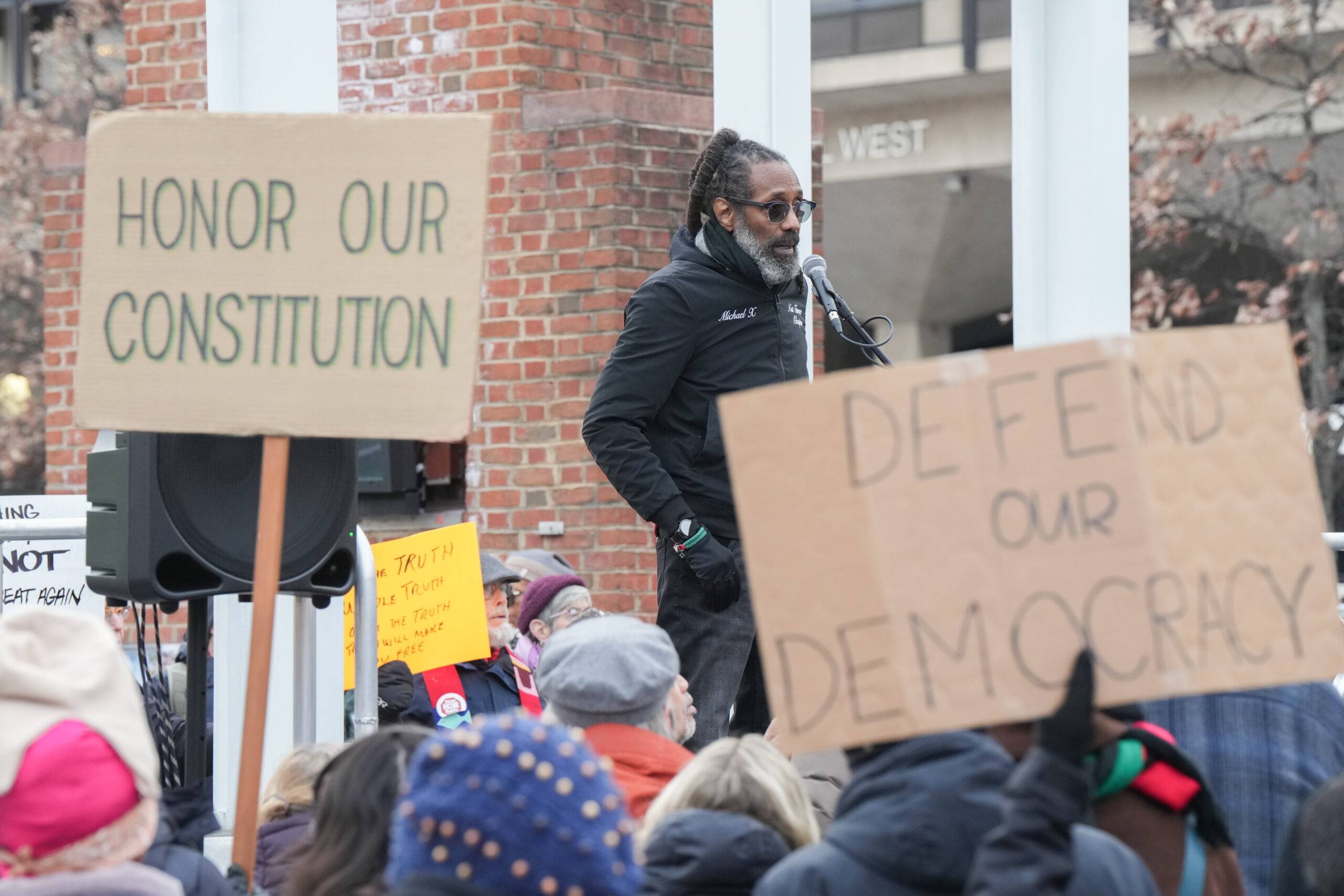
“This site is historic, holy ground,” said Michael Coard, an attorney and founding member of ATAC. “So now what? Now, we fight the good fight.”
Lawyer Michael Coard speaks at a rally at the President’s House Site in response to the removal of the President’s House exhibit.
ATAC was instrumental to the creation of President’s House on Independence Mall in 2010, a site that honors the nine people enslaved by George Washington while he lived at the precursor to the White House. The structure at Sixth and Market Streets featured video displays, illustrations and text-filled panels about the Atlantic slave trade and life under slavery, and detailed Washington’s dogged support for the institution.
Those exhibits were dismantled on Jan. 22, following directives from President Donald Trump’s administration to review and remove displays in National Parks that “inappropriately disparage Americans past or living.”
Thirteen exhibits from the President’s House were flagged for review this summer.
Mayor Cherelle L. Parker’s administration filed a federal lawsuit against Interior Secretary Doug Burgum and acting National Park Service Director Jessica Bowron, and their respective agencies, on the day the panels were removed. The complaint argues that dismantling the exhibits was an “arbitrary and capricious” act that violated a 2006 cooperative agreement between the city and the federal government.
“Attempts to unilaterally rewrite history will deprive residents and visitors” of the collar counties “of the full and accurate picture of the nation’s founding to which they are entitled,” the brief says.
The panels are currently being held in a storage facility owned by the National Park Service that is adjacent to the National Constitution Center, according to a legal filing by the Trump administration.
People gather for a rally at the President’s House Site in response to the removal of the President’s House exhibit in Old City.
Can’t hide the truth
Ever since the panels were taken down with crowbars and wrenches, there has been an outpouring of support for the memorial to be restored, and outrage toward the Trump administration.
“If you want to hide the truth of slavery in Philadelphia, you might as well tear down the whole city because it was built on the blood of my people. You cannot hide the truth,” said Solomon Jones, a radio host and columnist for The Inquirer.
“To erase slavery is to erase American history. That would be to erase Mount Vernon, to erase Wall Street … because those structures were built by enslaved labor,” said Yvonne Studevan, a seventh-generation descendant of Mother Bethel AME’s Bishop Richard Allen.
Judy Butler, a South Philadelphia resident, said she was both heartbroken and angry once she learned that the President’s House exhibits were going to be removed.
“I felt violated, disrespected,” she said.
Butler, 66, said she’s been inspired watching from afar as people in Minnesota have braved the frigid temperatures to protest, observe and resist ICE’s occupation of the Minneapolis area. Coming to ATAC’s rally was something she felt she had to do.
“They’re taking down our history. … How deplorable is that?” she said.
People gather for a rally at the President’s House Site in response to the removal of the President’s House exhibit in Old City.