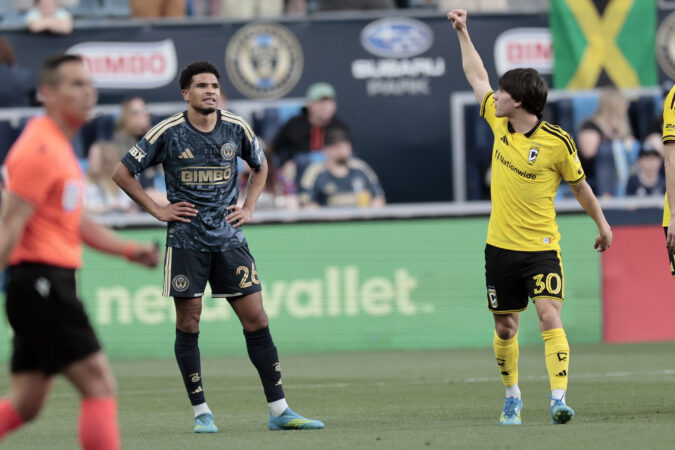
That’s all it took for the Union to find itself on the back foot against the Columbus Crew at Subaru Park on Saturday night.
The goal, a whipping in-swinging shot from Crew forward Hugo Picard, found the upper 90 past an outstretched Andre Blake.
It was also completely avoidable.
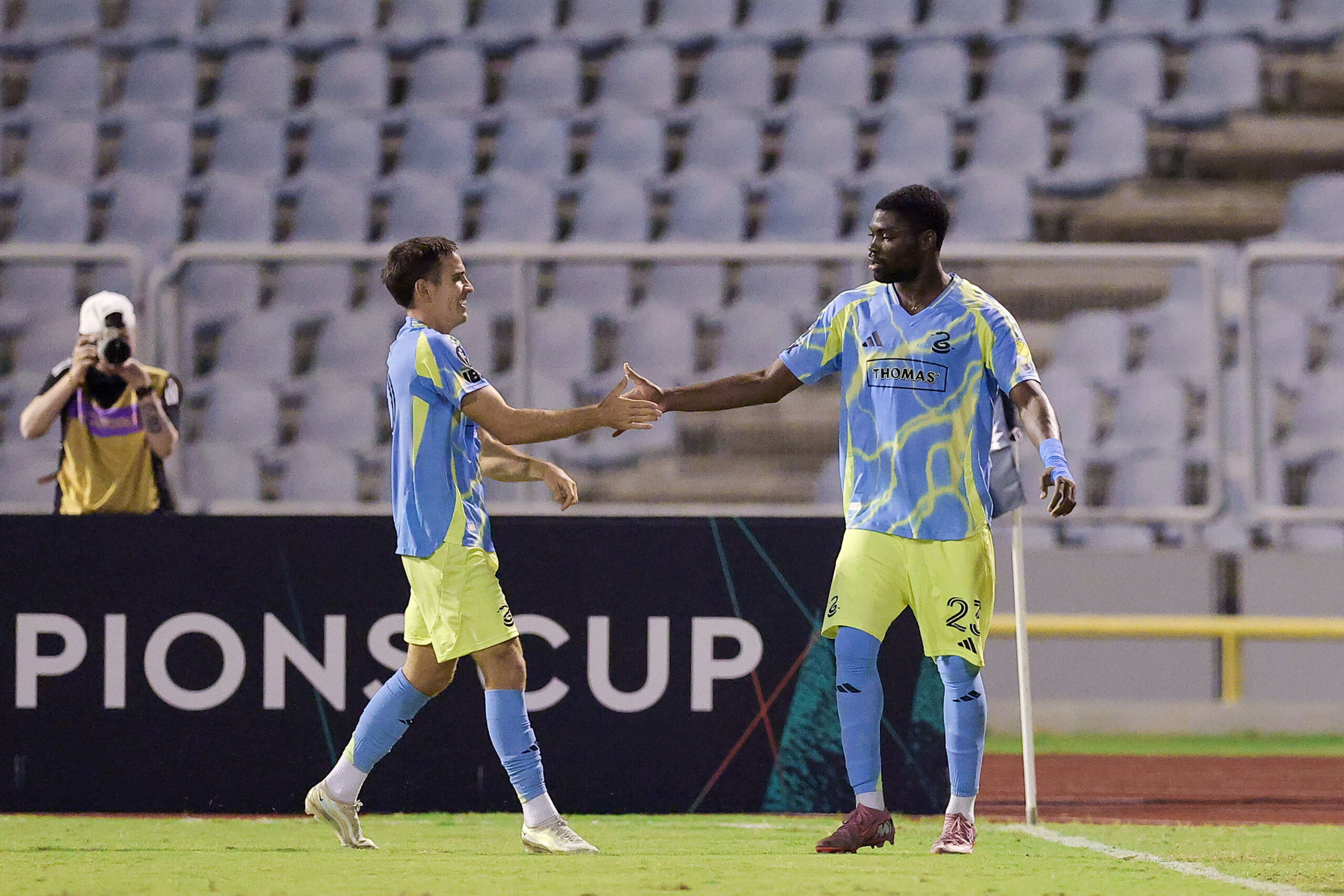
That’s a point for down the line. The larger point is that the Union were able to salvage a point after a 69th-minute goal from forward Milan Iloski. Iloski buried a tap-in following a nice run and cross into the box from second-half substitute Augustín Anello.
It was a goal that helped to shroud an otherwise ineffective night for Iloski, whose efforts, by either poor decision making or attempted shots that were blocked in the final third, amounted to very little.
Besides Iloski’s goal, repeated dazzling runs from midfielder Cavan Sullivan — and a halftime light show — were the only points of note on what was an otherwise familiar run of form from a Union team that hasn’t celebrated a win in MLS play since April 11 against Montréal.
Speaking of Sulliva, the 16-year-old phenom was inches from becoming the hero with the last kick of the game. After lloski was fouled just outside of the box in stoppage time, Sullivan was given the free kick opportunity. He hit a rifle through Columbus’ wall but the shot was seen all the way from Crew goalkeeper — and U.S. national team World Cup hopeful — Patrick Schulte.
Union 1, Crew 1.
But back to the point from earlier about salvaging a point…
On a free kick for Columbus, Picard stood alone at the far post unmarked. Closest to him was defender Nathan Harriel, but Harriel already had a mark at the edge of the 18. Just before the kick, midfielder Indiana Vassilev ran into the same space as Harriel and the Crew player he was marking.
Ball comes in, finds a deflection off an attempted clearance, falls to an unmarked Picard, who doesn’t hesitate and, to his credit, hits a gem into Blake’s far post.
The play seemed like a microcosm of the Union’s woes this season, where one unfortunate error, one mistimed run — or, in this case, a missed assignment — finds them chasing the game. It was a game that marked the final home match before a seven-week league wide respite for the FIFA World Cup, which begins on June 11, with June 14 being Philly’s first foray into the tournament.
It was also the third match in the span of a week for the Union after a pair of one-goal losses to New England (3-2) last Saturday, and a late 4-3 loss to Orlando City on Wednesday. The club has only collected two points out of a possible 12 from matches in their May slate.
One game remains and it’s perhaps the biggest in this first half of play for the Union, a road test against Lionel Messi and a surging Inter Miami team next Saturday (7:30 p.m., Apple TV). Miami, winners of their last two, have scored a combined 12 goals in their last three matches.
Soccer fans looking to buy tickets for this summer’s FIFA World Cup at face value will have a final opportunity on April 1.
In what FIFA is calling its Last-Minute Sales Phase, soccer’s governing body will sell remaining tickets via FIFA.com/tickets on a first-come, first-served basis, starting at 11 a.m. Philadelphia time. This will mark the final round of a four-part sales phase that began last September.
Tickets will be subject to availability, but according to FIFA, once prospective buyers bypass the queue, they will be able to see the remaining matches still up for grabs. There are two ways to secure tickets: either by viewing the seat map to see the remaining options or by selecting the “Book the best seat” option in the selected venue.
Brazil’s Vinicius Junior will be one of the main draws for fans at this summer’s World Cup group stage matches in Philadelphia when it takes on Haiti on June 19.
FIFA also announced that on April 1, fans who secured seats in earlier phases will be able to see where their purchased seats were allocated within their category. In earlier sale phases, fans were only able to purchase tickets across the Category 1 (lower level, prime seating), Category 2 (mid-upper level), and Category 3 (upper level) options.
After April 1, any remaining tickets will go onto secondary reseller markets, of which FIFA will manage its own via FIFA.com/tickets. It’s the first time the organization has opted to introduce its own secondary market, saying that purchasing on its secondary site is “the official and preferred source for FIFA World Cup 2026 tickets.”
FIFA continues to face pushback from people who believe the organization is running a monopoly when it comes to its own tournament, one that comes at the expense of fans, considering this is the first time the organization has elected to adopt a dynamic pricing system.
“This is what happens when one entity controls both supply and distribution,” said Ahmed Nimale, a former executive at Live Nation who now oversees a New York-based ticketing provider called KYD Labs. “Without competition, there is nothing to keep pricing or fees in check, and fans are left with no real alternatives. FIFA directly owns, controls and manages all ticketing for the World Cup, one of the most-watched sporting events on the planet, expected to draw as many as 5.5 million fans.“
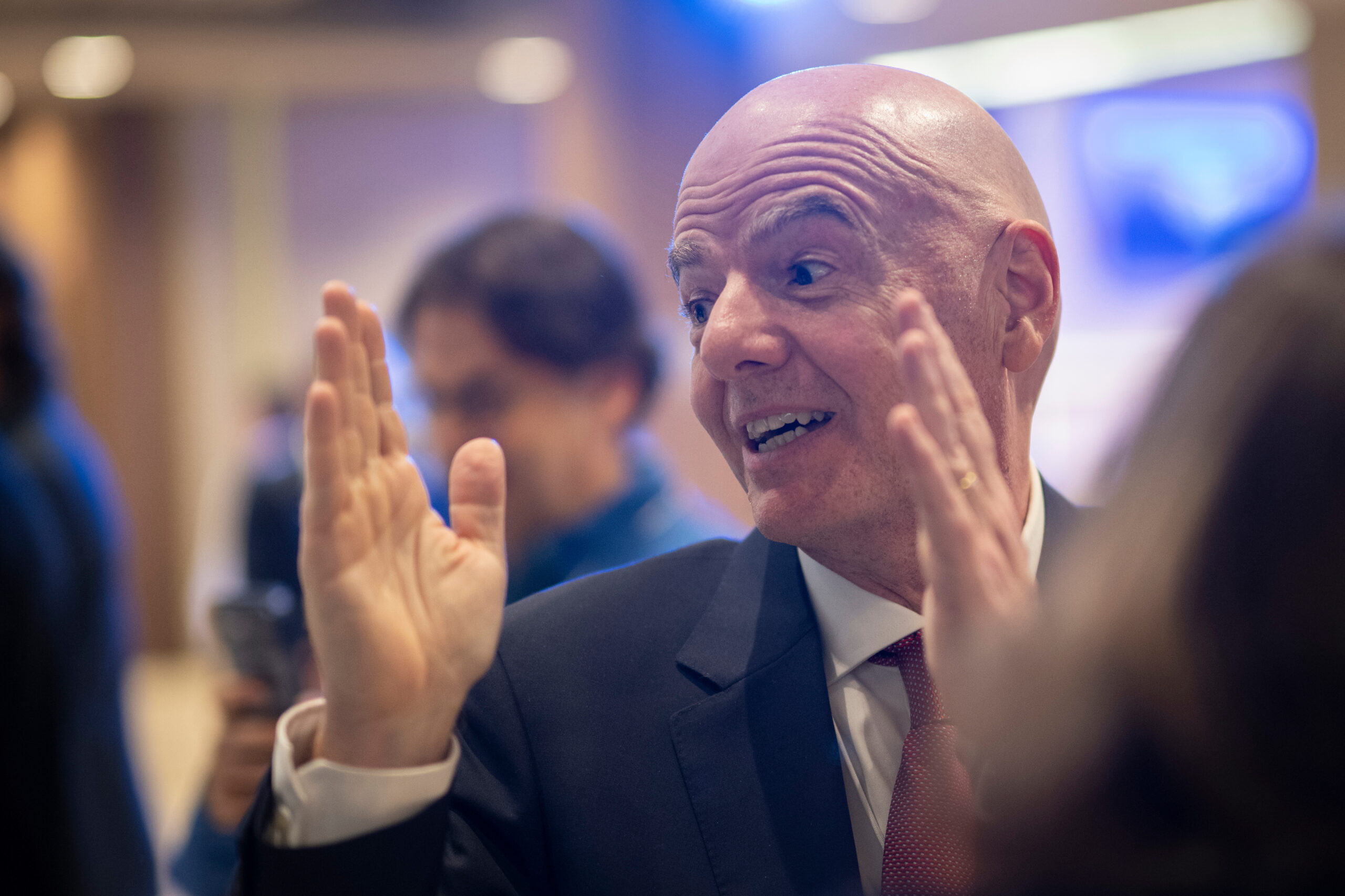
FIFA president Gianni Infantino claims that a large part of the revenue it generates goes back into supporting 211 member associations from around the world.
On Wednesday, a release from FIFA reaffirmed its claim that over 500 million ticket requests have been submitted since the initial draw phase, with over 1 million tickets being sold since Feb. 27. The organization also held a secret phase for fans who it felt missed out on the opportunity for earlier phases.
However, FIFA president Gianni Infantino has said previously that much of its revenue goes back into “growing the game,” adding Wednesday that the money it generates “fuels the growth of men’s, women’s and youth football throughout its 211 member associations.”
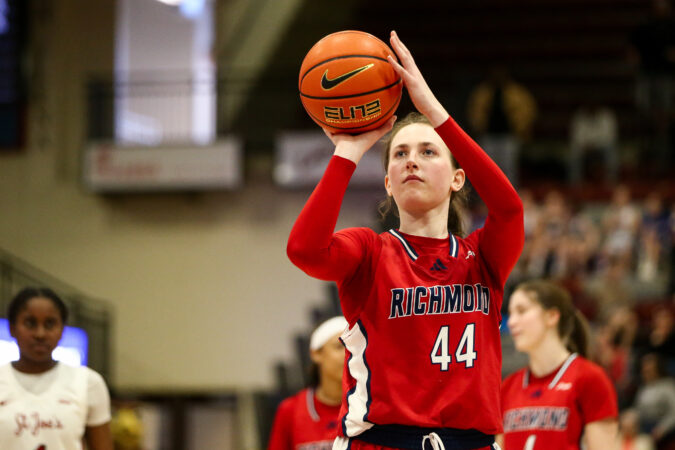
Maggie Doogan left Cardinal O’Hara as one of the best players to come out of the Catholic League. Now in her senior year at Richmond, she’s staking her claim as one of the best to play in the Atlantic 10.
For the second year in a row, Doogan was named conference player of the year after leading the Spiders (25-6, 15-3 A-10) to their third straight season with 25-plus wins.
She became just the third player in the school’s history to reach the 2,000-point mark behind nine double-doubles this season. She set an A-10 single-game scoring record with a 48-point night against Davidson on Jan. 10 — the most points in a Division I women’s basketball game this season — and turned in a 35-point effort in Saturday’s win over St. Joseph’s.
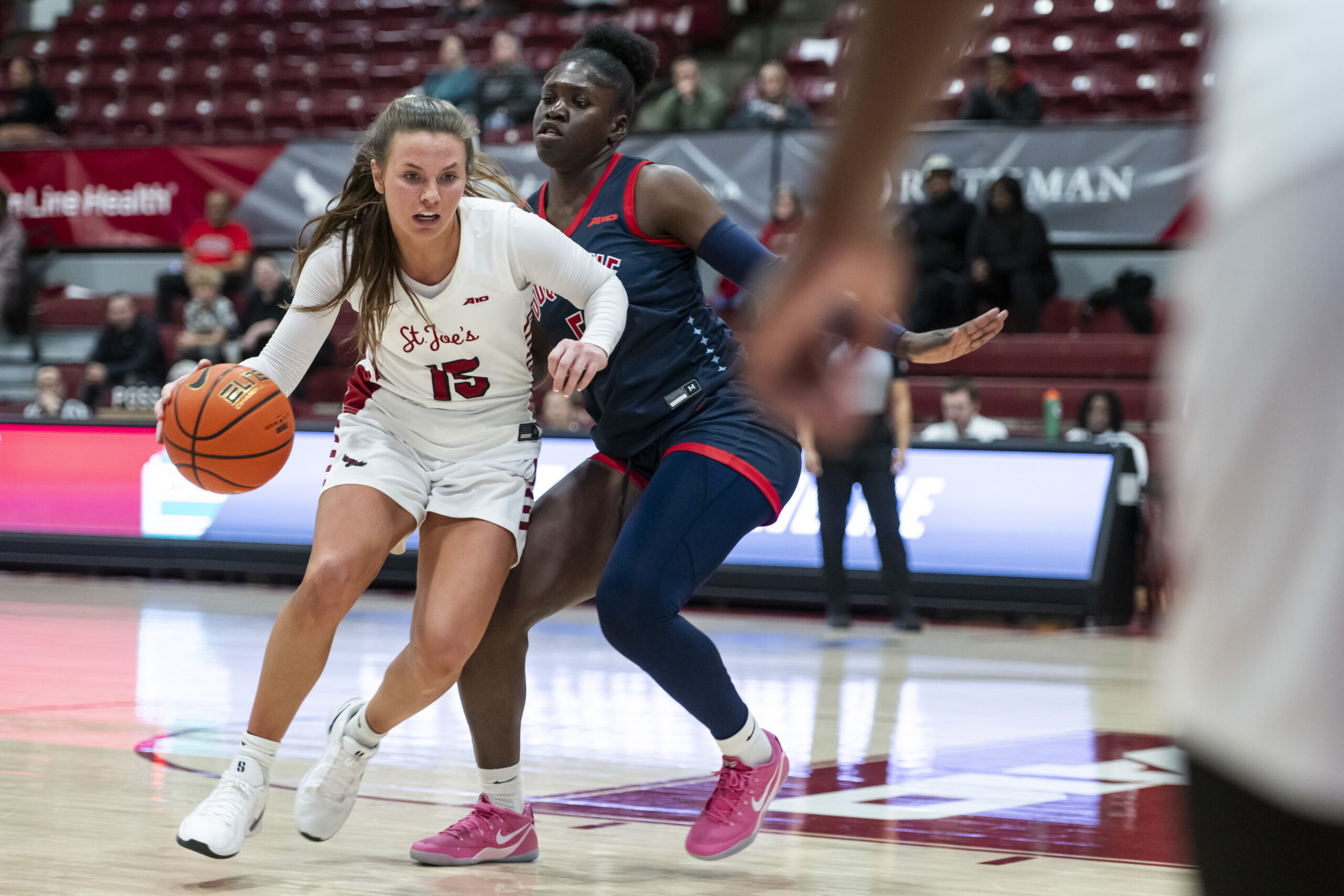
This marked the first time in four seasons that a St. Joe’s player hasn’t been named a first-team all-conference selection. However, Gabby Casey led the Hawks as a second-team selection and was named A-10 Most Improved Player. A three-time conference player of the week, Casey, a junior guard from Quakertown, leads St. Joseph’s with 16 points and 6.4 rebounds per game.
Aleah Snead earned third-team honors as the one-two punch with Casey in the Hawks’ offense. Snead, a junior guard and Penn Charter alumna, led the team in assists with 90 during the regular season and averaged 11.3 points.
St. Joseph’s will open its A-10 tournament campaign as the No. 5 seed and will play the winner between No. 12 Duquesne and No. 13 Virginia Commonwealth in second-round action on Thursday (1:30 p.m., ESPN+).
Gabby Casey (left) was named to the all-Atlantic 10 second-team, leading St. Joseph’s to the No. 5 seed in the upcoming women’s tournament.
Macktoon leads La Salle
After a much-improved season, La Salle took home several honors, specifically Aryss Macktoon, who picked up defensive player of the year and second-team all-conference honors and was named to all-defensive team.
Macktoon, a redshirt sophomore guard who was joined on the A-10’s second team by teammate Ashleigh Connor, ranks among the top 10 in the nation in steals per game (3.3), highlighted by eight she had in a 81-70 road win over Lehigh in November. Macktoon broke the Explorers’ single-season steals record in Saturday’s win over Loyola Chicago. Macktoon also averages 15.2 points and leads La Salle in rebounding with 7.3 per game.
Stole the show📺@aryssmacktoon30 has been named the Atlantic 10 Defensive Player of the Year, the first in La Salle history.
🔭1st in Steals (3.3) 🔭4th in Rebounds (7.3) 🔭8th in Points (15.2) 🔭12th in Minutes (32.4) 🔭23rd in Blocks (0.5) pic.twitter.com/YgYLZDsh1u
— La Salle Women’s Basketball (@LaSalle_WBB) March 3, 2026
Macktoon and Connor, a redshirt junior who leads the team in points (15.6 per game), and assists with 112, guided the Explorers to a No. 6 seed in the A-10 tournament, a big jump from their No. 14 seed in 2024-25.
La Salle awaits the winner between No. 11 St. Louis and No. 14 Fordham in the second-round nightcap on Thursday (7:30 p.m., ESPN+).
Many soccer fans hoping to score early World Cup tickets have been unable to do so after missing out on previous presale windows. In an effort to appease those fans, FIFA offered a 48-hour special opportunity for supporters to purchase tickets to select matches in their desired markets. But prices remained sky high, availability was severely limited, and details — like where you’d actually be sitting — were minimal.
Over the course of three separate presales, which began in September with a special draw for Visa cardholders, FIFA claims more than 500 million fans have expressed interest, with many registering in ticket lotteries. These lotteries and presales come before what’s expected to be a free-for-all in April, FIFA’s last-minute sales phase, in which tickets will be available on a first-come, first-served basis, “processed as real-time transactions.”
So the surprise that FIFA offered a special, unannounced 48-hour presale to select fans — starting at 11 a.m. on Wednesday and ending the same time on Friday — came as a welcome shock for those looking for seats before they hit the secondary market.
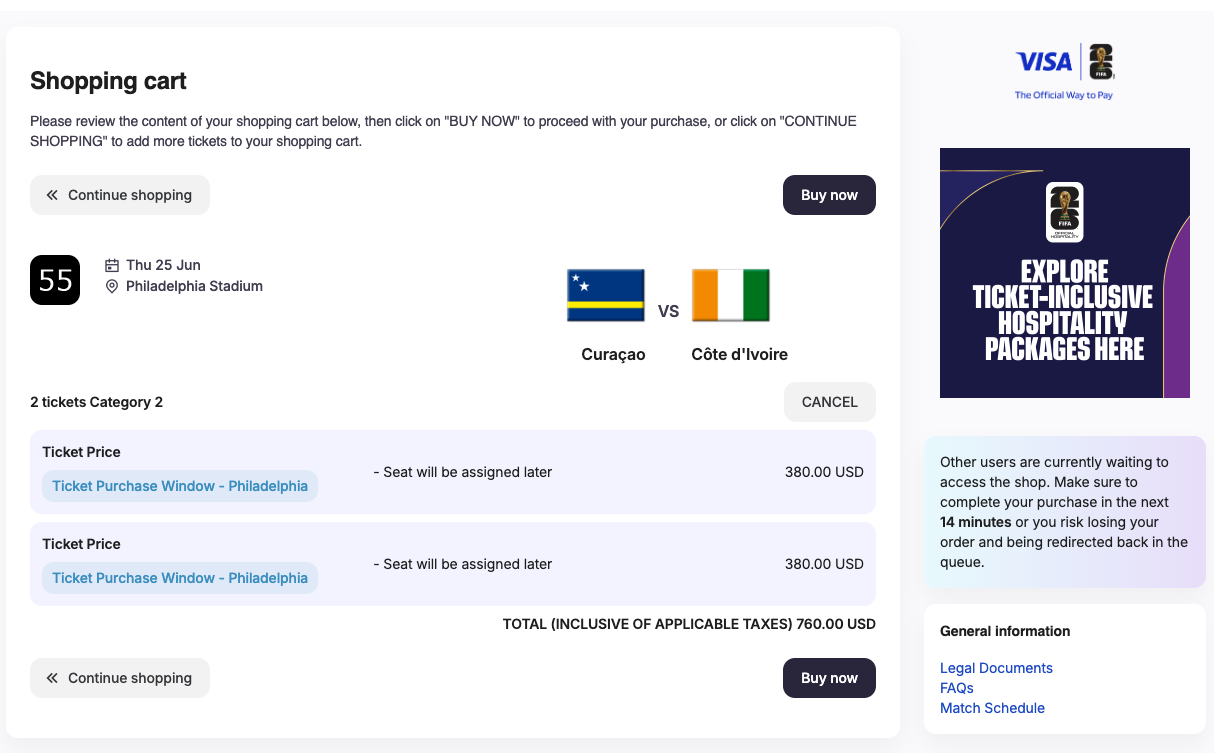
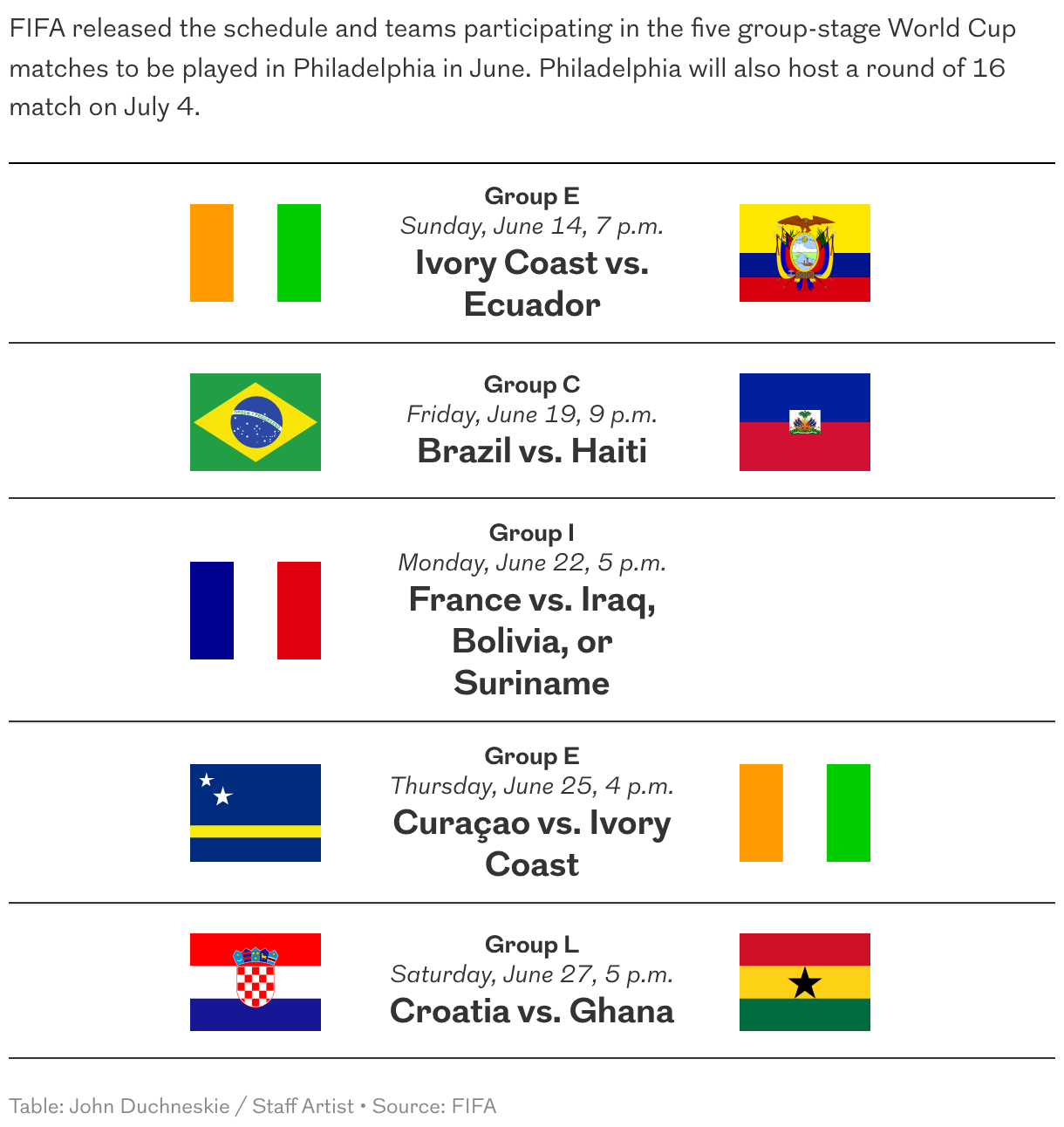
However, for some fans, the real shock arrived after they bypassed FIFA’s queue and gained access to the ticket portal. By Friday morning in Philadelphia, the only game left available was the Group E match between the Ivory Coast and World Cup first-timers Curaçao on June 25 (4 p.m., FS1).
It’s unknown if FIFA offered more than one match during this special presale or if it was just that one match, and requests for comment to its media team regarding the number of matches made available, as well as the number of matches in neighboring markets like New York for this presale, went unanswered at the time of this report.
Select fans looking to attend the World Cup in Philly were granted a special presale this week, but were still faced with high prices for match tickets to one game by Friday.
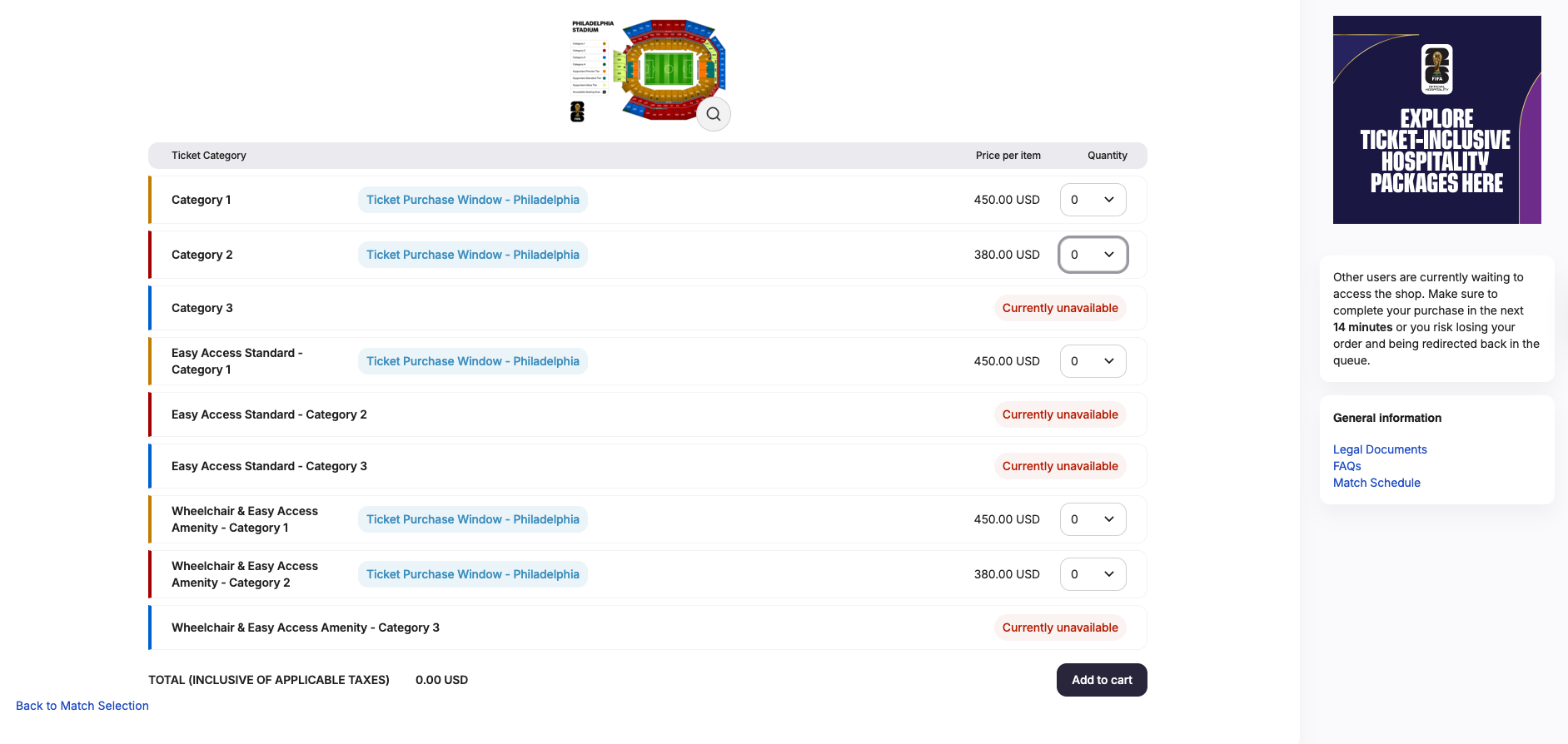
FIFA, which offers tickets in three categories ranging from Category 1 (the most expensive) to Category 3 (the least expensive), had seating in this special presale only for Categories 1 and 2 remaining on Friday morning. They started at $360 per ticket. For a seat in Category 1? $450.
These prices mirrored the original ticket prices for matches in Philly when they were first released in December, with Category 2 tickets in this latest special presale just $20 cheaper than the original $380 asking price.
Following global backlash in that same month, FIFA offered what they called a Supporter Entry Tier ticket, selling off a few hundred Category 3 seats across all 16 venues for just $60.
Lincoln Financial Field will host six World Cup matches, including a July 4 Round-of-16 knockout match.
However, it appears prices, fueled by FIFA’s employment of dynamic pricing for the first time in World Cup history, are back in the hundreds of dollars.
To some in this latest presale, the juice just didn’t feel worth the squeeze.
“Who can afford that for that game?” said Daniel Quinn, a Northeast Philly native who works in retail management. Quinn said he didn’t even notice the email from FIFA until Thursday night, as it hit his spam folder.
He rushed to the portal on Friday morning to see what was left.
“I just stared at my phone and laughed,” Quinn said. “Listen, I know it’s the World Cup, but I can’t justify paying $360 to watch a game where I can’t tell you a single soul playing on the field. Like, I know the Ivory Coast has good players, but for that to be the only game available and then to offer seats at those prices, just felt silly.”
One more surprise remained. The presale still only guaranteed fans what’s known as a “right to buy” ticket, meaning that seat selection, even after purchasing, remained a mystery and would only be made available as the match drew closer.
“Why are these still right to buy tickets?” Quinn continued. “This late in the game, I should know where I’ll sit so I can make an informed decision. Does a Cat 1 seat get me in the back [of the lower bowl] at the Linc, or a Cat 2, where I’m sitting up higher, but I might be in front? If you’re going to spend that type of money, I feel like you should at least know that.”
The total cost for two tickets for the June 25 game between the Ivory Coast and Curaçao inclusive of taxes and fees through a special presale FIFA offered select fans on Wednesday.
Earlier this week, a FIFA spokesperson told The Athletic that the fans chosen for its latest presale were “a defined group of applicants” selected in order to maximize fairness and acknowledge fans who have already demonstrated strong interest in the tournament.”
But the fact that, with just hours left before the Friday mid-morning deadline, the opportunity was availability for one game across the five group-stage matches coming to Philly beginning June 14, and that the cost to attend was still so high, rubbed soccer fans like Quinn the wrong way.
“Listen, shoutout to the people who can afford these [tickets],” he said. “I’m a lifelong soccer fan, and I’ve been to a lot of [soccer] games at the Linc. I went to the Club World Cup last year, and having the World Cup not just here in the States but literally where the Birds play feels like a bucket list [item]. But I think I’ll wait, man. Either these [ticket prices] drop because there are people like me who are laughing at what they’re charging, and prices will go way down, or people will snatch these up, and I’ll watch it for free on TV.
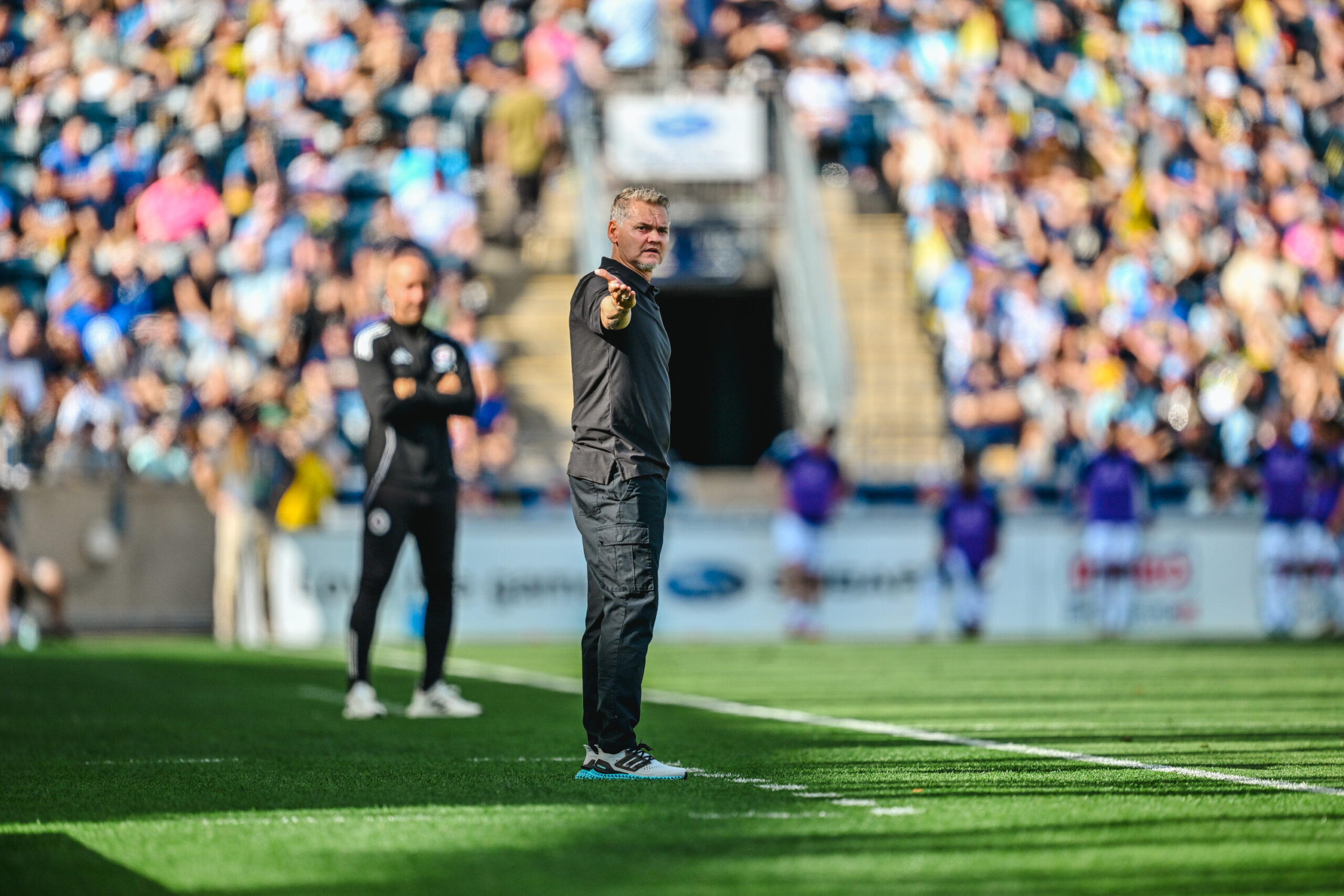
If he did, he certainly wasn’t sharing it on this day, doubling as a model for the Union’s new home kit, one that pays homage to America’s 250th birthday and coincides with the FIFA World Cup passing through Philadelphia this summer.
But the question last month was plain. As the Union’s new No. 10, the number generally designated for a team’s playmaker, how does it suit his strengths, and more importantly, his role on the team?
Will the move create opportunities for his partners sitting behind the forward in Bradley Carnell’s modified 4-4-2 (essentially 4-2-2-2) formation? Will it create chances for him running off them? Which would make sense given the imposing size of Ezekiel Alladoh, the team’s new 6-foot-3, 170-pound powerhouse up top?
Will it be both?
Some might suggest that two games into the regular season and a handful of televised preseason matches are still too small a sample size to determine where Iloski exactly fits and where he’ll be most effective. In that same time, however, credit him with four goals and a Man-of-the-Match award after a 5-0 rout of Trinidad’s Defence Force in the club’s Concacaf Champions Cup opener.
It is certainly not a bad thing to be a bit of an unknown for a team looking to surprise early in the season in defense of its 2025 Supporters’ Shield crown.
That continues this week as the Union have their Champions Cup return leg against Defence Force at Subaru Park on Thursday (7 p.m., FS2), followed by the team’s MLS home opener against Eastern Conference rival New York City FC on Sunday (4:30 p.m., Apple TV).
If that’s the case, one has to wonder what the coaching staff has told Iloski it’s looking for from him in the No. 10 jersey.
“I think stepping up in a big way,” said Iloski, a 26-year-old native of California. “I was brought here midseason last year to help bring a trophy. And you know, we were happy to win the Supporters’ Shield, but we fell short in other places. Now, it’s for me to be an important player on the team and really be a leader in the locker room and make sure to implement those core values and, you know, things that this club stands for.”
But the answer was a bit more complex from Carnell, who noted during a recent news conference the variety of ways Iloski can be used, with none of them sounding like a one-size-fits-all approach to the second-year Union player.
Union manager Bradley Carnell says that plans have been created that fuse the team’s attack with Milan Iloski’s skill set.
“We have a bunch of things drawn up in my [coaches] room,” the manager said. “There are different scenarios on tactical sheets of paper. We have an overload of strikers with us right now. So [we just need] Milan to build his foundation, I would say.
“We know what he brought us last year, through the summer [when he arrived] and down the stretch. He’s a real weapon in both phases, whether it’s in the possession phase or in the transition phase. … He has a bunch of things to learn even in the [No. 10] spot. But using him in the striker spot is an option as well. Right now, he’s being used in that 10 spot, and we’re confident we’ll get greater value out of him there.”
It’s no secret that Iloski provides value. His eight goals in a five-game tear for San Diego last season made him a midseason commodity that the Union pounced on. He collected four goals and five assists in just 14 games for the Union in all competitions, drilling home the fact that he’s anything but one-dimensional.
But a shift in position means a shift in mindset, and at the end of the day, Iloski is happiest around the box angling on goal. Proof came in the five shots, two on goal, from the Union’s loss to D.C. United on Saturday. It also arrived in a preseason wonder goal he scored running off the ball against CF Montréal.
It’s where he likes to be, his happy place if you will.
In his new role, Milan Iloski (left) is expected to be the creative provider for strikers like newcomer Ezekiel Alladoh (right) and others as the Union’s No. 10.
“I think in an ideal world, I enjoy being around the goal more,” Iloski said. “I came here because I enjoyed playing next to someone, that’s one thing I’ve talked with the coaching staff a lot about. I love playing next to someone up top.”
But that’s not his role anymore — at least not game over game. Which is why in the same breath, the leadership he spoke of earlier came through.
“I also know I can be that creative player who can come inside or can float underneath the strikers,” he said. “So, you know, for me, I’m open to anything that can help the team. And you know, I’m totally bought in. So whatever the staff needs from me is what I’ll try and provide.”
In 2022, Fox Networks threw Carli Lloyd into the proverbial fire — on the other side of the world.
Barely a year removed from her own retirement from professional soccer, the Delran native was announced as one of the primary studio analysts for the network’s monthlong coverage of the FIFA World Cup in Qatar.
She handled it all in stride, finding her voice while taking cues from longtime on-air personalities Rob Stone and Alexi Lalas, but it was the first time she’d be a consistent presence, and a different look from what’s customary, with her observations of each match being critiqued and analyzed by soccer fans all over the world.
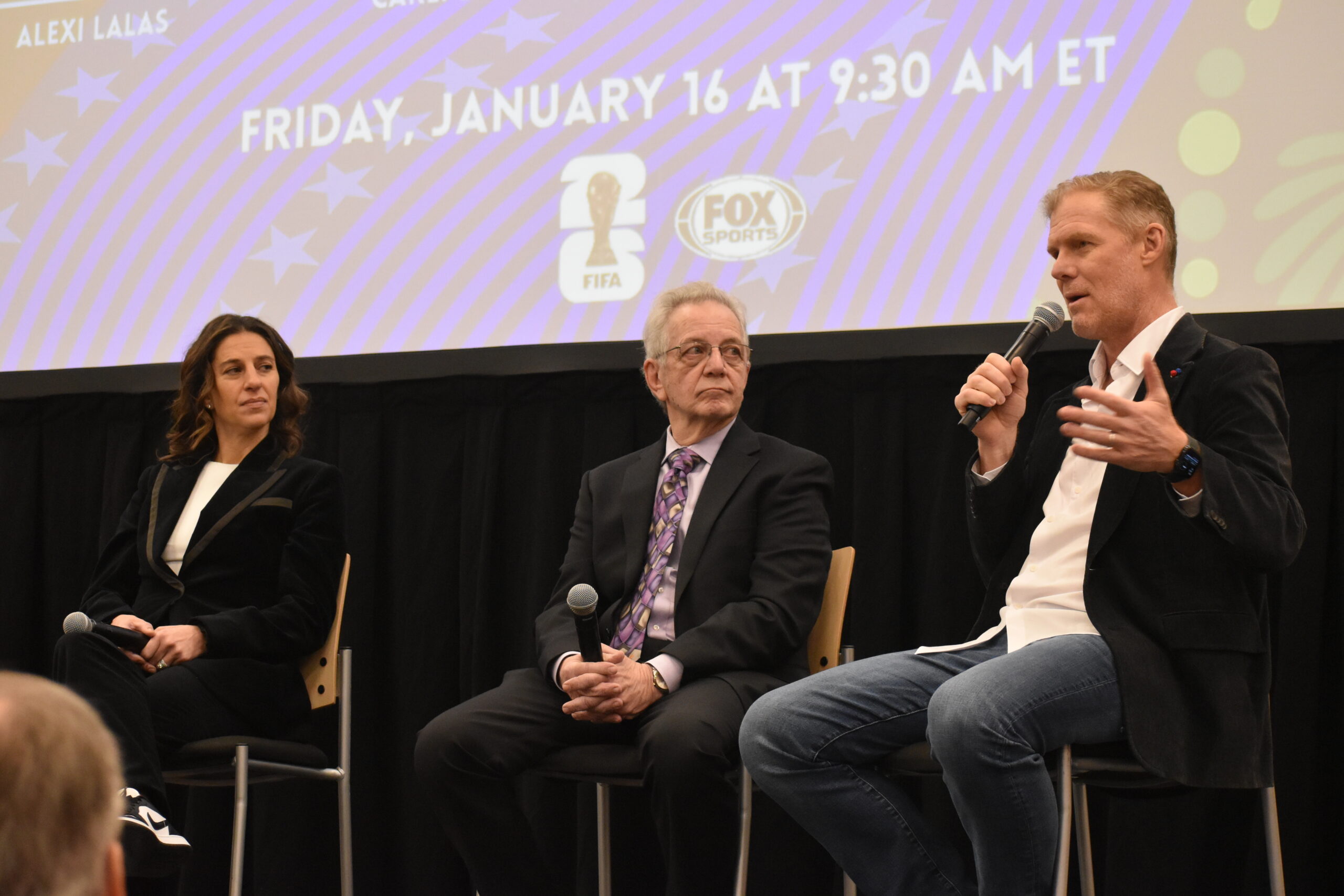
From left, Fox Sports soccer broadcasters Carli Lloyd, JP Dellacamera, and Alexi Lalas speak at the United Soccer Coaches Convention in Philadelphia last month.
“It was a lot to learn really fast, a lot to take in,” Lloyd recalled during the United Soccer Coaches Convention in Philadelphia last month. “But I was fortunate enough to learn from guys like Alexi and [Fox commentator] Stu [Holden] who helped me along the way really feel confident and like I can really do this.”
Lloyd did it well enough that she’ll be among Fox’s lead crew of studio analysts once again for the 2026 World Cup as the tournament makes six stops through Philadelphia as part of a 104-match schedule this summer.
It’s a task she says she’s “ready and excited for” after getting her feet wet in 2022, in addition to the commentary she’s been able to provide in the years since — some of which along the way stirred up a bit of controversy.
But a new year finds the tournament on home soil, with the United States hosting the bulk of scheduled matches, also spread across Canada and Mexico. It’s the perfect time for the United States to return to the biggest stage and show the world just how far it has evolved as a soccer nation, Lloyd says.
“I wouldn’t say there’s immense pressure in winning the World Cup,” Lloyd said. “But there’s the pressure to show the country that they are there to compete and they’re going to fight, and they’re going to give everything they have for our country.”
Made to inspire
Lloyd can recall being a 12-year-old girl watching the 1994 World Cup, the last time the men’s edition was held in America. That tournament, she recalled, sparked her excitement and love for the sport.
Follow that up with the unforgettable 1999 women’s edition, also hosted in the States, and those two moments galvanized the idea that Lloyd would do all she could to pursue it as a career.
The World Cup, Lloyd says, has that effect.
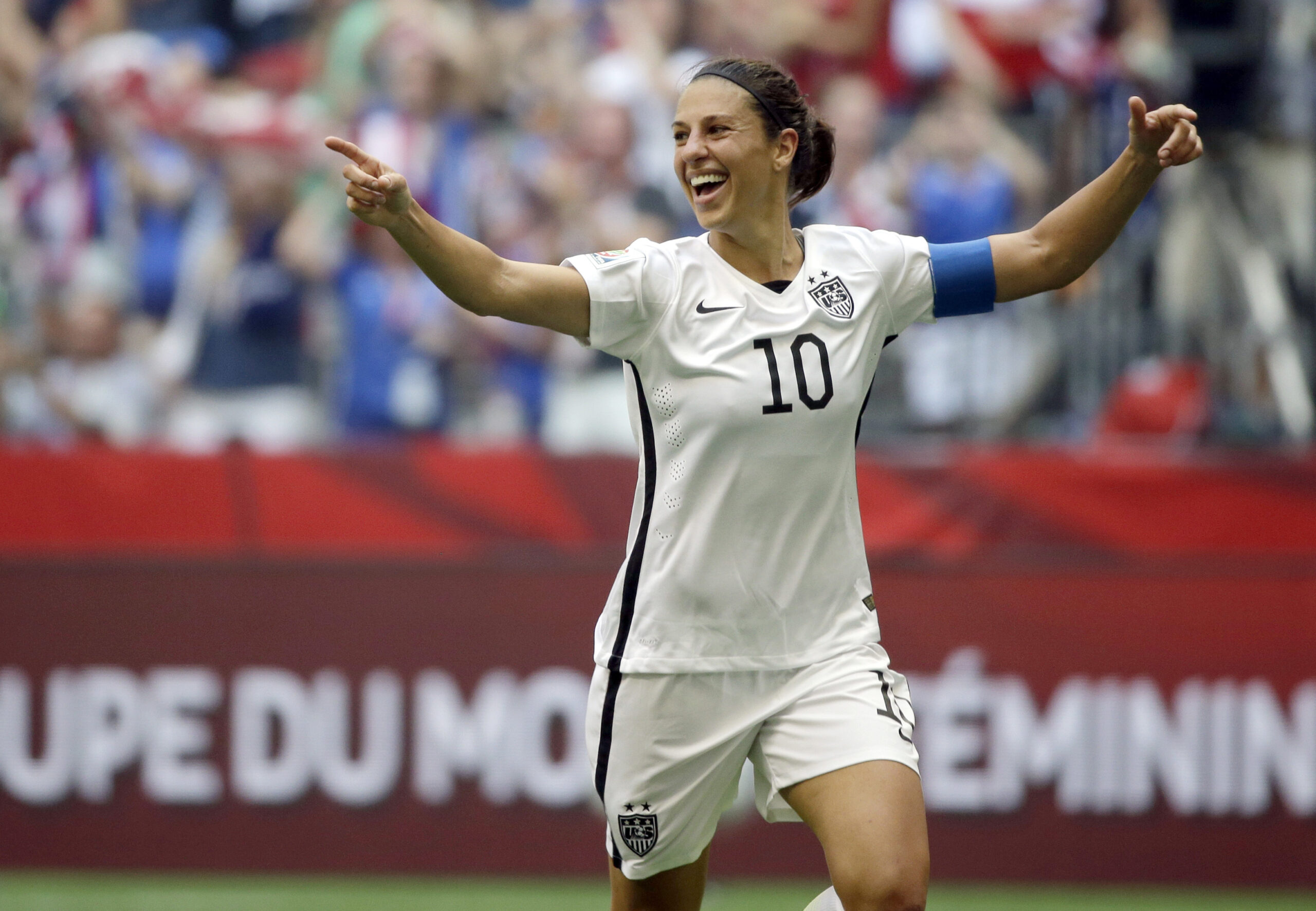
Carli Lloyd celebrates scoring her third goal against Japan in the 2015 women’s World Cup final in Vancouver.
“I don’t think we all know yet just how massive this is going to be, and the impact that it’s going to have on generations to come,” Lloyd said. Those 1994 and 1999 World Cups “jump-started my dream; they were life-changing for me. But I think it’s only going to be massive in the United States of America if our team shows up with that grit and that fight and that mentality.”
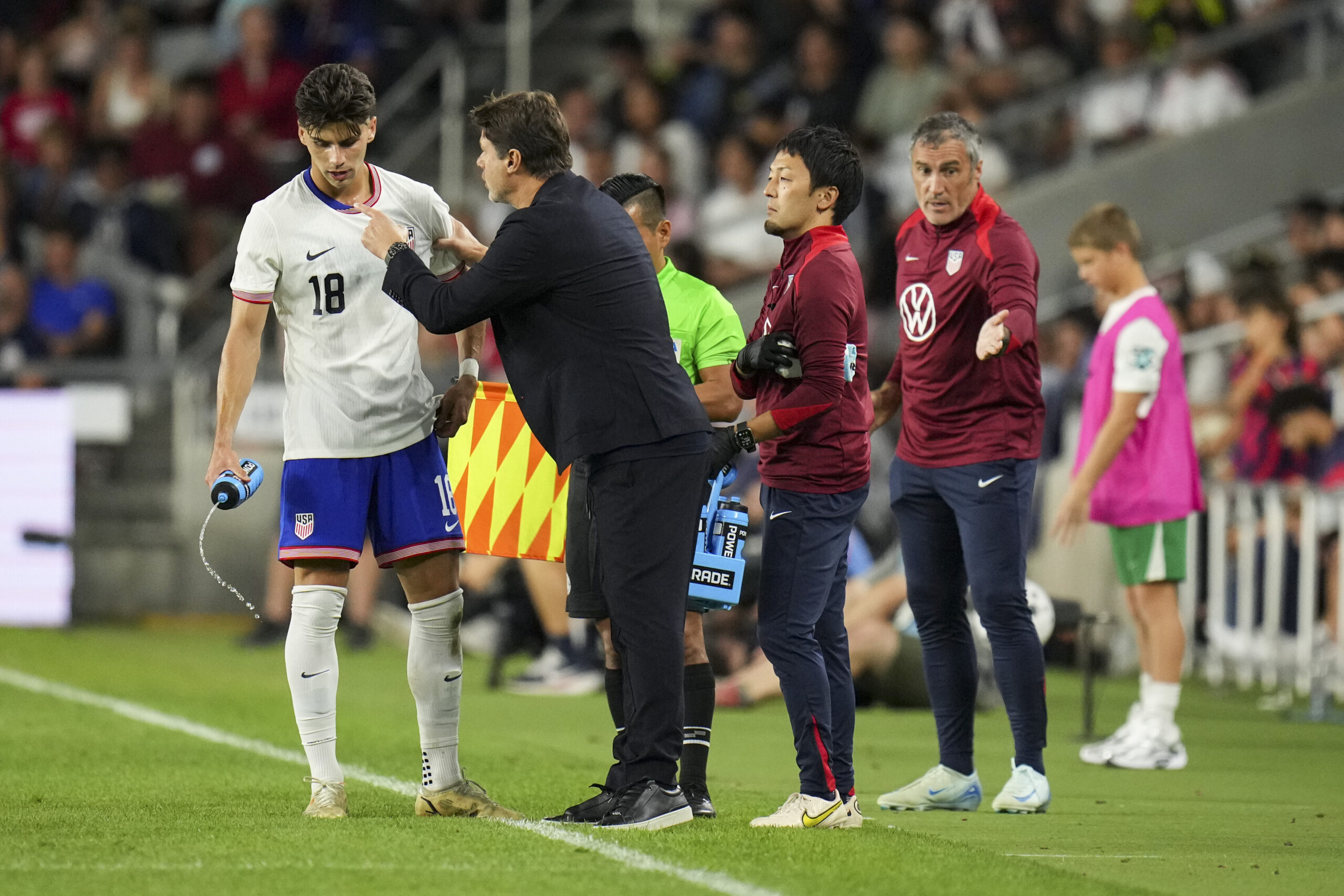
But it’s not just on the fans’ side. Lloyd said U.S. manager Mauricio Pochettino’s decision to leave a lot of the USMNT’s bigger names off the roster for the Concacaf Gold Cup, deciding to bring top American talent from Major League Soccer and elsewhere — like the Union’s Quinn Sullivan and Nathan Harriel — was an eye-opening experience for those players who might work a bit harder to remain on Pochettino’s radar.
“For me personally, I think the Gold Cup was the turning point for this team, leaving a lot of those well-known players off the roster,” Lloyd said. “I think it was the best thing that could have happened to this team going into this World Cup. It gave a lot of the non-European [American] players the confidence, the belief, and [allowed Pochettino] to instill the culture he wants to build.”
U.S. manager Mauricio Pochettino, second from left. Carli Lloyd said the manager’s decision to bring fresh faces into the national team last summer and in the November cycle reinvigorated the team ahead of the World Cup.
Games and opportunity
Lloyd compared all of that to the success U.S. women’s coach Emma Hayes achieved in a short span, becoming the change that was needed after the Americans’ shocking exit at the 2023 women’s World Cup.
There’s no reason, she says, that Pochettino can’t find similar success — despite being off to a noticeably slower start.
“Obviously, the 2023 [women’s] World Cup didn’t end well,” Lloyd said. “The team needed change and almost needed to be blown up in order to be rebuilt again. Emma Hayes comes in. A lot of players retire. She selects different rosters, and they instantly change the culture, the mentality, the pride of wearing the jersey again, and that happened very quickly.
“But with the men’s team, I feel like it took a lot of time, and I don’t know why it took time. Maybe it was the language barrier [between] coach and the team, and the lack of games and opportunities that they had together.”
The U.S. seemed to find continuity during November’s qualifying cycle with a pair of exhibition wins, against Paraguay in Chester and a 5-1 rout of Uruguay in Tampa, Fla., to close the year.
Pochettino will call up a number of players for matches against Belgium on March 28 (3:30 p.m., TNT, Peacock) and Portugal on March 31 (7 p.m., TNT, Peacock), in what will surely be a final audition for many on that roster.
Both matches will be in Atlanta, home of U.S. Soccer’s new multimillion-dollar national training center. Lloyd noted that the investment and the caliber of nations the U.S. is bringing in show a commitment to improvement on the global stage.
“I think we saw that fight [during this last FIFA window] in November,” Lloyd said. “You can see there’s a different tone within this group. And I’m glad that they found it when they did. There were some big wake-up calls for some players … and I think that’s all we’ve been wanting to kind of see, these guys having the pride when you put on that jersey. And they sure showed that those last two games in November.
“It’s not a vacation when you come into the men’s national team anymore. There should be an excitement around it where you want to come in and lay your body on the line and do everything possible for the team and for your country.”
It would be unfair to call Wednesday night’s Big East clash between Villanova and No. 1 Connecticut anything other than what it ultimately was: a litmus test for the Wildcats.
Villanova may sit in second place in a demanding Big East, but in Wednesday’s game against UConn, the Wildcats once were again looking up at a Geno Auriemma-coached Huskies program, which entered Finneran Pavilion undefeated with 27 wins.
Technically, make that 43 regular-season games, if you consider the Huskies haven’t lost since last February when, as the No. 1 team in the land, they suffered a four-point upset against then-No. 19 Tennessee.
A perennial power team in a power conference, Villanova wasn’t just playing the women wearing the Huskies’ deep blue on the other side of the floor; it was playing to prove itself against UConn’s stature, its reputation.
And, if we’re being honest, the result of UConn’s tens of millions in NIL funding, ready for distribution.
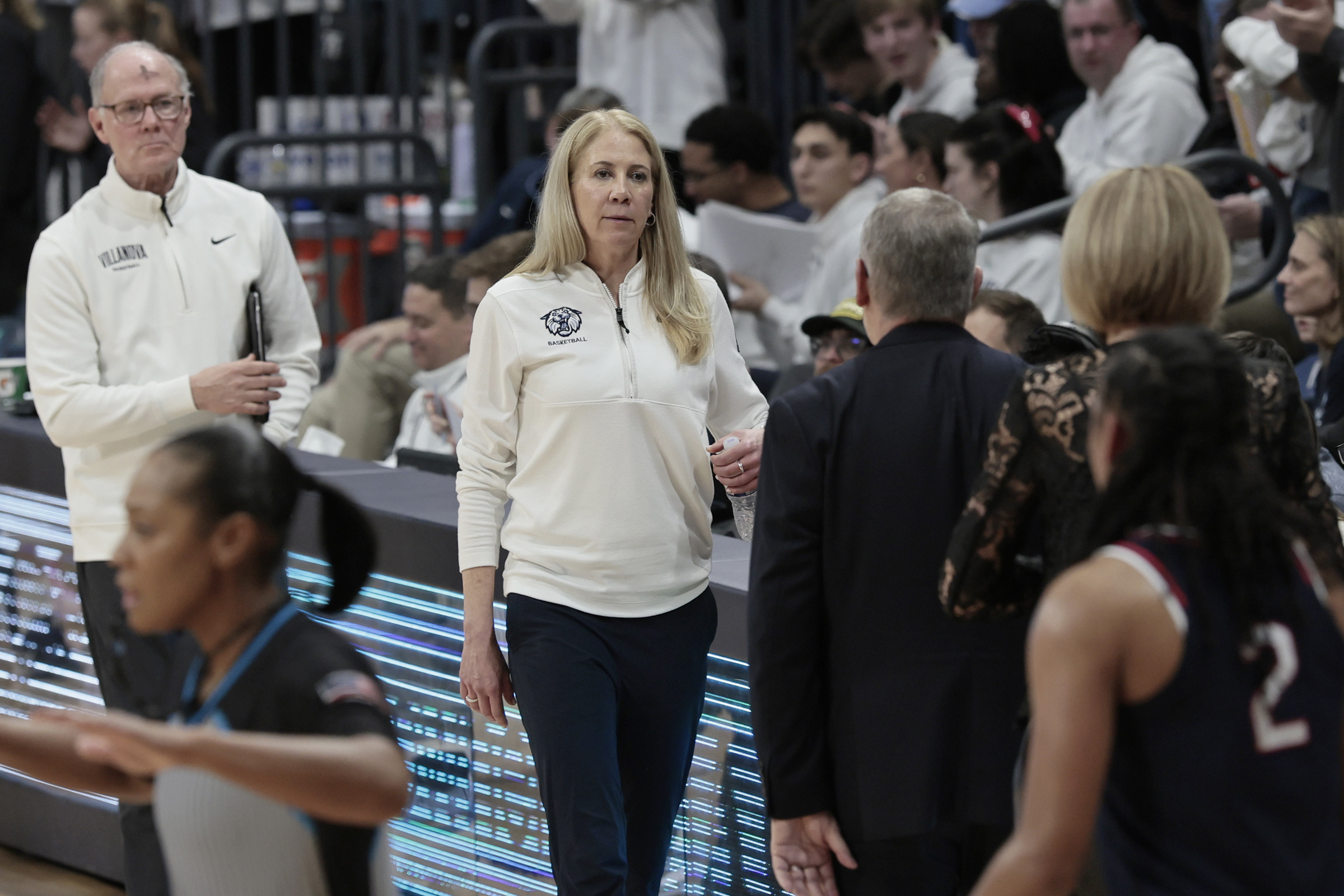
Villanova coach Denise Dillon approaches UConn coach Geno Auriemma following Wednesday’s game between the two at Finneran Pavilion.
In her six years as head coach, Denise Dillon has never made concessions for her team after it came up short against UConn, time and time again.
But if she wants this year’s Wildcats to dance far into March, their performance has to match what was on display in the first half on Wednesday night. And look a heck of a lot better than a second-half fallout that resulted in an 83-69 loss.
“Honestly, give them credit. [UConn] stuck to their game plan,” Dillon said. “I think we let up on what we needed to do … miss a possession here or there, they’re going to take advantage.
“And that’s what happened.”
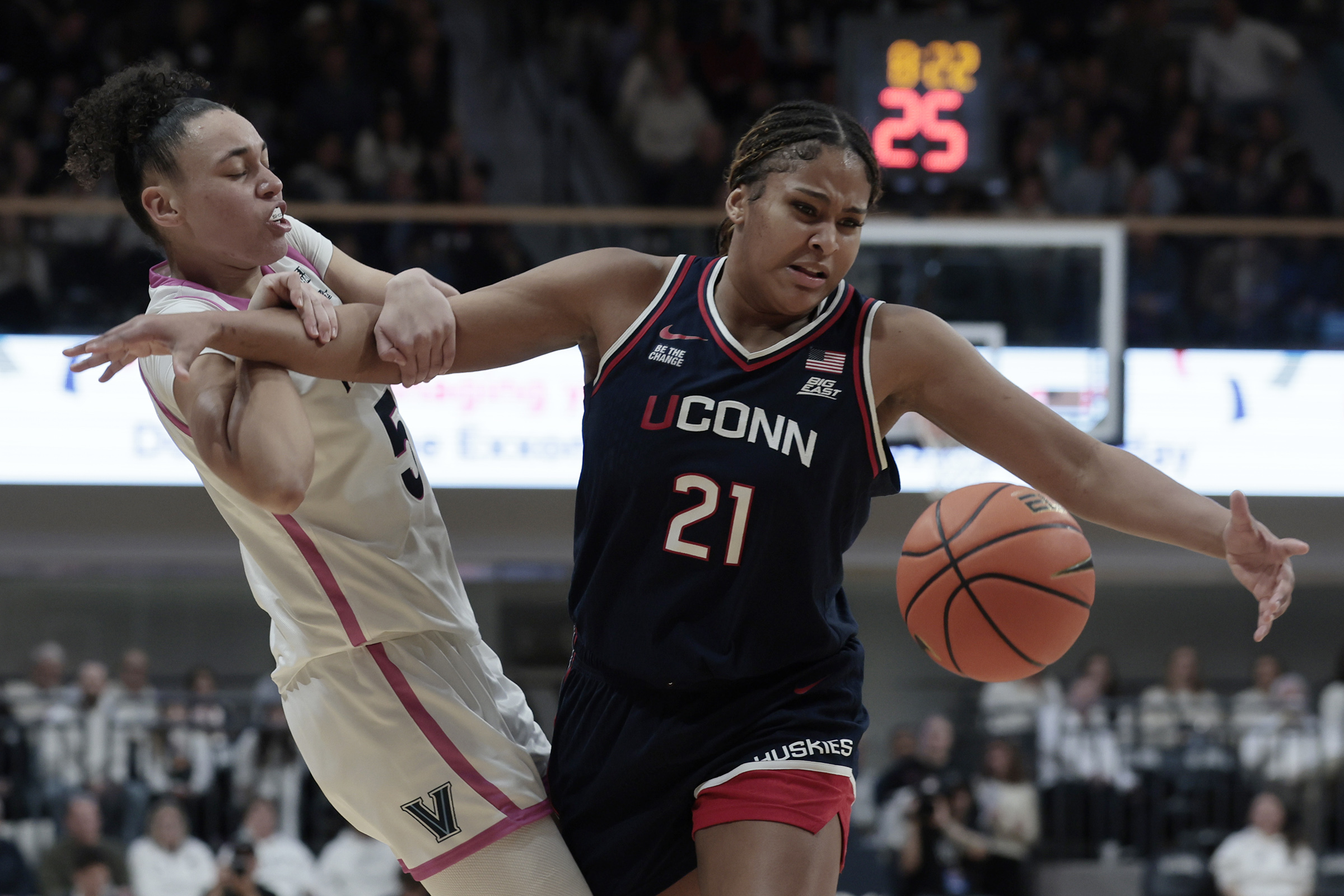
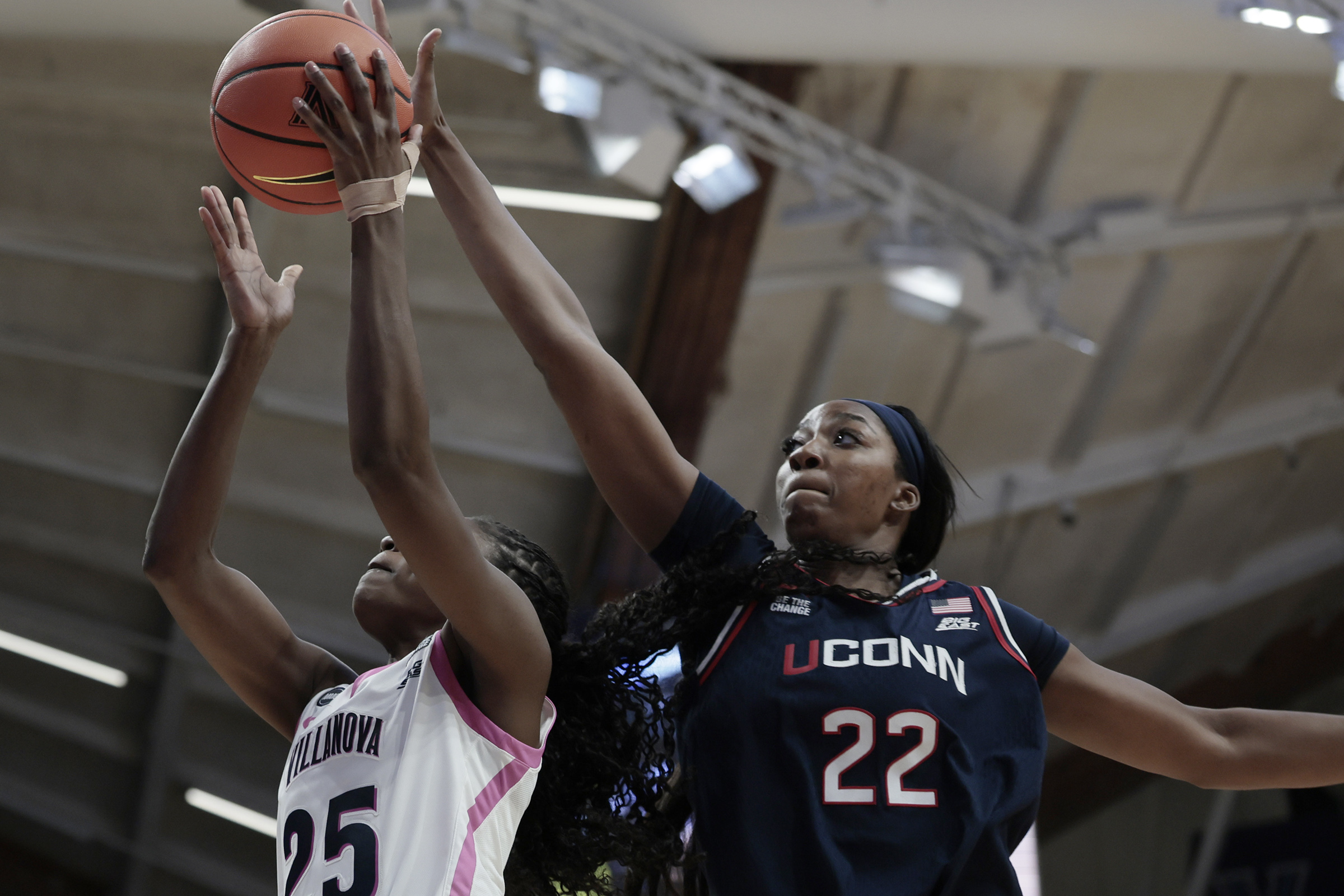
Villanova’s Ryanne Allen (left) is held back by UConn’s Sarah Strong during their game on Wednesday. Strong finished with 21 points and 12 rebounds.
Don’t sleep on the Wildcats
Villanova (21-6, 14-4 Big East) looked like a true contender in the first eight minutes. The Wildcats held a one-point lead at the first television timeout with 4 minutes, 38 seconds remaining and went into halftime up three.
It marked the only time UConn (28-0, 17-0) has trailed at halftime this season and one of its longest deficits, with the Wildcats ahead for 16:10 of the first half, compared to just 2:09 for the Huskies.
“How we started the game was unacceptable,” said UConn guard Azzi Fudd, who finished with a team-high 25 points. “We need to be able to start the game strong, play the full 40, and not take the game or a team for granted. I think they proved we cannot overlook anyone.”
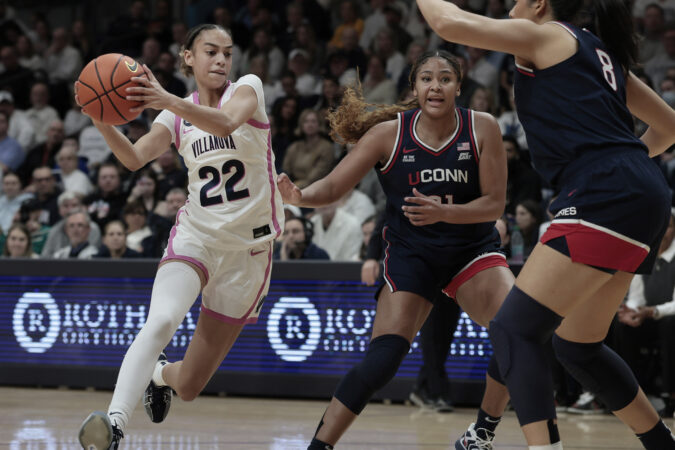
One player UConn certainly couldn’t overlook was Jasmine Bascoe, who had a game-high 26 points and was a rebound shy of a double-double. She got help from Denae Carter (21 points) and freshman Kennedy Henry, who finished with nine, but played one of her best games of the season.
“If it weren’t for my two girls [Fudd and forward Sarah Strong], she’d be the best player in the Big East, hands down,” said Auriemma, who lauded Bascoe’s performance. “Just an amazing talent, and she made it really tough for us tonight.”
Villanova’s Jasmine Bascoe signals one of her four made three-pointers in Wednesday’s game against UConn.
Lessons learned
The reason UConn is No. 1 — besides having one of the most dominant players in women’s college basketball in Strong — is an ability to grind out wins.
Speaking of Strong, while she finished with 21 points and 12 rebounds, the Wildcats frustrated the sophomore enough that by the third quarter, she was in danger of fouling out. She kept her composure and aided the Huskies in outscoring Villanova, 46-29, in the second half.
Strong and Fudd did what they do, but in the end, turnovers were the Wildcats’ undoing; UConn scored 28 points off 26 Villanova turnovers.
Villanova’s Denae Carter has her shot blocked from behind by UConn’s Serah Williams.
“We talked about it, even at the end of the first quarter,” Dillon said. “I said, ‘Imagine if we’d got 8-10 more shots off in that period, what a difference it could make.’ We just have to focus our attention on taking care of the basketball.”
Before the game, ESPN bracketologists had Villanova as a bubble team, projected as the No. 9 seed in the NCAA Tournament. Judging by last night’s performance, it feels like a pretty fair assessment.
“The goal is to get to the [Big East] championship game and [get into] March Madness,” Dillon said. “We’re preparing for that every day. We talk to our players about our practice plan, which is to prepare to face a UConn; and if they train that way, you’re going to have a lot of success along the way.”
scoop it. score it.@Denaeca25 is having a dayyy🙂↕️
But the consolation? They did more than enough to impress a storied coach who has firsthand experience of what success looks like.
“They’re a team that will be in the tournament, I think,” Auriemma said. “They’re really well coached. Denise [Dillon] does a tremendous job. You know, this felt like one of those old-school Big East games tonight where you have to grind it out, and that’s usually what it’s like when you play here.”
Villanova will remain in town in preparation for Marquette at the Finn on Sunday (3:30 p.m., Peacock). The Golden Eagles (16-10, 10-7) are coming off a 71-56 Valentine’s Day loss to UConn and will look to snap a three-game losing streak.
It’s Huskies week in Philly
On Saturday, Villanova’s men host No. 5 UConn (24-3, 14-2) at Xfinity Mobile Arena (5:30 p.m., TNT). The Wildcats (21-5, 12-3 Big East) are on a six-game winning streak and are looking to avenge a 75-67 overtime loss against then-No. 2 UConn on Jan. 24.
Nine nations will compete in five group stage matches this summer, plus two more in a knockout game on July 4. Here’s what you need to know about those countries and their fans — and what those fans need to know about Philly.
The long road to World Cup qualification isn’t over for six non-European countries.
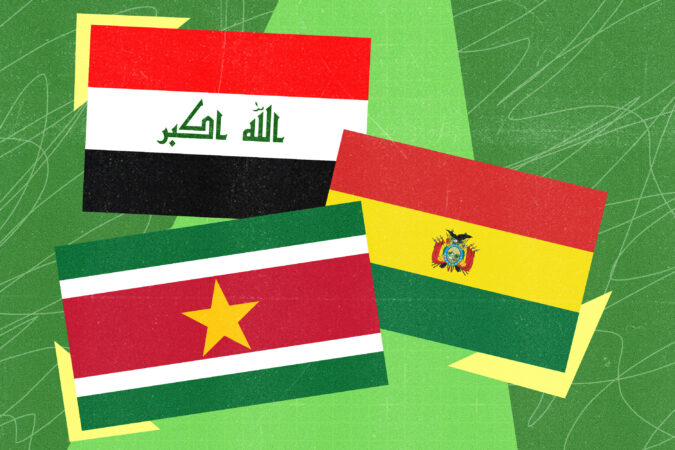
Of those final six, three, in Iraq, Bolivia and Suriname will head to a FIFA playoff round in late March to battle it out for the last spot in Group I. Win, and in addition to a berth into the World Cup alongside Norway, France and Senegal, a stop in Philly awaits for one of the three group stage games to be played against France on June 22 (5 p.m., Fox29, tickets).
No pressure.
What’s that road look like? For Suriname and Bolivia, it’s a first-round, single-elimination playoff match in Monterrey, Mexico, on March 26 (5 p.m.). The winner will then face Iraq, again in Monterrey on March 31. That game is currently scheduled to start at 9 p.m.
Your matchups for the FIFA World Cup 26 Play-Off Tournament! 🆚
Here’s your guide to all three ahead of March’s playoff rounds, the key players who could help their nation get over the hump, and if any of these three nations have previously had a footprint here in Philly.
About the nations
BOLIVIA
Confederation: CONMEBOL; FIFA world rank: 76
A seventh-place finish in grueling CONMEBOL qualifiers is what led to the South American nation needing to win two more matches for a trip to what would be its fourth World Cup finals appearance. Coincidentally, it would be Bolivia’s first trip since 1994, the last time the event was held in the United States — should they qualify. Bolivia will look to advance out of the group stages, something it hasn’t done in any of its previous appearances in 1930 and 1950.
IRAQ
Confederation(s): AFC and WAFF; FIFA world rank: 58
The Lions of Mesopotamia, as this team is affectionately known are looking for just its second ever World Cup berth, qualifying for the 1986 edition in Mexico. The team qualified for this year’s FIFA playoff by way of originally finishing third in their qualifying group, and then needing to playing a pair of inter-confederation playoff matches. The first one against Saudi Arabia, saw the Saudis book its second consecutive trip to the World Cup at the expense of Iraq. Iraq would redeem itself by defeating the United Arab Emirates, securing this final opportunity to qualify. As the nation with the highest FIFA ranking of the three, Iraq will face the winner of March 26 first round playoff match between Bolivia and Suriname.
A second place finish in Group A of Concacaf World Cup qualifying is what kept hopes alive for this tiny South American nation which is home to a little over 600,000 people according to 2024 World Bank data. Nestled between, Guyana and French Guiana, this Dutch colony is just two matches away from qualifying for its first ever World Cup. To get it over the hump, the country appointed former Ajax manager Erik Ten Cate as its coach in December ahead of the March playoff match against Bolivia. Ten Cate, 71, has experience with the national team as its assistant in 2023.
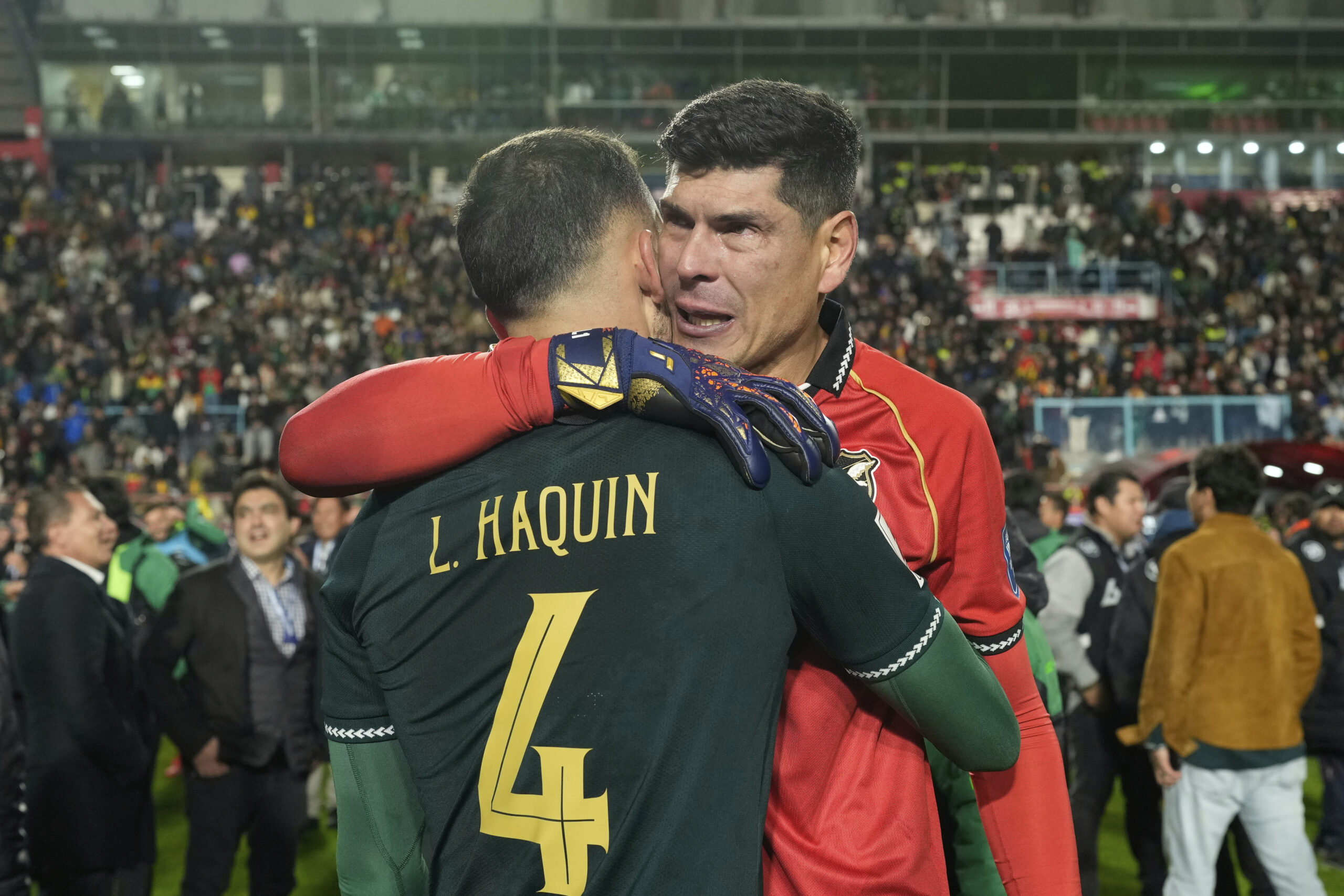
Bolivia’s goalkeeper Carlos Lampe (right) celebrates with teammate Luis Haquin following their team’s 1-0 victory against Brazil in a 2026 World Cup qualifying match on Sept. 9, 2025.
Players to watch
Carlos Lampe (Bolivia): The longtime goalkeeper wasn’t in net for his nation in the 2024 Copa America tournament in the United States, but is expected to lead this team in March’s playoff round. Lampe, 38, who has dual citizenship in Argentina, plays his club ball for Bolívar La Paz in the first division of the Venezuelan league.
Sheraldo Becker (Suriname): Becker has had a healthy career in Europe as a forward since 2019. Currently, he’s signed with CA Osasuna in Spain’s La Liga, but is on loan with Mainz 05, in Germany’s top division. He appeared in in 20 matches for his country including six games during qualifying.
Aymen Hussein (Iraq): Hussein ranks fifth all-time on his nation’s list of top goalscorers. Since debuting for his national team in 2015, Hussein, 30, has had 88 appearances, scoring 31 goals, 12 of which have arrived in World Cup qualifying campaigns. He’s expected to lead again as Iraq will look to qualify for the World Cup for the second time ever.
Philly ties
While it would be a first for both Suriname and Iraq to have passed through the Greater Philadelphia Region as a soccer nation, Bolivia trained at WSFS Sportsplex took part in a June 12, 2024 friendly against Ecuador at Subaru Park in Chester as part of a tune-up game ahead of that summer’s Copa America tournament. Bolivia was in a group with the U.S. men’s national team and in the first match for both countries, the Americans trounced the South American nation, 4-0.
If you’re in Philly or headed to Philly over the course of the six scheduled FIFA World Cup matches from June 14 to July 4, you’re in for a treat.
And we’re not even talking about the football, fútbol, fussball, voetbal, or soccer as we know it here, we’re referring to being in the nation’s birthplace on the year of its 250th anniversary.
Philadelphia is scheduled to be “on and poppin’,” as the kids say, with a host of special events over the two glorious weeks Philly joins 16 other cities to host the largest edition of the FIFA World Cup in history.
Just how poppin’? For starters, the World Cup isn’t the only major sporting event coming through our region. Later this year, the area will host golf’s PGA Championship (May 14-17) and Major League Baseball’s All-Star weekend and the events that surround it from July 10-14.
But with a host of other events, happenings, places, and parties set for what’s expected to be quite the summer, consider this your guide to the city and what to do in addition to watching the world’s largest sporting event come through the City of Brotherly Love.
What to know about Philly
Our fair town is considered the birthplace of the United States, where the laws that govern this nation were signed and, for a while, was the nation’s capital. That changed on Nov. 17, 1800, when Washington was designated as the new capital.
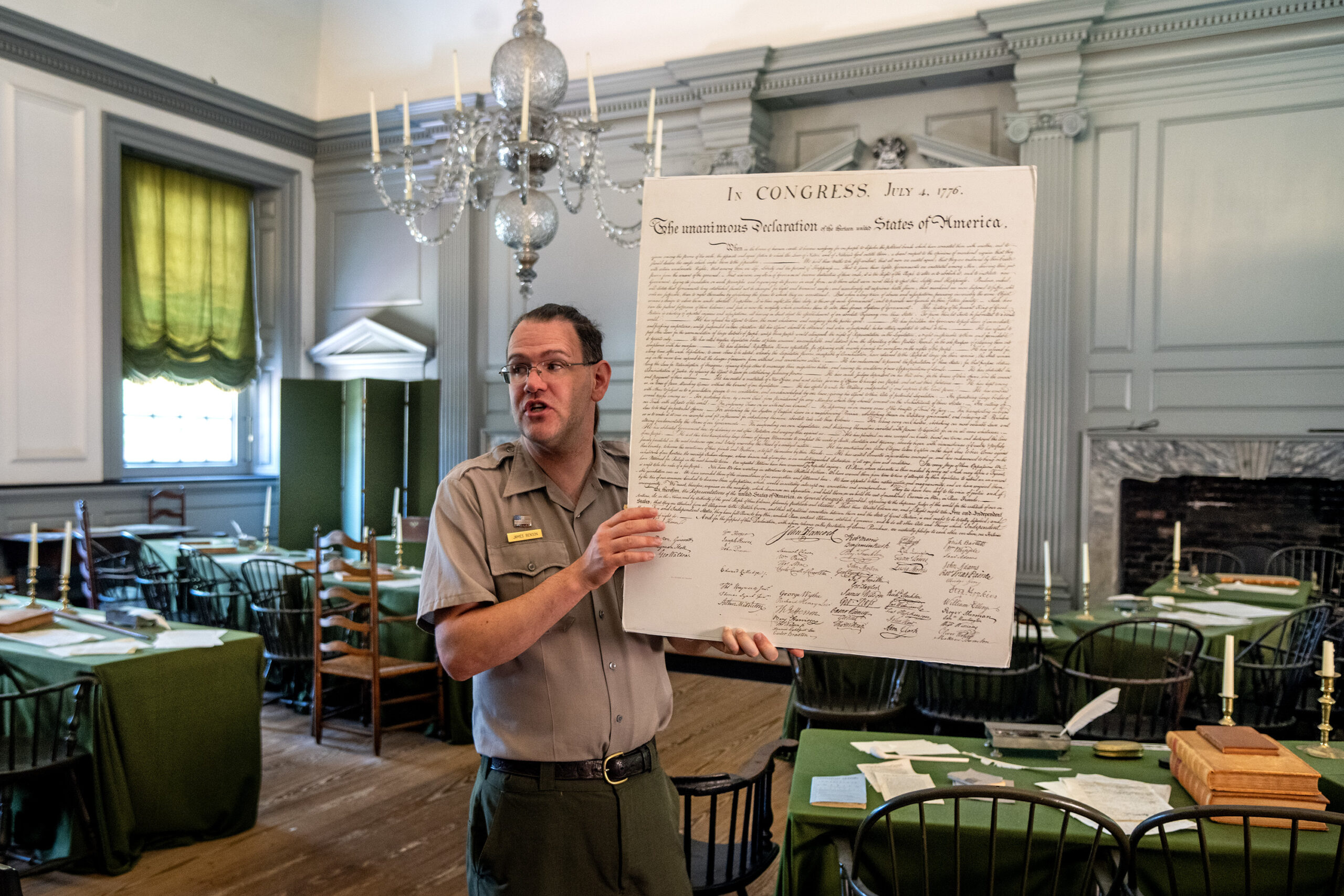
National Park Service ranger James Benson uses an enlarged copy of the Declaration of Independence while talking to visitors in the Assembly Room – where both the Declaration and the U.S. Constitution were signed – on the first floor of Independence Hall.
There are a host of iconic sites, but if you’re here for the first or want to explore, we offer a look at the best things to do around the city in addition to climbing the steps of the Art Museum, taking a picture at the foot of the Rocky statue or finding the best cheesesteak in town, the latter of which varies depending on who you ask and which neighborhood you’re in.
Oh, and our food scene is one of the best in the world. Hands down.
Here’s what’s great about Philly. We have a few diagonal arterials, but the Philly metro runs on a grid, with two major highways, I-76 (east-west) and I-95 (north-south), that can get you anywhere you want to go if you’re traveling by car.
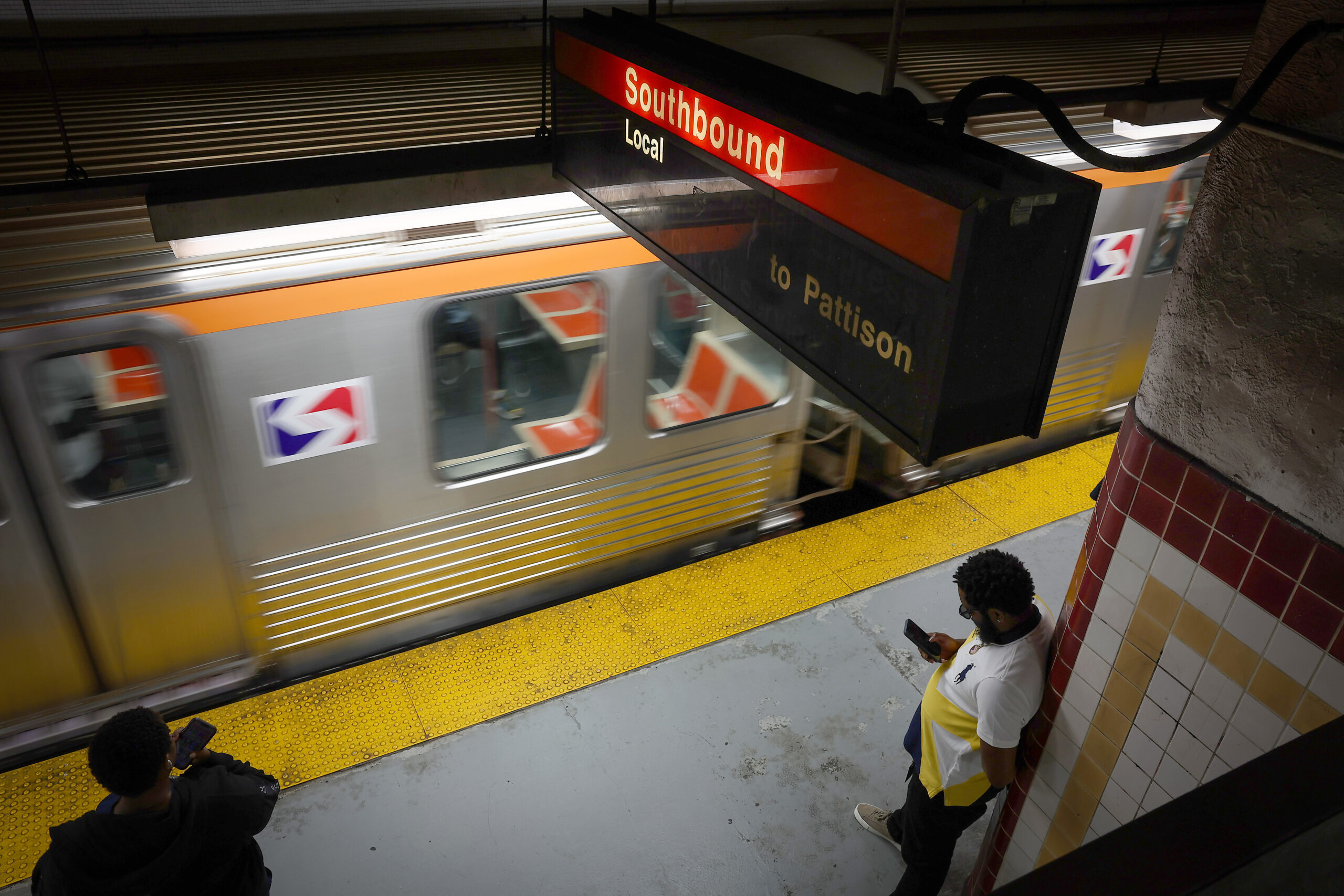
If we’re talking about matchdays and getting down to Philadelphia Stadium — which, outside of the World Cup, is Lincoln Financial Field, the home of the city’s beloved NFL franchise, the Philadelphia Eagles — then SEPTA, the city’s public transportation system, is your best bet.
SEPTA’s Broad Street Line train is a direct path from the city to the stadium on game day.
Don’t feel like figuring out all the schedules? Taxis or ride shares via Uber or Lyft also are quick and convenient options.
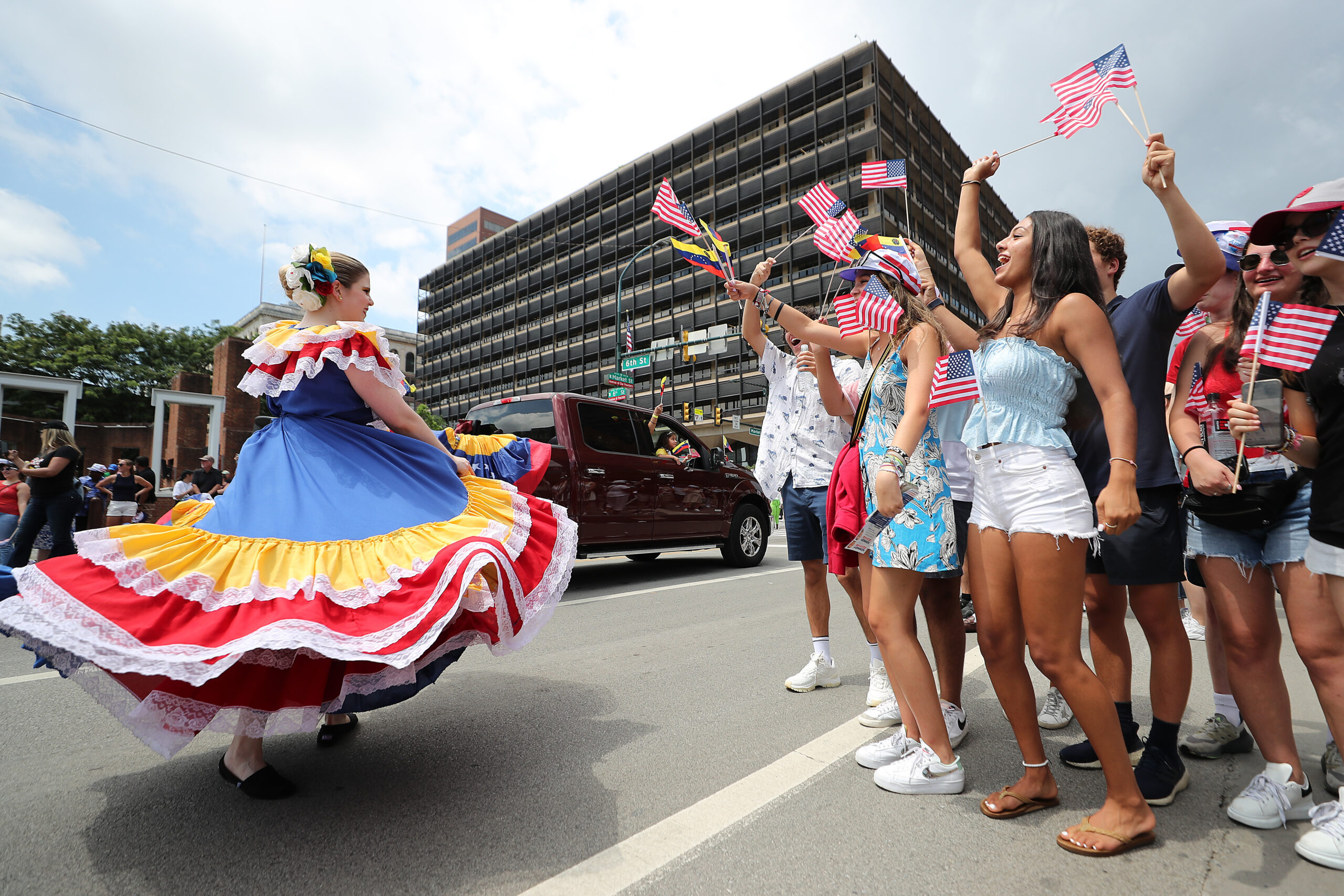
Spectators dance in the street as a Venezuelan dancers perform during the Wawa Welcome America Salute to Independence Day Parade in Philadelphia.
Other events coming to Philly
Here’s a highlight of just a few big events interspersed over the course of the three weeks the city will host World Cup group stage matches and the round of 16 match on July 4.
Wawa Welcome America: Philly’s annual celebration that features everything from free food, block parties, a concert, and, of course, fireworks. Oh, and it’s all free to attend. What does all that look like? Here’s what you can expect. 🗓️ June 19-July 4
What Now 2026: A five-week-long arts festival featuring works from a number of Philly artists across music, film, and, of course, art. 🗓️ May 27-July 4
America 250 at Penn: As part of a host of events, the University of Pennsylvania has an exhibit focusing on France, Haiti, and their touchpoints in our city. For any French or Haitian fans coming to town for those games who consider themselves history buffs, this might be worth checking out. 🗓️ Feb. 26-Sept. 4
What other events are on the schedule ahead this year? Take a look.
Where to watch the World Cup
Don’t have a ticket? All good.
In addition to the free FIFA Fan Festival coming to the historic grounds of Lemon Hill Mansion, Philly has a host of bars and restaurants that already serve as soccer hubs across the city. Last summer, we offered a list of the best 11 spots ahead of the FIFA Club World Cup, and we can confirm that these will be the go-to places again ahead of this summer’s edition.
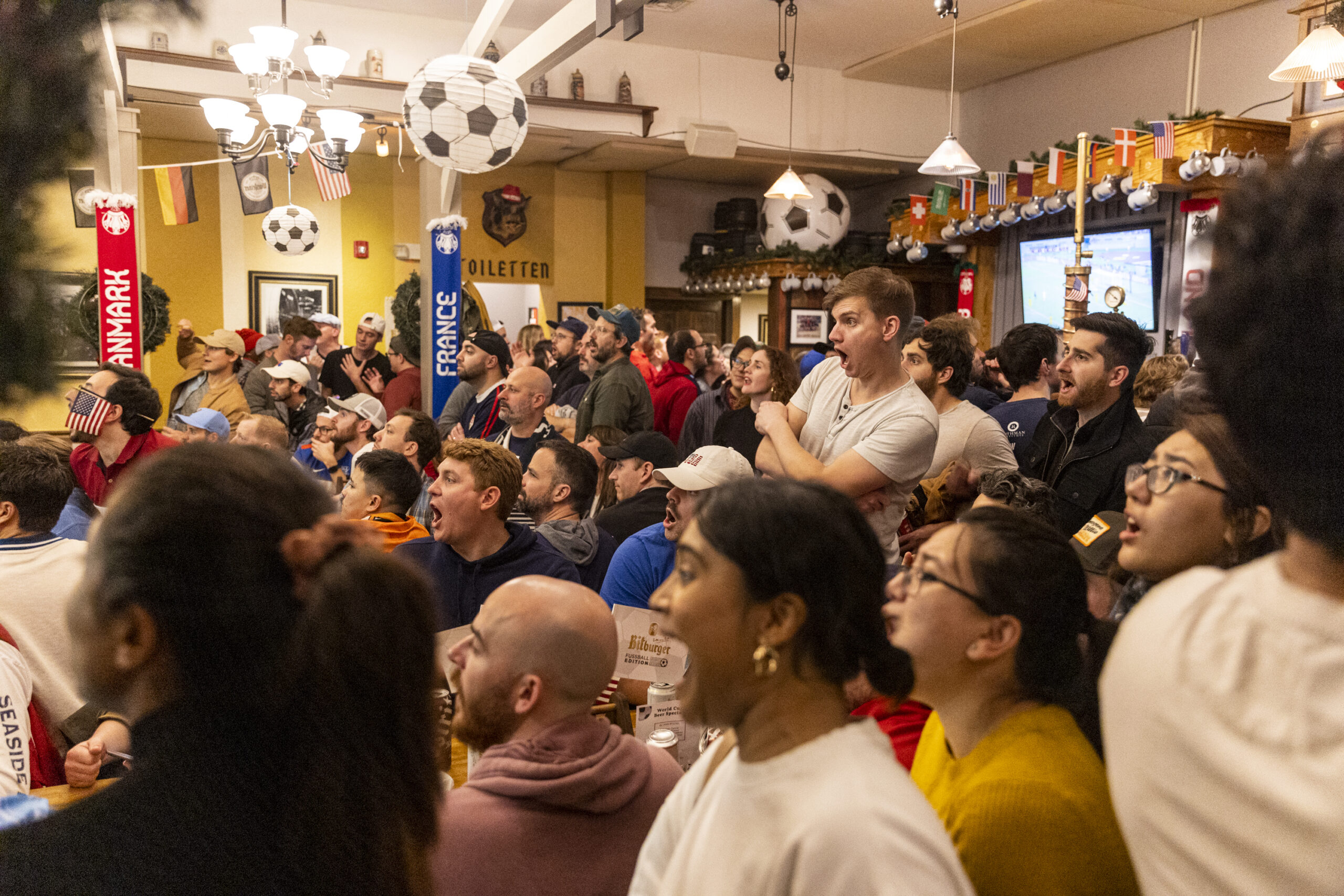
You’ll certainly find a soccer crowd at Brauhaus Schmitz, which was packed during the last World Cup.
We’re hearing that local host city organizers, Philadelphia Soccer 2026, in addition to the hometown Major League Soccer team, the Philadelphia Union, also are planning watch parties across the city.
Did you know …
That the first event at Lincoln Financial Field, er, sorry, “Philadelphia Stadium,” was a preseason friendly between European club giants Manchester United and Barcelona in 2003? One could say that Philly was built for soccer.