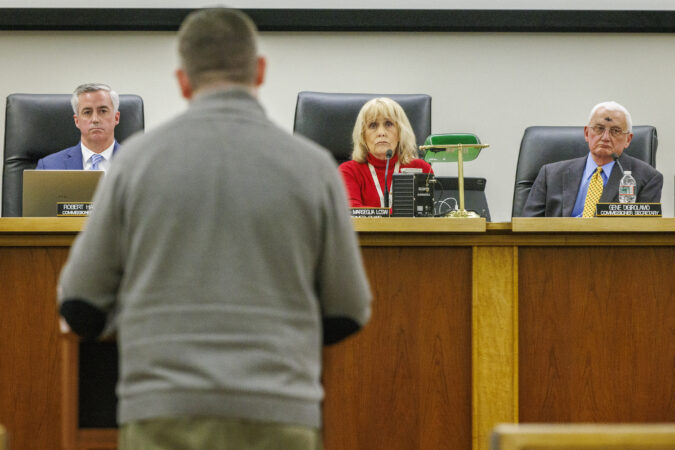
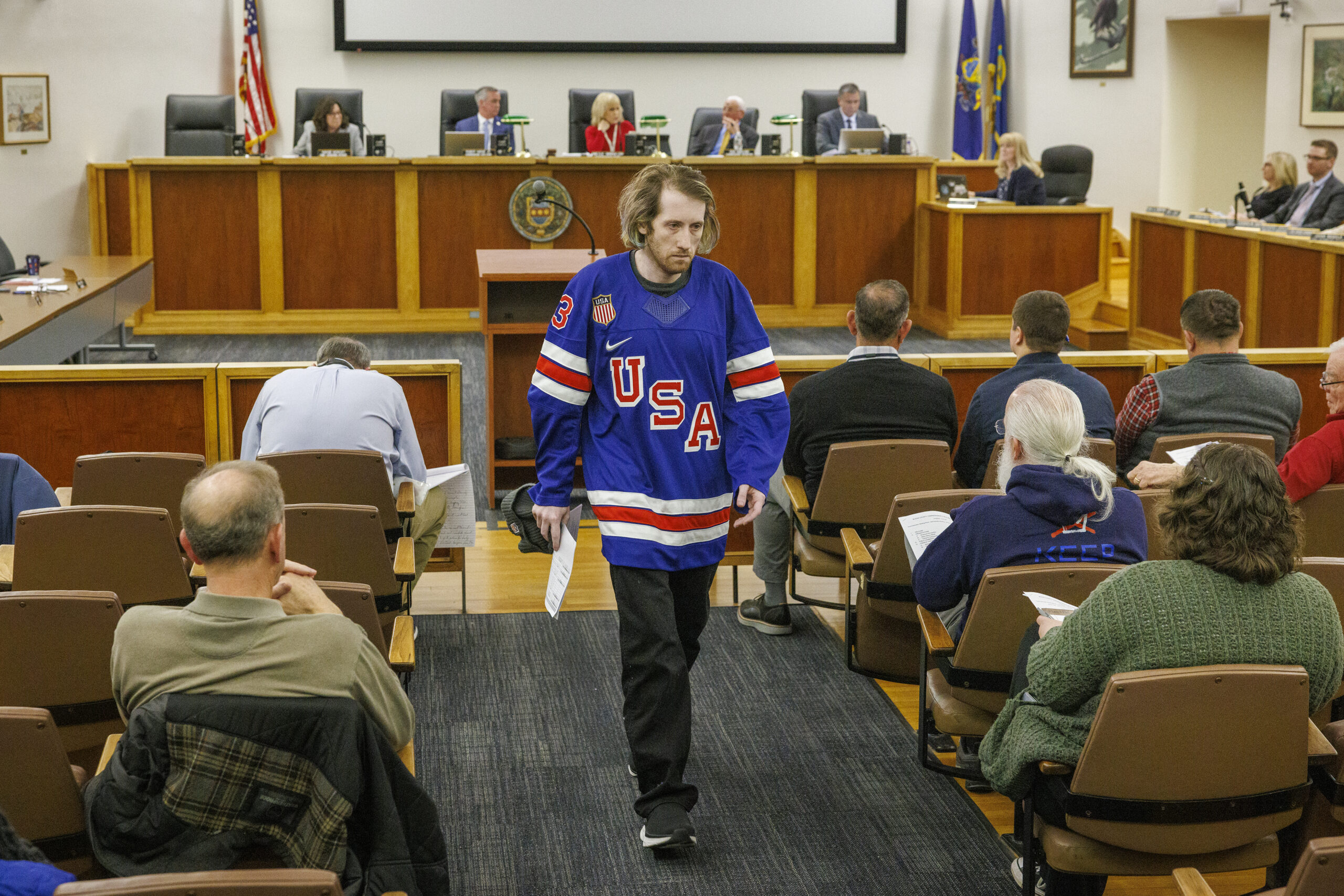
The contentious national discussion over the rapid expansion of ICE came to the doorstep of the Philadelphia region on Wednesday, as the Bucks County commissioners voted to oppose having any processing or detention facilities in the county.
Commissioners said they learned that the federal government had recently approached warehouse owners in two communities, Bensalem Township and Middletown Township, about possible conversions. Neither owner is going forward, they said.
The commissioners voted 3-0 ― including the board’s lone Republican ― to approve a resolution that said such a center would be harmful for county residents and the people who would be confined there.
ICE officials did not immediately reply to a request for comment.
The commissioners voted a day after U.S. Rep Brian Fitzpatrick said that he would oppose such a facility ― and that he had received federal assurances none was planned in his district, which covers Bucks County and parts of eastern Montgomery County.
Fitzpatrick, a Republican who is seeking reelection in the purple district, faces a likely November challenge from Democratic Bucks County Commissioner Bob Harvie, who also opposes ICE sites.
In Doylestown on Wednesday, Commissioner Gene DiGirolamo, a Republican who serves with two Democrats, said he heard about the federal interest in two local sites and strongly disapproved.
Jake Didinsky of Southampton, said he opposes ICE warehouses in his county, comparing them to Japanese interment camps.
“Bucks County is not a county that needs or wants a detention facility,” he said.
Harvie, the board’s vice chair, said Bucks County “is no place for these kinds of facilities” and cautioned: “We have been down this road before, with Japanese Americans. And with Italian Americans.”
During World War II the U.S. government forcibly incarcerated thousands of people of Japanese descent, holding them in concentration camps mostly in the western part of the country. About two-thirds of those confined were American citizens.
Some Italian Americans endured the same treatment.
A resolution conveys the opinion and wishes of the board, but holds no force of law.
The Bucks resolution said the county opposes “the use of warehouses or similar industrial facilities not intended for human occupancy as facilities to hold, jail, detain, house or otherwise store human beings.”
In addition to humanitarian concerns, the resolution says, “such facilities, being hastily erected in areas and structures not intended for human occupation, would place unanticipated demands upon water and sewer systems, creating hazards to public health, as well as heaping new strain upon public safety services.”
The vote came as the growth of ICE leasing and purchases has become contentious in Pennsylvania and across the United States.
U.S. Immigration and Customs Enforcement expects to spend $38.3 billion to acquire warehouses around the country and retrofit them into immigrant detention centers to hold tens of thousands of people, the Washington Post reported. The newspaper analyzed agency documents that were provided to New Hampshire’s governor and published on the state’s website.
ICE intends to buy and convert 16 buildings to serve as regional processing centers, each holding 1,000 to 1,500 immigrant detainees. An additional eight detention centers would hold 7,000 to 10,000 detainees and serve as primary sites for deportations.
Last week Gov. Josh Shapiro formally asked Homeland Security Secretary Kristi Noem in a letter to reconsider the conversion of the Berks and Schuylkill sites, citing “real harms” to the communities.
He questioned the legality of the facilities and hinted at a possible lawsuit, saying if DHS goes forward, his administration will “aggressively pursue every option to prevent these facilities from opening.”
DHS spokesperson Tricia McLaughlin confirmed the plans for the Pennsylvania sites, saying that they would undergo community-impact studies and a rigorous due-diligence process, and that they would bring 11,000 jobs to the two Pennsylvania communities.
The two sites would hold a combined 9,000 people.
On Tuesday, Fitzpatrick’s office said it had received assurances from DHS and ICE that they had no plans or intention to open a detention facility within the First Congressional District.
“After hearing from concerned residents, our office immediately contacted U.S. Immigration and Customs Enforcement, and we have received assurances that no such facility is planned,” Fitzpatrick said.
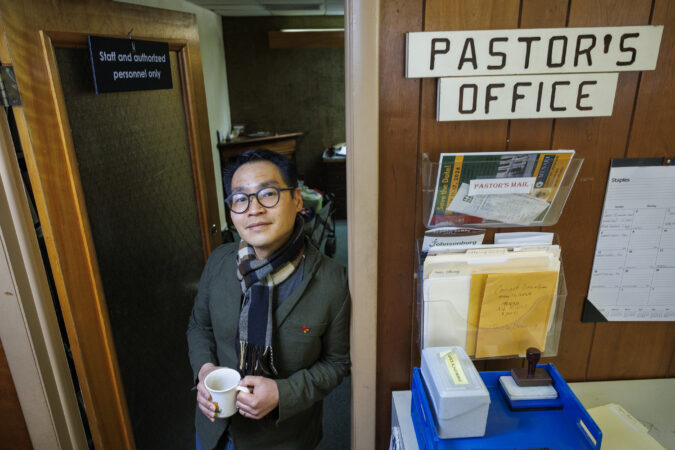
Within the serpentine halls and stairways of Olivet Covenant Presbyterian Church, congregants have established several private, off-limits rooms ― each a potential last-stand space where members would try to shield immigrants from ICE, should agents breach the sanctuary.
Church leaders call them Fourth Amendment areas, named for the constitutional protection against unreasonable search and seizure. The plan would be to stop ICE officers at the thresholds and demand proof that they carry legal authority to make an arrest, such as a signed judicial warrant.
“It’s a protective space,” said the Rev. Peter Ahn, pastor of the Spring Garden church. “While you’re here, you’re safe, is what we want to assert.”
Could it come to that? A pastor confronting armed Immigration and Customs Enforcement agents in the hallway of a church?
It’s impossible to know. But across Philadelphia, churches, community groups, immigration advocates, and block leaders are actively preparing for the time ― maybe soon, maybe later, maybe never ― that the Trump administration deploys thousands of federal agents. People say they must be ready if the president tries to turn Philadelphia into Minneapolis ― or Los Angeles, Chicago, or Washington, D.C.
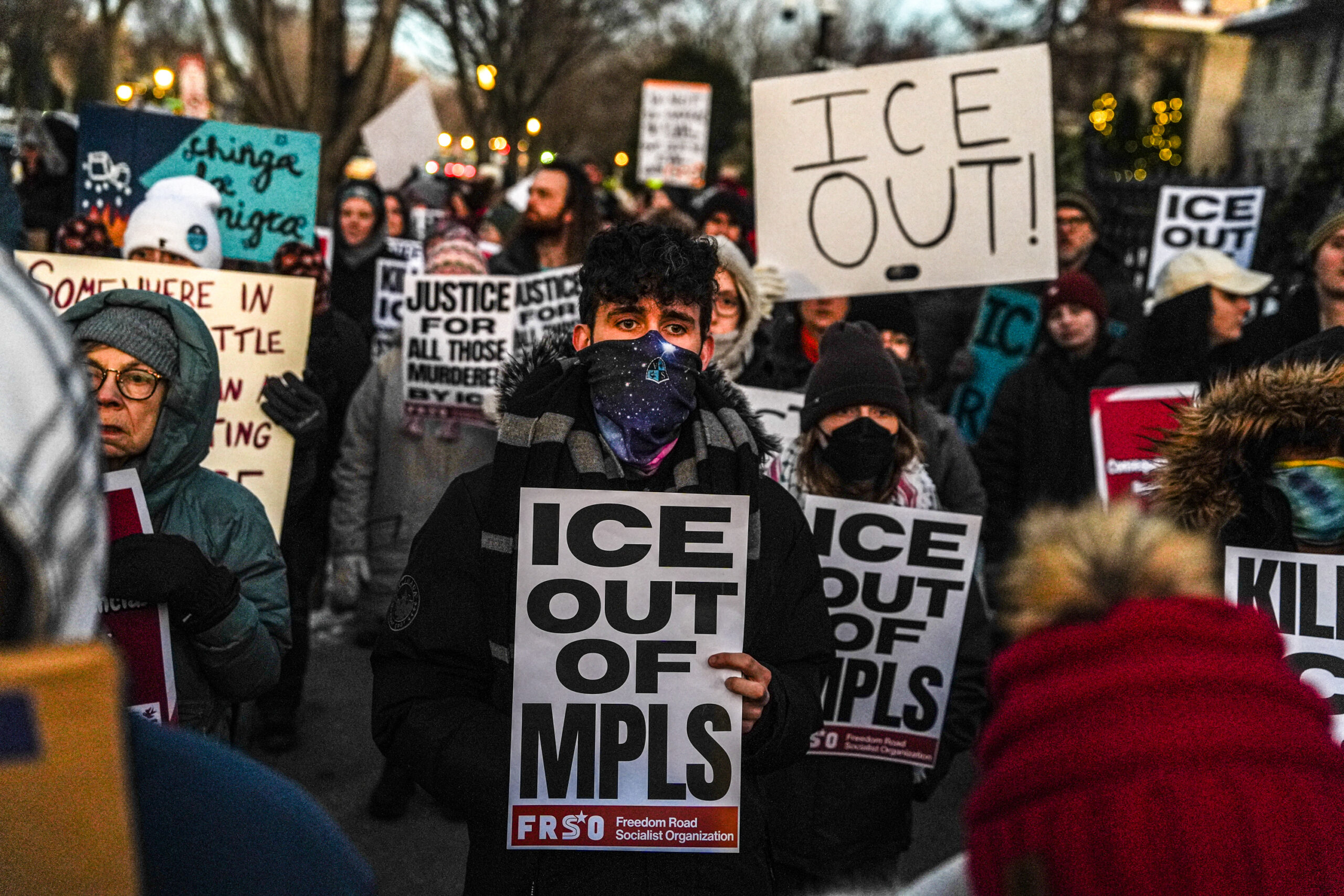
People participate in an anti-ICE protest outside of the Governors Residence on Feb. 6, in St. Paul, Minn.
Know-your-rights trainings are popping up everywhere, often to standing-room-only attendance, and ICE-watch groups are abuzz on social media.
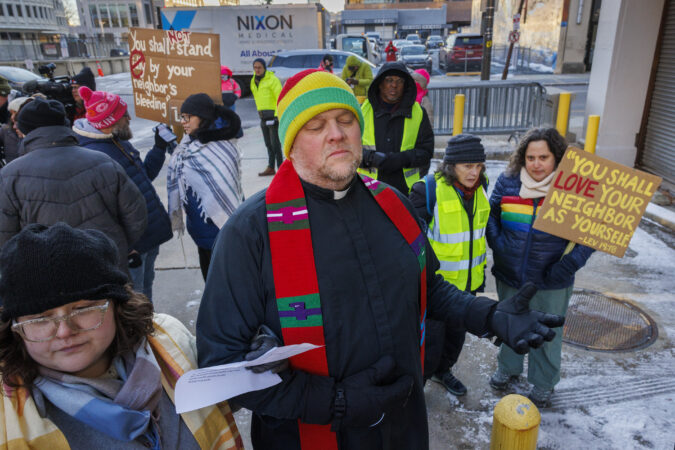
The First United Methodist Church of Germantown held a seminar last week to learn about nonviolent resistance, “so that we will be ready for whatever comes,” said senior pastor Alisa Lasater Wailoo.
“That may mean putting our bodies in the path to protect other vulnerable bodies,” she said. “We’re seeing that in Minnesota.”
In Center City, Temple Beth Zion-Beth Israel has ordered 300 whistles ― portable and efficient tools to immediately alert neighbors to ICE presence and warn immigrants to seek safety.
“There was a sense of needing to support our neighbors if it comes down to it,” said Rabbi Abi Weber. “God forbid, should there start to be ICE raids in our neighborhood, people will be prepared.”
In other places around the country, immigrant allies have similarly readied themselves for ICE’s arrival, and organized to react in concert when agents show up.
In Washington state, the group WA Whistles has distributed more than 100,000 free whistles to create what it calls “an immediate first line of community defense.” Chicago residents set up volunteer street patrols to warn immigrants of ICE and to contact family members of those detained. In Los Angeles, people raised money to support food-cart vendors, and organized an “adopt a corner” program to protect day laborers who seek work outside Home Depot stores.
A small sign at the Olivet Covenant Presbyterian Church, where the Rev. Peter Ahn is creating space to shield immigrants if necessary.
The agency’s Philadelphia office serves as headquarters not just for the city but for all of Pennsylvania and for Delaware and West Virginia as well. Arrests take place every day in the Philadelphia region.
“You all seem to be ‘preparing’ for something that’s already happened,” veteran activist Miguel Andrade wrote on Facebook.
What has changed, however, is the dramatic escalation in ICE enforcement, particularly visible in Democratic-run cities like Minneapolis, where agents fatally shot two U.S. citizens in January.
ICE detained 307,713 people across the country in 2025, a 230% increase over the 93,342 in 2024. What federal immigration agencies record as detentions closely mirror arrests.
For immigrants who have no legal permission to be in the U.S. ― an estimated 14 million people ― the rising ICE presence steals sleep and peace of mind. They know not just that they could be arrested and deported at any moment, which has always been true, but also that the U.S. government is expending vast resources to try to make that happen.
A woman who came to Philadelphia from Jamaica last year, and who asked not to be identified because she is undocumented, said she rarely leaves her home. She said she steps outside only to go to the grocery store, a doctor, or an attorney.
She recently asked her daughter to check something on the computer, and the girl balked ― afraid to even touch the machine, worried that ICE could track her keystrokes and identify their location, the woman said.
“How can I tell her it’s going to be OK when I don’t know it’s going to be OK?”asked the woman, who came to the U.S. to escape potential violence in Jamaica. “You come here expecting freedom, but here it’s like you’re in jail except for the [physical] barriers of the four walls.”
Some say President Donald Trump doesn’t want to ruin the summer celebration of the nation’s 250th birthday, or spoil the grandeur of the World Cup or Major League Baseball’s All-Star Game. Others suggest that he might be timing an ICE deployment to do exactly that.
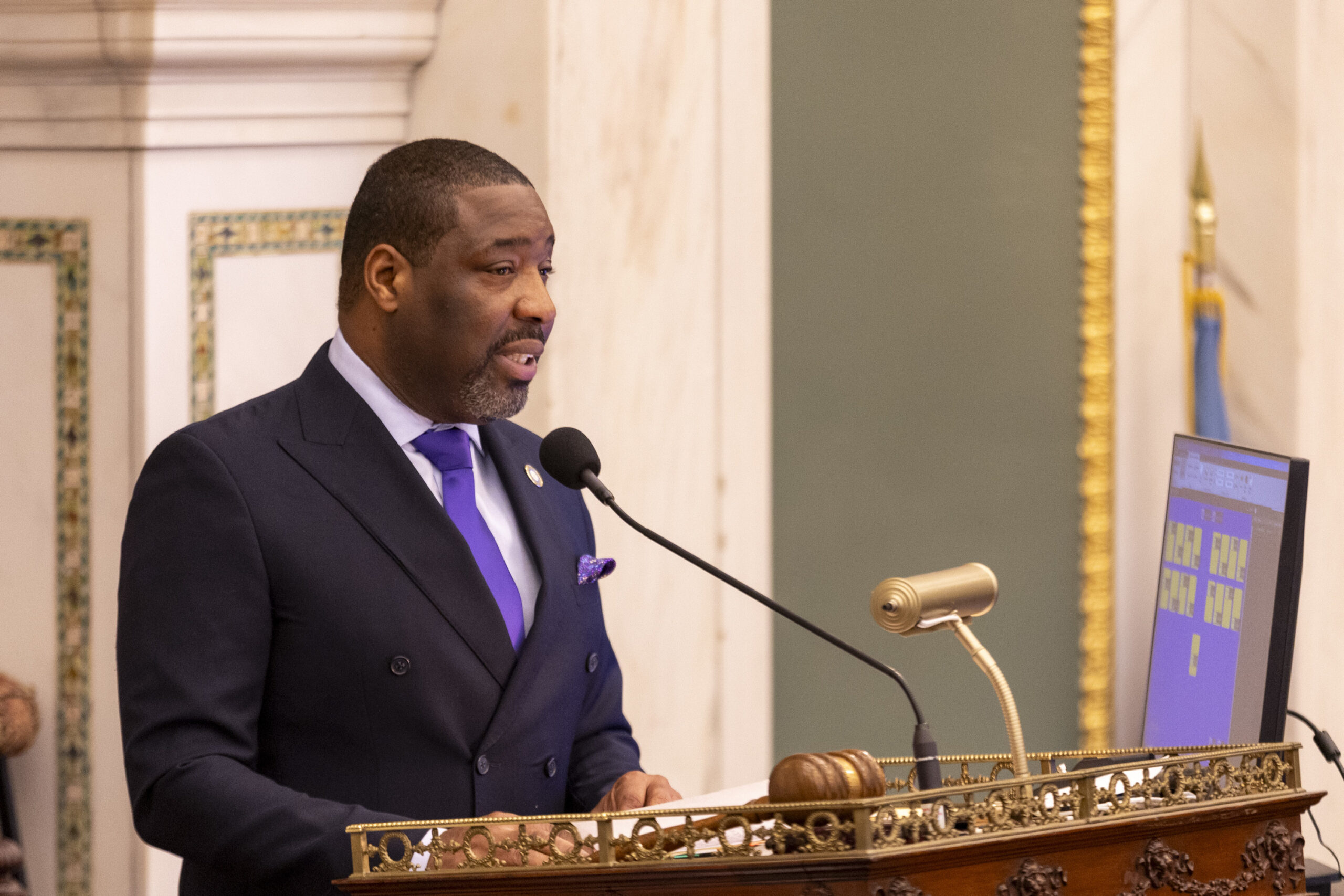
City Council President Kenyatta Johnson speaking at the City Council’s first session of the year Jan. 22. He said this month that it’s time to stand up for immigrants in Philadelphia. “It’s my responsibility to step up in this space and be more vocal,” he said.
Trump told NBC News this month that he is “very strongly” looking at five new cities.
Some people are not waiting to see if Philadelphia is on the list.
The monthly Zoom meeting of the Cresheim VillageNeighbors usually draws about 20 people. But a hundred logged on in January to hear a presentation: What to do if/when ICE comes to our neighborhood.
The short advice: If it happens, get out your phone and hit “record.”
“If I see ICE agents, I will film,” said neighbors group coordinator Steve Stroiman, a retired teacher and rabbi. “I have a constitutional right to do that.”
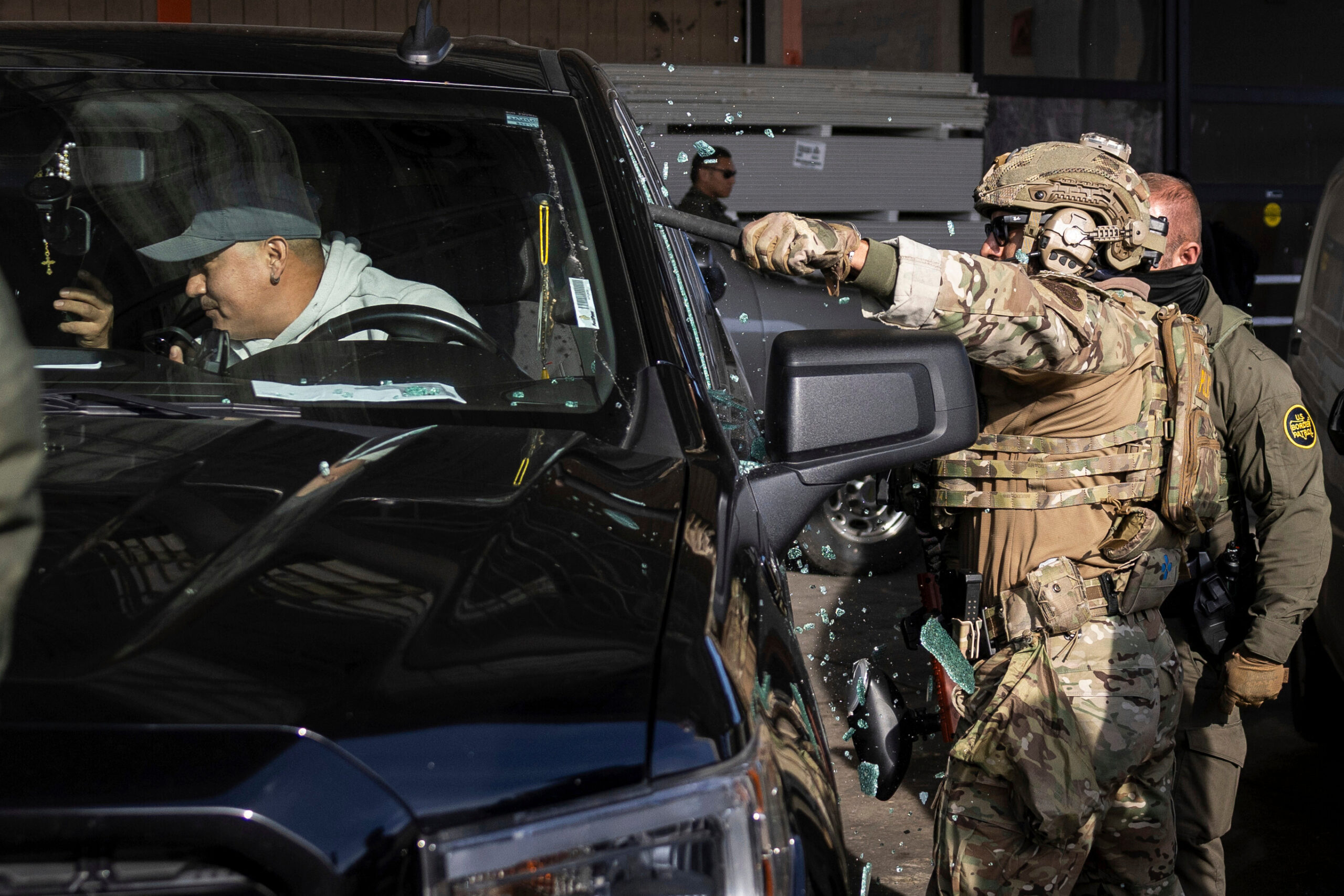
Federal immigration enforcement agents shatter a truck window and detain two men outside a Home Depot in Evanston, Ill., on Dec. 17, 2025.
In a sliver of University City, Miriam Oppenheimer has helped lead three block meetings where neighbors gathered to discuss how they would respond.
They set up a Signal channel so people can communicate. And they formulated a loose plan of action: People will come outside their homes and take video recordings ― and try to get the names and birth dates of anyone taken into custody, so they can be located later.
“Courage is contagious,” Oppenheimer said. “Everybody is waiting for somebody else to do something, but we have to be the ones.”
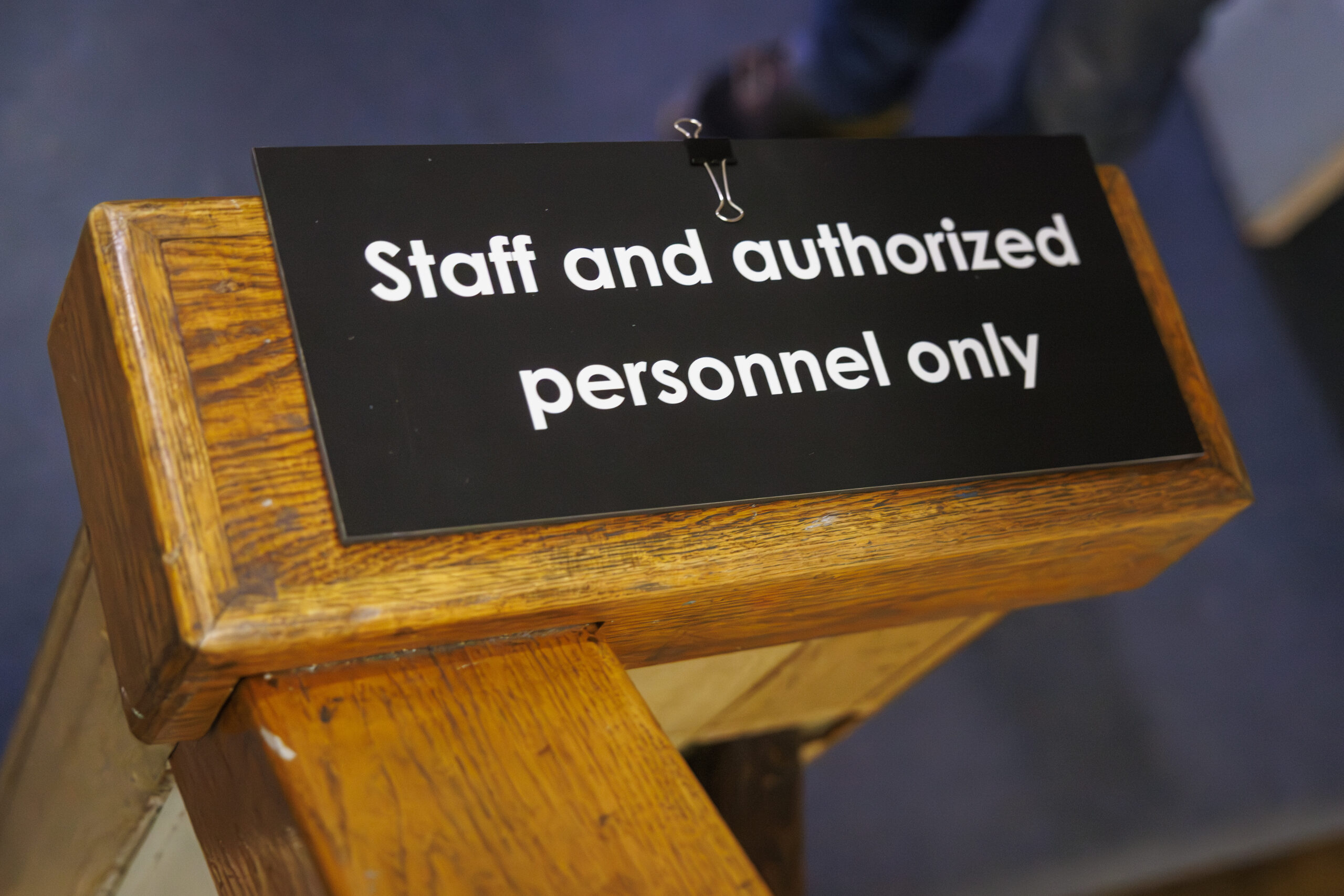
Inside Olivet Covenant Presbyterian Church, doorways to some rooms now bear black-and-white signs that say, “Staff and authorized personnel only.”
Issues around ICE access to churches have become more urgent since Trump rescinded the agency policy on “sensitive locations,” which had generally barred enforcement at schools, hospitals, and houses of worship.
Legal advocates such as the ACLU say ICE agents can lawfully enter the public areas of churches, including the sanctuaries where people gather to worship. But to go into private spaces they must present a warrant signed by a judge.
“There are many front lines right now,” said Ahn, the Olivet pastor. “We’re not trying to be simply anti-ICE, or anti-anybody. We’re just trying to be for the rights of the Fourth Amendment.”
Staff writer Joe Yerardi contributed to this article.
Some yarn shops around Philadelphia are running low on skeins of red wool, as local knitters and crocheters turn out scads of “Melt the ICE” caps in solidarity with protesters in Minnesota.
The hats don’t feature a patch or logo that says “Melt the ICE.” In fact, they carry no written message at all. What they offer is a deep scarlet hue, a dangling tassel, and a connection to an earlier, dangerous time, when a different people in another land sought to silently signal their unity.
“The hat is really a symbol and reminder,” said knitter Laura McNamara of Kensington, who is making two caps for friends. “People are looking for a sense of community.”
She refused her friends’ offers of payment, asking instead that they not let their involvement start and end with a hat ― but find a means to stand up for civil rights in some specific way.
The original hat was a kind of conical stocking cap, known as a nisselue, worn in Norway during the 1940s as a sign of resistance to the Nazi occupation. The Germans eventually caught on to the symbolism and banned the caps.
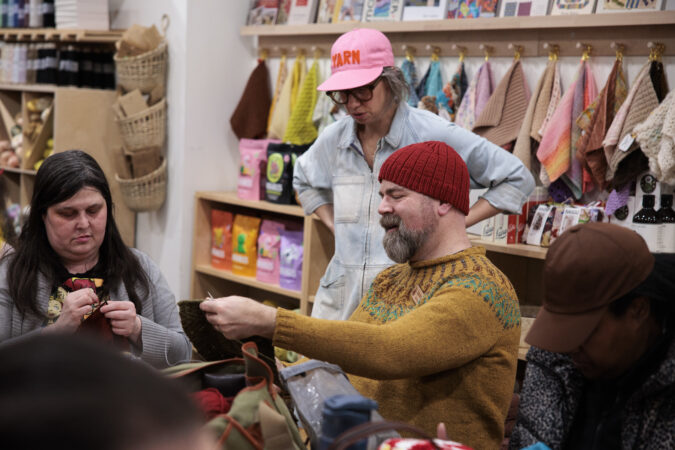
Amanda Bryman works on a red wool hat known as a “Melt the ICE” hat, during Fiber Folk Night at Wild Hand yarn shop in Philadelphia on Wednesday.
Now the new version that originated in a suburban Minneapolis yarn shop is spreading across the country. The hats signal opposition to U.S. Immigration and Customs Enforcement, which surged thousands of agents into Minneapolis, and sadness and anger over the deaths of Minnesotans and U.S. citizens Renee Good and Alex Pretti, who were shot to death by federal agents.
Today, comparisons of ICE agents to Nazis have become both frequent and contentious in American politics, with even some Democrats, including Gov. Josh Shapiro, who is Jewish, rejecting that equivalence as wrong and unacceptable.
ICE officials did not respond to a request for comment.
This is not the first time that the Philadelphia region’s craftivist movement, as it is known, has brought its knitting needles and crochet hooks to bear.
On the eve of Donald Trump’s first inauguration, artisans here turned out scores of cat-eared headgear known as pussy hats, a feline symbol of protest worn at the Women’s March on Washington. The hats aimed to tweak the then-president-elect over his comment about grabbing women by their genitals.
The Melt the ICE caps carry some controversy within the fiber community, as it calls itself. There have been online complaints that it’s easy to tug a red cap over one’s ears, but unless that is accompanied by action it holds no more significance than clicking a “Like” button on Facebook.
“It is just preening,” one person wrote in an internet forum.
Another said that “if your resistance is only this hat, then you have not actually accomplished anything except make a hat.”
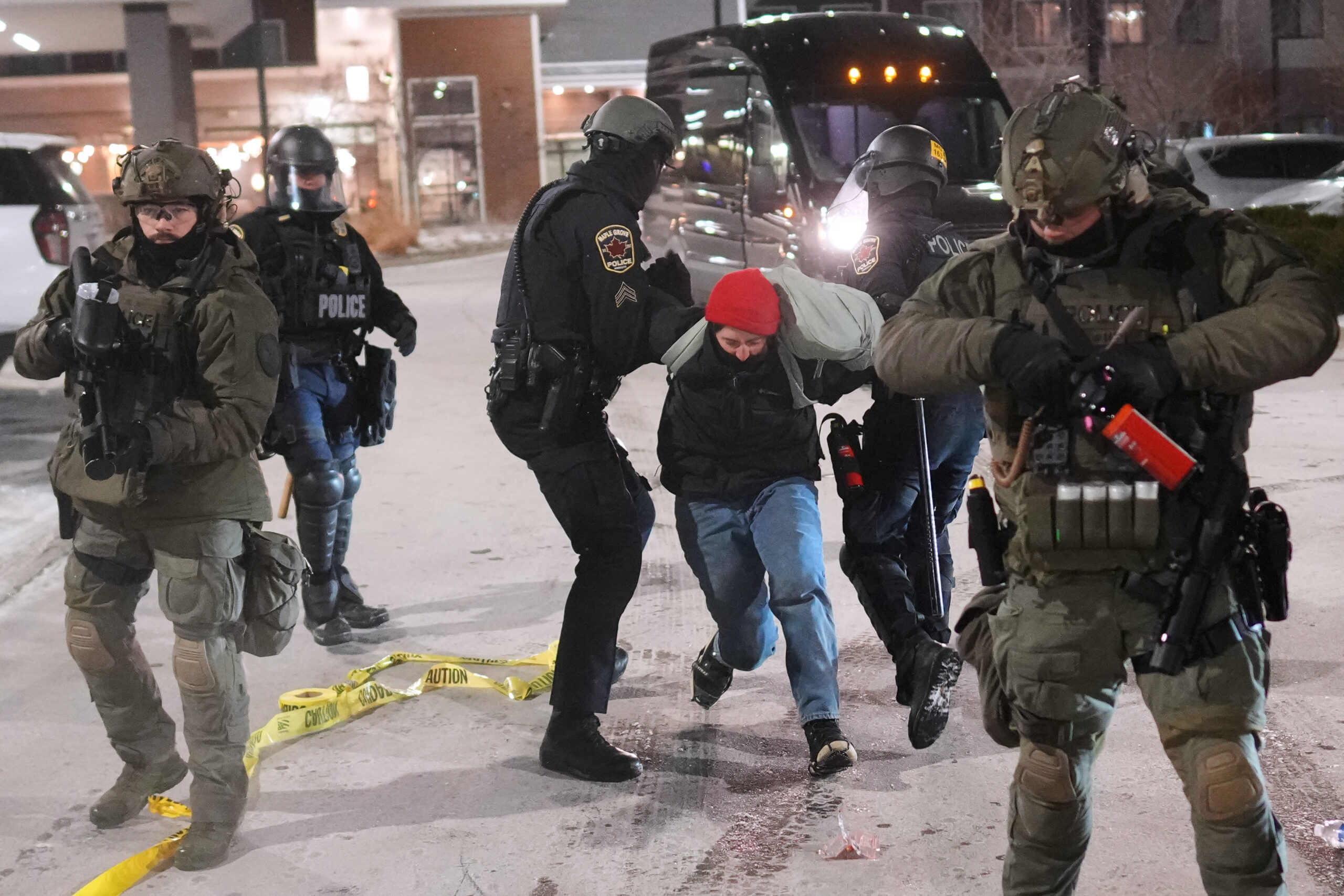
Law enforcement officers detain a demonstrator during a protest outside SpringHill Suites and Residence Inn by Marriott hotels on Jan. 26 in Maple Grove, Minn.
Liz Sytsma, owner of Wild Hand in West Mount Airy, has heard the criticism.
But “the people in our community who are participating in making the hats, this is one of many things they are doing,” she said. That includes taking part in protests, calling elected leaders, and giving money to causes they support.
On Wednesday, more than a dozen people gathered at Wild Hand for the weekly Fiber Folk Night, where crafters gather to knit, crochet, and chat ― and, now, to work on hats.
Damon Davison traveled from Audubon, Camden County, having developed his own hat pattern, with sale proceeds to go to the activist group Juntos in South Philadelphia.
He wants to show solidarity with people “who are expressing resistance to what has been happening in Minneapolis, but also what’s happening here in Philly,” he said. “The idea is to make it a little bit more local.”
The shop has seen a rush on red, sought by about 70% of customers whose purchases have depleted stocks during the last couple of weeks.
“We’re really low,” said store manager Yolanda Booker, who plans to knit and donate a hat. “I want to do whatever small part I can do to help out.”
A single hat can take two or three days to make, though the best and fastest knitters can complete one in a couple of hours.
Store Manager Yolanda Booker, standing, laughs with attendees during Fiber Folk Night at Wild Hand yarn shop in Philadelphia on Wednesday.
In West Mount Airy, Kelbourne Woolens closed its physical doors during the national “ICE Out” strike in late January and donated its onlineprofits of $4,000 to Asian Americans United, Juntos, and New Sanctuary Movement of Philadelphia, said team member Bailey Spiteri. She estimated the store has sold enough red yarn to retailers to make 500 or 600 hats.
At Stitch Central in Glenside, customers donated $1,000 during the strike and the store matched it, with the $2,000 going to Nationalities Service Center in Philadelphia.
“Sometimes people are skeptical. How does wearing a hat or even making a hat make a difference?” asked Allison Covey of Drunken Knit Wits, a local knitting and crocheting organization. “But look at the donations. It does make a difference.”
Veteran knitter Neeta McColloch of Elkins Park thinks the same. She has ordered enough yarn to make eight hats. And she is curious to see how the phenomenon will develop.
“This is probably bigger than I think,” she said. “Knitters tend to be the type of people who in my experience have a strong moral compass. If they can combine something they love to do with something in which they can make a statement, that’s important to them.”
In the end, the pressure on the family simply became too great.
Johny Merida Aguilara, the detained immigrant father of a 5-year-old son with brain cancer, has decided to drop efforts to stay in the United States and accept deportation to Bolivia.
His wife and three American-citizen children will also leave the country, though they are not required to do so, departing their Northeast Philadelphia home to reunite with their husband and father in the central Bolivian city of Cochabamba.
The decision to go comes as Merida Aguilara, 48, approaches his fifth month in immigration detention ― with no end in sight. The family’s forced separation has been emotionally devastating, friends and supporters said. And with Merida Aguilara in custody and unable to work, the financial situation for his wife and children was growing desperate.
Merida Aguilara had been a main caregiver for his son, Jair, who has been treated at Children’s Hospital of Philadelphia, and whose future is now deeply uncertain. Quality healthcare can be lacking in Bolivia, where the U.S. State Department warns that “hospitals cannot handle serious conditions.”
Jair has autism and a severe eating disorder, surviving on PediaSure nutrition drink delivered through a plastic syringe. He generally would accept food only from his father, and Merida Aguilara would leave work during the day to feed his son.
The father was arrested by ICE for an immigration violation during a September traffic stop on Roosevelt Boulevard near Hunting Park Avenue, having lived in the United States without official permission for nearly 20 years.
“I am tired,” Gimena Morales Antezana, his wife, said in an interview with The Inquirer. “We have been trying to survive, but it is difficult with the children because they miss their dad so much.”
U.S. Immigration and Customs Enforcement officials did not reply to a request for comment on Thursday.
The family has received strong community support, Morales Antezana said, but that could not continue indefinitely, and at this point she can no longer afford rent, water, or heat,
Son Matias, 7, cries himself to sleep most nights, calling out for his father to come home. His sadness deepened after Christmas, turning into anger when Morales Antezana finally revealed that his father was not away on an extended work trip, but was being held by immigration authorities at the Moshannon Valley Processing Center, an ICE facility in central Pennsylvania.
Gimena Morales Antezana and Johny Merida Aguilar’s wedding photos hang on the wall at their home in Northeast Philadelphia.
Daughter Melany, 13, now feels unsafe in the U.S., her mother said. Teenage insecurities have bloomed into a persistent sense of danger, and she told her mom that leaving might be the only way to feel comfortable again.
Jair cries inconsolably every time he sees or hears his father on the phone, asking why his dad can’t be home, Morales Antezana said.
All three children were born in this country and are U.S. citizens by law.
Some good news came this month. Doctors told Morales Antezana that Jair’s brain tumor had not grown, allowing time to try to find care in Bolivia.
“This is going to be a constant struggle every day until God decides,” Morales Antezana said. “It’s scary to think that if something happens we don’t have a hospital to take him to, but knowing his dad will be there makes it a little lighter to bear.”
Jair Merida, 5, posed for a portrait at home in October. His father, Johny Merida Aguilar, was stopped and arrested by ICE in September.
She has not been ordered deported while she has pursued legal means to stay in the country. Mother and children plan to voluntarily depart this month, while the precise timing of Merida Aguilara’s deportation is uncertain.
“He couldn’t do it anymore; he reached his limit,” said Philadelphia immigration attorney John Vandenberg, who represents the family. “It’s a tough environment in the jail.”
Vandenberg won relief in the U.S. Court of Appeals for the Third Circuit, which issued a Sept. 30 order to temporarily block Merida Aguilar’s deportation. The lawyer also applied on Morales Antezana’s behalf for a T visa, which can bestow a path to citizenship on victims of human trafficking and their families.
But time has gone on with no sign from the government as to when that visa application might be considered.
Vandenberg said Merida Aguilar has no criminal record in the U.S., and Bolivian authorities provided documentation showing he had committed no offenses in that country.
His efforts to remain in the U.S. have been complicated by a previous deportation, when he tried to enter the U.S. east of San Diego in 2008. Immigration officials sent him to Mexico, but Merida Aguilar secretly crossed back into the U.S. almost immediately.
Now he and his wife want their children to be in Bolivia in time for the new school year, which starts in February.
“I want to make sure our kids can study,” Morales Antezana said, “so they can decide who they want to be in the future, and come back [to the U.S.] as professionals with a different story than us.”
Her parents, and a son from a previous relationship, are eager to see them in Bolivia.
She said she is looking forward to what many people might take for granted ― hugging her partner, watching him play with their children, enjoying a meal as a family. That helps ease the pain of saying goodbye to a city she sees as home and to the friends who tried to help.
“They kept me strong and helped me not get more depressed,” Morales Antezana said. “I’m going to miss everything about Philadelphia. It hurts a lot to have to leave because there are good people here.”
A disabled Ecuadorian immigrant who was arrested and detained by ICE after he flagged down an officer in September was ordered back to his homeland on Tuesday.
That is not the same as an order of deportation, but for migrants in detention it has the same practical effect. If Acurio Suarez were to refuse to leave voluntarily, the order would convert to a deportation order, which carries consequences including fines and a bar on reentry.
“It’s not good news,” his attorney, Kaley Miller-Schaeffer, said shortly after the video hearing concluded.
She plans to quickly appeal to the Board of Immigration Appeals, which can review decisions by immigration judges. It is uncertain if an appeal would be successful.
The judge denied her client’s request for asylum, which can be granted to migrants who could face persecution in their home countries because of their race, religion, nationality, politics, or membership in a particular social group. Acurio Suarez was beaten by gangs who preyed upon his disabilities, his attorney said.
Miller-Schaeffer said she was not able to speak with her client after the ruling. His brother, Lenin Acurio Suarez, was still processing the decision, she said.
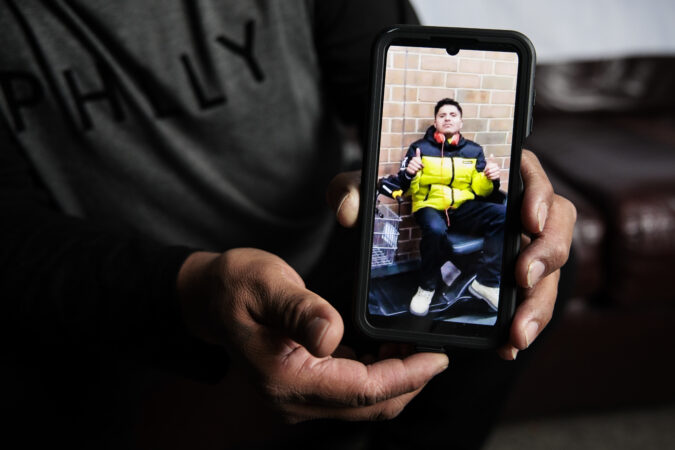
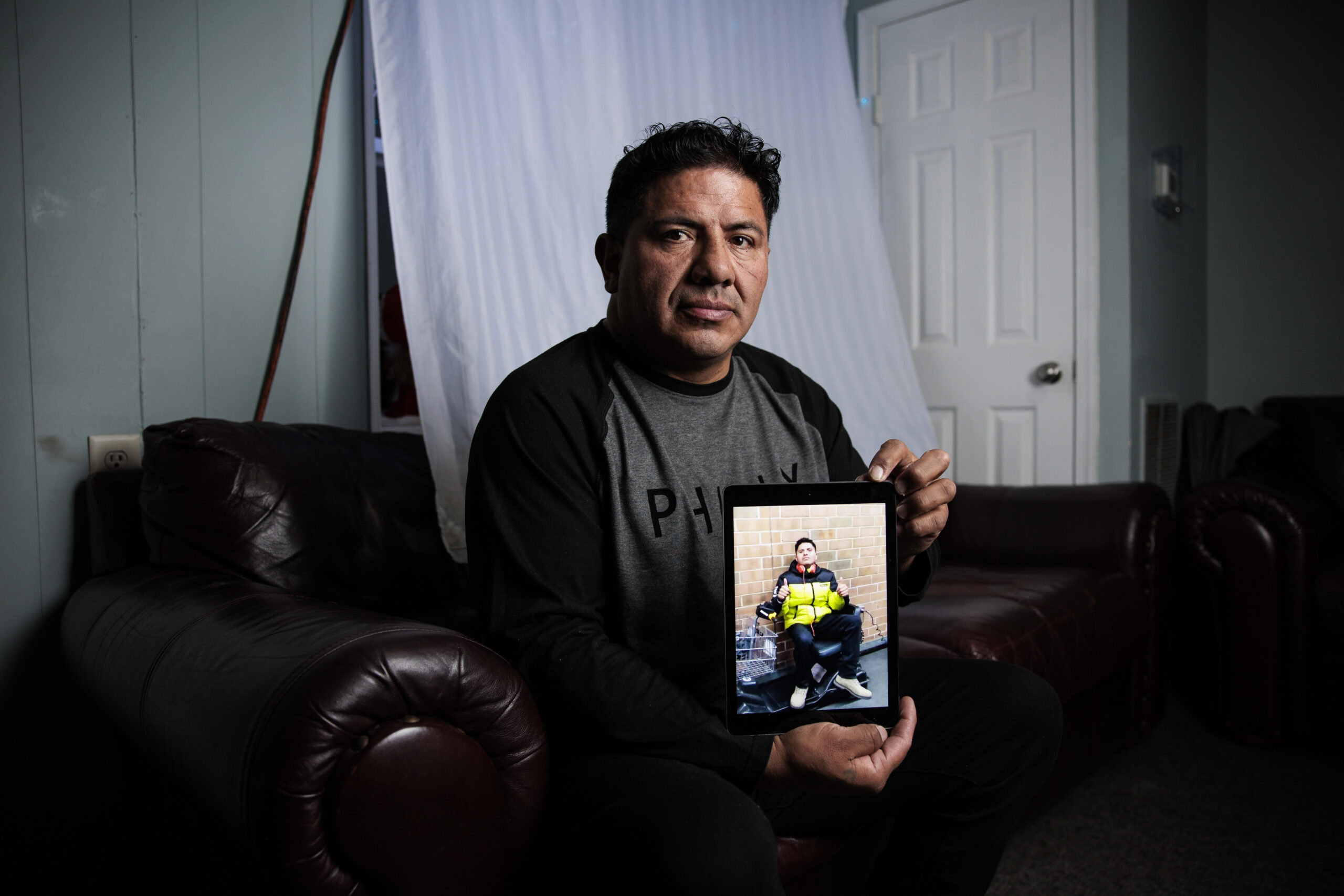
Lenin Acurio Suarez holds a photograph of his brother, Victor, at his home on Wednesday, Dec. 10, 2025 in Seaford. Victor was arrested by ICE in Seaford, De.
Victor Acurio Suarez’s case drew support from Delaware Gov. Matt Meyer, who wrote to the judge that it would be “cruel” and “egregious” to deliver the Seaford resident to gang violence. Meyer also advocated for Acurio Suarez in social media posts, calling his arrest and detention “deeply disturbing” and arguing that with no criminal history, not even a traffic violation, Acurio Suarez “poses no threat to public safety.”
The governor’s office did not immediately reply to a request for comment on Tuesday.
Acurio Suarez has long been cared for by his brother, Lenin Acurio Suarez, who said in an interview last month that Victor Acurio Suarez did not realize he was in immigration custody when he was taken to the Moshannon Valley Processing Center in Pennsylvania. He thought he was on vacation, provided with three free meals a day and allowed to buy snacks and kick a soccer ball.
He was arrested on Sept. 22 in a Lowe’s parking lot near the brothers’ home in Seaford when he tried to flag down a U.S. Immigration and Customs Enforcement agent, apparently thinking the officer could help him find work.
In the past, someone with Acurio Suarez’s profile might have been allowed to live at home as the case moved forward in immigration court. That has changed as President Donald Trump has pressed his mass-deportation agenda, and mandatory detention policies have swelled the number of people in custody.
His case, Miller-Schaeffer said earlier, is a prime example of how Trump administration policy shifts have encouraged ICE to detain even the most vulnerable and to treat potential discretionary relief as irrelevant in a bid to boost deportations. Her Sept. 30 request to have Acurio Suarez released to the care of his brother while his immigration case went forward was denied.
A medical assessment submitted for his asylum application said Acurio Suarez has autism and aphasia, a language disorder that affects his ability to produce or understand speech.
David W. Baron, the doctor whodid the assessment, said Acurio Suarez cannot safely live on his own. He requires supervision to perform daily hygiene activities or cook and has a hard time communicating his needs to others, a condition made worse by being in an unfamiliar setting while in detention, where he does not have access to the support needed for his neurocognitive disabilities.
At an earlier court hearing, Miller-Schaeffer said, she watched as Acurio Suarez struggled to answer basic questions. He told the judge he didn’t know if he had an attorney or know what an attorney does.
His ability to testify was so limited, she said, that the judge allowed his brother to take the stand to explain his sibling’s experience and situation.
Acurio Suarez can recall big events in his life, she said. He remembers being beaten by gangs, but he couldn’t tell you exactly when that occurred.
He worked at odd jobs in Ecuador before coming to this country.
Records show that on Aug. 2, 2021, the brothers were stopped by the U.S. Border Patrol as they tried to enter the United States near Eagle Pass, Texas.
Lenin Acurio Suarez was issued a notice to appear in court and released, and his immigration case was later dismissed.
Victor Acurio Suarez was ordered deported and subsequently returned to Ecuador on Sept. 24. Three days later, for reasons that are unclear, the deportation order was found to have been issued incorrectly, and Acurio Suarez was brought back by authorities to the U.S.
In October 2021, he was granted temporary permission to stay in the country. He had filed his asylum case by the time that permission expired a year later.
Last year, according to an ICE report, on Sept. 22 an ICE team was conducting operations in Seaford, a southern Delaware city of 9,000 where 13% of the population is foreign-born.
The ICE officer wrote that he was looking for a place to park in the Lowe’s lot when a man in paint-stained clothing, Acurio Suarez, approached him. Acurio Suarez waved his hand, signaling the officer to come to him, according to the ICE report.
The officer kept going, then stopped his car and watched Acurio Suarez from another lot. Acurio Suarez tried to hail other cars, and could be seen talking to people who were loading lumber onto a trailer in the parking lot, he said.
It looked as if Acurio Suarez was trying to find daily work, which is why he tried to get the ICE officer to stop his vehicle, the report said.
It is common for undocumented immigrants seeking a day’s pay to wait in the parking lots of big home-improvement stores like Lowe’s and Home Depot, hoping to connect with building contractors who need laborers.
Lenin Acurio Suarez said his brother cannot hold a full-time job, and is able only to handle small tasks, provided someone is beside him giving directions.
A second ICE officer arrived, and both parked their cars near where Acurio Suarez had left his lunch box. Acurio Suarez walked back toward the officers, and one of the agents approached and questioned him.
Acurio Suarez told the agents he had no identification or immigration documents and was placed in handcuffs.
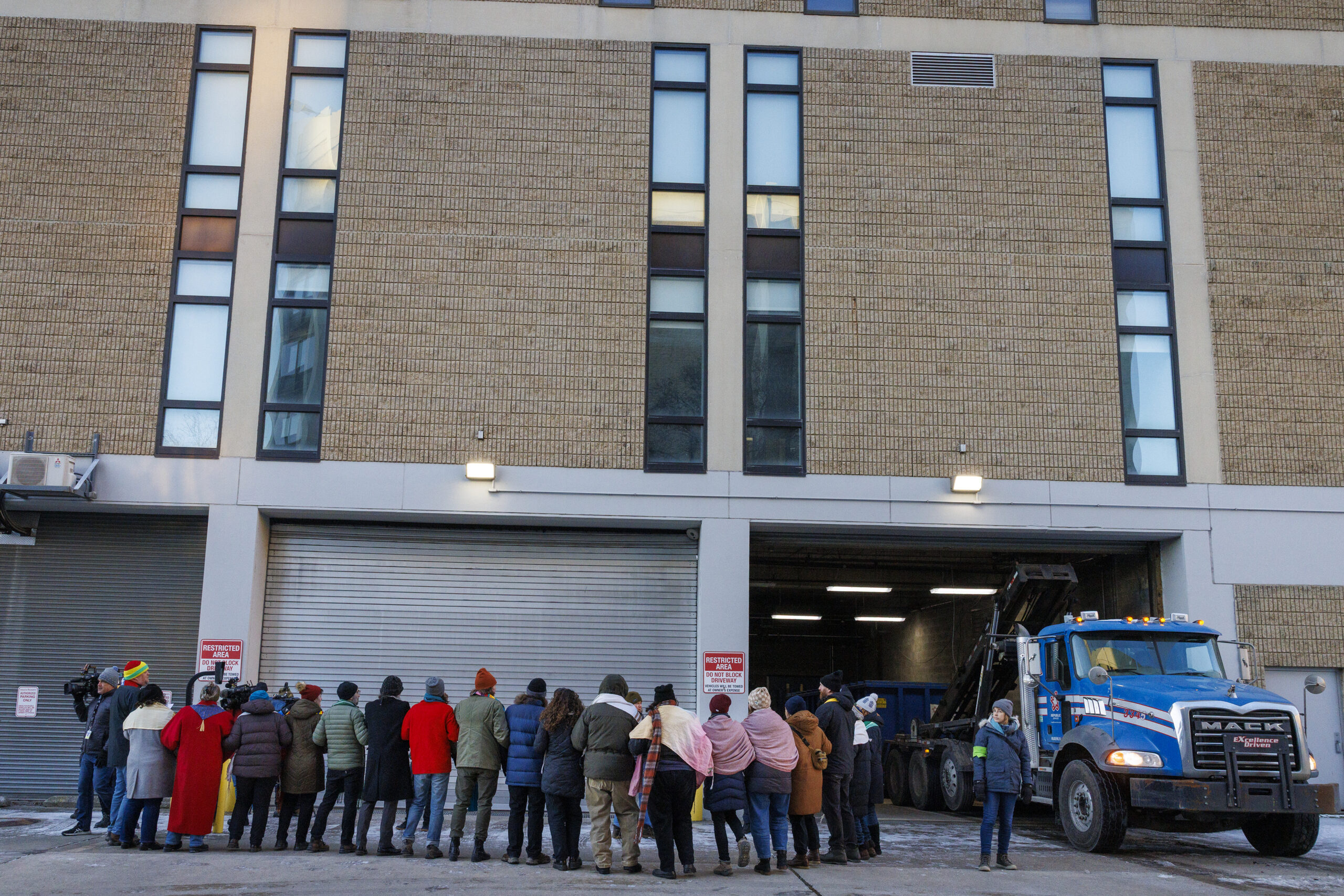
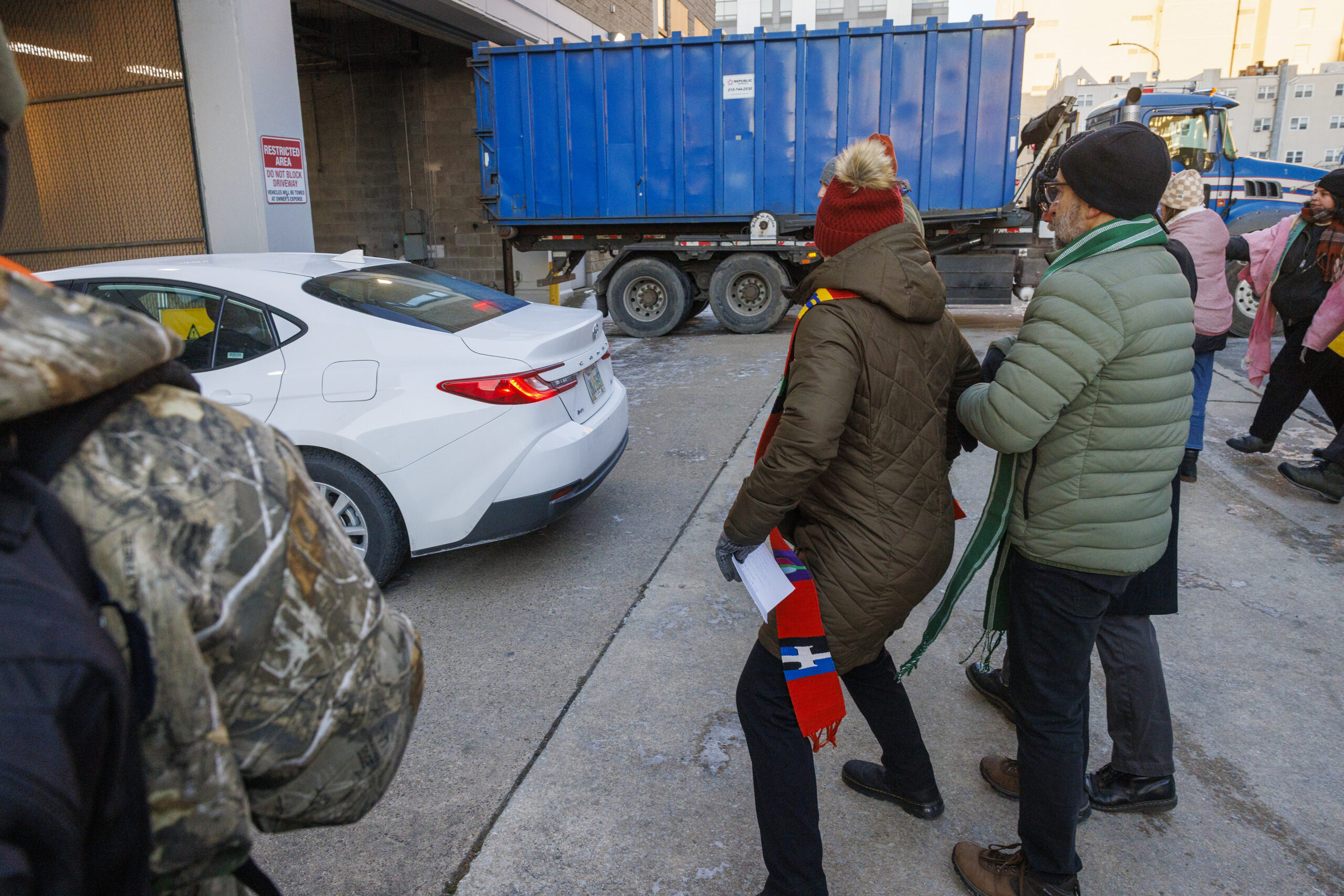
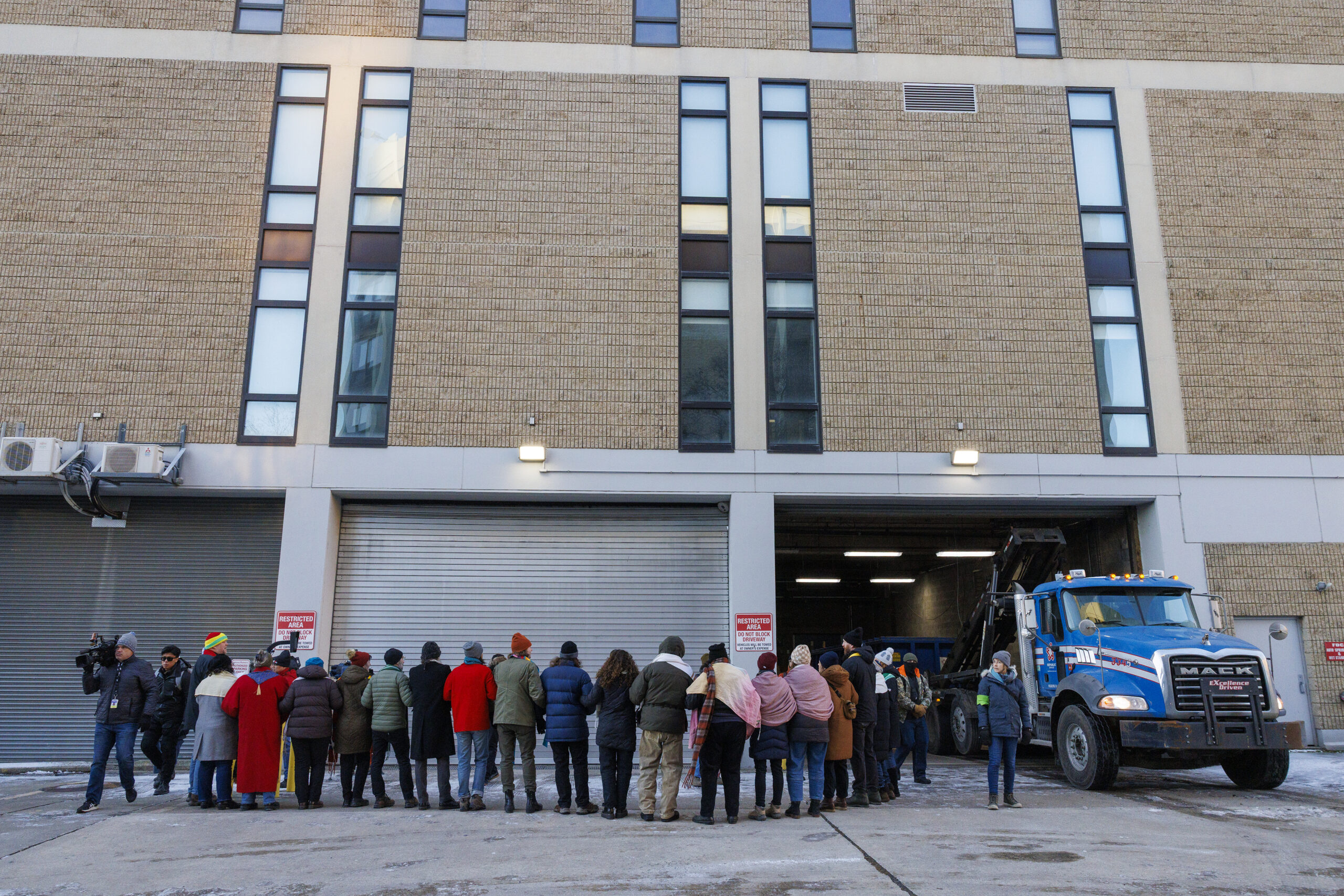
About 30 demonstrators blocked the garage doors at the Philadelphia ICE office Tuesday morning, saying they intended to stop agency vehicles from going to “terrorize” local residents.
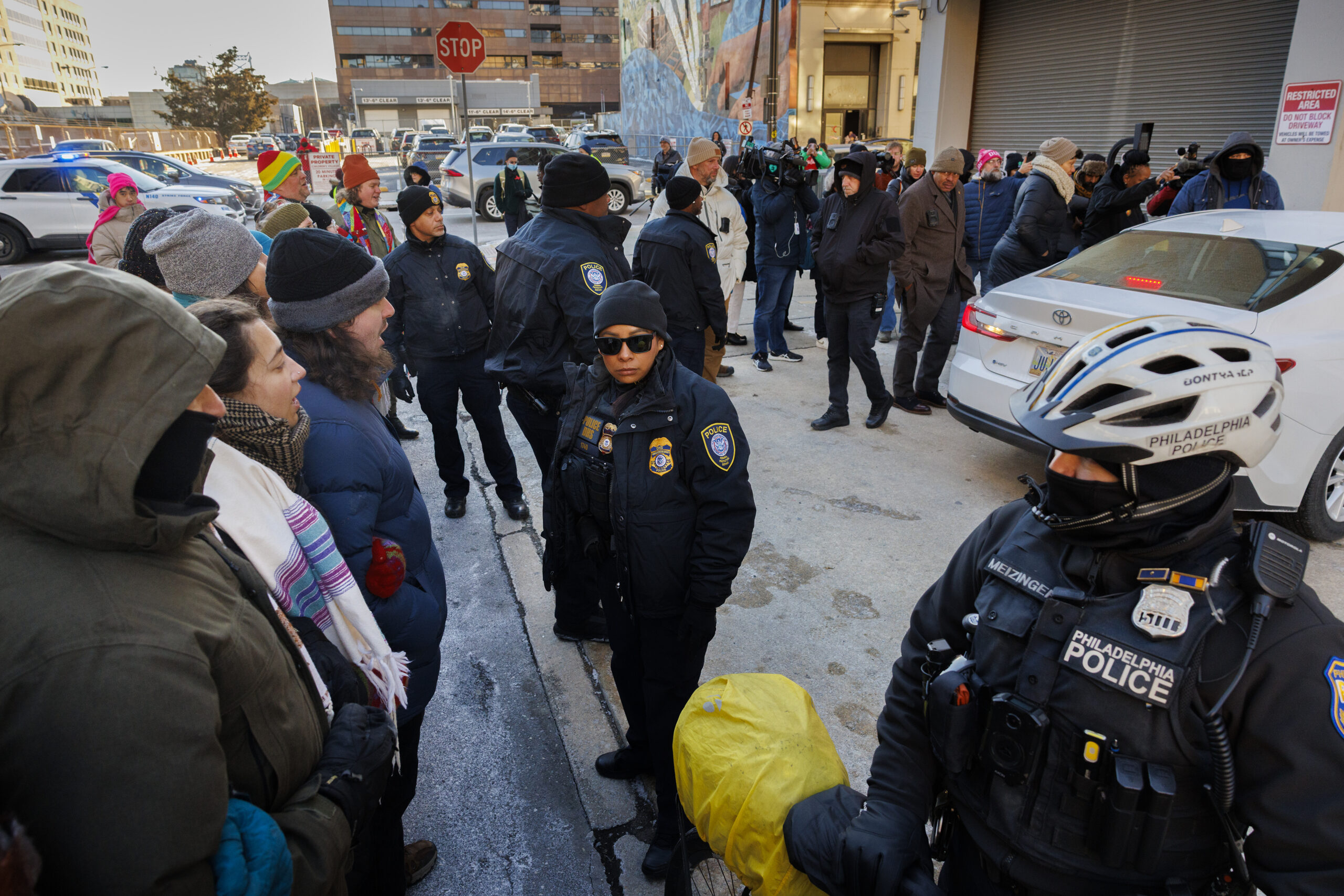
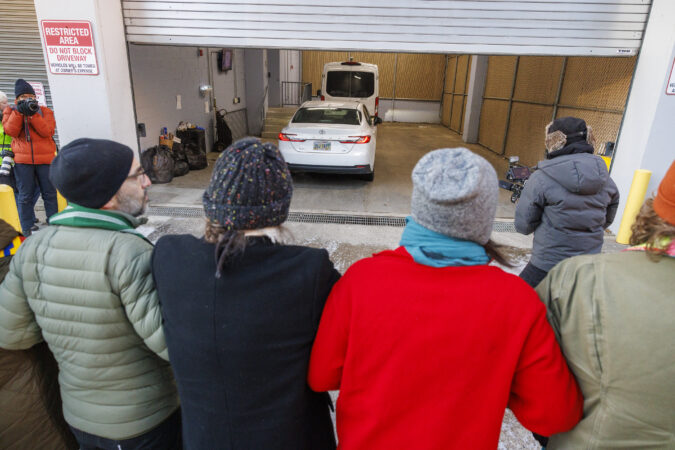
Only one car attempted to leave, and Philadelphia police moved demonstrators aside so it could depart.
No one was arrested.
Organizers with No ICE Philly had pledged to block the garage until they were forcibly removed or arrested, but halted the protest after about two hours. They said that they had accomplished their goal, and that the bitterly cold weather was too harsh on demonstrators who are older or who have medical conditions.
Demonstrators with No ICE Philly block the garage at U.S. Immigration and Customs Enforcement at 8th and Cherry Street, Philadelphia, Tuesday, Jan. 20, 2026.
The temperature was about 15 degrees when the protest began shortly before 8 a.m.
“All of us here have proven in our song and our prayer that we can slow down the machine of authoritarianism, of fascism, that we can delay the operations that will detain and kidnap and destroy our neighbors, our families, our community,” said the Rev. Jay Bergen, a leader of No ICE Philly and pastor of the Germantown Mennonite Church.
The protest was the latest in a string of anti-ICE demonstrations and vigils in the Philadelphia region; another was planned in Norristown on Tuesday evening. In October, a No ICE Philly protest outside the agency headquarters erupted into physical confrontations with police, with several people knocked to the ground and four arrested.
Immigration and Customs Enforcement officials did not reply to a request for comment Tuesday.
The clergy-led protest was boosted by City Councilmember Nicolas O’Rourke, who is a pastor of the Living Water United Church of Christ in Oxford Circle.
O’Rourke said that it was natural for him to join fellow clergy, that Tuesday’s action was part of a long tradition of faith leaders being at the forefront of the “struggle against oppression,” as led by the Rev. Dr. Martin Luther King Jr. and others.
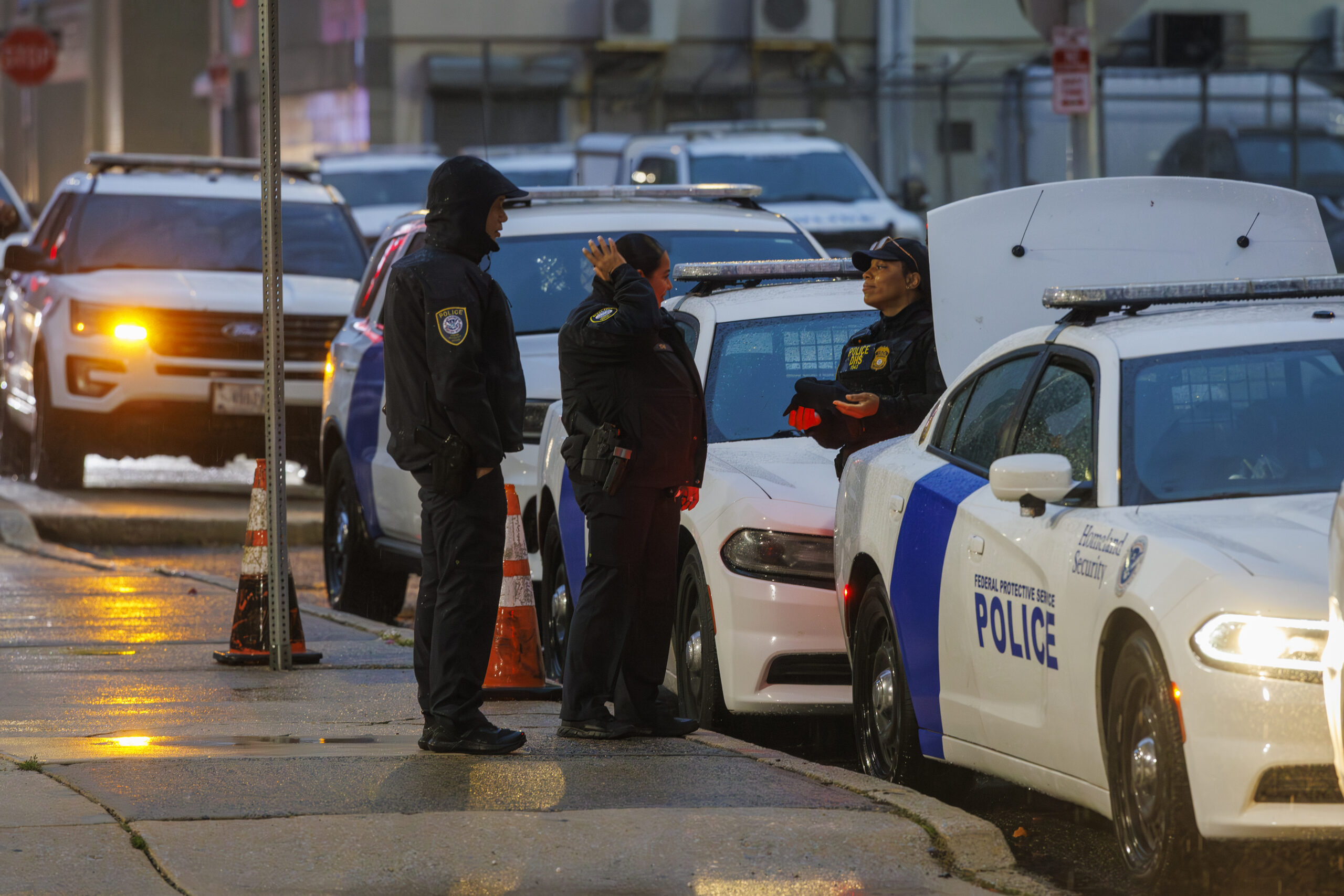
Philadelphia Police and Department of Homeland Security officers block demonstrators from No ICE Philly as they attempt to block vehicles from leaving the garage at U.S. Immigration and Customs Enforcement at 8th and Cherry Street, Philadelphia, Tuesday, Jan. 20, 2026.
“We are a day after King’s day, and it’s important that we don’t just wax eloquent about the nice things that King said or the image that he’s been painted of now,” he said, “but we continue in that tradition of resisting the oppression as he saw it, we’re doing in our own time.”
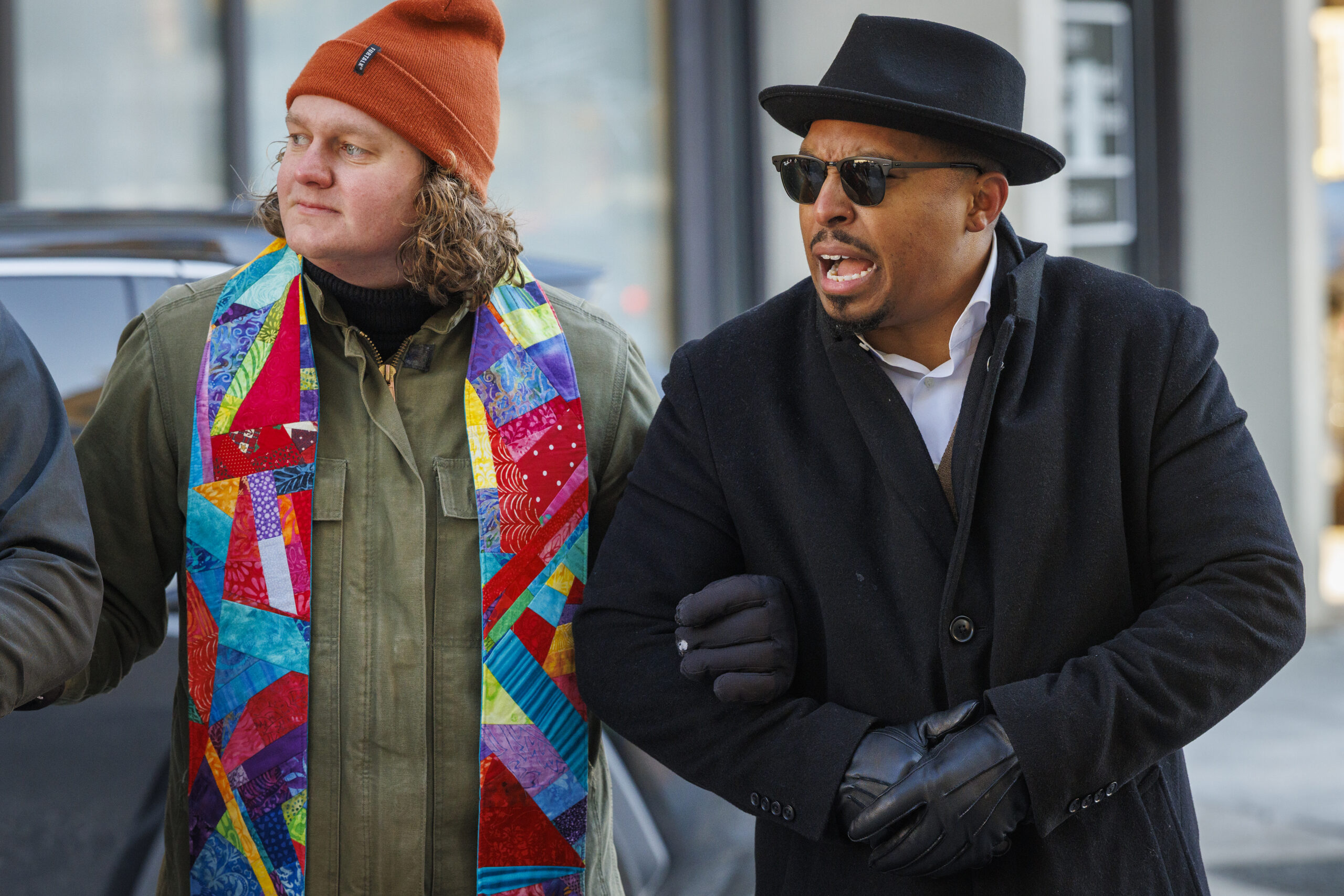
The group locked arms and sang, offering prayers and songs of peace and affirmation.
The Rev. Hannah Capaldi, minister at the Unitarian Society of Germantown, noted that all around her were clergy of different faiths wearing collars, tallits, and stoles.
“We’re saying, listen, we have some level of moral authority in this city, and we’re trying to tell you where to look and what to pay attention to,” she said.
The Rev. Jonny Rashid, a protest organizer, outside of U.S. Immigration and Customs Enforcement at 8th and Cherry Street, Philadelphia, Tuesday, Jan. 20, 2026.
Capaldi hoped to plant “seeds of resistance” in the broader public, encouraging people to get involved.
“We need more people every day willing to do this,” she said, “to stand between the vehicles and the work that they’re doing to kidnap our neighbors.”
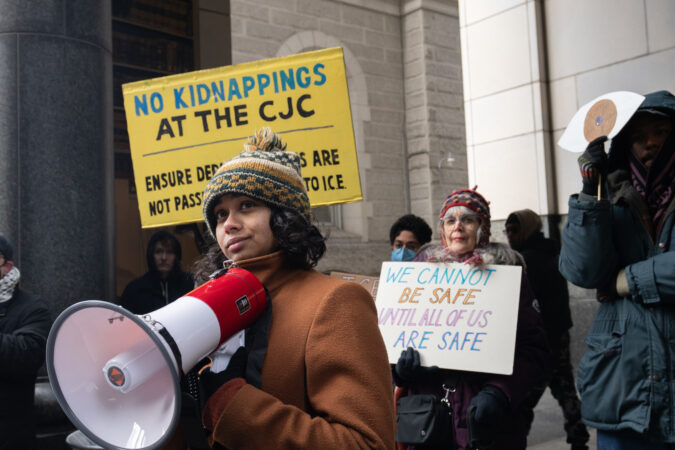
Protestors want ICE agents banned from the Criminal Justice Center in Center City, where immigrants have been trailed and arrested.
// Timestamp 01/20/26 9:39am
Anti-ICE demonstrators end their protest
Rev. Jay Bergen, a leader of No ICE Philly, said the group had accomplished its goal – and that the brutal cold had become too much for older demonstrators, some of whom have medical conditions.
In his closing prayer, Bergen hoped the nearly 2 hour stretch was enough for ICE’s target to be somewhere else.
“All of us here have proven in our song and our prayer that we can slow down the machine of authoritarianism, of fascism, that we can delay the operations that will detain and kidnap and destroy our neighbors, our families, our community,” Bergen said.
ICE vehicle able to exit garage, helped by Philly police
Philadelphia Police and Department of Homeland Security officials block protesters outside the garage at ICE’s Center City headquarters.
Just before 9:30 a.m., a white sedan – which had initially been blocked by protesters – was able to exit the ICE headquarters parking bay with the help of Philadelphia Police.
Philadelphia City Councilman Nicolas V. O’Rourke (right) joins the protest alongside Rev. Jay Bergen.
Protestors saw their ranks boosted by City Council member Nicholas O’Rourke, who is also a pastor of the Living Water United Church of Christ in Oxford Circle.
O’Rourke said it was only natural for him to join fellow clergy at Tuesday’s frigid demonstration.
A pastor of the Living Water United Church of Christ in Oxford Circle, O’Rourke said Tuesday’s action was part of a long tradition of faith leaders being at the forefront of the “struggle against oppression,” as seen with Rev. Dr. Martin Luther King Jr. and others.
“We are a day after King’s Day, and it’s important that we don’t just wax eloquent about the nice things that King said or the image that he’s been painted of now, but we continue in that tradition of resisting the oppression as he saw it, we’re doing in our own time,” said O’Rourke.
‘We need more people every day willing to do this’
Protesters sing and lock arms outside ICE headquarters in Center City Tuesday.
The group of clergy and immigration advocates continued to sing in locked arms in front of the parking bay in front of ICE headquarters in Center City after its initial “ICE block” in an effort to disrupt immigration enforcement.
Rev. Hannah Capaldi, minister at the Unitarian Society of Germantown, described the selection of participants as an intentional one as they face warnings from police, possible arrests, and citations.
Those present are leveraging a certain level of privilege, she said. All are citizens and many are clergy wearing collars, taluses, and stoles.
“We’re saying, listen, we have some level of moral authority in this city, and we’re trying to tell you where to look and what to pay attention to,” she said.
But in addition to drawing attention to ICE operations in Philadelphia, Capaldi hopes to plant “seeds of resistance” in the broader public, encouraging people to get involved.
“It doesn’t have to just be us, and we need more people every day willing to do this, to stand between the vehicles and the work that they’re doing to kidnap our neighbors,” she said.
“What ICE is doing in our communities is against our faith tradition,” said Rev. Jonny Rashid, a protest organizer. “We are gathered clergy, priests, rabbis, imams, and we are here to say no to ICE, and we want to demonstrate that publicly, and we’re willing to get arrested to do that. We’re blocking ICE’s garage as a symbol of saying you are not welcome in Philadelphia.”
He said he was not surprised by the lack of an overt Philadelphia police presence, though in the past groups of officers have been sent to anti-ICE protests.
“I don’t think the Philly police want to engage. They don’t want to make Philadelphia look like Minneapolis.”
Protestors are blocking the parking garage at ICE headquarters in Center City Philadelphia.
A group of about 30 immigration advocates, including local clergy, kicked off the frigid morning shortly before 8 a.m. with song in front of ICE headquarters.
They carried signs that read “Who would jesus deport?” and approximately at 7:55 a.m. the group locked arms calmly shouting “ICE block” as a white sedan tried to make its way out of a garage.
The gate to the garage closed back down almost immediately as the car pulled back in and the group continued in song.
Organizers with No ICE Philly say they’ll form a human blockade to stop ICE vehicles from departing the agency’s Center City headquarters beginning at 8 a.m. Tuesday.
They pledge to stay there, singing and chanting, until they are forcibly removed or arrested or both, in what they say is an effort to stop ICE from “leaving the facility to terrorize our neighbors.”
The ICE office is located at 8th and Cherry Streets, just southwest of the former Roundhouse police building.
Homeland Security officers with their cars along Cherry Street outside ICE’s Center City office in October.
In October, a No ICE Philly protest outside the agency headquarters erupted into physical confrontations with police, with several people knocked to the ground and four taken into custody.
A series of push-and-shove skirmishes broke out after about 35 protesters gathered for a Halloween Eve demonstration where they attempted to stop Immigration and Customs Enforcement vehicles from leaving the facility.
When an organizer shouted, “ICE Block!” about a dozen people poured onto Cherry Street to try to block the road. A series of scrums grew increasingly intense, with police shoving protesters back and in some cases to the ground.
The Department of Homeland Security, ICE, and Philadelphia police presence was substantial, with more than 30 officers outside the immigration agency’s big metal garage doors. Philadelphia police said four demonstrators were arrested and later released after being given citations for obstruction of highway, a violation that typically results in a fine.
That protest followed a September demonstration in which members of No ICE Philly acted as symbolic “building inspectors” who “condemned” the ICE facility. On the building they hung signs, bordered with yellow-and-black warning tape, that said, “ICE Raids Violate Philly Values.”
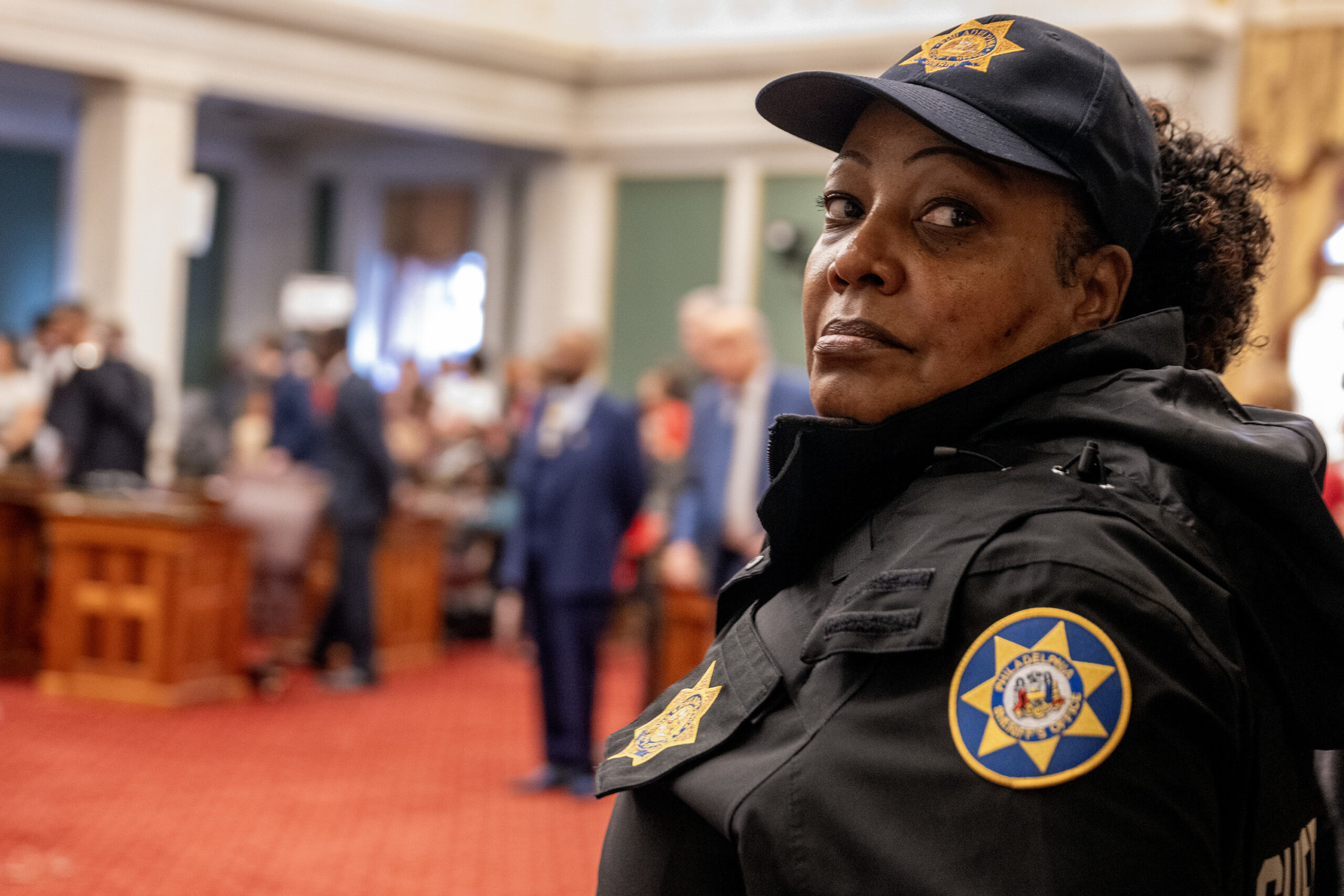
Protesters want Sheriff Rochelle Bilal to ban ICE agents from the courthouse in Center City.
No ICE Philly has been a leader in protests outside the Criminal Justice Center in Center City, where it and other groups have demanded that Sheriff Rochelle Bilal ban immigration agents from the building.
Activists charge that the sheriff has allowed ICE to turn the property into a “hunting ground,” with at least 114 immigrants trailed from the courthouse by agents and arrested on the sidewalk.
On Wednesday the judicial district that oversees the Philadelphia court system said that authority for managing ICE’s presence rested with the sheriff, and that decisions around that were her “sole responsibility.”
Many people who go to the courthouse are not criminal defendants ― they are witnesses, victims, family members, and others in diversionary programs. But they have been targeted and arrested by ICE, immigration attorneys and government officials say, causing witnesses and victims to stay away from court and damaging the administration of justice in Philadelphia.
The judicial district that oversees the Philadelphia court system says that the authority for managing ICE’s controversial presence at the Criminal Justice Center rests on Sheriff Rochelle Bilal and that decisions around that are her “sole responsibility.”
That follows a Wednesday morning news conference where the sheriff joined local elected and community leaders who suggested that court officials or legislators needed to address the ongoing turmoil around courthouse immigration arrests. They called for meetings with court leaders to discuss how to set guardrails on ICE activity.
The First Judicial District responded with a statement late Wednesday:
“The First Judicial District is always willing to discuss matters of mutual concern with our justice partners, but managing security in court buildings ― which includes managing ICE’s presence ― is the sole responsibility of the sheriff. These decisions are the sheriff’s to make.”
The Philadelphia Sheriff’s Office responded Thursday that it was “ready to execute all lawful judicial orders.”
“To be clear,” its statement said, “security inside court facilities is the responsibility of the Sheriff’s Office. … Areas outside of court facilities are public spaces, where individuals retain their First Amendment rights, including the right to assemble and protest. Those areas are not under the operational control of the Sheriff’s Office.”
The sheriff’s office added that it is committed to maintaining order and safety while upholding the rights of all who enter, and that it remains open to dialogue to ensure “clarity, coordination, and public safety.”
The sheriff has said her office does not cooperate with ICE, does not assist in ICE operations, and does not share information with the agency. She has not directly addressed whether she believes she has authority to bar ICE agents from the property.
Meanwhile, the presence of ICE in and around the Criminal Justice Center has provoked demonstrations and controversy, with activists charging that the sheriff has allowed ICE to turn the property into a “hunting ground” for immigrants.
U.S. Immigration and Customs Enforcement officials did not reply to a request for comment on Thursday.
The group No ICE Philly has castigated the sheriff, saying that by not barring ICE — as judges and lawmakers in some other jurisdictions have done — she has helped enable the arrest of 114 immigrants who were trailed from the courthouse and arrested on the sidewalk.
That group and others say ICE agents have been allowed to essentially hang out at the Center City courthouse, waiting in the lobby or scouring the hallways, then making arrests outside.
Many people who go to the courthouse are not criminal defendants ― they are witnesses, victims, family members, and others in diversionary programs. But they have been targeted and arrested by ICE, immigration attorneys and government officials say, causing witnesses and victims to stay away from court and damaging the administration of justice in Philadelphia.
“We already know that Sheriff Bilal is not doing all she can to protect people at the courthouse,” she said Thursday. “However, the First Judicial District is not powerless. The court can make its own policy, like the court in Chicago did, barring civil arrests on and around the courthouse. … What we’re seeing is a lot of blame-shifting and finger-pointing from our leaders at a time when we desperately need teamwork.”
The issue around ICE access is complicated by the fact that courthouses are public buildings, generally open to everyone. And sidewalks outside the buildings are generally considered public property.
“If any [ICE agents] want to come in this city and commit a crime, you will not be able to hide,” Bilal said in viral remarks. “You don’t want this smoke, ’cause we will bring it to you. … The criminal in the White House would not be able to keep you from going to jail.”
On Wednesday, at the news conference at the Salt and Light Church in Southwest Philadelphia, Bilal said her office follows the law and would obey judicial orders and legislative statutes around courthouse security.
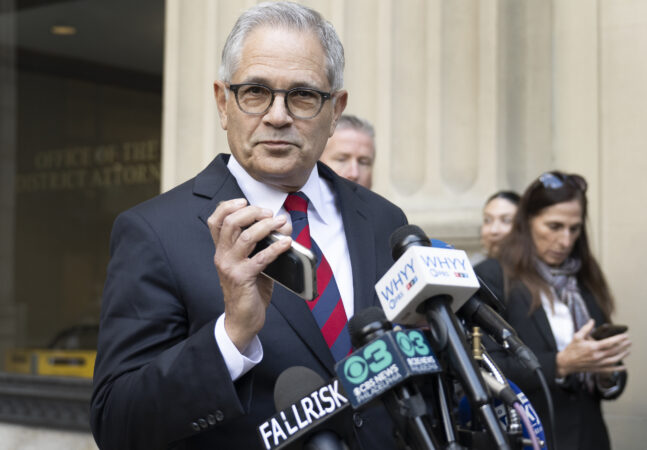
District Attorney Larry Krasner ― whose office led the event, and who reiterated his pledge to prosecute ICE agents who commit crimes ― said victims and witnesses are not showing up for cases due to fear of ICE.
About half a dozen elected officials and community leaders gathered, with some calling for ICE to get out of Philadelphia.
They asked for the court system to establish rules and protections for immigrants seeking to attend proceedings at the Criminal Justice Center, and for state court administrators to meet with the district attorney, the sheriff, the chief public defender, City Council members, and others.
Krasner said Thursday that his office and the other parties “look forward to meeting with the leadership of the courts to discuss lawfully regulating ICE activity in and around the Criminal Justice Center. We will be corresponding with the courts to schedule monthly meetings immediately.”
At the same time, “we will continue to do all we can to prioritize safety and justice for victims, witnesses, and families who are navigating the criminal justice system,” he said. “Unlawful and unnecessary ICE activity in and around the CJC is deeply traumatizing to those who are already navigating pain and unfortunate circumstances.”
Some elected city officials and community leaders called for ICE to get out of Philadelphiaon Wednesday, saying agents had become a threat to safety and to the orderly administration of justice.
They asked for state court administrators to meet with the district attorney, the sheriff, the chief public defender, City Council members and others, and suggested that in the meantime, court staff must be better trained to understand the difference between court- and ICE-issued orders, that they do not carry equal weight nor require equal obedience.
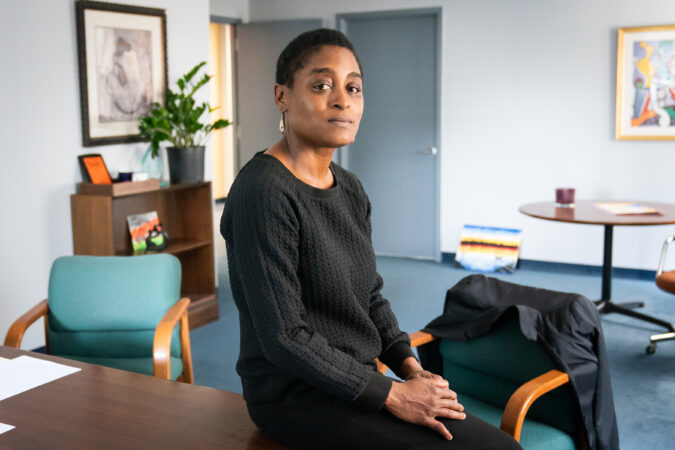
“People should be able to come to court without fear,” said Keisha Hudson, chief defender of the Defender Association of Philadelphia. “Without fear that doing what the law requires will put them at risk.”
District Attorney Larry Krasner ― whose office led the news conference, and who reiterated his pledge to prosecute ICE agents who commit crimes ― said victims and witnesses are not showing up for cases. And community leaders said residents’ lives were being diminished.
“Across Philadelphia, the increase in ICE raids is tearing the fabric of our community,” said Thi Lam, deputy director of the Southeast Asian Mutual Assistance Association Coalition, which serves refugees and immigrants, leaving people afraid to go to work, to seek medical care, and to take their children to school.
“As Philadelphians, we demand policies that protect due process,” he said. “We object to the violent way that this immigrant process has turned. We invite all Philadelphians to speak up. Speak up, Philadelphians!”
ICE officials did not immediately reply to a request for comment.
The news conference at the Salt and Light Church in Southwest Philadelphia came as protests and confrontations continue in Minnesota and other cities over the fatal ICE shooting of a Minneapolis wife and mother, Renee Good. Daily ICE activity and arrests in Philadelphia and surrounding towns continue to rile and frighten immigrant communities and those who support them.
Krasner called the shooting of Good “murder,” and said “that collection of people who left their Klan hoods in the closet” to become ICE agents will face prosecution for any crimes committed in Philadelphia.
Meanwhile, in Atlantic City on Wednesday, Mayor Marty Small and other officials gathered to support local immigrant communities, and to assert their willingness to ensure that ICE agents “continue to do the job under the legal letter of the law.
“Some of the footage that we’ve seen has been horrifying, and I understand, and I empathize with that community. And as your mayor, this city has your back,” Small said, flanked by Atlantic City Police Chief Jim Sarkos, Director of Public Safety Sean Riggin, and Cristian Moreno-Rodriguez from the immigrant advocacy organization El Pueblo Unido of Atlantic City.
Atlantic City police, they noted, do not assist ICE in immigration enforcement. Under the 2018 Immigrant Trust Directive, New Jersey state and local police agencies are limited in how they can cooperate with ICE.
Riggin clarified, however, that local police will assist ICE in cases where agents are in danger or a crime is being committed.
“We will respond, we’re going to assess the situation, and we’re going to act accordingly in compliance with that directive,” Riggin said. “So, just because somebody sees us with ICE does not mean we’re doing immigration enforcement.”
In Philadelphia, immigrant advocates have made the courthouse and Sheriff Rochele Bilal a target of protest, insisting that ICE has wrongly been given free roam of the property.
The group No ICE Philly has castigated Bilal, saying that by not barring U.S. Immigration and Customs Enforcement from the courthouse — as judges and lawmakers in some other jurisdictions have done — she has helped enable the arrest of at least 90 immigrants who were trailed from the building and arrested on the sidewalk.
That group and others say ICE agents have been allowed to essentially hang out at the Center City courthouse, waiting in the lobby or scouring the hallways, then making arrests outside, a pattern they say has been repeated dozens of times since President Donald Trump took office in January 2025.
Many people who go to the courthouse are not criminal defendants ― they are witnesses, crime victims, family members, and others already in diversionary programs.
The sheriff says her office does not cooperate with ICE, does not assist in ICE operations and does not share information with ICE. Last week she garnered national headlines and condemnation for calling ICE “fake, wannabe law enforcement” and for sending a blunt warning to its officers.
“If any [ICE agents] want to come in this city and commit a crime, you will not be able to hide, nobody will whisk you off,” Bilal said in now-viral remarks. “You don’t want this smoke, cause we will bring it to you. … The criminal in the White House would not be able to keep you from going to jail.”
On Wednesday she said her office follows the law, and would obey orders from judges or statues from lawmakers concerning courthouse security.
The news conference followed an announcement of the Defender Association of Philadelphia’s new initiative to help people facing immigration consequences both inside and outside the justice system.
Councilmember Jamie Gauthier told news reporters that guardrails must be set around ICE behavior at the Criminal Justice Center, and that the agency “is making us less safe by scaring away witnesses.”
Councilmember Kendra Brooks said constituents were phoning her office, asking how to get ICE out of their neighborhoods.
“ICE needs to get out of our city, for the safety of all of us,” Brooks said, calling on the city government and the court system to act. “Something needs to be done. … People can’t safely come to courts ― that’s a threat to all of us.”
Councilmember Rue Landau asked people to imagine a domestic-violence case, where victims and witnesses were afraid to go near the courthouse.
“We will not have some masked, unnamed hooligans from out of town come here and attack Philadelphians,” she said. “We are saying ICE out of Philadelphia. … Out of our courts, out of our city.”
The Defender Association of Philadelphia has launched a new initiative to help people facing immigration consequences both inside and outside the criminal-justice system.
The move comes as the Trump administration pursues aggressive new enforcement, where even minor legal cases can put undocumented city residents at risk of detention, family separation, or deportation.
The agency’s Immigration Law Practice is expected to grow to up to 11 staff members. Its creation is to be officially announced at a news conference on Wednesday.
“This is necessary right now,” Chief Defender Keisha Hudson said in an interview. “We’re going to have to sustain this work and expand this work if we’re going to meet the moment.”
The practice will be led by veteran immigration attorney Lilah Thompson, who often represents migrants facing complex legal challenges. She said the work would be done in collaboration with trial attorneys, social workers, and mitigation specialists to shape defense strategies that protect clients and their families.
One area of concentration will be on clients who are in immigration detention despite having no criminal charges, another on people who could face serious immigration repercussions because of what are often minor offenses.
In Philadelphia, attorneys say, people have been arrested by Immigration and Customs Enforcement as they’re enrolling in diversionary programs or heading to court to plead not guilty.
The Trump administration maintains it is arresting dangerous immigrants, though figures show 74% of all those held in detention have no criminal convictions.
A challenge is that those cases must be filed individually, and many of those in detention have neither a lawyer nor the money to hire one.
The new practice consolidates and builds on work that was done at the Nationalities Service Center and the Pennsylvania Immigrant Family Unity Project, or PAIFUP.
Thompson said the immigration practice will make sure that clients have accurate information, strong advocacy, and a chance to protect their futures.
“The work changes every day, with the twists and turns of this administration, and the cruelty it inflicts on noncitizens,” she said. “We have to respond to the moment.”