Author: Jeff Gammage

  • Supreme Court upholds birthright citizenship in momentous immigration ruling

    Supreme Court upholds birthright citizenship in momentous immigration ruling

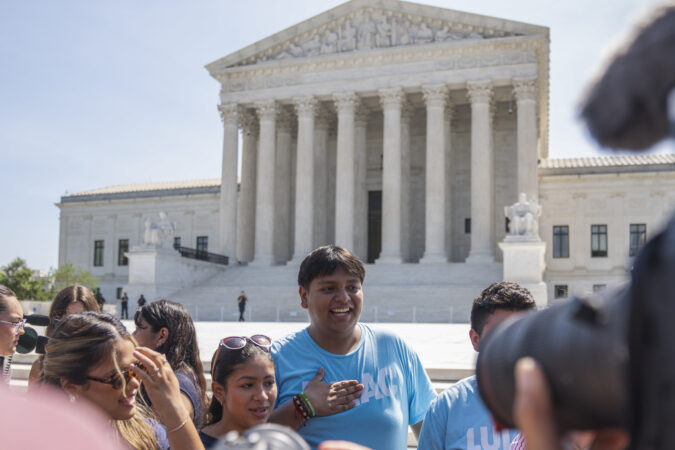
    The Supreme Court upheld the principle of birthright citizenship in a ruling for the ages on Tuesday, affirming amid rancorous national debate that people born in this country are American citizens.

    The decision handed a key loss to President Donald Trump in a case that represented a major goal of his administration ― the denial of citizenship for children born on American soil to undocumented parents.

    Instead, the court upheld what has been recognized as the law of the land for nearly 160 years, enshrined in the Constitution by ratification of the 14th Amendment shortly after the Civil War.

    “Citizenship, then and now, was the right to have rights — to freely participate in our political community. The Framers of the Fourteenth Amendment extended that promise to ‘every free-born person in this land,’” Chief Justice John Roberts wrote for the court. “We keep that promise today.”

    The court ruled 6-3, with three conservative justices voting to let Trump’s proposed restrictions take effect.

    Reaction flooded in immediately, with Cathryn Miller-Wilson, executive director at HIAS Pennsylvania, the immigrant-support organization, saying the decision fell “on the right side of history.”

    “It shouldn’t be a surprise because birthright citizenship is enshrined in our Constitution,” she said of the decision. “But unfortunately there are many other things that have been enshrined that the Supreme Court has ignored. So it was a point of anxiety, I think, for all of us.”

    Trump’s planned restrictions had been blocked by lower courts and had not taken effect.

    The Pennsylvania Immigration Coalition, an advocacy organization based in Philadelphia, called the decision “a victory for families, for immigrant communities, and for the shared values that should guide our country: belonging, safety, and unity.”

    “Today’s decision affirms what our communities have always known: no child’s belonging should be up for debate,” said Jasmine Rivera, the coalition executive director.

    Democratic Gov. Josh Shapiro said on social media that Trump’s effort to end birthright citizenship was cruel and “goes against centuries of hard work to advance American freedom.”

    Days before the nation’s 250th birthday, Shapiro said, the court affirmed “that the fundamental promise of America still rings true — that this is a land of freedom and opportunity for all.”

    In New Jersey, one of the first states to sue over the issue, Attorney General Jennifer Davenport said she was thrilled by the decision.

    “The president cannot change our citizenship laws with the stroke of a pen. We stood up for the rule of law, we stood up for our residents, and we won,” said Davenport, an appointee of Democratic Gov. Mikie Sherrill.

    Meanwhile, House Speaker Mike Johnson (R., La.) said that he was “very disappointed” by the ruling, that it will subject the country to “serious challenges going forward and we’ll have to deal with that.”

    Johnson, who has worked as a constitutional lawyer primarily on religious issues, said the 14th Amendment is being abused by people who are coming to the U.S. to have children in a practice called birth tourism.

    U.S. Rep. Scott Perry, a York County Republican, railed against the court, saying that it had “failed the American people,” and that justices Roberts and Amy Barrett were joining an effort to protect birthright citizenship specifically for the children of undocumented immigrants.

    “Now, more than ever, we must ensure the security of our borders and to prevent those who wish to do us harm by exploiting our immigration system are unable to do so; which means closing EVERY. SINGLE. LOOPHOLE,” Perry said in a statement.

    U.S. Rep. Chrissy Houlahan, a Chester County Democrat, mentioned the path trod by her father, a Polish-born Holocaust survivor who emigrated to the U.S. as a child.

    “I’m deeply grateful for the Supreme Court’s protection of the 14th Amendment, and for all of the first-generation Americans who make our community stronger,” she said on social media.

    On April 1 the Supreme Court heard oral arguments on one of the most important cases of the time, one that had been expected to define who gets to be a citizen of the United States. Trump traveled to the court to hear the arguments in person, departing after government lawyers wrapped up their presentation.

    There was no indication at the time of how the justices might rule, though several of the justices seemed skeptical of the administration’s arguments and peppered government attorneys with sharp questions.

    When Solicitor General John Sauer argued that “we’re in a new world now,” Roberts responded, “It’s a new world. It’s the same Constitution.”

    On Tuesday, the longest-serving justice, Clarence Thomas, joined by Neil Gorsuch, offered a 91-page dissent, saying the ruling added “to the sad history of the Fourteenth Amendment, which was designed and understood to secure equal rights for the freed Blacks but has instead been repurposed for political projects that the Reconstruction Congress did not support.”

    On the day he was inaugurated for a second term in 2025, Trump signed an executive order to end birthright citizenship for children born in this country to undocumented immigrants. That marked an attempt to reverse legal and Constitutional precedent, which has long held that people born in the United States are U.S. citizens.

    The ACLU sued within hours, and New Jersey officials went to court the next day, with then-Attorney General Matt Platkin saying, “Presidents in this country have broad powers, but they are not kings.”

    Birthright citizenship, simply put, is the legal foundation under which American citizenship is automatically conferred upon people who are born in the United States, with limited exceptions. The formal term is jus soli, Latin for “right of the soil.”

    Automatic citizenship also extends to children who are born abroad to U.S. citizens.

    Birthright citizenship is guaranteed in the Constitution by the 14th Amendment, ratified in 1868 after the end of the Civil War. It says that “all persons born or naturalized in the United States, and subject to the jurisdiction thereof, are citizens of the United States and of the state wherein they reside.”

    Trump and other opponents argue that the practice encourages people to enter the country illegally, so that children who are born here will automatically gain American citizenship. Those citizens, at age 21, can sponsor close family members to live permanently in the United States.

    The Trump administration contended that birthright citizenship had limited intent, meant only to ensure that formerly enslaved people and their children were U.S. citizens.

    The administration focused on the clause “subject to the jurisdiction thereof,” saying that excludes people with temporary or unlawful presence. The president’s order would have denied citizenship to babies born in the U.S. unless at least one parent is a U.S. citizen or lawful permanent resident at the time of the birth.

    Trump’s opponents said reliance on those five words makes no sense, that of course people who live in the United States without permission are subject to its jurisdiction ― its laws, orders, and government regulations ― the same as everyone else.

    The administration also invoked the practice of birth tourism as a main argument for revocation, elevating what was a side issue to a central cause.

    Birth tourism is when people from other countries travel to the U.S. for the purpose of giving birth, thereby obtaining citizenship for their babies.

    It’s relatively rare, the high estimate at 26,000 births a year, from the Center for Immigration Studies, which advocates for low immigration. That’s a fraction of the roughly 3.6 million children born annually in the United States.

    In Pennsylvania, all eight Democratic federal lawmakers who represent the state opposed Trump’s attempt to end birthright citizenship.

    Along with 208 other Democrats in Congress, they signed an amicus brief in February arguing that the 14th Amendment set a “constitutional minimum — a floor — for birthright citizenship” and that the administration’s arguments were incoherent.

    The Democrats who signed were U.S. Sen. John Fetterman and U.S. Reps. Houlahan, Brendan Boyle, Dwight Evans, Madeleine Dean, Mary Gay Scanlon, Summer Lee, and Chris Deluzio.

    Some Republicans in Congress filed amicus briefs supporting Trump’s case, though none of the 11 Republicans representing Pennsylvania signed on to them.

    The Republicans argued that within the 14th Amendment, the words “subject to the jurisdiction” were key.

    “The Framers would have recoiled at the present debasement of citizenship, understanding that ‘jurisdiction’ requires more than mere physical presence,” they wrote. “It demands total allegiance to the sovereign. To hold otherwise places sovereignty, citizenship, and our nation’s survival in jeopardy.”

    Staff writers Andrea Padilla, Sam Janesch, and the Associated Press contributed to this article.
  • A Ukrainian family was welcomed to Philly when Russia attacked. Now they’re leaving as pressures rise on immigrants.

    A Ukrainian family was welcomed to Philly when Russia attacked. Now they’re leaving as pressures rise on immigrants.

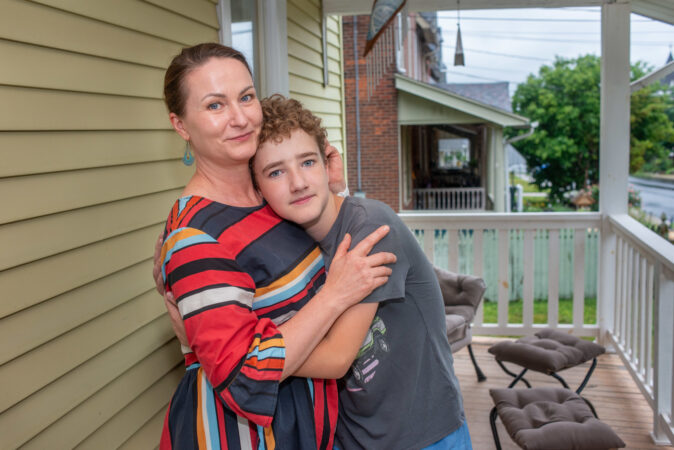
    Four years ago Veronika Pavliutina and her three young children landed in Philadelphia after fleeing Ukraine, escaping the war as Russia shelled their home city of Odesa.

    Their big shock: the outpouring of care and kindness that greeted them here.

    A Mount Airy couple, strangers, invited the family to live in their home ― just move in and take the third-floor bedroom while figuring out next steps. Neighbors delivered meals and clothes and Target gift cards, and others organized events and outings.

    Pavliutina, 48, said she’ll never forget it.

    But now, she said, it’s time to leave.

    Federal pressure on Ukrainian war immigrants has created doubt about the family’s ability to stay in the United States and raised fears about what could happen if they do.

    The government designation that allows Pavliutina and her children to live here, temporary protected status, expires for Ukraine in October. There’s been no sign the Trump administration plans to renew it, fostering uncertainty among thousands who have worked to rebuild their lives in this country.

    TPS, as it’s known, is a humanitarian immigration status that can be granted to nationals of countries embroiled in war, environmental disasters, or other extraordinary circumstances. It allows people to legally live and work here and protects them from deportation.

    The Trump administration wants to end TPS for some countries ― and the Supreme Court ruled on June 25 that the administration could lawfully strip protections from more than 350,000 Haitians and 6,000 Syrians, leaving them vulnerable to removal.

    Pavliutina has felt the changed government attitude toward immigrants, the ICE arrests and detentions, the common resentment and casual hate.

    “More and more I can see, it’s becoming not safe,” she said in an interview at the family’s home in Perkasie, Bucks County. “I may not be their target for now, but we don’t know.”

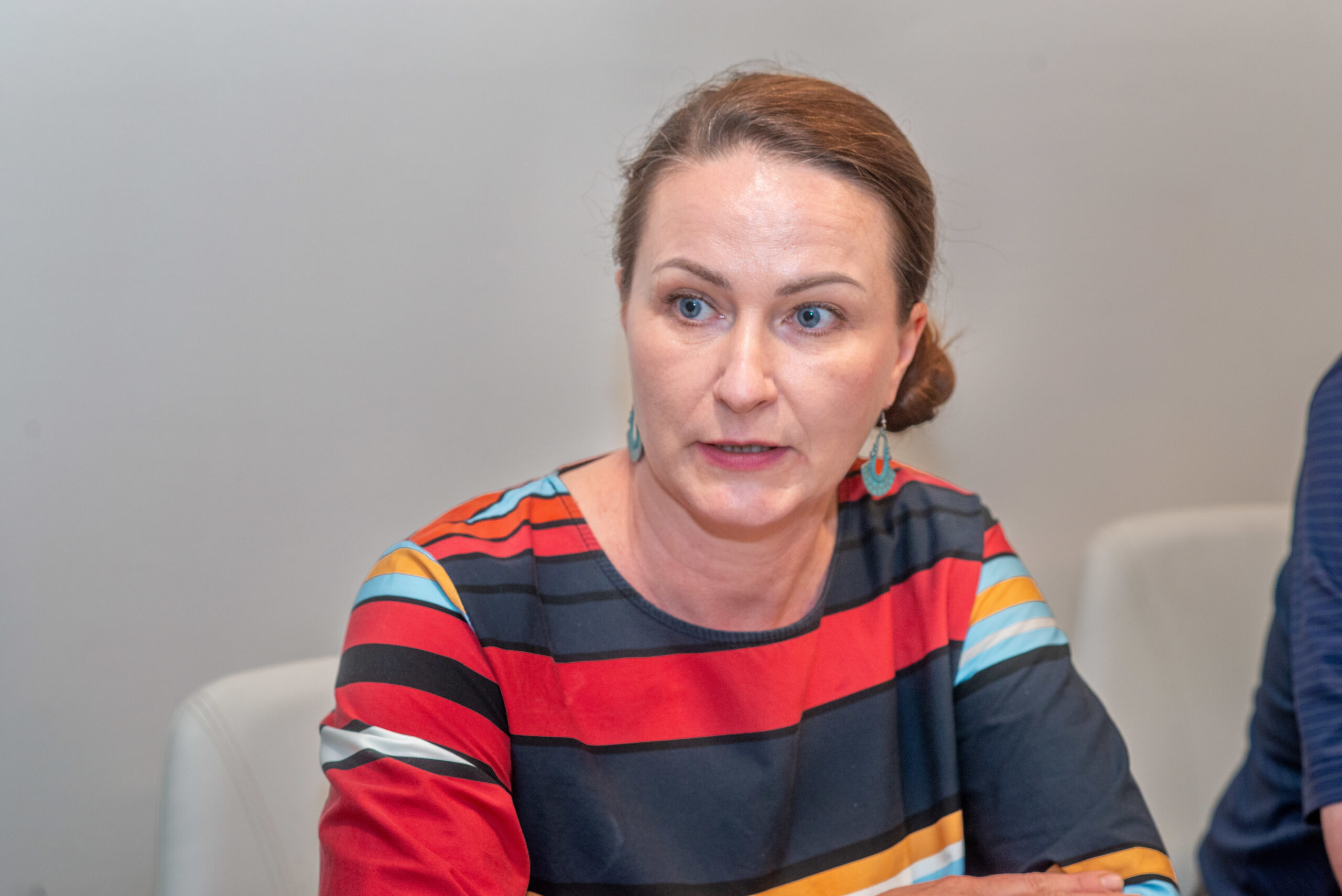
    Veronika Pavliutina speaks about leaving the U.S. for Italy during an interview at the family’s home in Perkasie.

    She and her two younger children, Nina, 15, and Yegor, 12 ― Polina, 19, is studying in South Korea ― intend to move to Italy in mid-July. Pavliutina doesn’t know anyone there, but for a family that is again starting over it’s a logical choice.

    In Italy, Ukrainians escaping the war can receive a Permesso di Soggiorno per Protezione Temporanea, a fast-track residency permit that provides work authorization and access to healthcare.

    “It makes me very sad to know they’re leaving,” said Richard McIlhenny, who with his wife, Marissa Vergnetti, welcomed the then-newly arrived family to live in their Mount Airy home. “I’m excited for their new adventure, but sad that it’s not here.”

    Russia struck the southern city of Odesa on the first day of the war, Feb. 24, 2022, blowing up warehouses and air-defense systems and killing at least two dozen.

    Pavliutina told her children they needed to leave, and fast. They fled by car and eventually reached friends in Serbia.

    Meanwhile, 4,700 miles away in Philadelphia, McIlhenny, a real estate agent, and his wife, a preschool teacher, watched the war unfold on TV and decided to become actively involved in helping refugees.

    McIlhenny contacted a childhood friend who was working in Ukraine, asking if perhaps there was a family in need. The friend knew of someone, a single mother with three children.

    The Russian invasion drove a mass exodus, with an estimated 6.9 million Ukrainians leaving the country by the end of 2025, according to the Migration Policy Institute in Washington. An additional 3.7 million were displaced internally, forced from their homes to other parts of the country.

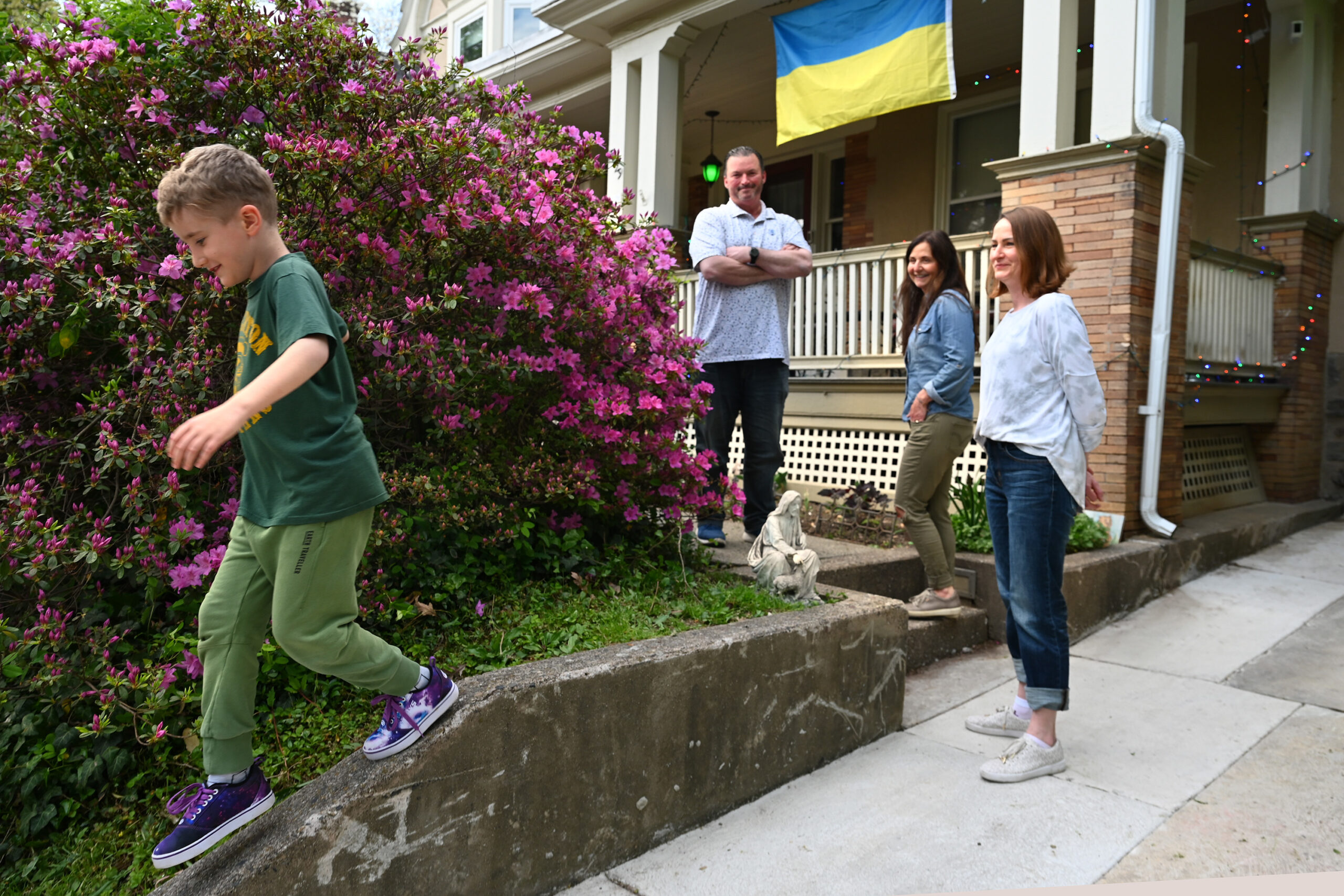
    Richard McIlhenny and Marissa Vergnetti (rear) outside their Mount Airy home May 2, 2022, where they are hosting Veronika Pavliutina (right) and her son, Yegor, then 8, and her two daughters. At the time, Pavliutina and her children had just arrived, escaping the Russian shelling in Ukraine.

    The United States opened its arms. And the Philadelphia region, home to one of the nation’s largest Ukrainian communities, helped lead that effort. Churches, civic groups, and families organized to help new arrivals navigate housing, employment, and schools.

    Now tens of thousands of Ukrainian war immigrants face uncertainty.

    “The protections Ukrainians rely on in the United States are quietly but dangerously eroding,” Krish O’Mara Vignarajah, president and CEO of Global Refuge, said in a statement earlier this year. “We’ve even seen Ukrainians swept up by immigration enforcement.”

    The Trump administration placed an indefinite pause on applications for the main Biden-era humanitarian program, “Uniting for Ukraine.”

    That effort admitted more than 200,000, but now expired work permits have left many struggling to maintain jobs and housing. Losing legal status can result in deportation, and some have left on their own.

    Meanwhile, as of March 2025, more than 100,000 Ukrainians were in the U.S. under TPS, which has faced backlogs and delays. The designation for Ukraine is due to end on Oct. 19, the prospect of renewal clouded as Trump touts his close relationship with Russian dictator Vladimir Putin and criticizes Ukrainian President Volodymyr Zelensky.

    Since 2022 TPS for Ukraine has been extended twice, each instance a nerve-fraying rise and fall of worry and relief that makes it hard to plan for the future.

    The war in Ukraine continues unabated. In this photo provided by the Ukrainian Emergency Service, firefighters put out a fire in a gas station following a Russian air attack in Sumy on Thursday.

    Last year, Pavliutina, who has worked as a chef, began thinking it might be time to, as she put it, self-deport.

    The children adjusted to the U.S., she said, learning English, making friends, and earning good grades in school. They also hear other kids talking up Trump, whose pledge to deport millions of immigrants was central to his election campaign.

    Son Yegor said he’s ready to move, “because I’m tired of America a bit.” Nina did not wish to be interviewed.

    Their mother follows the news.

    “It’s a little bit concerning, to be honest with you, because you don’t know when exactly it will be triggered to some kind of violence,” Pavliutina said. “For me it’s easier to think about a new country than to stay here with unknown status, with an unknown future.”

    She’ll miss their house in Perkasie, she said. In fact, it was a new American friend who provided the private loan for her to buy it, an example, she said, of the extraordinary kindness that’s been shown to her family.

    When she hears “Make America Great,” Pavliutina said, she thinks of the countless big and small acts of caring offered by everyday people, the Americans who help others simply because it’s their nature and think it’s a good thing to do. That’s what makes America great, she said.

    “I would definitely keep it in my heart, everything and everyone who was contributing to our life here,” Pavliutina said. “I love the country. I love the people. I just don’t feel safe to stay. And I don’t see the legal way to do so.”

  • The son of the Jersey Kebab restaurateurs now faces his own fight to stay in the U.S.

    The son of the Jersey Kebab restaurateurs now faces his own fight to stay in the U.S.

    The son of the Jersey Kebab restaurant owners whose ICE arrests sparked wide condemnation last year now confronts his own battle to stay in the United States.

    Muhammed Emanet, 26, said he is trying to be upbeat as he faces the prospect of being separated from his wife and two sons, ages 4 and 1, all American citizens.

    “I try not to dwell on what I can’t control,” said Emanet, who with his parents operates the popular South Jersey eatery in Collingswood. “I still have a restaurant to run, employees that depend on me, customers, family. I have no other choice but to be positive.”

    Still, his situation feels disorienting, as what seemed to be settled is now newly unsettled.

    In spring the Department of Homeland Security ended its effort to deport Emanet, which seemed to clear the path for him to stay in the U.S. But this month, a different federal immigration agency told him it plans to deny his request for legal permanent residency, what is known as a green card.

    That intended denial carries a 30-day window for Emanet, who came here from Turkey as a boy, to present new or additional evidence to try to change the minds of officials at U.S. Citizenship and Immigration Services.

    The government also told him that under a new Trump administration policy, he and other immigrants who are pursuing green cards while living in the U.S. must leave the country and apply from their home nations. Emanet hasn’t been in Turkey since he was 12.

    It’s unclear what will happen when the 30-day deadline expires around July 2.

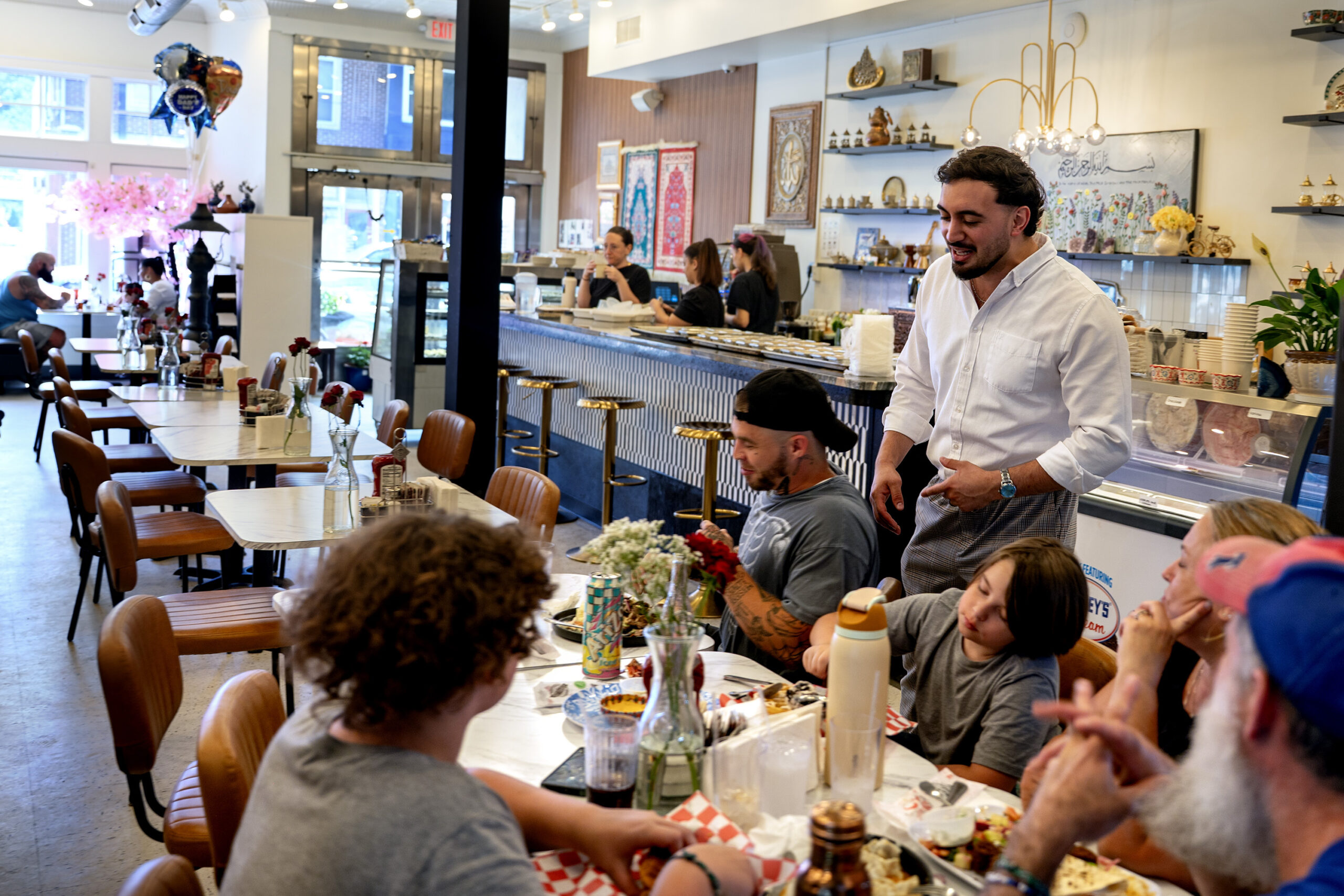
    Muhammed Emanet greets Elijah Brown, a friend from high school, and his family, at Jersey Kebab in Collingswood on Sunday.

    A little more than a year ago, on Feb. 25, 2025, the small Mediterranean restaurant on Haddon Avenue generated national headlines. Immigration advocates and local leaders railed against what they saw as government injustice, after ICE agents arrested owners Celal Emanet and his wife, Emine.

    Celal Emanet was released after being fitted with an electronic ankle monitor ― later removed ― while his wife was held at an ICE detention center in Elizabeth. She was released on bond after two weeks and a day.

    Their arrests angered a South Jersey community that has long known the couple as caring people who offer free food to the hungry. A GoFundMe campaign to pay family costs and expenses raised $327,000, drawing donations from across the country and beyond, including from Ireland, Germany, and England.

    Now, a community effort to help Muhammed Emanet is driving a new letter-writing campaign, with person after person attesting to his good character and his importance to his neighbors. Hundreds of letters have been signed and gathered to be presented on his behalf, said Lori Leonard, who organized the GoFundMe campaign last year.

    “People are rallying behind Muhammed,” she said.

    State Assemblyman Bill Moen, a Democrat who represents parts of Camden and Gloucester Counties, signed a letter of support. He said on social media that Emanet “has touched the lives of many people throughout South Jersey” as a husband, father, neighbor, friend, and businessperson.

    “While I don’t make immigration decisions,” Moen said, “I do believe decision-makers should understand the character of the people whose lives are affected by those decisions.”

    U.S. Rep. Donald Norcross, a South Jersey Democrat, met with the family soon after Emine Emanet was released from ICE detention, and as her son’s situation emerged this month he stressed in a statement that the family had been long “rooted in our community.”

    In response to questions on Muhammed Emanet’s situation, USCIS said it does not comment on individual immigration cases.

    Being removed to Turkey would likely separate Emanet from his wife and children for years. It also could subject him to reprisals from the Turkish regime, where repressive human-rights conditions under President Recep Tayyip Erdogan has driven an exodus.

    Marriage to a U.S. citizen by someone who legally entered the country ― as Emanet did ― has long been a reliable route to an adjustment of status and acquisition of a green card.

    But the Trump policy change announced in May said adjustment should be an “extraordinary” relief, one that depends on government discretion, not merely on having a valid marriage and submitting the proper forms. Failing to depart the U.S. under the policy can by itself be treated as a negative factor in the government’s decision-making.

    Emanet’s immigration lawyer, Joseph Best, said that change in administration policy does not alter the law around eligibility for green cards.

    “If USCIS follows the law,” Best said, “he will attain his lawful permanent resident status just as Congress intended. It is not some fluke or exceptional ‘ask’ here.”

    Discretionary factors, he said, all favor Emanet, who was brought legally to the U.S. as a child, was admitted under a valid visa, and has no criminal history. He is loved in his community, and a key person in a successful family business that is known for helping others, Best said.

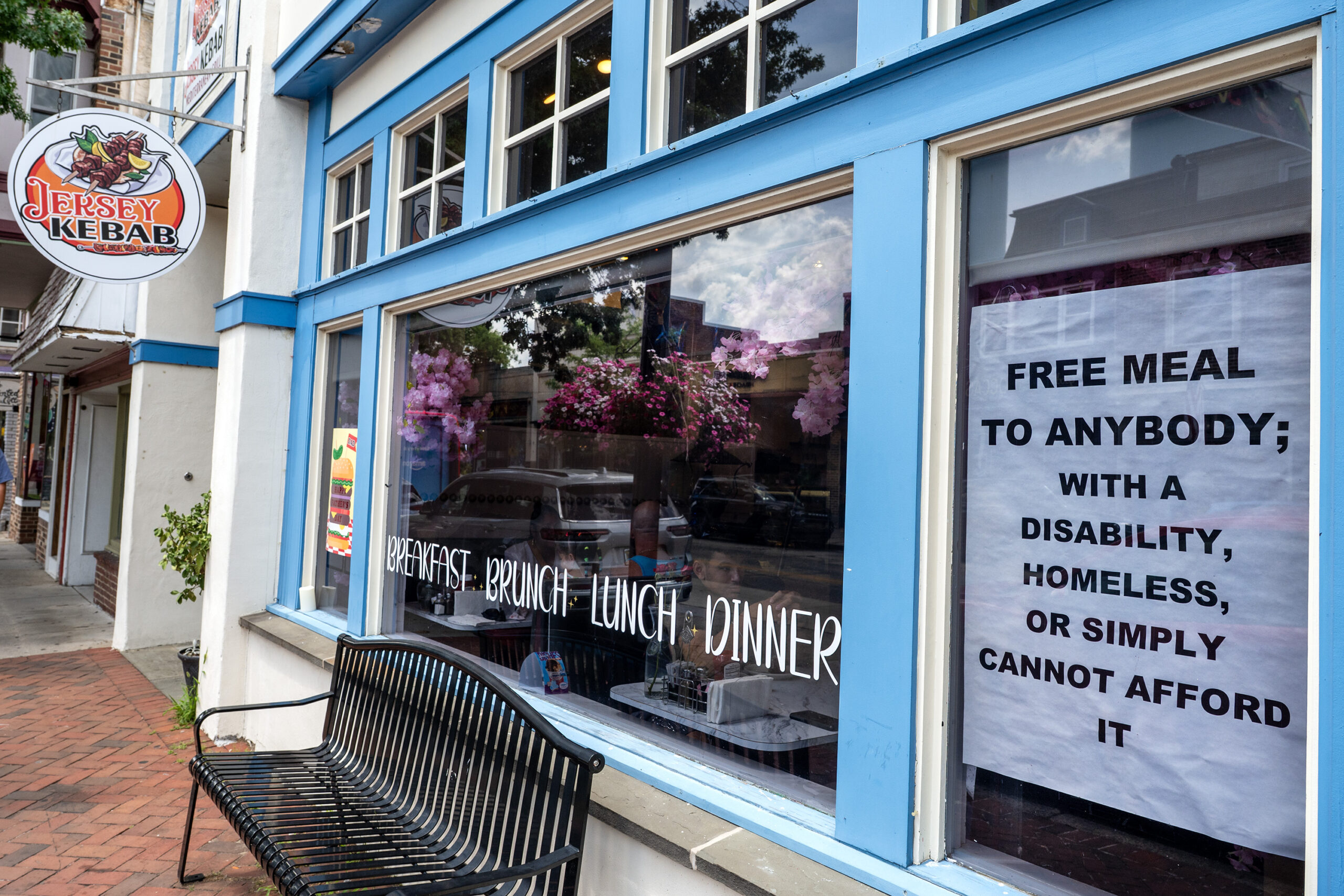
    The Jersey Kebab restaurant in Collingswood where Muhammed Emanet works is seen on Sunday, June 21. It offers the same “Free Meal” policy as at the prior location in Haddon Township.

    Celal and Emine Emanet came legally to the United States with two young children in 2008, entering under a religious visa that allowed the father to work at a New Jersey Islamic center.

    They said that they sought green cards before that visa expired in 2013, but that the application has been in government limbo for years.

    In 2021, they founded Jersey Kebab in Haddon Township, and the restaurant recently moved west on Haddon Avenue to a new location in Collingswood.

    The couple’s immigration cases continue. Celal Emanet’s next hearing is scheduled for December, while his wife is to appear in April 2027.

    The family stands among roughly 386,000 Turkish immigrants and people of Turkish ancestry who live in the United States, according to Inquirer computations of U.S. Census figures. That includes about 15,000 in Philadelphia and surrounding suburban Pennsylvania and New Jersey counties.

    Turkey is a longtime U.S. ally, a rectangular land bridge between Europe and Asia that is surrounded by sea on three sides. It is a Muslim nation, a country of tea drinkers, the place where Julius Caesar is said to have immortally proclaimed “Veni, vidi, vici” ― “I came, I saw, I conquered” ― after a decisive battle victory near what is now the modern town of Zile.

    Today, people are leaving the country amid economic instability and political purges, with many trying to get to the United States.

    U.S. government apprehensions of Turkish nationals at the Mexican and Canadian borders surged from 67 in 2020 to more than 15,000 in 2022 and another 15,000-plus in 2023, dropping to 10,500 in 2024. Figures for 2025 were not immediately available.

    President Donald Trump is expected to be in Turkey next month to attend the NATO summit in Ankara.

    Muhammed Emanet works at his family’s restaurant, Jersey Kebab, in Collingswood on Sunday, June 21.

    During Trump’s second term, USCIS has repeatedly paused the processing of applications for all types of immigration benefits, including those for legal permanent residency.

    Last month, the administration announced it would require foreigners who are living in the U.S. and want to obtain green cards to leave the country to do so. The administration said they must now apply in their homelands, a departure from longstanding policy that has sowed confusion and concern.

    For decades, foreign nationals who meet requirements have been able to complete the green-card process in the United States, including those married to U.S. citizens, holders of work and student visas, and refugees and asylum seekers.

    USCIS spokesperson Zach Kahler said in a statement that entering the U.S. on a visa should not be a first step toward obtaining a green card, that tourists and temporary workers are permitted to come here for limited times.

    “Our system is designed for them to leave when their visit is over,” he said.

    Making people leave the country to apply for green cards “reduces the need to find and remove those who decide to slip into the shadows and remain in the U.S. illegally,” he said.

    The administration instructed immigration officers to consider violations of immigration laws, including overstaying a visa, as negative factors in their decision-making.

    Since the uproar, though, USCIS has seemed to walk back the policy, saying it would be implemented on a case-by-case basis. That could mean that some immigrants will be able to stay in the U.S. while they seek green cards.

    Emanet said his immigration case started in 2020, when two plainclothes ICE officers arrived at the family home and said he was in the country illegally.

    In spring, his attorney persuaded an immigration court in Newark to terminate Emanet’s court case ― with no opposition from the DHS Office of the Principal Legal Adviser, the ICE prosecutors. That termination seemed to clear the way for Emanet to adjust his status.

    Instead, on June 3 he received a Notice of Intent to Deny from federal immigration officials, indicating they plan to reject his application to adjust his status. He is not sure what will happen when the 30-day deadline for new information expires.

    “I have children here who need my support ― American citizens who depend on me,” Emanet said. “I thought I was that one, that I did everything exactly how I was supposed to, that I should receive my green card. … It feels like a punch in the gut.”

  • The fake historic plaque that was erected at the scene of a Philly ICE arrest has disappeared

    The fake historic plaque that was erected at the scene of a Philly ICE arrest has disappeared

    The ICE plaque is gone.

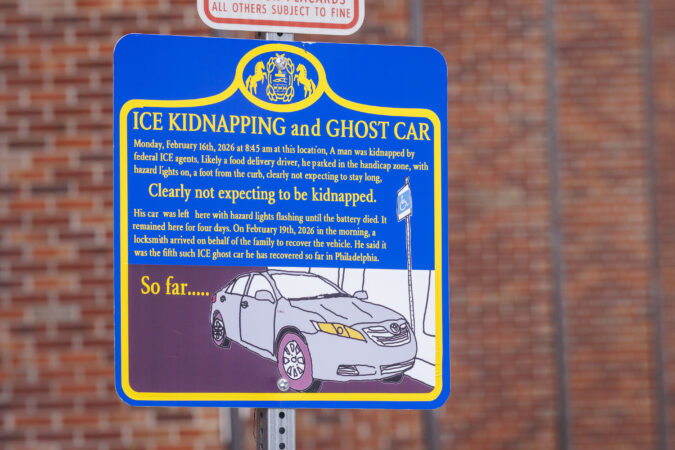
    The fake but authentic-looking Pennsylvania historic marker, erected by two artists who sought to ruefully commemorate a local immigration arrest, disappeared from its post in Philadelphia sometime Monday.

    Huston West, one of the artists, said he was walking his dog around 1 p.m. when he noticed that the sign was absent from its spot on Fairmount Avenue near Fifth Street. A neighbor told him the plaque had been there earlier in the day.

    “It’s lame,” West said of the sign being removed. “But it got a lot of coverage while it was up.”

    West said he could only speculate on who may have taken the marker ― he suspected conservative opponents, people who had criticized the sign on social media, or maybe even the city government.

    A city spokesperson said he would check.

    This particular, familiar-looking blue-and-yellow marker, similar to the ones that commemorate important people, places, and events in communities across Pennsylvania, was put up at the site of a Feb. 16 ICE arrest.

    That morning, masked agents descended on a Gopuff delivery driver who had pulled over to make a quick drop-off in Northern Liberties. After he was taken into custody, the car remained behind for days, set two feet from the curb in an accessible parking space, its hazard lights blinking until the battery died.

    West and a fellow artist who goes by the name Emeyewhisky wondered what had happened to the driver, and created a plaque bearing the header “ICE Kidnapping and Ghost Car.”

    The ghost car terminology borrows from ghost bikes, the roadside memorials where a bicycle is painted white and placed at the site where a cyclist was hit and killed by a motorist.

    Federal immigration authorities say the use of such terms as kidnapping is inaccurate and unfair, that they lawfully arrest migrants who have no permission to be in the United States and who in some cases have committed criminal and even violent offenses.

    Immigration and Customs Enforcement officials in Philadelphia said that on Feb. 16, officers conducted a targeted action and arrested Abdulasen Nazarkhudoev. They said he was unlawfully in the U.S., and told them that he was a Russian citizen.

    He was taken to the Federal Detention Center in Center City and later released by order of a judge, pending further immigration proceedings, records show.

    ICE earlier referred questions about the sign to city officials.

    As word of the art project spread on social media, some disapproved. Some suggested on a Northern Liberties Facebook group that the delivery driver was rightfully arrested.

    West said Monday that he and his art partner had conferred about what to do next. Emeyewhisky is known for projects that place signs with fake wording on Philadelphia streets, and some have been removed.

    Don’t be too surprised, Huston said, if an ICE marker should reappear.

  • Advocates call on Gov. Josh Shapiro to close a Berks County youth center that holds immigrant children

    Advocates call on Gov. Josh Shapiro to close a Berks County youth center that holds immigrant children

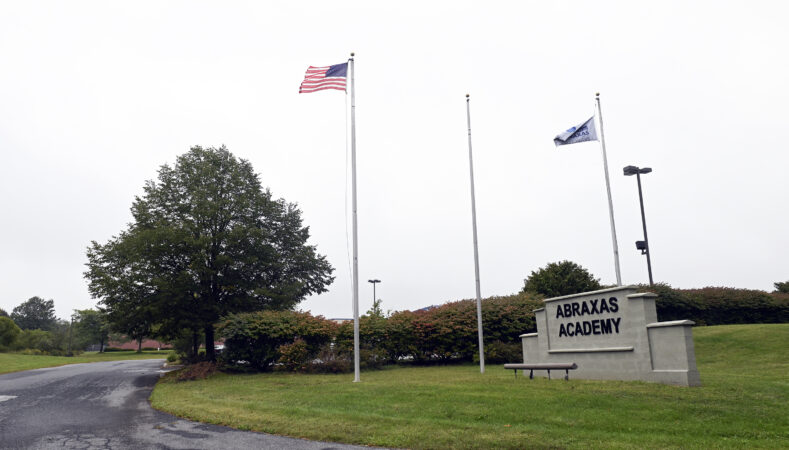
    Youth- and immigrant-rights allies called on Gov. Josh Shapiro Wednesday to immediately remove children from a Berks County center that they said harms those held there, including migrant kids who arrived at the U.S. border unaccompanied by parents.

    Speakers at an afternoon news conference held near the Abraxas Academy in Morgantown, Pa., asked the governor to issue an emergency removal order ― typically enforced to protect children in imminent danger of physical or emotional abuse.

    “Pennsylvania cannot continue to expose these kids to Abraxas’s abuse,” said Evan Feldberg-Bannatyne, an organizer with the youth-advocacy group Care, Not Control. “We need an ERO now.”

    The Shapiro administration said Wednesday that the Department of Human Services will continue to closely monitor the situation to determine next steps and ensure the safety of those living there.

    If DHS were to issue an ERO, it would not take custody of the young people or direct their placement. Instead, Abraxas would need to notify the federal government for immigrant youths, or the state court for Pennsylvania residents, to find other placements. DHS would monitor the wind-down of operations, which can take time, the administration said.

    “The department’s top priority is ensuring the safety of youth in the facilities we license, and it is concerning whenever we receive a report or allegation that a young person was put at risk,” said DHS spokesperson Brandon Cwalina. “When that happens, the Shapiro administration works urgently to ensure that any allegations and potential violations are investigated and handled.”

    Pittsburgh-based Abraxas Youth and Family Services said in a statement Friday that it was “aware of the concerns raised regarding Abraxas Academy in Morgantown,” and that “the safety and well-being of those in our care is our highest priority, and we take any allegation or concern seriously.”

    “Programs like Abraxas Academy operate within a regulated system with established standards for care and accountability that are in alignment with our state and federal partners and their regulations,” the statement said. “We are committed to meeting those expectations and upholding the responsibilities entrusted to us by families and government.”

    The agency website describes the Abraxas Academy as providing secure residential treatment and detention for male young people, ages 14 to 19, who face serious charges or have demonstrated delinquent patterns through multiple placements.

    Since October, the federal Office of Refugee Resettlement, which is responsible for “unaccompanied minors,” the migrant children who arrive at the border without parents, has held some teenage boys at the center, which has a documented history of staff physically and sexually abusing juvenile offenders, a Washington Post investigation found.

    ORR awarded $9 million to Abraxas Alliance in August to hold up to 30 young immigrants who had been deemed a danger to themselves or others. At times, The Post reported, between five and eight teenage boys have been held inside a dedicated wing of the center, sleeping inside locked rooms the size of walk-in closets.

    State inspectors documented at least 15 incidents since 2013 in which they said staff physically mistreated minors at the facility, which mainly holds juveniles facing or convicted of criminal offenses, The Post reported. In at least two incidents, officials documented allegations of staff sexually harassing or sexually abusing young residents, the newspaper reported.

    After some incidents, Abraxas suspended or fired staff members and submitted correction plans to state regulators, The Post said.

    DHS’s Cwalina noted that in November, the department revoked the license for Abraxas Academy’s Secure Detention Unit. Immigrant youths are not held there. Abraxas appealed and continues to operate the unit while the appeal goes forward.

    Abraxas has two other licenses that remain in place, subject to periodic, unannounced inspections. The DHS Office of Children, Youth, and Families is on site weekly — including today — to monitor the center’s operations, he said.

    “We do not want detention centers in our state,” said Jasmine Rivera, executive director of the Philadelphia-based Pennsylvania Immigration Coalition. “We fight for the closure of immigrant detention. Our communities do not need more cages.”

    Detention is particularly disturbing, she said, when it extends to children who have come to this country seeking shelter and safety.

    By law, ORR must provide care for unaccompanied children, defined as those who have no legal immigration status, have not yet turned 18, and have no parent or guardian in the United States. ORR says it tries to find sponsors, most often a close relative in this country, and in the meantime provides care at one of nearly 200 facilities.

    However, a 2025 rule change now allows ORR to consider a potential sponsor’s immigration status, and to share that information with enforcement agencies. The Immigrant Legal Resource Center in San Francisco says that discourages undocumented family members from becoming sponsors, leaving children in government custody longer and hurting their well-being.

    “It is immoral and unimaginable that in our backyard, children are being held in such violence and unsafe conditions,” said Gaby Lopez, lead organizer in Reading for Make The Road, which works to help immigrants. “Children need to be with their loved ones.”

    The United States needs an immigration system that welcomes those who come here to share their talents and be part of the American story, she said, not one that replicates the violence they experienced in their homelands.

    “Gov. Shapiro,” she said, “Issue an emergency removal order now, and protect families across Pennsylvania now.”

  • In efforts to disrupt ICE, the whistle has become an instrument of choice

    In efforts to disrupt ICE, the whistle has become an instrument of choice

    The eastern sky is aglow with dawn streaks of orange when the cry of a whistle sounds outside of ICE headquarters in Philadelphia.

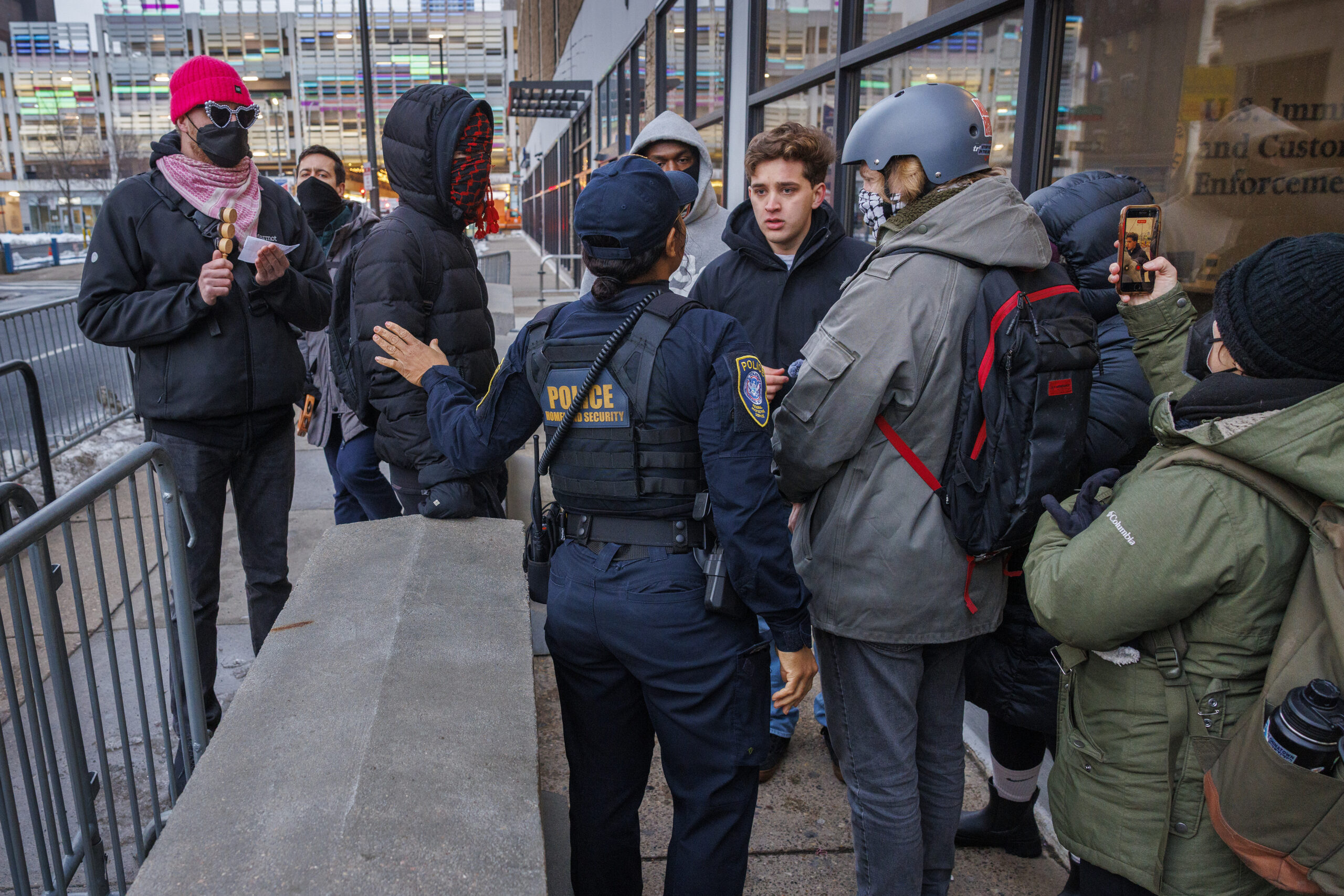
    The noise pierces amid an improvised orchestra of protest, as chanting demonstrators shake tambourines, rattle jingle sticks, and beat drums ― one person banged on a kitchen colander ― to create a clamor that makes it challenging to concentrate.

    That’s part of the goal of the weekly “Noise Demo” organized by No ICE Philly to raise awareness among morning commuters but also to try to disrupt the work of Immigration and Customs Enforcement agents at the Eighth and Cherry Street office.

    “We’re interrupting them,” said a protest leader who asked to be identified only as a member of No ICE Philly out of fear of repercussion from the government.

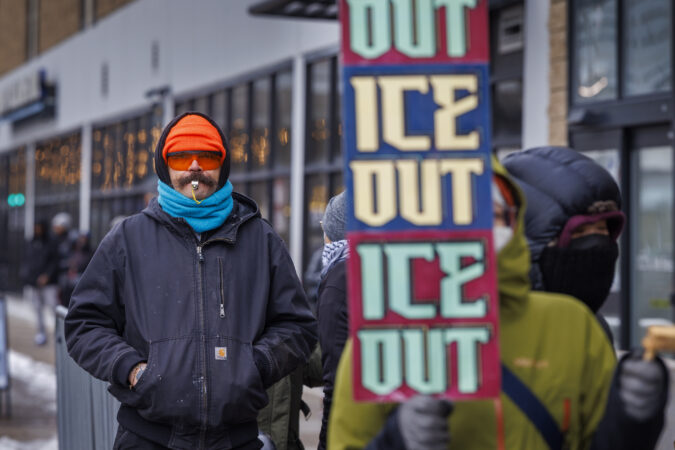
    For advocacy groups here and across the county, the whistle has become both a tool and symbol of the anti-ICE movement.

    On the streets, it’s the means to alert neighbors and warn immigrants when ICE arrives on the block, and to try to distract and confuse officers who may already be operating in an unfamiliar neighborhood.

    A blast from a standard pea whistle can carry half a mile, and the sound from a specialized emergency whistle can travel a mile or more, depending on conditions.

    ICE officials in Philadelphia said last week they had nothing to add on the noise demonstrations or on the use of whistles, beyond what the agency had already said: “Your whistles won’t stop or hinder ICE from arresting criminal illegal alien sex abusers, murderers, gang members, and more,” the agency told Minnesota protesters on social media.

    In November, President Donald Trump issued a ban ― so far blocked by the courts ― on creating “loud or unusual noises” at federal facilities in the U.S. That hasn’t slowed No ICE Philly, which gathers to make noise on Mondays, though the snowfall pushed a recent action to Thursday.

    “Maybe,” said activist Huston West, who blasted a steady beat on his whistle as ICE officers arrived at work on Thursday, “it makes them think about their life choices.”

    A man who tried to confront demonstrators is engaged by a Homeland Security officer during a No Ice Philly “Noise Demo” outside the U.S. Immigration and Customs Enforcement office at 114 N. Eighth Street in Center City.

    Why have whistles become so popular among immigration protesters?

    Many reasons.

    Whistles are light, portable, reliable ― and cheap, about 20 cents each when bought in bulk. They don’t need batteries or recharging, have no buttons or controls. Everyone knows how to make it work.

    “There’s not much more shrill or penetrating than the sound of a whistle,” said Temple University professor Ralph Young, who studies protest and dissent.

    To him, protesters’ use of whistles carries symbolism, summoning images of referees calling penalties during sports events. Maybe the activists are saying ICE has broken the rules or needs to stop.

    “Like throwing a penalty flag,” he said, “against ICE agents who they deem are acting unlawfully.”

    The whistle ranks among the oldest human inventions, the first ones crafted from bone, wood, or clay, used for hunting, signaling, and religious rites.

    Englishman Joseph Hudson is considered the inventor of the modern pea whistle ― the tiny ball in the air chamber produces the trill ― in the 1880s. He created the Metropolitan Police whistle for British bobbies and the Acme Thunderer for soccer referees, who to that point had waved handkerchiefs to signal fouls.

    Today, hundreds of thousands of whistles have been distributed to ICE protesters around the country ― more than 150,000 sent from Chicago alone, according to the Chicago Sun-Times.

    In Minneapolis, activists have used 3D printers to crank out supplies. In Philadelphia, whistles have been given out by the handful at organizing meetings. Temple Beth Zion-Beth Israel ordered 300 whistles for distribution, so neighbors can quickly signal that ICE is present and warn immigrants to seek safety.

    “The big orange ones are the best,” Rachel Monk wrote in the Progressive, in an essay that proclaimed 2025 the Year of the Whistle. “I don’t leave my apartment without mine.”

    In Maryland last month, the Washington County commissioners shut down a public meeting when protesters blew whistles to condemn the board’s support for turning a warehouse into an immigration detention facility, the Baltimore Banner reported. And in Arizona, a state senator introduced a bill to outlaw the use of whistles to warn neighbors of ICE, seeking to create a new state crime called “unlawful alerting.”

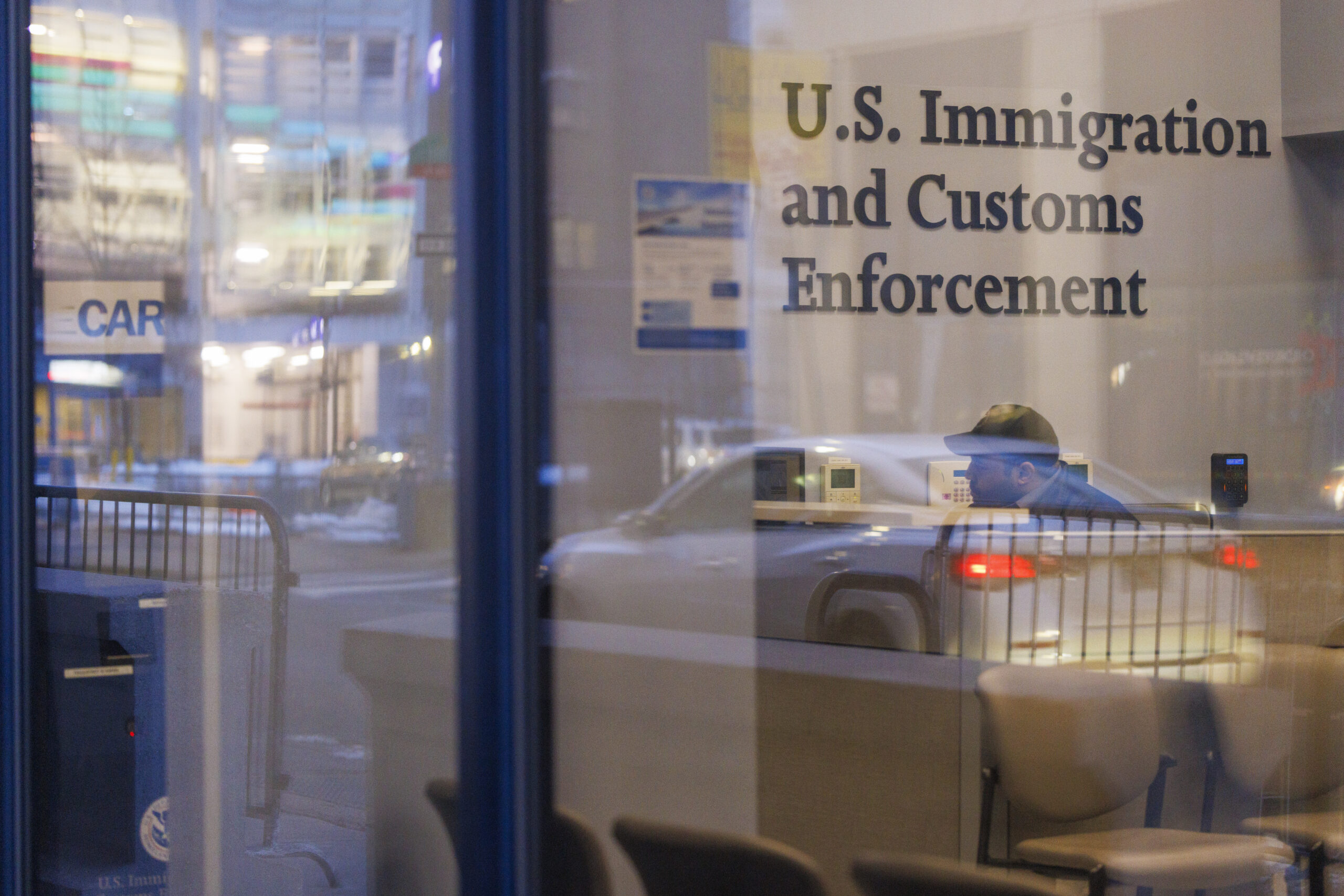
    The interior lobby of U.S. Immigration and Customs Enforcement at 114 N. Eighth St. in Center City.

    The Trump administration wants to ban loud noises outside federal facilities, a move widely seen as an effort to halt protests at ICE offices. A federal judge in Oregon temporarily blocked the restrictions, saying they said could violate the First Amendment by criminalizing free speech.

    But even among pro-immigration activists, not everyone sees whistles as consistently beneficial.

    Some think the noise adds to the confusion at the scenes of ICE arrests, increasing fear and anxiety among families during what are already tense and sometimes violent encounters.

    New Sanctuary Movement of Philadelphia, a major advocacy organization, has begun talking to other groups about finding alternatives to whistles, said co-director Blanca Pacheco.

    Yes, she said, it’s important that arrests not be permitted to be carried out in silence. But “what is the kind of noise that people can come up with that is supportive, instead of adding to the trauma?”

    Not all in immigrant communities understand the purpose of the whistles, she said. And for those who have survived war or torture the noise can be triggering.

    One option may be that people could shout, “ICE is here!” Perhaps two or three people on a block could be designated to blow whistles, rather than everyone at once. Even singing could work, she said.

    “I think that Chicago and Minnesota and other places that have used the whistles had to come up with tactics and strategy very quickly,” said Pacheco, who noted Philadelphia is not in that position. “We can learn from other places what has worked and what has not. I think whistles can be used in some scenarios, not all the scenarios.”

    Outside the ICE office on Thursday, two ICE agents heading into the building jawed with demonstrators who yelled at them to quit their jobs. Whistle calls and drum beats continued on, toward an 8 a.m. conclusion.

    “ICE operates from the very early morning into early afternoon,” said the demonstration leader who declined to give his name. “We just want to make sure that we’re here when they’re here.”

  • Immigrants are the ‘only reason’ Philly’s population is growing, analysis says

    Immigrants are the ‘only reason’ Philly’s population is growing, analysis says

    The nonpartisan Economy League of Greater Philadelphia issued an immigration analysis this week that on the surface might look like a boatload of numbers, but in fact offers fresh insight and a warning about the future.

    The organization looked at immigration not just as the coming and going of people but also as a key part of the city’s economic infrastructure.

    And it found that, in short, Philadelphia’s economic vitality depends more and more on foreign-born residents, whose growth has provided tentative population stability instead of the continuous decline that once afflicted the city.

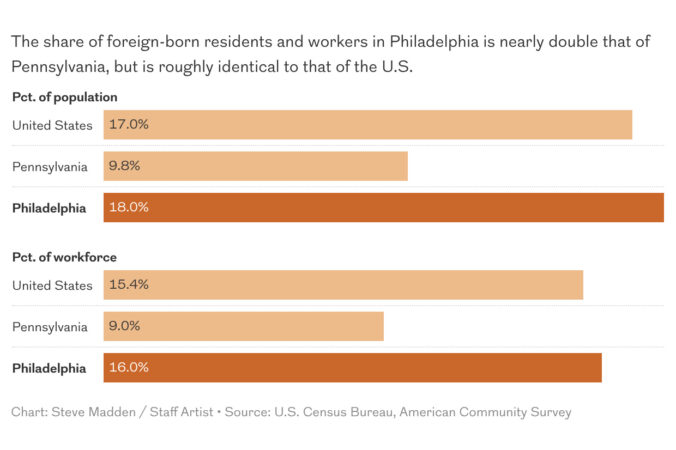
    Immigrants comprise nearly one in five workers and contribute $7.4 billion in consumer spending, filling critical roles in everything from research labs to restaurant kitchens.

    Still, the analysis said, without ever mentioning President Donald Trump by name, “the federal policy pressures continue to mount,” and that puts some local gains at risk.

    Here’s a look at some key aspects of the Economy League’s Leading Indicators report:

    How crucial are immigrants to the city’s population growth?

    “It is the only reason we’ve grown,” said league executive director Jeff Hornstein. “It’s the only reason we don’t have population decline.”

    The analysis said that without foreign-born residents, Philadelphia would be shrinking.

    As of 2024, immigrants comprised 16% of the city population, about 251,000 residents, the primary engine of net population growth since 2000. The arrival of newcomers has been enough to offset the loss in native-born residents, which dropped by about 59,700 between 2010 and 2020.

    “Philadelphia’s 21st-century demographic stabilization,” the analysis said, “is an immigration story.”

    window.addEventListener(“message”,function(a){if(void 0!==a.data[“datawrapper-height”]){var e=document.querySelectorAll(“iframe”);for(var t in a.data[“datawrapper-height”])for(var r,i=0;r=e[i];i++)if(r.contentWindow===a.source){var d=a.data[“datawrapper-height”][t]+”px”;r.style.height=d}}});

    How much do immigrants contribute?

    A lot. In Philadelphia, immigrants comprised nearly 20% of the workforce in 2024. That’s double the rate of Pennsylvania as a whole, where immigrants were 9% of the workforce. The city’s institutional anchors — its universities and hospitals — as well as established ethnic communities, serve as draws.

    That year the city’s foreign-born residents, both documented and undocumented, spent an estimated $7.4 billion on goods and services and paid $2.3 billion in taxes ― including federal income taxes, payroll taxes, state income taxes, sales taxes, and property taxes.

    Do some industries depend on immigrants more than others?

    Yes. Local healthcare services rely not just on doctors, the analysis showed, but also on immigrants across different jobs and skill levels. About 26% of all Pennsylvania physicians are foreign-born, and nationally the same is true for nearly 40% of nursing aides and home health aides.

    In the Philadelphia region, foreign students earn 40% of doctoral degrees, the report said, and research institutions depend heavily on that talent. Traditionally these students transition from F-1 visas, to Optional Practical Training, then compete for H-1B visas that enable long-term employment.

    That’s where things have gotten rough for immigrants, as in December the Trump administration halted processing for several groups of people and categories of applications, including those for anyone from any of the 19 countries covered in the spring travel ban.

    The administration has also raised the possibility of reopening cases that were already approved by the government.

    The city’s hospitality and restaurant trades also depend on foreign-born workers. Immigrants make up 25% to 30% of restaurant workers and 30% to 35% of hotel staff. At some restaurants the foreign-born staff can exceed 40%.

    Don’t many immigrants opt to work for themselves, starting their own businesses?

    They do. A study coauthored by an MIT economist found that immigrants are about 80% more likely than native-born residents to found a company. Some suggest that’s because immigrants are more comfortable with risk, having already taken the chance of moving to a new country.

    In Philadelphia, foreign-born entrepreneurs own roughly 30% of small businesses ― nearly twice their representation in the population. Those 47,800 businesses include everything from corner stores to tech startups.

    So what’s the bad news?

    It’s more like a warning. At 16%, Philadelphia’s foreign-born population exceeds the national average, which hovers around 13%. But traditional gateway cities like New York, Houston, Miami, and San Francisco maintain foreign-born populations as high as 35%.

    Philadelphia, the analysis said, is “no longer an immigration laggard,” but it’s not yet competing with top-tier global cities for international talent.

    Moreover, without sustained immigration, Philadelphia faces the prospect of renewed population decline. Native-born residents are aging, fertility remains below replacement levels, and U.S. domestic migration favors metro areas in the Sunbelt.

    “Immigration provides the only plausible mechanism for population stability,” the study said, but federal policies that reduce legal immigration, slow visa processing, and intensify enforcement risk causing the opposite.

    The question isn’t whether Philadelphia needs immigration ― the demographic math makes that undeniable, the study said. The question is whether policymakers will embrace supportive policies and investments.

    “Given the stakes,” it said, “getting immigration policy right isn’t optional ― it’s existential.”

  • Bucks commissioners vote to oppose ICE facilities, say feds looked at two local sites

    Bucks commissioners vote to oppose ICE facilities, say feds looked at two local sites

    The contentious national discussion over the rapid expansion of ICE came to the doorstep of the Philadelphia region on Wednesday, as the Bucks County commissioners voted to oppose having any processing or detention facilities in the county.

    Commissioners said they learned that the federal government had recently approached warehouse owners in two communities, Bensalem Township and Middletown Township, about possible conversions. Neither owner is going forward, they said.

    The commissioners voted 3-0 ― including the board’s lone Republican ― to approve a resolution that said such a center would be harmful for county residents and the people who would be confined there.

    ICE officials did not immediately reply to a request for comment.

    The commissioners voted a day after U.S. Rep Brian Fitzpatrick said that he would oppose such a facility ― and that he had received federal assurances none was planned in his district, which covers Bucks County and parts of eastern Montgomery County.

    Fitzpatrick, a Republican who is seeking reelection in the purple district, faces a likely November challenge from Democratic Bucks County Commissioner Bob Harvie, who also opposes ICE sites.

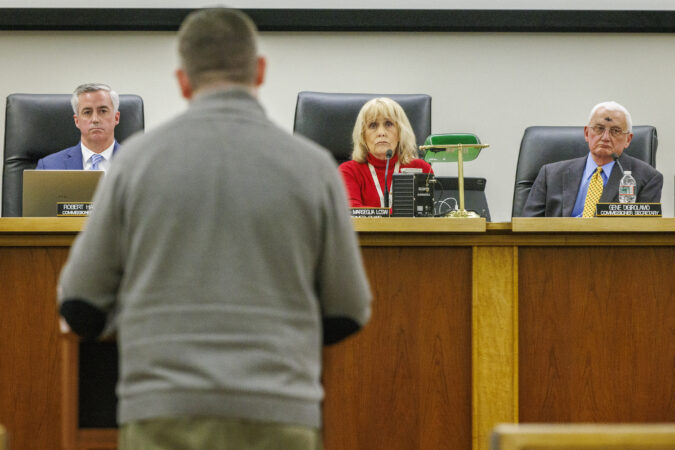
    In Doylestown on Wednesday, Commissioner Gene DiGirolamo, a Republican who serves with two Democrats, said he heard about the federal interest in two local sites and strongly disapproved.

    Jake Didinsky of Southampton, said he opposes ICE warehouses in his county, comparing them to Japanese interment camps.

    “Bucks County is not a county that needs or wants a detention facility,” he said.

    Harvie, the board’s vice chair, said Bucks County “is no place for these kinds of facilities” and cautioned: “We have been down this road before, with Japanese Americans. And with Italian Americans.”

    During World War II the U.S. government forcibly incarcerated thousands of people of Japanese descent, holding them in concentration camps mostly in the western part of the country. About two-thirds of those confined were American citizens.

    Some Italian Americans endured the same treatment.

    A resolution conveys the opinion and wishes of the board, but holds no force of law.

    The Bucks resolution said the county opposes “the use of warehouses or similar industrial facilities not intended for human occupancy as facilities to hold, jail, detain, house or otherwise store human beings.”

    In addition to humanitarian concerns, the resolution says, “such facilities, being hastily erected in areas and structures not intended for human occupation, would place unanticipated demands upon water and sewer systems, creating hazards to public health, as well as heaping new strain upon public safety services.”

    The vote came as the growth of ICE leasing and purchases has become contentious in Pennsylvania and across the United States.

    U.S. Immigration and Customs Enforcement expects to spend $38.3 billion to acquire warehouses around the country and retrofit them into immigrant detention centers to hold tens of thousands of people, the Washington Post reported. The newspaper analyzed agency documents that were provided to New Hampshire’s governor and published on the state’s website.

    ICE intends to buy and convert 16 buildings to serve as regional processing centers, each holding 1,000 to 1,500 immigrant detainees. An additional eight detention centers would hold 7,000 to 10,000 detainees and serve as primary sites for deportations.

    Two sites have been purchased in Pennsylvania ― one in Upper Bern Township, in northern Berks County, and another in Tremont Township, in Schuylkill County, where the purchase has drawn the ire of concerned residents.

    Last week Gov. Josh Shapiro formally asked Homeland Security Secretary Kristi Noem in a letter to reconsider the conversion of the Berks and Schuylkill sites, citing “real harms” to the communities.

    He questioned the legality of the facilities and hinted at a possible lawsuit, saying if DHS goes forward, his administration will “aggressively pursue every option to prevent these facilities from opening.”

    DHS spokesperson Tricia McLaughlin confirmed the plans for the Pennsylvania sites, saying that they would undergo community-impact studies and a rigorous due-diligence process, and that they would bring 11,000 jobs to the two Pennsylvania communities.

    The two sites would hold a combined 9,000 people.

    On Tuesday, Fitzpatrick’s office said it had received assurances from DHS and ICE that they had no plans or intention to open a detention facility within the First Congressional District.

    “After hearing from concerned residents, our office immediately contacted U.S. Immigration and Customs Enforcement, and we have received assurances that no such facility is planned,” Fitzpatrick said.

  • ‘Courage is contagious.’ How Philadelphia churches and neighborhood groups are preparing to confront ICE.

    ‘Courage is contagious.’ How Philadelphia churches and neighborhood groups are preparing to confront ICE.

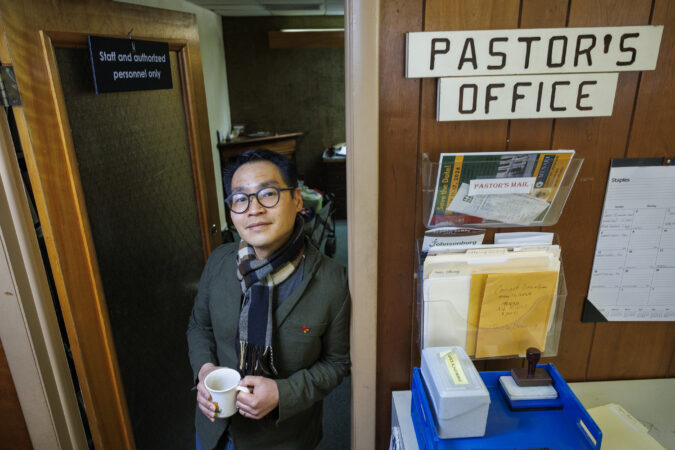
    Within the serpentine halls and stairways of Olivet Covenant Presbyterian Church, congregants have established several private, off-limits rooms ― each a potential last-stand space where members would try to shield immigrants from ICE, should agents breach the sanctuary.

    Church leaders call them Fourth Amendment areas, named for the constitutional protection against unreasonable search and seizure. The plan would be to stop ICE officers at the thresholds and demand proof that they carry legal authority to make an arrest, such as a signed judicial warrant.

    “It’s a protective space,” said the Rev. Peter Ahn, pastor of the Spring Garden church. “While you’re here, you’re safe, is what we want to assert.”

    Could it come to that? A pastor confronting armed Immigration and Customs Enforcement agents in the hallway of a church?

    It’s impossible to know. But across Philadelphia, churches, community groups, immigration advocates, and block leaders are actively preparing for the time ― maybe soon, maybe later, maybe never ― that the Trump administration deploys thousands of federal agents. People say they must be ready if the president tries to turn Philadelphia into Minneapolis ― or Los Angeles, Chicago, or Washington, D.C.

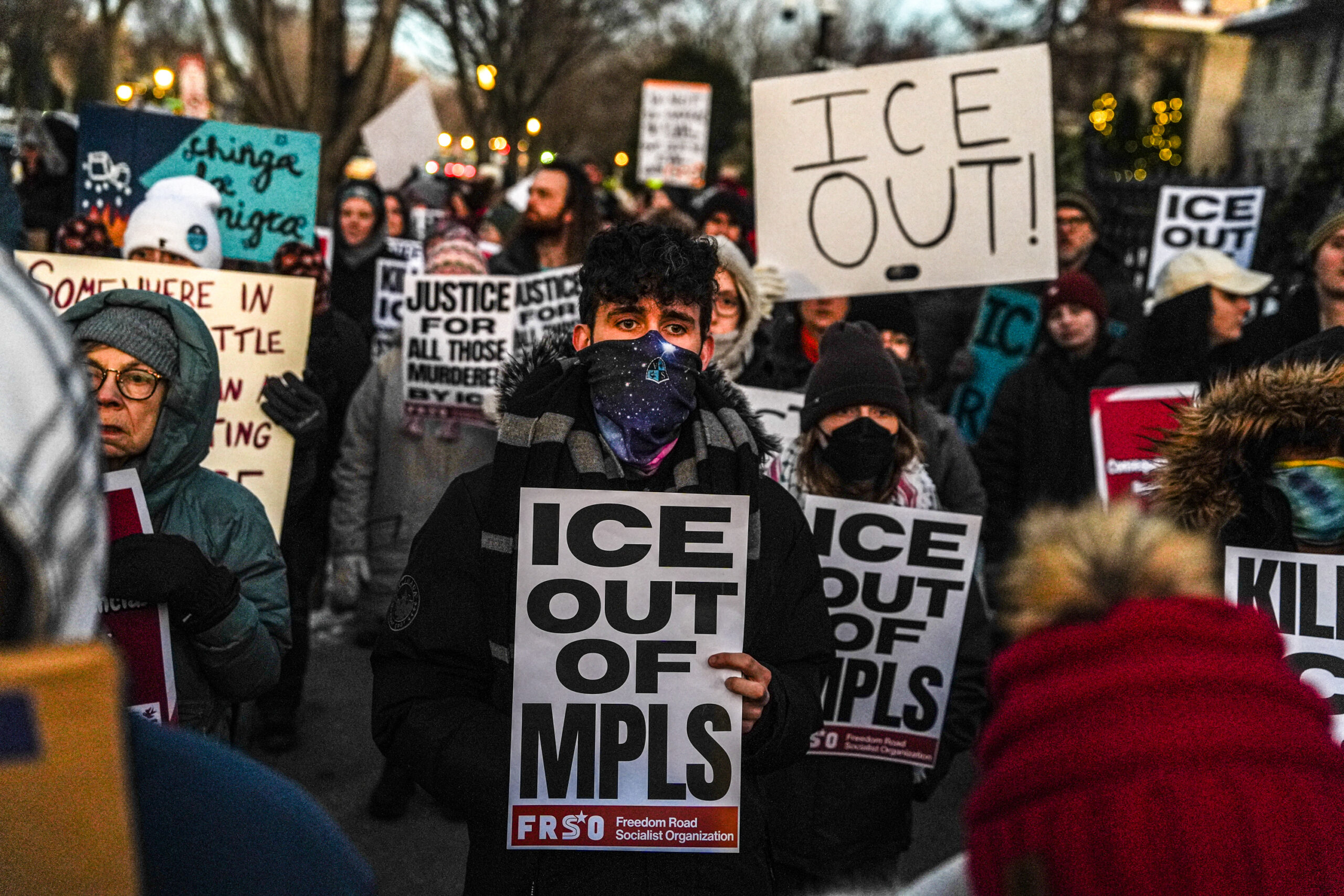
    People participate in an anti-ICE protest outside of the Governors Residence on Feb. 6, in St. Paul, Minn.

    Know-your-rights trainings are popping up everywhere, often to standing-room-only attendance, and ICE-watch groups are abuzz on social media.

    The First United Methodist Church of Germantown held a seminar last week to learn about nonviolent resistance, “so that we will be ready for whatever comes,” said senior pastor Alisa Lasater Wailoo.

    “That may mean putting our bodies in the path to protect other vulnerable bodies,” she said. “We’re seeing that in Minnesota.”

    In Center City, Temple Beth Zion-Beth Israel has ordered 300 whistles ― portable and efficient tools to immediately alert neighbors to ICE presence and warn immigrants to seek safety.

    “There was a sense of needing to support our neighbors if it comes down to it,” said Rabbi Abi Weber. “God forbid, should there start to be ICE raids in our neighborhood, people will be prepared.”

    In other places around the country, immigrant allies have similarly readied themselves for ICE’s arrival, and organized to react in concert when agents show up.

    In Washington state, the group WA Whistles has distributed more than 100,000 free whistles to create what it calls “an immediate first line of community defense.” Chicago residents set up volunteer street patrols to warn immigrants of ICE and to contact family members of those detained. In Los Angeles, people raised money to support food-cart vendors, and organized an “adopt a corner” program to protect day laborers who seek work outside Home Depot stores.

    A small sign at the Olivet Covenant Presbyterian Church, where the Rev. Peter Ahn is creating space to shield immigrants if necessary.

    Ask Philadelphia groups that advocate for immigrants — 15% of the population, including about 76,000 who are undocumented — and they say ICE isn’t about to land in the city. It’s been here.

    The agency’s Philadelphia office serves as headquarters not just for the city but for all of Pennsylvania and for Delaware and West Virginia as well. Arrests take place every day in the Philadelphia region.

    “You all seem to be ‘preparing’ for something that’s already happened,” veteran activist Miguel Andrade wrote on Facebook.

    What has changed, however, is the dramatic escalation in ICE enforcement, particularly visible in Democratic-run cities like Minneapolis, where agents fatally shot two U.S. citizens in January.

    ICE detained 307,713 people across the country in 2025, a 230% increase over the 93,342 in 2024. What federal immigration agencies record as detentions closely mirror arrests.

    Today residents in communities like Norristown and Upper Darby see ICE agents on the streets all the time. Cell phone videos have captured violent footage, including the smashed front door of a Lower Providence home after agents made an arrest on Feb. 9, and two people roughly pulled from a car in Phoenixville earlier this month.

    For immigrants who have no legal permission to be in the U.S. ― an estimated 14 million people ― the rising ICE presence steals sleep and peace of mind. They know not just that they could be arrested and deported at any moment, which has always been true, but also that the U.S. government is expending vast resources to try to make that happen.

    A woman who came to Philadelphia from Jamaica last year, and who asked not to be identified because she is undocumented, said she rarely leaves her home. She said she steps outside only to go to the grocery store, a doctor, or an attorney.

    She recently asked her daughter to check something on the computer, and the girl balked ― afraid to even touch the machine, worried that ICE could track her keystrokes and identify their location, the woman said.

    “How can I tell her it’s going to be OK when I don’t know it’s going to be OK?” asked the woman, who came to the U.S. to escape potential violence in Jamaica. “You come here expecting freedom, but here it’s like you’re in jail except for the [physical] barriers of the four walls.”

    Even as arrests have soared, Philadelphia has been spared the federal intrusions visited on other American cities.

    Why?

    Some say President Donald Trump doesn’t want to ruin the summer celebration of the nation’s 250th birthday, or spoil the grandeur of the World Cup or Major League Baseball’s All-Star Game. Others suggest that he might be timing an ICE deployment to do exactly that.

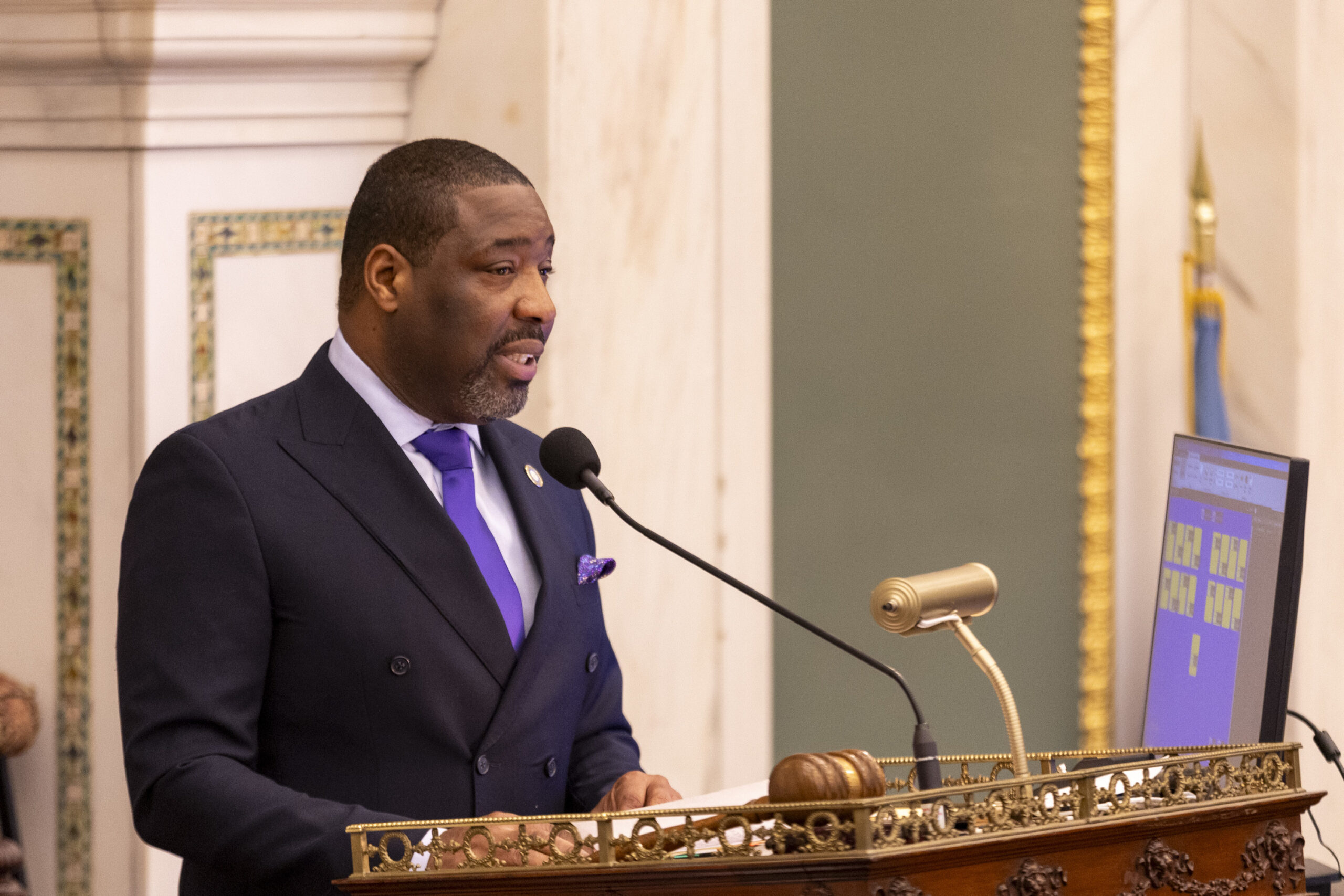
    City Council President Kenyatta Johnson speaking at the City Council’s first session of the year Jan. 22. He said this month that it’s time to stand up for immigrants in Philadelphia. “It’s my responsibility to step up in this space and be more vocal,” he said.

    That as Philadelphia City Council prepares to consider “ICE Out” legislation that would make it more difficult and complicated for the agency to operate in the city.

    Trump told NBC News this month that he is “very strongly” looking at five new cities.

    Some people are not waiting to see if Philadelphia is on the list.

    The monthly Zoom meeting of the Cresheim Village Neighbors usually draws about 20 people. But a hundred logged on in January to hear a presentation: What to do if/when ICE comes to our neighborhood.

    The short advice: If it happens, get out your phone and hit “record.”

    “If I see ICE agents, I will film,” said neighbors group coordinator Steve Stroiman, a retired teacher and rabbi. “I have a constitutional right to do that.”

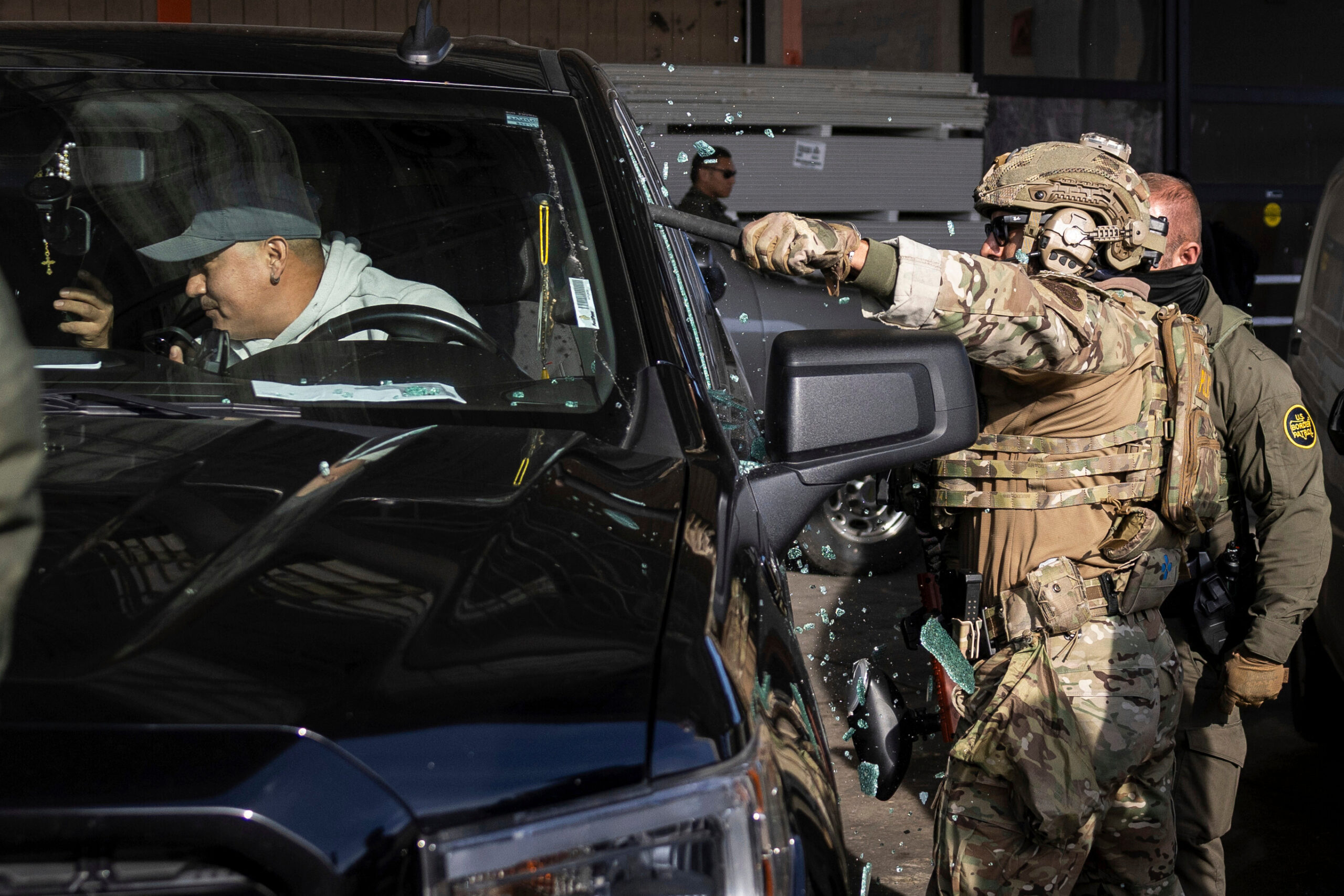
    Federal immigration enforcement agents shatter a truck window and detain two men outside a Home Depot in Evanston, Ill., on Dec. 17, 2025.

    In a sliver of University City, Miriam Oppenheimer has helped lead three block meetings where neighbors gathered to discuss how they would respond.

    They set up a Signal channel so people can communicate. And they formulated a loose plan of action: People will come outside their homes and take video recordings ― and try to get the names and birth dates of anyone taken into custody, so they can be located later.

    “Courage is contagious,” Oppenheimer said. “Everybody is waiting for somebody else to do something, but we have to be the ones.”

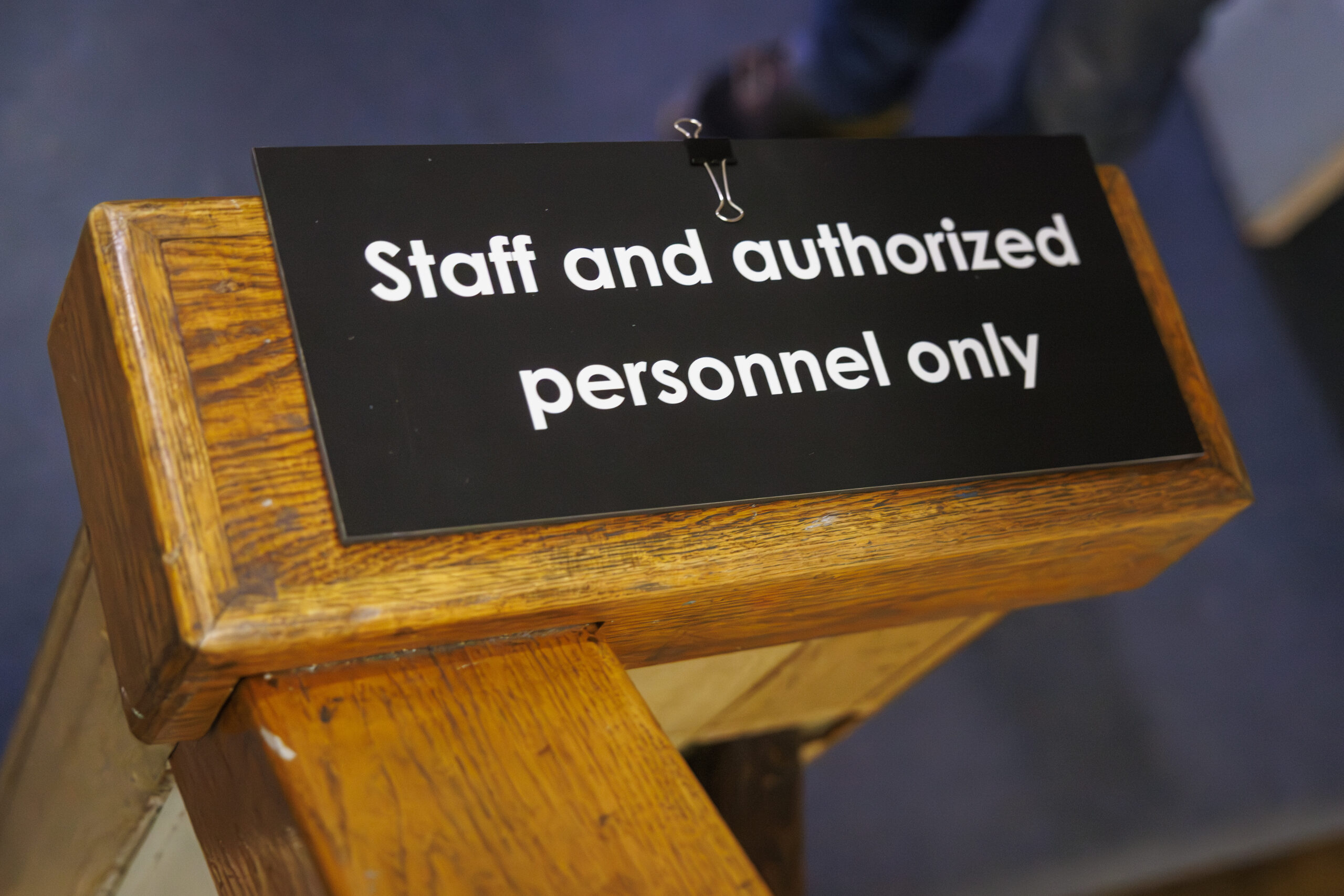
    Inside Olivet Covenant Presbyterian Church, doorways to some rooms now bear black-and-white signs that say, “Staff and authorized personnel only.”

    Issues around ICE access to churches have become more urgent since Trump rescinded the agency policy on “sensitive locations,” which had generally barred enforcement at schools, hospitals, and houses of worship.

    Legal advocates such as the ACLU say ICE agents can lawfully enter the public areas of churches, including the sanctuaries where people gather to worship. But to go into private spaces they must present a warrant signed by a judge.

    “There are many front lines right now,” said Ahn, the Olivet pastor. “We’re not trying to be simply anti-ICE, or anti-anybody. We’re just trying to be for the rights of the Fourth Amendment.”

    Staff writer Joe Yerardi contributed to this article.
  • In ‘Melt the ICE’ wool caps, a red tasseled symbol of resistance comes from Minneapolis to Philadelphia

    In ‘Melt the ICE’ wool caps, a red tasseled symbol of resistance comes from Minneapolis to Philadelphia

    Some yarn shops around Philadelphia are running low on skeins of red wool, as local knitters and crocheters turn out scads of “Melt the ICE” caps in solidarity with protesters in Minnesota.

    The hats don’t feature a patch or logo that says “Melt the ICE.” In fact, they carry no written message at all. What they offer is a deep scarlet hue, a dangling tassel, and a connection to an earlier, dangerous time, when a different people in another land sought to silently signal their unity.

    “The hat is really a symbol and reminder,” said knitter Laura McNamara of Kensington, who is making two caps for friends. “People are looking for a sense of community.”

    She refused her friends’ offers of payment, asking instead that they not let their involvement start and end with a hat ― but find a means to stand up for civil rights in some specific way.

    The original hat was a kind of conical stocking cap, known as a nisselue, worn in Norway during the 1940s as a sign of resistance to the Nazi occupation. The Germans eventually caught on to the symbolism and banned the caps.

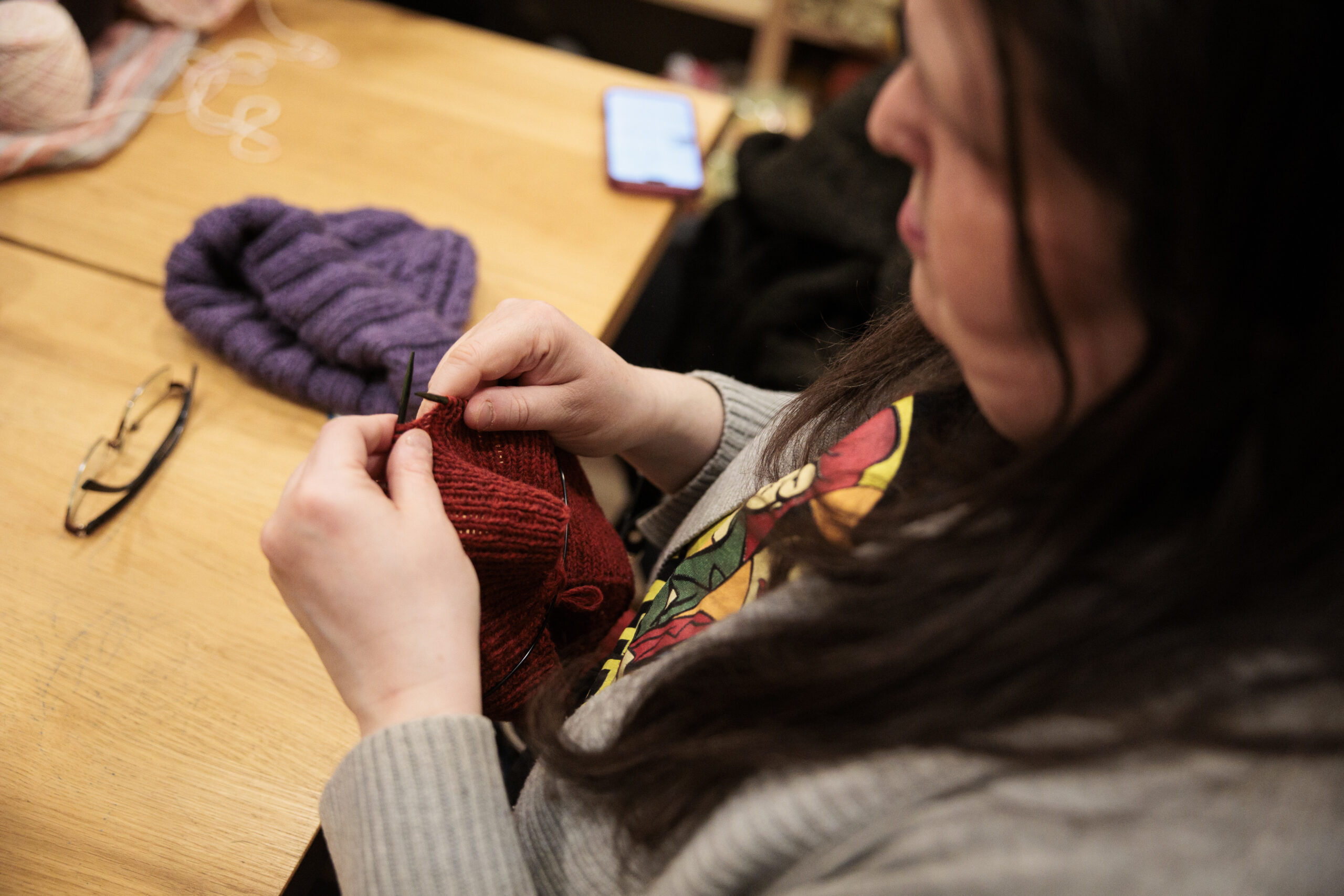
    Amanda Bryman works on a red wool hat known as a “Melt the ICE” hat, during Fiber Folk Night at Wild Hand yarn shop in Philadelphia on Wednesday.

    Now the new version that originated in a suburban Minneapolis yarn shop is spreading across the country. The hats signal opposition to U.S. Immigration and Customs Enforcement, which surged thousands of agents into Minneapolis, and sadness and anger over the deaths of Minnesotans and U.S. citizens Renee Good and Alex Pretti, who were shot to death by federal agents.

    Today, comparisons of ICE agents to Nazis have become both frequent and contentious in American politics, with even some Democrats, including Gov. Josh Shapiro, who is Jewish, rejecting that equivalence as wrong and unacceptable.

    ICE officials did not respond to a request for comment.

    This is not the first time that the Philadelphia region’s craftivist movement, as it is known, has brought its knitting needles and crochet hooks to bear.

    On the eve of Donald Trump’s first inauguration, artisans here turned out scores of cat-eared headgear known as pussy hats, a feline symbol of protest worn at the Women’s March on Washington. The hats aimed to tweak the then-president-elect over his comment about grabbing women by their genitals.

    The Melt the ICE caps carry some controversy within the fiber community, as it calls itself. There have been online complaints that it’s easy to tug a red cap over one’s ears, but unless that is accompanied by action it holds no more significance than clicking a “Like” button on Facebook.

    “It is just preening,” one person wrote in an internet forum.

    Another said that “if your resistance is only this hat, then you have not actually accomplished anything except make a hat.”

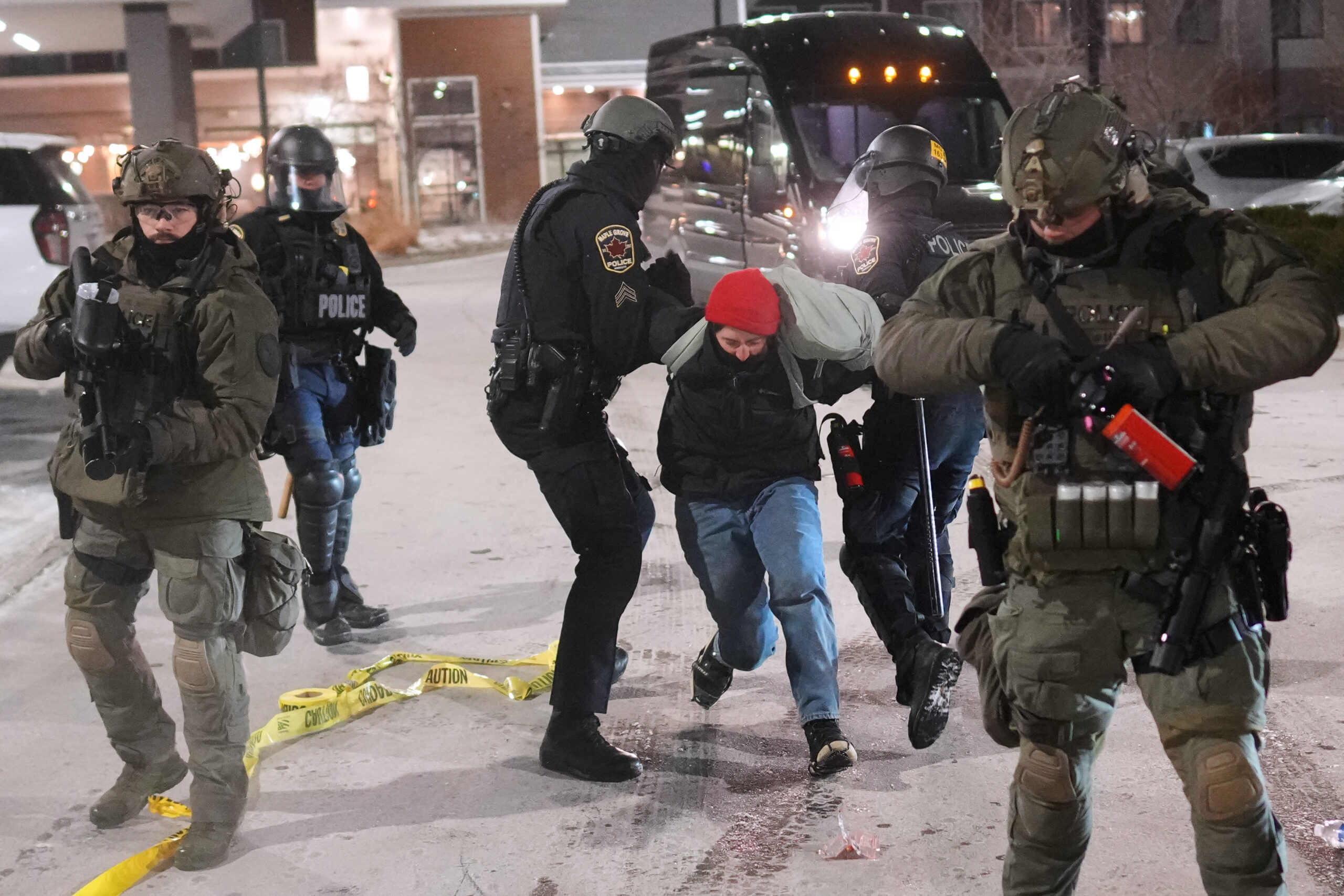
    Law enforcement officers detain a demonstrator during a protest outside SpringHill Suites and Residence Inn by Marriott hotels on Jan. 26 in Maple Grove, Minn.

    Liz Sytsma, owner of Wild Hand in West Mount Airy, has heard the criticism.

    But “the people in our community who are participating in making the hats, this is one of many things they are doing,” she said. That includes taking part in protests, calling elected leaders, and giving money to causes they support.

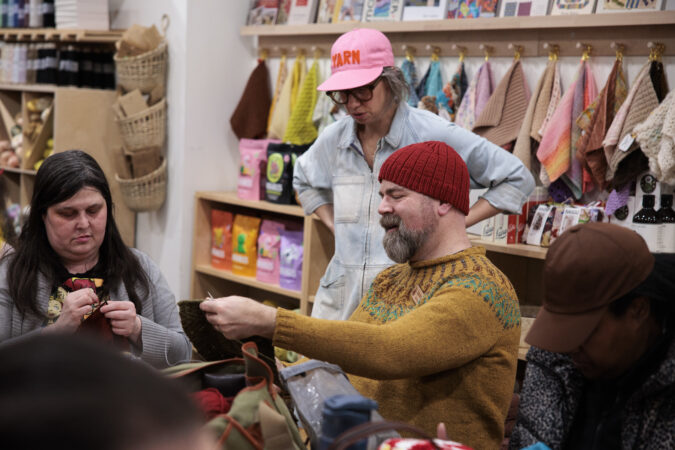
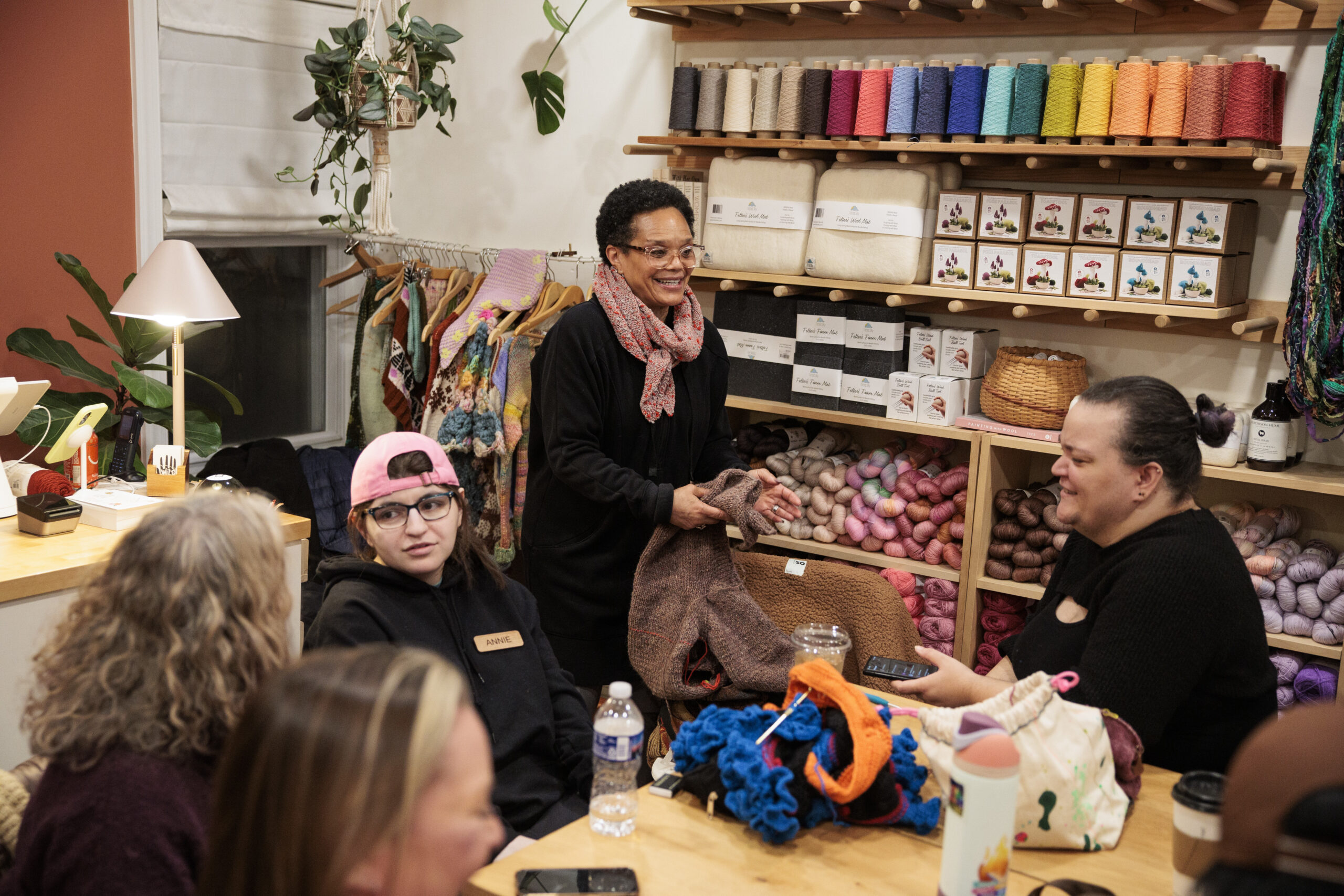
    On Wednesday, more than a dozen people gathered at Wild Hand for the weekly Fiber Folk Night, where crafters gather to knit, crochet, and chat ― and, now, to work on hats.

    Damon Davison traveled from Audubon, Camden County, having developed his own hat pattern, with sale proceeds to go to the activist group Juntos in South Philadelphia.

    He wants to show solidarity with people “who are expressing resistance to what has been happening in Minneapolis, but also what’s happening here in Philly,” he said. “The idea is to make it a little bit more local.”

    The shop has seen a rush on red, sought by about 70% of customers whose purchases have depleted stocks during the last couple of weeks.

    “We’re really low,” said store manager Yolanda Booker, who plans to knit and donate a hat. “I want to do whatever small part I can do to help out.”

    A single hat can take two or three days to make, though the best and fastest knitters can complete one in a couple of hours.

    In Minnesota, the owner of Needle & Skein, which produced the hats’ design, told reporters this month that online sales of the $5 pattern have generated more than $588,000 to be donated to area organizations.

    Store Manager Yolanda Booker, standing, laughs with attendees during Fiber Folk Night at Wild Hand yarn shop in Philadelphia on Wednesday.

    In West Mount Airy, Kelbourne Woolens closed its physical doors during the national “ICE Out” strike in late January and donated its online profits of $4,000 to Asian Americans United, Juntos, and New Sanctuary Movement of Philadelphia, said team member Bailey Spiteri. She estimated the store has sold enough red yarn to retailers to make 500 or 600 hats.

    At Stitch Central in Glenside, customers donated $1,000 during the strike and the store matched it, with the $2,000 going to Nationalities Service Center in Philadelphia.

    “Sometimes people are skeptical. How does wearing a hat or even making a hat make a difference?” asked Allison Covey of Drunken Knit Wits, a local knitting and crocheting organization. “But look at the donations. It does make a difference.”

    Veteran knitter Neeta McColloch of Elkins Park thinks the same. She has ordered enough yarn to make eight hats. And she is curious to see how the phenomenon will develop.

    “This is probably bigger than I think,” she said. “Knitters tend to be the type of people who in my experience have a strong moral compass. If they can combine something they love to do with something in which they can make a statement, that’s important to them.”