Author: Sarah Gantz

  • Philadelphia Medicaid advocates meet to plan outreach, with coverage at stake

    Philadelphia Medicaid advocates meet to plan outreach, with coverage at stake

    About 300,000 Pennsylvania residents risk losing Medicaid next year when new eligibility rules take effect, and advocates worry that too few people are aware.

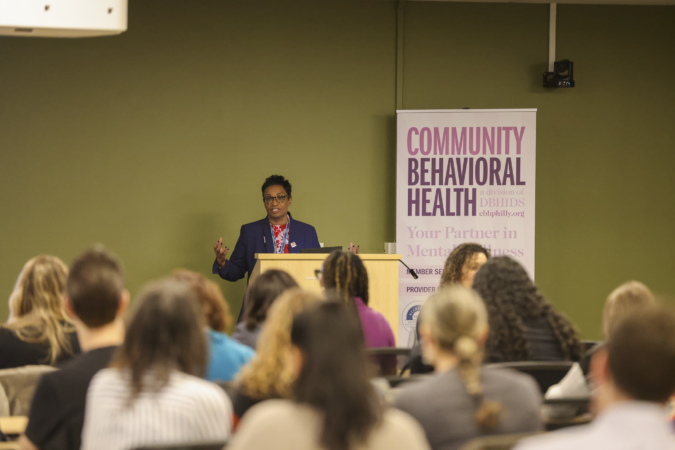
    More than 100 public health workers, community advocates, and medical providers gathered Thursday to strategize how to spread the word about forthcoming changes to Medicaid.

    The nonprofit Community Behavioral Health organized the event at its Center City offices as a first step toward rallying the stakeholders tasked with helping people navigate the new rules in order to maintain access to critical health services. The city contracts with CBH to provide mental and behavioral health services for Philadelphians with Medicaid.

    New federal rules taking effect in January 2027 require certain adults to meet work requirements and reapply for Medicaid every six months, instead of the current once a year. The changes were ordered under Republicans’ 2025 spending bill and signed into law by President Donald Trump. They are part of the largest cut in recent history to Medicaid, the publicly funded health coverage program for low-income families and individuals, and people with disabilities.

    States will be expected to verify eligibility for millions of people twice as often, a major administrative burden. For now, who will be exempt remains unclear. For instance, the law suggests that “medically frail” individuals will not need to meet work requirements or reapply every six months, without detailing who would qualify.

    The federal government expects to release more details in June.

    Public health leaders say they cannot wait for the additional guidance to begin talking about the forthcoming changes, in order to minimize the number of people who lose coverage.

    “It needs to be consistent and ongoing,” Donna E.M. Bailey, CEO of CBH, said of the group’s outreach efforts. “It really is a Philadelphia responsibility.”

    The coming Medicaid changes

    Roughly three million Pennsylvania residents are covered by Medicaid. About a quarter of them — roughly 750,000 people, including 180,000 in Philadelphia — qualify because the 2010 Affordable Care Act expanded access to low-income parents and childless adults. This so-called expansion group saw the bulk of the Medicaid cuts in last year’s Republican spending bill.

    Beginning next year, most people in this group will need to provide monthly proof that they spent at least 80 hours working, volunteering, or participating in job training. Every six months, they will need to reapply for the program. Some experts have compared this process to filing taxes because of the extensive paperwork and documentation required.

    Pennsylvania has estimated that about 300,000 people will lose Medicaid because they cannot navigate the new requirements — even though many remain eligible.

    “It’s hard to imagine with all these changes that it’s just going to be smooth,” said Mike Nardone, a former director of Pennsylvania’s Medicaid program, who spoke during the CBH event. “We’re going to have people who lose coverage, and we’re going to have to understand why that happens.”

    Starting outreach early

    Early and frequent communication is the best strategy for minimizing the number of people who lose Medicaid, public health advocates said at Thursday’s event.

    “We need to start now. This isn’t something that can wait,” said Joan Erney, CBH’s former chief executive.

    The dozens of medical providers, social workers, and community advocates in attendance were urged to work together to develop strategies for helping people to understand what new steps to take to keep their Medicaid coverage.

    “We always need the voice of those of you on the ground,” said Leesa Allen, a former Pennsylvania Medicaid director, who spoke during the panel.

    The event was the first in a series planned by CBH, which will expand outreach with similar events throughout Philadelphia designed for families and individuals to ask questions and learn more about the new Medicaid rules.

  • Pennie cost hikes hit low-income families and older adults the hardest

    Pennie cost hikes hit low-income families and older adults the hardest

    Low-income Pennsylvania families and adults in their late 50s and early 60s have been dropping out of Affordable Care Act health plans at the greatest rates after a key financial incentive expired at the end of last year, causing insurance costs to double on average across the state.

    Some 98,000 people who bought health plans last year from Pennsylvania’s Obamacare marketplace, Pennie, have opted out of coverage for 2026, as of Wednesday. That means one in five previously enrolled Pennsylvania residents have dropped their coverage.

    The number is expected to continue growing, as people begin getting premium bills they cannot afford, Pennie administrators said. They have already seen a significant increase since the end of open enrollment on Jan. 31, at which time 85,000 people had not renewed coverage.

    The agency has estimated that up to 150,000 people may ultimately drop coverage if Congress did not renew a tax credit program that ensures no one pays more than 8.5% of their income on an ACA health plan. The tax credits, which were adopted in 2021 during the COVID-19 pandemic, had been renewed annually until now.

    “If the tax credits had stayed in place, we probably would have seen another record enrollment, further reducing the uninsured rate,” said Devon Trolley, Pennie’s executive director.

    The tax credits were a defining issue in last year’s longest-ever federal government shutdown. In that budget stalemate, Democrats wanted to permanently expand the enhanced subsidies, and Republicans refused.

    New Jersey has not yet released the final results for its ACA open enrollment period, which also ended Jan. 31.

    window.addEventListener(“message”,function(a){if(void 0!==a.data[“datawrapper-height”]){var e=document.querySelectorAll(“iframe”);for(var t in a.data[“datawrapper-height”])for(var r,i=0;r=e[i];i++)if(r.contentWindow===a.source){var d=a.data[“datawrapper-height”][t]+”px”;r.style.height=d}}});

    2026 Pennie enrollment

    The first look at the impact of the higher insurance costs comes from Pennie data at the end of open enrollment. As of Feb. 1, a total of 486,000 people had signed up for coverage in 2026, down from 496,661 the same time last year.

    Some 79,500 newcomers to the marketplace partially offset the people who dropped coverage.

    In the Philadelphia region, more than 27,000 people who were enrolled in Pennie last year dropped coverage for 2026. Philadelphia and Montgomery Counties saw the biggest impact, with enrollment dropping 18% in each.

    Pennie leaders said people dropping plans are not enrolling in another type of insurance.

    That’s notable because those who joined Pennie for 2026 were coming from another form of insurance, such as an employer-based health plan. The people leaving Pennie were expected to become uninsured, Trolley said.

    Now that open enrollment is over, most people who find their plan is too expensive and drop it will not have an opportunity to select new coverage until the fall.

    window.addEventListener(“message”,function(a){if(void 0!==a.data[“datawrapper-height”]){var e=document.querySelectorAll(“iframe”);for(var t in a.data[“datawrapper-height”])for(var r,i=0;r=e[i];i++)if(r.contentWindow===a.source){var d=a.data[“datawrapper-height”][t]+”px”;r.style.height=d}}});

    Lower-income families were the most likely to drop coverage

    Pennie administrators said they heard from many lower-income families and individuals that the cost increases for 2026 were too much of a strain for already tight budgets.

    Breaking down the terminations by income, the greatest drop was seen among people with incomes 150-200% of the federal poverty rate. That’s an annual income of between $23,475 and $31,300 for an individual. For a family of four, the equivalent income range would be $48,225 to $64,300.

    A total of 13,562 Pennsylvanians in this income bracket declined to renew their Pennie plans for 2026 as of Feb. 1, according to the most recent available data from Pennie.

    “The math just isn’t working for people in those households,” said Trolley.

    People in this income bracket still qualified for some financial assistance. The ACA includes tax credits for anyone with income below 400% of the poverty rate, and these tax credits did not expire.

    Higher earners who would now have to pay in full, without the help of tax credits, account for another large segment dropping coverage.

    This included 11,837 people who earn more than 400% of the federal poverty rate. In the past years, the enhanced tax credit helped families in higher income brackets afford marketplace insurance.

    window.addEventListener(“message”,function(a){if(void 0!==a.data[“datawrapper-height”]){var e=document.querySelectorAll(“iframe”);for(var t in a.data[“datawrapper-height”])for(var r,i=0;r=e[i];i++)if(r.contentWindow===a.source){var d=a.data[“datawrapper-height”][t]+”px”;r.style.height=d}}});

    Dropouts high among young adults and those near retirement age

    Just under 20,000 adults between the ages 55 and 64 canceled their Pennie plans for 2026, accounting for nearly one-quarter of dropouts as of Feb. 1.

    About two-thirds of individuals in this age group earn enough that they would have had to pay the full price of their health plan, without any tax credits. They already pay more than younger adults for the same plan, under rules that allow insurers to charge more to cover older adults, who are likely to have more medical expenses.

    “That group is where we were seeing the most significant price jumps — a couple hundred dollars to a couple thousand dollars,” Trolley said.

    Another 15,356 adults between the ages 26 and 34 — many new to buying health insurance on their own — also dropped out. The ACA allows young adults to be covered under a parent’s health plan until age 26.

    Graphics editor John Duchneskie contributed to this article.

  • Five measles cases in Lancaster County are Pa.’s first outbreak of 2026

    Five measles cases in Lancaster County are Pa.’s first outbreak of 2026

    Five cases of measles have been confirmed in Lancaster County, the Pennsylvania Department of Health said this week.

    The cases, all among school-age children and young adults, are the first of 2026 in Pennsylvania. Four of the cases are related, making this the state’s first measles outbreak of the year.

    Separately, the Montgomery County Department of Health and Human Services on Tuesday confirmed a case of measles in Collegeville involving a person traveling through the county who sought care at Patient First Primary & Urgent Care-Collegeville.

    Health officials urged anyone who was at the clinic between 1:15 and 4:15 p.m. on Jan. 29 to monitor for symptoms, which include a high fever, cough, runny nose, and a red rash.

    Measles has been spreading in the United States over the last year, including isolated cases among travelers and increasingly larger outbreaks. The CDC reported 49 outbreaks in 2025, up from 16 in 2024.

    An outbreak is when three or more cases are related, and is a sign that the community lacks sufficient immunity to keep the disease from spreading. Experts generally consider a community to have so-called herd immunity if at least 94% to 95% of people are vaccinated.

    In Lancaster County, 89% of kindergarten students and 95% of high school seniors had received two doses of the measles, mumps, and rubella (MMR) vaccine in 2025, according to Pennsylvania Department of Health data.

    Last month, Philadelphia officials warned of a potential measles exposure for people who had passed through several transit hubs, including Philadelphia International Airport and 30th Street Station, after a traveler was confirmed to have measles.

    Measles is highly contagious, and people who are not vaccinated have a 90% chance of becoming ill if they come into contact with someone who has it. The virus spreads through the air when infected people cough, sneeze, or talk, and can linger in the air for up to two hours after an infected person leaves an area.

    People are considered immune to measles if they were born before 1957, have already had measles, or received two doses of the measles, mumps, and rubella vaccine.

    The U.S. Centers for Disease Control and Prevention recommends children receive two doses of the measles, mumps, and rubella (MMR) vaccine when they turn a year old and before entering kindergarten.

    Health and Human Services Secretary Robert F. Kennedy Jr. has recently overseen an overhaul of the CDC’s childhood vaccine schedule, with new recommendations for when vaccines should be given and who should receive them. But the measles vaccine remains among those recommended for all children.

    Staff writer Aubrey Whelan contributed to this article.

  • One year of inspections at Thomas Jefferson University Hospital: November 2024 – October 2025

    One year of inspections at Thomas Jefferson University Hospital: November 2024 – October 2025

    Thomas Jefferson University Hospital was cited by the Pennsylvania Department of Health in the last year for failing to keep a patient from setting fire in their hospital bed, turning away a person who came to the emergency department, and neglecting to monitor a patient’s vital signs.

    The incidents were among nearly three dozen times health department inspectors visited Jefferson Health’s flagship hospital in Center City to investigate potential safety violations between November 2024 and October 2025.

    Here’s a look at the publicly available details:

    • Dec. 3, 2024: Inspectors visited for a monitoring survey and found the hospital was in compliance.
    • Dec. 3: Inspectors followed up on a citation from August 2024 and found the hospital was in compliance. The hospital had been cited for failing to properly document details from cardiac monitoring for a patient with septic shock.
    • Jan. 24, 2025: The hospital was cited with immediate jeopardy, one of the state’s most serious warnings and a sign of potentially life-threatening safety problems, after a patient suffered first- and second-degree burns in their room. Inspectors found that the patient had attempted to light a cigarette while receiving treatment that involved supplemental oxygen, which can cause materials near it to catch fire. Inspectors found that Jefferson staff had failed to check the patient for smoking paraphernalia and educate them about no-smoking rules, as required by hospital protocol. The hospital posted more “No Smoking” signs, retrained staff, and updated its policies requiring smoking screening for all patients.
    • Jan. 30: Inspectors came to investigate a complaint but found the hospital was in compliance. Complaint details are not made public when inspectors determine it was unfounded.
    • Feb. 3: Inspectors came to investigate a complaint but found the hospital was in compliance.
    • Feb. 6: Inspectors came to investigate a complaint but found the hospital was in compliance.
    • Feb. 11: Inspectors came to investigate four complaints but found the hospital was in compliance.
    • Feb. 11: The Joint Commission, a nonprofit hospital accreditation agency, renewed the hospital’s accreditation, effective November 2024, for 36 months.
    • Feb. 12: Inspectors came to investigate a complaint but found the hospital was in compliance.
    • Feb. 14: Inspectors came to investigate two complaints but found the hospital was in compliance.
    • March 11: The hospital was cited for violating rules that require emergency departments to evaluate all patients who arrive seeking care. Inspectors found that a person walked into the emergency department saying they needed to use the restroom, and was asked to leave because the hospital does not have a public restroom. The patient said they were having an emergency and planned to check into the emergency department, but were still told to leave. Inspectors found that the dismissal violated Jefferson’s emergency department policies designed to comply with the federal Emergency Medical Treatment and Labor Act (EMTALA) — anti-patient dumping laws that require hospitals to evaluate and stabilize any patient who seeks emergency treatment. Administrators retrained staff on EMTALA protocol and updated their system for recording security incidents to better document when a provider is called by security to assess a patient who has a non-medical request, such as needing to use the restroom.
    • April 15: Inspectors followed up on the immediate jeopardy citation from January and found the hospital was in compliance.
    • April 29: Inspectors came to investigate a complaint but found the hospital was in compliance.
    • May 5: The hospital was cited for failing to follow protocol designed to prevent patient falls. In December 2024, an 80-year-old patient with impaired vision was admitted to the emergency department and given a drug known to cause patients to need to urinate more often. Inspectors found that the patient was initially evaluated to have a low risk of falling, but was not re-evaluated after being prescribed the medication that could increase how often they needed to get up to use the bathroom and their risk of falling. In response to the complaint, which was reported in December 2024 and finalized in May 2025, hospital administrators retrained staff on fall risk protocols and said they would monitor patient charts.
    • May 28: Inspectors came to investigate a complaint but found the hospital was in compliance.
    • May 30: Inspectors came to investigate a complaint but found the hospital was in compliance.
    • Aug. 14: Inspectors came to investigate a complaint but found the hospital was in compliance.
    • Aug. 19: Inspectors came to investigate a complaint but found the hospital was in compliance.
    • Aug. 19: The hospital was cited for failing to properly monitor a patient’s vital signs. Inspectors found that a provider had ordered continuous pulse oximeter monitoring for a patient, and instructions to report when the blood oxygen levels dropped below 90%. A staff member assigned to the patient could not find a pulse oximeter machine for the patient and told inspectors that they reported the issue to another provider, “but she never got back to me.” Hospital administrators acquired more pulse oximeters, retrained staff on medical supplies protocol, and said they would monitor patient hand-offs between nursing shifts.
    • Oct. 3: Inspectors came to investigate a complaint but found the hospital was in compliance.
  • Virtual nursing programs get mixed reviews in Penn Nursing study

    Virtual nursing programs get mixed reviews in Penn Nursing study

    The rollout of so-called virtual nurses in hospitals remains a mixed bag, University of Pennsylvania researchers have found in the largest survey to date on nursing care delivered remotely through a screen.

    One hospital staffer said virtual nurses are a huge help getting patients checked in.

    Another said they worry hospitals are trying to cut corners by keeping floors fully staffed by using virtual nurses.

    And sometimes, patients think the virtual nurse is a television advertisement and try to press fast forward, researchers were told.

    A new study out of University of Pennsylvania School of Nursing surveyed 880 registered nurses in 10 states, including Pennsylvania, about the virtual nursing programs that have sprung up at health systems across the country.

    About half — 57% — of the nurses surveyed said virtual nurse programs did not reduce their workload, with some saying they felt virtual nurses created more work.

    But similar numbers also said they thought virtual nurse programs improved the quality of care patients received.

    Others said they didn’t think the technology had any impact — positive or negative — on quality of care, according to a study of results published online in December in JAMA Open Network.

    “It can be beneficial or a headache,” one nurse interviewed by Penn researchers summed up.

    Virtual nursing programs became more widespread during the COVID-19 pandemic, when health systems needed to limit physical interaction to protect patients and medical staff, and have continued to expand in Philadelphia and across the country. Administrators embracing technology and artificial intelligence say they can help streamline administrative responsibilities that can burden staff, provide extra patient oversight, and improve how quickly clinicians can respond to emergencies.

    Local examples include Penn Medicine’s use of virtual nurses to monitor patients at risk of falling or pulling out tubes and wires. Jefferson Health assigns a virtual nurse to patients who doctors have decided need to be monitored around the clock.

    And virtual nurses handle administrative work, like reviewing medications and giving discharge instructions at Virtua Health hospitals in New Jersey.

    The new study from Penn is among the largest to date to evaluate how well the programs are meeting goals, and the mixed results should be a warning to hospital administrators to proceed cautiously, researchers say.

    “Virtual nursing programs have been heralded as an innovative silver bullet to hospitals’ nurse staffing challenges, but our findings show that most bedside nurses are not experiencing major benefits,” said lead author K. Jane Muir, an assistant professor of nursing in the university’s Department of Family and Community Health.

    Virtual nursing on the rise

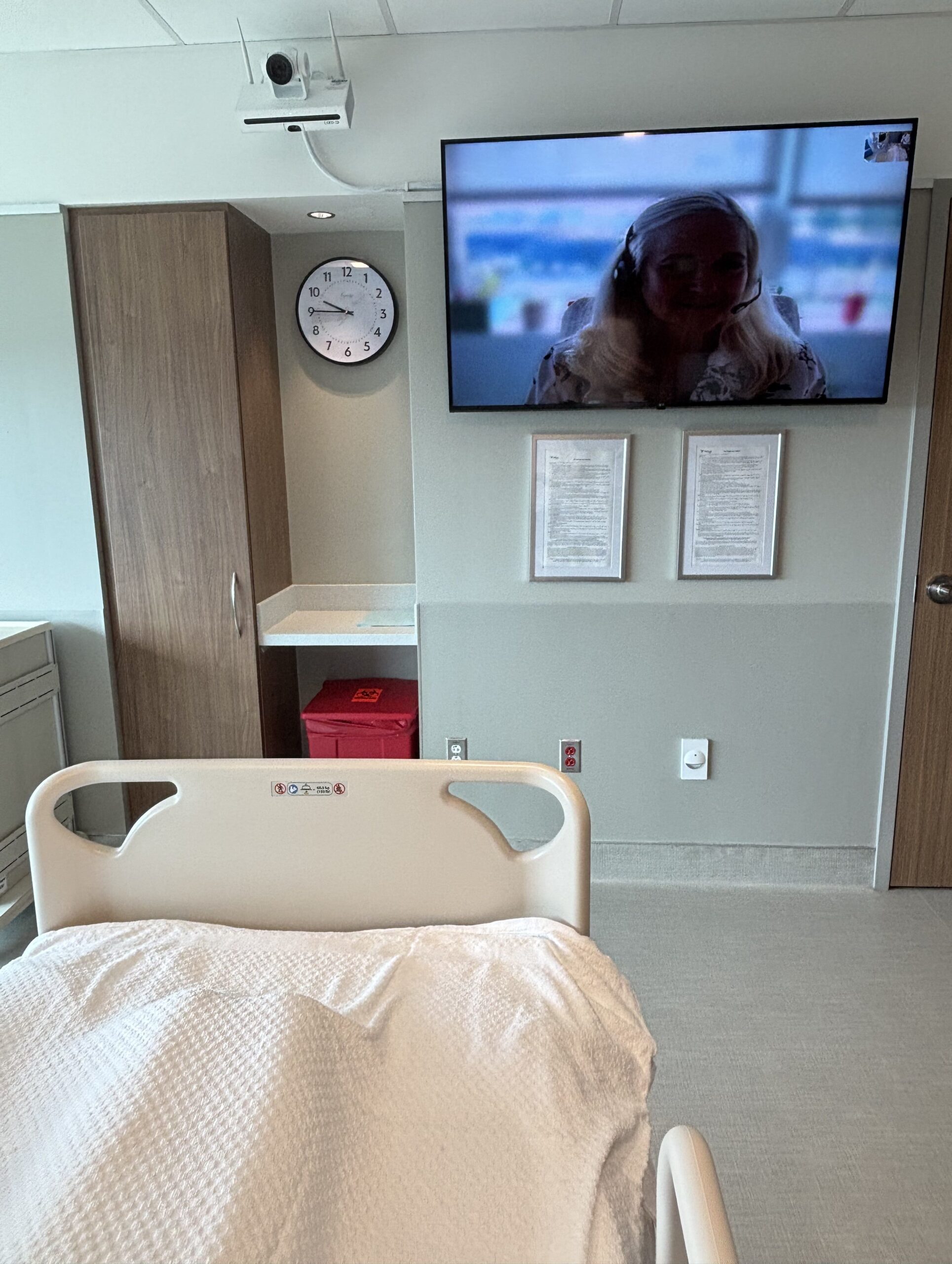
    Virtual nurses at Virtua Health appear on the television in a patient’s room.

    Virtual nursing refers to patient-care responsibilities managed by a team of nurses stationed at a remote hub, where they monitor screens and electronic information feeds.

    They are not intended to replace bedside care, but rather to serve as an extra set of eyes to monitor patients.

    If a patient who is known to be unsteady on their feet moves as if to get up from bed, a virtual nurse could speak through a screen or sound system asking if they need something and call a nurse on the floor to help them. If the patient falls, a virtual nurse can quickly alert medical staff.

    Virtua Health officially launched its program last year.

    Virtual nurses make sure patients have the appropriate medications before going home, know their discharge instructions, and have a follow-up appointment scheduled. They work in partnership with the bedside nurse, who focuses on the physical tasks in caring for a patient, while the virtual nurse handles the majority of the discussion.

    “It’s something that our patients are requesting and they’ve come to expect,” said Kristin Bloom, a nurse by training who serves as assistant vice president of clinical operations for Virtua’s Hospital at Home program.

    Virtua also uses virtual nurses in its intensive care units to help monitor and identify early signs of deterioration. These nurses have access to bedside cameras and can view the patient’s heart rhythms, lab results, and vital signs.

    Participants in the Penn survey, conducted in late 2023 and early 2024, did not include nurses working in New Jersey, where Virtua’s hospitals are based.

    Virtual nursing challenges

    Nurses surveyed by Penn’s researchers said they appreciated the extra set of eyes on patients, but not all were convinced that the virtual monitor was any more effective than bed alerts that can sound when they sense a patient leaving, according to the study.

    Karen Lasater, an associate professor of nursing and co-author of the study, urged health systems to include in-hospital nurses when shaping their virtual care programs.

    She said including bedside nurses in the conversation about what’s working and not working is “imperative.”

    “It’s important that nurses have a seat at the table,” Lasater said.

    Nurses surveyed also expressed concern that health systems were using virtual workers to avoid hiring more on-site staff.

    Bedside nurses questioned why they were being asked to take on more responsibility because administrators said they couldn’t afford to hire more staff, yet still found funding to build virtual programs.

    “They felt like investments in virtual nursing was a workaround,” Lasater said. “Why did they have money to invest in virtual nurses who couldn’t do all the work of the bedside nurses, but couldn’t invest in more bedside nurses?”

    At Virtua, administrators have turned to veteran bedside nurses to staff their virtual nursing program.

    “It’s an avenue to retain our experienced nursing staff,” Bloom said.

    Philadelphia-area hospitals have seen some virtual nursing challenges. In 2024, for instance, Jefferson Abington Hospital was cited by the Pennsylvania Department of Health after inspectors said the power cords attached to the monitors for virtual nursing created a strangulation risk for behavioral health patients.

    The hospital treated the incident as a learning experience, adjusting how the mobile monitors are used.

    The technology can also be confusing for some patients, who may not grasp the concept of a virtual nurse or may get conflicting instructions from their virtual and bedside nurses, Lasater said.

    Penn initially planned to use virtual nurses to help monitor behavioral health patients, who often require one-on-one monitoring around the clock.

    But staff found that patients who were experiencing behavioral or mental health challenges were too often confused or unsettled by virtual nurses, and unable to follow their instructions, Bill Hanson, Penn’s chief medical information officer, told The Inquirer in 2024.

    “We’re all learning as we go,” he said at the time.

  • How to shovel a ton of snow safely

    How to shovel a ton of snow safely

    With a significant snowfall expected in the Philadelphia region this weekend, doctors are urging people to be cautious when digging out.

    About 100 people a year die from heart attacks brought on by shoveling snow. Thousands more wind up in the emergency department with sprains, strains, chest pain, and other heart problems.

    Shoveling may not seem like a cardio workout, but it can put as much strain on your heart as a treadmill stress test, according to the American Heart Association. People often mistakenly lift with their arms, which is more taxing on the heart than lifting with their legs. In extreme cold, blood vessels constrict to conserve heat, but that can further elevate blood pressure.

    People with a history of heart problems, smoking, or obesity may be especially at risk.

    In the Philadelphia area, shovelers are more accustomed to an inch or two of powder or slush. This weekend’s storm, which could bring several times that, will be a bigger and more dangerous challenge, said Jonathan Stallkamp, a senior vice president and chief medical officer for Main Line Health, a nonprofit system with four hospitals in the Philadelphia suburbs.

    “All of a sudden your heart goes from beating normally, and now you’re putting in this additional heavy work of shoveling,” said Stallkamp.

    Here’s how to shovel safely and make sure the upcoming storm isn’t your downfall.

    Ask for help

    The best way to prepare for clearing massive amounts of snow is to make sure you’re in good physical shape, said Stallkamp.

    Shoveling uses muscles people may not be accustomed to exercising, and puts stress on the heart.

    “A lot of our older community members aren’t in as good shape as they think,” Stallkamp said.

    He encouraged people to be realistic about their abilities, and ask for help from a younger neighbor or relative, if possible.

    Some cardiologists say that anyone over age 45 should use extra caution when shoveling.

    Treat it like a sport

    Prepare to tackle snow the way an athlete would prepare for a big game: Drink lots of water, avoid caffeine (which can raise blood pressure), and wear the right gear (mittens are generally warmer than gloves). And don’t forget to stretch. Warming up your joints, and muscles in your legs, arms and back will reduce the risk of injury, according to Mayo Clinic.

    Lift with your legs

    Bending your knees to scoop and lifting with your legs will reduce strain on your back. Lifting with arms and back are more likely to result in a pulled muscle.

    Shovel often

    Stallkamp recommends getting out early, clearing snow as it falls, rather than waiting for the big event to be over. It’s easier to shovel an inch of snow multiple times than to dig out of a foot of snow. While the forecast for the Philadelphia region is still in flux, some forecasts suggest snow could turn to ice, which adds to the challenge of clearing driveways and sidewalks.

    Ice will be easier to clear if it falls on a thin layer of snow, than directly onto pavement, Stallkamp said.

    Keep fingers away from snowblowers

    This maybe goes without saying, but Stallkamp said he’s seen it enough that he’s sending a clear warning: Do not put your hands inside the opening of a snowblower.

    When a stick or chunk of ice gets stuck in a snowblower, people may instinctively reach in to try to dislodge the object.

    “But once that jam clears, those blades spin and your fingers go with it,” he said.

    Take breaks and warm up

    Mayo Clinic experts recommend taking breaks to check in with your body. If you feel out of breath, lightheaded, or just off, go inside to warm up and relax.

    With ice in the forecast, Stallkamp recommends taking steps to keep your house warm if your home uses electric heat and you lose power.

    Generators can help restore enough electricity to turn the heat on, but they should be kept as far from the house as possible and never used inside. Generators produce large amounts of carbon monoxide that can be deadly, especially in the winter when windows and doors are closed up.

    If possible, turn up the heat in advance, so your home stays warm longer if power goes out.

  • One year of inspections at Chester County Hospital: December 2024 – November 2025

    One year of inspections at Chester County Hospital: December 2024 – November 2025

    Pennsylvania’s Department of Health did not cite Chester County Hospital for any safety violations between December 2024 and November of last year.

    The West Chester-based hospital is part of Penn Medicine.

    Here’s a look at the publicly available details:

    • Feb. 6, 2025: Inspectors came to investigate a complaint but found the hospital was in compliance. Complaint details are not made public when inspectors determine it was unfounded.
    • May 5: Inspectors visited for a special monitoring survey and found the hospital was in compliance.
    • July 25: Inspectors came to investigate a complaint but found the hospital was in compliance.
  • Riddle Hospital receives $4M in state funding to expand healthcare access in Delaware County

    Riddle Hospital receives $4M in state funding to expand healthcare access in Delaware County

    Two Delaware County hospitals are getting $6 million in additional funding to help them address a sharp increase in patients after Crozer Health, the county’s largest hospital and busiest emergency department, closed last year.

    About $5 million of the funding had previously been allocated to Crozer Health under a program that supports hospitals that care for a high portion of low-income patients with Medicaid. About $3 million of that money was redistributed to Riddle Hospital in Media; Mercy Fitzgerald Hospital in Darby $2 million. Local lawmakers secured an additional $1 million for Riddle.

    “They really have stepped up to fill a big void, and we want to make sure they have the resources they need,” said Rep. Lisa Borowski, a Delaware County Democrat.

    The additional funding will allow Riddle, part of the nonprofit Main Line Health system, to hire more staff, said Ed Jimenez, Main Line Health’s CEO.

    When there aren’t enough nurses or other clinicians to cover the hospital’s needs, Riddle has had to turn to staffing agencies, which charge three to four times the rate Main Line pays staff providers, he said.

    Main Line executives and local lawmakers marked the funding announcement at Riddle Wednesday with a check presentation ceremony and roundtable discussion about ongoing regional healthcare challenges.

    Rep. Gina Curry, a Delaware County Democrat, urged hospital executives to continue trying to connect with patients who may be without doctors after Crozer was closed by its bankrupt for-profit owner, Prospect Medical Holdings, based in California.

    Crozer-Chester Medical Center in Upland and its sister hospital, Taylor Hospital in Ridley Park, served a disproportionately low-income population in Chester and other densely populated communities outside Philadelphia with high rates of chronic health problems, such as asthma and heart disease.

    “You’re working very hard inside here to try to help, but how are you including the community to let them know that Main Line Health is wrapping around them,” Curry said.

  • 70,000 Pennie customers have dropped their plans as price hikes loom for health insurance

    70,000 Pennie customers have dropped their plans as price hikes loom for health insurance

    Sasha Kinney fears she cannot afford the $750 a month it will cost to keep her Affordable Care Act health plan in 2026. But she will put the insurance bill on a credit card before risking a medical emergency without access to the doctors she sees regularly.

    The 42-year-old Drexel Hill resident’s insurance costs soared this year, after Congress did not extend a federal incentive program that ensured that no one paid more than 8.5% of income on health coverage.

    She earns enough doing freelance work for nonprofits, while serving as her mother’s primary caregiver, that she is not eligible for Medicaid, the publicly funded health program for low-income people.

    A private health plan through Pennsylvania’s Obamacare marketplace, Pennie, was a major expense, but one she prioritized to help manage her chronic headaches and stress-related pain. But the incentive program expired at the end of last year, leading to skyrocketing ACA insurance costs in Pennsylvania and across the country. Kinney will now pay an extra $250 without the added tax credit.

    “I will go into debt because of these increasing costs,” she said. “But it still seems better than not having coverage.”

    Congress has failed so far to strike a deal to bring back tax credits that have helped record numbers of Americans get health insurance. The U.S. House of Representatives approved legislation last week that would renew the program for three years, but it is unclear if the Senate will act.

    President Donald Trump on Thursday announced a healthcare plan that White House officials said would help address rising healthcare costs by creating new drug price controls and sending health subsidies directly to consumers. The sparsely detailed plan is intended to serve as a framework for Congress, though officials did not say which lawmakers are actively working on new healthcare legislation, the Associated Press reported.

    Meanwhile, people who are covered by Obamacare plans are running out of time to decide how to handle massive price hikes that doubled the average cost of the health plans in Pennsylvania.

    The deadline to enroll in a plan for 2026 in Pennsylvania and other states is Jan. 31. After that date, people can drop their coverage if they find it is too expensive, but they will not be able to select a new plan until the fall enrollment period.

    In Pennsylvania, about 70,000 people who bought Pennie plans in 2025 have decided they cannot afford the price increase and dropped their coverage. The dropout rate is unprecedented — about 1,000 people a day, said Devon Trolley, Pennie’s executive director.

    Nationally, about 800,000 fewer people have selected Obamacare plans compared with this time last year, a 3.5% drop in total enrollment so far, according to the AP.

    With just weeks to go in the enrollment period, marketplace leaders are urging people to think carefully about whether they can afford their plan for the full year and to look at other Pennie plan options. If Congress ultimately renews the enhanced tax credits, they have said, they would work quickly to adjust prices.

    “At this point, we are telling people they should make the best decision for their family based on the current cost,” Trolley said. “We want to make sure people who currently have coverage aren’t staying with a plan they can’t afford.”

    Trolley worries that people will stick with a plan they like, not realizing they can no longer afford it, only to be forced to drop the coverage and become uninsured partway through the year.

    window.addEventListener(“message”,function(a){if(void 0!==a.data[“datawrapper-height”]){var e=document.querySelectorAll(“iframe”);for(var t in a.data[“datawrapper-height”])for(var r,i=0;r=e[i];i++)if(r.contentWindow===a.source){var d=a.data[“datawrapper-height”][t]+”px”;r.style.height=d}}});

    Congress considering tax credit extension

    The add-on tax credits that expired at the end of 2025 were introduced in 2021 and have been renewed by Congress annually since then.

    In Pennsylvania, the federal incentive program ensured the vast majority of enrollees qualified for at least some amount of financial help, driving peak marketplace enrollment of 497,000 in 2025.

    The program became a major sticking point in federal budget discussions last fall, with Democrats forcing a government shutdown after Republicans refused to include the tax credits without significant restrictions.

    The budget ultimately passed without the tax credits after key Senate Democrats, including Pennsylvania’s John Fetterman, voted with Republicans to end the shutdown.

    Last week, 17 House Republicans — including Pennsylvania Reps. Brian Fitzpatrick, Robert Bresnahan, and Ryan MacKenzie — sided with Democrats to approve legislation that would reinstate the tax credits for three years. The measure must be approved by the Senate, and would need to return to the House to consider any changes.

    While the incentive program’s expiration is a major blow to the Obamacare marketplaces, Trolley, Pennie’s executive director, urged people not to rule out finding affordable coverage.

    President Barack Obama’s landmark health law also included income-based tax credits for people who earn less than 400% of the federal poverty level — about $60,000. These tax credits cannot expire because they are part of the law.

    “We have been encouraging people to not assume it’s too expensive,” Trolley said.

    Devon Trolley, executive director of Pennie, has been outspoken about how cuts to ACA tax credits are affecting people who buy Pennie health plans. Pictured during a 2025 roundtable with Pennsylvania lawmakers, stakeholders, health systems at the University City Science Center in Philadelphia.

    Health insurance decisions

    While some parts of Pennsylvania are seeing prices three to four times higher than in 2025, Philadelphia’s collar counties are seeing more moderate cost increases, ranging from an average 46% price hike in Chester County to a 70% average increase in Delaware County.

    Other factors that affect cost include household size, age, and income. People who are generally healthy and use insurance sparingly may be able to save money by opting for a plan that has a low monthly cost and a higher deductible (the amount of money spent out-of-pocket before the plan begins covering a greater share of costs).

    Sasha Kinney, 42, of Drexel Hill, considered switching to a high-deductible health plan to lower her monthly premium, but ultimately stuck with her old Pennie plan because it offered better coverage.

    In Drexel Hill, Kinney considered switching to a cheaper plan when she saw how much it would cost to keep her current coverage.

    Her current plan has a low deductible, and even so, Kinney said, she still spends hundreds on co-pays and other costs not covered.

    She worried that if she switched to a plan with even higher out-of-pocket costs, she would end up skipping appointments and avoiding needed care.

    She routinely sees doctors and physical therapists, and didn’t want to risk having to find new providers.

    “In the end I think it washes out — you can lower your monthly cost, but if the deductible and co-pays are higher, you’re paying the same,” she said. “There’s basically no way to save money.”

  • Riddle EMS rebranded as Main Line Health EMS

    Riddle EMS rebranded as Main Line Health EMS

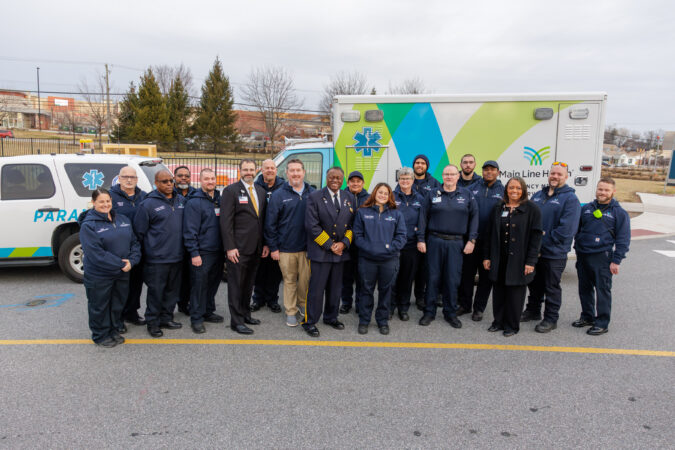
    Main Line Health on Wednesday announced that emergency medical services at Riddle Hospital in Media would be rebranded as Main Line Health EMS.

    The seven-ambulance fleet has been known as Riddle EMS for the past 40 years. It employs 77 paramedics and EMTs and provides emergency response services for Main Line’s four-hospital system.

    In addition to Riddle Hospital, Main Line Health includes Paoli Hospital, Lankenau Medical Center, and Bryn Mawr Hospital.

    The rebranding gives Main Line’s emergency services team a name that matches its system-wide mission, and “strengthens the team’s ability to meet the expanding needs of the community, while preserving the trusted service delivered for decades,” according to a statement from Main Line.

    Main Line’s hospitals, and in particular Riddle, have been strained by the closure of Crozer Health, which operated the largest emergency department and highest level trauma center in Delaware County.

    Riddle and Mercy Fitzgerald Hospital, in Darby, are the next closest hospitals for people who would previously have turned to Crozer for emergency care.