The Rachels met each other when they were 5 and 6 years old, and they met Lizzy Seitel — who would come to be known as one of the Rachels despite her name — in middle school.
They all lived in the D.C. area, and one weekend they took part in a retreat with Cheder, a progressive Jewish community in the area. In Seitel’s recollection, they listened to Ani DiFranco, went skinny-dipping, and talked about their fears.
“It was just a really crazy, beautiful, life-affirming teenage moment,” Seitel, now 38, said.
It also marked the beginning of a very long friendship.
Soon after, Rachel (Luban), Rachel (Neuschatz), and Seitel began celebrating winter solstice together with a witchy ritual drawn from a pagan book. In the quarter-century since, they’ve never missed the solstice.
Rachel Luban (from left), Lizzy Seitel, and Rachel Neuschatz, pictured in college in 2009.
The Rachels went to the same college; Lizzy went elsewhere.Then, after living apart for some years in their 20s, they decided to settle down, together. By that point, Seitel had married Serge Levin(he grew up in a communal house in Rostov-on-Don, Russia, and was game for an alternative arrangement) and was pregnant with their first child.
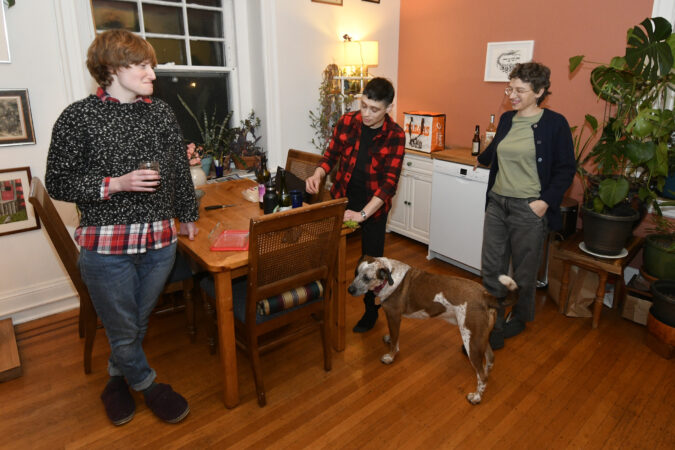
In 2022 the four bought a giant old stone house in Mount Airy, where they now live communally. They have a shared bank account for the mortgage, house maintenance, and utilities, along with a shared backyard, basement, porch, and Google calendar.
The Rachels, who both have romantic partners living elsewhere, coparent a dog. Seitel and Levin’s two young children call the Rachels Aunt Lu and Aunt Nu.
The following, as told to Zoe Greenberg in separate interviews, has been edited for length and clarity and combined.
On meeting each other as kids
Rachel Neuschatz: I consider myself a red diaper baby [a term to describe the kids of radical/Communist parents].We lived in a single family home, but we were always involved with the Jewish community Cheder. Rachel Luban and I were in it starting from age 5.
Lizzy Seitel: I grew up in a pretty typical nuclear family, in most ways. But my parents always had an extra room, and they were always having people come stay with us. There was this feeling of people coming in and out, and I really loved that — just the idea of family being expansive.
It was always my fantasy to live in a boarding house.
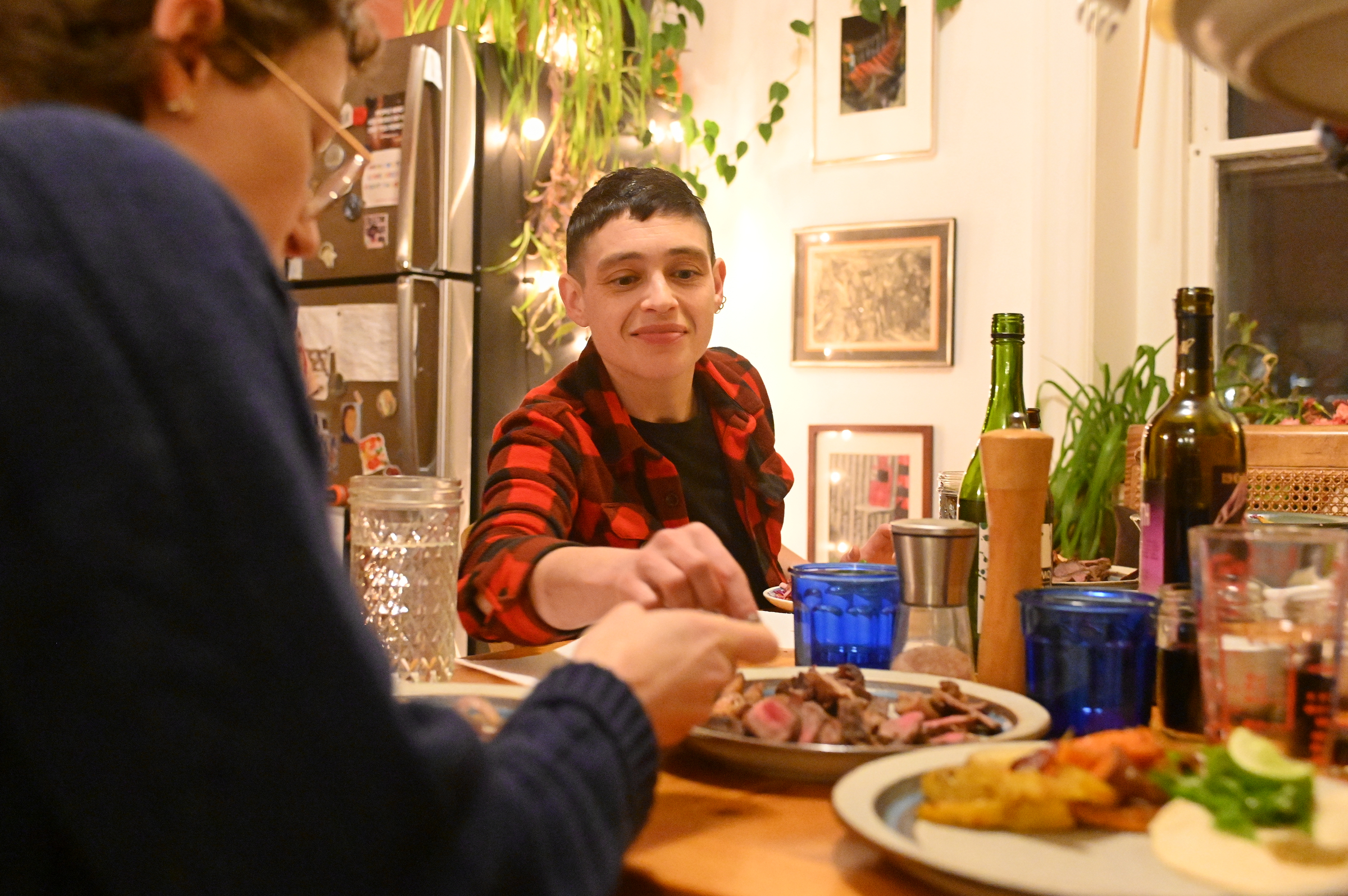
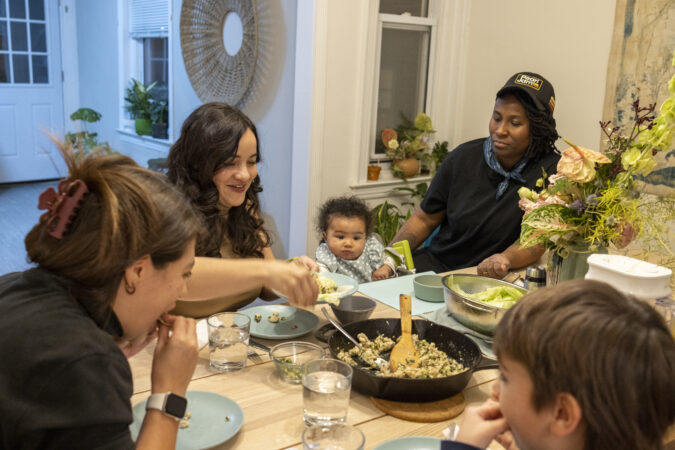
Rachel Luban and Rachel Neuschatz at house dinner.
Rachel Luban: I feel like we raised each other, and those relationships have always felt as central to me as romantic relationships. Romantic partnership was part of my vision, but as a kid I would never dream about getting married.
On the ‘palace of dreams’
Lizzy Seitel: The Rachels and I always talked about creating a palace of dreams.
Rachel Neuschatz: We’d always talked very vaguely about living together. Of course, people loved to tell us it wouldn’t work, which is a very funny, ubiquitous response.
Rachel Luban: We had been talking for many years about wanting a more communal living situation, some kind of cohousing. We didn’t know exactly what that would look like.
Lizzy was very rooted in Philly. She’d been here for maybe 10 years, she was married, she was pregnant.
So both Rachel and I decided to move to Philly in 2019. We moved within a month of each other, and we were all living in separate apartments in South Philly.
On choosing to buy a house together
Lizzy Seitel: Having a kid, and then it being the pandemic, it was like, “Oh yeah, the nuclear family is bulls—. This is not how anyone should raise kids.”
Rachel Luban: Even though we were all living in South Philly, less than a half hour walk from each other, it felt like seeing each other had to be this big planned thing and you had to clear your night for it.
We wanted lower barriers to spending time together, and more incidental interactions.
On searching for the right place
Rachel Luban: There was really no road map, and that was very challenging. We didn’t have many people to talk to. There are all of these logistics to figure out: Should we become an LLC? We decided not to do that, because then we would need a commercial mortgage.
We wanted a single structure that had separate units. So everyone has their own door, everyone has their own kitchen, but there are some common spaces, and we’re all really close together.
We made our own basic boundaries about what percentage of the property each person would own and therefore, what percentage of the finances they would be responsible for.
Our runner-up was this former nunnery that was three huge conjoined West Philly rowhomes. It had one giant kitchen, 13 bathrooms, and a lot of institutional carpeting. It was kind of cool, but also just an insane space.
The place we eventually found felt like it fell from heaven, because nothing else came close.
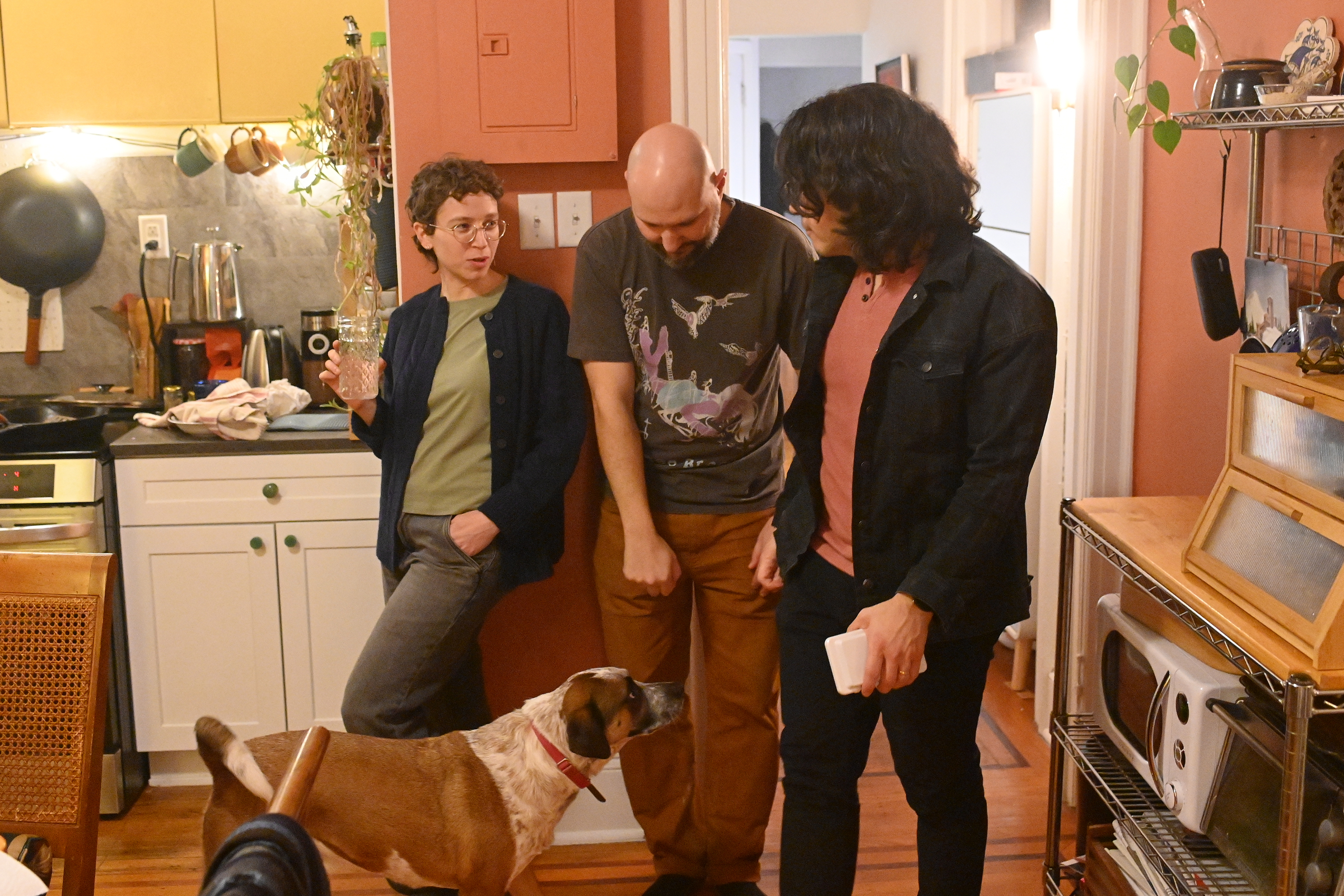
Rachel Luban, house friend Fadi Awadalla, and Serge Levin share a moment in the kitchen.
On committing
Lizzy Seitel: I knew that these are the people that are the most committed to me, besides Serge. I know we can fight and that we’re always gonna want to come back together. There’s no question of, is this friendship gonna last? We’re gonna make it last.
Rachel Luban: A lot of people, including lawyers, told us not to do this. They were like, “You intertwine your lives, and then somebody has a falling out, or somebody wants to move, and then you’re in a mess.”
In a certain way, I think it required the kind of psychological commitment that people make when they get married, where they’re throwing their chips in together. Knowing that if something happens, it could be really messy.
We decided we trust each other enough to think that if something changes, everyone will act with good faith.
On their friendships now
Rachel Luban: You get to know people in a different way, and your fates are more tied together. We had to replace our entire heating system, which is actually three different heating systems. There’s a range of different feelings about spending money and what kind of upkeep the house needs. Even whether we should mow the lawn was a discussion that we had to have.
Lizzy Seitel: We might not live in this house or in this arrangement for every year until we die, but we’re thinking that far ahead — about aging and wanting to be together in this life. That feels like a commitment to each other’s future.
Rachel Neuschatz: Probably I will not formally parent. Maybe it’ll still happen, but that’s not on my bucket list. Lizzy’s kids are like my niblings — nieces and nephews.
On telling other people:
Rachel Luban: Most people are like, “I’m jealous. I want to do that.” Then a minority of people are like, “That’s my personal hell.”
Lizzy Seitel: I feel like there’s this thing of people not knowing that they’re allowed to commit to their friends, or have their friends commit to them.
Rachel Neuschatz: I cap myself from gushing too much, because I don’t want to be a jerk. But yeah, it’s a goddamn paradise that we’ve made ourselves.
This is part of an occasional series about life partners across the Philadelphia area. If you want to share your story about who you’re navigating life with romantically or otherwise, write to lifepartners@inquirer.com. We won’t publish anything without speaking to you first.
Susanna Nolt grew up in Ephrata, the eighth in a family of 12 kids. They were Old Order Mennonites and lived similarly to the Amish, though Nolt said her community pushed back against the comparison: “Our buggies are black! The Amish buggies are gray!”
There weren’t arranged marriages, but Nolt knew what was expected: Around age 18, she could begin dating a young man who was baptized in the Church. After marrying, she would raise her own large family within the Old Order Mennonite community, just as her parents and grandparents and great-grandparents had done. A family tree Nolt made when she was 16 went 14 generations back, featuring almost all Mennonites.
When Nolt was 27, she had what she described as a “spiritual rebirth” and decided to leave. She was excommunicated and kicked out of her family’s home.
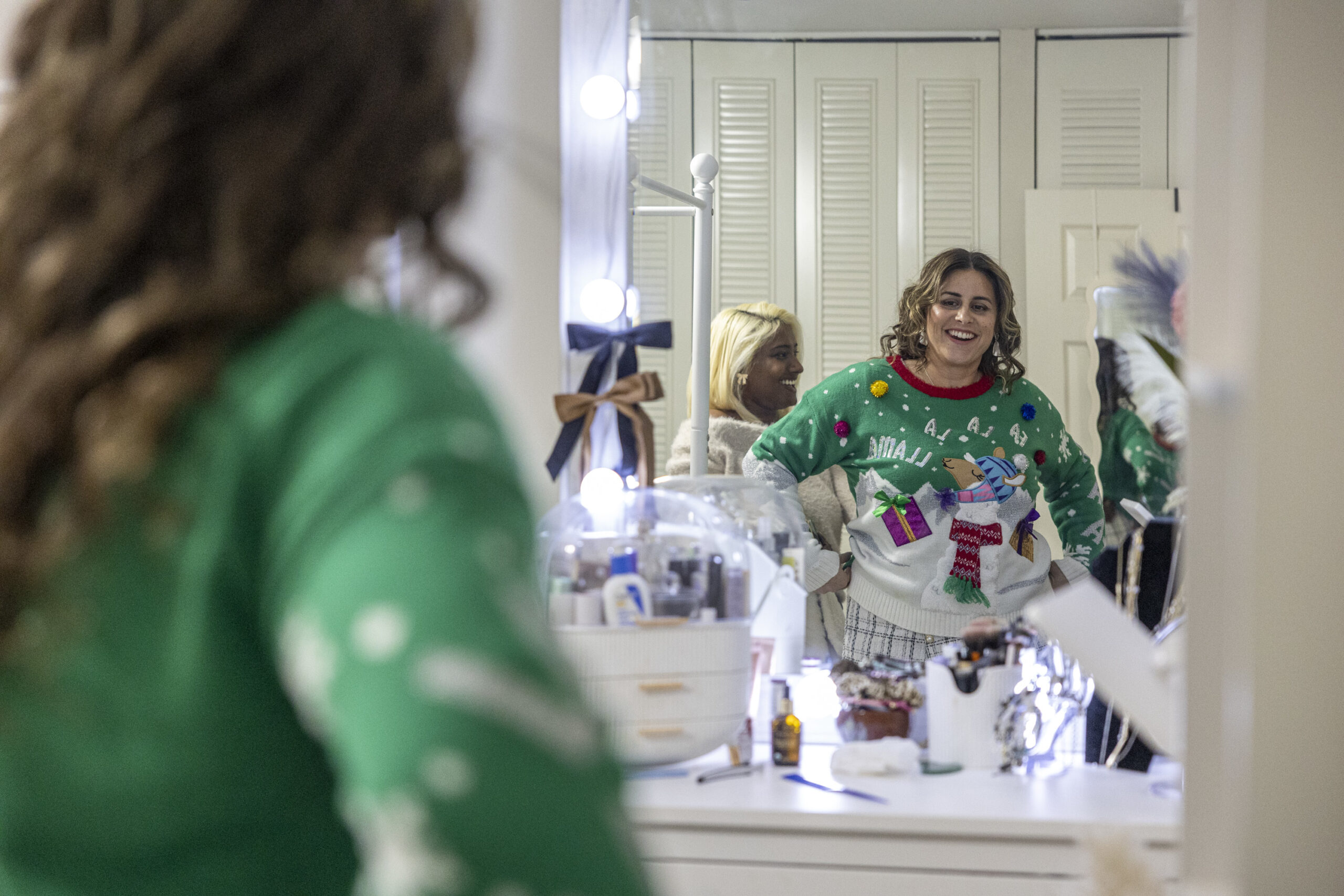
Nolt checks out her Christmas “ugly sweater” before the event.
After a few years of living in Lancaster and nannying in Reading, she moved to Roxborough.
Now 39, Nolt works as a nanny, drives for Lyft, and is earning an online master’s degree in art education from Liberty University. She lives by herself, and is figuring out what romantic partnership might look like in her new future.
The following, as told to Zoe Greenberg, has been edited for length and clarity.
On growing up in a different world
We knew the Church’s rules better than we knew the Bible. They were read to us every half year, the day before Communion: how long the dresses need to be, how big the head coverings need to be.
You didn’t have to work hard to make friends. You had your neighbors, the girls from church. You would go to school in the one-room classroom. We only went till eighth grade; we were prohibited from going to high school or college.
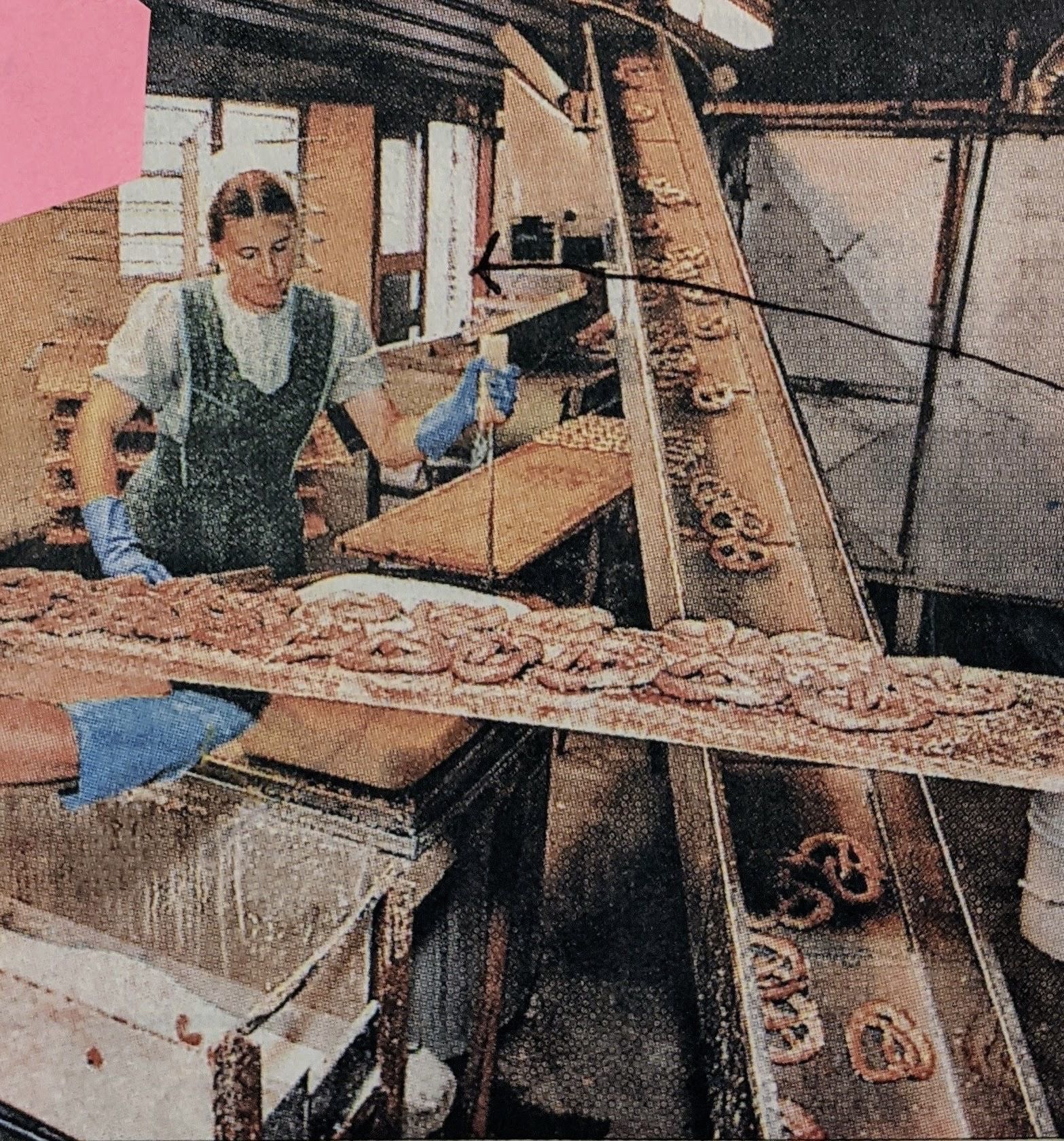
The earliest photo that Nolt has of herself is this newspaper clipping that shows her working at Uncle Henry’s Pretzel Bakery in Mohnton, Pa., when she was 19.
My mom was, obviously, a stay-at-home mom. We did all our cooking, canning, freezing, sewing, baking, gardening ourselves. So that was a full-time job for a mom. We had a ginormous garden.
My dad was a leather worker. He made harness parts for the horses. He was a deacon in the Church, so he was sometimes pretty busy with that, which made our income especially low, because positions in the Church do not pay.
On Sunday nights in the ‘dating parlor’
Young people were pretty much allowed to choose who they wanted to date, with the expectation that you date only someone who’s a baptized member of the Church, to ensure that you can build a good Mennonite family.
We had Sunday night dates, usually five-hour dates at the girls’ homes.
The house was very plain, no pictures. We had a dating parlor — it was the most decorated room of the house. The girls’ boyfriends would come over around seven o’clock on Sundays and stay ‘till 11 or 12.
The couple would sit on the couch and chat. Sometimes younger siblings would go in and play board games with them, or we’d play yard games like croquet or volleyball. Sometimes they would go on a walk in the woods. But most of the time they would spend in the parlor, getting to know each other and discussing their future.
Nolt had never been to a speed dating event before but wanted to try it.
On ‘courting buggies’ and Rumspringa
Sometimes the boys liked to decorate their buggies, to make them courting buggies. They would have a fancy varnished cabinet in the front, and maybe some dice or feathers hanging, and a nice afghan blanket or some kind of throw over the feet, because they wanted to impress their girls. They’d put reflectors on the buggy and some stripes, usually coordinating with the interior of the buggy.
In the outside world, I’ve learned they see Rumspringa as this year where you go out and experiment with the outside world, but that’s not really what it was to us. Rumspringa was just youth group, hanging out with our friends from church on Saturday nights.
Often it was hymn singing, and then afterward we would have a snack and play volleyball. There was usually a dance. We weren’t allowed to listen to music, so the dance itself was often kind of boring, because dance and music kind of need each other.
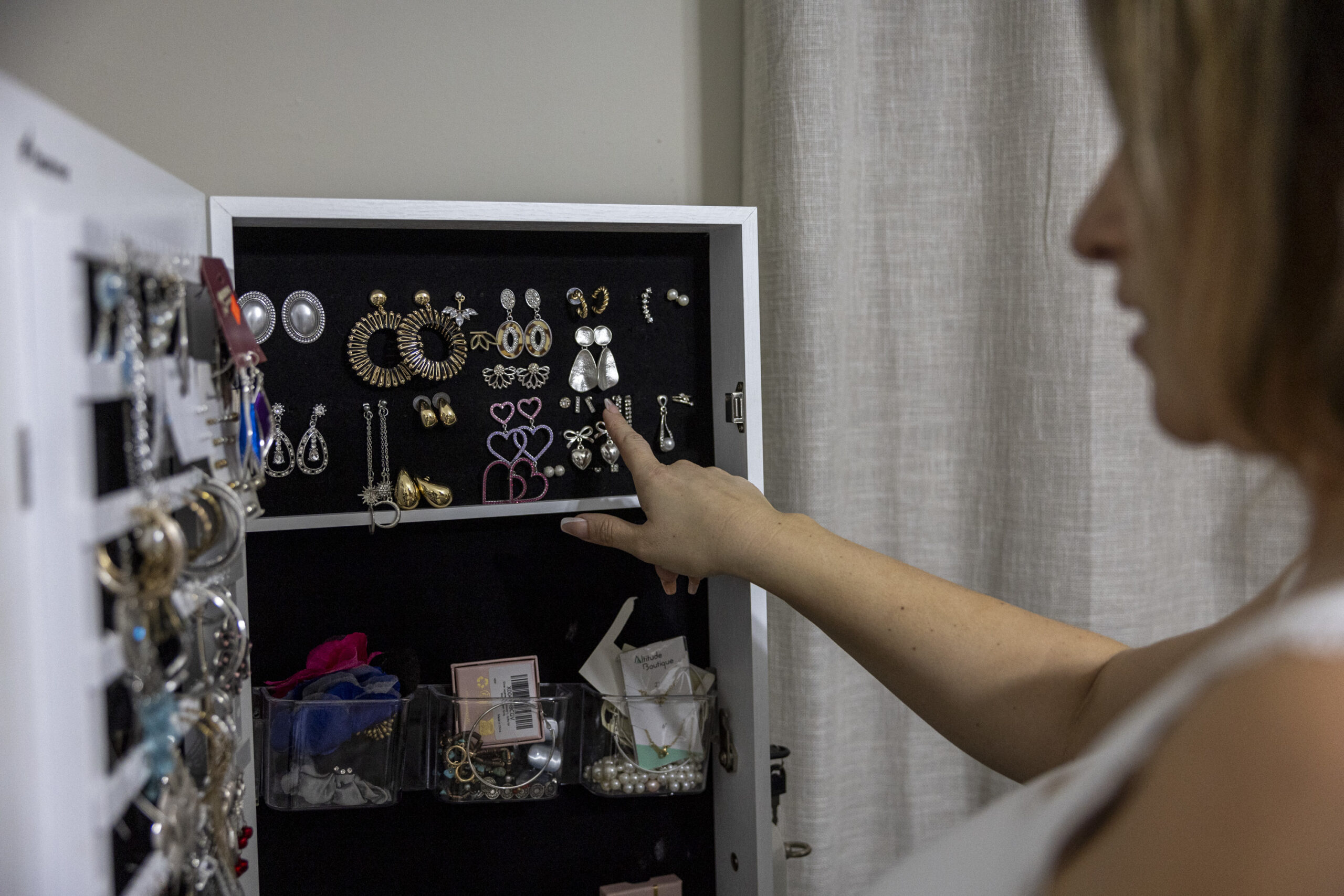
Nolt consulted her friend on which earrings she should wear.
I didn’t date much. In my time, guys didn’t really ask as easily, and the girls had no way of playing into it. You just had to wait until a guy would ask you. That felt very constricting to me.
Only about 50% of my friends were dating, if that. My mom especially, she had no problem with me being single.
Our weddings would happen on Tuesdays or Thursdays at the bride’s house. The bride’s family was responsible for hosting the wedding, which was all day: eight o’clock in the morning to at least eight o’clock at night. I never knew weddings were that expensive, because the family just provided it.
On choosing to leave
Ever since I was 10 years old, I had questions. I wouldn’t ask my questions, because that would make you a troublemaker. Ironically, I was afraid that our rules weren’t strict enough. For example, we weren’t allowed to have cameras or pictures because that was considered a graven image or an idol. I always loved playing with dolls, and I started thinking, “Maybe dolls are graven images or idols.” And I became so obsessed and bothered.
I tried to settle down by getting baptized at 17. But I felt like something wasn’t right, something was missing.
Then, when I was 27, I was teaching out in Kansas for a completely different set of Mennonites. I started realizing that bringing my rules to their community did not help anything. Like, nobody wants more rules.
I had this moment of rebirth in which I realized that Jesus is not the same as being Mennonite and all these rules really have nothing to do with Jesus.
At first I kept it to myself. I didn’t actually get excommunicated and kicked out of my parents’ house until soon after I was 28.
On losing everything
I learned that leaving is a much, much bigger deal than I ever realized, because those relationships were basically severed. I lost all my friends. I lost everything I had ever known. I had no idea how to drive a car. When I finally was able to get a car, it was like, No, you can’t drive it, you have to get a title, you have to get it notarized, you have to get insurance.
In my experience, you just get a horse and a buggy and you go drive.
A year or two after I left, my mom said that they’d been talking about it, and they decided they still want to be family. I’m still seen as the black sheep, but basically if they invite the family, they’re going to invite me. I can visit them, but of course I have to wear a long skirt or dress.
It doesn’t feel like family. It’s kind of this emotional distance.
On assimilating to the ‘English’ world
I had been nannying and I was looking for my next position and all the good ones were in Philadelphia. I moved to Philly, not knowing anyone.
I have to learn how normal people think. I grew up with no music, no media, no TV. A lot of conversations make all kinds of references to singers, actors, movies, shows. It’s a lot of researching all the time to understand what people are talking about.
I was enjoying Christian music already and I wanted to branch out, but found it difficult to connect with the music since it was overwhelmingly new. I could never recognize songs playing in public areas — it just sounded like noise. Until one day I did recognize a song and I felt so connected and happy I got tears.
Nolt in her home in Roxborough, where she lives alone.
So one of the guys I dated would send me playlists of 12 songs every time I requested a new list. I specifically asked to focus on songs that you hear in restaurants, malls, offices, etc. He would send me a list and I listened until I was familiar with each song.
My previous employer composed a list of 50 classic movies from the ‘70s to the current day so I could watch and slowly begin to catch on to references. Over the holidays that year when I was lonely, I binge-watched all those movies.
I found acquaintances in Philly who taught me about football, patiently explaining how the game works. I’ve become an Eagles fan.
On dating and ghosting
Most of the people I dated, I met online. I’ve used Upward, which is a Christian dating app; I’ve used Match. Even though I’m 39, in many ways, I’m just starting my life.
There was a guy who was in the film business, and I said, “I grew up without any of this, and so I’ve always been curious, how do they create this effect?” He got so freaked out that that was my background, and he sent me a long text afterward like, “I think you’re a really wonderful girl, but we’re just not compatible.” And he quickly blocked me.
Dating is much more inconsistent than dating in the Old Order Mennonite community. You think you’re dating them, and then all of a sudden they’re like, “Oh, never mind.”
I don’t expect perfectly scheduled dates like we had back there, but just some sense of consistency.
Nolt headed to the church where the speed dating event was held.
There’s some pretty serious genetic diseases among my people because the gene pool is so small, so I’m really not interested in dating someone from my background. Another reason I’m not interested is that many of them do not really assimilate to the extent that I have.
I’ve taken a number of the people I’ve dated out to Lancaster. They met my parents, and some of them did really well. Others were more just glad when it was over.
I don’t hide my background, because it’s part of who I am. Sometimes I wish it wasn’t, but that doesn’t change the fact that it is.
If I have a long-term committed relationship, I’m going to need to have someone who can be OK with that.
This is the first in an occasional series about life partners across the Philadelphia area. If you want to share your story about who you’re navigating life with romantically, write to lifepartners@inquirer.com. We won’t publish anything without speaking to you first.
Christina Gallo and Daniel Zehnder came to McPherson Square in the Kensington neighborhood looking for a fix, as they did almost every day.
But on this day in late April, an SUV pulled up. A woman bounded out with an offer that sounded like a miracle: an all-expenses-paid trip for free treatment at a luxury rehab center in California.
Gallo and Zehnder, both then37, hoped their lives were finally about to turn around after two decades strugglingwith addiction.
“We wanted to get clean,” Gallo said.
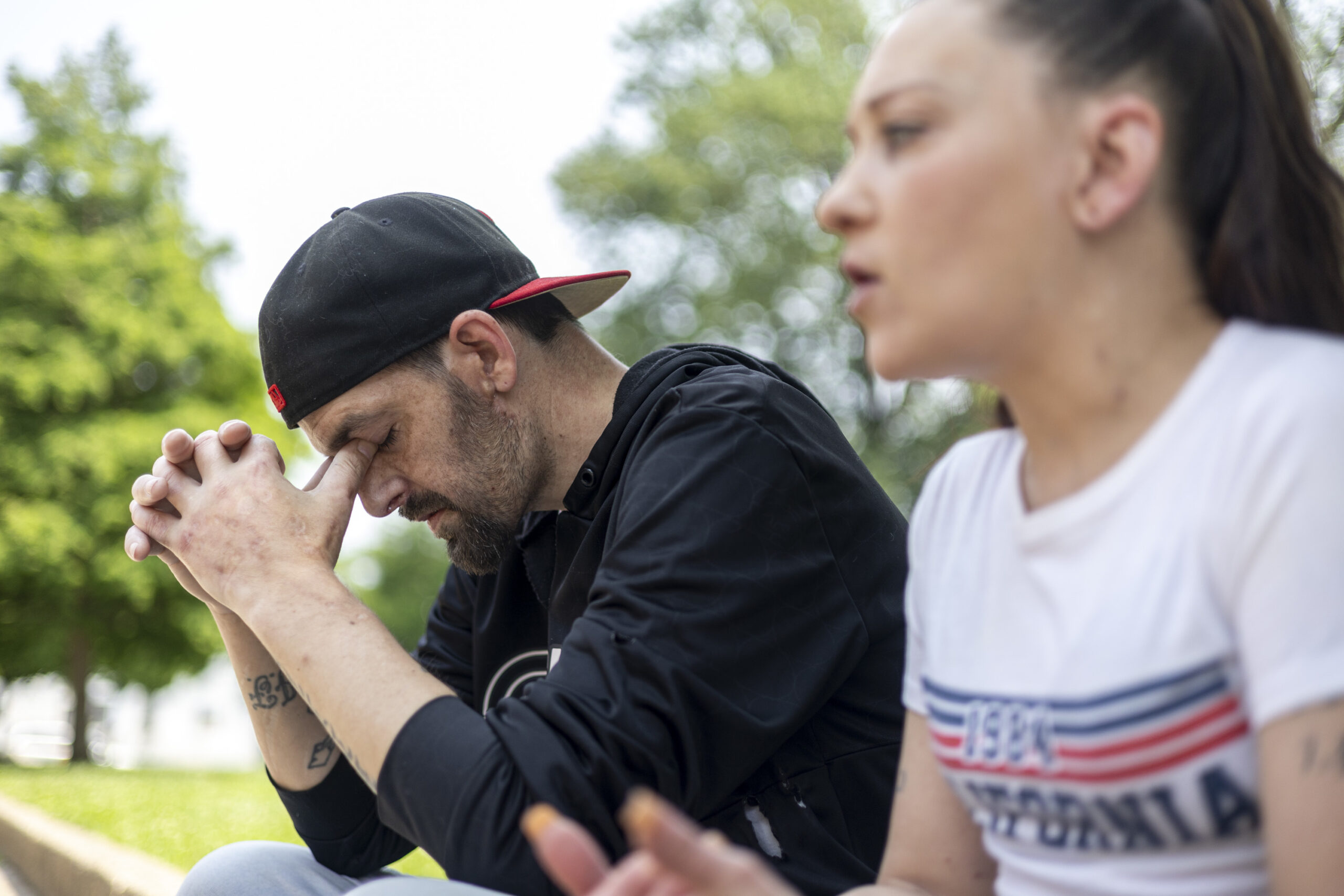
Christina Gallo and Daniel Zehnder, pictured here in Kensington’s McPherson Square in June, were recruited to what they thought would be a luxury rehab in California.
Within days, they were in a Lyft from their Bucks County trailer to the Philadelphia airport. Everything — the Lyft, the flight, the rehab — had been paid for, by whom they did not know.
They landed at a treatment facility in Los Angeles with a gleaming swimming pool, but said they did not see doctors or nurses and were offered little medical treatment to ease their agonizing withdrawal symptoms.Within a few days,the couple had left the clinic, relapsed, and the life-changing trip they envisioned ended in an ambulance rushing to a nearby hospital, where Gallo was admitted to intensive care.
Their California dreams were dashed. But the trip notchedanotherrecruitmentfor The Rehab Specialist, a year-old operation that makes money by scouting the streets for people in addiction to send to independently run rehab centers across the country.
Rehab Specialist recruiters working in Philadelphia offered free plane tickets, housing, and medical care — and at times cash, cell phones, cigarettes, and clothes — to entice people into recovery homes, Inquirer reporters found in interviews with seven people who had firsthand knowledge of the recruiting tactics.
With a single conversation in Kensington, recruiters alsogot willingpatients enrolled in private health insurance that could pay higher rates, often without the patients understanding what they had signed up for — until bills started to arrive.
Businesses like The Rehab Specialist operate as middlemen inan industry where one person’s recovery can be cashed in for hundreds of thousands of dollars in insurance payments.
Some referral and marketing services in the addiction treatment industry are legal. But the business is also notoriously rife with insurance fraud and patient brokering — a term that describes referrals to specific clinics in exchange for illegal kickbacks or bribes.
Rehab Specialist brochure, advertising a Spanish-Colonial style mansion with a pool in the backyard.
Pennsylvania is seeing a resurgence of patient brokering, according to tracking in 2023 by Highmark Health, a Pittsburgh-based Blue Cross Blue Shield affiliate. Such schemes are especially a concern in Kensington, home to one of the nation’s largest open-air drug markets.
Federal laws and a patchwork of state laws are supposed to protect vulnerable people. Prosecutors have limited resources, however, and rarely investigate low-level players.
Pennsylvania considered stronger laws after a major scandal.In 2019, federal and state prosecutors uncovered a multimillion-dollar insurance fraud scheme at Liberation Way, a Bucks County recovery home. The abuses spurred Pennsylvania lawmakers to introducelegislation that would have made it a felony to use money or services to lure patients into addiction rehabs and other healthcare facilities. The measure died without advancing to a vote.
“People get pretty brazen when nobody’s looking,” said Alan Johnson,chief assistant state attorney in Palm Beach County and a national expert on fraud in the industry.
Johnson called a description of The Rehab Specialist’s practices “classic patient brokering.”
For months, Philadelphiaadvocates for people in addictioncirculated warnings about the business and posted photos of its recruiters on Facebook. They tried to alert police, but never heard back.
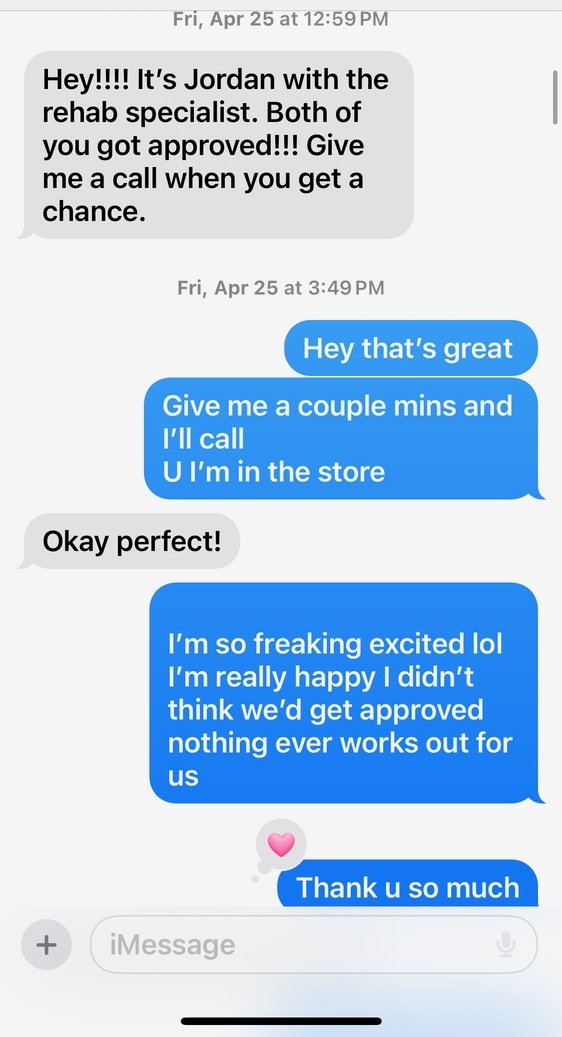
Screenshot of text messages between Christina Gallo and a Rehab Specialist recruiter, saying that Gallo and Zehnder got approved for private insurance that would pay for their treatment in California.
The Philadelphia Police Department did not respond to requests for comment, and the Philadelphia District Attorney’s Office said it has not opened an investigation and declined to comment on The Rehab Specialist’s practices.The Pennsylvania Attorney General’s Office also declined comment.
On social media, The Rehab Specialist’s director and founder, Gus Tarrant, strongly disputed critics who accused his business of patient brokering.
“I have never and would never give a client money to go to rehab or encourage them to cycle in and out of programs,” Tarrant wrote in a March post to a Facebook group that monitors addiction treatment.
Tarrant, in a June interview with The Inquirer, reiterated that he and his business havedone nothing wrong.
Tarrant said that his operation has a national focus and came to Philadelphia this spring because the city has “the worst drug epidemic in the country.”
Tarrant said his recruiters send patients out of their home state to avoid triggers for relapse, a practice he strongly believes in, having gone through his own recovery from addiction about five years ago. (Though popular in some recovery circles, some research suggests that it can be less effective than getting treatment closer to home, where people have established support networks.)
“Our goal is to help as many people as we can,” Tarrant said. Now based in Myrtle Beach, S.C., Tarrant has channeled his experience into starting at least two businesses in the past five years focused on people in addiction.
He said rehab centers payhis business a flat fee to arrange for people from Kensington to receive treatment in California, but declined to share details. Two Los Angeles treatment centers told The Inquirer they had paid Tarrant and his operation a flat fee for “marketing,” but both also declined to give specific details of the arrangement.
On business cards, Tarrant’s title is listed as The Rehab Specialist’s founding partner; his LinkedIn profile says he started working there in 2024.
The Inquirer was unable to find any documentation indicating the business was formally incorporated in a search of state corporate registries where its recruiters and Tarrant have operated. The Inquirer also did not identify any lawsuits filed against The Rehab Specialist.
The Inquirer interviewed Tarrant by phone this summer. He did not return multiple calls, texts, and emails this month requesting additional comment.
Reporters interviewed five people who were approached by The Rehab Specialist’s recruiters on the street, and another two whose relatives were recruited.
All shared similar stories about how the process worked. Two said they enjoyed eating chef-made meals and benefited from group therapy and daily outings in Los Angeles.
One mother said her son ultimately decided not to board the plane to California, though he continued to receive frequent calls from Rehab Specialist recruiters urging him to travel for treatment. In another case, a woman said her brother did not get the care he needed in California and ended up in the ICU.
Gallo and Zehnder were among the three people interviewed who said the medical care they received in California did not meet their expectations for a luxury rehab facility. The couple blames The Rehab Specialist for launching them on a journey that ended with them worse off than before.
“I don’t know if they have the intention of trying to help people,” Gallo said, “but they’re going about it totally the wrong way.”
Christina Gallo and Daniel Zehnder in June, sitting in the spot where they were first approached by The Rehab Specialist recruiters in McPherson Square Park.
Lofty promises and dire warnings
The fliers that The Rehab Specialist recruiters passed out in Kensington featured photos of a Spanish Colonial-style mansion surrounded by palm trees, with a pool in the backyard. They advertised “holistic treatment” including equine therapy, medical detox, and an intensive outpatient program.
All that, in sunny California.
The pitch has particular appeal in Philadelphia, where people have struggled through long waits to access medical detox programs that allow patients to withdraw under the supervision of a doctor or nurse. These programs typically offer medications to help ease intense withdrawal symptoms like nausea, vomiting, and agitation, all of which have become more dangerous as potent animal tranquilizers and industrial chemicals contaminate the local drug supply.
Despite often lofty promises, the addiction treatment industry has long seen high-profile prosecutions over exploitative practices.
In the Philadelphia area, the Liberation Way prosecution sent the company’s CEO and medical director to federal prison. Prosecutors said the center had signed patients up for private insurance plans and paid their premiums. It then charged insurers for shoddy or unnecessary treatment that resulted in excessive insurance payouts.
California and Florida in particularhave emerged as hot spots for addiction treatment fraud. In South Florida, a 2022 federal prosecution of a$112-million scheme led to prison sentences foreight people accused of using cash bribes and free rides, flights, drugs, and alcohol toattract patients to a rehab center.The payments were distributed via anetwork of lower-level street recruiters, purportedly hired for “marketing,” according to an affidavit from the case.
But addiction treatment scams are often ignored because they involve sprawling national investigations that require significant resources. State prosecutors can’t justify the expense and federal prosecutors won’t take on low-level fraudsters, according to Johnson. Palm Beach County prosecutors stepped up enforcement after the state passed stricter laws in 2017.
“You have to prioritize cases. This is not high on their hit list, unless it’s going to make a big splash,” said Deb Herzog, a former federal prosecutor turned fraud investigator at Anthem Blue Cross.
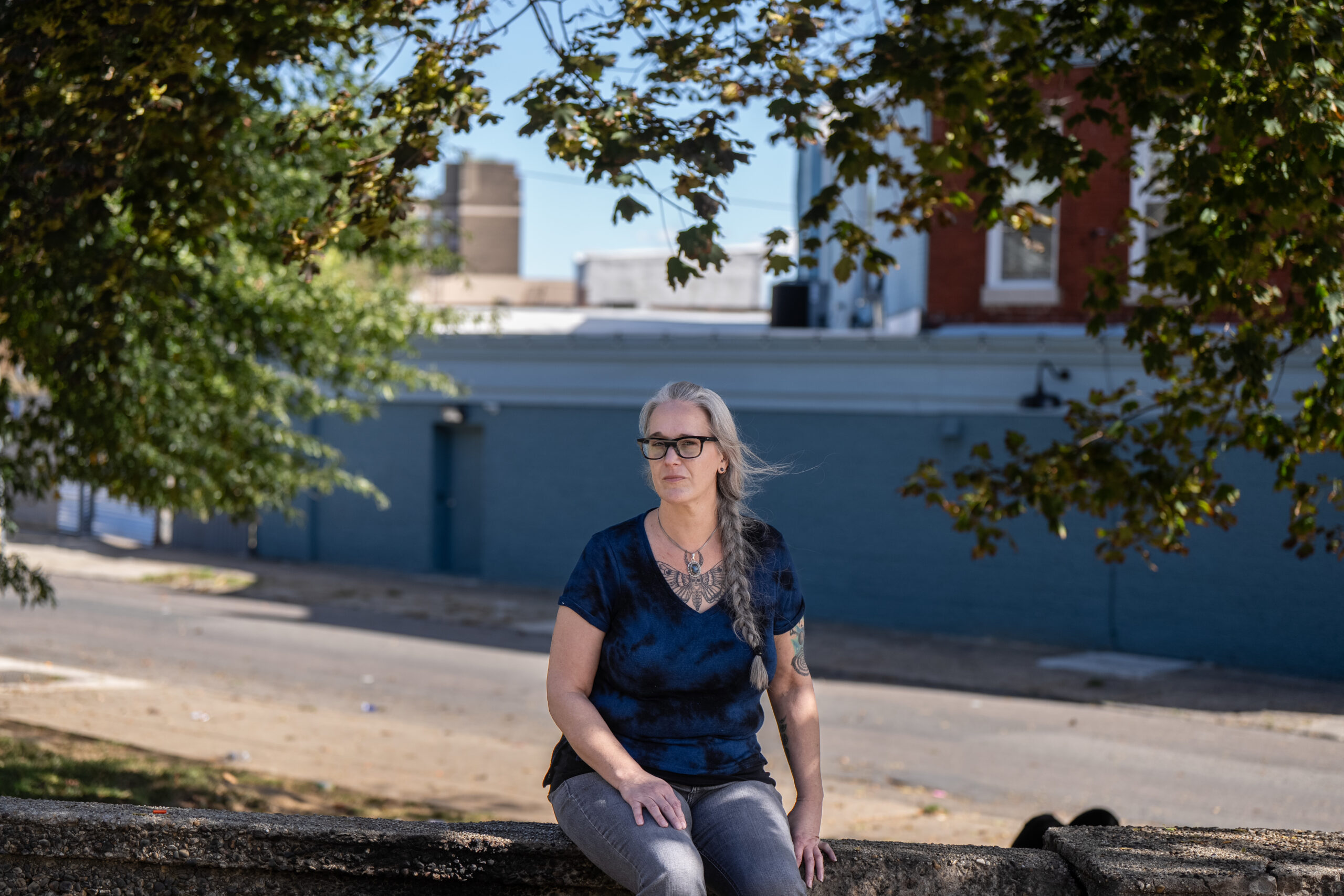
Melissa Ruby, an activist who runs a national Facebook group to monitor patient brokering, in Philadelphia in October.
Warnings about The Rehab Specialist instead came from Melissa Ruby, 46, and other local advocates. Ruby runs a Facebook group dedicated to monitoring patient brokering nationwide, and started sharing photos on social media as soon as the recruiters showed up in Kensington. She did the same when they were reportedly spotted in Pittsburgh.
She said she also alerted aPhiladelphia police officer who runs an independent nonprofitto help people in addiction, but never heard back.
For Ruby,the issue is personal: She has a relative who was a victim of patient brokering.
“BEWARE!!” she wrote in a March post about The Rehab Specialist, punctuated with red stop sign emojis. “No good will come from any of this!!”
Tarrant, the Rehab Specialist director, was a member of Ruby’s Facebook group at the time and wrote that the vast majority of the negative information Ruby had posted about him was “completely wrong.”
“I am not paid by the client or any ‘referral fees’ based on clients sent,” Tarrant wrote.
When asked in the Facebook group why The Rehab Specialist was sending patients out of state on free flights, he declined to answer, writing that he believed the questions were in bad faith. He encouraged people to reach out to him directly so he could explain.
After a few weeks, Ruby kicked him out of the group. “Adios, Gus!” she wrote.
A sunny pitch in Kensington
One day in April, two female Rehab Specialist recruiters introduced themselves to Samuel Rosato, 47 at the time, as he got off the El near Kensington. He was immediately intrigued.
“They were just real pretty and tan,” Rosato said.
They later said all they needed were a few identifying details, and they would be able to set him up with private insurance that would pay for everything at a luxury rehab out west.
Rosato scribbled down his Social Security number and handed over his ID card. Within 10 minutes, he said, the recruiters told him they had secured him Blue Cross Blue Shield insurance. Rosato, like others interviewed by The Inquirer, did not know who was paying for his insurance or lodging.
The Rehab Specialist recruiters, whose names he shared with The Inquirer, are not licensed insurance brokers or healthcare navigators in Pennsylvania.
Allison Hoffman, a health law professor at the University of Pennsylvania, said that without more information on how patients were signed up for insurance plans, it isdifficult to say definitively whether insurance laws were violated. But, she added, “it sounds potentially illegal.”
Tarrant said his employees “don’t deal with any of the insurance.” He said they do not directly enroll clients in insurance, but rather direct recruitsto independent, licensed insurance brokers.
Patients “sign up for the insurance themselves,” he said. Hedeclinedto say more, citing patient confidentiality.
A week later, Rosato said an Uber picked himup at his mother’s home in Northeast Philadelphia for his flight to California. He said he was joined by three other people from Kensington who told him they had also been recruited by The Rehab Specialist.
“I love it out here,” Rosato said in June, several months into his recovery in California. “I’m trying to rebuild my life now, starting at the bottom.” (Rosato stopped responding to calls and texts from The Inquirer in the fall; his mother said this month that he’s back in Philadelphia, but she is not sure where.)
Jerome Hayward, 48 at the time, and his girlfriend, Megan McDonald, 39 at the time, also didn’t ask too many questions when they were recruited in front of a Kensington soup kitchen and traveled separately to California in the spring.
Told only that she had been “approved” for treatment, McDonald said she didn’t realize she had been signed up for a Blue Cross Blue Shield plan until she received paperwork at a hospital.
“How would we pay for it?” McDonald asked. “Because we’re broke. We got no money.”
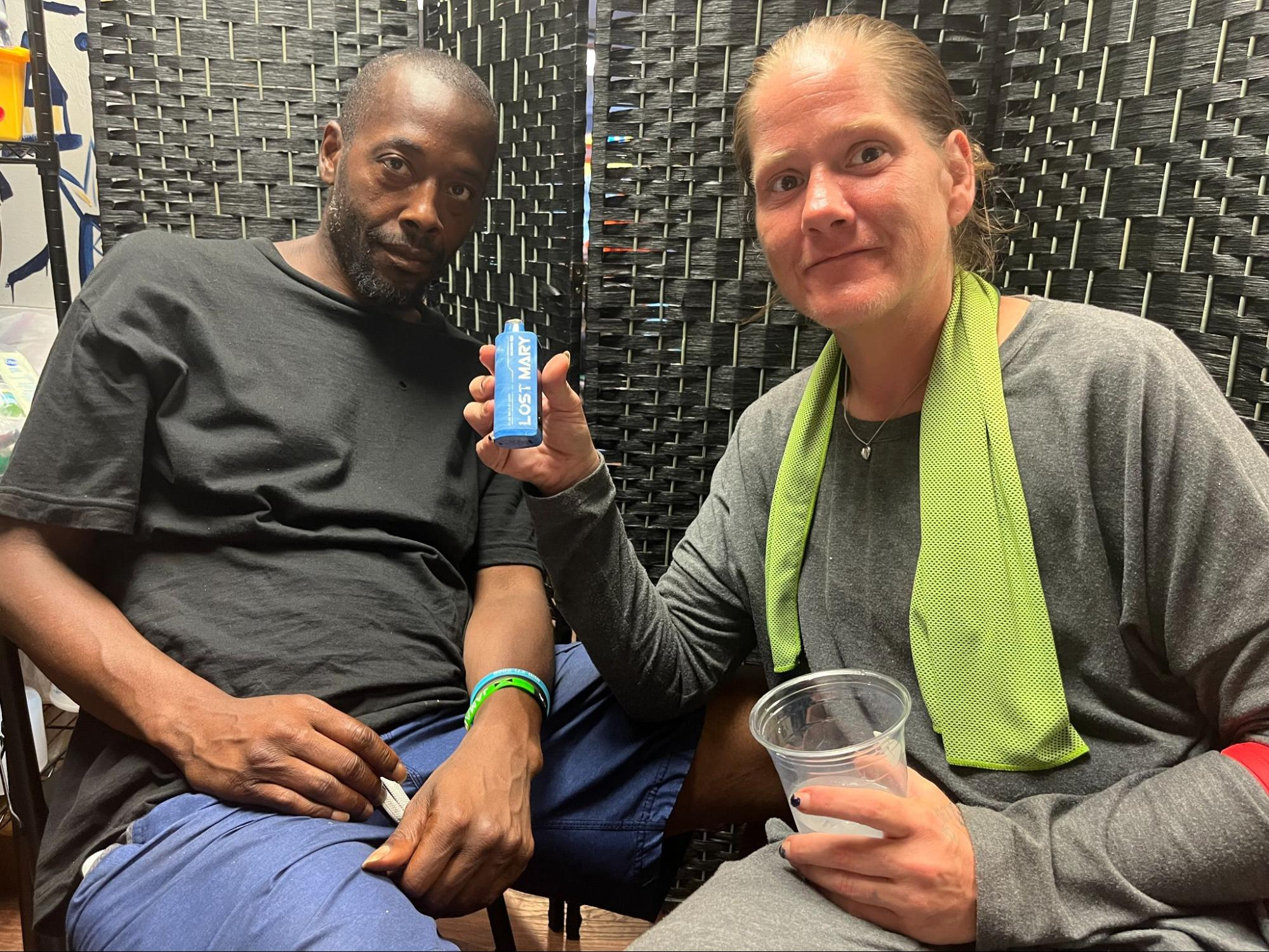
Megan McDonald and Jerome Hayward at a drop-in center in Philadelphia’s Kensington neighborhood.
A rising entrepreneur
Tarrant rose in the rehab industry after getting his start vacuuming floors at a rehab company run by LaMitchell Person, a mentor who Tarrant credited for giving him “the opportunity to get sober and clean,” in an interview with a local news station in California. The two later became business partners.
They were working together at a California rehab company in 2021 when a 22-year-old named Dean Rea died of a fentanyl overdose after leaving an associated sober home.
Rea’s mother later accused Tarrant, Person, and other employees ofcontributing to the death in a lawsuit filed against the facility,Ken Seeley Communities. Neither Tarrant nor Person, then the facility’s executive director, was named as a defendant in the case.
In court records, Rea’s mother claimed Tarrant falsely told Rea that his insurance wouldn’t cover more intensive treatment elsewhere.
“Gus is, essentially, a salesman whose goal is to admit as many patients to KSC as possible,” their legal complaint said. The rehab company denied the allegations, and Rea’s suit was settled in a confidential agreement in 2023 for an undisclosed amount.
In an interview this month, Person called the lawsuit’s claims inaccurate. “Fentanyl killed her son. Not Gus, not me, and not the organization,” Person said.
By the time the suit was settled, Tarrant and Person had both left the business.
In 2022, they filed paperwork to incorporate a company called Origin Addiction Services, based in Idaho, according to state corporate records. An official address on the website is a P.O. box in a Boise strip mall.
The company’s website said it offered addiction recovery services such as interventions, sober companionship, counseling, and transportation.
The company’s website featured an ‘about’ page with professional headshots of a nine-member executive team. All but three of those headshots appearedto be drawn from stock photo services,and The Inquirer was unable to trace the individualsto authentic social media or LinkedIn accounts.
After The Inquirer contacted Personabout the photos in September, all of them– except his own — were removed overnight. Person later said in a phone interview that the stock photos and some of the employee names were “placeholders,” but insisted that the staffers were real.
The company filed paperwork to dissolve a year later; Person said it had never done business, and he and Tarrant went on to pursue separate endeavors.
Person was in Philadelphiarecruiting people at the intersection of Kensington and Allegheny Avenues in March, according to acity employee there to help people in addiction. Person handed him a business card identifying himself as a “regional director” of The Rehab Specialist, said the employee,whom The Inquirer is not naming because he was not authorized to speak to the media and feared losing his job.
Person answered the phone this summer when The Inquirer called the Rehab Specialist’s general number, but he said he did not work there.
In a follow-up interview this month, he said that Tarrant had hired him to build a call center for a California rehab, saying that was his only involvement with The Rehab Specialist.
He said he hadnot come to Kensington and was not responsible for business cards that listed him as the regional director.
“Gus wanted me to work for him, because we are friends,” Person said.
Christina Gallo and Daniel Zehnder in McPherson Square Park in June.
A dream dashed in California
Desperate to get clean, Christina Gallo and Daniel Zehnder accepted the offer to fly to California after being recruited in Kensington earlier this year. A luxury van picked the couple up when they arrived at Los Angeles International Airport on May 3, they said.
The driver took the couple to Gevs Recovery, a large gated house in a residential neighborhood in Northridge. Gevs has been licensed as a drug abuse recovery home since 2024. State records show that as of early August, no complaints about its care have beenfiled with the California Department of Public Health.
Gallo and Zehnder said the Gevs house was dark and empty when they arrived, aside from a handful of employees. Gallo began to panic as drug withdrawal left her shaking and sweating, with a bloody nose and headache pangs that felt like she had stuck her finger in an electrical outlet.
“I said, ‘What’s going on here? Where’s any of the nurses or the doctors?’” she recalled. “‘Who’s going to be taking care of us, medically?’”
“We don’t do that here,” she remembers them saying. The Gevs employees told Gallo they could send her to a hospital, or give her some Tylenol, she said.
Alarmed, Gallo and Zehnder decided to leave. On their way out, they said a woman descending the stairs told them she had just left the hospital after a month there.
“Are you guys from Philadelphia, too?” Gallo recalled the woman asking.
She and Zehnder headed to a cheap motel, but they didn’t feel they could stand the withdrawal effects and decided to buy drugs nearby. By the morning, their symptoms had grown worse, and they returned to Gevs to demand plane tickets home.
Kristine Kesh, an operations manager at Gevs, told The Inquirer the center does have medical staff on site and does offer medication treatment for withdrawal.
“These clients have been addicts for most of their lives, and they come in expecting this glorious detox,” Kesh said. “Whatever they’re expecting is not realistic. I mean, you can’t help everybody.”
At the airport, Gallo vomited on herself before collapsing to the ground in pain. Zehnder defecated and vomited on himself. An ambulance took them to the emergency room, where Gallo was placed in intensive care.
After two days in the emergency room and the intensive care unit, Gallo and Zehnder were released.Zehnder’s mother paid for their flights home.
While Zehnder was away, bills from Highmark started arriving at his mother’s house — even though he had been promised free treatment.
The bill, which misspelled his last name, said he owed a $267 premium for the month of May. He said he also received a $700 bill for the ambulance ride from the LA airport to the emergency room, which he threw away.
Six months after their disastrous trip, recovery feels as far away as when their return flight from California landed. At the Philadelphia airport, they hailed a cab and went straight to Kensington. They wanted to inject heroin, right away.
Each of the city’s libraries, from Bustleton to Kingsessing, is a neighborhood hub stocked with books, movies, magazines, video games, and other media that anyone with a library card can access. This year, the Free Library circulated 7.6 million items and hosted 1.7 million people across its 54 branches.
So what were your neighbors reading this year?
We asked the library for the most borrowed fiction, nonfiction, and video games across the city. (The numbers don’t include e-books or audiobooks because they’re handled by a third party.) Can you sort the lists below from most to least popular?
Fiction
Rank
Which was the most popular?
Library Checkouts
Your Ranking
Drag to reorder this list
1
2
3
4
5
6
Liz Moore
The God of the Woods
Percival Everett
James
Alison Espach
The Wedding People
Suzanne Collins
Sunrise on the Reaping
Emily Henry
Great Big Beautiful Life
Dave Pilkey
Dog Man: Big Jim Begins
Liz Moore
The God of the Woods
Percival Everett
James
Alison Espach
The Wedding People
Suzanne Collins
Sunrise on the Reaping
Emily Henry
Great Big Beautiful Life
Dave Pilkey
Dog Man: Big Jim Begins
The most checked-out print book of the year across all Philly’s library branches — in any genre — was Liz Moore’s 2024 The God of the Woods, a propulsive thriller about a girl who goes missing from a summer camp in 1975, eerily mirroring the disappearance of her brother from the same place 14years earlier.
“An extraordinary storyteller, Philly would adore her transportive books even if she weren't an English professor at Temple,” said Kim Bravo, the Free Library’s adult materials selector.
Bravo said she was surprised that a few popular books, including Onyx Storm by Rebecca Yarros and Atmosphere by Taylor Jenkins Reid, weren’t also at the top of this year’s list.
story continues after advertisement
Nonfiction
Rank
Which was the most popular?
Library Checkouts
Your Ranking
Drag to reorder this list
1
2
3
4
5
6
Tariq Trotter & Jasmine Martin
The Upcycled Self
Mel Robbins
The Let Them Theory
Jonathan Haidt
The Anxious Generation
James Clear
Atomic Habits
Ezra Klein & Derek Thompson
Abundance
John Green
Everything is Tuberculosis
Tariq Trotter & Jasmine Martin
The Upcycled Self
Mel Robbins
The Let Them Theory
Jonathan Haidt
The Anxious Generation
James Clear
Atomic Habits
Ezra Klein & Derek Thompson
Abundance
John Green
Everything is Tuberculosis
The most popular nonfiction book borrowed in Philly libraries this year was The Upcycled Self: A Memoir on the Art of Becoming Who We Are by The Roots’ Tariq “Black Thought” Trotter and Jasmine Martin.
The 2023 book traces Trotter’s life growing up in South Philly: “Our history leaks a particular radiation into the blood of those born within its city limits. Loyalty, fight, pride, honor,” he writes. The book was the library’s 2025 One Book, One Philadelphia selection.
The library’s adult nonfiction selector, Ai Leng Ng, said one surprising book that didn’t make the list was Inner Excellence, by Jim Murphy, the self-help book that went viral after wide receiver A.J. Brown was seen reading it on the sidelines of an Eagles playoff game in January.
story continues after advertisement
Video Games
Rank
Which was the most popular?
Library Checkouts
Your Ranking
Drag to reorder this list
1
2
3
4
Nintendo
Super Mario Bros. Wonder
XBox Game Studios
Minecraft Legends
Sega
Sonic x Shadow Generations
Nintendo
Super Smash Bros. Ultimate
Nintendo
Super Mario Bros. Wonder
XBox Game Studios
Minecraft Legends
Sega
Sonic x Shadow Generations
Nintendo
Super Smash Bros. Ultimate
The most popular video game checked out this year was Nintendo’s 2023 Super Mario Bros. Wonder, a 2D adventure in the new, whimsical Flower Kingdom.
All the most checked-out video games were ones that could be played by gamers of all ages, said Kris Langlais, the library’s AV Selector. The top titles “also have a nostalgic factor for our adult patrons.”
Langlais said that books set in the worlds of widely played video games, including the Five Nights at Freddy’s, Minecraft, and Pokémon series, are also popular with patrons.
Thanks for playing! If you think you can hack it, head to our bonus round below and order the Dog Man graphic novel series from most to least popular.
Staff Contributors
Design and development: Charmaine Runes
Reporting and data: Zoe Greenberg
Editing: Sam Morris, Evan Weiss
Copy Editing: Brian Leighton
Bonus Round: Dog Man
The Dog Man graphic novel series is extraordinarily popular all over the country, including Philly. Here are five Dog Man books, each of which were checked out over 100 times across the local library system. Which was the hardest to get your hands on?
Rank
Which was the most popular?
Library Checkouts
Your Ranking
Drag to reorder this list
1
2
3
4
5
Dave Pilkey
Dog Man: Fetch 22
Dave Pilkey
Dog Man: Grime and Punishment
Dave Pilkey
Dog Man: A Tale of Two Kitties
Dave Pilkey
Dog Man: Scarlet Shredder
Mo Willems
Dog Man: Mothering Heights
Dave Pilkey
Dog Man: Fetch 22
Dave Pilkey
Dog Man: Grime and Punishment
Dave Pilkey
Dog Man: A Tale of Two Kitties
Dave Pilkey
Dog Man: Scarlet Shredder
Mo Willems
Dog Man: Mothering Heights
The 14-part Dog Man series by Dav Pilkey features a part-man, part-dog hero.
“We’re in the golden age of graphic novels for children. Most of the most heavily circulated children’s items this year were graphic novels, including graphic adaptations of popular fiction series like The Baby-Sitters Club, Sweet Valley Twins, and Wings of Fire,” said Megan Jackson, the library’s middle grade selector.
As for Dog Man in particular, “Dav Pilkey has been tapping into what kids want to read since Captain Underpants was first published in 1997— fast-paced, emotionally honest, hilarious stories that balance words and illustrations for multi-layered reading.”
In both West Philly and Northeast Philly, a Dog Man book was the top checked-out item across all genres.
Subscribe to The Philadelphia Inquirer
Our reporting is directly supported by reader subscriptions. If you want more journalism like this story, please subscribe today
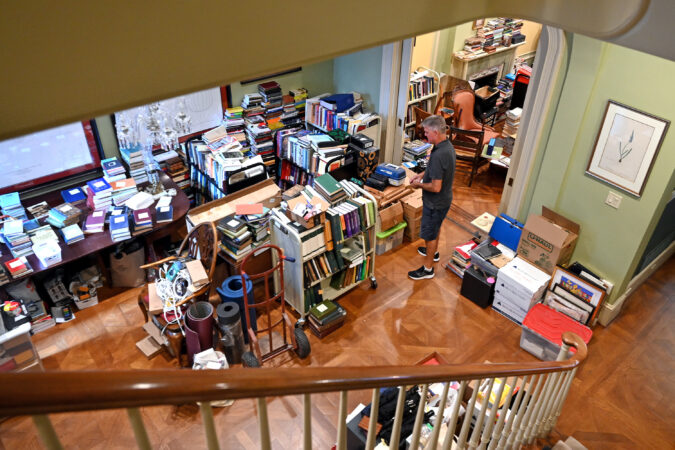
The estate sale of the late lawyer and bibliophile Bill Roberts, whose Rittenhouse townhouse is filled with thousands upon thousands of books and other treasures, opens to the public this week.
Roberts, a longtime lawyer at Blank Rome LLP, was a Renaissance man whose interests — and library — spanned genres and eras, touching on microeconomic theory, beekeeping, botany, classical music, poetry, and much else. When Inquirer columnist Stephanie Farr toured the Delancey Street home earlier this fall, she found books stacked on chairs, tables, carts, shelves, and “piled precariously in pillars, like paperback towers of Pisa.”
The contents of Roberts’ home were meticulously inventoried by Sales by Helen, the Main Line estate sale company, over the past few months.
“It’s cerebral, educated. There’s no Calvin and Hobbes books, unfortunately. As much as I love Calvin and Hobbes,” said John Romani, owner of Sales by Helen.
Roughly 300 of the highest-value books are now on auction in conjunction with Briggs Auction, which will close bidding on Thursday, Dec. 4. That collection includes an atlas of Venice, works on translating Homer, and volumes on lichen, algae, and fungi, among many other topics. Romani said the Briggs books are likely to fetch thousands.
About 250 valuable nonbook items, including Roberts’ Hermès ties, will be available on the Sales by Helen online store beginning on Wednesday at 8 p.m.
But the real thrill, for those who wants to examine the thousands of books and other objects in-person, will begin on Thursday Dec. 4, at 2 p.m., when Roberts’ home will open for the estate sale. Continuing through Sunday, Dec. 7, the sale will feature books, as well as artwork, rugs, and other household items from the upscale home.
Romani said he expects to sell the vast majority of books for flat rates: $3 for paperbacks, $5 for hardbacks, $20 for coffee-table books.
“I’m not saying I planned it that way, but I may have looked and seen when it’s going to be,” Romani said.
Bill Roberts read on many subjects. Here’s one of his books, about butterflies and moths of Newfoundland and Labrador.
In addition to working as a lawyer, Roberts played both the lute and the violin, was a researcher on the botany team for the Academy of Natural Sciences at Drexel University, and was president of the board of directors for the Chamber Orchestra of Philadelphia.
When a bookstore near his home closed, he bought its huge shelves and hired a carpenter to transform his home library, The Inquirer wrote in Roberts’ 2024 obituary.
“You’ll find a little bit of everything,” Romani said of the collection. “Just come in, the door’s open, we let everyone in. It’s gonna be fun.”
A 17-year-old in Mays Landing, N.J., was charged with the murder of his mother, 49-year-old Julissa Serrano, on Saturday, the Atlantic County Prosecutor’s Office said in a statement.
Prosecutors said the Hamilton Township Police Department received a 911 call on Saturday evening about a young man with a knife at Meadowbrook Condos in Mays Landing. When officers arrived, they found Serrano with multiple stab wounds. She died from her injuries after being transported to a nearby medical center, the prosecutor’s office said, and her cause of death is pending an autopsy.
Officials did not release the name or any other details about the 17-year-old. He was charged with murder, possession of a weapon for unlawful purpose, and unlawful possession of a weapon, the prosecutor’s statement said. He is now in custody at the Harborfields Atlantic Youth Center.
Attempts to reach Serrano’s relatives and next-door neighbors were not immediately successful.
The Atlantic County Prosecutor’s Office Major Crimes Unit and the Hamilton Township Police Department are leading the investigation, and ask that anyone with information about Serrano’s death call the Major Crimes Unit at 609-909-7666.
In 1955, Dorcas Bates Reilly of Haddonfield was tinkering with her team in the home economics department at the Campbell Soup Co., trying to recreate a casserole recipe that a manager had tasted somewhere. The team had been tasked with using ingredients most American families would already have on hand.
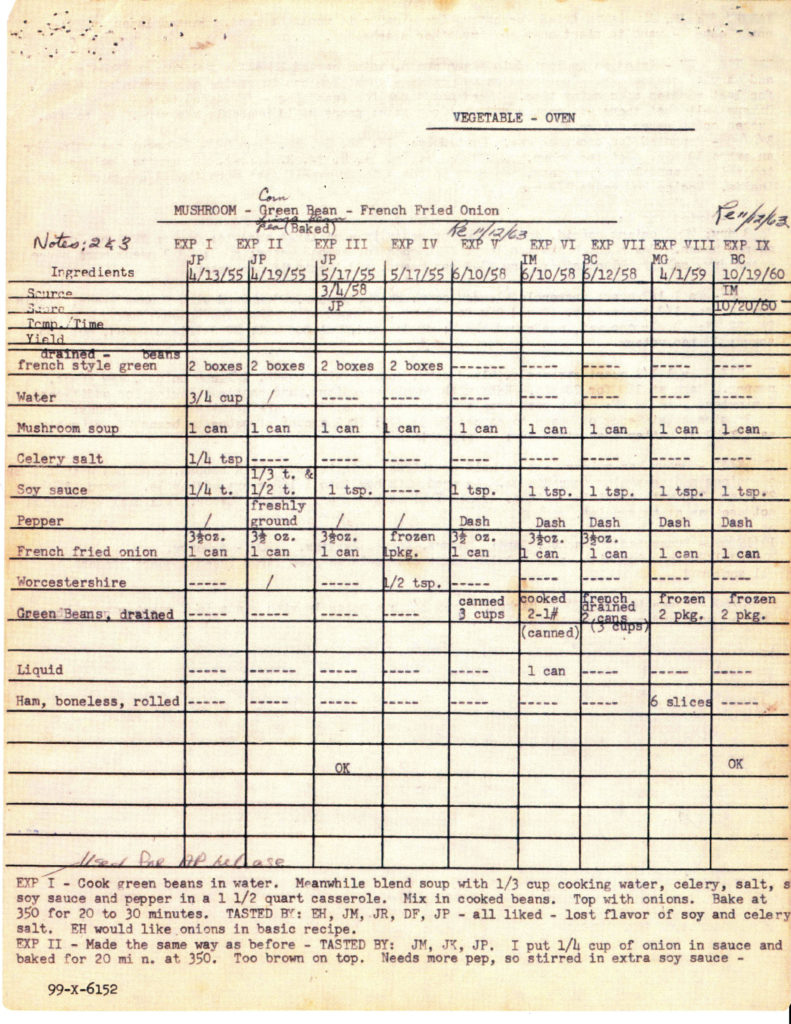
After a series of experiments, documented on a typed recipe card that is now part of the National Inventors Hall of Fame, Reilly, who was 29 at the time, hit upon the six-ingredient winner.
Now known as green bean casserole, the dish that has become a Thanksgiving icon turns 70 this year.
The original green bean casserole recipe card in the National Inventors Hall of Fame.
The “Green Bean Bake,” as it was called at the time, mainly relied on green beans and Campbell’s condensed cream of mushroom soup, along with a splash of milk, soy sauce, and black pepper. Crispy fried onions topped it off.
“It was such a rewarding feeling when your recipe was published,” Reilly told Drexel University’s alumni spotlight when she visited the campus years later. She had graduated from Drexel’s Home Economics program in 1947.
She never knew her careful experimentation (“onions too salty, beans lack freshness, too many onions,” she wrote in an early version of the recipe) would become a national star.
“How would she know of the thousands of recipes she worked on over all those years that there was one that stood out?” Reilly’s daughter, Dorcas R. Tarbell, 64, asked.
Before settling on the final ingredients, Reilly had played around with adding Worcestershire and slices of ham. Campbell’s began printing Reilly’s recipe on the back of its cream of mushroom soup can labels in 1960.
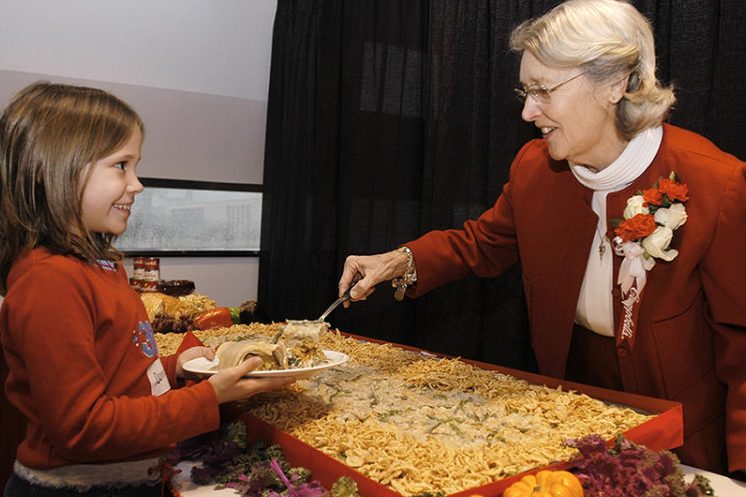
Dorcas Reilly, on the set of live TV commercials that were filmed in the late 1940s atop the original Campbell’s plant in Camden. Reilly was a Campbell’s Soup kitchen supervisor in 1955 when she combined green beans and cream of mushroom soup, topped with crunchy fried onions. It is the most popular recipe ever to come out of the corporate kitchen at Campbell’s.
Tarbell said her mother had not known how popular the dish was until 1995, 40 years after its creation.
That was when Campbell’s marketing team studied sales data and found that cream of mushroom soup sales spiked in October and November, and dropped in January. They told Reilly that her recipe was the company’s most-requested ever.
After that, Reilly became “the ambassador of the green bean casserole,” Tarbell said. Each year, she talked to radio stations and newspapers, and traveled to stockholder meetings to talk about the dish.
Reilly died in 2018 and was celebrated in obituaries across the country as the “grandmother of the green bean casserole.”
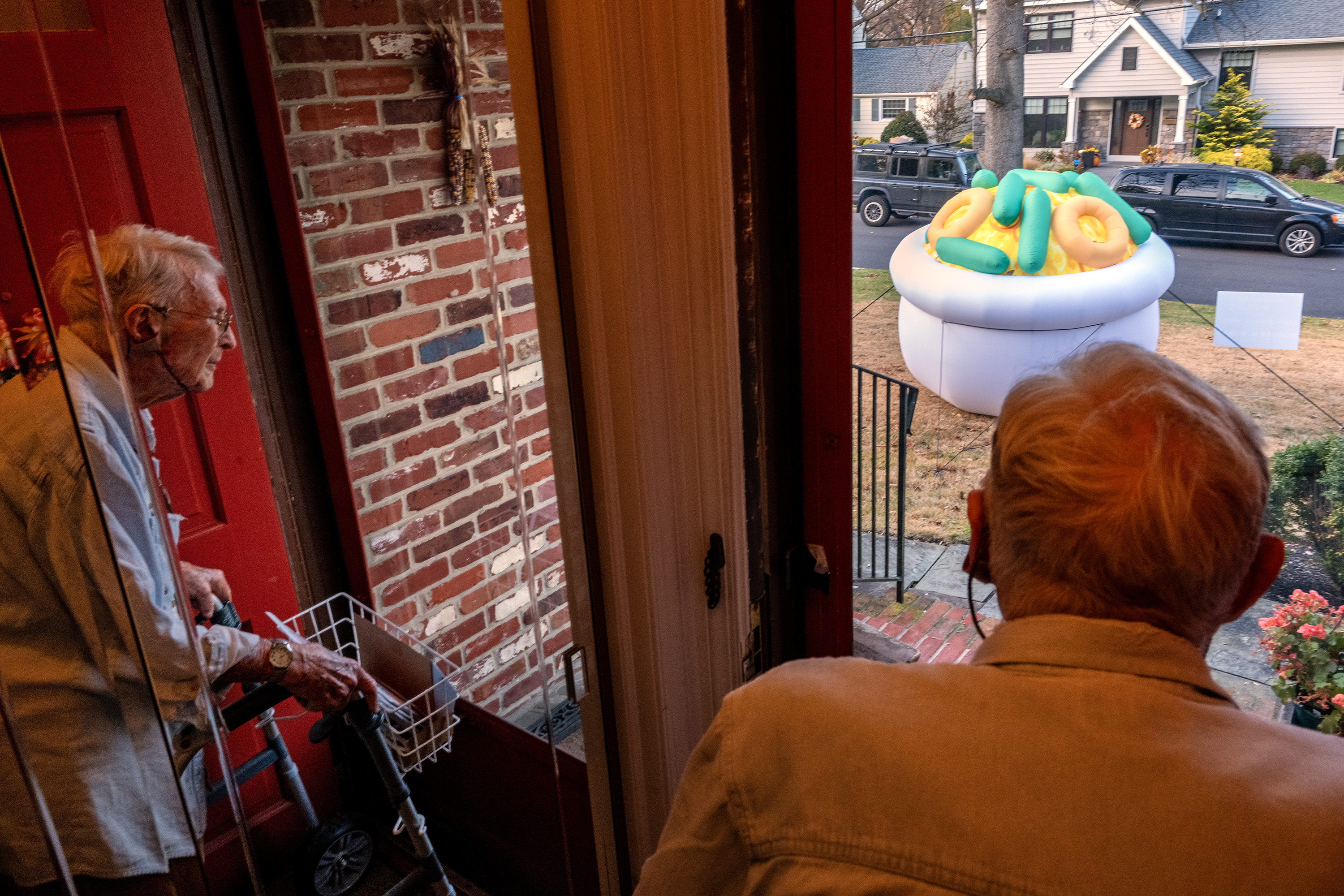
Thomas H. Reilly, 99 years old, is reflected in his foyer mirror as he looks out the front door of his home in Haddonfield at the giant inflatable green bean casserole his daughter ordered to celebrate the 70th anniversary of the famous dish.
This year, to celebrate the anniversary of her mother’s famous dish, Tarbell ordered an enormous, custom-made, inflatable green bean casserole to bedeck the lawn of her 99-year-old father and Reilly’s widower, Thomas H. Reilly.
“I thought, what better gift can I give than to honor the love of his life through the green bean casserole?” Tarbell, who lives down the street, said. “At this point, you have to have humor in life.”
In a town full of yards featuring inflatable Thanksgiving turkeys and pilgrims (and a few early Santas and snowmen), the six-foot side dish stands out.
Also in honor of the 70th anniversary, Reilly’s niece, Evelynne Bates Stoklosa, who is 80, established a research grant in honor of her aunt through Phi Upsilon Omicron, a national honor society for the Family and Consumer Sciences, the modern name for home economics. The research focus for the next two years will be “areas representing culinary arts, food science, nutrition, and dietetics.”
As for her mother’s dish — which is especially popular in the Midwest — it will likely appear on more than half of Thanksgiving tables nationwide this week, Campbell said.
Growing up, Tarbell said the family never ate green bean casserole. But after they realized Reilly had created a star dish, the family embraced it.
“Of course, we have green bean casserole at Thanksgiving,” Tarbell said, adding, “We have it at Christmas. We have it at Easter.”
Dorcas Reilly and a small unnamed admirer, with the iconic green bean casserole Mrs. Reilly invented.
Corinne Low, a Wharton economist, didn’t have to search far for an example of how women’s familial and professional choices are shaped by an uneven playing field.
In 2017, Low gave birth to her son while building a tenure-track career. Her life soon began to feel unmanageable. She was commuting up to six hours a day from Manhattan to Wharton while also taking care of the household tasks that kept her family functioning: groceries, laundry, cooking, childcare.
The situation reached a crisis point when Low found herself pumping in an Amtrak bathroom while crying; she had been in transit for hours and realized she wouldn’t make it home to see her son before bed.
Low, 41, was not a single parent. But her husband had recently left his job to start his own business, a choice that did not reduce his working hours, but did reduce his salary — to zero.
Wharton professor Corinne Low (right) and her, wife Sondra Woodruff, spend time after dinner playing and reading with their kids.
When Low examined her own life, she made two major changes that freed her time and altered her circumstances. First, she divorced her husband and decided to exclusively date women. (A summer article in the Cut about Low, headlined “This Economist Crunched the Numbers and Stopped Dating Men,” went viral.) She is now married to a woman.
The less viral but equally meaningful shift was that she left New York City — and embraced Philly.
“The underplayed hero of my story, of the changes that I made, was moving to Philadelphia,” she said recently in an interview. “That was actually the more important upgrade.”
When she was living in Manhattan and struggling to keep up, friends had recommended that she hire a live-in au pair, which they said was a more affordable, less transactional form of childcare. But of course, like most New Yorkers, Low had no spare room.
In Philadelphia, she was able to afford a bigger house with more space, which meant she could have an au pair. And her commute went from over two hours to seven minutes by bike, freeing her to build a life “filled with friends, community, time outdoors.”
It all added up. In Philadelphia, Low writes, “I rediscovered myself. I found who I had been before I became a stressed-out, angry, rapidly aging person. I was fun! I was creative! I could relax.“ (She adds the disclaimer that she is “not advocating that everyone who reads this book should leave their marriage and move to a new city,” although, perhaps they should, assuming they move to the right city.)
The book analyzes economic data to show women how to get a “better deal” for themselves.
She wanted to show that the feeling many working women experience — of being under siege from all sides, unable to figure out how to gloriously “have it all” — was not some symptom of being hysterical, but was instead rooted in data.
“I want people to figure out how to claw back some of their time from these structural forces that are squeezing us,” Low said. “Knowing the data, it gives you permission to make some of those choices.”
She found that even in families where women were the primary breadwinners, they still overwhelmingly had to put in a “second shift” at home. Some statistics in the book are startling: For example, men who earn only 20% of the household income in a heterosexual family do the same amount of housework as those who earn 80% of the family’s income, which Low found by analyzing the American Time Use Survey, a massive dataset of how individuals spend their time.
That means even when a woman earns more than twice what her partner earns, she also does twice as much cooking and cleaning.
“That bothers me, because it’s inefficient,” Low said. “Because you’re using the ‘more expensive’ person’s time on these home production tasks.”
In the book, Low aims to advise women on how to get a “better deal” for themselves, by employing the stark logic of her field.
She writes about how women might improve their “personal utility function,” which she describes as a “personal video game score at the end of your life,” grounded in one’s priorities and values. She urges women to think about dating as a job interview for a co-executive in a multipronged, multiyear enterprise, and to think of a job as a “technology for converting time into money.”
She also encourages readers to throw away their houseplants if they are not increasing personal utility function.
“You need to be ruthless in protecting your time from things that are not investments in your future and do not bring you joy,” she writes.
Corinne Low and her wife, Sondra Woodruff pictured here with their kids at Clark Park. ,
One of her most interesting arguments is that women today effectively “hire themselves” for too many jobs within the home. It has become normalized to outsource “male-coded” tasks, like changing a car’s oil or fixing an electrical outlet, by hiring a specialist to do it, Low said.
But women have not updated their mindsets about the market value of their time, and so there remains stigma to outsourcing “female-coded” tasks, like laundry, cooking, or home childcare.
Low sees Having It All as a rejoinder to Sheryl Sandberg’s Lean In: While “leaning in is doing more of what’s not working,” as Low put it, she wants readers of her book to “level up” by removing whatever constraints they’re able to.
Of course, many of the problems facing working women remain systemic, and she writes in the book’s afterword about the necessity of societal changes, including parental leave underwritten by the federal government and creative thinking by employers about how to allowfemale employees to meet both their professional and domestic obligations during peak child-rearing eras.
After a book tour, Low is now back in Philly with her two young children and her wife and still reveling in the charms of her city.
“When I was busy and on book tour,” she said, “neighbors walked my son to school.”
Readers told Low that they are making changes to their personal lives based on the book. No one has told her they’re moving to Philadelphia — yet.
Quiara Alegría Hudes grew up on the little street of South Saint Bernard near West Philly’s Baltimore Avenue, but her family spanned the city and its borders. As a child, she shuttled between her home and her mother’s extended Puerto Rican family in North Philly, while regularly visiting her father’s white, Jewish family on the Main Line.
Her writing is often rooted in Philly, though it spans borders and mediums, too. She cowrote the Tony-award winning musicalIn The Heights with Lin-Manuel Miranda, and won a Pulitzer in 2012 for her play Water by the Spoonful. Her 2021 memoir, My Broken Language, told the story of growing up in West Philadelphia and being the first in her family to attend college, at Yale.
Now Hudes, 48, is experimenting once again with a new form: her debut novel, The White Hot, is out this month. It’s a fever dream fantasy about a young mother from North Philadelphia escaping her predetermined life — and her child — in order to reckon with the “white hot” rage that sometimes consumes her and the women in her family. It’s a gem of a book, poetic and propulsive at the same time.
“Was my leaving a seed that might bear fruit?” April, the main character, wonders. “The possibility cracked open like a slitted envelope, that fleeing the stovetop and laundry machine could big-bang a new universe.”
Here’s how Hudes, who now lives in New York City, would spend a perfect Philly day.
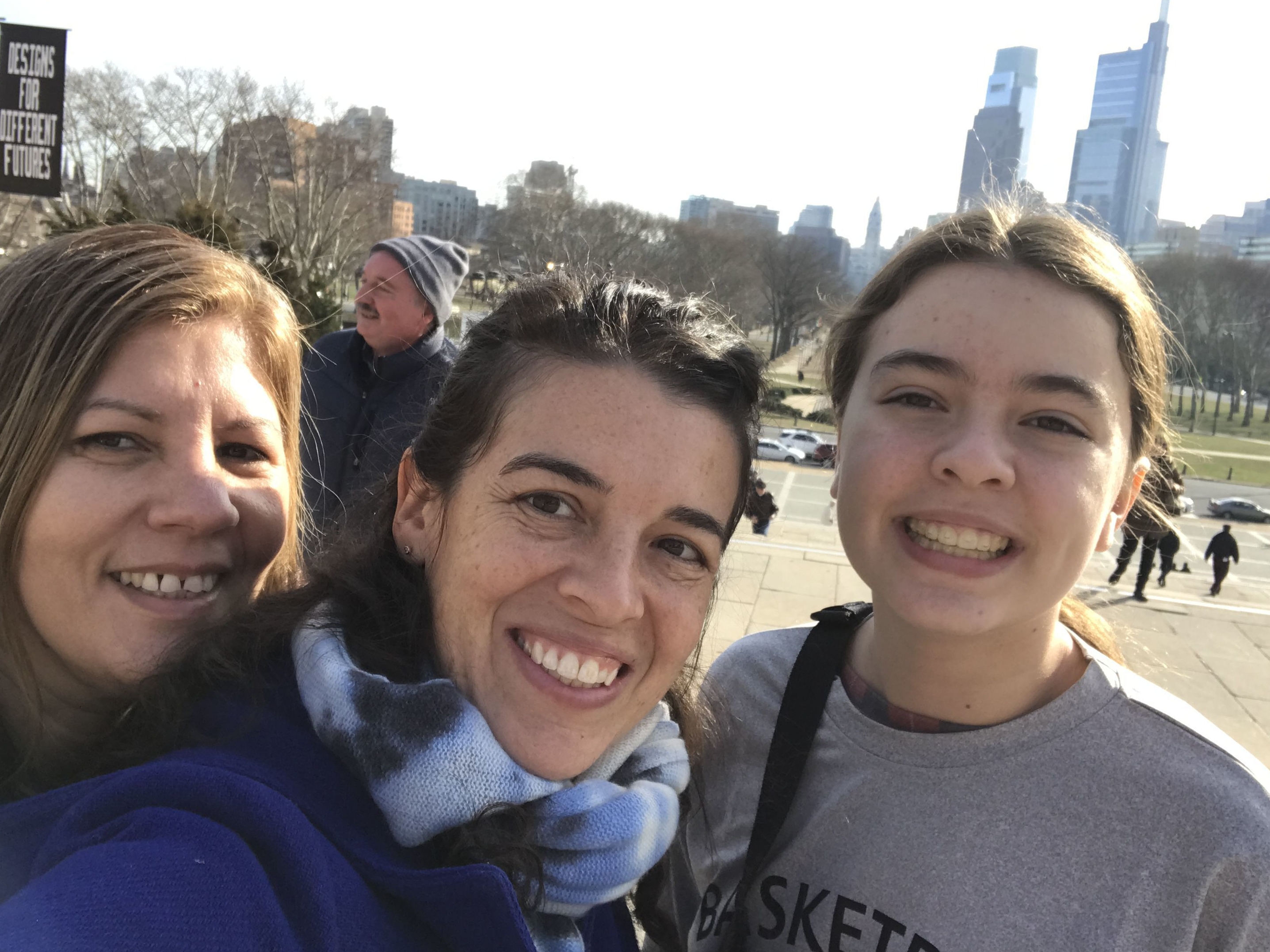
Quiara Alegría Hudes (center) with her cousin and daughter at the top of the Art Museum steps on Christmas morning. The family started the tradition in 2020.
7 a.m.
It starts on Christmas morning. Our across-the-street neighbors, Tracy and Charlie, bring over their pound cake.
The main event of the morning is that we head over to the Art Museum steps. The city’s empty, you can double-park on the street.
We climb up to the top of the steps in our pajamas and just hang. It’s magical and sleepy. The city has that wintery, cold air, blue-silver look to it. You’re looking through your crystallized breath.
9 a.m.
We walk through Center City to Sam’s Morning Glory Diner. (We’re definitely doing some time travel: Now it’s a more temperate fall day.)
Of course, this is all on foot because, no shade, in my experience SEPTA just doesn’t come. This is how I became a reader as a kid, because I had to do something while waiting for SEPTA.
At Morning Glory, they make their own ketchup. This is of utmost importance. Also, their biscuits are the best biscuits I’ve ever had, but even that pales in comparison to the homemade ketchup.
It’s never fancy with me — just give me two scrambled eggs and home fries, and some rye toast.
10:30 a.m.
We go on a Black history tour of Philly, with tour guide Mijuel K. Johnson of the Black Journey. He’s wonderful.
Even as a middle schooler, walking over the old cobblestone bricks of Old City, there was that sensation that 20 feet below, history is literally buried. It’s nice getting new layers of the historical story.
Some walking tours can be: fact, fact, fact, and my eyes gloss over. But Mijuel is not just rattling off facts, he’s really contextualizing stories.
1 p.m.
After all that walking, you want to sit down. The best bet is to go over to the Landmark Ritz Five and see what’s playing. Just go to the next show and enjoy it.
4 p.m.
We head south, and stop at Garland of Letters on South Street. It’s the O.G. New Age bookstore.
They’re always burning some great-smelling incense, they always have a huge amethyst geode that costs $5,000. They have a fountain with water trickling. It’s just peaceful — let the vibes center you.
4:30 p.m.
I go to Fante’s Kitchen Shop, a kitchen supply store. It’s the splurgy place. They’ve got copper pots and knives and kettles that looks so fancy. I’ll look for whatever I can afford.
Then we swing around the corner to John’s Water Ice. I always have the same conversation with them: I say, “Once upon a time I had a flavor called Tutti Frutti here,” and they say “No, such a flavor never existed.” I describe it, and they’re like, “Well, would you like a mixed cherry and pineapple?” And then I have it, and it’s amazing.
Quiara Alegría Hudes marshaling the Puerto Rican parade in New York City in 2022.
6:30 p.m.
For dinner we go to Marrakesh. We’re walking, we have not taken a taxi. If the bus has gone by, we popped on it, but we don’t wait for it.
This is either with an old friend who you need to spend hours catching up with, or date night. It’s all covered in blankets, and it’s candle-lit. It’s very romantic and magical in there. You’re leaning against pillows, you might be sitting on the floor.
They have a set menu, it’s Moroccan food. The dish I remember most is the B’Stella: it’s kind of like scrambled eggs and very finely diced chicken inside a flaky pastry that’s got sugar on top, so it’s sweet and salty.
You just gab the night away as they bring you food.
9 p.m.
For our next stop, we are going to rely on the bus. It’s just too far to walk at this point.
We go to Taller Puertorriqueño, the Puerto Rican culture workshop in North Philly. They have literary and musical events there. Maybe they have a Nuyorican author in town, or a Philly-Rican poet reading their work.
They also have an in-house bookstore called Julia de Burgos Bookstore. It’s fantastic: they have English books, Spanish books, and local artworks and jewelry.
11 p.m.
It’s way past my bedtime. I catch an Uber, or drive home.
Cherokee Guido swung her legs and hips vertically above the lower uneven bar at Vare Recreation Center one recent evening as her coach steadied her. Guido had once mastered this handstand but lost it during a few months off. She wanted it back.
“I can’t be afraid to fall,” Guido, 19, coached herself out loud. Behind her hung a sign with rainbow borders: The way you speak to yourself matters.
Over the years, young gymnasts like Guido and their Vare coaches have learned to talk themselves to victory, first when they were practicing in a crumbling rec building before COVID, then when they were trekking from South Philadelphiato Brewerytown’s Athletic Recreation Center while Vare underwent renovations. They had gotten used to tumbling on mats that slipped around, without a regulation spring floor. They learned to train their minds as much as their bodies.
Throughout practice, the girls cheer each other on across the gym, quick to compliment teammates they say are more like sisters.
“Nice, Laila!” Ariah Buzzetto, 10, called out to her friend Laila Godfrey, 12, across the floor.
“How you practice is how you compete. If you practice lazy, then you’re going to compete lazy,” said 12-year-old Meela Muhammad, sounding very much like an inspirational poster.
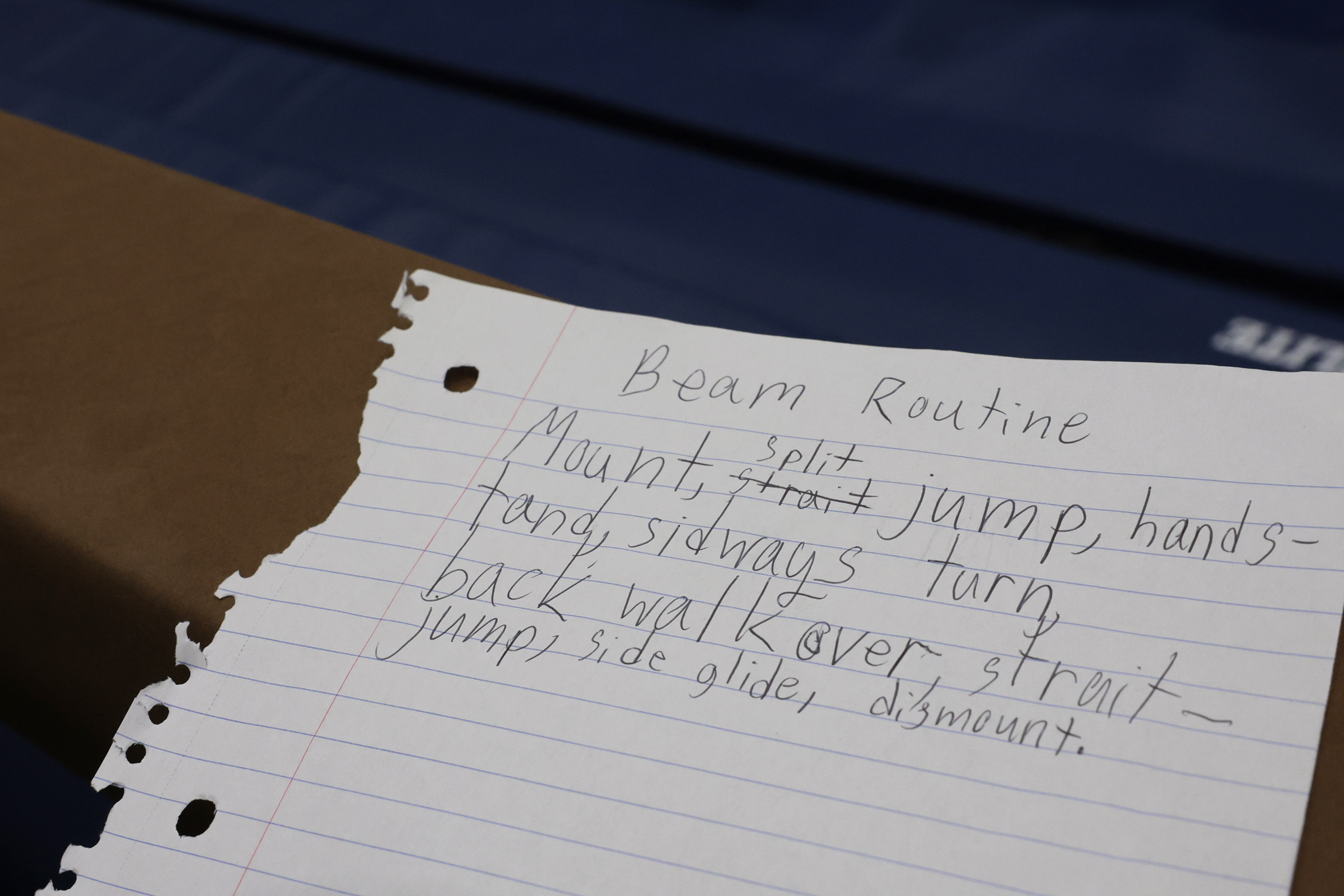
Notes written by 9-year-old Alessia Samson during practice.
Now, training in a new, state-of-the-art, 4,900-square-foot gym at the renovated Vare, which reopened in November 2024,the gymnasts have come a long way — but they’re still competing against private-club teams with sleek, matching uniforms who are better funded, and often better prepared for high-pressure USA Gymnastics (USAG) competitions.
“They have a lot more, bigger skills,” Guido said of their rivals. “At first, for me, I felt like how you go to a ball, you feel underdressed.”
Guido, for example, still wears an older purple leotard because she couldn’t afford a new one, while the rest of her team wears blue.
Head coach Kristin Smerker and Cherokee Guido, 19, laugh while working on the uneven bars during team practice.
Now, Vare Gymnastics is trying to raise at least$6,000 as soon as possible through a GoFundMefor new jackets and gym bags for this year’s competition season, which begins with the Liberty Cup, a December USAG meet at the Greater Philadelphia Expo Center.
If they don’t raise the money, they won’t be able to purchase full uniform sets. The team is also hoping to put some of the money toward financial aid for spring meets; most meets fill up by the end of the fall, and without the funds to enter, some girls won’t be able to attend.
USAG is the national governing body for gymnasts; the Vare Rec team competes in Xcel, a program that offers more accessible competitions than the parallel track that funnels athletes to world competitions and the Olympics.There are only two other city rec centers in Philly that compete in USAG competitions: Kendrick Recreation Center in Roxborough and the Water Tower Recreation Center in Chestnut Hill.
From left, Cherokee Guido, 19, and Alessia Samson, 9, train on the balance beam during team practice.
Though Xcel is supposed to be more affordable, gymnastics is expensive: Entrance fees and uniforms cost hundreds of dollars per child, plus tuition for practice. At $100 per semester, Vare’s rate is far less than at those private gyms, but many parents still struggle to pay.
Marie McBreen, 42, has two daughters in the program. Her oldest enrolled 10 years ago after McBreen begged the coaches for three weeks to find her a spot. She’s seen how positive the team is for them: It has boosted their confidence and they’ve made close friends. But this year, with two kids in the program, she can’t afford to send both to all the competitions.
“Most of us don’t have a whole lot of money. You do the fundraiser to help so they don’t have to miss out,” McBreen said.
Head coach Kristin Smerker is not sure whether the team will raise enough in time.
“Every club has a whole getup. And we don’t. We’re getting whatever we can,” Smerker said. “You can still compete, but they just don’t feel good about it … They’re so talented and they deserve better.”
Smerker is a Northeast native, an encouraging, pump-you-up kind of coach prone to wearing black leggings and mismatched grip socks at daily practice. She built the program from the ground up, starting in 1998 with two floor mats she had begged from nearby gyms.
Nearly 30 years later, Vare Gymnastics has 130 participants, plus a nine-page waiting list. In 2013, the team joined USAG. Alongside Smerker, the team has a beam coach and also a floor coach, Smerker’s sister. In 2017, Smerker brought the team to a USAG meet and lamented to the other coaches that the girls didn’t have a permanent building and were shuttling all over the city for practice.
“Our team won first place,” she said, laughing. “Our kids have heart.”
Head coach Kristin Smerker guides Ariah Buzzetto, 10, during practice. Alessia Samson, 9, (left) and Cherokee Guido, 19, (right) are guided by beam coach Natasha Rogers (middle) as Ariah Buzzetto, 10, looks on.
Guido has been practicing gymnastics at Vare since she was 2 years old, and is among the best at the gym. Last year she graduated from high school and technically from Vare, but she is now back working on her skills.
“I love it already!” she called to her teammate Suadaa “Susu” Muhammad, as Susu debuted her new floor routine.
Along with team captain Elianna Olsen,Muhammad and Guido call themselves the “OG gymnasts” because they’ve been at Vare the longest.
Perhaps like many young gymnasts, Muhammad, 19, started with enormous dreams.
In the beginning, she said, “I thought I was gonna be bigger than Simone Biles.”
These days, she fits practice in three times a week, alongside radiology classes in her freshman year at the Community College of Philadelphia, and a night job pushing wheelchairs at the airport. She was also just hired as a coach for the Vare team. In her own training, she’s focused on her round off back handspring back tuck for her floor routine, trying to get it ready for December’s meet.
“Some coaches say to our coaches, ‘Oh, wow, you’re from a rec center? I’m surprised your girls are doing this good,’” Muhammad said.
South Philly’s Vare Gymnastics Team is the subject of the short documentary “Underdogs,” which is executive produced by former Philadelphia Eagles Connor Barwin and Jason Kelce.
In the early years, Muhammad used to get points deducted at meets for wearing her headscarf, she said; the judges considered it in the same category as jewelry and nail polish, which are prohibited. Her family and coaches wrote letters to USAG, and the rule was changed, Smerker said.
This year, Smerker wants the girls to be wearing their matching uniforms when they walk out to meet their rivals.
“I want them to walk in there and feel proud of themselves and feel confident,” she said. “It’s important to them and important to me to do everything to make it happen.”