Author: Lauren Jones

  • David de Garavilla’s rise continues in adaptive golf with third straight trip to the USGA Adaptive Open

    David de Garavilla’s rise continues in adaptive golf with third straight trip to the USGA Adaptive Open

    David de Garavilla has always been a competitor.

    As a child, the Telford native played every sport he could — from soccer, to baseball, basketball, wrestling, and football.

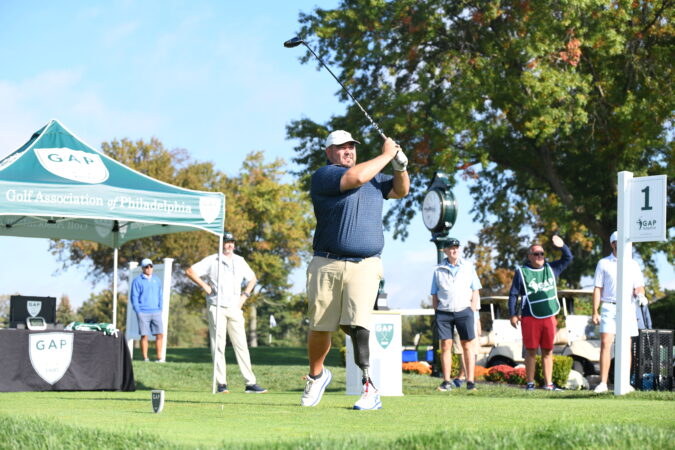
    Even after a life-altering injury during his sophomore year at Downingtown West High School resulted in the amputation of his left leg below the knee, de Garavilla never questioned whether he would compete again.

    “Sports were always something that I had done, so I wanted to continue doing it,” said de Garavilla, 43. “I’m going to do it if I’m able, so I was going to try everything and figure out a way to make it work.”

    With his competitive nature pushing him through, de Garavilla will be teeing off today in the USGA’s U.S. Adaptive Open, which runs through Wednesday at Woodmont Country Club in Rockville, Md. It marks the third consecutive year he has qualified for the championship, and de Garavilla is among 96 players to earn a spot in this year’s field.

    The USGA received 250 entries for the 2026 Adaptive Open and hosted eight 18-hole qualifying events across the country.

    “It’s no easy feat qualifying for a USGA event,” said Matt Hensel, his friend and caddie. “It’s hard to do that once, but three times in a row just shows his passion and love for the game, and his motivation to win.”

    In 1998, de Garavilla was playing in a junior varsity football game for Downington West when he broke his left leg. Doctors tried to fix his leg, but three weeks later, after several complications, his leg was amputated below his knee. Immediately following his surgery, he was fitted for a prosthetic and endured months of strenuous rehab.

    Soon after, he was back competing. He padded his prosthetic and by the start of his junior year in 1999, he returned to the football field, playing offensive line on junior varsity and long snapper for the varsity team.

    After his injury his sophomore year, the Eastern Amputee Golf Association in Bethlehem, Pa., learned of his amputation and reached out to de Garavilla with information about adaptive golf opportunities. The EAGA’s main goal is to organize and host amputee golf events for physically impaired individuals and teach them about the sport. At the time, he had little interest because he had never played golf.

    It wasn’t until after wrestling at Johns Hopkins University that de Garavilla bought his first set of clubs, looking for another opportunity to compete.

    “Sports dried up after college, and I didn’t have anything to do competitively,” de Garavilla said. “At that point I was just working, but there was a nine-hole work golf league, so I went out and tried that.”
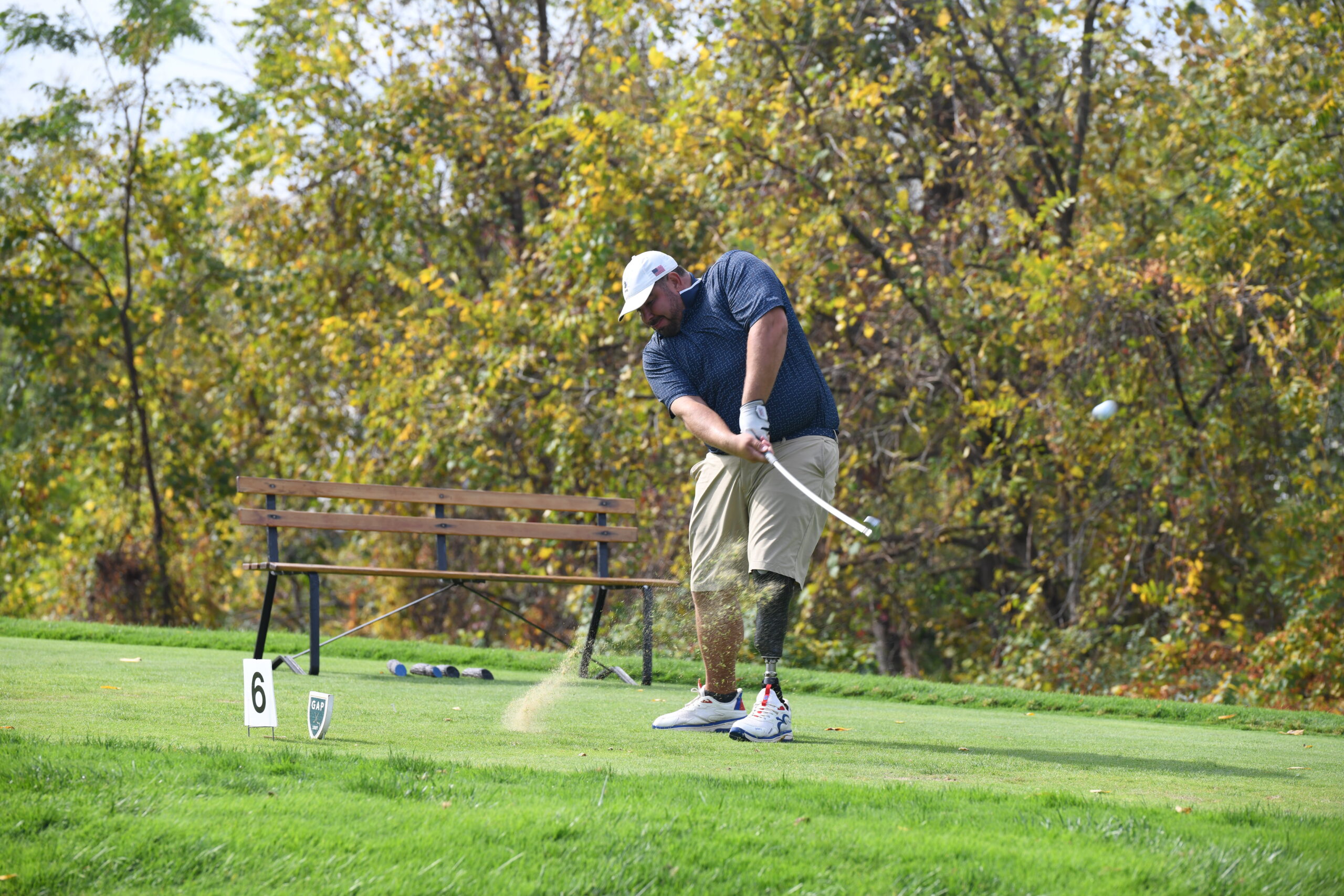
    David de Garavilla has developed into one of the area’s top adaptive golfers.

    Golf quickly became his primary competitive outlet, he said. He never had any formal lessons, so he taught himself by studying the game.

    “I watch a lot of golf, read about golf, watch videos about people talking about the mechanics of golf,” he said. “I’m a nerd in that sense.”

    Over the past 15 years, he has developed into one of the area’s top adaptive golfers. He won the second Golf Association of Philadelphia Adaptive Open at his home course, Indian Valley Country Club, in 2025, and competes often against able-bodied golfers.

    However, competing in an USGA event is the biggest honor, he said. The growth of adaptive sports de Garavilla has seen since his injury has been significant.

    “It’s really cool that these organizations are creating an event like this,” he said. “It isn’t a charity event to celebrate people with disabilities, it’s really run just like a real U.S. Open. You truly feel like you’re a part of a professional event as a participant.”

    Hensel met de Garavilla at Indian Valley Country Club when they started playing golf around the same time and has caddied for him at the Adaptive Open since 2024. Hensel, who works with people with intellectual disabilities daily, said he’s grateful to be de Garavilla’s caddie and be surrounded by hardworking athletes at a USGA event.

    “Adaptive athletes’ stories are really inspiring, but at the end of the day, they’re competitors and they’re good golfers, and I think that’s the real story behind it,” Hensel said. “They’re out there to win, and David is definitely like that. From my perspective, it’s just cool to see all the different types of folks out there competing and grinding, and it is definitely inspiring to see.”
  • What to know about the proposed Protect College Sports Act and its impact on NCAA athletics

    What to know about the proposed Protect College Sports Act and its impact on NCAA athletics

    A landmark bipartisan bill aimed at stabilizing college sports and protecting student-athletes cleared the U.S. Senate Commerce Committee on June 18 and is expected to receive a Senate floor vote in July. This marks the first time a major college reform bill has advanced this far in the Senate.

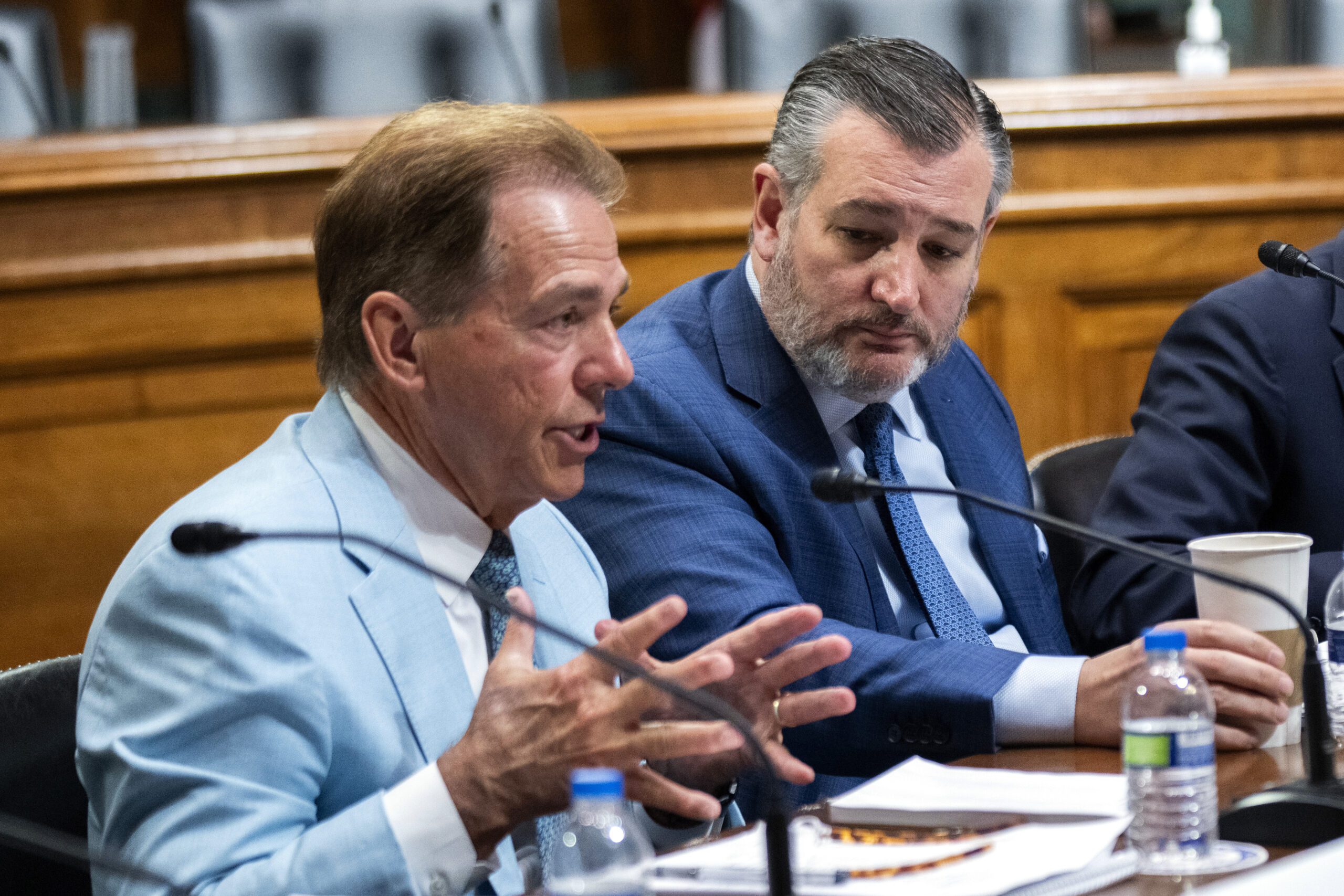
    Spearheaded by Sens. Ted Cruz, R-Texas., and Maria Cantwell, D-Wash., the Protect College Sports Act was introduced last month to regulate college sports and provide antitrust protection to the NCAA.

    “We need order and stability now,” Cantwell said in her opening statement on June 18. “The craziness that is happening in this marketplace with cutting of thousands of roster slots, the taxing students’ fees for education to pay for football, the arms race that is basically taking money away from research and development. Our task here is to win the race in innovation.”

    The bill was voted 19-9 and included support from Sen. John Fetterman, D-Pa. It now must pass the 60-vote threshold in the Senate before advancing to the House of Representatives. If approved by both chambers, it would then be sent to President Donald Trump’s desk. The bill can still be challenged and changed throughout this process.

    The history behind the proposed legislation

    The NCAA has sought congressional intervention for years to help regulate college athletics. College sports officials have asked Congress to help them create a national standard for how athletes are paid and for antitrust protections to avoid continuous legal challenges.

    “There have been dozens of attempts at congressional intervention in college athletics for decades, but it certainly has increased the past 10 years because of justified litigation over a broken college sports model and restricting athletes’ rights,” said David Ridpath, a professor of sports business at Ohio University and an expert on NCAA governance.

    The Protect College Sports Act has been spearheaded by Senators Ted Cruz (right) and Maria Cantwell.

    Last year, the SCORE Act advanced through two major House committees but did not reach the floor for a vote. That proposed bill was focused on creating a national framework for name, image, and likeness compensation and failed because it did not receive bipartisan support.

    What does the bill say?

    The proposed bill would provide an antitrust exemption, allowing the NCAA to regulate athlete transfers and eligibility within certain guidelines. It would also establish limits on athletes’ compensation and prohibit coaches from leaving before the season ends with their current team. Coaches who violate this rule would be ineligible to coach for the following season.

    The legislation also seeks to protect women’s and Olympic sports programs. Major colleges and universities would not be able to cut the number of women’s and Olympic sports programs, roster spots, or scholarship opportunities below current levels. The U.S. Olympic and Paralympic Committee endorsed the bill.

    “The revised version of the Protect College Sports Act ensures that higher-resourced NCAA Division I athletic departments — those with annual revenues exceeding $80 million — will maintain at least the same number of roster spots as in the 2024-2025 academic year,” wrote the U.S. Olympic and Paralympic Committee in a statement. “We welcome that the agreement provides reasonable flexibility, including traditional protections for mid-sized institutions, while preserving overall participation opportunities.”

    Student-athletes would be allowed only one unrestricted transfer during the NCAA designated windows in their career. Any other transfer would cost the athlete a year of eligibility.

    The bill would also allow colleges and conferences to voluntarily pool their media rights under a single entity rather than negotiate deals solely through individual conferences. The NFL voiced its support for the voluntary pooling of media rights, according to ESPN.

    What are the experts saying?

    Ridpath said pooling media rights could generate more revenue and allow colleges and universities to share that revenue across the entire college athletic ecosystem.

    “That could be used to help expand sports offerings and save current sports,” Ridpath said. “College sports is an incubator for Olympic and national teams, and if we start cutting these sports, we’re going to become less competitive.”

    Ridpath said this bill is a “fair effort” to regulate college athletics, but his biggest issue is the lack of direct negotiation with student-athletes.

    “If the NCAA wants real legal and antitrust protection, if they would sit down and negotiate with the athletes as a collective body, that would give you legal cover because everyone has agreed to the rules,” he said. “Until you speak directly with the athletes, I think we are still going to have litigation.”

    What are people saying?

    College sports stakeholders have voiced mixed opinions on the bill.

    More than 20 conferences, including the American, Big East, and Atlantic 10, have expressed support for the bill. The NFL, MLB, and the National Basketball Players Association sent statements to Congress voicing their support as well.

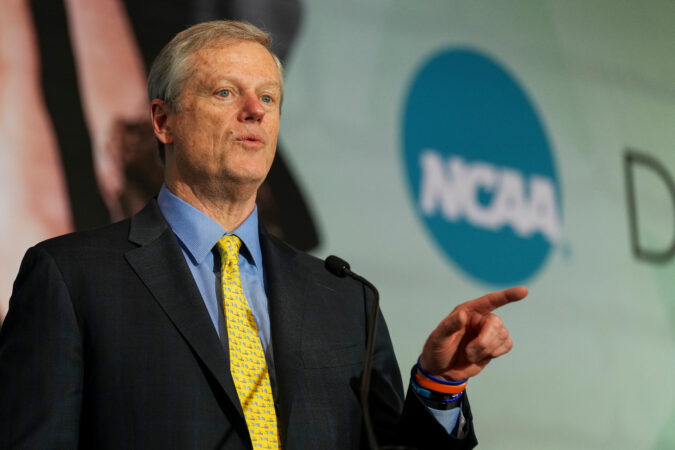
    Charlie Baker, the NCAA president and former governor of Massachusetts, publicly backed the bill on social media.

    “Every sports league needs rules, and there are certain challenges to NCAA rules that only Congress can address,” he wrote. “The bipartisan Protect College Sports Act’s sections bolstering eligibility, transfer and agent policies are needed now to deliver on that obligation. As a former governor, I understand that getting important legislation done requires compromise. While the bill does not address every issue college sports face, the current state of play cannot continue, and we must move the bill forward.”

    However, the Big Ten and SEC, the wealthiest college conferences, oppose the bill as it stands, saying revisions are needed to gain their approval. Part of the bill prevents conferences that declare more than $1 billion in revenue on their 2025 tax returns — the SEC and Big Ten — from forming a “super-league.”

    “From the outset, we identified a set of essential revisions to the PCSA necessary for the long-term sustainability of college athletics,” the two conferences wrote in a joint statement on June 18. “We have worked with both majority and minority staff to advance those revisions, which focus on better supporting student-athletes and stabilizing the college sports environment.”

    Letters obtained by The Inquirer from former Penn State trustee Anthony Lubrano showed Penn State president Neeli Bendapudi writing on June 17 to Sens. Fetterman and David McCormick in opposition to the bill, saying “significant problems remain” in the legislation.

    Lubrano, whose term ended Tuesday, said Bendapudi did not collaborate with the board of trustees on the correspondence with Fetterman and McCormick. He believes it would be in Penn State’s best interest to support the proposed legislation.

    “For Penn State, we’d be best served to embrace the legislation and work to enhance and improve it over time,” Lubrano said. “But in the absence of perfection today, we shouldn’t allow perfection to get in the way of being good, and so we should be behind it.”

    The bill, he said, protects all student-athletes and the non-revenue Olympic sports at Penn State.

    “Listening to the senators on a number of calls I’ve had with them, it’s clear that one of their primary concerns revolves around the Olympic sports,” Lubrano said. “If you do nothing, schools will likely discontinue some of their programs in the non-revenue sports, and a lot of those are Olympic sports. So consequently, you can envision a day where the United States isn’t competitive on a world stage at the Olympics. Is that what we want to see happen?”

  • Inside the Flyers’ 2026 NHL draft party: Fans come together in Atlantic City to share passion — and critique the team’s first-round move

    Inside the Flyers’ 2026 NHL draft party: Fans come together in Atlantic City to share passion — and critique the team’s first-round move

    ATLANTIC CITY — Noel Cronon and Sarah Colon, both native Philadelphians and devoted Flyers fans, had never met in person before the Flyers’ draft party in Atlantic City on Friday night.

    The two first connected through Flyers Nation, a Facebook group with more than 67,000 members where fans discuss the team and post updates. Cronon saw Colon in the group and reached out, and asking if she wanted to go to the draft party together.

    “There aren’t a lot of female Flyers fans, so it’s nice that we found each other,” Cronon said. “There are a lot of women here tonight, though, which is good to see.”

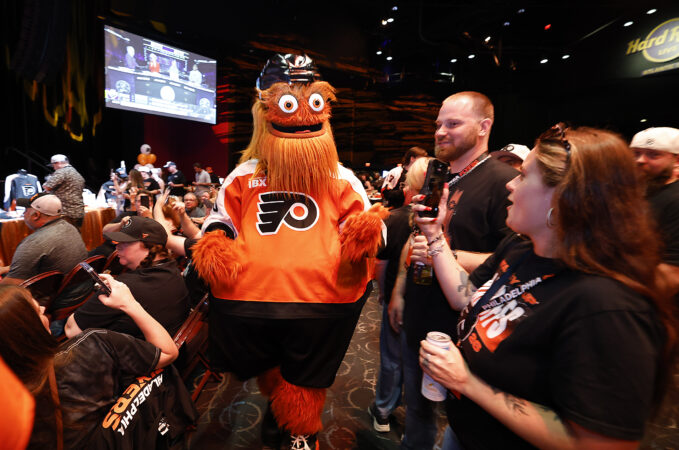
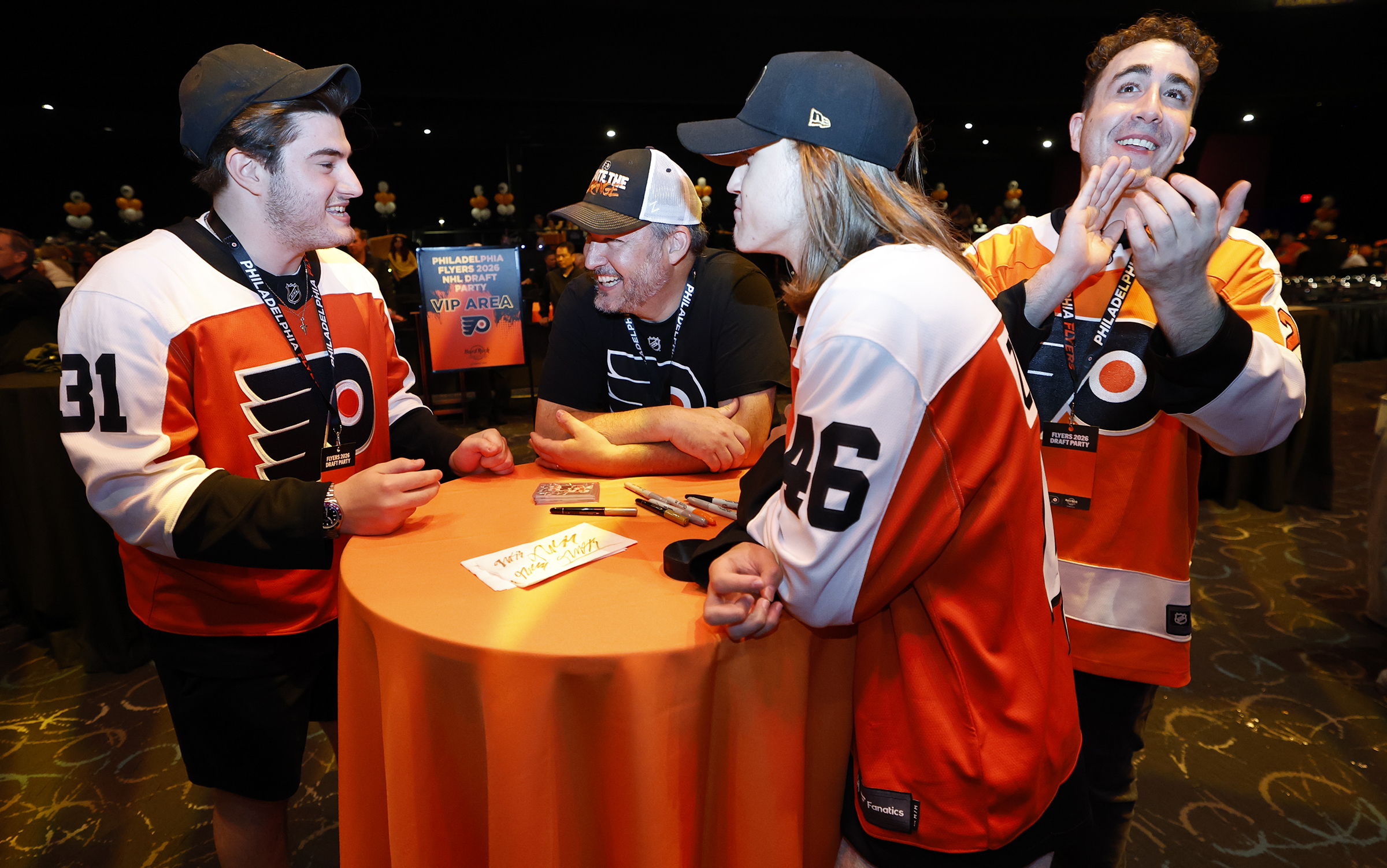
    Several hundred Flyers fans came together as a fan base at the Sound Waves Theatre at Hard Rock Hotel and Casino in Atlantic City to watch the 2026 NHL draft. Orange balloons, streamers, and Flyers memorabilia decorated the venue while fans came decked out in their best Flyers merchandise.

    Flyers fans watch the 2026 NHL draft during a party at the Hard Rock Hotel & Casino in Atlantic City on Friday.

    To kick off the night, past and present broadcasters Jim Jackson, Tim Saunders, and Steve Coates took the stage to share their thoughts on what general manager Danny Brière might do with the team’s first-round pick and energize the crowd.

    “We are back,” Coates said when he addressed the crowd. “Remember, this is a team that is going places.”

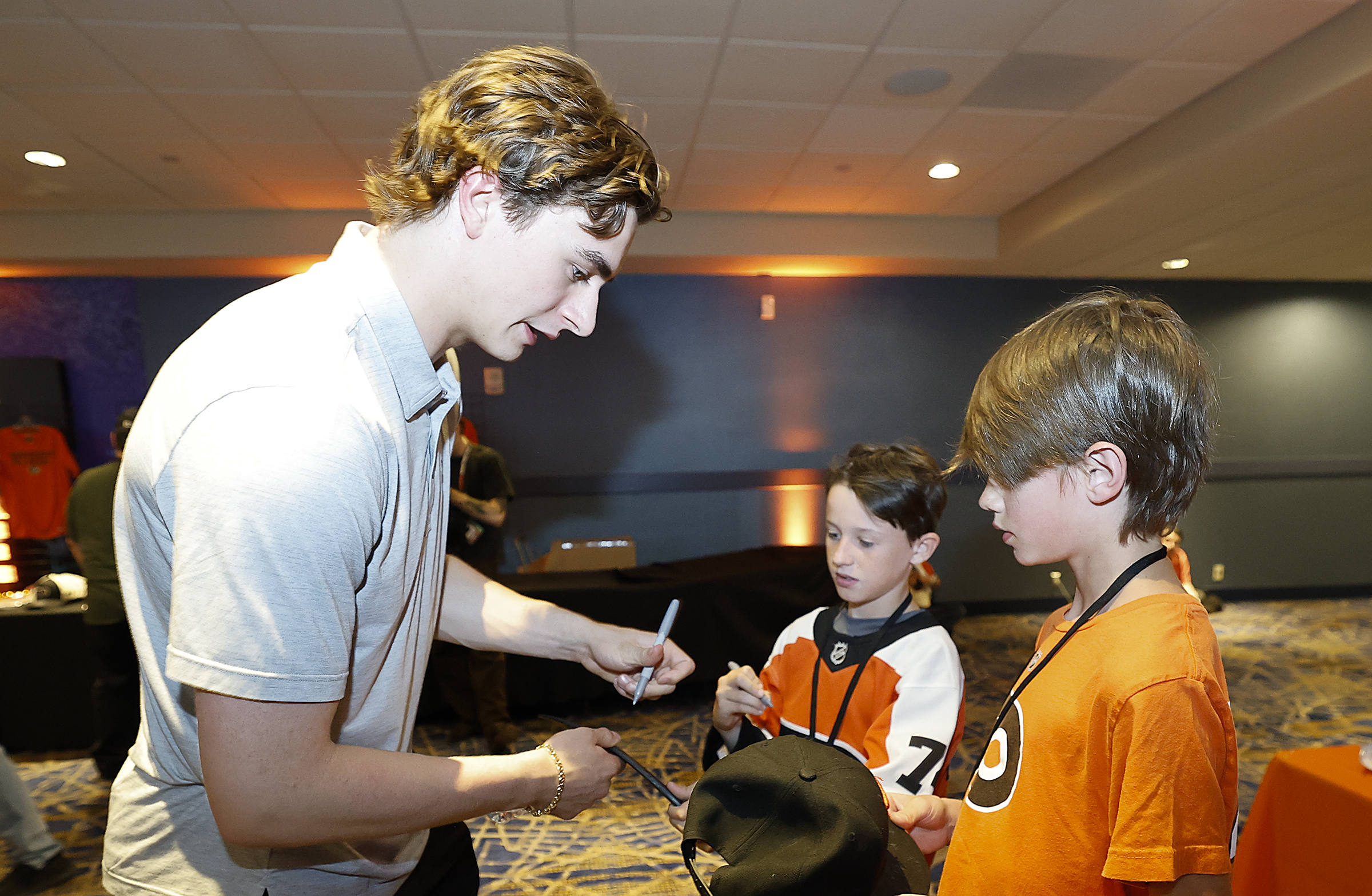
    The Austin City Nights band started the party, while the beginning of the draft played from monitors above the stage. Forward Porter Martone joined the band onstage and Gritty, the beloved Flyers mascot, posed for selfies and photos while Jackson went around the audience speaking with fans and taking photos.

    Father and son Grant and Trent Kitchenman have been season ticket holders since 1992 and said that they never miss events like this.

    “It’s really cool that they allow fans in on the draft night experience,” Grant said. “It makes it more personable and you get to see some of the players which is cool.”

    Garett Babik couldn’t have imagined watching the draft anywhere else.

    His dad took him to a playoff game against the Boston Bruins in 2010, and he’s been hooked ever since. During this year’s playoff run, Babik attended games dressed as Darth Vader to show his support for goalie Dan Vladař.

    “I’ve been a fan my entire life,” Babik said. “This is my life. I love this team from the bottom of my heart, and I can’t express that enough.”

    Fans (from left to right): Zack McErlain, Tug McErlain, Thomas McErlain and Stephen Dellaquilla react after the Flyers picked defenseman Maksim Sokolovskii with the 27th overall pick during the Flyers’ 2026 NHL draft party at the Hard Rock Hotel & Casino in Atlantic City on Friday.

    When it came time for the Flyers to make their first-round selection, the band stopped playing, and the theatre became quiet. Fans turned their attention to the monitors and anxiously waited for the announcement.

    When the trade alert came up on the screen and NHL commissioner Gary Bettman announced the trade, the crowd booed.

    Babik was not thrilled with the move either, he said.

    “I’m going to be totally blunt. I didn’t like it,” he said. “[Dallas Stars winger] Jason Robertson has been on the market, and I was hoping they would’ve got him. Don’t get me wrong, I understand we only have four picks in this draft, and they wanted to get more.”

    After they traded the 21st pick to the San Jose Sharks, moving down to No. 27, some fans immediately left, leaving the true diehards to wait until their pick.

    Among them were Eddie Bertino and Scott Parker, childhood friends from South Jersey who grew up playing hockey together and played in under-30 and under-40 leagues.

    Flyers Porter Martone signs his autograph for fans during the Flyers’ 2026 NHL draft party at the Hard Rock Hotel & Casino in Atlantic City on Friday.

    Bertino started playing hockey when he was 5 years old, with Parker’s dad as his coach. Both became lifelong Flyers fans thanks to their fathers, who had season tickets and attended the Flyers’ Stanley Cup victory in 1975.

    When Bertino secured the tickets for the draft party, he knew Parker was the right person to accompany him.

    “He is one of my few diehard Flyers fan friends,” Bertino said. “ I didn’t want to be here with some poseur, I wanted to be here with another diehard.”

    By 10:20 p.m., with the Flyers still waiting to pick and it being a Friday night in Atlantic City, Bertino was surprised so many fans decided to leave, but he wasn’t surprised by Brière’s trade.

    “The past two years he’s made some sort of trade, it’s kind of his thing,” Bertino said.

    Many fans didn’t stay around long enough to see the Flyers pick 6-foot-7 defenseman Maksim Sokolovskii with the 27th overall pick.

    However, a similar sentiment was shared with fans throughout the night — the future of Flyers hockey is bright, and they are proud to be a part of the fan base.

  • Westtown’s Jordyn Palmer, Bonner-Prendie’s Korey Francis named state’s Miss and Mr. basketball

    Westtown’s Jordyn Palmer, Bonner-Prendie’s Korey Francis named state’s Miss and Mr. basketball

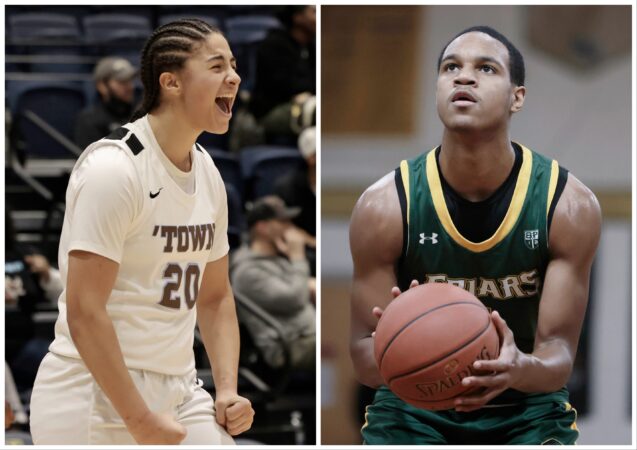
    Bonner-Prendergast’s Korey Francis and Westtown’s Jordyn Palmer were named Mr. and Miss Basketball for the 2025-2026 season.

    The award honors the best male and female high school players in Pennsylvania. Fans, coaches, and the media vote on the awards.

    Francis, a junior guard, averaged 21.5 points, 7.4 rebounds, 3.4 assists, and 1.7 steals, while shooting 52.1% from the field, including 35.3% from the three-point line. Bonner-Prendie went 24-6 and won its first-ever state championship in basketball.

    Palmer, a junior forward who’s considered one of best players in the nation, averaged 23.2 points, 13.2 rebounds, and 6.4 assists. She led Westtown to a 28-2 record last season.

    Other local finalist included junior guard Silas Graham (Haverford School), sophomore forward Colton Hiller (Coatesville), and senior Sammy Jackson (Roman Catholic).

    Palmer’s teammate Atlee Vanesko, a senior forward, and junior guard Ryan Carter (Friends’ Central) were also finalists.

  • What to know about the Invitational Clash, a pro-am basketball tourney promoting community wellness

    What to know about the Invitational Clash, a pro-am basketball tourney promoting community wellness

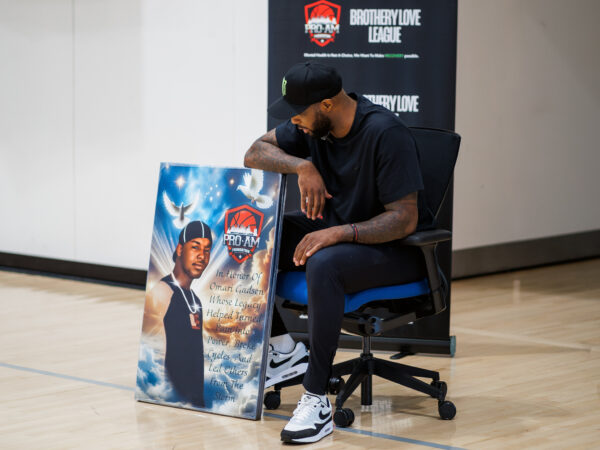
    Serving the community is an important mission for Philadelphia native Novar Gadson. After 14 years of playing professional basketball overseas, he is back home to bring his mission to life through the Invitational Clash Movement.

    The invitational is a five-day initiative at Drexel from Thursday to Monday in which pro-am men’s and women’s basketball teams from as far away as London will compete in a bracket-style tournament.

    The event will also feature other activities, including a youth basketball clinic and mental health workshops.

    “The basketball is obviously at the centerpiece of it, but the vision behind it is community wellness, mental health, and youth development,” said Gadson, 36.

    Eight men’s teams and four women’s teams will battle it out to decide the best pro-am leagues.

    The men’s teams represent Philly’s Brotherly Love League; Drew League from Los Angeles, Rucker Park Streetball from New York; Ball Don’t Stop from Toronto; the Smith League from Cincinnati; Queen City from Charlotte, N.C.; Denard Brothers from Chicago; and Great Britain Select from London.

    The four women’s teams represent Brotherly Love, Rucker Park, Queen City, and Swin City League from Dallas.

    The face behind the mission

    For Gadson, growing up in the city was not easy. His brother, Omari, was a victim of gun violence. He was 18 when he died in 2001.

    “My family has still not recovered from my brother’s murder,” he said.

    To stay out of trouble, Gadson said, he started playing basketball.

    He attended John Bartram High School, where he broke Kobe Bryant’s father Joe’s scoring record. He played at Rider University before playing professionally in Europe, Asia, and South America.

    “Basketball is what saved me from homelessness and sexual assault to everything that I was dealing with as a child,” he said. “I feel like it’s in my heart from Christ to serve people.”

    In 2021, he began developing the vision for a Philadelphia-based event that would engage the community with sports and mental health advocacy.

    Gadson is the chief executive officer of the Brotherly Love League Pro-Am Foundation, a nonprofit committed to increasing access to mental health resources for underserved communities in the area.

    The invitational is an extension of the foundation, he said.

    How the tournament works

    The competition begins on Friday and follows a bracket-style format with the winning teams advancing to the next round.

    The four women’s teams will open play on Saturday.

    Tickets are $10 for adults and free for children.

    Attendees will have a wide variety of community-focused activities that are designed to engage and connect community members with mental health resources.

    The event will also feature food trucks, gaming trucks where children can play in Madden 2K tournaments, hair-cut stations for children, face painting, crowd giveaways, and youth basketball clinics. The boys’ clinic is on Saturday and the girls’ is on Sunday. Participants in the clinics will receive meals and have access to mental health workshops.

    More than 30 resource tables will be available throughout the event with panel discussions focused on mental health in partnership with the National Alliance on Mental Illness Philadelphia. Attendees will have the opportunity to connect with professionals and sign up for licensed therapy sessions after the tournament.

    “People need help,” Gadson said. “I dealt with a lot of PTSD and anxiety from my experiences growing up, so I want to extend help and opportunities for therapy outside the event.”

    He noted that increasing access to resources can create change in the city beyond the basketball court.

    “If we give a lot of resources and access to kids outside of the basketball event, it will help the city as a whole and the violence go down,” he said.

    , Gadson has struggled to revisit the trauma around Omari’s death. He said he has never celebrated his brother’s birthday. But on Monday, Omari’s birthday and the last day of the invitational, Gadson plans to honor his legacy. The foundation will recognize two families who have lost their loved ones to suicide or gun violence.

    “The idea for me is to continue to bring light to his name,” Gadson said.

  • Winslow’s Jasmine Jackson emerges as one of the nation’s fastest hurdlers: ‘She is running with a purpose’

    Winslow’s Jasmine Jackson emerges as one of the nation’s fastest hurdlers: ‘She is running with a purpose’

    Jasmine Jackson sat on her couch at her home in Winslow Township, watching a broadcast of the nation’s fastest high school hurdlers competing at the 2025 Brooks PR Invitational. As she watched, she made it her goal to be on that track, competing in the race.

    After a year of training and dropping time, her invitation arrived in the mail, making her the first athlete in Winslow Township history to earn a spot in the prestigious event.

    “It was a big accomplishment when I got the invitation,” she said. “I was ecstatic. To know I was the first to do this showed it was a stepping stone to something even greater.”

    And something greater came at this year’s Brooks PR Invitational on June 7 in Renton, Wash.

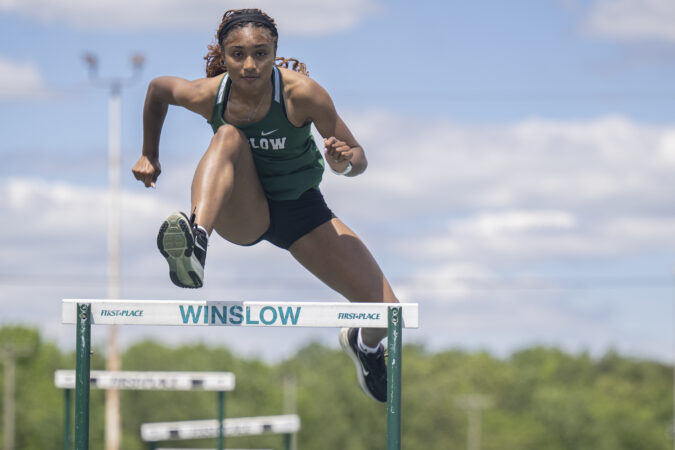
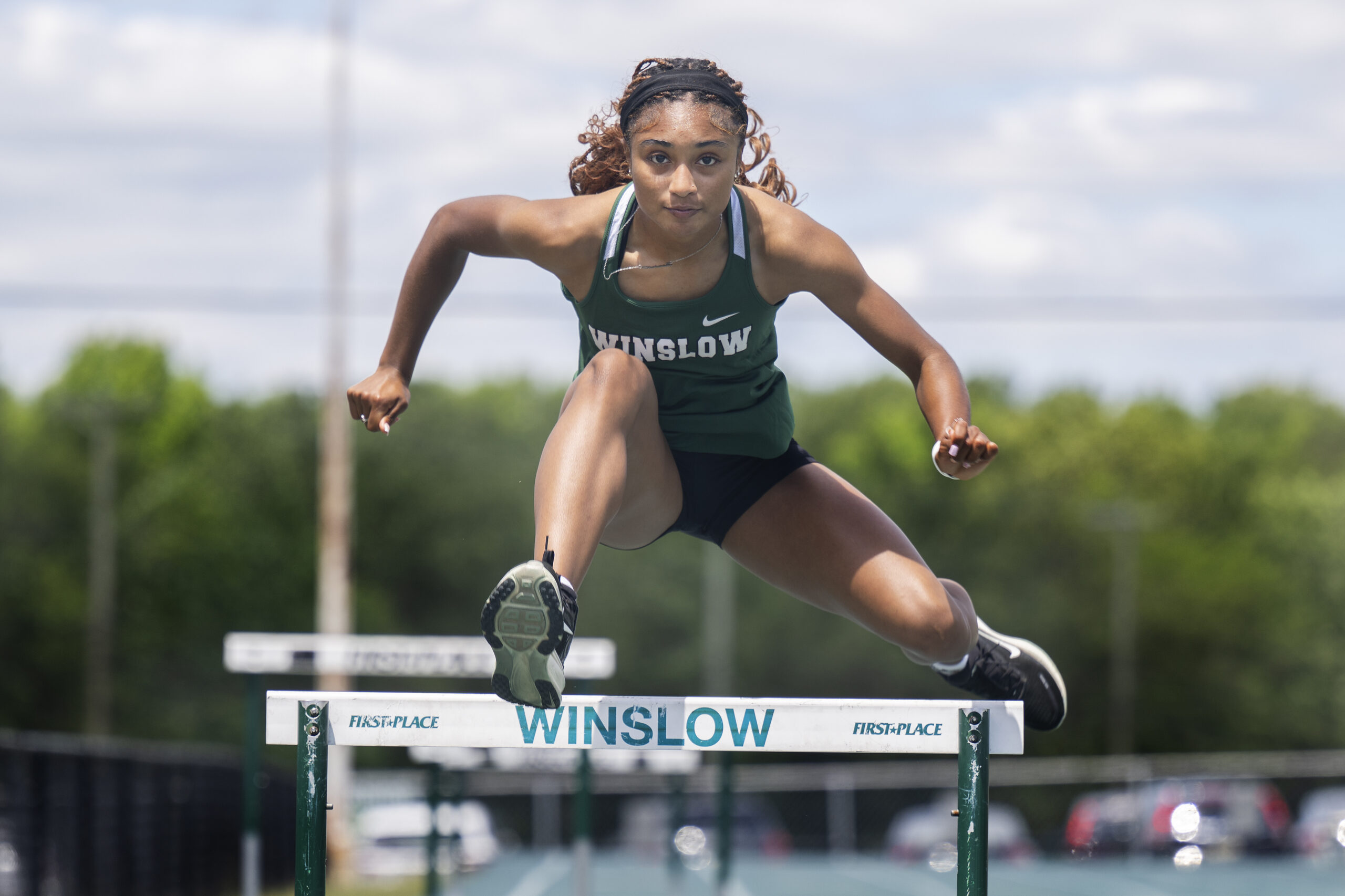
    The Winslow Township High School sophomore claimed the 100-meter hurdles title with a time of 13.33 seconds. It came days after winning the New Jersey Meet of Champions and running a personal-best 13.28 seconds.

    Jasmine Jackson set a personal record in the 100-meter hurdles at the New Jersey Meet of Champions.

    Her personal record currently ranks No. 3 in state history, No. 3 all-time on the wind-legal list for sophomores, and No. 3 in the nation this season. Jackson continues to climb the ranks as one of the nation’s fastest hurdlers and wants to accomplish more.

    Her love for hurdling began at a young age. Jackson grew up going to the track with her dad, Tyree Jackson, who was a sprinter and relay runner at Camden High School and Rowan. He is now a track-and-field coach at Pennsauken.

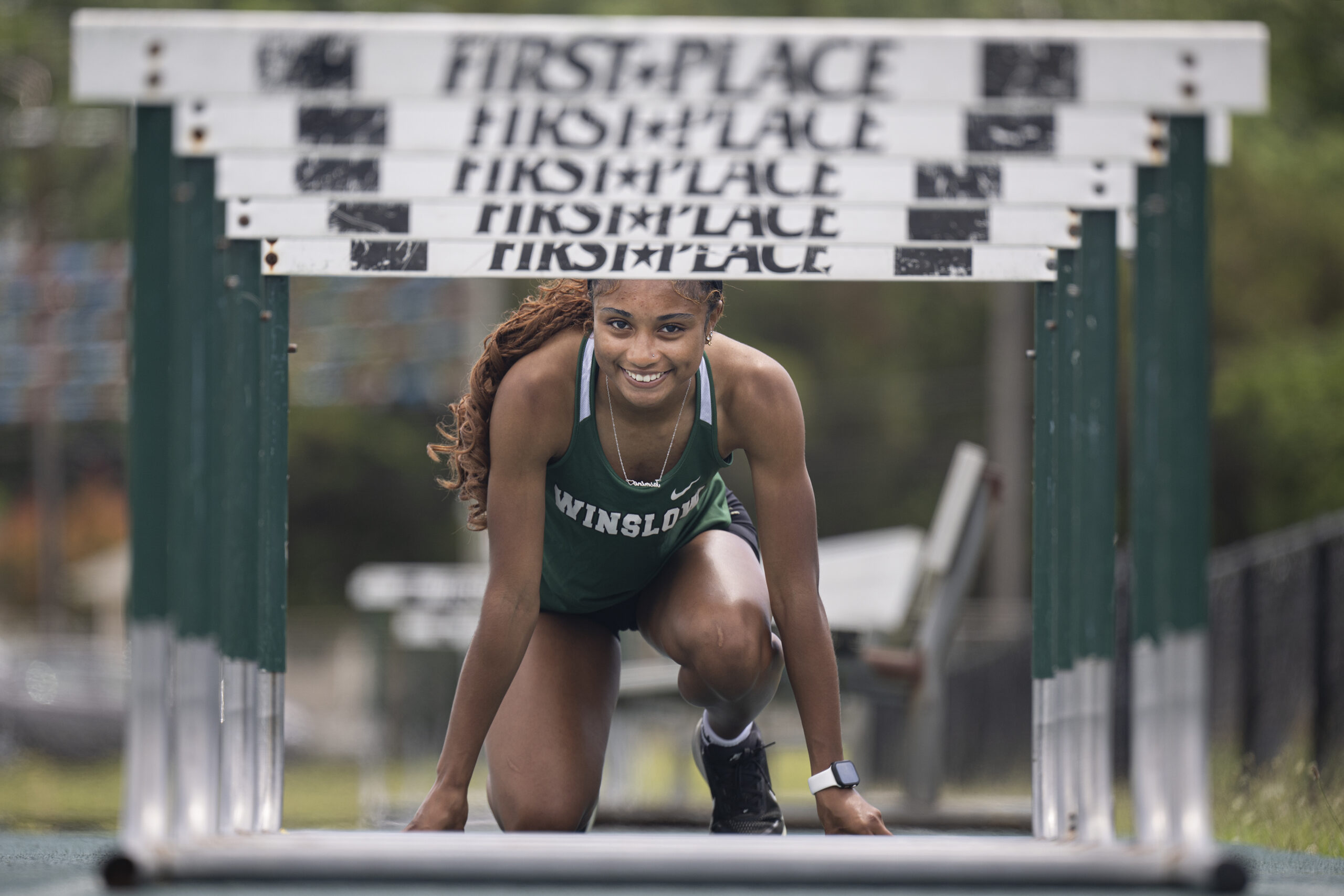
    When she was 5, she saw a hurdle on the track and asked her dad if she could try to jump over it. Tyree initially said no, worried she might hurt herself, but she persistently asked, so he finally gave in.

    She cleared the hurdle with her right leg leading and left leg trailing, the form she still uses today.

    “It was perfect,” Tyree said.

    Starting out, however, he wasn’t convinced that hurdles would become her event.

    “There were a lot of times where I thought that maybe hurdles weren’t for her because she was too timid and scared to actually run through the hurdles,” he said.

    Tyree scoured the internet for drills and training ideas to help his daughter develop as a hurdler. His former teammates offered advice on technique and form, and they soon progressed from wickets to smaller hurdles. She joined Winslow Elite Track and Field at age 8 to keep improving.

    By 14 years old, Jasmine broke the national record for the 100-meter hurdles with a time of 13.72 seconds at the 58th AAU Junior Olympic Games in Greensboro, N.C. That race gave her a newfound confidence.

    “That race pushed her over the edge as far as her demeanor and her confidence level because in order for her to win and break the record, she had to beat some really talented athletes she had never beaten before,” Tyree said.

    And as her confidence has grown, her times have dropped.

    Part of that growth has come from racing against the nation’s best, including one of her biggest competitors, Nia Armstrong from Tampa, Fla. The hurdlers have developed a friendly rivalry over the years since they typically compete in the same races and push each other to faster times.

    “Whenever those two compete against each other, it’s like I don’t care who else is on the track, the race is going to be between them,” Tyree said.

    Before the Meet of Champions earlier this month, Jasmine was nervous. The meet featured the toughest competition she faced all season. But as she set up on the line, she reminded herself that she belongs here and is built for the moment.

    “I just tell myself I’ve been here before. It’s just a track. I know how to run. I know how to hurdle. I know what I’m capable of,” she said. “I believe in myself, I’m ready for this moment, and not to let an opportunity pass by because you might not get it again.”

    Developing self-belief in a mentally challenging sport, Jasmine says, has been one of her biggest areas of growth.

    “She’s always been good. She just didn’t have the confidence to know that she’s good,” said Shawnnika Brown, Jasmine’s high school coach. “Now, she is running with a purpose.”

    That purpose is reflected in her daily routine. Jasmine trains with her team after school, goes to the gym to lift weights, and does additional hurdle sessions with her dad on the weekends.

    Having Tyree as her coach has also been an important part of her success.

    “I try not to let the coach interfere with the father,” Tyree said. “I’ve learned how to talk to her and get her motivated to the best of my ability without her being upset with the father.”

    After Jasmine won at Brooks, Tyree let his daughter enjoy the moment before turning their attention to the next race.

    “She knows I’m going to focus on the flaws first before I celebrate her and give her roses because I sometimes have to be the coach first and then dad second,” he said.

    That approach is shaping one of the nation’s fastest high school hurdlers, but Jasmine’s goals go beyond state titles and national championships.

    Jasmine Jackson will compete at the New Balance Nationals at Franklin Field this weekend.

    “The ultimate goal is to go to the Olympics,” Jasmine said. “Knowing I have that goal in mind, no matter how I feel, I know I have to work for it. It’s not going to be given to me. I have to earn it.”

    For now, the 15-year-old can check the Brooks PR Invitational off her list. Up next is the New Balance Nationals running until Sunday at Franklin Field. Jasmine will run the 100-meter hurdles and 4×400-meter relay championship. She is looking to earn her first national title at the event.

    “I’m tired of being second at this event,” she said, laughing. “I’m going up against pretty tough girls, so it’s going to take a lot to win. I believe I can do it if I put my mind to it.”