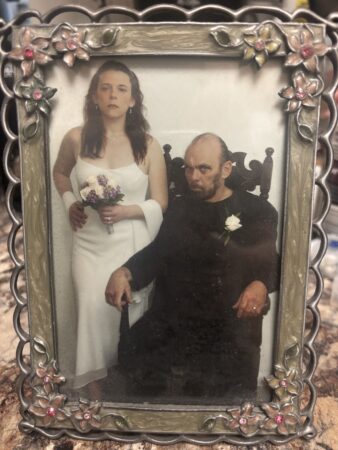
Amy McHale and Raymond “R.C.” Horsch met on the streets when she was battling pneumonia and needed medical care.
She had long struggled with mental health issues and drug and alcohol addiction. She saw Horsch, an erotic photographer and filmmaker 30 years her senior, as her rock, said her mother, Gloria McHale.
“He was like her savior.”
They held their wedding reception beside a greenhouse in the sprawling, serene backyard of his Chalfont home in September 2004. The marriage lasted only a few years, but Amy McHale kept going back to Horsch after he moved to a house on West Chew Avenue in the Olney section of Philadelphia with his son, Eugene Albert Horsch.
She was staying there on June 14, 2016, when she left a voicemail message for her daughter, Amanda Stofer, saying all was OK. At the time, Amy McHale was a 44-year-old mom and grandmother of three.
She has been missing ever since.
“She would never leave her daughter and grandchildren,” Gloria McHale, 79, said by phone after news broke this week that authorities had been combing through that house for days. “She loved them, adored them.”
For more than a week, Philadelphia police and federal authorities have been searching the crumbling Horsch twin home to determine if there is any connection to the disappearance of Amy McHale and one other woman.
R.C. Horsch was a controversial figure who had been convicted of forgery and drug manufacturing when he died in May 2025 of chronic obstructive pulmonary disease at age 82. Police have not named him as a person of interest in a missing-person investigation.
His son, Eugene Albert Horsch, is being held on $500,000 bail at Curran-Fromhold Correctional Facility on charges of illegal gun possession and drug crimes. He had a criminal history that included at least 10 other arrests for drug possession, dealing, assault, and drunken driving when he was arrested earlier this month near Independence Hall after his actions drew the attention of U.S. Park Police.
“This is much ado about nothing,” said Eugene Horsch’s attorney, Jerome Brown, of his client’s connection to any missing-person investigation. “They’re barking up the wrong tree.”
When the news broke, McHale’s mother and daughter thought they might finally discover what happened.
“But I don’t feel much closure, and today is an emotional low,” McHale’s daughter, Amanda Stofer, said Saturday. “I was hoping for some answers about my mother from the home, but I’m doubtful that will happen.
“It just feels heavy and sad.”
The case came to light under bizarre circumstances. U.S. Park Police stopped Horsch, 44, near Sixth and Market streets on June 19. In his black BMW, officers recovered two firearms with obliterated serial numbers and a phony drug enforcement badge with Horsch’s photograph under the name “Eugene Frederick Steiner.” He also had large amounts of cocaine, fentanyl, and marijuana, according to an affidavit of probable cause for his arrest.
A woman with Horsch gave officers a false name, one that belonged to a 38-year-old woman who had been reported missing in Kensington in February 2023. Horsch’s passenger told investigators that he had made her fake ID cards with that name before and advised that if she was ever stopped by police, she could use them.
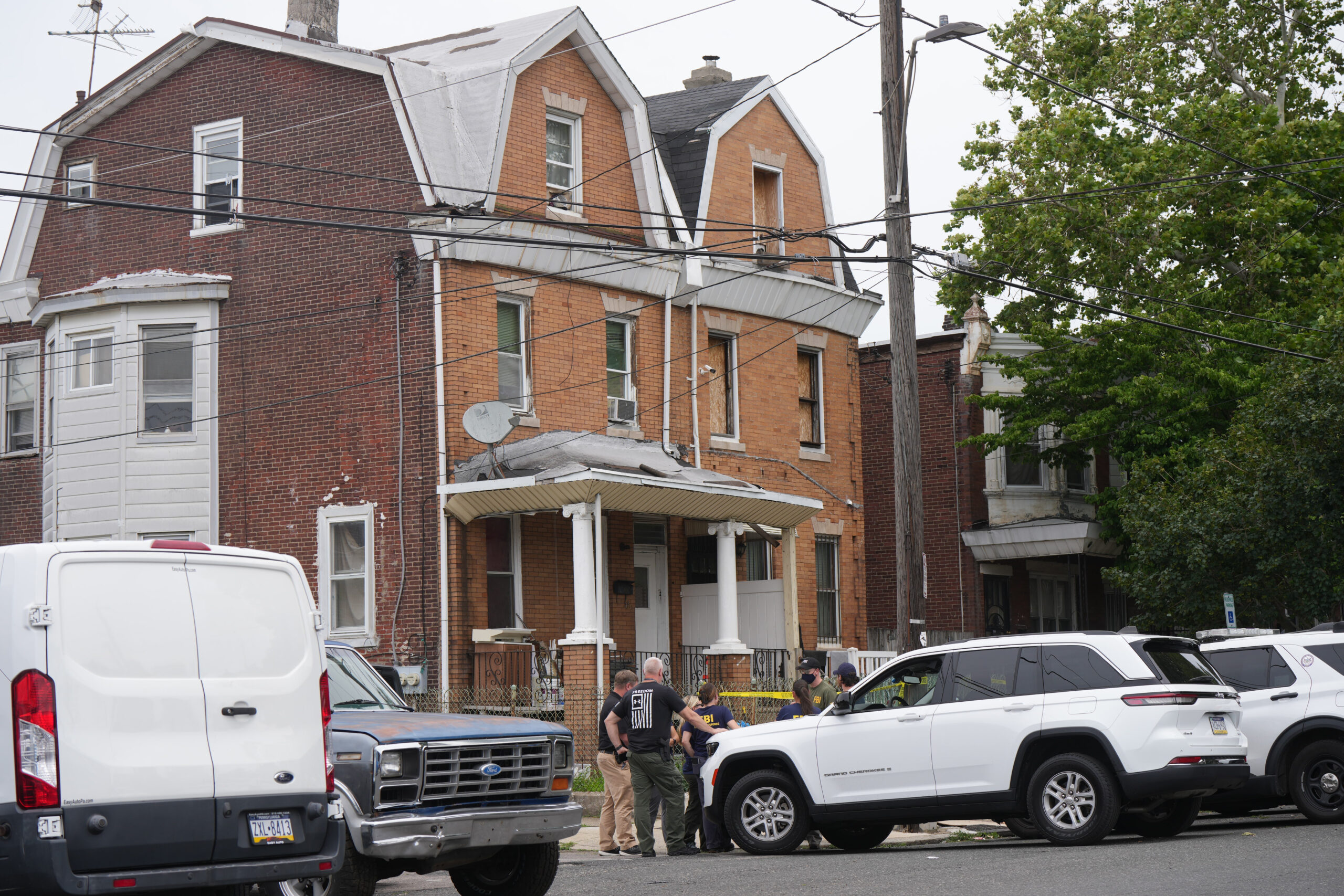
Law enforcement wearing FBI clothing at the scene of an ongoing investigation in the 400 block of West Chew Avenue, searching a home in Olney.
In Horsch’s dilapidated home, investigators found another handgun, hidden compartments, a 55-gallon drum with connections to water lines leading to a hole in the ground, and chemicals and bottles of liquid that forensics investigators are working to identify. There were also what appeared to be urns holding remains, one set of which was apparently his father’s. The basement resembled some sort of chemical lab.
Federal investigators also found a unsigned and handwritten letter that referenced hurting unspecified people and the serial killer Ted Bundy, according to an affidavit of probable cause obtained by The Inquirer.
Investigators are working to verify the authenticity of the letter, and whether it was meant to serve as a portion of a novel or screenplay.
Under a gloomy sky Saturday, about 15 FBI agents, some wearing hazmat suits, streamed in and out of the boarded-up twin home. “They’ve begun processing the scene,” Philadelphia Deputy Police Commissioner Frank Vanore said. Forensic experts were determining what evidence had to be sent away for scientific analysis, he said. “It’s going to take some time.”
Art and weed
R.C. Horsch, who was born in East Stroudsburg, Monroe County, in 1943, is described in an author’s biography as “an artist, filmmaker, composer, writer, porn performer, drug smuggler, sometime political activist, art forger, counterfeiter, pot grower, air show pilot, army deserter, fugitive, sociopath, ex-convict and all-out villain.”
Throughout his life, R.C. Horsch worked on avant-garde artwork and erotica, often focused on scantily clad women in sadomasochistic settings, including a book described as an “autobiographical memoir of a caring, empathetic serial killer.” He directed his first film, The Erotic Memoirs of a Male Chauvinist Pig, in 1973.
A 1968 news report identified Horsch, then in his mid-20s, as the operator of a theater on the 2000 block of Sansom Street known as “Underground Cinema 16” — later the Roxy — which screened avant-garde films, including his own, but was shut down for operating without a license.
Horsch was married at least three times. He married Anna Ferkuniak, a native of Nant-y-moel, Wales, who was Eugene Horsch’s mother. She died in 1989 at age 39 after a lengthy illness, according to her obituary.
R.C. Horsch also had an extensive criminal history.
He pleaded guilty to passing bad checks in North Carolina in 1973, and the following year the Secret Service charged him and another man in Doylestown with passing nearly $180,000 in fake 10-dollar bills and possessing phony driver’s licenses.
In 1977, federal authorities raided what was described as his home laboratory, seizing equipment they alleged was meant to make methamphetamine. But Horsch left for New Zealand, later returning to California, according to court records, and operating under the alias “Richard Harris.”
Eugene Horsch was born in 1981, while his father was still a fugitive.
Authorities captured R.C. Horsch in Florida in 1985. A psychologist hired by his defense attorney claimed Horsch had a 140 IQ, according to court records, but had “deep rooted emotional problems.”
He was sentenced to three years’ imprisonment, plus probation. He later settled in Chalfont but acquired the Chew Avenue house after his aunt died in 2004. In 2007, he used power of attorney to legally transfer ownership to his son for $1.
In 2009, R.C. Horsch was indicted in Chalfont for growing “455 marijuana plants.” Investigators also confiscated two shotguns. The feds seized his suburban home and he was sentenced to 54 months in prison.
Federal inmate records show he was released from prison in 2013, and later moved into the Chew Avenue property, where he would reside until his death. He authored several erotic novels in the 2010s, often focused on women battling substance abuse or mental health issues.
Krista Marie Killen is credited as appearing in multiple erotic films that he directed, including one released as recently as 2021, and at times listed the Chew Avenue house as her residence.
In 2025, a motorist sued R.C. Horsch, Killen, and an unidentified man, claiming the trio crashed their Chrysler 300 into her SUV near Adams Avenue and Montour Street in 2023. Court papers list Killen’s occupation as “caregiver” and the “adult in charge of residence.”
She died the next month, according to an obituary, three months after Horsch.
In searching the home recently, investigators found a death certificate for Killen. According to the affidavit of probable cause, the cause of death was drug intoxication.
‘People don’t vanish’
R.C. Horsch and Amy McHale had become a couple in the 1990s.
“I was a young kid when they started dating, and I want to say he had been around for at least 10 years by the time they got married,” Stofer recalled.
They divorced after a few years and McHale moved in with her mother on South Hutchinson Street in Philadelphia. She went to Peirce College, became a paralegal, and was trying to get her life back on track, said Gloria McHale, 79.
But she could not kick her drug and alcohol addiction, she said. She would periodically return to Horsch’s home on Chew Avenue.
“They stayed friendly with each other,” Stofer said. “I’m sure it had something to do with the drugs and alcohol. I think he enabled her with things that weren’t really permitted in my grandmother’s house.”
On June 13, 2016, she went to Horsch’s. She called her mom that night to tell her she was on her way home. “She was obviously very drunk and I told her to stay where she was, because to get home she would have to take the subway, and she was in no shape to take the subway.”
The next day, she called Stofer and left a message. “She told me she was at Ray’s house and she was OK.”
That’s the last they heard from her.
Amy McHale would sometimes be gone for a couple of days, but never for much longer, they said. Stofer had three children, and her mother doted on them. Stofer was planning her September wedding.
“My mom had her struggles with addiction,” said Stofer, 38. “But my mom would not want to disappear in my life. She would never do that. She always came back around. She never missed big things like my kid’s kindergarten graduation.”
Gloria McHale searched all over for her daughter. “I put signs up all over Kensington,” she said.
Detectives interviewed Horsch. He told police and the McHale family that she was drinking vodka and he went to bed. “He said when he woke up, she was gone,” McHale said.
And Horsch stopped reaching out to her family.
“When she would disappear before, Raymond would always keep calling me. ‘Did you hear from her?’ And after this I never heard from him.”
McHale is hoping someone will come forward now with new information.
“Somebody has to know something,” she said.
“People don’t vanish into thin air.”
Amy McHale.
Staff writers Brett Sholtis, Michelle Myers, and Isabel Maney contributed to this article.
Philadelphia’s police union issued a statement criticizing city officials for failing to promptly reimburse expenses incurred for officers who died in the line of duty, and disputed the city’s claim that it did not use tax dollars to cover a roughly $11,500 funeral luncheon, which included a 94% “gratuity.”
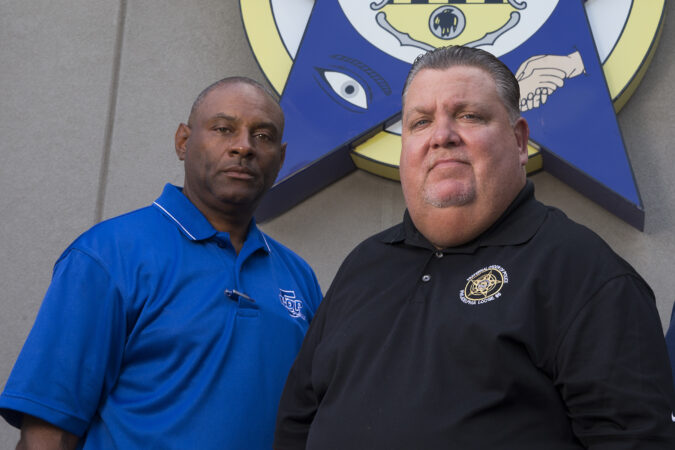
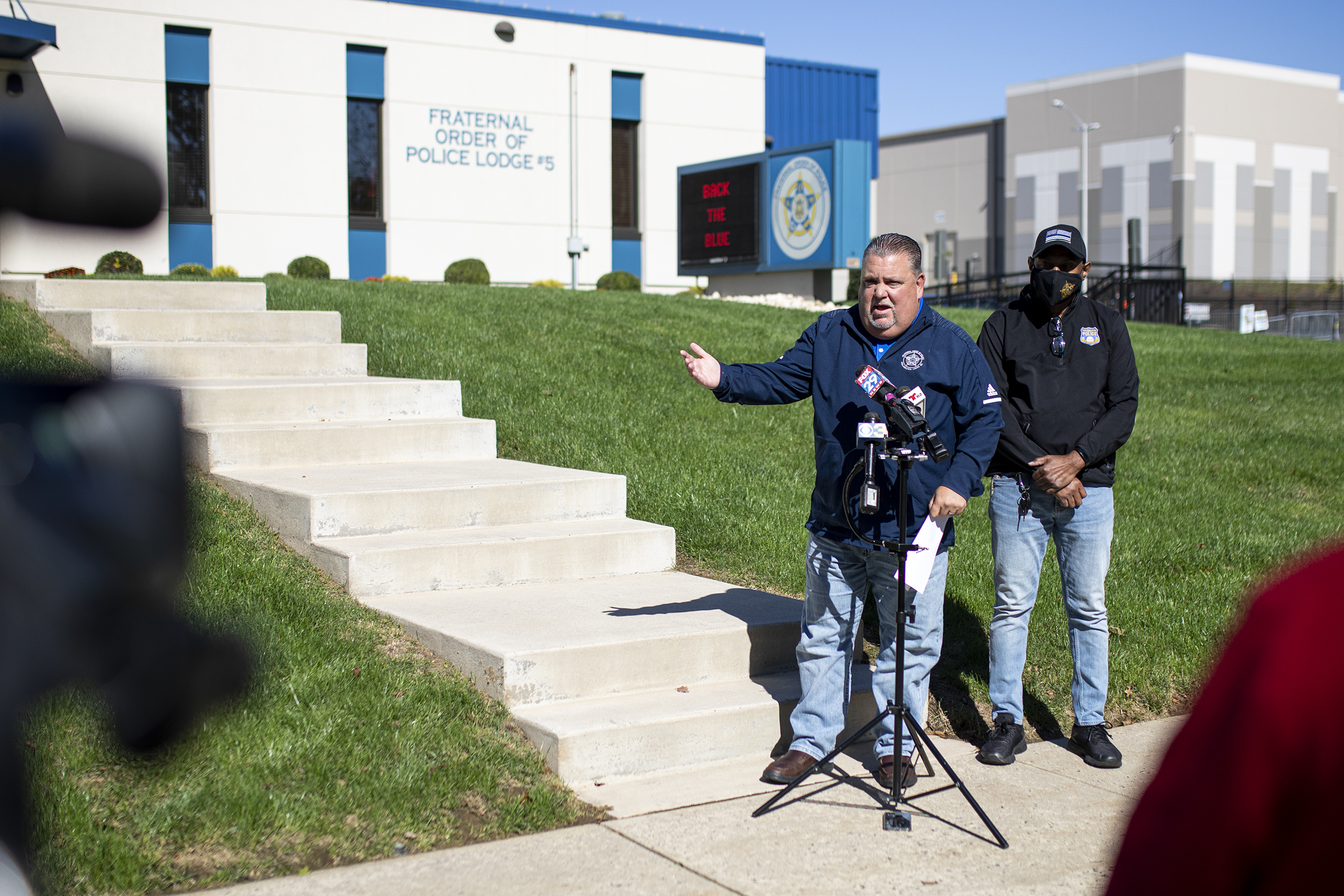
The Fraternal Order of Police Lodge 5’s statement, which was posted on Facebook last week and emailed to its members, followed an Inquirer investigation that found the union has for years billed the city following an officer’s death for expenses that are unrelated to funeral home and cemetery costs.
“The problem has always been and continues to be the city of Philadelphia’s ineptitude to pay bills in a timely fashion,” the FOP wrote. “Which leads to the survivors’ families having to make large financial decisions for funerals, services, luncheons, transportation, cemeteries, funeral attire, and cremations within days of suffering a traumatic life-changing event.”
Since 2014, the city has contributed up to $75,000 in tax dollars for each line-of-duty death, up from $15,000. The FOP’s contract with the city calls for the union to be reimbursed for “reasonable and necessary funeral expenses.” But there is no further explanation of what would qualify, and The Inquirer found the union has asked the city to pay tens of thousands of dollars for everything from bar and restaurant tabs to socks and underwear.
The FOP has also billed the city for at least eight events at its own bar, 7C Lounge, located inside its sprawling headquarters in Northeast Philadelphia. One of those events was a luncheon in May 2020 for Cpl. James O’Connor IV, a 23-year veteran and married father of two, who had been shot and killed in March of that year.
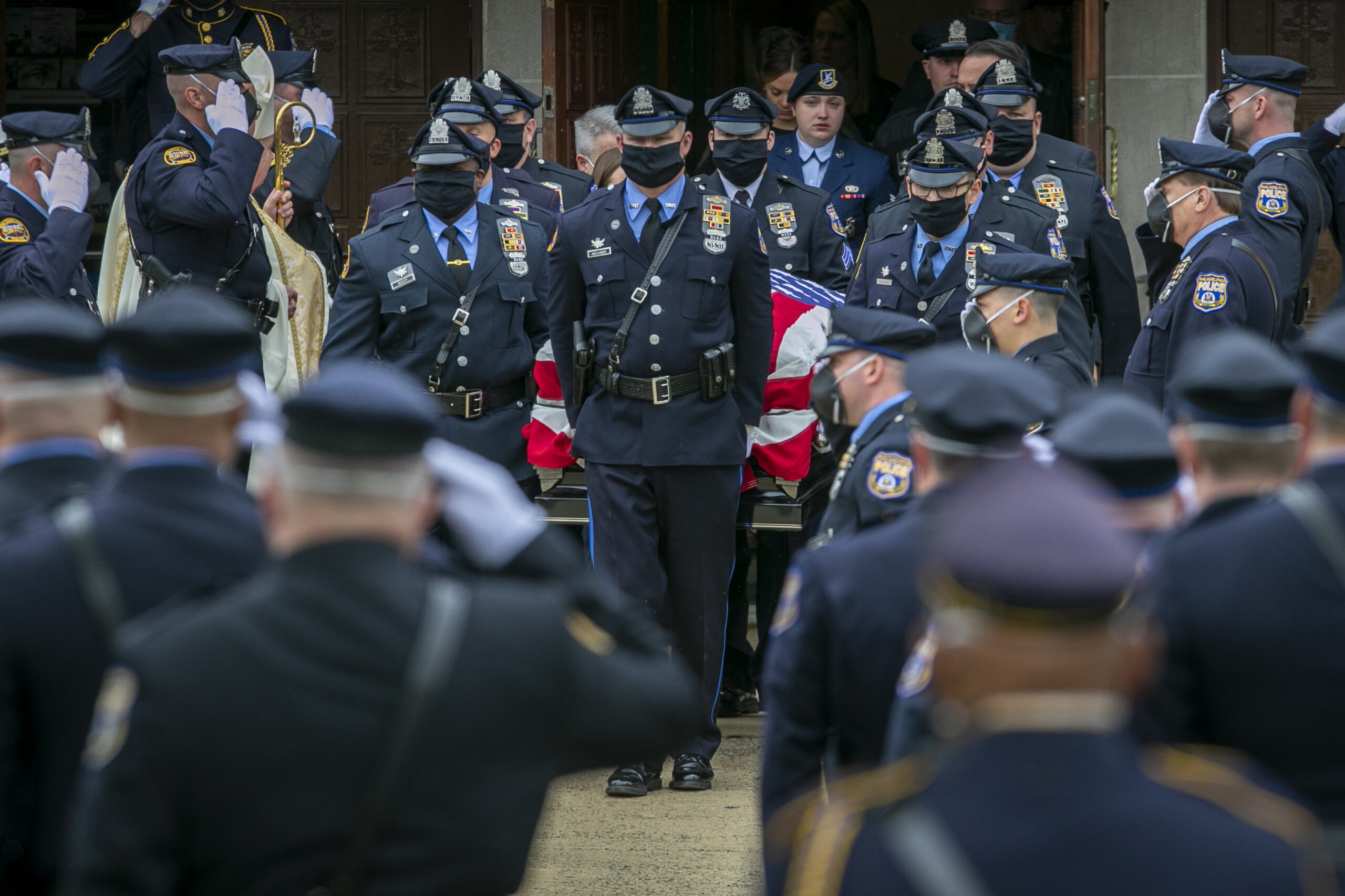
His funeral had to be postponed for eight weeks due to the COVID-19 pandemic and only a limited number of people, all in masks, were permitted inside the church.
Pallbearers carry the body of slain Philadelphia Police Cpl. James O’Connor IV outside Our Lady of Calvary on May 8, 2020. O’Connor was killed in the line of duty.
Even though the city had restricted bars and restaurants to takeout and delivery service, the FOP held a 2½-hour lunch for O’Connor at its own bar.
Records show the FOP billed the city for $5,700 worth of bottled beer, an open bar, and food for 160 people. The union added a $5,375 gratuity.
Sharolyn L. Murphy, the city’s risk manager and deputy finance director, wrote in an email to The Inquirer that the city did not reimburse the FOP for the O’Connor luncheon.
The FOP statement claims otherwise. The union wrote that it provided the city with comprehensive documentation and was fully reimbursed.
The FOP statement also says that the $5,375 was not all a gratuity — which is how it is listed on the bill — but just $925 for a tip while the rest was payment for kitchen and catering workers, bartenders, servers, and managers.
“This was the only way to add the payroll and gratuity expense to the catering invoice,” the FOP wrote. “This was all documented and explained in timestamped email records and provided to the city which is why they approved the reimbursement.”
The FOP attached to its statement copies of six emails listing the amounts paid to the staffers, all of whose names are redacted. Names of the senders and recipients are also redacted, except for then-FOP president John McNesby’s.
The emails were not included in the Right-to-Know records The Inquirer received from the city. The city did not respond to questions about whether the risk management team had gotten them and, if so, why they were not among the documents previously provided to the newspaper.
But Murphy on Tuesday e-mailed The Inquirer a breakdown of the items the city denied from a $32,600 reimbursement request, including the cost of the O’Connor luncheon, as well as liquor bills totaling $800 and $50 in miscellaneous beverages.
“The city provides expeditious payment of funeral expenses to support families of those who made the ultimate sacrifice to service to Philadelphia,” Murphy wrote in an e-mailed response to The Inquirer. “At the same time, the city has a responsibility to ensure that taxpayer funds are spent appropriately.”
Current FOP president Roosevelt Poplar and McNesby, who served as the union’s president for 16 years before stepping down in 2023, did not respond to multiple requests for comment before The Inquirer published its investigation. In its June 13 statement, the FOP called The Inquirer’s investigation a “hatchet job hit piece.”
The Inquirer’s examination of the funeral expenses underscored questions about the FOP’s nonprofit Charitable Foundation, commonly known as the Survivors’ Fund, which raises money to pay for funerals and support the families of officers who were killed or seriously injured in the line of duty.
A 2025 Inquirer investigation found that the FOP reported spending hundreds of thousands of dollars on “funerals and special events” in years when no officers died in the line of duty, and that its expenditures and cash donations had been loosely documented and were difficult to track.
The Inquirer sought further clarity by filing Right-to-Know requests with the city for more than 1,000 pages of invoices, bills, emails, and other public records concerning 17 police line-of-duty deaths since 2014. Eight of the deaths were attributed to COVID.
The FOP publicly criticized The Inquirer’s records request.
Included in the documents were FOP submissions of receipts from businesses such as Target, Home Depot, Walmart, Acme, 7-Eleven, and CVS that include no explanation as to why they were funeral expenses. The union has also forwarded statements of corporate credit cards requesting reimbursement for restaurants and beer stores.
Some reimbursement requests lacked receipts or itemized breakdowns, and at least two were for cash. The FOP did not address the cash requests in its statement.
The Inquirer found that the city has covered the bulk of the FOP’s requests, although in almost all cases, the documents do not point to which specific reimbursements were approved or denied. An FOP request for $1,870 to cover two bar tabs and pipes and drums after a dinner is the only explicit denial in the records.
The FOP wrote in its statement that its “finance office and accounting firm have comprehensive, accurate, and detailed records for all financial transactions for our multiple accounts. There are no missing or incomplete records.”
Raymond and Anna Wakeman had returned from dinner early on a Saturday night and were relaxing on the couch with their two rescue dogs in their Northeast Philadelphia home. Cricket, a pit bull, rested his head on Raymond’s shoulder. Jax, a miniature pinscher, was curled up next to Anna.
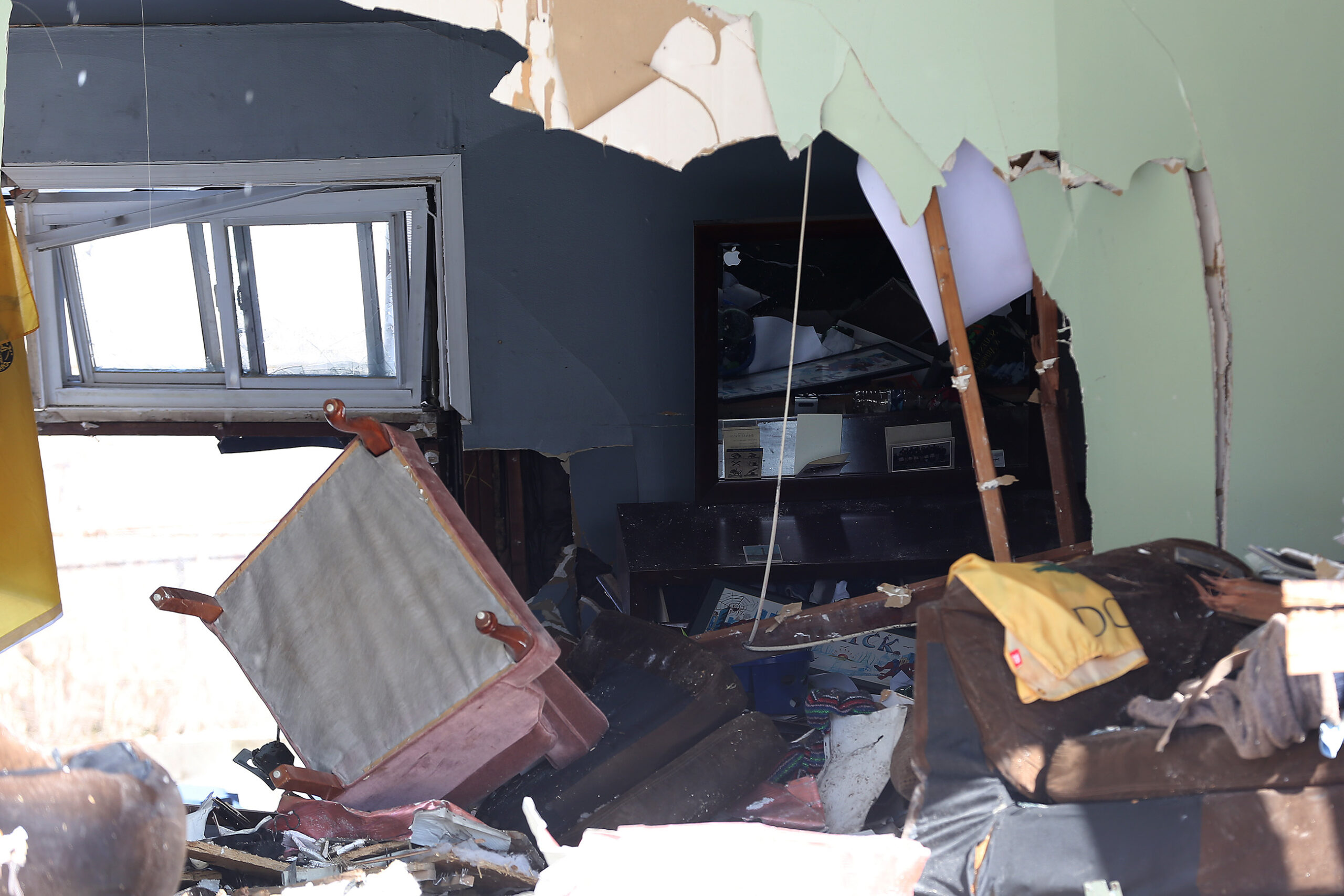
In an instant, a 2014 Dodge Dart exploded through the front of the Wakemans’ home and into their living room.
Firefighters arrived to find Anna in another room, pinned under the silver Dodge and gravely injured. Rescuers worked feverishly to free her from the wreckage and rush her to the hospital. Jax was dead. Cricket underwent emergency surgery, but died soon after.
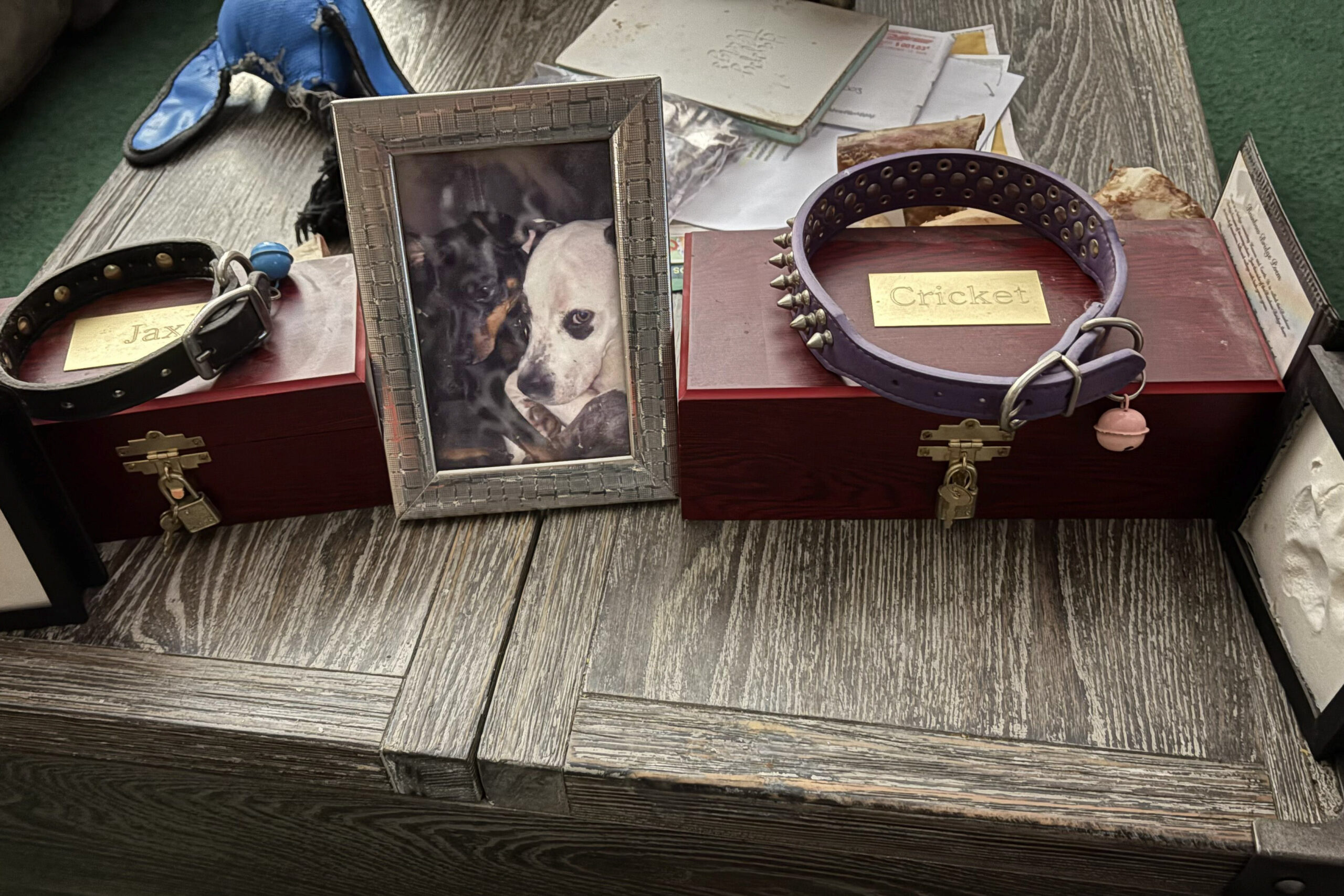
Anna Wakeman assembled a memorial to the family’s two rescue dogs, Jax and Cricket, who were killed by Gregory Campbell, a Philadelphia police officer who crashed his car into her home in 2021. Campbell spent hours consuming alcohol at a bar operated by the Fraternal Order of Police Lodge 5.
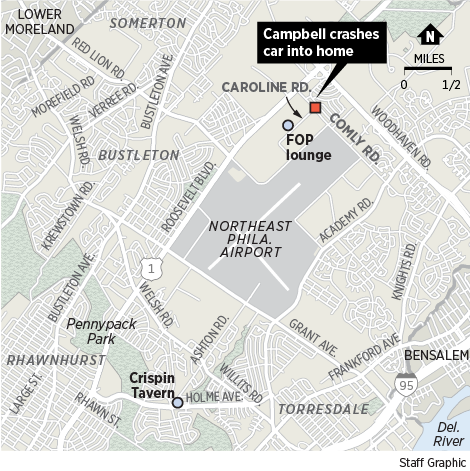
The driver, off-duty Philadelphia Police Officer Gregory Campbell, had been drinking since midafternoon on Feb. 6, 2021, and a lawsuit would later allege he had consumed as many as 20 alcoholic beverages. He had most of them where he ended his evening, at the 7C Lounge, a members-only club for active and retired cops operated by the Fraternal Order of Police Lodge 5, inside the union’s headquarters.
Campbell was arrested and fired from the police force after the crash. In June 2022, a Common Pleas Court judge sentenced him to 11½ to 23 months in prison.
“I am so sorry,” Campbell told the Wakemans in court, “for everything I’ve put you and your family through.”
Campbell’s accident and subsequent trial were widely covered at the time. But an Inquirer investigation has found troubling new details about that crash and the aftermath that were never made public, and identified two additional auto accidents tied to the 7C Lounge. The findings raise questions about how drunken-driving cases are investigated when they involve a powerful police union operating its own bar.
Records show that after crashing into the Wakeman house — and while it was still unclear whether Anna Wakeman had survived — Campbell was allowed to confer with FOP representatives and delay a blood-alcohol test for nearly six hours.
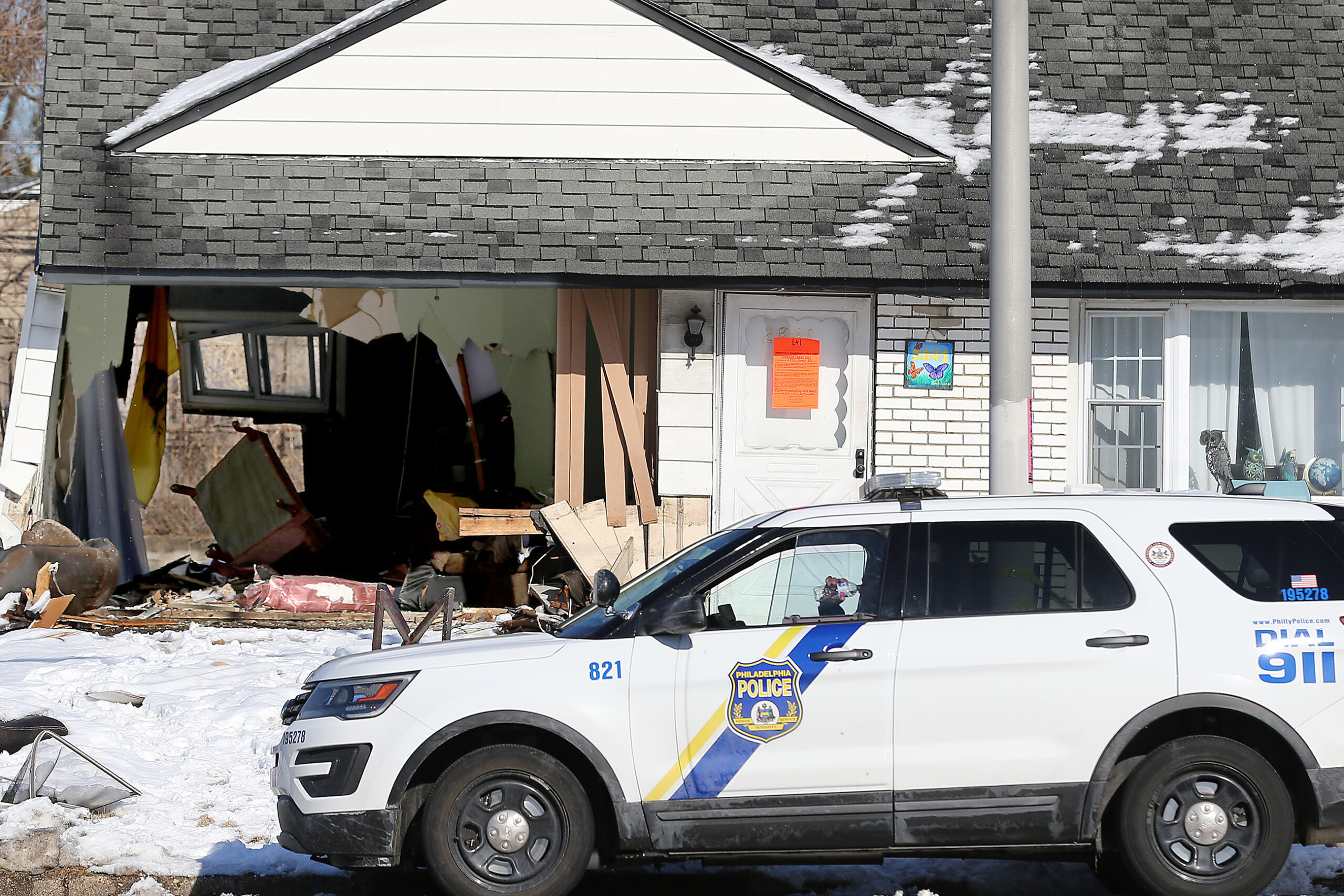
Gregory Campbell’s Dodge Dart sped from the parking lot outside the FOP’s 7C Lounge into the Wakemans’ home, killing the family’s two dogs and almost killing Anna Wakeman.
The delay was an apparent violation of Pennsylvania law, which requires suspected drunk drivers to undergo testing within two hours of being behind the wheel unless good cause is given. The records include no explanation for the delay.
An officer in the police department’s Crash Investigation District later testified in a deposition that he had never before encountered a person accused of driving under the influence who was allowed to seek guidance from his labor union before undergoing blood testing.
When Campbell’s blood was finally tested, his alcohol level registered at 0.23%, almost three times the 0.08 legal threshold for drunken driving. A toxicologist later estimated Campbell’s blood-alcohol content at the time of the accident was as high as 0.351%, more than four times the legal limit.
The Wakemans filed a lawsuit in Philadelphia Common Pleas Court against Campbell, the 7C Lounge, and Lodge 5. The couple’s attorney hired a liquor liability expert — a former police officer who had been an investigator for the New Jersey Division of Alcoholic Beverage Control for 11 years — who concluded that there was “overwhelming evidence” that the 7C Lounge had overserved Campbell and failed to monitor him or intervene.
The “actions and inactions were negligent and reckless” and “contributed directly to the accident, damages and injuries sustained by the Wakeman family,” the expert, Donald J. Simonini, wrote in his 23-page report.
On the night of the crash, a Philadelphia police accident investigator attempted to interview employees working at the 7C Lounge but was unable to do so because the bar had closed hours earlier than scheduled. The investigator said subsequent attempts to obtain information from the employees were also unsuccessful.
A manager later testified that he was “following orders” when he shut down the bar early.
An aerial view of Lodge 5’s headquarters, the 7C Lounge, and Anna and Raymond Wakeman’s home.
At that time, Lodge 5 was led by its longtime president, John McNesby. His chief of staff, Roosevelt Poplar, was vice president of the union’s Home Association, a nonprofit that operates the 7C Lounge.
Neither McNesby nor Poplar responded to requests for comment.
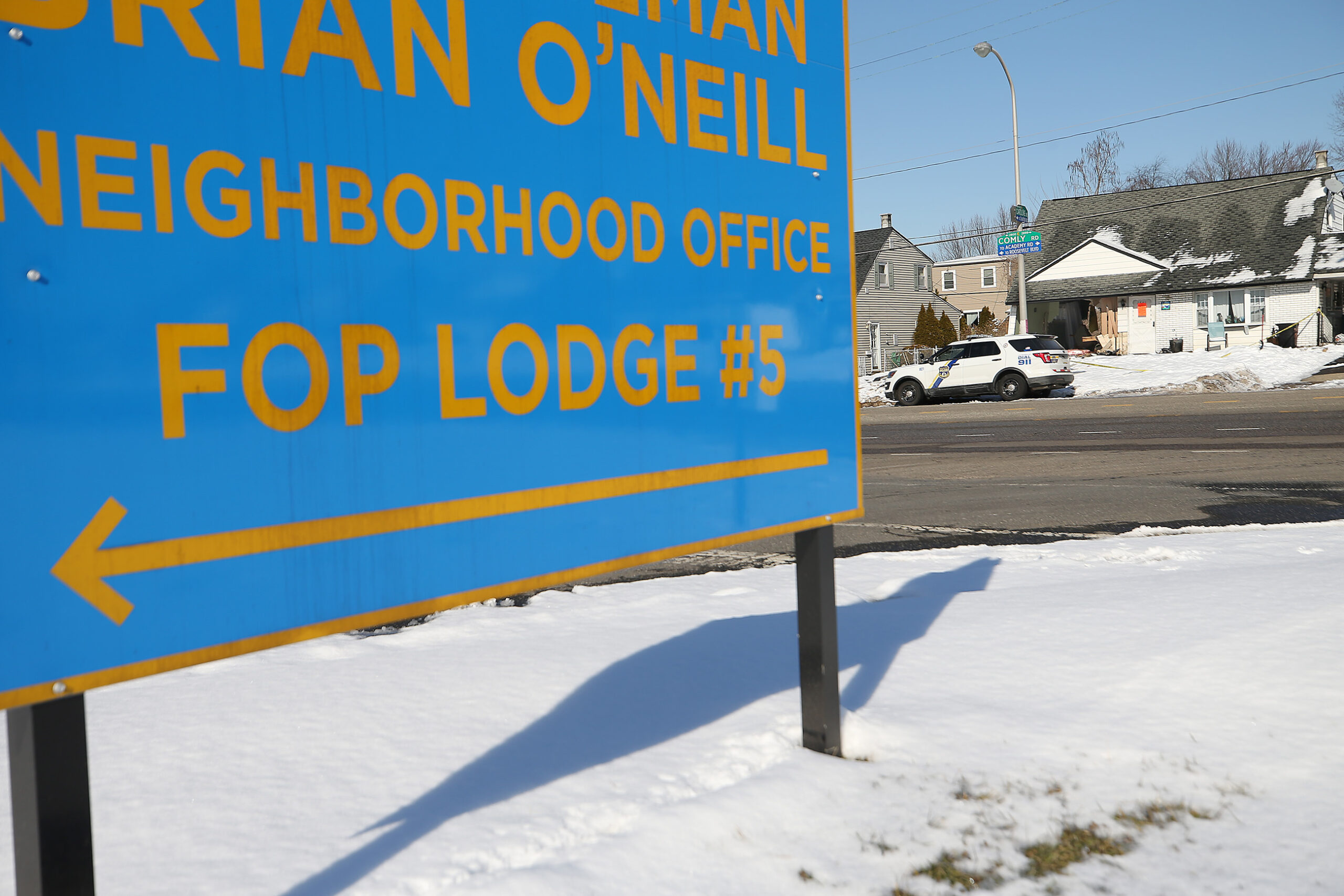
State law grants regulators broad authority to crack down on bars found to have overserved customers, with sanctions ranging from fines to suspension or revocation of a liquor license. Yet the FOP’s bar has faced no regulatory repercussions during the 16 years it has operated at its Northeast Philadelphia headquarters.
Paul Herron, a Philadelphia lawyer who specializes in liquor licenses and enforcement, said that the Pennsylvania State Police Bureau of Liquor Control Enforcement (BLCE) has “very stringent requirements” and that most establishments tend to have at least minor violations, such as improper recordkeeping. He said it is “very unusual” that the 7C Lounge has a clean slate given the severity of the Campbell case.
Campbell “had consumed monumental amounts of liquor, and for that to just not show up anywhere is awfully strange,” Herron said. “I would expect that if this happened to another place, that this would come to light, to the knowledge of the bureau, and they would ultimately issue a citation.”
In another incident tied to the 7C Lounge, regulators did not open an investigation because the union did not report what had happened.
The Inquirer viewed two minutes and 40 seconds of surveillance footage of the 7C Lounge parking lot from the evening of Nov. 22, 2021. The recordings come from three separate cameras and show a patron walking out of the 7C Lounge and getting into the driver’s seat of a compact SUV. At 11:21 p.m., the driver backs up, then accelerates forward into a parked truck, hitting it hard enough to slam the truck into the front bumper of an SUV parked behind it.
The motorist pauses a few seconds, reverses, then accelerates past the damaged vehicles and runs over two orange cones. The driver then plows through the FOP’s fence on Caroline Road, destroying a section of it, before disappearing from the camera’s view.
A source with firsthand knowledge of the incident said Poplar reviewed the footage of the parking lot crashes and took notes, including “4 cars hit” and “fence,” with the time each object was hit.
Roosevelt Poplar won a heated reelection battle for the FOP’s presidency in 2025. He previously served as the vice president of the union’s Home Association, a nonprofit that operates the 7C Lounge.
A police spokesperson said there is no record that the crashes in the 7C Lounge parking lot had ever been reported to authorities.
Herron said a typical bar would have almost certainly reported that type of incident.
“It’s just not something that would have happened maybe if it didn’t involve the police or the FOP,” he said.
‘I was dizzy’
There are potential conflicts of interest if law enforcement officers with arresting powers own establishments that serve alcohol. In fact, state law prohibits police officers from holding liquor licenses because they are responsible for enforcing liquor laws.
But that restriction does not extend to the FOP’s Home Association because it is considered part of a fraternal, nonprofit organization. State law defines such entities as “catering clubs” — much like a VFW post or an Elks Lodge — and permits them liquor licenses.
It’s a loophole in the law that Anna Wakeman, who barely survived the accident with Campbell’s Dodge, doesn’t understand.
“The cops can drink as much as they want there,” Wakeman, now 58, said. “The bartenders serve them till they’re blackout drunk and let them leave.”
When Campbell crashed into the Wakemans’ home, it was the second time the family’s property had been damaged by a patron who left the FOP’s bar impaired. Less than two years earlier, a former Philly cop had left the 7C Lounge, got into his car, and smashed into Anna Wakeman’s SUV, which was parked in her driveway.
Anna Wakeman and her husband couldn’t stomach the idea of returning to their Northeast Philadelphia home after the 2021 car crash, fearing it could happen again. They moved instead to West Virginia.
On a Sunday night in April 2019, an ex-Philly cop named Damien Walto worked as a DJ at the 7C Lounge, which has an expansive bar with gleaming dark wood and big-screen TVs. Walto was no longer an active member of Lodge 5: He had been fired from the police force in 2010 for allegedly assaulting a woman while off duty, and was later sentenced to three to six months in prison.
Walto left the bar just after 10 p.m. in his GMC Envoy. Rain was falling, the roads were slick, and Walto told a reporter that he lost control of his SUV when he tried to steer past a tractor-trailer on Caroline Road. He careered through the intersection at Comly Road and smashed into Anna Wakeman’s Chevrolet Equinox, which was sitting in her driveway.
The force of the impact crumpled the rear of the Equinox like an accordion and propelled it into Raymond Wakeman’s parked Chevrolet Silverado.
The Wakemans watched Walto stumble out of his Envoy, dazed and disoriented, then stagger along the sidewalk while clutching an Easter basket.
In a recent interview with The Inquirer, Walto said he does not remember if he drank any alcohol at the party, perhaps because he struck his head hard against the steering wheel.
“I was dizzy and messed up,” he said. “I didn’t know what was going on.”
Walto returned to his GMC and fumbled with a screwdriver in an attempt to remove an FOP-marked license plate from his SUV, the Wakemans said. He toppled over and the license plate remained in place, they said.
Walto said he was not trying to hide his link to the police union. “My tag fell off and I was trying to put it back on,” he said.
Police officers arrived at the scene and noted that Walto appeared to be under the influence of drugs or alcohol. They arrested him, and medics transported him to the hospital for chest pain, according to a police report. There is no mention in the report of Walto having suffered a head injury.
At the time of crash, Walto was also facing DUI charges in Montgomery County, court records show. In August 2019, he pleaded guilty there to driving under the influence and was sentenced to up to six months in prison; he spent 72 hours behind bars, he says.
His Philadelphia case was later dismissed.
The fact that the 7C Lounge has been connected to multiple drunken-driving incidents is troubling, experts say.
The 7C Lounge closed for business early the night Campbell crashed into the Wakemans’ house.
“The more accidents that result from serving alcohol at any bar, owned by the police union or anyone else, the more the public would be ordinarily concerned about the continuing operations of that establishment,” said Mark Carter, a longtime employer-side labor attorney and a member of the U.S. Chamber of Commerce’s Labor Relations Committee.
“Here, you’ve articulated a pattern of behavior that would create a legitimate interest by the city or the prosecutor’s office about the continuing operations of that establishment.”
The state BLCE, which has the authority to issue sanctions, would not confirm or deny the existence of any investigation.
‘Watch our boy’
Hours before the Wakemans were nearly killed in their home in 2021, off-duty Philly cops had gathered for what was supposed to have been a somber affair: paying tribute to James O’Connor IV, a police corporal who had been shot and killed in the line of duty in March 2020.
The Crispin Tavern, a small bar on Holme Avenue in Northeast Philadelphia, staged a beef-and-beer fundraiser for O’Connor’s family that afternoon. Among the bar’s patrons was Campbell, who recalled drinking about six beers there before he climbed into his car and drove to the 7C Lounge, court records would later show.
He arrived at the FOP’s bar just after 5:20 p.m. His next three hours inside the establishment are detailed in a report written by Simonini, the liquor liability expert, who watched video footage from the bar’s security feed.
Campbell, who had been on the police force since March 2018, joined a table of five. Nearby, a man in a white shirt had trouble standing and nearly fell several times as he struggled to get his jacket on. He took a swing at another customer who tried to steady him.
Simonini noted that a server walked by the stumbling man four times but did not once ask if he was OK.
During a deposition, an attorney representing the Wakemans asked the 7C Lounge’s bar manager, Ernie Gallagher, about the stumbling man’s apparent intoxication.
Gallagher theorized that instead of being drunk, the man might have suffered from a neurological disorder.
“A lot of times we have a lot of people come in who don’t even drink, and, you know, they have [multiple sclerosis],” Gallagher said. “They fall and they go, ‘He wasn’t even drinking.’”
When reached for comment recently, Gallagher said: “I have no recollection. I have no comment. I have nothing.”
Simonini wrote that Campbell was drinking what appeared to be bottled beer, Twisted Tea, and mixed drinks out of plastic cups. In one 36-minute period, Campbell downed both his own drinks and others served to people at the table.
This consumption went unnoticed by 7C staff, Simonini wrote.
Gallagher said in his deposition that he considers “two drinks an hour” a safe amount to serve a patron.
“Clearly, Campbell and his party were served far more than ‘two drinks an hour,’” Simonini wrote.
At 7:40 p.m., Campbell returned to the bar, where it appeared Gallagher waved him off. Gallagher said in his deposition that he told Campbell, “Yo, you’ve had enough,” and he thought he told a bartender, “Watch our boy, Greg.” That bartender said in a deposition that he had no recollection of Gallagher’s comment.
Simonini wrote in his report that the 7C bartenders “served Campbell and his party 6-7 drinks at a time, and never watched where the drinks were going and to whom.”
Around 8:10 p.m., Campbell finished a bottle of beer and drank from a plastic cup at the bar. He headed to a bathroom but appeared unsteady, Simonini wrote.
Campbell then went outside. Surveillance video appears to show him losing his balance while walking around a snow bank toward his Dodge Dart.
Lawyers showed Campbell footage from the nearly three hours he spent at the 7C Lounge. Asked in his deposition whether he should have been refused alcohol, he answered, “Yes, based on my blood level of intoxication, yes.”
“Could you safely operate a motor vehicle when you left that bar?” the Wakemans’ lawyer asked.
“No,” he replied.
‘Gurgling on blood’
Campbell got behind the wheel at 8:17 p.m. He pulled onto Caroline Road and drove north toward Comly Road.
The posted speed limit in the area is 30 mph.
Campbell’s Dodge rocketed to 82 mph.
He zoomed past a stop sign, then crossed four lanes of traffic before striking a curb at 70 mph. The Dart thundered over the Wakemans’ snow-covered front yard.
As smoke and dust filled his home, Raymond Wakeman stood up, in shock at the devastation that surrounded him. Shards of crushed glass cut his bare feet.
“The car went right by my face and took my dog,” Raymond recalled. “It took Anna and Jax.”
Campbell climbed out of his car, but didn’t seem to “know where he was or what happened,” Raymond said.
Raymond couldn’t find his wife. But he heard faint sounds coming from the undercarriage of the car, which had come to rest in their son’s bedroom.
“She was gurgling, breathing, but gurgling on blood or something,” he said.
Raymond ripped vinyl siding off his house and used it to shovel rubble and debris from the front of Campbell’s car.
Finally, he saw her battered face.
“There was blood coming out of her ears, nose, and mouth,” he said. “Her leg was hanging off. She was barely breathing.”
Medics transported the Wakemans to Jefferson Torresdale Hospital. When the couple’s 17-year-old son, Patrick, arrived at the hospital, a doctor told him his mother was unlikely to survive the night.
“Honestly, I thought that was going to be the last time I’d ever see my mom,” he said.
Police arrested Campbell outside the splintered remains of the Wakemans’ house and transported him to Jefferson Torresdale, where he was handcuffed to a bed and treated for a cut to his forehead. He was dazed and there was a stench of alcohol on his breath, the police report said.
Then he received special visitors at his bedside, according to court records: unnamed FOP representatives.
Poplar, in his deposition for the Wakemans’ lawsuit against the FOP, was asked how the union is notified after an officer is arrested.
FOP President Roosevelt Poplar (right) said in a deposition that the union was contacted shortly after Gregory Campbell crashed into the Wakemans’ home.
“So, this is just like an extra benefit that if you’re a cop that gets locked up, they call your union rep, 911 actually does?” the Wakemans’ lawyer asked.
“Yeah, that’s the only way we could get notified,” Poplar replied.
“I mean, look. There’s a lot of unions out there. Is there a 911 call going to the Teamsters if they get locked up to their union rep?” the lawyer asked.
“I don’t know,” Poplar replied. “I doubt it.”
Shortly after Campbell’s car bulldozed into the Wakemans’ home, a union representative called the 7C Lounge and told the staff to close for the night — even though closing time was not until 3 a.m. — because an officer had been involved in an accident after drinking there.
“I was following orders,” 7C Lounge bartender Andrew Reardon said in a deposition.
A.J. Thomson, the Wakemans’ attorney, alleged in court documents that the bar was closed to “prevent an investigation by Philadelphia Police and for any witnesses to be allowed to disperse prior to interviews. This was a possible homicide investigation that the FOP actively worked to torpedo.”
The FOP denied those allegations in a response to the Wakemans’ lawsuit, and its attorneys argued that bartenders did not serve Campbell while he was visibly intoxicated and did not cause the crash. The union vehemently denied allegations of negligence, recklessness, or carelessness.
At Jefferson Torresdale, Campbell conferred with Lodge 5 representatives and refused to take a blood-alcohol concentration (BAC) test.
Accident investigators obtained a warrant to draw Campbell’s blood, a process that took four hours. His blood was finally drawn and tested at 2:34 a.m., nearly six hours after his arrest.
Even with that delay, Campbell’s blood-alcohol level was almost three times the 0.08 legal threshold.
Those with a level between 0.25% and 0.40% are considered in a “stupor,” meaning they may be unable to stand or walk, and could be in an impaired state of consciousness and possibly die, according to Michael J. McCabe Jr., a toxicologist and expert on the effects of alcohol, who filed a report in the Wakeman lawsuit.
Herron, the liquor license lawyer, said in a case like this, he would expect the State Police Bureau of Liquor Control Enforcement to investigate and issue a citation. An administrative law judge would subsequently hear the case and decide what sanctions to impose.
The minimum fine for serving a visibly intoxicated person is $1,000.
“For more serious cases, if someone is injured, the administrative law judge has the discretion to impose larger fines or suspensions,” Herron said. “The problem with this case is that any investigation was sort of thwarted. It never really got to the point where there was an investigation.”
‘I should have died’
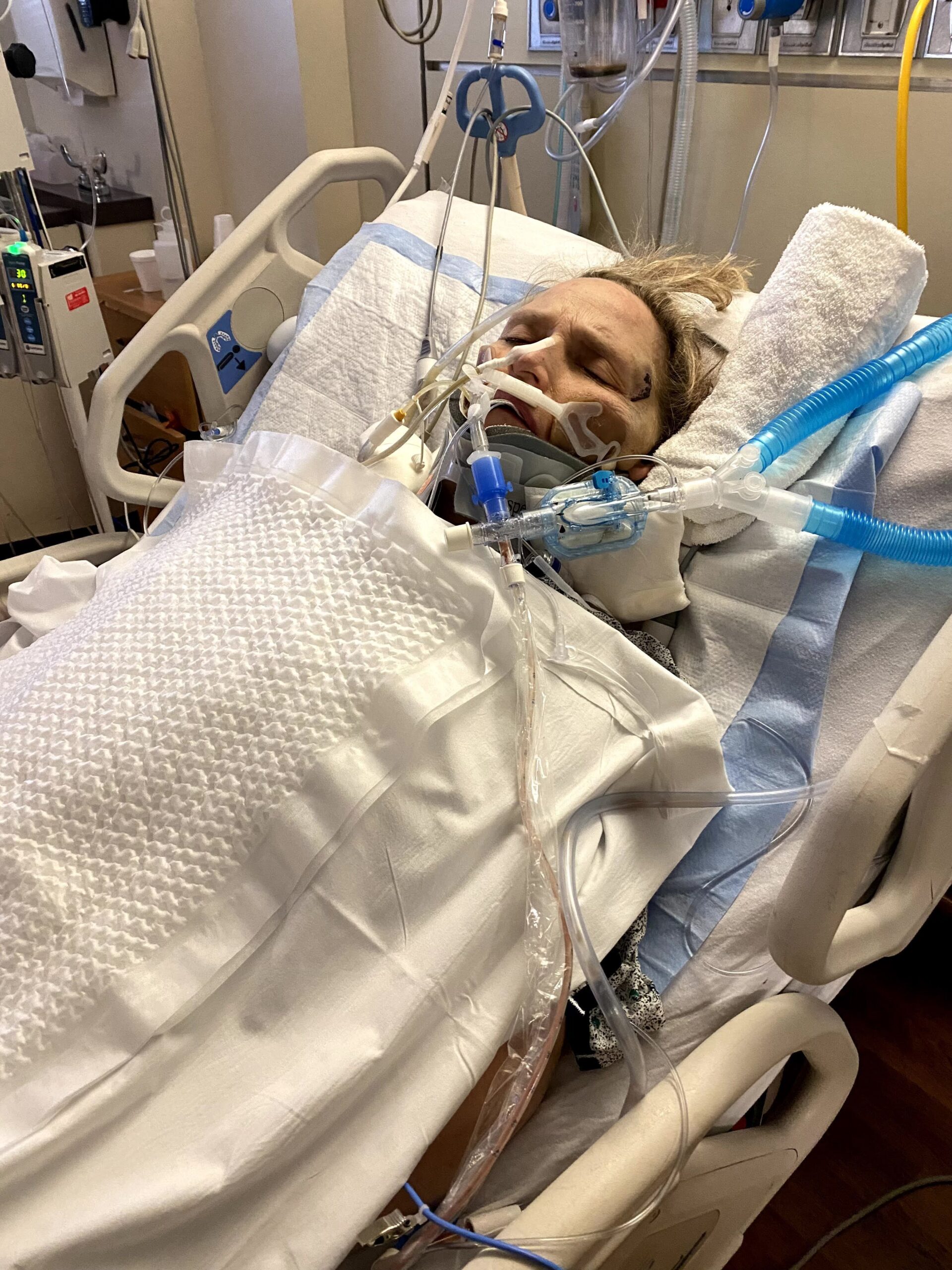
Anna Wakeman spent more than two months in a coma.
She had suffered a collapsed lung, a brain bleed, and a badly bruised heart muscle. Her spleen and her kidney were lacerated. Her sternum, thoracic vertebrae, collarbone, and 13 ribs were broken, along with her left leg.
She remained hospitalized for several weeks, then needed physical therapy.
Anna Wakeman spent more than two months in a coma after she was struck and dragged by Campbell’s car.
“I should have died,” she said. “The only reason I’m here is God was breathing for me.”
The Wakemans’ insurance company paid off the mortgage on their severely damaged home. The couple couldn’t stomach the idea of ever setting foot again inside, so they sold the property to a developer and moved to West Virginia.
They each spoke at Campbell’s sentencing hearing in June 2022.
“I was normal before this,” Anna said through tears, telling the judge she still suffers from a traumatic brain injury and lives in constant pain.
Campbell spent about a year in prison, and then was placed on house arrest.
“The man who did this to me walks free,” Anna Wakeman said in a recent interview “But I don’t have peace. We lost everything. I’m in pain all the time every single day. I’m in prison in my own body.”
The Wakemans sued the FOP under Pennsylvania’s Dram Shop Law, which holds bars liable if they serve alcohol to a drunk patron and that decision leads to injuries or damages.
In 2024, the case was settled for an undisclosed amount.
Records the Home Association filed as a 501(c) nonprofit do not require the kind of specificity that would show how the organization paid the Campbell settlement, or whether any payments were made related to the 2019 Walto crash or the unreported 2021 parking lot incident. An August investigation by The Inquirer found that while the union controls an array of nonprofits — including the Survivors’ Fund, Lodge 5, and the Home Association — its finances are opaque and difficult to track, in part because large amounts of cash move through the organizations.
Nearly five years after the accident that upended her life, Anna Wakeman still questions why 7C Lounge bartenders didn’t stop serving Campbell, or at least call him a cab, that evening.
“They let him leave knowing he was going to get behind the wheel,” she said. “These are officers of the law. They should hold the law sacred. There shouldn’t be different rules for them.”
Robert Flesch was sitting in his first-floor room at the Bristol nursing home shortly after 9 a.m. on Dec. 23 when a staffer poked her head in to tell him he should go to the activity room. There was a gas leak near his room, the staffer told him, and Peco had been notified.
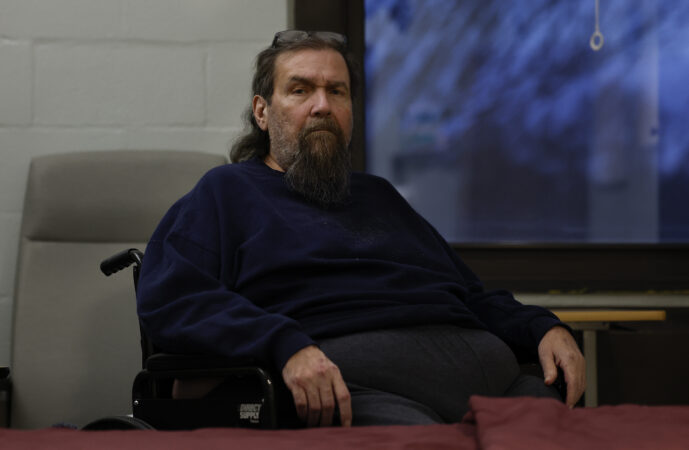
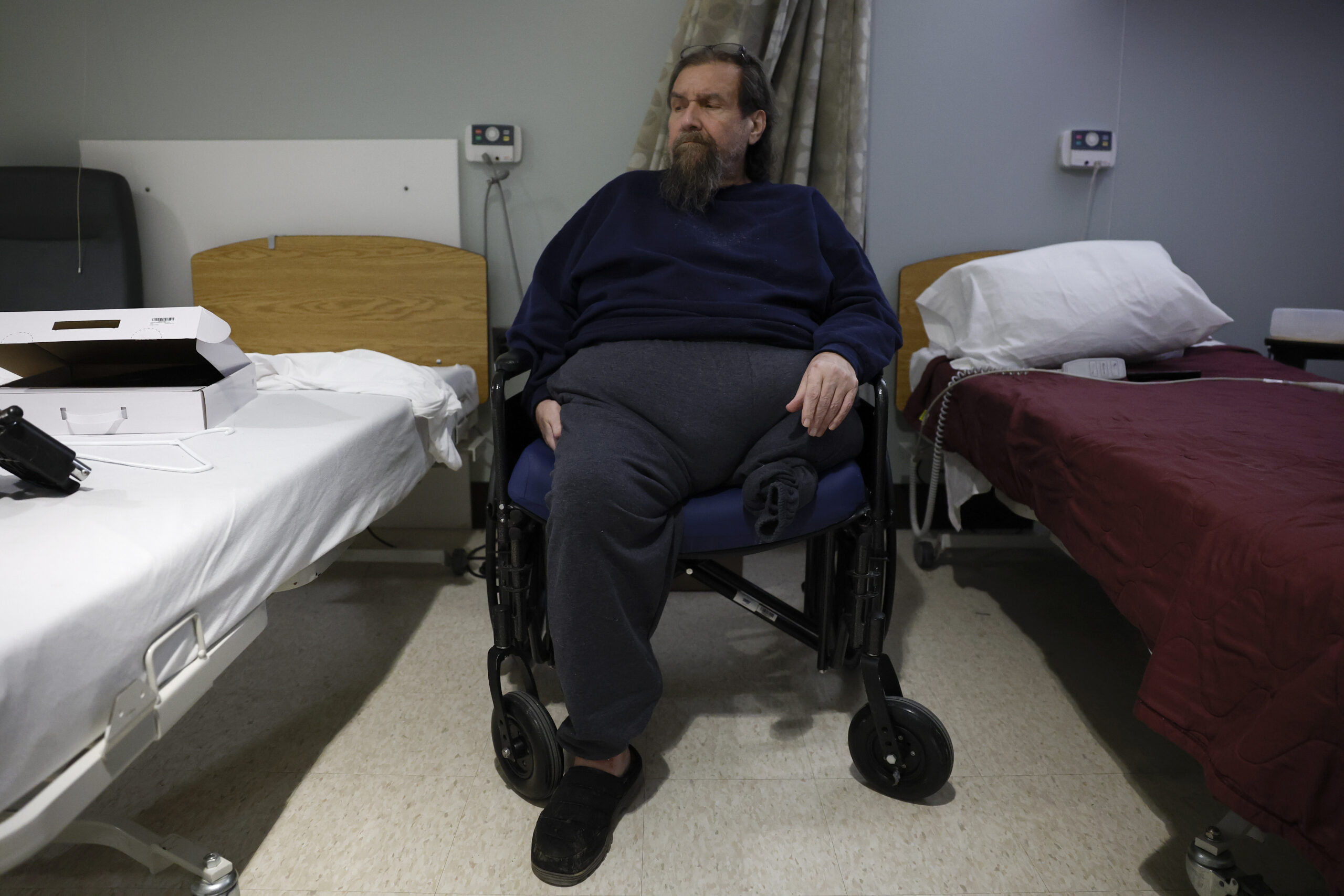
Flesch, who is 64 and an amputee, rolled his wheelchair into the hallway. “The whole hall smelled like gas,” he recalled.
Peco workers had already arrived, but nobody mentioned the possibility of needing to evacuate the 174-bed facility, Flesch said. Staffers did not seem concerned about the gas smell, and it was otherwise a typical Tuesday at the Bristol Health & Rehab Center, formerly known as Silver Lake Nursing Home.
Around 1:30 p.m., Flesch said he was told Peco had fixed “a pretty big leak” and that he could go back to his room. But the hallway outside his room had the same strong odor. “I’m telling you I still smell gas,” he said he told three staffers. He was reassured that it was just residual odor from the repaired leak.
Just after 2 p.m., another resident, Susie Gubitosi, was back inside after joining several other residents on the patio for a cigarette break. Gubitosi — known to friends as Susie Q — had become blind three years ago from glaucoma and was waiting for a staffer to help her remove old nail polish.
That’s when the place exploded.
“Suddenly I heard this loud boom,” Gubitosi, 71, said.
The blast knocked her out of her wheelchair, and debris slammed against her “as fast and hard as it could,” she said. “Next thing I’m on the floor, and I’m laying on my right-hand side, and I’m like, ‘Oh my God.’”
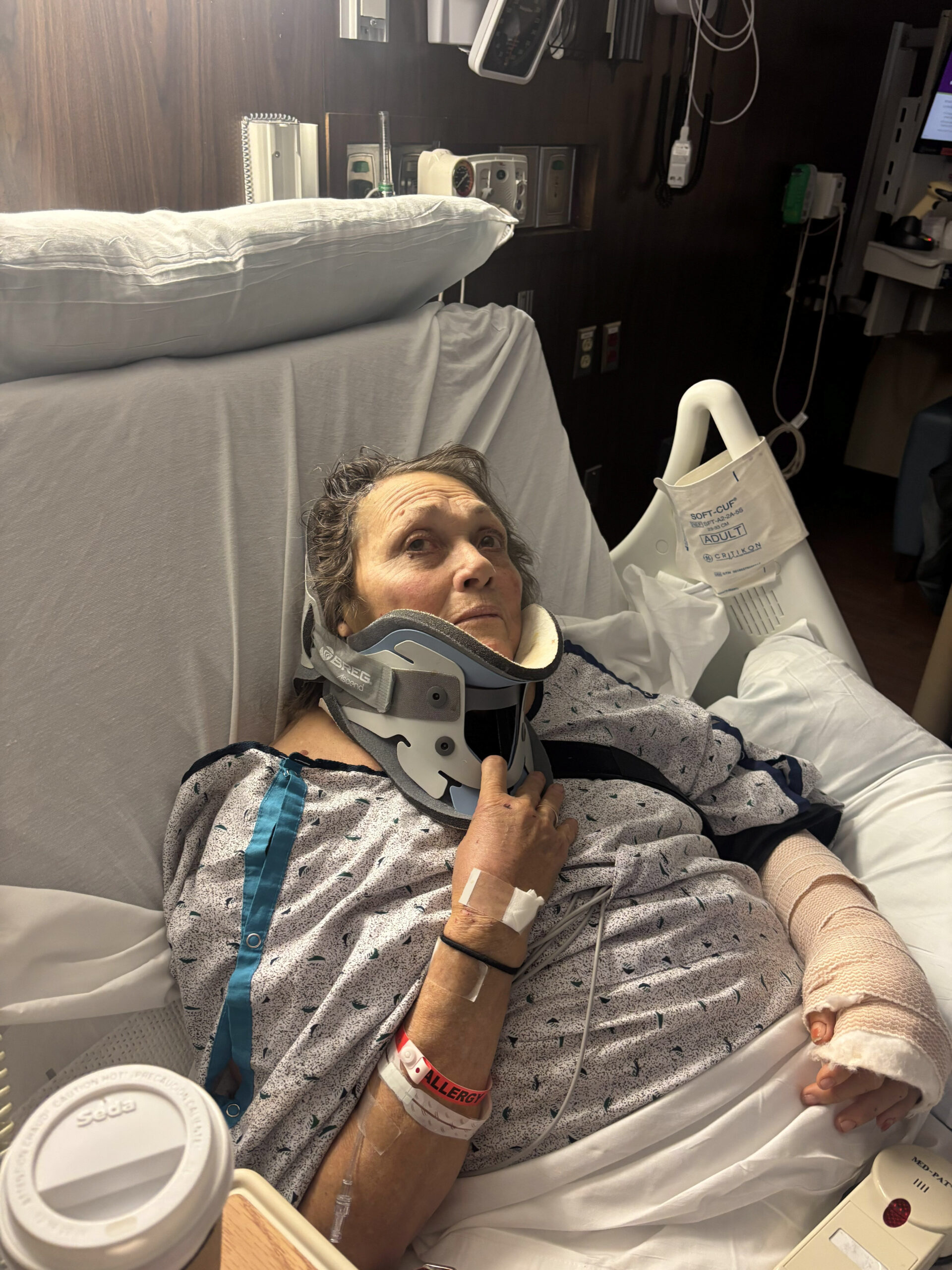
Susie Gubitosi was severely injured in a gas explosion and fire at the Bristol Health & Rehab Center in Bristol Township Dec. 23. She has staples in her head from where a brick fell on her. Her back, sternum, neck, elbow, and hand were broken.
The explosion, just after 2:15 p.m., killed Muthoni Nduthu, a 52-year-old nurse at the facility and mother to three sons. A second person who died, a resident, has not been identified. Twenty others were injured.
Flesch’s and Gubitosi’s accounts, told to The Inquirer in interviews over the last few days, give an expanded timeline of events before two explosions rocked the center. Their recollections underscore the key questions facing investigators from multiple agencies as they seek to determine the cause of the explosion and assess whether Peco, the nursing home, or both may have been negligent.
Robert Flesch at the Gracedale Nursing Home in Nazareth.
On Friday, Peco said in a statement that since the National Transportation Safety Board (NTSB) is leading the investigation, “we are not permitted to comment on this matter.”
The NTSB said it didn’t have any additional information but expects to release a preliminary report in about three weeks. In an earlier statement, it said investigators would test the natural gas service line that runs from the street to the basement of the impacted building, gather records, and interview witnesses, first responders, nursing home staff, and Peco employees.
Saber Healthcare Group, a privately run for-profit company that acquired the Bristol nursing home three weeks before the explosion and rebranded it, did not respond to requests for comment Friday. Saber has relocated about 120 residents to local hospitals and other assisted living facilities. It says it is reevaluating its evacuation procedures.
The previous owners, Ohio-based CommuniCare Health Services, had received numerous citations for unsafe building conditions and substandard care.
‘Am I dying?’
Recuperating in St. Mary’s Medical Center in Langhorne, Gubitosi said she felt as if her life was over.
Immediately, the former Bethlehem resident knew it was a gas explosion. “I heard shouting, screaming, moaning, and sirens,” she said.
“This place just blew up. And I thought, ‘Am I dying?’ I didn’t know,” she said. She was relieved when she could wiggle her toes. “I think I’m all in one piece,” she thought.
“Because I’m blind, it scared me even more. I felt ice cold water on me. The sprinkler system must have come on and I was drenched. But I was glad because I had dust, cement dust, soot all in my mouth, on my face, in my eyes and nose. And I was just trying to breathe.”
She cried repeatedly for help. “I heard all these voices and things moving. It was pandemonium. I could hear the EMT guys saying, ‘They’re in here! We’ve got to get them out! The building is going to collapse!’”
She heard one EMT, as he lifted her up, say, “This is the first patient that’s been crushed.”
Doctors in the hospital used staples to close a gash on her hairline. Her back, neck, and sternum are broken. She had surgery last week to repair fractures in her elbow and hand.
The pain, she said, is at times unbearable, even with medication. “It’s hard to breathe,” she said, lying in her hospital bed with her neck in a large brace, bandages that run from her hand to elbow, and IVs.
“It feels literally like an elephant put his foot on me and crushed me,” she said. “I was probably this close to death.”
She doesn’t know yet how long she’ll be hospitalized or where she will be placed next.
“Lawsuits are coming,” said Jordan Strokovsky, an attorney representing Gubitosi. ”There will be answers. There will be accountability.”
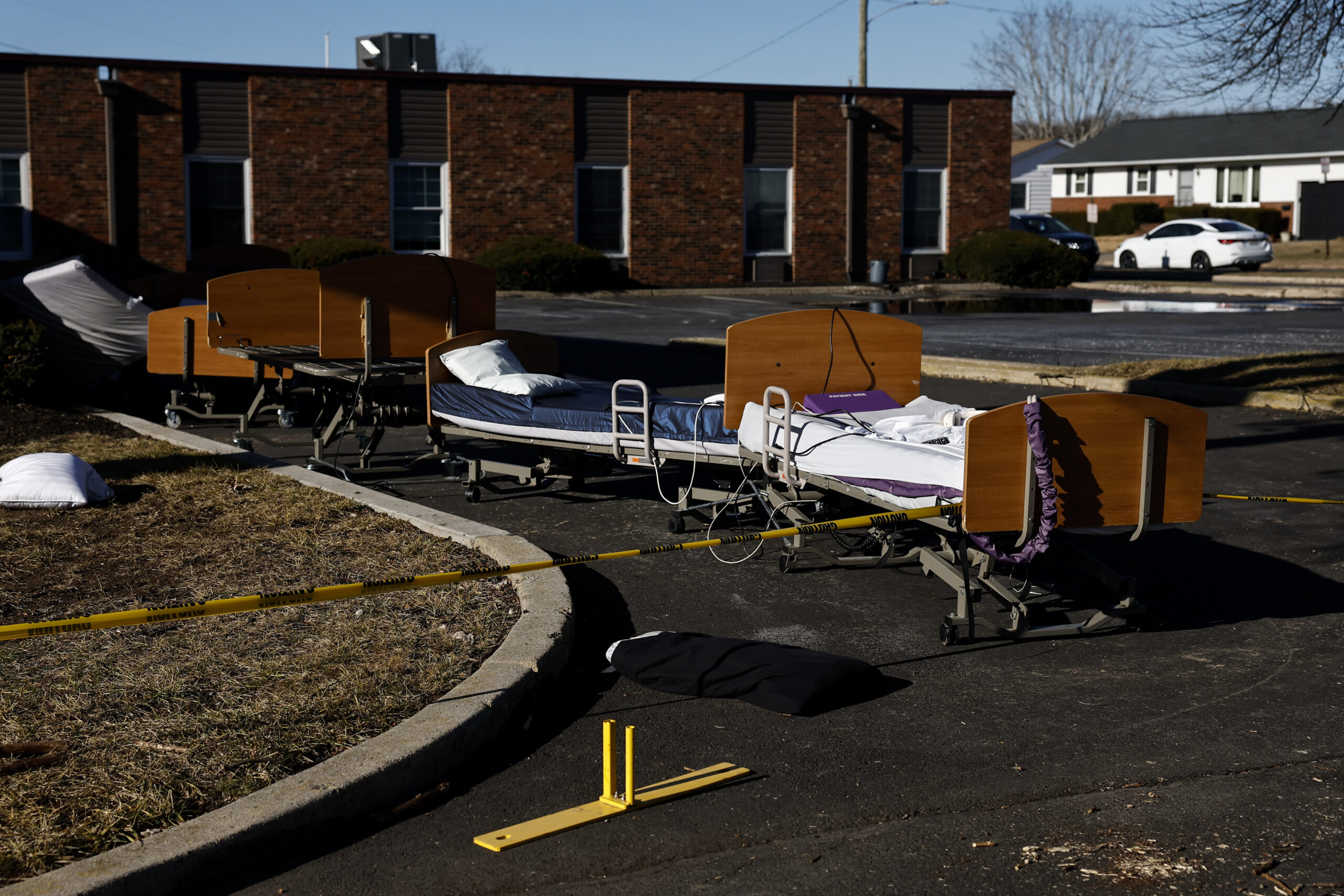
Hospital beds remain outside at Bristol Health & Rehab Center on Wednesday, Dec. 24, 2025, in Bristol Township, Pa. Two people were killed and 20 were injured in the explosion on Dec. 23.
‘The wall was coming down’
Flesch, who lost his left leg from a brown recluse spider bite, said he doesn’t understand why he was given the green light to return to his room.
A former pool and spa tradesman from Levittown, he had been a Bristol resident a short time, sifting through a file he kept of apartments he could possibly call his next home.
“Suddenly, there was this loud boom!,” he recalled.
“I’ve never been in anything like that in my life,” he said. “I was in shock because all the glass from my windows came flying out. Then the ceiling was coming down. The wall was coming down.”
Glass shards piled a foot deep in his room, even deeper in the hallway. Crumpled furniture was hurtled everywhere. Flesch maneuvered his wheelchair through glass to check on the bedridden man across the hall. He was OK.
The facility’s part-time psychologist helped Flesch and many others get outside safely.
“It was complete chaos,” he said.
The explosion left Flesch, now staying in a nursing home in Nazareth, Pa., with nothing more than scratches on his arms.
“I am still asking myself how I survived,” he said. “It must be God. I can’t explain it any other way.”
After 37 years in prison, Michael Gaynor — who was convicted of killing a 5-year-old boy in a Southwest Philadelphia candy store — could soon be released.
Lawyers from the McEldrew Purtell firm on Oct. 15 filed a petition under Pennsylvania’s Post-Conviction Relief Act (PCRA), saying that police and prosecutors suppressed crucial evidence pointing to another suspect, coerced witnesses, and relied on false testimony to convict Gaynor in 1988.
Gaynor is “wholly innocent,” lawyer Daniel Purtell told The Inquirer on Tuesday. “We request speed and transparency toward his exoneration.”
The District Attorney’s Office Conviction Integrity Unit (CIU) has also been investigating the case since late last year. The office is expected to file a brief with the court in response to the petition.
The petition to free Gaynor relies on information detailed in The Inquirer’s six-part investigative series “The Wrong Man,” published late last year. The stories uncovered evidence that Gaynor was not the gunman or even in the store where a shootout between two men took the life of little Marcus Yates. The Inquirer’s investigation was based on thousands of pages of court transcripts and police paperwork, 21 witness statements, and interviews with more than four dozen people.
For more than a year, Gaynor, now 58, has had the most unlikely supporter: Marcus’ family.
Marcus’ mom, Rochelle Yates-Whittington, remained tormented by the tragedy decades later. She said she could find peace only by telling Gaynor and Ike Johnson, who was one of the convicted gunmen, that she forgave them.
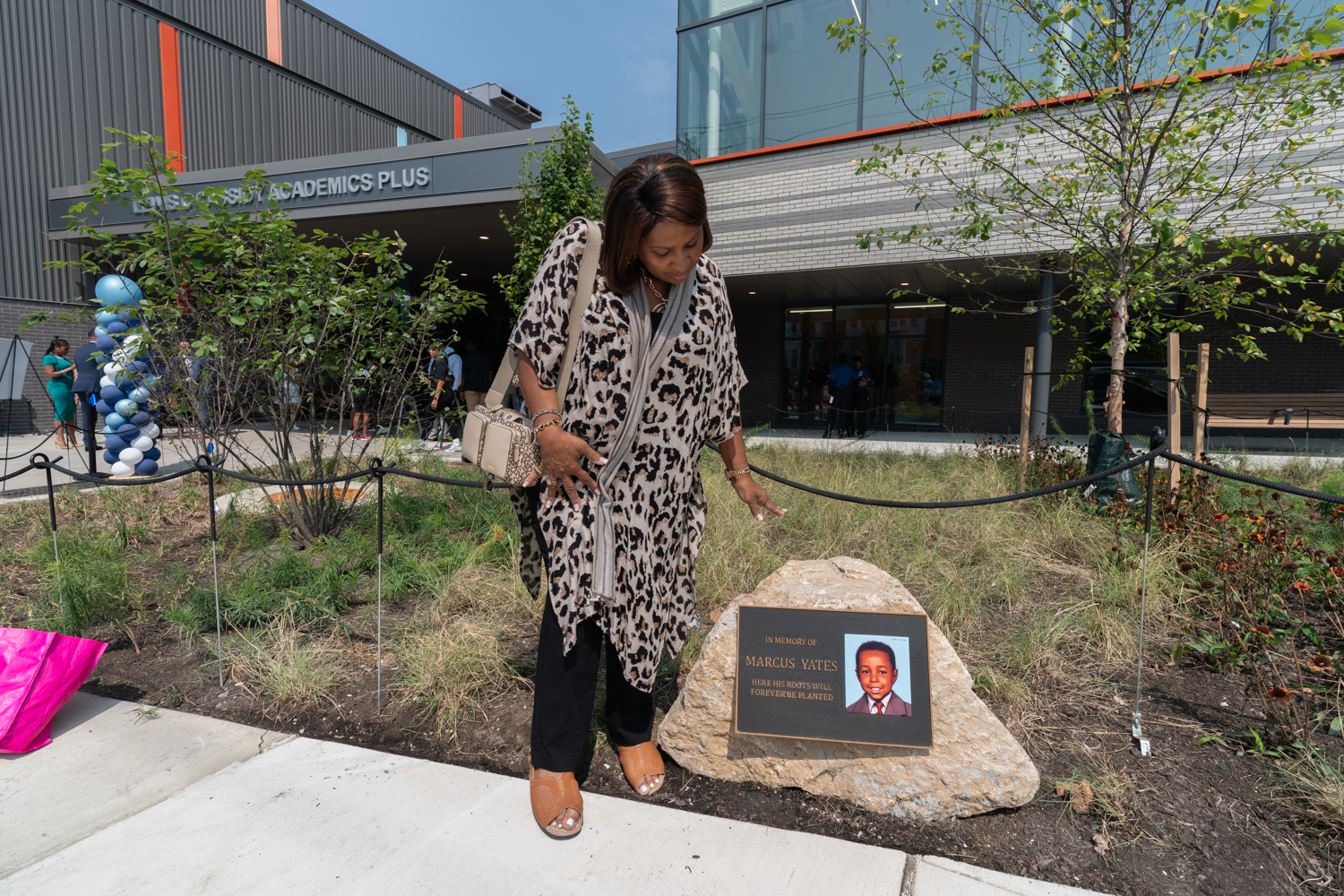
Rochelle Yates- Whittington, mother of Marcus Yates, at the new memorial for Marcus, at the .Lewis C. Cassidy Elementary Academics Plus School, in Philadelphia in 2024.
But after speaking with each of them in prison video calls last year, she said, she no longer believed the police and prosecutors’ account of the crime and told her family Gaynor was not guilty.
“I am just so overwhelmed with happiness,” Yates-Whittington said this week after hearing about the court filing. “I just want to let Michael know I’ll be there for him once he’s released. I really hope this moves fast and his release is expedited.”
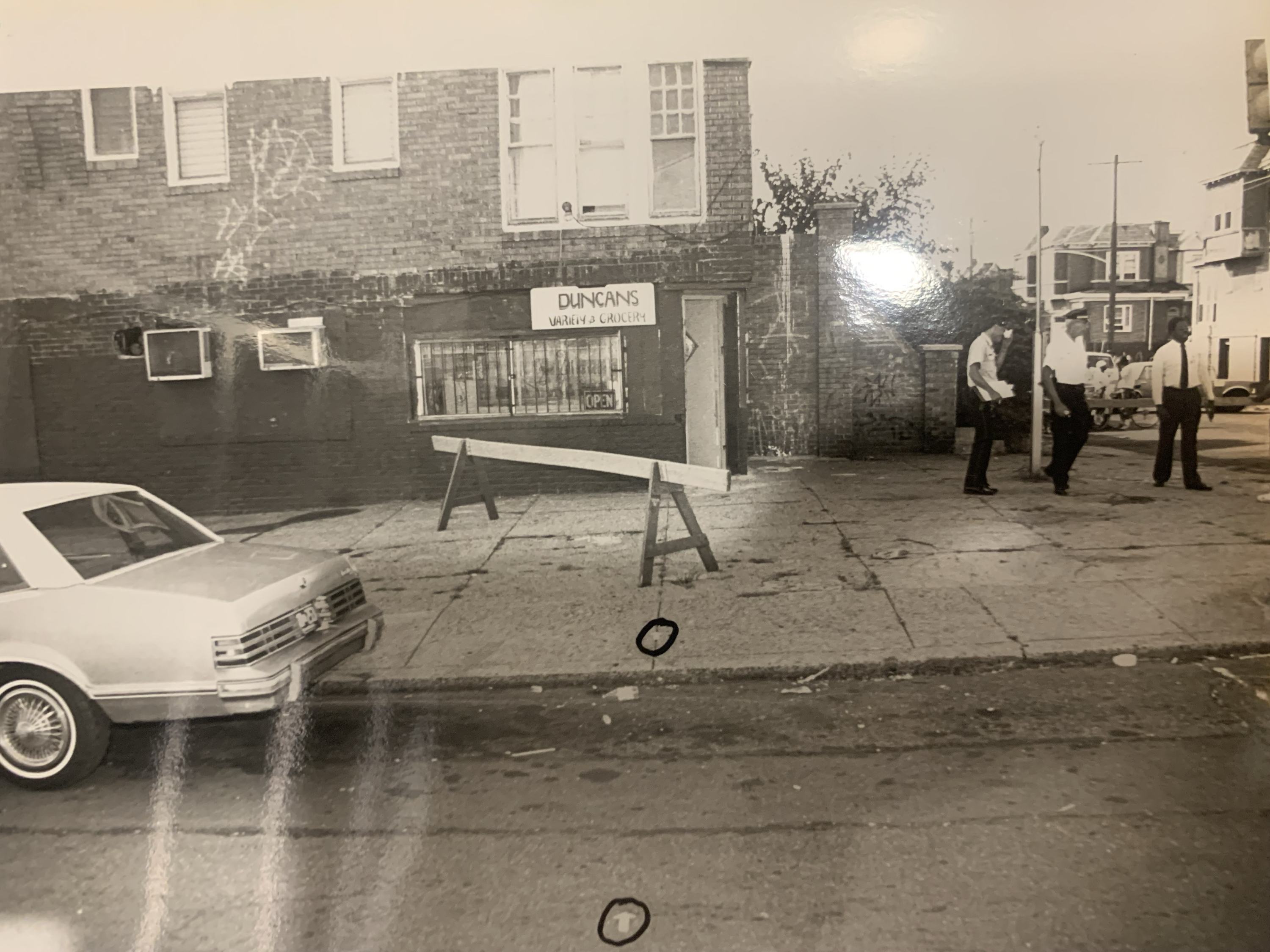
On the afternoon of July 18, 1988, Marcus, his two older brothers, and seven other children were crammed inside the tiny Duncan’s Variety & Grocery store, where they played three video games and eyed penny candy. Suddenly, two men blasted guns at each other, and the children were caught in the crossfire.
On the afternoon of July 18, 1988, police gather outside Duncan’s Variety and Grocery store in Southwest Philadelphia to start investigating the shooting death of 5-year-old Marcus Yates, and his brother and another boy, who were shot, yet survived.
Marcus, who took a bullet to the head, died at the hospital later that day. His brother Malcolm survived being shot, as did another boy.
Gaynor lived around the corner from the store and was a low-level crack dealer. He was from Jamaica, and witnesses had told police that both shooters were Jamaican.
As part of the investigation, police seized a number of cars parked near the store, including Gaynor’s 1988 Nissan 300ZX. Four days after the shooting, he called the police to claim his car and spoke to Paul Worrell, lead investigator on the case. Worrell told Gaynor to come to Police Headquarters.
Gaynor said Worrell took him into an interrogation room, placed him in handcuffs, sat him in a chair bolted to the floor, and accused him of killing the 5-year-old boy. Worrell put a plastic bag over his head, Gaynor said, held it tight, and told him he had to admit to the killing. Gaynor said he told him he would talk but wouldn’t confess to a crime he didn’t commit.
Worrell has been linked to seven murder cases in the 1980s and 1990s in which defendants allege he and his partners coerced false confessions, falsified statements, slapped suspects while handcuffed to chairs, kicked their genitals, and threatened witnesses with criminal charges if they didn’t testify. Four men in those cases have since been exonerated, and another conviction was vacated.
Worrell, now retired, declined to comment.
In an interview last year,he told The Inquirer: “I hope Michael Gaynor rots in jail.”
Gaynor and Johnson, also known as Donovan “Baby Don” Grant, were convicted of first-degree murder and sentenced to life without parole. Johnson and other witnesses had always maintained Gaynor was not the other shooter.
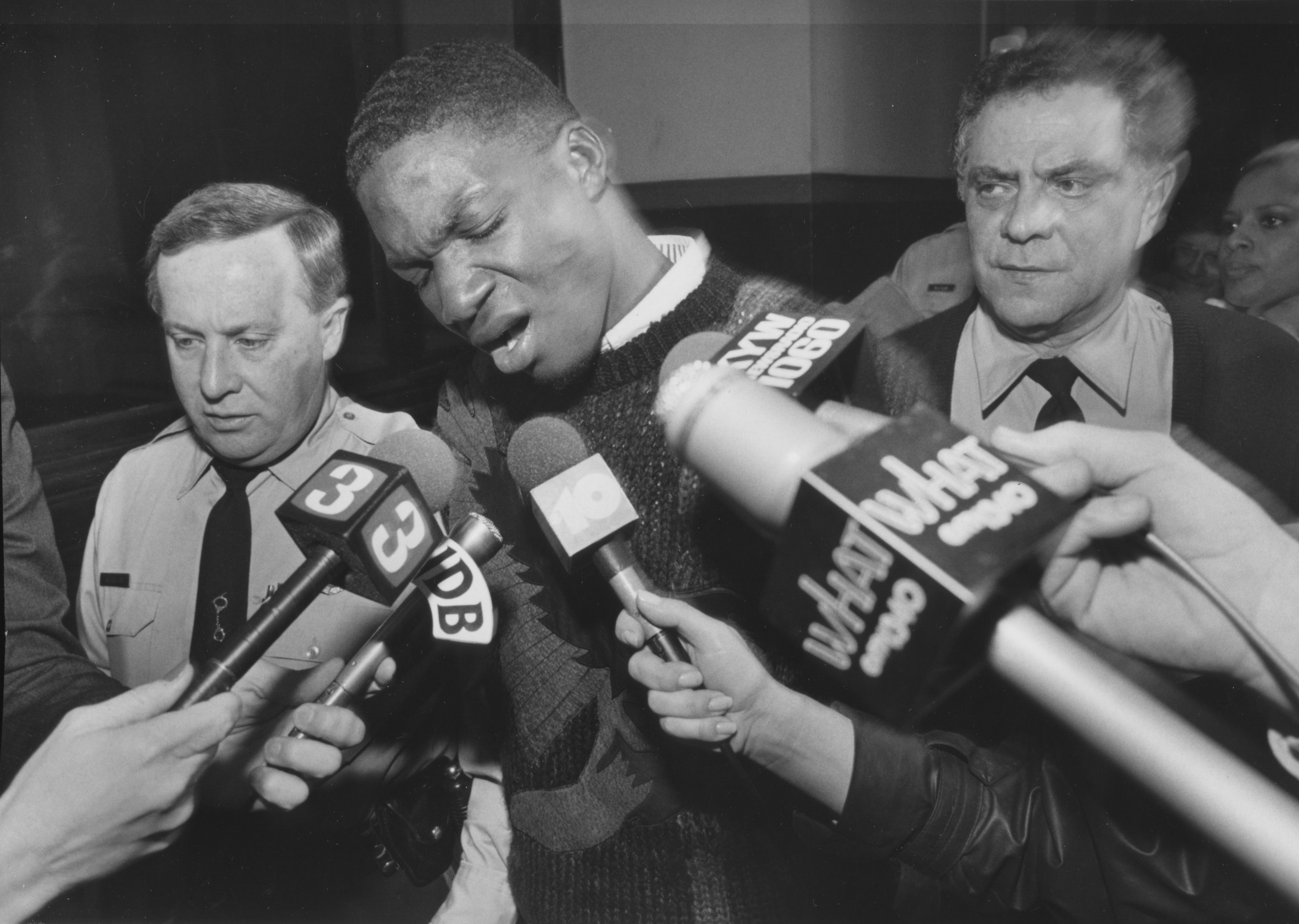
In this Feb. 20, 1990 Daily News file photograph, Michael Gaynor is escorted by sheriff deputies after receiving a life sentence from the jury.
In fact, witnesses had told police the other shooter was a man known on the street as “Harbor.” But detectives did not properly or substantively investigate Harbor.
When asked during the murder trial why police had not tried to find Harbor, Worrell replied: “I had investigated that name early on in the investigation, in the fall of 1988. …That name was a nickname. That name has never been attached to any human being that is in my capability to find nor within the New York Police Department’s capability to find. Our determination was that that person did not exist.”
The Inquirer determined that he was Paul Jacobs, also known as Peter J. Jacobs, a career criminal who was born in Jamaica and had lived in New York and Los Angeles.
Years after Gaynor and Johnson were locked up, Jacobs was shot dead on March 12, 1996, in a small ramshackle home in a South Los Angeles neighborhood wrought with street gangs and drug wars. He was 34.
Investigators knew Jacobs had faced criminal charges in New York and had an associated address that was part of the investigative records, according to the petition. Those details were concealed from the defense, the document says.
“The Philadelphia District Attorney’s Office has recently produced previously undisclosed documents confirming that Jacobs was identifiable through the New York prison system,” according to the petition.
Gaynor’s lawyers contend that suppressing that evidence amounted to misconduct that undermines the integrity of the conviction. Had it been disclosed, the petition said, “there is a reasonable probability the outcome of the trial would have been different.”
During the trial, the prosecution relied heavily on the testimony of traumatized children who identified Johnson and Gaynor in court. But three of the five children, now adults, said detectives and prosecutors had directed or coached them to do so, The Inquirer found. And police coerced Christopher Duncan, the son of the candy store owner, into recanting his original statement and adopting a false account implicating Gaynor, the petition said.
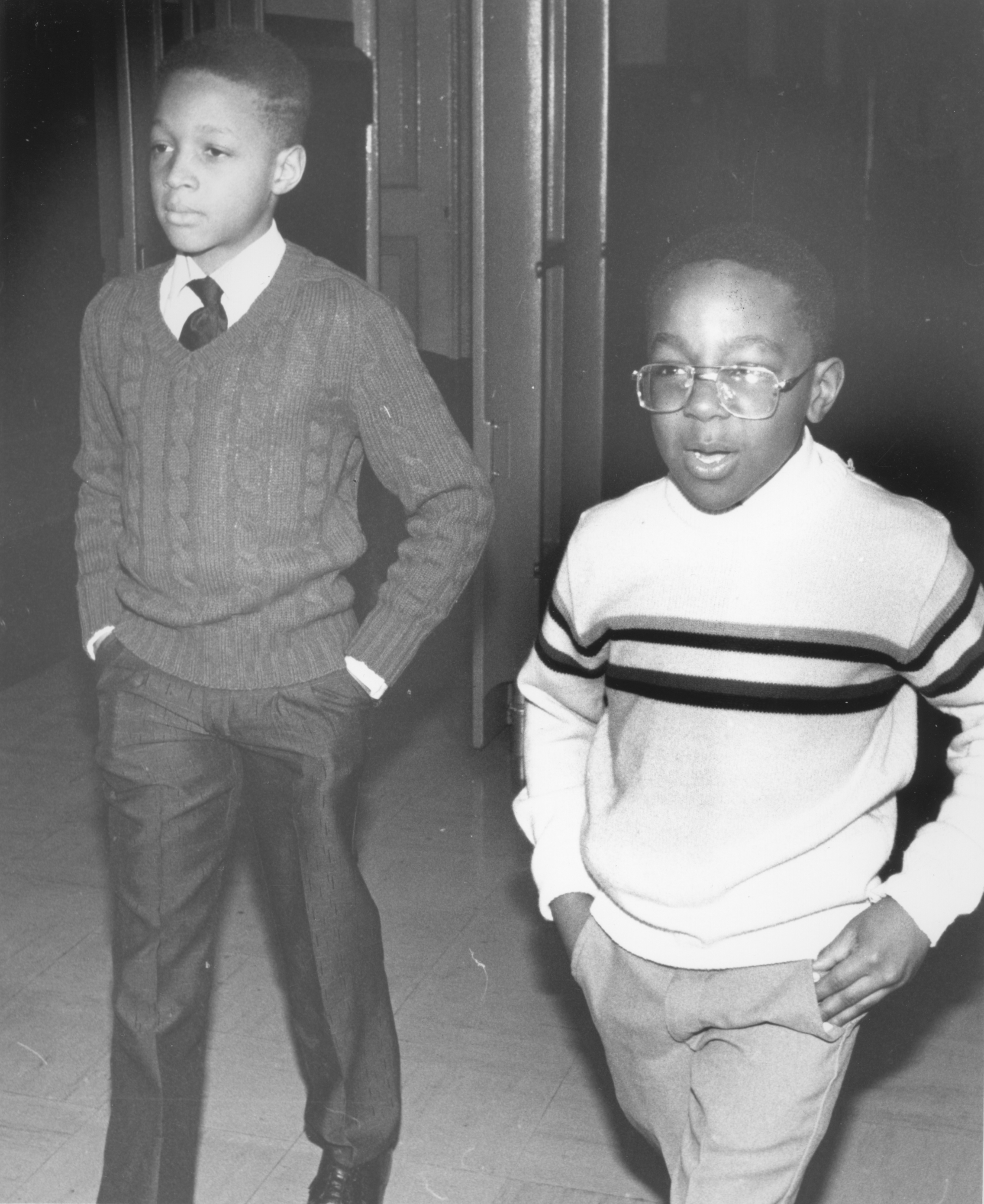
In this Feb. 6, 1990 Daily News file photograph Toney Yates, 12, and brother Malcolm Yates, 8, walk through the hall at City Hall outside of the hearing for the shooting of their brother Marcus Yates.
No forensic or physical evidence linked Gaynor to the murder.
“This was not a major lapse in judgment but a conscious decision to ignore leads that pointed away from Gaynor and toward the actual perpetrator,” his lawyers said in the court filing.
Since District Attorney Larry Krasner took office in January 2018, the convictions of 48 people have been overturned, according to data compiled by his office.
Many of the overturned cases date to the 1980s and 1990s, and police misconduct, fabricated statements, coerced confessions, and the withholding of exculpatory evidence were later cited as key factors in the wrongful convictions.