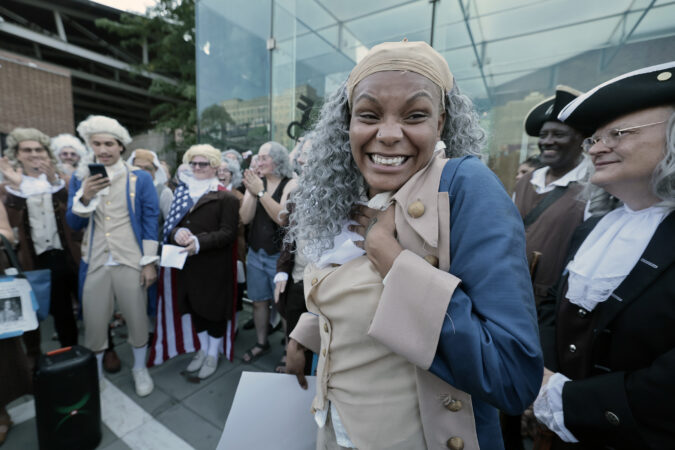
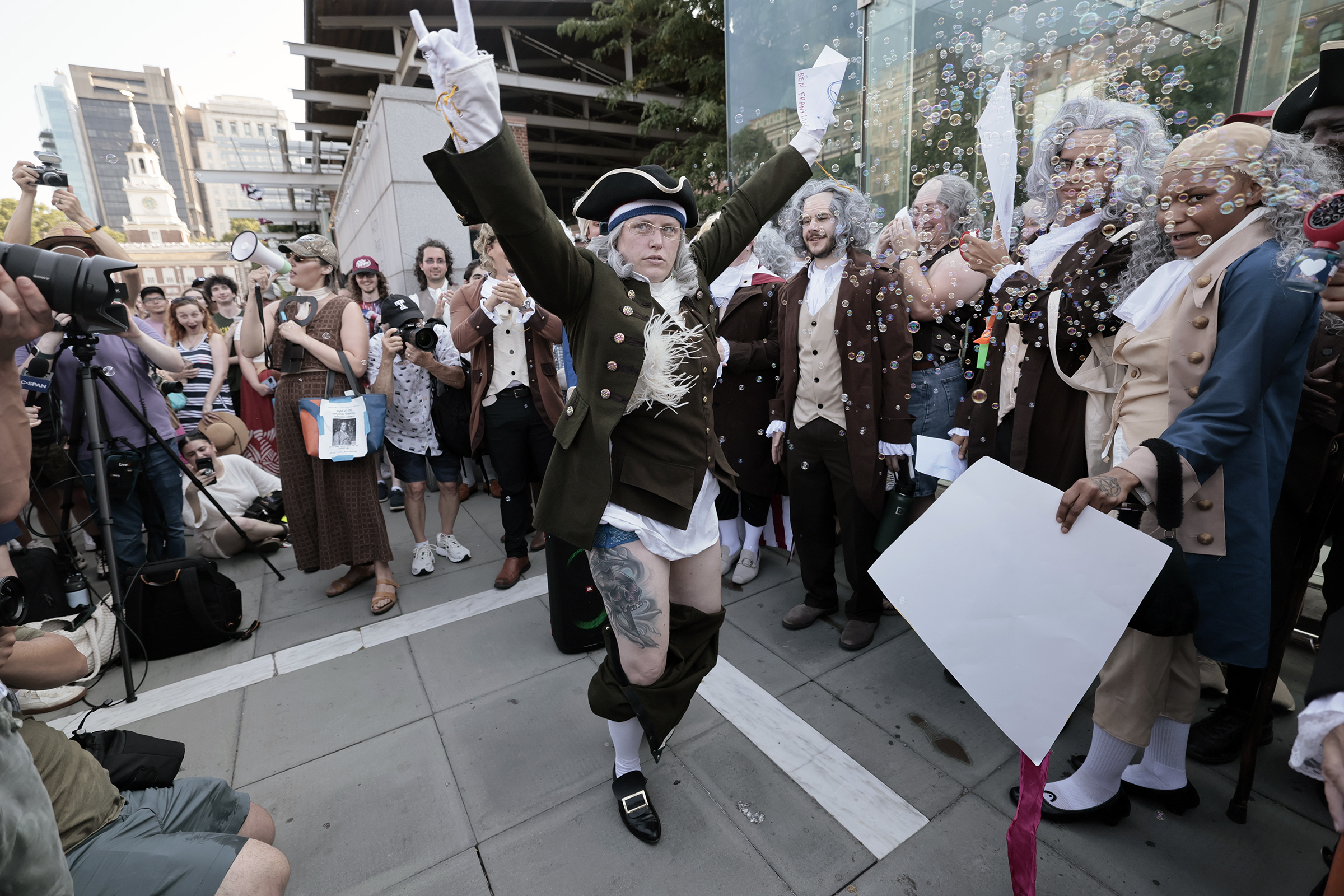
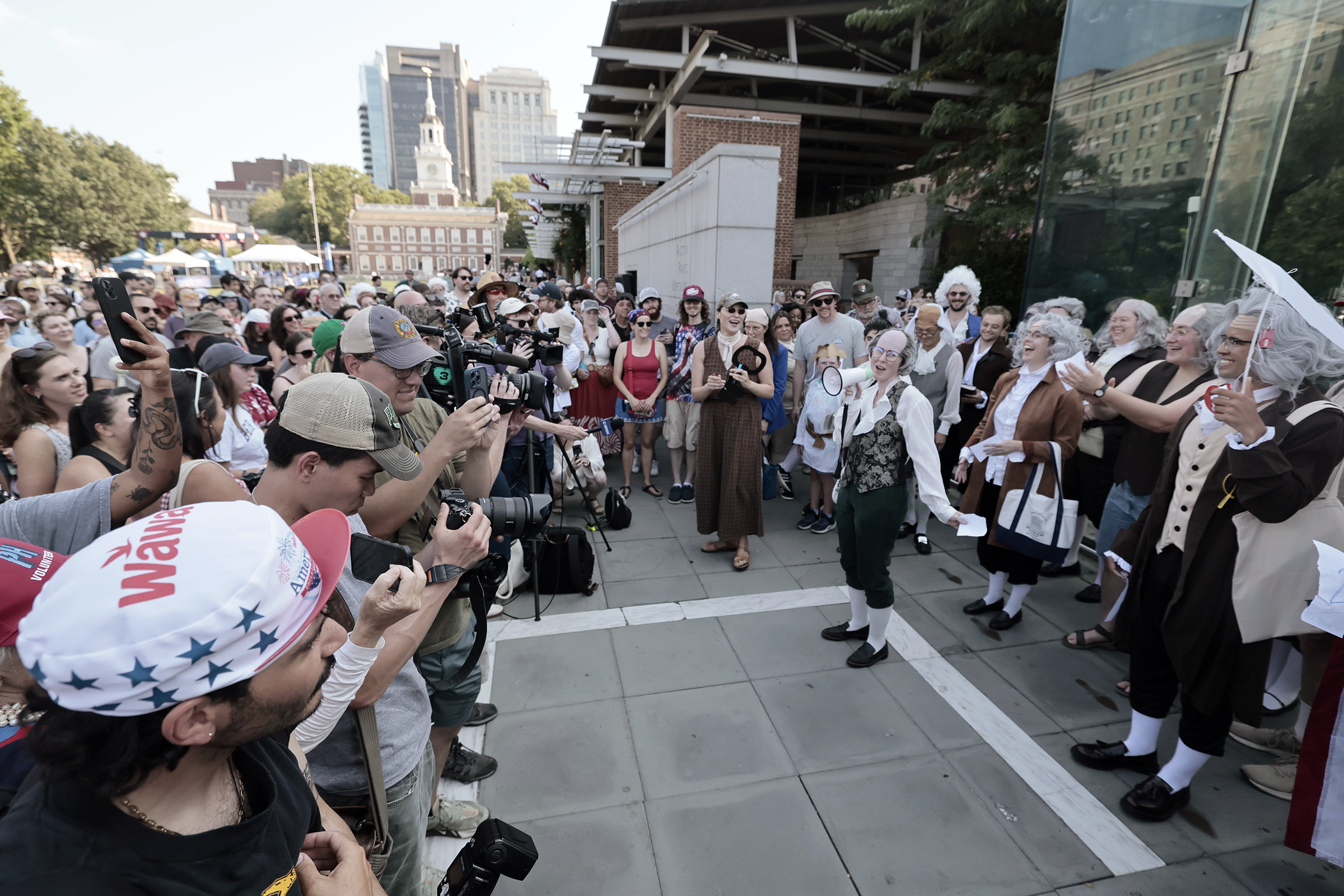
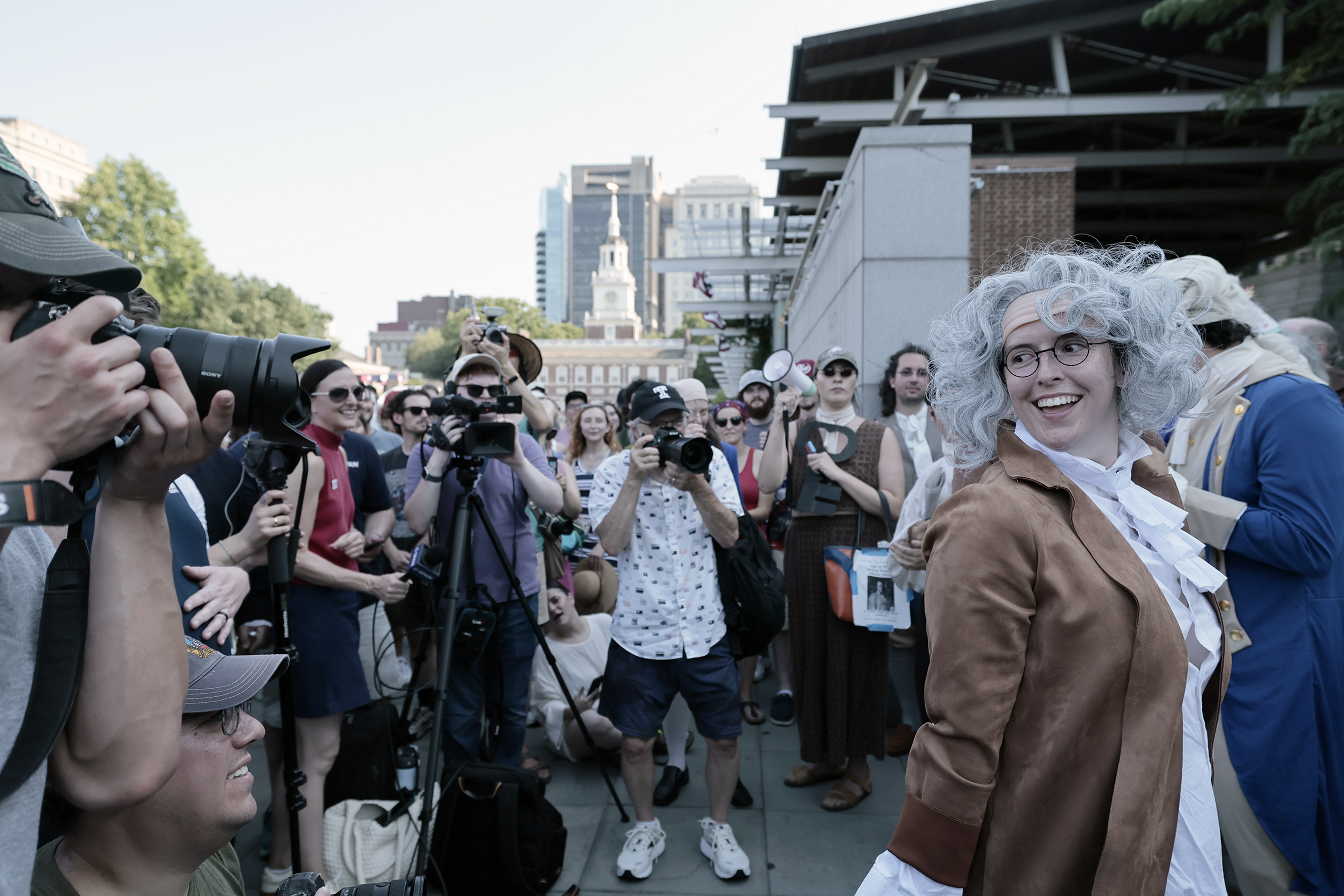
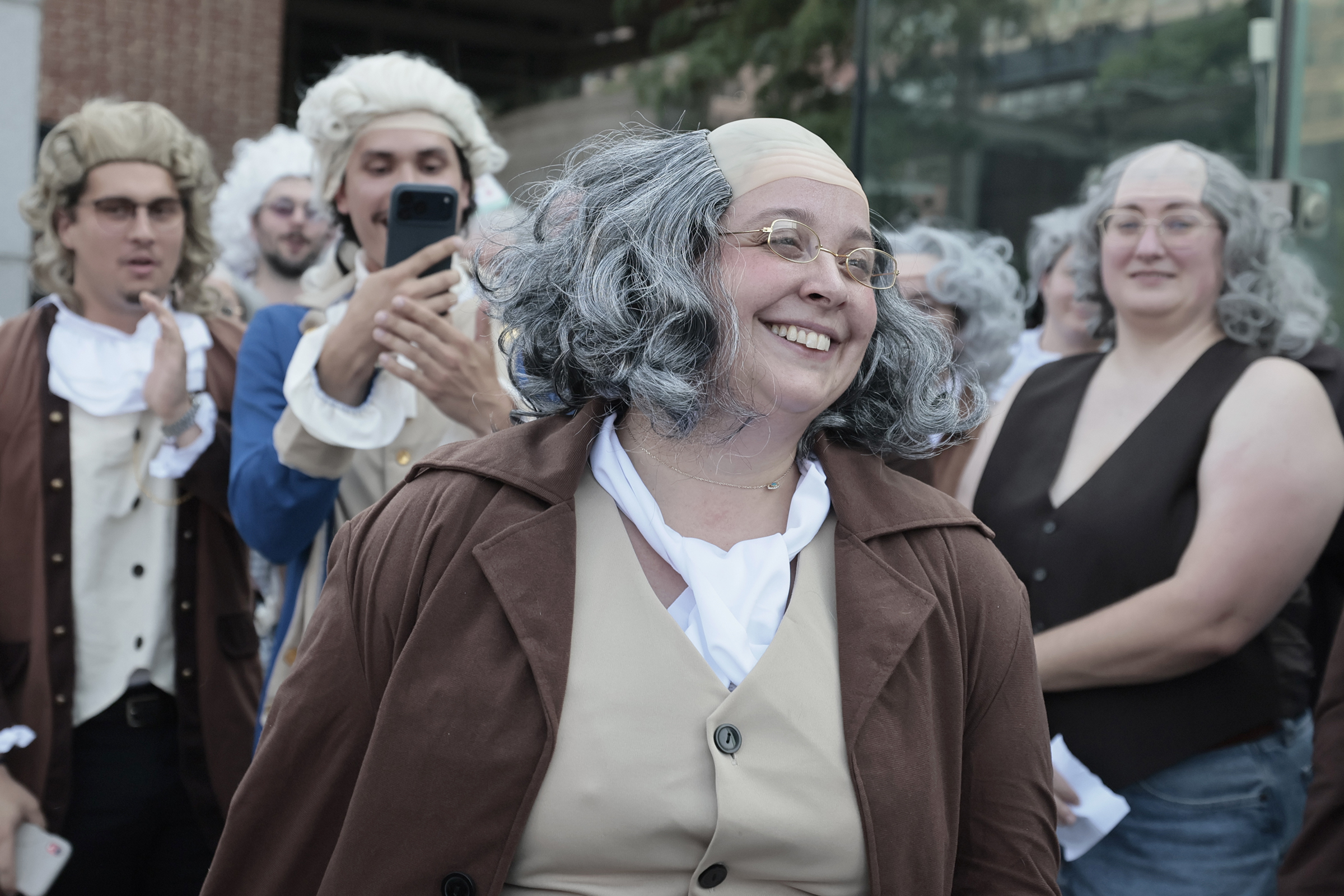
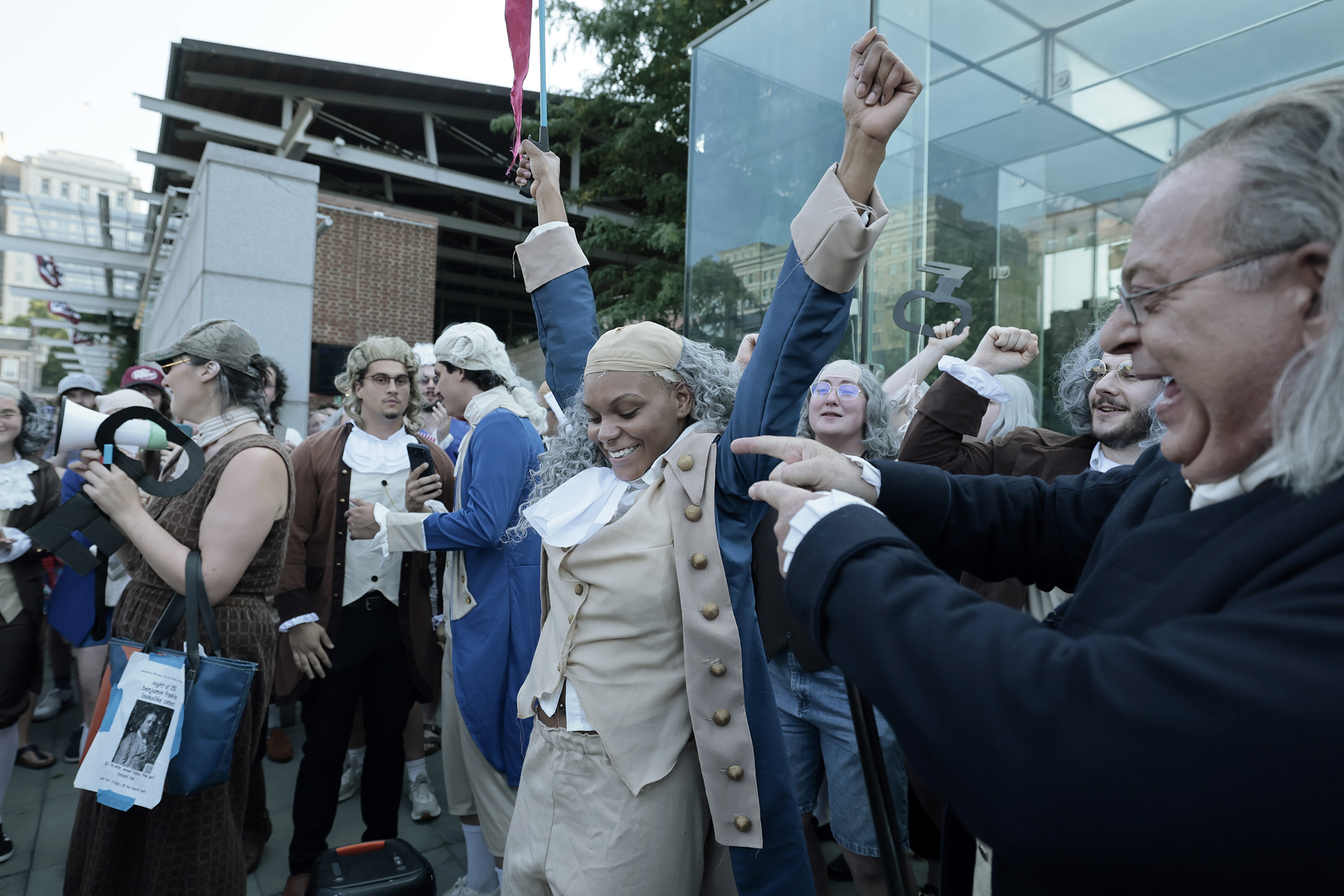
At the Benjamin Franklin look-alike contest at Independence Hall, which was supposed to end early, the crowd enthusiastically shouted, “One more Ben, one more Ben.” Latecomers — men and women dressed like the famed Founding Father — walked through the crowd to the front.
It wasn’t a catwalk, per se, but the Franklin stroll.
Kiya Burgess, 25, was crowned the victor of the Franklin free-for-all.
Elena Jackendoff, 32, a student at Johns Hopkins University studying public health, organized the event.
“You have to make the event you want to see in the world,” she said.
She organized the lookalike on a lark, making the flyers after her last final exam and pasting them across the city. She expected to see a few of her friends, not hundreds of people.
Many of the Franklins — like Kara Peterschmidt, 25; Kyra Feinauer, 25; and Lauren Zwetzig, 24 — didn’t even have to go out to buy a costume. The friend group had hosted a Constitution-themed housewarming a while back and came dressed in the same white wigs and tops.
Asked about the truest Ben Franklin expression, Peterschmidt said, “It’s definitely a mog.”
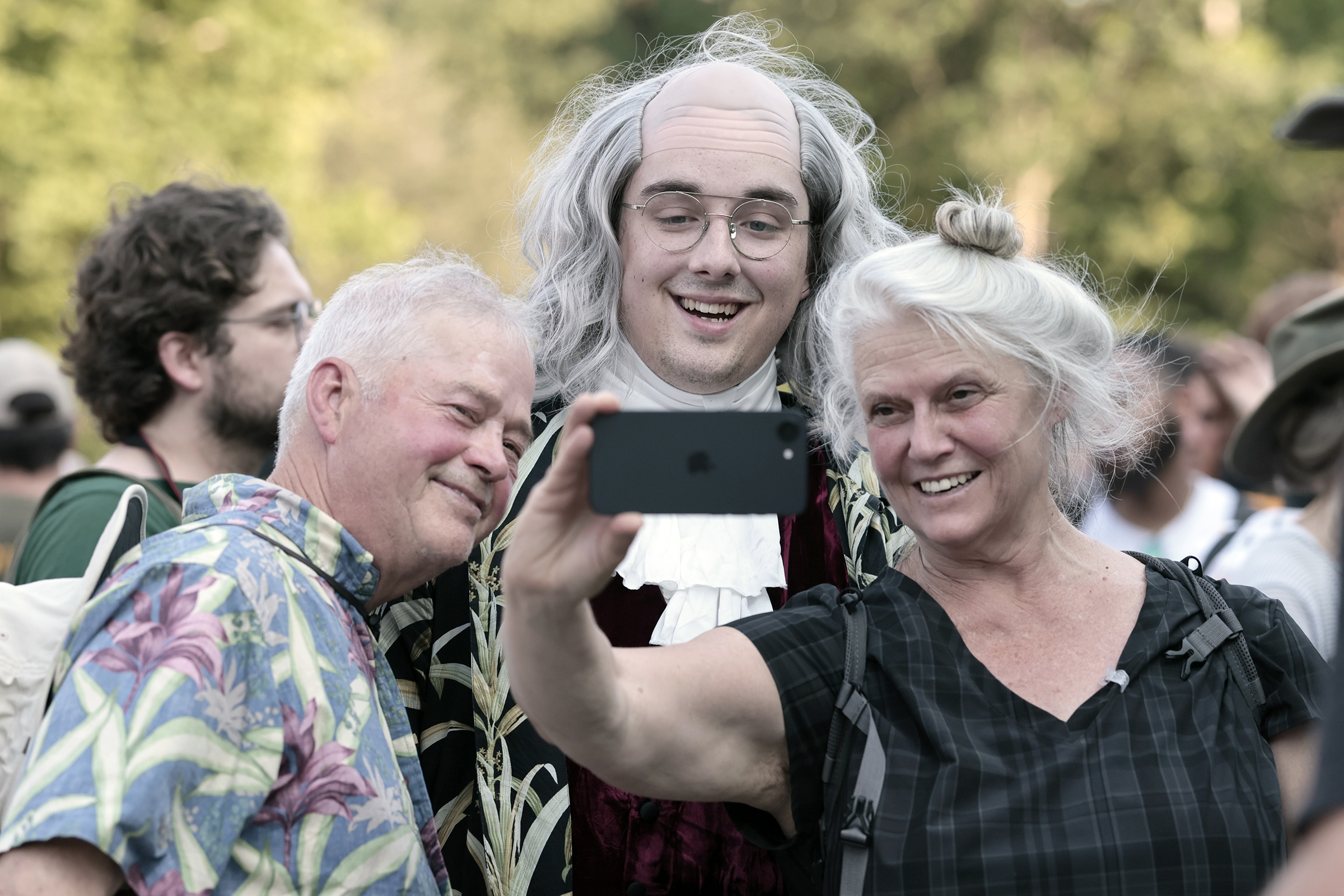
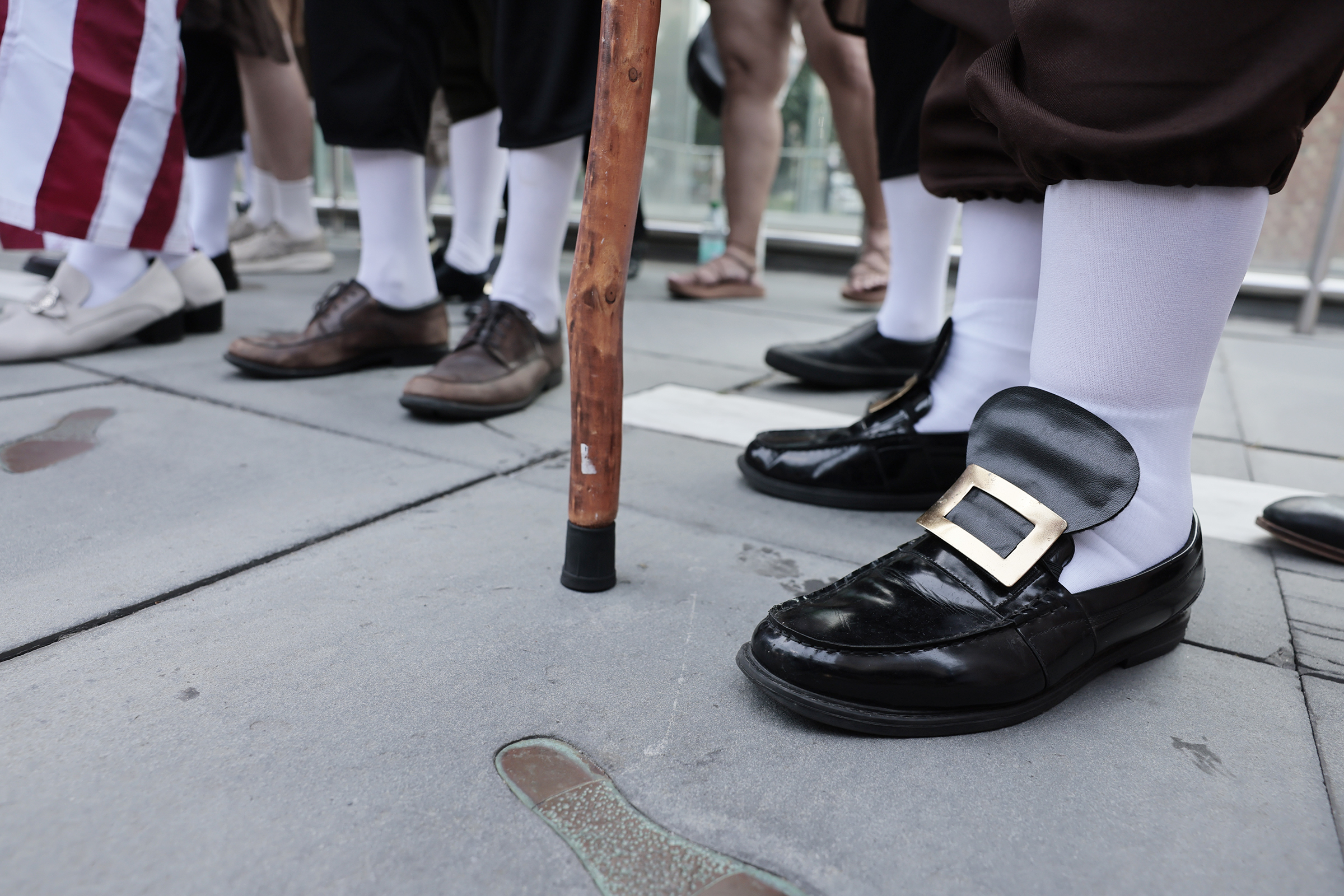
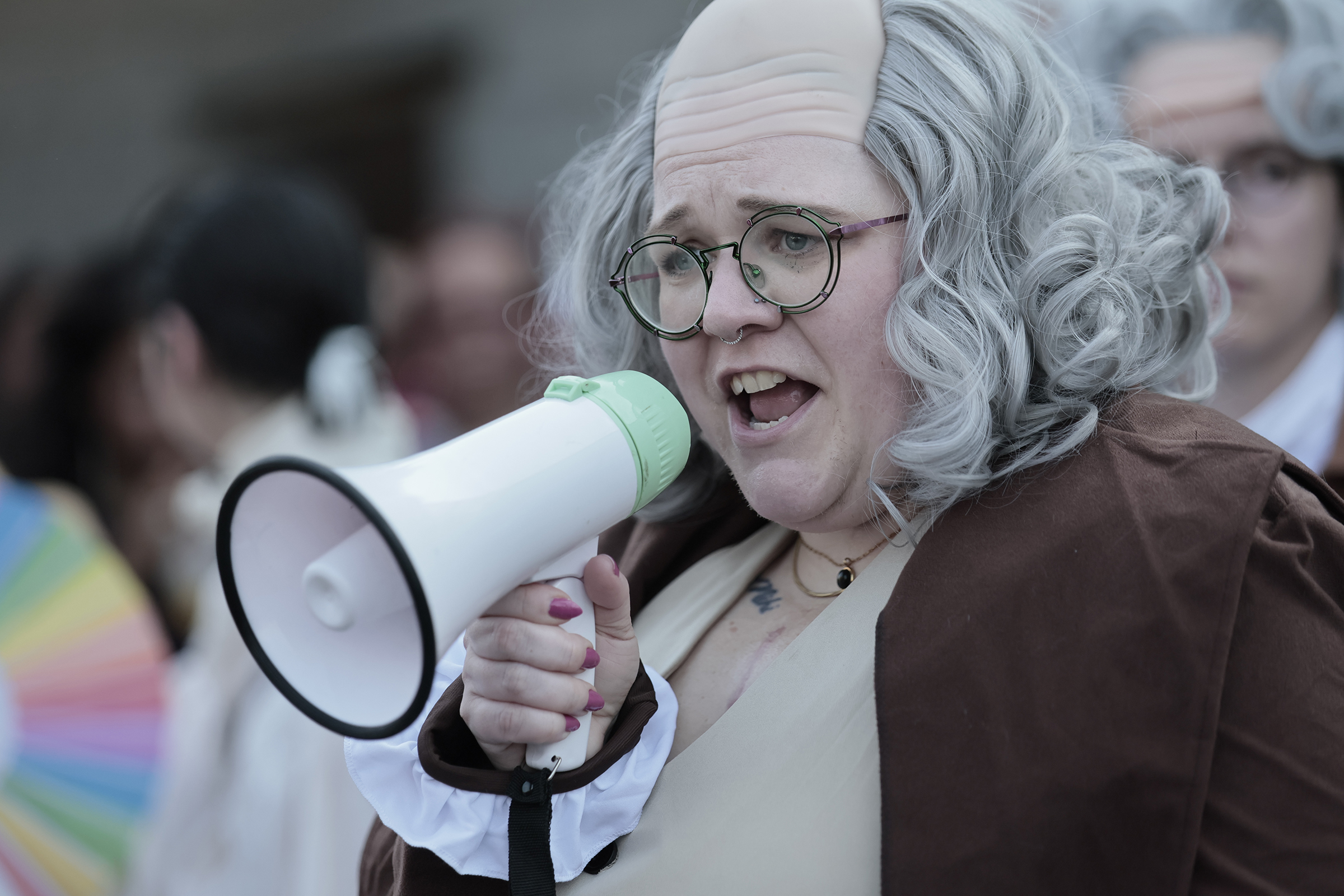
One of the contestants shows off their legs.Each contestant had to say why they were the best Ben Franklin.Gene Backus (left) and Maria D’Agostino (right) of Anchorage, Alaska take a selfie with Ben Franklin (Gabriel Meyer) of Levittown.Contestants pose for the cameras. Contestants are all smiles in the Ben Franklin lookalike contest.Footwear worn by some of the contestants.Contestants explain why they were the best Ben Franklin.The crowd cheers for the contestants.Mitchell Kramer holds up the arm of contest winner Kiya Burgess of Philadelphia.
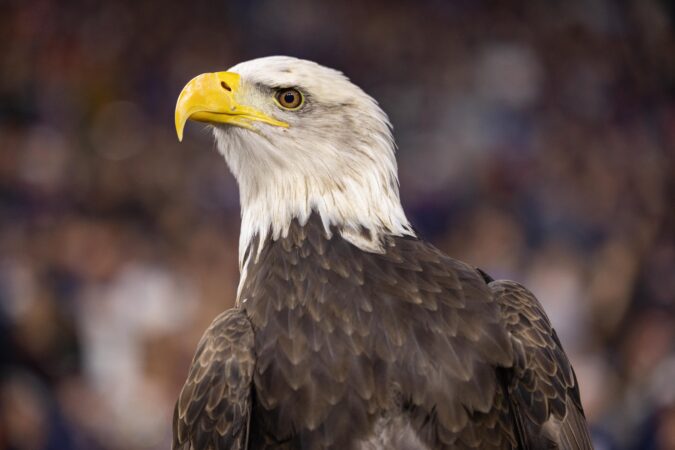
In Philadelphia, the Independence Day spectacle will include a bald eagle named Independence at Independence Hall.
The eagle, known as Indy, is scheduled to appear at the burial of America’s Time Capsule, part of the country’s 250th anniversary celebration. Visitors will be able to meet and take pictures with her.
Since 1782, when the bald eagle was placed on the Great Seal of the United States, the bird has stood for American sovereignty and power, holding arrows in one talon and an olive branch in the other. Long before that, eagles had been used as symbols of empire, authority and military strength, including in ancient Rome.
What merits does the bird have to have been attributed such strong symbolism — withappeal at events from Saturday’s time-capsule burial to flights at Lincoln Financial Field?
From a distance, the eagle looks formidable, with a six-foot wingspan. Indy is sometimes released to fly freely during Auburn football games, said Robyn Miller, Indy’s handler and the director of the Auburn University Raptor Center.
On the rare occasion that one sees eye-level with the bird — suchas in Indy’s various TV appearances — the eagle has an intense and almost disconcerting gaze. Her feet are bound or shackled to contain her but she occasionally gives out a squawk and shuffles around. The bird squawks as humans might laugh; they tilt their head back and can either let out a loud cry or many chirps, as Indy tends to do when she is inside.
The bird will travel to Philly from Auburn on a Delta flight with Miller and three other handlers. Her carrier will be strapped into two coach seats. Miller expects that she will be comfortable in her carrier but notes that she may let out the occasional squawk.
Indy, now 10, came to the Auburn University Raptor Center in 2018 after suffering a wing injury as a young bird. Although the injury healed, she had imprinted on humans during rehabilitation, meaning she could not be released into the wild. Now, she serves as an ambassador bird, teaching people about raptors, conservation, and the ecosystems that sustain them. Her appearances have included a flight at the Linc for an Eagles’ game.
Miller makes a distinction between captivity and care. “All of our raptors come to us with life-threatening disabilities,” Miller said.
The eagle is now used to human socialization and depends on human care. And yet the irony is hard to avoid. What draws people to Indy is precisely the quality that cannot be caged: the wildness she can embody, even if she can no longer live it.
“Folks can’t help but be fond of her when they meet her,” Robyn said. “Be fond of her wildness.” She added, “We wish these birds could still remain in the wild.”
The hoagie, it seems, not only can be a meal but a civic instrument: pretext and reason to bring huge crowds of people together ahead of July 4th during Wawa Welcome America festivities.
Organizers said 30,000 turkey hoagies were distributed in front of the National Constitution Center Wednesday for the annual event. The promise of a free sandwich prompted that particular American phenomenon — one of the physical vestiges of the public commons — the manifestation of the free-food zeitgeist.
Dion Clark said, succinctly, what many in line seemed to be saying in one form or another: “I want to be with the people.”
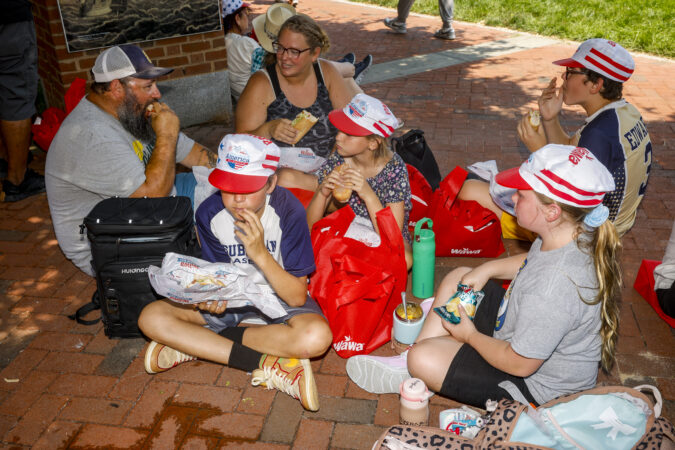
Attendees relax and enjoy their free hoagies at Independence Mall during the Wawa Hoagie Day.
Clark and her husband, who is vegetarian — Wawa was offering only turkey hoagies — had traveled from North Carolina to spend July Fourth in Philadelphia. Asked why they had come, Clark gestured around her: the National Constitution Center in front of her, the Liberty Bell nearby, the city’s founding monuments all around.
For others, like Jim Elliott, the answer was simpler. He lives nearby, and had come for the freehoagies, although, he added, “the hoagies are not the best.”
Sheylin Walker has been coming to Wawa Hoagie Day for seven years. Every year, she said, she makes sure to wake up by 9 a.m. so she can arrive by 10 before the noon hoagie distribution. “I love the crowd,” she said. “I love the sight — all of these people that are here.”
For some recent transplants to Philadelphia, the festival seemed to promise not just a free sandwich, but a kind of initiation. Getza Solana, who is 19, and recently moved from Houston to study at Thomas Jefferson University, said that to know Philadelphia, she felt she had to know the hoagie.
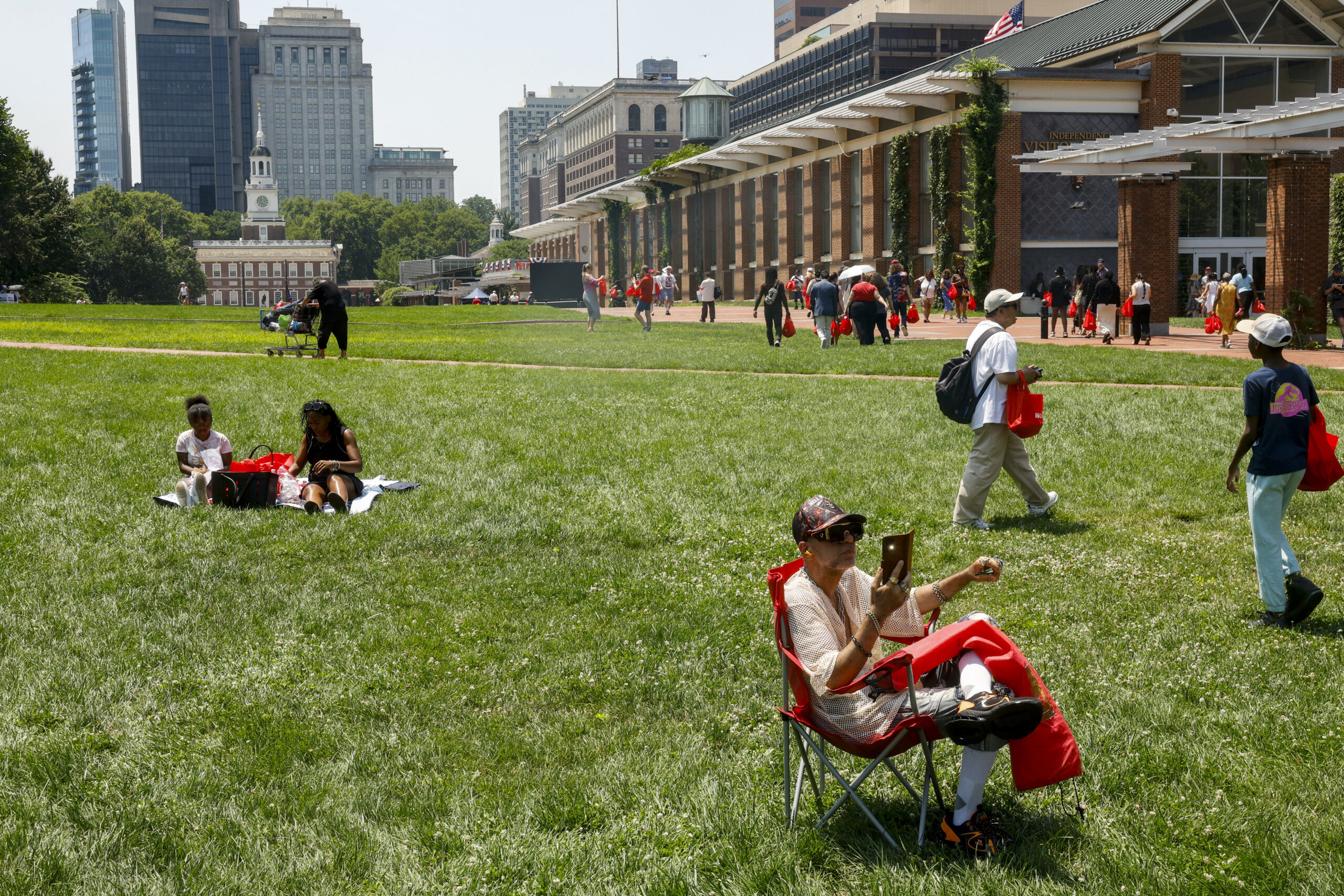
Outside the National Constitution Center, where lines of hoagie tents had been set-up, there is a contained but lush stretch of field: bunches of summer flowers, vines climbing the Visitor Center, a little green relief from the asphalt and the July heat.
There, people opened their red Wawa bags; some put on the red, white, and blue baseball hats and ate their hoagies. Pop music played from the speakers. The heat felt more bearable. And away from the crush of the line, it became clearer what many had come for: not only the sandwich, but an American picnic of sorts — friends, family, strangers, and the brief pleasure of being among fellow hoagie-eaters.
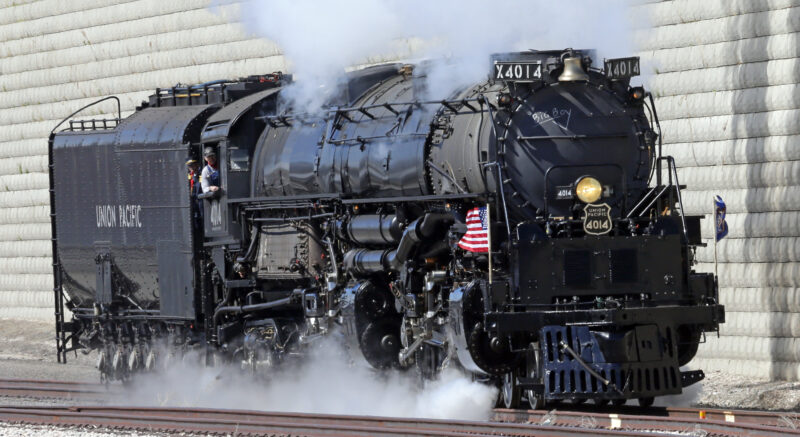
Union Pacific’s Big Boy No. 4014 will arrive in Philadelphia in time for Fourth of July celebrations, completing its journey from the West Coast. The legendary locomotive has already drawn thousands to tracks across Pennsylvania, according to the railroad.
The Big Boy is scheduled to arrive in Philadelphia for a Fourth of July display at Intrepid Avenue and League Island Boulevard in the Navy Yard, where the Port of Philadelphia will host a public viewing from 8 a.m. to 2 p.m. Saturday and again on Sunday from 9 a.m. to 3 p.m. before heading west. Admission is free.
The stop is part of Union Pacific’s coast-to-coast tour marking the nation’s 250th anniversary, a commemoration neatly suited to the locomotive itself: enormous, industrial in purpose, and now preserved as national memory.
On Thursday, the locomotive is scheduled to stop shortly in Reading (1:30 to 2:15 p.m.) and Pottstown (3:30 to 3:45 pm.) for public viewing before traveling to King of Prussia, from where it will depart at 9 a.m. Friday for Philadelphia. It will leave Philly at 9 a.m. Monday.
(function() {
var l2 = function() {
new pym.Parent(‘BIGBOY2.html’,
‘https://media.inquirer.com/storage/inquirer/projects/innovation/arcgis_iframe/BIGBOY2.html’);
};
if (typeof(pym) === ‘undefined’) {
var h = document.getElementsByTagName(‘head’)[0],
s = document.createElement(‘script’);
s.type = ‘text/javascript’;
s.src = ‘https://pym.nprapps.org/pym.v1.min.js’;
s.onload = l2;
h.appendChild(s);
} else {
l2();
}
})();
The Big Boys — 133 feet long and weighing 1.2 million pounds — are the world’s-largest steam locomotives. Big Boy No. 4014 was part of a fleet of 25 locomotives designed to haul heavy freight over the mountains between Ogden, Utah, and Cheyenne, Wyo., as rail traffic surged around World War II.
“There is something romantic about it,” said Robynn Tysver, a spokesperson for Union Pacific.“It echoes back to a time that you and I do not remember. Maybe it’s just the size of it.”
The restoration project that put Big Boy 4014 back on the track has been called one of the most significant locomotive restoration projects in recent memory by railroad experts. The restoration began in 2013. The locomotive was taken down to its bolts and rebuilt using graphics from 1941, according to Union Pacific.
Union Pacific’s history reaches back to the Pacific Railway Act of 1862, when President Abraham Lincoln chartered the railroad to help build the eastern portion of the first transcontinental line. Built largely by immigrant labor, the railroads that followed connected markets and cities, transformed the West, and made the country feel physically continuous.
Big Boy No. 4014 carries some of that history with it. It is both machine and symbol: of movement, expansion, industry, memory, and the complicated national faith that bigger could mean better.
Union Pacific reports that crowd sizes have increased as the locomotive has traveled from California to the East Coast. Though modern locomotives are more durable and have enhanced safety features — for example, AI software to scan tracks for debris — something inarticulable draws people to the Big Boy.
“You just have to see it to understand what captivates people,” Tysver said. “When you see it, you’ll understand what captivates people. It’s a living, breathing piece of history.”
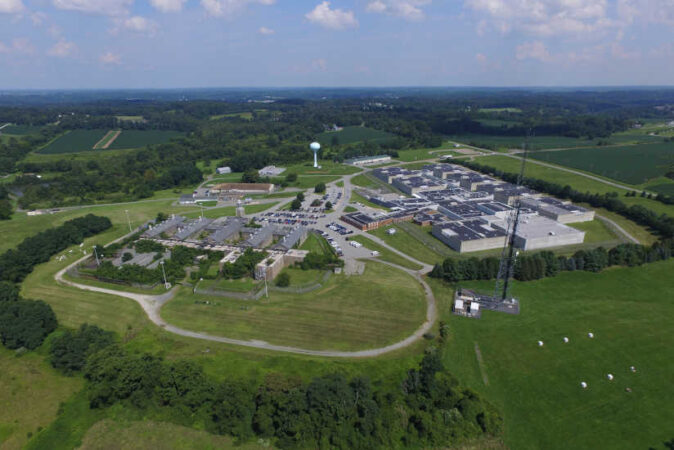
The chief warden ofthe George W. Hill Correctional Facility in Delaware County has resigned after less than six months on the job, according to a statement released by the county government.
WillieBonds’ decision was motivated by family considerations and the opportunity to pursue other interests, according to the Delco officials. Bonds will continue to serve as the chief of the facility until an interim warden is appointed.
TheGeorge W. Hill facility has been mired by scandal in recent years. The last chief to run the facility was ousted following a no-confidence vote by the labor union representing the prison’sguards. In the last two years, guards have beencharged with smuggling fentanyl and K2 into the facility; inmates were accidentally released; and an inmate was killed by his cellmate, who was considered high-risk and supposed to be placed alone.
Bonds was appointed to his position as chief of the facility in February. Last year, he served as the interim warden of the facility and he has worked in the facility since 2024, starting as deputy warden of security and training. He began his career in the New Jersey Department of Corrections in 1998.
During his time as deputy warden, a federal lawsuit alleged that county officials fired guards without due process.
After the Pennsylvania Prison Society conducted a walk-through of the facility and interviewed inmates in 2025, Bonds responded to the facility’s detailed shortcomings in a letter. The nonprofit advocacy group characterized his response, which added details about the prison’s conditions, as candid.
The group saidin a report that the facility had made significant improvements with a $50 million commitment from the county in 2025, but noted that the prison did not have enough staff for the number of inmates in the facility. At the time that the report was researched, there were 1,125 inmates, according to a response sent by Bonds. The total staff number was not reported.
The Prison Society‘s report noted “the fundamentally unsafe conditions that Bonds now has the responsibility for fixing — conditions will not be fixed with building repairs alone but will require major shifts in organizational culture.”
Delaware County hopes to continue efforts to improve the facility, the county’s statement said.
Ciara VanBuren was on the couch with her 4-year-old daughter in the next room and her 13-year-old upstairs when she smelled something burning.
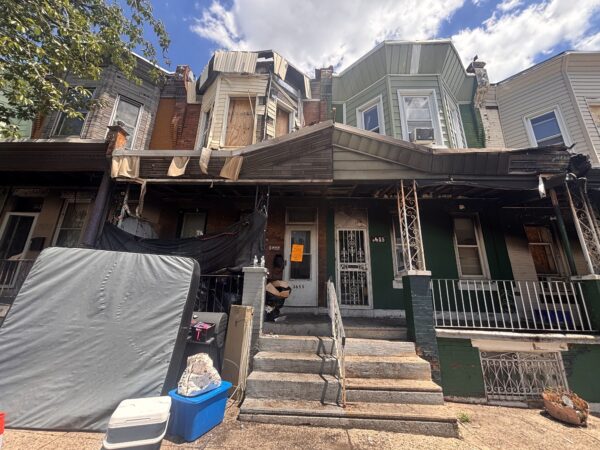
She looked out the window of her Franklinville rowhouse a few moments later and saw smoke coming from her neighbor’s window. She heard pounding on the door as neighbors and firefighters checked for anybody inside. In the moments that it took to get outside with her daughters, the front porch had collapsed, with the blaze killing a 69-year-old man and prompting charges for the woman accused of setting it.
Natasha Teague, 38, has been arrested and charged withmurder and arson, among other offenses, in connection with the Monday fire, police said Wednesday. Teague had been a frequent presence in the neighborhood over the last year, said neighbors, who said they believed she knew the fire victim’s brother.
Two fires were started on the block that day. In the early morning, police were called to the 3600 block of Percy Street after a small fire was started on the porch, according to the Philadelphia Fire Department. The fire department was not called, and no one was arrested. In the early afternoon, police say,Teague started the second fire, which severely damaged five homes and killed Barry Turner.
A preliminary hearing for Teague is scheduled for July 13. She remained in custody Thursday and no attorney for her was listed in court records.
Turner, 69, grew up in the area and came back to live with his brother, neighbors said. Other residents have described Turner as having been a straight-A student in school, said James Martinez, a 21-year-old who was in the shower when his house started to burn down.Hesaid he did not know Turner well.
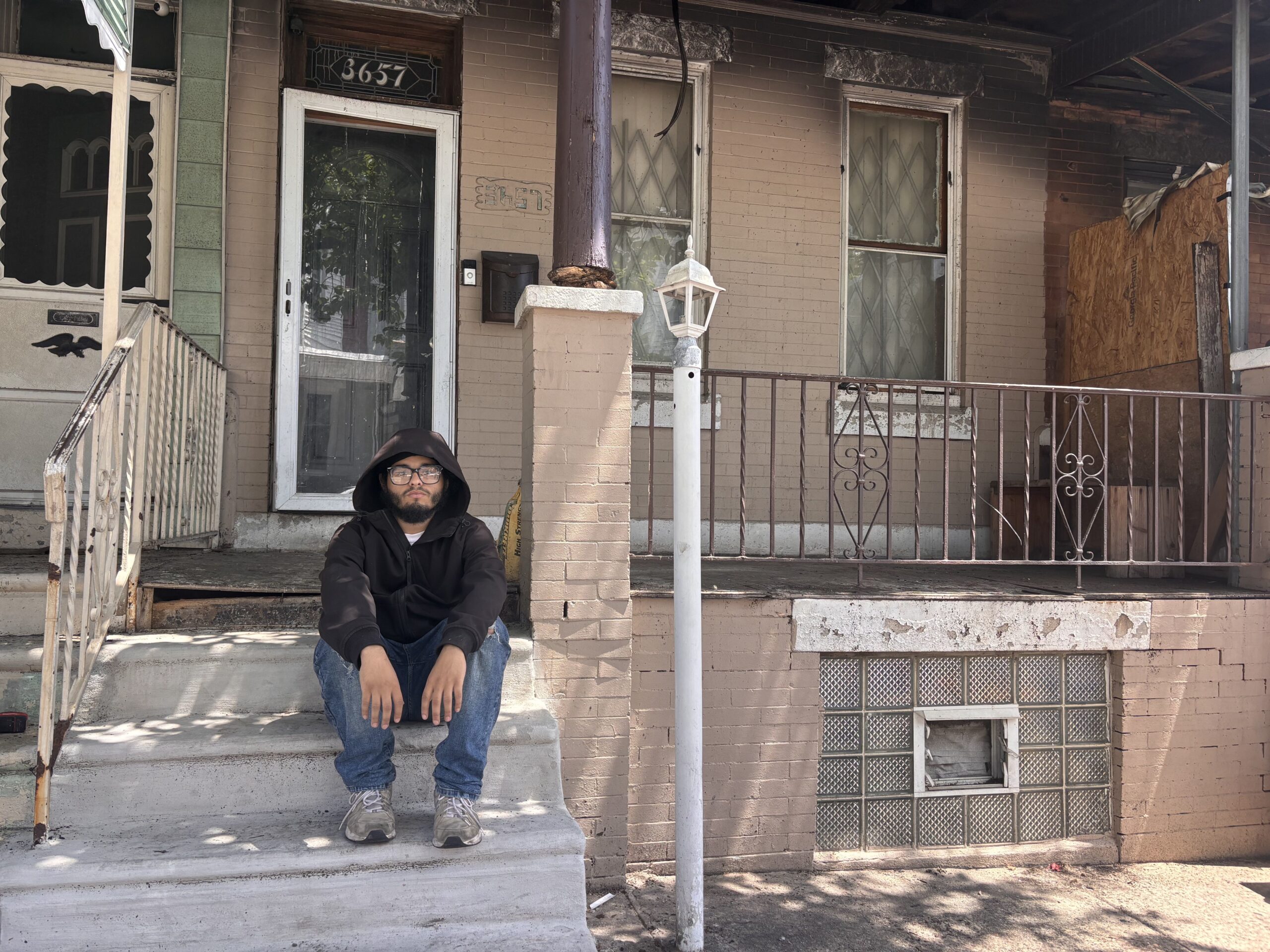
Martinez sat by the burned porch, sighing as he looked toward to the homes that were destroyed. “We are missing half a block.”
James Martinez sitting on the porch of a neighbor’s house on Percy Street.
Neighborssaid they were saddened and scared by the tragedy. Kendra Olen, who lives a few houses down from the fire with her 66-year-old mother and 22-year-old daughter, said she had not been able to sleep since the fire.
“It’s from fear,” she said. Firefightersknocked down the front door to rescue her mother, and they had to install fans in the house to get rid of the smoke.
This was the second incident of arson reported on the block in less than a month, according to the fire department. On May 23, a Molotov cocktail was thrown into an unoccupied house. No other houses were affected. Before these two incidents, neighbors could not remember a fire starting on their block in recent decades.
The fires concerned and confused neighbors who previously thought of their block as an idyllic place.
Days after the fire, there was a clear blue sky and cool breeze. Many residents sat on their porches as they usually do. Jose Vazquez lounged comfortably, wearing a blue-and-white-striped linen shirt, as he looked out to the row of burned houses.
“Almost everyone knows me, even if I forget their names,” Vazquez, who is 85 and has lived in the neighborhood for decades, said with a laugh. He does not plan to move.