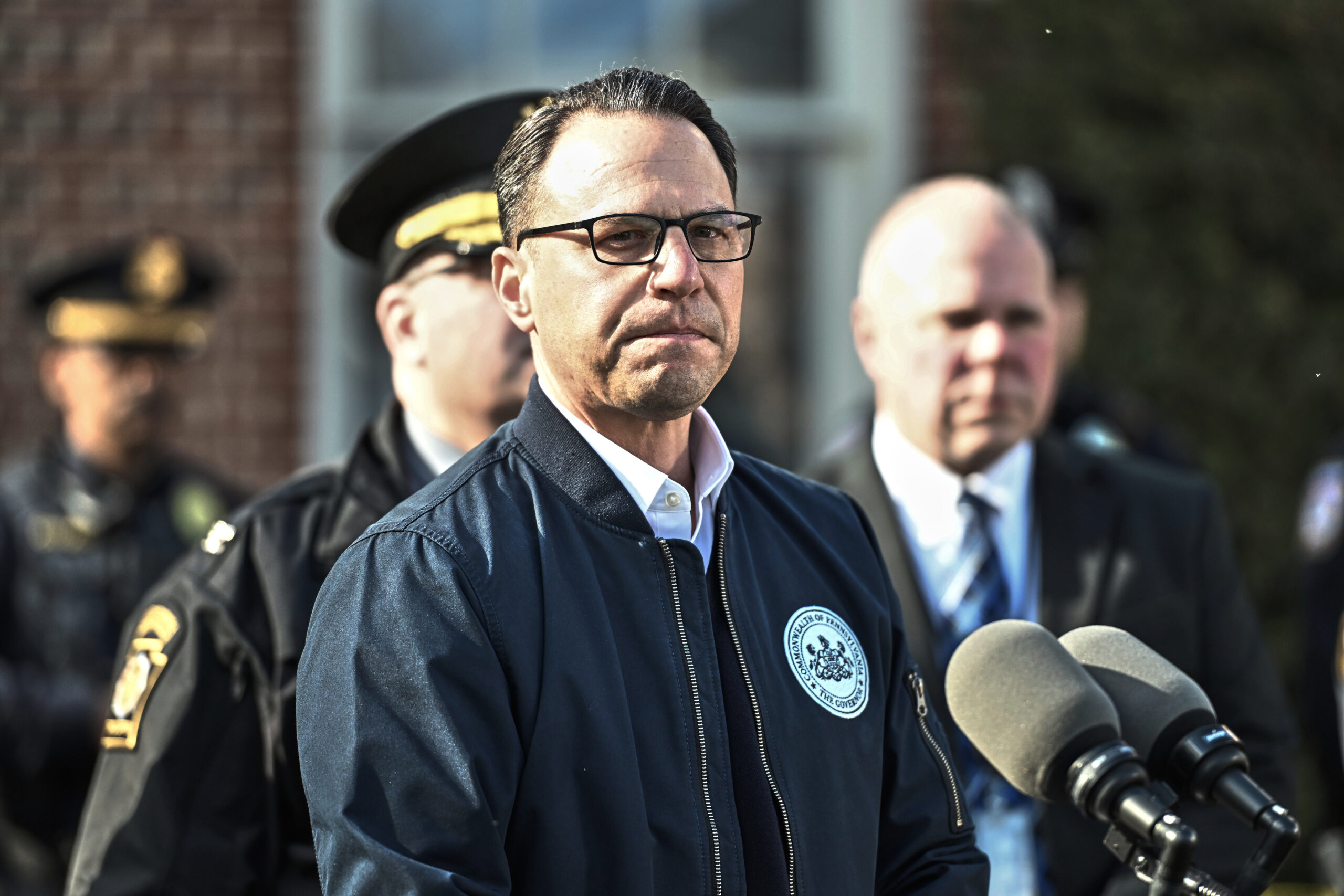
A Delaware County man was charged Wednesday after allegedly making threats againstGov. Josh Shapiro during a visit to a state representative’s office, including a threat to “burn down … [Shapiro’s] mansion with him in it,” Pennsylvania State Police said.
Police said the threats occurred when Richard John Franklin, 65, of Brookhaven, visited State Rep. Leanne Krueger’s legislative office in Brookhaven alongside his brotheron Tuesday to dispute and request help with an unanticipated and unpaid tax bill totaling $19, according to the criminal complaint. When a staffer tried to assist Franklin in completing a form to waive the taxes, Franklin “became irate and crumbled up the paper,” police said.
Franklin then began making threats the staffer believed were “threatening, harassing, and antisemitic in nature,” according to the complaint, including: “I guess I’ll pay that Jew. That Jew needs the money more than me” and “I’d like to burn down his [expletive] mansion with him in it.” Police said Franklin repeatedly referred to Shapiro as a “‘Jew’ multiple times in a negative manner.”
State law enforcement officers charged Franklin with felony levels of terroristic threats and ethnic intimidation, in addition to lower-level charges of harassment and disorderly conduct.
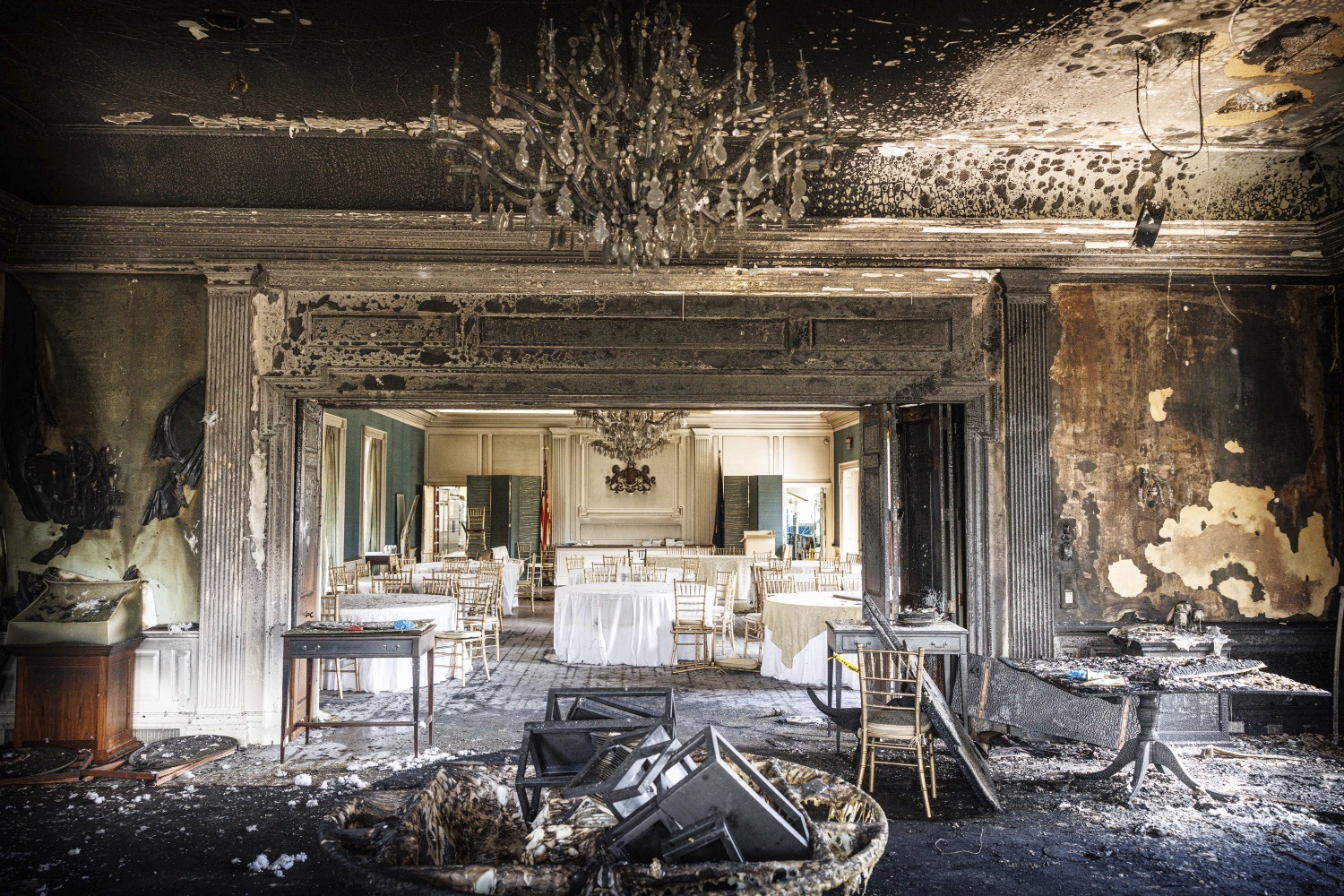
Shapiro, a Democrat who is among the most prominent Jewish officials in the country, has faced multiple threats of violence since becoming Pennsylvania’s top executive. In April 2025, a man broke into the state-owned governor’s mansion on the first night of Passover with a hammer and set several firebombs inside while Shapiro and his family were sleeping in a different part of the residence. The man, Cody Balmer, later pleaded guilty to attempted murder and was sentenced to 25 to 50 years in prison.
Pennsylvania Gov. Josh Shapiro pauses during a news conference at the governor’s official residence discussing the alleged arson that forced him, his family and guests to flee in the middle of the night on the Jewish holiday of Passover, Sunday, Apr. 13, 2025, in Harrisburg, Pa.
Early Wednesday, investigators from the state police political violencethreat unit visited Franklin at his Brookhaven home, where he provided conflicting accounts of what occurred at Krueger’s office before ultimately admitting to “calling the Governor a ‘Jew’ in a negative manner” and added that his “brother told him he should not have made the statement,” according to the criminal complaint. Franklin denied making any threats toward Shapiro, but admitted to referring to the previous arson attempt at the governor’s residence during the outburst, police said.
State police said they arrested Franklin without incident.
Franklin’s brother, who witnessed the events at Krueger’s office, disputed the state police account and said his brother never threatened the governor.
Leroy Franklin, 72, of Chester, said his brother visited the state representative’s office seeking information about a tax bill he had received, despite paying his state taxes through an accountant this year.
After the brothers spoke to a staffer who did not have answers for them, Richard Franklin became upset and raised his voice, Leroy Franklin said.
In a phone interview Wednesday, Leroy Franklin recalled his younger brother saying something to the effect of: “I’ve been on disability for 15 years, but I guess the state needs my money more than I do.”
The two were together at Krueger’s office the entire time, Leroy Franklin said, adding that he did not hear his brother use an antisemitic slur. He also disputed that his brother threatened arson.
“Anybody who said he did is lying,” Leroy Franklin said.
Around 2 a.m. Wednesday, Leroy Franklin said, he received a call from his younger brother. Richard Franklin told him that police were at his apartment and he was not sure where they were going to take him, Leroy Franklin recounted.
When the two spoke on the phone again later that morning, Leroy Franklin said, he learned police were taking his brother to jail.
“I don’t know what the heck anyone is talking about,” Leroy Franklin said Wednesday. “This is a bit extreme, to put it mildly.”
Richard Franklin was being held at the Delaware County prison with bail set at $100,000, according to court records. A preliminary hearing is scheduled for July 16, according to court documents. A lawyer for Franklin was not listed on court records.
Franklin is a registered Democrat, Pennsylvania voting records show. He has no prior convictions in Pennsylvania.
Shapiro’s office referred requests for comment about the incident to state police.
In a statement Wednesday, State Police Sgt. Logan Brouse said the agency “takes threats against the lives of public officials seriously,” noting the state police political violence threat unit was created “to address the growing amount of ideologically motivated violence against elected officials.”
The unit was created in May, after a Lebanon County man allegedly posted a “hit list” to social media targeting 20 state Democratic lawmakers. Adam Berryhill, 42, was arrested on May 6, after he was connected to an X account that posted a potential plan to attack the legislators. Some of the lawmakers named on the list said they had not been alerted to the threats against them, prompting state police leaders to update their communication protocols and create the investigations unit.
Krueger (D., Delaware) referred a request for comment to a spokesperson for House Democrats.
Nicole Reigelman, a spokesperson for House Speaker Joanna McClinton (D., Philadelphia), said in a statement that threats of political violence are becoming commonplace, “and every incident must be treated with the seriousness it deserves.”
“Healthy democracies depend on robust debate and respectful disagreement — not threats, intimidation, or violence,“ Reigelman added. ”Political violence has no place in our communities, and Pennsylvanians must unite in condemning it whenever and wherever it occurs.”
Pennsylvania elected officials are mourning the death of former State Sen. Shirley Kitchen, the second Black woman to serve in the state Senate and a champion for progressive issues who represented parts of North Philadelphia for more than two decades. She died Saturdayat 79. A cause of death was not immediately clear.
Kitchen represented the 3rd Senatorial District, composed of parts of North Philadelphia, for 20 years. She is remembered by her former colleagues as a pillar and matriarch of her community who worked tirelessly to improve the lives of low-income people, even after she retired.
“She did so many things for so many people. Now that I’m old enough to appreciate it, I’m not quite sure how she did it — and she did it with such force,” said State Sen. Anthony H. Williams (D., Philadelphia), who served alongside Kitchen in the Senate and had known her for decades. Kitchen was elected to the state Senate in 1996 and served five terms before retiring in 2016.
Her former colleagues, some through tears, credited many of Pennsylvania’s recent criminal justice reforms as being born under Kitchen’s leadership, with her early legislative proposals paving the way for their passage years later. For example, Kitchen authored early drafts of what is now known as the Clean Slate Act, which automatically seals some nonviolent convictions after 10 years, hiding them from most employer and landlord background checks. She first introduced similar legislationin Harrisburg years earlier and it failed. In 2018, two years after Kitchen retired, the Clean Slate Act became law in Pennsylvania and was heralded as a first-in-the-nation model for criminal justice reform.
Elected officials across the city shared their condolences, remembering Kitchen as an advocate who cared deeply for her community.
Mayor Cherelle L. Parker in a social media post on Sunday recalled Kitchen as “fighting for people who often had no one else to fight for them,” and as a trailblazer for Black women in politics.
“Shirley Kitchen cared about working people, and she cared about Philadelphia,” said Parker, the city’s first Black female mayor and a former state representative.
City Council President Kenyatta Johnson said in a statement that Kitchen “never forgot who she was fighting for,” dedicating her life to making people’s lives better.
State Rep. Joanna McClinton (D., Philadelphia), Pennsylvania’s first Black female speaker of the House, wrote in a social media post that Kitchen was “a mentor and her service in the state House and Senate inspired me greatly.”
Williams added that Kitchen also sought to elevate other Black politicians, like himself, to elected office — and laid the groundwork for much of the city’s current political progressivism.
“The reality is that a lot of the infrastructure that helps them, Shirley had everything to do with it, and more,” Williams said, noting her advocacy and experience during the Civil Rights Movement. “I would hope the progressives in this generation would tip their hat to a generation that really created the progressive movement.”
State Sen. Sharif Street (D., Philadelphia) had known Kitchen since he was a child, and said she helped him see the power a Senate seat has in improving the lives of his neighbors. When she decided to retire, Kitchen encouraged Street, who was on her staff at the time, to run to fill the vacancy in the 3rd District following her fifth and final term in the state Senate.
Williams and Street recalled Kitchen as a fair but demanding mentor.
“If she told you to do something, you better do it,” Williams said, with a laugh.
For Street, Kitchen “didn’t limit her advice. She had opinions about everything in my life, including when my wife was right and I needed to listen to her.”
Street said he spoke with Kitchen weekly, and Williams said he remained in touch with her as recently as last month. She often had ideas or issues she wanted the senators to take up. Street spoke with her last week about a forthcoming Registered Community Organization meeting that she was leading about a new proposed development nearby, emblematic of her continued involvement in her community.
Prior to her election to the state Senate, Kitchen was involved in the National Welfare Rights Movement, which was a progressive advocacy group for the dignified treatment of women and children, largely led by Black women, during the 1960s and 1970s, Williams said.
Kitchen served as the minority chair of the Senate Public Health and Welfare committee, in which she often leaned on her social work experience to inform her legislative proposals.
A Democrat in a time where Republicans controlled the state legislature, she served her entire tenure in the minority party, but was still able to garner bipartisan support for some of her legislative proposals.
“This image of her being an urban Black woman from Philadelphia would limit her ability to get stuff done in the Senate just wasn’t true,” Williams added. “She could analyze people and figure out what way to approach them with exceptional skill.”
Born in 1946 in Augusta, Ga., Kitchen attended the Philadelphia School District and graduated from Antioch University in 1979 with a bachelor’s degree in human services, according to her Senate Library biography. She went on to work for former Philadelphia Mayor John Street, Sharif Street’s father, before she was elected to the state House in a special election in 1987. After she lost reelection to the seat in 1989, Kitchen returned to Harrisburg a decade later after her election to represent the 3rd Senatorial District.
“She was a transformational figure that loved her community and understood that the purpose of those of us holding elected power is to be able to make a difference in the lives of the people we serve, in a way that they can feel and see,” Sharif Street added.
Funeral services will be announced in the coming days, he said.
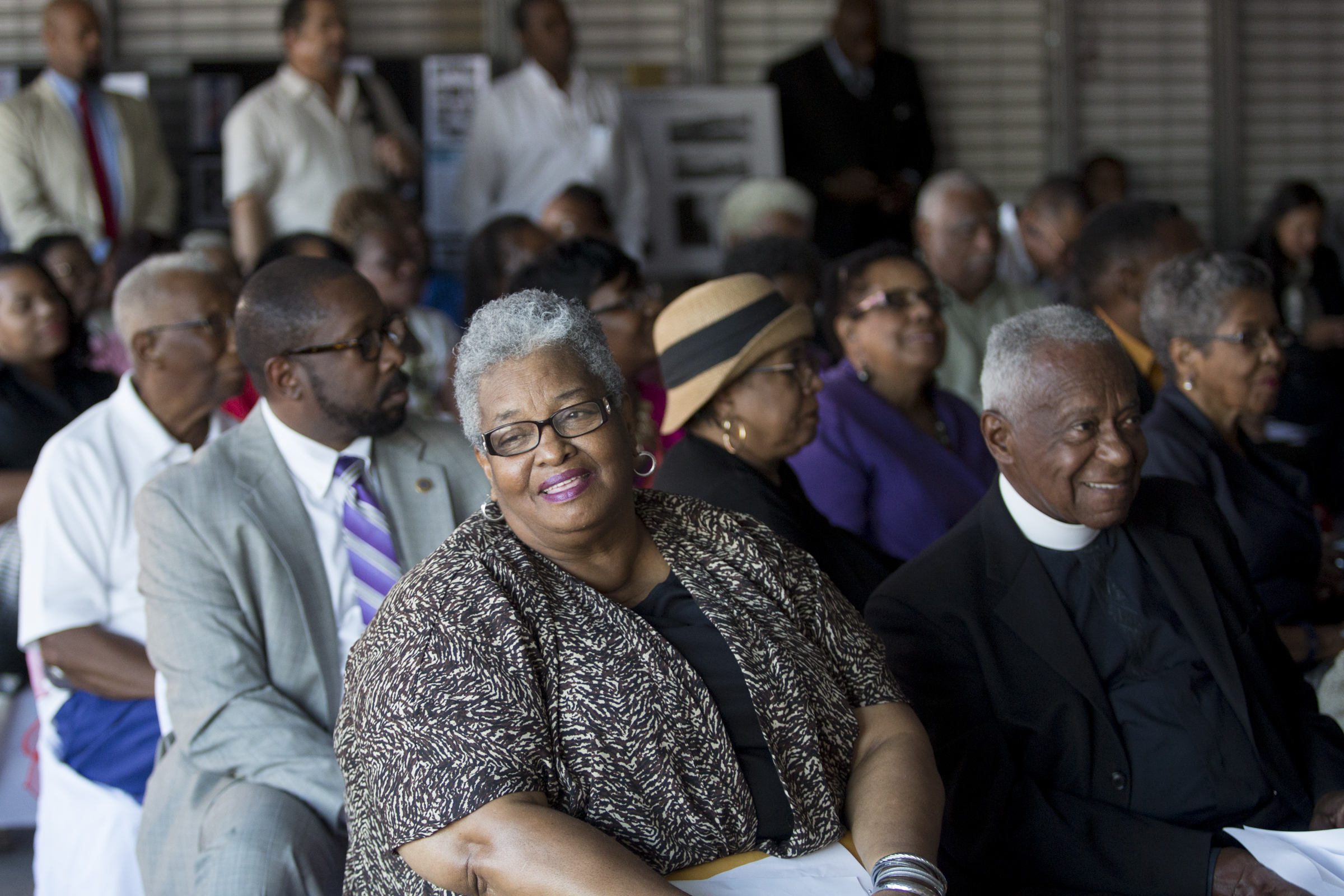
Senator Shirley Kitchen in the audience during speeches in honor of the historical marker that was unveiled at Sullivan Progress Plaza September 14, 2016. The plaza was the first black-owned and operating shopping center in America. Wednesday, Sept. 14, 2016.
This is the birthplace of democracy, and with it, comes the responsibilities that America’s founders left behind.
“The founders made clear that we have a real responsibility to do the work to constantly perfect our union,” Shapiro said in an interview this week, ahead of his speech before the ceremonial meeting of Congress, marking 250 years since the Declaration of Independence was signed in that same building. “And that the Congress of the United States has a unique responsibility in that to be a check on the executive branch.”
Those words come at a critical inflection point in America’s history, amid a tumultuous presidency, and as Shapiro is rumored to have aspirations of a White House bid in 2028. The first-term Democratic governor will appear before approximately 40 bipartisan members of Congress in Old City at the event convened by U.S. Rep. Brendan Boyle (D., Pa.), speaking to the lawmakers from across the country about their collective duty to the public. Shapiro will attend numerous other 250th celebrations across Philadelphia in the coming days, during which he said he plans to share his optimism for America’s future and deep concerns that President Donald Trump has led the nation astray from its founders’ design.
“I don’t think patriotism belongs to one party. I don’t think it should ever be partisan,” Shapiro said. “Unfortunately, Donald Trump routinely divides us, routinely injects partisanship into his definition of patriotism, and his actions, in many ways, are the opposite of patriotism.”
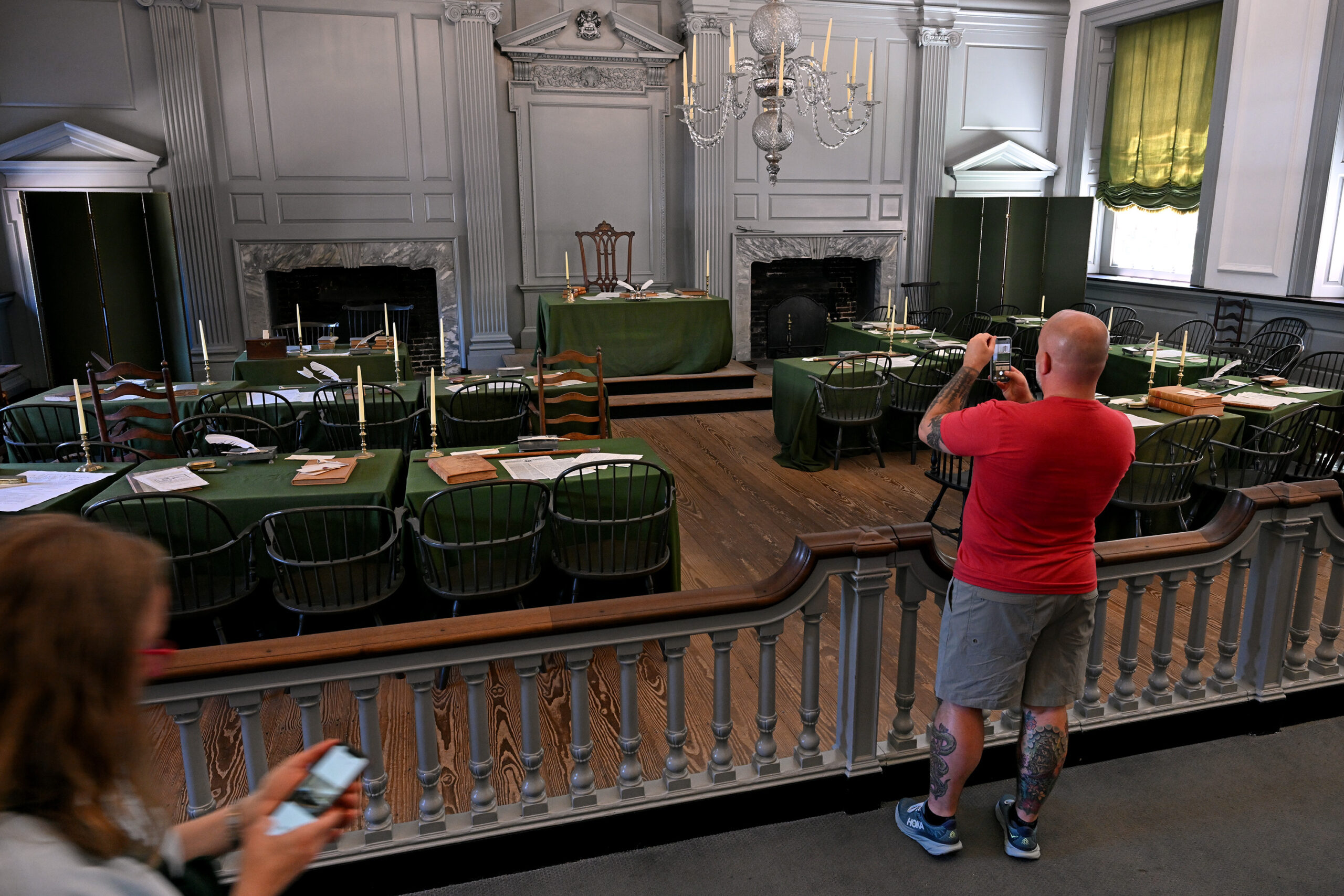
Assembly Room in Independence Hall (Pennsylvania State House) Monday, June 15, 2026. This is the exact space where the Second Continental Congress met and the Declaration of Independence was adopted.
As Trump plans to spend America’s 250th birthday hosting a politicalrally on the National Mall — with no plans to visit Philadelphia, the city where the nation was founded — Shapiro sees his own role as a unifier, and in direct contrast to Trump. As attention shifts to Philadelphia this weekend, he’ll appear on the national stage from sunup to sundown at events and on frequent TV hits — all with a home-turf advantage for his 2028 presidential prospects, as the governor of the nation’s quintessential swing state and also most important to the country’s founding.
“[Celebrating the 250th] allow the spotlight to shine on Shapiro, even though it’s not entirely about him,” said Alison Dagnes, a political-science professor at Shippensburg University. “Do I think that helps his ambitions? Sure.”
‘Direct contrast’
Sitting with Shapiro in his Harrisburg office earlier this week, it’s undeniable that he’s a history nerd — another reason why he was built for the moment.
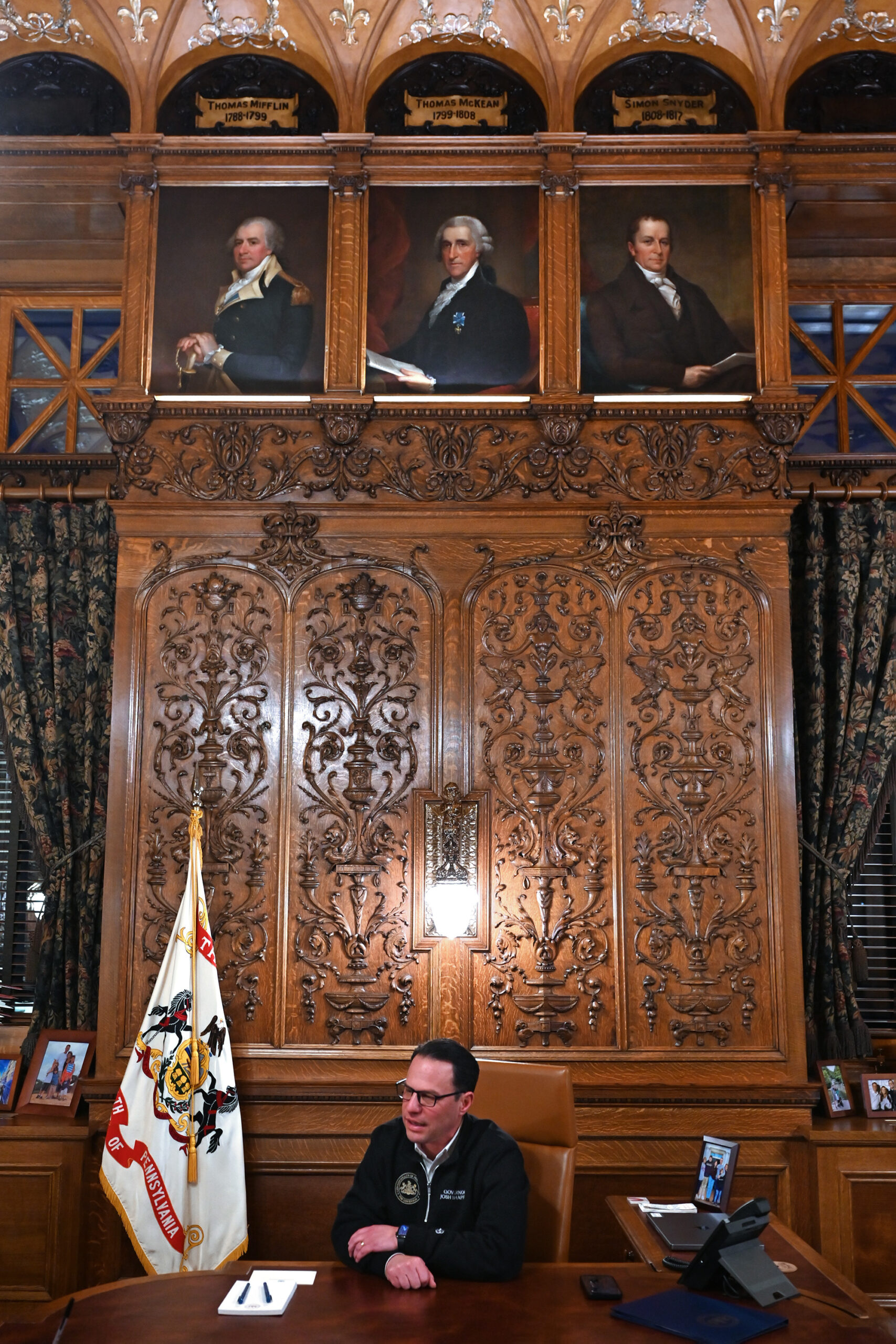
He casually quotes segments of The Federalist Papers, and references his favorite story about Benjamin Franklin‘s fixation on a half-sun on the back of George Washington’s chair during the 1787 Constitutional Convention, which Franklin remarked during the U.S. Constitution signing that “it is a rising and not setting sun.” Without having to look for its location, he points to his right to a portrait of Franklin, one of his predecessors as governor of Pennsylvania, hanging on his office wall. He notes lesser-known Pennsylvanians who played an important role inthe nation’s founding whom he plans to highlight over the coming days.
“You know, I hate to quote a guy not from Pennsylvania,” Shapiro said, returning to The Federalist Papers to recite James Madison’s concerns about giving an executive too much power.
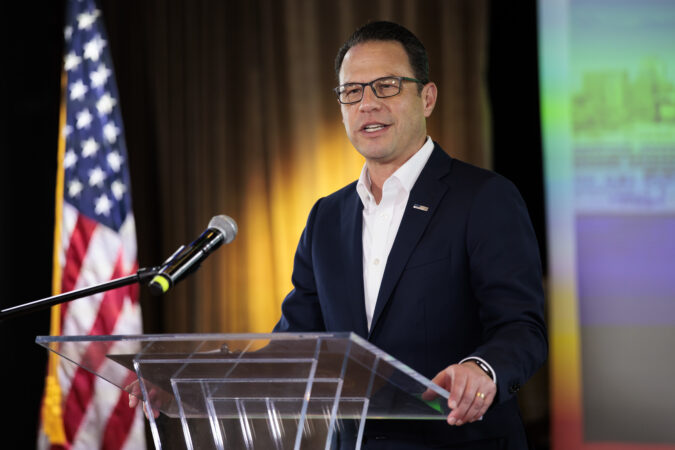
Gov. Josh Shapiro in the Capitol in Harrisburg Feb. 21, 2023.
“If Madison were here today, he’d be really concerned about how one man has accumulated so much power and is wielding it in really dangerous ways, and I hope that at this 250-year mark we find our way back to that balance and back to the constraints on the people who lead our government,” he said.
Shapiro sees his leadership style as a “direct contrast” to Trump’s, especially at this moment.
“[Trump] restricts peoples’ freedom and liberties,” the governor added. “He whitewashes our history. That doesn’t further a sense of community, that doesn’t further patriotism. All that does is divide us, and I refuse to participate in that.”
But for the next few days, Shapiro said his approach to the 250th celebrations is to: “Celebrate America, find ways to bring people together, and to have some fun in the process.”
Fair games
Despite his overtures of political unity, Shapiro has faced accusations from Republicans in recent days for playing partisan games over Pennsylvania’s participation in Trump’s 16-day Great American State Fair. Shapiro, in addition to several other Democratic governors last week, announced that Pennsylvania would not take part in the fair due to his administration being unable to secure any state businesses to sponsor the exhibit. Staffing and sponsoring the exhibit on the state’s dime would have cost $700,000 that would be better spent on in-state 250th events, he said this week.
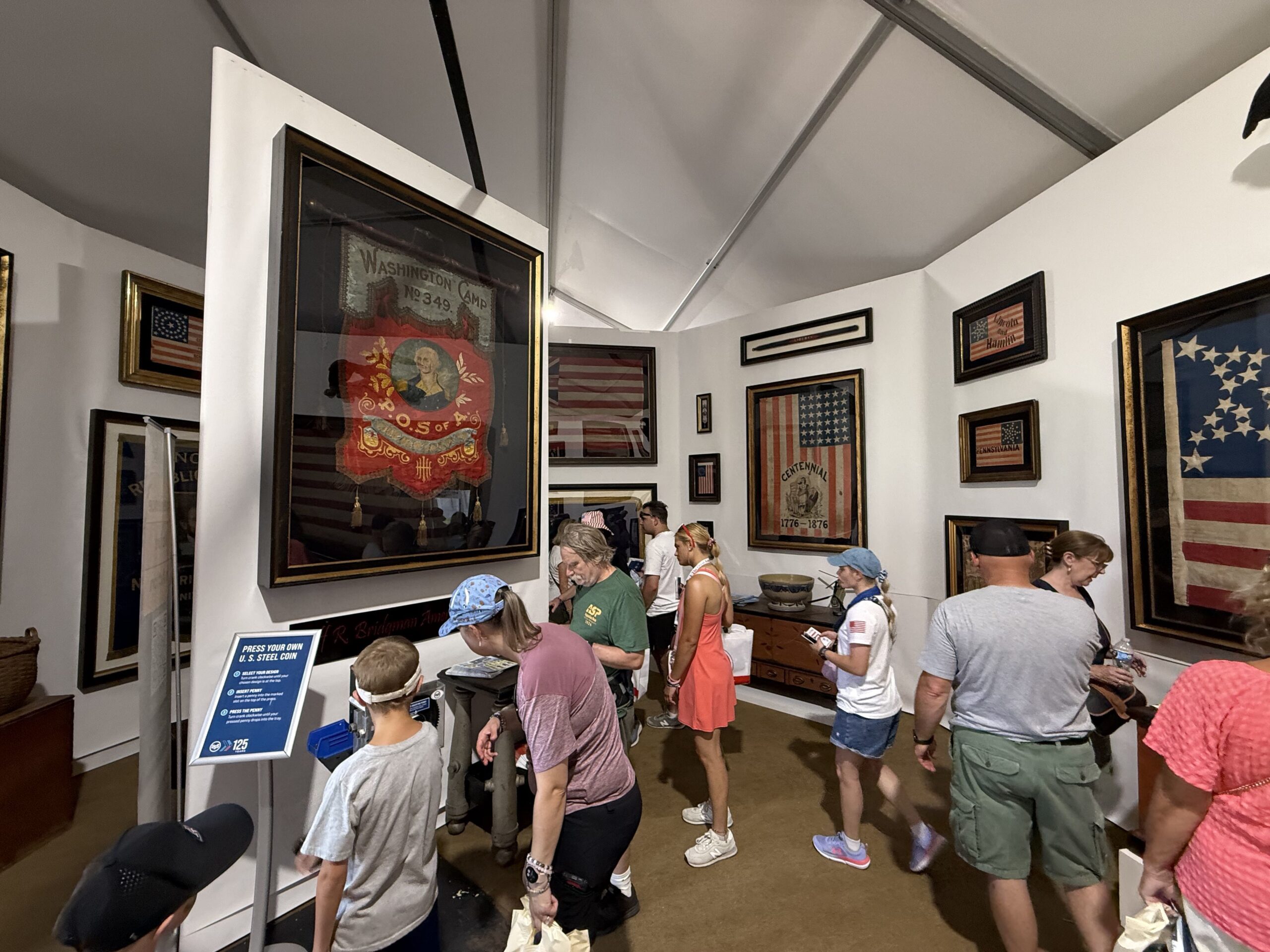
In the weekend that followed, Pennsylvania’s U.S. senators, Republican Dave McCormick and Democrat John Fetterman, made a push to fill the state’s empty exhibit. By Tuesday, it was filled with antique flags lent by a York County man, bags of potato chips from Snyder County, and a Christmas tree display from Fayette County, among other Pennsylvania-centric items.
Pennsylvania’s pavilion showcases state history and memorabilia at the Great American State Fair on June 30, 2026, in Washington, D.C.
Some of the businesses originally told Shapiro’s office they didn’t have enough time to participate. But when McCormick and Fetterman approached them with the idea to fill the empty pavilion, they joined in.
“They obviously had a change of heart at the last minute. That’s fine,” Shapiro said about the revived Pennsylvania pavilion.
State Treasurer Stacy Garrity — Shapiro’s Republican challenger for governor, who has aligned herself with Trump — in a statement called Shapiro the “only career politician who has politicized America 250.”
“Josh Shapiro put his political ambitions above his commonwealth and his nation when he pulled Pennsylvania out of the national celebration of our 250th birthday in a pitiful attempt to score cheap political points with the liberal wing of his party,” Garrity said.
Beyond the 250th
Shapiro’s strength as a politician has always been his ability to appear “harmonizing” and bringing people together, dating back to his days as a Montgomery County commissioner, Dagnes said.
A careful politician, Shapiro is known to stick to his message and has faced criticism from some fellow Democrats for his well-rehearsed statements.
When Shapiro delivers his messages of unity and freedom to a broader audience in the coming days, voters are likely toview them as authentic — one of the most important qualities to any presidential hopeful, she added.
“If [California Gov.] Gavin Newsom is the guy who’s gonna punch Trump in the face, then Shapiro is going to be the guy who’s like, ‘No, let me offer you an alternative,’” Dagnes said.
“It’s what he should be doing right now, because this is what America is about,” she added.
HARRISBURG — Pennsylvania enters the new fiscal year on Wednesday without a state budget in place for a fifth consecutive year, while top leaders in the politically split legislature publicly disagreed over whether a deal was near.
Lawmakers in the Republican-controlled Senate and the Democratic-led House have known for months that Pennsylvania faces fiscal straits, as the state is on a path to spend more than it brings in in revenue in fiscal 2027. Top negotiators have spent weeks meeting behind closed doors about how the state should spend more than $50 billion in taxpayer dollars, in hopes of avoiding another drawn-out budget impasse.
Under first-term Democratic Gov. Josh Shapiro’s proposed $53.2 billion budget, Pennsylvania would spend $4.8 billion more than its $48.6 billion in projected revenue and would require lawmakers to create new revenue streams, cut spending, or raise taxes — or dip into the state’s reserves.
Senate Republicans on Tuesday recessed until legislators have a final budget deal to vote on, with Senate Majority Leader Joe Pittman (R., Indiana) saying that there is “no reason we cannot conclude our work early next week” and that lawmakers “have a very good trajectory in front of us.”
Pittman — a top negotiator in the closed-door talks — made those remarks just one day after a Senate committee voted to gut the main spending bill in Shapiro’s budget proposal, which was approved by the House in April, from $53.1 billion to $25 million.
State Senate Majority Leader Joe Pittman (R., Indiana) during a press conference at the Capitol in Harrisburg in February.
In a news conference Tuesday, House and Senate Democratic leaders offered a different picture: Despitelawmakers traditionally staying in Harrisburg in the days leading up to July Fourth in hopes of hashing out a deal, Senate Republicans are already packing up for the holiday weekend, the Democrats said, and are politically motivated to hold up the state budget. (House Democrats later canceled their scheduled legislative session on Thursday.)
“[Senate Republicans are] going to tell you that progress is being made, and that it’s important that we allow time for members to go home for the weekend. And by the way, it’s Tuesday,” said Senate Minority Leader Jay Costa (D., Allegheny).
“The bottom line is they’re not serious about getting a budget done, they’re slow-walking this process for weeks and weeks, and we’re calling them on it,” Costa said.
Shapiro echoed the same frustration with Senate Republicans in an interview Tuesday, adding that the Senate “decided to go home on vacation” when lawmakers are due to deliver a budget bill to him for his signature.
“I think it’s disrespectful to the people of Pennsylvania,” Shapiro said, noting that Pennsylvania has a revenue surplus. “They should be here, and they should be working. And instead, they ran away.”
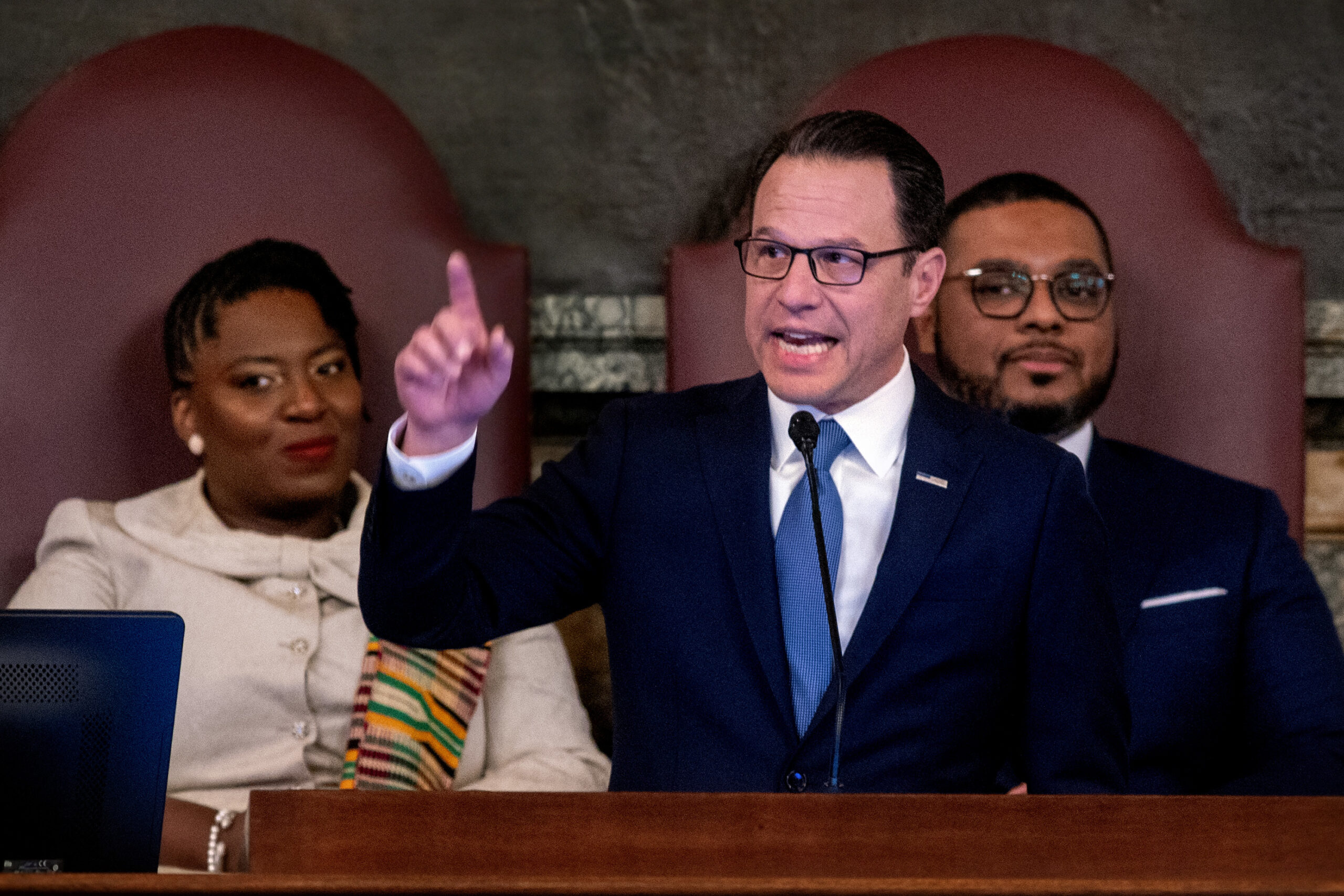
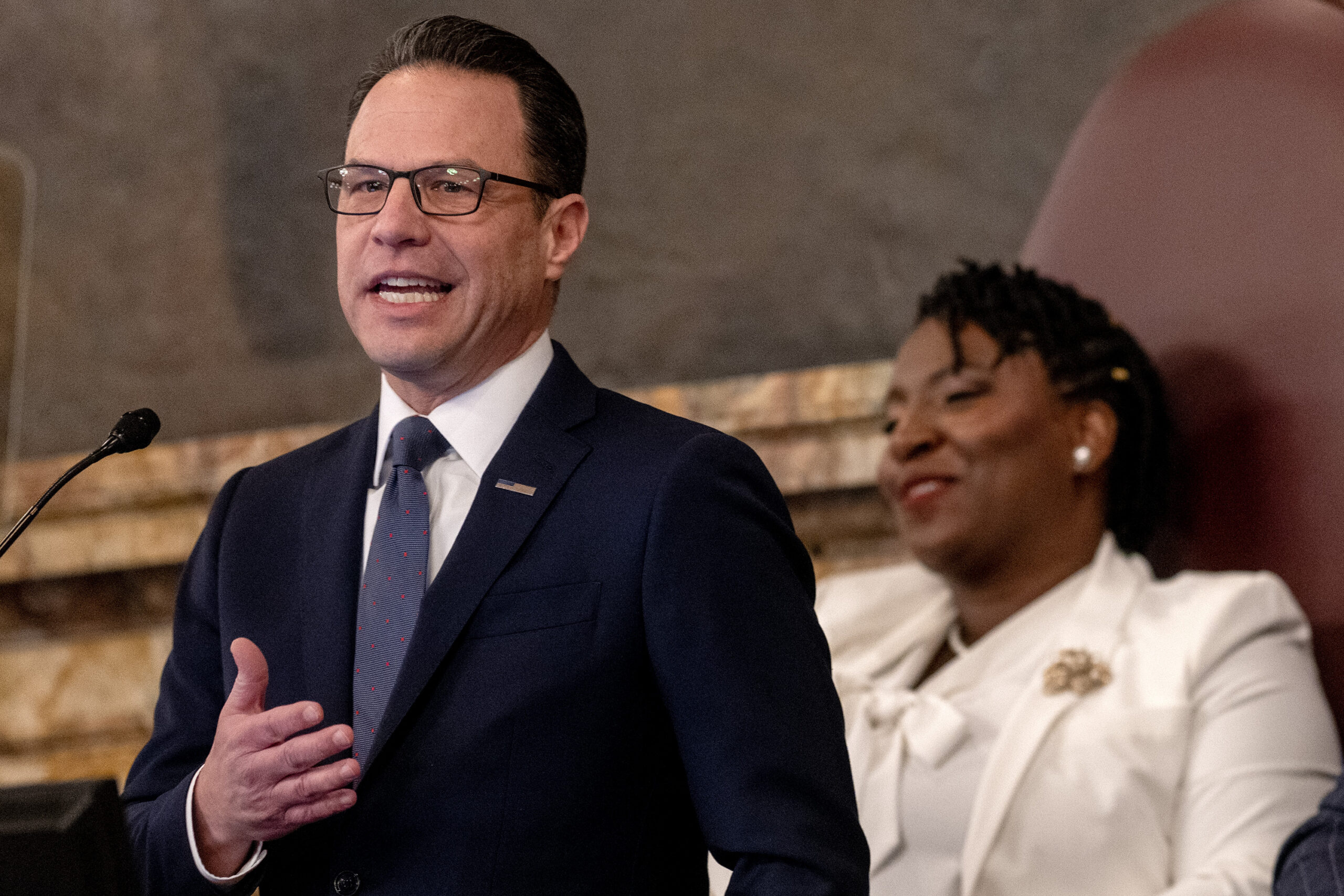
Speaker of the House Joanna McClinton (left) and Lt. Gov. Austin Davis are seated behind Gov. Josh Shapiro as he delivers his third budget address to a joint session of the state House and Senate at the state Capitol on Feb. 4.
Senate GOP leaders, in a statement following their recess Tuesday, said they believe they are “well on our way to effectuating a full budget agreement in the days.”
House Minority Leader Jesse Topper (R., Bedford) told reporters that legislative leaders have been constantly in contact “over the past month” no matter if members are in the building.
“At the end of the day, the talks continue,” Topper said. “This kind of stunt feels a lot like politics.”
Top legislative leaders have been tight-lipped about what the remaining sticking points are in budget talks.
Pennsylvania is constitutionally required to deliver a balanced budget by the start of the new fiscal year on July 1, releasing state funds which are then sent to school districts, county governments, and nonprofit organizations that offer critical services to residents.
The true impact of the missed deadline won’t be felt by local governments and schools for weeks. However, these entities are often required by law to submit their own budgetsdespite inaction by the state, often leaving them unable to predict how much state money to budget. State employees and lawmakers continue to receive pay during a state budget impasse.
Last year, a nearly five-month budget impasse required schools, counties, and service providers to cut jobs, take out high-interest loans, or stop services altogether. The School District of Philadelphia, the state’s largest school district, borrowed $1.5 billion to pay its bills, resulting in $30 million in interest and borrowing costs that weren’t repaid when the state approved its annual spending plan.
Lawmakers were at a bitter standstill about whether to allocate a new, reliable funding stream for public transit, reviving the state’s long-held rural-urban divide. Members also couldn’t agree on how much to spend, until ultimately reaching a $50.1 billion budget deal in November 2025.
This year, both chambers have slim margins for budget votes: House Democrats hold a one-seat majority, while Senate Republicans have a three-seat majority with several conservative members who rarely support spending increases. This often means legislative leaders must work with the minority parties to come to a final deal.
On Monday, Senate Republicans leaders did not show up to a scheduled meeting with Shapiro and Democratic leaders, Costa said, signaling potential discord.
Legislators still need to reach agreements on a number of issues, including whether to tax and regulate so-called skill games differently from slot machines and whether the state should overhaul existing school choice programs.
Democrats have wholly backed Shapiro’s budget proposal, which included legalizing recreational marijuana and raising the state minimum wage. Republicans have emphasized a need to slow down spending, citing the state’s structural deficit.
The leaders will also trade a number of legislative priorities in closed-door meetings unrelated to state spending as part of an overall deal, such as data center oversight proposals.
In Pennsylvania, the state budget topped $50 billion for the first time last year. It had increased by 25% — about $10 billion — over a five-year period.
HARRISBURG — Three years after a bitter budget standoff over allowing state funding to be used for private school tuition, top Democrats in Harrisburg are ready to engage on school choice.
Legislative action and comments from a top House Democrat this week expressing openness to a federal school-choice program marked a notable change from 2023, when a fight over school vouchers put Democratic lawmakers at odds with both Republicans and Gov. Josh Shapiro, a member of their own party.
House Majority Leader Matt Bradford (D., Montgomery) said this week that some of the uses of Trump’s tax credits, which are opposed by the country’s largest teachers unions, are “intriguing.” And he noted he is proud of some money the state now pours into one of thetax credits to fund private-school scholarships for low-income families in low-achieving districts. Those comments from Bradford, a top leader in Harrisburg, suggested a public softening on an issue that was previously a non-starter for his party— and signaled the school-choice debate may once again factor into state budget negotiations.
“For our members of our caucus who want to see alternatives for the poorest kids in the poorest schools, we’re being responsive to the needs of those constituents,” he said in an interview, referencing growing support for school choice among some House Democrats, particularly those from Philadelphia.
State Rep. Matt Bradford (D., Montgomery County) during a press conference at the Capitol in Harrisburg Feb. 3, 2026.
The school-choice movement, a largely Republican-backed effort to allow public dollars to go to private schools, faces strong opposition from education advocates who say such programs can take money from public schools.
And that debate is sure to continue. Bradford said more oversight — and an overall reform of the current tax credits — is needed to make sure the state tax dollars are actually reaching poor students.
Earlier this week, House Democrats fast-tracked an overhaul to the state’s current $680 million school-choice tax-credit programs to require additional reporting from private schools in order to secure funding. The legislation is likely to face opposition in the GOP-led Senate, where Republicans on Thursday advanced a $25 million increase to the programs ahead of a June 30 deadline to pass a state budget.
Senate Republicans called the tax credits a “priority for empowering parents,” while the Archdiocese of Philadelphia said the House bill would be “devastating” to local Catholic schools and lead to fewer scholarships for students.
A spokesperson for Shapiro said his office is reviewing the House bill, and declined to comment on whether his position on school choice has changed. Shapiro, who has sent his own children to private school in Montgomery County, has previously said he supports school choice, including school vouchers.
Shapiro has until the end of the year to decide whether to opt in to the federal program. But the signal of openness from Bradford, who is close with the governor, offers potential insight into his path forward.
That program, enacted last year under Trump’s “One Big Beautiful Bill Act,” would offer federal tax credits to donors for giving to organizations that grant private school scholarships. Many GOP-led states have already signed on, while some Democratic governors have declined to participate.
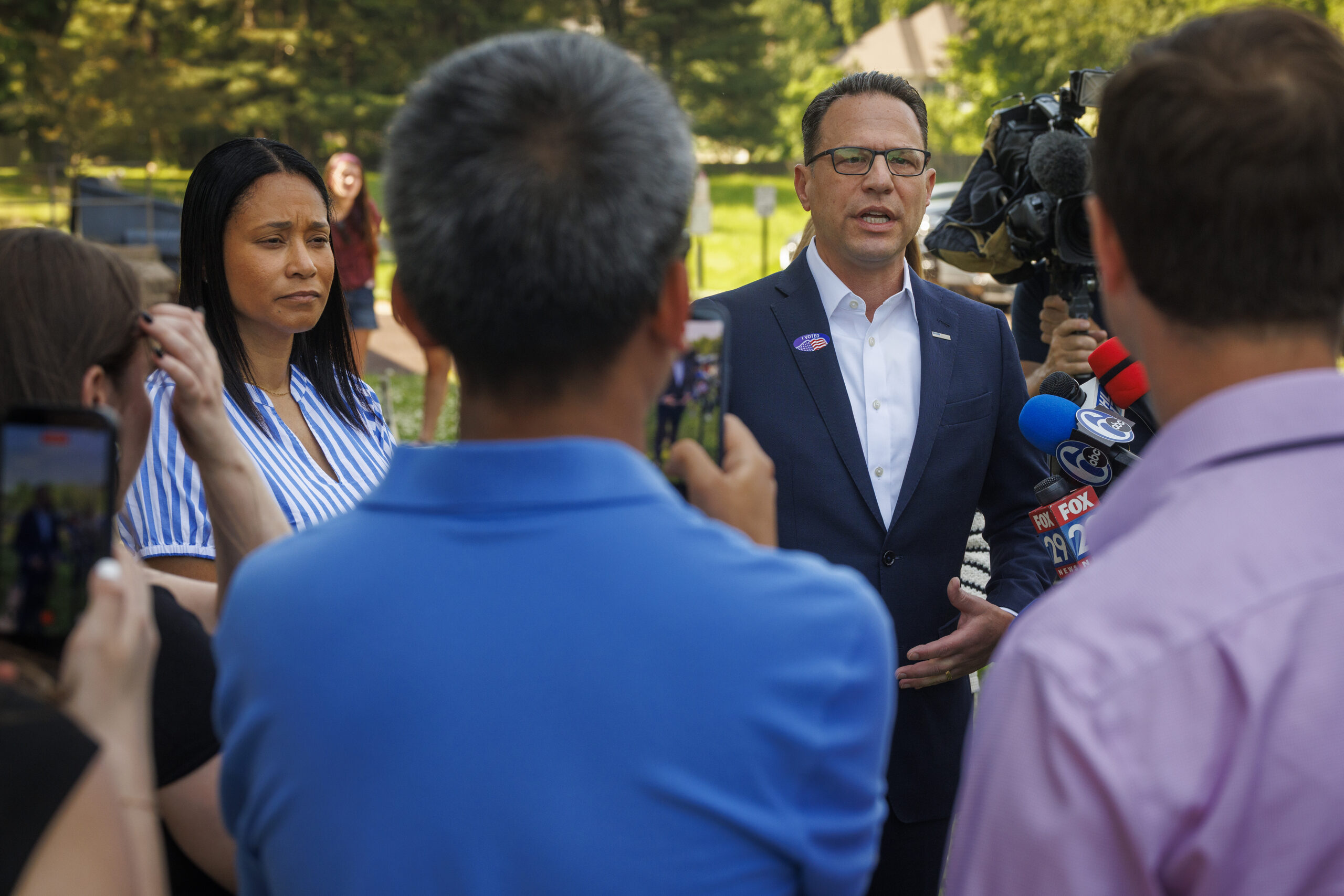
Pennsylvania Governor Josh Shapiro taking questions from media on election day, Tuesday, May 19, 2026. He voted today at Rydal Elementary (West) 1231 Meetinghouse Road Rydal, PA. At left is Jamila H. Winder, Chair, Montgomery County Commissioners.
Shapiro will also likely face questions about school choice on the campaign trail.
He is running for reelection in November against Republican Treasurer Stacy Garrity. Garrity’s platform focuses, in part, on expanding school-choice options in Pennsylvania and she has the support of Commonwealth Partners, a political action committee largely funded by Pennsylvania’s richest man, Jeff Yass, which has poured money into supporting school choice.
The issue will also likely surface a national stage if Shapiro enters the 2028 Democratic presidential primary race. His support for vouchers drew criticism from fellow Democrats in 2024, when he was a potential vice presidential nominee.
Debate over state tax credits
Pennsylvania does not have a direct school voucher program. Instead, the state sets aside $680 million each year for tax credits that allow businesses and individuals to write off charitable giving that supports private school scholarships.
House Democratic support for those credits has quietly grown in recent years. In a June 2025 letter recently obtained by The Inquirer, 10 House Democrats, including five from Philadelphia and the head of the Pennsylvania Legislative Black Caucus, asked their leadership to expand a portion of the tax credits forstudents in the lowest-achieving school districts — revealing more Democratic support for the programs than was previously known.
Public education advocates who oppose voucher programs say the state is funneling money to private schools with little accountability.
“It’s just a pot of money that a bunch of people get, and nobody really knows where it goes or what happens to it,” said Susan Spicka, executive director of Education Voters PA.
New requirements approved by the state legislature last year are set to take effect in November andwill require scholarship organizations to report the dollar amount of each award, the recipient’s district of residence, and where they attend private school.
The bill advanced by the House in a 105-97 vote this week would also require organizations to report each scholarship recipient’s income level — reducing the currentlimit to $144,000 for a family of four — and the amount of remaining tuition charged to a student. Advocates, including Spicka, called that information key to gauging whether scholarships are going to families who otherwise could afford private school.
Bradford said he’s proud of the $110 million earmarked in existing state tax credits to provide additional money to kids attending schools where a majority of students are getting scholarships. House Democrats say their newest proposal would steer more money toward those students.
But the proposed legislation — which would also reduce the tax credit donors could claim for some contributions, and require scholarship organizations to set 2% of funding aside for state oversight of the programs — drew swift backlash from private school advocates.
Philadelphia Archbishop Nelson J. Pérez is “deeply concerned that this legislation would have a devastating impact,” said spokesperson Ken Gavin. “The clear intent is to lead to the dilution or elimination of the programs, which are vital.”
Schools affiliated with the Philadelphia archdiocese educate nearly 44,000 students across 117 schools in the region, according to its website.
Bradford, who is Catholic, said the Archdiocese’s response “missed the mark,” arguing that this legislative effort is trying to achieve a similar goal of serving students from poor families who attend the roughest schools.
“I’m proud of my own Catholic faith. I love when my Catholic Church stands for those communities,” Bradford added. “No one should ever fear transparency, especially when you’re talking about three-quarters of a billion dollars of state tax dollars.”
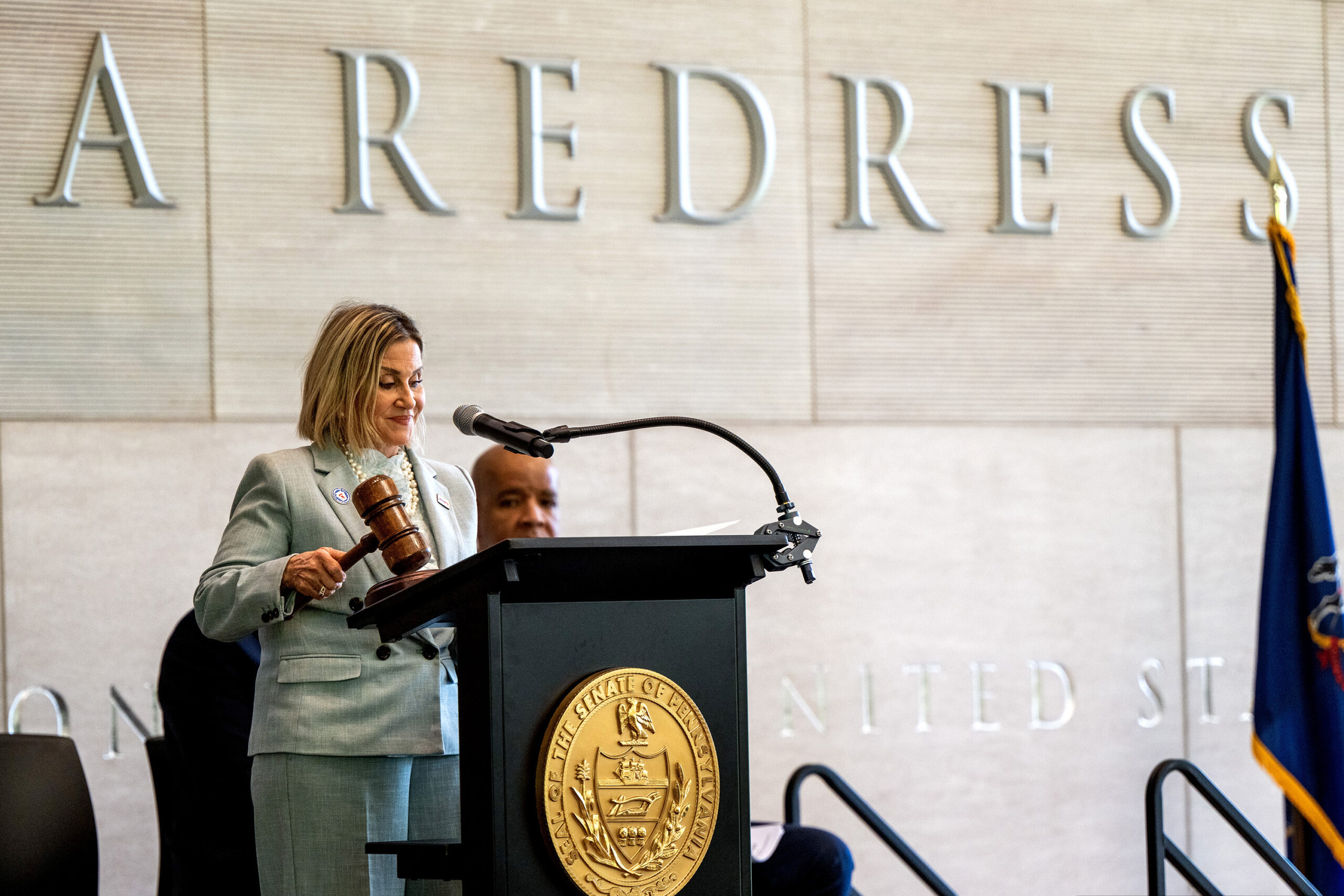
President Pro Tempore Kim Ward gavels the opening as the Pennsylvania Senate hosts a ceremonial meeting at the National Constitution Center Tuesday, May 5, 2026.
Meanwhile, Senate Republicans on Thursday amended another House bill to increase the state’s current tax credit programs to $705 million.
President Pro Tempore Kim Ward (R., Westmoreland), a staunch supporter of school vouchers, said in a statement that Bradford‘s attention to school choice is disingenuous, criticizing the House Democrats’ bill as “overly burdensome auditing requirements disguised as ‘transparency.’”
The 2023 budget breakdown, where Shapiro ultimately vetoed the school voucher program he‘d helped draft with Senate Republicans because it couldn’t pass the Democratic-controlled House, continues to tarnish his relationships with top GOP leaders, including Ward. He and Ward have hardly spoken since.
“While Senate Republicans have consistently advanced legislation to provide scholarships to disadvantaged students, the track record for Gov. Josh Shapiro and House Democrats has been nothing more than a case of whiplash as their words and actions rarely align,” Ward said. “To me, it seems like the support for school choice by the House Democrat Leadership is more of a façade as they continue to cater to political special interests.”
Bradford, in response, said he is open to conversation about accountability and transparency, but that debate needs to include private schools benefiting from taxpayer dollars.
“We shouldn’t carve out any portion of our K-to-12 education,” Bradford added. “That conversation needs to be uniform.”
A choice for states on Trump’s tax credits
Shapiro has previously said he would wait for more details before making a decisionon whether to participate in the new federal tax credit program. The U.S. Department of the Treasury earlier this month released additional details, including that itwill allow individuals to receive up to $1,700 in credits for making donations to private school scholarships that can cover tuition, tutoring, and more. In Philadelphia, families making $368,100 annually, or 300% of the county’s gross median income,would be eligible to receive the scholarship.
Shapiro’s press secretary Rosie Lapowsky said the governor appreciates the guidance, but continues to await information on “how this will affect use of our existing tax credits, how states will be expected to administer the program, and how eligibility will be determined.”
Twenty-eight states have opted in to the program, most of which are led by Republicans. And Democrats are facing pressure to stay out of the program.
In a letter sent to Democratic governors this week, American Federation of Teachers President Randi Weingarten and National Education Association President Becky Pringle called the program “a Trojan horse carrying near-universal K-12 private school vouchers into every state that participates.”
So far, Democratic governors elsewhere have taken differing approaches to the program. New York Gov. Kathy Hochul has said her state will participate but is waiting for final guidance before officially signing on. Other governors like Minnesota Gov. Tim Walz and Oregon Gov. Tina Kotek have announced that their states will not participate. Democratic governors in Arizona and Wisconsin have vetoed legislative efforts to force their states to opt in, while governors’ similar vetoes in North Carolina and Kentucky were overridden by legislators.
Bradford said it’s “an abomination” that funding for Trump’s program came from Republicans making other cuts to the federal budget, and emphasized that stateDemocrats remain committed to increasing public education funding.
“Here in Pennsylvania,” he said, “we are a humble 102 [Democrats] in the Pennsylvania House and we are nimble and pragmatic.”
HARRISBURG — Philadelphia Mayor Cherelle L. Parker called on Pennsylvania’s General Assembly to double what it sets aside for school districts to update their aging facilities, as the Philadelphia School District embarks on a $3.3 billion plan to modernize 169 school buildings.
Parker hosted a two-hour news conference at the state Capitol on Monday, asking Pennsylvania’s split legislature and Gov. Josh Shapiro to increase the amount of money available for school facility renovations from its current $125 million to $250 million as part of this year’s state budget, which is due at the end of the month.
The school district is on track to close 17 schools as part of the larger modernization efforts, following months of protest and controversy over the facilities plan.
Parker appeared alongside City Council President Kenyatta Johnson, Philadelphia School Superintendent Tony B. Watlington Sr., and school board president Reginald L. Streater, following several weeks of tensions with state and city legislative leaders over her proposed tax plans to raise revenue for the city and the school district, which ultimately failed.
But on Monday, the city leaders appeared as a united front in Harrisburg, showcasing their commitment to “rightsizing” Pennsylvania’s largest school district, which is the ninth-largest in the nation.
“We are here united to let you know that we are proud that the City of Philadelphia has some skin in the game, and we are not coming here simply with our hat in hand, asking the Commonwealth of Pennsylvania to come save the School District of Philadelphia,” Parker said, noting that the city was able to stave off classroom cuts.
“It is the General Assembly who told us last year we will not give additional funding until you come back with a facilities plan. So we went to work,” Johnson said during thenews conference Monday.
Now it is on the state to set aside additional funding to help school districts update their facilities, Parker and Johnson said.
Shapiro, a first-term Democrat, proposed keeping the pot of money at $125 million for the coming fiscal year, as part of his $53.2 billion budget proposal.
Pennsylvania is facing its own budget problems, as the state is on track to spend more than it brings in in revenue this year and in future years. Shapiro’s budget proposal would spend $4.3 billion more than the state’s projected revenue for the coming fiscal year, meaning Parker’s funding increase request faces an uphill battle.
The event highlighted a coalition of advocates, from labor leaders to recent graduates to public education advocates — all calling on the state to increase the state’s capital fund, in addition to continuing to increase the city’s adequacy funding.
The school district is facing a $300 million structural deficit and had planned to cut more than 300 school-based positions before city officials cut a deal to keep funding the positions with a yet-to-be-determined revenue source.
Several of the speakers recalled recent times when their young children did not have access to bathrooms, or instances when schools had to shift to virtual learning because the buildings are unequipped to handle cold or hot weather.
The speakers, including Parker, emphasized that the issue of aging school buildings is not exclusive to Philadelphia. It is an issue faced by school districts around Pennsylvania, including rural and suburban ones.
“So goes the decision-making in this building, so goes the future of rural, urban, and suburban Pennsylvania, and all of our children,” Parker said.
In a letter sent Monday to members of the General Assembly, top leaders from the Pennsylvania League of Urban Schools and the Pennsylvania Association of Rural and Small Schools echoed the calls.
“Safe, modern school buildings should not depend on a community’s zip code, and we stand with Mayor Parker in calling for Harrisburg to make that needed commitment to students in every corner of the Commonwealth,” the letter said.
In a letter to Shapiro in January, ahead of his annual budget pitch, Parker requested that the state double the amount available for school facility improvements, and she sought a revision to the guidelines to allow a single district to receive up to 25% of the total grant funding in a given year. That would open approximately $50 million to $60 million annually for the district to tap into to improve school buildings, according to the letter.
Parker, who served as a state representative for 10 years before joining City Council and her election as mayor, received a major blow to her tax plans from Harrisburg in the final days of city budget negotiations. Three sources with knowledge of the closed-door state budget talks told The Inquirer then that lawmakers would not approve increases to the city’s hotel and long-term rental taxes she requested to help expand the city’s homelessness services.
Only one state lawmaker joined the mayor’s event: Sen. Art Haywood (D., Philadelphia/Montgomery). Parker met separately in a private meeting with Philadelphia’s House delegation to Harrisburg.
Pennsylvania voters broadly oppose some of President Donald Trump’s immigration enforcement tactics — but there’s a stark partisan split, according to a new statewide poll of registered voters.
Franklin & Marshall College’s Center for Opinion Research released a wide-ranging poll Thursday that tracked registered Pennsylvania voters’ opinions on America’s 250th anniversary, ICE enforcement tactics, and other issues facing the state and nation ahead of the midterm election.
Trump’s approval ratings have remained consistently low since returning to office last year, with a majority of Pennsylvanians disapproving of his job as president.
Democratic Gov. Josh Shapiro maintains a 50% approval rating heading into the midterm elections later this year.
Pollsters at Franklin & Marshall College surveyed 834 registered Pennsylvania voters, including 353 Democrats, 347 Republicans and 134 independents. The sample error is +/- 4.1 percentage points.
Here are three takeaways from the poll of registered Pennsylvania voters, conducted Feb. 18 through March 1 by phone or online.
Trump is consistently unpopular in Pennsylvania
Trump’s approval ratings among registered Pennsylvania voters remain low, with 61% of voters rating him as doing a “poor” or “fair” job, according to the statewide poll, which also assessed Trump’s performance on immigration, the economy, and other issues.
Trump maintained a net negative approval rating throughout his first term in 2017-2021 and so far in his second term, according to the poll.
Despite winning the state in 2024, he remains divisive with 51% of respondents rating him as doing a “poor” job, and only 10% who rate him as doing a “fair” job. Approximately 39% of registered Pennsylvania voters view Trump as doing an “excellent” or “good” job, according to the poll.
window.addEventListener(“message”,function(a){if(void 0!==a.data[“datawrapper-height”]){var e=document.querySelectorAll(“iframe”);for(var t in a.data[“datawrapper-height”])for(var r,i=0;r=e[i];i++)if(r.contentWindow===a.source){var d=a.data[“datawrapper-height”][t]+”px”;r.style.height=d}}});
Trump’s low approval numbers could have a drag effect on Republicans’ performance in the midterm election, said Berwood Yost, the director of Franklin & Marshall’s poll.
“While there’s still a long way to go until November, [Trump has] got to figure out a way and his party has to find a way to prevent that and earn those voters back,” Yost said.
Trump’s low numbers align with those of former President Barack Obama or George W. Bush’s approvals at the same point in their second term, Yost added. Both of their parties lost seats in the midterms elections those years.
However, Trump’s approval ratings are not the lowest they have been in the state. His approval ratings dropped to their lowest, 70% disapproval, during his first term in September 2017.
Josh Shapiro is still popular
Gov. Josh Shapiro remains popular ahead of his reelection contest this year: 50% of Pennsylvania voterssayhe is doing an “excellent” or “good job,” while another 44% believe he is doing a “fair” or “poor” job leading the nation’s fifth most populous state.
Shapiro is the most popular governor since 2000, when comparing his approval ratings to those of other Pennsylvania governors at the same point during their first terms, Yost said.
Shapiro also maintains a significant lead over his likely GOP challenger, State Treasurer Stacy Garrity. If the midterm elections were to happen today, 48% of voters said they would reelect Shapiro, while 28% said they would vote for Garrity. Another 7% of voters said they would vote for a different candidate, while 17% were undecided or refused to answer the question.
Shapiro’s approval ratings have remained steadily high since taking office in January 2023. A Quinnipiac Universitypoll released last month found similar public opinion toward Shapiro’s reelection, while some voters said they were unsure whether they wanted the rumored 2028 presidential candidate to run for higher office.
Pa. voters broadly oppose some of ICE’s enforcement actions, but are split on others
Approximately three-fourths of Pennsylvania voters believe ICE should not be able to use deadly force against protesters or enter a home without a warrant, in a major pushback to Trump’s immigration enforcement tactics.
Pennsylvania voters’ opinions on immigration enforcement varies significantly based on a person’s political party: While nine in 10 Republicans support ICE tactics, only two in five independents and one in 10 Democrats support them.
Protesters march up Eighth Street, towards the immigration offices, during the Philly stands with Minneapolis Ice Out For Good protest at Philadelphia’s City Hall on Friday, Jan. 23, 2026.
Republicans support ICE’s use of unmarked vehicles to detain people and their use of masks to hide an agent’s identity at much higher rates than Democrats, while independents are split. On the use of masks, 77% of Republican voters believe agents should be able to wear them, while 40% of independents and only 10% of Democrats do.
“There’s a lot of consensus about the fundamental principles that protect our individual rights like entering a home without a warrant or using force against protesters, whereas there’s a little more partisanship in others,” Yost said.
window.addEventListener(“message”,function(a){if(void 0!==a.data[“datawrapper-height”]){var e=document.querySelectorAll(“iframe”);for(var t in a.data[“datawrapper-height”])for(var r,i=0;r=e[i];i++)if(r.contentWindow===a.source){var d=a.data[“datawrapper-height”][t]+”px”;r.style.height=d}}});
There is also overwhelming support among Pennsylvania voters that non-citizens who are in the U.S. legally — whether by visa,green card, asylum or other protected statuses, or in the process of becoming a citizen — should not be targeted by Immigration and Customs Enforcement for deportation, according to the poll.
However, a majority of Republicans and independent voters believe undocumented immigrants who have been in the United States illegally for any amount of time and have no criminal record should be targeted for deportation, while less than a quarter of Democrats believe they should.
Pennsylvania voters want the 250th anniversary to acknowledge the positives and negatives from American history
As Trump tries to reframe American history for the nation’s 250th anniversary, most Pennsylvanians want the celebrations to acknowledge its positive and negative parts.
Approximately 73% of Pennsylvania voters believe any retelling of American history should include the upsides and downsides of the nation’s founding, while 24% believe only positive aspects should be celebrated.
“Most people, they want to see historical interpretations that include the whole picture,” Yost said.
This finding is of particular interest in Pennsylvania, following the Trump administration’s removal of an exhibit that memorialized the enslaved people who lived in George Washington’s home from the historic President’s House site in Independence National Historical Park. A federal judge ordered the restoration of the exhibit, but the Trump administration is appealing the decision.
When a messy land dispute between Gov. Josh Shapiro and his backyard neighbor poured into public view via federal court filings earlier this month, it jolted his sleepy Montgomery County neighborhood.
The picturesque suburban community tucked behind Penn State Abington is usually quiet and boring, current and former neighbors said, just the way they like it. It’s a great place to raise their kids, and where Shapiro’s four children have grown up. Among the biggest points of contention is when one neighbor fails to say hello to another. Many houses in the neighborhood sit a quarter-mile away from the main road, behind winding, tree-lined driveways. Some of the homes have been purchased in recent years for upward of $1 million. In many ways, the neighbors said, it’s the perfect picture of the suburban American dream.
But this month, the neighborhood also became the battleground for dueling lawsuits between Shapiro and his neighbors, Jeremy and SimoneMock, bringing tension to atranquil community.
What’s more: Shapiro’s office alleges the lawsuit against him is a political hit job to hurt him as he runs for reelection, citing the Mock family’s communications with the top Republican in the state Senate and his frequent sparring partner, President Pro Tempore Kim Ward. The family’s attorney in the lawsuit is also a local lawyer known to represent Republican causes, and whose former clients include the political campaigns of President Donald Trump and U.S. Sen. Dave McCormick.
The Mocks, meanwhile, argue in their lawsuit — filed in the U.S. District Court for the Eastern District of Pennsylvania — that Shapiro has used his powerful position as governor to infringe on their constitutional rights and take their land.
The disputed land — a 2,900-square-foot strip between Shapiro and his neighbor’s lawn — had not been an issue between them until security updates were proposed to Shapiro’s home after a Harrisburg man firebombed the state-owned governor’s residence last April while Shapiro and his family slept inside, both the Shapiros and Mocks said in court filings. The man, Cody Balmer, later pleaded guilty to attempted murder and related crimes for the attack, and was sentenced to 25 to 50 years in prison.
Afterward, state police proposed security upgrades to Shapiro’s personal residence and the state-owned governor’s mansion in Harrisburg, suggesting the installation of an eight-foot fence along the perimeter of Shapiro’s personal property, along with tree trimming, a new security system, and other landscaping efforts expected to cost more than $1 million, Spotlight PA reported. The proposed taxpayer-funded improvements to the Montgomery County home — criticized by the Republican-controlled state Senate — came in addition to the more than $32 million in repairs and security upgrades made to the governor’s mansion in Harrisburg, which included the replacement of an existing security fence there.
(function() { var l = function() { new pym.Parent( ‘shapiroyard__graphic’, ‘https://media.inquirer.com/storage/inquirer/ai2html/shapiroyard/index.html’); }; if(typeof(pym) === ‘undefined’) { var h = document.getElementsByTagName(‘head’)[0], s = document.createElement(‘script’); s.type = ‘text/javascript’; s.src = ‘https://pym.nprapps.org/pym.v1.min.js’; s.onload = l; h.appendChild(s); } else { l(); } })();
The Shapiros allege in a countersuit that they believed the disputed piece of lawn was theirs, and that they had maintained it for 22 years. When a land surveyor hired by the state to help with the security upgrade projects found that the Shapiros did not own the disputed part of the land, the Shapiros approached the Mocks in July to purchase or lease it.
Ultimately, the talks fell apart, as the neighbors blamed one another for being unwilling to make a deal.
Any resolution is now likely to be decided in court.
The Mocks in their lawsuit — represented by Delaware County attorney Wally Zimolong, who describes himself on his website as the “‘go-to’ lawyer in Pennsylvania for conservative causes and candidates” — accused Shapiro in his official capacity as governor of an “outrageous abuse of power” by illegally occupying a part of their yard that they pay taxes on. The Shapiro family quickly filed a countersuit in the Montgomery County Court of Common Pleas, arguing they have control of the land through adverse possession, a legal mechanism through which a person can gain ownership of a property they’ve actively used for at least 21 years.
The Mocks have asked a federal judge to find that Shapiro, as governor, violated their constitutional rights; as well as prohibit state officials from trespassing on their property moving forward; and to award them damages. Private attorneys representing Shapiro have asked the Common Pleas Court to find they are the owners of the disputed part of the yard and refund attorney fees.
‘Everybody got along’
Shapiro and his wife, Lori, have lived in the same home in the neighborhood for 22 years, purchasing the four bed, three-and-a-half bath property in June 2003 for $465,000 as the young couple wanted to move back to the Philadelphia suburbs after spending several years working as staffers on Capitol Hill. Shapiro ran for state House the following year and represented the area until 2011, in what was the beginning of his decades-long political career that has helped flip Montgomery County, the state’s third-most populous county, from red to blue.
Several current and former neighbors in the Philadelphia suburb raced to defend the Shapiros as great neighbors, adding they don’t mind the additional state police presence as his star rises as a top Democrat and after the governor and his family were victims of political violence. Others said they’ve had a good relationship with the Mocks so far.
“We had nothing but pleasant experiences with Josh. I have nothing that I can say negative in any way, shape, or form,” said Eileen Simon, who used to live next door to Shapiro until 2020. Simon lived in the neighborhood for 48 years. She hasn’t spoken to the Shapiro family in a few years, but recalled that her grandchildren would often play on the Shapiro’s backyard swing set.
“We were all neighbors together, and everybody got along,” Simon added. “I’m devastated that this has happened.”
Cathy Keim, who moved out of the neighborhood seven years ago and shared a boundary line with the Shapiros for some of the nearly 40 years she lived there, also recalled a neighborhood where everyone got along. Keim said she believes the current dispute is petty, and added thatwhen Shapiro first built his swing set behind her pool fence, he mistakenly put it on her property. When the Keims alerted him to it, Shapiro quickly moved it back onto his own backyard, she said.
“That area, it looked like it should be theirs because of the pool fence,” she said. “I had to tell them, ‘that’s our property,’ and they very quickly moved it.”
Stephanie Berrong, whose backyard also abuts the Shapiro’s property, said in a text message that after the arson attack, the Shapiros asked if they could remove a tree on her property to build the security fence. Berrong and her husband agreed, and said the Shapiros were “respectful of our time and our property” throughout the tree-removal process. She did not comment on the Mocks.
“We just felt it was the right thing to do, considering someone tried to burn down the governor’s mansion with them, and their kids, inside,” Berrong added.
This image provided by Commonwealth Media Services shows damage after a fire at the Pennsylvania governor’s mansion while Democratic Gov. Josh Shapiro and his family slept inside on April 13, 2025, in Harrisburg.
State police never built the security fence that started the land feud, instead opting to surround Shapiro’s home with updated landscaping. That escalated the conflict with the Mocks. In their lawsuit, the Mocks allege that despite ongoing negotiations over the strip of land, the Shapiros began planting arborvitae-type trees and other plants on the Mocks’ property, flying drones over it, and threatening to remove healthy trees. The lawsuit also accuses state police of “chasing away” contractors who came to work in the Mocks’ yard.
The Shapiros, meanwhile, argue in court filings that the Mocks’ alleged harassment is causing them irreparable harm and further threatening their safety. According to a source briefed on the conflict, the Mocks at one point posted a series of signs on the land and a tree that read “Hippity hoppity, stay off my property,” and “This is my property,” among other efforts to antagonize the Shapiros.
John Ginsberg grew up in the home now owned by the Mocks during the 1970s and ‘80s, and said he never thought of their property as stretching into the land now owned by the Shapiro family.
“It just wasn’t an area that was used,” said Ginsberg, who now works as an attorney in Washington. “It wasn’t maintained, and it was brambly.”
Another man, who requested anonymity to speak freely about his neighbors, said he lived next to the Shapiros for more than 21 years, and has for decades shared the upkeep on a portion of the property highlighted in the lawsuit with Shapiro, taking turns clearing and replanting the area.
“I don’t think either of us thought twice about that little strip of land,” he said.
The Shapiros have been great neighbors, he said, and the Mocks have been “good neighbors to us,” describing them as a “nice young family.”
Political allegations
Shapiro has faced ongoing scrutiny from the state Senate for implementing the $1 million in security upgrades to his personal home, in addition to $32 million in repairs and security upgrades to the governor’s mansion following the arson attack. All of the upgrades were implemented without legislative approval due to their urgent nature.
A Senate committee in December took the unprecedented step to subpoena Shapiro over the security upgrades to his personal home, arguing that his administration had not been transparent in previous inquiries about how state taxpayer dollars were being used to upgrade security at Shapiro’s personal home.
Ward, the top official in the state Senate, has been critical of the state spending on security upgrades, saying that taxpayer dollars should not be funding security upgrades to Shapiro’s private residence.
Shapiro’s office is quick to note that Ward has been in contact with the neighbors taking the governor to court — saying that helps show the land dispute lawsuit is politically motivated.
Ward, of Westmoreland County, told ABC27 earlier this month that she had had contact with the Mock family on two occasions. A person close to Ward said that the senator is an acquaintance of the Mocks, but that the family had already obtained legal counsel by the time Ward reached out to them, and that the lawmaker did not encourage Shapiro’s neighbors to take any legal action against him.
Senate President Pro Tempore Kim Ward leaves the House chamber Feb. 3 following Gov. Josh Shapiro annual budget proposal in Harrisburg.
Jeremy Mock has owned a small coffee business in Ward’s legislative district in western Pennsylvania since 2022, according to public business filings. He and his wife moved to the Abington Township neighborhood in 2017, and have had no issues with the Shapiros until the fence feud, according to both parties’ lawsuits.
“This dispute over a small piece of the Shapiros’ backyard has been turned into a shameless political stunt by their neighbors and members of the Republican State Senate, who are now harassing and exploiting the Shapiros,” said Rosie Lapowsky, a spokesperson for Shapiro, without directly naming Ward.
Zimolong, the Mocks’ attorney, said the fact that the couple was willing to work with the Shapiros to find a solution dispels any claim that their suit is politically motivated. The Mocks could have said “no” from the outset when the Shapiros approached them, he argued, but instead participated in negotiations.
“At base, this is a straightforward defense of the property rights of two innocent owners, who were living peacefully next to the Shapiros for over nine years,” Zimolong added in a statement.
“Even today, the Mocks remain open to resolving the dispute,” Zimolong said.
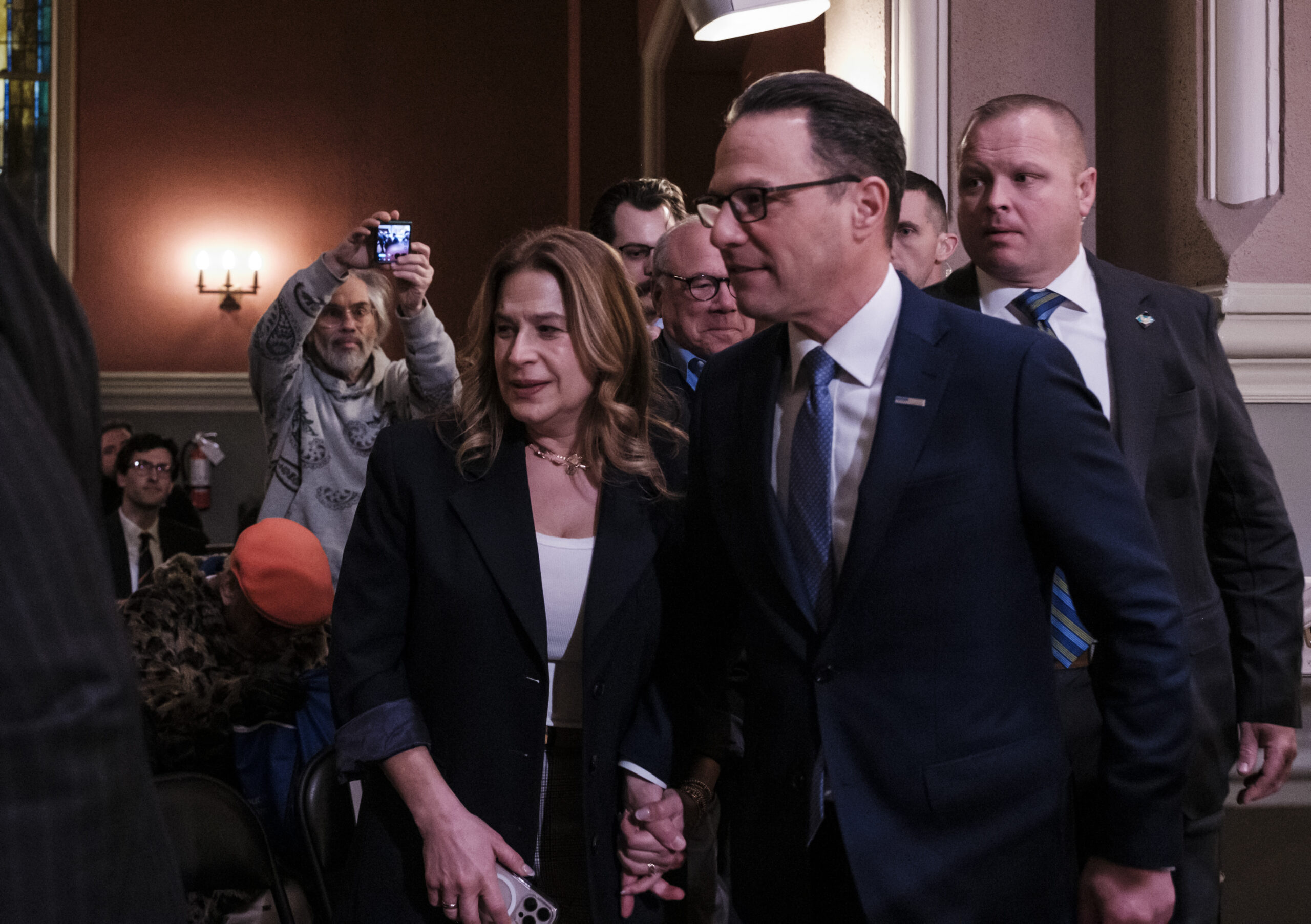
Gov. Josh Shapiro and his wife, Lori Shapiro, depart a talk for his new memoir “Where We Keep the Light” on Jan. 29 in Washington, D.C
Zimolong says he has never discussed the lawsuit with Ward or coordinated with her staff over the issue, “and I have no intention of doing so.”
He saidhe is one of few attorneys in southeastern Pennsylvania who is “not afraid to hold a powerful governor accountable” and does not have work before the state that would present an ethical conflict.
Erica Clayton Wright, a spokesperson for Ward, noted that taxpayer funds have now been used to pay for security upgrades to Shapiro’s personal residence and the property of his neighbors, and argued that it’s “not the first time Gov. Shapiro’s team has been put in the awkward position of pointing fingers to distract from Gov. Shapiro’s questionable methods of operation.”
“It is important not to lose sight of the need to ensure the governor and his family are safe while also safeguarding the processes in place to manage taxpayer funds,” Clayton Wright said.
“Absolutely no one but Gov. Shapiro himself is responsible for trying to take his neighbor’s property via squatter rights, which has resulted in federal and state lawsuits,” she said.
Staff writer Abraham Gutman contributed to this article.
HARRISBURG — Pennsylvania’s top leaders want to avoid another ugly, monthslong budget standoff, showing resolve this year to begin negotiations much sooner in hopes of approving a spending deal by their June 30 deadline.
But that doesn’t change the state’s financial predicaments: Pennsylvania is again on track to spend more than it brings in this fiscal year. Gov. Josh Shapiro has pitched spendingat least $4.3 billion more than the state is projected to raise in revenue next fiscal year, part of his $53.2 billion budget proposal.
And after last year — when lawmakers couldn’t agree on a state budget deal for months, leading to a bitter impasse and negotiations stretching into November while schools and counties went unfunded — the governor is trying a new strategy.
Shortly after unveiling his budget proposal to lawmakers last month, Shapiro called top legislative leaders in for a meeting in his office to discuss their spending priorities. Last year, the initial negotiation conversation took place just before the June budget deadline, taking months to arrive at an agreement. House Majority Leader Matt Bradford (D., Montgomery), Senate Majority Leader Joe Pittman (R., Indiana), House Minority Leader Jesse Topper (R., Bedford), and Senate Minority Leader Jay Costa (D., Allegheny) accepted Shapiro’s invitation.
Rosie Lapowsky, a spokesperson for Shapiro, said in a statement that the early conversation was intended to “ensure they remain timely, constructive, and focused on results.”
A $4.3 billion budget shortfall — and disagreement over how to fix it
Both Pittman and Bradford, who control their chambers and are top architects to any final budget deal in closed-door negotiations with Shapiro, said the first talks were a good first step in opening negotiations much sooner than last year. But they acknowledged the tough fiscal realities facing the state, and disagreed on how to address them.
“It just simply spends too much money. We can’t continue the spending trajectory,” Pittman said of Shapiro’s $53.2 billion budget proposal. “It’s only going to cause us to have conversations, as the Independent Fiscal Office pointed out about massive, broad-base tax increases.”
The Independent Fiscal Office was created by the state legislature in 2010 and is required to produce revenue projections for current and future years. An IFO report this month found that the budget deficit could top $6 billion this year, and hit $8 billion by 2028-29, likely requiring broad tax increases to fill the gap.
“Assuming he’s reelected, if he’s reelected, I can’t imagine he’s going to be wanting to deal with budgets in 2027 and 2028 that are going to have to call for broad-based tax increases,” added Pittman, who has endorsed Shapiro’s likely GOP gubernatorial challenger, State Treasurer Stacy Garrity.
State Senate Majority Leader Joe Pittman (R., Indiana) during a Feb. 3 news conference at the Capitol in Harrisburg.
Meanwhile, Bradford, a Democrat, believes the state should focus on the long game in addressing Pennsylvania’s budget shortfall, citing the state’s efforts to recruit new businesses and pass tax cuts to encourage economic growth, as well as Shapiro’s renewed push to create new revenue streams like the taxation and regulation of recreational marijuana and the slot-machine look-alikes know as skill games.
Pennsylvania’s declining population has “put a lot of stress on our budget books,” Bradford said.
“The best thing we can do is continue to grow this economy,” Bradford added.
State Rep. Matt Bradford (D., Montgomery County) during a Feb. 3 news conference at the Capitol in Harrisburg.
Even without increasing its spending over the 2025-26 fiscal year — an impossible feat due to growing Medicaid obligations — Pennsylvania would still be poised to spend $1.2 billion more than it is expected to bring in next fiscal year.
To avoid raising taxes this year, leaders will need to raise new revenues and tap into its more than $7 billion in reserves. Republican leaders want to avoid tapping into the state’s Rainy Day Fund until an emergency arises, citing the state’s lackluster revenue projections in future years. However, it’s unclear what government programs or agencies they’d like to cut.
Just as he did last year to no avail, Shapiro this month again proposed regulating and taxing recreational marijuana and skill games as a way to help fill the state’s budget shortfall. This time, however, his projections on how much revenue could be made has increased dramatically since last year, without changing much of the scope of the proposals.
For example, last year he pitched a 20% tax on the sale of legal marijuana that he estimated would bring in $535.6 million in its first year. This year, he projected the same idea, but instead projected a marijuana tax would bring in $729.4 million in its initial year — a 36% increase. A Shapiro administration official said earlier this month that the projected increase is due to more interest from marijuana companies that want to do business in Pennsylvania.
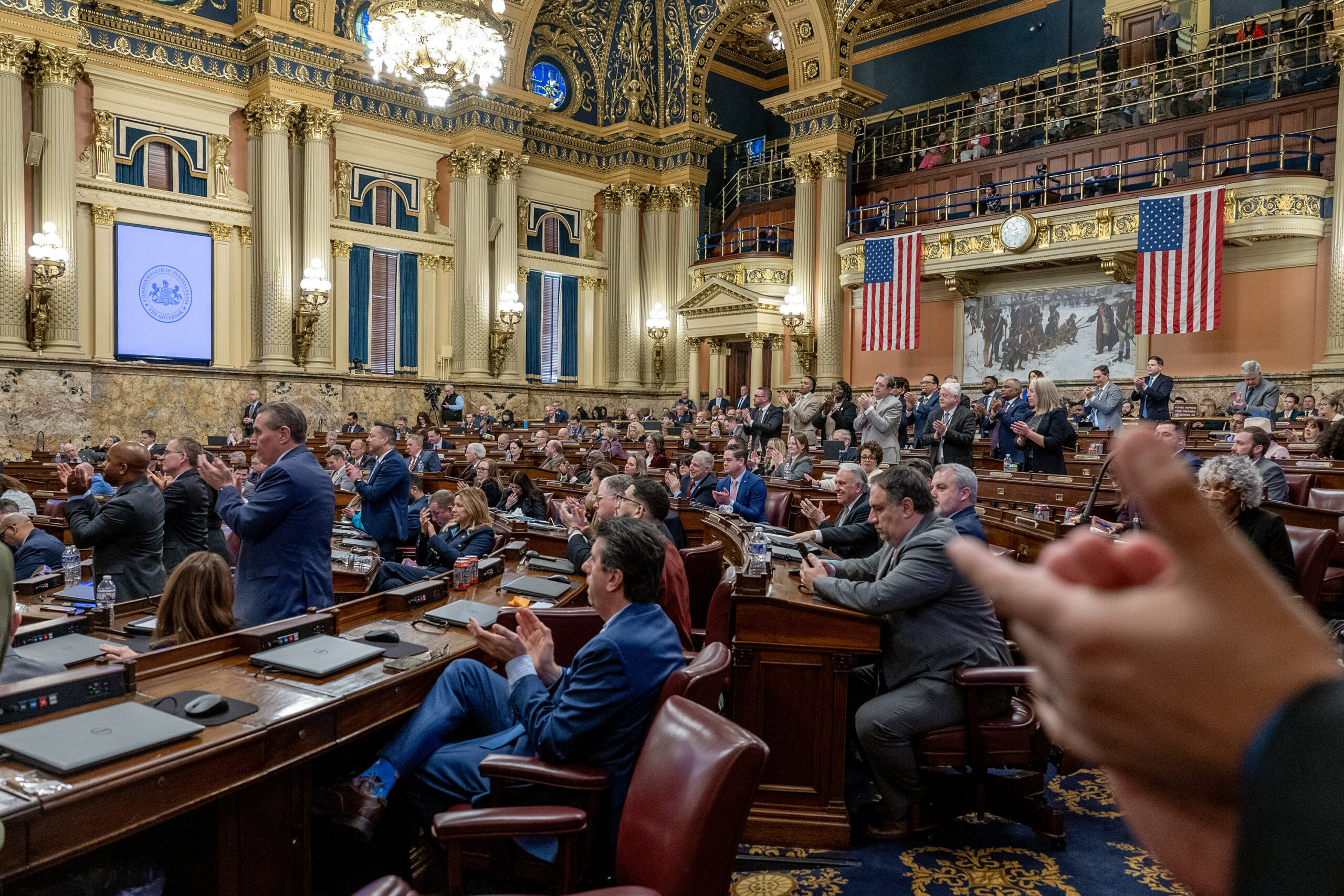
Gov. Josh Shapiro makes his annual budget proposal in the state House chamber on Feb. 3. House Speaker Joanna McClinton is seated behind him.
State revenues are $362 million higher than expected so far this fiscal year, according to the IFO, offering some hope that the state may continue to grow its economy to fill some of the budget hole.
Lapowsky, Shapiro’s spokesperson, said in a statement that Shapiro’s budget pitch shows “that government can be a force for good in people’s lives when leaders come together and put Pennsylvanians first.”
Election year optimism and a preview of the fights to come
Legislators on the powerful Senate and House appropriations committees, led by House Appropriations Chair Jordan Harris (D., Philadelphia) and Senate Appropriations Chair Scott Martin (R., Lancaster) will individually begin analyzing Shapiro’s budget proposal line-by-line in public hearings this week. Both committees were scheduled to begin their budget hearings on Monday, but were rescheduled to begin on Tuesday afternoon and Wednesday morning for the Senate and House, respectively, due to a snowstorm that blanketed the Philadelphia area.
The weekslong series of hearings examine the budget needs for each state government agency and row office, as well as the spending from the previous year. Secretaries and elected officials from each office come before the committee to answer questions about their proposed spending.
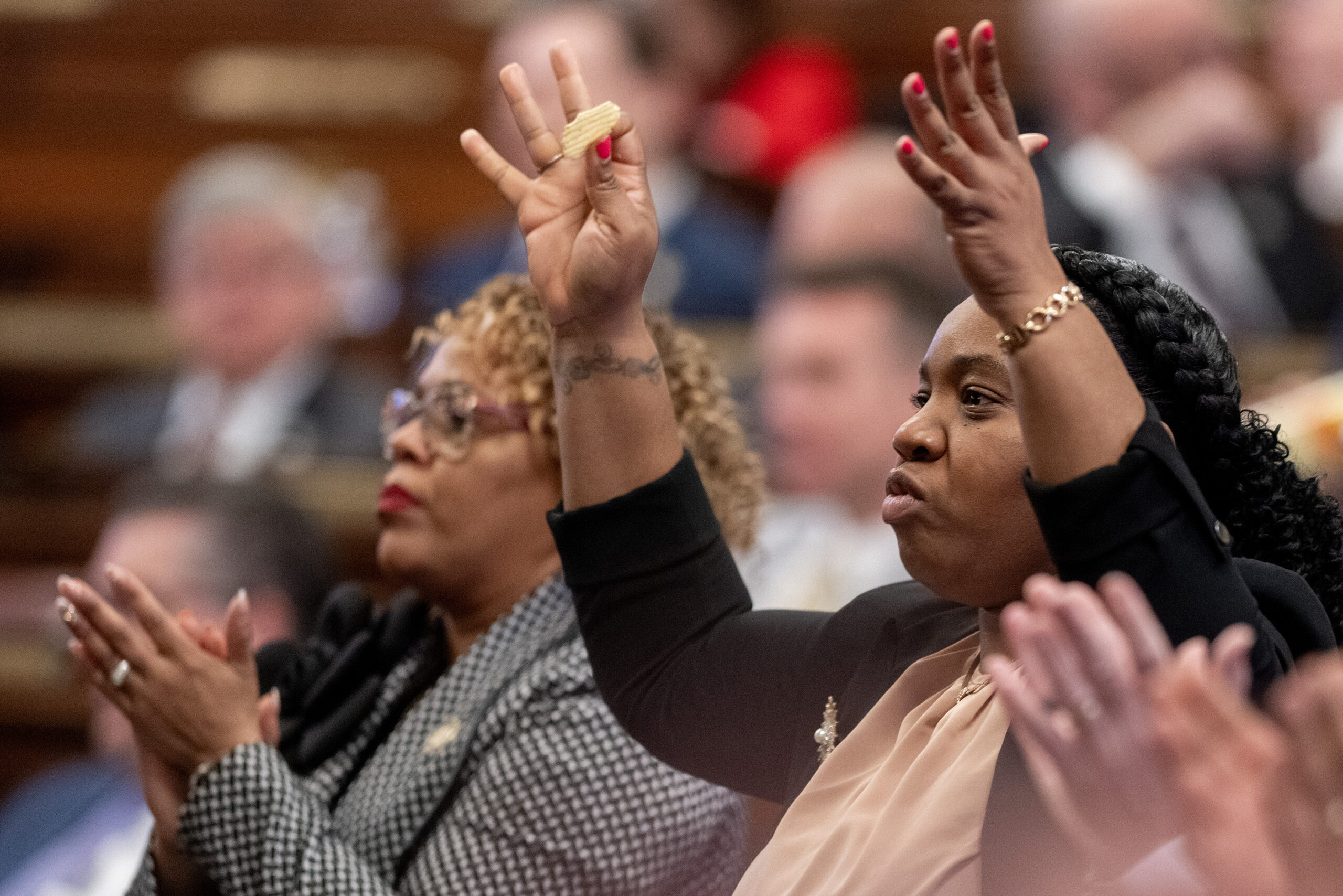
State Reps. Johanny Cepeda-Freyitz (left), a Berks County Democrat, and Carol Kazeem (D., Delaware) in the state House chamber Feb. 3 during Gov. Josh Shapiro’s annual budget proposal.
Pittman said Senate Republicans are likely to zero in on Shapiro’s $1 billion proposed bonding initiative for a range of infrastructure projects relating to energy, housing, local governments, and schools that he largely billed as “a major investment in building new housing.” They’ll also likely question why the Department of Corrections is seeking a $150 million funding increase, after the closure of two state prisons last year.
Despite the inevitable disagreements ahead, there is some cause for optimism heading into another year of Pennsylvania state budget negotiations: Midterm election years often produce much less contentious budget battles, as lawmakers are motivated to reach an agreement and bring home their accomplishments to their districts as they campaign for reelection in November.
Both Bradford and Pittman expressed hope that the election year may bring an increased willingness among all parties to finish an on-time budget.
But, “divided government creates all kinds of twists and turns,” Pittman added. “I certainly can’t predict what’s coming ahead here.”
Pennsylvania Gov. Josh Shapiro joined President Donald Trump at the White House for a breakfast on Friday, following weeks of uncertainty and strife over whether any Democrats would attend the traditionally bipartisan annual event after Trump reversed course on a decision to disinvite two other blue-state governors from the meeting.
A spokesperson forShapiro said he decided to attend the meeting at the White House once Maryland Gov. Wes Moore and Colorado Gov. Jared Polis were invited, despite Trump previously declaring the pair of Democratic leaders were not welcome.
“Gov. Shapiro chose to join his colleagues and go to the White House to raise real issues and harm the Trump administration is doing to Pennsylvania,” Rosie Lapowsky, Shapiro’s press secretary, said in a statement.
Trump initially planned to invite only Republican governors to the annual event that coincides with the National Governors Association winter meeting in Washington, D.C., but faced pushback by the group’s GOP chair. Trump then invited Democrats, as well, but rescinded the invitations for Moore and Polis. In a post on his Truth Social platform earlier this month, Trump wrote that the two Democratic governors were “not worthy of being there.”
The weekslong back-and-forth threatened the nonpartisan nature of the National Governors Association that represents 55 governors, including those from all 50 states and five U.S. territories. Ultimately, the NGA declined to facilitate the annual breakfast event, and Trump later re-invited Polis and Moore.
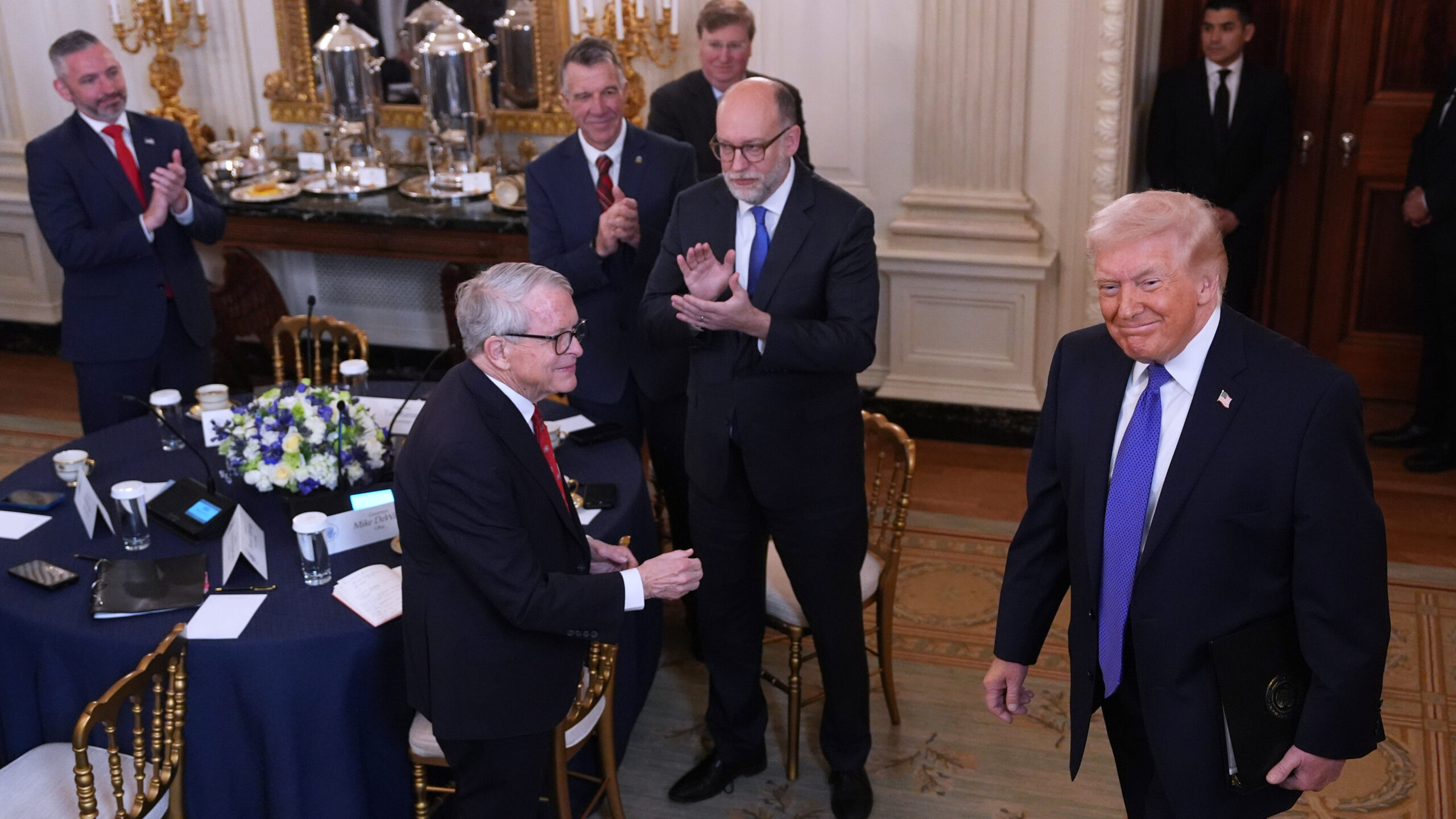
President Donald Trump arrives to speak during a breakfast with the National Governors Association in the State Dining Room of the White House, Friday, Feb. 20, 2026, in Washington. (AP Photo/Evan Vucci)
Moore, Polis, and Shapiro were among the more than two dozen governors who attended the White House breakfast Friday, where Trump delivered brief remarks. Other Democrats, including New Jersey Gov. Mikie Sherill, decided against going.
Sherrill, a former member of Congress who just began her term last month, said in a statement that she opted to skip the White House breakfast to “focus on other NGA meetings.”
“The president’s chaotic back-and-forth about the NGA was counterproductive and Gov. Sherrill decided not to attend,” said Sean Higgins, a spokesperson for Sherrill.
What Shapiro talked about
Shapiro described the closed-door meeting between Trump, the governors, and all of Trump’s cabinet as productive for him to advocate for specific issues directly with federal leaders.
“Folks were respectful to me,” Shapiro told reporters following the meeting. “I went there with a mission to talk about things that were important to Pennsylvania.”
Shapiro, who is currently running for reelection and touts his ability to work across partisan lines, has expressed an openness to working with Trump on issues specific to Pennsylvania, though he has challenged the president more than a dozen times in court since Trump took office last year.
Shapiro said he was able to discuss his top issues directly with federal officials. He said he spoke with U.S. Department of Agriculture Secretary Brooke Rollins about the reemergence of the avian flu in Pennsylvania; discussed releasing withheld broadband funding with Treasury Secretary Howard Lutnick about releasing withheld broadband funding; and talked with U.S. Secretary of Health and Human Services Robert F. Kennedy Jr. and Director of the Office of Management and Budget Russ Vought about the ways “their policies are hurting rural Pennsylvanians.”
New York Gov. Kathy Hochul, another Democrat who attended the meeting, said afterward in a news conference that she was glad to hear what lessons Trump said he learned from his administration’s immigration enforcement mission in Minneapolis that led to mass protests and the fatal shootings of two U.S. citizens by federal agents.
Hochul said Trump told the group that “we’ll only go where we’re wanted,” alleviating concerns among some Democratic governors that their states may be the next to see a full-scale federal presence upending daily life.
Weeks of back-and-forth ahead of the White House breakfast
“Democratic governors have a long record of working across the aisle to deliver results and we remain committed to this effort,” they said in a joint statement on Feb. 10 through the Democratic Governors Association. “But it’s disappointing this administration doesn’t seem to share the same goal. At every turn, President Trump is creating chaos and division, and it is the American people who are hurting as a result.”
They added: “Democratic governors remain united and will never stop fighting to protect and make life better for people in our states.”
In comments to CNN last week, Sherrill said that “worse decisions” would be made without all the governors there.
“For the president to pick and choose who he is going to have to sort of undermine the very focus of this, of coming together to get stuff done for the country just seeds more … chaos,” the New Jersey Democrat said.
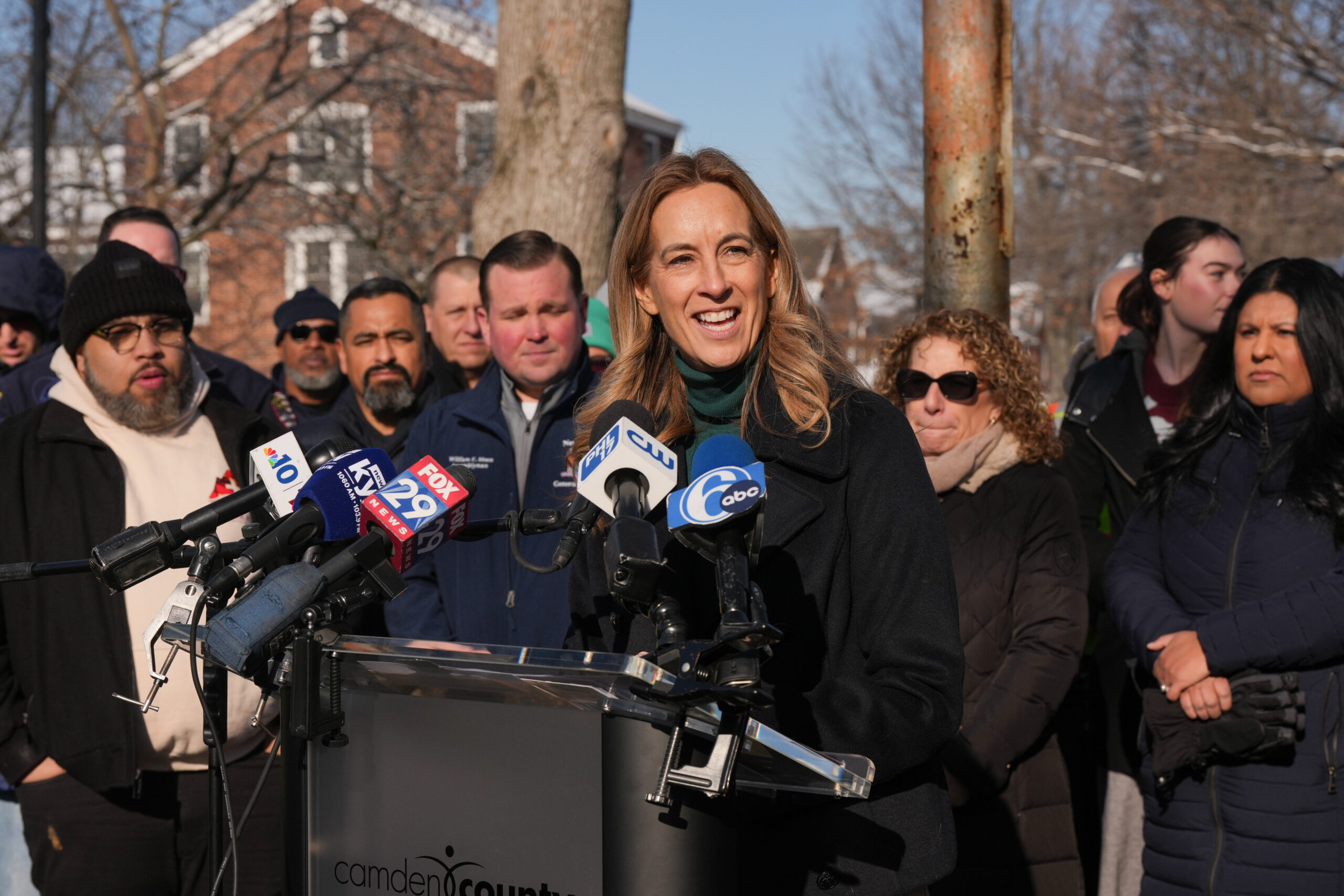
Gov. Mikie Sherrill, shown here at a news conference as volunteers gather prior to shoveling snow at Fairview Village on Martin Luther King Day during a day of service, in Camden, New Jersey, January 19, 2026.
Moore, the nation’s only Black governor, and Polis, the first openly gay man elected to U.S. governor, were the only two leaders Trump singled out, raising concerns by civil rights groups.
Trump, however, cited different reasons for his objections to Moore and Polis’ attendance. He said he wanted to exclude Polis because his state continues to incarcerate a former county clerk over her conviction related to allowing election-denier activists access to election data following the 2020 election. Trump also expressed a number of grievances toward Moore, including his handling of the rebuilding of the Francis Scott Key Bridge and Baltimore’s crime rates.
Following the meeting Friday, governors from both parties reaffirmed that they were still committed to working with Trump despite the turmoil.
“It’s really important imagery that we stand together as governors of our states and represent all of America, and just remind people that there’s really more that brings us together and unites us than divides us,” said Oklahoma Gov. Kevin Stitt, a Republican who chairs the NGA.
Shapiro separately told reporters that he has worked with directly Trump to “save steelworker jobs” but remains ready to challenge them in court if they threaten Pennsylvanians’ rights.
Asked whether he has a good relationship with Trump, Shapiro said: “We have a relationship where we can work for the people of Pennsylvania, that’s my job.”