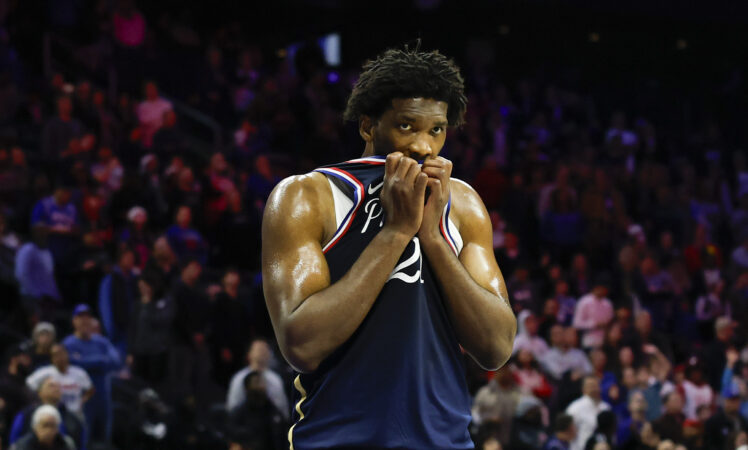
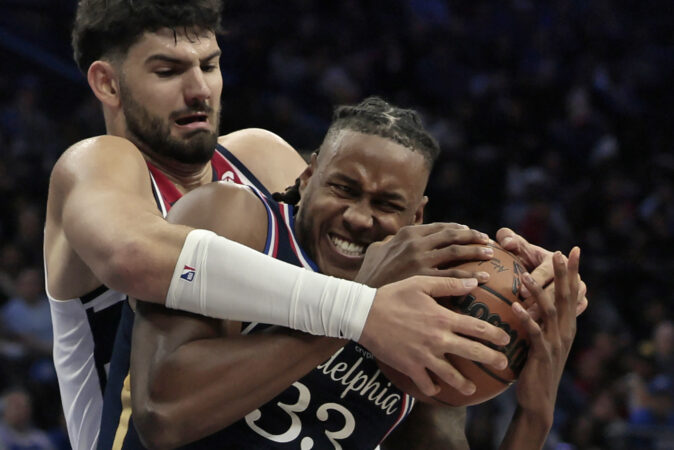
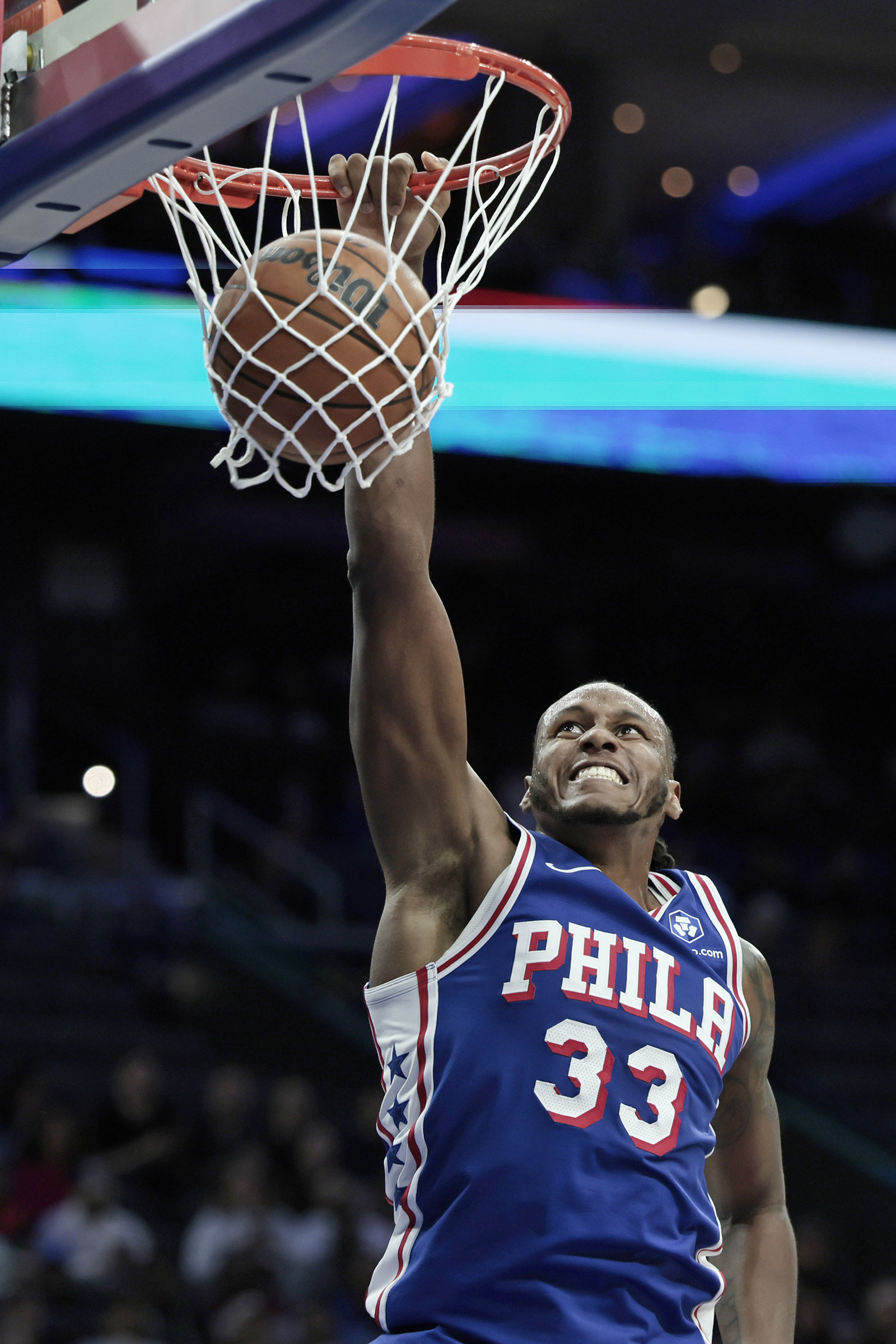
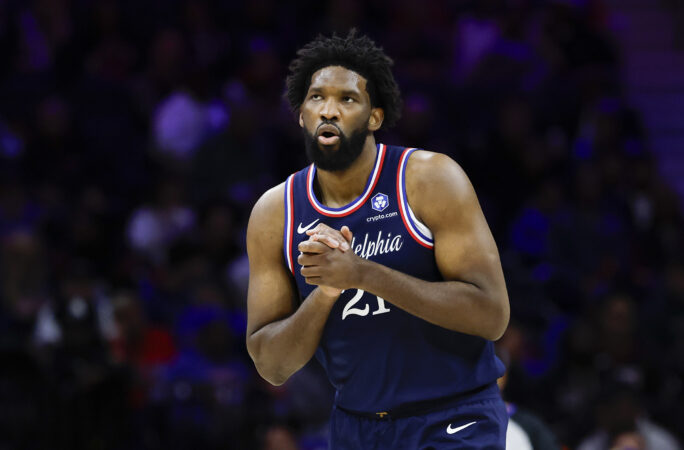
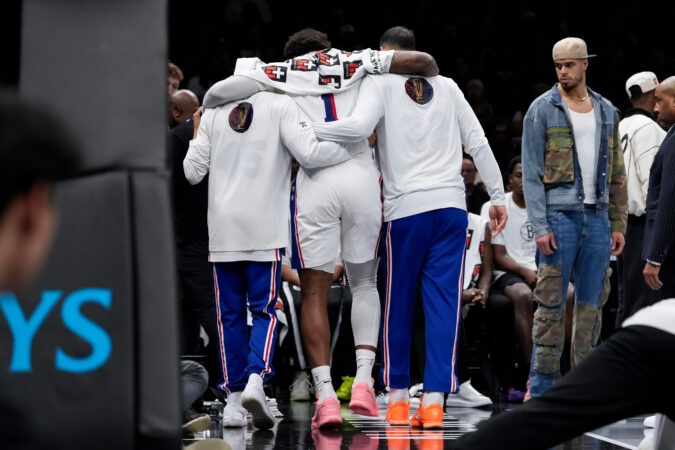
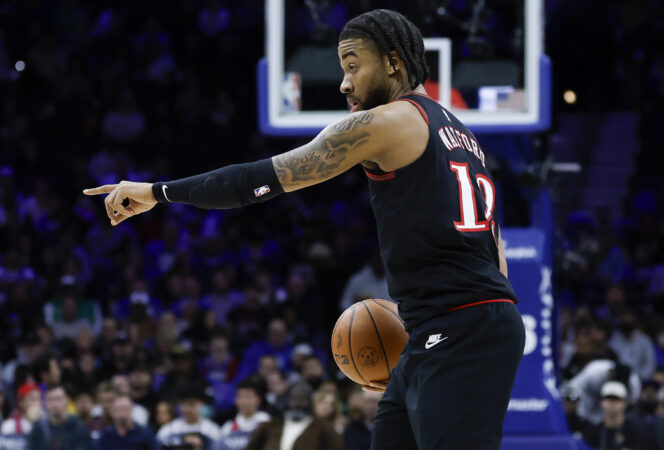
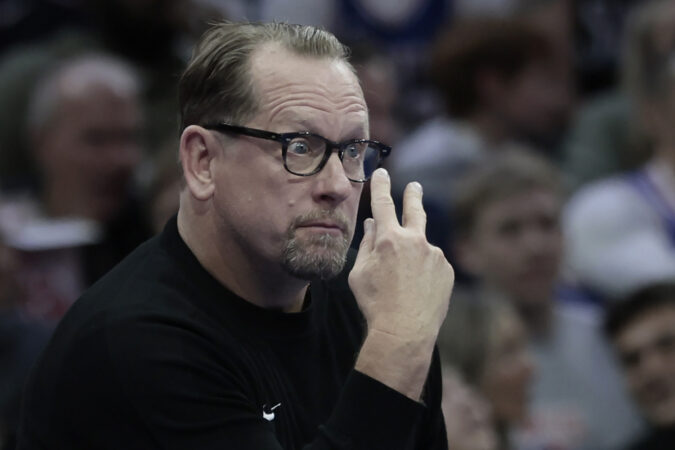
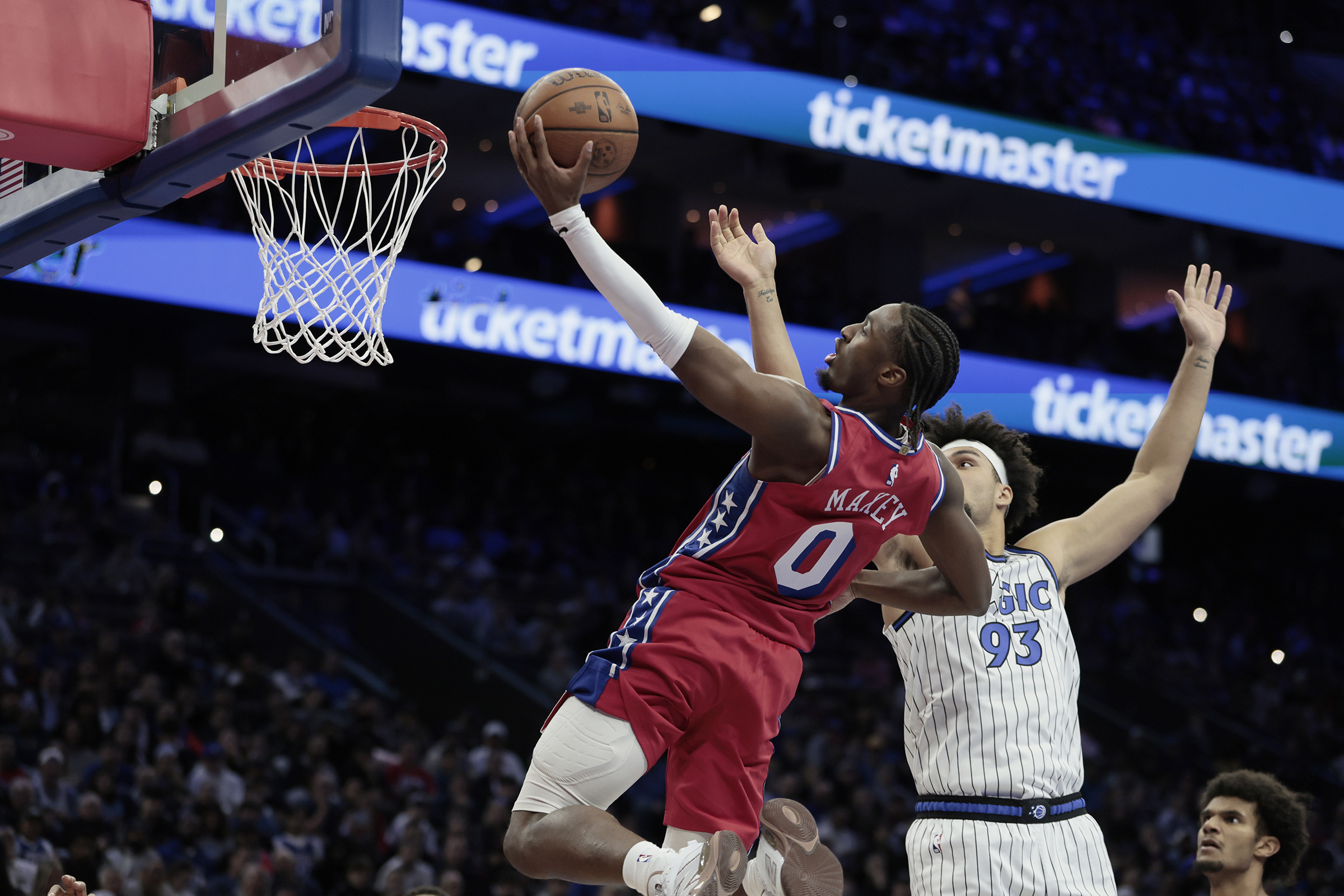
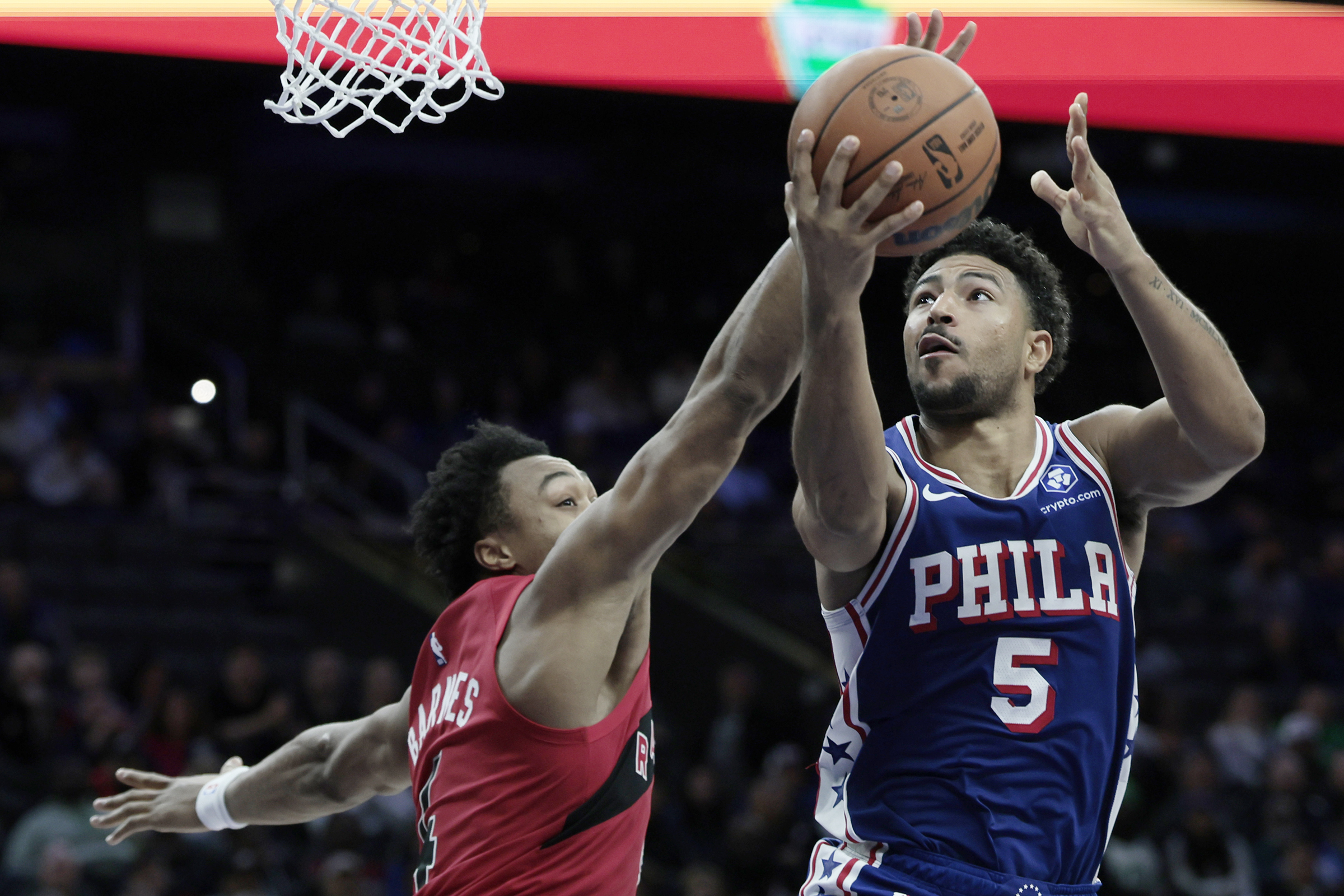
The NBA announced Wednesday that it has fined the 76ers $100,000 for violating the league’s injury reporting rules after Joel Embiid initially was listed as out for Sunday’s game against the Atlanta Hawks and then subsequently played in their double-overtime loss.
The NBA’s announcement said the Sixers “failed to accurately disclose the game availability status” of Embiid before the game. Embiid, who had missed nine consecutive games before Sunday, was listed as out because of right knee injury management on the league’s official report released Saturday night. He was upgraded to questionable Sunday afternoon before taking the floor for his pregame warmup and being announced in the starting lineup about 30 minutes before tipoff. He finished with 18 points, four rebounds, and two assists in a season-high 30 minutes.
According to the NBA, “the fine takes into account the [Sixers’] prior history of fines for violating injury reporting rules.” Embiid, who has dealt with several health issues throughout his decorated career, often is at the center of such inconsistencies on the league-mandated injury updates.
Embiid sat out Tuesday’s victory over the Washington Wizards to allow his right knee to recover and also has missed several games this season as part of his recovery from multiple left knee surgeries. The Sixers next play a back-to-back on Thursday against the Golden State Warriors at home and on Friday at the Milwaukee Bucks.
Jabari Walker was on the 76ers’ practice court Monday with rookie center Johni Broome, who screened and rolled while Walker awaited the ball to shoot a corner three-pointer.
After one repetition, Walker shifted to other skills, then eventually went back to that corner. The unorthodox drill sequencing was designed to simulate the typical space between Walker’s opportunities to shoot in a game — and that he must be ready to fire.
“We’re putting so much importance on one shot,” Walker said. “ … There’s been an [emphasis] on, ‘OK, you’re not going to get that many of them.’”
The off-day session was Walker’s response to getting squeezed out of the Sixers’ rotation for the first time this season Sunday in a double-overtime loss to the Atlanta Hawks. The approach paid off when the reserve forward drilled his first two three-pointers in less than one minute of game action in the second quarter Tuesday night against the Washington Wizards. That ignited Walker’s first double-double as a Sixer, with 10 points and a season-high 12 rebounds in his team’s dominant 121-102 victory at Xfinity Mobile Arena.
“When I was in the corner,” Walker said, “it was like, ‘OK, this is the one. Just make sure everything is solid [and] follow through.’ And then got that one, and then the next one. … That just builds confidence.”
Now in his fourth season, Walker has been in the NBA long enough to understand that rosters and rotations fluctuate. After receiving zero minutes Sunday — when Joel Embiid, Paul George, Tyrese Maxey, and VJ Edgecombe finally shared the floor for the first time — Walker was an unsurprising ninth-man choice for Tuesday’s game. Embiid (knee injury recovery) and sixth man Quentin Grimes (calf) were ruled out after playing against the Hawks, while starting wing Kelly Oubre Jr. (knee) and versatile forward Trendon Watford (thigh) also remain sidelined.
Still, Walker said he has learned to “trick [his] mind” into ensuring he does not put unnecessary pressure on himself whenever he does receive an opportunity. He is averaging 3.8 points and 3.5 rebounds in 13.4 minutes in 19 games.
“You’ve just got to make yourself think you don’t care as much as you do,” said Walker, who is on a two-way contract that limits him to 50 NBA games this season.
Walker also alluded to this mentality following a nine-point, nine-rebound effort in a Nov. 19 loss to the Toronto Raptors. Detaching his emotions, he said, helped him snatch extra rebounds, set harder screens, and shoot more confidently in that game. Walker also now knows that coach Nick Nurse will keep well-performing role players on the floor. Against the Wizards, Walker went from sitting on the bench the entire first quarter to playing the full second frame.
And, if the worst-case scenario unfolds, Walker leans into being a good teammate.
“My attitude’s been right,” he said. “I’ve been supportive through it all, and I think that is a positive thing you can do even if you’re not having a good game.”
It also helps that Nurse has been encouraging Walker to launch those three-pointers, dating back to the preseason. Despite making only four of his 17 long-range attempts entering Tuesday, Walker’s shooting data tracked by technology inside the Sixers’ practice facility had been “really good,” the coach said.
But the stakes naturally increase during game action, requiring Walker to quickly process that he is open as a catch-and-shoot pass heads his way. Nurse stopped Tuesday’s shootaround to reiterate when and where he wants Walker to fire, the player said. And during the game, Maxey pointed at Walker to indicate “that’s the one” whenever he appropriately let the ball fly.
“It doesn’t get any better than that,” Walker said.
When asked after Tuesday’s win about Walker’s impact, George described him as a “bully.” Jared McCain, meanwhile, called Walker “tenacious” and “relentless.”
Both were referencing Walker’s knack for rebounding. To successfully crash the glass, the 6-foot-7 Walker first highlighted his physicality and positioning before the shot goes up. Once he has pinpointed where he believes the ball is going to ricochet off the rim, he relies on his reflexes to, in Nurse’s words, “snap” the ball down from its highest point.
Walker credits his father, Samaki Walker, who spent 10 seasons as an NBA role player, with teaching him this skill. When Jabari grabbed a one-handed rebound — and screamed as he pinned the ball to his side — during that Nov. 19 Toronto game, it signaled “that’s the me I know I can show,” he said.
“That’s what I know I’m capable of,” Walker said that night. “I just haven’t done that to the level that I’m happy with. So when I got that rebound, it was a moment to myself, like, ‘OK, there we go.’”
Jabari Walker posted one of his best games of the season in a nine-point, nine-rebound effort against the Toronto Raptors. He then posted a double-double Tuesday vs. the Wizards.
Walker’s playing time — and production — have been a bit unpredictable since then. It is unclear how long his teammates who missed Tuesday’s lopsided win will remain out, and how that could affect any upcoming minutes.
Yet Walker put together his best performance as a Sixer on Tuesday. And it stemmed from how he attacked his off-day work after falling out of the rotation.
“We’re not just trying to survive and be, like, ‘OK, let’s wait for these guys,’” Walker said. “We’re trying to thrive with who we have right now.”
As 76ers public-address announcer Matt Cord rolled through Sunday’s starting lineup, an in-arena camera caught Joel Embiid jogging down the hallway that connects the locker room to the tunnel. He then met his huddled teammates, who bounced and threw their arms in the air while engulfing the former MVP.
Embiid was back — again — from a nine-game absence because of an issue in his right knee. He described his first half as successful and his second half as “a little rough,” while totaling 18 points, four rebounds, and two assists in a season-high 30 minutes in a double-overtime loss to the Atlanta Hawks at Xfinity Mobile Arena.
Before training camp, Embiid said he was prepared to face unpredictable health flare-ups that would force personal restarts throughout the season. He stressed the need to navigate them methodically and with positivity.
So how would he evaluate his ability to put that mentality into practice?
“It was OK,” Embiid said at his locker after the game. “Obviously, like I said, it’s going to happen, so you can’t put your head down and whine about it. Keep working hard and trying to get back at it as close as possible.
“What can we do? The only thing you can do is keep doing the right things, focusing on the right things, and go from there.”
Sunday’s return meant the 10-9 Sixers’ max-contract players Embiid, Tyrese Maxey (44 points, nine assists, seven rebounds), and Paul George (16 points, seven rebounds, four assists, five steals) — plus third overall draft pick VJ Edgecombe (seven points, two assists, two steals) — played together for the first time. And though Kelly Oubre Jr. (knee) and Trendon Watford (thigh) remain out, it was the closest the Sixers have gotten to a “normal” top of the rotation — at least in the first half, before minutes restrictions became a factor.
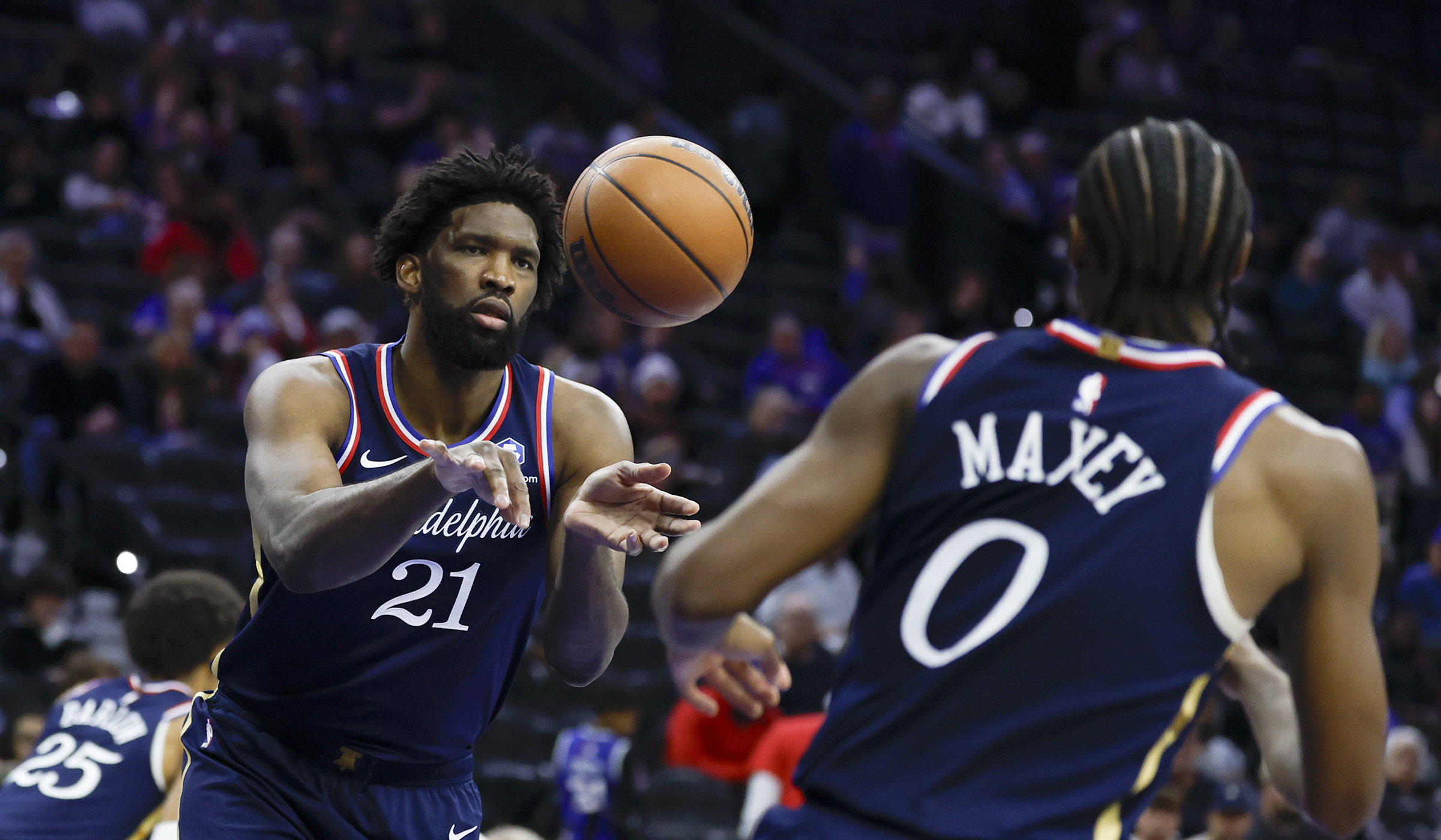
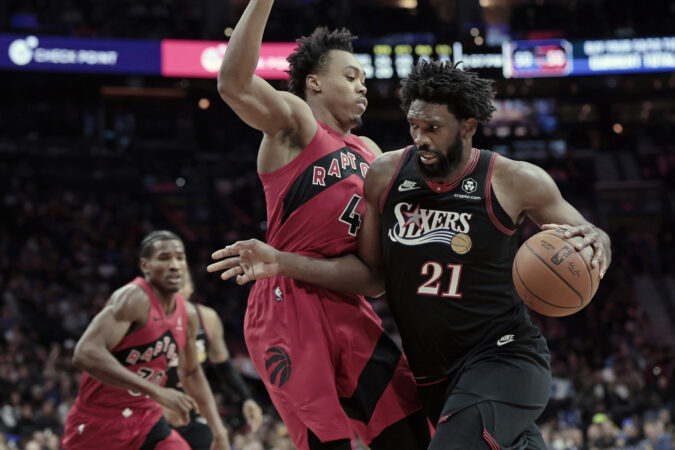
Joel Embiid passes to Tyrese Maxey, who led the Sixers with 44 points against the Hawks on Sunday.
That it took until Game 19 to achieve this was unfortunate for Embiid, who said he was “actually getting back to myself” just before reporting soreness in his right knee the morning of a Nov. 11 home game against the Boston Celtics.
His day-to-day status turned into nearly three weeks, including recent toggles between questionable to play and out. Embiid said Sunday that uncertainty was due to how his knee responded to on-court sessions.
He was initially ruled out for Sunday’s game on the NBA’s official injury report, before getting upgraded to questionable in the afternoon. He stepped onto the court for his pregame warmup about 45 minutes before tipoff, then was officially announced as in the starting lineup.
On the Sixers’ first possession, Embiid took his defender off the dribble to get to his spot for an elbow jumper. He hit a baseline fadeaway in the second period, then two more textbook mid-range shots. At halftime, he had 11 points on an efficient 4-of-6 shooting in 13 minutes.
Coach Nick Nurse said he was pleased with how Embiid created offense and open space for teammates in a variety of ways. He set pin-down screens, or began possessions in the corner while George and Dominick Barlow ran pick-and-rolls in the middle of the floor. He executed dribble handoffs with Quentin Grimes. And though he could lean on his exceptional two-man chemistry with Maxey when the game got tight down the stretch, Embiid reiterated his desire to contribute to the Sixers’ faster-paced, passer-friendly offense.
“I can make nine of those 10 shots [off the short roll] every single time,” Embiid said. “It’s easy to get there. But I think it’s also better when everybody else is involved and we play together.”
Added Maxey: “It’s different, because he’s still really good. We’ve still got to get him the ball. We’ve also got to run our stuff. … We haven’t really practiced with that group [with George and Edgecombe], so it’s kind of hard. But that’s no excuse. I think we did a good enough job to win the game.”
When Maxey’s heroic game-tying three-pointer forced overtime, Embiid said he “fought hard” to play in the extra frame. He missed both shot attempts during that stretch but helped Barlow protect the rim on a Jalen Johnson miss with 5.3 seconds to go.
Embiid then “wasn’t allowed” to stretch his minutes restriction further to play in the second overtime. It was an obvious absence because of the “simple” package of plays the Sixers can run through the big man even while he is limited physically. Nurse noted that smaller players attempted to set screens for Maxey, but they “couldn’t hardly get up there because of the physicality” of the Hawks.
“I still felt like there’s something I could have done,” Embiid said, “just being on the floor.”
Embiid said he will not judge his progress on his shot-making but by how he moves laterally and jumps. Though a hesitancy (or inability) to get airborne for rebounds was obvious, Embiid said Sunday’s effective first half was a “good step” on which to build.
And the need for another personal restart is no surprise to Embiid.
“If anybody thinks that I don’t want to play every game, that’s their problem,” he said. “But I think, this year, I’ve shown that I would do anything just to play one game of basketball. … You’ve just got to trust what you’re doing, and in God, and be OK with the fact that whatever happens, happens.
“If I have something [that] happened to me like it happened, what can I do? Just go out and rehab, and come back as soon as possible. That’s the mindset.”
NEW YORK — Whenever Adem Bona works through his pregame shooting routine, he eventually moves to the corner and fires three-pointer after three-pointer. The 76ers’ second-year big man even takes a step back to plant his feet out of bounds, a tactic designed to make any “real” long-range attempt feel less daunting.
So when Bona got a pass with about one minute remaining in Friday’s matchup at the Brooklyn Nets, he recalled the advice of player development coach Fabulous Flournoy and launched without hesitation.
“Don’t give yourself time to think much about it or what the situation was,” Bona recalled. “ … It was just catch, and let it fly.”
Bona’s first career NBA three-point make — which arrived after he missed the previous five games with a sprained ankle — could be viewed these days as a nod to Andre Drummond, the Sixers’ other previously non-shooting center who has suddenly become a legitimate threat from the corner. The Sixers now might need more of that from Bona — who also finished the Sixers’ 115-103 victory in Brooklyn with 13 points on 6-of-7 shooting, six rebounds, and four blocks — after Drummond left the game in the second quarter with a right knee sprain.
It was the latest example of what Sixers coach Nick Nurse called “two steps forward, one back” in the injury department, which in the short term could lead to some patchwork frontcourt lineups.
“We were just piecing it together,” Nurse said after the game.
The other step forward? Paul George returned from a one-game absence due to a sprained ankle to total an efficient 14 points on 6 of 10 shooting in his fourth game this season. He also continues to re-acclimate on a minutes restriction following offseason knee surgery, saying he recently landed on an approach to “activate” the knee before games.
Still, the Sixers (10-8) struggled to put away the already-tanking Nets (3-15), who played Friday without top scorers Michael Porter Jr. and Cam Thomas. Yet even with Bona’s and George’s return — and before Drummond’s departure — the Sixers took the floor without injured starters Joel Embiid (knee), VJ Edgecombe (calf), and Kelly Oubre Jr. (knee) along with key reserve Trendon Watford (adductor). Through 18 games, max-contract players Embiid, George, and star guard Tyrese Maxey have yet to share the floor.
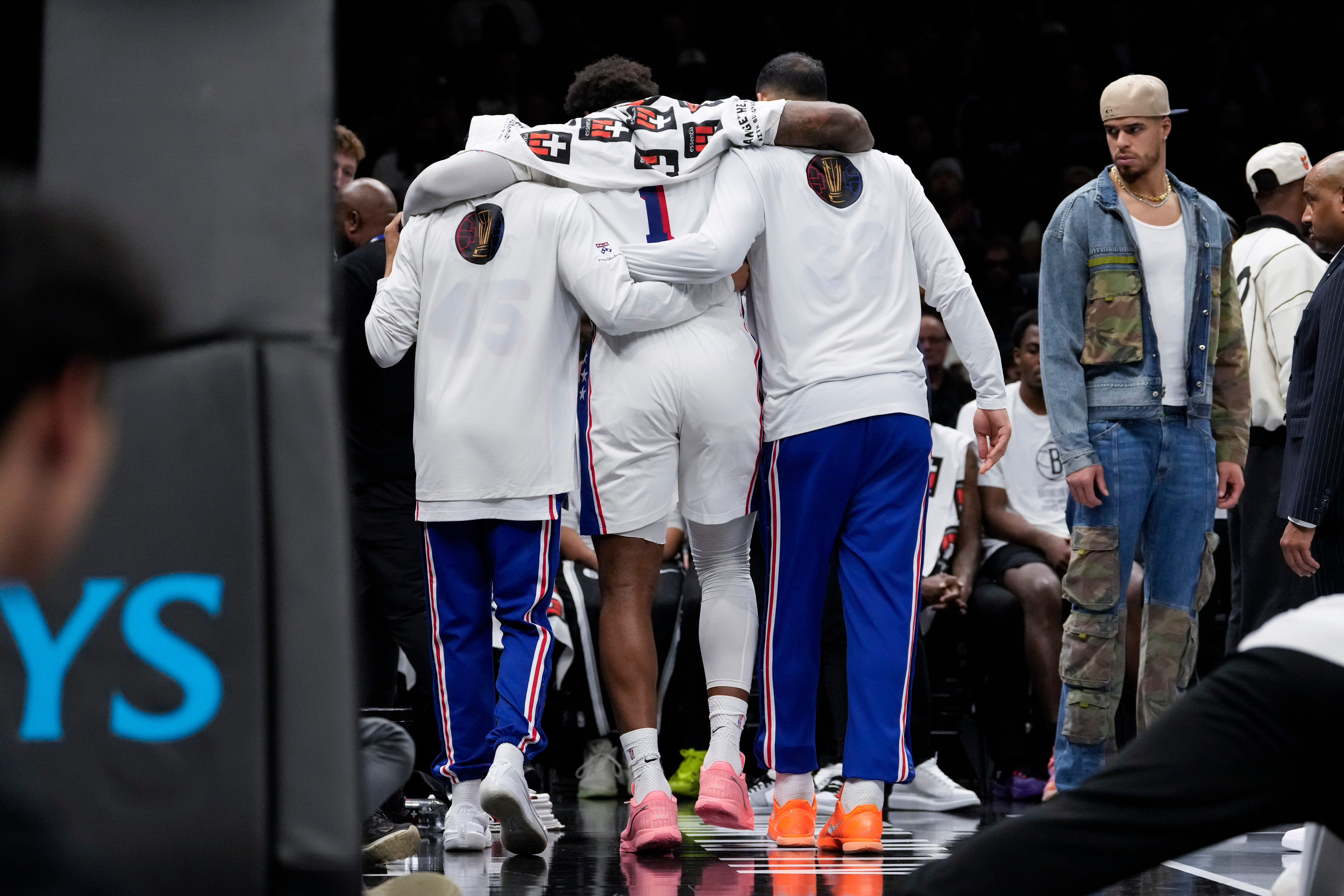
Andre Drummond (1) leaves court after getting injured during the first half against Brooklyn Nets on Friday.
In comments with an unintentionally short shelf life, Nurse spoke before Friday’s game about the benefits of reintroducing Bona’s size and “bounce” to the Sixers’ rotation. Those qualities could spell Drummond, who had been enjoying a resurgent season by averaging 8.3 points and 10.7 rebounds in 16 games entering Friday. The Sixers are otherwise undersized without Embiid, who on Friday missed his ninth consecutive game with an issue with his right knee.
And this week’s public messaging about the state of Embiid’s knee could be perplexing to an outsider. Embiid was initially listed as questionable to play Tuesday against the Magic on the NBA’s official injury report, before being ruled out the afternoon of that game. On Thursday’s report, Embiid was immediately ruled out for the game in Brooklyn the following night.
“We’ve been thinking he’s been trending towards getting there, and he just hasn’t yet,” Nurse said before Friday’s game. “They just haven’t cleared him to go. That’s all it is. Pretty much the same thing I keep telling you. He’s just not there yet.”
Embiid’s absence has yielded an opportunity to start for Drummond, who during Friday’s game had totaled seven points and four rebounds in 11 minutes before hitting the floor and grabbing his knee. Though the 6-foot-11, 280-pounder needed to be helped off the court, he was standing under his own power with his knee wrapped following the game. George empathized with Drummond in the postgame locker room, because George was hampered by a knee hyperextension last season.
“I know that injury very well,” he said. “ … It’s a tough rehab. I mean, I don’t know the severity of it [for Drummond]. But hopefully, it wasn’t the case that mine was, because it’s a challenge.”
Drummond’s injury, plus foul trouble with multiple players, forced the Sixers into some unconventional frontcourt looks against the Nets. Rookie Johni Broome played the first legitimate rotation minutes of his NBA career, sometimes alongside Justin Edwards as the power forward. There were stretches with two-way players Dominick Barlow and Jabari Walker on the floor together as a small-ball look.
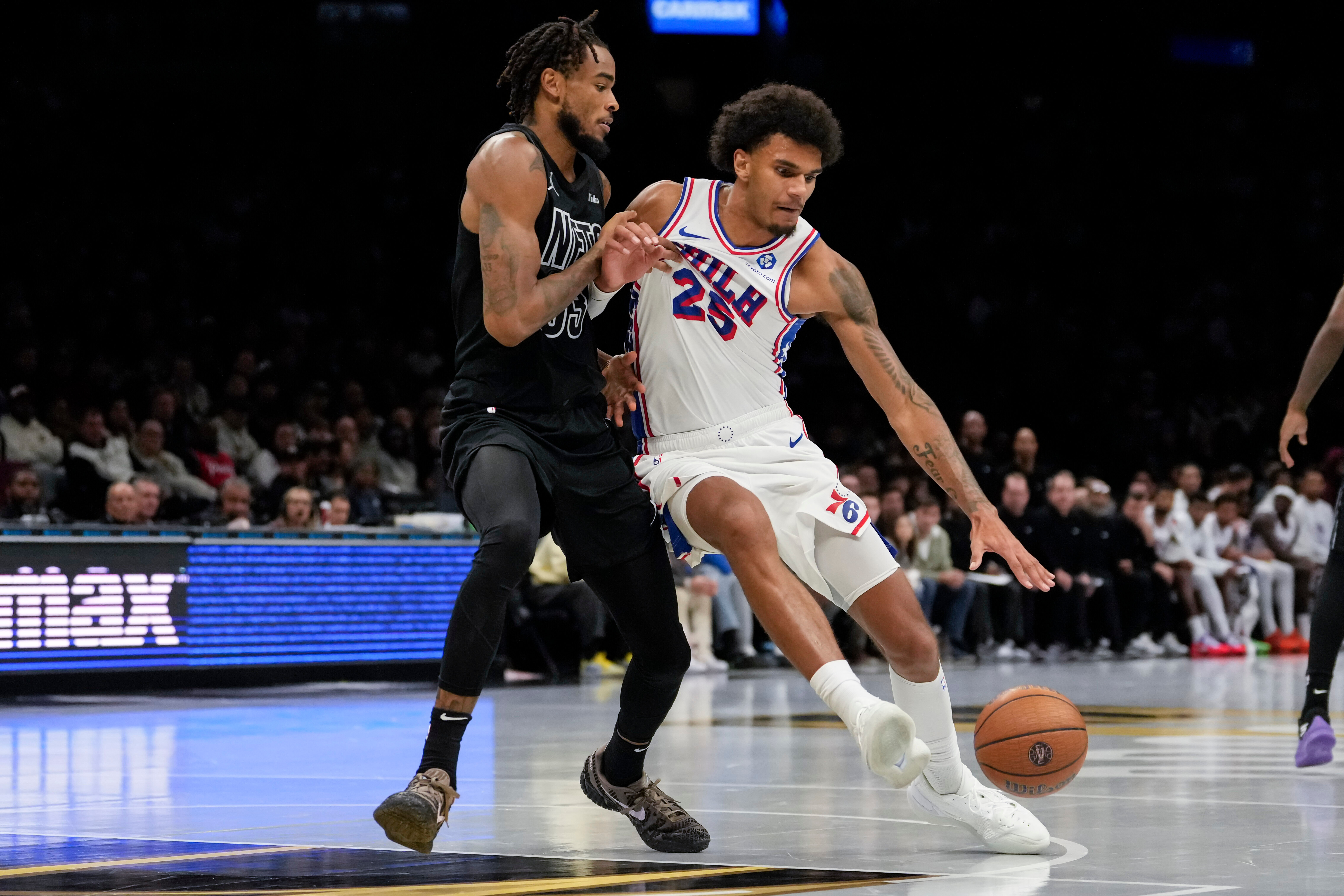
Dominick Barlow (25) drives past Brooklyn Nets center Nic Claxton during the second half on Friday.
Nurse said after the game that he was pleased with the playmaking from those big men whenever the Nets forced the ball out of Maxey’s hands.
“There was a lot of dunks and there was a lot of driving layups,” Nurse said. “There was a couple kick-outs. So, for the most part, those guys handled things really well.
“Those guys are fairly new to the league, and [opponents are] going to put the ball in their hands and see what they can do with it time and time again.”
Part of Drummond’s value to these Sixers has been his mentorship of younger players, including Bona. The veteran noticed Bona getting “a little overwhelmed” as his role increased, prompting Drummond to sit next to Bona on the bench.
“Listen,” Drummond told Bona, “this is a huge, huge opportunity for you to showcase yourself and be present in the moment and have fun with this. Because, right now, you’re young, so messing up is OK. So I would try and do as many things as you can, just to showcase yourself and just stay with it.”
Bona initially beat out Drummond for the backup center job during the preseason, before Drummond recently regained that spot. Bona understands that consistency — rather than shorter bursts of impactful play as a rim protector and athletic finisher — is the next step in his development.
“It was maybe not 20 minutes of amazing play,” Nurse said of Bona’s production before his injury. “But there was always that spurt of three or four minutes that gets you to that next part of the game — or sparks you on a momentum run.”
Bona’s first career three-pointer certainly qualified as that type of moment. And it was a fitting homage to Drummond, whose role Bona might need to replace for the time being.
“He shot that confidently,” Nurse said, “and looked good.”
Andre Drummond left the 76ers’ game at the Brooklyn Nets on Friday night with a right knee sprain. The veteran center dropped to the floor after contesting a second-quarter shot, then grabbed at his right leg before being helped off the floor. The 76ers announced that he will not return to the game.
Drummond had been enjoying a resurgent season for the Sixers, averaging 8.3 points and 10.7 rebounds in 16 games entering Friday and filling in as a starter while Joel Embiid has nursed issues with both knees throughout the early season. Drummond had totaled seven points and four rebounds in 10 minutes before leaving the game.
Fellow center Adem Bona on Friday returned from a five-game absence from a sprained ankle. Rookie Johni Broome also saw first-half action after Drummond departed the game. Dominick Barlow and Jabari Walker are small-ball options at the center spot, if Drummond and/or Embiid remain sidelined beyond Friday.
Trendon Watford will miss at least two weeks after an MRI revealed that the 76ers forward suffered a strained adductor muscle in his left thigh Tuesday during a loss to the Orlando Magic, the team said Wednesday.
Watford is averaging 8.9 points, 4.7 rebounds, and 3.6 assists, including one triple-double, in 14 games this season. His versatility will be missed on a team that played Tuesday without starting forwards Kelly Oubre Jr. (knee) and Paul George (ankle) and starting guard VJ Edgecombe (calf). Watford missed the season’s first three games with a hamstring injury.
“We were just getting ready to get used to him,” coach Nick Nurse said of Watford after practice on Wednesday. “He was kind of going to be this Swiss Army knife kind of guy that probably plays anywhere from [point guard] to [power forward] for us and [we can] move him around.
“He had a good knack of getting us some timely buckets. Good knack of setting things up for other people. … He can guard multiple positions. That’s kind of a lot of stuff.”
Reserve big man Adem Bona, meanwhile, said after practice that he is optimistic he will return from a five-game absence because of a sprained ankle on Friday against the Nets in Brooklyn.
“That’s the goal,” Bona said.
George and Edgecombe participated in practice, the team said. Joel Embiid (knee) did not, but he did go through an individual strength and conditioning session. Embiid initially was “trending” toward playing Tuesday before being ruled out, Nurse said.
All nine questions posed to Nick Nurse during Tuesday’s pregame news conference pertained to the 76ers’ mounting injuries. Joel Embiid’s knee. VJ Edgecombe’s calf. Paul George’s ankle.
The five-minute session felt like a flashback to last season, when inquiries about statuses and ramp-ups and rotation ripple effects piled up as jarringly as the Sixers’ losses. So did the ensuing on-court product, a 144-103 shellacking by the Orlando Magic peppered with boos from the Xfinity Mobile Arena crowd.
The Sixers (9-8) so far have handled health absences significantly better than last season, though this version of the roster was at its most depleted Tuesday. Now the Sixers must prove that showing was a brutal blip that’s inevitable over the course of an 82-game regular season and not slippage into a “here we go again” injury conundrum.
“We weren’t who we are tonight,” Nurse said postgame. “I’m super proud of what they’ve done the rest of the other games. They fought like crazy. And tonight, we couldn’t catch and we couldn’t shoot and we couldn’t fight.”
Nurse said pregame that he would be “really surprised” if the Sixers’ rotation remains this decimated for Friday’s matchup at the Brooklyn Nets. Embiid, who practiced fully Monday and participated in “parts” of Tuesday’s shootaround, was “trending” toward playing against the Magic before being ruled out for an eighth consecutive game because of right knee injury management, Nurse said. George, who is nursing a sprained ankle, had been downgraded from probable to play Tuesday to out.
To better withstand any inconsistent availability from the oft-injured Embiid and George, the Sixers deliberately got younger and more athletic. Their guard-heavy, fast-paced approach already has been more competitive and entertaining in this season’s first month than during virtually any stretch of 2024-25, when the Sixers were 3-14 through 17 games.
But now injuries have struck starting wing Kelly Oubre Jr., who was playing perhaps the best basketball of his career before a knee sprain that is scheduled to be reevaluated next week. Edgecombe’s terrific rookie season has been interrupted by a calf issue that could benefit from a cautious treatment approach. Reserve big man Adem Bona, whose size is needed when Embiid is sidelined, was testing his sprained ankle during pregame on-court work Tuesday.
Those absences have meant that, during the last week, the Sixers needed a career-high 54 points from star point guard Tyrese Maxey to beat a Milwaukee Bucks team missing Giannis Antetokounmpo in overtime (though that still was an admirable Sixers effort on the second night of a home-road back-to-back). Sunday’s loss to the Miami Heat was competitive until the Heat closed out the fourth quarter.
Then, after the opening frame, Tuesday was disastrous for the Sixers on both ends of the floor.
The injuries forced Dominick Barlow to be the starting forward and backup center, even against the 6-foot-11 Goga Bitadze. Rarely used veteran guard Eric Gordon played legitimate rotation minutes, and rookie big man Johni Broome entered during garbage time while chants of “We want Kyle [Lowry]!” rang through the arena.
Maxey unsurprisingly was the last starter standing Tuesday, and even he began the day listed on the injury report with a shoulder sprain he suffered vs. Miami.
He also entered the night leading the NBA in minutes per game (40.4), then logged another 31 minutes, 58 seconds in a game the Sixers trailed by as many as 46 points. His workload prompted a pregame question about whether it is time to strategically scale back Maxey’s playing time, especially after all that he shouldered physically and mentally during last season’s slog.
“We’re always trying to get him a few minutes here and there a little bit more,” Nurse said, “And just see if it presents itself. He’s obviously vital to the team, especially right now.”
Edgecombe, meanwhile, entered Tuesday ranked third in minutes (37.4 per game), a much heavier load than any college player experiences. Oubre also was in the top 20 in that category, at 34.8 per game, a number slightly skewed by logging only 14:56 before leaving the Nov. 14 loss at the Detroit Pistons with his knee injury.
Sixers guard Tyrese Maxey has played heavy minutes to start the season.
Yet the injury bug is not only affecting the Sixers. The number of NBA stars — including the Magic’s Paolo Banchero — already missing notable time has again become a leaguewide topic in recent days. And Maxey publicly called for his deeper-bench teammates to seize their chance to make an impact.
“This is your time,” Maxey said during his postgame news conference. “When I was a rookie and guys either sat out or just got hurt, I knew I had to step up and bring something to the table to help our team win. And for the most part, every single time that happened, I pretty much did. …
“You wish for opportunity. Now, when the opportunity presents itself, you’ve got to go out there and put your mark on the game.”
That was a continuation of Maxey’s preseason vow to set a standard, and style of play, no matter who is on the floor. That sentiment has been echoed by Nurse, who said his primary goal was for spectators to conclude whenever they left the arena that the Sixers “played their [butts] off.”
Calling Tuesday’s effort a failure in that regard would be a massive understatement. One could blame the depleted roster, which got two recovery days before Friday’s game in Brooklyn.
That will be the Sixers’ opportunity to squash what briefly felt like a flashback to last season’s injury misery.
“I know, firsthand, that’s the worst feeling to know when people go down,” said second-year guard Jared McCain, who underwent knee and thumb surgeries within the last year. “So I hate seeing it. … Now, it’s just chalk this game up [and] understand that this isn’t us.
“We’re not going to go back to last year. [We are] trying to do our best to just get back to our personality, our character, and how we play as a team.”
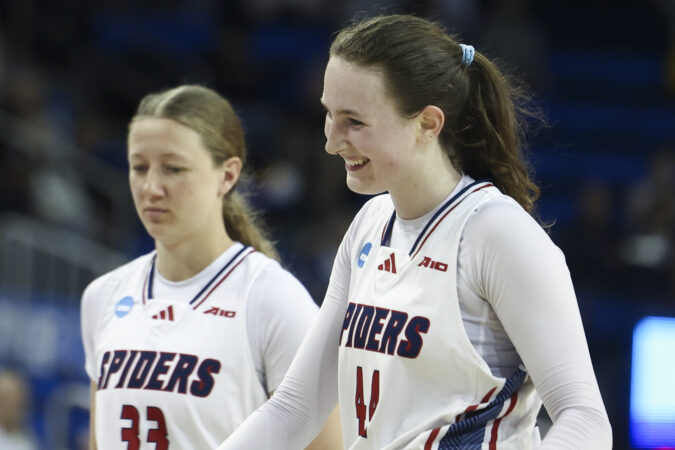
NEW YORK — Maggie Doogan turned and launched a three-pointer from the top of the key, then yelled, “What?” when the ball splashed through the net to give Richmond a 13-point lead at Columbia last week. The former Cardinal O’Hara star grinned when she sank another deep shot to continue her team’s fourth-quarter surge.
After a cold shooting start, Doogan was Richmond’s leading scorer (16 points) and added nine rebounds, four assists, and three blocks in a key early-season matchup between mid-major programs that won NCAA Tournament games in March. And when a reporter in the postgame news conference suggested she had struggled offensively in the 77-67 road victory, coach Aaron Roussell playfully responded with, “Tough ‘evals,’ man.”
“I think it’s a pretty good stat line, with all due respect,” Roussell said. “ … I’ll take those ‘off’ nights from her.”
That illustrates the heightened expectations for Doogan, the reigning Atlantic 10 Player of the Year and perhaps the best mid-major player in women’s college basketball. The 6-foot-2 do-everything forward is averaging 23.1 points, 10.9 rebounds, 5.3 assists, and 1.4 blocks through the Spiders’ first seven games. That includes a monster performance in last week’s 72-57 victory over Temple, when she racked up 31 points, 14 rebounds, and nine assists.
Her ascent has coincided with Richmond’s, which last season won a second consecutive A-10 regular-season title and its first March Madness game in program history. The 5-2 Spiders, whose only losses so far are to No. 4 Texas and No. 8 TCU, were ranked in the preseason Associated Press top 25 poll and are receiving votes now.
Doogan acknowledges building this legacy is “not at all” what she envisioned when she signed with Richmond. But Roussell calls her a “perfect model” for player development, with the versatility to anchor the Spiders’ read-and-react offensive system. In this new era of college athletics, Doogan also made an increasingly rare decision to not entertain NIL opportunities from power-conference programs and stay at Richmond for her final season.
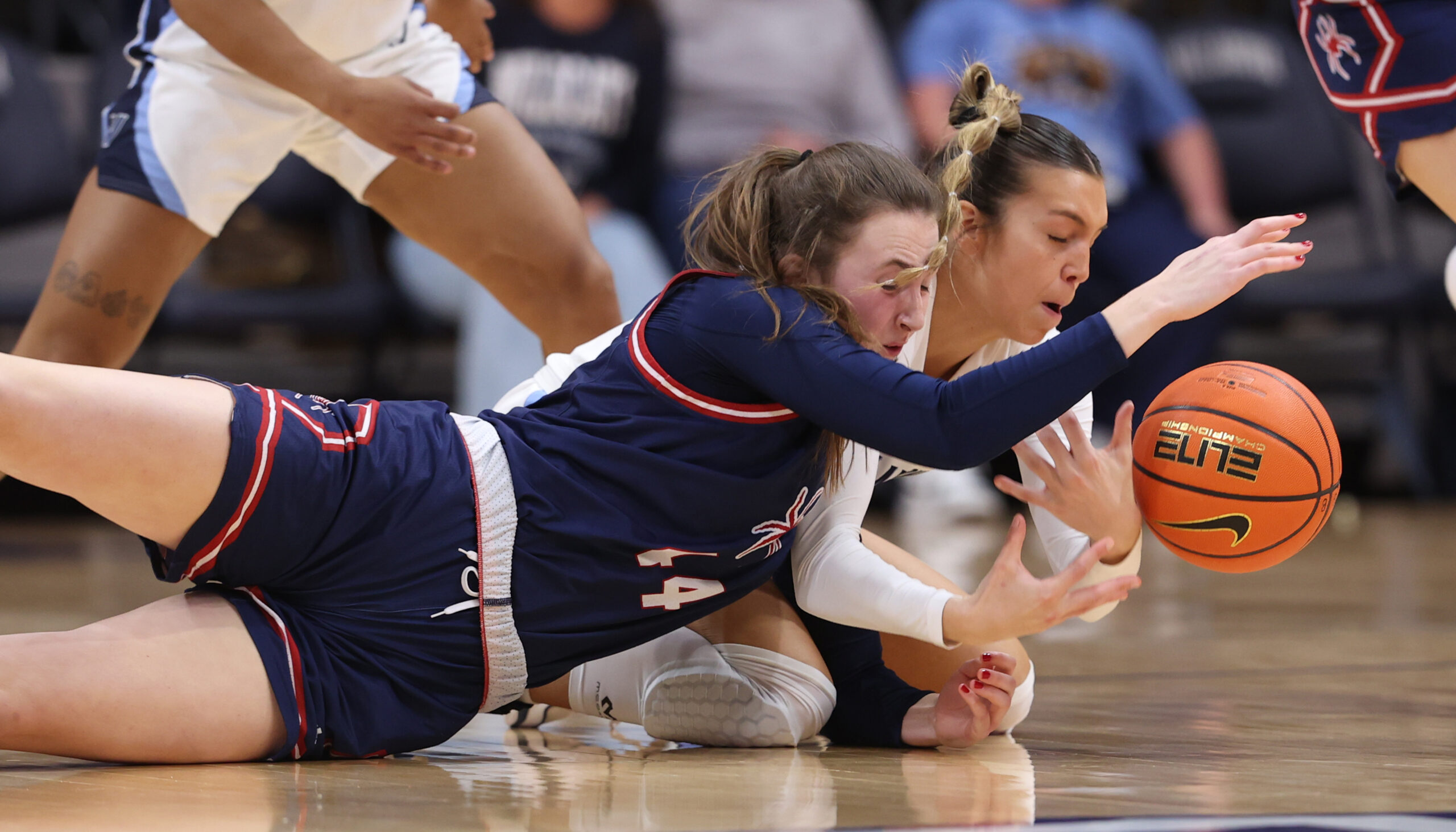
Richmond’s Maggie Doogan dives for a loose ball in a 2023 game against Villanova.
Also fueling Doogan’s rise? Her on-court diligence and quest for basketball intel. That sets the standard for everybody in the Spiders’ program — including its coach.
“You can’t fake anything with her,” Roussell said in a telephone interview last week. “You can’t be a teammate and not work hard around her. You can’t be her coach and not invest in her and not put the time in with the film. Because she’s going to have questions, and you need to be able to answer those.
“That’s probably been different for me coaching her than maybe any other kid that I’ve ever coached.”
Spiders?
When Doogan was a sophomore in high school, her mother, Chrissie, gave her a Richmond T-shirt as an Easter present.
“Mom, I’m not going to a school where Spiders are the mascot,” Maggie jokingly retorted.
But the Doogan family, based in Broomall, already had a connection to the Richmond coaching staff. Assistant Jeanine Radice, then at Marist, had recruited Chrissie (née Donahue) before she became La Salle’s second all-time leading scorer and member of the school’s athletics Hall of Fame. Then they stayed in touch as Chrissie entered coaching at La Salle, Cornell, and Cardinal O’Hara, where she currently is the school’s athletic director.
So Mom initially sent Maggie’s film, which highlighted her basketball IQ, to Radice. Maggie later demonstrated her outstanding shooting at one of Richmond’s camps, Roussell said. And the coach recognized untapped potential.
Maggie, meanwhile, was interested in branching out from the Philly area but remaining within a reasonable driving distance. She wanted strong academics and the opportunity to play right away. And while visiting Richmond’s campus, she fell in love with the “gorgeous” red-brick buildings.
“It was an easy choice once I really looked into it,” she said.
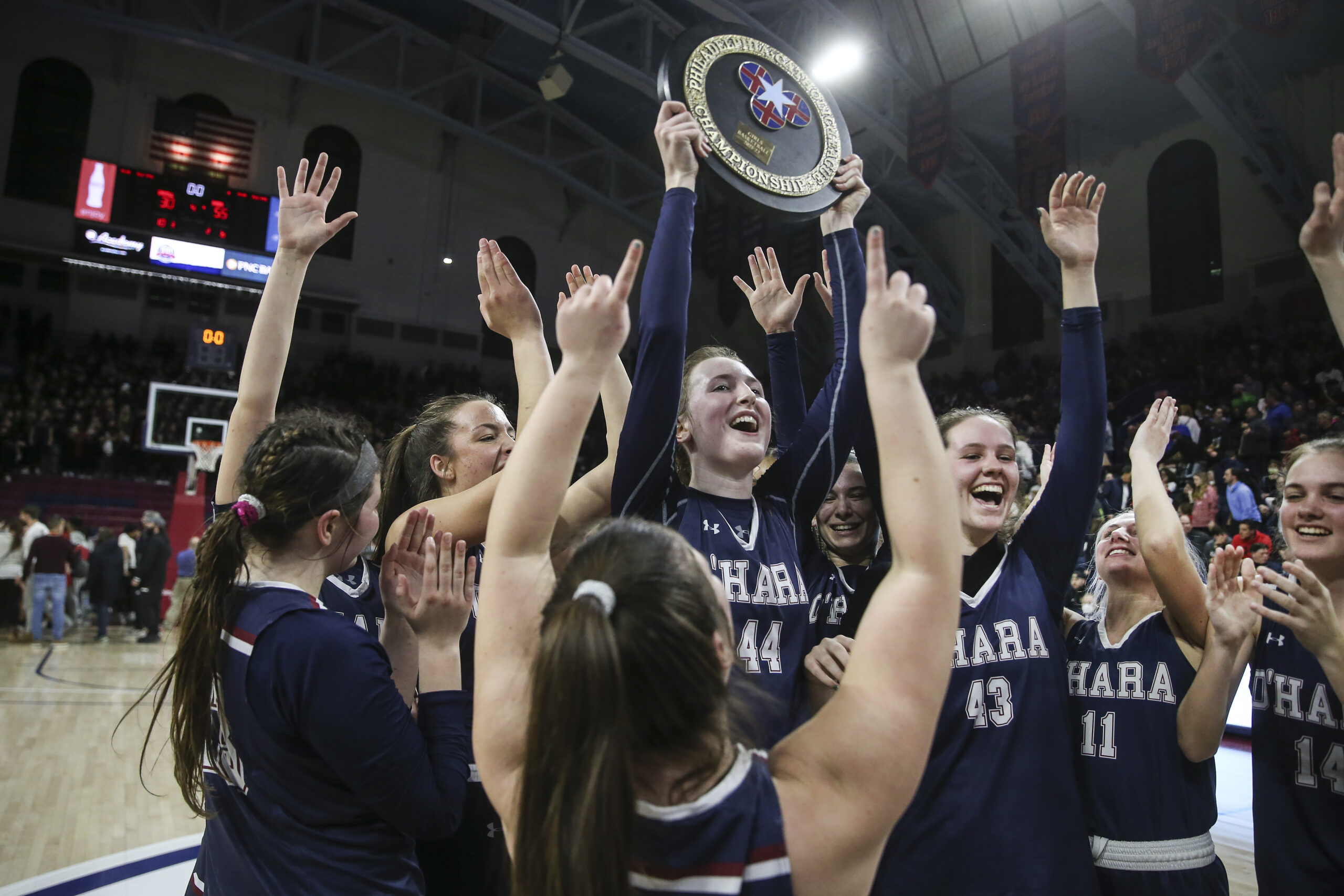
Cardinal O’Hara’s Maggie Doogan holds the the championship plaque as she celebrates with teammates after beating Archbishop Carroll for the Catholic League title in 2022.
Chrissie wondered whether Maggie’s lanky frame would be strong enough when she entered college. Roussell, though, deliberately took her early development slowly, because the coach “really wanted to make her earn” playing time. A broken hand kept Doogan sidelined for about five weeks, forcing her to step back and observe and pick coaches’ brains from the bench.
“I don’t know if they put something magic in my hand,” Doogan said, “but I was just kind of a different player and took that big leap. That kind of just gave me more confidence at the collegiate level.”
Her breakout game fittingly came in a nationally televised overtime victory over St. Joseph’s. Roussell called her “unguardable” as she totaled 28 points, six rebounds, five assists, three blocks, and two steals. By her sophomore season, she was the Spiders’ leading scorer for a team that won 29 games and the first A-10 championship in program history.
In Roussell’s positionless system, Doogan could be viewed as a post player with excellent perimeter shooting and playmaking skills — or a wing who can make an impact inside on both ends of the floor. She not only impressed with her commitment to the weight room and on-court work, but with her film study and tactical aptitude.
Roussell jokingly calls it “stressful” to coach Doogan because of the information she constantly demands. She is not afraid to approach her coach during a shootaround and respectfully ask why they have chosen a specific strategy against an opponent. And the Spiders have changed elements of game plans — before or during a matchup — because of something Doogan observed.
Roussell already says he hopes his “retirement job” is as an assistant coach on Doogan’s future staff.
“The level and the layers of which she thinks about the game is already like a coach,” Russell said. “ … I never want her to be bashful or not tell me what she’s feeling during a game or seeing during a game.”
Those qualities propelled Doogan’s numbers to jump again as a junior, to 17 points, 7.1 rebounds, 3.8 assists, and 1.2 steals per game. She shot 55.5% from the floor, including 40.6% from beyond the arc. She helped Richmond win a second consecutive regular-season A-10 title, and became the program’s first conference player of the year since 1990.
But after a St. Joe’s buzzer-beater upset Richmond in last season’s A-10 tournament — a game during which Doogan took just five shots and scored five points — she and Roussell had “frank conversations” about what the Spiders consistently needed from her. Doogan went home for spring break and “didn’t speak for three days. … She was miserable,” Chrissie said.
Roussell believes that gave Doogan an extra dose of motivation for a monster NCAA Tournament, after Richmond earned a No. 8 seed in an at-large berth.
She racked up 30 points on 5-of-8 shooting from three-point range, along with 15 rebounds and six assists, in a dominant 74-49 victory over ninth-seeded Georgia Tech. She totaled another 27 points on 11-of-18 shooting, seven assists, and six rebounds in an 84-67 loss to top-seeded UCLA, which advanced to the Final Four.
“I had a lot of pride. A lot of pride,” Doogan said of her team’s March Madness run. “ … Once you kind of step back, and a couple weeks later, I was like, ‘Wow, we really did that.’”
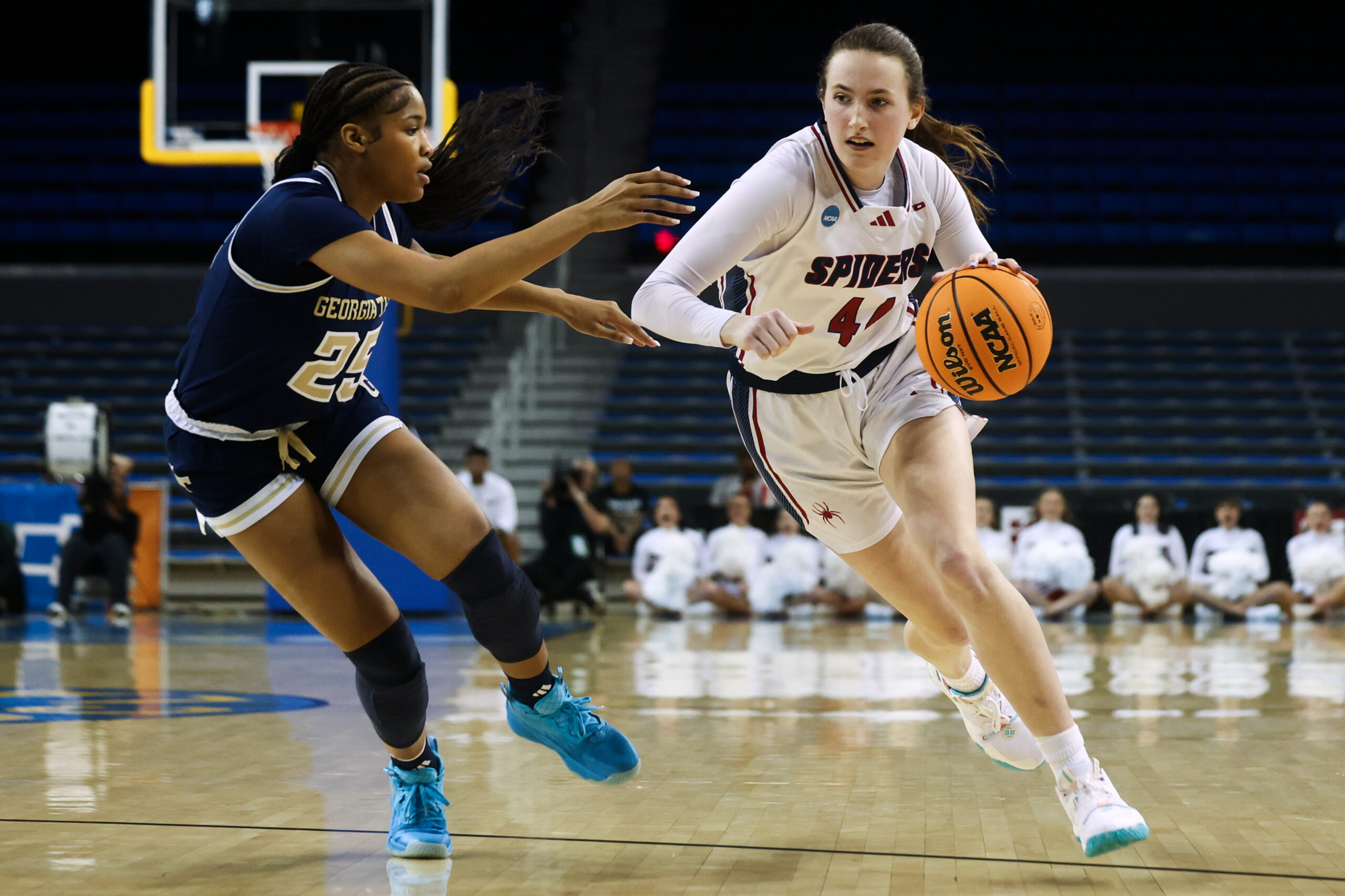
Richmond forward Maggie Doogan toward the basket as Georgia Tech guard Kara Dunn defends during last season’s NCAA Tournament.
Still, “literally the second we got back” from the NCAA Tournament, Roussell said, he and Doogan needed to have another honest discussion about her plans for the 2025-26 season. That is the reality in this transfer-portal era, because mid-major players regularly leave for power-conference programs that can offer more lucrative NIL deals.
Chrissie acknowledges she “got some calls on the side” to gauge Maggie’s interest in exploring options. She had to ask her daughter, “Would you leave for any certain amount?” Though Roussell received no indication from the family that he should be worried, he added, “I’m no dummy. I know the pursuers were out there.”
But Maggie and Roussell were aligned on how special this season could be for the Spiders — and that she wanted to finish her college career where it started.
“Not everybody would have made the decision that she did,” Roussell said. “There was a lot of loyalty involved. Now, do I think this was a great fit for her and this was the right answer? Yeah. But she left money on the table by coming back here, and that’s not something every 21-year-old is doing.”
Added Doogan: “Honestly, it’s home. And I wouldn’t want to spend my last year anywhere else.”
After Richmond’s win at Columbia, Chrissie sent Maggie a text about the two turnovers she committed during the game’s final minute.
“Wow, thanks for the love,” Maggie sarcastically responded.
Consider that evidence that the coach-player aspect of this close mother-daughter bond has never fully dissipated. Neither have other characteristics Maggie says she acquired while growing up as a Philly basketball kid. She immediately highlighted her toughness, that “I don’t really like to take a lot of B.S. from people, and I think I get that from back home.” She also credits her time at O’Hara with fostering her vocal leadership, which was on display while speaking up during timeouts throughout Richmond’s win at Columbia.
“I’m trying to calm everybody down, which hopefully works,” she said after that game. “I kind of know what [Roussell is] thinking, and I’m good at talking with everybody else. I think it’s kind of why I’m on the floor.”
She also is navigating life as a player who, before the season, was ranked among ESPN’s top 25 returners in the country.
She acknowledged after the Columbia game that she felt more defensive “crowding” while in the paint and a greater focus on wherever she was on the floor. Roussell is pleased that Doogan is executing on individual focuses, like better finishing, drawing fouls around the rim, and improving as a playmaker and rebounder. Being invited to last summer’s Team USA’s Women’s AmeriCup team trials, where she competed alongside some of college basketball’s best players, also boosted her confidence, Roussell said.
“She has not hit her apex yet,” Roussell said. “There is really good basketball in her future that will be better than what she is now.”
Yet the Doogan family is embracing Maggie’s final college season, which Chrissie compares to the ending of a book.
A group in Richmond gear swarmed Maggie for hugs following the Columbia win, then posed together for a photo op. Her grandparents make the four-hour drive to Richmond for nearly every home game. And whenever Chrissie visits, she notices children wearing No. 44 jerseys with “Doogan” on the back.
“As a parent, you’re like, ‘Wow, this kid,’” Chrissie said. “People all over Richmond know her.”
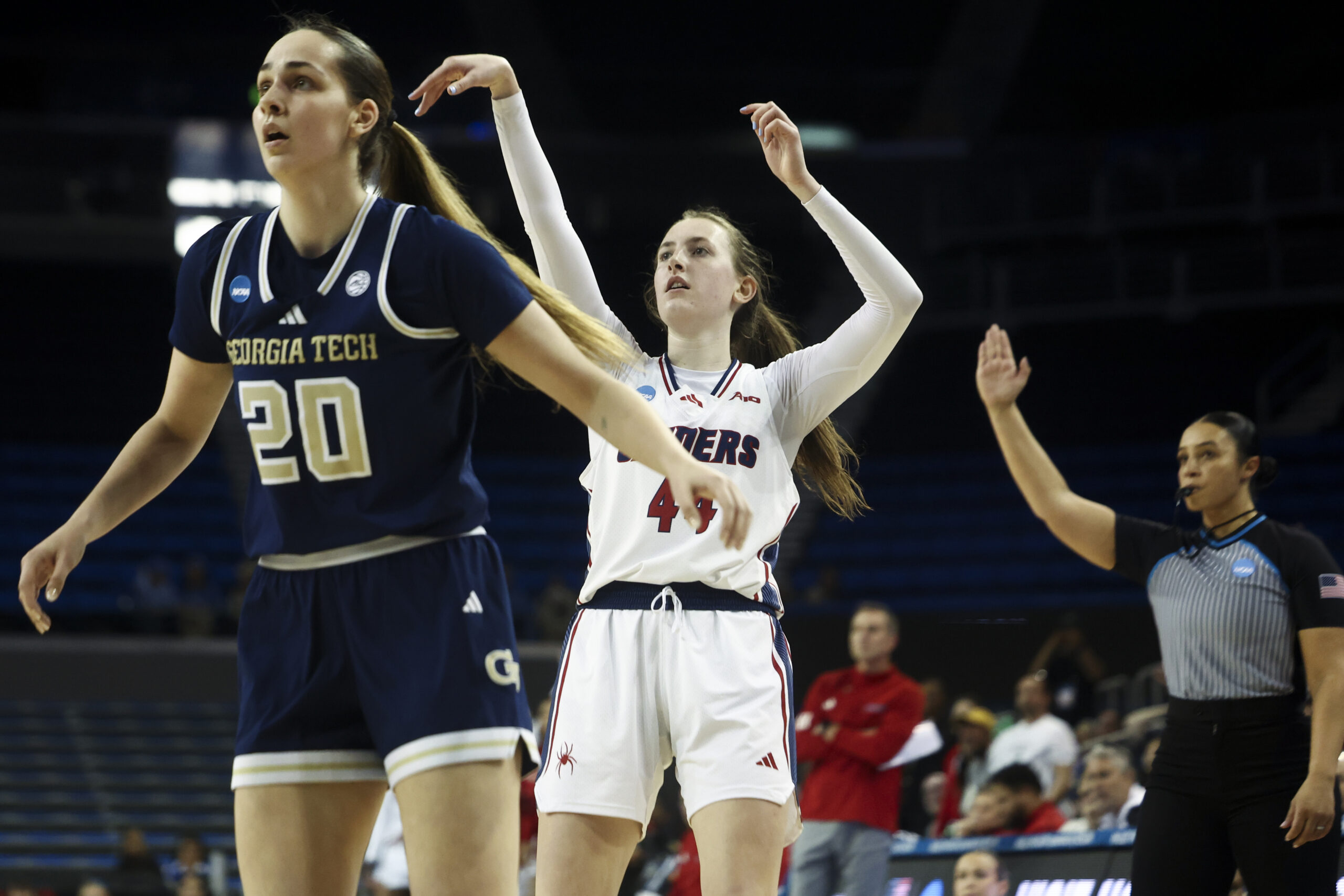
Richmond’s Maggie Doogan looks on after shooting as Georgia Tech center Ariadna Termis watches.
That’s the impact of Doogan becoming a perfect model of development and versatility.
And the player who stayed at her mid-major school through her entire career.
And the person who continues to set the standard for her program’s historic rise.
“It’s going to be awful whenever she takes off that jersey,” Chrissie said of Maggie. “I know there will be tears shed. But she’s got so much to be proud of, and so much to be excited for this season.
“We’re just trying to take it one game at a time, one practice at a time, and enjoy the ride.”
Jared McCain called for a Dominick Barlow screen, then created the space to get to his spot and elevate for a mid-range jumper.
The 76ers’ second-year guard has long identified that “bump middie” as one of his favorite types of shots. And that first-quarter bucket ignited McCain’s best performance — in statistical production and in mobility — since returning from a nearly 11-month absence following knee and thumb surgeries.
It was evidence of the positive steps McCain has taken since going on a G League assignment — and an encouraging longer-term sign for a Sixers team already utilizing guard-heavy lineups this season.
“I felt really good today,” McCain said after the game. “I felt like I got a little burst for my first step. Just continue to build off each game, the more minutes I play.”
He played only five minutes during last Monday’s home victory over the Los Angeles Clippers. Then he finally made his first shot in Wednesday’s loss to the Toronto Raptors, a moment of “pure joy” captured when he threw his arms out and yelled in celebration. He then cleared another medical checkpoint by also playing the second half of a back-to-back the following night at the Milwaukee Bucks, scoring eight points and looking “a little bit more like we needed him to play,” coach Nick Nurse said.
Sunday afternoon, the still-uber-popular McCain was greeted with exuberant cheers upon entering the game late in the first quarter. After his first bucket, he got downhill for a finger-roll layup and flexed after burying a game-tying three-pointer late in the second quarter. A third-quarter deep shot from the top of the key pushed his point total into double figures for the first time this season. Another three-pointer got the Sixers within 102-96 early in the final period, before Miami’s final surge.
An acceleration in McCain’s reacclimation would be a plus for a Sixers team already thriving while playing three-guard lineups.
Tyrese Maxey, Quentin Grimes, and Edgecombe have boasted a plus-14.6 net rating (and have averaged 121.1 points per 100 possessions) while sharing the floor for 213 minutes in 15 games, often in closing lineups. Before the season, Nurse even floated experimenting with four guards on the floor together. But if Edgecombe’s calf issue lingers, McCain could immediately slide into such personnel combinations.
This long recovery process has taught McCain — who was an early Rookie of the Year front-runner before suffering a torn meniscus in mid-December — to practice patience and recognize “small wins.” Being able to walk again after surgery. Or play in an NBA game. Or take a hit from a defender and still step back onto his left foot and fire a shot.
He proclaimed earlier this week that there was “no such thing as garbage time” while regaining comfort on the floor. And even after he missed his first nine shot attempts over four games since debuting Nov. 4 at the Chicago Bulls, he said he did not believe in slumps.
“I put in the work,” McCain said after shootaround last Monday, “so I know it’s going to show whenever it needs to.”
Aiding that recent progress has been a switch from a bulky knee brace — “every time I dribbled, it felt like I was about to fall over,” McCain said — to a compression sleeve called Incrediwear. He also said he is unbothered by the brace he continues to wear on his shooting hand, though: “I try not to put any negative energy in the universe talking about the thumb.”
So what are McCain’s next incremental goals?
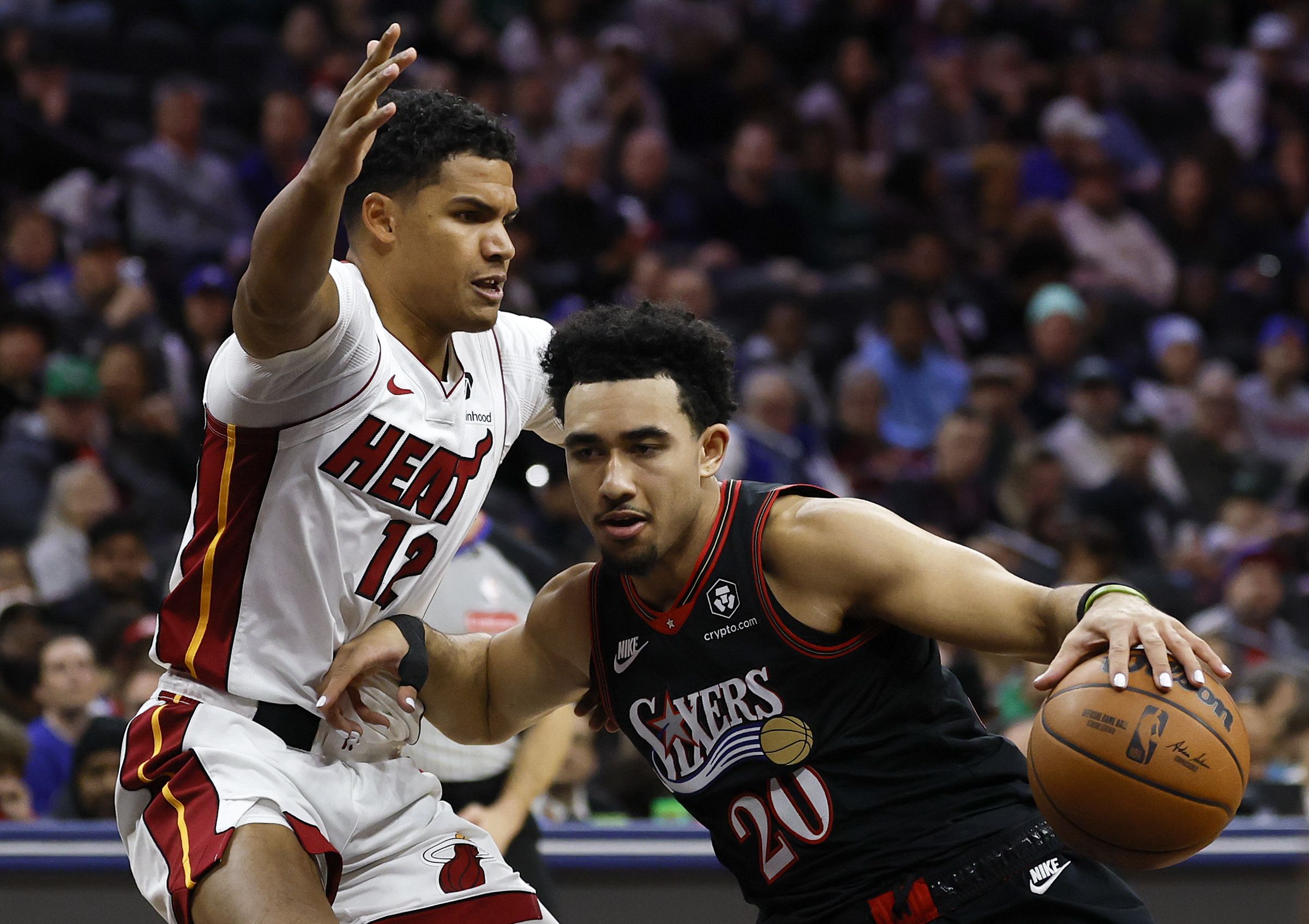
Sixers guard Jared McCain drives to the basket against Miami’s Dru Smith on Sunday.
Defensively, he wants to improve at running full speed to close out on a shooter, then push off his left leg to change direction to cut off another player. Offensively, his first step with the ball in his hands still can get quicker.
And after Sunday’s game, Nurse reemphasized the importance of McCain’s three-point shooting, after he made 38.3% of his 5.8 attempts in 23 games as a rookie and shot 41.4% from long range during his one college season at Duke. That floor-spacing can be particularly valuable when Maxey relentlessly attacks the rim.
“I know I keep saying that,” Nurse said, “but we do need that production from him.”
As Sunday’s halftime clock ticked down, McCain was one of the first players out of the Sixers’ locker room.
He uses that additional time to get his knee moving again, after sitting during the break. But he also aims to mimic part of the routine of future Hall of Fame sharpshooter Stephen Curry, who said he visualizes shots falling before the third quarter begins.
“I just want to get loose again,” McCain said. “So I try to come out as early as possible and get my reps up, and see the ball go through the net.”
McCain is still not back to the player he was before his surgeries and lengthy absence. But Sunday marked his best game since his return, an important step for him and the Sixers.
“I just want him to keep being aggressive and keep being himself,” Maxey said of McCain earlier this week. “ … It’s going to take some time. I think [we need to] just keep pushing confidence into him.
“Just remind him who he is, and remind him what he does.”
Joel Embiid will miss his seventh consecutive game for right knee injury management Sunday afternoon against the Miami Heat, per the NBA’s injury report released Saturday evening.
The Sixers said following Saturday’s practice that Embiid is still experiencing soreness in that knee, which has not undergone multiple surgeries in recent years. The medical staff does believe Embiid is progressing following his most recent evaluation, the Sixers added.
Rookie starting guard VJ Edgecombe (calf tightness) is listed as questionable to play Sunday. Reserve center Adem Bona (sprained ankle) will also remain out for at least the Sixers’ next two games against the Heat and Tuesday against the Orlando Magic, the Sixers said. He will be reevaluated after that.
Embiid has missed the Sixers’ past six games with the knee issue. The former NBA Most Valuable Player was briefly upgraded to doubtful to play in Wednesday’s loss against the Toronto Raptors, but then was ruled out of that contest and Thursday’s overtime win at the Milwaukee Bucks.
“I can’t predict any of it,” coach Nick Nurse said when asked about the bigger-picture outlook for Embiid’s health. “I think we’re trying to take the best care we can of him and get him out there. He wants to play. He’s being very diligent, all this stuff. He’s doing a lot to try to get back on the floor, and I think it’ll be soon.
“I know this has been a long, ‘I think it’ll be soon,’ but just keep doing the right things and keep listening to what the doctors tell us.”
Embiid has averaged 19.7 points, 5.5 rebounds, and 3.3 assists in six games played this season. He has previously been under a minutes restriction, and has had scheduled absences for select practices and games as part of his recovery plan from the longtime left knee issues.
Grimes a Sixth Man of the Year candidate?
Quentin Grimes hit a massive three-pointer to put the Sixers up, 116-112, with less than two minutes to play in overtime of Thursday’s win in Milwaukee. It was another example of his value in crunch time, and in the Sixers’ potent three-guard lineups.
But because Grimes has initially come off the bench in all 15 of the Sixers’ games entering Sunday, he also is considered an early contender for the NBA’s Sixth Man of the Year award.
He entered Sunday averaging 16.9 points, which entering Sunday ranked third among reserve players, along with 4.1 assists and 3.7 rebounds. He also regularly takes on challenging perimeter defensive assignments, such as James Harden in Monday’s victory over the Los Angeles Clippers.
Quentin Grimes has embraced his role as the Sixers’ sixth man after failing to come to terms on a deal with the team this summer.
When asked if he has considered his candidacy for such an honor, Grimes responded with, “No, not really.”
“If you start thinking about stuff like that,” Grimes said, “you can get lost in everything [and] you start losing the focus on the game. … I worry about going out there and winning and doing [things] to impact the game. [Awards will] take care of itself if that happens.”
Grimes, though, did start the second half in three of the Sixers’ past four games. That generally gets him on a better rotation pattern to be part of the closing lineup. Thursday in Milwaukee, however, he did not begin the third period on the floor, but then played nearly seven consecutive minutes in that frame and then the entire fourth and overtime. His schedule will also likely continue to evolve as Embiid and Paul George are reintroduced to the lineup.
“It doesn’t change my mindset,” Grimes said. “I know what I bring to this team offensively and defensively. Just coming in and try to impact the game as soon as I get in the game — whether I’m starting the game, starting the second half, coming off the bench …
“Impact the game in a positive way, and help swing the momentum a little bit.”
Sunday matinee
Sunday’s game against the Heat will be a rare weekend matinee matchup. That means, from a preparation standpoint, Saturday’s practice essentially served as a shootaround.
Grimes added that the atypical tipoff time did not change much about his pregame routine. He will sub his two-plus-hour afternoon nap with sleeping in later Sunday morning, rather than waking up earlier for shootaround. And his pregame meal will be breakfast, likely “four or five” over easy eggs and pancakes.
Quotable
Justin Edwards on Paul George’s 11-point outburst to begin the Milwaukee game: “We were all hyped for him. I was in the game laughing because I’m like, ‘Yo, he’s just out there killing it.’”