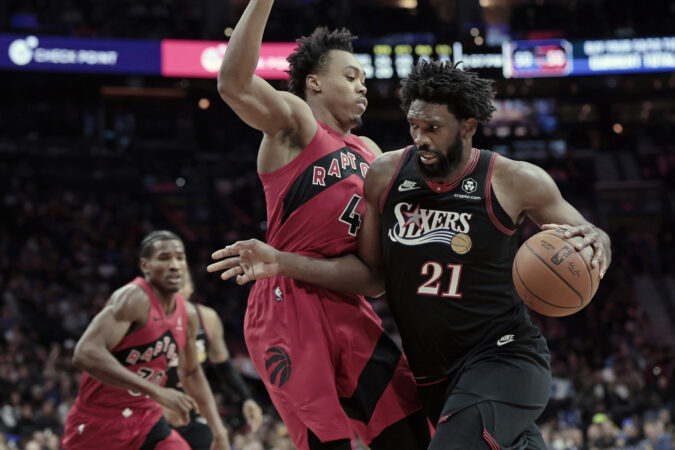
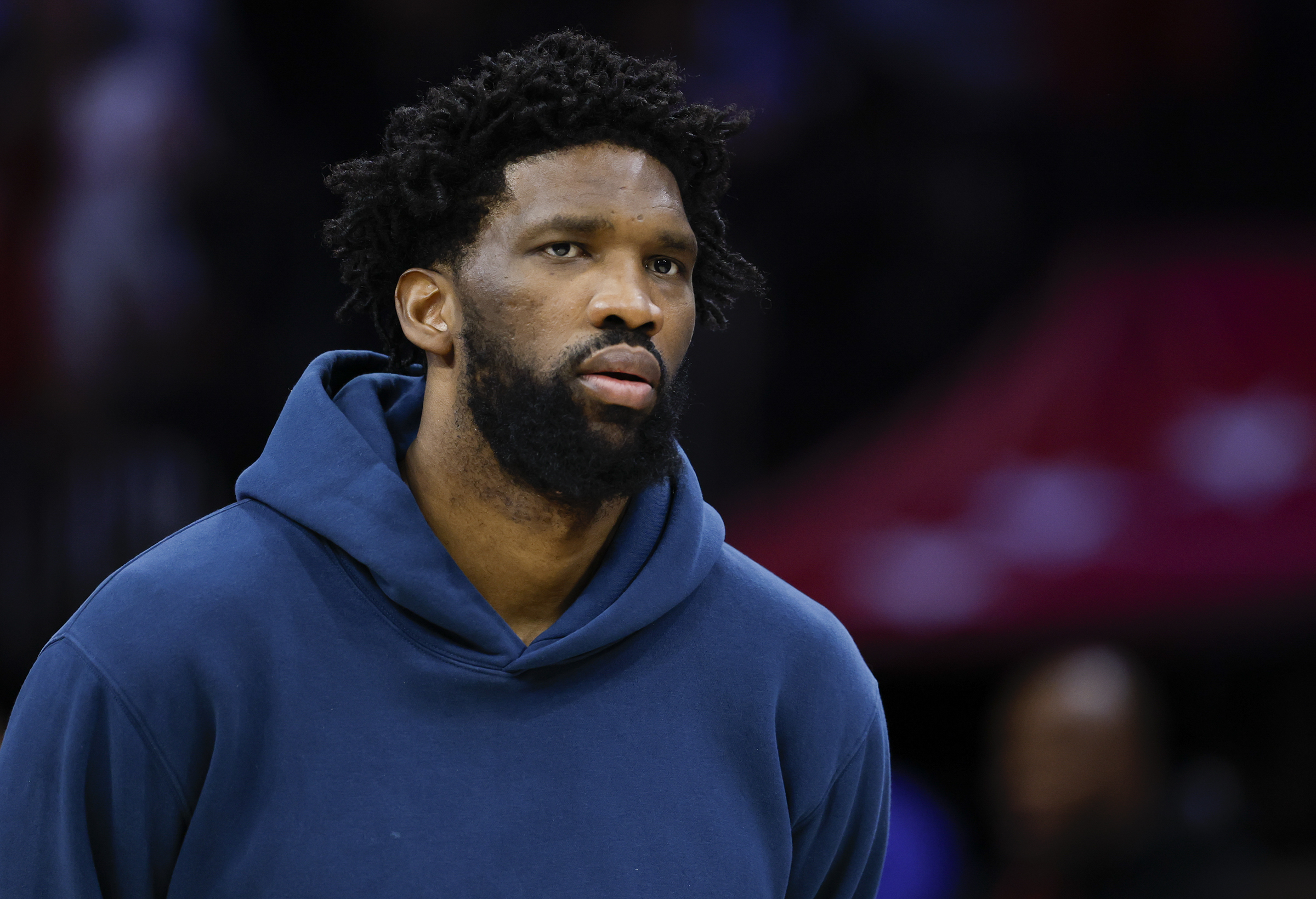
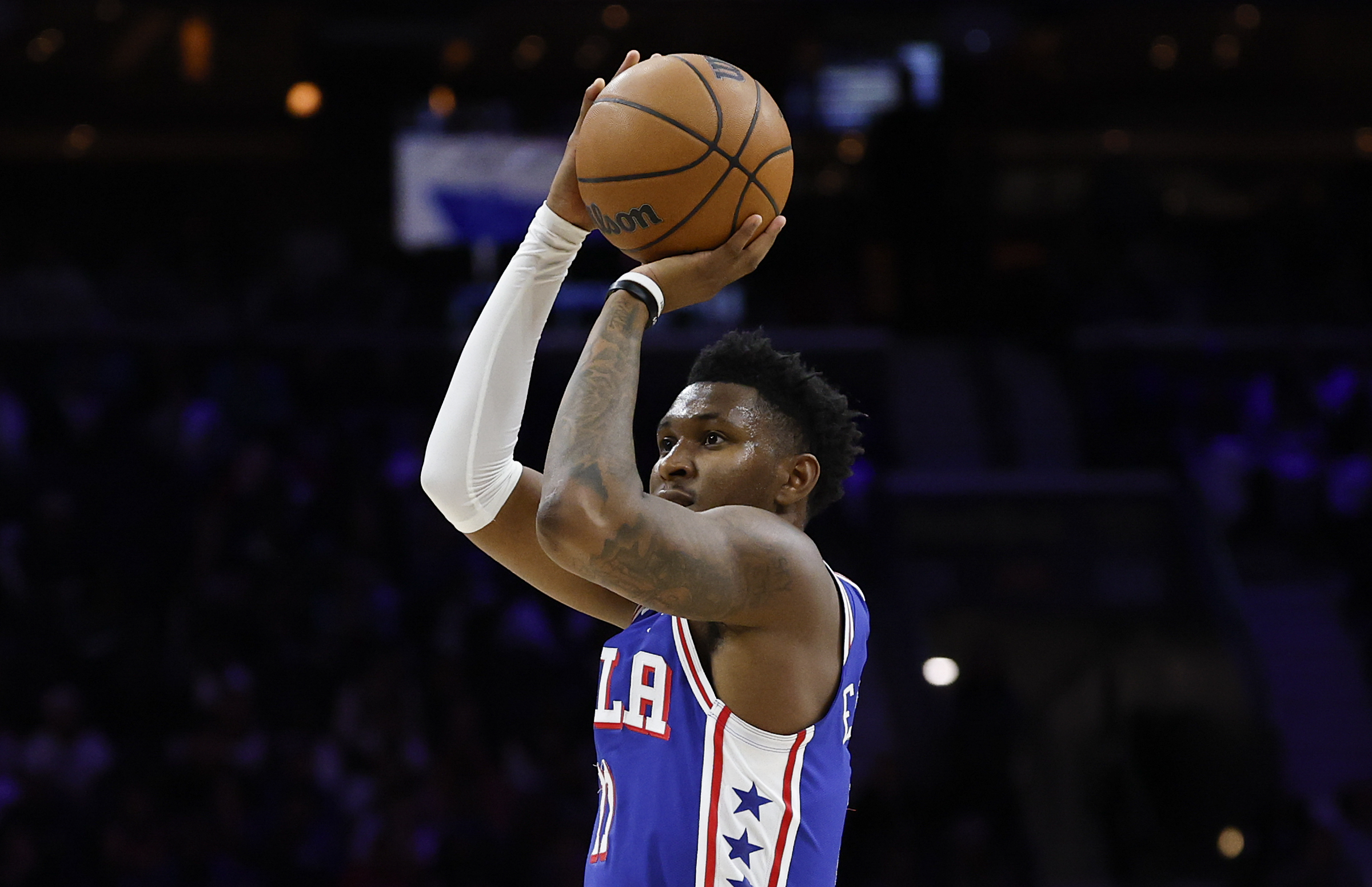
Joel Embiid will miss his seventh consecutive game for right knee injury management Sunday afternoon against the Miami Heat, per the NBA’s injury report released Saturday evening.
The Sixers said following Saturday’s practice that Embiid is still experiencing soreness in that knee, which has not undergone multiple surgeries in recent years. The medical staff does believe Embiid is progressing following his most recent evaluation, the Sixers added.
Rookie starting guard VJ Edgecombe (calf tightness) is listed as questionable to play Sunday. Reserve center Adem Bona (sprained ankle) will also remain out for at least the Sixers’ next two games against the Heat and Tuesday against the Orlando Magic, the Sixers said. He will be reevaluated after that.
Embiid has missed the Sixers’ past six games with the knee issue. The former NBA Most Valuable Player was briefly upgraded to doubtful to play in Wednesday’s loss against the Toronto Raptors, but then was ruled out of that contest and Thursday’s overtime win at the Milwaukee Bucks.
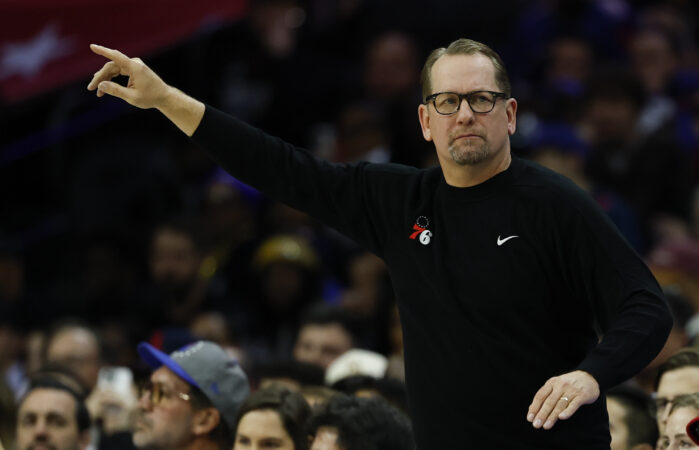
“I can’t predict any of it,” coach Nick Nurse said when asked about the bigger-picture outlook for Embiid’s health. “I think we’re trying to take the best care we can of him and get him out there. He wants to play. He’s being very diligent, all this stuff. He’s doing a lot to try to get back on the floor, and I think it’ll be soon.
“I know this has been a long, ‘I think it’ll be soon,’ but just keep doing the right things and keep listening to what the doctors tell us.”
Embiid has averaged 19.7 points, 5.5 rebounds, and 3.3 assists in six games played this season. He has previously been under a minutes restriction, and has had scheduled absences for select practices and games as part of his recovery plan from the longtime left knee issues.
Grimes a Sixth Man of the Year candidate?
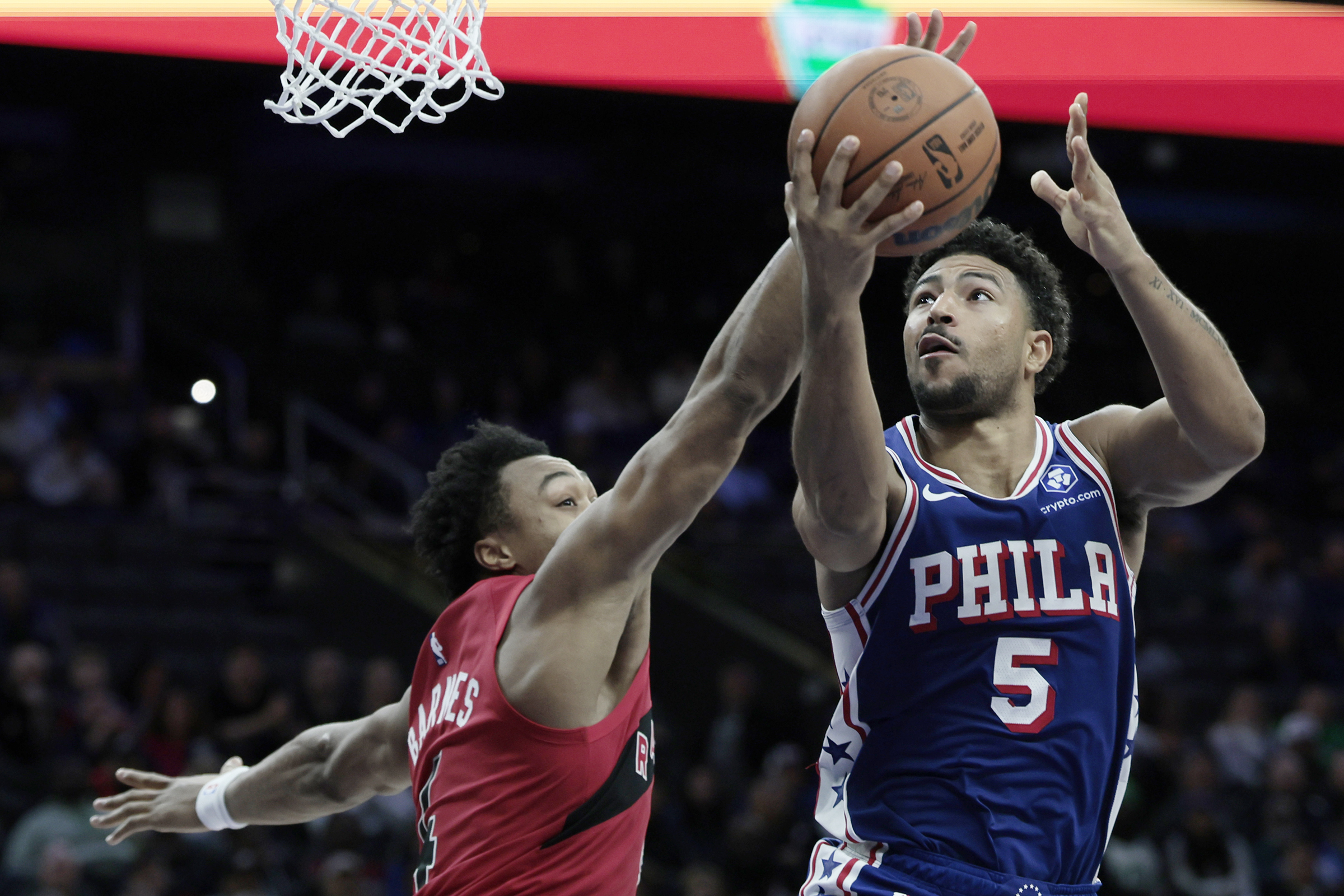
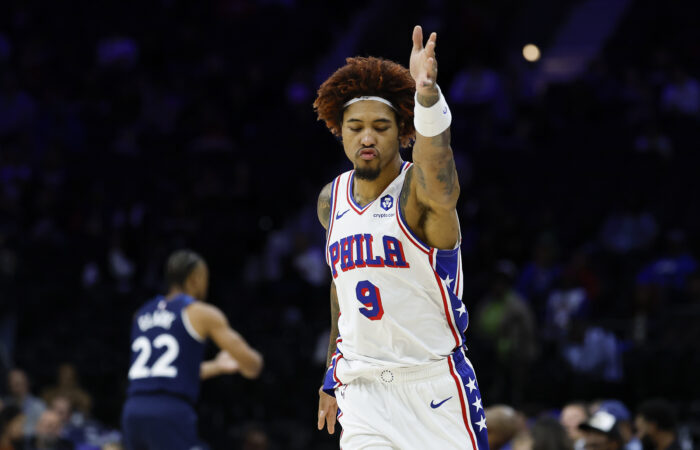
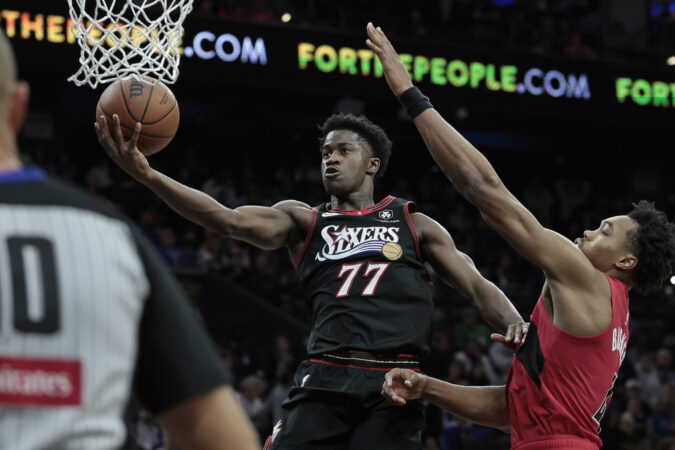
Quentin Grimes hit a massive three-pointer to put the Sixers up, 116-112, with less than two minutes to play in overtime of Thursday’s win in Milwaukee. It was another example of his value in crunch time, and in the Sixers’ potent three-guard lineups.
But because Grimes has initially come off the bench in all 15 of the Sixers’ games entering Sunday, he also is considered an early contender for the NBA’s Sixth Man of the Year award.
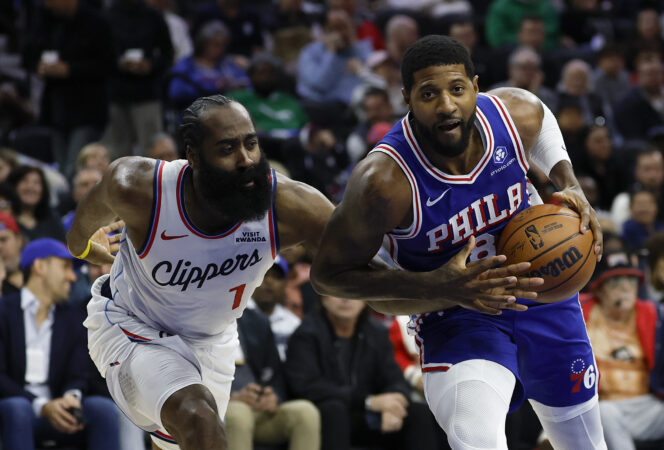
He entered Sunday averaging 16.9 points, which entering Sunday ranked third among reserve players, along with 4.1 assists and 3.7 rebounds. He also regularly takes on challenging perimeter defensive assignments, such as James Harden in Monday’s victory over the Los Angeles Clippers.
Quentin Grimes has embraced his role as the Sixers’ sixth man after failing to come to terms on a deal with the team this summer.
When asked if he has considered his candidacy for such an honor, Grimes responded with, “No, not really.”
“If you start thinking about stuff like that,” Grimes said, “you can get lost in everything [and] you start losing the focus on the game. … I worry about going out there and winning and doing [things] to impact the game. [Awards will] take care of itself if that happens.”
Grimes, though, did start the second half in three of the Sixers’ past four games. That generally gets him on a better rotation pattern to be part of the closing lineup. Thursday in Milwaukee, however, he did not begin the third period on the floor, but then played nearly seven consecutive minutes in that frame and then the entire fourth and overtime. His schedule will also likely continue to evolve as Embiid and Paul George are reintroduced to the lineup.
“It doesn’t change my mindset,” Grimes said. “I know what I bring to this team offensively and defensively. Just coming in and try to impact the game as soon as I get in the game — whether I’m starting the game, starting the second half, coming off the bench …
“Impact the game in a positive way, and help swing the momentum a little bit.”
Sunday matinee
Sunday’s game against the Heat will be a rare weekend matinee matchup. That means, from a preparation standpoint, Saturday’s practice essentially served as a shootaround.
Grimes added that the atypical tipoff time did not change much about his pregame routine. He will sub his two-plus-hour afternoon nap with sleeping in later Sunday morning, rather than waking up earlier for shootaround. And his pregame meal will be breakfast, likely “four or five” over easy eggs and pancakes.
Quotable
Justin Edwards on Paul George’s 11-point outburst to begin the Milwaukee game: “We were all hyped for him. I was in the game laughing because I’m like, ‘Yo, he’s just out there killing it.’”
About 10 days ago, Nick Nurse jokingly proclaimed that maybe the 76ers would play better in the third quarter if they spent halftime regrouping on the bench, instead of inside the locker room. Veteran Kyle Lowry suggested to star guard Tyrese Maxey that perhaps the players should try another round of layup lines before the second half begins.
There was no making light of the ongoing problem late Wednesday, when another dreadful third quarter doomed the Sixers in a 121-112 loss to the Toronto Raptors on the front end of a back-to-back. For a season that so far has been a pleasant 8-6 surprise, the Sixers’ perplexing struggles during that specific quarter remain a worthy criticism.
“A lot of bad, right?” Nurse said when asked again Wednesday about the blunders.
The Sixers were outscored 44-26 in Wednesday’s third quarter, flipping a three-point halftime advantage into a 15-point deficit entering the final frame. And though they rallied in the fourth — another quality consistently flashed throughout the early season — that hole ultimately was too deep to fully overcome against the streaking Raptors (10-5).
When the third-quarter topic was broached again Wednesday, a far more terse Maxey pointed to the Sixers’ turnovers (eight, which Toronto parlayed into 15 points) and defensive breakdowns (the Raptors shot 68.4% from the floor, including a blistering 5-of-6 on three-pointers) as the primary areas to blame. Nurse added that the Sixers committed five fouls in less than four minutes, leading to a whopping 16 free-throw attempts (and 13 shots made) for the Raptors during that period.
“Just set the tone for a really bad quarter,” Nurse said.
It was the latest on a growing list of “really bad” third quarters populating the regular season’s opening month. The Sixers have “lost” 11 of their 14 third quarters, with one tie. They have been outscored by 111 total points (454-343) in that frame, with an average of 24.5 points per third quarter.
On Oct. 30, Nurse said the reasons for the Sixers’ woes during those 12 minutes were “under investigation.” Subsequent questions to the coach as the dilemma persisted did not yield revelations about correctable through-lines or themes.
Separately and unprompted, Maxey and reserve big man Jabari Walker have suggested that it may now be a collective mental block.
“Man, I think it’s a mindset thing, honestly,” Walker said Wednesday, after a long exhale. “We’ll figure it out. But it’s honestly mindset. It’s nothing besides that.”
After a Nov. 5 loss at the Cleveland Cavaliers, Nurse floated the idea of starting a different group at the beginning of each half, a tactic he has previously used to spark his team coming out of the locker room.
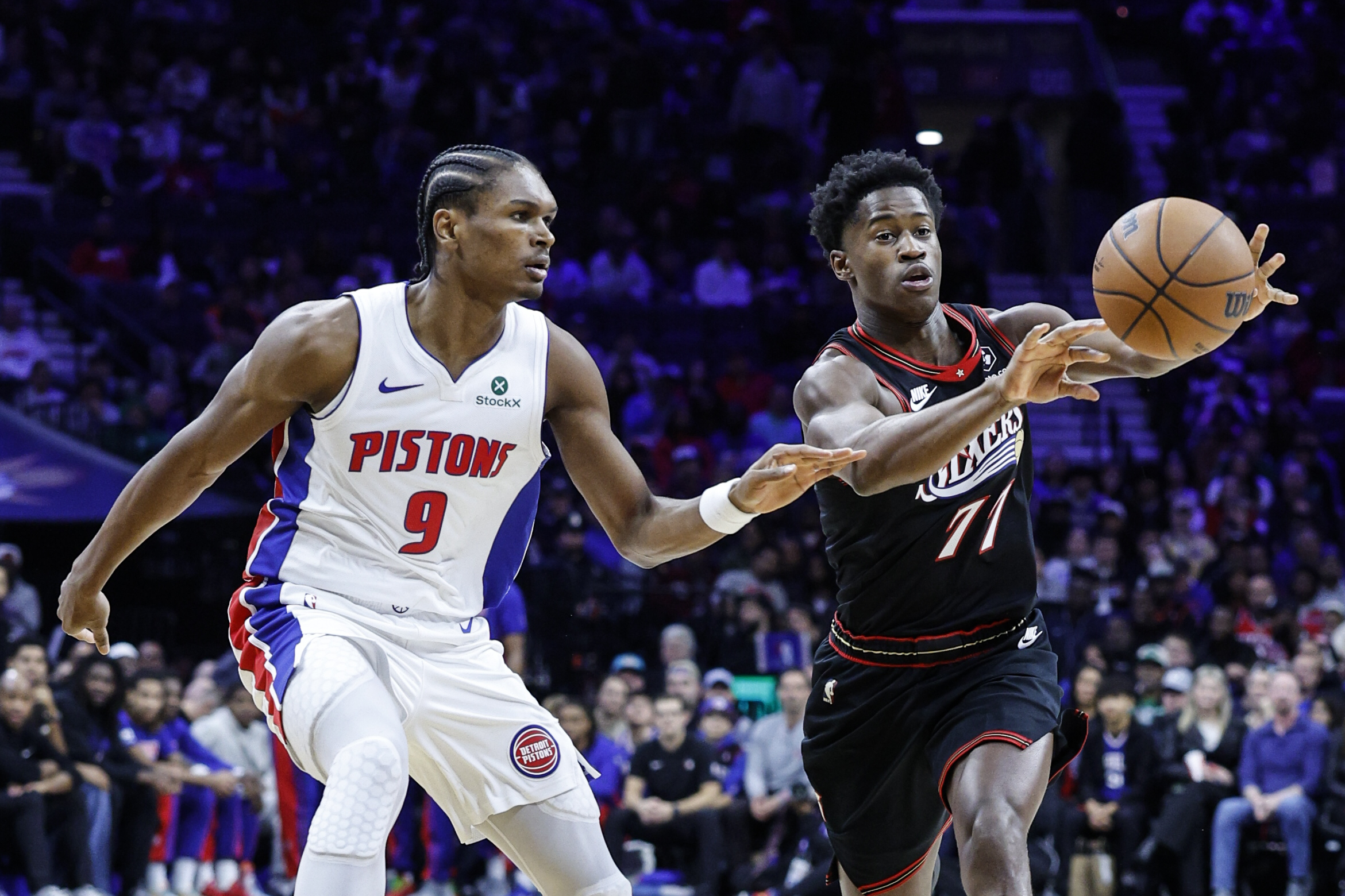
That has transpired in the Sixers’ past three games. One change was out of necessity, when wing Kelly Oubre Jr. went down with an LCL sprain in his left knee in the second quarter of last Friday’s loss at the Detroit Pistons. But Wednesday night, Quentin Grimes and Trendon Watford replaced starters Justin Edwards and Dominick Barlow in the first group to play after the break.
That approach placed Grimes on a better rotation pattern for the closing lineup, with which he scored 15 of his 21 points in Wednesday’s fourth quarter. It also allowed the coaching staff to make judgments in real time, to cater to specific matchups or ride a role player who excelled in the first half.
“It just changes the rhythm of the start of the second half,” Nurse said in Cleveland. “It doesn’t mean you’re penalizing anyone in particular. Just trying to look for solutions.”
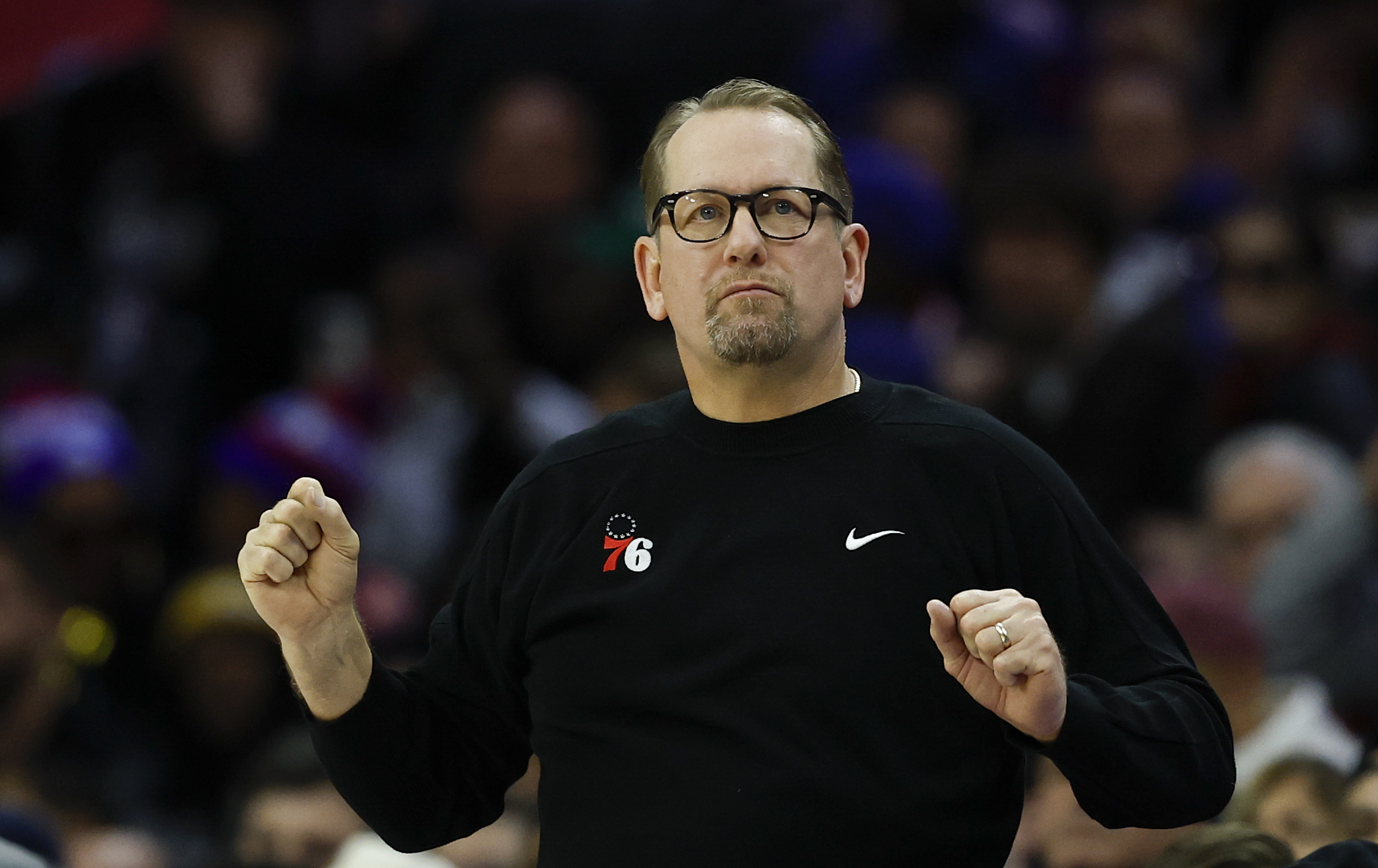
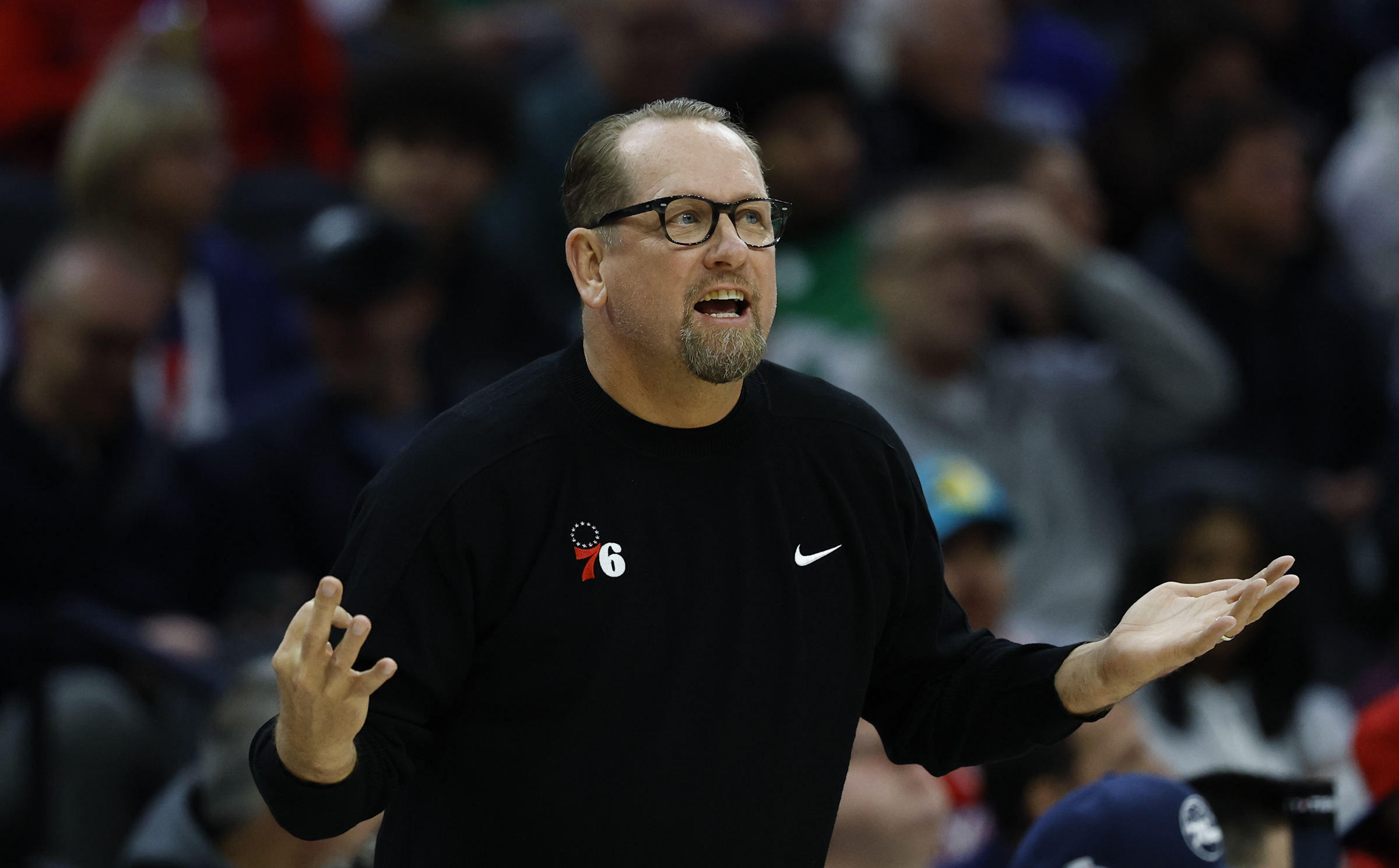
Sixers head coach Nick Nurse and his teams are still trying to figure out their fourth-quarter issues.
That lineup tweak, however, did not solve the issue Wednesday. The Raptors began the third on a 10-2 run, and never surrendered the lead after that.
And perhaps the third-quarter gaffes are even more glaring because of the Sixers’ knack for clawing back in the fourth quarter.
They have already played an NBA-leading 12 “clutch” games, going 7-5 in such situations. They also have already tied an NBA record for most victories by a team that entered the fourth quarter trailing by double digits, with four.
It looked like the Sixers might be on their way to such a result again, when a Grimes three-pointer capped a 24-12 run to slash the Raptors’ lead to 109-106 with 5:25 to play. But the work required to rally meant the Sixers could not afford defensive miscues down the stretch, which helped Toronto re-extend its lead.
Before making the quip about staying on the floor during halftime, Nurse bristled a bit at a question about the Boston Celtics outscoring the Sixers, 36-20, in the third before his team rallied to a Nov. 11 win. The coach said, “I’d rather be a better fourth-quarter team” because, “in the fourth quarters, we’re pretty damn good.”
But inside the Sixers’ postgame locker room that night, the phrase “30th in 3Q” had been written on a white board — with the word “STILL” in red. Ten days later, this is still plaguing a positive start to the season.
So why does the Sixers’ third-quarter problem persist?
“To be honest, we don’t know,” rookie VJ Edgecombe said. “If we had it all figured out, there would be no slow starts to third quarters.”
Kelly Oubre Jr. has suffered a sprained lateral collateral ligament in his left knee and will be reevaluated in two weeks, the Sixers announced Wednesday night.
Before the injury, Oubre was enjoying a terrific start to the 2025-26 season. The 6-foot-8 wing is averaging 16.8 points on 49.7% shooting and 5.1 rebounds, and often takes the most difficult perimeter defensive assignment.
Without Oubre, who was logging nearly 35 minutes per game before he was hurt, the Sixers’ options at small forward include Justin Edwards (who started Wednesday against the Toronto Raptors) and Paul George (who made his season debut Monday).
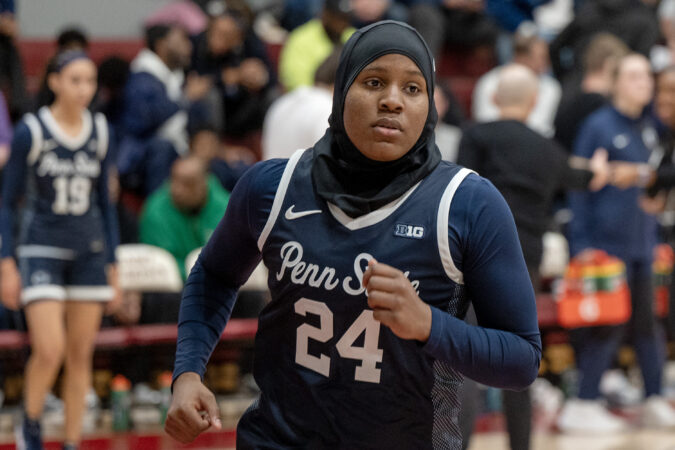
Shayla Smith mingled on the Hagan Arena court Sunday afternoon, posing for a photo with St. Joseph’s guard Kaylinn Bethea.
The brief reunion with a former Philly Rise EYBL teammate was one reason Smith said it felt like “a breath of fresh air” to be back in her hometown. It was her first trip as a Penn State player, after becoming the city’s all-time scoring leader for high school boys’ and girls’ basketball last spring.
“It definitely feels good to be back here,” Smith told The Inquirer. “ … Just coming back home, seeing everybody, all my people.”
An undisclosed injury kept Smith from playing in the Nittany Lions’ 89-77 victory over St Joe’s. Yet the former Audenried superstar is embracing the beginning of her college career, and coach Carolyn Kieger expects Smith to “drastically” help a 4-0 Penn State this season.
“I wish she was 100% to play in her hometown today,” Kieger said postgame. “ … I’ve been really impressed with her work ethic and how she’s kind of been just soaking up learning and growing.
“It’s an unfortunate injury there, but she’ll be back healthy and ready to rock here in no time.”
Smith has played 19 total minutes during two of Penn State’s first four games, going 3-of-7 from the floor for six points along with four rebounds, two assists, two steals, and one block.
But the 5-foot-9 freshman guard believes she has already improved since arriving on campus for summer workouts. Physically, Smith feels stronger and faster. Mentally, she feels more decisive, a necessity in Kieger’s “0.5” offensive system that requires players to begin to shoot, pass, or dribble in less than a second.
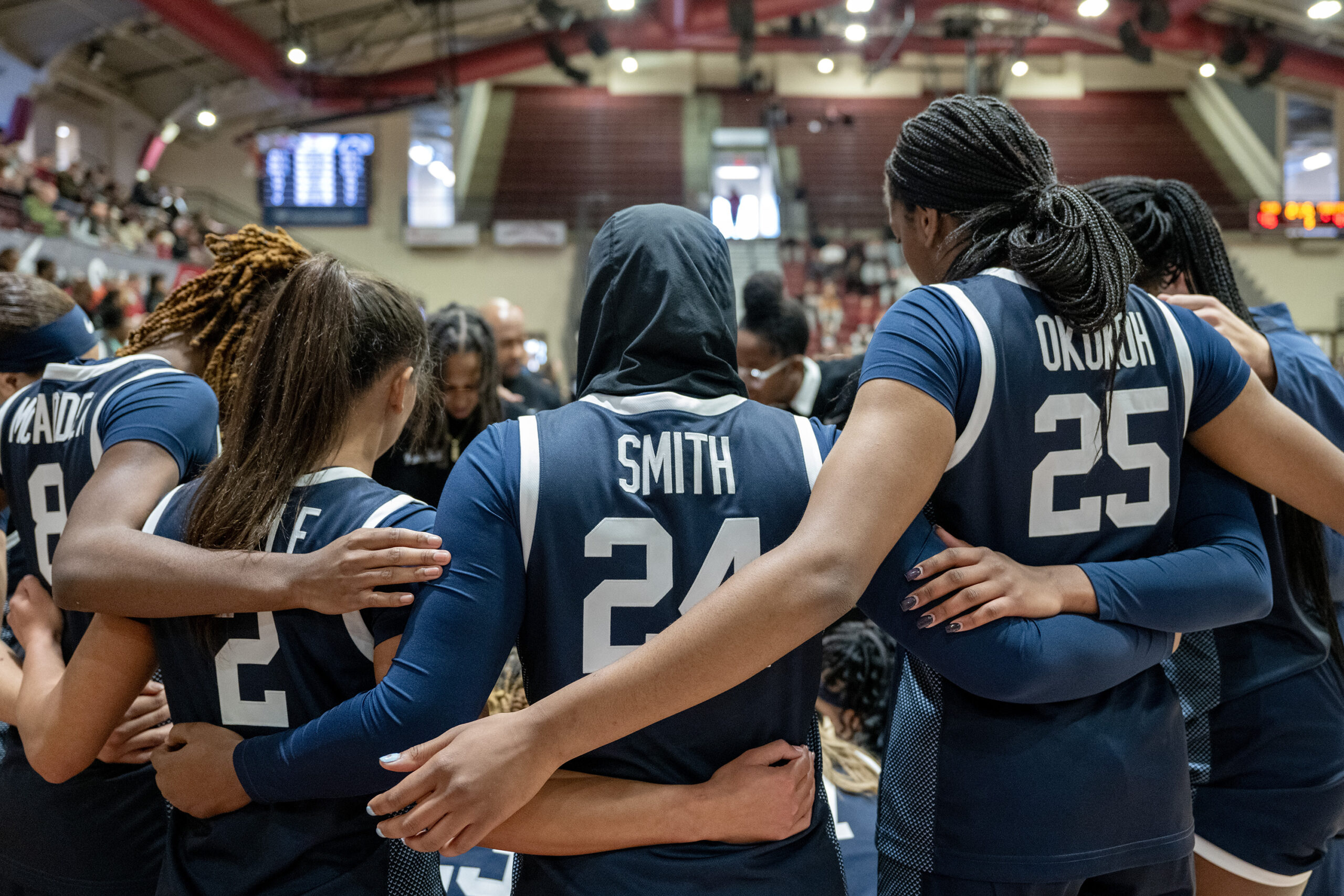
Penn State freshman Shayla Smith (center) has played 19 total minutes this season.
Smith also has concentrated on being a more vocal teammate, a noticeable emphasis while she watched Sunday’s game from the bench. She emphatically clapped when the Nittany Lions surrendered a layup on their opening possession, clearly aiming to motivate those on the floor. She stood up, lifted three fingers, and hollered “Yeah!” when Vitória Santana buried a three-pointer that gave Penn State an 86-74 lead with 1 minute, 37 seconds remaining. Smith applauded as her team dribbled out the final seconds of a game often played at a frenetic pace.
Kieger said she envisions utilizing Smith’s frame and skills on both ends of the floor. She is an obvious three-level scorer who can shoot from beyond the arc and muscle her way inside. Those attributes fueled a decorated high school career in which she amassed a record-breaking 2,691 career points and averaged 27.5 points as a senior. Smith also has the capability to guard multiple positions, Kieger said.
“I’m going to bring my physicality as a guard,” Smith said. “Just my attack mindset. Just embracing my role. Trying to be the best at what they need me to do. … When I get my chances, just do what I can do. Play my game when I get the chance.”
Heading to Happy Valley also has meant adapting to college life. Though Smith quipped that she enjoys “just being able to do whatever I want and nobody saying anything,” these early months have been a test in time management. A diligent gym rat, Smith has been learning when to squeeze her individual workout time in between classes, practices, and other team obligations such as alumni events.
“There’s always something to do,” Smith said. “ … I’ve just got to find the time to work on my craft and still be on top of everything else.”
While recovering from this injury, Smith said she has been trying to make the best of observing how the game unfolds from a pulled-back perspective. That was a rarity when the offense flowed through her as a record-breaking high school player, who was a three-time All-State honoree and anchored Audenried’s three-peat as Public League champions.
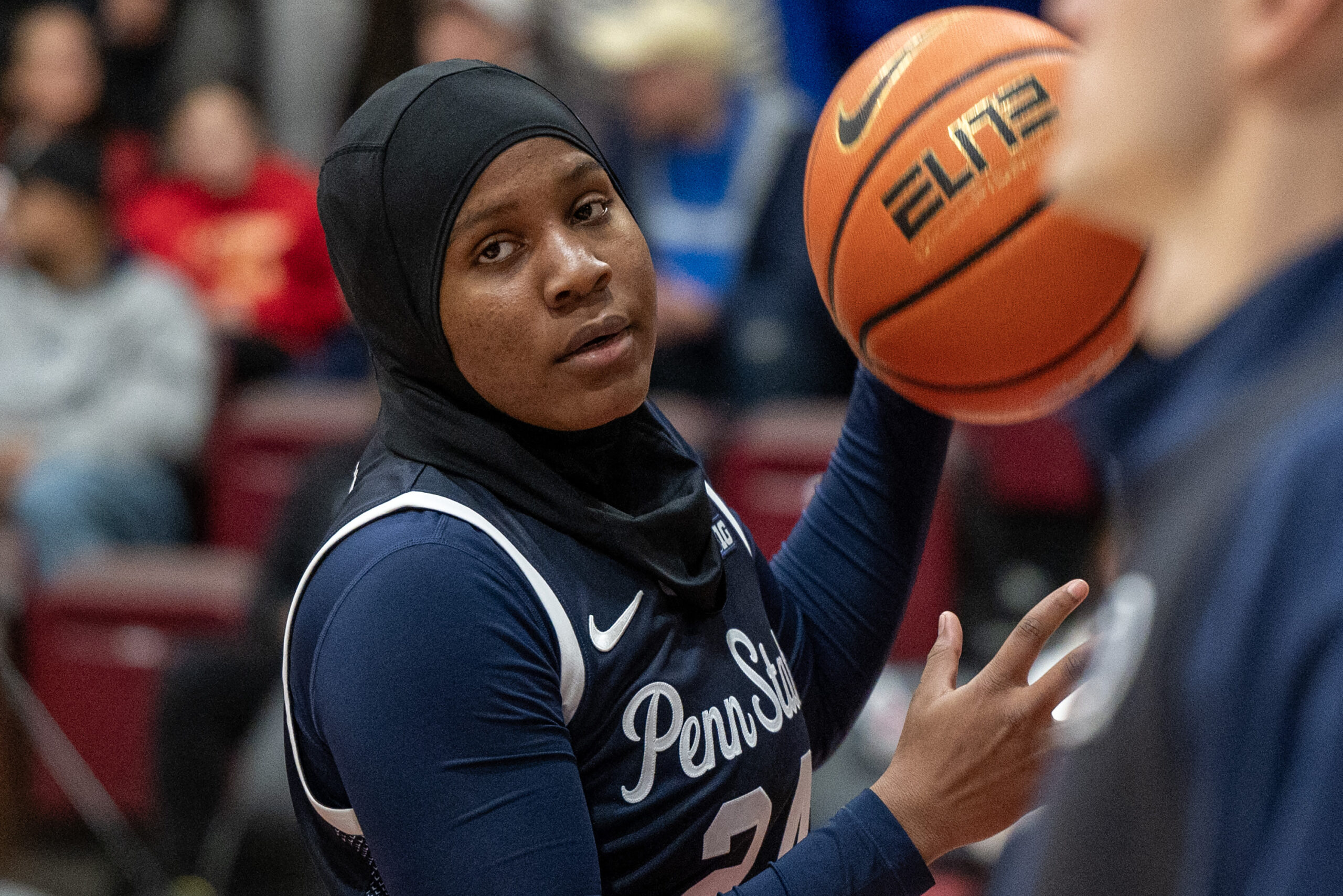
Shayla Smith, the former Audenried standout, did not play in Penn State’s win over St. Joseph’s on Sunday because of an injury.
And spending Sunday’s return to Philly on the bench has made her “eager” to truly get her college career underway.
“I just want to be a great teammate [and] master my role,” Smith said. “Bring my physicality. Bring everything that I can. I want to contribute, and help the team make it to the NCAA Tournament and Big Ten championship.”
When Paul George received an opening-minute pass from Tyrese Maxey and let the three-pointer fly from the right wing, his stoic backpedaling as the ball splashed through the net did not exactly convey his actual feelings.
“I watched it, and there were so many emotions inside,” George later said. “There were zero emotions outside. Honestly, I was just trying to focus on just the game and staying locked in and engaged, but it felt great to make the first shot.”
Monday was far from the first time George has taken the floor after a monthslong injury recovery, but he used the words “rusty” and “rewarding” to describe his first NBA game action since early March. He totaled nine points, seven rebounds, three assists, and two blocks in 21 minutes, 6 seconds of the 76ers’ 110-108 victory over the Los Angeles Clippers at Xfinity Mobile Arena.
“It was a long journey,” George said at his locker following the Sixers’ win over his former team. “A lot of ups and downs. A lot of hiccups. But felt good to finally get back out there.”
Clippers coach Tyronn Lue — who is more than familiar with George’s game and injury history — quipped before tipoff that he “just [hopes George is] not himself tonight.” Yet it would be unreasonable to expect a 35-year-old George to immediately return to All-Star form following a July arthroscopic knee surgery — and while limited to roughly five-minute stints at the beginning of each quarter.
It took George less than 60 seconds to record his first block, rebound, and points of the season. Sixers coach Nick Nurse said he considered running plays specifically for George, but instead opted to see what opportunities the 6-foot-8 wing would organically discover in a revamped offensive scheme that emphasizes pace and passing.
George went 2-of-9 from the field, an indicator of that rust. Yet Nurse appreciated George’s commitment to rebounding and instantly slinging the ball ahead in transition — like in the second quarter, when he found a streaking Quentin Grimes, who drew a foul. The lack of offensive rhythm, George said, could be attributed to pushing to regain his game-level cardio and conditioning in those abbreviated stints.
“Before you know it, five minutes is up, and then [you’re] getting subbed out,” George said. “I’ve always kind of let the game come to me. I thought today I was a little rushed, trying to make the most of that five minutes every quarter. A lot of possessions were kind of uncomfortable from just how I play.”
Paul George showed rust in his return but contributed as the Sixers moved to 8-5.
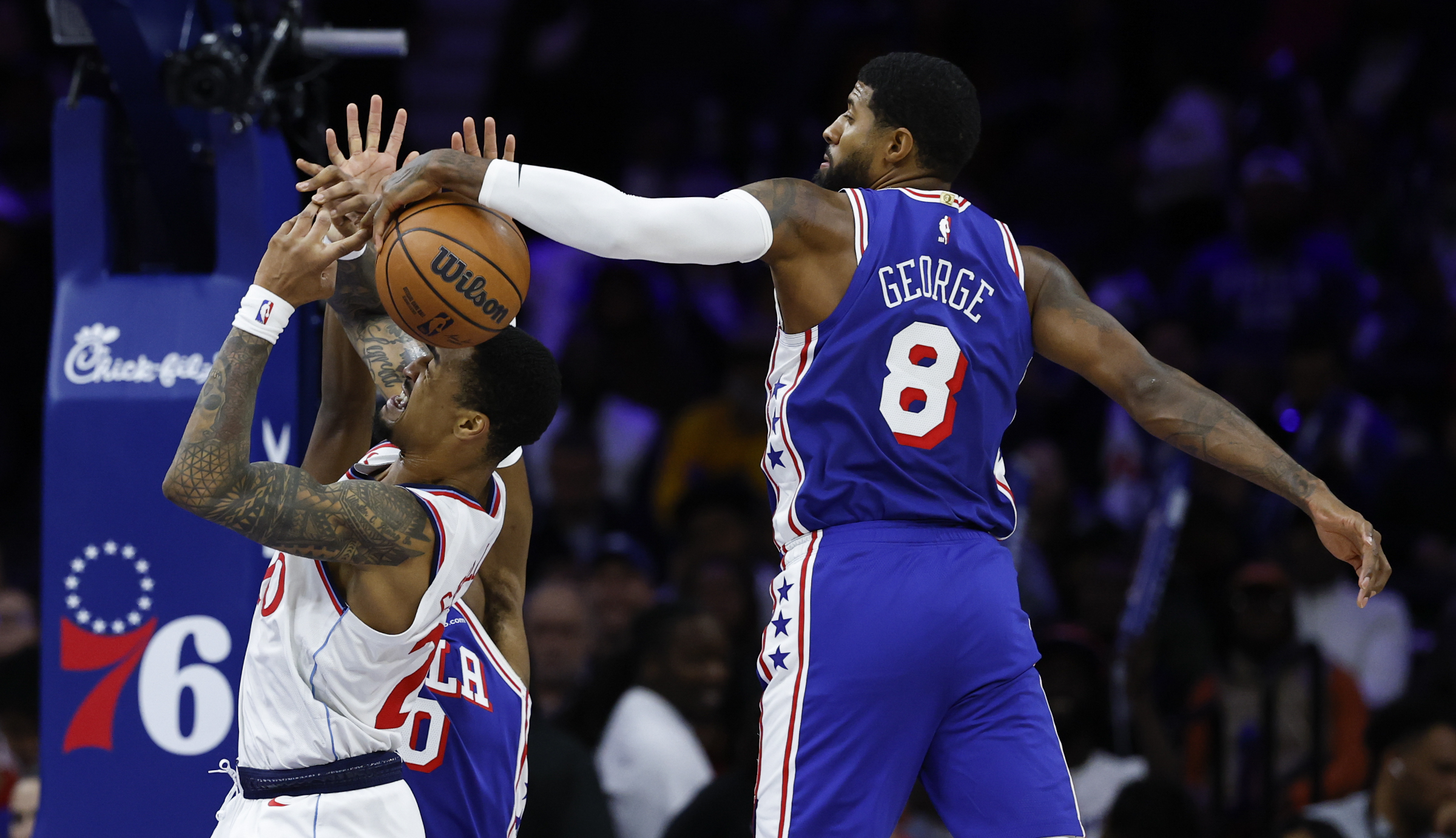
The internal reviews for George were higher on defense, the end of the floor where Nurse was more eager to observe George’s impact. George said he rolled through a mental checklist, clocking that he could slide his feet, stay in front of ballhandlers, and “just fly around.” In the third quarter, for instance, George elevated to block a John Collins floater and pinned the ball to the side of his body.
“Right away,” George said, “it was like, ‘All right, I’m ready for this. I can move. I can react. I can play physical. I can beat the guy to his spot. I can rebound.’”
Monday’s outing marked George’s latest comeback in a decorated career interrupted by injuries. In his first season with the Sixers, he battled multiple knee issues — plus a finger injury that eventually required painkilling injections in order to play — before being shut down after 41 games.
Then came a “freak accident” during an offseason workout, restarting George’s recovery timeline after knee surgery.
George made his presence felt on defense, including in a block of a John Collins shot.
Though George had been practicing with the Sixers for about a month, his left quadriceps muscle “was just weak from being shut down for so long,” he said. George went through a strengthening program targeting that muscle, with extra reps on the left side of squats and leg extensions. He said he had a “huge breakthrough” a few days ago, when the measurable data on his left quad finally matched his right.
“That was kind of the stamp,” George said, “to go along with how I felt on court and to be clinically cleared.”
From here, George and the Sixers’ medical team will monitor how his body tolerated Monday’s workload. The Sixers already have evidence that long-term injury recovery does not always occur in a straight line.
Joel Embiid missed his fourth consecutive game Monday with right knee injury management, even amid a cautious plan with minutes restrictions and scheduled absences to aid his left knee that has undergone multiple surgeries. Jared McCain, who missed nearly 11 months after knee and thumb surgeries, has not scored a point in four games since his return earlier this month.
The Sixers’ injury history with Joel Embiid and others shows that recovery timetables are not always linear.
And there are legitimate questions about George’s ability to ever rekindle his perennial All-Star production or whether he will be more of a veteran role player with this iteration of the Sixers’ roster. After signing a max contract as the NBA’s most coveted free agent during the 2024 offseason, George struggled to get by defenders in his first season in Philly. He averaged 16.2 points — his lowest scoring average over a full season in more than a decade — along with 5.3 rebounds, 4.3 assists, and 1.8 steals.
When asked about his role at media day in late September, George said, “I do think I’ve still got a lot of game in me.” Following Monday’s game, George added that he hopes his offensive creation can take some pressure off Maxey, who amassed another 39 points and six assists in 40:57 against the Clippers. But George also recognizes that teammates, such as Grimes and rookie VJ Edgecombe, also can put the ball on the floor and make plays for a Sixers squad that is off to a surprising 8-5 start and entered Tuesday ranked seventh in the NBA in offensive efficiency (117.8 points per 100 possessions).
“That’s really why our team is special and so versatile,” George said. “So [I’m] just trying to fit into what the guys are doing now.”
George, though, still holds gravitas within the Sixers locker room. Fellow veteran Andre Drummond called him “very smart” on both ends of the floor. Maxey praised George’s defensive presence. And Edgecombe said sharing the floor with George for the first time brought out his “inner child” who was a “big fan” of his while growing up in the Bahamas.
“I wanted him to get going early,” Edgecombe said of George. “At least feel the ball, feel the flow of the game.”
By crunch time, though, George had a towel draped over his shoulders while standing with teammates to watch the final possession unfold. When the Clippers’ James Harden missed two potential game-winning three-pointers, George lifted his arms into the air in celebration.
Finishing the game on the bench illustrated how much reacclimation remains for George. But making his season debut — and that first shot — was a start.
“It felt great to finally play basketball again,” George said.
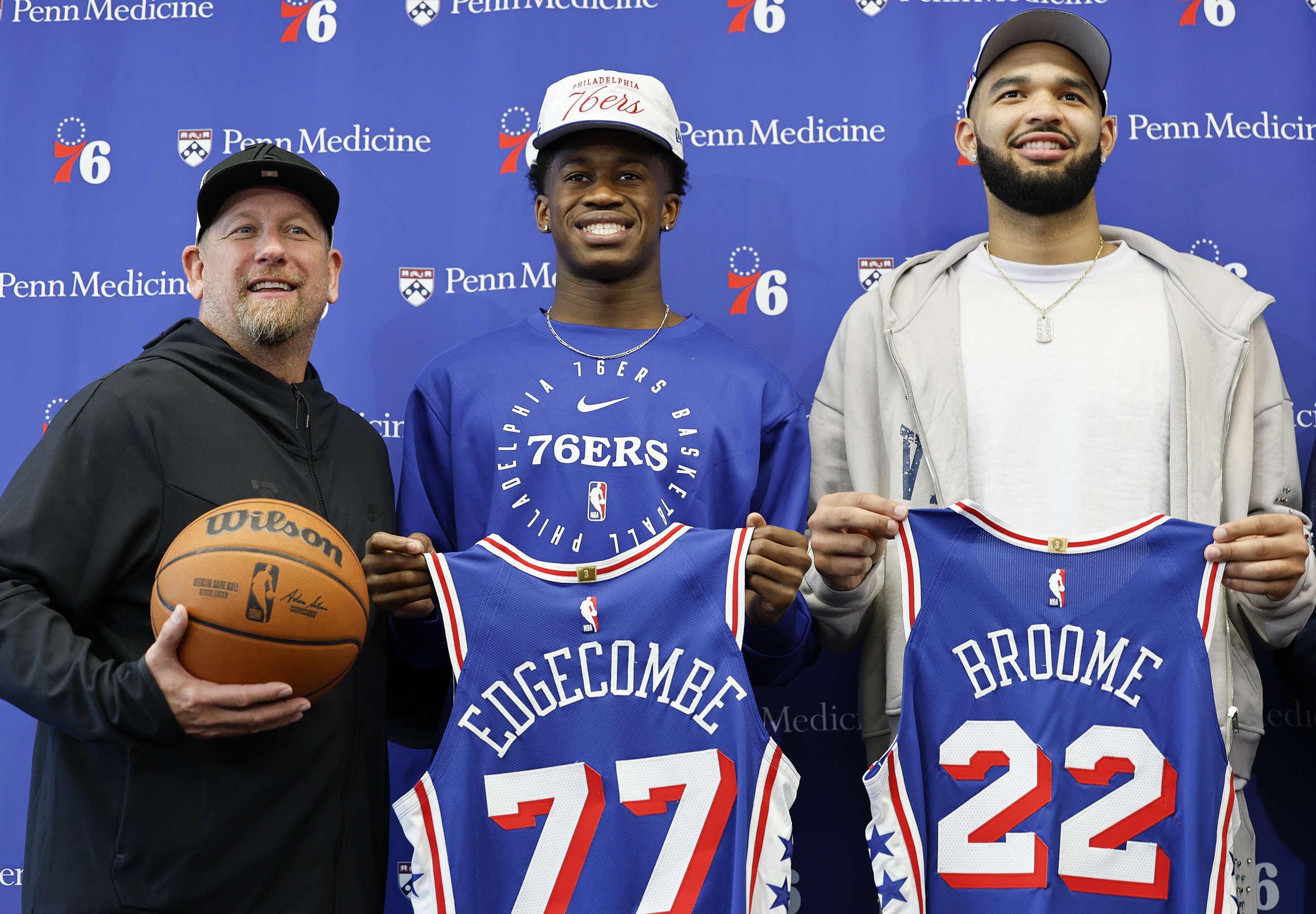
As VJ Edgecombe prepared to leave the 76ers’ locker room Sunday, following the team’s second set of back-to-back games in less than a week, veteran teammate Andre Drummond noticed the rookie looked “exhausted.”
So Drummond offered direct instructions for Edgecombe heading into the Sixers’ mandatory off day.
“Don’t get up until 6 p.m. tomorrow,” Drummond publicly reiterated in front of reporters a few minutes later. “6 p.m., VJ. So if you see this, keep your [butt] in bed.”
Perhaps no Sixer will benefit more than Edgecombe from this light stretch of the Sixers’ early schedule, when their only game in five days is Friday at the Detroit Pistons. After a torrid scoring start — including a historic 34-point outburst in the Sixers’ opener at the Boston Celtics — Edgecombe has shot 27.9% (17 of 61) from the floor and 25% (5 of 20) from three-point range and averaged 9.4 points during his past five games.
The mini slump is understandable for a rookie going through the demanding 82-game NBA schedule for the first time, and playing heavy minutes for a competitive Sixers team in record (7-4) and in number of “clutch” games played (nine, tied for the NBA lead entering Thursday). And there is no substitution for Edgecombe simply experiencing the grind.
“It’s not weighing on me,” Edgecombe said of his recent struggles. “Why I say it’s not is because it’s an 82-game season. Nobody’s going to remember these games early. I mean, I’m a rookie, man. I’ve got to give myself some grace. Obviously, I set a pretty high standard when I came and had a good debut scoring the ball.
“But at the end of the day, I just want to win. That’s the main thing for me. I just want to win.”
Coach Nick Nurse said that Edgecombe’s “tremendous engine” — the 20-year-old guard can “work really long days, and then do it again the next day,” the coach added — and mental fearlessness have been present since the Sixers drafted him this summer.
Sixers Vj Edgecombe has shot 27.9% from the floor and 25% from three-point range and averaged 9.4 points during his past five games.
That motor has already been put to use. Entering Thursday, Edgecombe ranked second in the NBA in minutes played (37.3 per game), only behind teammate Tyrese Maxey (40.5 per game). And after playing 35 total games his one college season at Baylor — “and 12 of them don’t really count,” Nurse quipped — Edgecombe logged 11 NBA games in less than three weeks. That included three back-to-backs, which Edgecombe acknowledged was “tough for me personally.”
“I don’t know if I can prepare myself for that,” Edgecombe said.
And it is not just the avalanche of games, but everything in between. Last week, the Sixers completed their first multigame road trip to Brooklyn, Chicago, and Cleveland. That typically means leaving one city immediately after a game, landing in the next city in the middle of the night, then needing to be ready to jump into practice or game preparation a few hours later.
Maxey said Tuesday that, in Year 6, he has just begun to figure out a maintenance routine that works for him. Justin Edwards, who was a rookie last season, learned preventive treatment such as sitting in a cold tub, “flush” massages, and red light therapy are crucial.
So far, Edgecombe spends nights without a game sitting on his couch in recovery boots that alleviate leg soreness. On game days, he takes a nap and speaks to his family. His goal is to keep his mind peaceful, following a mantra from high school coach John Buck that “you can’t be grateful and stressed at the same time.”
Edgecombe had already earned the trust of teammates and coaches with his work ethic and temperament. Nurse praised that Edgecombe was “everywhere” the team asked during the offseason, even canceling a visit home to the Bahamas.
That is why Nurse was not hesitant about immediately inserting Edgecome into the starting lineup. Or keeping him with the closing group, even when he struggled with his shot or turnovers earlier in the game. Edgecombe is already one of the Sixers’ better perimeter defenders. He also always has the potential to flash his insane athleticism as a driver or finisher. And he has already shown a knack for knocking down clutch shots, while averaging 15.4 points, 5.5 rebounds, and 4.3 assists so far this season.
“He’s got great composure. He’s calm. He doesn’t make too many mistakes,” Nurse said. “I super believe in him. … He needs to be out there and learn this stuff, and he’s produced.”
Like during the Sixers’ win over Celtics Tuesday night. Edgecombe missed eight of his first nine shots, including an air-balled three-pointer to begin the third quarter that prompted him to mouth “Oh my God” in surprise (or self-deprecation).
Sixers guards VJ Edgecombe and Tyrese Maxey occupy the NBA’s top two spots in minutes played per game.
But with about five minutes remaining, Edgecombe elevated to block All-Star Jaylen Brown’s dunk attempt, then pushed the ball ahead to Edwards for a three-pointer. Then with 2 minutes, 20 seconds to play, Edgecombe let an open three-pointer fly — and watched it bounce high off the rim and through the net to give the Sixers a four-point lead. Perhaps that was a reward for Edgecombe’s summer work to get more arc on his shot, and “give it a chance to get in the rim,” he said.
“It’s been a rough couple days, but I won’t stop shooting the ball,” Edgecombe said. “I will continue shooting the ball if I’m wide-open, if it’s the right shot.”
That is one of several on-court lessons for Edgecombe during these first 11 games. Another is that he cannot expect to outjump competitors for a rebound, because “they’re 7-foot and they’re gonna get there quicker than me.” Nurse added that Edgecombe must get downhill more aggressively while playing alongside Joel Embiid, in order to draw the defender away from the former MVP and open opportunities for Edgecombe to pass to a rolling or popping Embiid. Even the speedy Edgecombe notices the increased pace at the NBA level, and that he needs to sharpen his defensive positioning.
And though Edgecombe feels empowered by coaches and teammates to be himself on the court, Nurse acknowledged Thursday that the staff can more deliberately put Edgecombe in situations with the ball in his hands.
“Come hell or high water, this is your play,” Nurse said. “Go make something happen.”
After Tuesday’s sputters, Edgecombe believes he is “due for a game to get back on track.” Nurse added that Edgecombe’s past two days have been filled with “constant film work,” which is “still [a] pretty heavy load mentally, no matter if he’s on the court or not.”
But that approach does allow Edgecombe to take Drummond’s advice. On Monday, Edgecombe said he woke up after noon, then was back asleep by 5 p.m. So it is fair to assume he will aim to maximize this lighter early-season stretch, with one game in five days.
“When I get home, in my bed,” Edgecombe said, “that’s the best thing.”
NEW YORK — As a group of Columbia women’s basketball players struggled to break a press defense and advance the ball up the court, Megan Griffith’s voice rang through the gym.
“I need more active participation with your voice!” the coach said. “Can you please get back to playing like us?”
That is one of the go-to phrases that Griffith, a King of Prussia native, reinforces during this October preseason practice. They are all designed to “make things sticky” and keep the team process-focused, Griffith said.
“How you do anything, is how you do everything,” Griffith and standout guard Perri Page will both rattle off within the same hour.
Those callbacks have fueled a remarkable turnaround as Griffith enters her 10th season as the head coach at her alma mater.
Columbia was one of women’s college basketball’s worst programs for decades before clinching at least a share of three consecutive Ivy League regular-season championships and winning its first NCAA Tournament game in school history last season.
And it received an at-large bid to the Big Dance in each of the past two seasons, typically unheard of for Ivy League programs. The Lions are 2-0 to begin the 2025-26 season, heading into a marquee home opener against reigning Atlantic 10 regular-season champion Richmond Saturday night.
Griffith, a finalist last season for the Women’s Basketball Coaches Association’s Coach of the Year award, has displayed her Philly roots while making breakthrough after breakthrough during this rebuild.
There’s the influence of her high school coach, Villa Maria Academy’s Kathy McCartney, whose motivational style Griffith describes in a way that her current players now talk about her. And her childhood being raised by a father from Delaware County and a mother who immigrated from Hong Kong, before they met at Villanova. The emphasis on running a high-powered offensive system spearheaded by dynamic guard play? A no-brainer for a 40-year-old who grew up watching the Allen Iverson Sixers era.
That culture has already elevated Columbia to historic heights, and a stability Griffith and players now strive to protect. Now, the coach has the Lions believing they can — again — become the best team in program history.
“She’s a force,” Page said. “Honestly, do not mess with her. She is going to go out and get whatever she wants. … I can’t see myself playing for any other coach in the country.”
‘A determined little bugger’
Diane and Bob Griffith still are in awe when they watch their daughter coach, or when she speaks during news conferences. She actually was a shy kid in everyday life, taking hold of Dad’s pant leg whenever the family was out in public.
But as soon as there were competitive stakes, Megan turned into “a determined little bugger,” Bob said. Diane remembers a T-ball game when a young Megan rounded third base, and the umpire told Bob, who coached Megan’s youth sports teams, that “this kid can slide better than most adult men can.”
“Once that light turned on or that game clock started, she was tenacious, even as a small kid,” Bob said. “ … When you look back on it, she was probably one of the most aggressive kids out there on the court.”
Megan concedes today that she probably should have pursued soccer (“Look at me. I’m 5-5,” she quips). But she gravitated toward the intimacy of smaller basketball rosters and how the game never stops moving.
Neither did she, because she was fast. When Griffith first arrived at Villa Maria, McCartney remembers the teenage point guard could not always control her dribble in transition … because she literally outran the ball.
King of Prussia native Megan Griffith played her high school ball at Villa Maria Academy.
So McCartney told a steely eyed Griffith that she was not ready to play on the varsity team as a freshman. She needed to learn how to mold those natural athletic gifts into a ballhandler who could anticipate the defense’s next move. Griffith clocked that, while being coached by a woman for the first time, she was receiving a similar combination of intensity and care that her father provided in those settings.
“When I started getting [that tough love] from somebody else, it was like, ‘Oh, this is also how other people do this,’” Griffith said. “And it just really resonated with me. … That allowed me to really gain the confidence as a young woman, to then take that next step in my career and play college.”
By her senior high school season, Griffith was the point guard and defensive menace for a team that won its first 21 games. She had chosen to play for Columbia, which does not offer athletic scholarships, over an offer from LIU-Brooklyn.
And the hug McCartney and Griffith shared as she walked off the court for the final time as a high schooler has “stuck with me for years,” the coach said.
“It kind of solidified in my head the difference a coach can make,” McCartney said. “And I think — I hope — it has helped her in some way. I remember whispering in her ear, ‘You’ve got big things ahead of you, girl.’”
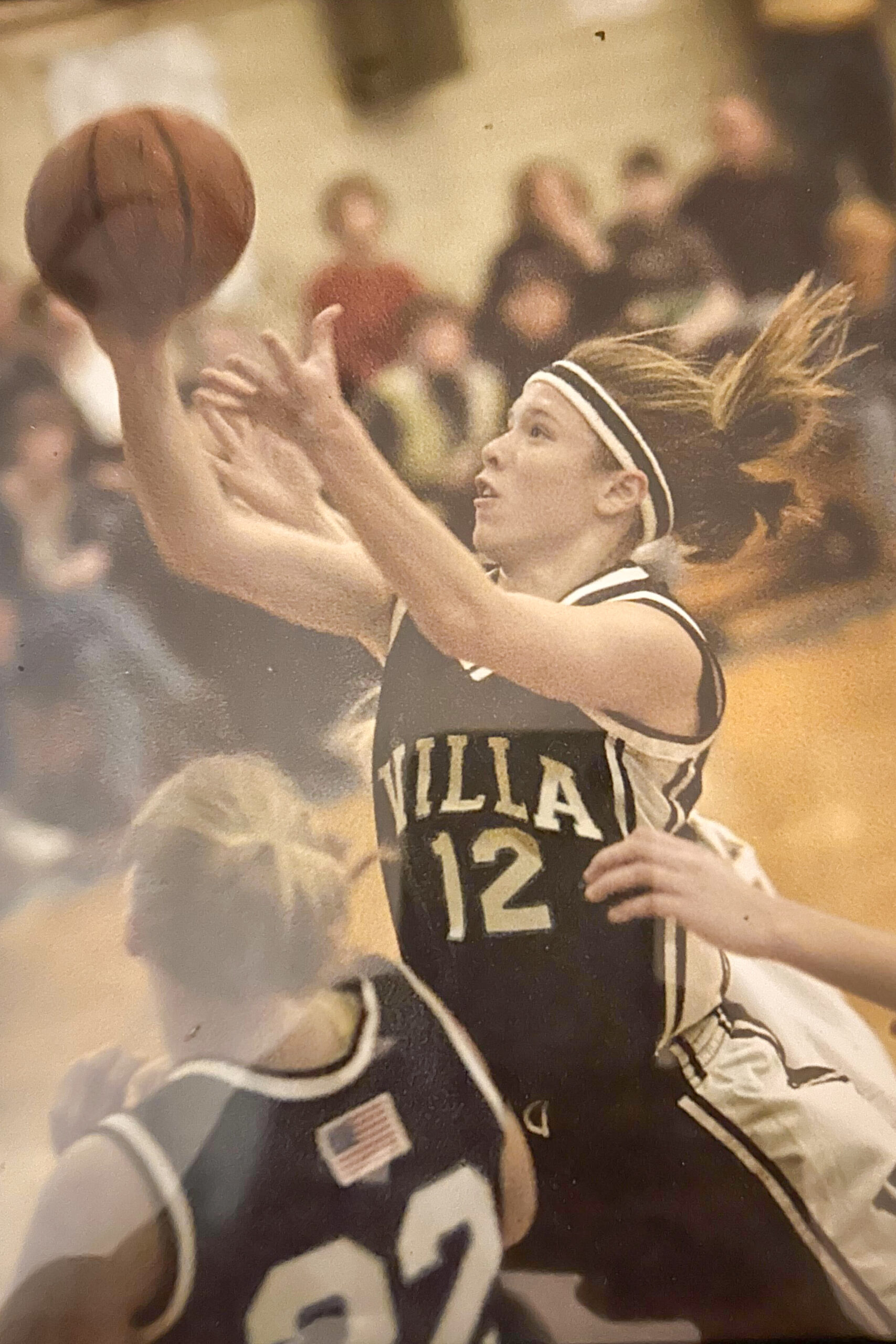
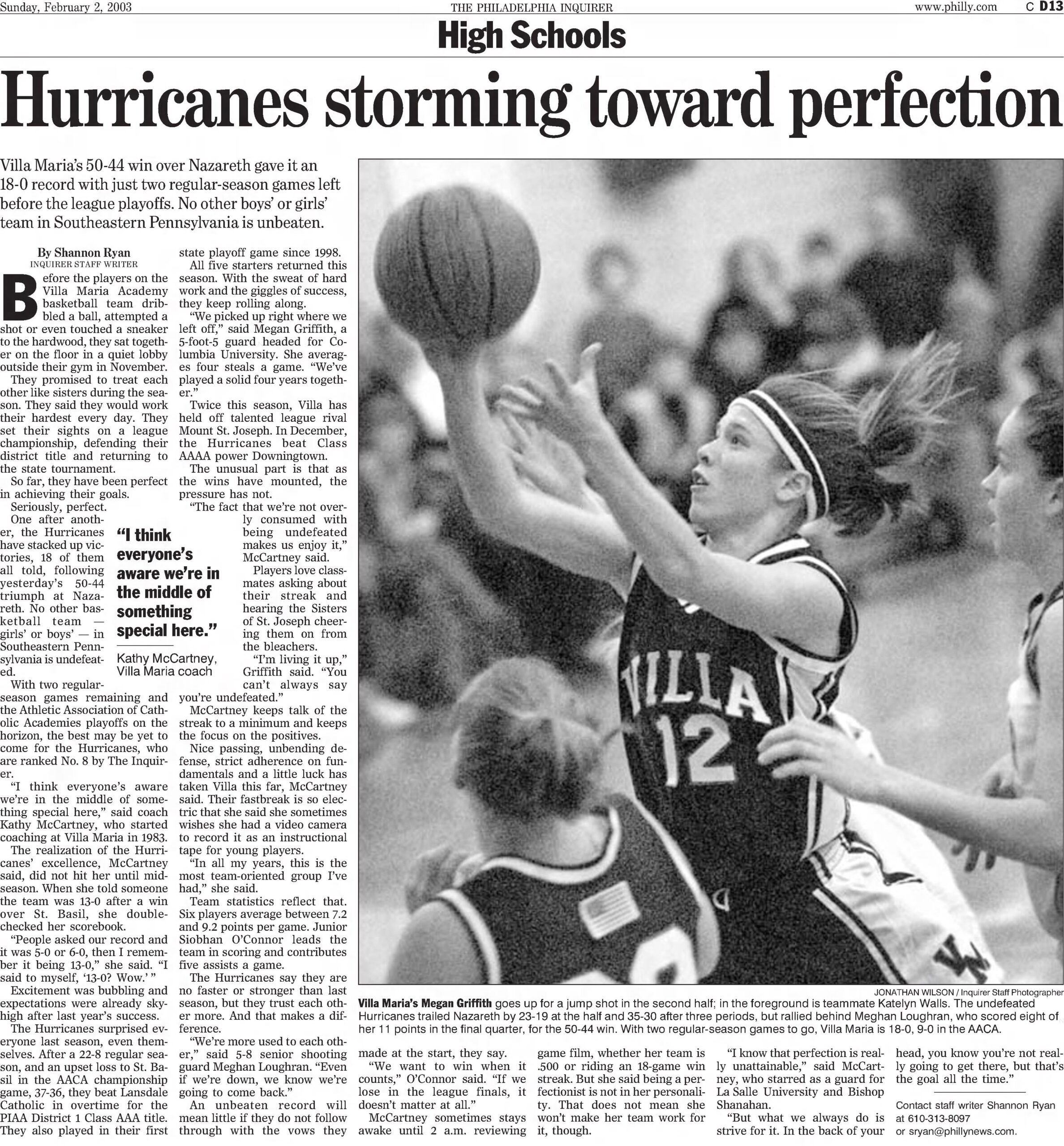
A clipping from the Philadelphia Inquirer sports section of February 2, 2003, showing Megan Griffith driving to the basket for Villa Maria Academy high school. Griffith is now the head women’s basketball coach at Columbia University.
‘I can go prove everybody wrong’
Columbia’s program was in a tumultuous state during Griffith’s playing career, from 2003 to 2007. She had four coaches in four seasons. The Lions’ record during that span was 38-70.
But that is where Griffith learned how to “stack days,” not just with her on-court training but in daily habits such as nutrition and sleep. Bob watched his daughter morph from a “very predictable” freshman who was “trying to please her coach too much,” to a 1,000-point scorer and two-time all-Ivy League selection.
“I was like, ‘Wow, I’ve had it the complete wrong way,’” Megan said. “I was so focused on the results all the time. Starting. Trying to come in as a freshman and change the program. I was like, ‘Wow, if I can just focus on what I can control …’”
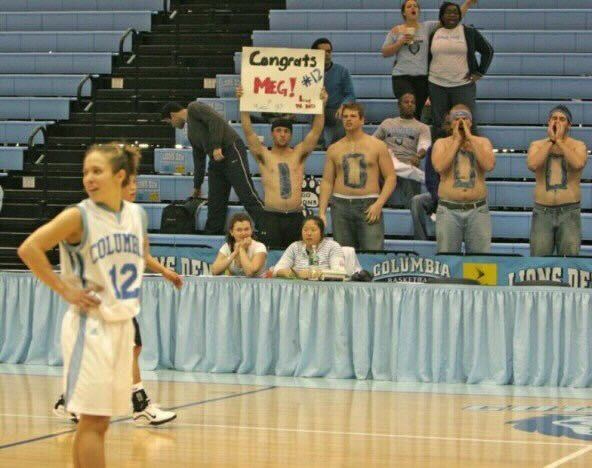
Megan Griffith was an 1,000-point scorer at Columbia. The King of Prussia native now coaches her alma mater.
She also had an Ivy League education and a job lined up at Lincoln Financial in Philly upon graduating with an economics degree. She turned that offer down to continue playing overseas in Finland and then the Netherlands.
Griffith called that experience “transformational.” She leaned into exploring her new surroundings and connecting with her local teammates. An assistant coach began involving her in game-planning and strategizing, which she said “channeled my competitive energy very differently.” She learned enough Dutch to help coach kids. When she came home during off-seasons, she held youth skills clinics.
“I could see just how these kids just looked up to her,” Diane said. “ … I think that was probably the first glimpse of her maybe, possibly becoming a coach.”
When Megan no longer found as much satisfaction in that daily grind, she knew it was time to pivot from playing. She was hired as the director of basketball operations at Princeton, and was intrigued by then-coach Courtney Banghart, who led the program to its first Ivy League title.
Banghart, now the coach at 11th-ranked North Carolina, quickly made Griffith the Tigers’ recruiting coordinator. Griffith was hesitant at first, instead wanting more tactical responsibilities. But she was organized and a people person.
“What I learned there is that, actually, the most important thing is relationships,” Griffith said. “You have to know things and be smart. But at the end of the day, everybody can learn an offense. But what do you do with talent? How do you get talent? How do you get people that are bought into a common language, and an ethos, and a culture?”
In 2016, Columbia’s head-coaching job came open. Griffith, then 30, went to athletic director Peter Pilling with a detailed plan on how she would run her alma mater. And she thought back to conversation in the car with her father, while she was still playing overseas.
“[I said], ‘Dad, I feel I’m meant for something, like, big and different,’” she said. “I didn’t know what that meant at that time. So when this opportunity came up it was like, ‘Wow, I can go prove everybody wrong.’
“And I love that. I love the underdog. That’s who I am at my core.”
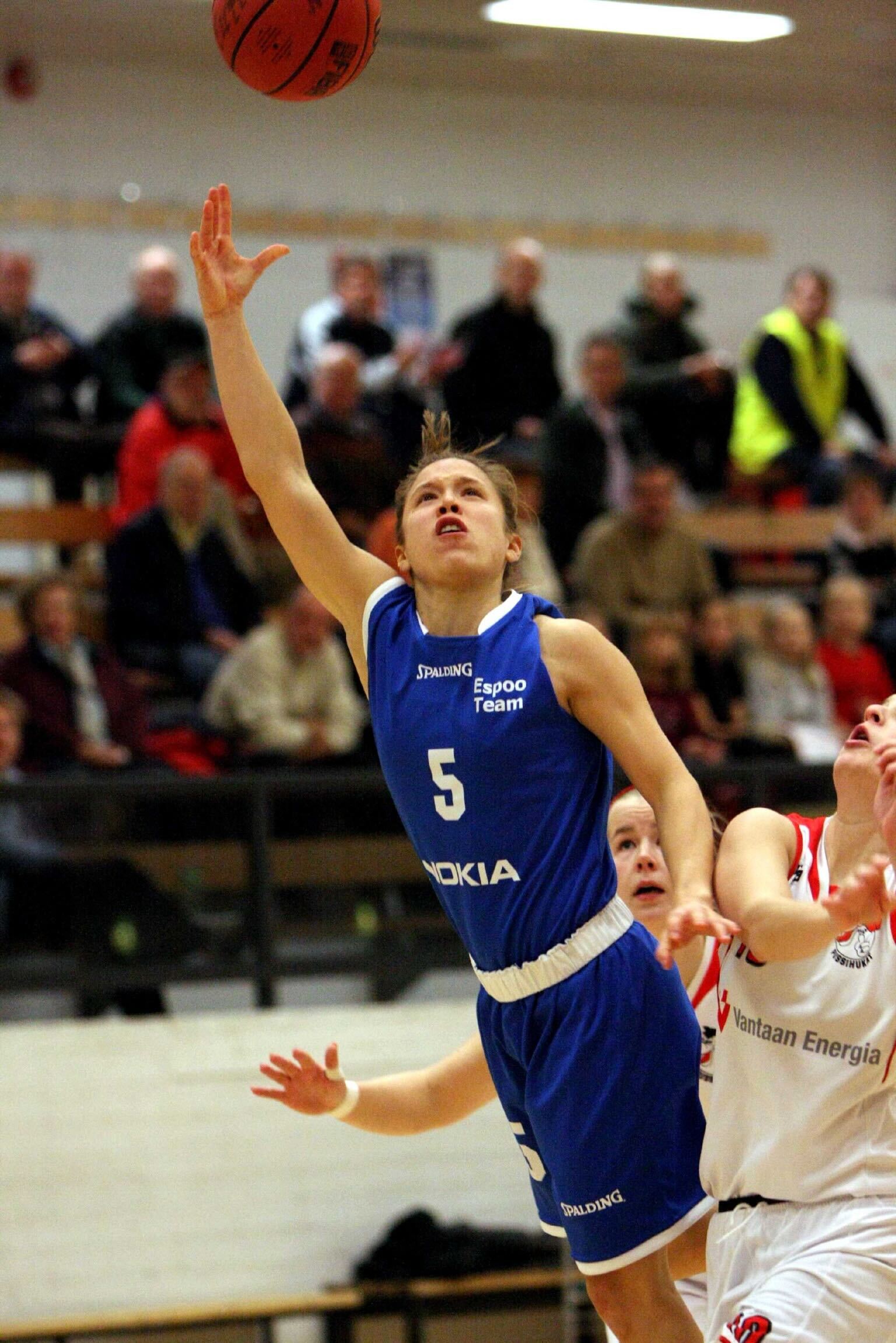
Megan Griffith played professional basketball in Finland.
‘It’s why you do it’
Tyler Cordell was “a little intimidated” the first time she spoke to Griffith. While interviewing for a job as Princeton’s director of basketball operations when Griffith was promoted to assistant coach, Cordell left the phone conversation thinking, “I don’t know if I’m smart enough to follow up in her footsteps.”
Now, Griffith and Cordell have worked together for 14 years. Cordell said it was a “no-brainer” to join Griffith’s staff at Columbia. Griffith calls Cordell an example of the “builders” the program needed.
“You start with the people,” Griffith said.
That meant thorough — and unconventional — recruiting.
The coaching staff went into southern states, such as Florida and Georgia. And internationally, to Spain and Australia. Today, nine players on Columbia’s 2025-26 roster are from outside the United States.
And there was perhaps nobody better to pitch Columbia than Griffith, who experienced the top-tier academics, limited athletic resources, and basketball struggles firsthand.
“It’s not like we’re in the same sandbox as a lot of schools,” Griffith said. ” … But we’ve never been.”
Griffith needed to power through the early on-court woes as a coach, including back-to-back eight-win seasons from 2017 to 2019 that left Diane worried about Megan’s health. Still, accolades began to surface. Their first victories over programs from the Atlantic Coast Conference (Boston College) and Big East (Providence). Their first Ivy League Rookie of the Year in Sienna Durr. The commitments of Abbey Hsu and Kaitlyn Davis, who became “young, hungry freshmen” and, eventually, conference champions and WNBA draft picks.
Those players could emulate an on-court style — with athletic, guard-heavy rosters that could pressure defensively and get out in transition — that led to sustained success for other mid-majors. It evolved into a system that, from 2022 to 2025, averaged more than 70 points per game.
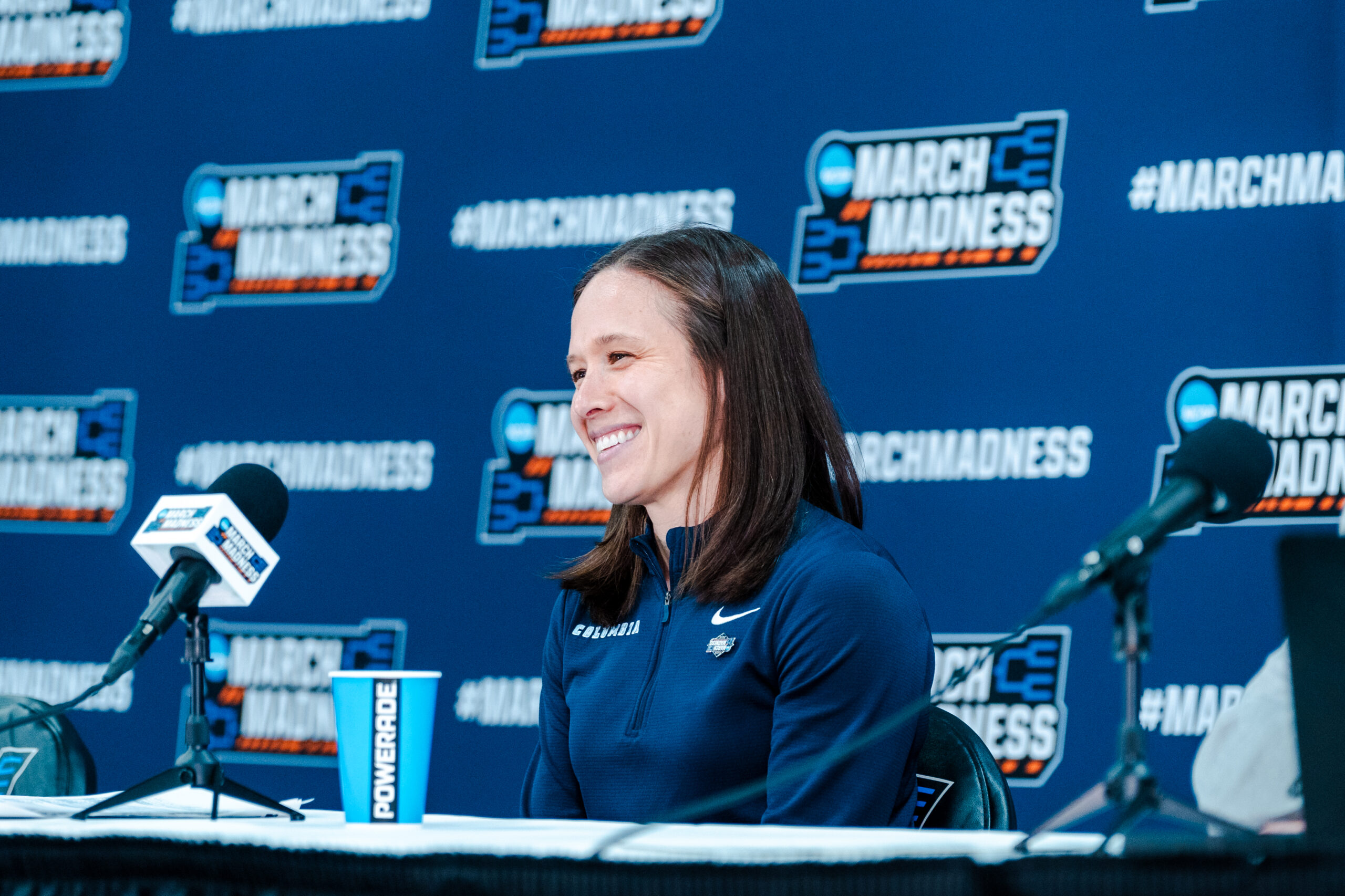
King of Prussia native Megan Griffith has built Columbia women’s basketball into an Ivy League power.
Griffith, meanwhile, strives to make people feel important, even when demands are high. She will get on a player’s case during practice, but then help them make their first resumé or ask about their dog. During the COVID-19 pandemic, when Columbia’s 2020-21 season was canceled, the staff created a space for players to talk. Page actually took her recruiting “visit” on Zoom and was blown away by the staff’s energy and attention to detail in less-than-ideal circumstances.
“That’s what made me say, ‘Wow, they put a lot of thought and effort into everything that they do,’” she said. “ … I was like, ‘If you can make this look good, imagine what it looks like on the court, too.’”
Once the Lions returned to to play, the avalanche of checkpoints continued.
A 2021 signature comeback win at Clemson? Check.
Qualifying for the four-team Ivy League tournament for the first time? Check.
Four consecutive 20-win seasons? Check.
Advancing to the WNIT quarterfinals in 2021, then the championship game the following season? Check.
First Ivy League regular-season titles, as co-champions in 2023 and 2024 and then as the outright winner last season? Check.
First NCAA tournament appearance in 2024, when they lost a tight First Four matchup against Vanderbilt? Check.
“That’s what’s been so cool about our journey,” Cordell said. “Because we haven’t skipped one step.”
The most recent: Last season’s NCAA First Four. The Lions at halftime flipped how they were guarding Washington’s post players, and rallied from 13 points down to win and advance to the round of 64.
“It was just the next thing we had to do in our journey,” Griffith said. “I feel like we manifested it, but at the same time, it was supposed to happen. …
“When the buzzer sounded, it’s why you do it. It’s why I’ve coached the last nine years — to be in that moment and be able to share that with my staff and this team.”
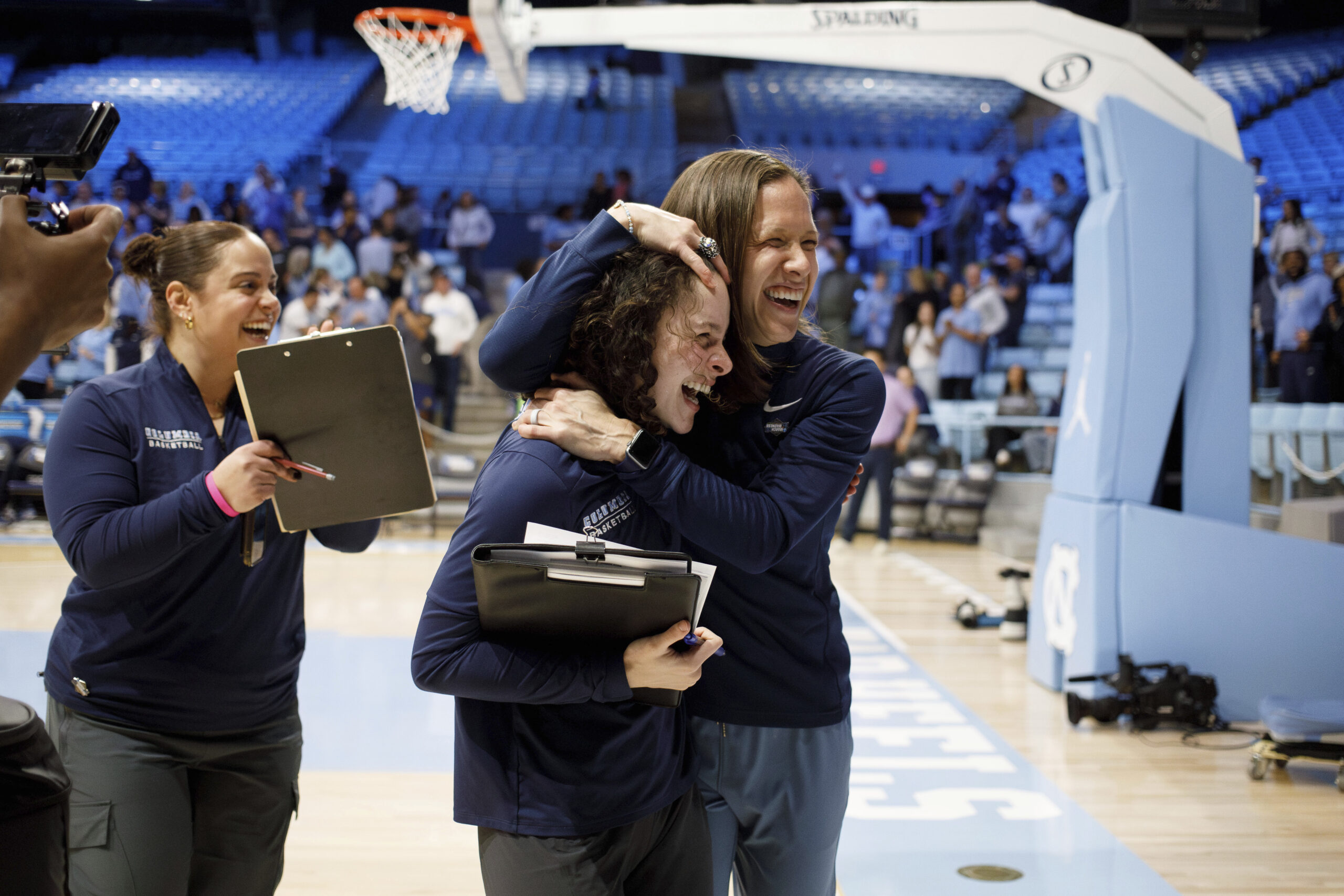
Columbia head coach Megan Griffith (right) celebrates with assistant coach Cy Lippold after beating Washington in a First Four game in last season’s NCAA Tournament.
‘Coach-led, player-fed’
Those back home also have relished in Griffith’s rise.
McCartney still texts Megan and her parents, and loves telling friends “that’s one of my kids” while watching Columbia play. Megan’s godmother, who lives in Australia, wakes up at 4 a.m. to tune in to games. Supporters are in the stands whenever Columbia plays Penn in Philly, where Griffith takes pride in those who knew her as a player recognizing similar qualities in her teams.
And Diane and Bob are regular visitors to campus. While watching a recent scrimmage, they noticed Megan being “really tough” on the freshmen. Up in the coach’s offices, a veteran told one of those first-year players, “She’s tough, but you have to listen to Coach. She knows what she’s talking about.”
“Yes, she yells at you a lot,” Diane said. “She screams in your face. You think she hates you. But she really does care about you, and she wants to make you a better player and person.”
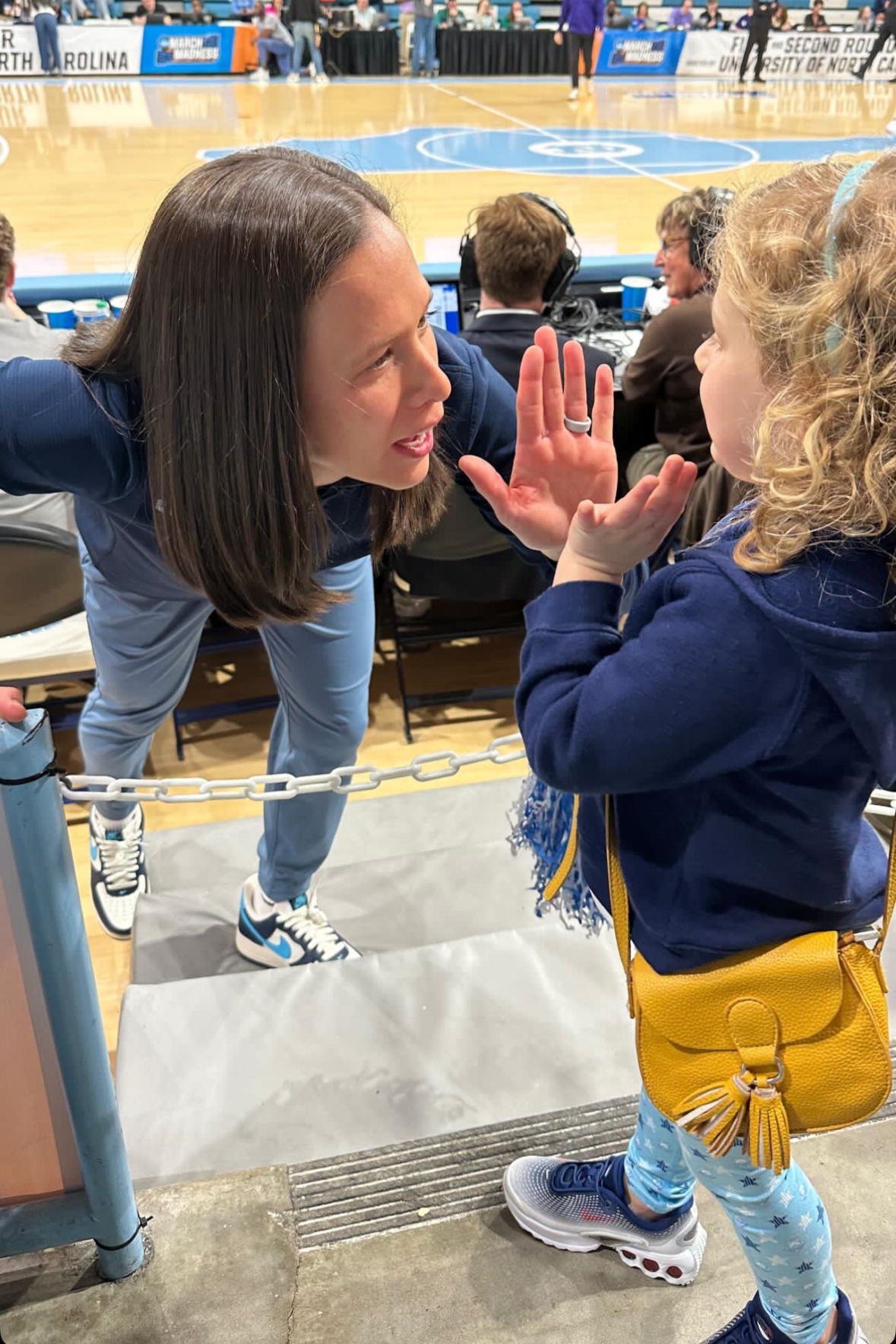
Columbia women’s basketball coach and King of Prussia native Megan Griffith (left) high-fives her niece, Carmen, who calls her Titi.
Like during that October practice, when new assistant coach Kizmahr Grell needed to tell Griffith to take a deep breath. The Lions have a taller roster and fewer ballhandlers this season, forcing some tweaks to their on-court identity. That was particularly apparent with Page sitting out this practice, prompting a direct challenge from Griffith to be a better leader from the sideline.
“It just gets me so fired up, too,” Page said of those interactions. “ … I take it, like, this is my program. This is my baby. When she gives a task, I am ready to attack it, always. Because I want to do right for her, but I want to do right for this program, as well.”
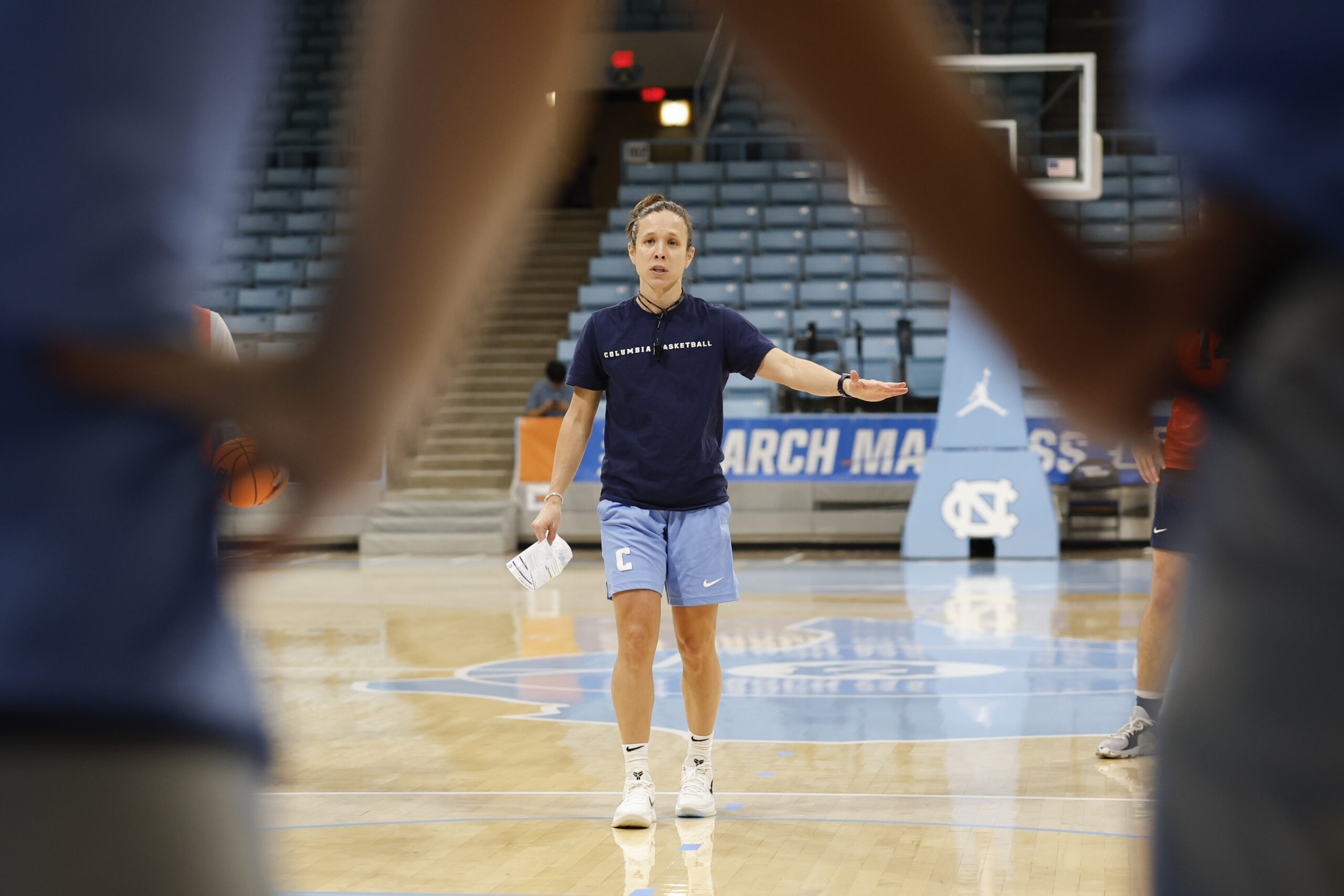
Columbia coach Megan Griffith talks to her team at practice last season.
That’s an example of another Griffith callback: “Coach-led, player-fed.” It’s why a practice that began with harsh words ended with everybody gathering at midcourt for a calm circle, where players individually spoke up to encourage and hold each other accountable. They snapped in agreement of each player’s input. When Griffith asked who got better today, every player raised their hand.
Those mantras have become sticky, establishing Columbia’s foundational culture. They have fueled the Lions’ historic rise.
So what is the next breakthrough, with Griffith’s 10th season underway?
“That’s my big challenge right now, is just continue to teach when the expectations are higher — and self-imposed,” Griffith said. “Nobody here is like, ‘Hey, you need to win more.’ Everybody is like, ‘Look at everything you’ve done,’ but that’s just not who I am.
“I don’t just think we can continue to win Ivy League championships. I think we can make deep runs into March. As long as we keep getting the right people here, why couldn’t we go to the Elite Eight?”
Nick Nurse’s summer mood has long been dictated by how the just-completed season unfolded. So naturally, the 76ers’ coach spent much of this past offseason in a state of, in his words, “[ticked]-off-edness.”
The Sixers’ woeful, injury-plagued 24-58 season sent Nurse and his team home much sooner than they ever would have anticipated months earlier, when they had championship aspirations. The irritation lingered.
And lingered.
“It kind of fatigues you mentally and you’re just kind of constantly thinking about it,” the 58-year-old Nurse recently told The Inquirer. “And then, at some point, you’re like, ‘OK, tomorrow I’m getting up at 5:30, and we’re going to start going to work. We’ve got to make a move here.’
“And then that’s kind of what the rest of the summer becomes.”
That methodical approach has yielded a surprising 4-0 start to the Sixers’ 2025-26 season, even with Paul George and Jared McCain sidelined with injuries and Joel Embiid limited while working his way back from an ongoing knee issue. They rallied from a 19-point deficit to top the Washington Wizards in overtime Tuesday night, already their third double-digit comeback victory of the season.
Last season, it took the Sixers until Nov. 30 to record their fourth win. And though it is far too early to make sweeping declarations of a guaranteed turnaround, the Sixers have flashed an on-court identity — and palpable juice — that make good on Nurse’s public vow that “I want you to walk away from the game saying, ‘Jesus, they played their [butts] off tonight.’ That’s it.”
“You could feel his frustration, feel his pain,” said Minnesota Timberwolves coach Chris Finch, one of Nurse’s close friends. “And, generally, when we’ve all been through a season or a situation like that, there’s an incredible focus on where we need to start going into it the following year. …
“You [could] sense the confidence in their ability to do that when I talked to him this summer.”
Sixers coach Nick Nurse determined that his team needed to play faster this year.
For Nurse, that summer evaluation always begins with a self-debrief, which he acknowledges is not unlike how his brain operates daily. He is constantly thinking about the puzzle of fusing his coaching philosophy — “what you think is the absolute best way of doing anything, regardless” — with roster strengths and weaknesses.
Tactically, Nurse concluded that the Sixers must play a faster-paced, free-flowing offense that could succeed even when Embiid — the perennial All-Star and 2022-23 MVP who has been the franchise’s centerpiece for much of the past decade — inevitably missed time. That emphasis was first raised to dynamic point guard Tyrese Maxey (who totaled another 39 points and 10 assists Tuesday in Washington) during his exit interview with Nurse, president of basketball operations Daryl Morey, and general manager Elton Brand. It became even more imperative when the Sixers drafted VJ Edgecombe, a hyper-athletic guard.
But pace does not only mean how quickly the ball travels up and down the floor. Nurse said he, simply, “just wanted more passing. I just wanted the ball to touch more hands.”
The coaching staff began to implement those concepts — and individual skill development plans aligned with them — with younger players during summer league and workouts in Los Angeles, where assistant Rico Hines stages renowned pickup games. When everybody reconvened in Philly after Labor Day for informal team sessions, Nurse harped on the strength and conditioning required to attack the basket and play relentlessly on both ends of the floor. They scrimmaged without calling fouls, a style veteran center Andre Drummond called “prison ball.”
“All those things that kind of enable you to play with some toughness [and] physicality,” Nurse said, “push through when you think you’re tired, that you’re not.”
Returning players such as Adem Bona and Quentin Grimes described Nurse as more “direct” and “intense” while teaching schemes and principles during training camp practices. Kelly Oubre Jr. added that “Nurse has been putting us through the wringer.”
Yet newcomer Dominick Barlow said Nurse’s style and personality falls between his previous two NBA coaches, San Antonio Spurs legend Gregg Popovich and the Atlanta Hawks’ Quin Snyder. Jabari Walker, who also is in his first season in Philly, said he recently swung by Nurse’s office to thank him for giving him the confidence to shoot three-pointers.
“He stopped practice a couple times, saying, ‘That’s the one I want you to shoot,’” Walker said. “I think that’s just so helpful for players, because we overthink the game and we’re playing with such great guys [that] we don’t know when we should shoot sometimes.
“Having a coach that really believes in you allows you to just take that step back and trust your work. [You] even want to play harder for a leader like that, just because he instills so much in you.”
Sixers head coach Nick Nurse showed early confidence in rookie VJ Edgecombe and it appears to be paying off.
Nurse also can tap back into past experiences on his wide-ranging coaching journey of when a team responded to a disappointing season with a significant bounce-back.
After five years coaching in the British Basketball League, Nurse went 22-28 his first season with the D-League’s Iowa Energy, from 2007-08, while adjusting to a “totally different” playing style and roster “merry-go-round [that] was unlike anything I’ve ever seen.” He flipped that record to 28-22 the following season, won the 2011 league championship, and then was hired to coach the Rio Grande Valley Vipers, the D-League affiliate of the Houston Rockets, then run by Morey. Nurse went 24-26 that first season, before winning the title the next year.
Nurse, though, has been candid about what faces the Sixers this season. They must “earn their way back” into the playoffs, he said on media day. “We’re digging ourselves out of a pretty big hole,” he reiterated following recent practices. When asked before Saturday’s home opener against Charlotte how much pressure he felt entering this season, Nurse said, “Not more than any other time.”
“I’m going into every game trying to win,” Nurse said, “and that’s been going on for 35 years. … That’s really all I think about.”
Even before this impressive start, Nurse could pull optimism from a practice day just before the season opener. When he walked into the Sixers’ facility at 7:30 a.m., the coach said, two players already were watching film in the chairs that line the practice courts. Another was moving through an individual workout.
“It’s not easy to get all that stuff: the work ethic, the togetherness,” Nurse said. “I keep saying I’m happy with it. Am I surprised? A little bit, because it’s not that easy.”
Perhaps those Sixers were mirroring their coach and the way his offseason mood propelled him into 2025-26.
“You go through these [times] as a coach, for sure,” he said. “And you just do all those things I said. You debrief. You regroup. You brush the dust off and get back to work.
“And you let that [ticked]-off-edness fuel you a little bit.”
Gilbert Rolle Jr. and his youth basketball team gathered in Freeport, the Bahamas, on Wednesday, the night before traveling to the nearby Abaco Islands for a tournament.
They were all locked in on a front-room television showing the 76ers’ season opener at the Boston Celtics, where one of their own was making his much-anticipated NBA debut.
It felt like a full-circle moment for Rolle, because the last time he traveled to this tournament, a seventh-grade VJ Edgecombe was with him. Now, there were outbursts of cheers whenever Edgecombe scored for the Sixers, making it feel like “every shot was a 5, 4, 3, 2, 1 … moment,” Rolle said.
Edgecombe’s historic NBA debut — his 34 points were the most in a Sixers rookie’s first game in franchise history, and the most scored in any NBA debut since Wilt Chamberlain’s 43 with the Philadelphia Warriors in 1959 — dazzled those who follow the sport.
But for those with roots on the tiny island of Bimini, who watched Edgecombe grow into this player and man, the pride cannot be overstated.
“It was like, ‘Wow, it was just so inspiring,’” said Rolle, a coach and principal at Gateway Christian Academy. “Because this isn’t somebody we just know. This is somebody who sat in our schools, that we watched him play in the park, walked through the community. We know, know, know, know him. …
“It was so personal, and it was amazing.”
When asked how Edgecombe was ready to make such an instant impact at basketball’s highest level, Rolle and others reached by The Inquirer by phone pointed to the 20-year-old’s maturity and confidence. Those qualities were shaped by Edgecombe’s childhood circumstances, when his family spent time living with a generator for power in their home. And on the basketball court, he played against older kids.
In every way, Rolle said, Edgecombe was “always a notch above his age.”
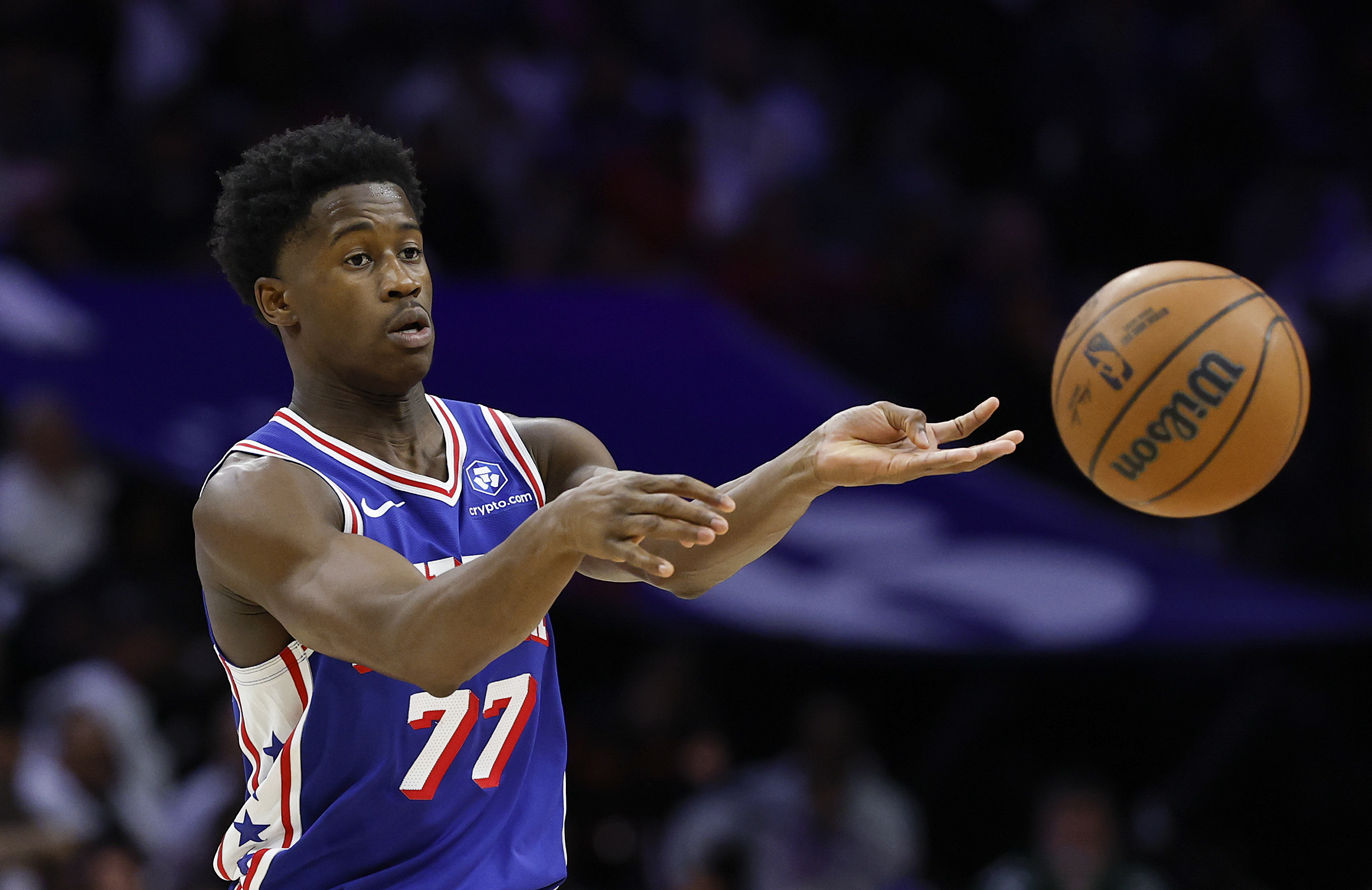
Sixers rookie VJ Edgecombe passes against the Charlotte Hornets on Saturday night at Xfinity Mobile Arena.
Leano Rolle saw this in Edgecombe from the beginning. They are such close friends that they consider themselves cousins or brothers. As kids, they started playing basketball together barefoot on a neighborhood dirt lot, with a makeshift hoop made of a crate and two-by-fours.
When Edgecombe went through his pre-draft process earlier this year, Leano Rolle was still by his side. The night before Edgecombe was selected third overall by the Sixers, tears of disbelief and joy fell from the corners of Leano Rolle’s eyes as he stared at the ceiling while lying in a New York City bed.
“I texted [Edgecombe] and told him how proud of him I was,” Leano Rolle said. “It was so amazing because, where we’re from, you wouldn’t expect nothing to happen like that.”
But the younger Rolle is chasing his own basketball dreams at Southwest Mississippi Community College, and Wednesday’s practice overlapped with the start of the Sixers-Celtics game.
When a team manager alerted Rolle that Edgecombe had 14 first-quarter points, he was in shock. He kept checking his phone for box scores and Instagram dunk highlights as he moved from practice to a mandatory pep rally, convinced that Edgecombe was about to get 50 points.
When Rolle finally returned to his room, Edgecombe called him and their other best friend for a postgame chat.
“Just talking and laughing and telling him how he did,” Rolle said. “Letting him know he went out there and did well, and did what he was supposed to do.”
Also watching that night was LJ Rose, the general manager of the Bahamian national team. He did not realize that Edgecombe took 25 shots against the Celtics, because “he was just flowing.”
Rose, who is also the general manager of the University of Miami’s men’s basketball team, remembers first learning about Edgecombe from a local media member named John Nutt. Nutt persuaded Buddy Hield, the fellow NBA Bahamian and former Sixer, to invite a young Edgecombe to his basketball camp.
“He held his own,” Rose said of Edgecombe. “And ever since then, he’s kind of been on the radar.”
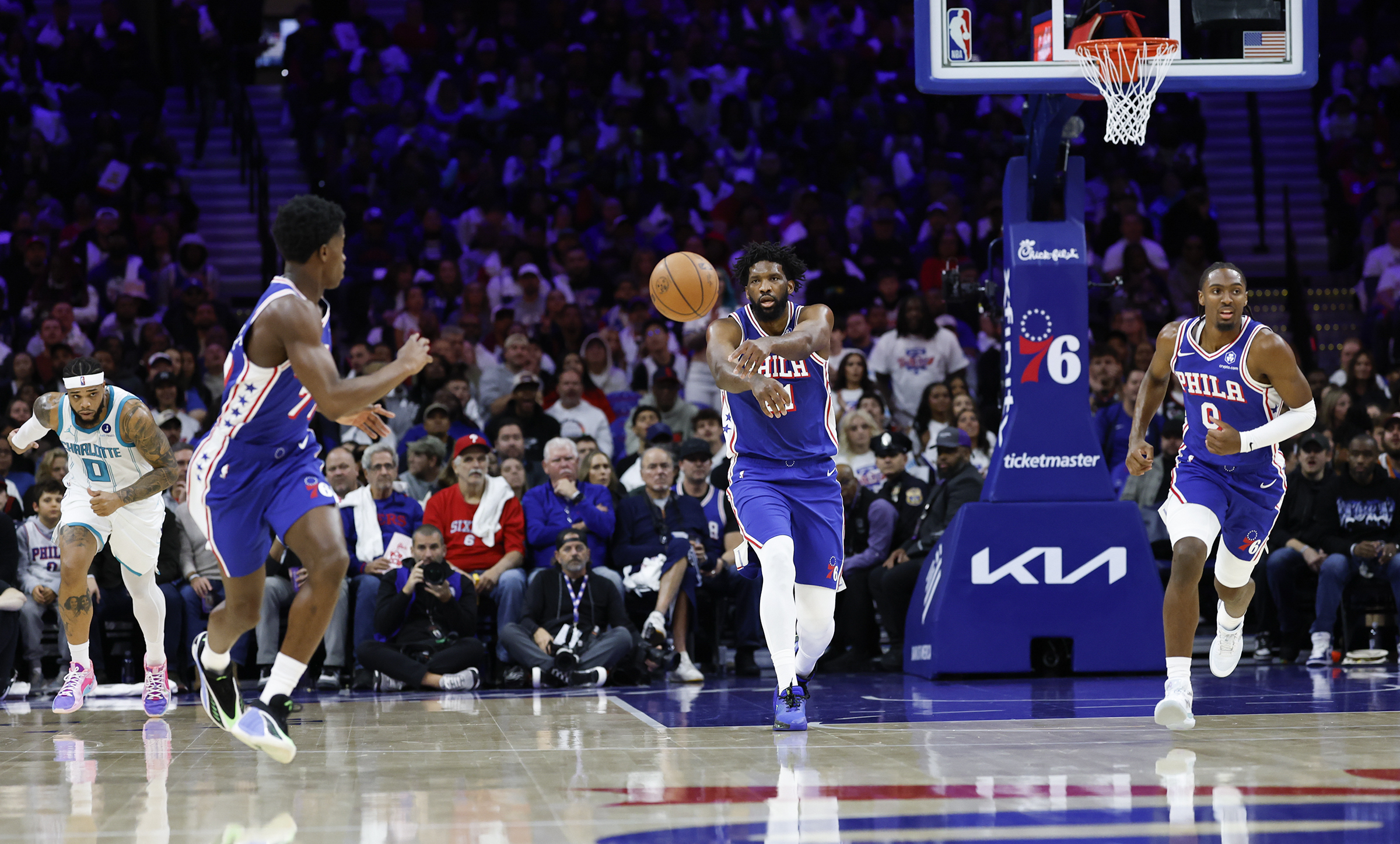
Sixers center Joel Embiid fires a pass to VJ Edgecombe on Saturday.
That buzz only grew when Edgecombe joined the senior national team for an Olympic qualifying tournament last summer. He played alongside NBA players Hield, current Sixer Eric Gordon, and Deandre Ayton, the first time Edgecombe had been surrounded by teammates with more credentials and experience.
Still, Edgecombe “showed up Day 1 and he asserted himself,” Rose said, a testament to Edgecombe’s “everyday” work ethic and temperament. Rose went back to the Houston Rockets, where he was an international scout at the time, and told general manager Rafael Stone, “Hey, we have one.”
“He did not get rattled when he got overseas,” Rose said. “And it was a new environment. Some adversity was coming, but he just kind of kept on plugging away. And I think that just goes back to, it’s the everyday. His consistent grind and just coming from where he’s come from.”
Even during this dramatic life transition to the NBA, Edgecombe has remained connected to those Bimini roots.
Leano Rolle is planning to visit Edgecombe in Philly for Thanksgiving and Christmas. Gilbert Rolle texts Edgecombe at least once per week and said any impromptu phone call would be answered with a, “Hey, what’s up?”
When asked late Saturday — after totaling 15 points, eight assists, and six rebounds in the Sixers’ comeback win over the Charlotte Hornets — about the support he has felt from back home in recent days, a grinning Edgecombe said, “Yeah … I’ve heard from a lot of people.”
Because Edgecombe is still the “humble spirit” that Gilbert Rolle watched cry “as if somebody died” after losing in that Abaco Islands tournament as a seventh grader. To Rolle, that visceral reaction cemented how seriously Edgecombe took the sport.
“He’s not only talented, but he worked for this and he wanted this,” Rolle said. “This was something that he put his mind to do. And every opportunity he had, he went and got up extra shots. Any opportunity he had to get better in his game.
“To see him crying from losing a game, to on TV playing and breaking records, I’m like, ‘He deserves this.’”
And now, Gilbert Rolle has direct evidence of Edgecombe’s hard work to pass along to his current crop of young players. That is one component of the Edgecombe chatter that spread throughout the Bahamas into the weekend, as those close to the rookie revel in his instant success.
And if Edgecombe continues this torrid start to his NBA career?
“The people back home are ready to name the island after him one day,” Leano Rolle said. “That’s VJ Island.”
Andre Drummond secured the rebound off Tyrese Maxey’s missed free throw, then fought through contact to convert underneath the basket. The big man pounded his chest with both hands near the 76ers’ bench, a fire lit under himself and his team in the midst of another double-digit rally.
“That’s what I’ve been paid for my entire career,” Drummond said. “It doesn’t take much for me to get to that point where I want to get every rebound.”
Drummond grabbed 13 boards in 15 consecutive minutes to end the game — and added seven points, two assists, and two steals — in the Sixers’ 125-121 comeback victory over the Charlotte Hornets in Saturday night’s home opener. The vintage performance rescued the Sixers on a night when former MVP Joel Embiid remained on a strict minutes restriction, backup Adem Bona struggled, and forward Dominick Barlow exited the game with an injury.
And though Drummond entered this season mostly viewed by outsiders as a rotation afterthought — at least partially due to a turf toe injury that sapped much of a disappointing 2024-25 season — the effort signaled that the 32-year-old may still be a viable option while Embiid works his way back.
“I felt normal. I felt like myself,” Drummond said at his locker after the game. “I was able to move the way I wanted to move. Reaction time was there, just the spring in my jumps and how fast I was moving. Felt good to feel like myself again.”
Embiid (20 points, four assists, two steals) was significantly more effective against the Hornets than in Wednesday’s opener at the Boston Celtics — but burned through 15 of his 20 allotted minutes in the first half. That left him with only one third-quarter stint before he emerged during the final period wearing a hoodie and an ice pack on his surgically repaired left knee.
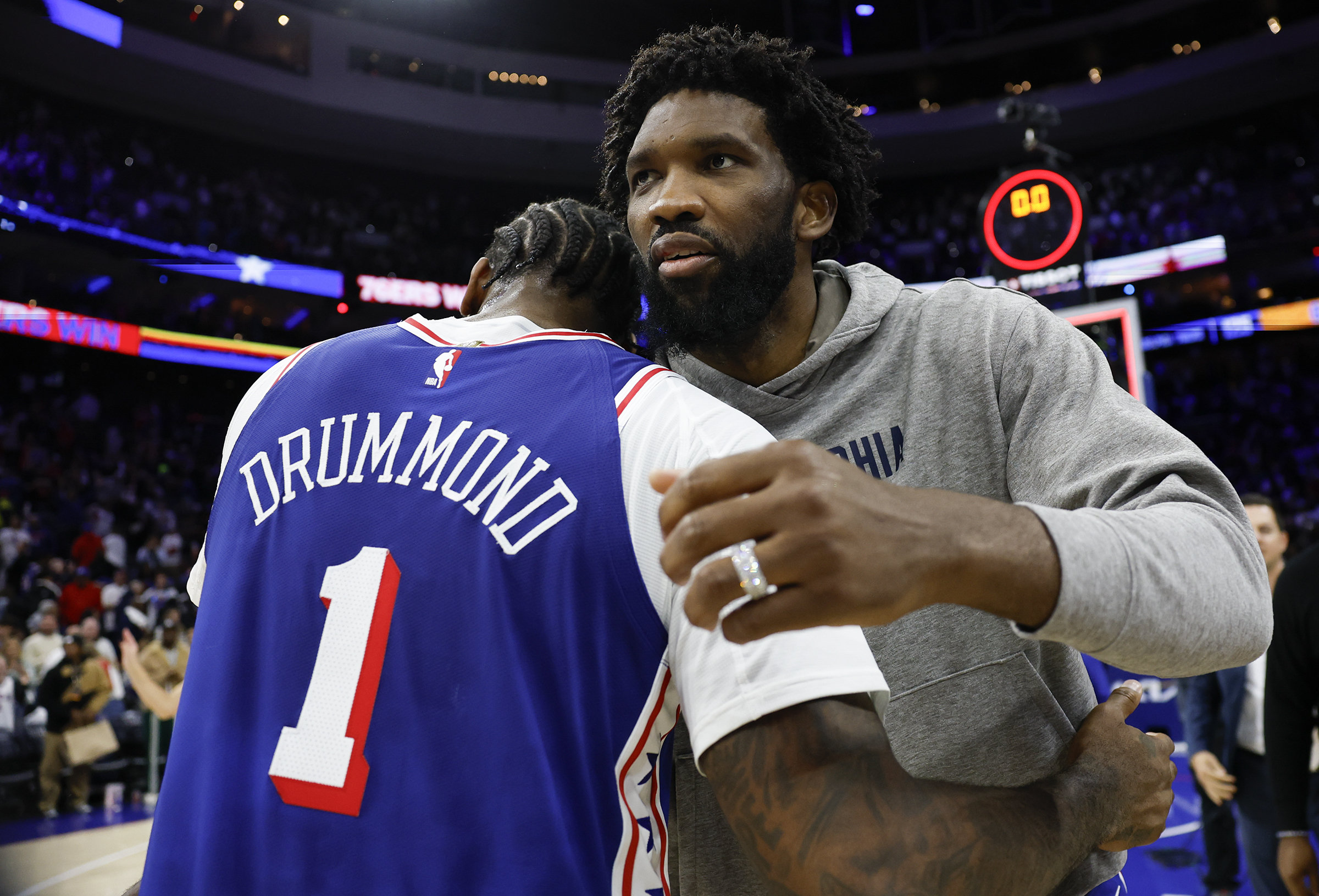
Joel Embiid and Andre Drummond embrace after the Sixers beat the Hornets, 125-121, on Saturday.
Against the Celtics, coach Nick Nurse chose a small-ball lineup featuring Barlow and Jabari Walker to finish off their first win. But that was not an option Saturday, when Barlow did not return after halftime because of an elbow laceration. Bona, meanwhile, played 12 minutes but recorded only one point with no rebounds.
So Nurse turned to Drummond, who played less than three minutes in Boston, with 3 minutes, 50 seconds remaining in the third quarter and the Sixers trailing by eight points. He had four rebounds before the end of that frame.
Early in the fourth, Drummond swiped the ball from Charlotte rookie Kon Knueppel and quickly dished the pass ahead to Kelly Oubre Jr. for a dunk, prompting teammate VJ Edgecombe to chest-bump Drummond heading into a timeout. Drummond later found Oubre again for a three-pointer that cut the Hornets’ lead to 112-105 with 5:23 to play, then sank a difficult turnaround hook shot about a minute later. He pulled down nine more rebounds during the period, including six on the offensive glass.
And when Drummond flew in to clean up Maxey’s driving miss with a two-handed, rim-rocking slam — which gave the Sixers a 117-116 lead with 2:13 remaining — the Xfinity Mobile Arena crowd exploded.
“You’re wondering why you didn’t use him earlier, to be honest,” Nurse said of Drummond. “ … I just thought it was time to try to find some spark of energy, and he certainly provided it. Because, all of a sudden, the rebounding got a lot easier and [got us] some offensive extra possessions.”
It was reminiscent of the prime version of Drummond, who was a two-time All-Star and four-time league rebounding leader. He also was once the backup center Embiid called the best he has ever had, before being traded to the Brooklyn Nets as part of the 2022 package in the Ben Simmons-James Harden blockbuster.
Rejoining the Sixers during 2024 free agency was a celebrated complementary move. But, like so many aspects of the Sixers’ woeful 2024-25 season, Drummond’s role never materialized. He missed 42 games, mostly with that nagging toe injury, and largely did not look like the same player whenever he was on the floor.
Drummond said on media day that he felt like he let down himself, his team, and the city — and “took that personal.” During his offseason reflection, he concluded that he spent too much time last season overthinking and “worried about manipulating the game in a way that I wanted it to work for me.” He shifted his focus to rediscovering his joy while playing the sport.
“I’m in a place now where I’m just happier,” Drummond said following the Sixers’ Oct. 10 preseason game against the Orlando Magic. “I’m excited to be here. I told my team — I told the coaching staff, too — whatever it is they need from me to help this team win, I’m more than willing to do it. And I think they’re seeing that. I’ll continue to put my best foot forward.”
Another offseason goal: getting into better physical shape to be ready to play stretches like Friday’s. He cut back on cheat meals — the Asian fusion restaurant Nobu is his guilty pleasure — and spent more time running. To help heal his injury, he adopted “toe yoga.” During his pregame routine, he rolls out an acupuncture mat at his locker and stands on the tiny spikes to relieve any stiffness in his feet.
“That’s what helped me speed the [recovery] process up,” Drummond said.
Drummond has learned to adopt the “stay ready” mindset in recent seasons, as his playing time began fluctuating.
From the bench, he watches the game flow and nuances recognizable to his veteran eye, such as defensive communication lapses or moments to set (or not set) screens. He is not shy about passing advice on to Bona, if the second-year big man receives the initial reserve minutes. And regularly sitting next to Drummond is second-year wing Justin Edwards, who is in a similar fringe rotation spot and now a beneficiary of the big man’s encouragement.
Sixers forward Justin Edwards had nine points in 12 minutes against the Hornets on Saturday.
“Bro, don’t lose yourself in this,” Drummond tells Edwards, who finished Saturday with nine points in 12 key second-half minutes. “It’s a game of runs. It’s a game that changes often.”
Saturday, it did. Drummond emphasized that he was not the only player who fueled the Sixers’ second consecutive comeback win. Quentin Grimes hit the go-ahead three-pointer with 15 seconds left, and finished with 24 points off the bench. Maxey (28 points, nine assists) and Edgecombe (15 points, eight assists) continue to form a dynamic guard tandem. Oubre (19 points on 7-of-10 shooting) was a team-high plus-18.
But after the Hornets’ Tre Mann missed a potential game-tying three-pointer with 12.1 seconds to play, Drummond grabbed the game-sealing rebound.
It was — again — vintage Drummond.
“Wouldn’t have won that game without him,” Embiid said. “… That’s the Drummond that we wanted back two years ago.”