Author: Jeff Neiburg

  • Villanova’s teams are going to the NCAA Tournament. Will they have any company from the Big 5?

    Villanova’s teams are going to the NCAA Tournament. Will they have any company from the Big 5?

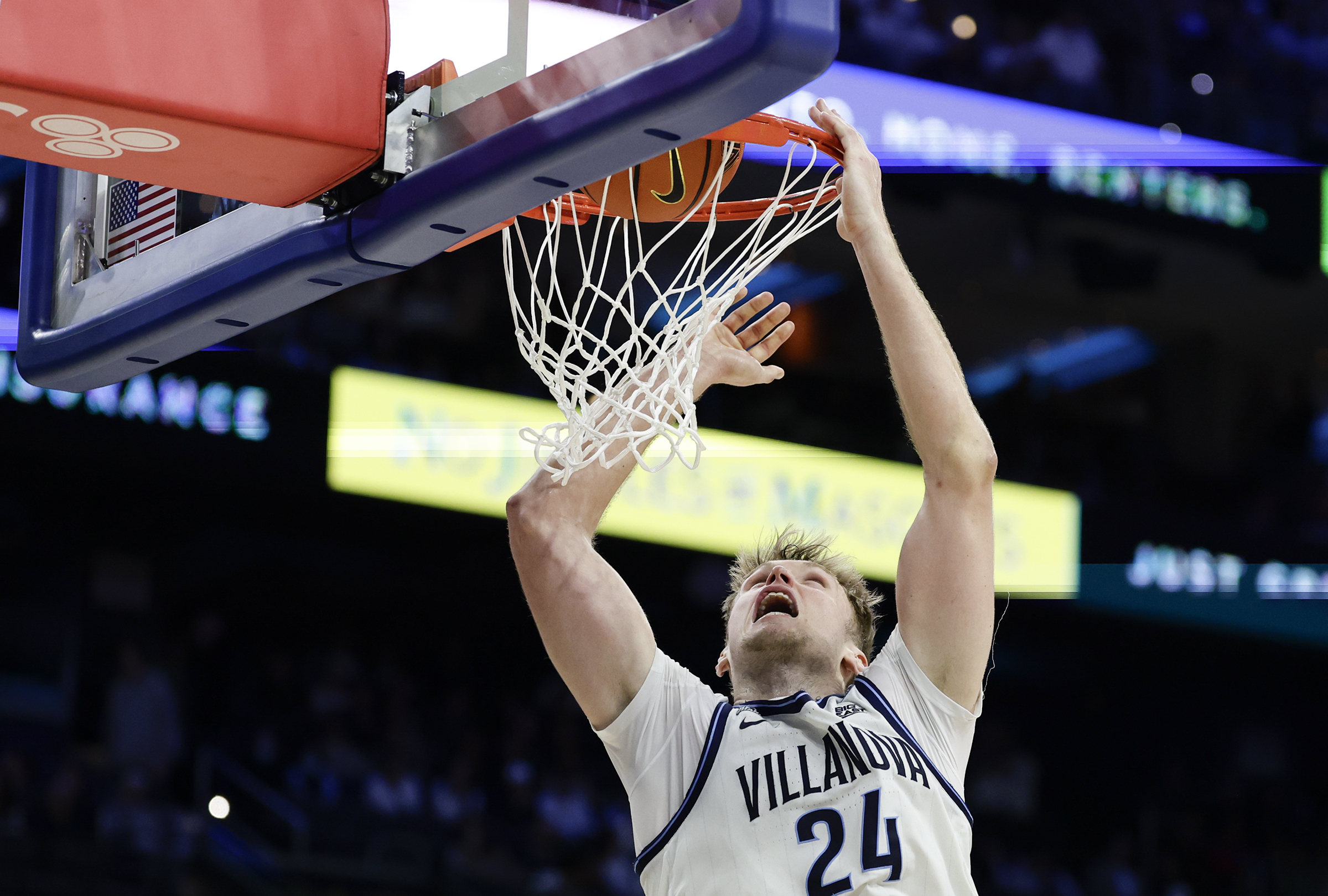
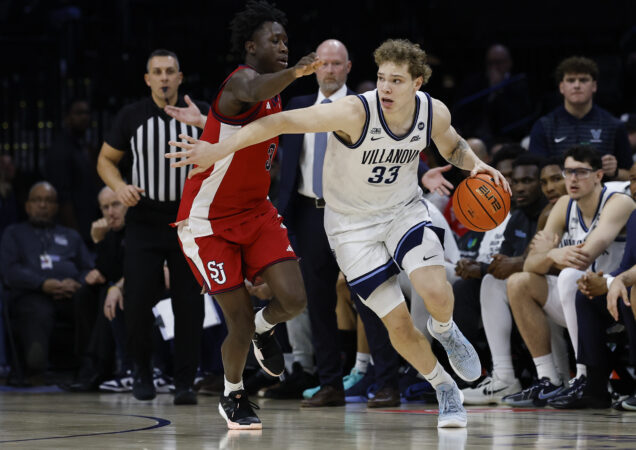
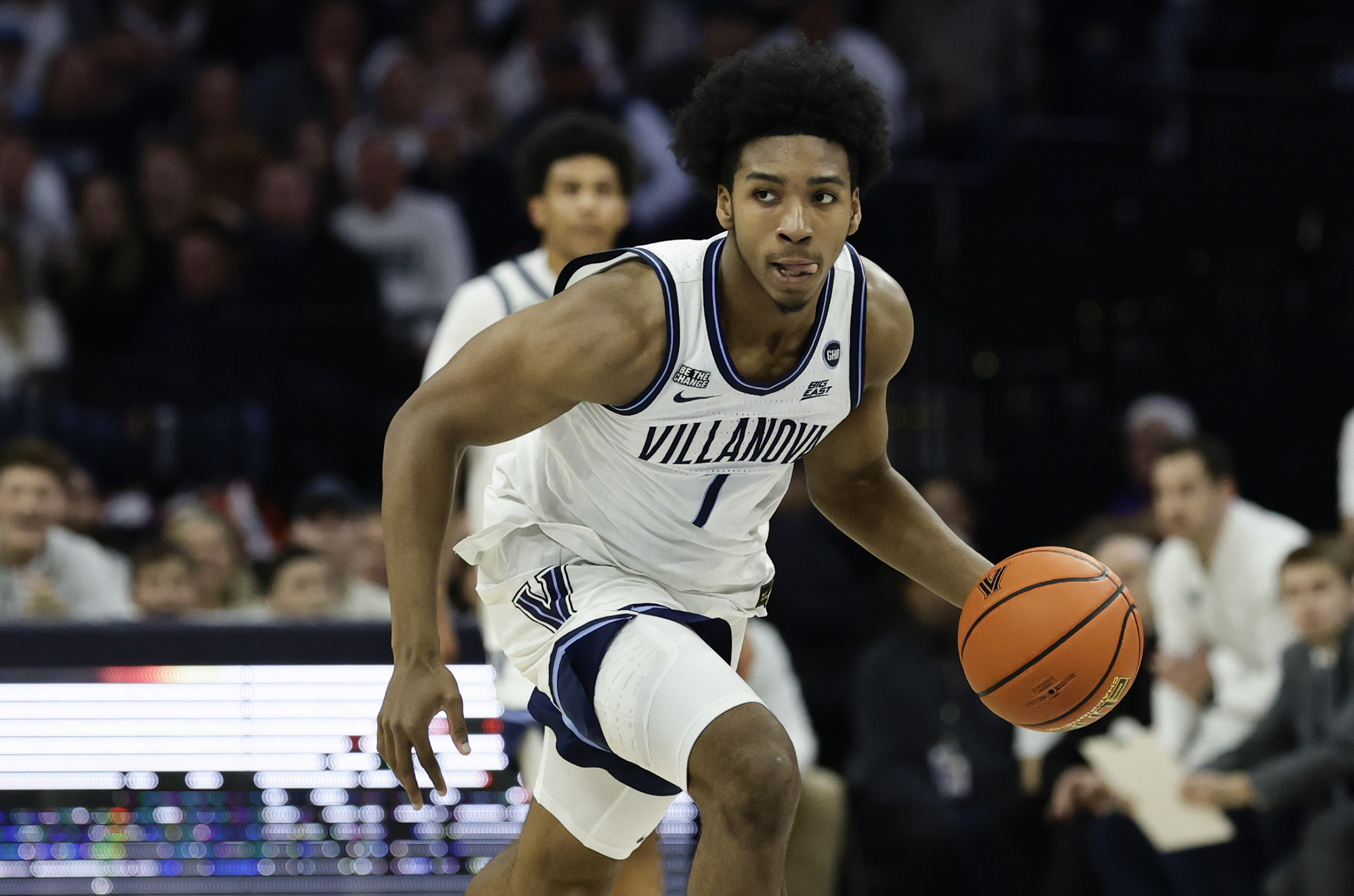
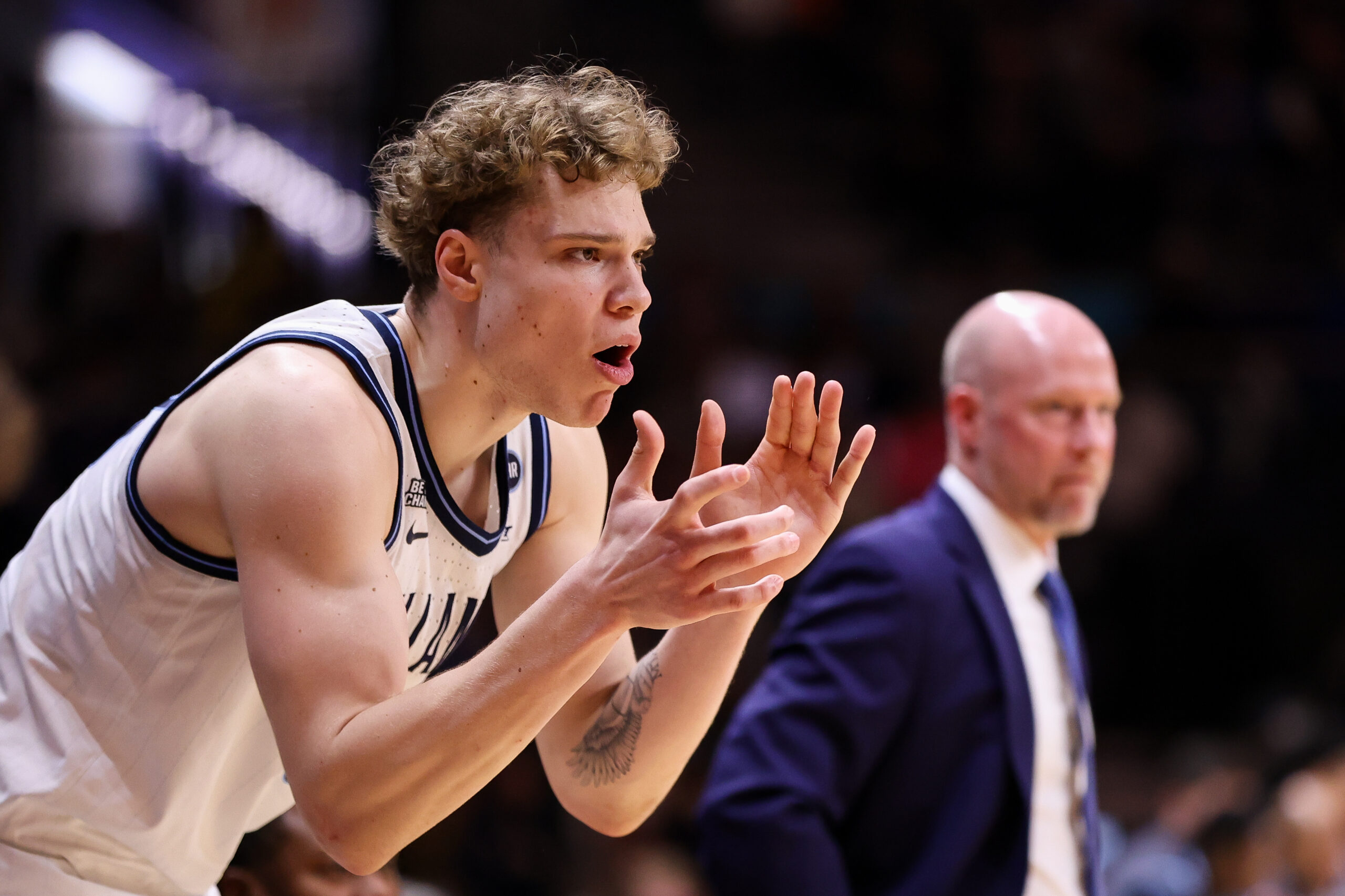
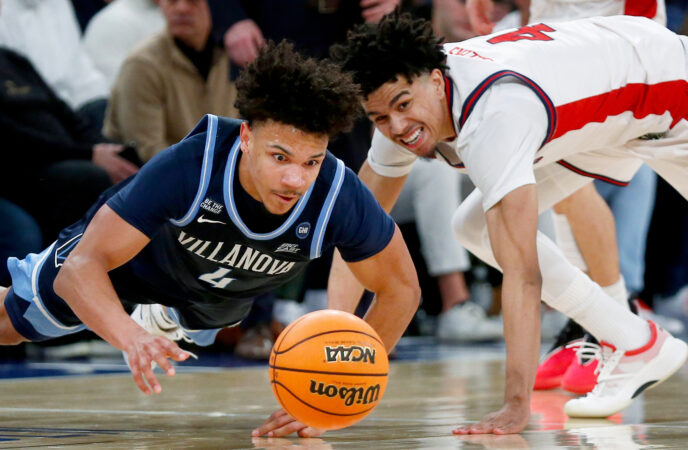
    The three-year drought with no men’s team from the Big 5 in the NCAA Tournament will end, finally, with Villanova seemingly locked into the field of 68 for the first time since 2022.

    Kevin Willard’s Wildcats (23-7, 14-5 Big East) finish their regular season Saturday at home against Xavier before embarking on their postseason run beginning next week at the conference tournament in New York.

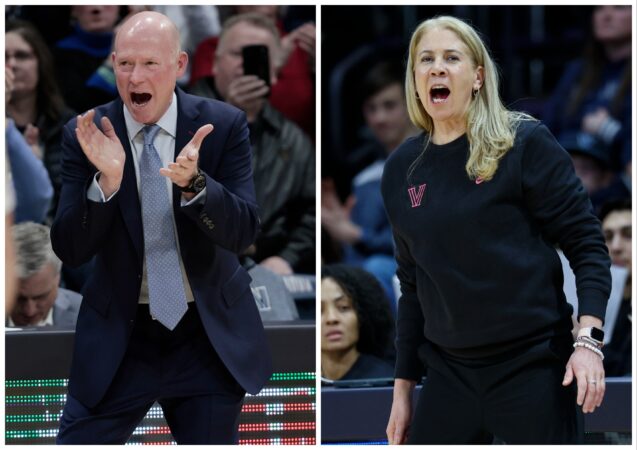
    Villanova’s women, too, appear on their way to the dance after a two-year drought. The Wildcats (23-6, 16-4) were projected as a No. 9 seed in ESPN’s latest women’s bracketology, and it’s hard to imagine that an opening-round loss in the Big East tournament would slide Denise Dillon’s team back to the bubble.

    Will Villanova have any local company?

    The contenders

    St. Joseph’s men: The Hawks may not have the best mathematical chance among the rest of the pack (more on that soon), but it’s worth starting here because they pulled off a pretty impressive road win Wednesday night at Davidson and secured their first double-bye and top-4 seed in the Atlantic 10 tournament since 2018.
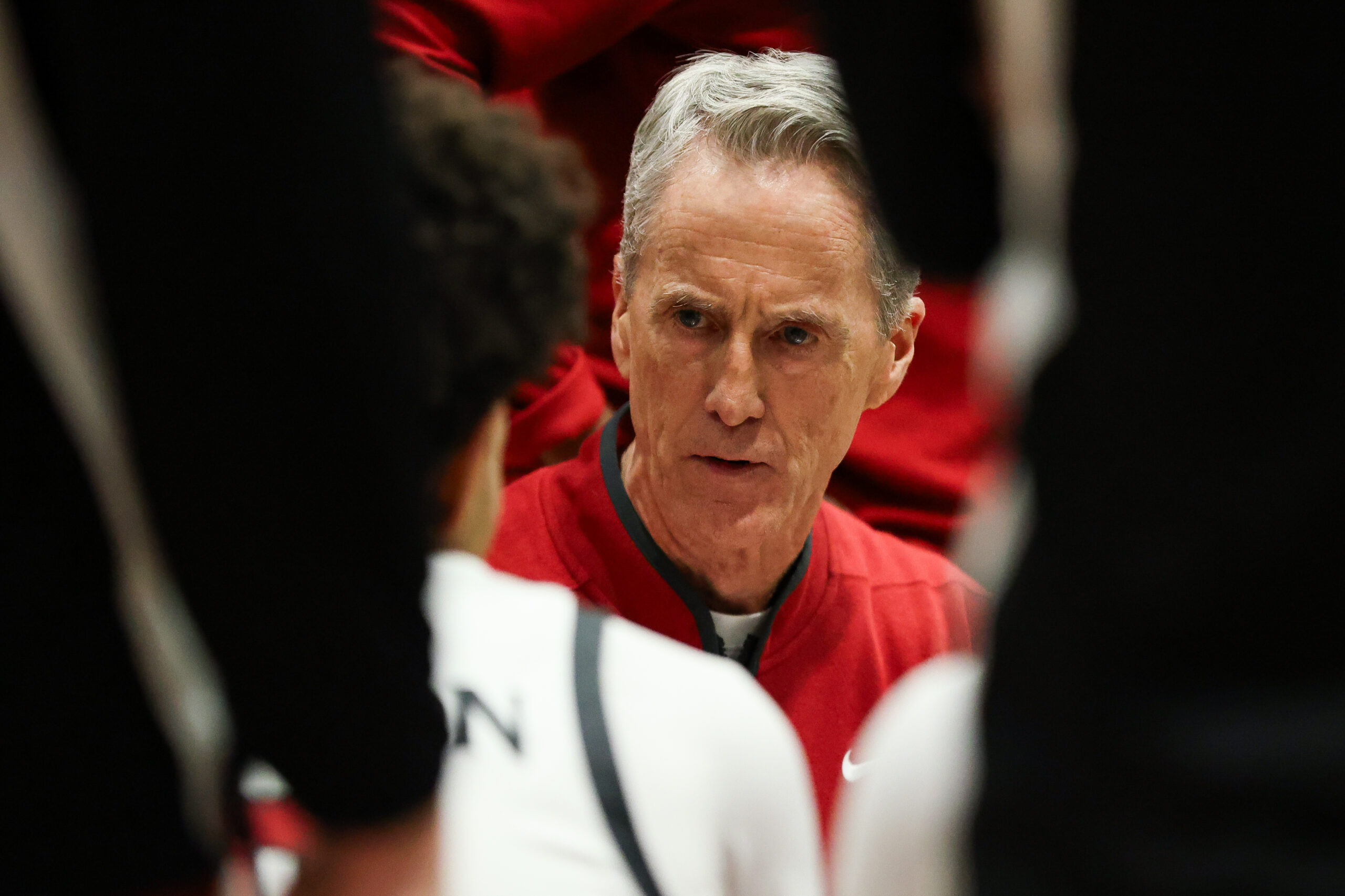
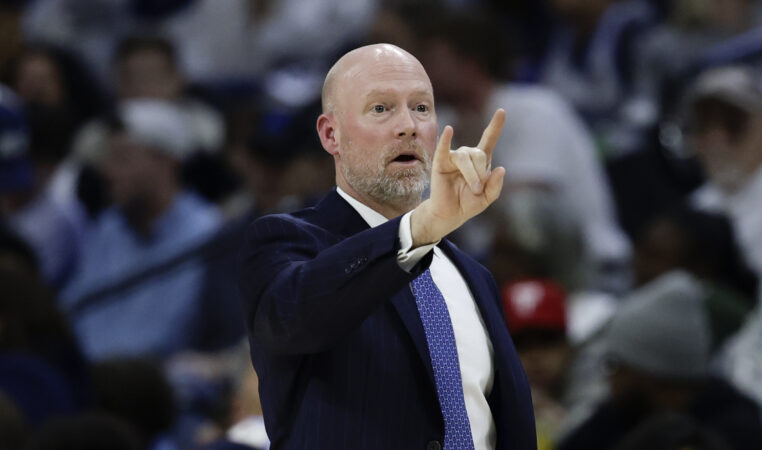
    St. Joe’s coach Steve Donahue has his team in the Atlantic 10 tournament with a double-bye and top-4 seed for the first time since 2018. Could the Hawks make a run and reach the NCAA Tournament?

    This has been a pretty remarkable season on Hawk Hill considering all of the context. Former coach Billy Lange bolted for the NBA in the fall. Steve Donahue, whom Lange hired as an assistant after Penn fired him, was given the keys.

    The Hawks stumbled a bit at the start of the season, and then starting guard Deuce Jones was off the team by the holidays. But a team meeting in January helped turn the tide, and Derek Simpson, Jaiden Glover-Toscano, and company have been on a roll.

    Will they cut the nets down in Pittsburgh? It’s still pretty hard to imagine, given the talent of Saint Louis and Virginia Commonwealth at the top of the conference.

    But the double-bye means the Hawks will start the tournament in the quarterfinals, needing just three wins in three days to reach the dance. Bart Torvik’s NCAA hoops analytics site gives the Hawks a 7.8% chance based on thousands of simulations. That’s not nothing.

    Penn men: While we’re on the subject of math, it’s the Ivy League tournament that makes any of its participants more likely than those in other conferences to run the table simply because only four teams are invited and only two wins are needed to win an automatic bid.
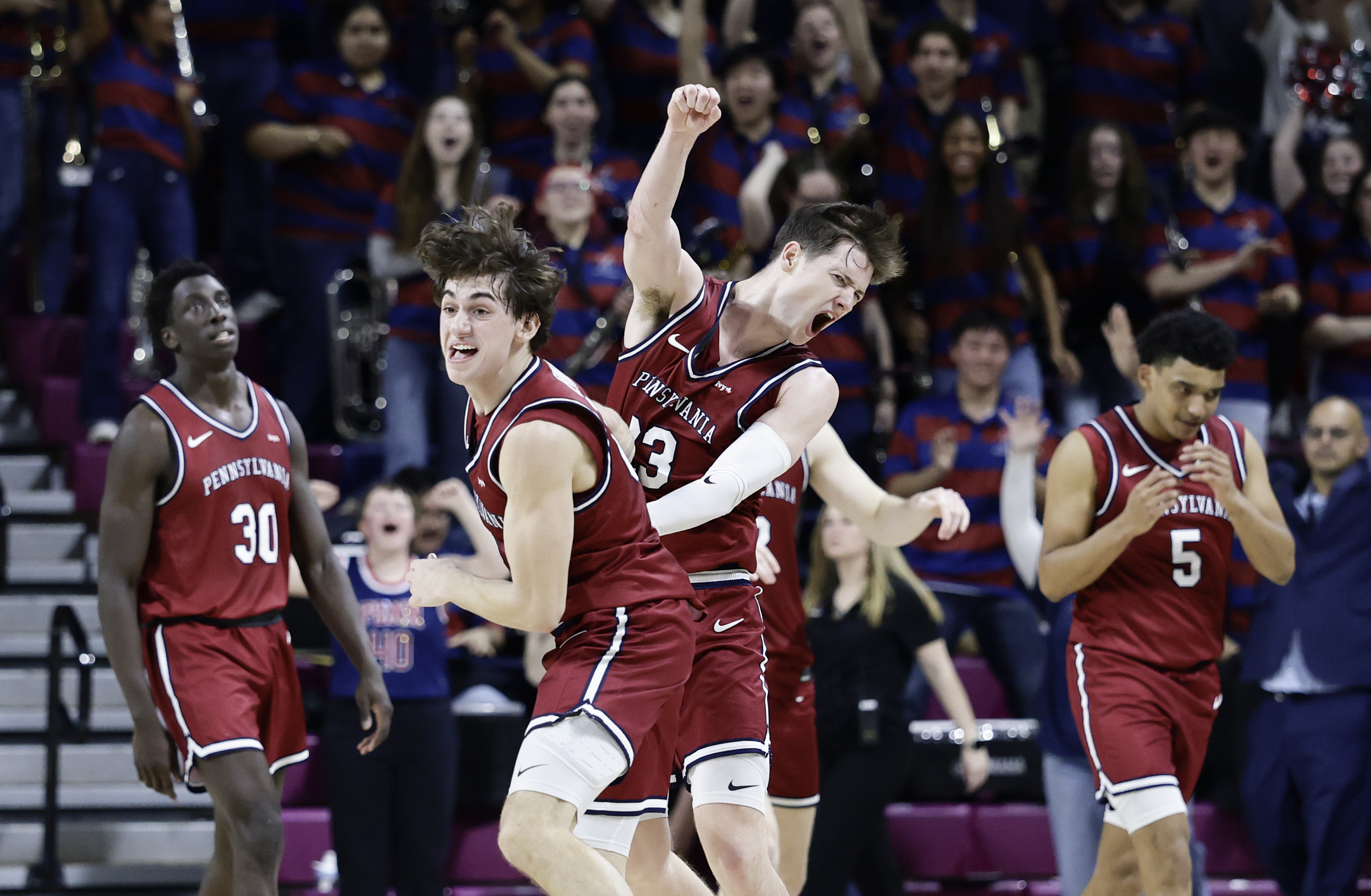
    Penn is back in Ivy Madness for the first time since 2023.

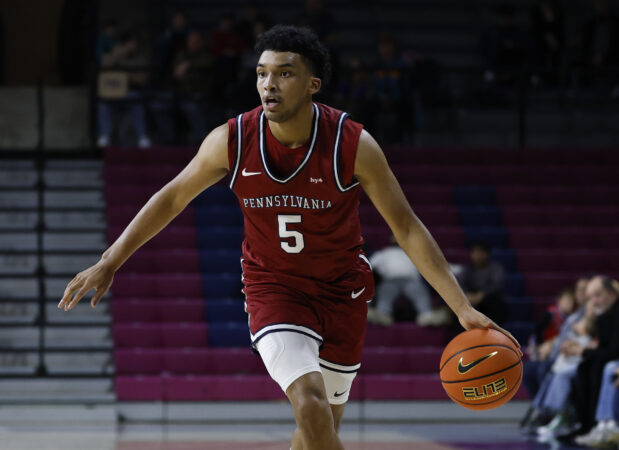
    The Quakers, under Fran McCaffery, are back in Ivy Madness for the first time since 2023. They have plenty of talent with Ethan Roberts and TJ Power leading the way. Penn is the No. 3 seed and plays Harvard in the semifinals, a team the Quakers beat at home last weekend. A win would likely mean a date with Yale, the top team in the Ivy. But the Bulldogs just lost to fourth-seeded Cornell, which is the host site for the tournament. Penn beat Cornell twice this season.

    Torvik has the Quakers at 14.7% to win the league.

    Drexel women: The Dragons have one regular-season game remaining, Saturday at Towson, and sit second in the Coastal Athletic Association with a 13-4 record. That’s certainly good enough to be labeled a contender, especially considering that Amy Mallon led a 10-8 CAA team to a conference tournament championship two seasons ago.
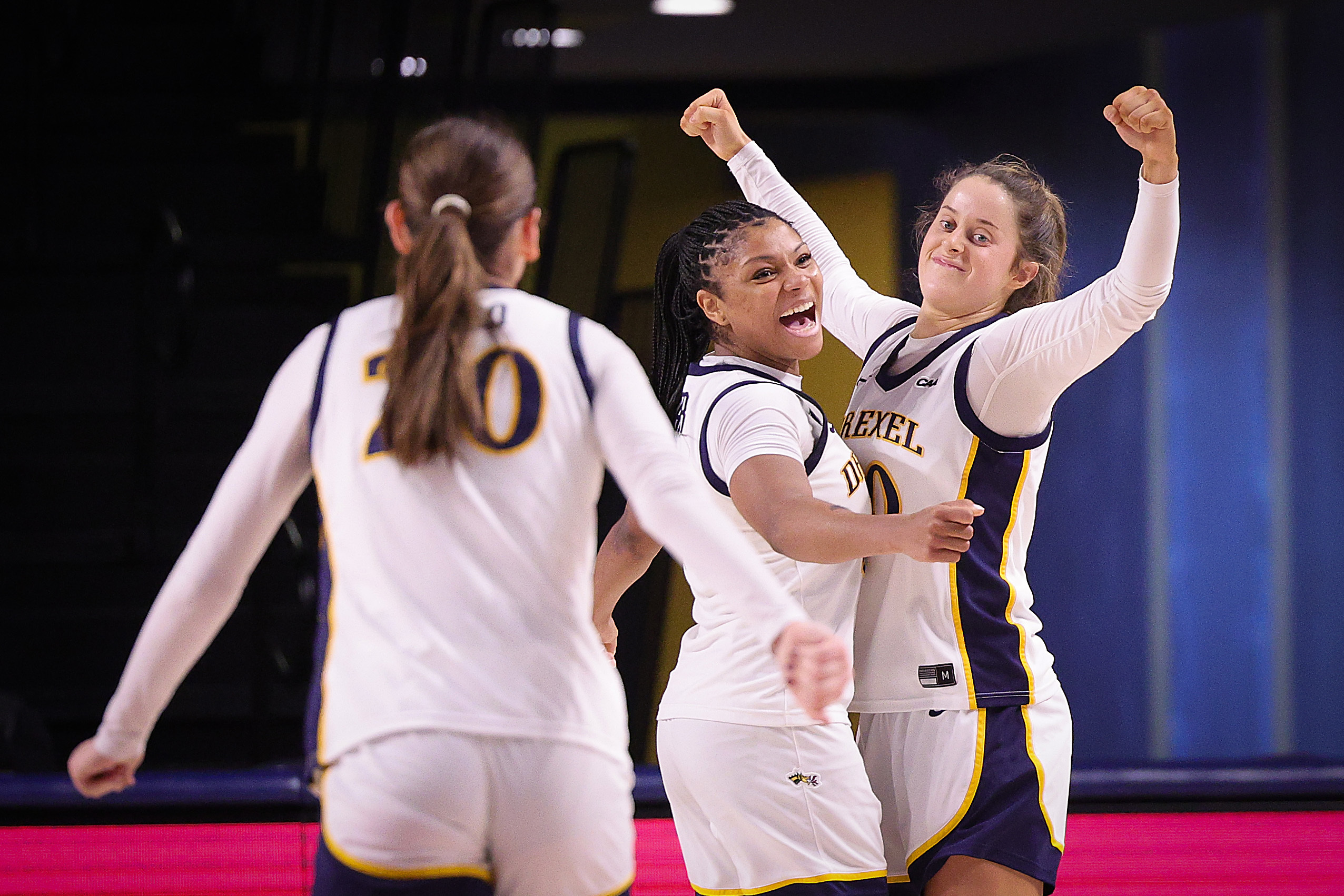
    Drexel guard Laine McGurk (right) celebrates with guard Amaris Baker (center) as Molly Rullo (left) joins them after they defeated North Carolina A&T on March 1.

    This year’s squad has won 11 of 12 and has two local products leading the way. O’Hara’s Amaris Baker, a senior, is second in the CAA in scoring with 19.0 points per game, and her backcourt mate, West Chester Rustin’s Laine McGurk, was at 13.2 points and 4.1 rebounds per game.

    The long(er) shots

    Drexel men: The CAA tournament is usually wide open. Twelfth-seeded Delaware reached the final game last season, a year after seventh-seeded Stony Brook took top-seeded Charleston to overtime in the final. Two years before that, Delaware took a 10-8 conference record and the fifth seed and went all the way to the NCAA Tournament.

    That’s where Drexel stands ahead of its first conference tournament game Saturday, at 10-8 and the No. 5 seed. The Dragons started 0-3 in conference and are 10-5 since. And though they haven’t beaten any of the four seeds ahead of them, weird things tend to happen at the CAA tournament. Torvik says this weird occurrence has a 4.5% chance of happening. So, not all that different from the Hawks running the table in the A-10.
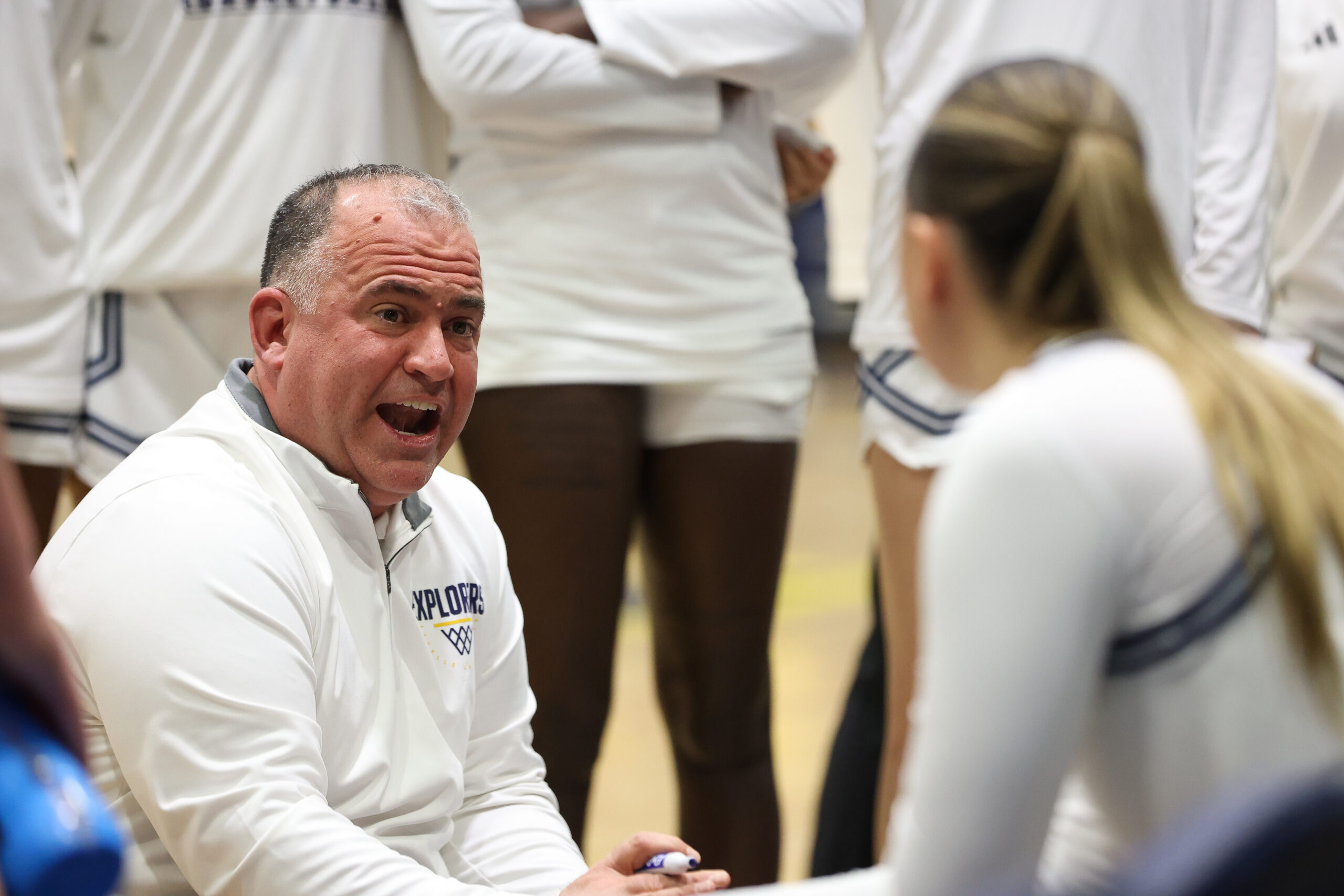
    La Salle coach Mountain MacGillivray has led his team to go 10-8 in the conference.

    La Salle women: Mountain MacGillivray should be getting some coach of the year love both in his conference and locally in the Big 5. The Explorers won three A-10 games last season and five the year before. They went 10-8 this year. They faced Richmond in a tournament quarterfinal Friday night.

    Better luck next year

    La Salle men: Darris Nichols’ first season in Olney was marred by injuries, and though the Explorers have been a tough out at times, it’s bordering on impossible for them to get through the gauntlet that would be five wins in five days. (Torvik chances: 0.1%)

    Temple men: The Owls went from vying for the No. 2 seed and a bye to the semifinals in their conference tournament to needing a win Thursday just to qualify for it. They got that, but the prospect of running the table and winning five games in five days seems too daunting for a team that has seemingly been running out of gas. (Torvik chances: 1%)

    St. Joe’s women: Like La Salle, the Hawks went 10-8 in the A-10 and owned the tiebreaker to get the fifth seed. They lost in the quarterfinals Friday night to Davidson, 64-59, after a 66-45 win over 12th-seeded Duquesne on Thursday.

    Temple women: Temple is 7-10 entering its final regular-season game Saturday at home against Florida Atlantic. The Owls are minus-97 in point differential in seven games against the top four teams in the conference.

    Penn women: The Quakers are 6-7 in the Ivy and have one game remaining, Saturday at home against Brown, but they will not qualify for the four-team league tournament.
  • Stifling defense and new-look rotations highlight Villanova’s blowout win at DePaul

    Stifling defense and new-look rotations highlight Villanova’s blowout win at DePaul

    Villanova entered Wednesday with a 9-3 road record, but the last true road game of the season for the Wildcats came with a new wrinkle, and a new starting lineup after Matt Hodge suffered a season-ending ACL injury Saturday night vs. St. John’s.

    Villanova coach Kevin Willard said Tuesday that the injury hurt the Wildcats, but “it’s not catastrophic.” They had the right answers to make up for missing their sixth-leading scorer, Willard thought, and while a sloppy first half didn’t make him look like much of a prophet, a much better second half helped Villanova turn a tight game into a rout and an eventual 76-57 win over DePaul.

    The Wildcats improved to 23-7 on the season and 14-5 in the Big East behind big nights from Tyler Perkins (20 points, six rebounds), Duke Brennan (15 points, 12 rebounds), and Devin Askew (14 points, five rebounds). It was their eighth conference road win, their most since 2016.

    Here are a few observations from the victory:

    Dominant defense

    DePaul is the second-worst scoring offense in the Big East and ranks seventh of the 11 teams in three-point shooting (33.1%).

    It’s on the defensive end where Hodge’s absence in the starting five won’t be felt in a major way. That’s not to say Hodge, a redshirt-freshman, hasn’t held his own, but inserting Malachi Palmer in the lineup gives Villanova more versatility. Palmer is two inches smaller than Hodge at 6-foot-6 and allows the Wildcats to effectively switch more, which was especially effective against DePaul’s pick-and-roll offense.

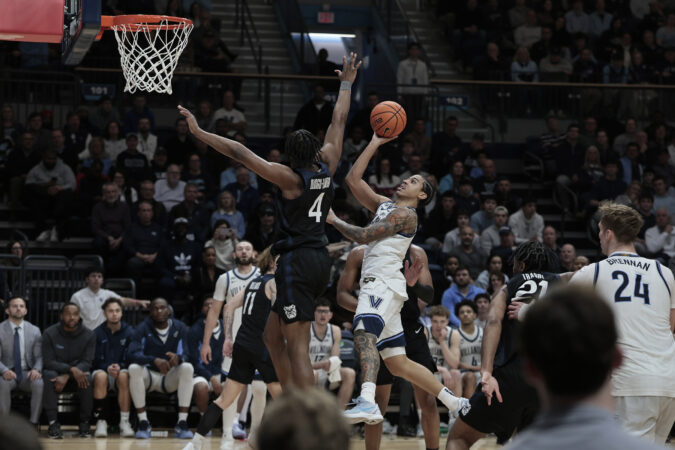
    Malachi Palmer gave Villanova a major boost on the defensive end Wednesday night.

    Villanova was aggressive on the ball defensively and created 16 DePaul turnovers, leading to 22 points off those turnovers. Villanova got its own good looks in the first half but shot just 27.6%. The Wildcats survived a slow start because they forced seven turnovers and limited DePaul to just 24 points. It was the third time this season Villanova allowed fewer than 25 points in an opening half.

    In the second half, Willard deployed more matchup zone and dared DePaul to try to shoot its way to a win. The Blue Demons were just 2-for-16 from three-point range, and many of those were either well-contested or forced into the hands of low-percentage shooters.

    Three Wildcats had at least two steals. Perkins had four, while Bryce Lindsay and Acaden Lewis had two apiece.

    New-look rotation

    Palmer, as expected, got the start and tied his season-high with 29 minutes, a mark he reached for the first time Saturday night in part because of Hodge’s injury early in the second half.

    Palmer, a sophomore, looked a little jittery to start but settled in during the second half. He finished with 10 points on 3-for-9 shooting (1-for-4 from deep) and added five rebounds.

    Askew was the first player off the bench as usual. Then freshman guard Chris Jeffrey and backup center Braden Pierce, a redshirt-freshman. Hodge’s absence will force Villanova into some awkward rotations when Palmer needs to rest. Willard had brief stretches with one big man and four guards on the floor, a unit that he won’t be afraid to roll with depending on matchups because of Perkins’ physicality and rebounding ability.

    Villanova forward Duke Brennan finished with 15 points and 12 rebounds against DePaul.

    What Villanova didn’t show Wednesday was a two-big look with Brennan and Pierce both on the floor. Willard said he’ll be willing to go to it, and the Wildcats have practiced it some, but DePaul did not have a ton of size to force Villanova to counter.

    Brennan played 35 minutes for the fourth time in a game that ended in regulation. Palmer played 19 of the 20 minutes in the second half while Pierce (two minutes) and Jeffrey (one minute) played sparingly. They finished with five and three minutes, respectively. An eight-man rotation was effectively a six-player rotation. It worked fine Wednesday night, and may work fine again Saturday in the regular season finale vs. Xavier, but tougher tests await in the postseason.

    No Stanford

    Hodge being out meant Zion Stanford, a West Catholic graduate and Temple transfer, potentially was in line for more of a role. The junior had seemingly fallen out of the rotation and hadn’t played since Feb. 4.

    But Stanford was not with the team in Chicago. He practiced Wednesday, according to sources, but didn’t travel with the team and the nature of his absence was unclear.

    Bouncing back

    Willard told the broadcast after the game that he “got after” his team a little bit in two days of practice following what was the worst Villanova loss in 29 years.

    Willard attributed the missed shots and carelessness offensively to still dealing with the emotional letdown of having Hodge out. But things settled down after halftime. The Wildcats changed up their defense and were much more efficient on the offensive end.

    It’s no surprise that it was Askew, Brennan, and Perkins — a graduate student, a senior, and a junior — who helped lead the way in the second half.

    One more, then the tournaments

    The regular season ends Saturday with a noon home game vs. Xavier. A win would give Villanova 15 conference wins for the first time since 2021-22, Jay Wright’s final season. That possibility may be a little less daunting considering Xavier’s Tre Carroll, the Big East’s leading scorer (18 points per game), went down with an injury Tuesday night. His status for Saturday is not yet known.

    The Wildcats are on their way to the NCAA Tournament for the first time since 2022, but first is the conference tournament next week in New York, where Villanova will be the No. 3 seed. They open up in the final game of the quarterfinals next Thursday (9:30 p.m.) vs. the winner of the No. 6 vs. No. 11 matchup.

  • The short- and long-term implications of Matt Hodge’s injury for Kevin Willard and Villanova

    The short- and long-term implications of Matt Hodge’s injury for Kevin Willard and Villanova

    It’s worth addressing the human part of Matt Hodge’s right ACL tear first.

    The Villanova forward was having a solid first college basketball season after an NCAA ruling prevented him from playing last year as a freshman. The long wait was worth it. Hodge made his 29th start in Villanova’s 29th game of the season Saturday night at Madison Square Garden. He hit two three-pointers and was on his way to reach his season average of 9.2 points per game before he crumpled to the floor early in the second half after making a move in the post.

    Hodge will undergo surgery to his right knee and miss the rest of the season.

    “It just really stinks that the kid was going to be able to play in his first Big East tournament, his first NCAA Tournament, that’s really where [my head] is at,” Villanova coach Kevin Willard said Tuesday.

    But this is March, crunch time in college basketball, and so while Willard was feeling bad for the player he recruited out of high school while still the coach at Maryland, Villanova has a game Wednesday night and another on Saturday before postseason play begins.

    Hodge was averaging more than 28 minutes in the 28 games prior to Saturday, and the 6-foot-8 forward going down leaves Willard with a big hole to fill for a team with limited frontcourt depth.

    Willard answered the obvious first question — who goes into the starting five? — by saying sophomore wing Malachi Palmer, who will likely get his first college start in his 52nd career game Wednesday night at DePaul. Palmer, a 6-6 sophomore wing, is the sort of obvious replacement. Save for 7-foot backup center Braden Pierce, Palmer is the biggest and most physical defender Villanova brings off the bench.

    Villanova guard Malachi Palmer could make his first on Wednesday night.

    Palmer had a relatively quiet first half of the season but has emerged in conference play as a willing defender and someone who can knock down three-point shots.

    “Obviously not having Matty stinks, but Malachi has played really well,” Willard said. “It does hurt us, but it’s not catastrophic.”

    While Palmer starting offers more of a traditional one-through-five lineup for Willard, there will be variations that have the Wildcats going smaller or bigger. The smaller unit would have Tyler Perkins — who at 6-4 is Villanova’s second-leading rebounder (5.5 per game) — guarding a forward in a lineup that also has three other guards — Acaden Lewis, Bryce Lindsay, and Devin Askew — on the floor.

    The bigger unit would be one that hasn’t happened yet this season: Pierce being on the floor at the same time as 6-10 starting center Duke Brennan. Neither big man stretches the floor with outside shooting ability. So, how would that work?

    Willard pointed to his two-big lineups last year at Maryland, where Derik Queen and Julian Reese played side-by-side and while Queen could shoot a little bit, he rarely attempted three-pointers. Lineups with Brennan and Pierce on the floor at the same time would feature more screening and more side-to-side action, Willard said. One big hides in the dunker’s spot, for example, while the other is rolling.

    Villanova has practiced with both bigs on the floor, Willard said, in case it ever needed to match up against bigger lineups. It’s a lineup the Wildcats could have had to use in the postseason with or without Hodge’s injury, now it’s one they could deploy as soon as Wednesday night.

    Temple transfer Zion Stanford, who has barely played in conference play, could factor into the rotation more significantly, too.

    Kevin Willard believes Villanova forward Matt Hodge will have a large role when he returns from injury next season.

    Those are the short-term implications, and Willard has two regularseason games to tinker with the rotation before the Big East tournament.
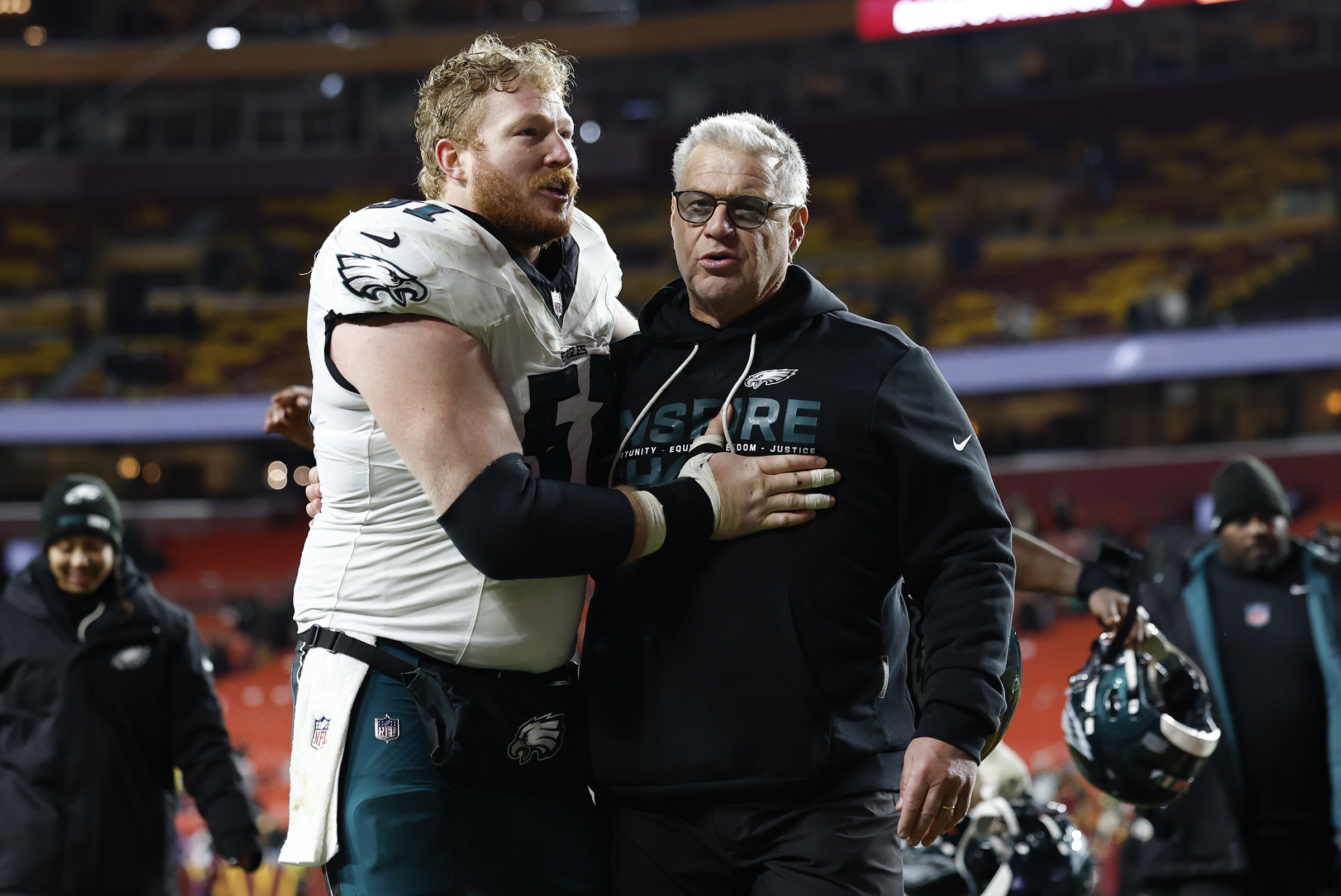
    But it being March also means it’s time to start considering next season’s roster. Willard said Hodge’s injury “does and it doesn’t” have major implications for the 2026-27 Wildcats. That’s because Willard is planning for Hodge to return and take on a big role. Willard said he expects Hodge to need around eight months to return from his injury, and he could be practicing by October.

    “We’re planning on Matt playing for us next year,” Willard said.

    There will still need to be plans for the portal, though. That means making sure to stockpile the roster via the portal or otherwise in case Hodge isn’t ready to go right away or, worse, has a setback. Villanova’s priorities for the portal were going to be adding talent and athleticism in the frontcourt anyway with Brennan graduating.

    From that standpoint, Hodge’s injury hasn’t changed a ton. But it will be on Willard’s mind as he and general manager Baker Dunleavy navigate the frenzy that is the transfer portal, which is only one month away.

  • Your Eagles guide to free agency, Part I: What changes and new faces are coming on offense?

    Your Eagles guide to free agency, Part I: What changes and new faces are coming on offense?

    A week from now, the NFL’s new league year begins, the free-agency frenzy kicks off, and rosters for the 2026 NFL season will start taking shape.

    For the Eagles, a crucial offseason is underway. They moved on from offensive coordinator Kevin Patullo after the offense took a big step back in 2025, and replaced him with first-year coordinator Sean Mannion, who will bring a new scheme to an offense in need of a jolt.

    The Eagles have 20 total pending free agents and a few holes to fill, but, as of now, only have around $14 million in cap space, according to Over the Cap, before making any moves to clear room.

    How will they approach free agency? What new faces could be coming to town?

    Let’s start our two-part free agency preview with a position-by-position look at the offense.

    Will A.J. Brown stay or will he go? The answer to that question could have a domino effect for the whole offense.

    Wide receivers

    Why start here? Well, it’s the obvious place to start, because the entire offseason approach sort of revolves around what happens with A.J. Brown.

    Will the Eagles trade him or keep him? They’re certainly going to listen to offers, and it’s likely a resolution comes sooner than later given how the move could shape the rest of the Eagles’ offseason.

    With or without Brown, though, the Eagles need reinforcements at wide receiver. They’re losing Jahan Dotson in free agency and need a WR3 (or WR2, depending on Brown). It’s a position the Eagles likely will add talent to during the draft, but there are options in free agency, too.

    Romeo Doubs surpassed 700 yards for the first time in his career this past season.

    Romeo Doubs: The fit is obvious. Doubs, who turns 26 next month, was with Mannion in Green Bay, where last season he caught 55 passes for 724 yards and six touchdowns. He’s a good route runner who has produced in each of his first four NFL seasons since the Packers drafted him 132nd overall out of Nevada in 2022. It is not a loaded class, which means Doubs could be pricier than he normally would be.

    Deebo Samuel: Perhaps his beef with the Eagles could be squashed. Samuel is 30 now and the burst that made him a big-name receiver with the stats to back it up seems to come and go. Will Samuel’s market be too rich for the Eagles? It’s hard to imagine given his age, but he did still rack up 72 catches for 727 yards and five touchdowns with Washington last season.

    Christian Kirk: Kirk, 29, is due for a pay cut after injuries led to a decline in his statistical output with Jacksonville and Houston over the past two seasons. With the Texans, Kirk was surrounded by talent and that limited his production, too. But with Nico Collins out for the playoffs, Kirk broke out in a playoff win over Pittsburgh, catching eight of nine targets for 144 yards and a touchdown. He caught another touchdown the next week in a loss to New England. Could Kirk be available a little bit cheaper on a one-year deal? The Eagles may want to find out.

    Other names to watch: Jalen Nailor, Kendrick Bourne, Van Jefferson

    Offensive line

    The Eagles are returning all five starters for the 2026 season along the offensive line, but it also may be the most important offseason for roster building at the position in quite some time.

    And it’s all happening without longtime position coach Jeff Stoutland in the fold.

    Lane Johnson and Landon Dickerson weighed retirement until recently. Cam Jurgens flew to Colombia to treat his ailing back. Tyler Steen’s long-term viability at right guard is up for debate.

    There’s a lot to address. Let’s start with Johnson, whose eventual replacement most likely will come via the draft. Don’t be surprised to see the Eagles take a tackle with their first pick. But they also need a swing tackle with Fred Johnson as a free agent. There are two second-year tackles on the roster in Cameron Williams and Myles Hinton, but Johnson’s ability to get through a full season isn’t a lock, so the Eagles need contingency plans.

    They are relatively thin on the interior, more so than at tackle. Long-term replacements for Dickerson and potentially elsewhere are more likely to come via the draft, but the Eagles will need to mine the free-agency market.

    Could Evan Neal be an O-line reclamation project for the Eagles?

    Evan Neal: Neal fits the Eagles’ playbook. No, not Mannion’s playbook. Neal, 25, is a first-round pick (seventh overall in 2022) who has been a bust and even changed positions from tackle to guard. He’s 6-foot-7 and 340 pounds. Hello, Mekhi Becton? Stoutland isn’t around to have the same kind of makeover, but Neal will be a pretty cheap flier.

    Isaac Seumalo: Another guard, Seumalo, an Eagle from 2016-22, is a 32-year-old who made the Pro Bowl in 2024 with the Steelers. Unlike Neal, Seumalo isn’t a project. He’s a player you sign to start over Steen and be in the building for Dickerson insurance.

    Alijah Vera-Tucker: Vera-Tucker has been really solid for the Jets, but he’s coming off a torn triceps that wiped out his 2025 season and could be available on a one-year, prove-it deal. The 14th overall pick in the 2021 draft would push Steen in camp and could earn the starting job while giving the Eagles more plug-and-play depth than they have right now.

    Trey Pipkins III: It’s time to put a tackle on this list. Pipkins wasn’t great with the Chargers in 2025, but he’s started a lot of games in seven seasons and could be an option for a reliable swing tackle behind the Eagles’ starters.

    Other names to watch: James Daniels, Fred Johnson

    Tight ends

    Welcome to the biggest area of need for the Eagles, due respect to Jaheim Bell, Cam Latu, and E.J. Jenkins, the three tight ends on the roster.

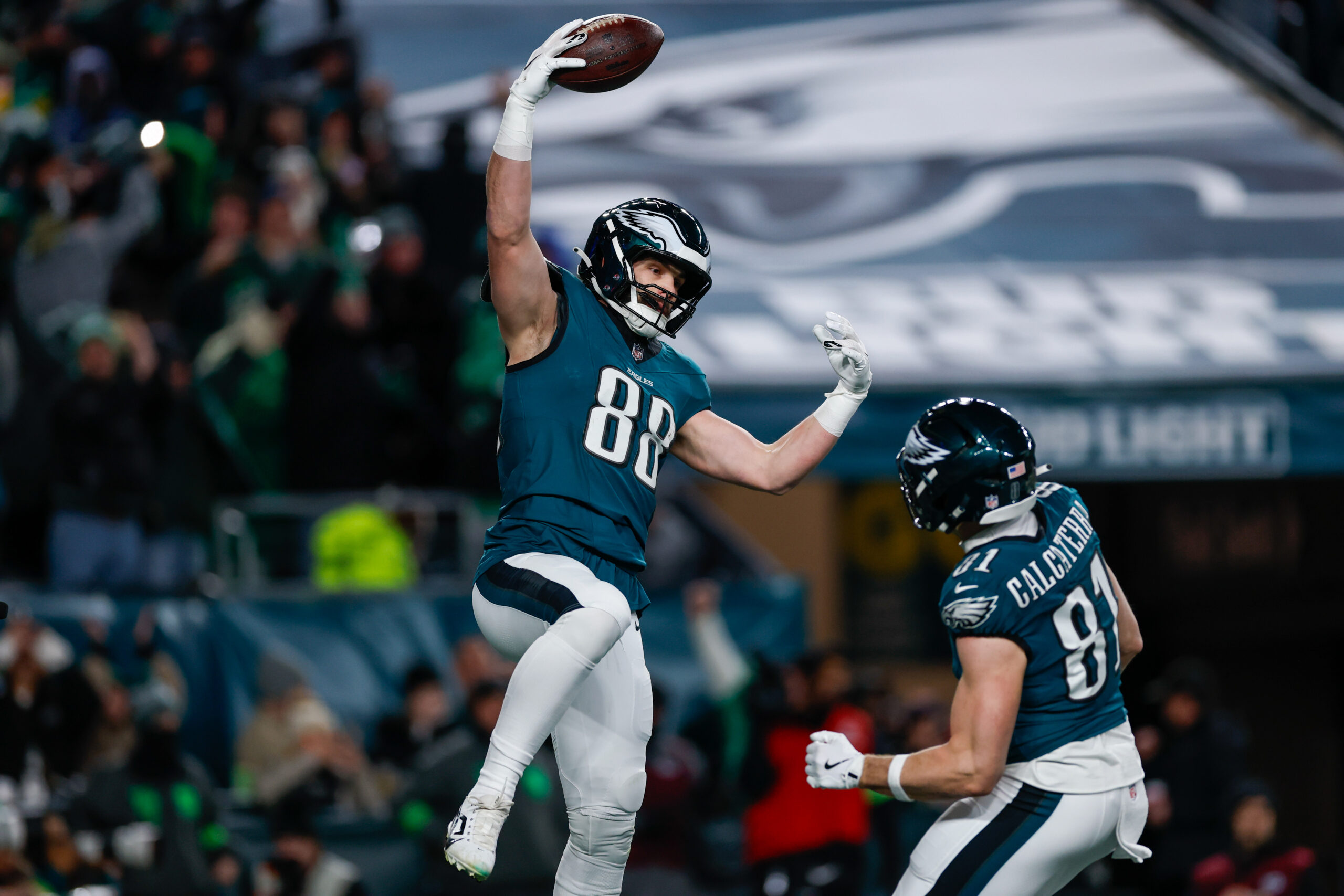
    Dallas Goedert is a free agent after coming back last season on a restructured deal and scoring more touchdowns (11) than he had in the previous three seasons combined (8). But while he was a major red-zone weapon running routes, Goedert’s blocking took a step back. Grant Calcaterra, the Eagles’ sixth-round pick in 2022, is also a free agent and is best used as a receiver. The Eagles certainly need to add a pass catcher or two at this spot, but the scheme they’re turning to will also require much better blocking.

    The Eagles probably will draft a tight end, but they need to add in free agency as well. They seem likely to be priced out of the top of the market — think Kyle Pitts, David Njoku — in what is a relatively weak free-agent class.

    Will Dallas Goedert parlay a big scoring year into a bigger deal elsewhere?

    Goedert: What will Goedert command on the open market? How will teams view his 11 touchdown receptions after he finally got through a season mostly healthy? He’s still just 31 years old and thinks some of his best football is ahead of him. If the number isn’t too high, the Eagles could bring him back.

    Isaiah Likely: It’s unclear what Likely’s market is going to be in free agency. The soon-to-be-26-year-old has been playing in Mark Andrews’ shadow in Baltimore, and has probably benefited from having talented pass catchers around him. But Likely has shown flashes, and the Eagles could get in the mix for him. A weak class, though, means he could fetch more than some teams are willing to spend.

    Jake Tonges: Tonges is limited in his catching abilities, but he’s an elite blocking tight end that the Eagles could certainly value as TE2 or TE3. Tonges, who turns 27 in July, has been with the 49ers since 2023 and knows how to block up outside zone concepts.

    Tyler Higbee: Higbee recently turned 33 and has played just 13 games over the last two seasons. He would add an experienced red-zone target to the offense, but most importantly Higbee is a solid blocker in the run and pass game.

    Charlie Kolar: Kolar’s running mate in Baltimore, Likely, is the better and more expensive option on the free-agent market. But Kolar, 27, is one of the better blocking tight ends in the league.

    Other names to watch: Robert Tonyan, Nick Vannett

    Quarterbacks

    This position, like receiver, also has a trade possibility that could impact how the Eagles address it in free agency.

    That depends on whether Tanner McKee fetches a draft pick that makes him worth offloading. The Eagles value the backup quarterback spot, and behind Jalen Hurts, McKee is the only quarterback under contract for 2026. The Eagles probably will take another quarterback on Day 3 at the draft, but they could add to the group in free agency, too, especially for another camp body. Last year, they drafted Kyle McCord in the sixth round and were later forced to part with draft compensation to bring in Sam Howell in the QB3 spot.

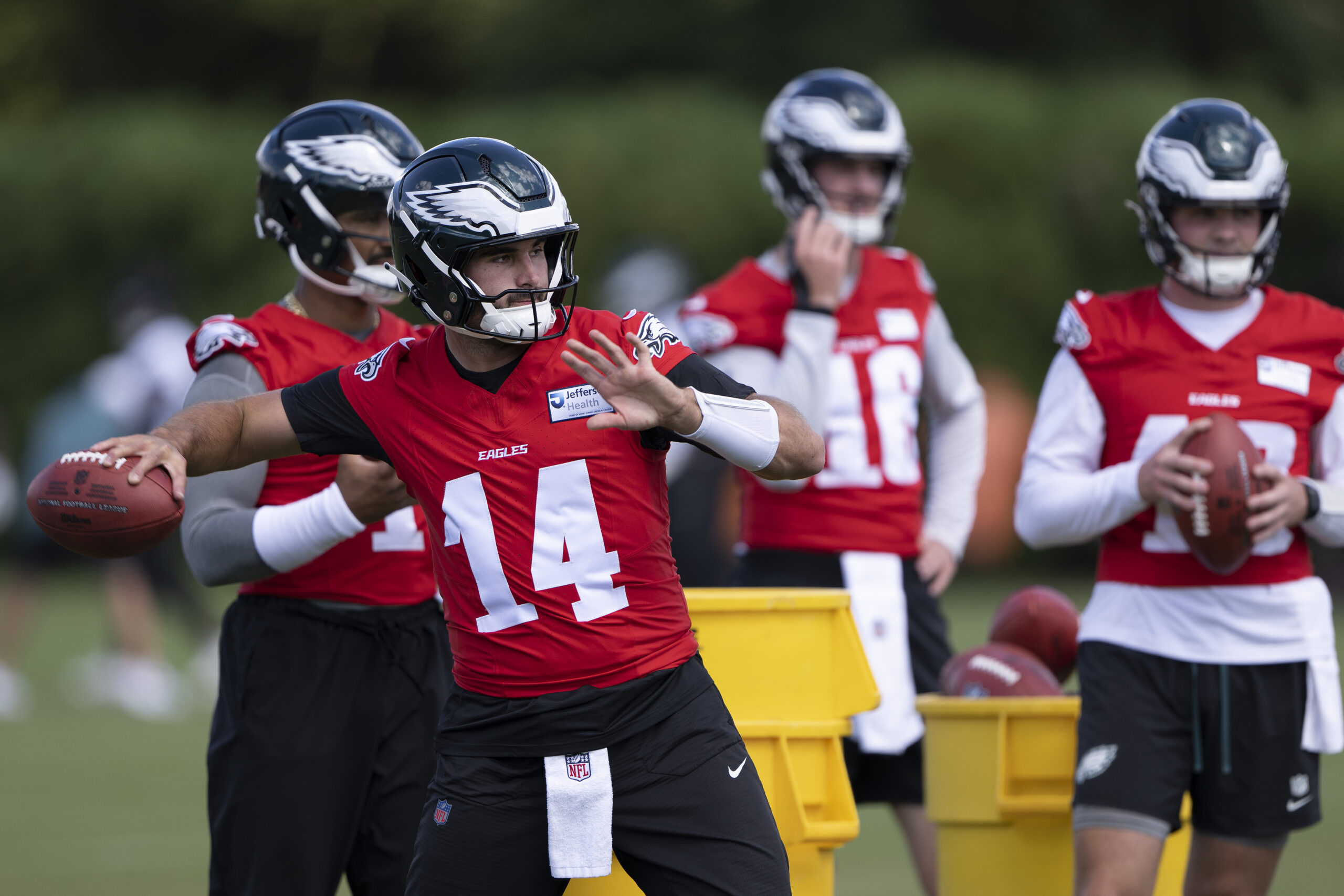
    Will Sam Howell (14) stay in the QB room in 2026?

    Howell: Keep the band together? Howell is a free agent and still has much more NFL playing experience than McKee. He didn’t see the field for the Eagles last season, but they could do worse than bringing him back to the room.

    Trey Lance: The No. 3 overall pick in the 2021 draft is still just 25 years old and was with his third NFL team this season when he backed up the Chargers’ Justin Herbert. Lance spent his first two seasons with the 49ers in the Kyle Shanahan offense, from which the Eagles likely will install elements during the offseason. Can’t hurt to have a player in the building with some experience hearing calls from the man himself.

    Clayton Tune: Another one for the translator category. Tune, a fifth-round pick by Arizona in 2023, was on Green Bay’s practice squad last season and could help Hurts and Co. transition into the Mannion offense and terminology.

    Other names to watch: Kenny Pickett, Brett Rypien

  • Villanova forward Matt Hodge suffers season-ending knee injury

    Villanova forward Matt Hodge suffers season-ending knee injury

    Villanova forward Matt Hodge suffered a torn right ACL in the Wildcats’ loss to St. John’s Saturday night at Madison Square Garden, the school announced on Monday afternoon.

    He will undergo surgery and miss the rest of the season.

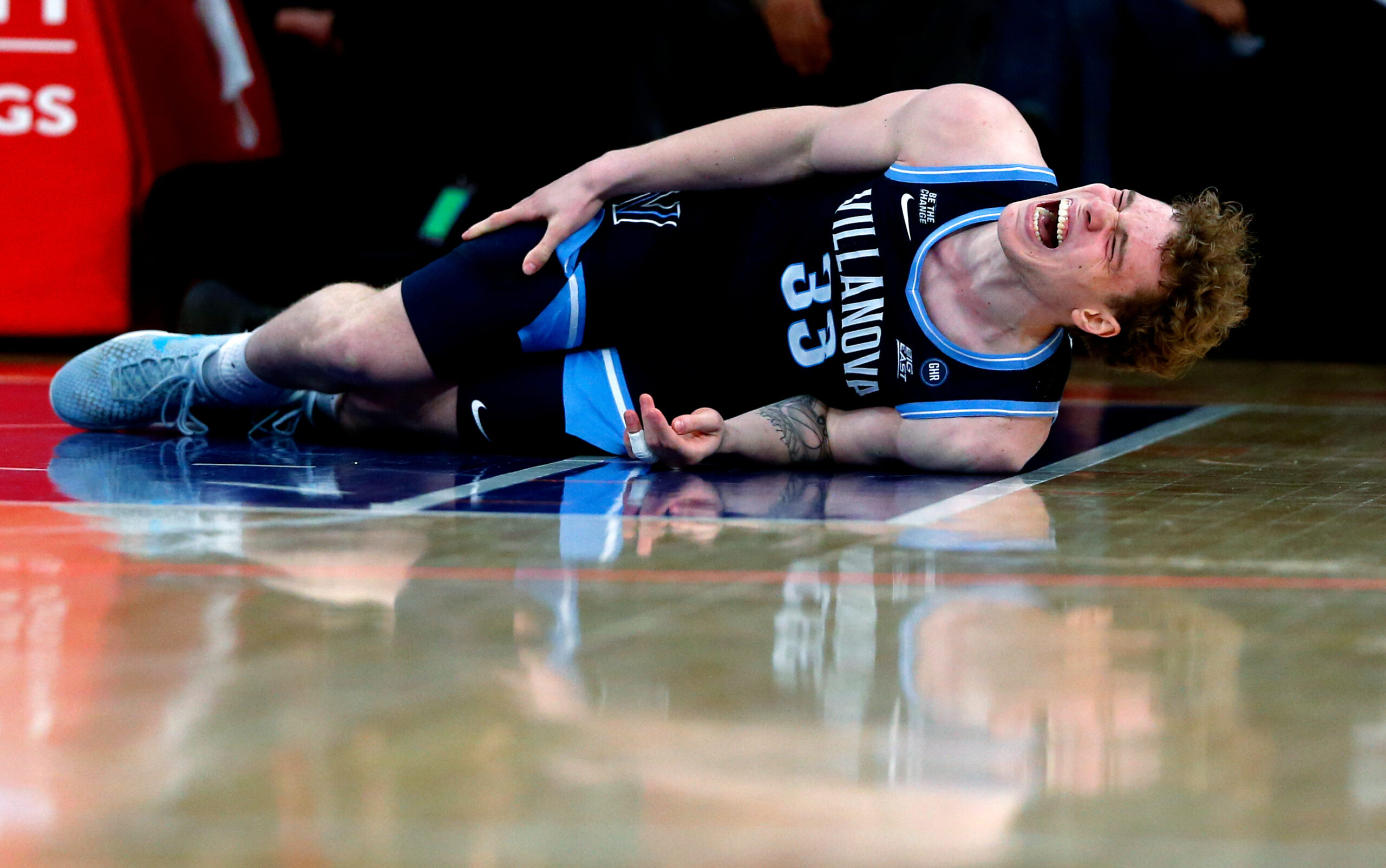
    The injury occurred in the second half when Hodge made a move in the post and fell to the ground. He was down on the floor in pain for a few moments before being helped to his feet. He struggled to put weight on his right leg and was helped into the locker room.

    Villanova forward Matt Hodge goes to the floor against St. John’s on Saturday with an injury that was later determined to be a torn ACL.

    The injury is a big blow to Villanova, which has two regular-season games remaining before beginning postseason play. Hodge, a 6-foot-8 redshirt freshman, has started all 29 games this season and is Villanova’s sixth-leading scorer at 9.2 points per game while shooting 36.8% from three-point range.

    He also plays about 28 minutes per game, and his absence will test Villanova’s depth. The Wildcats do not have much in their frontcourt, and playing without Hodge could force coach Kevin Willard to go a bit unconventional with the power forward spot.

    Willard has a few options. He could go for a small-ball lineup and insert sixth man Devin Askew, a 6-5 guard, into the starting five and use Tyler Perkins, a physical 6-4 guard and Villanova’s leading scorer, in a forward role. Or he could replace Hodge with the 6-6 sophomore Malachi Palmer. The decisions could be matchup dependent.

    Temple transfer Zion Stanford, a 6-6 wing, could move back into the back end of the rotation. The West Catholic graduate has played in just 10 games (5.1 minutes per) and has rarely seen the court in conference play. Hodge’s injury also highlights the loss of Tafara Gapare, a 6-9 athletic forward who left the team around the holidays.

    Villanova’s two centers, starter Duke Brennan and reserve Braden Pierce, have not shared the floor together, but Villanova’s lack of size could potentially lead to the big men sharing some minutes depending on opponent and game flow.

    Hodge, who was forced to redshirt as a freshman last season at Villanova due to an NCAA ruling regarding his academic eligibility after moving to the U.S. from Belgium, scored six points in 14 minutes before suffering his injury Saturday night.

    The Wildcats (22-7, 13-5) finish their regular season this week with a road game at DePaul on Wednesday and a home game Saturday vs. Xavier at Finneran Pavilion. They will be the No. 3 seed in the Big East tournament.
  • Villanova suffers worst loss in 29 years in drubbing to St. John’s: ‘We’re going to move on’

    Villanova suffers worst loss in 29 years in drubbing to St. John’s: ‘We’re going to move on’

    NEW YORK — Kevin Willard spent his formative years in coaching working under Rick Pitino, first with the Boston Celtics and then later in the college ranks at the University of Louisville.

    So the Villanova coach didn’t have to imagine what practice was like for Pitino’s No. 15 St. John’s team this week after it was blown out and embarrassed by No. 6 UConn Wednesday night.

    He lived it.

    “I don’t have hair because of him,” Willard said after Villanova was throttled in an 89-57 loss — the worst defeat for the program in 29 years — that was all but over before halftime. “I had a full set of hair when I started working for him. It’s the most miserable experience in life. You fear for your life every day. Everyone laughs when I say that, but no, you think you’re going to get fired, and it’s miserable.”

    The game was already going to be hard to begin with. Villanova (22-7, 13-5) is on its way to the NCAA Tournament, but it has failed to show it can compete with the two teams at the top of a Big East conference that will send just three teams to the dance, barring a miracle run at Madison Square Garden in two weeks. Add to the equation that St. John’s was coming off a 32-point drubbing, the Garden was sold out, and those rough and rowdy Red Storm practices this week, and you get a recipe for disaster.

    St. John’s coach Rick Pitino walks by the bench against Villanova on Saturday.

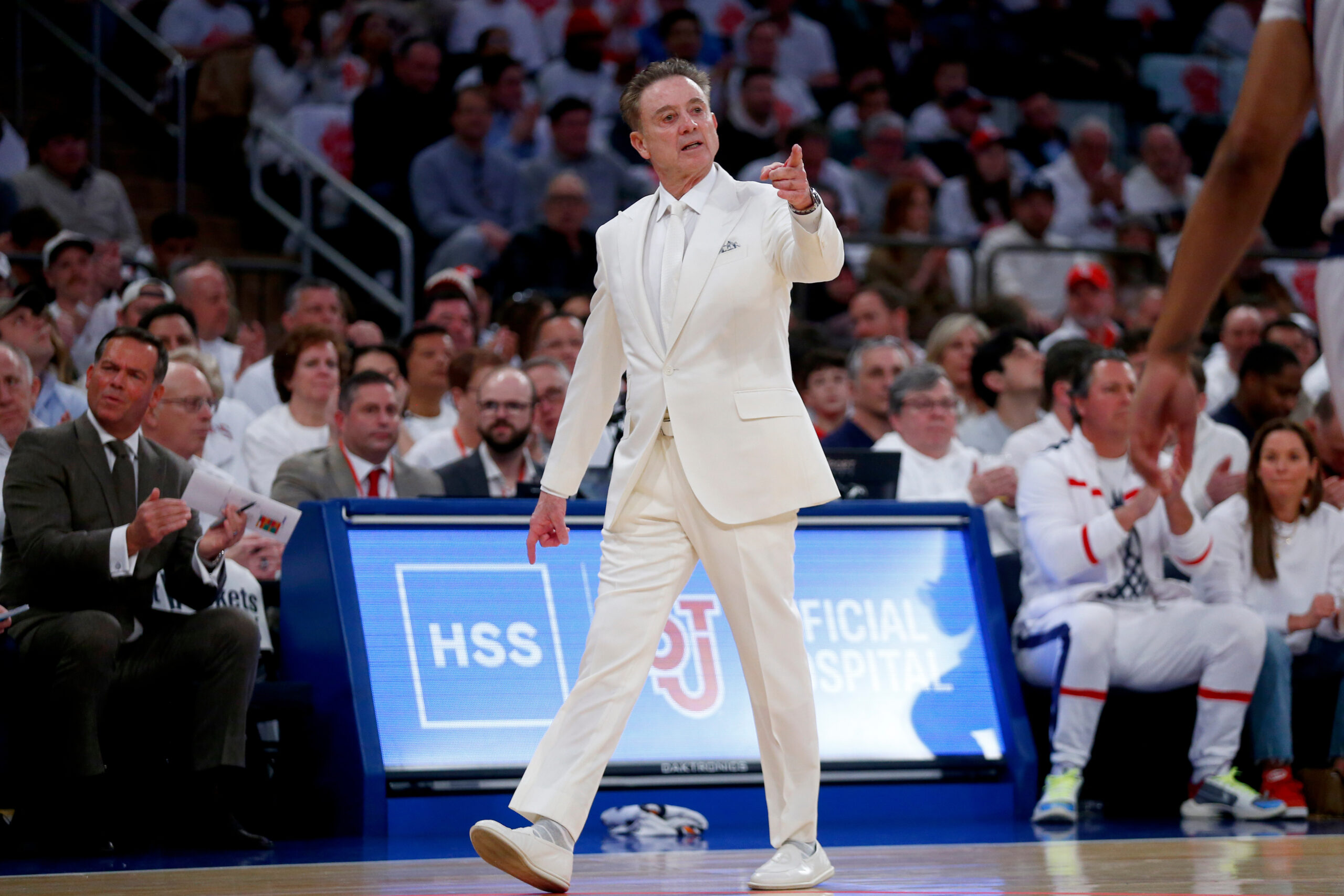
    Pitino told reporters ahead of Saturday that the game against UConn was the biggest since he arrived on campus in 2023. It is the hyperbole you resort to after you lose a game by 32. St. John’s held a White Out and gave out white t-shirts for lower-level ticket holders, and Pitino emerged from the tunnel onto the floor before the game wearing a white suit. The crowd loved it, and Pitino’s players made sure they continued having things to cheer about.

    It was 11-2 after three quick Villanova turnovers. Later, two more consecutive turnovers led to easy dunks and a 28-14 deficit. Willard used multiple timeouts during the first half, but Villanova had no answers for the defensive pressure and intensity from St. John’s. It was 48-23 by the time the first-half buzzer mercifully sounded, and the first-half stats told the story.

    St. John’s held an 18-0 advantage in points off turnovers. Villanova had more turnovers (eight) than it did made baskets (seven). The Wildcats shot 25.9%. Tyler Perkins, Villanova’s leading scorer, was minus-32 in 17 first-half minutes.

    “I think the biggest difference is that they’re a veteran team,” Willard said. “You knew Zuby [Ejiofor] wasn’t going to come out and lay an egg, and he didn’t.”

    The St. John’s center became the fourth known Red Storm player to record a triple-double. He had 16 points, 12 rebounds, and 10 assists. The superlatives didn’t stop with him. The 32-point victory was the largest St. John’s has ever recorded vs. Villanova in what was the 135th matchup between the two teams.

    Further, it was the worst Villanova loss since the Wildcats lost by 37 in a February 1997 game vs. Kentucky.

    Who coached that Kentucky team? Pitino.

    Villanova guard Tyler Perkins defends St. John’s forward Zuby Ejiofor on Saturday.

    Back to the present day, Willard’s Wildcats on consecutive Saturdays received a dose of reality vs. the conference’s elite, but they also survived a rough stretch during Wednesday’s win over Butler.

    “We still won seven out of nine games,” Willard said when asked if he was concerned about the timing of it all. “We lost to UConn and St. John’s. Unfortunately, I caught UConn after they played their worst game of the year and it seems like God is punishing me for my sins.

    “We’re going to move on. We have two more games left. Life happens, man. You get your [butt] kicked every once in a while.”

    Willard had a similar thing to say last week after a 10-point loss to UConn that wasn’t as close as the final score indicated. Villanova bused home late Saturday night and is back on the road for a Wednesday night game at DePaul. The regular season finishes Saturday with a home game vs. Xavier before the Big East tournament begins.

    How will Villanova respond to its worst loss of the season?

    Perhaps Willard can channel Pitino at Monday’s practice.

    No update on Matt Hodge’s injury

    Villanova redshirt-freshman forward Matt Hodge went down with what appeared to be a right leg injury early in the second half. Hodge was on the floor in pain for a few moments and then struggled to put any weight on his right foot as he was helped off the floor and into the locker room.

    Willard did not have an update on Hodge’s status after the game.

    Villanova forward Matt Hodge goes to the floor with an apparent injury during the second half against St. John’s on Saturday.

    Wildcats locked into Big East seed

    The loss Saturday means Villanova can’t possibly climb higher than third in the Big East conference. For reference, the Wildcats were picked seventh in the preseason poll. But there appears to be a steep drop off from UConn and St. John’s at the top.

    The No. 3 seed means the Wildcats will open the Big East tournament with a 9:30 p.m. quarterfinal game vs. the winner of the game between No. 6 and No. 11.

  • A senior who never transferred? Among Big 5 men’s basketball teams, Penn’s Cam Thrower is one of one.

    A senior who never transferred? Among Big 5 men’s basketball teams, Penn’s Cam Thrower is one of one.

    It was senior day Saturday at the Palestra, and four members of the Penn men’s basketball team were honored: Ethan Roberts, Cam Thrower, Johnnie Walter, and Dylan Williams.

    “It’s definitely bittersweet,” Thrower said Wednesday after a morning practice at the Palestra.

    More for him than the rest of them.

    Among the four players, Thrower, a native of Southern California, is the only one who attended Penn as a freshman and never transferred. It makes him a Lone Ranger of sorts on a basketball team that has undergone change with name, image, and likeness legislation, the modern transfer portal, and, this season, a new coach, Fran McCaffery, who took over after Steve Donahue was fired at the end of last season.

    Thrower, though, isn’t just the only four-year senior at Penn. Among the six Big 5 men’s basketball programs, Thrower, a 6-foot-3 guard, is sort of a unicorn. He is the only senior who plays, the only non-walk-on, who is at the same school where he first attended classes as a freshman.

    It is a sign of the times in a sport that, at least locally, has lost some of its luster. People are less invested when they don’t know any of the players at their favorite schools. One class below Thrower, there are just four juniors in the Big 5 who are in their third year at the same place, and two of them are at Penn.

    The sport has rapidly changed, and you don’t need to go back far to see the effects. In the 2019-20 season, before the pandemic upended the four-year track and before NIL and the transfer portal took over the sport, the numbers were drastically different. That year, there were 12 four-year seniors in the Big 5 and 14 three-year juniors.

    This isn’t just limited to men’s hoops. On the women’s side of the Big 5, only seven Throwers exist. Two at Drexel, two at St. Joseph’s, and three at Penn.

    “It’s definitely a rare thing nowadays,” said Thrower, whom Donahue recruited out of the venerable Harvard-Westlake School. “But for my family and I, the biggest thing coming into college was finding a situation where, regardless of what happens with basketball, I could meet great people, and having a great, well-rounded experience was something that we valued and Penn has provided that and changed my life for the better.”

    Thrower said he wears the distinction that was recently brought to his attention as a ”badge of honor.” But the Wharton student knows that everyone’s journey is different, and he doesn’t judge those around him and in college basketball for moving around and finding the best situation for themselves.

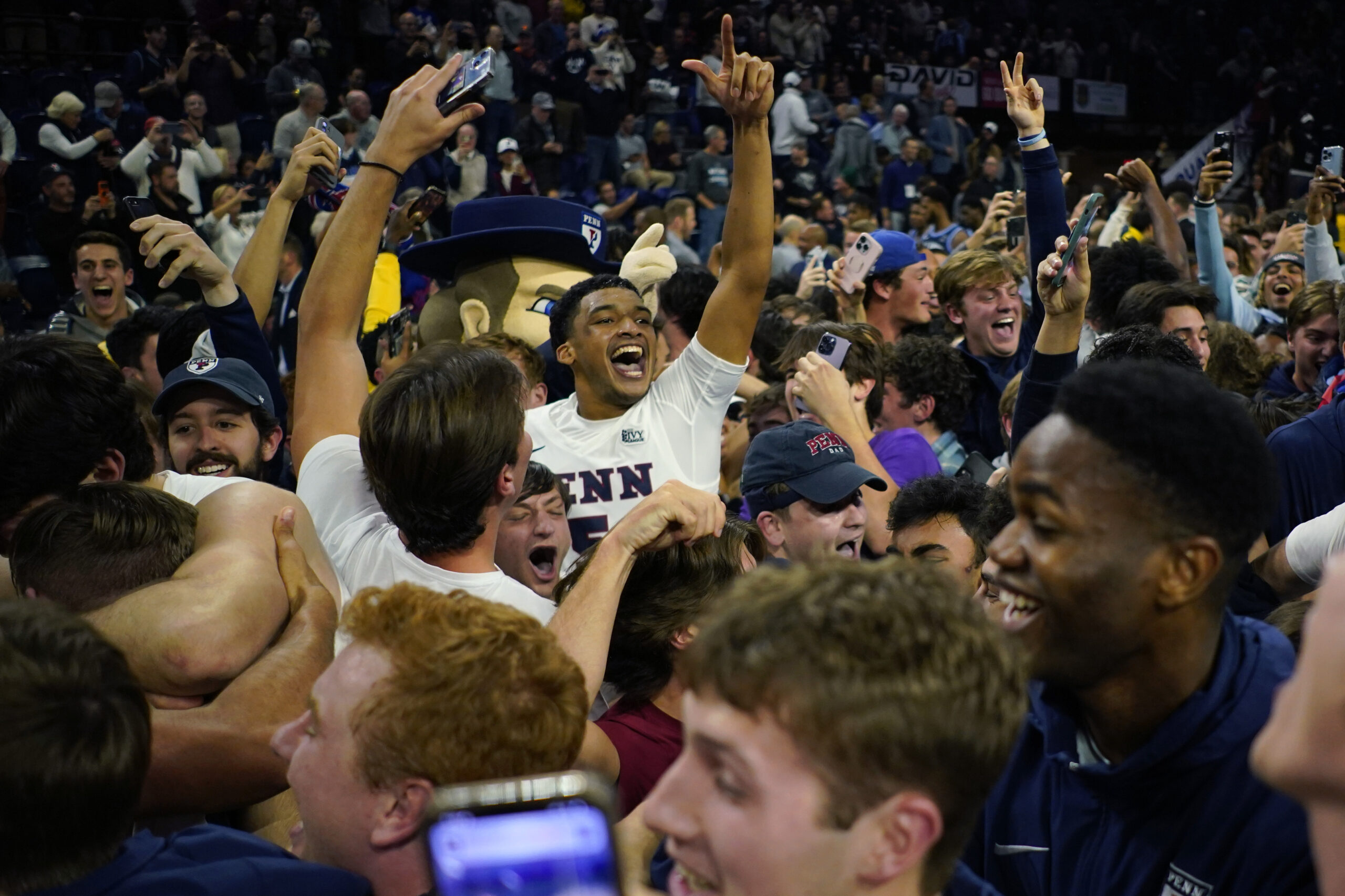
    Cam Thrower celebrates with fans as they storm the court after Penn beat Villanova in 2023.

    “Penn has been great to me,” Thrower said. “Basketball has been great to me.”

    The backup guard is averaging 5.2 points in 16.5 minutes in 21 games this season after missing all of last year with a wrist injury. His basketball journey has had ups and downs. One of the highs came in his sophomore year. He started and scored 11 points in 26 minutes when the Quakers knocked off a nationally ranked Villanova team at the Palestra.

    The injury wiped out his junior season, then Donahue was fired. Transferring wasn’t really an option, Thrower said. A Penn degree is more valuable than wherever he might transfer to continue playing basketball. So Thrower stayed, and he helped McCaffery and a new team transition into a new season.

    “His attitude and his leadership and his work ethic, for a new coach it’s incredibly appreciated,” McCaffery said. “You need your veteran guys to show the example for the younger guys, and that’s what he does.”

    McCaffery, who last coached at Iowa, is a Philadelphia native who was a rarity in 1978 when he transferred from Wake Forest to Penn. Back then, moving around from school to school wasn’t as prevalent as it became.

    “It’s just a different time,” McCaffery said. “Thank God for Cam that he went to Penn for all the right reasons and he stayed.”

    Thrower said the end of the season is bringing a “sense of urgency,” one the team talked about after practice Wednesday. The Quakers had two home games this weekend — Friday vs. Dartmouth, and Saturday vs. Harvard — and finish the season next weekend with a road game at Brown. Penn (15-11, 8-5 Ivy) clinched one of four spots in the Ivy Madness tournament with Saturday’s come-from-behind 64-61 win over Harvard. The Quakers are two wins from reaching the NCAA Tournament, a possibility, however small, that excites Thrower.

    From left, Penn forward Ethan Roberts, guard Cam Thrower, guard AJ Levine, and forward Augustus Gerhart react in the final minutes of the win against St. Joseph’s on Nov. 17.

    Off the court, he is spending his final few months on a campus and with a community that will stay with him forever. On the court, Thrower is savoring his final games and practices with a group of teammates that he’s constantly learning from. He scored 5 points in 14 minutes vs. Dartmouth on Friday and 3 in 17 minutes vs. Harvard on Saturday.

    “It’s helped me learn what life is and sometimes you may be with certain people for a year or two and then they move on with their lives,” Thrower said. “It’s a trial run of understanding what life can look like.”

    What’s next?

    Thrower is weighing the possibilities. He has studied finance, sports business, and legal studies and has learned a lot about professionalism and amateurism at an interesting time for those topics . But school isn’t done. Thrower said he wants to pursue his MBA and get his formal finance and accounting training under his belt before entering the workforce.

    Surely, he could do those things at Penn. That wrist injury from last year, however, left him with another year of basketball eligibility, and Ivy League rules prohibit graduate students from playing varsity sports.

    What if they didn’t?

    “Penn has been great,” Thrower said, “but I want to see what else is out there.”

  • Villanova’s Bryce Lindsay is breaking out of his slump at the right time for the Wildcats

    Villanova’s Bryce Lindsay is breaking out of his slump at the right time for the Wildcats

    Bryce Lindsay isn’t very superstitious, so he didn’t take Kevin Willard up a few weeks ago when the Villanova coach suggested maybe he should reorient himself in bed and sleep a different way.

    Lindsay did, however, take Willard and his family and support staff up on their advice in recent days. Lindsay was 13-for-65 from three-point range in the 11 games that preceded his 15-point effort, behind four triples, last week in an overtime road win over Xavier. The redshirt sophomore guard carried Villanova at times through its nonconference schedule, but being the focus of the opposing team’s scouting report was taking its toll.

    “They’re telling me, ‘Go out there and be you,’” Lindsay said Wednesday night after Villanova’s 82-73 win over Butler. “‘Don’t think too much. Focus on defense, focus on the other things, and your shot will come.’”

    Lindsay scored 19 points Wednesday and helped Villanova get to 22-6 on the season and 13-4 in Big East play. He went 2-for-6 from three-point range and was 6-for-14 from the field overall and 5-for-5 from the free-throw line. It was Lindsay’s first time making six shots in a game since a Jan. 3 road win at Butler. He made six or more in eight of Villanova’s first 14 games before a 13-game drought.

    Villanova has fared just fine despite Lindsay’s prolonged slump. But there’s no denying how much easier the offense comes when Lindsay — who shot 40.8% from deep at James Madison last season — is filling it up.

    Bryce Lindsay and Villanova are third in the Big East behind St. John’s and UConn.

    It did take a bit for Lindsay to understand that there was more to impacting a game than just making shots. This was the first real slump he remembers going through. He had some off shooting nights at JMU last season, but things never snowballed the way they did in recent weeks.

    “That was probably one of the hardest things I have ever went through in my life,” Lindsay said. “I’ve never, ever played that bad until now. It comes with the game. When you’re the No. 1 player on the scout, they’re going to try to take you away and that’s what they did. I’m just figuring out ways to maneuver through that.”

    Willard would certainly disagree with Lindsay’s assessment of his play, and he spent recent weeks trying to build him up and remind him of that when he noticed Lindsay’s frustration showing up in his body language.

    “Sometimes when you’re a shooter and you’re not shooting good and you’re standing on the court and you’re thinking about it, it’s like the worst thing you can do,” Willard said. “Just trying to get them to focus on all of the positive stuff.

    “There are times on the floor where he’s plus-8, plus-9, but he’s 0-for-4. You can see his body language. You can see everything going down. But your team is playing well when you’re out there.”

    Lindsay, who is averaging 14.3 points over the last three games, was plus-12 in 31 minutes Wednesday night. The advanced stats show a team that has a much better net rating in conference play with Lindsay on the floor.

    “In my head I feel like I was playing bad, but in their head I’m not playing bad because [of] the stats, my plus-minus is good,” Lindsay said. “I was always able to make shots, but when I don’t see the ball go in it’s hard.

    “These past few games I tried not to focus on it as much.”

    His effort Wednesday helped Villanova bounce back from Saturday’s deflating loss to No. 6 UConn in front of a sold-out Xfinity Mobile Arena. The Wildcats built a 14-point halftime lead but started sloppily in the second half and allowed Butler to climb back into the game. The lead was one before Lindsay extended it back to three with a layup with more than eight minutes to play. He again scored inside to bump an eight-point lead back to double digits with four minutes to go, then helped seal the game with four free throws inside the final two minutes.

    The fact that Lindsay scored all 10 of his second-half points inside the arc is a positive sign, too. It seemed at times that he was becoming too reliant on shooting threes in trying to break out of his slump.

    “Just focusing on other things,” Lindsay said when asked how he navigated it all. “My defense, my rebounding …”

    Willard, who was seated at the postgame podium between Lindsay and Devin Askew — who scored 16 points Wednesday — leaned over as Lindsay went on with his answer and circled a stat on the sheet in front of Lindsay.

    Focused on rebounding? Lindsay had zero rebounds Wednesday.

    The player and coach shared a laugh. After six weeks of slumping, Bryce Lindsay can finally smile.

  • Five things to watch as Villanova plays its final four regular-season games before the Big East tournament

    Five things to watch as Villanova plays its final four regular-season games before the Big East tournament

    Inside a sold-out Xfinity Mobile Arena on Saturday night, Villanova endured a 40-16 UConn run over a 20-minute stretch that turned the biggest home game of the season into a blowout loss.

    The loss dropped the Wildcats to 21-6 and 12-4 in the Big East, and, barring the unforeseen, all but ensured them the No. 3 seed in the conference tournament, which begins in two weeks at Madison Square Garden.

    Just four games separate the Wildcats from the postseason, starting with a home game Wednesday night vs. Butler (15-13, 6-11). A trip to the NCAA Tournament, which would snap a three-season drought, is basically a foregone conclusion, but, as Saturday showed, there are things that need to be corrected if Villanova wants to finish the season strong and threaten to get to the second weekend.

    Here are five things to watch in the final four games of the regular season.

    The second unit

    It was a rough night all around vs. the fifth-ranked team in the country on Saturday, but it was especially difficult for much of Villanova’s second unit. Sophomore wing Malachi Palmer was minus-17 in 18 minutes. Devin Askew, who has provided a big boost as a veteran ball handler and scorer off the bench, was minus-16 in 18 minutes. Backup center Braden Pierce was minus-13 in 11 minutes.

    Plus-minus numbers never tell the whole story. But Villanova caused eight turnovers in the first half and couldn’t take advantage in part because the second unit struggled offensively. The two-man game with Askew and Pierce, for example, was ineffective.

    Villanova guard Devin Askew and UConn’s Solo Ball fight for possession in Saturday’s matchup.

    Pierce has made some strides in recent weeks filling in for Duke Brennan when the starter needs rest. Palmer emerged in the second half of the season as a reliable reserve on both ends. Freshman Chris Jeffrey returned from injury and has occasionally provided a spark. Askew, meanwhile, has been the reason Villanova has won a few games. But the 23-year-old guard is 9-for-44 from the floor (20.4%) over the last five games and has not made up for it by creating efficient offense and generating assists.

    Villanova coach Kevin Willard talked recently about needing to figure out which lineups to get out there at the right times now that his team is healthier and the bench has expanded. Perhaps we’ll see some new wrinkles over the next two weeks.

    Bryce Lindsay’s shot

    Lindsay got the weight of the world off his shoulders when he made 4 of 8 three-point shots and scored 15 points during an overtime win at Xavier last week. Before that, Lindsay was 13-for-65 (20%) in the previous 11 games.

    Lindsay’s shooting prowess helped Villanova to a 9-2 start through nonconference play, but when his shot wasn’t falling, it wasn’t as easy to justify playing him 30-plus minutes, which Villanova asked of him when he had it going earlier in the season. Villanova’s offensive analytics are much better with Lindsay on the floor than off, even when his shot isn’t falling. But his perimeter defense can leave a little to be desired in critical moments of the game.

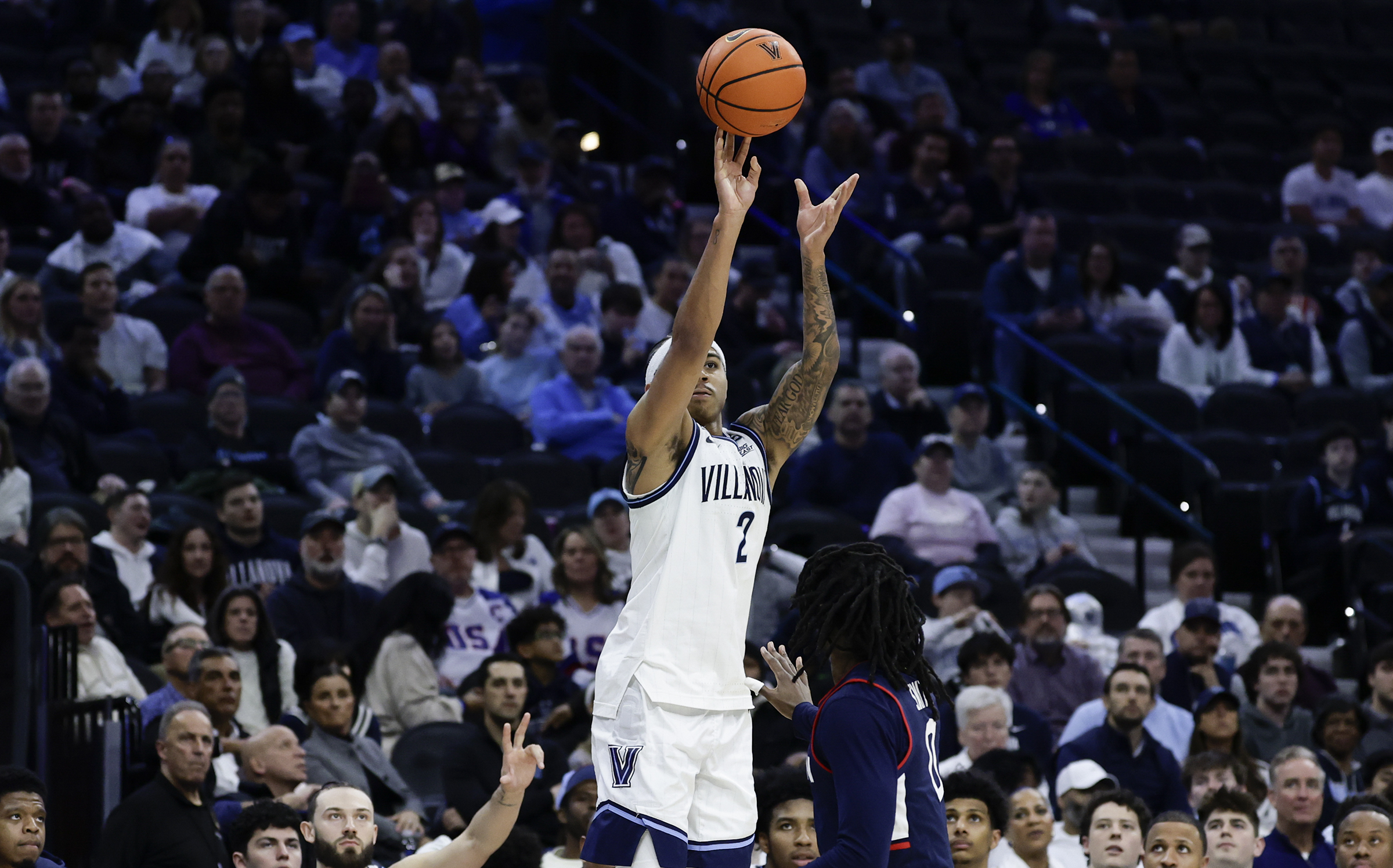
    Villanova guard Bryce Lindsay shoots the basketball over UConn’s Malachi Smith on Saturday.

    Everything is easier for Villanova when Lindsay’s shot is going in. Willard would probably be wise to try to get Lindsay going over the next four games. The coach said the redshirt sophomore guard was feeling the mental side of his slump but was confident that Lindsay would be a big boost going into the postseason.

    Free throw woes

    Villanova has missed at least five foul shots in each of its last 10 games. The Wildcats missed eight and almost lost to a Xavier team with five conference wins last week. They missed 13 on Feb. 10 and almost suffered a home loss to Marquette because of it.

    After that game, Willard pointed to a young team shooting important free throws in bigger college basketball games for the first time and needing to work its way through it.

    Two weeks from now, the lights get even brighter.

    Bouncing back

    Villanova “didn’t come out with enough urgency” after it left the locker room following halftime trailing UConn by just two, leading scorer Tyler Perkins said.

    It led to an embarrassing loss in front of the home crowd, and Willard said his team seems to have a better mentality on the road than it does at home.

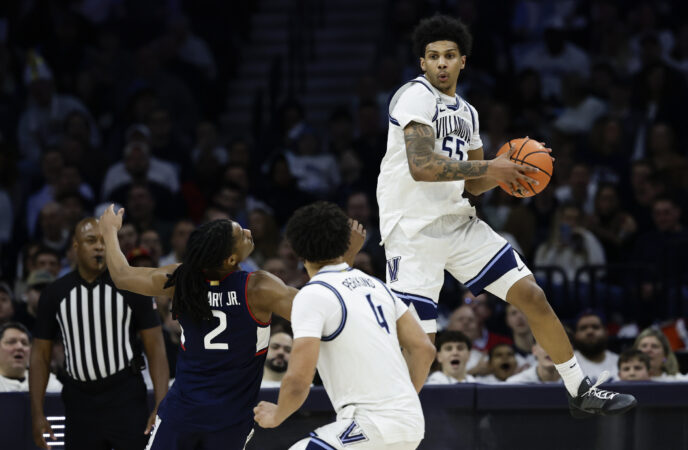
    Villanova guard Tyler Perkins grabs the basketball in front of UConn’s Jayden Ross on Saturday.

    “We’ve really struggled at home at times just playing well for good stretches,” he said. “Some of it is a little bit of youth. This is really only our second time in this building. The crowd was unbelievable. They were into it. I think some shots that we’ve been making, we were a little juiced up and missed some shots early.”

    He also said that “every once in a while you get your [butt] kicked.” That’s happened only once or twice (depending how you’d classify the home loss to St. John’s on Jan. 17), but the last time the Wildcats were blown out, an 89-61 loss to No. 3 Michigan on Dec. 9, they responded with a dominant home win over Pittsburgh and two tough road wins at Wisconsin and Seton Hall.

    “It’s not the end of the world,” Willard said.

    Bouncing back starts Wednesday, when the Wildcats have a chance to also play well in front of a home crowd.

    The seed line

    With a road game at St. John’s looming on Saturday, Wednesday night’s game vs. a Butler team that Villanova blew out on the road on Jan. 3 isn’t one to fool around with.

    Bracket Matrix, the website that tracks all of the NCAA Tournament bracket projections, shows Villanova as the top No. 7 seed in the bracket with an average seeding of 7.04. Losing to Butler at home would probably be a seed-line loss, and dropping back into the 8-9 range means the possibility of having to face a No. 1 seed on opening weekend.

    There’s some runway left, and moving up a seed line — or two, pending a big run at the Garden — is still possible. It’s just a bad time of year to fall backward.

  • How will the Eagles navigate a critical moment for their offensive line without Jeff Stoutland?

    How will the Eagles navigate a critical moment for their offensive line without Jeff Stoutland?

    Two months after the Eagles hired Jeff Stoutland, they drafted Lane Johnson with the fourth overall pick in the 2013 NFL draft. Howie Roseman had his cornerstone offensive lineman, one whom Stoutland helped develop into a future Hall of Fame right tackle.

    Stoutland was in the room with — and in the ear of — Roseman in the years that followed, even after the coach who hired Stoutland, Chip Kelly, left town. Stoutland survived 13 seasons and three coaching staffs in large part because he was arguably the best offensive line coach in football, but he also shared similar philosophies with Roseman.

    “In 13 years, I probably couldn’t get on one hand our disagreements,” Roseman said during a session with Eagles beat writers on Friday, a few weeks after Stoutland announced his departure from the Eagles. “We looked at offensive line play very similarly.”

    The Eagles, with Stoutland as offensive line coach, consistently had one of the best units in the league, and the two Eagles teams that won Super Bowls did so behind dominant offensive line play. But change is on the way, not just along the offensive line but for the offense as a whole. The Eagles have a new coordinator, Sean Mannion, and multiple new coaches working under him, including new offensive line coach Chris Kuper.

    The line, meanwhile, is at a somewhat critical juncture. Johnson, who missed half of last season, turns 36 in May and didn’t decide until last week to make his return for the 2026 season official. It’s unclear how much longer Landon Dickerson, a second-round pick in 2021 whom Stoutland developed into a three-time Pro Bowler, will play football. The 27-year-old has undergone multiple surgeries since college and played through an abundance of pain in 2025. Cam Jurgens, 26, whom the Eagles drafted in the second round in 2022 to replace Jason Kelce, recently flew to Colombia to receive stem cell treatments, apparently to help deal with the lingering impacts of a back injury and subsequent pain that limited his effectiveness in 2025.

    The Eagles offensive line will enter 2026 with questions about its health and ability to adjust to a new coaching regime.

    The offensive line, which took a step back in 2025 thanks to those injuries, has quickly gone from a position of strength and certainty to one that may soon need to be overhauled. The Eagles have been due to draft and develop Johnson’s eventual replacement, but now they may have big holes in the interior sooner than they anticipated. It’s a crucial offseason for Roseman to address multiple spots on the depth chart, not just the offensive line, and retooling the offensive front now comes without the help of Stoutland.

    “I probably could have 50 stories on our draft process and how we went through them,” Roseman said. “I miss him. … We’ll continue to move on. I feel like we have a really good group of people here. I feel confident in our ability to evaluate, but at the same time understanding how important he was to the process of adding good players and then developing those good players.”

    Stoutland out, new scheme in

    The interviews with Roseman and Nick Sirianni last week offered the general manager and head coach their first chances to comment publicly on Stoutland’s exit and respond to some of the reporting that happened surrounding it.

    The Inquirer’s Jeff McLane reported that Stoutland, who was also the run game coordinator, had his influence on the running game lessened during the season last year. And while the Eagles wanted to keep Stoutland in the building as the offensive line coach, he likely wasn’t going to keep the run game coordinator title. Plus, Mannion is bringing with him a new scheme that would change some of the things Stoutland has been teaching.

    Sirianni said he doesn’t “get too wrapped up into what’s reported.” The head coach was more involved in all phases of the offense throughout this past season as it sputtered under first-year coordinator Kevin Patullo, Sirianni said, including the running game.

    “We still went about our process the same,” Sirianni said. “There was obviously different things that we did and a different process in the sense of we were all together doing it in there. … Stout still had a lot of ideas. It’s always been collaborative in everything that we’ve done here.”

    Eagles center Cam Jurgens with offensive line coach Jeff Stoutland after the Eagles beat the Washington Commanders in December.

    There was, perhaps, even more collaboration when Sirianni made changes last season. Rather than having separate pass pods and run pods, the units worked together, especially when the offense shifted to some more under-center looks and worked in play-action calls. Sirianni said he anticipates more of the same under Mannion.

    It’s unclear what the Mannion offense will look like, but while the 33-year-old has never been a play-caller, he has tentacles of influence from offenses run by Sean McVay, Matt LaFleur, and Kyle Shanahan. As it relates to the running game, that means more outside zone concepts as opposed to the inside zone runs more prevalent with the Eagles in recent years.

    The offensive coaching staff Sirianni assembled under Mannion comes from various backgrounds, and the scheme will likely be a mix of different ideas, all of which are still coming together as the Eagles begin assembling the 2026 roster in earnest. Sirianni noted that things like third-down offense, red-zone offense, and four-minute offense may look pretty similar. It’s the first- and second-down runs and play actions that may look a lot different.

    For the offensive line, there will likely be big changes to blocking assignments and strategies.

    “Good players can play and fit in many different schemes,” Sirianni said when asked how big of an adjustment the line will face. “I know how good of players we have there at the position, and I know if we asked them to do the Navy triple option they’d be good at that. I do think it translates there. Obviously there’s always going to be [a] learning curve of everything, but that’s what your OTAs are for, that’s what your offseason’s for, that’s what your training camp is for, to get yourself ready for that.”

    All of it will come with a new voice, Kuper’s, in charge. Stoutland was revered in the offensive line room.

    Chris Kuper will bring eight years of experience as an NFL offensive lineman to the Eagles coaching staff.

    “Obviously we wanted him to stay and be involved in this … I don’t want to say rebuild … reclassification, however you want to say it,” Sirianni said of Stoutland. “At the end of the day, Stout got to where he was and I obviously wish him the best and am going to deeply miss him because he’s done so many things that have helped us throughout his time here.

    “Just like you always want good players around, you always want good coaches around.”

    A ‘priority position’

    Ultimately, it will be the players who decide the trajectory of the offensive line moving forward.

    While Roseman and Stoutland’s success stories are plenty, there have been a few misses. The biggest success story, turning Jordan Mailata from a 2018 seventh-round rugby-playing project into an All-Pro, helped offset missing on Andre Dillard in the first round in 2019.

    Dillard’s selection was the last time the Eagles used their first-round pick on an offensive lineman. That could change in April. Roseman expressed confidence that Johnson, Dickerson, and Jurgens still have “incredible ability to affect our football team going forward,” but the Eagles are surely planning for the future.

    “Is it a priority position? Always,” Roseman said.

    Eagles general manager Howie Roseman expressed that improving the offensive line is an ongoing priority.

    As the roster stands, there are no obvious replacements for the injured and older trio of linemen. Johnson’s spot would be the obvious priority in the short-term future. Swing tackle Fred Johnson is a free agent. The only tackles on the roster behind Johnson and Mailata slated to be in camp this summer are last year’s sixth-round picks, Myles Hinton and Cameron Williams; Hollin Pierce, who was on the practice squad last season; and John Ojukwu, who went undrafted in 2023 and accumulated 428 offensive snaps with the Tennessee Titans over the last three seasons.

    The interior isn’t much deeper. The Eagles drafted center Drew Kendall in the fifth round last season, then claimed Willie Lampkin off waivers after camp. Practice squad member Jake Majors was re-signed to a futures deal after the season. Kendall saw limited action as a rookie and Lampkin spent the season on injured reserve.

    The Eagles need reinforcements. They also need to plan for 2027 and beyond.

    “You’ve got to have continual depth at that position, good depth, guys who can play at a high level, and you’ve got to develop guys at that position,” Roseman said. “We’re always trying to balance that, what we have now and what we’re looking for going forward. When we’re building an offensive line, we’re not just saying, ‘We’ve got five starters, we’re good to go.’ We’re looking at the depth behind those guys, guys who can play, because in all our best years we’ve had to have guys step in and play for a long period of time.”

    For the first time in 13 years, they’ll navigate it all without Stoutland.