A 13-year-old boy in Franklin Township died after getting trapped underneath an overturned farm tractor Monday night, according to officials.
A statement released by Franklin Township police Tuesday morning said officers from Franklin and Elk Townships responded to the 1100 block of Swedesboro Road around 5:35 p.m. and found the teen unconscious and unresponsive beneath the tractor.
Officers began lifesaving measures once the tractor was lifted, and the teen was taken to Cooper University Hospital, where he died of his injuries, according to the police statement.
An initial investigation showed that the teen was helping a family member dig a hole with the tractor. While riding the equipment with an adult male, the tractor overturned, trapping the teen underneath and leaving the adult with minor injuries. The adult was treated at a local hospital.
The adult who rode the tractor is a family member of the teen, though Police Chief Matthew DeCesari declined to share more about their relationship.
“The incident remains under investigation by the Franklin Township Police Department and the Gloucester County Prosecutor’s Office,” the police statement said. “The investigation is ongoing, and any potential criminal charges will be determined upon its conclusion.”
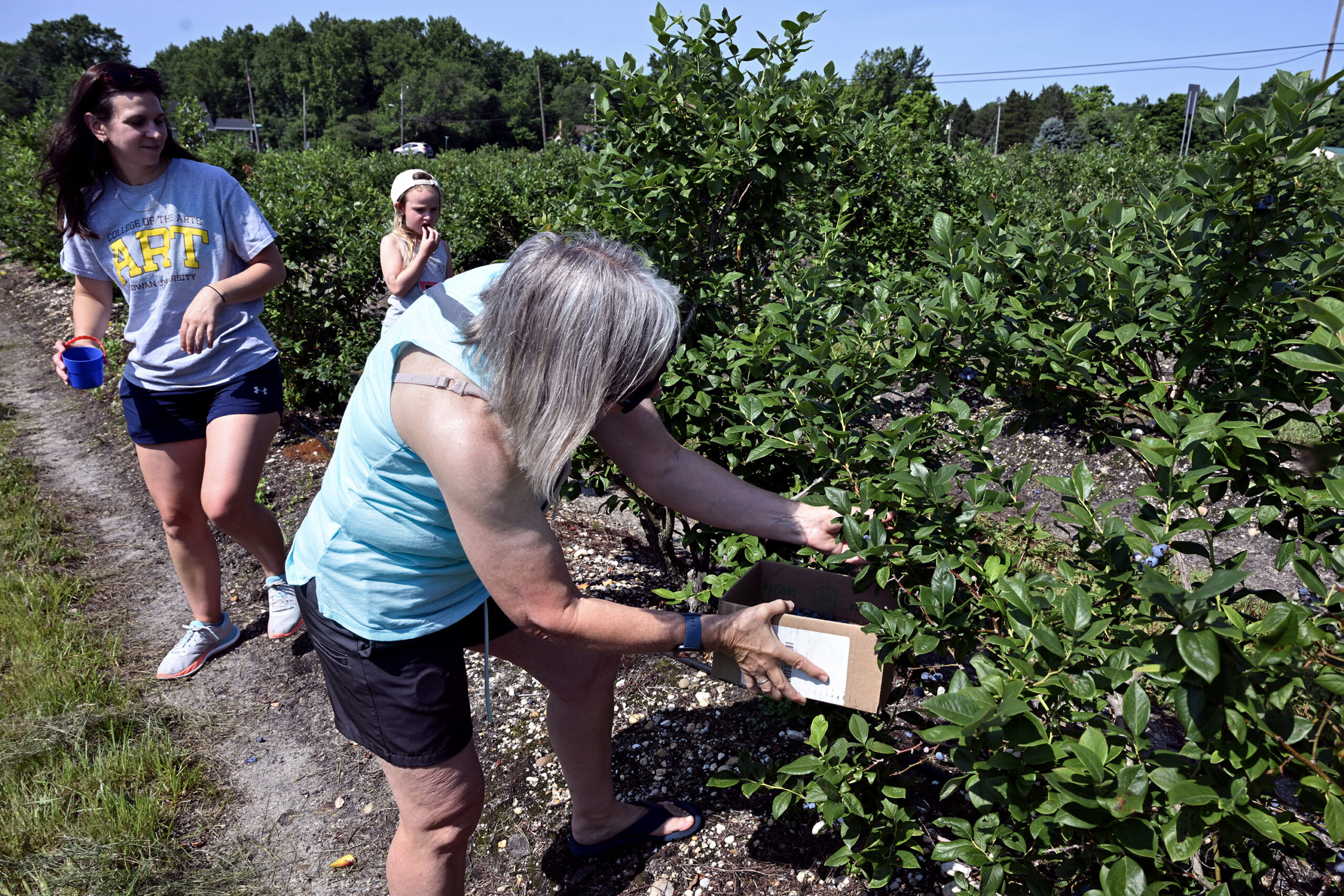
Cynthia Martini of Mantua Township visits Mood’s Farm Market every year to pick blueberries. During a typical summer, she collects 40 pounds of them. She used to bring her kids, but now that they’re older, she goes solo.
Her routine on June 30 didn’t look much different from the last 25 years. On a hot morning, she picked two Tupperware containers of blueberries in paint-streaked shorts.
“In an hour I picked 10 pounds,” Martini said. “So not bad.”
But rather than harvesting in the farm’s designated pick-your-own area, Martini kept to to an area typically reserved for staff.
Mood’s, a 180-acre fruit farm in Elk Township, Gloucester County, opened the off-limits fields as one strategy to survive the summer after a spring crop freeze destroyed about two-thirds of its blueberries and all its cherries, plums, nectarines, pears, and peaches. The farm will likely have only a handful of healthy apples come fall. That means no apple hayrides, even though pick-your-own operations are one of its primary revenue streams. A skeleton crew is working the land rather than a full staff, and it’s taking workers longer to pick fruit since there’s less on the bush.
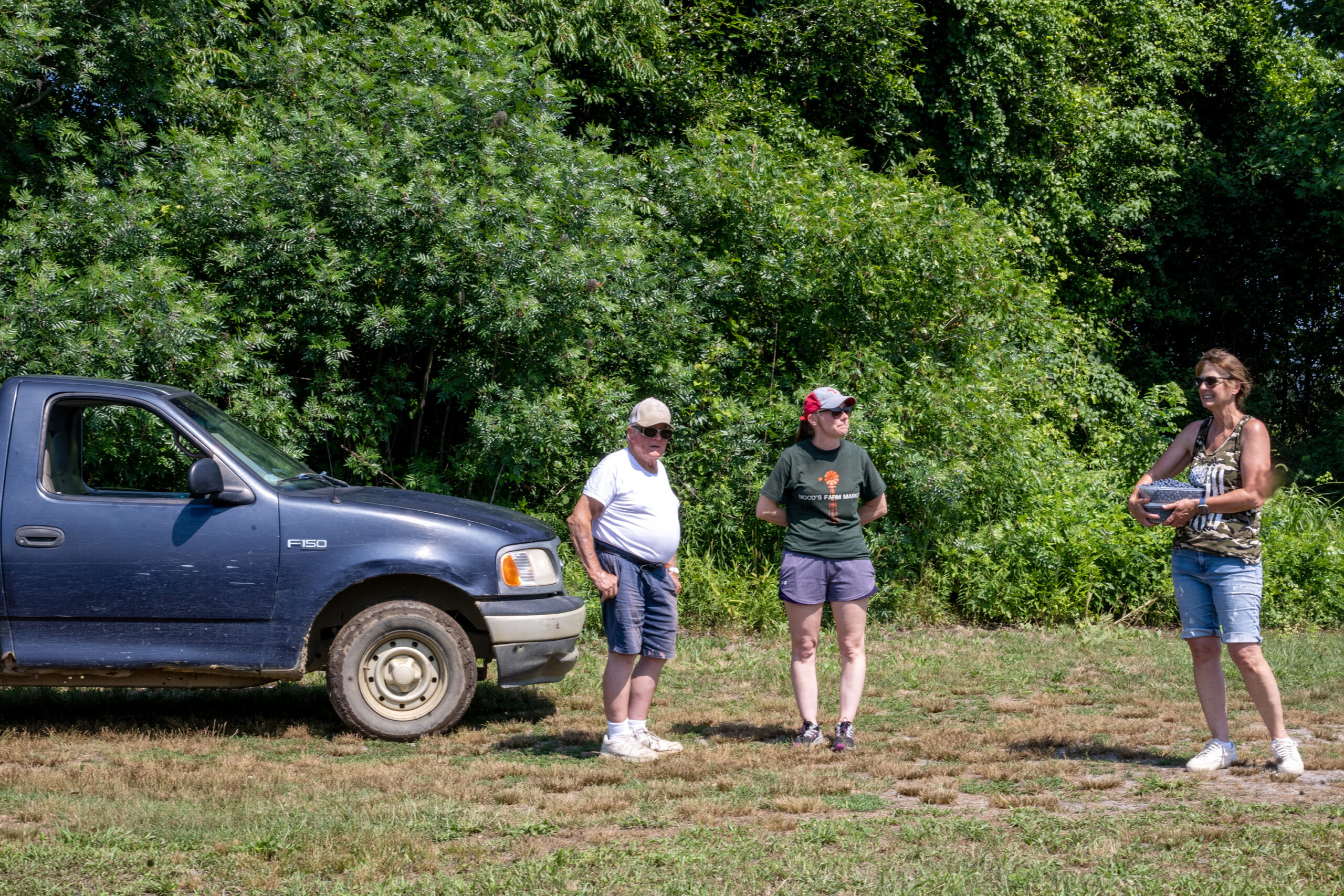
After picking her own blueberries, Cynthia Martini (right) of Mantua talks with owners Richard Mood and daughter Patti Mood at Mood’s Farm in Gloucester County on June 30.
But South Jersey farms like Mood’s are getting creative to survive a summer with depleted income and damaged crops. From promoting frozen fruit to temporary closures to raising prices, here’s how farms are keeping on.
Spend less and plant more
Rowand’s Farm, a 20-acre sweet and sour cherry orchard in Glassboro, Gloucester County, is going through unprecedented circumstances.
Stephen Rowand, the farm’s third-generation owner, said he’s usually excited when a spring frost arrives, since the cold weather thins out the fruit and produces larger cherries.
“This season is unique for us as a first with NO CROP at all,” Rowand said via Facebook Messenger. “No income.”
Rowand decided to close the farm, but that hasn’t meant time off. To ensure the orchard blooms next season, the farm still needs mowing, irrigation, fertilizer, and trimming, and without the ability to hire farmworkers. Rowand, 60, is doing all that work himself through extreme heat. He said he’s currently living off his retirement savings and might have to get a job in the offseason next fall. He’s trying to stay frugal by avoiding vacations and eating out.
But Rowand has managed to find some solutions to survive.
To make sure they stay fed, his family planted a bigger garden of tomatoes, string beans, eggplants, cucumbers, greens, and herbs for their personal diets after figuring out the freeze had eliminated their income. He said he will likely apply for a loan from the USDA’s Farm Service Agency to pay bills, and a GoFundMe, which has raised $25,000 so far, has helped pay for some of Rowand’s farm expenses.
“It’s really helping keep the farm from going into debt,” Rowand said, “which is usually what puts a farm out of business in the end.”
Duffield’s Farm Market in Sewell, Gloucester County, like Mood’s, won’t have peach picking this summer and is still considering whether it’ll apply for loans. Since the freeze halved their apple crop, the farm won’t offer apple picking trips for local schools this fall, either. To ensure people have enough to pick in the fall, owner Tracy Duffield said, farmers planted a field of pumpkins early.
As for labor, without peaches to pit, Duffield said there’s less to do, which means reducing hours for the farm’s migrant workers from Puerto Rico.
“It’s not just us. Everybody is kind of in the same boat,” Duffield said. “Just support your local farm. We’ll recover.”
‘A silver lining’
South Jersey farmers say the natural laws of supply and demand mean fruit prices will rise this year. Mood said their farm’s blueberry prices have doubled, while Duffield’s increased the cost about 50 cents per pound.
“We still have a business to run, and we have to support the families involved with the business,” Duffield said. “They just have to understand for this year, anyway, that things are going to be a bit higher.”
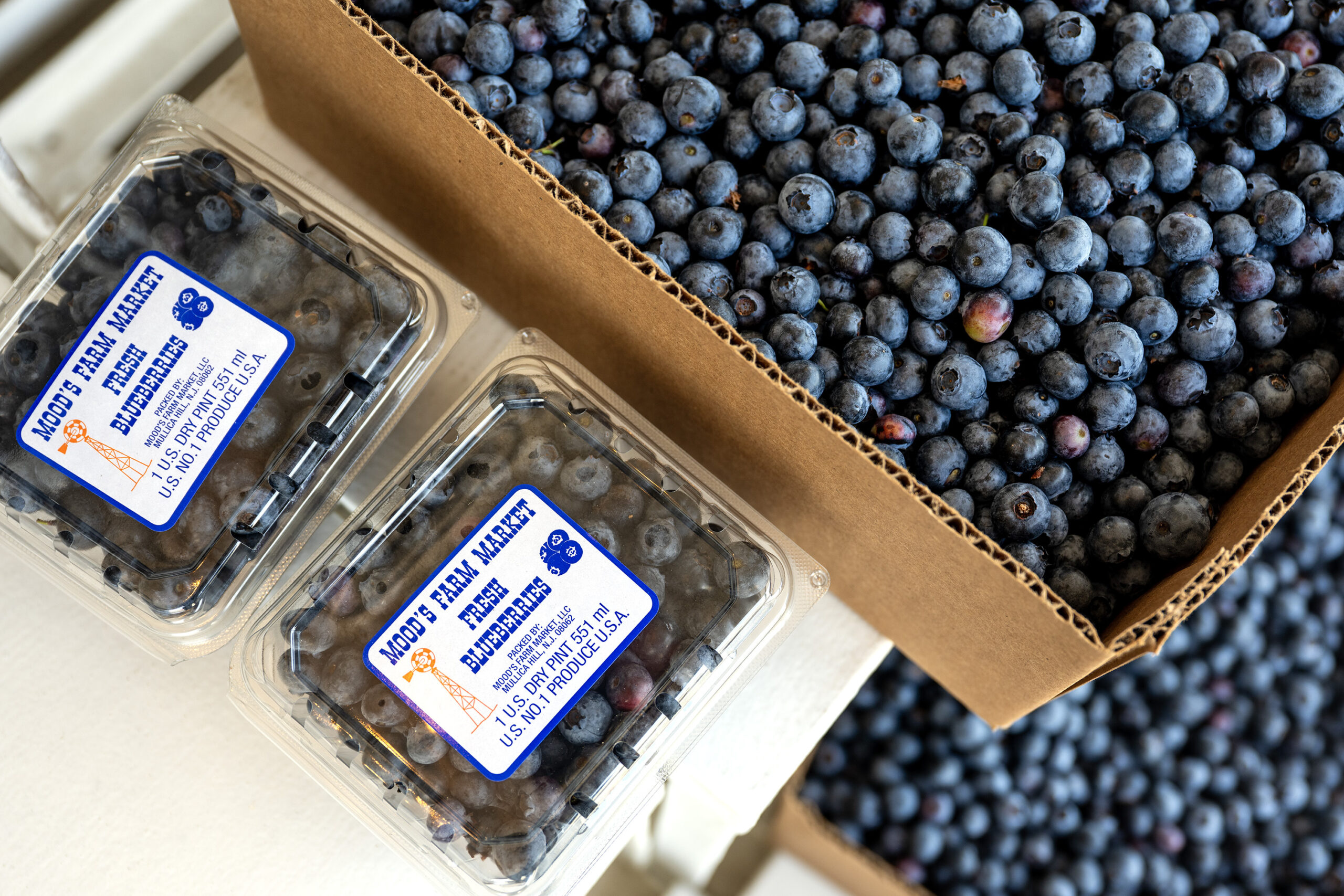
Blueberries for sale at the farm stand at Mood’s Farm in Gloucester County.
Anthony DiMeo owns DiMeo Farms and Blueberry Plants Nursery, which has a large pick-your-own blueberry operation in Hammonton, Atlantic County. With significant damage to his crop, DiMeo said, he anticipates the season to end a couple of weeks early.
“But there’s a silver lining to this, and that is the price is very high,” DiMeo said. “Even for blueberries that might not be the biggest or might not be the best, the price is exceptional.”
DiMeo, though, said he decided not to significantly raise prices this year, keeping blueberries at $2.50 per pint, a cheaper price than most grocery stores and farm markets. The choice to eat the losses was influenced by the price consumers are already paying to get through life right now.
“They’re spending enough as it is with gas and tolls and everything else,” DiMeo said.
‘Just luck’
Bob Fralinger of Fralinger Orchards, a fifth-generation peach and nectarine farm in Bridgeton, Cumberland County, said it was “just luck” that some of his peaches survived the freeze.
His farm sits along the Cohansey River, and the heat emitting from the water kept the temperature a couple of degrees warmer for the crops. Fralinger said he still lost about half his peaches, but since nearby South Jersey farmers weren’t quite as lucky, nearly 100 farm markets, some hours away, have come to him for fruit. Duffield’s and Mood’s are on that list.
The increased interest has meant Fralinger has to make sure he has enough peaches for everyone, including his typical wholesalers. And even though Fralinger is having no problem selling, the reduced harvest means he worries that the revenue won’t be enough to pay next year’s bills.
“Your margins are so close that you can’t survive from one year to the next unless you do things just right, and that’s the problem,” Fralinger said.
Like Fralinger, Robson’s Farm in Wrightstown, Burlington County, also managed to salvage some peaches from the harvest this year, but not nearly enough to meet the summer demand.
Customers travel from out of state for Robson’s peaches, fourth-generation farmer Rose Robson said, and many will be disappointed to arrive to find no peaches in sight.
But once she overcame her initial grief over the lost crops, Robson said, she quickly hatched a plan to adapt to a potentially peachless summer on the farm.
“Just because the farm is really sad and not great in one way doesn’t mean the whole summer has to be,” Robson said. “This could be a really fun opportunity to be creative and to bring some new people to the farm and still have a really great summer.”
Robson had already started developing ways to boost business during the farm’s offseason in the fall, like a walking club on the farm, she said. The spring freeze just forced her to consider starting sooner and making it active year-round.
Plus, Robson’s is focusing on what they can still offer customers.
“We doubled up on our U-pick cut flowers,” Robson said, “which has been growing over the years anyway, so that’s kind of fun.”
But more than anything, Robson said her priority has remained the same: “making the farm as grand an experience as we can possibly make it,” she said.
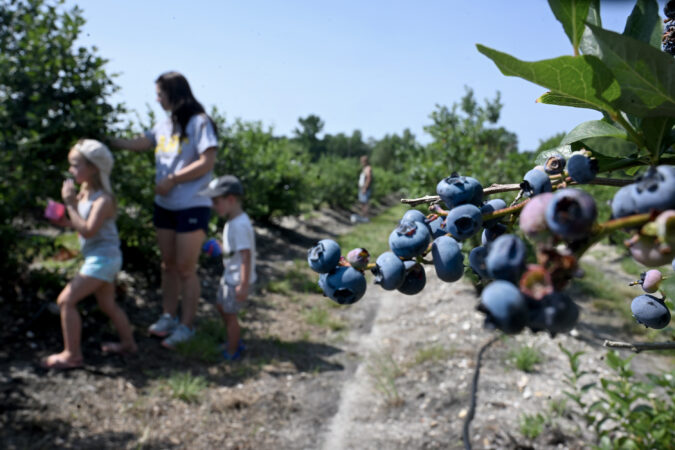
Sandy Trifiletti (front) of Glassboro and her daughter Hope Welch and granddaughter Rosie, 6, of Pitman, pick their own blueberries June 30 at Mood’s Farm in Gloucester County.
As farms scramble to adapt, South Jersey residents, whether they’re in the market for fresh fruit or flowers, continue to support their local markets.
Back at Mood’s Farm, Hope Welch of Pitman picked blueberries with her two children and her mother, Sandy Trifiletti. The Welches have visited Mood’s for years.
Hope Welch, whose son spoke some of his first words during an annual Apple Festival, asked Mood about the fate of this year’s event. Mood said one would still happen, but it probably wouldn’t revolve around apples, since they won’t have very many.
“That hurts my heart,” Welch said. “We’ll be back for the fall festival. Whatever it’s called.”
Mayor Victor Carstarphen said no fatalities or injuries have been reported, but by Monday afternoon, Camden City had received about 90 service calls reporting damages following more than 4 inches of rainfall, and he expected Camden to get more calls as people return home from work to potential flooding.
“Today, the rainfall exceeded what our stormwater system is designed to handle in such a short period of time,” Carstarphen said.
Countywide, Camden received about 1,000 911 calls just in the stretch of the morning storm, said Dan Keashen, Camden County’s public affairs director.
It will take a while for the county to determine how many homes were impacted and the estimated cost of damages. Public assistance teams from the state will work with the city and county to assess damages home by home in affected areas, said Morgan Callan, external communications manager for Camden County.
Dave Balog of Mullica Hill makes his way to his truck in the flooded parking lot at the Ferry Avenue PATCO station in Camden Monday, July 6, 2026, as a flash flood threat continues for the region. Balog said there were no warnings about a storm when he parked there four hours earlier for an appointment in Center City Philadelphia. His truck did start as it was not in the deepest area of the lot.
Flooding left vehicles stranded on roadways throughout the county, including two police vehicles and a fire department apparatus in Camden City, Keashen said. But most of the water has receded, according to a press release Monday afternoon.
Both city pools in Camden will be closed this week, Carstarphen said.
Camden City residents with damage to their properties can call the city emergency operations center at (856) 757-7132 or (856) 757-7139. Calling in those damages will allow city officials to report them to the state, which then could unlock regional and state disaster aid for residents.
Residents of other Camden County municipalities can report property damages to their respective offices of emergency management.
Carstarphen couldn’t confirm the timeline for how long it would take officials to visit properties to assess damages, but he said he encourages residents to file claims with their property insurance providers in the meantime.
A single-vehicle crash late Sunday night on southbound Route 55 in Deptford Township killed two women and injured another.
New Jersey State Police responded to the crash at 10:55 p.m., Trooper Christopher Postorino said via email. A preliminary investigation shows some of what happened, though the crash is still under investigation.
Ayzia J. Toledo, 22, of Bristol, Pennsylvania, was driving a BMW with Henrietta F. Carter, 22, of Darby, Pennsylvania, in the front passenger seat and another passenger in the rear when she lost control of the vehicle and ran off the roadway. The BMW overturned and struck a tree. Toledo and Carter died of their injuries, and the rear seat passenger was transported to an area hospital for minor injuries.
The families of Toledo and Carter have been notified, Postorino said. No traffic delays were reported after the accident. A GoFundMe has been established in Toledo’s honor.
BAPS Shri Swaminarayan Mandir, a Hindu temple on the eastern border of Cherry Hill, is preparing for a major facelift.
The Cherry Hill Township Zoning Board approved site plans last week during a 4½-hour meeting for an 18,330-square-foot expansion that would transform BAPS Cherry Hill’s exterior and add a gym, lobby, prayer hall, improved Sunday school rooms, new parking spaces, and more.
More steps will have to be made before construction can begin, but this approval is a majormove forward after what zoning officials say took more than a year of planning.
BAPS Inc., an international religious nonprofit, has more than 100 temples across the U.S., including eight in New Jersey. Cherry Hill Township approved a zoning variance back in 2002 to allow a former vacant warehouse building on an 11-acre property at 1 Carnegie Plaza, acquired by a real estate company for $1.9 million and conveyed to BAPS, to become a Hindu temple despite the lot being zoned Industrial Restricted. The temple is run by BAPS Cherry Hill, a limited liability company.
Decades have passed since BAPS Cherry Hill opened, and the mandir, a Hindu place of worship that neighbors King’s Christian School and Remington & Vernick Engineers, still looks like a warehouse.
But the new plans propose a more decorative exterior, including the addition of three shikharas, tall spires on the roof that would reach 58 feet at their highest. Aavart Patel, the project’s architect, said the change matches more traditional styles of Hindu architecture.
The current zoning rules put the building’s maximum height at 35 feet, but BAPS Cherry Hill’s lawyer, Damien Del Duca, sought a variance allowing for the boost.
“Metaphysically, the shikhara represents the spiritual connection between the earthly realm and the divine,” Del Duca wrote in a March letter. “It guides the eyes to move from the earth upwards toward the sky — representing heaven.”
Del Duca and BAPS did not return requests for comment about the projected cost of the expansion, but Del Duca said during the zoning board meeting that the temple had raised the necessary funds for the project.
Riya Patel, a BAPS Cherry Hill volunteer and youth coordinator, testified during the zoning meeting that the temple’s current structure poses a problem for its youth classes and group activities.
“It still serves as this warehouse layout,” Patel said. “So talking about some of our weekly activities, a lot of the space that we have doesn’t have much utility.”
Neel Patel, a lead volunteer and national coordinator for BAPS, has attended BAPS Cherry Hill for the last 22 years. He said the temple has 400 to 500worshipers on an average Sunday and offers scriptural studies, language learning, music, and sports programming for attendees from kindergarten age to adults.
The new additions would mean educational and sports programs could take place in designated classrooms and a gymnasium rather than in the current dining hall, makeshift spaces, or outside on the warehouse loading dock, which the temple converted into a basketball court. The addition of about two dozen parking spaces will accommodate extra visitors during the high holidays.
Under the current site plans, the building’s footprint would only expand about 3,000 square feet, and the remaining 15,000 square feet of additions come in the form of a second story to accommodate classrooms, offices, and the new gym.
Anand Bhatt with Arna Engineering, the project’s civil engineer, said the project will be completed in one phase, and the mandir will remain open throughout the process since construction will be limited to weekdays. The temple has little foot traffic except on Sunday.
‘A space where I can express my religious freedoms’
The BAPS location in Cherry Hill came to be in 2002 when Rishi Realty acquired the vacant warehouse space from Graphic Controls Corp. for $1.9 million and quickly conveyed ownership to BAPS.
Although the property is zoned industrial and accompanied by surrounding commercial businesses, the temple faces a residential neighborhood, Point of Woods, in Cherry Hill.
Three neighbors attended the zoning board meeting via Zoom last week to voice their concerns, mostly regarding the desire to protect the property’s wetlands and limit lighting at night.
Jody and Jenn DeMarco, who live across from the BAPS parking lot and its wooded area, asked the zoning board to deny the application unless the front facade of the new temple is reoriented to face away from their neighborhood.
“It’s a matter of preference, not a matter of necessity, that they are putting this giant variance that impacts our neighborhood negatively facing our property,” Jenn DeMarco said.
In 2012, BAPS Cherry Hill received violations from the township and the New Jersey Department of Environmental Protection for illegally removing trees in a wetland without proper permits, but BAPS Cherry Hill said in its zoning application that the organization remediated the issue by planting more trees.
BAPS representatives said at the zoning board meeting that they would follow N.J. DEP’s rules and make sure any lighting above the height maximum of 35 feet turns off by 10 p.m. Plus, BAPS Cherry Hill doesn’t anticipate increased visitor volume after the renovations, and they don’t plan to add any additional seating for its Sunday services.
Another Cherry Hill resident, Deepak Chhatwal, said he was excited about the upcoming changes.
“I’m very happy that there’ll be an organization and a space where I can express my religious freedoms, and there will be a better space for myself and my family and other neighbors who are practicing the Hindu faith.”
The six zoning board members who attended the meeting approved the site plans unanimously.
Brian Bauerle, the township’s chief of staff, said Cherry Hill still has to adopt a resolution confirming the decision and its conditions of approval at a future meeting on an undecided date.
As for BAPS Cherry Hill, the nonprofit will have to update its site plans based on the new approvals and satisfy remaining compliance items, which Bauerle said can take weeks to months. Then, the Department of Community Development can issue a zoning permit allowing BAPS to apply for construction permits.
An unsuspecting property in north Camden that had a front-row seat to the American Revolution has become a multimillion-dollar museum.
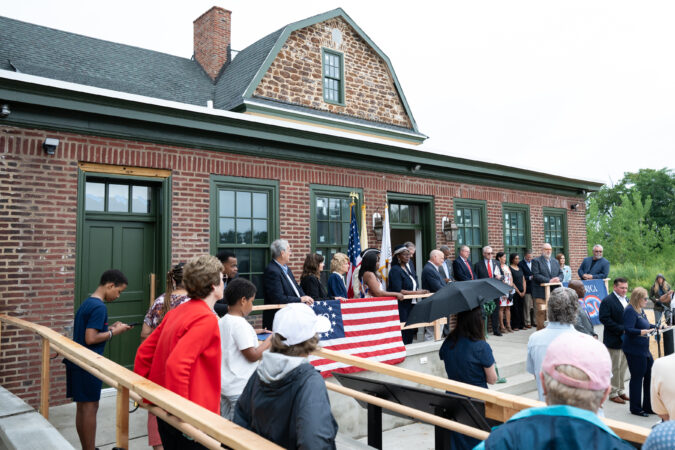
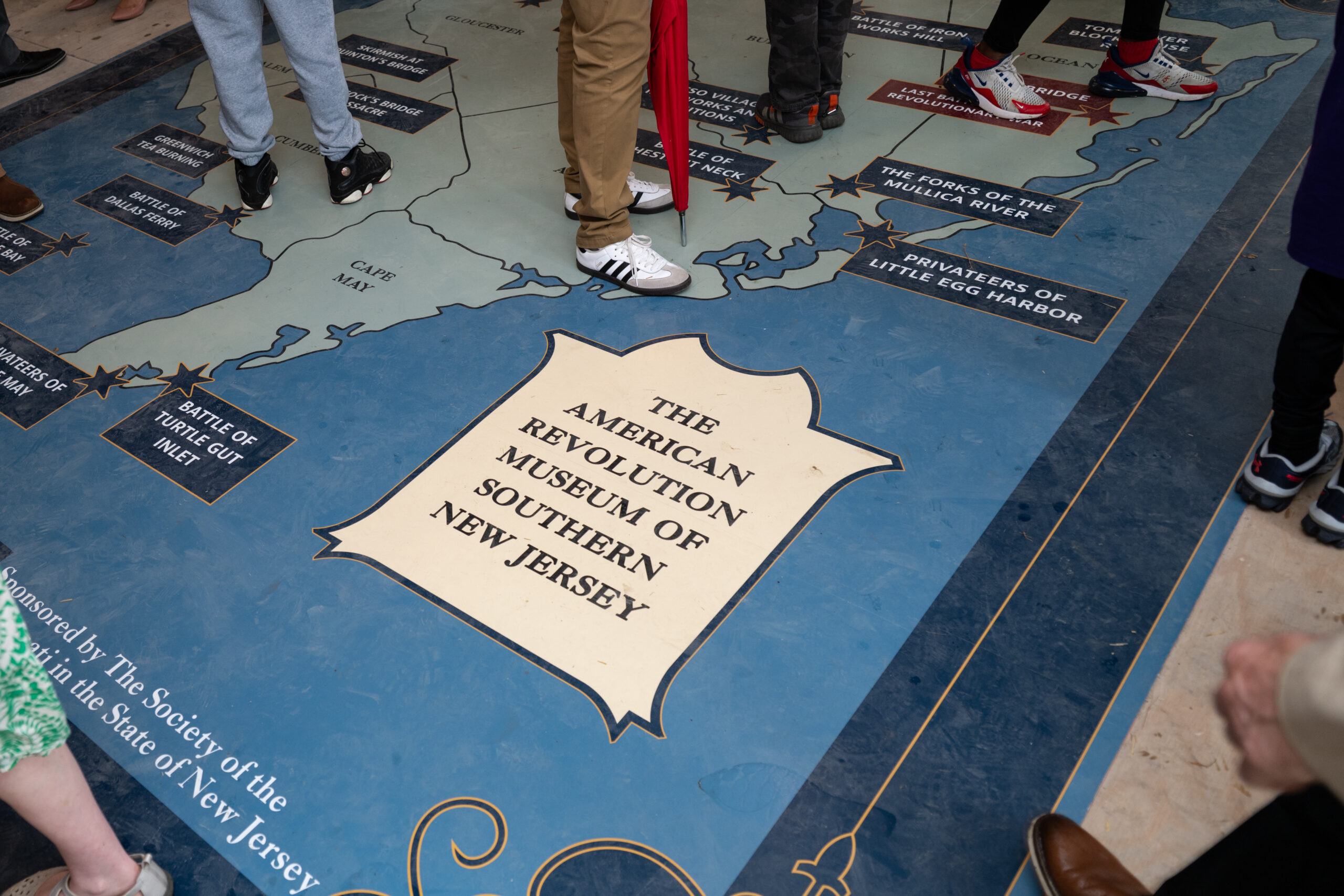
Elected officials, history buffs, and local organizers gathered at the Benjamin Cooper Inn at 75 Erie St. on Saturday to celebrate the soft opening of the American Revolution Museum of Southern New Jersey. The project was funded by $4.6 million in grants from federal, state, and local sources, with the largest amount coming from the New Jersey Historic Trust.
The 18th-century stone building has taken on many identities, including a private residence, tavern, British Army outpost, shipyard, luxury yacht building site, storage unit, and dumping ground for toxic materials. In the 1760s, the land was witness to the mass auction of enslaved people. Until recently, the building was abandoned.
The museum hasn’t fully opened to the public and likely won’t for at least a little while, but leaders of the Camden County Historical Society, which has a 30-year lease with the building’s private owner, wanted to give people a taste of what the museum will be when it does. Right now, the museum is open for limited tours by appointment only.
The Inn still needs work. The building has a temporary roof installed after a 2012 fire. The floors aren’t finished, and bathrooms have no doors. The second floor, currently sectioned off, hasn’t undergone any renovations, which will require fundraising of hundreds of thousands of dollars. Dirt piles and overgrown foliage block any view of the Delaware River.
Visitors explore the exhibits at the soft opening of the American Revolution Museum of Southern New Jersey in Camden on Saturday.
For the past six years, the society has planned to unveil the museum before America’s 250th, said Jack O’Byrne, the society’s executive director, but they kept running into obstacles. The project’s success came years after the society lost the Hugg-Harrison-Glover House, a Bellmawr home that survived the Revolutionary War, to a highway construction project after a preservation battle.
“It’s been a race to the end,” said O’Byrne, who will retire from his role on July 4. “The project probably died like 13 times.”
Zed Fox, the incoming executive director, and the society’s board will determine the future official opening date, hours, and cost. Fox said Monday that the board will meet on Wednesday to discuss those options, but he expects the museum to ready to open at full capacity by fall.
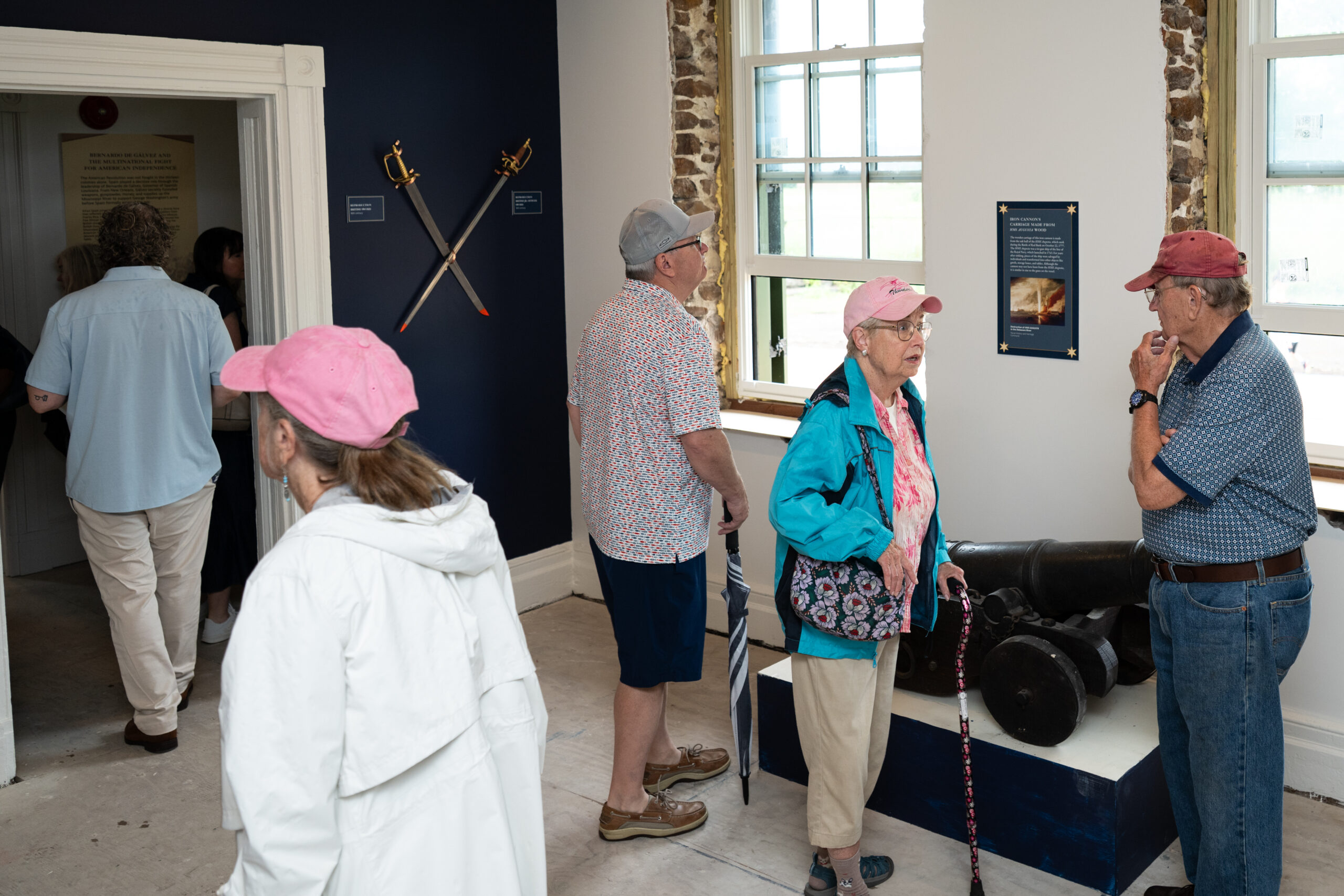
The new museum doesn’t showcase many historic artifacts. Many gems kept in the society’s archives, such as a letter written by George Washington at Valley Forge and a dozen other Revolutionary War-era items, wouldn’t fare well at the Inn with the sunlight streaming through the windows.
But scattered amid walls of weapon replicas and educational text are hints of the real thing.
There’s some 19th-century furniture originally owned by the Cooper family, a British cannon featuring wood blown off an 18th-century Royal Navy ship in Gloucester City, framed New Jersey bank notes from the 1760s and 1770s, and a front door key from when the Inn was a saloon called the “Old Stone Jug.”
A bell hanging in one room rang to announce ferries landing at Cooper Street Ferry in 1800, and a cheval-de-frise, a sharp wooden log, once blocked British ships from sailing the Delaware River.
In the same room, there’s a mantel from Hugg’s Tavern in Gloucester City, salvaged in 1929 before the building was demolished. Betsy Ross married her first husband, John Ross, in front of the fireplace at the tavern in 1773, though the mantel at the museum isn’t the original.
Visitors explore the exhibits at the opening of the American Revolution Museum of Southern New Jersey in Camden on Saturday.
But local historians say the displays aren’t the main attraction.
“The building itself is an artifact,” O’Byrne said. “You know, it’s the most historic building in Camden.”
Before the house was built, a teenage Benjamin Franklin was said to have slept at the property while traveling from Boston to Philadelphia.
In 1734, Joseph Cooper, a Quaker, built a 2½-story Dutch Colonial stone home for his son and daughter-in-law, Benjamin and Hannah Cooper, at what became the historic building. Benjamin Cooper, a ferryman, also used the residence as an inn and a tavern.
In 1777, the Benjamin Cooper Inn was used as a outpost for British Col. Robert Abercrombie. Hessian troops, German auxiliaries to the British Army, marched through Cooper Point during the war, and at one time, local historians say Benjamin Cooper’s sons, Samuel and Joseph Cooper, were jailed in Haddonfield in 1778 on suspicion of being American spies.
But the property has a more troubling past.
In the 1760s, the site was used for the auction of enslaved people. Though some who were forced to stay on the Cooper’s property until being sold managed to escape, “all were pursued and re-captured,” according to the Inn’s 2021 historic preservation plan.
O’Byrne said the museum is working to educate people about that history. One of the museum’s few rooms, which the society has titled “The Declaration’s Promise,” informs visitors about how immigrants, Black people, and the Lenape, who lived in the region before white settlers arrived, shaped South Jersey’s history.
“What we’re trying to do is make this a balanced history and not just about, you know, white people,” O’Byrne said.
Camden’s ‘most historic building,’ under threat
When demolition crews tore down the Hugg-Harrison-Glover House in 2017, the Camden County Historical Society viewed the outcome as a huge injustice to historic preservation.
“That was a gut punch,” said Chris Perks, board president. “We had invested a tremendous amount of time and the community’s time into that site.”
Then, in 2018, a private company, 75 Erie St. LLC, purchased the Benjamin Cooper House from Agathon Realty for $1.1 million without knowing the building’s history. The house was in poor condition and graffitied. The windows were boarded up. It was difficult from the street to even know the building was there, because the house faces the river instead. The waterways were the real highways back then, O’Byrne said.
“When we heard this just got purchased, we were like, ‘Oh, my God, we can’t let Camden’s most historic house go under,’” O’Byrne said. “It took me two years, and I was able to get a 30-year lease.”
A view of the Benjamin Franklin Bridge from the newly opened American Revolution Museum of Southern New Jersey in Camden on Saturday.
That lease will last at least through 2051. Perks declined to share how much the historical society will pay monthly.
The 2021 historic preservation plan for the building estimated that if the building opened in 2025 as originally projected, museum operations would have required an operating budget of $300,000 full time, or $132,000 part time.
While several organizations came together to fund the Benjamin Cooper Inn’s restoration, O’Byrne said the society will require more revenue beyond the funding for the restorations to maintain operations. O’Byrne applied for an operating support grant from the state and is working to raise $750,000 to match a New Jersey Historic Trust grant to restore the tavern’s upper level.
“We opened this thing, and it’s a minor miracle that we were able to pull all the funds together and make it in time,” O’Byrne said. “But in some respects, capital fundraising is easier.”
Any Collingswood resident over the last 18 years can remember the fight to legalize backyard chickens. Or the second attempt. Or the third.
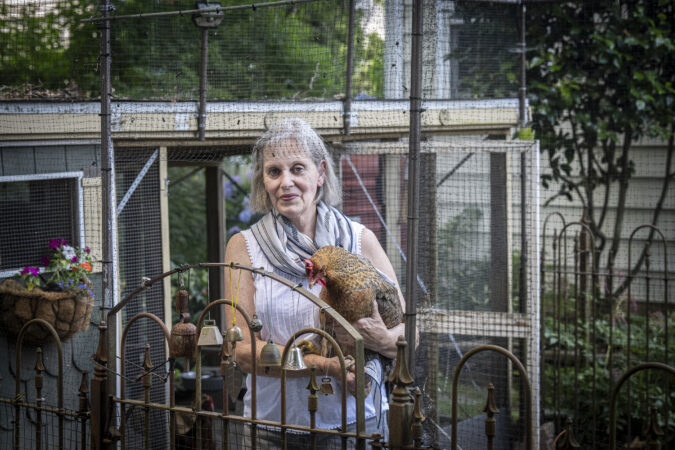
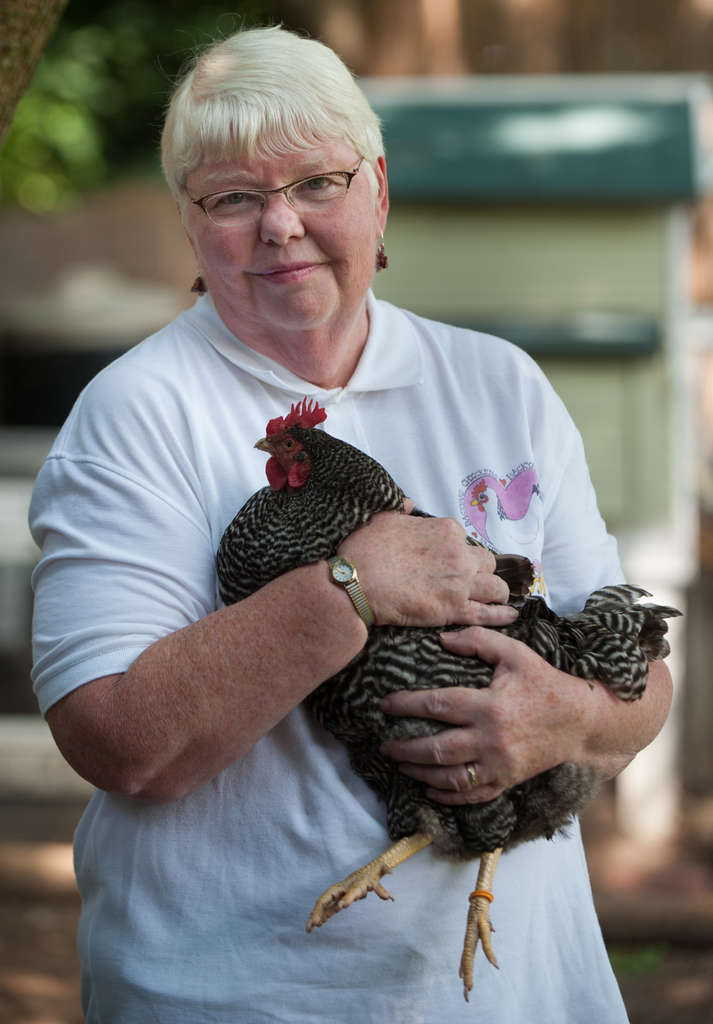
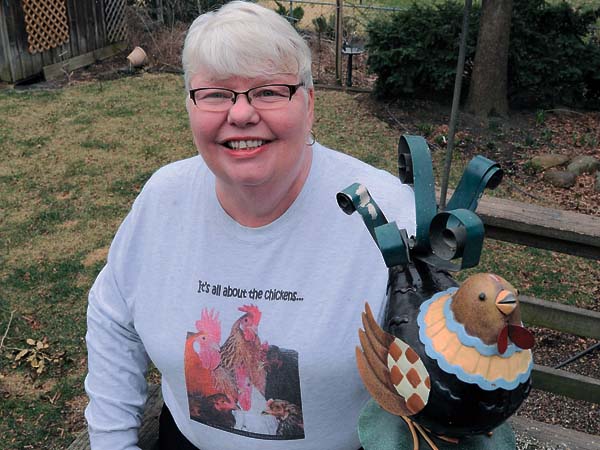
Gwenne Baile, 77, knows the efforts well. A Haddon Township resident and the unofficial “Chicken Lady of South Jersey,” Baile initially became interested when she saw Martha Stewart showing off her chickens on TV. After retiring in 2009 from a long career as an ob-gyn nurse, Baile decided she needed a hobby.
“I started looking into it,” Baile said, “but it was illegal here.”
Since then, Baile said, she has played some part in changing the ordinances in 35 municipalities across South Jersey, including in her hometown. She keeps a list of places with pro-chicken zoning rules, including the 19 municipalities in Camden County that allow them. Baile now has five hens, taken in as fosters, including those injured by predators or forced from owners whose municipalities do not allow coops.
One hen with arthritis lives indoors. Baile calls her a “mini me” since she hates the heat, doesn’t like exercise, and has golden feathers that match Baile’s hair.
Gwenne Baile, an advocate of backyard chickens, holds Mimi, a family’s hen in Audubon.
Baile and a small group of hopeful Collingswood residents have frequented Collingswood Borough Board of Commissioners meetings in recent months. At its last working meeting on June 17, the group handed over proposed language that they hope the board will use in a future ordinance supporting backyard chickens, informed by Baile’s years of advocacy.
The last major push for residential hens fizzled out in 2019 after several Collingswood residents spent more than a year regularly attending meetings to champion an ordinance that never saw the light of day.
But this time feels different, Baile said, and some locals and officials agree.
Dan DiVito, 42, has lived in Collingswood for six years and owns Front Yard Food, a business that teaches people how to grow their own crops and helps design the backyard infrastructure to do it. If Collingswood passes an ordinance, DiVito said, he will get chickens himself and join the new Backyard Chicken Advisory Board — a five-member commission that would oversee the initiative and investigate complaints.
“Chickens are a no-brainer,” DiVito said. “It’s a pet that makes you breakfast.”
Gwenne Baile in her backyard in 2014.
‘A change and an opportunity’
Collingswood did not always ban chickens.
But in 2008, Collingswood’s three-person board of commissioners — made up of a mayor, deputy mayor, and a commissioner — adopted measures prohibiting residents from keeping or breeding a long list of livestock and fowl, including chickens.
Local news records from 2008 do not give a clear explanation why the rules were adopted, other than comment from then-Mayor Jim Maley that the board wanted to “head off a problem before it presents itself.”
The maximum penalty for violating the ordinance is a $500 fine.
Repeated attempts to end the ban have been unsuccessful, even as neighboring municipalities passed ordinances to allow chickens. Some residents voiced concerns about the smell or the noise, or about Collingswood properties being too small to house chicken coops. Collingswood Chicken Uprising, the local Facebook group for the chicken resistance, was created 16 years ago and is up to 234 members.
But a recent political shift in Collingswood has meant hope for some local chicken advocates.
Maley’s 28-year tenure as mayor ended last May, when two progressive challengers joined Maley to win seats on the board of commissioners.
Daniela Solano-Ward became the first female and Latina mayor of Collingswood in 2025, and Deputy Mayor Amy Henderson Riley became one of only a handful of women to serve on the board in the borough’s history. That shuffling was one factor that brought on the chicken resurgence.
“Advocates and community members saw that this was a change and an opportunity to try this out with the new team and see what could happen,” Henderson Riley said.
Passing an ordinance takes time. There must be two separate readings of the proposal, and time must be given for residents to comment. The next commissioners meeting is not until July 15, and Henderson Riley said Tuesday that she was unsure whether the proposal drafted by Collingswood residents would make it to the agenda.
But with an organized, citizen-led group, Henderson Riley said, she suspects this is the most favorable effort thus far. Plus, with concerns like the cost of living and gas prices, she said, there are bigger things to worry about than banning chickens.
“Let the chicken people have their thing,” she said.
Maley and Solano-Ward did not respond to requests for comment.
What advocates are proposing
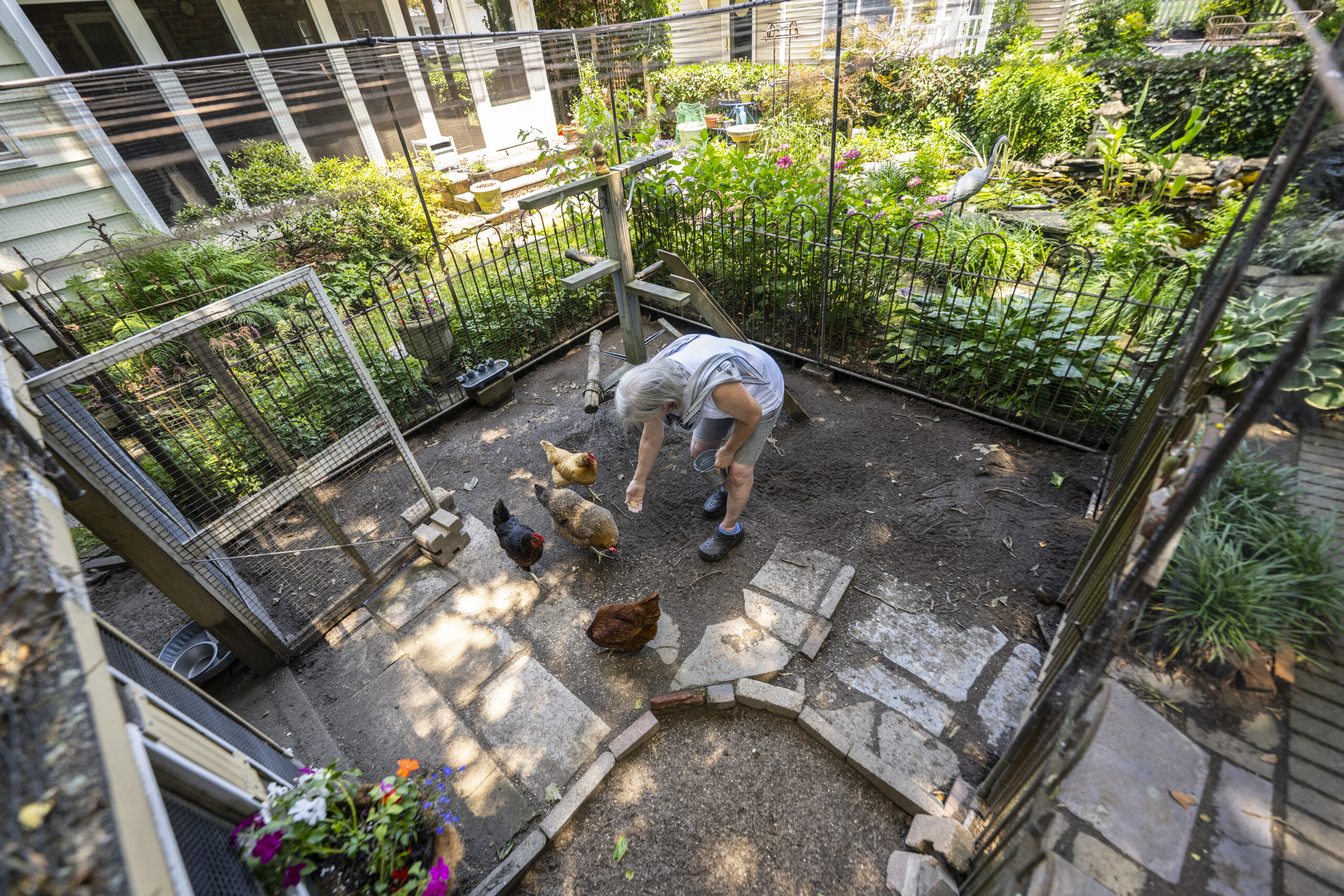
Suzanne Passante feeds her chickens inside the chicken coop in the backyard of her home in Haddon Township, N.J., on Wednesday, June 24, 2026.
Every municipality’s backyard chicken ordinance is slightly different. Most have strict requirements, including that coops are predator-proof, set a certain distance from other properties, and kept dry and clean.
Collingswood residents’ pitch to the commissioners would ban roosters, forbid residents from selling their eggs, and require completion of an online course teaching applicants how to care for hens. Collingswood could have only 30 households with hens at a time (of the 6,900 estimated housing units the U.S. Census Bureau estimates are in Collingswood), and new licensees would be capped at four chickens.
Chicken owners would have to pay $10 fees annually to renew their licenses. The Backyard Chicken Advisory Board would investigate complaints and help relocate chickens that are no longer wanted, since the advocates are calling for a ban on slaughtering hens.
Any violations could result in a fine of up to $1,250 or imprisonment of up to 90 days, a more severe punishment than the current ordinance gives for keeping chickens.
Henderson Riley, who has a doctorate in public health, took the three-hour backyard chicken course to learn more about the potential process residents would have to go through to get a coop.
She passed, but not without a bunch of red markings and a reality check that owning chickens takes time, money, and energy that she does not have. Henderson Riley said she thinks the long list of requirements, along with the difficulty of raising hens, will dissuade the vast majority of people from partaking in the hobby.
“It’s not like the hens are going to take over Collingswood.”
Words of wisdom
Lynn Parker, 52, has 10 hens in her backyard in Stratford Township, Camden County. When Stratford passed its ordinance allowing chickens in 2023 (an effort Baile helped with), Parker was the first person in line for a chicken permit.
She now chairs the township’s Hen Advisory Commission, which inspects new coops and educates residents. Fourteen homes in Stratford have chickens now, Parker said, and there have been no complaints.
Her advice to people who want to change their municipality’s chicken law is simple.
“Even if you get a no, do it again,” Parker said.
Suzanne Passante, 71 and Baile’s neighbor, chairs Haddon Township’s Backyard Chicken Advisory Board. She has four chickens and averages a dozen eggs per week.
It took time to educate residents about the benefits of hens and to quell misconceptions, like chickens attracting rats, but she said complaints have been nonexistent in recent years.
“Now, after 11 years, people don’t even think about it,” Passante said.
A new agreement between the Collingswood Board of Education and Collingswood Borough approved this week will open the door for a $10.5 million renovation of the school district’s athletic complex.
The three-person Collingswood Board of Commissioners voted in favor of the shared service agreement on June 17, and the 11-member Board of Education followed suit unanimously at its Monday meeting.
The agreement aims to update the school district’s recreation spaces and give the borough more access to school properties formerly closed to nonstudents, including auditoriums, classrooms, and athletic fields.
The public can now visit the district’s playgrounds and track facilities from 7 a.m. until dusk on days when students aren’t at school, including the summer months, weekends, and holidays. When school is back in session, those facilities will open when after-school activities end and close at dusk.
The new shared service agreement just lays out the formal framework for that collaboration and ensures the borough gets perks in return, like use of school property for July 4 celebrations and access to the new facilities.
Amy Henderson Riley, one of Collingswood’s commissioners, said the agreement gives the spending a dual purpose.
“When you work together, things can be kind of amazing. Everybody is being squeezed,” Henderson Riley said. “The word of the year is affordability.”
The project proposal, presented in October at a community forum on Collingswood’s recent 310-page recreation master plan, has a long list of goals. The district wants to convert the current grass football field into a multisport artificial turf field and build a new eight-lane track, along with adding a grass softball field, a concessions building, new bathrooms, a 1,500-seat grandstand, a student press box, and more improvements.
The firms involved so far include Remington & Vernick Engineers and Garrison Architects, Superintendent Fredrick McDowell said. A construction company won’t come on board until Collingswood and its school board publicize a bid package for construction work and review those bids at least 30 days later.
McDowell said Wednesday the goal is to start the project as soon as possible, though there’s no timeline yet for when the project could begin or wrap up. Students will continue to use existing facilities in the meantime.
A new grade school and park improvements
The remaining $4.5 million in bonded funds from the borough will likely be split between improvements to Knight Park, a 70-acre green space in the middle of Collingswood, and the potential acquisition of a new upper grade school.
The recreation presentation from October reported that $2.5 million of the $15 million bonded funds will go toward Knight Park upgrades.
Henderson Riley said her fellow commissioner Jim Maley is overseeing the steering committee for the Knight Park project. Maley did not return requests for comment.
The other $2 million could go to the acquisition of the former Good Shepherd Catholic School on Lees Avenue. The Collingswood School District has sought for years to convert Good Shepherd into an upper grade school building for fourth and fifth graders.
Henderson Riley said there is currently no information to share on the status of acquiring Good Shepherd.
The only way the school district could have afforded the athletic field renovations and these projects without collaboration with the borough is through a bond referendum, McDowell said, a vote at the ballot box to determine whether a school can borrow funds through the sale of bonds.
It would have also closed two elementary schools and allowed the district to acquire Good Shepherd and convert it into an upper grade school. The referendum would’ve raised Collingswood residents’ property taxes, since that’s how bonds are paid back.
One of those elementary schools, James Garfield Elementary, still closed due to budget cuts this week.
Current and former military personnel can now receive free estate planning assistance in Camden County to help support their families’ futures.
The Camden County Board of Commissioners launched the new clinic last month, one of several no-cost legal services available to vulnerable South Jersey residents.
The clinic, currently scheduled monthly, gives active service members, veterans, and their spouses living in Camden County access to certain legal services at no charge. The county will provide a last will and testament, power of attorney, and an advance directive, which documents a person’s preferences for medical treatment in case they become unable to make their own healthcare decisions.
Sixteen veterans are signed up for the first Veterans Will Clinic on Wednesday at the Camden County One-Stop Career Center in Cherry Hill Township, said Morgan Callan, the county’s external communications manager. There is no current cap for how many veterans can participate.
The Camden County Office of Veterans Affairs is now accepting registrations for the second clinic, on July 29. Anyone interested should contact the office by calling 856-374-5801, or by visiting the office at 1 Collier Drive in Blackwood, part of the Camden County Lakeland Complex.
The Camden County Office of Veteran’s Affairs has partnered with Susan Purvin, an attorney from Gloucester County, to help provide the services. Louis Cappelli Jr., one of Camden County’s three commissioners, said in a statement that he hopes everyone eligible takes advantage of the program.
“Our veterans and servicemembers have sacrificed so much in service to our nation, so have their families,” Cappelli Jr. said. “The least we can do is help them get their affairs in order, giving them the confidence that their last wishes will be protected.”
The cost to Camden County for the program is $50 per will, $25 per power of attorney, and $100 per hour for every legal information session, with the total cost varying based on how many people show up for the clinics, said Dan Keashen, the county’s public affairs director.
Other counties in South Jersey provide similar services. All active military personnel and veterans in Gloucester County can receive assistance with a simple will, a legal document for those not looking to involve complicated estates or trusts in their end-of-life plans.
You don’t have to be a veteran to find free legal services in Camden County.
The Camden County Bar Association hosts Wills for Heroes, a small, volunteer-led clinic that provides free wills and estate planning documents to firefighters, police officers, and paramedics, and their spouses annually. The 2026 clinic, which took place in March, was full at 21 participants.
Kara Edens Graser, the association’s executive director, said she hopes to run the same clinic next year.
Plus, about 300 attorneys volunteer on an as-needed basis for the Volunteer UP Legal Clinic, a Camden-based nonprofit that provides legal expertise to those who need it. The nonprofit spent more than $300,000 in 2024 to provide legal services for tenants, criminal record expungement, estate planning, and name changes, according to its 2024 tax filing.
Volunteer UP also provides same-day eviction defense for tenants in Burlington, Camden, Cumberland, Gloucester, and Salem Counties, CEO Steven Salinger said via email.