Author: No Author

  • Judge orders ICE chief to appear in court to explain why detainees have been denied due process

    Judge orders ICE chief to appear in court to explain why detainees have been denied due process

    MINNEAPOLIS, Minn. — Federal immigration authorities have released an Ecuadorian man whose detention led the chief federal judge in Minnesota to order the head of Immigration and Customs Enforcement to appear in his courtroom, the man’s attorney said Tuesday.

    Attorney Graham Ojala-Barbour said the man, who is identified in court documents as “Juan T.R.,” was released in Texas. The lawyer said in an email to The Associated Press that he was notified in an email from the U.S. attorneys office in Minneapolis shortly after 1 p.m. CT that his client had been freed.

    In an order dated Monday, Chief Judge Patrick J. Schiltz expressed frustration with the Trump administration’s handling of Juan’s and other immigration cases. He took the extraordinary step of ordering Todd Lyons, the acting director of ICE, to personally appear in his courtroom Friday.

    Schiltz had said in his order that he would cancel Lyons’ appearance if the man was released from custody.

    “This Court has been extremely patient with respondents, even though respondents decided to send thousands of agents to Minnesota to detain aliens without making any provision for dealing with the hundreds of habeas petitions and other lawsuits that were sure to result,” he wrote.

    The order comes a day after President Donald Trump ordered border czar Tom Homan to take over his administration’s immigration crackdown in Minnesota following the second death this month of a person at the hands of an immigration law enforcement officer.

    Trump said in an interview broadcast Tuesday that he had “great calls” with Minnesota Gov. Tim Walz and Minneapolis Mayor Jacob Frey on Monday, mirroring comments he made immediately after the calls.

    As he left the White House, the president was asked whether Alex Pretti’s killing by a Border Patrol officer Saturday was justified. He responded by saying that a “big investigation” was underway. In the hours after Pretti’s death, some administration officials sought to blame the shooting on the 37-year-old intensive care nurse.

    The seemingly softer tone emerged as immigration agents were still active across the Twin Cities region, and it was unclear if officials had changed tactics following the shift by the White House.

    Walz’s office said Tuesday that the Democratic governor met with Homan and called for impartial investigations into the shootings involving federal officers. They agreed on the need to continue to talk, according to the governor.

    Frey and Minneapolis Police Chief Brian O’Hara said they also met with Homan and had a “productive conversation.” The mayor added that city leaders would stay in discussion with the border czar.

    The White House had tried to blame Democratic leaders for the protests of immigration raids. But after the killing of Pretti on Saturday and videos suggesting he was not an active threat, the administration tapped Homan to take charge of the Minnesota operation from Border Patrol commander Gregory Bovino.

    The streets appeared largely quiet in many south Minneapolis neighborhoods where unmarked convoys of immigration agents have been sighted regularly in recent weeks, including the neighborhoods where the two deaths occurred. But Associated Press staff saw carloads of agents in northeast Minneapolis, as well as the northern suburb of Little Canada.

    Schiltz’s order also follows a federal court hearing Monday on a request by the state and the mayors of Minneapolis and St. Paul for a judge to halt the immigration enforcement surge. The judge in that case said she would prioritize the ruling but did not give a timeline for a decision.

    Schiltz wrote that he recognizes ordering the head of a federal agency to appear personally is extraordinary. “But the extent of ICE’s violation of court orders is likewise extraordinary, and lesser measures have been tried and failed,” he said.

    “Respondents have continually assured the Court that they recognize their obligation to comply with Court orders, and that they have taken steps to ensure that those orders will be honored going forward,” he wrote. “Unfortunately, though, the violations continue.”

    The Associated Press left messages Tuesday with ICE and a DHS spokesperson seeking a response.

  • Hornets take a 50-point lead for 2nd time this month, roll past 76ers 130-93

    Hornets take a 50-point lead for 2nd time this month, roll past 76ers 130-93

    CHARLOTTE, N.C. (AP) — Brandon Miller scored 30 points, and the Charlotte Hornets took a 50-point lead for the second time this month on the way to rolling past the 76ers 130-93 on Monday afternoon.

    All five Hornets starters finished in double figures. Kon Knueppel and Moussa Diabate scored 12, LaMelo Ball added 11, and Miles Bridges finished with 10 for Charlotte, which has won three straight games for the first time this season.

    It was 28-22 after one quarter — and then Charlotte outscored Philadelphia 81-37 over the next two quarters, taking a 109-59 lead into the fourth.

    Kelly Oubre Jr. scored 17 for Philadelphia. Jared McCain added 16 and Quentin Grimes had 14 for the 76ers, while Tyrese Maxey was held to a season-low six points on 3-for-12 shooting in 25 minutes. Maxey’s scoring average dropped a full half-point to 29.4 per game.

    Charlotte became the first team since Phoenix in February 2009 to lead by 50 or more points in two separate games within the same calendar month. The Hornets led Utah by 57 on their way to a 150-95 win on Jan. 10.

    The Hornets had one other lead of 50 or more points in the NBA’s play-by-play era, which goes back to 1996. It’s now happened twice more in a span of just over two weeks.

    The game was moved up to a 3 p.m. start because of extreme weather conditions in the Charlotte area, all related to Winter Storm Fern.

    Ryan Kalkbrenner had 13 points and nine rebounds off the bench for Charlotte. Philadelphia outscored the Hornets 34-21 in the fourth quarter and still took its second-worst loss of the season. The 76ers lost to Orlando by 41 on Nov. 25.

    Up next

    The 76ers host the Milwaukee Bucks on Tuesday (8 p.m., NBCSP).

  • U.S. carries out first known strike on alleged drug boat since Maduro’s capture

    U.S. carries out first known strike on alleged drug boat since Maduro’s capture

    WASHINGTON — The U.S. military said Friday that it has carried out a deadly strike on a vessel accused of trafficking drugs in the eastern Pacific Ocean, the first known attack since the raid that captured Venezuelan President Nicolás Maduro earlier this month.

    U.S. Southern Command said on social media that the boat was “engaged in narco-trafficking operations” and that the strike killed two people and left one survivor. It said it notified the Coast Guard to launch search and rescue operations for that person.

    A video accompanying the post announcing the latest strike shows a boat moving through the water before exploding in flames. The U.S. military has focused lately on seizing sanctioned oil tankers with connections to Venezuela since the Trump administration launched an audacious raid to capture Maduro and bring him to New York to face drug trafficking charges.

    With the latest military action, there have been 36 known strikes against alleged drug smuggling boats in South American waters since early September that killed at least 117 people, according to announcements from the U.S. military and Trump. The majority of those of strikes have occurred in the Caribbean Sea.

    The last reported boat strikes occurred in late December, when the military said it struck five alleged drug-smuggling boats over two days, killing a total of eight people while others jumped overboard. Days later, the Coast Guard suspended its search.

    The U.S. conducted a large-scale operation in Caracas, the capital of Venezuela, on Jan. 3 that led to the capture of Maduro and his wife, who were then flown to New York to face federal drug trafficking charges.

    Maduro, before his capture, said the U.S. military operations were a thinly veiled effort to oust him from power.

    President Donald Trump has repeatedly said that the U.S. strikes targeting alleged smugglers are having an enormous impact on slowing drug trafficking routes in the Caribbean and eastern Pacific.

    “We’ve stopped — virtually stopped almost 100% of all drugs coming in by water,” Trump said in remarks on Thursday at the World Economic Forum at Davos.

  • 76ers fall to Suns, 116-110, despite 25 points from VJ Edgecombe

    76ers fall to Suns, 116-110, despite 25 points from VJ Edgecombe

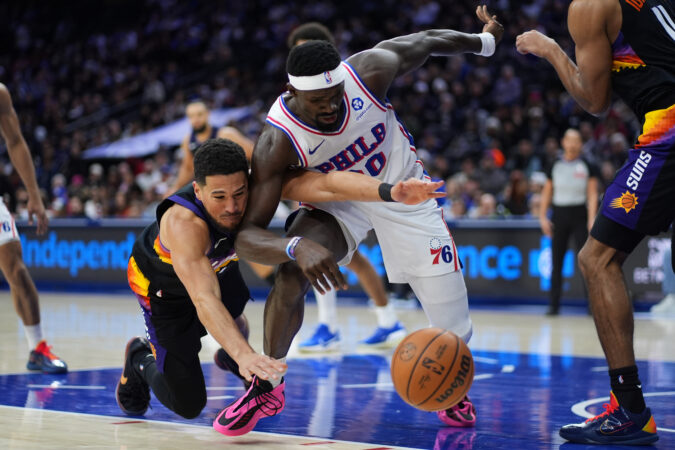
    PHILADELPHIA (AP) — Devin Booker scored 27 points and Jalen Green added 12 points in his return to the lineup as the Phoenix Suns beat the 76ers 116-110 on Tuesday night in a matchup of teams playing the second game of a back-to-back.

    Grayson Allen and Jordan Goodwin scored 16 points apiece, and former Villanova star Collin Gillespie and Oso Ighodaro each added 12 as the Suns won their third straight game and for the 12th time in 16 games.

    Rookie VJ Edgecombe led the 76ers with 25 points. Kelly Oubre Jr. finished with 21 points, and Tyrese Maxey added 20. Andre Drummond finished with eight points and 15 rebounds for the Sixers, who lost for the fourth time in six games.

    Philadelphia was without Joel Embiid (right ankle injury management) and Paul George (left knee injury management).

    Green played in just his third game of the season, and his first since Nov. 8, because of a right hamstring injury. He is in his first season with the Suns, arriving in the offseason as part of the trade in which Kevin Durant was sent to the Houston Rockets.

    Green came off the bench to score seven points in nine minutes in the first half, and went on to shoot 4 for 11 from the field, including 2 for 4 from distance, in 20 minutes, with three assists and two rebounds.

    The Suns, coming off a win over Brooklyn on Monday, got 13 points from Booker, 10 from Ighodaro, and were perfect on 13 shots from the free-throw line on the way to a 57-53 lead at the break.

    The Sixers, who beat Indiana on Monday, opened the second half with a 13-2 run for a 66-59 lead. The Suns tied it at 68 and built a 97-84 lead by the end of the third period. Phoenix extended its lead to 103-86 with 9 minutes, 37 seconds left in the fourth after Sixers coach Nick Nurse received a technical foul for contesting a call. Philadelphia chipped away down the stretch, but never really threatened.

    Up next

    The Sixers host Houston on Thursday (7 p.m., NBCSP) in the fifth game of a six-game homestand.

  • Mexico sends 37 cartel members to U.S. in latest offer to Trump administration

    Mexico sends 37 cartel members to U.S. in latest offer to Trump administration

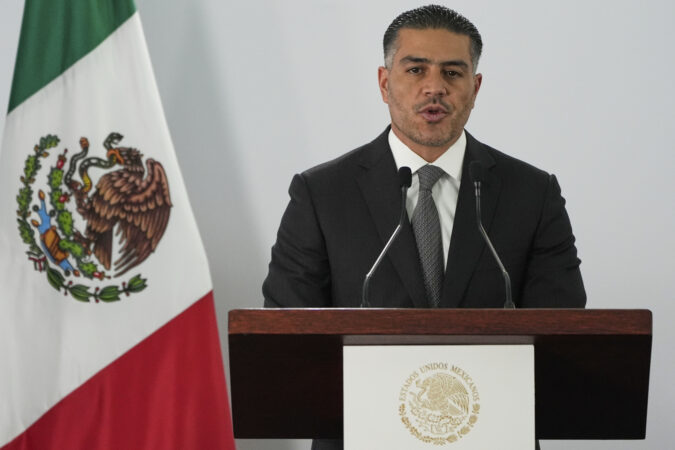
    MEXICO CITY — Mexico’s security minister said Tuesday that it had sent another 37 members of Mexican drug cartels to the United States, as the Trump administration ratchets up pressure on governments to crack down on criminal networks it says are smuggling drugs across the border.

    Mexican Security Minister Omar García Harfuch wrote in a social media post on X that the people transferred were “high impact criminals” that “represented a real threat to the country’s security.”

    It is the third time in less than one year that Mexico has sent detained cartel members to the U.S. as the country attempts to offset mounting threats by U.S. President Donald Trump. García Harfuch said the government has sent 92 people in total.

    Video shared by Mexican authorities shows a line of handcuffed prisoners surrounded by heavily-armed and masked officers being loaded onto a military jet at an airport on the outskirts of Mexico City.

    “As the pressure increases, as demands from the White House dial up, [Mexico’s government] needs to resort to extraordinary measures, such as these transfers,” said David Mora, a Mexico analyst at the International Crisis Group.

    The U.S. State Department and Justice Department did not immediately respond to a request for comment.

    Tuesday’s transfer included a handful of important figures from the Sinaloa Cartel, the Beltrán-Leyva cartel, Jalisco New Generation Cartel, the Northeast Cartel, a remnant of the infamous Zetas based in the Mexican border state of Tamaulipas, across from Texas. Mexican authorities said that all had pending U.S. cases.

    Among those transferred was María Del Rosario Navarro Sánchez, the first Mexican citizen to face charges in the U.S. for providing support to a terrorist organization, after being accused of conspiring with a cartel.

    Trump has publicly entertained the idea of military action on Mexican cartels, language that has only gotten more combative since a U.S. military operation in Venezuela deposed former President Nicolás Maduro earlier this month.

    Turning his attention to Mexico shortly after the Venezuela attack, Trump said in an interview with Fox News: “We’ve knocked out 97% of the drugs coming in by water and we are going to start now hitting land, with regard to the cartels.”

    Last week, Mexico President Claudia Sheinbaum spoke with Trump, telling him that U.S. intervention in Mexico was “not necessary,” but emphasizing that the two governments would continue to collaborate.

    Last February, Mexico sent 29 cartel figures to the U.S., including drug lord Rafael Caro Quintero, who was behind the killing of a U.S. DEA agent in 1985. In August, a second round saw 26 Mexican cartel figures sent to the U.S. None had the profile of Caro Quintero, but spanning multiple cartels, the figures could help U.S. prosecutors build cases.

    After the August transfer, García Harfuch said it was a public safety decision, because Mexico did not want them to continue operating their illicit businesses from inside Mexican prisons.

    Another transfer of prisoners to the U.S. had been rumored for weeks. Mexico has sought to assure the Trump administration that it continues to be a willing partner in combating drug traffickers.

    “For the Trump administration and the Trump base, what is going to matter in the end is some wins that Trump can actually bring back and say ‘Look this is what I’m getting out of Mexico,’” said Mora.

  • 2026 THE INQUIRER SUBSCRIBER e-EDITION SURVEY GIFT CARD SWEEPSTAKES OFFICIAL RULES

    1. Eligibility. Sweepstakes is offered only in the United States to legal residents who are 18 years of age or older as of the date of entry and who have subscribed with The Inquirer. Employees, officers, directors, agents and representatives of The Philadelphia Inquirer, LLC (“The Inquirer”), their immediate family/household members are not eligible to participate or win a prize. By entering, you agree to these Official Rules (“Official Rules”) and the decisions of The Inquirer, which are final and binding in all respects.

    2. Sweepstakes Period. Sweepstakes period begins at 5:00:00 a.m. on February 3, 2026 and ends at 11:59:59 p.m. on February 10, 2026 ET (the “Sweepstakes Period”). All entries must be received by The Inquirer by the end of the Sweepstakes Period.

    3. Entry. For individuals who are Inquirer Subscribers: You may enter by completing the Subscriber e-Edition Satisfaction Survey, which can be found here: Inquirer.com/survey or through the link provided in the sent email or postcard. You may need to enter your name, address (no P.O. Boxes accepted), and/or e-mail address, and will need to confirm that you are 18 years of age or older and agree to the Official Rules and The Inquirer’s Terms of Use and Privacy Policy. Upon completing the entry method and submitting your entry, subject to the conditions set forth in these Official Rules, you will automatically be entered into the Sweepstakes. Proof of entry submission does not equate to proof of receipt. Entrants agree to be bound by the Official Rules. ONE ENTRY PER PERSON DURING SWEEPSTAKES PERIOD (REGARDLESS OF WHETHER MORE THAN ONE PERSON USES THE SAME E-MAIL ADDRESS).

    4. Winners. All winners will be selected by random drawing with one winner selected for each Sweepstakes prize. The drawing will be conducted by The Inquirer following the conclusion of the Sweepstakes Period and held on or about February 11, , 2026. There will be Three (3) prize winners. All winners will be selected randomly by The Inquirer from all eligible entries received during the Sweepstakes Period. One prize per entrant.

    Winners of the drawing will be notified by e-mail (a “Prize Notification”) within approximately two (2) business days of the drawing. To claim a prize, the winner must: (A) respond to the Prize Notification within three (7) days of the date of the Prize Notification by replying to the email address provided in the Prize Notification; (B) provide The Inquirer with valid identification no later than seven (7) days following the Prize Notification; and (C) sign and return to The Inquirer its Affidavit of Eligibility, Liability Release and any tax forms deemed required by The Inquirer no later than seven (7) days following the Prize Notification.

    If a winner fails to fulfill the above requirements, the applicable prize will be deemed forfeited and an alternate winner may be randomly selected from the eligible entries received during the Sweepstakes Period. Four (4) alternate winners will be selected in case of forfeiture. Final designation as the winner depends on verification of eligibility as determined by The Inquirer. Winners may not substitute or redeem prizes for cash.

    5. Prize/Odds. In accordance with these Official Rules, each winner will be awarded one (1) American Express Gift Card with a value of $100. Odds of winning will be determined by the total number of eligible entries received during the Sweepstakes Period. No assignment, transfer or substitution of prize is permitted except by The Inquirer in the event of prize unavailability.

    6. General Conditions. Winners may be required to execute and return an Affidavit of Eligibility, a Liability Release, applicable tax forms, and where lawful, a Publicity Release within five (5) days of notification of the prize. Failure to return documents timely, or if prize notification or prize is returned as non-deliverable, the winner may be disqualified with an alternate winner selected. Where permitted by law, winner agrees to grant to The Inquirer the right to print, publish, broadcast and use, worldwide in any media the winner’s name, portrait, picture, voice, likeness and biographical information as news or information and for advertising and promotional purposes without additional consideration; and further without such additional compensation, appear for, or provide biographical information for use in, any presentation or other activity which may include filming/audio/video/electronic or other recordings and/or interviews, as may be determined from time to time by The Inquirer. Each winner and entrant agrees to release and hold harmless The Inquirer and their respective affiliates and their respective directors, officers, employees, representatives and agents from any and all liability for any injuries, loss or damage of any kind to person, including death, and property, arising in whole or in part, directly or indirectly, from acceptance, possession, use or misuse of a prize, participation in any Sweepstakes related activity, or participation in this Sweepstakes. This Sweepstakes is organized, administered, and Sponsored by The Inquirer.

    VOID WHERE PROHIBITED BY LAW. FEDERAL, STATE AND LOCAL LAWS AND REGULATIONS APPLY. NO PURCHASE NECESSARY TO ENTER OR WIN. A PURCHASE WILL NOT INCREASE YOUR CHANCES OF WINNING.

    7. Limitations of Liability. The Inquirer is not responsible for any incorrect or inaccurate information, whether caused by Web site users, or tampering or hacking, or by any of the equipment or programming associated with or utilized in the Sweepstakes and assumes no responsibility for any error, omission, interruption, deletion, defect, delay in operation, or transmission, communications line failure, theft or destruction. or unauthorized access to the Web site. The Inquirer is not responsible for injury or damage to participants’ or to any other person’s computer related to or resulting from participating in this Sweepstakes or downloading materials from or use of the Web site. If, for any reason, the Sweepstakes is not capable of running as planned by reason of infection by computer virus, worms, bugs, tampering, unauthorized intervention, fraud, technical failures, or any other causes which, in the sole opinion The Inquirer, could corrupt or affect the administration, security, fairness, integrity or proper conduct of this Sweepstakes, The Inquirer reserve the right at their sole discretion to cancel, terminate, modify or suspend the Internet portion of this Sweepstakes for any drawing(s) and select the winner from Internet entries received for that drawing prior to the action taken. IN NO EVENT WILL THE INQUIRER OR THEIR RESPECTIVE OFFICERS, DIRECTORS, EMPLOYEES, REPRESENTATIVES, AFFILIATES AND AGENTS, BE RESPONSIBLE OR LIABLE FOR ANY DAMAGES OR LOSSES OF ANY KIND, INCLUDING DIRECT, INDIRECT, INCIDENTAL, CONSEQUENTIAL OR PUNITIVE DAMAGES ARISING OUT OF YOUR ACCESS TO AND USE OF INTERNET SITE INQUIRER.COM, OR THE DOWNLOADING FROM AND/OR PRINTING MATERIAL DOWNLOADED FROM SAID SITE.

    8. Disputes. As a condition of participating in this Sweepstakes, entrant agrees that any and all disputes that cannot be resolved between the parties, and causes of action arising out of or connected with this Sweepstakes, shall be resolved individually, without resort to any form of class action or mass arbitration, exclusively, before a court located in the Commonwealth of Pennsylvania having competent jurisdiction, which Court shall apply the laws of the Commonwealth of Pennsylvania without regard for doctrines of conflict of law.

    9. Privacy Policy. By entering the Sweepstakes, you consent to receive promotional emails, newsletters, and other emails from The Inquirer and to The Inquirer’s privacy policy, which is available here: https://www.inquirer.com/privacy-policy/. You acknowledge that if you elect to log in to Inquirer.com through Google or Apple, that in doing so, you also agree to the privacy policy of Google or Apple, as applicable.

    10. Winners’ List. or names of the winners send a self-addressed stamped envelope by March 30, 2026 to: The Inquirer Satisfaction Survey Sweepstakes – Winners’ Names, 100 S. Independence Mall West, Philadelphia, PA 19106.

  • Valentino Garavani, an Italian fashion designer known for his signature shade of red, has died at 93

    Valentino Garavani, an Italian fashion designer known for his signature shade of red, has died at 93

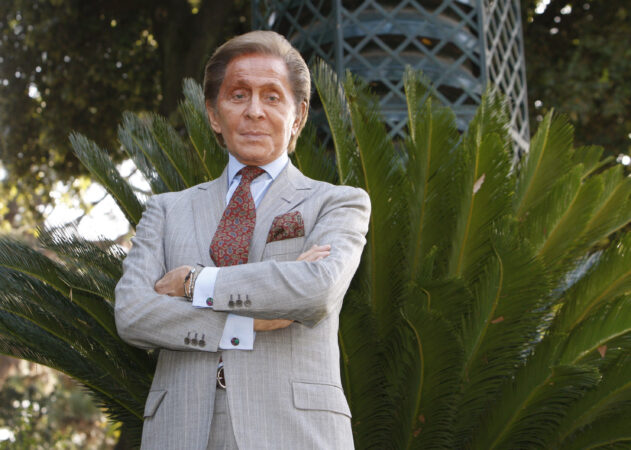
    ROME — Valentino Garavani, the jet-set Italian designer whose high-glamour gowns — often in his trademark shade of “Valentino red” — were fashion show staples for nearly half a century, has died at home in Rome, his foundation announced Monday. He was 93.

    “Valentino Garavani was not only a constant guide and inspiration for all of us, but a true source of light, creativity and vision,″ the foundation said in a statement posted on social media.

    His body will repose at the foundation’s headquarters in Rome on Wednesday and Thursday. The funeral will be held Friday at the Basilica Santa Maria degli Angeli e dei Martiri in Rome’s Piazza della Repubblica.

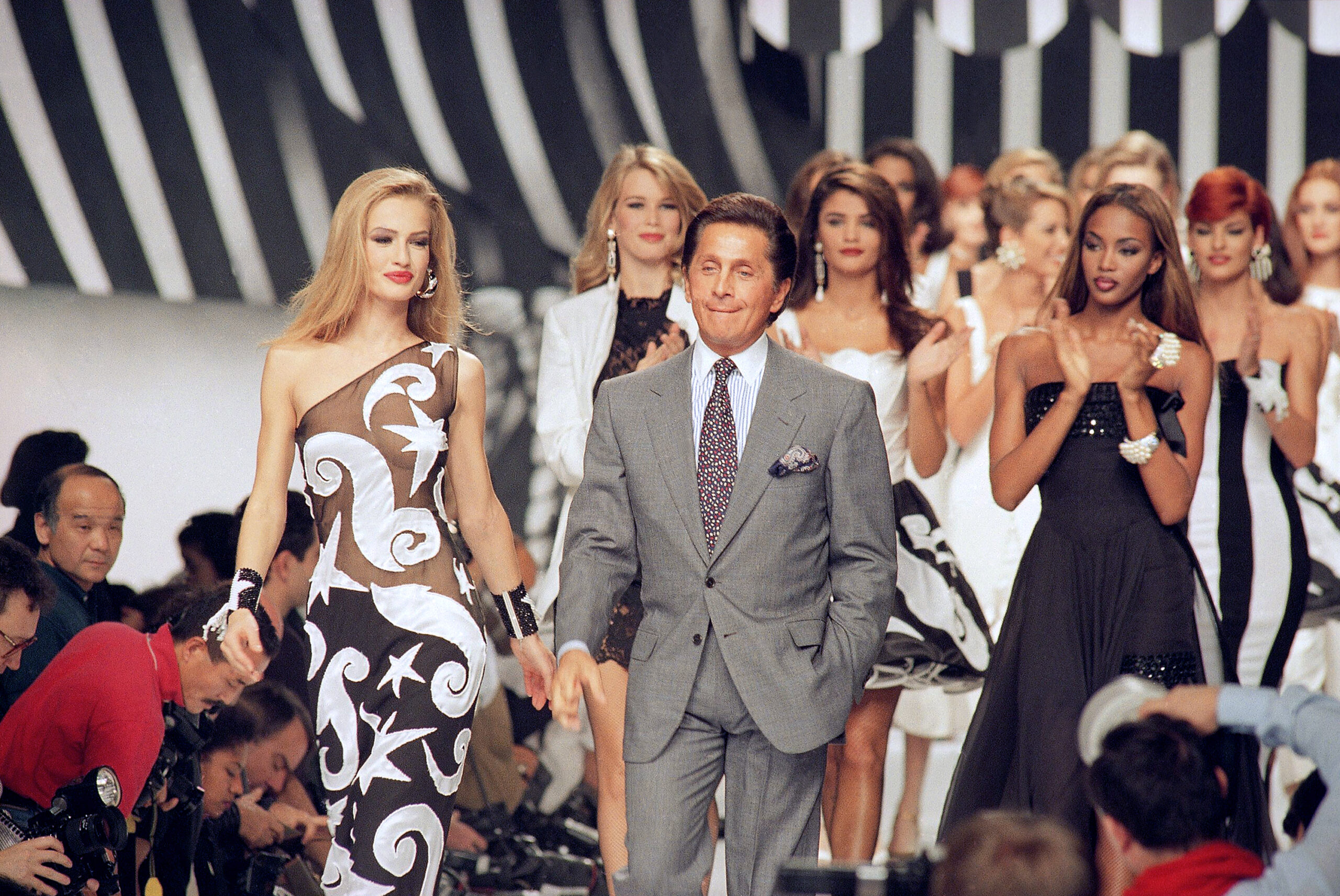
    Italian fashion designer Valentino Garavani walks the catwalk with his models after a fashion show on October 20, 1991 in Paris, France.

    Universally known by his first name, Valentino was adored by generations of royals, first ladies and movie stars, from Jackie Kennedy Onassis to Julia Roberts and Queen Rania of Jordan, who swore the designer always made them look and feel their best.

    “I know what women want,” he once remarked. “They want to be beautiful.”

    Never one for edginess or statement dressing, Valentino made precious few fashion faux-pas throughout his nearly half-century-long career, which stretched from his early days in Rome in the 1960s through to his retirement in 2008.

    His fail-safe designs made Valentino the king of the red carpet, the go-to man for A-listers’ awards ceremony needs. His sumptuous gowns have graced countless Academy Awards, notably in 2001, when Roberts wore a vintage black and white column to accept her best actress statue. Cate Blanchett also wore Valentino — a one-shouldered number in butter-yellow silk — when she won the Oscar for best supporting actress in 2004.

    Valentino was also behind the long-sleeved lace dress Jacqueline Kennedy wore for her wedding to Greek shipping magnate Aristotle Onassis in 1968. Kennedy and Valentino were close friends for decades, and for a spell the one-time U.S. first lady wore almost exclusively Valentino.

    He was also close to Diana, Princess of Wales, who often donned his sumptuous gowns.

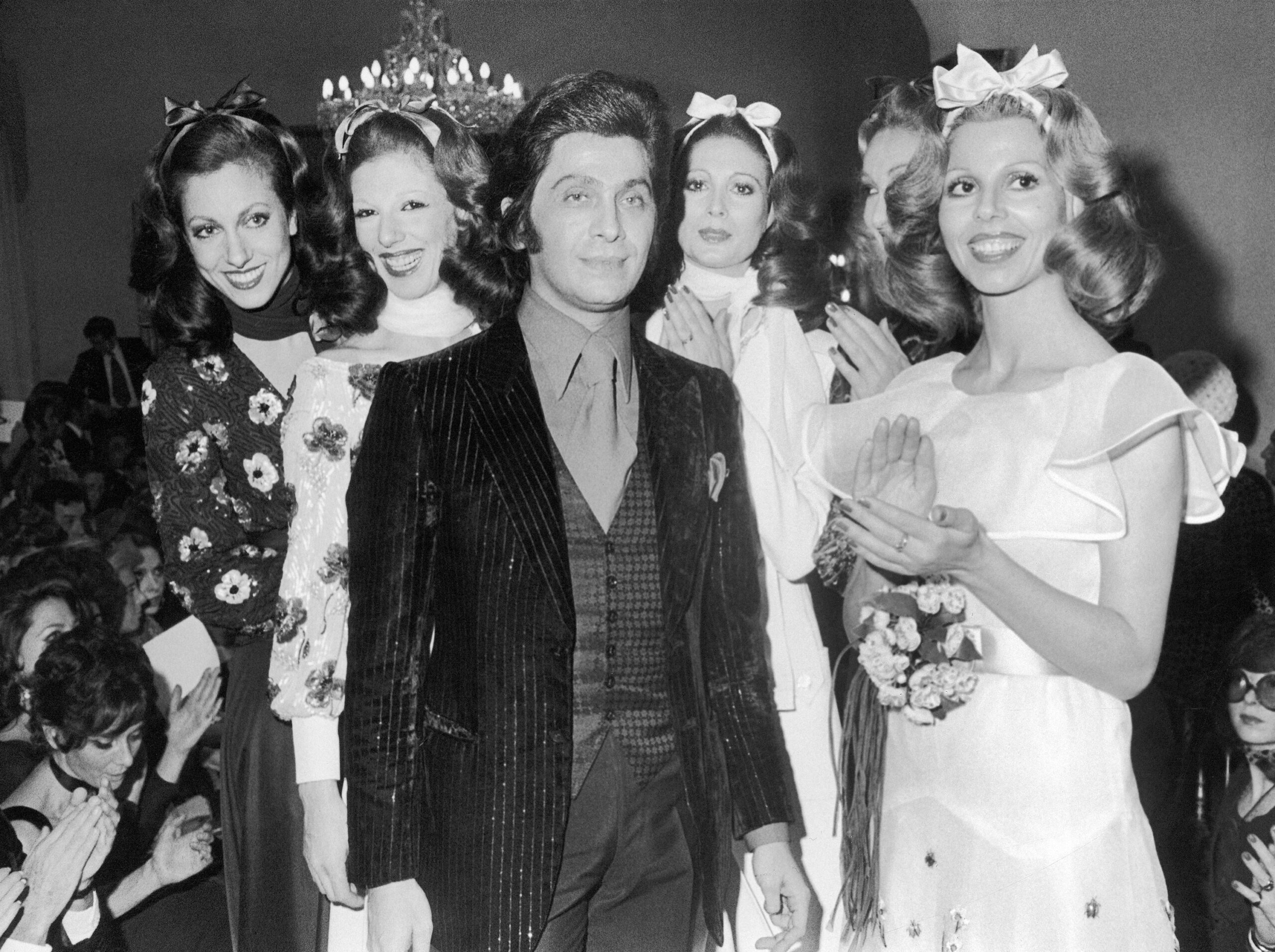
    Models flank Italian fashion designer Valentino Garavani in Rome, Italy, at the end of the fashion show for his spring-summer collection on Jan. 20, 1971.

    Beyond his signature orange-tinged shade of red, other Valentino trademarks included bows, ruffles, lace and embroidery; in short, feminine, flirty embellishments that added to the dresses’ beauty and hence to that of the wearers.

    Perpetually tanned and always impeccably dressed, Valentino shared the lifestyle of his jet-set patrons. In addition to his 152-foot (46-meter) yacht and an art collection including works by Picasso and Miro, the couturier owned a 17th-century chateau near Paris with a garden said to boast more than a million roses.

    Valentino and his longtime partner Giancarlo Giammetti flitted among their homes — which also included places in New York, London, Rome, Capri and Gstaad, Switzerland — traveling with their pack of pugs. The pair regularly received A-list friends and patrons, including Madonna and Gwyneth Paltrow.

    “When I see somebody and unfortunately she’s relaxed and running around in jogging trousers and without any makeup … I feel very sorry,” the designer told RTL television in a 2007 interview. “For me, woman is like a beautiful, beautiful flower bouquet. She has always to be sensational, always to please, always to be perfect, always to please the husband, the lover, everybody. Because we are born to show ourselves always at our best.”

    Valentino was born into a well-off family in the northern Italian town of Voghera on May 11, 1932. He said it was his childhood love of cinema that set him down the fashion path.

    “I was crazy for silver screen, I was crazy for beauty, to see all those movie stars being sensation, well dressed, being always perfect,” he explained in the 2007 television interview.

    After studying fashion in Milan and Paris, he spent much of the 1950s working for established Paris-based designer Jean Desses and later Guy Laroche before striking out on his own. He founded the house of Valentino on Rome’s Via Condotti in 1959.

    From the beginning, Giammetti was by his side, handling the business aspect while Valentino used his natural charm to build a client base among the world’s rich and fabulous.

    After some early financial setbacks — Valentino’s tastes were always lavish, and the company spent with abandon — the brand took off.

    Early fans included Italian screen sirens Gina Lollobrigida and Sophia Loren, as well as Hollywood stars Elizabeth Taylor and Audrey Hepburn. Legendary American Vogue editor-in-chief Diana Vreeland also took the young designer under her wing.

    Over the years, Valentino’s empire expanded as the designer added ready-to-wear, menswear and accessories lines to his stable. Valentino and Giammetti sold the label to an Italian holding company for an estimated $300 million in 1998. Valentino would remain in a design role for another decade.

    In 2007, the couturier feted his 45th anniversary in fashion with a 3-day-long blowout in Rome, capped with a grand ball in the Villa Borghese gallery.

    Valentino retired in 2008 and was briefly replaced by fellow Italian Alessandra Facchinetti, who had stepped into Tom Ford’s shoes at Gucci before being sacked after two seasons.

    Facchinetti’s tenure at Valentino proved equally short. As early as her first show for the label, rumors swirled that she was already on her way out, and just about one year after she was hired, Facchinetti was indeed replaced by two longtime accessories designers at the brand, Maria Grazia Chiuri and Pier Paolo Piccioli.

    Chiuri left to helm Dior in 2016, and Piccioli continued to lead the house through a golden period that drew on the launch of the Rockstud pump with Chiuri and his own signature color, a shade of fuchsia called Pink PP. He left the house in 2024, later joining Balenciaga, and has been replaced by Alessandro Michele, who revived Gucci’s stars with romantic, genderless styles.

    Valentino is owned by Qatar’s Mayhoola, which controls a 70% stake, and the French luxury conglomerate Kering, which owns 30% with an option to take full control in 2028 or 2029. Richard Bellini was named CEO last September.

    Valentino has been the subject of several retrospectives, including one at the Musee des Arts Decoratifs, which is housed in a wing of Paris’ Louvre Museum. He was also the subject of a hit 2008 documentary, “Valentino: The Last Emperor,” that chronicled the end of his career in fashion.

    In 2011, Valentino and Giammetti launched what they called a “virtual museum,” a free desktop application that allows viewers to feast their eyes on about 300 of the designer’s iconic pieces.

  • Judge rules feds in Minneapolis immigration operation can’t detain or tear gas peaceful protesters

    Judge rules feds in Minneapolis immigration operation can’t detain or tear gas peaceful protesters

    MINNEAPOLIS — Federal officers in the Minneapolis-area participating in its largest recent U.S. immigration enforcement operation can’t detain or tear gas peaceful protesters, a U.S. judge in Minnesota ruled Friday.

    U.S. District Judge Kate Menendez ruled in a case filed in December on behalf of six Minnesota activists.

    Thousands of people have been observing the activities of Immigration and Customs Enforcement and Border Patrol officers enforcing the Trump administration’s immigration crackdown in the Minneapolis-St. Paul area since early December.

  • FBI searches a Washington Post reporter’s home as part of a classified documents investigation

    FBI searches a Washington Post reporter’s home as part of a classified documents investigation

    FBI agents searched a Washington Post reporter’s home on Wednesday as part of a leak investigation into a Pentagon contractor accused of taking home classified information, the Justice Department said.

    Hannah Natanson, who has been covering President Donald Trump’s transformation of the federal government, had a phone, two laptops and a Garmin watch seized in the search of her Virginia home, the Post reported. Natanson has reported extensively on the federal workforce and recently published a piece describing how she gained hundreds of new sources — leading one colleague to call her “the federal government whisperer.”

    While classified documents investigations aren’t unusual, the search of a reporter’s home marks an escalation in the government’s efforts to crack down on leaks. The Post was told that Natanson and the newspaper are not targets of the probe, executive editor Matt Murray said in an email to colleagues.

    “Nonetheless, this extraordinary, aggressive action is deeply concerning and raises profound questions and concern around the constitutional protections for our work,” Murray wrote. “The Washington Post has a long history of zealous support for robust press freedoms. The entire institution stands by those freedoms and our work.”

    Attorney General Pam Bondi said that the search was done at the request of the Defense Department and that the journalist was “obtaining and reporting classified and illegally leaked information from a Pentagon contractor.”

    “Leaking classified information puts America’s national security and the safety of our military heroes in serious jeopardy,” White House press secretary Karoline Leavitt said in a post on X. “President Trump has zero tolerance for it and will continue to aggressively crack down on these illegal acts moving forward.”

    The warrant says the search was related to an investigation into a system engineer and information technology specialist for a government contractor in Maryland who authorities allege took home classified materials, the Post reported. The worker, Aurelio Perez-Lugones, was charged earlier this month with unlawful retention of national defense information, according to court papers. He has not been charged with sharing classified information, and he has not been accused in court papers with leaking.

    Perez-Lugones, who held a top secret security clearance, is accused of printing classified and sensitive reports at work. In a search of his Maryland home and car this month, authorities found documents marked “SECRET,” including one in a lunchbox, according to court papers.

    An FBI spokesperson declined to comment on Wednesday. The Washington Post said Wednesday that it was monitoring and reviewing the situation. An email seeking comment was sent to lawyers for Perez-Lugones, who is expected to appear in court on Thursday for a detention hearing.

    First Amendment groups expressed alarm at the search, saying it could chill investigative journalism that holds government officials to account.

    “Physical searches of reporters’ devices, homes, and belongings are some of the most invasive investigative steps law enforcement can take,” Reporters Committee for Freedom of the Press president Bruce Brown said. “While we won’t know the government’s arguments about overcoming these very steep hurdles until the affidavit is made public, this is a tremendous escalation in the administration’s intrusions into the independence of the press.”

    The Justice Department over the years has developed, and revised, internal policies governing how it will respond to news media leaks.

    In April, Bondi rescinded a policy from President Joe Biden’s Democratic administration that protected journalists from having their phone records secretly seized during leak investigations — a practice long decried by news organizations and press freedom groups.

    The moves again gave prosecutors the authority to use subpoenas, court orders and search warrants to hunt for government officials who make “unauthorized disclosures” to journalists. A memo she issued said members of the press are “presumptively entitled to advance notice of such investigative activities,” and subpoenas are to be “narrowly drawn.” Warrants must also include “protocols designed to limit the scope of intrusion into potentially protected materials or newsgathering activities,” the memo states.

    The aggressive posture with regard to The Washington Post stands in contrast to the Justice Department’s approach to the disclosure of sensitive military information via a Signal chat last spring involving senior Trump administration officials. A reporter was mistakenly added to that chat. Bondi indicated publicly at the time that she was disinclined to open an investigation, saying she was confident that the episode had been a mistake.

    Bondi also repeated Trump administration talking points that the highly sensitive information in the chat was not classified, though current and former U.S. officials have said the posting of the launch times of aircraft and the times that bombs would be released before those pilots were even in the air would have been classified.

  • Head of FBI’s New York field office to serve as co-deputy director after Bongino’s departure

    Head of FBI’s New York field office to serve as co-deputy director after Bongino’s departure

    WASHINGTON — The head of the FBI’s New York field office has been named co-deputy director of the bureau, replacing Dan Bongino following his recent departure, an FBI spokesperson said Friday.

    Christopher Raia, who helped lead the response to the deadly truck attack in New Orleans on New Year’s Day last year, was picked to run the New York office in April after having served as a top counterterrorism official at FBI headquarters. A former Coast Guard officer, Raia joined the FBI in 2003 and during the course of his two-decade career has investigated violent crime, drugs and gangs as well as overseen counterterrorism and national security investigations.

    As a career FBI agent, Raia is a more conventional selection for the FBI’s No. 2 job than was Bongino, a popular conservative podcaster who had previously served as a Secret Service agent but had never worked for the FBI until being selected by the Trump administration last year.

    Raia is expected to serve as co-deputy director alongside Andrew Bailey, the former Missouri attorney general who was named to the job last August. He is scheduled to start next week.

    He became the head of the New York field office after his predecessor, James Dennehy, who was reported to have resisted Justice Department efforts to scrutinize agents who participated in politically sensitive investigations, was forced to retire.

    Bongino announced last month that he was departing the bureau following a brief and tumultuous tenure. He officially ended his tenure last week.

    No immediate successor was named for Raia in New York.