The union that represents more than 2,000 Philadelphia firefighters and paramedics says its members will, for the first time in two decades, receive a wage increase lower than police officers did — a contract provision they see as the end of years of pay parity among the city’s first responders.
Mayor Cherelle L. Parker’s administration announced Wednesday that a panel of arbitrators had issued a two-year contract award for Local 22 of the International Association of Fire Fighters after its members had gone more than a year without a contract.
Local 22 was the last of the city’s four major municipal unions to reach a multiyear agreement with the Parker administration. The other unions agreed to their contracts last year.
Parker said in a statement that the contract award recognizes the contributions of the city’s firefighters and emergency medical personnel “while supporting the city’s efforts to remain fiscally responsible.”
The contract award was issued by a three-member arbitration panel, a process governed by state law because emergency workers do not have the right to strike. The deal includes 3% raises annually for the next two years, plus a 1% wage increase in recognition of mandatory physical evaluations that members must receive biannually.
Those raises total a 7% pay increase over two years for union firefighters, paramedics, and emergency medical personnel. In the city’s contract with police inked about a year ago, members of the Fraternal Order of Police Lodge 5 received a 9% wage increase in total over the same time period, plus a $3,000 signing bonus.
Local 22 president Mike Bresnan said Parker’s administration did not adequately advocate for pay parity between police and firefighters. He said he is lobbying members of City Council to consider legislation that would require Council approval for the mayor to appeal firefighters’ contracts in the future.
“Mayor Parker likes to run around putting her one index finger up as ‘we’re all one,’” Bresnan said. “Well, she just put her middle finger up to every firefighter and paramedic in the city.”
He added: “If there’s somebody out there that’s thinking about running for mayor, we’d like to have a conversation with them.”
The firefighters union has historically played a relatively minimal role in city elections compared with more politically active labor groups like those that represent construction workers. The union did not back a candidate in the 2023 mayor’s race, which Parker won.
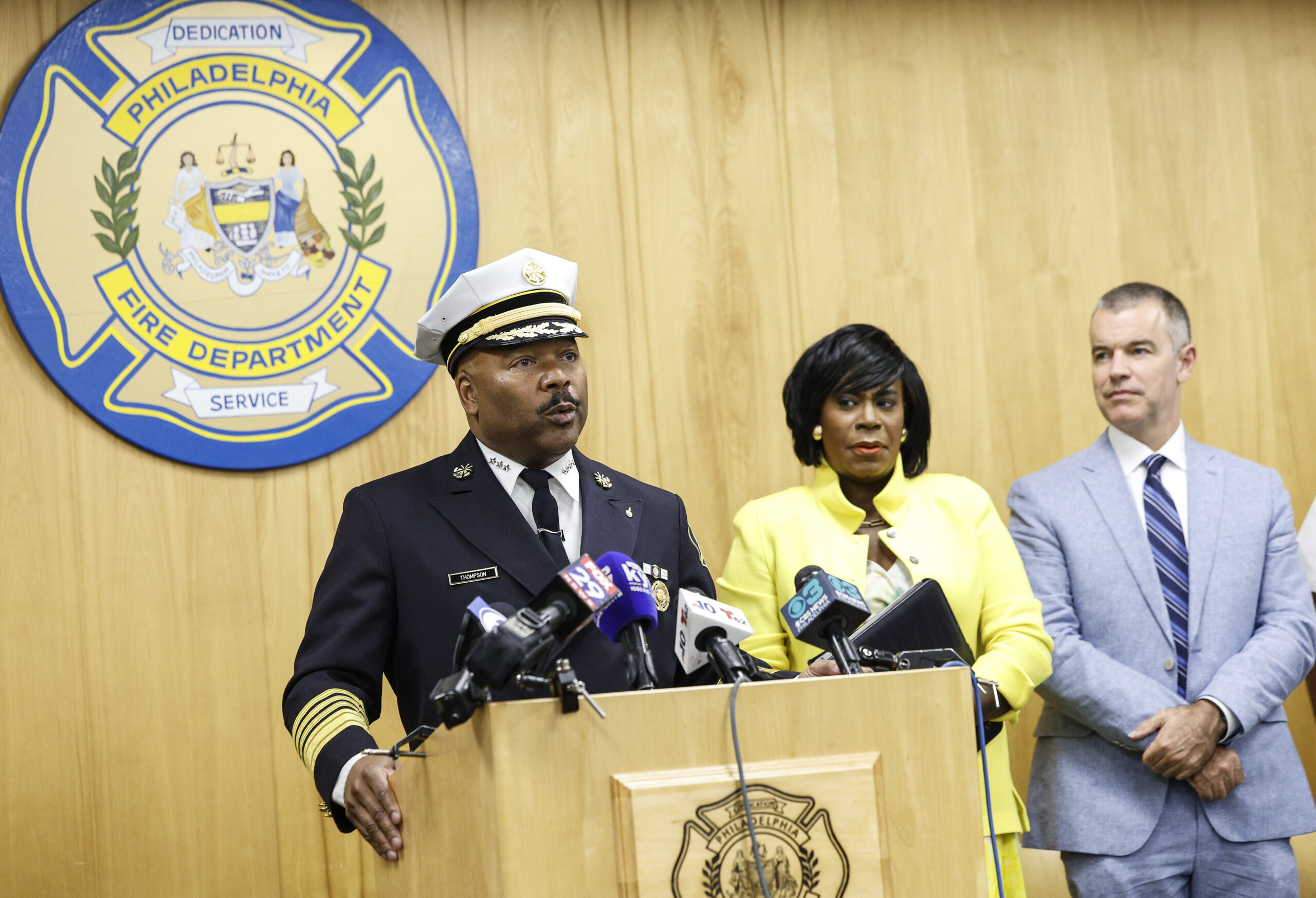
In this 2024 file photo, Fire Commissioner Jeffrey W. Thompson stands, at left, with Mayor Cherelle L. Parker with Managing Director Adam Thiel at the fire administration building in Spring Garden.
The FOP contract, similar to the firefighters’, included 3% annual raises. The difference was that police received an additional 1.5% annual wage increase because their union agreed to a process called “civilianization,” meaning some roles held by uniformed officers would be transitioned to ones held by civilians.
The raise, according to the contract, was in recognition of the “operational flexibility” that the civilianization process would achieve. It did not identify the number of positions that would be civilianized or if the effort would save the city money.
The arbitration panel that drafted the firefighters’ contract is made up of one appointee each from the city and the union, plus a neutral arbitrator. The panel wrote that while there has, in general, been pay parity in raises for police and firefighters, that “has never meant identical awards.”
In this case, the panel reasoned, the civilianization-related raise was unique to the police department and the city did not need to match it for the firefighters.
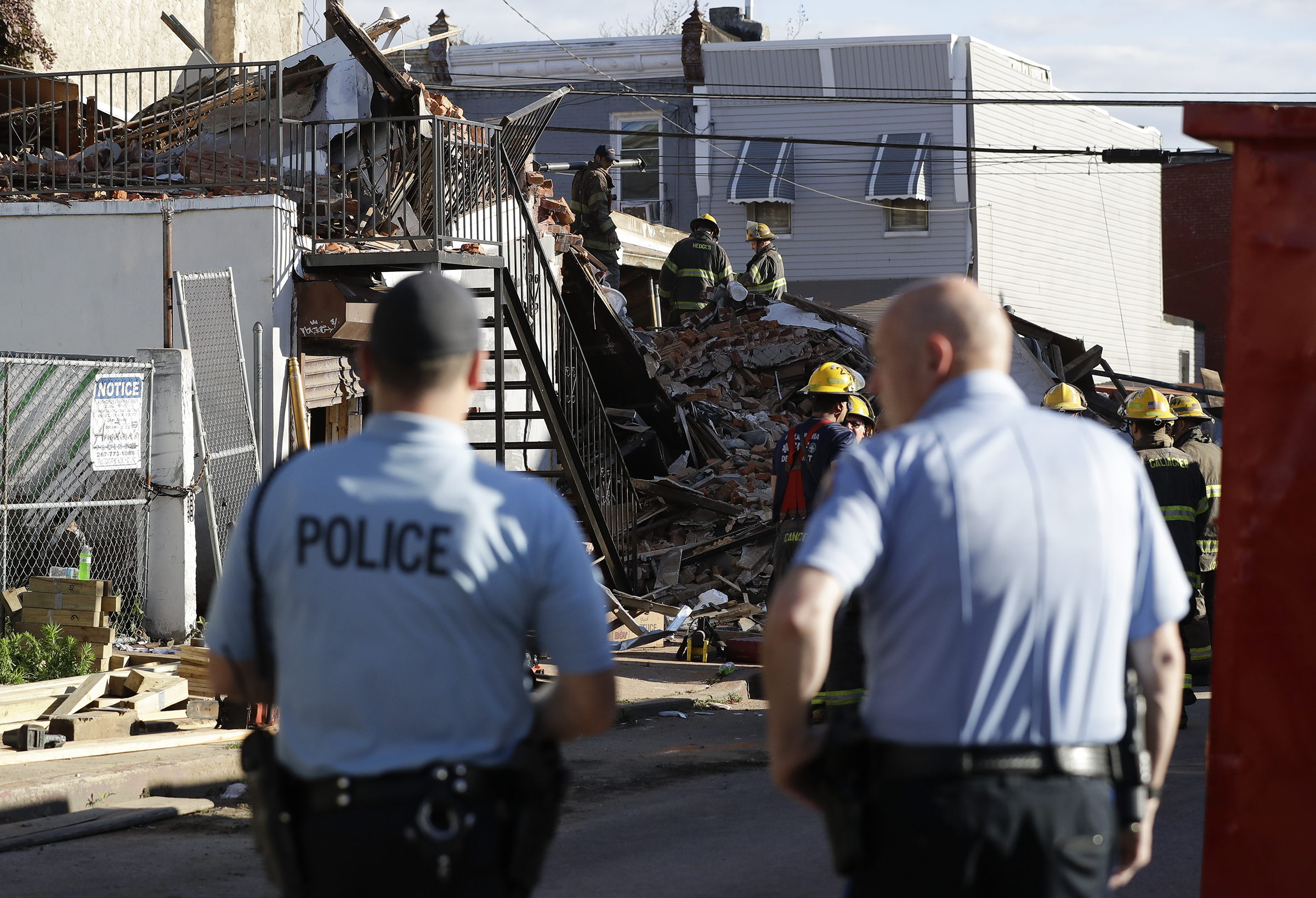
In this 2022 file photo, Philadelphia firefighters examine the remains of a collapsed building along the 300 block of West Indiana Street in the Fairhill section of Philadelphia as Philadelphia police officers look on.
Marc Gelman, the union’s appointed arbitrator, issued a scathing dissent, writing that the contract award was ultimately a “rubber-stamp to the city’s desired economic wishlist” and provided firefighters with “a dramatically lower wage increase than the police.”
He argued that the city could afford a higher wage increase for firefighters because it is operating from a place of fiscal strength, citing its substantial surplus in this year’s budget.
However, the city will have to tap into reserves or make adjustments to its existing five-year budget plan to cover the firefighters’ contract. That is because the administration already exhausted its $550 million labor reserve to cover contracts with the city’s other major municipal unions.
The Parker administration did not estimate how much money the firefighters’ contract award will cost.
Gelman wrote that the labor reserve was exhausted through the city’s “mismanagement and inability to plan.”
“The city now cries poor,” he wrote, “and expects the members of Local 22 to suffer for its ineptitude.”
Bresnan said pay parity is critical because the police and firefighters unions are unique in that “members can leave for work in the morning and not come home at night to their family.”
“We’re out there shoulder-to-shoulder on these emergencies in the city,” he said. “Every mayor prior recognized this and kept the peace. Now they’ve created a fracture between the first responders in the city.”
The biggest jump in Philadelphia’s property assessments this year occurred in Kensington, a measure that means many homeowners in the long-struggling neighborhood are likely to see higher taxes amid a concerted effort by the city to clean up the area.
That is according to an Inquirer analysis of recently released property assessments of single-family homes, which found that, citywide, there was a 3% median change in valuations from the 2025 tax year, the last time there was a mass reassessment.
That increase is far more modest than the widespread jump in valuations that homeowners saw two years ago, which captured multiple years of real estate growth and the volatile post-pandemic market.
What remains the same: who will be most affected.
The Inquirer’s analysis of this year’s property assessment data shows that low-income neighborhoods near gentrifying areas saw the sharpest jumps in valuations compared with the rest of the city.
The four areas that saw the largest percentage increases in median assessments — Kensington, Mantua, Grays Ferry, and Kingsessing — all border more gentrified neighborhoods like Fishtown, University City, and Point Breeze. The results of the analysis are a further sign that market pressures in higher-income areas are pushing into pockets of the city that have long been primarily home to Black and brown working-class residents.
Of the eight neighborhoods that saw the largest increases between the 2025 and 2027 tax years, five have median annual household incomes around $40,000 or less, according to an analysis of U.S. Census data. The federal poverty level is $33,000 for a family of four.
(function(){function e(){window.addEventListener(`message`,function(e){if(e.data[`datawrapper-height`]!==void 0){var t=document.querySelectorAll(`iframe`);for(var n in e.data[`datawrapper-height`])for(var r=0,i;i=t[r];r++)if(i.contentWindow===e.source){var a=e.data[`datawrapper-height`][n]+`px`;i.style.height=a}}})}e()})();
In a statement, officials with Mayor Cherelle L. Parker’s administration noted that many homeowners in those five neighborhoods are benefiting from a popular city tax break. The city said that the median 2027 value in those five neighborhoods is $123,600, so for many homeowners in those areas, the median taxable assessed value is just $23,600.
That is because of the homestead exemption, a tax break for homeowners who live in their house as their primary residence that exempts the first $100,000 in home value from property taxes. Homeowners must sign up to be included in the free program.
At least 60% of homeowners in those neighborhoods have signed up for property tax relief programs, according to the city.
James Aros Jr., the chief assessor of the Philadelphia Office of Property Assessment, and Revenue Commissioner Kathleen McColgan said enrollment rates in property tax relief, including the homestead exemption and multiple tax freeze programs, are “encouraging.”
They said the city will “build on this progress through extensive targeted outreach, community partnerships, and efforts to make enrollment as simple and accessible as possible.”
The current property tax rate is 1.3998% of assessed value, which has not changed for nearly a decade. The revenue is split between the city and the Philadelphia School District.
Rising home values in Kensington
Citywide, the steepest increase in valuations was in Kensington, where the median property value jumped 15.3%, from $115,700 in the 2025 tax year to $133,400 now. That median increase would translate to a roughly $250 annual property tax hike.
That comes after Parker’s administration in 2024 launched a multipronged effort to address the long-entrenched open-air drug market in Kensington, which is the epicenter of the city’s opioid crisis and a site of sprawling homelessness.
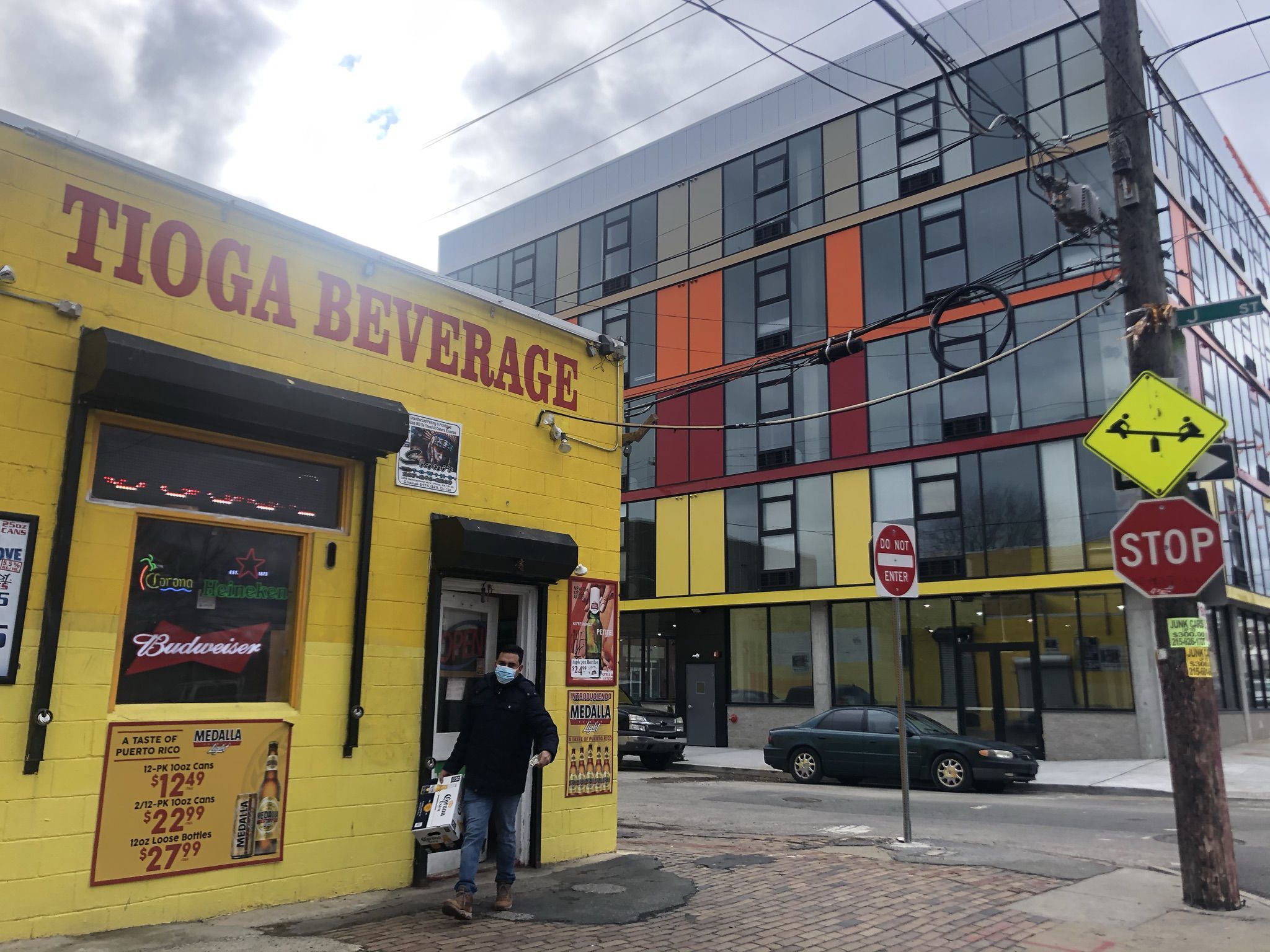
In this 2021 file photo, a glass building at J and Tioga sits near a beer store in Kensington.
Some neighborhood leaders have watched with anxiety as luxury housing developers and out-of-town investors gobbled up properties in the neighborhood, fearing that poorer residents and middle-class homebuyers may be priced out.
City Councilmember Quetcy Lozada, a Democrat who represents the 7th Council District, which includes parts of Kensington, said she knew speculators from outside the area would want to make it “the next gentrified neighborhood” once the city changed its strategy to more aggressively clean up trash and improve public safety.
But Lozada said there are not enough programs specific to Kensington aimed at preventing displacement as a result of rising property values, especially as the city is investing millions of dollars a year to improve the neighborhood. She said her office is exploring additional tax relief measures.
“I’m going to do whatever I have to do to make sure that residents who have lived in that community can stay there, can raise their families there,” Lozada said. “We have witnessed what has happened on the southern end of the district, where there has been rapid gentrification.”
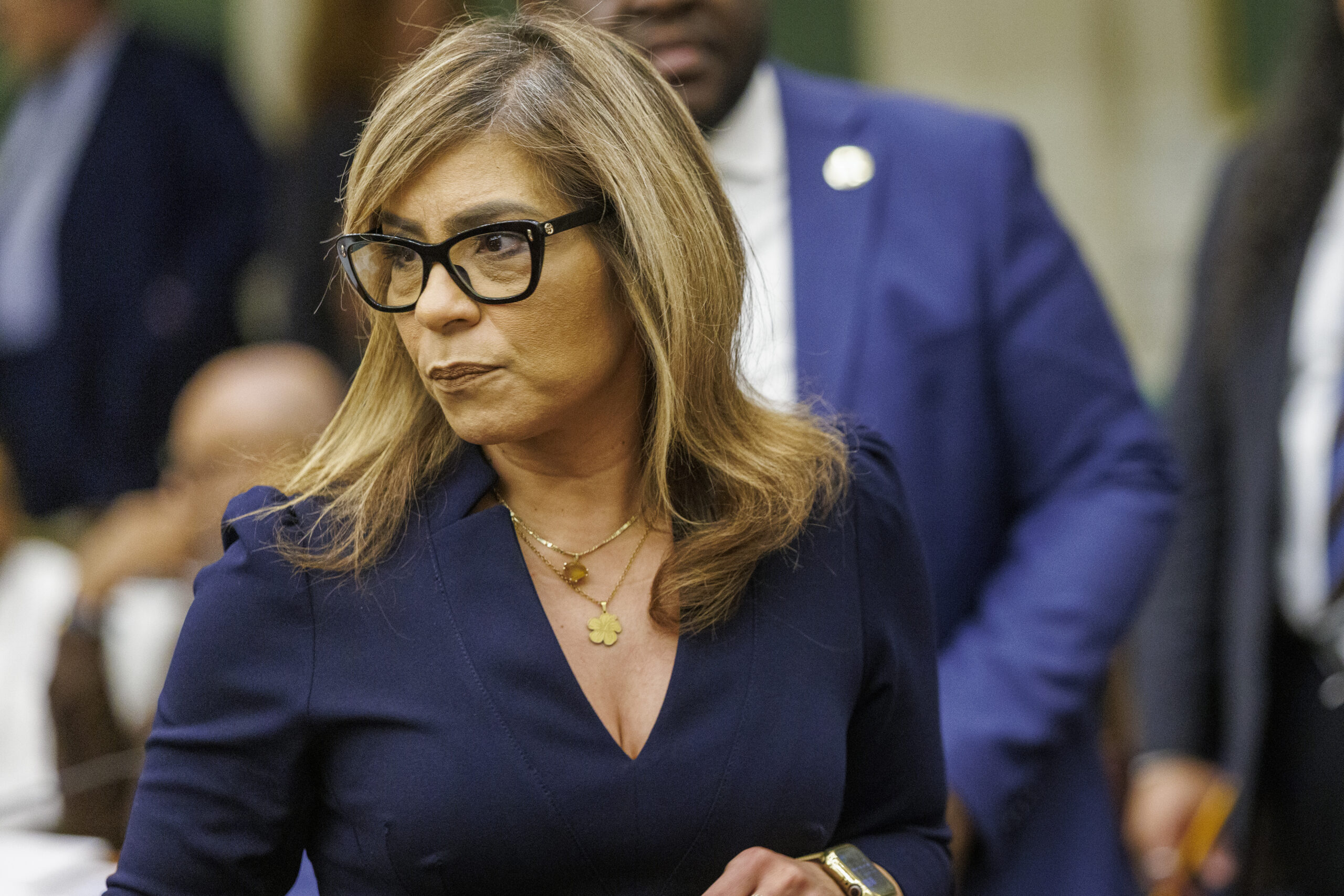
In this March file photo, City Councilmember Quetcy Lozada stands in Council chambers during Mayor Cherelle L. Parker’s budget address.
Lozada also said rising property values in Kensington are part of why she has been “so careful with projects presented to me” and has prioritized what she sees as equitable development in the neighborhood — at times to the chagrin of developers who think she has been too restrictive.
“I’m all about people making a return,” she said, “but you can’t continue to do it on the backs of poor people.”
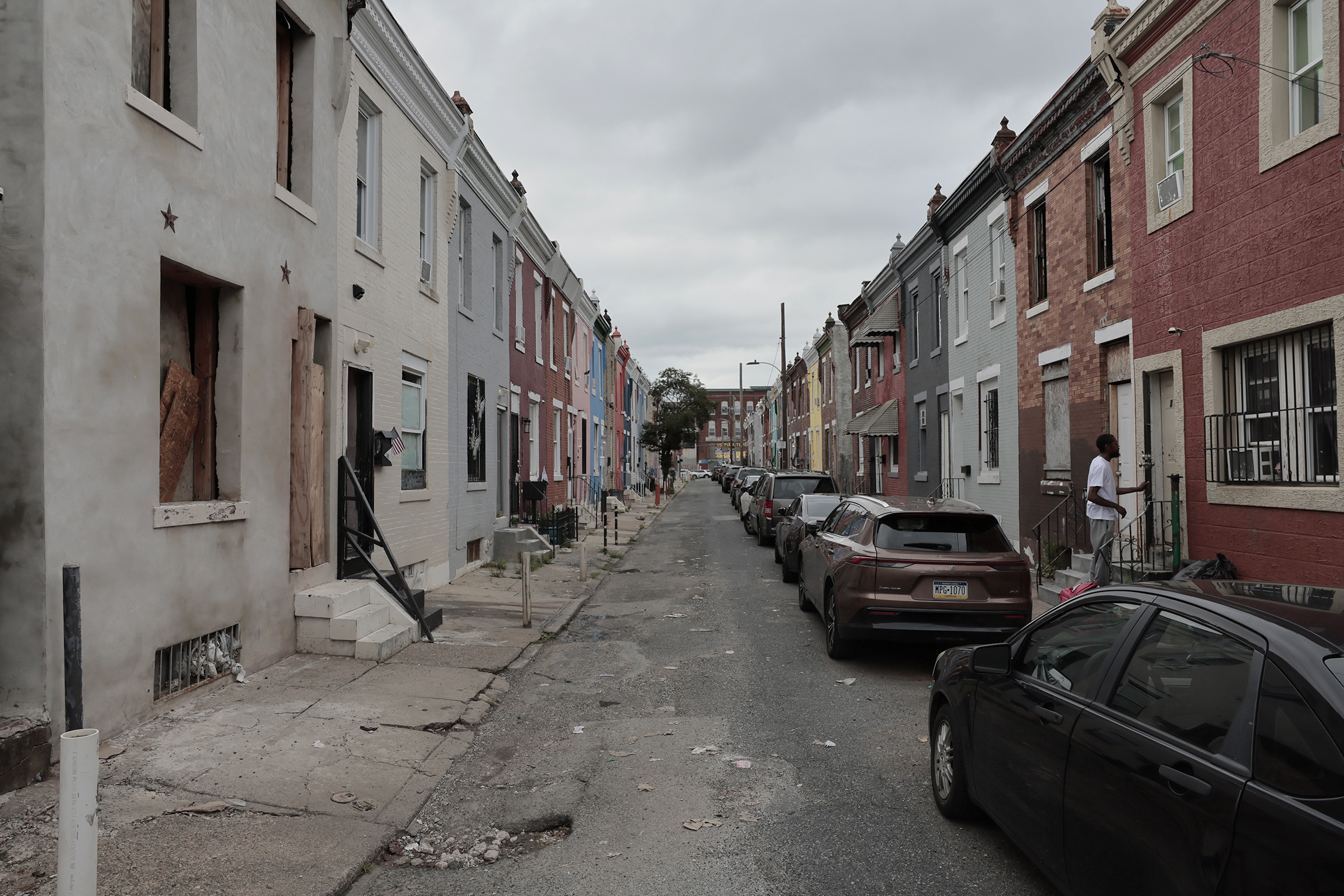
The 3100 block of Arbor Street in Philadelphia on Tuesday, July 7, 2026.
Continuing change in pockets of West Philly
There were also significant property value increases in parts of West Philadelphia.
The median increase in Mantua, the neighborhood north of University City, was the second highest in the city, at 15%, according to The Inquirer’s analysis. The median increase was 12% in Kingsessing, the neighborhood south of University City that in 2025 saw the largest jump of any neighborhood in Philadelphia.
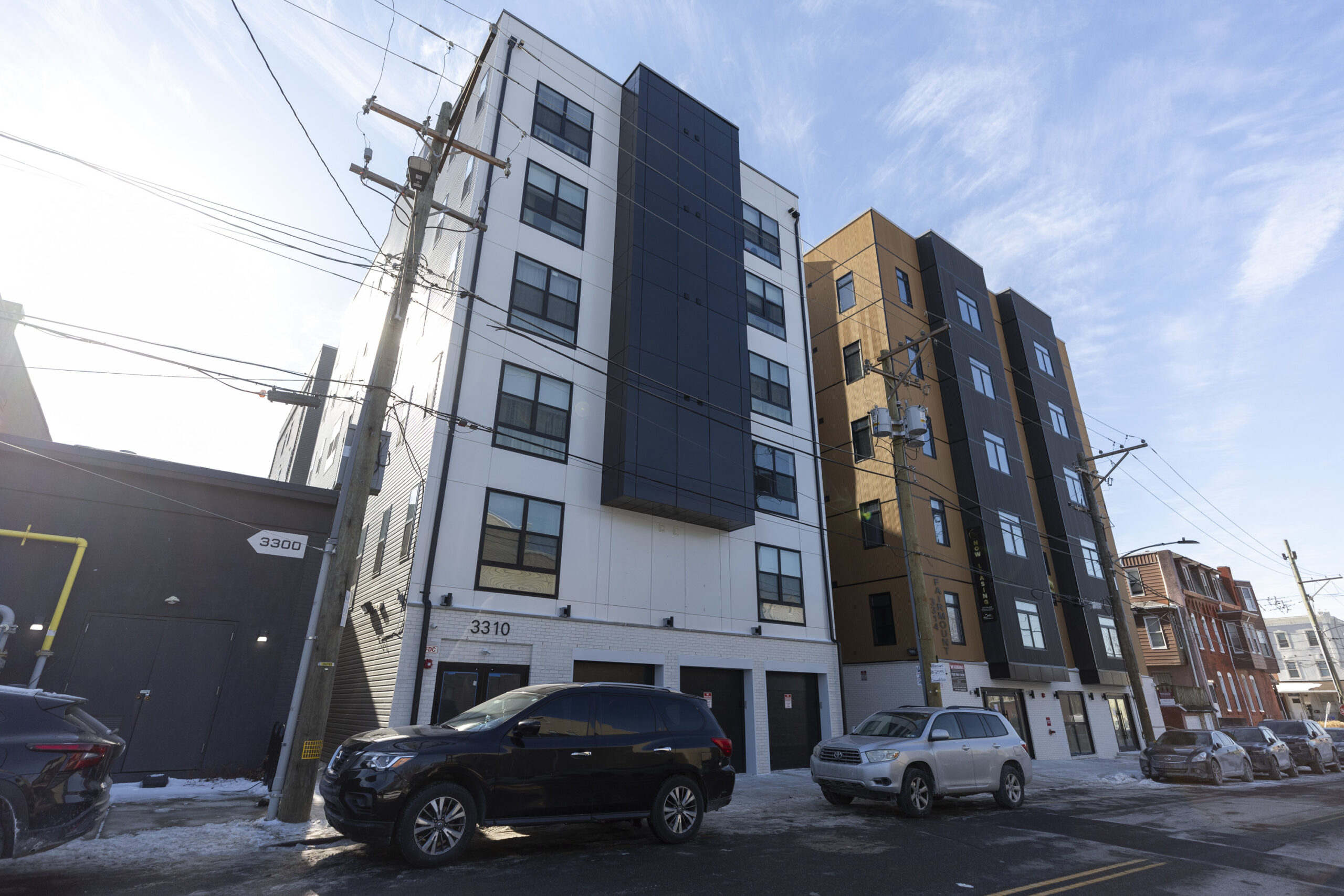
Newly developed buildings along Fairmount Avenue in the neighborhood of Mantua in Philadelphia, Pa., on Thursday, Jan. 23, 2025.
Councilmember Jamie Gauthier, a Democrat who represents West Philadelphia and has made preventing displacement a key initiative, said that there has long been racial bias in the city’s property assessments and that the city must “get serious” about protecting low-income homeowners by revamping its system.
“There has to be a higher level of urgency in making sure that the city doesn’t have a hand in pushing out all of these homeowners that make Philadelphia what it is,” Gauthier said. “It’s unconscionable for us to destabilize our neighborhoods and the longtime homeowners who live there because we didn’t take enough care to make sure that our process was fair and equitable.”
For too long, she said, city officials have said they intended to examine the property assessment practices and identify improvements. In 2024, Parker convened a task force to study the process.
Aros told Council in April that the task force’s report was “being finalized.” He said OPA would look to implement recommendations from the report, including conducting more regular reassessments and improving property-level data such as property condition.
The city is also planning to hire an outside consultant to examine its mass appraisal practices, according to city records. The analyst will be responsible for drafting a report by the end of this year.
Deputy creative director John Duchneskie contributed to this article.
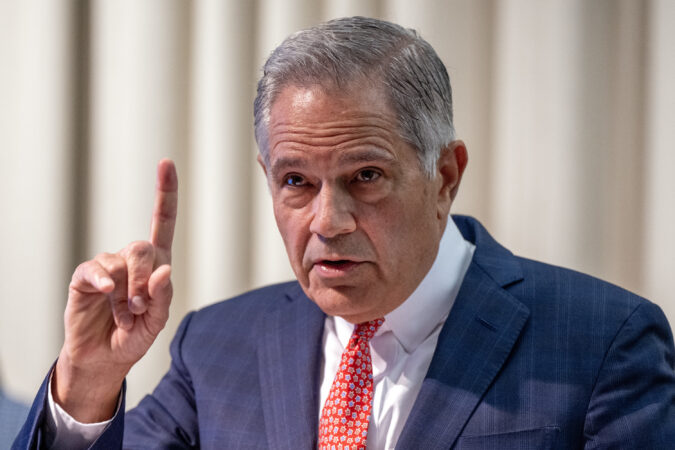
Philadelphia District Attorney Larry Krasner has long said he’s a friend to organized labor. As prosecutors in his office are gearing up for an election to authorize their union, Krasner has said their efforts could ensure his own legacy, because “whatever person might take my seat later cannot easily undo what we have done.”
But not everyone in his office is feeling the support.
More than 100 lower-level employees in the District Attorney’s Office, including paralegals and victim and witness coordinators, are separately trying to secure their own union— and some say they’re meeting resistance.
Several workers said that Krasner’s administration has put up roadblocks and taken positions that they see as at odds with his public image as a leader of the city’s progressive movement.
Five paralegals and coordinators, all of whom spoke to The Inquirer on the condition of anonymity to avoid retribution before a union is in place, said the unionization process has left them disappointed with Krasner.
“He was elected in large part because of a number of very important pro-labor organizations in Philadelphia,” said one employee. “If the DA just came out and publicly supported it, that’s what I would expect from the most progressive DA in America.”
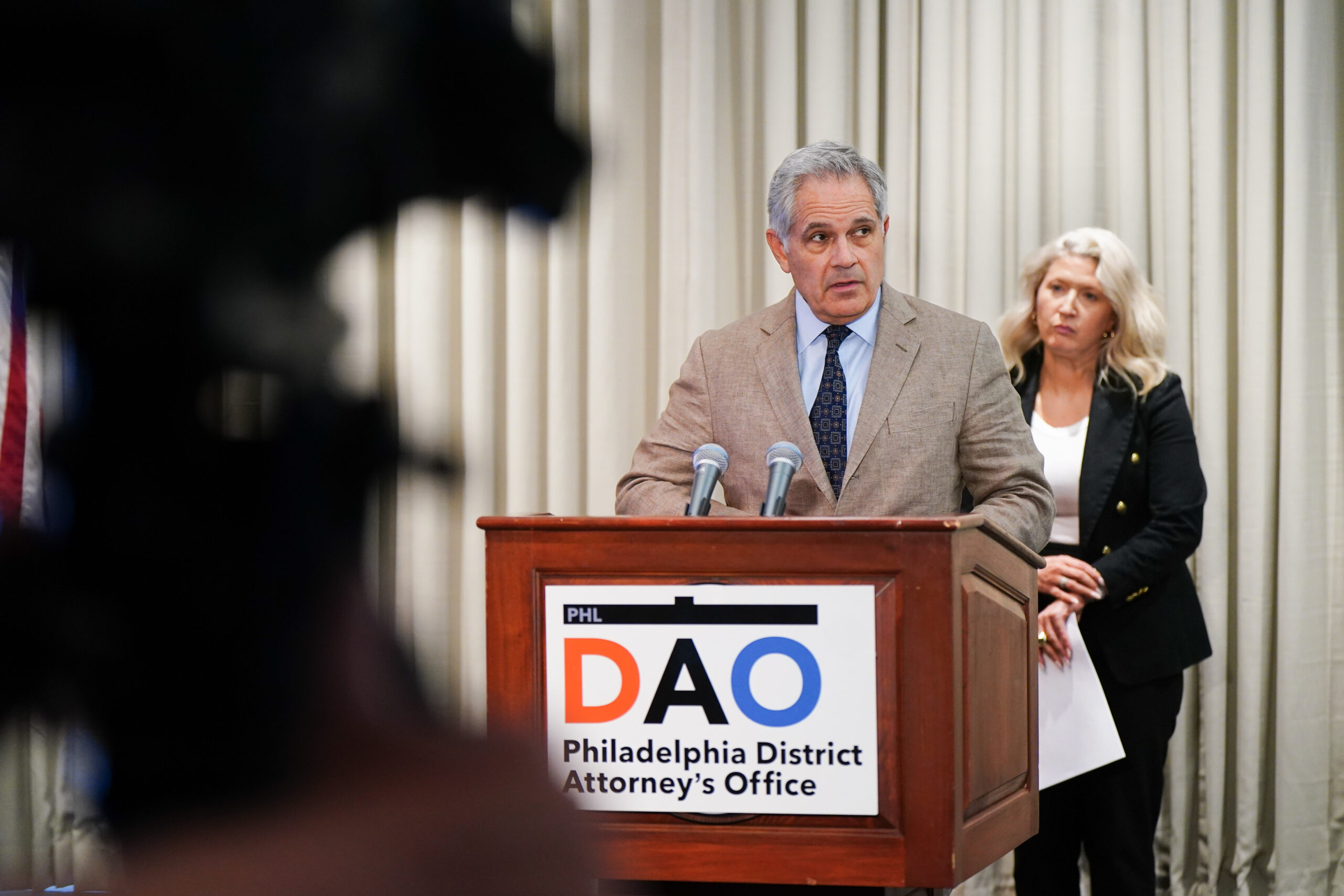
District Attorney Larry Krasner speaks during a press conference about a homicide in May.
And meanwhile, the lower-level employees say there’s been a separate Wild West-style standoff between two unions, which are both vying to represent them.
Krasner said in an interview on Monday that he supports his employees’ right to organize a union through a “properly conducted free, fair, and final election.”
“I will support them 100% in whatever decision they make to form or not to form a union, and whatever union they choose if they do form one,” he said.
Still, it all could become a political flashpoint for Krasner, a third-term progressive Democrat whose name has been floated by some in the city’s political class as a potential candidate for higher office. He has not ruled out running next year, when Mayor Cherelle L. Parker, a more centrist Democrat, will be up for reelection.
While Krasner has positioned himself as supportive of organized labor, his relationship with some leaders of the city’s politically powerful unions has been strained. He’s received steadfast support from the unions that tend to align with left-leaning politicians, but clashed with others, including the leaders of the building trades unions that last year backed his challenger.
Krasner last month publicly criticized Parker for not acquiescing to his office’s requests for additional funding, to which Parker countered that his funding has increased every year since she became mayor. He said this week that he believes the unionization effort among his employees is the result of his office being underfunded during Parker’s administration.
Paralegals and victim and witness coordinators said that they have explored unionization to improve wages. Several staffers described living paycheck-to-paycheck and holding second jobs to meet expenses.
The starting annual salary for paralegals, who assist attorneys with legal research and drafting documents, and for coordinators, who shepherd victims and witnesses through the court process, is $46,000.
Several employees also said they’re seeking union representation to improve their workplace culture. Two said the expectations of them change frequently, and that responsibilities often expand with little warning.
But the road to get there, they said, has not been smooth.
To unionize, the lower-level employees partnered last year with organizers at the United Steelworkers Local 286. The union represents workers in a diverse range of industries, including school bus drivers, pharmaceutical packaging plant workers, and some clerks in the city’s court system.
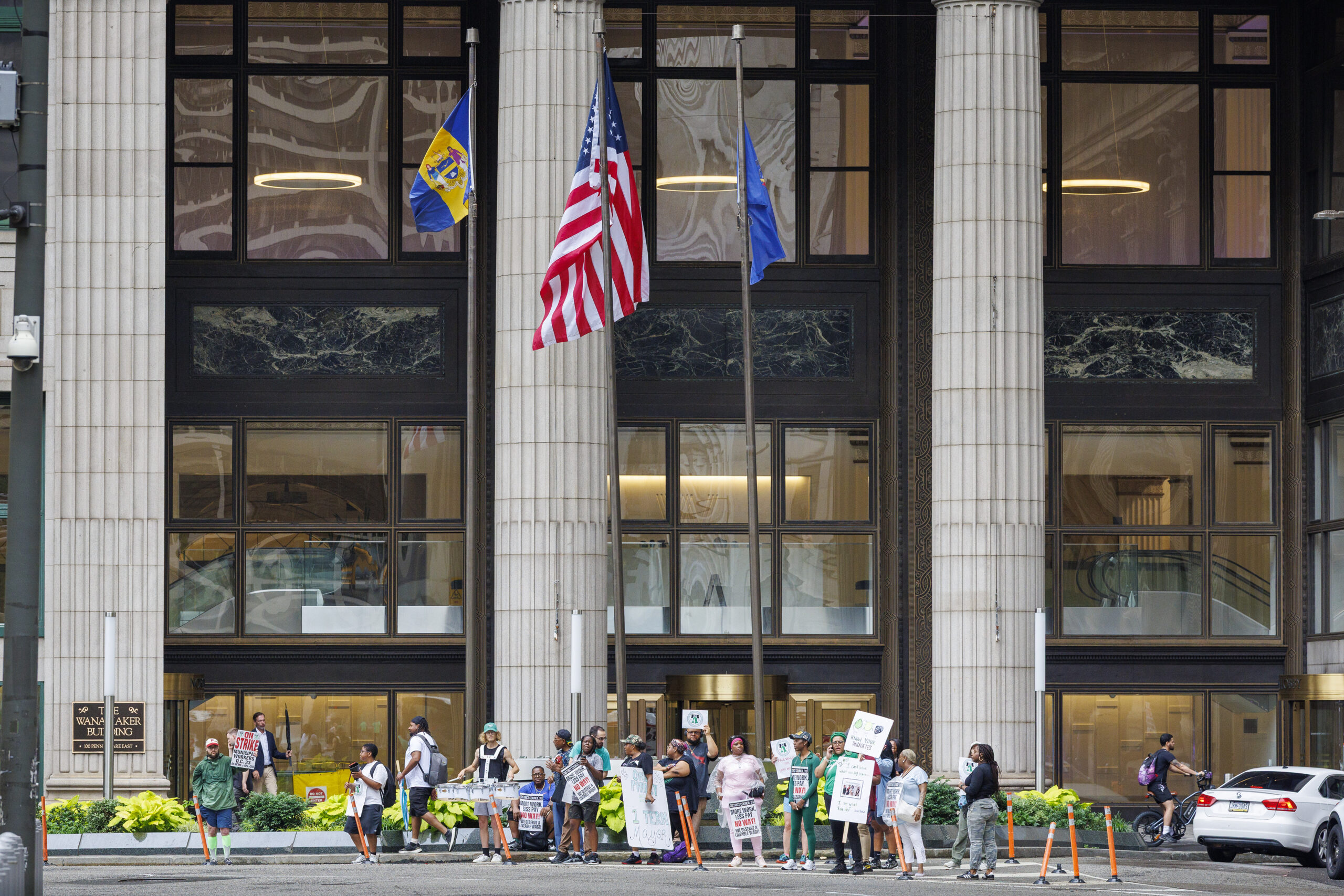
Picketers employed in the District Attorney’s Office picket outside during the AFSCME District Council 33 strike on Wednesday, July 2, 2025. DC 33 already employs some workers in the DAO.
Carlo Simone Jr., the union’s president and business manager, said his local has been seen by some city employees in recent years as “an alternative” to the American Federation of State, County and Municipal Employees District Council 33 and District Council 47.
Those two much larger unions represent thousands of city employees, with DC 33 largely representing blue-collar workers and DC 47 working primarily with white-collar staff.
The prosecutors in Krasner’s office will be represented by DC 47 if their election is successful. But several of the lower-level workers in the District Attorney’s Office had preexisting relationships with USW and said that they thought the steelworkers’ union would be the best fit to represent them.
In December, USW filed a petition with the Pennsylvania Labor Relations Board, asking the state to authorize an election that would lead to them representing the paralegals.
But DC 33 had other plans. In February, DC 33 filed paperwork with the state and argued that the paralegals instead belong in their municipal workers’ union, setting up a power struggle with the steelworkers.
The PLRB agreed with DC 33.
Last month, the board issued a preliminary ruling that said DC 33 is the appropriate union to organize the workers. The board reasoned that, under longstanding precedent, DC 33 is responsible for representing “nonprofessional” employees — or those that don’t require advanced professional education — who are designated as members of the civil service.
The vast majority of city employees are members of the civil service, which is the city’s merit-oriented system for hiring and promotion. It is intended to separate municipal employment from political considerations.
But for decades, most employees in the District Attorney’s Office have been exempt from the designation. Under the Philadelphia Home Rule Charter, employees are civil service unless they are specifically exempted. Assistant district attorneys and some investigators in the DA’s office are exempt, but there is no carve-out for paralegals or victim and witness coordinators.
The lower-level employees who spoke to The Inquirer said they want their jobs to be classified as civil service, because the designation would require job descriptions and afford them protections against arbitrary discipline.
But Krasner’s office last month filed paperwork opposing the PLRB ruling, saying that lower-level workers in his office have not been designated as civil service for decades and that the labor board doesn’t have the authority to reclassify them.
Krasner called the PLRB’s decision a “rogue finding that was illegal.”
“This is a law enforcement agency. We have to follow the law,” he said. “If there’s going to be civil service, it will be because our workers’ rights are protected because they decide it’s beneficial to them and because legal processes are followed.”
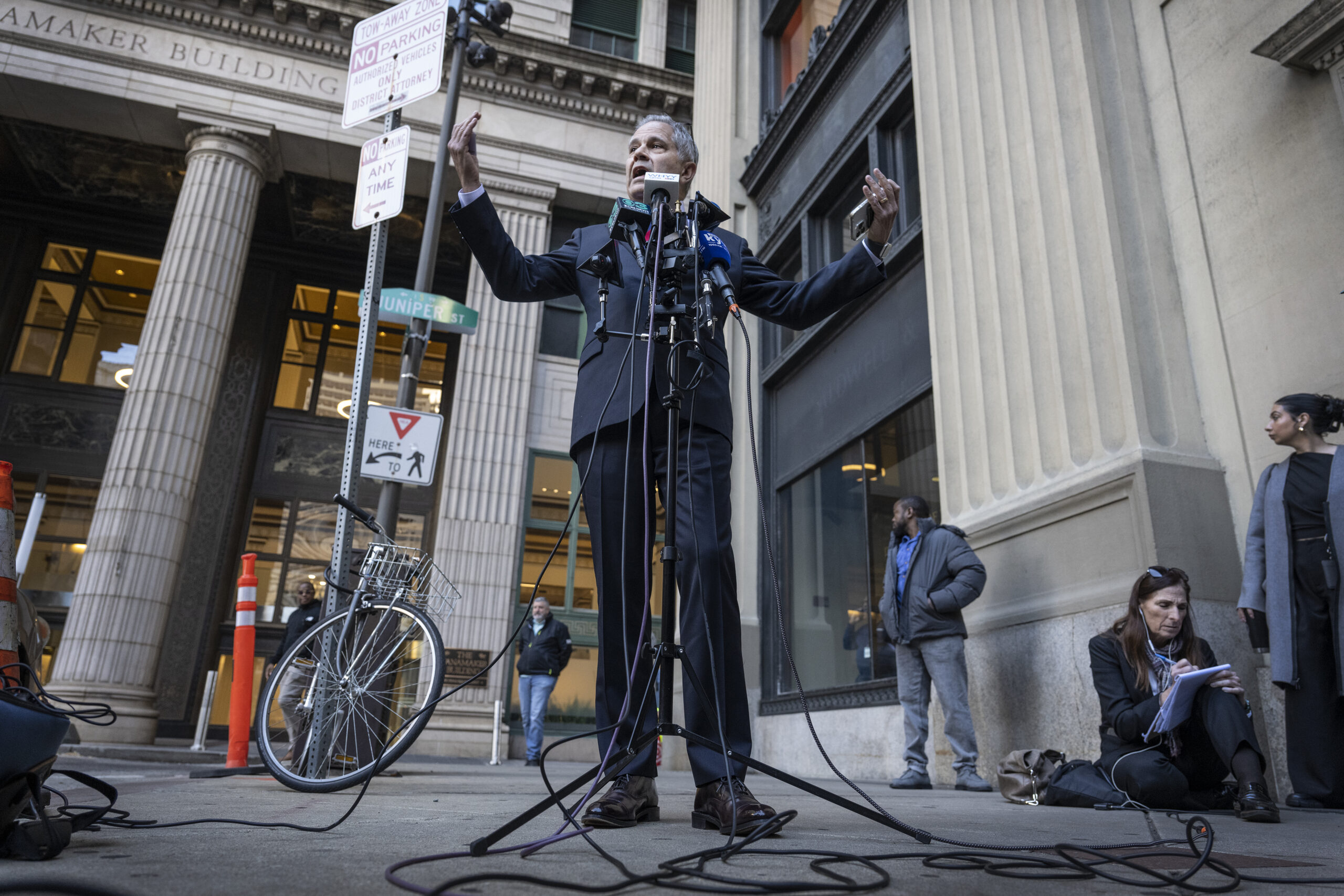
In this November file photo, District Attorney Larry Krasner speaks to reporters during a news conference outside the District Attorney’s Office after he won reelection.
But employees said they saw Krasner’s opposition as a slight.
“He is not pushing for us,“ one employee said, ”and in fact is making this process way longer than it should have been.”
The PLRB has yet to issue a final ruling, and it’s unclear when one may come.A spokesperson declined to comment. DC 33 also declined to comment.
If the PLRB’s ruling stands, paralegals and victim and witness coordinators would be represented by DC 33, and it’s not clear if they’d have the ability to pursue organizing with another union.
Simone, of the steelworkers’ group, said that USW is encouraging employees in the DA’s office to “stay the course,” even if they ultimately join a different union.
“It might not be as soon as they want it,” he said, “but they will be OK.”
An overwhelming majority of Philadelphians feel safe in their neighborhoods and more than 40% believe that the city has become cleaner under the leadership of Mayor Cherelle L. Parker, according to a new poll, suggesting that city residents see significant progress on the mayor’s key campaign promises.
However, there is not a broad citywide consensus on Parker’s tenure as she heads into an expected reelection campaign next year, and there were also red flags for her and the city, including alarmingly bad evaluations of the public school system.
That is according to a recent Suffolk University/Philadelphia Inquirer poll that surveyed 500 Philadelphians across the city on issues including crime, quality of life, city services, and education. More than half of those surveyed said they would rate Philly as a “good” or “excellent” place to live.
About 83% of residents reported feeling safe in the city just five years after record-high rates of gun violence in Philadelphia, with respondents in neighborhoods most affected by violent crime most likely to say they feel that crime has decreased since Parker took office in 2024.
And the city’s public school system emerged as a primary concern, with 45% saying they would rate Philadelphia’s schools as of “poor” quality, while more than half of the poll’s respondents said that schools play an important role in whether they stay in the city or move out.
The survey was conducted last week, after the financially struggling Philadelphia School District and its controversial school closure plan dominated local headlines for more than a month.
David Paleologos, director of the Suffolk University Political Research Center in Boston, said the poll provides Philadelphia policymakers with a blueprint for how to keep people in the city: continue progress on crime and improve the public schools.
“If that happens,” he said, “then Philadelphia is poised to be a renaissance city.”
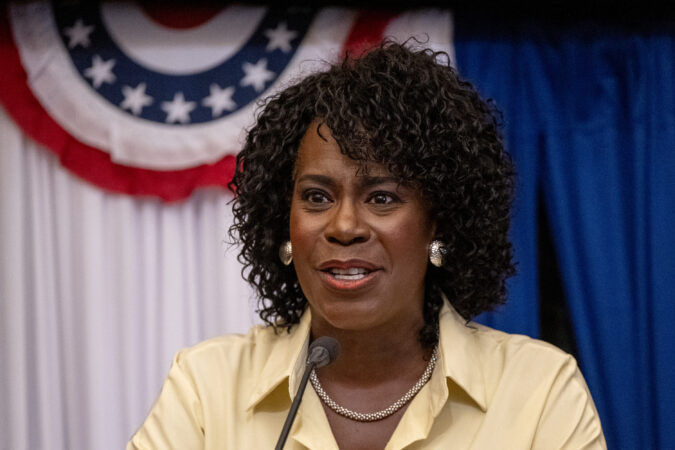
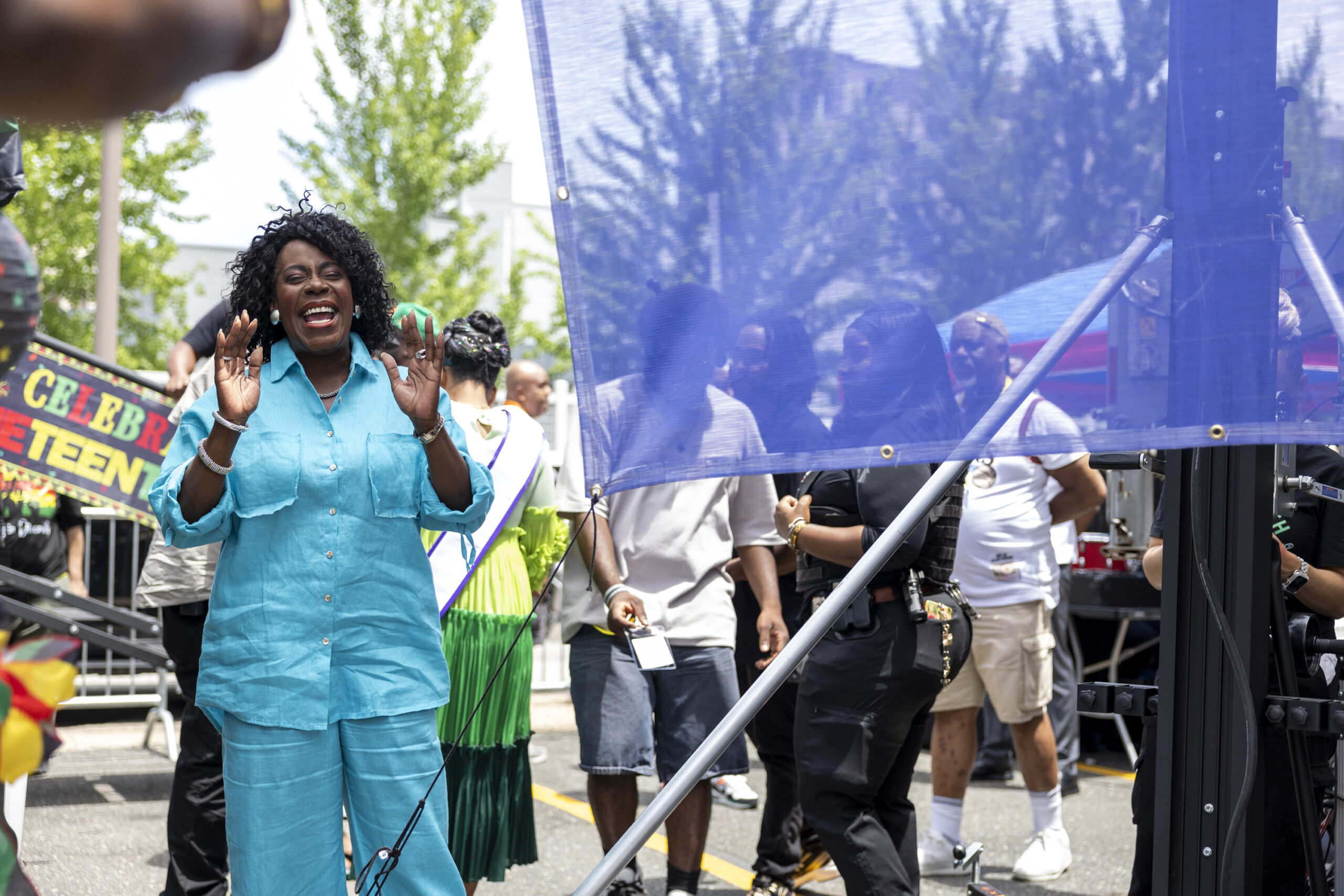
Mayor Cherelle L. Parker attending the Juneteenth Block Party at the African American Museum in Philadelphia on June 19.
Parker said in a statement that her administration “values both qualitative and quantitative information.”
“The real-life, lived experiences of people in this city are what matters most,” she said. “Polling is not my North Star in how I govern. My solutions always come from the ground up, from what people can see, touch, and feel.”
For Parker’s political fortunes, the poll represents mixed results. It showed that the substantial base of support that lifted the mayor to office in 2023 is holding up, with Black residents and older Philadelphians most likely to say they have a favorable view of her and see progress on her campaign promises.
But Parker has not consolidated broad citywide enthusiasm, with 44% of respondents saying that they have a favorable view of the mayor and 35% saying they have an unfavorable one. That is positive territory for Parker more than halfway through her first term, but not overwhelmingly so.
Her biggest vulnerability is with young people — respondents under age 45 were more likely to say that they had an unfavorable view of the mayor than a favorable one. White residents were also more sour on Parker.
(function(){function e(){window.addEventListener(`message`,function(e){if(e.data[`datawrapper-height`]!==void 0){var t=document.querySelectorAll(`iframe`);for(var n in e.data[`datawrapper-height`])for(var r=0,i;i=t[r];r++)if(i.contentWindow===e.source){var a=e.data[`datawrapper-height`][n]+`px`;i.style.height=a}}})}e()})();
Paleologos said that the poll shows there are “pockets of strength” that make Parker, a centrist Democrat, electorally strong, but that he would not consider her support broad-based.
Those results come as the city’s most prominent progressive political groups are weighing whether to mount a challenge against Parker next year. As the incumbent, Parker would be the hands-down favorite in any contest, as no Philadelphia mayor has lost a campaign for reelection in modern history.
Aren Platt, the executive director of People for Parker, the mayor’s political arm, said in a statement that Parker’s support “has always been under-counted, especially in public polling.” He cited polling conducted during the 2023 mayor’s race that showed her tied with or trailing her top opponents in the Democratic primary, in which Parker prevailed by a commanding 10 percentage points.
Platt also said the Suffolk University/Inquirer poll is not necessarily predictive of how the mayor could perform in a theoretical reelection race. The poll was of Philadelphia residents, not likely primary voters.
“This poll may reflect the demographics of Philadelphia, but elections are decided by the people who show up to vote on election day,” he said. “In Philadelphia, those are two very different universes.”
The poll also showed relatively positive marks for one of Parker’s potential successors: City Council President Kenyatta Johnson. He has said that he supports Parker for reelection, but Philadelphia mayors are limited to two terms and Johnson is widely seen as a potential future contender for the city’s top office.
Overall, 48% of respondents said they had a favorable view of Johnson and only 12% had an unfavorable one. Johnson is also far less publicly known than Parker, with 40% of those surveyed saying they had either never heard of him or were undecided on their view of him.
Negative reviews of the Philadelphia School District
About one in five respondents said that schools and education are the most important issue in the city, making it second only to crime. Paleologos said that is somewhat unique to Philadelphia — in other major cities where he has polled public opinion, he said, respondents often rank jobs and the economy as greater concerns.
(function(){function e(){window.addEventListener(`message`,function(e){if(e.data[`datawrapper-height`]!==void 0){var t=document.querySelectorAll(`iframe`);for(var n in e.data[`datawrapper-height`])for(var r=0,i;i=t[r];r++)if(i.contentWindow===e.source){var a=e.data[`datawrapper-height`][n]+`px`;i.style.height=a}}})}e()})();
Nearly 75% of respondents said they would rate the quality of Philadelphia’s public schools as “fair” or “poor.” Younger residents were far more likely than older ones to rate the schools as “poor,” and more than half of all respondents said the public schools are an important factor in determining whether they and their family stay in the city or move away.
“That’s a big number,” Paleologos said. “That research alone gives the policymakers a bird’s-eye view of what they need to do to keep people here in Philadelphia.”
The survey also shows that residents see issues across the school system. When asked what should be the highest priority in improving the schools, there was little consensus among respondents: About a third said teacher pay, while a quarter said school safety, and another quarter said building repairs.
Just 4.4% said the highest priority should be instituting year-round school, an initiative that Parker campaigned on and that the district is piloting.
Superintendent Tony B. Watlington Sr., School Board President Reginald L. Streater, and Mayor Cherelle L. Parker stand together during an announcement at the School District of Philadelphia Headquarters on June 10.
In a statement provided to The Inquirer after the initial publication of this story, Monique Braxton, a spokesperson for the School District of Philadelphia, said district leaders share “the public’s sense of urgency to significantly improve public schools in the City of Philadelphia.”
She said the district is making progress toward the superintendent’s goal of making the district the “fastest improving large urban district in the nation.”
Braxton added that the district’s own survey suggests most parents are satisfied. The district’s 2024-25 survey, Braxton said, found that 90.3% of more than 26,000 parents whose students attend district schools said they were pleased with the quality of education their child received.
The quality of Philadelphia’s public schools has been a perennial concern, and city leaders have long pointed to the chronic underfunding of the Philadelphia School District. In 2023, the state Commonwealth Court ruled that Pennsylvania had for years unconstitutionally deprived students in low-wealth districts of an adequate education, and state lawmakers are now funding schools under a new formula.
District leaders have undertaken significant efforts in recent years to improve academic performance. There have been some positive results, including improvement on test scores and a recent report that said Philadelphia School District students’ learning post-pandemic was tops in the nation among large urban districts.
The district also earlier this year adopted a sweeping, $3.3 billion effort to renovate and modernize 169 schools. That multiyear plan was hotly debated, as it included the closure of 17 schools.
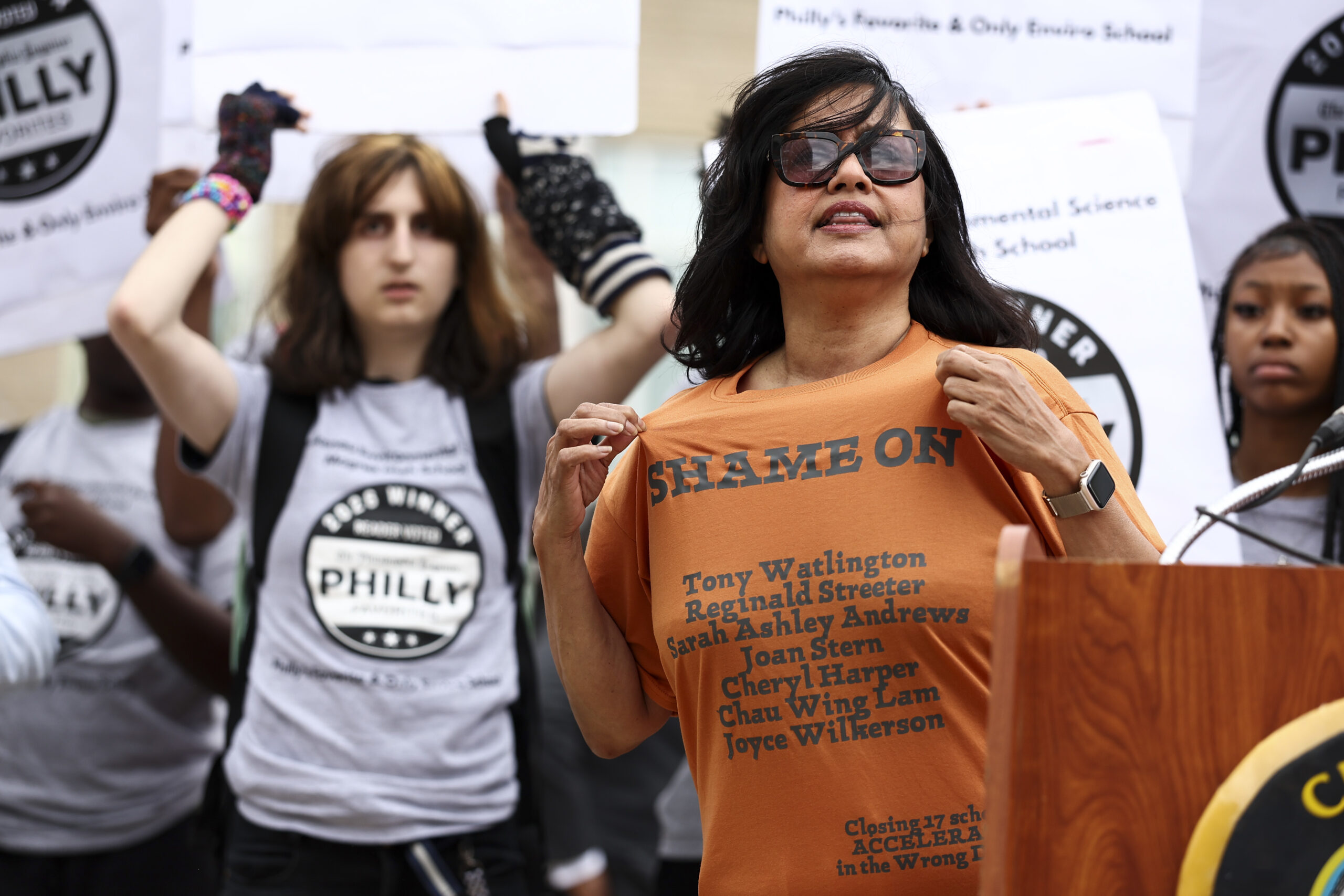
Councilmember Nina Ahmad shows off her T-shirt during a rally outside of the School District of the Philadelphia School District headquarters building on May 28. Council members rallied to oppose the school closure plan.
Parker said the Commonwealth Court “got it right” in declaring that low-wealth districts like Philadelphia’s are chronically underfunded.
“If we had all the resources we need, we’d see even more enhanced improvements in our schools,” Parker said. “I’ll never stop fighting for our children and their right to a high-quality education.”
Crime is the top concern, but most residents feel safe
Despite rates of violent crime in the city plummeting to record lows under Parker, public safety remains the top concern for three in 10 Philadelphia residents, suggesting that people who live in the city are still anxious about crime.
When asked about whether they believe crime in their neighborhood has increased or decreased over the last two years, a third of respondents said they believe it has increased, about 32% said it has decreased, and 28% said they believe it has stayed the same.
(function(){function e(){window.addEventListener(`message`,function(e){if(e.data[`datawrapper-height`]!==void 0){var t=document.querySelectorAll(`iframe`);for(var n in e.data[`datawrapper-height`])for(var r=0,i;i=t[r];r++)if(i.contentWindow===e.source){var a=e.data[`datawrapper-height`][n]+`px`;i.style.height=a}}})}e()})();
(function(){function e(){window.addEventListener(`message`,function(e){if(e.data[`datawrapper-height`]!==void 0){var t=document.querySelectorAll(`iframe`);for(var n in e.data[`datawrapper-height`])for(var r=0,i;i=t[r];r++)if(i.contentWindow===e.source){var a=e.data[`datawrapper-height`][n]+`px`;i.style.height=a}}})}e()})();
A closer look at the results shows that a plurality of respondents in the neighborhoods most affected by violent crime, including North and West Philadelphia, believe that crime has decreased.
The respondents most likely to say that they believe crime in their area has increased live in Northeast Philly. But public data maintained by the Philadelphia District Attorney’s Office show overall crime has decreased there, too. There are five Northeast Philadelphia police districts, and the total number of crime incidents reported to police declined in all of them between 2023, the year before Parker took office, and last year.
Despite the mixed poll results, a vast majority of Philadelphians — nearly 83% — said that they feel safe in their own neighborhood.
That is good news for Parker, who ran for office as a tough-on-crime Democrat amid a historic wave of gun violence and who vowed often to “bring order back to our city.”
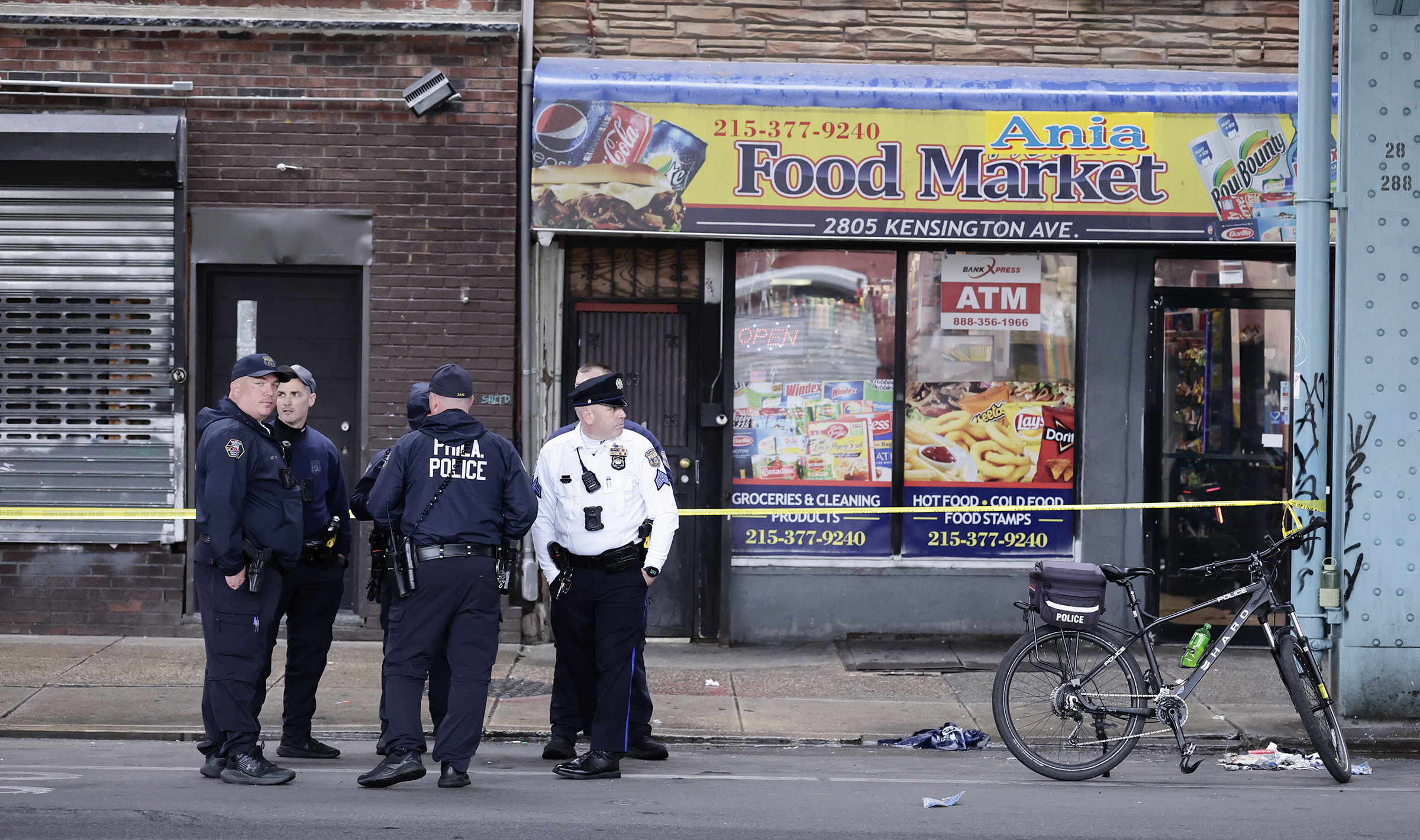
Philadelphia police officers stand along the 2800 block of Kensington Ave. after a police involved shooting on May 23. Police shot a robbery suspect.
Parker said in a statement that the polling results are evidence that her public safety strategy is working, calling it her “number one priority.”
She also vowed to continue her administration’s efforts in Kensington, the epicenter of the city’s opioid crisis. The Parker administration has deployed a multipronged approach, including increased police patrols in the neighborhood and an expansion of offerings for people in addiction.
But 53% of poll respondents said they do not believe the mayor’s efforts there are working, and those who live closest to the problem were the least supportive. In the region that encompasses the Lower Northeast and the river wards, where Kensington is located, 68% of people said Parker’s strategy is not working while only 18% said it is.
The mayor’s overall favorability was also lowest in that area of the city, the only region where more respondents said they had an unfavorable view of the mayor than a favorable one.
(function(){function e(){window.addEventListener(`message`,function(e){if(e.data[`datawrapper-height`]!==void 0){var t=document.querySelectorAll(`iframe`);for(var n in e.data[`datawrapper-height`])for(var r=0,i;i=t[r];r++)if(i.contentWindow===e.source){var a=e.data[`datawrapper-height`][n]+`px`;i.style.height=a}}})}e()})();
Parker acknowledged that there is “much more work to do” in Kensington and said that “changing culture and going to war with the status quo is never easy.“
Parker’s ‘clean and green’ message is landing
For a city derisively called “Filthadelphia” and where cleanliness has been a longtime concern, a significant number of people seem to think Philadelphia is getting cleaner.
When asked about trash and litter, 41% of poll respondents said they believe the city has gotten cleaner over the last two years. Just 19% said Philadelphia has gotten dirtier, and 38% said it has stayed the same.
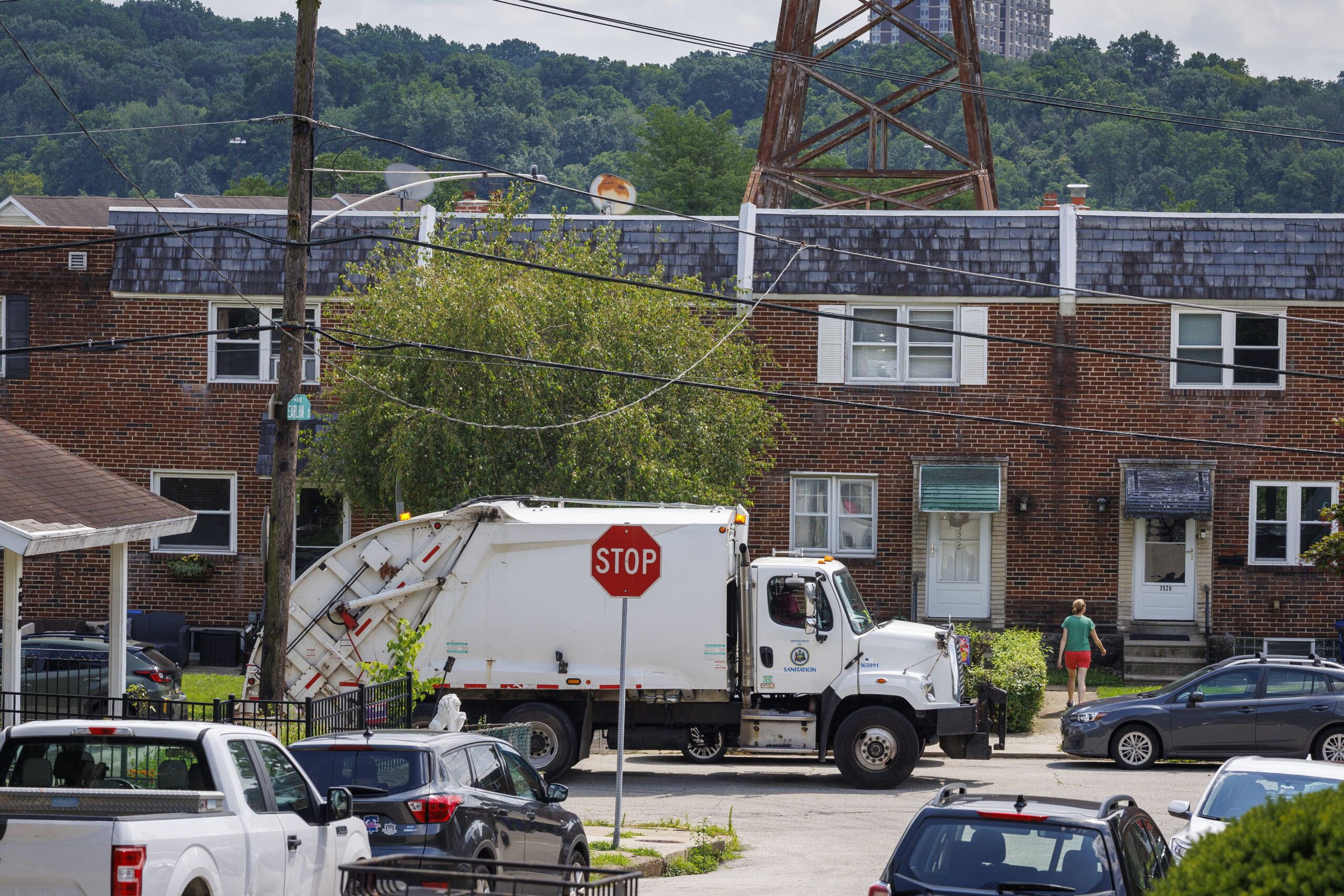
A sanitation department truck is seen along Cresson Street at West Earlham Street in Philadelphia on the first day of trash collection after a strike on July 14, 2025.
Those are positive marks for a mayor whose slogan is “safer, cleaner, greener” and who has instituted new programs including twice-weekly trash pickup in the densest parts of the city.
Despite those efforts, Philadelphians gave worse reviews to the overall quality of city services in their neighborhood. About six in 10 respondents said the quality was either “fair” or “poor,” while 40% said “good” or “excellent.”
Staff writer Michelle Baruchman contributed to this article.
A significant majority of residents want Philadelphia to remain a sanctuary for immigrants, according to a new poll that shows the overwhelmingly Democratic city is undeterred by President Donald Trump’s threats to defund so-called sanctuary cities.
A recent Suffolk University/Philadelphia Inquirer poll that surveyed 500 city residents asked respondents if Philadelphia should remain a sanctuary city, “even if it means losing federal funding.” A commanding 59% answered “yes,” with only 28% saying “no” and the remainder undecided or unwilling to say.
The support for Philadelphia’s sanctuary status was consistent across age and racial groups. The only geographic region where a plurality of respondents answered “no” was far Northeast Philadelphia, which is among the most politically conservative areas of the city.
The survey question did not elaborate on what a loss of federal funding could mean for the city in terms of the impact on residents. Philadelphia received $2.2 billion from the federal government in fiscal year 2024 to pay for a wide range of critical services, including infrastructure needs, as well as healthcare, food, and housing assistance for low-income people.
(function(){function e(){window.addEventListener(`message`,function(e){if(e.data[`datawrapper-height`]!==void 0){var t=document.querySelectorAll(`iframe`);for(var n in e.data[`datawrapper-height`])for(var r=0,i;i=t[r];r++)if(i.contentWindow===e.source){var a=e.data[`datawrapper-height`][n]+`px`;i.style.height=a}}})}e()})();
Still, the results of the poll show relatively widespread support in Philadelphia for the city’s sanctuary policies, which include its practice of not complying with detainers issued by U.S. Immigration and Customs Enforcement without a court order. Those detainers are effectively requests submitted by federal agents to local law enforcement agencies that ask to hold undocumented immigrants in custody.
Mayor Cherelle L. Parker’s administration does not refer to Philadelphia as a “sanctuary city” — she and her top aides instead call it a “welcoming city,” language that has been increasingly adopted nationwide as Trump and his allies in the Republican Party have sought to crack down on sanctuary cities.
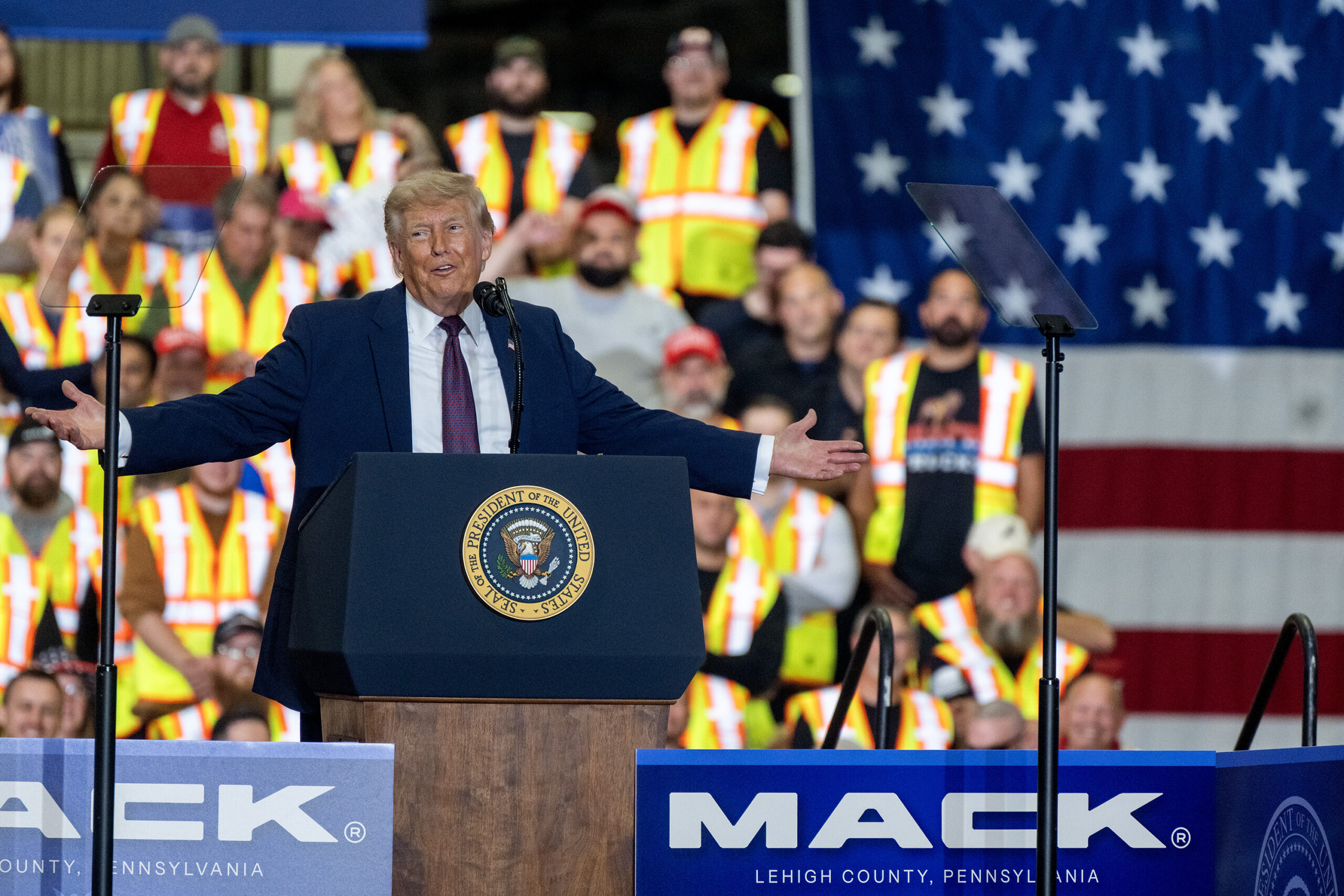
President Donald Trump travels to the Lehigh Valley to visit Mack Trucks in Macungie on Tuesday, June 23, 2026.
The sanctuary policies predate Parker’s tenure and were in place under an executive order signed by former Mayor Jim Kenney. They were codified into law earlier this year after City Council passed a package of legislation aimed at limiting ICE’s operations in the city and instituting some of the nation’s toughest restrictions on ICE.
In May, Parker signed six of the seven bills in the package, but took no action on one that bars law enforcement officers from concealing their identities, including by wearing masks. City Solicitor Renee Garcia wrote in a letter to Parker that the legislation may not be legally enforceable, but the mayor did not veto the bill, allowing it to become law.
Last week, the Trump administration sued Philadelphia and some of its top officials, including Parker, over the mask-ban ordinance. The Trump administration contended that the law is “blatantly unconstitutional” and undermines federal law enforcement’s ability to do its job.
The lawsuit is one of several filed across the nation by the Trump administration challenging local laws related to immigration as federal authorities carry out the massive deportation campaign promised by the president.
That effort is also tied up in litigation. Last year, a federal judge issued an injunction blocking the Trump administration from denying funding to jurisdictions that limit cooperation with ICE, saying the White House could not impose funding conditions without authorization from Congress.
Staff writer Sean Collins Walsh contributed to this article.
Mayor Cherelle L. Parker and other top leaders of the city government and the Philadelphia School District will travel to Harrisburg on Monday for a high-stakes trip aimed at securing millions of dollars in new funding for the financially strapped public schools.
Parker will spend much of the day advocating for increased public education dollars as state lawmakers hurtle toward their June 30 budget deadline. The mayor is slated to host an afternoon rally in the Capitol Rotunda alongside Superintendent Tony B. Watlington Sr., school board president Reginald L. Streater, and City Council President Kenyatta Johnson.
Their trip to the Capitol comes after weeks of tension among those same leaders, who earlier this month hammered out a city budget deal that was in large part centered on finding new funding for the school district, which is facing a $300 million structural deficit and had planned to cut more than 300 school-based staff positions.
Parker and school officials wanted the city to levy a $1-per-ride tax on rideshare services like Uber and Lyft to secure about $50 million a year in recurring funding, but Council rejected that plan, and instead voted on a one-time diversion of money to the district that came out of the existing city budget.
Parker, who served in the state legislature for a decade before becoming a City Council member and then taking office as mayor in 2024, said when she announced the new funding plan that city leaders would be able to travel to Harrisburg “saying we’ve made tough decisions, we’ve made sure we’ve done our best to take care of our own, and we have a plan.
“Philadelphia is primed to travel to Harrisburg to advocate in unity to ensure that our children get access to the revenue that they deserve,” she said, “so that they can have a first-class school district here in the city.”
Superintendent Tony B. Watlington Sr., school board president Reginald L. Streater, and Mayor Cherelle L. Parker stand together during an announcement at the School District of Philadelphia Headquarters on June 10 in Philadelphia. Philadelphia School District officials will move to restore 340 classroom-based jobs that were slated to be cut, despite top district leaders saying earlier that they did not have the recurring funding needed to keep the positions.
The mayor’s message to lawmakers will be largely focused on securing capital dollars for the district’s $3 billion plan to modernize 169 aging school buildings over the next decade. In April, the school board adopted its controversial facilities plan — which includes an intention to close 17 schools — with the goal of bringing in $2 billion of that money from state and philanthropic sources.
Finding that money in Harrisburg could be a tall task as the state faces its own multibillion-dollar budget shortfall. All 203 state representatives and half of the 50-member Senate are up for reelection this year, and many lawmakers gearing up to face voters in November are averse to broad-based tax increases aimed at juicing revenue.
In addition, gridlock is commonplace in the divided legislature, where reaching a state budget deal has been a drawn-out and arduous process in recent years. Last year’s bitter negotiations stalled for more than five months, leading to mass service disruptions statewide.
Gov. Josh Shapiro, a Democrat who is in the midst of his own reelection battle and is seen as a potential contender for president, has also said that he is generally not looking to raise taxes. Leaders in Harrisburg last month rejected a separate proposal by Parker to raise the city’s hotel tax to generate new funding for homelessness prevention programs.
However, Shapiro has positioned himself as a champion of public education, and he proposed increasing the Philadelphia School District’s general funding allocation to about $2.2 billion in the coming fiscal year, a $151 million increase over this year’s amount.
Statewide, Shapiro called for an additional $565 million for public schools as part of the state’s new “adequacy funding” formula, a multiyear plan developed to address the chronic underfunding of low-wealth school districts.
The formula was adopted in 2024 after a Commonwealth Court ruling that the state had for years unconstitutionally deprived some children of an adequate education by sustaining a funding plan largely reliant on local property tax dollars. Philadelphia is the only school district in the state that can’t itself raise taxes. Instead, it depends on the city and state governments for funding.
Parker said earlier this month that despite her own tax proposal to fund the schools falling through, she intends to “take this fight on the road.”
“We stand in unity with our legislative leaders in Harrisburg, our legislative leaders on both sides of the aisle, [and] we stand with our governor,” she said. “And we fight until the end to ensure that we do everything we possibly can to ensure that our school district has access to the resources that it needs.”
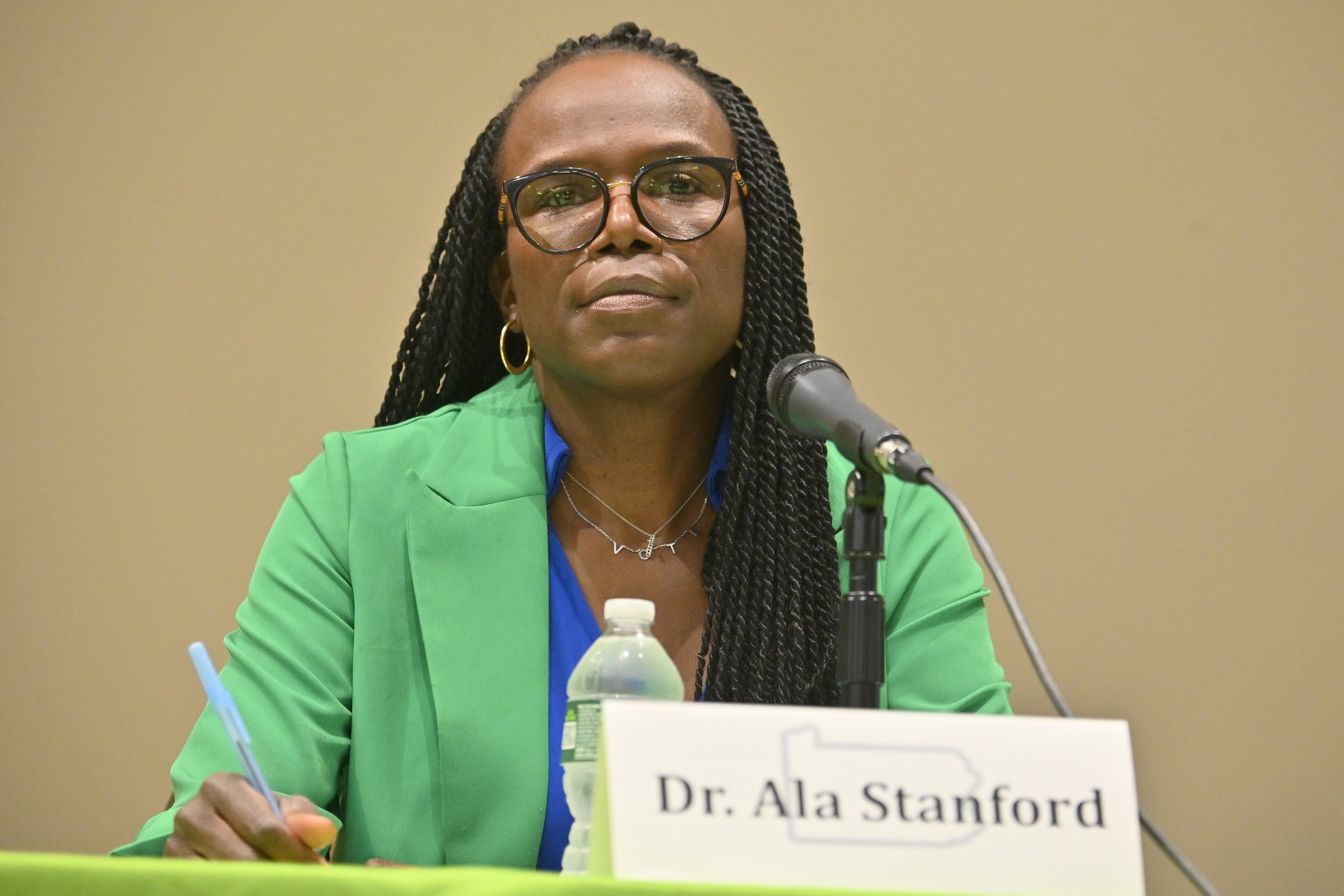
Congressional hopeful Ala Stanford on Wednesday morning announced she was dropping out of a WHYY candidates debate two hours before it was scheduled to begin, saying her campaign could not agree with the public radio station on a format for the debate and criticizing her opponents in the race for “misogynistic attacks.”
“I have never been afraid of a hard room,” Stanford said in a statement. “After engaging in good faith with WHYY, we could not reach terms on a format that would deliver the serious accountability voters in PA-03 deserve.”
Stanford’s campaign manager emailed the announcement to reporters around 10 a.m., two hours before the debate on WHYY’s Studio 2 was supposed to take place.
In her statement, Stanford did not clarify what problems she had with the debate format. She also did not provide details on any attacks from her opponents in the Democratic primary for Pennsylvania’s 3rd Congressional District.
A Stanford spokesperson declined to comment beyond her written statement.
Stanford’s surprise announcement came less than three weeks before the May 19 primary, and followed a series of missteps for her campaign, including the revelation that a staffer used artificial intelligence to help answer a candidates’ questionnaire and her stumbling through a question about immigration enforcement in an interview with NBC10.
A recent Inquirer report on her stewardship of the Black Doctors Consortium also found that the organization omitted details about her income that were required to be included on nonprofit tax forms filed with the Internal Revenue Service.
Ala Stanford, pediatric surgeon and founder of the Black Doctors Consortium, participates in the debate for Pennsylvania’s 3rd Congressional District at Center in the Park in Germantown on Tuesday, April 14, 2026.
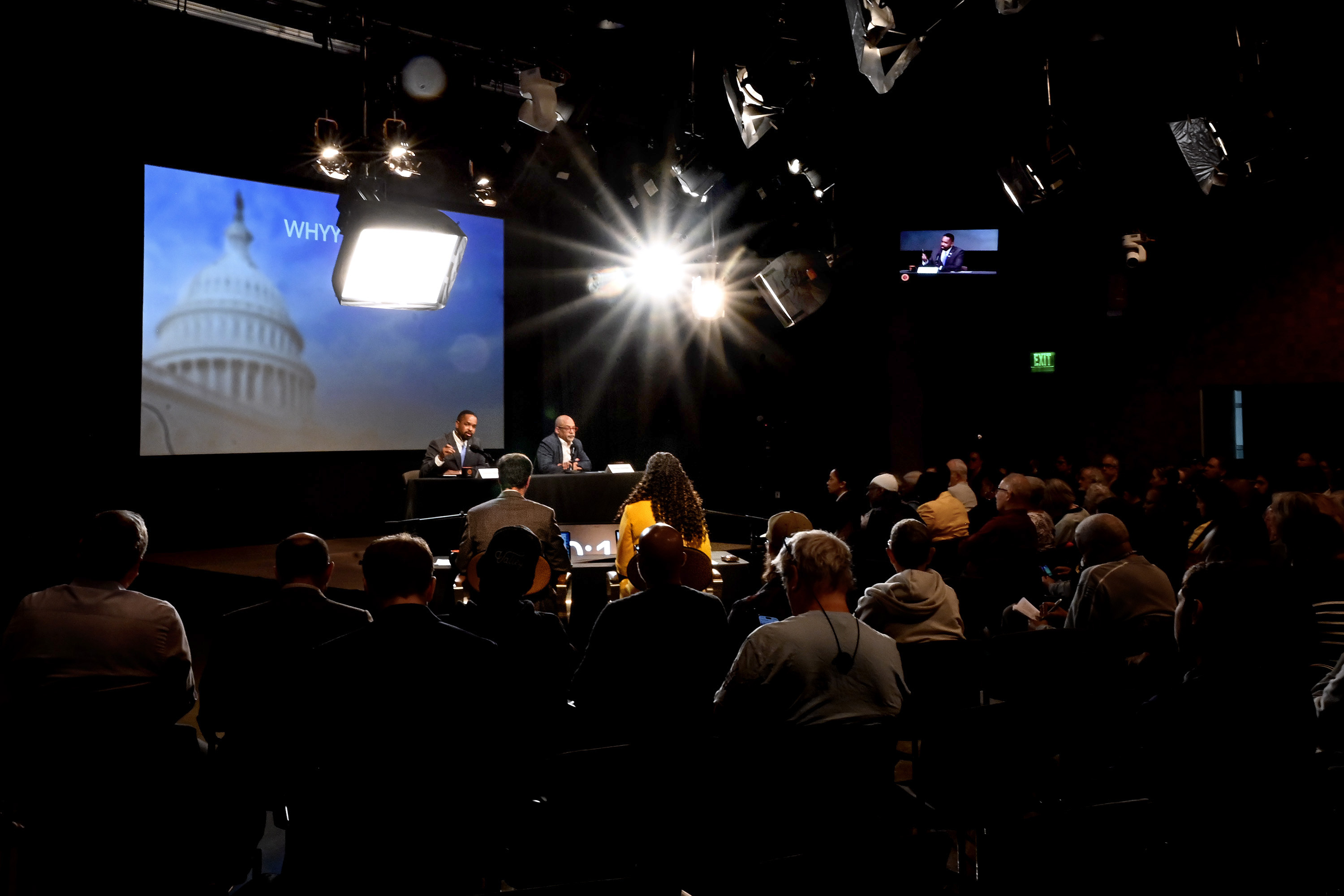
Stanford’s exit from the Wednesday event meant the other two top contenders in the race, State Rep. Chris Rabb and State Sen. Sharif Street, were the only candidates to participate in the debate featured on WHYY’s Studio 2, the highest-profile live and on-air debate thus far.
It was a relatively subdued affair compared to some of the other more gloves-off style campaign events in the open race. Street and Rabb took questions from moderators and largely agreed on policy, with both saying they support expanding universal healthcare, abolishing U.S. Immigration and Customs Enforcement, and impeaching President Donald Trump.
The two state lawmakers sought to contrast their styles, with Street portraying himself as a more competent legislator.
“I get things done,” said Street, the former head of the state Democratic Party. “Rep. Rabb and I share a lot of value propositions. But the difference is I deliver on ideas.”
Rabb, a progressive who has been endorsed by the Working Families Party, said Street is too closely aligned with the Democratic establishment, and that his ideas are not bold enough.
“There’s so many people who think we can’t do things big and bold,” he said. “They play around the edges, because that’s what establishment politics does.”
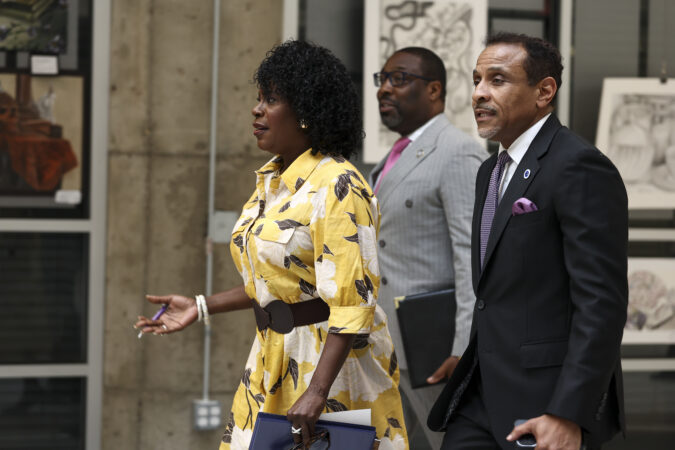
State Sen. Sharif Street (left) and State Rep. Christopher Rabb (right) wait for the WHYY studio door to close Wednesday, April 29, 2026 before start of their debate in the Democratic primary for the 3rd Congressional District. The third leading candidate, Ala Stanford declined to attend at the last moment.
Both candidates were also asked about Stanford’s absence and her charge Wednesday that the race has been “marred by misogynistic attacks and lies from both of my opponents.”
Stanford, a first-time political candidate, is the only woman on the ballot.
Rabb said he wasn’t sure what she was referring to, but pointed out that when Stanford was recently heckled by some of his own supporters during a candidates forum, he repeatedly told them to let her speak.
And Street said he has not attacked her directly, but acknowledged that she’s faced criticisms.
“She has been attacked. I’ve been attacked. Everybody on this campaign, I’m sure, has been attacked at some point,” he said.
Rabb and Street said their campaigns did not negotiate with WHYY on the format of the event.
Kevin McCorry, an executive producer and host at the station, said WHYY engaged with Stanford’s campaign “in good faith” and acquiesced to her staff members’ requests, including allowing her to have notes on the table and bring extra staffers to sit in the audience.
He said WHYY learned that she was pulling out when Stanford’s campaign manager released a statement to reporters from multiple news outlets.
“We were flexible with her requests,” McCorry said. “At no time did they say, ‘If X doesn’t change, we’re backing out.’”
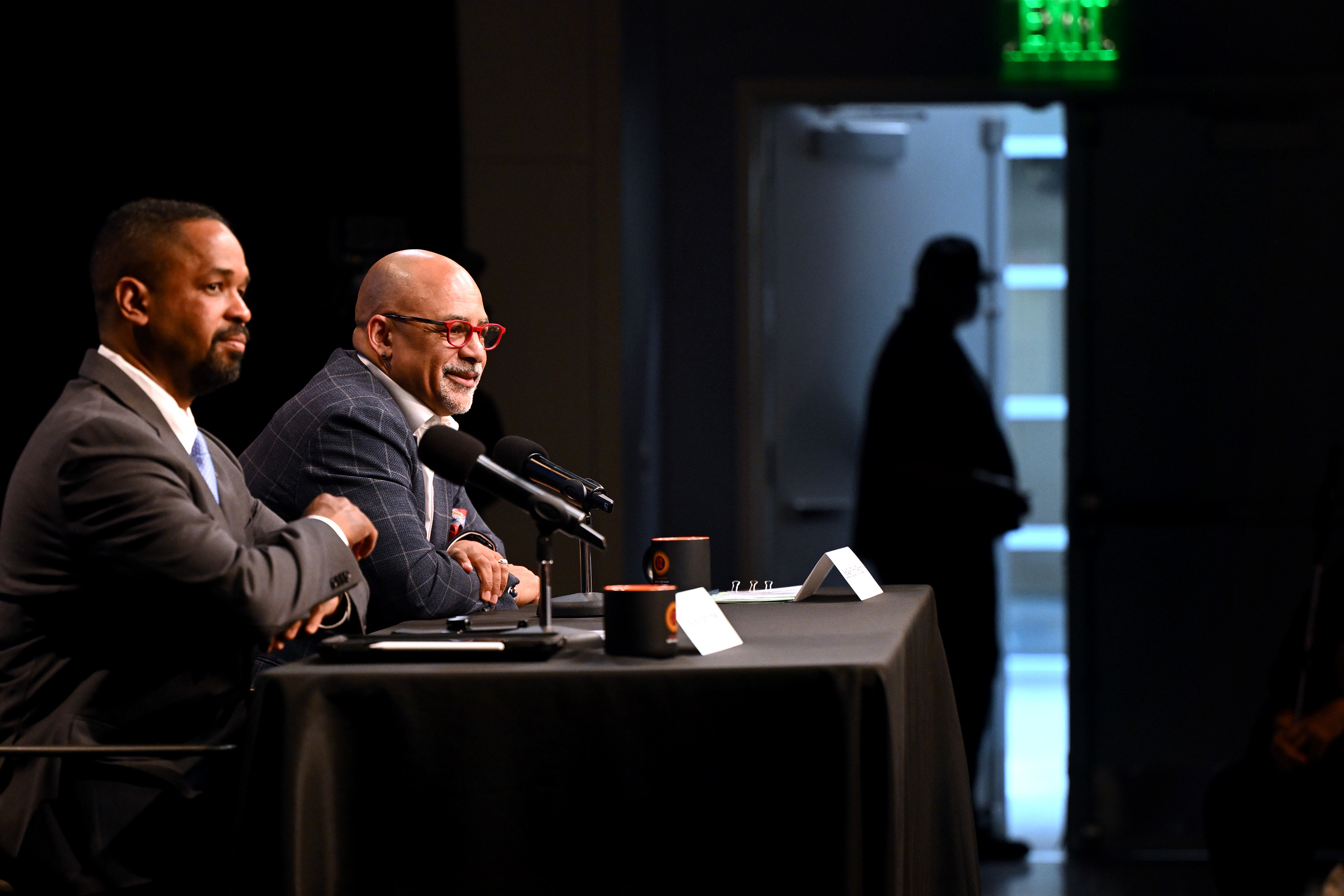
State Sen. Sharif Street (left) and State Rep. Christopher Rabb (right) appear in a debate at WHYY studios Wednesday, April 29, 2026 for the Democratic primary in the 3rd Congressional District. The third leading candidate, Ala Stanford declined to attend at the last moment.
Street spokesperson Anthony Campisi accused Stanford of dropping out to avoid tough questions,adding that “her campaign is in free fall.”
“Rather than answer these questions in a debate that’s aired on radio and television, she appears to be taking her ball and going home, which is not what Philadelphians expect from their member of Congress,” Campisi said Wednesday. “Philadelphians deserve a member of Congress who is ready to fight for them and against Donald Trump, not someone who runs from a fight.”
Rabb said that when it comes to campaign events, he and his team “don’t negotiate, we just show up.”
“Even if I didn’t like the format, which is not uncommon, I still show up,” he said, “because I’m a public servant and I’m a public candidate, and I got to reach people wherever they are.”
In her statement, Stanford, a physician, noted she has taken the Hippocratic Oath “to first do no harm.”
“I challenge everyone in this race to join me in promoting the kind of spirited, but serious and meaningful dialogue Philadelphians should expect from those asking to serve,” she said. “In the meantime, I will be where I have always been — on doorsteps, in church basements, and on the corners of the wards that built me.”
Shaun Griffith, a tax adviser and the fourth candidate in the race, did not participate in the debate because he did not meet WHYY’s criteria, which included a fundraising threshold.
He attended the event and sat in the audience, and said afterwards that it was “frustrating to be watching other people get to answer questions and not have the opportunity to do so myself.”
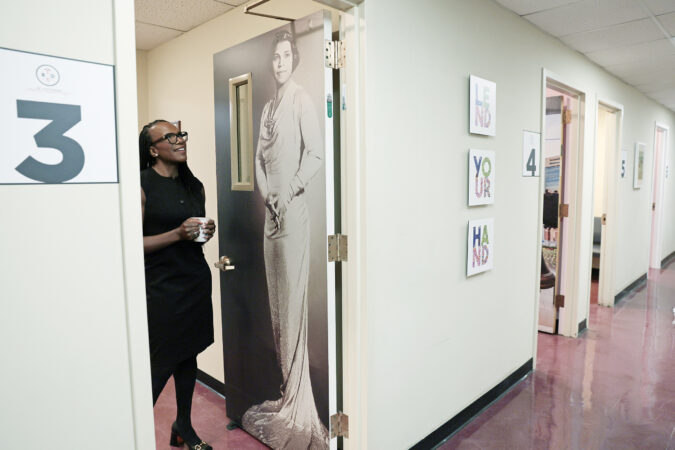
At times, Ala Stanford feels like she doesn’t quite fit in.
She’s a pediatric surgeon — albeit very well-known — who is running for political office for the first time, trying to win a seat in Congress that for decades has been held by a seasoned Philadelphia politician.
At campaign events, when the top Democrats in the congressional race are chit-chatting among themselves, Stanford has found herself on the margins. Often, she feels more comfortable talking medical procedures with Dave Oxman, the other physician in the race, than whatever the sitting state representatives have going on in Harrisburg.
The trail may get lonelier. Oxman is planning to drop out Wednesday and endorse Stanford, making her the hands-down most prominent outsider in a race that is stacked with political veterans.
To amass support ahead of the crowded May 19 primary election — the likely deciding contest in one of the nation’s bluest congressional districts — Stanford will have to chart a path that beats both the Democratic establishment and the progressive left, which have chosen other candidates in the wide-open race.
Stanford, 55, knows her lack of political experience makes her stand out, and she’s accentuating it on the campaign trail. She is highlighting her career as a physician, and she says she’ll fix a healthcare system her opponents failed to address in their years as public officials. Her candidacy comes as an increasing number of medical professionals are running for office across the country, and as thousands of Pennsylvanians have dropped their healthcare coverage due to rising costs.
She has kept pace with three sitting lawmakers who are also running for the seat, in part by lending her campaign $250,000 of her own money.
Candidates (from left) State Rep. Morgan Cephas; physician David Oxman; State Rep. Chris Rabb; physician Ala Stanford and State Sen. Sharif Street appear at a forum hosted by the 9th Ward Democratic Committee in Mt. Airy Thursday, Dec. 4, 2025.
Stanford alsohas a cadre of healthcare workers uplifting her. She has won endorsements from prominent doctors, as well as a national super PAC, 314 Action, which backs candidates with backgrounds in science and has poured $1.5 million into a pro-Stanford campaign.
The group so far funded five weeks of television commercials reminding voters that Stanford founded the Black Doctors COVID-19 Consortium. In the throes of the pandemic, she set up mobile testing sites in majority-Black communities and ran vaccination clinics to inoculate thousands of Philadelphians, a grassroots effort to fill gaps left by government-funded programs.
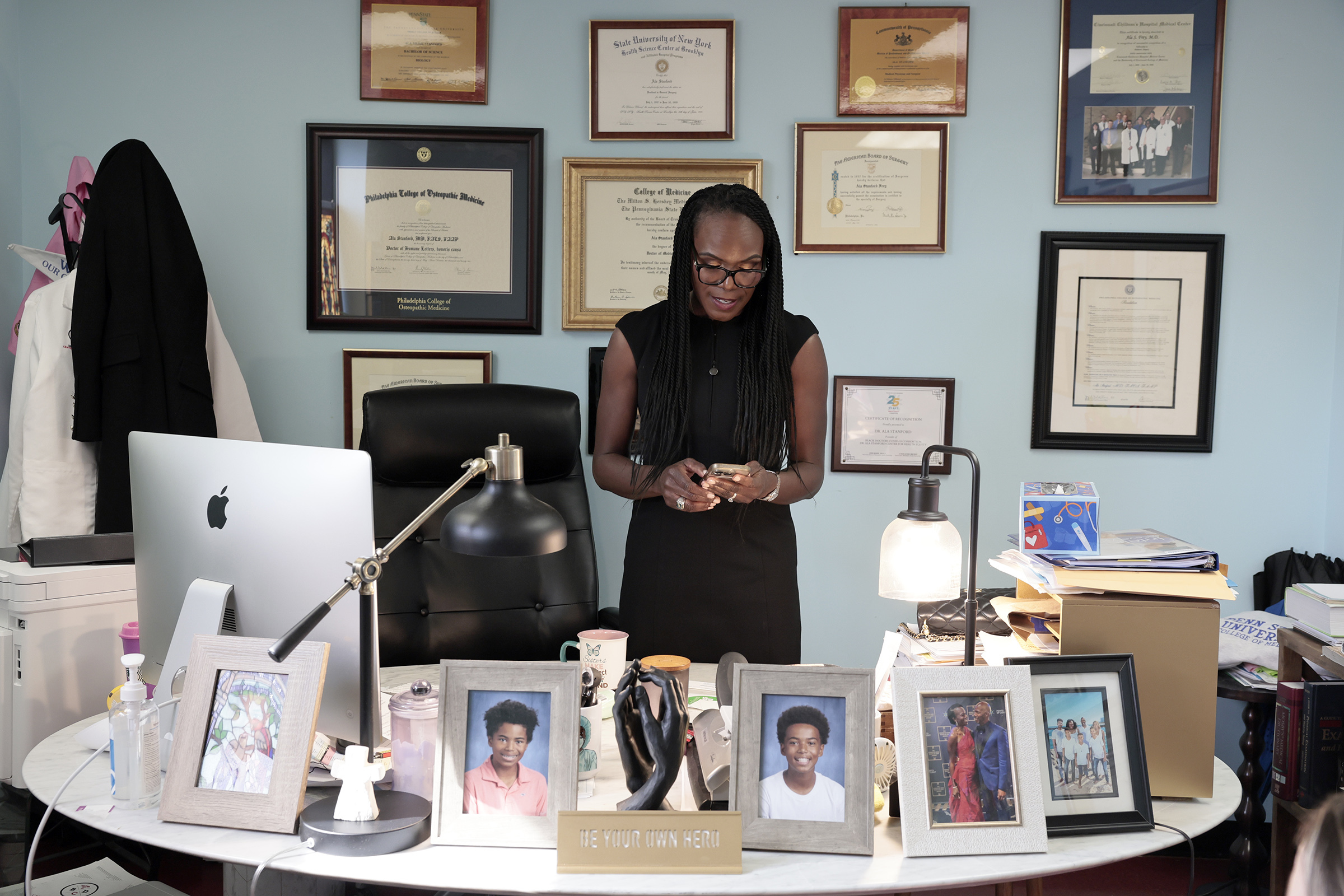
Ala Stanford texts her son while in her office at the Dr. Ala Stanford Center for Health Equity, 2001 W Lehigh Ave. in Philadelphia on Friday, March 13, 2026
It is a compelling story that has been told many times — across national media, on podcasts, and in Stanford’s own memoir.
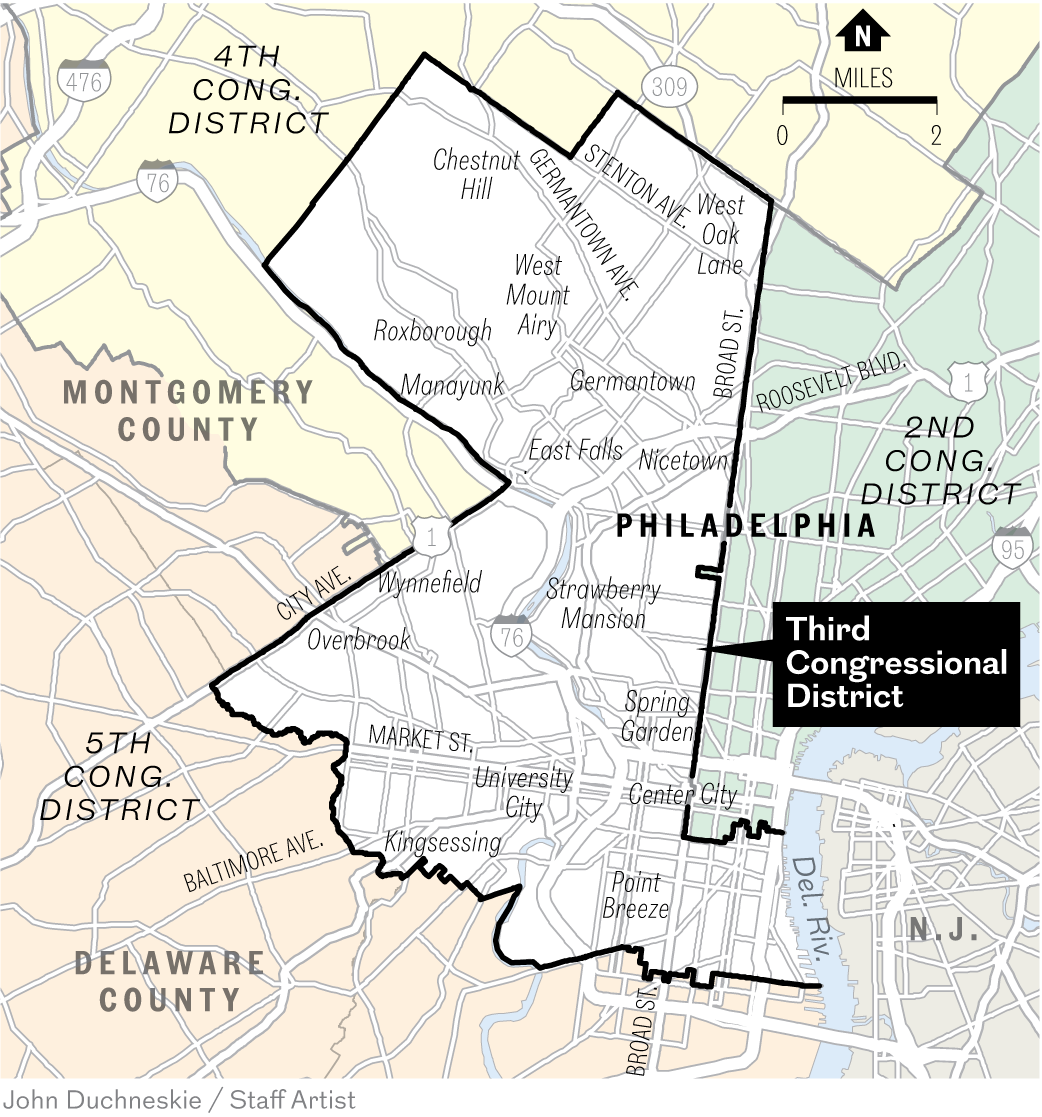
What hasn’t been told is why it means she should represent the 3rd Congressional District, which covers much of Philadelphia, over her opponents who have spent years in politics.
“People get so comfortable doing things the same way, the same way, the same way,” she said in a recent interview at her health clinic. “And no one likes change. But the city needs this. The city needs some change.”
Other candidates say Stanford doesn’t have a monopoly on talking about healthcare. State Sen. Sharif Street, another front-runner in the race, has touted that he and other government officials helped secure funding for Stanford’s pandemic operation.
“During COVID, he was very proud of his work,” Street spokesperson Anthony Campisi said, “to ensure that Doctor Stanford’s vaccination efforts received the support they needed so that we could get vaccines into arms quickly.”
Stanford’s opponents also clearly know that her status as a physician may be an asset.
She submitted paperwork to appear on the ballot as “Dr. Ala Stanford.” But on Tuesday, a member of the Democratic City Committee — which endorsed Street — filed a petition in state court, saying Stanford’s name should appear without the “Dr.” in front of it.
In the coming days, a judge will decide.
Leaning on healthcare as a core issue
Stanford does not fit neatly onto the ideological spectrum.
Of course, she is not conservative. She doesn’t call President Donald Trump by his name — he’s “47″ — and she uses words like “tyranny” and “running amok” to describe the current White House.
But unlike some of her opponents, she is not of the Philadelphia Democratic establishment. She said she feels like the city’s long-entrenched party apparatus had always planned to endorse Street, the former head of the state party and the son of a Philadelphia mayor.
Stanford is also not of the populist left. She believes Palestinians “deserve to have safety and freedom,” but thinks it’s inflammatory when her progressive opponent, State Rep. Chris Rabb, calls Israel’s war in Gaza a “genocide.”
“I know when you use the G-word how hurtful it is to a group of people,” she said. “It’s like someone saying the N-word around me. I don’t want to hear that. And every time you shout that from the rooftops, how many people are you hurting?”
What she does believe is that government systems have failed underserved communities, and that most domestic issues can be traced back to inequities in healthcare — points she has consistently emphasized in her campaign.
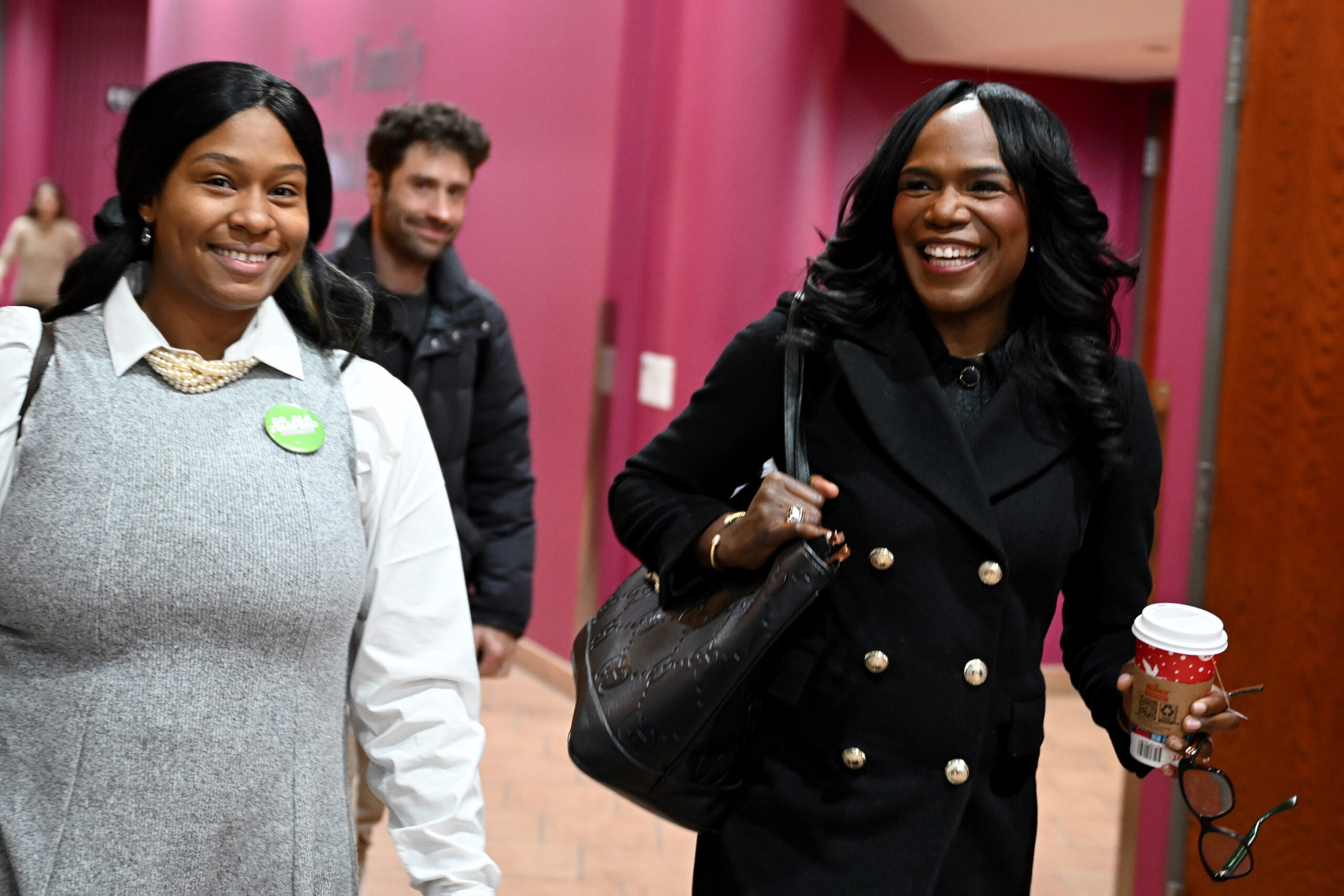
Physician Ala Stanford (right) arrives at a forum hosted by the 9th Ward Democratic Committee Dec. 4, 2025. She is a Democratic candidate running to represent Philadelphia’s 3rd Congressional District.
She has hammered Republicans for not extending pandemic-era subsidies that ensured people on Affordable Care Act health plans did not pay more than 8.5% of their income for care. She has advocated for universal healthcare. And she has harshly criticized Health and Human Services Secretary Robert F. Kennedy Jr., who has long been skeptical of vaccines.
“In this country, wealth is linked to homeownership, home ownership is linked to education, education is linked to health outcomes, and health outcomes are all exacerbated by racial injustice,” Stanford said during a recent candidates forum. “So when you talk about one, you talk about all.”
Stanford is careful to say that her focus on healthcare doesn’t mean she can’t discuss housing, immigration, or the war in Iran.
But it is clear that she feels most comfortable talking about what she knows best. Her supporters say that’s an asset in the 3rd Congressional District, which has a disproportionately high number of people who rely on public healthcare systems.
More than a third of the district’s residents, or more than 284,000 people, were on Medicaid as of December, according to the state Department of Human Services. Among Pennsylvania congressional districts, that’s the second-highest proportion of residents on Medicaid. (The first highest is the 2nd Congressional District, which also includes parts of Philadelphia.)
There were also more than 80,000 people in the district who last yearhad health coverage under the Affordable Care Act, either through expanded Medicaid eligibility or a plan they purchased through the marketplace.
That number is also likely lower now since ACA subsidies expired this year and premiums rose. Statewide, one in five people who bought plans last year from Pennsylvania’s marketplace, Pennie, opted out for 2026.
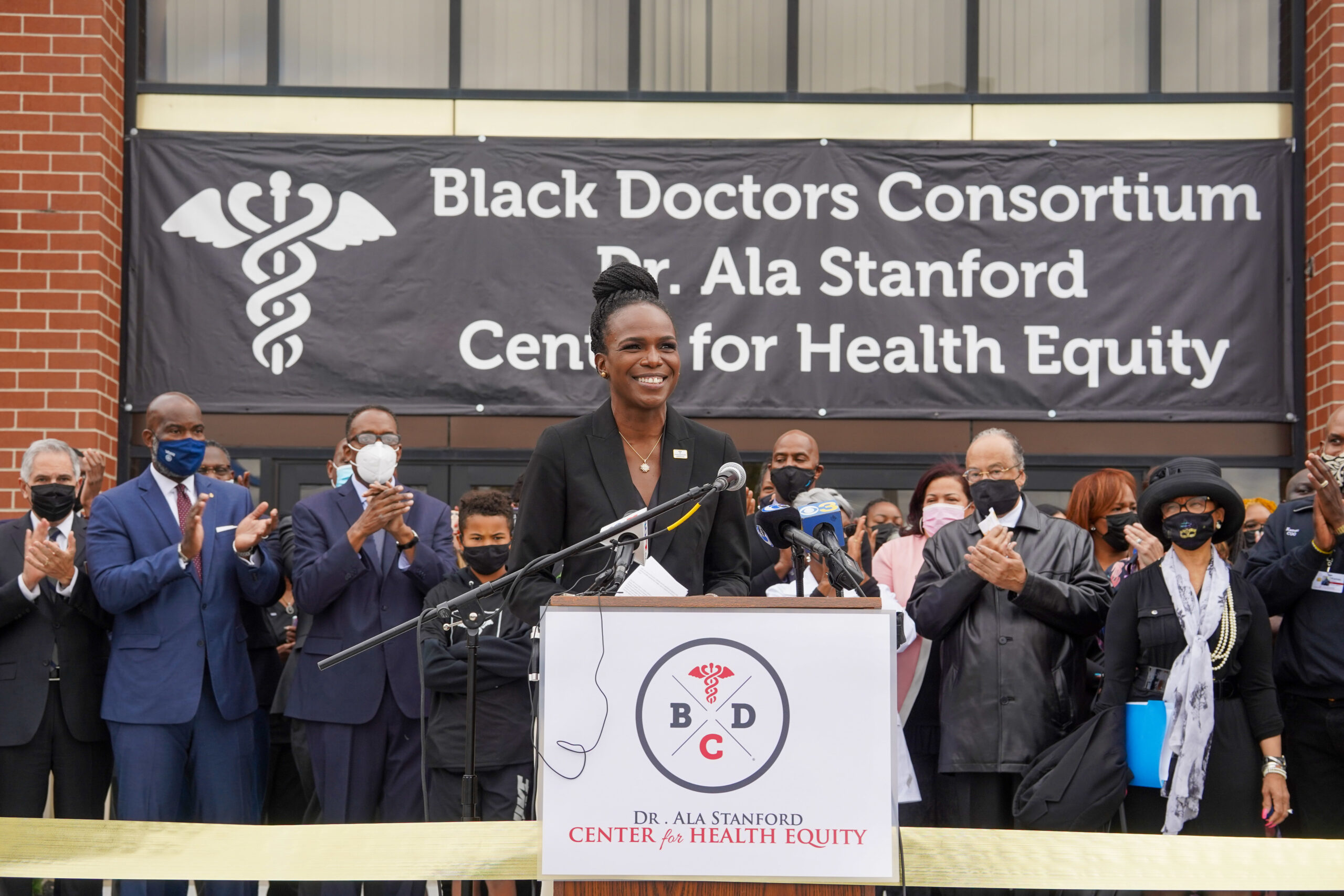
Ala Stanford speaks at the Black Doctors Consortium Dr. Ala Stanford Center for Health Equity in Philadelphia, Pa., on October 27, 2021. The center was opened with the goal of making healthcare accessible for those in communities who might struggle to get proper healthcare treatment.
Stanford’s supporters think Philadelphia voters will trust a doctor to ensure affordable healthcare access. They point to a survey released this month by the Annenberg Policy Center at the University of Pennsylvania that found 86% of respondents said their primary healthcare provider is trustworthy.
Erik Polyak, the executive director of 314 Action, said Stanford’s background differentiates her in a Democratic primary in which most candidates align on key issues.
“Voters want healthcare decisions made by people who understand patients and the science,” he said, “and not politicians chasing headlines.”
Oxman, Stanford’s now-former opponent, said physicians running for office can help rebuild a Democratic Party that has “lost the trust of so many people.”
“So many people see us as not centered on their needs, particularly their economic needs,” he said. “If the Democrats are going to build a party that has a chance of winning in Center City Philadelphia and in central Pennsylvania, it’s got to regain the trust of the voters.”
New to politics, but not government
It was the spring of 2020, and the bills were piling up.
Stanford, who was born in Germantown, had given up her well-paying day job as a surgeon to work full-time with the Black Doctors Consortium. She ran COVID-19 testing clinics in Philly parking lots and churches, and amassed some $200,000 in bills, saying she couldn’t “let one person lose their life for a test that costs $100.”
That was the beginning of her pandemic experience with government.
A lot of it was begging. As Stanford tells it, she peppered government officials with emails, telling them how many people she and her volunteers had tested that day, and asking for help securing funding.
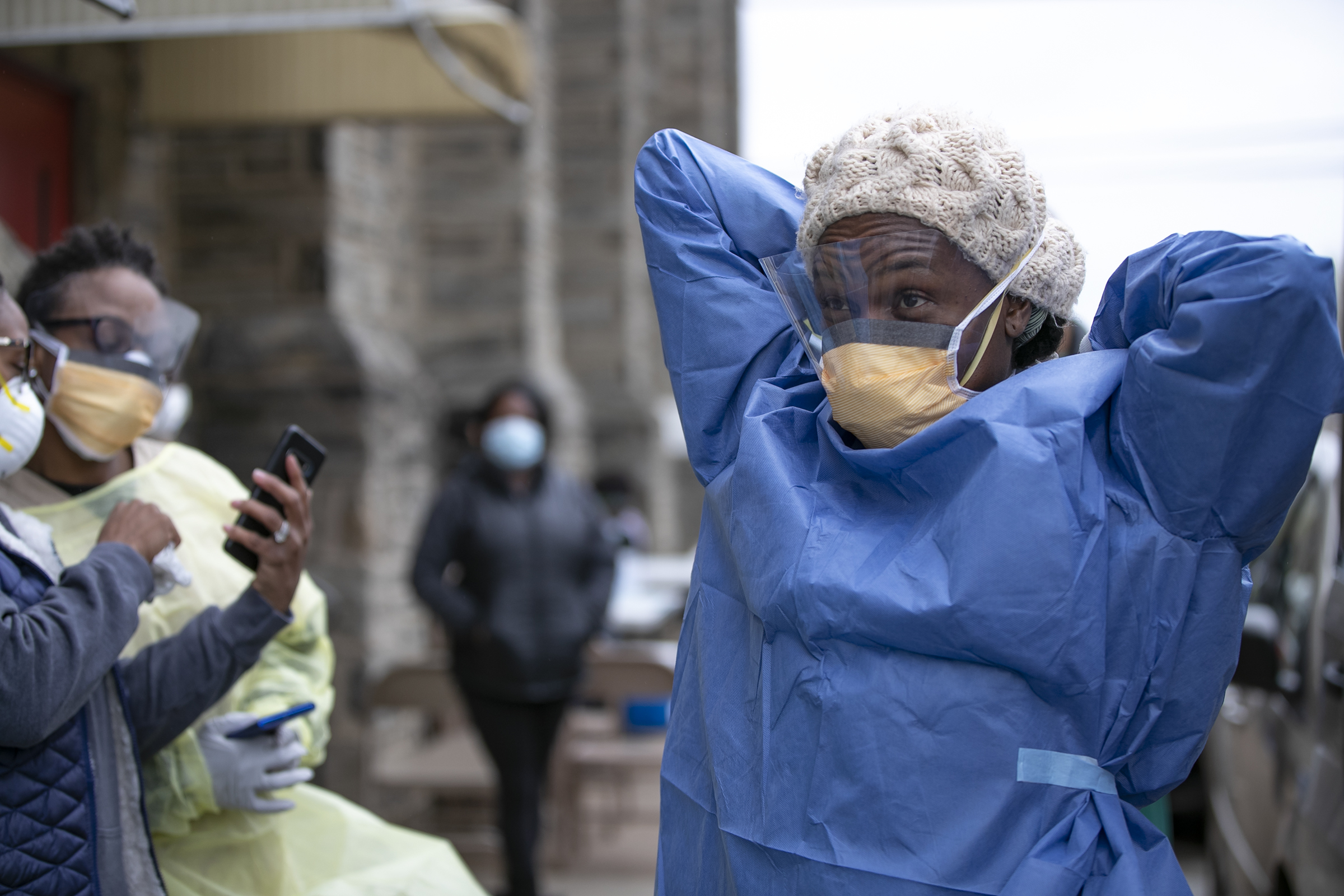
In this April 2020 file photo, Ala Stanford puts on her mask before running a coronavirus (COVID-19) testing site at the Miller Memorial Baptist Church in Philadelphia.
U.S. Rep. Dwight Evans was immediately responsive. He connected Stanford with the White House, other members of Congress, and top insurance companies. And he publicly called on former Gov. Tom Wolf and then-Mayor Jim Kenney to allocate funding to Stanford’s organization, citing the group’s outreach to predominately Black communities and its work to address distrust of medical institutions.
The money came in several months later. It was finally enough for Stanford to pay for testing, compensate her staff, and prepare to vaccinate thousands of Philadelphians.
Fast-forward five years, and Evans has endorsed Stanford to replace him in Congress as he retires after decades of public service. His backing has been invaluable to Stanford, and it surprised some political observers who figured he might endorse one of the politicians whom he’d served alongside.
Stanford said Evans’ support has not convinced some Democratic voters. Some tell her they plan to vote for Street, citing his family name, or they say that “it’s his turn now.”
“What about if he is not what’s best for the people?” Stanford said. “Doesn’t that factor in?”
She tells voters that despite being new to the campaign trail, she isn’t new to government. She worked as a regional director for the Department of Health and Human Services under former President Joe Biden, who appointed her to the role. And she leads medical services at the Riverview Wellness Village, the city-owned drug recovery center opened last year by Mayor Cherelle L. Parker’s administration.
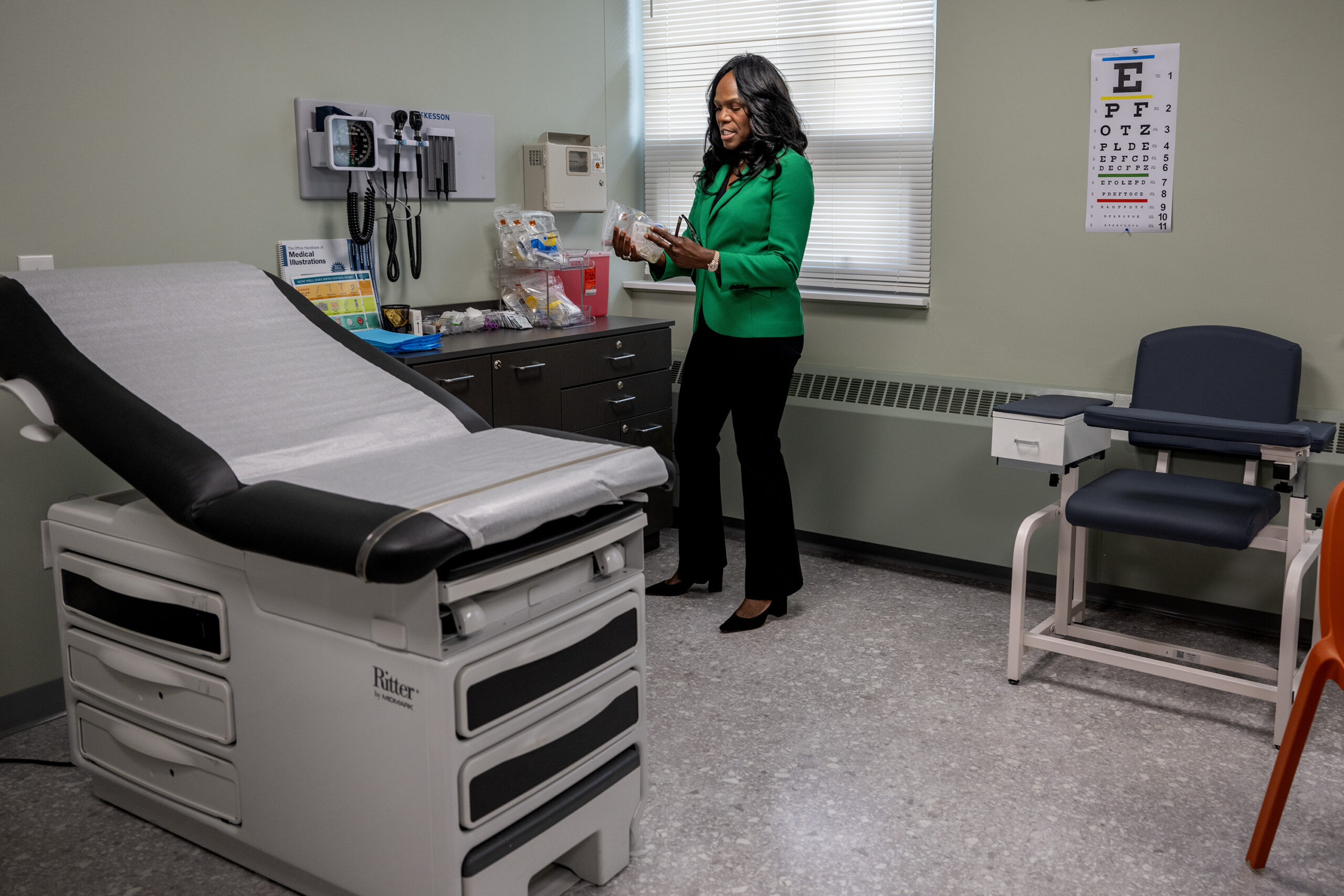
Physician Ala Stanford in an examination room at the primary medical care center run by her Black Doctors Consortium at Riverview Wellness Village, a city-owned drug recovery home in Northeast Philadelphia Tuesday, Nov. 25, 2025.
Still, Stanford very much sees herself as a doctor.
She often works out of a corner office in the North Philadelphia health center, and she still is alerted when the temperature of the vaccine refrigerator dips a degree too low. She has, on more than one occasion, tended to someone experiencing a medical emergency while she was campaigning.
She knows that overseeing day-to-day operations at the health clinic won’t be possible if she’s in Congress. There’s a succession plan in place.
“It’s just about, how can I have more significance at a larger scale? Congress is definitely a way to do it, but it might be somewhere else,” Stanford said. “That is, if I don’t win. But I want to win. I should win.”
Council President Kenyatta Johnson, a Democrat who controls the flow of legislation in the chamber, said he has scheduled a hearing to take place at 10 a.m. on April 6 before the Committee of the Whole, which comprises all 17 Council members.
That means every lawmaker will have the opportunity to question members of Mayor Cherelle L. Parker’s administration, as well as immigration advocates, about the package.
The timeline means mid-April is the earliest that Council could pass the package. Fifteen of the body’s 17 members have expressed support, and that constitutes a veto-proof majority.
City Councilmembers Rue Landau, a Democrat, and Kendra Brooks, of the progressive Working Families Party, sponsored the legislation introduced in January, which prohibits ICE agents from wearing masks, bans them from staging raids on city property, and makes it illegal to discriminate against someone based on immigration status.
The legislation also clarifies how and when Philadelphia officials can coordinate with federal immigration enforcement.
Parker has said an executive order signed by her predecessor remains in place, limiting some cooperation between law enforcement and ICE. But the legislation that Council is considering goes further, codifying a prohibition on city officials assisting ICE and prohibiting data-sharing agreements.
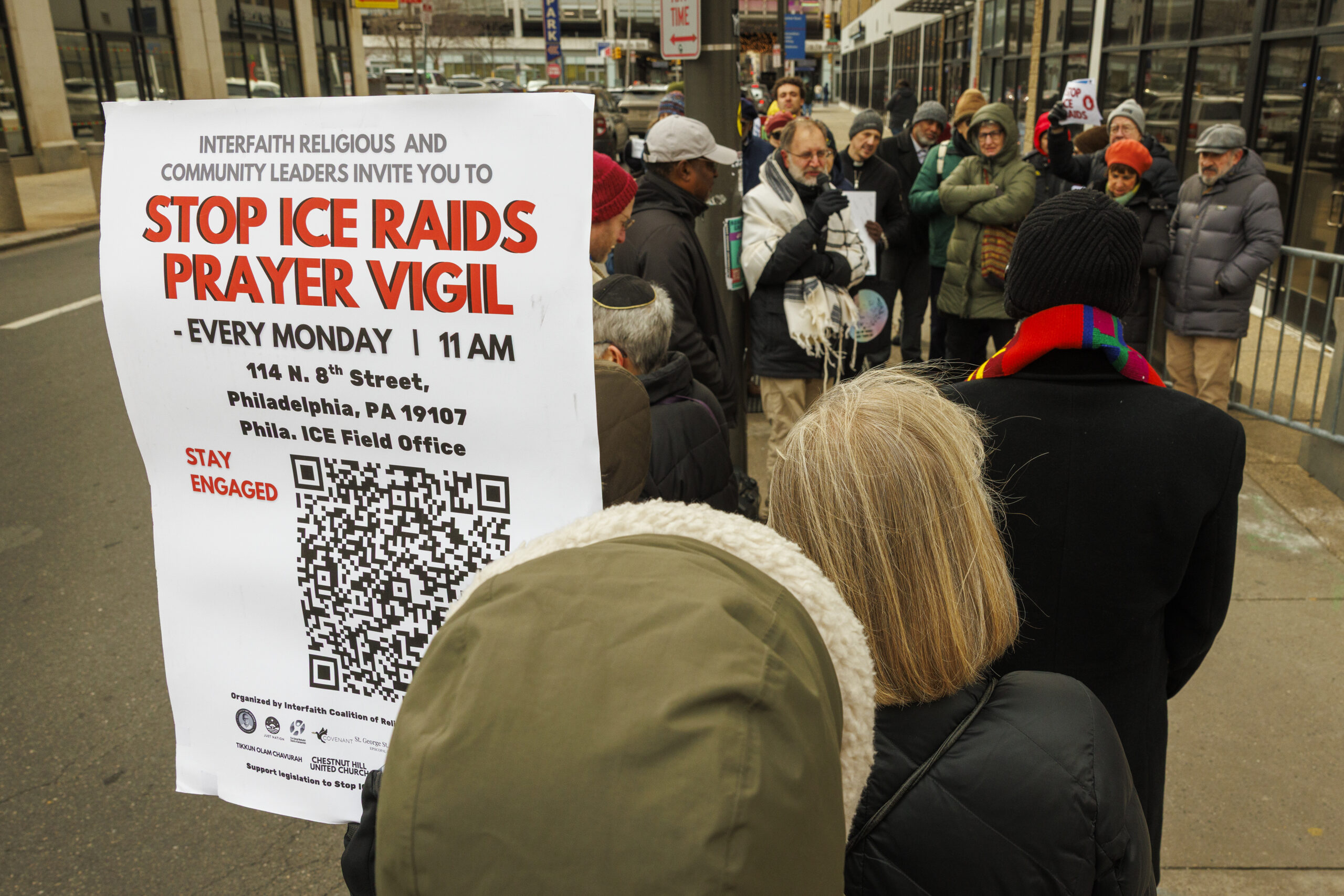
Interfaith religious and community leaders prayer vigil outside the Philadelphia U.S. Immigration and Customs Enforcement office at 114 N. 8th Street in Center City on March 2.
It comes as the U.S. Immigration and Customs Enforcement agency is undergoing a revamping to its leadership structure. President Donald Trump on Thursday ousted Department of Homeland Security Secretary Kristi Noem, and said he intends to nominate U.S. Sen. Markwayne Mullin (R, Okla.) to replace her.
Several local officials said this week that they’re worried the federal government will surge enforcement efforts in Philadelphia in order to fill the centers, and that the city must move quickly to pass its legislation.
“I’m extremely concerned,” said City Councilmember Quetcy Lozada, a Democrat whose North Philadelphia-based district has a large immigrant population. “We need to really figure out what our position is as it relates to working with ICE very closely. We have community residents that we should be protecting.”
Two are in Pennsylvania and could reportedly hold about 9,000 beds in total.
Spotlight PA reported Tuesday that ICE is referring to a facility in Tremont, located in Schuylkill County, as the “New ICE Philadelphia Mega Center” and one in Upper Bern Township in Berks County as the “New ICE Philadelphia Processing Center.”
Landau said Council is “paying close attention to these developments and the questions they raise about the expansion of detention facilities in our area.”
“The majority of Philadelphians are deeply disturbed by ICE’s tactics,” she said.
Johnson said in an interview last month that the detention centers are a reason to move swiftly on the ICE-related legislation.
The proposed laws, he said, are a means to “be out in front” of a potential surge of immigration enforcement in the city.
“Some people say, ‘Well, they’re not even here yet.’ But they just built a warehouse in [Berks County],’” Johnson said. “I believe that was strategic. It took some planning to say ‘We want to set up shop right in your backyard.’”
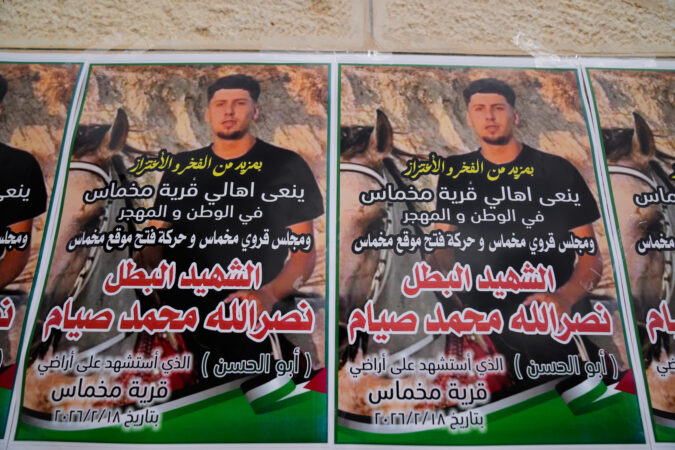
City Council on Thursday formally honored a Philadelphia-born Palestinian American who was killed last month by Israeli settlers in the occupied West Bank.
In a unanimous voice vote, Philadelphia lawmakers passed a resolution to celebrate the life of 19-year-old Nasrallah Abu Siyam, who was fatally shot during a violent clash in a village on Feb. 18, the beginning of the Muslim holy month of Ramadan.
Members of Abu Siyam’s family appeared in Council chambers Thursday alongside representatives from the Council on American-Islamic Relations, who called for an independent U.S.-led investigation into the killing.
“You don’t know what it means to live under occupation. You don’t know what these settlers are doing,” said Abdelhamid Siyam, Nasrallah Abu Siyam’s uncle. “When justice is attacked, silence is treason. … We should stand together and pressure all those elected officials to stand with justice.”
City Councilmember Rue Landau, a Democrat who authored the honorary resolution in partnership with Councilmember Nicolas O’Rourke, said Thursday that other members of Abu Siyam’s family are trapped in the Middle East after flying there after his death.
They are unable to travel home, she said, due to the ongoing war in Iran and restrictions on airspace.
Landau also called on the U.S. State Department and the Department of Justice to “conduct a full investigation and pursue justice for Nasrallah.”
“We demand accountability so that no other family here or abroad has to stand where this family stands now,” she said during a later event alongside Abu Siyam’s family.
Thirty U.S. senators signed a letter to President Donald Trump’s administration Thursday calling for an independent investigation into Abu Siyam’s killing. Pennsylvania’s two senators, Republican Dave McCormick and Democrat John Fetterman, did not sign it.
Here’s what else happened in Council on Thursday.
What was the highlight?
Prioritizing transit-oriented development: Mayor Cherelle L. Parker’s administration is pushing Council to approve a package of legislation that makes it easier to build apartment buildings near SEPTA stations, measures that proponents see as a way to boost ridership and increase the city’s housing stock.
Parker transmitted a package of zoning bills to Council on Thursday, but no member formally introduced it. Members said they saw the legislation for the first time on Wednesday and want more time to review it before introduction.
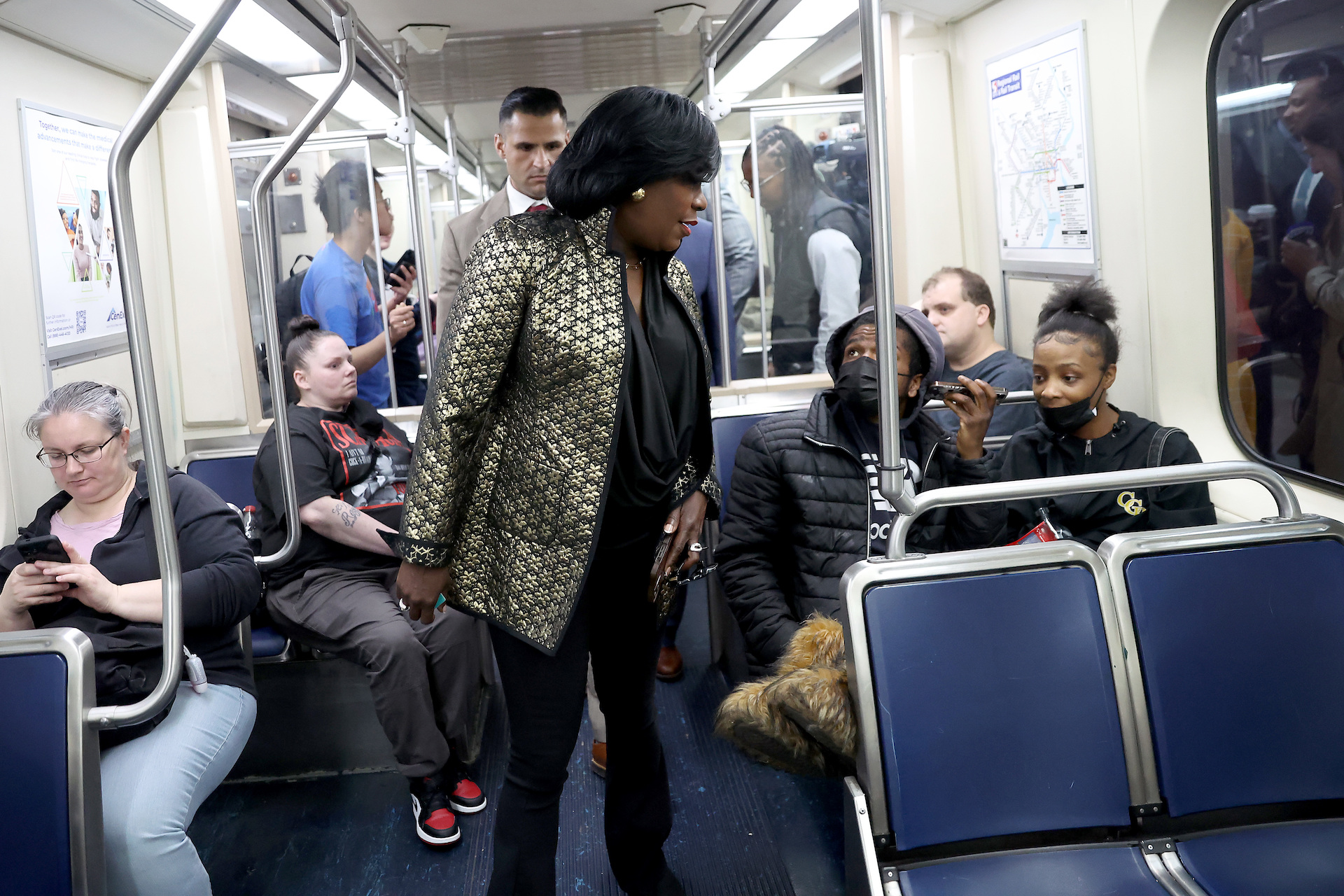
Mayor Cherelle Parker (center) rides the SEPTA Market-Frankford Line to an event in the Kensington section of Philadelphia, Pa. on Thursday, April 11, 2024.
The bills are aimed at advancing Parker’s goal to build, preserve, and repair 30,000 housing units.
Most crucially, one bill expands an existing law that says properties within 500 feet of a Council-designated SEPTA station can receive benefits allowing developers to build more homes. Parker’s legislation increases the radius to 1,320 feet, or a quarter of a mile.
What else happened?
Smoke-filled doom: Lawmakers continued their crusade against smoke shops and so-called nuisance businesses Thursday, with Councilmember Katherine Gilmore Richardson bringing legislation to hold commercial landlords accountable for renting to illegal smoke shops.
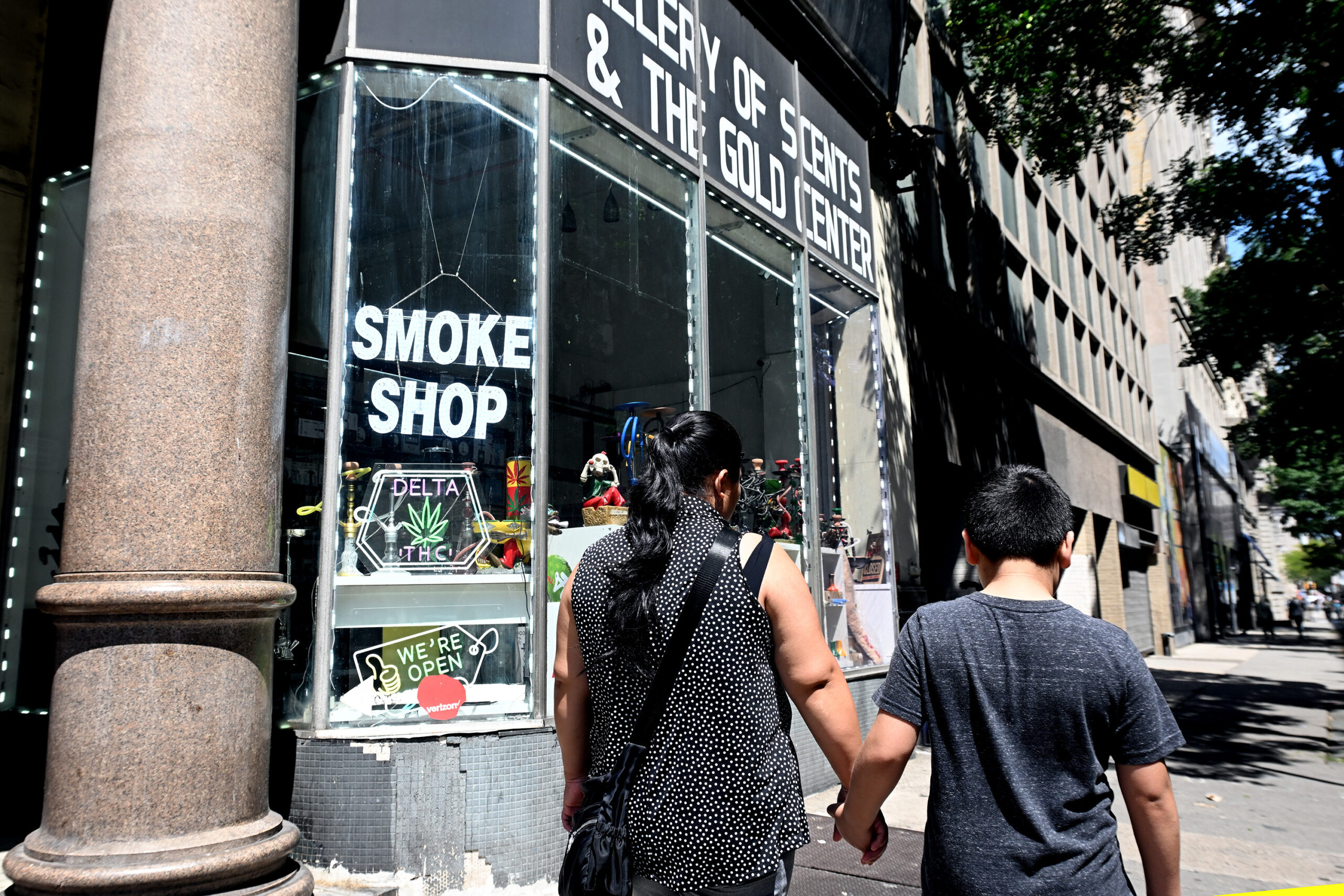
This file photo shows a city smoke shop exterior on the 1000 block of Chestnut Street in July. City Council has advanced several pieces of legislation aimed at curbing smoke shops.
Gilmore Richardson introduced a second bill to establish a new license requirement for stores selling products like hemp-based THC and kratom. The ordinance would define the products as “intoxicating substances” and establish a 21-plus age minimum.
What’s next?
Block off your calendar: Next week will be a busy one. Parker is scheduled to deliver her annual budget address to Council on Thursday, when she will outline her vision for the coming year.
The speech will kick off weeks of hearings before Council, when members will have the opportunity to question administration officials from every major department, as well as the leaders of other agencies that receive city dollars, including the city courts, the district attorney, and the Philadelphia School District.
Quote of the week
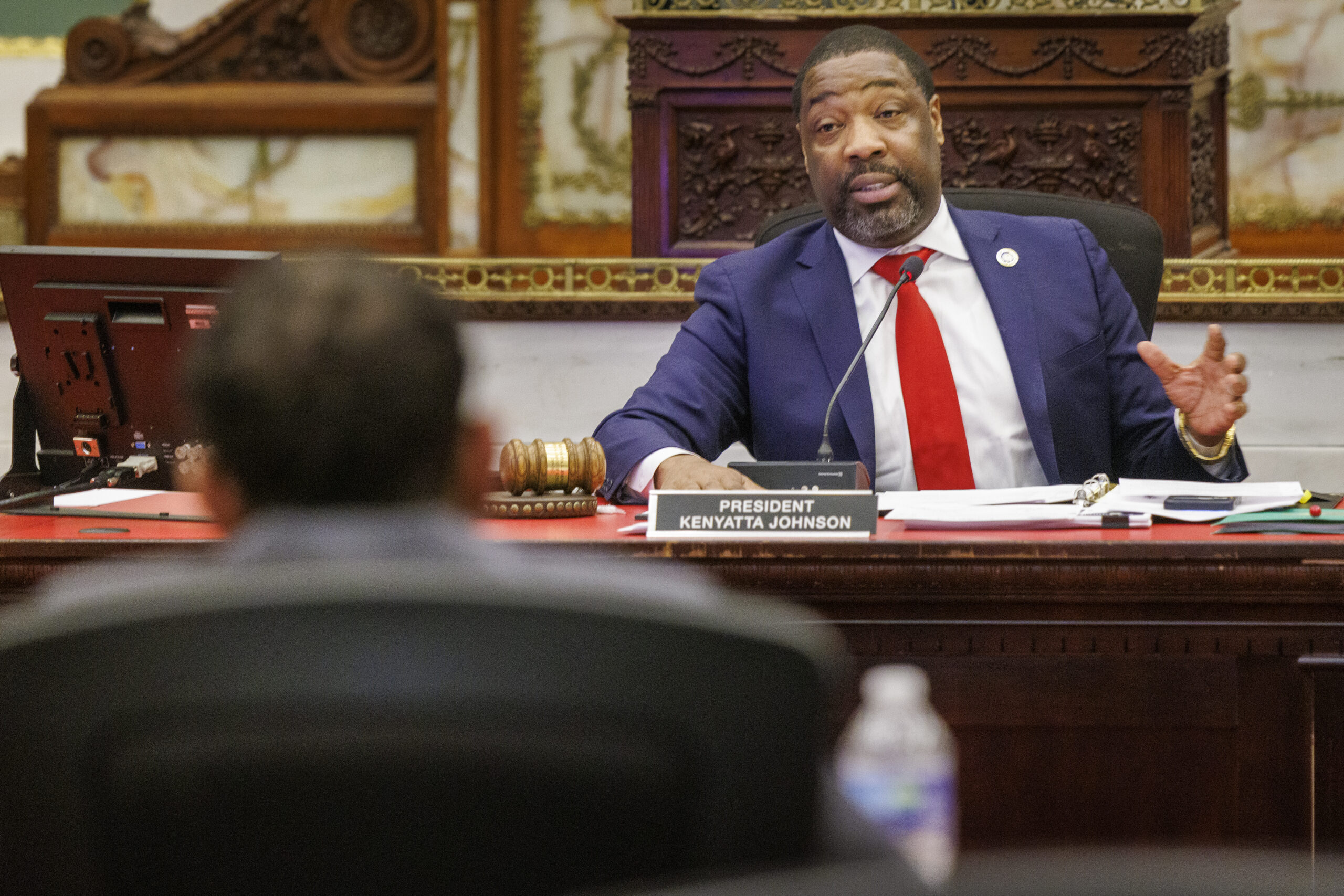
Philadelphia City Council President Kenyatta Johnson questioning Dr. Tony Watlington, Superintendent of School District of Philadelphia, during a hearing with board members of School District of Philadelphia, Tuesday, Feb. 17, 2026.
A little school district shade: That was Council President Kenyatta Johnson chiming in on an effort to rename a North Philadelphia street after the late Constance E. Clayton, Philadelphia’s first Black and female schools superintendent.