Philadelphia’s heatwave has claimed another casualty: the Big Boy.
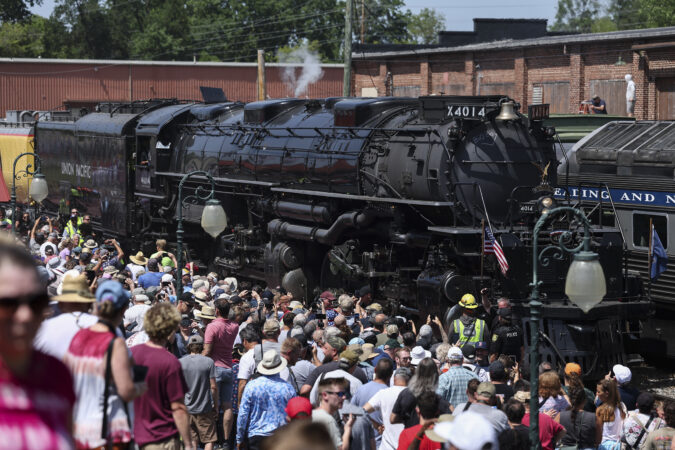
Union Pacific’s Big Boy No. 4014 — the world’s largest operating steam locomotive — closed early to the public Sunday afternoon, due to the oppressive heat, according to a Facebook bulletin.
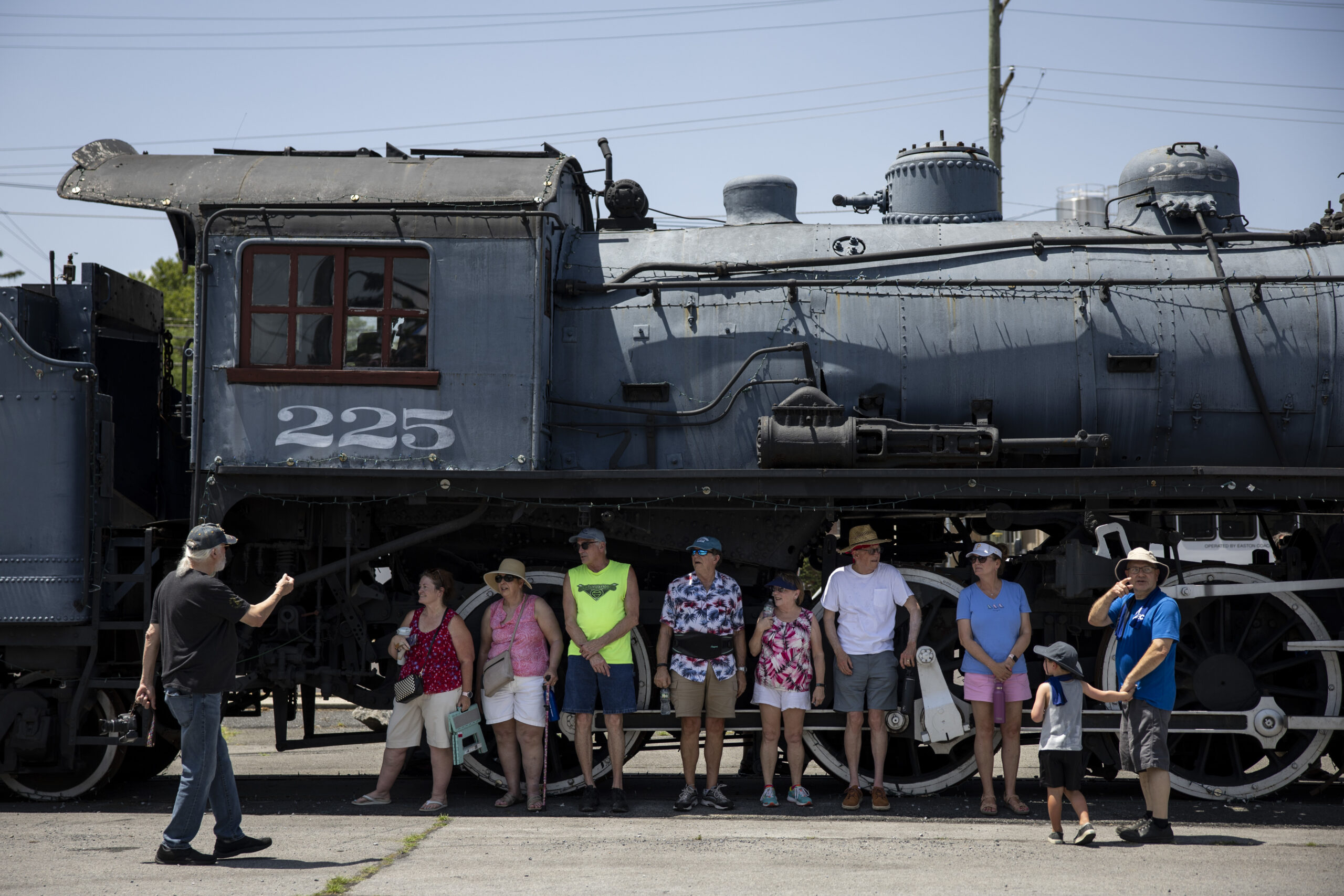
The Navy Yard had been bustling Sunday with fans clad with wide brim hats lathered in sunscreen, hoping to snag a view of the Big Boy. The locomotive was scheduled to be on display until 3 p.m.
But by 1:30 p.m., when the temperature neared 90, police were turning the train enthusiasts around.
“They’re not even letting people get close,” a dejected man in red, white, and blue grumbled to others headed in the direction of the locomotive.
A spokesperson for Union Pacific, Robynn Tysver, said the difficult decision was made as crews began running out of bottled water for the estimated 65,000 visitors — more than double Saturday’s crowd, Tysver said.
“We just had to make this call for safety,” she said.
The Big Boy arrived at Intrepid Avenue and League Island Boulevard for July Fourth, as part of Union Pacific’s coast-to-coast tour commemorating the Semiquincentennial. The Port of Philadelphia also hosted a public viewing on Independence Day, when the temperature eclipsed 100 degrees.
Reactions to the Big Boy’s reduced hours on social media were mixed: “This decision is regrettable and puzzling,” one person commented on the Facebook announcement.
Spectators await the arrival of Union Pacific’s Big Boy No. 4014 at Reading Outer Station on Thursday, July 2, 2026, in Reading, Pa.
“It was hotter yesterday and you stayed open makes no sense,” noted another.
Others were more understanding: “Safety first for guests and especially crew,” a user wrote.
The Big Boy is scheduled to depart Philly on Monday morning and head back West.
It’s expected to be on display in Altoona’s Railroaders Memorial Museum July 9-10.
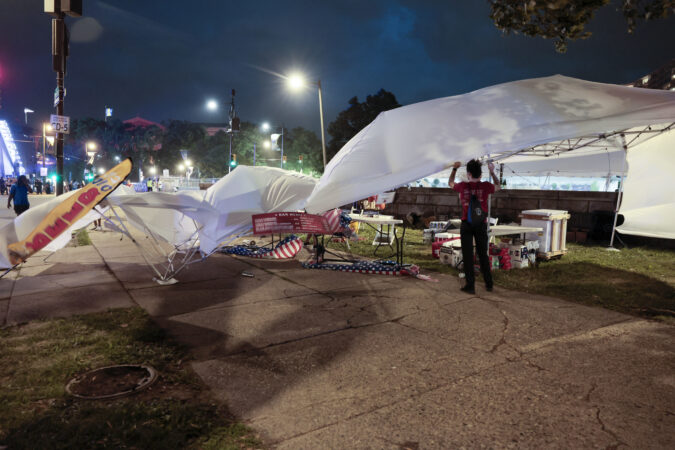
Storms and strong winds late Saturday downed trees and wires throughout the Philadelphia region, and more severe weather is forecast into Monday.
A slew of wind-damaged trees and wires in the suburban counties were reported to authorities and the National Weather Service late Saturday and Sunday morning. Such debris briefly suspended service on the Lansdale/Doylestown regional rail line during July Fourth celebrations.
Thousands of people, largely in Chester and Bucks Counties, were also without power early Sunday, Peco’s online tracker showed. During the storms’ peak, at about 10:45 p.m., that number reached almost 50,000. By 2:20 p.m. Sunday, it had fallen to less than 7,000.
The outages came as Peco workers, from linemen to call center staff, were on strike. Negotiations between the union and energy company were ongoing Sunday afternoon.
Bucks County officials were able to evacuate Independence Day festivities ahead of the storm, county Emergency Management Director George Wilson said.
While a pine tree fell into a home in Upper Southampton and another downed tree hit a car in Doylestown, no one was injured, he said. Additional felled trees and debris caused road closures Sunday.
“Overall, we were pretty lucky,” Wilson said.
But in Philadelphia — where heavy rain, lightning, and wind gusts near 60 mph suspended the city’s Semiquincentennial concert on the Benjamin Franklin Parkway — minimal power outages were reported, according to the city’s Office of Emergency Management.
Spokesperson Jeffrey Kolakowski said tree limbs and vegetation were knocked over on and around the Parkway and have since been cleared.
Another round of severe weather and extreme heat was forecast, according to NWS. Heavy rainfall and winds on Sunday and heavy showers and thunderstorms on Monday may bring flash flooding to the Philly area.
The weather service issued a flood watch Sunday that was in effect until 8 p.m. on Monday. It covered much of the region, including Philadelphia; Bucks, Chester, Delaware, and Montgomery Counties; Camden and Gloucester Counties; and Northwestern Burlington County.
The inclement weather may hamper cleanup efforts and power restoration, Wilson said.
Chester County leaders were asking residents to “stay weather aware.”
“Our teams stand ready to assist our community,” spokesperson Kevin Beck said in a statement.
The eve of the United States’ 250th birthday in Philadelphia was less celebration and more chagrin, as oppressive heat left swaths of tourists and revelers in an aimless search of pomp and circumstance.
On Friday, Wawa’s Salute to Independence Semiquincentennial Parade was canceled because of 100-plus-degree temperatures and aperilous heat index. It was one of numerous events called off or shortened this holiday weekend, as the scorching weather has thwarted events across the region, and potential storms could impact more.
The cancellation left scores of sweat-soaked performers, musicians, and historical reenactors in wool garb stranded near Independence Hall and around Center City. There might not have been the sort of “shews, games, sports, guns, bells, bonfires and illuminations” that John Adams prophesied in a July 3, 1776, letter to his wife, but there was still an air of importance — and some impromptu pageantry.
“We won’t be around for the 300th, so we really wanted to come for the 250th,” said war re-enactor Kathy Touzjian, 61. Touzjian and Laurie Pelletier were among a 75-person Massachusetts Army of 1775 troupe, who traveled six hours by bus to be in Friday’s parade.
“At least we still have cheesesteaks,” Touzjian said.
To the pair, the 250th anniversary of the signing of the Declaration of Independence and the fledgling country’s split from Great Britain felt different — and not just because of the heat. Now more than ever, Pelletier said, it was important to return to the country’s bedrock: liberty and independence for all.
“Today is still special,” saidPelletier, 60. “It’s a chance to recognize what our ancestors gave us, because the world is falling apart and this brings people together.”
The cancellation didn’t immediately send the performers home; instead, the duo stayed to play the fife, a wooden instrument similar to a piccolo, throughout Old City. As they readied their three-layer historic attire, Touzjian hoped future generations would heed her advice:
“No matter how hot it is, do not cancel the 300th independence parade.”
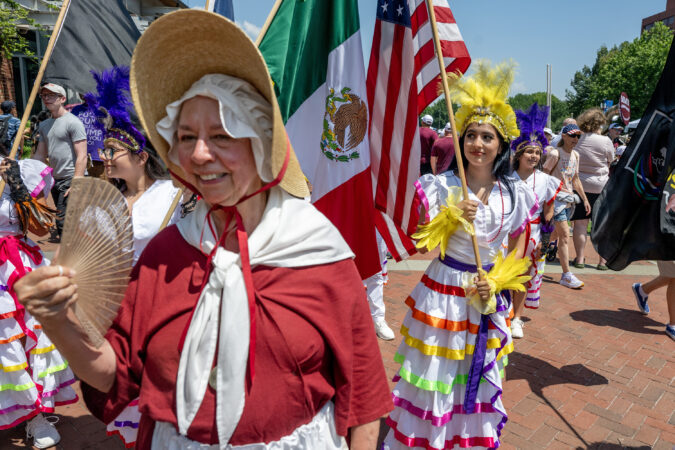
At Independence National Historical Park, people clamored for respite in the tree-lined periphery, in the sliver of shade by the Liberty Bell, or the air-conditioned Independence Hall. Around noon, the line to see the historic site of the Second Continental Congress snaked through the courtyard. While entries were paused as the building surged to capacity, history buffs dressed in colonial costume gave mini lectures, and a few marooned groups didn’t let the weather dampen their dancing. Indianapolis-based squad Ballet Folklorico Mosaicos performed their routine inspired by an annual carnival in Veracruz, Mexico, while Asian American Dragon & Lion Dance artisans carried a long puppet dragon to the beat of a drum.
“I feel immense pride to be able to show the love for our country,” said Henry Lee, founder and director of Asian American Dragon & Lion Dance.
Asian American Dragon Lion Dance outside Independence Hall today. “I feel immense pride to be able to show the love for our country,” said group founder Henry Lee. pic.twitter.com/2WLv1ErZej
Teens from Sahuarita High School’s band came a long way from their Arizona homes only to not be able to march through Center City. But, director Ben Garland said it taught his 87 students a valuable lesson about being an American: community. Garland praised organizers for making the parade participants feel included in the 250th.
“Most of my students have never even been on a plane before and coming here was their opportunity to see the Wast coast and engage with history they wouldn’t see otherwise,” he said. “For us the trip was worth it for what they have been able to learn and the camaraderie they have built here.”
Across the city, Allison Utain and her husband found a form of patriotism at the Philadelphia Museum of Art no less festive than what they were hoping for in the parade.
“You see a culmination of so many cultures that make the tapestry of what American is,” Utain said, “far from perfect, but it’s great.”
Despite a rocky start, city leaders and tourism officials have postured Philadelphia’s Semiquincentennial celebrations as the country’s defining 250th party. And there’s immense pressure for the city to meet its moment, as commemorative events — from George Washington’s Mount Vernon estate to the Boston Harbor — and the American royal wedding between Pennsylvania’s own Taylor Swift and Eagles-adjacent Travis Kelce compete for the nation’s attention.
Alex Bergstedt and his wife traveled from Idaho to Philadelphia because they “knew Fourth of July would be big.” Nicholas Roth and two friends came from upstate New York to walk where the Founding Fathers were.
Just this week, Mayor Cherelle L. Parker reiterated the gravity of the grandeur: “We won’t get a second chance to do this over again, Philadelphia. We only turn 250 years old once in a lifetime.” The mayor defendedthe city’s July Fourth concert planned for Saturday, amid concerns about the dangerously high temperatures and revelations that the event will cost taxpayers more.
As of late Friday afternoon, the concert was still on. Misting stations and water-refilling stations will be available along the Benjamin Franklin Parkway during the seven-hour billing, featuring acts such as Jill Scott, Christina Aguilera, The Roots, Will Smith, and Freeway, the city said. Officials pleaded with attendees to prepare accordingly.
On the Parkway Friday, it was hot enough to see the shimmering heat on the asphalt. Most people rushed from museums to other scraps of shade, while some poured water down the backs of their necks, and dozens of children and their families streamed through the Swann Memorial Fountain at Logan Circle.
Yet, this isn’t Philadelphia’s first brush with a foiled fete. In 1976, the city’s grand plans for its Bicentennial were dashed — not by weather, but rather unmeetable expectations. The blunder of ‘76 was an unrivaled level of municipal malaise, according to contemporaneous reports.
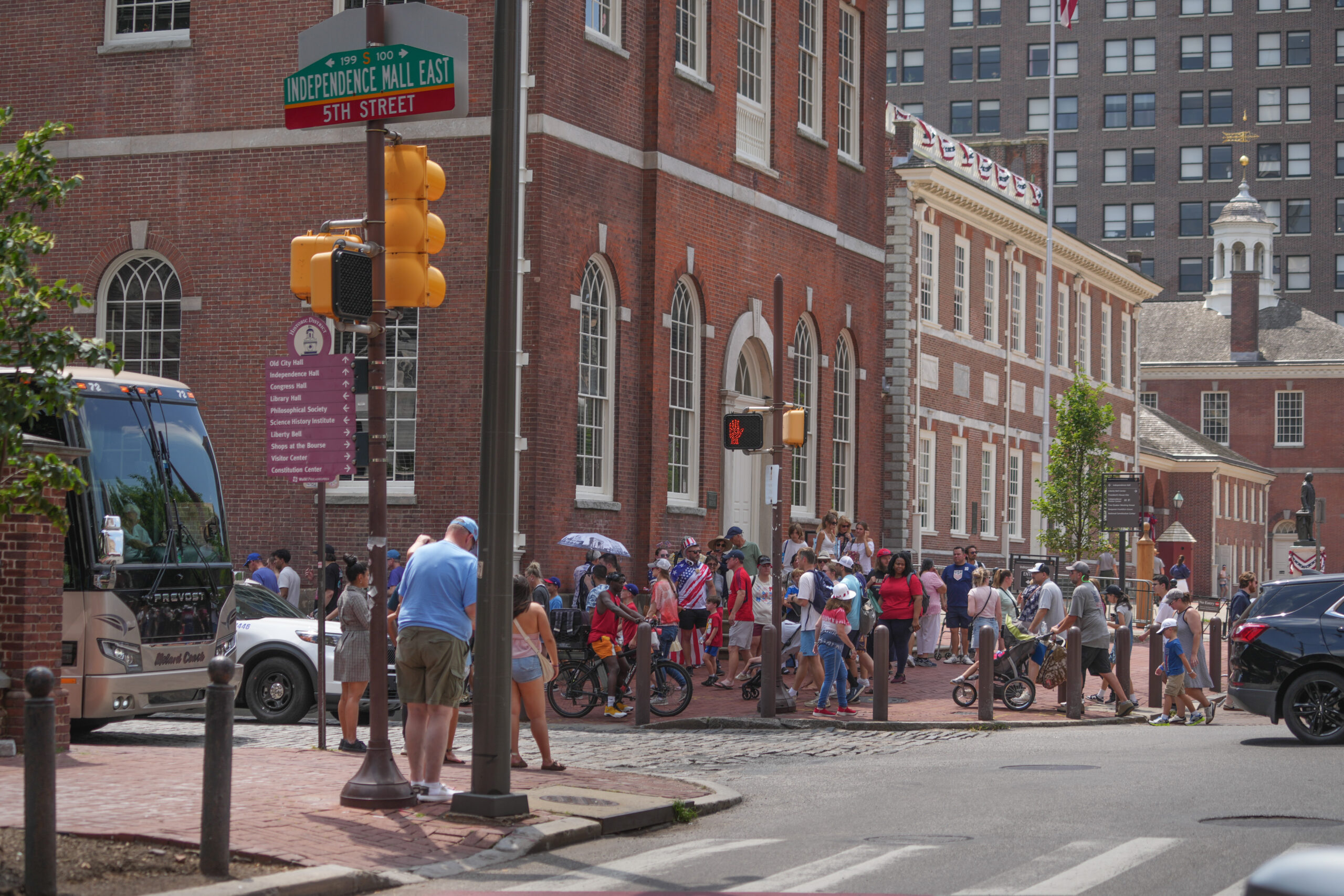
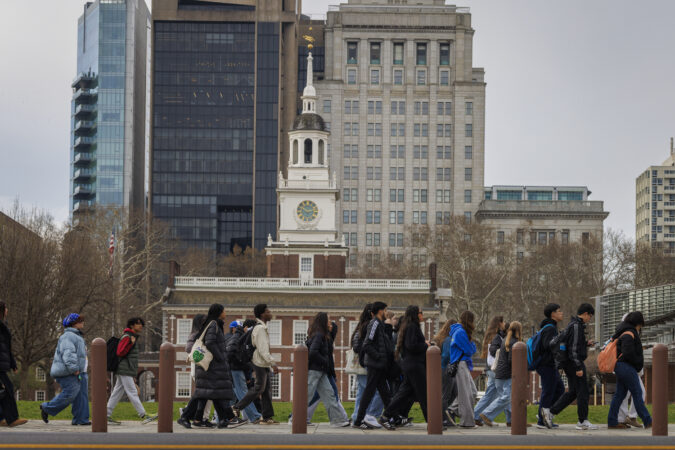
Visitors to Independence Hall, in Philadelphia, July 3, 2026.
This year,Ron Crofoot traveled to Philadelphia to be with his granddaughter as her marching band was supposed to perform at the parade. He reflected on what it was like to have celebrated the Bicentennial.
“How quickly 50 years go by,” he said. “I won’t see the next — it gets more meaningful as you get older — you come to appreciate the uniqueness of the United States.”
The rupture at the President’s House is just one part of the Trump administration’s ongoing campaign to purge history it says “inappropriately disparage[s] Americans past or living.”
It wasn’t immediately known if federal authorities would attempt to install the panels during this historic weekend.
In a video address, a block north at the National Constitution Center, Pope Leo XIV called for a “recommitment” to the nation’s ideals as he accepted the center’s prestigious Liberty Medal. The first U.S.-born pope has been outspoken about calls for international peace, which have landed him at odds with Trump’s immigration policies and the war with Iran.
“I’ve never seen such patriotism in one place,” said Thad Waites, 81, who traveled from Hattiesburg, Miss., for the Semiquincentennial — and hear from Pope Leo XIV.
Andrew McLaughlin, 68, of West Chester, recently returned from a trip to Chicago.
“I think it brings back pride in the country,” McLaughlin said of the 250th anniversary.
By Friday evening, Philly’s proclivity for wackiness was on full display when a crowd formed on Independence Mall, shouting “one more Ben, one more Ben” as men and women dressed like Benjamin Franklin walked through the plain-clothed masses.
It wasn’t a catwalk, per se, but rather the Franklin stroll. The mob had gathered to find the Founding Father’s best doppelganger.
“You have to make the event you want to see in the world, said organizer Elena Jackendoff, 32, who is a student at Johns Hopkins University. “I wanted to see 250 bald caps.”
Opposite Market Street, thousands gathered to hear Pops on Independence. By the delayed-8 p.m. start time, the temp had fallen to a pleasant 89 degrees and the orchestra played on with featured Broadway star Idina Menzel.
Last year’s Pops concert was cut short by rain. This year, the sky held dark clouds and some flashes of lightning, but the precipitation stayed at bay as Menzel made her appearance to a roaring audience.
“There is something especially fitting about gathering here, surrounded by the places where the nation was born,” said Steven Sims, superintendent of Independence National Historical Park, told spectators stretched out on the lawn.
Music, he said, “has always brought people together.”
Staff writers Peter Dobrin and Nick Vadala contributed to this article.
While all eyes are on Independence Hall this week, something almost unfathomable happened more than 200 years ago: It was nearly demolished.
Between the 18th and 19th centuries, Pennsylvania’s capital had moved to Harrisburg from Philadelphia, by way of Lancaster, and lawmakers wanted a new statehouse. The obsolete building then known as the Old State House in Philadelphia, on Chestnut between Fifth and Sixth Streets, was on prime real estate, according to Villanova University professor and historian Whitney Martinko.
So, they contemplated demolishing the building and selling off the salvage and parcels of land to the highest bidders to fund the grand statehouse. But Philadelphians mounted a campaign to save what’s now called Independence Hall — the Georgian-style building where the Declaration of Independence and U.S. Constitution were debated and drafted. Today, Independence Hall stands as a testament to the Founding Fathers’ ideals as the country prepares for its 250th birthday this Saturday.
“People looked to Independence Hall — already in the 1810s — as an important building and historic site,” said Martinko, who studies historic preservation in the early U.S. “Some of those people were residents of Philadelphia who didn’t want to lose a local landmark … but other people were really tourists who came to Philadelphia to see the site.”
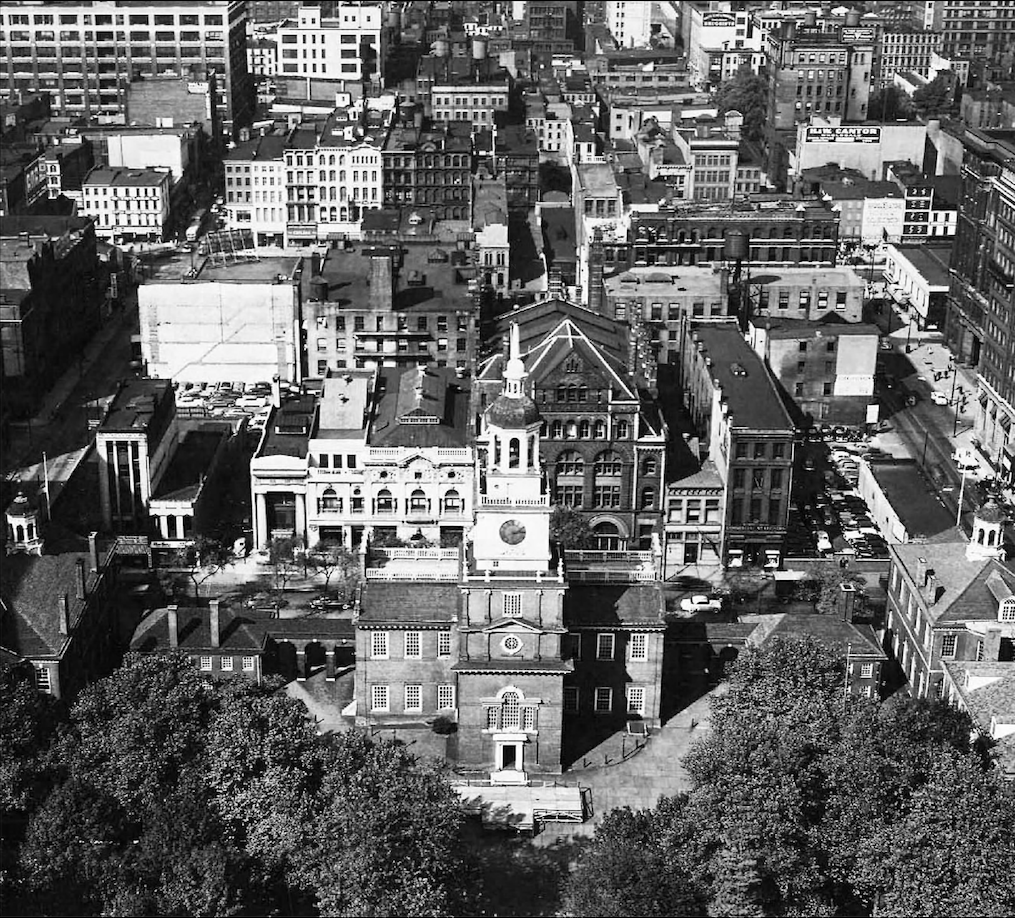
Independence Hall in 1950, looking north from Walnut Street, in the area that would become Independence Mall.
The state initially wouldn’t budge on its $150,000 price tag for the building, according to Martinko’s research, but after its yearslong campaign, the city ultimately purchased the plot for $70,000, or less than $2 million today. The deal, which was finalized in 1818, cemented Independence Hall’s legacy as a monument to the great American experiment.
Government offices occupied the building, while the State House yard remained public green space. What’s now Independence National Historical Park was once a maze of industry, mixed-use buildings, and alleyways.
By the mid-20th century, those blocks were razed, with some giving way to Independence Mall, in a push to beautify and boost civic pride.
“Preservation and stewardship of historic sites is an ongoing decision — it’s very easy to take for granted buildings that are preserved today are going to be there tomorrow,“ Martinko said, ”but there’s no guarantee that any building will be here tomorrow or in 50 or 100 years.
“History needs stewards and we all need to think of ourselves as people who should be engaged with saving places.”
Did Pope Leo XIV actually go to a Villanova University fraternity party?
That’s what one user on X purported when he posted an aged photo of the leader of the Catholic Church standing with a group of young men — one wearing a Villanova T-shirt and holding a small dog — in front of a brick bungalow. “The future Pope Leo XIV at a Villanova frat party in 1976,” the caption read.
The tweet had 1.4 million views and more than 15,000 likes as of Sunday.
But internet sleuths were suspicious:
“Not one of them is holding even a beer. That’s one tame frat party,” one of nearly 150 comments read.
“Doesn’t this look more like a step ranch in/near Chicago than anything on the Main Line?” another user smartly deduced.
The photo was actually taken at a fellow Wildcat’s house on the South Side of Chicago, where the pontiff is from, according to a classmate who has a copy. The classmate, who declined to be named for privacy reasons, assured The Inquirer it was not a frat party and dated the photo to the mid-’70s.
The legendary redheaded drag queen Carlota Ttendant donned a baby-blue Eva Gabor-inspired gown — its plunging neckline revealing tasteful chest hair — and sensible black heels.
At 65, arthritis stifles her strut in stilettos.
“Drag is a young girl’s game,” she said.
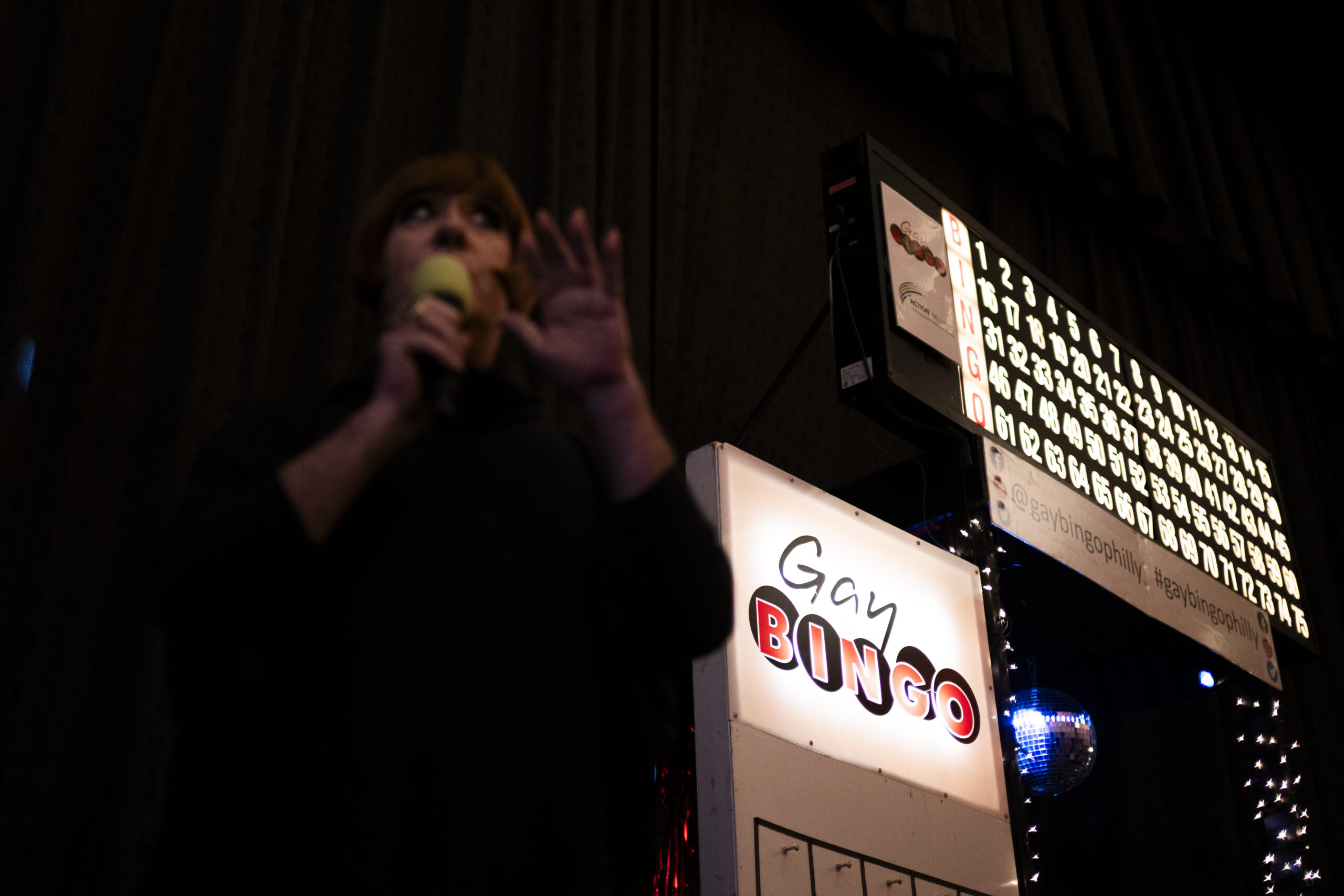
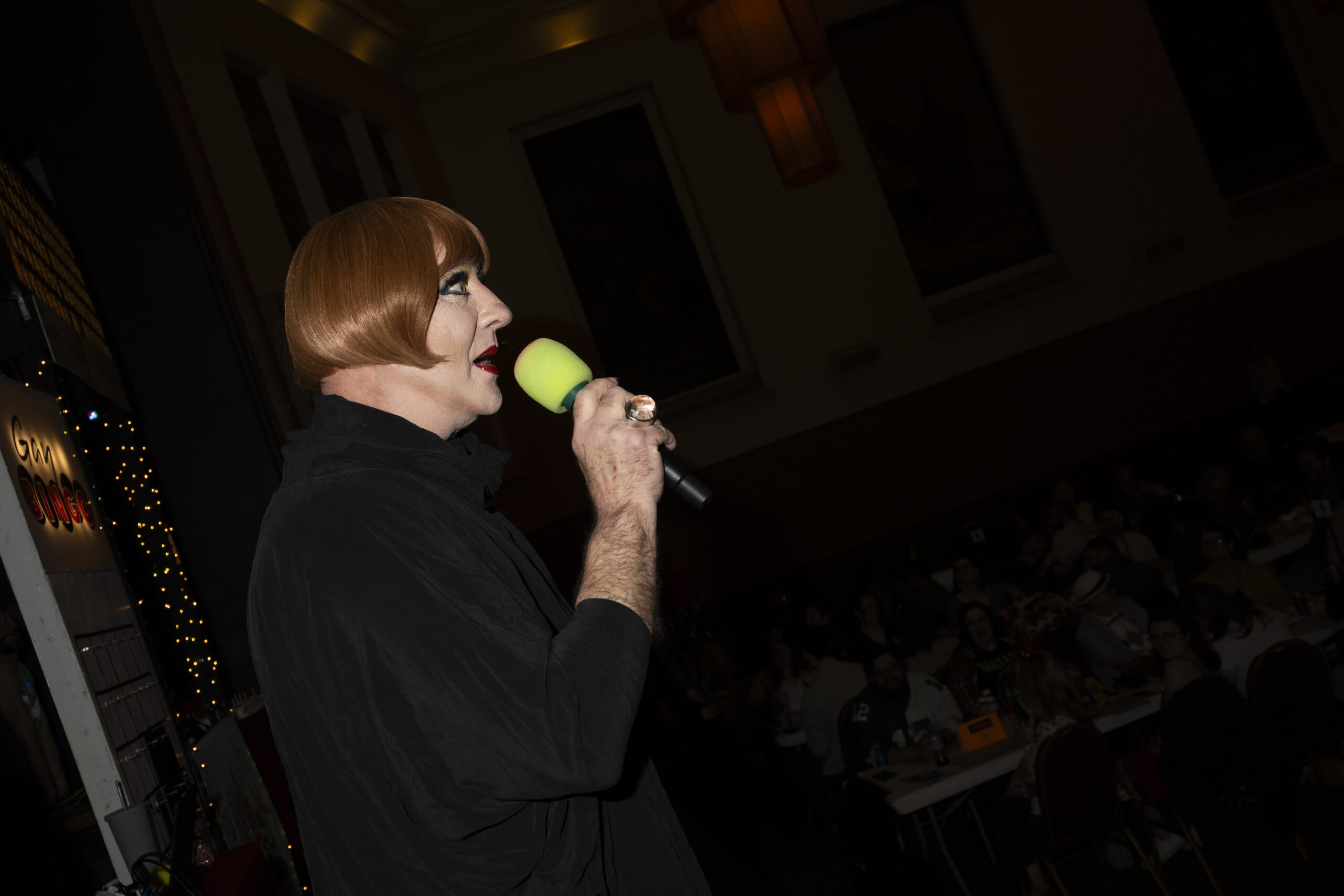
This was her swan song. At the close of its 30th season this Pride Month, the man behind the makeup, Michael Byrne, hung up his heels and bid adieu to his drag persona and his longtime gig hosting Gay Bingo, the camp, irreverent, slightly profane, and undoubtedly silly monthly HIV/AIDS fundraiser.
“I know it’s time,” Byrne said. And, “I’m excited to never wear Spanx ever again.”
Across three decades, Carlota Ttendant has called hundreds of games and elicited endless laughs, all while raising millions for people living with HIV/AIDS across the Delaware Valley. She helped steer a community through crisis, providing a respite to those experiencing immense loss and stigma. Even as medicine has advanced and HIV/AIDS has become manageable, she’s crafted a safe space for queer Philadelphians. For one night each month, she’s been an entertainer and an equalizer, responsible for uniting people — gay and straight, from Haddonfield to Phoenixville — around a common goal.
And since Carlota came into Byrne’s life, she’s taught him to lead with courage, practice gratitude, and be unabashedly unafraid. He’s gone from being the “worst waiter ever” and selling cosmetics, to being a performer, licensed clinical social worker counseling older LGBTQ+ folks through their own next phases of life, and president of Philly AIDS Thrift’s board.
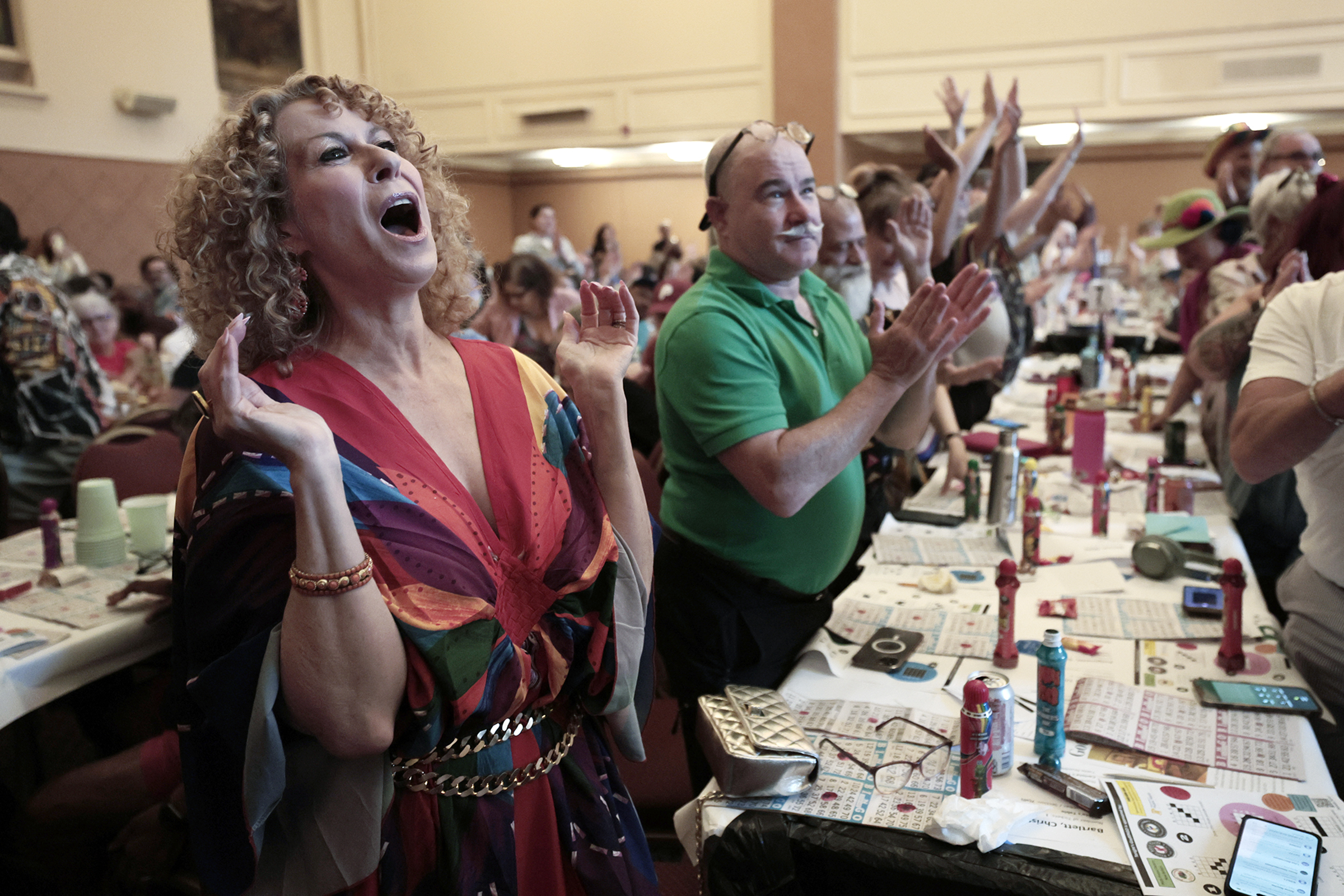
“None of it would have been possible without all of you,” Carlota told the 400-person crowd — the biggest turnout in years — at her last Gay Bingo on June 13 in the basement ballroom at Congregation Rodeph Shalom. “In the ’90s there was horror happening, and today there is horror happening.
“But please, let’s do some laughing,” Carlota said.
“Let’s play bingo!”
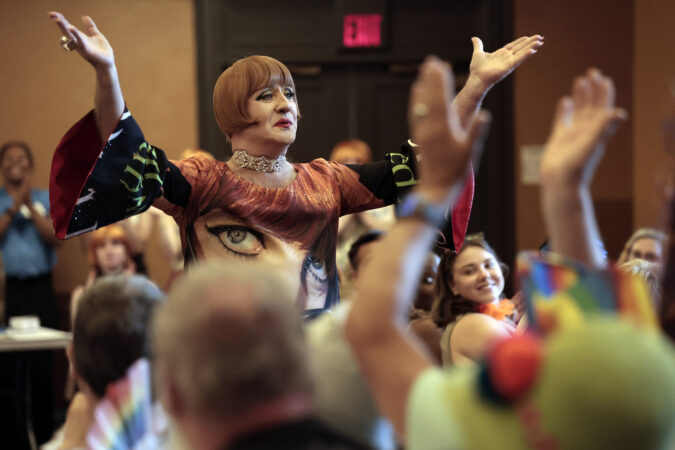
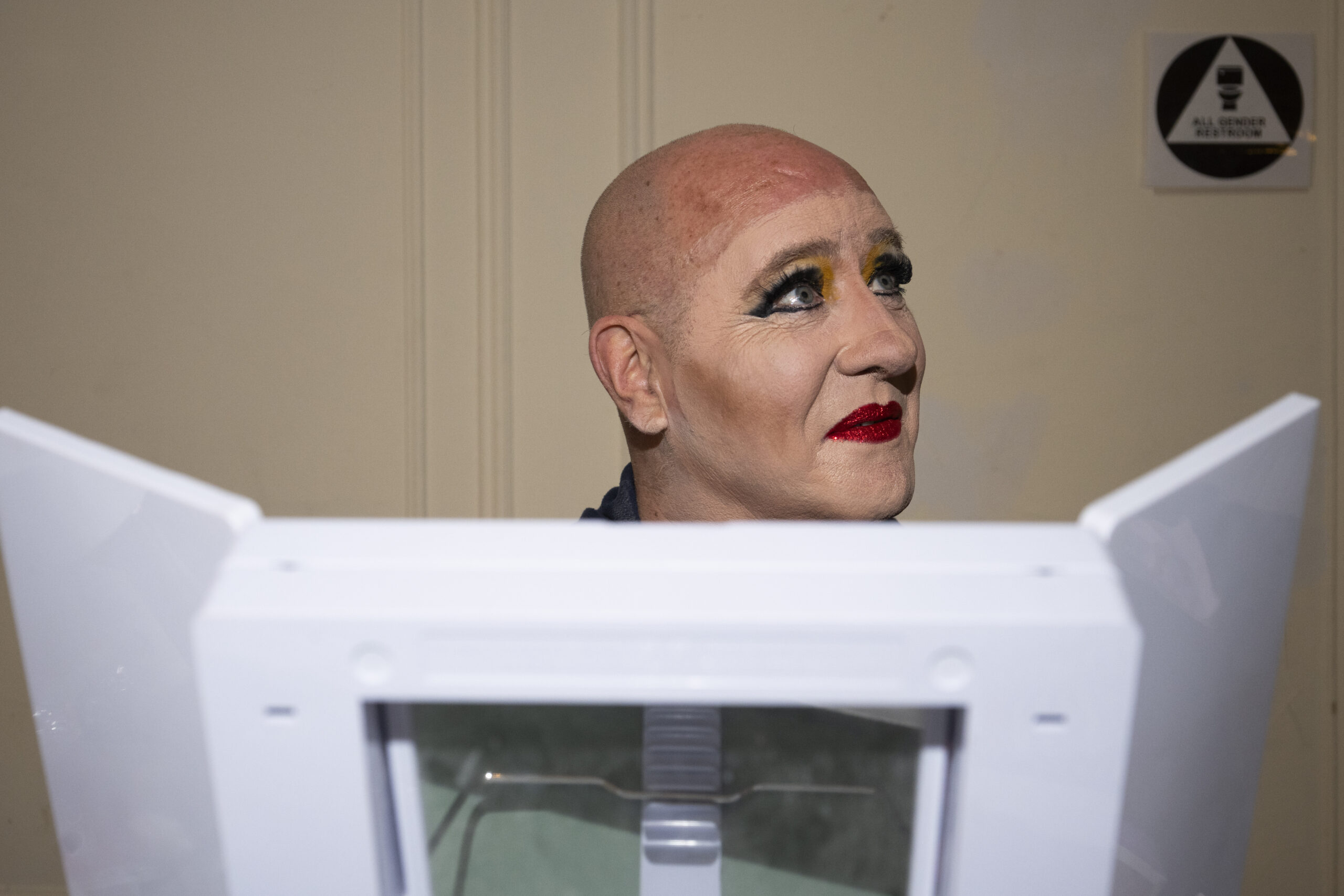
Michael Byrne, as his drag persona Carlota Ttendant, during Gay Bingo on Saturday, May 9, 2026, at Congregation Rodeph Shalom in Philadelphia.
Act I
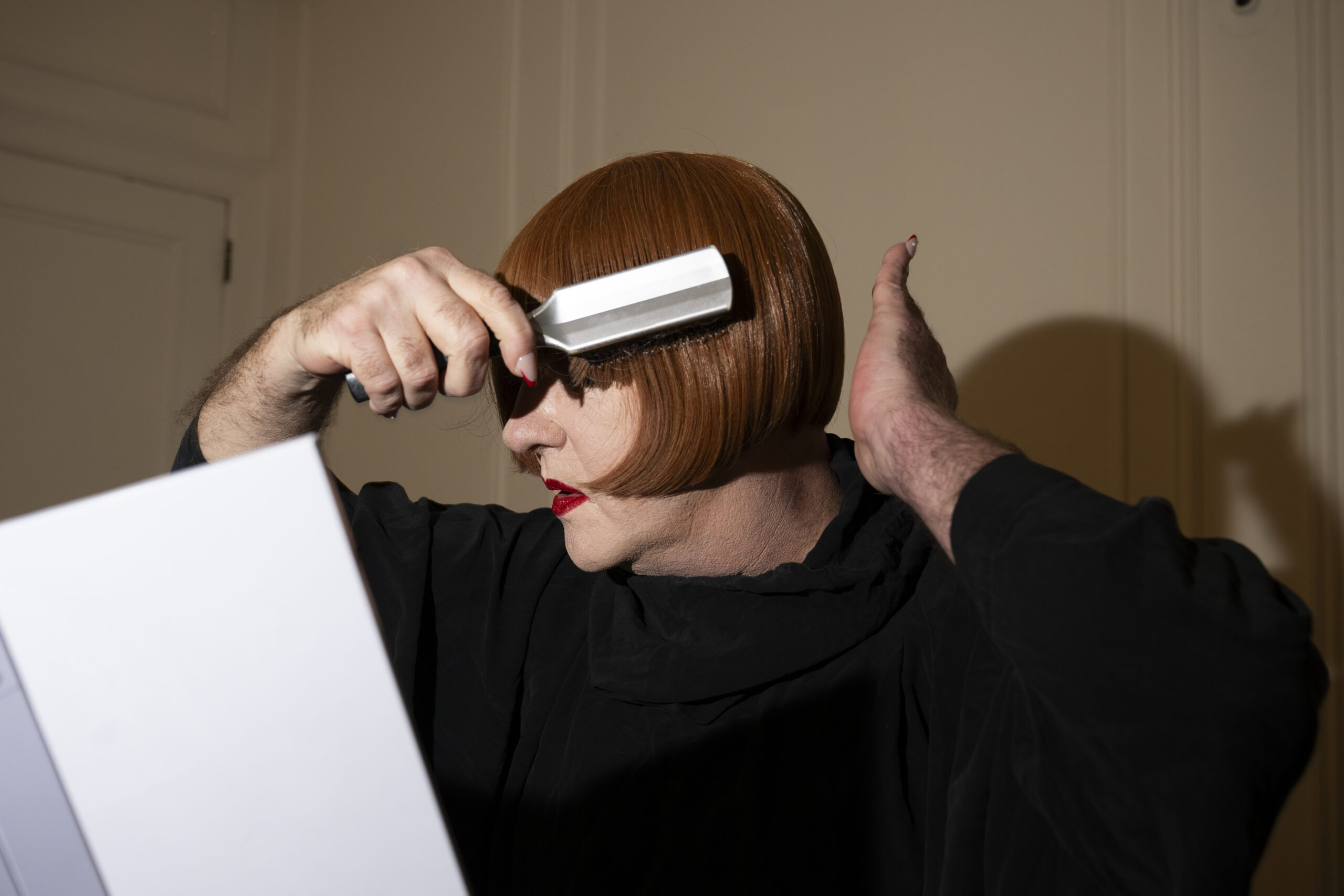
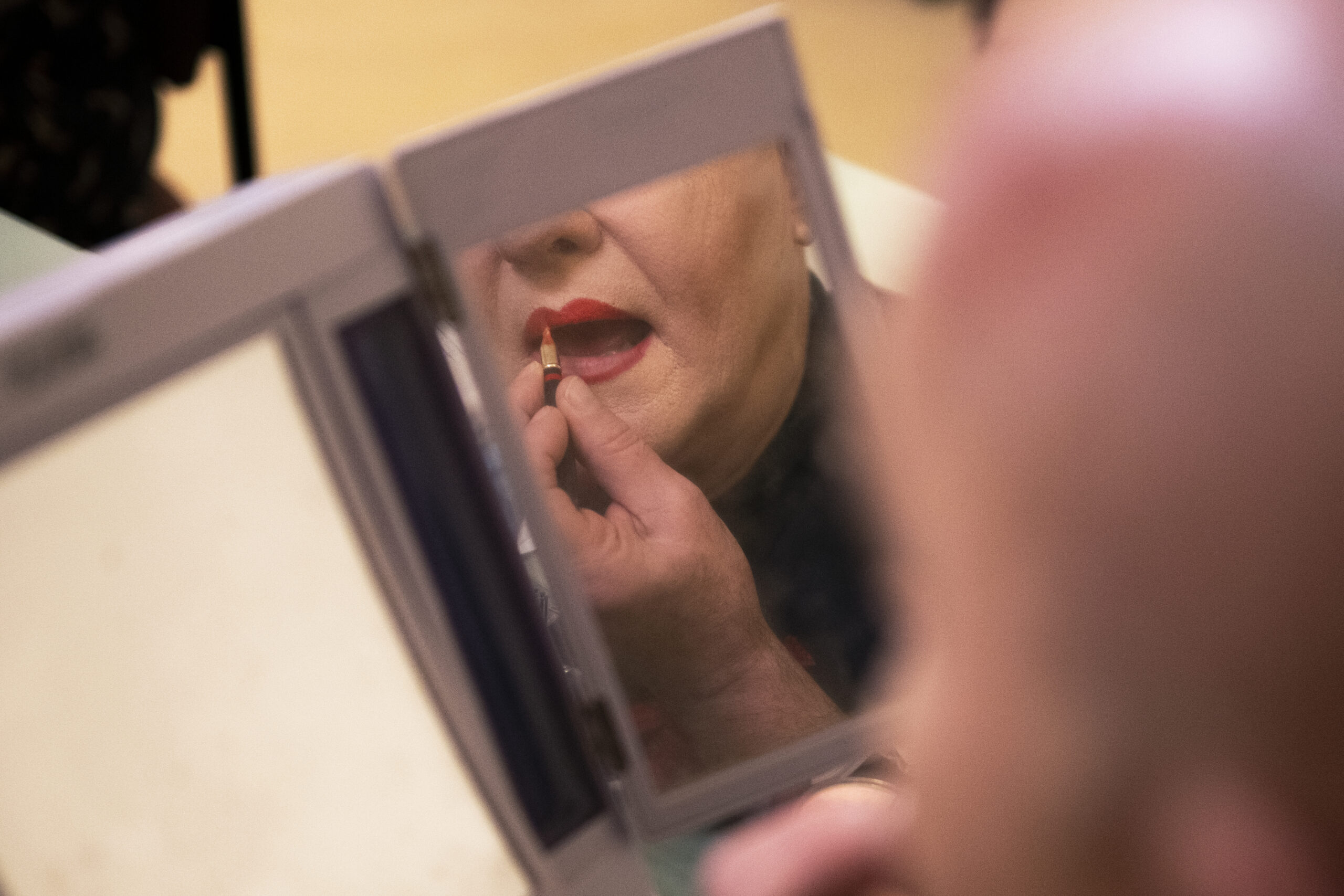
Like so many Saturdays before, Byrne, on June 13, slathered his face with foundation, carved out his cheeks, deepened his eyes, and painted on his red lip. There was haze — from the dusting of loose setting powder, bronzer, and blush — and musk — from sweat and heat and hairspray — in a Rodeph Shalom classroom, which moonlights as a bridal suite and a boudoir for the Bingo Verifying Divas or BVDs. At 10 minutes till curtain, he futzed with his press-on nails, shimmied into a mod swing dress, straightened the back seams of his tights, and dabbed on some glitter. With each gender-bending step, he transformed into his “twin sister,” Carlota.
Michael Byrne transforms into his drag persona Carlota Tendant ahead of Gay Bingo on May 9 at Congregation Rodeph Shalom in Philadelphia.
Like all classy ladies, Carlota’s exact age is lost to time. In the 1990s, Byrne was organizing a fundraiser for Big Mess Theatre, an avant-garde troupe that he helped establish as the spinning axis of Philadelphia’s alternative performance scene, complete with vaudeville acts, an oompah orchestra, and live auction with a striptease routine. Byrne was to host and make his drag debut, and Carlota Ttendant (read as car lot attendant) was conjured up over bourbon and blackjack. (He learned, years later, that there was a ’60s stripper at the famed Trocadero Theatre with the same name.)
Byrne never aimed to create a perfect, feminine illusion with Carlota. He left his chest unshaven and unstuffed, but short, thrifted dresses showed off his long and feminine legs. Carlota’s makeup was an extension of the exaggerated theater paint Byrne, who has been on stages since he was 10, knew; cheap wigs hid his sideburns. Nothing could mask his deep, raspy, anything-but-ladylike voice.
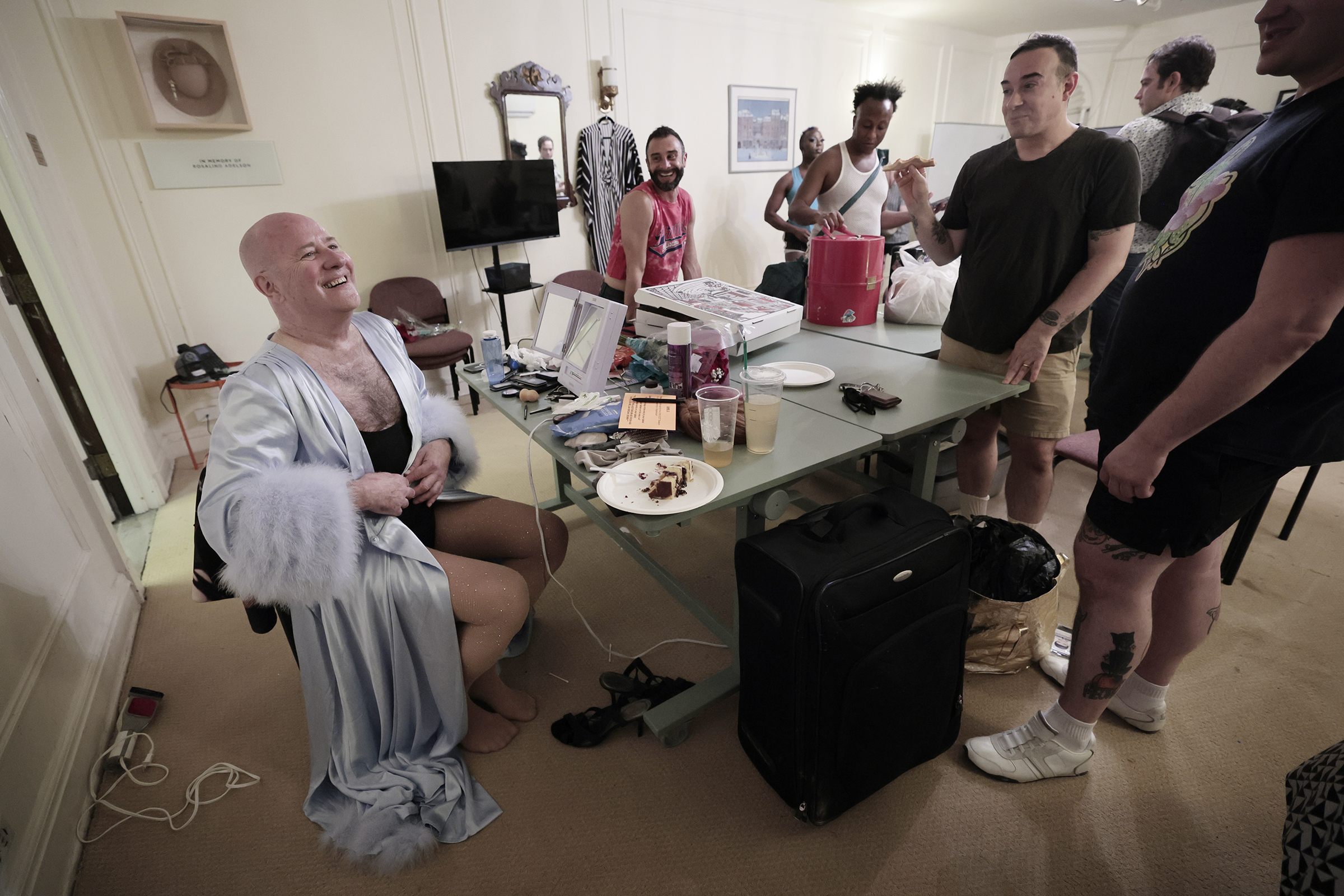
Carlota Ttendant (Michael Byrne) (at left) laughs with friends and fellow performers after Carlota’s final evening cohosting Gay Bingo at Congregation Rodeph Shalom in Philadelphia on June 13. Michael Byrne transforms into his drag persona Carlota Ttendant ahead of Gay Bingo on May 9 at Congregation Rodeph Shalom in Philadelphia.
Carlota could be bossy and profane but never vulgar; she could poke fun at audiences without being cruel. She became the “drag queen you could bring your grandma to,” Byrne said.
Around the time Carlota came to be, the number of new AIDS diagnoses and deaths peaked in Philadelphia. In 1992, new AIDS cases surpassed 1,500; in 1994, AIDS deaths topped 900, according to city data.
(function(){function e(){window.addEventListener(`message`,function(e){if(e.data[`datawrapper-height`]!==void 0){var t=document.querySelectorAll(`iframe`);for(var n in e.data[`datawrapper-height`])for(var r=0,i;i=t[r];r++)if(i.contentWindow===e.source){var a=e.data[`datawrapper-height`][n]+`px`;i.style.height=a}}})}e()})();
Misinformation about the disease, which strips the body of its natural defenses and leaves it vulnerable to life-threatening infections and ailments, was rampant. People alienated gay men, wrongly fearing HIV/AIDS could be transmitted through a handshake, a hug, or across a dinner table, The Inquirer and Philadelphia Daily News wrote. Diagnostic testing took weeks; what rudimentary treatments were available sometimes made people sicker; and HIV often progressed to AIDS within a few years.
“It was not unusual to have people dying every month,” said Kevin Burns, who as a case manager with the nonprofit ActionAIDS (now called Action Wellness) connected clients to hospice care. Burns later served as Action Wellness’ executive director.
The need for resources was rife, and in 1996, Philly’s nonprofit AIDS Fund set out to supplement the money it made from its annual AIDS Walk, according to Sandra Thompson, former chair of its board of directors. An article in City Paper about an irreverent bingo-drag night sweeping Seattle — which, by one report in the Seattle Times, raised $10,000 a night — caught the attention of Mark “Chumley” Singer, then a fledgling events producer, who pitched the idea to the AIDS Fund. (The fund folded in 2024 due to the decrease in new AIDS cases, and turned ownership of Gay Bingo over to Action Wellness.)
Singer recalled thinking at the time: “I’ve been doing sad, mopey, candlelight vigil fundraisers. … Why can’t we raise money and have fun?”
Singer and Byrne had never met before the latter was tapped to host Gay Bingo, but their chemistry was kismet.
“There was never a show where we weren’t having more fun than everybody,” said Singer, who cohosted until the early aughts. Byrne and Singer left Gay Bingo around that time, but Byrne later returned.
Byrne remembers the magic of those early years of Gay Bingo. He remembers when 600 seats would sell out in 10 minutes, and he remembers doing his glittered red lip from the floor of the Gershman Y’s mirrored dance studio. He remembers two-show Saturdays and how six hours in heels would make him catatonic on Sunday. He remembers riffing with and ribbing Singer and the laughs their off-color jokes and mild profanity elicited. He remembers the constant movement of the bold and bawdy BVDs, on Rollerblades, or the electricity when O-69 was called and hundreds stood up, shaking and shouting with the fervor of their libidos.
But Byrne also remembers the solemn moments: the steelworker who told a documentarian about watching his bodybuilder son become emaciated; the families who sponsored games on the anniversary of their loved one’s death; the pharmacist who learned all he could about HIV drugs; Byrne’s own friends who were infected.
“Our community was in crisis,” Byrne said, “while we focused on it, we also focused on being fun and laughing.
“And we all needed that at that point.”
Act II
The “Rainbow Bombshell” Gay Bingo on June 13 doubled as a Pride extravaganza and an homage to all things Carlota. Her first outfit of the night was crafted from a promotional banner from her years hosting the Philadelphia Orchestra’s Halloween Concert. Alongside her, the BVDs dressed as Big Mess-era Carlota, Norma Kamali-inspired Carlota, Phillies Carlota, and fuzzy caftan-wearing Carlota. Attendees, ushers, volunteers, and even the American Sign Language interpreter wore that signature red bob — wigs that Action Wellness bought in bulk. One wore a T-shirt that read, “Dibs on the ginger.”
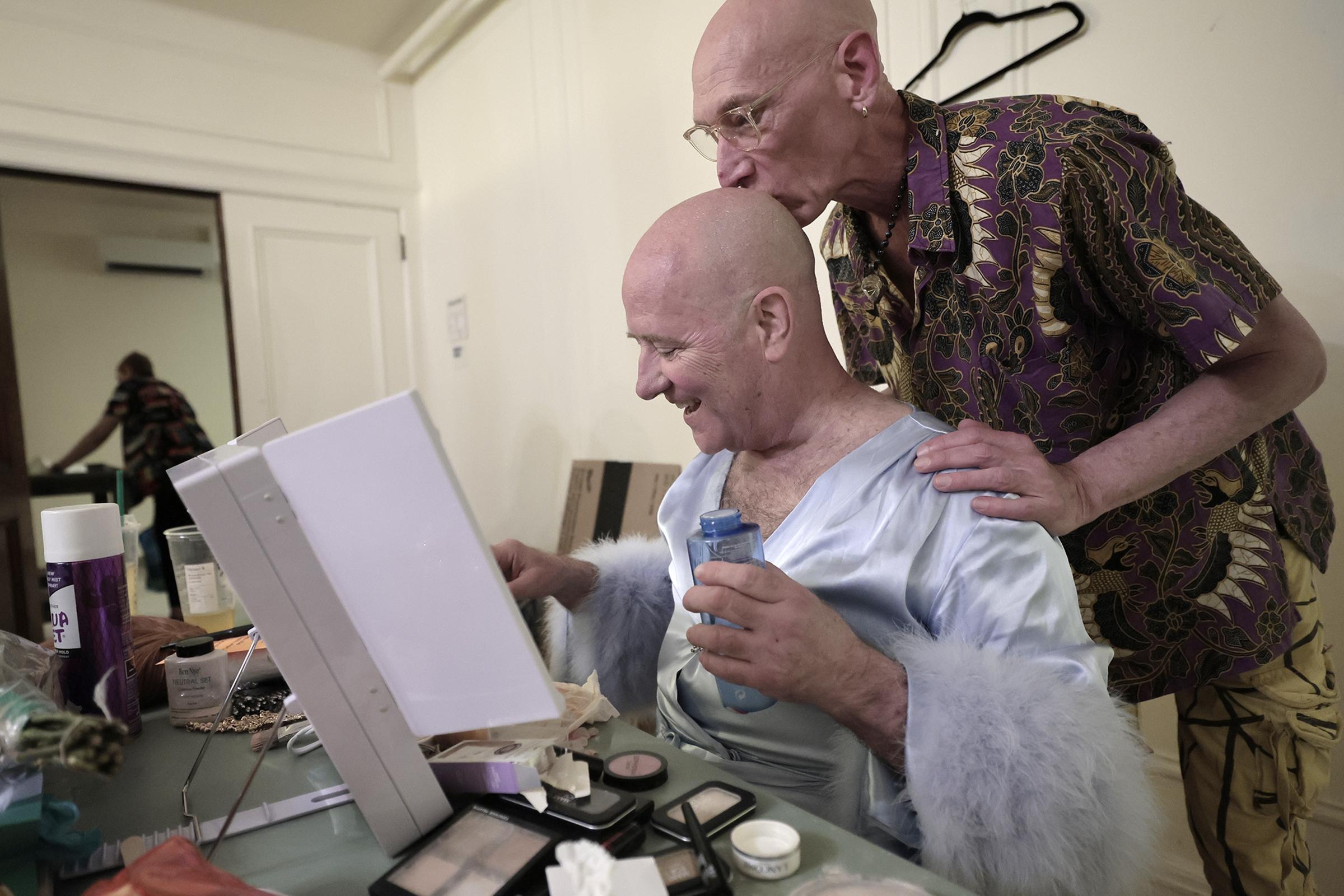
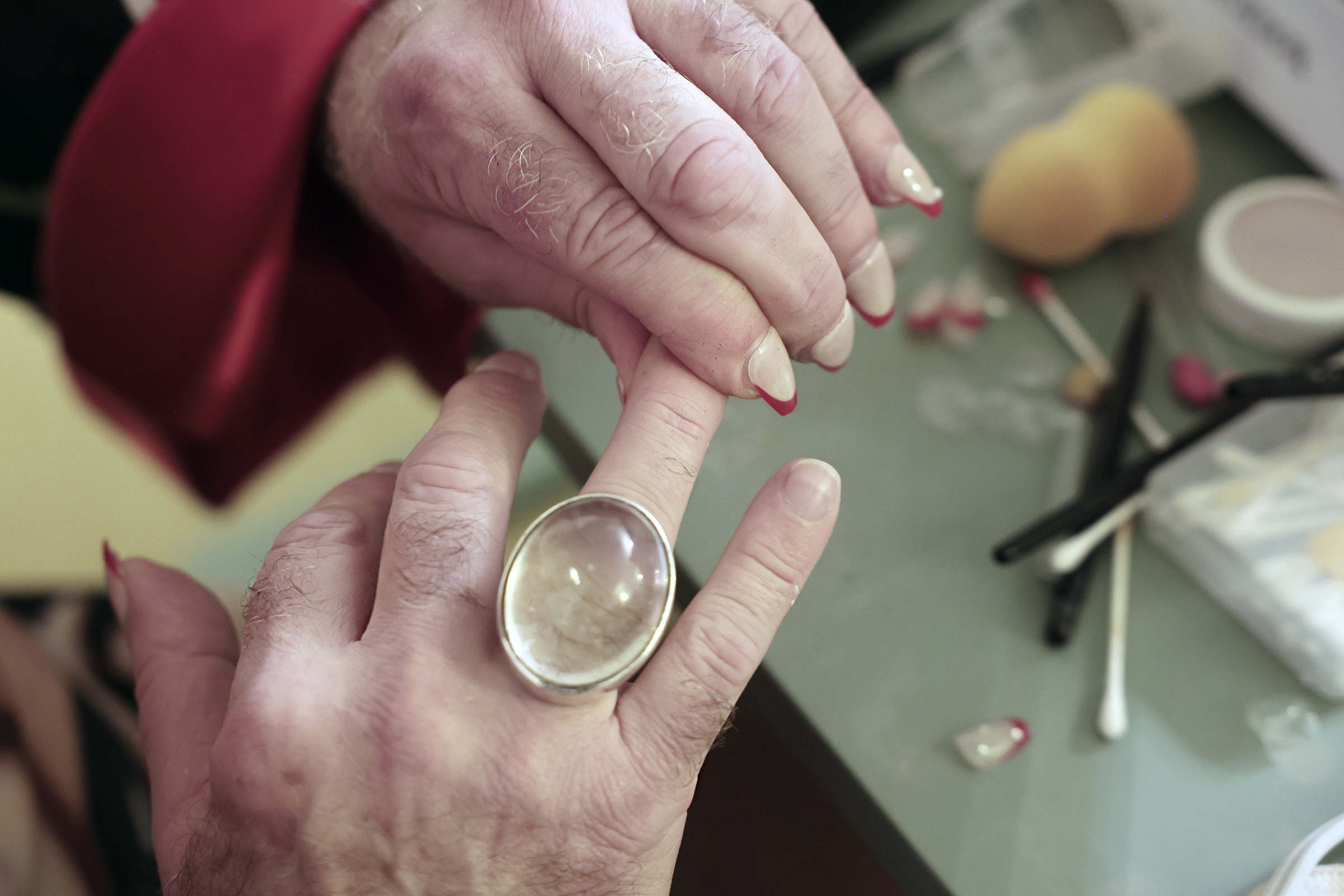
In the dressing room, Tess Tickle (Paul Struck) kisses Carlota Ttendant (Michael Byrne) on the head after Rainbow Bombshell Gay Bingo at Congregation Rodeph Shalom in Philadelphia on Saturday, June 13, 2026. “I love him” said Struck as he walked out of the dressing room.Carlota Ttendant (Michael Byrne) puts on a favorite crystal ring and fake nails before cohosting Rainbow Bombshell Gay Bingo on June 13.
“Are we ready to win some money?” Carlota said, hyping up the crowd before the first of 12 rounds of bingo. Councilmember Rue Landau, the Philadelphia City Council’s first openly LGBTQ+ member, called the first game:
I-28.
I-26.
G-52.
B-14.
O-63.
B-3.
“Bingo!” someone cried out, as the audience let out an audible wave of disappointment, exasperation, and defeat, and the BVDs rushed over to authenticate.
“Did you just get bingo, girl?” Carlota wisecracked.
For 30 years, these Gay Bingo players have pledged each month to “keep on playing Gay Bingo until this crisis is over.” And today, HIV/AIDS deaths and new diagnoses have stagnated, according to the most recently available health department data, and drug cocktails have made it so people with HIV can live long, healthy lives and may never pass the disease onto others or have their illness advance to AIDS. Preventative medications, like PrEP, can also dramatically decrease the risk of becoming infected.
Michael Byrne, as his drag persona Carlota Ttendant, on May 9 at Congregation Rodeph Shalom in Philadelphia.
But there are still obstacles to ending the epidemic. HIV/AIDS disproportionately affects Black and brown communities and low-income people who experience barriers to healthcare, according to Action Wellness executive director Mary Evelyn Torres. The geographic disparities are also stark: Current drug regimens may be readily available in well-resourced countries, like the United States, but access is scarce in the world’s vulnerable pockets. These problems have only been exacerbated by President Donald Trump’s proposed cuts to domestic and foreign HIV/AIDS programs. The withdrawal of American dollars overseas, United Nations officials warned, could lead to more than 4 million AIDS-related deaths and 6 million more HIV infections by 2029.
(function(){function e(){window.addEventListener(`message`,function(e){if(e.data[`datawrapper-height`]!==void 0){var t=document.querySelectorAll(`iframe`);for(var n in e.data[`datawrapper-height`])for(var r=0,i;i=t[r];r++)if(i.contentWindow===e.source){var a=e.data[`datawrapper-height`][n]+`px`;i.style.height=a}}})}e()})();
“We’ve come a long way, but there’s still work to be done,” Torres said, “and that work is being threatened by this administration.”
As the epidemic has changed, so has Gay Bingo: The money raised — more than $5 million since its inception — now goes toward Action Wellness’ social services and programming. The BVDs ditched their roller skates at the Gershman Y (because of the new, carpeted venue). Tickets cost $50-$60, compared to $10-$12 in May 1996, and these days, attendance averages between 150 and 200 a month.
Drag has evolved, too. Spending centuries on the periphery as proto-punk-beatniks and after-midnight acts, queens disrupted and challenged the mainstream with wit and wonder. Then, the exploding popularity of RuPaul’s Drag Race, a drag reality-TV competition, seismically changed the culture, snubbing scrappiness for silicon and kitsch for couture. The show ushered drag into the zeitgeist: Its lingo became commonplace and its contestants turned into social media stars, with businesses, makeup brands, books, and podcasts, as the art form continues to face political bans and threats nationwide.
The show “has taken everything to a whole other planet,” Byrne said, “and that’s amazing and that’s really great.
“That’s also not what I do.”
Carlota was never concerned with “affecting female mannerisms” or “trying to be this woman or this drag queen,” Singer said. To Byrne, she’s come to embody the fiercest, most unafraid, and righteous versions of himself. But “Michael was never far from Carlota,” Singer said.
Janie Lopez of Philadelphia cheers for her friend Carlota Ttendant during Gay Bingo at Congregation Rodeph Shalom.
To those who know Byrne, Carlota’s come to represent someone purer and more singular, a testament to what joyful resistance and defiant resilience can achieve amid tragedy. Her ingenuity and authenticity have made her synonymous with Gay Bingo, according to Action Wellness event planner and cohost Tim Johnson (otherwise known as Stella D’Oro); her playfulness is what’s engaging, Burns said; the safe space she’s cultivated for the queer community is what keeps people coming back season after season, said regulars Cat Johnson, 47, and Katie Dickerson, 38, of Roxborough.
“It’s going to be really different without Carlota,” Johnson said. “No one’s going to fill her shoes, but I think that the vibe and the energy is going to live on.”
“It’s a lot easier to raise money when everyone is having fun,” said Amber Schlesman, 38, of Point Breeze, who’s been coming to Gay Bingo since its Gershman Y days. “And for the shoes, I’m guessing it’s a size 12.”
All those shoes will be donated to Philly AIDS Thrift soon enough, Byrne said.
Byrne’s voice cracked as he thought of the people who made Carlota’s run possible: the AIDS Fund organizers, Singer, the original cast of BVDs, the volunteers, those who came back monthly, the victims, their families. Many sent her off June 13 with a trove of well wishes, notes that read, “thanks for the memories,” and “so proud of all you’ve done.” They told her, “I love you,” and “hang up those high heels, baby.”
At the end of the night, Byrne’s best friend gifted him a throw pillow.
“Don’t be a lady,” it said. “Be a legend.”
Michael Byrne transforms into his drag persona Carlota Ttendant ahead of Gay Bingo on Saturday, May 9, 2026, at Congregation Rodeph Shalom in Philadelphia.
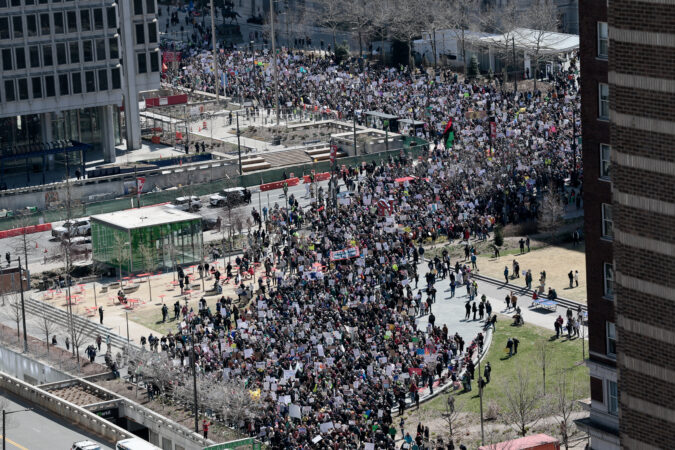
In step with demonstrators nationwide Saturday, thousands took to streets across the Philadelphia region — from Center City, to Ardmore, to Camden — denouncing President Donald Trump, his policies, and his administration.
It was the third No Kings protest in roughly nine months, signaling the breadth of dissent and concern over what protesters see as Trump’s authoritarianism and his attempts to consolidate and expand his power. Protesters condemned the gamut of the president’s agenda, including escalating immigration enforcement, the war in Iran and rising gas prices at home, and the dismantling of foreign aid programs.
“The people in power are making decisions that they won’t have to live through,” said Electra Powers, who brought her Grays Ferry family to the demonstration outside Philadelphia City Hall. “The future they’re setting up for our kids is horrible.”
On a brisk March afternoon, chants reverberated throughout Center City, drums beat in time, and homemade signs swung as participants marched down the Ben Franklin Parkway to a rally at the Philadelphia Museum of Art.
Near City Hall’s north entrance, Meoshe McQueen unfurled a large American flag, a tribute to her father, she said, who served as an airman in World War II.
“My father fought for equality and justice,” the North Philly native said. “The world we live in today threatens that. We want fairness, regardless of a person’s color, creed, or race. None of that matters.”
“We need a world where kids can be safe, and not hauled off based on the color of their skin,” said Pamela Schott of Jenkintown, who held up a sign pleading for “peace and safety” for her grandchildren.
Energy was also building in pockets of the region where Trump has more political capital, and those who oppose the president feel their voices drowned out.
“I grew up in an America where I saw change for the good,” said Betsy Tucker of Bucks County. “Now, I’ve seen that change ripped away.”
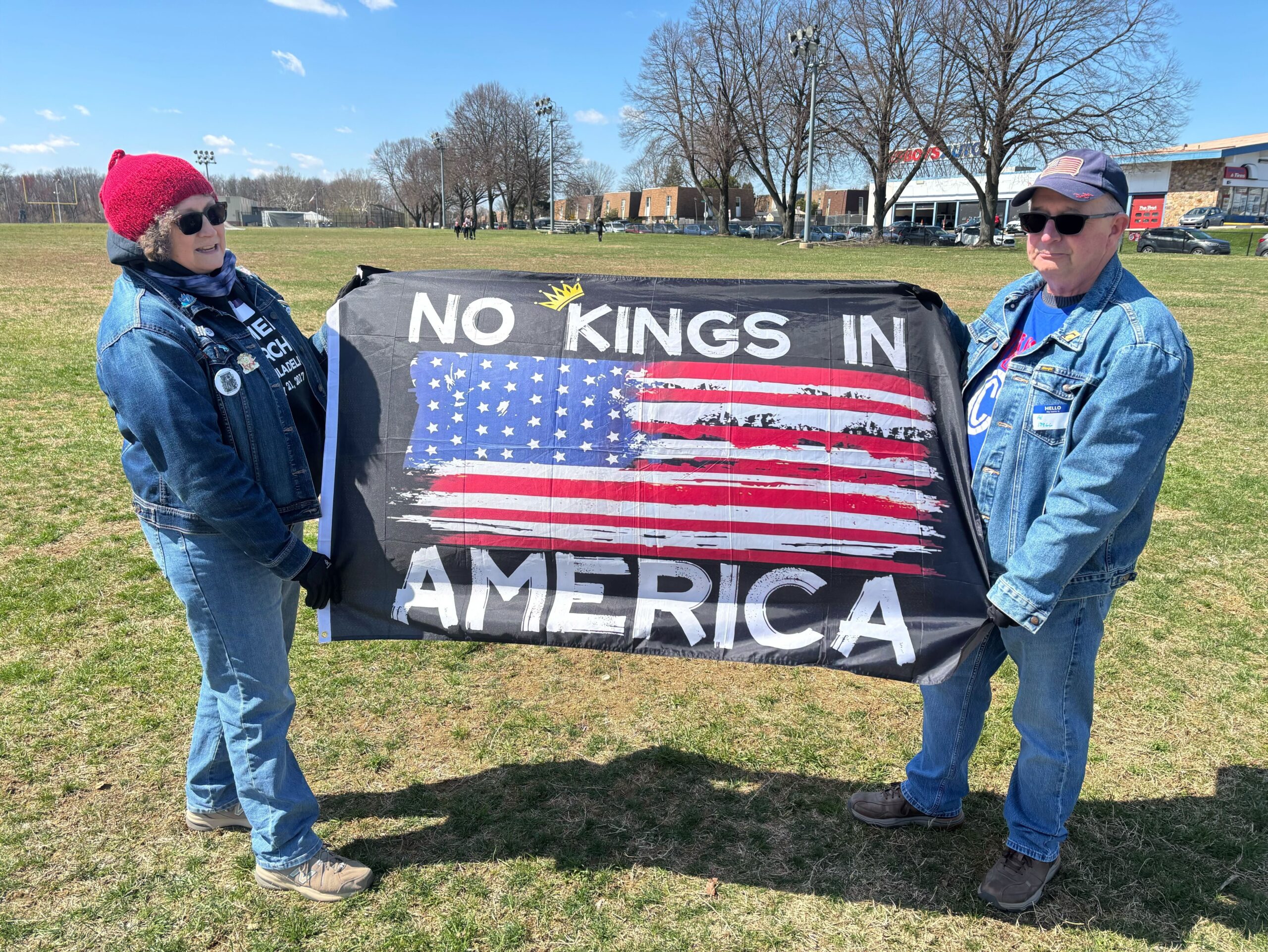
Michelle Dupree, 67, was one of the first of roughly 150 people at the Northeast Philly No Kings rally at Bustleton Field. She had hoped more people would show up in the Northeast.
She was tired. But not defeated.
“It’s important to me,” she said, waving her sign for the modest, but steady stream of drivers, who registered their approval with a honk or three. “My knees hurt. My back hurts. It’s so frustrating to be at home and to watch the news — you want to scream. You want to be heard.”
Olivia Hayes was among a couple thousand ralliers in Ardmore. Hayes was cheered by reports of robust crowds at No Kings events in other suburban spots, like Wayne and nearby Havertown. For a few hours, at least, a sense of pride pierced the anger and hopelessness, she said.
“It’s great to see such a community,” she said. “When you’re in your day-to-day life, and not around so many people, it can be hard to have hope.”
Betsy and Al Tucker attend the Northeast Philly No Kings protest on Saturday.
Across the river, Camden hosted its first No Kings protest (previous events were held in Collingswood and Haddon Heights). The change in locale was driven by increased immigration enforcement and presence in the area, said Michele Messer, of Cooper River Indivisible. Camden city’s population is about 54% Hispanic, according to U.S. Census data. Last month, a nearby ICE operation made a group of Camden County fourth graders and fifth graders run away from a bus stop in a panic, according to the Lindenwold School District.
“We’re a united front,” she said, “no matter where you land on the political spectrum, we need to work together and build coalitions to fight back against what this administration continues to try to pile on us.
“And the stronger that fabric, the stronger we’ll be.”
In a statement to the Associated Press, the White House dismissed the nationwide protests as the product of “leftist funding networks” with little real public support.
Center City attendees said the sense of urgency is growing.
“We wanted to show our support for the movement,” Peter Maiolino said. “If we weren’t outraged last time, we definitely are now.
“Things have only gotten worse.”
In a video message to the crowd, U.S. Rep. Brendan Boyle — who was stuck in Washington, D.C., as congressional leaders haggle over the partial government shutdown, which has forced Transportation Security Administration employees to work for weeks without pay — encouraged people to continue their protest, even after the rally concluded.
“This is a fight we cannot lose, but we need to be crystal clear about what is that stake in this country,” Boyle (D., Philadelphia) said. “Our president is more concerned about building his ‘big beautiful ballroom’ than he is about the poor and working-class people in this country.”
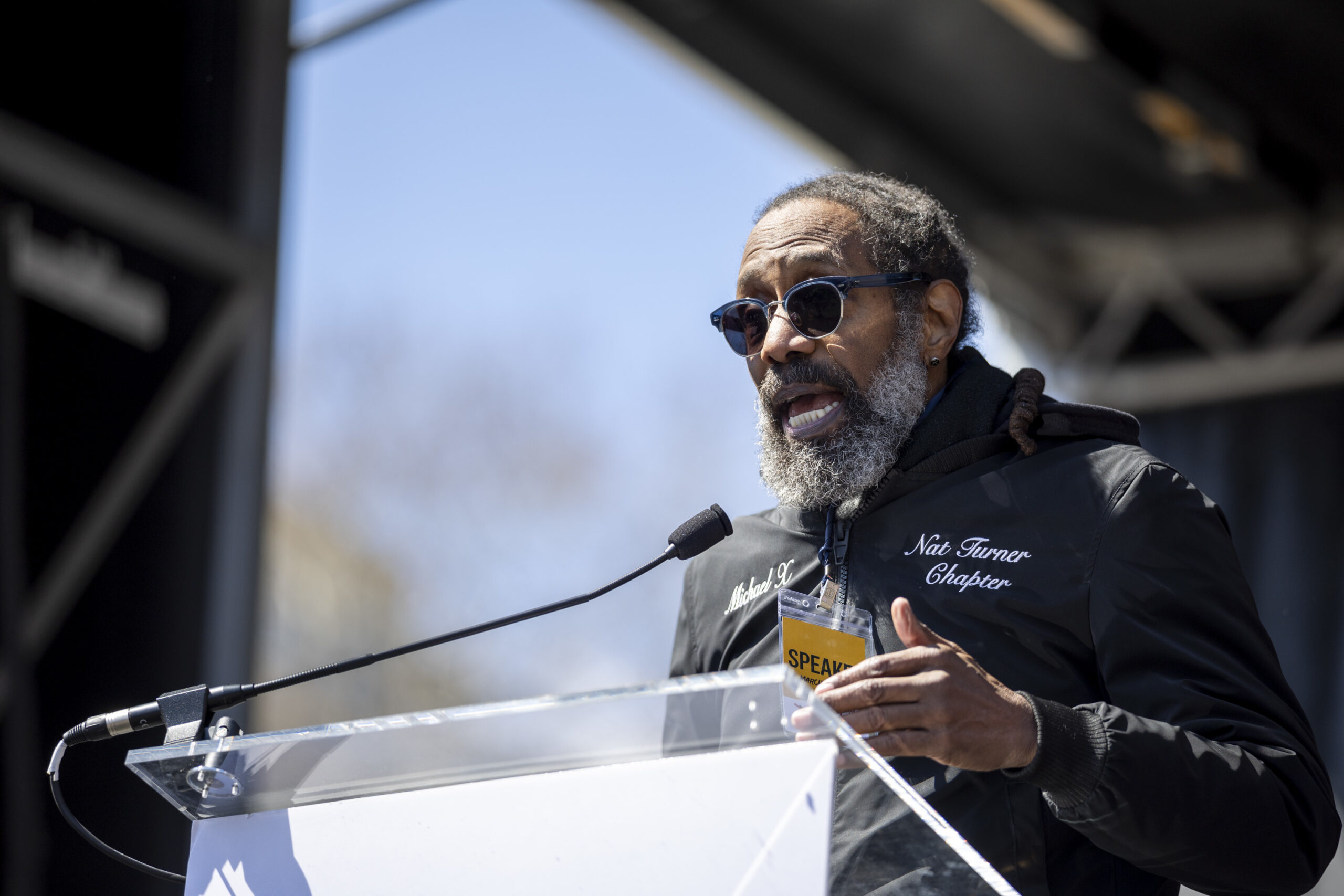
Avenging The Ancestors Coalition (ATAC) leader and attorney Michael Coard echoed Boyle’s sentiments, calling the attendees “the revolution.” ATAC stewarded the President’s House Site on Independence Mall, a slavery memorial removed — and later partially restored by court order — in what some have called an attempt by the Trump administration to sanitize history.
Michael Coard, of the Avenging the Ancestors Coalition, speaks Saturday at the third No Kings rally in Philadelphia.
“When I say fascism, I want you to know that I say it without hyperbole,” he said. “Today America is where Italy was in 1926, but we are not going to do the same. We are going to fight a good fight and we are going to win.”
The No Kings’ trajectory has been atypical compared to other social movements, where enthusiasm historically wanes over time, according to Billie Murray, an associate professor of communication at Villanova University. No Kings has, instead, gained momentum: Organizers say more than 5 million people took to the streets in June, followed by more than 7 million in October. Organizers projected 9 million people would participate Saturday.
“The issues don’t seem to be getting resolved,” Murray said, “people see that as a motivating factor — ‘We have to keep pushing, we have to keep trying, we have to keep organizing.’ … People aren’t seeing the change that they want to see.”
A failed exam and getting cut from University of Rochester’s basketball team led Gov. Josh Shapiro to his first political endeavor: student government.
Decades of politicking later — winding his way from Pennsylvania state representative, to county commissioner, then attorney general, and now the commonwealth’s highest executive — Shapiro says he still looks at leadership through the prism of basketball.
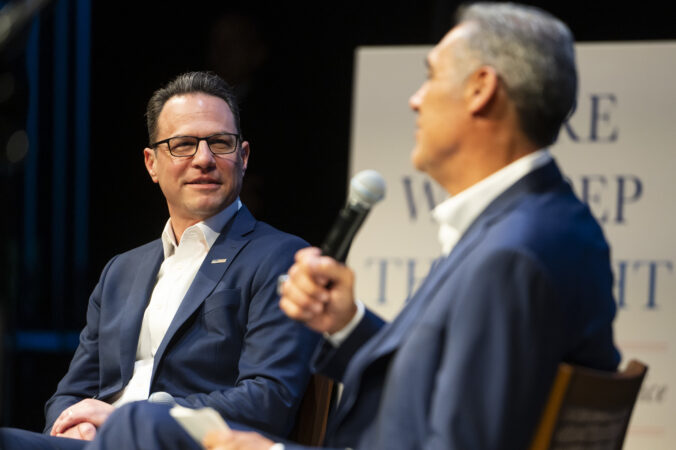
At the latest event to promote his memoir, Where We Keep the Light, Shapiro discussed his love of the sport Saturday evening at Villanova University alongside decorated former men’s basketball coach Jay Wright. While Shapiro is often floated as a likely 2028 presidential candidate, the conversation was largely apolitical, instead focusing on core themes of the book — family, faith, and the governor’s ethos.
Shapiro, once a point guard with a midrange jumper, talked about his “get stuff done” mentality and putting “points on the board” for Pennsylvanians.
“Teams win when every single player, every coach — even the players on the bench who don’t have a role on the floor — each operates at their highest level,” Shapiro said. “My job is to get the most out of myself and all the people around me so we can be successful for others.”
The governor spoke extensively about his propensity to listen: to constituents on the campaign trail; to his wife and children; to his beliefs. Shapiro said his family and Jewish faith have driven him to a life of public service.
A premier Catholic basketball school, Villanova was an apt venue for the event, as Shapiro described how he sees religion as a way to bridge divides. (Shapiro, however, incorrectly identified Villanova as Jesuit — not Augustinian. The crowd jeered, and Wright assured him it was a common mistake. “Even the Catholics don’t know all the orders,” Wright said.)
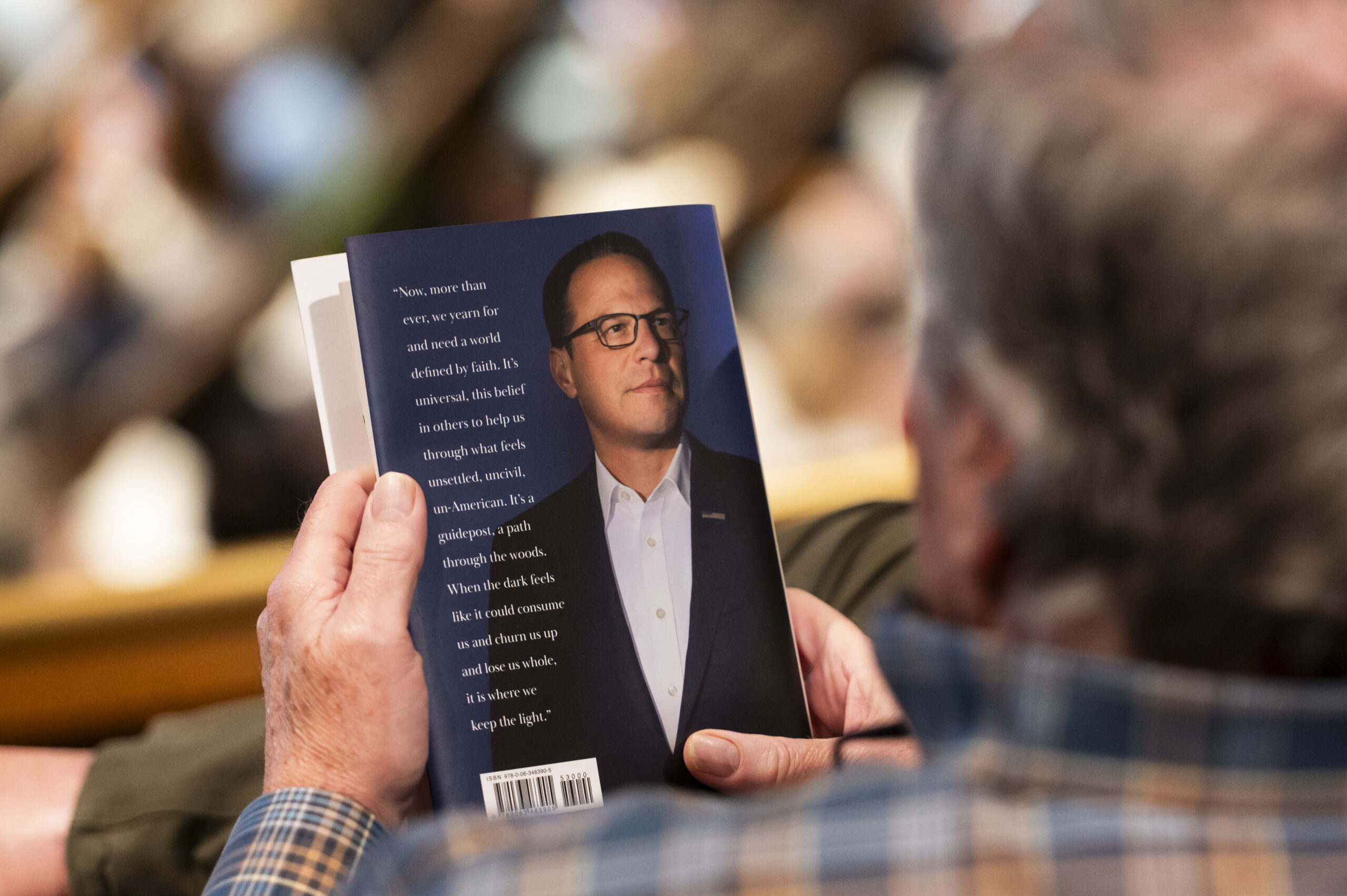
An attendee looks at the back of Gov. Josh Shapiro’s new book, “Where We Keep the Light,” before a book discussion with Jay Wright, former head men’s basketball coach, at Villanova University on Saturday, Feb. 28, 2026.
“By being close to my faith, it allows me to understand people of other faiths better,” Shapiro said. “There’s different ways religions go about their practice, there’s different customs, there’s different ceremonies. But there really is a shared through line of faith.
“Love thy neighbor, feed the hungry, clothe the naked — these are all universal teachings that I think sometimes we end up losing sight of, and frankly, I think that leads to a lot of division in our society.”
“There’s an emotional toll. … [My family] all had to be in,” Shapiro said. “They were all in because you can’t let the bad guys win. We can’t let those who try to intimidate good people from doing this work prevail. You’ve got to stay in the arena, and you’ve got to keep fighting.”
While the conversation largely steered away from politics, Shapiro promised fair midterm elections, discussed views on capital punishment, and touched on civil discourse and unrest nationwide.
“I’m still betting on the people of Pennsylvania — betting on the American people — to help us through this challenging moment that we’re in,” he said. “If the people really continue to rise up, … demand more, seek justice, try and build a world that has more equity in it, eventually politicians are enough to hear those voices, and that’s going to correct our politics. That’s going to help us find more light.”
Staff writer Katie Bernard contributed to this article.
Its size is also a reason the Philadelphia School District wants to shut it down.
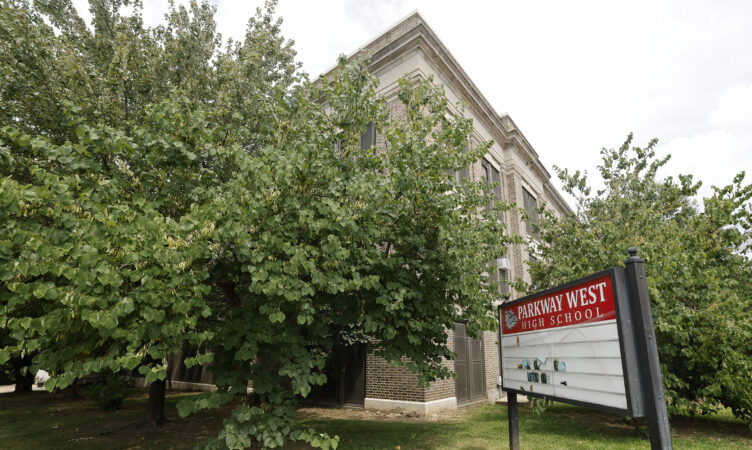
It is among the 20 schools the district is proposing to close, citing its low enrollment. The district plans to merge the Mill Creek magnet school into Science Leadership Academy at Beeber, two miles northwest in Overbrook. That move would dissolve the Parkway West name — and its storied history of alternative education, its supporters say.
Community members say the merger would do away with what makes Parkway West special and successful: the only curriculum in the city tailored for teens interested in becoming early childhood educators, specialty classrooms to support students with disabilities, and intimate class sizes that foster tight-knit relationships. And some say it would unfairly limit school options in West Philadelphia.
“It’s a safe environment — a small school which allows for greater touches, and you just don’t get swallowed up in the size of a big school,” said Earl Morgan, a Parkway West special education teacher who coaches three Hoya sports teams.
Morgan added: “We’re losing a real, safe alternative to private education in West Philadelphia.”
The district’s facilities plan, which the school board is expected to vote on this winter, looks to address systemic issues like declining enrollment, aging infrastructure, and disparate programming in part by targeting some schools with large numbers of empty seats. Parkway West is operating with 140 students, or 40% capacity; its 11th-grade class — possibly its last graduating cohort — has just 18 students. Comparatively, there are nearly 500 students at Beeber, which is 54% full.
Morgan said the proposal poses a “logistical nightmare.” Community members have raised concerns about safety and transportation woes to get children to Beeber. Inside Parkway West, emotions range from indifference to outrage, Morgan said.
The closure would leave “a hole” in the neighborhood, said Cecelia Thompson, a Mill Creek resident and former school board member who regularly interacts with the Parkway West community.
West Philadelphia is now staring down an educational landscape devoid of choice: The number of small, individualized magnet high schools, like Parkway West, in the area would shrink to one, while the district prioritizes reinvesting in neighborhood schools. The proposed school closures would disproportionately affect Black students, according to an Inquirer analysis, though the district says its plan is aimed at boosting opportunities and achievement.
This troubles City Councilmember Jamie Gauthier, whose district includes Parkway West and a handful of other schools affected by the plan.
“It feels like they’re hollowing out my district,” Gauthier said. “They’re essentially shuttering criteria-based schools that people value and that are accessible to Black and brown children in West and Southwest Philadelphia. They’re completely taking it away … or dumping them into much larger schools that are not going to provide the experience that people want.
“Those kids deserve to have high-quality options right where they live.”
The Parkway model was a pioneering approach to alternative education, hallmarked by nonconformism, wandering classrooms, and a casual, personable learning environment where students called teachers by their first names, alumni told The Inquirer. Shaunda Watson graduated from Parkway Gamma, which later became Parkway West, and said the program took her from a C average to honor-roll student.
“Students like me will get lost in larger classrooms,” Watson, 48, of West Philadelphia, said. She added: “We have students that are exceptional and they will get lost in the sauce if they have to go to neighborhood schools. I don’t think that’s fair.”
For Gamma graduate Shannon Sherrod, 54, of Delaware County, preserving the model is more important than the name: “It’s bittersweet. I hate to see it die off,” Sherrod said.
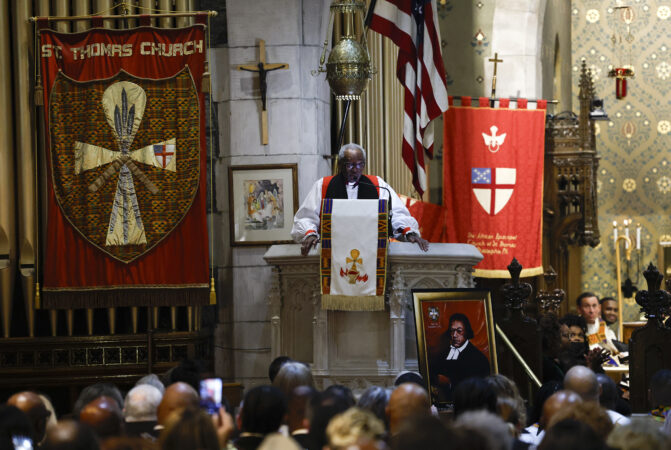
This year’s celebration of African Episcopal Church of St. Thomas’ founder, the Rev. Absalom Jones, was intrinsically political.
Parishioners on Sunday overwhelmed the pews at the Overbrook Farms church for the annual event honoring Jones, the first Black ordained Episcopal priest. But this year’s service took on new meaning after Jones’ legacy was stripped from the President’s House historical site on Independence Mall, the church’s rector said.
Last month, the National Park Service dismantled the exhibit memorializing the lives of nine people enslaved at the nation’s first presidential mansion. The illustrative displays chronicled the Atlantic slave trade and President George Washington’s dogged support for the institution. They also elevated early influential Black Philadelphians, like Jones and contemporary Richard Allen. The site was a casualty of President Donald Trump’s push to remove all content that “inappropriately disparages Americans past or living” from federal land — what many have called an attempt to sanitize history by omitting the brutality of slavery from the narrative.
But Curry’s prevailing message was clear: Fight through the vicissitudes. Curry, former presiding bishop and primate of the Episcopal Church, is the first African American presiding bishop in the country.
“If you want to taste freedom, if you want America to be just again,” Curry said, “if you want an America where every person is a child of God, where there is freedom and justice — not just for some — but for all … don’t you quit. Keep going, keep going.”
Curry later added: “If we love America, change America.”
The late afternoon service also featured young singers from Minnesota, faith leaders from other prominent Philadelphia institutions, and descents of the Rev. Allen.
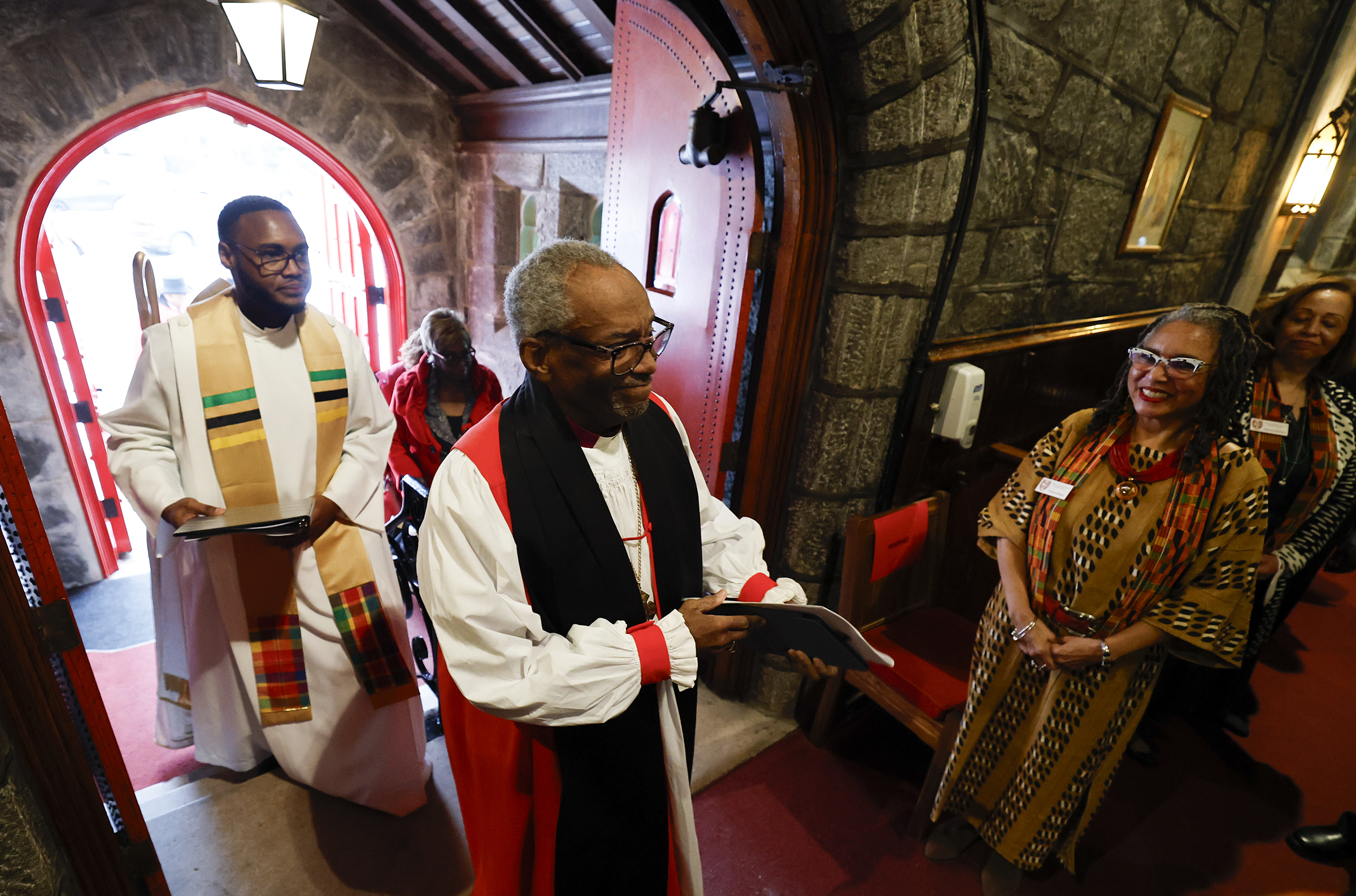
The Rt. Rev. Michael B. Curry (center) walks into the African Episcopal Church of St. Thomas before providing the sermon in the celebration of the life and ministry of the Rev. Absalom Jones on Sunday.
Jones and Allen, former slaves who became lay preachers in the 18th century and together created the benevolent Free African Society, were forced out of St. George’s Methodist Church general congregation and forced to worship in segregated pews. Jones went on to form St. Thomas, while Allen built Mother Bethel A.M.E. Church.
The men’s names and history were invoked throughout the President’s House Site. A panel titled “How Did Enslaved People Become Free?” discussed Jones’ and Allen’s experience at St. George’s, their respective parishes, and how they organized against slavery.
The erasure of the site — which captured the somber paradox of a young America that exalted freedom for some but deprived others — comes ahead of the country’s Semiquincentennial celebrations putting Philadelphia in the national spotlight.
“It brings a totally different emphasis and focus on the celebration this year at the church,” the Rev. Martini Shaw, St. Thomas’ rector, told Episcopal News Service. “But while some want to erase history, we in the church are prepared to celebrate history.”