Author: Fallon Roth

  • Why there’s less controversy — and less money — in this year’s school board races in Central Bucks and elsewhere

    Why there’s less controversy — and less money — in this year’s school board races in Central Bucks and elsewhere

    Personal attacks, political division, and culture wars have defined school board races in the Philadelphia suburbs in recent years.

    But 2025 feels different.

    Even as national politics are more divided than ever — and amid a federal shutdown and state budget standoff — local school board candidates from both parties are shying away from partisanship in favor of focusing on local issues like taxes and full-day kindergarten.

    The change in posture can be attributed to several factors — Republicans who ran on culture-war issues largely lost in 2023 and, while the GOP is now tackling those priorities from the federal level, local candidates said they cannot control what President Donald Trump does. Schools are also facing pressing fiscal issues amid state and federal budget cuts.

    There are some exceptions. In Souderton, candidates on the Republican slate say they want to maintain the district’s current policies that prevent transgender girls from playing sports and prioritize “parental rights” — stances Trump has also embraced. Some Democratic candidates, meanwhile, say Trump’s education policies, including plans to dismantle the federal Department of Education, motivated them to run.

    Still, those issues are not taking center stage across the Philadelphia collar counties.

    “School districts are struggling financially,” said Brittany Crampsie, a Democratic consultant. Parents “don’t want to have a debate about DEI [diversity, equity, and inclusion] anymore, they want to make sure their kids are getting a good education.”

    Moving on from ‘culture wars’ — for the most part
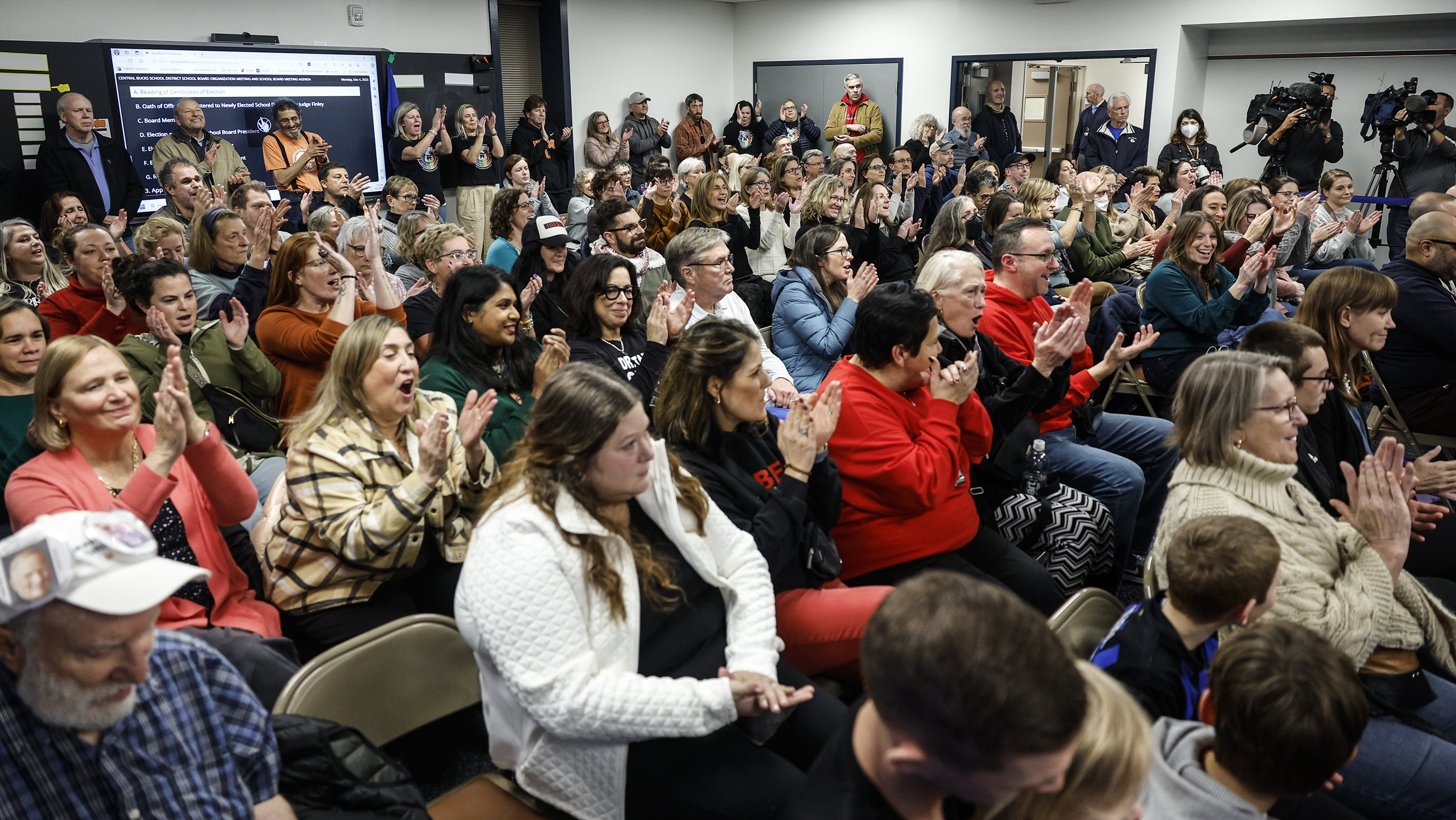
    Supporters cheer in 2023 before five new Central Bucks school members are sworn in. Democrats seized control of the board in a contentious race.

    Culture-war debates reached a fever pitch in the aftermath of COVID-19, as conservative parents voiced frustration over pandemic protocols and classroom curricula. Republicans in districts like Central Bucks won contentious races focused on those issues in 2021.

    Two years ago Central Bucks was again among the most closely watched races in the region, with spending surpassing $600,000. Democrats swept every open seat, ousting a conservative majority that had banned books and Pride flags in the district. Other suburban districts flipped to Democratic control as well.

    Now, candidates are steering clear of those hot-button topics.

    “My campaign is focused on academics, school taxes, and safety….these are the current issues of concern in Central Bucks,” Betty Santoro, a Republican, wrote in an email.

    The Democratic candidates for Central Bucks school board: Amanda O’Connor, Katrina Filiatrault, David Comalli, and Daniel Kimicata (left to right).

    Culture wars were a “distraction” from priorities for the district, said Daniel Kimicata, a Democrat running for reelection. Four of nine seats are on the ballot this year; Democrats will maintain their majority regardless of the outcome.

    Andrew Miller, a Republican running in Central Bucks, wrote in an email it’s good that things are quieter. “People are tired of the shouting and want results,” he wrote. “They want candidates who listen, not lecture and candidates who build bridges, not walls.”

    In Souderton — where Democrats say they are optimistic about their chances of gaining representation on the all-Republican board — the Republican platform also includes parental rights and student safety.

    Republican board president Stephen Nelson, who is running for reelection, said that culture-war topics are not an issue in the district, but that it would not allow transgender athletes to compete on girls sports teams should the situation arise. (The Pennsylvania Interscholastic Athletic Association this year changed its transgender athlete policy to comply with President Donald Trump’s executive order on “Keeping Men Out of Women’s Sports.”)

    “Why is that a question? It’s always been that way and we don’t quite understand why it has to be any different,” Nelson said.

    In Pennridge, where the board is Democratic-controlled, Republican candidates, in a statement, pushed back on the idea that school board races in the past centered on issues promoted by Republicans. Instead, they argued, GOP candidates were responding to Democratic-initiated policies and questioning some DEI policies and whether they were best for students.

    “Our intent was never to divide but to ensure that schools serve all students equally and that classroom priorities remain rooted in education, not ideology,” they said.

    Money, money, money

    This year, there is far less money flowing into school board races, though Central Bucks continues to attract outside fundraising.
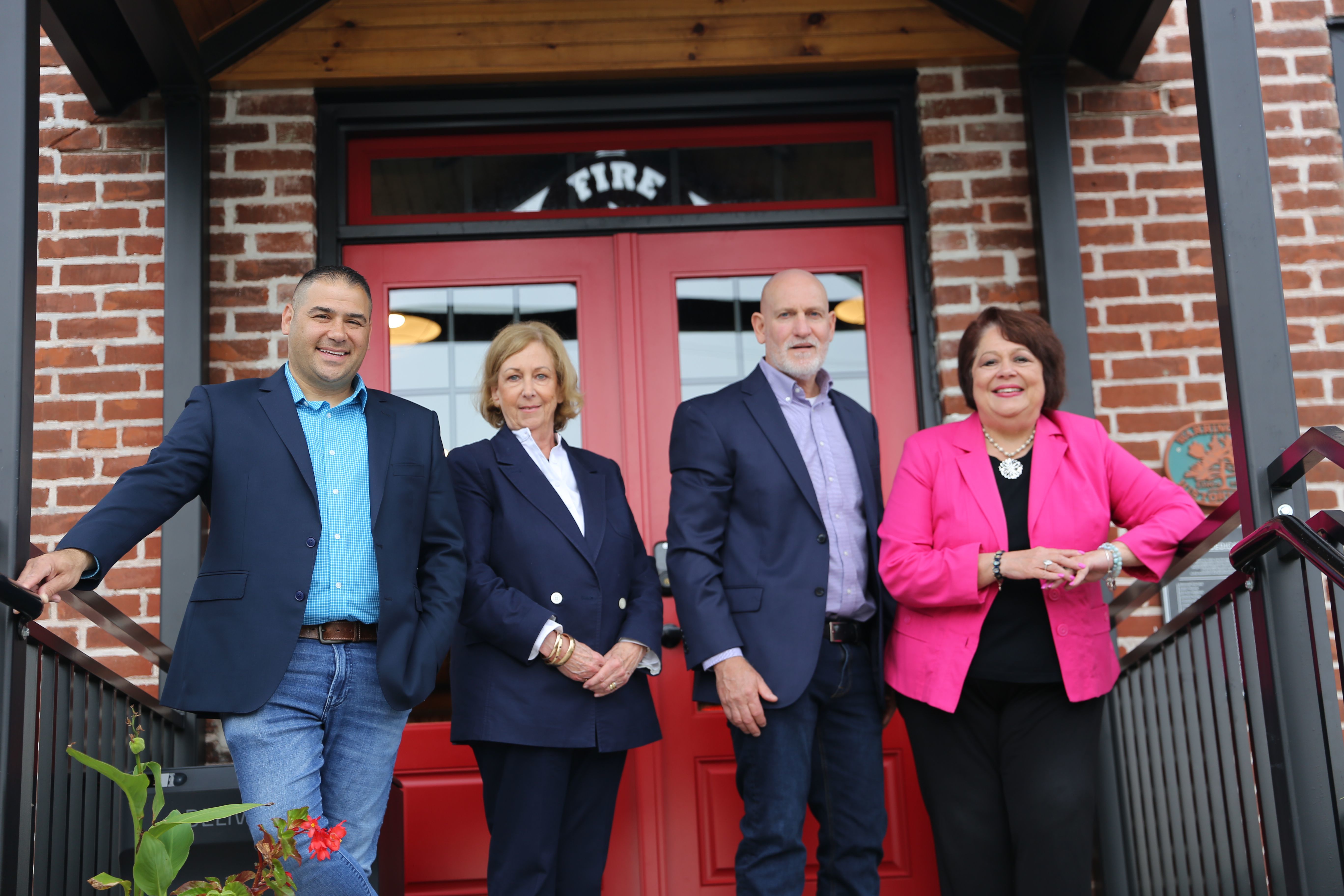
    The Republican candidates for Central Bucks school board. Andrew Miller, Sharon Beck, Roman Szewczuk, and Betty Santoro (left to right).

    The 1776 Project PAC, a group supporting Republican school board candidates that has drawn ire from Democrats, has spent more than $86,000 on mailers and text messages in Bucks County. Approximately half that has gone toward supporting Central Bucks GOP candidates, with the rest going to candidates in Centennial School District and Pennridge, according to Bucks County campaign finance reports.

    The PAC has also spent more than $20,000 supporting candidates on Republican slates in Perkiomen Valley and Lower Merion, according to Montgomery County campaign finance filings.

    Democrats are also getting support from an outside group — Red Wine and Blue, a national group of suburban women that promotes Democratic candidates. The group has spent approximately $260 in Bucks County and $104 in Montgomery County school board races, according to county filings.

    In Bucks County, other races like district attorney and sheriff have drawn money and attention that might have otherwise gone to school boards, said Guy Ciarrocchi, a GOP analyst.

    “There’s a certain amount of fatigue that’s hitting a place like Bucks,” Ciarrocchi said.

    The Trump factor

    Democrats in suburban districts said they need to maintain majorities to best address the impacts of Trump administration policies.

    “When I realized the threat that public education was under, I decided now was the time that I had to run,” said Katrina Filiatrault, a Democrat running in Central Bucks.

    Judy Lofton, a Democrat running in Perkiomen Valley, said of her slate: “Our central unifying message is that we want to protect public education, that public education is currently under attacks from a variety of different stakeholders.”

    Republicans are striking a different tone.

    “We’re not focused on anything that’s going on outside of something that we don’t control,” said Jason Saylor, a Republican running for reelection in Perkiomen Valley. “We don’t control the federal government. We don’t control what might happen with the Department of Education. We don’t control issues at the state legislature.”

    In Souderton, controversy flared last year when Republican school board member Bill Formica made lewd comments about former Vice President Kamala Harris. He is still on the board and is not up for reelection this year.
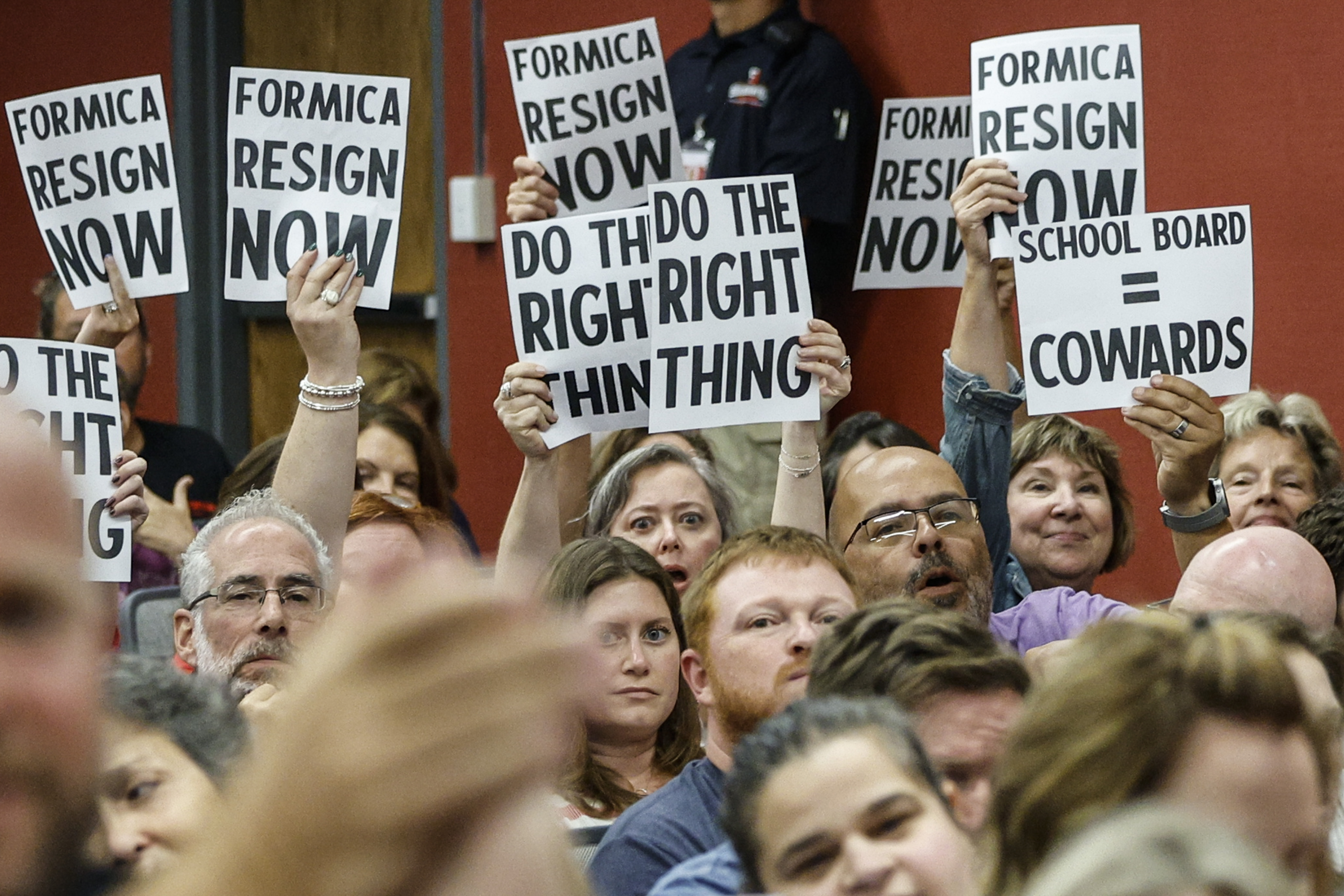
    Residents protest at a Souderton school board meeting last year after board member Bill made a lewd social media post about then-Vice President Kamala Harris.

    “We’re talking to every voter who might be a Republican or an independent, and they’re sharing concerns at the doors about how they can’t vote for certain people anymore,” said Corinne DeGeiso, a Democrat running for the board.

    Nelson, the Republican school board president running for reelection, said Formica was protected by the First Amendment.

    His comments, Nelson said, were “rude, lewd, and unacceptable,” but there was nothing the board could do about it.

    Even in a less contentious election cycle, Chris Lilienthal, a spokesperson for the Pennsylvania State Education Association, which tends to endorse Democratic candidates, said school board elections are more important than ever this year.

    “They’re holding the line right now in this budget impasse,” he said, “and that alone should merit the attention of voters.”

    This suburban content is produced with support from the Leslie Miller and Richard Worley Foundation and The Lenfest Institute for Journalism. Editorial content is created independently of the project donors. Gifts to support The Inquirer’s high-impact journalism can be made at inquirer.com/donate. A list of Lenfest Institute donors can be found at lenfestinstitute.org/supporters.

  • More than 300,000 Pennsylvanians need help heating their homes. The federal shutdown has delayed that assistance.

    More than 300,000 Pennsylvanians need help heating their homes. The federal shutdown has delayed that assistance.

    More than 300,000 Pennsylvanians who struggle to pay their heating bills will need to wait longer for assistance from the state government due to funding stoppages caused by the federal government shutdown.

    The Pennsylvania Department of Human Services said in a news release Wednesday that Pennsylvania will delay the opening of this year’s Low-Income Home Energy Assistance Program (LIHEAP) until at least Dec. 3 because of a pause in federal funding due to the shutdown. The program was originally scheduled to open on Nov. 3.

    The opening date for the program will be reassessed once the shutdown ends and is contingent on the state receiving the delayed federal funds, Brandon Cwalina, DHS press secretary, said in a statement Thursday.

    LIHEAP distributes benefits to utility companies or home heating fuel providers for Pennsylvanians who need assistance paying their heating bills. The state has received more than $200 million each of the last two years from the federal government to carry out the program.

    Pennsylvania Human Services Secretary Val Arkoosh said in the news release that the program “is especially critical for older adults and low-income families” as colder months approach.

    Once DHS receives federal funding after the shutdown ends, the department will begin accepting LIHEAP applications and will continue processing applications that had been received during the shutdown.

    This announcement comes the same week that DHS said nearly 2 million Pennsylvanians will not receive benefits from the Supplemental Nutrition Assistance Program (SNAP) next month if the shutdown continues. The food assistance program provides $366 million a month to low-income people in Pennsylvania, including roughly 500,000 in Philadelphia.

    Joline Price, an attorney in the energy unit at Community Legal Services who works with clients to advocate for their access to water, heat, and electricity, said many of the same households could be affected by a lack of SNAP benefits and assistance in paying their heating bills, creating a “huge and devastating impact.” The program assisted 56,000 Philadelphia households last season, she noted.

    “Even if some of these benefits become available later in November, they’re gonna be making really serious choices between food and utilities,” Price said. “It’s gonna be — I don’t even know that I have the words — it’s going to be bad.”

    Other resources are available in the meantime — for instance, some electric and gas companies offer assistance programs — but there are gaps that remain with LIHEAP help beginning later than expected. For instance, Pennsylvania has an annual winter utility shut-off moratorium for qualified residents from Dec. 1 through March 31, though it does not eliminate any outstanding home heating bills, DHS said.

    Prior to Dec. 1, low-income Pennsylvanians who are already “drowning” in utility costs could see their electric or gas shut off, Price said.

    “Until then, folks are vulnerable to having their electric or their gas shut off, which would then bring them into the winter without safe heating sources,” Price said.

    Democratic Gov. Josh Shapiro and members of his administration are arguing that impacts to crucial services are on the shoulders of Republicans in Washington, who hold both chambers of Congress and the White House. Meanwhile, Republicans are blaming the shutdown on Democrats because the majority party cannot pass funding legislation in the Senate without at least seven Democrats crossing the aisle.

    Arkoosh echoed Shapiro’s messaging Wednesday, saying of LIHEAP: “Inaction from the Republican-controlled Congress now threatens access to this assistance.”

    “I urge Congress and the White House to recognize the serious consequences that limiting heating assistance will have on the health and safety of people in Pennsylvania. Congress must come together for a solution that protects people most at risk,” she said.

  • The Shapiro administration has posted messages blaming Republicans for the government shutdown, impacts to SNAP benefits

    The Shapiro administration has posted messages blaming Republicans for the government shutdown, impacts to SNAP benefits

    As nearly 2 million Pennsylvanians brace for the loss of their food assistance next month due to the federal government shutdown, the Pennsylvania Department of Human Services is pinning the blame on Republicans on Capitol Hill.

    States administer the federally funded Supplemental Nutrition Assistance Program, which provides support to low-income people, including families with children. But as the standoff in Congress prevents federal funding from flowing to states, Democratic Gov. Josh Shapiro’s administration entered the messaging battle over the cause of the disruption to benefits.

    “Because Republicans in Washington D.C., failed to pass a federal budget, causing the federal government shutdown, November 2025 SNAP benefits cannot be paid,“ reads a pastel orange banner on the DHS website from Friday, alerting recipients of the Supplemental Nutrition Assistance Program to the impending changes.

    The message reflects the mounting impacts of the government shutdown, which is in its third full week, and the growing political tensions between Republicans and Democrats on the state and national levels after lawmakers failed to pass funding to avert a government shutdown by Oct. 1.

    Shapiro has frequently gone head-to-head with the Trump administration, but the use of a state government website is a notable escalation.

    The governor said in a news release Monday that Congress already had kicked off hundreds of thousands of Pennsylvanians from Medicaid and SNAP when it passed President Donald Trump’s One Big Beautiful Bill Act in July.

    “Now, Republicans are once again threatening vital support for Pennsylvania families and children — it’s time for them to pass a federal budget and end this shutdown.”

    Pennsylvania Human Services Secretary Val Arkoosh added that “Inaction from Republicans in Congress” jeopardizes the well-being of Pennsylvanians.

    A significant impact will be felt next month in Philadelphia, where half a million people will not receive SNAP benefits. The program, which is funded by the U.S. Department of Agriculture, serves households including elderly people, individuals with disabilities, and children.

    Another Democratic-led state, Illinois, also referred to the lapse in funding as the “Republican federal government shutdown” on its benefits webpage. Other Democratic-led states near Pennsylvania, New Jersey and Delaware, have not posted political messages on their states’ SNAP benefits pages.

    Republicans in Pennsylvania criticized the use of the DHS website for a partisan message.

    “Public service isn’t a political weapon and using a government website to fuel your partisan agenda is indefensible,” the Pennsylvania GOP wrote Monday in a post on X.

    However, the Trump administration has also been using its official government websites for partisan rhetoric on the national level, potentially raising red flags related to federal ethics laws.

    The shutdown is “Democrat-led,” says the Trump administration’s State Department website.

    “The Radical Left in Congress shut down the government,” declares a bright red banner on the U.S. Department of Housing and Urban Development homepage.

    The rising political pressure comes as the Trump administration began rolling out highly politicized messaging to the public and federal employees after the government shutdown began earlier this month.

    Last week, Philadelphia International Airport and other airports refused to play a video from Homeland Security Secretary Kristi Noem that inculpates Democratic members of Congress for the shutdown.

    And some federal workers — nonpartisan civil servants who have been coping with plummeting morale and either being furloughed or working without pay during the shutdown — have been on the receiving end of politicized messaging, too.

    A message to federal employees ahead of the Oct. 1 funding deadline proclaims that Trump “opposes a government shutdown.”

    Any lapse in appropriations, the message continues, is “forced by Congressional Democrats.”

  • Dave McCormick joins fellow Senate Republicans urging RFK Jr. to rescind approval for an abortion pill

    Dave McCormick joins fellow Senate Republicans urging RFK Jr. to rescind approval for an abortion pill

    U.S. Sen. Dave McCormick (R., Pa.) has joined fellow Senate Republicans in signing on to a letter urging top health officials in the Trump administration to rescind approval for a drug used in one of the most common methods of abortion.

    In a letter to Health and Human Services Secretary Robert F. Kennedy Jr. and FDA Commissioner Marty Makary earlier this month, the Republican senators recommended, among other things, that officials re-evaluate the safety of mifepristone, one of two pills commonly used in a medication abortion, and suspend the distribution of the drug and its generic versions, saying it should be considered an “imminent hazard” at the federal level.

    “Today, your agencies have all the information they need to bring an end to previous Democrat administrations’ abortion drug regulations while a comprehensive review is conducted,” the Republicans wrote in the letter.

    Only two Senate Republicans, Lisa Murkowski (R., Alaska) and Susan Collins (R., Maine), did not sign the letter.

    Mifepristone is considered safe and effective and is used to terminate early-stage pregnancies and manage miscarriages, according to the American Medical Association. It received initial approval from the Food and Drug Administration in September 2000.

    McCormick’s signature on the letter could signal a change in how the Pennsylvania Republican views abortion regulation. During his campaign last fall, McCormick said during a debate that he wants to leave regulation to individual states, which has been the status quo since the U.S. Supreme Court overturned Roe v. Wade in 2022. His backing of the letter, which encourages sweeping policy decisions at the national level, suggests otherwise.

    “Sen. McCormick has concerns about the adverse effects mifepristone can have on women, as shown in a recent study,” a spokesperson for McCormick said in a statement Friday evening. “This letter addresses those potential impacts on women’s health and encourages HHS and FDA to reevaluate the potential risks and harms associated with mifepristone. Sen. McCormick also issued a statement yesterday applauding the White House’s efforts to lower IVF costs.”

    Eugene DePasquale, chair of the Pennsylvania Democratic Party, accused him of betraying his constituents.

    “Sen. McCormick’s support for an extreme anti-choice policy that could threaten the lives of Pennsylvania women is a shameful betrayal of his constituents,” DePasquale said. “This type of extreme policy coming out of Washington only makes it clearer that everything is on the line when it comes to protecting our freedom — and it is up to us to do it right here at the state level.”

    Last month, Kennedy said the FDA is reviewing the safety of mifepristone.

    “By law, the FDA has very limited discretion in deciding whether to approve a generic drug, and the FDA’s approval of a generic mifepristone is not an endorsement of the product. HHS remains committed to its study of the reported adverse effects of mifepristone,” White House spokesperson Kush Desai said in a statement to The Inquirer.

    Medical abortions, where mifepristone is used as part of a two-drug regimen along with misoprostol, account for more than half of all abortions performed in the U.S., according to the Cleveland Clinic in 2024.

    Should the FDA revoke its approval of mifepristone, medical abortions won’t be eradicated. Medication abortions are possible using just misoprostol, but the method is less effective, according to a 2021 report from the American Family Physician.

    In addition to their safety concerns, Senate Republicans are also urging Kennedy and Makary to suspend approving new generic versions of mifepristone awaiting the results of a safety review of the Risk Evaluation and Mitigation Strategies (REMS) for the drug. REMS are safety programs for certain medications as required by the FDA.

    The Republicans are also urging the federal government to require mifepristone and its generic versions to be distributed in person, not through mail, and not at a pharmacy.

    The letter also claims that the U.S. has an “‘abortion-on-demand’ culture,” referring to the accessibility of mifepristone through mail. But, according to Planned Parenthood, a telehealth call is required before any pill is shipped.

    Staff writer Katie Bernard contributed to this article.

    This story was updated to include a comment from Sen. McCormick.