Author: Andrew Seidman

  • As Josh Shapiro seeks reelection, his business-friendly brand has drawn millions from CEOs — including some with interests in Harrisburg

    As Josh Shapiro seeks reelection, his business-friendly brand has drawn millions from CEOs — including some with interests in Harrisburg

    A Florida developer who is building data centers in Pennsylvania. A Chicago crypto trader whose company was sued by the Biden administration. And a Southwestern Pennsylvania coal magnate whose firm received a permit from state regulators last year to expand operations — and is now seeking approval to open a new mine.

    These are some of the dozens of CEOs backing Pennsylvania Gov. Josh Shapiro, a Democrat, as he seeks a second term this fall in Harrisburg — with an eye on a possible run for president in 2028.

    Shapiro’s gubernatorial campaign raised at least $8.5 million last year from nearly 240 CEOs, founders, business owners, and other top executives, according to an Inquirer analysis of campaign-finance records that were made public last month.

    That includes the single biggest donation to the campaign: $2.5 million from billionaire and former New York City Mayor Michael Bloomberg. Shapiro’s haul from top executives represents 50.8% of the $16.8 million he raised from donors who listed their occupation in campaign finance filings.

    window.addEventListener(“message”,function(a){if(void 0!==a.data[“datawrapper-height”]){var e=document.querySelectorAll(“iframe”);for(var t in a.data[“datawrapper-height”])for(var r,i=0;r=e[i];i++)if(r.contentWindow===a.source){var d=a.data[“datawrapper-height”][t]+”px”;r.style.height=d}}});

    During his first three years in office, Shapiro, 52, has sought to build a profile as a pragmatic, business-friendly governor, focusing on speeding the permitting process and promoting economic development through government grants and tax breaks.

    At the same time, the governor has proven adept at raising campaign cash from people who have business interests before state government in Harrisburg. Those include a skill game developer who staved off a major policy defeat this year and a waste coal power plant owner who gave $100,000 to Shapiro two days before the governor pulled out of a multistate program that requires such facilities to pay for their greenhouse gas emissions.

    It’s a contrast with the rising populism on both the left and right, marked by a “Fighting Oligarchy” tour by progressive leaders and the MAGA movement’s deep suspicion of elites.

    It’s not unusual for corporate executives to make contributions to candidates from both parties. But the practice could invite scrutiny for Shapiro in a White House run — particularly among voters and activists who are dismayed by the role of money in politics.

    “We are concerned about any elected leaders taking monetary donations from corporate interests, regardless of who they are,” said Ashley Funk, executive director of the Mountain Watershed Association, a nonprofit that opposes a Shapiro donor’s coal mining expansion.

    “I think that it influences decision-making,” she said.

    ‘The speed of business’

    For now, Shapiro’s pledge to make Pennsylvania’s government run “at the speed of business” appears to have won over many executives, helping him build a massive fundraising advantage in his reelection bid. Shapiro raised $23.2 million overall in 2025, compared with the $1.5 million reported by his likely Republican opponent, State Treasurer Stacy Garrity.

    “I’ve long admired the way the commonwealth approaches economic development and innovation, and I have deep respect for Gov. Shapiro’s leadership,” said Bob Clark, executive chairman and founder of Clayco, a Chicago-based real estate and construction firm that is redeveloping a site at the industrial hub known as the Bellwether District in South Philadelphia.

    Clark gave Shapiro’s campaign $100,000 last year. “I consider him both a trusted colleague and an effective leader,” he said.

    In recent weeks, the governor has celebrated pledges by pharmaceutical companies to invest billions of dollars in new facilities in Montgomery County and the Lehigh Valley, secured with tens of millions of dollars in state incentives. And last year, Amazon said it would spend $20 billion in Pennsylvania to build two new artificial intelligence data centers, in what officials called the single largest private investment in state history.

    Shapiro’s allies say he stands up to big business, too, highlighting how he successfully prodded PJM Interconnection LLC — the Valley Forge-based regional electric grid operator whose voting members largely consist of companies in the electricity industry — to impose and extend a price cap. He has also received support from organized labor.

    Shapiro argues that the way to restore faith in institutions is not by railing against billionaires but by showing that the government can fix real problems — “get s— done,” in his parlance.

    Garrity, the Republican state treasurer, says Shapiro’s actions don’t live up to the hype.

    Under Shapiro’s watch, she said, the state budget now has a $4.3 billion shortfall and Pennsylvania’s economy is on the wrong track.

    “Liberal national donors may be investing in Josh Shapiro’s political vanity project, but hardworking Pennsylvanians are seeing nothing in return,” she said in a statement.

    Garrity received nearly $380,000 from more than 60 CEOs and other top business executives. That figure represents about 41% of her contributions from donors who listed their occupation in campaign-finance filings.

    Shapiro’s campaign said his coalition is “reflective of a governor who is delivering for all Pennsylvanians — and of a campaign that is fighting to win up and down the ballot.”

    window.addEventListener(“message”,function(a){if(void 0!==a.data[“datawrapper-height”]){var e=document.querySelectorAll(“iframe”);for(var t in a.data[“datawrapper-height”])for(var r,i=0;r=e[i];i++)if(r.contentWindow===a.source){var d=a.data[“datawrapper-height”][t]+”px”;r.style.height=d}}});

    The governor has “focused on growing our economy and creating jobs, and he has delivered — creating tens of thousands of jobs, winning major deals, and building the only growing economy in the Northeast,” campaign spokesperson Manuel Bonder said in a statement.

    Shapiro highlighted one such deal in July, when he appeared alongside executives at defense contractor Rhoads Industries at the Navy Yard in South Philly to announce the firm’s $100 million plan to build a new manufacturing facility, create 450 jobs, and boost production of submarine parts.

    To help secure the investment, the Shapiro administration approved $4 million in grants and, along with the City of Philadelphia, extended a tax designation around the project site known as a Keystone Opportunity Zone, a program that voids most state and local taxes.

    “One of the things that Rhoads is known to do is get things done. … We want to turn out product; we want to turn it around; we want to get it done,” president Mike Rhoads said.

    Looking toward Shapiro, he said, “Somebody standing to my left has the kind of same attitude.”

    Gov. Josh Shapiro (right) with Rhoads Industries CEO Dan Rhoads in July 2025 at the Navy Yard.

    Taking his turn at a lectern that read “Rebuilding America’s Fleet,” Shapiro said Rhoads’ investment — with help from the state — would “ensure the future of submarine manufacturing, shipbuilding, and all things important to securing our freedom is going to run right through the Philadelphia Shipyard.”

    Three months later, in October, CEO Dan Rhoads contributed $10,000 to Shapiro’s campaign — the single largest donation he made to a candidate for state office in the last decade, records show. Rhoads did not respond to requests for comment.

    Data centers and ‘skill games’

    Shapiro donors’ business interests include everything from data center construction to state regulation of slot machine-style games and approvals for a nuclear reactor.

    • Dan Hilferty, CEO of Philadelphia-based Comcast Spectacor — which owns the Flyers and the Xfinity Mobile Arena in South Philly — gave $40,000. A political action committee affiliated with parent company Comcast also gave $50,000. Comcast Spectacor and the 76ers are building a new arena at the South Philadelphia sports complex, and Shapiro last year did not rule out offering state incentives. Hilferty, a former CEO of Independence Blue Cross, previously gave Shapiro’s campaigns $27,500 over the last decade. Other Comcast Spectacor executives contributed about $95,000 during that period.
    • Top executives at Pace-O-Matic, the Georgia-based developer of so-called skill games that have proliferated across convenience stores and bars, gave $50,000. Operators for Skill, a PAC affiliated with the firm, contributed $10,000. The company successfully fended off a push in 2025 by Shapiro and lawmakers to tax the games at a level the industry considered too high. The governor has renewed a push to regulate the games, which some Philadelphia lawmakers say they would prefer to see banned. Pace-O-Matic contributes to both parties and remains “committed to fighting for fair regulation and taxation of Pennsylvania skill games,” said Mike Barley, chief public affairs officer for Pace-O-Matic.
    • Joseph Dominguez, president of Baltimore-based Constellation Energy, gave $25,000. The company is seeking to restart a nuclear reactor at Three Mile Island, just outside Harrisburg, and needs state and federal approvals. The plant would supply power to Microsoft to support the tech company’s data centers. “Constellation executives contribute to policymakers on both sides of the aisle who, like Gov. Shapiro, prioritize results and pragmatic solutions over politics,” a company spokesperson said.
    • Brian Patten, CEO of Next Generation Land Co. LLC, gave $10,000. He is a Florida data center developer who says he is pursuing projects in Pennsylvania. Data centers that power companies’ cloud storage and computing needs have drawn backlash across the U.S. over fears of rising electricity rates. In his February budget address, Shapiro said he wants data centers to supply their own energy and pay for any new generation they need. He has also said the U.S. needs to win the AI race against China.
    • Justin Thompson, CEO of Iron Senergy, a coal operator, gave $10,000. His firm owns the Cumberland Mine in Greene County. When Pennsylvania applied to the U.S. Environmental Protection Agency for a $400 million grant, it mentioned several firms — including Iron Senergy — that could use the money for decarbonization projects, the Pittsburgh Post-Gazette reported in 2024. The EPA awarded the grant, and the Pennsylvania Department of Environmental Protection is tasked with administering it. The state is now reviewing applications, which it says are confidential.
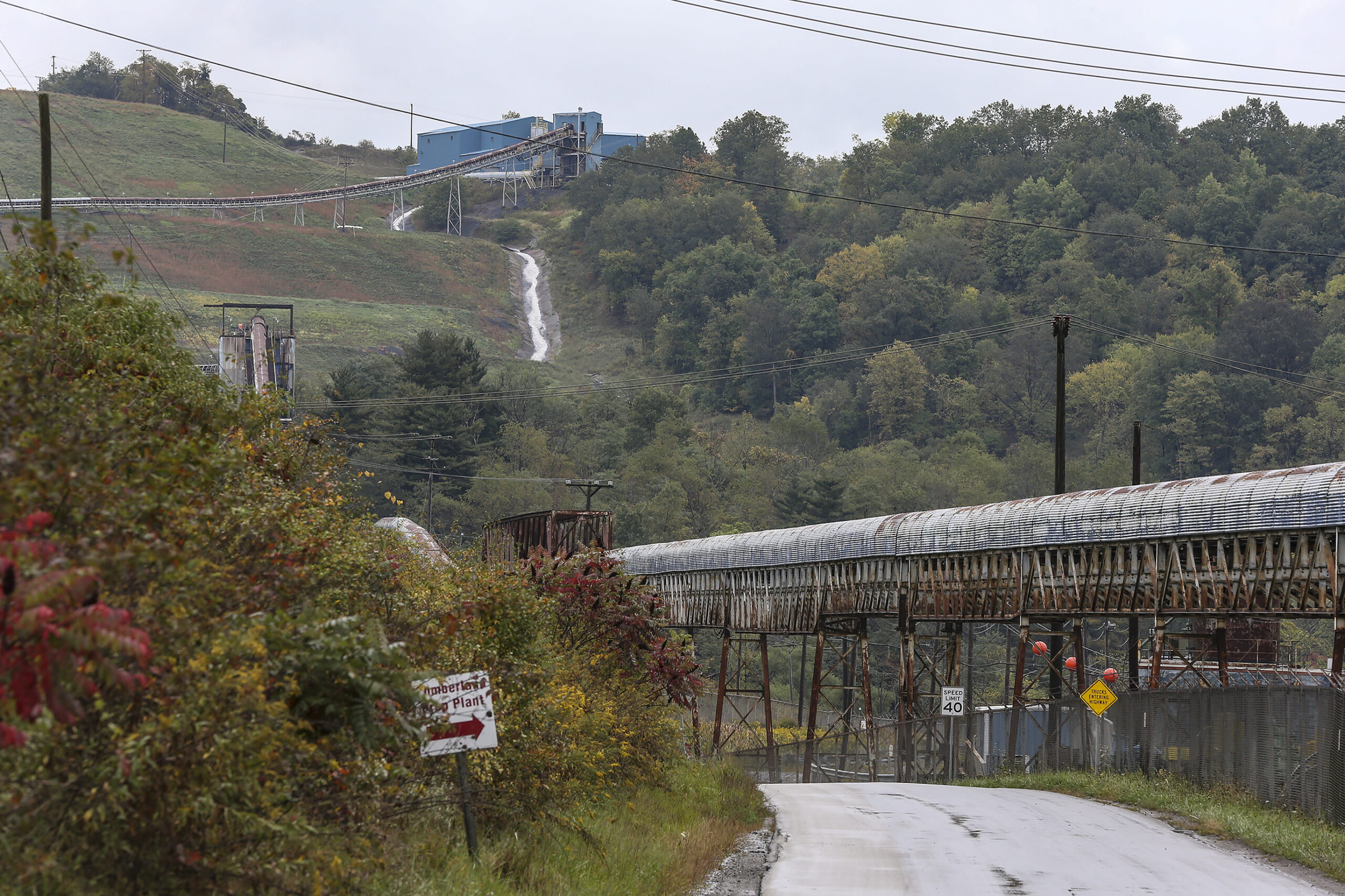
    The Cumberland Coal Mine in Greene County seen in 2020.

    Local and national donors

    Shapiro drew on a mix of executives from local and national firms. In Pennsylvania, he raised money from health system CEOs (Joseph Cacchione of Thomas Jefferson University, $10,000), bankers (Richard J. Green of Philly-based Firstrust Bank, $125,000), and a home remodeler (Asher Raphael of Power Home Remodeling in Chester, $100,000). Josh Kopelman — founder of First Round Capital and chairman emeritus of The Inquirer’s board of directors — and his wife, Rena, each gave $50,000.

    There were private equity investors (San Francisco billionaire John Pritzker, cousin of Illinois Gov. JB Pritzker, $50,000), Hollywood producers (Jimmy Miller of talent management and production firm Mosaic, $75,000), professional sports team owners (telecom billionaire Robert Hale, minority owner of the Boston Celtics, $50,000), and a Massachusetts sports betting executive (Jason Robins of DraftKings, $10,000).

    For his part, Bloomberg is “a big fan of Gov. Shapiro and a big believer in his leadership, and thinks he’s done a great job for Pennsylvania,” adviser Howard Wolfson told Axios.

    At least one donor had ties to President Donald Trump, whom Shapiro often criticizes.

    Don Wilson Jr., CEO of Chicago-based trading firm DRW Holdings LLC, gave $10,000 to Shapiro in September.

    The Securities and Exchange Commission filed civil charges against a unit of Wilson’s firm while President Joe Biden, a Democrat, was in office. The SEC accused it of operating as an unregistered cryptocurrency dealer.

    Biden-era regulators said that firms were dodging that rule by claiming crypto was a commodity, not a security. The enforcers argued this exposed investors to extra risks associated with digital currencies.

    Then last March, a couple of months after Trump took office, the new administration dropped the charges against Wilson’s firm. Nine weeks later, Wilson invested $100 million into a Trump bitcoin project, the Financial Times reported.

    The company told the newspaper it engages in a “variety of strategies in the crypto ecosystem” and saw value in holding bitcoin. “This transaction was viewed purely through that lens,” it said.

    Trump denies having conflicts of interest.

    That didn’t stop the Democratic National Committee from flagging the news on its “CORRUPTION WATCH” page.

    The Trump administration, the Democrats’ post said, “now appears to be engaged in blatant pay-to-play politics.”

    Power plants and coal mines

    Among corporate executives, two of the eight biggest donors to Shapiro’s campaign last year were the father-and-son owners of privately held Robindale Energy Services, which owns about 20 companies involved in waste coal reclamation, power generation, mining, and logistics. Robindale’s assets include multiple power plants fueled by waste products from abandoned coal mines.

    CEO Scott Kroh and his son Judson, the Latrobe-based company’s president, gave a total of $271,000.

    That included a $100,000 contribution from Scott Kroh two days before Shapiro signed the annual budget, which came after a monthslong stalemate. The deal with Senate Republicans included language pulling the state out of the Regional Greenhouse Gas Initiative, a multistate effort to generate cleaner power that Robindale had vocally opposed.

    Robindale’s executives did not respond to requests for comment.

    In June 2023, Judson Kroh spoke out against RGGI at a public hearing, telling Pennsylvania lawmakers that Robindale’s power plants have enough capacity to power 500,000 homes. “Our main concern is you’ll see a significant decrease in power exports out of the state due to RGGI, as well as a significant decrease in coal production,” Kroh said.

    Other energy industry firms, Republican lawmakers, and building trades unions have also long opposed the initiative, which requires power plants to buy allowances to cover their carbon emissions. They call it a job killer and an electricity tax. Environmental groups say it has reduced pollution and led to investments in clean energy in other states.

    Shapiro had for years expressed concerns about the greenhouse gas initiative, which Pennsylvania joined under his predecessor but never implemented due to litigation. Shapiro said in 2021 during his first run for governor that “it’s not clear to me” that the program protected jobs, addressed climate change, or ensured energy reliability.

    The Kroh family donated a total of $55,000 to his 2022 campaign and $21,000 the following year. Judson Kroh was among the more than 300 people who served on Shapiro’s transition team.

    Many of Robindale’s operations are regulated by the state, and the company spent $150,000 lobbying state government officials last year, records show. Company executives in recent years have largely donated to Republicans in Harrisburg, though they have also supported some Democrats, including Shapiro.

    window.addEventListener(“message”,function(a){if(void 0!==a.data[“datawrapper-height”]){var e=document.querySelectorAll(“iframe”);for(var t in a.data[“datawrapper-height”])for(var r,i=0;r=e[i];i++)if(r.contentWindow===a.source){var d=a.data[“datawrapper-height”][t]+”px”;r.style.height=d}}});

    In addition to its power generation business, Robindale owns coal mines that are subject to state inspections and oversight. When two people died in a Somerset County mine operated by subsidiary LCT Energy, DEP required the company to update its safety protocols. The deaths in 2022 and 2023 came during a time in which there were 20 coal mining fatalities nationwide, according to federal data.

    Johnstown-based LCT is currently expanding.

    About 30 miles west of Maple Springs, LCT opened another mine in 2018 in Westmoreland County called Rustic Ridge 1, which produces 600,000 tons of coal a year.

    The state renewed the permit for the 2,800-acre underground mine in January last year, and from that month through March, the Kroh family donated $70,000 to Shapiro’s campaign.

    In April, after a yearslong review, the Pennsylvania Department of Environmental Protection approved a permit authorizing LCT to expand its operations there, adding 1,400 acres under the Pennsylvania Turnpike — the equivalent of 93 Lincoln Financial Fields. The permit allows LCT to mine coal up to 600 feet underground. The company sells the coal for production of steel.

    The nonprofit Mountain Watershed Association is appealing the DEP’s approval to the Pennsylvania Environmental Hearing Board — whose judges are appointed by the governor, subject to confirmation by the state Senate — arguing that the expansion could harm groundwater and streams.

    Others say the mine supports jobs and helps the local economy. Before opening, the company said in 2014 that it would invest $50 million to develop the mine, according to local news reports.

    LCT is now also seeking federal and state approvals to open a new, 2,300-acre underground mine nearby.

    That process could soon speed up.

    The state budget Shapiro signed in November expanded a program for expedited permitting involving approvals from the DEP, which reviews 40,000 permits a year. Introduced in 2024, the program is currently available for eligible permits such as air quality, dam safety, and oil and gas erosion and sediment control.

    The budget legislation — cheered by Shapiro and GOP lawmakers — added more permit types, including one for mining, “which DEP is in the process of adding to the program,” a department spokesperson said.

    Funk — the executive director of the watershed association, which has spent millions of dollars over the last 30 years repairing the environmental damage of legacy coal mining — said she is concerned the Krohs’ political giving “might be having an influence over Shapiro and his administration as we work to permit some of Robindale’s projects such as LCT Energy.”

    Shapiro says permitting reform reflects his governing ethos.

    “When you think about getting stuff done … it requires focus and speed,” he said in December at a National Governors Association event. “We’ve gotta be speedier as a country.”

  • Pa. and N.J. call it gambling. Trump calls it finance. A high-stakes fight over prediction markets is underway

    Pa. and N.J. call it gambling. Trump calls it finance. A high-stakes fight over prediction markets is underway

    A high-stakes fight is brewing between President Donald Trump’s administration and states such as Pennsylvania and New Jersey over the regulation of prediction markets, the online platforms that allow users to wager on everything from sports and elections to the weather.

    States that have legalized sports betting in recent years say prediction markets amount to unauthorized gambling, putting consumers at risk and threatening tax revenues generated by regulated entities like casinos.

    But the Trump administration this week said the federal government was the appropriate regulator, siding with the industry’s argument that the markets’ “event contracts” are financial derivatives that allow investors to hedge against risks.

    The chair of the federal Commodity Futures Trading Commission on Tuesday said the CFTC had filed a brief in federal court to “defend its exclusive jurisdiction” to oversee these markets, amid litigation between state governments and platforms such as Kalshi and Polymarket.

    Prediction markets “provide useful functions for society by allowing everyday Americans to hedge commercial risks like increases in temperature and energy price spikes,” CFTC Chairman Mike Selig said in a video posted on X.

    New Jersey collected more than $880 million in gaming tax revenues last year, while Pennsylvania brought in almost $3 billion, according to regulators. The revenues fund property tax relief programs and the horse racing industry, as well as programs for senior citizens and disabled residents.

    Pennsylvania’s gaming regulator has previously warned that prediction markets risk “creating a backdoor to legalized sports betting,” without strict oversight.

    The state Gaming Control Board’s Office of Chief Counsel told The Inquirer Wednesday that it sees a distinction between certain futures markets — like those for agricultural commodities, which have long been regulated by the CFTC — and “event contracts” tied to “the outcome of a random Wednesday night NBA basketball game.”

    Representatives for Gov. Josh Shapiro of Pennsylvania and Gov. Mikie Sherrill of New Jersey, both Democrats, didn’t respond to requests for comment.

    But former New Jersey Gov. Chris Christie — a Republican who worked to legalize sports betting while in office and who’s now advising the American Gaming Associationsaid Tuesday on X that the Trump administration is trying to “grow the size of the federal government & their own power while trying to crush states rights and take advantage of our citizens.”

    Beyond the courts, the GOP-led Congress could also choose to step in. Some Republican lawmakers have expressed concerns about a “Wild West” in prediction markets, notwithstanding Trump’s support for the industry.

    Sen. Dave McCormick (R., Pa.) welcomed the CFTC’s announcement, writing on X that prediction markets “offer tremendous benefits to consumers and businesses.”

    “A consistent, uniform framework for derivatives is essential to supporting U.S. markets,” he said.

    The CFTC’s action means the federal government is backing an industry in which the Trump family has a financial stake. The agency’s brief supports Crypto.com, a platform that last year partnered with the Trump family’s social media company to launch a prediction market.

    Ethics experts have said the Trump family’s ties to Crypto.com create a conflict of interest. The White House denies that and says the president’s holdings are in a trust controlled by his children.

    Winding through courts

    The U.S. Supreme Court in 2018 struck down a federal law that prohibited sports betting in most states, paving the way for states to legalize it. Pennsylvania and New Jersey both enacted laws authorizing sports gambling and imposing requirements on betting operators such as taxation on gaming revenues, consumer protection rules, and licensing fees.

    Despite state laws, prediction markets now operate nationwide — even in states that prohibit gambling altogether, like Utah.

    New York-based Kalshi launched its platform in 2021. The CFTC initially opposed Kalshi’s election-related contracts, but in the fall of 2024 the company won a case in which courts found the regulator failed to show how the platform’s “event contracts” would harm the public interest. Kalshi users proceeded to trade more than $500 million on the “Who will win the Presidential Election?” market.

    Then came sports contracts. In January 2025, following the CFTC’s protocols, Kalshi “self-certified” that its contracts tied to the outcome of sports games complied with relevant laws.

    The company has since offered event contracts on everything from the Super Bowl to Olympic Male Curling. Some established sportsbooks like Fanatics and DraftKings have also jumped into prediction markets.

    About 90% of Kalshi’s trading volume is tied to sports, the Associated Press reported.

    States have tried to intervene. In March, New Jersey’s gaming regulator ordered Kalshi to cease and desist operations in the Garden State, alleging the company issued unauthorized sports wagers in violation of the law and state Constitution.

    Kalshi filed a lawsuit, and a federal court issued an injunction prohibiting New Jersey from pursuing enforcement actions. Kalshi and other platforms have filed suits against other states, and courts have issued conflicting rulings.

    The CFTC said it filed a brief in one such suit this week.

    “To those who seek to challenge our authority in this space, let me be clear: we’ll see you in court,” Selig, the Trump-appointed CFTC chairman, said Tuesday.

    It could ultimately reach the U.S. Supreme Court.

    Advertisements by the company Kalshi predict a victory for Zohran Mamdani in the New York City mayoral election before the votes are counted and polls close, Tuesday, Nov. 4, 2025, in New York.

    ‘Event contracts’

    At issue is whether the “event contracts” offered by prediction markets amount to gambling — regulated by states — or, as Selig says, financial instruments “that allow two parties to speculate on future market conditions without owning the underlying asset.”

    Platforms like Kalshi say they are similar to stock exchanges, where people on both sides of a trade can meet — and therefore subject to federal regulation of commodities. Unlike a casino, the platforms say, they don’t win when customers lose.

    Pennsylvania regulators see it differently.

    The state Gaming Control Board told The Inquirer Wednesday that it takes issue with “‘prediction markets’ allowing any consumer, age 18 years old or older, to purchase a ‘contract’ on any potential future event occurring, even when that event does not have any broad economic impact or consequence, such as the outcome of a random Wednesday night NBA basketball game.”

    (Under Pennsylvania law, gambling is limited to those who are 21 or older.)

    “The Board believes that is not what the Commodities Exchange Act contemplated when it was enacted by Congress and established the CFTC and is, in fact, gambling,” the board’s Office of Chief Counsel said in a statement.

    If the courts side with the Trump administration, states worry that tax revenues from regulated sportsbooks would fall and customers would be vulnerable to markets they say are easily exploited by insiders.

    “If prediction markets successfully carve themselves out of the ‘gaming’ definition, they risk creating a parallel wagering ecosystem where bets on sports outcomes occur with significantly less oversight regarding potential match-fixing,” Kevin F. O’Toole, executive director of the Pennsylvania Gaming Control Board, wrote in an October letter to the state’s congressional delegation.

    For example, the gaming board has the ability to penalize licensed operators if they violate state regulations, O’Toole wrote, “something that an operator who ‘self-certifies’ their contracts/wagers [under CFTC rules] would never be subjected to.”

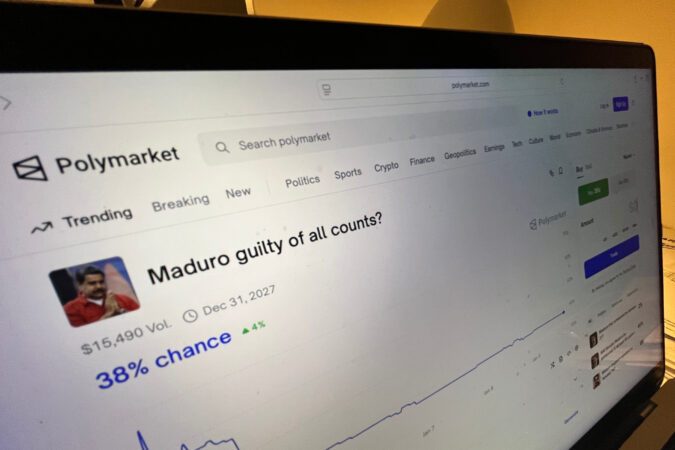
    O’Toole said the board’s regulatory role in this area is limited to sports wagering, but he added that markets on non-sports related events — he cited examples from Polymarket such as whether there will be a civil war in the United States this year — are equally “if not more troubling.”

    The CFTC says it is capable of overseeing the industry. “America is home to the most liquid and vibrant financial markets in the world because our regulators take seriously their obligation to police fraud and institute appropriate investor safeguards,” Selig wrote in a Wall Street Journal opinion piece this week.

  • N.J. attorney general is dropping racketeering charges against George Norcross following court ruling

    N.J. attorney general is dropping racketeering charges against George Norcross following court ruling

    New Jersey prosecutors are dropping racketeering charges against Democratic power broker George E. Norcross III, ending a high-profile case that law enforcement officials had framed as a reckoning on the state’s culture of corruption.

    Acting Attorney General Jennifer Davenport, an appointee of Democratic Gov. Mikie Sherrill, will not appeal a January appellate court ruling that upheld a judge’s decision to dismiss charges against Norcross and five codefendants, the attorney general’s office said Tuesday.

    Davenport could have asked the state Supreme Court to review the Appellate Division’s decision, but prosecutors concluded that their resources “would be best spent on other matters,” Sharon Lauchaire, a spokesperson for the New Jersey Attorney General’s Office, said in a statement.

    A three-judge panel said in a Jan. 30 decision that several of the racketeering conspiracy and extortion charges were time-barred under the statute of limitations. Other counts failed to state a crime, were untimely, or both, the panel said.

    Norcross, 69, is a former longtime member of the Democratic National Committee, founder of insurance brokerage Conner Strong & Buckelew, and chair of Cooper University Health Care. He was accused of using threats of economic and reputational harm — and his purported control of Camden’s government — to obtain valuable property on Camden’s waterfront from a developer and a nonprofit.

    His spokesperson on Tuesday portrayed the case against Norcross — announced in June 2024 by then-Attorney General Matthew J. Platkin — as a politicized abuse of the law similar to the Trump Justice Department’s targeting of perceived enemies.

    “We always knew that Matt Platkin brought this case for reasons other than its legal merits — and now multiple judges and Platkin’s successor as AG agree the allegations simply weren’t true,” Norcross spokesperson Dan Fee said in a statement.

    “The question now is whether Platkin’s supporters who cheered him on will take a serious look at what he did and whether other authorities will do the same,” he said. “We will certainly be making the case that he and anyone else who used lawfare against George should be held to account, no differently than Pam Bondi and her DOJ should.”

    Platkin, who was appointed to the post by Democratic Gov. Phil Murphy, has denied pursuing the case for political reasons. He noted on Tuesday that the case “was presented to a grand jury by career prosecutors over several months.”

    “Out of respect for the men and women who do brave work holding corruption to account, I won’t comment further — other than to say I remain proud to have supported their efforts at a time when trust in government is at an all-time low and I will never apologize for believing that everyone should be held to the same standards, no matter how powerful they may be,” Platkin said in a statement.

    Notwithstanding the decision to drop charges, Lauchaire said the attorney general’s office “remains committed to prioritizing public corruption prosecutions in this time of deepening mistrust in government.”

    “Wrongdoing by public officials undermines faith in our institutions, and the public rightfully demands and deserves that officials perform their duties with integrity and in accordance with the law,” she said. “We will never shy away from holding public officials accountable when they betray the public’s trust and behave unlawfully.”

    The prosecution faced an earlier setback last February, when a Superior Court judge found that the charges were not timely and said that even if the allegations in the indictment were proven true, they amounted to hard bargaining in real estate deals and did not cross the line into unlawful threats.

    Prosecutors appealed that ruling, arguing that the judge should review evidence presented to the grand jury before deciding whether the indictment was valid.

    The appeals court affirmed the trial judge’s order, though the panel focused on the statute of limitations violations and largely sidestepped the question of whether the threats underpinning the indictment met the legal requirements for alleging conspiracy to commit extortion.

    In addition to Norcross, prosecutors are dropping charges against his brother Philip Norcross, CEO of the law firm Parker McCay; attorney William Tambussi; former Camden Mayor Dana L. Redd; Sidney R. Brown, CEO of logistics firm NFI; and John J. O’Donnell, an executive at residential developer the Michaels Organization.

    “We are pleased and gratified that this misguided, baseless prosecution has been finally laid to rest,” said Kevin H. Marino, a lawyer for Philip Norcross.

    Henry Klingeman, an attorney for Redd, said his client “is relieved that this unjust and unnecessary ordeal is over.” The former mayor has “continued her unswerving commitment to bettering Camden,” Klingeman said.

    Brown said he was “innocent of these baseless charges” and added that Tuesday’s decision showed “justice was carried out based on the facts.”

    “Since its inception, this case was unfounded and attacked those of us who believed in the future of a thriving Camden,” the NFI CEO said in a statement.

    Tambussi’s lawyers, Jeff Chiesa and Lee Vartan, said their client “engaged in the routine practice of law.” They said Platkin’s attempted prosecution “did damage to the profession” and “was rightly rejected by both courts.”

  • American Airlines flight attendants call for a new CEO due to ‘hemorrhaging customer trust’

    American Airlines flight attendants call for a new CEO due to ‘hemorrhaging customer trust’

    Unions representing tens of thousands of pilots and flight attendants at American Airlines are openly questioning the competence of the company’s CEO, citing weak performance and poor customer satisfaction.

    Employees have been raising concerns for months about the company’s direction, and on Monday, the directors of the union that represents 28,000 flight attendants issued a vote of no confidence in chief executive Robert Isom.

    On Thursday, workers protested outside the company’s Fort Worth, Texas, headquarters, demanding a leadership change and a “credible turnaround strategy.”

    The brewing employee revolt comes amid a rough start to 2026. American canceled about 10,000 flights during Winter Storm Fern last month. That was the most of any carrier, though that particular problem was largely due to the fact that American hubs in Charlotte, Dallas, and Philadelphia were hit hard by the storm.

    American is by far the largest carrier at Philadelphia International Airport — the airline’s gateway to Europe — accounting for about 70% of its nearly 29 million total passengers in 2024. The next biggest carrier, Frontier, transported 3.6 million passengers. American is also one of the 10 biggest employers in the city, according to state data, with some 10,000 employees in the area.

    Here’s what to know about the troubles at American.

    87% drop in profit

    American has been lagging its competitors’ financial performance. Its $111 million in net profit last year marked an 87% decline from the prior year and just a fraction of Delta’s $5 billion, according to CNBC.

    Uncertainty over the economy reduced demand for travel, and the government shutdown last fall didn’t help.

    “Reclaiming American’s reputation as the world’s premium global airline is our mission, and we are relentless in that pursuit,” the company said in a statement to The Inquirer on Thursday. “The foundation is set, and the plan is in place for us to deliver for our customers, shareholders and each other — and we will do that as one team.”

    Low rankings from customers

    Critics say the company’s problems run deep.

    American ranked near the bottom of every category in the Wall Street Journal’s annual airline rankings published last month, including on-time arrivals, canceled flights, two-hour tarmac delays, and mishandled baggage.

    About 73% of American flights arrived on time through the first 11 months of 2025, ranking eighth out of 10 major airlines, according to U.S. Department of Transportation data.

    The Association of Professional Flight Attendants noted that a May J.D. Power survey ranked American last in overall customer satisfaction among passengers flying first and business class.

    Every day, flight attendants see “eroding service standards, chaotic operational meltdowns, and a brand hemorrhaging customer trust have become the norm under Isom’s leadership,” the union’s board of directors said Monday.

    Betting on improvement in 2026

    Those remarks came days after a union representing 16,000 American Airlines pilots sent a letter to the company’s board saying the airline is on an “underperforming path” and has failed to correct course. The Feb. 6 letter cited “persistent patterns of operational, cultural, and strategic shortcomings.”

    Isom, 59, became CEO in 2022 after serving several years in senior positions including president and chief operating officer, a role in which he helped integrate American and US Airways following their 2013 merger.

    Isom says American is trying to elevate the customer experience by offering premium seating on long-haul flights, expanding high-speed Wi-Fi, and building out its network of lounges, including a new one opened in Philadelphia last year.

    To improve reliability, the company is restructuring its schedule at Dallas Fort Worth International Airport, its biggest hub, the Wall Street Journal reported.

    “Our strategy to deliver on American’s revenue potential centers on four key areas: delivering a consistent, elevated customer experience; maximizing the power of our network and fleet; building partnerships that deepen loyalty and lifetime value; and continuing to advance our sales, distribution, and revenue management efforts,” Isom said on an earnings call this month.

    “While this has been a multiyear effort, 2026 will be the year these efforts start to bear fruit,” he said.

  • Pa. company pleads guilty in illegal video gambling scheme, but charges have been dropped against the owners

    Pa. company pleads guilty in illegal video gambling scheme, but charges have been dropped against the owners

    A Pennsylvania company has pleaded guilty to a crime stemming from its work installing hundreds of illegal video gambling devices across the state — but its owners appear to be off the hook.

    Schuylkill County-based Deibler Brothers Novelty Co. pleaded guilty Friday to corrupt organizations, a first-degree felony, and was ordered by a judge to forfeit $3 million to the state in cash and assets, according to the office of Pennsylvania Attorney General Dave Sunday.

    The company is owned by brothers Arthur Deibler, 34, and Donald Deibler, 33, and their friend Joel Ney, 35, each of whom was charged in 2024 with multiple felonies, including corrupt organizations and conspiracy.

    Court records show the charges were withdrawn Tuesday. Sunday’s office said that was part of the plea agreement, which also required the company to pay the asset forfeiture up front.

    “We expect those charges to be dismissed by the attorney general,” said defense lawyer William J. Brennan, who represents the Deibler brothers along with Michael T. van der Veen.

    Prosecutors say Deibler Brothers marketed its illegal devices as legal skill games — the slot machine-style games that have proliferated across Pennsylvania — and paid kickbacks to an executive at a device vendor.

    State lawmakers have repeatedly pledged, but so far failed, to tax and regulate the games. The Pennsylvania Attorney General’s Office has argued that the games are illegal slot machines — essentially unregulated casino games — but courts have thus far disagreed.

    “For many years, the legal status of games of chance has been a ping-pong ball in the court system,” Brennan said. “From day to day, it’s hard to follow what the current state of the law is. This corporation has done everything it can to try to remain compliant in a changing legal landscape. This result allows all the parties to move on and put this matter behind them.”

    Sunday, a Republican, said in a statement Monday that the plea resolution “secures a substantial forfeiture of assets to the commonwealth.”

    “This company was warned time and time again and continued to snub its nose at state regulations by flooding Pennsylvania counties with illegal gambling machines,” he said.

    A grand jury presentment accused Deibler Brothers of supplying thousands of illegal video gambling devices — modified slot machines — to convenience stores, bars, and gas stations across more than a dozen counties.

    From April 2021 through November 2023, the company received more than $1 million a month from the distribution and operation of the machines, according to the presentment from the 50th Statewide Investigating Grand Jury.

    In an effort to “disguise” its use of illegal slot machines, Deibler Brothers also paid $150,000 in illegal kickbacks to an executive at device vendor Pace-O-Matic, the presentment said.

    The executive — Ricky Goodling, a retired Pennsylvania State Police corporal and Pace-O-Matic’s former director of national compliance — pleaded guilty last week to state money laundering charges. He also pleaded guilty to federal tax evasion charges.

    Deibler Brothers sought to commingle its illegal games with legal Pace-O-Matic machines to try to “dupe” law enforcement authorities and store owners into thinking they were the same, the presentment says.

    Pennsylvania courts have ruled that Pace-O-Matic games are legal games of skill, not chance, because they include a memory component that distinguishes them from casino-style slot machines. But most of the machines distributed by the Deibler Brothers had no such secondary element and were therefore illegal, the presentment said.

    Goodling used his authority at Pace-O-Matic to quash complaints about Deibler Brothers and another firm that paid him kickbacks, according to the grand jury.

  • Philly’s port has a problem with the ‘Buy America’ law: The cranes they need aren’t made in the U.S.

    Philly’s port has a problem with the ‘Buy America’ law: The cranes they need aren’t made in the U.S.

    In an effort to reduce air pollution and modernize U.S. ports, the Biden administration in 2024 announced $3 billion in grants for zero-emission equipment — including tens of millions earmarked for Philadelphia’s port to buy two new electric cranes to help unload ships.

    Ports have embraced the clean energy push, but some have run into a problem. U.S. law requires federally funded infrastructure projects to use American-made products. But according to industry groups, no U.S. firm makes the giant ship-to-shore gantry cranes like the ones Philly is hoping to buy.

    So now the Philadelphia Regional Port Authority (PhilaPort), the state agency that owns terminals and logistics facilities along the Delaware River, is asking the Trump administration for a waiver from so-called Build America, Buy America rules.

    Those rules — included in a 2021 law that had bipartisan support in Congress — reflect a push under both Republican and Democratic administrations to revive American manufacturing, especially in industries such as semiconductor production and shipbuilding, where continued U.S. deference to China is seen as a potential security risk.

    But there are practical constraints to so-called onshoring, from the cost of materials to a shortage of skilled labor. The U.S. manufacturing sector has lost more than 200,000 jobs since 2023.

    In the case of the cranes, PhilaPort says that even if it could procure them in the U.S., it would still face risks because of a lack of “a reliable domestic supply chain for spare parts and service.”

    The Environmental Protection Agency said it is reviewing PhilaPort’s application. It might not be a slam dunk: President Donald Trump’s administration has slashed billions of dollars in funding for Biden-era clean energy initiatives — and early last year, PhilaPort’s grant appeared to be briefly suspended.

    Yet Trump has also expressed support for union dockworkers like the ones who would operate new cranes at Tioga Marine Terminal in Port Richmond. The International Longshoremen’s Association has celebrated the initiative, known as the Clean Ports Program, saying it protects jobs against automation.

    If the EPA does sign off on the request, the port authority will have to navigate a geopolitical minefield.

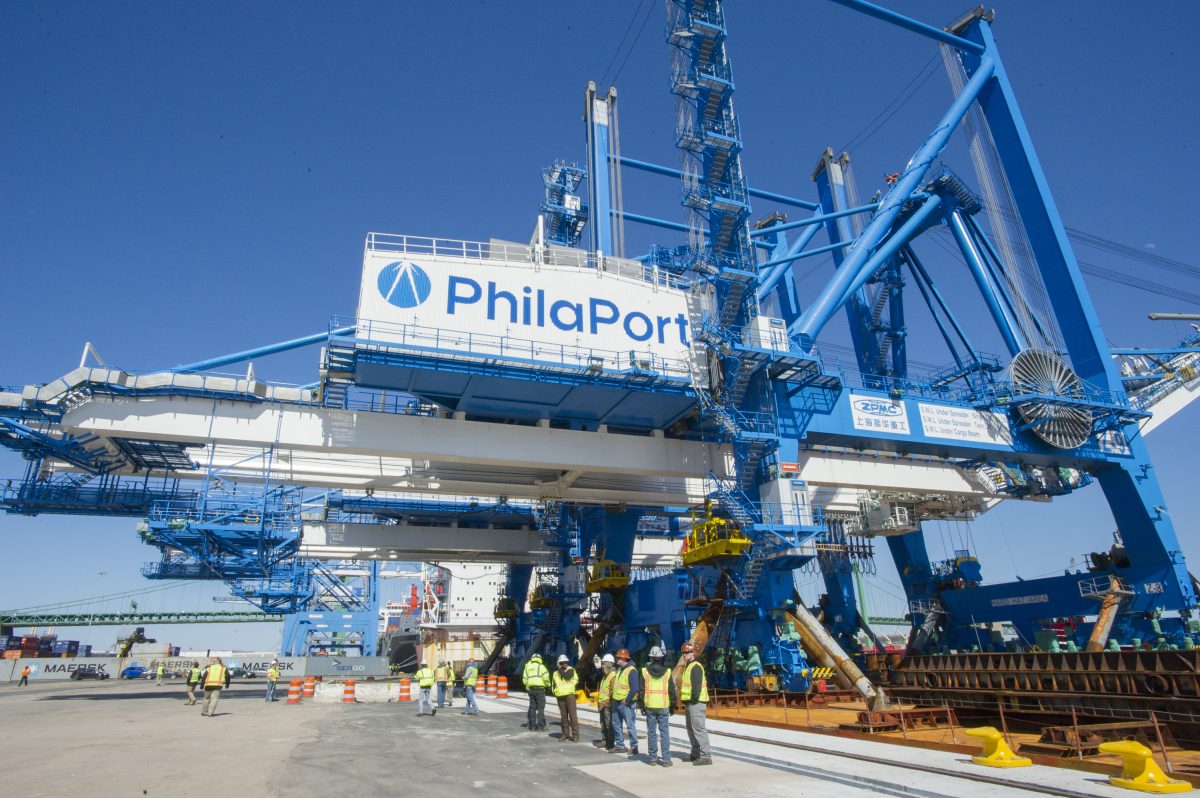
    Grant recipients are prohibited from using the funds to buy equipment made in China, whose state-owned Shanghai Zhenhua Heavy Industries Co. Ltd. (ZPMC) produces 70% of the world’s ship-to-shore cranes, including the vast majority in use at U.S. ports.

    American reliance on Chinese-made critical port infrastructure has raised national security concerns, magnified by the FBI’s 2021 discovery of “intelligence gathering equipment” onboard a ship that was delivering ZPMC cranes to Baltimore’s port, according to a congressional investigation.

    Only three companies outside China, two in Europe and one in Japan, make ship-to-shore cranes available for international buyers, according to the American Association of Port Authorities. Each firm’s cranes would likely be subject to tariffs imposed by the Trump administration.

    Another wrinkle: As PhilaPort has sought support for the waiver from Pennsylvania’s congressional delegation, some lawmakers have expressed reservations that even cranes made by a non-Chinese manufacturer might include parts made in China. Limiting that exposure could be challenging, given China’s dominance in these intermediate goods.

    It remains to be seen whether lawmakers will ultimately back the request. Labor unions such as United Steelworkers have broadly opposed exemptions from domestic production requirements. A spokesperson for United Steelworkers said the union is “still reviewing the specifics of this case.”

    U.S. Rep. Brendan Boyle (D., Pa.) said he “fought hard” to include the Build America Buy America provision in the 2021 law. “So I’m naturally quite concerned any time an entity is attempting to circumvent these important provisions that protect American jobs and industries,” he said in a statement.

    “PhilaPort’s management needs to do a much better job explaining why a waiver in this case is absolutely necessary,” said Boyle, whose district includes the Tioga terminal.

    Spokespeople for U.S. Sens. John Fetterman (D., Pa.) and Dave McCormick (R., Pa.) did not respond to messages seeking comment.

    Those restrictions will likely increase the cost. Of the $80 million awarded to PhilaPort by the EPA, the port authority had budgeted $47 million for two cranes at Tioga Marine Terminal.

    Now, “it’s unclear if we can do two [cranes] for that price,” said Ryan Mulvey, the port authority’s director of government and public affairs.

    Replacing diesel-powered cranes

    The 2022 Inflation Reduction Act passed by Congress and signed by President Joe Biden presented an opportunity for PhilaPort’s Tioga Marine Terminal, which was built in the 1960s and until recently was still using two diesel-powered cranes that had been installed in the late ‘60s and early ’70s.

    The cranes reached the end of their useful life and were recently dismantled, and the port authority has installed electrical infrastructure to support zero-emission equipment at Tioga, which handles cargoes such as forest products, containers, and steel.

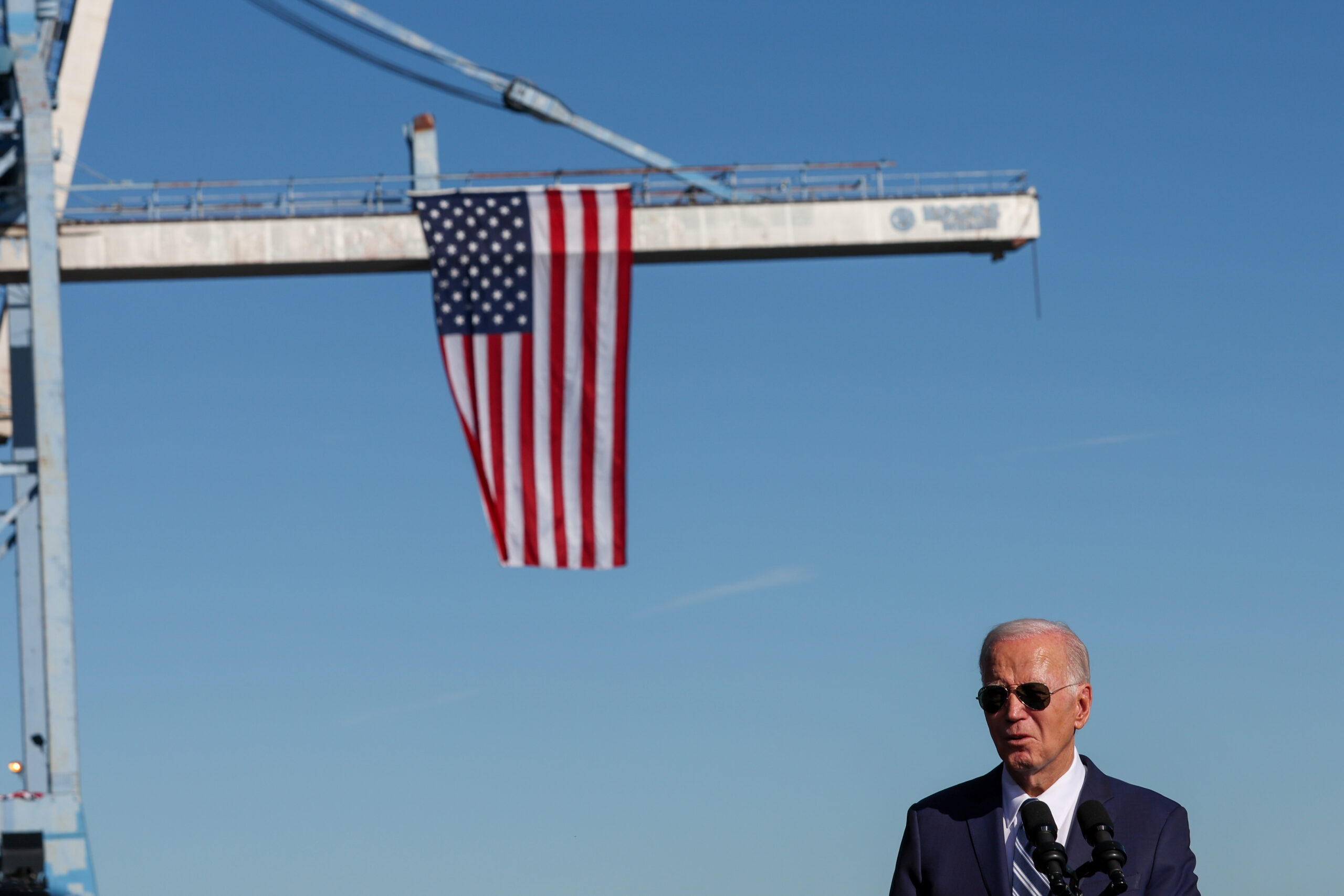
    President Joe Biden speaks at PhilaPort’s Tioga Marine Terminal in Philadelphia on Oct. 13, 2023.

    Cranes can lift two 20-ton cargo containers off a ship at a time. Without them, “it really restricts the amount of cargo you can put through the terminal,” said Andrew Sentyz, president of operator Delaware River Stevedores, which leases the terminal from the port authority.

    About 100 to 200 union longshoremen work at the site, depending on cargo volumes, he said.

    When PhilaPort started reaching out to vendors, at least three — Konecranes of Finland, Phoenix-based Stafford Crane Group, and Swiss-German firm Liebherr’s U.S. affiliate — indicated they were working toward making ship-to-shore cranes that would meet domestic content requirements under the Build America, Buy America Act, a provision of Biden’s 2021 bipartisan infrastructure law. (Stafford is a new entrant in the STS crane market.)

    But when the port authority proceeded to bid for the project last spring, four potential bidders said they were not able to deliver cranes meeting PhilaPort’s technical specifications within its schedule or budget, according to the application it filed with the EPA in September.

    One firm said Buy America rules would increase the cost of the project as much as threefold. It would take three to five years to build the manufacturing facilities needed to comply with the law and a further 36 months to complete production. By comparison, cranes that are not subject to those rules can be completed within 28 months, the vendor said.

    “In the absence of continuing federal incentives toward onshore crane manufacturing, the vendor advised there is not sufficient market demand to continue to scale up its domestic manufacturing of cranes,” PhilaPort’s application says.

    Another vendor told the port authority that “the low volume of current demand for BABA-compliant cranes makes domestic manufacturing currently uneconomical.”

    To comply with Buy America regulations, more than 55% of the total cost of components in a manufactured product must be from U.S.-made parts.

    The EPA has acknowledged the limited domestic production of zero-emission port equipment and in 2024 temporarily lowered that requirement to 25% for certain items. But to take advantage of that reduced threshold, installation of the STS cranes would have to begin by the end of the year — a timeline PhilaPort says is not realistic.

    ‘Nonexistent for decades’

    PhilaPort’s findings were consistent with broader industry research.

    American crane manufacturing “has been nonexistent for decades,” Cary Davis, president and CEO of the American Association of Port Authorities, told the U.S. trade representative last May in comments opposing Trump’s proposed 100% tariff on Chinese-made cranes.

    Barriers to reviving domestic industry include a shortage of welders and the fact that “American steel is significantly more expensive than European or Asian alternatives,” Davis said.

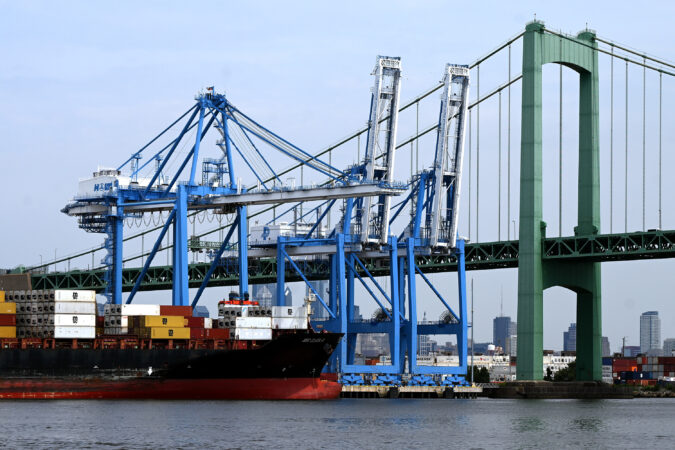
    Holt Logistics Corp. cranes lift containers off vessels docked at the Packer Avenue Marine Terminal in South Philadelphia.

    Likewise, the National Association of Waterfront Employers told the Biden administration in 2024 that domestic crane manufacturing is years, “if not decades, away from being a reality.”

    The EPA is aware of the industry input, and as part of its review of PhilaPort’s application, the agency is now conducting its own market research to assess the availability of American-made cranes, a spokesperson said.

    There have been signs of some incremental progress toward diversifying supply chains. In September, California-based PACECO Corp., a subsidiary of Japanese firm Mitsui E&S, said it had secured a contract to supply two ship-to-shore cranes to a terminal at the Port of Long Beach in California. The cranes will be built in Japan, the companies said, and include “American-made components supplied by U.S. companies.”

    “This order underscores the shift now underway in the U.S. container handling market,” Troy Collard, general manager of sales at PACECO, said in a news release announcing the order. He said the order shows there are “reliable alternatives” to Chinese manufacturers “that both meet the needs of U.S. ports and support broader national security and supply chain resilience goals.”

    Scrutiny of China

    The focus on domestic production comes as Congress and federal law enforcement have in recent years stepped up scrutiny of potential security risks associated with Chinese equipment at U.S. ports.

    China’s ZPMC built about 80% of the ship-to-shore cranes in use at U.S. ports — including several bought by PhilaPort for the Packer Avenue Marine Terminal in South Philadelphia. The firm has close ties to the Chinese Communist Party, according to two Republican-led House committees that investigated the company.

    ZPMC cranes were installed at Packer Avenue Marine Terminal in 2018.

    In 2024, three years after the FBI’s discovery in Baltimore, the committees said their investigation found that ZPMC had installed communication devices on crane components and other maritime infrastructure at two U.S. seaports. These cellular modems, not included in contracts with U.S. ports, were “intended for the collection of usage data on certain equipment,” constituting “a significant backdoor security vulnerability that undermines the integrity of port operations,” the investigation found.

    China has called concerns about spying “overly paranoid.”

    But under Beijing’s “highly acquisitive data governance regime and comparatively high levels of control over PRC firms,” Chinese-made equipment and software in port systems enable surveillance and “may cause delay or disruption to the critical operations of U.S. maritime transport systems,” Isaac Kardon, senior fellow for China Studies at Carnegie Endowment for International Peace, told Congress last year.

    It is not easy to completely remove China from the supply chain, however. In response to a request from lawmakers, PhilaPort asked prospective bidders if they could produce the cranes without Chinese parts, Mulvey said. Only one firm said it could source “100% without Chinese components,” he said.

    PhilaPort noted in the waiver application that it is considered by the Pentagon as one of 14 “strategic military seaports.” During the Iraq War, that enabled the port to handle Army shipments.

    “These cranes enable the efficient handling of heavy, oversized, and mission-critical military cargo, directly supporting the Department of Defense’s logistical and deployment capabilities,” the application says.

  • Judge was right to toss racketeering charges against George Norcross, N.J. appeals court says

    Judge was right to toss racketeering charges against George Norcross, N.J. appeals court says

    A New Jersey appellate court on Friday declined to reinstate racketeering charges against Democratic power broker George E. Norcross III, dealing a fresh blow to prosecutors who had accused him of running a criminal enterprise.

    The three-judge panel affirmed a lower court order dismissing a 13-count indictment against Norcross, 69, and five codefendants, whom a grand jury alleged used threats of economic and reputational harm — as well as their control of Camden government — to obtain property on the city’s waterfront from a developer and a nonprofit.

    Acting Attorney General Jennifer Davenport — Democratic Gov. Mikie Sherrill’s nominee for the post — will now have to decide whether to file another appeal in a case that was brought by her predecessor. A spokesperson said the Attorney General’s Office is reviewing the opinion, which says the state has 45 days to pursue an appeal at the state Supreme Court.

    Mercer County Superior Court Judge Peter Warshaw ruled last February that none of the threats described in the June 2024 indictment were unlawful because, he said, state law permits such statements in the context of economic bargaining. Warshaw also found the charges were time-barred.

    The state Attorney General’s Office appealed Warshaw’s decision, arguing that the judge had failed to review thousands of pages of grand jury evidence and that the indictment properly alleged criminal extortion.

    On Friday, the appellate court in a 92-page opinion upheld Warshaw’s order but did so on different legal grounds. The panel said several of the indictment’s racketeering conspiracy and extortion charges were time-barred under the statute of limitations. Other counts failed to state a crime, were untimely, or both, the panel said.

    Norcross’ representatives didn’t immediately respond to requests for comment.

    In addition to Norcross — founder of insurance brokerage Conner Strong & Buckelew and chair of Cooper University Health Care — the grand jury charged his brother Philip, CEO of the law firm Parker McCay; attorney William Tambussi; former Camden Mayor Dana L. Redd; Sidney R. Brown, CEO of logistics firm NFI; and John J. O’Donnell, an executive at residential developer The Michaels Organization.

    Statute of limitations

    The case centers on Norcross’ efforts to acquire real estate in Camden following a 2013 New Jersey law he allegedly shaped that turbocharged corporate tax incentives for development in a city that had faced decades of disinvestment.

    Prosecutors say that from 2014 through 2016, Norcross and his associates threatened a nonprofit redevelopment group and Philadelphia developer Carl Dranoff, coercing them into selling property for less money than they believed it was worth.

    Norcross and his partners then used the properties to obtain millions of dollars in state tax credits for various corporate entities and later sold the credits for cash, the state says.

    In contrast to the lower court judge, the appeals panel did not weigh whether the threats allegedly made in 2014 and 2016 were unlawful. Instead, the panel said the charges associated with those threats — racketeering and extortion conspiracies — were filed by prosecutors beyond the five-year statute of limitations.

    To comply with that statute, prosecutors needed to show that the conspiracies outlined in the June 2024 indictment continued past 2019. The state contended that it met this burden because corporate entities controlled by Norcross continued to receive tax credits during that period and because the indictment says the power broker took steps to conceal his conduct in the years since.

    But the appellate panel agreed with Warshaw that “the objects of the conspiracies were concluded” with the completion of the redevelopment deals years earlier.

    The court also rejected the concealment argument, saying the indictment does not meet a legal requirement alleging an “agreement among the conspirators to continue to act in concert in order to cover up, for their own self-protection, traces of the crime.”

    Dealings with Carl Dranoff

    The appeals court did find that another charge related to waterfront real estate dealings was timely, but failed to satisfy other legal requirements.

    When Dranoff in 2018 tried to sell the 349-apartment Victor Lofts to a real estate investment firm for $71 million, the indictment says he faced resistance from Camden officials. They agreed to “slow down” a government approval at the direction of Philip Norcross — an attorney who, like his brother, had no official role in city government, the indictment says.

    The sale ultimately fell through, and the city moved to terminate Dranoff’s option to develop another property known as Radio Lofts. The dispute led to years of litigation, and Dranoff ultimately settled with the city in 2023, agreeing to forfeit his rights to Radio Lofts and pay Camden $3.3 million despite believing “he was in the right,” according to the indictment.

    Prosecutors allege this was another conspiracy to extort Dranoff. But while the alleged conduct occurred within the limitations period, the appeals panel said, the indictment failed to meet the legal requirements for alleging conspiracy to commit extortion. For example, neither George Norcross nor his codefendants were accused of threatening or planning to threaten Dranoff to settle, the panel said.

    Serving on the panel were Appellate Judges Greta Gooden Brown, Lisa Rose and Ellen Torregrossa-O’Connor.

  • Gloucester County warehouse project has been undermined by a ‘rogue’ employee and rival firm, lawsuit says

    Gloucester County warehouse project has been undermined by a ‘rogue’ employee and rival firm, lawsuit says

    The developer behind a massive mixed-use project in South Jersey has filed a lawsuit accusing a “rogue” employee of derailing municipal approvals and plotting to steer the property to Rowan University and a rival firm.

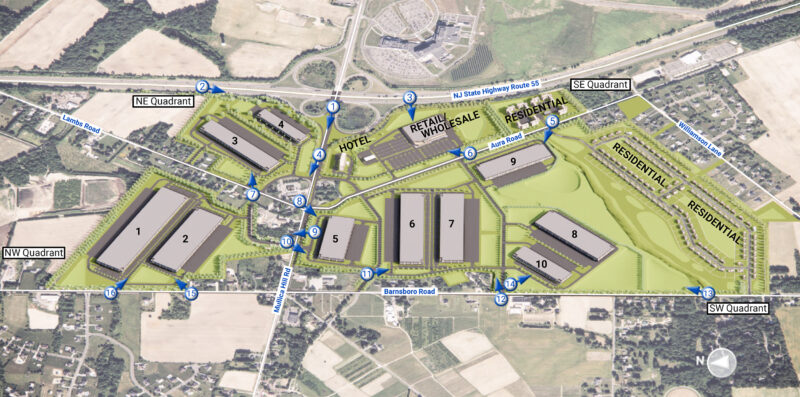
    For more than two years, Seth Gerszberg and his Englewood, N.J.-based firm Active Acquisitions have been pursuing a development at the intersection of Route 322 and Route 55 in Gloucester County including proposals for 10 warehouses, a wholesale retail club, a hotel, and 117 single-family homes.

    An affiliate of Gerszberg’s firm agreed to buy the property — totaling 429 acres, about 29 times the footprint of Lincoln Financial Field — in May 2023 for $23 million from Madison Richwood Village LLC, the suit says.

    But the government approval process hit a snag in recent months, the suit alleges, as Gerszberg’s project manager, Sean Earlen — a land-use consultant, former mayor of Lumberton, and chair of the Burlington County GOP — “leveraged his close personal relationship” with Harrison Township’s mayor, Republican Adam Wingate, “to sow doubt within the township” about the viability of the development.

    Yearslong saga

    It’s the latest twist in a development saga that dates to 2008, when plans for a walkable town center in Harrison’s Richwood section were unveiled, including talk of a new elementary school and liquor licenses for restaurants in what had been a dry town.

    But development efforts went nowhere, and the new push for warehouses — in a region that’s added tens of millions of square feet of warehousing space in recent years to meet demand for online shopping — has faced some resistance from residents in the affluent rural town of 14,000.

    Now those plans could be in question.

    According to the suit, Earlen has been pushing the current property owner, Madison Richwood, to do a deal with Rowan and Ohio-based Fairmount Properties LLC, which has been pursuing a “wellness district” at the university featuring proposals for a headquarters for Inspira Health, a hotel, as well as shops and restaurants.

    Rowan University in Glassboro.

    At some point last year Rowan negotiated a deal with Madison Richwood to buy the property for $31 million, plus another $10 million in 2026, the complaint says, in an effort to “fulfill the university’s vision for a comprehensive plan at the Route 55/Route 322 interchange.”

    As the township’s confidence in the warehouse project has eroded, the suit alleges, a neighboring property owner filed a lawsuit in October challenging Active’s government approvals.

    The developer — which has industrial and residential projects across New Jersey — has sunk roughly $4 million to obtain the necessary approvals for the project and $7 million in “consultant and development expenses,” according to court records.

    Gerszberg, who before his work in real estate was cofounder and president of hip-hop fashion brand Marc Ecko Enterprises, didn’t respond to requests for comment.

    What does Rowan say?

    The most recent suit, filed this month in Bergen County Superior Court by Active affiliate ActiveRWHA Property LLC, names Earlen and Fairmount Properties as defendants. It alleges interference with contractual rights, misappropriation of trade secrets, and defamation, among other counts.

    Representatives for Fairmount and Rowan — a public research institution that isn’t a party to the suit — did not directly answer questions about whether they intend to buy the property. Neither Earlen nor Wingate — who took office as mayor last year — responded to requests for comment.

    Randy Ruttenberg, a Fairmount principal, said the suit is “completely without merit” and called it an “ill-advised attempt to disrupt the very straightforward development process we continue to diligently pursue for the benefit of the entire region.”

    “Fairmount Properties is focused fiercely on executing their own world-class development, and no matter what obstacle is placed in our path, we will not be distracted, bullied or deterred,” he said in a statement.

    Joe Cardona, a spokesperson for Rowan, said it would be inappropriate to comment on pending litigation. “Rowan remains focused on its academic mission and on conducting all institutional planning activities responsibly and in accordance with applicable laws and governance standards,” he said in an email.

    Madison Richwood affiliate Madison Marquette — a Washington, D.C.-based real estate investment and operating company — said in court papers that Gerszberg’s concern about a sale to Rowan is “without merit.”

    Madison Marquette “will not sell the property, as defined in the [purchase and sale agreement], to Rowan, Fairmount, or any other entity while the PSA is in full force and effect,” firm president and managing principal William Sudow said in a court filing in a related case that has since been resolved.

  • In one of Phil Murphy’s final acts as governor, he signed a bill that could help Camden tower get $400 million in tax credits

    In one of Phil Murphy’s final acts as governor, he signed a bill that could help Camden tower get $400 million in tax credits

    Hours before leaving office, New Jersey Gov. Phil Murphy on Tuesday signed legislation that could make it easier for commercial real estate projects in Camden to qualify for hundreds of millions of dollars in state tax incentives.

    One planned development that could benefit is the Beacon Building, a proposed 25-story office tower downtown on the northwest corner of Broadway and Martin Luther King Boulevard, The Inquirer previously reported.

    Murphy approved the bill and dozens of others on the final day of his second term, shortly before fellow Democrat Mikie Sherrill was sworn in as governor. Another newly signed law authorizes up to $300 million in tax breaks to renovate the Prudential Center in Newark, home of the New Jersey Devils. The hockey team is owned by Harris Blitzer Sports & Entertainment, which also owns the Philadelphia 76ers.

    The Camden-focused law makes changes to the state’s gap-financing program, known as Aspire, which authorizes up to $400 million in corporate tax credits over 10 years for “transformative” redevelopment projects that have a total cost of $150 million and meet other requirements.

    To qualify for the incentives, most commercial projects must generate a net positive benefit to the state, based on the Economic Development Authority’s economic modeling. The new law exempts certain projects from that “net benefit test.”

    The law applies to redevelopment projects located in a “government-restricted municipality” — as described in the Aspire program’s statute — “which municipality is also designated as the county seat of a county of the second class.” In addition, the project must be located in “close proximity” to a “multimodal transportation hub,” an institution of higher education, and a licensed healthcare facility that “serves underrepresented populations.”

    A rendering of the 25-story Beacon Building proposed for the northwest corner of Broadway and Martin Luther King Boulevard in Camden. It would be the tallest building ever constructed in the city.

    The site of the proposed Beacon Building is across the street from the Walter Rand Transportation Center and Cooper University Hospital. Rutgers’ Camden campus is also nearby. Lawmakers said projects in New Brunswick and Trenton could also qualify for exemptions under the law.

    Development firm Gilbane is leading the project with the Camden County Improvement Authority. Gilbane has yet to announce any commitments from tenants.

    Assembly Majority Leader Louis Greenwald (D., Camden), who sponsored the legislation, has said it wasn’t written with a specific project in mind but rather to remove a barrier to investment in South Jersey.

    Critics said that the law removes a key safeguard meant to protect taxpayers and that it represented an about-face for Murphy, who earlier in his tenure sought to reform corporate incentive programs.

    “Just in terms of the governor signing the bill, this is a massive disappointment,” said Antoinette Miles, state director of the New Jersey Working Families Party.

    “Broadly, if there’s a so-called transformative project that can’t pass the net benefit test, maybe it isn’t so transformative,” she said.

    Murphy’s office announced the bill signing without commenting on it, though he has previously cheered state investment in Camden. Any Aspire tax incentives must be approved by the state’s Economic Development Authority.

  • Temple bought the site of a former McDonald’s for $8 million

    Temple bought the site of a former McDonald’s for $8 million

    Temple University last month bought a vacant property at the site of a former McDonald’s near its North Philadelphia campus for $8 million, according to property records.

    The university is still developing plans for the 48,640 square-foot lot at 1201-1219 N. Broad St., by Girard Avenue, a spokesperson said.

    It’s adjacent to the Temple Sports Complex, which features two fields for soccer, lacrosse, and field hockey. That location “provides an opportunity to implement the vision of our campus safety and physical environment plan,” Steve Orbanek said.

    The transaction was earlier reported by the Philadelphia Business Journal.

    The restaurant franchise was demolished in 2023.

    Temple’s latest acquisition comes as the university has expanded its footprint in recent months along Broad Street.

    In early 2025 the university paid $18 million for Terra Hall, a former University of the Arts building on South Broad Street. The building will be Temple’s Center City campus. And last fall Temple bought jazz bar New Barber’s Hall on Oxford Street for $2.3 million, the Business Journal reported.