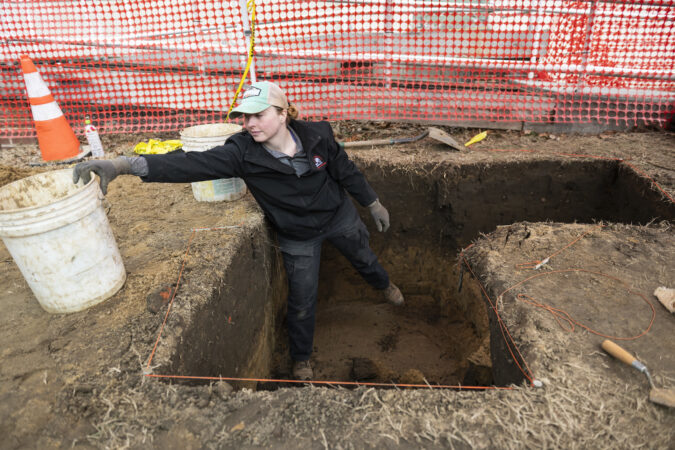
To the casual observer, it’s just an L-shaped hole in the ground, about 40 inches deep, showing two distinct layers of dirt.
But to the archaeologists who dug the hole, it’s a portal into the past going back thousands of years.
Croft Farm is a national historic site. Its owners during the mid-1800s helped Black people escape from slavery. The farmhouse, outbuildings, and 80 acres of the farm are now owned by Cherry Hill Township, part of a recreational and educational space for the public.
The darker brown top layer of “silty sand” contains artifacts from the last 300 years, an era when both enslavers and those dedicated to emancipation lived on the site, according to Matt Kraemer, 27, an archaeologist from Summit, N.J.
Below it, the lighter-colored layer has revealed artifacts from a time when the Lenni-Lenape Indigenous people lived on the land along the Cooper River, in what is now Cherry Hill.
“It’s a very significant site for the fact that it has a Native American component, plus everything the Evans family left behind,” Kraemer said Saturday.
Alanna-Corinne Konkisre (center), 9, of Gloucester County, sifts through dirt to find artifacts at Croft Farm in Cherry Hill, N.J. on Saturday, Feb. 21, 2026. Croft Farm, listed on the National Register of Historic Places, is now an active archaeological site due to the farm’s role during the time of the Underground Railroad.
The Evans family was part of the Quaker religious movement, and like many area Quakers of the time, owners Thomas Evans and his son Josiah were part of the New Jersey Abolition Society, “a group that advocated an end to slavery and also helped to maintain the Underground Railroad,” according to a history of Croft Farm provided by Cherry Hill Township.
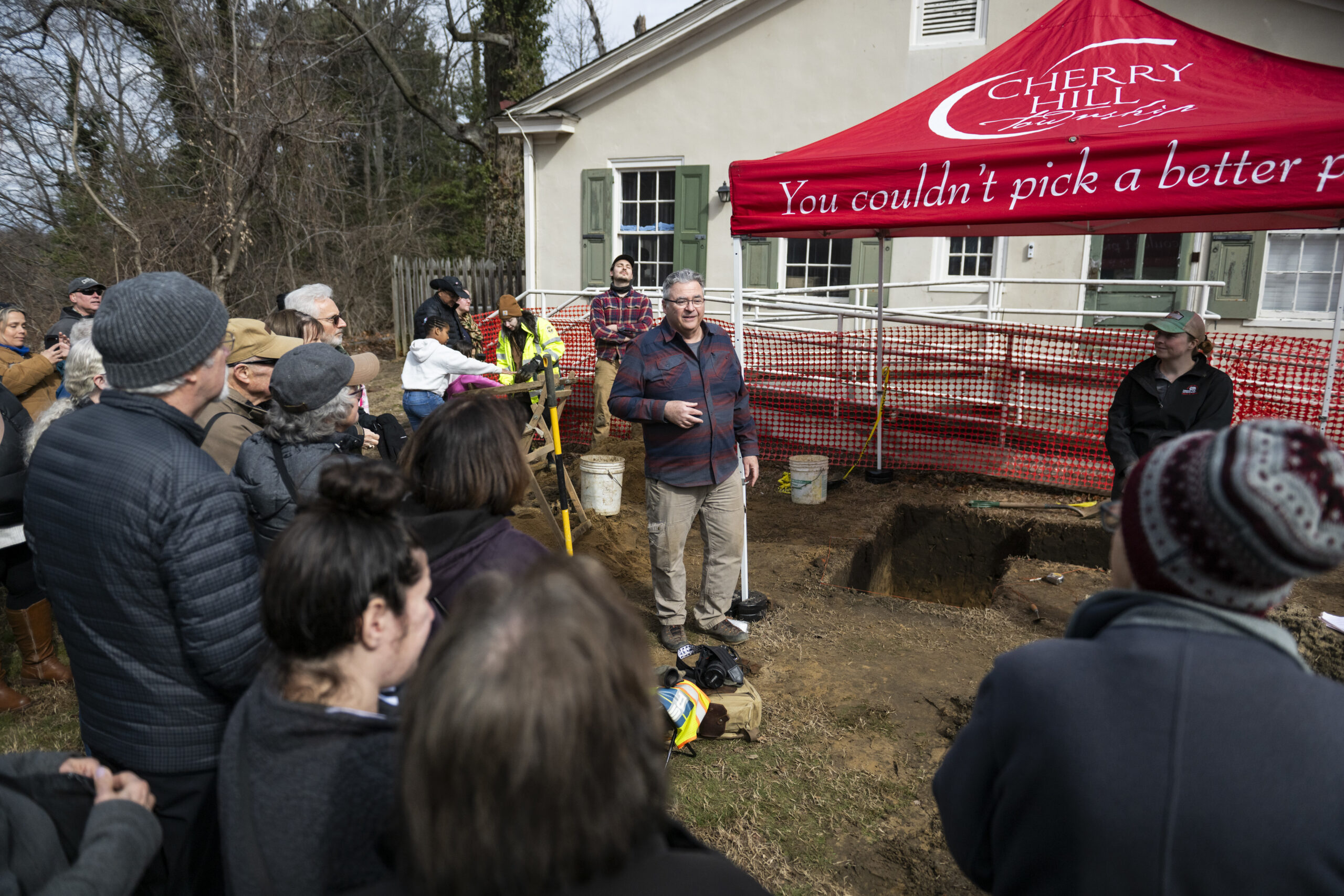
Matthew Tomaso, senior director of cultural resource practices at PS&S, speaks to a crowd of people before the start of an archeological dig at Croft Farm in Cherry Hill, N.J.m on Saturday, Feb. 21, 2026. Croft Farm, listed on the National Register of Historic Places, is now an active archaeological site due to the farm’s role in the Underground Railroad.
The farm’s historical significance presents a great learning opportunity, said Matthew Tomaso, the archaeologist leading the project for PS&S, an architecture and engineering firm with a location in Warren Township.
A year ago, PS&S was brought in to oversee cultural resource management as the township sought to stop groundwater from entering the basement of the brick house on the property, Tomaso said.
That gave Tomaso and his team a chance to see what they might find that would shine a light on the property’s role as a station on the Underground Railroad.
Animal bones, pieces of pottery, and other artifacts help tell that story, Tomaso said, by showing the dietary patterns, habits, and traditions of the people living there at the time.
Nolan Arcinese (left) and Aaron Arcinese (right) look through dirt to find artifacts at Croft Farm in Cherry Hill, N.J., on Saturday, Feb. 21, 2026. Croft Farm, listed on the National Register of Historic Places, is now an active archaeological site due to the farm’s role during the time of the Underground Railroad.
That includes previously enslaved people known to have lived there, such as Joshua Sadler, as well as others who worked and lived on the farm, he said. Sadler went on to found nearby Sadlertown, a Black settlement located in what is now Haddon Township.
What they learn could be especially important since the Underground Railroad was not well documented at the time it was in operation, due to the need to maintain secrecy, Tomaso said.
Mostly, though, they have found bones, said Chelsea Carriere, 29, an archaeologist who called herself “the bone lady.”
Carriere explained that she was looking closely at cow, pig, and bird bone fragments — and the ways the animals were butchered nearly 200 years ago.
To her, the rough cuts on the bones show that these animals likely were raised on the farm or hunted, and were likely butchered on-site, rather than through a butcher shop.
“They were doing it themselves, and that suggests lower socioeconomic status,” Carriere said. Her team is still in the early stages of examining the artifacts.
To her, some of the most amazing finds so far were discovered deeper down in the dirt and would date back 2,000 or more years. These include a piece of argillite that she surmised was a spear point, and a basalt biface, an ancient tool that would have been used for cutting.
“This is a really good site,” Carriere said.
It was also a great experience Saturday for learners of all ages who listened to demonstrations and, with archaeologists’ guidance, used a sifter to search for artifacts in the dirt.
“I love to know what people were doing hundreds of years ago,” said Cherry Hill resident Debbie Kilderry, 71, as she watched children sift the soil.
She came to the site with two artifacts she had obtained — a small porcelain container and a stone — hoping that the archaeologists might have insights into their origins. Tomaso’s professional analysis: She had a real arrowhead, likely from the American West, and a cup once used for coffee cream.
To Kilderry, it is exciting to connect with those who came before her.
“I’m excited to see what they were doing, because they were people just like us — just with different inconveniences.”
The Bucks County District Attorney’s Office is investigating the Quakertown Borough Police Department’s response to a high school student protest against federal immigration enforcement.
On Friday, a Quakertown High School student walkout protesting U.S. Immigration and Customs Enforcement (ICE) escalated into a confrontation with adults that left at least one teenager bloodied and in handcuffs.
“Our office is conducting an independent investigation into the police response during this incident,” said Manuel Gamiz Jr., a spokesperson for Bucks County District Attorney Joe Khan. “To ensure a thorough and transparent review, we are seeking the community’s assistance and encourage anyone with information, including video footage or photos, to contact the Bucks County detectives at 215-348-6354.”
Bystander video footage showed police, adults, and what appear to be teenagers, at times fighting, on a sidewalk along Front Street. In a widely shared video, teens were seen scuffling with a man who put a girl in a chokehold. Several news organizations have reported that the man, who was not wearing a police uniform, was Quakertown Police Chief Scott McElree. Quakertown police and McElree did not respond to requests for comment Saturday morning.
Quakertown police said Friday that five or six minors and one adult were taken into custody. Police have not provided details on who was arrested and said that the students had been acting violently.
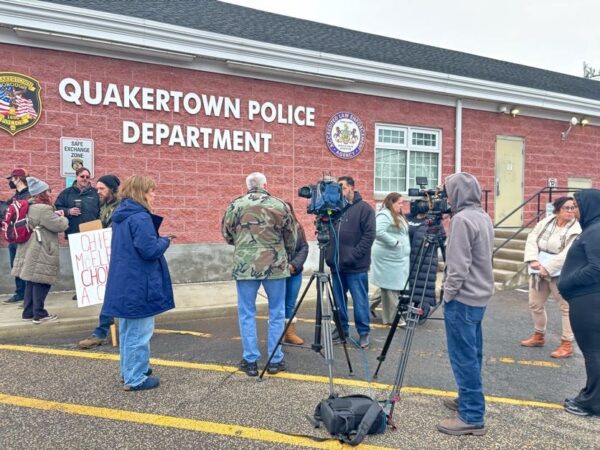
Standing outside the Quakertown police station Saturday morning, parents and leaders from local civil rights groups called on police to provide answers.
Adrienne King, president of the Bucks County NAACP, said that when young people are involved in a police encounter, “the standard for care, restraint, and adherence to policy are high and must be adhered to.”
“Video circulating publicly has raised serious questions in our community,” King said. “Those questions deserve answers, and we are here to ask for those answers today. Transparency is not optional in situations like this.”
Family members of one of the girls in police custody provided a written statement Saturday.
“We are looking for answers and accountability from the Quakertown police department and school district as well as justice for our daughter and the other children. We offer solidarity with the other families affected and hope to have our children home immediately.”
To explain his journey from Ukraine to Huntingdon Valley in Montgomery County, Ukraine army veteran Illia Haiduk first must explain one of the worst days of his life.
On Nov. 3, 2023, Haiduk and about 70 other Ukrainian soldiers were at an outdoor awards ceremony in Zaporizhzhia, near the war’s front line. After an enemy drone spotted the gathering, the Russians launched an Iskander-M ballistic missile.
“You hear nothing,” Haiduk said. “It just hits immediately.”
Haiduk awoke on the ground. To his left, people were moving. To his right was “a mess, fire, and smoke.”
He tried to get up. That was when he realized shrapnel had mangled his lower right leg.
Haiduk belted a tourniquet around his thigh and tried to crawl to another soldier from his unit, the 128th Mountain Division. “I wanted to get to him. And there was this hole in his chest. Nothing could save him. He was the same age as me,” the 35-year-old said.
The attack killed at least 19 soldiers and wounded dozens more, according to news reports.
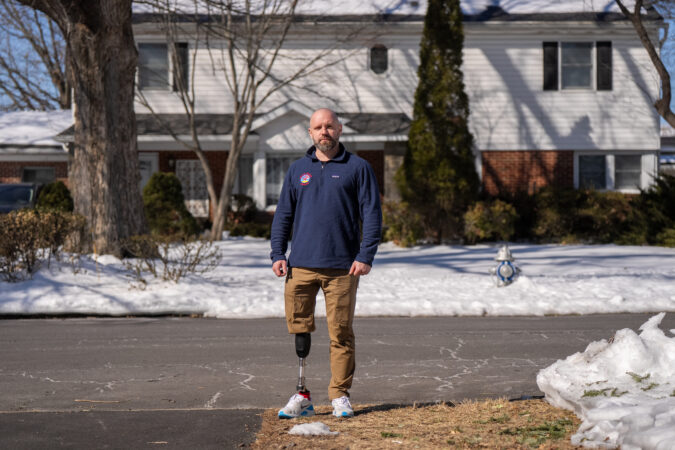
Haiduk’s injury sent him on a long path of healing that ultimately brought him to the Philadelphia area. But more than two years later, the attack is just one incident in a war that has claimed an estimated 2 million lives.
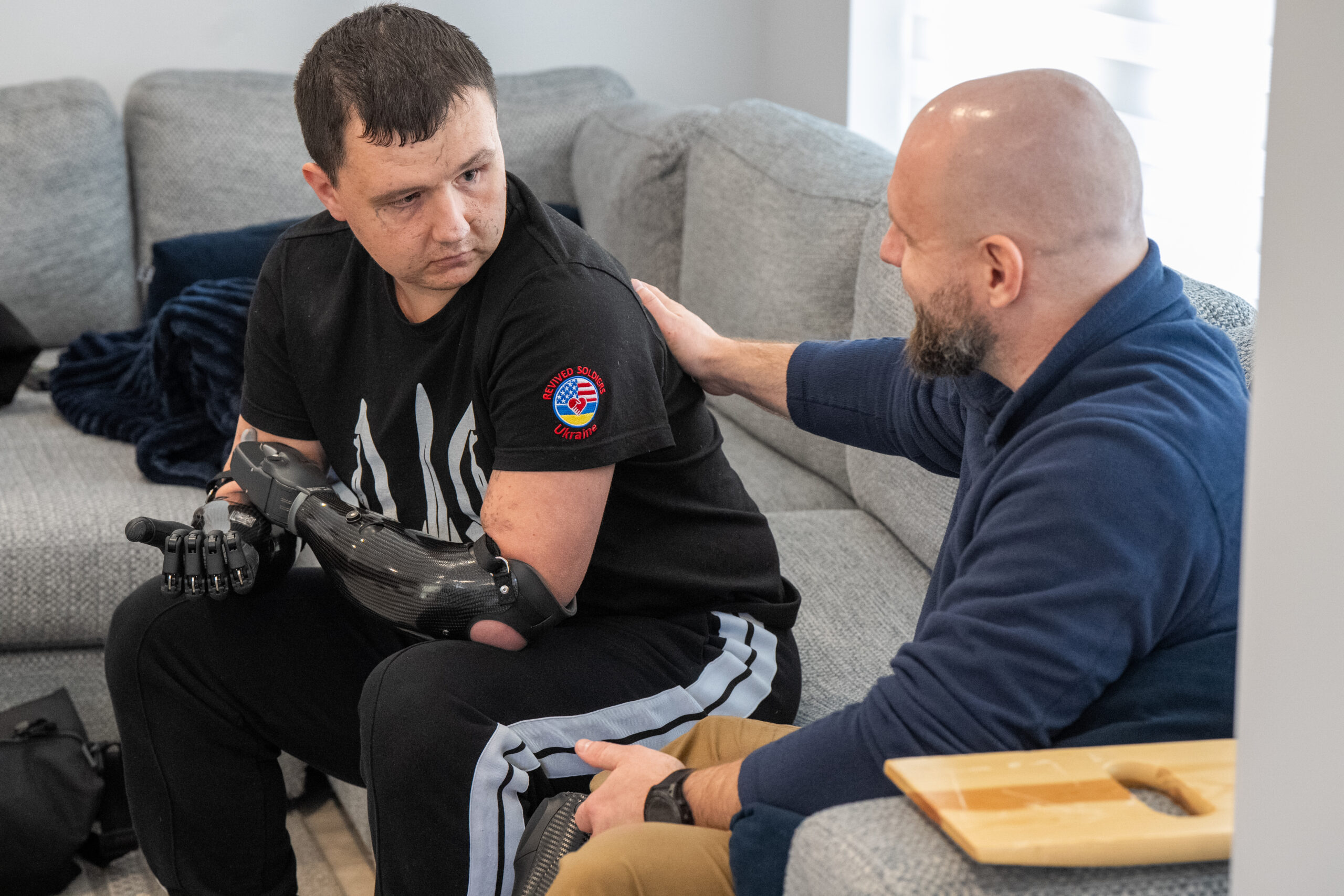
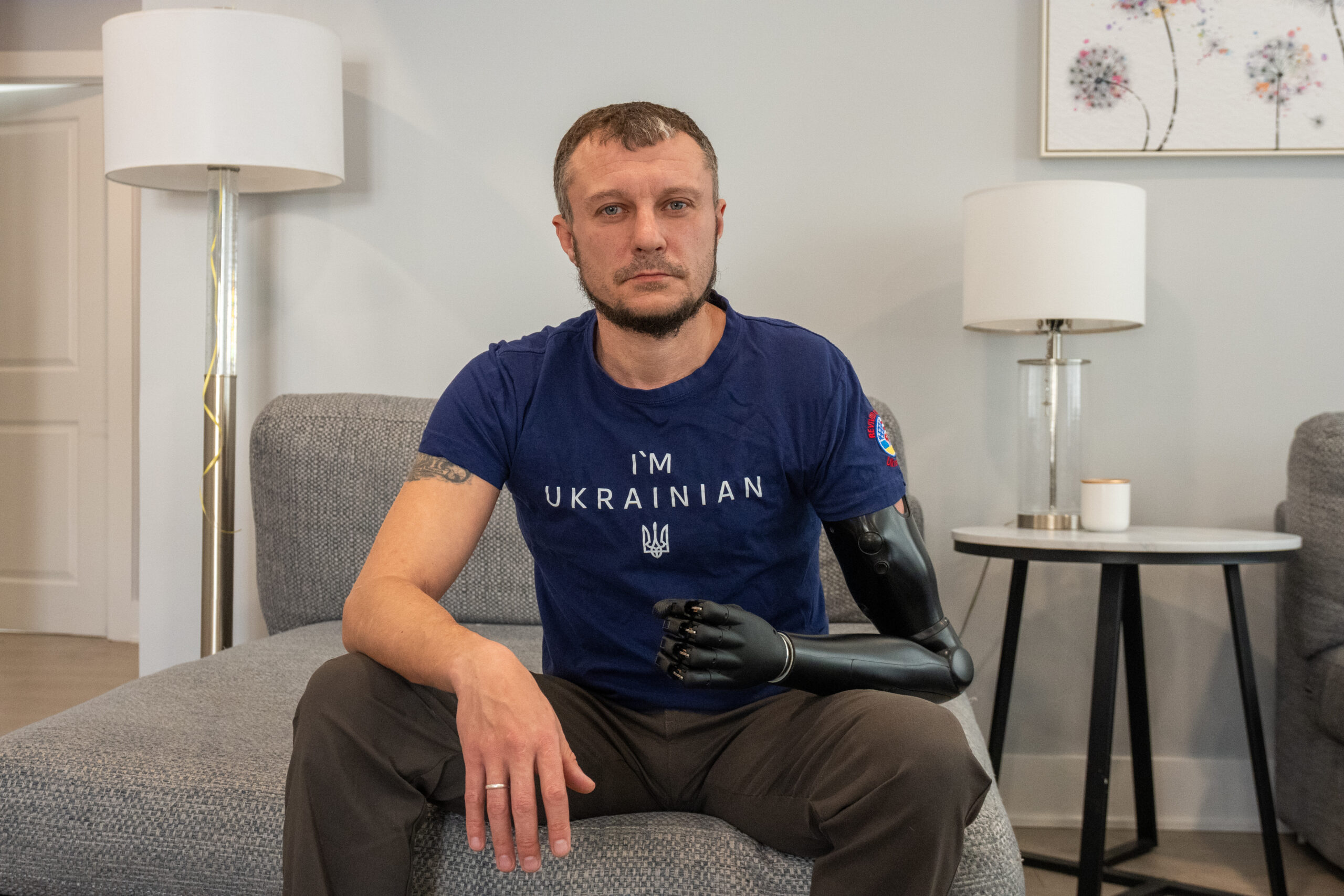
Vladislaw Romanenko (left) and Ilia Haiduk in a community-living home where veterans of the war in Ukraine support each other through their medical journeys, in Philadelphia, Feb. 13, 2026.
Four years after Russia invaded Ukraine, the war’s effects can be found throughout the region, among refugees and veterans seeking support services and the advocates helping them. Many are concerned about the future.
“In 2022, support and donations poured, but every year they become smaller and smaller,” said Roman Vengrenyuk of Philadelphia, who helps run the Revived Soldiers Ukraine program that brought Haiduk to the U.S. “A lot of nonprofits closed.”
Vengrenyuk said he has no expectation that the war will end this year. The Trump administration has failed to provide Ukraine with the weapons it needs to win, he said. Meanwhile, the bloodshed has left 60,000 Ukrainians in need of amputations, overwhelming hospitals in Ukraine and Europe.
Though it has gotten harder to get attention for their cause, an alliance of healthcare providers, nonprofits, and advocates across Philadelphia has continued to help wounded veterans and refugees. And for that, Vengrenyuk said, he is grateful.
“The Philadelphia community of doctors really stepped in,” Vengrenyuk said.
Life after war
After recovering from his injury, Haiduk went home and attempted to return to civilian life, but he felt depressed. That changed, however, in 2025, when he traveled to Canada to compete in the Invictus Winter Games, a multisport event for disabled veterans. He won a bronze medal in the skeleton race, and he found purpose and fellowship with others who had similar experiences.
“We can talk really freely, because we know that this man will understand me,” Haiduk said of his fellow veterans.
Vladyslaw Romanenko at a community-living home where veterans of the war in Ukraine support each other through their medical journeys, in Philadelphia, Feb. 13, 2026.
Later that year,Revived Soldiers Ukraine sent Haiduk to Orlando , where he received a prosthetic lower leg.
Haiduk got more involved with the Florida-based nonprofit. He has since helped numerous disabled veterans who were routed to the Philadelphia region for medical care.
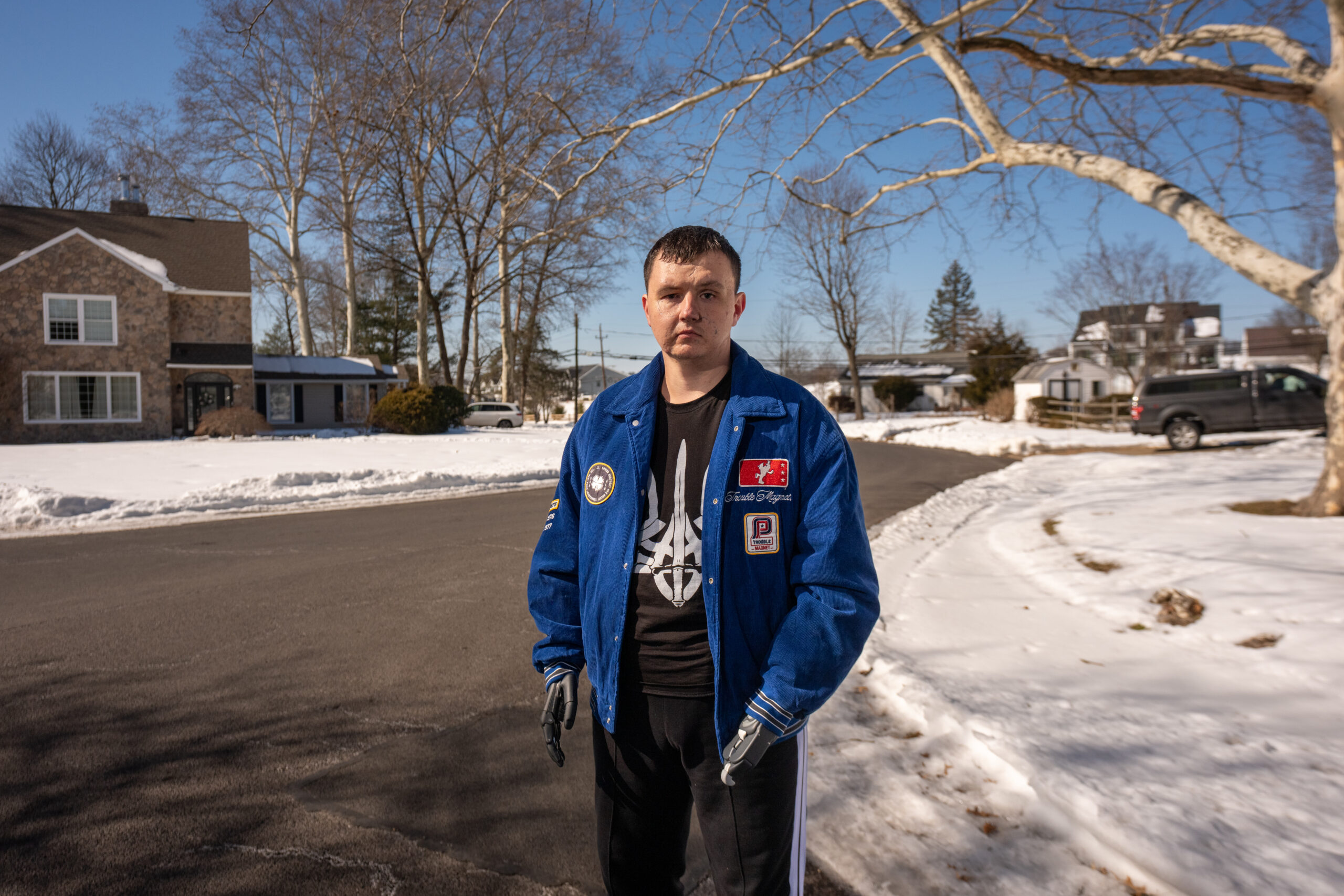
One is 30-year-old Vladyslav Romanenko, a former engineering student from Kharkiv who joined the army in 2022 and lost his lower arms in a drone strike last May. Romanenko is one of six Ukrainian war veterans living together at two homes in Huntingdon Valley.
Revived Soldiers Ukraine flew Romanenko and his partner to Philadelphia. At Wills Eye Hospital, a Ukrainian-speaking doctor, Michael Klufas, helped to restore vision in his right eye. Then, Prosthetic Innovations in Eddystone, Delaware County, outfitted him with bionic arms. “I’m very grateful to the Ukrainian and American doctors,” Romanenko said in Ukrainian, as Haiduk translated.
Oleksii Kondratenko at a community-living home where veterans of the war in Ukraine support each other through their medical journeys, in Philadelphia, Feb. 13, 2026.
Haiduk said Romanenko’s story is typical of the soldiers he works with: men from a wide range of professions and ages, who signed up to save their people. “I would never have joined the army, but because the war started, it was my responsibility to join, for my country,” Romanenko said.
Haiduk said people in the U.S., and most of the world, support the Ukrainian cause of “democracy and humanity.” However, more pressure needs to be put on Russia, he said.
“There is support, but it isn’t enough support to end this war,” Haiduk said.
Paying to stay in the U.S.
As an American-born Ukrainian whose parents were displaced after World War II, 71-year-old Mary Kalyna said, she considers it her mission to help those in “the Ukrainian diaspora.” The fluent Ukrainian speaker from Mount Airy said the situation has gotten worse for Ukrainian refugees since last year.
“Even though Ukraine is not in the news as much, I believe people still support Ukraine,” Kalyna said. “The problem is our government has changed. Now we have a government that is less supportive of Ukraine.”
The Konoshchuk family has lunch Sunday, Feb. 15, 2026. The family, from Ukraine, lives in Delaware County.
She criticized President Donald Trump for welcoming Russian President Vladimir Putin and holding peace talks where Ukraine was expected to cede land to Russia.
To her, Trump administration policy is working against local efforts from churches and communities that have embraced Ukrainians.
“There are many, many screws being tightened,” Kalyna said.
She provided an example: Due to one provision in Trump’s “OneBig Beautiful Bill,” thousands of Ukrainians who previously had been invited to the U.S. through the federal United for Ukraine program have to pay $1,000 per family member to maintain their humanitarian parole status.
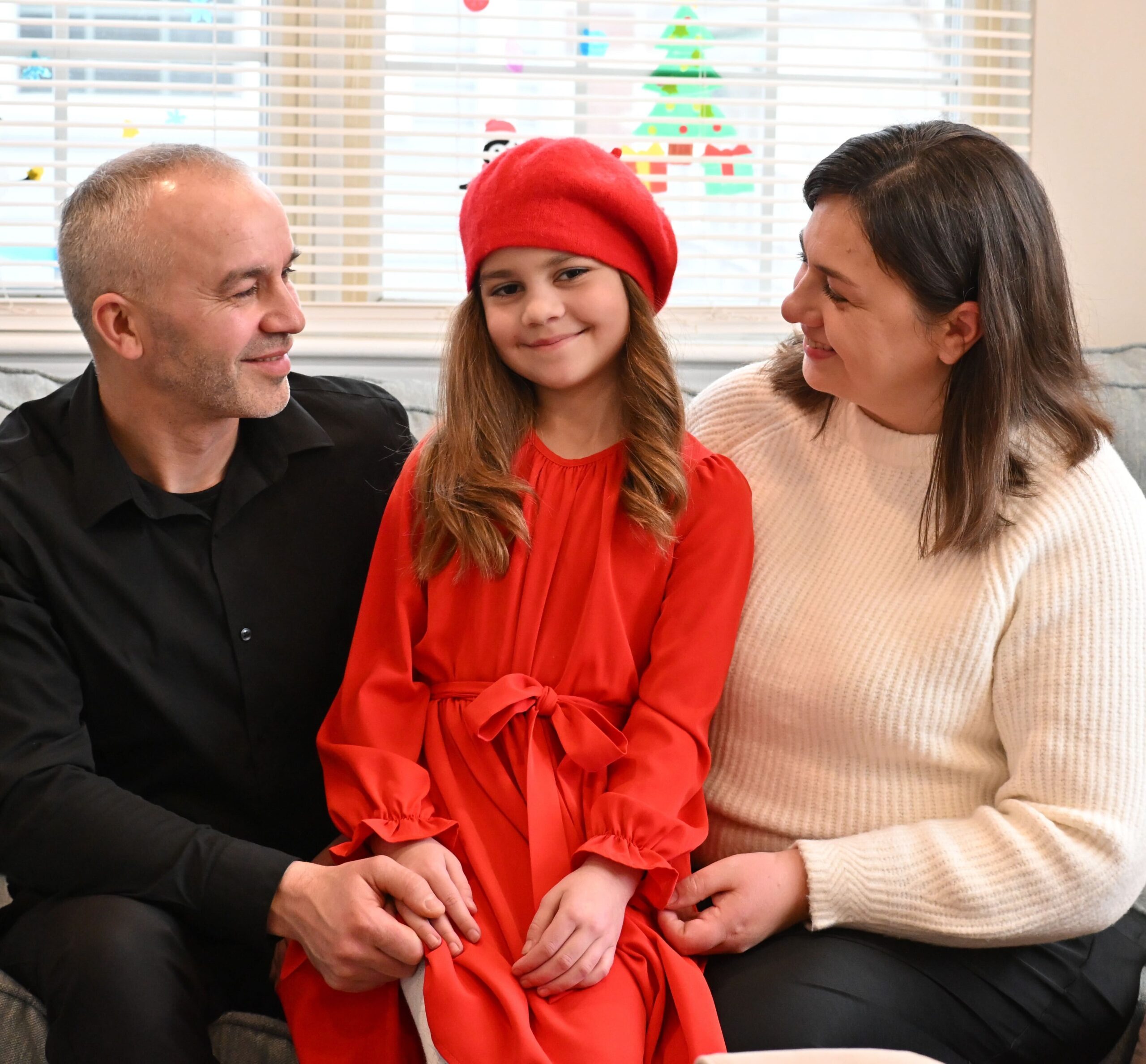
On a Sunday afternoon at an apartment in Norwood, Delaware County, Kalyna met with one family who received such a notice at the end of December. Yurii Konoshchuk, 43, explained that he and his wife and four children came to the U.S. in May 2023. His 9-year-old daughter, Milana, has leukemia and is receiving treatment at Children’s Hospital of Philadelphia.
“We don’t have any safe place in Ukraine,” Konoshchuk said. “It is so important for us to be here. We thank God that we’re in Philadelphia.”
Though Konoshchuk works full-time at the Barry Callebaut chocolate factory in Eddystone, and has a supportive community at the nearby Living Hope Ukrainian Baptist Church, money has been tight. Then, he got a bill from the federal government to pay $6,000 or risk his familybeing deported.
As Kalyna prayed with the family and shared in the Sunday dinner they had prepared, she was brought to tears when asked about the money. Kalyna said that after people in the Northwest Regional Refugee and Immigrant Network sent out emails, they raised $6,000 within a few hours.
“People really want to give,” she said. “They understand.”
Milana Konoshchuk smiles for a portrait between her parents, Yurii (left) and Anna on Sunday, Feb. 15, 2026. Refugees from Ukraine, the Konoshchuks are living in Delaware County while their daughter receives medical treatment for leukemia at CHOP.
At the dinner table, the Konoshchuk family recounted their journey. Katie Konoshchuk, 14, remembered going weeks without school, and having to evacuate to the schoolbasement during air raids. Each child had to carry a flashlight. Her 13-year-old sister, Ohli, said they used to hope that if the bombs came, they would come on a day they had to take a test.
“People adjust to the situation that they’re in,” their mother, Anna Konoshchuk, said.
Yurii Konoshchuk said he saw missiles flying so low overhead that he could read the words written on them. “It’s good then, because you think it will not fall on you, but you don’t know about next time, and you don’t know who it did fall on.”
One of the missiles struck an electric power station less than a mile away, he said, and over the winter of 2022-23, it was a regular occurrence to rush from their home to the air-raid shelter in a city without light.
“We never in the city saw such bright stars,” he said. “It was beautiful on the heaven, but not on the earth.”
Yurii Konoshchuk struggled to predict what will happen next. “We are thankful, first to God, and to American nation, to give us the possibility of treatment here,” he said.
When they came to the U.S., Anna Konoshchuk said, she told her children life would be better, more peaceful. “But we’re treating it as an experience,” she said. “We don’t know how long America will allow us to stay. We’re being flexible.”
The University of Pennsylvania soon may be off-limits to Army officers and other military service members who are seeking tuition aid to further their educations.
The Ivy League university in West Philadelphia is among 34 schools the Army says are at risk of being banned from military funding for service members to pay for their graduate programs and other education, according to a CNN report. The messaging has caused confusion among military officers seeking advanced degrees in law, medicine, and nuclear engineering, the report states.
The G.I. Bill and similar programs to pay for college have long been a major draw for people who join the military. But last week, Defense Secretary Pete Hegseth said the DOD “will discontinue graduate-level professional military education, fellowships and certificate programs” at Harvard.
“Too many faculty members openly loathe our military,” said Hegseth, who obtained a master’s degree in public policy from Harvard in 2013. “They cast our armed forces in a negative light and squelch anyone who challenges their leftist political leanings, all while charging enormous tuition.”
File this under: LONG OVERDUE
The @DeptWar is formally ending ALL Professional Military Education, fellowships, and certificate programs with Harvard University.
Hegseth, a former Army National Guard officer who served in Iraq and Afghanistan, said the department, which he calls the Department of War, is evaluating its relationships with other schools as well.
“[We] will evaluate all existing graduate programs for active-duty service members at all Ivy League universities and other civilian universities,” he said. “The goal is to determine whether or not they actually deliver cost-effective strategic education for future senior leaders when compared to, say, public universities and our military graduate programs.”
CNN obtained a “preliminary list of at-risk schools compiled by the Army,” which includes the University of Pennsylvania, as well as nearby Princeton University and Carnegie Mellon University in Pittsburgh. Officials at Princeton and Penn did not immediately respond to requests for comment Sunday.
“We are aware of reports indicating that Carnegie Mellon is among several universities whose eligibility to support graduate training for military officers may be under review. At this time, we have received no formal notification confirming that any such review is underway,” a spokesperson for Carnegie Mellon said in a statement. “As always, CMU stands ready to engage constructively with the Department on ways to strengthen and advance military education.”
Numerous schools on the list are the alma maters of Trump administration officials. In addition to attending Harvard, Hegseth obtained a bachelor’s degree in politics from Princeton. President Donald Trump holds a bachelor’s degree in economics from the Wharton School of the University of Pennsylvania. Vice President JD Vance holds a law degree from Yale University.
Here is the preliminary list of “at-risk” schools:
American University
Boston College
Boston University
Brown University
Carnegie Mellon
Case Western University
Columbia University
College of William and Mary
Cornell University
Duke
Emory
Florida Institute of Technology
Fordham
Georgetown
George Washington University
Harvard
Hawaii Pacific University
Johns Hopkins University
London School of Economics and Political Science
MIT [Massachusetts Institute of Technology]
Northeastern University
Northwestern University
New York University
Pepperdine
Princeton
Stanford
Tufts
University of Miami
University of Pennsylvania
University of Southern California
Vanderbilt
Wake Forest
Washington University in St Louis
Yale
Update: This article has been updated to include comment from Carnegie Mellon University.
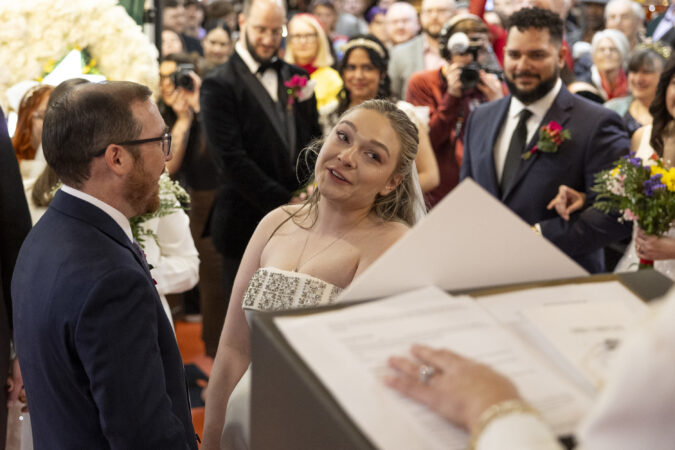
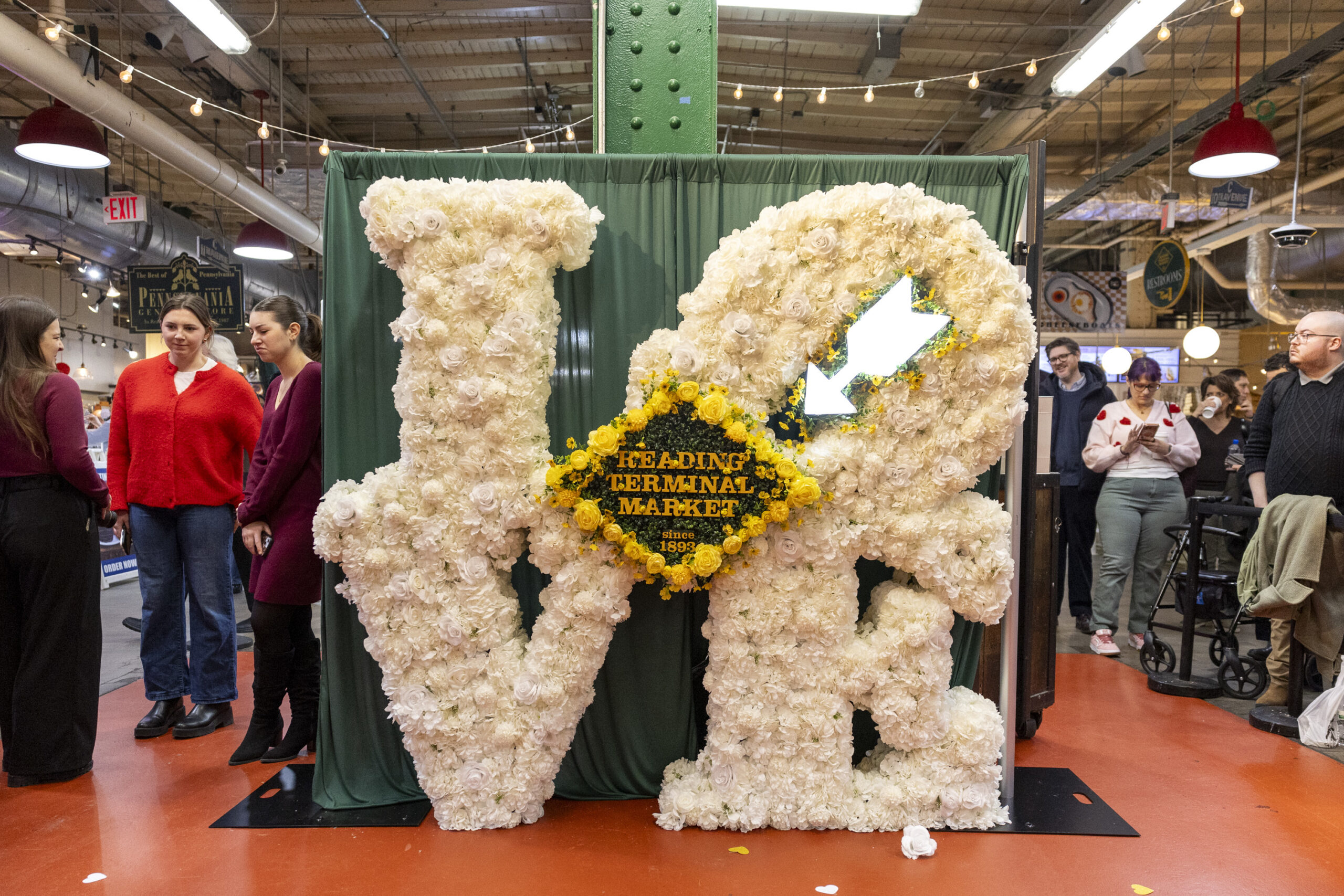
Tucked in between a fish market, a bakery, and a honey stand, seven couples tied the knot among family, friends, and perfect strangers on Saturday.
“It’s amazing,” said Beth Esposito-Evans, who officiated the ceremony. “What could be more Philly than Reading Terminal Market?”
Esposito-Evans, a vendor at the market, said she helped relaunch the “Married at the Market” Valentine’s Day wedding last year after she became an ordained minister.
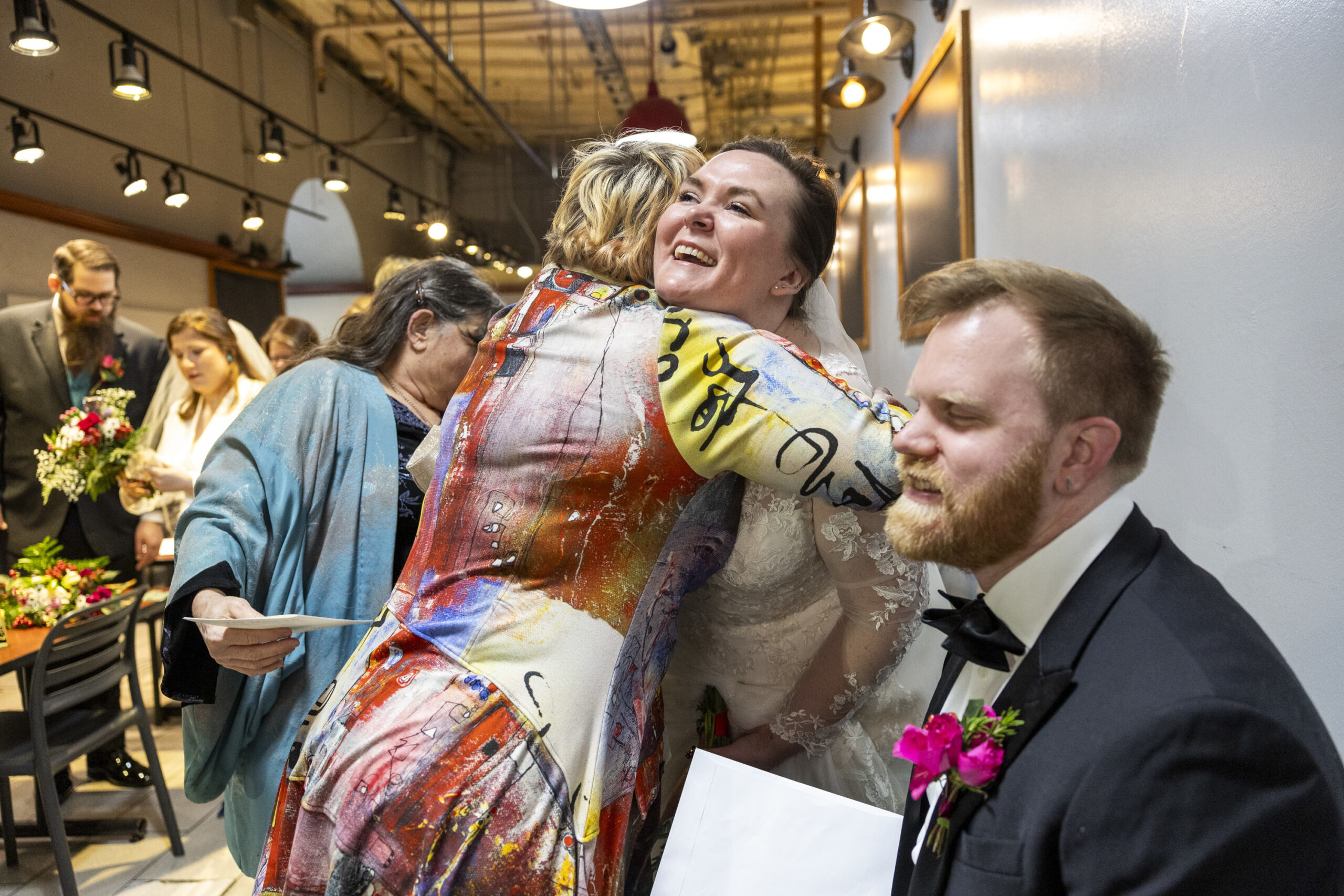
It was her second year officiating a group ceremony that blended traditional elements — two couples broke a glass, for example — with plenty of love for the market.
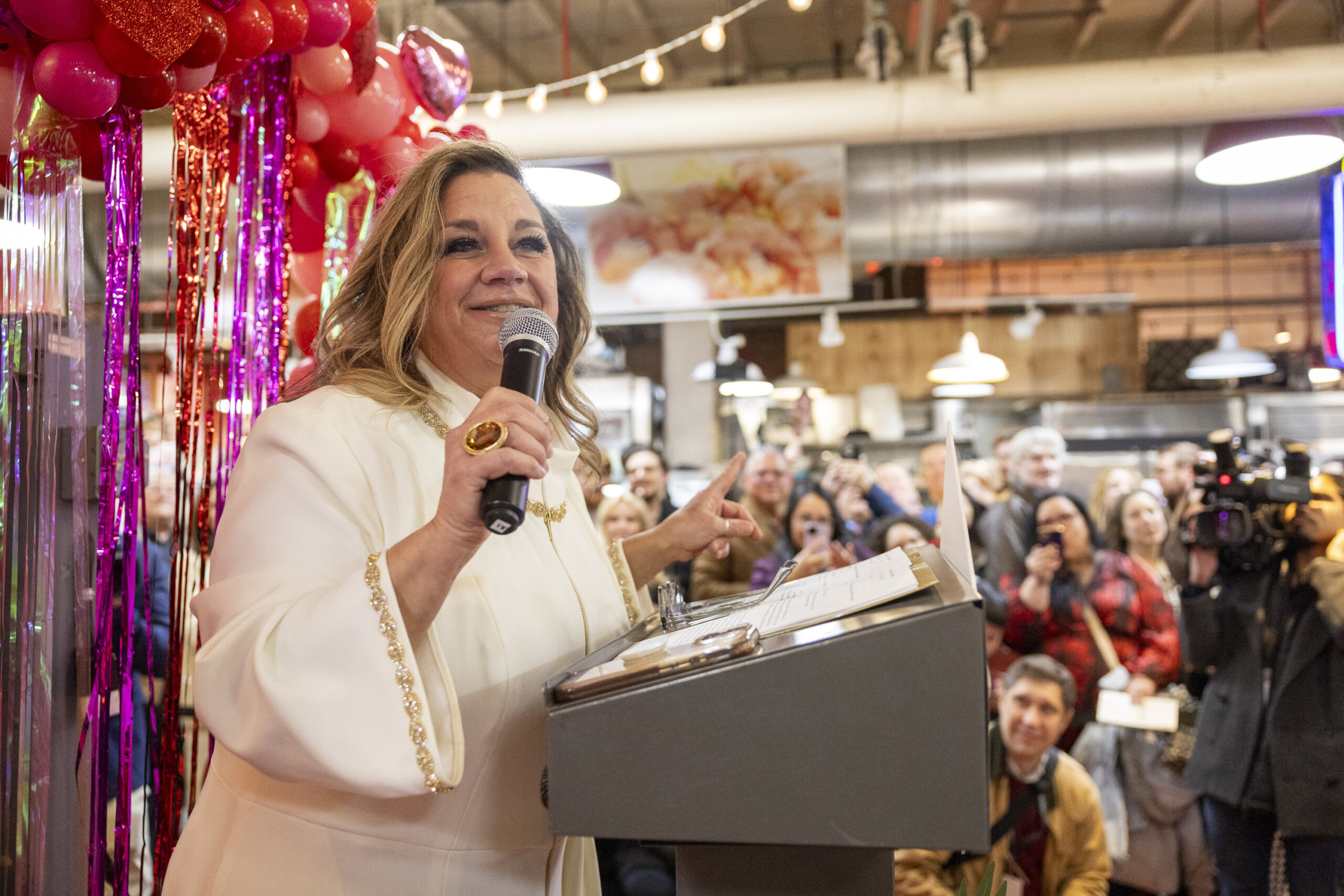
Minister Elizabeth R. Esposito-Evans officiates and leads the wedding ceremony at the Reading Terminal Market’s Married at the Market on Valentine’s Day in Philadelphia, Pa., on Saturday, Feb. 14, 2026.
“Love is timeless,” Esposito-Evans said, “regardless of destination or background.”
For bride Daysi Morales, the market is a place full of fond memories. Her father, Juan Morales, worked there as a security guard. He died of cancer in September 2024.
“So there’s a sentimental aspect,” Morales said. “It’s a place where I can feel my dad’s presence.”
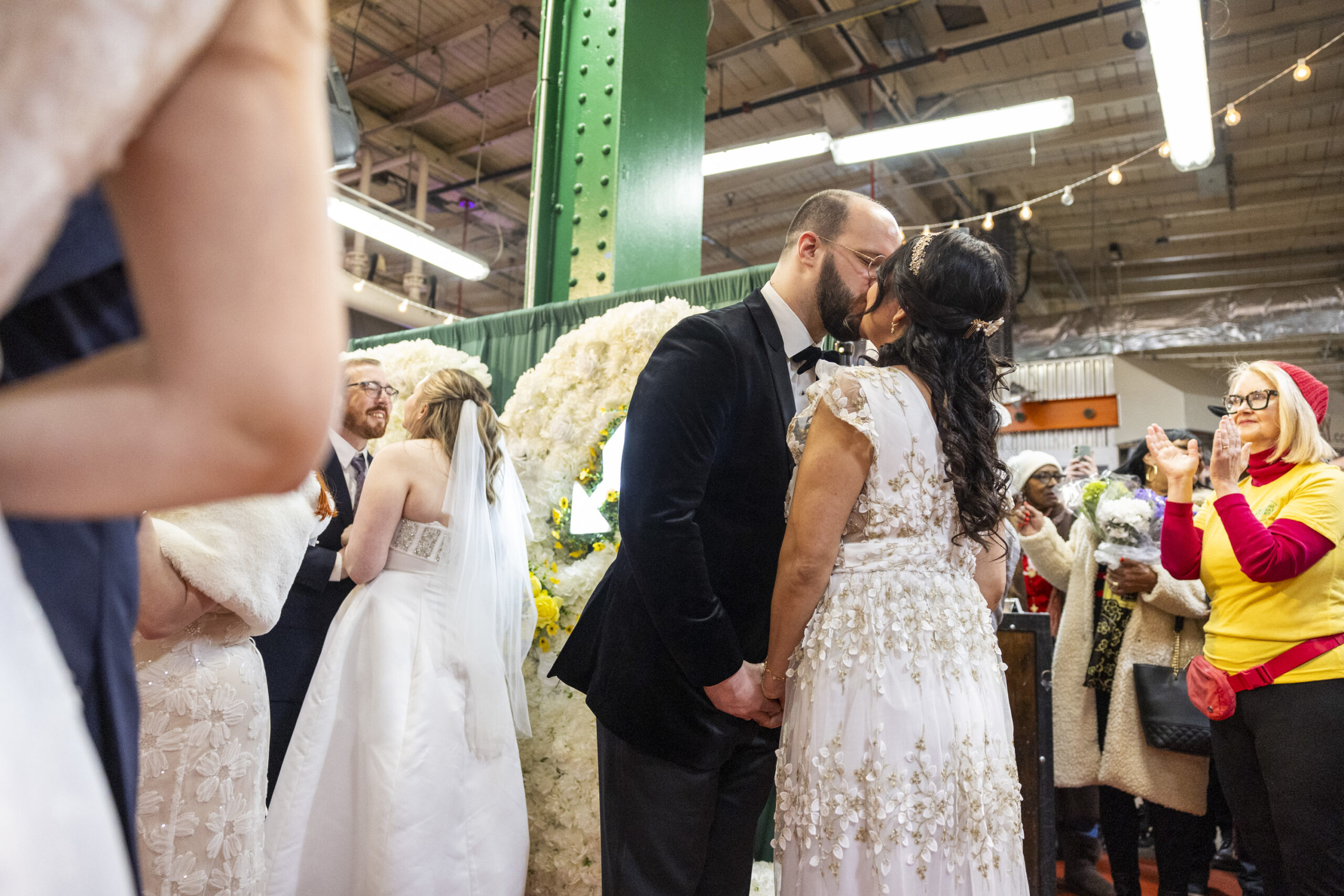
David Skillman, kisses his bride, Daysi Morales, during their wedding day at the Reading Terminal Market’s Married at the Market on Valentine’s Day in Philadelphia, Pa., on Saturday, Feb. 14, 2026.
In an interview a few days before the ceremony, Morales, 36, and her partner, David Skillman, 35, finished each other’s sentences as they told their love story, which started as a Tinder date during the winter of 2021.
They first met at Craft Hall, a sports bar in Old City, chosen because of its outdoor seating, which many people preferred during the worst days of the COVID-19 pandemic.
They decided to go inside anyway, Skillman said, and there the conversation flowed and the connection was immediate. Morales was born in Honduras, he noted, where he had done medical missionary work as a registered nurse.
“I think we dated for a couple weeks, then made [our relationship] official,” Morales said.
They moved in together into her apartment in West Philly.
After Morales’ father, Juan, fell ill, Skillman provided medical care for him during one of his shifts at the Hospital of the University of Pennsylvania Pavilion emergency department..
“David was such a rock, not just for me, but for my family,” Morales said.
In December 2024, they got engaged.
The Reading Terminal Market offered couples a chance to get “Married at the Market” on Valentine’s Day in Philadelphia, Pa., on Saturday, Feb. 14, 2026.
For the couple, who now live in South Philly, there was also a practical aspect to having a scaled-down, low-cost wedding.
“I want to buy a house,” Skillman said. “And buying a house and having a big wedding aren’t both feasible.”
Morales said she worked for the U.S. Department of Housing and Urban Development before being laid off last year.
“Especially in this economy, I think micro weddings are becoming more and more popular,” Morales said.
That didn’t stop them from having a special wedding with some of their favorite Philly attractions — including Okie Dokie Donuts, an after-party at Sardine Bar, specialty cocktails, and a cake made by Morales’ family.
Luigi Nicolae performs some music for families, friends, and guests attending the Reading Terminal Market’s Married at the Market on Valentine’s Day in Philadelphia, Pa., on Saturday, Feb. 14, 2026.
“It feels so special, to be in the market where my dad worked,” said Daysi Morales’ older sister Esther.
Reading Terminal Market, at 12th and Arch Streets, is a magnet for tourists and a regular destination for residents. Housed in a National Historic Landmark building dating to 1893, the market has 72 food vendors, including a produce market, an oyster bar, Pennsylvania Dutch traditional food, and a wide range of other offerings.
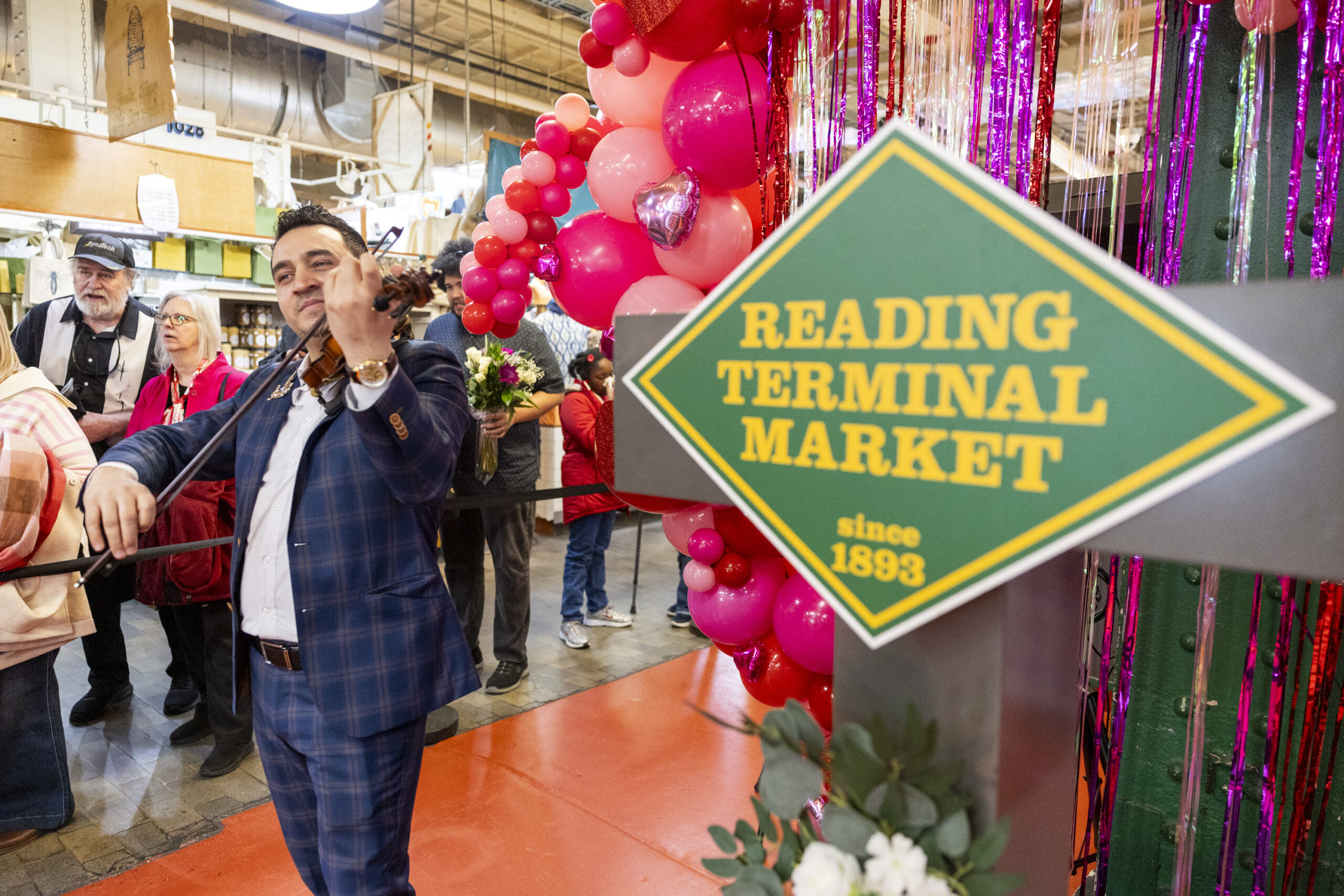
Fifty-seven couples applied for “Married at the Market,” according to event promoter London Faust. The seven lucky couples selected were treated to decor, a violin player, and the location, all paid for by Reading Terminal Market.
Faust said “the Reading Terminal team began an outreach process loosely prioritizing those who had strong ties to the market in their love story.” The celebration is free of charge for those accepted.
“We kind of needed something like this,” groom Joey Kathan said before the ceremony. “We’ve been engaged two years.”
Megan Keane hugs Maurie Kathan, sister to Joey Kathan of Fishtown, the groom, at the Reading Terminal Market’s Married at the Market on Valentine’s Day in Philadelphia, Pa., on Saturday, Feb. 14, 2026.
Kathan’s bride, Megan Keane, described them as a “COVID couple” who met on Bumble Washington and bonded over hiking trips before moving to Philadelphia a few years ago.
“This was crazy,” Keane said. “We couldn’t believe we were accepted.”
There were even some last-minute guests of honor. Dorothy and Terry White were at the market Saturday when one of the housekeepers introduced them to Esposito-Evans. She asked them to join the celebration.
“We got married here, 21 years ago today,” Dorothy White triumphantly told the crowd.
Born in a puppy mill in Peach Bottom, Lancaster County, Oscar suffered from “failure to thrive,” his breeder said.
By the time the breeder turned the 6-week-old toy poodle over to Phoenix Animal Rescue in Chester County, Oscar weighed just 7 ounces, according to Marta Gambone, a coordinator at the all-volunteer organization.
“But one of our volunteers was able to turn him around, from this scraggly little hamster to this wonderful Puppy Bowl player,” Gambone said.
When Oscar, a toy poodle, was rescued from a puppy mill in Lancaster County, he weighed just 7 ounces. After being nursed back to health, he’s playing in the 2026 Puppy Bowl.
After being nursed back to health, Oscar traveled to Glens Falls, N.Y., to participate in the October 2025 taping of the 22nd annual Puppy Bowl, which airs today before the Super Bowl.
Gambone said the annual event has become a wonderful way to raise awareness for animal rescues across the United States. Every one of the 150 dogs in the competition — between Team Ruff and Team Fluff — comes from a rescue.
Oscar, a toy poodle nursed back to health in Chester County, is one of this year’s Puppy Bowl stars.
Oscar, now 8 months old, has developed into a playful, social, and upbeat young dog who has found a loving home, Gambone said.
Oscar is one of six puppies from Phoenix Animal Rescue in the annual TV special this year, Gambone said. Jill, an 8-month-old Cavalier, was suffering from a hernia when she was turned over by a breeder in New Holland, Lancaster County.
The rescue also has four dogs participating in this year’s first-ever “Oldies vs. Goldies” senior dogs’ competition: Tiki, a Shiba Inu; Starlight, a Jack Russell terrier; Daisy, a Pomeranian; and Emmie, a Maltese mix.
Tiki, a Shiba Inu, is in this year’s “Oldies vs. Goldies” senior dog competition.
They all came from breeders in Lancaster County and were in need of care, Gambone said, “and now they’re all playing on a national stage, and getting lots of attention, and finding their forever homes.”
Though all of this year’s stars have since been adopted, Gambone noted that the rescue gets about a dozen dogs per week, across a wide variety of breeds and mixes.
“Anybody looking can find what they’re looking for if they have a little patience,” she said.
Carrie Pawshaw sits for a portrait. Pawshaw, a rescue dog from the Pittsburgh region, competed in the 2026 Puppy Bowl.
Across the state in Springdale, Allegheny County, Jacqueline Armour said it’s the third year that some of her rescue dogs are playing in the Puppy Bowl.
She founded Paws Across Pittsburgh, a rescue that places dogs with foster parents until they find permanent homes. The dogs come from owners and shelters from as far away as West Virginia, Kentucky, and Ohio.
This year, a playful Jack Russell mix named Meeko is their star, along with a Norwegian elkhound and American Eskimo dog mix named for Sarah Jessica Parker’s character in the TV show Sex and the City.
“They pick some of them and rename them,” Armour explained, “so initially I thought they were going to call her Sarah Jessica Barker. And then they said Carrie Pawshaw.”
Armour noted that, because her organization uses foster homes, their puppies are already learning how to live in a home — getting house-trained and crate-trained, and learning how to get along with children and other pets. This also gives volunteers a chance to see the dogs’ personalities, which can be helpful in matching a dog with an owner.
Both Armour and Gambone emphasized that rescue operations offer a variety of ways for volunteers to help out.
For those who’ve never owned a dog, Armour said the experience can be profound. The medical community consensus is that having a dog can help people get more exercise, improve mental health, and lower blood pressure, and can help children learn how to properly treat an animal.
In Chester County, Gambone said she’s seen firsthand how dogs can add vitality to someone’s life.
“They help with loneliness, and on the physical side, they help people stay more active,” she said. “We have so many senior citizens coming to us saying, ‘I just need something — something to love.’ And it changes their lives.”
U.S. Sen. John Fetterman (D., Pa.) is calling on the Department of Homeland Security to hit the brakes on its plan to develop two Immigration and Customs Enforcement detention centers in Pennsylvania, saying they would have a negative impact on local communities.
“While I have been clear in my support for the enforcement of federal immigration law, this decision will do significant damage to these local tax bases, set back decades-long efforts to boost economic development, and place undue burdens on limited existing infrastructure in these communities,” Fetterman wrote in a letter addressed to DHS Secretary Kristi Noem and posted online Saturday.
A 1.3-million-square-foot former Big Lots warehouse in Tremont, Pa., has been bought by U.S. Immigration and Customs Enforcement for $119 million. The agency plans to detain up to 7,500 immigrants there.
The Tremont Township detention center would house as many as 7,500 people, Fetterman noted, while the Upper Bern Township one would be capable of detaining 1,500 people.
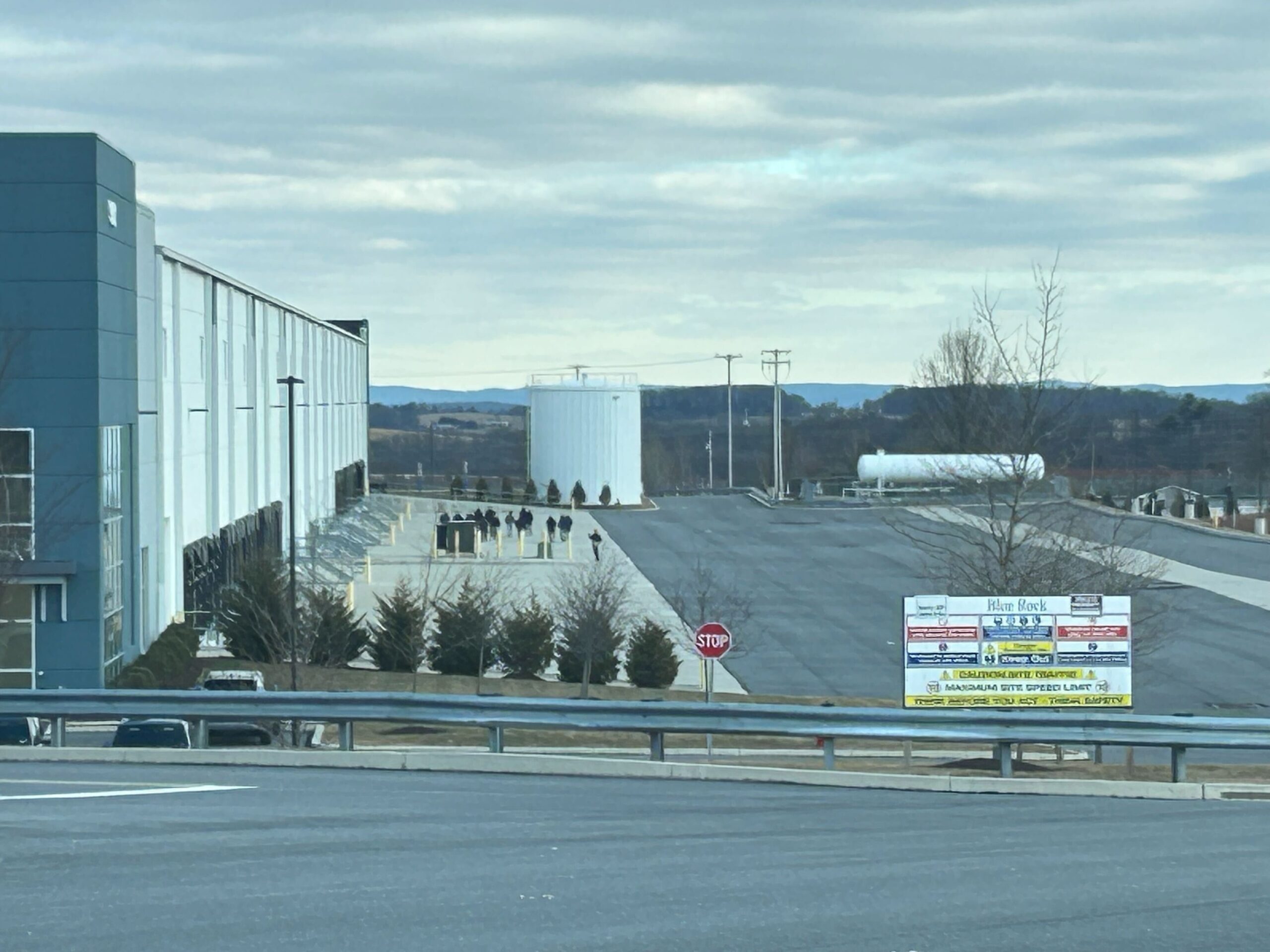
Upper Bern Township has 1,606 residents, according to the U.S. Census Bureau, and is about 30 minutes northwest of Reading. The facility is near an Amazon warehouse and the Mountain Springs Camping Resort.
Tremont Township — where the much larger detention center is set to be built — has just 283 residents and is next to the 1,670-resident Tremont Borough. Tremont is in a rural area northeast of Harrisburg, near the Appalachian Trail, state game lands, and Fort Indiantown Gap, an Army National Guard training center.
In his letter, Fetterman said local and state officials did not have a chance to weigh in on how these massive facilities would affect everything from sewer systems and the electrical grid to hospitals and emergency medical services.
“Both townships do not currently have the capacity to meet the demands of these detention centers, with Tremont Township officials specifically stating the proposed 7,500-bed detention facility would quadruple the existing burden on their public infrastructure system,” Fetterman said.
A warehouse in Upper Bern Township, Berks County, Pa., was purchased by ICE and the Trump administration.
The letter maintains Fetterman’s stance as someone who supports ICE operations in general while criticizing the federal government’s recent handling of them. After federal agents shot and killed two U.S. citizens in Minneapolis last month, Fetterman called on the Trump administration to fire Noem. A few days later, Fetterman said he supports ICE agents wearing face masks.
Fetterman was among 23 Senate Democrats to cross the aisle last month to vote for a compromise bill funding the federal government through September, while granting just two weeks of funding for DHS.
Fetterman said the Pennsylvania facilities would result in a tax loss of $1.6 million to the communities. He asked DHS to agree to several conditions before proceeding further with the sites.
He requested an “impact assessment,” details on the criteria used to select these facilities, an agreement that federal funds be used to upgrade them, and “a commitment to a period of public engagement and dialogue with these communities.”
“Due to these significant concerns, it is my fear that DHS and ICE did not perform any due diligence, spending more than $200 million in tax dollars for warehouses that cannot be adequately converted and further eroding trust between Pennsylvanians and the Federal government,” Fetterman wrote.
The Department of Homeland Security and Immigration and Customs Enforcement did not immediately respond to a request for comment.
This story has been updated to correct the location of one of the proposed detention centers to Upper Bern Township.
A man died in North Philadelphia Saturday night after being shot, city police said.
The fatal shooting happened around 7:40 p.m. on the 3200 block of North Howard Street, police said. Officers responding to a call found the man “suffering from multiple gunshot wounds.”
Emergency medical responders pronounced him dead at 7:45 p.m., police said.
No arrests have been made, and police have not located the firearm used in the shooting.
Police ask those with information to call 215-686-TIPS (8477).
This is the 11th homicide in Philadelphia this year, according to the police department’s crime statistics website. That’s a 50% decrease from the same period last year, the website states. Last year, homicides were at a nearly 60-year low after peaking in 2021.
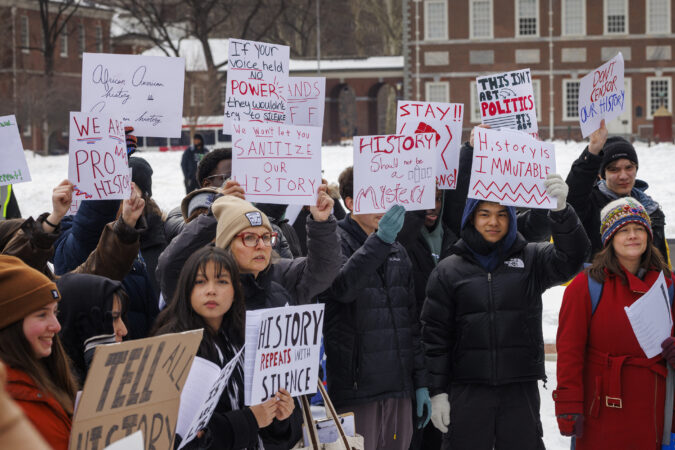
Students and teachers from two Philly area private schools joined up with activists and protesters Friday morning at the President’s House in Independence National Historical Park to demand that the site’s slavery exhibit be restored after it was abruptly dismantled last month.
“Whitewashing history is a totalitarian gimmick,” read one sign in a crowd that included young and older people. “All our stories must be told,” read another.
The “teach in” was held in front of a granite wall etched with the names of nine enslaved people owned by U.S. founding father and first president George Washington. The wall is one of the few remnants of the slavery exhibit that was dismantled by order of the Trump administration.
Standing at a lectern, the students, from Solebury School in Bucks County and Friends Select in Center City, read the biographies of the enslaved whose names had been etched on the wall.
Activist and criminal defense attorney Michael Coard told the crowd he helped to create the slavery exhibit after learning that Washington owned enslaved people — and realizing that his educators had failed to teach him about it.
“When I learned about that, I was enraged, because I’d never heard about it,” Coard said.
With the help of elected officials, the President’s House Site became a reality in 2010, Coard said.
But when the Trump administration issued its “Restoring Truth and Sanity to American History” executive order last March, Coard knew that the exhibit could be targeted. The order calls on the U.S. Department of the Interior to remove historical exhibits that “perpetuate a false reconstruction of American history” or “disparage Americans past or living.”
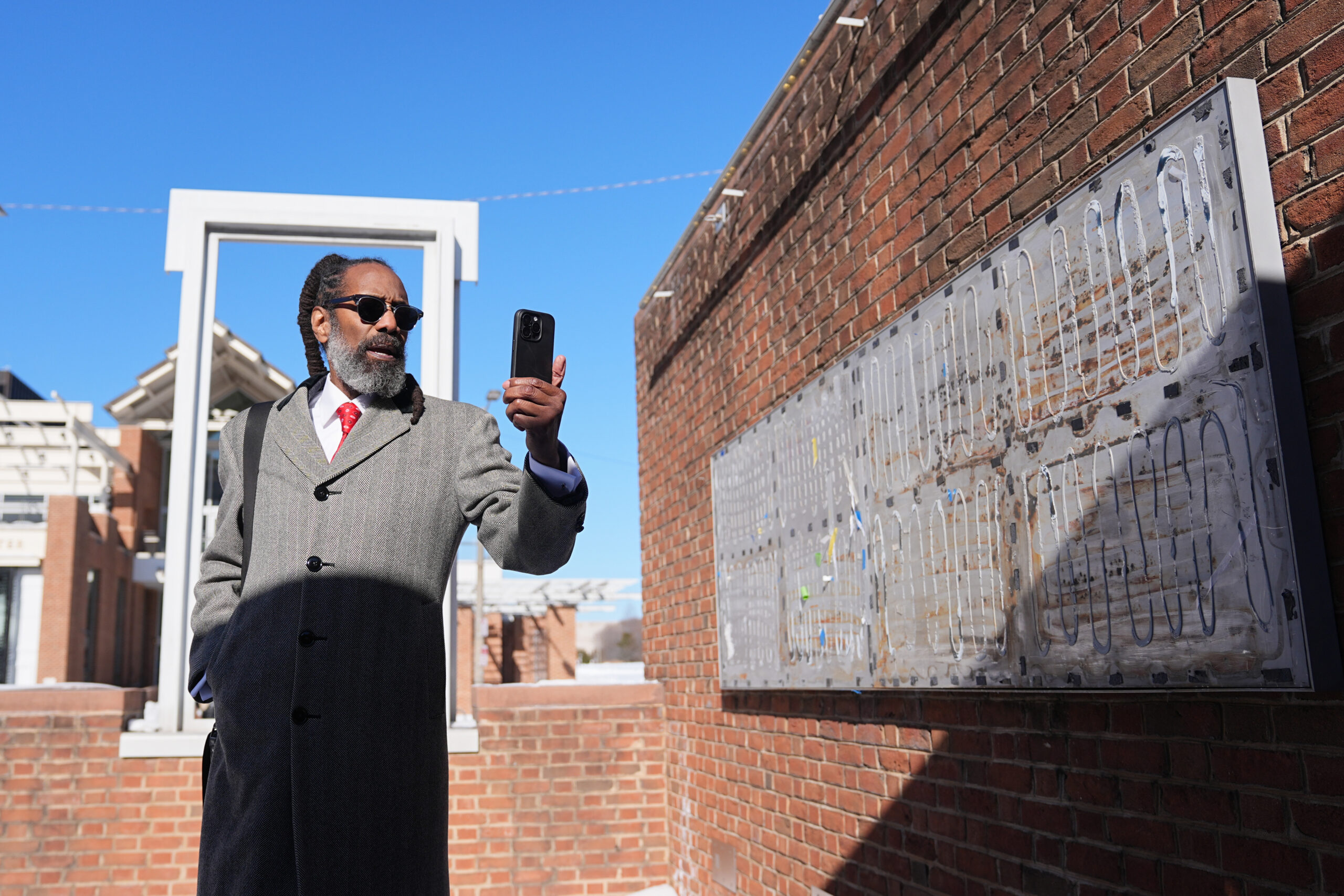
Attorney Michael Coard makes a social media post at the now removed explanatory panels that were part of an exhibit on slavery at President’s House Site in Philadelphia, Friday, Jan. 30, 2026. (AP Photo/Matt Rourke)
“Anything pertaining to Black people, he was opposed to it,” Coard said of President Donald Trump.
Since then, Coard said, there’s been a furious legal battle to have the site restored. Philadelphia Mayor Cherelle L. Parker sued the federal government. A judge ordered the government to safeguard the exhibits, which are currently in storage, while the issue plays out in federal court.
Coard encouraged people to sign a petition, attend protests, and stay involved in future protests.
“Just because you can’t do everything, that doesn’t mean you shouldn’t do anything,” Coard told the crowd, quoting poet and musician Gil Scott-Heron.
Solebury School college counselor Erin Wallace joined the 50 students who traveled by bus to the site for the teach-in.
Wallace said the students are “very active” in following national politics, and were eager to attend the protest. About 25% of the student body attended, Wallace said.
“It was an overwhelmingly positive response,” Wallace said.
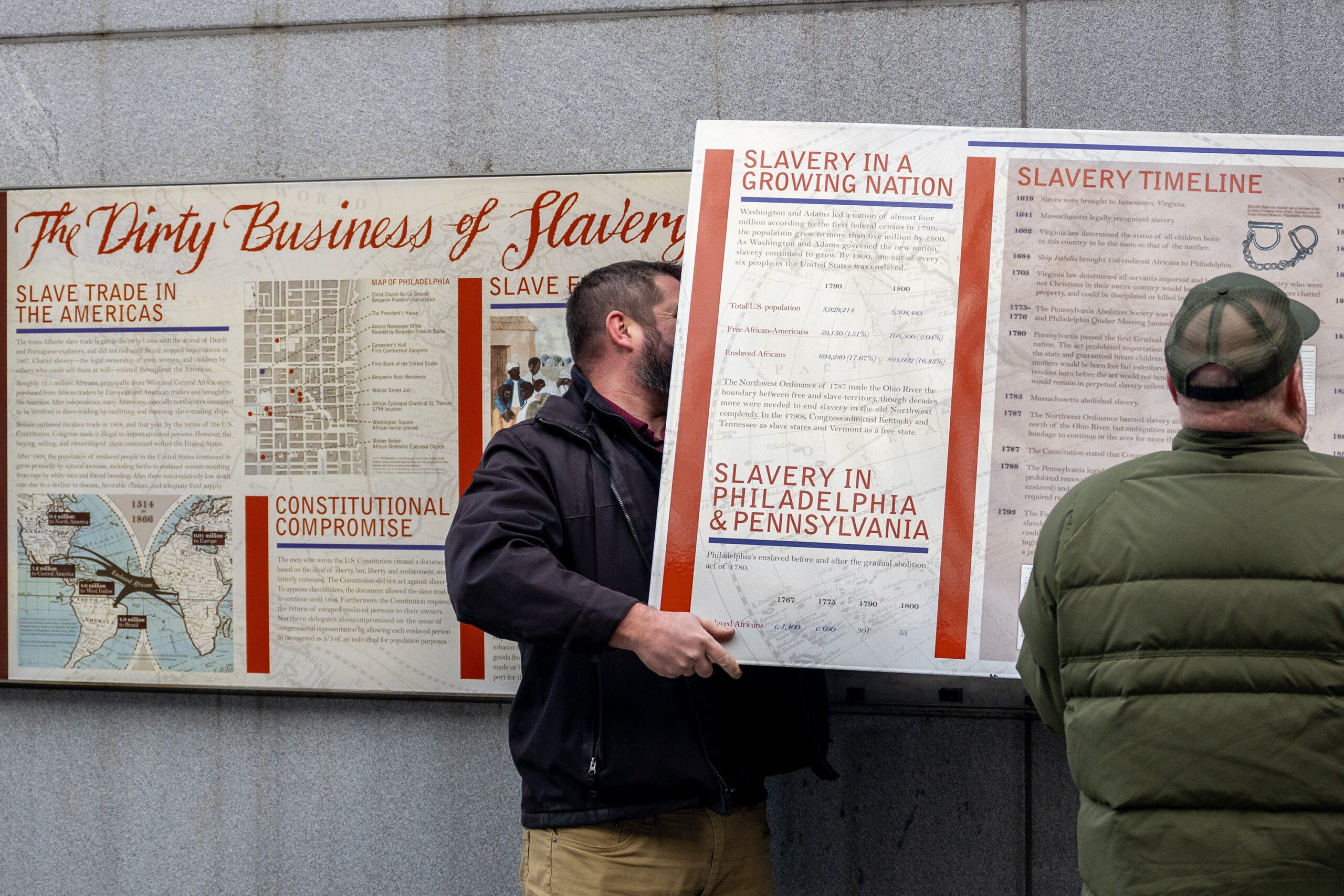
Workers remove the display panels about slavery at the President’s House Site in Independence National Historical Park Thursday, Jan. 22, 2026. The fate of exhibits at the site, which serves as a memorial to the nine people George Washington enslaved there during the founding of America, had been in limbo since President Trump’s executive order, “Restoring Truth and Sanity to American History,” directed the Department of the Interior to review over 400 national sites to remove or modify interpretive materials that “inappropriately disparage Americans past or living.”
Solebury School history teacher Don Kaplan of Elkins Park attended the first vigil after the site was shuttered. Kaplan said he organized the teach-in student protest because it is relevant to what he teaches his 9th- and 11th-grade students.
“I just thought to myself, we need to address this,” Kaplan said.
Kaplan asked that his students not be quoted directly. But after the rally, he struggled to keep his 11th graders from weighing in as he was interviewed for this story.
“We should teach all history,” two students said.
They explained that in Kaplan’s class, their research often shows that historical figures are not purely good or evil and were shaped by myriad forces.
To Kaplan, that stands in contrast to the Trump administration’s perspective on teaching history, which seeks to eliminate “negative” stories about America’s founders.
“That’s not what we do,” Kaplan said. “We have to teach every possible perspective.”
Members of the public in Norristown are demanding answers after a police cruiser responding to a 911 call Wednesday morning struck a naked man standing in an intersection.
The incident, captured on video, shows a police SUV apparently accelerating toward the man, who was standing on the road with other vehicles stopped around him. After being hit by the car, the man flies several feet in the air and hits the pavement. Police then rush out of the vehicle and surround the man.
Norristown police said one officer has been put on paid administrative leave while the Montgomery County District Attorney’s office investigates the matter.
Police have not released the name the officer or the victim. District Attorney’s office spokesperson Kate Delano confirmed that the man is alive, but declined to provide further details.
It’s a potential test for Norristown Police Chief Mike Trail, who has been on the job just about six months and is the fourth police chief to lead the agency in four years.
Trail took questions from community members at a public meeting Thursday. He said he wouldn’t be able to provide some details because they were part of the investigation, saying “my role here is to listen to you here tonight.”
Many of those questions centered on what residents who had seen the video perceived as the police officer’s decision to ram into the man.
Several people asked Trail whether agency policy ever would allow for a police officer to strike someone with a vehicle. Another speaker said she heard the car strike the man from her home.
Responding to questions, Trail pledged to make the police agency’s policies available to the public. He said he wants to initiate a mental health co-responder program, which would pair police officers with mental health experts trained to de-escalate situations.
“People experiencing mental health behavioral episodes are more likely to be victims of, to be subject to use of force by responding law enforcement officers because they lack the tools and the sophisticated training necessary to de-escalate.”
But according to Heather Lewis, who leads the Reuniting Family Bail Fund in Norristown, local police should already know how to work safely with people dealing with mental health issues.