There’s something to be said for a team that stops the bleeding.
After losing two straight back in mid-November, the Flyers ended another losing streak at one game with a 4-1 win against the San Jose Sharks on Tuesday night. Since those consecutive losses to the Ottawa Senators and Edmonton Oilers, the Flyers have gone 8-4-0.
The Flyers came out like it was a feeding frenzy at Xfinity Mobile Arena, putting 11 shots on San Jose goalie Alex Nedeljkovic before the Sharks got their first one more than 11 minutes into the game. The only problem? Their first shot was also a goal.
San Jose broke out of its own end on a stretch pass by Dmitry Orlov to Macklin Celebrini at center ice. The No. 1 pick in 2024 sent a backhander into the Flyers’ end, and Will Smith, who was drafted three spots before Matvei Michkov in 2023, blew past the Flyers’ defense.
He tracked down the puck along the end boards, carried it around, and sent a cross-ice pass from the top of the left faceoff circle to defenseman John Klingberg. That pass pulled Flyers goalie Dan Vladař out of position, and the defenseman sent it to Collin Graf atop the crease for the goal.
It was the 19th time in 28 games the Flyers have trailed 1-0. But it was also the 11th time they’ve come back and won to lead the NHL. They also have a league-leading 12 comeback wins.
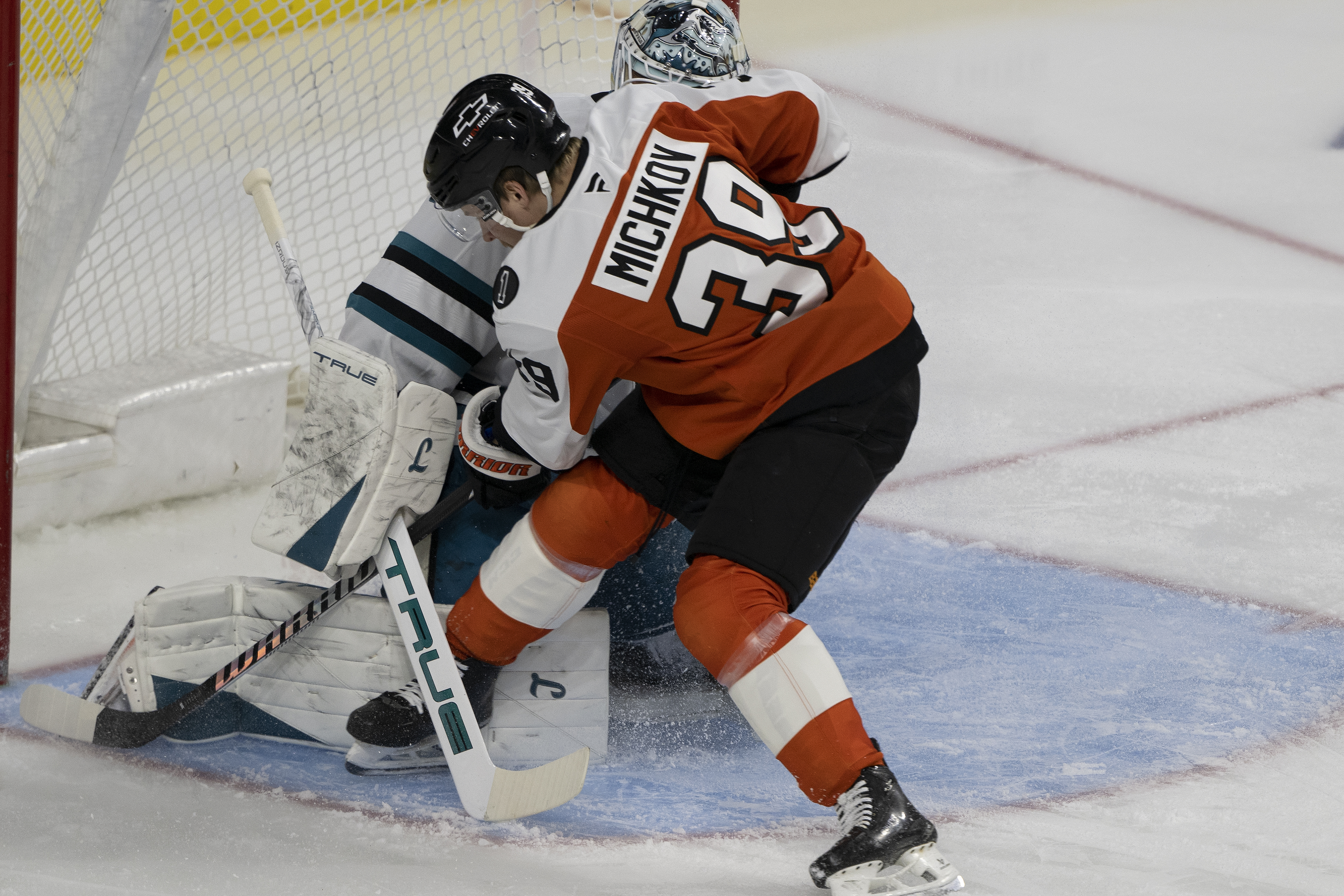
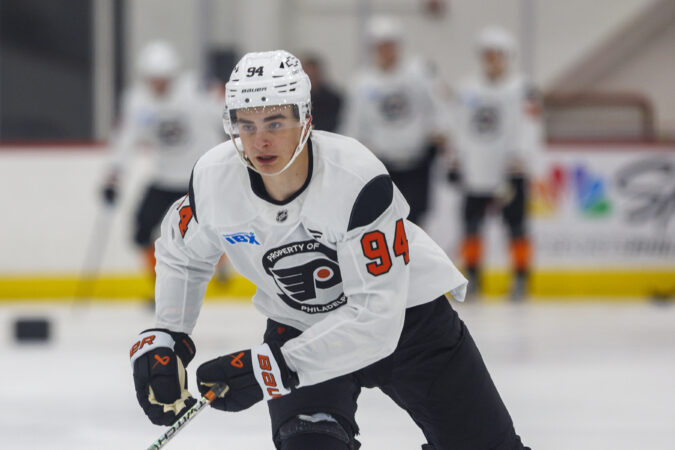
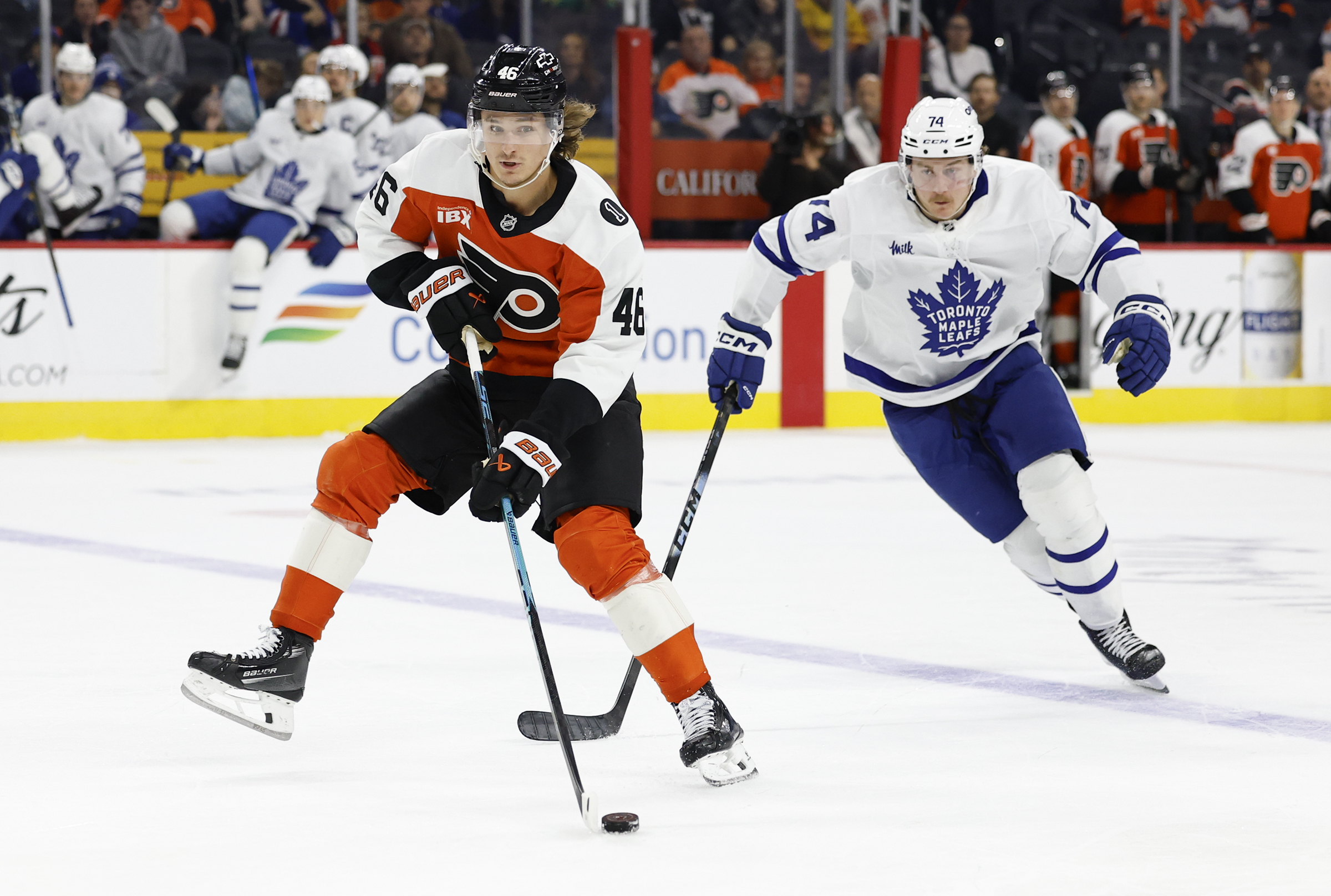
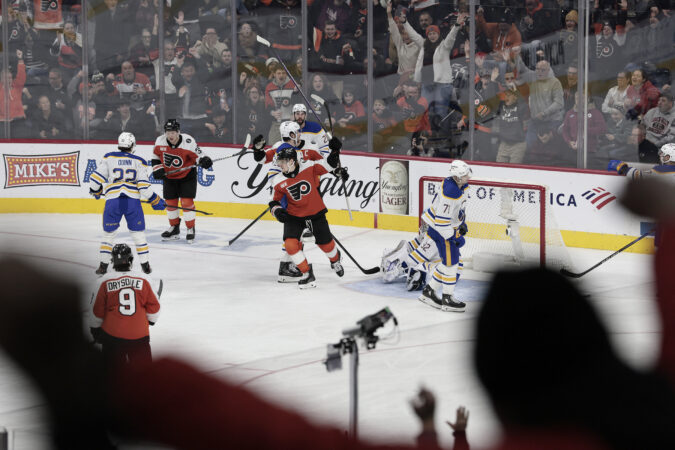
Flyers’ Matvei Michkov (right) shoots on goal against San Jose Sharks goalie Alex Nedeljkovic during the first period on Tuesday.
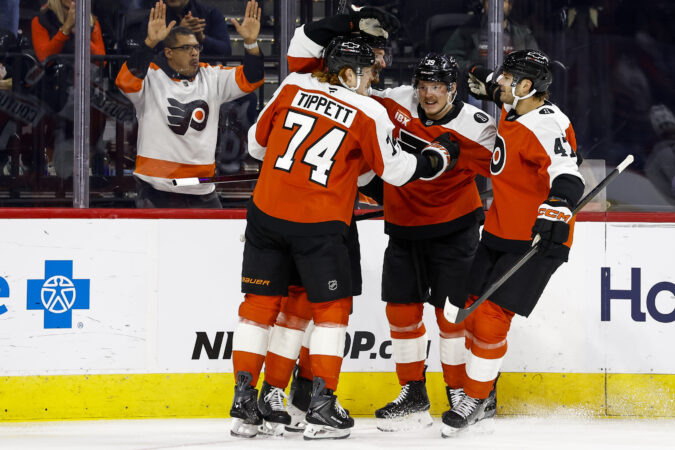
Christian Dvorak evened the score with 81 seconds left in the first period with a nifty backhand-forehand move around Nedeljkovic. Travis Konecny sent a backhand pass up in the air from the Flyers’ end.
The puck hit Trevor Zegras in the shoulder in the neutral zone, and Dvorak got behind Sharks defenseman Sam Dickinson to score his seventh goal of the season.
The secondary assist was the 500th point (205 goals, 295 assists) in 674 games for Konecny, who became the 17th player in Flyers history to hit the mark. He added his eighth goal of the season with an empty-netter late in the third period.
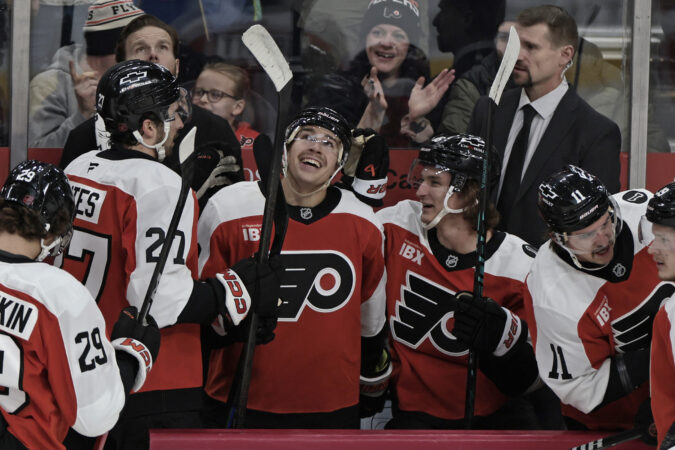
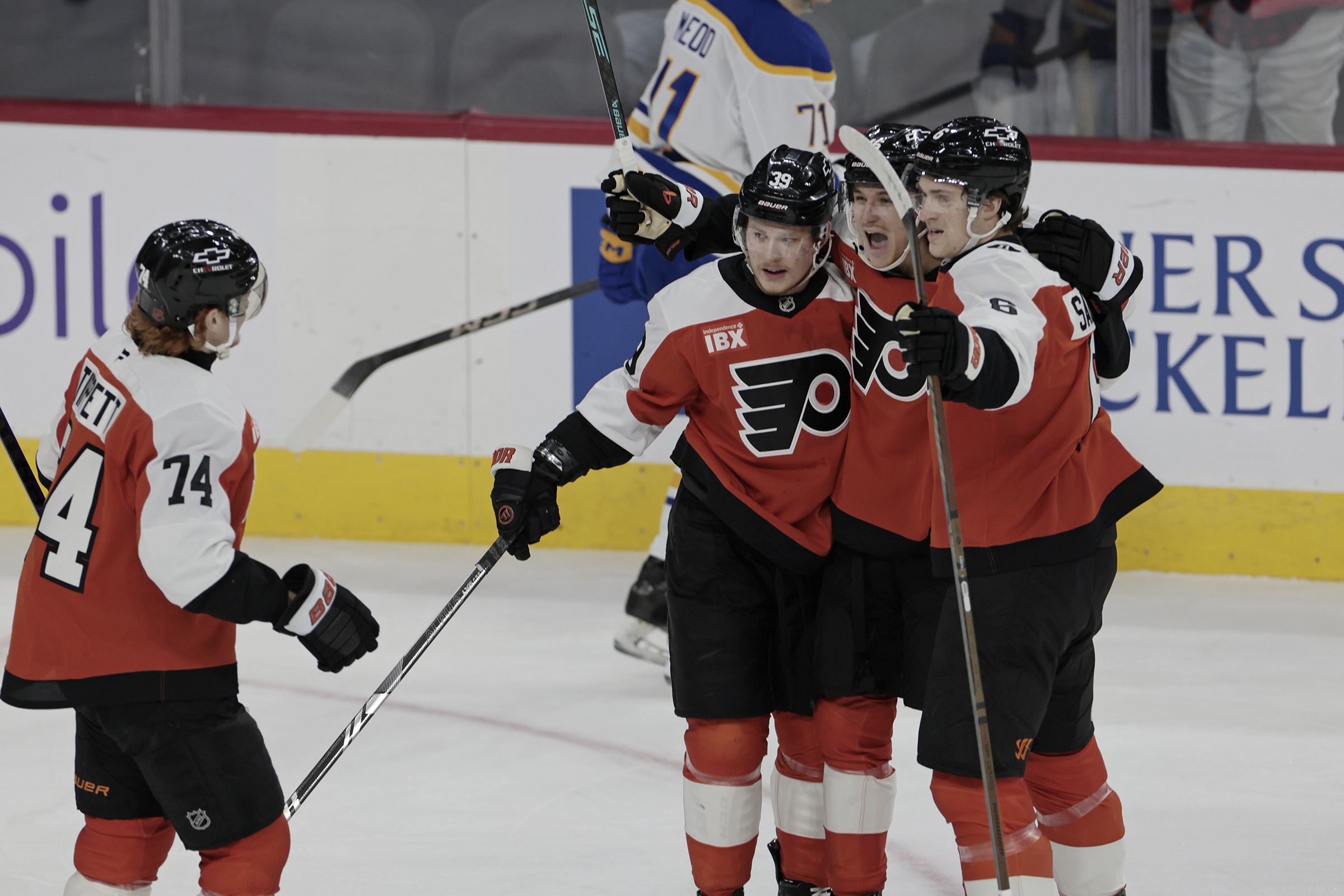
Then the fourth line finally got a goal. Skating against the team that traded him to the Flyers, Carl Grundstöm got some revenge in the second period.
Flyers defenseman Nick Seeler sent the puck on goal from the left point, and Grundstöm, in just his second game as a Flyer, deflected the puck as he trailed his stick behind him.
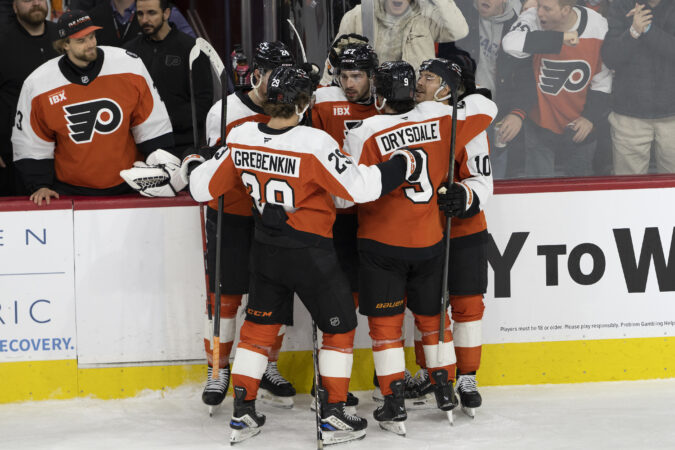
With 12 seconds left in the middle frame, Noah Cates added some insurance. Bobby Brink carried the puck down the right wing and sent it over to Cates at the top of the left circle for the catch-and-shoot goal. It gave him seven goals on the season.
Vladař didn’t face a ton of shots — he stopped 17 — but made the big saves when needed.
Not long after Dvorak tied things up, the Czech netminder stopped Smith on a breakaway. Then, up by a goal, he snared a wicked Celebrini wrist shot as he skated down during a Sharks power play. He stopped Ty Dellandrea all alone in front late in the second and robbed him again in the third period from point-blank range in front of the net.
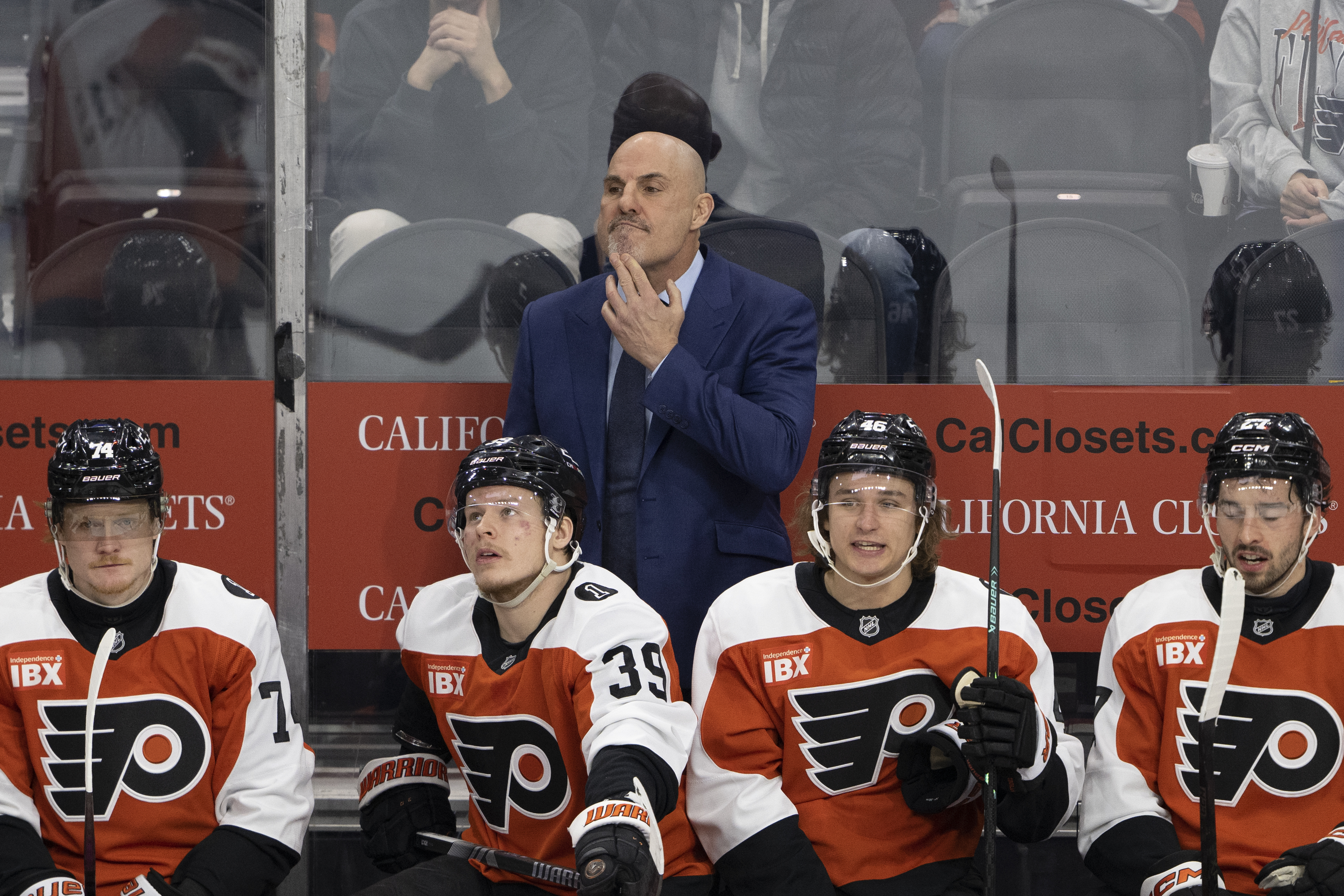
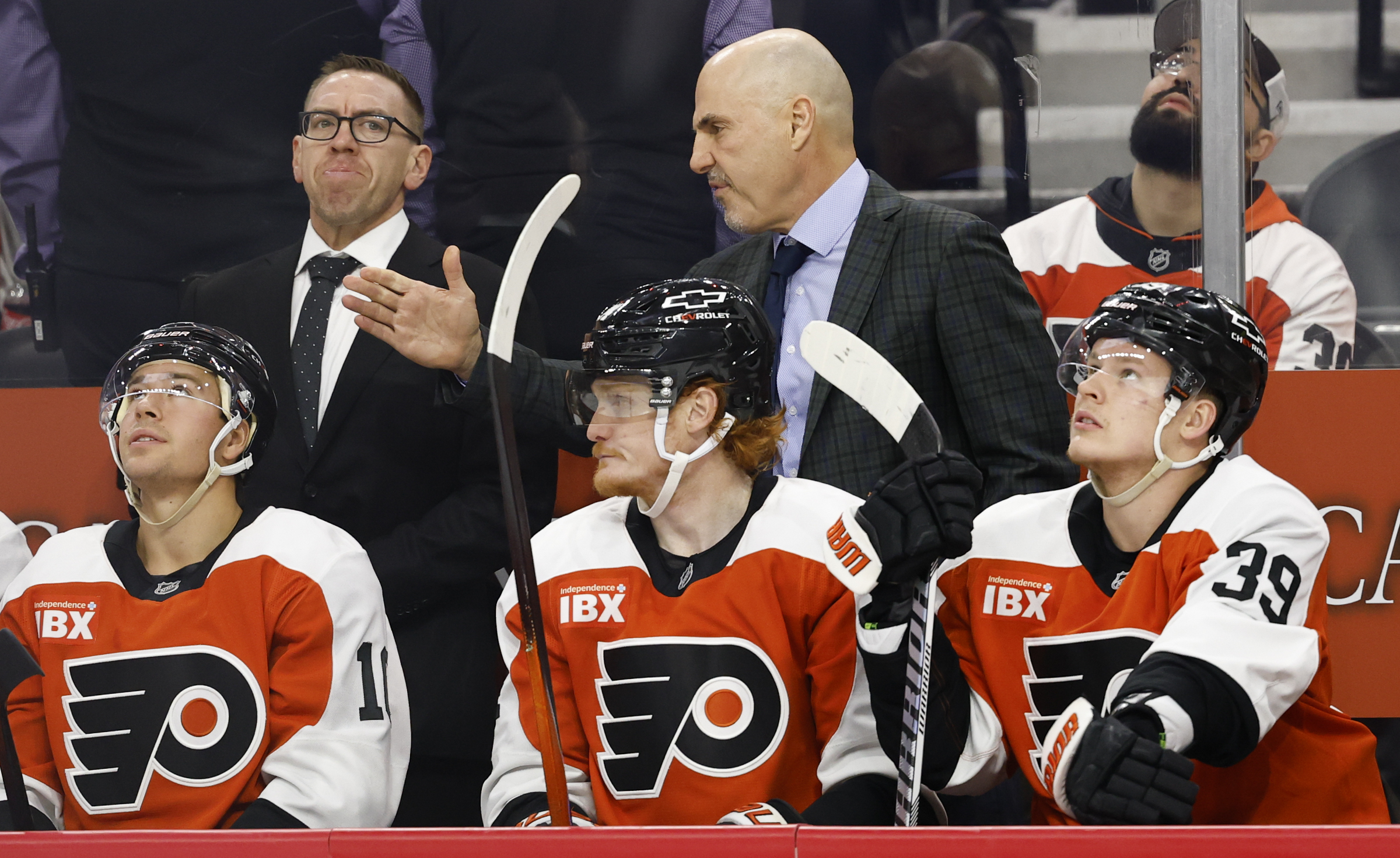
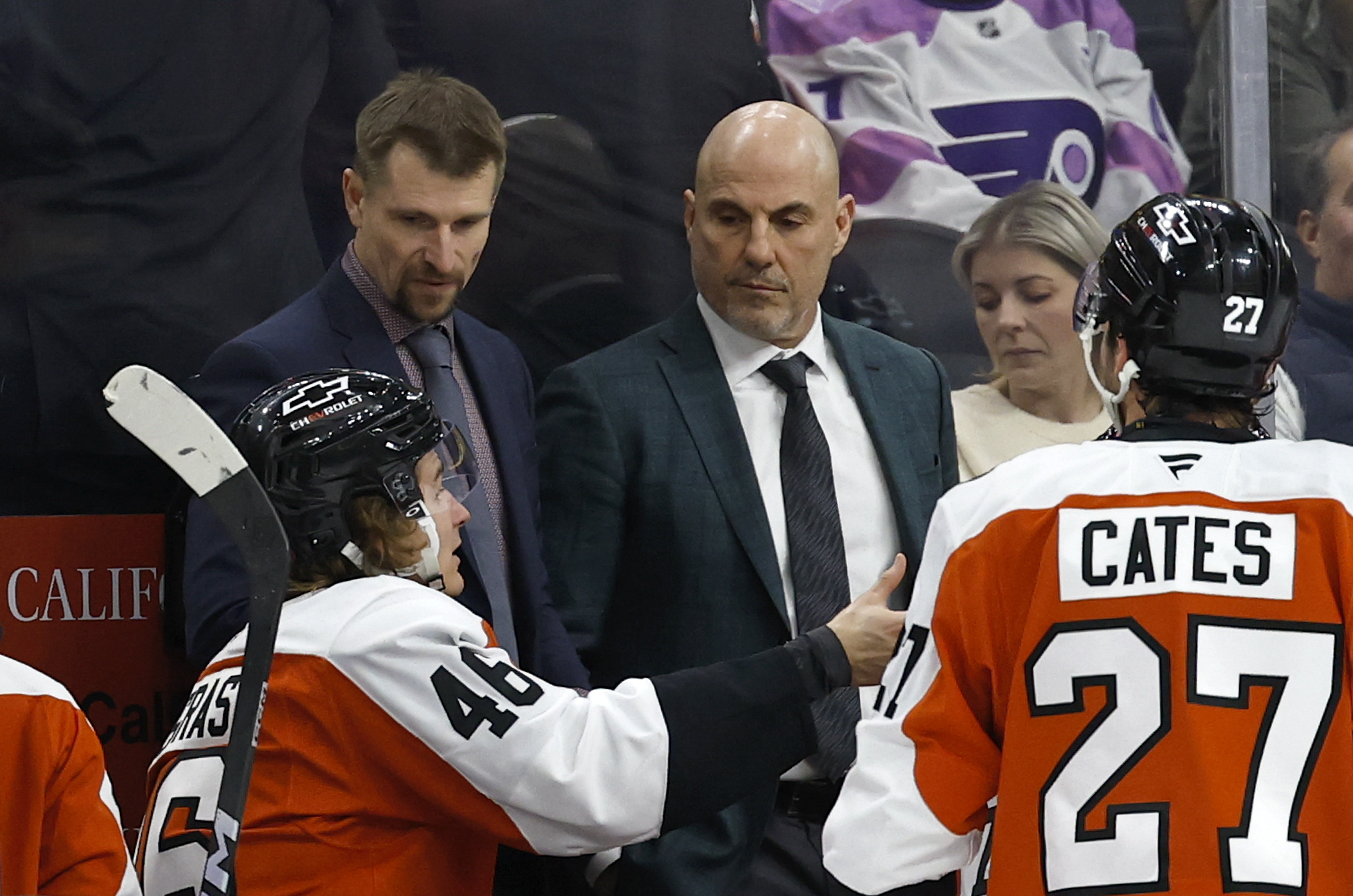
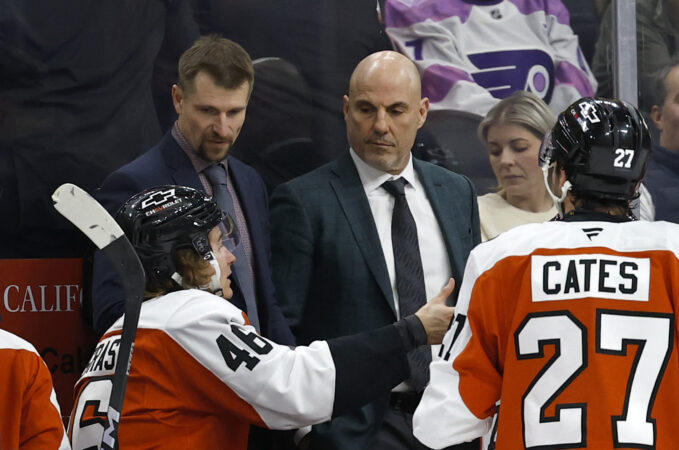
Flyers coach Rick Tocchet watches his team on Tuesday night.
Breakaways
Sharks goalie Yaroslav Askarov was sick and did not suit up. Justin Kowalkoski, a 39-year-old emergency backup goalie for the Sharks, signed an amateur tryout agreement with the team. He participated in warmups and sat on the bench in case Nedeljkovic had to leave the game. Kowalkoski played college hockey for Colgate University and previously served as a backup in 2018-19 for the Detroit Red Wings. Daniel Spencer, who rotates with Kowalkoski as the EBUG, was in goal for the Sharks’ morning skate. … Defenseman Ty Murchison made his NHL debut and did not look out of place skating on the third pair with Noah Juulsen. He saw ample time on the penalty kill and played almost 15 minutes with family and friends in attendance. … Michkov, who turned 21 on Tuesday, missed the first few minutes of the second period. According to coach Rick Tocchet postgame, “he had to get some stuff taken care of.”
Up next
The Flyers host the Vegas Golden Knights on Thursday (7 p.m., ESPN).
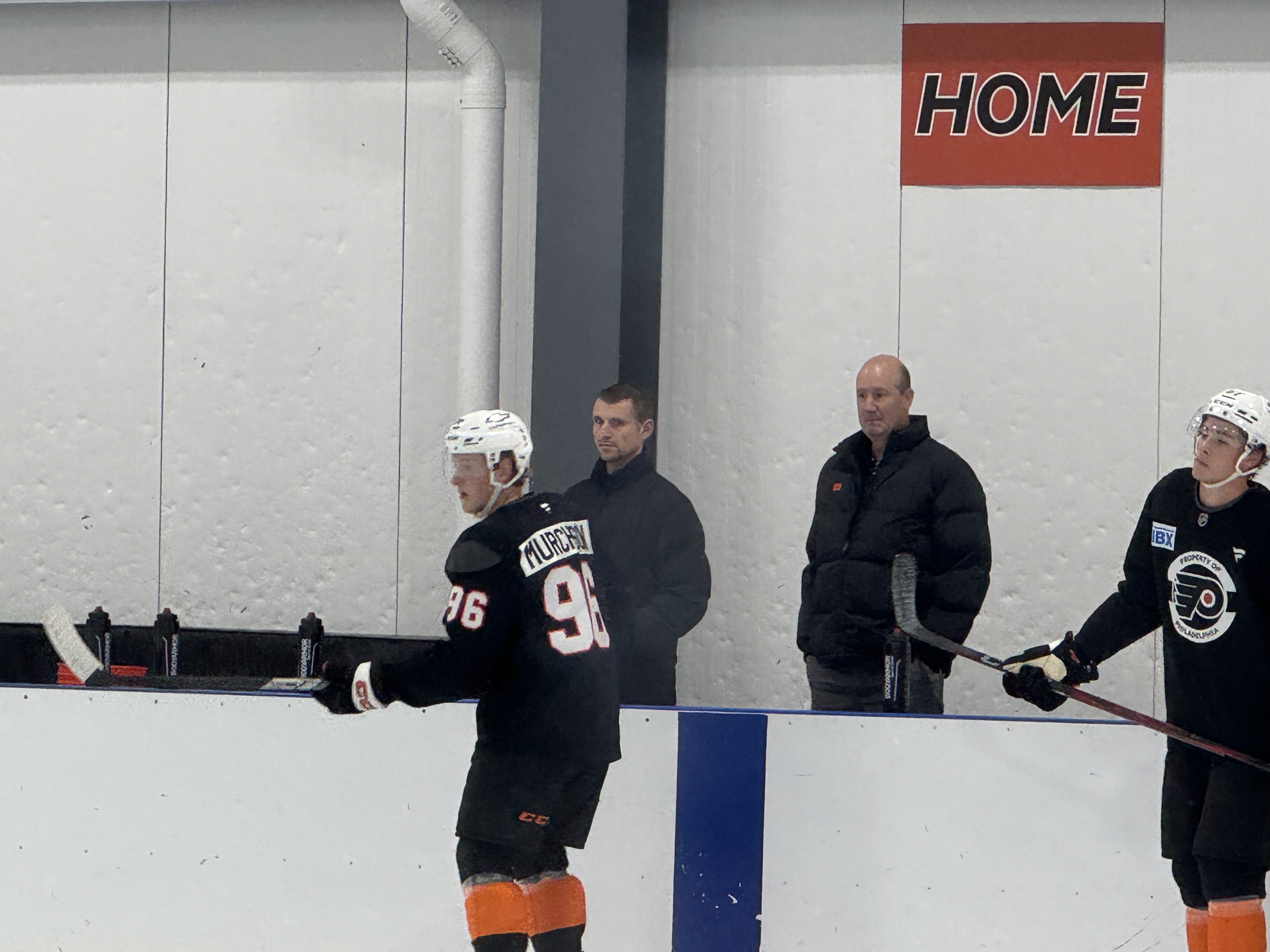
Ty Murchison wasn’t sure whether he should sit or stand when the media wanted to talk to him in the Flyers’ locker room in Voorhees on Monday.
On Saturday, the defenseman was recalled from Lehigh Valley of the American Hockey League, and, normally, availability in Allentown is held outside the room.
He was more prepared for the swarm of reporters following the team’s optional morning skate Tuesday at Xfinity Mobile Arena. Although it was hinted at a day earlier, Murchison learned officially that he would be making his NHL debut later that night.
“Extremely excited,” the 22-year-old said. “It’s been something I’ve been dreaming about my entire life. So, yeah, definitely an emotional time, but ready to go tonight.”
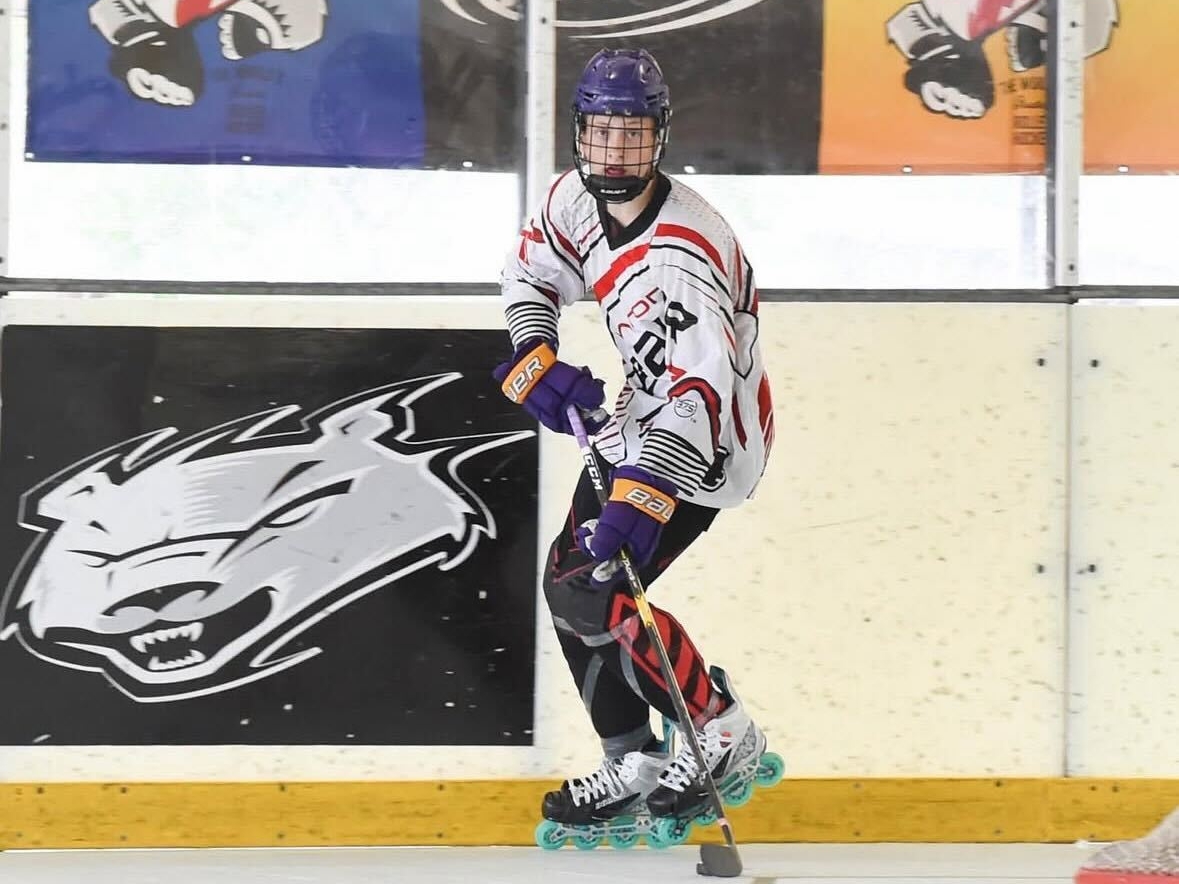
It’s been a journey for the California kid, a fifth-round pick by the Flyers in 2021 and someone who didn’t swap his roller hockey wheels for ice hockey steel until he was 11 years old.
“I would say roller hockey is where home is for me,” he said Monday. “The skating is definitely a bit different. It’s funny when I go back and play in the summer with all my ice hockey buddies, like I’m the only guy that can stop in my roller blades, because I pretty much grew up on them. But the rest of the guys, they usually struggle trying not to break any ankles out there.”
Murchison jokes that he didn’t know how to stop and was “blowing up kids” on the ice when he started playing. It’s not a bad thing because that’s how he evolved into a rugged defenseman.
With his size, 6-foot-2 and 212 pounds, and physicality at development camp in July, and rookie camp and the main training camp in September, his play piqued the interest of the Flyers’ new coaching staff.
“I thought from Day 1 — and I don’t think we gave [him] an exhibition game — he was really impressing me in practice,” Flyers coach Rick Tocchet said on Monday.
“He was [ticking] guys off, he was blowing up guys on cycles and stuff like that. And he’s played really well. I talked to [Phantoms coach John Snowden], and he’s a guy who deserves to come up and get a shot.”
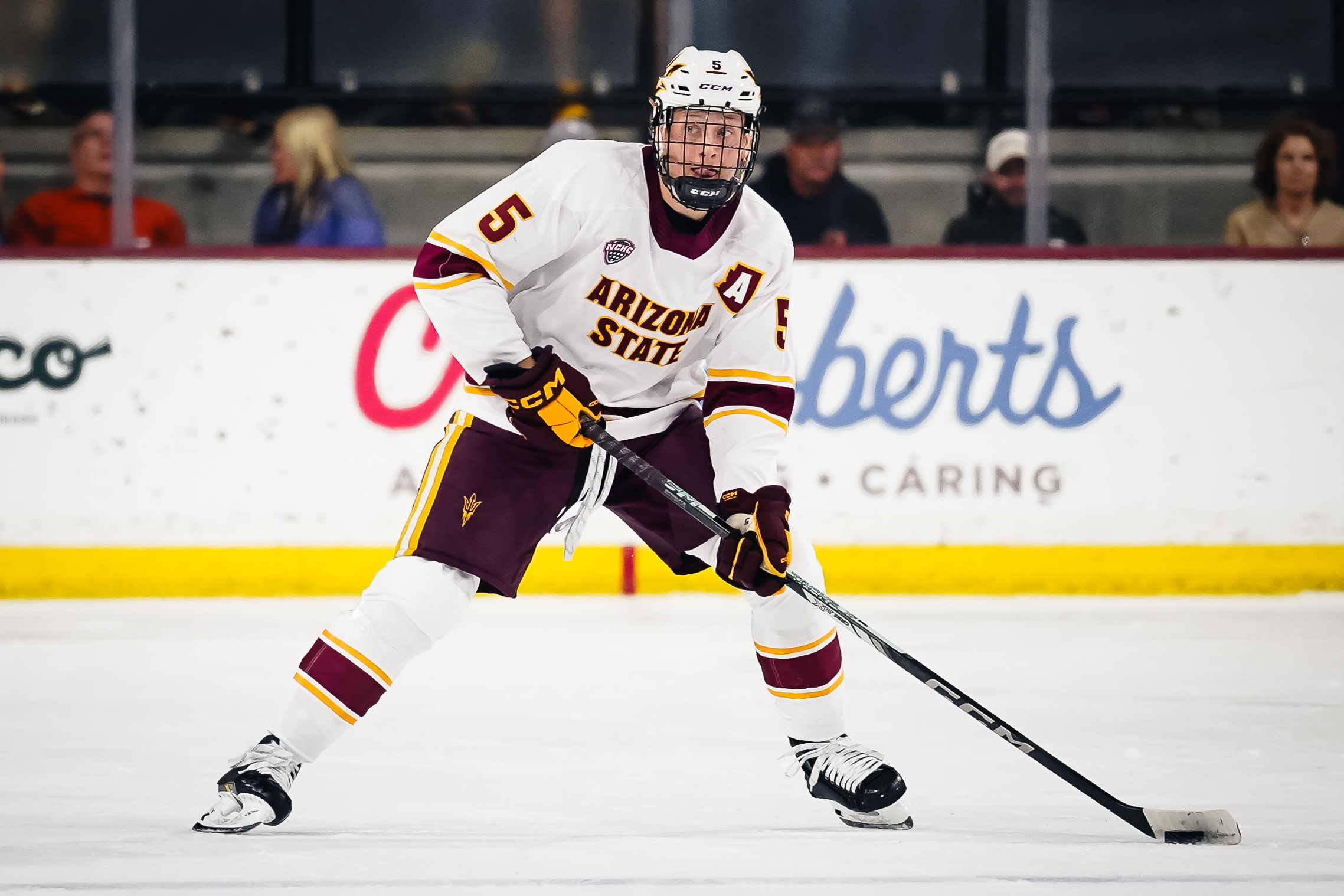
When the season started, not many would have pegged him to be the first guy to take a rookie lap this season. Just a few months ago, Murchison wrapped up his four-year career at Arizona State as the National Collegiate Hockey Conference’s defensive defenseman of the year after blocking 98 shots.
Ty Murchison’s roller hockey background has taken him all the way to the NHL.
After signing a two-year deal, he registered a goal and an assist in four regular-season games last season for the Phantoms and did not play in the postseason.
But this year, in 21 games, he has a goal, four points, 30 penalty minutes, and is plus-9. Murchison said he feels the pro game fits his style of play better than college because he likes to play a fast-paced, physical game.
So there he was this week, getting called into Snowden’s office to learn he was getting called up.
“My heart was beating about 100 beats per minute,” he said. “It was crazy, definitely nerve-racking, but extremely grateful to be here.”
And then he started making calls. His former teammates at ASU got a call, but the first FaceTime of the day was to his parents, Allyson and Ken.
“It was early morning back in Arizona, so woke them up, but yeah, I was choked up trying to get the words out. But as soon as I told my mom, she was screaming for my dad,” Murchison said with a laugh.
“But yeah, extremely emotional. There’s been a lot of periods throughout the last 48 hours where I’ve been getting a bit choked up and just thinking about it. Because, I mean, I’ve been thinking about this every day of my life.”
Murchison added that his parents packed their bags after that initial call and were just waiting for the next call to say he would be making his NHL debut. They will be in attendance along with about 20 buddies and family members from places like California, Prince Edward Island (his parents are from Canada), and Arizona on Tuesday when he skates against the visiting San Jose Sharks (7 p.m., NBCSP). For the record, Murchison grew up an Anaheim Ducks fan in Corona, Calif.
Ty Murchison has some familiarity with Todd Reirden (middle), having worked with his son at Arizona State.
He’ll be working with assistant coach Todd Reirden — he already knew him through Reirden’s son, Travis, who worked in analytics for Arizona State — and alongside veteran blueliner Noah Juulsen on the third pairing. Communication will be key for the new partner, as noted by Juulsen, and Murchison said he was “extremely talkative” during practice on Monday.
A big difference between this year and previous regimes is that the Flyers and Phantoms play a similar structure, especially in the defensive zone. It has helped several players, like center Jacob Gaucher and defenseman Emil Andrae, seamlessly enter the big club’s lineup when they have been called up.
Now it’s Murchison’s turn to show the bench boss what he can do. And while Tocchet called it “music to my ears” when told that Murchison likes to play a fast, hard game with an edge, the Flyers coach just wants to see him play his game.
The Phantoms coaches “felt that he was a guy who really consistently has brought his game [and is] competitive every night,” Tocchet said. “I’ve talked to [the media] about how we’ve got to squash plays, we’ve got to come up with some battle. And he’s one of those guys who, hopefully he can do it for us. I don’t know, but I think you’ve got to give him a shot.”
Breakaways
Forward Carl Grundström will be inserted into the lineup on the fourth line in place of Nic Deslauriers. Acquired in the deal that sent Ryan Ellis’ contract to the Sharks, Grundström played one season for San Jose, registering nine points in 56 games. He was recalled Dec. 2 from the Phantoms after Tyson Foerster was injured. Grundström made his Flyers debut against the Ottawa Senators on Nov. 8. … Goalie Dan Vladař (10-5-1, .906 save percentage) will start in net.
Ty Murchison signed a two-year entry-level contract with the Flyers in March.
Two members of the Flyers’ prospect ranks are swapping orange and black for red and white.
Hockey Canada announced on Monday that forwards Porter Martone and Jett Luchanko will pack their bags for Minnesota to play in the 2026 IIHF World Junior Championship.
The Flyers’ top pick in last June’s draft, when he was taken sixth overall, Martone brings “size, strength, power, shot, playmaking, puck skill” in a 6-foot-3, 210-pound body.
A freshman at Michigan State University, the right winger leads the Spartans in goals (11), points (20), power-play goals (three), game-winning goals (three), and penalty minutes (58) in 16 games.
Luchanko, who played for Canada at last year’s tournament, has two goals and five points in five games after being traded to Brantford of the Ontario Hockey League. He was acquired from Guelph, where he had 17 points (two goals, 15 assists) in 11 games, on Nov. 24.
After breaking camp for the second straight season with the Flyers, Luchanko skated in four NHL games and did not register a point before being sent back to Guelph on Oct. 27.
Also named to the roster is projected No. 1 pick in the 2026 NHL draft, Gavin McKenna, and defensemen Jackson Smith, a Columbus Blue Jackets pick in 2025, who suits up for Penn State.
Sean Couturier said it best after taking on the Colorado Avalanche.
“I know we’re a young team, but I think we’ve got to start believing in ourselves,” Couturier said. “It’s a good proof today that we can play with anyone, and we’ve just got to bring that effort, that intensity, more consistently.”
The Flyers did hang with the NHL’s best team for much of the Sunday matinee at Xfinity Mobile Arena, although Couturier added that it “felt that [at] times maybe we gave them a little too much respect and we watched them a little bit.”
They had their chances but ultimately fell, 3-2. It is their second loss in the last three games, but the Flyers are 7-4-0 since losing two straight in mid-November. The Avalanche improved to 21-2-6.
“Some people use games as measuring sticks, and I think we don’t need to do that anymore,” Travis Konecny said. “We’ve shown we can compete with the best teams, so why not start believing that we should be right there with them?”
A rapid flow
Trailing 3-1, the Flyers started to build some momentum when Konecny cut it to a one-goal lead with his seventh goal of the season early in the second period.
Konecny put a hard shot on Mackenzie Blackwood and tried to knock the puck away deep but ended up falling near the net. As that happened, the Avalanche transitioned the other way.
Sam Ersson made a kick save on a shot from the right half wall by New Jersey native Ross Colton, and Emil Andrae picked up the puck.
The defenseman sent a stretch pass up to Konecny, who was late getting back because of being trapped deep up the ice. The pass was nicked by Brock Nelson in the neutral zone, but Konecny took it off the wall, skated in, and scored five-hole.
“Yeah, it’s great,” said Christian Dvorak, who was given a secondary assist on Konecny’s goal, about playing with the winger lately. “High skill, high compete player [who] wins a lot of battles. Makes a lot of great plays out there and a nice goal tonight.
“Yeah, we had plenty of chances in the third, especially to tie it up, just a little bit away from executing there.”
Coach Rick Tocchet also had praise for Andrae after the game. Andrae was up in the play, making smart moves, and helping to lead the Flyers at both ends of the ice.
“That’s what I’m looking for right there. He was very good tonight,” Tocchet said. “When he had the puck, and there was room to skate, he skated; he didn’t wait. Even on the blue line, there were times when he had it, he had a step on a guy, he took, what we call, the good ice. He wasn’t flat-footed; he wasn’t looking to defer. He was being aggressive. So it’s a good step for Emil.”
The Flyers started to carry the game more, and in the third period, they outshot the Avalanche 13-3. According to Natural Stat Trick, the Flyers also had 26 chances to 14 against, 12 scoring chances to four for Colorado, and eight high-danger chances to one against. Their expected goals also climbed from 0.3 in the first period to 1.38 in the third.
“It was a strong finish again,” Konecny said. “I don’t know if it was like a flat first period for us. I know, for me specifically, I didn’t have anything good going on first. But yeah, we responded well.”
Trevor Zegras probably had the best chance when he was held up on a breakaway by Nathan MacKinnon and was awarded a penalty shot. Known for his prowess in the shootout, he was unable to bury this one.
It was his second penalty shot this season, as he also was unable to beat Jordan Binnington in overtime in the Flyers’ 6-5 shootout win against the St. Louis Blues in November. Zegras did score in the shootout.
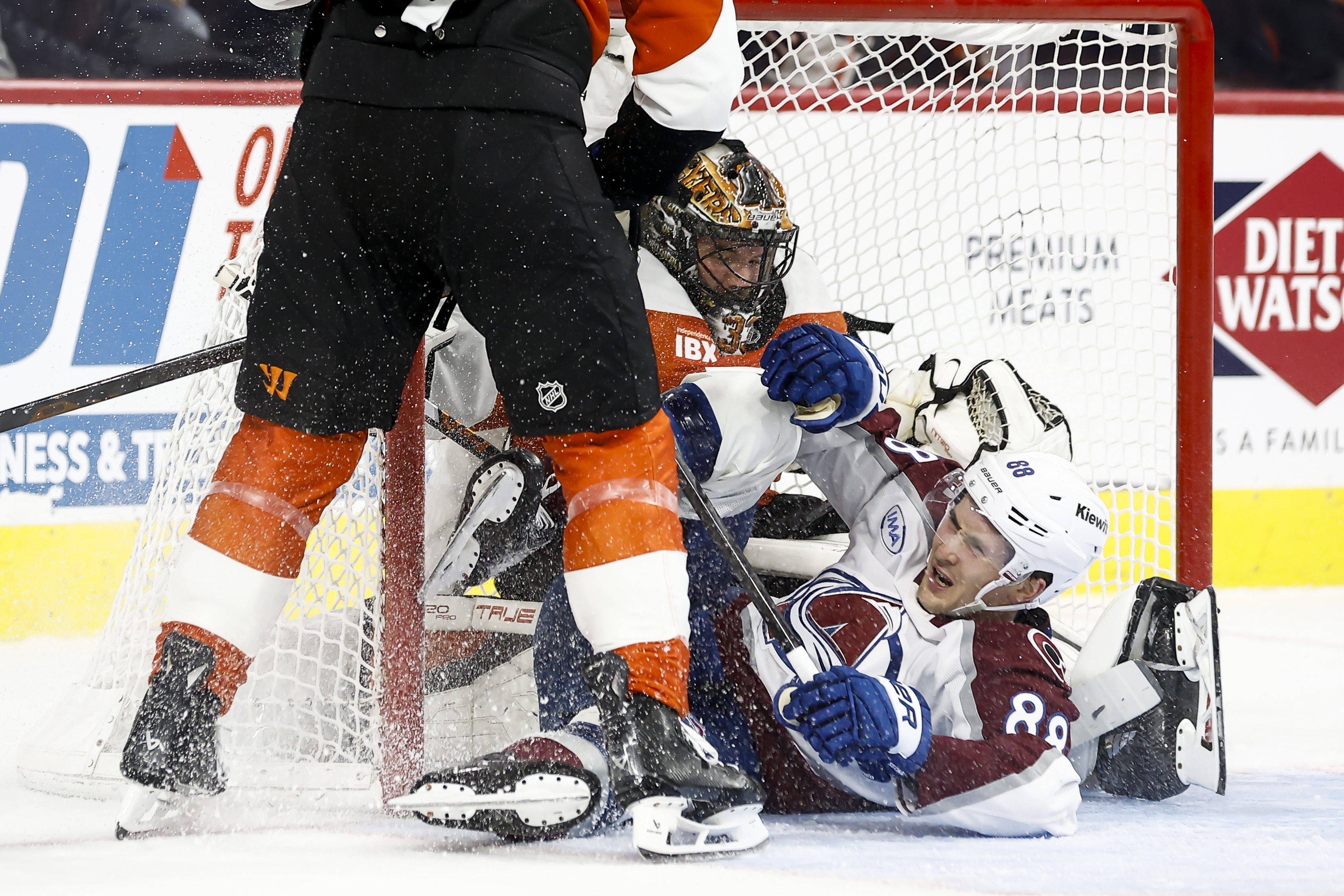
Colorado center Martin Necas slides into Flyers goaltender Samuel Ersson during the second period at Xfinity Mobile Arena.
The birthday boy
Skating in his 900th NHL game — all with the Flyers — and on his 33rd birthday, Couturier set the tone early.
On his first shift of the game, a tidy 35-second shift to boot, he made it 1-0 Flyers. With Couturier centering Matvei Michkov and Owen Tippett, the three forwards got to work to keep the puck on the Flyers’ sticks.
Tippett carried the puck deep along the left boards before curling and feeding it to Noah Juulsen at the right point. The defenseman, who has three of the Flyers’ 10 hardest shots this season, according to NHL Edge, put the puck on net with Couturier tipping it in out front, even with Avalanche defenseman Sam Malinski on him.
“It’s fitting for him to get that first one. It’s just great to see him play 900. He’s been through a lot in his career, and he’s always just put his head down and gone to work and led by example,” Konecny said.
“And he’s a guy that you can say he doesn’t care about that goal, he’ll care about if we won or lost the game, and that speaks to why he’s our captain. He’s been doing it for a long time. He just wants to win. So it’s a good guy to have on your side, and we love him.”
Starting his second straight game for just the second time this season — because Tocchet said he felt he deserved it after beating the Buffalo Sabres on Wednesday — Ersson had a tall task against the Avalanche. They entered the day leading the NHL with an average of four goals a game.
On the first goal, Egor Zamula couldn’t handle the puck behind the net and then didn’t get to it along the boards quickly enough. It allowed Colorado forward Jack Drury to easily play the puck deep to Martin Nečas, who sent a cross-ice pass up to Brent Burns at the right point for the goal.
“We play our best when we’re on our toes, and skating forward and be aggressive, and kind of get in their face and get their speed down,” Andrae said.
“Maybe we had a couple of long shifts, and they keep going, and they’re coming at us, and maybe we’re backing off a little bit too much and giving too much space, so you get on your heels. But overall, I think we played a pretty good game, but we didn’t capitalize on our chances.”
The second goal was a bit wonky as it was on a power play for Colorado — no surprise here, once again a questionable call by the referees — and happened after the puck hit the glass behind the net. The shot by Cale Makar, the reigning Norris Trophy winner, hit the glass, and MacKinnon had a swipe at it before Brock Nelson scored.
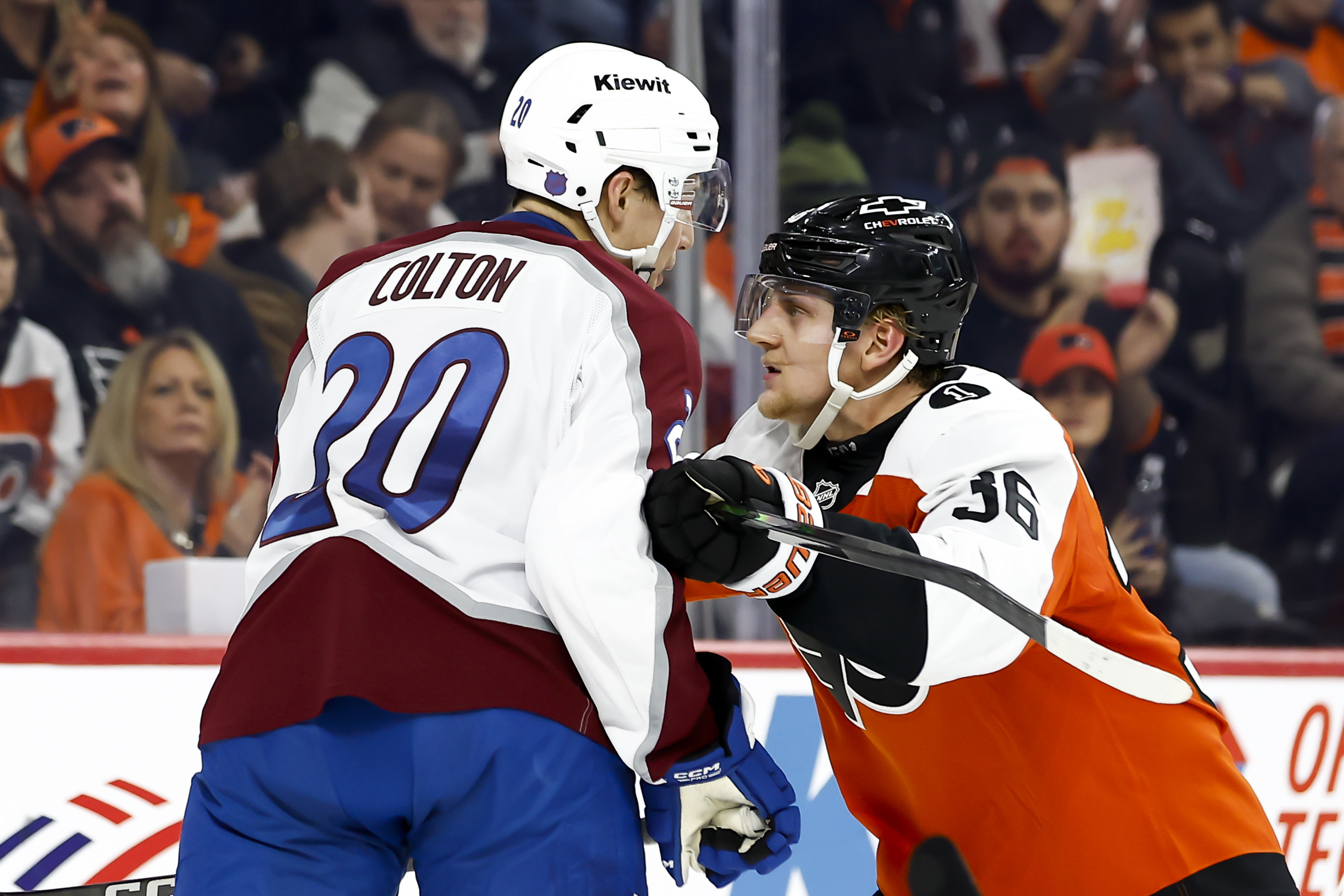
Flyers defenseman Emil Andrae shoves Avalanche center Ross Colton during the second period.
And the third goal came off a cross-ice pass by Victor Olofsson to Valeri Nichushkin atop the right faceoff circle. He whipped it passed Ersson to make it 3-1.
Zamula and his partner, Juulsen, were on the ice for that goal too.
“Yeah, I mean, listen, they’re scratching and clawing,” Tocchet said. “That’s what you’ve got to get from them. They’re trying.”
Ersson settled down and had some key saves. With the score tied, he stopped a hard, high shot by Burns and then a Josh Manson rebound. Early in the second period, he made a save on a shot by Devon Toews with Gabriel Landeskog in front before robbing the Colorado captain on the doorstep.
Later in the middle frame, Ersson did what he does best — stopping guys one-on-one. Facing his countryman, Olofsson, Ersson stoned him on a breakaway as he got behind Zamula.
“He was unbelievable, like he always is. He kept us in it. And it wouldn’t have been a one-goal game without him,” Dvorak said of Ersson, who made 25 saves.
Defenseman Cam York did not play and remains day to day with an upper-body injury. Blueliner Ty Murchison, who was recalled from Lehigh Valley of the American Hockey League on Saturday, participated in warmups but did not play. … Defenseman Nick Seeler played in his 400th NHL game. … Konecny has six points (two goals, four assists) during a four-game point streak. … Andrae has seven points in 17 games this season and is plus-7.
When did things start getting better for Matvei Michkov?
“When I start scoring,” he said with a smile through a team translator on Thursday.
“When you score, when you make a play, when you make an assist, that’s when you feel more confident.”
Across the first 19 games of the season, the winger had four goals and nine points, and a plus-minus of minus-4. In the last seven games, he leads the team with seven points (four goals, three assists) and is plus-2.
“A little bit better than the beginning,” Michkov said about his game. “Feels better, feels faster. Every game, [I] have to make a little bit better. It’s not my maximum.”
Five of Michkov’s last seven points have come at even strength. On Wednesday night, he made a slick pass to Owen Tippett for his goal, peering over his shoulder seconds before Buffalo Sabres defenseman Mattias Samuelsson, the son of former Flyers defenseman Kjell Samuelsson, converged on him.
But his power-play points are still finding their way. Last season, when Michkov led all NHL rookies in goals and tied for second in points, eight of his 26 goals and 17 of his 63 points were on the power play.
He’s still learning and adapting to his new position on the power play. On a unit with Trevor Zegras, Travis Konecny, Travis Sanheim, and Tippett, Michkov’s role is now focused on being a net-front presence and screening the goalie.
“Try to be a universal player, [and] if it will help the team, I’m willing to work on it and get better at it,” said Michkov, who was the one cutting across the crease when Zegras’ pass attempt went off a skate and past Sabres goalie Colten Ellis.
Since Nov. 8, Michkov has also primarily played as a left winger. The shift started amid a three-game goal streak. He says there’s no difference in his game by playing the left side, but coach Rick Tocchet disagrees.
Flyers head coach Rick Tocchet and winger Matvei Michkov (left) are working hard to improve their communication.
“I think playing him on the left side has made him go more north,” Tocchet said. “He’s not backward skating as much through the neutral zone. I’m trying to explain to him, the faster he can go north with [the puck] you get more rush plays.
“When you take it back, and you’re opening up, playing backwards, you’ve just got to beat structure again. If we’ve just beat structure, why do we want to go back so we have to beat structure again. … But the more north he can play, the faster he looks, too.”
Michkov tried not to think too much about his early struggles. When you have a heavy head and start overthinking, and therefore not creating or getting points, he hates it.
But a big part of his slow start can be attributed to the fact that he did not train well this offseason and, because of it, as he noted in November, he “lost concentration” at the beginning of the season. Michkov, who turns 21 on Dec. 9, knows he is talented and that he just needs to keep working and building his craft.
“I think I will start training here [in Voorhees]. Maybe will go home for [short time],” he said. “What’s happening right now is I’m not feeling good about it. I’m not happy about my points. I’m sure I can do much better and make a lot more and make better for my team and, of course, score.
“You cannot score in every game, but physically, I need to be ready for it. And in February [during the Olympic break], I need to spend the time to be ready for the rest of the season. If you’re going to have good physical form, everything else will come along.”
“If that’s his choice, we can help him,” Tocchet said when told of Michkov’s summer plans.
“As for his play, I don’t want him to worry about points. He was focused on goals and assists. He’s got to be careful. Those things will come by doing the right things, and I think he’s tried to do the right things. Where to go in certain areas, he’s getting better at definitely.”
Although he may not be ready to be interviewed without Slava Kuznetsov, the Flyers interpreter, Michkov’s English is progressing. It is noticeable that he is understanding and responding more when speaking with teammates and the media.
Matvei Michkov says he plans to train next summer in Voorhees.
And the coach and player are still learning how to work together.
“I think in real time, it’s harder. I can bark at someone, ‘Hey, on a D dive, you’ve got to remember, this is your quad,’” Tocchet said. “With Matvei, you’ve got to take your time, and you’ve got to get a [white]board. Or intermission time, I’ve done it a few times, called him in to show video.”
“I think earlier on, we were giving him so much information, I think we could frustrate him a little bit,” Tocchet added. “I think the last three weeks, we’ve really dialed in how we do it. OK, one coach has him for today. Hey, let’s give him a break today. Let’s not talk even systems; let’s talk to him about something else.
“I think we just, collectively, [figured out] how to manage how we give him information, because he seems to be grasping it more these last three weeks than he did the first three weeks.”
And it’s showing on the ice.
It also helps that he has his mother, Maria, and his brother, Prokhor, in the area because if he were to be by himself, “I would go nuts,“ he said.
But there is one rule.
“I like to talk about everything,” he said, “but when I’m mad, she knows not to talk about hockey.”
The injury bug has finally caught up with the Flyers.
After losing Tyson Foerster to an upper-body injury for the next two to three months on Monday, Cam York is now day-to-day with an upper-body injury.
“I think he got hit behind the net, or something,” coach Rick Tocchet said after the game. “We were trying to look for it. But I think he got hit behind the net a little bit late or something. I haven’t talked to the doctors.”
After Trevor Zegras was boarded by Buffalo Sabres captain Rasmus Dahlin in the offensive zone, York was involved in a scrum. Dahlin was assessed a five-minute major and was ejected from the game, but the Flyers did not score on the power play.
York did not return after the scrum that occurred with 3 minutes, 10 seconds left in the second period.
It’s also possible that the high hit by Buffalo Sabres forward Jason Zucker behind the Flyers net with 13:50 left in the period is the hit that Tocchet is referencing. The hit was a little late, as the blueliner skated back for the puck.
York, 24, went on injured reserve on Oct. 6 with a lower-body injury, two days after playing more than 25 minutes in the preseason finale. He missed the first three games of the season but has played in 23 games, posting 12 points (one goal, 11 assists) while averaging the second-most minutes (23:31).
Paired with Travis Sanheim, who had a maintenance day on Thursday, they are the Flyers’ best duo and skate against the opposition’s top lines. According to Money Puck, among the 19 pairs in the NHL that have skated at least 300 minutes together, they have the fourth-lowest expected goals against (14.1). Offensively, they are 18th in expected goals for (12.9) while skating the 10th most minutes together (368.4).
The Flyers do not return to game action until Sunday, but face a formidable task against the best team in the NHL, the Colorado Avalanche, who have lost just once in regulation across 26 games this season (1 p.m., NBCSP).
Some pluses for the Flyers? The one loss in regulation was on the road, and the Avalanche, who play Thursday at the New York Islanders and Saturday at the New York Rangers, have lost six of seven games that went beyond regulation. The Flyers have won seven of 10.
But if York cannot go, it leaves a big hole on the blue line.
“Obviously, it challenges your depth,” Tocchet said on Thursday. “It’s the same thing, that everybody wants a chance to play, so when it’s your number, be ready. That’s why I always tell players be ready. Practice hard, off the ice do the right things, your number will be called.
“So, there’s a possibility he might not play, so whoever’s going to come in there, as a group, we’re going to have to make up for those minutes.”
Two seasons ago, when the Flyers ranked among the best teams in the Eastern Conference, they lost 5-3 to the Ottawa Senators on Jan. 21.
Yes, it was amid a five-game losing streak, but entering that game, the Senators were not just last in the conference; they were 23 points back in the standings from the Flyers. At the end of the season, the Flyers missed a playoff spot by three points, and that game could be circled as a missed opportunity.
This season is still in its infancy, but the Flyers are maintaining a postseason spot and currently sit in third place in the Metropolitan Division. If they want to be a team to be reckoned with, they need to beat up on the bad teams. And the Sabres, who are ninth in the conference, are a bad team.
The Flyers power play cashed in twice on Wednesday night against the Buffalo Sabres.
Good teams stop losing streaks
It wasn’t a losing streak, per se, but the Flyers lost one game for the fifth time this season and ended it there. The most they’ve lost this season is two straight, which hasn’t been seen during the first chunk of the season since 2011-12.
So why hasn’t the losing snowballed like in years past?
“I think that’s just showing our maturity as we’re growing. I think that we work really hard, practicing, trying to keep our momentum going. You practice hard, you play hard. So those things kind of translate,” alternate captain Travis Konecny said.
“We also had some days off, too, right now, so that’s given us a little bit of our legs tonight, and we have a little stretch coming up here to get going again. So it’s kind of a combination of things, to be honest.”
Tyson Foerster, who officially went on injured reserve on Wednesday after sustaining an upper-body injury on Monday, was in the locker room after the game, high-fiving his teammates. But while he’s around, not having him on the ice leaves a pretty big hole in the lineup.
Entering the night, he was the Flyers’ top goal scorer with 10 goals. At the end of it, he was tied with Zegras, with Tippett breathing down their necks after potting his ninth.
“That’s a big hole that we have to fill with him out,” Tippett said of Foerster. “Obviously, you hate to see a guy like that go down, but anytime, all of us can kind of pitch in, and guys contribute throughout the lineup, it’s good to see. And, I think everyone kind of steps up a little bit when a guy like that’s out of the lineup.”
Bobby Brink connected with Noah Cates down low to extend the Flyers lead to 4-1. Sidenote, don’t ever separate those two again. Goal: Cates (6) pic.twitter.com/4AM6NoUsMX
But the best sign of the night was that Bobby Brink and Noah Cates both got on the board, with each logging an assist on the other’s goals.
Brink’s goal came off a shot by Cates after he dropped it to the centerman — neither could remember if Cates called for the drop pass — and while it was his seventh of the year, it was just his second in the past 13 games.
“Yeah, I mean, it’s not really fun scoring one point in 12 games,” said Brink, who is inching closer to his career high of 12 goals. “I mean, it’s one game, so probably should start scoring more in the other ones, too.”
While Cates had been playing primarily with Foerster, he was reunited with Brink on Wednesday, and the chemistry was immediately rekindled. Brink fed Cates for the redirect and his sixth of the season. And they did so with Nikita Grebenkin, who finally moved up to the top nine, on the left wing.
“He makes some good plays. He’s in good spots. He’s always flying out there and making plays,” said Cates of Grebenkin, who created the turnover and got an assist on Brink’s goal. “So just kind of, the more we play together, the more we can learn and build that chemistry and that trust. And I thought he was awesome tonight.”
According to Natural Stat Trick, Tocchet rolled all four lines evenly, with each line getting roughly 6½ to 8½ minutes despite a disjointed game with a ton of penalties called. It’s important that, as the schedule gets heavier because of the pending Olympic break, the Flyers can continue to roll four lines and generate offense from throughout the lineup.
Good teams score on the power play
Last season, of the 16 teams that made the postseason, only the Los Angeles Kings, Carolina Hurricanes, Montreal Canadiens, Minnesota Wild, and Dallas Stars were in the bottom half of the league’s power play rankings. The two teams in the Stanley Cup Final, the Edmonton Oilers and champion Florida Panthers, clicked at 23.7% and 23.5%, respectively.
The power play has been a thorn in the Flyers’ side for years, but right now, it’s out of the basement and tied for 18th with the Anaheim Ducks at 18.7%. It’s a critical step forward for the team to not just have confidence in their units but to know that it can help them either get back into games or extend leads.
Travis Konecny snapped his 11-game goalless drought and it’s 1-1. Goal: Konecny (6) pic.twitter.com/OhwUnb3CxZ
And if they don’t score, as they did twice on Wednesday night, going 2-for-5, it also helps build momentum in the game.
With Foerster out for 2-3 months, one of the units now has Konecny, Zegras, Travis Sanheim, Matvei Michkov, and Tippett. Sean Couturier took a neutral zone faceoff and then went right to the bench for Zegras to hop on.
They scored two goals.
“Just moving it, I think try not to hold on to it too long. I thought Sanny did a great job tonight of being confident up top, moving the puck, and I think just being direct, trying to get shots to the net,” Konecny said.
“When you look at a lot of the top power plays, other than some of the really skilled ones, you look at all the top power plays, it’s just like getting pucks to the net, deflections, having bodies there, outnumbering them. And I think we focused on doing that tonight a lot.”
“We had some looks up top. Obviously, he got a few blocked, so we might have to change some angles there, but at least we’re shooting the puck,” added coach Rick Tocchet.
“If it hits a shaft or something, I can live with it, but we’re getting more shots from the middle. … I’d like to see a little bit more movement earlier on the power play, but, being picky. But yeah, it was good for us tonight.”
Trevor Zegras sat down for his first interview on Day 1 of training camp in September, sporting a Nirvana shirt.
“Come as you are, as you were, as I want you to be,” the band’s frontman Kurt Cobain would sing.
Well, the Flyers wanted Zegras to come as he is, as he was, and as they want him to be. There was no rush, but Zegras, who was acquired in June from the Anaheim Ducks in exchange for Ryan Poehling, a 2025 second-round pick, and a 2026 fourth-rounder, hurried up the process. Nevermind the past two years, he has trended in the right direction.
“It’s fun to see the joy in his game again,” Flyers general manager Danny Brière said recently. “You can tell he’s having fun playing the game. I think for hockey players, it’s a big part of having success is that you’ve got to play with passion, you’ve got to play with enthusiasm, and I think that’s what we’re seeing in Trevor’s game.
“I don’t know what happened in Anaheim, that’s not my business. But we see a young man who is having fun and making plays, going out there trying to make a difference. It’s been fun to watch, too, for our fans, adding another guy with high-end skill that can get you out of your seat.”
‘Here we are now, entertain us’
The Flyers have long needed a game-breaker and a creative force to draw fans out of their seats again. Matvei Michkov brought some of those qualities last season, and the hope was that adding Zegras would infuse more.
Twenty-six games into his tenure in orange and black, the 24-year-old has showcased the rare skill level that has long wowed fans. He is tied with Tyson Foerster, who was placed on injured reserve on Wednesday, atop the Flyers’ leaderboard with 10 goals and leads the team with 26 points.
And although there might be some bruises on the fruit, he has helped the power play come in bloom as four of his goals and 11 of his points have come on a man advantage that is tied for 18th in the NHL. He’s also had a knack for the dramatic, scoring the game-winning goal in Saturday’s win over New Jersey, and clinching two other games via the shootout.
Trevor Zegras’ trademark skill and swagger have popped from Day 1 with the Flyers.
The kid who grew up idolizing Patrick Kane, aka “Showtime,” has stolen the show. He is a perfect 4-for-4 this season and ranks No. 1 all-time among players with at least 15 shootout attempts at 68% (17 goals on 25 shots).
“Especially when you have Trevor Zegras on your team, you start almost with one up,” said Sean Couturier, captain of a Flyers team that is a perfect 5-0 in shootouts this season. “So we like our odds in shootouts.”
But maybe the biggest difference for Zegras this year is that the coaching staff has confidence in him. Zegras is averaging 18 minutes, 14 seconds a night, the second-most among Flyers forwards, and his highest amount since the 2022-23 season.
“He’s done a really nice job,” coach Rick Tocchet said last week in South Florida. “He moves his feet. He can make some plays out there. They’re hard to find, and he’s got to be a difference maker for us, which he is. He’s making some good plays for us.”
After a tough few years under Greg Cronin in Anaheim, Trevor Zegras has found a coach in Rick Tocchet who believes in him.
Heart-Shaped Box
Although he says you have to prioritize the team game, Zegras notes that he is always building and working on his own game. He can often be spotted doing that on the ice long after practice is done.
He’s also often on the ice talking to Tocchet, whom he affectionately has nicknamed Taco. It looks as if the two are either going over reads, structure, systems, and positioning. In October — after a win against the Seattle Kraken, no less — he texted Tocchet that he wanted to watch video with him, too.
“It’s good,” Zegras said of his relationship with Tocchet. “He watches a lot of hockey, and he played for a long time. There’s just little stuff that he sees; it’s definitely good stuff, important stuff, and they’re usually really good points, so I try to listen.”
Bobby Brink and Trevor Zegras stayed out long after #Flyers practice wrapped up today. In these pics they were working on saucer passes. Zegras was working earlier with an assistant coach on backhand saucer passes too. pic.twitter.com/XecZ8CNFJm
“Unreal, coachable kid. You can tell him anything. We talked last game, I thought he didn’t really skate, didn’t do much, and he actually comes up to me, and he goes, ‘Man, I didn’t move my feet last game, I can really tell,’” Tocchet said, referencing the Nov. 24 game in Tampa Bay.
The bench boss also likes that Zegras is correcting mistakes. He had a big turnover early in the Flyers’ 6-5 shootout win against the St. Louis Blues on Nov. 14 that led to a goal. How did he rebound? By playing a role in each of the Flyers’ goals in regulation and scoring the lone shootout tally.
But while the good times are rolling, the big question remains: At five-on-five, is he a center or a winger?
Right now, it’s a little bit of both.
According to Natural Stat Trick, he’s played just 26 minutes, 46 seconds across the first 26 games of the season down the middle. He’s skated the majority of the season on a line with Christian Dvorak and Owen Tippett — although on Wednesday night, Travis Konecny was on their wing — with Zegras deployed in a hybrid center role.
“Yeah, I don’t know what’s going to happen in the future, but I think it’s a great setup for him,” said Brière when asked if maybe a hybrid is best right now for a player who may be a natural centerman but has spent the last two seasons almost exclusively on the wing.
“The way we have him with the centers that we have, it gives him the chance to take more chances on offense and not have to always come back and be the first player back, battling down deep in the defensive zone.
“He has to do it at times — everybody at times gets caught being the first guy back — but he doesn’t have to do it every shift, and I think it opens him up, frees him up a little bit on the other side of things.”
The hybrid role focuses on the play below the hashmarks in the defensive zone and being the high man, when applicable, in the offensive zone. It’s about being the first forward or F1 — and about faceoffs. Not really known for his faceoff prowess, Zegras is feeling more confident in the circle and has been getting help from Couturier.
“Dvo’s great down low. Not that he needs [it], but I can switch maybe during the shift,” Zegras said before the Flyers’ win last week against the Florida Panthers, before adding with a smile, “or if he wants to maybe cheat on some faceoffs, and he ends up getting kicked out of them, I feel fine getting in there.”
‘Found my friends’
While he’s no longer a teen, Zegras definitely has some spirit. Bounding into the locker room these days with his long flowing locks and a grin mixed in with some chatter, the 24-year-old looks rejuvenated on and off the ice.
“Just extremely grateful that it ended up being Philly.” Gary Zegras, Trevor’s father, told The Inquirer during the dad’s trip in November. “The closeness is incredible. We get to come to the games, and we get to spend a lot of time down here. He’s got a lot of other family that have been coming to the games and friends in the area. So that’s great for him, and it’s also great for us, selfishly.
“And then between management, between the coach, and the other players on the team, it’s just such a great fit. You just see the smile on his face, and you just can tell that he feels comfortable here, and it’s translating to — I know it’s early in the season — but he certainly looks a lot more like his old self. And I think a lot of that has to do with the environment, 100%.”
Zegras has several familiar faces in the room, including his best buddies Jamie Drysdale, his teammate in Anaheim, and Cam York, whom he played with as a teenager at the United States National Team Development Program.
“Just fun to have him around in the locker room. … Obviously, what he’s done has been really great for our team,“ York said. ”He’s added a lot of skill and good vibes, good mojo to the team, I think, and that goes a long way in this league.”
Added Drysdale: “He’s a free spirit. He does his thing. We all love and appreciate him for it. He keeps it light, and he’s playing really good hockey. Yeah, we’re just lucky to have him, and he fits in perfectly here.”
Zegras has found his spark again. But has he found a home, too?
Of course, Brière had no comment when asked recently about a new contract for Zegras. The forward is a restricted free agent on July 1, and the general manager rarely signs players to extensions during the season. But, while it’s early, there is no doubt that Zegras is the type of talent and game-breaker the Flyers have been searching for the past several years.
According to Puckpedia, the cost to keep him around begins at $5.75 million, the minimum qualifying offer the Flyers must give him to retain his rights. But with the salary cap rising, there is no doubt he will command a much higher number.
Jamie Drysdale, Cam York, and Trevor Zegras (center) are best friends and are relishing getting to play together with the Flyers.
A good comparable to Zegras is probably Shane Pinto. The Ottawa Senators center, who was drafted 23 spots below him in the 2019 NHL draft, just signed a four-year extension with an annual average value of $7.5 million. Zegras has eight more points than Pinto this season.
He also has more points than other recent center signings like Utah’s Logan Cooley (eight years at $10 million per), his former Ducks teammate Mason McTavish (six years, $7 million), and Chicago’s Frank Nazar (seven years, $6.59 million). Dallas Stars forward Wyatt Johnston, who got four years at $8.4 million last season, is the only real comparable who has more points than Zegras so far this season.
Two more worth noting are Utah’s JJ Peterka and Winnipeg’s Gabe Vilardi, who, like Zegras, are capable of playing center but have also played a lot of wing. Peterka signed this offseason for five years at a $7.7 million average annual value, and Vilardi got six years at $7.5 million.
Factoring in his recent history and that all but Vilardi are younger than Zegras, the expectation is that he’ll get at least five years — which is the length York, who is also represented by Pat Brisson, signed for in July — and between $7.5 million and $8 million per year.
Brière likes to wait; maybe he shouldn’t. If Zegras keeps trending the way he is — he is on pace for a career-high 32 goals and 82 points — it puts the past two years, and his injury concerns, in the rearview, and the ask could be closer to $9 million.
Is that too much for a kid in his mid-20s who has found his game again and looks to be back on a star trajectory? Probably not. Does it truly matter if he’s that top center or the top winger? In reality, not really, because in the end, he’ll still be a critical piece of a Flyers team moving through a rebuild with the focus on being a Stanley Cup contender for years to come.
Zegras loves playing in Philly. He loves the spotlight. It sounds like a happy marriage because, while for years and years, Zegras roamed, he now feels like he’s back home.
And if he does stay for the long haul, it sounds like Flyers fans will be in nirvana.
Trevor Zegras isn’t going anywhere but the Flyers would be wise to sign him now and try and save a few bucks.
With leading scorer Tyson Foerster out 2-3 months after getting injured in Monday’s 5-1 loss to the Pittsburgh Penguins, there were questions about how the Flyers would find offense.
The answer? Easily.
The Flyers beat the Buffalo Sabres 5-2 for their fourth win in the past five games. Since losing two straight in mid-November to the Ottawa Senators and Edmonton Oilers, they have gone 7-3-0 and have not lost two in a row since.
They did lose defenseman Cam York late in the second period. After Trevor Zegras was boarded by Sabres captain Rasmus Dahlin in the offensive zone, York was involved in a scrum. He did not return and coach Rick Tocchet said postgame he thought it was an upper-body injury.
“I think he got hit behind the net, or something,” Tocchet said. “We were trying to look for it. But I think he got hit behind the net a little bit late or something. I haven’t talked to the doctors.”
Dahlin was assessed a five-minute major and was ejected from the game, but the Flyers did not score on the power play.
But they had already scored a pair with the man advantage. It came in the first period when the Flyers scored a trio of goals after — no surprise here — trailing 1-0.
Travis Konecny scored on the power play to tie the game 1-1 while on the ice with the revamped unit of Zegras, Travis Sanheim, Owen Tippett, and Matvei Michkov. Konecny got the puck along the boards and carried it above the left faceoff circle and toward the middle before putting the puck past the blocker of Sabres goalie Colten Ellis for his sixth goal of the season.
The Sabres challenged the call with Tippett in front, but the video review confirmed that there was no interference before the goal. Because of the failed challenge, the Flyers went right back on the power play.
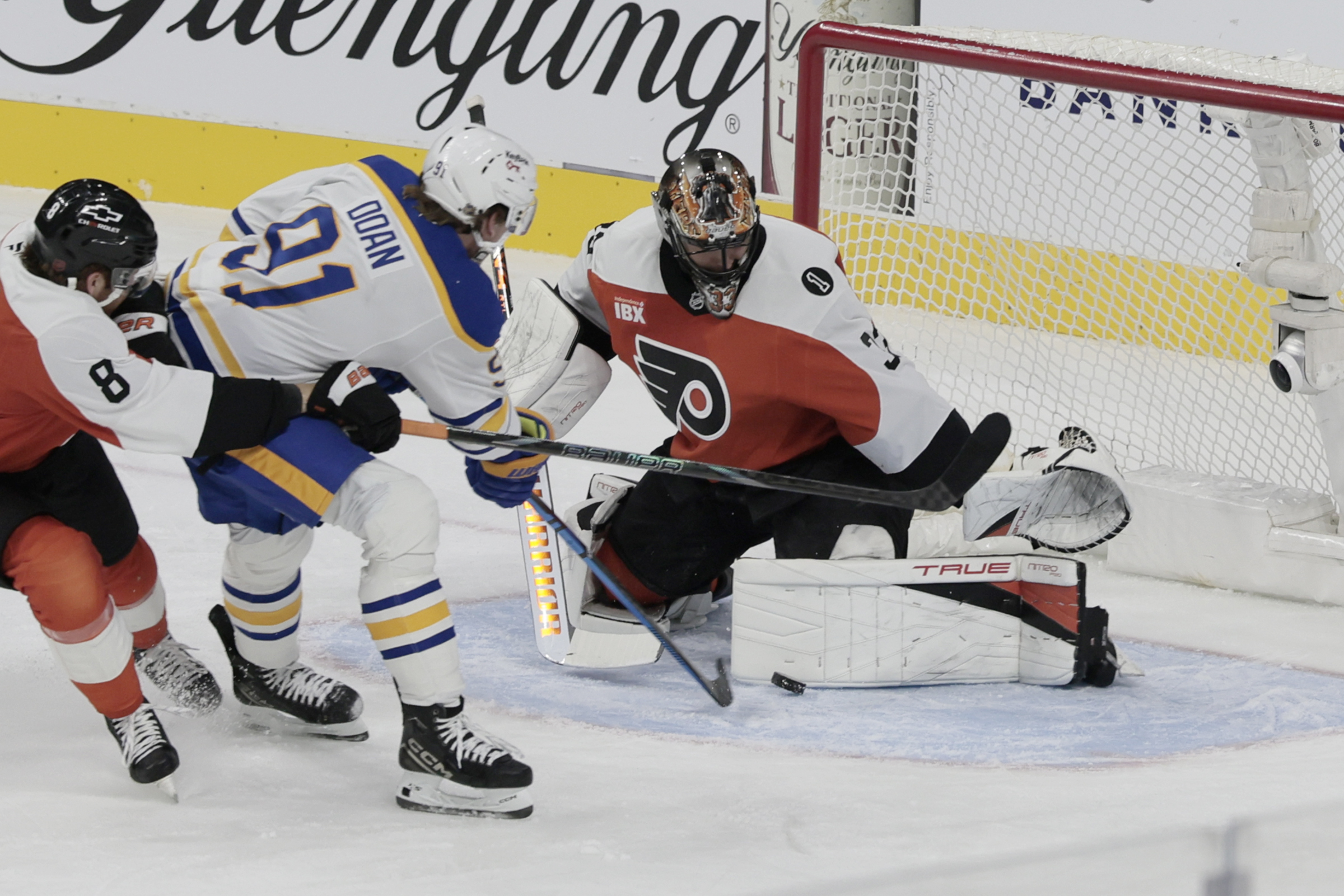
Flyers goaltender Sam Ersson makes a save on a shot from Sabres’ Josh Doan in the first period.
Zegras scored his 10th goal of the season on the ensuing man advantage. It tied him with Foerster for the team lead.
The Flyers moved the puck around the outside well. Konecny skated down the left boards before sending the puck back to Sanheim to open space. The defenseman saw Zegras with his stick up in the air, awaiting the pass above the right circle. After receiving it, he put the puck toward the net, and it ended up going off the skate of Buffalo’s Ryan McLeod to give the Flyers the lead 38 seconds after tying the game.
Zegras said postgame he was actually looking to get the puck to Konecny across the ice.
Twenty-one seconds later, it was 3-1. After putting the follow line of Noah Cates, Bobby Brink, and Nikita Grebenkin — who was promoted to the top nine after the Foerster injury — on the ice, the trio connected.
Grebenkin deflected a pass intended for Tage Thomson and collected the puck inside the blue line before feeding Brink, who dropped it to Cates. The center put the puck on goal, and Brink cleaned up the rebound for his seventh goal of the season. It gave the Flyers three goals in 59 seconds.
In the second period, it was Brink who fed Cates for the goal seconds after a Flyers power play ended. Jamie Drysdale got the loose puck and carried it to the middle of the ice before dishing to Brink atop the right circle. He carried it down and set up Cates for a redirect and his sixth of the season.
Later in the period, Tippett made it 5-1 with his third goal in three games. Emil Andrae kept the puck in at the blue line and sent it down the boards to Sean Couturier, who sent a no-look pass to Michkov. The Russian winger then did the same to Tippett with Mattias Samuelsson, the son of former Flyers defenseman Kjell Samuelsson, on him.
Tippett went backhand to forehand and had his initial shot go off Ellis’ shoulder. But the Flyers forward stuck with it and battled the puck out of midair for his ninth of the season.
Tocchet didn’t like the first goal the Flyers gave up. After Monday’s game, he chastised the penalty kill, citing that he didn’t like the structure; he prefers an aggressive diamond and hates the box. Well, the goal by Sabres forward Jason Zucker was because the penalty kill fell into the box and he was able to score in front off a pass from Josh Doan.
Buffalo’s second goal of the night, which made it 4-2, came off the stick of Bowen Byram. On a bouncing puck, the defenseman fired the puck past Flyers goalie Sam Ersson.
Breakaways
The Flyers now have 11 comeback wins and are 10-6-2 after trailing first. Both lead the NHL. … Ersson made 27 saves, and the Flyers put 35shots on goal.The Flyers’ goalie is now 5-2-2 on the season. …Forward Carl Grundström, who was recalled from Lehigh Valley of the American Hockey League on Tuesday, and defenseman Noah Juulsen were the healthy scratches. … The Flyers challenged a goal by the Sabres in the third period, and it was determined that Buffalo was offside.
Up next
The Flyers have a few days between games, but next face the NHL’s top team, the Colorado Avalanche, on Sunday (1 p.m., NBCSP). How good are the Avalanche? They’ve lost once in regulation this season.
The Flyers will be without Tyson Foerster, the team’s leading goal scorer, for the next two to three months after he suffered an upper-body injury in Monday night’s loss to the Pittsburgh Penguins and was placed on injured reserve Wednesday.
It is a major blow to a team that is averaging 2.76 goals this season, the seventh-lowest total in the NHL. But as coach Rick Tocchet said, “The poor-is-me stuff, that can’t linger in that room.”
And with that, the bench boss whipped up some new line combinations at Wednesday’s morning skate. Tocchet likes to keep pairs together, and Trevor Zegras and Christian Dvorak are a duo that is working well. They will now have Travis Konecny on their wing. According to Natural Stat Trick, they’ve played as a line for just 97 seconds at five-on-five this season.
The fourth line remained somewhat the same, with Rodrigo Ābols, Garnet Hathaway, and Nic Deslauriers skating together. Deslauriers, who started his career with Wednesday’s opponent, the Buffalo Sabres, last played Nov. 24 in Tampa Bay. Carl Grundström was recalled on Tuesday from Lehigh Valley of the American Hockey League, but it looks like he will be a healthy scratch against the Sabres (7:30 p.m., TNT).
Speedy winger Owen Tippett was moved alongside Matvei Michkov and Sean Couturier. The trio has not played together this season, but did last year, skating almost 125 minutes together. With that line on the ice, the Flyers had a 52.57% Corsi For, 56.36% of the scoring chances, 60% of the high-danger chances, outshot opponents, 76-51, and outscored their opponents, 10-8.
Not too shabby. However, there is one difference now: Tippett will be on the right wing, with Tocchet liking the speed and north-south game Michkov plays on the left.
“The last two or three years I’ve played left more consistently, so obviously I’ve gotten more comfortable with it,” Tippett said about playing the right side. “But again, I’ve played right my whole life, and even now, there’s been some shifts or some periods where I’ve had to go back to the left. I think I’m ready for it whenever it happens.”
And of course, the biggest move of the day involves Nikita Grebenkin, who — some would say, finally — has been moved into the top nine. He is playing with Bobby Brink and Noah Cates.
“Tyson [has an] injury now. It’s bad for the team [because] Tyson, big guy for Flyers. It’s bad, but now I have maybe more time [and it] is good for me,” Grebenkin said. “It’s a big chance for me, and I want to help the team every time. Let’s go Flyers.”
Acquired in the deal that sent Scott Laughton to the Toronto Maple Leafs, Grebenkin has played in 16 of the Flyers’ 25 games, mostly on the fourth line. He has one goal and three points while averaging 9 minutes, 52 seconds.
Nikita Grebenkin, 22, will get first crack at trying to replace Tyson Foerster in the Flyers’ top nine.
Some of the critiques from Tocchet have focused on Grebenkin’s decision-making. He wants him to be “sticky” and stay in piles. On Wednesday, Tocchet wants to see the 22-year-old make good decisions, play mind free — he’s mentioned in the past the Russian has told him he’s overthinking — and move his feet more.
“In practice, when he has two-on-ones, he slows down, and he tries to pass the puck. So against Pittsburgh [on Monday night], he had all day to go in and fire the puck, but he waited, and he tried to make the pass, and it got picked off,” Tocchet said.
“So we talked about it, and today his two-on-ones were outstanding. Hopefully, he can apply that in a real game. To be an NHL player, you’ve got to take that information, so hopefully he gets a two-on-one tonight and he moves his feet. I think he will because he did it today in practice.”
Grebenkin has not officially been on a line with Brink this season, but according to Natural Stat Trick, he has skated more than 25 minutes on Cates’ wing during five-on-five action this season.
Without Cates as his center, Grebenkin has been on the ice for seven goals against, to just his first career NHL goal, scored against the Montreal Canadiens in early November. But when they’re on the ice together, the Flyers have outshot opponents 16-7 and outscored them 2-1.
“Obviously, a ton of skill and some speed from him. He’s been working at his game and getting a lot of good looks,” Cates said.
“I think we can work with each other and make some good give-and-go plays or cycle plays,” said Cates, who, like Grebenkin, excels below the hash marks. “I’ll get to the net, I think that’s the biggest thing. So he makes really good plays down there, and I just have to create some space when we’re getting to the net because he’ll find me.”
Grebenkin agrees that he’s been overthinking at times during games, but he has been working at it. He is looking forward to more minutes, helping the team excel, and wants to play better consistently.
But Tocchet knows it takes time for players to develop.
“He’s got to do the process. But do I feel like he’s ready for it? Yeah, I do,” Tocchet said when asked about Grebenkin being in the top nine. “I think he’s ready for it, but there’s a process to it, the way you practice, the way you take information, that’s the way it is.”
Breakaways
Sam Ersson (4-2-2, .859 save percentage) will start against the Sabres. He is 3-1-0 with a 1.83 goals-against average, .913 save percentage, and one shutout against the Sabres in four career games. … Defenseman Egor Zamula will play in place of Noah Juulsen. … Defenseman Rasmus Ristolainen was on the ice in a non-contact jersey for morning skate. It is the first time he has skated with the group since he suffered an elbow injury in March. He underwent surgery on a right triceps tendon rupture later that month. In 2024, Ristolainen underwent two surgeries, including a repair to a ruptured triceps tendon. According to Flyers general manager Danny Brière in April 2025, the injury was similar, although he wouldn’t confirm whether he tore the tendon again. Tocchet wouldn’t put a timeline on his return to game action but said, “It’s not a month, it’s not a week. What’s that sweet spot? I don’t know.”