Author: Jackie Spiegel

  • Flyers Q&A: Brent Flahr talks Denver Barkey, Alex Bump, Jack Berglund, and the 2026 NHL draft

    Flyers Q&A: Brent Flahr talks Denver Barkey, Alex Bump, Jack Berglund, and the 2026 NHL draft

    Teaser


    With hockey leagues around the world nearing the midway point and the World Junior Championship starting on Friday, we caught up with Brent Flahr to talk prospects. In Part 2 of our interview with the Flyers’ assistant general manager, we focused on the team’s international-based prospects and those competing in Lehigh Valley.

    This interview, which was conducted on Dec. 10, has been edited for clarity and length. Part 1.

    • While No. 1 center and No. 1 defenseman remain holes the Flyers organization is looking to fill, Flahr noted that while there are fewer than 32 of those guys around, the Flyers remain on the lookout and have assets that could help in acquiring one.
    • Swedish center Jack Berglund’s skating has been a contentious point among fans, but Flahr says it has improved and that Berglund reminds him of a young Mikko Koivu in that regard.
    • When asked for his favorite under-the-radar prospects, Flahr pointed to Cole Knuble and Denver Barkey as two guys that are easy to “cheer for.”

    More Details


    With hockey leagues around the world nearing the midway point and the World Junior Championship starting on Friday, we caught up with Brent Flahr to talk prospects. In Part 2 of our interview with the Flyers’ assistant general manager, we focused on the team’s international-based prospects and those competing in Lehigh Valley.

    This interview, which was conducted on Dec. 10, has been edited for clarity and length.

    Q: Where do you see Jack Berglund, who was pretty impressive at development camp, fitting?

    A: I think he’s a very well-rounded player and has the ability to be a really good 3C, maybe more. But he can play power play. He’s strong. He wins battles. He can make plays. He’s very sound defensively. Where he’s played, he’s had to earn everything he can, but he can shoot it.

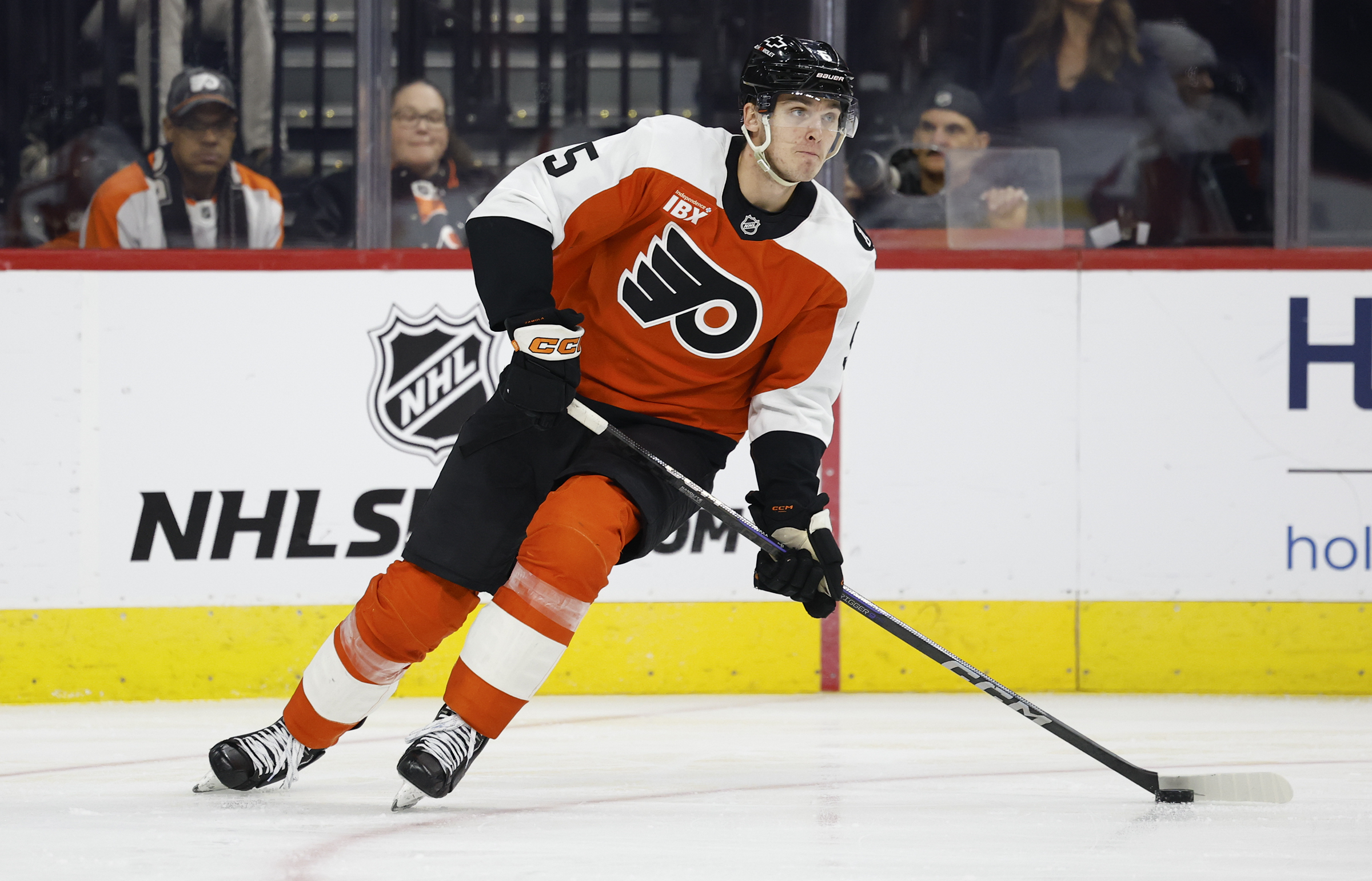
    I think people worried about his skating, but his skating is coming along as well, and he’s big and strong. You’ll see at the U20 level, he’s a big, strong horse out there, but he’s nowhere near where he’s going to be at 23 years old. When you see him off the ice, he’s still a young guy, and you forget about that. … Not all these players who have been drafted are going to play the next year, but he’s on the right path to being a very good pro.
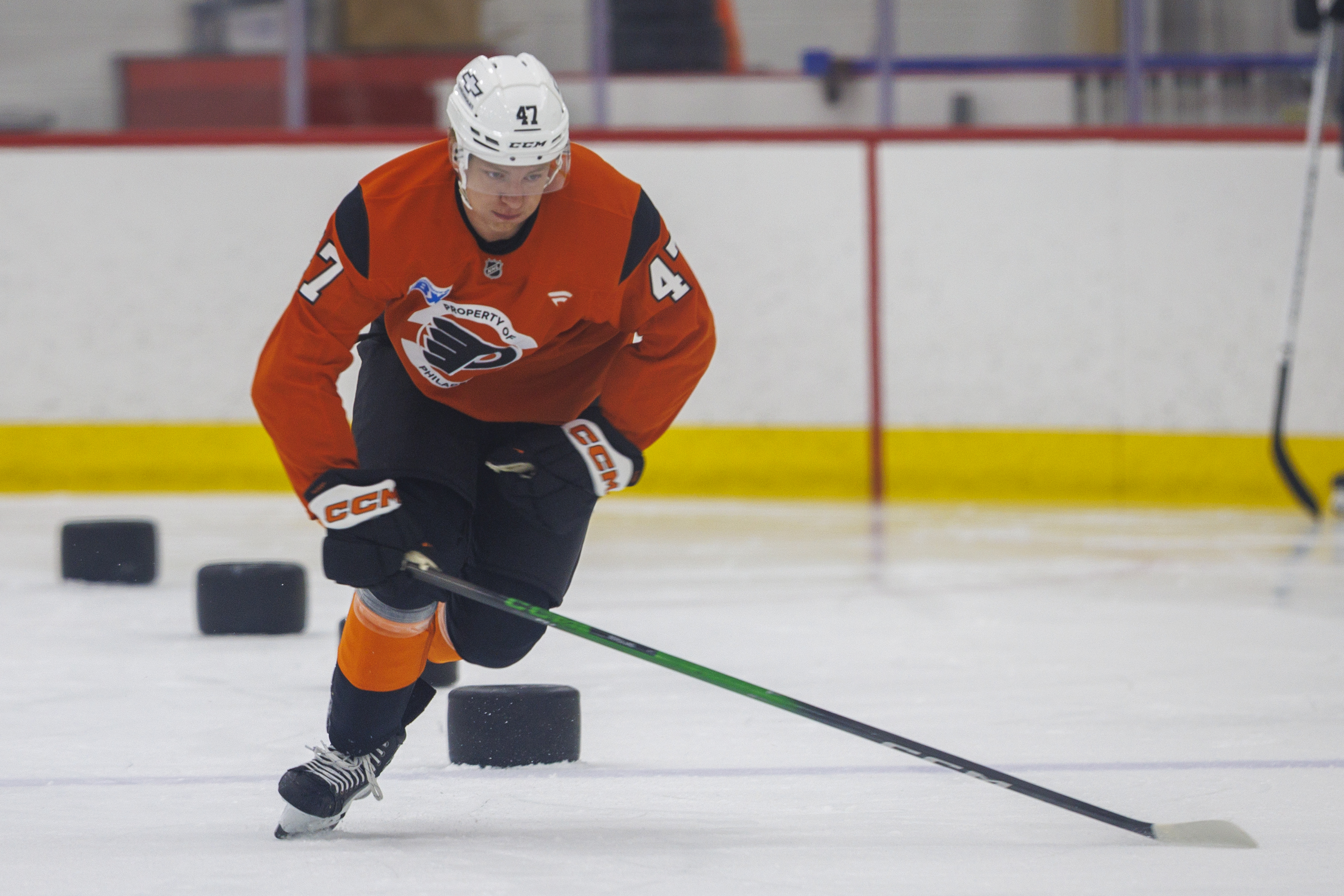
    The Flyers remain bullish on Jack Berglund, who Brent Flahr says continues to make strides with his skating.
    Q: Alex Bump, Denver Barkey, and Carson Bjarnason, have been the three B’s in Lehigh Valley. What have you seen from them in their transition to pro hockey? [Note: Barkey was recalled after this interview was conducted.]

    A: Barkey, I think right from the start, he’s played very well. On the production side, he makes plays, he works, and the details are great. Such a smart player. He’s got to get stronger and build up his body to handle the grind but so far, so good. Down there, he’s been arguably our best forward a lot of nights, and coaches love him. …

    I think Bumper, when he first went down there, even though playing last year — I don’t know if he thought it was going to be easy or disappointment from not making the team right away — I thought he stumbled around a little bit early, and then he found his game, and now he’s going. But part of the why he’s down there is to find the consistency in his game, not just offensively, but defensively, and managing the game and then playing it every night. But he’s talented. He’s producing now. I think he’s feeling good about himself, and he’s certainly going in the right direction. …

    And Carson … I think he’s exceeded expectations so far. He’s got the right demeanor, the size, the athleticism, and he’s learning the pro game. … It just seems easier for him. In juniors, it was so chaotic in front of him; he used to get so many Grade A chances.

    Q: You mentioned Aleksei Kolosov. He seems like a different player this year, no?

    A: He is a different player, different personality. He’s really trying to fit in. He’s very athletic, very competitive, and he’s giving our team a chance to win down there almost every night. He’s a talented kid, so he’s got a chance to be an NHL goalie now. He just skipped a step last year. Now he’s building it back up again here, and we’ll see where it goes.

    Q: What about Yegor Zavragin? He has another year on his deal but it sounds like he’s playing well in Russia.

    A: He’s a talented, talented kid with size. … He’s got to build up his body, which is a big focus for St. Petersburg, and he’s working hard. … We want him to be over here right away, but the one thing the KHL does, or has a history of doing recently, is developing goalies. So we’re in a good spot and, hopefully, when the time comes, we can get him over here and get him going.
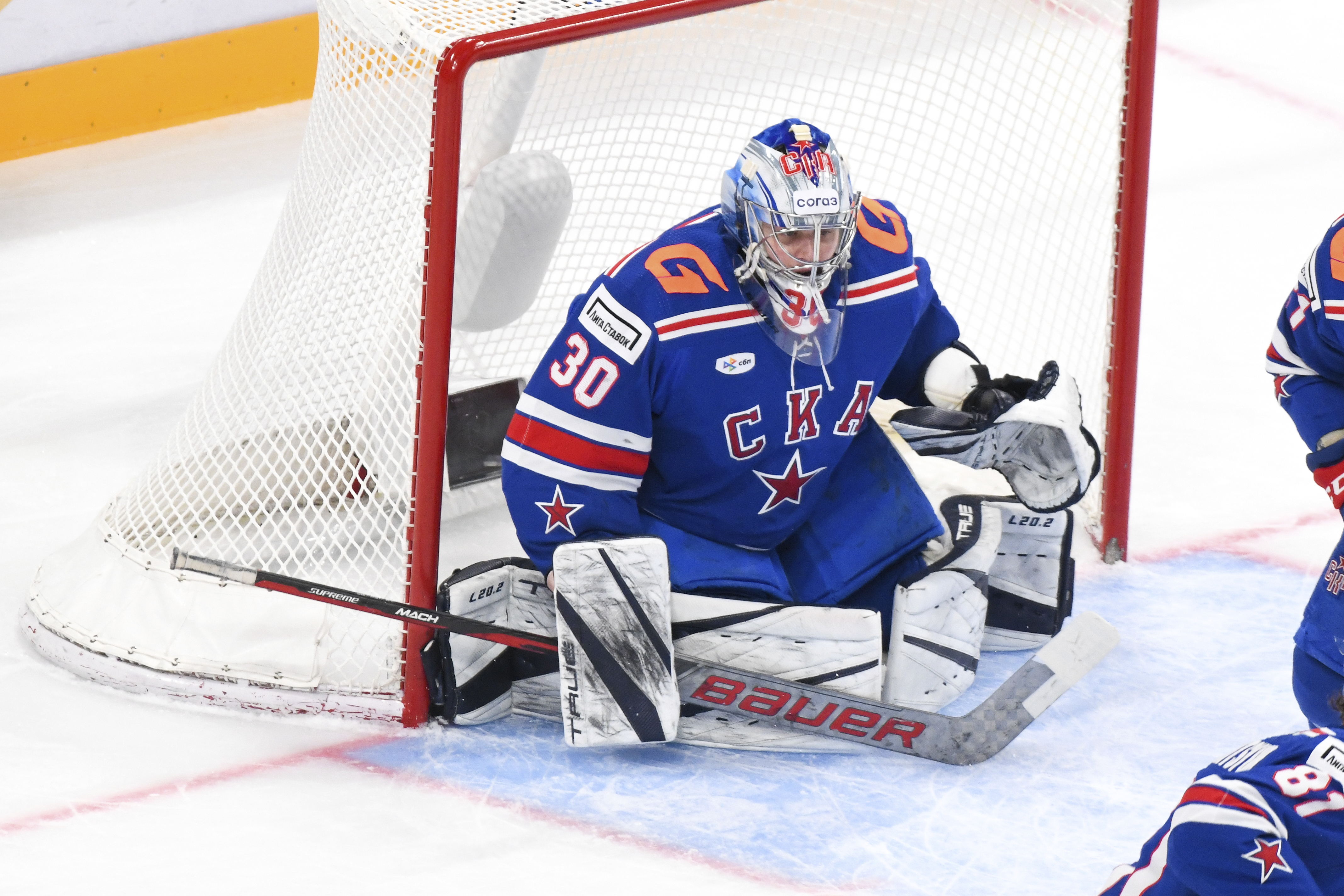
    Egor Zavragin has firmly established himself as one of the best young goaltenders in Europe.
    Q: There’s been a lot of criticism of the Flyers not having a 1C or 1D. What would you say to those people, and how would you assess the system?

    A: There are not 32 1Cs in the league or 32 1Ds. So we’re always trying to look for that and strive for that. But we have some good players coming, guys who can play, hopefully, 2Cs. We have some guys on the wing, we think. We have some solid defensemen coming.

    We understand what we need to be an elite team; at the same time, we’re growing a pretty good base as far as depth through the lineup and people that can contribute in different ways. So, that’s where the Berglunds and some of these guys that aren’t talked about as much could be valuable pieces as well. Then you’ve got [Jett] Luchanko, and [Jack] Nesbitt, who are going to take a little time to get stronger. Heikki [Ruohonen], as well, is a really good player.

    Q: Give me one or two prospects that you’re excited about in the system.

    A: Porter [Martone] is Porter. He has a chance to be a special player. When you meet him, he’s kind of got that “it factor,” as far as he’s got cockiness, but in a good way. I think he’s a pro; he’s got the mindset now where he knows where he has a little more work to do as far as getting there. But he understands. Getting that experience last year with Team Canada was huge, to be a young kid playing with those types of players and see where you’ve got to get to. I just think he’s matured, and he has a chance to be a really good one for us.

    But the guy we drafted, who is one of my favorites … is Cole Knuble. Just a good hockey player. So competitive, great motor, smart, plays every position. I don’t know where it’s going to get to, but he’s worked really hard on his skating, and it’s become good. It’ll be interesting to see when he turns pro. Guys like Barkey and him are the guys you cheer for.
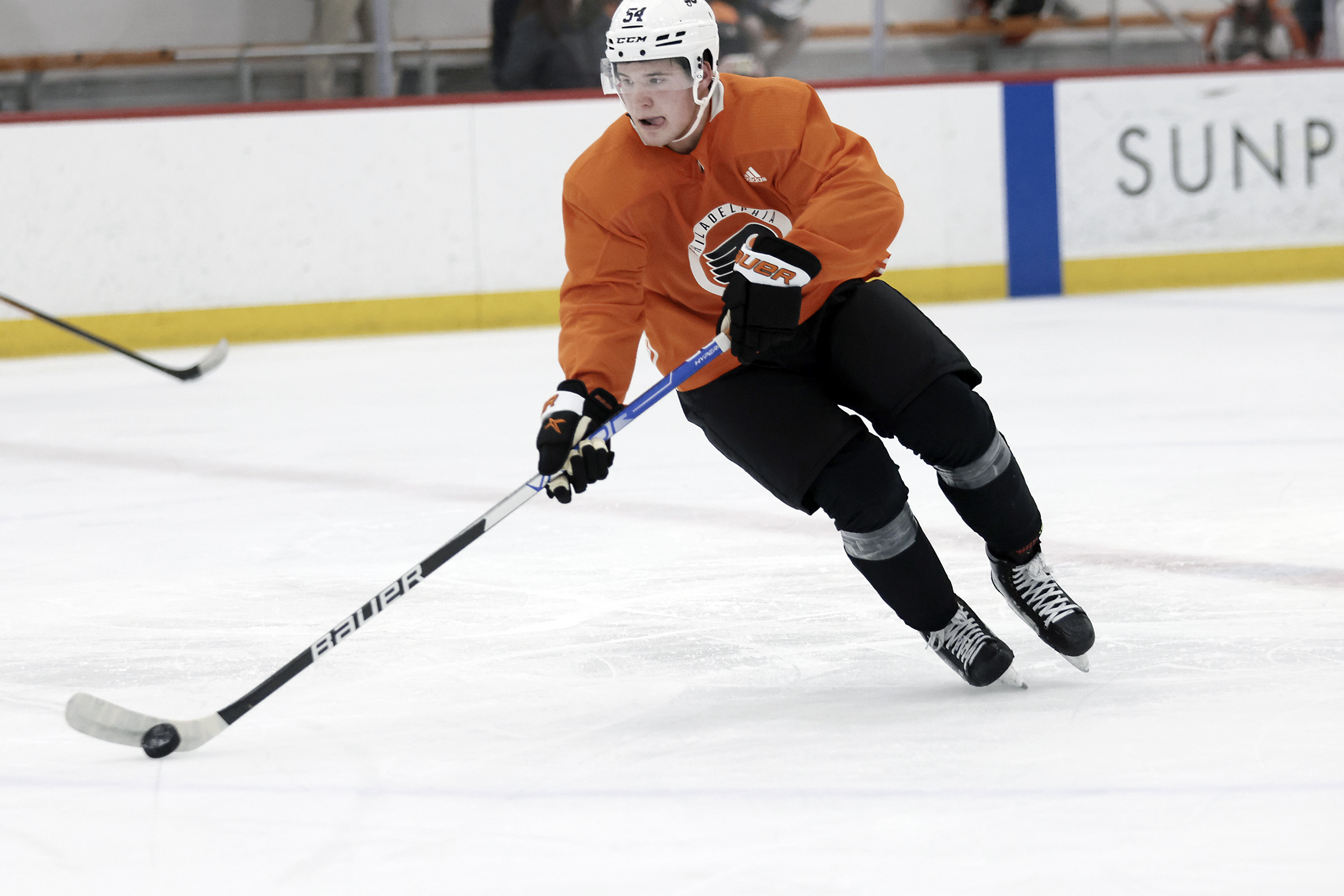
    Brent Flahr believes Cole Knuble, son of former Flyer Mike Knuble, is a prospect who has a chance to surprise.

    Barkey’s such a smart player, he’s so competitive. You watch a game, you just kind of start just watching him, just because of the way he plays the game. Whether he can handle the size [remains to be seen] but he’s proven everybody wrong at every level.

    Q: What are the strengths of the 2026 NHL draft?

    A: Early on, I think it’s a strong defensemen draft. There are some quality wingers. I think there are a couple of centermen, but not a really deep pool of centermen. But some good players. … I don’t think there’s any Connor McDavids. There are some well-known, big-name players at the top end, and there are some guys challenging behind who aren’t as far up as some people think. So it’ll be interesting.

    Everything


    With hockey leagues around the world nearing the midway point and the World Junior Championship starting on Friday, we caught up with Brent Flahr to talk prospects. In Part 2 of our interview with the Flyers’ assistant general manager, we focused on the team’s international-based prospects and those competing in Lehigh Valley.

    This interview, which was conducted on Dec. 10, has been edited for clarity and length.

    Q: Where do you see Jack Berglund, who was pretty impressive at development camp, fitting?

    A: I think he’s a very well-rounded player and has the ability to be a really good 3C, maybe more. But he can play power play. He’s strong. He wins battles. He can make plays. He’s very sound defensively. Where he’s played, he’s had to earn everything he can, but he can shoot it.

    I think people worried about his skating, but his skating is coming along as well, and he’s big and strong. You’ll see at the U20 level, he’s a big, strong horse out there, but he’s nowhere near where he’s going to be at 23 years old. When you see him off the ice, he’s still a young guy, and you forget about that. … Not all these players who have been drafted are going to play the next year, but he’s on the right path to being a very good pro.

    The Flyers remain bullish on Jack Berglund, who Brent Flahr says continues to make strides with his skating.
    Q: How do you define it when you say a player’s skating is not NHL-ready?

    A: Nine times out of 10, that’s strength-related. Like Tyson Foerster, everybody was worried about his skating when we drafted him. He was not a great skater when we drafted him. But it’s not all fundamentals. You see his body, he’s got no leg strength at this point. And you see he can generate speed in a straight line, quickness, agility, and lower-body power, stuff like that.

    So Jack could skate in a straight line. His foot speed and everything had to improve, turning and that. But a lot of its strength, a lot of it’s just his body linking up for a big 6-4 guy. And as he gets older and stronger, he’s skating more than fine, and it’s something that he’s always gonna have to work on, the quickness and agility.

    I compared his skating, when I saw him play as a young player, to a player that we had in Minnesota a long time, Mikko Koivu, who was a great player. He’s someone that he could pattern his game after because Mikko was a great two-way player, but he’s big and strong, and as a young player, people worried about his foot speed and whatnot, and he just became a really good pro for a long time that you can win with.

    Q: Alex Bump, Denver Barkey, and Carson Bjarnason, have been the three B’s in Lehigh Valley. What have you seen from them in their transition to pro hockey? [Note: Barkey was recalled after this interview was conducted.]

    A: Barkey, I think right from the start, he’s played very well. On the production side, he makes plays, he works, and the details are great. Such a smart player. He’s got to get stronger and build up his body to handle the grind but so far, so good. Down there, he’s been arguably our best forward a lot of nights, and coaches love him. …

    I think Bumper, when he first went down there, even though playing last year — I don’t know if he thought it was going to be easy or disappointment from not making the team right away — I thought he stumbled around a little bit early, and then he found his game, and now he’s going. But part of the why he’s down there is to find the consistency in his game, not just offensively, but defensively, and managing the game and then playing it every night. But he’s talented. He’s producing now. I think he’s feeling good about himself, and he’s certainly going in the right direction. …
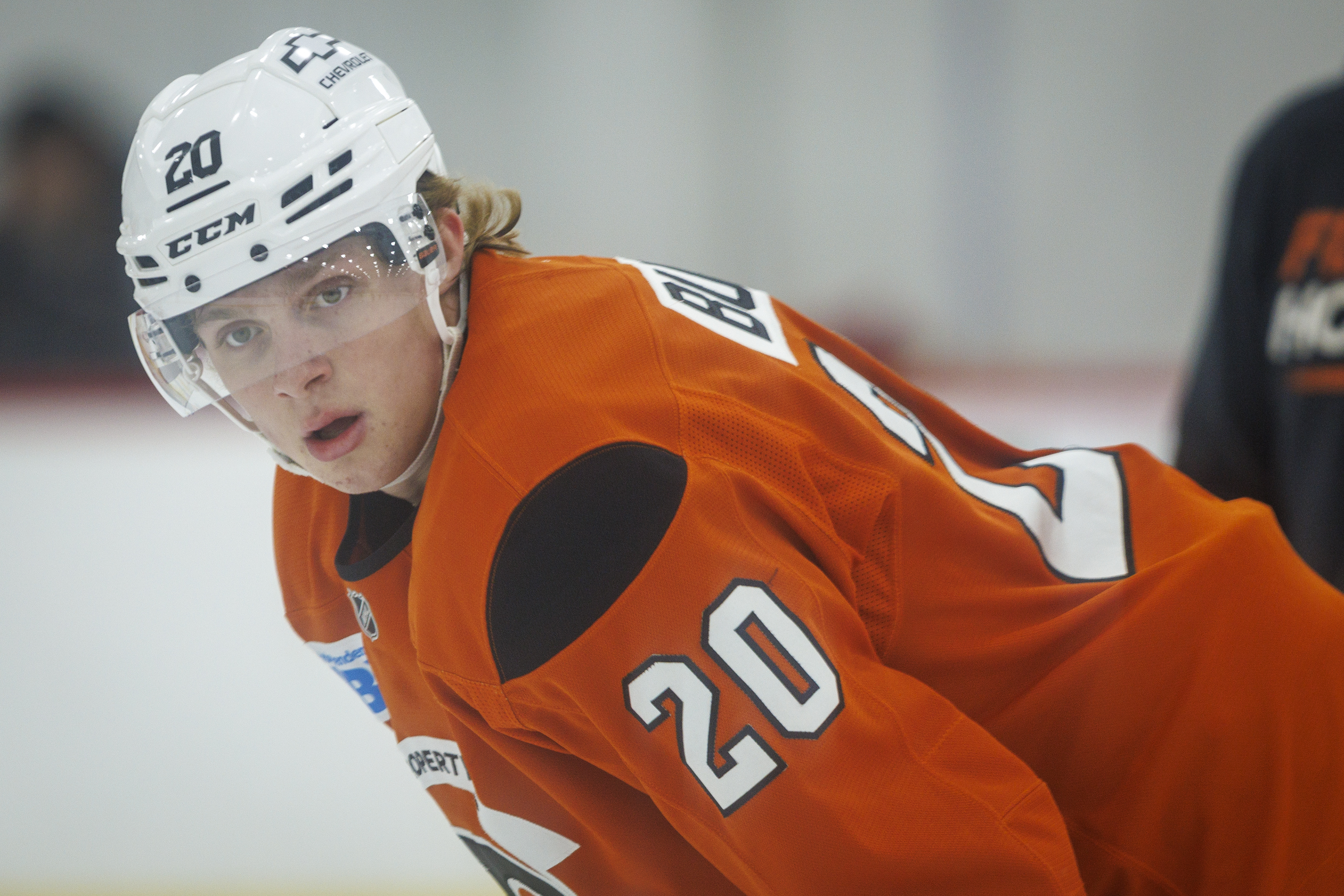
    Alex Bump is producing down in Lehigh Valley but his defensive consistency remains a work in progress.

    And Carson … I think he’s exceeded expectations so far. He’s got the right demeanor, the size, the athleticism, and he’s learning the pro game. … It just seems easier for him. In juniors, it was so chaotic in front of him; he used to get so many Grade A chances.

    Q: You mentioned Aleksei Kolosov. He seems like a different player this year, no?

    A: He is a different player, different personality. He’s really trying to fit in. He’s very athletic, very competitive, and he’s giving our team a chance to win down there almost every night. He’s a talented kid, so he’s got a chance to be an NHL goalie now. He just skipped a step last year. Now he’s building it back up again here, and we’ll see where it goes.

    Q: What about Egor Zavragin? He has another year on his deal but it sounds like he’s playing well in Russia.

    A: He’s a talented, talented kid with size. … He’s got to build up his body, which is a big focus for St. Petersburg, and he’s working hard. … We want him to be over here right away, but the one thing the KHL does, or has a history of doing recently, is developing goalies. So we’re in a good spot and, hopefully, when the time comes, we can get him over here and get him going.

    Egor Zavragin has firmly established himself as one of the best young goaltenders in Europe.
    Q: Christian Kyrou has hit the ground running in Lehigh Valley. What have you seen from him, and what are his NHL chances?

    A: Well, he brings a dimension we didn’t really have there as far as his offense and the power-play ability but I think it was a good trade for both players, a new environment. What he’s brought is some swagger and some offensive instincts.

    Obviously, he’s not the biggest guy, and his criticism was defensive play and lack of size, but he’s been fine. … What he does with the puck is he gets it going up the ice and transitions. … He’s been very good and productive … and really helped the power play.

    Q: Samu Tuomaala went the other way in the deal. What do you think went wrong?

    A: He just kind of stalled, and part of it, you’ve seen the guys that kind of went ahead of him. But Samu, when he’s on his game, he brings speed, he can really shoot the puck, and he’s a good kid. I just think for whatever reason, he just didn’t have it at the start of camp. … You look at what we have coming and what we have now, the way he was going, he was going to be boxed out, so we decided to make the move, and it kind of worked out for both teams.

    Q: Ty Murchison recently made his NHL debut, and he has seemed to have jumped a few people. What made the Flyers opt to call him up from Lehigh Valley?

    A: He’s a great kid. He can skate, he’s competitive, and he’s taken his game, even from last year in college, to a whole new level, even in the playoffs, and it’s opened a lot of people’s eyes here. He went down to Lehigh, and he did nothing but play well, played hard, played his game, and some other guys were up and down and not going. So when Rick Tocchet wanted a guy, that’s a guy they recommended just because of his performance and consistency and his battle level. I think it sends the right message to a lot of guys down there.
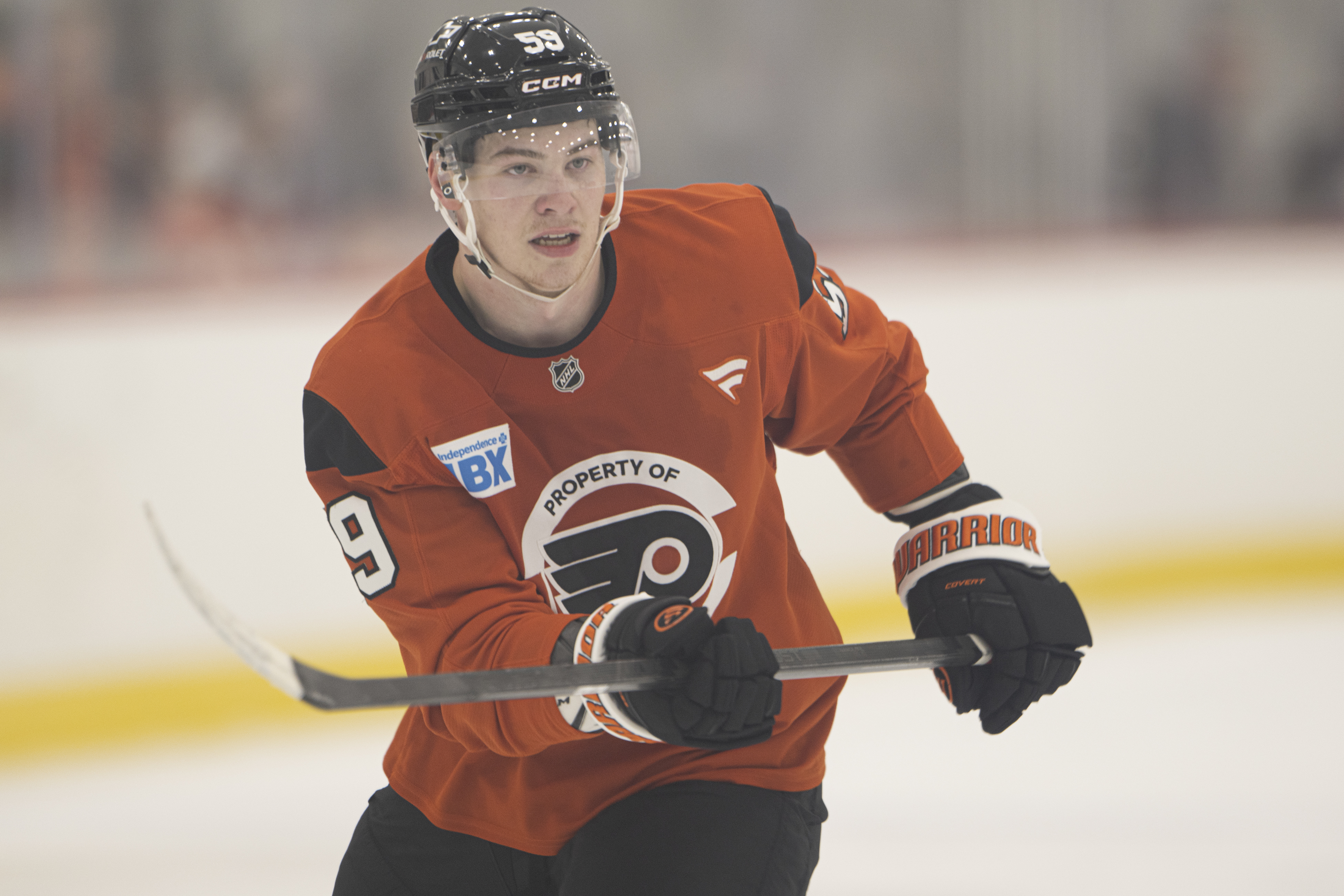
    Flyers prospect Oliver Bonk just recently joined the Phantoms after missing most of the summer with an injury.
    Q: Oliver Bonk just got back on the ice. What’s the latest with him?

    A: Finally, he’s healthy, feeling good. … He’s a smart player. I assume he’ll be a fairly quick study, and I know coaches are happy with this first game, but it’s going to take him some time for conditioning, strength, and all that to get back up to normal.

    Q: Where do you see Alex Bump this year? Do you see him getting called up?

    A: It’s all based on his play and, to be honest with you, an opportunity here with injuries or whatever. … But he’s going in the right direction, and at some point, my guess is he’ll get an opportunity. .

    Q: John Snowden was very impressive in my first interactions with him. How important has he been to the development of not just the ‘killer Bs’ that we talked about, but Karsen Dorwart, Devin Kaplan, and others in Lehigh Valley?

    A: He’s got a presence on the ice when he teaches, when he runs a practice, but …[also] has fresh ideas, whether it’s generating offense or the way the team plays.

    He wants guys to hold on to pucks, make plays, and that comes with mistakes. These guys are young, and they’re gonna have to learn to manage the puck and manage situations a little differently, but that’s part of the process of learning down there. … They’re having fun and they’re winning some games. So yeah, it’s a good development environment.

    Q: There’s been a lot of criticism of the Flyers not having a 1C or 1D. What would you say to those people, and how would you assess the system?

    A: There are not 32 1Cs in the league or 32 1Ds. So we’re always trying to look for that and strive for that. But we have some good players coming, guys who can play, hopefully, 2Cs. We have some guys on the wing, we think. We have some solid defensemen coming.
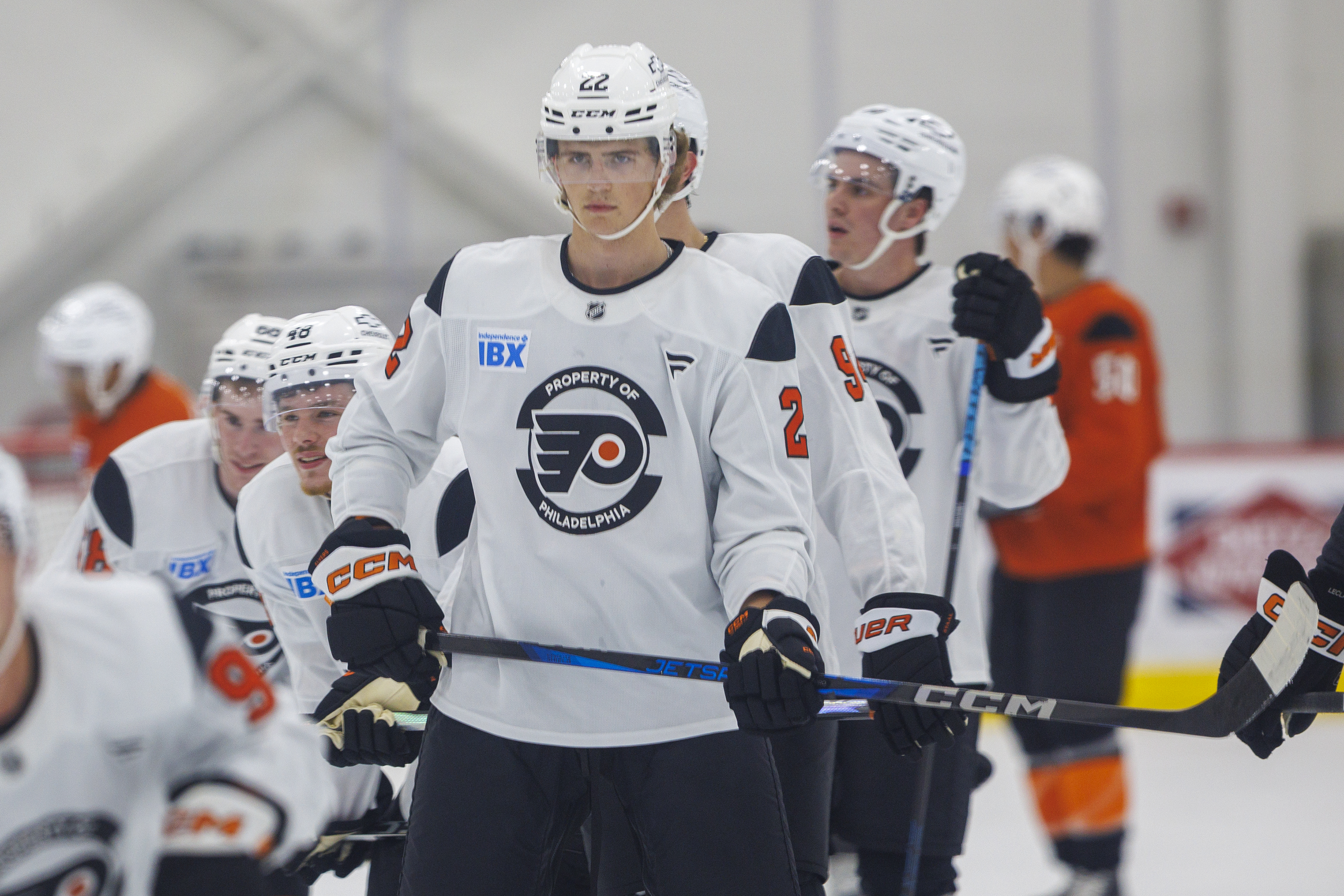
    The Flyers believe Jack Nesbitt can develop into a strong 2C on a winning team.

    We understand what we need to be an elite team; at the same time, we’re growing a pretty good base as far as depth through the lineup and people that can contribute in different ways. So, that’s where the Berglunds and some of these guys that aren’t talked about as much could be valuable pieces as well. Then you’ve got [Jett] Luchanko, and [Jack] Nesbitt, who are going to take a little time to get stronger. Heikki [Ruohonen], as well, is a really good player.

    Q: Does it take the pressure off needing a 1C when you have such top-tier wingers?

    A: I think it certainly helps, yeah. You can do some things, but you look at the elite teams, and they have 1Cs. Sometimes it surprises you, some guys turn into that, that you weren’t necessarily expecting. But I think we’re doing the best we can to build up around it, and last year, the most skilled position we can to help our team going forward. And at one point, whether we have the assets to get it by trade, or develop it within your system, we’ll do the best we can to do that.

    Q: What are the strengths of the 2026 NHL draft?

    A: Early on, I think it’s a strong defensemen draft. There are some quality wingers. I think there are a couple of centermen, but not a really deep pool of centermen. But some good players. … I don’t think there’s any Connor McDavids. There are some well-known, big-name players at the top end, and there are some guys challenging behind who aren’t as far up as some people think. So it’ll be interesting.
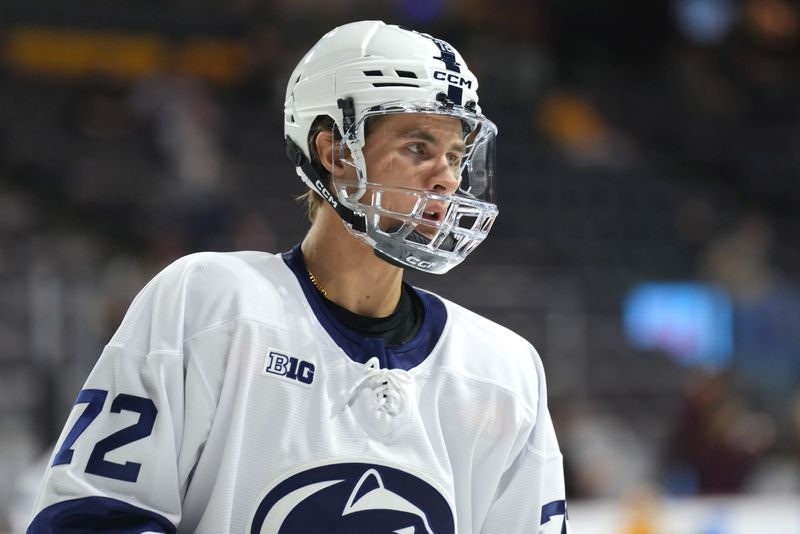
    Penn State winger Gavin McKenna is viewed as the prize of the 2026 NHL draft, but others like defenseman Keaton Verhoeff are gaining steam.

    Q: Trade chatter is starting to pick up. Do you think the Flyers can be competitive with putting packages together?

    A: We have assets now, and teams are going to have interest in our assets and make trades. The thing is that we have this prospect pool now, part of what’s going to make the players good is these guys emerging into the NHL and down the road filling in roles in the depth. But now, if you have a chance to add a star piece or elite player, you’ve got to match the value of it, but you can’t totally decimate your prospect pool and all your young players just to get one player — and then you have one player, and you have a bad team. Not everybody’s going to be able to play, but at the same time, we’re in a good position now.

    Q: Give me one or two prospects that you’re excited about in the system.

    A: Porter [Martone] is Porter. He has a chance to be a special player. When you meet him, he’s kind of got that “it factor,” as far as he’s got cockiness, but in a good way. I think he’s a pro; he’s got the mindset now where he knows where he has a little more work to do as far as getting there. But he understands. Getting that experience last year with Team Canada was huge, to be a young kid playing with those types of players and see where you’ve got to get to. I just think he’s matured, and he has a chance to be a really good one for us.

    But the guy we drafted, who is one of my favorites … is Cole Knuble. Just a good hockey player. So competitive, great motor, smart, plays every position. I don’t know where it’s going to get to, but he’s worked really hard on his skating, and it’s become good. It’ll be interesting to see when he turns pro. Guys like Barkey and him are the guys you cheer for.

    Barkey’s such a smart player, he’s so competitive. You watch a game, you just kind of start just watching him, just because of the way he plays the game. Whether he can handle the size [remains to be seen] but he’s proven everybody wrong at every level.
  • Flyers pull away from the Canucks, 5-2, with four third-period goals

    Flyers pull away from the Canucks, 5-2, with four third-period goals

    Skating in front of a sellout crowd of 19,994 at Xfinity Mobile Arena, the Flyers gave the faithful something to cheer about.

    In their final home game of 2025, the Flyers beat the Vancouver Canucks, coach Rick Tocchet’s old team, 5-2.

    “Happy to be home,” said Owen Tippett. “Obviously, a long road trip, so you want to have a bounce back and use your fans as much as you can. So they were great tonight. Obviously, in warmup[s], you can tell there’s a lot of people here. So, we were ready to go in the room.”

    After struggling to close out games, including the last game of the four-game road trip that saw the Flyers blow a third period lead to the Rangers, they scored four goals in the third period to seal the win.

    “I think in the past, we just kind of sat back a little bit too much … But I thought we were more aggressive tonight and controlled most of the play,” Christian Dvorak said. “We have a lot of chances, and capitalized on them. So I thought that was a big step for us in the third tonight.”

    The win snapped a two-game losing streak for the Orange and the Black. It is their second win in the past seven games and their fourth win out of 11 games in December (4-3-4).

    Vladař solid in net

    Standing on the Chase Bridge at Madison Square Garden on Saturday, Flyers general manager Danny Brière revealed that goalie Dan Vladař had “a little, little boo-boo.” He added that his upper-body injury is “nothing too serious” and that “he should be back, we hope, by Monday.”

    After not dressing on Saturday, Vladař was indeed back between the pipes on Monday, and the netminder picked up right where he left on in his last start, a 4-1 win against the Montreal Canadiens last Tuesday.

    “All the trainers did an awesome job, especially [assistant athletic trainer] Joe Mele, so all the credit to him, and [he] got me back as soon as possible,” Vladař said postgame. “So I’m very thankful. And he’s got magic hands.”

    Any nervousness getting back between the pipes?

    “As a goalie, you’ve got to be a little bit nervous every game,” he said. “So obviously, it’s something that comes with playing goalie. But no, health-wise, just no fear as usual.”

    Vladař played his angles well as his defense kept the Canucks away from the front of the net. Through the first two periods, he stopped all 17 shots on goal he faced.

    Flyers goaltender Dan Vladar stopped 23 of the Canucks’ 25 shot attempts on goal.

    According to Natural Stat Trick, only one — on the power play — was a high-danger shot; and it was the only shot he stopped across two penalty kills. Eleven of the shots were low-danger. Late in the second period, it looked like he even made a save off his mask on a shot by Evander Kane.

    In the third period, things fell off a little bit.

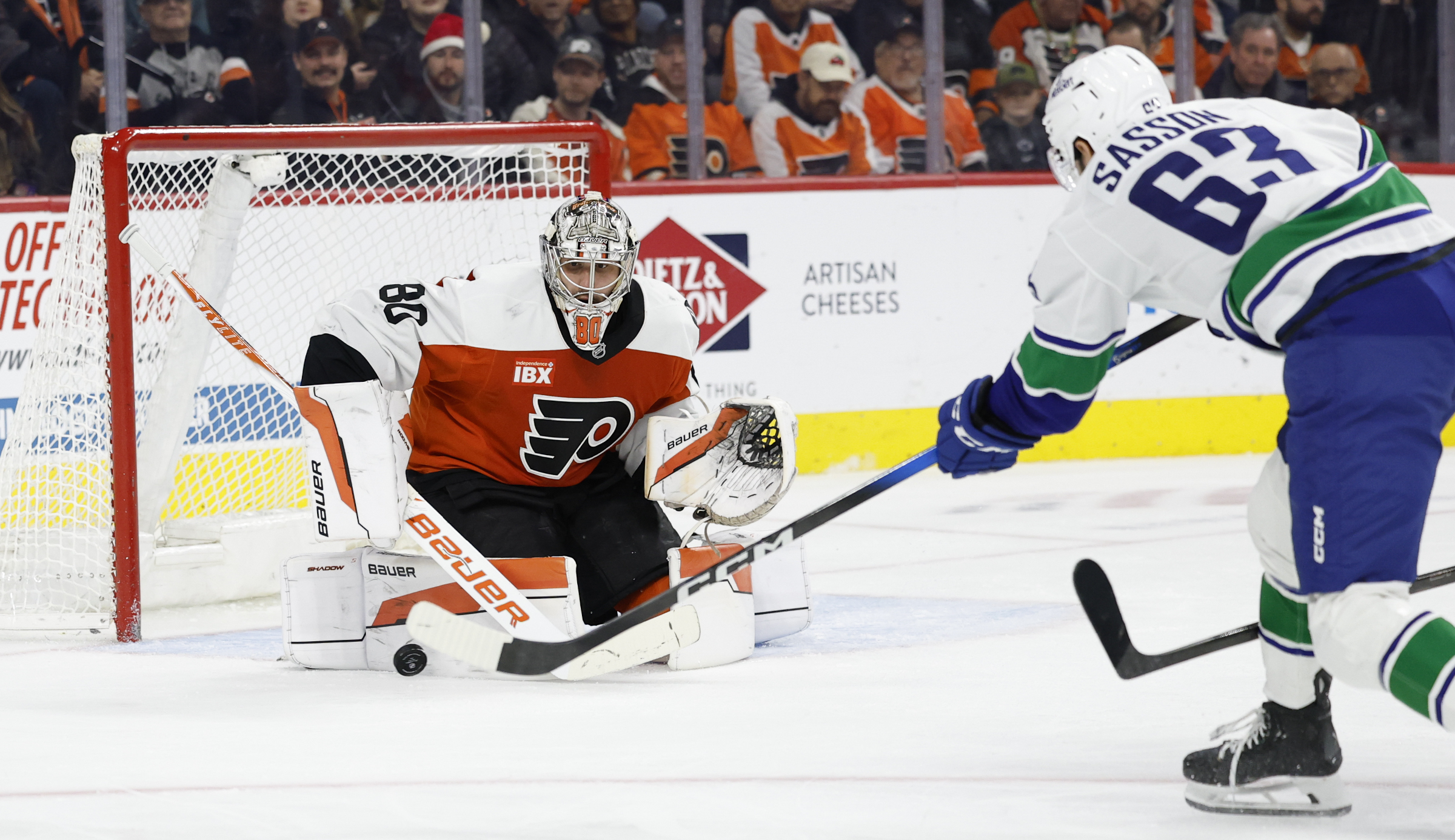
    The Czech netminder was 6 minutes, 55 seconds away from getting the first Flyers shutout of the season, but Vancouver’s Max Sasson ended the bid. Conor Garland drew in Emil Andrae and made a leading pass to Sasson, who skated in alone and scored.

    Drew O’Connor added a goal with 18 seconds left for the Canucks, who had eight shots on goal — with both coming from a high-danger spot

    May the fourth be with you

    The fourth line has been retooled, and it is working. Nikita Grebenkin and Carl Grundström each got on the board for the Flyers.

    Grebenkin gave the Flyers a 1-0 lead 13:13 into the second period. Grundström made it 2-0 5:58 into the third period.

    “We played pretty direct and got pucks to the net, and we got rewarded for it today,” Grundström said.

    To open the scoring, Grebenkin got a stretch pass from Cam York down the left wing boards and, although it bounced off his stick, he chased down the puck. The Russian winger then sent a backhand pass up the boards to Rodrigo Ābols, who was providing support.

    Ābols curled away from his check and sent the puck up to Andrae at the point. The Swedish defenseman put a one-timer toward the net, and Grebenkin, who went to the net after being checked along the end boards, tipped in the puck past Canucks goalie Thatcher Demko.

    It was Grebenkin’s second goal of the season and his first since Nov. 4 in Montreal, which was also the first of his NHL career.

    Grebenkin then played a big role in helping Grundström pad the lead with his fourth goal of the season. The 22-year-old winger got the puck high along the right boards from Grundström and carried it down behind the net.

    Along the way, he avoided a check by Filip Hronek and then did a little fake before going deeper into the zone. He sent a backhand chip pass to Grundström in front, finding an open lane despite four Canucks surrounding the Swede.

    Grundström, who had peeled off and headed to the net after getting the puck to Grebenkin, quickly got the shot off on Demko before getting a second chance and burying it to put the Flyers up 2-0.

    “[Grundström]’s an NHLer,” said Ābols, who had two assists for the first multipoint game of his career. “He’s got 300 games, you know, he’s playing with confidence. It’s something maybe some of us were lacking down there. He comes out with confidence, a lot of speed, a lot of skill, and we can feed off it.”

    The game was one of the better ones for Grebenkin, who has played in 24 of the Flyers’ 35 games.

    “The goal, that’s what I saw in training camp, get to the net, he was around the net,” said Tocchet. “Then behind the net [on Grundström’s goal] he made a [heck] of a play to hold it.

    “We knew hash mark down [he’s good]. The other parts [of his game] he’s getting better at not overthinking. But I think getting that goal really helps him. Like, that’s the places where he’s got to go.”

    Dvorak’s big role

    Brière also added that Dvorak would miss Saturday’s game, and he did with a minor lower-body injury. Like Vladař, he returned on Monday and played a big role in the win.

    “I guess whenever you miss the game, there’s concern, but I felt a lot better after taking a couple of days off, and that’s kind of what I needed,” Dvorak said. “And felt pretty good tonight.”

    In the third period, the Flyers headed up the ice, and Travis Konecny hit York coming late. The defenseman handed it back to Konecny, who then fed Trevor Zegras skating down the slot.

    His shot attempt was blocked by Brock Boeser and went off the glass behind the net before Dvorak batted the puck out of the air into the back of the net at the left post to put the Flyers ahead 3-0.

    The goal was reviewed for a potential high stick; however, Dvorak said he purposely waited until it was below the crossbar before knocking it in for his eighth of the year.

    “Yeah, it was crazy,” said Tippett with a grin when asked about the snazzy passing leading up to the goal. “Obviously, the patience on [Dvorak], too, to wait for it to drop below the crossbar before he whacked it in, it was pretty special too.”

    Breakaways

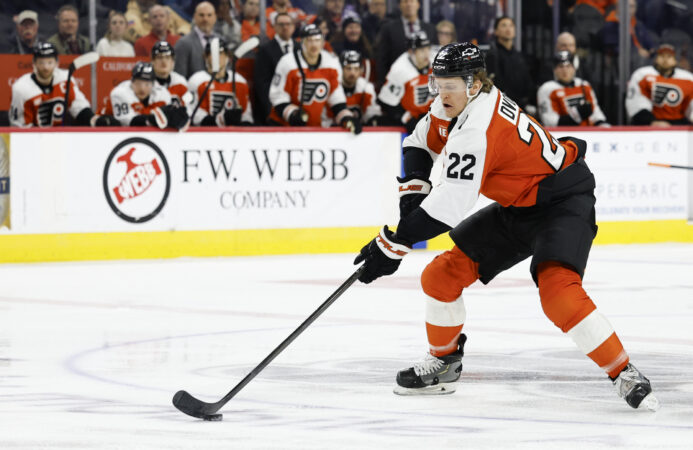
    Tippett pulled off a highlight-reel move — going inside-outside on Vancouver’s Tom Willander — to add a breakaway goal in the third period for his 11th of the season. On one of his 10 shots on goal, which tied his career high, he had a breakaway chance earlier in the game that he could not capitalize on. “I wasn’t too happy with the first breakaway; I don’t think I really got him moving too much,” he said. “So kind of learned and improved the next time.” … Matvei Michkov added an empty-netter for his first goal in December. … Zegras extended his point streak to eight games (five goals, five assists). … Forwards Garnet Hathaway and Nic Deslauriers, and defenseman Noah Juulsen were healthy scratches. It was the second straight scratch for Hathaway and the fourth straight for Juulsen.

    Up next

    The Flyers get right back at it on Tuesday against the Blackhawks in Chicago (9 p.m., TNT, truTV, HBO Max).

  • ‘Enough is enough’: Rick Tocchet sounds off after latest questions about Matvei Michkov’s usage

    ‘Enough is enough’: Rick Tocchet sounds off after latest questions about Matvei Michkov’s usage

    In mid-October, Flyers coach Rick Tocchet said the quiet part out loud.

    “I know he’s the lightning rod for everybody around here,” he said of Matvei Michkov.

    A talented offensive player, the recently turned 21-year-old Russian, who arrived in North America two years earlier than expected, led the Flyers — and all NHL rookies — with 26 goals and finished second on the team with 63 points last season. He also won the league’s rookie of the month award twice, becoming the first Flyer in 30 years to do so.

    But this season, Michkov has struggled to find that spark with 19 points (eight goals, 11 assists) in 34 games. He has also taken several unnecessary penalties and seen his ice time decrease from 16 minutes, 41 seconds last season to 14:43 this year.

    Although Natural Stat Trick has the Flyers with 51.74% of the shot attempts when Michkov is on the ice — tops on the team — and an expected goal-share of 53.6%, which is No. 2 among players who have played at least five games, he has struggled defensively and shown a tendency to cherry-pick at times.

    As Tocchet said, he is a lightning rod, so, of course, he is often a topic of conversation.

    On Saturday, the television broadcast caught Michkov, Tocchet, and assistant coach Jaroslav “Yogi” Svejkovský having an animated conversation on the bench. The conversation appeared to happen right after Michkov drew a minor penalty when New York Rangers winger Will Cuylle cross-checked him from behind.

    “It happens all the time. It’s not Mich, it’s just a story, because it’s Mich. It wasn’t even an argument. It was about when he should switch, and not with [Denver] Barkey. And he’s getting it, when to switch and when not to on the power play,” Tocchet said, although it’s not clear if he meant to say power play as he did appear to stop himself, and the Flyers were heading to their first power play of the game.

    “But that was all. He was just getting frustrated on when to switch and when he shouldn’t switch. I know it’s a lot of media people like to let him do what he wants. But there’s a time to switch and when not to switch, and that’s really what it comes down to.”

    It is worth noting that Michkov and Barkey picked up assists on Travis Sanheim’s power-play goal directly following the Russian’s animated conversation with Tocchet.

    Michkov has five assists in December but does not have a goal this month. A follow-up question asked the bench boss about Michkov having the right attitude but getting frustrated when he’s not scoring.

    Flyers right wing Matvei Michkov, 21, has just 19 points in 34 games this season.

    “Guys who want to score goals get frustrated, but you can’t let it affect your overall game,” Tocchet said. “You’ve got to continue to go to the spots, you keep going to the middle, keep getting to that slot area when you already have two guys down low, like — don’t go behind the net — like things like that.

    “He’s just got to stay with it, because he’ll get those chances. He had some chances against the Rangers. … Now he’s got [to] play a little faster and separate himself. That’s what it comes down to. You can’t get frustrated, and just keep working.”

    Barkey and Michkov switched one time before the bench interaction. It came with 11:49 left in the first period, and it occurred after Rangers goalie Igor Shesterkin froze the puck. So was it about switching shifts and the short shifts by Michkov that have been discussed recently?

    “We tell our players, when you’re tired, get off. So if he’s tired after 20 seconds, get off. I don’t know. I don’t know what you want me to say. Yeah, he’s getting enough shifts. He’s coming off short because sometimes he’s tired. I don’t know what the big deal of that is,” Tocchet snapped.

    The fourth question about Michkov noted that Tocchet and the Russian winger were seen speaking before practice. Does the coach like that he’s willing to work on things, showing his sheer competitiveness?

    “We’re 17-10[-7], we have a good record. I’ve answered six Michkov questions. I mean, enough is enough,” Tocchet said.

    “We’ve got [Dan] Vladař having a great year. [Jamie] Drysdale is playing really good five-on-five for us. [Cam York’s] doing a really good job. We’ve got a lot of other players playing good and a team game.

    “I mean, this is the fifth question. I appreciate it, but you’re trying to make something that it’s not. He’s got to learn to play the game, and he’s trying. He’s a lot better defensively. He’s a lot better playing a team game, and that’s how you win hockey. It’s not about catering to one person. I hate to tell you guys. That’s it.”

    Breakaways

    Goalie Aleksei Kolosov was sent back to Lehigh Valley of the American Hockey League on Monday morning. Vladař (upper-body injury) and Christian Dvorak (lower-body injury), who both missed Saturday’s game against the Rangers, were at the team’s morning skate. Tocchet expects Dvorak to play, but said Vladař is a game-time decision. … Barkey will make his Xfinity Mobile Arena debut on Monday against the Vancouver Canucks (7:30 p.m., NHLN, NBCSP). … Defenseman Noah Juulsen and forwards Garnet Hathaway and Nic Deslauriers are expected to be healthy scratches.

  • The Flyers spoil a four-goal second period, lose to the New York Rangers in shootout

    The Flyers spoil a four-goal second period, lose to the New York Rangers in shootout

    NEW YORK — The Flyers seemed to have the game in hand, thanks to a four-goal second period, but then the lights went out on Broadway.

    Heading into the third period with a 4-2 lead, the Flyers allowed the New York Rangers to come back and steal a 5-4 shootout win. It is the first time this season the Flyers led heading into the third period and lost (10-0-1).

    Mika Zibanejad tied the game with 2 minutes, 34 seconds left in regulation, beating his countryman, Sam Ersson, with a one-timer from the left circle. The Rangers had a power play after Rasmus Ristolainen was called for delay of game, when he sent the puck over the glass.

    “I think we just can’t sit back as much as we do,” said forward Owen Tippett. “We put ourselves in great spots, and obviously we play a certain way to get there, and I think we just have to kind of continue playing that way and not worry about sitting back.”

    Artemi Panarin, who had a pair in regulation, and Vincent Trocheck, who scored the Rangers’ third goal, each beat Ersson in the skills competition. New York netminder Igor Shesterkin stopped Trevor Zegras before Travis Konecny hit the post.

    The Flyers have lost two straight and five of their past six games, with four of the losses coming after regulation.

    “We’re starting to learn how to win,” coach Rick Tocchet said postgame. “This group’s going to have to learn, but they’re working hard. We [were up] 4-2 and had a couple of opportunities to score, and then we leave it for chance, right? A penalty. You can’t take your foot off.”

    The dog is in the fight

    Denver Barkey spent Friday afternoon tossing and turning in bed, trying to get his pregame nap in before Lehigh Valley of the American Hockey League’s game against Bridgeport.

    “Couldn’t fall asleep, and I rolled over and checked the time on my phone and saw a few missed calls from [Flyers general manager Danny Brière] and a text saying, call me back ASAP, so kind of clicked in there,” Barkey said of when he found out he was being called up to the Flyers.

    “Yeah, super cool moment.”

    Those lights were bright on Broadway for the forward as he had an “eye-opening experience” making his NHL debut at Madison Square Garden with his parents and brother in attendance despite snow in Toronto delaying their arrival.

    They must have enjoyed it even more when the forward made his presence known from puck drop. Literally, as he got the start with linemates Sean Couturier and Tippett.

    On his first shift, Barkey forced Shesterkin to freeze the puck on a shot by Tippett. On his next shift, he almost scored — twice.

    The Flyers controlled the perimeter and the boards with Barkey, Couturier, and Tippett cycling the puck down low. Couturier got the puck in the left corner and sent it around to Tippett before finding Barkey crashing down. He shot the puck off the pass and then got a rebound chance.

    In the third period, he came close to scoring his first NHL goal as he drove to the net. Couturier sent the pass to the 5-foot-10, 173-pound forward as he tried to finish backdoor.

    “I’ve actually played with him a couple years now in camp, and obviously, super skilled player, and brings a lot of energy,” Tippett said. “Were telling him to kind of play his game and not worry about anything else. And I think he played great.”

    In the second period, Barkey got on the scoresheet with a pair of primary assists.

    His first came on a power play, when he got the puck off the right boards and fed Travis Sanheim in the high slot. The defenseman skated down and fired the wrister from the slot past the stick of Shesterkin. It is Sanheim’s first power-play tally since Jan. 31, 2019, against the Boston Bruins.

    Just 23 seconds later, he got point No. 2. Flyers defenseman Cam York threw a backhander on net that was knocked down by Rangers defenseman Will Borgen in front. Barkey scooped up the loose puck and sent the backhand pass to Tippett, who was at the left point. The forward skated in between the circles and also beat Shesterkin stick side.

    “The way he played tonight, the way he competes, yeah, I’m going to fight for him,” Tocchet said when asked if Barkey has a chance to stick around. ”Listen, he’s a young kid too. You want to make sure that he has enough reps where he’s going to be, but I saw enough tonight, and that’s a short sample side, that he’s a good little player.”

    What We Do

    In the second period, Barkey also drew a penalty that led to yet another power-play goal for the Flyers. The penalty came in the offensive zone, after the forward cleared the puck away from the front of the Flyers’ end.

    On the ensuing power play, the Flyers ran what appeared to be a set play. Noah Cates won the face-off back to Jamie Drysdale at the left point. The defenseman sent it across to his good buddy, Zegras, and the New York native sent a one-timer into the back of the net.

    Zegras has a team-leading 15 goals and 35 points in 34 games. He is riding a seven-game point streak (five goals, four assists).

    It is the first time the Flyers have scored two power-play goals in a game since Dec. 3 against the Sabres, which was also the last time the Flyers got a tally on the man advantage. They went 0-for-16 across the past seven games.

    But what made the day extra special was the Flyers getting their first short-handed goal of the season. Rodrigo Ābols forced defenseman Scott Morrow to make a pass across the ice that was picked off by Sanheim.

    The defenseman skated down and made a nifty move around Morrow on a two-on-one. His pass went off the skate of Ābols as he crashed the net. The goal is Ābols’ second of the season.

    Philly had two chances to win the game in overtime. Panarin slashed York eight seconds into the extra session. They had four shot attempts, with Konecny missing the net twice.

    Then, with 51 seconds left in overtime, Zegras was pulled down by Morrow, but the Flyers couldn’t find the back of the net. Shesterkin stopped a tip-in chance by Konecny from 6 feet out with 33 seconds left, and Zegras had a shot blocked.

    “Yeah, it’s tough. … I think it’s something that we’ve got to get a lot better at, because that’s, two four-on-threes in overtime, like you’ve got to come up with a goal for the team there,” Zegras said. “Just not good enough.”

    Added Tocchet: “We had chances at the end, four-on-three. We have some guys here who’ve got to help us. Got to score there. Too slow with the four-on-three. … We’ve just got to learn how to handle pressure. We knew at the beginning of the year we had to start to do [that], but take the point when we thought we should have had two.”

    ‘Broadway is dark tonight’

    Before the game, Brière announced that goalie Dan Vladař “has got a little, little boo-boo.” The goalie has an upper-body injury is “Nothing too serious,” and “he should be back, we hope, by Monday.”

    With that, Ersson got the start in goal for the second straight game. Although he came up big at times, he still allowed four goals on 27 shots, including two on 10 shots in the final frame.

    Panarin, who was clearly the Rangers’ best player Saturday, beat Ersson twice. His first goal of the game, with 26 seconds left in the first period, put the Flyers in a 1-0 hole. It is the 24th time in 34 games that the Flyers have trailed 1-0.

    Off a face-off in the Flyers’ end, Zibanejad got the puck on the right boards and chipped the pass to Panarin alone in the middle of the ice. He sent the wrister stick-side past Ersson.

    Flyers goaltender Samuel Ersson allowed four goals on 26 shots in regulation against the Rangers on Saturday.

    The Russian winger scored again in the second period after Tippett turned the puck over in the neutral zone. Panarin intercepted his backhand pass in the middle of the ice, skated down the right wing, and fired the snapshot off the far post and in.

    Trocheck cut it to 4-3 in the third period after Ersson made a brilliant save on the Pittsburgh native, but couldn’t control the rebound. Trocheck’s second shot appeared to nick the skate of Nikita Grebenkin before getting past Ersson.

    “Comparing this one to recent third periods, I thought this one was a little bit better. I think maybe just a couple mental breakdowns, obviously, that led to the goal that was bouncing around. And then obviously they got one on the power play late to tie it up.” Zegras said.

    ”But, I mean, I thought we were playing better in the third than we normally have. So I guess that’s exciting, but still not good enough.”

    Breakaways

    Forward Garnet Hathaway was a healthy scratch for the first time with the Flyers on Saturday. The winger does not have a point in 33 games this season. “He’s had some tough moments and stuff like that. He’s trying to find his game,” said Tocchet, when asked about Hathaway postgame. “… He’s good when he plays with speed guys. So we’ve also got to help him, too.” … Forward Christian Dvorak (lower-body injury) did not play. Neither Dvorak nor Vladař’s injury is expected to be long-term, per Brière. Goalie Aleksei Kolosov was recalled under emergency conditions and served as the backup. … The Flyers are 12-7-5 when trailing 1-0; their 12 wins lead the NHL. … The two goals assisted on by Barkey, 23 seconds apart, is the sixth time this season the Flyers have scored twice within 25 seconds. It is three more than the next-closest team, the Pittsburgh Penguins.

    Up next

    The Flyers head home for a meeting with coach Rick Tocchet’s old team, the Vancouver Canucks, on Monday (NHLN, NBCSP, 7:30 p.m.).

    They finish up the schedule before the NHL’s holiday break with a quick trip on Tuesday against the Chicago Blackhawks (9 p.m., TNT, truTV, HBO Max).

  • Flyers’ Christian Dvorak, Dan Vladař out with injuries, and more roster updates

    Flyers’ Christian Dvorak, Dan Vladař out with injuries, and more roster updates

    NEW YORK — There’s been some movement with the Flyers’ 23-man roster in recent days, but before a question could even be asked about Egor Zamula clearing waivers, Tyson Foerster undergoing surgery, or Denver Barkey’s first call-up, Flyers general manager Danny Brière started things off with some news.

    Goalie Aleksei Kolosov was with the team for Saturday’s matinee against the New York Rangers as an emergency recall and backed up starter Sam Ersson. Goalie Dan Vladař “has got a little, little boo-boo,” he said, adding his upper-body injury is “Nothing too serious” and “he should be back, we hope by Monday.” But added that they don’t know for sure.

    Vladař last played on Tuesday in Montreal, backstopping the Flyers to a 4-1 win against the Canadiens. The Czech netminder is 12-5-3 this season with the sixth-best goals-against average (2.41) and tied for the ninth-best save percentage (.910) in the NHL among goalies who have played at least 15 games.

    And then there was more. Forward Christian Dvorak, who has been centering one of the Flyers’ top lines and serving as a key penalty killer, is out with a lower-body injury. He did not dress against the Rangers, but “according to our trainers, shouldn’t be long-term.”

    Here are three more questions answered by Brière on Saturday afternoon.

    Why was Denver Barkey recalled and not Alex Bump?

    Called up from Lehigh Valley on Friday, Barkey delivered two assists in his NHL debut Saturday.

    Drafted by the Flyers in the third round of the 2023 NHL draft, the 5-foot-10, 173-pound forward, who is known for his grit, moxie, and determination, turned pro this season and has been impressive in the minors. The 20-year-old has 16 points (seven goals, nine assists) in 26 games for the Phantoms, primarily playing on the wing with center Lane Pederson and winger Alex Bump.

    “He came in. He played extremely well. I think the biggest thing from the report is his consistency; he was good night after night and earned the right to get a look,” Brière said.

    Barkey has looked impressive since the Flyers’ rookie camp in early September, but everyone outside the organization expected Bump to be the one getting the call-up. Brière did say, “It could have also been one of those two guys,” meaning Pederson or Bump, as the line has been dominating in the AHL, “but we decided to go with Barkey.”

    A highly touted prospect, Bump was someone many thought would break camp with the Flyers. Instead, after a solid rookie camp, he was sent down after a poor main training camp. After a slow start in Lehigh Valley, he now has 20 points (seven goals, 13 assists) in 27 games in Allentown.

    “We’re very happy with Alex,” Brière said. “Unfortunately, he got injured [Friday] night. He’s going to be out for a short period of time, maybe seven to 10 days. He didn’t have a great camp, and he knows that. But since then, he went down there, and he’s been working hard as well. He’s a guy we considered, and he’s not that far off.”

    What’s next for Egor Zamula?

    The Flyers defenseman cleared waivers on Friday afternoon and has been assigned to Lehigh Valley.

    Zamula last played on Dec. 7 and has skated in 13 of the Flyers’ first 33 games this season, registering one assist. Averaging a few ticks above 14 minutes a night, he had a plus-minus of plus-4, only boosted by a plus-5 night when he returned to the lineup on Nov. 22 against the New Jersey Devils.

    Flyers defenseman Egor Zamula cleared waivers on Friday and was assigned to Lehigh Valley.

    “The biggest thing with Egor is that he needs to play,” Brière said. “It doesn’t really help him sitting game after game, and we figured if he clears waivers, it’s going to give him the chance to play some games, maybe find his game again.

    “We expect to have some adversity there on defense at some point, too, where injuries are going to come — what was it two, three weeks ago, we didn’t have Cam York and Rasmus Ristolainen, and now they’re back in the lineup. So things change fast. Hopefully, he can find his game, and we could very well see him back with the big team at some point.”

    A mainstay last season, skating in 63 games, Zamula has dropped down the depth chart this season. He has been passed by Emil Andrae, offseason acquisition Noah Juulsen, and, more recently, Ty Murchison.

    A long-standing criticism, dating back to former coach John Tortorella, has been Zamula’s pace of play. Coach Rick Tocchet also said he wanted to see the 6-foot-3, 200-pound defenseman move the puck more quickly. Although he did not play for the Phantoms on Friday night, and while the AHL has a slightly slower pace of play, the hope is that he can refind his game.

    “It’s up to him,” Brière said. “We hope that he kind of takes charge down there. That’s up to him to decide how he’s going to play, but I think just going on the ice and getting the reps is more important than sitting around and just practicing day after day.”

    Why the change in status for Tyson Foerster?

    Originally, the winger was expected to miss two to three months after suffering an “upper-body” injury on Dec. 1 against Pittsburgh. However, on Wednesday, the Flyers announced that Foerster will miss the next five months after undergoing arm surgery on Monday. It is likely that his season is over.

    “Just more in-depth examinations, and after talking to different people, and just to make sure it was decided that, at the moment, the best thing was to take care of it with surgery,” Brière said.

    The GM added that it is an approximate timeline and “it could be a little less, could be a little bit more.”

    At the time of his injury, Foerster led the Flyers in goals (10), leaving a huge hole in the lineup. Brière is hoping the Flyers can fill the spot from within.

    “It’s a pretty good player that you’re trying to replace, so that’s obviously not easy, but it’s a chance for other guys to step up, get more ice time, and take advantage of it,” he said.

    “So that’s the way we see it. It’s a great opportunity for a lot of guys to see what they can do. [Carl] Grundström’s recall, since then, he’s played extremely well, so that’s good to see, but it’s never easy to replace a guy like Tyson, who’s becoming a huge part of our offense.”

  • Flyers forward Denver Barkey called up as NHL rosters head toward holiday freeze

    Flyers forward Denver Barkey called up as NHL rosters head toward holiday freeze

    NEW YORK — The NHL hits a roster freeze at 11:59 p.m. on Friday, so with defenseman Egor Zamula clearing waivers and being assigned to the American Hockey League, it left a roster spot open.

    Forward Denver Barkey has been called up.

    Drafted by the Flyers in the third round of the 2023 NHL draft, Barkey turned pro this season and has been impressive while skating primarily on the wing for Lehigh Valley of the AHL. The 20-year-old has 16 points (seven goals, nine assists) in 26 games for the Phantoms, primarily playing on the wing with center Lane Pederson and winger Alex Bump.

    “I think right from the start, he’s played very well,” Flyers assistant general manager Brent Flahr recently told The Inquirer. “On the production side, he makes plays, he works, and the details are great. Such a smart player. He’s got to get stronger and build up his body to handle the grind and but so far, so good.

    “Down there, he’s been arguably our best forward a lot of nights, and coaches love them plays, plays a lot. He’s certainly going in the right direction.”

    Well, the direction now is east to New York City ahead of the Flyers’ matchup with the New York Rangers on Saturday afternoon (12:30 p.m., NBCSP). The kid from Ontario is in line to make his debut at the World’s Most Famous Arena.

    “I call him like a little mini [Travis Konecny],” Flyers director of player development Riley Armstrong said of Barkey over the summer. “He’s all over the puck. He’s grimy when he doesn’t have the puck. He’s always working to get the puck back.

    “He’s really good with his stick picking pockets, transitioning, and his eyes are up; I don’t think a little guy like that skating around, his head down, is going to last very long in the game.

    “But when you watch him go into corners, and he’s not afraid of that, he’s quick to get in, he’s quick to get out.”

    Some have questioned Barkey’s size at 5-foot-10, 173 pounds, but no one questions his grit, moxie, will, and determination. Last season, he notched 25 goals and 82 points in 50 regular-season games before adding another nine goals and 20 points in 11 postseason games for London of the Ontario Hockey League.

    On June 1, he captained the Knights to the Memorial Cup championship despite suffering a high-ankle sprain in the OHL Final. In the finale of the Memorial Cup, against the projected No. 1 for this June’s draft, Gavin McKenna, and Medicine Hat of the Western Hockey League, Barkey drove play and scored a pair of goals.

    A month later, he was at the Flyers development camp but did not participate. He did, however, try.

    “[Barkey] always comes to me every morning, ‘Hey, do you think you can get me out on the ice?’ No, no, you’re done,” Armstrong said with a chuckle in early July.

    The rest helped. He was again impressive at the Flyers’ rookie camp and in a game against their Rangers counterparts in early September in Allentown.

    Barkey opened eyes with his speed, hockey IQ, puck possession and patience, and high-end passing ability. Looking completely healed from his high-ankle sprain, the forward used his quickness, leverage, and ability to win pucks to beat the defense at every turn and notched a goal.

    It appears that his summer of eating Italian giant subs — Mike’s way, minus the onions — at Jersey Mike’s with his buddy, and former London teammate, Oliver Bonk, to add weight paid off. Phantoms coach John Snowden called him “a heck of a hockey player” in September.

    “Continue to get bigger, stronger,” Barkey said of his summer plans at development camp. “It’s a big jump next year. I’m going to be playing against older men and strong guys. So, continuing to get stronger, faster, and I think the biggest thing is just using my brain and then finding a way to adjust. It’s a different game in pro.”

    And Barkey has adjusted well to the pro ranks, skating on the wing of the Phantoms’ top line, which drives play and is relied on for offensive swings. His fellow winger, Bump, was actually the one many thought would be called up.

    The kid from Minnesota, who led Western Michigan to the NCAA championship in April, was pegged by everyone, including The Inquirer, to break camp with the Flyers; however, he was sent down after a poor main training camp. After a slow start in Lehigh Valley, he now has 20 points (seven goals, 13 assists) in 26 games in Allentown.

  • Flyers-Sabres takeaways: More special team struggles, ‘still maturing in some areas’

    Flyers-Sabres takeaways: More special team struggles, ‘still maturing in some areas’

    BUFFALO — The Flyers were handed a 5-3 loss by the Buffalo Sabres on Thursday, a team that just fired its general manager and may make a coaching move soon.

    They came out hard but still trailed, and while they tied the game and even took the lead at one point, they eventually sputtered and lost.

    Here are two things to know from Western New York:

    Special teams struggled again

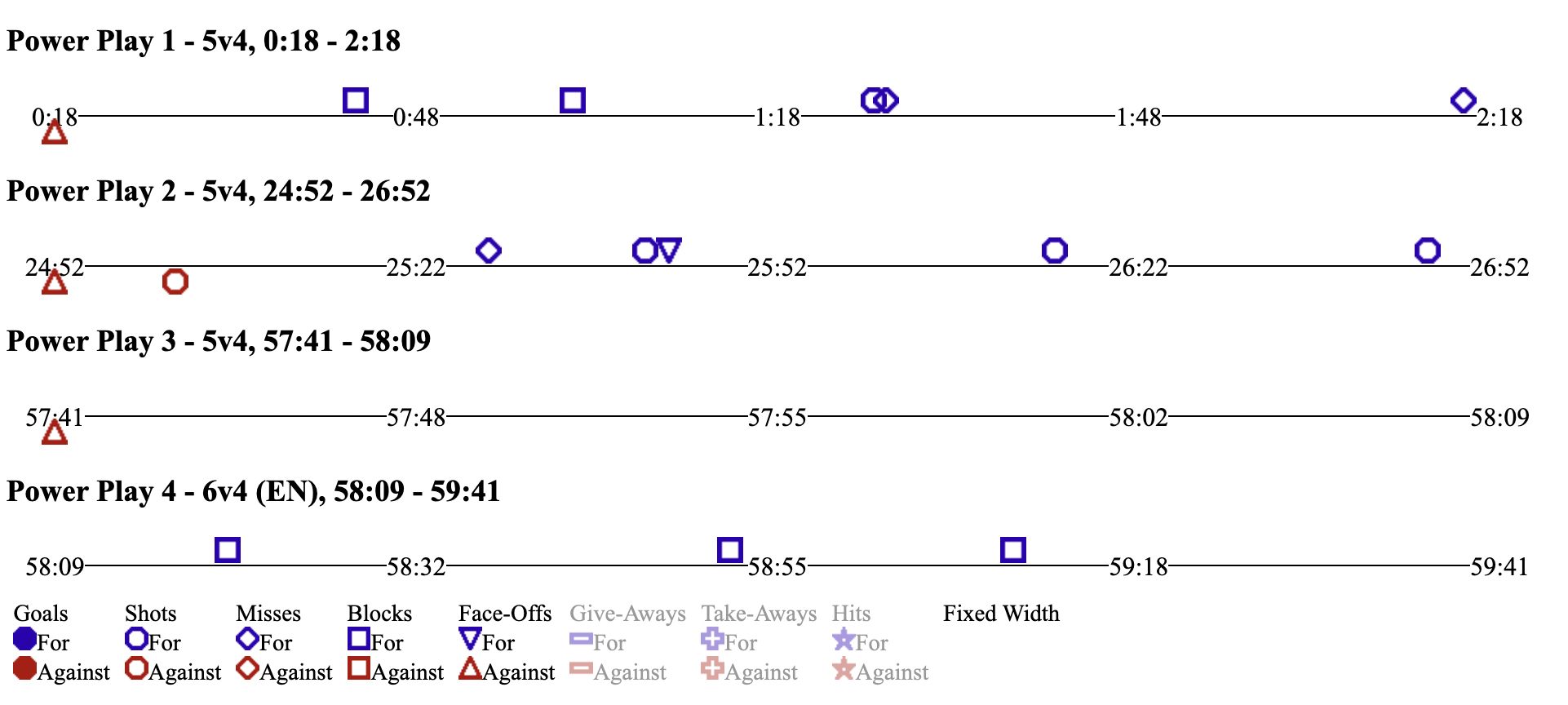
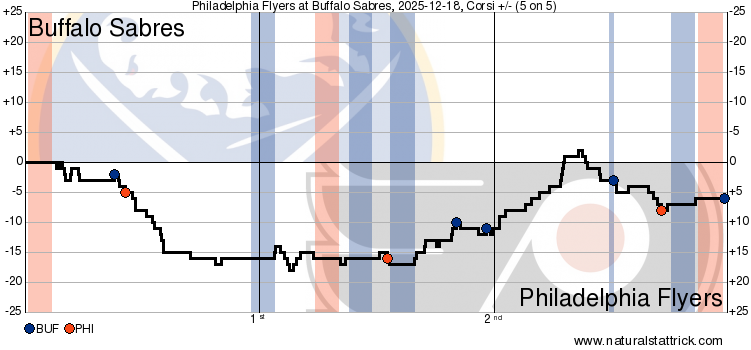
    The Flyers had three power-play opportunities but were unable to put one past former Flyers goalie Alex Lyon. According to Natural Stat Trick, they had 12 chances, including four shots on goal; the four shots came on the first two power plays.

    The last man advantage was in the third period, with the Flyers down a goal, after Mattias Samuelsson, the son of former Flyers defenseman Kjell Samuelsson, put the puck over the glass with 2 minutes, 19 seconds left in the game. They had shots by Trevor Zegras, Jamie Drysdale, and Owen Tippett blocked when goalie Sam Ersson was pulled to make it a six-on-four.

    The Flyers’ power play had 12 chances across three opportunities, with five shots blocked.

    “We’re getting points. It’s a loss. I mean, relax. I’m not saying you, nothing against you [the media],” coach Rick Tocchet said. “But, I mean, yeah, it’s a loss, I’m mad like you, but we’re getting points. These guys are trying, so we’ve got to take it easy on that part.

    “But saying that we got to be more disciplined, right? I’d like to see the power play, we got to get some guys to score some goals on the power play. Too perimeter. We need some people in front. That’s the one thing. I thought the key tonight, we didn’t have people in front of the net. You’ve got to be in front of the net to score goals.”

    The penalty kill allowed a goal to Josh Norris, who was left wide-open in front, in the third period. Norris’ goal, the eventual game-winner, came 18 seconds after Bobby Brink took a high-sticking call in the offensive zone when he hit Michael Kesselring in the face as he tried to make contact with the puck in the air.

    Norris was left alone in front as all four Flyers penalty killers went to one side of the ice.

    The penalty was one of five by the Flyers, although the goaltender interference call on Matvei Michkov in the second period was questionable. The winger appeared to be bumped into Lyon and then took several cross-checks to his back while on the ice and defenseless behind the net.

    The Sabres had 11 chances during five-on-four action and nine scoring chances. The Flyers had four scoring chances during their power-play opportunities, none in the third.

    Philly has been called for 117 minor penalties this season in 33 games, tied with the Winnipeg Jets for the seventh-most in the NHL. Last season, the Flyers had 238 across 82 games, tied with the Chicago Blackhawks for the 13th-fewest.

    “We’re taking a lot of penalties and we’re playing good players, so the more opportunities they get, the more chances for them to score,” defenseman Travis Sanheim said. “But in saying that, obviously we have to do a better job, and we’re at our best when we’re pressuring and disrupting and it’s something obviously we know we’ve got to be better, and I’m sure we will be moving forward.”

    The Flyers’ penalty kill was better early on but faltered in the third period, allowing the game-winning goal to be scored.

    They had good moments but also bad

    Defenseman Cam York, whose second goal of the season gave the Flyers a 2-1 lead in the second period, probably said it best postgame.

    “I think it’s just group maturity. I think we’re still maturing in some areas,” he said. “You don’t want to play simple sometimes, and it comes back to bite you, I think, when you don’t want to get the pucks behind their D-man and forecheck; we’re not going to have the puck much, and we’re going to be defending.

    “So there’s a lot of things that go into the game, obviously, but we’re definitely struggling to put a full 60 [minutes] together.”

    The Flyers’ Cam York celebrates his second-period goal against the Sabres on Thursday.

    According to Elite Prospects, the Flyers are the sixth-youngest team in the NHL with an average age of 27.08, aging slightly with the recent return of 31-year-old defenseman Rasmus Ristolainen.

    And while they are young and still learning and growing, they’ve also played just 33 games under a new coaching staff led by Tocchet.

    “There’s positives,” Tocchet said. ”To learn how to win, you’ve got to be disciplined. You can’t throw pucks away. We have a couple guys who were diving in when we shouldn’t.

    “That’s hockey, and we’re not a team that could outscore our mistakes. But we’re in every game, so I give them credit. But there’s some things there. We need some other guys to contribute too. It just can’t be the same guys.”

    At five-on-five, the Flyers had 53.66% of the shot attempts, but while they controlled play for the most part, they had dips and which allowed the Sabres back into the game.

    Despite it being the fourth game in six days, the Flyers came out firing and dominated the analytics. But they ended up trailing before Noah Cates tied things up less than a minute later.

    “You just got to stay focused and be ready,” Cates said. “Any opportunity you’re given, no matter who or what the situation is. So just something we’ve honestly been needing to work on our whole season.

    “It [stinks] because we’ve honestly been good kind of in the back half of games, kind of coming back and kind of bites us in the butt. So we obviously can’t rely on it, and going to learn from it and move on and have a big one on Saturday.”

  • Flyers Q&A: Brent Flahr dishes on prospects Porter Martone, Jett Luchanko, and more

    Flyers Q&A: Brent Flahr dishes on prospects Porter Martone, Jett Luchanko, and more

    Teaser


    With the Flyers nearing the midway point and the World Junior Championship around the corner on Dec. 26, it’s time for our annual midseason prospect check-in with assistant general manager and scouting chief Brent Flahr. In Part 1 of a two-part series, we asked Flahr about the team’s prospects that are playing NCAA or Canadian junior hockey, headlined by Porter Martone at Michigan State.

    • Flahr believes Porter Martone, who is averaging 1.25 points per game, which is third among freshmen, has improved his pace in the faster college game. Flahr believes Martone is on track to challenge for an NHL opening-night roster spot next season.
    • Flahr name-checked Jack Berglund, Heikki Ruohonen, and Max Westergård as less-talked-about prospects who have impressed him over the past few months.
    • While Flahr said Jett Luchanko wasn’t unhappy in Guelph, he thinks the move to Brantford is in the best interest of both Luchanko and the organization, as the center will play alongside better players and should benefit from not having to be “the guy” all the time.

    Disclaimer: This interview, which was conducted on Dec. 10, has been edited for clarity and length.

    More Details


    With the Flyers nearing the midway point and the World Junior Championship around the corner on Dec. 26, it’s time for our annual midseason prospect check-in with assistant general manager and scouting chief Brent Flahr. In Part 1 of a two-part series, we asked Flahr about the team’s prospects that are playing NCAA or Canadian junior hockey, headlined by Porter Martone at Michigan State.

    Disclaimer: This interview, which was conducted on Dec. 10, has been edited for clarity and length.

    Q: We are heading into the midway point of the season. How would you assess the Flyers’ prospect pool right now?

    A: It’s pretty good. Obviously, we had a lot of picks last year. We’ve had some guys emerging from previous drafts that have played well and are trending in the right direction. So overall, pretty excited.

    Q: Is there anyone who has stood out to you thus far?

    A: I think Porter Martone gets a lot of the attention because of where he was picked and whatnot, and he’s had a terrific start at a good program. I think [among] the lesser talked about guys, Jack Berglund and Heikki Ruohonen. Those two guys in the summer at the World Junior Showcase in Minnesota were both really good. Max Westergård played well. So I think those guys overseas have done their part to be big parts of their teams going to the World Juniors, which would be fun to see. And then obviously with Jack Nesbitt, Shane Vansaghi, a number of the guys we drafted last year, they’re big parts of their really good teams, and it’s been exciting for them.

    Q: We’ll start with Martone because he is the one everyone talks about. What have you seen from this year with Michigan State, and how do you think it’s helping him prepare for the NHL?

    A: His biggest challenge, and what we’ve talked about, is his pace. He was a really good junior [player], obviously, but he could slow things down all the time and kind of do what he wanted. In the college game, he’s playing against older kids, bigger, stronger, faster, and the way they practice, the way they play games, it’s all out and all full speed. So I think it’s forcing him to move his feet. Obviously, you can’t teach the brain he has, the skill set he has, and the size and whatnot. I think even he’s the first one to tell you, he’s in better shape. He’s playing faster. And I think it’ll really help him adjust to the pro game faster.

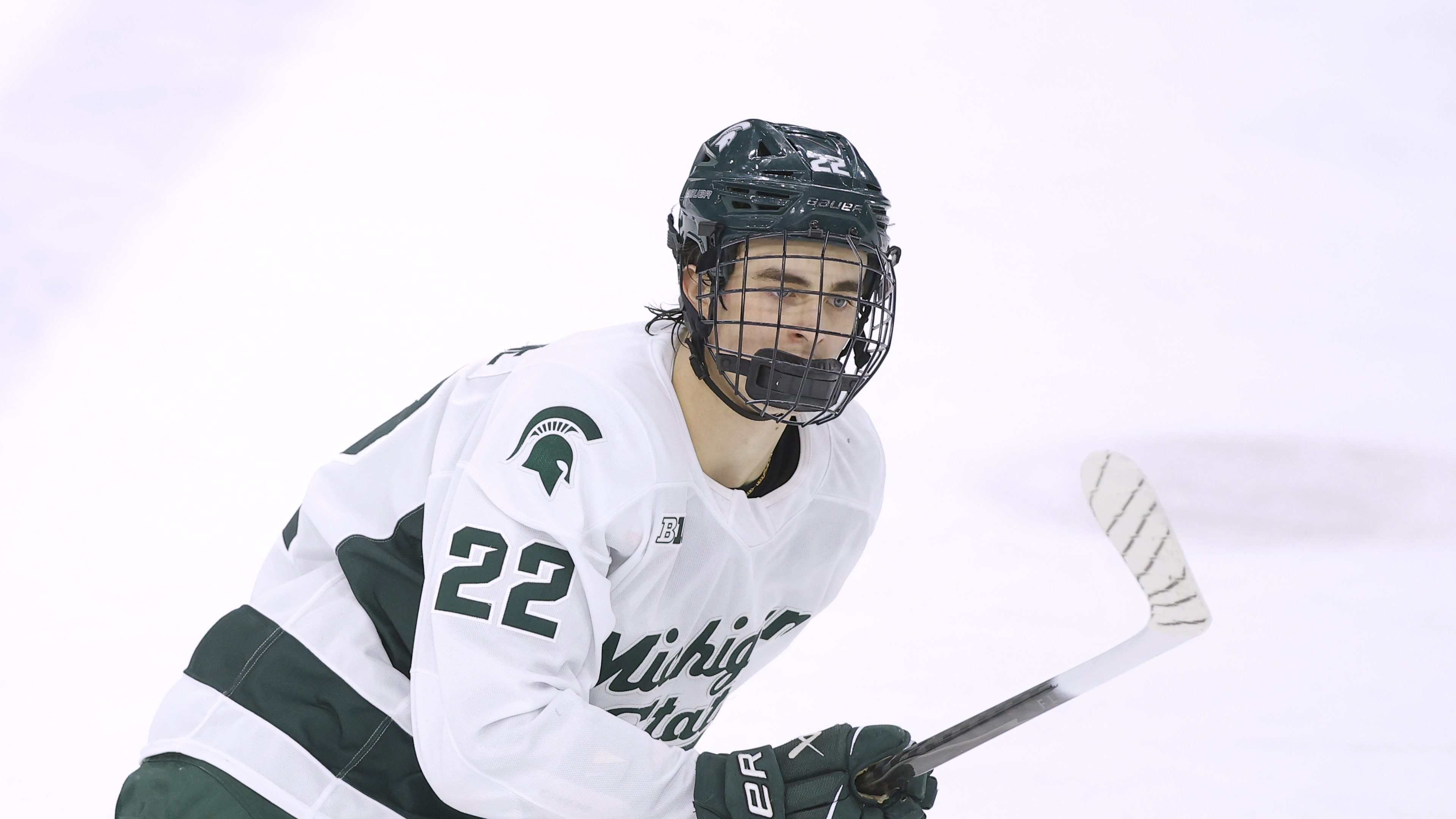
    Flyers top prospect Porter Martone has 11 goals and 20 points in 16 games for the third-ranked Michigan State Spartans.
    Q: Outside of Martone, Nesbitt is probably the most important player from the 2025 draft class. What have you made of his start in the OHL this season?

    A: Yeah, I’ve seen him a number of times. He plays his game. The biggest thing with him is we’re going to have to be a little patient. He’s just a tall drink of water right now, and he’s got to get put on weight. He’s got to get stronger, which we’re well aware of that. But he is a competitive kid. He’s got skill, and he’s very sound defensively.

    He plays with an edge — he’s been suspended a couple times already — but he plays to the identity of a Flyer, what we think of a Flyer. I think he’s going to be a very well-rounded centerman when he gets here. His details are good, good net-front on the power play, and he’s a good penalty killer. But the thing with him, I think the strength and skating is what you can wear down, so that’s a big focus with him. He’s got a good program there, where they have the trainer, and he’s drinking as many shakes as he can and doing all the things he needs to do.

    But it’s going to take some time. His offseason is going to be critical this year and next, but he’s shown that he’s willing to put in the work. But so far so good, really positive, and hopefully next year he’ll get his chance at World Juniors. He’s part of a really good team there in Windsor, and they have a chance, I think, with a few additions to go on a pretty good run there this year as well.

    Flyers center Jett Luchanko was recently traded from Guelp to OHL favorites Brantford. Brent Flahr believes that move will serve his development well.
    Q: What have you seen from Jett Luchanko, and how important was the trade to Brantford for his development?

    A: I don’t think he was unhappy in Guelph; he had friends there, guys he played with and played a ton. But I think his lack of offseason — he had injuries he was dealing with — so he wasn’t able to train and do his thing. So I think out of the gates, he was slow here in camp. He was fine, but really didn’t knock the door down. His details are good enough, skates good enough, where our coaches were like, we would like to give this guy a chance. But for us, long-term, we felt the necessity [for him] to go back to junior.

    I think going to Brantford now, he’s not the guy. He’s one of many guys there, and I don’t know if there’s a better team in Canada. They have a really good coaching staff there, and he has a chance to just play and be a big part of the team there. Jett doesn’t get too high or low ever. He’s always going to take care of the defensive side of things, but I think playing with some good offensive players there and in a lot of situations is only going to help him be confident.

    The one thing with him is, he’s unselfish to a fault. He can really make plays, but at the same time, he passes up opportunities to shoot it, which is what Riley Armstrong and Johnny LeClair, and Patrick Sharp want to get him going and shooting the puck more, being a little more selfish and taking more chances. But he’s in a good spot, good spot mentally, and I think he’s finally feeling back to normal again.

    Flyers Asst. GM Brent Flahr is excited about the progress of many of the team’s top prospects.

    Everything


    With the Flyers nearing the midway point and the World Junior Championship around the corner on Dec. 26, it’s time for our annual midseason prospect check-in with assistant general manager and scouting chief Brent Flahr. In Part 1 of a two-part series, we asked Flahr about the team’s prospects that are playing NCAA or Canadian junior hockey, headlined by Porter Martone at Michigan State.

    Disclaimer: This interview, which was conducted on Dec. 10, has been edited for clarity and length.

    Q: We are heading into the midway point of the season. How would you assess the Flyers’ prospect pool right now?

    A: It’s pretty good. Obviously, we had a lot of picks last year. We’ve had some guys emerging from previous drafts that have played well and are trending in the right direction. So overall, pretty excited.

    Q: Is there anyone who has stood out to you thus far?

    A: I think Porter Martone gets a lot of the attention because of where he was picked and whatnot, and he’s had a terrific start at a good program. I think [among] the lesser talked about [guys], Jack Berglund and Heikki Ruohonen. Those two guys in the summer at the World Junior Showcase in Minnesota were both really good. Max Westergård played well. So I think those guys overseas have done their part to be big parts of their teams going to the World Juniors, which would be fun to see. And then obviously with Jack Nesbitt, Shane Vansaghi, a number of the guys we drafted last year, they’re big parts of their really good teams, and it’s been exciting for them.

    Flyers top prospect Porter Martone has 11 goals and 20 points in 16 games for the third-ranked Michigan State Spartans.
    Q: We’ll start with Martone because he is the one everyone talks about. What have you seen from this year with Michigan State, and how do you think it’s helping him prepare for the NHL?

    A: His biggest challenge, and what we’ve talked about, is his pace. He was a really good junior, obviously, but he could slow things down all the time and kind of do what he wanted. In the college game, he’s playing against older kids, bigger, stronger, faster, and the way they practice, the way they play games, it’s all out and all full speed. So I think it’s forcing him to move his feet. Obviously, you can’t teach the brain he has, the skill set he has, and the size and whatnot. I think even he’s the first one to tell you, he’s in better shape. He’s playing faster. And I think it’ll really help him adjust to the pro game faster.

    Q: Aside from his pace of play, is there anything else that you want to see him work on? And what do you see as his strengths already?

    A: Just the pace of play is the biggest thing for me. His food speed, working on that. His conditioning, and being able to play hard and not coasting like you can get away with in juniors. In college and especially in the NHL, he’s not going to be able to get away with that. But he’s a quick study. He’s a really smart player and skilled. His ability to go to the right spots, and he knows where to be on the ice. He has the ability to process the game at the level that a lot of guys can’t. So whether it’s scoring goals or making plays. Defensive side of things, he’s being forced to work harder at stuff like that, which just helps him when he gets here.

    Q: Do you foresee him pushing for an NHL spot next year?

    A: I think so. But at the same time, we don’t get too far ahead. I don’t even like talking about it. I just want him focusing on his season there and not getting ahead of things. He’s got a good group, and he has a chance to do something special; they’re one of the top teams, and hopefully win it all. And I don’t want him focusing on the end of the season or next year. I just told him, go there with the right attitude and work, and earn your spot, and he has. And, obviously, he’s had success. So I think he gets it, but I want to make sure he makes the most of it and has a chance to have a real special year with World Juniors, and potentially, if you win a national championship and things like that, that really helps build a player going into their pro career.

    Q: Martone will play for Canada at World Juniors. How important is that for him, or any player really, to get that experience?

    A: Well, it can be great. It’s not a be-all, end-all. Especially in Canada, it gets so blown up on the stage, people get crazed if guys don’t make it or make it. But the thing that fans don’t understand is that the coaches of those teams and management have different goals than what we have. We have players that we envision in the NHL in a couple of years — and there’s been lots of great players who have been cut that go on to have great careers — but they’re building a team to win a 10-day tournament in January this year. So they look at it a little differently. But if you are a part of it and you win, just the experience, I think, is great. Especially when it’s in Canada or in a full building, and to play it’s exciting and usually, a lot of times, it translates.

    Flyers Asst. GM Brent Flahr is excited about the progress of many of the team’s top prospects.
    Q: Vansaghi is teammates with Martone on the Spartans and will play for the U.S. at World Juniors. He’s not someone who is talked about as much, but maybe he should be?

    A: You go to a game at Michigan State, you understand what he brings and how he impacts games. He’s a tank. He’s physically engaged. He wins every battle, but his details are really good. And more importantly, off the ice, the way he conducts his business is extremely mature for a young player. It’s contagious to the people around him with how hard he works and the intensity he works. So, you know, he’s a guy that it’s different roles, probably, when they get here, but he could be a very valuable piece to a good team we hope.

    Q: Outside of Martone, Nesbitt is probably the most important player from that draft class. What have you made of his start in the OHL this season?

    A: Yeah, I’ve seen him a number of times. He plays his game. The biggest thing with him is we’re going to have to be a little patient. He’s just a tall drink of water right now, and he’s got to get put on weight. He’s got to get stronger, which we’re well aware of that. But he is a competitive kid. He’s got skill, and he’s very sound defensively.

    He plays with an edge — he’s been suspended a couple times already — but he plays to the identity of a Flyer, what we think of a Flyer. I think he’s going to be a very well-rounded centerman when he gets here. His details are good, good net-front on the power play, and he’s a good penalty killer. But the thing with him, I think the strength and skating is what you can wear down, so that’s a big focus with him. He’s got a good program there, where they have the trainer, and he’s drinking as many shakes as he can and doing all the things he needs to do.

    At 6-foot-5, Jack Nesbitt’s skill popped at this year’s offseason camps.

    But it’s going to take some time. His offseason is going to be critical this year and next, but he’s shown that he’s willing to put in the work. But so far so good, really positive, and hopefully next year he’ll get his chance at World Juniors. He’s part of a really good team there in Windsor, and they have a chance, I think, with a few additions to go on a pretty good run there this year as well.

    Q: What have you seen from Jett Luchanko, and how important was the trade to Brantford for his development?

    A: I don’t think he was unhappy in Guelph; he had friends there, guys he played with and played a ton. But I think his lack of offseason — he had injuries he was dealing with — so he wasn’t able to train and do his thing. So I think out of the gates, he was slow here in camp. He was fine, but really didn’t knock the door down. His details are good enough, skates good enough, where our coaches were like, we would like to give this guy a chance. But for us, long-term, we felt the necessity [for him] to go back to junior.

    I think going to Brantford now, he’s not the guy. He’s one of many guys there, and I don’t know if there’s a better team in Canada. They have a really good coaching staff there, and he has a chance to just play and be a big part of the team there. Jett doesn’t get too high or low ever. He’s always going to take care of the defensive side of things, but I think playing with some good offensive players there and in a lot of situations is only going to help him be confident.

    Flyers center Jett Luchanko was recently traded from Guelp to OHL favorites Brantford. Brent Flahr believes that move will serve his development well.

    The one thing with him is, he’s unselfish to a fault. He can really make plays, but at the same time, he passes up opportunities to shoot it, which is what Riley Armstrong and Johnny LeClair, and Patrick Sharp want to get him going and shooting the puck more, being a little more selfish and taking more chances. But he’s in a good spot, good spot mentally, and I think he’s finally feeling back to normal again.

    Q: You also have a trio at Boston University in Jack Murtagh, Owen McLaughlin, and Carter Amico. What have you seen from them?

    A: They’re finding their way. McLaughlin is actually having a pretty good year.

    Amico is coming off the knee injury, so he’s just finding his way. Saw him there the other night, and he’s a huge kid. He’s going to hopefully get more and more as we go along here.

    And Murtagh, he’s a freshman; they don’t get put into top offensive roles right away, so he’s going to have to earn it. I think the things that he needs to work on, he’s going to have to figure out there, which is good. With the U.S. program, he was the goal scorer. Now he’s learning the details of the game, not only defensively, but where to be on the ice, and whether it’s forechecking, playing within the system, and it’s not just about him, but his attitude is great, and he works hard.

  • Flyers’ five-game point streak is snapped with 5-3 loss at the Sabres

    Flyers’ five-game point streak is snapped with 5-3 loss at the Sabres

    BUFFALO ― The Flyers are having better days lately, but came up short on Thursday night, falling 5-3 to the Buffalo Sabres.

    The loss snapped the Flyers’ five-game point streak and is their first road loss in regulation since a 3-0 stinker against the Tampa Bay Lightning on Nov. 24.

    Things started well for the Flyers. They came out in dominating fashion, but for the 23rd time — in 33 games — they trailed 1-0. It is just their seventh loss (12-7-4) when trailing first.

    Jack Quinn knocked down a Travis Konecny pass in the neutral zone, and the Sabres took the puck the other way. Zach Benson carried the puck down the left board before curling and feeding Mattias Samuelsson at the point. Samuelsson, the son of former Flyers defenseman Kjell Samuelsson, put the puck on net quickly, and Quinn redirected it past Sam Ersson.

    But before the KeyBank Center’s announcer could finish announcing the goal, 58 seconds later, Noah Cates found the back of the net to tie it at 1. Sabres defenseman Rasmus Dahlin moved a dump-in by Cates up the boards, but Bobby Brink picked up the loose puck.

    Brink carried the puck up the boards and maintained control under pressure before turning back down the boards and into the left circle. He dished a backhand pass to Cates, who snapped the one-timer past the glove of former Flyer goalie Alex Lyon.

    According to Natural Stat Trick, by the end of the first period, the Flyers had a 12-4 lead in shots on goal, had 21 shot attempts to the Sabres’ five, and 88.45% of the expected-goals share.

    The Flyers took a 2-1 lead with 8 minutes, 59 seconds to go in the second period. As Trevor Zegras carried the puck through the offensive zone, Cam York cut through the middle, turned, and received a no-look pass from Zegras in the right circle.

    York held the puck and then sent the wrister past Lyon. The goal was the defenseman’s second of the season.

    But in a period that saw an almost even number of shots, 12 for the Sabres and 10 for the Flyers, Buffalo took a 3-2 lead.

    Off a defensive-zone face-off, the Flyers got stuck in their own end, and 32 seconds later, the Sabres tied the game at 2. Travis Sanheim played the puck along the left boards, but right to Buffalo’s Dahlin. He dropped the puck between his legs in front to Tage Thompson, and the winger skated to the middle before beating Ersson.

    The Flyers’ Noah Cates (27) celebrates his goal during the first period on Thursday night.

    Noah Ostlund gave the Sabres their second lead of the game less than three minutes later. With 30 seconds left in the middle frame, he sent a shot from the point past several bodies that appeared to screen Ersson.

    In the third period, Josh Norris scored to give Buffalo a two-goal cushion. Norris was sitting wide-open in front during a power play when he received a cross-crease pass from Benson. The center waited and whipped the puck past Ersson 18 seconds into a high-sticking penalty on Brink. Philly went 4-for-5 on the penalty kill.

    Konecny cut it to a one-goal game with 5:32 remaining off a pass from Emil Andrae. The Flyers had the puck in the offensive zone for 52 seconds when Andrae at the left point found Konecny curling above the right circle.

    The goal, which came from a similar spot as York’s, is Konecny’s 10th of the season and fifth in December. He has 11 points in his last nine games.

    Breakaways

    Buffalo’s Ryan McLeod scored an empty-netter. … The Flyers placed defenseman Egor Zamula on waivers on Thursday. … Defenseman Noah Juulsen and forward Nikita Grebenkin were the healthy scratches. … Ersson allowed four goals on 27 shots. The Flyers put 27 shots on goal, too, with only five coming in the third period. … Flyers forward Matvei Michkov, who was handed a questionable goaltending interference call and was cross-checked while down multiple times — without a call — played 15:27. It is his highest ice time since Dec. 3 (six games ago).

    Up next

    The Flyers head downstate to face the New York Rangers on Saturday (12:30 p.m., NBCSP).

  • Matvei Michkov is playing less than many of the Flyers’ other forwards. Here’s why.

    Matvei Michkov is playing less than many of the Flyers’ other forwards. Here’s why.

    BUFFALO ― Flyers coach Rick Tocchet likes his pairs.

    Trevor Zegras and Christian Dvorak have been attached at the hip since almost the start of the season. Noah Cates and Bobby Brink have been a duo dating back to the John Tortorella era, as have Matvei Michkov and Sean Couturier.

    But Michkov was recently switched to the left wing with Cates and Brink — and it paid off with a Brink goal in Tuesday’s 4-1 win over the Montreal Canadiens.

    “Bobby and Noah have been together last year and this year, and they have a little chemistry. I just wanted to switch, get a little juice,” Tocchet explained on Thursday before the Flyers take on the Buffalo Sabres (7:30 p.m., ESPN+, Hulu).

    “Noah and Bobby play a little bit more north,” he added. “They’ve got some speed, so that could help Matvei and his game.”

    Michkov’s season started slowly, but his game has certainly picked up as the schedule builds. After leading all rookies in goals last season with 26, he had just one tally, along with five assists, in the first 13 games this season. Since then, he has seven goals and 12 points in 19 games.

    Tocchet has seen an improvement in the young Russian’s game.

    “Well, he’s obviously making less turnovers,” he said of Michkov, who has seen his giveaways drop from almost two a game (22 in the first 13 games) to one a game (19 in the last 19).

    “He’s trying to understand. He’s getting his shifts. He’s doing 30-second shifts, which is fine. I have no problem with it. I know he’s coming off early sometimes, and I think there’s a number of reasons why, but I don’t mind the progression when it comes to that. We’ll work on the other stuff, and he’s still building his game.”

    Although Michkov’s ice time has been a point of contention with fans, he is often the one opting to skate a short shift, as he goes to the bench with his linemates still on the ice.

    According to Natural Stat Trick, he is tied with Cates and defenseman Nick Seeler for the second shortest average shift length at 41 seconds; only Garnet Hathaway and Noah Juulsen average fewer seconds per shift (39). And while the 21-year-old winger ranks ninth in average time on ice among Flyers forwards at 14:40, there are several factors leading to it, like the fact that he leads the team with 32 penalty minutes in 32 games.

    Flyers head coach Rick Tocchet and Matvei Michkov (middle) are still trying to come to an understanding of what the Russian needs to do to earn more ice.

    Among the forwards, he ranks eighth with 555 shifts, trailing Travis Konecny (623), Tippett (593), Christian Dvorak (591), Cates (582), and Couturier (573), who all serve on the penalty kill and have all played on the power play too at some point this season. The only two players above him who do not kill penalties, but are on the power play, are Trevor Zegras (589) — who leads the team in goals (14) and points (33) — and Brink, who has only just six more shifts than Michkov.

    “I do like short shifts, but there’s sometimes you’ve been out there for 30, but you still got juice. You can still stay out there. It’s time and place. It’s a lot of different things,” Tocchet said, speaking in a general sense about short shifts.

    “Shift lengths are anywhere from 30 to 40, 45 seconds, and you get up a minute, 55 seconds, it can happen. Sometimes when you have the puck, and you’re just moving around, and you’re not really tired, stay out there and try to score. But I think for the most part, every coach preaches short shifts. I mean, that’s how you drive play.”

    The Flyers need Michkov to drive play, and thus far, he has looked better as he gets back into shape and builds his game. Although he doesn’t have a goal in December, he does have four assists in eight games — along with 10 penalty minutes.

    And while he is one of five forwards who have played at least half the games this season with a negative plus-minus (minus-2), he has an even rating in December. That was helped by setting up Brink on Monday during his 20 five-on-five shifts and 14:06 of ice time, which was one more shift than Brink and one fewer than Konecny, who played 16:08 and 17:50, respectively.

    “He’s got that skill and that vision,” Cates said before the game in Montreal. “I think, just for me, to get him in good spots, get him the puck with time and space … [and] going to the net or getting open, because, you know, he’s special, and he’ll find you.

    “So obviously just got to talk with him and work with him a little bit with some things, but just the kind of special skills that he has, you know, we’ve got to try to take advantage of.”

    Breakaways

    Sam Ersson will start in goal against the Sabres. He is 4-1-0 against with a 1.87 goals-against average and a .917 save percentage against Buffalo for his career. Ersson’s first career shutout came in Western New York, when he made 28 saves on Jan. 9, 2023. … Tocchet said there are game-time decisions, but forward Nikita Grebenkin and defensemen Juulsen and Egor Zamula were the only ones on the ice for the optional morning skate. The Flyers later placed Zamula on waivers Thursday.