Author: Jane M. Von Bergen

  • Catholic Charities helps those in need both surmount life’s hardships and celebrate its many little joys | Philly Gives

    Catholic Charities helps those in need both surmount life’s hardships and celebrate its many little joys | Philly Gives

    Heather Huot, the top executive at Catholic Charities, named her only daughter after Lidia, a homeless, mentally ill, and often cranky elderly woman she met as a young social worker at Women of Hope Vine, a transitional housing facility run by the organization Huot now leads.

    As “mean spirited” as Lidia was, Huot said, Lidia still celebrated forsythia.

    When their bright yellow blossoms heralded winter’s end, Lidia would drag Huot outside to marvel. “Despite all the hardships,” Huot said, “there are things to be celebrated.”

    Which brings us to the Christmas holiday season.

    Even if it were possible, which it’s not, to overlook all the troubles in our world, with wars and starvation, or even to overlook all the troubles in our nation, there would still be the troubles of the season — too much work, too much loneliness, too many struggles.

    Where’s the forsythia?

    Two weeks ago, it was outside the Archdiocesan Pastoral Center in the form of a living Nativity scene, complete with a wee baby goat named Lady, an artificial-snow machine, an actual camel, and an elementary school choir in their Catholic school uniforms singing “Joy To the World.”

    Yes, “Joy To The World,” because 500 children, some of whom live in tough circumstances, got a chance to celebrate Christmas and with it, maybe, the hope that the holiday brings. It was the 70th annual Archbishop’s Benefit for Children, a Catholic Charities of Philadelphia event funded by a grant from the Riley Family Foundation. No expense was spared.

    Heather Huot, the chief of Catholic Charities Philadelphia, pets a calf during a living Christmas scene in front of the Archdiocesan Pastoral Center in Center City Philadelphia.

    More than 60 volunteers from area high schools lunched on pizza and cookies before heading across the street to a lavishly decorated ballroom in the Sheraton Philadelphia Downtown. Balloons, banners, party favors, huge plates of cookies, a container of ice cream cups, and a bucket of all different flavors of milk awaited at each table. Kids and chaperones crowded the dance floor, only to make way for an appearance by Santa, who high-fived his way around the ballroom. At the party’s end, the volunteers sprang into action distributing bags of toys — all beautifully wrapped.

    In a way, the party is a metaphor for Catholic Charities as a whole. Both the party and the organization are big and multifaceted with lots of moving parts, involving all types of people, not only Catholics.

    Each year, Catholic Charities spends about $158 million to run about 40 different programs in four main categories — care for seniors; support for at-risk children, youth, and families; food and shelter; and its biggest category, many-pronged assistance for people with intellectual and developmental disabilities and their families.

    As an overview, there’s housing for at-risk youth in Bensalem. In Philadelphia, people may be familiar with St. John’s Hospice on Race Street, which provides food, showers, shelter, and case management to men. There are several smaller transitional housing shelters for women in the city.

    Social workers funded by Catholic Charities assist students at six Catholic high schools across the region. Other social workers handle case management under contract with the City of Philadelphia. A program teaches teenagers involved in the juvenile justice system about conflict resolution. Family navigators step in to assist families with issues ranging from employment to parenting support. There are adoption and foster-care services.

    For the elderly, Catholic Charities supports senior centers and works to help seniors stay independent through case management.

    Archbishop Nelson Pérez poses with students during a holiday party.

    Just over half of Catholic Charities’ annual budget is allocated to supporting people with intellectual or developmental disabilities. A major focus is housing for adults. For example, at the Divine Providence Village in Springfield, Delaware County, 72 women live in six cottages on a 22-acre campus with a pool, greenhouse, and picnic pavilion.

    In addition, there is employment support, a day program, field trips, a family-living program, and respite care to help families overwhelmed by caregiving responsibilities.

    Nearly 80% of Catholic Charities’ funding comes from government sources, which, these days, requires Huot to focus her prayers. “I ask God to help me get through this and to give me the strength and the people around me to get through this,” she said. “At the same time, we have to recognize that God provides in ways you don’t expect.

    “We’ve been blessed with generous benefactors who have stepped in,” she said. “The Philadelphia community is incredibly generous. We get a bad rap as the people who throw snowballs at Santa Claus, but Philadelphians will give you the shirt off their backs. They are passionate about caring for one another.”

    The generosity moved Lakisha Brown to tears as she shepherded her two children and a third to the party earlier this month. Brown, 44, lives in a three-bedroom subsidized housing apartment at Catholic Charities’ Visitation Homes in Kensington.

    “This is the best I ever lived,” she said. But, she said, just outside her door “is a constant reminder of where I came from and where I never want to go.”

    Brown’s father died when she was in elementary school and her mother struggled with alcohol addiction. Brown left home when she was 16 under the protection of a man who started their relationship with gifts and ended it with beatings.

    “He left me in a coma,” she said.

    Brown had her own struggles with addiction. She spent many nights without a roof over her head. If lucky, she could sleep in safety in an abandoned car on a quiet block. One night, she went to a party in a hotel. When she woke up, her clothes were off. Whatever happened wasn’t consensual.

    Soon after, she learned she was pregnant and, knowing that, she vowed to give her baby a clean birth. She found a drug program and a place to live. Slowly, through housing and support from Catholic Charities, she rebuilt her life.

    Erika Hollender holds up her grandchild so Layani, 3, can touch Percy the camel.

    “They help us with budgeting, with money management,” said Brown, who relies on disability, welfare, and food benefits while trying to cope with her own mental health issues. “When we get some money, we want to spend it on the children. We were parenting out of guilt and shame.”

    Those are the big things, but what Brown wants people to understand is that the level of care is deep, personal, and specific. It’s being able to ask a staff person for a roll of toilet paper and trash bags — basics that are sometimes unaffordable when money must be allocated to food and shelter.

    “A mom’s job is never done,” she said, explaining why people should donate to Catholic Charities. “It is needed for mothers who come from nothing. It is needed.”
    For more information about Philly Gives, including how to donate, visit phillygives.org.

    About Catholic Charities of Philadelphia

    People served: 294,000 annually (in the 2023-24 fiscal year)

    Annual spending: $158.6 million across four pillars of mercy and charity

    Point of pride: Catholic Charities of Philadelphia is the heart of the church’s mission in action, serving all people regardless of background. With decades of experience, nearly 40 comprehensive programs, and deep community partnerships, Catholic Charities turns compassion into action, and action into lasting and impactful change.

    You can help: By serving meals, volunteering at a food pantry or shelter, hosting a food or clothing drive, and sharing your gifts and passions with seniors.

    Support: phillygives.org

    What your Catholic Charities donation can do

    • $25 provides five nutritious lunches for children through the School Lunch Program.
    • $50 provides three hot lunches at St. John’s Hospice for individuals experiencing food insecurity.
    • $100 provides an instructor and supplies for an art or recreation class for 50 to 100 seniors at a senior community center.
    • $275 provides one week of groceries for a family of four.
    • $325 provides a mother with formula, diapers, and wipes for a month.
    • $550 provides emergency shelter and meals for a week for someone experiencing homelessness.
  • At SEAMAAC, long-settled immigrants devote themselves to helping new arrivals | Philly Gives

    At SEAMAAC, long-settled immigrants devote themselves to helping new arrivals | Philly Gives

    To escape the soldiers, Mai Ngoc Nguyen swam across the Mekong River as Laotian snipers on the riverbank fired into the water. She and four others fled Laos together, but only Nguyen made it to safety in Thailand. The rest drowned before they could reach the opposite shore.

    On her first night in Philadelphia, Kahina Guenfoud, an Algerian immigrant eight months pregnant with her first child, was exhausted. When it was time to sleep, she pulled what she could out of her single suitcase and tried to get comfortable on the floor of an empty house.

    To this day, Thoai Nguyen remembers how he, his parents, and seven siblings were airlifted from South Vietnam to an aircraft carrier in the ocean. As the North Vietnamese moved into the area at the end of the Vietnam War, there would have been no mercy for his father, who had worked for the American government.

    Every immigrant has a story and SEAMAAC can hold them all, serving the city’s low-income and immigrant community in more than 55 languages from its headquarters in South Philadelphia — just blocks from where Guenfoud spent her first night. Thoai Nguyen, the chief executive officer, still lives nearby in the South Philadelphia house where his family found refuge in 1975.

    The majority of people who work for SEAMAAC (Southeast Asian Mutual Assistance Associations Coalition) are immigrants in an organization that began in 1984 by serving people from countries like Vietnam and Cambodia and now assists all low-income and marginalized people, including immigrants from Asia, Africa, Europe, and South and Central America.

    A half century ago, Thoai Nguyen, his parents, and seven siblings were airlifted from South Vietnam to an aircraft carrier in the Pacific. Today, he is SEAMAAC’s chief executive officer.

    “It’s about the feelings,” Guenfoud, SEAMAAC’s adult literacy and access coordinator, said. “We feel what they feel. We have all left our families. We still have that emptiness inside.”

    It’s why staffer Biak Cuai, SEAMAAC’s outreach worker to Philadelphia’s Burmese community, keeps her phone next to her bed at night. Everyone has Cuai’s number and they call when there is an emergency. “They call me and ask me to call 911: `My stomach hurts and I can’t breathe.’”

    The hour doesn’t matter, she said, because she understands.

    Many of the people who come to Philadelphia from what is now known as Myanmar are illiterate in their own language because education is no longer readily available back home, Cuai said. Here, even the basics, like opening a bank account, using email, or dealing with paperwork from their children’s schools, seem insurmountable.

    “They come here because they feel America is the top country in the world, but the problem is that everything is new and unfamiliar,” she said. “They have fear. They are scared.

    “I feel the same way because I am an immigrant,” she said.

    Biak Cuai, SEAMAAC’s outreach worker to Philadelphia’s Burmese community, works with a client.

    “I prayed to my God to guide me to my dream job, so I can serve my people,” she said. “They knock on my door. I tell them, ‘if you have any problem, you can reach out at any time.’”

    The stories are dramatic and the help is real.

    In broad strokes, SEAMAAC provides education with classes in digital literacy and English as a second language (although for most immigrants, it’s English as a third, fourth, or fifth language).

    “It’s about feeling and belonging,” Guenfoud said. “When you learn English you learn the culture, and if you learn the culture, you belong in this country. You’ll find your place here.”

    There’s social work and legal assistance to help people obtain benefits or apply for citizenship. A separate stream of funding finances SEAMAAC’s support for children who are missing school due to difficult family situations.

    SEAMAAC works with domestic violence survivors and has co-produced a short, animated film offering hope and support in 10 languages — Lao, Cantonese, Hakha Chin, Nepali, Bahasa Indonesia, and Khmer, among others.

    Laura Rodriguez, from Colombia, discusses food for the Thanksgiving holiday during an English as a second language class at SEAMAAC. Seated behind her is Leo Boumaza, from Algeria.

    Art therapy helps survivors cope with trauma. A domestic violence survivors group produced a collection of mosaics, each with a teacup, surrounded by shards of glass. What was broken, explained Christa Loffelman, health and social services director, can become something beautiful.

    Many of the people who come to SEAMAAC have experienced trauma. “Everyone’s been through multiple layers of trauma,” she said. “You are displaced from your home country — not by choice — and you are going to a refugee camp in a different country. Their entire system has been disrupted.”

    Traditional Western-style talk therapy doesn’t help. For one thing, the language isn’t there, and secondly, it’s not part of many cultures. What has worked, Loffelman said, is expressing feelings through art, and being together while doing it.

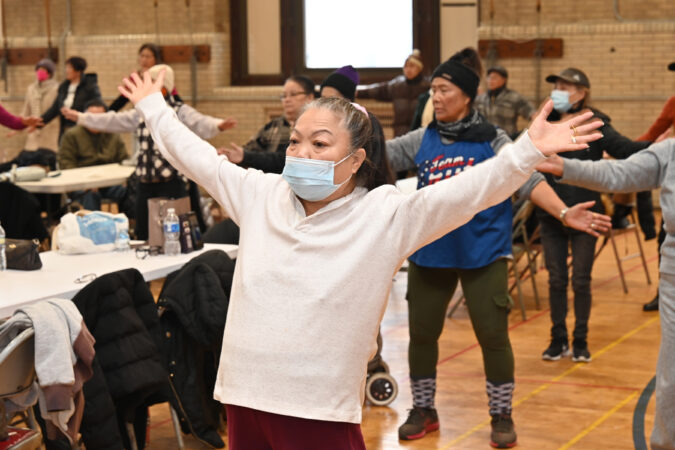
    To counter the social isolation of seniors, SEAMAAC organizes meetings of “the Council of Elders.” They gather in a drafty gym at the Bok building, a former high school in South Philadelphia where SEAMAAC offers classes and counseling.

    Often, the elders practice qigong, a form of movement meditation, or on a less esoteric level, enjoy multicultural bingo. Languages may be different, but when someone holds up a G-32 poster, everyone understands. If they don’t, Mai Ngoc Nguyen, a volunteer who can speak Laotian, Thai, Vietnamese, and English can help.

    She has experienced plenty of trauma and heard plenty of traumatic stories. She’ll never forget the mother who gave her baby medicine so it wouldn’t cry in a boat carrying refugees away from their country. The boat capsized. The baby drowned.

    “She comes into the refugee camp and she became crazy, yelling `Where is my baby?’ Her brain got messed up” and she never recovered.

    Luckily for Mai Ngoc Nguyen, then age 12, she was a strong swimmer and ready to cross the Mekong as she made her escape. But she had to kick away a friend who was clinging to her, dragging her under. Her friend never made it to the opposite shore.

    “If you ask me, I’ll talk about it,” she said. “But if you don’t ask, I won’t talk.”

    But she will joke, saying that she knows the Mekong alligators didn’t get her because they knew she needed to help her family back home.

    It’s a lot of trauma, but every day at SEAMAAC isn’t full of anxiety. The elders coming out of the gym after bingo were smiling. And in a nearby classroom, students practicing their English last month traded jokes as they learned about Thanksgiving.

    Fatma Amara, from Algeria, has been here long enough that she’ll serve a turkey on Thanksgiving, but the apple pie she makes will be Algerian, with seasoned apples layered among thin sheets of dough.

    For her, SEAMAAC is more than a language class.

    “At first, you feel lonely. You’re anxious. It’s stressful,” said Amara, who works in a hospital and is getting better and more confident with her English. “I take the classes, and we talk together and I feel better.

    “Thanksgiving is my favorite holiday in America. It’s an international holiday. It’s about food and God and family,” she said. “You thank God for all you have.”

    For all the blessings SEAMAAC provides, these days, funding is a struggle.

    In 2024, SEAMAAC learned that the federal government had approved its application for a $400,000 multiyear federal grant to improve digital “equity.” But after President Donald Trump took office, federal staffers targeted “equity” programs. “That’s $400,000 we’ll never see,” said Thoai Nguyen, the executive director. “We would have had some of that money by now.”

    Federal cuts since Trump took office have slashed SEAMAAC’s budget by 20%, he said. Hunger relief programs had to be curtailed, with 1,500 families who relied on SEAMAAC for food losing that lifeline.

    “We’re in a moment,” he said, “where intentional cruelty is considered an acceptable form of political discourse.”

    This article is part of a series about Philly Gives — a community fund to support nonprofits through end-of-year giving. To learn more about Philly Gives, including how to donate, visit phillygives.org.

    For more information about Philly Gives, including how to donate, visit phillygives.org.

    About SEAMAAC

    Mission: To support and serve immigrants and refugees and other politically, socially, and economically vulnerable communities as they seek to advance the condition of their lives in the United States. Services include ESL classes, job readiness, domestic violence survivor support, services for low-income elders, food assistance, public benefit counseling, health and nutrition education, and civic engagement.

    People served: 8,000 families

    Annual spend: $3,360,401 in fiscal year 2024

    Point of pride: SEAMAAC plans to increase our impact to serve even more Philadelphians at its new South Philly East (SoPhiE) Community Center on Sixth Street and Snyder Avenue, scheduled to open in December 2026. In January, SEAMAAC, partnering with the American Swedish Historical Museum, will welcome visitors to “Indivisible: Stories of Strength,” an art exhibition showcasing the art and stories of South Philadelphians.

    You can help: SEAMAAC provides many volunteer opportunities through our work in beautifying and improving Philadelphia’s neighborhoods through our work in urban gardening, tree planting, neighborhood and public park cleanings, and beautification of public schools and places of worship. Additional opportunities are available through our civic engagement and neighborhood unity events as well as by delivering groceries in our hunger relief efforts.

    Support: phillygives.org

    What your SEAMAAC donation can do

    • $40 provides shelf stable foods for a family impacted by the SNAP shutoffs for one week.
    • $50 provides holiday presents for two children.
    • $100 helps maintain one plot in SEAMAAC’s community garden for an entire growing season, providing tools, culturally appropriate seedlings, and soil.
    • $100 covers the full cost of supplies for one youth participant in SEAMAAC’s summer programs — giving young people the tools they need for career and college readiness.
    • $200 covers four hours of ESL instruction.
    • $250 provides 50 elders with a freshly made breakfast.
    • $250 provides a family with emergency food, hygiene items, diapers, and social service support for one month.
    • $300 supports a domestic violence survivor moving into safe housing, by covering the cost of utility hookups and household supplies.
    • $300 provides ingredients and cooking supplies for a nutrition education workshop.
    • $1,000 covers the full cost for one high school student to participate in SEAMAAC’s eight-week summer career exploration program.
  • With roots stretching back 170 years, the Jewish Family and Children’s Service strives ‘to make the world a better place’ | Philly Gives

    With roots stretching back 170 years, the Jewish Family and Children’s Service strives ‘to make the world a better place’ | Philly Gives

    By the time more than 700 people had found coats at the Jewish Family and Children’s Service of Greater Philadelphia’s annual coat drive last month, JFCS volunteer manager Brianna Torres should have been exhausted.

    Instead, she was exhilarated.

    “Honestly, this is one of our most favorite days of the year,” she said, taking a break from shepherding the 60 volunteers helping hundreds of folks choose free winter jackets and coats for themselves and their children at Congregation Rodeph Shalom.

    Sometimes the line stretched around the historic synagogue on North Broad Street.

    “It’s all hands on deck,” Torres said, with a smile. “We feel good — giving and receiving.”

    JFCS’s roots date to 1855, when philanthropist and Jewish educator Rebecca Gratz founded the Jewish Foster Home, and to 1869, when United Hebrew Charities was organized.

    These days, JFCS’s client base has grown beyond the Jewish population it once primarily served. It offers a multitude of services, including help with basic needs, mental health and wellness, support for Holocaust survivors, older adults and their families, help for children and families, and for people living with disabilities, as well as an LGBTQ initiative.

    “We’re an organization that is very focused on the equal value of every human being,” said Robin Brandies, JFCS’s new president and chief executive.

    When the giveaway ended, 900 of those human beings had chosen 1,200 coats out of 1,600 donated.

    “It is our responsibility to make the world a better place,” Torres said. “Our main forefront is dignity.”

    That’s why, she explained, the coat drive, while massive, didn’t resemble a rummage sale. “We’re trying to create a boutique type of atmosphere.”

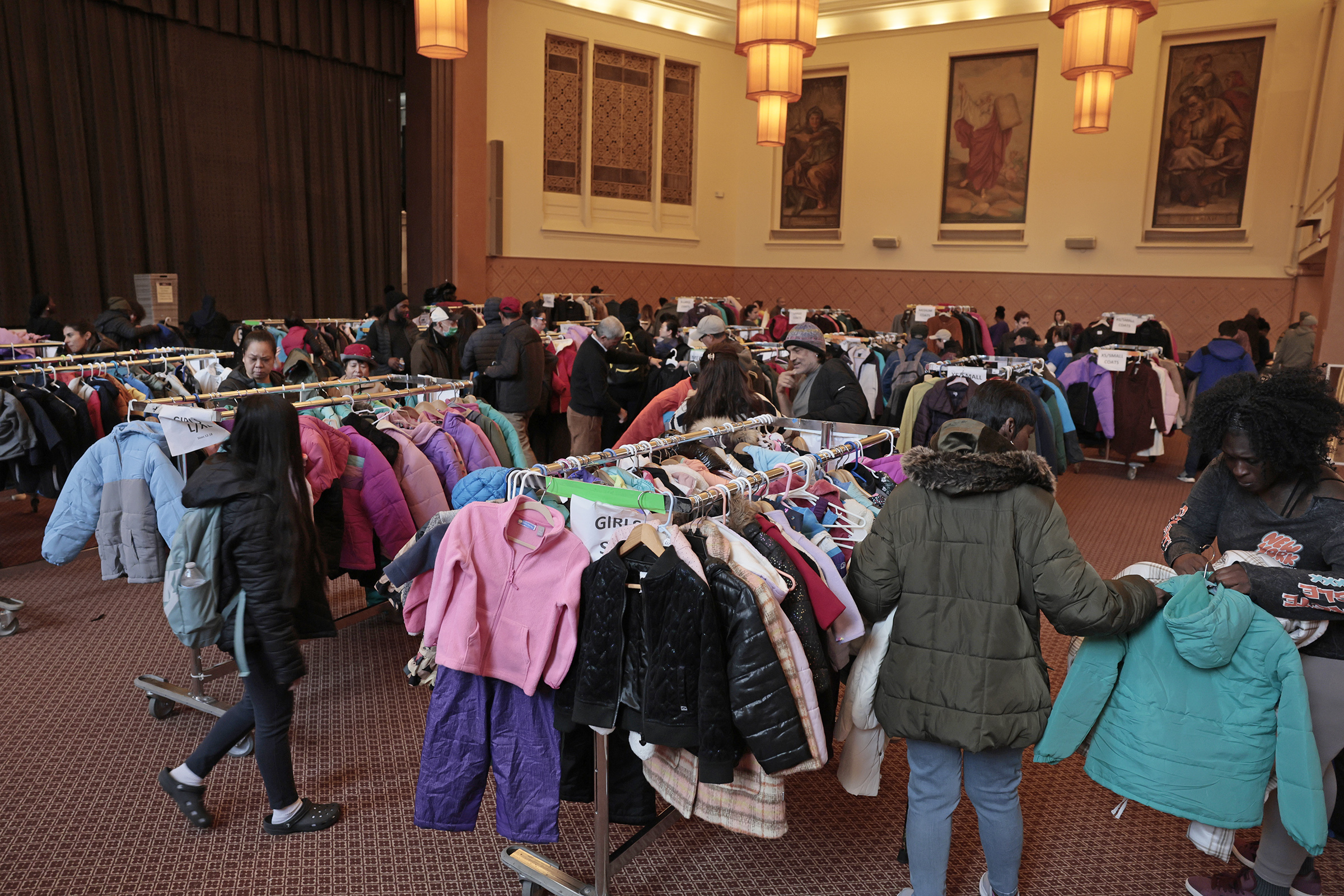
    People look for coats during the winter coat drive at Rodeph Shalom synagogue last month.

    Volunteers hung coats neatly on racks by size, not piled in heaps. While many people were served, only 35 at a time were allowed in to “shop” in the synagogue’s huge community room. They could look at and try on coats at leisure without jostling for room.

    Volunteers helped them choose their coats while other friendly volunteers packed their coats into bags along with flyers describing more of JFCS’s services.

    Leftover coats wind up in JFCS’s mobile pop-up, “Our Closet in Your Neighborhood.” The agency brings a truck loaded with all kinds of clothing, from shoes to coats, and sets up mini boutiques in synagogues, churches, and community centers around the region. Fresh produce is also often available.

    Last month’s coat drive was Brandies’ first as JFCS’s new president and chief executive. She replaces JFCS’s longtime executive Paula Goldstein, who retired Sept. 1 after more than 40 years of service.

    “I’m blown away,” Brandies said. She walked into the synagogue’s community room and almost immediately ended up helping little King James, 3, get zipped into his new jacket.

    His mother, Jessel Huggins, of Strawberry Mansion, brought five of her 13 children to the coat drive.

    As they waited to choose, three of the boys, Shar, 6, Boaz, 7, and Prince Jedidiah, 8, said they hoped for winter jackets themed with Sonic the Hedgehog characters — Sonic and Tails, the fox.

    Sadly, they weren’t available, but at least Boaz and Prince Jedidiah got blue coats — the same color as the hedgehog. Shar landed a gray camouflage one. Their older sister, Shaly, 13, managed to snag her dream coat, a jacket with fur around the hood.

    “This is my first time coming,” Huggins said. “Buying coats for 13 kids is a lot.”

    LaToya Adams, of West Philly, stood in line, hoping she’d find a coat for herself, her daughter, 20, and her son, 7. “We can’t afford coats with food stamps being cut off — and right at Thanksgiving.”

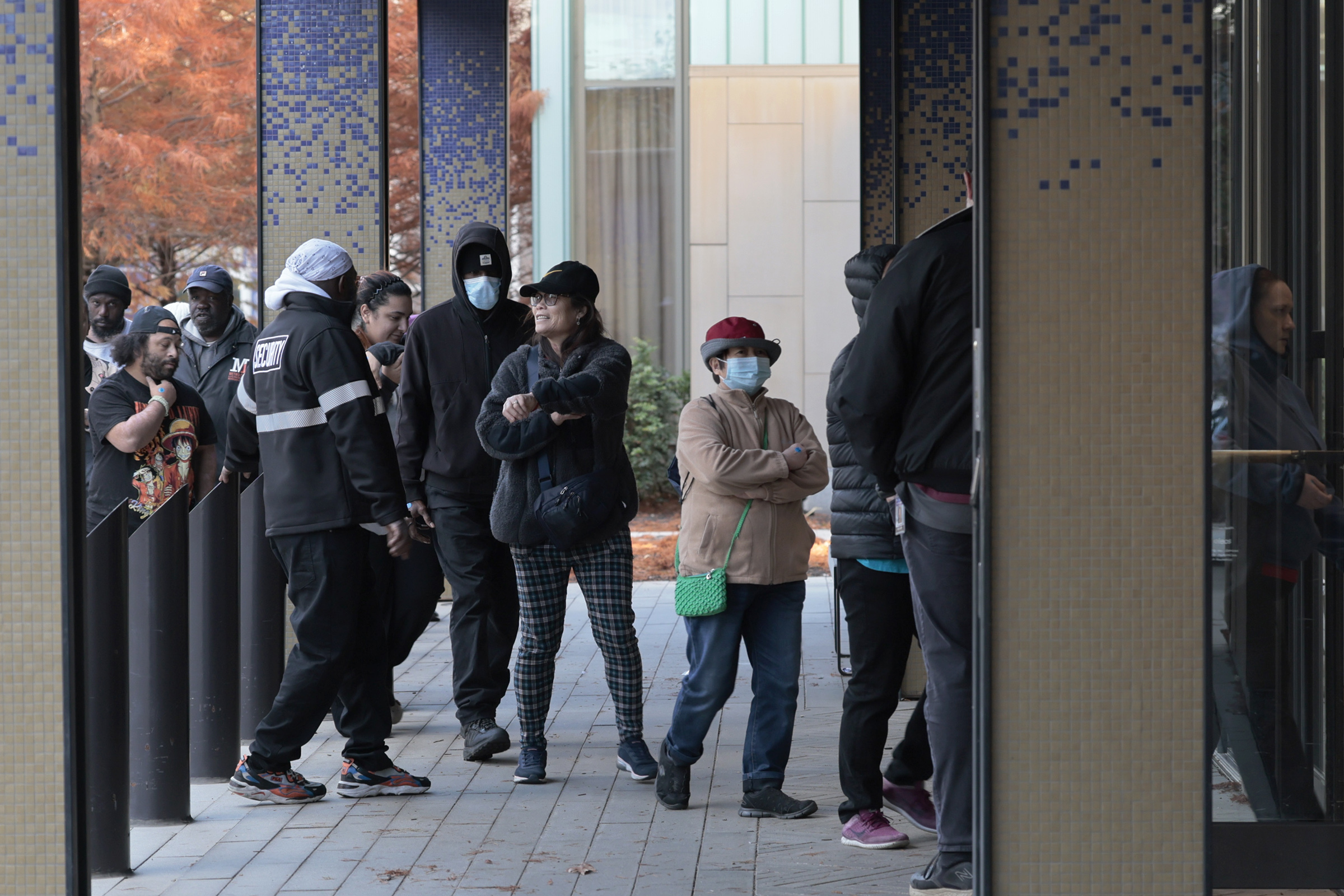
    People wait in line to get into the winter coat drive at Rodeph Shalom synagogue last month.

    “The money I do make has to go to the bills,” she said. “I’m just trying to find a good-paying job. It’s a burden. It feels like you have a weight on your shoulders and you can’t get out of it. We’re trying to survive, and them giving a coat today helps.”

    Brandies came to JFCS after serving as the leader of Abramson Senior Care. The two organizations joined on Oct. 1 to provide more seamless care for older adults and their families in a program now known as Abramson Senior Care of JFCS.

    Abramson had offered more health-based care with JFCS, providing other types of services to seniors, including help with housing and food. “A family can make one phone call” on a 24-hour hotline to access services, Brandies said.

    Sometimes there are emergencies, like a person calling late at night after noticing an elderly neighbor had tried to cook herself a meal and ended up having a minor fire. Usually, though, Brandies said, the calls are from people seeking advice on how to care for an aging relative.

    Brandies, who had earlier careers in law and fundraising, said she became a fierce advocate for older adults in the 10 years she spent at Abramson.

    “People don’t like to think about aging,” she said. “It’s possibly the most universal and least sexy of causes. It’s not as sexy in fundraising circles as donating” to programs for children.

    “Everybody ages and needs help at some point,” she said. “But we’re not educated [as a society] as to the best way to be there.

    “As the percentage of the population that’s aging increases, we have fewer people going into senior care professions,” and there are fewer resources available to help the elderly. Many are aging alone, with no families nearby to help.

    “Seniors don’t want to be infantilized,” she said. “They want to continue to live their lives with as much dignity as possible.”

    This article is part of a series about Philly Gives — a community fund to support nonprofits through end-of-year giving. To learn more about Philly Gives, including how to donate, visit phillygives.org.

    For more information about Philly Gives, including how to donate, visit phillygives.org.

    Jewish Family and Children’s Service of Greater Philadelphia

    Mission: Jewish Family and Children’s Service (JFCS) of Greater Philadelphia strengthens families and individuals across generations and cultures to achieve stability, independence, and community.

    People served: Over 30,000 annually

    Annual spending: $14,899,000 for 2024-2025

    Point of pride: The recent merger of JFCS and Abramson Senior Care (now Abramson Senior Care of JFCS) expands access to comprehensive social and healthcare services for older adults and their caregivers across Greater Philadelphia.

    You can help: We invite individuals, families, groups, corporations, and more to contribute their time and skills to a variety of community-based volunteer opportunities.

    Support: phillygives.org

    What your JFCS donation can do

    • $25 buys a warm winter coat for a child.
    • $50 purchases a grocery store gift card for a family.
    • $100 pays the heating bill for an individual with a disability.
    • $360 subsidizes the cost of therapy for an individual experiencing a mental health crisis.
    • $500 covers medical bills for an older adult.
    • $1,000 helps a family of four pay their rent.
    • $2,500 installs a chair lift in the home of a Holocaust survivor.
  • In North Philly, Congreso de Latinos Unidos has spent five decades being ‘here for you’ | Philly Gives

    In North Philly, Congreso de Latinos Unidos has spent five decades being ‘here for you’ | Philly Gives

    The litany of horrors never stopped:

    For more than an hour, one domestic violence survivor after another stepped up to the microphone with tales of pain and resilience.

    “When people get close to me, I flinch because I’m afraid they are going to abuse me,” said one woman, speaking in Spanish, her words translated into English by a staffer at Congreso de Latinos Unidos, a nonprofit social services agency in North Philadelphia that provides help with housing, education, medical needs, workforce training, and after-school activities for youngsters.

    Congreso is celebrating its 48th year in operation, and for 30 of those years, it has maintained a program to support people dealing with, and trying to escape from, domestic violence.

    “I was never allowed to go outside. He would show up at my job,” the woman continued in a room decorated with purple balloons, the color symbolizing domestic violence. Each year, Congreso honors survivors and mourns, in a few moments of poignant silence, the people who lost their lives to domestic violence. Last year, in Pennsylvania, there were 102.

    “He would bruise my face so I couldn’t see my family. I worked in a nightclub, and he would drag me out … No one wanted to get involved,” she said.

    No one, until Congreso did and helped relocate her to a new home.

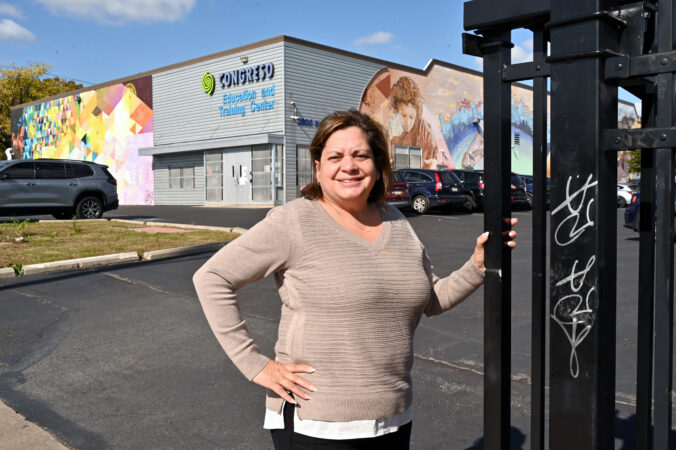
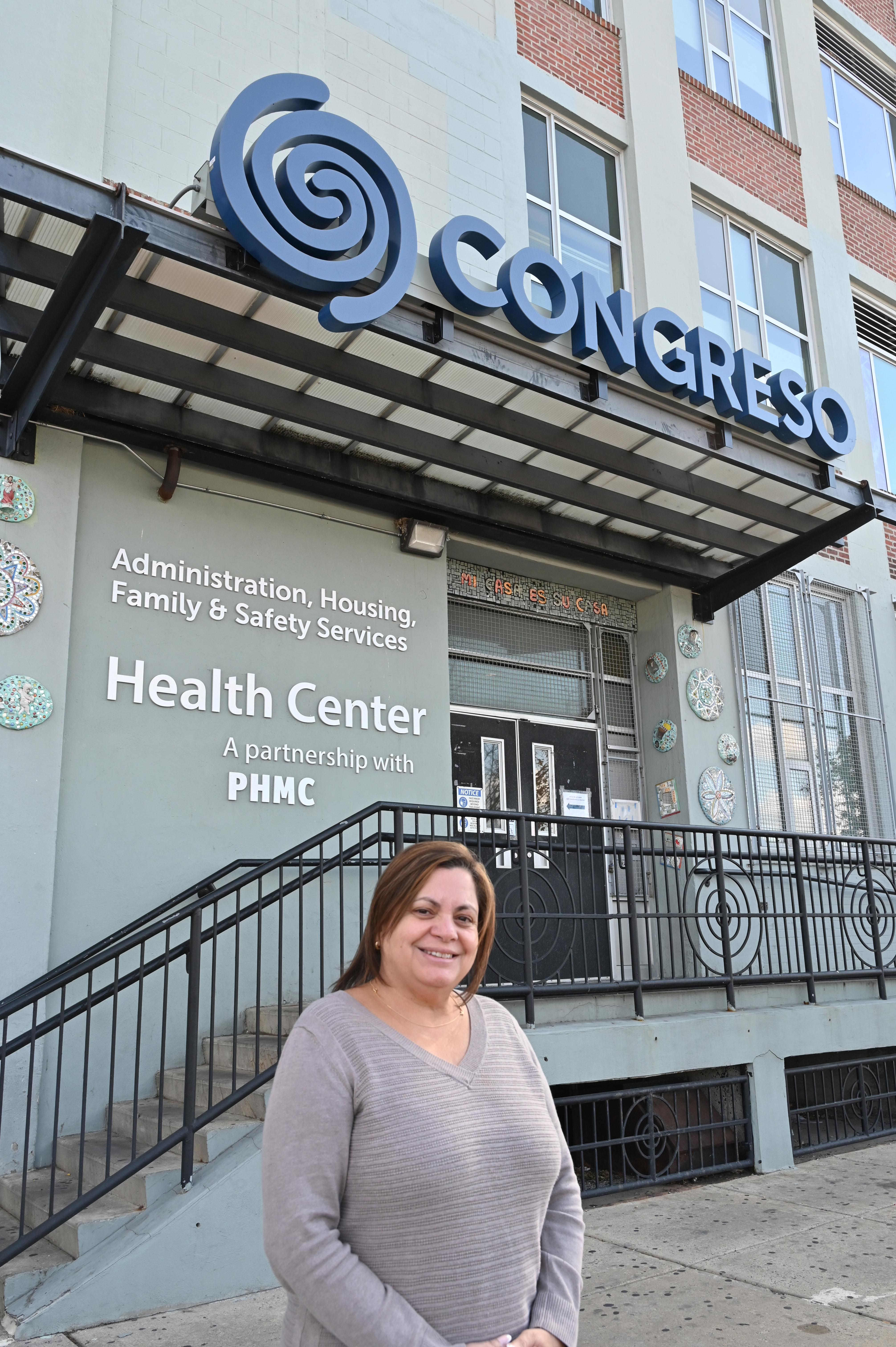
    Jannette Diaz, president and CEO of Congreso, outside the group’s offices in North Philadelphia.“We’re all feeling the crunch,” she said of recent funding challenges.

    “It takes a lot of courage to come up here and share your story,” Ramona Peralta, Congreso’s director of family wellness, said as the woman finished speaking. “We’re very proud of you, and we are here for you all the way.”

    In the main room, the mood vacillated between the heavy silence of shared pain and the cheerful clamoring of babies. Later, there was music, and before, a friendly lunch of rice with pork and chicken.

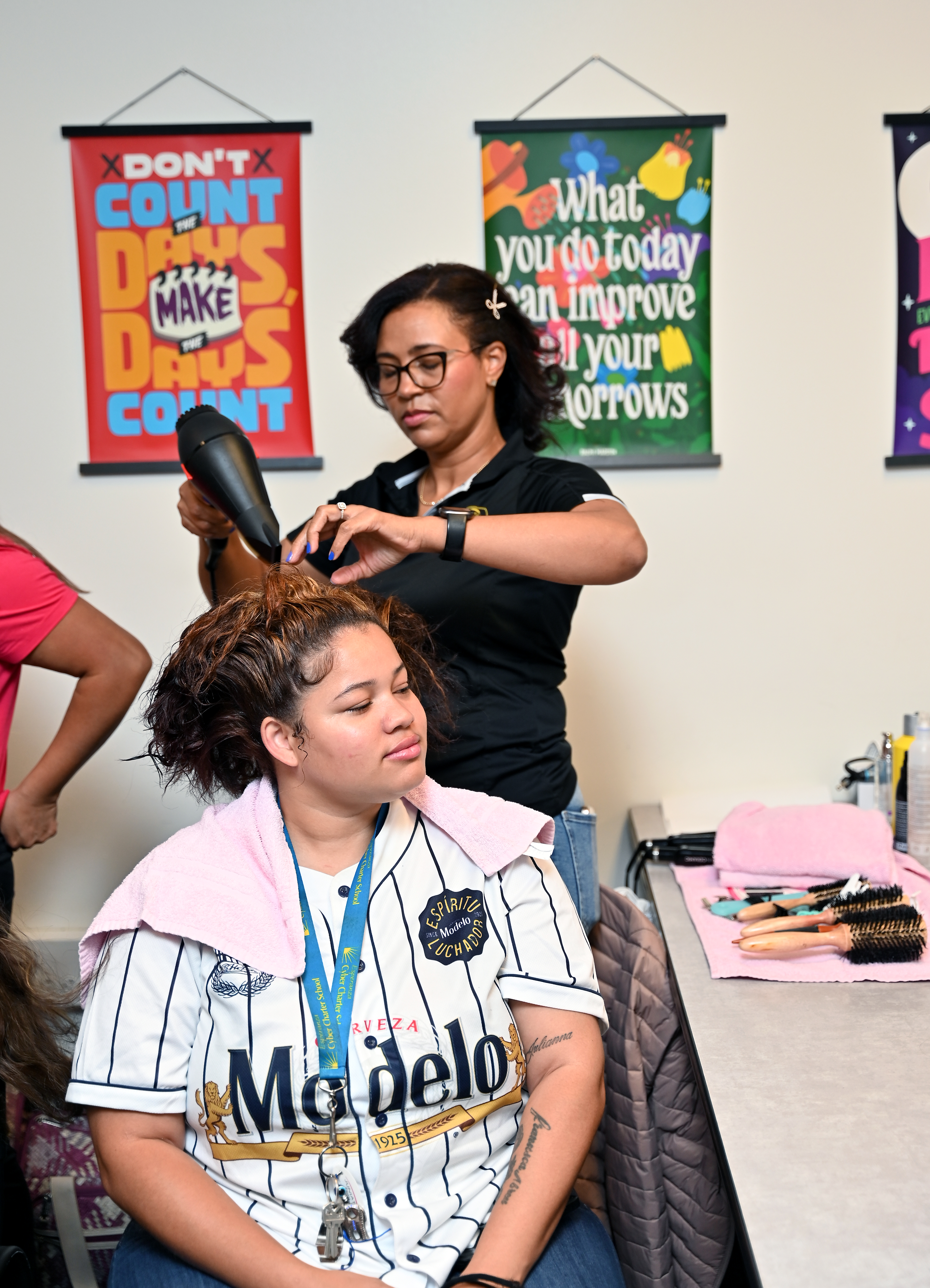
    Across the hall, members of the Asociación de Cosmetologas de Pennsylvania offered free hairstyling to the women who attended the celebration.

    Congreso, as part of its program to teach police, educators, social workers, and others to recognize signs of domestic abuse, had trained this group, as well, and because of the intimacy of their work, the stylists were uniquely positioned to do so. More than most, beauty salon operators could readily see the bruises hidden under hair and makeup. They could feel the cuts and scars on the scalp. And then there were the confidences confessed during shampoos and stylings.

    Wanda Gómez, of the Blessings of God beauty salon, styles Franyeimi Abreu’s hair at Congreso’s offices.

    Among the volunteers was Wanda Gómez, owner of the Blessings of God beauty salon in Northeast Philadelphia. “Thank God, I’m no longer in that situation,” she said, speaking through a translator. But because she survived domestic violence, she said she’s in a better position to help others. She tells them about Congreso.

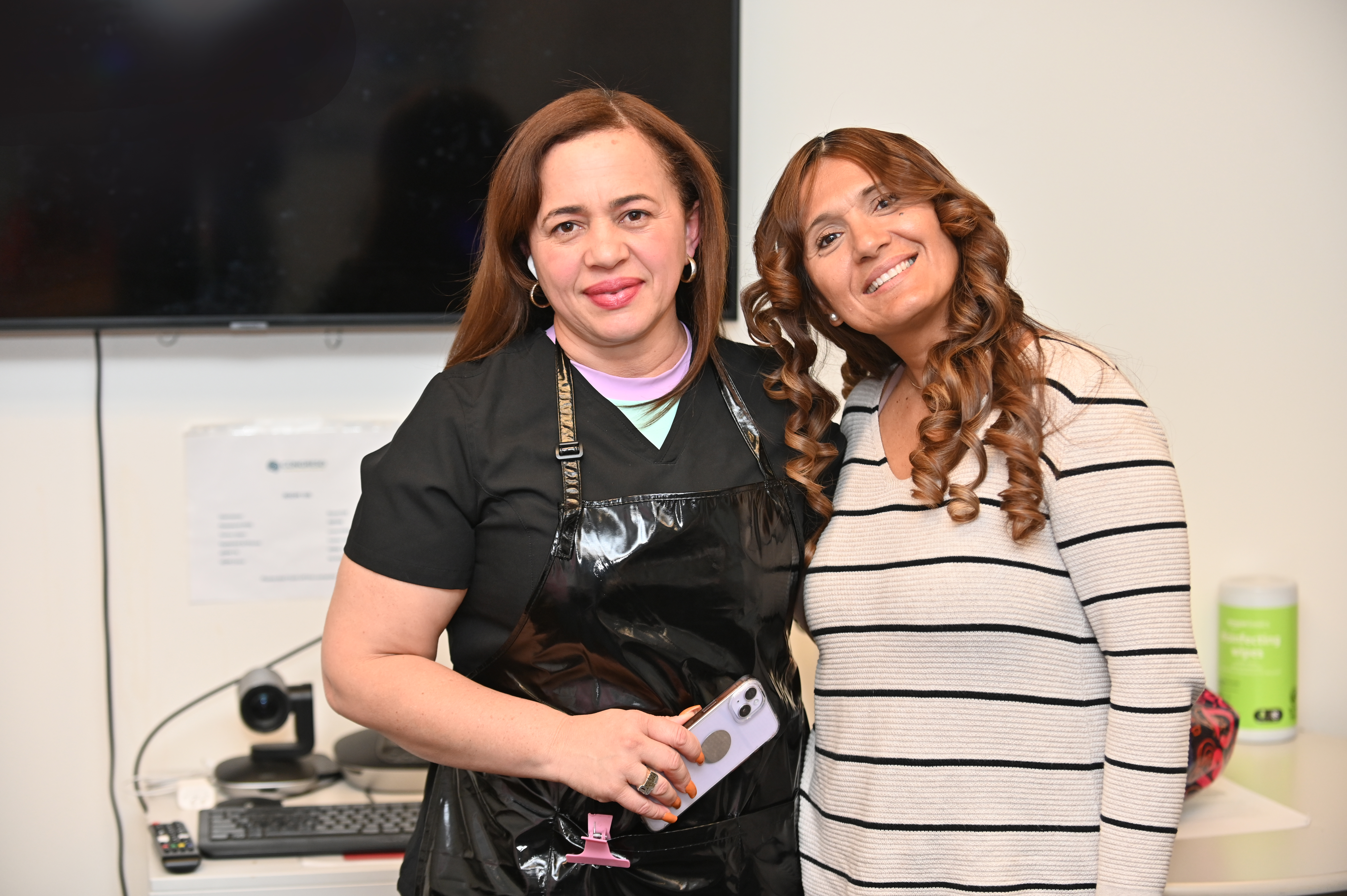
    Elisa Zaro Doran, owner of Dominican Divas Beauty Salon in Olney, twisted a strand of hair around a curling iron as she styled Maria Rodriguez’s long, dark hair. Like Gómez, Doran survived domestic abuse. “The first time, when he hit me, we were having a lot of problems, so I thought it was normal,” Doran said.

    He’d even come into her beauty salon and hit her. “My clients would try to defend me,” she said. Eventually, when her son tried to protect her, she knew she had to take the necessary steps to get away and be safe — for herself and her children.

    Rodriguez was there yesterday to support her daughter, who survived domestic violence, but still lives in fear — which is the reason she would only agree to be interviewed if her name was not used. “He told me that it doesn’t matter how many years — he will come and burn down my house with me in it,” she said.

    Hairdresser Domaris Rodriguez shows her artistry on Raquel Mendez’s hair.

    Rodriguez’s daughter turned to Congreso for help after Thanksgiving a few years ago. Her oldest son told her that day that he would no longer live with her, because every night he dreamed of killing his father. He couldn’t stay and watch the beatings or watch his father, in a rage, destroy the furniture in their home.

    “I don’t know how many dining room tables I bought,” the daughter said.

    On that Thanksgiving, she told her husband he had to leave. It was the end of the relationship, but the beginning of a new nightmare. He followed her to work and even stood in the pharmacy, watching her as she managed the office.

    Counseling at Congreso helped her name her situation for what it was — abuse. “They made me see that I was in danger,” and that what she thought was normal was anything but. In group sessions, she learned a critical lesson: “I understood that I wasn’t the only one. They made me know it wasn’t my fault.”

    She’s still afraid to leave her home. “I’m going through anxiety, PTSD. It still affects me.”

    As she watched her mother get her hair styled, Rodriguez’s daughter hoped her mother would absorb a lesson from the stories she would hear. The daughter wanted her mother to understand the intergenerational legacy of abuse because she believes her mother also suffered from domestic violence.

    That abuse, Rodriguez’s daughter believes, impacted both her and her sister, whose abuser stopped hitting her only when he thought she was dead. She teaches her sister lessons learned from counseling at Congreso. Counseling includes helping women develop a safety plan.

    Rodriguez’s daughter brings her own little girl, 13, to Congreso’s counseling groups for children impacted by domestic violence. “I’m saving my sister’s life, and I’m saving my daughter’s life,” she said. As for her sons, “I’m not raising abusers,” as she reminds them to respect their girlfriends.

    Last month’s celebration in honor of the survivors of domestic abuse took center stage that day at Congreso, but Congreso’s programming benefits many more people in the community, 75% of whom are Latino, said Jannette Diaz, president and chief executive.

    Diaz grew up a few blocks from Congreso, and her father relied on the nonprofit for help with the family’s utility bills.

    These days, she spends time working on strengthening relationships with fellow nonprofit agencies and with Congreso’s friends in the donor community.

    “We’re all feeling the crunch,” Diaz said, describing a double whammy in mid-October of the state’s failure to pass a budget as the national government moved into another week of shutdown. Congreso gets much of its funding from government reimbursements for services provided.

    At Congreso, “we’re very mindful of our spending. So far, we’re continuing to provide services at 100%, but there’s only so much we can do, tapping into our reserves and our line of credit.”

    “Sometimes it’s heavy, but I’m also hopeful,” Diaz said, explaining that the twin state and federal budget crises required a sharper focus even as demand for services increases. Changes in Medicaid regulations may impact finances at Congreso’s health center, for example.

    But, she said, donors can be confident their dollars are being spent wisely.

    Why? Because as nonprofits come and go, Congreso has survived, thanks to providing trauma-informed and culturally responsive services that are informed by data to its clients, Diaz said.

    “We’ve been around for 48 years, and there’s a reason for that. And that is how we operate within our community,” she said. “We forge a trusting relationship, and we try our best to do what they need. It’s important that we make sure our programs have impact.”

    And that impact, Diaz said, goes beyond help given directly to clients. When Congreso assists a first-time home buyer in qualifying for and landing a mortgage, that homeowner becomes a Philadelphia taxpayer, benefiting the community.

    When someone like Gary DeJesus-Walker earns a CDL truck-driving license through Congreso’s workforce training program, he can go on to build a trucking business. Now he employs three people.

    “Congreso — they changed my life,” he said. “From trucking, I started two other companies.” With Congreso’s CDL program, “if you need a second chance, you can have one for the rest of your life. This is a way you can provide for and feed your family, forever.”

    The stories are an inspiration to Diaz.

    “Even in this season,” she said, “we can strategize and design services that our community needs. We’re not paralyzed by this crisis, and in terms of moving the needle forward, we’re progressing.”

    This article is part of a series about Philly Gives — a community fund to support nonprofits through end-of-year giving. To learn more about Philly Gives, including how to donate, visit phillygives.org.

    For more information about Philly Gives, including how to donate, visit phillygives.org.

    About Congreso de Latinos Unidos

    Mission: To enable individuals and families in predominantly Latino neighborhoods to achieve economic self-sufficiency and well-being.

    People served: 13,435 unique clients served in fiscal year 2025.

    Annual Spending: $30 million

    Point of Pride: Trademarked Primary Client Model that drives Congreso’s bilingual and bicultural approach to delivering services in a client-centered, data-informed, and culturally responsive way, whether a community member is receiving support in education, workforce development, housing, health, or family services.

    You can help: Become a monthly donor, a member of Congreso’s Corporate Advisory Council, or a volunteer in the Congreso Cares Program. Volunteers help with participating in program initiatives like Congreso’s free tax preparation, supporting program and agency events, and assisting with fundraising.

    Support: phillygives.org

    To get help:

    866-723-3014 (Philadelphia Domestic Violence Hotline)

    215-763-8870 (Congreso)

    What your Congreso donation can do

    • $25 can help provide food baskets to individuals living with HIV.
    • $50 can help cover past-due utility bills and prevent shutoffs for a family to stay safe in their home.
    • $100 covers an immunization visit at the Congreso Health Center for a child entering the school system.
    • $200 provides a new uniform or professional wardrobe for a community member entering the workforce.
    • $250 provides a semester of after-school programming for a high school student.
  • As demand soars and resources dwindle, the Share Food Program stays focused on its mission | Philly Gives

    As demand soars and resources dwindle, the Share Food Program stays focused on its mission | Philly Gives

    To this day, George Matysik, executive director of Share Food Program, can’t bite into a South Indian dosa without remembering a daily act of kindness that mattered to him when he was a young man, a paycheck away from poverty.

    When he would arrive for his 6 a.m. shift as a housekeeper at the University of Pennsylvania’s engineering school building, the engineering school’s librarian would hand him a homemade dosa, a thin crepe redolent with the warm smells of curry and potatoes.

    “My stomach was growling by then,” he said, sitting in a warehouse full of food ready to be packed for the nearly three million people who rely on the Philadelphia nonprofit for food.

    “The moment of her handing me that dosa, I felt like I was going to be OK,” he said. Matysik, who graduated from Mercy Career and Technical High School across the street and down the block from Share’s main warehouses near Henry, Hunting Park, and Allegheny Avenues, went on to earn a degree in urban studies from Penn.

    “I felt supported,” he said. Now, Matysik leads an organization that supports people who are missing meals and are worried about getting their next ones.

    Look, Matysik said, society has many problems, and most are difficult to solve. Homelessness is complicated. Addiction grips its victims in its relentless stranglehold. “They don’t have simple solutions,” he said.

    “But with hunger, it is simple. It’s getting food to the people who need it,” he said, like the dosa that began his day of washing floors and cleaning toilets at Penn.

    “It’s frustrating to me that in the richest country in the world, a food program like Share has to exist at all,” Matysik said. “Food is a human right, and hunger is solvable. We have the resources in this country to eliminate food insecurity, and we can do it in Philadelphia if organizations like Share can get the resources.”

    But it’s daunting.

    Jimmette Hughes, a volunteer at the Canaan Baptist Church’s Family Life Center, which distributes food contributed by Share.

    Since the start of President Donald Trump’s second term in office in January, Share’s funding from the federal government has been cut by $8.5 million, or about 20% of the nonprofit’s annual expenses.

    Also, the cost of the food Share buys wholesale by the pallet has risen. The increase in food costs will come as no surprise to grocery shoppers around the nation, Matysik said. “We can all see our receipts.”

    Even as Share’s resources are being depleted, demand for the food it provides is increasing. Share distributes food to nearly 400 community partners — religious groups, food pantries, neighborhood organizations — and all of them are telling Share that more and more people are coming for food.

    Community partners report that the number of new families or individuals registering to receive food has increased 12-fold. For example, in the past, a community partner might register five new families or individuals a week. But in late October and early November, with the government shutdown and the delay in government SNAP food benefits, that number might have risen to 60.

    And more people than ever are coming to receive food. Organizations that served 100 people or families on their food distribution days were seeing 150 in line, Matysik explained.

    “It’s making it more and more challenging for families to get the resources they need,” he said.

    Patricia Edwards understands. When Edwards, a retired security guard, opened her refrigerator on Veterans Day in mid-November, she saw one box of powdered milk. That was it.

    Supplemental Nutrition Assistance Program benefits had provided barely enough in the past, but with all the back-and-forth during the shutdown, her benefits weren’t available. “I’m looking at a bare cabinet and a bare refrigerator,” she said.

    Patricia Edwards picks up food, including a Share box of food in her cart, at the Canaan Baptist Church’s Family Life Center.

    The only reason Edwards had anything to eat leading up to Veterans Day was that a neighbor stopped by with some prepackaged meals.

    “I didn’t know what to do. I didn’t know where to go,” she said, “but a neighbor told me about this.”

    So, on that cold November day, Edwards walked a few blocks from her home in Germantown to the Canaan Baptist Church’s Family Life Center, hoping she could get some groceries at its weekly food pantry. “I need some food in the house,” she said.

    She wound up with a box of food from Share and two bags of groceries filled with tuna, noodles, cereal, and vegetables.

    “It’s a blessing,” she said.

    Of course, those blessings cost money.

    Share pays $12,000 to $14,000 a month for electricity to keep its warehouses running. Each tractor-trailer-sized truckload of food costs $40,000. Each industrial-sized freezer costs $800,000, and Share bought three of them in the last two years.

    Three years ago, Share expanded into two warehouses, one in Ridley Park in Delaware County and the other near Lansdale in Montgomery County, the better to serve people in Philly’s surrounding communities.

    Share needs money for forklifts, for payroll, for trucks. Funding pays for food, of course, but it’s also necessary to bankroll the infrastructure required to move not just boxes of food, but tons of it, to the people who need it. Share pays drivers to deliver food to homebound seniors. Even that’s a cost.

    Share also has government contracts to provide school meals to 300,000 kids per day in public and charter schools in 70 districts, including Philadelphia’s public schools.

    It’s a source of revenue, “but we lose money on it,” Matysik said.

    Beyond that, Share runs gardens and greenhouses, which serve both as food sources and educational laboratories for young people.

    Years ago, Matysik was one of those young people crossing the street from his high school to pack boxes as a Share volunteer.

    These days, his work at Share involves budgeting and fundraising — balancing demand against resources.

    “I’ve never been more disappointed in the American government,” he said, “And yet, I’m inspired every day by the American people stepping up to support organizations like ours.”

    This article is part of a series about Philly Gives — a community fund to support nonprofits through end-of-year giving. To learn more about Philly Gives, including how to donate, visit phillygives.org.

    For more information about Philly Gives, including how to donate, visit phillygives.org.

    About Share Food Program

    Mission: Share Food Program leads the fight against food insecurity in the Philadelphia region by serving an expansive, quality partner network of community-based organizations and school districts engaged in food distribution, education, and advocacy.

    People served: 2,901,243 in 2024

    Annual spending: $42 million, including $25 million distribution of in-kind donations and $6 million to purchase food.

    Point of pride: In 2024, Share Food Program supported nearly 400 food pantry partners across the region, provided more than 6,500 30-pound senior food boxes each month, ensured over 300,000 children had access to nutritious food every day through its National School Lunch Program, and rescued and redistributed nearly six million pounds of surplus food. Altogether, Share distributed 32,214,873 pounds of food.

    You can help: Volunteer your time packing boxes, rescuing food, or make calls from home to help coordinate senior deliveries.

    Support: phillygives.org

    What your Share donation can do

    • $25 supports seeds for produce growth and upkeep at Share Food Program’s Nice Roots Farm.
    • $50 feeds a school-age child for a week.
    • $100 fuels Share’s ability to transport millions of pounds of emergency food relief a month.
    • $250 nourishes a family of four for a week.
    • $500 enables Share to deliver 30-pound boxes of healthy food to thousands of older adults each month.
  • At Project HOME, providing shelter is just one link in a chain that restores dignity and offers hope | Philly Gives

    At Project HOME, providing shelter is just one link in a chain that restores dignity and offers hope | Philly Gives

    As charming and ebullient as Nephtali Andujar is (lots of hugs, compliments, and gifts of his homemade pottery), the 61-year-old is also pretty blunt about why people should give to Project HOME, one of the city’s largest nonprofit housing agencies.

    Because of Project HOME, said Andujar, who spent years living on the streets, he is no longer desperate — desperate to get money to feed a heroin addiction, desperate to scrape $5 together to pay someone to let him drag a discarded mattress into an abandoned house for a night’s sleep out of the rain.

    “It’s not just giving someone an apartment,” said Andujar, who sheepishly described a past that included stealing cars and selling drugs. “It’s the snowball effect.

    “You are not just helping the homeless,” he said. “You are helping the city. You are helping humanity.”

    In the agency’s name, the letters HOME are capitalized, because each letter stands for part of the multipronged approach that Project HOME takes in addressing homelessness and combating poverty for the 15,000-plus people it serves each year.

    There’s H, for Housing — not only housing in the literal sense, but also in the teams of outreach workers who comb through the city’s neighborhoods looking for people like Andujar. One outreach worker found Andujar in 2021 at a critical moment in his life — clean, just out of the hospital for liver treatment, and back on the streets of Kensington ready to begin anew.

    “We know we have to do the most we can to preserve these resources that we’ve come to rely on,” says Donna Bullock, president and CEO of Project Home.

    For Andujar, it was a race. What would find him first?

    Would it be heroin, as it had so often been in the past? It was tempting. It’s painful being on the street — cold, hungry and dirty, ashamed and alone. “When you do heroin, you don’t feel the cold. It kills the hunger,” he said. “When you use the drugs, you don’t have to suffer for hours. Heroin numbs you.”

    Instead, though, it was the outreach worker — someone who had been through Project HOME’s recovery program — who plucked Andujar off the street in the nick of time and took him to a shelter.

    A year later, that same outreach worker helped Andujar move to his own room at Project HOME’s Hope Haven shelter in North Philadelphia.

    “You get tired of the streets. They were killing me,” Andujar said.

    Next Andujar found Project HOME manager JJ Fox, who helped him get a birth certificate and other documents, and arranged for him to stay. But he needed more than a warm bed.

    The problem with getting straight after a heroin addiction, Andujar explained, is finding a new purpose and direction. For so long, life was focused on a repeat cycle of getting the next fix and then becoming numb to pain while it was working.

    So when he got to Project HOME, he needed a new direction, which is where both the O and E in HOME came in for Andujar.

    “JJ Fox gave me direction,” he said, and so did Project HOME employment specialist Jamie Deni.

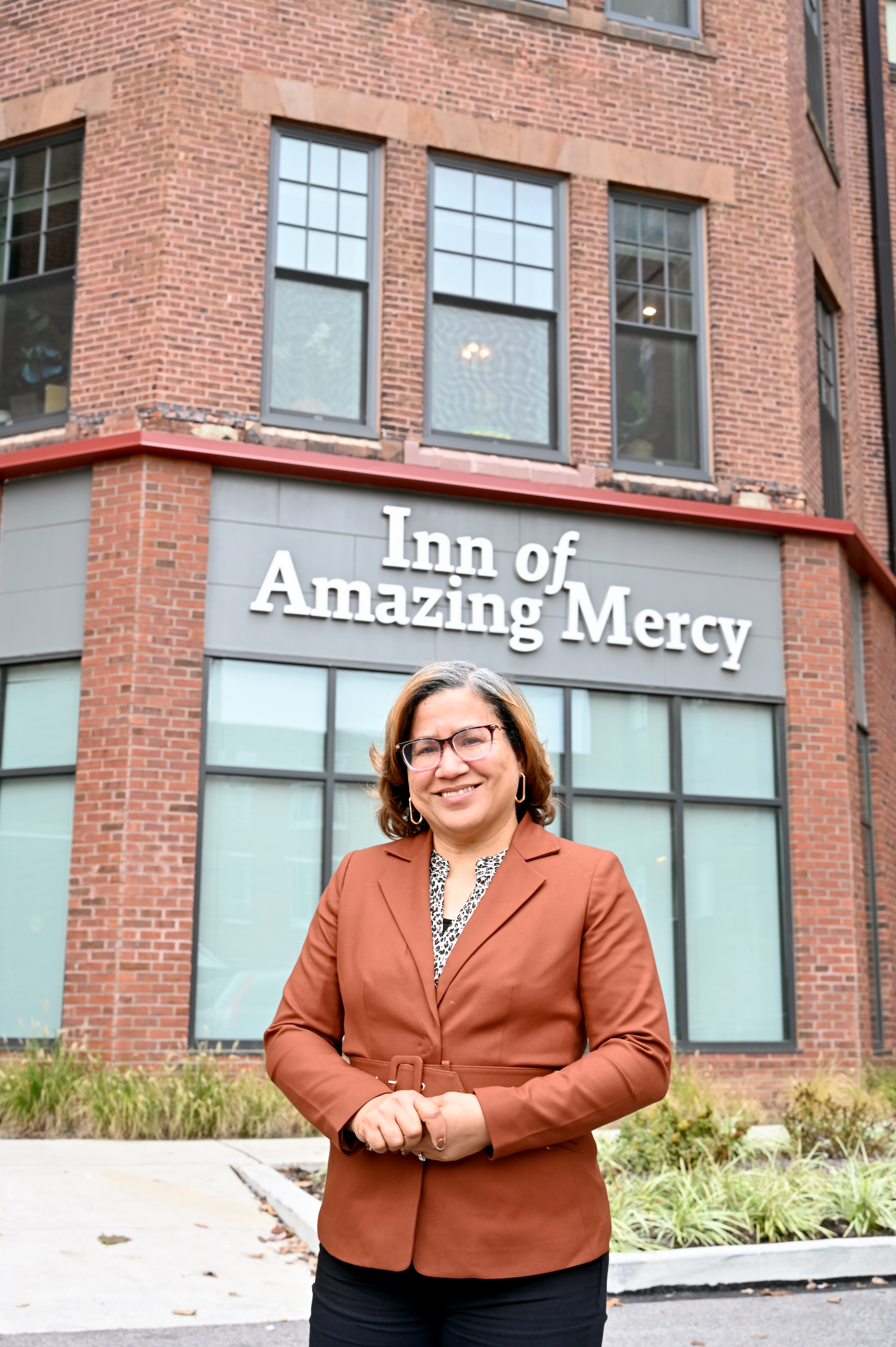
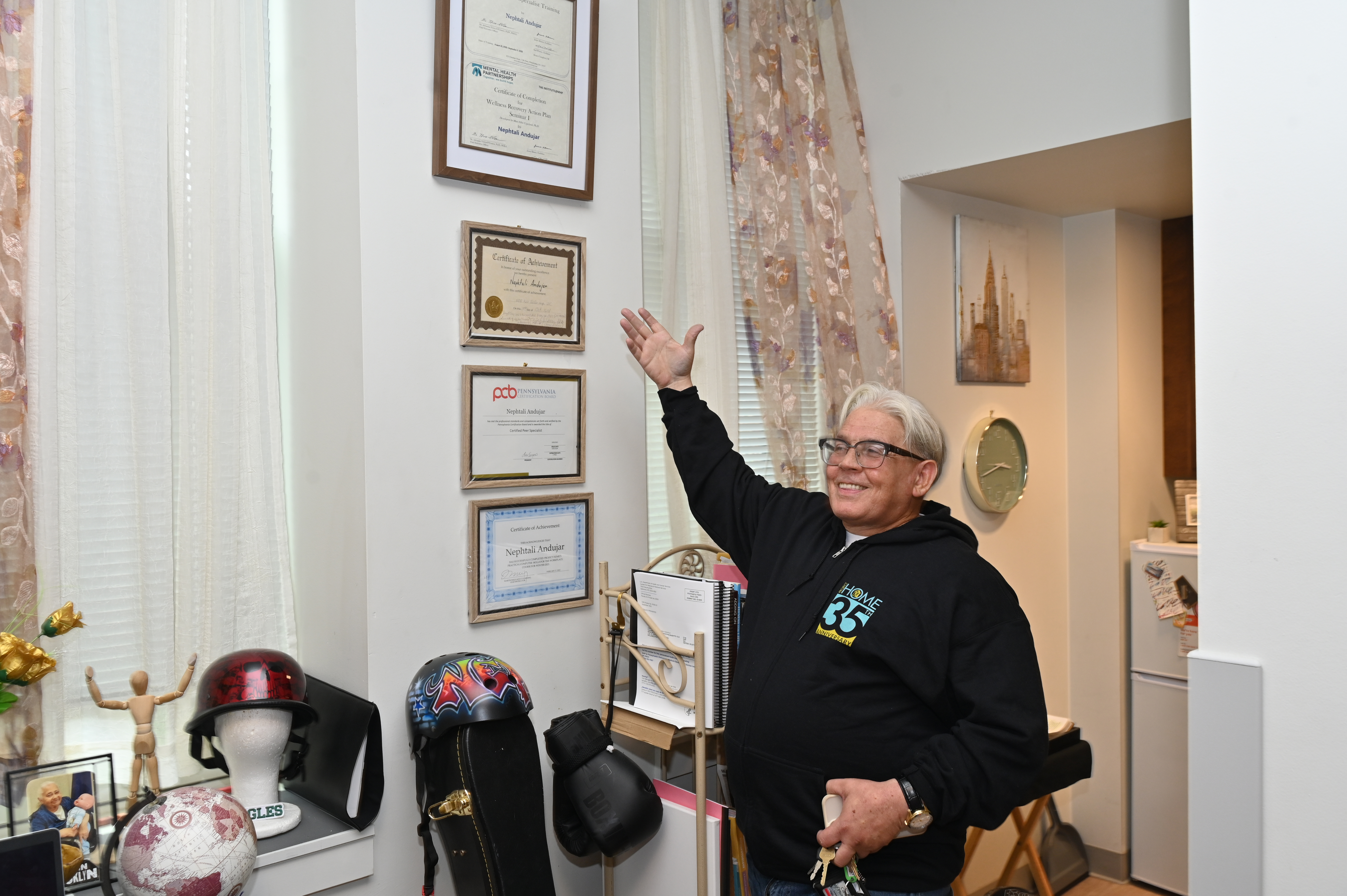
    Training certificates cover a wall in Nephtali Andujar’s studio apartment in Project HOME’s Inn of Amazing Mercy in Kensington.

    The “O” in HOME has to do with Opportunities for employment. Certificates cover one wall in Andujar’s studio apartment in Project HOME’s Inn of Amazing Mercy, a 62-unit apartment building and offices in a former nursing school dormitory in Kensington. He can point to his accomplishments in computer skills, barbering, and training as a peer specialist to help others the way the outreach worker helped him.

    But Andujar is not in good health, as vigorous as he appears. His addictions will someday exact their price, even though with cirrhosis of the liver, he is already living years beyond what his doctor predicted.

    Full-time work is not an option. So Andujar is part of the “E,” as in Education. Deni helped him get a grant to take art classes at Community College of Philadelphia. She helped him understand CCP’s education software so he could turn in his homework.

    Project HOME offers classes in graphic design, music production training, ServSafe food handling, forklift and powered industrial trucks certification, and website building, among other courses.

    The M stands for Medical. Project HOME doctors, nurses, and other health practitioners treat 5,000 people a year, both in a fully equipped health center and by sending medical teams into the streets, caring for people, literally, where they live.

    “My dad always told me that you need three things — housing, food, and love. You get all that here,” Andujar said.

    And for him, it goes beyond that. During a stable period in his life, Andujar had a partner and a child. His daughter is now 14 and living with her aunt in New Jersey. Her mother, who was also stable for many years, fell into addiction but is clean now. She is living in another Project HOME apartment.

    Like Andujar, Omayru Villanueva, 49, another resident at the Inn of Amazing Mercy, recalls her first night of homelessness.

    She remembered a cold slushy rain.

    She remembered sweeping every corner of her house, determined to leave it clean, no matter what. Her husband had been convicted and jailed for a federal crime. She couldn’t make the payments on the house, so she sold or stored all of her belongings and prepared to leave.

    On her last morning at home, she and her school-age twin sons walked out the door before the sheriff came. Her older daughter was able to find a place in a shelter. Her second daughter, just under 18, said she was living with a boyfriend, but it turned out that she had been trafficked.

    “There’s a sense of dignity and respect when you have your own place,” says Omayra Villanueva, another resident of the Inn of Amazing Mercy.

    By that evening, Villanueva was desperate. She took her boys to a hospital emergency room. At least they could sit indoors while she figured out something. “I was crying inside.” Finally, she called a friend from church who took her and her sons in.

    From there, they moved from shelter to shelter, and ultimately to a Project HOME apartment with two bedrooms.

    “That night we had a pizza party. We were so happy,” she said. “There’s a sense of dignity and respect when you have your own place. You can take your worries away from having a place to live, and you can focus on other things.”

    She remembered lying in her new bed, “thanking God and rubbing my feet against the mattress.” The next day, she woke up, opened the window, and listened to the birds. Then she asked her sons what they wanted for breakfast. “When you are in a shelter, you eat what they give you.”

    The simple pleasures.

    Three of her four children, scarred from the experience, have also been homeless and living on the street. Her two sons, now 23, are in Project HOME apartments. Both daughters are now fairly well-established.

    Villanueva appreciates the medical help she has been given at Project HOME, particularly for mental illness stemming from the trauma she has experienced with her ex-husband’s arrest and homelessness.

    “Anybody can end up being homeless,” she said. “I wasn’t a drug addict. I wasn’t an alcoholic. It can happen to anybody.”

    She thinks of her daughter, who has a house, a job, and a car. But if something happens to the car, her daughter won’t be able to get to work. She won’t be able to pay her mortgage, and she could wind up homeless. It’s that simple.

    “It’s important to donate because people can help break the cycle of homelessness,” Villanueva said.

    “It’s about housing and education. It’s about medical help. It’s about employment,” she said. “Project HOME helped me a lot.”

    The truth is that every person in Project HOME has a story. Those stories keep Donna Bullock, president and chief executive, motivated to preserve and protect the agency founded just over 35 years ago by Sister Mary Scullion and Joan Dawson McConnon.

    She worries about how the city will respond to federal executive orders amounting to the criminalization of homelessness. Will there be tightened requirements for agencies that provide shelter?

    Project HOME is reimbursed for some of the medical care it provides, but Bullock worries that new rules involving Medicaid reimbursement will impact the agency’s budget, while cutbacks in services increase demand.

    “It’s terrifying,” she said. “We know we have to do the most we can to preserve these resources that we’ve come to rely on.

    “In this job, I’ve learned to appreciate the humanity of folks — the residents and the stories they tell and the contributions they make to our community.”

    Sometimes, she said, Project HOME residents walking the path of recovery slip and fall away. Sometimes the results are tragic, the losses devastating.

    “We’re experiencing all these moments — communal grief and communal celebrations as well. We talk a lot about how every journey of recovery is unique. Everyone walks their own journey. We can’t do the walk for you, but we can walk with you,” she said.

    Bullock invites others to the journey, promising that when people give to Project HOME, they can be assured that their money is carefully managed. “We’re good stewards of the resources entrusted in our care. We know how to leverage the resources given to us.

    “Folks expect a return on their investment, and the return is the difference in individual lives and also building a community,” she said. “Your investment is magnified 10 times over.”

    This article is part of a series about Philly Gives — a community fund to support nonprofits through end-of-year giving. To learn more about Philly Gives, including how to donate, visit phillygives.org.

    For more information about Philly Gives, including how to donate, visit phillygives.org.

    About Project HOME

    Mission: To empower adults, children, and families to break the cycle of homelessness and poverty, to alleviate the underlying causes of poverty, and to enable all of us to attain our fullest potential.

    People served: More than 15,000 annually — with street outreach, housing, opportunities for employment, medical care, and education.

    Annual spend: $49.06 million

    Point of pride: Project HOME, which operates 1,038 housing units, broke ground in October for construction of 45 new apartments; also under construction are 20 respite beds. In the pipeline are an additional 44 apartments. Project HOME also operates the Honickman Learning Center Comcast Technology Labs, Stephen Klein Wellness Center, Helen Brown Community Center, and Hub of Hope.

    You can help: Volunteers tutor students, serve meals, participate in neighborhood cleanups, and organize donation drives at their organizations for household items or other items useful to families or people still experiencing street homelessness.

    Support: phillygives.org

    What your Project HOME donation can do

    Here are some ways that a gift can help the people we serve:

    $25 provides warm clothing and new socks for a visitor at the Hub of Hope.

    $50 supports a behavioral health counseling visit.

    $100 provides a month’s worth of hygiene products and toiletries for a family.

    $250 provides a welcome basket for a new resident complete with sheets, towels, and cooking supplies.

    $500 supports five dental visits at the Stephen Klein Wellness Center.

    $1,000 funds six weeks of summer camp at the Honickman Learning Center Comcast Technology Labs, keeping a child’s mind active during the summer and supporting moms who work.

    $1,500 funds a certification program through the Adult Education and Employment program leading to employment readiness.

  • A Fishtown-based nonprofit works to address the roots of trauma in children before crisis hits | Philly Gives

    A Fishtown-based nonprofit works to address the roots of trauma in children before crisis hits | Philly Gives

    Mellisa Wilson had been working hard — so, so hard — to change the trajectory of violence that marked her life and the lives of her five children when she saw something that broke her heart.

    Her youngest daughter was putting her baby doll to bed, “and she was hitting it,” Wilson said, choking back tears. “That’s when I knew it was really bad. That’s when I knew that wasn’t what I wanted them to take from me,” as a parent.

    And so, Wilson did what she had done many times before.

    She turned to the Children’s Crisis Treatment Center (CCTC) for help.

    In schools, homes, and community centers in Philadelphia, Montgomery County, and Camden, CCTC provides trauma-informed care annually to over 3,500 children, up to age 18, suffering from behavioral issues, depression, and trauma, helping their families in the process.

    “I knew I had to do something different,” Wilson said.

    Wilson, a CCTC volunteer and a member of the center’s parent advisory council, had been bringing her children to CCTC, a nonprofit children’s mental health agency, for 20 years.

    With all the counseling she and her children have received, she could easily give the same talking points as CCTC’s chief executive officer, Antonio Valdés.

    And she did.

    It may take years, she said, but when a child experiences trauma, at some point, sooner or later, there will likely be a behavioral issue.

    Wilson said she grew up in a home where she was regularly beaten with a broom handle or an extension cord. “Those were my grandmother’s favorites.” The trauma repeated itself across the generations when she became a mother.

    Mellisa Wilson, who now volunteers at the Children’s Crisis Treatment Center, said the group helped her realize she needed to end a generational legacy of corporal punishment as a parent.

    Always angry, she yelled at her children and spanked them, but only with her hands — at least she could give them that safety.

    But all of it had to end — for her own good, and for theirs. So she turned to CCTC for help.

    It’s a typical pattern, said Valdés.

    CCTC treats children who have experienced every kind of trauma and adversity — death of a parent, witnessing a parent be killed or beaten, attacks from dogs, sexual abuse, neighborhood violence.

    “We treat kids no matter what trauma they have,” he said. “For the vast majority, we’re talking about domestic violence, toward them or a family member, or maybe shootings they have witnessed.”

    But what’s just as significant, he said, is how CCTC treats everyone in its care. “It’s the lens we use,” he said, describing trauma-informed care. “We don’t ask what’s wrong with a child. We asked what happened.”

    For example, Valdés said, a young boy, maybe 5, sees his mother regularly beaten by her drunken boyfriend. “The kid may even try to intervene, but he’s only 5. What can he do?”

    Eventually, the mother gets rid of the drunken boyfriend. All seems normal until months or even years later, when she gets calls from school. Her child is fighting, destroying school property.

    “He’s still reacting to what he witnessed, and the behavior he developed at that time,” when he understood, as only a little child can, that his mother, the person who was supposed to be protecting him, couldn’t keep him, or herself, safe, Valdés said.

    Says Antonio Valdés, chief executive officer of the Children’s Crisis Treatment Center: “We don’t ask what’s wrong with a child. We asked what happened.”

    “Any moment he might feel even a little threatened evokes that response,” he said.

    “There’s a mistaken belief that young children, when they experience trauma, they’ll get over it,” Valdés said. “When trauma and adversity happen, there are normal consequences. It’s not normal for the kid to be OK.”

    Some parents bring their children to CCTC for counseling, or they get referrals from schools. More help, including a summer camp, is available at satellite community centers.

    At its headquarters on Delaware Avenue in Fishtown, CCTC runs a day treatment program for preschool-age children who have been kicked out of their preschools. There are day programs for children who have been discharged from psychiatric hospitals to help them reacclimate before returning to their schools.

    CCTC also provides behavioral health help at over 40 middle and elementary schools, where CCTC staffers work with teachers and students.

    Valdés remembered one little boy, about 10 or 11, who had been an average student — no trouble in school. His mother worked two jobs to make ends meet, and his grandfather took care of him, fed him dinner, helped with homework, and even put him to bed when his mom worked late.

    One Monday, the boy didn’t come to school — and it was so unusual that counselors reached out. On Tuesday, he did show up and, within hours, was fighting with kids and teachers. “They had already written up detention slips,” and it was so bad that harsher punishments were on the table.

    But then a counselor who had been trained by CCTC recalled what she had learned and asked the boy what happened. His grandfather had passed away on Saturday, and his mother had to go to work so she could pay the rent, leaving him to fend for himself.

    “In five minutes, they tore up the detention slips and had a different kind of conversation. It could have turned into something really bad for that boy. It’s those little moments that are critical,” Valdés said.

    In Philadelphia, he said, children in Kensington are suffering from the opioid crisis. When children leave the house, they see people shooting up and have to step carefully to avoid human feces or used needles. It’s not safe to play on the sidewalks or in the parks.

    “All of these things add up to a stressful environment,” he said. “There’s an impact of trauma and adversity on the way people start treating each other. It’s a behavior that’s adaptive to the trauma, the crisis, the ugliness,” but may not show up until later.

    “It’s highly contagious. Certain kinds of maladaptive behaviors may find themselves in families, in communities, in workplaces, or the way you might treat your girlfriend or wife,” Valdés said. “These behaviors were critical in surviving the moment,” but aren’t useful or appropriate in other situations.

    Healing comes from reframing — acknowledging realities but assuring the children that what happened was not normal and not their fault, then giving them techniques to cope positively when disturbing feelings arise, he said.

    “We’re treating kids and families, and we’re helping them heal,” he said. “Then they start to support their siblings or neighbors who have been through trauma. We see this as the counter to adversity and trauma.”

    Parenting skills Wilson learned at CCTC helped her help her children and regain control of her family, even as she was struggling to manage five youngsters under 5, including a set of twins.

    One child was inappropriately touched. Another child pushed Wilson against a wall and accused her of driving their father away. Another child, always her father’s favorite, said her father hated her. Another child hit a kitten.

    Tears filled Wilson’s eyes. “That was the trauma I put on them by hitting them and yelling at them.”

    Chaos and fatigue were constant, as was anger, yelling, and spanking. At CCTC, her kids got help, and so did she, learning new parenting techniques that led to a peaceful home with five children, now in their 20s and heading into professions to help others.

    Valdés said people should support CCTC because that healing is contagious, mending families and neighborhoods.

    Wilson agrees. “What I’ve learned, I’ve put into practice,” she said.

    Her story is so compelling, she said, that people at her overnight warehouse packing job turn to her for help. And she’s always ready to give it.

    “My favorite place is on the bus,” she said, where she’ll say hello and ask her fellow passengers about their day. “People will start talking to me. People are very honest when they think they are never going to see you again.”

    When Wilson wears her CCTC T-shirt as she often does, she wants to serve as a walking billboard for a nonprofit that has made a real difference in herself and her family. She vows to support the organization and its mission for the rest of her life.

    “We shouldn’t keep good things to ourselves.”

    This article is part of a series about Philly Gives — a community fund to support nonprofits through end-of-year giving. To learn more about Philly Gives, including how to donate, visit phillygives.org.

    For more information about Philly Gives, including how to donate, visit phillygives.org.

    About Children’s Crisis Treatment Center

    Mission: To support children and families by helping them heal from abuse, violence, and trauma by bringing mental health services to them where they are — at home, in schools, and in their communities.

    Children served: 3,500

    Point of pride: Started as a demonstration project in the basement of the Franklin Institute and is now in over 40 schools, up from 14 last year.

    Annual spending: Over $31 million in fiscal year 2024.

    You can help: Volunteers are needed to help with special events, the Holiday Toy Drive, or group day-of-service activities.

    Support: phillygives.org

    What your Children’s Crisis Treatment Center donation can do

    • $25 provides art supplies for an activity in one Therapeutic Nursery classroom (preschool-age children).
    • $40 purchases a gift for one child through our annual Holiday Toy Drive.
    • $100 provides one child attending our Summer Therapeutic Enrichment Program with educational program supplies.
    • $250 provides music therapy to one child attending our Cornerstone program (acute partial hospitalization for children ages 5 to 13).
    • $500 supplies a therapeutic counseling room with toys for play therapy.
    • $1,000 provides program activities, including field trips, for one child attending our Summer Therapeutic Enrichment Program.
  • For almost 40 years, Esperanza has served ‘the least of these’ and those who ‘just need a break’ | Philly Gives

    For almost 40 years, Esperanza has served ‘the least of these’ and those who ‘just need a break’ | Philly Gives

    Talk to most nonprofit chief executives, and they’ll be able, on cue, to recite a heartwarming story about someone their organizations helped.

    And the Rev. Luis Cortés Jr., Esperanza’s founder and chief executive, can do it, too.

    But he’d rather talk about a sin he committed as a little boy — a sin that impacted his thinking for a lifetime and allowed him to understand how to build a $111.6 million organization with 800 employees that educates, develops, uplifts, and houses 35,000 people a year in the heart of North Philadelphia’s predominantly Hispanic Hunting Park neighborhood.

    When Cortés was 12, he stole a Snickers candy bar from the bodega his father owned in New York City’s Spanish Harlem.

    Oh, his father figured it out, and quickly, too, because he began to ask little Luis some important questions:

    Did the 12-year-old know how many Snickers bars the bodega would have to sell to break even — not only on the box of Snickers, but on the taxes and utilities for the entire store? More importantly, how many Snickers bars would be required to turn a profit — a profit that could be reinvested?

    “You need to understand finance, whether it’s a box of Snickers or a multimillion-dollar bond to build a school. Where is the money coming from, and what’s the repayment structure?” Cortés said.

    Outside, as he spoke, a crane moved materials in what will soon become a new culinary school.

    “Understanding finance is important, and understanding culture is important, and you have to understand the relationship between the two.”

    So, yes, Cortés can and did tell the story about the mother who came to Esperanza to learn English skills, who got help to get a job and a house, who sent her daughter to Esperanza’s charter school and to Esperanza’s college, and now that same daughter is getting a house thanks to Esperanza’s mortgage counseling help.

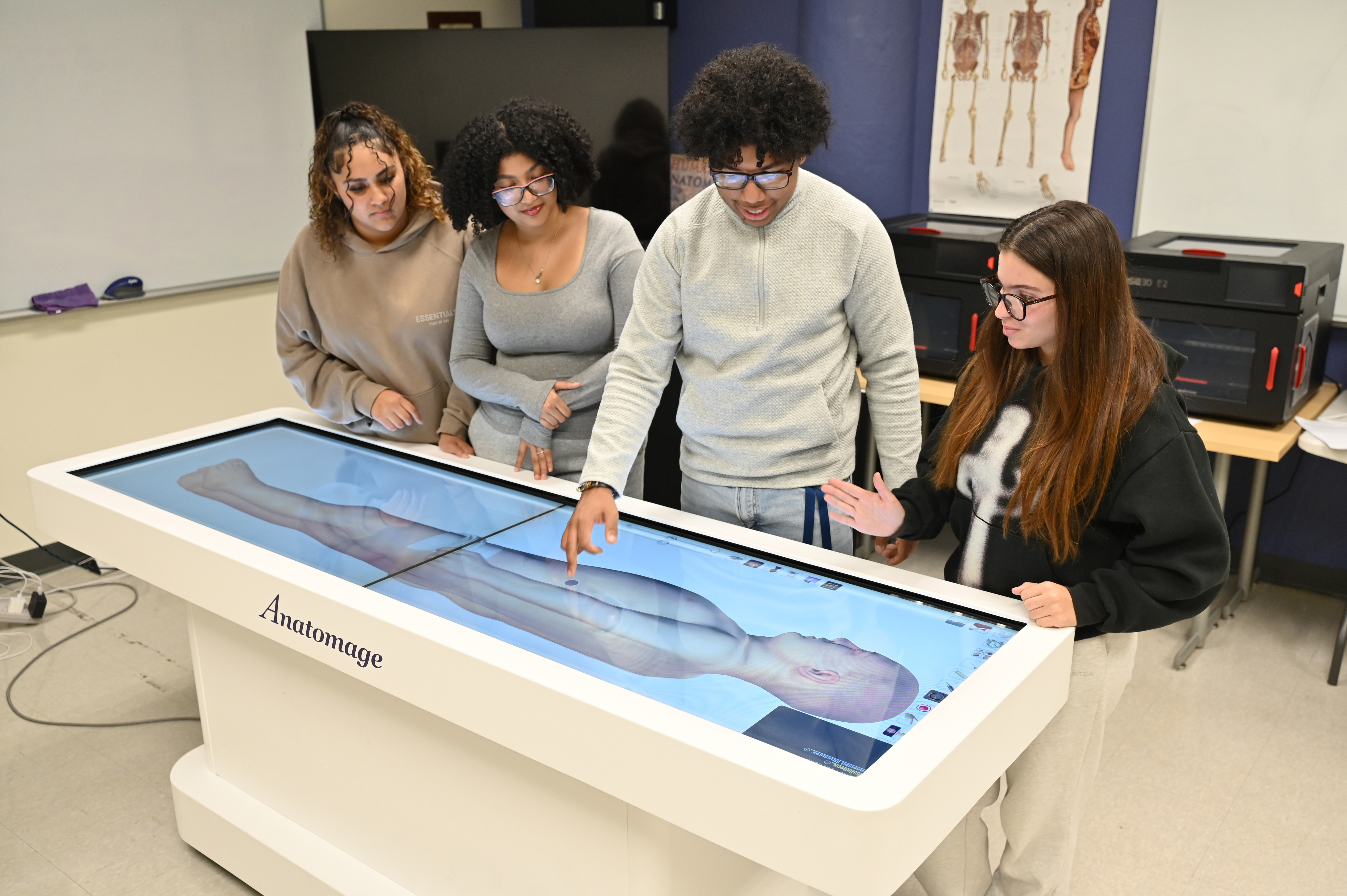
    Students Jayliani Casioano, Oryulie Andujar, Derek Medina, and Natalia Kukulski use an interactve anatomy table. The students are members of is the Health Occupations Students of America (HOSA).

    All good. But this is what Cortés really wants people to know:

    “If people trust us with their funds,” he said, “we’re putting the money into institutions, and institutions build culture.”

    That’s why Esperanza has a K-12 charter school, a cyber school, a two-year college that’s a branch campus of Eastern University, a 320-seat theater, an art gallery, computer labs, an immigration law practice, a neighborhood revitalization office, a CareerLink office for workforce development and job placement, a music program, a youth leadership institute, housing and benefit assistance, and a state-of-the-art broadcasting facility.

    Cortés even likes to brag about the basketball court. “Three inches of concrete, maple wood flooring, fiberglass backboards — NBA standards.”

    “Think about Paoli. It has a hospital, a public school, a theater. Paoli has all of that, and it’s understood that that’s the quality of life. We have to have access to those same things at a different price point,” he said. “Notice I didn’t say different quality. I said different price point.

    “We want to create an opportunity community, where people can have a good life — with arts, housing, healthcare, financial literacy, education, all those pieces — regardless of your family income,” he said.

    “What’s important here and what’s different is that in all our places, all our facilities are first class,” Cortés said.

    “I grew up in a low-income community where people were always telling you to step up, but step up to what?” he asked. “Where is the vision? What is possible to even have? How can anyone know unless they can see it?”

    So, when people from the community visit Esperanza, “you can see that you can have the best facilities with state-of-the-art equipment. As a provider of services, we have to step up,” he said, in turn always giving people the tools and resources they need to step up.

    For example, on Citizenship Day, Sept. 20, Anu Thomas, an attorney and executive director of Esperanza’s Immigration Legal Services, trained a dozen volunteer lawyers and law students on the fine points and recent pitfalls in the process of applying for citizenship.

    Soon, the room was crowded with people coming for help.

    Watching from the sidelines was Charlie Ellison, executive director of the city’s Office of Immigrant Affairs, who noted that an estimated 60,000 legal residents of Philadelphia are eligible to apply for citizenship.

    “Clinics like these are critically important to helping people who might be facing barriers,” including the cost of getting legal help. “This bridges a lot of gaps. It’s a vital mission, now more than ever,” he said.

    For Neury “Tito” Caba, a men’s fashion designer, tailor, and director of green space at Historic Fair Hill, citizenship help from Esperanza was a family affair. Through Esperanza, he, his grandmother, and his mother all became citizens.

    “Now I can vote, and that’s the most positive thing I can do,” he said. “And also, things being the way they are, it gives me some sort of protection.”

    Fashion designer Neury “Tito” Caba talks about his citizenship experience at Esperanza.

    Earlier this fall at Esperanza’s CareerLink branch, counselor Sylvia Carabillo helped Luis Rubio on the computer. He was trying to extend his unemployment benefits and looking for a job as a security guard. Agueda Mojica was being tutored in Esperanza’s most popular workforce class: Introduction to Computers.

    “I want to become more independent to be able to do anything on a computer,” she said in Spanish, speaking through a translator. “I was always working and never had time to learn.”

    Much of Esperanza’s staff is bilingual in Spanish, but to help people from the neighborhood, Esperanza also hired counselors who speak Ukrainian and Kreyòl for Haitians who live nearby.

    In Esperanza College classrooms a few weeks ago, Esperanza Academy high schoolers enrolled as college students had just finished a chemistry exam. When they graduate from high school, they’ll already have associate degrees on their résumés.

    For them, Esperanza represents a future.

    There’s Oryulie Andujar, 18, who wants to study sonography because an ultrasound technician found a cyst in her mother’s uterus. “We could have lost her. That was very impactful for me.”

    Jayliani Casiano, 17, wants to go into anesthesiology. The oldest of seven, she witnessed her mother giving birth to several younger siblings. “She was in a lot of pain. It was interesting. I want to do everything after seeing her through that process.”

    Derek Medina, 18, said the opportunity to go to college “made me rethink my whole life.” He had been getting into trouble in school, but now wants to combine a love of mathematics and a desire to help people by going into the field of biomedical engineering.

    Recently, on Nov. 14, Esperanza College hosted its Ninth Annual Minorities in Health Sciences Symposium, designed to acquaint high schoolers with medical careers.

    Construction will soon begin to convert a former warehouse space into a center to teach welding and HVAC in an apprenticeship program.

    Next month, it’ll be time for “Christmas En El Barrio” with music, food, and community in Teatro Esperanza — admission is free. In January, the Philadelphia Ballet will perform there. Tickets are $15 and free for senior citizens and students.

    “My worst seat — in Row 13 — would be $250 at the Academy of Music,” Cortés said. He wants to offer the arts at a price and a time available to a mother of three, who may not be able to afford even the cheapest seats in downtown venues, plus bus fare, “and heaven forbid the child wants a soda,” Cortés said.

    All this adds up to culture, which brings him back to the Snickers bar, and not just breaking even, but investing.

    Other groups, Cortés said, had to build their own institutions when mainstream organizations put up barriers. Howard University helped Black people, Brandeis served Jewish people, and Notre Dame provided education to the Irish.

    Building an institution is his investment goal with Esperanza, and he takes as his mentors famous Philadelphia pastors such as the Rev. Leon Sullivan, who founded Progress Plaza in North Philadelphia, and the Rev. Russell Conwell, the Baptist minister who founded Temple University.

    “Philadelphia has a tradition that its clergy don’t just do clergy things,” he said, admitting that he doesn’t have the patience for a more traditional pastor’s role. “As clergy here, it’s understood that we snoop around everything.”

    Cities sometimes brag that their poverty rates have declined, he said, when in reality, rates have declined because people with low incomes were forced to move away.

    Philadelphia, he said, has a chance to be different — to lower the poverty level both by raising people’s incomes and improving their standards of living. “There should be Esperanzas in every neighborhood,” he said.

    “How can we focus on helping the people who just need a break?” Cortés said, referencing Jesus’ admonishment to “help the least of these.”

    “This city has the opportunity to make this a win-win,” he said, “to show the rest of the country and Washington, D.C. — especially Washington, D.C. — that people who are different, and people who are `the other’ can be supported, so that they are not only part of the fabric of the city, but economic drivers of the city.”

    This article is part of a series about Philly Gives — a community fund to support nonprofits through end-of-year giving. To learn more about Philly Gives, including how to donate, visit phillygives.org.

    For more information about Philly Gives, including how to donate, visit phillygives.org.

    About Esperanza

    People Served: 35,000

    Annual Spending: $111.6 million across all divisions

    Point of Pride: Esperanza empowers clients to transform their lives and their community through a diverse array of programs, including K-14 education, job training and placement, neighborhood revitalization and greening, housing and financial counseling, immigration legal services, arts programming, and more.

    You Can Help: Esperanza welcomes volunteers for community cleanups, plantings, and other neighborhood events. Some programs also need volunteers with specific skills (lawyers, translators, etc.).

    Support: phillygives.org

    What Your Esperanza Donation Can Do

    • $25 covers the cost of one private music lesson for a young student through our Artístas y Músicos Latinoamericanos program.
    • $50 provides printing and distribution of 30 “Know Your Rights” brochures to immigrant families.
    • $100 pays for five hours of training for a new mentor fellow at the Esperanza Arts Center, preparing a young person for a career in arts production through hands-on learning.
    • $275 funds the planting of one street tree in a neighborhood that desperately needs additional tree cover to address extreme heat.
    • $350 covers tuition and books for one English as a second language student at the Esperanza English Institute.
    • $550 supports the cost of the initial work authorization for an asylum-seeker.