Ghostly films will meet ghosts of department stores past in a pop-up film series leading up to Halloween. Film historian and former Inquirer film critic Carrie Rickey has curated five silent films from the 1920s to be shown at the Pipe Up! series in the Wanamaker Building — each one accompanied by live organ.
Among the films being screened are Robert Wiene’s The Cabinet of Dr. Caligari (1920) and F.W. Murnau’s Nosferatu (1922) and Faust (1926).
“What was scary a century ago when the great German filmmakers invented these templates of the modern horror movie aren’t exactly spine-tingling today,” said Rickey. “But they are creepy, in the manner of folk and fairy tales — and artists like Hieronymus Bosch. They get under the skin. And they’re inventive.”
Also being shown are two lesser-known Swedish films: Victor Sjöström’s The Phantom Carriage (1921) — “a huge influence on Ingmar Bergman,” says Rickey — and Häxan (1922), Benjamin Christensen’s film purporting to be documentary.
“It hypothesizes what medievalists called possessed nuns and black sabbaths, and what Freud would call female hysteria. It is the earliest example of goth horror that I’ve ever seen,” Rickey said.
The screenings are scheduled to take place in the Wanamaker Building’s Greek Hall, which means the musical accompaniment will be played on an instrument that gets considerably less attention than the one in the Grand Court.
That smaller instrument is a theater organ, a restored 1929 Wurlitzer originally from the Fox Theatre in Appleton, Wis.
“It’s pristine, it hasn’t been fooled with like a lot of Wurlitzers,” said Friends of the Wanamaker Organ president Ray Biswanger. “It’s got a lot of color in it and represents well the experience of hearing a silent movie.”
Organists have different approaches to scoring silent film, said Peter Richard Conte, the Wanamaker Grand Court organist who is playing two of the five nights. His method is to watch the film 10 to 15 times, prepare a cue sheet, and play leitmotifs (recurrent themes) for various characters and places.
“And you just watch the film like a hawk and improvise,” he said.
Conte tends to avoid tucking in popular tunes or familiar musical references. “It distracts from the film. It can be cute and occasionally I will do it, but almost like a joke. What you want to do is disappear. If the audience forgets that you’re there,” Conte says, “that’s the biggest compliment I can get.”
The lineup: Monday, “Faust,” organist Ian Fraser; Tuesday, “The Phantom Carriage,” organist Don Kinnier; Wednesday, “Nosferatu,” organist Peter Richard Conte; Thursday, “The Cabinet of Dr. Caligari,” organist Peter Richard Conte; Friday, “Häxan,” organist Don Kinnear.
Screenings begin at 7 p.m. at the Wanamaker Building, 1300 Market St. Admission is free with advance registration. operaphila.org.
Conte will also perform on the Grand Court Organ for a live-to-screen presentation of the 1925 film “The Phantom of the Opera,” Nov. 10 at 7 p.m. The event is free and requires no advance registration.
After the success of its world premiere adaptation of James Baldwin’s Giovanni’s Room, Quintessence Theatre Company is back. In collaboration with the New Classics Collective, it’s now presenting the world premiere of Fire!! by Paul Oakley Stovall and Marilyn Campbell-Lowe.
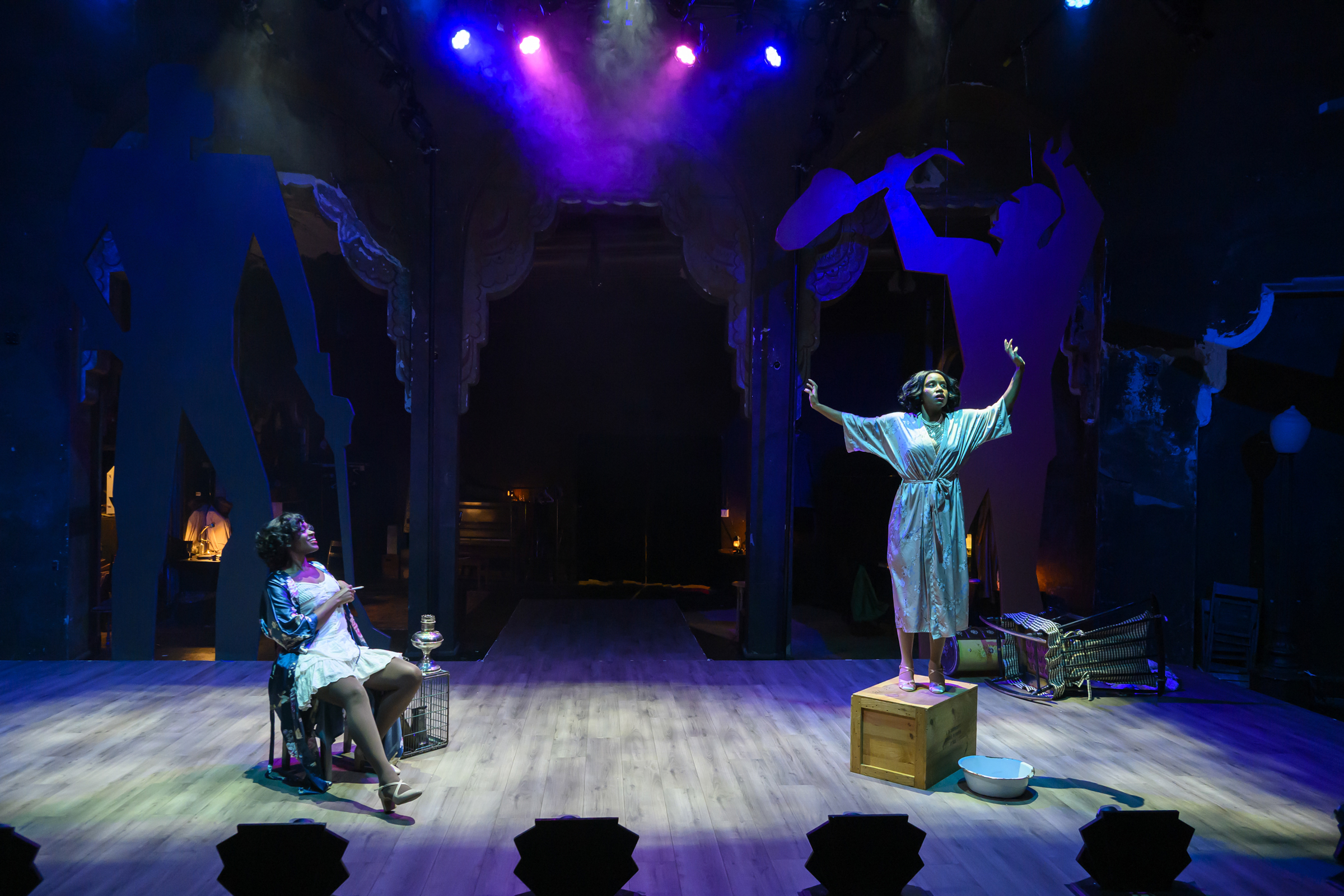
The play seeks to reimagine the 1927 quarterly publication Fire!!, the first all-Black magazine in the country, as a stage production. Throughout the show, audiences are treated to staged performances of plays, stories, and poems by some of the great writers of the Harlem Renaissance, including Zora Neale Hurston and Langston Hughes.
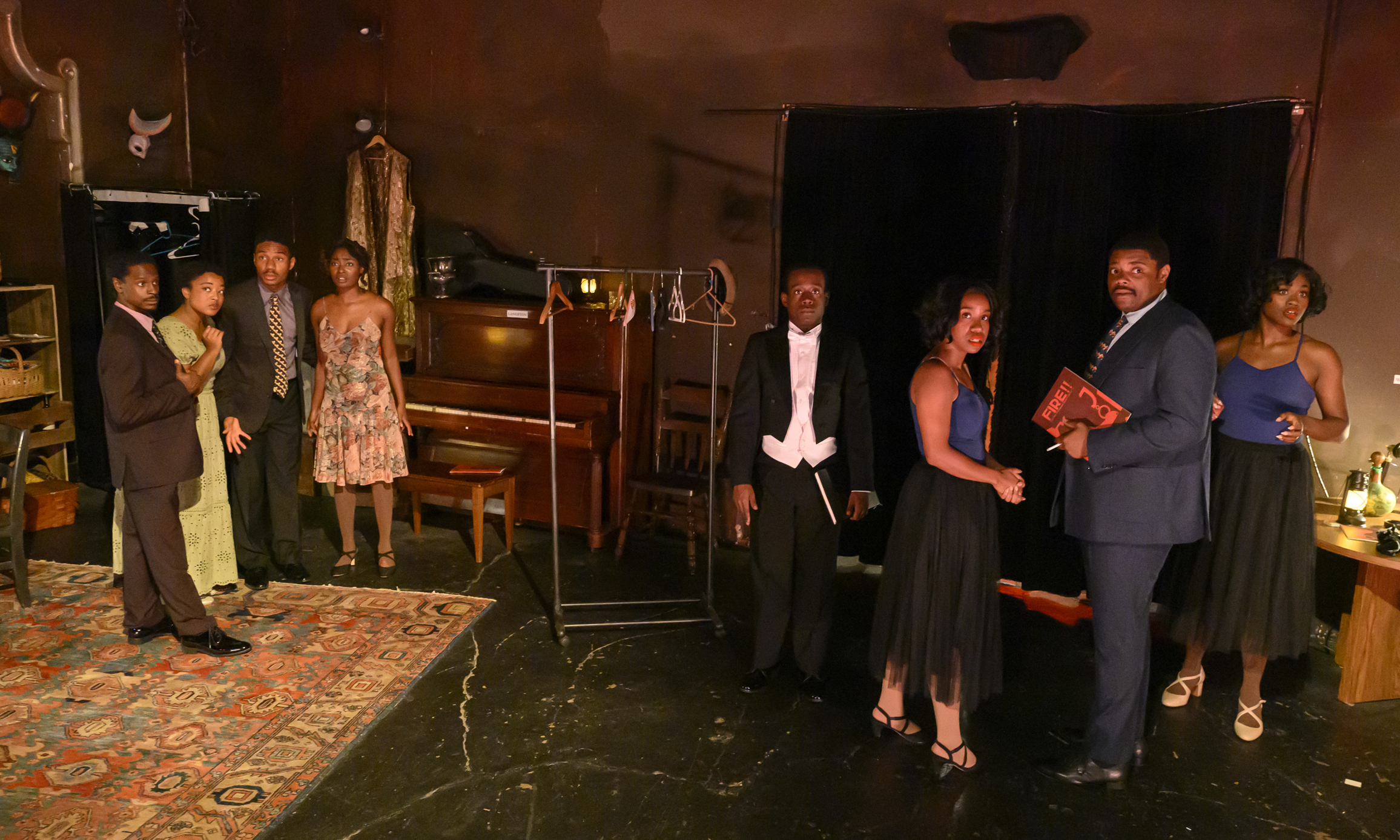
Seeking to offer audiences a more immersive experience, director Raelle Myrick-Hodges begins the play in the historic Sedgwick Theater’s lobby, with performers in suits and flapper dresses. The 1928-built lobby throbs with life, making you believe you are in 1920s Harlem. Wallace Thurman (Kaisheem Fowler-Bryant), one of the editors of Fire!!, introduces himself and his fellow editors and explains that the night’s performances are part of a fundraiser to raise money for the magazine.
From left: Taylor J. Mitchell (as Gwendolyn Bennett) and Alicia Thomas (as Zora Neale Hurston) in Quintessence Theatre’s “Fire!!”
Zora Neale Hurston (Alicia Thomas) introduces herself soon after, but it’s hard to hear her over the rumbling of a wheeled platform stage being ushered into the lobby. This later serves as the train for the first scene of Hurston’s play Color Struck.
While it is admirable for Quintessence to use the Sedgwick in new and different ways, the echoing sound quality of the lobby leaves things feeling under-produced.
The audience eventually makes its way into the house. The theater’s arching pillars remain visible as a “backstage” space throughout the play — without the black curtains, this adds to the echo in the lobby.
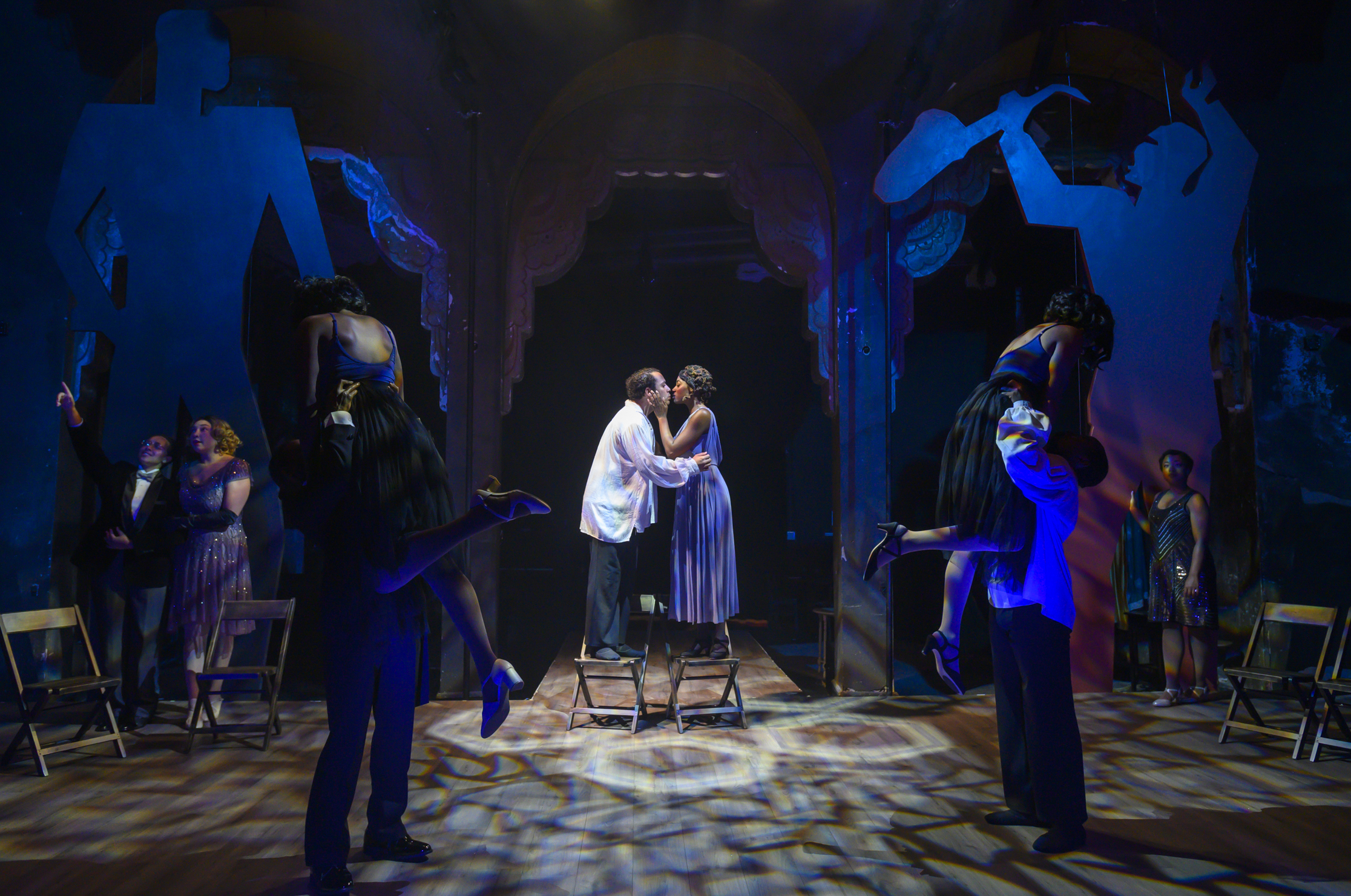
Charlie Bay (as Richard Bruce Nugent) and Imani Lee Williams (as Melva) in Quintessence Theatre’s “Fire!!”
Inside, the play continues, flipping between staged presentations of pieces that were published in Fire!! and the imagined drama of the editors hoping to appeal to patrons and fund the publication.
This invented drama is interesting but feels under-realized. For one thing, this is the actual conflict of the play, but all the action happens upstage of the “stage” and presents a myriad of sight line issues depending on where audiences are seated in relation to the pillars on stage. The audibility issues persist, making it difficult to hear actors, especially when they are fighting over any sound cues or underscoring.
The conflict of the play boils up when Thurman voices hesitancy toward presenting his lover Richard Bruce Nugent’s novel, which features queer characters. This conflict, while seeming to be the crux of the entire play, easily resolves itself within the performance of Nugent’s story, and is barely addressed later.
From left: Imani Lee Williams, Taylor J. Mitchell, Nichalas Parker (as Paul Watson), Alicia Thomas, and Ivana R. Thompson in Quintessence Theatre’s “Fire!!”
The behind-the-scenes tension, which is the through line of the plot, feels almost forgotten by the time the house lights are back up.
The staged presentations of works from Fire!! are, however, alive and well-executed.
At a time of extreme political division, it is important to celebrate joy — especially Black joy. It is timely to witness Quintessence recall the Harlem Renaissance and its resistance with fondness.
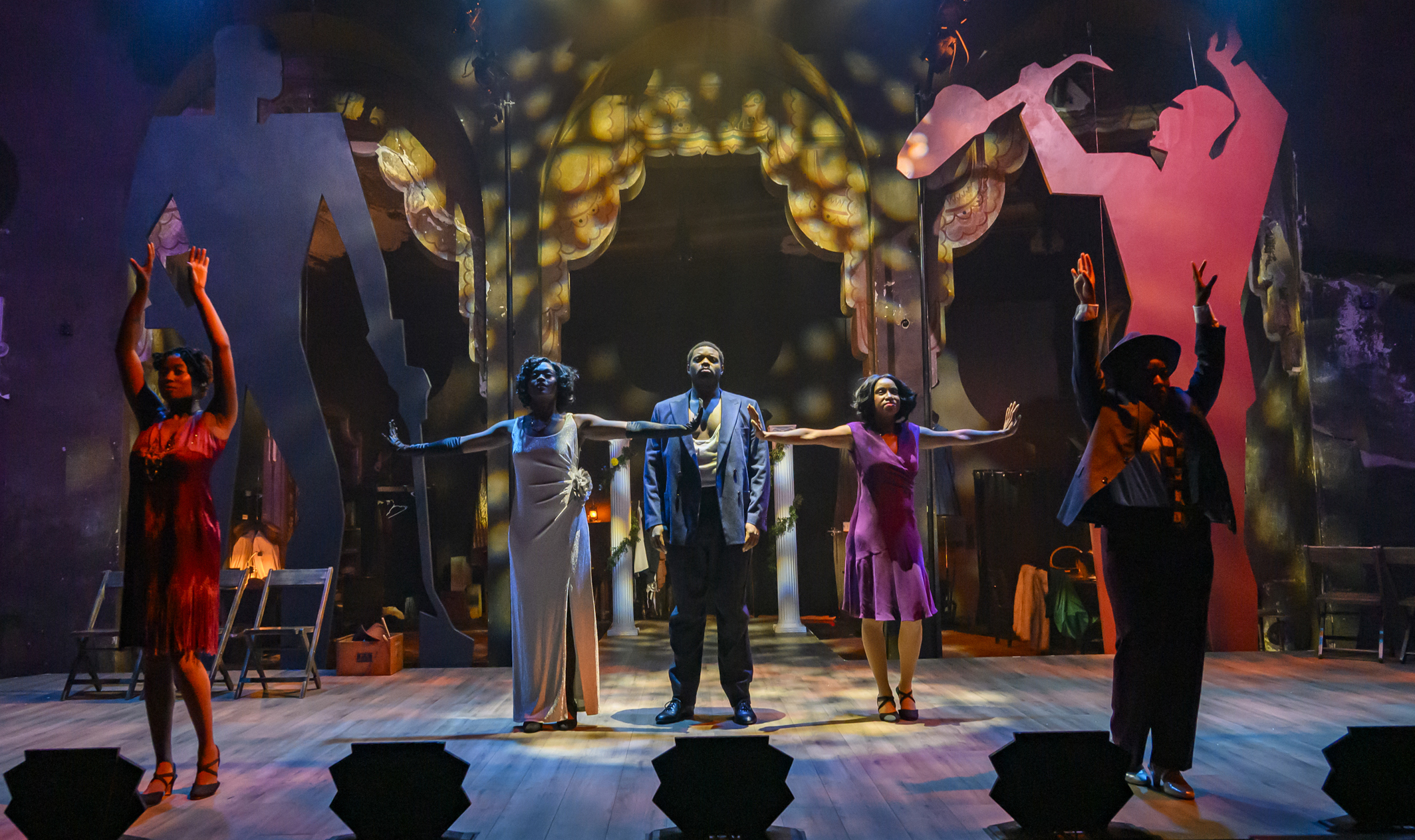
The stagings are ripe with music and dance. Xavier Townsend, who plays Aaron Douglas, in particular dazzles the audience with high kicks and spins, and Jordan Fidalgo’s Helene Johnson blows the audience away with her musical rendition of Johnson’s poem “A Southern Road.” The poems of Langston Hughes and Gwendolyn Bennett speak for themselves and are well orated by Nicholas Parker and Taylor J. Mitchell, respectively.
From left: Xavier Townsend (as Aaron Douglas), Ivana R. Thompson (as Dorothy West), Tyler Bey (as Arthur Huff Fauset), Imani Lee Williams (as Georgia D. Johnston), Kaisheen Fowler-Bryant (as Wallace Thurman), Alicia Thomas (as Zora Neale Hurston), Nichalas Parker (as Langston Hughes), and Taylor J. Mitchell (as Gwendolyn Bennett) in Quintessence Theatre’s “Fire!!!”
Quintessence and the New Classics Collective are, as usual, impeccable with their selection of source material. The selected works from Fire!! are dynamic and fascinating stories that investigate the issues of the 1920s and today.
Audiences seeking to hear works of the Harlem Renaissance will be overjoyed by this production, if a bit confused by the subplot.
‘Fire!!’
(Community/Arts)
The story of the country’s first all-Black magazine, and the fight to keep it afloat, gets told in this 1920s Harlem Renaissance-set play. With Zora Neale Hurston and Langston Hughes making an appearance, Fire!! is a celebration of Black joy and resistance, and a delight to witness.
On Tuesday, Harper — an imprint of HarperCollins Publishing — announced the release of Shapiro’s forthcoming memoir, Where We Keep the Light: Stories From a Life of Service, which will hit shelves on Jan. 27, 2026.
Shapiro, 52, has worked in some level of government for his entire career: on Capitol Hill as a staffer, in Montgomery County as a commissioner, and in Harrisburg as a state representative, attorney general, and now governor. He has noted that he has never lost an election, going back to his election as student body president his freshman year at the University of Rochester. Along the way, elected officials have whispered about his talents as a politician, orator, and rumored presidential ambitions.
The Montgomery County native has become a key player in the national Democratic Party, touting a brand as a governor of a split legislature in the most sought-after swing state. His administration’s motto is “Get Stuff Done,” which he defines as bringing Democrats and Republicans together to accomplish long-delayed reforms, or restarting residents’ trust by improving their interactions with state government. (Pennsylvania still has not finished its state budget, which was due July 1, as legislators from the Democratic-controlled House and GOP-controlled Senate cannot agree on how much they should spend this fiscal year and causing school districts, counties, and nonprofits to take out significant loans to continue offering services during the 113-day budget impasse.)
Shapiro’s rise through the Democratic Party ranks skyrocketed last year, when he became a front-runner for vice president during Harris’ whirlwind, 107-day presidential campaign, in which she ultimately chose Minnesota Gov. Tim Walz as her running mate. Harris also released a book this year, which includes stories from her interview with Shapiro for the role.
Shapiro, who was born in Kansas City, Mo., before moving to Montgomery County, has credited his upbringing by his parents — his father a pediatrician, and his mother an educator — as laying the foundation for his life in public service. Shapiro has four children and is married to his high school sweetheart, Lori. He and his family still live in Abington Township and split their time between their family home and the governor’s mansion in Harrisburg.
The Barrymore Awards celebrated the best of Philadelphia’s regional theater Monday night at Temple Performing Arts Center, where Theatre Philadelphia spotlighted about 50 nominated productions from the 2024-25 season. Twenty-one awards were presented to 13 local companies.
The top winners were Old City’s Arden Theatre Company and Olde Kensington’s Pig Iron Theatre Company, which each took home four Barrymores. Center City’s Wilma Theater — the 2024 Regional Theatre Tony Award recipient — and Inis Nua Theatre Company earned three awards apiece for multiple productions.
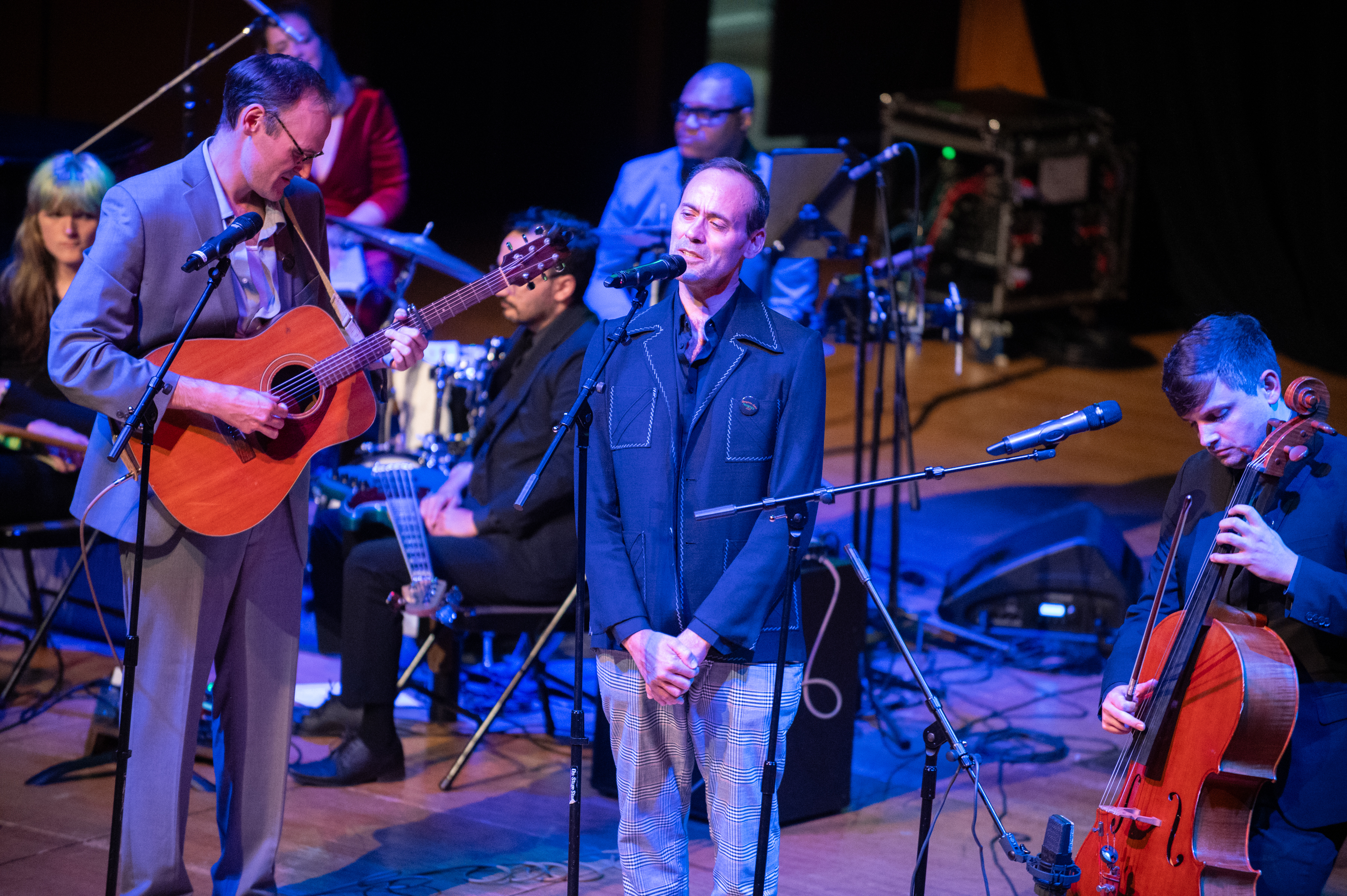
Dito van Reigersberg (center) performs at the 2025 Barrymore Awards on Monday, Oct. 20, 2025.
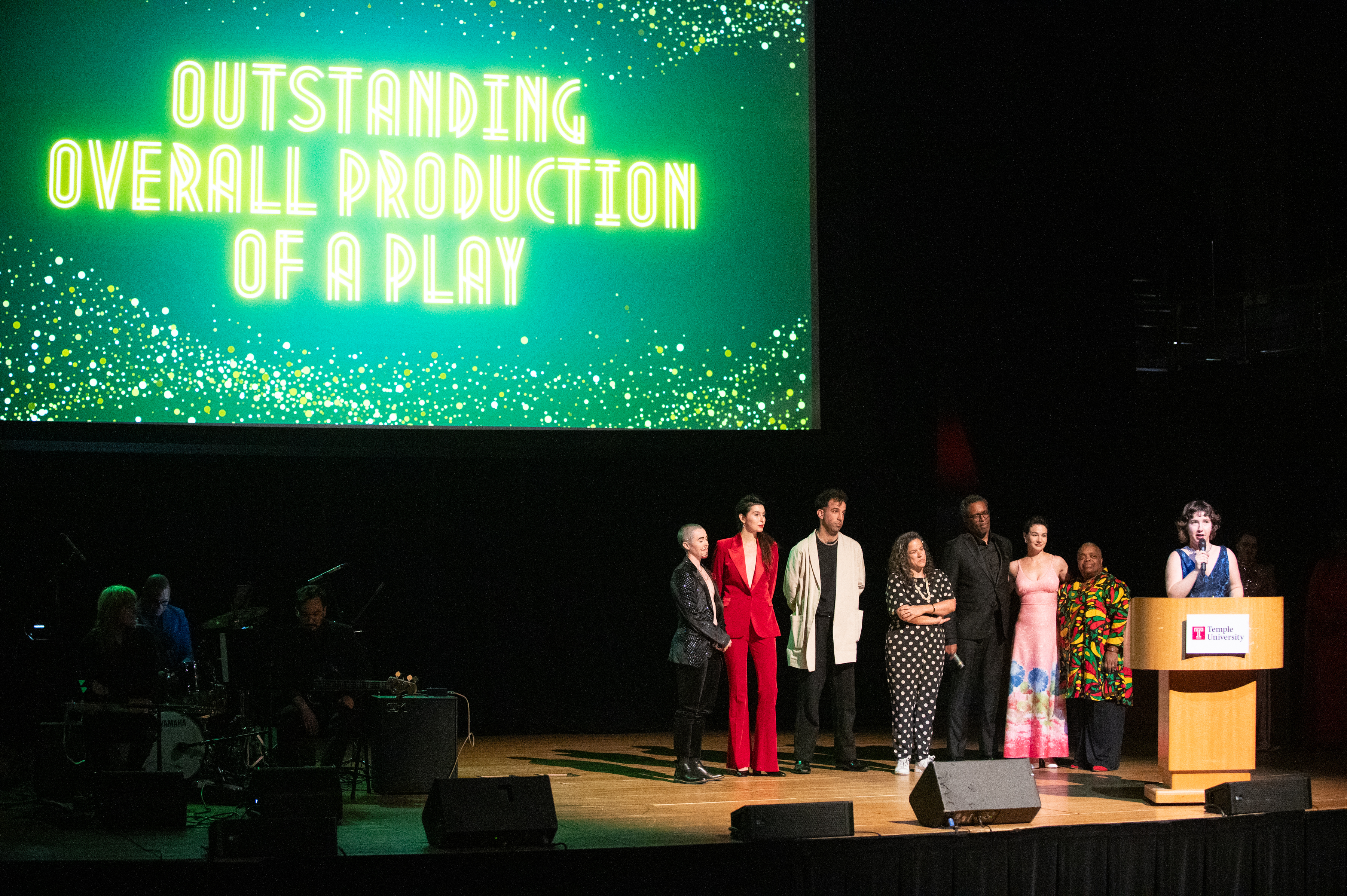
The Wilma’s production of Branden Jacobs-Jenkins’The Comeuppance, a spooky-tinged millennial drama directed by Wilma co-artistic director Morgan Green, won three awards: outstanding overall production of a play, outstanding ensemble in a play, and outstanding sound design for Jordan McCree.
“The Comeuppance brings the drama of diverging politics and experiences to a microscopic, interpersonal level,” wrote Krista Mar in her Inquirer review. “No one character is a hero, as each of them wins our empathy, especially when possessed by Death, and then loses it. The play holds a mirror to the audience and makes them confront their own biases, assumptions, and judgment.”
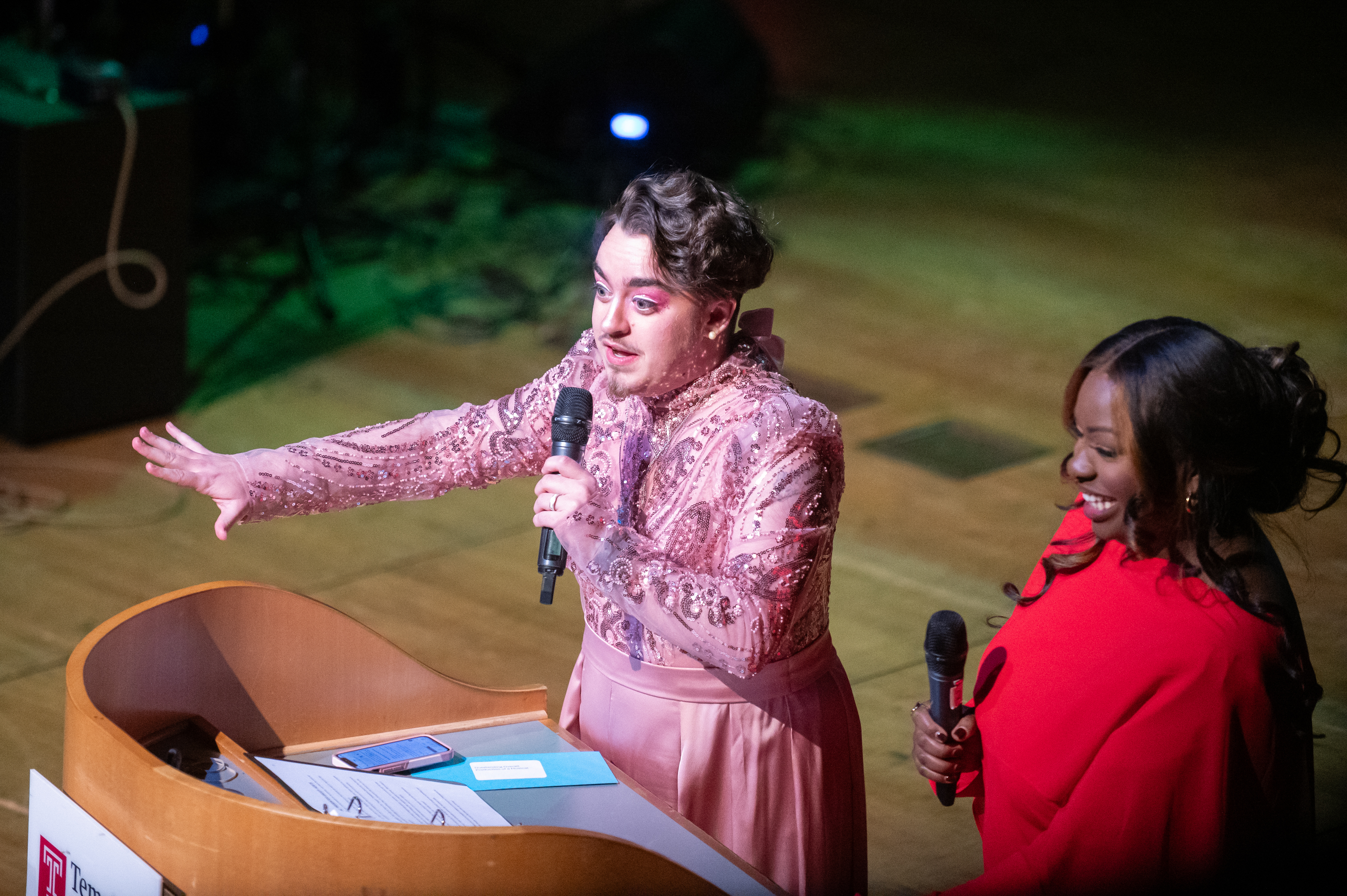
CJ Higgins, Interim Executive Director of Theatre Philadelphia, cohosts the 2025 Barrymore Awards ceremony with Aunyea Lachelle, entertainment and lifestyle anchor for NBC10’s Philly Live at the Temple Performing Arts Center in North Philadelphia on Monday, Oct. 20, 2025.
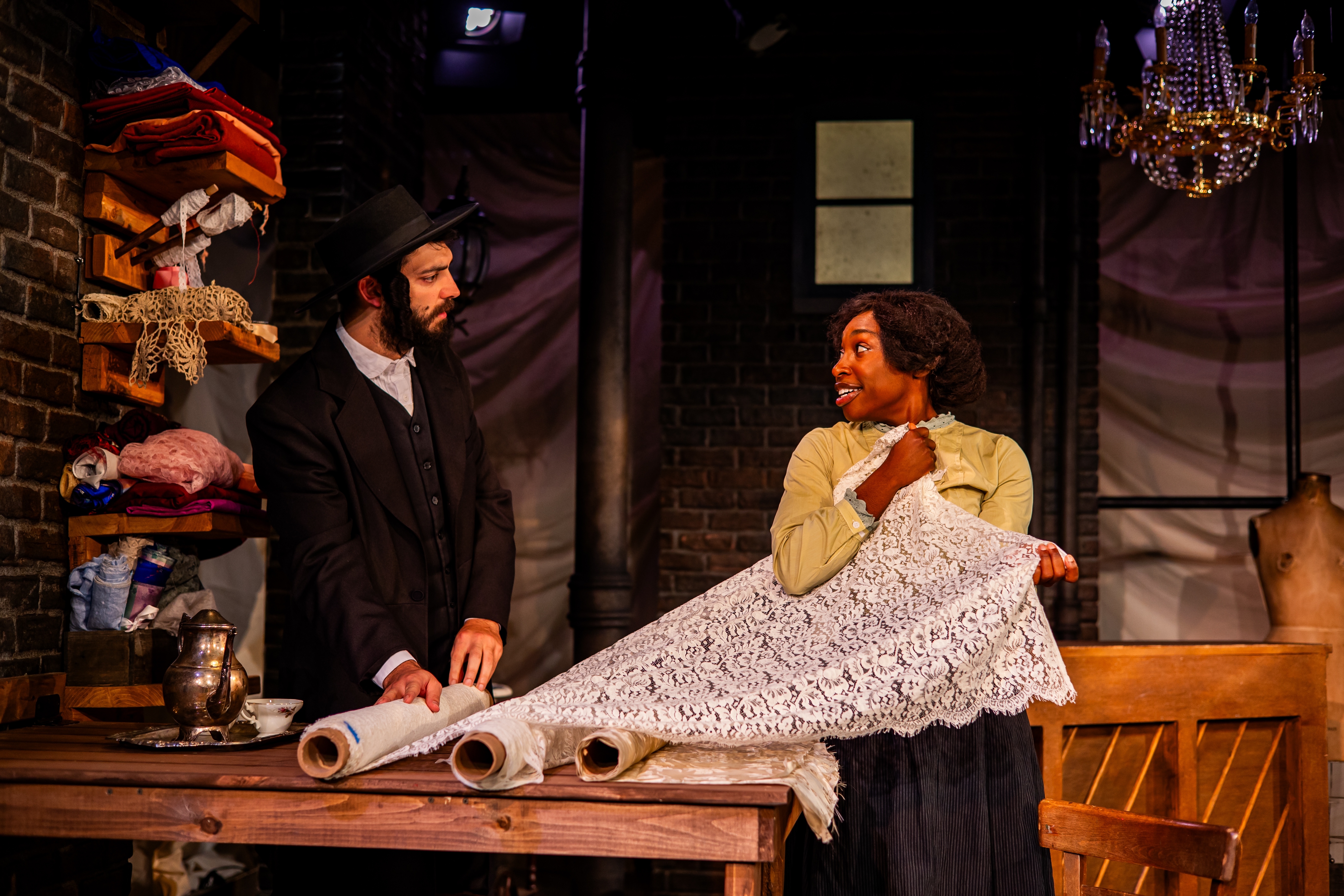
Arden Theatre’s Intimate Apparel, a touching tale from Pulitzer-winning playwright Lynn Nottage about an African American seamstress hoping for romance, won two Barrymores. Amina Robinson earned outstanding direction of a play, and David Pica, who played love interest Mr. Marks, received outstanding supporting performance in a play. Robinson has previously won two Barrymore Awards for directing a musical for The Color Purple at Theater Horizon and Once on This Island at the Arden.
Kishia Nixon, the actor behind interior designer Thalia in R. Eric Thomas’ Glitter in the Glass at Theater Exile, also won for outstanding supporting performance in a play. The Inquirer review called the new work “a nimble, nerdy, and very funny play that tries to answer some very tough questions.”
For outstanding leading performances in a play, both awards went to the stars of InterAct Theatre Company’s Rift, or White Lies. Matteo Scammell and Jered McLenigan played two brothers on opposite sides of the political spectrum and each night they alternated roles. (The Barrymores does not divide acting award categories by gender.)
The cast and crew of the play “The Comeuppance” accept the award for Outstanding Overall Production of a Play at the 2025 Barrymore Awards at the Temple Performing Arts Center in North Philadelphia on Monday, Oct. 20, 2025. The Barrymore Awards spotlight the best musicals, plays, actors, directors, and backstage creatives in the Philadelphia region
In musical categories, Pig Iron Theater’s production of Poor Judge, which ran at the Wilma Theater as part of the 2024 Fringe Festival, took home three awards: outstanding overall production of a musical, outstanding media design for Mike Long, and outstanding music direction for Alex Bechtel.
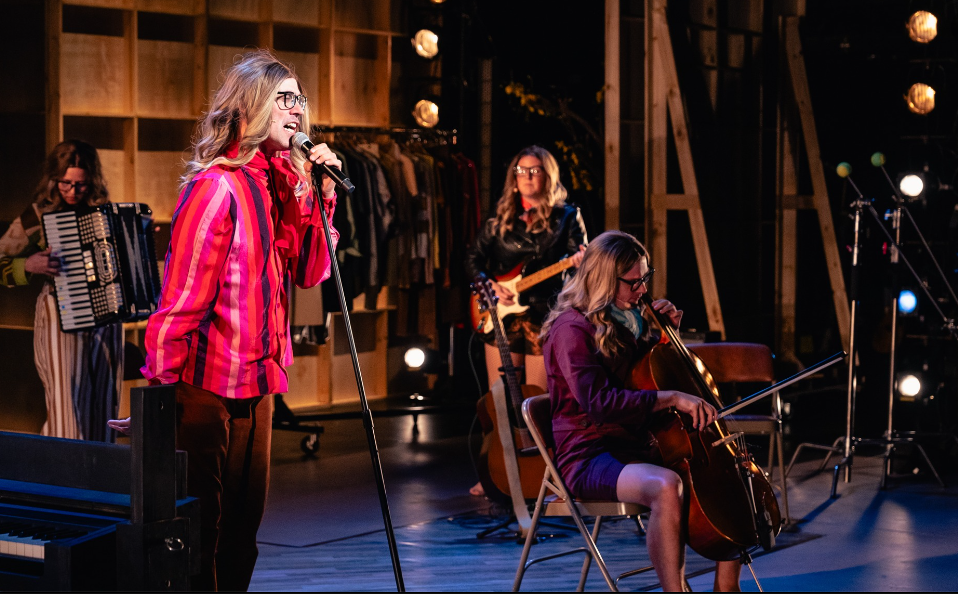
The eccentric show, conceived and led by Philadelphia legend Dito van Reigersberg (aka Martha Graham Cracker), is a trippy journey through alt-rock singer Aimee Mann’s catalog, enhanced by fascinating live video taping.
Everyone in the ensemble for the September 2024 production played Aimee with delightfully weird and unexpectedly profound results. It was such a success that the Wilma is bringing it back for another run in January.
Dito van Reigersberg in the 2024 Fringe Festival’s production of ‘Poor Judge.’
Bechtel also won the award for outstanding original music for People’s Light’s production of Peter Panto: A Musical Panto. It’s the second year in a row that the composer has been recognized for his original music; last year he won for Alice in Wonderland: A Musical Panto.
Peter Panto earned another Barrymore as well: Connor McAndrews, who played Smee, won for outstanding supporting performance in a musical, alongside actor Sevon Askew, who won in the same category for playing Benny in Arden Theatre’s RENT.
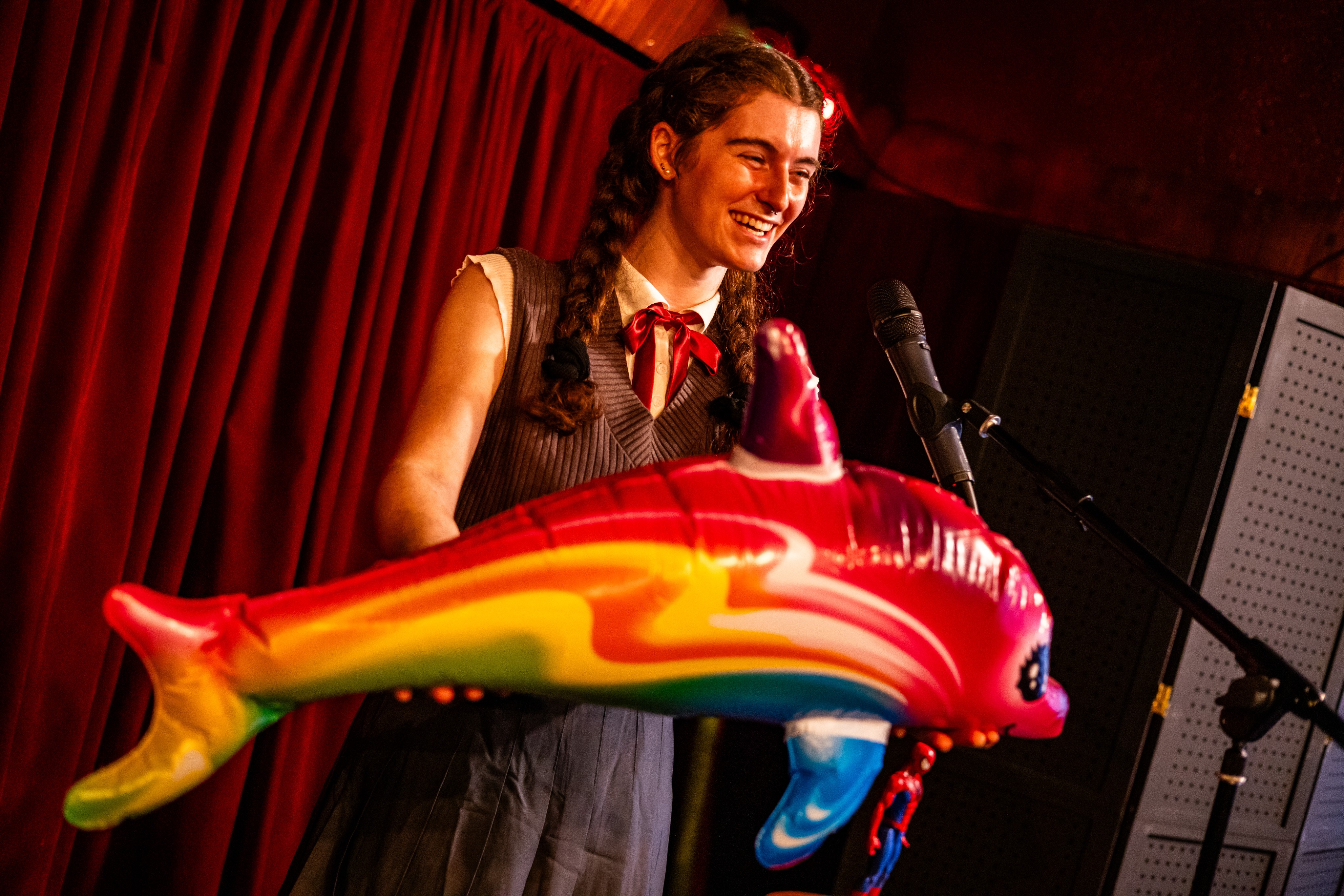
Inis Nua’s Drip, a solo comedy that ran at Fergie’s Pub, won two Barrymores recognizing director Kyle Metzger and actor Max Gallagher for outstanding leading performance in a musical. The story follows a teen who desperately wants to build a synchronized swim team but doesn’t actually know how to swim. The Inquirer review said the show was “a small bit of joy that makes a heartfelt statement through its casting and earnestness, reminding us in the final number that whoever we are, we should all ‘make, make, make a splash.’”
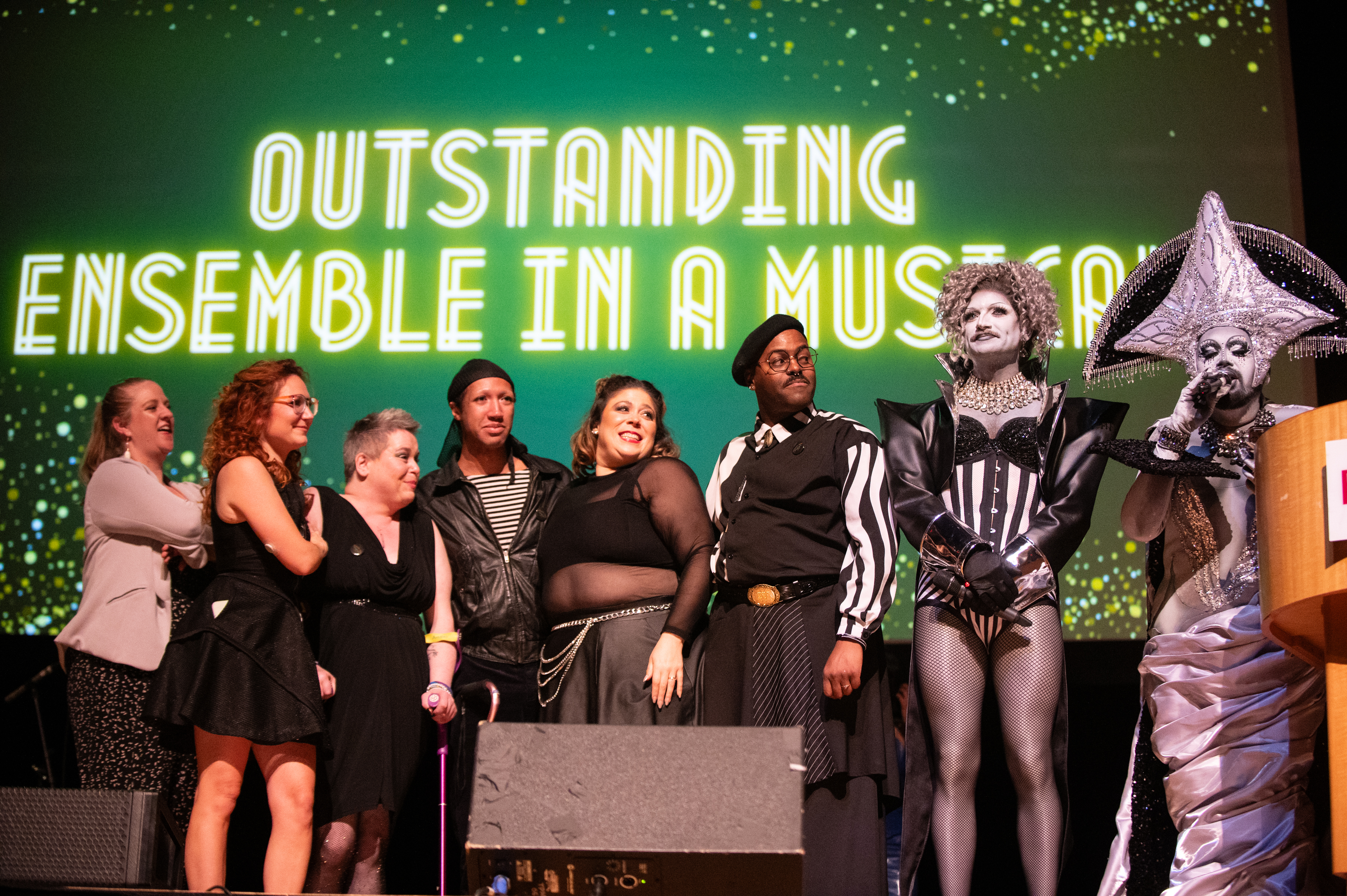
The cast and crew of “Gay Mis” accept the award for Outstanding Ensemble in a Musical at the 2025 Barrymore Awards at the Temple Performing Arts Center in North Philadelphia on Monday, Oct. 20, 2025. Danny Wilfred (third from right) won for outstanding leading performance in a musical.
Also winning for leading performance in a musical was Danny Wilfred, who played Parmesan in Gay Mis, a queer parody of Les Misérables from Philly drag queen Eric Jaffe’s Jaffe St. Queer Productions. Gay Mis took home the Barrymore for outstanding ensemble in a musical as well.
The Philadelphia Award for Social Insight, which comes with a $25,000 prize, went to Esperanza Arts Center for Nichos, a world premiere about Mexican history based on interviews with immigrants in Philly and their families.
For a second year in a row, Theatre Philadelphia did not grant its F. Otto Haas Award for an Emerging Artist, which spotlights up-and-coming Philadelphia actors with a $15,000 cash prize. The organization said it has been unable to grant the award after losing funding.
“The F. Otto Haas Award for an Emerging Artist was a meaningful part of our celebration of Philly theatre for many years,” said Theatre Philadelphia in a statement. “While the F. Otto Haas Award is no longer being presented, we remain deeply grateful for the years of support that made it possible and continue to honor emerging artists across the region through our ongoing recognition programs.”
Connor McAndrews — Peter Panto: A Musical Panto, People’s Light
Livvie Hirshfield — Legally Blonde, Media Theatre
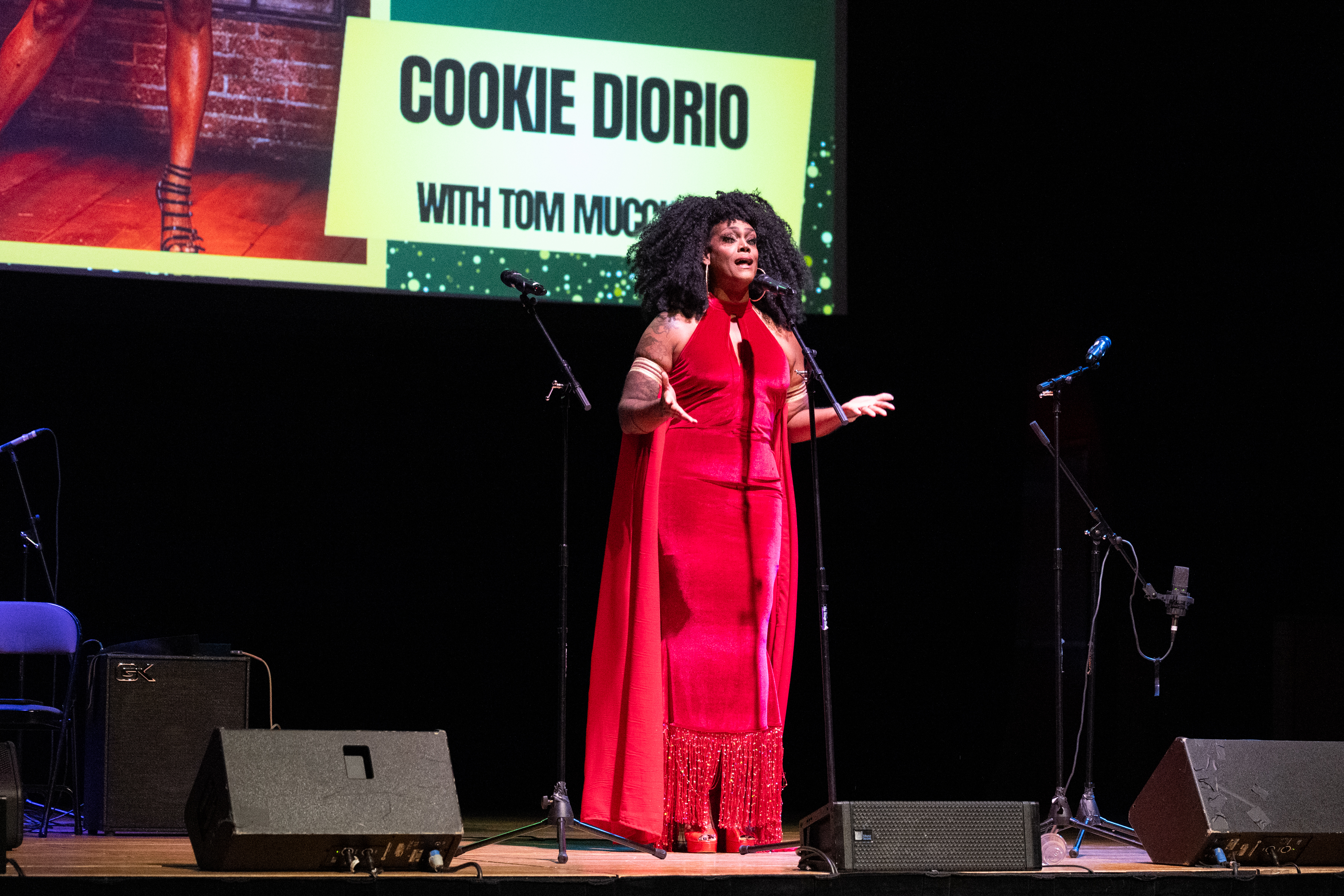
Cookie Diorio, nominated for ‘Kinky Boots,’ performs at the 2025 Barrymore Awards ceremony at the Temple Performing Arts Center in North Philadelphia on Monday, Oct. 20, 2025. The Barrymore Awards spotlight the best musicals, plays, actors, directors, and backstage creatives in the Philadelphia region.
Outstanding Choreography/Movement in a Musical
Todd Underwood — Kiss Me, Kate!, Quintessence Theatre Group
Melanie Cotton — Peter Panto: A Musical Panto, People’s Light
Taylor J. Mitchell — Kinky Boots, New Light Theatre
Christian Ryan — Legally Blonde, Media Theatre
Outstanding Music Direction
Lili St. Queer — Gay Mis, Jaffe St. Queer Productions
Ryan Touhey — Peter Panto: A Musical Panto, People’s Light
Alex Bechtel — Poor Judge, Pig Iron Theatre and Esperanza Arts Center
Justin Yoder — Penelope, Theatre Horizon
Outstanding Ensemble in a Musical
Poor Judge — Pig Iron Theatre
Gay Mis — Jaffe St. Queer Productions
Night Side Songs — Philadelphia Theatre Co.
Peter Panto: A Musical Panto — People’s Light
Outstanding New Work
Iraisa Ann Reilly — January 6: A Celebration. A Bodega Princess Remembers Tradition, Not Insurrection, Simpatico Theatre 2
Eva Steinmetz & Dito van Reigersberg — Poor Judge, Pig Iron Theatre
Daniel & Patrick Lazour — Night Side Songs, Philadelphia Theatre Co.
Jennifer Childs — Peter Panto: A Musical Panto, People’s Light
Tanaquil Márquez — Nichos, Esperanza Arts Center
Outstanding Outdoor Production
All’s Well — Shakespeare in Clark Park
One Monkey Don’t Stop No Show — Theatre in the X
Julius Caesar — Delaware Shakespeare
As You Like It — Shakespeare in Clark Park
Outstanding Set Design
Chris Haig — The Playboy of the Western World, Inis Nua Theatre
Thom Weaver — August Wilson’s King Hedley II, Arden Theatre
Matt Saunders — Archduke, The Wilma Theater
April Thomson — Hold These Truths, Montgomery Theater
Anna Kiraly — Franklin’s Key, Pig Iron Theatre
Roman Tartarowicz — Tuesdays with Morrie, Delaware Theatre Co.
Jordan McCree — The Half-God of Rainfall, The Wilma Theatre
Jordan McCree — The Comeuppance, The Wilma Theater
Chris Sannino — Franklin’s Key, Pig Iron Theatre
Michael Kiley — A Summer Day, The Wilma Theater
Yaim Chong Chia — Archduke, The Wilma Theater
Connor McAndrews (left) and Jamison Stern (right) in People’s Light Theatre’s ‘Peter Panto,’ which was nominated for 8 awards. McAndrews won the Barrymore for outstanding supporting performance in a musical.
Outstanding Original Music
Daniel & Patrick Lazour — Night Side Songs, Philadelphia Theatre Co.
Alex Bechtel — Peter Panto: A Musical Panto, People’s Light
Jordan McCree — The Hobbit, Arden Theatre
Lili St. Queer — Gay Mis, Jaffe St. Queer Productions
Ximena Violante & Ampersan (Zindu Cano and Kevin García) — Nichos, Esperanza Arts Center
Jakeya L. Sanders — Fallawayinto: Corridors of Rememory, Ninth Planet
The Philadelphia Award for Social Insight
Rift, or White Lies — InterAct Theatre
Young Americans — Theatre Horizon
The Drag —EgoPo Classic Theater
Night Side Songs — Philadelphia Theatre Co.
The Half-God of Rainfall — The Wilma Theater
January 6: A Celebration. A Bodega Princess Remembers Tradition, Not Insurrection — Simpatico Theatre
Glitter in the Glass — Theatre Exile
Nichos — Esperanza Arts Center
The Playboy of the Western World — Inis Nua Theatre
Philly can’t seem to stay off the screen lately — and now, Apple Studios is getting in on the action. Following recent buzz from Task, Abbott Elementary, and the ever-enduring It’s Always Sunny in Philadelphia, a new movie production titled Cheesesteak is setting up shop in the city that invented the sandwich.
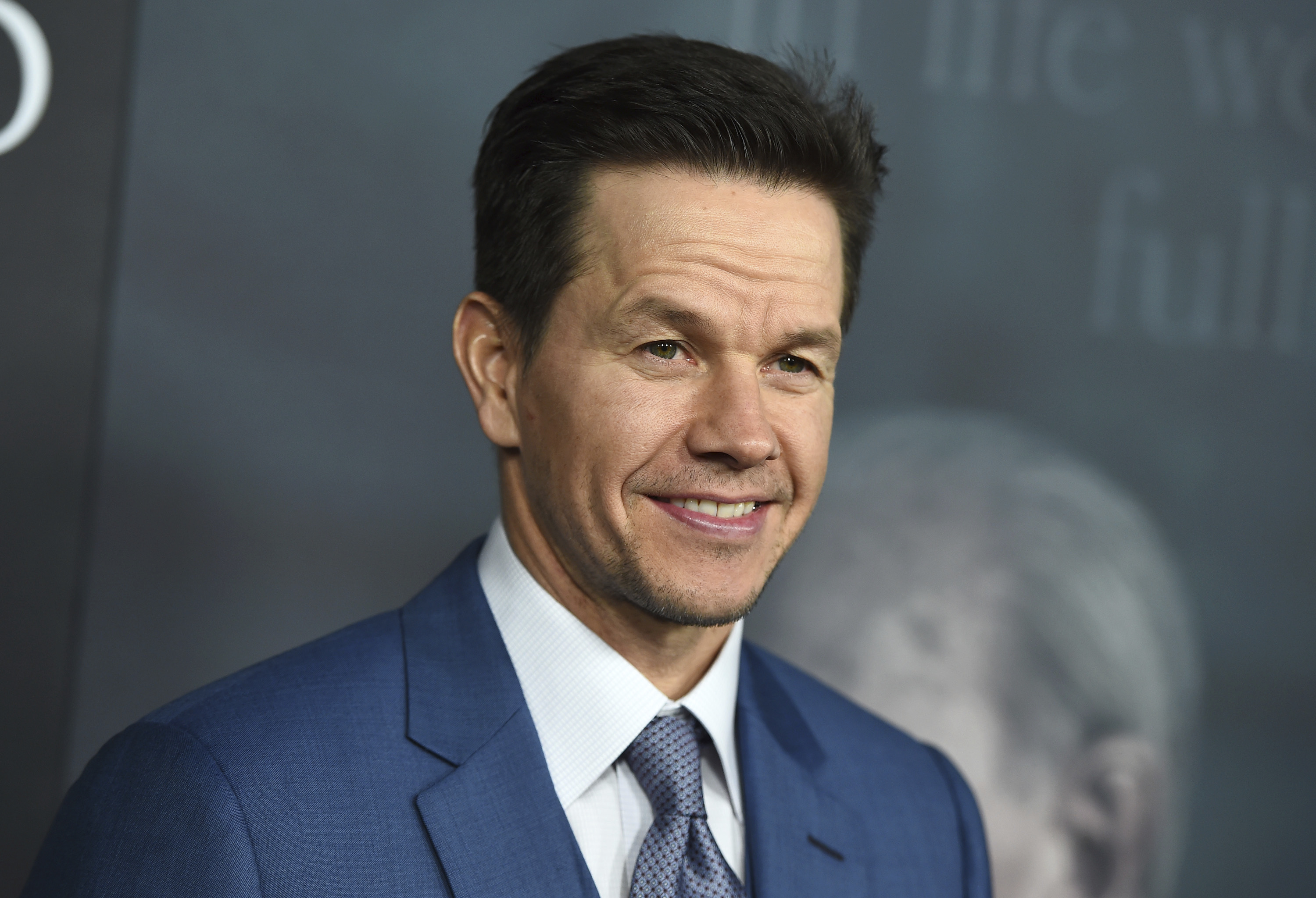
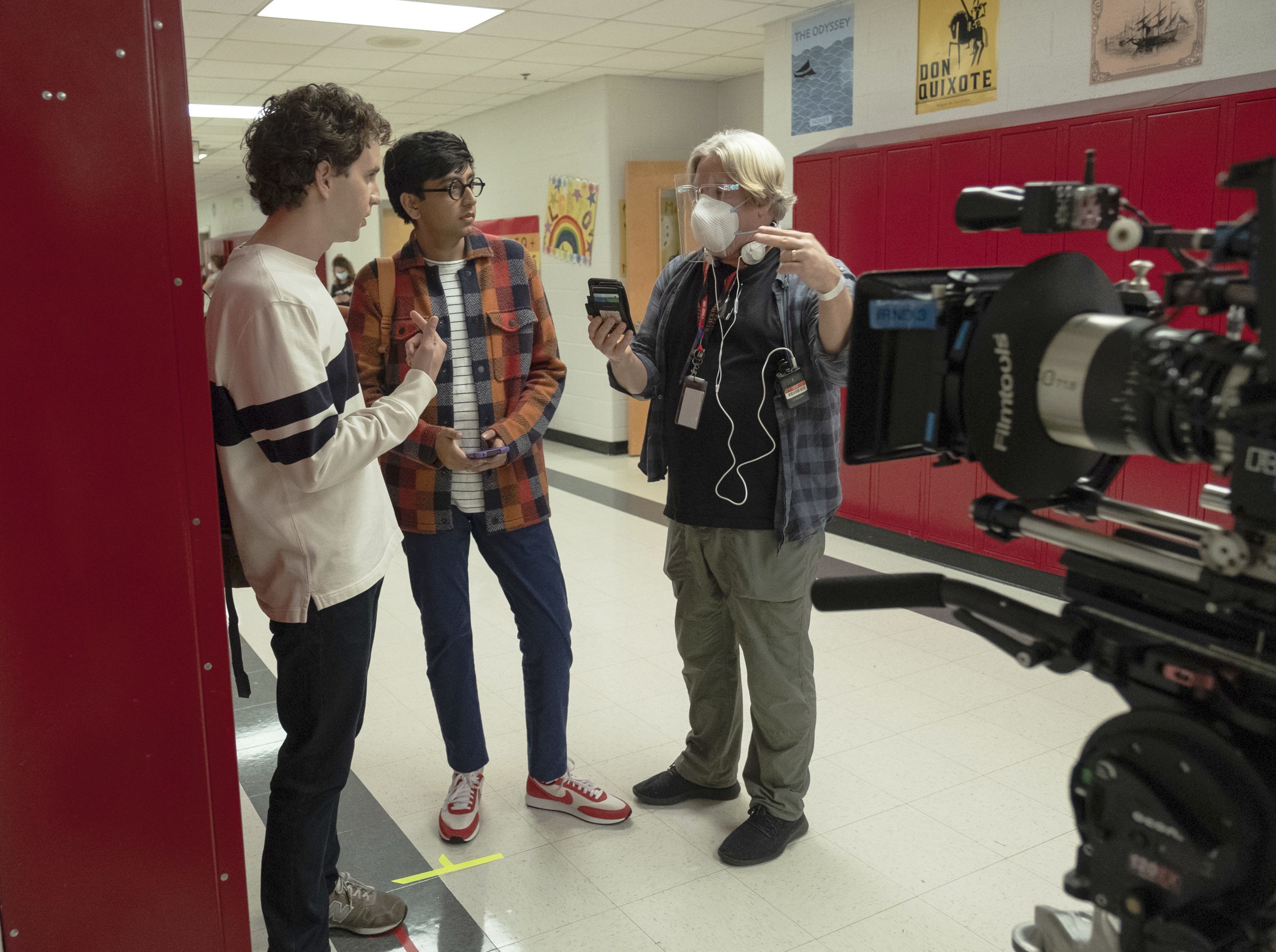
According to the casting magazine Backstage, Apple is holding open calls for Cheesesteak, a film starring Mark Wahlberg and directed by Stephen Chbosky (The Perks of Being a Wallflower, Dear Evan Hansen).
Boston Casting Inc. is seeking extras ages 18 and older to play basketball fans for a scene filming in Philadelphia on Nov. 9.
The project — which has also gone by the working title Weekend Warriors — is based on the 2023 German sports comedy-drama Weekend Rebels.
Inspired by the true story of Mirco and Jason von Juterzcenka, the original film follows a father and his autistic son as they travel across Europe to visit every Premier League soccer club so Jason can decide which team to root for.
In the American remake, soccer becomes basketball and Europe becomes the United States.
According to CBS News, Wahlberg plays a long-haul truck driver who takes his son on a cross-country journey to visit NBA arenas — a story that blends sports fandom, family tension, and plenty of heart.
The Philly filming location has yet to be revealed. Filming has already taken place in Worcester County, Mass., and other parts of New England, with Wahlberg spotted shooting scenes at a basketball court in Lynn, Mass., last month.
The Philadelphia shoot marks the latest stop, and a fitting one for a movie named after the city’s most iconic sandwich.
Mark Wahlberg arrives at the world premiere of “All the Money in the World” at the Samuel Goldwyn Theater on Monday, Dec. 18, 2017, in Beverly Hills, Calif. (Photo by Jordan Strauss/Invision/AP, File)
The film is produced by Dede Gardner and Jeremy Kleiner for Plan B, alongside LeBron James and Maverick Carter’s SpringHill Company, according to Deadline.
A separate casting notice describes Cheesesteak as the story of “a self-made restaurateur fighting to keep his family business alive amid fame, rivalry, and secrets that could change everything” — a premise that feels right at home in Philly.
From left: Ben Platt, Nik Dodani, and director Stephen Chbosky on the set of “Dear Evan Hansen.”
🎬 How to apply
Boston Casting Inc. is seeking local talent ages 18 and older to appear as basketball fans in a crowd scene filming Nov. 9 in Philadelphia.
Pay: $17.50 an hour (estimated $140 for an eight-hour day)
Company: Boston Casting Inc.
Location: Philadelphia
To apply, visit Backstage and search “Cheesesteak.”
The world’s most-visited museum was closed Monday following a professional heist that resulted in the theft of priceless jewels. Within minutes, thieves entered and exited the Louvre on Sunday, taking eight treasures.
The result? One of the highest-profile museum thefts in living memory amid a climate where museum staffs — worldwide, not just at the Louvre — are complaining about crowding, thin staffing, high turnover, and strained security.
Here’s what we know so far.
How did the Louvre heist happen?
Within minutes, thieves rode up a basket lift outside the Louvre’s facade, forced open a window, smashed display cases, and fled with priceless Napoleonic jewels, officials said.
The heist took place on Sunday, only 30 minutes after opening, with visitors already inside.
The theft took four minutes inside the building and less than eight in total, according to French Culture Minister Rachida Dati, who called it a “professional” operation.
“They went straight to the display windows,” Dati said. “They knew exactly what they wanted. They were very efficient.”
Sunday’s theft focused on the gilded Apollo Gallery, where the crown jewels are displayed. Alarms brought Louvre agents to the room, forcing the intruders to bolt on motorbikes, but the robbery was already over.
It’s unclear how many people took part in the theft and whether they had inside assistance. French media reported there were four perpetrators, including two dressed as construction workers. Authorities have not commented on the specifics.
What was taken from the Louvre?
Eight pieces of “priceless” jewels were stolen from the Louvre in Paris. Here is what they were.
Eight objects were taken, according to officials:
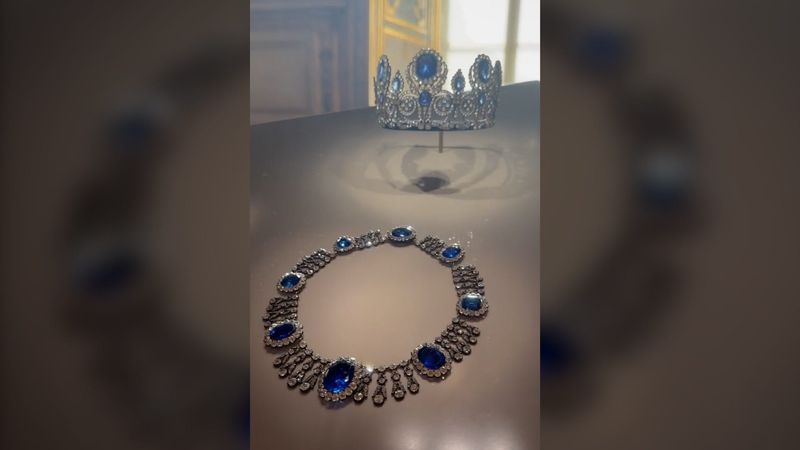
A sapphire diadem, necklace, and single earring from a matching set linked to 19th-century French queens Marie-Amélie and Hortense.
An emerald necklace and earrings from the matching set of Empress Marie-Louise, Napoleon Bonaparte’s second wife.
A reliquary brooch.
Empress Eugénie’s diadem and her large corsage-bow brooch, a prized 19th-century imperial ensemble.
A ninth object, the emerald-set imperial crown of Napoleon III’s wife, Empress Eugénie, was also taken but apparently dropped by the thieves. The crown, with more than 1,300 diamonds, was damaged but recovered outside the museum.
All of the items are considered priceless, though officials have not disclosed an overall estimate.
What will happen to the stolen jewels?
The Louvre has been closed since the robbery on Sunday morning for the investigation.
Experts say the initial hours after a heist are critical before the scent grows colder and thieves have more time to dispose of the jewels.
The big concern is that the thieves are motivated by commodity vs. art, and will scrap the priceless works for sale on the black market, breaking the pieces for their stones and melting down the precious metals. In doing so, the thieves can make more high-ticket sales while remaining undetected.
Has this ever happened before at the Louvre?
According to National Geographic, the Louvre has a long history of bold heists — but it’s been a while until now.
In 1911, the Mona Lisa — then a lesser-known piece by Leonardo da Vinci — was taken by Vincenzo Peruggia, a former employee dressed in his old work uniform. No one noticed it was missing for over 24 hours. The painting was recovered two years later after Peruggia tried to sell it to another museum.
In 1940, a portion of the Louvre’s collection was looted by occupying Nazis, though the museum’s director had already hidden most of its collection in a safe house off-site.
There was the 1966 theft of antique jewelry, which was being transported back to France from a loan to a Virginia museum. Those jewels were recovered after being found in New York inside a grocery bag. A decade later, one group of thieves stole a Flemish painting, and months after that, another group stole French King Charles X’s jeweled sword. The sword is still missing.
The most recent string of heists occurred in the 1990s. In 1990, thieves cut a Renoir painting from its frame in broad daylight and also took ancient Roman jewelry and other paintings. In 1995, two pieces — a painting and a battle ax from a 17th-century bronze sculpture — were stolen. Finally, in 1998, a Camille Corot painting was cut from its frame and taken. It hasn’t been recovered.
What about in Philly? Any heists?
Yep. Philly-area museums have seen their fair share of art thefts over the years.
Dating back to the 1980s, several thefts or alleged thefts have occurred across the Philadelphia Art Museum, Rodin Museum, Penn Museum, and more, according to Inquirer archives.
Various thefts include a gold saw from Iraq and a 19th-century Chinese crystal ball taken from the Penn Museum in 1981 and 1988, a painting taken during a Philadelphia Art Museum after-hours party in 1984, and a bronze sculpture from the Rodin Museum in 1988 during a gunpoint robbery. The sculpture was recovered shortly afterward, and the alleged robber was arrested and charged. The crystal ball was also recovered.
There’s also Frank Waxman, the Philly-based doctor who authorities said secretly amassed the largest known private collection of stolen art: about 150 pieces worth more than $2 million. The FBI raided his Rittenhouse condo in 1982 to find Rodins, Picassos, and more. Due to the statute of limitations surrounding his thefts, he was only convicted of taking eight pieces and served eight months in prison.
In 2003, the Barnes Foundation said hundreds of items were missing from its collection, including a piece by Henri Matisse, a Jean Renoir ceramic vase, a mahogany Steinway piano, and historic recordings. It’s unclear whether the items were stolen or simply unaccounted for. No formal large-scale investigation took place.
There was also an incident in 2017 where Michael Rohana, who was attending an after-hours ugly sweater party at the Franklin Institute, broke the thumb off a life-size Chinese terracotta warrior statue.
Rohana described the incident as a “drunken mistake” and returned the thumb, which he had taken home. Still, it caused international turmoil, with Chinese officials accusing the Franklin Institute of carelessness with the artifact. The statue, which is called “The Cavalryman,” is insured for $4.5 million. Rohana went to court in 2019, eventually pleading guilty to a misdemeanor charge in 2023. He was sentenced to five years’ probation, a $5,000 fine, and community service.
Thomas Gavin admitted to targeting dozens of museums up and down the East Coast, taking valuable artifacts sometimes unnoticed for years. The Hershey Museum and Pennsylvania Farm Museum in Landis, Lancaster County, were among some of the museums impacted. Gavin’s crimeswent cold for so long that the statute of limitations expired for many, leading him to only serve a day in prison for trying to sell a historic rifle.
What does the jewel heist mean for museums’ futures?
The latest Louvre heist comes amid a tense time for museums worldwide.
Following the height of the COVID-19 pandemic, museums have been working to balance mass tourism, stretched-thin staff, and security upgrades.
Locally, the Philadelphia Art Museum and its employees reached a settlement last year after a yearlong dispute over pay raises called for in their 2022 labor contract and a nearly three-week strike.
At the Louvre, a June staff walkout over frustrations with overcrowding and chronic understaffing led to a delayed opening. Unions say mass tourism leaves too few eyes on too many rooms and creates pressure points where construction zones, freight routes, and visitor flows meet.
Officials say security updates are underway at the Louvre as part of an $800 million modernization plan. But critics say the measures are too little, too late.
The Mann is getting a new name. With a major sponsorship in hand, Philadelphia’s arts center in Fairmount Park will now be called the Highmark Mann Center for the Performing Arts.
The Pittsburgh-based Highmark insurance company will join the Mann nameplate starting immediately under the terms of a 12-year deal.
“This investment will absolutely help to ensure that the Mann will continue to be an evolving, creative, living, inviting premier destination for our region, for all the artists that we present, and for the audiences that come. This is really an exciting next step for us,” said Catherine M. Cahill, president and CEO of the arts center.
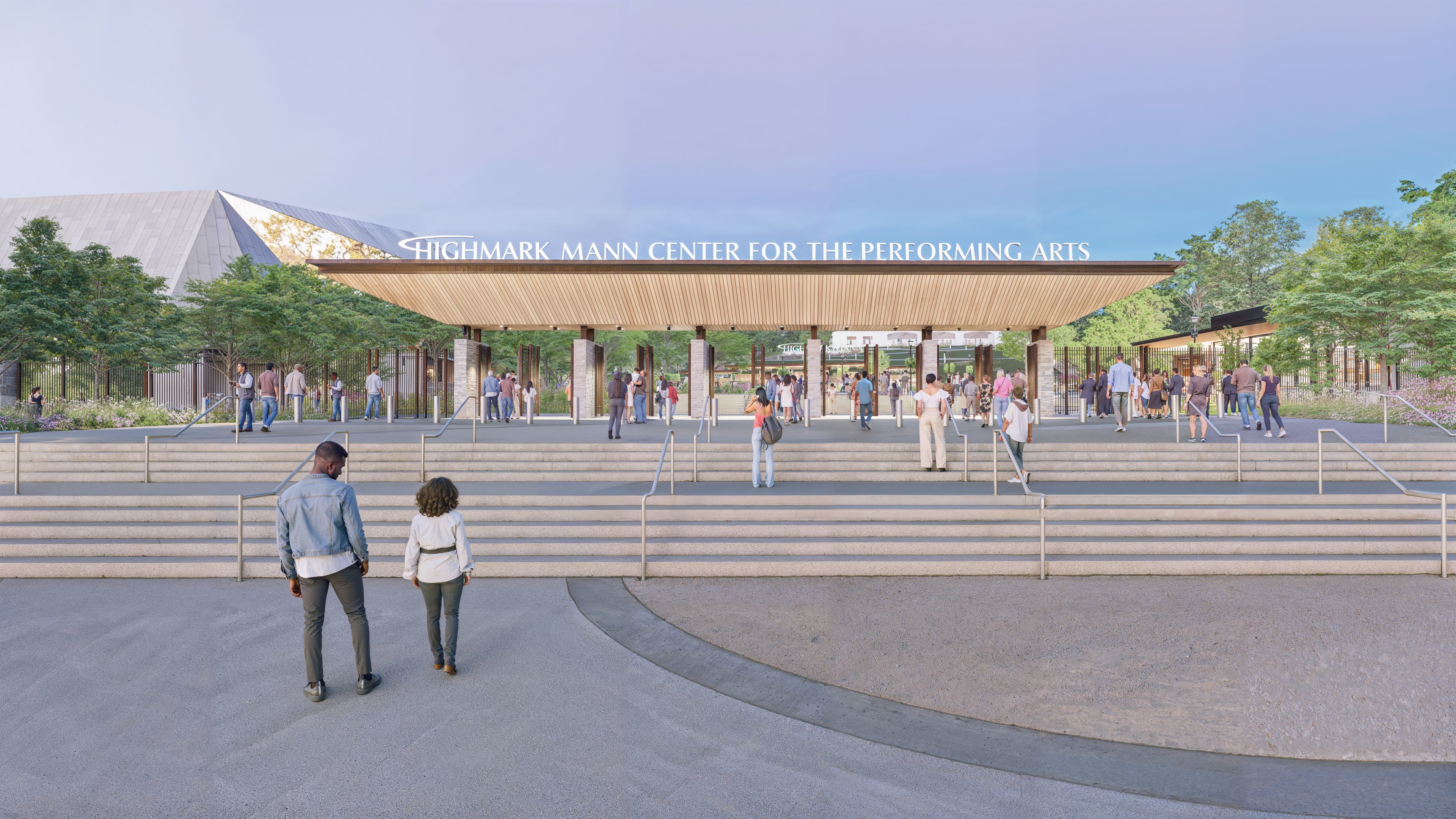
The main entrance to the Highmark Mann as it is envisioned after a renovation and re-opening in the spring of 2026.
Cahill and Highmark declined to discuss how much the company paid for the naming rights and other financial details. “Substantial” is how Dan Tropeano, market president of Highmark Blue Shield in Southeastern Pennsylvania, described the amount of money the company will pay to put its name on the venue.
He noted that Highmark had entered the Philadelphia market recently — in 2023 — and that the company saw an alignment between its customers and the Mann’s patrons.
“They offer programming that appeals to the entire demographic of the folks here in Southeast Pa., whether that’s the orchestra for folks that like that kind of thing, whether it’s other music festivals that cater to other types,” said Tropeano, who recalled attending his first Mann concert in 1991 (the Allman Brothers Band). “We find it to be one of the most diverse venues that really exposes us to the entire community, not just one defined segment.”
The arts center will use the moniker Highmark Mann for short.
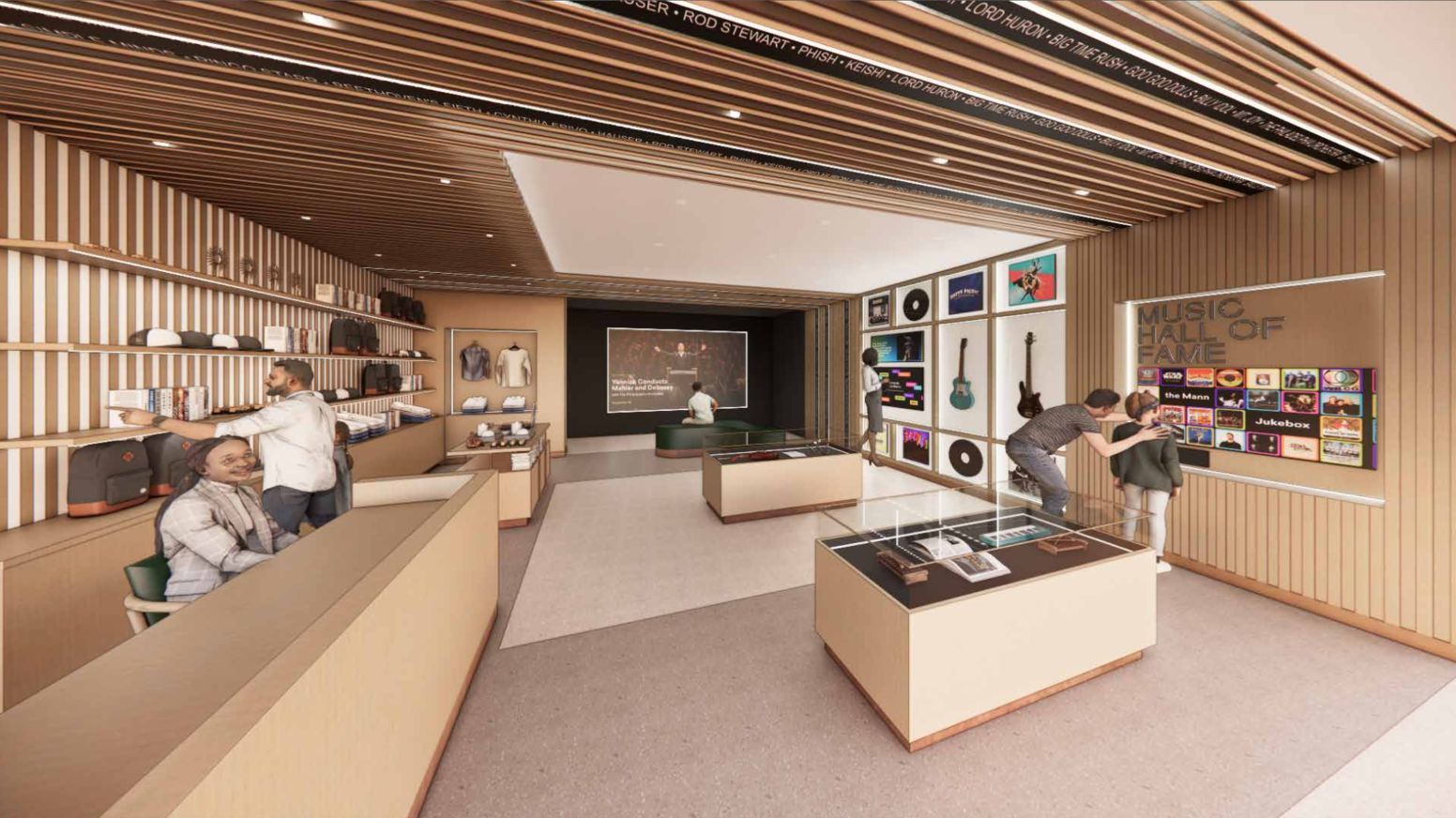
A rendering of a new Welcome Center at the arts center that, when built, will house a Music Hall of Fame Jukebox, gift shop and a continuously running LED ticker with names of performers who have played the center throughout its history.
The new name was announced Wednesday afternoon in a ceremony marking the start of construction on a renovation slated for completion in the spring. The project is part of a $70 million campaign that will also boost endowment and fund operations and artistic projects.
Among the changes coming to the Mann are a new main entry canopy and a plaza three times the size of the current one. A section of the Mann’s angular shed will display a 4,900-square-foot LED screen animated with video and kinetic artwork. Digital pillars, landscaping, lighting, and new way-finding features are on the way.
To date, nearly $60 million has been raised toward the $70 million total, said Cahill, who declined to specify whether the money from Highmark would be paid in one lump sum or in installments over years.
“This is an important component of this campaign, but we still have more work to do. We still have more money to raise,” she said, adding that she expects the $70 million goal to be reached by February 2027.
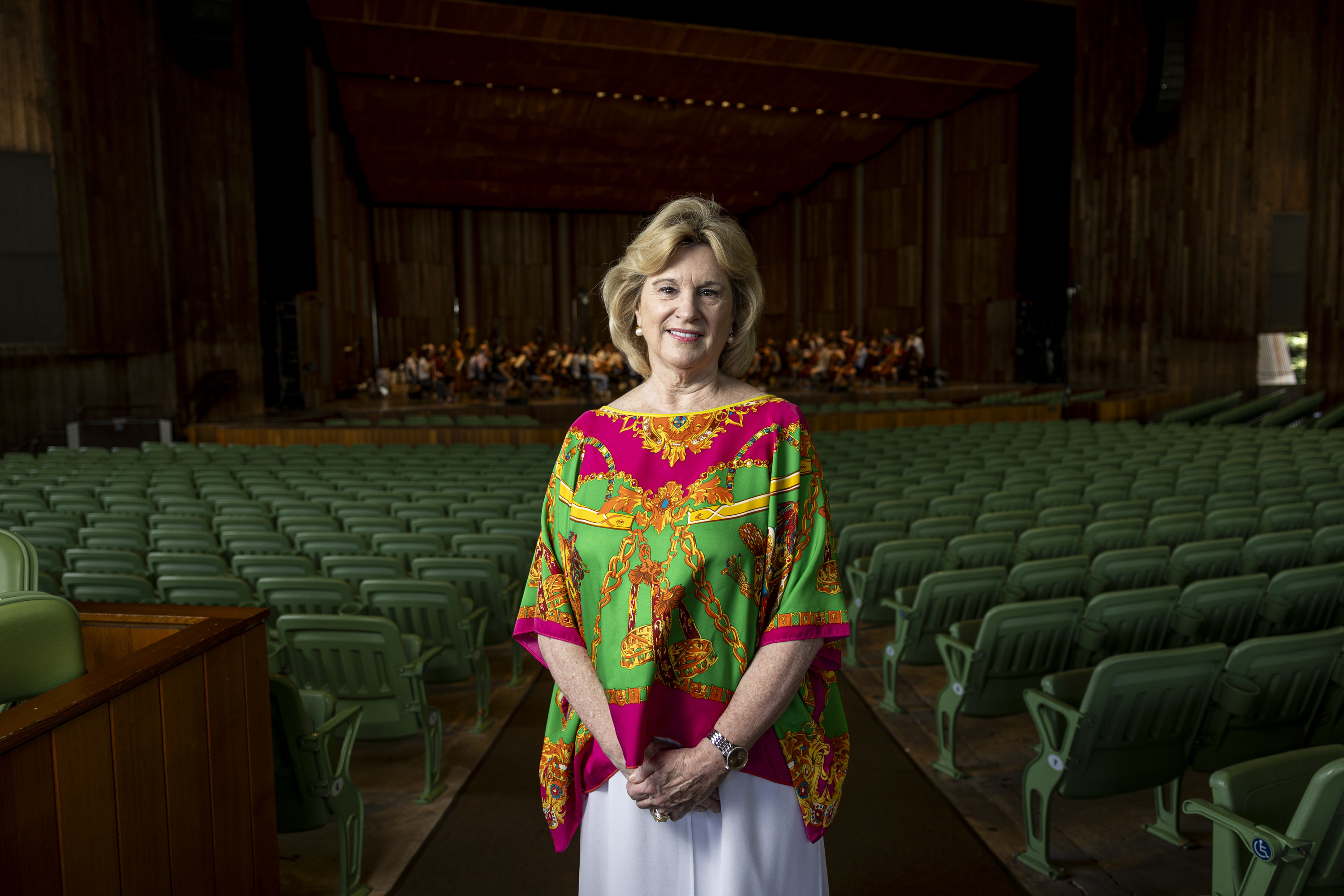
Catherine M. Cahill, president and CEO of what is now called the Highmark Mann, with the Philadelphia Orchestra rehearsing in the background, July 23, 2025.
The new name is the center’s fourth. Called the Robin Hood Dell West at its opening in 1976, it was renamed the Mann Music Center in 1979 for philanthropist Fredric R. Mann and then, in 1998, the Mann Center for the Performing Arts.
The new name will apply not just to the physical campus — which includes the main shed named for TD Bank and a smaller stage at the top of the hill already named for Highmark — but also to the organization itself.
(The name change is a rebranding; the center is not changing its name legally.)
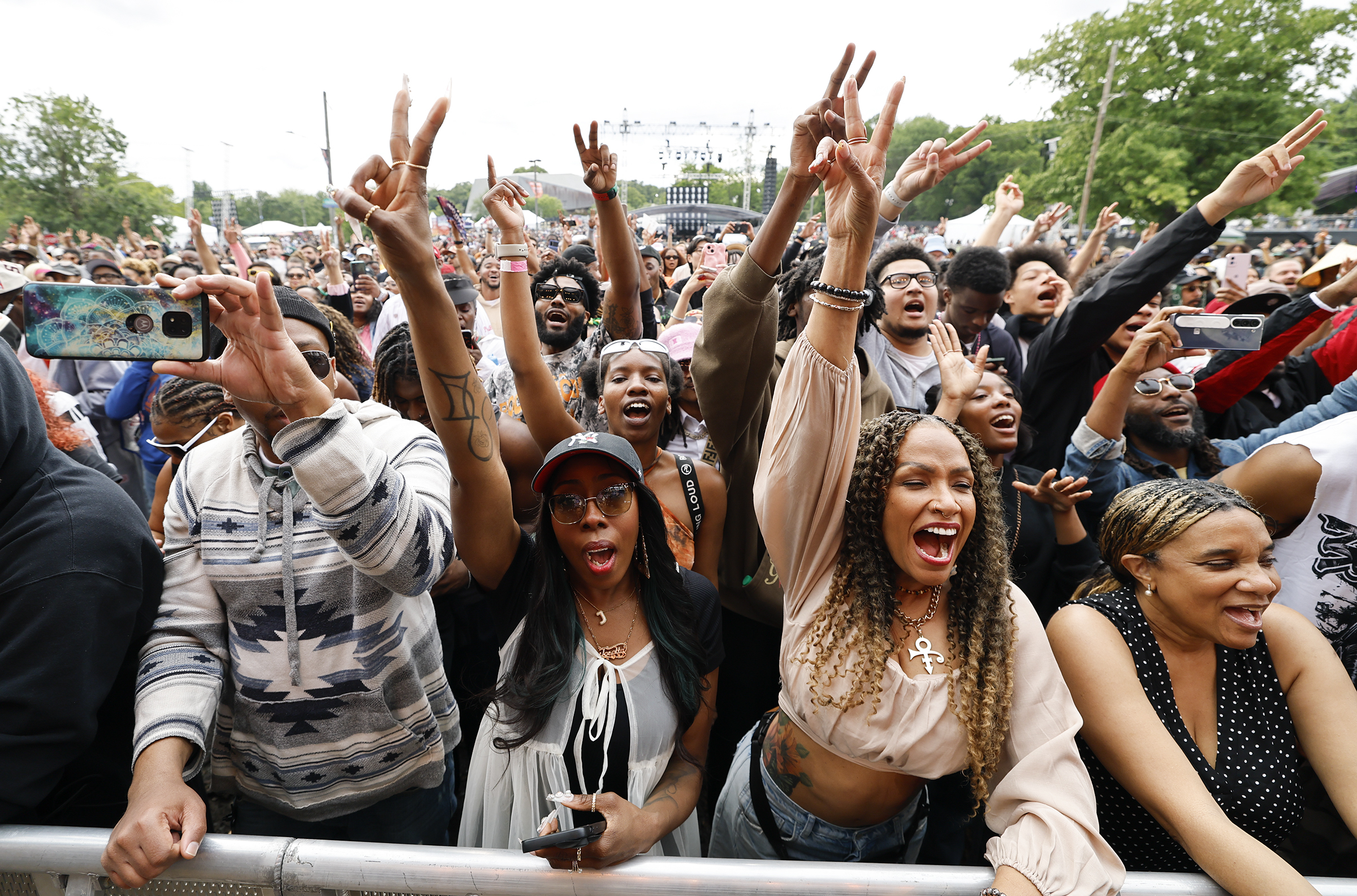
Fans cheer while Black Thought of The Roots performed during day two of the Roots Picnic 2025 at the Mann Center on Sunday, June 1, 2025.
Some major naming opportunities may be spoken for, but others remain, Cahill said.
“We have the plaza that can be named. We have backstage spaces to be named. We have programmatic things to be named. We have a whole laundry list of naming rights.”
Though officials declined to quantify the cost of the sponsorship deal, Cahill said the amount was in line with similar ones elsewhere.
“We did national benchmarking about the world of naming rights, and I can tell you we are absolutely confident that where we landed in this deal is exactly where the Mann should be.”
For more than quarter century, Greta Greenberger ended her tours of Philadelphia City Hall at the tower, just below the bronze buckled shoes of William Penn (1892), the shady colossus that Alexander Milne Calder sculpted.
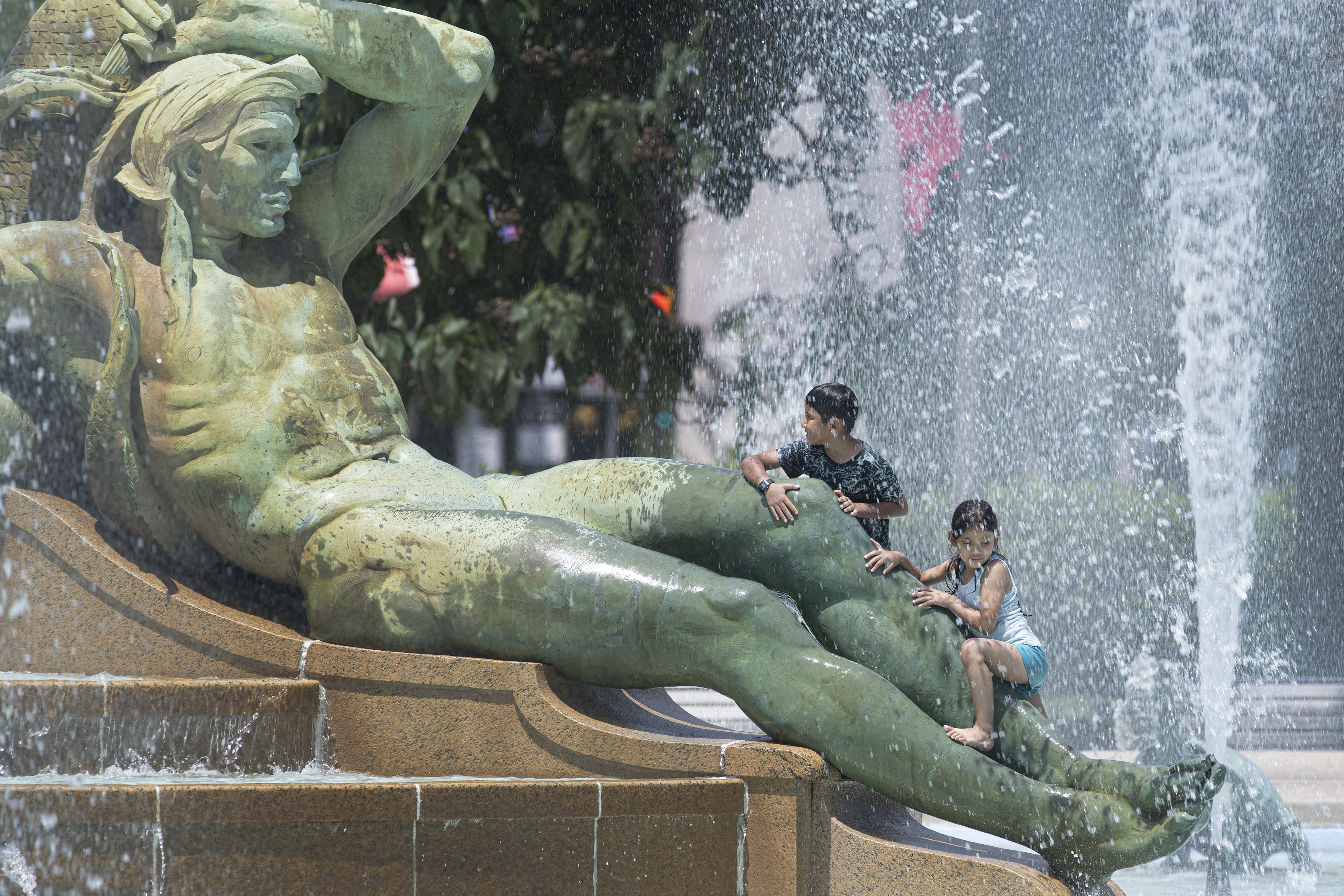
From there, she’d point up the Parkway to Logan Square, where on hot days children sneak into The Fountain of Three Rivers (1924), created by Calder’s son, Alexander Stirling Calder, to honor the Schuylkill, the Delaware, and the Wissahickon.
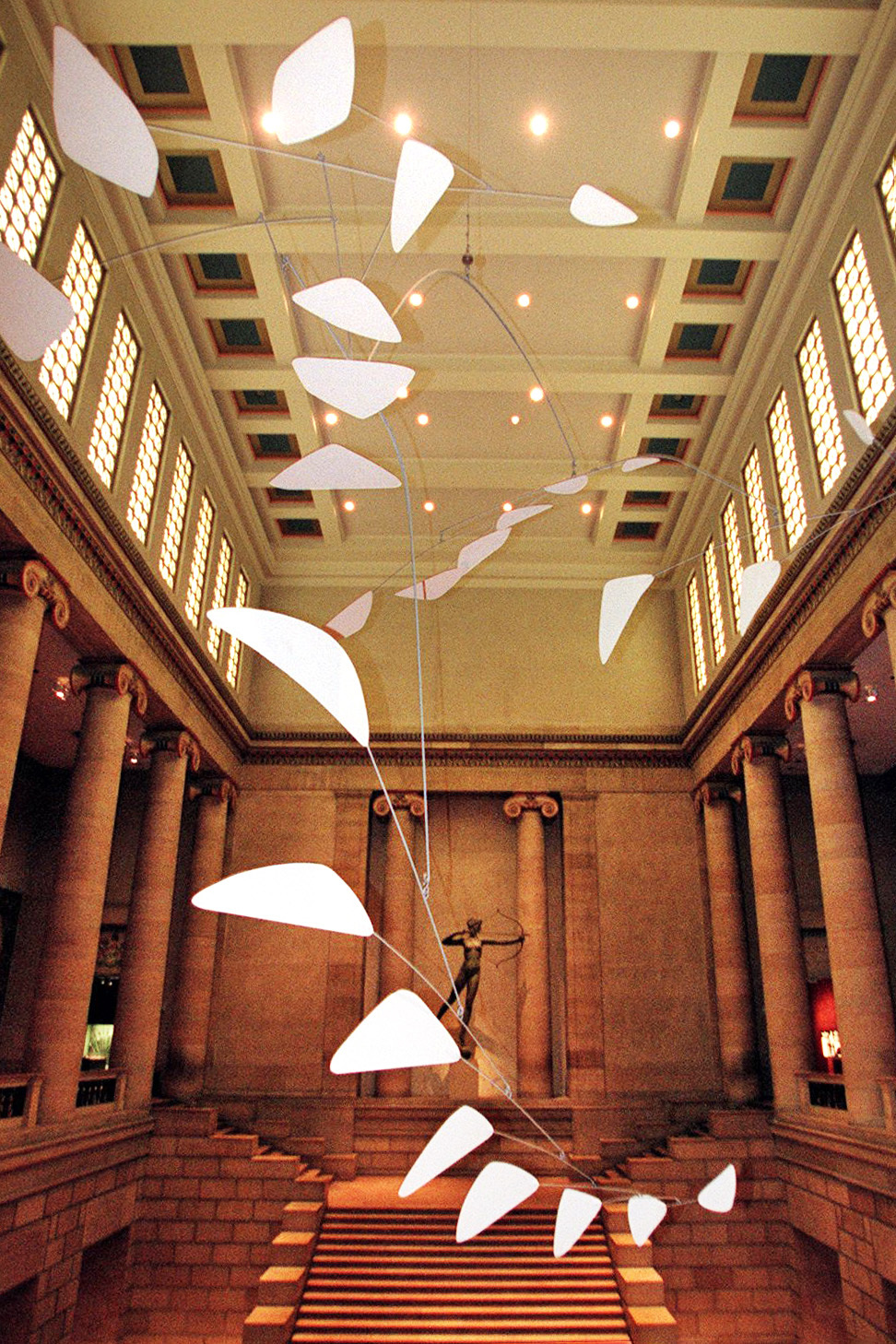
She’d finish her lesson at the Philadelphia Art Museum, where an unearthly, white mobile, Ghost (1964), designed by the third generation of Alexander Calders, Sandy, sways ever so slightly in the Great Stair Hall.
“Sometimes, I’d refer to this as ‘The Father, the Son and the Holy Ghost,’” she says. “It tells such a wonderful story.”
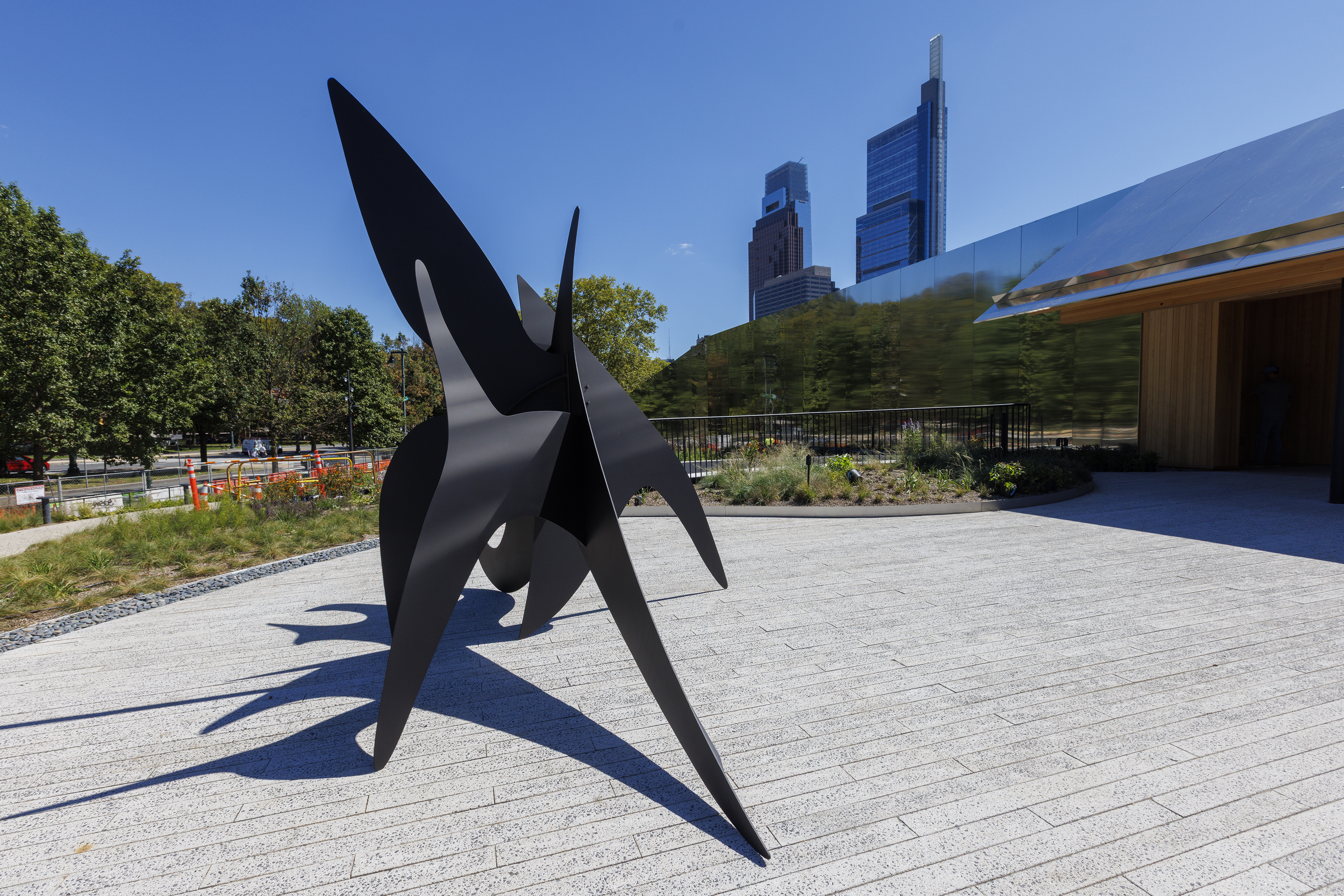
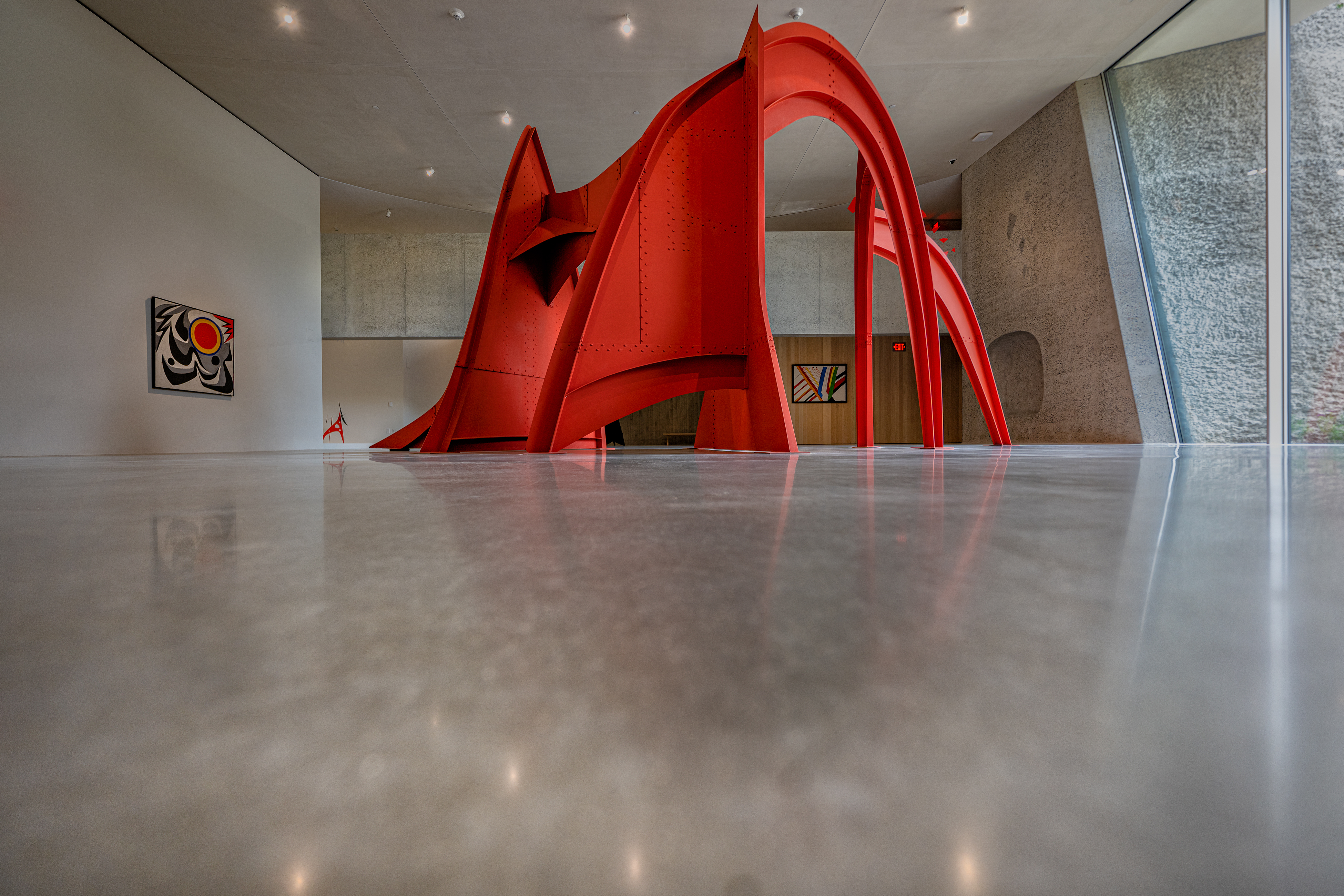
That story will be easier to tell now, with the opening of Calder Gardens at 21st Street and the Ben Franklin Parkway. The Gardens, focused on the work of the youngest Calder, known asSandy, brings another opportunity to celebrate the family dynasty’s in Philadelphia: three sculptors named Alexander Calder who have shaped the look of the city and beyond.
Exterior of the new Calder Gardens on the Ben Franklin Parkway.
“The Calder family is incredibly important to Philadelphia,” said Anna O. Marley, the former chief curator at the Pennsylvania Academy of Fine Arts (PAFA), where so many Calders studied. “They tell us so much about what it means to be an artist in the United States and how an American artistic identify was created in Philadelphia.”
And their work here offers “a pocket history of art,” in the view of Kathleen A. Foster, the Art Museum’s senior curator of American art.
“Between the three of them, you really go from the academic realism of the grandfather through kind of shift into Art Deco and modernism in the `20s with Stirling Calder, and then all the way into modern forms, completely abstract shapes and bright colors.”
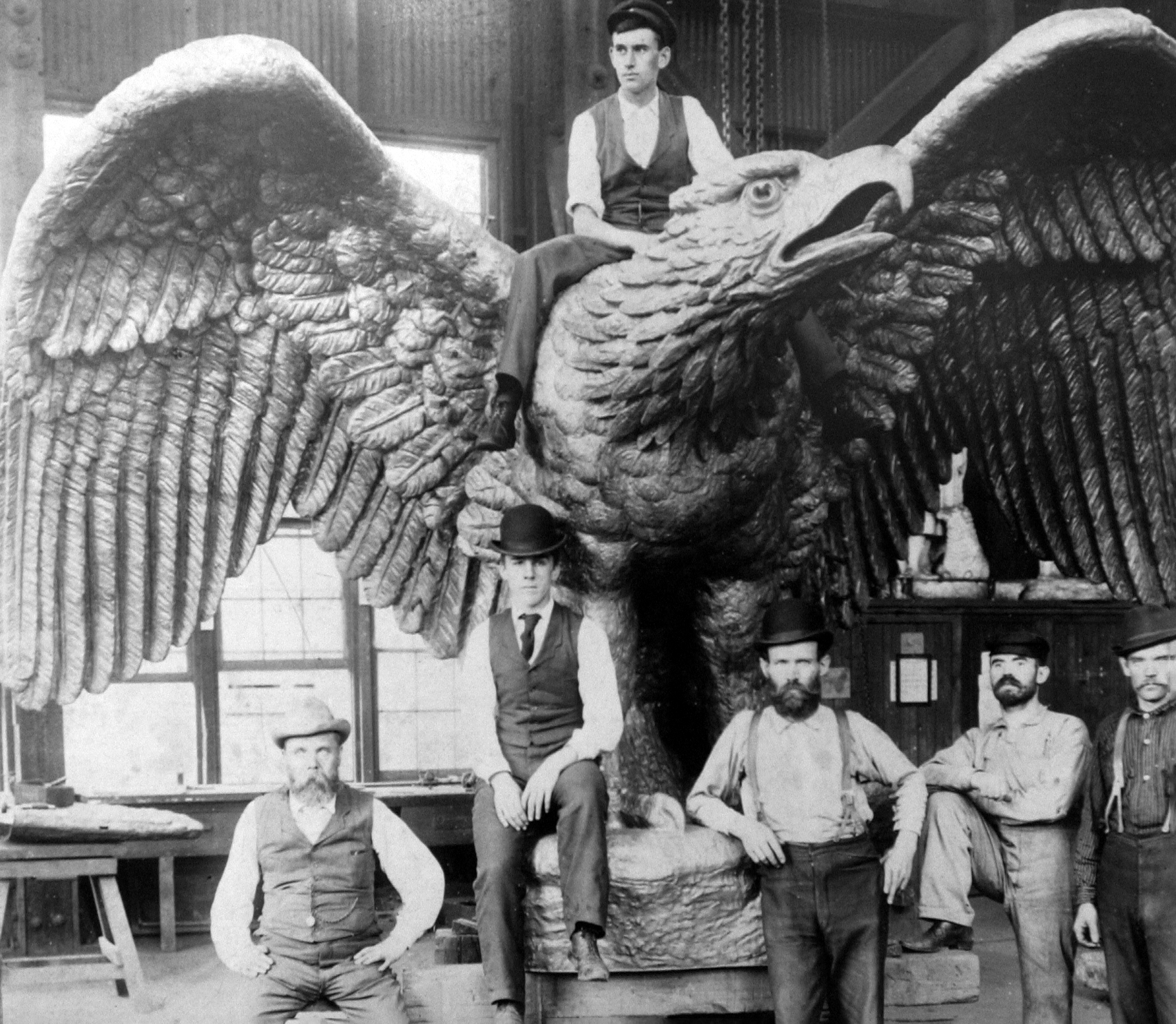
A photograph of workers and an Alexander Milne Calder eagle sculpture before installation around 1894, on display in the tower at City Hall. Calder created the statue of William Penn atop Philadelphia City Hall — and over 250 other works of sculpture on the exterior and interior of the building — from 1871-1901.
‘One of the greatest’
The Philadelphia that Alexander Milne Calder, a Scottish stonecutter’s son from Aberdeen, first saw in 1868 was sorely in need of a makeover. The sprawling metropolis was known for building big things like ships and rail engines and a wealth of small manufacturers that earned it the nickname “Workshop of the World.”
It was also filthy.
“It’s clear that there is no future for a city that is just increasingly based on its industrial might, on the dirt-producing, noise-producing, the squalor,“ says David Brownlee, emeritus professor of the history of art at the University of Pennsylvania.
The boundaries of Fairmount Park had just been established the year before and plans would soon begin for a giant celebration of the country’s 100th birthday, the 1876 Centennial, which would show the world the city’s cultural achievements. The Benjamin Franklin Parkway was unfolding, a broad boulevard lined by art and leading to what Brownlee calls “one of the greatest monumental ensembles of sculpture ever created.”
That would be City Hall, the émigré Calder’s workplace for 22 years as he presided over the creation of more than 250 sculptures from his first floor office in the building’s southwest corner — and the towering figure of the colony’s founder.
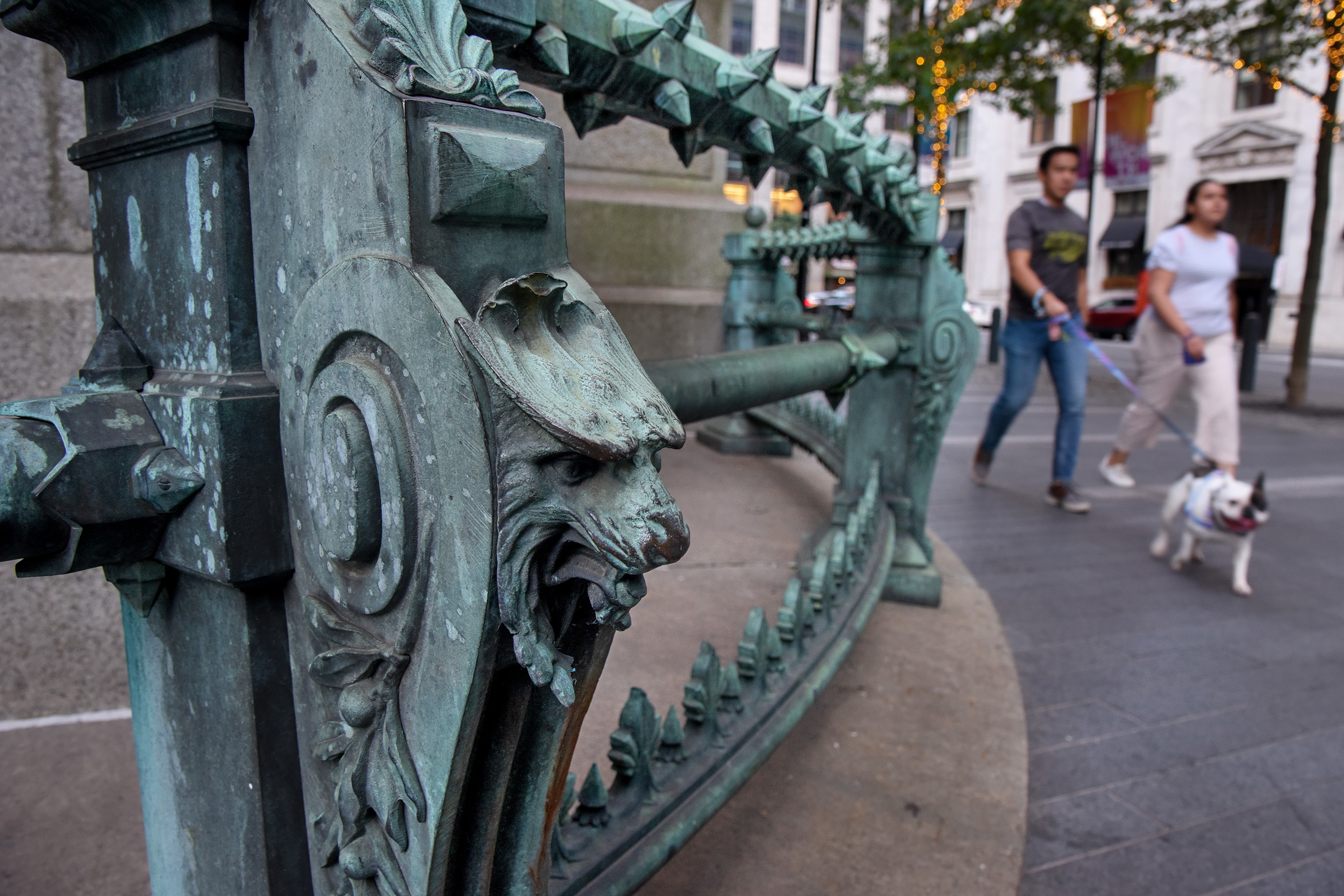
There were once almost 150 small lion heads on the ornate bronze spiked railing that surrounds City Hall. They, like most of the statuary on the building — including the big one of William Penn — were designed by Alexander Milne Calder. Less than two dozen of the lions remain after 100 years.
Calder had worked at the Royal Academy in Edinburgh and on the Albert Memorial in London before sailing to America. He stopped in New York, but chose Philadelphia, armed with a letter of introduction to the city’s most eminent sculptor, Joseph A. Bailly, and to the scion of a monument business, William Struthers. Calder was 22.
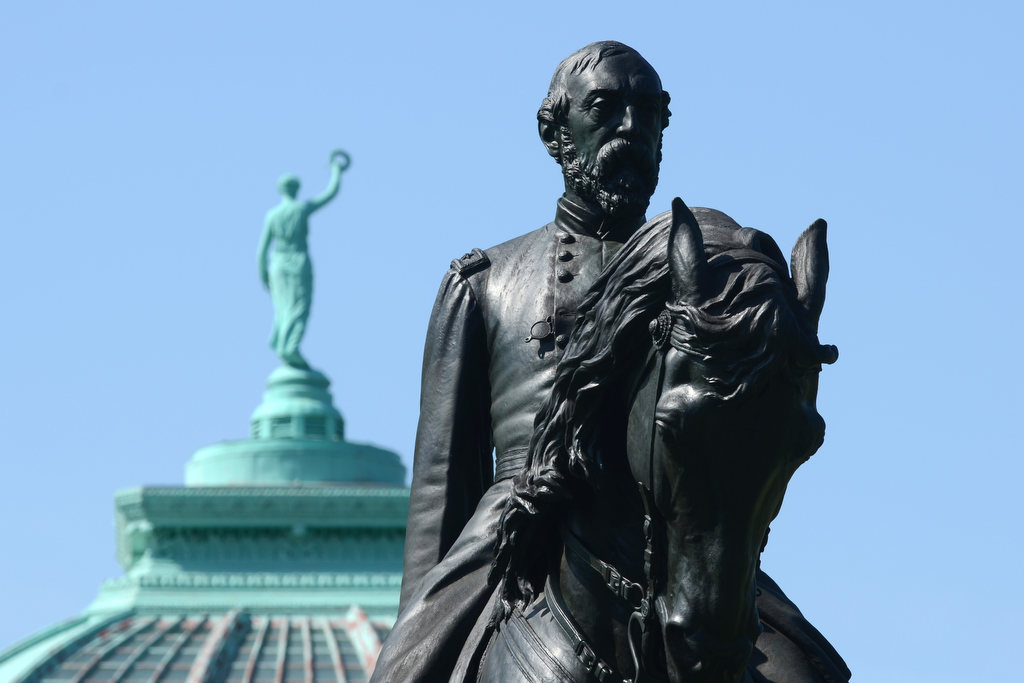
He registered that year at Pennsylvania Academy of the Fine Arts, the nation’s first art school and museum, and studied “antiques,” drawing from plaster casts of classic sculptures. It was not long before Calder won a prized commission over one of his instructors, to sculpt the likeness of Major Gen. George G. Meade atop his horse, Baldy. Meade, who’d defeated Robert E. Lee at Gettysburg, later designed many of the paths and drives of Fairmount Park. His statue stands now behind the Please Touch Museum on Lansdowne Drive.
Alexander Milne Calder’s Meade Equestrian Monument in the rear of Memorial Hall. It was cast using captured Confederate cannon for the bronze. Calder rendered Gen. Meade reining in his horse at a moment of crisis during battle.
When Greenberger gives tours of City Hall — though retired, she still volunteers one day a week — she likes to start in the north portico, where one can sample his expansive vision. Look up to the south, and there are Africans, surrounded by tobacco leaves, a lion. To the east, people from China, Japan, India, and an Asian elephant. West are the Native Americans and pioneers, and a bear. And north is Europe, people from Germany, England, France, maple leaves, and cattle. (She isn’t sure why cattle.)
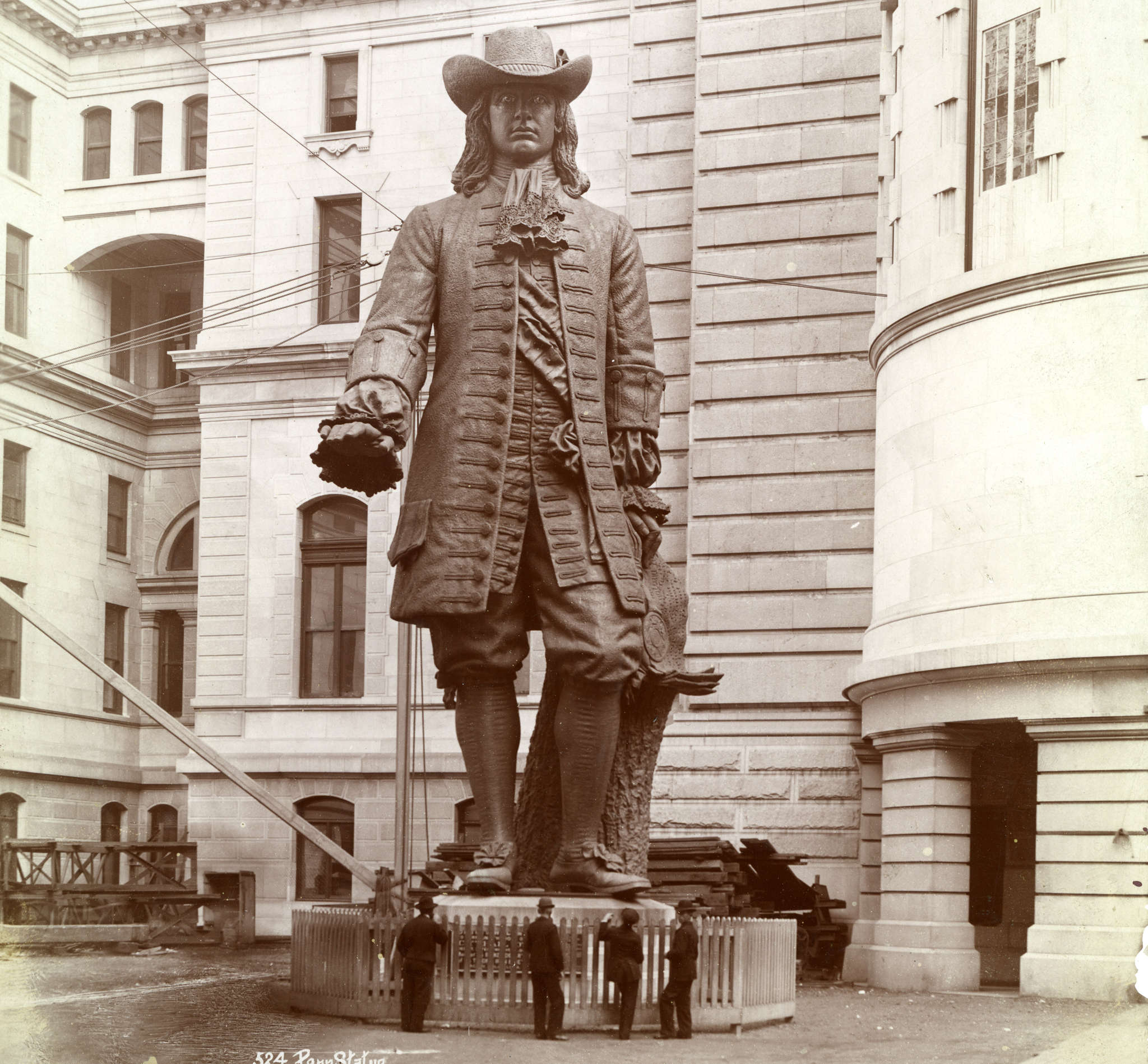
Calder started on the Penn sculpture in 1886. The iconic figure, now visible from miles away, was the fourth version of the colony’s founder that the sculptor created. Calder’s models were one-tenth the size of the 37-foot high statue. His goal, according to an article at the time in The Inquirer, was to create “William Penn as he is known to Philadelphians; not a theoretical one or a fine English gentleman.”
The William Penn statue on display in the City Hall courtyard in 1893, the year before it was hoisted, bit by bit, to the top.
Four teams of horses drew massive plaster sections of the statue up Broad Street to the Tacony Iron & Metal Works. It wasn’t until Thanksgiving 1894 that the head was lifted onto the statue atop the tower, completing Calder’s colossus.
He was not happy with the result.
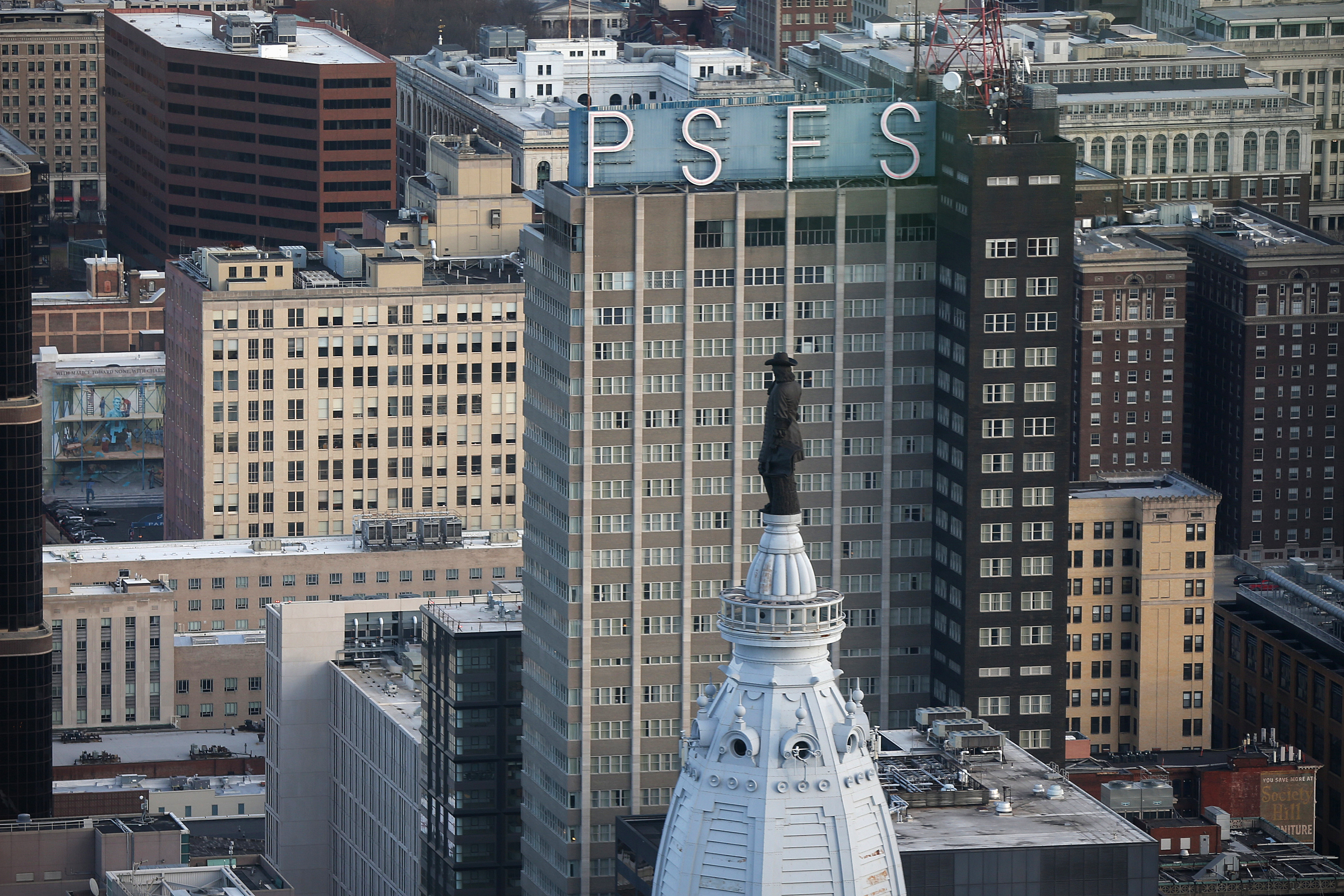
For most of the day, William Penn’s face is shadowed. That was not the artist’s intent. Calder had wanted Penn facing south, where the sun would light his youthful face and the intricate detail of his garb would be visible for all to admire.
But members of the Public Buildings Commission wanted Penn facing northeast, toward Penn Treaty Park, the site of the 1683 peace agreement with the Lenni-Lenape.
In a letter quoted in the Dec. 14, 1894 Inquirer, Calder wrote “I think that you will agree that is very disappointing from every point of view.”
Calder’s William Penn statue atop City Hall as seen from the Comcast Technology Center in Center City.
While Calder lived in a number of homes around the city — a home at 2020 Bainbridge St. and a studio at 337 Broad — when he registered at PAFA, the address listed was 1903 N. Park Ave., now on Temple’s campus. Decades later, his granddaughter, Margaret Calder Hayes, would remember the North Philadelphia house as “gloomy” — four floors with Empire furniture, a long dark hallway leading to a parlor where children were not welcome unaccompanied.
Calder had met his wife, Margaret Stirling, soon after his arrival in Philadelphia and married her after a brief courtship.
Three of their sons would study at PAFA and become artists — Ralph Milne Calder, and Norman Day Calder, and Alexander Stirling Calder. But it was “Stirling,” the eldest who left the biggest mark on Philadelphia.
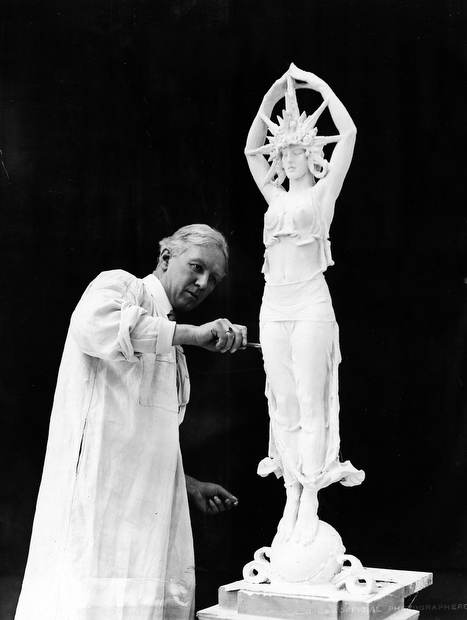
A portrait of A. Stirling Calder.
‘An idealist, somewhat withdrawn’
In a remembrance kept in the PAFA archives, Alexander Stirling Calder describes art as a fallback. Ever since he was 6 and saw the great Edwin Booth play Hamlet, Stirling Calder wanted to be an actor. But he was too shy. In 1885, he enrolled in art classes at the academy’s new building at Broad and Cherry, and years later recalled the first criticism of his teacher, the artist Thomas Eakins: “Attack all of your difficulties at once.” Eakins urged sculptors to paint, painters to sculpt, and to dissect cadavers to learn anatomy.
After studying at the École des Beaux-Arts in Paris, he returned home and won a commission to immortalize Samuel Gross with a statue that first stood on the National Mall in Washington, D.C. (It’s since been moved to the Center City campus of Thomas Jefferson University). At 25, he married a fellow PAFA student, Nanette Lederer, a painter.
To the critic Malcolm Cowley, Stirling Calder was “an idealist, somewhat withdrawn, wholly impractical, creating symbolic figures while brooding on the cruelty of nature.”
Foster says that looking at the allegorical figures in Logan Square’s Swann Fountain, you can see how Stirling inherited his father’s traditions.
Children cool off at the Swann Memorial Fountain in 2023.
“But the figures have a kind of sleek, modern simplicity to them,” she said. “They’re more stylized. So by the 1920s the Swann Fountain represents a kind of moving from the academic past into a more expressive and abstract style.”
The fence came off the Swann Fountain on a hot July day in 1924. The next evening, 10,000 revelers danced to tangos from a police band. Not everyone was pleased — some wondering if the average Philadelphian would grasp the significance of all that Calder had created.
He was unbothered.
“The meaning of works of art is just as mysterious as life itself. It can be explained in many ways by people of different philosophies. …,” he was quoted in the Evening Bulletin as saying. “There are lots of things in life we do not understand; art is no exception.”
Alexander “Sandy” Calder installs his “Big Spider” mobile at New York’s Museum of Modern Art in 1943.
‘A big child’
In his autobiography, Sandy Calder included a photograph of the sprawling mansion in Philadelphia where he says he was born. He called the place Lawnton. In 1898 when Calder was born, Lawnton was a neighborhood in East Oak Lane, served by the Reading Line and lined with grand homes where the wealthy went to escape the summer heat.
It’s unlikely Calder was born there. David Brownlee has dug into the mystery of the third and most famous Calder’s birthplace. While his family doctor lived in Lawnton, and it is possible that his mother delivered her son nearby, more likely, he was born near the edge of the growing city, at 1203 East Washington Lane in Germantown. City records showed that Stirling Calder rented that country place, while the family still owned a home on North Park Avenue.
In Margaret Calder Hayes’ memoir, she described how Sandy, two years younger, went to school in Buster Brown suits his mother had sewn and by 8 had built a Noah’s Ark of animals. He enrolled in Germantown Academy, when it was still in the city, but left at age 9 before moving to Croton-on-Hudson, N.Y.
“We love to claim him, but he only went to school here as a child,” Foster said of the youngest Calder’s time in Philadelphia.
Yet in some ways, he’s the essence of the city he was born in: practical, playful, unpretentious, no pushover.
He worked as a fireman on a steamer bound for San Francisco, spent a year keeping time in a Washington state logging camp. Trained as an mechanical engineer, he moved to New York City at age 25 to paint.
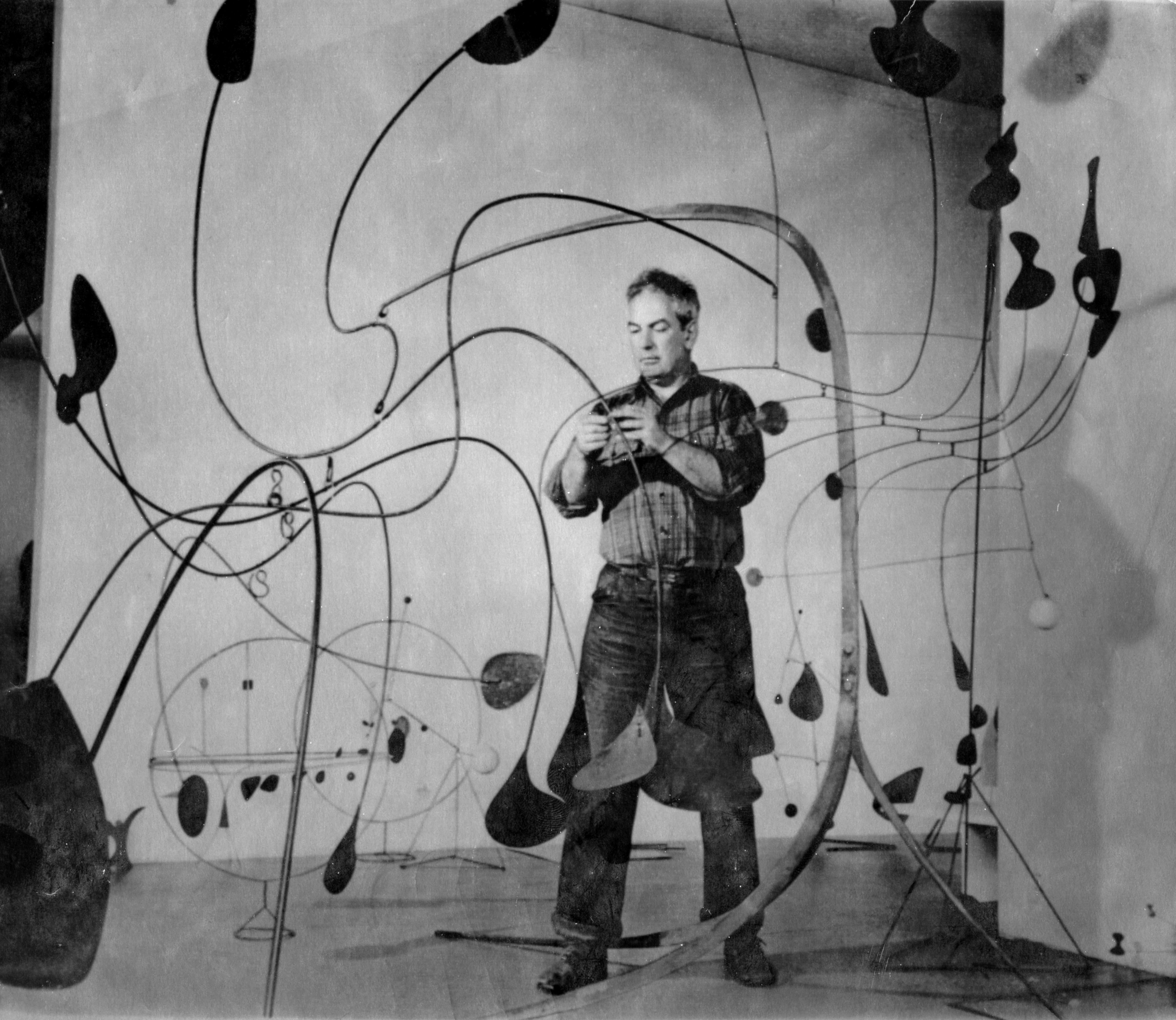
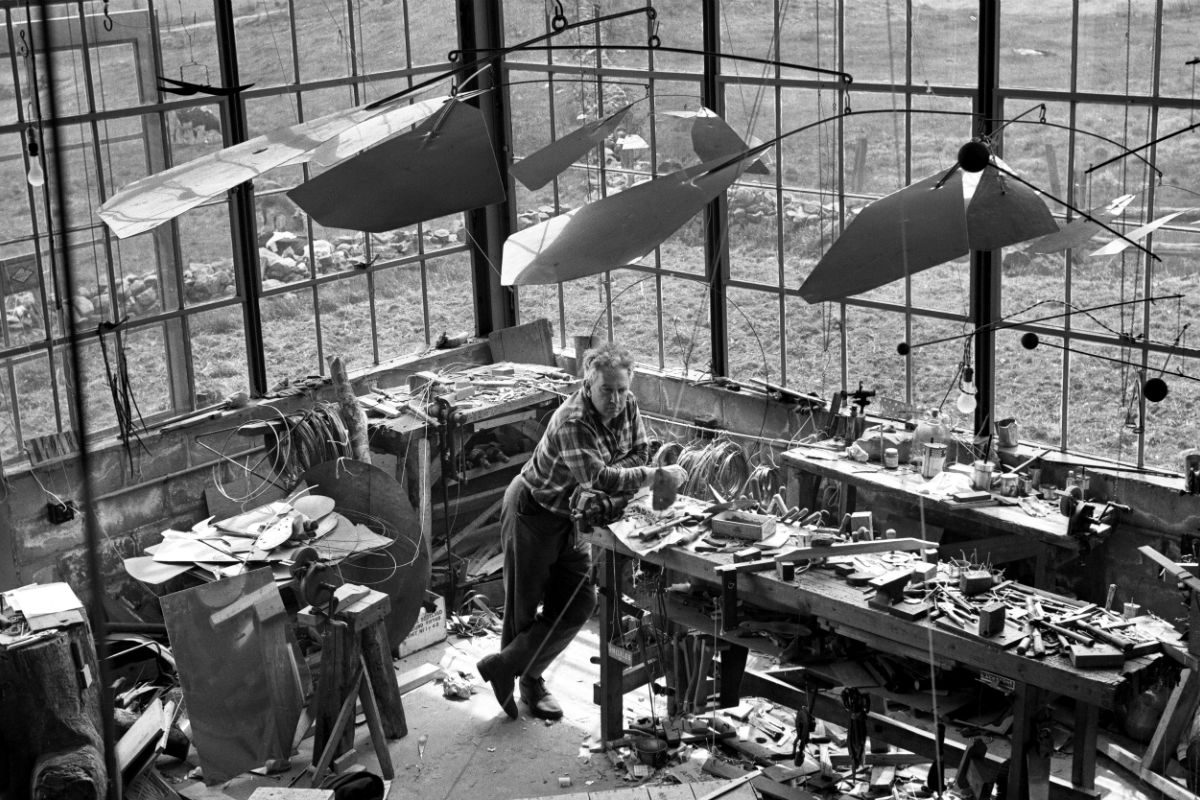
Calder with Mobile in his Roxbury, Ct., studio in 1941.
He is known as a 20th century modernist, the artist who put sculpture in motion.
After visiting Calder’s Paris studio in 1931 and marveling at his sculptures that relied on little motors, Marcel Duchamp coined the word “mobiles” for these kinetic marvels.
Parisians took to him, while they scoffed at other American artists. Cowley, in an introduction to Hayes’ Three Alexander Calders had a theory:
”Of course his work in itself, continually inventive, playful, and enchanting, was his ticket of admission.” But Sandy and his wife Louisa, “a beauty,” Cowley wrote, entertained generously and simply. Calder was in the tradition of the Noble Savage, “who disregards social conventions and judges everything by his instinctive standards.”
“A big child,” as his friend the playwright Arthur Miller once put it.
Sandy Calder created Ghost in 1964 for a retrospective at the Guggenheim in New York City, that included 400 examples of his mobiles, stabiles, toys, jewelry, carvings, tapestries, etc. The Art Museum bought the 34-foot-long showpiece a year later and brought it to the city of his birth.
Ghost, in the Great Stair Hall at the Philadelphia Museum of Art (now, Philadelphia Art Museum). It was created to hang in the center of the Guggenheim Museum in New York for Calder’s exhibition there in 1964.
“It’s a colossal example of the mobile and it’s majestic,” Foster said. “When it moves, it’s just breathtaking, because it, it almost moves like a giant dinosaur or something. In other words, it’s got long spines and fins, and it moves very slowly and grandly in the air currents in the Great Stair Hall. … It’s delightful.”
“When every baby has a mobile hanging over their crib, you don’t think about Calder as being the genesis of this. I think he would be delighted to know that … because he was such a child at heart. He managed to keep that imagination.”
Now, Philadelphia will be home to an institution that celebrates that imagination. It’s a fitting homecoming for an artist whose life and legacy was so shaped by his family, who in turn both shaped and were shaped by Philadelphia.
The weight of a name
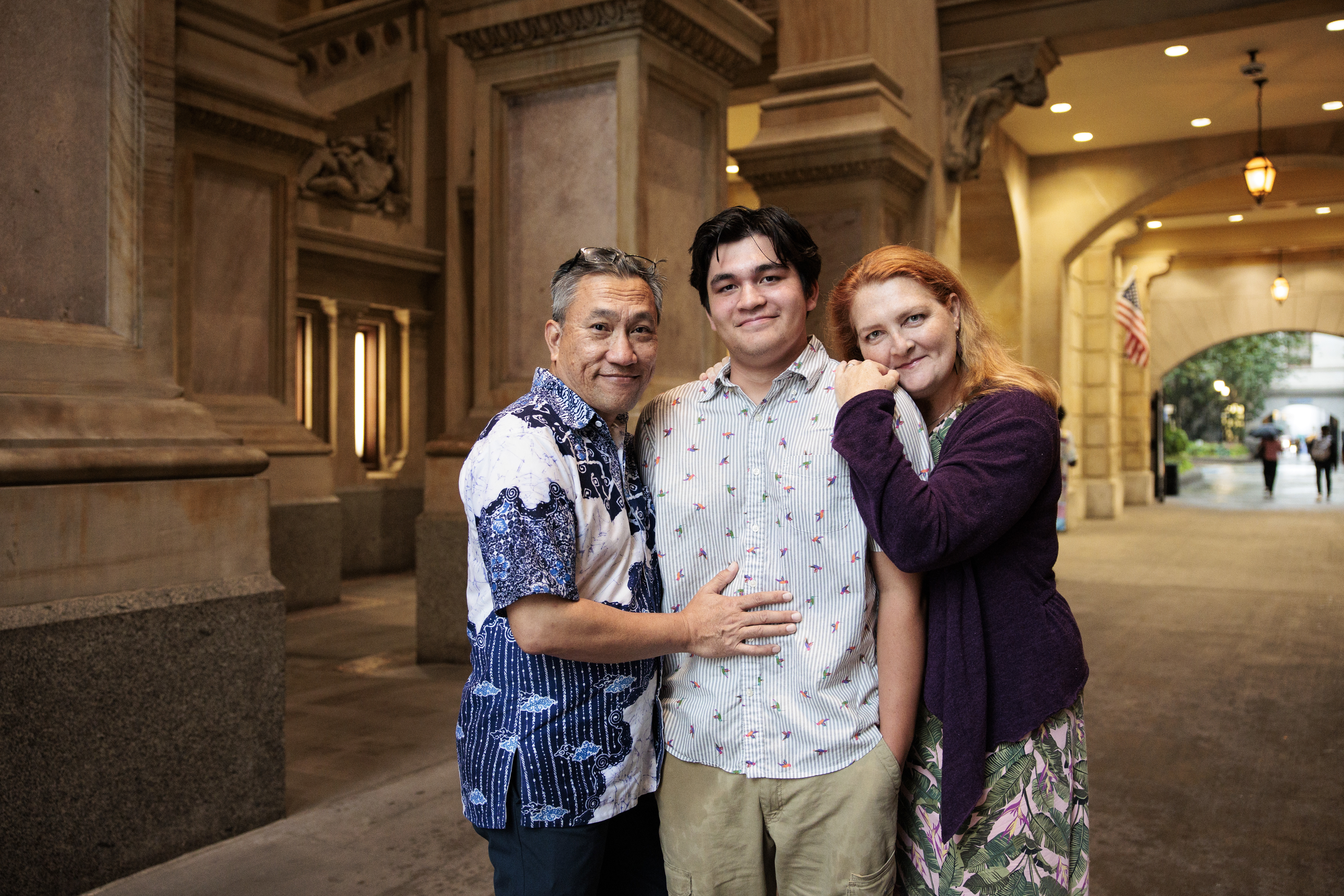
Tú Huynh was working at the National Gallery of Art in Washington, D.C., when he told a job applicant to look for him under the giant Calder mobile that hangs in the East Building.
That was in 1997. The applicant,Kaleo Bird, landed the job — and later, his heart. Three years later they moved as a couple to Philadelphia, where she started grad school. Soon they married.
In 2008, when their son was born, they didn’t take long to decide on a first name:
Calder.
He’s now 17, a senior at Penn Charter School.
Tú Huynh, Calder Huynh, 17, and Kaleo Bird at Philadelphia City Hall where more than 250 of Alexander Milne Calder’s sculptures adorn the building, topped by his statue of William Penn.
“I have yet to meet anyone my age who knows who the whole Calder family was, which is a shame because I feel they’ve had such an impact here, particularly with City Hall,” said the teen. “So many people think Ben Franklin is atop City Hall and don’t know anything about these beautiful sculptures.”
His father now runs the Art in City Hall program.
“I tell people that the true art of City Hall belongs to Alexander Milne Calder,” says Tú Huynh. “This was his Sistine Chapel. There are over 250 sculptures, leafs, busts all over this building. And that’s an homage to his ideal of what this city, state and country is supposed to be about. And he doesn’t sugarcoat anything. There are enslaved Africans, Indigenous populations, Europeans. It tells you the folks who’ve contributed to this extraordinary country.”
Calder Huynh says he feels the weight of his name — in a way that the two generations named after Alexander Milne Calder must have felt.
He paints, draws in charcoal, creates his own comic books — exploring themes with super heroes and Westerns, always with an eye on his father’s works that line the walls of their home.
“Naming me after them is such a big thing to put on someone. For me, it is a weight that Alexander Sandy Calder must have felt. A weight to achieve and create something that differs from what his family members had created, which is kind of cool. … Put something in this world that hasn’t been done yet.”
“The Magic of Calder Gardens” is produced with support from Lisa D. Kabnick and John H. McFadden. Editorial content is created independently of the project’s donors.
To support The Inquirer’s High-Impact Journalism Fund, visit Inquirer.com/giving
Jerusalem Stabile II, 1976 by Alexander Calder is shown on display at the Calder Museum in Philadelphia.