While weed is legal in Delaware, with a baker’s dozen worth of dispensaries to buy it from, people can still face jail time for public marijuana use under current state law.
State Rep. Eric Morrison (D., Newark) introduced a bill last month that would ease those punishments. House Bill 252 would reduce the penalties for public marijuana consumption from a misdemeanor to a civil violation.
“This is not saying that public consumption of cannabis is OK. It is simply making the penalty commensurate with the offense,” Morrison said. “Almost all of the states that have legalized cannabis like we have revisited their laws and changed this violation to a civil offense instead of a misdemeanor, which carries higher fines, a criminal record, and possible jail time.”
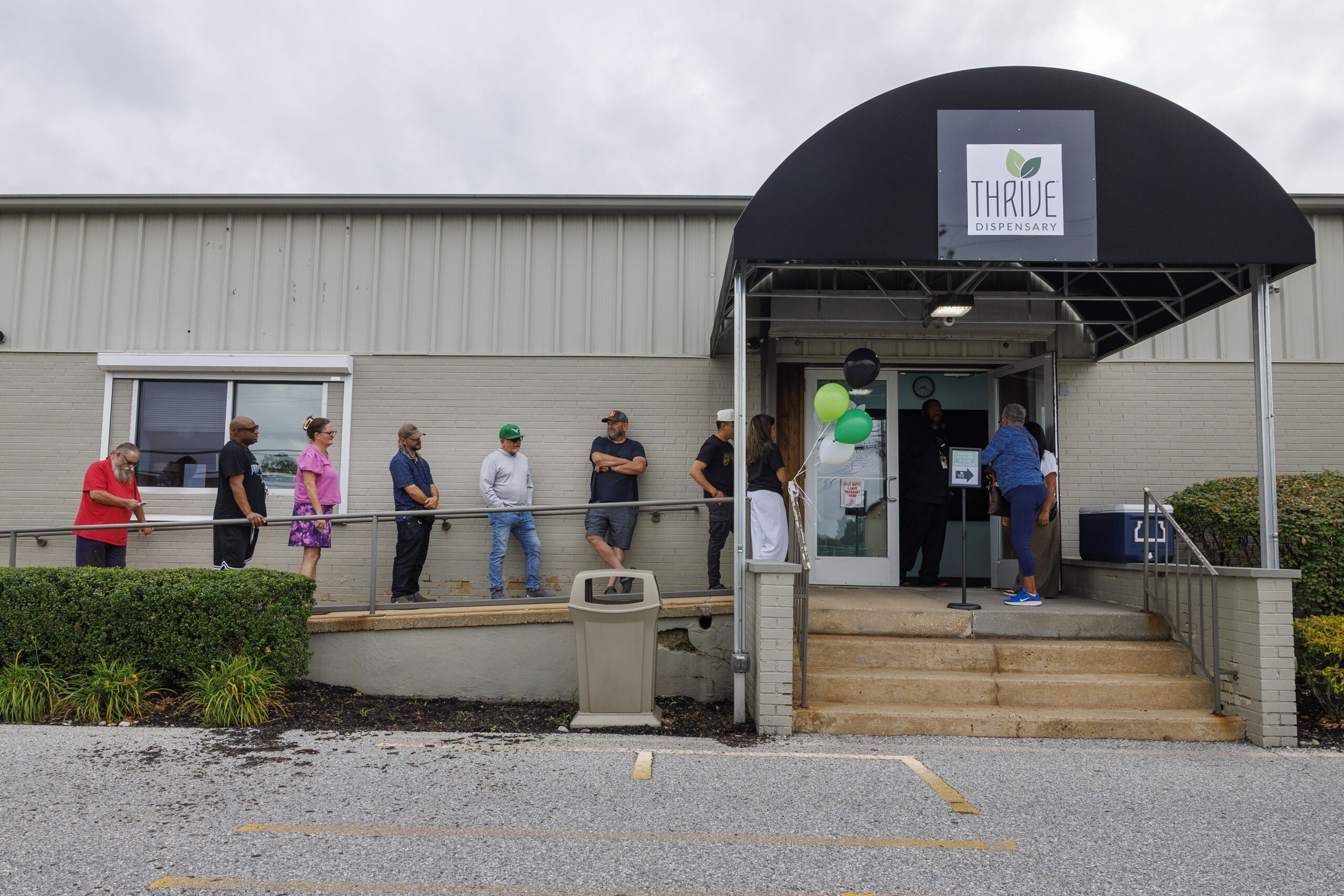
Customers line up for the first day of recreational marijuana sales at Thrive Dispensary in Wilmington on Aug. 1, 2025.
Currently, police can either stop and fine someone up to $200 for smoking weed in public, or officers have the option to arrest the person, with possible imprisonment for up to five days.
Under Morrison’s bill, police can still stop people for smoking or consuming marijuana in public, but instead of a misdemeanor, the offense is considered a civil violation — similar to a traffic violation — that carries a fine of up to $50 for a first offense, and up to $100 for subsequent offenses.
People driving a vehicle while under the influence of marijuana would still beconsidered a DUI.
Delaware’s decriminalization of public marijuana use would match the policies of neighboring states, like New Jersey and Maryland, where weed is fully legal, and some Pennsylvania cities where only medical marijuana is legal, such as Philadelphia and Pittsburgh. In these places, only fines are given out, and violations do not appear on criminal records.
New Jersey went a step further and approved the East Coast’s first legal weed lounges, which means more adults can safely and legally consume cannabis outside of their homes.
Zoë Patchell, president of the Delaware Cannabis Advocacy Network, said some lawmakers are now correcting a policy that should have been included in the original legalization laws.
“This simply just brings Delaware’s law in line with the standards used by most other states,” Patchell said. “This measure does not legalize public consumption. It reduces the penalty from a misdemeanor, which can result in a criminal record.”
Criminal charges have “severe collateral consequences,” Patchell added. For example, arrest and incarceration can negatively impact someone’s health and social outcomes, like losing access to housing, financing, and employment.
“Especially today, for people in America living paycheck to paycheck, spending time in jail can lead to lost wages or having this charge on a criminal record can lead to being terminated from your job,” Morrison said. “For a whole lot of Americans, losing any wages puts their family in a hard predicament financially.”
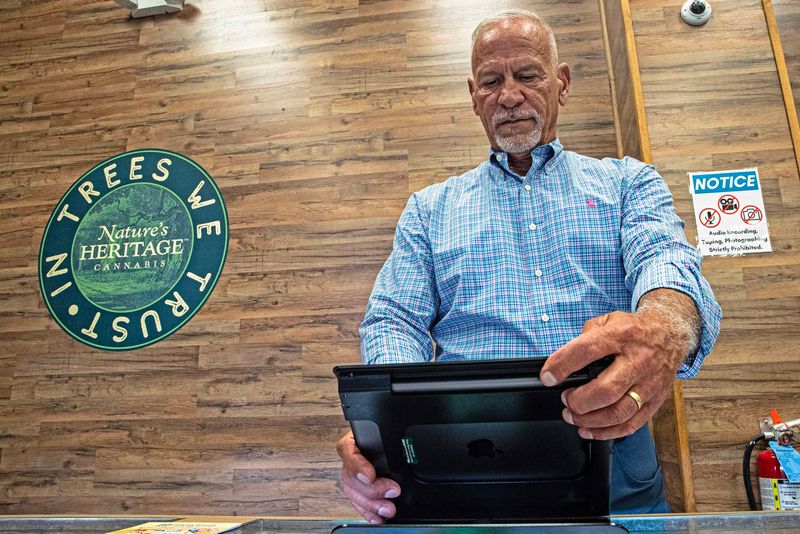
A customer browses through product offerings on Day One of recreational marijuana sales at Thrive Dispensary in Lewes on Aug. 1, 2025.
Delaware legalized recreational marijuana in 2023, but it took years to open legal sales to adults in recreational dispensaries. The first 13 dispensaries opened to adults last year, but advocates like Patchell say the current law makes it difficult to consume cannabis legally.
Delaware’s laws on consumption on private property are also restrictive, Patchell said. Adults can consume cannabis on private property, but only in locations that are at least 10 feet from a sidewalk, street, parking lots, businesses, or “any other areas to which the general public is invited,” according to state law.
“This means that someone can be arrested for consuming cannabis on their own private property,” Patchell said. This proves even more difficult for those living in households that don’t have the property space to be away from the public, she said.
Morrison said he wants to keep working with cannabis advocates to create a safe and robust cannabis industry, but that it would be premature to say if additional measures will be taken at this time, such as amending the 10-foot rule around private property and public space.
“For this year, [decriminalization of public use] is what I’m focused on regarding cannabis,” Morrison said.
The word was out among Chester County teens: West Grove Smoke Shop wasn’t checking IDs.
“Many students frequented it,” a student told a Pennsylvania State Police officer investigating how scores of local high schoolers were getting their hands on an array of marijuana products. “So many, in fact, that there were long lines at the smoke shop after school.”
The tip — revealed in a grand jury report released in October — launched one of the largest stings of smoke shops in Pennsylvania this year. While those shops are allowed to sell hemp-based THC products that fall below a certain potency threshold, undercover detectives found widespread deception. After investigators made purchases from 19 stores in Chester, Delaware, and Lancaster Counties, lab tests determined all but one were selling unregulated marijuana falsely labeled as hemp.
It was a striking, if rare, example of local law enforcement cracking down on smoke shops selling hemp-based THC products, which an Inquirer investigation this year found are often just black market weed, sometimes contaminated with harmful toxins and chemicals. Several teens in Chester County told police they got sick from such products, with one landing in the hospital.
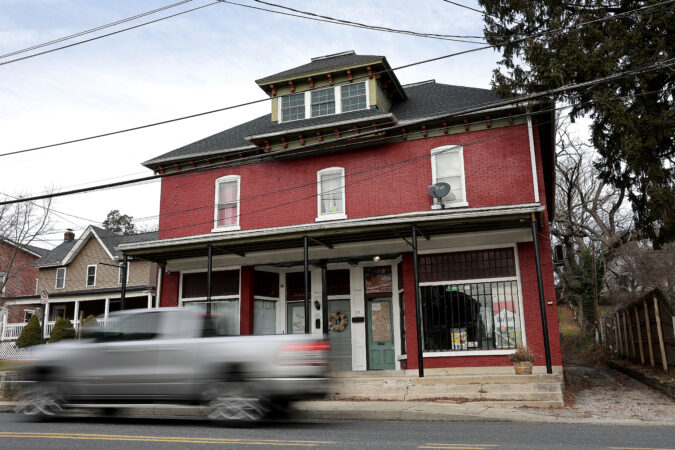
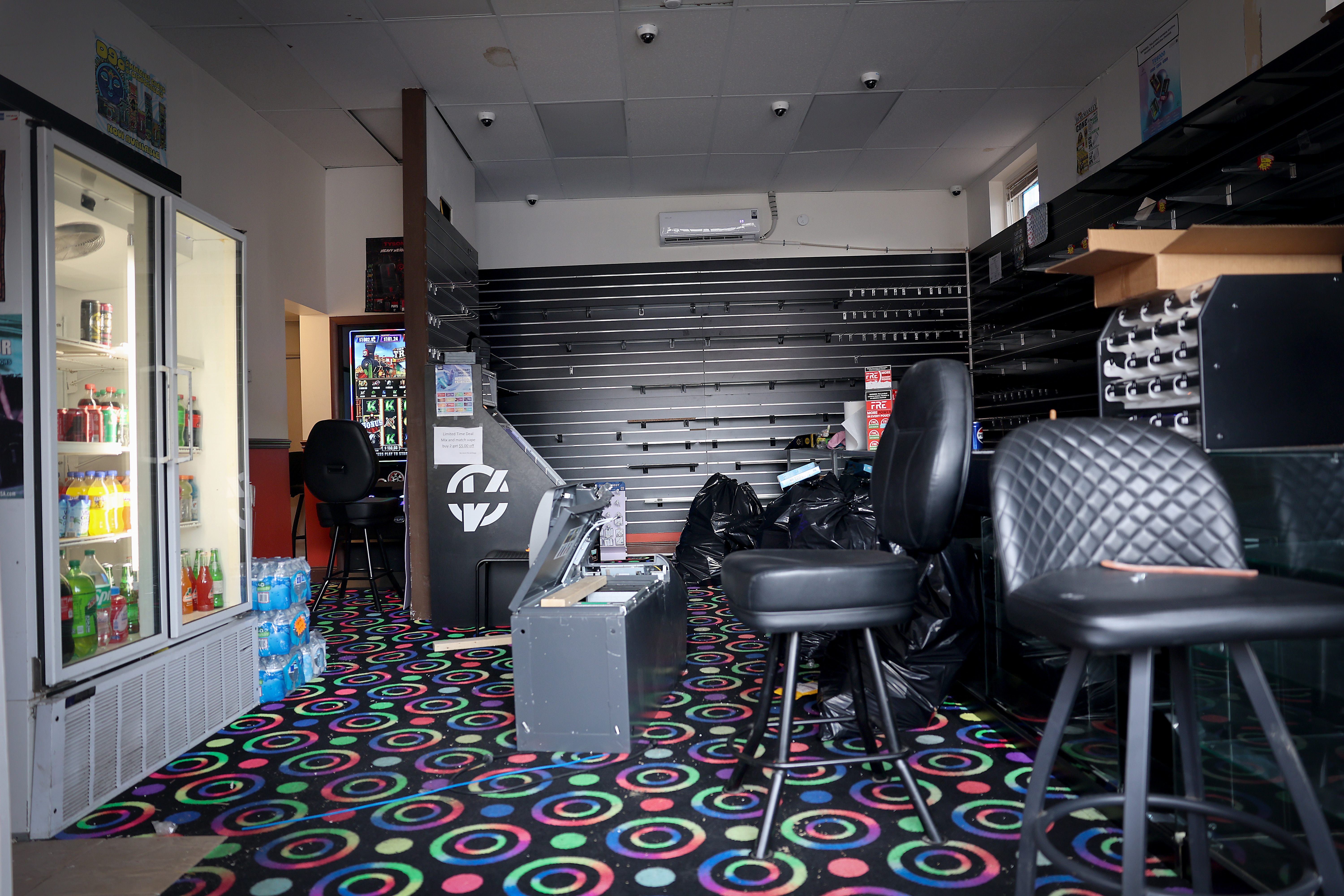
A view looking into the front window of the former West Grove Smoke Shop in West Grove, on Sunday, Dec. 21, 2025.
Confusion over federal hemp law, and the inability of lawmakers in Harrisburg to pass regulations in a state lacking a recreational cannabis program, has led to smoke shops popping up all over Pennsylvania. But the emerging effort to police these shops has so far been inconsistent and haphazard.
Philadelphia City Councilmember Katherine Gilmore Richardson has advanced a series of bills designed to crack down on scofflaw operators, who typically pull fraudulent grocery store licenses to open up shop. An Inquirer analysis found that the city has taken a stricter approach to smoke shops that operate under grocery store permits while peddling drug products and paraphernalia — with investigators doubling violations for improper licensing over the last two years.
“[It] marks important progress in the city’s efforts to better enforce against illegal smoke shops and nuisance businesses devastating our neighborhoods,” Gilmore Richardson said.
But block after city block, smoke shops remain open and continue to operate with relative impunity — sometimes within view of a similar shop that authorities have closed down.
Many use thinly veiled references in their names, such as “High Time Convenience” or “Hi Baby,” the latter featuring a logo meant to resemble the popular RAW rolling paper brand. Since 2022, nearly 100 zoning permits filed by the Frankford-based permit expediter Tina Accounting & Tax Services on behalf of would-be grocery store proprietors were later cited by inspectors as invalid, an Inquirer analysis found. (“There is no assumption that they are aware that these businesses may later become nuisance businesses,” a city official said.)
With the city short of investigators, many shops simply reopen even after they are shut down. Philadelphia has cited at least 42 stores, many of them smoke shops, for resuming operations after receiving an official shutdown order from inspectors over the last two years. One store, Market Mini Mart, located in the shadow of the 52nd Street El station, was cited 10 times for illegally reopening, records show.
City officials said the lack of a specific “smoke shop” permit makes it difficult to track the scope of the problem. Yet an Inquirer analysis of the city’s list of top 35 “nuisances businesses” found more than a third either had “smoke shop” in their names or advertised drug paraphernalia.
Going after technical violations remains one of the few tools available to local authorities, short of conducting raids and lab tests to determine if the over-the-counter products comply with federal law.
The supply line for smoke shops, however, could dry up next year. A provision in a federal spending bill would ban intoxicating THC products derived from hemp nationally, potentially closing a loophole that has created a glut of these quasi-legal products across the country.
The grand jury investigation acknowledged that the growing number of smoke shops presents a daunting challenge. The lead investigator in the Chester County case “quickly realized the sheer number was overwhelming, and many stores were interconnected, operating across multiple counties,” according to the grand jury report.
That investigation resulted in the September arrest of Satish Parsa, 33, the owner of three establishments, including the West Grove Smoke Shop, a redbrick storefront that now sits empty. Parsa faces more than 60 counts of drug trafficking and related charges, according to court records.
His attorney, Elliot Marc Cohen, said Parsa, who has pleaded not guilty, intends to “vigorously” fight the prosecution.
Ellie Siegel, CEO of Longview Strategic, a Philadelphia-area cannabis consultancy firm, argued that selective enforcement is ineffective.
When the federal ban goes into effect late next year, she reasoned, many smoke shops will shut down as the supply line dries up, while others will attempt to pivot toward the regulated marijuana market.
“The manufacturers won’t have a way to manufacture the intoxicating hemp products they’re making now,” she said. “It’s the closing of a loophole.”
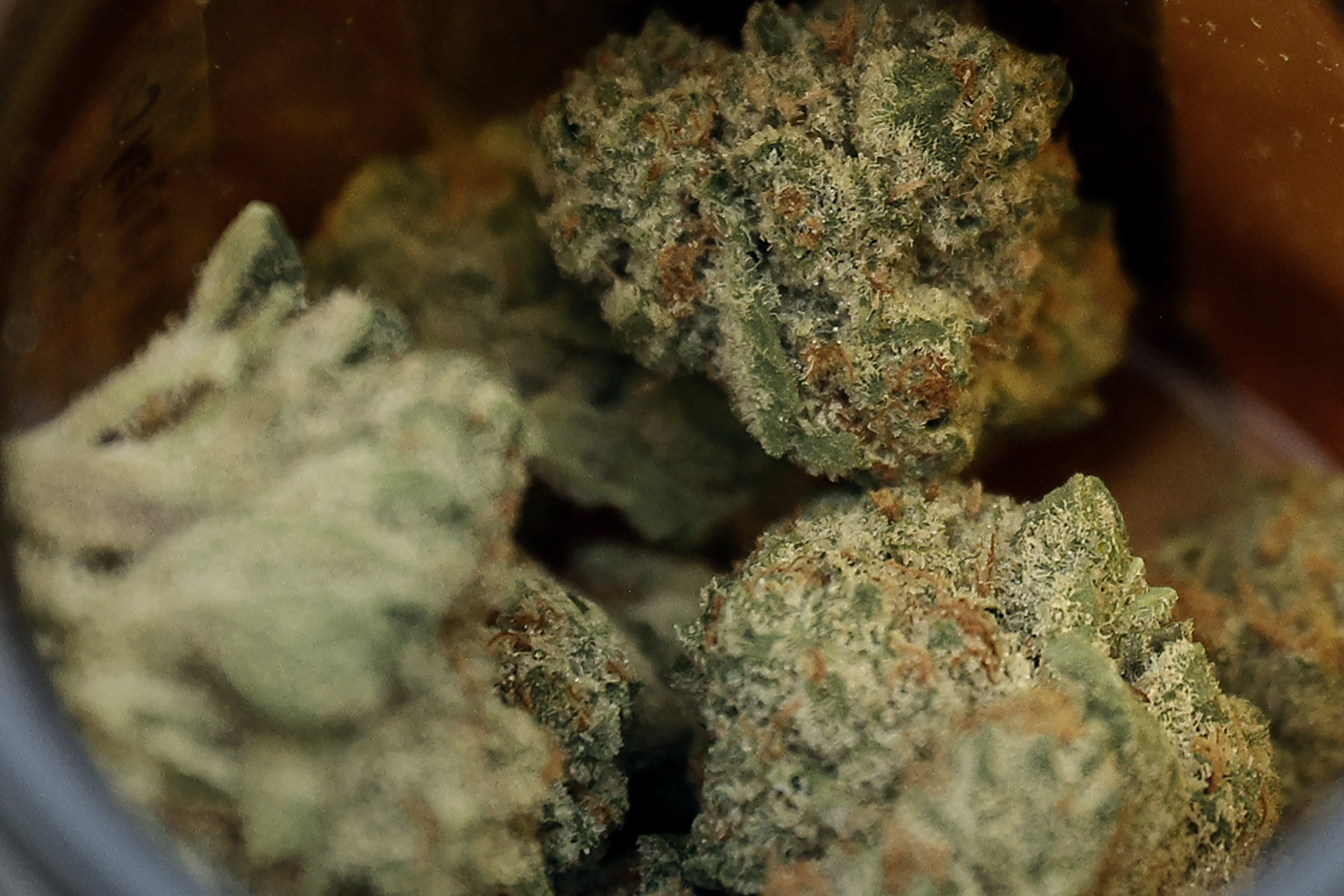
A sample of hemp-based THC flower that was purchased by The Inquirer and sent for lab testing this summer.
The rise and fall of the Philly smoke shop
In interviews with about a half dozen Philly-area smoke shop owners over the last month, several told The Inquirer that they are bracing for closure, saying survival is nearly impossible in an already saturated market.
Others said they are confident they can endure.
On South Street, more than a dozen smoke shops crowd the mile-long stretch east of Broad Street. The longtime operator of Munchies Reloaded recalled thriving years when bongs and pipes brought in roughly $600,000 annually, before he expanded into hemp.
Now, he said, business has plunged nearly 80%. City inspectors have increasingly fined and shuttered stores for selling glassware used for smoking. Those items are easier to classify as “drug paraphernalia” prohibited by city codes, rather than quasi-legal hemp, which is superseded by federal laws.
“There used to be good money in it,” said the store owner, who declined to give his name. “Now there is no money.”
Smoke shops proliferated during the pandemic, often launched by marijuana enthusiasts, immigrant entrepreneurs, or small grocers looking to replace revenue lost to increasingly strict tobacco sale regulations.
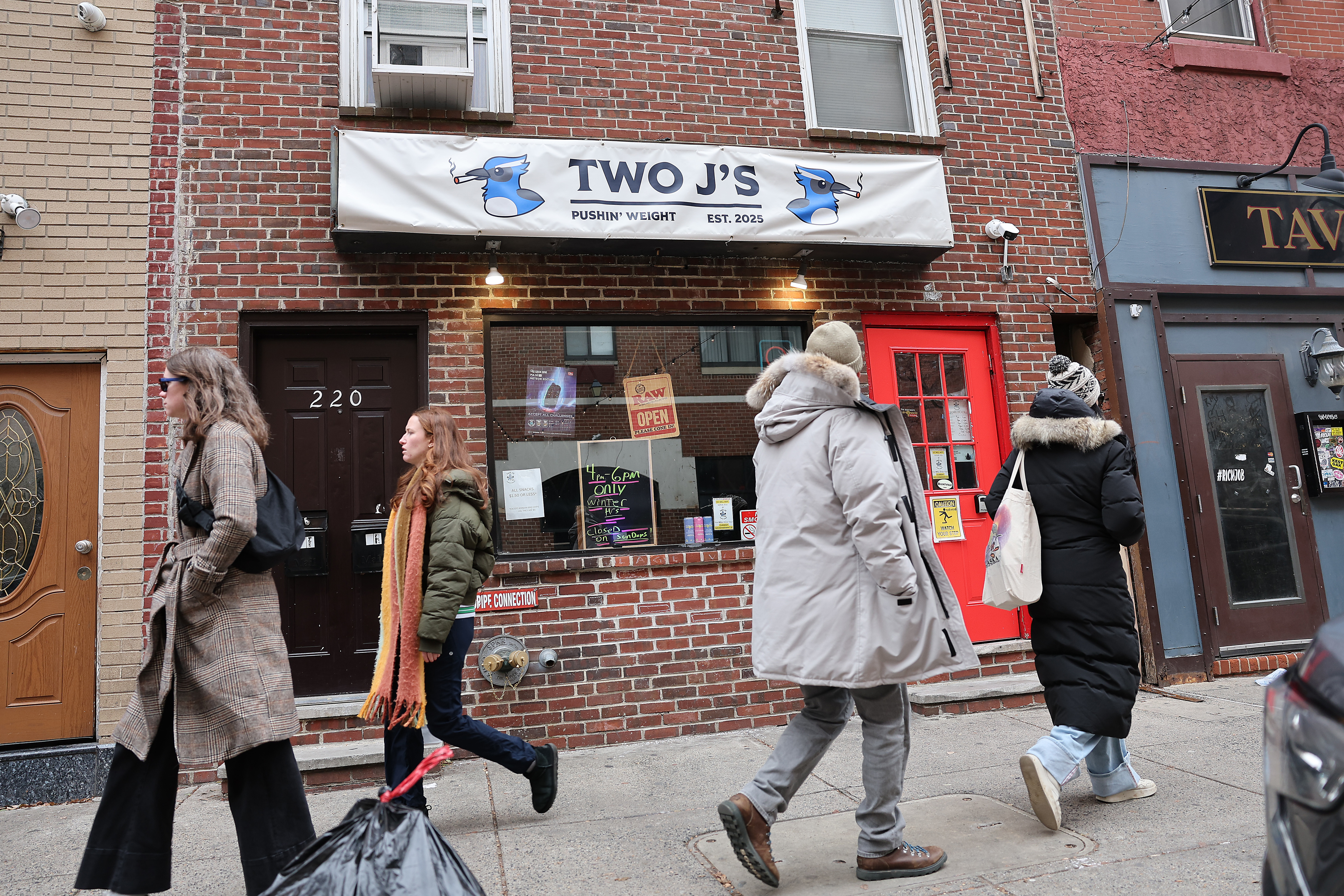
Pedestrians walk along South Street by Two J’s Pushin’ Weight shop in Philadelphia, on Sunday, Dec. 21, 2025.
Some shop owners have migrated to Philadelphia from the New York City area, lured by lower rents and higher demand in a state without legal recreational cannabis. A business permit for Green Broad Smokeshop on Broad Street, for instance, lists an owner based in Queens.
At the peak, a single shop could net between $250,000 and $1 million annually, depending on foot traffic and product line, according to two owners who spoke with The Inquirer on the condition they not be named so they could speak frankly about their businesses. Low overhead and high demand made for a tempting copycat model — a cheap pound of hemp might cost $600 in bulk but retail for more than $5,500.
On the same block as Munchies Reloaded, Abtein Jaeger and his brother in January opened Two J’s Pushin’ Weight. Jaeger said he sources high-grade hemp from West Coast farmers, positioning his store as a premium dispensary amid competitors selling a lower-quality product.
He said he is upbeat about surviving a potential crackdown on stores like his next year.
“It’s not the worst thing in the world,” Jaeger, 34, said.
He added that he would comply with any testing requirements and try to apply for a license, and that he already enforces a 21-plus age limit.
Reforming the Wild West of weed
Unlike in state-run cannabis programs, which mandate costly contaminant testing, hemp products need only carry a certificate of authenticity showing the flower tested under 0.3% Delta-9 THC at harvest.
The Inquirer, in its investigation earlier this year, commissioned a lab to test 10 products. Nine of them exceeded that limit, and most were tainted with banned pesticides, harmful mold, or heavy metals. Manufacturers had also used forged certificates to make their products appear safe and legitimate, The Inquirer found.
But the complexity of federal drug law makes it difficult to prove products are illegal, as many hemp-based products use THC variants like Delta-8 or Delta-10 that are not specifically banned.
For now, most shop owners say, local police leave them alone. Undercover stings, like those led in the suburbs, remain rare because they demand expensive lab testing and significant resources.
One South Street establishment has a singular strategy for surviving a potential crackdown.
South Street Cannabis Museum, whose logo includes a Liberty Bell festooned with marijuana leaves, exhibits a small collection of Reefer Madness-era newsprint, historical pamphlets, and other weed-themed memorabilia.
Exterior view of South Street Cannabis Museum in Philadelphia, on Sunday, Dec. 21, 2025.
“We are a museum, first and foremost, where we can engage with the public about the history, science, culture, and art of cannabis,” said owner Kristopher Wesolowski, 42, a former neuroscience lab manager and event planner, who pivoted into hemp sales after the pandemic.
The back half of the museum is a gift shop where visitors can buy hemp-derived THC flower under glass display cases.
“It’s almost like a simulated dispensary,” Wesolowski said. “But it’s not like some spot where people can just go and get high. … You can get historically stoned at our museum, in a sense.”
Like other proprietors, Wesolowski said the hemp industry has been “screaming for regulation,” as “bad actors” gave well-intentioned store owners a bad name.
But he also cautioned that overregulation would only create new problems, like increasing demand for unpredictable designer drugs on the black market.
“When you close one door, another will open,” he said. “And that one might be a little bit more dangerous.”
President Donald Trump announced he would advise federal agencies to reschedule marijuana from a Schedule I controlled substance to Schedule III, easing federal restrictions on the plant.
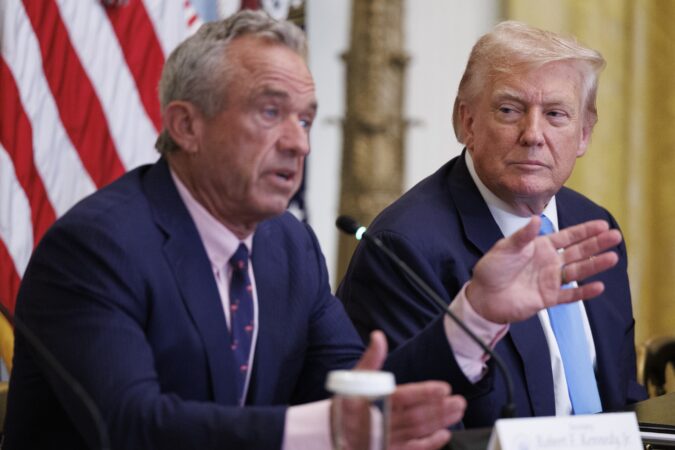
Trump announced the executive order Thursday in the Oval Office, alongside Health and Human Services Secretary Robert F. Kennedy Jr. and a line of medical workers in white coats and scrubs. The president does not have the direct authority to reschedule marijuana but can request his federal agencies to do so.
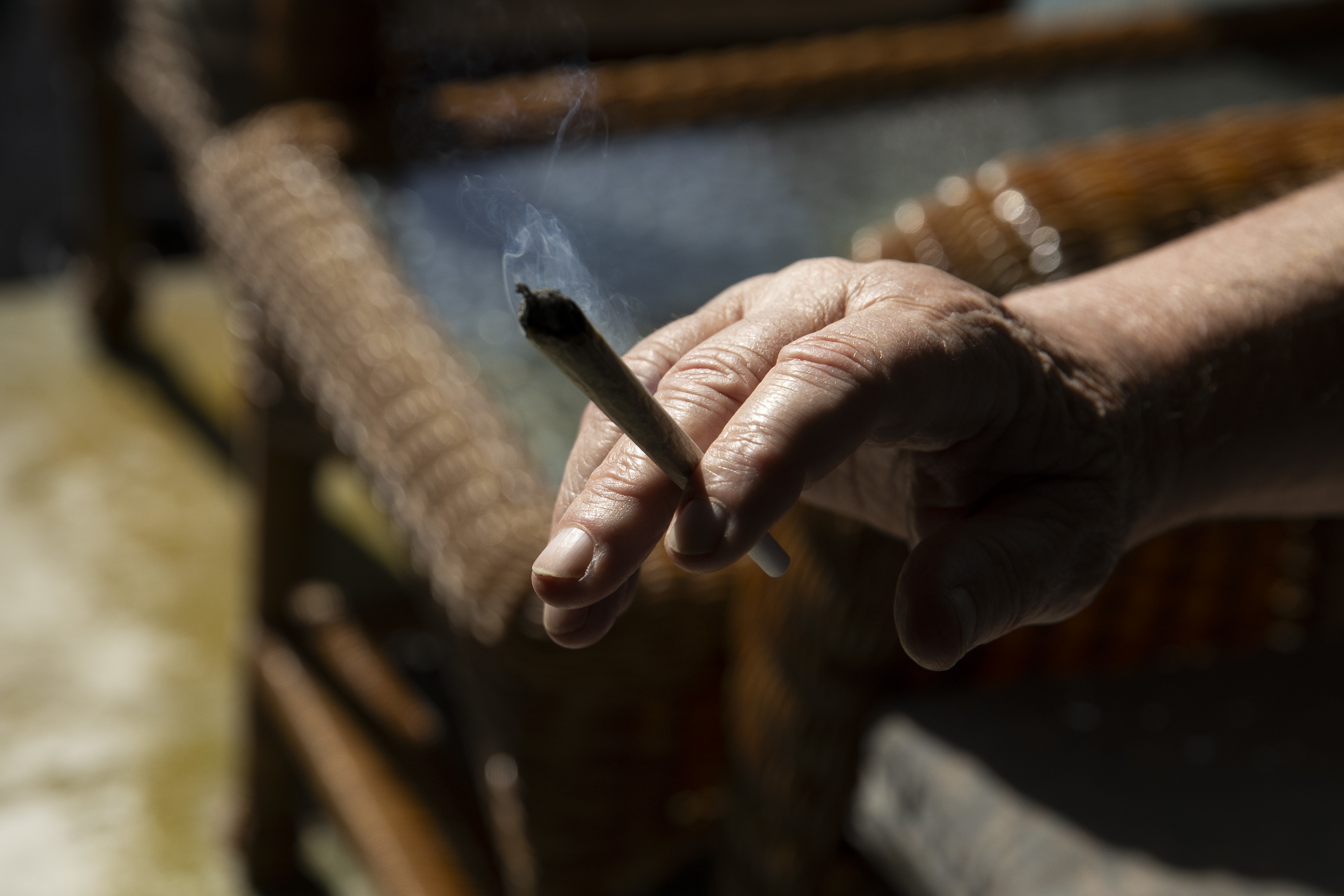
Jeff Hodgson smokes a pre-roll at his home in Cape May, NJ on Thursday, May 2, 2024. Hodgson mostly uses medical marijuana to help him sleep.
Marijuana has been a Schedule I controlled substance since the 1970 Controlled Substances Act, meaning the federal government considers marijuana to have no accepted medical use, with a high risk of abuse. Schedule I drugs, such as heroin, cocaine, and LSD, are illegal and strictly regulated, making medical research on these drugs, including cannabis, nearly impossible.
A reclassification would be the most significant reform on marijuana in more than half a century, opening the doors for medical research. But it would not be full legalization, said Adam Smith, executive director of the Marijuana Policy Project. It could also pave the way to federal intervention in the state-run medical and recreational marijuana industries, something stakeholders fear.
“There is a possibility that in moving cannabis to Schedule III, instead of opening up access, what it will do is incentivize federal agencies to clamp down control on the availability of cannabis,” Smith said. “Treating it as other Schedule III substances, which virtually all require prescriptions, is not how this works in medical cannabis and could really create chaos and a lot of economic pain in the industry.”
Frank Burkhauser of Woodbury displays the legal marijuana purchase that he just made at Cannabist in Deptford, N.J. on April 21, 2022. Burkhauser said he has been working for the legalization of marijuana since the early 90’s.
Smith said stakeholders are unsure what this might mean for the wider industry but remain optimistic, as rescheduling of marijuana has been a priority for decades.
This executive order has plenty of positives, said Joshua Horn, a Philadelphia cannabis lawyer at Fox Rothschild. Loosening restrictions could clear the way for the IRS to allow cannabis businesses to deduct business expenses (which they currently cannot do). Additionally, more traditional banking options might become available to entrepreneurs.
“It could also rectify the criminal injustice that has been ongoing since the passage of the Controlled Substances Act, where people of color have been disproportionately impacted by the ‘war on drugs,’” Horn said. “In the end, rescheduling should reinvigorate these businesses out of their current tax and financial struggles.”
This federal rescheduling of marijuana would come on the heels of Congress’ banning all intoxicating hemp products, which are derived from cannabis plants. While this may seem like a policy flip-flop, Smith said, these are two different issues at hand.
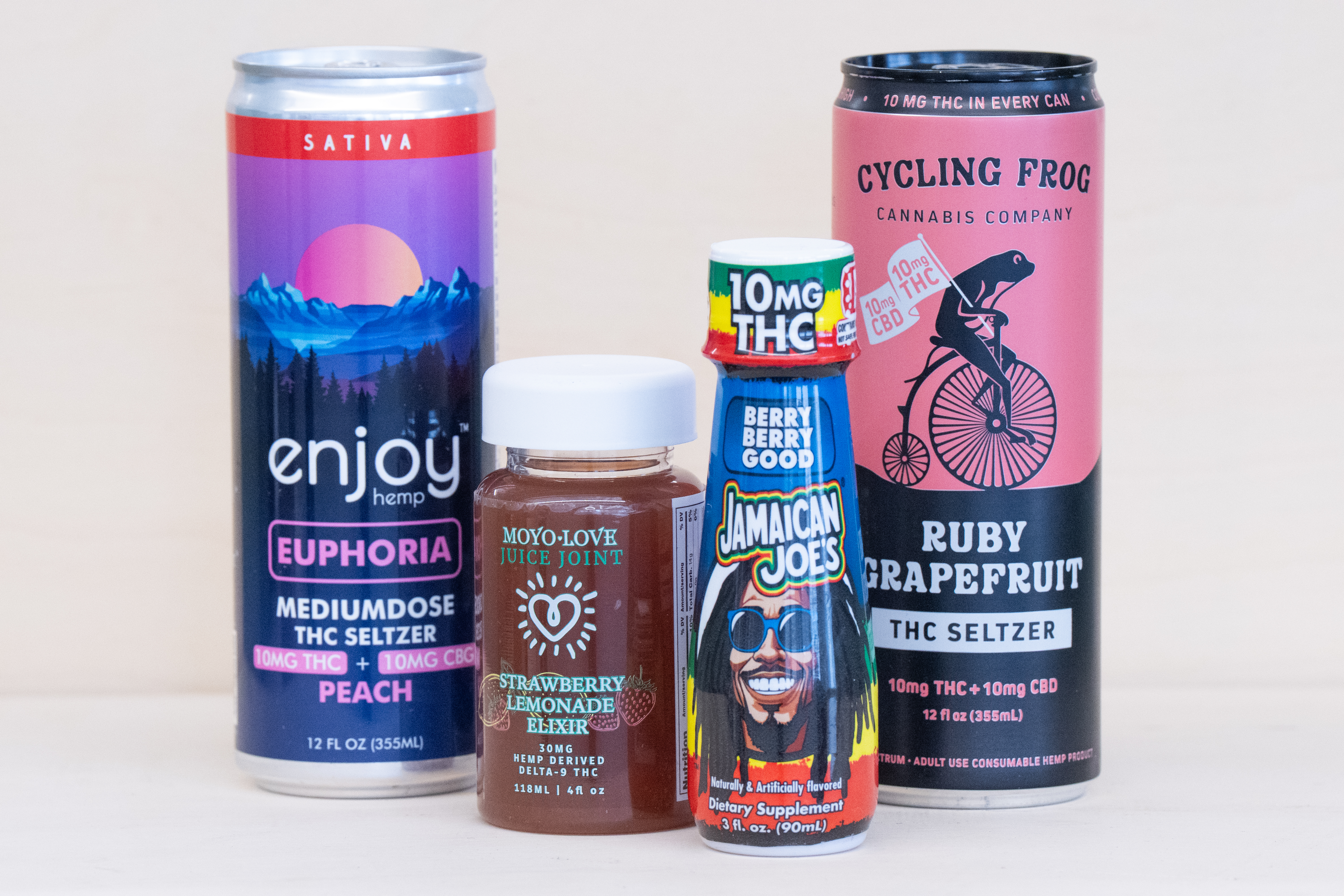
Hemp products photographed at the Philadelphia Inquirer, November 21, 2025.
“The hemp ban is the result of the fact that the market was chaotic and, in many cases, unsafe. Without regulation, that market was rife with pesticides, heavy metals, and products that should not be on shelves,” Smith said.
But he contends there is a movement to push back against wider marijuana legalization. “There’s always pushback when there’s big change,” Smith said. “But also because of the instability created when we have state-regulated markets operating in a federally illegal area.”
Industry folks are hoping this move better aligns the federal government and state markets, opens the doors to research, and provides better clarity to states that are hesitant to legalize marijuana, Smith said.
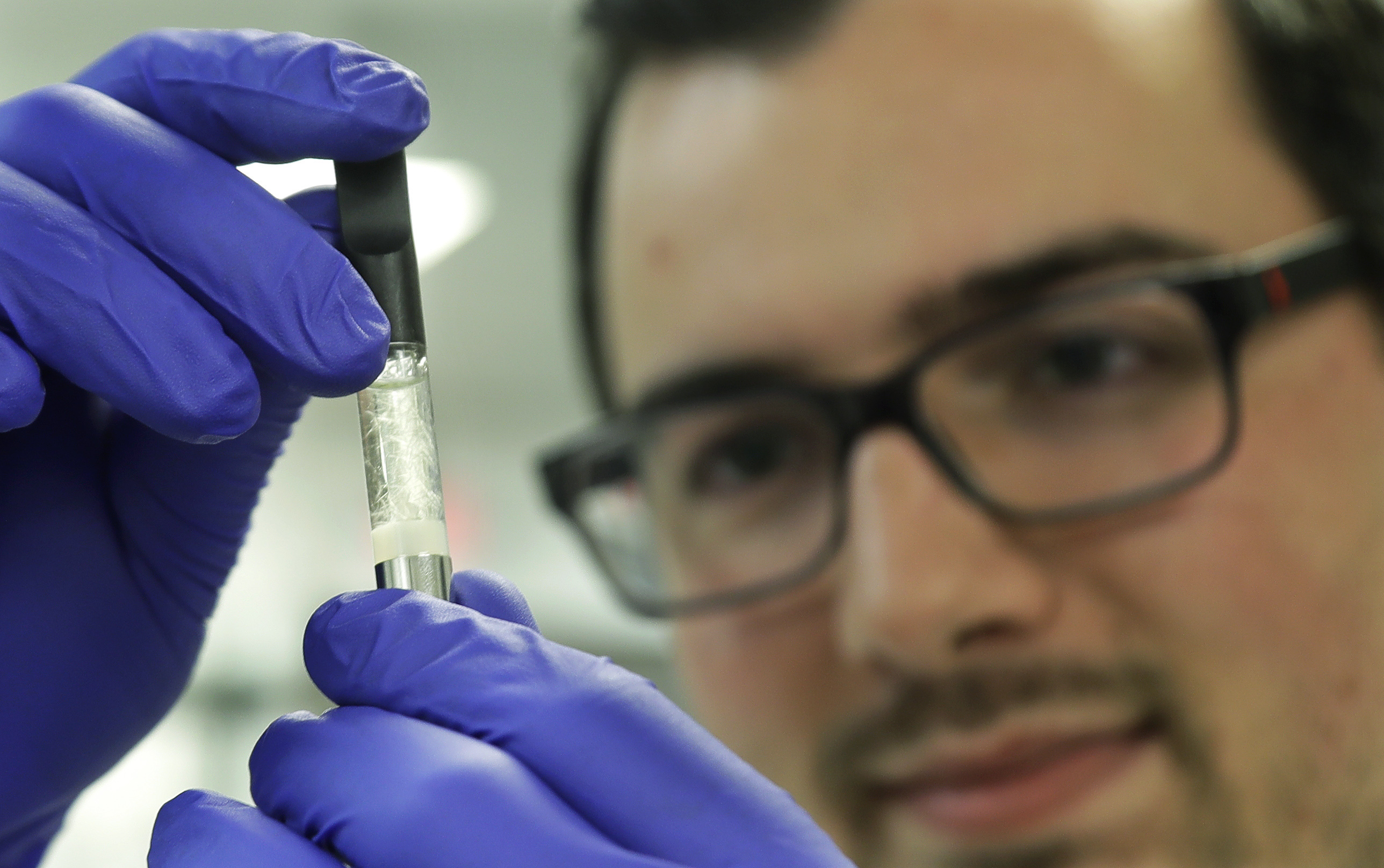
In this July 19, 2019, file photo, Pierce Prozy examines a Yolo! brand vape oil cartridge marketed as a CBD product at Flora Research Laboratories in Grants Pass, Ore.
Reducing restrictions on commercially available cannabis is “a key missing ingredient toward making clinical breakthroughs,” said Stephen Lankenau, director of Drexel University’s Medical Cannabis Research Center.
“A key issue is that any reclassification efforts need to reduce restrictions for university-based researchers to have access to cannabis-derived THC — commercially available products in particular — for clinical studies, whether laboratory or human subjects,” Lankenau said.
Researchers now are only able to examine hemp-derived nonpsychoactive cannabinoids like CBD or CBC. However, Lankenau said, it is unclear whether Trump’s proposal would give them the green light.
Right now, any Philadelphian 21 or older can go online or walk into a regional smoke shop and buy a THC-infused drink as potent as products in legal dispensaries.
But soon, that might all change.
The billion-dollar intoxicating beverage industry exploded in recent years, with THC-infused seltzers, lemonades, and teas that resemble popular products like Surfsides or White Claws. Sold in local gas stations, smoke shops, and liquor stores outside of Pennsylvania, these weed drinks deliver a cannabis high that is infused into bubbly, sweet canned beverages.
While marijuana is still federally illegal, the hemp industry had found a way to manufacture and sell hemp-derived THC drinks across the country through a legal loophole that is soon closing.
Last month, Congress banned all intoxicating hemp products, a slew of THC-infused smokeable, vape-able, and edible products that are derived from hemp plants but could be mistaken for actual marijuana. In many cases, the drinks are just as potent as conventional weed.
Starting in 2027, almost all of them will be illegal, spurring a nationwide movement within the industry to save the burgeoning market.
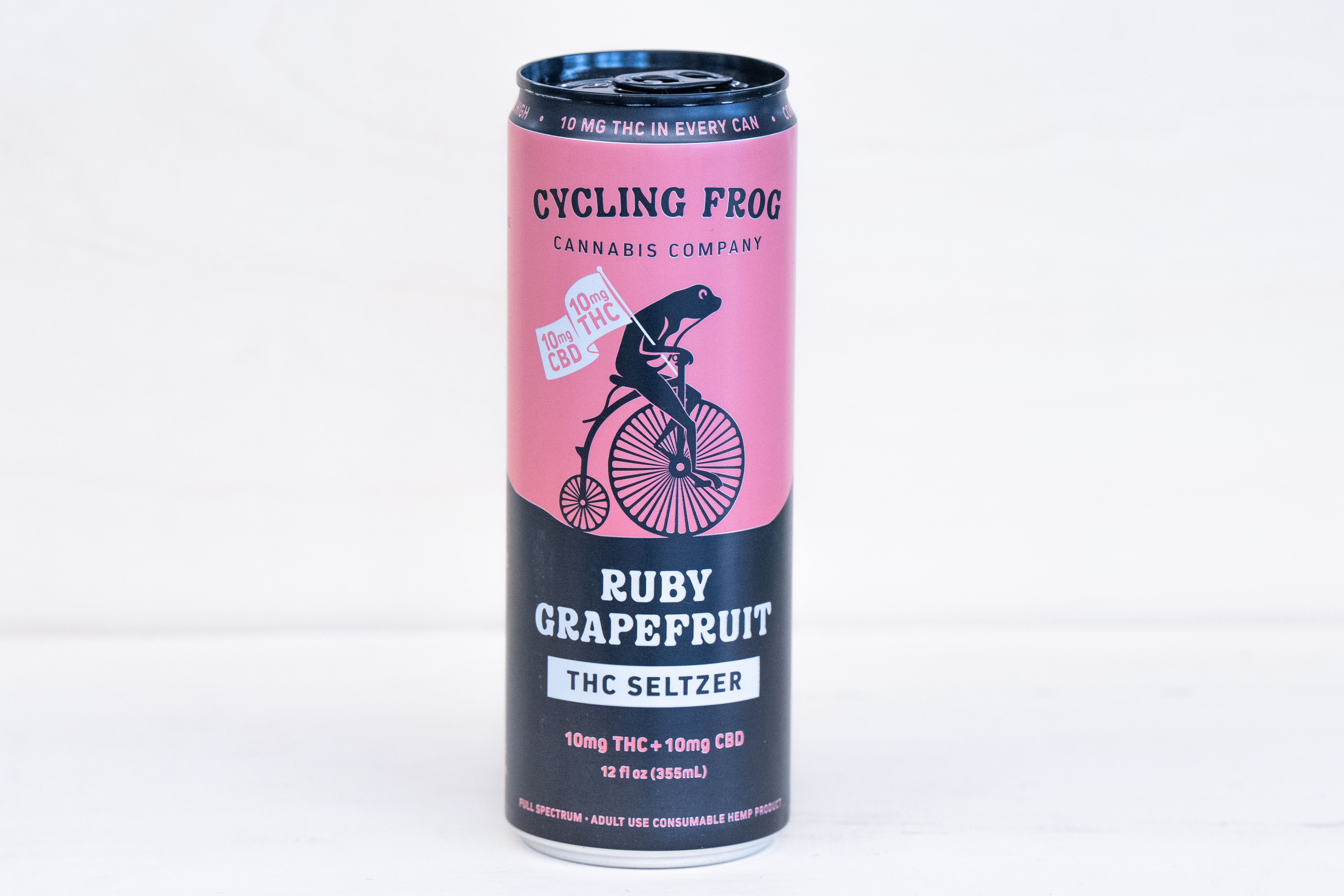
Arthur Massolo, the vice president of national THC beverage brand Cycling Frog, which sells its wares locally, saidthese restrictions will have devastating effects on the producers of thousands of hemp-derived products, like THC, but also CBD, the non-intoxicating cannabinoid popular for treating anxiety, sleep, and pain.
Will Angelos, whose Ardmore smoke shop and wellness store, Free Will Collective, relies on THC drinks for nearly 40% of its business, is hoping for some saving grace. “We’re either looking to pivot or we’re disappearing,” he said.
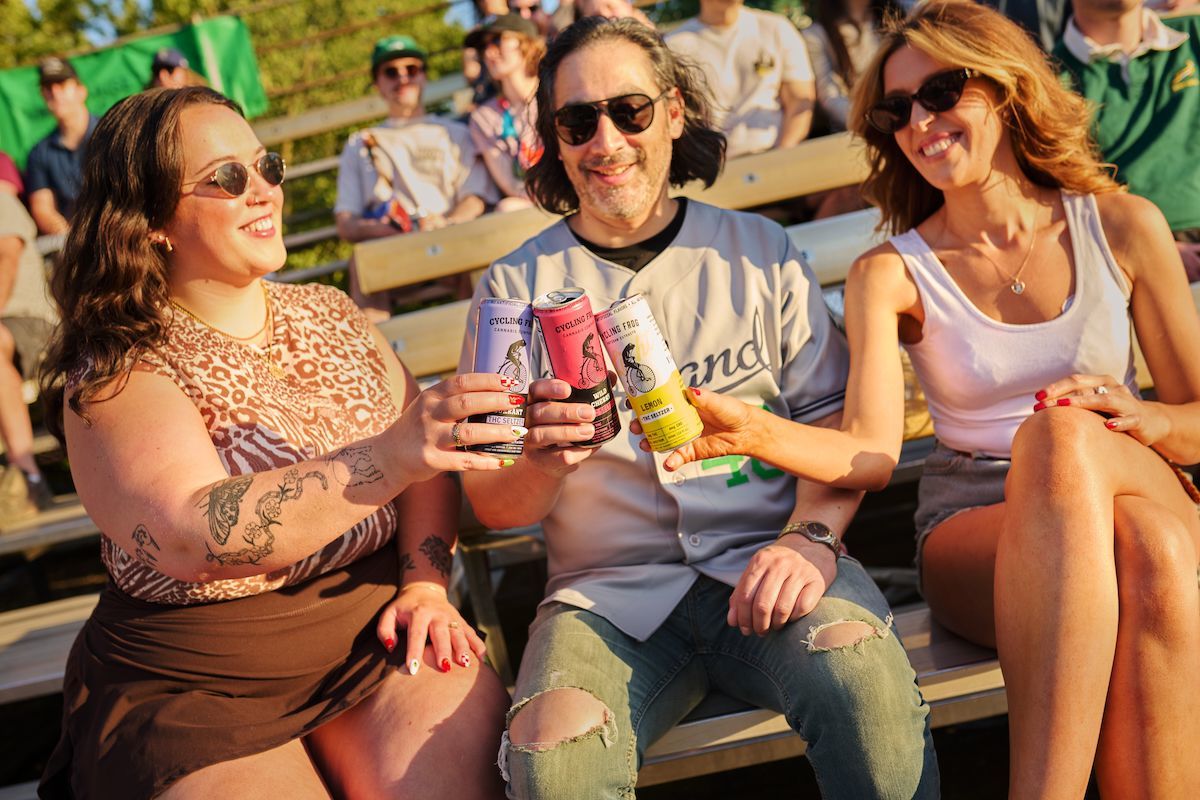
Adults share Cycling Frog canned THC drinks in this marketing photo provided by Cycling Frog.
What are THC-infused drinks?
Seltzers, sodas, teas, mocktails, and lemonades all infused with THC — and sometimes non-intoxicating CBD — exploded onto the scene a few years ago and grew into a billion-dollar business, said hemp market analyst Beau Whitney.
“These drinks have transformed the hemp industry into this low-dose intoxicating health and wellness, alcohol-adjacent product,” said Massolo, who is also the president of U.S. Hemp Roundtable, a hemp business advocacy organization.
The THC-infused drinks sold in gas stations, smoke shops, and liquor stores are supposedly formulated using legally grown hemp, which is allowed to be grown under the 2018 Farm Bill that opened the door to hemp farming in the U.S.
Lawmakers carved out an exemption from federal drug laws for cannabis plants containing 0.3% or less of THC. These low-THC plants are considered “hemp” and are legal to grow. Cannabis plants over that THC threshold are considered marijuana and can carry felony charges if the plant is not being grown by state-licensed growers in places where adult use or medicinal marijuana is legal, like New Jersey and Pennsylvania.
While intoxicating hemp products have enjoyed consistent growth in the past years, these THC-infused drinks have increasingly appeared in aisles of liquor stores and supermarkets in some states, allowing adults who normally don’t visit dispensaries to pick up a bottle of infused wine in the same place they grab groceries, said New Jersey cannabis lawyer Steve Schain.
Hemp products photographed at the Philadelphia Inquirer, November 21, 2025.
The ease of access to THC drinks allowed the national market to grow to $1.3 billion in annual sales, and if access continues, Whitney said, that figure could reach $15 billion in the coming years.
This is all thanks to what Whitney calls the “FPS,” or “Female Power Shopper.” These women, ages 29 to 45, are the ones who are likely shopping for a household in grocery and liquor stores, and may jump at the chance to try cannabis products without diving headfirst into dispensaries, Whitney said.
Mary Ellen, 55, of Bucks County, who asked to not to be identified by her last name over concerns for her cannabis use and employment, said these THC drinks are the perfect way to unwind after a long day, especially for adults like her who choose not to drink alcohol. As a medical marijuana patient, she uses regulated cannabis for a variety of ailments, but also enjoys THC drinks like Nowadays’ infused mocktails that she buys at Angelos’ Ardmore store.
“I’d rather come home and have a glass of Nowadays. That’s a lot better than having a glass of vodka or a benzodiazepine,” she said. “I’m not going to forget what I did the night before, and I’m not going to wake up feeling crappy the next morning.”
City smoke shop exterior in the 1000 block of Chestnut Street Monday, July 21, 2025.
What are the concerns over THC drinks?
As the money started to roll in for THC drinks, fear among local communities and law enforcement began to grow. In the Philadelphia suburbs, the Bucks, Chester, and Montgomery County district attorneys’ offices finished a 10-month investigation into intoxicating hemp products and the local stores that sell them.
The 107-page grand jury report speaks of a public health crisis unfolding in “plain sight” across Pennsylvania, where retailers have little to no oversight, in some cases selling actual marijuana.
Montgomery County District Attorney Kevin Steele said the industry created a “Wild West situation” and urged state lawmakers to regulate the industry similarly to alcohol and tobacco, including age requirements, licensing, and mandatory lab testing.
Stakeholders in the industry support regulation of some kind. While hemp-derived THC companies fear the economic collapse of their industry, Massolo and Angelos say there is concern that these products will leave overt brick-and-mortar operations known by local officials for more covert, illicit operations, similar to how these products were purchased before the 2018 Farm Bill.
“We’ve basically traveled back to 10 seconds before the Farm Bill of 2018 was signed,” Schain said.
Mary Ellen says the lack of regulation is a major sticking point for consumers who flock to these products, but would like some reassurance on the drinks they are ingesting.
But, even if the ban goes into effect, she said, “people will just figure out another way for us to get it. It’ll be like a prohibition that we’ve seen in this country with alcohol and marijuana.”
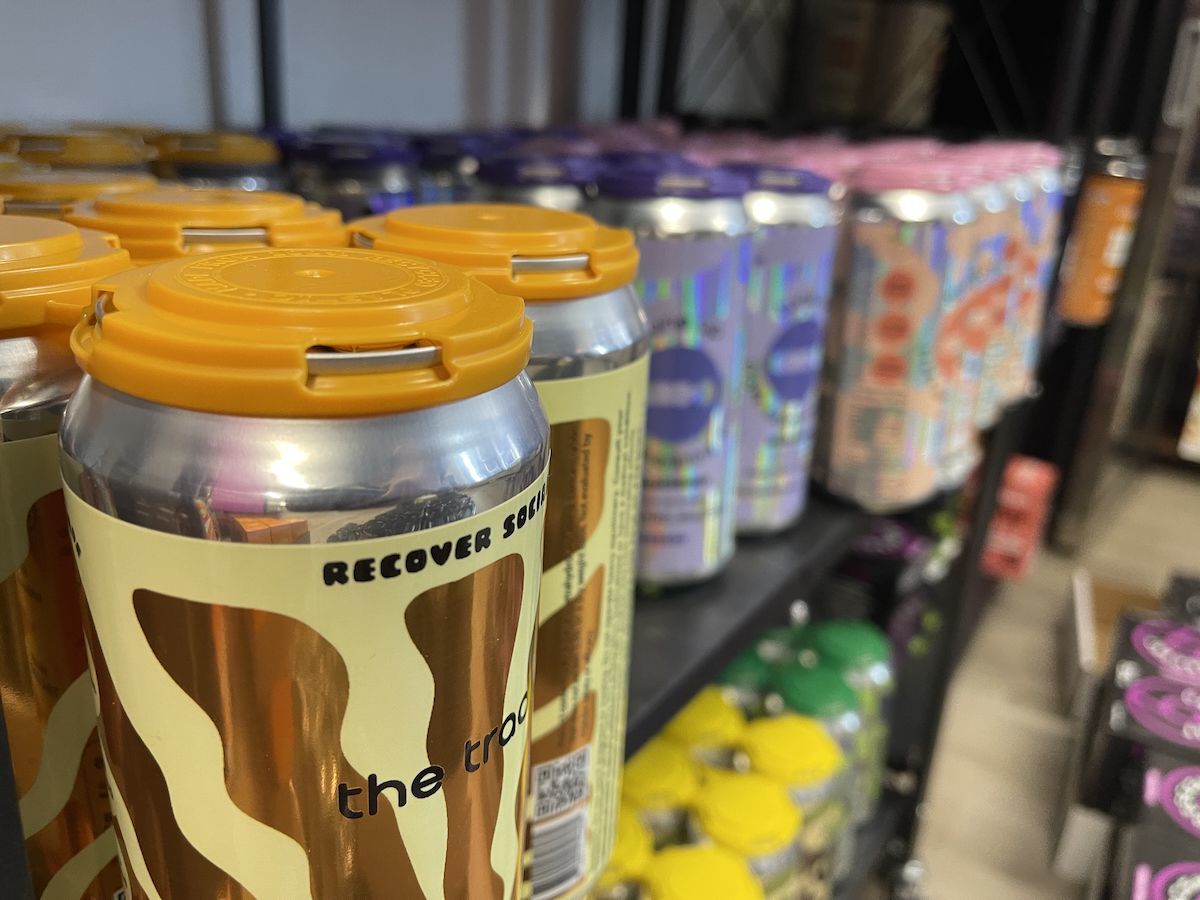
THC and CBD-infused beverages on the shelves of Free Will Collective, an Ardmore smoke shop and wellness store owned by Will Angelos. As Congress moves to ban most intoxicating hemp products, business owners like Angelos aren’t sure they will be able to keep the doors open long past 2027 if current regulations go into effect.
Will THC-infused drinks be banned or saved by 2027?
Now, as the industry’s yearlong grace period begins before the ban takes effect, companies are scrambling.
The intoxicating hemp manufacturers and retailers who spoke to The Inquirer said the game plan is to offload all of the intoxicating hemp products in stock, including THC-infused drinks, flower, vapes, and even CBD products.
Some companies will see almost their entire product catalog become illegal, in some cases dwindling from 45 products on offer down to two, Whitney said of the firms he works with. The far-reaching impact will also hurt industrial hemp products, cannabis tourism, alcohol distributors, and even the legal cannabis industry, as some of their products, including CBD, will now have to contend with these new regulations, Schain and Whitney said.
At the U.S. Hemp Roundtable, Massolo is having daily board meetings, including on weekends, to coordinate a response to federal lawmakers. It’s now a race against the clock to remedy or claw back some of the new regulations before damage is done to the industry’s distribution pipelines, Massolo said. The group hopes to rally other industries, like traditional beverages, wellness products, and supplements, to bolster its case.
Among the U.S. Hemp Roundtable’s recommendations to lawmakers are an extension of the hemp ban grace period to two years, raising the limit on hemp-derived THC products, and allowing states to regulate these products as they see fit, to name a few.
Stakeholders say they want regulations to help legitimize this billion-dollar endeavor and save it from annihilation, but smaller operators like Angelos hope it’s not at the expense of small independent businesses.
While precautions like rigorous age verification systems and lab testing are necessary, Angelos said, if regulators “overtax, or over gate-keep,” many of the smaller retailers — who he said enjoy the benefit of knowing their local government officials and community — won’t be able to compete in the market.
“There obviously has to be standards, but I’m scared of an overcorrection,” Angelos said of the hemp ban. “It’s not just a singular choice. If you want your kids to be safe, have a mechanism where you can keep your eyes on the product.”