Skip to content

Philadelphia local news, sports, jobs, cars, homes

Category: Tourism & Gaming

  • Philadelphia’s politics were reshaped by the effort to win the 1936 Democratic Convention

    Philadelphia’s politics were reshaped by the effort to win the 1936 Democratic Convention

    In late April, Ken Martin, chair of the Democratic National Committee (DNC), visited Philadelphia to assess the possibility of the city hosting the 2028 Democratic National Convention. He toured Xfinity Mobile Arena and met with Mayor Cherelle L. Parker and business leaders, who rolled out a “blue carpet” aimed at charming him.

    It seemed natural to see business leaders working with local politicians to try to convince the DNC to choose Philadelphia, as well as helping to raise the funds required for the city to be eligible to host the convention. Democrats dominate the city’s politics, and its elected officials tend to share local business executives’ visions for economic development.

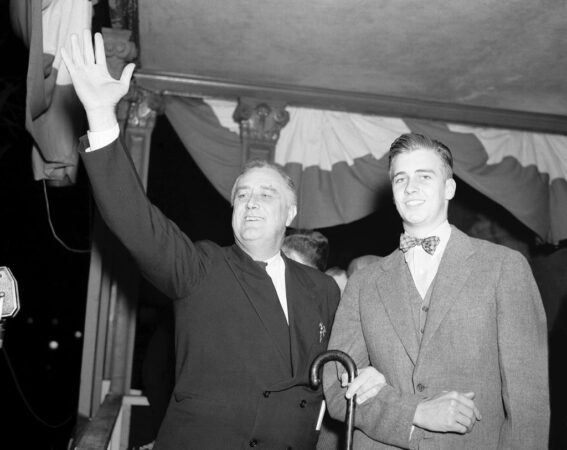
    But these groups weren’t always aligned. In 1936, when Philadelphia made a similar push to host the Democratic Convention, the effort aroused skepticism in a city that had been a Republican stronghold for decades. Much of the skepticism was centered in the business community — where many vehemently opposed the policies of President Franklin D. Roosevelt.

    It took a push by coalition builders like Albert Greenfield, a powerful business leader, to win over skeptics. Greenfield sold his fellow businessmen by framing the pursuit not as something partisan or political, but as a venture in civic boosterism. This argument proved compelling, and business support helped land the convention for Philadelphia. Today, Greenfield’s efforts provide a model for how to bring diverse interests together to boost a city, even in times of polarization.

    Before the 1930s, Philadelphia was firmly a Republican city. In this era, the national party’s platform was dominated by pro-business politics, aligned around policies aimed at enhancing economic growth and competition.

    A thoroughly corrupt political machine led by William Vare dictated the city’s politics. Each ward had Republican committee people who purchased individual votes at a going rate of one dollar. Loyal to the Vare machine, they also ensured voters headed to the polls on Election Day. In exchange, many of these committee people were rewarded with spots on the city payroll.

    The flow of money linked voters and committee people alike to Vare and the GOP. The machine’s dominance meant that the Republicans won most local elections, and the city gave its votes to their party in federal and state contests, including in every presidential election dating back to 1856. That even included in 1932 when Roosevelt was first elected by a large margin nationally.

    The Democratic Party — which, in other cities, drew power from local machines — remained weak and made little headway because Democrats, too, relied upon patronage favors from the dominant Republicans. That made them hesitant to rock the boat or wage an assault on the Vare machine and the status quo.

    At the beginning of Roosevelt’s first term, however, the city’s politics began to shift thanks to the new president and his New Deal. Struggling Philadelphians started to feel the tangible effects of New Deal policies at precisely the same moment that changes began to occur in both parties’ leadership locally. The result was a restoration of genuine two-party competition.

    The same Depression-era pressures loosening working-class loyalty to the Republican machine also began to pull Greenfield — who had once been a staunch Republican, but had soured on Herbert Hoover — toward the Democratic Party. The businessman benefited from several million dollars in funding from the Reconstruction Finance Corporation, the governmental lender of last resort, to prop up his business enterprises. Experiencing the benefits from New Deal policies firsthand, Greenfield started to express cautious support of Roosevelt.

    From his position as chairman of the Philadelphia Chamber of Commerce Convention and Tourist Committee, Greenfield also launched an effort to recruit the Democratic Convention to Philadelphia.

    His colleagues in the Chamber of Commerce shared Greenfield’s vision of landing a party convention in 1936 — but they didn’t care which party. Greenfield himself, however, remained focused on the Democrats in part because of his friendship with the liberal newspaper publisher J. David Stern.

    In December 1935, he began soliciting donations from the city’s business leaders with the goal of raising $150,000 (more than $3.6 million in 2026 dollars) to help lure the Democrats. He framed the convention not only as an opportunity to increase business activity, but also as a means of enhancing the city’s national reputation.

    Greenfield appealed to a wide range of constituencies, at times striking an unrelenting tone in his correspondence with business leaders. In one letter, Greenfield wrote that members of the Chamber, “feel that each individual enterprise has a moral obligation and responsibility with respect to the financial requisites for securing the convention.”

    Made By History sponsors. FOR USE ON MADE BY HISTORY STORIES ONLY.

    Greenfield’s efforts quickly bore fruit. Ledgers show contributions from both businesses and individual donors in sectors ranging from dentistry to distilling and hospitality. He also sold his fellow businessmen on their contributions being a non-partisan investment that would be “returned manyfold” to those who donated. This framing made it easier for many of his still staunchly Republican peers to support the bid.

    In January 1936, after the Chamber formally invited the Democratic National Committee to hold its convention in Philadelphia, news headlines reflected the importance of the incentive package organized by Greenfield. When Philadelphia won the bid — with a financial package that ended up totaling $200,000 — The New York Times characterized the proceedings as an “auction and now a poker game.” The money Greenfield raised ultimately compelled national Democrats to shift their preference from Chicago to Philadelphia as their host city.

    Greenfield soon became the chair of the city’s convention planning committee. In that role, he assembled a cohort of other prominent business and financial figures to orchestrate the programming surrounding the convention. He promised them pomp and circumstance — which he delivered.

    When the convention finally arrived in Philadelphia in June, flags bearing the names of U.S. states and festive decorations lined Broad Street; ceremonial stamps depicted a triumphant, sun-illuminated city; press photographers documented a ceremony in which city officials registered a donkey that was part of the New York delegation to vote. The city even suspended its blue laws to allow Sunday drinking.

    In bringing the convention to Philadelphia, Greenfield constructed his own alliance that worked to replace the system long sustained by Vare and the Republican machine. While he did not offer jobs and cash to individuals in exchange for loyalty like Vare did, he created a mechanism by which the success of the convention became materially valuable to the city’s business establishment.

    If members of the city’s business community sought to access the economic benefits of this national political event, they had to do so through Greenfield, further aligning Philadelphia’s commercial interests with an individual who wanted the convention to succeed not only financially but politically as well.

    What may have begun as tentative, pragmatic support for hosting the convention evolved into a more explicit embrace of the Democratic Party, with many businesses ultimately associating themselves with Democratic messaging. One newspaper advertisement praised the efforts of Roosevelt as a force behind Philadelphia’s economic revitalization. That message received endorsements from more than a dozen small businesses, whose names were featured alongside the message of support for the president.

    At the close of the convention, Greenfield told delegates that their enthusiasm might one day lead historians to view the city as a Democratic stronghold — a prediction that ultimately proved correct. By constructing a new network of support within Philadelphia’s business community, Greenfield helped rally backing for a convention that proved to be far more than an economic boost or mere “convention fireworks.” Instead, the gathering would serve as an engine for a realignment that would hold the city for the Democratic Party through the next two decades.

    The day after the 1936 election, the city of Philadelphia awoke to stunning results. Roosevelt had carried 43 of the city’s 50 wards and the city that the Philadelphia Bulletin had confidently described as unlikely to depart from “its long tradition” as a Republican stronghold had broken sharply with it. In 1940, when the city again explored hosting either the Republican or Democratic convention, the same committee which had led fundraising in 1936 initiated both efforts. Reflecting the changes in Philadelphia politics, however, the fundraising effort to attract the Democratic convention was far more successful than efforts to court its GOP counterpart. The business community in a city that had voted reliably Republican just four years earlier now raised three and half times as much money for potentially hosting the Democratic convention as the Republican one.

    As business leaders in Philadelphia work to bring the convention back to the city, they are drawing from Greenfield’s playbook 90 years ago that brought together a new alliance of business leaders in support of a convention that proved to be a political inflection point.

    Ethan Young is a rising senior at the University of Pennsylvania studying history and political science.

    Made by History takes readers beyond the headlines with articles written and edited by professional historians. Opinions expressed do not necessarily reflect the views of The Inquirer.

    July 9, 2026
  • Breeze Airways is expanding again at the Atlantic City Airport

    Breeze Airways is expanding again at the Atlantic City Airport

    The Atlantic City International Airport will soon offer even more southbound flights.

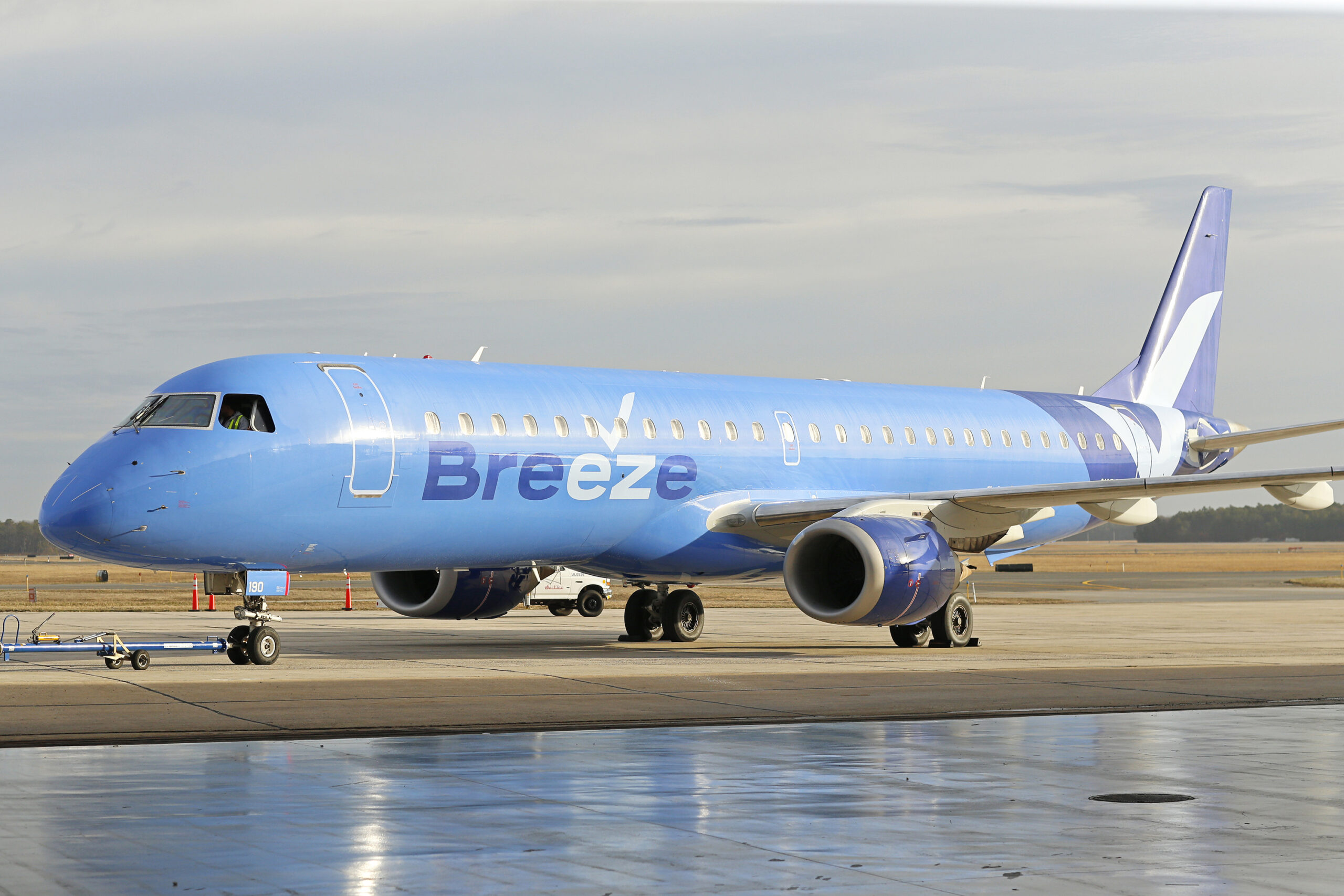
    Breeze Airways, a budget carrier founded in 2021, is set to add direct flights between A.C. and Tampa twice a week starting this summer, the company announced Tuesday.

    The routes will be offered on Wednesdays and Saturdays beginning July 1, according to Breeze, and fares for a one-way ticket will start at $79 per person.

    The airline announced the new route to and from the Jersey Shore along with more than a dozen other nonstop flights nationwide.

    Breeze Airways is adding nonstop flights from Atlantic City to Tampa twice a week starting in July.

    “The addition of these new cities and routes will give even more travelers the opportunity to save precious hours that would otherwise be spent flying through hubs or driving,” David Neeleman, Breeze Airways’ founder and CEO, said in a statement, noting his company’s mission to offer affordable airfare in underserved markets. Neeleman has founded four other airlines, including JetBlue.

    Last month, Breeze announced new nonstop service from Atlantic City to Charleston, S.C., and Raleigh-Durham, N.C., as well as a flight to Tampa, Fla., that includes a stopover.
    The Charleston flights are set to be offered on Wednesdays and Saturdays starting May 6. And the Raleigh-Durham and stopover Tampa routes are scheduled for Thursdays and Sundays starting June 11.

    Atlantic City is getting more southbound flights on Breeze Airways

    All Breeze flights out of Atlantic City can be booked online now at flybreeze.com.

    Breeze Airways is a private company, so it is not required to publicly report its finances. Last year, however, the airline announced that it had turned a profit for the first time in the fourth quarter of 2024, a period in which the company generated more than $200 million in revenue.

    The Utah-based carrier has expanded in recent years, now operating more than 300 routes, including seasonal flights, to 86 cities in the U.S., Mexico, and the Caribbean.

    Breeze is one of only a few major airlines that operate a dozen or so flights in and out of Atlantic City every day, depending on the season.

    Last year, Allegiant Air started offering flights from A.C. Spirit Airlines, meanwhile, has trimmed its flight schedule from the airport, a move that resulted in the 2024 decision to shut down its crew hub there.

    American Airlines allows passengers to go through security in Atlantic City and then get on a bus to catch flights at the Philadelphia International Airport.

    February 25, 2026
  • Four Seasons Philadelphia is one of U.S. News’ top 75 hotels

    Four Seasons Philadelphia is one of U.S. News’ top 75 hotels

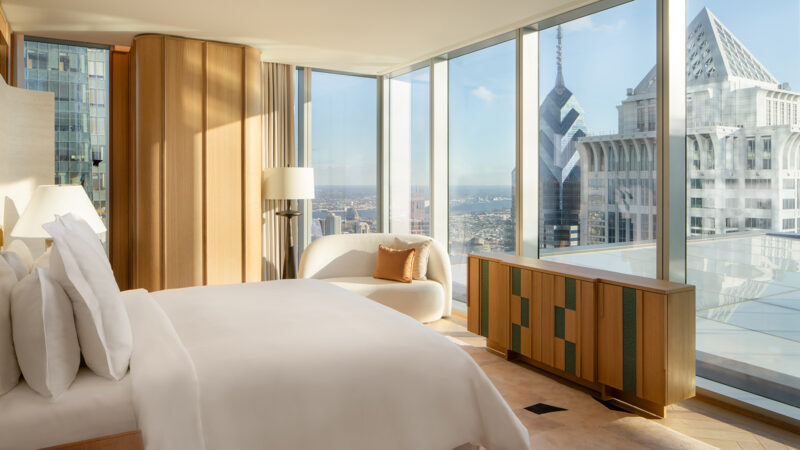
    Four Seasons Hotel Philadelphia at Comcast Center is among the top 75 hotels in the country, according to a new report from U.S. News.

    The swanky hotel that towers high above Center City ranked 74th in the outlet’s annual ranking of the top 100 hotels in the U.S.

    It came in second in the site’s Pennsylvania rankings after the Nemacolin in Farmington, about 70 minutes outside Pittsburgh. The wooded 2,200-acre golf resort ranked No. 28 on U.S. News’ national list.

    The Rittenhouse Hotel ranked third in Pennsylvania, while the Dwight D, a boutique hotel near Rittenhouse, came in fifth, and Fishtown’s Anna & Bel, which opened in 2024, ranked No. 7.

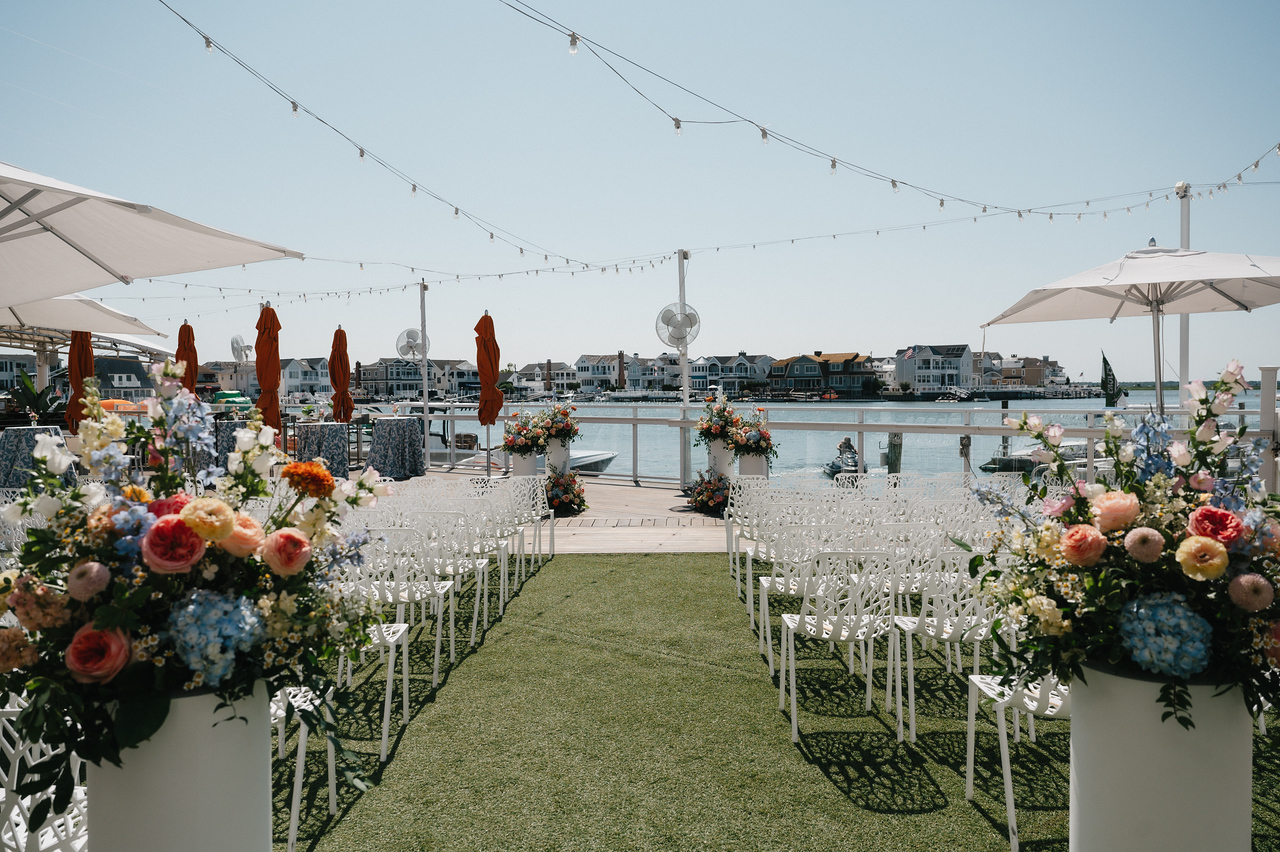
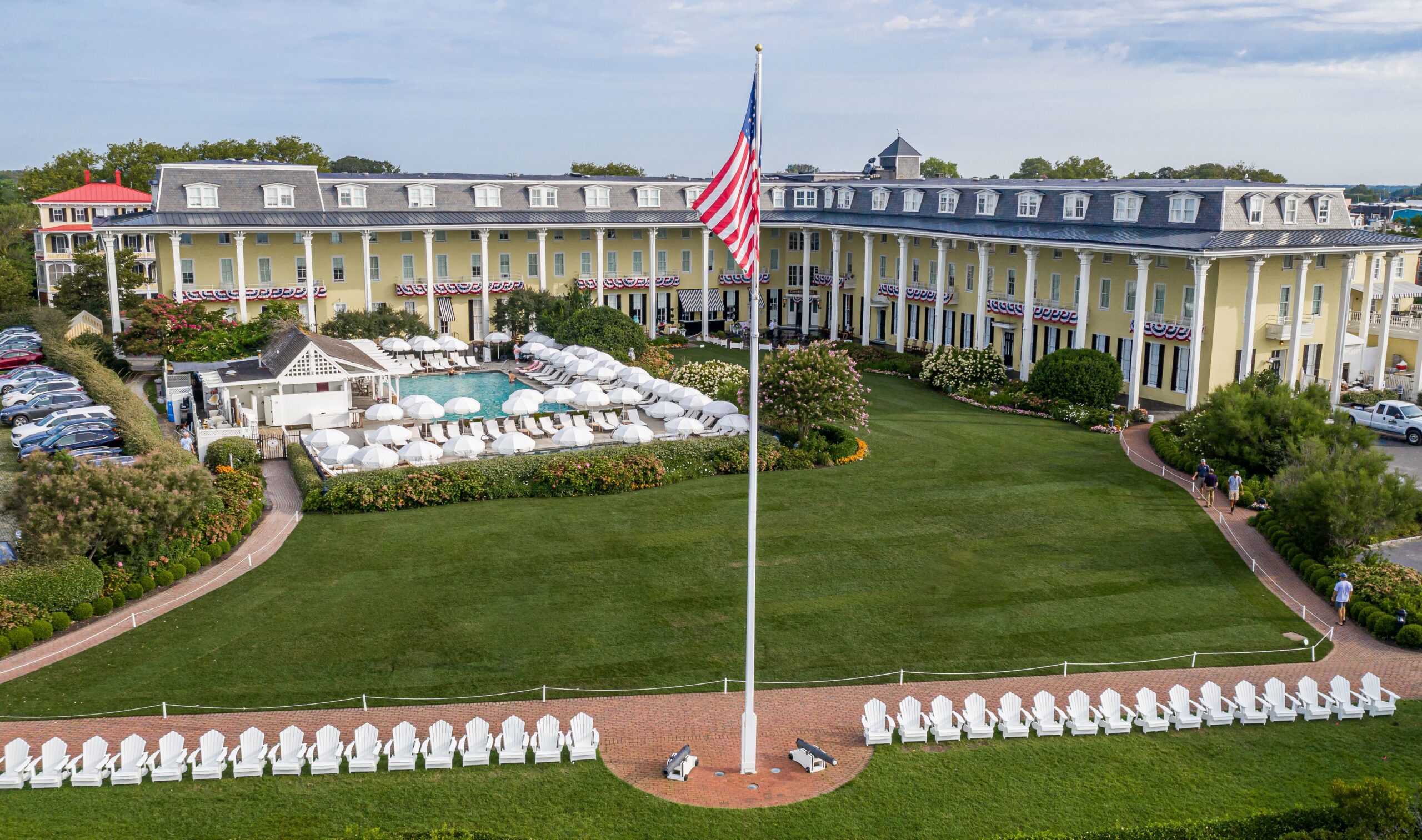
    In U.S. News’ New Jersey rankings, MGM Tower at Borgata in Atlantic City came in at No. 2, Icona Diamond Beach in Wildwood Crest took the fourth spot, and Congress Hall in Cape May came in fifth. The Reeds at Shelter Haven, located on the water in Stone Harbor, ranked seventh in New Jersey.

    Weddings at The Reeds at Shelter Haven, ranked New Jersey’s seventh best hotel by U.S. News, can take place on the hotel’s bayside lawn.

    Hotels were ranked based on their past awards and recognitions, including star ratings, as well as guest reviews, according to the U.S. News website.

    “U.S. News predominantly ranks luxury lodgings, as these are the type of accommodations travelers seek when researching the best hotels and resorts in a given destination,” company analysts write, noting that luxury options typically receive 4- and 5-star ratings from multiple expert sources.

    The Philly-area hotels on the 2026 lists were no exception.

    Want to stay in the Four Seasons Philadelphia’s new penthouse suite? It costs… $25,000 per night.

    The Four Seasons Philadelphia recently unveiled an ultraluxe floor that includes a 4,000-square-foot penthouse suite costing around $25,000 a night. Other rooms at the hotel start at more than $1,200 a night.

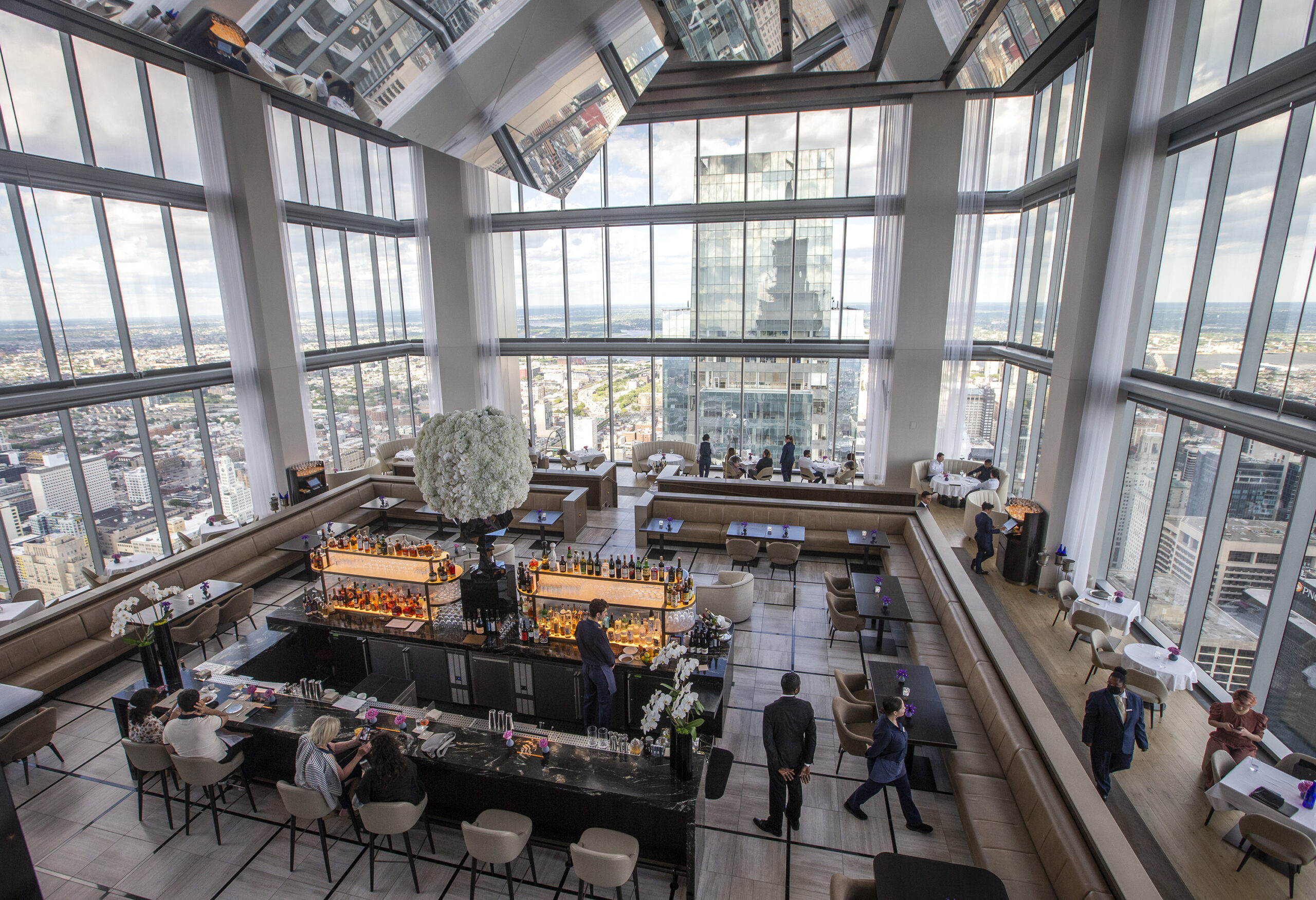
    Four Seasons Philadelphia, which was located in Logan Square until 2015, called itself the “highest elevation hotel” in the country when it opened at the Comcast Center in 2019.

    The dining room at Jean-Georges is located on the 59th floor of the Four Seasons Hotel, as seen in 2022.

    Below is the complete list of the U.S. News top 10 hotels in Pennsylvania and New Jersey for 2026:

    Pennsylvania

    1. Nemacolin (Farmington)
    2. Four Seasons Hotel Philadelphia (Center City)
    3. The Rittenhouse Hotel (Center City)
    4. The Hotel Hershey (Hershey)
    5. The Dwight D (Center City)
    6. The Lodge at Woodloch (Hawley)
    7. Anna & Bel (Fishtown)
    8. Kimpton Hotel Monaco Pittsburgh by IHG (Pittsburgh)
    9. Omni Bedford Springs Resort & Spa (Bedford)
    10. The Inn at Leola Village (Leola)
    Congress Hall in Cape May is shown in this 2022 file photo.

    New Jersey

    1. Pendry Natirar (Peapack)
    2. MGM Tower at Borgata (Atlantic City)
    3. Asbury Ocean Club Hotel (Asbury Park)
    4. Icona Diamond Beach (Wildwood Crest)
    5. Congress Hall (Cape May)
    6. Archer Hotel Florham Park (Florham Park)
    7. The Reeds at Shelter Haven (Stone Harbor)
    8. Embassy Suites by Hilton Berkeley Heights (Berkeley Heights)
    9. Canopy by Hilton Jersey City Arts District (Jersey City)
    10. Teaneck Marriott at Glenpointe (Teaneck)

    Editor’s note: A previous version of this article incorrectly stated the location of Hotel Hersey. The hotel is located in Hershey.

    February 12, 2026
  • A look at how Ventnor is completely rebuilding its boardwalk

    A look at how Ventnor is completely rebuilding its boardwalk

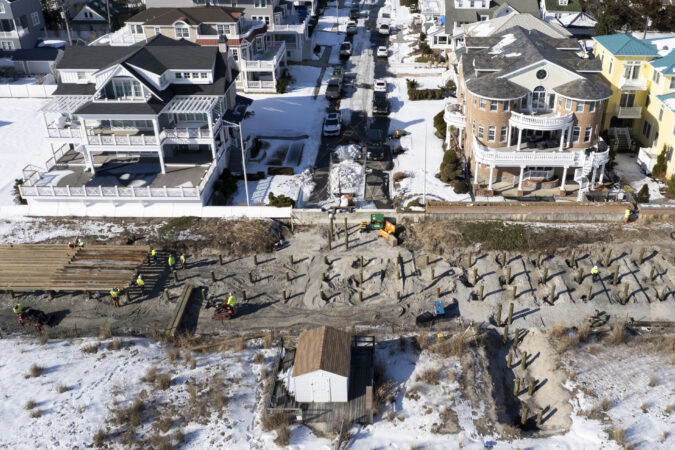
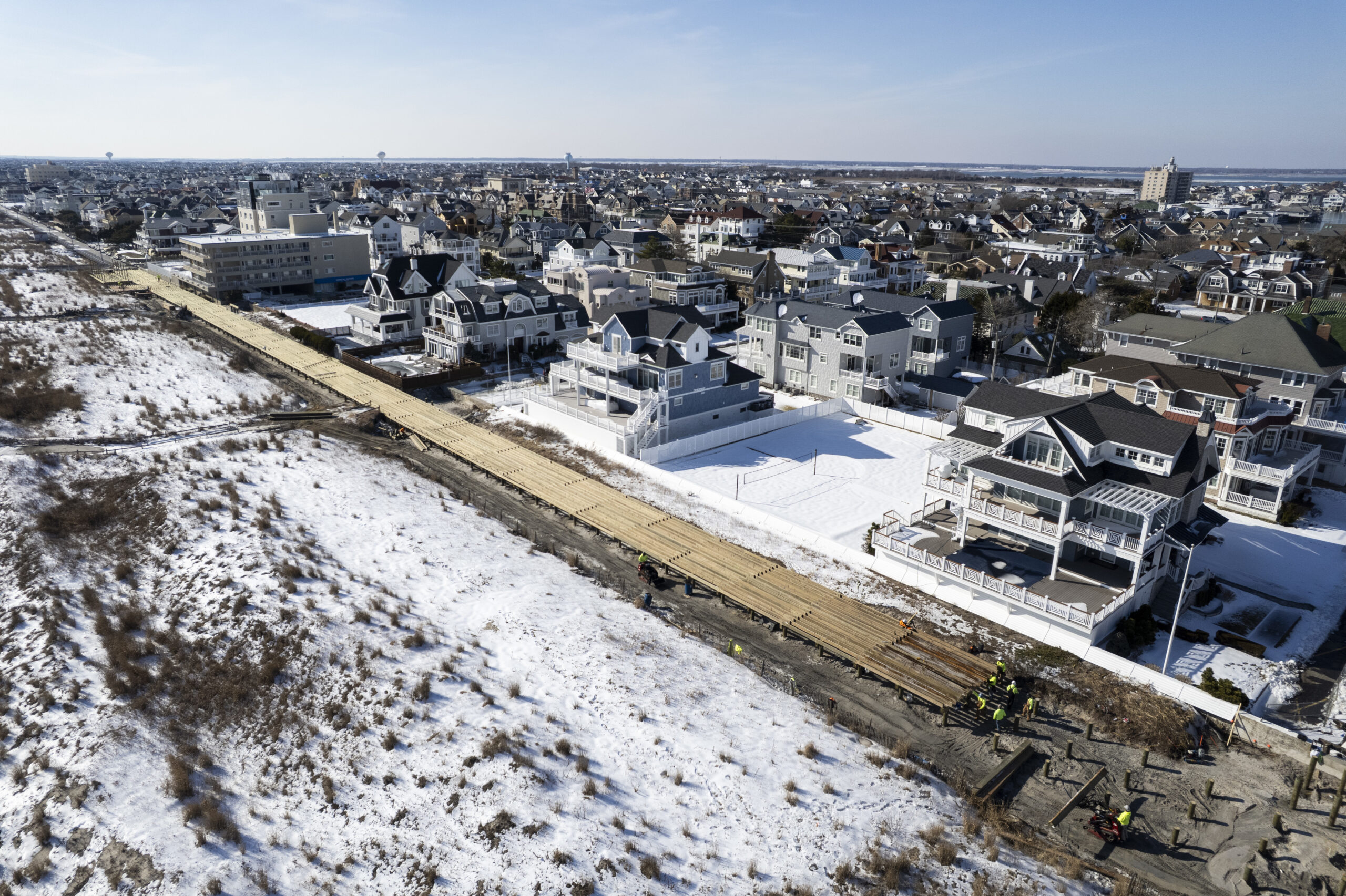
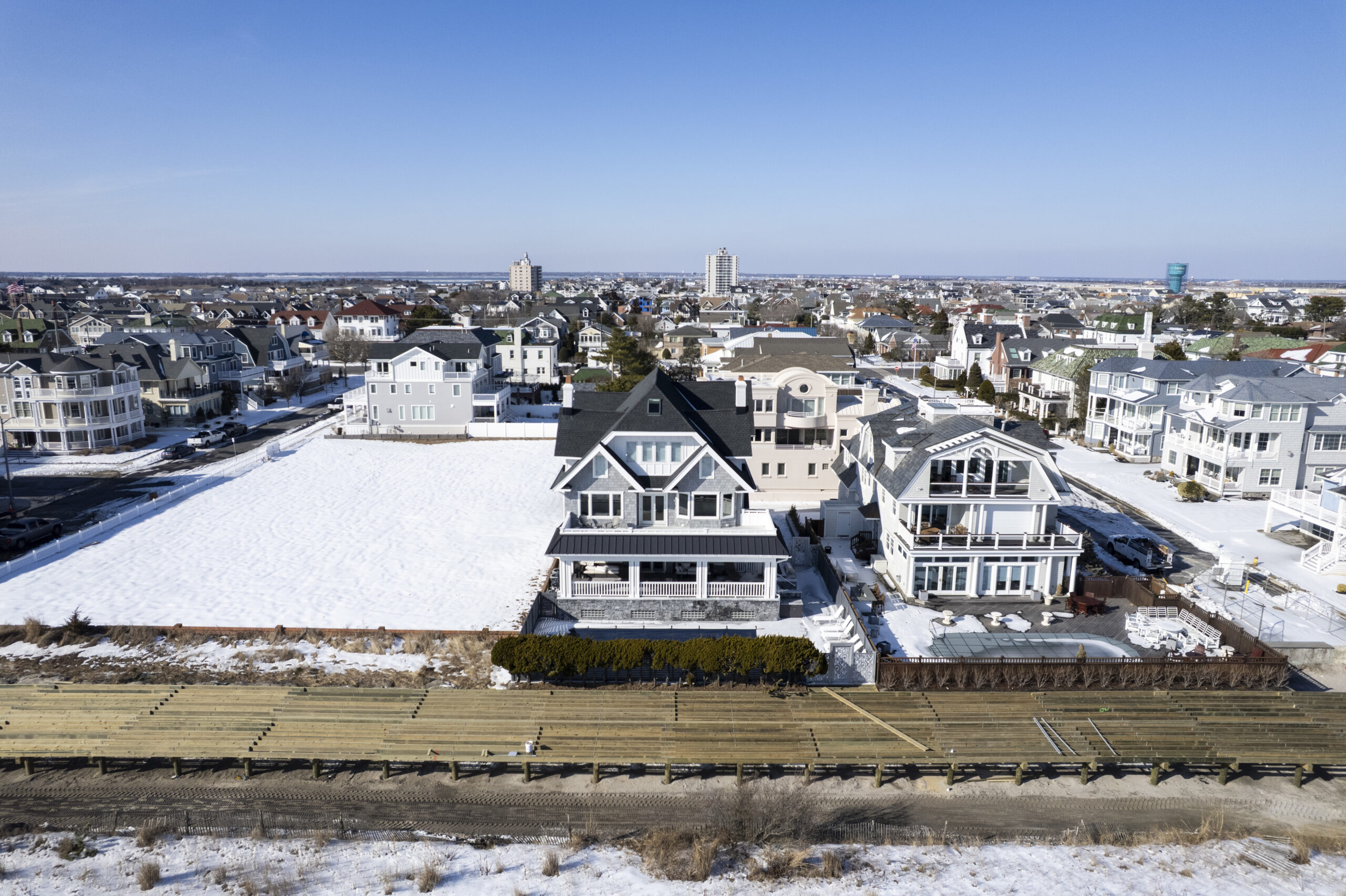
    VENTNOR, N.J. — They demolished the existing boardwalk from the tennis courts to the fishing pier, north to south, and now they are building their way back up.

    Financed mostly with federal funds granted to New Jersey from the COVID American Rescue Plan, Ventnor and other Shore towns like Ocean City, North Wildwood, Atlantic City, and Wildwood have set out to redo or upgrade their iconic pathways.

    Ventnor is using $7 million in federal funds and bonded for about $4 million more, officials said.

    Will this stretch of boardwalk reconstruction be done by Memorial Day?

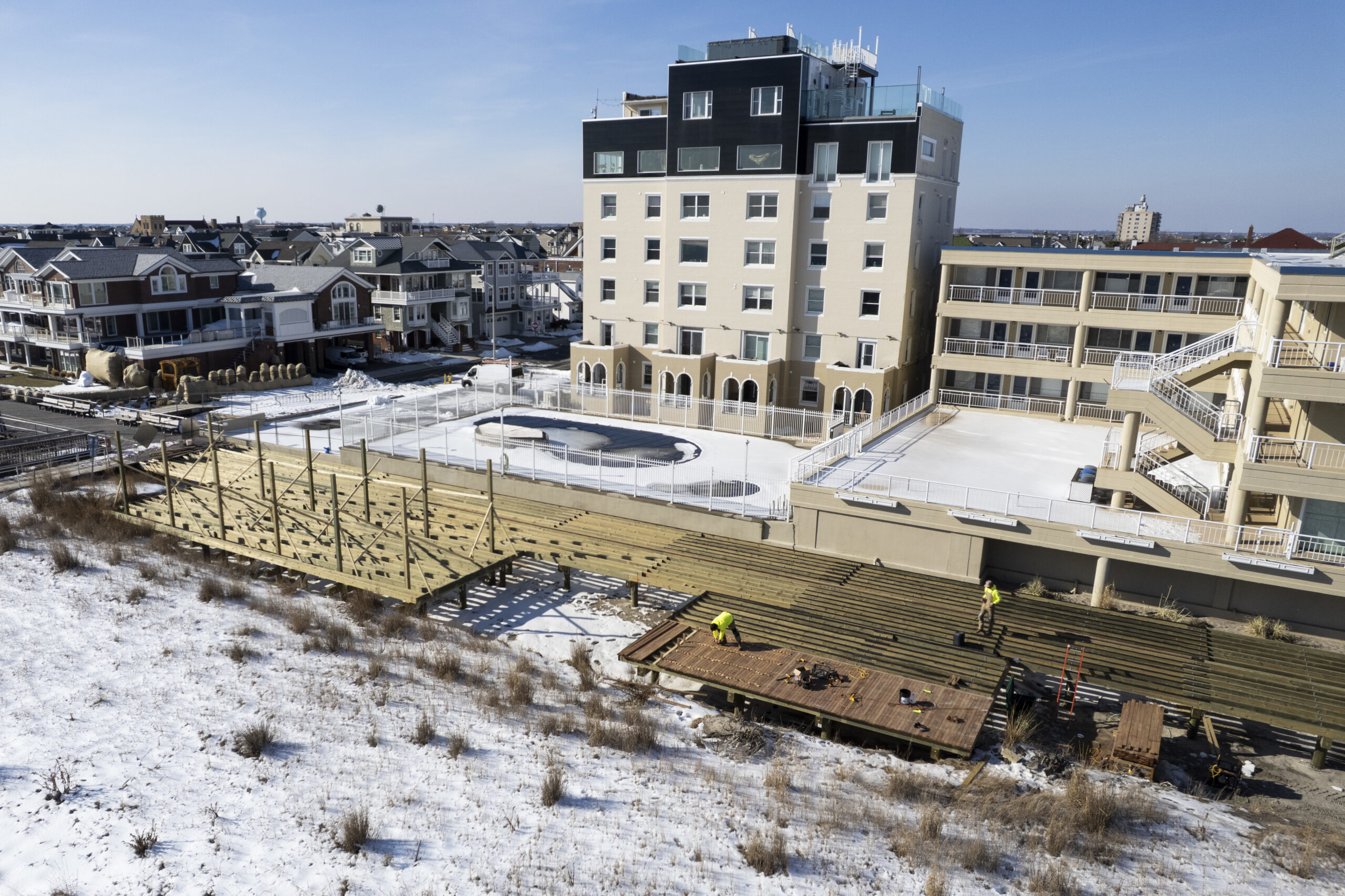
    Construction continues on the boardwalk on Wednesday, Feb. 4, 2026, in Ventnor City, N.J.

    “It’s always a worry,” Ed Stinson, the Ventnor city engineer, said in an interview late last month. “We’ve had multiple meetings with the contractor [Schiavone Construction], one as recent as three weeks ago. In all the meetings, he’s said it’ll be complete and open before Memorial Day.”

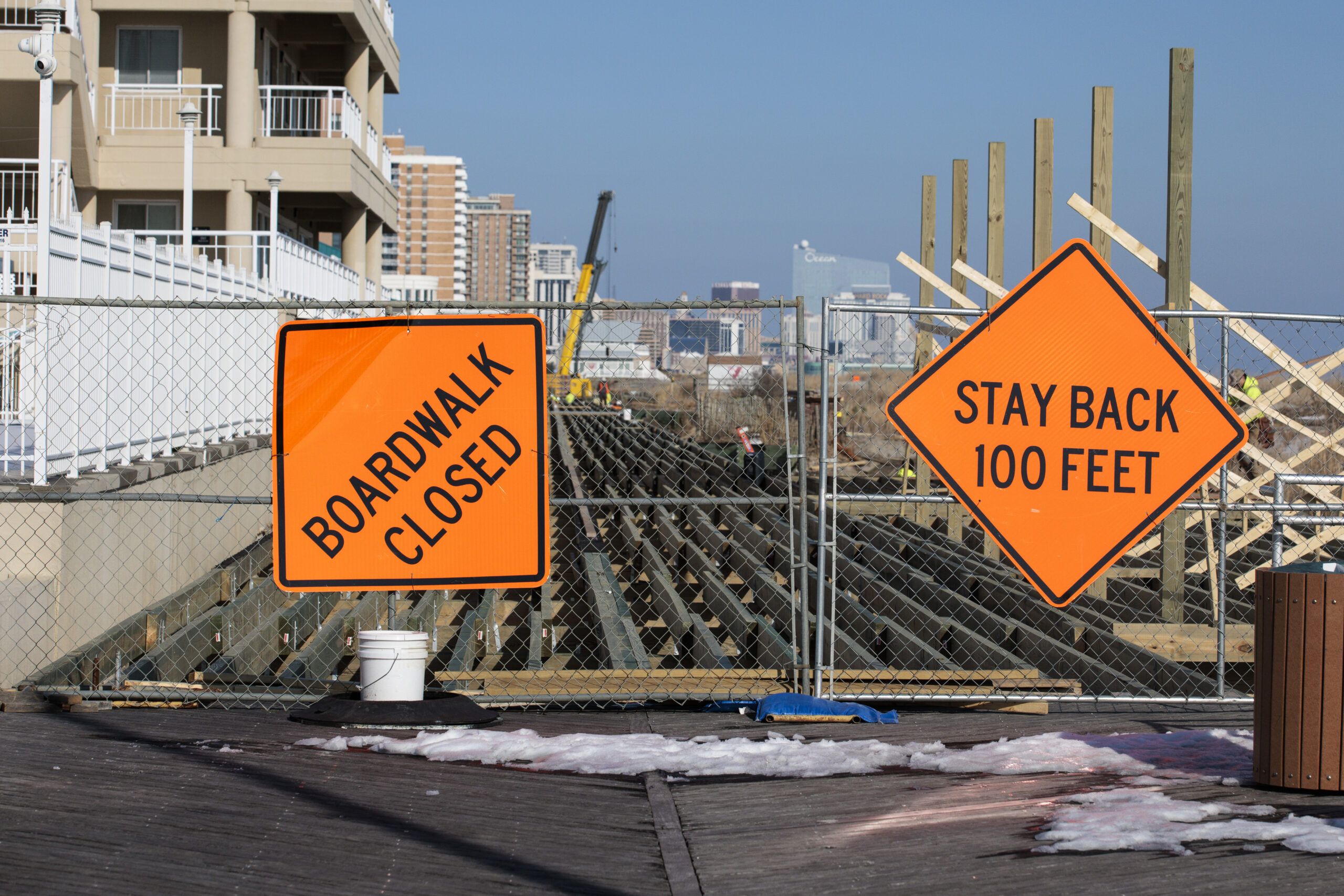
    The reconstruction has delivered a seven-block offseason interruption in a walkway that is popular year-round.

    Work will stop for the summer, city officials say. In the fall, a second 13-block section, from Suffolk Avenue to the Atlantic City border at Jackson Avenue, will begin. There is currently no funding or plan for the boardwalk from Cambridge south to the Margate border, said Stinson.

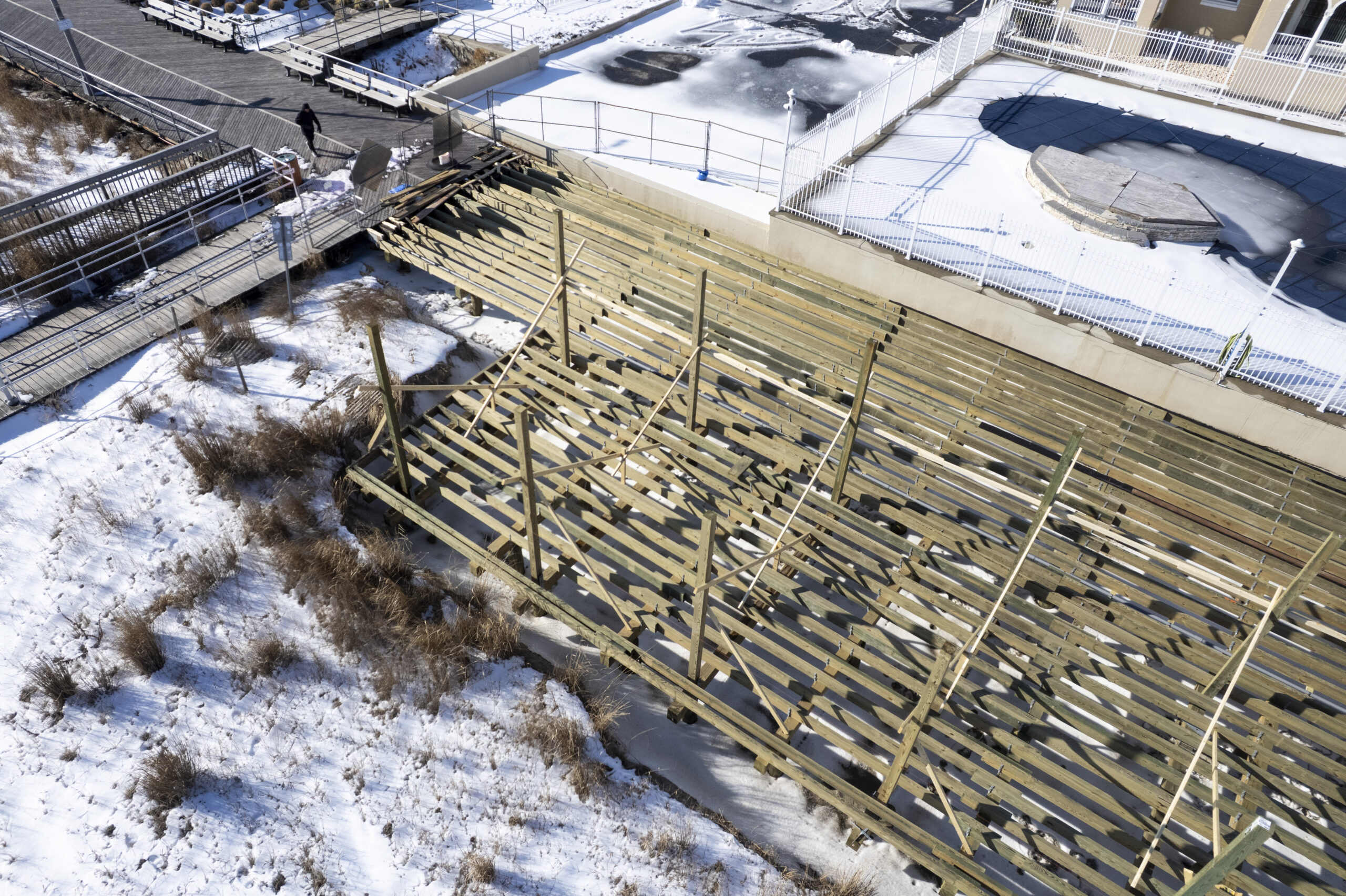
    The biggest change people will notice is that the original and distinctive angled herringbone decking pattern of the boardwalk is being replaced with a straight board decking. Ultimately, it came down to cost over tradition.

    “There was discussion about it,” said Stinson. “There’s additional lumber that’s wasted when you do the herringbone, and the labor to cut that material. The additional material costs were significant. It’s a waste of tropical lumber. The only reason to go herringbone is tradition and appearance.”
    The reconstruction has delivered a seven-block offseason interruption in a walkway that is popular year-round. Work will stop for the summer, city officials say.

    Other differences are changes in lighting (lower, more frequent light poles) and some enhancements of accessible ramps. The existing benches, with their memorial plaques, will be back.

    To demolish the boardwalk, the contractor cut the joist and the decking in 14-foot sections, “swung it around, carried it over to the volleyball court,” Stinson said, on Suffolk Avenue.

    “That’s where they did their crushing and loading into the dumpsters. They worked their way down and followed that with the pile removing.”

    The original herringbone pattern can be seen on the left, compared with the new straight decking pattern on the new construction side.

    The other massive job was excavating the sand that had accumulated under the boardwalk. “They screened it, cleaned it, and put it down there,” on the beach in piles. It will be spread around above the tide line, Stinson said.

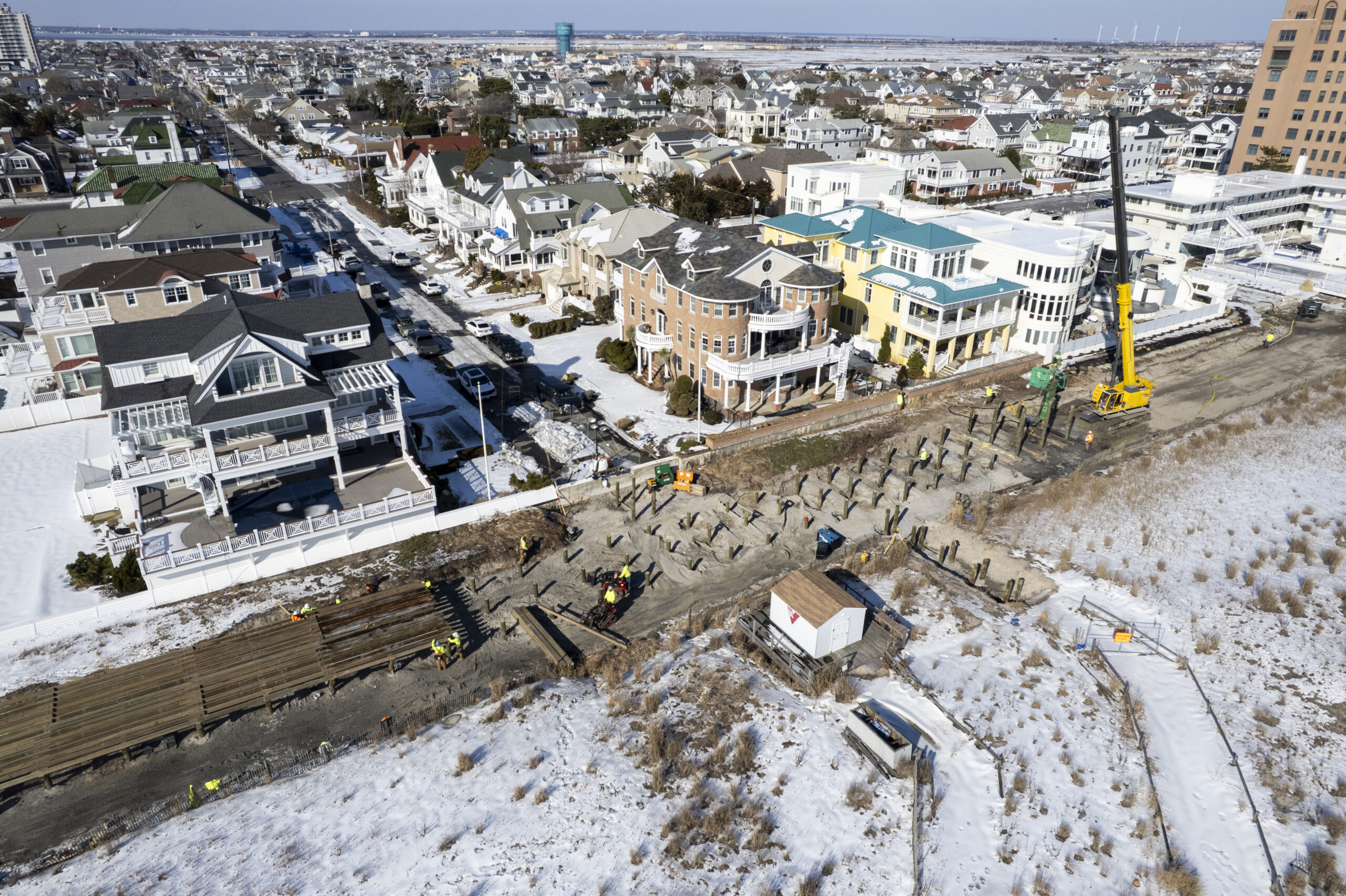
    Once the excavation was down, the pile driving crew set out beginning at the south end and working their way toward Suffolk Avenue. “Then the framing crew came in and started framing,” Stinson said. On Feb. 2, the third team began its work: the decking crew.

    The weather has slowed the pace, Stinson said. “They were doing about 20 to 24 piles a day,” he said, a pace that dropped to about nine piles a day after the snowstorm and ice buildup.

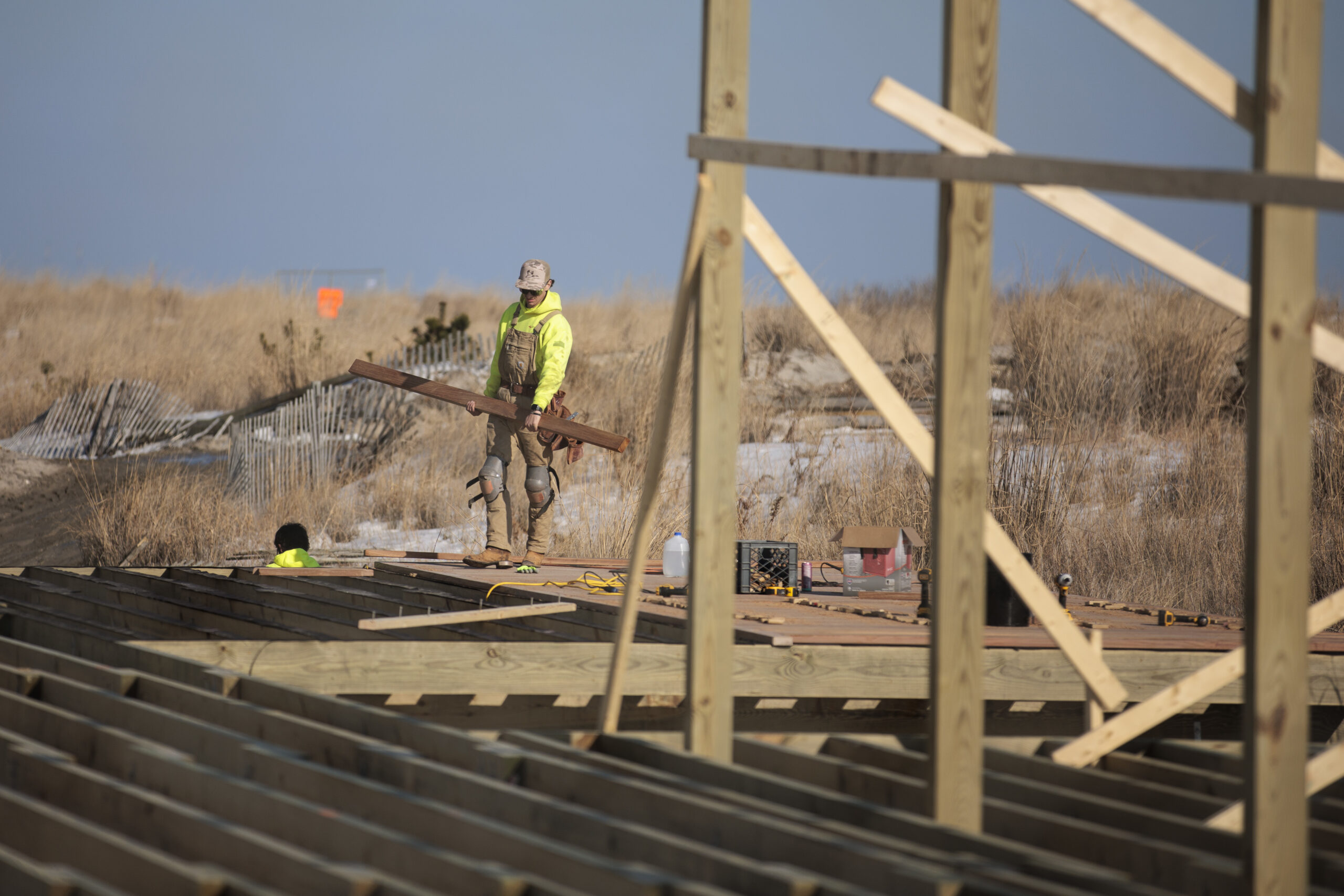
    The framing crew installs pile caps, 8-by-14 beams that run across the boardwalk atop the pilings. The decking crew follows behind them, installing the wood, a tropical wood known as Cumaru. The use of Brazilian rainforest lumber at one time inspired protests, but that has not been an issue this time.

    Construction continues on the boardwalk on Wednesday, Feb. 4, 2026, in Ventnor City, N.J.

    Ventnor’s boardwalk, which links to Atlantic City’s famous walkway, dates to 1910. It was rebuilt twice before: once after the hurricane of 1944 and again after the March storm of 1962. Margate, on the southern end, never rebuilt its boardwalk after 1944.

    Stinson said the tropical wood is noted for its “denseness and durability. It does not last forever.”

    In all, $100 million of American Rescue funds was set aside by Gov. Phil Murphy for a Boardwalk Fund and awarded to 18 municipalities, including, as Stinson said, “anybody who has anything close to a boardwalk.”

    Brigantine, with its promenade, received $1.18 million. Ocean City, in the process of rebuilding a portion of its north end boardwalk, received $4.85 million.

    The two biggest recipients were Asbury Park and Atlantic City, each receiving $20 million. Atlantic City has completed a rebuilding of its Boardwalk to stretch all the way around the inlet to Gardner’s Basin. Wildwood, with $8.2 million, has undertaken a boardwalk reconstruction project, and North Wildwood, receiving $10.2 million, is rebuilding its boardwalk between 24th and 26th Streets, combining the herringbone pattern with a straight board lane for the tram car.

    Although the timing of the reconstruction was no doubt prompted by the availability of the federal funds, Stinson said Ventnor’s boardwalk had shown signs of age.

    “We’ve been into some significant repairs on the boardwalk,” Stinson said. “Those have increased every year. We were getting into pile failures. It was due. I don’t know if the city would have tackled it without the [federal] money.”

    Ventnor’s boardwalk, which links to Atlantic City’s famous walkway, dates to 1910. It was rebuilt twice before: once after the hurricane of 1944 and again after the March storm of 1962.
    February 11, 2026
  • LOVE Park’s saucer could soon get a reboot. For real this time, the city says.

    LOVE Park’s saucer could soon get a reboot. For real this time, the city says.

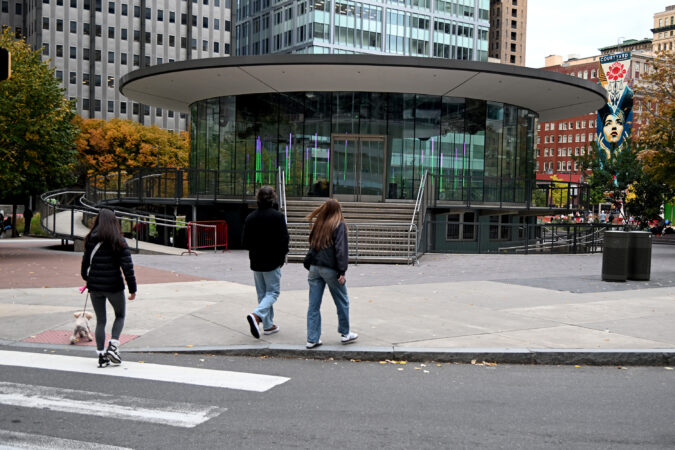
    The saucer in LOVE Park finally has a timeline for its revival.

    After years of seeking ideas from business owners and other Philadelphians, city officials expect work on the historic building to begin in May, the city’s Parks & Recreation Department says.

    But officials are still working to select a partner for the project.

    In May, the city issued a “request for expressions of interest” (RFEI) from “visionary businesses, particularly those in food, beverage, retail, or hospitality,” who wanted to partner on the saucer.

    City officials said the interest exceeded expectations, with more than 50 applicants submitting ideas. They included “coffee and cafe concepts, casual food offerings, beer garden hybrids, and informal meeting spaces,” according to Parks & Recreation spokesperson Ra’Chelle Rogers.

    Among applicants, there was a focus on “flexible, welcoming concepts that function as a true public amenity, encouraging people to meet, linger, and connect in the park,” Rogers said.

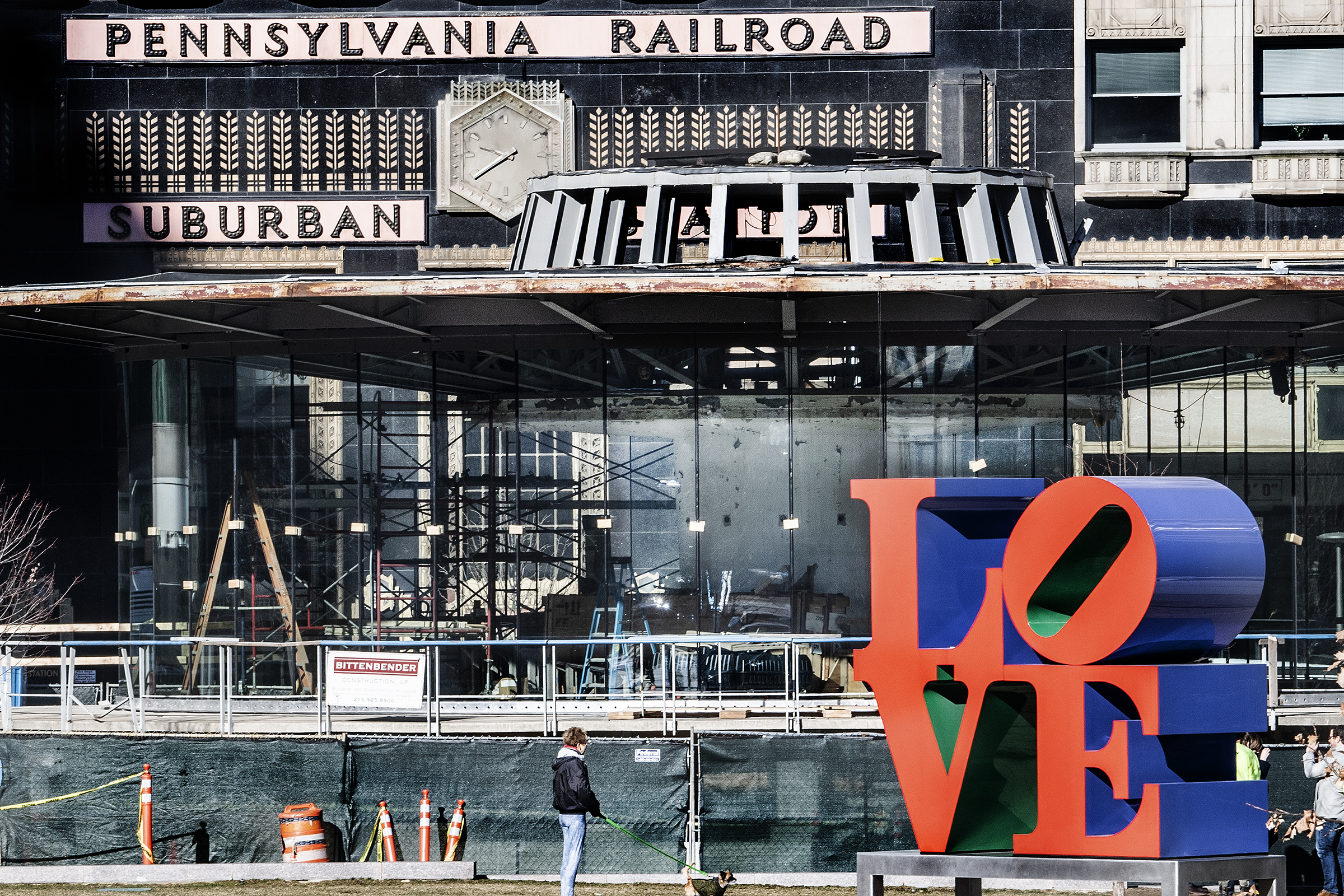
    The saucer building in LOVE Park is pictured in March 2019, amid early renovations for a bar-restaurant concept that never panned out.

    In light of the demand, the city is moving into its next stage, requiring prospective partners to visit the saucer at 3 p.m. on Feb. 18 and submit a proposal online by March 18.

    Prospective partners do not need to have submitted an idea in the spring, Rogers said. Any experienced food, beverage, hospitality, or community operator with the capacity to “generate sustainable revenue to support the park” is encouraged to apply, Rogers said.

    “The saucer has always been envisioned as a people-first space — one that complements the park, supports programming, and welcomes both residents and visitors,” said Susan Slawson, the city’s parks & recreation commissioner. The RFEI process has given officials “confidence to move forward with a flexible, inclusive model designed for the way people actually use LOVE Park.”

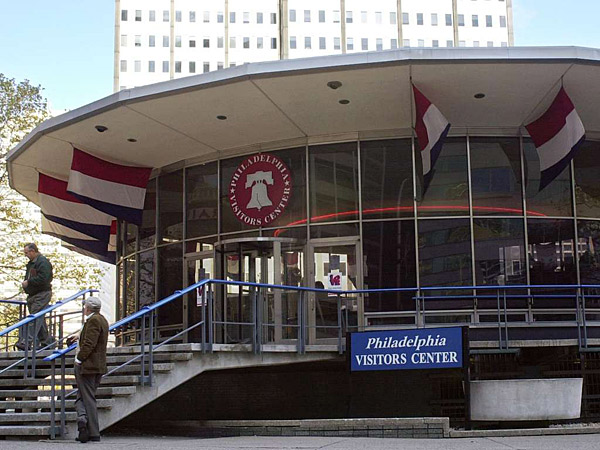
    The saucer, also referred to as the UFO, was added to the Philadelphia Register of Historic Places last year. Built in 1960, the building predates LOVE Park, and first served as the city hospitality center. It later housed offices for park staff.

    An undated file photo of LOVE Park’s saucer building when it served as the Philadelphia Visitors Center.

    For more than a decade, however, the circular structure near 16th Street and JFK Boulevard has largely sat dormant (the building has opened to the public for the Festival of Trees, a Children’s Hospital of Philadelphia fundraiser, during recent holiday seasons).

    As part of LOVE Park’s rehabilitation in the late 2010s, the saucer got a $5.6 million facelift, making it “structurally brand new,” as Rogers described it in May.

    The city solicited proposals for a restaurant to fill the space, and selected Safran Turney Hospitality, the group behind a slew of popular restaurants on 13th Street. They planned to open a bar-restaurant called Loveluck that would seat about 50 people indoors and another 150 outside.

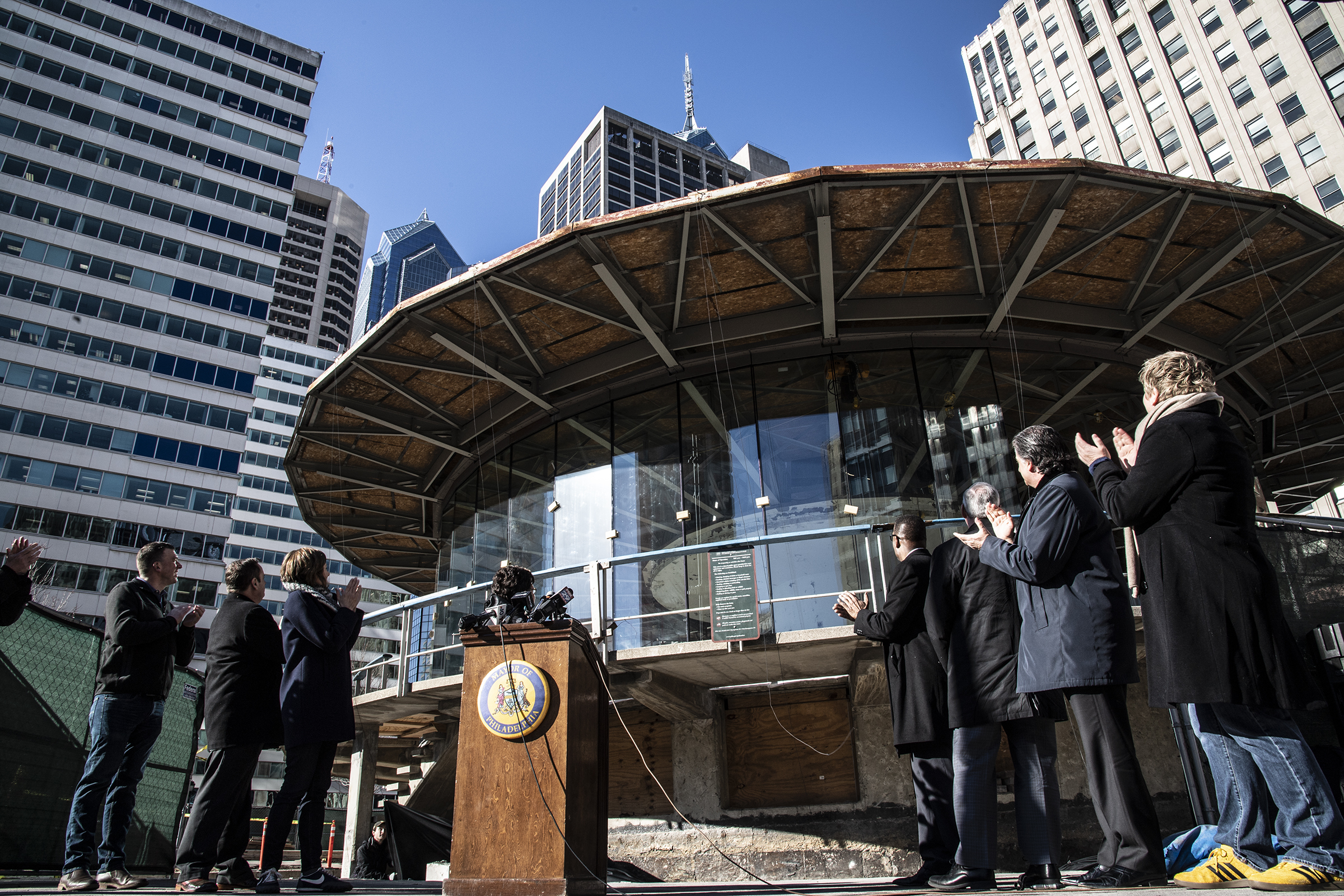
    In March 2019, city officials applauded the early construction of a bar-restaurant that was set to fill LOVE Park’s saucer building. The pandemic later caused the restaurateurs to bow out of the project.

    Then the pandemic happened, and the group bowed out of the project in 2022. A few months later, the city issued another request for proposals from experienced restaurateurs interested in signing a 10-year lease. That request did not result in any bids, Rogers said in May.

    As for this latest request process, city officials said they plan to select a partner by April, and begin work a month later. The timing could coincide with Philly’s celebration of America’s 250th birthday, as well as the city’s hosting of World Cup matches and the MLB All-Star game.

    The office of Councilmember Jeffery Young, whose district includes LOVE Park, is set to fund “key utility and infrastructure improvements” at the saucer, according to the city statement, and public grants are being sought to offset other upfront costs.

    “Bringing an active, public-facing partner into the saucer is a milestone for LOVE Park and for Philadelphia,” Young said. “I’m proud to support improvements that make the saucer a welcoming hub for years to come.”

    February 10, 2026
  • As a hotel looms, a tiny Ocean City neighborhood behind the old Gillian’s fears losing its small-town feel — and its sunrise

    As a hotel looms, a tiny Ocean City neighborhood behind the old Gillian’s fears losing its small-town feel — and its sunrise

    OCEAN CITY, N.J. — Marie Crawford was immediately charmed in 2021 when she and her soon-to-be-surfer husband Rich moved into their historic house in the literal shadow of Gillian’s Wonderland Pier.

    They’d come from Blue Bell, Pa., to live year-round by the ocean, and landed with an amusement park right up the street.

    “The ball drop, that was what we heard from my house,” she said, referring to the 130-foot-high Drop Tower ride. “It was, ‘Ah, ah, ahhhhhhhh,‘” she said, imitating the screams she would sometimes hear.

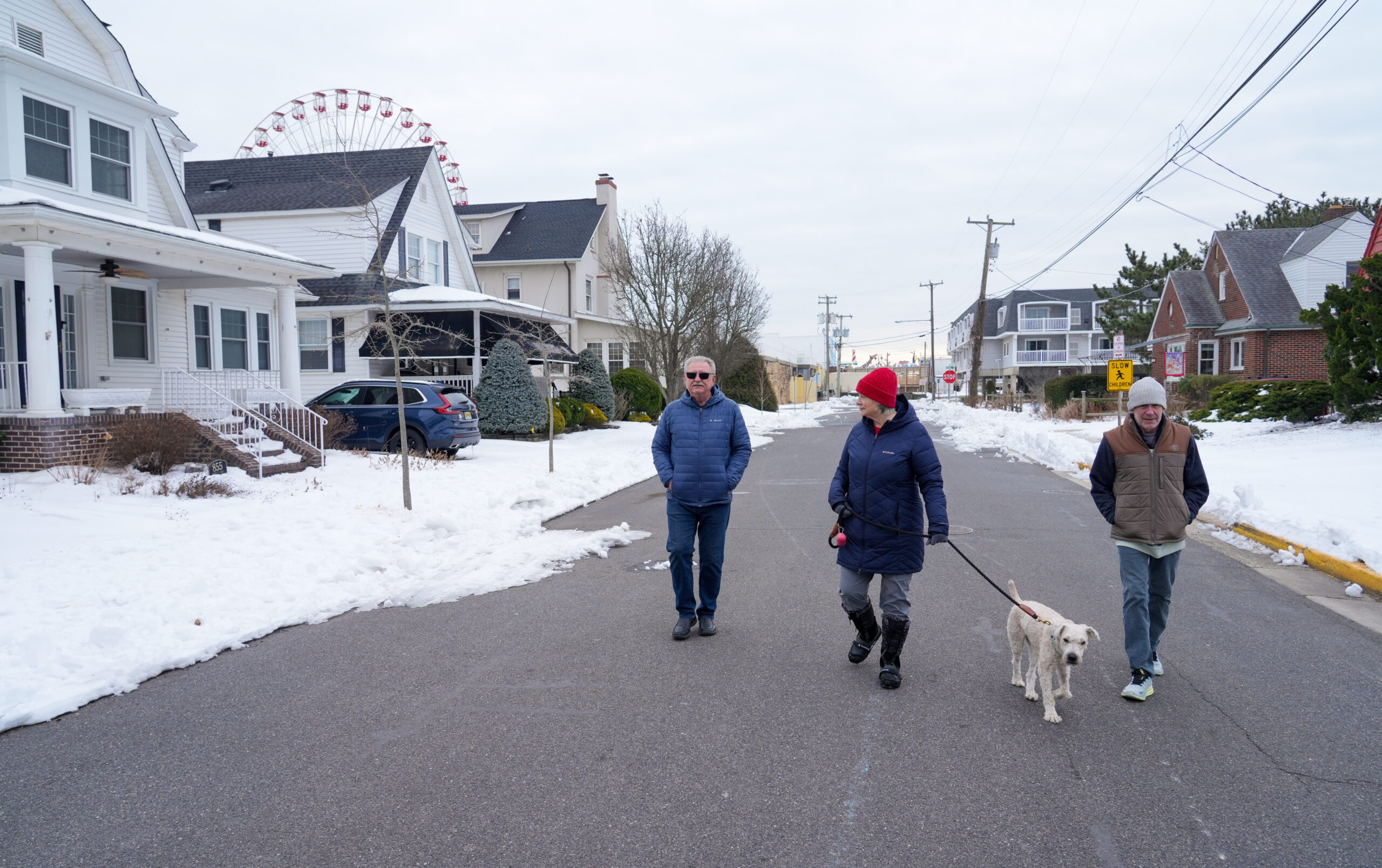
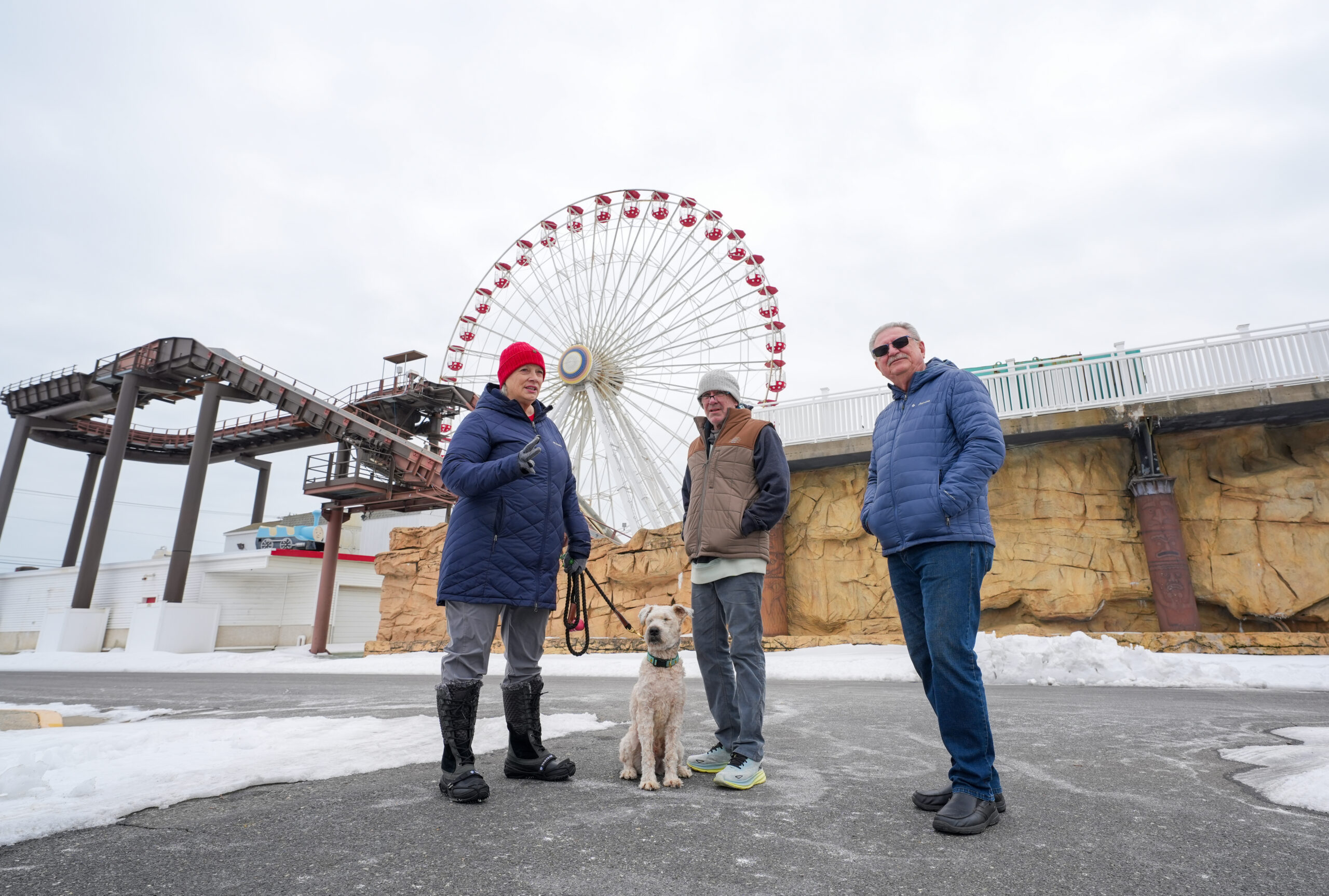
    Jack Gutenkunst, left, Marie Crawford and her husband Richard with Shiloh, a 9-year-old soft coated wheaten terrier, walk along Plaza Place, in Ocean City, Tuesday, Feb. 3, 2026.

    “It was so beautiful and romantic. On our porches, we would hear the ocean, not the amusement park. There were families, babies in strollers, coming up the street, flowing up to Wonderland. We were kind of ambassadors.”

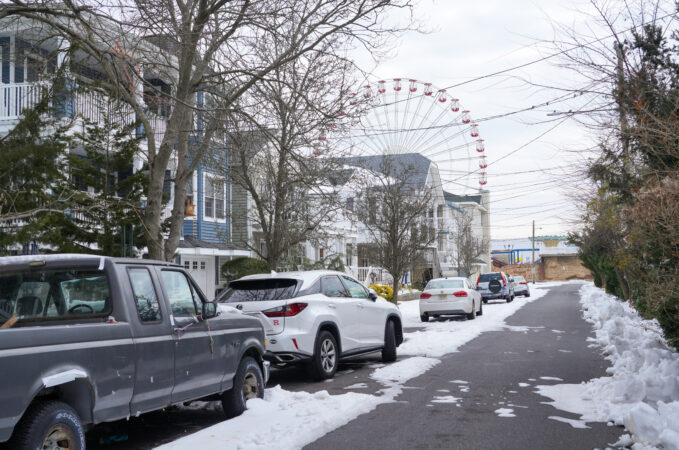
    Now, more than a year after the closing of Gillian’s, the residents are faced with the possibility of a seven-story hotel they fear will block their sun, bring traffic to their streets, and threaten the small-town charm they found in their little pocket of Ocean City.

    “It’s just another example of maximizing, pushing,” said Rich Crawford, Marie’s husband, who programs music for his family’s Christian radio station, WDAC, located in Lancaster, Pa. In his 60s, Rich fell in with Ocean City’s surfing crowd and unexpectedly grew to love his little community.

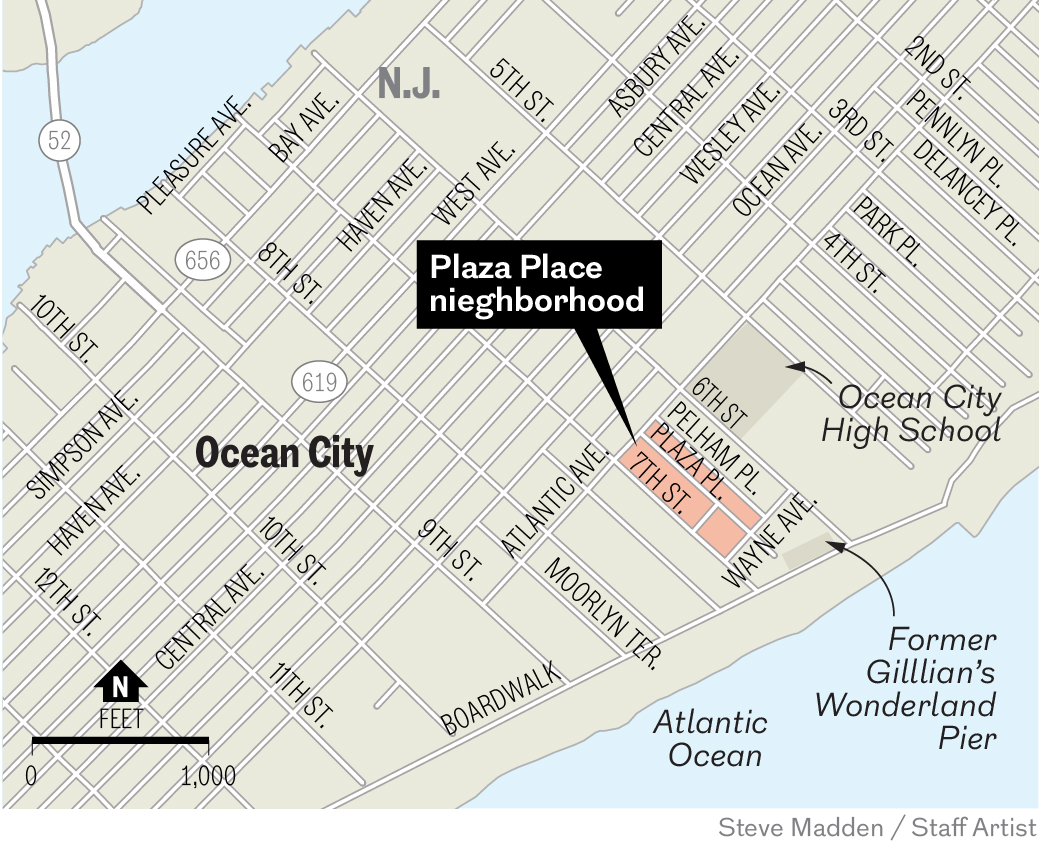
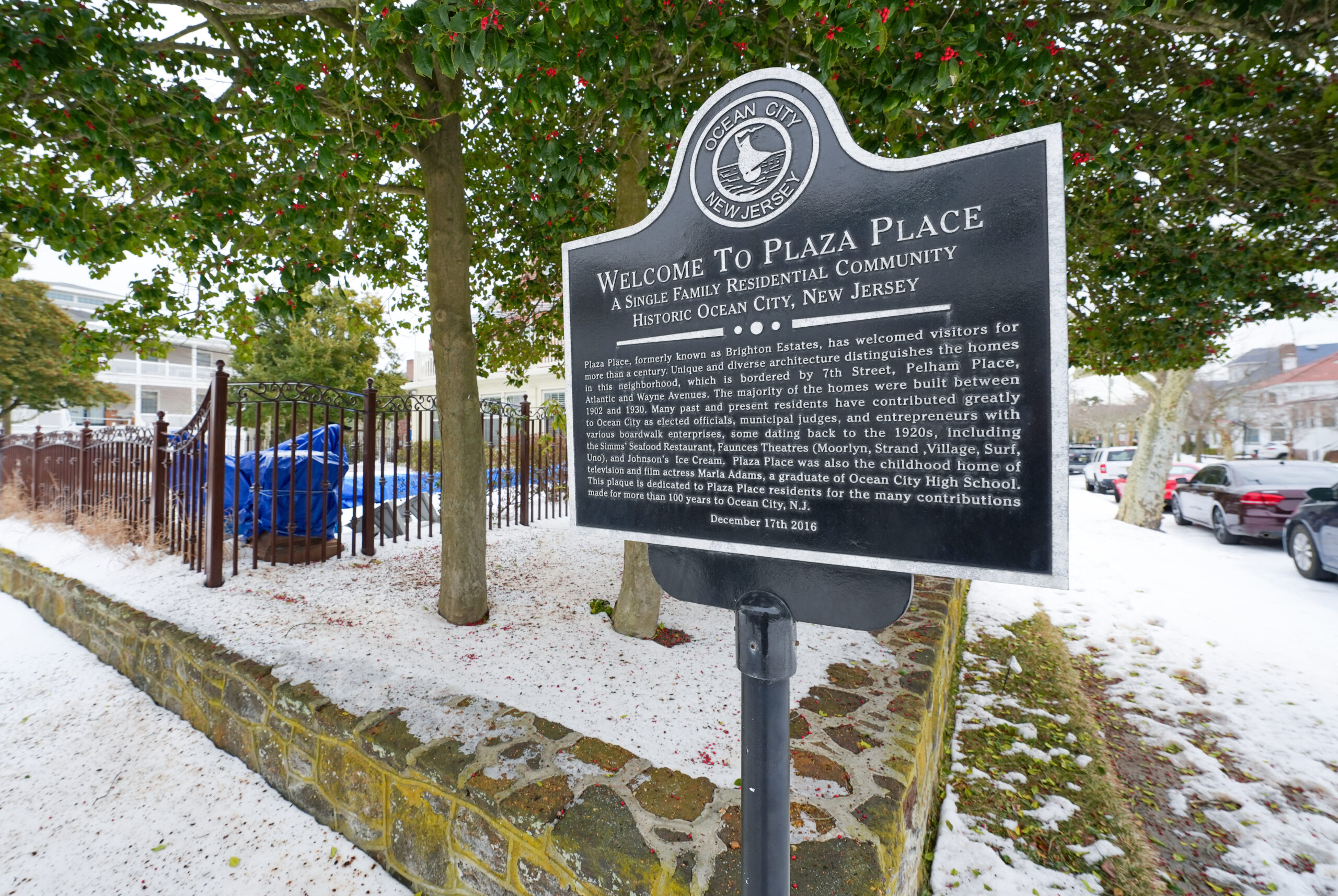
    The Crawfords’ neighborhood of 100-year-old homes and 153 trees is called Plaza Place, which is one block each of Pelham Place, Plaza Place, and the north side of Seventh Street, between Wayne Avenue and Atlantic.

    Across Wayne Avenue, toward the ocean, was Wonderland. On a clear day, a red ball of sun creeps up above the boardwalk and peeks into their little neighborhood.

    On Pelham Place, residents each also own a two-foot- wide stretch of land across the street from their houses, a quirk of their deeds originally designed to prevent the rooming houses on Plaza Place that backed up against Pelham Place from using Pelham as an alleyway for their trash. There are dedicated gardeners on the streets who turn those strips into showpieces.

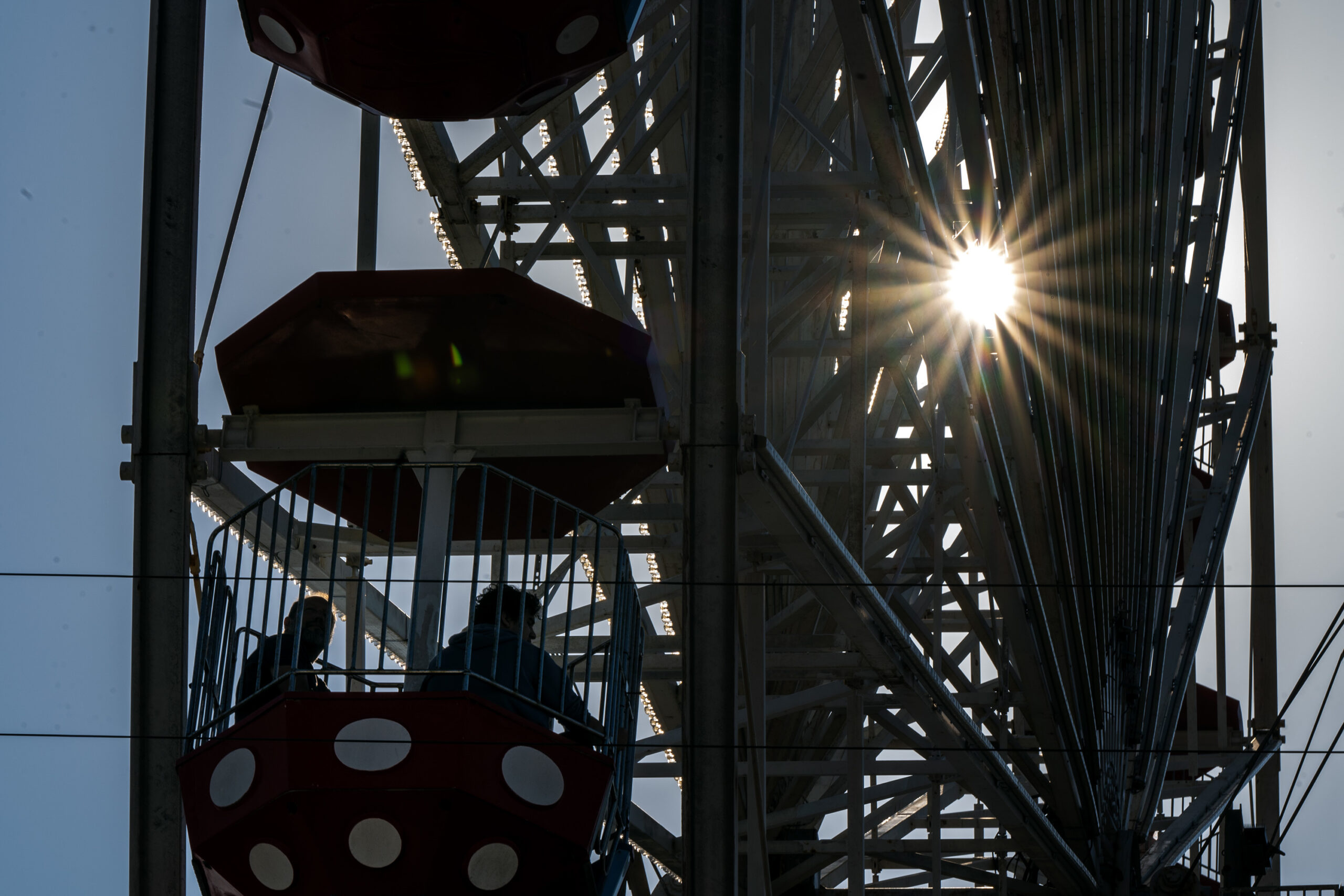
    The sun sets behind the Ferris wheel on the final day for the beloved Wonderland Pier in Ocean City Sunday, Oct. 13, 2024.

    Neighbor Barb Doctorman, whose family owns the Islander store on the boardwalk, said she used to take her children up on the Ferris wheel and peer down at their neighborhood. So lush, it looked like a forest, she said.

    “I looked up the impact of a high-rise,” said Doctorman. “We’re going to lose some sun. The airflow is going to be totally changed from what it was. There’s a heat radiant that comes off it.”

    Her husband, Doc, said: “We want something up there, but we know there could be more of a draw to that boardwalk than just the hotel.”

    Marie Crawford (left) holds the leash of Shiloh, a 9-year-old soft-coated wheaten terrier, while standing with her husband Richard (center) and neighbor Jack Gutenkunst at the end of Pelham Place in Ocean City.

    The land is owned by developer Eustace Mita, who has proposed Icona in Wonderland, a 252-room hotel that would preserve the Ferris wheel, carousel, and some kiddie rides.

    So far, the city has not declared the site in need of rehabilitation, as Mita has requested, or otherwise moved to rezone the area to allow a hotel.

    Merchants have begged the city to allow the hotel, and described how their businesses have suffered since the closure of Wonderland. Some residents have clung to the idea that an amusement park can return, though those numbers are dwindling.

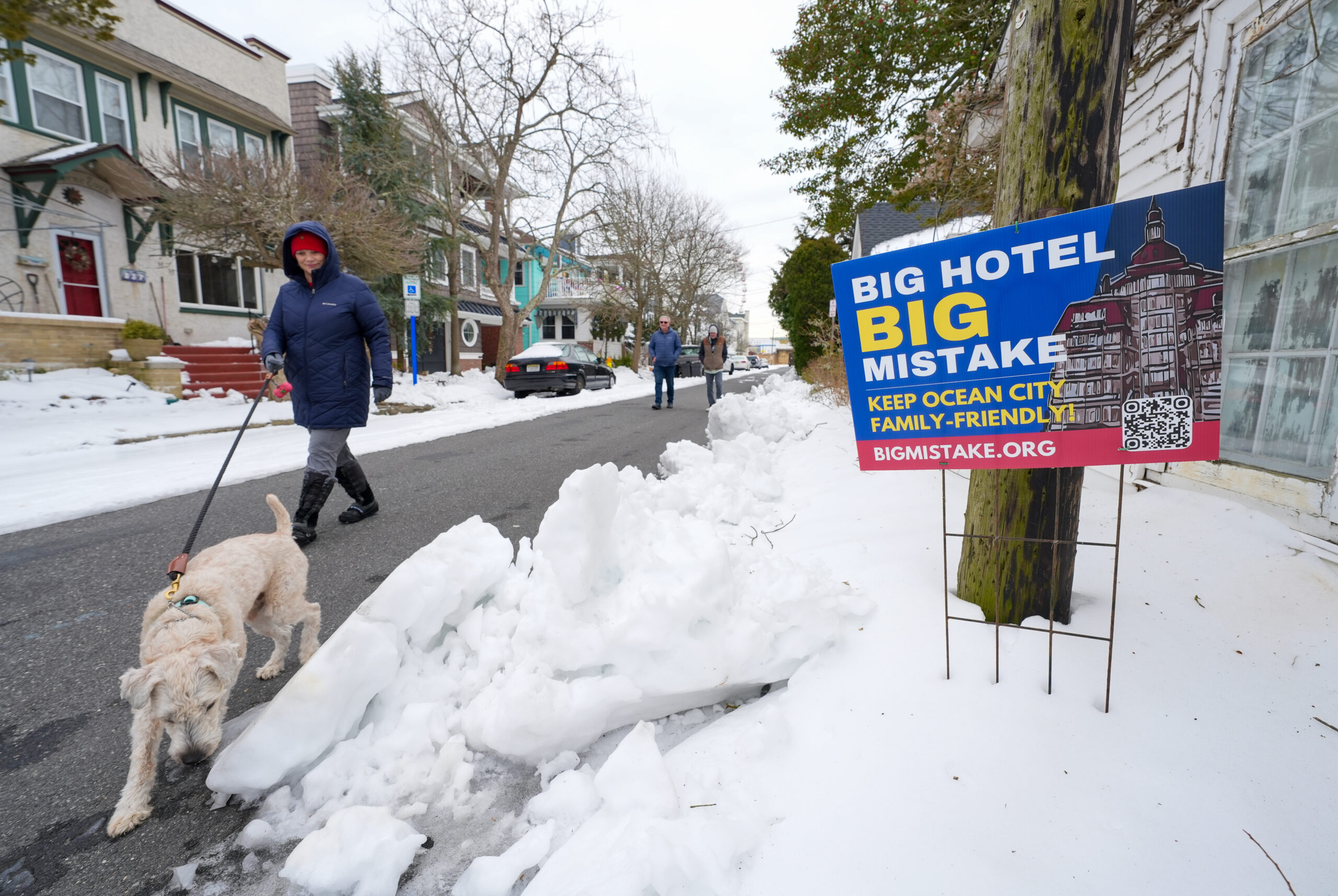
    Marie Crawford, her husband Richard, right, along with Shiloh, a 9-year-old soft coated wheaten terrier, and their neighbor Jack Gutenkunst, walk past a sign against the development of a hotel at the site of the old Wonderland Pier on the boardwalk in Ocean City, Tuesday, Feb. 3, 2026.
    After the Gillian’s closure, boardwalk merchants agree it will never be the same. They want a say in what comes next.

    In Plaza Place, the opposition is less sentimental, more practical. They fear traffic, and the shadow from a neighboring seven-story hotel. Like residents in other towns who fought dunes, they fear the loss of the ocean breeze, or a shift in wind patterns that will affect surfing at the popular Seventh Street Beach.

    “It’s got that old feel to it, and everybody’s house is different,” said Marie Crawford, who bought her Craftsman Colonial on the north side of Pelham for $905,000 in 2021. She estimates it’s worth $2.5 million now. There are about 60 homes in the Plaza Place civic association.

    The association is one of several groups that are prepared to go to court if the city tries to change the zoning to allow a hotel, without going through a thorough master plan process, said Jack Gutenkunst, the Plaza Place Association president.

    While Wonderland brought thousands of people on a summer night, the pier itself had no parking. So people parked elsewhere and excitedly walked through their neighborhood on their way to the rides. People on their porches called out, “Have a blessed evening,” and chatted the night away, said Crawford. The hotel proposal calls for parking underneath the structure.

    A sign stands near the historic neighborhood behind the old site of the Wonderland Pier in Ocean City, Tuesday, Feb. 3, 2026. Residents are against the development of a hotel at the boardwalk site.

    Crawford stressed that it’s not a case of selfish NIMBY, Not In My Backyard. Despite Ocean City’s decades-old pattern of replacing single-family homes with duplexes, there are nearly 1,400 homes over 100 years old still left in Ocean City, said Bill Merritt, president of Friends of OCNJ History & Culture.

    Being a block from the boardwalk, and living in a beach town, does not mean the neighborhood’s purpose is primarily hospitality, said Crawford. Its distinct, increasingly rare Jersey Shore character deserves to be valued, she said.

    “It’s height. It’s chaos. It’s the change in culture,” she said, when asked what specifically worries her about the hotel. “It’s a transient population coming through here for three nights at a time. That’s in the hospitality district. We are not the hospitality district.”

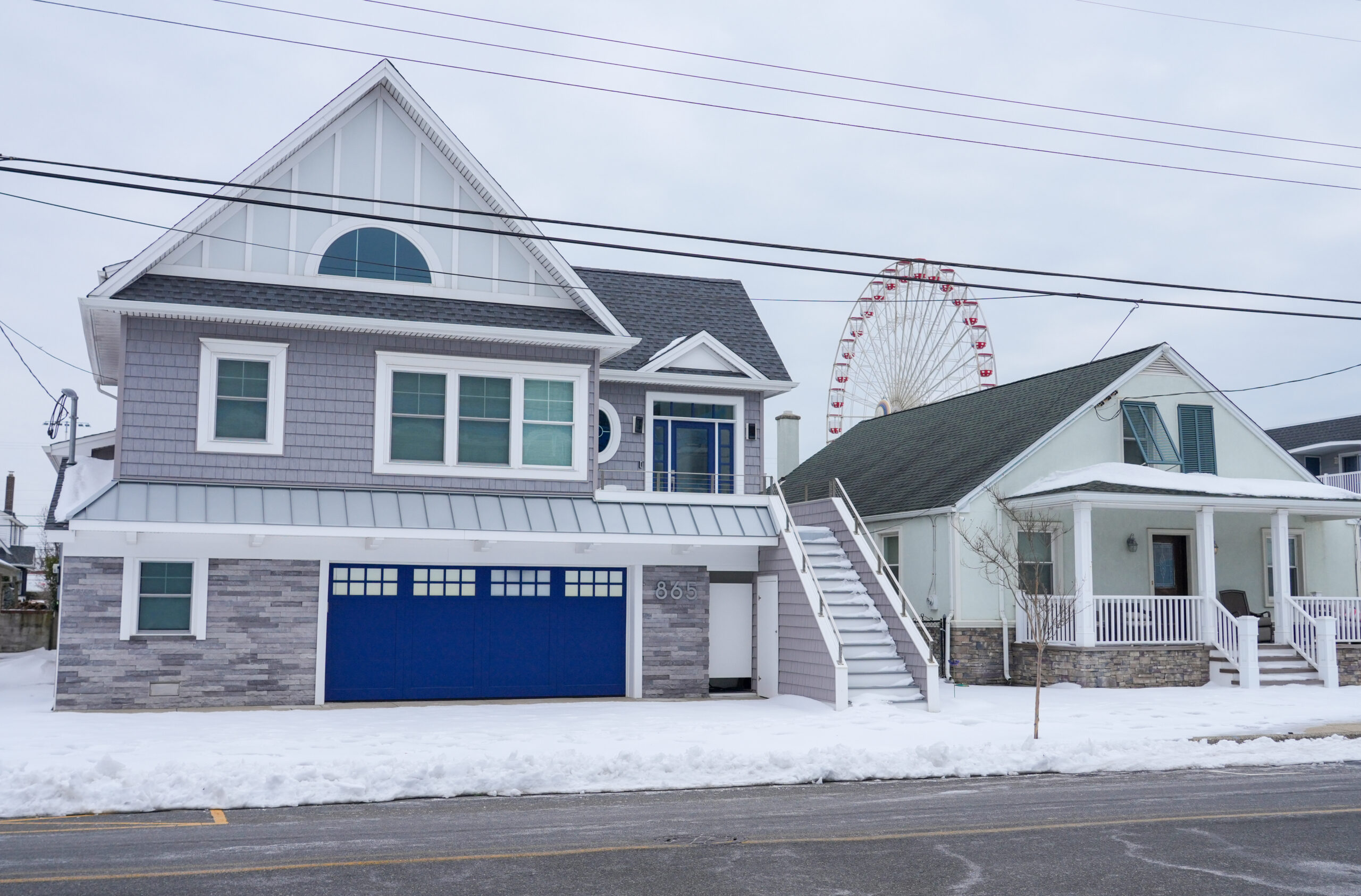
    The neighborhood behind the old Wonderland Pier site on the boardwalk in Ocean City, Tuesday, Feb. 3, 2026. Residents are against the development of a hotel at the boardwalk site.

    The demolish-and-rebuild mania that took over a lot of the rest of the island has mostly left Plaza Place alone, though residents acknowledge that is also a threat to their way of life. They also fear a hotel will prompt Plaza Placeans to sell.

    “It’s a Norman Rockwell painting, it just is,” Councilman Keith Hartzell says in the documentary Plaza Place: The Enigmatic Street, a locally made short film about the neighborhood. “It’s right here in Ocean City, and you kind of don’t expect it, when there’s two streets away a bunch of duplexes.”

    Hartzell, who is running for mayor against incumbent Jay Gillian, the former owner of Wonderland who sold to Mita, says he hopes to negotiate with Mita over height, parking, and other issues before considering any kind of zoning allowance or rehabilitation designation. A city council-appointed subcommittee tasked with assessing the boardwalk’s usage as a whole is holding a public meeting at 10 a.m. on Feb. 7 at the city’s library.

    The residents of Plaza Place worry about the survival of the hidden little neighborhood by the beach they fell in love with. “The neighborhood is so beautiful and so old,” said Marie Crawford. “If the hotel goes in, the dramatic change that will be for all of us with the traffic, the tone of the neighborhood — you’re going to see people sell. That threatens the neighborhood. The people won’t want to stay.”

    February 7, 2026
  • Moody’s boosts Atlantic City to investment grade a decade after its near bankruptcy

    Moody’s boosts Atlantic City to investment grade a decade after its near bankruptcy

    ATLANTIC CITY — A decade after teetering on the edge of bankruptcy and being taken over by the State of New Jersey, Atlantic City has been given an investment-grade rating by Moody’s Ratings.

    “Today is a tremendous day to start the new year,” Atlantic City Mayor Marty Small Sr. said Monday at a livestreamed news briefing. “The city of Atlantic City is officially investment grade.”

    The credit rating of Baa3 puts the city in the lowest long-term investment-grade category, several steps from the top A ratings. But it marks a dramatic rise from 10 years ago, Small noted, when he was sworn in as the City Council president.

    “We had the junkiest junk bonds imaginable,” he recalled. “The city’s finances were not in a good state. Employees were getting paid once a month. People were running to the bank to cash their checks. The outlook was bleak. We even entertained that we were bankrupt. It was a long, drawn-out fight. However, that was then; this is now.”

    Small himself ended 2025 in dramatic fashion: a two-week trial that ended in an acquittal on charges that he physically abused his teenage daughter.

    Small and business administrator Anthony Swan said at the Dec. 31 meetings that Moody’s expressed interest in seeing a stable government and experienced department directors.

    Small was sworn in to a new four-year term on New Year’s Day with his daughter in attendance and said then that the family has begun the healing process. A decision is expected soon by the Atlantic County prosecutor on whether to pursue similar charges against his wife, La’Quetta Small, the city’s schools superintendent.

    The state’s takeover of Atlantic City expired Dec. 1. But another bill is moving through the legislature that will leave the state in charge of Atlantic City finances for another six years. It calls for a “master developer” to oversee major projects, even as the city is trying to regain control over planning and zoning.

    There are other challenges ahead for Atlantic City: New York City approved three casino licenses that could cut a substantial hole in Atlantic City’s gambling revenue and prompt state lawmakers to approve casinos in North Jersey. Casino owners also oppose an effort to ban smoking in the city’s casinos that is now before an appellate court.

    Though the state takeover began a decade ago in hostile fashion, it evolved to a cooperative partnership. Small praised the decision by incoming Gov. Mikie Sherrill to keep Jacquelyn Suárez as head of the state’s Department of Community Affairs, which would oversee the next takeover.

    Atlantic City Mayor Marty Small Sr. speaks to the media after being found not guilty on all counts of abusing his teenage daughter, on Dec. 18.

    But Monday was a day of triumph for the city.

    Small noted that the city had substantially reduced its debt to $228 million, down from a peak of $550 million, and cut taxes six years in a row. Of that, only $71 million is debt directly incurred by the city; the rest are legacy debts from money owed to casinos from tax appeals. He anticipated announcing a seventh tax cut in the coming weeks.

    “This government gets criticized all the time,” he said. “People say, ‘Oh they’re spinning like drunken sailors, spinning spinning spinning like it’s out of control.’ Ladies and gentlemen, that’s just not true.”

    Business administrator Swan said Moody’s was interested in more than just numbers. “It’s about the stability of the city,” he said. “It’s about how the city is run.”

    Finance director Toro Aboderin called the announcement “an extraordinary milestone.” She said Moody’s asked about “bulkheads, roads, infrastructure.”

    “Restoring Atlantic City to sound financial footing has been our top priority every single day,” she said. “A lot of people talk about Atlantic City and how we’re terrible, how the finances are the worst, and the roads are messy. They say all kinds of things, but we have attained something quite remarkable.”

    Officials hope the vote of confidence from Moody’s will signal to investors and developers to look again at their city, which has some of the most affordable beachfront real estate on the East Coast.

    An investment-grade credit rating signals to financial markets that Atlantic City is a lower-risk borrower, although the mayor emphasized that the city currently has no need to borrow.

    January 5, 2026
  • The Pennsylvania Turnpike’s restaurant offerings can feel like a trip back in time

    The Pennsylvania Turnpike’s restaurant offerings can feel like a trip back in time

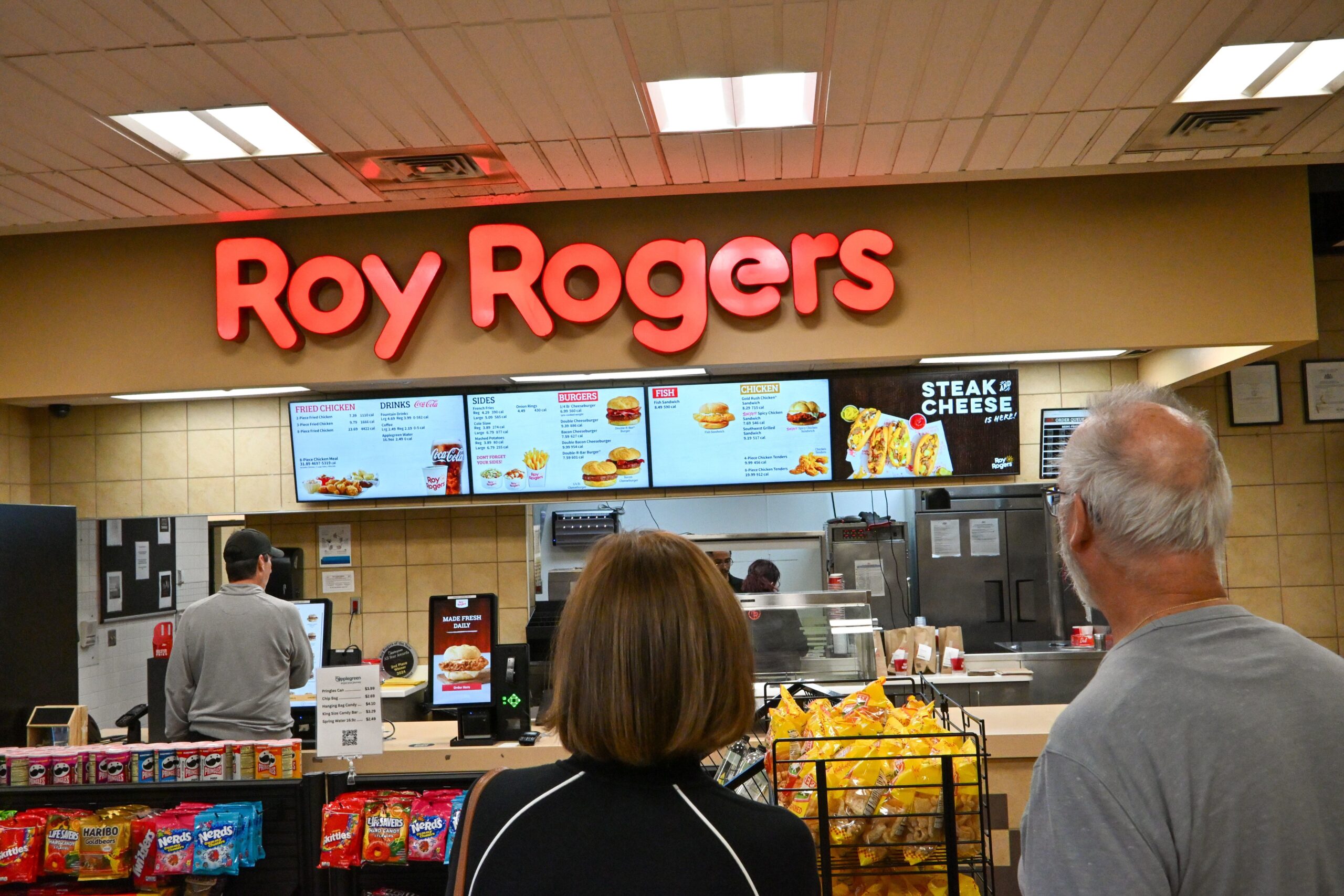
    Driving west on the Pennsylvania Turnpike, Mary Wright was hoping for a Chick-fil-A. But as she watched the limited options on road signs pass, fond memories of roast beef sandwiches lured her to Roy Rogers.

    “My mother liked Roy Rogers,” said Wright, who is in her 60s and from Collingswood. “That’s how long it’s been around.”

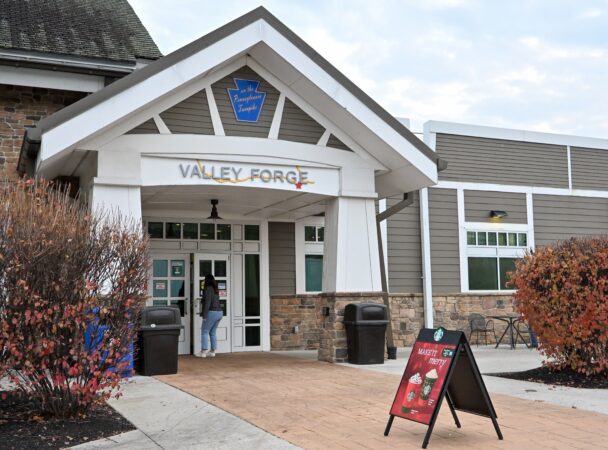
    That’s pretty typical of the food offerings on the Pennsylvania Turnpike, where old-school brands such as Auntie Anne’s, Baskin-Robbins, and Sbarro dot many of the 17 service plazas.

    That puts the turnpike behind the times compared with similar toll roads in New Jersey and New York, where travelers can hold out for newer brands like Chick-fil-A, Pret a Manger, and Shake Shack.

    “I think the older generation likes Roy Rogers and all that, but younger people are more likely to like Shake Shack, for example,” said John Zhang, professor of marketing at the University of Pennsylvania’s Wharton School of Business.

    Once on the toll road, people are faced with dining options decided almost entirely by one company. It’s what Zhang called a “captive consumer” environment. The reasons for this involve state policy, a corporate contract, and a little business history.

    Mary Wright and Rich Misdom of Collingswood consider their options at the Roy Rogers located in the Peter J. Camiel Service Plaza on the Pennsylvania Turnpike in late November.

    ‘Applegreen determines the food concepts’

    The commercial stakes are significant: More than 550,000 people drive on the turnpike every day, according to the Pennsylvania Turnpike Commission, and about 7.4 million travelers are expected to have used the toll road around the Christmas and New Year’s holidays.

    Though the turnpike commission oversees the operation, a company called Applegreen primarily decides which restaurants fill the state’s 17 service plazas, according to turnpike commission spokesperson Marissa Orbanek.

    Applegreen runs travel plazas in 12 states, including New Jersey and New York. The company, based in Ireland, was taken private for $878 million in 2020 and is majority-owned by the large private equity firm Blackstone Inc. Applegreen did not respond to requests to comment for this story.

    For access to the service plazas, Applegreen pays the turnpike commission 4% of its gross food and beverage sales, amounting to about $2.4 million per year, Orbanek said.

    “Applegreen determines the food concepts and seeks approval from the commission,” Orbanek said. “So the turnpike is certainly involved in this process.”

    Roy Rogers, Fixin’s Bar and all, returns to the Philly area after three decades with a new restaurant in Cherry Hill

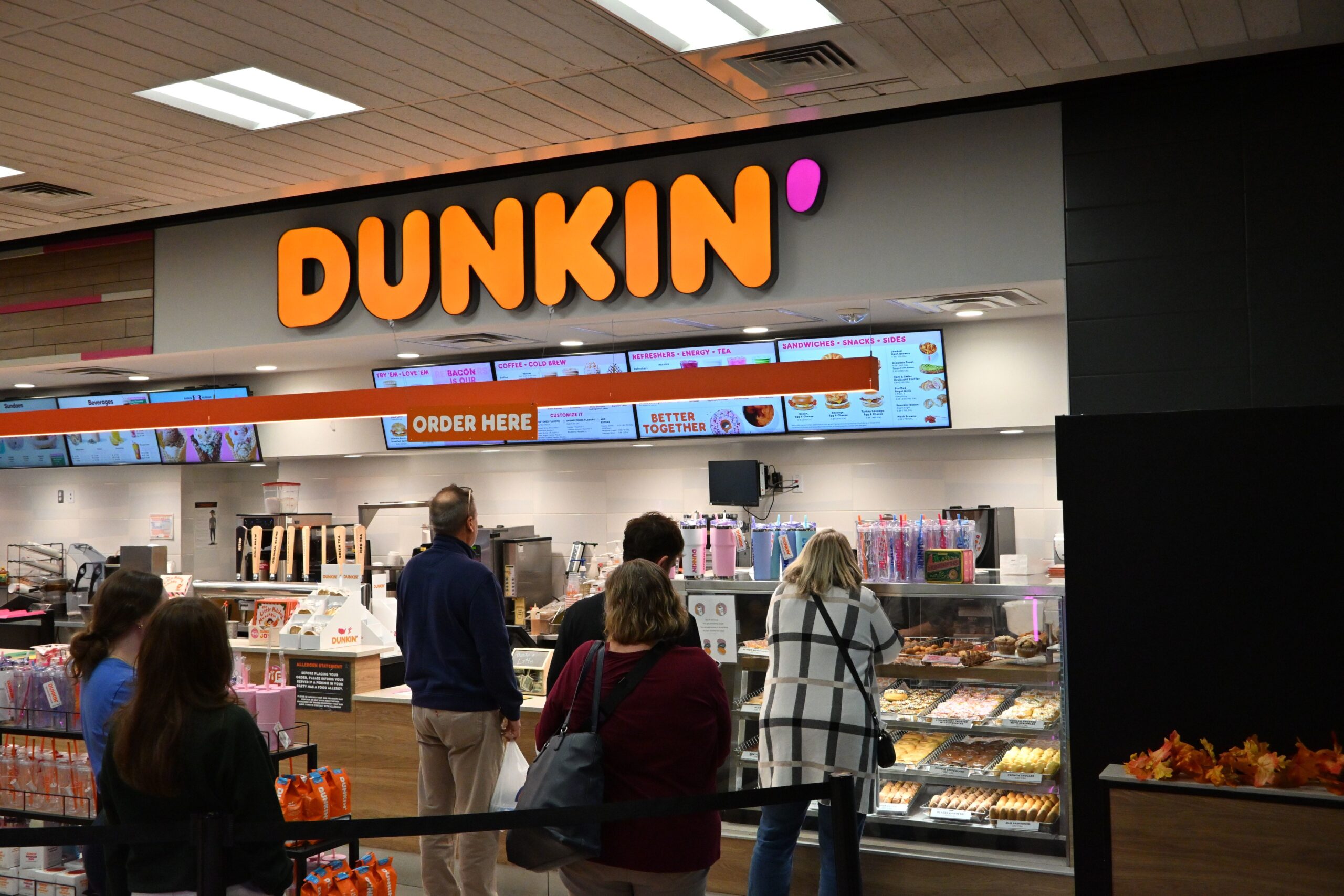
    Of the 15 restaurant chains Applegreen lists on its website, nine appear on the Pennsylvania Turnpike. There are nine Auntie Anne’s, eight Burger Kings, one Cinnabon, seven Dunkin’s, two Popeyes, seven Roy Rogers restaurants, four Sbarros, 10 Starbucks outposts, and one Subway restaurant, according to the turnpike commission website. Pennsylvania also has six Baskin-Robbins locations, it shows.

    In other states, Applegreen’s brands include Chick-fil-A, Nathan’s Famous Hot Dogs, Panda Express, Panera, Pret a Manger, and Shake Shack.

    The service plaza contract dates back to 2006, when the turnpike commission signed a 30-year lease agreement with HMS Host Family Restaurants, giving the company “exclusive rights” to food and drink sales, Orbanek said.

    Seven Dunkin’ locations dot the Pennsylvania Turnpike.

    In 2021, Applegreen acquired HMS Host for $375 million and took over its lease. The lease will expire in August 2036, Orbanek said.

    Until then, Applegreen decides which eatery goes where.

    What’s with all the Roy Rogers restaurants?

    When Applegreen bought HMS Host, it became the franchisee of the Roy Rogers restaurants on the turnpike, said Jim Plamondon, who co-owns the Frederick, Md.-based Roy Rogers brand with his brother.

    Plamondon wants to keep the restaurants on the turnpike past 2036 — a decision that will depend in part on whether Applegreen sticks with the restaurants it acquired when it bought HMS Host.

    “It’s all about developing relationships and hoping to grow with our operators,” Plamondon said.

    As for Roy Rogers’ prominent position on the turnpike, that dates back to the 1980s, when Marriott Corp. managed the service plazas, Plamondon said. Back then, the restaurant was owned by Marriott — it had a licensing agreement with the showbiz cowboy of the same name — and Plamondon’s dad was an executive in the company.

    These days, Plamondon said, nostalgia and curiosity for something a bit different have driven the restaurant chain’s modest growth: It has opened a few new locations in recent years, including one in Cherry Hill, and has a devoted fan base.

    Fast-food restaurants are facing a number of challenges in the current economic climate. Wages and tariffs have pushed prices up, and low-income consumers in particular have started to reduce spending. Even McDonald’s, the largest fast-food chain in the U.S., has seen nearly double-digit decreases in traffic among low-income Americans, the company said in its third-quarter earnings report last month.

    McDonald’s CEO Christopher Kempczinski told investors on a call announcing the third-quarter results that low-income consumers were having to absorb significant inflation, which was affecting spending behavior.

    Roy Rogers has seen some of these challenges as well, Plamondon said. Costs have gone up, margins are thin, and people’s tastes are always changing. People are eating more chicken and want spicier options, he added. .

    “It’s a really good menu, it’s great quality food, and I think our brand absolutely has a future to it, because at the end of the day, it’s about the food.”

    Changing tastes

    The Wharton School’s Zhang agreed that consumers’ tastes have shifted. “People increasingly want ethnic foods, and younger people want spicier food,” he said. “And people want to go upscale nowadays.”

    Zhang noted a number of older brands on the Applegreen roster, such as Sbarro, the pizza restaurant that has faced two bankruptcies in the years since the turnpike commission approved the 30-year lease.

    In terms of market forces, Zhang said, turnpike service plazas are “an aberration.” Unlike those in most suburban or urban areas, service plaza customers are willing to settle for what’s available, and pay more to get in and out, he said.

    “If you’re a traveler on a holiday, you tend to be less price sensitive,” Zhang said. “You just want to have your food very quickly.”

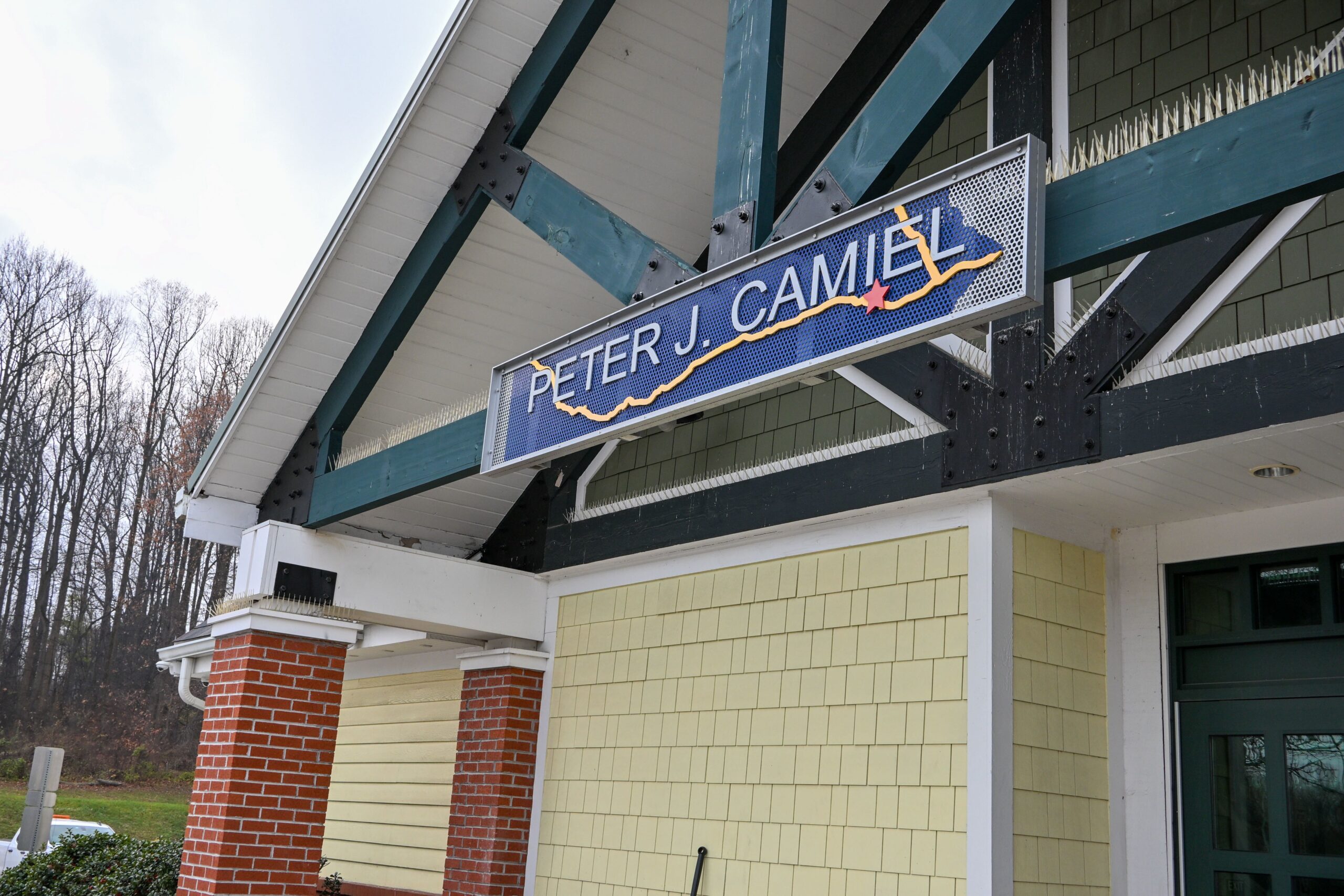
    A sign at the Peter J. Camiel service plaza on the Pennsylvania Turnpike.

    That puts turnpike service stops at odds with the shifting consumer preferences that have bedeviled the fast-food industry over the last couple of decades, Zhang said, including the addition of food delivery services like DoorDash and GrubHub.

    Zhang said that the lack of order-ahead options at turnpike eateries is puzzling. For people traveling down a strip of highway, it seems like calling ahead would make sense.

    “For them, the customers just pass by once,” he said.

    For Mary Wright and her traveling companion, Rich Misdom, their recent Roy Rogers visit did not exactly ignite enthusiasm.

    “This is, like, old-school kind of stuff,” Misdom said, adding he was disappointed that this Roy Rogers restaurant was not serving roast beef. He settled for a cheeseburger, while Wright got a chicken sandwich.

    “We don’t come here to fine dine,” Misdom said, between bites. “Let’s put it that way.”

    December 28, 2025
  • S test edit post Christmas

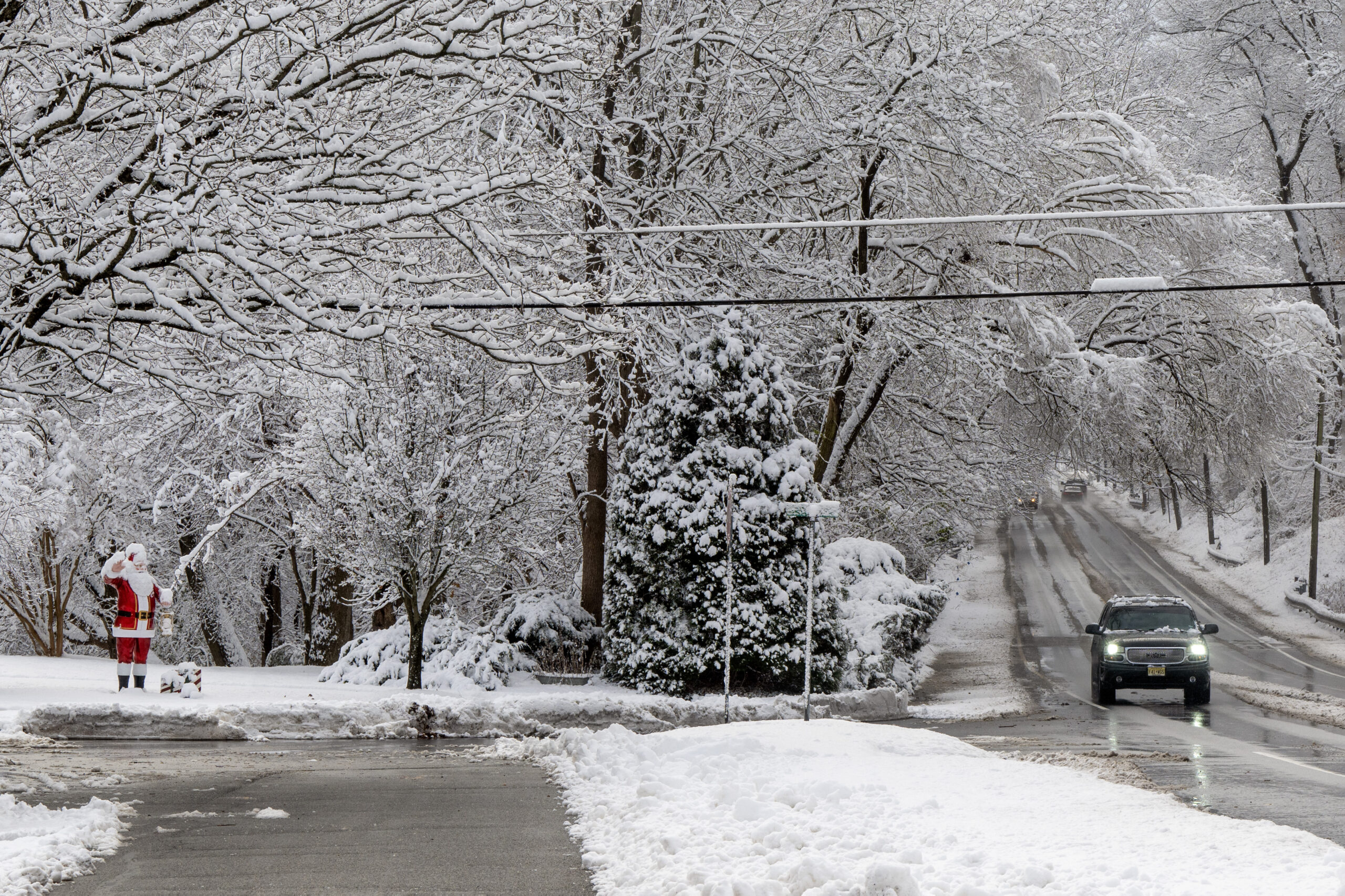
    A Santa statue “waves” to drivers along Brace Road in Cherry Hill on Dec. 14, 2025. The Philly region may see its second snowfall of the season on Friday night.
    A Santa statue “waves” to drivers along Brace Road in Cherry Hill on Dec. 14, 2025. The Philly region may see its second snowfall of the season on Friday night. Read more Tom Gralish / Staff Photographer
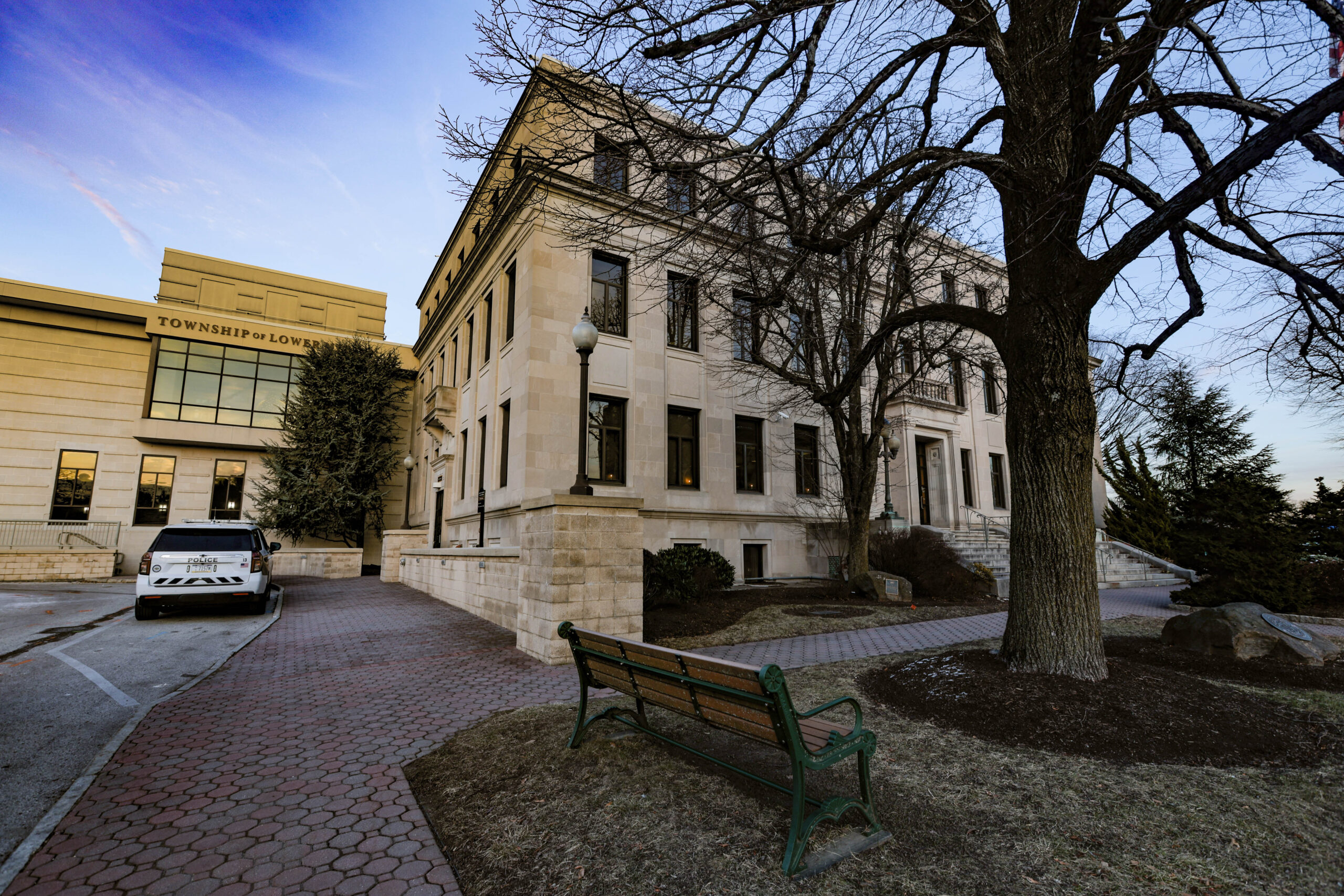
    Lower Merion residents can expect tax hikes on the township and countywide level in 2026.
    Lower Merion residents can expect tax hikes on the township and countywide level in 2026. Steven M. Falk / Staff Photographer
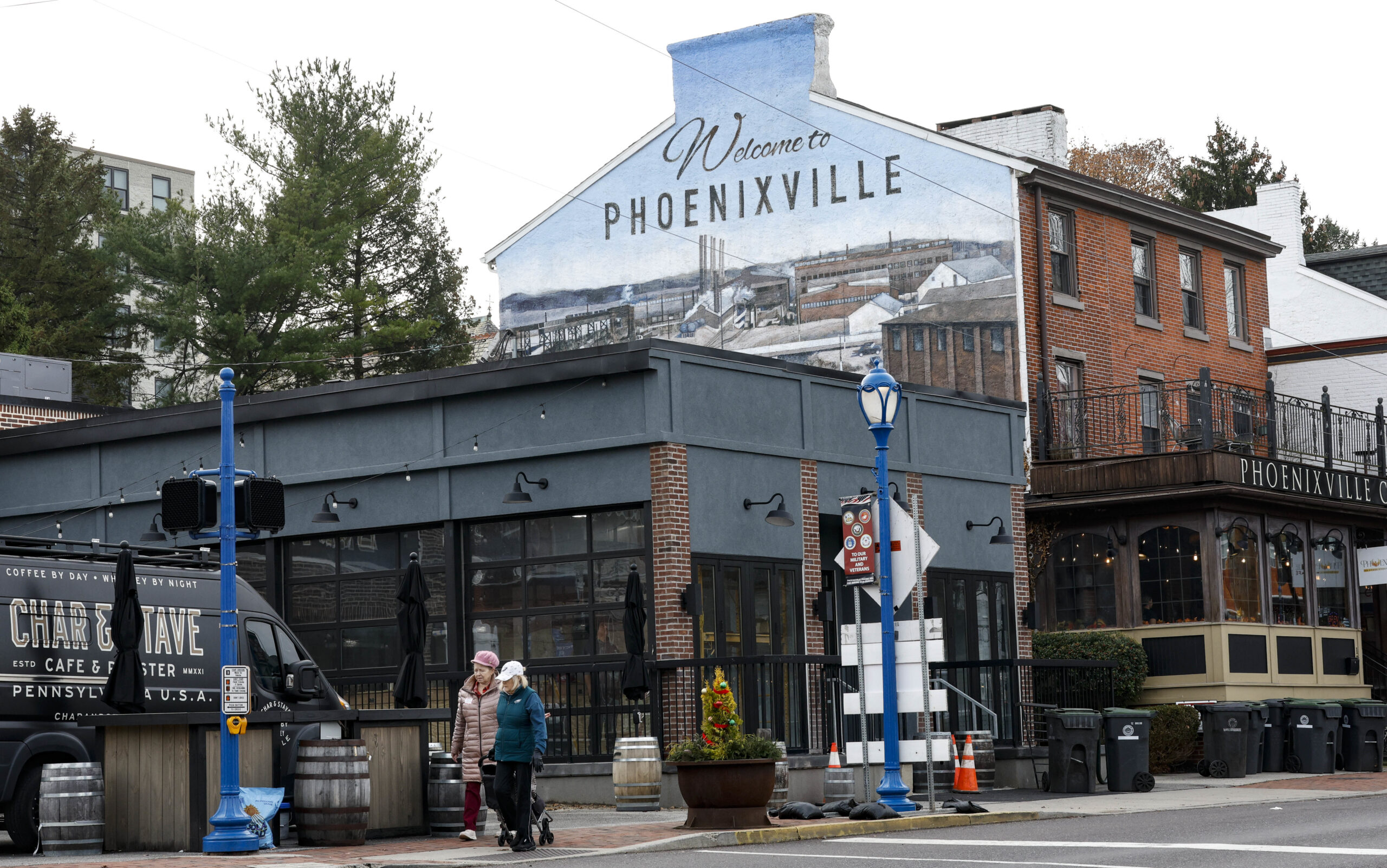
    Phoenixville recently welcomed a pair of eateries, just some of the new businesses that have opened recently in Chester County.
    Phoenixville recently welcomed a pair of eateries, just some of the new businesses that have opened recently in Chester County. Steven M. Falk / For The Inquirer
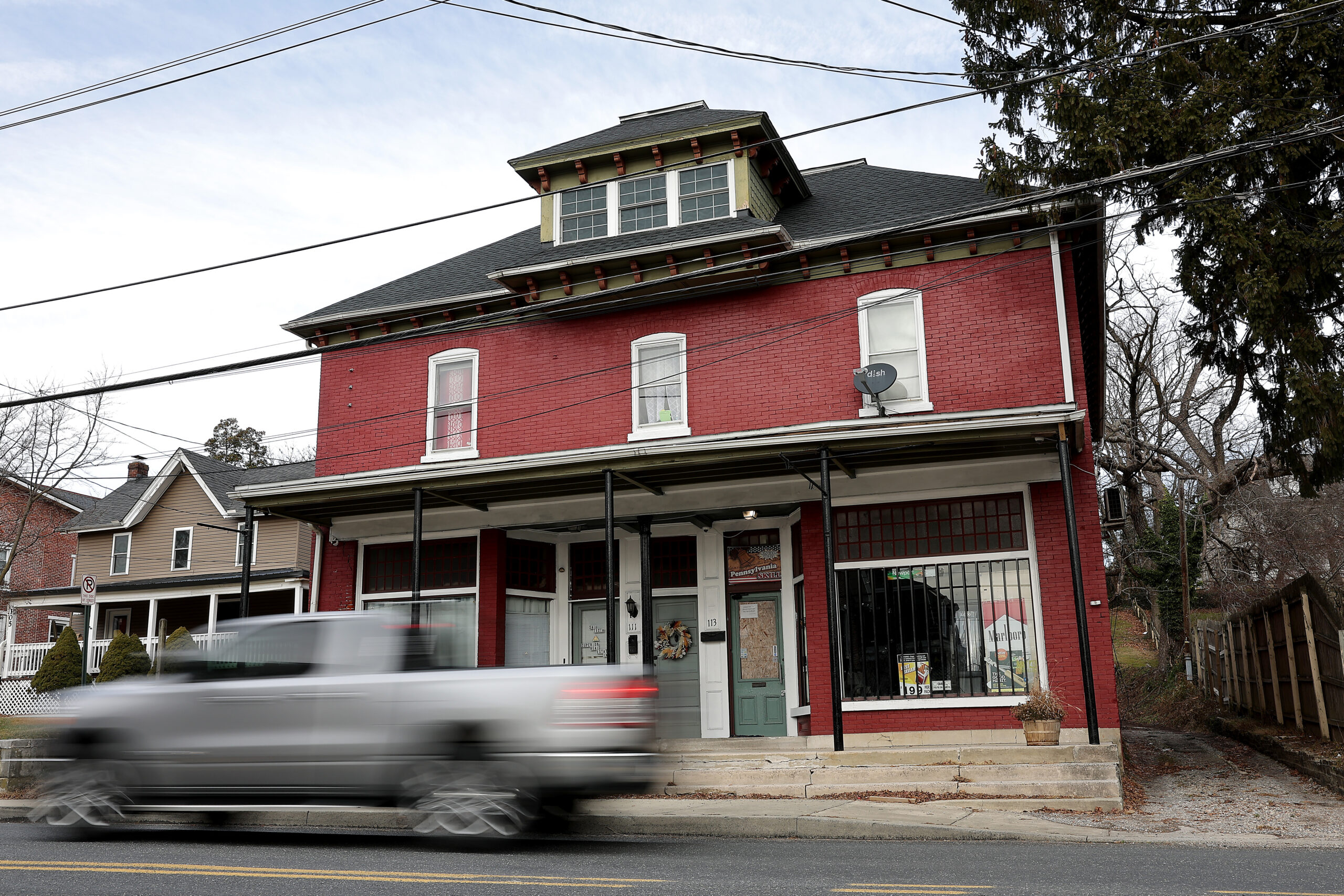
    An exterior view of the former West Grove Smoke Shop in the borough of West Grove, Chester County.
    An exterior view of the former West Grove Smoke Shop in the borough of West Grove, Chester County. David Maialetti / Staff Photographer
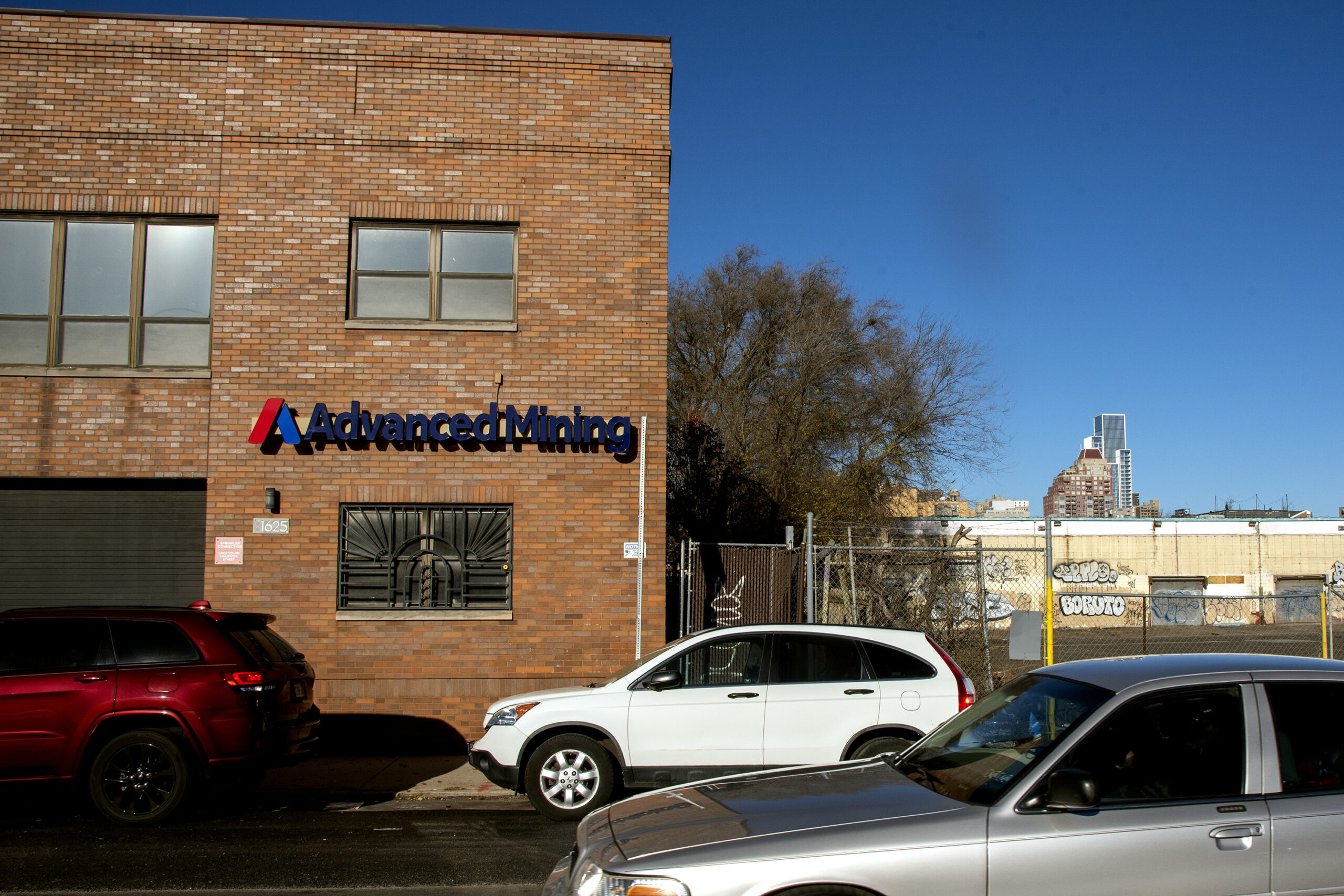
    The scene at 1625 Washington Avenue Tuesday Dec. 13, 2022. The sign reads "Advanced Mining" the business that acquired the cryptocurrency company VBit Technologies which is facing several new lawsuits in federal court after its customers claim the company froze them out of millions of dollars in assets this summer.
    The scene at 1625 Washington Avenue Tuesday Dec. 13, 2022. The sign reads “Advanced Mining” the business that acquired the cryptocurrency company VBit Technologies which is facing several new lawsuits in federal court after its customers claim the company froze them out of millions of dollars in assets this summer. Read more Tom Gralish / Staff Photographer
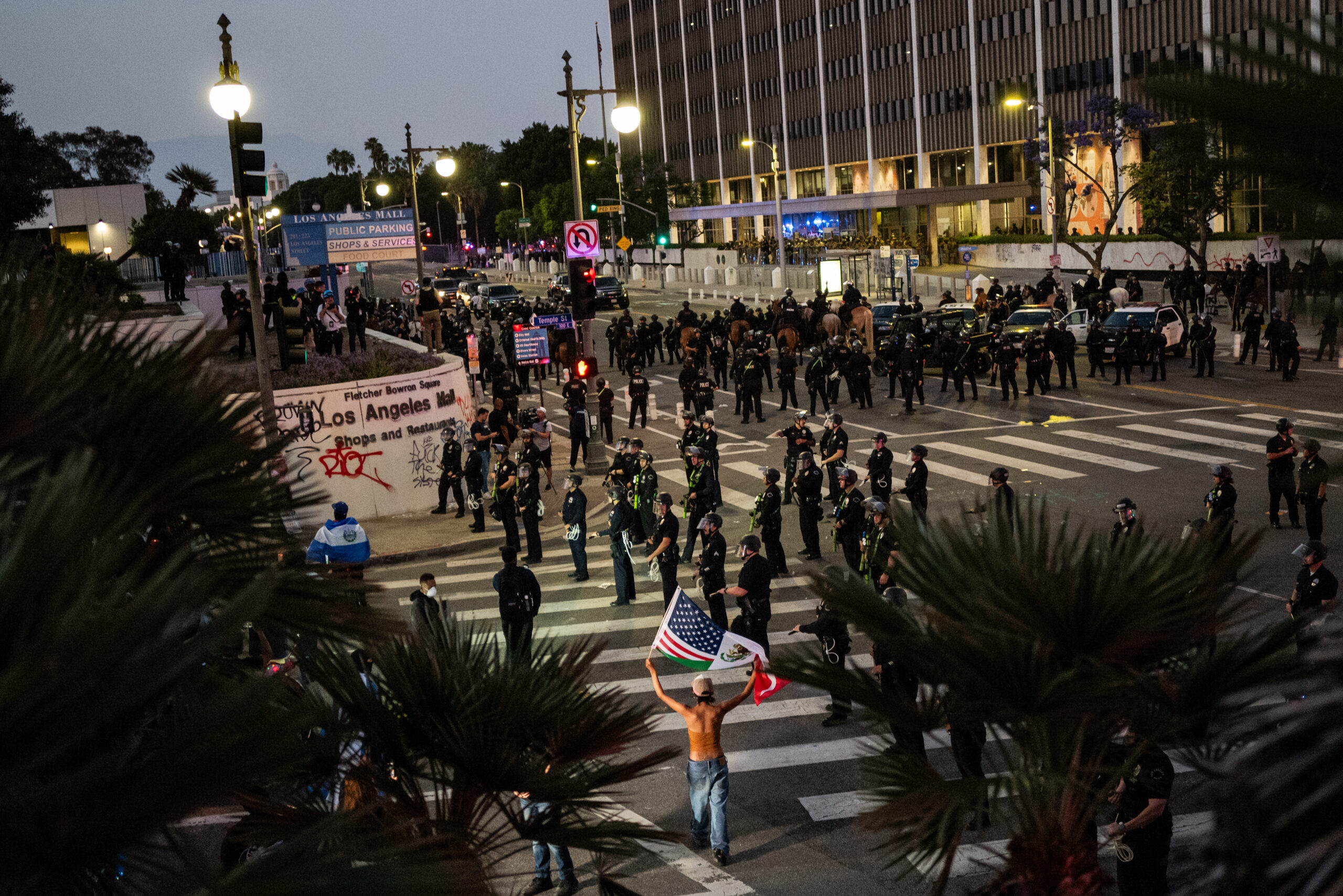
    Law enforcement officers stand guard outside a detention center in Los Angeles on June 10, the day a curfew took hold following clashes in days prior between protesters and law enforcement.
    Law enforcement officers stand guard outside a detention center in Los Angeles on June 10, the day a curfew took hold following clashes in days prior between protesters and law enforcement. Read more Salwan Georges

    » READ MORE: This is a test – Merry Christmas

    “Merry Christmas”
    — Author name

    Poster perayaan 20 tahun anniversary HOWL’S MOVING CASTLE.

    Bakal tayang ulang tanggal 26 September. Tertarik nonton kalo tayang di bioskop Indonesia?
    pic.twitter.com/s8d9U8lxnu

    — Habis Nonton Film (@HabisNontonFilm) September 11, 2024

    A 360 turntable shot of my Howl's Moving Castle model. This lacks scale, but it is 21" tall (53cm) and 4.2 lbs (1.9kg) of scratch-built garbage. pic.twitter.com/ZqJv7M05WY

    — Studson (@StudsonStudio) August 17, 2021

    @jellycat

    Do you agree? 💙

    ♬ original sound – Jellycat
    @jellycat

    Do you agree? 💙

    ♬ original sound – Jellycat

    December 25, 2025
  • The Wall Street Journal says Philly is the best place to visit in 2026

    The Wall Street Journal says Philly is the best place to visit in 2026

    New Year’s Day is still more than a week away, but already, everything’s coming up Philly in 2026.

    In the latest sign that the city is poised for a banner year, the Wall Street Journal has named Philadelphia the world’s top place to visit in ‘26 — echoing what various national and international publications have been saying for weeks.

    The primary draw, of course, is the nation’s 250th birthday celebration, which is expected to bring an endless stream of tourists — not to mention contribute to as much as $2.5 billion to the city and region in additional tourism dollars, by one estimate.

    As the Journal notes, the city has been glowing up for the yearlong celebration, with the Museum of the American Revolution undergoing a sizable renovation and new galleries set for display at the National Constitution Center.

    The city’s sports calendar in the coming year ain’t looking too bad, either.

    Most notably, the FIFA World Cup arrives next summer with a much-anticipated slate of games in June and July. (France and Brazil are among the teams that’ll take part in six matches slated for Lincoln Financial Field.)

    And in July, Major League Baseball’s All-Star Game festivities will take place at Citizens Bank Park — in the same year the Phillies rank among the betting favorites to win a third World Series title, no less — while Xfinity Mobile Arena will be hosting first- and second-round games for the NCAA men’s basketball tournament.

    Oh, and the PGA Championship returns to the Philadelphia area, May 11-17 at the Aronimink Golf Club in Newtown Square.

    The Wall Street Journal’s recognition marks the latest in a spate of hype for Philadelphia in the coming year. Last month, Travel + Leisure named the city one of its top places to travel in ’26, as did the BBC.

    Joining Philadelphia in the Journal’s top five destinations for ‘26 were Basque Country, Spain; Okavango Delta, Botswana; Yunnan, China; and Guadalupe Valley, Mexico.

    Tulsa, Okla. — which in June will celebrate the 100th birthday of the country’s favorite lonely highway with its annual Route 66 Road Fest — was the only other American city to make the Journal’s top 10.

    December 23, 2025
1 2
Next Page→

Philadelphia local news, sports, jobs, cars, homes

  • Blog
  • About
  • FAQs
  • Authors
  • Events
  • Shop
  • Patterns
  • Themes

Twenty Twenty-Five

Designed with WordPress