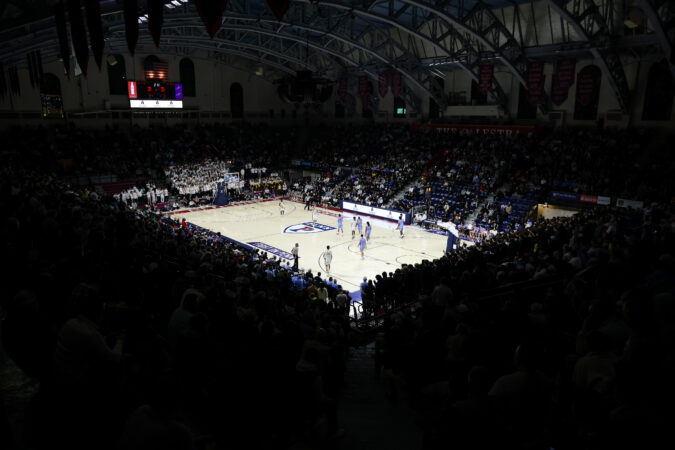
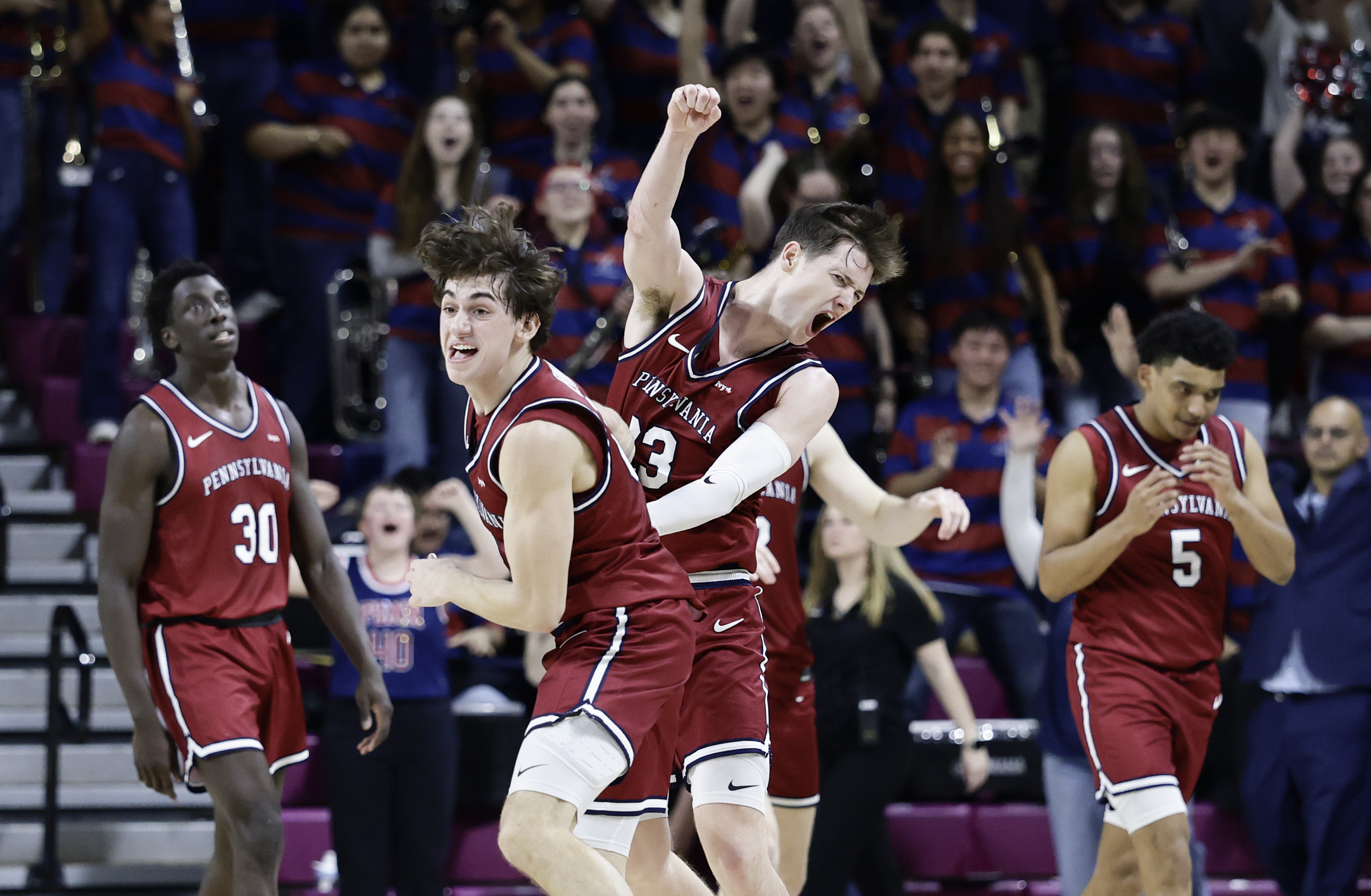
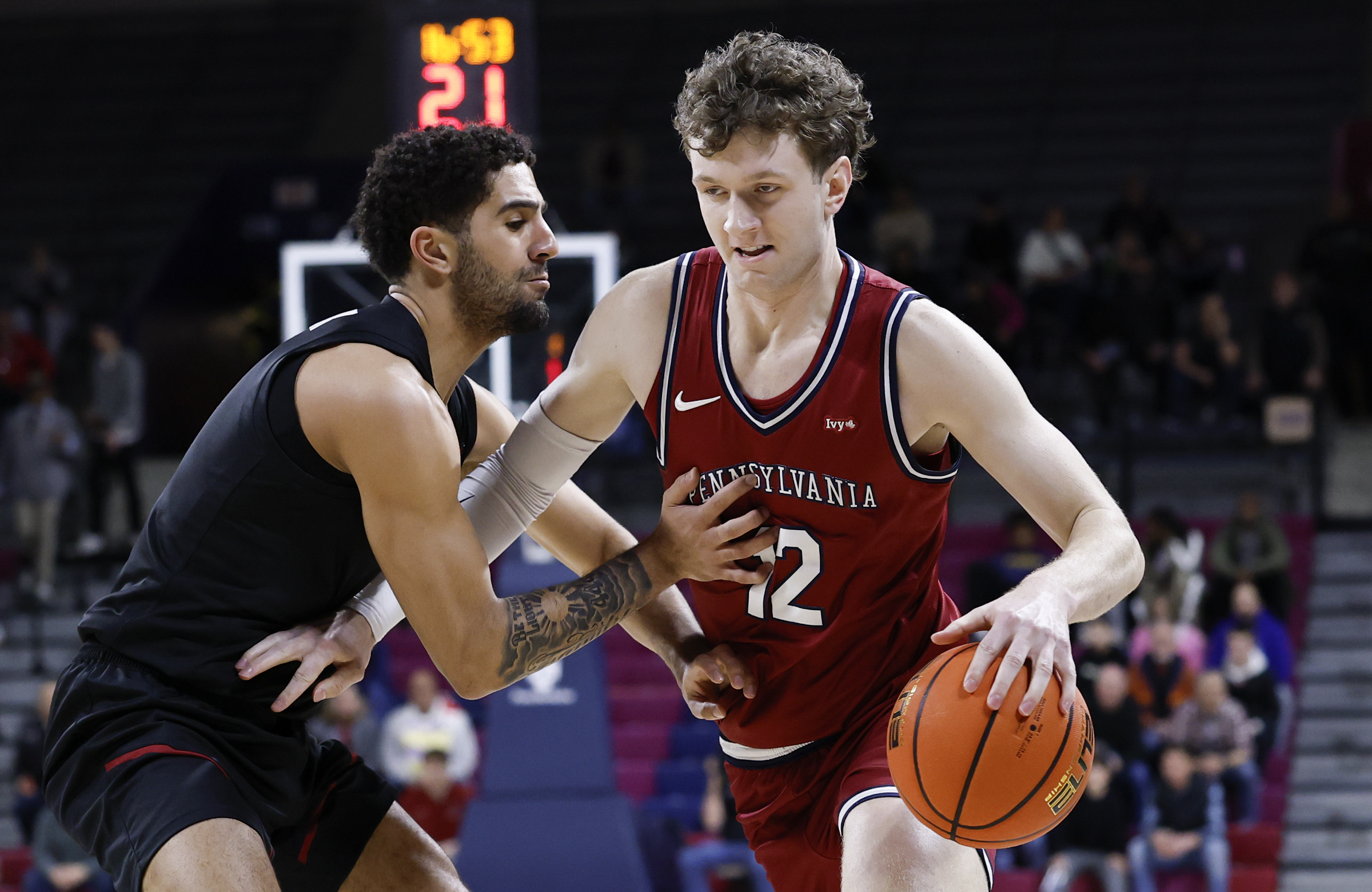
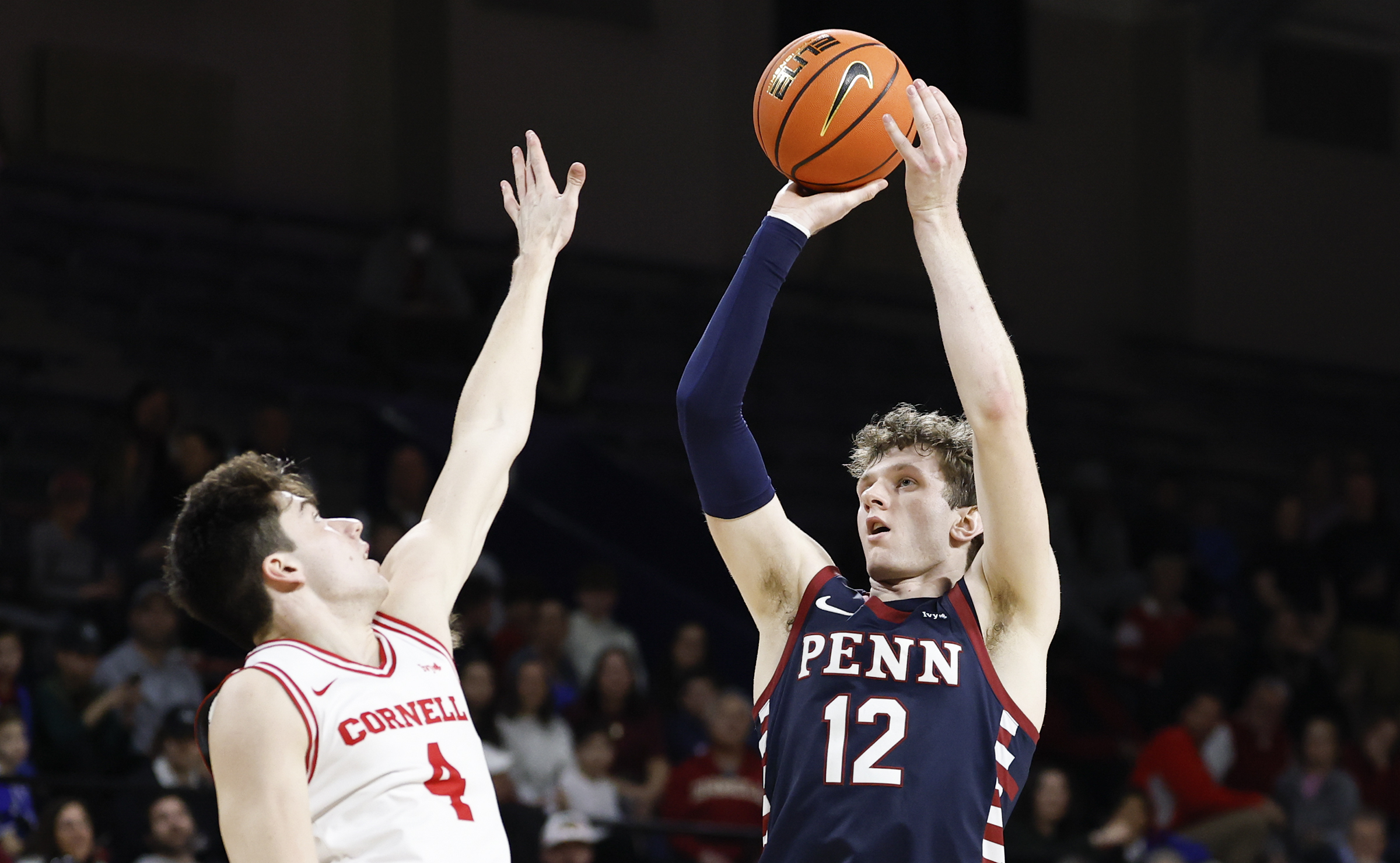
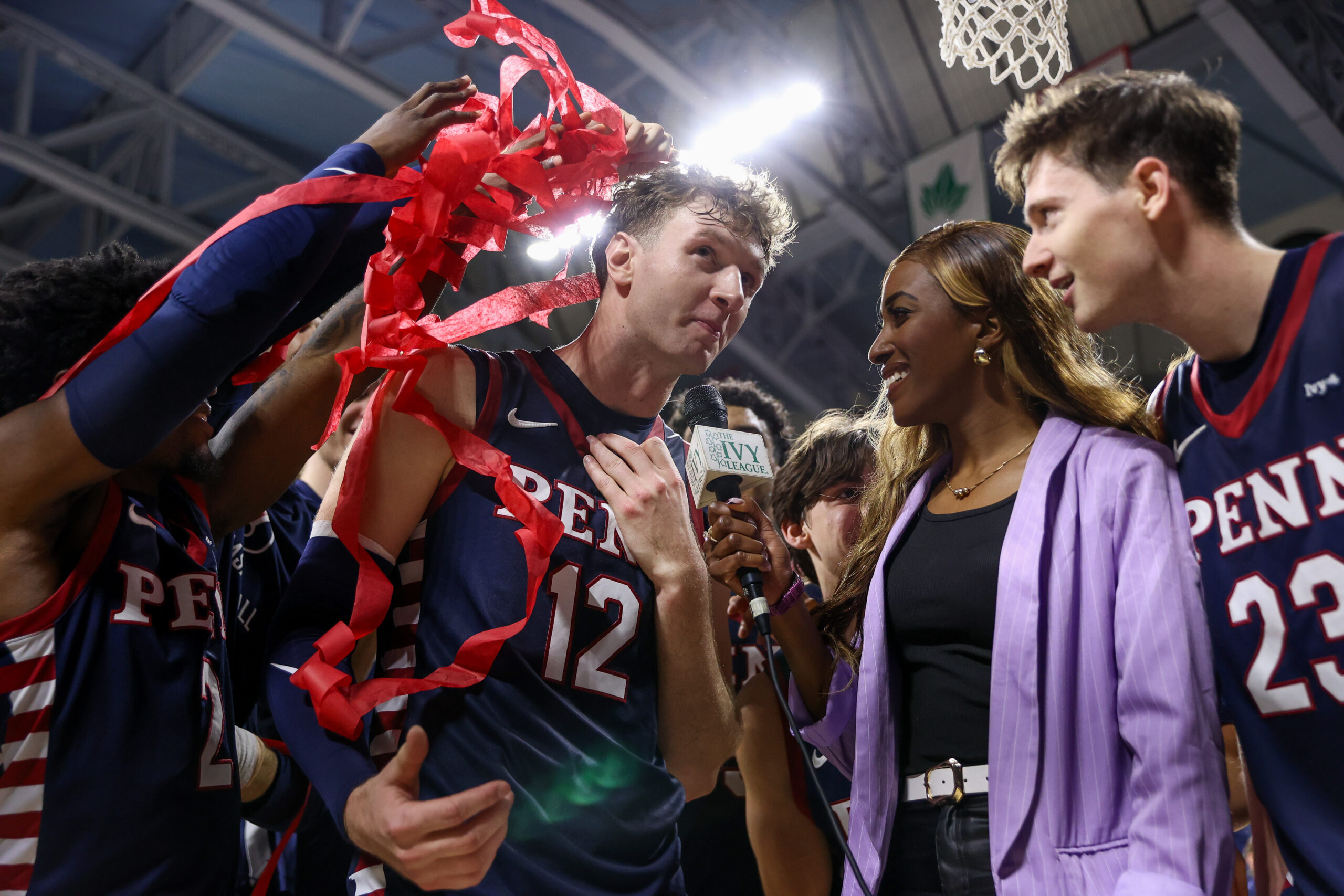
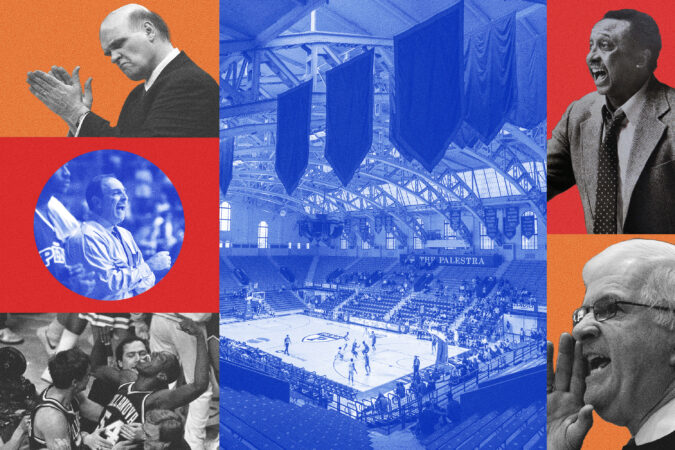
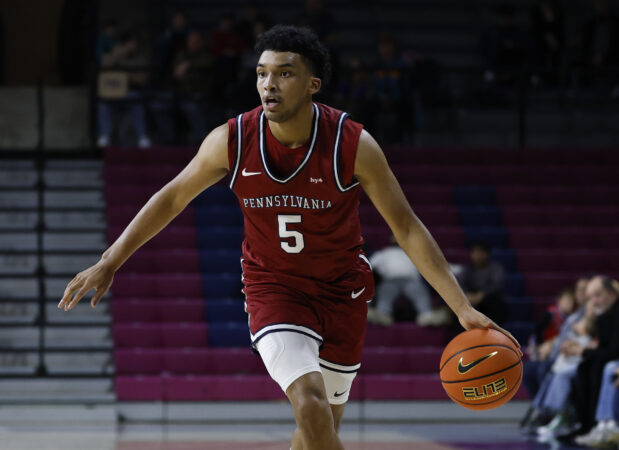
With this year marking the Palestra’s 100th anniversary, the fifth annual Cathedral Classic is expanding.
The multiteam event, which previously was a four-team round robin, will boast five teams this year: host Penn, La Salle, Bucknell, Buffalo, and Towson. The classic also is shifting from three days to two and no longer will crown a winner.
The two days of doubleheaders span Thanksgiving weekend, Nov. 27-28, and open with La Salle vs. Bucknell at 3:30 p.m., then Penn vs. Towson (6 p.m.). The next day, Towson takes on Buffalo (3:30 p.m.), and Penn will face Bucknell (6 p.m.).
“The Penn men’s basketball program is excited to celebrate 100 years of the Palestra with the return of the Cathedral Classic,” Penn coach Fran McCaffery said in a release. “There is no better way to honor our historic arena than with a weekend of great basketball games.”
The stage is set 🙌
Don’t miss the 5th annual Cathedral Classic at the Palestra on Thanksgiving weekend! pic.twitter.com/Qih5QryT2Y
La Salle coach Darris Nichols added: “We’re grateful for the opportunity to play at the Palestra during its 100th anniversary. Honoring the venue’s legacy was important to us when we first talked about this year’s schedule, and we’re excited to take on a good Bucknell team.”
Last season, Hofstra was crowned the tournament’s champion after defeating Penn to finish 3-0 in the round robin. However, for Big 5 fans, the most memorable game was on Day 2, when the Quakers faced La Salle. In that matchup, Penn erased a 15-point deficit to defeat the Explorers, 73-71.
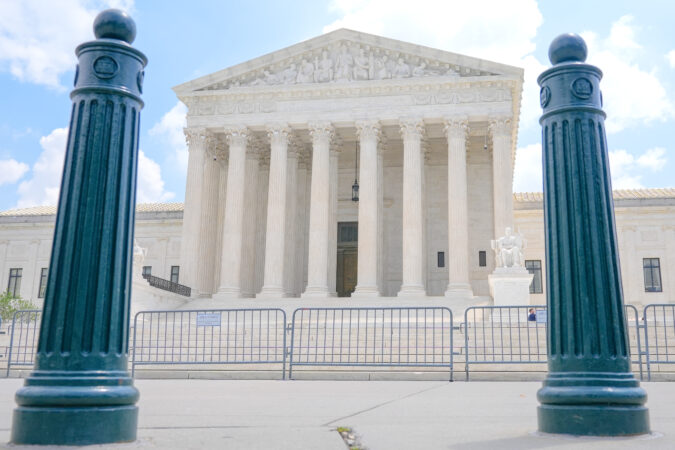
The Supreme Court on Tuesday upheld bans in Idaho and West Virginia on transgender athletes playing on girls’ and women’s sports teams, the latest in a string of legal setbacks for the LGBTQ+ community before the high court.
In a decision led by the court’s six conservatives — but joined in parts by its three liberals — the justices found that states can separate teams based on “biological sex” without offending the Constitution’s guarantee of equal protection and Title IX, a landmark 1972 antidiscrimination law involving education.
“Separate sports teams for biological males and biological females are reasonable: Given the inherent physical differences between the sexes, allowing only biological females to play on women’s and girls’ teams can reduce the risk of physical injury and ensure fair competition,” Justice Brett M. Kavanaugh, who coached his daughter’s youth basketball team, wrote for the majority.
The court’s three liberals, led by Justice Sonia Sotomayor, agreed that West Virginia’s ban did not violate Title IX. But they disagreed with the majority on several fronts, especially the conclusion that the West Virginia law withstands scrutiny under the Constitution’s guarantee of equal protection for all.
Sotomayor wrote that a lower court should have the chance to sort out a question central to the case of the teenage plaintiff from West Virginia, Becky Pepper-Jackson: whether trans girls who have not undergone male puberty have physical advantages in sports.
“Because of the Court’s decision today, West Virginia, and any other state actor, can deny B.P.J. and others like her these experiences simply because it thinks they have an inherent athletic advantage, even if the facts show that they do not,” Sotomayor wrote.
The court did not address what is arguably the flip side of its ruling — whether schools and states can adopt policies allowing transgender athletes to compete on girls’ and women’s teams, as some liberal states and communities do.
“That question is currently the subject of litigation in some lower courts,” Kavanaugh wrote in a footnote. “Nothing in this opinion is intended to decide that question.”
The ruling is among several in recent terms that are consequential for the LGBTQ+ movement. The Supreme Court in March ruled a Colorado law banning “conversion therapy” for gay and transgender youths probably violated the free-speech rights of a religious counselor who wants to counsel such young people according to biblical teachings.
Earlier that month, the court sided with Christian parents in blocking, for now, California policies that discourage schools from informing parents of a student’s sexual orientation or gender identity without the student’s consent. Last year, the court upheld bans on gender transition treatment for minors.
Questions over whether transgender girls and women should play on girls’ and women’s sports teams has been a particular flash point in a broader conversation about transgender rights. Dozens of states have bans amid intense public debate about fairness at all levels of competition.
The debate over the allowance of transgender women in collegiate athletics gained national attention in 2022 after Penn swimmer Lia Thomas won the national title in the women’s 500-yard freestyle. Thomas, who is a transgender woman, competed for the Quakers men’s team during the 2018-19 season before medically transitioning.
In July 2025, Penn struck a deal with the Trump administration regarding Thomas’ participation. According to the deal, Penn agreed to ban transgender athletes, vacate Thomas’ records, release a statement in support of Title IX “as interpreted by the Department of Education,” and send personalized letters of apology to Thomas’ former women’s teammates. The deal came after the White House had paused $175 million in federal funding to Penn because of Thomas’ participation on the Quakers’ women’s team in 2021-22. The federal funding was restored following the agreement.
The issue came to the high court in a pair of cases, brought separately by Pepper-Jackson, a teen from West Virginia, and Lindsay Hecox, a Boise State University student in Idaho. Both argued that the bans in their states discriminated on basis of sex and violated the Constitution’s equal protection clause. In January, the justices appeared sympathetic to arguments for keeping the bans in place as the cases were argued back-to-back.
LGBTQ+ activists said the decision would be devastating for some young people.
“This is a heartbreaking ruling for our clients and transgender girls like them who’ve asked for nothing more than the same opportunities afforded to their peers,” said Joshua Block, senior counsel for the American Civil Liberties Union’s LGBTQ & HIV Rights Project, who argued the case for Pepper-Jackson.
Sasha Buchert, director of nonbinary and transgender rights at Lambda Legal, said the decision was upsetting but also narrow.
The ruling is “a serious loss — we’re not minimizing that,” she said. But noting that the court did not impose a national ban on transgender athletes in female sports, Buchert added, “This ruling says, sure, a state may discriminate, not that they must discriminate.”
Twenty-seven states have passed laws banning transgender student-athletes from competing on women’s or girls’ sports teams. Supporters of the bans say they are necessary to ensure fairness and safety because of inherent physical differences between males and females. Opponents say the laws discriminate against trans people and should be struck down.
President Donald Trump early last year signed an executive order aimed at keeping transgender women out of women’s sports. The administration has argued that there are only two sexes — male and female — and that they “are not changeable.”
Soon after the executive order on sports, the NCAA and the U.S. Olympic and Paralympic Committee updated their policies to bar trans women from playing on women’s sports teams. Since then, the administration has aggressively investigated schools that allow trans girls to participate in girls’ and women’s sports.
Education Secretary Linda McMahon welcomed the court’s decision Tuesday.
“For years, ideologues distorted Title IX to advance a radical transgender agenda, subjecting women to immeasurable harm,” she said in a statement.
Nicole Neily, founder and president of Defending Education, a conservative advocacy group, called the decision an “exercise in judicial humility” and noted that it may be disappointing to conservatives in liberal states that allow transgender athletes to participate.
“Although it’s certainly not as sweeping as parent activists would have liked, it means that the action shifts to the states and is now a persuasion game,” she said in a statement.
Views among Americans on transgender issues are nuanced. A Pew Research Center survey published in February 2025 showed 56% of adults support policies aimed at protecting transgender people from discrimination in jobs, housing, and public spaces.
But over the past few years, Americans also have become more supportive of restrictions for transgender people, according to the Pew survey. Fifty-six percent of Americans supported bans on providing gender transition care for minors, up 10 percentage points from 2022, the study found.
But athletics have always stood out.
The Pew survey found that 66% favored laws that require trans athletes to compete on teams that match their sex assigned at birth, up eight points from 2022. Even before the general shift in public opinion, a majority of Americans opposed allowing trans women to compete against other women at all levels of sports, according to a Washington Post-University of Maryland poll.
The science concerning biological advantages of transgender girls and women in sports is evolving and remains hotly debated. The case featured competing evidence about whether transgender girls are inherently better at sports. The transgender plaintiffs presented evidence that transitioning before puberty prevents them from building enough body mass to have an advantage in high school and college sports.
Lawyers for the states countered with studies that showed that nontransgender boys and men perform better at all ages. The study found that boys between the ages of 7 and 12 ran about 4% faster and jumped about 7% farther than girls in the same age group.
“The legislatures and the schools are better equipped — and under the Constitution, are the more appropriate entities — to assess the competing medical and scientific considerations and draw appropriate lines,” Kavanaugh wrote in the majority opinion. “Of course, no line that the States draw will satisfy everyone.”
While there’s no comprehensive tally of trans athletes nationally, an estimated 300,100 transgender youths between the ages of 13 and 17 live in the United States, according to the Williams Institute at the UCLA School of Law. The Human Rights Campaign, an LGBTQ+ advocacy group, has estimated that 14% of trans boys and 12% of trans girls play on a sports team.
Inquirer Staff Writer Conor Smith contributed to this article.
The college basketball season is officially over, which means it’s time for the transactional period to begin. Welcome to the 2026 transfer portal.
More than 1,500 men’s basketball players were in the portal in the first 24 hours after it officially opened on April 7. The portal is open for two weeks, but players do not need to make their commitment to a new school during that window. The next few weeks will be filled with salary negotiations during the yearly NCAA free agency process.
We’ll be tracking it all here, from players moving in and out of — or around — the Big 5 to keeping tabs on Philly-area players at other schools. We’ll also take a look at where some of the top local high school recruits from the Class of 2026 will be playing in the fall.
Big 5 portal entries
Here are the players who were at Big 5 schools during the 2025-26 season but have entered the transfer portal.
Villanova
Acaden Lewis (point guard) started for the Wildcats during his freshman year and averaged 12.2 points, 5.3 assists, and 3 rebounds. (Transferring to Miami.)
Bryce Lindsay (guard) was a redshirt sophomore and Villanova’s best scorer during its nonconference schedule. (Transferring to Indiana.)
Malachi Palmer (forward) was a solid contributor off the bench who started down the stretch after Matt Hodge went down. But Villanova recruited multiple forwards out of the portal. (Transferring to Minnesota.)
Chris Jeffrey (guard), a freshman backup point guard who missed time after knee surgery but had promising moments.
Braden Pierce (center), a redshirt freshman reserve who followed coach Kevin Willard from Maryland, played 6.5 minutes per game and averaged 1.2 points. (Transferring to College of Charleston.)
Zion Stanford (forward/West Catholic graduate) transferred to Villanova from Temple, left the team in March after playing in 10 games. (Transferring to Towson.)
Tafara Gapare (forward), a senior, left the program at midseason after playing in just nine games.
Aiden Tobiason (guard) averaged 15.3 points, second on the team, and led the Owls with 39 steals. He’ll have two years of eligibility left. (Transferring to Syracuse.)
Babatunde Durodola (forward), a sophomore, started as a freshman and was a key rotational player this season. (Transferring to Ball State.)
Jamai Felt (forward) started in 23 games and averaged 4.1 rebounds. (Transferring to Arkansas-Little Rock.)
AJ Smith (guard) averaged 7.8 points in eight games and had his season cut short by a shoulder injury.
Spencer Mahoney (forward) made 13 appearances as a redshirt sophomore. (Transferring to Denver.)
Ayuba Bryant Jr. (forward) appeared in 27 games, averaging 8.1 minutes.
Connor Gal (guard/Great Valley High graduate) played 12 minutes across five games and will have one year of eligibility left.
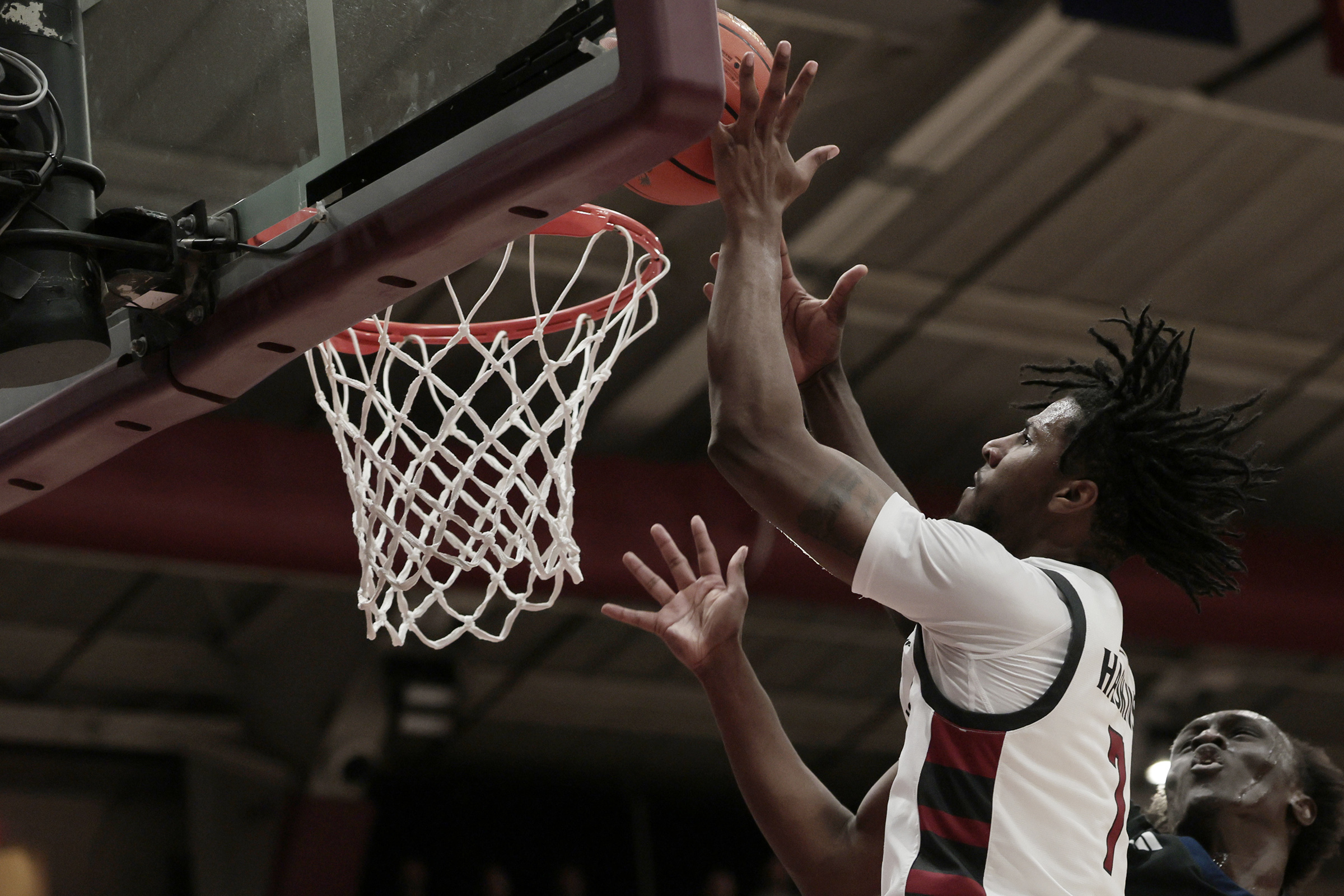
Dasear Haskins was a key starter for the Hawks this season.
St. Joseph’s
Deuce Jones (guard/La Salle), who led the Hawks in scoring during the first two months of the season, was dismissed from the team in December. (Transferring to Alabama-Birmingham.)
Dasear Haskins (guard/Camden High graduate) averaged 11.1 points and started for the Hawks as a redshirt sophomore. (Transferring to Ole Miss.)
Anthony Finkley (forward/Roman Catholic graduate), a junior, averaged 19 minutes in 35 games. (Transferring to La Salle.)
Kevin Kearney (forward) appeared in 14 games as a redshirt freshman. (Transferring to Manhattan.)
Jaden Smith (center) averaged 2.8 points and 1.8 rebounds in 9.1 minutes after transferring from Fordham. (Transferring to Ball State.)
Steven Solano (center), a redshirt freshman, played in eight games. (Transferring to Delaware.)
Al Amadou (center/Springside Chestnut Hill Academy graduate) transferred from Marquette and appeared in 11 games. (Transferring to Wisconsin-Milwaukee.)
Penn
Ethan Roberts (forward) has one year of eligibility remaining — the Ivy League prohibits graduate students from playing intercollegiate athletics — and was the Quakers’ leading scorer (16.9 points per game). (Transferring to Notre Dame.)
Cam Thrower (guard), a senior who spent four years at Penn, averaged 17 minutes in 27 games. (Transferring to Elon.)
Dylan Williams (guard) played in seven of Penn’s first 10 games before the senior missed the rest of the season with an injury. (Transferring to Northwestern)
Michelangelo Oberti (center) appeared in 12 games. (Transferring to Boston University)
Alex Massung (guard), who averaged 5.6 minutes in 10 games played. (Transferring to Saint Anselm.)
Bradyn Foster (forward) saw action in Penn’s season opener.
Drexel
Shane Blakeney (guard) was Drexel’s leading scorer, averaging 14.2 points in 33 games as a junior. (Transferring to South Carolina.)
Kevon Vanderhorst (guard) averaged 9.3 points and 2.9 assists while starting all 33 games for the Dragons. (Transferring to Iona.)
Villiam Garcia Adsten (guard), a junior, averaged 17.5 minutes in 32 games. (Transferring to Maine.)
Horace Simmons Jr. (forward/La Salle College High School graduate) appeared in 13 games.
La Salle
Ashton Walker (guard) started 21 games and averaged 8.2 points as a freshman. (Transferring to Monmouth.)
Eric Acker (guard), a junior, appeared in 26 games, starting 10, and averaged 18.9 minutes. (Transferring to Northern Kentucky.)
Nas Hart (forward) played in 20 games as a freshman. (Transferring to Quinnipiac.)
Edwin Daniel (forward) played 31 games (14.5 minutes) and averaged nearly four points and 3.5 rebounds. (Transferring to Stephen F. Austin.)
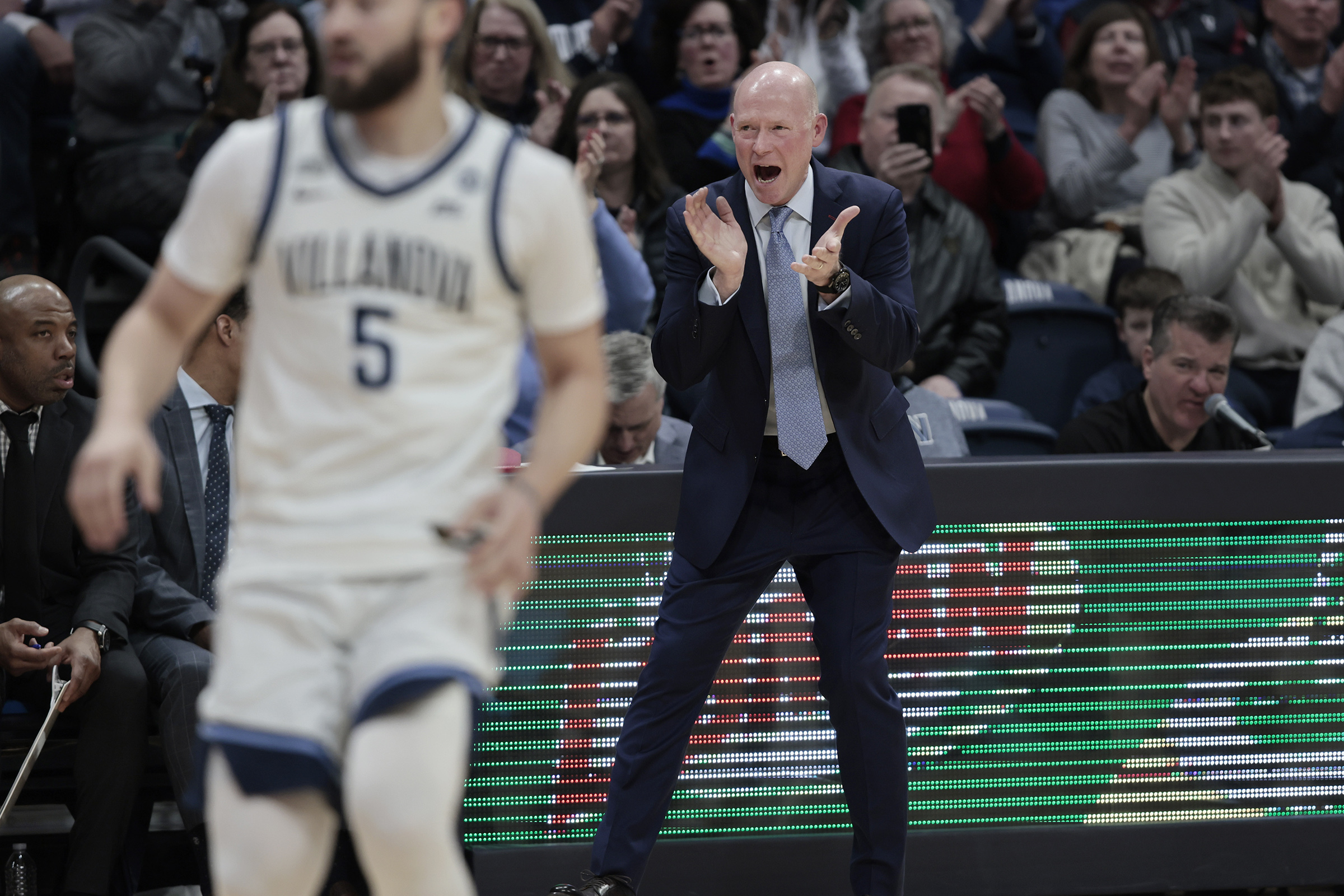
Villanova coach Kevin Willard directs his team against Butler on Feb. 25.
Big 5 portal additions
These are the players who are transferring to Big 5 schools.
Before games, Michael Pereira needs some time alone to visualize the moment.
“I’m thinking about what I’m going to do and also trying to feel the emotion that would come with doing that thing,” Pereira said. “I’ll think of me dunking, and then feel the jolt of energy you get after you dunk it.”
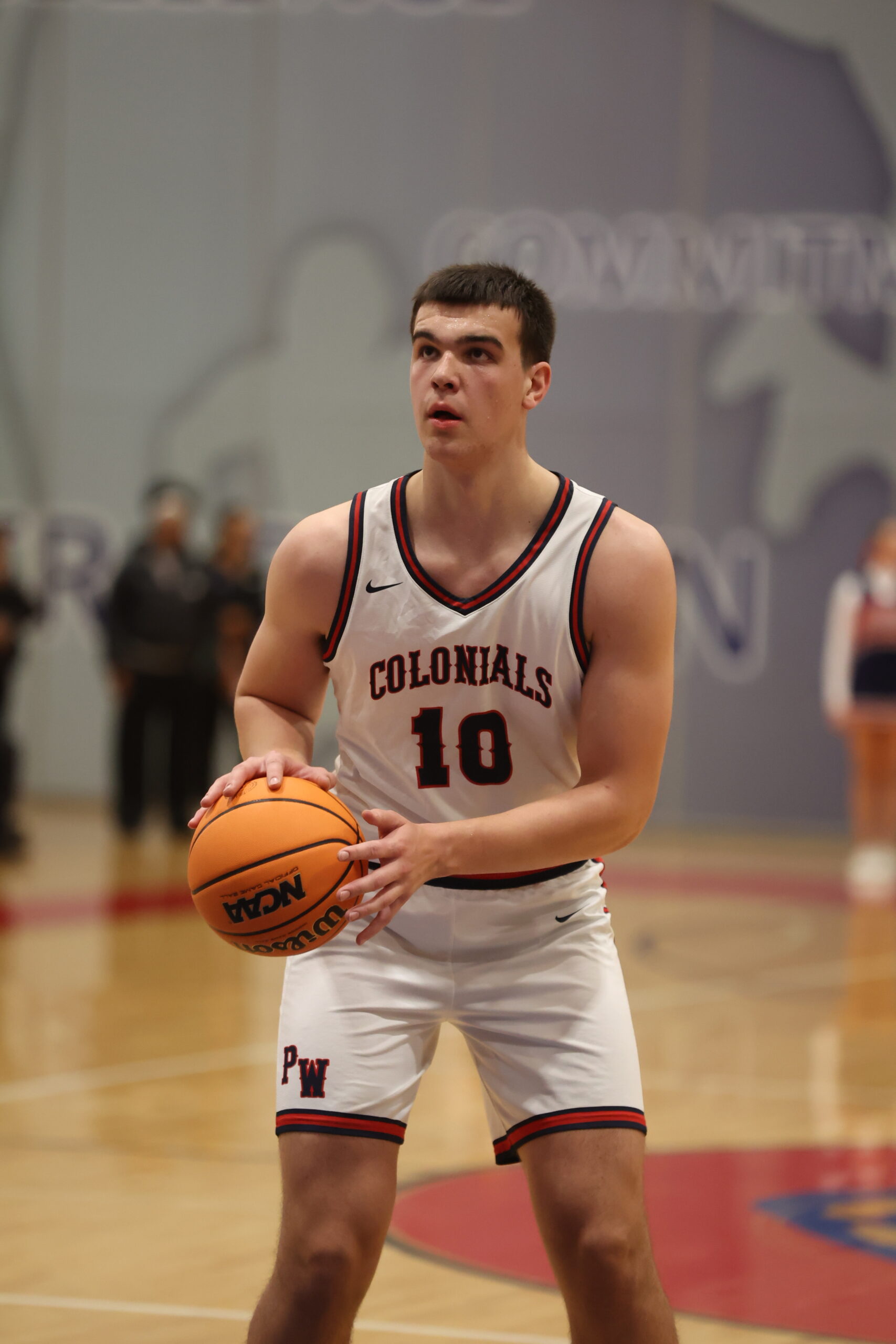
It’s a practice he learned from his mother, and being a visionary through his four years at Plymouth Whitemarsh High School has taken the 6-foot-10 center pretty far. After starring for the Colonials, Pereira has been playing internationally for Brazil, where his father was born.
In June, he missed his senior prom to help the country’s under-18 national team place third in the FIBA AmeriCup in Mexico. Come fall, Pereira will join Penn, where he’s a member of Fran McCaffery’s first recruiting class.
Pereira is hoping to bring what he learned from international play to Penn.
“[The AmeriCup] was a great learning opportunity, definitely,” Pereira said. “The pace of play, the physicality of the game was faster because everyone was higher level there compared to what I’m used to.”
After falling to the United States, 102-56, in the semifinals, Brazil faced Puerto Rico in the third-place game on June 7. At halftime, Puerto Rico led by 19. It seemed as if Brazil would end AmeriCup play with back-to-back blowout losses. Then, Brazil came storming back and took the lead in the closing minutes of the fourth quarter. From there, it was able to hold on to claim an 83-77 victory. Pereira notched 4 points, 11 rebounds, and 2 blocks.
Michael Pereira averaged 14.1 points, 7.6 rebounds, and 1.3 blocks this season with Plymouth Whitemarsh.
Three days later, he was back at Plymouth Whitemarsh for his graduation.
“He’s a serious student-athlete,” said Plymouth Whitemarsh coach Jim Donofrio. “Anyone that can get accepted into Wharton early admissions obviously has a good resumé academically. Michael is a very curious guy when it comes to learning; he is open-minded to learning anything, he has high standards to want to excel in anything he takes on.”
‘Something special’
Pereira’s curiosity drove him into his coach’s Honors Philosophy & Ethics course. In class, Pereira did not shy away from offering his thoughts on whatever topic Donofrio covered that day. But before interjecting, Pereira would always stop and take in the concept.
Donofrio said this quality has become rare in today’s “hyper impatient society.”
However, it did not surprise the longtime coach that his player was a diligent and thoughtful student. Pereira showed the same characteristics in practice.
“One thing in the coaching world that we should emphasize constantly is when I’m talking to you, I want pure eye contact,” Donofrio said. “Michael gives you nothing but eye contact, he almost looks through you. He takes the message and he absorbs it, and that’s mind training — for a young guy to have that kind of discipline to want to listen.”
Pereira picked up the sport relatively late, in sixth grade. His parents had Chuck and Ronald Moore, two former Plymouth Whitemarsh players who went on to play collegiate basketball, train Pereira and his older brother Will. When Pereira entered eighth grade, Ronald was his coach.
Then, in high school, Chuck oversaw Pereira’s development as Donofrio’s assistant.
After McCaffery was hired by Penn, he brought in three assistants. One of them was Ronald Moore, who played under him at Siena. It was Ronald who put Pereira on his former coach’s radar.
“Tons of respect for Jimmy [Donofrio] and the job that he’s done for so many years there,” McCaffery said. “Also aware of the quality of play in that conference, the teams they played against, and I felt very strongly that Mike would be ready when he got here.
“When I saw him his junior year, I thought he had a chance. When I saw him his senior year, I knew he was going to be something special.”
Pereira received offers to play at various high-level prep schools for his senior season, but he wanted to stay at Plymouth Whitemarsh. His decision paid off. Pereira averaged 14.1 points, 7.6 rebounds, and 1.3 blocks, while leading the Colonials to a PIAA District 1 Class 6A championship.
“Something I liked about Plymouth Whitemarsh was that I could do more stuff, I could try stuff that was out of my comfort zone,” Pereira said. “Since it wasn’t like insanely good competition, I would get away with some stuff.
“I’ve tried different footwork. I would shoot a three or two in a high school game. But just considering my role in international play, I wasn’t really doing any of that, I was more so just doing what got me on the team in the first place.”
Improving as a Quaker
The Colonials’ 2026 campaign ended with a loss to Father Judge in the PIAA Class 6A quarterfinals. Pereira, who logged a double-double, wanted to get his mind off the defeat.
Coincidentally, Penn was playing in the Ivy League championship against Yale the next day.
“I don’t want to be depressed after this loss. Let’s just drive up,” Pereira said.
The game, played at Cornell, offered much more than a distraction. Penn junior forward TJ Power poured in 44 points to lead the Quakers to an 88-84 overtime victory and a ticket to the NCAA Tournament.
“I still think it’s one of the best games I’ve ever watched in person,” Pereira said.
Penn is expecting eight newcomers on the roster next season. Going into his second season at the helm, McCaffery has valued acquiring size and flexibility.
In order to take advantage of his frame, Pereira will need to continue his rapid progression as a player. McCaffery does not believe this will be an issue, noting he expects his new center to develop a “year-round obsession” with improvement under his watch.
Meanwhile, Donofrio believes that Pereira’s game will translate to the next level if he can better balance his intellectual side.
“He has to use his humble ability to listen like crazy and his curiosity,” Donofrio said. “All that stuff is really important, but he’s then going to have to learn how to be as aggressive as he can with that body without fouling out, but I almost want him to foul out a few times.”
“I always said, ‘Mike, you’re like in professor mode, then there’s the Hulk mode, where you turn into the Hulk.’ If we can just get the professor and the Hulk merged together, you got a guy that might be making money at the game someday.”
The three-year drought with no men’s team from the Big 5 in the NCAA Tournament will end, finally, with Villanova seemingly locked into the field of 68 for the first time since 2022.
Kevin Willard’s Wildcats (23-7, 14-5 Big East) finish their regular season Saturday at home against Xavier before embarking on their postseason run beginning next week at the conference tournament in New York.
Villanova’s women, too, appear on their way to the dance after a two-year drought. The Wildcats (23-6, 16-4) were projected as a No. 9 seed in ESPN’s latest women’s bracketology, and it’s hard to imagine that an opening-round loss in the Big East tournament would slide Denise Dillon’s team back to the bubble.
St. Joseph’s men: The Hawks may not have the best mathematical chance among the rest of the pack (more on that soon), but it’s worth starting here because they pulled off a pretty impressive road win Wednesday night at Davidson and secured their first double-bye and top-4 seed in the Atlantic 10 tournament since 2018.
St. Joe’s coach Steve Donahue has his team in the Atlantic 10 tournament with a double-bye and top-4 seed for the first time since 2018. Could the Hawks make a run and reach the NCAA Tournament?
This has been a pretty remarkable season on Hawk Hill considering all of the context. Former coach Billy Lange bolted for the NBA in the fall. Steve Donahue, whom Lange hired as an assistant after Penn fired him, was given the keys.
The Hawks stumbled a bit at the start of the season, and then starting guard Deuce Jones was off the team by the holidays. But a team meeting in January helped turn the tide, and Derek Simpson, Jaiden Glover-Toscano, and company have been on a roll.
Will they cut the nets down in Pittsburgh? It’s still pretty hard to imagine, given the talent of Saint Louis and Virginia Commonwealth at the top of the conference.
But the double-bye means the Hawks will start the tournament in the quarterfinals, needing just three wins in three days to reach the dance. Bart Torvik’s NCAA hoops analytics site gives the Hawks a 7.8% chance based on thousands of simulations. That’s not nothing.
Penn men: While we’re on the subject of math, it’s the Ivy League tournament that makes any of its participants more likely than those in other conferences to run the table simply because only four teams are invited and only two wins are needed to win an automatic bid.
Penn is back in Ivy Madness for the first time since 2023.
The Quakers, under Fran McCaffery, are back in Ivy Madness for the first time since 2023. They have plenty of talent with Ethan Roberts and TJ Power leading the way. Penn is the No. 3 seed and plays Harvard in the semifinals, a team the Quakers beat at home last weekend. A win would likely mean a date with Yale, the top team in the Ivy. But the Bulldogs just lost to fourth-seeded Cornell, which is the host site for the tournament. Penn beat Cornell twice this season.
Torvik has the Quakers at 14.7% to win the league.
Drexel women: The Dragons have one regular-season game remaining, Saturday at Towson, and sit second in the Coastal Athletic Association with a 13-4 record. That’s certainly good enough to be labeled a contender, especially considering that Amy Mallon led a 10-8 CAA team to a conference tournament championship two seasons ago.
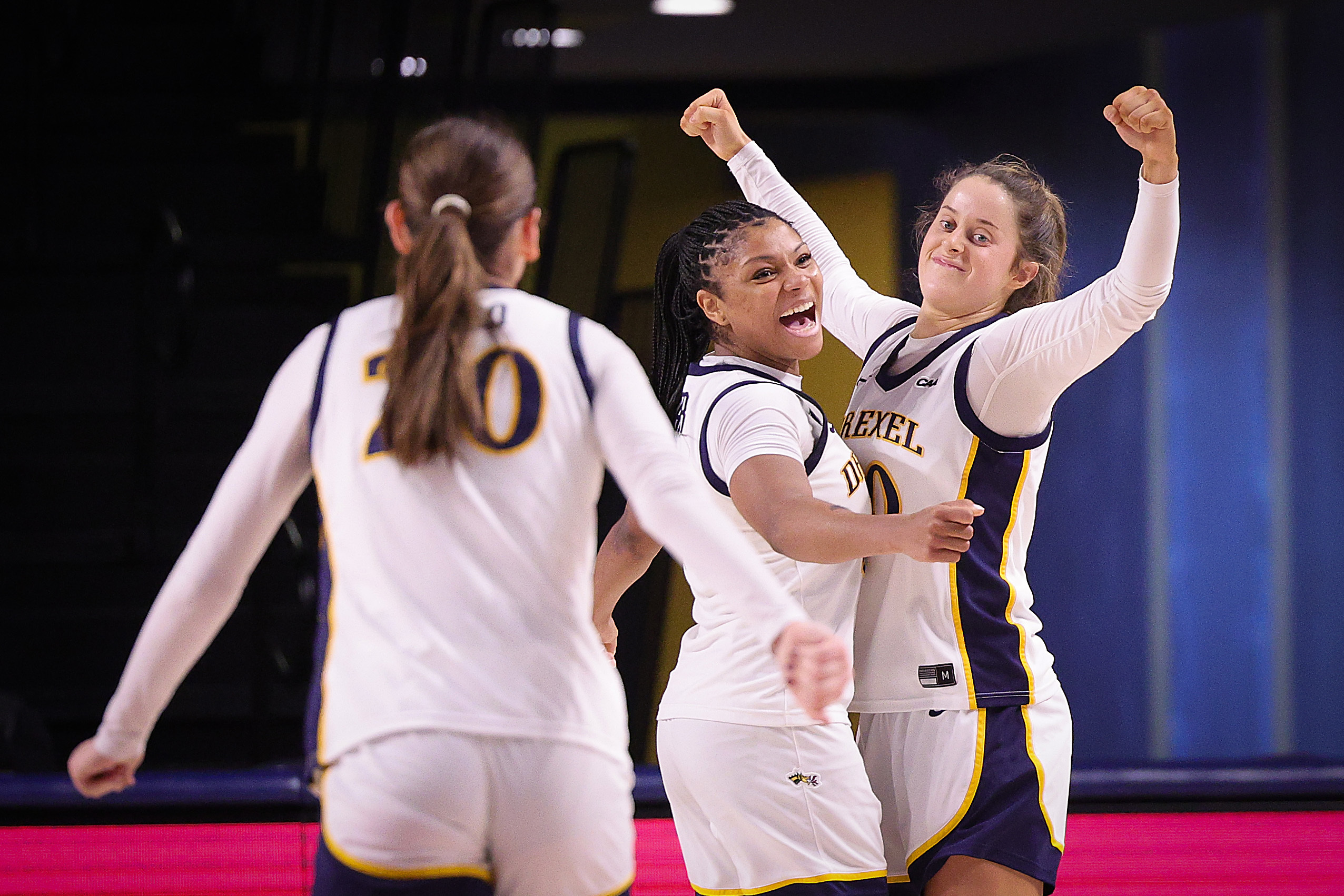
Drexel guard Laine McGurk (right) celebrates with guard Amaris Baker (center) as Molly Rullo (left) joins them after they defeated North Carolina A&T on March 1.
This year’s squad has won 11 of 12 and has two local products leading the way. O’Hara’s Amaris Baker, a senior, is second in the CAA in scoring with 19.0 points per game, and her backcourt mate, West Chester Rustin’s Laine McGurk, was at 13.2 points and 4.1 rebounds per game.
The long(er) shots
Drexel men: The CAA tournament is usually wide open. Twelfth-seeded Delaware reached the final game last season, a year after seventh-seeded Stony Brook took top-seeded Charleston to overtime in the final. Two years before that, Delaware took a 10-8 conference record and the fifth seed and went all the way to the NCAA Tournament.
That’s where Drexel stands ahead of its first conference tournament game Saturday, at 10-8 and the No. 5 seed. The Dragons started 0-3 in conference and are 10-5 since. And though they haven’t beaten any of the four seeds ahead of them, weird things tend to happen at the CAA tournament. Torvik says this weird occurrence has a 4.5% chance of happening. So, not all that different from the Hawks running the table in the A-10.
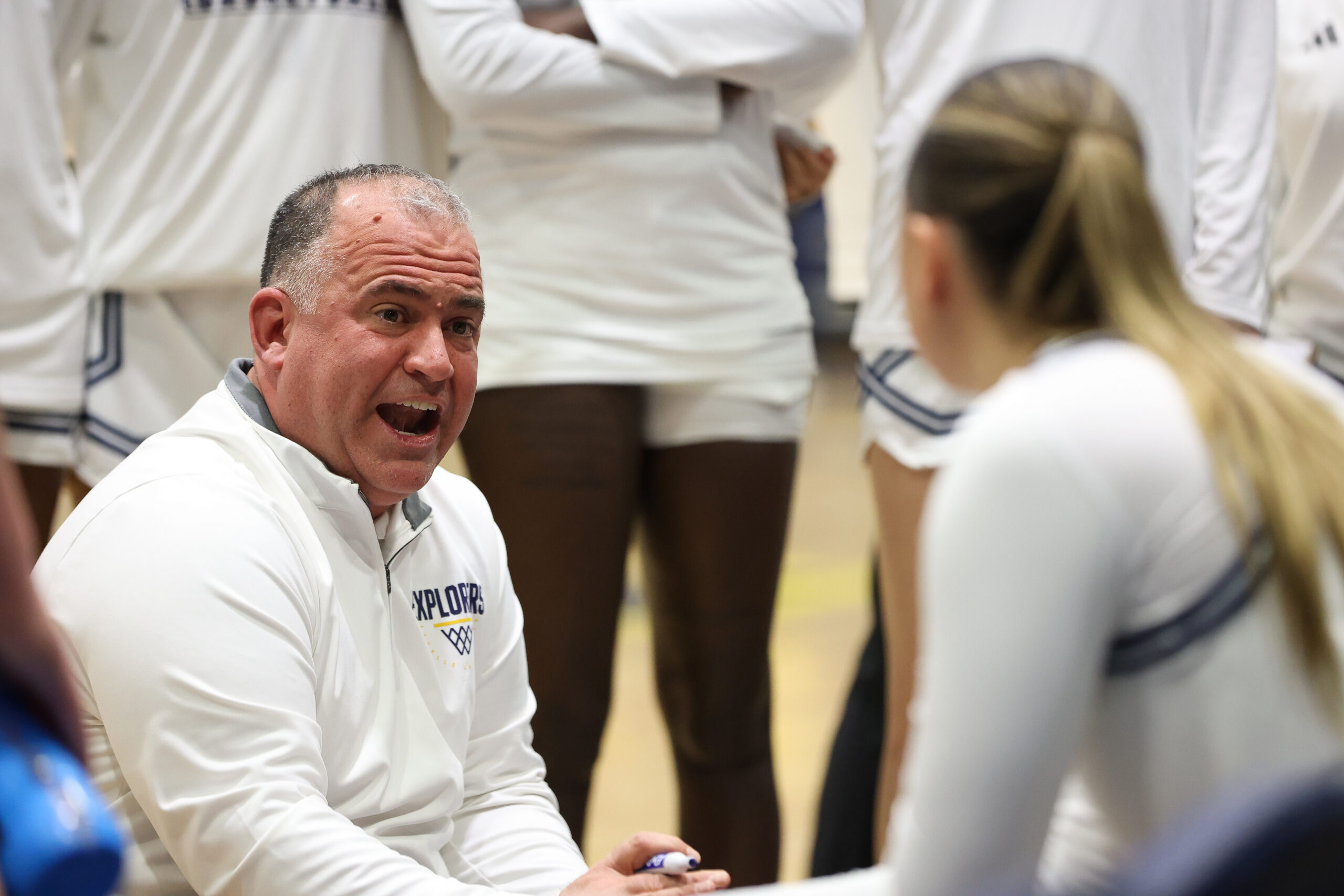
La Salle coach Mountain MacGillivray has led his team to go 10-8 in the conference.
La Salle women: Mountain MacGillivray should be getting some coach of the year love both in his conference and locally in the Big 5. The Explorers won three A-10 games last season and five the year before. They went 10-8 this year. They faced Richmond in a tournament quarterfinal Friday night.
Better luck next year
La Salle men: Darris Nichols’ first season in Olney was marred by injuries, and though the Explorers have been a tough out at times, it’s bordering on impossible for them to get through the gauntlet that would be five wins in five days. (Torvik chances: 0.1%)
Temple men: The Owls went from vying for the No. 2 seed and a bye to the semifinals in their conference tournament to needing a win Thursday just to qualify for it. They got that, but the prospect of running the table and winning five games in five days seems too daunting for a team that has seemingly been running out of gas. (Torvik chances: 1%)
St. Joe’s women: Like La Salle, the Hawks went 10-8 in the A-10 and owned the tiebreaker to get the fifth seed. They lost in the quarterfinals Friday night to Davidson, 64-59, after a 66-45 win over 12th-seeded Duquesne on Thursday.
Temple women: Temple is 7-10 entering its final regular-season game Saturday at home against Florida Atlantic. The Owls are minus-97 in point differential in seven games against the top four teams in the conference.
Penn women: The Quakers are 6-7 in the Ivy and have one game remaining, Saturday at home against Brown, but they will not qualify for the four-team league tournament.
TJ Power has only been looked at as a basketball player.
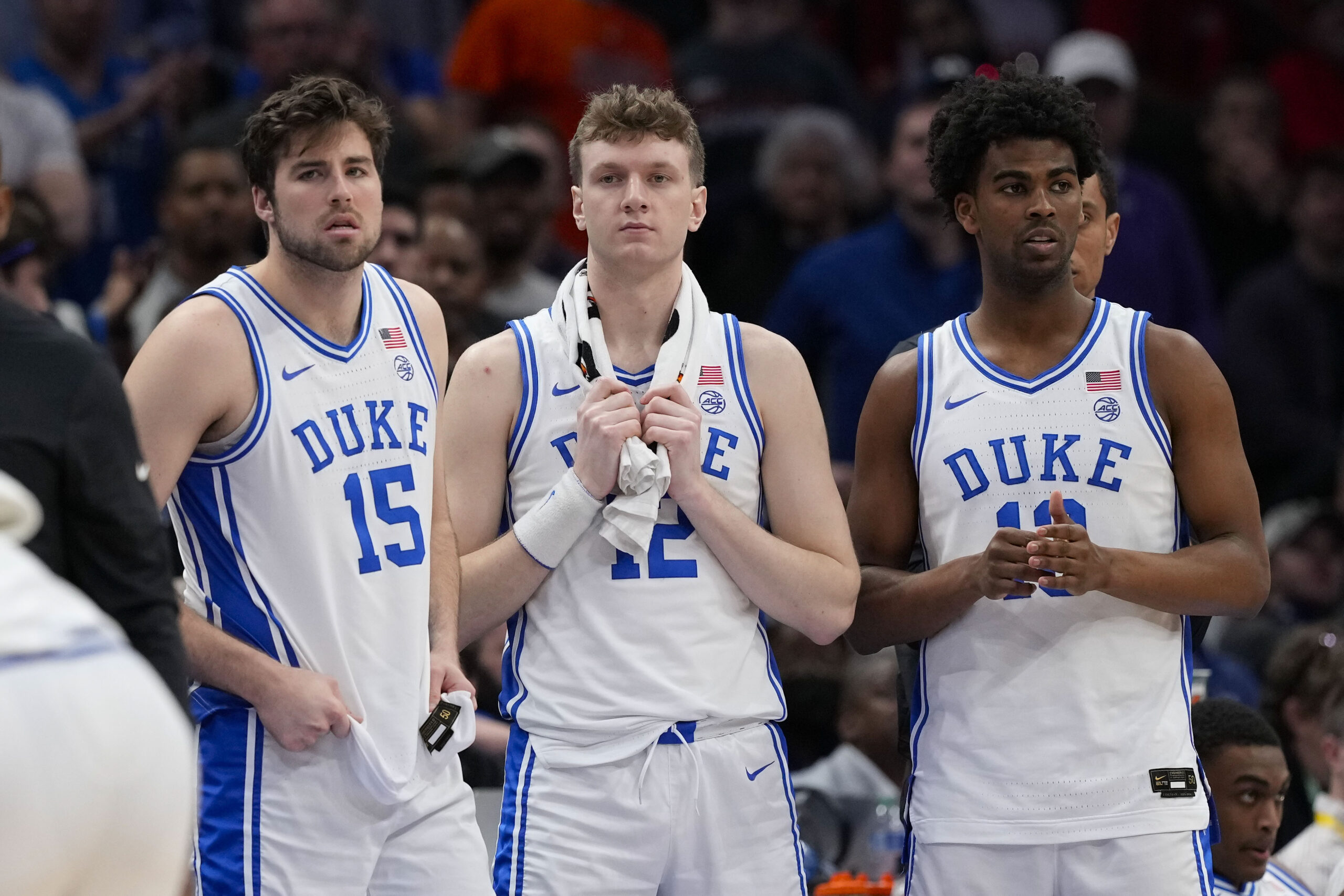
A five-star recruit coming out of Worcester Academy in Massachusetts, his talents landed him at Duke, then his need for opportunity took him to Virginia, but a search for himself brought him to Penn.
Three years at three schools? Power wouldn’t have it any other way.
“That suffering tested my faith and my fortitude,” Power said of his collegiate career before Penn. “And like everyone says, that’s how you get stronger. But that’s real, like as a holistic human, I’m so much more mature and better off right now because I had to leave Duke. I had to make that decision. I had to leave Virginia. I had to go through those moments. And now I’m here, and I have armor. I feel like it’s indestructible.”
After struggling for playing time at Duke and Virginia, Power, a 6-foot-9 forward, has soared under first-year Penn coach Fran McCaffery. Power is leading the Ivy League in minutes (34.7 per game), while averaging 15.7 points and a team-best 7.5 rebounds.
Last weekend, Power posted his best performance of his collegiate career, scoring 38 points against Dartmouth on Friday and then helping Penn gain its first Ivy League Tournament berth in three years with a victory over Harvard on Saturday.
“I’ve been playing better,” Power said before this weekend. “I think [McCaffery] knows this. I have another level that I can tap into here. I’m trying to get to it week by week. It’s different. I probably had the biggest minutes jump in college basketball history.”
Penn forward TJ Power leads the Ivy League with 34.7 minutes per game.
Penn will visit Brown on Friday (7 p.m.) for its final game of the regular season as winners of six of its past seven games, thanks to Power’s resurgence. Penn will then face Harvard in the first round of the conference tournament on March 14 in Ithaca, N.Y., with Yale playing Cornell in the other semifinal.
‘Took a chance’
Power, who grew up in Shrewsbury, Mass., said his father would drive him around the neighborhood as a kid to find local churches and recreation centers to play in games. The pair usually ended their trips at Worcester Academy’s gymnasium.
By his sophomore year, college coaches were rushing to see Power on the court, including McCaffery, then the head coach at Iowa.
McCaffery attended Power’s AAU games, and his presence was quickly felt.
“I had three offensive fouls in the first half,” Power said. “It was terrible, and you know how Fran is with refs. He wasn’t even my coach at the time. Obviously, he’s there to recruit me, and he’s yelling at the ref as I’m playing in an AAU game.”
TJ Power averaged 6.7 minutes in 26 games as a freshman at Duke.
As a senior, Power was named the Massachusetts Gatorade Player of the Year after winning a state prep school Class AA championship. He accepted an offer to Duke, but he and his family stayed close to McCaffery.
Power averaged 6.7 minutes in 26 games as a freshman during the 2023-24 season, but that didn’t stop him from enjoying his experience as a Blue Devil.
“Duke was one of the best years of my life,” Power said. “Honestly, people from the outside might not think that just because you know basketball and playing time and stuff, but that experience is once in a lifetime.”
Power planned on staying for his sophomore year, but an “uphill battle” for minutes and competition from the incoming class, which included future NBA lottery picks Cooper Flagg and Kon Knueppel, made Power consider other options.
Leaving Duke meant saying goodbye to his “best friends for life” Sean Stewart, Caleb Foster, and former 76ers guard Jared McCain, but the decision was best for his career.
“Knowing this could go bad,” Power said, “where I’m not playing, the hardest decision I ever made was to leave there. I was really emotional about that because people look at transfers and they’re like, ‘Oh, they’re running from stuff.’ I never pictured myself as that, because I took a chance going to Duke.”
Breaking point
Before the 2024-25 season, Power entered the transfer portal and committed to Virginia, his second choice coming out of high school. Coach Tony Bennett and Power had grown close during the recruiting process.
“I felt rejuvenated,” Power said. “I was going to go there and learn from him. We were really close. That whole summer, I played really well, we looked good, and he had said to me in the recruiting process, because they had struggled the year before, he was talking about how he wants to play faster and change the offense.”
When it finally seemed as though Power found the right fit, Bennett announced his retirement before the start of the season.
“One day in the fall,” Power said. “He comes back, and we’re going into the film room, like we always do, and he just sits down, starts crying, and tells us he’s going to retire.
“I remember it was a feeling I’ve never had before, where my whole body started overheating, and the world was shifting. I was in the front row, sitting right in front of him. That was a hard moment. And I don’t know if I have fully moved on from that.”
Ron Sanchez was named interim head coach, and despite his promise to stick with the offense Bennett wanted to implement, it was never the same for Power. He was injured to begin the season and started just five games, averaging 9.3 minutes in 24 games.
Virginia finished 15-17, Sanchez was fired, and “everyone entered the portal.” According to Power, the new coaching staff didn’t want him.
“You want to talk about emotional,” Power said. “My time at Virginia [was] some of the darkest moments of my life.”
Power had not played consistent basketball in almost two years. He decided to visit Penn at the request of an old friend.
After starting in only five games at Virginia, TJ Power transferred to Penn.
McCaffery, whowas fired by Iowa, was rumored to be heading back to his alma mater.
“I eventually got this job,” said McCaffery, who was hired by Penn in March last year. . “It was an easy discussion because he knew that I believed in him, and he knew that our style of play was perfect for him. He came down to campus on his own. I wasn’t even here.”
Power added: “Penn is a great place, and I’ve come to learn that even more, but in the recruiting process, I was like, wherever Fran goes — I’m going. I’m playing for that dude. If Fran wasn’t here, I wouldn’t be here.”
‘I’m coming here’
Power called his parents, bought a couple of train tickets and a hotel room, drove back to Virginia, and left that night on a train to 30th Street Station.
Power had struggled with his connection to the game and his identity around it. Coming off the train at 1 a.m., Power reflected back on a moment when he enjoyed basketball and had a familiar request for his dad .
“I want to see the gym,” Power said.
Power and his parents pulled up to the Palestra.
“My dad gets out, and just like our drive around Worcester, shakes on doors,” Power said. “We go to the Palestra front door. He shakes it three times. It opens, and I walk in, and for some reason, the lights are on. I’m standing right there, 1:30 in the morning. It’s just my dad and me. We’re looking at the Palestra. I’m coming here. I got to come here.”
TJ Power came to Penn to play under coach Fran McCaffery. “If Fran wasn’t here, I wouldn’t be here.”
Fran was committed to helping Power get back on track, which showed in their first few practices together.
“If I struggled, he knows what’s on the other side of that wall once I climb it,” Power said. “So that was a huge factor in my decision. I wanted someone I could trust again, and someone who has my back when I inevitably struggle.
“The first thing Fran said when he called me was, ‘We’re going to have fun playing basketball again.’ No other coach said that.”
Power has returned to the form that made him a five-star recruit in high school. And he has found a home — on and off the court.
After years of chasing the best opportunity to help him go pro or get the most playing time, Power chose Penn for another reason: to find who he is outside of the sport.
“Basketball used to be my identity,” Power said. “People ask me, ‘Who am I?’ I play basketball, I’m a basketball player. When I switched that to my relationship with God coming first, and then my identity is built through that relationship with God. …
“That path is so much more rewarding. My identity comes first, and … my mission is to play well, and I think that’s going to give me what I want.”
One afternoon in early December, Bill Raftery and Tim Legler, both La Salle alumni, returned to campus for an hourlong panel discussion about their careers in sports media, only to have the conversation shift to a topic with broader implications.
It was a point of pride for the university to welcome back Raftery, who has been college basketball’s preeminent analyst for more than a quarter-century, and Legler, who has reached a comparable status at ESPN with his insights into the NBA. But 33 minutes into the event, the first question from an audience member wasn’t about the origins of Raftery’s trademark catchphrases (The kiss! … Onions! … Laundry on the deck!) or Legler’s game-film breakdowns.
Bill Raftery, now broadcaster, graduated from La Salle and was inducted into the Big 5 Hall of Fame.
“Can we bring the Big 5 back to its glory?” a man in the auditorium asked. “Because it was a national thing, right? It wasn’t just a Philly thing.”
These days, most people who follow college basketball, if they’re being honest, have to acknowledge that the Big 5 isn’t much of anything anymore. The round-robin rivalries among La Salle, Penn, St. Joe’s, Temple, Villanova, and more recently Drexel have lost most of their juice.
That white-hot competition, fueled by the benign hatred that only proximity and familiarity can ignite, used to define Philadelphia hoops. It has cooled. Now, just one school, Villanova, enters each season with the baseline expectation that it will qualify for the NCAA Tournament, and the pipeline of local recruits that once sustained these programs has all but dried up.
window.addEventListener(“message”,function(a){if(void 0!==a.data[“datawrapper-height”]){var e=document.querySelectorAll(“iframe”);for(var t in a.data[“datawrapper-height”])for(var r,i=0;r=e[i];i++)if(r.contentWindow===a.source){var d=a.data[“datawrapper-height”][t]+”px”;r.style.height=d}}});
Three of the six schools — Drexel, La Salle, and Penn — don’t have a Philadelphia native on their rosters. Interest in the city series has plummeted. A 2022 doubleheader at the Palestra drew an official attendance of just 3,300 people. And the Big 5 Classic, conjured in the aftermath of that alarming display of indifference, hasn’t revitalized the rivalries or restored any prestige to them.
While this season has seen an uptick in the programs’ quality of play — Villanova is virtually assured of an at-large bid, and Penn, St. Joe’s, and perhaps Drexel could be strong enough to win their conference tournaments — that improvement hasn’t been enough to stem the dismal tide.
Tim Legler, who led La Salle to the 1988 NCAA Tournament, said the Big 5 was once a “transformative” environment to play in.
For their part, the panelists at La Salle mustered some nostalgia but weren’t optimistic. Legler, who grew up in Richmond, Va., remembered attending a Palestra doubleheader on a recruiting trip and marveling at the atmosphere: the streamers, the cheering, the chanting.
“I turned to my parents and said, ‘This is the environment I want to play college basketball in,’” he said. “It was literally that transformative.”
Still, he had no solution for salvaging the Big 5, and neither did Raftery, who suggested that smaller programs throughout the NCAA would soon be casualties of this new era of college basketball.
“They’re trying to freeze [out] a lot of programs and leagues,” he said, “and I can envision maybe two or three conferences. They’ll run the whole thing, and the networks will pay for it. That’s the way it is.”
It’s convenient to point to the sport’s lurch into modernity — into the era of Name, Image, and Likeness; of pay-for-play; of the permeable membrane of the transfer portal — as the cause of the decline. And it’s true: With the exception of Villanova, which is ensconced in the Big East and supported by engaged donors with deep pockets, college hoops’ evolution has made everything more difficult for the other, more vulnerable programs in the city. But this train has been rumbling down the tracks for a while, and its arrival should compel a reevaluation of the Big 5’s history, of the decisions and unstoppable forces that led it here, to the brink.
To those Baby Boomers and GenXers weaned on the Big 5’s traditions, it’s surely incomprehensible and saddening to hear Raftery contemplate a world without it. But if the institution as Philadelphia knew it is fading away — and it appears to be, if it hasn’t already — the proper question isn’t Can it be saved? That one has been asked and is on its way to being answered.
No, the better questions to chew on are these: How did the Big 5 survive, and at times thrive, as long as it did? And did any of the attempts over the years to preserve it and its identity actually contribute to its downfall?
Villanova has become the only school in the Big 5 that enters each season with the baseline expectation that it will qualify for the NCAA Tournament.
The seeds of rebirth and decline
It’s tempting to picture the Big 5’s history as an unbroken string of unforgettable nights at the Palestra, great teams playing great games inside a gym packed to its uppermost corners with 9,000 people, give or take a few rascals who managed to sneak in for free. There were hundreds of such nights, to be sure. But it’s striking to put that past into a wider context and see how much certain changes and trends fostered and then jeopardized everything that made the Big 5 wonderful and unique.
Those fond memories often gloss over a relatively fallow period for the Big 5 during the 1970s. Villanova had three consecutive losing seasons from 1972 to 1975. Temple went 16-37 over the ’74-75 and ’75-76 seasons and qualified for the NCAA Tournament once in an 11-year span from 1972 to 1983. St. Joe’s went 8-17 in ’74-75, the first of six straight seasons in which the Hawks missed the NCAAs. Penn was the exception, and La Salle held its own, but a Daily News back-page photo captured the overall listlessness perfectly: Harry “Yo-Yo” Shiffern, the lovable vagrant who was the city series’ unofficial mascot, fast asleep during a Palestra doubleheader.
The Big 5 was in a collective funk, and it took a few pivotal developments to snap it back to prominence and position it to flourish further.
Lionel Simmons (center) is the Big 5’s all-time leading scorer and fifth in NCAA history with 3,217 career points.
College basketball’s landscape was flatter then. The NCAA Tournament went to 32 participants in 1975 and to 40 in 1979, and many of the qualifying programs were mid-majors. During the ’70s, each of these teams reached the Final Four: Jacksonville, St. Bonaventure, New Mexico State, Western Kentucky, Marquette, UNC Charlotte — and, in ’79, Penn. The Quakers upset North Carolina, Syracuse, and St. John’s before Magic Johnson and Michigan State pulverized them in the national semis. But their run was the most improbable of the decade, and their timing was impeccable.
The following season, after a star turn at the Pan-American Games in Puerto Rico, La Salle’s Michael Brooks was named the Kodak National Player of the Year. As terrific as Brooks’ senior campaign was — he averaged more than 24 points and 11 rebounds, scoring 51 points in a triple-overtime loss at BYU — his candidacy for the honor was buoyed by Indiana’s Bob Knight, who had coached him at the Pan-Am Games and touted him to reporters.
“If I were allowed to start my own team tomorrow,” Knight said in January 1980, “the first person I would pick would be Michael Brooks.”
Such praise from the best, the most famous, and the most temperamental coach in the country carried weight, and Knight’s words elevated the reputations of both Brooks and Philadelphia basketball. That ascendance continued in March 1981, when St. Joe’s, under Jim Lynam, won the East Coast Conference tournament, knocked off top-ranked DePaul in the second round of the NCAAs, and advanced to the regional final before losing to the eventual national champs: Knight, Isiah Thomas, and the Hoosiers.
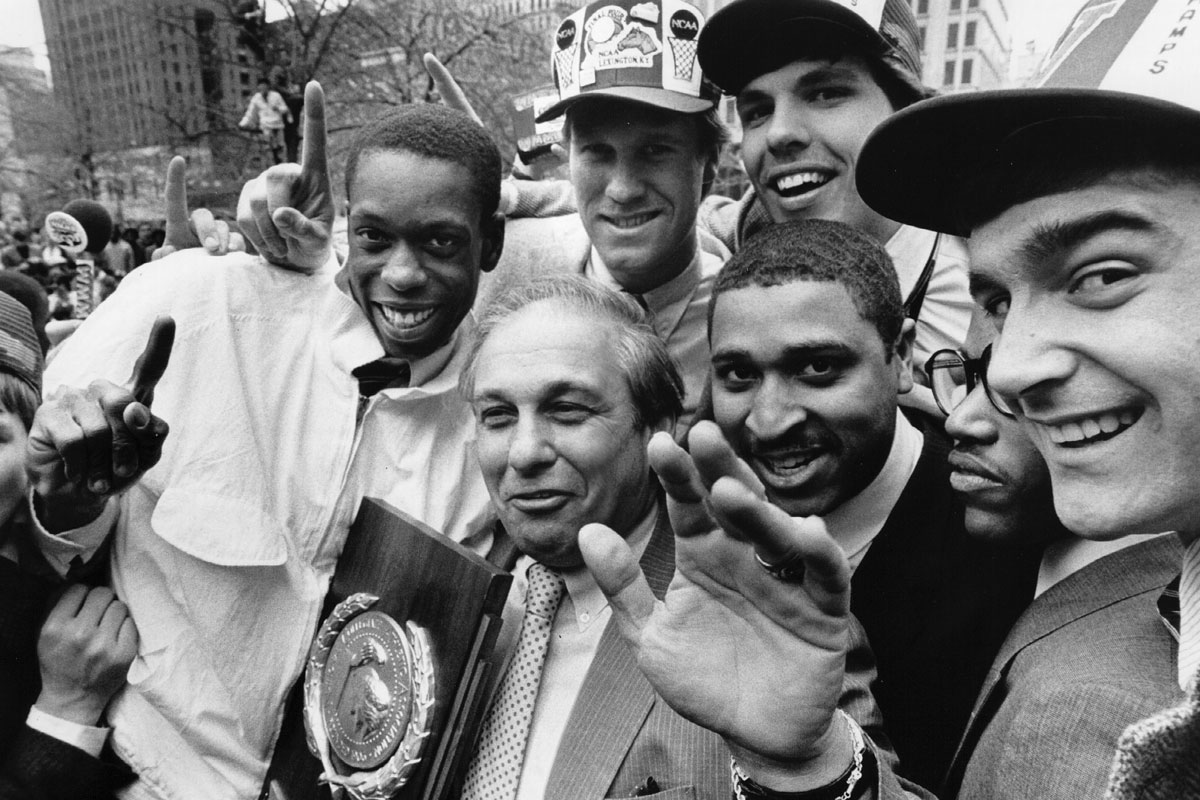
Fran Dunphy coached more than 1,000 games as a Division I head coach.Villanova coach Rollie Massimino gathers in Center City with players Ed Pinckney, Wyatt Maker, Chuck Everson, Dwight Wilbur, Veltra Dawson, and Brian Harrington in 1985 after winning the national title.
So the Big 5 was on its way back, regaining relevance among casual college hoops fans and among the sport’s cognoscenti. The two most significant factors in its renaissance, though, happened off the court. In March 1980, Villanova left the Eastern Eight and jumped to the Big East. And in August 1982, Temple hired John Chaney as its head coach.
Those moves and the rewards they wrought thrust those two programs, and in turn the entire Big 5, into a higher realm. Villanova won the national championship in 1985 — an underdog triumphant, a marvelous story enhanced by the Wildcats’ status as a program in a major conference in a sport whose vast national reach was still expanding: Magic vs. Larry Bird in ’79, North Carolina State surviving and advancing in ’83, Dick Vitale, CBS, ESPN, Big Monday, Selection Sunday, March Madness consuming a month’s worth of America’s attention.
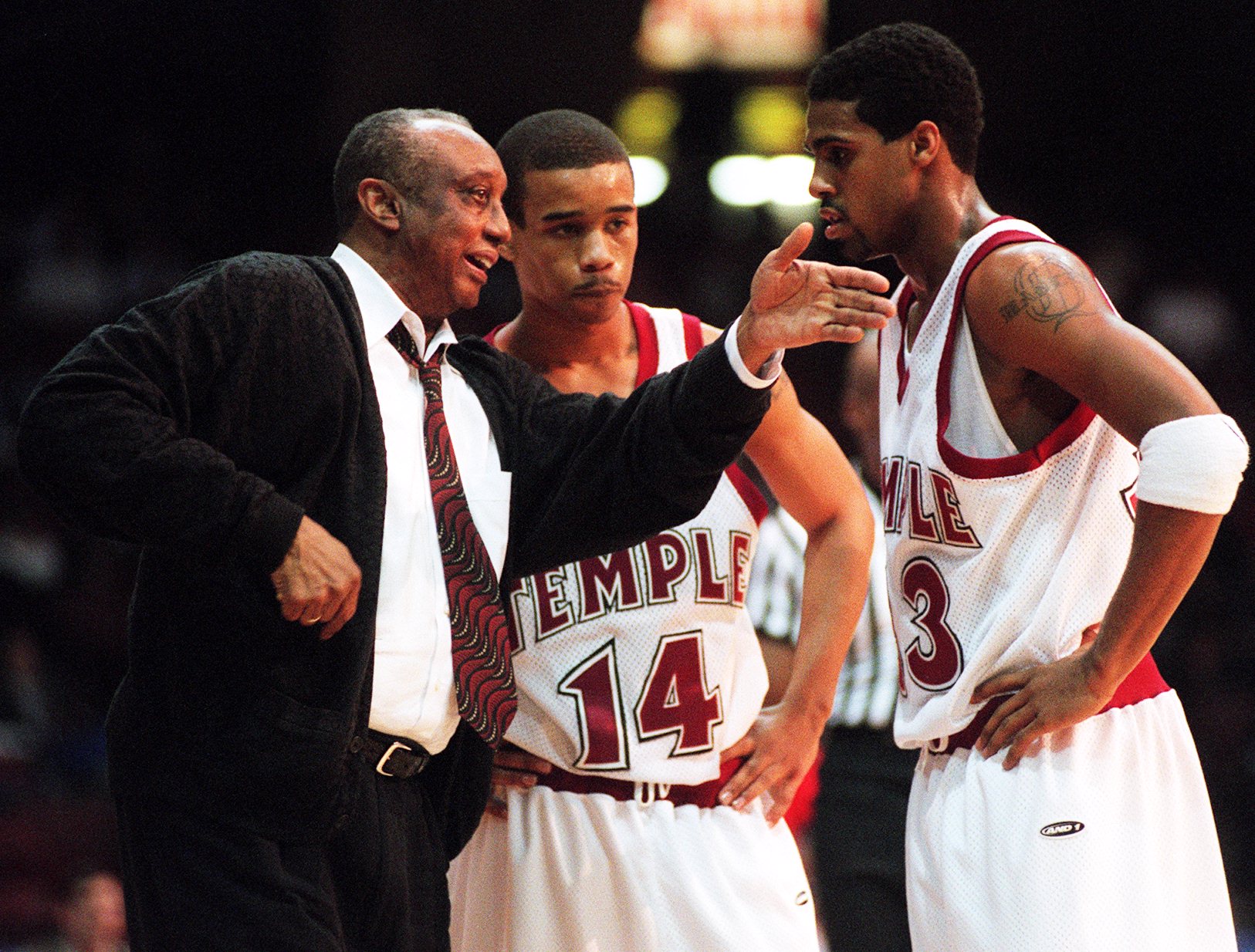
Chaney was this wild-eyed, lesson-teaching, justice-preaching wizard, confounding opponents with his matchup-zone defense, crafting the hardest schedule in the nation every year to battle-test his teams, leading the Owls to a No. 1 ranking in 1988 and three Elite Eight appearances in a six-year span.
Fran Dunphy led Penn to a 69-14 record and three NCAA Tournament appearances from 1992 to 1995.
Nestled in the Metro Atlantic Athletic Conference (MAAC) with schools of similar profiles, La Salle went to the NCAA Tournament four times and the NIT twice in Speedy Morris’s first six years as head coach and had another national player of the year: Lionel Simmons. From 1992 to 1995, Penn dominated the Ivy League under Fran Dunphy: a 69-14 record, three NCAA Tournament appearances and a first-round victory over Nebraska, Jerome Allen and Matt Maloney forming one of the best backcourts in the country. St. Joe’s went 26-7 and advanced to the Sweet 16 in 1996-97, the season that introduced that notorious wallflower Phil Martelli to the rest of the country.
Former Temple coach John Chaney with players Lynn Greer and Quincy Wadley.
Hard circumstances and poor decisions
The factors that damaged the Big 5 were legion. Some applied to just one or two programs. Some applied to all of them. Some were mistakes, bad choices. Some were unavoidable and beyond the programs’ control.
Start with La Salle. Given an opportunity in 1990 to build an 8,000-seat on-campus basketball arena — Tom Gola offered to raise the funding for it — the university said no. Then its leadership made what is commonly considered the disastrous decision to relocate from the MAAC to the Midwestern Collegiate Conference. The program has never recovered.
Look at Temple. Chaney, a singular presence and attraction, retired in 2006. Though Dunphy, his successor, guided the Owls to six consecutive NCAA Tournament appearances, the university’s quest for football dollars led it to leave the Atlantic 10 for the American Athletic Conference — and abandon its basketball-first identity.
Again: individual schools, individual issues. But those problems were byproducts of college basketball’s overall reshaping during the 1980s and ’90s. In retrospect, the most infamous moment in Big 5 history — the dissolution of the round-robin, at the insistence of Villanova and coach Rollie Massimino, after the 1990-91 season — was an acknowledgment of those changes, and the attempts to preserve the Big 5 as it had always been would inevitably fail.
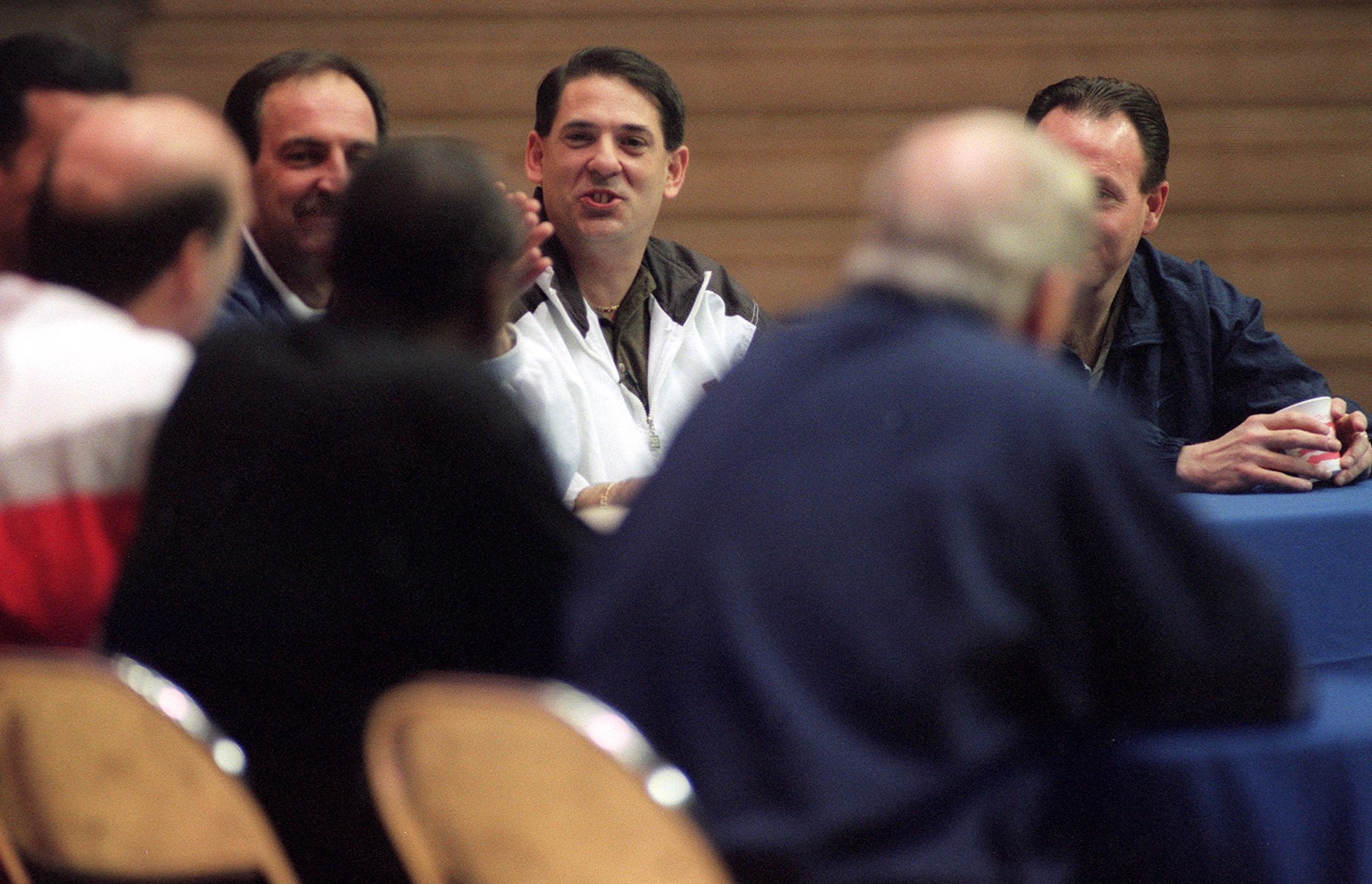
Phil Martelli led St. Joe’s to go 26-7 and advanced to the Sweet 16 in 1996-97.Former Villanova coach Steve Lappas jokes with the other Big 5 coaches during a taping of the Comcast basketball show in 1997.
When Villanova pushed to cut back on city series games and Temple pushed for more of those matchups to be played at campus sites other than the Palestra, they weren’t merely trying to make things easier for themselves. They were responding and reacting to college basketball’s new conditions for success.
Sneaker companies had begun financing all-star camps, AAU programs, and college programs. Now coaches didn’t have to rely on local high school teams to find players, and great Philly players were no longer making their names solely in the Public League, the Philadelphia Catholic League, or the Sonny Hill League. They were traveling to play AAU. They were seeing other cities, meeting other coaches. They weren’t as likely to stay home to play college ball.
“The most important recruiting device is recognition,” Chaney told author Bob Lyons in Palestra Pandemonium: A History of the Big Five, “and recognition comes from national TV. … They don’t know what the Big 5 is outside of this area. They knew who Villanova was when they won the national championship, so you could always attach yourself to them. But it wasn’t going to get you very far because no one knew the history and tradition of the Big 5.”
In that way and others, the inherent parochialism of the Big 5 worked against it. For instance, Dave Gavitt, the founding commissioner of the Big East, struck a deal in 1980 with ESPN, then a fledgling sports network hungry for programming, for the exclusive rights to televise the conference’s games. That arrangement made it difficult, if not impossible, for Villanova and any other Big East school to be involved in a 7 p.m./9 p.m. Palestra doubleheader and for a national television audience to watch that doubleheader.
“We needed the game between Villanova and Georgetown at 8 p.m. to go on our network,” Gavitt told Lyons. “We couldn’t clear games at 7 p.m. because of the game shows that all the local stations carried.”
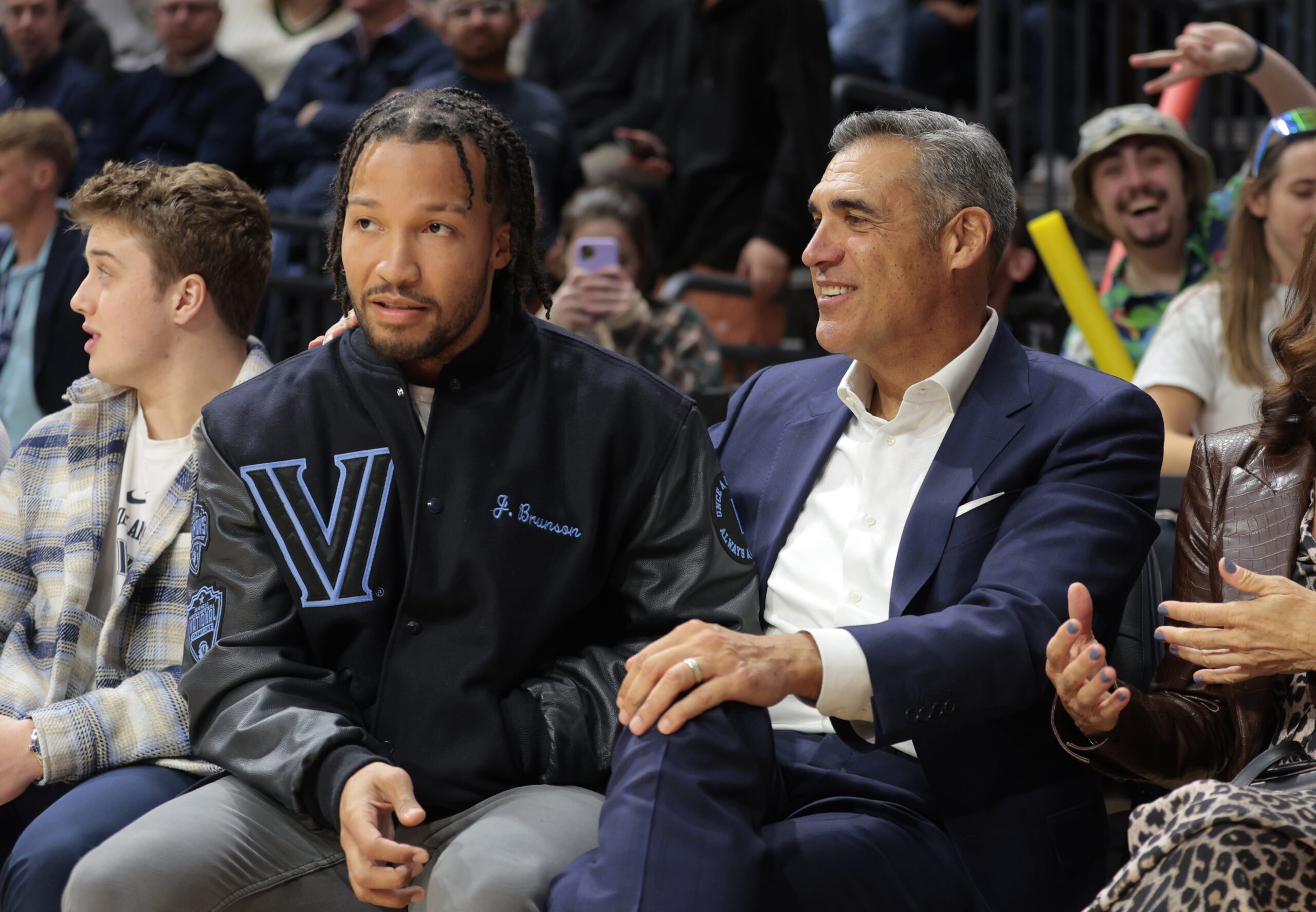
Jalen Brunson and former Villanova coach Jay Wright at the Finneran Pavilion on Feb. 8, 2023.
As it was, the Big 5 had a TV deal of its own, with the Philly-based premium cable channel PRISM, starting in 1978. Yet the PRISM commitment actually limited the exposure of some of the Big 5’s schools.
During the 1989-90 season, as one example, the Atlantic 10 wanted to place a Temple-La Salle game on ESPN so that it would be telecast nationally. “ESPN,” Lyons wrote, “subsequently refused to carry it, however, because it did not want to black it out in PRISM’s trading area.”
So hoops fans in the Delaware Valley could watch the game at home, but no one else could. At a time when college basketball was becoming more accessible, the Big 5 was cutting itself off from everyone who wasn’t already familiar with it.
That history might seem ancient. It’s not. Wright’s tenure and the economics of the sport have placed Villanova on a separate tier from the other programs. And now that he, Chaney, Dunphy, Martelli, and Morris — the local legends who were the backbone of the Big 5 — aren’t coaching anymore, the remaining infrastructure hasn’t been strong enough to restore the teams to excellence and maintain the intensity of the rivalries.
It’s a shame, but it was only a matter of time. Yes, the Big 5 was a Philly thing. Yes, it was a national thing. Yes, it was a glorious thing. And now it’s gone, and all the wistfulness and wishful thinking in the world won’t change the hard and inescapable truth: That glory isn’t coming back.
March was six hours away when the ball was tipped at the Palestra on Saturday, and it had been a while since that mattered for Penn’s men.
Fran McCaffery’s squad has clearly improved over the course of this season, but just how much has been hard to tell at times. A senior night showdown with tied-for-first Harvard offered a proper test, and a win would clinch the Quakers’ first Ivy League tournament berth in three years.
Which Penn team would show up?
The one that fell behind Dartmouth by 12 points a night before, or the one that rallied to win? The one that nearly threw away a late lead to Princeton at the start of the month, or the one that finally ended a 14-game, eight-year losing streak to its historic rival?
All of them, it turned out. Penn trailed 31-21 at halftime, then charged back to lead 56-50 with 5 minutes, 37 seconds to play. But the Quakers almost gave it up before holding on to win, 64-61.
There was plenty of noise from the 2,877 fans on hand at the buzzer, a reminder that even a paltry crowd can make a great atmosphere at the 99-year-old shrine. It might have been as much out of relief as anything else, but it was still a release.
“I think that’s what makes it emotional, is we’ve been so close,” senior forward Ethan Roberts said after his Palestra finale. “So to see these wins and the season transpire the way it did, we’re in a great spot, and we just learned from it. We kept fighting, and it was ugly at times, but it just makes it all worth it.”
It’s easy to say that this Penn team goes as far as TJ Power takes it. He took it to an extreme on Friday, scoring 38 of his team’s 80 points against the Big Green. But Roberts matters too, and this was his best game in weeks: 21 points, three assists, and four rebounds, including the game-sealer in the closing seconds.
“I kind of blacked out after the buzzer hit,” Roberts said. “Our team, our entire year since last summer when we had the coaching change [and] we see coach McCaffery is coming here, it’s like, ‘All right, we’re winning.’ And to see we’re in this position today … this is literally all we’ve worked for. This has been our north star.”
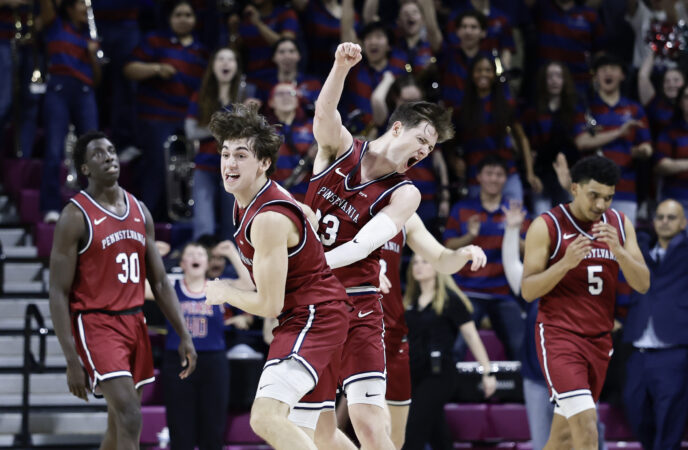
Penn’s AJ Levine (left) and forward Ethan Roberts celebrate after the final buzzer.
AJ Levine, the sophomore starting point guard, is another big factor — and not always in a good way. He’s a tenacious defender, and is capable of great passes and shots. But he’s also capable of driving into any lane in front of him, even if it’s a trap.
It’s not a coincidence that he played much more within himself in the second half of conference play, and that Penn went 6-1 in those seven games.
“He’s always going to have an aggressive mindset, and you don’t ever want to take that away from him,” McCaffery said, with a towel draped over his shoulders after a postgame water-dousing in the locker room. “He gets emotional, and you don’t want to take that away from him either, but you can’t let it get you to where you’re focused on, ‘I got a bad call,’ or ‘He [a teammate] should have cut backdoor.’ When he’s under control and he’s locked in like he was in the second half, he’s really good.”
What to know about the Ivy League tournament
Now, after the regular-season finale at Brown on Friday, it will be off to Cornell’s arena for a rematch with the Crimson in the Ivy tournament semifinals. All four seeds are set with a game to spare.
AJ Levine drives for a layup during the second half.
“It’s great feeling as a coach when you know you have a group of guys that have bought in from day one since I got here, and want to experience success,” McCaffery said. “And then to see them celebrate in the locker room — the thing we have to do now, and they both [Roberts and Levine] said it, which is good, is we have to stay locked in. We earned an opportunity. We have to play well next week, and then get ready to play well against two really good teams.”
(If you’re wondering, there’s no word when the event will next be at the Palestra. All that’s known is the 2027 edition will be at Dartmouth, and Hanover, N.H., is as glamorous as central New York is in mid-March.)
No. 1 Yale will be the favorite on paper, No. 66 in the NCAA’s NET rating while the other three teams are all in the 150s. But the top seed has only won the tournament twice in its seven editions, as the five-time finalist Bulldogs know well.
This time, they’ll have to beat the hosts in the semis. Yale won its home game vs. Cornell in a 102-68 blowout, then the Big Red won the regular-season round in Ithaca on Friday on a last-second three.
FIEGEN CALLED GAME.
Jake Fiegen's game winning 3⃣ secured a 72-69 win for the Big Red over Yale. @cornell_mbb improved to 6-6 in league play with the win and remains in the thick of the Ivy Madness race. 🌿🏀 pic.twitter.com/Mu4E99K3sg
Penn and Harvard also split their games, with the Crimson winning by 64-63 in Boston on Jan. 19.
“There’s the frustrating losses, there’s the hard-fought wins like today,” Levine said. “When that buzzer went off and I realized what we’ve done — and how it’s just the start, really, because we’re going to go compete there — I mean, it felt amazing to just see that hard work pay off a little bit. But it will really pay off when we go up there and we do what we do.”
Those words might have been a little too accurate for their own good. Still, they have a chance, and that’s more than Penn could say the last two seasons.
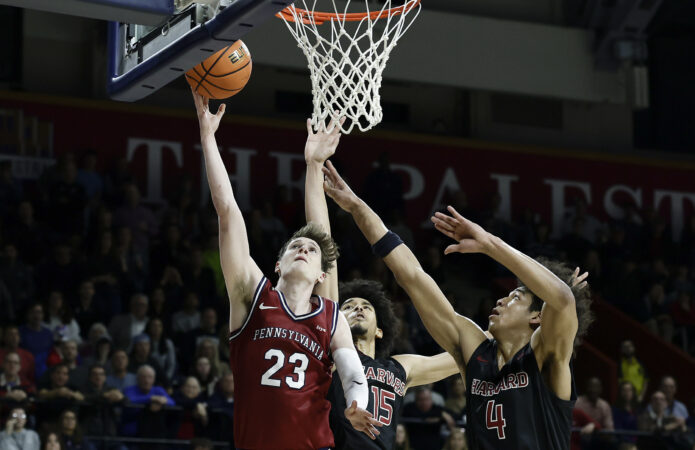
On Saturday, Penn men’s basketball took down Harvard, 64-61, securing a bid to the Ivy League Tournament. As the game came down to a back-and-forth, one-possession game, senior forward Ethan Roberts (21 points) took over for the Quakers — scoring eight straight in the final minutes to secure the victory.
“It meant everything,” Roberts said. “I kind of blacked out when the buzzer hit. This is what we wanted our entire year. Since last summer, we had a coaching change. We see McCaffery coming here, and to see that we’re in this position today, it’s like, back me up, this is literally all we work for. Our North Star. It’s emotional, and I can’t really put it into words.”
Roberts, along with Cam Thrower, Dylan Williams, and Johnnie Walter, were honored pregame as a part of Penn’s senior night celebrations.
The Quakers took control of their own destiny by defeating Harvard, with the win securing Penn an Ivy League tournament bid in head coach Fran McCaffery’s first year as head coach.
Penn last won the Ivy League tournament in 2018, and will look ahead to a rematch with Harvard, the two seed, in the semi-final round on March 14th at noon in Ithaca, New York.
“It’s not like we don’t know each other,” McCaffery said in reference to Harvard. “We have a lot of respect for them. We played twice, we won by three and they lost by one. Expect a good fight; we expect to have our guys ready.”
The Quakers can’t wait for Ivy Madness to start, with the team being proud of their “roller coaster” regular season nearing its end.
“This ivy season has been a roller coaster,” AJ Levine said. “It’s been so hard fought. I mean, we know every single game we go into, we have an opportunity to win. We’ve had so many close games, some that we won, some that we lost, but you know, those all make us better, and they all prepare us for this postseason.”
Comeback kids
Harvard’s league-leading defense dismantled Penn in the first half, holding the Quakers to only 21 points on 24 percent shooting, forcing six turnovers en route to a 10 point halftime lead, 31-21.
The Quakers’ three-headed attack of TJ Power, Michael Zanoni, and Ethan Roberts went a collective 2 of 19 from the field — with starting point guard AJ Levine only playing 10 minutes.
In the second, in just the first four minutes of play, Penn turned the tide — forcing four turnovers and scoring an electric 15 points, with every point coming from one of Roberts, Power, or Levine.
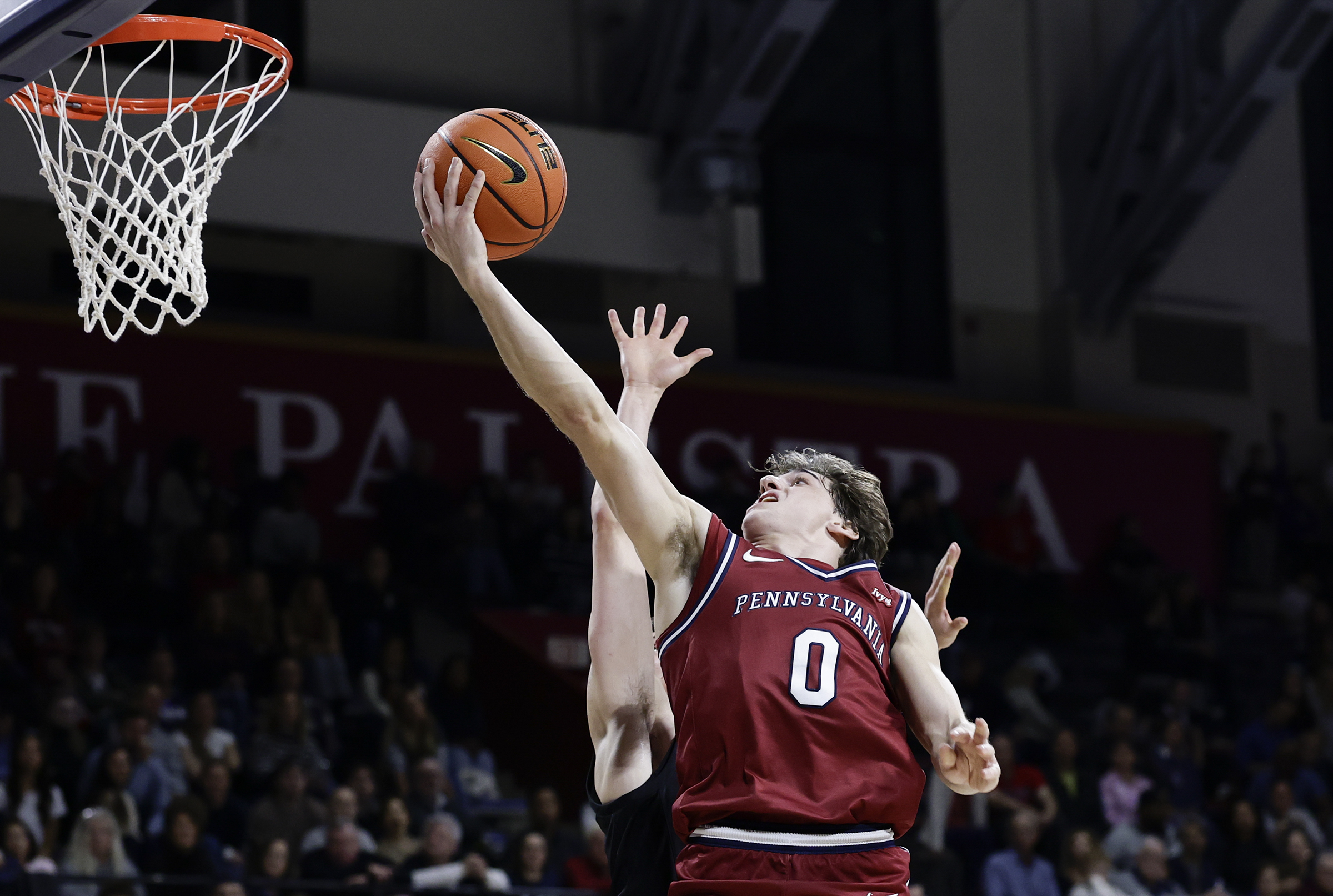
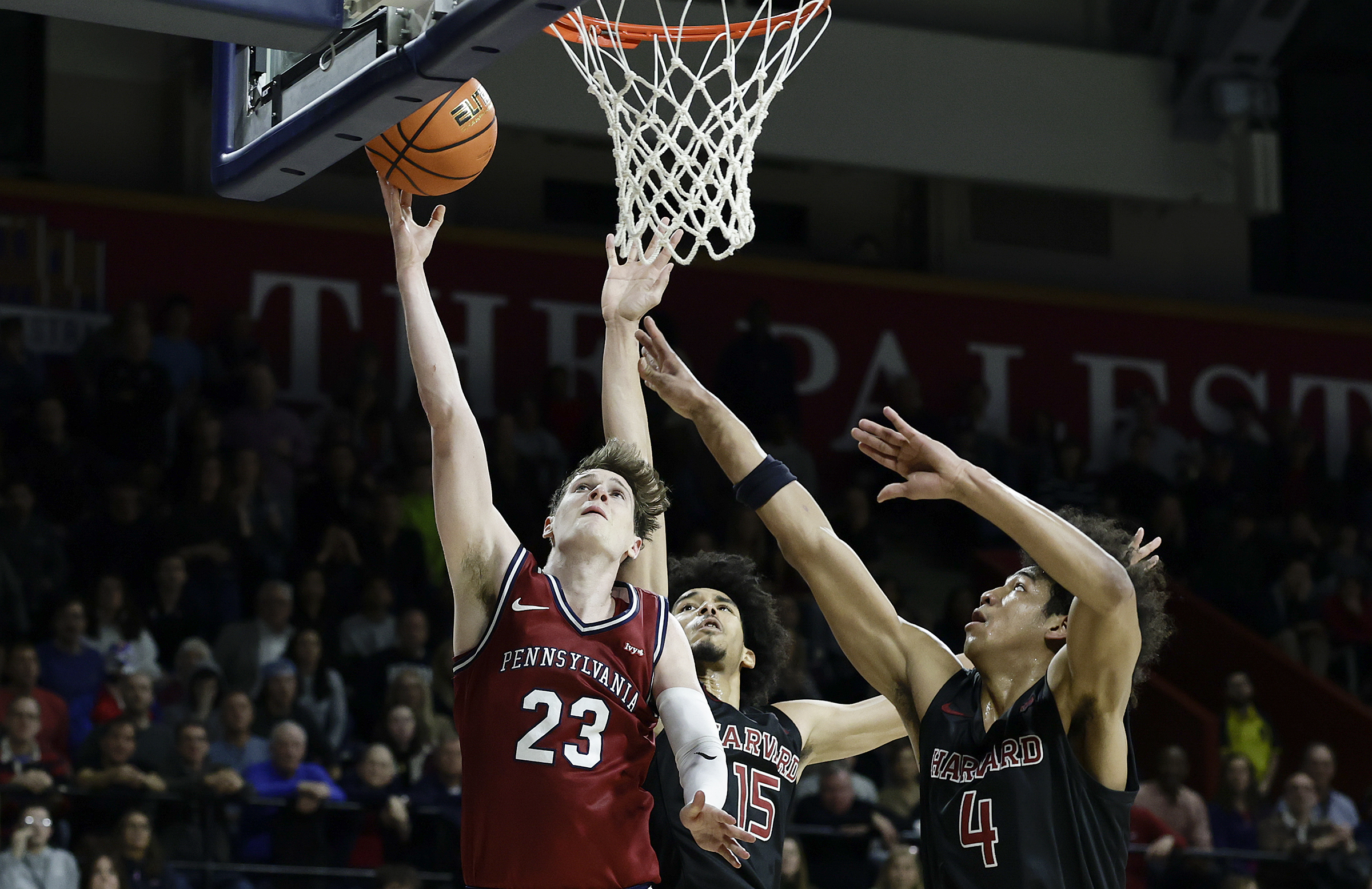
Penn forward Ethan Roberts lays up the basketball past Harvard forward Thomas Batties III (center) and guard Robert Hinton during the second half on Saturday.
“I think the huge thing is defensive intensity,” Levine said in reference to what the team changed at half time. “ [We were} a little quiet on defense and not as energetic, and that was a huge point at halftime, that we’re gonna come out, and we’re gonna get stops, we’re gonna get on this glass and push the ball, that’s where our best offense is, and we want to really capitalize on that.”
Quakers continued to pile on, with the trio scoring a collective 36 of the team’s 41 points in the second half. Power provided much-needed versatility — hitting three of four from behind the arc with four boards, while Levine was ferocious downhill, going four of five with two made free throws for 10 points.
“But to his credit, he showed maturity today,” McCaffery said regarding Levine. “Figured it out. And I think you could know, with all due respect to the game Ethan had, I think you could really look at AJ and say, Okay, that was a difference. The way you played at the start of the second half changed everything.”
Roberts, in his final regular-season home game donning the Red and Blue, controlled the pace, using his physicality and outside touch to uphold the offense, scoring 17 in the second half.
In the end, the former transfer sealed the game for the Quakers and showed emotion after his final home game with Penn.
“I love this place,” Roberts said regarding his performance. “And I just want to give everything back to Penn. How much it means to me to wear this jersey. So to do that means a lot, and I hope that caps off my legacy, but I still got more to go, because, you know, I want to win.”
Zanoni, a senior, was left out of the senior night celebrations. McCaffery, when questioned post-game, confirmed that Zanoni is expected to return to Penn next year.
While Zanoni struggled tonight, his impact this season has been felt — as the Greensboro, North Carolina, native averages 12.1 point per game.
His best performances came against Providence (30 points) and Ivy League leading Yale (20 points), with his outside shooting looking to boost McCaffery’s fast-paced offense for at least one more year.
It was senior day Saturday at the Palestra, and four members of the Penn men’s basketball team were honored: Ethan Roberts, Cam Thrower, Johnnie Walter, and Dylan Williams.
“It’s definitely bittersweet,” Thrower said Wednesday after a morning practice at the Palestra.
More for him than the rest of them.
Among the four players, Thrower, a native of Southern California, is the only one who attended Penn as a freshman and never transferred. It makes him a Lone Ranger of sorts on a basketball team that has undergone change with name, image, and likeness legislation, the modern transfer portal, and, this season, a new coach, Fran McCaffery, who took over after Steve Donahue was fired at the end of last season.
Thrower, though, isn’t just the only four-year senior at Penn. Among the six Big 5 men’s basketball programs, Thrower, a 6-foot-3 guard, is sort of a unicorn. He is the only senior who plays, the only non-walk-on, who is at the same school where he first attended classes as a freshman.
It is a sign of the times in a sport that, at least locally, has lost some of its luster. People are less invested when they don’t know any of the players at their favorite schools. One class below Thrower, there are just four juniors in the Big 5 who are in their third year at the same place, and two of them are at Penn.
The sport has rapidly changed, and you don’t need to go back far to see the effects. In the 2019-20 season, before the pandemic upended the four-year track and before NIL and the transfer portal took over the sport, the numbers were drastically different. That year, there were 12 four-year seniors in the Big 5 and 14 three-year juniors.
This isn’t just limited to men’s hoops. On the women’s side of the Big 5, only seven Throwers exist. Two at Drexel, two at St. Joseph’s, and three at Penn.
“It’s definitely a rare thing nowadays,” said Thrower, whom Donahue recruited out of the venerable Harvard-Westlake School. “But for my family and I, the biggest thing coming into college was finding a situation where, regardless of what happens with basketball, I could meet great people, and having a great, well-rounded experience was something that we valued and Penn has provided that and changed my life for the better.”
Thrower said he wears the distinction that was recently brought to his attention as a ”badge of honor.” But the Wharton student knows that everyone’s journey is different, and he doesn’t judge those around him and in college basketball for moving around and finding the best situation for themselves.
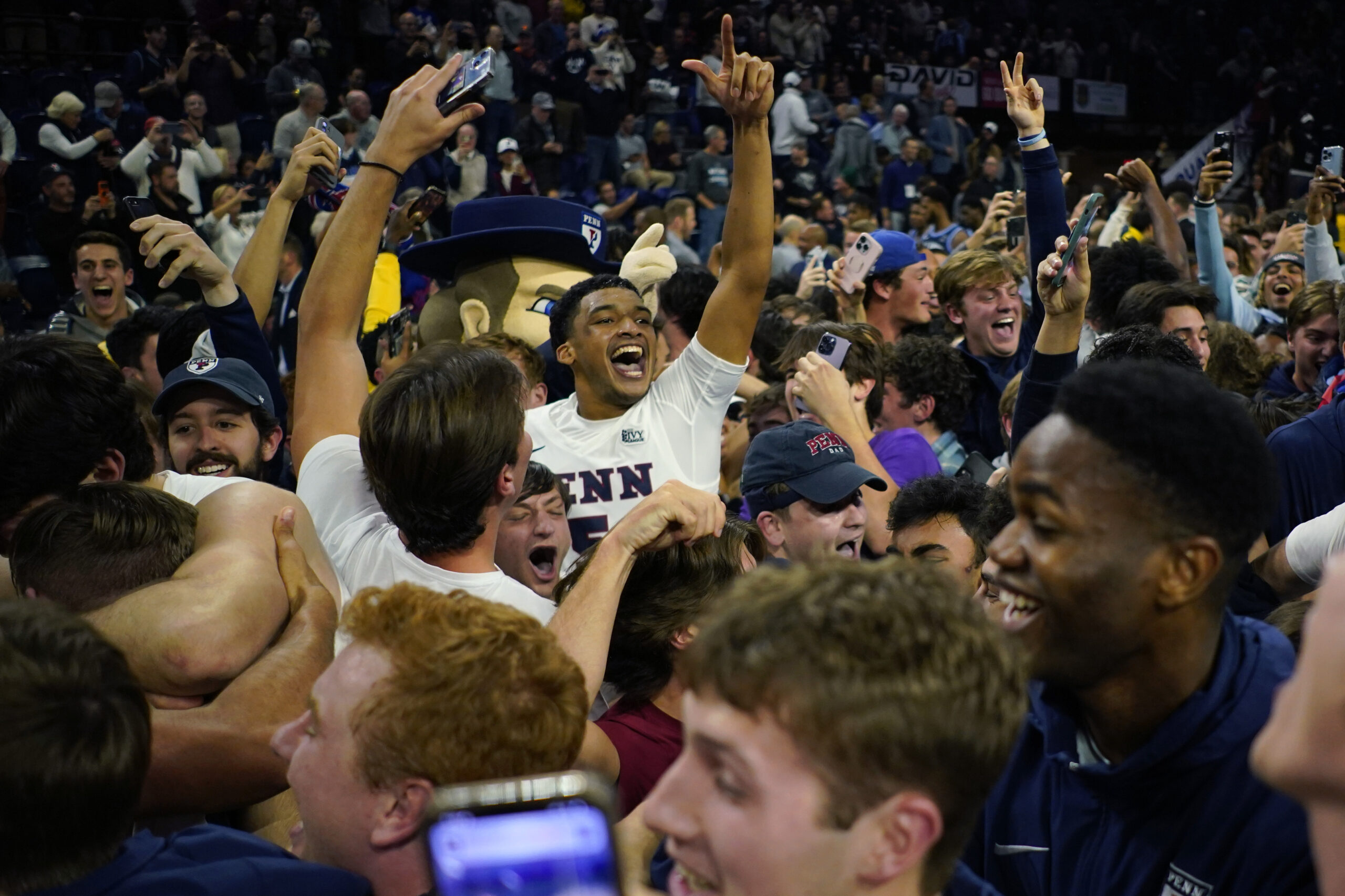
Cam Thrower celebrates with fans as they storm the court after Penn beat Villanova in 2023.
“Penn has been great to me,” Thrower said. “Basketball has been great to me.”
The backup guard is averaging 5.2 points in 16.5 minutes in 21 games this season after missing all of last year with a wrist injury. His basketball journey has had ups and downs. One of the highs came in his sophomore year. He started and scored 11 points in 26 minutes when the Quakers knocked off a nationally ranked Villanova team at the Palestra.
The injury wiped out his junior season, then Donahue was fired. Transferring wasn’t really an option, Thrower said. A Penn degree is more valuable than wherever he might transfer to continue playing basketball. So Thrower stayed, and he helped McCaffery and a new team transition into a new season.
“His attitude and his leadership and his work ethic, for a new coach it’s incredibly appreciated,” McCaffery said. “You need your veteran guys to show the example for the younger guys, and that’s what he does.”
McCaffery, who last coached at Iowa, is a Philadelphia native who was a rarity in 1978 when he transferred from Wake Forest to Penn. Back then, moving around from school to school wasn’t as prevalent as it became.
“It’s just a different time,” McCaffery said. “Thank God for Cam that he went to Penn for all the right reasons and he stayed.”
Thrower said the end of the season is bringing a “sense of urgency,” one the team talked about after practice Wednesday. The Quakers had two home games this weekend — Friday vs. Dartmouth, and Saturday vs. Harvard — and finish the season next weekend with a road game at Brown. Penn (15-11, 8-5 Ivy) clinched one of four spots in the Ivy Madness tournament with Saturday’s come-from-behind 64-61 win over Harvard. The Quakers are two wins from reaching the NCAA Tournament, a possibility, however small, that excites Thrower.
From left, Penn forward Ethan Roberts, guard Cam Thrower, guard AJ Levine, and forward Augustus Gerhart react in the final minutes of the win against St. Joseph’s on Nov. 17.
Off the court, he is spending his final few months on a campus and with a community that will stay with him forever. On the court, Thrower is savoring his final games and practices with a group of teammates that he’s constantly learning from. He scored 5 points in 14 minutes vs. Dartmouth on Friday and 3 in 17 minutes vs. Harvard on Saturday.
“It’s helped me learn what life is and sometimes you may be with certain people for a year or two and then they move on with their lives,” Thrower said. “It’s a trial run of understanding what life can look like.”
What’s next?
Thrower is weighing the possibilities. He has studied finance, sports business, and legal studies and has learned a lot about professionalism and amateurism at an interesting time for those topics . But school isn’t done. Thrower said he wants to pursue his MBA and get his formal finance and accounting training under his belt before entering the workforce.
Surely, he could do those things at Penn. That wrist injury from last year, however, left him with another year of basketball eligibility, and Ivy League rules prohibit graduate students from playing varsity sports.
What if they didn’t?
“Penn has been great,” Thrower said, “but I want to see what else is out there.”