Category: Villanova

  • Havertown’s Mike Tollin screens his new documentary profiling Villanova hero George Raveling

    Havertown’s Mike Tollin screens his new documentary profiling Villanova hero George Raveling

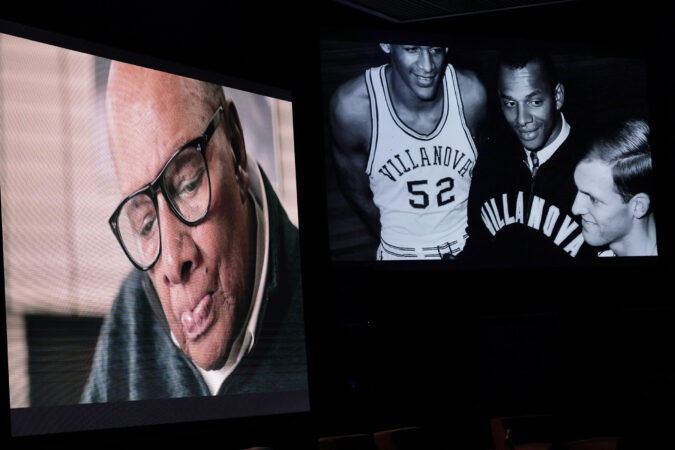
    Mike Tollin received an ovation for his documentary film about the life of George Raveling after a Wednesday night showing on Villanova’s campus. But the best part of the Havertown native’s night may have been meeting and snapping a photo with former guard Fran O’Hanlon, one of his “Villanova heroes.”

    Tollin’s love for Villanova hoops is one of the main reasons he chose to direct Unraveling George, a 90-minute documentary that profiles Raveling. He was a player and assistant coach at Villanova before he rose to prominence as a head coach at Washington State, Iowa, and Southern California. After his coaching career, Raveling joined Nike as a marketing executive.

    Nike and Villanova staged a screening of Tollin’s film before Wednesday night’s game between the Wildcats and Georgetown at the Finneran Pavilion.

    The screening was preceded by a panel conversation with Tollin, a longtime television and film executive who served as the executive producer on the 10-part Michael Jordan docuseries The Last Dance. Former Villanova coach Jay Wright and Larry Miller, president of Jordan Brand at Nike, joined Tollin onstage.
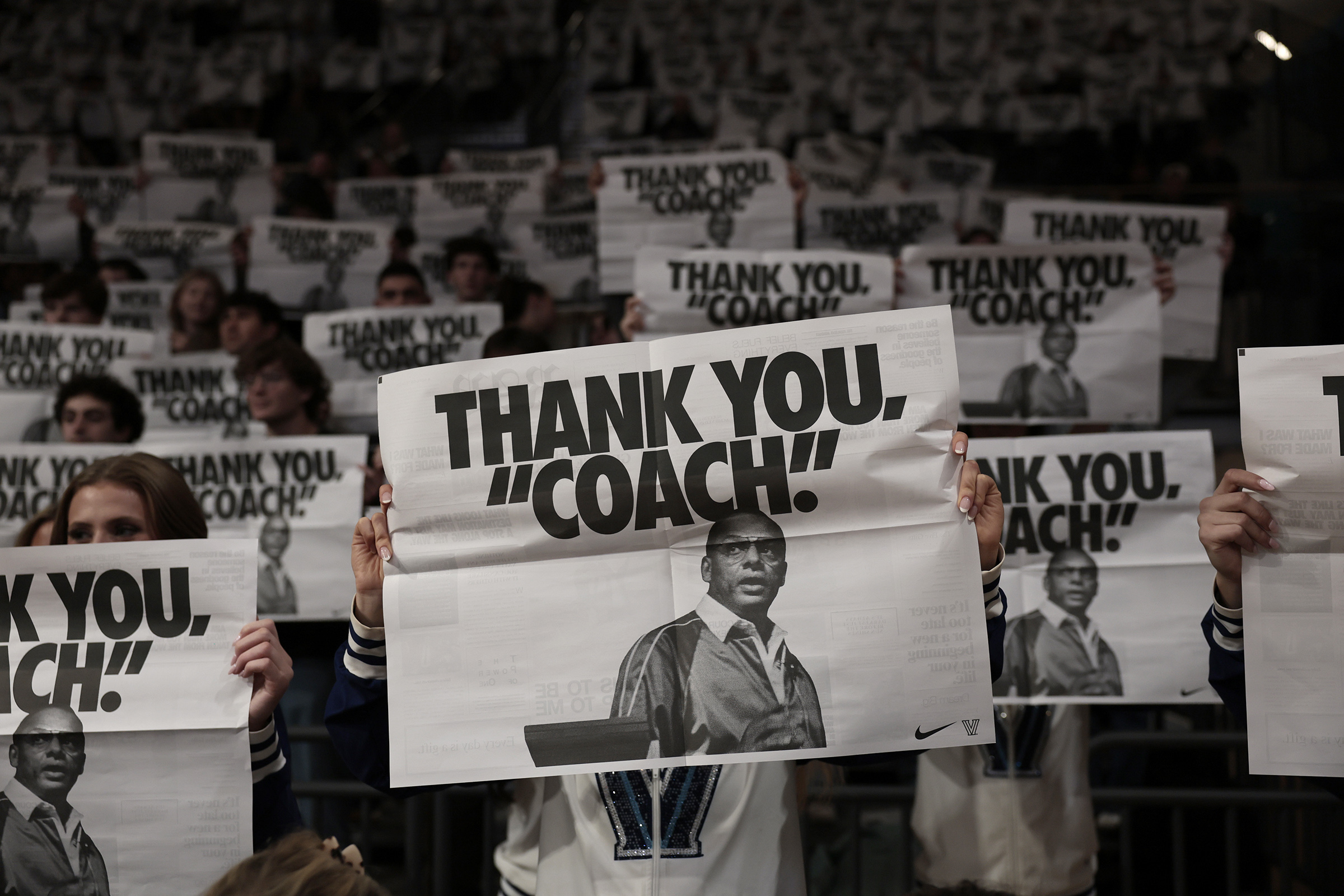
    Fans honored the life and legacy of coach George Raveling during Villanova’s game against Georgetown on Wednesday.

    Villanova also honored Raveling during its game against the Hoyas, which the Wildcats won, 66-51. Raveling graduated from Villanova in 1960 and served as an assistant coach under Jack Kraft from 1963 to 1969. He died at age 88 on Sept. 1, 2025. Fans held up newspaper fliers distributed by Nike that read “Thank You, Coach” during the game’s first timeout.

    “This team, I’m sure [Villanova coach Kevin Willard] has talked to them about coach Rav, but they would not have gotten to know him,” Wright said during the discussion. “All the other teams, coach Rav would come here, spend time with us, talk to the team. It’s great for them, because these guys are smart guys on this team. They’ll Google him, they’ll read about him and they’ll get to know how important coach Raveling was to Villanova and to the world.”

    The idea for Tollin to work on a documentary about Raveling came after the release of Ben Affleck’s AIR in 2023. That film is a fictionalized account of Nike’s pursuit of an endorsement deal with Jordan before his rookie season with the Chicago Bulls in 1984.

    Marlon Wayans plays George Raveling in AIR, but the film’s plot suggests that Sonny Vaccaro, played by Matt Damon, was the primary reason Jordan signed with the company. Jordan disputes this in Unraveling George, saying that Raveling, who coached Jordan at the 1984 Olympics, was the first person to pitch Nike to him.

    Tollin said a conversation about AIR with William Wesley, executive vice president of the New York Knicks, gave him the inspiration to work on the project.

    “He said, ‘Did you see AIR?’” Tollin said. “And I said, ‘Yeah, I enjoyed it.’ He said, ‘Yeah, but we’ve got to tell the real story, and we’ve got to honor George.’”

    Wesley introduced Tollin to Raveling at a Los Angeles Clippers game, where Tollin’s childhood admiration for Villanova basketball showed. Tollin, who graduated from Haverford High School in 1973, grew up watching the players Raveling recruited for the Wildcats.

    “I sat there and I just gushed,” Tollin said. “I said, ‘You recruited all my first basketball heroes.’ I started naming names like Johnny Jones, like Howard Porter.”

    Raveling agreed to be the subject of the documentary, and Tollin got to work on raising funds for the project. The film was completed before Raveling died, and the coach got a chance to see it. Tollin said Wednesday night’s screening at Villanova was “bittersweet.”

    “I wish he was here,” Tollin said. “But obviously, I feel his presence. I know how he felt about the film. He loved it. He was grateful. He was just so generous with me.”
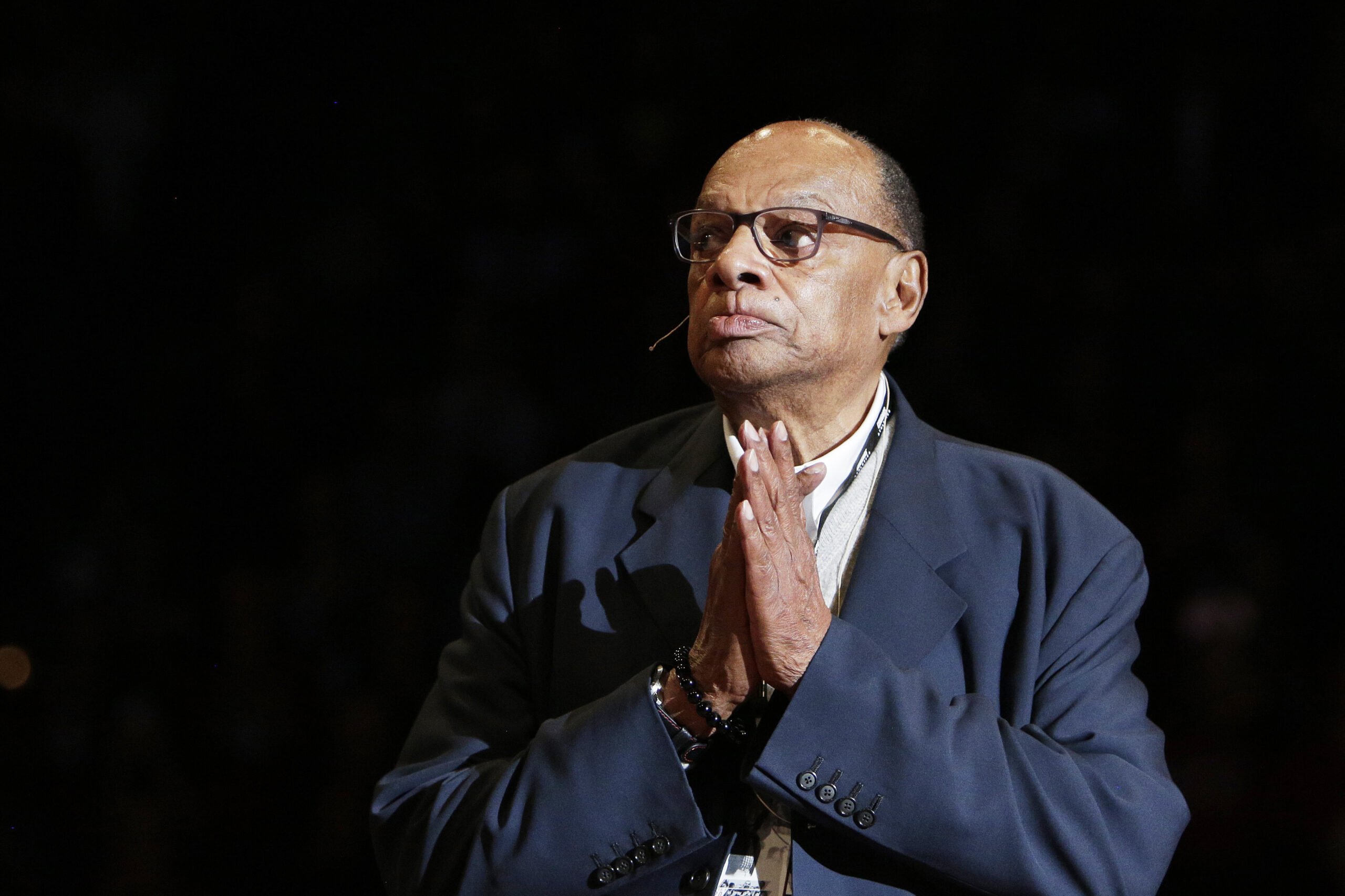
    The late George Raveling played a role in Michael Jordan’s signing a landmark endorsement deal with Nike.

    The film follows Raveling’s life, from his youth in segregated Washington to his playing career at Villanova, where he was the school’s second Black basketball player, and his coaching career. It details the events that led to Raveling obtaining the original typewritten copy of the Rev. Dr. Martin Luther King Jr.’s “I Have a Dream” speech during the March on Washington in August 1963.

    The film also shares Raveling’s time as an assistant coach on Bob Knight’s staff for the 1984 Olympic basketball team, when Raveling formed a relationship with Jordan. It also follows Raveling’s recovery from a 1994 car accident that kept him in intensive care for two weeks and led to his retirement from coaching.

    The documentary goes into Raveling’s second career as an executive for Nike. In addition to being responsible for Jordan’s decision to sign with Nike in 1984, Raveling was also instrumental in helping to bring international players like Dirk Nowitzki and Yao Ming to the NBA.

    Former Villanova coach Jay Wright (left) and filmmaker Mike Tollin during the panel conversation and screening of “Unraveling George” on Wednesday.

    The film features interviews with many significant figures in basketball, including Jordan, Nowitzki, longtime coach Lefty Driesell, Wright, and Nike founder Phil Knight, among others. Wayans provides voice-over narration and sits down for a conversation with Raveling during the film’s credits.

    “It was incredible to keep turning over rocks and find more and more layers, and more and more people who love George and wanted to be a part of the storytelling,” Tollin said.

    Nike made promotional materials for Wednesday night’s screening at Villanova. Those included embroidered canvas tote bags that read “RAV,” and the fliers, inspired by Raveling’s love for reading the newspaper.

    Tollin said when Nike’s team approached him about supporting the film, he wanted the company to help bring it back to Villanova.

    “I just knew this would feel like family,” Tollin said. “And it did. This is sort of like the womb, you know? This is like a really warm bath of support and love. … It was critical that we bring the film here, partly because I’m from here and partly because this is [Raveling]’s origin story.”

    Unraveling George is not available to stream, although Tollin expects to have more details on where to watch it soon.
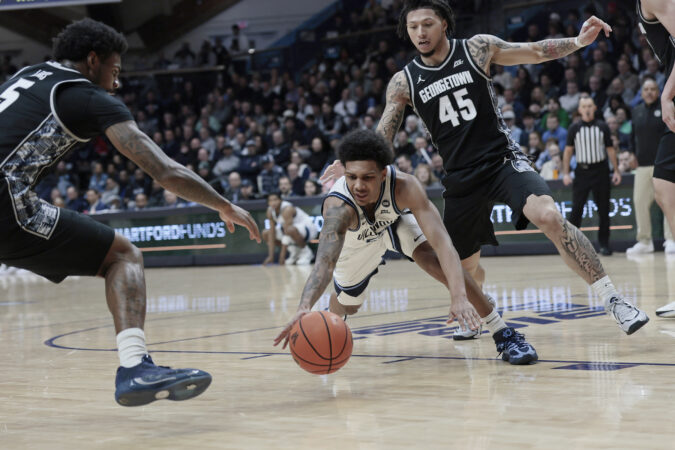
  • Second-half surge helps Villanova roll past Georgetown to set up a Saturday showdown with No. 2 UConn

    Second-half surge helps Villanova roll past Georgetown to set up a Saturday showdown with No. 2 UConn

    The difference isn’t in the adjustments as much as it is the inherent advantage of the location of each team’s bench during the first half, according to Villanova coach Kevin Willard.

    Villanova runs its offense in the first half in front of Ed Cooley and Georgetown’s bench, and the Hoyas run their offense in front of Willard and his bench.

    “I get to yell their plays out,“ Willard said after Villanova’s 66-51 victory over Georgetown on Wednesday. ”The coaches all know the plays. I’ve watched Georgetown play nine times now. You know when the center is out in the corner, they’re going to run a boomerang. You know when [Malik] Mack’s on the block, it’s going to be an iso.”

    Villanova used a 16-1 surge in the first four minutes to blow open just a three-point halftime lead, and there has to be more to it than the orientation of the court. Save for a few games, Saturday’s loss to St. John’s being one of the outliers, Villanova has been a solid second-half team. It entered Wednesday night with a plus-4.1 margin over its opponents in the second half. That ranked 62nd nationally and fourth in the Big East. It is not amazing, but considering there are 365 Division I teams, it’s not nothing.

    There is, of course, more to it than Willard’s initial explanation.

    Villanova watches a lot of film at halftime. Willard watches the offense to figure out what he wants to call in the second half, but the rest of the staff and team focus on the defensive end. There was a lot to like on that end from the first 20 minutes. It was an ugly opening frame that ended with the teams combining to shoot 15-for-54 (27.8%). Villanova’s offense looked clunky, but the Wildcats forced nine first-half turnovers from a Georgetown team that entered Wednesday on a five-game losing skid but was 15th nationally in turnover percentage.

    There was less tactical messaging during the break, too.

    “It’s just getting a very young team to understand, it’s all I talked about at halftime, this is Big East play,” Willard said. “They’re a really good, physical defensive team. It’s not going to be easy. We have to rebound and get out. That’s usually all the message is and just cleaning up what we’re struggling with defensively.”

    Villanova allowed a 20-4 St. John’s start to the second half Saturday at Xfinity Mobile Arena, but Wednesday, against a lesser opponent that dropped to 1-7 in conference play, was a much different story. Georgetown turned it over four times in the first four minutes of the second half and Villanova finally got out in transition and found cleaner shots.

    “That first stretch won us the game,” said Tyler Perkins, who led Villanova with 16 points.

    The 16-1 spurt stretched to 29-8 midway through the second half to give Villanova its largest lead, 55-31. The defense that kept Villanova in the game during the first half carried over. The Wildcats held Mack, who averages 13.8 points, to five points on 1-for-14 shooting. The 51 points the Hoyas scored were the fewest by a Villanova opponent this season.

    “I think we all knew we’d be better on offense in the second half,” said freshman point guard Acaden Lewis, who had 15 points and a season-high seven rebounds. “That’s kind of what happened. We stayed solid defensively, and the offense came around late.”

    Bryce Lindsay, who hit a three-pointer from the edge of the midcourt logo in the second half, and Duke Brennan joined Perkins and Lewis in double figures with 11 and 10 points, respectively. It was far from the cleanest offensive night from the Wildcats, who got just nine assists on their 24 makes, far below their season-long assist percentage of 53.7. But it was more than enough against a Georgetown team that Cooley said was “emotionally and physically frustrated” by Villanova in the second half.

    “Villanova does what they do,” Cooley said. “They use a ball screen 118 times a game, and they took advantage of that and made some shots.

    “This game is all about discipline. It’s all about connection. It’s all about emotional and mental toughness.”

    One team had it Wednesday, the other didn’t. One team’s season is spiraling, the other’s continues Saturday afternoon in Hartford, Conn., where it gets another opportunity for a signature win.

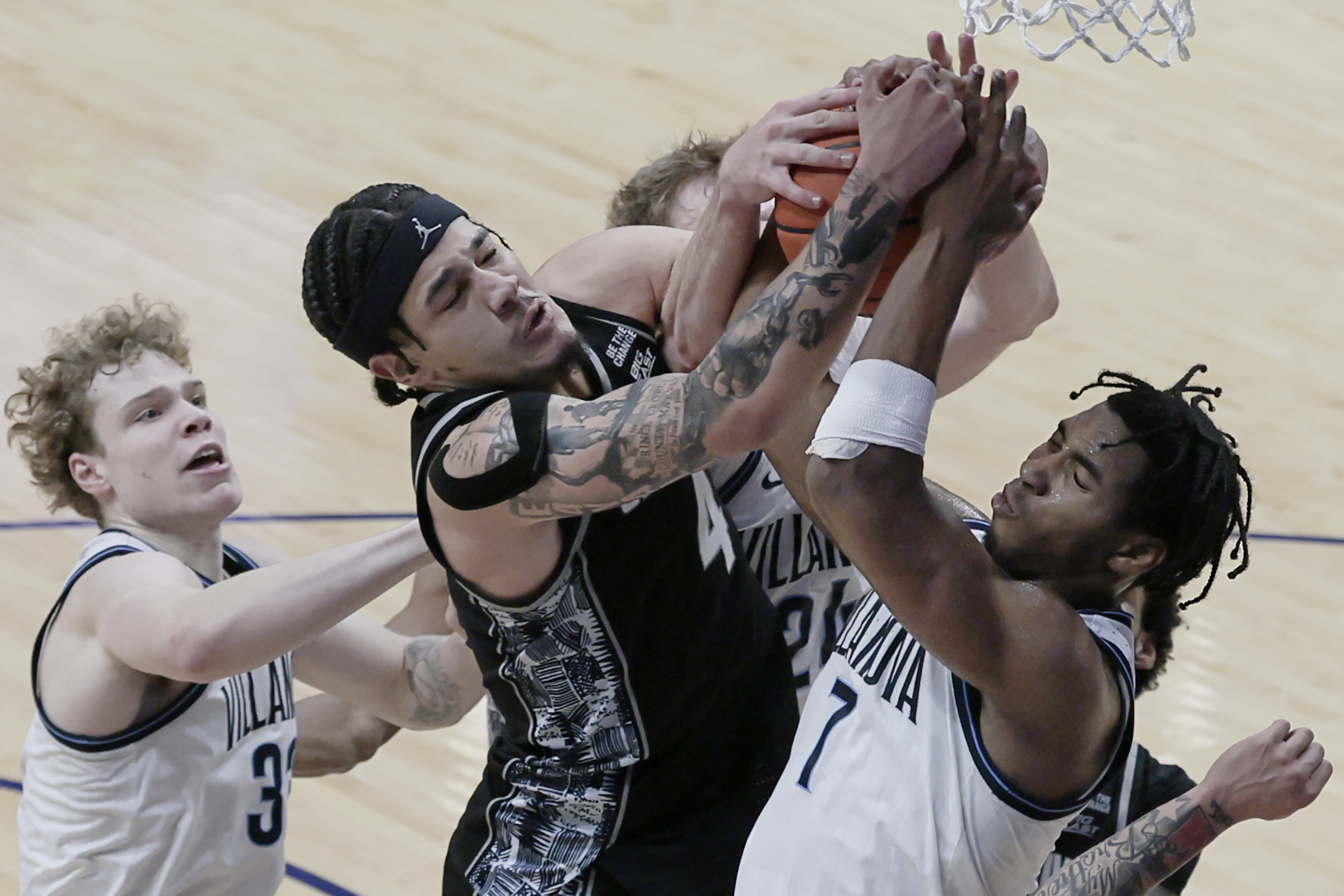
    Georgetown’s Caleb Williams is sandwiched between Villanova players on Wednesday.

    The good part about this time of year, Willard said, is that he’s seen about all of his conference opponents on film. No. 2 UConn, he said, has a lot of veteran talent and he loves watching freshman Braylon Mullins, who attempts nearly six three-pointers per game in 26 minutes and is “always hunting.”

    Villanova entered Thursday rated 24th at KenPom and 34th at Torvik, two of the primary college basketball metrics sites, and was 33rd in the NCAA’s NET rankings. The Wildcats are on a path to snapping their NCAA Tournament drought of three seasons. But what they don’t have yet is a marquee victory, due respect to Wisconsin and Seton Hall. Each major step up in competition has been met with much resistance.

    “Every league game is important,” Lewis said when asked about Saturday. “It’s the same approach, same things we always do.”

    If that’s not working early on, there’s always halftime.

  • Villanova freshman Acaden Lewis is often praised for using his ‘off’ right hand. He’s actually right-handed.

    Villanova freshman Acaden Lewis is often praised for using his ‘off’ right hand. He’s actually right-handed.

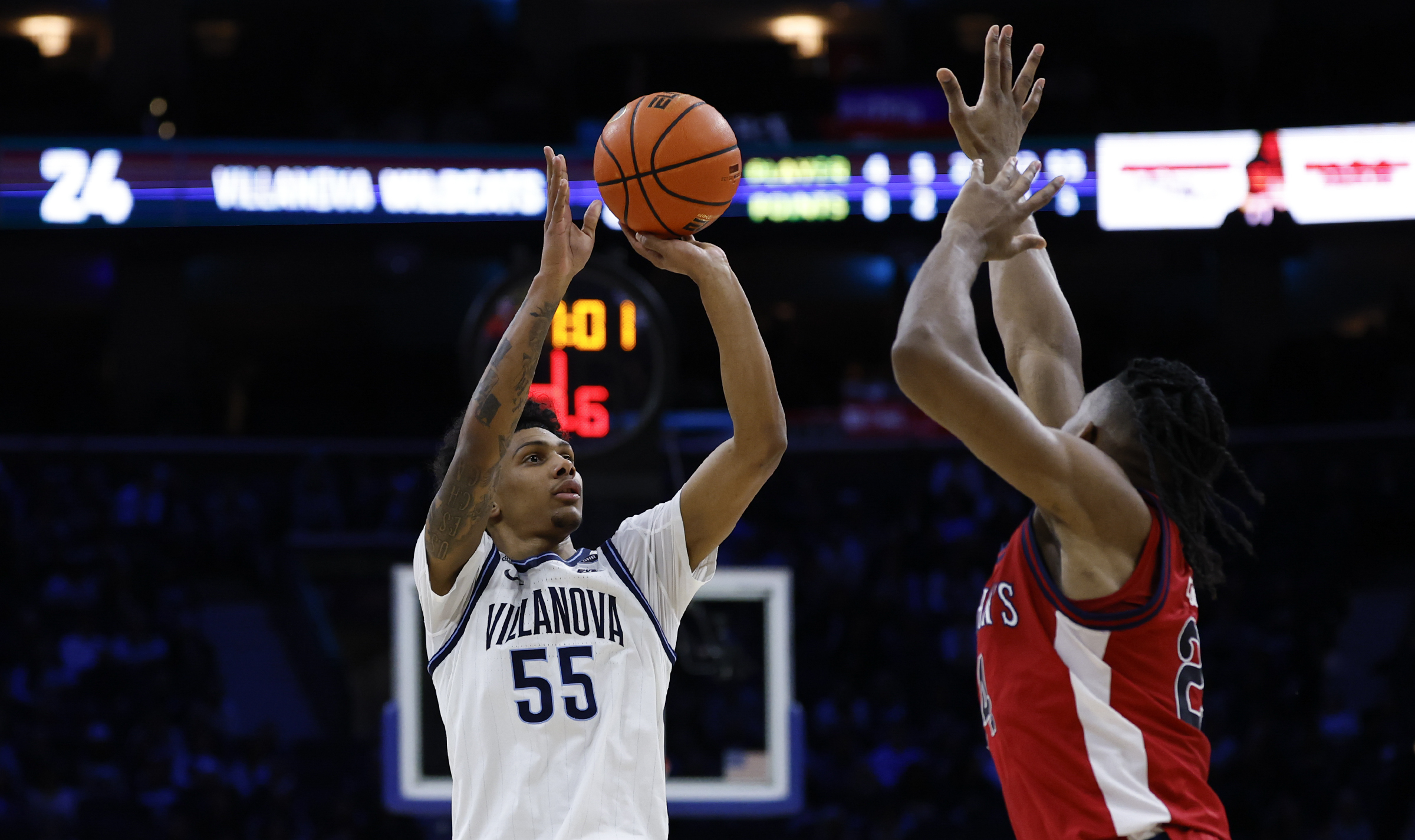
    Because Acaden Lewis shoots a basketball left-handed, it is natural for observers to admire the way the freshman Villanova point guard uses his right hand.

    The admirers often wear headsets and announce games on television.

    There goes Lewis, using his other hand.

    Look at that, with the off hand.

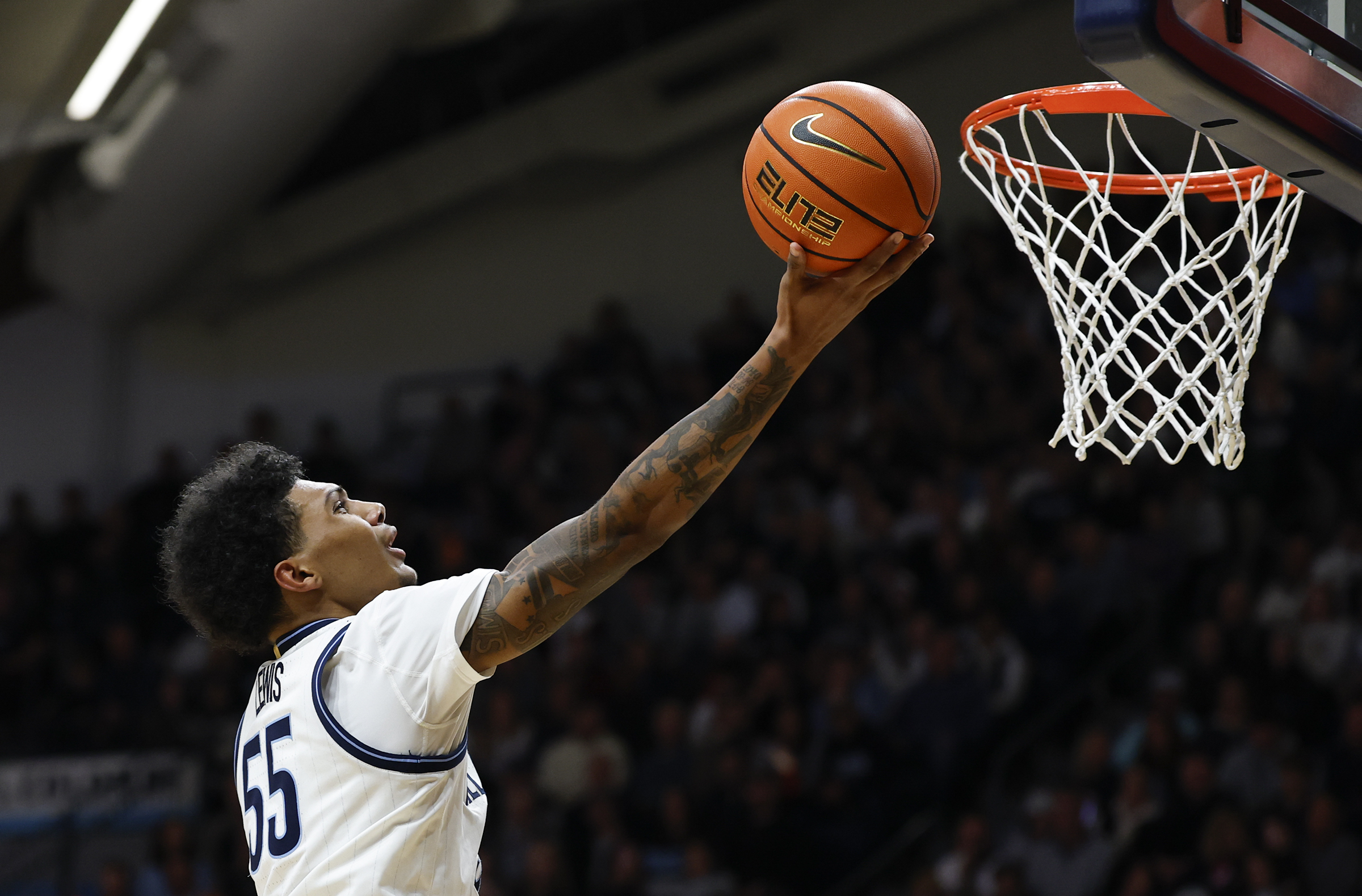
    For most players, passing the ball with their nonshooting hand, dribbling to their nonshooting hand’s side, and using their nonshooting hand to finish a layup or floater takes a lot of practice. The movements can be unnatural.

    To be sure, Lewis has worked hard to sculpt a skill set that has allowed him to play right away and be the lead guard on what looks like an NCAA Tournament-bound Villanova team.

    But he isn’t left-handed.

    “I can’t do anything with my left hand,” Lewis said by phone this week as he forked noodles into his mouth using his right hand following a post-practice film session. “I can’t palm a ball. I can’t write. I can’t eat.”

    Acaden Lewis is averaging 12.1 points, 5.3 assists, and 3.4 rebounds for the Wildcats.

    How did a right-handed kid growing up in the nation’s capital learn to play basketball left-handed?

    “I actually have no clue,” Lewis said. “I think I just shot with my left hand when I started hooping.”

    Whatever works. And it’s working. Entering Wednesday night’s game vs. Georgetown, Lewis is at 12.1 points, 5.3 assists, 3.4 rebounds, and 1.9 steals per game.

    His ability to use both hands is all over that stat line.

    “I think he has so much confidence in the fact that he can go both ways, and it’s not like you can shade him one way or send him to his weak hand,” Villanova coach Kevin Willard said.

    Willard first recruited Lewis out of high school when he was the coach at Maryland, but Lewis initially committed to Kentucky. It wasn’t until April, a few months before summer workouts, that Lewis withdrew his commitment from Kentucky and was back on the market. Villanova needed a point guard.

    During the recruiting process, Lewis told Willard and his staff that he actually was a righty.

    “I thought he was full of s—,” Willard said. “Because he was doing everything with his left.”

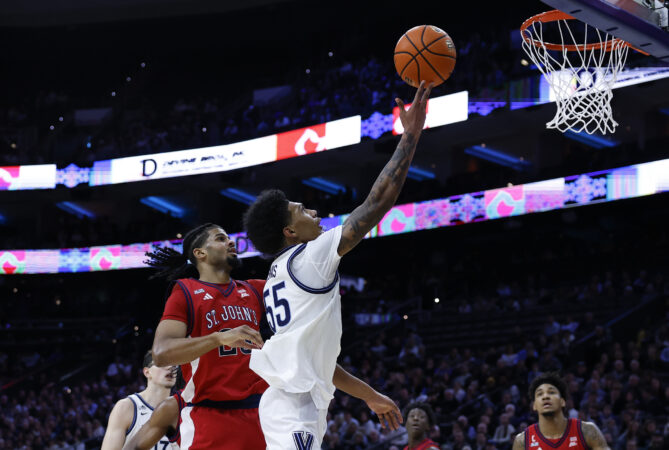
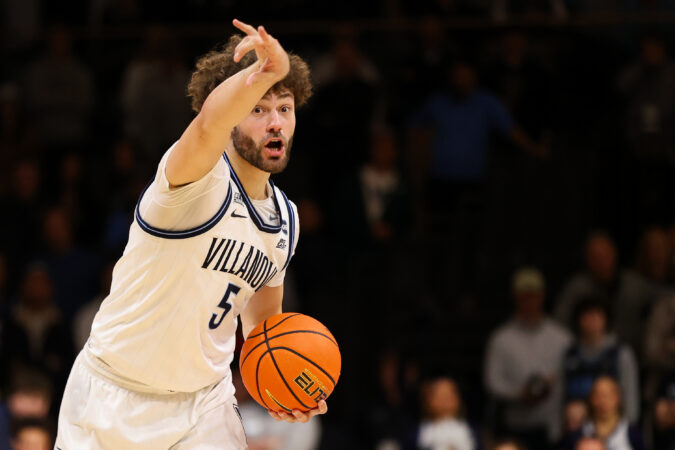
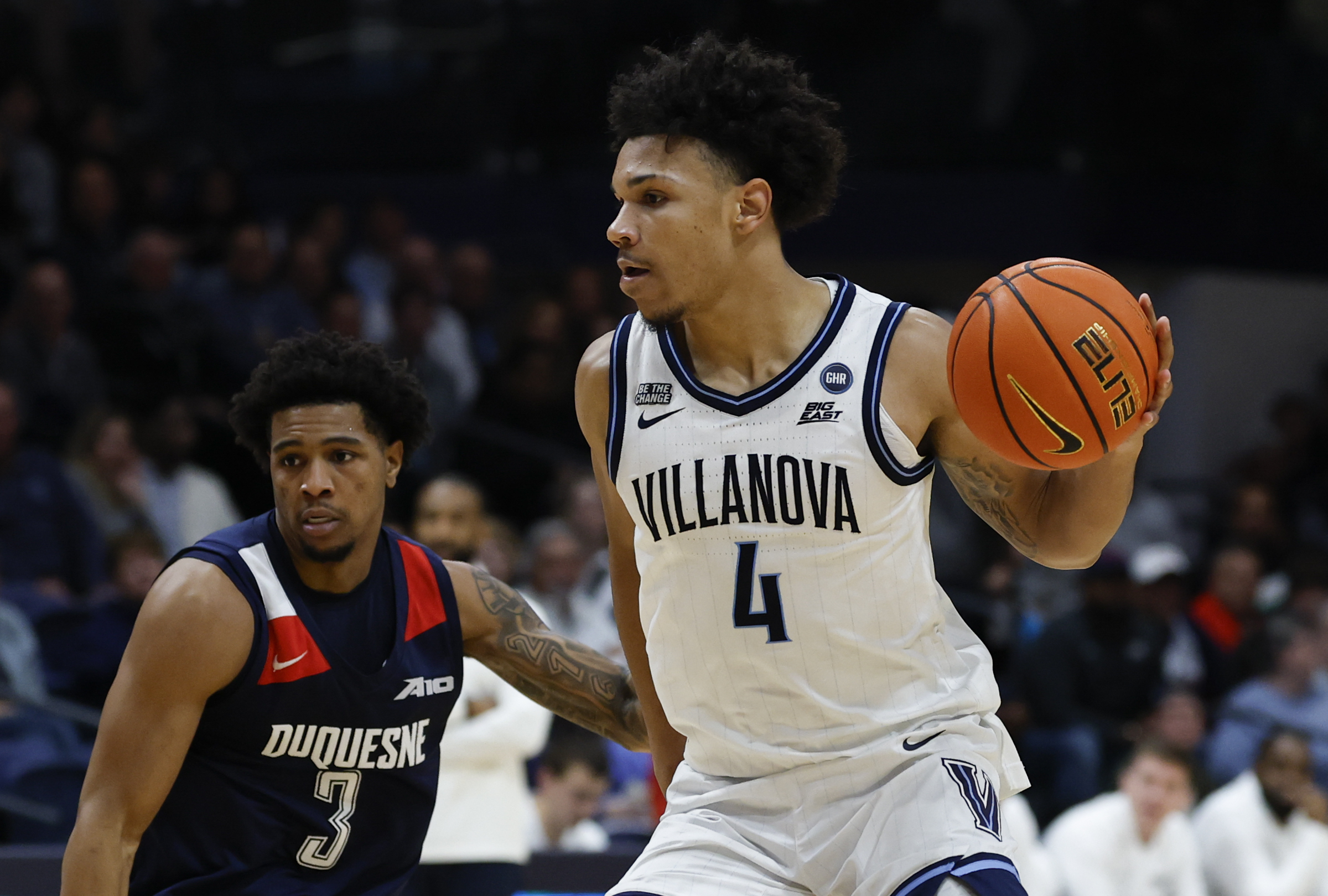
    Villanova guard Acaden Lewis lays up the basketball against Duquesne on Nov. 15.

    Willard noticed Lewis was good going both ways when he watched him, but it took floater drills during preseason practices for the coach to finally become a believer. Lewis was better with his right.

    “I was like, ‘Jeez, he must be right-handed,’” Willard said.

    Then, in October, during the installation of Villanova’s pick-and-roll defense, Willard noticed Lewis’ ability to run offense and pass effectively using his right hand. For most players, Willard said, there’s a “dramatic difference” when running an offense to their supposed weak side. With Lewis, it’s a strength.

    “We actually run some plays where he’s passing with his right hand because he can do it,” Willard said. “We don’t have to switch sides of the floor because he’s lefty. He gives me flexibility in the fact that we can run certain plays on the same side of the floor.”

    Lewis, who has been named Big East freshman of the week four times, agreed with Willard that passing might be the most critical component of him being ambidextrous.

    “I think that’s the best thing I actually do with both hands,” Lewis said. “Either that or finishing. I think the passing ability is really dynamic. I can do all types of passing with both hands, so it’s never like I have to come across my body or have to make awkward movements to throw passes. It makes a lot of things comfortable for me.

    “It’s a little unorthodox, and it’s kind of hard to guard.”

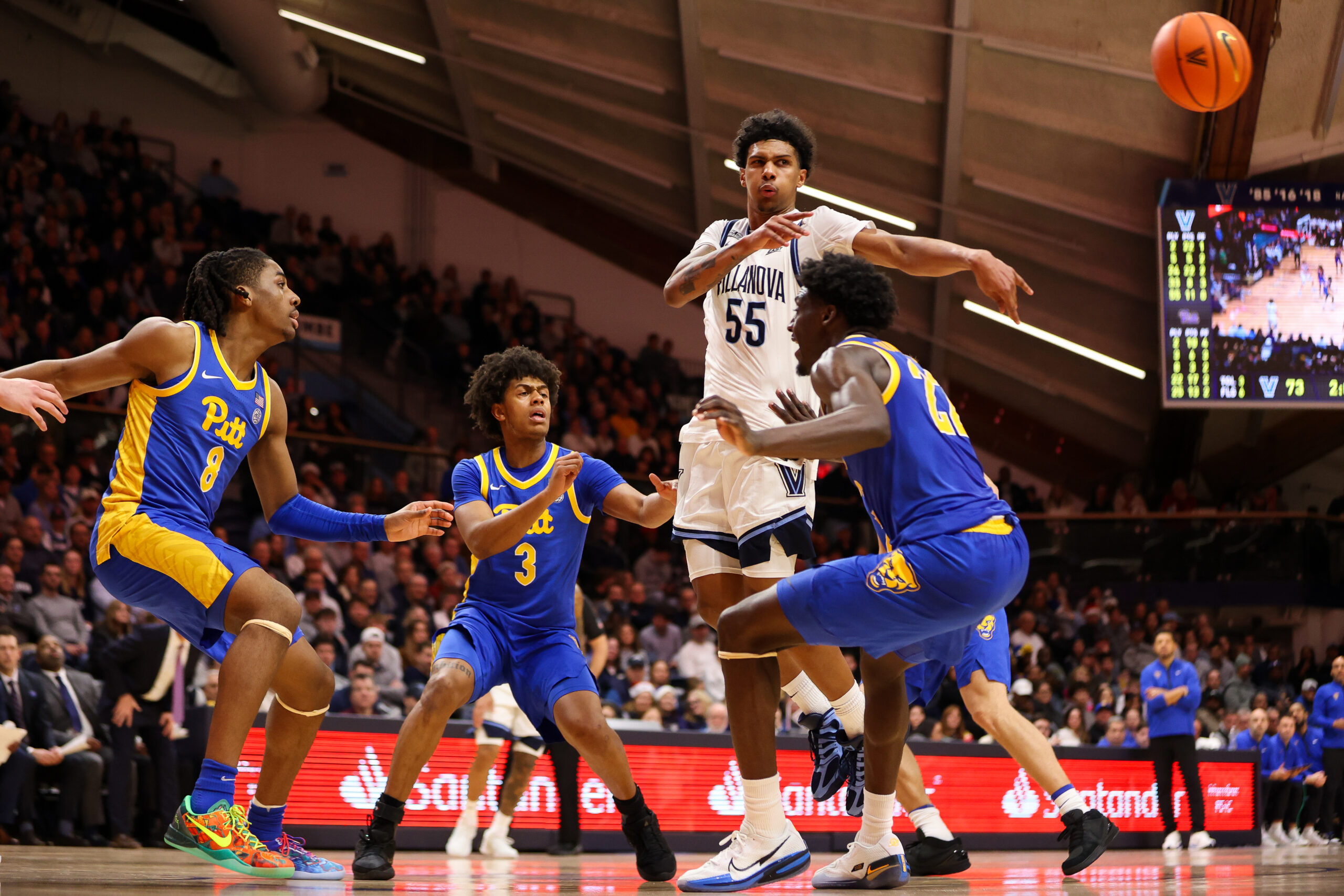
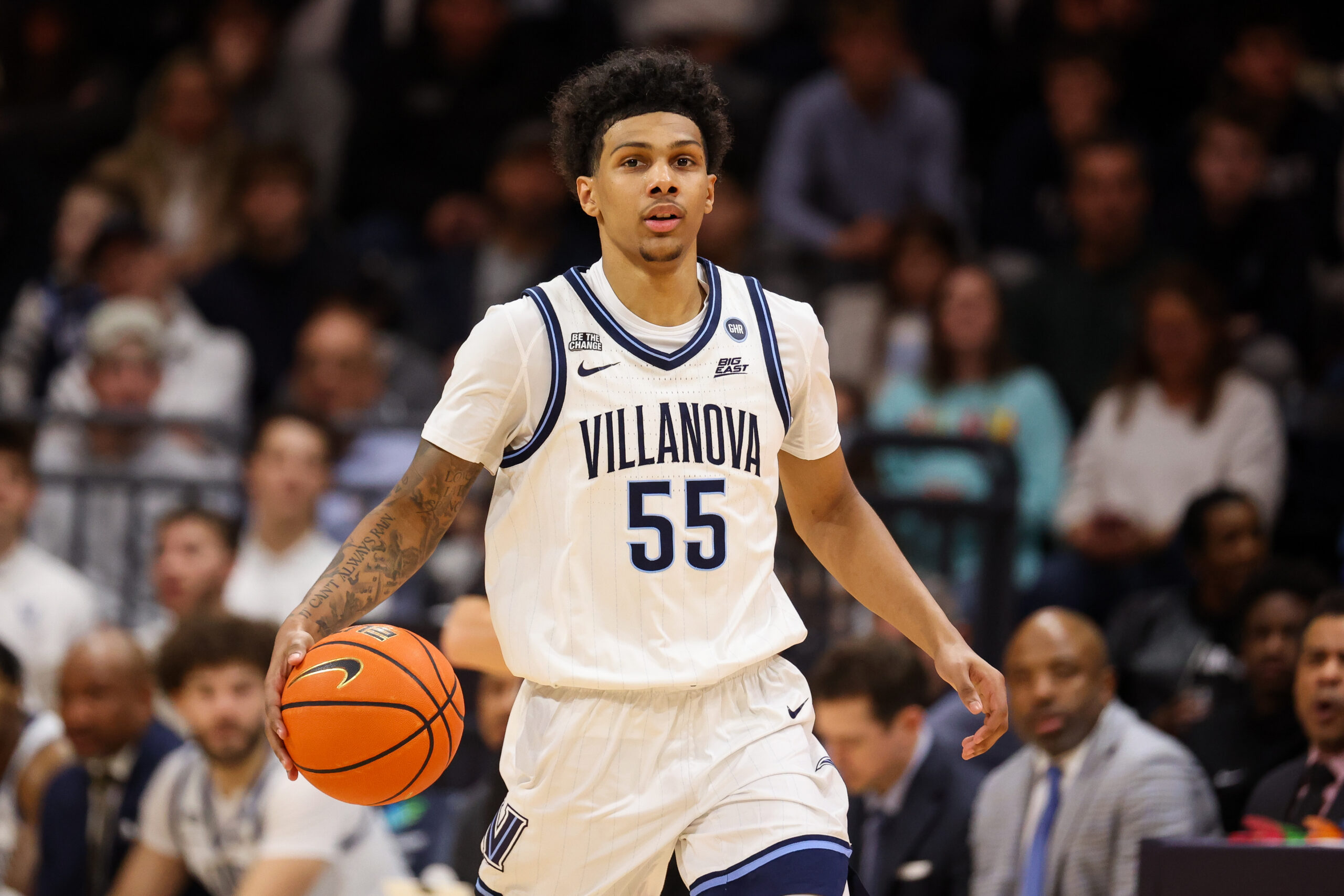
    Acaden Lewis firing a pass to his left during Villanova’s win against Pittsburgh on Dec. 13.

    There is, however, no advantage to being strong with both hands on the defensive end, Willard said.

    “I wish it did [help him],” Willard said jokingly. “I think he wishes it did, too.”

    Lewis credited his knack for the ball as the reason he is averaging nearly two steals through his first 18 college games. But while Lewis is fourth in the Big East in steals, his defense and inexperience have landed him on the bench a few times this season, including for all but 19 seconds of the final 11-plus minutes of Saturday’s loss to St. John’s.

    Lewis, Willard said, takes to coaching. He was similarly benched during the second half of a season-opening loss to BYU and responded well.

    “I think one of the biggest things about a leader is, he admits when he [messes] up,” Willard said. “He owns it. I think other guys have really bought in to the fact that here’s a young guy that’s getting yelled at by the coach because he’s the point guard, but he’s the man taking it.”

    Having two dominant hands and arms on the basketball court has been key for Lewis during his first season, but beyond that, Willard said Lewis’ commitment to learning and studying has enabled him to play well right away. That part he expected. Eric Singletary, Lewis’ coach at Sidwell Friends School in Washington, which previously fed Villanova stars like Josh Hart and Saddiq Bey, raved about the student of basketball Willard was getting.

    What Willard didn’t know until Lewis got on campus was that Lewis is a “monster competitor,” the coach said.

    “I just never knew how much of a competitor, how much he wanted to win, and how much he wants to be good. I don’t think you ever really find that out until you start coaching a kid. He’s blown me away with how much of a competitor he is.”

    That, and the right-handed floaters.

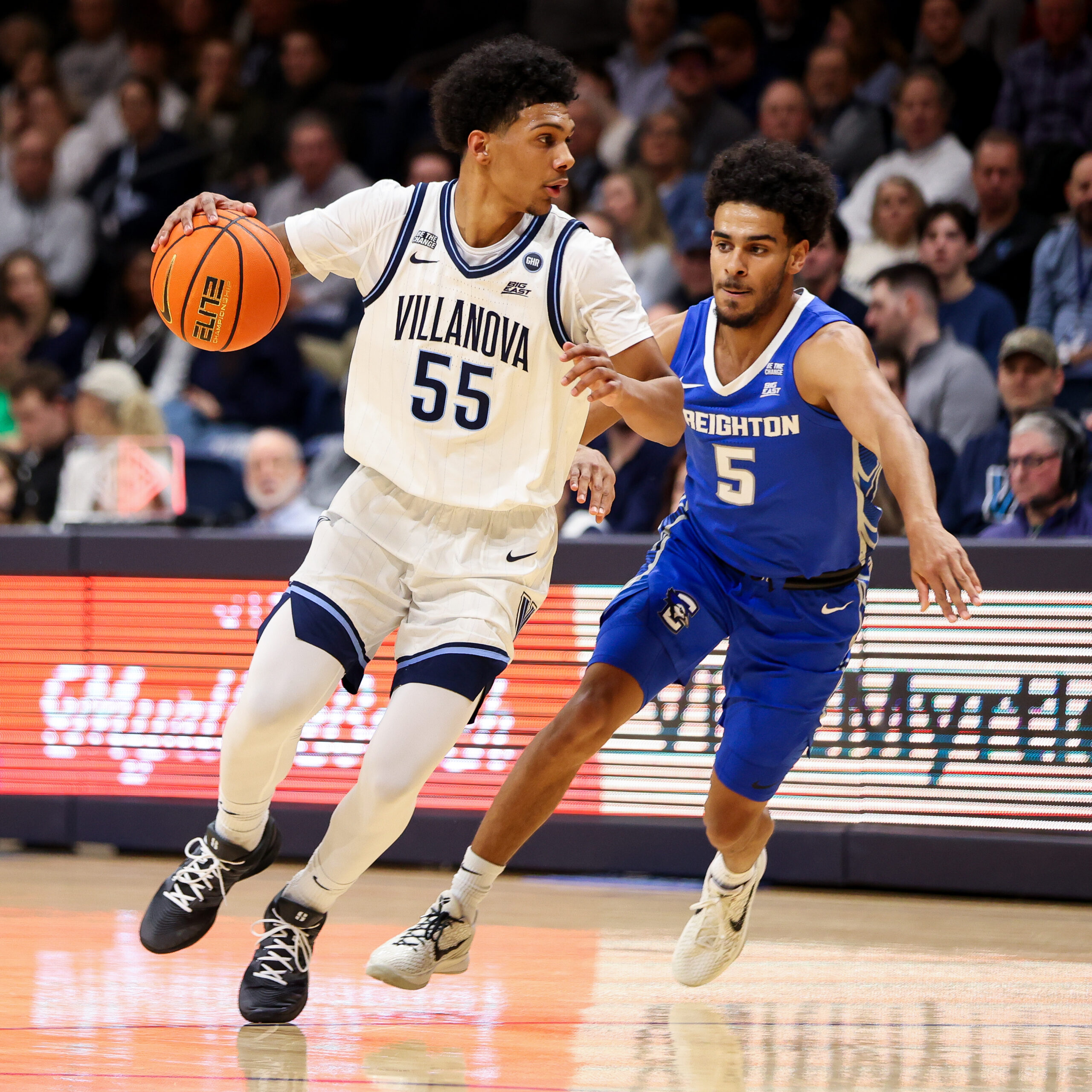
    Acaden Lewis dribbles with his right hand as Creighton’s Nik Graves pursues him on Jan. 7.

    Those, and Lewis’ ballhandling skills, were developed during early-morning training sessions that started when Lewis was a freshman in high school. While Lewis is right-handed, he spent his youth mostly using his left on the court. His trainer, Kevin “Uncle Skoob” Kuteyi, would pick Lewis up full-court during 6 a.m. workouts and force the teen to beat the pressure, often dribbling to his right, and finish at the rim, again mostly with his right hand.

    It came naturally, thanks to Lewis’ right hand being his dominant hand.

    “Everything about me in basketball is left-handed, I would say,” Lewis said. “But I’m right-handed, so I’m ambidextrous, basically. It’s weird.”

    Weird, even ambiguous.

    Does Lewis consider himself right-handed, left-handed, or ambidextrous?

    “I’m a right-handed person who is left-handed when I hoop,” he said. “That’s how I would put it.”

  • The NBA journey of former Villanova star Collin Gillespie seems unlikely to everyone — except him

    The NBA journey of former Villanova star Collin Gillespie seems unlikely to everyone — except him

    Jay Wright saw enough of Collin Gillespie a few nights before to invite him to Villanova on a Monday in January 2017 and offer him a scholarship. But this was hardly a courtship. Wright told Gillespie that he would redshirt his freshman season, maybe play as a junior, and then have a complementary role as a fifth-year senior.

    “I thought he would get his master’s degree and be a great coach one day,” Wright said. “I was thinking ‘I would love to have this guy on my staff.’”

    Gillespie — who has molded himself into an NBA starter with the Phoenix Suns after going undrafted in 2022 — nodded along. He didn’t have a Division I scholarship before his senior year at Archbishop Wood and declined to visit Division II schools because he believed bigger programs would eventually see what he already knew: He could play. Redshirt? OK. Bench player? Sure. Coach? Yes, sir.

    “I didn’t really believe him,” said Gillespie, who will play against the 76ers on Tuesday night. “I believed in myself. I was just like, ‘Whatever he says, I’ll take it and then prove him wrong.’”

    There was Gillespie 15 months later on the court for Wright in the national championship game, taking a charge against Michigan and looking the part. In his fifth year, the kid who had to wait for college scholarships was named the nation’s top point guard in 2022. He went undrafted that June but landed a non-guaranteed contract in July with the Denver Nuggets. He was on track.

    Three weeks later, Gillespie suffered a broken right leg while playing in a pickup game at Villanova.

    His NBA career — the one that is now flourishing — seemed unlikely then to nearly everyone except the guy who nodded along that day in Wright’s office.

    “Everyone has their own journey,” Gillespie, 26, said. “Everyone runs their own race. You just have to stick to what you do, put your head down, and work hard. Don’t compare yourself to anyone else. If you work hard enough, you can probably achieve anything you want to.”

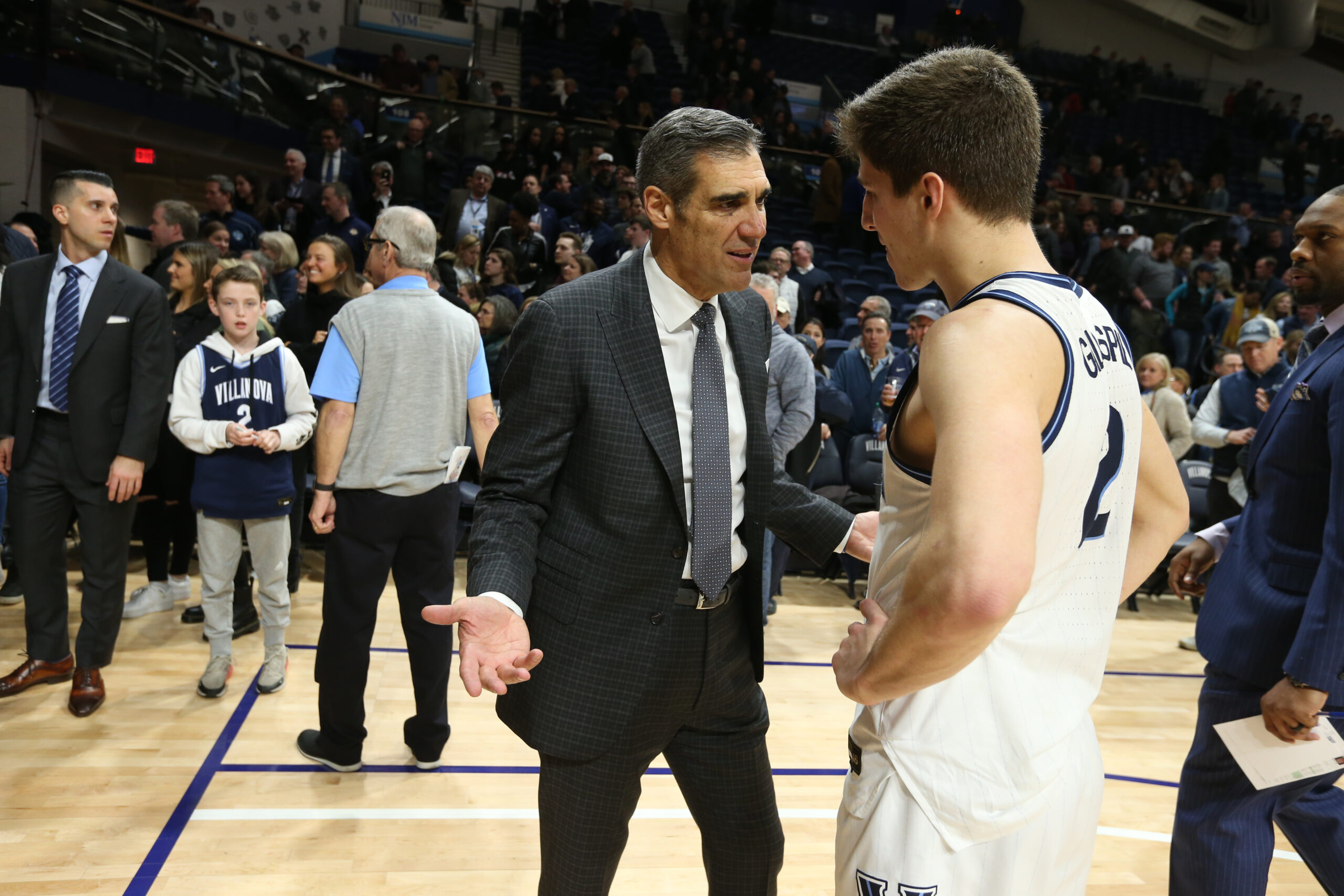
    Collin Gillespie (right) became much more than a fifth-year senior role player first envisioned by Villanova coach Jay Wright.

    G League to the league

    Andre Miller often learned via text messages which players would be flying nearly three hours from Denver to join his G League team that night. He coached the Grand Rapids Gold, the Nuggets’ minor-league affiliate in Michigan that played 1,100 miles from Denver. Those morning flights gave Gillespie a chance to get on the court.

    “It wasn’t a good recipe for these guys to be successful, but when he did show up, he didn’t want to come out of the game,” said Miller, who played three of his 17 NBA seasons with the Sixers. “We knew we had to leave him out there because he didn’t have an opportunity with the other team and he took great advantage of it.”

    Gillespie feared that the Nuggets would void his contract after he suffered that injury playing at Villanova. That’s the first thing he said to his father, who was in the gym when it happened. But they didn’t. They kept him around that first season while he rehabbed and then split his time the next season between Denver and Grand Rapids.

    “There was no ego,” Miller said. “One thing that’s tough to deal with is when your career is in the hands of other people. Some people felt like he wasn’t an NBA player and some people felt like he was an NBA player. The one thing that stood out about him to me is that he’s a competitor. He’s a dog. He’s a guy who enjoys playing basketball. He’s a leader. He plays with a chip on his shoulder.

    “I wish I could have coached him more in the G League, but he was an NBA player. I knew that from the first time I saw him on the court with the G League players. I was like, ‘He probably won’t be here much.’”

    Gillespie signed before last season with the Suns, again splitting time between the NBA and the G League. The 6-foot-1 guard earned a full-time role this season, starting for the Suns and fitting in with pesky defense and a three-point shot. Just like college, it took time before Gillespie’s game was appreciated.

    “You just don’t see it initially. He doesn’t wow you,” Wright said. “But when you see him play over time and you realize this guy is getting to the rim and finishing, he’s elevating on his jumper and shooting over bigger guys, and he’s not getting backed down. You almost need to have time to believe what you’re watching.”

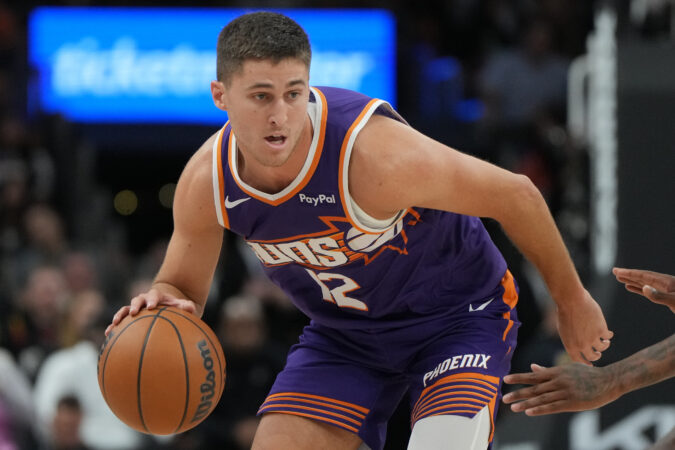
    Collin Gillespie is shooting 41.4% from three-point range for the Suns.

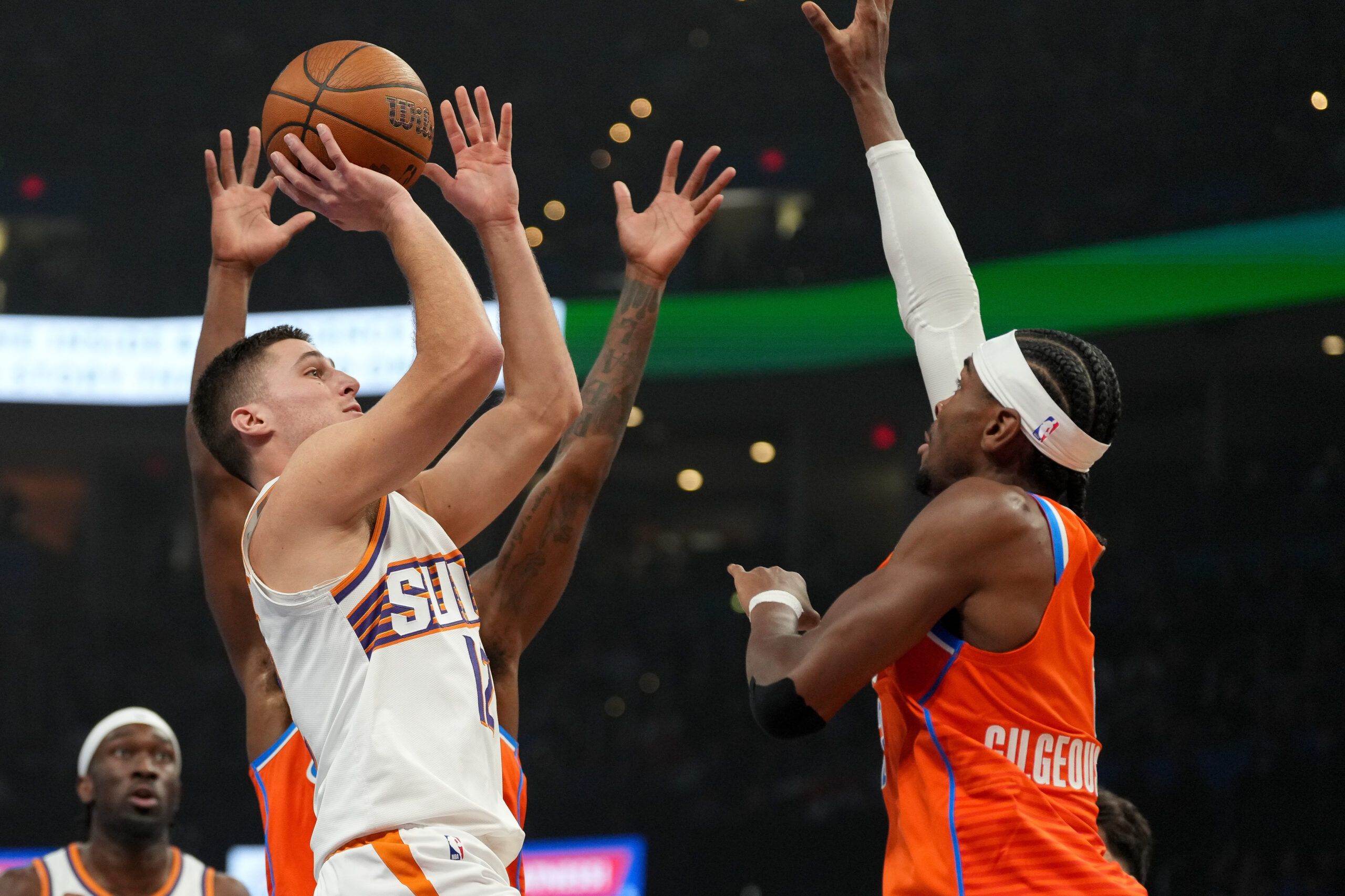
    Gillespie entered Monday’s game against Brooklyn averaging 13.2 points, 4.9 assists, and shooting 41.4% from three-point range. He hit a game-winner at the buzzer in November, regularly finds ways to create his own shot, and has proved that his game fits in the NBA.

    Kevin Durant called him “a dog” and Anthony Edwards said after a loss to the Suns last season that “No. 12 is pretty good at basketball.” Two NBA superstars could see what Gillespie always believed: He belongs.

    “He has more heart than talent,” said his father, Jim. “The kid just doesn’t want to lose. When he sets his mind to something, he just does it. And ultimately, he’s a winner. Wherever he’s gone, he’s won. At every level.”

    Jay Wright says Collin Gillespie came to Villanova with a “killer mentality and stone face that we try to teach.”

    Change of plans

    Gillespie was in the stands for a Villanova game as a senior in high school, seated behind the La Salle bench at the Palestra. The Explorers invited him and Gillespie thought a scholarship offer was near.

    “But they never offered,” Jim Gillespie said.

    Gillespie eventually landed smaller Division I offers as a senior, but he was hopeful a Big 5 school would have a spot for him. None of them did until January when Villanova assistant Ashley Howard urged Wright to watch Gillespie play a game against five-star recruit Quade Green’s Neumann Goretti squad at Archbishop Ryan.

    The Northeast Philly gym was packed and the coach couldn’t stay long as he was being hounded. Howard called Wright while he was driving home and told the coach that one kid scored 42 and the other kid scored 31. Wright figured the 42 points belonged to Green, who was already committed to Kentucky. It was Gillespie, the assistant said. Wright was sold.

    “Nothing was spectacular, and he’s not bringing any attention to himself,” Wright said. “He just makes the right plays.”

    Wright called Gillespie’s father and told him he needed his son at Villanova on Monday. The coach gave Gillespie his pitch that day without any guarantees.

    “We left and we were like, ‘What are you going to do?’” his mother, Therese, said. “He said, ‘I’m going to play out my senior [year].’ I said, ‘Collin, it’s Jay Wright.’ He said, ‘Mom, I know what I’m doing.’”

    Gillespie committed a week later, simply deciding after a game at Bonner-Prendergast that he had enough of the recruiting trail. He was headed to ’Nova and told a Wood coach without first running it by his parents. Gillespie knew what he was doing.

    “He always said, ‘I’ll bet on myself,’” Jim Gillespie said. “He put the work in and the effort in and that’s what he’s always done.”

    It took Gillespie just a few weeks to force Wright to rethink the plan that he would redshirt. Every day in practice that June he went up against Jalen Brunson and held his own.

    Collin Gillespie (left) got to play in practice against future NBA players Donte DiVincenzo (center) and Jalen Brunson (right) at Villanova.

    “He came in with that killer mentality and stone face that we try to teach,” Wright said. “But he came in with that. Then he spent every day with Jalen Brunson and it just became reinforced. It was so obvious. The coaching staff, behind closed doors, was going, ‘This kid is going against Brunson every day. He’s pretty good.’”

    Gillespie suffered a minor injury that month and Wright checked with athletic trainer Jeff Pierce to see how the freshman was feeling. He was fine, the trainer said.

    “The trainer said, ‘You’re not redshirting this kid,’” Wright said. “I said, ‘Is it that obvious?’ He said ‘Yeah, everyone knows.’ Yeah, it was.”

    The guy who nodded along in Wright’s office proved that he belonged. Now, he’s doing it again in the NBA.

    “It’s the way I was raised and where I come from,” said Gillespie, who grew up in Pine Valley before moving to Huntington Valley. “My brother is a year older, so I always played a year up. I had to play against older guys and was always smaller. I always had to prove myself and had a chip on my shoulder. My parents always believed in me and my family always believed in me and taught me to believe in myself.”

  • Jasmine Bascoe scores 22 as Villanova beats Butler

    Jasmine Bascoe scores 22 as Villanova beats Butler

    For sophomore guard Jasmine Bascoe, Villanova is “right where we want to be” after a 73-65 victory over Butler on Sunday at the Finneran Pavilion.

    Bascoe led the way with 22 points and added two rebounds and six assists as Villanova (15-4, 8-2 Big East) maintained its hold on second place in the conference.

    The Wildcats trailed by 33-31 at the half but used a productive third quarter to seal another Big East win. In their last outing, they were thumped, 99-50, at No. 1 UConn on Thursday.

    “We want to be trailing UConn in the Big East,” Bascoe said. “That’s a great spot for us going into the second half of the league [schedule], and then hopefully the Big East Tournament. … So it’s just continuing to push through.”

    Turning it around

    Heading into the game, Villanova coach Denise Dillon urged the team to come out stronger after halftime.

    Butler (8-11, 2-7) went on a 7-0 run in the final 1 minute, 13 seconds of the second quarter. The Bulldogs kept the game close in the first half with efficient shooting, going 60.9% from the field. Meanwhile, Villanova shot just 34.4% from the field and 16.7% from the three-point range in the half.

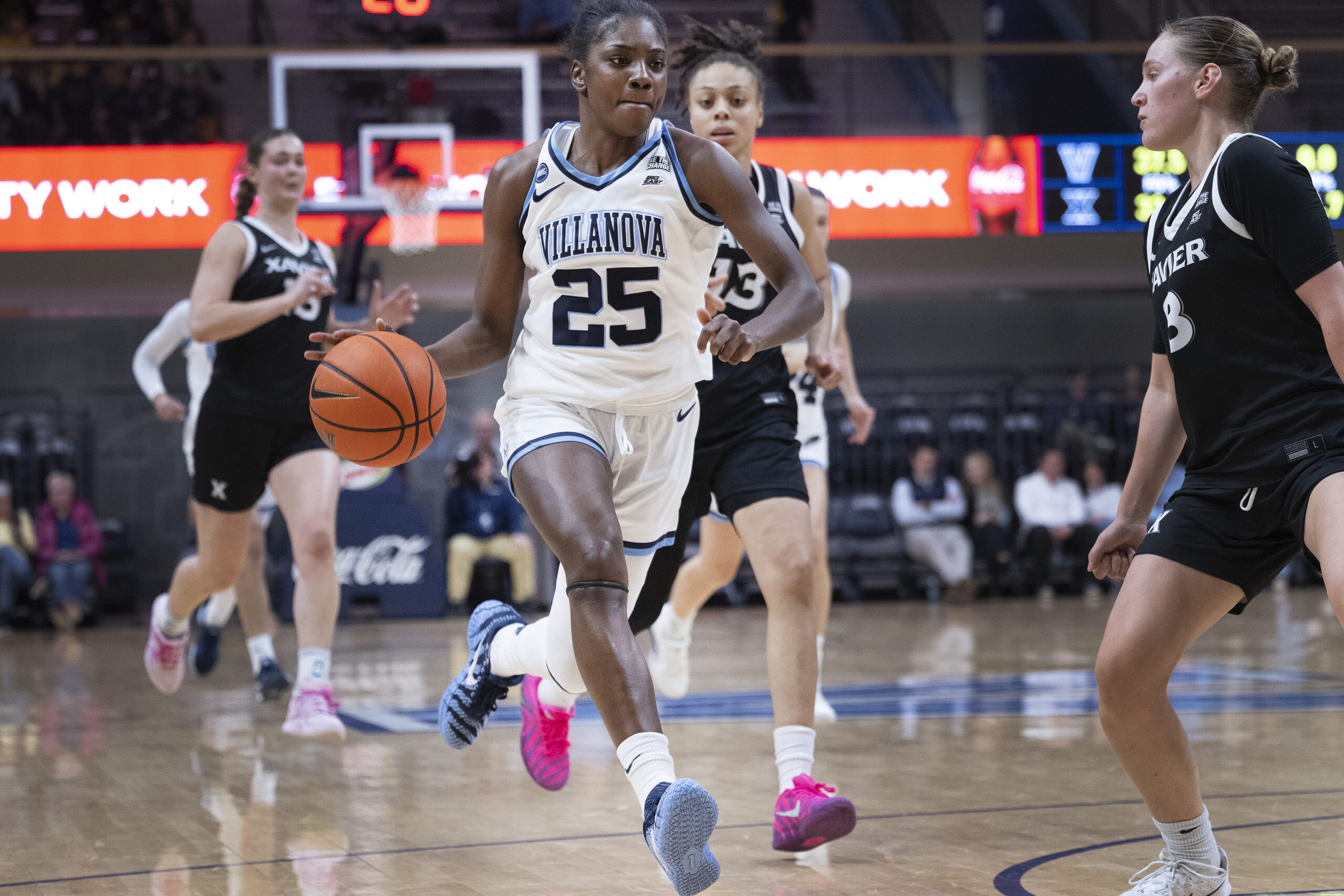
    Villanova’s Denae Carter in action against Xavier on Jan. 8.

    “[At halftime,] we just acknowledged that we weren’t playing like ourselves in the first half,” Bascoe said. “And to finish off the game right, we had to come out hard in the third quarter. So, you know, we drew up some plays, we intensified our defense, and then it kind of slowed down from there and we didn’t have to force any shots.”

    Carter has her moment

    Villanova opened the third quarter with a 7-0 run of its own. Bascoe sank a three-pointer and layup off a Butler turnover. Then, sophomore forward Dani Ceseretti assisted on a layup by junior forward Brynn McCurry.

    The Wildcats outscored the Bulldogs, 24-15, in the third quarter and led for the rest of the game.

    Graduate forward Denae Carter accounted for 11 of those points, shooting 5-for-7 from the field. She added six points in a scoring burst within the last 1:31 of the quarter.

    “This is [Carter’s] final run, and when she realizes it, it just fuels her,” Dillon said. “There’s nothing better for this group. You can even see it in the huddle, when all of a sudden she’s like, ‘I’m ready to go.’ … Denae is one of our top defenders, and when she’s disruptive, good things happen for us.”

    With less than four minutes left to play, Carter had to leave the court after she was struck in the face and Butler was charged with a flagrant foul. She finished the game with 15 points and four rebounds.

    Next up

    Villanova visits St. John’s (15-5, 5-4) on Saturday (2 p.m., FS1).

  • Villanova hits a ‘bump in the road’ after struggling with the physicality and experience of St. John’s

    Villanova hits a ‘bump in the road’ after struggling with the physicality and experience of St. John’s

    Six minutes was all it took for the things that had to have worried Kevin Willard ahead of Villanova’s Saturday night showdown with St. John’s to make the difference.

    Villanova’s deficit at halftime was just one point, but by the time St. John’s converted the fifth Villanova turnover of the second half into a layup, the deficit was 56-39 with 14 minutes to go in an eventual 86-79 St. John’s victory.

    Some inherent disadvantages were working against Villanova at Xfinity Mobile Arena. Chief among them were the size, strength, and experience that St. John’s possesses, and the way its defensive pressure can be unrelenting. Three of Villanova’s top five scorers — Acaden Lewis, Bryce Lindsay, and Matt Hodge — are in their first or second season playing college basketball. The Red Storm, meanwhile, starts four seniors to Villanova’s one. All of that showed during a 20-4 run.

    St. John’s had 12 offensive rebounds to Villanova’s seven. Four of the 12 came during that fateful six-minute stretch. Each team had eight turnovers by halftime, but Villanova finished with 14, five during the opening six minutes of the second half, and St. John’s had just one over the final 20 minutes. The Red Storm converted those Villanova turnovers into 17 points. St. John’s had 42 paint points to Villanova’s 22.

    The youthful Wildcats eventually got back in the game and trailed by five with 6 minutes, 36 seconds left and again inside of a minute to play. But St. John’s was too big, too strong, and too experienced for Villanova to get over the hump, no matter how hard junior Tyler Perkins and senior Devin Askew — who scored 23 and 21 points, respectively — tried.

    Villanova’s lone senior starter, center Duke Brennan, a transfer from Grand Canyon, was no match for his experienced Big East counterparts. Zuby Ejiofor had 17 points and seven rebounds. Bryce Hopkins had 20 and six. Brennan was minus-14 on the night. Lewis finished with a season-low three points and a season-high six turnovers and was on the bench for the final 11 minutes.

    Lewis, who was also minus-14, looked like a freshman, which has only happened a few times this season. Hodge normally scores 10.6 points per game but was held to four. Lindsay entered Saturday scoring 15.2 points per game and scored 11, all in the second half.

    “Acaden, Bryce, Matt — freshman, freshman, sophomore — against grown men,” Willard said. “That’s why Devin and Tyler played well, because they’re grown men. They’re physical, able to play against a St. John’s where I think Acaden, Bryce, and Matt are all trying to figure out, ‘How do I play when I play against a physically dominant team?’ We’ve struggled against physically dominant teams for that reason.”

    Saturday night offered Villanova (14-4, 5-2 Big East) a chance for its first real signature win. Instead, it showed, for now, where the Wildcats are. They have beaten teams projected to make the NCAA Tournament like Wisconsin and Seton Hall, but they have been knocked off by the three big dogs on the schedule so far: BYU, Michigan, and now St. John’s. Villanova is where it is — ranked 25th in the NCAA’s NET rankings and 27th at KenPom as of Saturday — in large part because it has beaten the teams it’s supposed to beat.

    Villanova entered Saturday as the 21st team in ESPN bracket guru Joe Lunardi’s projected NCAA Tournament field. The best of all the No. 6 seeds. St. John’s, meanwhile, was 26th. Saturday should at least cause a flip-flop.

    “You’ve got to sit back as a coach every once in a while and realize there is a process to this,” Willard said. “Sometimes you’ve got to play bad and go back and watch film and kind of … we did some things in the second half late, defensively, that made no sense.”

    It is not a talent thing, Askew said. Villanova has the players, but it needs to play in games like Saturday’s to get better.

    “It’s an experience thing,” said Askew, a sixth-year senior who is averaging 18 points off the bench in his last three. “As they play more games in atmospheres like that, they’ll get better. … They just have to get used to it and they will.”

    Villanova coach Kevin Willard believes his team is still learning to deal with physical opponents.

    The good part for Villanova is that very few teams in the Big East are built to hurt Villanova the way St. John’s can.

    The Wildcats are back at the Finneran Pavilion on Wednesday night against Georgetown, which is 1-6 in the Big East. After that is another big test — a road game at No. 3 UConn next Saturday afternoon that will give Villanova a chance to quickly show what it learned from its step up in competition.

    “It’s a little bit of a learning process,” Willard said. “This group, they have a great attitude, they work hard. We’re going to have some bumps in the road. It’s a part of conference play.

    “We’re not at the level where we’re going to pitch a shutout. We can’t give up 50 points in the second half. We can’t give up nine offensive rebounds in the second half. We can’t come out and turn the ball over three times. That’s all part of the learning curve a little bit.”

  • Top-ranked UConn routed Villanova, but there were still plenty of lessons to learn

    Top-ranked UConn routed Villanova, but there were still plenty of lessons to learn

    No. 1 UConn continued to storm through the Big East — and women’s college basketball in general — with a 99-50 rout of Villanova on Thursday night in Storrs, Conn.

    UConn brought the intensity on defense that has helped the defending national champions hold opponents to 51.7 points per game and maintain a 38.7 scoring margin. The Huskies (18-0, 9-0 Big East) took control early and repeatedly stifled Villanova possessions.

    UConn limited Villanova to more than 20 points below its per-game average of 73.8 points and just 27.7% shooting from the field, including 25% from three.

    Villanova (14-4, 7-2 Big East) remains in second in the conference. Freshman guard Kennedy Henry led the Wildcats in scoring with 12 points and four rebounds.

    Here’s what we learned from Villanova’s showdown with the nation’s top team:

    UConn defense looks unbreakable

    The Huskies were spearheaded by sophomore forward Sarah Strong, who recorded 24 points, nine rebounds, and five blocks.

    The versatile Strong proved difficult to stop from the beginning and scored 15 of her points in the first half. Junior guard KK Arnold (13 points) facilitated UConn’s offense with a team-high seven assists.

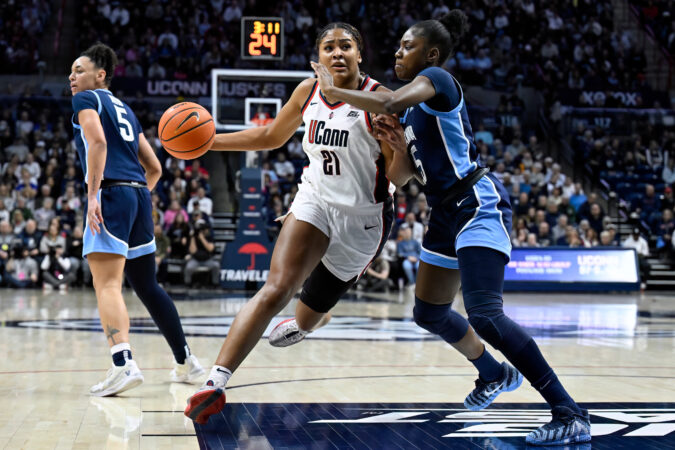
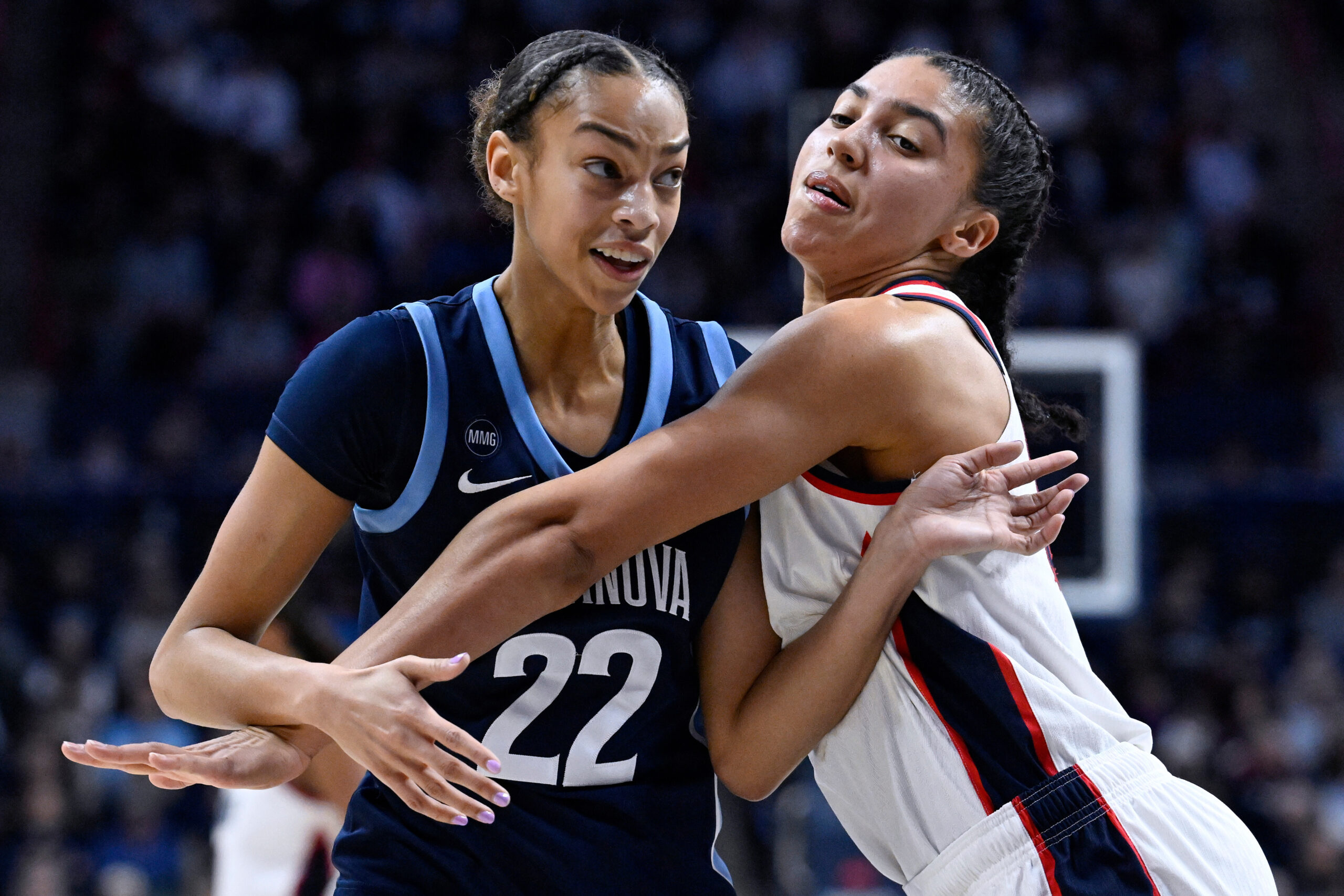
    Villanova guard Kennedy Henry (22), who’s being guarded by UConn star Azzi Fudd, was the team’s leading scorer on Thursday.

    Villanova made just three baskets in the first quarter, as UConn raced out to a 26-8 lead. The Huskies defense didn’t let up, forcing 26 turnovers, which they parlayed into 36 points.

    UConn also benefited from a significant size advantage and won the rebound battle, 46-34. That advantage also paid off in the paint, where the Huskies scored 58 of their 99 points.

    Henry, McCurry lead the way

    UConn swarmed sophomore guard Jasmine Bascoe, who’s Villanova’s scoring leader this season and the third-leading scorer in the Big East. Instead, Henry and junior forward Brynn McCurry (11 points, five rebounds, and three blocks) led the Wildcats in scoring.

    The Huskies forced the Wildcats outside and allowed just one made basket in the paint in the first half and 12 points in the paint overall.

    Instead, Villanova found looks from beyond the arc to create offensive momentum late in the second quarter. The Wildcats put together a 10-0 run over 1 minute, 26 seconds that was sparked by a three-pointer by senior guard Ryanne Allen to close the deficit to 38-23 with 2:58 left in the first half.

    But that was the closest that Villanova would get. Bascoe was fouled with three seconds until halftime and left the court after making both foul shots. She played just five minutes in the second half and finished with eight points.

    Villanova struggled to get around UConn’s press and shot just 2-for-16 from the field in the fourth quarter. By the final three minutes, UConn held a 40-point lead.

    Up next

    Villanova has a few days to recover from its battle at UConn, next hosting Butler on Sunday (2 p.m., ESPN+) at Finneran Pavilion. The Bulldogs (8-10, 2-6 Big East) are 10th in the 12-team conference.

  • Temple, Villanova, and Penn State are among local schools beginning to pay athletes. Here’s how it’s going so far.

    Temple, Villanova, and Penn State are among local schools beginning to pay athletes. Here’s how it’s going so far.

    At local colleges with major sports programs, some student athletes are now getting paychecks — from their athletic departments.

    Pennsylvania State University, Temple, Villanova, St. Joseph’s, Drexel, and La Salle are among the Pennsylvania schools that have begun to directly pay athletes following a settlement last year in federal class-action lawsuits over student athlete compensation.

    The move arguably ends college athletes’ status as amateurs and begins to address long-standing concerns that players haven’t fairly profited from the lucrative business of some college sports.

    It also raises questions about how schools will fund the athletes’ pay and whether equity complaints will arise if all athletes are not comparably awarded. Some also question how it will impact sports that are not big revenue makers.

    Locally, most colleges have been mum on how much they are paying athletes, and some have also declined to say which teams’ athletes are getting money through revenue sharing, citing competitive and student privacy concerns. Villanova, a basketball powerhouse that has 623 athletes across 24 sports, said it will provide money primarily to its men’s and women’s basketball teams.

    Erica Roedl, Villanova’s vice president and athletic director, speaks during a news conference at the school’s Finneran Pavilion in 2024.

    “Our objective is to share revenue at levels which will keep our basketball rosters funded among the top schools in the Big East [Conference] and nationally,” Eric Roedl, Villanova’s vice president and director of athletics, said in a June message after the court settlement.

    St. Joe’s, another basketball standout, said its arrangement is also with men’s and women’s basketball athletes, like its peers in the Atlantic 10 Conference.

    Temple University established Competitive Excellence Funds that allow all of its 19 teams to raise money for revenue sharing, but declined to say which teams are currently distributing money to athletes.

    “Donors could, if they wanted to, make sure their money went to a certain sport,” said Arthur Johnson, Temple’s vice president and director of athletics. “They have that ability.”

    Other local colleges, including St. Joseph’s and Villanova, also launched funds to help raise money for revenue sharing. And all three schools also plan to use athletic revenue.

    Under the revenue-sharing framework established by the court settlement, each college can pay its athletes up to a total of $20.5 million this academic year. Football powerhouse Penn State, which has about 800 athletes, has said it intends to reach the cap, according to a June 7 statement from athletic director Pat Kraft.

    “This is a rapidly evolving environment that we are monitoring closely to ensure our approach remains consistent with applicable rules, while supporting the well-being and academic success of our student-athletes,” said Leah Beasley, Penn State’s deputy athletic director for strategic engagement and brand advancement.

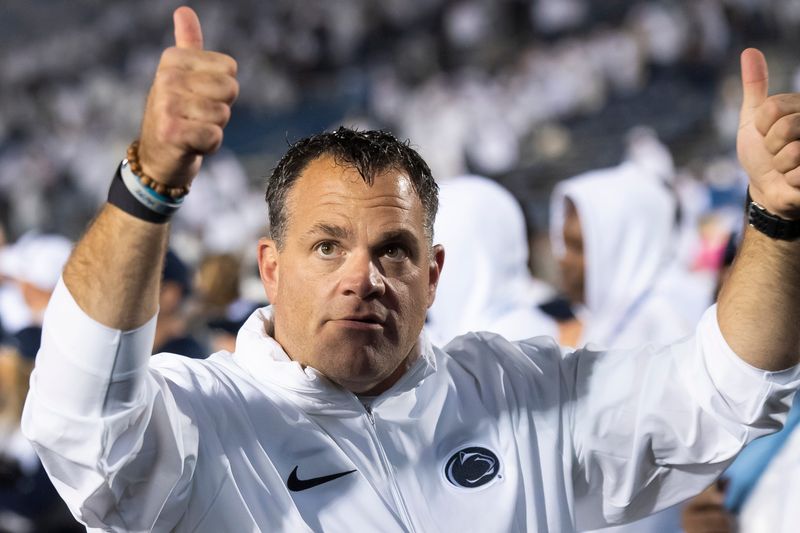
    Penn State athletic director Pat Kraft gives two thumbs up to the student section following a 31-0 win in a football game against Iowa in 2023.

    ‘It’s a job’

    To athletes, revenue sharing seems only fair, given many are so busy practicing and playing through summers and other breaks that they don’t have time to work.

    “It is a job at the end of the day,” said former Villanova University basketball player Eric Dixon, who holds the Wildcats’ record as all-time leading scorer. “You put a lot of time into it every single day, every single week.”

    Players get hurt and can see their sports careers harmed or halted, said Dixon, who grew up in Abington and played at Villanova from 2020 to 2025. College may be their only time to earn money for their sports prowess.

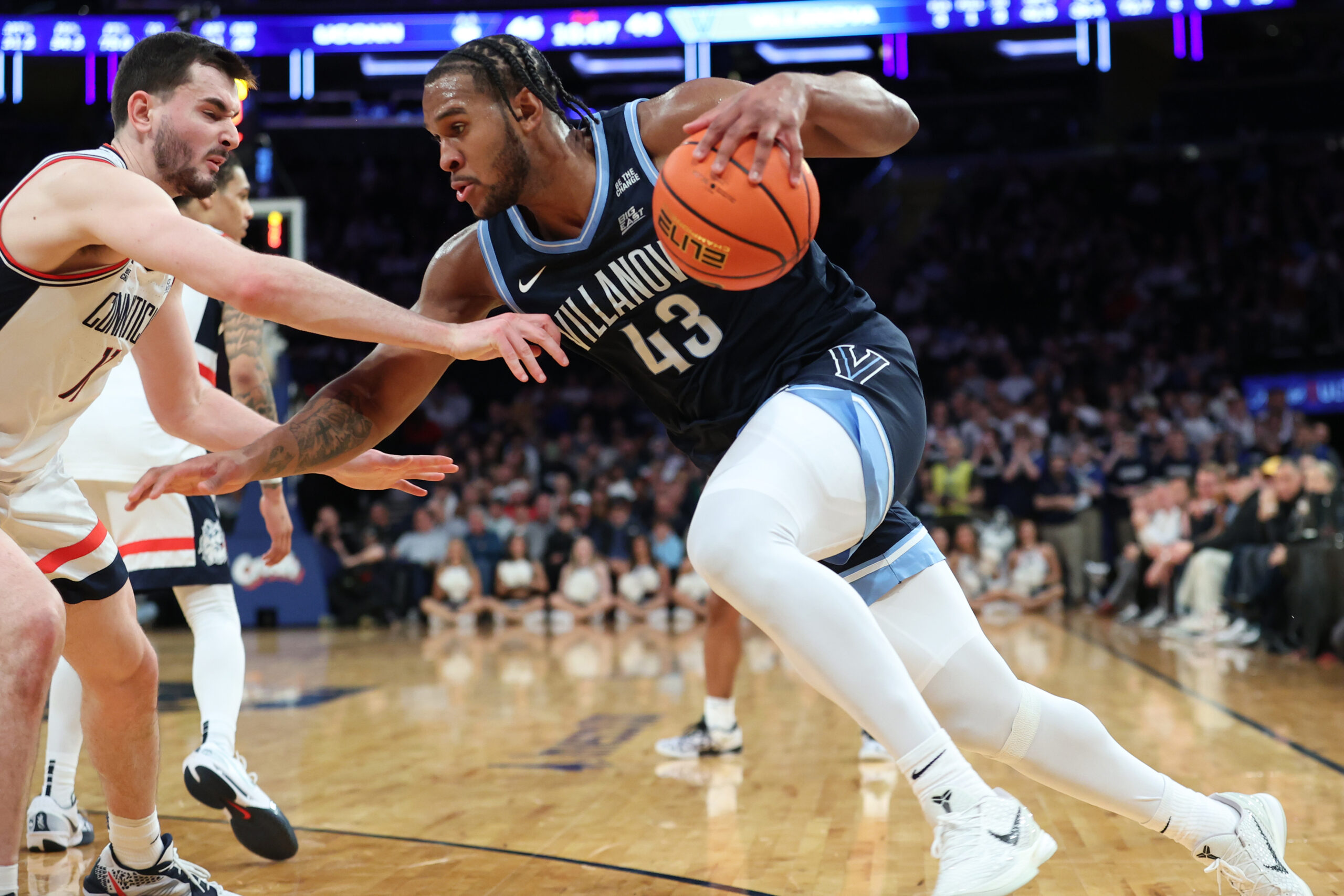
    Villanova’s Eric Dixon drives against Alex Karaban of UConn during the 2025 Big East Tournament at Madison Square Garden in New York.

    Dixon didn’t benefit from revenue sharing. But he got money through external name, image, and likeness (NIL) endorsements and sponsorships that the NCAA began allowing in 2021. Dixon declined to specify how much he received, but said it was “seven figures” over four years and allowed him to help his family.

    Like some other schools, Villanova, he said, provided players with financial guidance so they could make wise decisions on how to use their money.

    External NIL arrangements, though, he said, were a little “like the Wild West.” (NIL compensation is allowed to continue under the lawsuit settlement, but deals of more than $600 have to be reported.) Revenue sharing from colleges will offer athletes more predictable income, said Dixon, who now plays for the Charlotte Hornets’ affiliated team in the G League.

    Tyler Perkins, a Villanova junior from Virginia, currently plays for the Wildcats, who won national championships in 1985, 2016, and 2018. While he declined to say how much he is receiving, he said revenue sharing is helping him prepare for his future and “set up for the rest of my life.”

    Maddy Siegrist, also a former Villanova basketball player who now plays for the Dallas Wings in the WNBA, is pleased universities are able to share revenue directly with athletes.

    “It will be interesting to see how it all plays out,” said Siegrist, the Big East’s all-time leading scorer in women’s basketball and Villanova’s overall highest scorer, of men’s and women’s basketball.

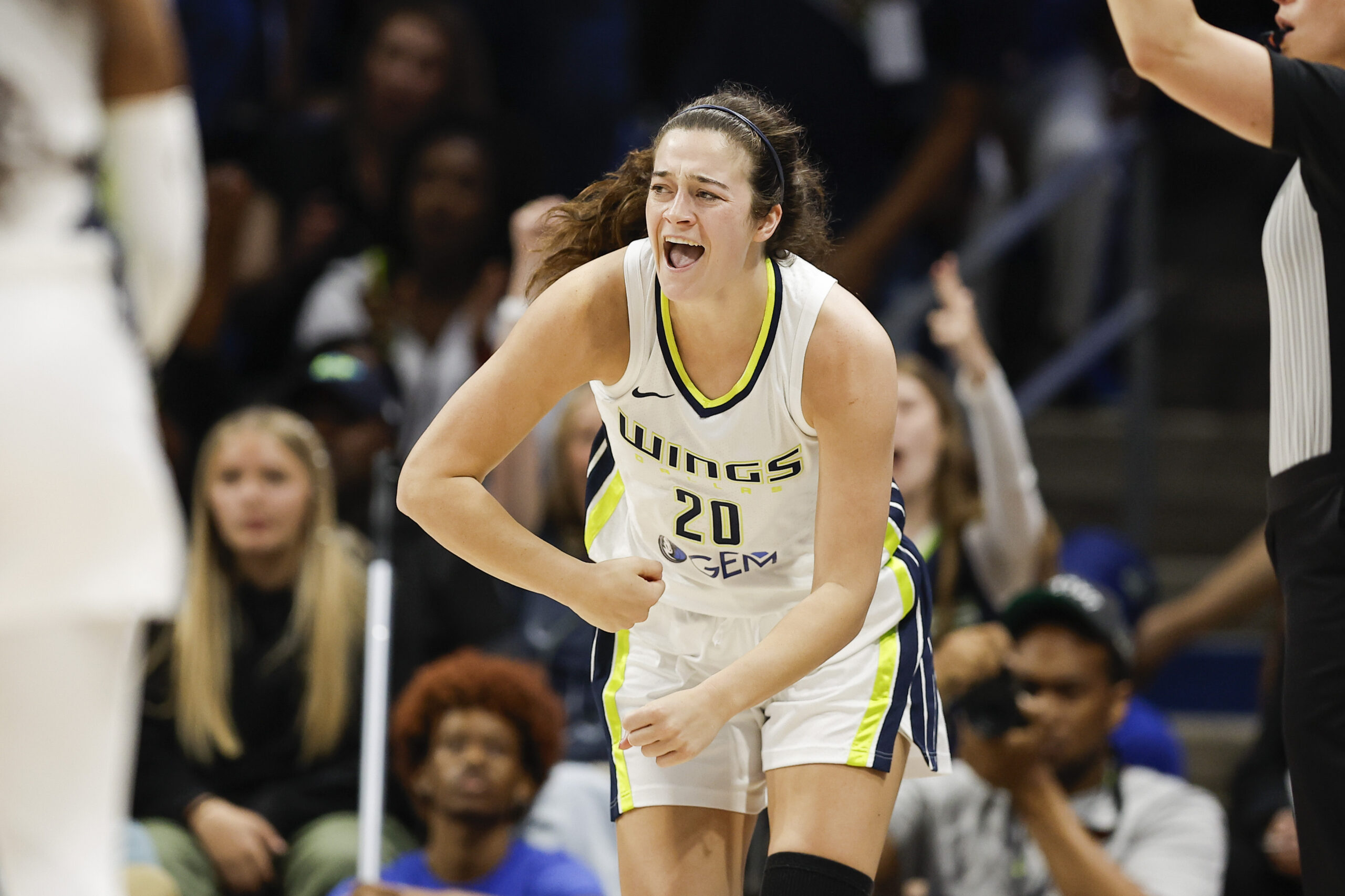
    Dallas Wings forward Maddy Siegrist celebrates a three-point shot during a WNBA basketball game against the Chicago Sky in 2024 in Arlington, Texas.

    While the big revenue sports are likely to see the money first, she said, “I would hope there will be a trickle-down effect where almost every sport is able to benefit.“

    A lawsuit spurs changes

    For years, there have been growing concerns that athletes were not getting their fair share of the profits from college sports, which make money on broadcast rights, ticket sales, and sponsorships. Meanwhile, coaches can be among the highest paid in a university’s budget.

    In 2020, former Arizona State swimmer Grant House became the lead plaintiff in House vs. NCAA, a class-action antitrust lawsuit that argued athletes should be able to profit from the use of their name, likeness, and image and schools should not be barred from paying them directly.

    The settlement approved in June of that suit and two others against the NCAA requires the NCAA and its major conferences to pay $2.8 billion in damages to current and former Division 1 athletes. Another provision gave rise to the revenue sharing.

    It initially applied to the major sports conferences: the Big Ten, Atlantic Coast Conference, Southeastern Conference, and the Big 12. Penn State belongs to the Big Ten and the University of Pittsburgh to the Atlantic Coast.

    But other athletic conferences, along with many of their members, decided to opt in to the agreement to remain competitive in select sports. St. Joseph’s, La Salle, Villanova, Drexel, and Temple all are part of conferences participating in revenue sharing with athletes this year.

    “We support student-athletes’ ability to pursue value among their peers and to leverage commercial opportunities that may benefit them or the institution,” said Maisha Kelly, Drexel’s vice president and director of athletics and recreation.

    Temple belongs to the American Athletic Conference, which said its members must agree to pay at least $10 million over three years to its athletes. Johnson, Temple’s athletic director, noted that total also includes new scholarships, not just pay.

    No tuition, state dollars to be used

    Pitt alumnus J. Byron Fleck has called on the Pennsylvania State Board of Higher Education to advise three state-related colleges — Penn State, Temple, and Pitt — not to use tuition dollars, student fees, or state appropriations to fund athlete payments. He also asked lawmakers to take action.

    “It doesn’t relate to any educational or academic purpose,” said Fleck, a 1976 Pitt alumnus and lawyer in California.

    Fleck said he was especially concerned about how Pitt could afford it. Pitt had a $45 million deficit in its athletics department budget in 2023-24, according to Pittsburgh’s Public Source.

    Karen Weaver, an expert on college athletics, higher education leadership, and public policy, said the same concerns about public funds being used to pay athletes have risen in other states, including Michigan and Washington.

    But Penn State, Temple, and Pitt all said in statements that they would not use tuition, student fees, or state appropriations to fund revenue sharing with athletes.

    “Penn State Intercollegiate Athletics is a self-sustaining unit of the university,” said Beasley, Penn State’s deputy athletic director.

    Pitt said it would use athletic revenues.

    In addition to donations, Temple, too, is using athletic department revenues, such as ticket sales, but it is also looking at other “nontraditional ways” to raise money, Johnson said.

    “We’re turning over every stone,” he said.

    Weaver, an adjunct professor at the University of Pennsylvania, said she worries that as the caps on revenue sharing get higher and costs grow, schools, especially those tight for cash, may start raising recreation and other student fees. The University of Tennessee added a 10% student talent fee for season ticket renewals, according to the Associated Press, while Clemson is charging a $150 per semester student athletic fee, according to ESPN.

    Roedl, the Villanova athletic director, said in a statement that it had launched the Villanova Athletics Strategic Excellence (VASE) Fund to raise money for the payments.

    “Additionally, we are looking for other ways to maximize revenue through ticketing, sponsorships, and events, and identifying cost efficiencies throughout our department,” he said.

    St. Joe’s, which has about 450 student athletes, said that it started a Basketball Excellence Fund to raise revenue and that payments also are funded by the basketball program. Athletes that receive funds “serve as brand ambassadors for the university,” the school said in a statement. “… These efforts have included community engagement — particularly with youth in the community — and marketing initiatives that directly support the Saint Joseph’s University brand.”

    La Salle declined to say how much student athletes receive or in what proportion.

    “We can share that any funds provided to students come from external sources and not tuition dollars,” said Greg Nayor, vice president for enrollment management and marketing.

    Weaver, author of a forthcoming book, Understanding College Athletics: What Campus Leaders Need to Know About College Sports, said plans that call for the bulk of revenue sharing to go to football and basketball players would lead to legal action, charging that female athletes are not being treated equally.

    “Any day now I expect we’ll see a huge Title IX lawsuit,” she said.

  • What’s it like to face one of Geno Auriemma’s UConn teams? Ask Villanova’s Denise Dillon.

    What’s it like to face one of Geno Auriemma’s UConn teams? Ask Villanova’s Denise Dillon.

    Since Denise Dillon’s playing days at Villanova, much has changed in the Big East — and college basketball in general. But one constant has been the presence of Geno Auriemma.

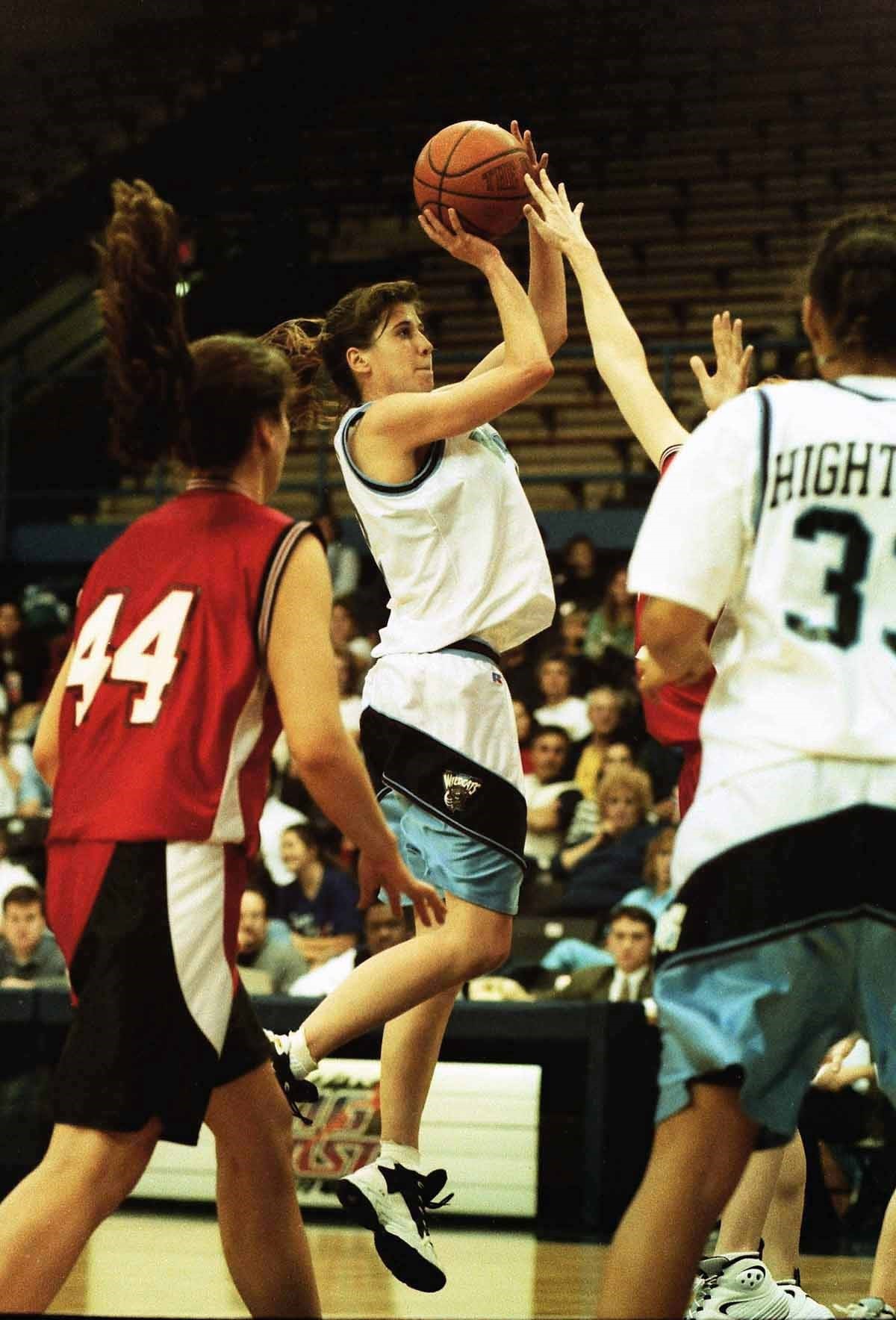
    Auriemma has been the head women’s basketball coach at Connecticut since 1985, so he already was well-established by the time Dillon was playing for Villanova from 1992 to 1996. Dillon has continued to face Auriemma, who grew up in Norristown, since she took over as Villanova’s coach in the 2020-21 season.

    Denise Dillon played for Villanova from 1992-96.

    As the winningest coach in college basketball, Auriemma has been both an opponent and a mentor for Dillon over the years.

    “I have the utmost respect for Geno,” Dillon said. “The wins column speaks for itself, but also just what he’s done for the game. He was a women’s basketball coach before it was popular and has seen how it’s evolved. But he’s always given back to the game, and by giving back to the game, he’s given to coaches.”

    Villanova (14-3, 7-1 Big East) is second in the conference as it enters its biggest test of the season yet. The Wildcats head to Storrs, Conn., on Thursday for their first matchup this season with the Huskies (7 p.m., FS1).

    Big East powerhouse

    UConn has been untouchable this season.

    No. 1 UConn (17-0, 8-0) looms over the Big East, with an average scoring margin of 38.1 points.

    The defending national champions are led by the returning duo of sophomore forward Sarah Strong and graduate guard Azzi Fudd. Strong, the Big East’s leading scorer, averages 18.4 points and 8.1 rebounds.

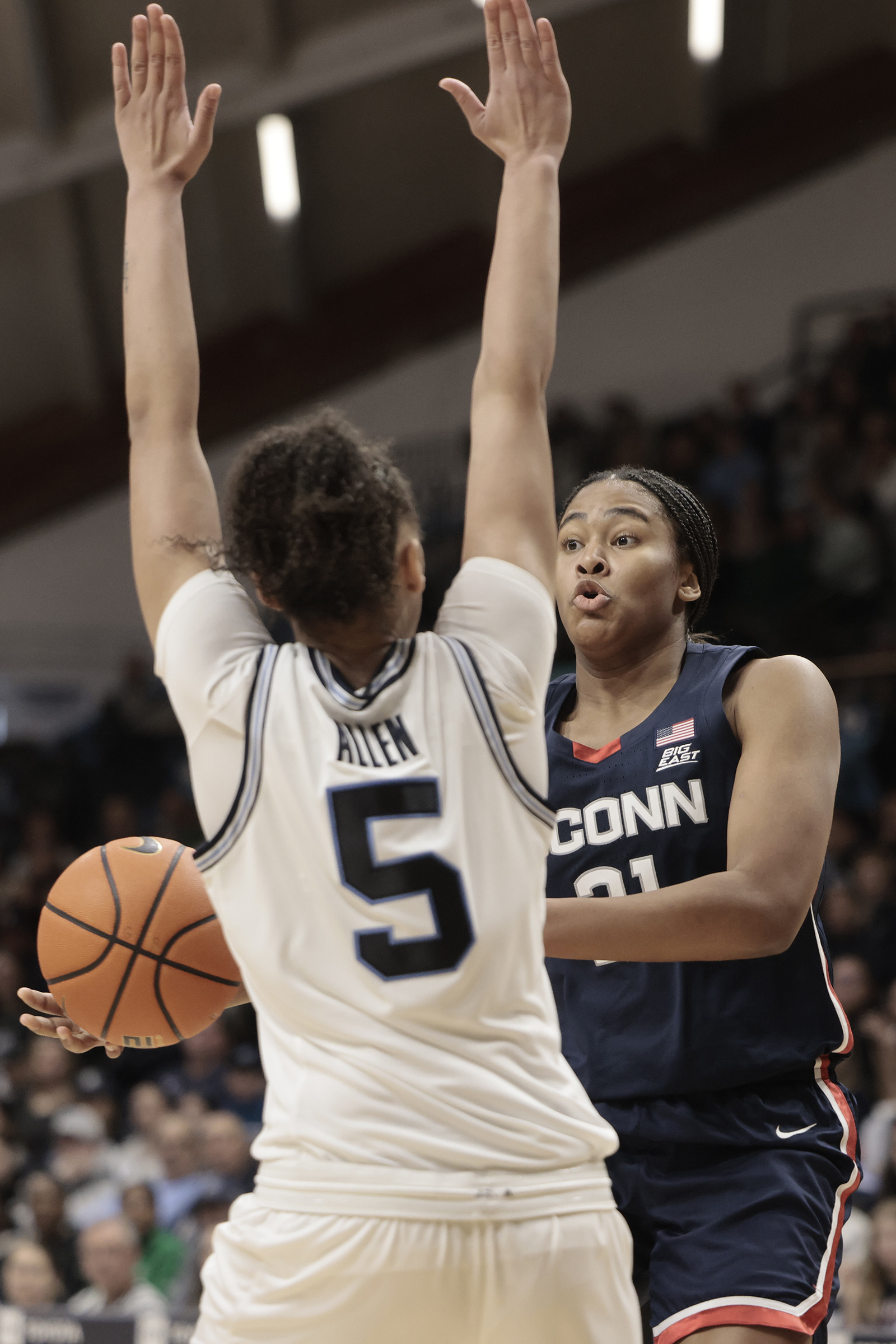
    UConn’s Sarah Strong, here being guarded by Villanova’s Ryanne Allen in a game at Finneran Pavilion last season, currently is the Big East’s leading scorer.

    Auriemma’s characteristic high-pressure defense has overwhelmed opponents this season. The Huskies have limited opponents to just 51.8 points per game.

    The Huskies won soundly in each of last year’s meetings with the Wildcats. Their last regular-season matchup was a 100-57 rout on Jan. 22, 2025, in Storrs. UConn also has knocked Villanova out of the Big East tournament in three of the last four seasons.

    Under Dillon’s leadership, Villanova has posted a 1-9 record against UConn, which has claimed the conference title every year since rejoining the Big East in 2020-21, the season when Dillon took over on the Main Line.

    Embracing ‘opportunity’

    Villanova veterans like graduate forward Denae Carter and sophomore guard Jasmine Bascoe anticipate the intensity of a matchup at a loud UConn home court.

    “Playing [UConn] at any point is a challenge, but seeing them the first time this year on the road will be one that we’re going to rely on some of those who have experienced it, just to prepare the others,” Dillon said.

    When it comes to attacking UConn’s press, Villanova aims to utilize the depth that has led to success in conference play.

    With the additions of junior forward Brynn McCurry, who missed last season with an injury, and graduate forward Kylee Watson, a Notre Dame transfer, the Wildcats have a much different look than the last time they traveled to Storrs.

    “A key point for us has always been having those versatile post players, with Denae Carter, Brynn McCurry, and Kylee Watson, and making sure that they are ready and willing to initiate the offense for us, being there with the press break,” Dillon said.

    From left, Denae Carter, Jasmine Bascoe, and Brynn McCurry will be key players for Villanova in Thursday’s matchup with UConn.

    Since UConn has a grip on the top spot in the conference, stacking wins over other Big East rivals has been crucial for Villanova. A 85-69 loss to Marquette on Jan. 4 provided what Dillon called a “wake-up call” for the team.

    “There were lessons learned out there in Milwaukee against a very good Marquette team,” Dillon said. “It just shows that if you don’t come in mentally ready for the battle of the Big East, you’re going to get taken advantage of.”

    Auriemma and the Huskies continue to uphold top-tier standards for the Big East. In Dillon’s view, Thursday’s trip to Storrs will be a chance for Villanova to compete against the nation’s best and show its program-wide improvement.

    “It does start with that mental prep of where we need to be in order to embrace some of the blows we’re going to take in the game,” Dillon said. “That’s what we want this group to recognize: You have an opportunity to get better together every time you step on the floor. So take it in one possession at a time, as we say with every game, and see where we stand. Fight till the end.”

  • Devin Askew’s bench scoring powers Villanova to an 88-82 win over Providence

    Devin Askew’s bench scoring powers Villanova to an 88-82 win over Providence

    Villanova picked up its fourth consecutive Big East road win Tuesday with an 88-82 victory at Providence.

    Villanova (14-3, 5-1 Big East) was able to outscore Providence (8-9, 1-5), which entered the game averaging 89.1 points. Devin Askew led the Wildcats with 20 points and seven assists off the bench.

    “I thought we did a good job in the first half of slowing them down,” coach Kevin Willard said. “We gave up a lot of twos, but once a game gets up and down, sometimes you’ve got to find ways to score. And I think against them, you’ve got to get up and down a little bit.”

    The Friars were the highest-ranked KenPom offense (36th) Villanova has faced since its 89-61 loss to Michigan on Dec. 9. Providence’s leading scorer Jason Edwards, who is scoring 17.2 points per game, missed Tuesday’s matchup because of a foot injury.

    Three Friars — Jaylin Sellers (24), Jamier Jones (23), and Stefan Vaaks (21 points) — combined for 68 of their 82 points.

    “You’ve got to match [Providence’s] pace,” Willard said. “[Even] on the road, where I don’t like to do that. They just get out and go so well. And they have so many guys that can hurt you that you’ve got to take advantage and go right back down.”

    The Wildcats collected 14 offensive rebounds, with Duke Brennan being responsible for five of them. Brennan totaled 14 points and eight rebounds.

    Villanova shot 32-for-64 from the field, 10-for-28 beyond the arc.

    Villanova guard Tyler Perkins, shown on Nov. 15, scored 15 points on Tuesday night.

    Perkins is rejuvenated

    Tyler Perkins scored 15 points for the Wildcats, shooting 6-for-12 from the field, along with eight rebounds.

    He came up big in key moments, especially in the second half. Perkins scored on a post-up in the paint while Providence was trying to cut into Villanova’s double-digit lead.

    “That was huge because that kind of got us back up [by eight points],” Willard said when asked about Perkins. “I thought [that] was huge at that point.”

    Perkins is averaging 14.4 points and 5.4 rebounds on 48% shooting over the last five conference games.

    Villanova’s bench helps drive offense

    Outside of Askew, Villanova’s bench has been quiet offensively since conference play began. Askew scored eight points during a 10-0 scoring run early in the first half.

    He has come off the bench in all of Villanova’s games this season besides the season opener against Brigham Young.

    During conference play, Askew has developed into a veteran Willard can lean on in difficult moments. Askew is averaging 10.8 points over his last five games.

    Malachi Palmer collected 10 points in the first half to tie his career high, which he set at Maryland last year.

    “My mindset is just come in and play as hard as possible and whatever happens, happens,” Palmer said.

    Being unselfish

    Willard has consistently talked about the unselfishness of his team this season. Acaden Lewis has been the prime example of what Willard has harped on.

    The four-time Big East Freshman of the Week dished out a team-high eight assists while scoring only seven points, marking his fourth consecutive and ninth overall game with six or more assists.

    Villanova guard Acaden Lewis, shown last week against Creighton, had a team-high eight assists on Tuesday night.

    As a whole, Villanova had 21 assists, its second-best total this season. The Wildcats had 28 against Sacred Heart on Nov. 11.

    Six of eight Villanova players who played collected at least one assist.

    Up next

    Villanova will host St. John’s (12-5, 5-1) in its first game at the Xfinity Mobile Arena this season on Saturday (8 p.m., Peacock). St. John’s entered the season ranked in the AP Top 25 poll, but has since dropped out.

    Villanova split the regular-season series with St. John’s last year.