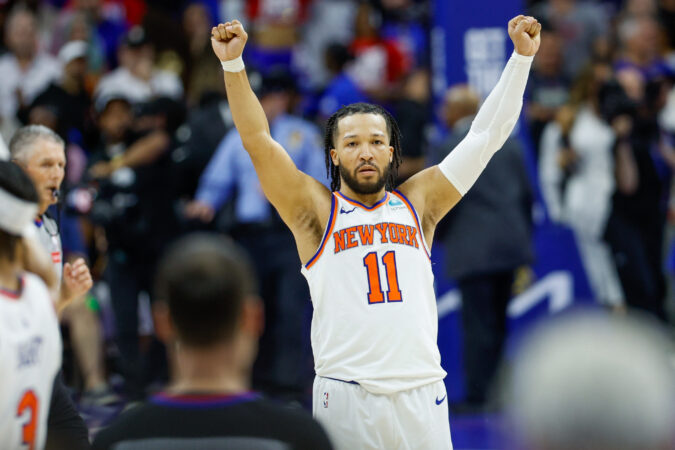
On Thursday, current New York Knicks star and former Villanova guard Jalen Brunson and Nike officially released his first retail player edition shoe, the Kobe 6 PE “Statue of Liberty.”
This is not the first time Brunson has created a player edition Kobe shoe, but it is the first to go to retail. The shoe went on sale Thursday morning at 10 a.m. on the Nike SNKRS app through the draw drop and in-store drops at the Nike Store and Foot Locker. It was first debuted by Brunson during the Eastern Conference finals against the Indiana Pacers.
Brunson designed the shoes through Nike’s player edition collaborations. While it does not specifically mention the Statue of Liberty, it clearly draws on his New York ties, and is the same turquoise color as the Statue of Liberty and features bronze accents.
Instead of getting a signature shoe, NBA players like Brunson get to choose one from Nike’s current lineup and design the colorway of it. Brunson is a longtime wearer of the late Kobe Bryant’s shoes. The Kobe 6 was originally designed and created specifically for Bryant in late 2010. Bryant, of course, was born in Philadelphia and went on to star for Lower Merion High School and later the Los Angeles Lakers.
Brunson’s Kobe shoes are already sold out on the retail market and can now only be attained through third-party sellers. A pair currently runs for around $460 on popular third-party shoe reseller StockX.
But Brunson was nice enough to save a few for his alma mater, gifting every Villanova men’s and women’s player a pair of the sneakers. Both basketball programs posted player reactions to the shoes on their social media.
In February 2025, Brunson unveiled a pair of Kobe 4 Protro PE “The Natty’s” he designed that were inspired by Villanova’s championships from 2016 and 2018.
In 2014, Brunson met Bryant in Chicago when the Los Angeles Lakers traveled to play the Chicago Bulls. While Bryant did not play, he ended up gifting Brunson a pair of red Kobe 9s that he was supposed to wear in the game. Brunson went on to wear them for his high school, Stevenson, during the team’s holiday tournament. The team won the tournament.
Since then, Brunson has continued to wear Bryant’s shoes, and this collaboration with Nike marks the start of what possibly could be a long line of Brunson player edition Kobe’s.
Villanova football is riding a 10-game winning streak — its longest since the 1997 season — and will travel to Stephenville, Texas to take on fourth-seeded Tarleton State in the quarterfinals of the FCS playoffs on Saturday (noon ET, ESPN).
Villanova (11-2), the No. 12 seed in the bracket, is coming off a 14-7 upset against then-undefeated Lehigh (the No. 5 seed) on the road. The Wildcats scored 14 points in the second half, including a 28-yard Braden Reed touchdown reception with just over three minutes remaining, to pull off the victory.
Pat McQuaide led Villanova’s passing attack, throwing for 208 yards and the game-winning touchdown. The touchdown pass was the 50th of McQuaide’s career and 23rd as a Wildcat, meaning he has thrown almost half of his career touchdowns in his single season in blue and white.
It was also his eighth game of the season with 200 or more passing yards. McQuaide isaveraging 211.1 yards per game, which is 29th in the FCS.
Tarelton (12-1) had a first-round bye and is coming off a dominant 31-13 win over North Dakota in the second round last weekend.
Who is Tarleton State?
Some schools in the FCS playoffs are not the most recognizable.
Tarleton State is located in Stephenville, about a two-hour drive from Dallas.
The Texans are part of the United Athletic Conference. They were formerly in the Western Athletic Conference since 2021, before it merged with the Atlantic Sun Conference in 2022.
It became an FCS football program in 2020, when the program switched from Division II to Division I.
YOUR TARLETON STATE TEXANS ARE CONFERENCE CHAMPIONS 🔥
Tarleton State has made it to the FCS playoffs in consecutive seasons, just five years after becoming a Division I program. Last season, the Texans won their first FCS playoff game against Drake, but fell to No. 4 South Dakota in the second round. Eagles rookie wide receiver Darius Cooper starred for Tarleton State from 2020-24.
Limit the turnovers
Villanova has prided itself on winning the turnover battle, and it has done so consistently this season. Its five total turnovers are currently an FCS low.
McQuaide has thrown just two interceptions, and only one in FCS play, this season. He has thrown 10 touchdowns and zero interceptions over his last five games.
Villanova has only lost three fumbles. Over the course of its 10-game win streak, Villanova has won the turnover battle, 16-2.
Defense needs to be near perfect
Villanova’s defense has shut down efficient offensive teams of late. The unit held Lehigh to one touchdown and its second-lowest offensive output this season (339 total yards).
The week before, the Wildcats held Harvard to a season-low 213 total yards.
Tarleton State is averaging an FCS-high 44.1 points. The Texans recorded a 61-0 blowout win against North Alabama on Nov. 15 and have scored 30 or more points in each win this season.
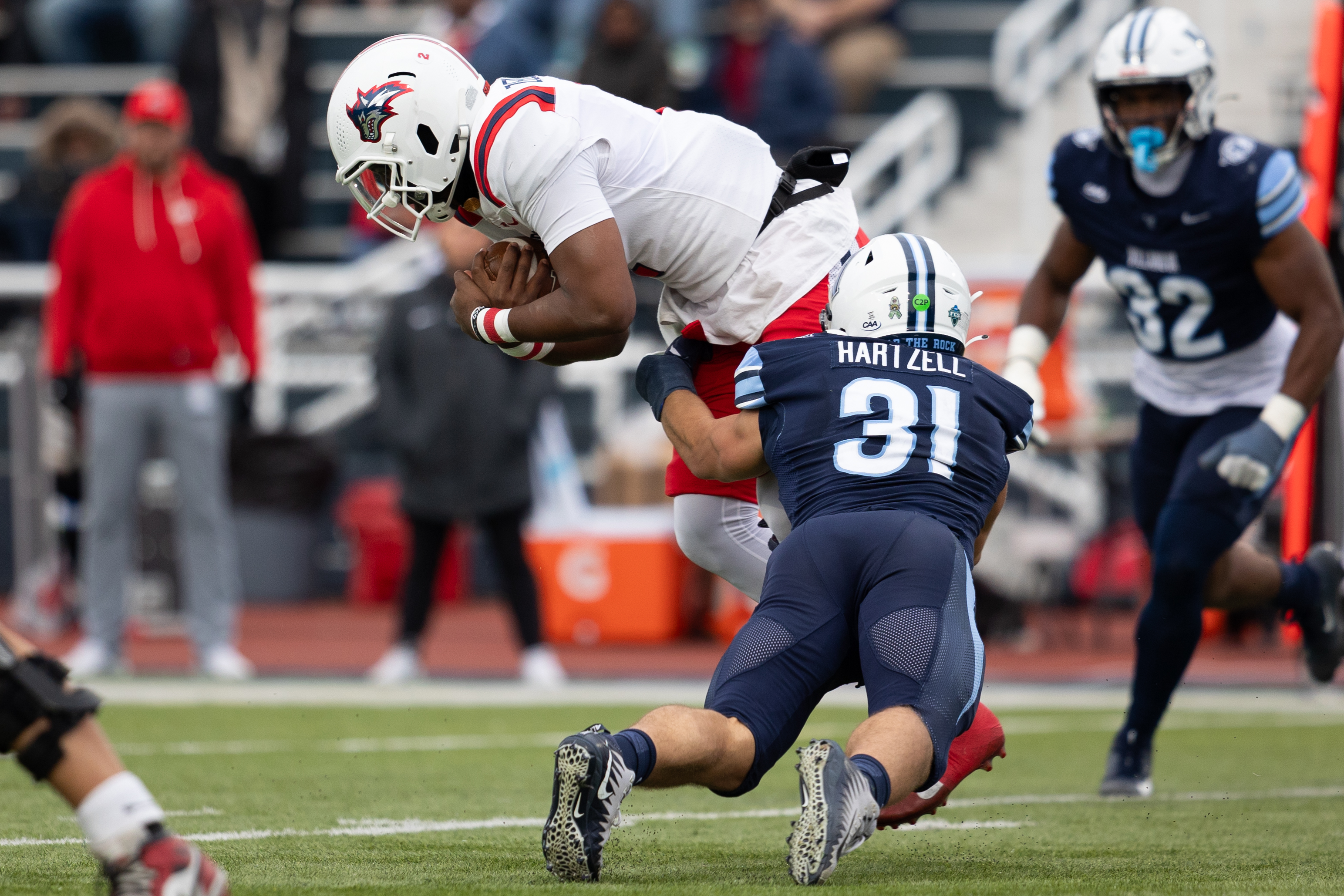
Wildcats linebacker Shane Hartzell has a team-high eight sacks for a loss of 49 yards this season.
The Texans scored a season-low 28 points in their only loss against then- No. 24 Abilene Christian in early November.
Villanova has held opponents to an average of eight points in its last three games.
Graduate linebacker Shane Hartzell leads the Wildcats’ defense by a wide margin, with 87 total tackles (50 solo). Hartzell scooped up his first fumble recovery of the season against Lehigh and recorded six total tackles (five solo). This season, Hartzell has a team-high eight sacks.
Villanova needs to run the football
Villanova has some of the best running back depth in the FCS. Even with standout David Avit missing the last four games, Ja’briel Mace and Isaiah Ragland have stepped up.
Mace and Ragland have rushed for career-high games during Avit’s absence due to a knee injury. Mace even broke Brian Westbrook’s 21-year-old single-game rushing record on Nov. 8 with 291 yards against Towson.
Tarelton currently allows 163.6 rushing yards per game, which ranks 69th in the FCS.
Villanova has leaned on its rushing game all season. It averages 177.8 rushing yards per contest, which is 32nd nationally. Despite rushing for a season-low 27 rushing yards last weekend, Villanova has averaged 194.4 rushing yards over the last three. Ragland rushed for a career-high 152 rushing yards against Harvard two weeks ago, when Villanova finished with a season-high 48 carries.
What has happened since Sunday’s College Football Playoff selection show could begin to shape the future of the sport this year and beyond.
Miami and Notre Dame, both 10-2 and ranked 12th and 10th, respectively, ahead of conference championship weekend, were essentially vying for one spot in a 12-team playoff that was mostly set with the top eight teams seeing little movement.
After No. 9 Alabama lost to third-ranked Georgia by three touchdowns and No. 11 Brigham Young lost by 27 to No. 4 Texas Tech and No. 17 Virginia dropped the ACC title game to Duke, the debate then shifted to whether the Crimson Tide deserved to be in the field.
In the end, though, BYU dropped out of the top 12, Alabama remained at No. 9, and Miami jumped two spots to knock Notre Dame out of the playoff field, creating a firestorm in the process with Tulane and James Madison getting the final two spots.
The committee pointed to Miami’s head-to-head victory over Notre Dame in Week 1 of the season as the ultimate deciding factor.
In response to getting left out of the playoff field, the Irish decided to turn down a potential bowl game matchup against BYU in the Pop-Tarts Bowl in Orlando, ending the season.
The outrage is all too familiar. An undefeated Florida State team in 2023, ranked No. 4 in a four-team playoff format at the time, was dropped because of an injury to star quarterback Jordan Travis in favor of No. 8 Alabama, which had defeated Georgia in the SEC title game that year.
That 2023 decision to leave the ACC champion out of the playoff has continued a negative trend for the selection committee:distrust. Distrust in the committee’s criteria. Distrust in what it values in playoff-caliber teams vs. what it does not. Distrust in how the panel measures the resumés of each team. Distrust in measuring programs by a different set of standards.
Notre Dame coach Marcus Freeman reacts on the sideline against Stanford on Nov. 29.
To be clear, every conference should have a fair shot at winning the national championship.
Tulane, which beat three Power Four schools, plays in the toughest Group of Six conference in the American, and its coach, Jon Sumrall, was hired to be Florida’s next head coach.
James Madison, although it lost its lone game against a Power Four opponent, had Bob Chesney poached to be UCLA’s next head coach. Both Sumrall and Chesney are sticking with their teams through the playoffs.
Notre Dame’s decision to sit out a bowl game could set a precedent. With Name, Image, and Likeness reshaping college sports, more programs built specifically with playoff aspirations may do the same if their seasons don’t go as planned.
Keeping Notre Dame out of the playoff is fine, but don’t have the school ranked ahead of Miami for five weeks only to flip it on Selection Sunday. What about keeping Alabama at No. 9 after losing by three touchdowns, but moving down BYU and Ohio State after their losses?
After this, the CFP committee ought to figure out a better way to determine the best 25 teams every week — because this current format is not working and could have long-term ramifications for the sport.
Villanova’s tall task
The star of Villanova’s two wins to open the Football Championship Subdivision playoffs has been its defense, which allowed just seven points in each win, the lowest among the remaining eight teams.
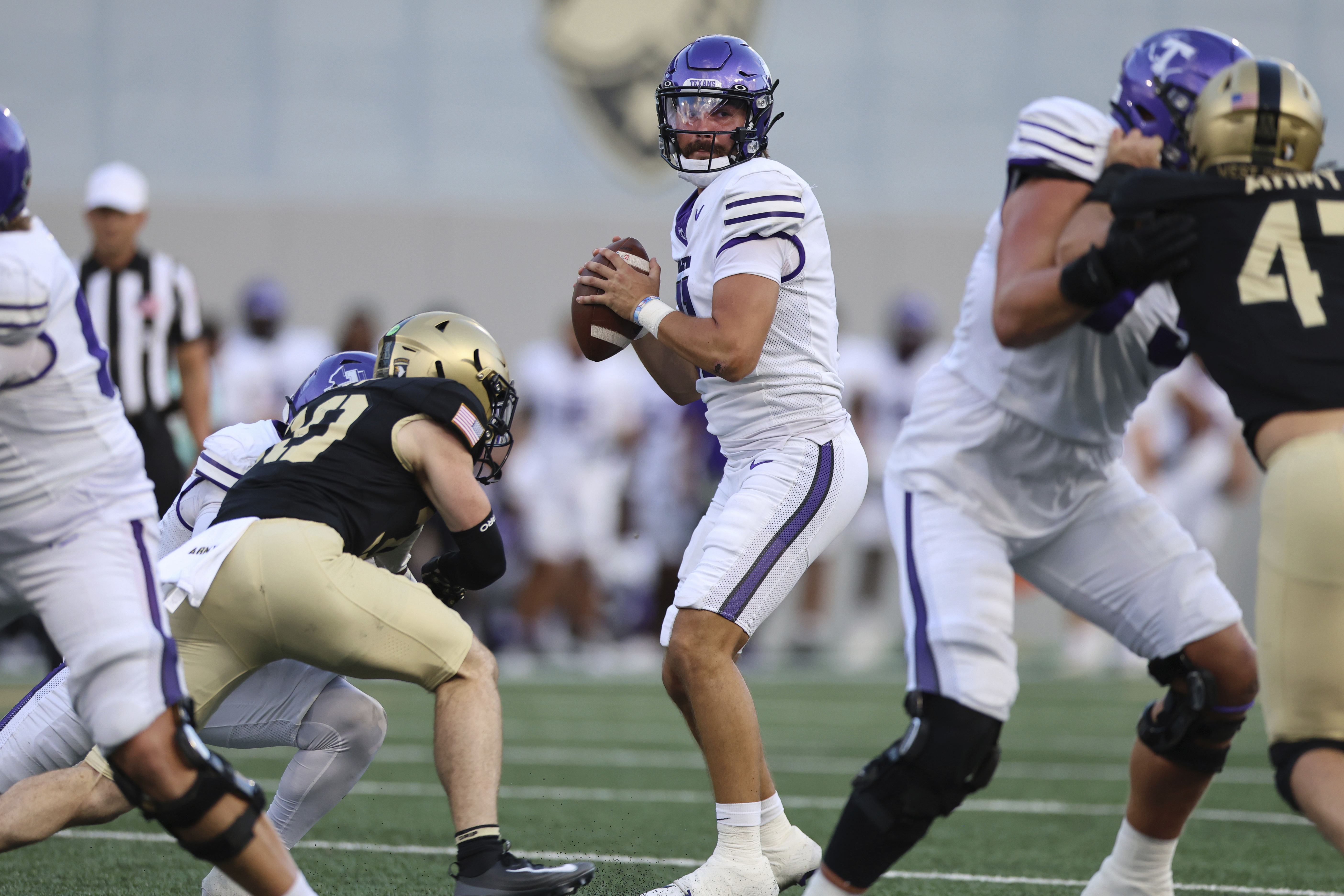
That defense will be put to the test Saturday against fourth-ranked Tarleton State (12-1) of Texas, which has one of the best scoring offenses in the FCS (44.1 points per game) and the No. 3 total offense (472.3 yards), led by Walter Payton Award finalist Victor Gabalis, the team’s quarterback.
The Texans also have wins over an FBS school, Army, and are a perfect 7-0 at their Memorial Stadium in Stephenville, Texas, while averaging 41.8 points.
Tarleton State, about 80 miles southwest of Fort Worth, also ranks in the top 10 in scoring defense (18 points) and passing yards allowed (160.5 yards) but has one glaring weakness: defending the run. On the season, Tarleton ranks 69th in rushing defense, giving up 163.6 yards per game, which should offer the Wildcats an opportunity to control the game in that aspect.
Tarleton State’s Victor Gabalis in action against Army on Aug. 29.
Saturday’s quarterfinal game (noon, ESPN) will ultimately come down to Villanova’s defense holding Tarleton State’s offense in check. Harvard and Lehigh each ranked inside the top 25 in total offense, but the Wildcats shut both teams down.
The only game Tarleton State lost this season came against Abilene Christian, the only time the Texans scored less than 30 points.
Villanova (11-2) will need big games from running backs Ja’briel Mace and Isaiah Ragland and the offensive line to clinch the program’s first semifinal appearance since 2010. The winner of this matchup will face the winner of UC Davis and Illinois State next Saturday.
Although Delaware State’s season came to an end with a loss to South Carolina State two weeks ago that determined the Mid-Eastern Atlantic Conference’s representative in the Celebration Bowl, coach DeSean Jackson, the former Eagles wideout, earned some recognition after his debut season.
On Monday, Jackson, after an 8-4 season was named the 2025 Boxtorow HBCU Coach of the Year for his efforts at Delaware State this season. The Hornets led the FCS in rushing yards per game (291.2 yards), and Jackson led his team to a win over Michael Vick’s Norfolk State on Oct. 30 at Lincoln Financial Field.
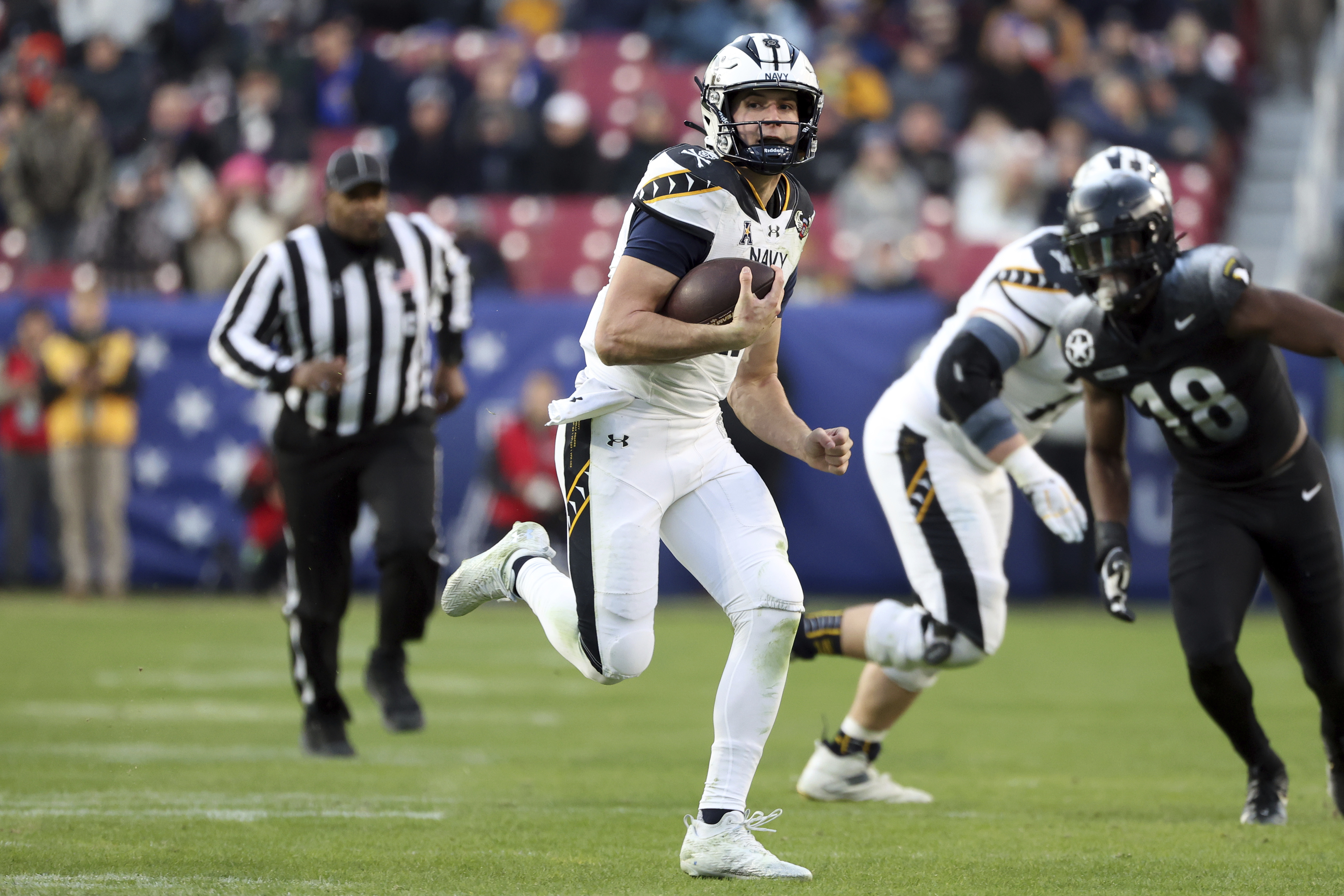
For the 126th time, Army and Navy will meet, this year at Baltimore’s M&T Bank Stadium, with the Commander-in-Chief’s Trophy on the line. Navy won last year’s matchup with a resounding 31-13 victory at Northwest Stadium in Landover, Md.
Navy leads the series, 63-55-7, but Army has won six of the last nine matchups. The Midshipmen, though, have the best player in quarterback Blake Horvath and the nation’s top rushing offense (298.4).
Navy quarterback Blake Horvath in last season’s game against Army.
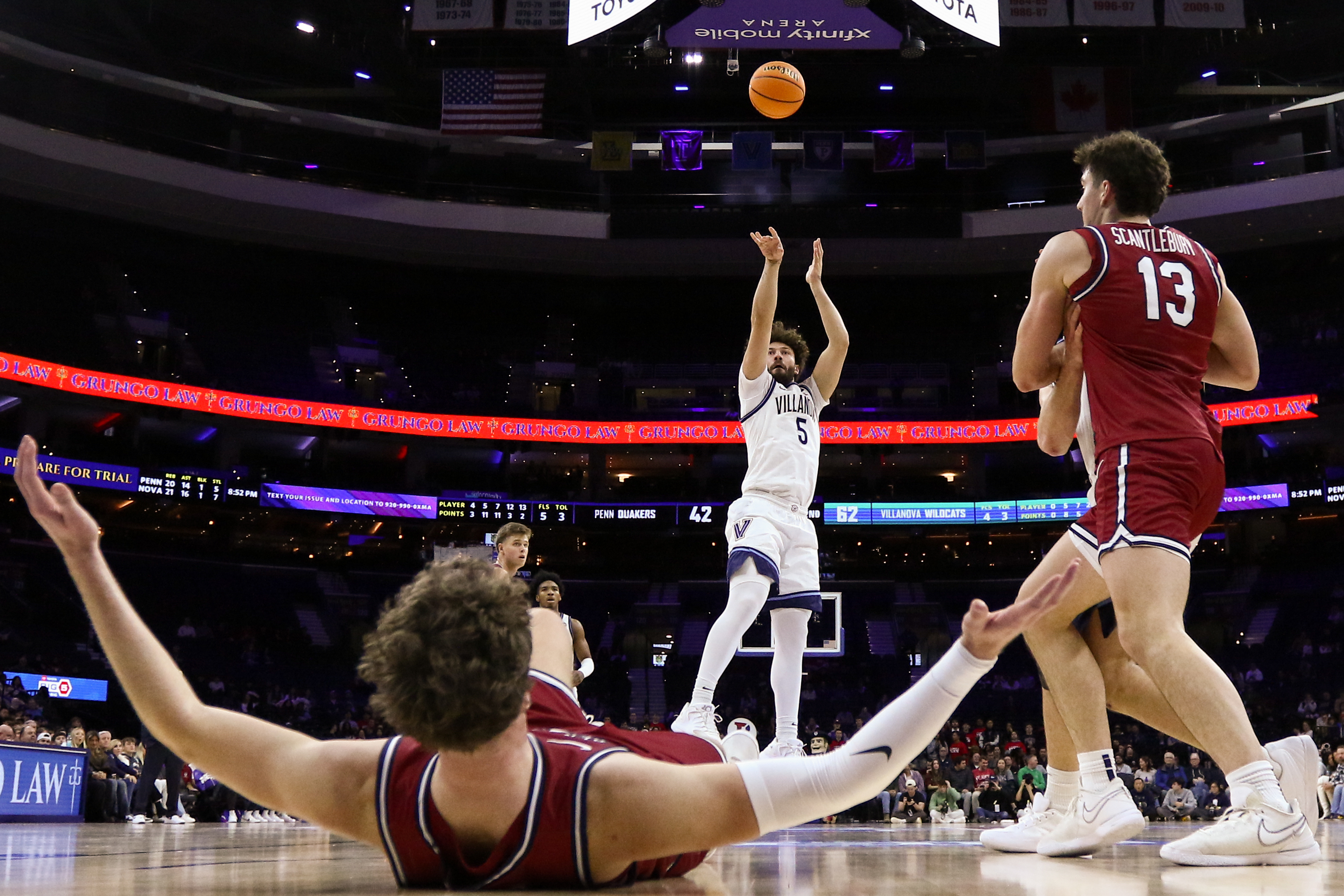
Villanova‘s winning streak reached seven games Saturday when it blew out Pennin the Big 5 Classic championship game. A season-opening loss to nationally ranked BYU in Las Vegas preceded a stretch of games in which Kevin Willard’s Wildcats didn’t have any blips.
They beat their next seven opponents by an average margin of 19.7 points, and at 7-1 entering this week even made it onto some Associated Press Top 25 voters’ ballots as they climbed to KenPom’s 35th-ranked team by adjusted efficiency. But those wins came against teams ranked 142nd or lower by KenPom metrics.
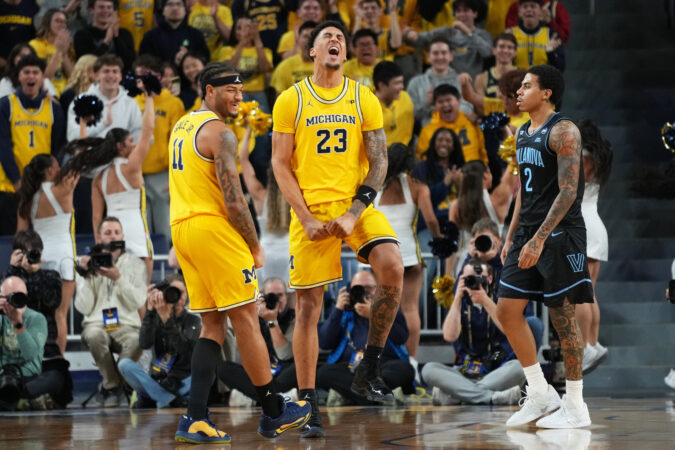
The tuneups were over, and it was time for a test. Perhaps the biggest test of all: against No. 2 Michigan, a team that has been a buzz saw of sorts through the first five weeks of the college basketball season.
Villanova learned that the hard way Tuesday night in Ann Arbor, Mich., where the Wildcats were run off the floor in an 89-61 loss.
Here’s what we learned from Villanova’s step up in competition:
First, the context
Let’s get out of the way first how good Michigan is. The Wolverines are the No. 1 team at both of the main college hoops metrics sites, KenPom and Torvik. They ran through the Players Era tournament in Las Vegas a few weeks ago with wins of 40, 30, and 40 points over San Diego State, Auburn, and Gonzaga, the third-ranked team at KenPom and Torvik.
Dusty May has his Michigan squad undefeated at 9-0.
Then Michigan started Big Ten play Saturday with a 101-60 victory over Rutgers.
Dusty May has built a team that will compete for a national title, and one that could be capable of making history along the way.
That being said, Villanova wasn’t nearly good enough, and it started right away with a deer-in-the-headlights start that enabled Michigan to pull away early.
What you can’t do against the best defensive team in the country is give away possessions, and Villanova did that way too often.
Freshman point guard Acaden Lewis had two turnovers in the first five minutes. Villanova watched as its best defensive possession ended with a Michigan offensive rebound and putback. Then came a lazy pass from Bryce Lindsay to Tafara Gapare that led to a runaway dunk by Yaxel Lendeborg that upped Michigan’s lead to 19-7.
Willard called timeout, and the ensuing inbound resulted in a 10-second violation. Michigan scored at the other end on another second-chance basket and its lead was 21-7 with 13 minutes, 40 seconds to go in the first half.
Kevin Willard’s Villanova squad turned the ball over 15 times against Michigan.
Villanova turned it over 10 times in the first half, far too often to have a chance against this type of opponent, and 15 times overall. Six Wildcats each had two turnovers. Michigan had 15 offensive rebounds to Villanova’s six.
Where’s the offense?
Defense has been a problem for the Wildcats over the first five weeks of the season, even against some lighter competition. But offense hasn’t been very worrisome.
Until Tuesday.
Again, Michigan is the best defensive team in the country with its mixture of size, length, and athleticism, but Villanova is going to face some pretty good defenses in the Big East, and there were some concerning things Tuesday night.
Michigan took Lewis and Lindsay out of the game. If not for the isolation skills of Devin Askew, it might have been 53-13 at halftime instead of 53-23. This was Lewis’ first real test since he was benched vs. BYU in the opener, and he wasn’t good enough at getting Villanova into its offense, though he got better as the game went on (and already was out of reach).
The Wildcats got assists on 57.7% of their makes entering Tuesday. They had just six assists on 21 makes Tuesday (28.6%), and one of them came on a last-second three-pointer.
Michigan, with its length, took away Villanova’s chances at the rim, and the Wildcats were forced to bomb away from three-point range, especially when they started trailing. They made just 10 of their 37 attempts.
“You try to,” Willard told reporters Tuesday when asked if creating threes was the plan. “But it’s not easy against a very connected defensive team.
“Everyone talks about their offense, but everything is predicated on their defense.”
Rotation roulette
Part of Villanova’s problems on offense came from issues that may pop up against better competition. Willard had to decide what he had tolerance for. Lewis and Lindsay were getting beaten defensively, but reserves Malachi Palmer and Gapare offered little help offensively.
The second unit on the floor meant only Askew could be relied on for offense.
Villanova’s Devin Askew led the team with 18 points against Michigan.
Beyond that, it’s apparent that Willard doesn’t think backup big man Braden Pierce is ready to contribute. He’s Villanova’s only rotation 7-footer, and against a Michigan team that has 7-3 center Aday Mara, Pierce barely saw the floor. Neither did Temple transfer Zion Stanford, who logged just three minutes. Stanford only recently returned from an ankle injury, but he is playing just 5.8 minutes per game.
The game got out of reach fast, but it still seems like Willard is trying to figure out his best mix of players, and that will be something to monitor moving forward.
What’s next?
Tuesday was the kind of game that doesn’t hurt when you lose and really helps when you win.
Up next is the opposite. Villanova welcomes Pittsburgh to Finneran Pavilion on Saturday, and while the ACC school isn’t one of the cupcakes that have been on Villanova’s schedule to date, the 5-5 Panthers aren’t very good. Villanova will be expected to win, but it will be another chance to see the new-look Wildcats against a power-conference foe.
From there, only a Dec. 19 trip to Milwaukee to face a solid Wisconsin team separates Villanova from its Big East opener on Dec. 23 at Seton Hall.
The real games are underway, and the Wildcats took a big punch Tuesday.
When Villanova hosted the first women’s Big 5 Classic tripleheader last year, the Wildcats intended to cap it off by winning the title.
Instead, the Temple Owls spoiled the party plans and left the Main Line with the title in their hands.
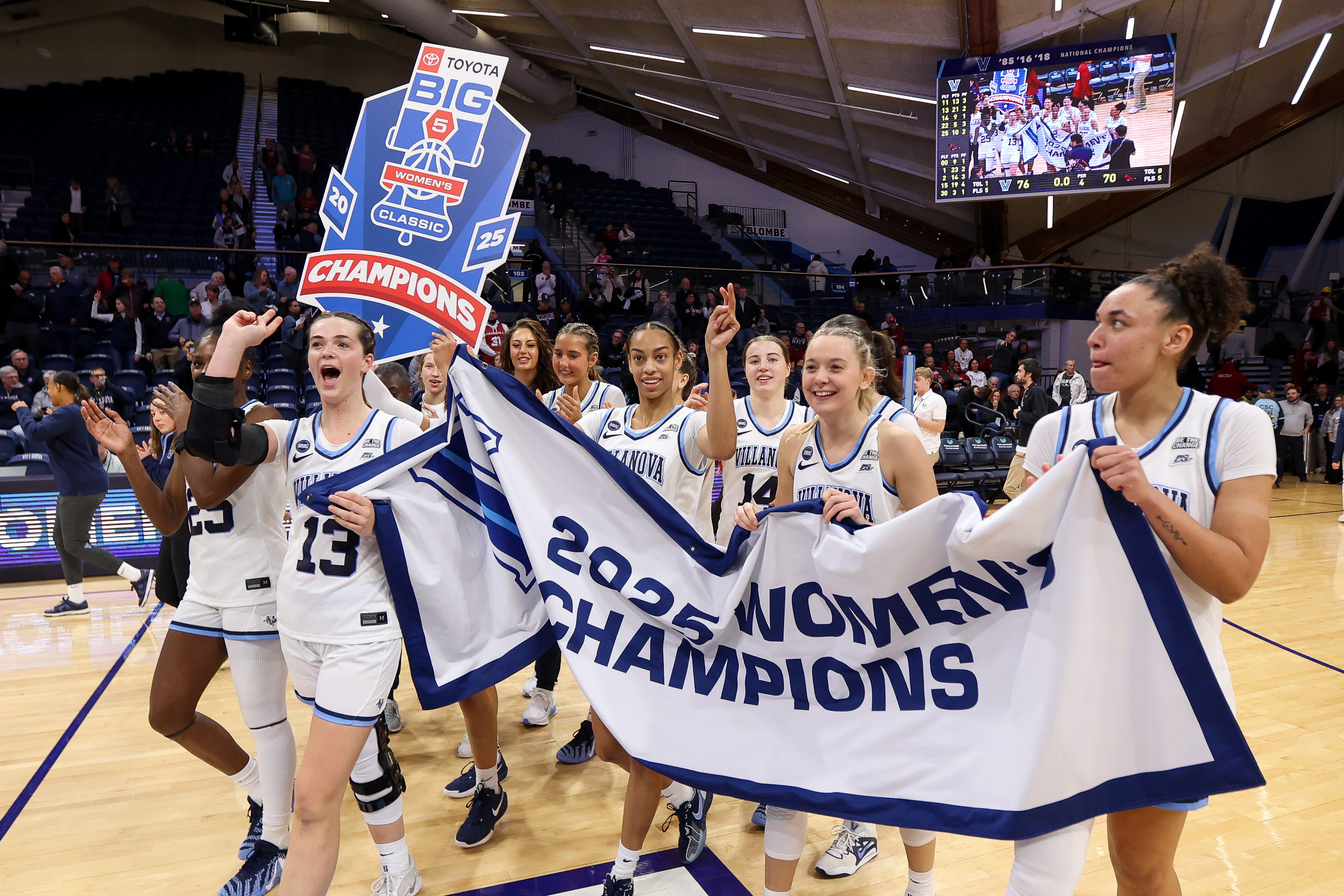
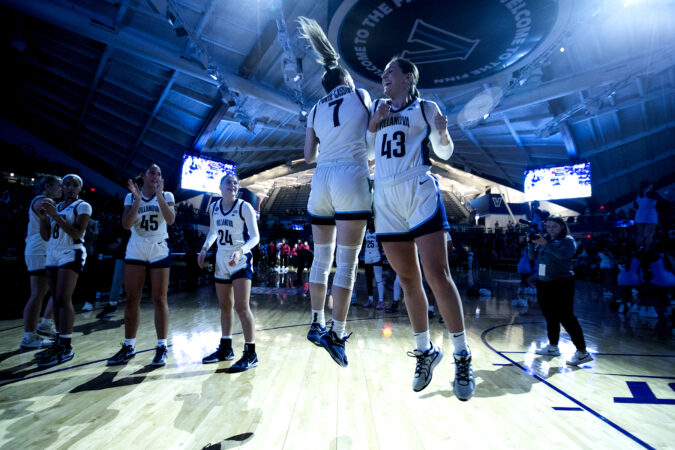
This year, the Wildcats delivered. Led by Brynn McCurry’s 21 points, they topped St. Joseph’s, 76-70, Sunday in a title game that was close throughout. It marked ’Nova’s 22nd women’s Big 5 crown, the most of any City Series team.
For as much as rosters in college basketball change by season these days, coach Denise Dillon admitted she had kept last year’s loss in mind.
“That’s the responsibility of myself and our staff, to explain to our players, because of so many new players on the roster, and not recognizing what Philly basketball is,” she said. “Yeah, the taste stuck with me, and I think some of the others who were playing in that game. Denae Carter and Jasmine Bascoe last year, they knew they gave something up here on our home court, and wanted to make sure we took care of business here today against St. Joe’s.”
Villanova’s players celebrate with the Big 5 champions’ banner.
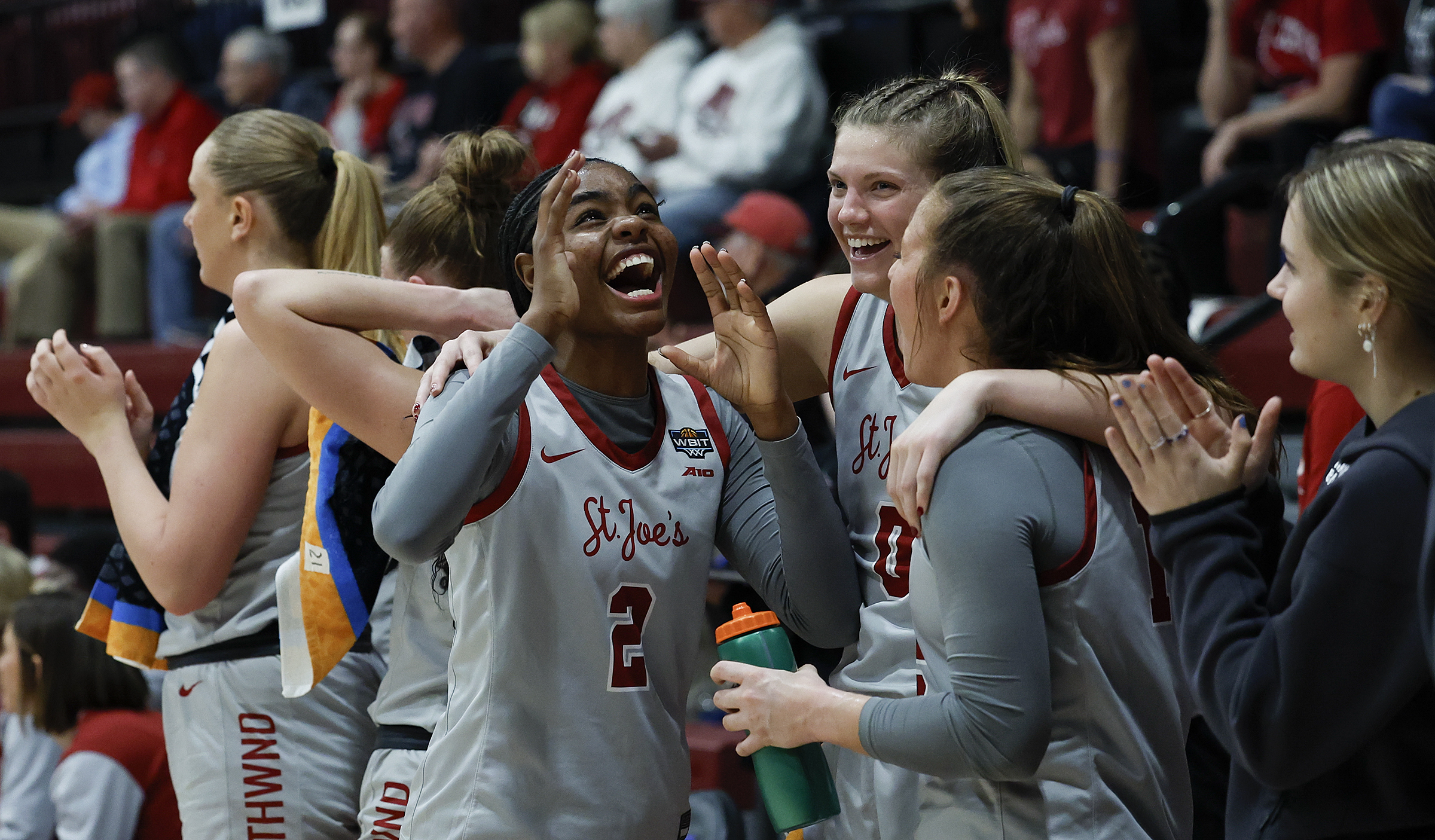
The Hawks were more than valiant. Rhian Stokes totaled 23 points and six assists, while Gabby Casey had 19 points and eight rebounds.
At the other end, St. Joe’s held Bascoe to 4-of-16 field-goal shooting, though she still had 13 points. McCurry, who missed all of last season with a knee injury, delivered her third straight 20-point outing.
“Kudos to [McCurry] and to her teammates for stepping up, because I thought we did a hell of a job on Bascoe,” Hawks coach Cindy Griffin said,
December obviously isn’t March, but Villanova is on some national bracketologists’ early NCAA Tournament bubbles. Though the Wildcats lost at Princeton last month, they made up for it with a win at then-No. 25 West Virginia last Monday, and followed it with a win at Georgetown on Thursday to open Big East play.
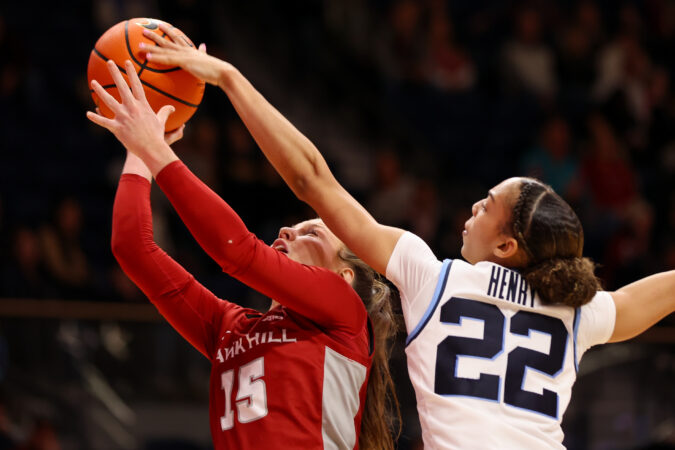
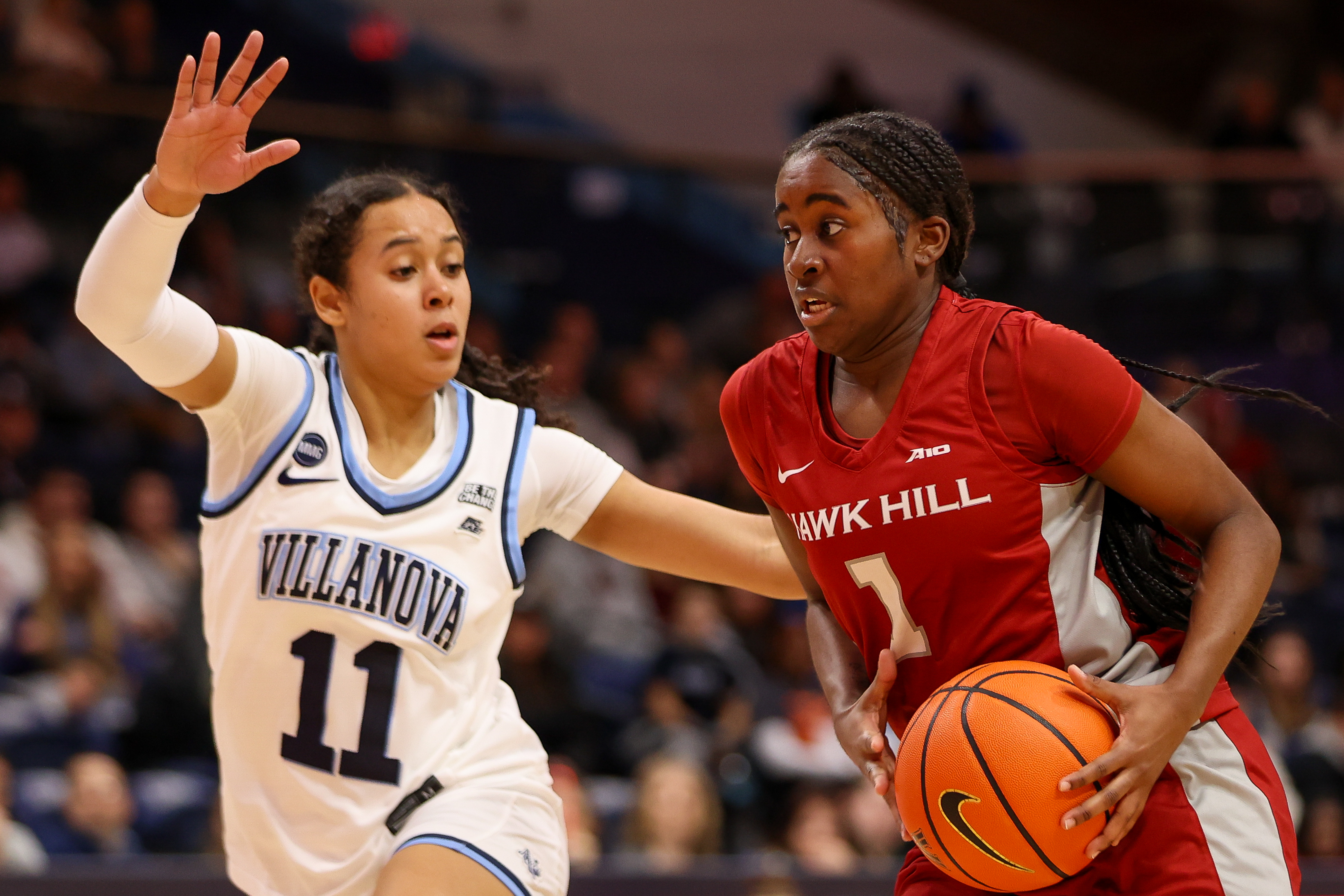
Villanova’s Jasmine Bascoe defending Rhian Stokes of St. Joe’s, who led all scorers with 23 points.
Their next game, following exams, should be another solid barometer: home vs. Seton Hall on Dec. 19. The Pirates were picked third in the preseason conference poll, with ’Nova fourth.
“We gave up a tough one to Seton Hall last year in this place,” Dillon said of a 56-55 defeat. “We’ll remind them [at practice] on Tuesday.”
The rest of the day
Drexel topped Temple in the third-place game, 59-52. With Dragons star guard Amaris Baker held to just seven points on 2-of-13 shooting, Deja Evans stepped up with 18 points on 8-of-14 shooting, plus seven rebounds and three assists.
“Things weren’t going our way, our scorers weren’t making shots, but they still found a way to lock in and stay focused on what we needed to do to win the game,” Drexel coach Amy Mallon said. “And to me, that’s what Drexel basketball is about, and how we find ways to win.”
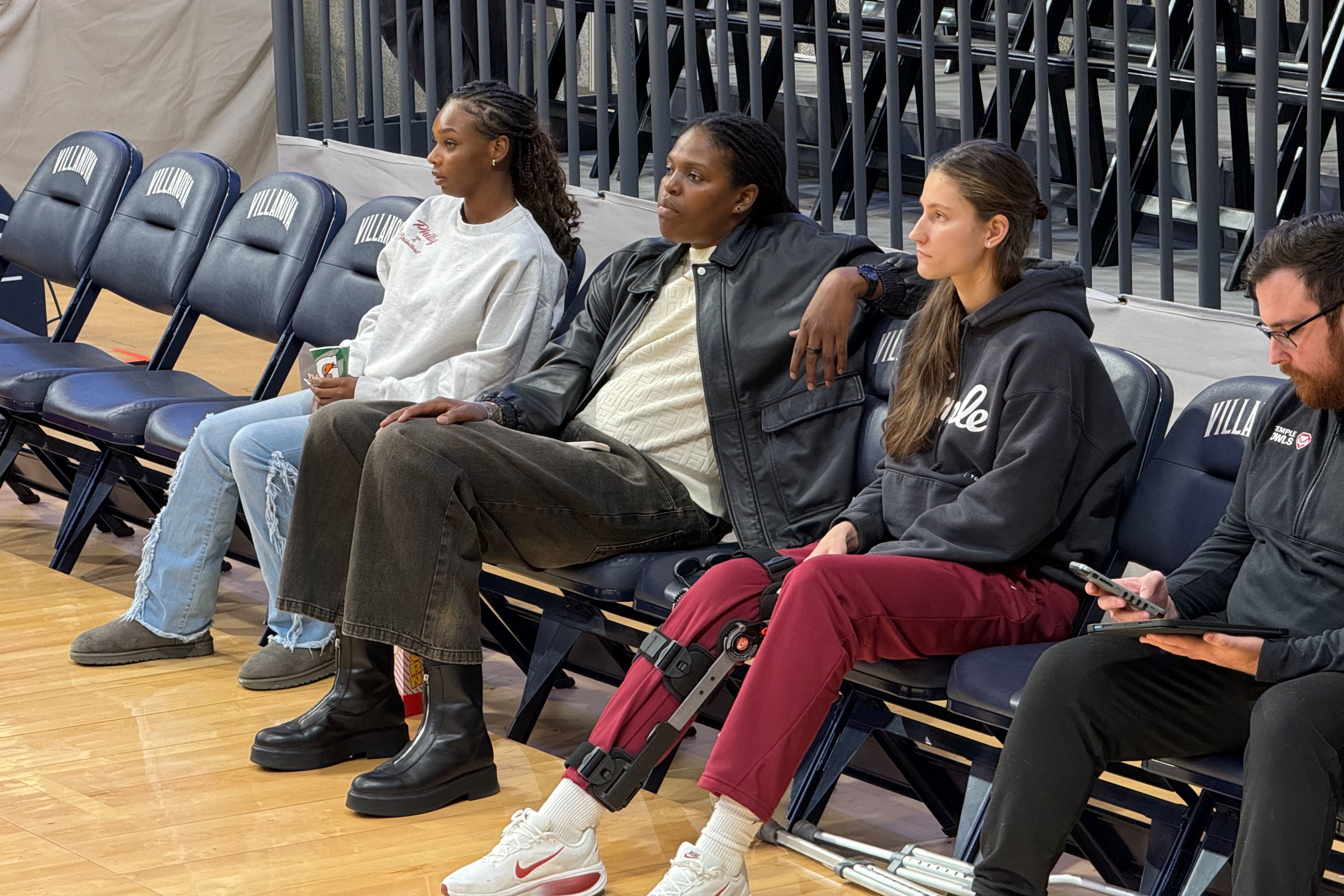
New York Liberty star Jonquel Jones, the adopted daughter of Temple women’s coach Diane Richardson, sat courtside to watch the Owls. That was a reminder of how big women’s basketball is nationally these days, though the stardust hasn’t landed on the Big 5.
Jonquel Jones (second from left) sitting courtside during the Temple-Drexel game.
“Well, I’d love to have her on the court, but we have already exhausted that eligibility,” the always-charismatic Richardson said. “It’s great. She loves our kids and she’s got some time off because of her [ankle] injury, so she’s been spending a lot of time with me. We’re glad to have her here, and not only just for us, but for women’s basketball — and here at the Big 5, where we want to shine a light.”
Penn won the fifth-place game over La Salle, 65-52, led by Katie Collins’ 20 points and nine rebounds. The Quakers led by 21 points in the third quarter, but the Explorers rallied to within five at the end of the period before Penn pulled away in the fourth.
As The Inquirer confirmed a few days ago, the women’s tripleheader will change location next season. Sunday marked Villanova’s second straight year, and the second straight year of disappointingly small crowds on the Main Line: 1,242 fans over the three games.
Though it’s not official yet, the Palestra is the favorite right now to host as part of the arena’s 100th birthday celebration. Penn’s coach isn’t alone in hoping that moving the games to the city’s most famous college basketball venue will draw more fans to watch them.
“I know one thing: Penn would put on a first-class event, just like Villanova has done here,” said Mike McLaughlin, who has long championed having the women’s tripleheader at the city’s most famous venue. “This has been a great event for our athletes, and Penn will do the same if it’s at the Palestra.”
The Villanova women’s basketball team had vengeance in mind as it beat Temple to open Big 5 play on Nov. 22.
While the teams’ history spans decades, anticipation of the annual Big 5 Classic tripleheader has added a new layer to the competition.
And for some Villanova players, the 30-point win was personal. Temple beat Villanova by 14 to win last year’s inaugural women’s Big 5 Classic championship.
“[The Big 5 championship] was a tough loss last year,” Villanova senior guard Ryanne Allen, a Bucks County native and Archbishop Wood graduate said. “That was a huge impetus for us, especially losing on our home floor. We didn’t want it to happen again, so it was nice to get that win back for us.”
Three days after the Wildcats’ 88-58 win, they secured a return to the Big 5 championship game with a win over La Salle. In the other “pod,” St. Joseph’s (6-2, 0-1 Atlantic 10) came out on top with wins over Penn and Drexel. The Wildcats (7-2, 1-0 Big East) will face the Hawks on Sunday at Finneran Pavilion (4:30 p.m., NBCSP).
After back-to-back years at Finneran Pavilion, the Big 5 Classic will change locations next season, Villanova confirmed. The Palestra, a focal point of Philadelphia basketball history, would be a fitting host as the venue prepares for its its 100th birthday.
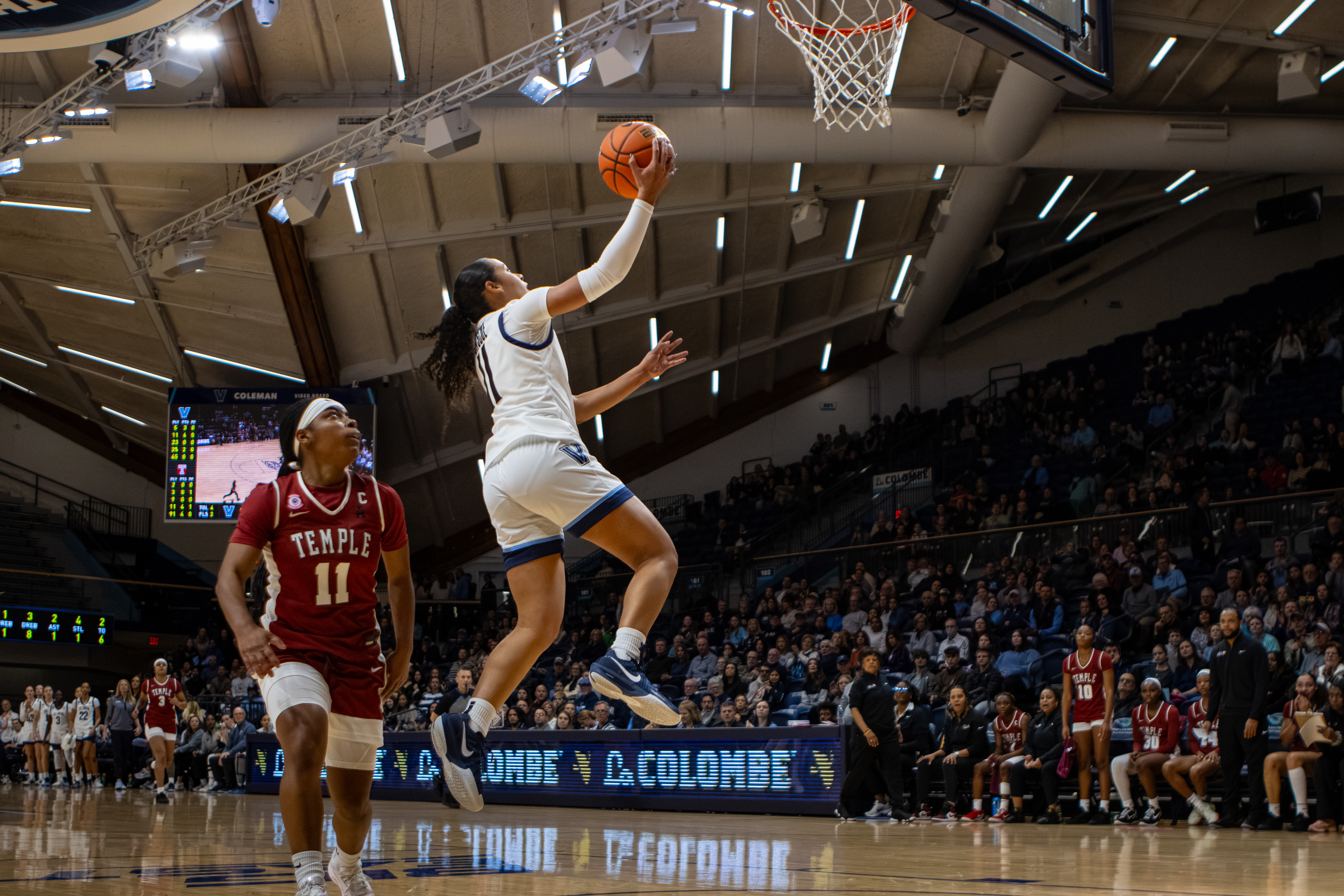
Villanova’s Jasmine Bascoe goes up for a layup as Temple’s Tristen Taylor defends on Nov. 22.
“It’s a great rivalry,” said Cindy Griffin, who is in her 25th season coaching the Hawks. “We’ve been battling [with Villanova] for the last couple of years, and we’re ready to come on top of this battle … I think our players are hungry to not only compete, but to win. It’s going to be a great game.”
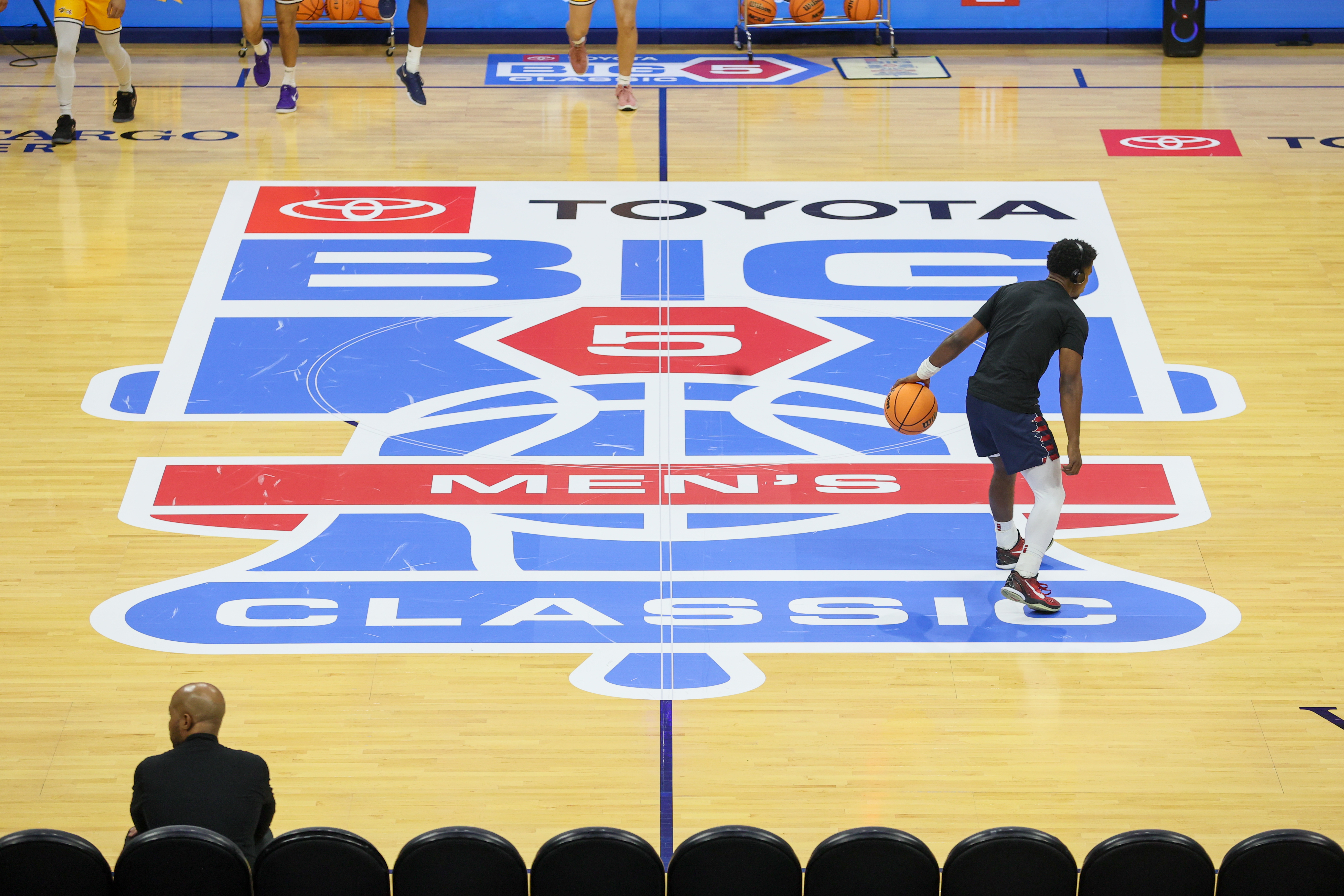
Villanova will install the Big 5 logo on its court at the Finneran Pavilion as it prepares to host the tripleheader for the second consecutive year.
“I’m hoping this young crew recognizes how [the home court] can work in your favor, and just feed off that energy,” Villanova coach Denise Dillon said. “Our atmosphere here at the Finn is tremendous. We’ve got to feel it and know that it can give us a little bit of an edge in a tough battle against our city rival.”
The Wildcats will ride the high of a five-game winning streak — including wins over No. 25 West Virginia and Georgetown in their Big East opener — into the championship game.
Since 2004, Villanova has a 15-4 record against the Hawks.
“We had a couple disappointing losses to start the season, but you can just see this group figuring out who they are and what they’re doing. … Getting that tough La Salle win at their place to put ourselves in position was the first step,” Dillon said. “We’ll focus all of our attention on Saint Joe’s, hopefully redeeming ourselves and getting that win on Sunday in front of our fans.”
The Hawks are led by homegrown talent in returning junior guards Gabby Casey and Aleah Snead.
Casey, who attended Lansdale Catholic, and Snead, a graduate of Penn Charter, will bring an extra level of intensity to the Big 5 matchup. Casey currently leads St. Joe’s with 15.9 points and 6.9 rebounds per game.
“Gabby [Casey] and Aleah [Snead] are the ultimate competitors and Philadelphia kids,” Griffin said. “ … they understand what [the Big 5] is. They understand the pride and the value of playing in Philadelphia and representing St. Joe’s.”
St. Joseph’s guard Aleah Snead (left) celebrates with teammates Talya Brugler and Gabby Casey after a game last season.
As dynamics between Big 5 schools shift entering the 2025 Classic, the tripleheader will serve as a platform for each school to promote its program.
“There’s a lot of different brands of basketball in the Big 5,” Griffin said. “I think just with the growth of women’s basketball, the more we promote women’s basketball in our area, the better off all these young women are going to be.”
Mark Ferrante wore his usual visor with a smile, but his plastic toothpick, which normally sticks out of the side of his mouth at practices, was missing.
It was Wednesday morning, and the Villanova coach walked off the field at Villanova Stadium after wrapping practice in preparation for his team’s game against Lehigh in the second round of the FCS playoffs.
Despite the team’s inexperience after losing more than a dozen starters to graduation, Villanova demolished Harvard, 52-7, last weekend and has won nine straight. Ferrante said postgame that his players might lack experience, but they never lacked confidence.
Ferrante, in his ninth year at the helm, and the program is making its fifth FCS playoff appearance in the last six seasons and 17th all-time. Ferrante has been around the team since 1987 and watched former head coach Andy Talley build the program from the ground up. That paid off in 2009, when Villanova won its lone FCS championship.
In the last three seasons, Villanova has won its first FCS playoff game and then fallen short in the second round. Last season, Villanova traveled to San Antonio, Texas, to face sixth-seeded Incarnate Word in the second round. The Wildcats held Incarnate Word, which last season averaged 33.6 points per game, to 13, but still lost, 13-6.
Now, Villanova is back in the second round, and Ferrante is tasked with guiding his team over that hurdle on Saturday noon (ESPN+) in Bethlehem, Pa.
Villanova’s FBS game — against Penn State this season — and tough Coastal Athletic Association matchups helped prepare the team to play into December.
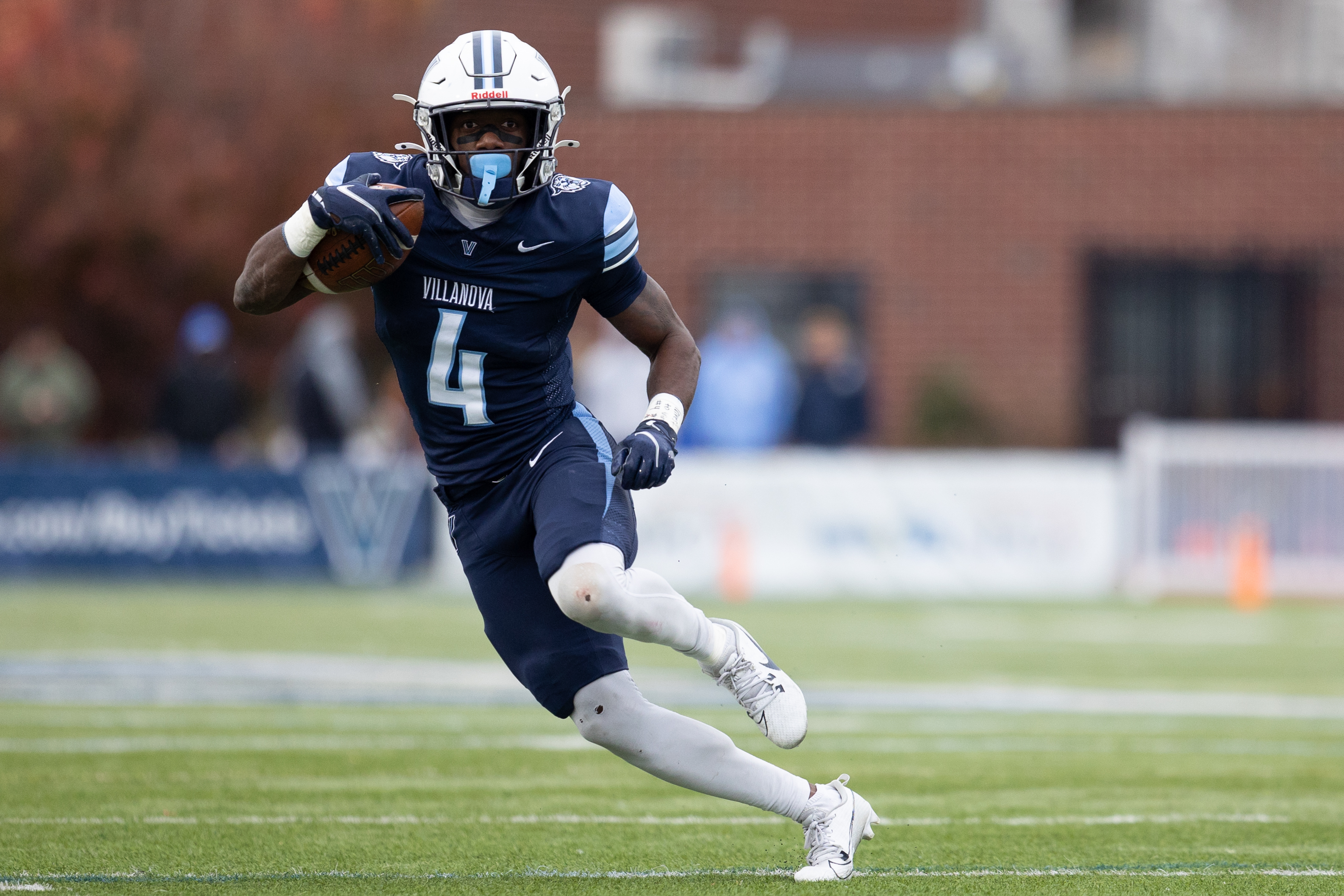
Wildcats running back Ja’briel Mace (4) carries the ball on Nov. 15.
“Sometimes it comes down to the health of the team,” Ferrante said. “If you look at last year against Incarnate Word, we’re playing a ton of freshmen [defensive backs] in that game by the time we got to that point of the season. So right now, we’re better than we were a year ago when it comes to the health of the team. I’m not looking to make excuses, because you have to go 1-0 each week. And this idea is to survive and advance.”
Villanova has lost starters intermittently because of injuries this year. Notably, standout running back David Avit has missed the last three games with a knee injury. Ja’briel Mace and Isaiah Ragland stepped up with no issue, both rushing for career highs during that stretch. Mace even broke the program’s 24-year-old single-game rushing record.
On defense, the team started the season without graduate linebacker Richie Kimmel and lost junior linebacker JR Strauss after the Penn State game.
During Villanova’s 2009 championship season, meanwhile, it lost one notable starter to an injury.
While injuries are uncontrollable, execution is not, Ferrante said.
“The bottom line is it has to come down to execution,” Ferrante said. “You have to go out and perform at a high level, regardless of who you’re playing, regardless of the weather conditions, regardless of the health of your team.”
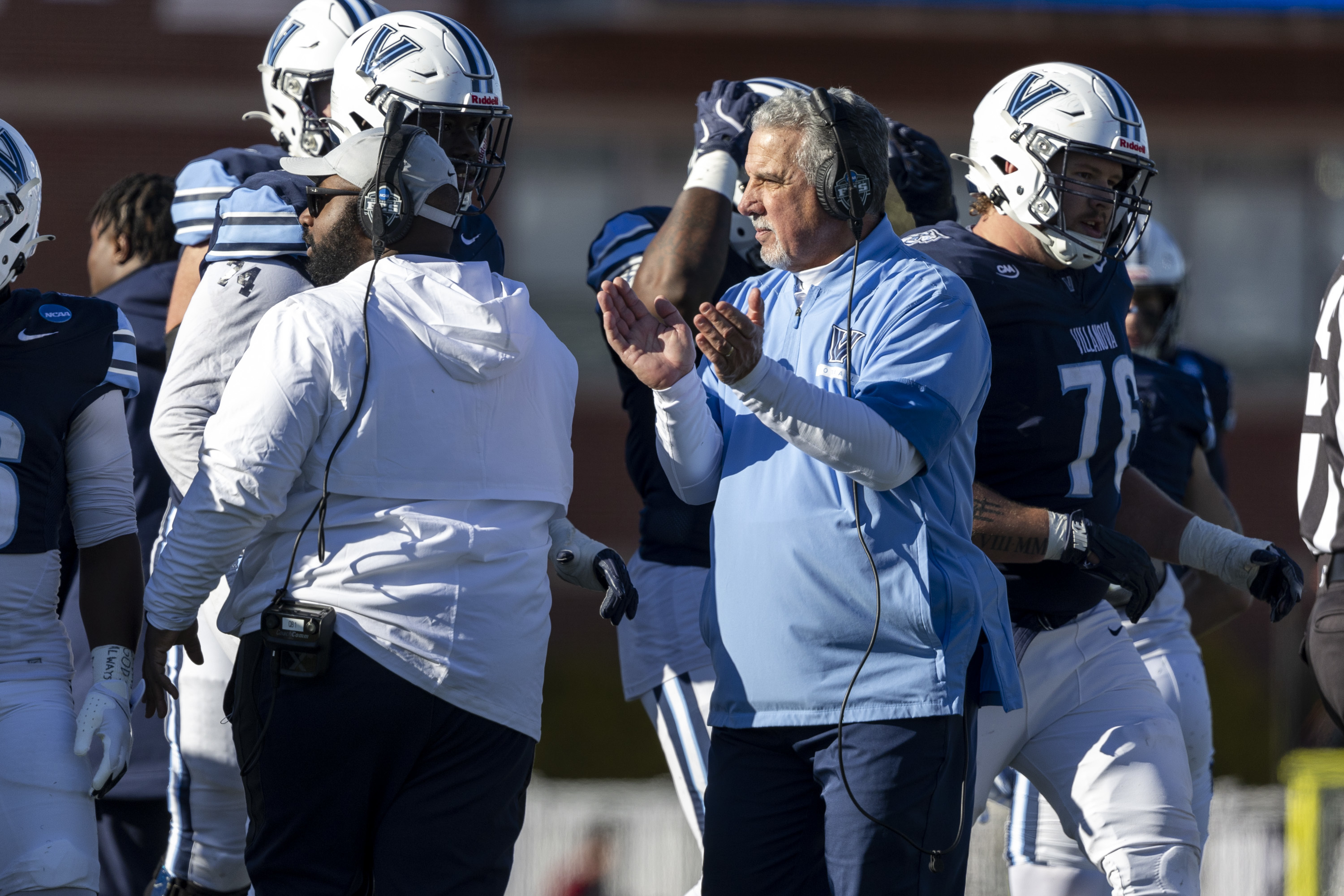
Villanova coach Mark Ferrante, applauding his team on Nov. 29.
Graduate linebacker Shane Hartzell has played in all of Villanova’s playoff games these past three seasons.
“The experience of Shane, I’m sure [the vets] talk to guys behind the scenes,” Ferrante said. “I think we have a good locker room right now. So I think there’s a lot of that going on that we really don’t even see as coaches, but it’s their practice habits that help as well. You have guys that just go out there and practice hard all the time, and that filters down into the young guys.
“So now you see some of our younger guys are having fairly good success. They see how practice is supposed to be, and then they follow suit, and then they end up becoming pretty good players.”
It has become a standard for Villanova to retain players for four years or more. Ten of Villanova’s starters last season were five-plus-year players.
“We just try to set a standard of being good students, good athletes, and good people,” Ferrante said. “Just work hard, be a good person, make good decisions, and good things will happen.
“That’s our approach when it comes to the classroom. That’s our approach when it comes to practice and playing. If you have a good locker room and you have a team that could lead themselves a little bit, there’s not a lot of drama.”
As college football coaches ride a merry-go-round of programs, Ferrante has not moved an inch from the Main Line, and that looks to be the case well into the future.
“If you love what you do, you love where you do it, and you love the people you do it with, that’s a win,” Ferrante said. “And that’s what this place has been for me.”
The banner made its way to the bottom of the student section, and a crew of security guards soon was hovering. Everyone had to go, they said.
“We were like ‘What?,’” said Luke Butler, who led the crew of Temple students that night at La Salle.
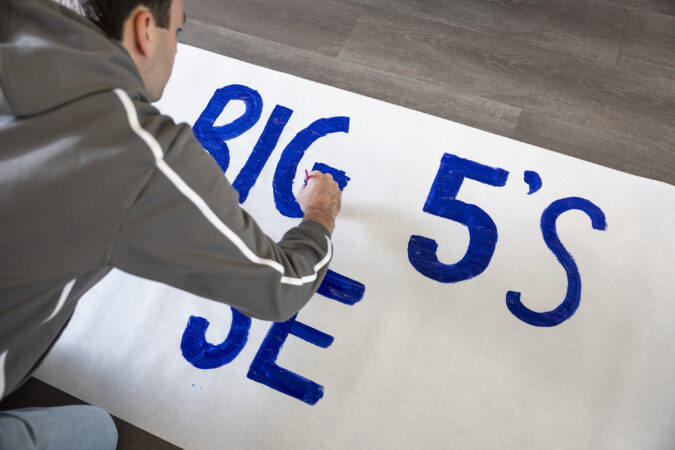
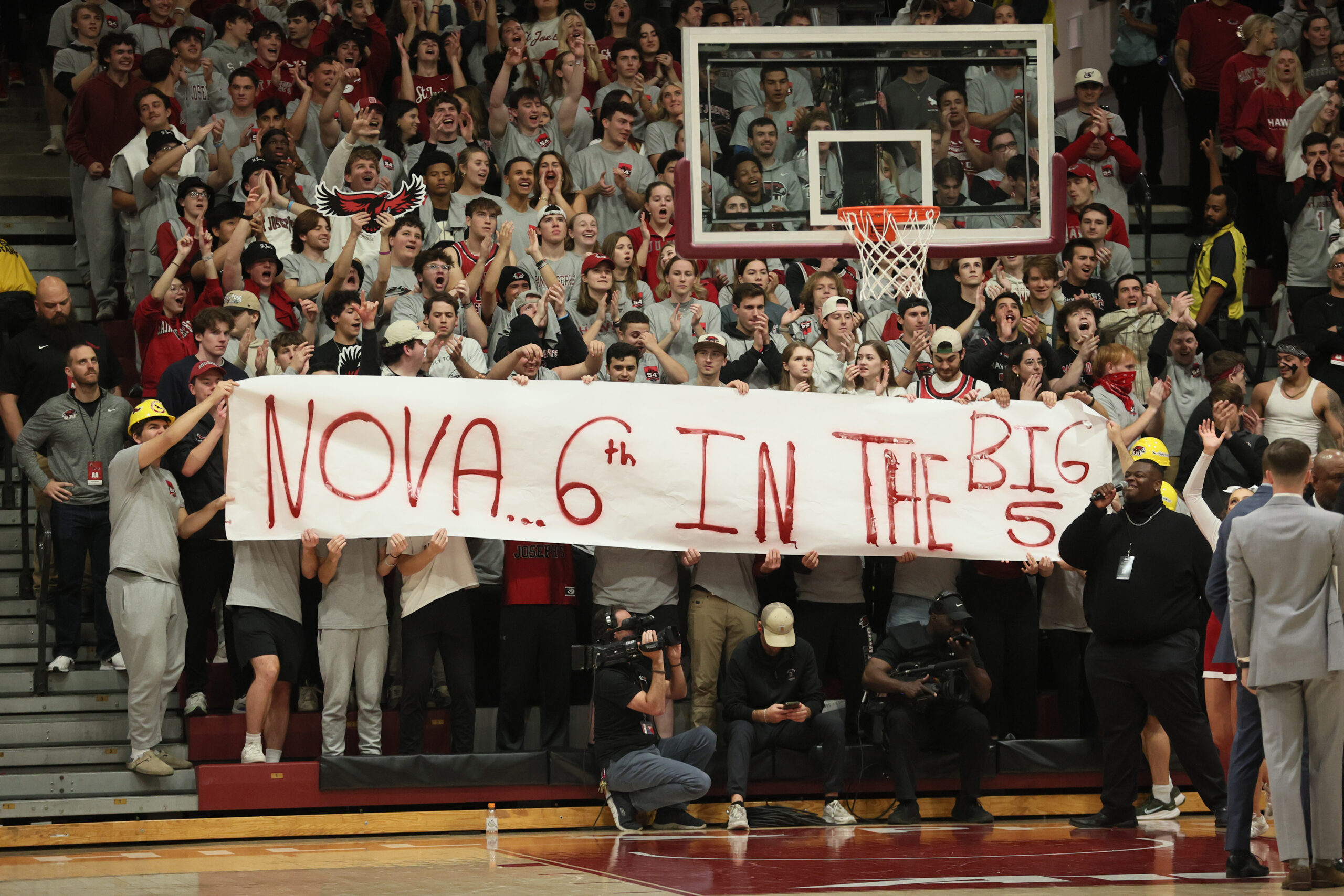
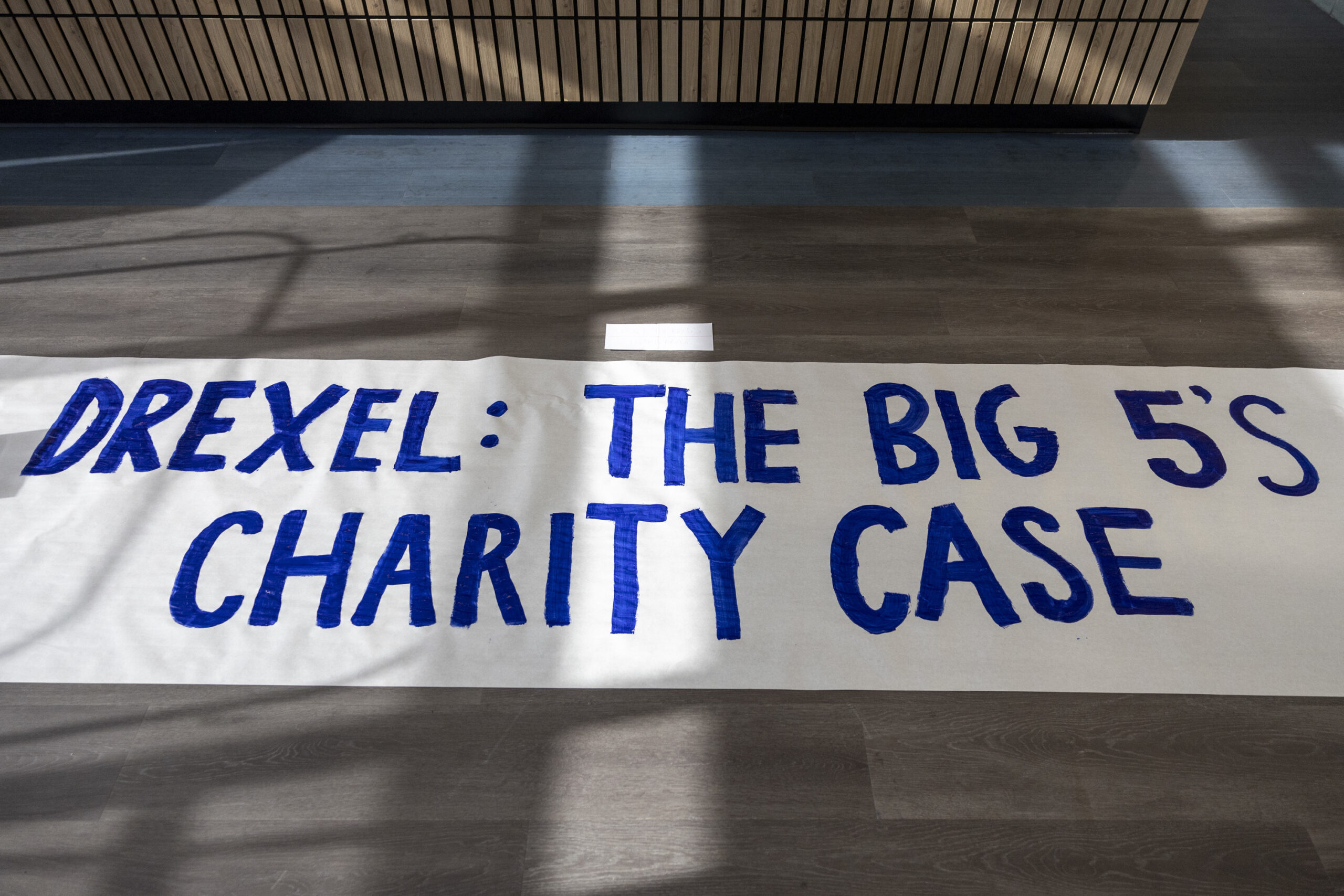
The fans — the Cherry Crusade — spent a few days crafting one-liners to paint onto 30-foot banners that would be rolled out during the Temple-La Salle basketball game. The “rollouts” have been a Big 5 tradition since the 1950s, even surviving a brief ban when the schools thought the messages had become too racy.
The rollouts often are a play on words or innuendoes that make light of the opposing school. You roll out your banner and then hold your breath while the other school shows theirs. Each student body takes turns dissing each other like kids in a schoolyard. The best rollouts, Butler said, are the ones that “twist the knife” just a little.
St. Joe’s students unveil a banner referring to Villanova finishing last in the Big 5 Classic last year.
But this one, Butler learned, twisted a little too much.
The Explorers entered that game in February 2010 on a seven-game losing streak, and Ash Wednesday had been two weeks earlier. Temple, down a point at halftime, raced away in the second half. And here came the rollout: “LA SALLE GAVE UP WINNING FOR LENT.”
The Temple students — the same crew who held a “funeral” a year later for the St. Joe’s Hawk — thought it was good banter. But a priest was offended, and security had instructions.
“They were like ‘Father is pissed. You basically affronted their faith, and they don’t want you in the building,’” Butler said. “That was a good example of a rollout where we said ‘This will get a good reaction.’ It did. It just wasn’t the reaction we were thinking of.”
70 years of rollouts
The rollouts trace back to the Palestra, when the building was the home of the Big 5 and basketball doubleheaders. The bleachers were filled, the basketball was good, and the crowds were lively. Philly was the center of the college basketball universe, and the Palestra was a scene.
The “rooters” who sat behind the baskets would roll out banners during the games about opposing schools. The messages were a chance for a student body to take a shot at their rivals from across the court. When La Salle students hung a dummy of their coach in the early 1960s from a campus flagpole, St. Joe’s rolled out a banner a week later that said “We Fly Flags on our Flagpole.”
The messages became more pointed, as the Daily News wrote in January 1966 that “the rollouts wandered from the realm of good taste.” The Big 5 athletic directors agreed to ban them, saying that “certain rollout subject matter has been offensive and detrimental to the best interests and continued success of the Palestra program.”
The president of the St. Joe’s student section protested the decision at the Big 5’s weekly luncheon, telling the athletic directors that they were ruining “the greatest spectator participation event in sports” and the rollouts were part of the “spectacular” that was basketball at the Palestra.
“It’s not a spectacular,” said Jack Ramsay, then the coach and athletic director for St. Joe’s. “We’re down there to play basketball. If the students want to join in, that’s fine.”
No longer allowed to roll out their messages, students at the Palestra began to shout what they would have written. Banner Ball gave way to Chorus Ball, the Daily News wrote. A year later, the students won, and rollouts were welcomed back to the Palestra as long as messaging was preapproved by the school’s athletic office.
The banners became as integral to a Big 5 game as a soft pretzel from the Palestra concession stand. You didn’t miss a basket during a doubleheader, but you also made sure you caught the dig the opposing students made during a timeout about your school.
The banners were the game within the game as the student sections planned their rollouts like a comedian preparing a stand-up skit. The jokes had to be fresh. How many times can you call the other coach ugly before it’s no longer funny? They had to be timely and tap into current events. That scandal involving a prominent alumni from the other school? Fair game. The football team stinks? That’ll work. A basketball player got arrested? There’s a rollout to be made.
And they had to be timed just right. You can’t come out swinging with your best bit. You have to build up the crowd with a few decent banners and then roll out the one you know will hit.
“You could tell from the other alumni if they were like, ‘Whatever,’ or if it really pissed them off,” Butler said. “Ultimately, that’s what you’re looking for. From brainstorming, to the making of them, to rolling them out, you’re looking for that reaction of them saying ‘Ugh.’”
A fading tradition
The rollouts, just like the Big 5, seem to be waning. Student attendance at local games is no longer what it was. The basketball programs have been down, the transfer portal has made players hard to identify, and conference realignment has introduced games with unfamiliar opponents.
Villanova — the lone Big 5 school to make an NCAA Tournament in the last five years — is the only team that regularly draws a large swath of students. Most schools fill up a student section for the marquee games but attract just a small group on most nights. Attracting students to a once-integral aspect of campus life has become a challenge.
Each school is trying to confront the decline of student participation, and Temple decided last year to revamp its student section. The Cherry Crusade does not have a student president, and the rollouts are made by athletic department staffers.
A banner made by the Olney Outlaw’s La Salle Student Section on Thursday.
They sold out their tickets two years ago when they reached the final of the Big 5 Classic and still fill the student section for a big game. The challenge has been to build a consistent presence.
“We want to find those passionate fans to bring back what the Cherry Crusade was,” said Katie Colbridge Ganzelli, Temple athletics’ marketing coordinator for on-campus initiatives. “They’re still there. We’re just trying to find those passionate students who want to be in charge of the student section like it used to be.”
Villanova’s rollouts earlier this week vs. Temple — “Rocky would’ve gone to Villanova,” one said — didn’t twist the knife. Penn’s student section is dormant, forcing the band to provide rollouts. The tradition seems to be fading across the Big 5, but credit La Salle for trying to keep the edge.
The school revived its student section this season, and the Olney Outlaws took aim at a Big 5 coach for being follically challenged and used another rollout to dunk on Villanova and St. Joe’s. They’re twisting the knife in Olney.
“We had noticed a lack of student engagement and thought this would be a fun way to get kids involved,” said Paige Mitchell, a senior marketing major who founded the Olney Outlaws. “I was working in the athletic department, and my boss at the time gave me a project to come up with something that would get everyone more engaged. It’s grown from there.”
Get your rollouts ready.
The road to the Toyota Big 5 Classic starts Saturday and ends at Xfinity Mobile Arena on December 6! 🏀 #Big5IsPhilly
The group of students — “I have a couple guys in the group who are pretty clever,” Mitchell said — brainstorm ideas for the rollout before they meet to paint their signs. They’re ready for Saturday, when La Salle plays Drexel in the Big 5 Classic.
“It’s stressful making sure they get rolled out at the right time,” said Mitchell, who’s also a center forward on the Explorers’ water polo team. “But I love seeing the way the students react. I have a couple friends who were sitting behind the rollout, and they’re blowing up my phone like, ‘What did it say?’ It’s just exciting.”
Perfectly Philly
Butler asked the La Salle security guard if he could talk to the priest, hoping he could ask for absolution. The priest was still steaming as Butler told him it was a misunderstanding. It was just some college kids making a joke, he said. The priest offered Butler penance: the Temple students could stay, but they had to hand over the rest of their banners.
But the Owls were going to clinch the Big 5 title that night, and the Cherry Crusade brought a rollout to celebrate it. Butler pleaded with the priest to allow them to keep that sign. He rolled it out to show the priest and security guard what it said. “Fine,” said the priest. The rollouts, once again, would not be banned. A perfectly Philly tradition lived on.
“There’s something in the Philly culture that rollouts hit a perfect vein,” Butler said. “The thing about people from here is that there is respect if you can dish it and you can take it. People love to twist that knife. When people did good rollouts against us, you were angry, but there was respect there.
“It’s making fun of people who appreciate it, but also hate it, and it gives you an opportunity to be a little bit of an a—. At the end of day, it’s all love. We all love Philly basketball, even though I’ll never root for St. Joe’s and I’ll never root for Villanova. But I still want them around. I want everyone to do well, so then the hate means something.”
In March of 2013, La Salle pulled off the improbable. The Explorers hadn’t been to the NCAA Tournament since 1992. They hadn’t advanced past the Round of 64 since 1990.
But here they were, on a chilly night in Kansas City, edging out Kansas State, 63-61, to earn a spot in the Round of 32.
As players danced in the middle of the locker room, with the music blaring, an unlikely figure emerged.
Donning a black suit with a blue dress shirt, the visitor walked through the chaos, straight to La Salle’s head coach, John Giannini.
It was Jay Wright.
His team had a game in a few hours, against North Carolina, but the Villanova head coach wanted to congratulate his dear friend.
Former La Salle head coach John Giannini during a game against Butler on Jan. 23, 2013.
“Once we got to the tournament, we were always rooting for each other,” Wright said of the Big 5 programs. “It was always about Philadelphia basketball.”
This was the way he and his Big 5 counterparts had been taught. When Wright was an assistant at Villanova in the late 1980s and early 1990s, he watched as head coach Rollie Massimino battled with Temple’s John Chaney.
The games were intense, and often heated, but they always showed each other respect. Sometimes, Big 5 coaches would go to dinner afterwards. It wasn’t uncommon for them to get together during the offseason.
The coaches would celebrate each other’s wins, even though they were technically competitors. Every time Wright advanced in the NCAA Tournament, he’d get a call from Chaney.
When Martelli reached the Elite Eight in 2004, he heard from Wright and longtime La Salle coach Speedy Morris.
The men who preceded them practiced the same habits, from Temple’s Harry Litwack, to Villanova’s Al Severance, to St. Joseph’s Dr. Jack Ramsay.
“The initial [Big 5] group was so together, and so tight, that when the rest of us joined, it was just the way it was done,” said Fran Dunphy, who spent a combined 33 seasons at the helm of Penn, Temple, and La Salle. “The culture was already set.”
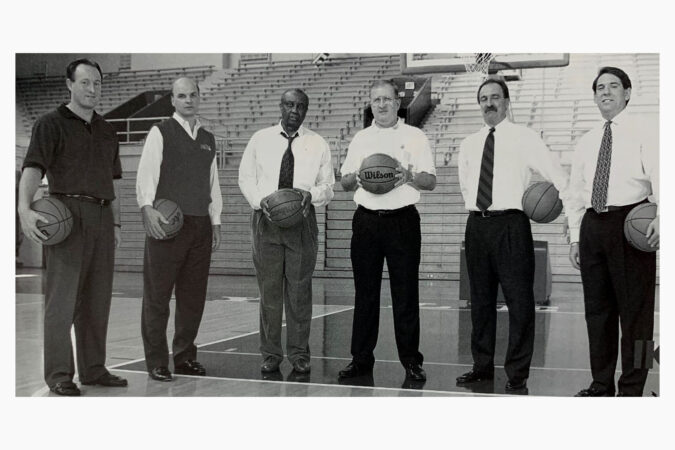
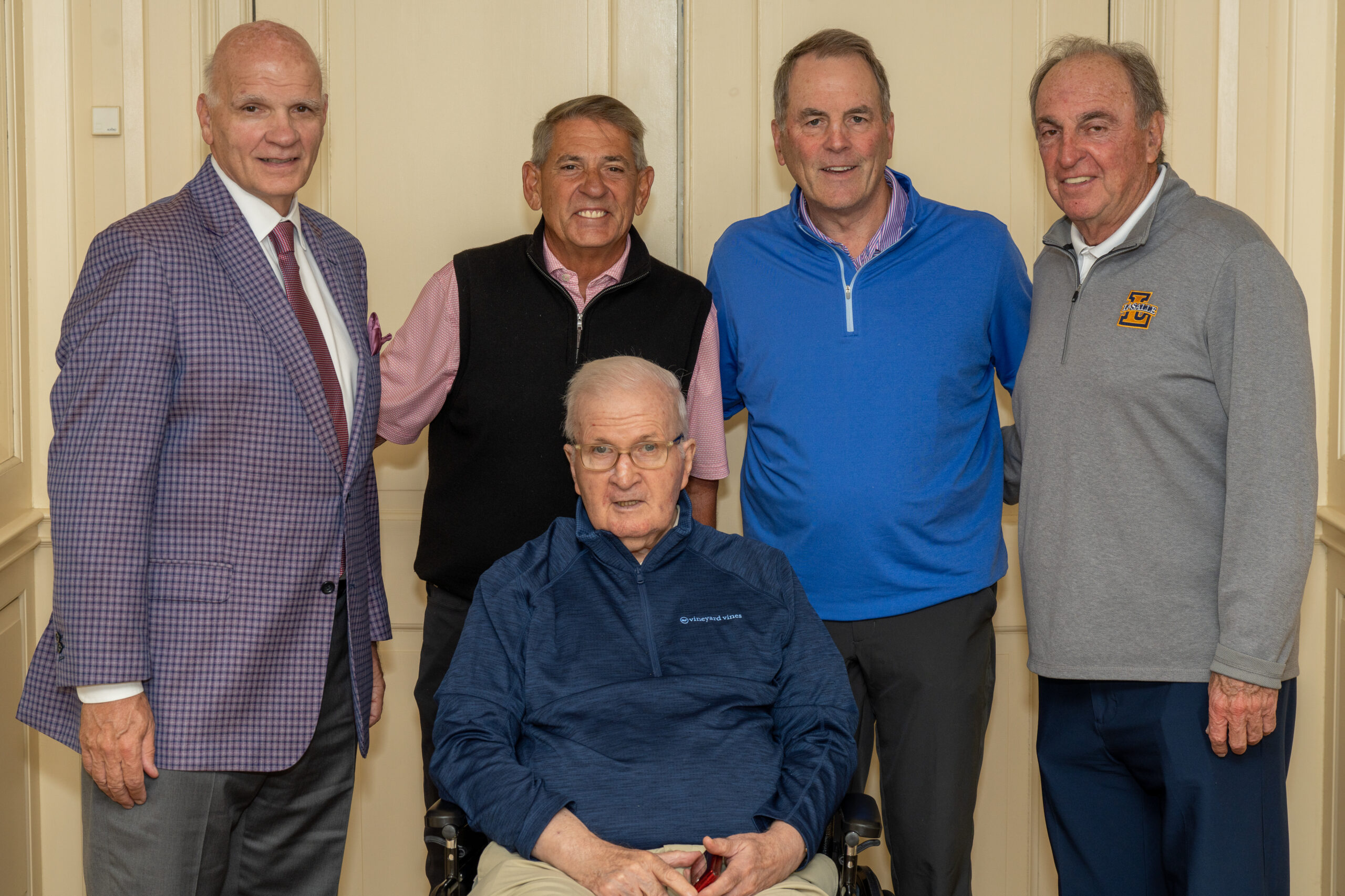
Former Big 5 coaches Phil Martelli, Steve Lappas, John Griffin, Speedy Morris, and Fran Dunphy.
For former Big 5 coaches in the area, that culture is still intact. Martelli, Dunphy, and Wright remain good friends. They visit with Morris, and are in regular contact with other former colleagues, like Giannini, Steve Lappas, and John Griffin.
The coaches believe this brotherhood is unique to Philadelphia, a city rich with basketball lore.
“On the court, you wanted to kill each other,” Wright said, “and off the court you were like brothers.”
A ‘different’ kind of bond
Dunphy was born and raised in Drexel Hill, only a few years before the founding of the Big 5 in 1955.
Back then, it was an association of five Division I schools: Villanova, Penn, St. Joe’s, Temple, and La Salle (Drexel was added in 2023).
The future coach rooted for them all, without prejudice. He’d often spend his Wednesdays, Fridays, and Saturdays at the Palestra, watching Big 5 teams square off.
“There were three nights of doubleheaders,” Dunphy said. “It was an amazing experience.”
When he was hired as the head coach of Penn in 1989, Dunphy felt a deep sense of pride. He also felt respect for his peers, many of whom had toiled through the same high school and assistant coaching ranks.
Their connections went far back. In 1976, when Wright was in the ninth grade, he attended a basketball camp in the Poconos. His camp counselor was a young Martelli.
A few years later, Martelli coached his first high school game for Bishop Kenrick in Norristown, which closed in 2010. His opponent was Dunphy, who was leading Malvern Prep at the time.
Morris and Chaney were introduced during their tenures at Roman Catholic and Simon Gratz in the late 1960s and 1970s. Lappas was an assistant at Villanova when Martelli assisted at St. Joe’s in the 1980s.
All of this only fortified the “brotherhood.”
Fran Dunphy spent a combined 33 seasons at the helm of Penn, Temple, and La Salle.
“It was different than going to an ACC school or a Big Ten school or whatever the major conferences are,” Dunphy said. “Let’s say we went to Orlando for an AAU tournament. There might be three or four of us sitting together as Philly coaches, because that’s what we did. And we might be recruiting the same guy.
“And there would be coaches from other leagues, and they’d say, ‘What are you guys doing?’ Well, that was just the way it was.”
Added Martelli: “You never said, ‘I’m going to talk bad about this guy or that guy, just so we can get a recruit.’ Because you knew [the other coaches] weren’t doing it. So we were not going to do it.
“People from the outside marveled at it. They’d say, ‘Seriously, this is what you guys do?’ And I’m like, ‘Yeah.’”
Despite this unspoken pact, the coaches were not thrilled when a Big 5 rival would scoop up a promising player. Martelli, for example, was very frustrated when Dunphy earned local star Lavoy Allen’s commitment in late 2006.
“I would say that in a complimentary way,” Martelli said. “I was like, ‘I can’t believe we didn’t get him. And to make matters worse, Temple got him. We’ve got to deal with him for four years?’”
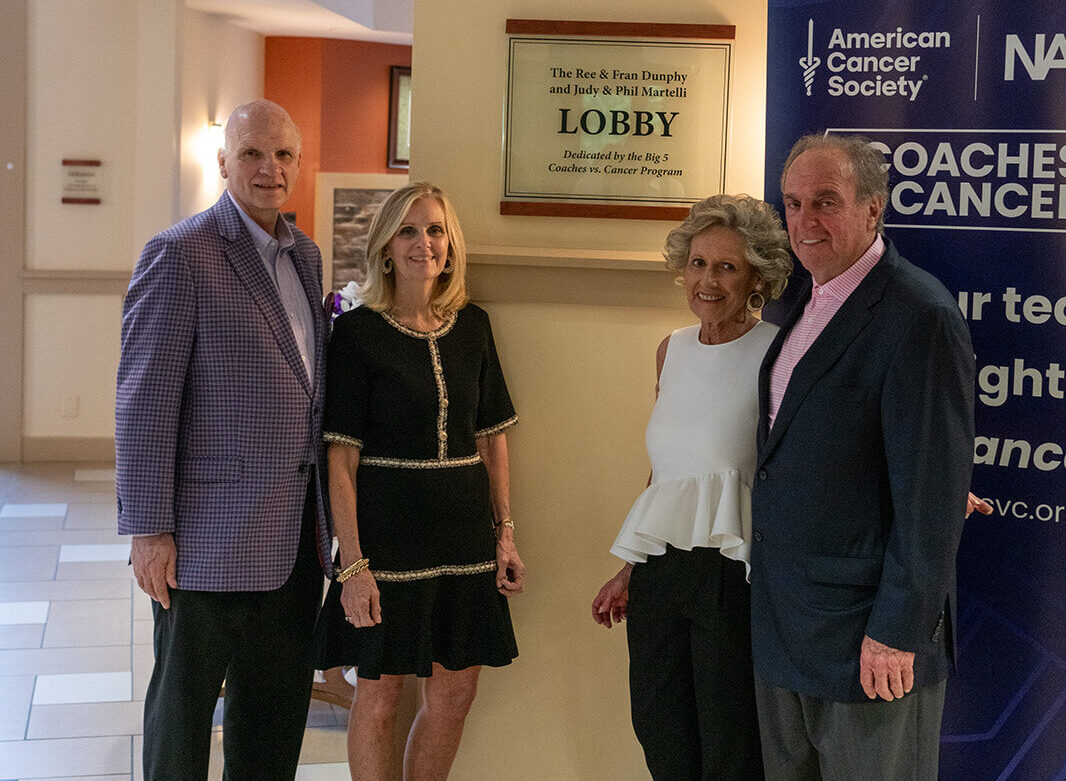
Even at the height of their competitive prowess, the coaches would band together for the betterment of the sport and the world around them. In 1996, Martelli and Dunphy started the Philadelphia chapter of Coaches Vs. Cancer, a nonprofit that raises awareness and funds for cancer research.
They looped in their fellow Big 5 coaches: Lappas, Morris, Chaney and Bill Herrion (who was at Drexel). Not long after Wright was hired as head coach of Villanova in 2001, he accompanied Martelli and Dunphy to meet the CEO of Blue Cross/Blue Shield, Fred DiBona, for lunch in Center City.
Former Big 5 coaches Phil Martelli and Fran Dunphy with their wives at a Coaches Vs. Cancer event.
The insurance company offered them $50,000, and became the group’s first corporate sponsor. That donation helped lift the chapter off the ground.
“The three of us were really competing against each other, right then,” Wright said. “And we all went together during basketball season, up to his office, and got that thing spearheaded.”
Wright, Martelli, and Dunphy are still very involved with Coaches vs. Cancer. The Philly chapter has since become the most successful in the country, raising over $22 million.
It is not the only legacy they’ve left behind. Over recurring breakfasts at Overbrook Golf Club, the coaches would talk about everything from scheduling to the format of the Big 5 round-robin.
Some of those ideas will be implemented on Saturday, in the third-annual Big 5 classic. Wright said that the triple-header format was discussed as far back as “15-20 years ago.”
He and peers wanted to put on a big event, one that didn’t cause scheduling conflicts.
“It was healthy, because we were from different leagues,” Martelli said. “Fran was in the Ivy League, I was in the Atlantic 10, and Jay was in the Big East.
“It was always for the greater good. It wasn’t about, ‘What’s best for St Joe’s? It was, ‘What’s best for college basketball?’”
‘The elder statesmen’
Wright, Dunphy, and Martelli have a reverence for Morris and the late Chaney, “the elder statesmen” of the group.
Chaney took special interest in Dunphy, who replaced him at Temple in 2006. The former head coach liked to share his thoughts after games. This was especially true if Temple had too many turnovers.
The next day, Dunphy’s phone would ring. He always knew who was calling.
“The conversation would go, ‘Franny, what the hell is going on out there?’” he recalled. “‘Why are we turning the ball over?’
“‘I know, Coach. We’re working on it. We’ve gotta get better.’”
Speedy Morris and John Chaney developed a friendship while serving as Big 5 coaches.
Like their younger counterparts, Morris and Chaney were contemporaries. They both grew up in the city; Morris in Roxborough and Chaney in North Philly.
The coaches also shared a flair for the dramatic. Neither man was above throwing his coat, or screaming at a referee, or stomping up and down the court.
They found kindred spirits in each other.
“He was tough,” Morris said of Chaney. “But I enjoyed him, very much.”
One day, in the late 1990s, the La Salle coach came up with an idea. The Temple coach was known for his expensive clothes, especially his ties. He’d often give them away as gifts.
So, Morris decided to pay it forward. He grabbed a few dozen of the ugliest 70s-era ties he could find, and asked his wife, Mimi, to wrap them up in a box. She sent it to Temple, with a note.
“It read, ‘You’ve been so kind to share some of your beautiful ties with me,’” Morris’s son, Keith, recalled. “‘I’d like to share a few of mine with you.’
“Chaney opened it up, and he was like, ‘What is this [expletive]?’”
After Chaney retired from coaching in March of 2006, he became an occasional attendee at Morris’ practices and games at St. Joe’s Prep. There was one, in particular, that stuck out in Morris’s mind.
It was 2006, and the two coaches had just paid a visit to Tom Gola, who was dealing with a health scare. They headed back to the Prep, where they’d parked their cars. As Morris said goodbye, Chaney made an impromptu announcement.
He would be coming to practice, too.
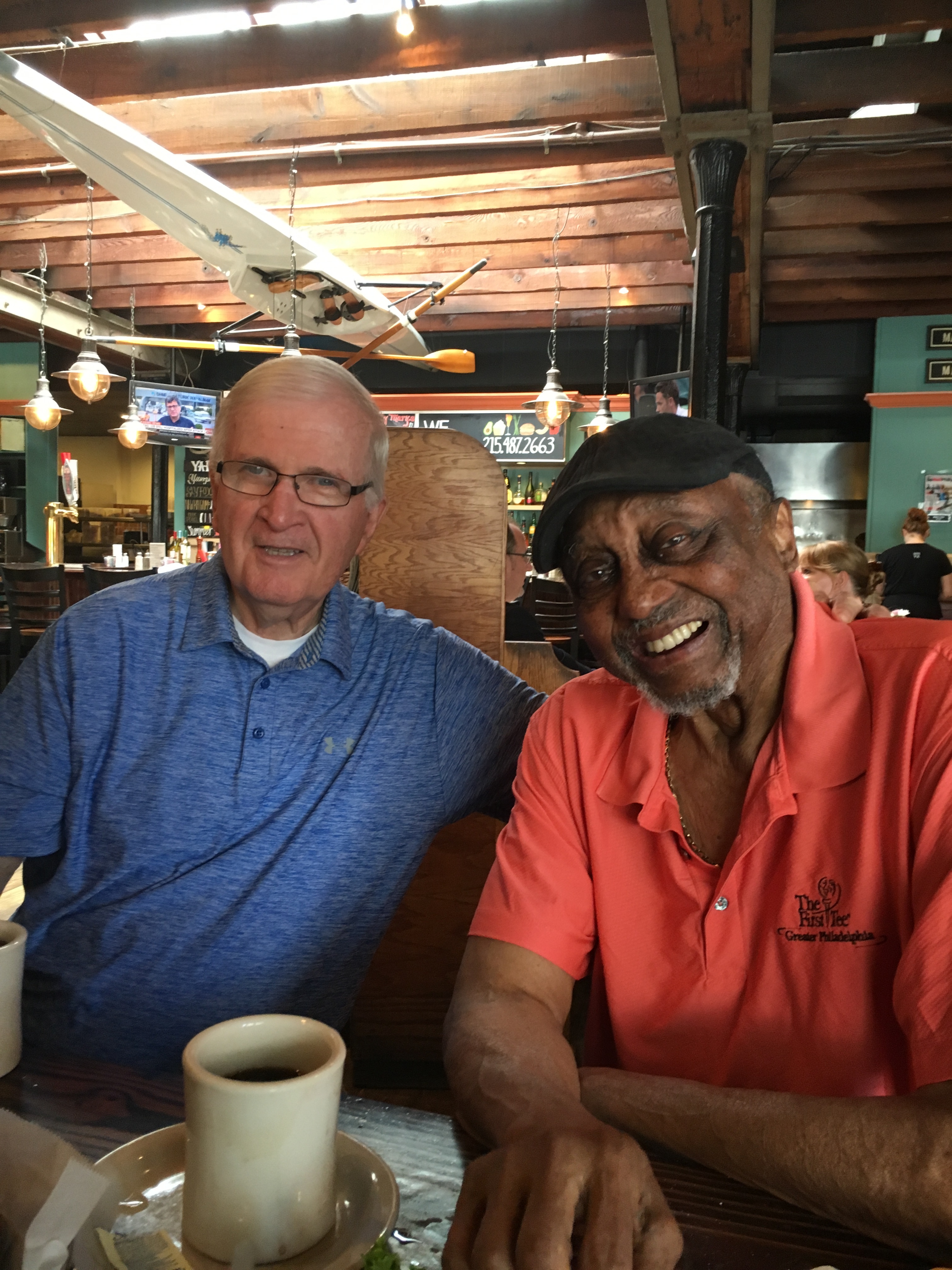
John Chaney, Speedy Morris, and Fran Dunphy.
Morris was thrilled. The high school coach asked his friend if he wanted to take the lead. Chaney insisted he didn’t. But once Morris started running a defensive drill, that quickly changed.
It was a 2-3 matchup zone, and a Prep player missed a weak-side box-out. Chaney jumped out of his chair, as if he was still at Temple.
He ran from midcourt to the paint.
“He said, ‘No!’” Morris recalled. “‘That’s not how we do it!’”
Chaney proceeded to give the student a 10-minute, expletive-laden lesson on rebounding and positioning. Keith Morris, an assistant coach at the time, nervously looked around to make sure there weren’t any Jesuit priests in the gym.
The two coaches stayed close until Chaney died in 2021. They’d talk on the phone at least once a week. They’d get lunch together in Manayunk, discussing basketball and life.
“They called each other brothers,” Keith said.
‘The caretakers’
This level of camaraderie is more challenging in today’s game. When Wright, Dunphy, and Martelli were coaching, the idea of having a player transfer from one Big 5 school to another was unfathomable.
Now, it is commonplace, with much more relaxed rules. The advent of NIL has pushed programs to generate more revenue, so they can remain competitive and pay their players. It has led to a corporate, less familial environment.
But despite these challenges, the coaches still believe that upholding the Big 5 brotherhood is worth the effort.
“Because the guys who are coaching now, they didn’t create the Big 5,” Martelli said. “They don’t own the Big 5. But they are the caretakers. And the same goes for all of us.”
In 1991, a Villanova coach whose team had risen to national prominence was vilified for killing the Big 5 when the association of Philadelphia’s Division I hoops programs moved away from its round-robin format to a scaled-down version.
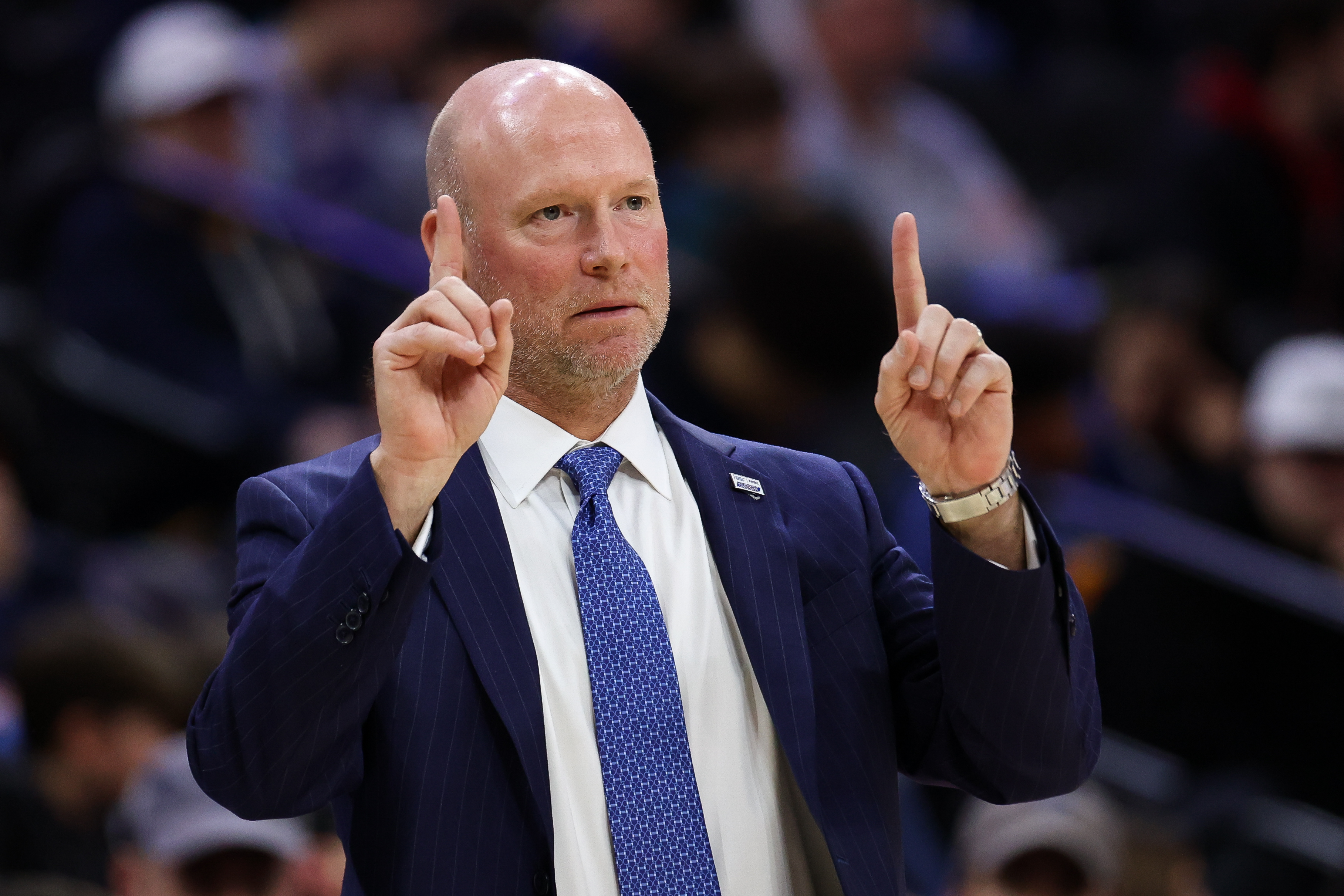
Thirty-five years later, new Villanova coach Kevin Willard may soon face his Rollie Massimino moment.
“It’s not going to go away,” Willard said of the Big 5 in an interview over the summer. “I think there’s ways to make things better.
“I want to go through it and figure out what’s best for it.”
On Saturday, Villanova will play for a Big 5 Classic championship vs. Penn. But what’s best for Villanova probably isn’t what’s best for the other five schools, and what’s best for Penn, St. Joseph’s, or Temple might not be what’s best for La Salle or Drexel.
To be sure, the sport has changed greatly since 1991. The gap between Villanova and the other local programs has not just grown, it’s never been greater — with Jay Wright’s run of dominance and, more relevantly, the implementation of a payment structure in college sports. Villanova is the only Big 5 school in a power conference with a major television deal and probably can afford to spend more money on its men’s basketball roster than the other five Big 5 programs combined. It probably will be a 15-point favorite over Penn on Saturday in the title game.
The money is at the heart of all of this. Forget your grandfather’s Big 5; this isn’t even your older brother’s Big 5. There are myriad reasons why the rivalries themselves aren’t the same, and they have been covered ad nauseam over the years: Young people don’t attend college basketball games the way they used to, the teams haven’t been very good, the transfer portal era has created a culture of mercenaries who travel from school to school year after year, and so on.
Fran Dunphy, the man they call “Mr. Big 5,″ who still watches plenty of basketball in his retirement, had an entire row to himself at Glaser Arena for a large part of the La Salle home game vs. Villanova last month. The Palestra has been removed from the equation almost entirely. The Villanova-St. Joe’s rivalry won’t happen this season for the first time in nearly 30 years. All of that is to say things change and nothing lasts forever.
But the financial component of it is why the current format of the Big 5 in its nascent stages — in which the six teams are divided into two rotating pods before playing two pool games to determine which teams match up in first-, third-, and fifth-place games during the Big 5 Classic tripleheader — seems unlikely to last very long.
The House v. NCAA settlement that resulted in schools directly paying players has only increased the need for financial diligence.
Players warm up before the start of the Big 5 Classic games on Dec. 7, 2024.
Villanova has to be considering the merits of keeping together an aging tradition vs. the cost of doing so, and it shouldn’t be alone in its considerations.
Instead of taking a bus ride to Olney to play at La Salle and winning by 15 in a sleepy building, wouldn’t Villanova have been better off having a home game, even if that means spending something like $100,000 to have a lesser opponent come to Finneran Pavilion? Maybe it’s not a buy-game and is instead another opportunity to host a team like Pittsburgh, which Villanova will do on Dec. 13.
Regardless of the replacement opponent, the current format means Villanova could be missing out on essentially two home games. One is the automatic road game from the two pod-play contests, the other is the Big 5 Classic itself, which divvies the pot from ticket sales seven ways between the six schools and the building.
That’s hundreds of thousands of dollars in revenue Villanova isn’t bringing in. Sure, your reaction to that can be “boo-hoo,” but that could be the salary of a rotational player floating away for the sake of nostalgia.
“When you play 20 conference games, playing an [Atlantic 10] road game every year is really difficult,” Willard said in June. “You’re also taking away a home game when revenue has become extremely important.”
Which brings us to the other element of this, and why Villanova isn’t alone, even if the Main Line school again will be vilified publicly for whatever happens next to the Big 5 (if its competition, for example, ends up being something like a one-day-only event with rotating matchups).
Let’s take Drexel or La Salle, for example. What if instead of playing two of these three Big 5 games, those schools got $100,000 to fly to a high-major program? A few hundred thousand may be a rotational player at Villanova, but that’s a starter or two at either of the aforementioned schools.
It may be reductive to view all of this through that lens, but that’s the reality for these schools. Money is all that matters, and the toothpaste is out of the tube in that regard. There will be no going back, which means traditions, even new takes on them, can’t last forever.
The new Big 5 format breathed some life into one that was getting stale, but it was agreed upon before the House settlement. The six athletic directors soon will have to put their heads together and figure out the best path forward.
“Scheduling is as important as anything in college sports,” Willard said. “Scheduling is everything.”
Massimino felt something similar in the early ’90s, too. That much hasn’t changed, but the financial implications certainly have.