Category: Will Bunch

  • College journalism exposes the rot of ‘grown-ups’ | Will Bunch Newsletter

    I’m always reluctant to talk about upcoming columns, because in this twisted era everything changes at the drop of a MAGA hat, and I hate to jinx things. But as of now, I’m booked for a trip to Charlotte (or Raleigh?…I’ve already jinxed it, maybe) this coming weekend, where I hope to report from the front lines of the Border Patrol’s latest big-city invasion that has terrorized the immigrant community in North Carolina. So I’m going to spend a couple days reading up on what to do in a tear-gas attack, and I’ll see you again this weekend.

    If someone forwarded you this email, sign up for free here.

    Fearless college kids are saving journalism. Grown-ups? Not so much
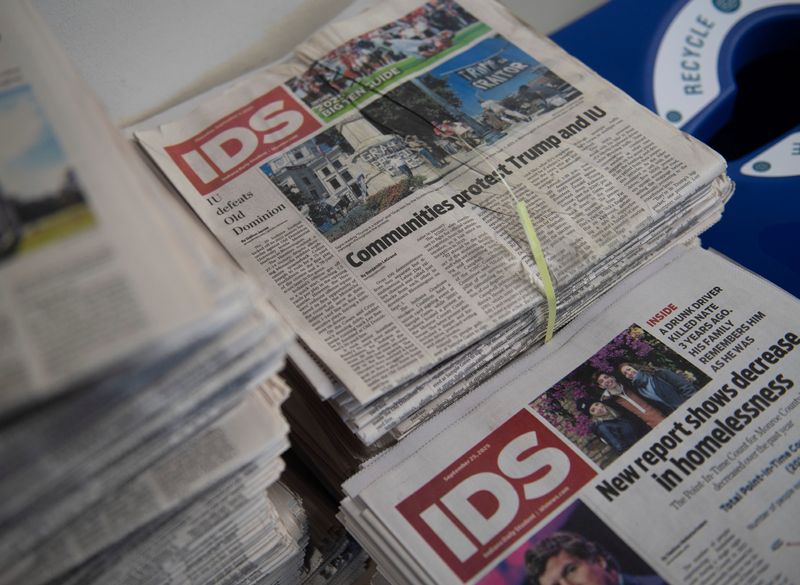
    Editions of the Indiana Daily Student in the student media area in Franklin Hall on Indiana University’s campus on Oct. 14.

    In American journalism’s year of the bended knee, nobody would have been surprised if the student editors of the Harvard Crimson followed the sorry example of major outlets like CBS News or the Washington Post in groveling before the rich and powerful — in this case, their ex-university president and still plugged-in professor Larry Summers.

    Earlier this month, Summers took to social media (the Elon Musk-owned X, of course) with a rant against the student-run paper at the Ivy League school he once helmed, linked to an article by conservative commentator (and former Crimson editor) Ira Stoll accusing the Crimson of biased coverage in favor of Palestine. Summers said ominously, “I do hope alumni trustees will investigate and take any necessary steps lest a problematic situation deteriorate any further.”

    But instead of backing down, Harvard’s student journalists stepped up. When the emails of the late financier and sex fiend Jeffrey Epstein, released last week by a House committee, proved to be riddled with his communications with Summers — long after Epstein had pleaded guilty to teen sex trafficking in Florida — the Crimson produced the most in-depth takedown of any media outlet, anywhere.

    “As Summers Sought Clandestine Relationship With Woman He Called a Mentee, Epstein Was His ‘Wing Man’” was the blistering headline on the article by undergraduates Dhruv T. Patel and Cam N. Srivastava. It described, in excruciating detail, the married Summers’ missives to Epstein about his efforts to woo a much younger Chinese economist on campus whom he was mentoring (and whom the former U.S. treasury secretary and his felonious friend code-named, with a racism they thought would remain forever private, as “peril.”)

    Take that to the alumni trustees, Mr. Summers!

    With a devastating kicker that shows Summers still emailing Epstein up until 1:27 p.m. of the day before his pal was busted on new federal sex charges in 2019, the Crimson article went viral over the weekend. By Monday morning, Massachusetts U.S. Sen. Elizabeth Warren was calling for Summers’ ouster from his faculty post. By Monday night, a “deeply ashamed” Summers announced that he’s pulling back from his public commitments, although he plans to continue teaching.

    The students’ reporting was another win for truth, justice, and the American way — but not an isolated incident. In recent years, as mainstream journalism looks increasingly weak and flabby in the face of U.S. authoritarianism, and with college campuses on the front lines of a culture war, scribes in their teens and early 20s — burning with youthful idealism and the freedom of not much to lose — have raced into the void.

    Some 3,000 miles from Harvard Square, the student journalists at the Stanford Daily stood their ground after one of its reporters was charged with three felonies, at the behest of a top university administrator, for attempting to cover a pro-Palestinian protest on the California campus. Under increasing public pressure, the charges were dropped in March — another triumph for the paper whose 2022 investigative reporting into research irregularities took down the university president.

    In the heartland, the editors of the Indiana Daily Student at that state’s flagship public university last month stood up to school administrators banning their print editions, blasting the move in a front-page editorial that said “telling us what we can and cannot print is unlawful censorship.” The students, who worked with their peers at nearby Purdue University to publish a special issue that circumvented the ban, rallied support from prominent alums and got the school to reverse course.

    “I think that many of these college journalists are laser-focused on their beats, are developing great sources among administrators, faculty and students, and are unfazed by the possibility that their stories might piss off a valued source or two,” Columbia Journalism School professor Bill Grueskin, who covered the Stanford fracas for Columbia Journalism Review, told me Monday. “In other words, they’re doing the things that the best reporters do. They’re just not able to buy a beer (legally, at least) when their story shakes up the world.”

    I know what some of you are thinking here. Investigating corruption or misconduct among university leaders, or fighting for a free press…aren’t these college students just doing what any journalist worth their salt would do? Well, yes and no.

    Consider those Epstein emails that continue to dominate the news. It turns out that two prominent journalists corresponded frequently with the convicted sex creep: the “palace intrigue” access journalist Michael Wolff, and a soon-to-be-fired New York Times business reporter, Landon Thomas Jr. The missives suggest they had zero interest in reporting on Epstein’s proclivity for underage girls but very much wanted the access to the rich and famous that jeevacation@gmail.com offered.

    And it gets worse. Thomas actually solicited a $30,000 donation from Epstein to a favored charity — a severe ethical breach that cost him his job in America’s most prestigious newsroom. Wolff, meanwhile, was offering Epstein advice on how to leverage — in essence, blackmail — the sitting U.S. president, Donald Trump. At the same time, he was pushing a business venture that would link him not only with Epstein but another man later convicted of sex crimes, filmmaker Harvey Weinstein. It seems like both conflicted journalists wanted to play in the big leagues with the much richer people they were supposed to watchdog.

    This is something that too many elite journalists share with the increasingly conflicted corporations that employ them: a desire to comfort the comfortable in return for access, or prestige, or money — and to avoid getting sued, which might jeopardize those first three things.

    How else to explain major TV networks like CBS or ABC, owned by corporations with myriad issues before the federal government, settling frivolous lawsuits by Trump for millions of dollars, or the similarly conflicted Jeff Bezos telling his Washington Post to spike its endorsement of Kamala Harris, or the mealy-mouthed “both sides” reporting on rising authoritarianism that plagues so many elite newsrooms of the traditional media?

    The late, great Kris Kristofferson told us that freedom’s just another word for nothing left to lose, and maybe that simple explanation has a lot to do with the bravery of college journalists — that they are freer to question authority than folks with a mortgage and worries about paying for their own kids to attend a top school.

    Still, it’s important to understand that most of the rot in modern mainstream journalism — too much consolidation in the hands of too few conglomerates with too much at risk to be seen as anti-regime — is institutional. We should strive to make something great out of the fact that the next generation of American journalists has arrived with smarts, savvy, and a moral compass yet to be worn down by late-stage capitalism.

    Our challenge, as a society, is to tear down the decrepit structures of the corrupted old media and build a new one that rewards independent journalists who actually afflict the comfortable, and offers them incentives to keep doing that instead of cutting venture-capitalism deals with the folks they allegedly cover. Most of today’s college journalism majors would never trade emails with the likes of Jeffrey Epstein — except to take him down.

    Yo, do this!

    • The stroke of timing behind Ken Burns’ latest documentary epic, The American Revolution, which is currently running this week on PBS stations like WHYY here in Philadelphia and also streaming, was supposed to be the 250th anniversary of the conflict that created the United States. But the project has taken on much greater relevance in a fraught present, when folks are heatedly arguing just what the Founders’ American Experiment is really all about. Critics have praised Burns and his skilled team for blending the ideals and leadership of the George Washingtons and Thomas Paines with the realities faced by everyday folk, including indigenous and enslaved people.
    • Personally, I’ve been embroiled in my nostalgia for a more recent revolution — the cultural and musical explosions that occurred in 1966. I’ve been listening to the audiobook about that tumultuous year1966: The Year the Decade Exploded — by the British author Jon Savage, whose later book on the year 1971 was the basis for an outstanding but largely ignored documentary series on Apple TV, But 1971’s classic rock wouldn’t have happened without the cultural pioneers and a youthful clamor for liberation that came five years earlier. The book is an engrossing reminder that change is possible.

    Ask me anything

    Question: Now that People Magazine has revealed the disgusting “piggy” story, why isn’t this atop every news outlets coverage? We spent 3 full weeks on Biden’s age, a week on his pardon of his son with such moral outrage from every outlet. This doesn’t even get covered? — BigTVFan (@bigtvfan.bsky.social) via Bluesky

    Answer: The episode that BigTVFan is referring to occurred with a gaggle of journalists about Air Force One, but just started getting viral attention Monday night. It is, indeed, shocking to watch. When a Bloomberg woman journalist pressed Donald Trump on the Epstein files, the president erupted. “Quiet! Quiet, Piggy!” Yes, this should be a front-page story in the traditional media, and not only because of the stunning sexism (when the subject is Epstein, no less!) and the regal arrogance, but also this: the man who’s followed around by the nuclear suitcase seems to be losing his grip on reality. Monday afternoon, Trump spoke to a gathering of franchisees of the fast-food addiction that may be just one reason why nobody believes he only weighs 16 ounces more than Jalen Hurts, McDonald’s, and was at times beyond incoherent. Yet Trump’s rapidly deteriorating mental state remains mostly off-limits for the elite media. It’s a massive error of omission that the world will look back on and regret.

    What you’re saying about…

    It’s funny how one week can feel like a decade in 2025. Last week’s question about the eight senators (seven Democrats and an independent) who cut a deal to end the long government shutdown drew a huge response from folks fired up about an issue that now almost feels like ancient history after the Epstein email release. Readers were passionate but divided. Certainly many felt the eight senators had caved in the worst possible way. An outraged Freddi Carlip wrote that “most people wanted to do what was best for Americans who are hurting and that is to stand up to bullies.” But a number of you thought the opposition had few real options but to deal from a weak hand. “This was always going to end with the government opening under the black flag of the Big Ugly Bill,” wrote Kent Dietz. “Oft repeated but true: elections have consequences.”

    📮 This week’s question: It’s all Epstein all the time, so let’s talk about it. Do you think Trump has sincerely flip-flopped and the relevant files will soon be released? Or is the White House still playing a long game aiming to keep Epstein’s secrets buried with him? Please email me your answer and put the exact phrase “Epstein files” in the subject line.

    History lesson on ‘Charlotte’s Web’…and fascism

    U.S. Border Patrol Commander at large Gregory Bovino, right, looks on as a detainee sits by a car Monday, in Charlotte, N.C.

    Nobody reads any more, at least not to the end. That’s been driven home this autumn by several efforts from tech bros and other leaders of our dystopia falling flat on their face with their attempts at literary allusions. A viral post on Bluesky recently mocked the Icarus Flying Academy, whose founders may be blissfully unaware that their Greek mythological namesake flew too close to the sun and crashed. On Monday, gazillionaire Jeff Bezos also invoked ancient Greece by announcing his AI startup Project Prometheus, invoking an inventor who was ultimately bound to a rock by Zeus for his overreaching. Then there’s the bad people behind the U.S. Border Patrol and its inhumane mass deportation drive, who took their horror show to North Carolina this past weekend with their “Operation Charlotte’s Web.”

    The “brains” behind the BP’s masked goon squad, Gregory Bovino, named the operation — which netted 81 detainees in its first Saturday during a chaotic surge through suburban lawns and Home Depot parking lots — after the 1952 classic children’s novel by E.B. White about a farm, a pig, and the compassionate spider, Charlotte, who saves the pig’s life. Why? Because Bovino’s secret police force are ensnaring scores of immigrants in their web. In Charlotte, N.C. Get it? Bovino even took to social media’s X with a wildly out-of-context quote from the novel: “Wherever the wind takes us. High, low. East, west. North, south. We take to the breeze, we go as we please.”

    In a viral essay, the writer Chris Geidner of the excellent site LawDork demolished Bovino’s literary aspirations for his police-state operation. His piece went well beyond the obvious point that a children’s novel that centers on a spider’s quest to protect someone different from her — a pig — from his human predators is the 180-degree polar opposite from the web of inhumanity that Team Bovino is spinning in Charlotte, terrorizing the Latino community there. Geidner notes that much of E.B. White’s wider work was in opposition to the very fascism that’s behind the mass deportation drive of Bovino and his ultimate boss, Donald Trump.

    Geidner quotes White from a 1940 essay, as Adolf Hitler’s stormtroopers were advancing across Europe: “I am in love with freedom and that it is an affair of long standing and that it is a fine state to be in, and that I am deeply suspicious of people who are beginning to adjust to fascism and dictators merely because they are succeeding in war. From such adaptable natures a smell rises. I pinch my nose.”

    White, and his fictional Charlotte, would have done more than pinch their nose from the stench of this operation in a proud city that shares its name with a heroic spider. For sure, Bovino’s crimes against literature pale in comparison to his ongoing crimes against humanity. But he may discover that the rapidly spinning American thread of community and common decency that is resisting mass deportation is the true sequel to Charlotte’s Web.

    What I wrote on this date in 2018

    It was Mississippi’s most famous writer, William Faulkner, who wrote, “The past is never dead. It’s not even past.” Seven years ago on this date, I wrote about how a justice-denied 1955 murder of a Black man trying to deliver absentee ballots to the county courthouse in Brookhaven, Miss., haunted the modern Senate campaign of that town’s GOP U.S. Sen. Cindy Hyde-Smith. I wrote: “Four years after [Lamar Smith] was killed, a baby girl was born in Brookhaven named Cindy Hyde. Over the next 59 years, she immersed herself in the politics of a community that bitterly refuses to concede the just cause that Lamar Smith died for.” Read the rest from Nov. 18, 2018: “Why the blood of a 1955 Mississippi murder drenches today’s U.S. Senate race.”

    Recommended Inquirer reading

    • Only one column this week, and as you might expect it drilled deeply into the true meaning of the Jeffrey Epstein emails that have dominated the headlines. I went beyond the suggestive comments about Donald Trump to look at the deeper moral decay of the rich and famous who continued to seek out Epstein and his connections years after his Florida guilty plea to child prostitution charges. The missives from billionaires and political insiders also reveal their growing — and justified — worries that the public may be reaching for pitchforks.
    • The John Fetterman saga never ends, nor does Pennsylvania readers’ bottomless fascination with his decade-plus odyssey from outspokenly progressive mayor of struggling Braddock, Pa., to the U.S. Senate, where he is increasingly at odds with his fellow Democrats about practically everything. The Inquirer’s coverage of revelations in Fetterman’s new autobiography, including his long-running feud with Gov. Josh Shapiro, was one of the most widely read stories last week. So was what happened next, as renewed heart problems caused Fetterman to fall flat on his face and again be hospitalized. There’s three more years until the end of Fetterman’s term and an all-but-certain primary challenge from his political left. No one is going to cover this better than The Inquirer, so why not subscribe today?

    By submitting your written, visual, and/or audio contributions, you agree to The Inquirer‘s Terms of Use, including the grant of rights in Section 10.

  • Did a $10M bribe break the soul of America? | Will Bunch Newsletter

    The sense of loss that has permeated 2025 struck again this weekend when we learned of the sudden death of a Philly journalism legend, Michael Days, who guided the Philadelphia Daily News during most of its last dozen freewheeling and Pulitzer-winning years before we merged with The Inquirer in 2017. He was just 72, far too young. The top-line of Mike’s obituary was how, as the first African American to lead a newsroom in America’s founding city, he paid it forward by mentoring the next generation of rising Black journalists. But people like me who worked for him remember him more simply as the wisest and most empathetic human being we ever had as a boss. He leaves right when the nation’s newsrooms need decent souls like Mike Days more than they ever did.

    If someone forwarded you this email, sign up for free here.

    What a $10M bribe rumor says about Trump, Middle East peace, and America’s fall

    President Donald Trump talks with Egypt’s President Abdel-Fattah el-Sissi during a summit to support ending the more than two-year Israel-Hamas war in Gaza after a breakthrough ceasefire deal, Oct. 13 in Sharm El Sheikh, Egypt.

    The thing about being a 79-year-old president is that sometimes you just blurt stuff out, with no filter as to whether your words might be embarrassing, undiplomatic — or potentially incriminating.

    Consider the case of Donald John Trump, the 47th U.S. president and the oldest one on the day of his election. Last week, in what may prove to be a fleeting moment of triumph as Trump celebrated a Gaza peace deal that included the release of 20 Israeli hostages, POTUS arrived at an Egyptian resort town for a Middle East summit. He kicked off the day with a one-on-one sit-down with Egypt’s strongman ruler, Abdel-Fattah el-Sissi.

    “There was a reason we chose Egypt [for the summit] because you were very helpful,” Trump said as a gaggle of reporters and photojournalists entered their meeting room.

    Really? Helpful in what way?

    “I want to thank you,” the American president told Sissi, who seized power in a 2013 coup. “He’s been my friend right from the beginning during the campaign against Crooked Hillary Clinton. Have you heard of her?”

    Here Trump was pushing, ever so absurdly, for the Nobel Peace Prize, and then he had to spoil it all by saying somethin’ stupid like, you bribed me. Well, he almost spoiled it, if more journalists — aside from MSNBC’s brilliant Rachel Maddow, who seized on the remark hours later — had grasped the potential import of this presidential prattle.

    It’s certainly legal, if gross, for Trump to be close pals with Sissi, even if Human Rights Watch reports that the Egyptian dictator is “continuing wholesale repression, systematically detaining and punishing peaceful critics and activists and effectively criminalizing peaceful dissent.” What would not be legal is the Middle Eastern nation interfering in the 2016 election, in which Trump narrowly defeated Clinton in the handful of swing states that tipped the Electoral College.

    What made Trump’s comments last week so jaw-dropping is that U.S. federal investigators worked for several years trying to prove exactly that scenario. In August 2024, days after Trump was nominated by the GOP for his second reelection bid, the Washington Post reported that the Justice Department investigated a tip that Sissi’s Egypt provided Trump with $10 million the candidate desperately needed in the 2016 homestretch to defeat Clinton. That happened right before Trump, as 45th president, reopened the spigot of foreign aid that had been halted because of Sissi’s human rights abuses.

    It’s known that Trump did put $10 million into the campaign, which he listed as a loan. The Post in 2024 offered a tantalizing, if circumstantial, piece of evidence — that the Cairo bank had received a note from an agency believed to be Egyptian intelligence to “kindly withdraw” nearly $10 million in two, 100-pound bags full of U.S. $100 bills, five days before Trump took the oath of office.

    But the investigative trail ran cold. In 2019, then-special counsel Robert Mueller turned the matter over to Trump’s appointees in the Justice Department, who of course didn’t pursue the president’s bank records. Neither — inexplicably — did Joe Biden’s attorney general, Merrick Garland, as the statute of limitations expired in January 2022. That’s where things stood last week before Trump started blathering in Sharm El Sheikh.

    One reason I’m writing about this is the sheer frustration that Trump — yes, allegedly, possibly — might have gotten away with bribery to the point where he’s almost bragging about it in public. But I also think the mysterious case of the Egyptian bags of cash speaks to the present, dire American moment in a couple of ways.

    For one thing, it casts a light on what’s really behind what Trump hopes will be viewed as the signature achievement of his second presidency. That would be the fragile peace deal that aims to end the last two years of bloodshed in Gaza that started with the Hamas terror attack of Oct. 7, 2023 and has resulted in at least 67,000 dead Palestinians and the utter destruction of their seaside homeland.

    How did Trump get a deal that had eluded his predecessor Biden, in a region that has vexed every American president from both parties? It certainly helped that most of the power brokers with the clout and the cash to help end the fighting in Gaza are repressive strongmen — or, as Trump might call them, role models. And they all seem to speak the same language of corrupt back-scratching.

    If those bags with $10 million in greenbacks did make their way to Trump in 2017, it looks like small change in today’s cross-Atlantic wheeling-and-dealing. After all, a key go-between in the negotiations — Qatar, which has good relations with Hamas and has hosted its exiled leaders — gifted America a $400 million jet that Trump plans to use not just as Air Force One but in his post presidency, while his regime has promised to protect the Qatari dictators if they are ever attacked.

    Another key supporter of the plan is the United Arab Emirates, which also backs the UAE firm that recently purchased a whopping $2 billion in cryptocurrency from a firm owned by Trump’s family as well as the family of Steve Witkoff, the regime’s lead Middle East negotiator. At the same time, Trump’s U.S. government allowed UAE to import highly sensitive microchips used in artificial intelligence.

    Witkoff’s negotiation endgame brought in Trump’s son-in-law, Jared Kushner, who forged close ties during his father-in-law’s first term with Saudi Arabia’s murderous de facto ruler Prince Mohammed bin Salman, who pulled the levers for a $2 billion investment in a hedge fund created by Kushner despite no prior expertise.

    Those Saudi ties could prove critical to future stability in the region, and in a joint interview with CBS’ 60 Minutes Sunday night, Kushner and Witkoff made no apologies for mixing billion-dollar deals with the pursuit of world peace. “What people call conflicts of interest,” Kushner said, “Steve and I call experience and trusted relationships.”

    OK, but those “trusted relationships” are built on a flimsy mountain of cash that could collapse at any minute. Look, I’m thrilled like everyone else that 20 Israeli hostages are finally reunited with their loved ones, and to the extent Trump and his regime deserve any credit, I credit them. But the art of the deal that the president is bragging about is all about the Benjamins — more worthy of applause on the floor of the New York Stock Exchange than a Nobel Peace Prize.

    Real peace is based on hard work and trust, not Bitcoin — so is it any wonder that the ceasefire is already collapsing with two dead Israeli soldiers and fresh, lethal airstrikes in Gaza? The only thing with any currency among a rogues’ gallery of world dictators is currency, and that transactional stench has fouled everything from Cairo to K Street.

    Is it any surprise that a regime whose origin story allegedly includes bags of Egyptian cash would do absolutely nothing when it was told that its future border czar, Tom Homan, was captured on an audiotape accepting $50,000 in a fast-food bag from undercover FBI agents who said they wanted government contracts?

    In hindsight, the failure to pursue that report of the $10 million Egyptian bribe opened up a floodgate of putrid corruption, wider than the Nile. It signaled a sick society where everything is for sale — even world peace — but nothing is guaranteed.

    Yo, do this!

    • The 1970s and ‘80s are having a cultural moment right now, and this boomer is here for it! On Apple TV (they’ve dropped the “+,” probably after paying some consultant $1 million for that pearl of wisdom) comes the long-awaited five part docuseries about the life and times of filmmaker Martin Scorsese, the savior who rose from NYC’s mean streets to give us Goodfellas, Raging Bull, Taxi Driver, and so much more. Watching Mr. Scorsese is going to make the eventual death of the baseball season so much easier to take.
    • The earthy, urban musical equivalent of Scorsese would have to be Bruce Springsteen, who has been marking the 50th anniversary of his breakthrough Born to Run LP with all kinds of cool stuff, capped with Friday’s long-awaited release of the first-ever biopic about “The Boss,” Deliver Me from Nowhere. Staring The Bear’s Jeremy Allen White as Springsteen, the film’s unlikely narrative — focusing on the making of 1982’s highly personal and acoustic Nebraska as the rock star seeks release from a bout of depression — sounds like exactly the uplift that America needs right now.

    Ask me anything

    Question: As someone living in Ireland and looking across the ocean. Trump won’t be in power forever, but how is anyone going to deal with the MAGA crowd that helped elect him? That level of stupidity, hatred and racism cannot be fixed. How is [t]he USA ever going to heal? — Stephen (@bannside@bsky.social) via Bluesky

    Answer: That’s a great question, Stephen, and like most great questions there’s no easy answer. Although I’m optimistic that the 2026 midterms and the 2028 presidential election will happen and that the anti-Trump coalition that we witnessed at “No Kings” will prevail, I agree with you that it’s only a partial and temporary fix. I’d fear an Iraq-level resistance could rise up in the regions we call “Trump country.” My long-term solution would be along the lines of what I proposed in my 2022 book After the Ivory Tower Falls: Fix higher education — broadly defined as from the Ivy League to good trade schools — to made it a public good that reduces inequality instead of driving it. And promote a universal gap year of national service for 18-year-olds, to get young people out of their isolated silos. There are ways to prevent the next generation from becoming as stupid or hateful or racist as the Americans who came before them, but it will take time and patience that we seem to lack right now.

    What you’re saying about…

    Remember the Philadelphia Phillies? When I last saw you here two weeks ago, their annual postseason collapse and the fate of manager Rob Thomson was a hot topic. As expected, there was minimal response from you political junkies, and opinions were split — even before the team defied the conventional wisdom and announced he’ll be returning in 2026. Thomson’s supporters were more likely to blame the Phillies’ inconsistent sluggers, with John Braun asking “who could you hire who could guarantee clutch hits?” Personally, I’m with Kim Root: “I follow the Philly Union, who just won the Supporters Shield — that is all.”

    📮 This week’s question: Back to the issue at hand: I’m curious if newsletter readers attended the “No Kings” protest last Saturday, and what you see as the future of the anti-Trump movement. Are more aggressive measures like a nationwide general strike needed, or is the continued visibility of nonviolent resisters enough? Please email me your answer and put the exact phrase “No Kings future” in the subject line.

    Backstory on who the “No Kings” protesters really were

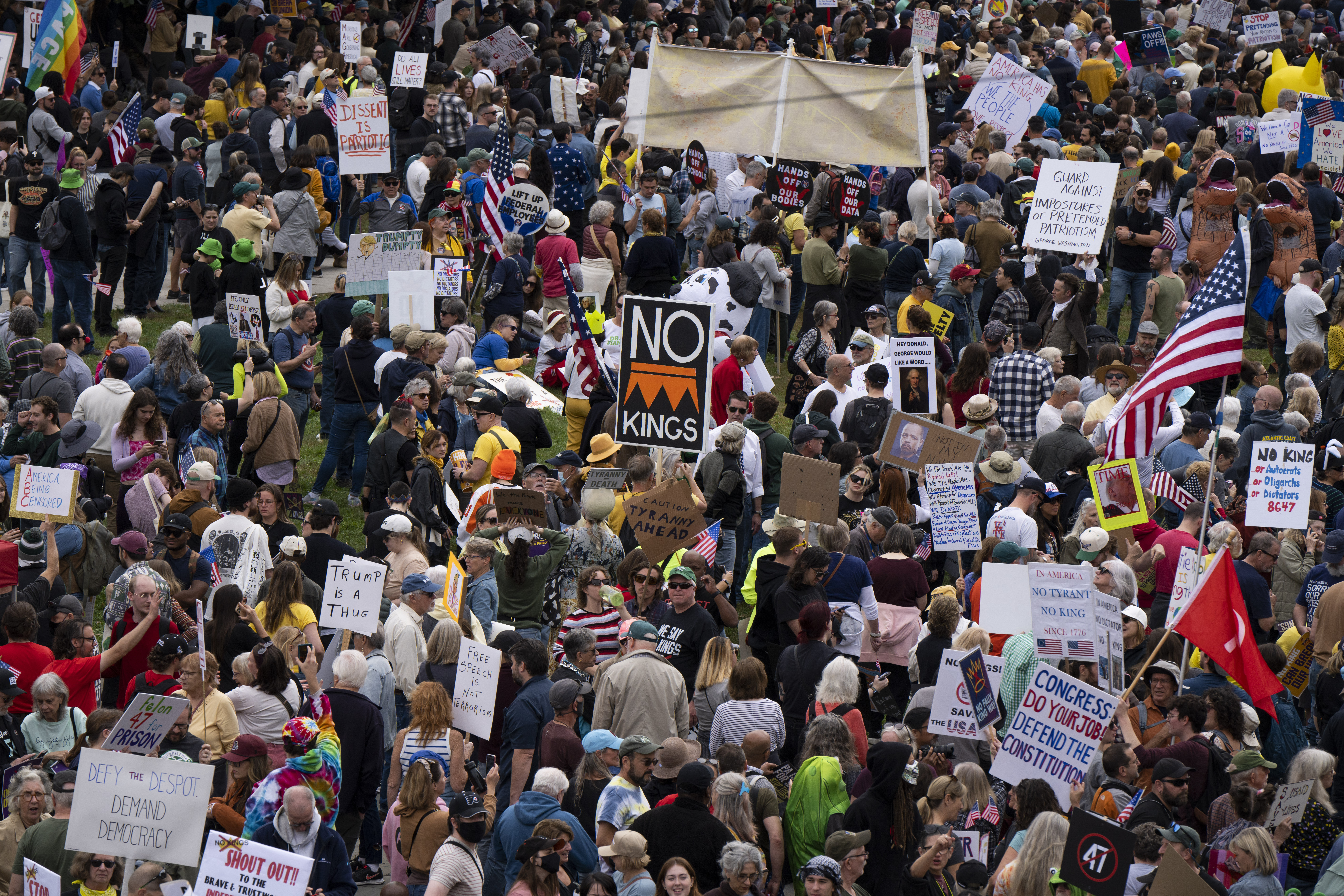
    Demonstrators gather for a ’No Kings’ rally in Philadelphia on Saturday.

    They clogged city plazas and small-town main streets from San Diego to Bangor on Saturday, yet the more than 7 million Americans who took part in the massive “No Kings” protest — the second-largest one day demonstration in U.S. history, behind only the first Earth Day in 1970 — seemed to mystify much of the befuddled mainstream media. Just who were these people protesting the Donald Trump presidency, and why are they here?

    Instead of a journalist, it took a sociologist to get some answers. Dana Fisher — the Philadelphia-area native who teaches at American University and is the leading expert on contemporary protest movements — was out in the field Saturday at the large “No Kings” march in Washington, D.C., collecting data with a team of researchers. She’s shared her early top-line results with me, aiming to both give a demographic and ideological snapshot and also compare Saturday’s crowd with her findings at other recent rallies.

    If you were among the 7 million on Saturday, some of this data won’t surprise you. The protesters were, on the whole, older than the average American, with a median age of 44 (compared to 38 for the nation as a whole.) Once again, the “No Kings” participants were overwhelmingly white (87%) with women (57%) in the majority. But it’s also worth noting that men (39%) were more likely to take part than earlier protests tracked by Fisher, and the 8% who identified as Latino is double the rate of Hispanic participation in the 2017 Women’s March.

    That last finding may reflect the passions of the “No Kings” protesters, who listed immigration as a key motivation at a rate of 74%, second only to their general opposition to Trump (80%, kind of a no brainer). That certainly jibed with the demonstrators at the rally I attended in suburban Havertown, who again and again mentioned the sight of masked federal agents grabbing migrants off the street as what compelled them to come out.

    Fisher’s most telling findings may have been these: The people out in the streets are mad about what they see happening to America, with 80% listing “anger” as an emotion they are feeling, trailed closely by “anxiety” at 76%. Yet few of those who spoke with her team believed that will translate into violence. The number of demonstrators who agreed with the statement that “because things have gotten so off track, Americans may have to resort to violence in order to save our country” was only 23% — lower than other protests her team has surveyed. It seems like the larger the public show of resistance to Trump’s authoritarianism, the more optimism that the path back to democracy can be nonviolent.

    What I wrote on this date in 2021

    I hate to say I told you so but… On this date four years ago, Joe Biden was still clinging to dreams of a presidential honeymoon after ousting Donald Trump in the 2020 election, but there were dark clouds on the horizon. On Oct. 21, 2021 I warned that sluggish action on key issues was starting to hurt his standing with under-30 voters. I wrote that “while the clock hasn’t fully run out on federal action around issues like student debt or a bolder approach on climate — the disillusionment of increasingly jaded young voters could change the course of American history for the next generation, or even beyond.” How’d that turn out? Read the rest: “From college to climate, Democrats are sealing their doom by selling out young voters.”

    Recommended Inquirer reading

    • I returned from a much-needed staycation this weekend by leaving the sofa and spending a glorious fall morning at the boisterous “No Kings” protest closest to home in Delaware County, which lined a busy street in Havertown. I wrote about how the protests are winning back America by getting under the skin of Donald Trump and the GOP, who can no longer pretend to ignore the widespread unpopularity of their authoritarian project.
    • Every election matters, even the ones that are dismissed as “off-year” contests. In today’s heated and divisive climate, even what used to be a fairly routine affair — the retention of sitting judges on the state and local level — has taken on greater importance. Here in Pennsylvania, the state’s richest billionaire, Jeff Yass, is spending a sliver of his vast wealth to convince voters to end the tenure of three Democrats on the state Supreme Court. The Inquirer’s Editorial Board is here to explain why that’s a very bad idea. On the other hand, some judges up for retention in the city of Philadelphia — where jurists haven’t always lived up to the promise of America’s cradle of democracy — deserve closer scrutiny. The newsroom’s Samantha Melamed revealed a leaked, secret survey detailing what Philadelphia attorneys think of some of the judges on the November ballot, and it is not pretty. The bottom line is that you need to vote this year, and subscribing to The Inquirer is the best way to stay informed. Sign up today!

    By submitting your written, visual, and/or audio contributions, you agree to The Inquirer‘s Terms of Use, including the grant of rights in Section 10.