Category: Technology

  • TikTok settles as social media giants face landmark trial over youth addiction claims

    TikTok settles as social media giants face landmark trial over youth addiction claims

    LOS ANGELES — TikTok agreed to settle a landmark social media addiction lawsuit just before the trial kicked off, the plaintiff’s attorneys confirmed.

    The social video platform was one of three companies — along with Meta’s Instagram and Google’s YouTube — facing claims that their platforms deliberately addict and harm children. A fourth company named in the lawsuit, Snapchat parent company Snap Inc., settled the case last week for an undisclosed sum.

    Details of the settlement with TikTok were not disclosed, and the company did not immediately respond to a request for comment.

    At the core of the case is a 19-year-old identified only by the initials “KGM,” whose case could determine how thousands of other, similar lawsuits against social media companies will play out. She and two other plaintiffs have been selected for bellwether trials — essentially test cases for both sides to see how their arguments play out before a jury and what damages, if any, may be awarded, said Clay Calvert, a nonresident senior fellow of technology policy studies at the American Enterprise Institute.

    A lawyer for the plaintiff said in a statement Tuesday that TikTok remains a defendant in the other personal injury cases, and that the trial will proceed as scheduled against Meta and YouTube.

    Jury selection starts this week in the Los Angeles County Superior Court. It’s the first time the companies will argue their case before a jury, and the outcome could have profound effects on their businesses and how they will handle children using their platforms. The selection process is expected to take at least a few days, with 75 potential jurors questioned each day through at least Thursday. A fourth company named in the lawsuit, Snapchat parent company Snap Inc., settled the case last week for an undisclosed sum.

    KGM claims that her use of social media from an early age addicted her to the technology and exacerbated depression and suicidal thoughts. Importantly, the lawsuit claims that this was done through deliberate design choices made by companies that sought to make their platforms more addictive to children to boost profits. This argument, if successful, could sidestep the companies’ First Amendment shield and Section 230, which protects tech companies from liability for material posted on their platforms.

    “Borrowing heavily from the behavioral and neurobiological techniques used by slot machines and exploited by the cigarette industry, Defendants deliberately embedded in their products an array of design features aimed at maximizing youth engagement to drive advertising revenue,” the lawsuit says.

    Executives, including Meta CEO Mark Zuckerberg, are expected to testify at the trial, which will last six to eight weeks. Experts have drawn similarities to the Big Tobacco trials that led to a 1998 settlement requiring cigarette companies to pay billions in healthcare costs and restrict marketing targeting minors.

    “Plaintiffs are not merely the collateral damage of Defendants’ products,” the lawsuit says. “They are the direct victims of the intentional product design choices made by each Defendant. They are the intended targets of the harmful features that pushed them into self-destructive feedback loops.”

    The tech companies dispute the claims that their products deliberately harm children, citing a bevy of safeguards they have added over the years and arguing that they are not liable for content posted on their sites by third parties.

    “Recently, a number of lawsuits have attempted to place the blame for teen mental health struggles squarely on social media companies,” Meta said in a recent blog post. “But this oversimplifies a serious issue. Clinicians and researchers find that mental health is a deeply complex and multifaceted issue, and trends regarding teens’ well-being aren’t clear-cut or universal. Narrowing the challenges faced by teens to a single factor ignores the scientific research and the many stressors impacting young people today, like academic pressure, school safety, socio-economic challenges, and substance abuse.”

    A Meta spokesperson said in a statement Monday the company strongly disagrees with the allegations outlined in the lawsuit and that it’s “confident the evidence will show our longstanding commitment to supporting young people.”

    José Castañeda, a Google Spokesperson, said Monday that the allegations against YouTube are “simply not true.” In a statement, he said “Providing young people with a safer, healthier experience has always been core to our work.”

    TikTok did not immediately respond to a request for comment Monday.

    The case will be the first in a slew of cases beginning this year that seek to hold social media companies responsible for harming children’s mental well-being. A federal bellwether trial beginning in June in Oakland, Calif., will be the first to represent school districts that have sued social media platforms over harms to children.

    In addition, more than 40 state attorneys general have filed lawsuits against Meta, claiming it is harming young people and contributing to the youth mental health crisis by deliberately designing features on Instagram and Facebook that addict children to its platforms. The majority of cases filed their lawsuits in federal court, but some sued in their respective states.

    TikTok also faces similar lawsuits in more than a dozen states.

  • Ikea is testing a digital Roblox experience

    Ikea is testing a digital Roblox experience

    Ikea is expanding.

    But this time it’s not with new physical stores. The home design company is entering the virtual world.

    The retailer, which has its U.S. headquarters in Conshohocken, announced this week that it is testing an immersive product experience on the Roblox platform.

    Sweden and Australia are the first two pilot countries, according to the company, and the tests there “will better inform future decisions.” Ikea spokespeople did not respond Friday to questions about whether there were plans for similar pilots in the U.S.

    What users of “Welcome to Bloxburg,” a Roblox game, will see when they go to search for Ikea digital products in the simulation.

    “We’re delighted to bring some of our most loved Ikea products into this digital space,” Sara Vestberg, home furnishing direction leader at Ikea Retail, said in a statement. “With curiosity, we’re looking forward to seeing the home furnishing ideas people create, and how our products feel at home in their digital lives.”

    Swedish and Australian customers can experience Ikea digitally on Welcome to Bloxburg, a life-simulation and role-playing game that is similar to The Sims. Welcome to Bloxburg is one of millions of games on the massively popular Roblox platform, which has more than 151 million active users every day.

    Companies including Walmart, Chipotle, and Gucci have used the digital platform to advertise their brands. Executives say it’s a way to reach Gen Z and Gen Alpha consumers, who are in their teens and 20s and with whom Roblox is particularly popular. Sports leagues like the NFL and MLB are also active on the platform.

    During the Ikea pilot, the company is making six of its popular products available in virtual form to Welcome to Bloxburg users in the select countries. The digital items include the Stockholm sofa, the Elsystem rug, and the Blahaj stuffed shark.

    The virtual experience can collide with the in-real-life shopping experience, too, if customers scan QR codes hidden around physical stores in these countries. The QR codes unlock extra virtual products, according to Ikea. In Sydney, Roblox users can compete to win real products at in-store events next week.

    “This pilot is very much about learning and exploring,” said Parag Parekh, chief digital officer at Ikea Retail. “We’re using it to better understand how digital environments can enrich the Ikea experience, while continuing to stay true to our values and what customers expect from us.”

    Ikea was founded in Sweden in 1943, and is currently based in the Netherlands. Its U.S. headquarters in Conshohocken employed more than 800 people as of June. Nationwide, Ikea has more than 50 stores, including in Conshohocken and South Philadelphia.

  • A massive and controversial AI data center is under construction in South Jersey

    A massive and controversial AI data center is under construction in South Jersey

    The French developer of South Jersey’s first large-scale AI data center made his case to residents on Wednesday, saying his massive under-construction facility will benefit them in ways unprecedented in the emerging industry.

    But at a contentious town hall, several residents said they’re not taking his word for it, especially given the timing at which the developer was asking for their input.

    “You couldn’t do this before the building was built?” asked one resident, who spoke during public comment but declined to give their name. “You kind of took our voice away.”

    The 2.4 million-square-foot, 300-megawatt Vineland data center was approved by city council more than a year ago. The center is already under construction, and the developer expects to complete it by November.

    Located on South Lincoln Avenue, off State Route 55, the site was formerly a private industrial park.

    DataOne, a French company that manages advanced data centers, is the owner, operator, and builder. Its client, Nebius Group, an Amsterdam-based AI-infrastructure company, will operate the center’s internal technology, which will fuel Microsoft’s AI tools.

    Located on South Lincoln Avenue, off State Route 55, the site was formerly a private industrial park. It was sold to DataOne in a private transaction, the details of which Charles-Antoine Beyney, DataOne’s founder and chief executive officer, declined to disclose.

    At city council meetings and on social media, some residents have voiced concerns about the environmental, financial, and quality-of-life impacts of the site. Prior to Wednesday’s meeting, residents were prompted to submit questions online that were then addressed in a presentation. Dozens also took to the mic afterward.

    Beyney said he understood their concerns, but they don’t apply to his center, which will use “breakthrough” technology to reduce its environmental impact.

    “Most of the data centers that are being built today suck, big time,” Beyney said Wednesday. “They consume water. They pollute. They are extremely not efficient. This is clearly not what we are building here.”

    “No freaking way am I am going to do what the entire industry is doing … just killing our communities and killing our lungs to make money,” he added.

    Developers tout promises of data centers

    Data centers house the technology needed to fuel increasingly sophisticated AI tools. In recent years, they have been proliferating across the country and the region.

    In June, Gov. Josh Shapiro announced a $20 billion investment by Amazon in Pennsylvania data centers in Salem Township and Falls Township.

    Politicians on both sides of the aisle — from Republican President Donald Trump to Democratic Pa. Gov. Josh Shapiro — have encouraged the expansion, as have certain labor and business leaders. Yet environmental activists and some neighbors of proposed data centers have pushed back.

    Across the Philadelphia region, residents have recently organized opposition to proposals for a 1.3 million-square-foot data center in East Vincent Township and a 2 million-square-foot facility near Conshohocken (that was forced to be withdrawn in November due to legal issues).

    This week, Limerick Township residents voiced concerns about the possibility of data centers being built in their community. And in Bucks County, a 2-million-square-foot data center is already under construction in Falls Township.

    Pennsylvania and New Jersey are home to more than 150 data centers of varying sizes and scopes, according to Data Center Map, a private company that tracks the facilities nationwide. But so far, the AI data center boom has largely spared South Jersey.

    A 560,000-square-foot data center is being built in Logan Township, Gloucester County, and is set to have a capacity of up to 150 megawatts once completed in early 2027, according to the website of its designer, Energy Concepts. There are also smaller, specialized data centers in Atlantic City and Pennsauken, according to Data Center Map.

    In Vineland, Beyney said his gas-powered center will have nearly net-zero emissions, not consume water while cooling the equipment, and generate 85% of its own power. He told residents: “You will not see your bill for electricity going and skyrocketing.”

    Opponents of data centers worry their electric bills will rise due to the centers. The developer in Vineland says that won’t happen in South Jersey.

    The facility will be 100% privately funded, he said, after the company turned down a nearly $6.2 million loan from the city amid resident backlash. The loan was approved at a December council meeting, and Beyney said DataOne would have paid about $450,000 in interest, money that could have gone back into the community.

    “That’s a shame,” Beyney said, “but we follow the people.”

    At a meeting next week, Vineland City Council could approve a PILOT agreement that would give DataOne tax breaks on the new construction in exchange for payments to the city.

    Beyney said DataOne plans to be a good neighbor. Across the street from the data center, he said they will build a vertical farm — which grows crops indoors using technology — and provide free fruits and vegetables to Vineland residents in need.

    Residents voice concerns about Vineland data center

    Several residents expressed skepticism, and even anger, about Beyney’s data-center promises, noting that Cumberland County already has plenty of farms.

    Regarding the data center itself, they asked how Beyney could be so confident about new technology, questioned the objectivity of his data, and accused him of taking advantage of a city where nearly 14% of residents live below the poverty line.

    Beyney denied the allegations.

    At least one resident said he was moved by Beyney’s assurances.

    “I was a really big critic of [the data center all along], but I think what you said tonight has alleviated a lot of my concerns,” said Steve Brown, who lives about a mile away from the data center. He still had one gripe, however: The noise.

    “What I hear every night when I wake up at 2, 3, 4 o’clock in the morning is this rumble off in the distance,” Brown said. “When I get out of my car every day when I get home, I hear it.”

    Brown invited Beyney and his team to come hear the noise from his kitchen or back patio. Beyney said they would do so, and promised to get the sound attenuated as soon as possible, certainly by the end of the project’s construction.

  • Trump’s voice in a new Fannie Mae ad is generated by artificial intelligence, with his permission

    Trump’s voice in a new Fannie Mae ad is generated by artificial intelligence, with his permission

    NEW YORK — What sounds like President Donald Trump narrating a new Fannie Mae ad actually is an AI-cloned voice reading text, according to a disclaimer in the video.

    The voice in the ad, created with permission from the Trump administration, promises an “all new Fannie Mae” and calls the institution the “protector of the American Dream.” The ad comes as the administration is making a big push to show voters it is responding to their concerns about affordability, including in the housing market.

    Trump plans to talk about housing at his appearance at the World Economic Forum in Davos, Switzerland, where world leaders and corporate executives meet this week.

    This isn’t the first time a member of the Trump family has used AI to replicate their voice, first lady Melania Trump recently employed AI technology firm Eleven Labs to help voice the audio version of her memoir. It’s not known who cloned President Trump’s voice for the Fannie Mae ad.

    Last month, Trump pledged in a prime-time address that he would roll out “some of the most aggressive housing reform plans in American history.”

    “For generations, homeownership meant security, independence, and stability,” Trump’s digitized voice says in the one-minute ad aired Sunday. “But today, that dream feels out of reach for too many Americans not because they stopped working hard but because the system stopped working for them.”

    Fannie Mae and its counterpart Freddie Mac, which have been under government control since the Great Recession, buy mortgages that meet their risk criteria from banks, which helps provide liquidity for the housing market. The two firms guarantee roughly half of the $13 trillion U.S. home loan market and are a bedrock of the U.S. economy.

    The ad says Fannie Mae will work with the banking industry to approve more would-be homebuyers for mortgages.

    Trump, Bill Pulte, who leads the Federal Housing Finance Agency, and others have said they want to sell shares of Fannie Mae and Freddie Mac on a major stock exchange but no concrete plans have been set.

    Trump and Pulte have also floated extending the 30-year mortgage to 50 years in order to lower monthly payments. Trump appeared to back off the proposal after critics said a longer-term loan would reduce people’s ability to create housing equity and increase their own wealth.

    Trump also said on social media earlier this month that he was directing the federal government to buy $200 billion in mortgage bonds, a move he said would help reduce mortgage rates at a time when Americans are anxious about home prices. Trump said Fannie Mae and Freddie Mac have $200 billion in cash that will be used to make the purchase.

    Earlier this month, Trump also said he wants to block large institutional investors from buying houses, saying that a ban would make it easier for younger families to buy their first homes.

    Trump’s permission for the use of AI is interesting given that he has complained about aides in the Biden administration using autopen to apply the former president’s signature to laws, pardons, or executive orders. An autopen is a mechanical device that is used to replicate a person’s authentic signature.

    However, a report issued by House Republicans does not include any concrete evidence that autopen was used to sign Biden’s name without his knowledge.

  • Dina Powell McCormick, former Trump official and Dave McCormick’s wife, will be president of Facebook’s parent company

    Dina Powell McCormick, former Trump official and Dave McCormick’s wife, will be president of Facebook’s parent company

    Dina Powell McCormick, a former Trump official and former member of Meta’s board, has been hired as the company’s new president and vice chair, CEO Mark Zuckerberg announced Monday morning.

    “Dina has been a valuable member of our board and will be an even more critical player as she joins our management team,“ Zuckerberg wrote on Threads, one of Meta’s platforms alongside Facebook and Instagram. ”She brings deep experience in finance, economic development, and government.“

    He also noted that she will be involved in all of Meta’s endeavors, but will particularly focused on ”partnering with governments and sovereigns to build, deploy, invest in, and finance Meta’s AI and infrastructure.”

    Powell McCormick has extensive business leadership and government experience. She spent 16 years in different leadership roles at Goldman Sachs, according to her LinkedIn page. Powell McCormick was most recently the vice chair, president, and head of global client services at BDT & MSD Partners, a banking company.

    She worked in the White House and the U.S. Department of State under former President George W. Bush and was deputy national security adviser during President Donald Trump’s first term.

    The move also signifies what appears to be Meta’s intention to create stronger ties with the federal government as it develops artificial intelligence tools. Trump praised Zuckerberg’s decision Monday.

    “A great choice by Mark Z!!! She is a fantastic, and very talented, person, who served the Trump Administration with strength and distinction!” Trump said on Truth Social, his social media platform.

    U.S. Sen. Dave McCormick (R., Pa.), Powell McCormick’s husband, has been heavily involved with AI and tech policy. For instance, he convened an AI summit in Pittsburgh in July 2025 where billions of dollars in planned projects for Pennsylvania were announced.

    The senator is also a member of the Senate Banking Committee and the Subcommittee on Digital Assets, which, among other things, oversees cryptocurrency and stablecoins. Last spring, Fortune reported that Meta could return to the crypto space after scrapping its initial foray, Diem, in 2022.

    McCormick, in a post on X Monday, said he is “incredibly proud” of his wife.

    Asked about how he would mitigate potential conflicts of interest that arose from Powell McCormick’s position, a spokesperson for the senator said: “As he has from day one, Senator McCormick will continue to comply with all U.S. Senate ethics rules and honorably and enthusiastically serve the great citizens of Pennsylvania.”

    Powell McCormick is also the second former Trump official to be hired by Meta in recent weeks, CNBC reported. Earlier this month, Meta said that it had hired Curtis Joseph Mahoney, a former deputy U.S. trade representative, to be its chief legal officer.

  • Kenneth W. Ford, hydrogen bomb physicist, educator, and author, has died at 99

    Kenneth W. Ford, hydrogen bomb physicist, educator, and author, has died at 99

    Kenneth W. Ford, 99, of Gwynedd, Montgomery County, theoretical physicist who helped develop the hydrogen bomb in 1952, university president, college professor, executive director, award-winning author, and Navy veteran, died Friday, Dec. 5, of pneumonia at Foulkeways at Gwynedd retirement community.

    Dr. Ford was a 24-year-old physics graduate student at Princeton University in 1950 when he was recruited by a colleague to help other scientists covertly build a hydrogen bomb. “I was told if we don’t do it, the Soviet Union will,” Dr. Ford told The Inquirer in 2023, “and the world will become a much more dangerous place.”

    So he spent one year at the Los Alamos National Laboratory in New Mexico and another back at Princeton, creating calculations on the burning of the fuel that ignited the bomb and theorizing about nuclear fission and fusion. The H-bomb was tested in 1952.

    Dr. Ford’s expertise was in nuclear structure and particle and mathematical physics. He and Albert Einstein attended the same lecture when he was young, and he knew Robert Oppenheimer, Fredrick Reines, John Wheeler, and dozens of other accomplished scientists and professors over his long career.

    He came to Philadelphia from the University System of Maryland in 1983 to be president of a startup biotech firm. He joined the American Physical Society as an education officer in 1986 and was named executive director of the American Institute of Physics in 1987.

    “He always seemed to be the head of something,” his son Jason said.

    He retired from the AIP in 1993 but kept busy as a consultant for the California-based Packard Foundation and physics teacher at Germantown Academy and Germantown Friends School. Michael Moloney, current chief executive of the AIP, praised Dr. Ford’s “steady and transformative leadership” in a tribute. He said: “His career in research, education, and global scientific collaboration puts him among the giants.”

    As president of the New Mexico Institute of Mining and Technology from 1975 to 1982, Dr. Ford oversaw improvements in the school’s enrollment, faculty, budget, and facilities. He “was an accomplished researcher, scholar and teacher,” Michael Jackson, interim president of New Mexico Tech, said in a tribute, “a techie through and through.”

    Dr. Ford wrote “Building the H Bomb,” and it was published in 2015.

    Before Philadelphia, he spent a year as executive vice president of the University System of Maryland. Earlier, from 1953 to 1975, he was a researcher at Indiana University, physics professor at Brandeis University in Massachusetts and the University of Massachusetts, and founding chair of the department of physics at the University of California, Irvine.

    Officials at UC Irvine said in a tribute: Dr. Ford “leaves an enduring legacy as a scientist, educator, and institution builder. … The School of Physical Sciences honors his foundational role in our history and celebrates the broad impact of his distinguished life.”

    He told The Inquirer that he hung out at the local library as he grew up in a Kentucky suburb of Cincinnati and read every book he could find about “biology, chemistry, geology, you name it.” He went on to write 11 books about physics, flying, and building the H-bomb.

    Two of his books won awards, and 2015’s Building the H Bomb: A Personal History became a hit when the Department of Energy unsuccessfully tried to edit out some of his best material. His research papers on particle scattering, the nuclear transparency of neutrons, and other topics are cited in hundreds of publications.

    Dr. Ford was a popular professor because he created interesting demonstrations of physics for his students.

    In 1976, he earned a distinguished service citation from the American Association of Physics Teachers. In 2006, he earned an AAPT medal for notable contributions to the teaching of physics.

    He was the valedictorian at Phillips Exeter Academy in New Hampshire in 1944. He served two years in the Navy and earned a summa cum laude bachelor’s degree in physics at Harvard University and his doctorate at Princeton in 1953.

    In 1968, he was so opposed to the Vietnam War that he publicly declined to ever again work in secret or on weapons. “It was a statement of principle,” he told The Inquirer.

    Kenneth William Ford was born May 1, 1926, in West Palm Beach, Fla. He married Karin Stehnike in 1953, and they had a son, Paul, and a daughter, Sarah. After a divorce, he married Joanne Baumunk, and they had daughters Caroline and Star, and sons Adam and Jason. His wife and former wife died earlier.

    This photo shows Dr. Ford (center) and other students listening to former First Lady Eleanor Roosevelt speak in 1944.

    Dr. Ford lived in University City, Germantown, and Mount Airy before moving to Foulkeways in 2019. He was an avid pilot and glider for decades. He enjoyed folk dancing, followed the Eagles closely, and excelled at Scrabble and other word games.

    He loved ice cream, coffee, and bad puns. He became a Quaker and wore a peace sign button for years. Ever the writer, he edited the Foulkeways newsletter.

    In 2023, he said: “I spent my whole life looking for new challenges.” His son Jason said. “He found connections between things. He had an active mind that went in all different directions.”

    In addition to his children, Dr. Ford is survived by 14 grandchildren, a great-grandson, a sister, a stepdaughter, Nina, and other relatives.

    Services are to be from 2 to 4:30 p.m., Saturday, Jan. 24, at Foulkeways at Gwynedd, 1120 Meetinghouse Rd., Gwynedd, Pa. 19436.

    Dr. Ford and his son Jason
    Dr. Ford wore a peace sign button for years.
  • How to recycle your old electronics the right way, according to e-waste experts

    How to recycle your old electronics the right way, according to e-waste experts

    If you got an iPhone, smart TV, or laptop as a holiday gift, you may be facing the age-old dilemma of what to do with your old electronics.

    Or maybe you’ve already thrown your now-outdated device in the kitchen junk drawer to languish for years alongside flip phones from the early aughts.

    “People want to do the right thing, but they don’t know what to do,” Joe Connors, CEO of the Pennsylvania-based secure e-waste recycler CyberCrunch. Something like an old TV “often ends up in their basement or in their garage.”

    There is a better way to bid adieu to these electronics, experts say, and it’s not even that complicated.

    “It’s easier than people think,” said Andrew Segal, head of operations at eForce Recycling in Grays Ferry. “A lot of people scratch their heads, [saying] ‘I don’t know what to do with this stuff.’ … [But] there are plenty of electronics recyclers out there.”

    The industry has grown in recent decades, particularly after state laws began governing e-waste recycling in the early 2000s.

    Let experts answer your questions about how to responsibly dispose of old electronics.

    Can I put TVs, phones, and other electronics out with my regular trash or recycling?

    Electronics can’t be picked up with regular trash or recycling, but they can be taken to places like Philadelphia’s sanitation services centers.

    That’s a resounding no.

    Throwing out electronics is technically illegal in Pennsylvania and New Jersey, and consumers can face fines for disposing of e-waste. As of January, 25 states and D.C. have such laws on the books.

    Leaving TVs and other large electronics outside also poses environmental risks.

    “The screens wind up getting cracked, and they get rained on, and that all can wash up into the waterways,” Segal said. “It’s not good.”

    Only put electronics on the curb if you have arranged a pickup with a certified recycler, experts say.

    It can be difficult to find a company that will pick up electronics, e-recycling executives say. Some said they used to recommend the service Retrievr, but it recently paused its Philly-area services indefinitely. If a consumer does find such a service, they say it’s likely to come at a cost.

    If an electronic is too heavy to lift alone, and you don’t want to pay for a pickup, experts recommend asking neighbors, friends, or relatives to help get the item into the car. Once you get to a collection site, they say, workers can usually take it from there.

    So what should I do with old electronics?

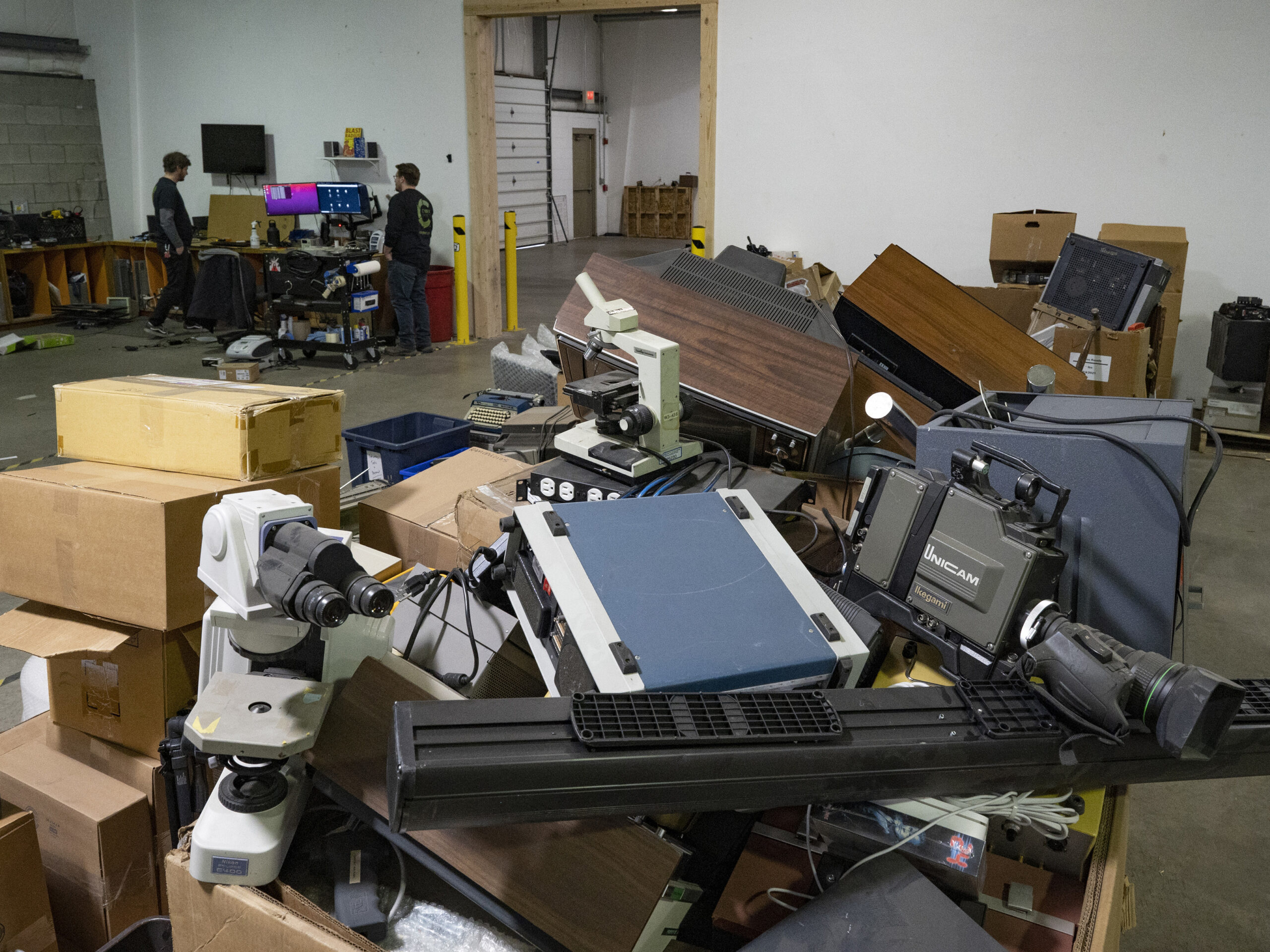
    Electronics are stacked on pallets at the Greensburg, Pa., facility of CyberCrunch, an electronics recycling and data destruction service, as pictured in 2022.

    Take it to a certified electronics collection site.

    “Google ‘e-waste recycling’ and see what options exist” in your area, said Tricia Conroy, executive director of Minneapolis-based MRM Recycling, which helps electronics manufacturers recycle sustainably. “Most phone carriers will recycle on the spot.”

    Other programs and services vary by location, Conroy said.

    Philadelphians can drop off items for free at any of Philadelphia’s sanitation convenience centers. And in New Jersey, you can search free sites by county at dep.nj.gov/dshw/rhwm/e-waste/collection-sites.

    Elsewhere, you can search for township or county e-recycling events. You can also bring electronics to Goodwill Keystone Area stores, Staples, or Best Buy to be recycled. Call or go online to check a store’s specific e-recycling policy before making the trip.

    North Jersey-based Reworld waste management helped design Goodwill’s program in 2024 to “address a gap in Pennsylvania’s electronics recycling infrastructure,” spokesperson Andrew Bowyer said in a statement.

    “Prior to its launch, many counties, including densely populated areas around Philadelphia, had limited or fee-based options for recycling electronics — particularly bulky items like televisions — which often led to illegal dumping.”

    Consumers can also make appointments to drop off devices at places like CyberCrunch in Upper Chichester, said Connors, whose company specializes in data-destruction, e-waste recycling, and reuse.

    About 90% of CyberCrunch’s business comes from commercial clients, Connor said. But the Delaware County warehouse, he said, accepts drop-offs from consumers, usually for no fee (with the exception of TVs, which cost money to sustainably discard, Connors said).

    What should I do before I recycle an old smartphone, computer, or smart TV?

    Consumers should take care to remove data from old smartphones before they are recycled, industry experts say.

    Delete all data, experts say.

    “Most people, once [a device] leaves their hands, they don’t think about it,” Connors said. And “people don’t think that bad things are going to happen.”

    But consumers’ digital information gets stolen every day in increasingly creative ways, Connors said.

    To be safe, Connors recommends people remove the SIM cards from all old smartphones, whether they’re sitting in a junk drawer or heading to an e-recycling facility. SIM cards hold much of a user’s important, identifying data. On iPhones, SIM cards are located in a tray on the side of the phone and can be removed by putting a straightened paper clip or similar tool into the tiny hole on the tray.

    When removing data from an old laptop, Connors recommends more than a factory reset. Take it to a professional who can wipe the computer clean entirely, he said.

    Don’t forget to also remove data from old smart TVs, where users are often logged into multiple apps, including some like Amazon that are connected to banking information, Connors said.

  • Musk’s AI chatbot faces global backlash over sexualized images of women and children

    Musk’s AI chatbot faces global backlash over sexualized images of women and children

    LONDON — Elon Musk’s AI chatbot Grok is facing a backlash from governments around the world after a recent surge in sexualized images of women and children generated without consent by the artificial intelligence-powered tool.

    On Tuesday, Britain’s top technology official demanded that Musk’s social media platform X take urgent action while a Polish lawmaker cited it as a reason to enact digital safety laws.

    The European Union’s executive arm has denounced Grok while officials and regulators in France, India, Malaysia, and Brazil have condemned the platform and called for investigations.

    Rising alarm from disparate nations points to the nightmarish potential of nudification apps that use artificial intelligence to generate sexually explicit deepfake images.

    Here’s a closer look:

    Image generation

    The problem emerged after the launch last year of Grok Imagine, an AI image generator that allows users to create videos and pictures by typing in text prompts. It includes a so-called “spicy mode” that can generate adult content.

    It snowballed late last month when Grok, which is hosted on X, apparently began granting a large number of user requests to modify images posted by others. As of Tuesday, Grok users could still generate images of women using requests such as, “put her in a transparent bikini.”

    The problem is amplified both because Musk pitches his chatbot as an edgier alternative to rivals with more safeguards, and because Grok’s images are publicly visible, and can therefore be easily spread.

    Nonprofit group AI Forensics said in a report that it analyzed 20,000 images generated by Grok between Dec. 25 and Jan. 1 and found that 2% depicted a person who appeared to be 18 or younger, including 30 of young or very young women or girls, in bikinis or transparent clothes.

    Musk response

    Musk’s artificial intelligence company, xAI, responded to a request for comment with the automated response, “Legacy Media Lies.”

    However, X did not deny that the troublesome content generated through Grok exists. Yet it still claimed in a post on its Safety account, that it takes action against illegal content, including child sexual abuse material, “by removing it, permanently suspending accounts, and working with local governments and law enforcement as necessary.”

    The platform also repeated a comment from Musk, who said, “Anyone using Grok to make illegal content will suffer the same consequences as if they upload illegal content.”

    A growing list of countries are demanding that Musk does more to rein in explicit or abusive content.

    Britain

    X must “urgently” deal with the problem, Technology Secretary Liz Kendall said Tuesday, adding that she supported additional scrutiny from the U.K.’s communications regulator, Ofcom.

    Kendall said the content is “absolutely appalling, and unacceptable in decent society.”

    “We cannot and will not allow the proliferation of these demeaning and degrading images, which are disproportionately aimed at women and girls.”

    Ofcom said Monday it has made “urgent contact” with X.

    “We are aware of serious concerns raised about a feature on Grok on X that produces undressed images of people and sexualised images of children,” the watchdog said.

    The watchdog said it contacted both X and xAI to understand what steps it has taken to comply with British regulations.

    Under the U.K.’s Online Safety Act, social media platforms must prevent and remove child sexual abuse material when they become aware of it.

    Poland

    A Polish lawmaker used Grok on Tuesday as a reason for national digital safety legislation that would beef up protections for minors and make it easier for authorities to remove content.

    In an online video, Wlodzimierz Czarzasty, speaker of the parliament, said he wanted to make himself a target of Grok to highlight the problem, as well as appeal to Poland’s president for support of the legislation.

    “Grok lately is stripping people. It is undressing women, men, and children. We feel bad about it. I would, honestly, almost want this Grok to also undress me,” he said.

    European Union

    The bloc’s executive arm is “well aware” that Grok is being used to for “explicit sexual content with some output generated with childlike images,” European Commission spokesman Thomas Regnier said

    “This is not spicy. This is illegal. This is appalling. This is disgusting. This is how we see it, and this has no place in Europe. This is not the first time that Grok is generating such output,” he told reporters Monday.

    After Grok spread Holocaust-denial content last year, according to Regnier, the Commission sought more information from Musk’s social media platform X. The response from X is currently being analyzed, he said.

    France

    The Paris prosecutor’s office said it’s widening an ongoing investigation of X to include sexually explicit deepfakes after officials receiving complaints from lawmakers.

    Three government ministers alerted prosecutors to “manifestly illegal content” generated by Grok and posted on X, according to a government statement last week.

    The government also flagged problems with the country’s communications regulator over possible breaches of the EU’s Digital Services Act.

    “The internet is neither a lawless zone nor a zone of impunity: sexual offenses committed online constitute criminal offenses in their own right and fall fully under the law, just as those committed offline,” the government said.

    India

    The Indian government on Friday issued an ultimatum to X, demanding that it take down all “unlawful content” and take action against offending users. The country’s Ministry of Electronics and Information Technology also ordered the company to review Grok’s “technical and governance framework” and file a report on actions taken.

    The ministry accused Grok of “gross misuse” of AI and serious failures of its safeguards and enforcement by allowing the generation and sharing of ”obscene images or videos of women in derogatory or vulgar manner in order to indecently denigrate them.”

    The ministry warned failure to comply by the 72-hour deadline would expose the company to bigger legal problems, but the deadline passed with no public update from India.

    Malaysia

    The Malaysian communications watchdog said Saturday it was investigating X users who violated laws prohibiting spreading “grossly offensive, obscene, or indecent content.”

    The Malaysian Communications and Multimedia Commission said it’s also investigating online harms on X, and would summon a company representative.

    The watchdog said it took note of public complaints about X’s AI tools being used to digitally manipulate “images of women and minors to produce indecent, grossly offensive, or otherwise harmful content.”

    Brazil

    Lawmaker Erika Hilton said she reported Grok and X to the Brazilian federal public prosecutor’s office and the country’s data protection watchdog.

    In a social media post, she accused both of generating, then publishing sexualized images of women and children without consent.

    She said X’s AI functions should be disabled until an investigation has been carried out.

    Hilton, one of Brazil’s first transgender lawmakers, decried how users could get Grok to digitally alter any published photo, including “swapping the clothes of women and girls for bikinis or making them suggestive and erotic.”

    “The right to one’s image is individual; it cannot be transferred through the ‘terms of use’ of a social network, and the mass distribution of child pornography by an artificial intelligence integrated into a social network crosses all boundaries,” she said.

  • New York subway ends its MetroCard era and switches fully to tap-and-go fares

    New York subway ends its MetroCard era and switches fully to tap-and-go fares

    NEW YORK — When the MetroCard replaced the New York City subway token in 1994, the swipeable plastic card infused much-needed modernity into one of the world’s oldest and largest transit systems.

    Now, more than three decades later, the gold-hued fare card and its notoriously finicky magnetic strip are following the token into retirement.

    The last day to buy or refill a MetroCard is Dec. 31, 2025, as the transit system fully transitions to OMNY, a contactless payment system that allows riders to tap their credit card, phone, or other smart device to pay fares, much like they do for other everyday purchases.

    Transit officials say more than 90% of subway and bus trips are now paid using the tap-and-go system, introduced in 2019.

    Major cities around the world, including London and Singapore, have long used similar contactless systems. In the U.S., San Francisco launched a pay-go system earlier this year, joining Chicago and others.

    MetroCards upended how New Yorkers commute

    The humble MetroCard may have outlasted its useful life, but in its day it was revolutionary, says Jodi Shapiro, curator at the New York Transit Museum in Brooklyn, which opened an exhibit earlier this month reflecting on the MetroCard’s legacy.

    Before MetroCards, bus and subway riders relied on tokens, the brass-colored coins introduced in 1953 that were purchased from station booths. When the subway opened in 1904, paper tickets cost just a nickel, or about $1.82 in today’s dollars.

    “There was a resistance to change from tokens to something else because tokens work,” Shapiro said on a recent visit to the museum, housed underground in a decommissioned subway station. “MetroCards introduced a whole other level of thinking for New Yorkers.”

    The Metropolitan Transportation Authority launched public campaigns to teach commuters how to swipe the originally blue-colored cards correctly, hoping to avoid the dreaded error message or lost fares. Officials even briefly toyed with the idea of an quirky mascot, the Cardvaark, before coming to their senses.

    The cards quickly became collectors items as the transit system rolled out special commemorative editions marking major events, such as the “Subway Series” between baseball’s New York Mets and the New York Yankees in the 2000 World Series. At the time, a fare cost $1.50.

    Artists from David Bowie and Olivia Rodrigo to seminal New York hip hop acts, such as Wu-Tang Clan, the Notorious B.I.G., and LL Cool J, have also graced the plastic card over the years, as have iconic New York TV shows like Seinfeld and Law & Order.

    “For me, the most special cards are cards which present New York City to the world,” said Lev Radin, a collector in the Bronx. “Not only photos of landmarks, skylines, but also about people who live and make New York special.”

    Perfecting the correct angle and velocity of the MetroCard swipe also became something of a point of pride separating real New Yorkers from those just visiting.

    During her failed 2016 presidential campaign, Hillary Clinton, a former U.S. Senator from New York, took an excruciating five swipes at a Bronx turnstile. In fairness, her chief Democratic opponent at the time, U.S. Sen. Bernie Sanders of Vermont, a native Brooklynite, didn’t even appear to realize tokens had been discontinued.

    Cost savings and lingering concerns

    Unlike the MetroCard rollout, OMNY has required little adjustment.

    Riders reluctant to use a credit card or smart device can purchase an OMNY card they can reload, similar to a MetroCard. Existing MetroCards will also continue to work into 2026, allowing riders to use remaining balances.

    MTA spokespersons declined to comment, pointing instead to their many public statements as the deadline approaches.

    The agency has said the changeover saves at least $20 million annually in MetroCard-related costs.

    The new system also allows unlimited free rides within a seven-day period because the fare is capped after 12 rides. It’ll max out at $35 a week once the fare rises to $3 in January.

    Still, new changes come with tradeoffs, with some critics raising concerns about data collection and surveillance.

    Near Times Square on a recent morning, Ronald Minor was among the dwindling group of “straphangers” still swiping MetroCards.

    The 70-year-old Manhattan resident said he’s sad to see them go. He has an OMNY card but found the vending machines to reload it more cumbersome.

    “It’s hard for the elders,” Minor said as he caught a train to Brooklyn. “Don’t push us aside and make it like we don’t count. You push these machines away, you push us away.”

    John Sacchetti, another MetroCard user at the Port Authority stop, said he likes being able to see his balance as he swipes through a turnstile so he knows how much he’s been spending on rides.

    “It’s just like everything else, just something to get used to,” he said as he headed uptown. ”Once I get used to it, I think it’ll be OK.”

  • CEO of South Philadelphia Bitcoin mining company defrauded investors out of $48.5 million, regulators say

    CEO of South Philadelphia Bitcoin mining company defrauded investors out of $48.5 million, regulators say

    For years after the abrupt folding of a South Philadelphia-based company that promised big returns on cryptocurrency, investors who lost thousands of dollars had two questions — where was the firm’s elusive CEO, and when would he be held accountable?

    A lawsuit brought by the Securities and Exchange Commission this month is offering answers.

    Danh C. Vo, the 37-year-old founder of the now-defunct VBit Technologies Corp., was accused last week of misappropriating more than $48 million of investor funds in a nationwide scheme that affected 6,400 people. Vo’s alleged victims, many of them in the Philadelphia region, gave him money to maintain highly advanced computers they believed would generate passive income through the cryptocurrency Bitcoin.

    But Vo, whose company lured potential investors into a multilevel marketing program with sports cars and luxury watches, instead ran something of a one-man shadow company, according to the SEC’s 28-page complaint, filed in federal court last Wednesday.

    While Vo possessed some of the computers — devices that process cryptocurrency transactions and reward the owner with a fraction of Bitcoin in exchange for maintaining the costly technology — SEC investigators found VBit’s customers did not own the computers Vo said he had sold them.

    That was hardly the only alleged fabrication in VBit’s four-year existence.

    In all, Vo raised more than $95 million from investors and kept much of the Bitcoin the company generated in a personal account before fleeing the Philadelphia area to Vietnam in 2021, SEC investigators say.

    Weeks earlier, Vo had learned he was the subject of a federal investigation.

    As customers grew increasingly suspicious of VBit’s supposed sale that winter to an “Asia-based company” — an organization the SEC now says existed only on paper — Vo blamed his lack of communication on mysterious health issues, the complaint says.

    All the while, the company’s day-to-day operations ground to a halt and investors found they were no longer able to withdraw their money.

    The complaint also names a handful of Vo’s family members, who are not accused of wrongdoing but have been ordered to return investor funds.

    Investigators say that before he fled the country, Vo gifted $5 million to his wife and others close to him.

    Vo has yet to hire an attorney, court records show. The complaint does not show whether investigators know his current location. He could not be reached by phone, and a number for his wife was disconnected.

    Bitcoin ‘without the headaches’

    Before the cryptocurrency industry’s rise in the public eye, Bitcoin and other digital tokens were considered niche financial tools used by only the most devout believers.

    Then, in the thick of the pandemic, crypto was seemingly everywhere, from Matt Damon-assisted Super Bowl commercials to the portfolios of billion-dollar hedge funds and international banking institutions.

    When used for making transactions or storing value, Bitcoin and other cryptocurrencies can serve legitimate purposes.

    But companies like VBit took the hype a step further. In the view of burgeoning executives like Vo, “mining” for Bitcoin with advanced computers offered the average person a near-mythic opportunity to get rich.

    Vo started VBit Technologies in 2018 with the uninitiated in mind. He set up shop in a redbrick office building on bustling Washington Avenue, keeping a small staff of employees there.

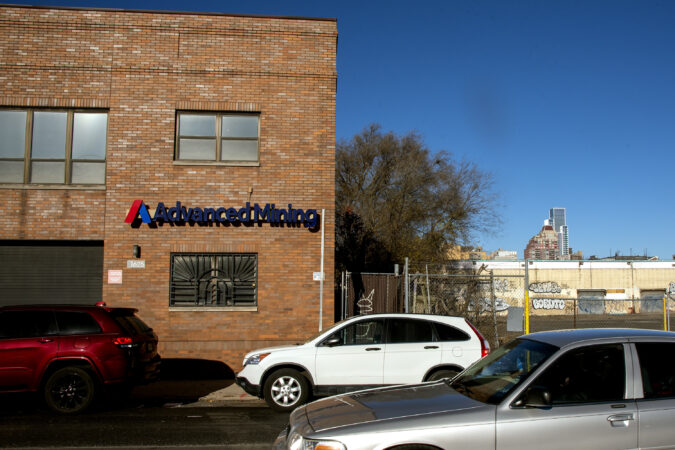
    The scene at 1625 Washington Avenue Tuesday Dec. 13, 2022. The sign reads “Advanced Mining” the business that acquired the cryptocurrency company VBit Technologies which is facing several new lawsuits in federal court after its customers claim the company froze them out of millions of dollars in assets this summer.

    An investigation published in The Inquirer in 2022 found some of Vo’s customers had little knowledge of how cryptocurrencies actually worked. SEC investigators say customers believed VBit would provide them with a “turnkey solution” for those complexities.

    Vo sold investors “hosting agreements” for the computers that, in some cases, cost upward of $100,000 per package, according to the complaint. VBit told customers that if they purchased one of the Bitcoin-earning computers, the company would pool together their devices’ collective computing power, generating even greater returns.

    Vo owned a building in rural Montana and leased facilities elsewhere to house thousands of the noisy devices, which use massive amounts of power and rarely make sense for an individual to operate at home.

    As the Bitcoin piled up, customers tracked their profits on digital portals that VBit had created for them.

    According to the SEC, those figures were nothing more than pixels on a screen.

    The complaint says the actual profits went directly into accounts that only Vo controlled. Meanwhile, customers had no way to know what exactly the CEO had even sold them.

    Investors were not provided serial numbers for their computers, and were largely barred from visiting the far-flung facilities that housed them, according to the complaint. Instead, Vo alone controlled the devices — and sold many more than he actually possessed.

    In 2021, the company’s peak sales year, VBit sold agreements to host more than 8,400 computers, according to the complaint. The company had just 1,643 on hand.

    Meanwhile, of the $48 million of investor funds Vo allegedly misappropriated, the CEO “gambled away” around $32 million on other cryptocurrency investments, the complaint says.

    For customers who did choose to cash in on their profits, Vo kept several million in a separate account to dole out. Still, the SEC found that VBit had never had enough money to back up the total value of the investments.

    And because many customers had only partially purchased their computers, using their newfound income to pay VBit back the balance they owed on the device, the scheme largely averted their suspicions.

    At least until the company’s final days.

    A mysterious exit

    On Oct. 19, 2021, Vo learned the SEC was investigating his company for selling unregistered securities, according to the complaint.

    The CEO soon began laying the seeds of a supposed sale of his company to a new firm, Advanced Mining Group.

    A website for Advanced Mining was registered on Nov. 1, and by January 2022, a news release went out to crypto-related news outlets announcing that VBit had been sold for more than $100 million.

    The sale would give Vo “peace of mind and freedom to focus on my health,” the CEO said in a cryptic statement.

    Meanwhile, investigators say, Vo began transferring investors’ money to his family and himself.

    More than $15 million went to Vo’s personal bank account, according to the complaint. His sister received $300,000, his brother, $500,000, and his mother, $100,000.

    Vo’s daughter, who is a minor, received $1 million in a trust fund. None of the family members provided services in exchange for the funds, the complaint says.

    The only person who received more than Vo’s daughter was his wife, Phuong D. Vo. The CEO gifted her $1.8 million over a monthlong period, according to the complaint.

    And on Nov. 19 — the day Vo began transferring the funds — he filed for divorce from his wife, the complaint says. The CEO’s travel records indicated he was headed for Vietnam the following day.

    For VBit’s customers, Vo’s secretive exit and the supposed sale to Advanced Mining began a period of decline and confusion.

    Customers who had been incentivized to recruit other investors through video-based information sessions soon began to lose communication with those higher up in the marketing chain.

    And for the sliver of investors who had been cashing in, withdrawals went from taking hours to weeks. By June 2022, customers found they were frozen out of their accounts entirely.

    Attempting to explain the chaos, representatives with Advanced Mining told customers through email that the company was having regulatory issues with the SEC. The agency declined to comment on any such probe at the time.

    In July, Advanced Mining promised refunds that investors say never came. By the fall, company communication had gone dark.

    Customers soon launched a series of unsuccessful lawsuits in multiple states, hoping to claw back their money via a judge. In Washington state, financial regulators opened a smaller-scale investigation into potential fraud on behalf of a group of residents.

    In group chats on the messaging app Telegram, hundreds of investors began to gather, finding solace that others, too, had allegedly been victims of Vo’s company. Members spent the months after VBit’s collapse speculating about the CEO’s whereabouts and the increasingly unlikely odds of getting their money back.

    The SEC’s lawsuit this month signals the first sign of closure in those customers’ yearslong quest for justice.

    There has not been a post in one of those chats, dubbed “PA Advanced Mining Lawsuit Group,” since 2023.