According to the new survey, 38% of all Pennsylvanians support data centers being built in the Commonwealth, while 35% oppose, and 27% are neutral or have no opinion. But when asked about data centers being built in their area, residents’ opposition grows: 34% support, 42% oppose, and 24% are neutral or have no opinion about centers being built in or near their communities.
And opposition to close-to-home data center construction is among the strongest in the southeast part of Pennsylvania, second only to opposition in the northeast, a hot spot for data center construction. In Southeast Pennsylvania, 45% of respondents strongly or somewhat oppose data centers, while 54% strongly or somewhat oppose them in the northeast.
Among Pennsylvanians’ worries about data centers, 70% are concerned about the amount of water data centers use, and 71% are concerned about the amount of electricity data centers use.
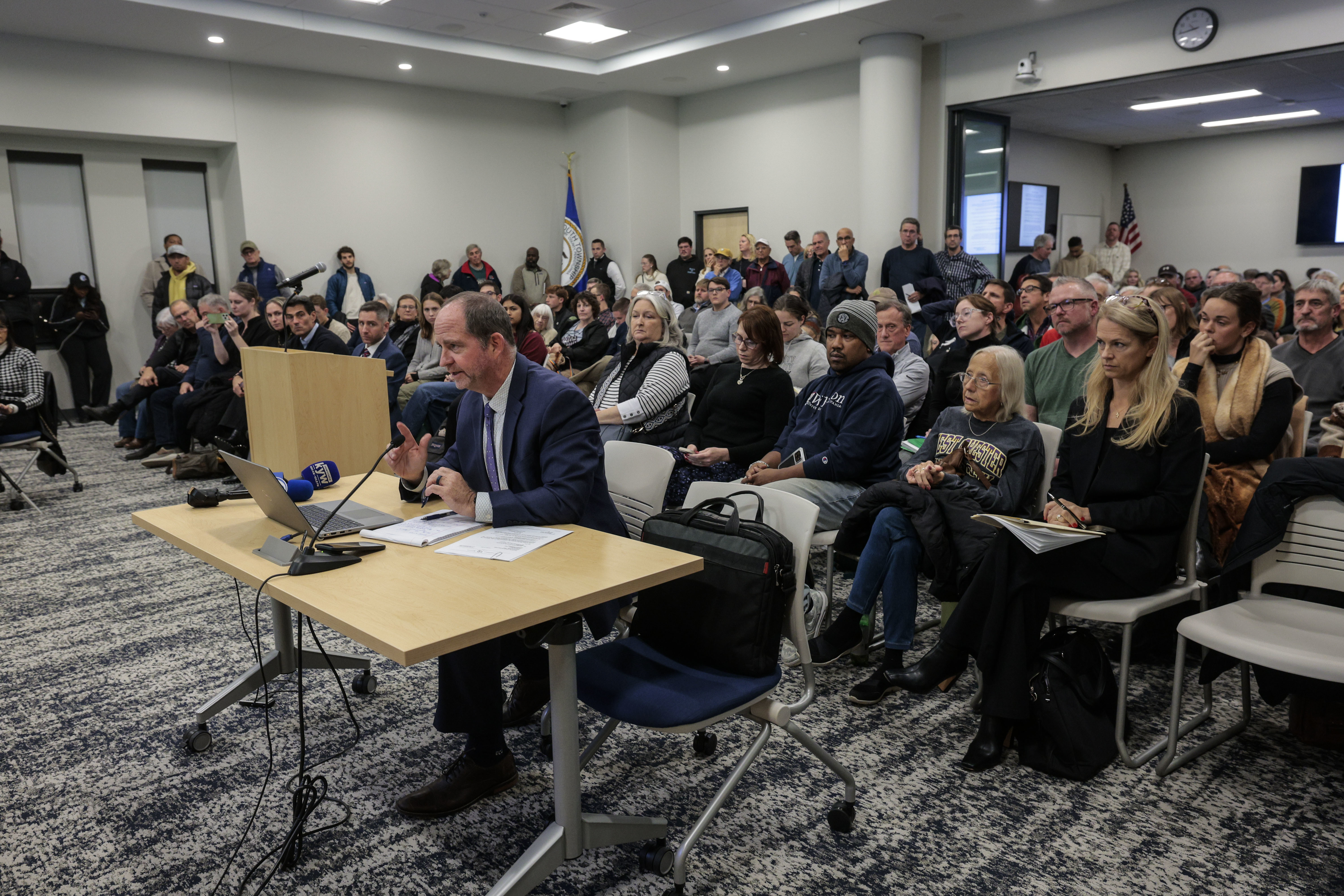
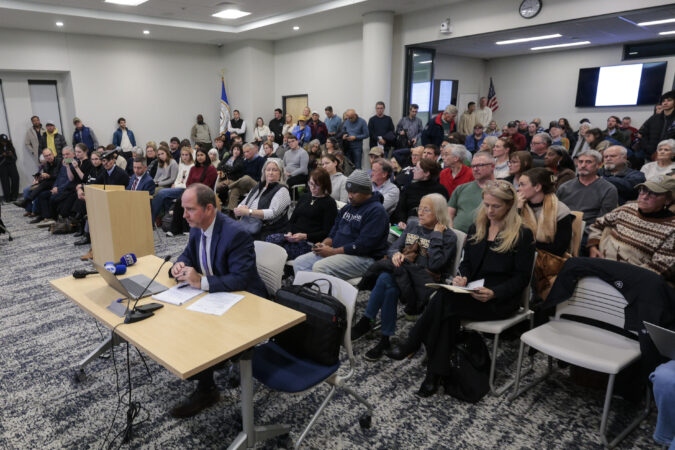
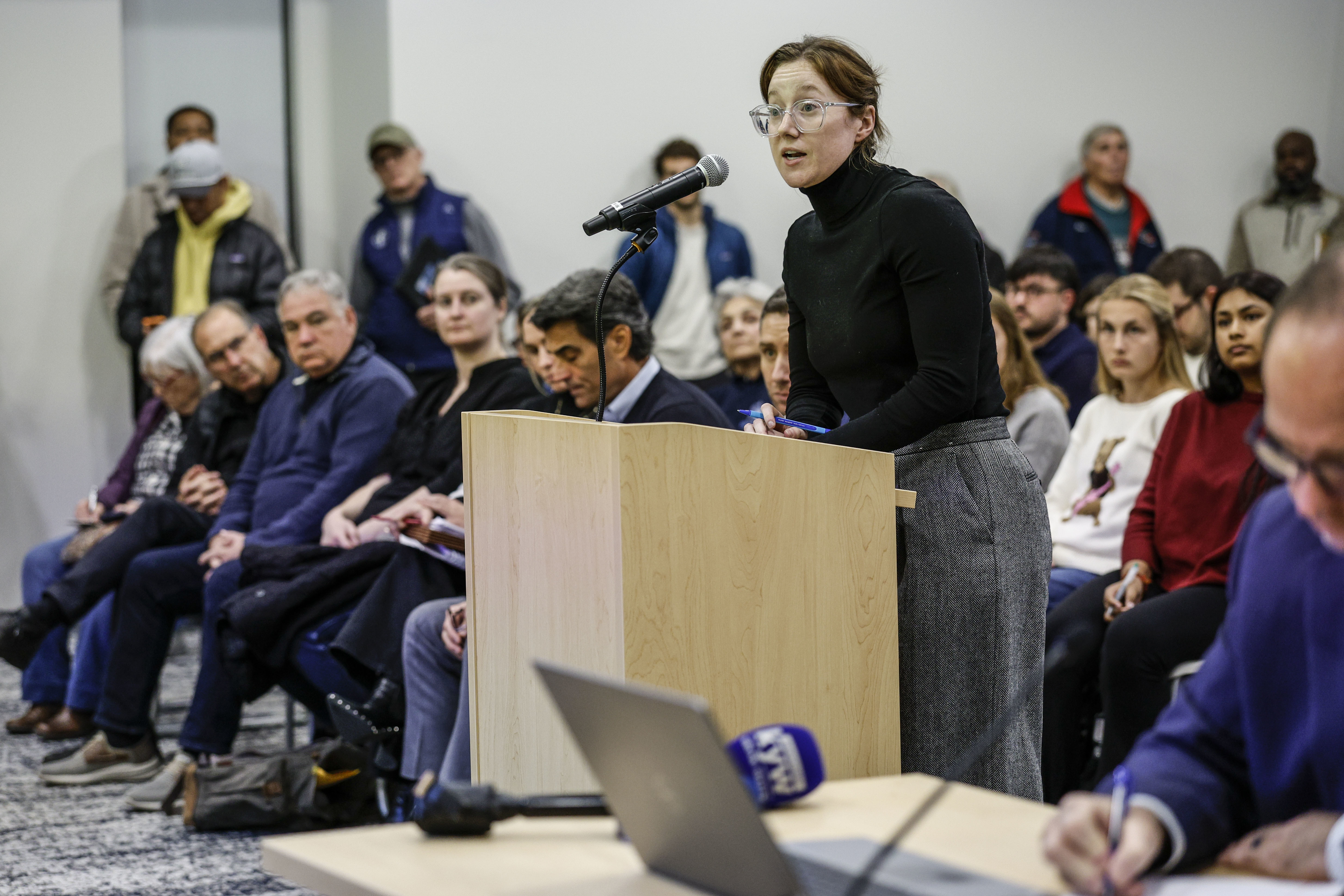
Edmund J. Campbell, attorney for developer Brian O’Neill, spoke to the Plymouth Township zoning board in November before abruptly withdrawing the application for a Conshohocken-area data center over legal issues. Residents, some of whom had rallied against the proposal, packed the room.
Seventy percent of Pennsylvanians strongly or somewhat support requiring data centers to provide their own energy generation, rather than get electricity from the grid.
When it comes to AI more broadly, just over half of Pennsylvanians told pollsters they believe AI will decrease the number of available jobs in their industry, while 16% said they think it will increase the number of jobs (29% said they thought it would have no impact).
Nearly twice as many residents think AI will have a net negative impact on the economy compared to how many think it will have a positive impact (48% said negative, 25% said positive). When respondents were asked about the environment, the results were similar (46% vs. 21%).
The survey of 2,000 Pennsylvania adults was conducted online and via text between Nov. 19 and 23.
NEW YORK — Paramount has gone hostile bid for Warner Bros. Discovery, challenging Netflix which reached a $72 billion takeover deal with the company just days ago.
Paramount said Monday that it is going straight to Warner Bros. shareholders with a $30 per share cash bid for the entirety of the company including its Global Networks business, asking them to reject the deal with Netflix.
That is the same bid that Warner Brothers rejected in favor of the offer from Netflix in a merger that would alter the U.S. entertainment landscape.
Paramount criticized the Netflix offer, saying it “exposes WBD shareholders to a protracted multi-jurisdictional regulatory clearance process with an uncertain outcome along with a complex and volatile mix of equity and cash.”
Paramount said it had submitted six proposals to Warner Bros. Discovery over a 12 week period.
“We believe our offer will create a stronger Hollywood. It is in the best interests of the creative community, consumers and the movie theater industry,” Paramount Chairman and CEO David Ellison said in a statement. ”We believe they will benefit from the enhanced competition, higher content spend and theatrical release output, and a greater number of movies in theaters as a result of our proposed transaction,”
On Friday Netflix struck a deal to buy Warner Bros. Discovery, the Hollywood giant behind “Harry Potter” and HBO Max. The cash and stock deal is valued at $27.75 per Warner share, giving it a total enterprise value of $82.7 billion, including debt. The transaction is expected to close in the next 12 to 18 months, after Warner completes its previously announced separation of its cable operations. Not included in the deal are networks such as CNN and Discovery.
Netflix has agreed to buy Warner Bros Discovery’s TV, film studios and streaming division for $72 billion, a deal that would hand control of one of Hollywood’s most prized and oldest assets to the streaming pioneer.
The agreement, announced on Friday, follows a weeks-long bidding war in which Netflix offered nearly $28-a-share, eclipsing Paramount Skydance’s close to $24 bid for the whole of Warner Bros Discovery, including the cable TV assets slated for a spinoff.
Buying the owner of marquee franchises including “Game of Thrones,” “DC Comics” and “Harry Potter” will further tilt the balance of power in Hollywood in favor of Netflix.
It would help the streaming giant, which has so far built its dominance without major deals or a large content library, to ward off competition from Walt Disney and the Ellison family-backed Paramount.
The two companies together will “help define the next century of storytelling,” said Netflix co-CEO Ted Sarandos, who had once said “the goal is to become HBO faster than HBO can become us.”
Strong antitrust scrutiny likely
The deal, however, is likely to face strong antitrust scrutiny in Europe and the U.S. as it would give the world’s biggest streaming service ownership of a rival that is home to HBO Max and boasts nearly 130 million streaming subscribers.
David Ellison-led Paramount, which kicked off the bidding war with a series of unsolicited offers and has close ties with the Trump administration, had questioned the sale process earlier this week and alleged favorable treatment to Netflix.
Even before the bids were in, some members of Congress said a Netflix–Warner Bros Discovery deal could harm consumers and Hollywood.
Cinema United, a global exhibition trade association, said on Friday the deal poses an “unprecedented threat” to movie theaters worldwide.
“In light of the current regulatory environment this will raise eyebrows and concerns. The combined dominant streaming player will be heavily scrutinized,” said PP Foresight analyst Paolo Pescatore.
“We should expect this to wrangle on given Paramount Skydance pursuit for Warner Bros Discovery.”
Looking to allay some concerns, Netflix said the deal would give subscribers more shows and films, boost its U.S. production and long-term spending on original content and create more jobs and opportunities for creative talent.
The company argued in deal talks that a combination of its streaming service with HBO Max would benefit consumers by lowering the cost of a bundled offering.
The company has told Warner Bros Discovery it would keep releasing the studio’s films in cinemas in a bid to ease fears that its deal would eliminate another studio and major source of theatrical films, according to media reports.
Cash-and-stock deal
Warner Bros Discovery shares were up 2.4% at $25 in premarket trading, while Netflix fell nearly 3% and Paramount 2.2%. Comcast, the third suitor, was trading little changed.
Paramount and Comcast did not immediately respond to requests for comment.
Under the deal, each Warner Bros Discovery shareholder will receive $23.25 in cash and about $4.50 in Netflix stock per share, valuing Warner at $27.75 a share, or about $72 billion in equity and $82.7 billion, including debt.
The deal represents a premium of 121.3% to Warner Bros Discovery’s closing price on September 10, before initial reports of a possible buyout emerged.
The deal is expected to close after Warner Bros Discovery spins off its global networks unit, Discovery Global, into a separate listed company, a move now set for completion in the third quarter of 2026.
Netflix has offered Warner Bros Discovery a $5.8 billion breakup fee, while Warner Bros Discovery would pay Netflix $2.8 billion if the deal collapses.
Netflix said it expects to generate at least $2 billion to $3 billion in annual cost savings by the third year, after the deal closes.
Netflix growth worries
Analysts have said Netflix is driven by a desire to lock up long-term rights to hit shows and films and rely less on outside studios as it expands into gaming and looks for new avenues of growth after the success of its password-sharing crackdown.
Its shares are up just 16% this year, after surging more than 80% in 2024, as investors worry its breakneck growth could be slowing, especially after it stopped disclosing subscriber figures earlier this year.
The company has leaned on its ad-supported tier to drive growth, but that is not expected to become a major revenue engine until next year, while analysts say its push into video games has stumbled amid strategy shifts and executive turnover.
Buying Warner Bros would also deepen its gaming bet, as WBD is one of the few entertainment companies to notch big successes in the sector, including its Harry Potter title “Hogwarts Legacy,” which has generated more than $1 billion in revenue.
It’s no secret that the use of both generative and agentic AI will proliferate over the next few years as the technology becomes more reliable and pervasive.
More than 58% of small businesses are already using AI in their companies, according to a recent study from the U.S. Chamber of Commerce, and that usage is expected to rise this year. For now, most of that can be attributed to chatbots like ChatGPT, Gemini, Copilot, and others.
Because of this, your business needs to create and maintain a strict AI policy. Why?
“An AI policy places guardrails around the usage of AI by your employees,” said Philadelphia attorney David Walton, who chairs the artificial intelligence team at Fisher & Phillips. “It allows your employees to use AI faster and better.”
Without an AI policy, a business would be exposed to reputational damage that’s caused by AI “hallucinations” or errors, Walton said. In addition, a company’s proprietary data — pricing, contracts, customers information, processes — could be exposed to the public, particularly when employees use free AI tools that offer less protection.
Lawyer Star Kashman, founding partner of Cyber Law Firm, warns her clients that without an AI policy, employers could be exposed to claims of bias and other lawsuits.
“For example, there might be some resumes from people of certain races, people of certain genders that maybe aren’t as accepted by the AI system, and you’re automatically rejecting great candidates,” she said. “You’re going to be the one that has a huge lawsuit on your hands, even for your employees’ actions, if you weren’t able to protect it.”
A good AI policy should include the following.
Include a statement of purpose for AI
The policy should be clear that AI is allowed only when used responsibly and with guardrails.
It should also be clearly stated that AI tools are used only when they can improve productivity, provided that they are safe and confidential.
Provide a list of approved applications
A company’s AI policy should specify which tools and software are approved by management, both lawyers said.
The tools should be used for business purposes only. Free tools should not be allowed because of their privacy concerns, and if a tool is not listed in the policy, permission is required from management to use it.
When employees use AI on a personal account, Walton said, “it’s hard for the business to control privacy settings, and confidential data may leak into free or public AI models.”
Consider a proprietary information ban
It’s still unclear how safe our data is when AI applications are being used. To that end, it’s a good practice to avoid or even ban the entry of private information into these platforms.
This would include customer data, financial statements, contracts, pricing information, personal identifying factors, trade secrets, or anything medical, legal, or human resources related.
State the ownership of AI work
When an employee makes a “prompt” into an AI chatbot, that query, as well as any resulting workflows and custom instructions, are all assets of the company and should be stated as so.
A company’s AI policy should state that employees must return all AI-created work at separation, cannot export data into their personal accounts, and cannot use their own agents or tools for company work.
Avoid AI in HR
AI applications shouldn’t be used in hiring or performance reviews, both Kashman and Walton said. Many platforms leverage AI to perform these functions, but these tools could create more headaches than benefits.
“HR is the front line for legal problems tied to AI,” Walton said. “Relying on AI to make hiring, firing, or performance review decisions could be very problematic.”
Ban certain outputs
An AI policy should ban the use of images, videos, or voice without management approval. NSFW (not-safe-for-work), pornographic, or defamatory content should be off limits. This can help protect against reputation damage, deepfakes, and offensive content.
Always use human oversight
We know today’s AI tools are far from perfect. Your policy should state that everything AI produces must be validated, checked, sourced, and edited by a human.
Explain why the AI policy exists
AI is new, and your employees are already concerned about this new technology. Kashman said it’s important to explain the “why” behind each rule in your policy.
“Instead of just ‘don’t,’ explain the risk to the employee and company such as hallucinations, data leaks, bias, etc.” she said. “Employees follow rules better when they understand them.”
The uncertain regulatory environment is another big reason for creating an AI policy. Regulation of AI use shouldn’t be expected anytime soon, Walton said.
“Businesses must prepare for state-level AI regulation, especially around risk assessment and bias, because the federal government is unlikely to pass comprehensive laws anytime soon,” he said.
However, some states — like New Jersey — have proposed bills that would require businesses to do formal risk assessments and acceptable-use policies. Meanwhile, President Donald Trump is considering an executive order limiting states from regulating AI.
Kashman said the lack of regulations will leave business owners vulnerable “because tech companies aren’t going to be as liable for harms.” So small businesses “must protect themselves with strong internal policies,” she said.
“An AI assistant or chatbot can help businesses draft a policy or template, especially for nonlawyers who need structure or a first draft,” Kashman said. It’s important to frequently update this policy because the technology, models, privacy terms, and data breaches change rapidly, she added.
“However, be careful,” she said. “AI can’t understand the nuances of a specific business or legal risk, so human review from legal counsel or an expert is necessary.”
A Main Line developer’s plan to turn a shuttered steel mill into a 2-million-square-foot AI data center on the outskirts of Conshohocken was stymied Monday when he was forced to withdraw his application over legal issues.
At the Plymouth Township zoning hearing board meeting, Brian O’Neill’s team had been set to make their case for an exception that would allow a data center to be built at 900 Conshohocken Rd.
The plan has faced neighborhood pushback, and hundreds of people packed the meeting room on Monday night. O’Neill did not appear to be among them.
Edmund J. Campbell Jr., an attorney for O’Neill, said they wished to move the hearing to the township’s December meeting. Then an attorney for Cleveland-Cliffs, the property owner, said the prospective buyer did not have legal standing to do so.
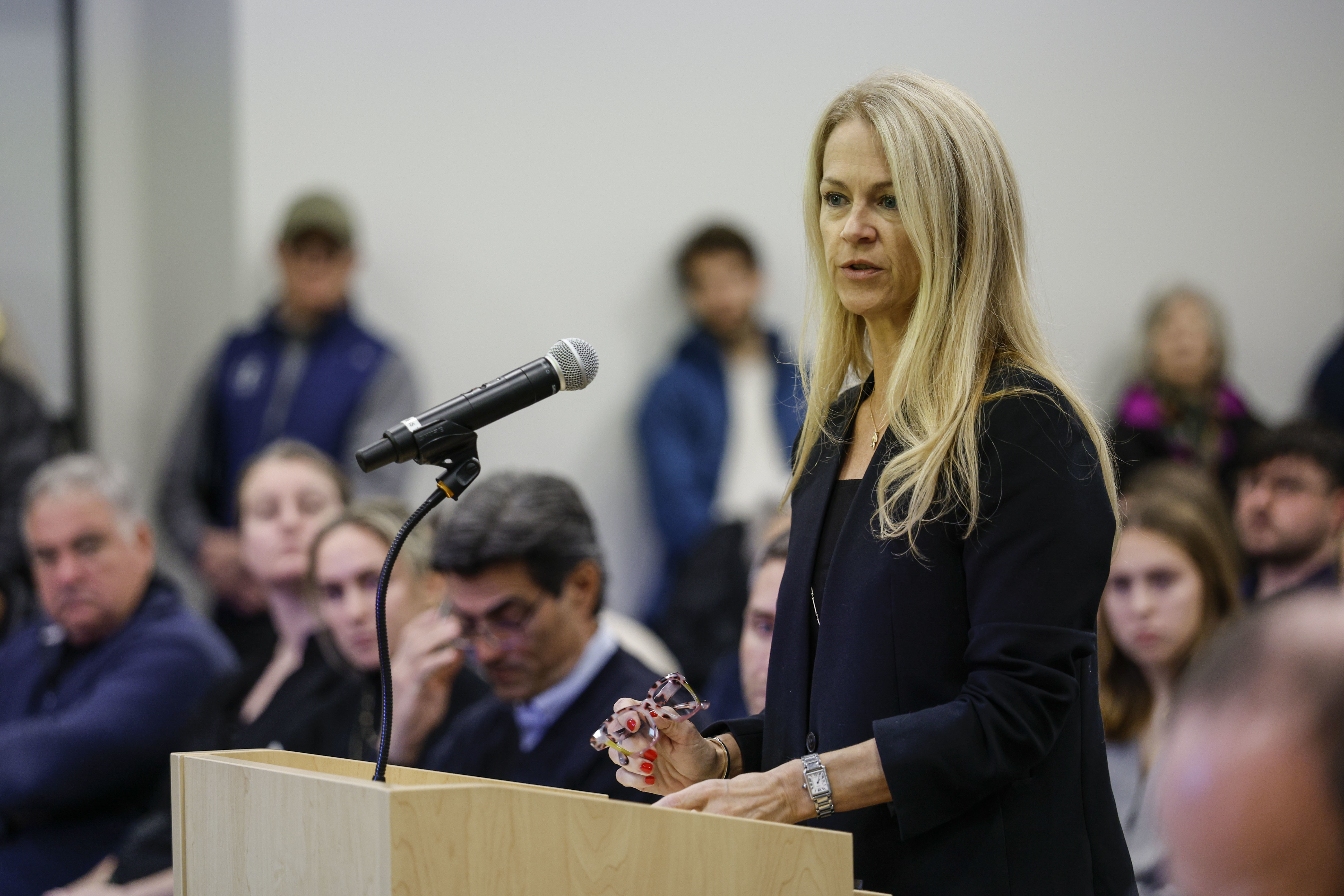
An agreement of sale had not been approved prior to the meeting, said Heather Fine, the attorney for Cleveland-Cliffs.
Heather Fine, an attorney for Cleveland-Cliffs, addresses the Plymouth Township zoning hearing board on Monday.
Campbell later asked Fine and then the board for permission to withdraw the application. Both declined to provide additional comment.
Residents who had spent more than a month organizing in opposition to the project said they had mixed emotions.
“It is the smallest of small wins, because we’re making it harder for something bad to happen to our community,” said Nick Liermann, an attorney who lives in a neighborhood near the former steel mill. “But we will be back in this room in a few months.”
“Communities can be effective,” said Patti Smith, a neighbor of Liermann who has spearheaded the local data-center opposition efforts. “We have to stand up for ourselves.”
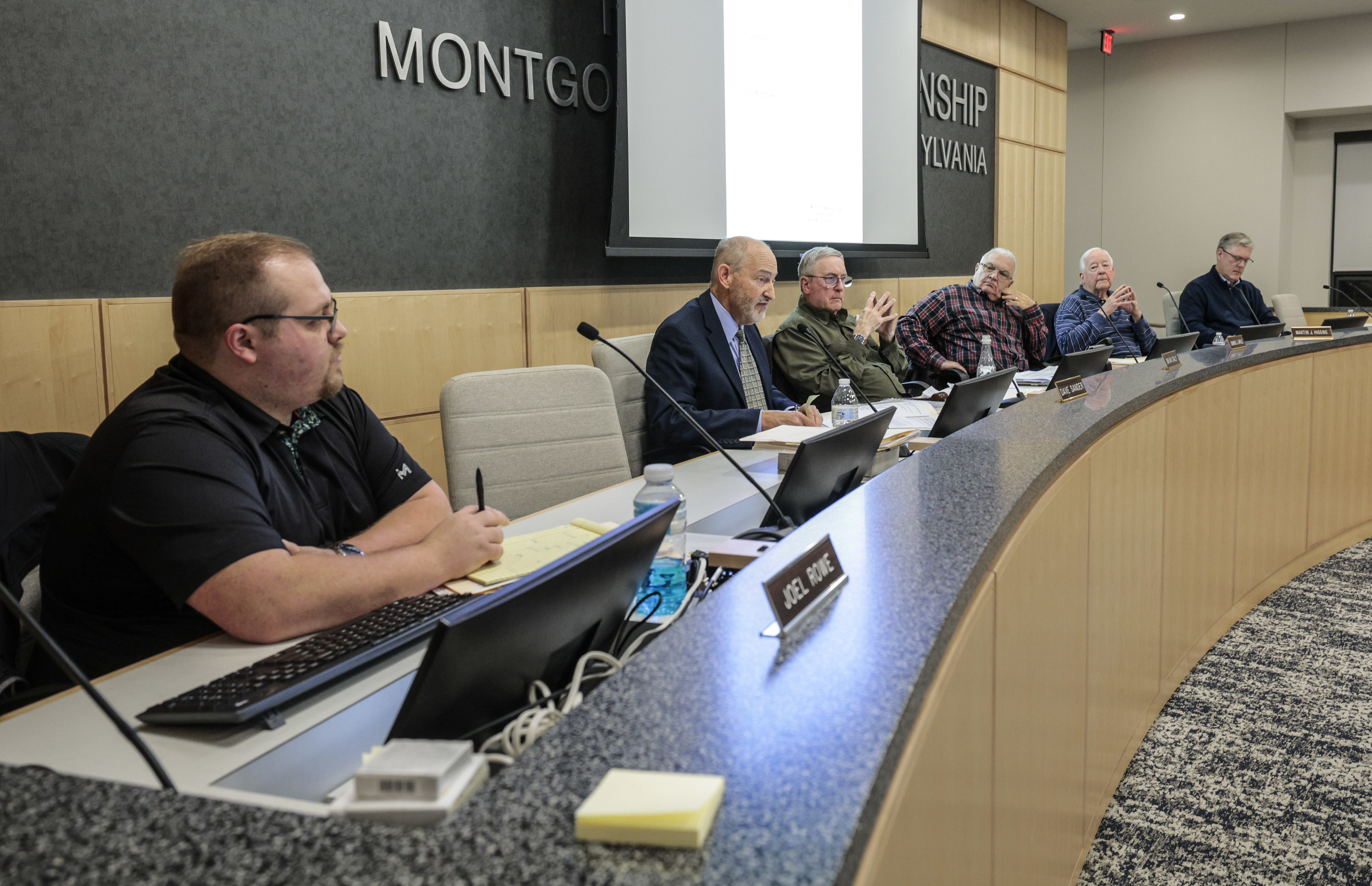
With the withdrawal, the data center proposal is officially off the docket in Plymouth Township, zoning officer Joel Rowe said, but the applicant can resubmit a plan at any time, restarting the process.
What the data center proposal entailed
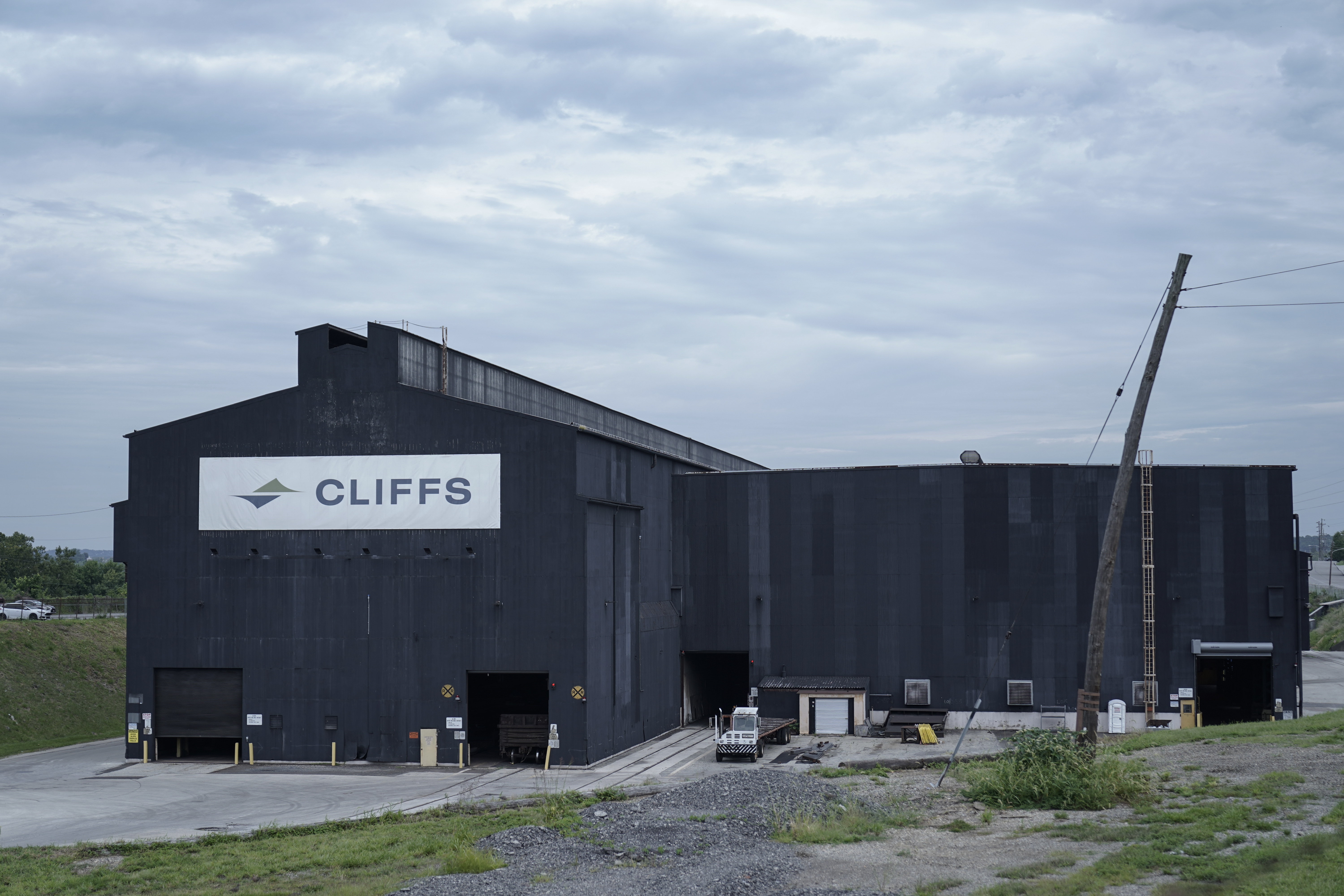
The now-closed Cleveland-Cliffs plant near Conshohocken is shown in this 2023 file photo. A data center has been proposed for the site.
This latest development in the Conshohocken-area data center saga occurs amid broader controversy about such facilities, which handle cloud-computing and storage for Big Tech companies.
The construction of data centers has been fast-tracked to meet the growing demands of power-hungry AI tools like ChatGPT. Politicians on both sides of the aisle, including President Donald Trump and Gov. Josh Shapiro, have pushed for more centers, while some neighbors near proposed sites have mounted fierce pushback.
In the Philadelphia area, Amazon is building a 2-million-square-foot data center on a former steel mill in Falls Township, Bucks County. And a 1.3-million-square-foot data center has been proposed at the former Pennhurst State School and Hospital in East Vincent Township, Chester County.
In Plymouth Township, O’Neill had not revealed the potential tenant for his proposed data center, but indicated it would be related to the life sciences.
The data center is proposed for a 66-acre property along the Schuylkill in the Connaughtown section of the township. The site is less than a mile from downtown Conshohocken. Its neighbors include the Proving Grounds sports complex, Tee’s Golf Center, and dozens of homes.
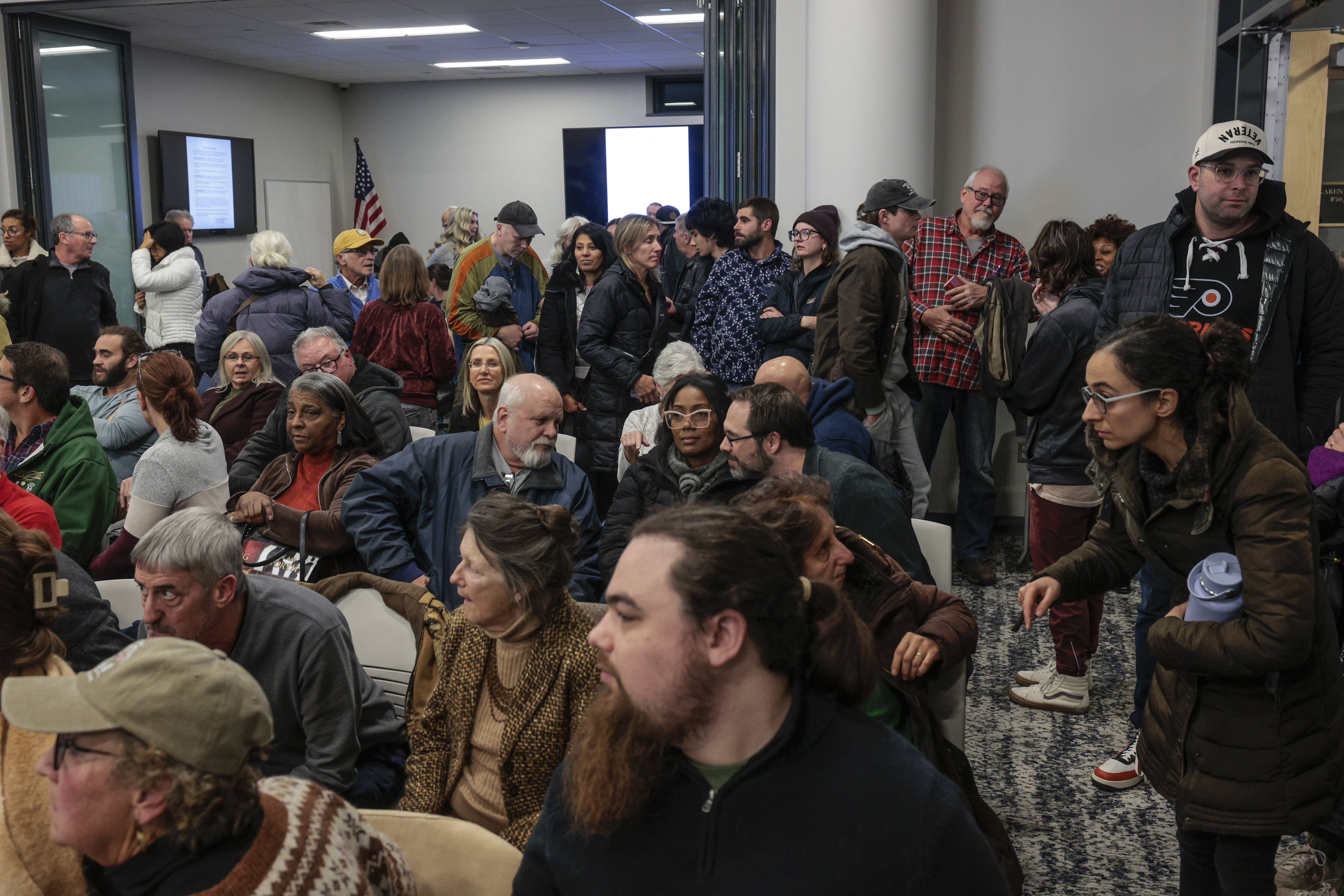
A crowd of people leave the Plymouth Township zoning hearing board meeting on Monday.
Some Connaughtown residents, along with other data center opponents from across the Philadelphia region, have rallied against the proposal. As of Tuesday, more than 1,000 people had signed an online petition urging township officials not to grant a zoning exception for the data center, citing concerns about light, noise, and air pollution; water usage; and electricity costs.
O’Neill, meanwhile, had argued that a data center should be permitted in the “heavy industrial” zone due its to similarity to a warehouse and laboratory, which are both permitted uses under township code. He had also touted the center’s potential economic benefits, saying it could bring in $21 million in annual tax revenue and attract other companies to the area.
“Industry hasn’t come and gone. It’s simply changed,” O’Neill said at last month’s planning board meeting. “What I’m proposing is to put 21st-century industry into an industrial building.”
Why the data center plan was withdrawn
The Plymouth Township zoning hearing board had been set to hear Brian O’Neill’s proposal for an AI data center outside Conshohocken on Monday.
At the start of Monday’s standing-room-only meeting, Plymouth Township officials were expecting a long and potentially tense night.
Solicitor Dave Sander began by warning the crowd that they must maintain decorum, and said he would cut off the proceedings at 10 p.m. Police officers stood outside the room.
Quickly, however, it became clear that Campbell, O’Neill’s attorney, had other plans, requesting a continuance to the Dec. 15 meeting. If granted, it would have marked the hearing’s second continuance: The proposal was initially supposed to be discussed at an October meeting.
“My client would like an additional opportunity to review with [community members] the project,” Campbell said. “When we proceed, if we have had a more robust dialogue with those participants, this hearing on the 15th would be significantly more efficient.”
Neighbors, some of whom had already attended a private meeting with O’Neill last month, objected to the last-minute request, saying that it was unlikely their minds would be changed if no significant changes had been made to the plan.
“Is the proposal significantly different than what was displayed to community members at the Oct. 8 meeting?” asked Smith, who organized neighborhood opposition.
Patti Smith, resident and organizer of anti-data center movement in the neighborhood, addresses the Plymouth Township zoning hearing board at Monday’s meeting.
“No,” Campbell responded, later adding that they wanted more residents to be able to attend the meeting and hear from their experts who could speak to concerns, including about noise and emissions.
Before the zoning hearing board could vote on the continuance request, Fine, the attorney for property owner Cleveland-Cliffs, took to the podium.
“There is no standing for the prospective buyer to proceed with the application this evening,” Fine said. “That authority was not extended to the prospective buyer from the owner. There is no LOI [letter of intent] in place.”
“My client delivered a signed agreement of sale to the owner this evening,” Campbell said. “Based on that, we have standing. … We made our application with the express consent of the owner.”
Sander turned to Fine, asking if that was true.
“It’s not entirely true, no,” Fine said. “The signed agreement that was transmitted to my colleague at 5:51 p.m. this evening had redline changes. Those have not been accepted by my client.”
She did not elaborate on what those changes entailed.
The zoning hearing board recessed before returning to accept Campbell’s motion to withdraw the application.
As a neighbor to the site, Liermann said the unexpected turn of events left him with a more sour taste in his mouth about the developer: “The last-minute request in an attempt to obstruct the process and dissuade the public from participating, and then this ‘confusion’ over whether or not an LOI was actually signed between the developer and the owner, is incredibly disturbing.”
Cloudflare, an internet infrastructure platform, is experiencing an outage that appears to be affecting websites across the internet, including the social media platform X.
The company said in a status update before 7 a.m. EST on Nov. 18 that it was aware of “an issue which potentially impacts multiple customers,” and was investigating the problem.
In a statement to USA TODAY around 8:30 a.m. EST, Cloudflare said it “saw a spike in unusual traffic” to one of its services around 6:20 a.m. EST.
“That caused some traffic passing through Cloudflare’s network to experience errors. We do not yet know the cause of the spike in unusual traffic. We are all hands on deck to make sure all traffic is served without errors. After that, we will turn our attention to investigating the cause of the unusual spike in traffic,” the statement said.
Many X users reported having problems loading the social media app.
According to Downdetector, an outage-tracking website, thousands of users of several popular websites were reporting issues or outages as of 8 a.m. EST, including X, Spotify, OpenAI, League of Legends and more.
By 8:30 a.m. EST, though, Downdetector also appeared to be having connectivity issues tied to the Cloudflare outage.
Is Cloudflare down?
Cloudflare said it is experiencing issues with its global network, causing outages at many websites that rely on the platform.
Shortly after 8 a.m. EST, Cloudflare said it had identified the issue and made changes to recover its Cloudflare Access and WARP system, which both help protect companies’ traffic and devices.
“We are continuing to work towards restoring other services,” Cloudflare said.
More updates will be available on its status website.
Cloudflare is a platform which many websites use to improve their performance and functionality.
Which websites are down from Cloudflare outage?
According to Downdetector, the following websites were reporting increased outages as of 9 a.m. EST:
X, formerly Twitter
Spotify
OpenAI
League of Legends
Grindr
Google Store
Archive of Our Own
Uber
Quizlet
Canva
Claude AI
Character AI
Indeed
Truth Social
Dayforce
ChatGPT
Letterboxd
Square
Rover
Zoom
Canvas
Ikea
Downdetector also appeared to be impacted by the outage, as did news outlet Axios. Both websites loaded a banner that said, “Please unblock challenges.cloudflare.com to proceed.”
OpenAI introduced its own web browser, Atlas, on Tuesday, putting the ChatGPT maker in direct competition with Google as more internet users rely on artificial intelligence to answer their questions.
Making its popular AI chatbot a gateway to online searches could allow OpenAI, the world’s most valuable startup, to pull in more internet traffic and the revenue made from digital advertising. It could also further cut off the lifeblood of online publishers if ChatGPT so effectively feeds people summarized information that they stop exploring the internet and clicking on traditional web links.
OpenAI has said ChatGPT already has more than 800 million users but many of them get it for free. The San Francisco-based company also sells paid subscriptions but is losing more money than it makes and has been looking for ways to turn a profit.
OpenAI said Atlas launches Tuesday on Apple laptops and will later come to Microsoft’s Windows, Apple’s iOS phone operating system and Google’s Android phone system.
OpenAI CEO Sam Altman called it a “rare, once-a-decade opportunity to rethink what a browser can be about and how to use one.”
But analyst Paddy Harrington of market research group Forrester said it will be a big challenge “competing with a giant who has ridiculous market share.”
OpenAI’s browser is coming out just a few months after one of its executives testified that the company would be interested in buying Google’s industry-leading Chrome browser if a federal judge had required it to be sold to prevent the abuses that resulted in Google’s ubiquitous search engine being declared an illegal monopoly.
But U.S. District Judge Amit Mehta last month issued a decision that rejected the Chrome sale sought by the U.S. Justice Department in the monopoly case, partly because he believed advances in the AI industry already are reshaping the competitive landscape.
OpenAI’s browser will face a daunting challenge against Chrome, which has amassed about 3 billion worldwide users and has been adding some AI features from Google’s Gemini technology.
Chrome’s immense success could provide a blueprint for OpenAI as it enters the browser market. When Google released Chrome in 2008, Microsoft’s Internet Explorer was so dominant that few observers believed a new browser could mount a formidable threat.
But Chrome quickly won over legions of admirers by loading webpages more quickly than Internet Explorer while offering other advantages that enabled it to upend the market. Microsoft ended up abandoning Explorer and introducing its Edge browser, which operates similarly to Chrome and holds a distant third place in market share behind Apple’s Safari.
Perplexity, another smaller AI startup, rolled out its own Comet browser earlier this year. It also expressed interest in buying Chrome and eventually submitted an unsolicited $34.5 billion offer for the browser that hit a dead end when Mehta decided against a Google breakup.
Altman said he expects a chatbot interface to replace a traditional browser’s URL bar as the center of how he hopes people will use the internet in the future.
“Tabs were great, but we haven’t seen a lot of browser innovation since then,” he said on a video presentation aired Tuesday.
A premium feature of the ChatGPT Atlas browser is an “agent mode” that accesses the laptop and effectively clicks around the internet on the person’s behalf, armed with a users’ browser history and what they are seeking to learn and explaining its process as it searches.
“It’s using the internet for you,” Altman said.
Harrington, the Forrester analyst, says another way of thinking about that is it’s “taking personality away from you.”
“Your profile will be personally attuned to you based on all the information sucked up about you. OK, scary,” Harrington said. “But is it really you, really what you’re thinking, or what that engine decides it’s going to do? … And will it add in preferred solutions based on ads?”
Google since last year has automatically provided AI-generated responses that attempt to answer a person’s search query, appearing at the top of results.
Reliance on AI chatbots to summarize information they collect online has raised a number of concerns, including the technology’s propensity to confidently spout false information, a problem known as hallucination.
The way that chatbots trained on online content spout new writings has been particularly troubling to the news industry, leading The New York Times and other outlets to sue OpenAI for copyright infringement and others, including The Associated Press, to sign licensing deals.
A study of four top AI assistants including ChatGPT and Google’s Gemini released Wednesday showed nearly half their responses were flawed and fell short of the standards of “high-quality” journalism.
The research from the European Broadcasting Union, a group of public broadcasters in 56 countries, compiled the results of more than 3,000 responses to news-related questions to help ascertain quality responses and identify problems to fix.
Barry Leonard, 87, formerly of Philadelphia, celebrated crimper, longtime innovative owner of the Barry Leonard Crimper & Spa in Center City, unisex beauty salon groundbreaker, fashion and marketing trendsetter, haircutting mentor, and Army veteran, died Sunday, Oct. 12, at his home in Hallandale Beach, Fla. The cause of his death has not been disclosed.
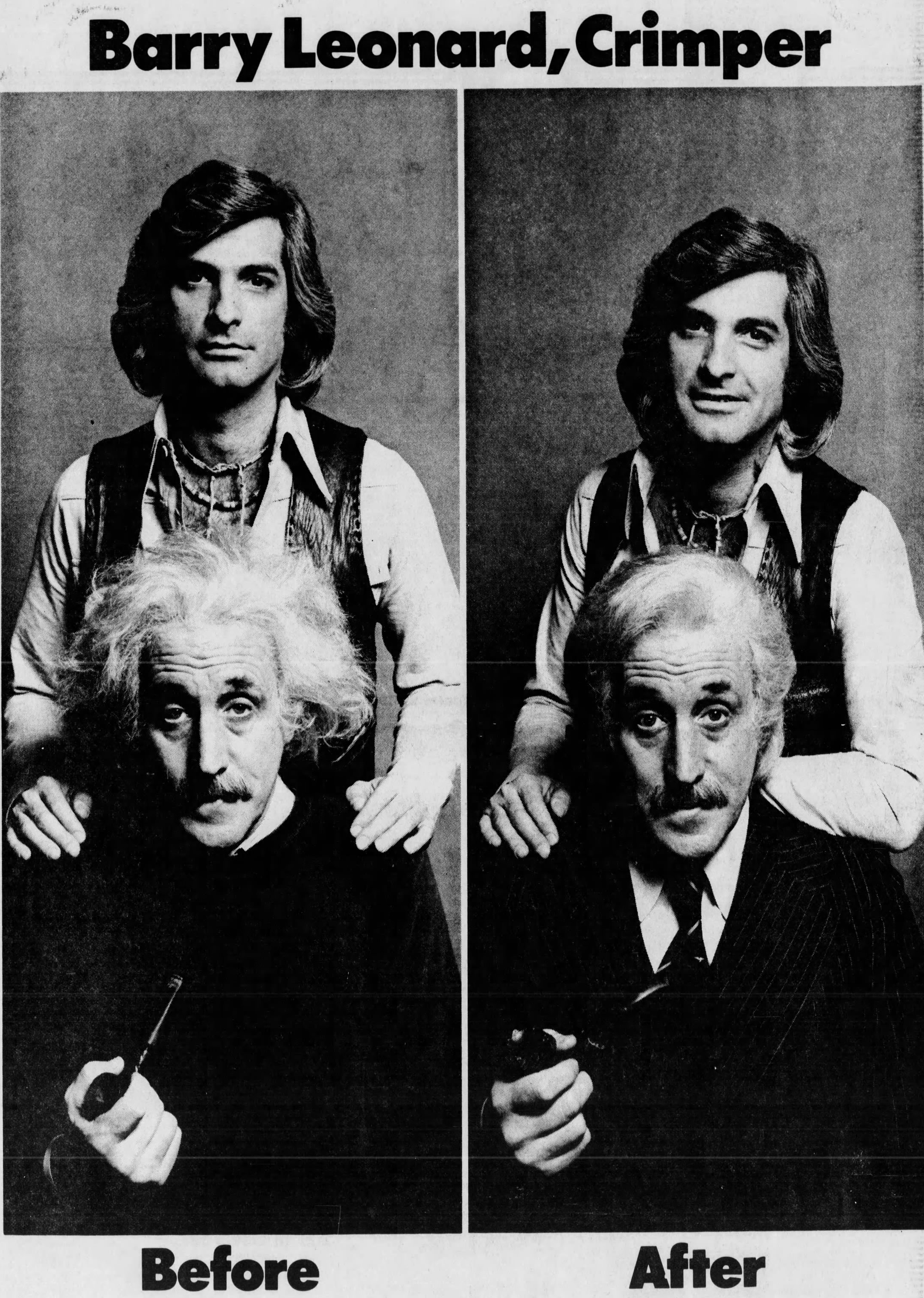
Born in Philadelphia to a family of hairstylists, Mr. Leonard swept the floor at his father’s beauty salon in West Philadelphia as a boy and, in 1955, became the first male to graduate from the beauty culture curriculum at Murrell Dobbins Career and Technical Education High School. He went on to help rewrite state statutes to allow unisex beauty salons in the 1970s, wow the marketing world with innovative ads that featured Fidel Castro, Albert Einstein, Santa Claus, and the Wolfman, and own high-end shops in the old Marriott Hotel on City Avenue and then on Chestnut Street for 43 years.
A proponent of what he called “natural haircutting,” Barry Leonard, Crimper, counted politicians, musicians, actors, and other celebrities as well as local residents as his regulars, and most of them were fine with waiting months for an appointment. He moved his bustling salon from the Marriott to 1527 Chestnut St. in 1972, relocated to 1822 Chestnut in 1995, and retired to Florida in 2005.
In the early 1970s, he saw that men appreciated hair care, too, and he successfully challenged an old state law that required separate locations for male and female haircuts. So unisex salons became common in the 1980s and ’90s.
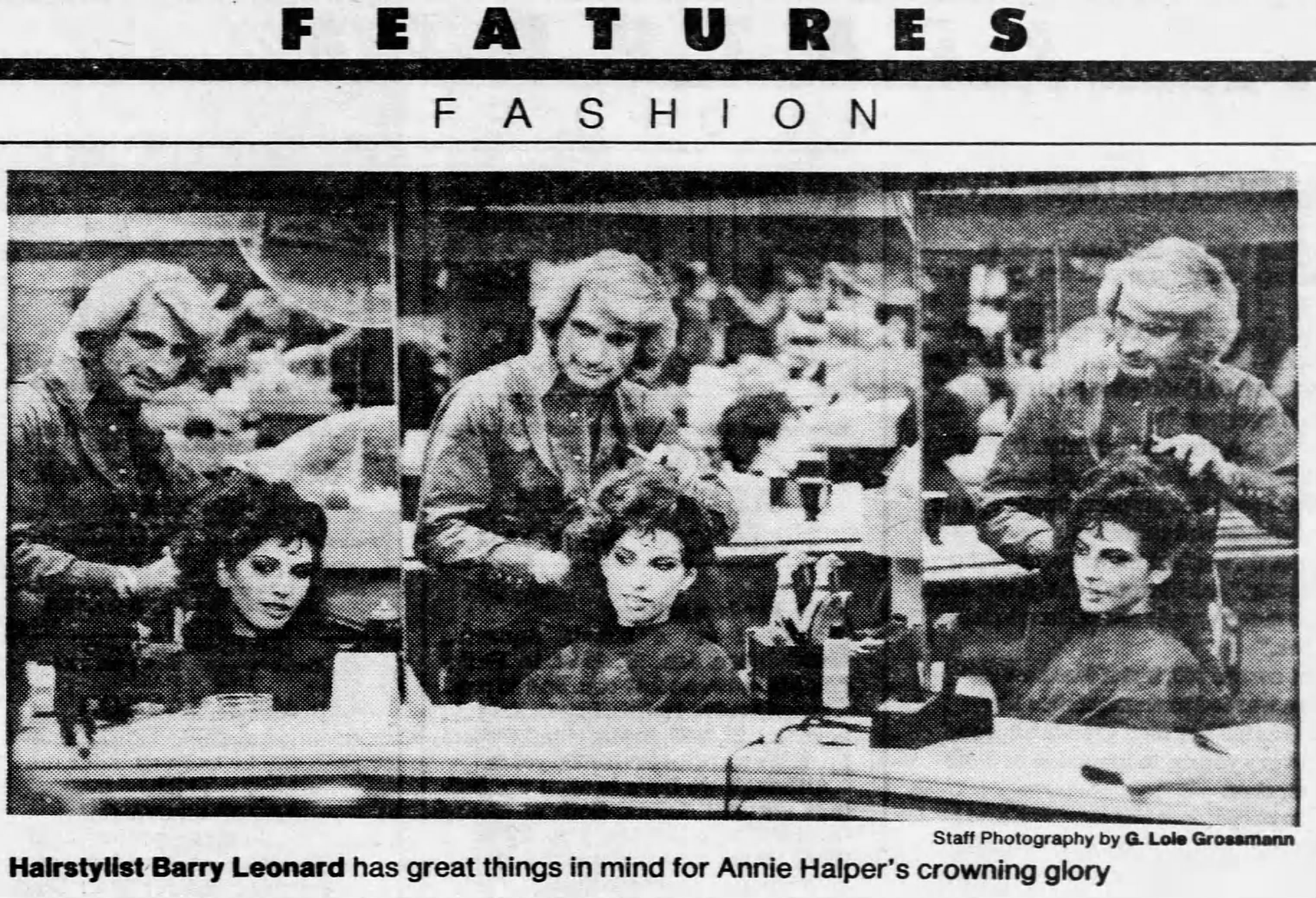
Mr. Leonard is shown styling the hair of Annie Halpern, his future wife, in this 1985 photo in the Daily News.
“Hair,” he told The Inquirer in 1973, “is the only part of the body that can be changed readily and allows the individual to play his role as he feels it at that particular moment — protest, freakiness, sensuality, anything.”
His New Age salon featured wicker furniture, hanging plants, big pillows, Japanese koi, and free coffee, fruit, and wine. He charged $12.50 per cut in 1973 and $25 in 1991. Sometimes, he booked 75 heads a day, his wife, Annie, said.
Most often, he consulted with customers before the cut, assigned the job to an assistant stylist, and checked back when the work was done. Over his career, he told his wife, he likely attended to more than 1 million customers. In 1991, he told The Inquirer: “My general philosophy is to make people happy.”
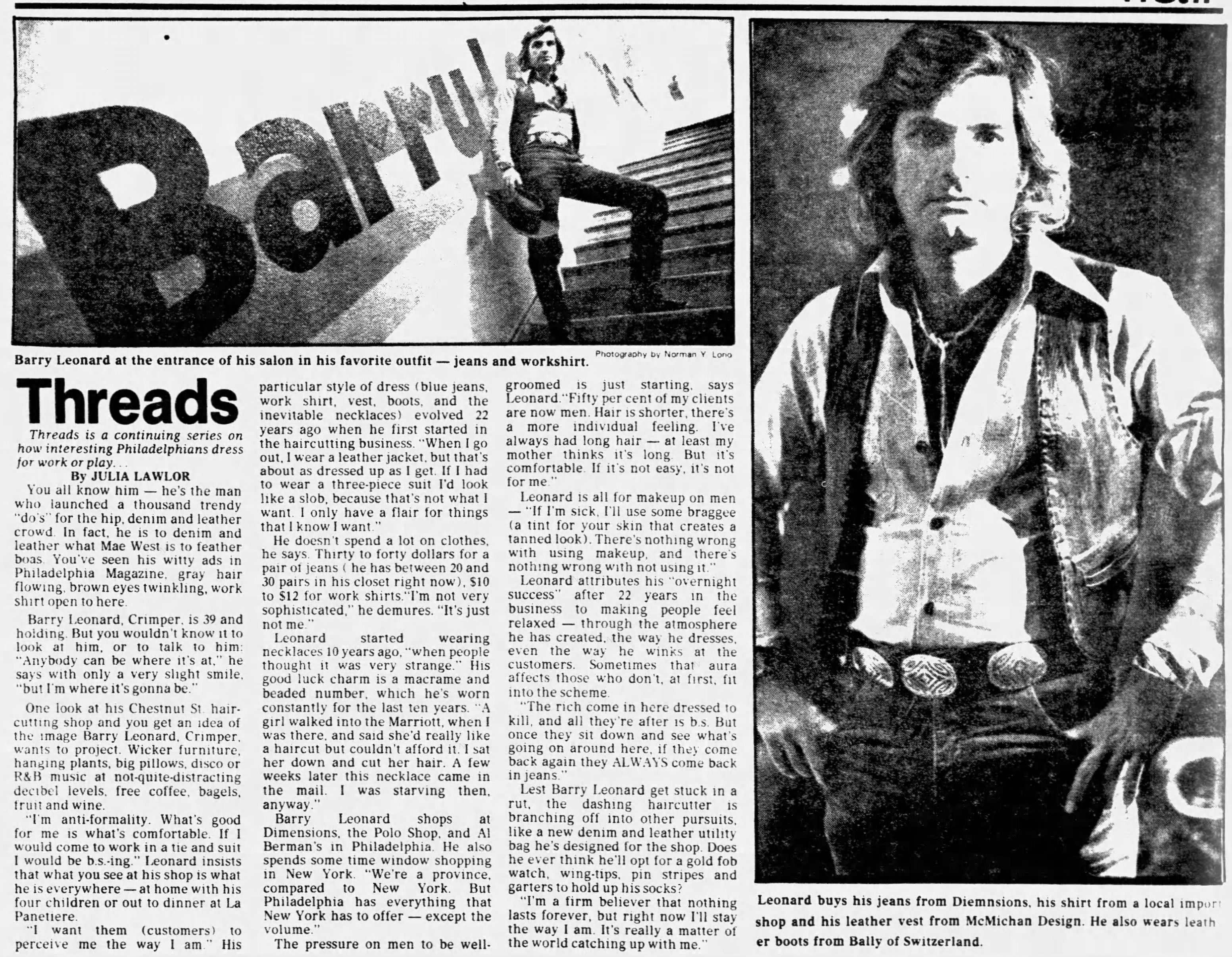
He also created and distributed do-it-yourself manuals for those who couldn’t get appointments and introduced computerized styling technology in the 1980s so clients could design their own cuts on video screens. “I’m a firm believer that nothing lasts forever,” he told the Daily News in 1977. “But right now, I’ll stay the way I am. It’s really a matter of the world catching up with me.”
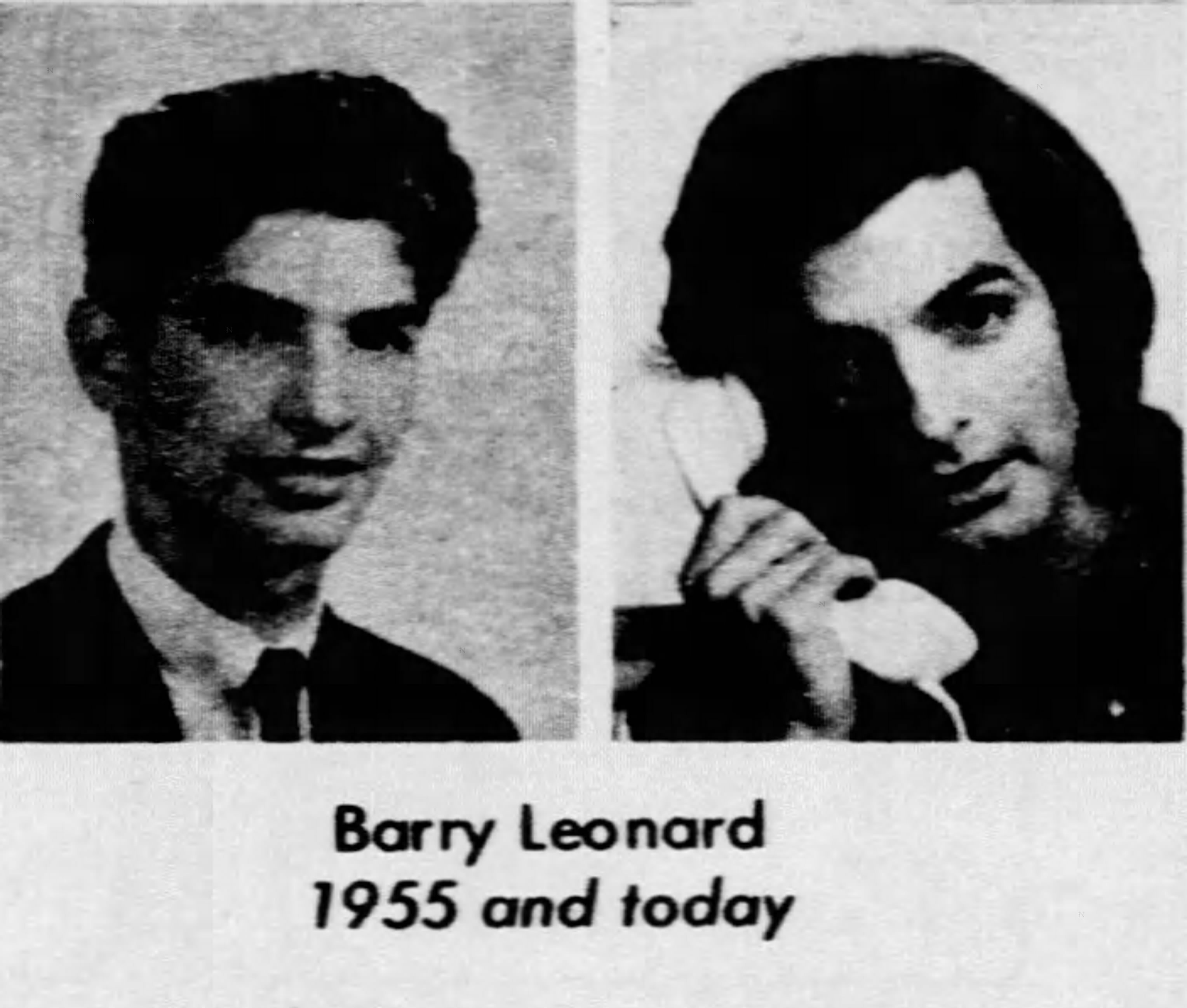
This then and now photo appeared with a story in The Inquirer in 1973.
He was featured often in The Inquirer, Daily News, Philadelphia Magazine, Philadelphia Business Journal, and other publications, and writers dubbed him the “top hair gun” in Philadelphia, “the dashing haircutter,” and “Philadelphia’s leading proponent of hair as art.” He dabbled in selling franchises, endorsed a new Japanese hair-straightening process, and hosted runway-style hair shows and crimper workshops.
Women told him his beauty advice changed their lives. Men said his haircuts improved their sex lives.“I was the image changer,” he told The Inquirer in 2002.
In the late 1960s, Mr. Leonard gave local advertising whiz Elliott Curson a haircut, and Curson, delighted with the result, suggested rebranding Mr. Leonard as “a crimper,” British slang for hairdresser. What followed was a hugely successful ad campaign and a friendship that lasted more than 50 years.
One of their first ads featured the phrase: “When I come out of Barry Leonard’s, I won’t look like my mother.” Curson said: “He had that look, the outfit, and the vision that worked so well.”
Mr. Leonard and his wife, Annie, married in 1986.
Mr. Leonard liked to wear a work shirt, vest, blue jeans, boots, designer glasses, and turquoise jewelry to work. His own hair flowed down to his shoulders when he was young. He told the Daily News in 1977: “Anybody can be where it’s at. But I’m where it’s going to be.”
He was a member of Intercoiffure America and participated in its competitive showings in New York and elsewhere. He was included in a display called “Movers and Shakers” at the now-closed Philadelphia History Museum.
“He would meet you once and have an impact on the rest of your life,” his wife said. “Everybody loved him. He was passionate and compassionate.”
Barry Leonard was born Jan. 27, 1938, in Philadelphia. He grew up in Wynnefield and Bala Cynwyd, and served in the Army’s 101st Airborne Division for two years after high school.
Mr. Leonard (second from right) celebrated his 80th birthday with his children.
He wore a traditional tie and jacket, and cut hair with his father and in a few local shops before opening his place at the Marriott in 1962. He also spent some time working in London and first heard the word crimper there.
He married Charlene Brooks, and they had daughters Karen, Susan, and Elizabeth and a son, Brett. After a divorce, he met Annie Halpern at a party in 1983. They went to a Neil Diamond concert on their first date in 1984, married in 1986, and moved from Center City to Florida in 2005.
Mr. Leonard was an avid boxing fan, and he knew his way around the popular Blue Horizon venue on Broad Street. He had a summer home in Longport, N.J., and enjoyed time at Gulfstream Park racetrack in Florida.
He was spiritual and loquacious, his wife said. He had favorite witty quips, and his family and friends refer to them as “Barryisms.”
This article about Mr. Leonard’s fashion sense was published in the Daily News in 1977.
He attended all kinds of galas and benefits, and doted on his children. “He gave me my first shag” haircut, a longtime friend said on Facebook. Another friend said her neighbor cut her hair once. “The results were not good,” she said. “Barry fixed me.”
They called him “one of a kind,” “truly the best around,” and a “mentor and a friend.” His wife said: “He was the love of my life.”
In addition to his wife, children, and former wife, Mr. Leonard is survived by eight grandchildren and other relatives. A brother died earlier.
A celebration of his life is to be at 11 a.m. Saturday, Dec. 6, at Gulfstream Park, Third Floor, Flamingo Room, 901 S. Federal Highway, Hallandale Beach, Fla. 33009. RSVP to blcrimper@aol.com.
This ad by Mr. Leonard and Elliott Curson appeared in The Inquirer in 1982.