Police were seeking the public’s help in locating the driver of a white SUV that fatally struck a 49-year-old man riding an e-bike early Monday in Burlington County and then fled the scene.
Just before 12:15 a.m. Monday, Mount Laurel Township police were dispatched to the 1100 block of Route 73 southbound to respond to a crash involving an e-bike and an unknown vehicle.
Police said they located Anthony Caprio III, who was pronounced dead.
The striking vehicle fled the scene.
Sgt. Kyle Gardner on Tuesday said the e-bike was equipped with lights, which were on at the time of the crash. The vehicle dragged Caprio at least a quarter-mile and then continued south on Route 73 into Evesham Township, Gardner said.
Michele Caprio, 71, Anthony’s mother, said he had taken his e-bike to a Wawa on Sunday night from his mother’s house in Mount Laurel. At some point, he called his mother to say he had trouble with the bike, but had fixed the problem, she said.
Then around 3 a.m. Monday, two police officers came to her house to inform her of the crash and his death, she said.
Anthony Caprio III and his mother, Michele Caprio, in photo from the mid-1990s.
His mother said he was very skilled at fixing anything mechanical. He briefly was employed at SEPTA, which he highlighted in several photos on his Facebook account. “He loved trains and worked for SEPTA fixing trains,” she said.
He had a love for aircraft that developed when he was a kid because his father had a plane and took him flying, his mother said.
His 50th birthday was coming on Jan. 4, she said.
She also said he had struggled for many years with mental illness and alcohol abuse. He recently found himself homeless and moved back in with his mother, she said.
The Mount Laurel Police Department released images from surveillance video of the white SUV and asked anyone with information to call the department at 856-234-8300 or the confidential tip line at 856-234-1414 ext. 1599.
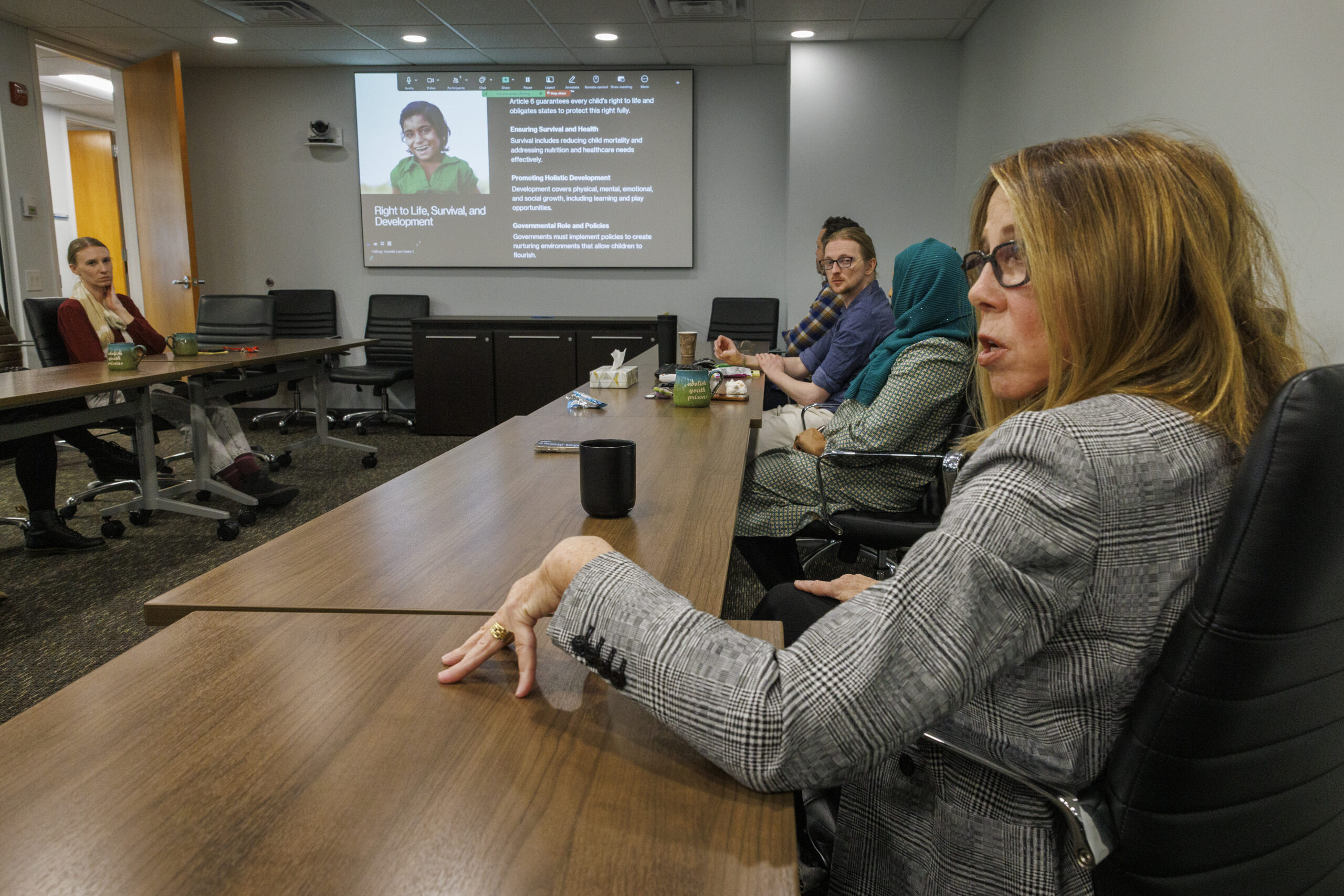
Marsha Levick took her seat at a conference table at the Juvenile Law Center on a recent Wednesday for what would be one of her last meetings. She walked colleagues through the basic principles of the United Nations Convention on the Rights of the Child, the 1989 treaty that laid out, in clear terms, what the world said it owed young people.
At the heart of the treaty is a simple idea: A child’s best interests come first — even when that child enters the justice system. It has been ratified by all but one of the U.N.’s member nations: the U.S. And in many of those 196other countries,Levick said, children younger than 14 cannot be prosecuted at all.
“Wait,” a staffer interjected. “Kids younger than 14 aren’t in the justice system?”
“I know,” Levick said. “It’s very different.”
Marsha Levick, chief legal officer and cofounder of the Juvenile Law Center, speaks with staff on Dec. 17.
For 50 years, Levick, 74, has been one of the most persistent and influential voices in the American juvenile justice system, a driving force in turning what was once a niche legal specialty into a national civil rights movement. Colleagues credit her with helping to rewrite how courts view children — persuading judges, including those on the U.S. Supreme Court, to treat youth not as miniature adults but as citizens with distinct constitutional protections and needs.
Levick will step down Wednesday from her position as chief legal officer of the Juvenile Law Center, the Philadelphia-based organization she helped build from a walk-in legal clinic in 1975 into a national leader in children’s rights.
Her departure coincides with the center’s 50th anniversary. At a celebration gala in May, the nonprofit honored Levick with a leadership award that recognized her body of work.
Levick’s career ranged from representing individual teenagers to steering landmark litigation that forced states to overhaul abusive practices. She helped lead the Juvenile Law Center’s response to the “kids for cash” scandal in Luzerne County. She coauthored briefs in a series of U.S. Supreme Court victories that throttled the harshest punishments for kids, including life in prison.
But Levick is also stepping down at what she calls a “dark moment” forcivil liberties in America — a time when rights once thought settled are being rolled back.
Levick was in law school in 1973 when the U.S. Supreme Court handed down Roe v. Wade, the landmark decision that recognized a constitutional right to abortion. In the years that followed, a constellation of rights — from marriage equality to access to contraception — also expanded.
Roe was overturned, however, in 2022. Since then, other decisions have also chipped away at affirmative action in colleges and LGBTQ+ protections.
“It’s hard to convey the shock that it imposes,” Levick said in a recent interview. “Now, 50 years later, you’re pushing the rock back up the hill.”
She made clear she was unsparing with herself, quick to point out what she perceived as shortcomings. “There were high moments for sure,” she said. “But I am not foolishly happy about that. I’m shocked that that’s all we could do. That’s as far as we got.”
Yet even as fresh battles loom, colleagues say the groundwork Levick has laid will guide the Juvenile Law Center’s mission and the broader fight for children’s rights for years to come.
Jessica Feierman, the center’s senior managing director, will step into Levick’s role. “It is a huge privilege and also an immense responsibility,” she said. “In this moment of attacks on civil rights and children’s rights, it’s even more vital that we build on the victories of the last 50 years.”
From Philadelphia to the U.S. Supreme Court
Raised in Philadelphia’s Fairmount neighborhood, Levick discovered early the charge of using her voice, first as a girl who demanded a recount in an elementary school election and won the presidency, and later as a teenager who inhaled The Feminine Mystique and the feminist writers who followed. She earned an undergraduate degree from the University of Pennsylvania and a law degree from what is now Temple University Beasley School of Law.
She cofounded the Juvenile Law Center in 1975 with three law school classmates: Bob Schwartz, a classical music aficionado and part-time semi-pro baseball umpire; Phil Margolis, a vegetarian and free spirit; and Judy Chomsky, a mother of two and passionate Vietnam War resister.
Seven years earlier, the U.S. Supreme Court had ruled that juveniles were entitled to due process. That decision cracked open an untapped field, Levick said, to buildwith her classmates a new kind of civil rights practice focused on children.
For the first year, they worked out of the Chestnut Street office of Chomsky’s husband, a cardiologist, carving out space in his waiting room and sidestepping an exam room on the days he saw patients.
In its earliest years, the center took on individual cases for children. One of Levick’s first clients was in Montgomery County, a teen girl who had participated in a protest at a nuclear plant and who was arrested and charged with trespassing, she said.
But the center struggled financially. The founding partners laid themselves off at one point, Levick said, so they could keep paying the few employees they had hired: a divorced mother who worked as a receptionist; their first lawyer, Anita DeFrantz, who was an Olympic rower; and a social worker.
In 1982, Levick quit the center to become the legal director of the national NOW Legal Defense and Education Fund, now Legal Momentum. By the time she left there six years later, she had become its executive director.
At the NOW Legal Defense and Education Fund, Levick said, she learned how to build national cases — coordinating multistate litigation and filing amicus briefs in federal courts. By the time she returned to the Juvenile Law Center in 1995, after a stint at a small Paoli firm, she had come to believe that individual wins, while necessary, would not be enough to create lasting change.
The center’s mission became more focused on appellate litigation and national advocacy, setting the stage for children’s rights to reach state supreme courts and, eventually, the U.S. Supreme Court.
Hundreds of juveniles resentenced, released
In 2005, in Roper v. Simmons, Levick cowrote in a brief that social science research on youth development should inform constitutional law. Children, she also wrote, have a greater capacity to change.
“We just pushed ourselves into the center of it,” Levick said. “We were like, ‘We’re here. We’re writing the amicus brief.’”
The high court overturned decades of precedent when it ruled in Roper that the Eighth Amendment forbids the death penalty for juveniles. Five years later, in Graham v. Florida, it barred life-without-parole sentences for juveniles in non-homicide cases, after reading another brief Levick coauthored.
In 2012, Levick helped persuade the court to end mandatory life-without-parole sentences for youths convicted of homicide in Miller v. Alabama. And in 2016, she served as cocounsel in Montgomery v. Louisiana, the case that made the Miller decision retroactive across the country.
Since then, hundreds of juveniles — including nearly 500 in Pennsylvania — have been resentenced or released from prison. One of them: Donnell Drinks, freed in 2018 after 27 years.
The first time Drinks met Levick, he hugged her. “I couldn’t believe how small she was, because of her presence, her legal prowess, has all been so enormous,” recalled Drinks, who works as a leadership and engagement coordinator at the Campaign for the Fair Sentencing of Youth.Levick is 5-foot-3.
Those cases brought Levick into courtrooms across the state, often alongside public defenders. One of them, Bradley S. Bridge, a retired Philadelphia public defender who worked with her on dozens of resentencings, called Levick a “zealous advocate” who “always saw the big picture.”
Her ability, he said, “to think toward the future, I think, was most glorious.”
Levick agreed that looking ahead had always been part of her work. “We always tried to look around the corner,” she said.
One of those moments came in 2008, when she and her colleagues began fielding troubling calls from Luzerne County — the first hints of what would become the “kids-for-cash” scandal.
Seeing more in the ‘kids-for-cash’ scandal
In 2007, Laurene Transue called the Juvenile Law Center. Her daughter, 14-year-old Hillary Transue, had been ordered to serve three months in a detention facility after she created a Myspace page mocking her school principal, she said at the time.
“We saw in that one phone call something that was clearly much bigger,” Levick said.
In fact, it was one of the most egregious judicial corruption cases in modern American history: Two Luzerne County judges had accepted kickbacks in exchange for sentencing thousands of juveniles — many for minor misbehavior — to extended stays in private detention centers.
“It was kind of like, if I may, what the f— in my mind,” Levick recalled.
Levick and the center petitioned the Pennsylvania Supreme Court, which ultimately threw out and expunged thousands of adjudications. They later helped families pursue civil damages, with the help of other firms. The judges, Mark Ciavarella and Michael Conahan, were convicted of federal crimes and sentenced to long prison terms; President Joe Biden commuted Conahan’s sentence in 2024.
Hillary Transue now serves on the Juvenile Law Center’s board.
Transue told The Inquirer that as a teenager she believed that “highly educated” adults in “positions of authority” were “mean, nasty people who were out to hurt you.” But Levick, she said, “brushed up against my perception of adults” and proved her wrong.
“I think she’s a goddamn superhero,” Transue said recently.
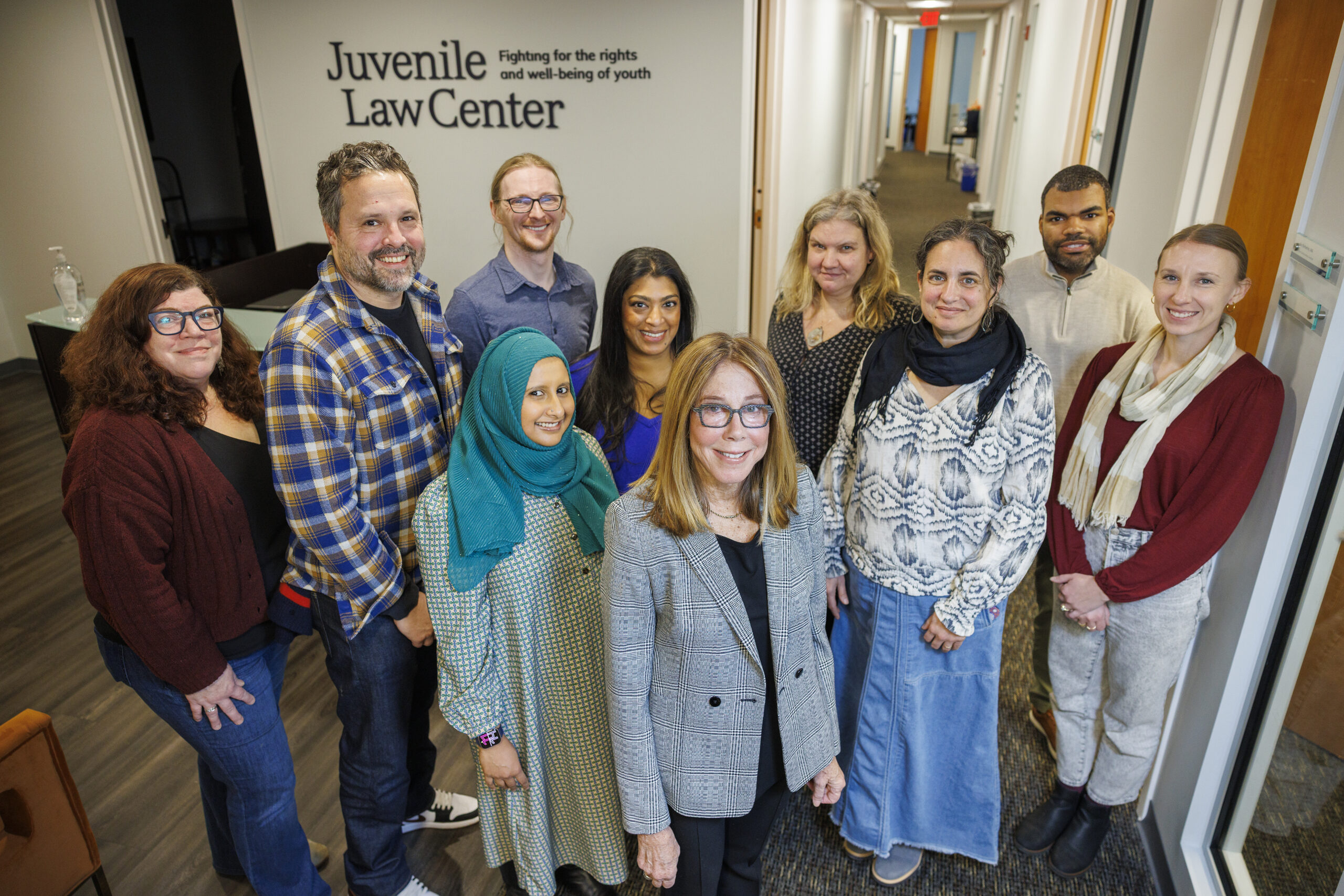
Marsha Levick (center) stands with staffers at the Juvenile Law Center earlier this month.
Among the successes, Levick still sees failures
Despite the victories, Levick is quick to cite the cases she lost. “I’ve had successes. I’ve also failed many times,” she said.
She still thinks about clients like Jamie Silvonek, sentenced to 35 years to life in prison after killing her mother, whose early release Levick has fought for but has not yet won, or a recent bid to expand parole access for people convicted as juveniles that fell flat in Florida.
Those losses have hardened her view of how deeply punishment is embedded in American law. “I feel like punishment is in our bones,” she said. “The way that we think about crime is that it is always followed by punishment.”
That instinct, she said, has left behind people who could have thrived outside prison — including juvenile lifers who will never be released. One of them is Silvonek, whom Levick described as brilliant and warm. “I want her to be able to share that warmth and joy with her family and with her community, who are all behind her,” Levick said.
“We lost what they had to give,” she added.
Levick isn’t done yet
Levick, who is married with two adult daughters, is not leaving the field. She will become the Phyllis Beck chair at Temple’s Beasley School of Law, a post once held by her cofounder Bob Schwartz, and will teach constitutional law to first-year students.
She feels newly urgent about the course. “I am outraged at the degree to which the law has been perverted by the current moment, and I think I still can say and do something about that,” she said. “I think that the things that motivate me include outrage.”
She expects much of the future progress in youth justice to come from state supreme courts rather than the U.S. Supreme Court — a shift she sees as pragmatic, not pessimistic. Washington State Supreme Court Justice Mary Yu, who has heard Levick argue successfully before her, called her a fearless litigator. “She’s an extraordinary appellate lawyer,” Yu, who is also retiring Wednesday, said in an interview.“It’s almost instinctual to her.”
And even now, Levick said, she has hope.
“We’re not going to abolish the juvenile justice system in America, but we could transform it radically,” Levick said. “I believe that. But it takes more than just lawyers to care. It takes more than the community to care. It takes people in positions of power to care. And that’s the hard part.”
Correction: An earlier version of this article misstated the name of a legal advocacy group at which Levick worked. She worked at NOW Legal Defense and Education Fund. The story also misstated the year Laurene Transue called the Juvenile Law Center; she called the law center in 2007.
She went by Dr. Mary, and her promise was a tantalizing medical breakthrough.
At clinics operated in Arizona and several other states, Mary Blakley and her husband, Fred, told patients that for just $300, they could provide a full-body scan that utilized a proprietary “smart chip” to detect a variety of potential illnesses, including cancer.
In addition, the Blakleys boasted, their technology could actually help cure some patients’ maladies — blasting away kidney stones with a laser, killing cancer cells by injecting a special cream, or cleaning out lungs with a prototype “sweeper” approach.
But in federal court in Philadelphia on Monday, the couple admitted that their clinics were a sham — that in reality, they only administered basic ultrasounds to patients while lying about the other fantastical benefits.
Their guilty pleas were the latest development in a fraud prosecution with a variety of unusual elements. Mary Blakley, for example, had not only lied about being a doctor to build her clinics, prosecutors said — her background included a prior federal conviction for manufacturing methamphetamine.
Fred Blakley, 61, meanwhile, also pleaded guilty Monday to a separate set of firearms charges, admitting that as he was perpetuating the healthcare fraud, he was also stockpiling dozens of guns and thousands of rounds of ammunition for what he said was a forthcoming civil war against the U.S. government.
Neither of the Blakleys said much in court Monday beyond responding to routine questions from U.S. District Judge Gerald McHugh. They pleaded guilty to counts including mail and wire fraud and conspiracy.
Prosecutors said the couple — from Lake Havasu City, Ariz. — generated more than $2 million in fraudulent billings over the years. Their clinics operated in places including their home state, California, and Colorado, prosecutors said, and some of their patients had ties to Pennsylvania, which is where they were ultimately prosecuted.
Their chief offering was a signature “full-body scan,” which they ran through a traditional ultrasound machine — but said had been enhanced with their proprietary smart chip technology. They told patients their machine could detect, treat, and cure a variety of illnesses, and also said the technology was a secret and should not be discussed with anyone.
The Blakleys would often go on to prescribe various creams or drugs that had little to no benefit, prosecutors said, and sometimes said a patient would need to continue using the prescription for life. One of the substances, fenbendazole, was approved for use in animals by the Food and Drug Administration, prosecutors said, but was not approved for use in humans.
To bolster her standing with clients, prosecutors said, Mary Blakley, now 66, lied about her background, falsely claiming she had worked at the MD Anderson Cancer Center in Houston; saying she had developed pharmaceuticals for Merck; and claiming she had received a Ph.D. in nuclear physics from the Karolinska Institutet in Sweden.
She hung a fake degree from the Swedish school on the wall of her clinic office, prosecutors said, along with others from Gatesville University and Almeda University — two online institutions that prosecutors described as “diploma mills.”
To try to avoid detection, prosecutors said, the Blakleys asked their patients to pay with cash or check, refused to keep client records, and avoided keeping records of the full-body scans, which they sometimes described as “research.”
They also sought to expand their empire, sometimes by selling their purported devices to others, or by charging trainees to open franchise branches of their clinics.
In the meantime, court documents said, Fred Blakley was amassing a collection of more than two dozen guns and 30,000 rounds of ammunition, some of which he stored in the garage of his pastor. He was not allowed to own any firearms because he had been convicted alongside his wife in the prior methamphetamine case.
As undercover FBI agents investigated the couple for their healthcare fraud, court documents said, Fred Blakley was captured on an audio recording in 2022 telling one of the agents he was “planning on shooting some humans.”
“We’re gonna have to go to war with our own government … a civil war,” he said, according to court documents, later adding: “You better arm up good. I’ve got thousands of rounds of ammunition, and I’m ready to rock.”
The couple’s downfall began several years ago, when local authorities in Arizona received complaints about the clinics, including from the couple’s estranged daughter.
The FBI then began an extensive investigation, court documents said, and the couple were indicted in federal court in Philadelphia earlier this year.
They are scheduled to be sentenced by McHugh in April. The couple are in custody at the federal detention center in Philadelphia. Each faces the possibility of being sentenced to more than 150 years behind bars.
A Delaware County woman was charged with first-degree murder for allegedly stabbing her 23-year-old daughter to death in their Upper Darby Township home two days before Christmas, authorities say.
Police found Diane Grovola, 57, naked, covered in blood, and suffering self-inflicted stab wounds when they responded to a 911 call at the family residence that morning, according to the affidavit of probable cause in her arrest.
Grovola’s daughter was in an upstairs bedroom with knife wounds to her face, chest, legs, and back. Her eyes were open but she was unresponsive, the affidavit says. She was pronounced dead shortly after.
“Sorry, I should have stabbed myself first,” Grovola told officers as they placed her in wrist restraints, according to the affidavit.
Grovola’s husband, the young woman’s father, was first to discover the distressing scene.
The man arrived at the home on South Bishop Avenue in the Secane section around 6:30 a.m. after returning from a shift at Philadelphia International Airport, the affidavit says. He had stopped at McDonald’s to get breakfast for his family.
Once inside, the man was greeted by the family dog, which had suffered knife wounds to its abdomen and “got blood on his clothing,” according to the affidavit.
He found his wife seated on the living room sofa with a knife in her hand.
“I stabbed our daughter,” she told him, according to the affidavit.
As her husband dialed 911, Diane Grovola told him she did not want to live anymore and began to stab herself in the chest, according to the affidavit.
The operator told the man to flee the residence.
During that time, Grovola stripped naked and began breaking items in the kitchen until police arrived. They eventually recovered a large stainless-steel knife that appeared to have blood on it, the affidavit says.
In addition to first-degree murder, prosecutors charged Grovola with third-degree murder, possessing an instrument of a crime, and aggravated cruelty to an animal.
She is being held in the George W. Hill Correctional Facility and was denied bail, court records show.
Police found the body of the woman with the crystal pendant necklace stuffed beneath a wooden pallet in an overgrown lot in Frankford one night last June. She had been shot once between the eyes, and wore only a sports bra, with her pants and underwear tangled around her ankles.
Days in the stifling heat had left her face unrecognizable, nearly mummified.
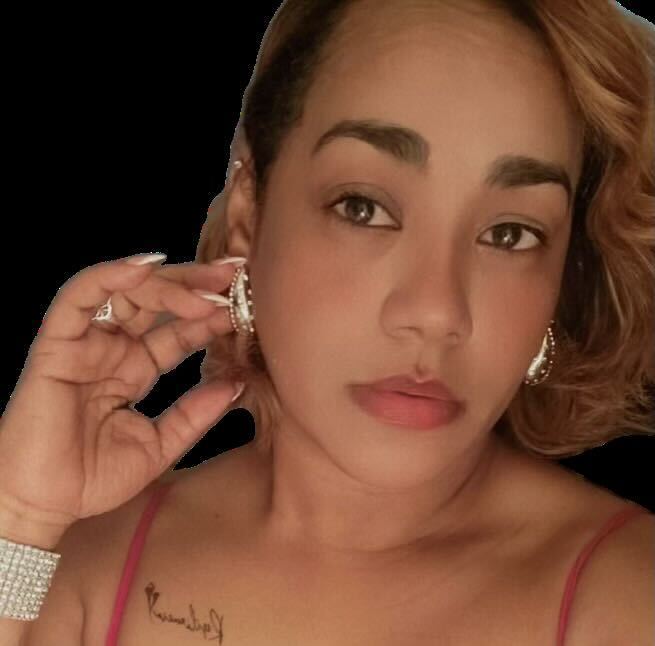
Still, Homicide Detective Richard Bova could see traces of the beautiful young woman she had been. She was small, about 100 pounds, with long dark hair tinted red at the ends. Her nails were painted pale pink. She wore small gold hoops in her ears.
But he didn’t know her name. And for 90 days, the absence of that essential fact stalled everything.
A victim’s identity is the foundation on which a homicide case is built. Without it, detectives cannot retrace a person’s final moments or home in on who might have wanted them dead and why. For three months, Bova and his partner scoured surveillance footage, checked missing-persons reports, and ran down every faint lead, eager to put a name to the woman beneath the pallet.
At the same time, in a small house in Northeast Philadelphia, a family was searching, too.
Olga Sarancha hadn’t heard from her 22-year-old daughter, Anastasiya Stangret, in weeks and was growing worried. Stangret had struggled with an opioid addiction in recent months, but never went more than a few days without speaking to her mother or sister.
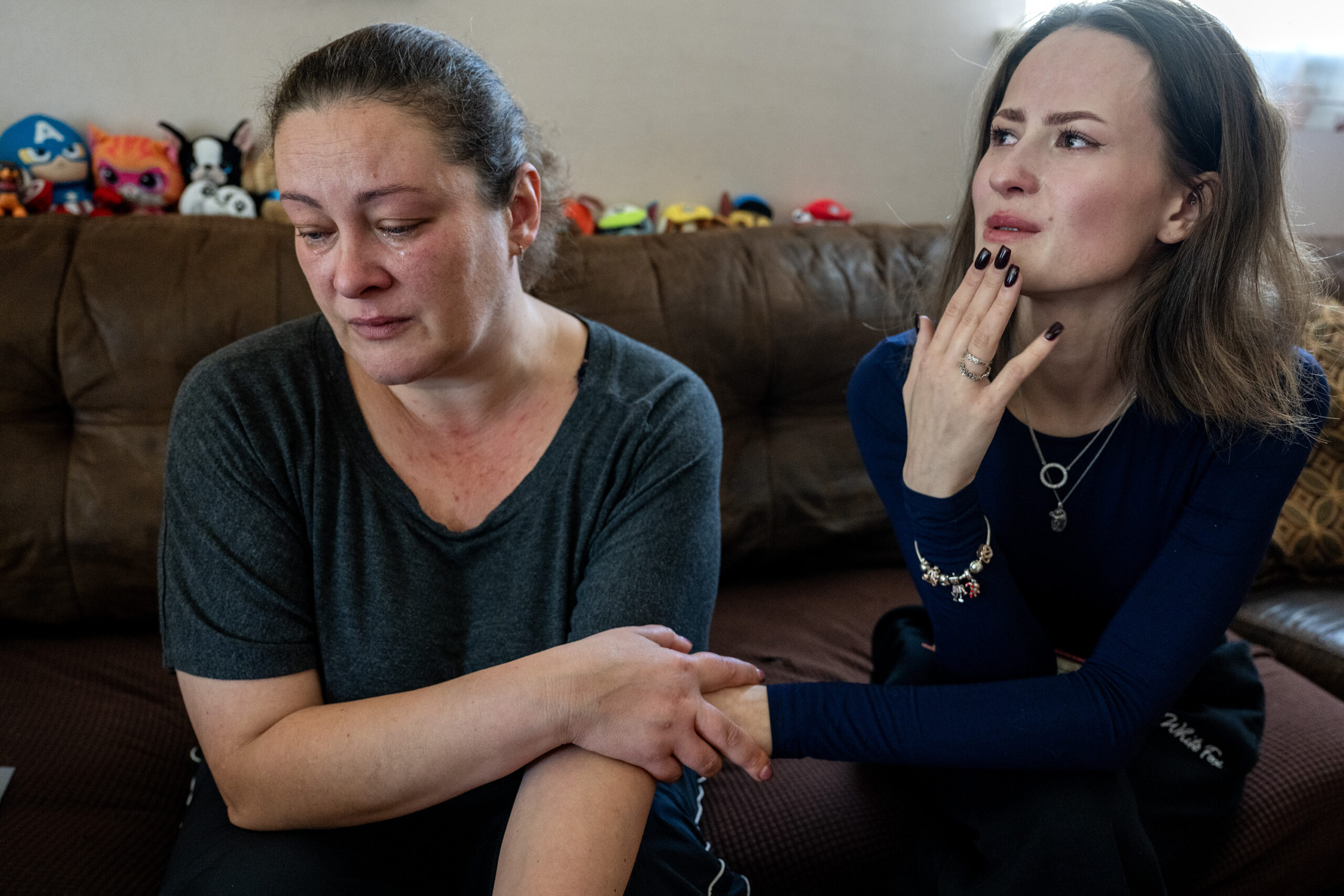
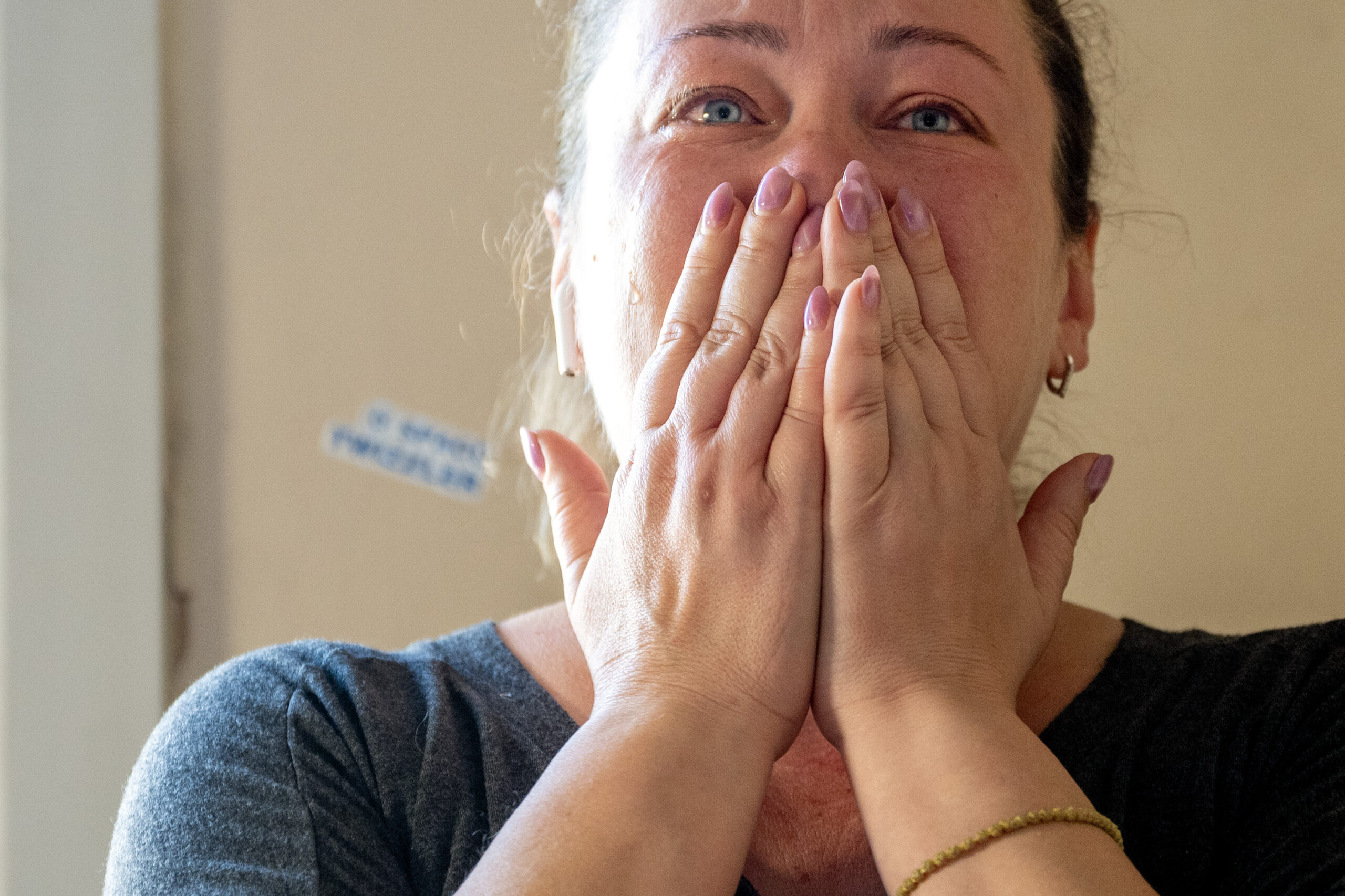
Olga Sarancha (left) and her daughter, Dasha Stangret, speak of the pain of the death of her eldest daughter, Anastasiya, at their Northeast Philadelphia home. Dasha wears a bracelet featuring Pandora charms gifted by her sister.
Through July and August that summer, Sarancha and her youngest daughter, Dasha, tried to report Stangret missing, but they said they were repeatedly rebuffed by police who turned them away and urged them to search Kensington instead.
So they kept checking hospitals, calling Stangret’s boyfriend, and driving through the dark streets of Kensington — looking for any sign that she was still alive.
It was not until mid-September that the family was able to file a missing-persons report. Only then did Bova learn the name of his victim.
But by then, he said, the crucial early window in the investigation had closed — critical surveillance footage, which resets every 30 days, was gone. Cell phone data and physical evidence were harder to trace.
Still, for 18 months, Bova has worked to solve the case, and for 18 months, Stangret’s mother and younger sister have grieved silently, haunted by the horrors of her final moments and the fear that her killer might never be caught.
Philadelphia’s homicide detectives this year are experiencing unprecedented twin phenomena: The city is on pace to record its fewest killings in 60 years, and detectives are solving new cases at a near-record high.
But those gains do not erase the reality that hundreds of killings in recent years remain unresolved — each one leaving families suspended in despair, and detectives asking themselves what more they could have done.
In this case, extensive interviews with Bova and Stangret’s family offer a window into how a case can stall even when a detective puts dozens of hours into an investigation — and what that stall costs.
Bova has a suspect: a 58-year-old man with a lengthy criminal record who he believes had grown infatuated with Stangret as he traded drugs for suboxone and sex with her. But the evidence is largely circumstantial. He needs a witness.
And Stangret’s family needs closure — and reassurance that the life of the young woman, despite her struggles, mattered.
“Everybody has something going on in their life,” said Dasha Stangret, 23. “It doesn’t make her a bad person, and it’s not what she deserved.”
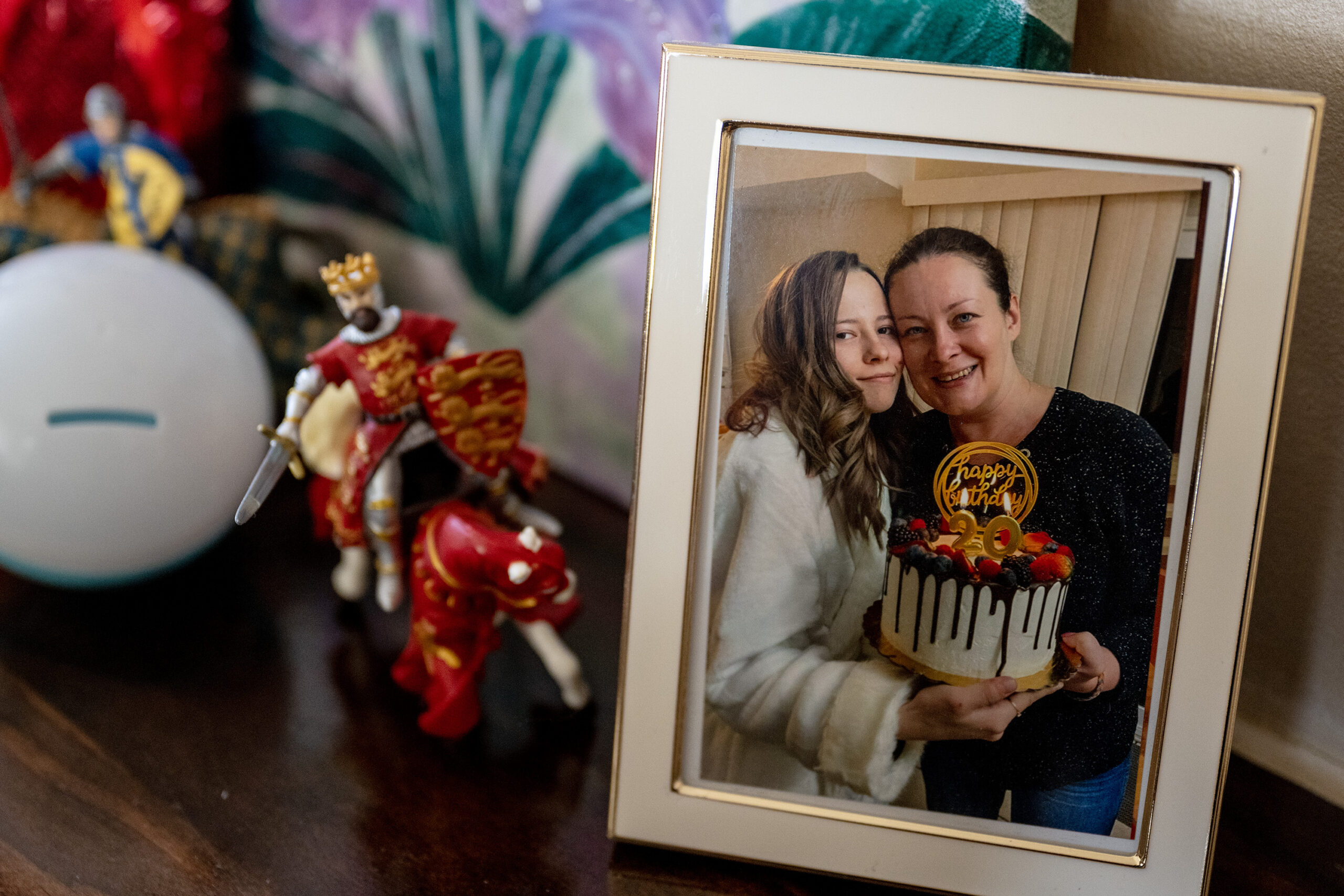
Anastasiya Stangret, left, celebrated her 20th birthday with her mother in 2022.
Becoming Anna
Anastasiya Stangret was born in Lviv, Ukraine, on Nov. 15, 2001. Her family immigrated to Northeast Philadelphia when she was 8 and Dasha was 7.
The sisters were inseparable for most of their childhood. They cuddled under weighted blankets with cups of tea. They put on fluffy robes and did each other’s eyebrows and nails.
Anna was bubbly, polite, and gentle, her family said. She enjoyed working with the elderly, and after graduating from George Washington High School, she earned certifications in phlebotomy and cardiology care. She volunteered at a nearby food bank, translated for Ukrainian and Russian immigrants, and later worked at a rehabilitation facility, where she gave patients manicures in her free time.
Sisters Dasha, left, and Anastasiya Stangret were inseparable as children. They dressed up as princesses for Halloween in 2008.Dasha, left, and Anastasiya Stangret at their first day of school in Philadelphia after emigrating from Ukraine.
“Anna always worked really hard,” Dasha Stangret said. “I looked up to her.”
But her sister was also quietly struggling with a drug addiction.
Her challenges began when she was 12, her mother said, after she was hit by a car while crossing the street to catch the school bus. She suffered a serious concussion, Sarancha said, and afterward struggled with PTSD, anxiety, and depression.
About a year later, as her anxiety worsened, a doctor prescribed her Xanax, her mother said. Not long after, she started experimenting with drugs with friends, her sister said — first weed, then Percocet.
She hid her drug use from her family until her early 20s, when she became addicted to opioids.
She sought help in January 2024 and began drug treatment. But her progress was fleeting. She returned to living with her boyfriend of a few years, who they later learned also used drugs, and she became harder to get in touch with, her mother said.
When Sarancha’s birthday, June 18, came and passed in 2024 without word from her daughter, the family grew increasingly concerned.
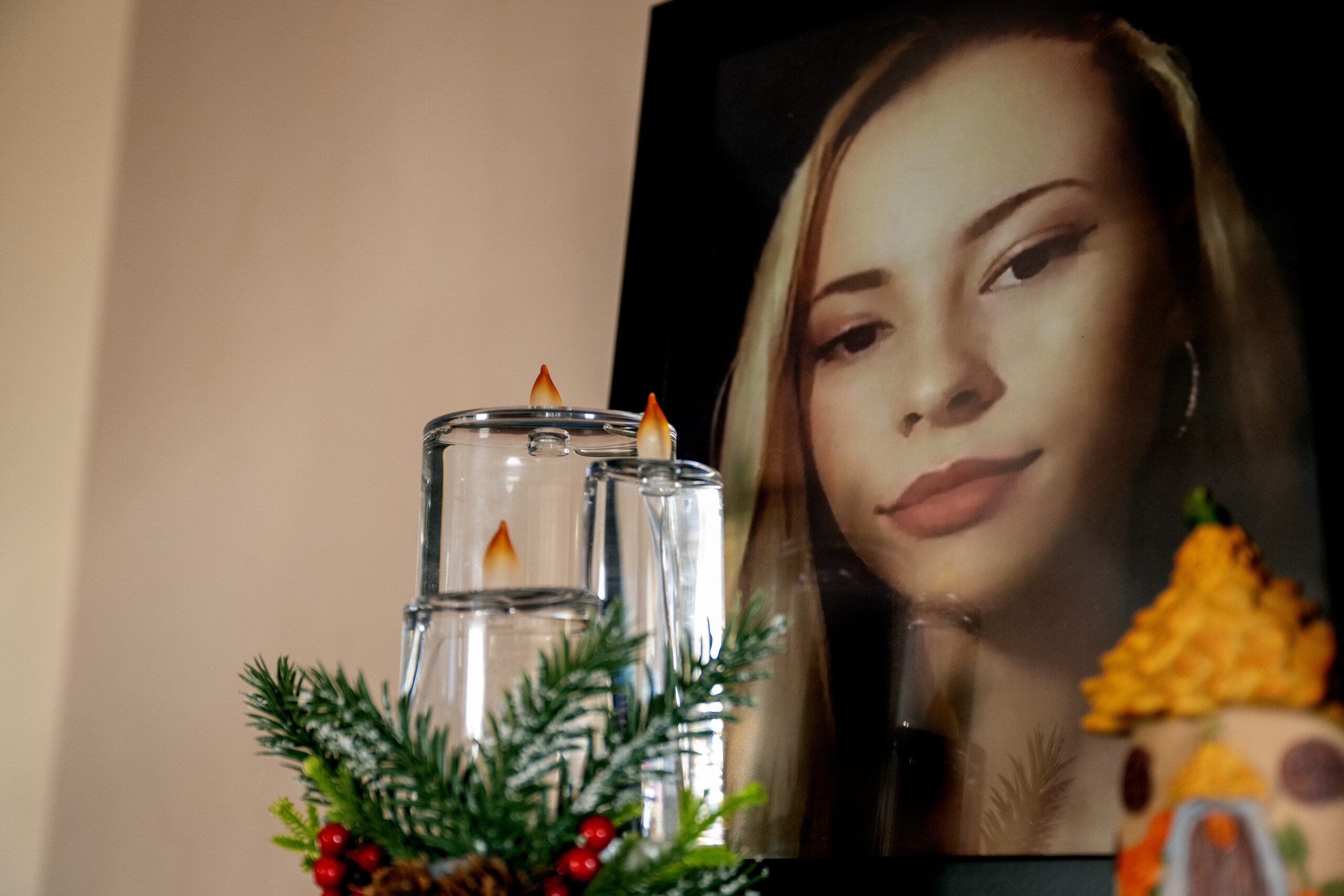
Anastasiya Stangret was kind, gentle, and polite.
They checked in with Stangret’s boyfriend, they said, but for weeks, he made excuses for her absence. He told them that she was at a friend’s house and had lost her phone, that she was in rehab, that she was at the hospital.
On July 27, Sarancha and her daughter visited the 7th Police District in Northeast Philly to report Anna missing, but they said an officer told them to go home and call 911 to file a report.
Two officers responded to their home that day. The family explained their concerns — Stangret was not returning calls or texts, and her boyfriend was acting strange. But the officers, they said, told them they could not take the missing-persons report because Stangret no longer lived with them. They recommended that the family go to Kensington and look for her.
Through August, the family visited a nearby hospital looking for Stangret, only to be turned away. Sarancha, 46, and her husband drove through the streets of Kensington without success. They continued to contact the boyfriend, but received no information.
They wanted to believe that she was OK.
On Sept. 12, they visited Northeast Detectives to try to file a missing-persons report again, but they said an officer said that was not the right place to make the report. They left confused. Dasha Stangret called the district again that day, but she said the officer on the phone again told her that she should go to Kensington and look for her sister.
That the family was discouraged from filing a report — or that they were turned away — is a violation of Philadelphia police policy.
“When in doubt, the report will be taken,” the department’s directive reads.
Finally, on the night of Sept. 12, Dasha Stangret again called 911, and an officer came to the house and took the missing-persons report. For the first time, they said, they felt like they were being taken seriously.
A few days later, Dasha Stangret called the detective assigned to the case and asked if there was any information. He asked her to open her laptop and visit a website for missing and unidentified persons.
Scroll down, he told her, and look at the photos under case No. 124809.
On the screen was her sister’s jewelry.
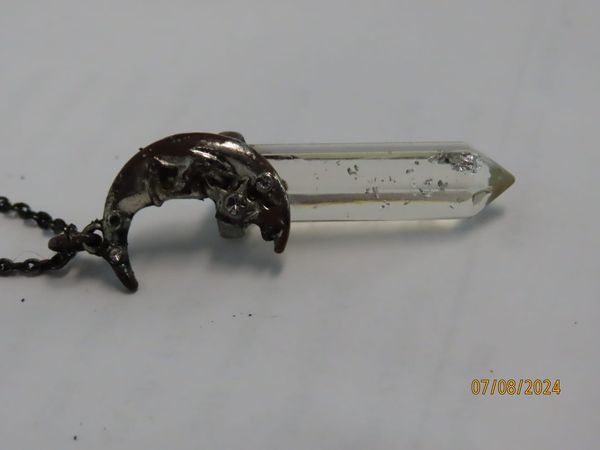
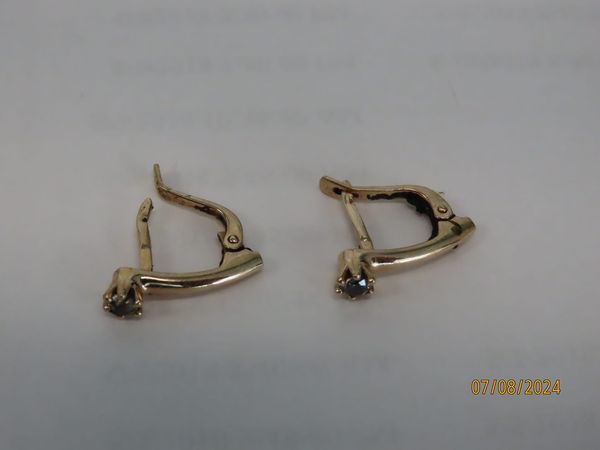
Dasha Stangret gifted this necklace to her sister for her birthday one year. Police released the image after Anastasiya’s body was found last June, in a hope that someone would recognize it and identify her. Dasha did not see the photo until September 2024.Olga Sarancha gifted these gold earrings, handmade in Ukraine, to her eldest child on her birthday a few years ago. Police released this image after they recovered the earrings on Anna’s body, hoping it could lead them to her identity.
A detective’s hunch
Three months into Bova’s quest to identify the woman under the pallet — of watching hundreds of hours of surveillance footage and chasing fleeting missing-persons leads — dental records confirmed that the victim was Stangret.
After meeting with her family, Bova questioned the young woman’s boyfriend.
He told the detective he and Stangret had met a man under the El at the Arrott Transit Center in Frankford sometime in June, Bova said, and that the man gave them drugs in exchange for suboxone and, later, sex with Stangret.
But the man had grown infatuated with Stangret, he said, and after she left his house, he started threatening her in Facebook messages, ordering her to return and saying that if anybody got in his way, he would hurt them.
The man lived in a rooming house on Penn Street — almost directly in front of the overgrown lot where Stangret’s body was found. Surveillance video showed Stangret walking inside the rowhouse with him just before 7 p.m. on June 18, Bova said, but video never showed her coming back out.
Police searched the man’s apartment but found nothing to link him to the crime — no blood, no gun, no forensic evidence that Stangret had ever been inside. The suspect had deleted most of the texts and calls in his phone from June, July, and August, Bova said, and because nearly four months had passed, they could no longer get precise phone location data.
He said that, at this point, he does not believe the boyfriend was involved with her death, and that he came up with excuses because he was afraid to face her family.
Surveillance cameras facing the lot where Stangret was found didn’t show anyone entering the brush with a body. Neighbors and residents of the rooming house said they didn’t know or hear anything, he said. And a woman seen on camera pacing the block and talking with the suspect the night they believed Stangret was killed also said she had no information.
The detective is stuck, he said.
“Is it enough for an arrest? Sure,” Bova said of the circumstantial evidence against the suspect. “But our focus is securing a conviction.”
Bova’s theory is that the man, angry that Stangret wanted to leave, shot her in the head. Because the house has no back door, he believes the man then lowered her body out of the second-floor window, used cardboard to drag her through the brush, and then hid her under a pallet.
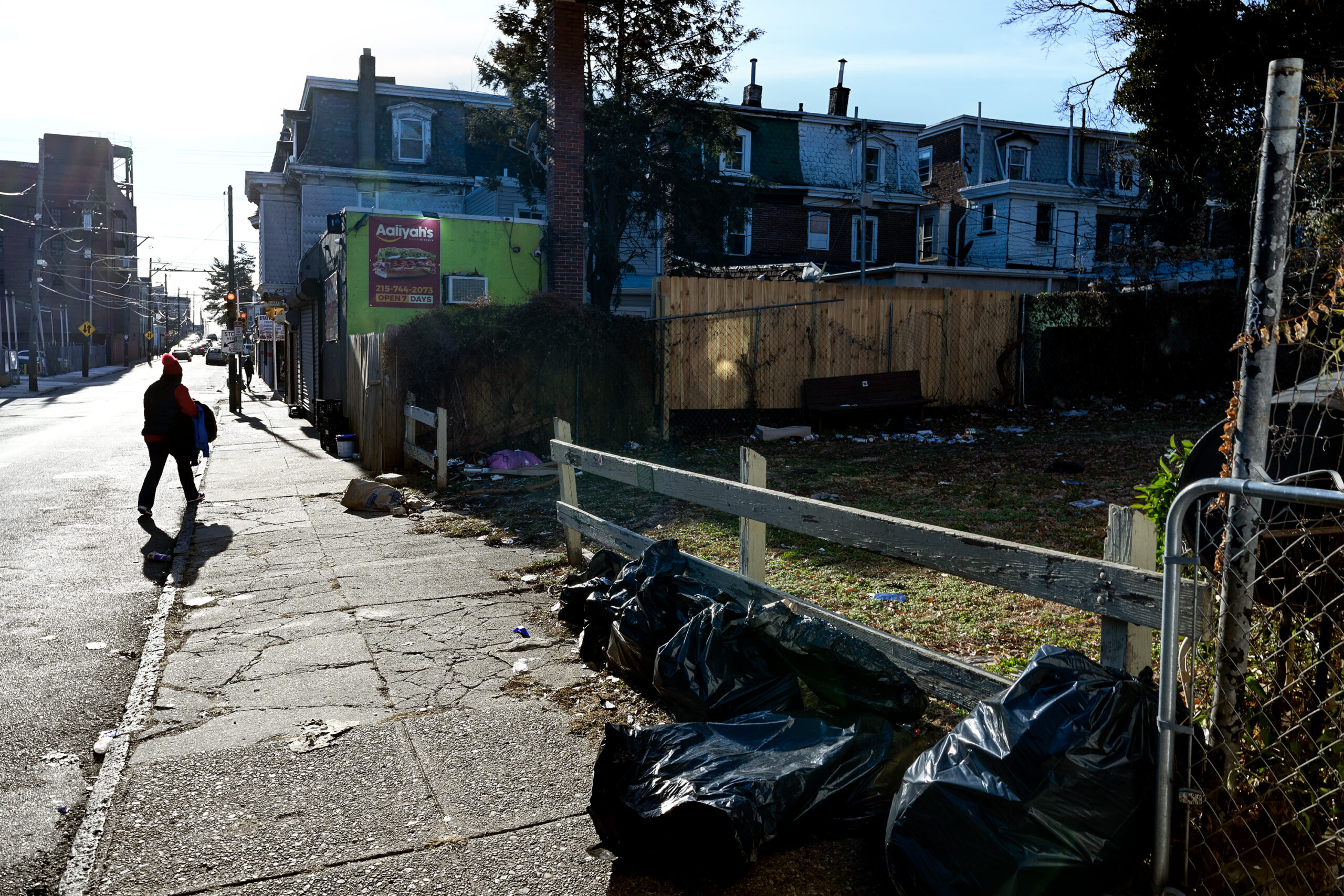
Anastasiya Stangret’s body was found in the back of this vacant lot, on the 4700 block of Griscom Street, in June 2024.
He is sure that someone has information that could help the case — that the suspect may have bragged about what happened, that a neighbor heard a gunshot or saw Stangret’s body being taken into the lot.
There is a $20,000 reward for anyone who has information that leads to an arrest and conviction.
“The hardest part is patience,” he said. “I’m looking for any tips, any information.”
Bova has worked in homicide for five years. As with all detectives, he said, some cases stick with him more than others. Stangret’s is one of them.
“Anna means a lot,” he said. “This is a young girl. We all have children. I have daughters. For her to be thrown in an empty lot and left, to see her life not matter like that, it’s horrifying to me and to us as a unit.”
“It eats me alive,” he said, “that I don’t have answers for them and I’m not finishing what was started.”
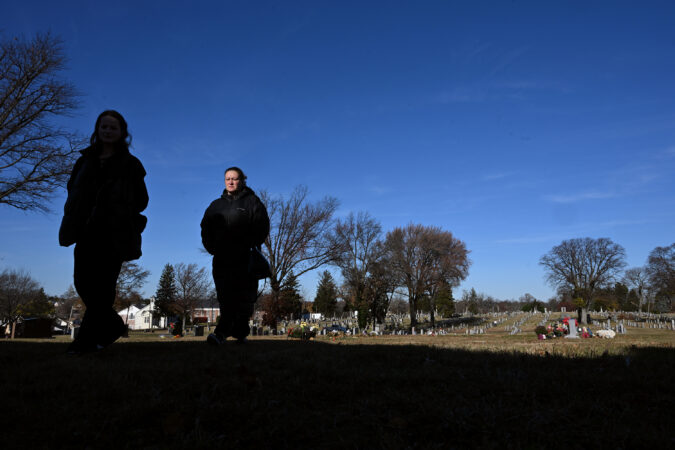
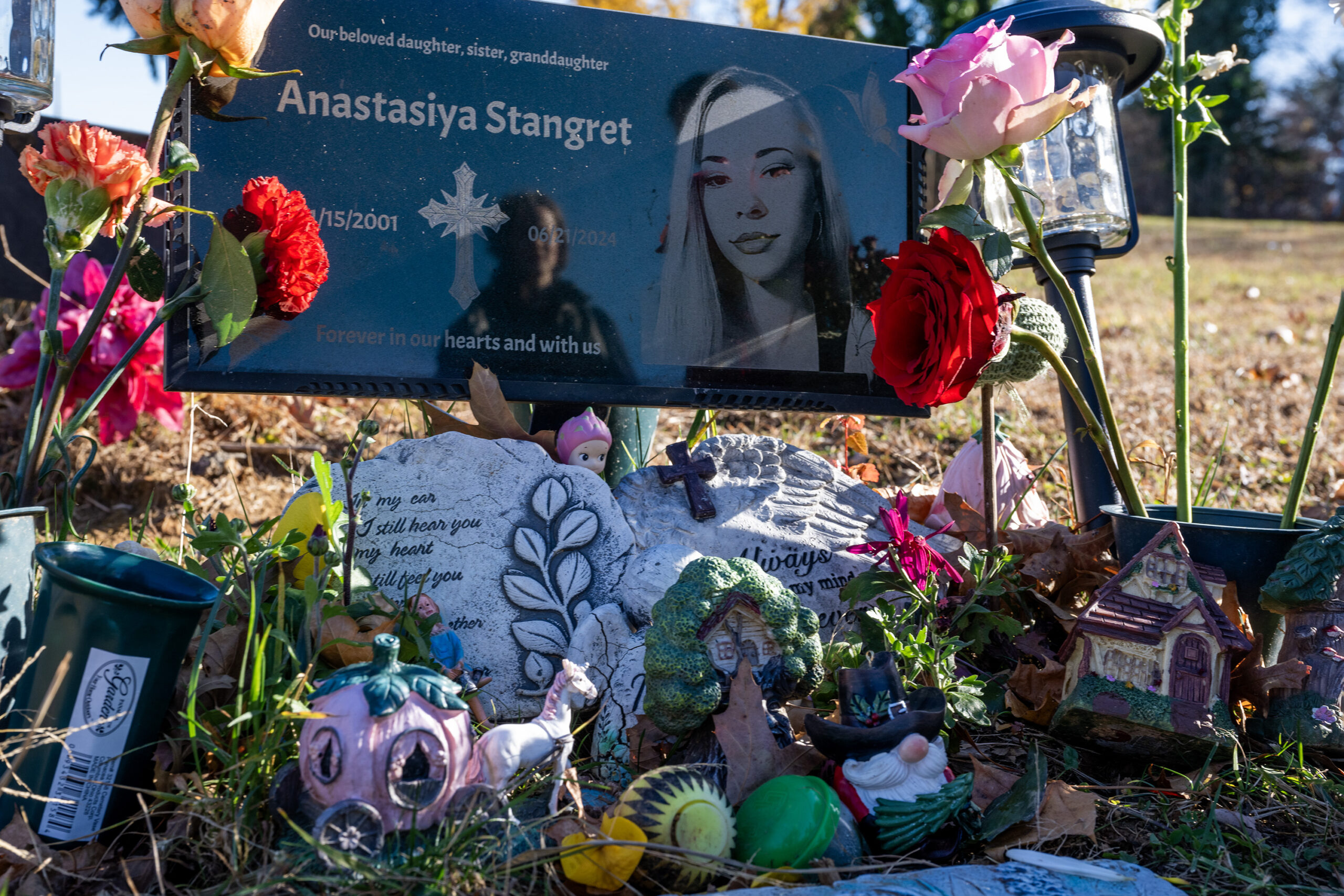
Dasha Stangret is reflected in the memorial at the grave of her sister, Anastasiya, in William Penn Cemetery.
‘I love you. I miss you’
Stangret’s family suffers every day — the guilt of wondering whether they could have done more to get her help, the anger that her boyfriend didn’t raise his concerns sooner, the fear of knowing the man who killed her is still out there.
Dasha Stangret, a graphic design student at Community College of Philadelphia, finds it difficult to talk about her sister at length without trembling. It’s as if the grief has sunk into her bones.
In July, she asked a police officer to drive her to the lot where her sister’s body was found. She sat for almost an hour, crying, placing flowers, searching for a way to feel closer to her.
“I cannot sleep, I cannot live,” Olga Sarancha said of the pain of losing her daughter.
Sarancha struggles to sleep. She wakes up early in the mornings and rereads old text messages with her daughter. She pulls herself together to care for her 6-year-old son, Max, whose memories of his oldest sister fade daily.
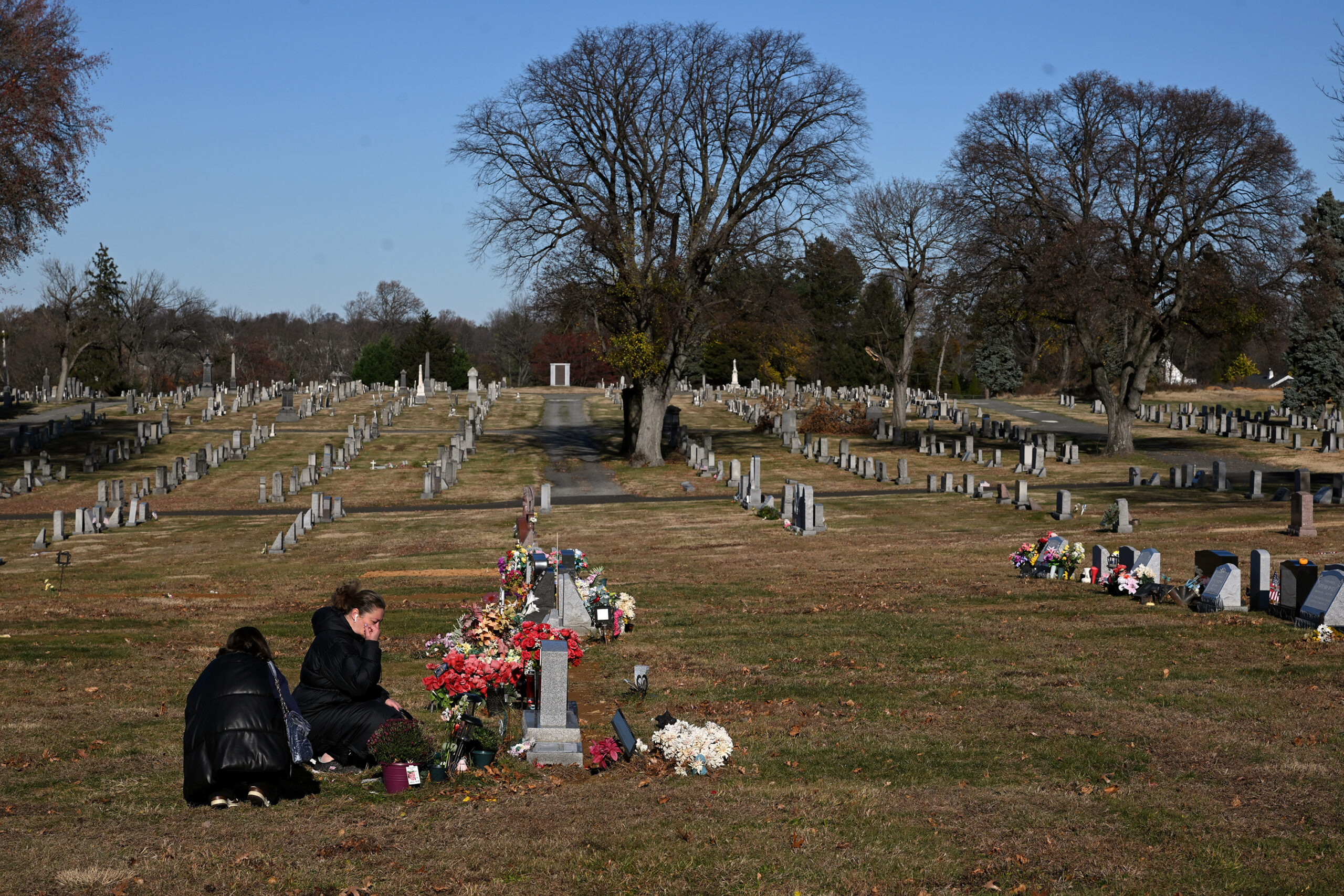
On a recent day, Dasha Stangret and her mother visited her sister’s grave at William Penn Cemetery. They fluffed up the fresh roses, rearranged the tiny fairy garden around her headstone, and lit a candle.
Stangret began to cry — and shake. Her mother took her arm.
“I love you. I miss you,” Stangret told her sister. “I hope you’re happy, wherever you are.”
And nearly 20 miles south, inside the homicide unit, Bova continues to review the files of the case, waiting for the results of another DNA test, hoping for a witness who may never come.
If you have information about this crime, contact the Homicide Unit at 215-686-3334 or submit a confidential tip by texting 773847 or emailing tips@phillypolice.com.
Olga Sarancha (right) and her daughter Dasha visit the grave of her older daughter Anastasiya Stangret in William Penn Cemetery. “It feels out of body. Like a dream, a movie, like it’s not real,” Dasha said of losing her sister.
A woman was killed in front of her three children reportedly by their father who then shot himself during a custody transfer early Friday afternoon in Upper Darby.
Shortly after 1 p.m., Upper Darby police posted on social media that a man and woman had been found shot. Just after 6 p.m., Upper Darby police posted an update that the double shooting at Copley Road and Locust Street was “another senseless act of domestic violence.”
Officers responded to a 911 call for a shooting at the location and found the woman seated in the driver’s seat of a vehicle with a gunshot wound. Lifesaving measures were attempted but unsuccessful for the woman, police said.
The man was transported to Penn Presbyterian Medical Center, where he was listed in critical condition on life support, police said.
Police Superintendent Timothy M. Bernhardt told the Delaware County Daily Times that the woman was 34 and the man is 45. Their identities have not yet been made public.
Bernhardt told the Daily Times: “What we know through investigation so far is that the female was there picking up children. There’s a custody order in place. The male had the children for Christmas, he walked up to the car with the children, the children got into the vehicle, there was some type of an argument, exchange of words, he pulled out a handgun and shot her … got out of the vehicle and then shot himself.”
Three children inside the vehicle at the time of gunfire were not injured, Upper Darby police said.
“Yesterday’s incident was a brutal act of domestic violence,“ Bernhardt said in a statement to The Inquirer. ”A mother was killed in front of her children. Those children will live with this trauma for the rest of their lives. There is no excuse for this kind of violence, and the damage it causes is permanent.”
Staff writer Maggie Prosser contributed to this article.
A New Jersey actor was indicted earlier this month on attempted murder and other charges in connection with accusations he shot a woman in the face following a traffic dispute.
Ernest W. Heinz, 46, of Port Republic, faces 31 charges, including aggravated assault and weapons infractions, stemming from the September incident in Galloway Township, court records show.
Heinz’s attorney did not immediately respond to requests for comment Friday. In a statement to People, a lawyer for Heinz said, “he denies the allegations as reported and will contest them through the legal process, where the facts — not speculation or headlines — will determine the outcome.”
The statement continued: “We ask that the public and the media respect the presumption of innocence and allow this matter to proceed in court.”
Maritza Arias-Galva of Galloway Township, N.J., took this photo on her 42nd birthday, Sept. 7, four days before she was shot in what police call a road rage incident. Arias-Galva survived, and described her encounter days later.
Arias-Galva said another driver blocked her from merging, then pursued her. The driver then confronted her near Stockton University and fired at least one shot into Arias-Galva’s vehicle, NJ Advance Media reported. Prosecutors alleged at a detention hearing that Heinz told Arias-Galva, “I’m going to kill you,” according to the outlet.
Heinz has had minor roles in television and films, but it appears his acting career sputtered after 2014; his IMDB profile lists credits in the 2011 biographical drama J. Edgar,The Sopranos, and two Resident Evil video games.
He is scheduled to make another court appearance in January, records show.
A man accused of fatally shooting a Delaware State Police trooper at a DMV office allowed customers to leave and then fired at approaching officers before being killed, investigators said Friday.
State Police Cpl. Matthew Snook was working an overtime assignment at the New Castle DMV reception desk on Tuesday afternoon when Rahman Rose entered as a customer, approached him from behind, and shot him with a handgun, state police said in a news release.
Rose, 44, of Wilmington, continued firing at the trooper, who pushed a DMV employee out of the way and told them to run, investigators said. Rose then allowed customers to leave but fired multiple rounds at law enforcement as they approached the building.
A New Castle county police officer shot Rose through a window from outside the building. Rose later died at a hospital.
Snook, who went by “Ty,” was a 10-year veteran of the state police force. On Wednesday, members of the community lined roadways and displayed messages of gratitude as a procession of troopers, police officers and firefighters escorted his body from the state medical examiner’s office to a funeral home.
William Crotty, superintendent of the Delaware State Police, said the outpouring of support served as a reminder that Snook’s service and sacrifice will not be forgotten.
The shooting remains under investigation, and authorities have asked witnesses or others with relevant information to contact detectives.
A Delaware state trooper who was shot to death at a DMV office was described Wednesday as dependable and professional on the job and steady and kind at home.
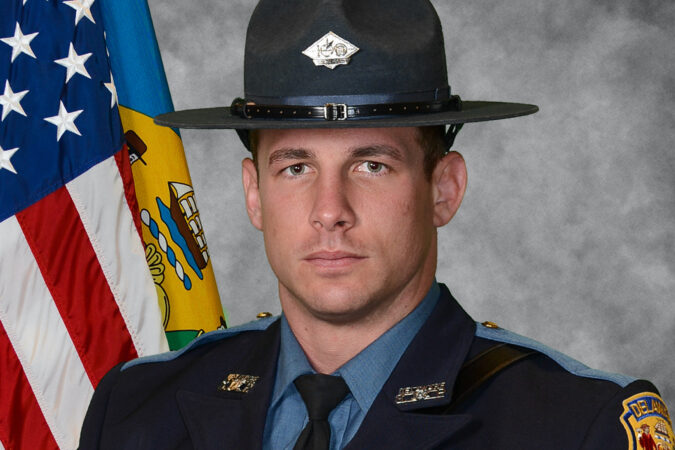
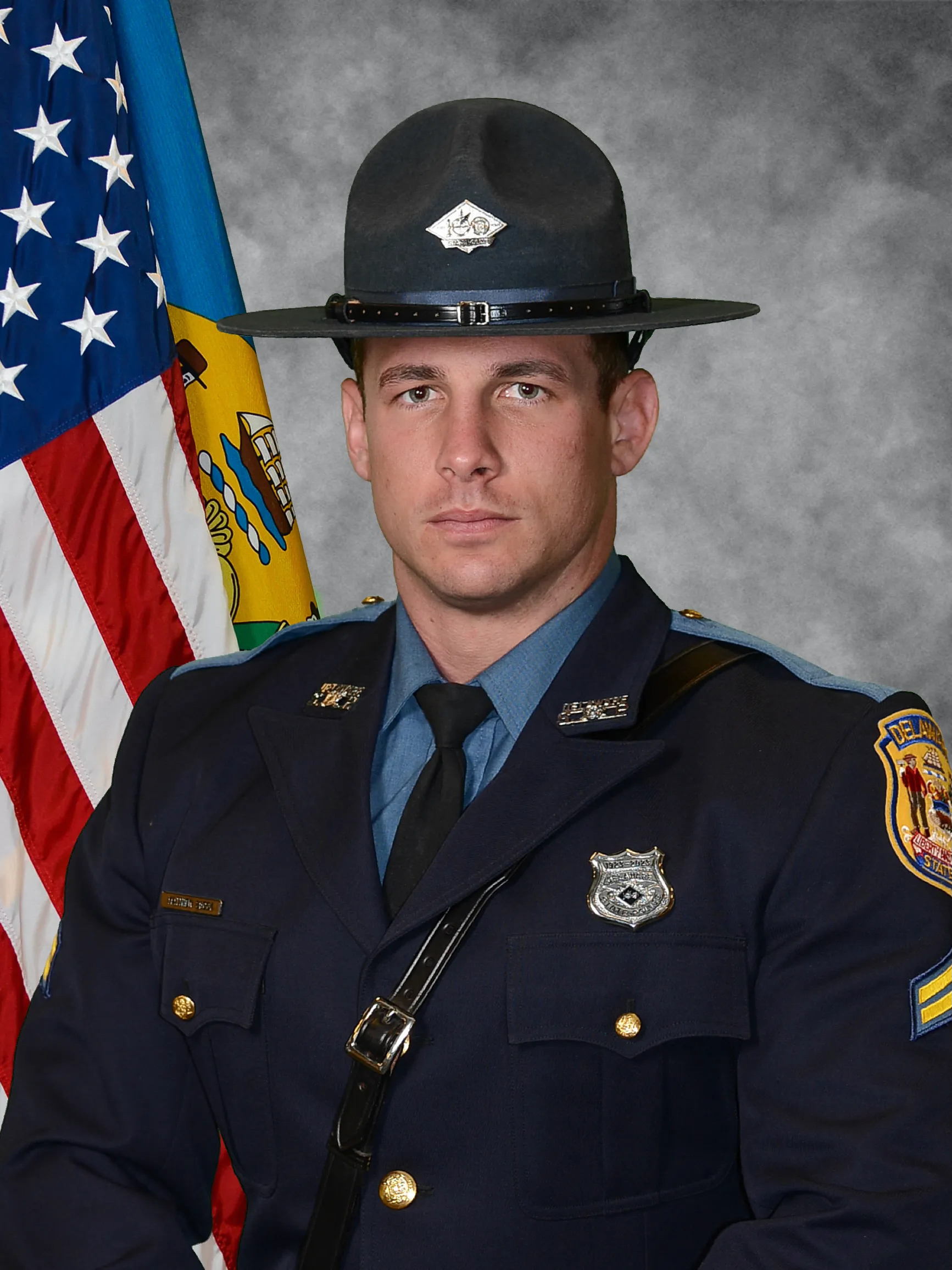
Cpl. Matthew “Ty” Snook, 34, of Hockessin, was working an overtime assignment at a Delaware Division of Motor Vehicles office near Wilmington on Tuesday when he was shot by a 44-year-old gunman, state police said. Authorities said Snook pushed a nearby employee to safety before he was shot again. He died later at a hospital, as did the gunman, who was shot by another officer.
Cpl. Matthew “Ty” Snook, 34, of Hockessin, is survived by his wife and their 1-year-old daughter.
Snook, who is survived by his wife and their 1-year-old daughter, was a Delaware native. He graduated from the University of Maryland, where he was a member of the wrestling team, and had been a trooper for 10 years.
“He was known as a dependable, professional, and committed trooper,” state police said in a news release that also described him as a trusted partner and beloved community member and extended condolences to Snook’s family.
“We are forever grateful to them for sharing ‘Ty’ with us and for the sacrifices they made in support of his service to the citizens of Delaware,” the agency said.
An official fund established to support the family describes the officer as a “loving husband, a devoted father, and a deeply cherished friend.”
“Those who knew him remember his steady presence, his kindness, and his unwavering commitment to the people he loved,” the fundraiser’s organizer wrote. “Family meant everything to Ty, and he worked every day to provide, protect, and be present for those closest to him.”
Authorities have not yet publicly identified the gunman or disclosed a possible motive for the shooting.
“What happened today was an act of pure evil, and if not for the heroism of several troopers and other officers, the consequences could have been so much worse,” Delaware Gov. Matt Meyer said at a news conference.
The state DMV closed its offices statewide, with all but the site of the shooting scheduled to reopen Monday.
A Delaware State Police trooper was shot and killed while responding to a report of an active shooter on Tuesday in Wilmington.
“One Delaware State Trooper has been confirmed killed during this incident,” Delaware State Police said on X, formerly known as Twitter. “We are continuing to assess additional injuries.”
The suspected shooter was also “confirmed deceased,” Delaware Gov. Matt Meyer wrote on X.
We are closely monitoring the situation at the DMV in New Castle, and I want to be clear that there is no active threat to the public at this time. Law enforcement acted swiftly to secure the scene, and the shooter has been confirmed deceased. State and local law enforcement are…
“Today is a tragic one for our State,” U.S. Sen. Lisa Blunt Rochester said in a statement Tuesday evening.
“The holiday season should be about joy and celebration, not senseless acts of violence,” she said. “I am thankful for the swift and courageous action by law enforcement who worked immediately to counter the threat.”
“This officer put on their uniform this morning and went to work to make our community safer. Now, they will never come home. This is devastating for their family, their fellow officers, and our entire state,” said U.S. Sen Chris Coons in a statement. “Our law enforcement community is a strong one — knit together through courage and a determination to serve. I’m grateful for their brave actions today that likely saved lives.”
State police first posted on X around 2 p.m., saying there was an active shooter at the Department of Motor Vehicles bureau on Hessler Boulevard, close to Interstate 495 and Route 13.
In a follow-up post, police said one suspect was in custody. They asked people to avoid the area during their investigation and said further updates would follow.