Now, a man accused of committing voter fraud in that contest by voting twice for Trump is seeking to wipe out a pending criminal case by saying the powers of that pardon action should extend to him.
Attorneys for Matthew Laiss wrote in court documents last month that the language in Trump’s pardon proclamation “clearly extend” to Laiss, who is awaiting trial on charges that he illegally voted twice in the 2020 election — first by submitting a mail-in ballot in Bucks County, then by voting in-person at his new home in Florida.
Federal prosecutors in Philadelphia charged Laiss in September with crimes including voter fraud and voting more than once in a federal election, and they said he faces potential prison time if convicted.
Last month, however, Laiss’ attorneys filed a motion to dismiss the case, saying that the pardon Trump issued Nov. 7 clearly applied to Laiss, and that Laiss had accepted it.
Although Laiss was not among the 77 people Trump listed when specifying who would receive relief, Laiss’ lawyers said the proclamation’s preamble included language making it applicable to “all United States citizens” for conduct, voting, or advocacy surrounding the contest.
In addition, his attorneys wrote, Trump allies including Rudy Giuliani, Sidney Powell, and Mark Meadows were all explicitly pardoned for “exponentially more egregious alleged conduct.” Extending relief to them while denying it to Laiss, his lawyers wrote, “would be outrageous.”
Federal prosecutors say Laiss is “entirely incorrect.”
In a reply brief filed last week, the U.S. Attorney’s Office said Trump’s pardon was intended for people who were seeking to expose or rectify potential fraud in the 2020 election — not for people like Laiss, who are accused of actually committing it.
Beyond what they said was Laiss’ clear misinterpretation, prosecutors said that they checked with Trump’s Office of the Pardon Attorney and that it does not believe the president’s clemency —` which it helped effectuate — applies to Laiss.
“In other words, it is this office’s understanding that if Laiss were to appeal directly to the Office of the Pardon Attorney for a pardon based on [the] November 7 pardon proclamation, that petition would be denied,” prosecutors wrote.
It was not immediately clear how or when U.S. District Judge Joseph F. Leeson Jr. might rule on the issue, although Laiss was scheduled to have a final pretrial hearing Tuesday morning.
If Leeson rules that the case can proceed, a trial is scheduled to begin next week.
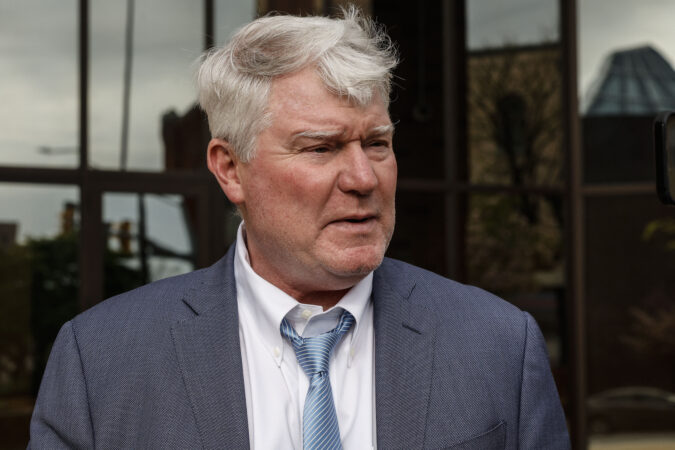
Convicted former labor leader John J. Dougherty is again asking a federal judge to cut short his six-year prison term, this time because he says the recent death of his father-in-law has left his gravely ill wife without a caregiver.
Dougherty made the request in a brief filed last month with U.S. District Judge Jeffrey L. Schmehl, writing that his wife, Cecilia — who for years has suffered from a debilitating brain injury — has been left “entirely alone and without any capable caregiver” since her father died from pancreatic cancer on Nov. 10.
Dougherty has previously argued that he should be granted compassionate release and allowed to serve the remainder of his sentence on house arrest to oversee his wife’s care — a request federal prosecutors have opposed.
In the latest request, Dougherty’s attorney, George Bochetto, wrote that Dougherty’s father-in-law, Joseph Conroy, had been serving as Cecilia Dougherty’s primary caregiver despite his own poor health and that Conroy’s death is “precisely the type of development” that warrants a change to Dougherty’s sentence.
Dougherty, Bochetto wrote, “remains the only person able and willing to provide his wife’s necessary care. No one besides Mr. Dougherty can fill the detrimental need that Mrs. Dougherty requires for survival.”
Federal prosecutors, however, said that Dougherty had previously asserted that Conroy was incapable of serving as Cecilia’s primary caretaker and that his newest motion for relief “directly contradicts” the representations he made in the last one.
“In short, the unfortunate passing of Mr. Conroy has no bearing at all on the circumstances,” prosecutors wrote in a reply brief filed last week.
Dougherty, 65, was once one of the state’s most powerful political figures, serving as the charismatic leader of Local 98 of the International Brotherhood of Electrical Workers with a wide range of connections in City Hall and Harrisburg.
Dougherty’s latest request for relief came several months after he first asked Schmehl for compassionate release.
In August, Bochetto filed an emergency brief saying that a trust fund established to pay for Cecilia Dougherty’s care was about to run out of money and that the couple’s adult daughters were not equipped to serve as permanent caregivers.
It also said Conroy, “once a limited source of support, is now medically incapacitated and permanently unable to contribute to her care in any way.”
Beyond detailing issues around the health of Dougherty’s wife, that filing said that Dougherty had also effectively run out of money and assets since he began serving his sentence at a federal penitentiary in Lewisburg and that he’d suffered from several new health issues while behind bars, including a chronic foot infection that made it hard for him to walk.
Prosecutors at the time wrote that they were sympathetic to the plight of Dougherty’s wife but that his absence from her life “does not distinguish this case from that of countless defendants whose loved ones suffer as a result of their crimes.”
It was not immediately clear when Schmehl might rule on Dougherty’s requested relief, or if he might take any additional action — such as scheduling a hearing — before doing so.
Christina Miranda was shot and killed by two Philadelphia police officers early Sunday morning, authorities said, after she held a gun to her head, then turned the weapon on the officers. Her name was released Monday morning.
Police were called just after 4 a.m. Sunday to the 900 block of West Erie Avenue, where they found Miranda, 35, with a .22-caliber handgun. The officers ordered her to drop the weapon and used a Taser on her, according to police, but she fled. As she ran, they said, she pointed the gun at the officers.
The officers fired at Miranda, striking her multiple times, according to police. She was taken to Temple University Hospital, where she later died.
The two officers involved in the shooting — both on the force for less than three years — have been placed on desk duty, as is customary, pending an investigation by the police department and the Philadelphia District Attorney’s Office.
Tyler Ramaley wakes up every morning grateful that he’s able to do “respectable work in a hardhat” as he clocks in for his shift at JGM, a steel fabrication plant in Coatesville.
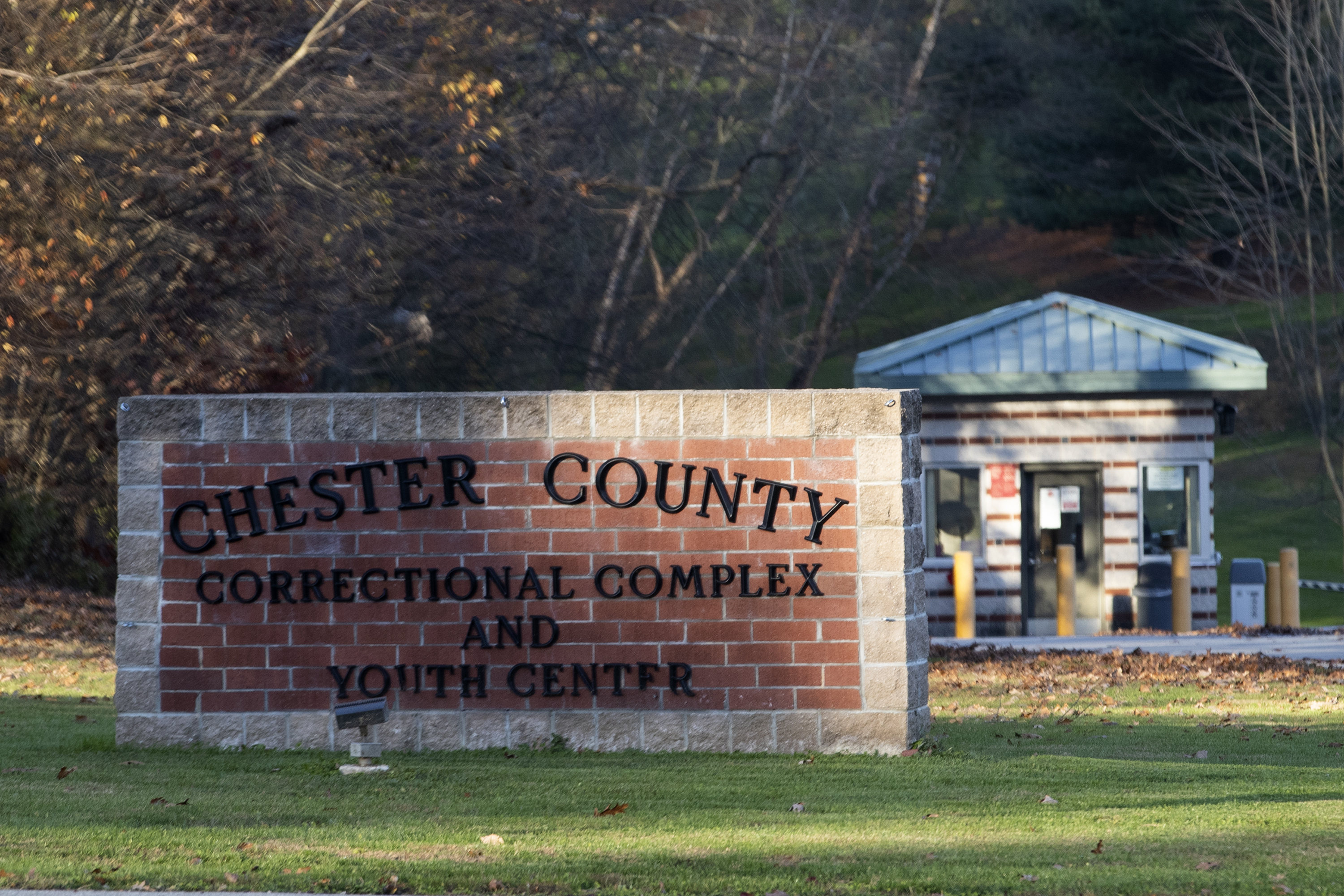
Nineteen months ago, that would have been impossible: He was struggling with an opioid addiction and waking up to a monotonous routine in a Chester County Prison cell.
A new program offered at the jail, Exit, Enter, Employ, gave him an opportunity to move on from his past mistakes. He had help building his resume, getting certified in his chosen field, and, crucially, landing an interview for a job that was waiting for him after his release.
“I was in there, and I just didn’t like who I was and I just knew I needed to change,” Ramaley, 37, said in an interview during a break from running a plasma cutter on a recent day. “It gave me a purpose to wake up every day, and it makes me not want to waste the opportunity I’ve been given.”
Ramaley’s experience, county officials say, is just one of many success stories to come out of the E3 program since its inception in January 2023 through a partnership between the jail and the Chester County Intermediate Unit.
More than 100 people have graduated from the course, with a recidivism rate of 2%, according to Jill Stoltzfus, the program’s career-readiness coordinator and a CCIU employee.
“Everybody needs a second chance,” she said. “And I’m very candid with people when I interview them. Like, we’ve all made mistakes, I’m sure I’ve made mistakes that I could be in the same situation.”
More than 100 inmates at the Chester County Prison have graduate from the E3 program since its inception in January 2023.
Job-readiness programs are nothing new for county jails — they’re offered almost universally across the region. But Stoltzfus said E3 is different because it provides a direct path, with job openings already lined up for graduating inmates from multiple companies that partner with the county.
And in the first few months in those jobs, coordinators from the program follow up with former inmates, checking in to see how they are faring.
“I don’t like the judgment we often hear of ‘Why should we fund this?’ or the idea that some people deserve a chance over others,” Stoltzfus said. “I think it’s crucial that we at least put that opportunity out to them.”
E3 is available only to inmates who have been sentenced to county jail, meaning their crimes were not serious enough to warrant state prison time. And county officials carefully screen those who apply to the program to make sure they are ready.
Besides workforce skills like OSHA certification and courses in customer service, E3 offers financial-planning advice, as well as cognitive behavioral therapy and anger management.
Current partner employers, besides JGM, include J.P. Mascaro & Sons, FASTSIGNS, and MacKissic. Stoltzfus is hoping to expand the offerings to include agricultural and culinary posts.
Howard Holland, the warden of Chester County Prison, views the program as a way to help incarcerated people prepare to reenter society in a productive way.
“We’re engaging them in a way other than just ‘Here’s your cot, stay behind the bars,’” he said. “You just have that same cycle over and over and over again because that’s the way our institutions are run.
“At the end of the day, we’re humans, right?” he added. “They’re here, and it’s our responsibility to, while they’re here, try to do the best we can for them.”
Tyler Ramaley said he never thought he would be able to go to work, after years of addiction. The E3 program helped him connect with a job he loves.
Ramaley, who was named JGM’s employee of the month in June, said the opportunity was an important step toward reversing years of bad decisions.
His drug abuse, he said, began in 2020, when he was injured on the job while running a hammer drill at a concrete mill. The drill skipped and jerked his arm hard, shredding multiple tendons. After several surgeries, he said, he was prescribed Tramadol in bottles of 150 pills at a time. He became reliant on the pills, using them to deal with the pain.
And when his workers’ comp ran out, he said, his doctor cut him off cold turkey and he turned to other ways to support his opioid habit and purchase drugs, racking up convictions for theft and forgery and landing in county jail.
His moment of clarity came this spring, he said, and he graduated from E3 in April, weeks before his jail sentence ended and he was released.
“When I was in my active addiction, I never thought I would be able to go to work and not be on something,” he said, “and there’s times I’ll stand out there and just kind of think about how happy I am here, actually doing hard work and respectable work and doing it the right way.
“And that’s a better feeling than anything I had when I was in my addiction.”
Late Thursday afternoon, while Thanksgiving rituals unfurled in rowhouses and neighborhoods across Philadelphia, Rosa Mar Espinosa Rodas took her final steps.
Espinosa Rodas, 41, was struck by a black 2012 Honda Accord at 36th and Market Streets in University City about 3:50 p.m., according to preliminary information released Friday by Philadelphia police.
After hitting Espinosa Rodas, the Honda’s driver didn’t stop. Instead, police said, the car continued eastbound along Market Street, where it then crashed into a Buick LaCrosse near 34th Street.
The driver of the Honda attempted to flee on foot, but was apprehended by police a few blocks from the second crash scene.
Police identified the motorist as Shamir Miller, 30.
Miller was charged with murder, homicide by vehicle, involuntary manslaughter, and nine other offenses, court records show.
His bail was set at $3 million, and he is scheduled to face a preliminary hearing on Dec. 15.
Medics pronounced Espinosa Rodas dead on Market Street, police said. CBS3 reported that Espinosa Rodas had worked nearby and was on her lunch break when she was fatally struck.
The driver of the Buick, a 41-year-old woman, was admitted to Penn Presbyterian Medical Center with neck and back injuries and was listed Friday in stable condition.
Miller was also treated at Penn Presbyterian for head injuries.
On Nov. 20 — a week before Espinosa Rodas was killed — a nearby stretch of Market Street was the scene of another fatal hit-and-run crash.
Early that morning, the driver of a silver Chrysler 300 with tinted windows struck Meaza Brown at 33rd and Market.
Police said that Brown, 48, was hit at such a high rate of speed that she was “launched out of her sneakers” and propelled through the air for several hundred feet. She was pronounced dead at Penn Presbyterian.
Investigators later found the Chrysler at 34th and Race Streets, but no arrests have been reported.
The city, as part of its Vision Zero plan to reduce traffic deaths, is seeking from state legislators the authority to set speed limits for local roadways, and to expand its use of automated speed enforcement cameras, The Inquirer reported this week.
Last year, the city recorded 120 vehicle crash deaths, a 41% increase from 2015, when the Vision Zero program began.
The Philadelphia Police Department is forming an “auxiliary” unit that may be ready as early as next year, according to a department spokesperson, adding to its ranks volunteer members who will assist officers at large public gatherings.
Auxiliary police will not carry weapons and will not be assigned typical law enforcement duties, according to Sgt. Eric Gripp, a department spokesperson. They will not be authorized to make arrests.
But the department wants the unit to act as a link between the public and police, participating in community engagement and, according to Gripp, serving as additional “eyes and ears” for officers on the ground.
As Philadelphia prepares to host a series of widely attended events in 2026 — the country’s 250th July Fourth anniversary celebration, FIFA World Cup matches, and more — the police department will be tasked with maintaining order amid an influx of visitors.
An auxiliary unit would assist police during those types of events, according to Gripp. He said the department had tasked its academy recruits with similar duties during citywide celebrations after the Eagles’ Super Bowl victory in February.
It is unclear whether the auxiliary unit will be ready in time for the summer.
The department does not have an official estimate on when it plans to introduce the unit; the idea is still in the planning stages and targeted for 2026, Gripp said. The only confirmed requirement is that recruits must be 18 years old to apply.
Police departments in municipalities large and small have used auxiliary units, sometimes called reserve units, for years.
The New York Police Department has maintained its auxiliary unit for more than half a century; major cities like Baltimore also have reserve officers, as do smaller townships like Cranford, N.J.
Criminologists and former law enforcement officers say police departments use these units to assist with traffic management, crowd control, and community engagement, and for reporting more serious issues to officers who have the authority to intervene.
Experts say the units are a boon to departments facing recruitment and retention issues, providing unpaid assistance from those who are already curious about life as a police officer and who often hail from the communities they are assigned to.
But departments must invest time, money, and adequate training into auxiliary units for them to be successful.
Joseph Giacalone, a retired NYPD sergeant and criminal justice instructor at Pennsylvania State University’s Lehigh Valley campus, said the New York department often uses its 3,700-member auxiliary unit for crowd control during “fun events” like parades and street fairs.
Most importantly, Giacalone said, departments should not view their auxiliary unit as a crime-fighting tool; members should be provided uniforms that are recognizable to the public, he said, distinct from those of actual police officers.
“We’re not talking riots,” Giacalone said of situations in which auxiliary officers are useful. “We don’t want them really identifying things such as drug dealing, dens of prostitution, things like that. We can get that from ordinary intelligence — we don’t want ordinary citizens doing that.”
Still, auxiliary members may help officers with other duties.
During Giacalone’s tenure with the department, the NYPD’s auxiliary unit proved beneficial when members reported quality-of-life issues such as abandoned vehicles and broken traffic lights, he said.
Given the potential danger that accompanies police work, Giacalone said, he hopes the Philadelphia department’s plan includes extensive training for auxiliary recruits — as well as protective gear.
The former sergeant still recalls a harrowing day in 2007 when two unarmed New York auxiliary officers were shot and killed by a gunman in the city’s Greenwich Village neighborhood while out on patrol.
Gripp, the Philadelphia department spokesperson, said the city’s auxiliary unit would not conduct foot patrols. He said members would be trained by the department’s internal staff.
Meanwhile, New York auxiliary officers must pass hours of training courses in first aid, self-defense, and patrol technique; in Giacalone’s experience, those trainings require more experienced officers to sacrifice time and energy to the project.
By the former sergeant’s estimate, for Philadelphia, “it’s going to take a while to get this up and running.”
Atlantic City Police are investigating the deaths of two New Yorkers who were found dead in a casino hotel room Sunday afternoon.
Police were called to the Borgata Hotel Casino and Spa around 5 p.m., where they found the bodies of Baoyi Bowie Zheng, a 36-year-old woman from Staten Island, and Wei Guo Liang, a 68-year-old man from Brooklyn.
An autopsy determined Bowie Zheng died of a broken neck. Guo Liang was found to have died from self-inflicted stab wounds.
Many details regarding the individuals, including their connection, if any, and how long they’d been at the Borgata, had not been made public as of Wednesday, when the Atlantic County Prosecutor’s Office encouraged people with information about the incident to call in.
A spokesperson for the hotel could not be reached for comment.
Pennsylvania State Police identified three men who were killed in a crash when the vehicle they were in allegedly fled from a traffic stop and crashed early Friday in Chester County.
Devon Hargraves, 35, Gershad Andre, 33, and Larry Wilmer, 36, all of Wilmington, were killed in the crash, state police said this week.
About 1:20 a.m. Friday, troopers saw a Silver Toyota sedan allegedly violate traffic laws near East Third Street and Garner Drive in New Garden Township.
When troopers tried to conduct a traffic stop, “the vehicle failed to stop and a pursuit ensued,” state police said Friday.
“Soon after the pursuit ensued the fleeing vehicle crashed, and the three occupants of the fleeing vehicle are deceased,” state police said.
The crash happened in Avondale Borough.
The Pennsylvania State Police said its investigation of the crash was ongoing.
Three-year-old Hope Jones weighed 24.5 pounds, less than 99% of children her height and age, just a month before she died in July 2022.
The child was starved and beaten up by her foster parent, a distant relative from Southwest Philadelphia who pleaded no contest to third-degree murder over Hope’s death.
A new federal lawsuit is pointing a finger in another direction. It accuses medical providers from Philadelphia FIGHT, a community health nonprofit based in Center City, of failing to investigate or report abuse despite a series of red flags from Hope’s wellness checks.
The lawsuit, filed Friday in the Eastern District of Pennsylvania, is against the United States because FIGHT is a federally qualified health center and thus receives funding and operates with requirements from the government.
Philadelphia’s U.S. Attorney’s Office declined to comment. FIGHT did not respond to a request for comment.
The lawsuit is not only the latest legal fallout from Hope’s death, but the latest in litigation brought after children who were part of the city’s child welfare system have been harmed.
The city and its affiliated agencies were sued nearly 70 times between 2012 and 2024 after kids in their care were killed, sexually abused, or injured, an Inquirer/Resolve Philly investigation found. And at least 50 of these lawsuits led to settlements or verdicts of $1 million or more.
The new lawsuit on behalf of Hope’s biological family extends the circle of litigants to include medical providers.
“It’s another group of professionals that failed Hope,” said Sherrell Dandy, one of the Kline & Specter attorneys representing the family.
Child welfare services were involved in Hope’s life from her first days on Earth, according to the complaint. Her mother and the infant tested positive for marijuana after the delivery, and the Philadelphia Department of Human Services placed the infant under its care.
Hope became a FIGHT patient, and her first few visits as a baby went well, the lawsuit says. She was “well-developed and well-nourished,” the complaint says, and had a “good appetite.”
Hope’s weight reached the 98th percentile at her 15-month wellness visit, in the summer of 2020, but she fell off the growth chart steadily after the following November when she was placed in foster care with a distant relative, the complaint says. Hope failed to meet developmental milestones and lost teeth, a couple times without explanation and another time following an alleged fall.
The child’s medical records note that she developed an abnormal gait, ate her own feces, and was eating extremely fast followed by periodically vomiting, the suit says.
The FIGHT physicians did refer Hope to an orthopedic specialist because of her gait, but the lawsuit says that they failed to recognize it as “clinical indicators of severe weight loss and underlying caloric deprivation, starvation, and neglect.”
Hope’s weight fell to the single digits as summer 2022 approach. She was rushed to the hospital that July and was pronounced dead. The Philadelphia Medical Examiner’s Office determined that her cause of death was multiple blunt impact injuries, and the manner of death was homicide.
“The hallmark for health is growth,” said Nadeem Bezar, another Kline & Specter attorney. “During those visits there were alarming things that were never followed up on.”
A previous version of the lawsuit was filed against FIGHT in federal court in February. A judge dismissed that case in March because Hope’s estate had other administrative remedies to pursue before filing a lawsuit, and said that the appropriate defendant would be the United States.The new lawsuit says that all administrative remedies were exhausted and the government is the only defendant.
Ramon Roman-Montanez knew the police were watching.
One day last April, as Roman-Montanez prepared to hand out free drug samples to users on Weymouth Street — a common tactic that dealers use to attract customers — he stood in the middle of the Kensington block and spotted a problem.
The cops had put up a pole camera.
Using binoculars, Roman-Montanez scouted out the new device at the end of the block, prosecutors said in court documents. But he had a business to run — and so, after talking with a few associates in the street, he decided that giveaway day would move forward as planned.
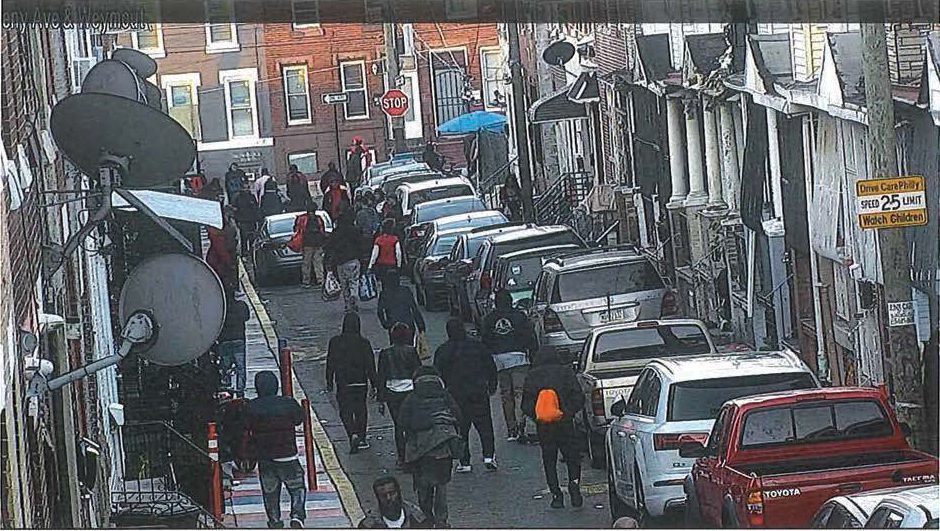
Shortly after dawn, prosecutors said, customers were recorded on the new surveillance camera crowding onto the 3100 block of Weymouth to receive their samples.
And in the weeks to come, business continued to boom.
A pole camera placed near Weymouth Street captured potential drug customers coming to the block to receive free samples handed out by the gang that ran the block, prosecutors said.
The camera, however, was just one hint of what authorities now say was a sprawling, multiyear investigation into the gang Roman-Montanez helped lead — a group that sold thousands of doses of heroin, fentanyl, crack, and cocaine over the course of more than a decade, and effectively took over a residential block in a neighborhood that has long suffered from crime, open-air drug dealing, and neglect.
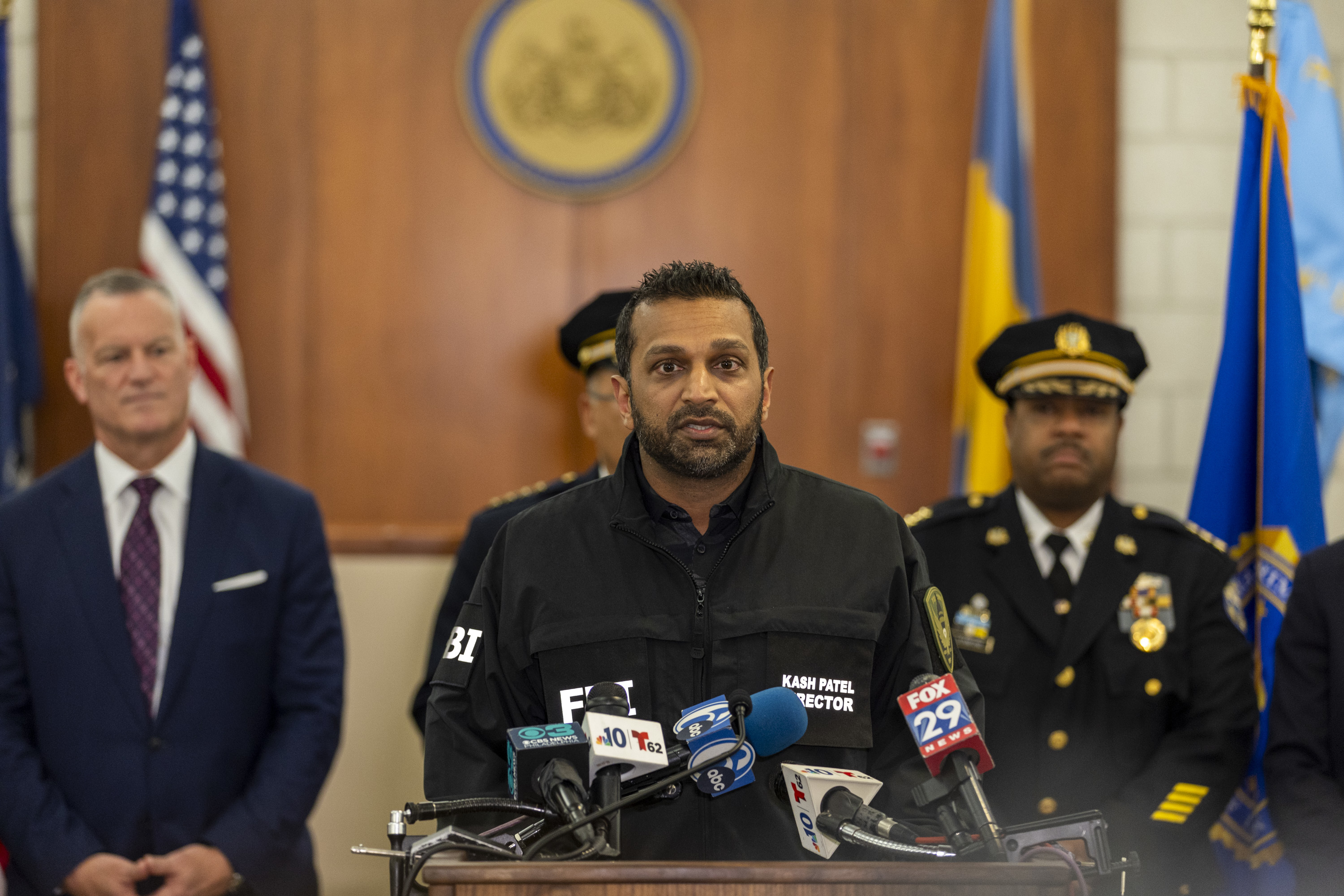
The results of the probe came to light last month, when FBI Director Kash Patel came to Philadelphia to announce that 33 people, including Roman-Montanez, had been indicted on drug charges. Patel called the case a model for law enforcement across the country, and an example of how to take out a drug gang terrorizing a community.
FBI Director Kash Patel speaks to press at the 24th Police District Headquarters in Philadelphia on Oct. 24.
To understand the scope of the case — which U.S. Attorney David Metcalf described as the region’s largest single prosecution in a quarter-century — The Inquirer reviewed hundreds of pages of court records, examined social media accounts and videos connected to the group, and interviewed law enforcement officials and Weymouth Street residents.
The review revealed previously unreported details about the investigation, including that authorities ran monthslong wiretaps on about a half-dozen phones tied to gang members, placed a recording device in a vacant lot the gang used as a meeting place, employed at least seven confidential informants, and believe that over the course of nine years, the group trafficked tens of thousands of doses of drugs into the city — worth millions of dollars.
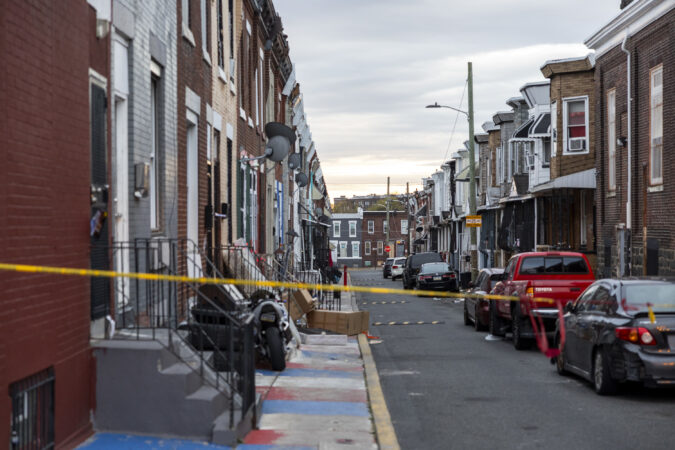
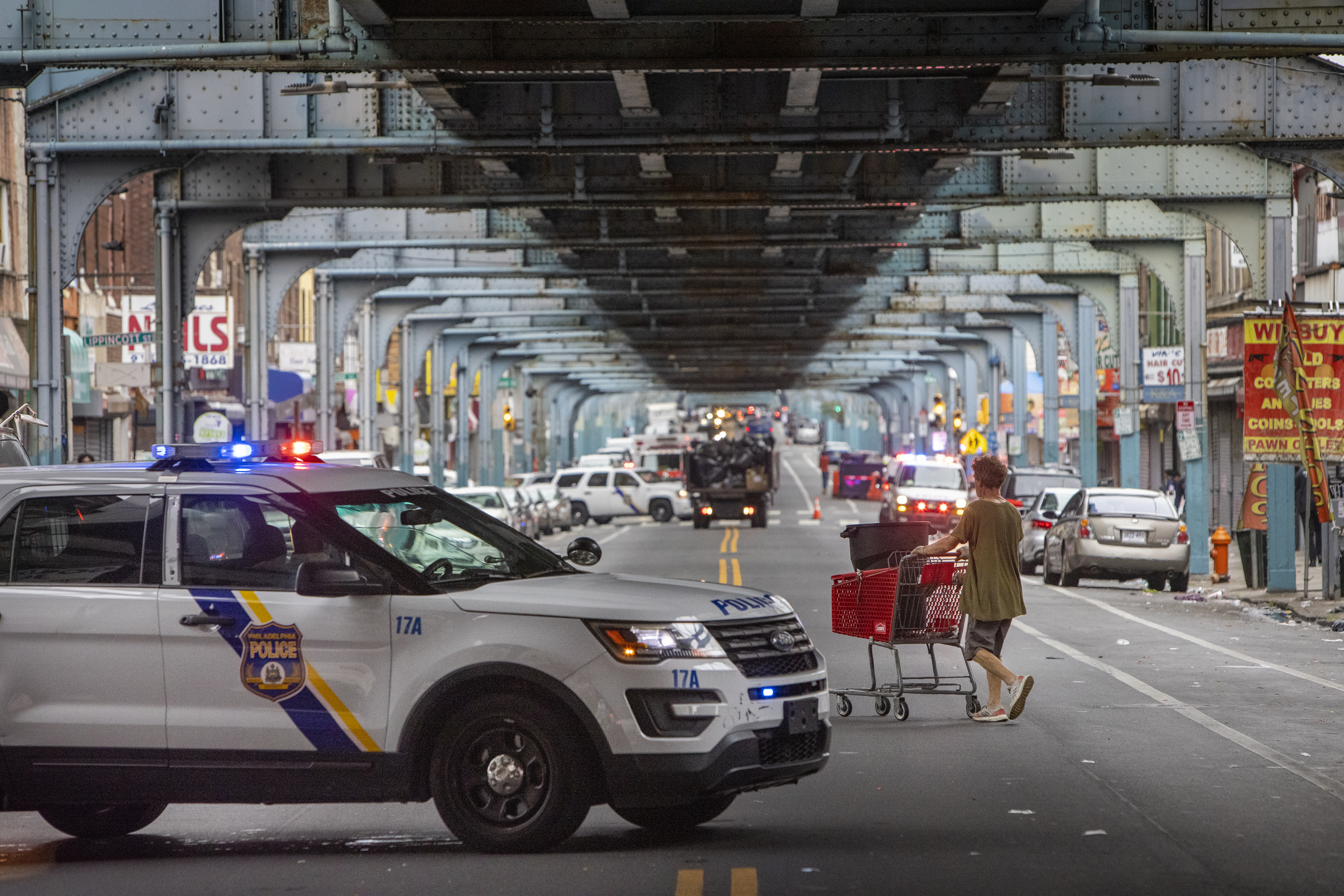
Philadelphia police this month continued to restrict access to Weymouth Street long after gang members had been arrested, a highly unconventional approach that officials said was aimed at sustaining the block’s newfound sense of quiet. Several residents said they didn’t mind the unusual tactic, in part because it helped prevent their block from quickly returning to its status as a marketplace for round-the-clock drug deals.
Those tactics underscored the depth of the investigation, which unfolded in the heart of Kensington — where law enforcement has employed a variety of approaches over the years to try to address crime, drug dealing and violence, sometimes with mixed results.
Philadelphia officials have for years tried a variety of tactics to try and address crime and quality-of-life concerns along Kensington Avenue.
But the review also showed that even as the investigation was underway, the gang continued to operate in the open — and some of law enforcement’s attempts to hold people accountable as the probe was unfolding were unsuccessful.
In August, for example, Roman-Montanez was charged in state court with drug possession and related crimes after police found fentanyl, crack, and $20,000 in cash in his house — the result of a raid on Weymouth Street that was part of the investigation into his gang.
But a few weeks later, his attorneys persuaded a Philadelphia judge to reduce his bail and he walked out of jail. The 40-year-old — who federal prosecutors now say was the de facto chief operating officer of one of the city’s biggest drug conspiracies — was taken back into custody only this month, when federal authorities unsealed his indictment.
Even as investigators were continuing to collect evidence against the gang, members routinely appeared in videos and songs on social media in which they boasted about their gang affiliation, brandished guns, and threatened acts of violence against rivals.
Some of the videos made modest Weymouth Street look more like a nightclub. Men wearing shimmering gold chains can be seen carrying designer bags and waving guns with extended clips at the camera. Others smoke blunts, or mix soda and a purple liquid together to make what appears to be the codeine-infused drink “lean.”
A video for the song “Philly Boy,” uploaded to YouTube last spring, made clear where the debauchery was taking place: It opens with a shot of the Weymouth street sign.
Beyond the fact that people who remained on the street could continue to sell drugs, prosecutors said the gang used threats to maintain control over their territory. And at least two suspected coconspirators were killed as the investigation wore on — sparking the potential for more retaliatory violence. Prosecutors have not yet charged any gang members with any shootings or homicides, but have said their investigation is continuing.
Metcalf, through a spokesperson, declined an interview request to discuss the case in more detail. But while announcing the takedown last month, he said there is always a tension in long-running investigations between making quick arrests and taking time to gather evidence for broader or stronger cases. And in this instance, he said, the goal was clear: Prosecutors were seeking to “eliminate the organization.”
“We could obviously just prosecute individual seizures of guns and drugs. But the organizational prosecution … that’s what’s going to make a difference in the community,” he said. “This neighborhood will be a lot safer than it [would’ve been] if we didn’t take our time to do that.”
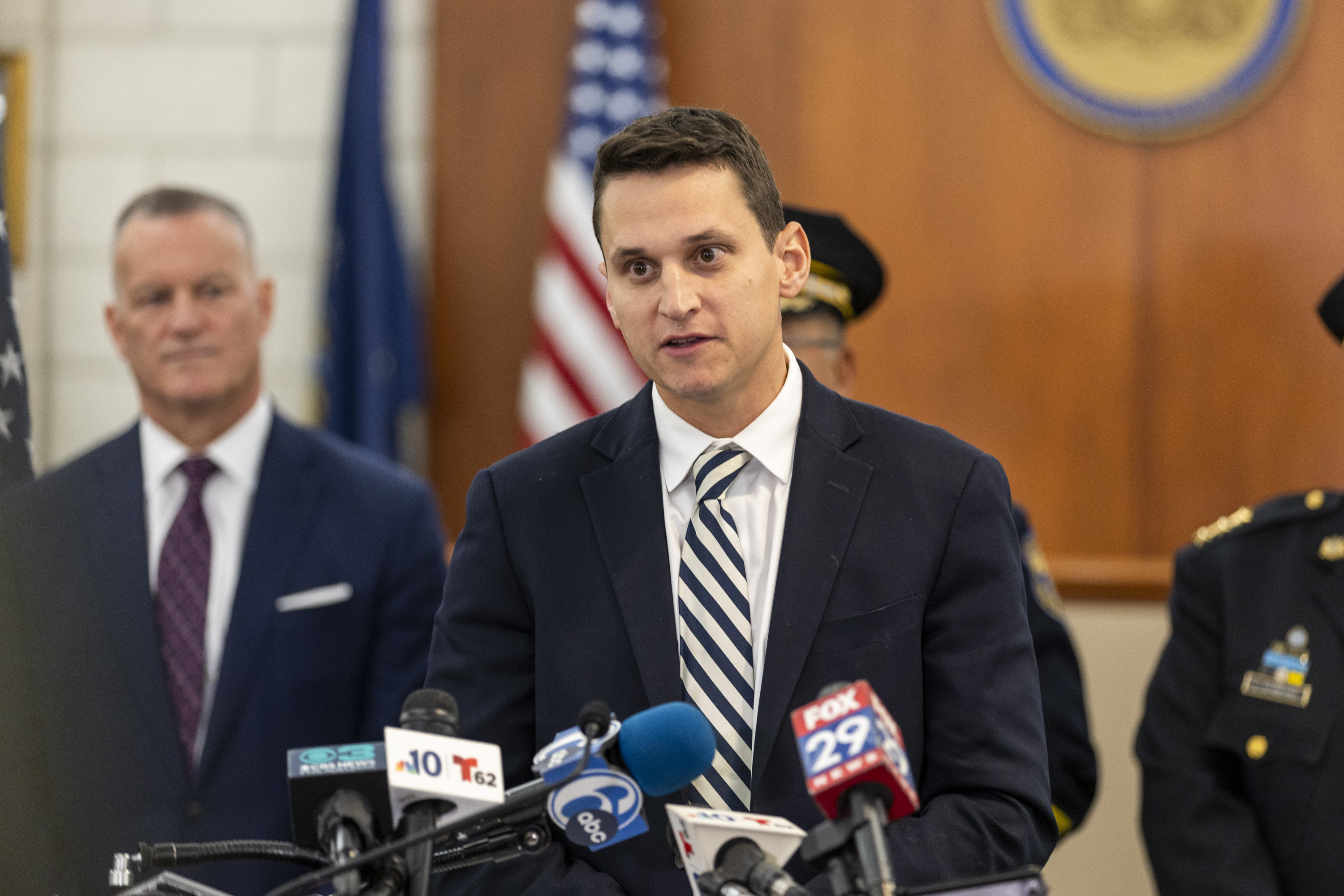
U.S. Attorney David Metcalf speaks to press at the 24th Police District Headquarters on Oct. 24.
A sophisticated operation
Weymouth Street is one of a series of narrow, rowhouse-lined blocks in Kensington just a few steps from McPherson Square and near the intersection of Kensington and Allegheny Avenues — long the epicenters of a bustling narcotics bazaar.
Some corners in the area can pull in tens of thousands of dollars a day in drug sales, authorities say. And the competition among dealers has often led to violence, with shootings and homicides in Kensington historically outpacing the rest of Philadelphia.
The crew on Weymouth Street thrived in that environment, prosecutors said, and developed a sophisticated system for seeking to build and protect a business that sold fentanyl, crack, and cocaine 24 hours a day, seven days a week.
Their drugs were branded with unique stamps or names like Ric Flair, Horse Power, Gucci, or Donald Trump. Bags were sold for $5 each, prosecutors said, while “bundles” of about a dozen packets went for between $55 and $75.
The group maintained an internal hierarchy, prosecutors said, with key figures at the top overseeing layers of workers who engaged in hand-to-hand sales, watched out for police, managed the drug supply, or used violence to protect the operation. Many members were related to one another, prosecutors said, and some families had people from multiple generations working for the group.
The leader was Jose Antonio Morales Nieves, prosecutors said, who “owned” the block and allowed people to deal there in exchange for payments he called “rent.”
His top deputies ran the day-to-day operations, prosecutors said, and included Roman-Montanez, nicknamed Viejo, and Roman-Montanez’s paramour, Nancy Rios-Valentin.
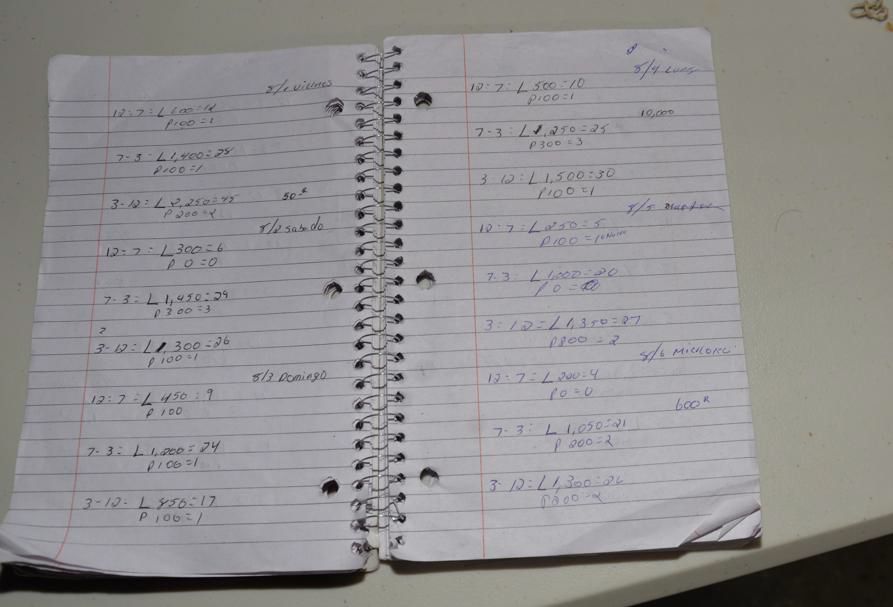
The two set and distributed schedules for lower-level employees, kept track of how and when drug stashes needed to be refilled, and maintained handwritten ledgers tracking sales per shift.
Prosecutors said leaders of the Weymouth Street drug trafficking organization kept detailed schedules on which members would work which shifts.
The first episode in the indictment dates to January 2016, when, prosecutors said, Angel Rios-Valentin — the brother of Nancy Rios-Valentin — stood watch as someone sold drugs to a confidential informant.
A few months later, the indictment said, police conducted a traffic stop on the block, and gang leader Morales-Nieves — also known as Flaco — responded by approaching the officers in a threatening manner carrying a shovel.
As the gang continued to build its business on Weymouth, prosecutors said, several members took up residence on the block, including Roman-Montanez, and members used a variety of houses or abandoned lots to store or sell drugs.
Among them, prosecutors said, was a vacant lot with a tent they labeled the “bunker.” It was next door to the house Roman-Montanez shared with Rios-Valentin, they said, and served as a meeting place, stash location, and place to cook crack.
Last May, prosecutors said, it also served as a site for violence, when Roman-Montanez dragged a man into the bunker, and another gang member — who is not named in court documents — beat him with a rod.
Crimes involving violence
Much of the 170-page indictment revolves around individual episodes in which members of the gang conducted operations that would be considered routine if they weren’t illegal, such as selling drugs to users, managing the block’s supply, or handling illicit proceeds.
The document includes detailed quotes from those accused of taking part in the operation and describes their actions with unusual precision, the result of what prosecutors said were a series of wiretapped phones, cameras — including one inside the bunker — interactions with informants, and seizures of drugs by police.
Police found handwritten ledgers detailing drug activities inside Ramon Roman-Montanez’s house on Weymouth Street, prosecutors said.
Some incidents, however, went well beyond the everyday rhythm of drug sales, prosecutors said.
In November 2024, several gang members ran after a car that had sped down Weymouth, then fired shots at the vehicle after they caught up to it around the corner, the indictment said. The document does not say if anyone in the car was struck.
Six months later, prosecutors said, the pole camera captured footage of two members of the gang — John David Lopez-Boria and Luis Williams — laughing at someone sitting on a front step across the street, then beating the person and dragging the victim into an abandoned lot to continue the assault.
The gang’s violent nature was also captured on YouTube, where gang members appeared in videos taunting rivals and flaunting guns.
In one video, the rapper Sombra PR — whom prosecutors described in court documents as an unindicted coconspirator — made clear that he and a Weymouth Street gang member known as Panza would use a Draco gun to come after anyone who threatened them.
“I’ll get you with Panza with Draco and you’re stiff,” he rapped.
Prosecutors said Weymouth Street members often flaunted guns and boasted about their gang affiliation in YouTube videos.
Panza, whose given name was Heriberto Torres Gual, was described by prosecutors in court documents as one of the group’s enforcers, and he appeared in some of Sombra PR’s videos.
But last month, Gual, 31, was gunned down while riding an electric bike on the 3000 block of Kensington Avenue, just a few blocks from Weymouth, according to police. Surveillance footage showed a torrent of shots being fired out of an SUV that had pulled up beside him.
In all, police recovered 35 spent shell casings from the scene and said it was a targeted attack.
Gual was the second high-ranking gang member to be killed in the last year, authorities said. Last November, Felix Rios-Valentin — the brother of Nancy and Angel Rios-Valentin — was fatally shot in Mayfair.
Police have made no arrests in either case.
After Gual’s death, an Instagram account for a record label dubbed “Weymouth Family” made a post referencing the title of a new song that memorialized Gual. The post tagged Pressure 9X19, the artist behind “Philly Boy.”
And on another account associated with Weymouth-tied rappers was an illustration of an unmistakable street sign: the marker for the intersection of Allegheny Avenue and Weymouth Street.
Evading accountability
During their long investigation, law enforcement did sometimes disrupt the gang’s drug operations and make arrests.
In 2020, Angel Rios-Valentin was convicted in federal court of illegal gun possession after officers found him carrying a loaded handgun that he had taken from Roman-Montanez’s house. He was sentenced to five years in prison and was on supervised release when he was arrested again last month.
Police found four guns in Rios-Valentin’s house, a discovery that prosecutors said showed his ongoing commitment to the gang.
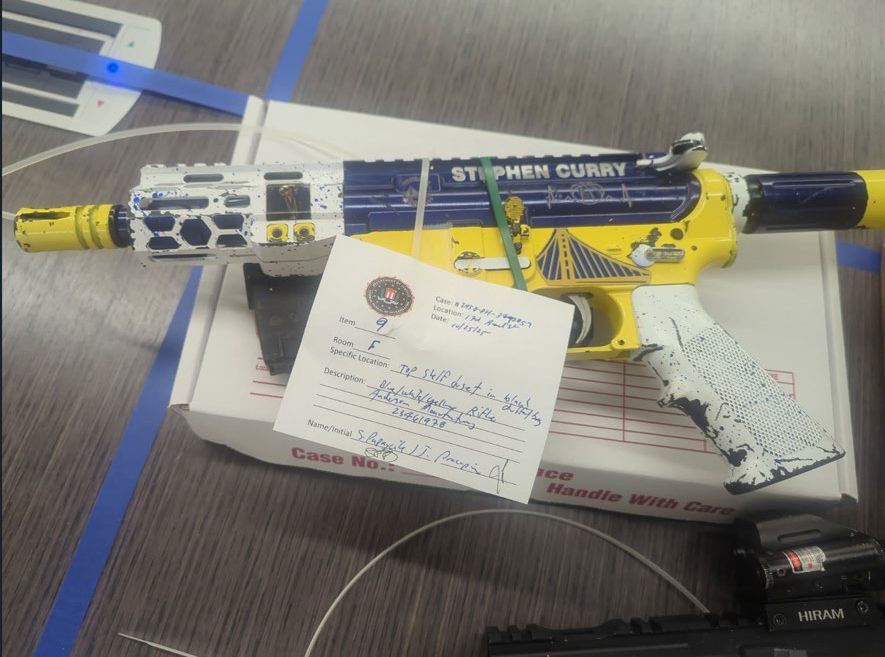
When Angel Rios-Valentin was arrested, prosecutors said, responding officers found several guns in his house, including this assault rifle.
Roman-Montanez, meanwhile, was arrested twice in the last three years, court documents show — but in both cases managed to avoid significant consequences.
In October 2022, police searched his house and found 96 grams of fentanyl, four loaded guns, and nearly $125,000 in cash, prosecutors said. Roman-Montanez was charged in state court, but the case was withdrawn.
Federal prosecutors did not explain the withdrawal in court documents, and because the case did not result in a conviction, the records are now sealed under Pennsylvania law. The district attorney’s office did not respond to a request for comment.
A source familiar with the case said it collapsed because scheduling issues with lawyers and witnesses delayed the preliminary hearing for more than a year and prosecutors ultimately withdrew the charges.
The second arrest was in August, when police, acting on a search warrant, again searched Roman-Montanez’s house and found more fentanyl, crack, and cash inside, court records show. He was charged with crimes including conspiracy and possession with intent to deliver, and his bail was set at $750,000.
But a month later, his lawyers persuaded a judge to lower his bail.
The prosecutor argued against that, according to a transcript of the bail hearing, saying the sheer amount of drugs and cash involved made clear that Roman-Montanez was “not a minor player.”
But Common Pleas Court Judge Elvin Ross III said details about Roman-Montanez’s role in the conspiracy were lacking. He reduced bail to $300,000, and a few weeks later, Roman-Montanez was back on the street.
Will the quieter aftermath last?
On the morning of Oct. 24, dozens of federal agents and city police officers swarmed Weymouth Street to arrest suspected gang members and gather additional evidence to use in their court case. Some targets were taken into custody elsewhere — the group’s leader, Morales Nieves, was arrested in Luquillo, Puerto Rico.
Patel, the FBI director, said at a news conference afterward that the case “is not just one instance of removing a couple of people — it is an example of how you remove an entire organization that has corrupted not just the city of Philadelphia but the state of Pennsylvania as well.”
Roman-Montanez has pleaded not guilty, as has Nancy Rios-Valentin. Her attorney wrote in court documents that she maintains her innocence, that the case against her was “not strong,” and that she “cannot be convicted on a theory of ‘guilt by association.’” A federal judge on Monday ordered that Rios-Valentin — who has four children — be released from jail and placed in home confinement at her sister’s house while awaiting trial.
On Weymouth Street, residents said in interviews that life has been quieter in the weeks since the raids. Some of that is the result of the ongoing police presence, which began to relax this week as officers resumed allowing passersby to walk or drive through the street.
One resident, who asked not to be identified for fear of retaliation, said he appreciated law enforcement’s attempt to help clean up a struggling area.
But he was skeptical that one prosecution — even one as ambitious as this — would reverse a persistent and neighborhood-wide problem.
“I don’t see it making a big difference any time soon, and it’s nobody’s fault,” he said. “This is not an overnight fix.”