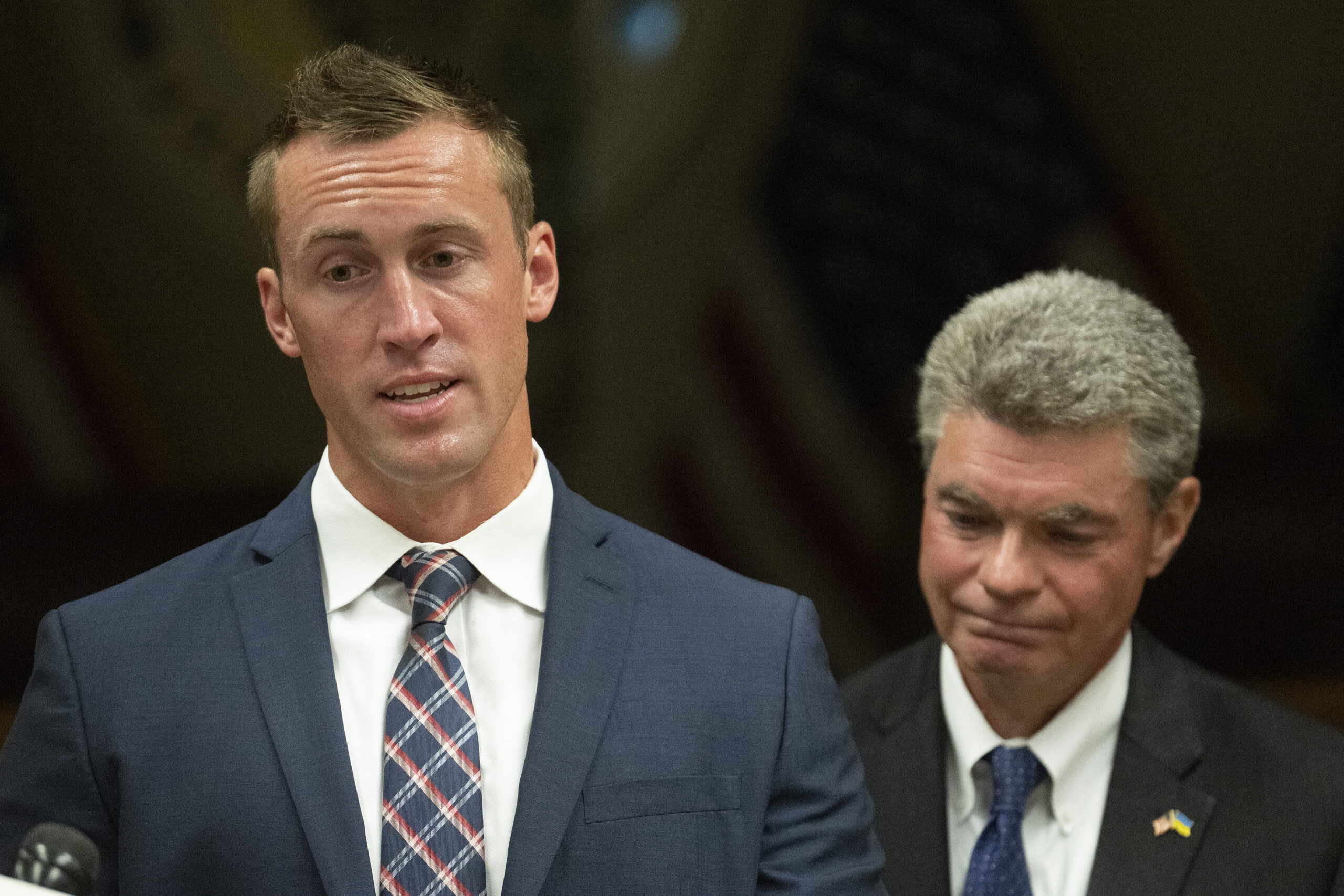
A Montgomery County judge sharply rebuked a Dresher woman Monday before sentencing her to 25 to 50 years in state prison in the murder of her son, telling her that she failed in her fundamental duties as a parent by allowing him to waste away to just 59 pounds.
During the hearing before Judge Wendy Rothstein, Sherrilynn Hawkins, 43, wept, calling Tylim Hatchett her “first love” and best friend while pleading guilty to third-degree murder, neglect, and related crimes in his September 2024 death.
She described how the 21-year-old fought all his life to overcome cerebral palsy, blindness and other debilitating medical issues, and required constant care to, among other things, feed himself.
“I made Tylim a promise to keep him safe, and after 21 years, I failed and broke that promise,” Hawkins said. “And I will always be sorry for that.”
Despite Hawkins’ professed remorse, prosecutors said, in the last three weeks of her son’s life, she frequently left him alone in her apartment, sometimes for 24 hours at a time.
All the while, she accepted funding from Aveanna, a home healthcare agency, to work as her son’s primary caregiver. She also included Lorretta Harris, one of her friends, on that payroll to receive a portion of the money to care for him part-time.
In reality, neither woman spent much time with Hatchett and falsified their records with the agency, despite being paid more than $48,000 combined, according to evidence presented in court Monday.
Prosecutors said Tylim Hatchett weighed just 59 pounds when he died last September.
Harris, 49, pleaded guilty to neglect of a care-dependent person earlier this year. Her sentencing is scheduled for December.
In handing down Hawkins’ sentence Monday, Rothstein said Hawkins had betrayed her son’s trust and, even worse, had prioritized scamming Aveanna for financial gain.
“You utilized state funding and let your child die,” she said, telling Hawkins that her conduct was despicable. “And you did all this while driving around in a Mercedes.
“I’d like to say more, but I’m left speechless that a parent could do this.”
Hatchett was found dead Sept. 18, 2024, inside his mother’s apartment at the Residences at the Promenade, according to investigators.Police were called to the apartment by the man’s father. An autopsy found that he was severely malnourished and dehydrated.
Evidence pulled from Hawkins’ phone by detectives showed that in the weeks leading up to her son’s death, she spent the majority of her time with her younger son, whom she brought with her to her boyfriend’s house in Philadelphia, according to the affidavit or probable cause for her arrest.
During this time, she texted Vernon Hatchett, her son’s father, telling him “this might be it” for their son, and later that she would let him know when to make funeral arrangements.
The elder Hatchett, 40, has been charged with neglect, abuse, and conspiracy. However, he has been a fugitive from justice for more than a year and is currently being sought by the U.S. Marshals Service.
Hawkins also lied to concerned family members, saying she had taken her son to a nearby hospital for treatment, according to prosecutors.
But First Assistant District Attorney Ed McCann said Monday that the only time Hawkins sought medical care for her son in 2024 was at the beginning of the year, when he weighed 90 pounds.
Hatchett, McCann said, had lost more than third of his body weight between then and his death and had been “left alone in that apartment to die.”
“It’s horrific. It doesn’t have anything to do with being a parent; it has everything to do with being a human being,” he said. “I think the defendant failed at the fundamentals of being a human being by allowing this to happen.”
Hawkins’ family members and friends took turns Monday imploring Rothstein to be lenient. They told the judge that Hawkins had struggled with fertility issues in her youth and that she had endeavored to keep her son healthy and happy through his many medical issues.
They said that she had frequently asked for assistance in caring for Hatchett and that those pleas had been ignored.
Hawkins’ attorney, Joseph Schultz, said she is a caring and loving mother that had simply become overwhelmed.
“Today, she took responsibility, and she’s going to have to live with this the rest of her life,” Schultz said.
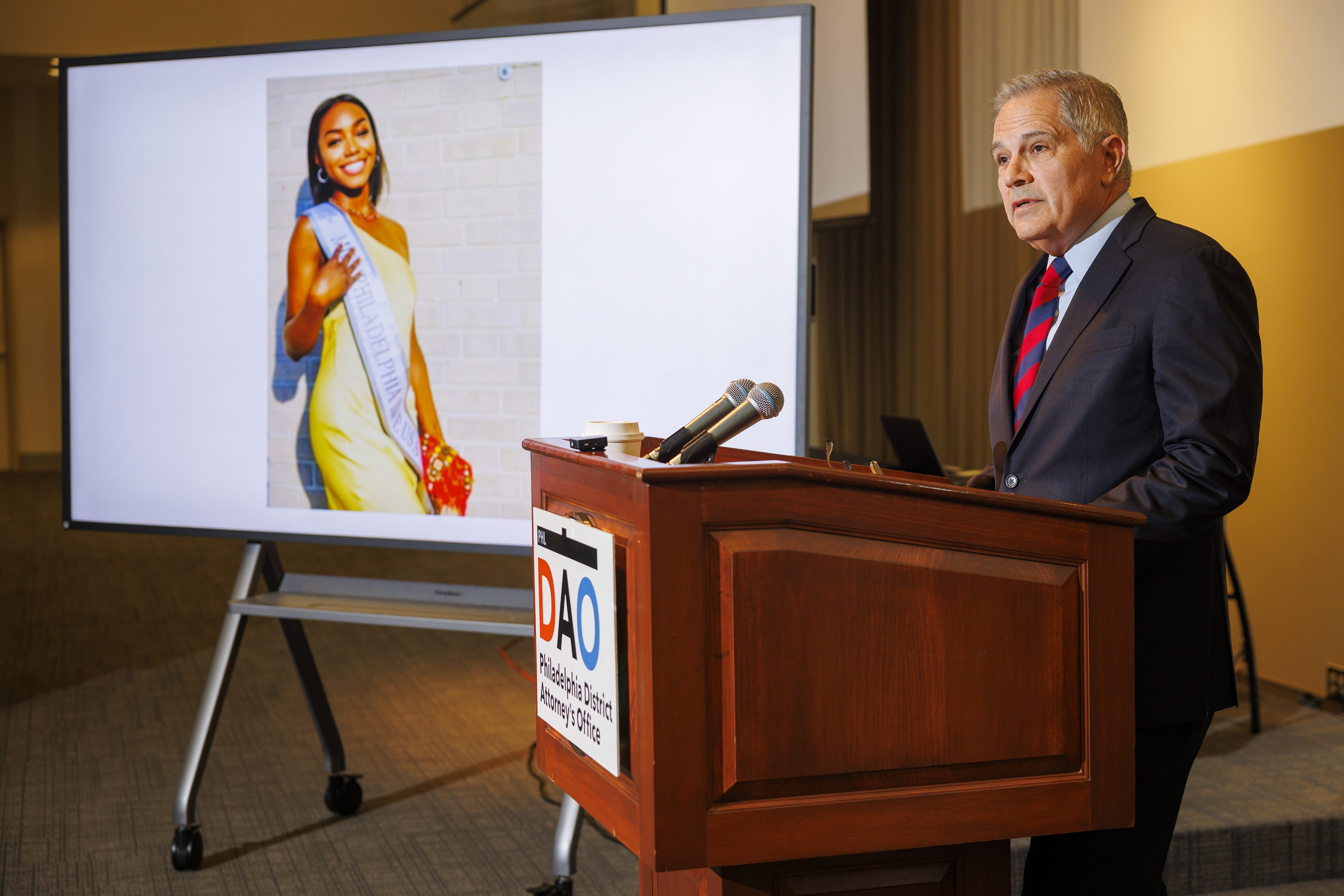
Prosecutors on Monday charged Keon King, the man accused of kidnapping Kada Scott from her workplace earlier this month, with arson — and said they soon intend to charge him with murder for allegedly killing Scott, then setting on fire the car they say he used to abduct her last week.
District Attorney Larry Krasner said that he expects to charge King with murder in connection with Scott’s death but that officials are awaiting additional information from the Medical Examiner’s Office and are working to “precisely confirm everything we need” to do that.
Prosecutors also said that they “have reason to believe that other people may have been involved” or helped King conceal evidence after Scott, 23, was killed and that investigators are working to identify additional suspects.
Scott’s cause of death remains under investigation.
Philadelphia District Attorney Larry Krasner said he intends to charge Keon King with murder, but awaits additional information before formally filing the charges.
King, 21, turned himself in to police last week to face charges of kidnapping, stalking, and related crimes after investigators linked him to the Oct. 4 disappearance of Scott. Cell phone data showed King was the last person in touch with Scott before she walked out of the Chestnut Hill nursing home where she worked and never returned, officials said.
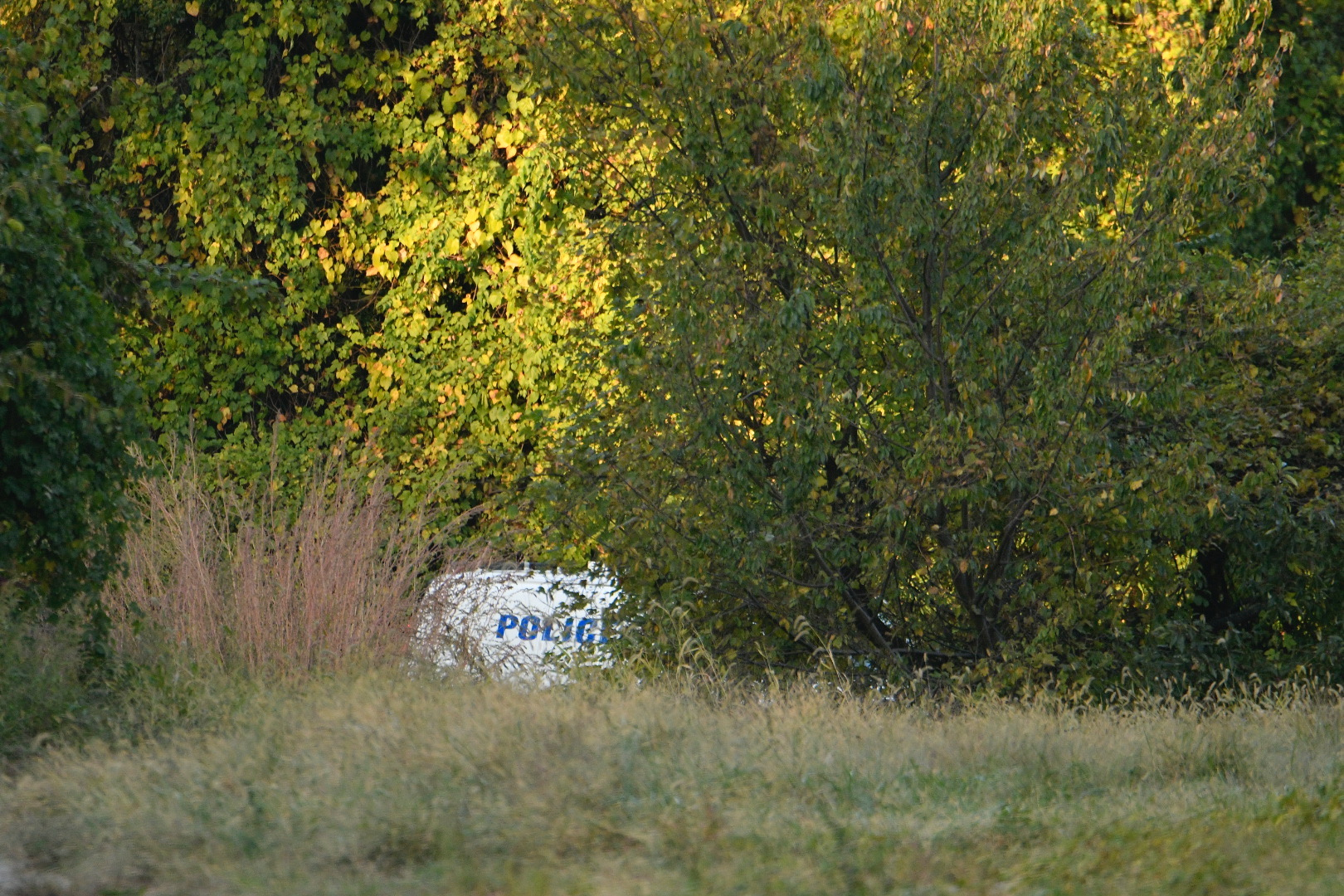
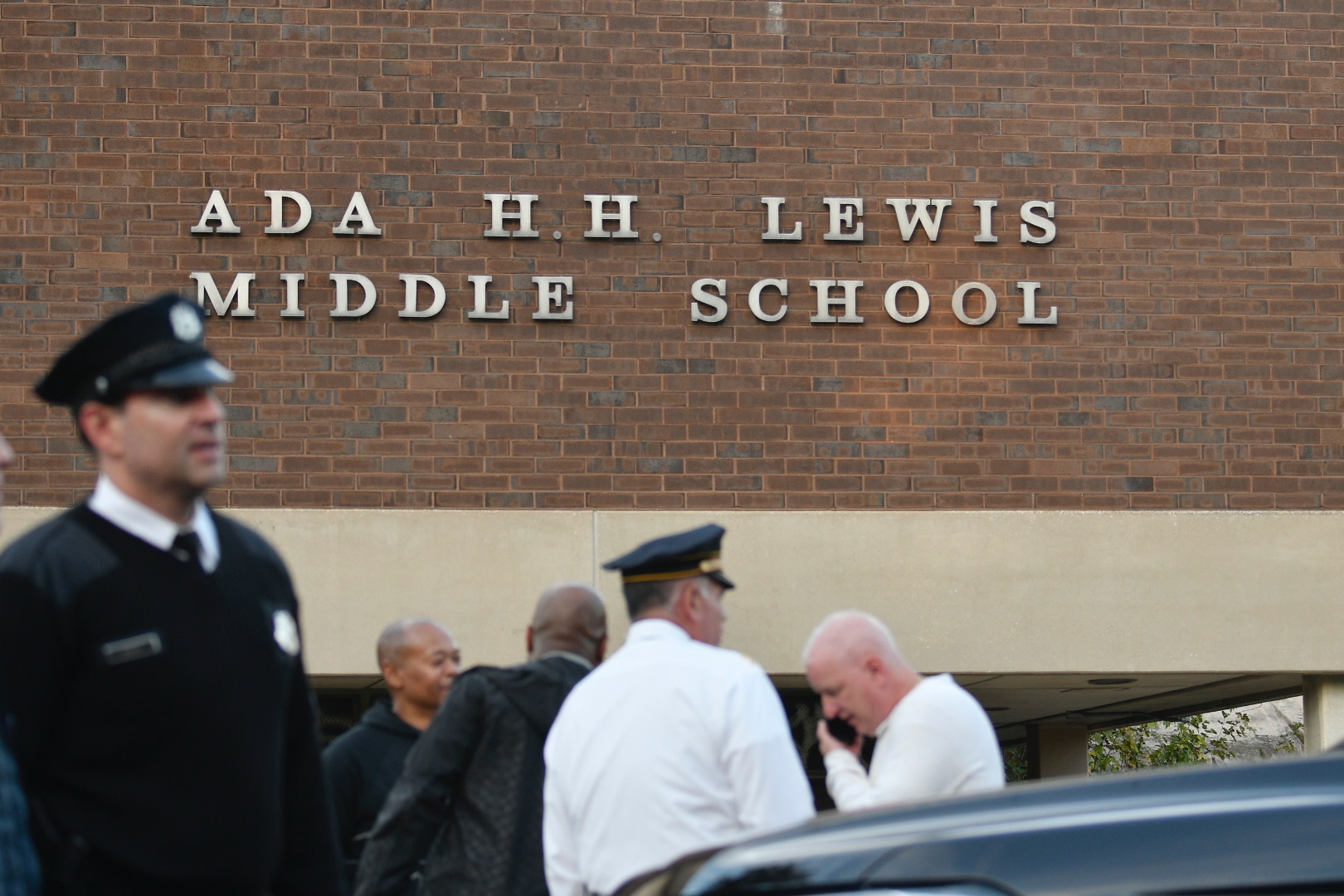
After a two-week search for the Mount Airy woman, police on Saturday found Scott’s body, buried in a shallow grave in the woods behind the abandoned Ada H.H. Lewis Middle School in East Germantown.
“There will be additional charges that are coming,” Krasner said at a news conference Monday.
In the meantime, Krasner said his office would charge King with arson, conspiracy, and related crimes for setting a black Hyundai Accent on fire near 74th Street and Ogontz Avenue on Oct. 7.
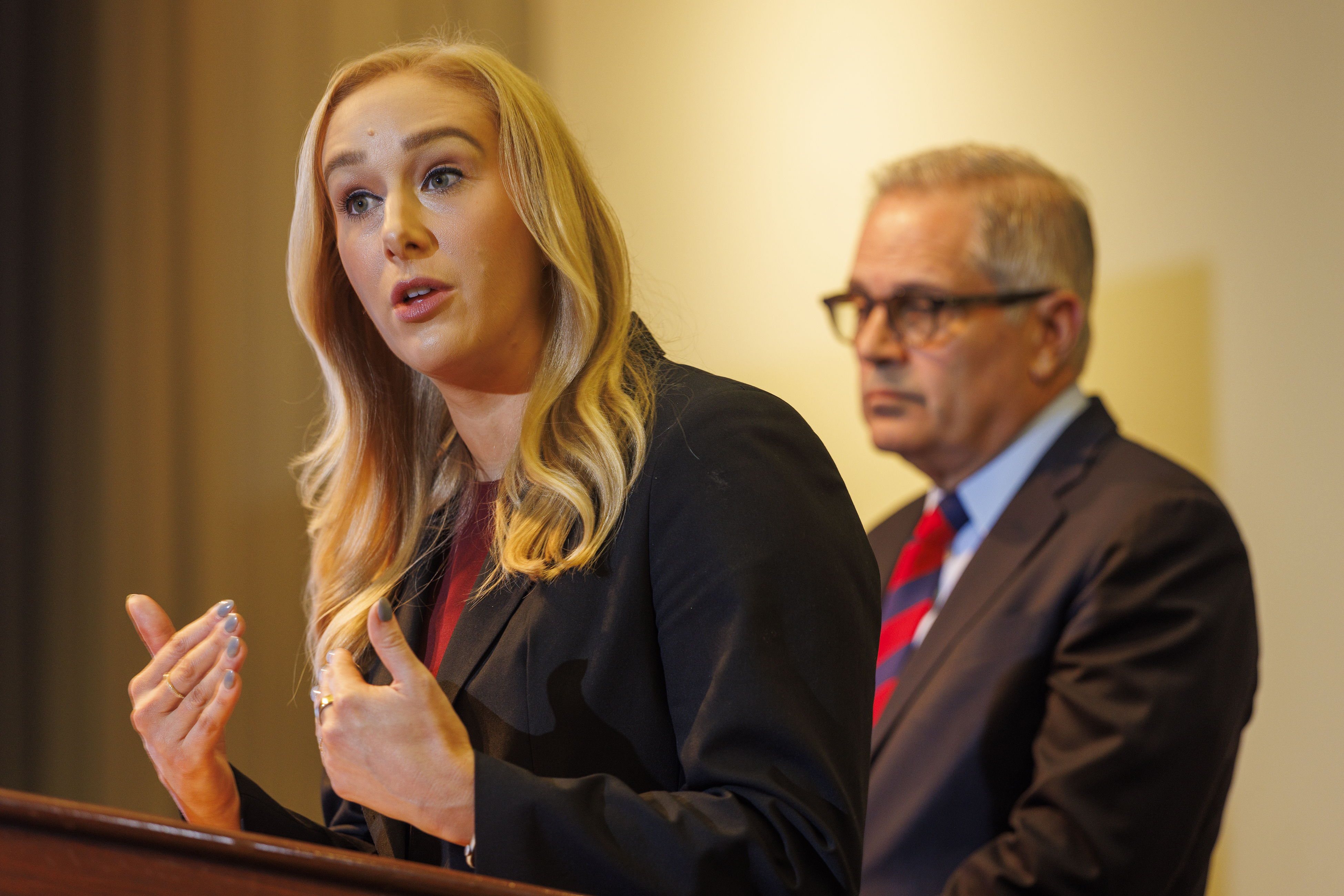
Assistant District Attorney Ashley Toczylowski said investigators believe that King used that car — which had been stolen from the 6600 block of Sprague Street in East Mount Airy on Oct. 3 — to kidnap Scott on the night of Oct. 4.
The extent of her relationship with King remains unclear, officials said.
Surveillance footage recovered late last week showed that the Hyundai Accent arrived at the Awbury Recreation Center around 10:30 p.m. the night Scott disappeared, the sources said.
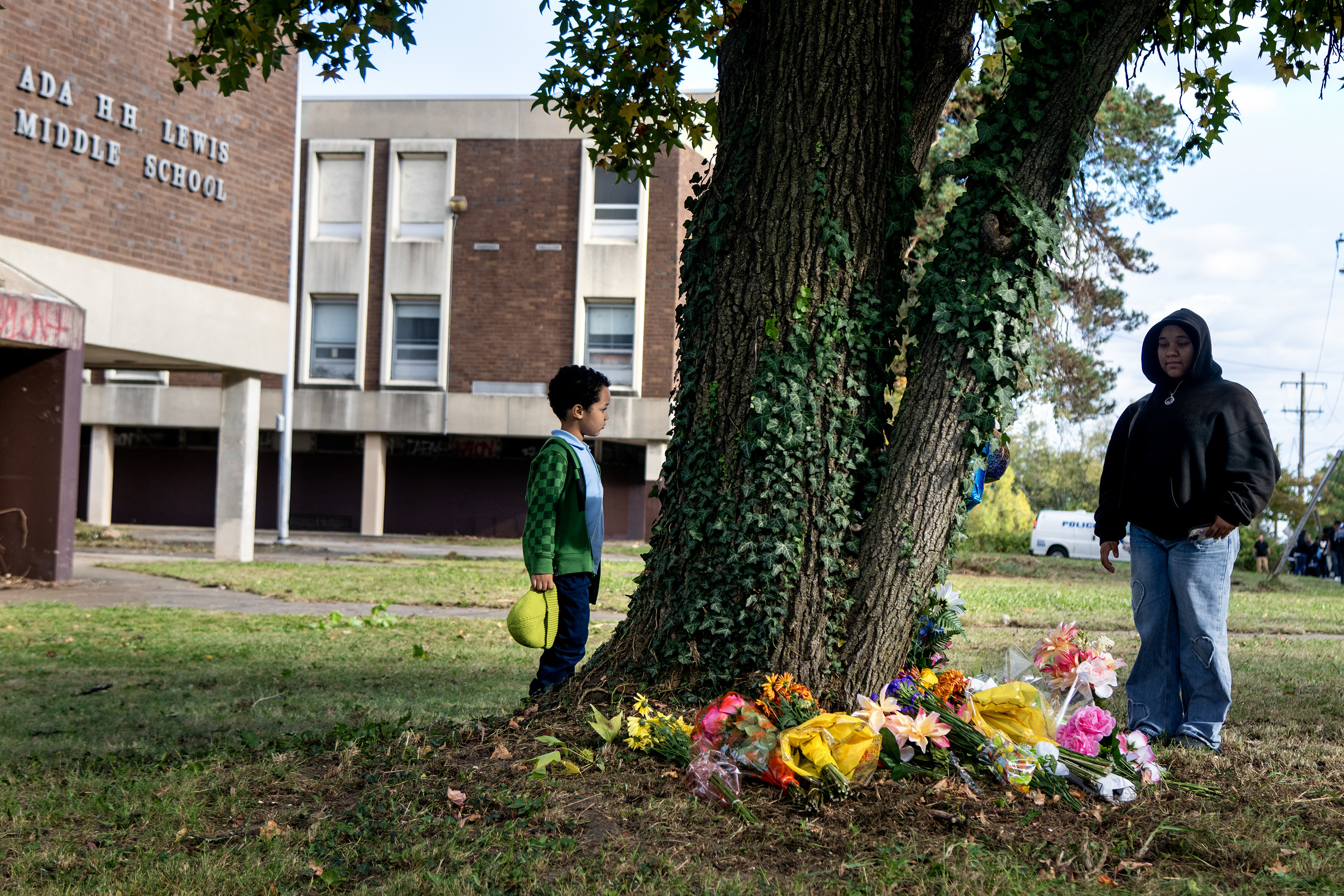
Julius Peden, 5, and Jaihanna Williams Peden (right), 14, pause at a memorial for Kada Scott at the Ada H. Lewis Middle School on Oct. 20, not far from where her body was found on Saturday. The siblings were brought by their grandmother Deborah Peden who said she felt the need to come. “My heart is broken. I feel like I lost someone in my family,” she said. “My daughter is a young Black woman. They are being targeted.”
King left the car in the parking lot, the sources said, then returned two days later — when video appears to show him moving what detectives believe was Scott’s body from the vehicle. Her corpse was buried at least 100 yards away in the woods behind the school next door.
The next day, Toczylowski said, King set the car ablaze.
Toczylowski said King’s cell phone location data shows he was at the recreation center when the car arrived Oct. 4 and again when he returned two days later. It also shows him in the area where the car was burned three days later, she said.
Detectives learned of the torched car last week after police received a tip that a car connected to her disappearance had been set on fire on the West Oak Lane block, she said. The car had already been towed, crushed, and sent to a junkyard when authorities learned of it, she said.
Assistant District Attorney Ashley Toczylowski will lead the prosecution again Keon King.
When investigators recovered video from the recreation center, she said, it confirmed that the car was used in the crime.
Krasner asked for the public’s continued help with the investigation, which he said “is developing almost hourly.”
“The community has already done tremendous work in aiding progress with this investigation,” he said. “We are simply asking for more.”
Scott’s family on Monday released their first statement since her body was found, thanking the public for its help in the investigation and asking for privacy as they grieve.
“Our hearts are shattered, yet we are deeply grateful for the outpouring of love, support, and prayers from people across the nation and around the world,” her parents wrote.
“Kada was deeply, deeply loved. Her light, kindness, and beautiful spirit will forever remain in our hearts,” they said.
They said they trust that the police department and district attorney’s office will get justice for their daughter, and that they are thankful for the “unity, leadership, and love” that has surrounded them so far.
“Please honor Kada’s memory by showing kindness and care to one another,” they wrote, “just as she did every day of her life.”
City Councilmember Anthony Phillips said his office is collecting donations to support Scott’s family, including toiletries, self-care and comfort products, and gift cards for grocery and meal delivery services.
Items can be dropped off at his office at 1514 Wadsworth Ave. from Tuesday through Friday, 8:30 a.m. to 4:30 p.m., and Saturday from 9 a.m. to noon. For questions, he said, call 215-686-3454.
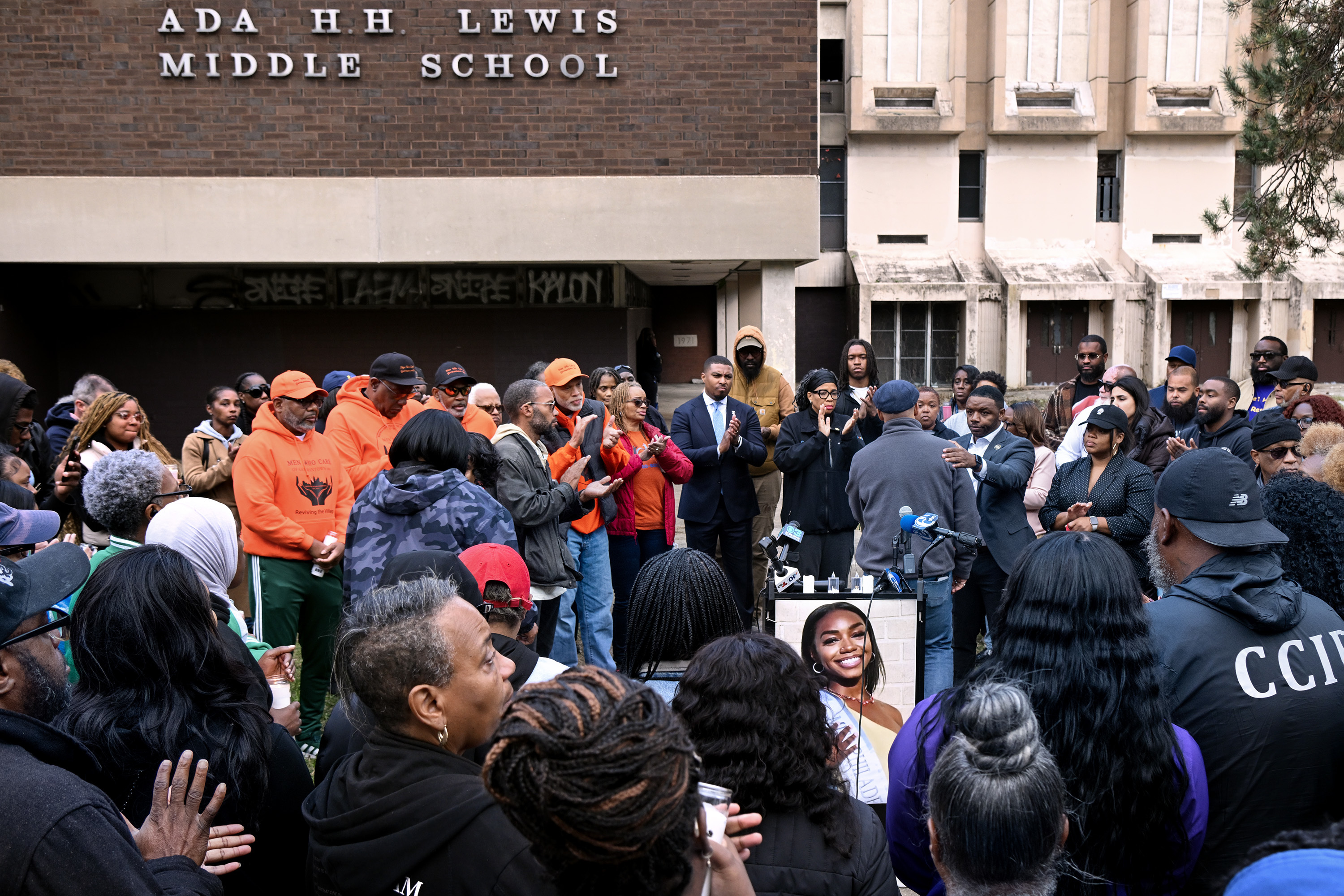
Community members gather for a candlelight vigil in memory of Kada Scott on Monday. Neighborhood residents said they want the abandoned school torn down.
DNA analysis confirmed that the body recovered in the woods behind Ada H.H. Lewis Middle School in East Germantown is that of Kada Scott, the young woman who officials say was kidnapped two weeks ago, law enforcement sources said Sunday, and new details emerged about what led investigators to find her corpse.
An anonymous tipster contacted police Friday night, adamant that Scott’s body was on the grounds of the school.
Police had missed it in their earlier searches, the tipster said, and they should look along the old wooden fence that divides the school from the recreation center next door, said the sources, who spoke on the condition of anonymity to discuss an ongoing investigation.
“GO BACK YOU MISSED HER,” the tipster wrote, according to the sources.
And so, investigators returned to the school on Saturday morning, freshly scouring an area police had focused much of their search efforts on throughout the week after cell phone location data placed Keon King — the man suspected of kidnapping Scott, 23, from her workplace on Oct. 4 — nearby on the night she disappeared.
Days earlier, they had found Scott’s debit card and pink phone case behind the school, but nothing else.
Sources say DNA evidence has confirmed that police discovered the body of Kada Scott in a wooded area near Awbury Recreation Center on Saturday.
Officers were walking through the densely wooded area again on Saturday afternoon, the sources said, when one stepped on a patch of earth that felt softer than the rest — leaves, sticks, and debris scattered loosely on top.
Police excavated the area, and, a few feet down, they found Scott’s body.
It’s not yet clear how she died. It could take days or weeks for the Medical Examiner’s Office to determine the cause of death.
But new video evidence suggests that Scott was likely killed within just 30 minutes of her leaving her workplace the night she went missing, the sources said.
The discovery of the shallow grave, two weeks after Scott disappeared, came after anonymous tips that grew more detailed with each passing day, the sources said, coupled with location data from Scott’s Apple Watch, and finally, new surveillance footage recovered near the school.
Scott, a vibrant young woman from the Ivy Hill section of Mount Airy, disappeared from her workplace, a nursing home in Chestnut Hill, on the night of Oct. 4.
Investigators believe she and King, 21, had been texting, and that night, she walked out of work to meet him shortly after 10 p.m. but never returned.
Police are still investigating the nature and extent of Scott’s relationship with King.
After detectives identified King as a suspect, they pored over the location data from his and Scott’s phones. It showed that King was the last person in touch with Scott on Oct. 4, that his phone traveled with hers briefly before her phone was turned off, and that he was in the area of Awbury Arboretum later that night, a law enforcement source said.
Late last week, police learned that Scott had been wearing an Apple Watch on the night she disappeared. Location data showed that, around 1 a.m., the watch was in the parking lot of the Awbury Recreation Center, said the source.
Police discovered a grave containing female human remains in the area of Ada H. H. Lewis Middle School, a closed school facility near the Awbury Arboretum in Germantown on Saturday.
Investigators went to the recreation center on Friday and recovered new surveillance footage that showed King pull into the parking lot around 10:30 p.m. on Oct. 4 in a Hyundai Accent that had been reported stolen, two sources said. He left the car there that night — most likely with Scott’s body inside, the sources said.
The footage appeared to show King return to the car two days later and retrieve and move what they believe to be Scott’s body, the sources said. It’s not clear whether he acted alone.
The next day, the sources said, the car was set on fire behind homes on the 7400 block of Ogontz Avenue. King’s cell phone data placed him there at the time of the blaze, the source said. (Police had initially been searching for a gold Toyota Camry that King was seen driving but no longer believe that car was used in the crime, the sources said.)
The district attorney’s office said prosecutors would wait for additional information from police and the medical examiner before determining whether to charge King in connection with Scott’s death.
King is expected to be charged with arson in the coming days for allegedly setting the car on fire in West Oak Lane, according to the sources.
Police don’t know the identity of the tipster who steered them to the location of Scott’s body. But if King had help moving it, the sources said, the accomplice may have confided in others, and one of those people may have contacted police.
The investigation is continuing.
Staff writer Maggie Prosser contributed to this article.
The FBI on Friday announced criminal charges against two men in connection with an attempted robbery of an armored truck on Oct. 3 that led to school lockdowns and a shelter-in-place order in Lower Merion Township.
Dante Shackleford, 26, also was charged by indictment with two attempted robberies of armored trucks in Philadelphia in July and an armored truck heist in Elkins Park in August in which $119,100 was stolen.
Mujahid Davis, 24, and Shackleford were charged with the Oct. 3 attempted robbery of an armored truck on the Philadelphia side of City Avenue that led to a pursuit and an hours-long incident. Several suspects were finally arrested in Lower Merion.
The FBI announcement came just hours after another attempted robbery of an armored truck, this time outside a Wawa store in Philadelphia.
Shortly before 8 a.m. on the 7700 block of Frankford Avenue, two male suspects attempted to rob a Loomis truck when the driver fired two shots at the suspects, who then fled. Police reported no injuries or arrests.
The indictment against Shackleford and Davis filed in federal court on Thursday provided few details about the prior armored truck crimes.
On July 15 and on July 22, Shackleford and others allegedly attempted to rob Brink’s trucks in Philadelphia, according to the indictment.
On Aug. 12, Shackleford and others allegedly robbed a Brink’s truck in Elkins Park and got away with approximately $119,100 and the Brink’s employee’s gun.
Then on Oct. 3, Shackleford and Davis allegedly attempted to rob a Brink’s truck in Philadelphia, which reportedly occurred in the area of City Avenue.
Davis also is charged in Montgomery County Court with multiple counts related to what happened on Oct. 3, including fleeing law enforcement and evading arrest.
The homicide clearance rate this year has hovered between 86% and 90% — the highest since 1984, when the department recorded a 95% clearance rate.
The change is a welcome improvement from the challenges of 2015 to 2022, when the rate of solved homicides hovered around 50% or less and dropped to a historic low of 41.8% in 2021, according to police data.
Just as there’s no single explanation for the drop in shootings, there’s no simple answer to why detectives are closing cases more quickly this year. And a higher arrest rate doesn’t account for whether a defendant is convicted at trial.
But interviews with law enforcement officials and a review of police data and court records suggest a few likely factors: the overall decline in violence, which gives officers more time to investigate, and recent investments in technology that give detectives faster access to evidence.
Here are five things contributing to the improved clearance rate:
!function(){“use strict”;window.addEventListener(“message”,function(a){if(void 0!==a.data[“datawrapper-height”]){var e=document.querySelectorAll(“iframe”);for(var t in a.data[“datawrapper-height”])for(var r,i=0;r=e[i];i++)if(r.contentWindow===a.source){var d=a.data[“datawrapper-height”][t]+”px”;r.style.height=d}}})}();
Simple math
The clearance rate is calculated by dividing the number of homicide cases solved in a given year — regardless of when the crime occurred — by the number of homicides that occurred in that same year.
And so the apparent improvement partly comes down to simple math: with dramatically fewer killings this year, even fewer total arrests can boost the clearance rate.
Through August, police had solved about 60% of the killings in 2025, but because they’ve cleared nearly 50 others from previous years — and because there are a third as many homicides as three years ago — the rate goes up.
Still, that number is notable. Only about a third of killings that occurred in 2021 and 2022 were solved that same year, according to an Inquirer analysis of court records and police data.
!function(){“use strict”;window.addEventListener(“message”,function(a){if(void 0!==a.data[“datawrapper-height”]){var e=document.querySelectorAll(“iframe”);for(var t in a.data[“datawrapper-height”])for(var r,i=0;r=e[i];i++)if(r.contentWindow===a.source){var d=a.data[“datawrapper-height”][t]+”px”;r.style.height=d}}})}();
Time
The significant reduction in violence this year has given detectives the time to solve their cases, both old and new.
During the pandemic — as the city recorded about 2,000 homicides in just four years — detectives were handling 10 to 15 cases each year, more than twice the workload recommended by the U.S. Department of Justice.
This year, it’s half that.
That’s making a difference. Detectives this year appear to be solving cases more quickly than years past, according to an Inquirer analysis.
Through August, police arrested a suspect within a week in about 31% of cases — up from just 15% three years ago.
A video camera at Jasper and Orleans Streets in Philadelphia.
Cameras are everywhere
Just in the last year, police have doubled the number of “real-time crime” cameras on Philadelphia’s streets. In 2024, police said there were 3,625 of the ultrahigh-resolution cameras across the city. This year, there are 7,309.
And there are tens of thousands of other cameras through SEPTA, private businesses, and residents’ home-surveillance systems that give detectives leads on suspects.
Police have also recently installed hundreds of license plate readers — 650 for every patrol vehicle and another 125 on poles across the city.
The department also subscribes to a software that taps into a broader network of millions of other plate readers — on tow trucks, in parking garages, and even private businesses across the region.
Police said the tools are helping them track shooters’ movements before and after a shooting and locate getaway cars more quickly, by searching a vehicle’s license plate or even by its make and model.
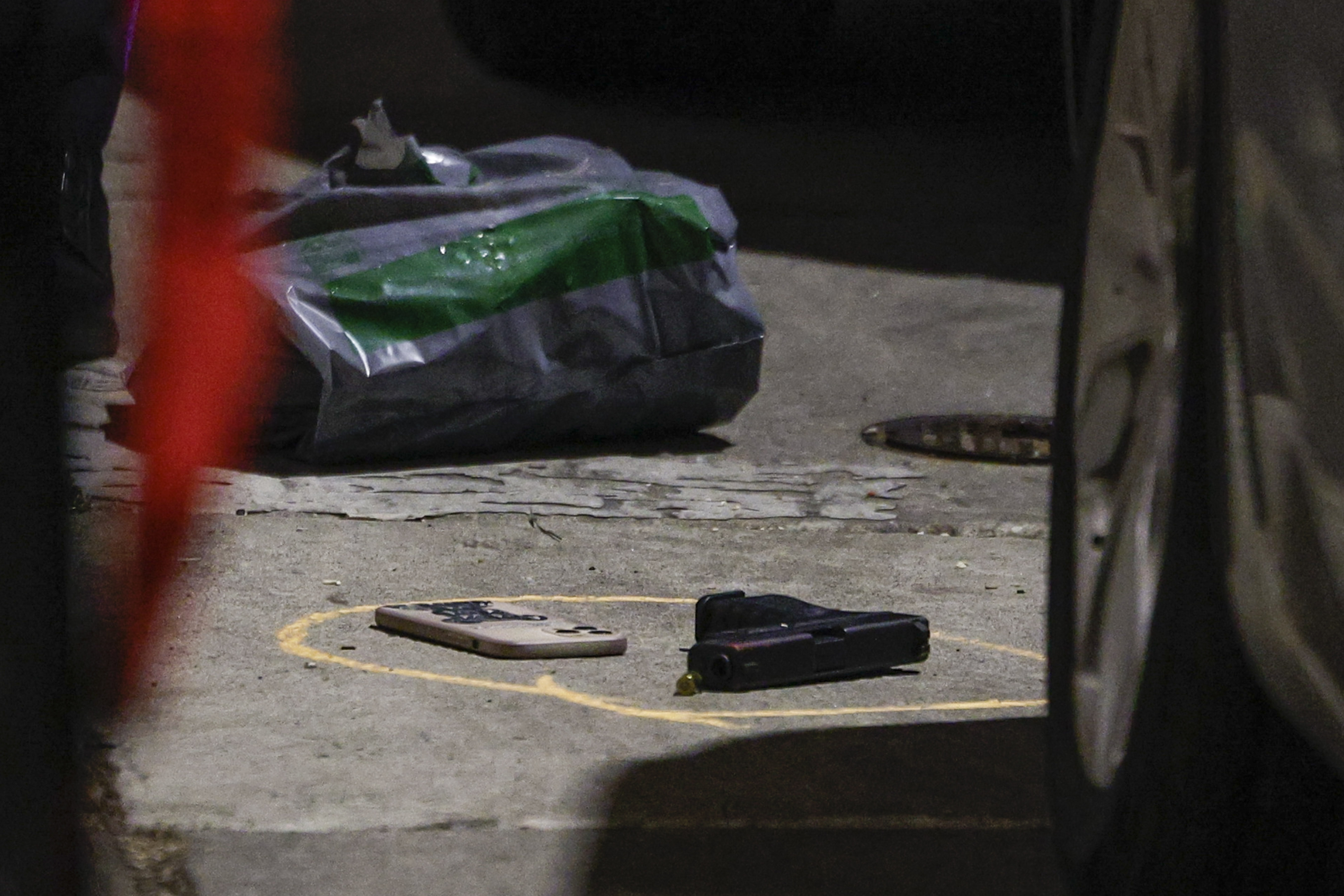
Police locate a gun and a cell phone on the 700 block of East Willard Street, where a man in his 20s was fatally shot in December 2024.
Phones and social media
Philadelphia police and the district attorney’s office have greatly expanded their digital evidence tools in the past two years.
Where cases once relied on grainy video and often-reluctant witnesses, detectives now have high-definition video footage, partial DNA processors, and cell phone location data — evidence that “never goes away” and doesn’t lie, said Deputy Police Commissioner Frank Vanore.
Getting access to a suspect’s — and victim’s — phones and social media can often tell the story behind a crime.
The Gun Violence Task Force, which investigates gang violence and works closely with homicide and shooting detectives, had just two cell phone extraction devices two years ago. Now, it has 14, plus a host of advanced software that helps investigators track and map gang networks.
Between the homicide unit and the task force, nearly 2,000 phones were processed last year — often giving detectives crucial evidence and information about crimes beyond the one they were initially investigating.
Improved morale
Some detectives, who asked not to be identified to speak frankly about their work, said morale in the homicide unit — and across the department — has improved.
During the pandemic, when shootings surged, tensions in the unit went unchecked, and conditions at the Roundhouse headquarters were dire. The office was overcrowded and infested with vermin, and investigators shared just 15 computers among nearly 100 detectives.
Since moving in 2022 to new offices at 400 N. Broad St., each detective now has a desk and computer, and that has boosted productivity, they said.
The detectives also said that patrol officers seem more empowered than during the height of the gun violence crisis to engage with their neighborhoods and gather information that ends up being important to their investigations.
The city’s new Neighborhood Wellness Court initiative has been placed on hold amid growing concern from the leadership of Philadelphia‘s courts and judges’ mounting frustration with the city officials tasked with overseeing the program.
Wellness court, which Mayor Cherelle L. Parker’s administration launched in January as a fast-track way to arrest people in Kensington for drug-related offenses and get them into treatment, has not taken any new cases over the last three weeks, city officials said.
Supervising Municipal Court Judge Karen Simmons was nearly ready to shut the program down over frustration with the lack of coordination and communication from the Parker administration with the courts and other city agencies involved, according to sources with knowledge of conversations about the program.
Simmons was concerned that the city was treating people arrested in some neighborhoods differently from others, and that there was inconsistency in how the program was tracking its data and determining who should be eligible for treatment, according to the sources, who spoke on the condition of anonymity to discuss private conversations.
Simmons ultimately gave the city time to fix those issues, asking that officials put together a written manual and streamline the paperwork and intake procedures to ensure fairness, the sources said. The city is expected to make those adjustments so police can resume making arrests and bringing people through the program next week.
A spokesperson for the courts declined to comment and referred questions to the city.
Chief Public Safety Director Adam Geer oversees the office that runs Neighborhood Wellness Court in Kensington.
Chief Public Safety Director Adam Geer, who oversees the city office that runs wellness court, said the delays were related to “administrative protocols” that needed to be resolved but declined to provide specifics.
Geer said that he expects the program to return to normal operations next week and that the city “is fully committed to successfully implementing and sustaining the Neighborhood Wellness Court model.”
Joshu Harris, the city’s deputy director of public safety, is no longer overseeing the program‘s operations, the sources said, and Deputy Mayor Vanessa Garrett Harley is now involved.
“As with all new pilot programs of this kind, adjustments will continually be made to improve operations as time moves forward,” city spokesperson Joe Grace said Thursday.
The pause comes amid long-simmering tension between the courts and the city over how the program was launched, sources said. Leadership of the Philadelphia District Attorney’s Office, the Defender Association of Philadelphia, and even the judges tasked with overseeing the court were largely excluded from the city’s plans for the program and how it would operate, sources said. They have felt like the Parker administration did not want their input.
That conflict spilled into open court this month. Municipal Court Judge Henry Lewandowski III, who has presided over most of the wellness court cases so far, said at a hearing in early April that certain politicians in the city think they can “just wave a wand” and fix Kensington’s long-standing drug problems.
“I care way more than they ever will. They’re fake,” he said, adding that officials are trying to build new programs just so they have something to take credit for.
“If I said what I wanted to say,” he said, “I’d have to resign.”
His frustration was clear again Thursday as he oversaw more than 100 summary offense cases, most for fare evasion amid SEPTA‘s new crackdown on turnstile jumping.
“Who knows what program they’ll start by next week,” he said. “Every Wednesday, there’s new stuff, new programs, new procedures. … I’ve never been more confused, I’ve never been more uncertain what my job is.”
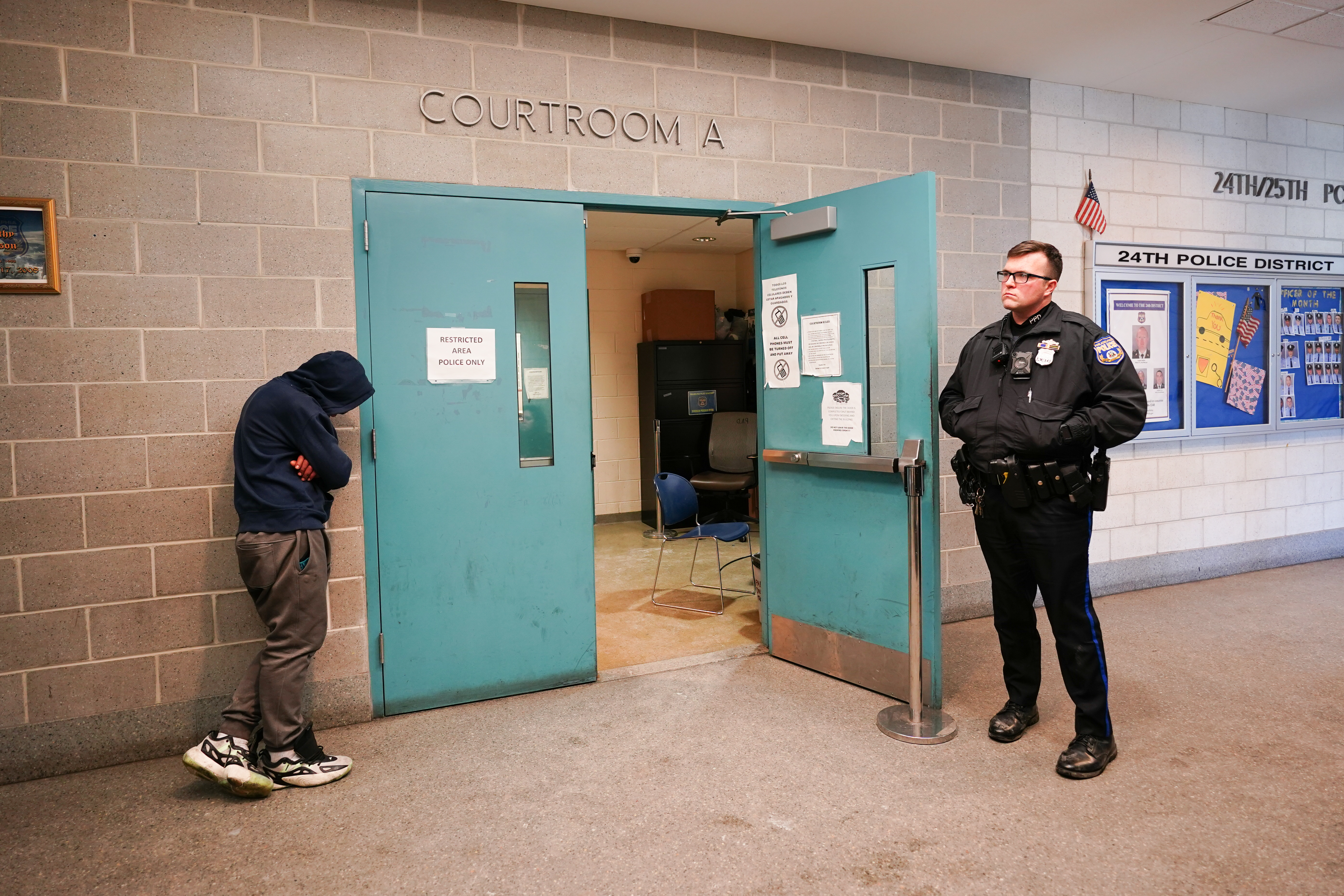
Wellness court takes place every Wednesday inside a courtroom at the 24th / 25th Police District.
Wellness court is a signature part of Parker’s plan to shut down Kensington’s notorious open-air drug market and restore quality of life for neighborhood residents.
The court runs on Wednesday afternoons. First, in the morning, police conduct sweeps of the Kensington area and arrest people in addiction for offenses like sleeping on the sidewalk, gathering around an outdoor fire, or stumbling into the street. They are typically charged with summary offenses like obstructing highways.
Those arrested are then brought to the Police-Assisted Diversion program building on Lehigh Avenue, where they are evaluated by a nurse and an addiction specialist. Officials also attempt to address any outstanding arrest warrants, and connect them with a court-appointed attorney hired by the city to discuss their rights.
Finally, they are brought before a judge — Lewandowski has heard most cases so far — inside the nearby police district. They are offered the opportunity to immediately go to rehab or face a summary trial for their alleged crimes. Those who opt to go into treatment and complete the program and terms set by the city will later have their cases dismissed and expunged.
Few in the program have asked for a same-day trial. Those found guilty have so far been ordered to pay fines and court fees ranging from about $200 to $500.
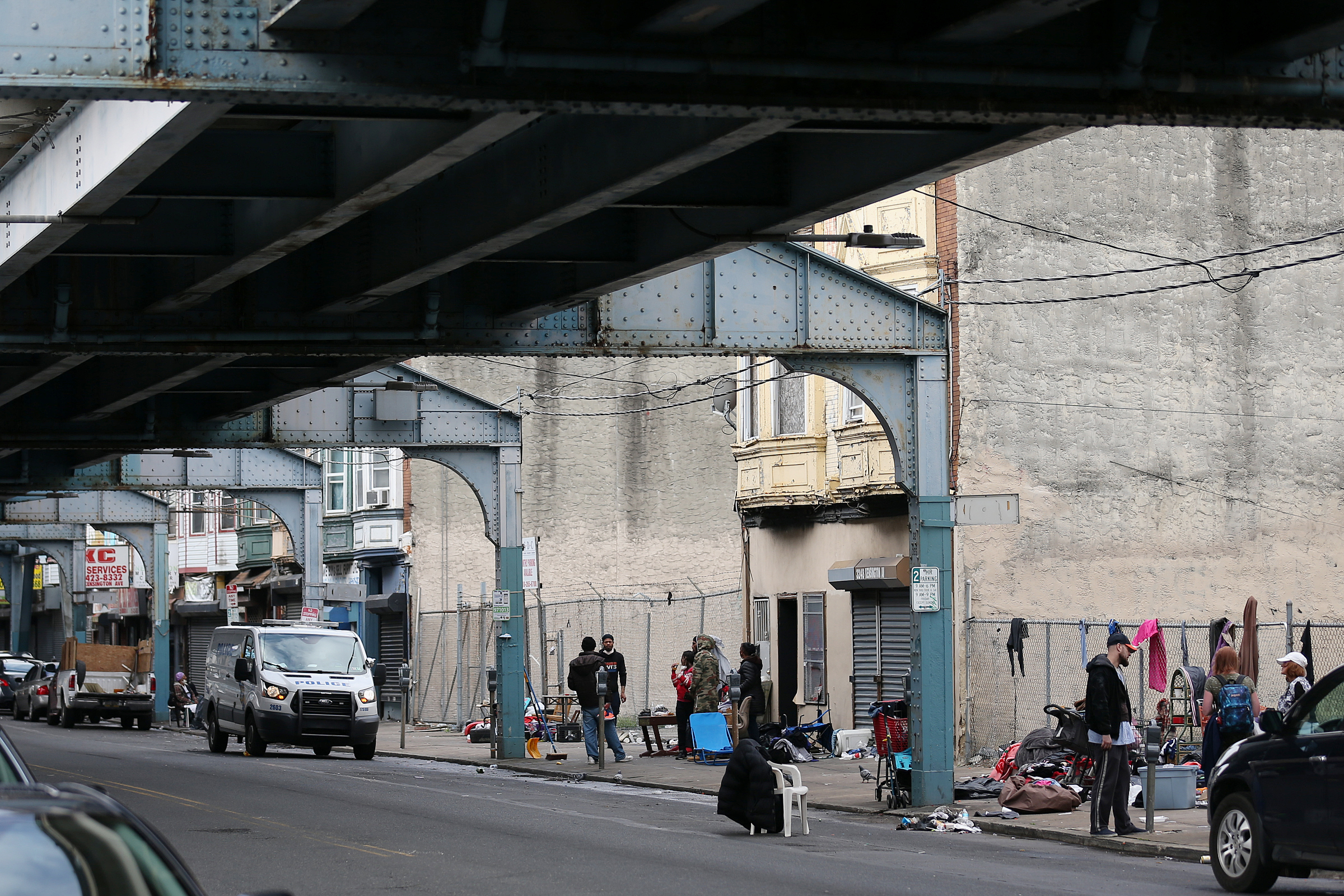
Homelessness and public drug use is widespread in Kensington, the heart of the city’s open-air drug market.
Of the more than 50 people who have come before the court so far, only two had successfully completed treatment as of early April, according to data collected by The Inquirer. The vast majority brought through the program almost immediately leave treatment and do not appear at follow-up hearings, the data show.
The city has declined to share data on wellness court, including with City Council at a recent budget hearing, saying that it is too early to judge the program on numbers alone and that more time is needed to see results.
But the Parker administration said it wants to expand the court and needs more funding for it to succeed. At a recent budget hearing, Geer asked City Council for an additional $3.7 million to operate the court five days a week and hire additional staffers.
The goal, Geer said, is to build a system where people suffering on the streets can immediately be connected with treatment and resources, avoid going to jail, and get housing through the city’s new Riverview Wellness Village. Geer has said that the program will never have a 100% success rate, but that every “touch” the program has with people in addiction increases their likelihood to eventually go into treatment.
But the First Judicial District has said wellness court will not be expanding anytime soon, according to sources.
Civil rights advocates have raised constitutional concerns over the program. In a letter to the Parker administration, the Pennsylvania chapter of the American Civil Liberties Union said the program could pose a threat to drug users’ rights and questioned whether the city could force people to make consequential legal decisions while potentially under the influence of narcotics.
The 42-year-old man in addiction who died inside a Philadelphia jail days after his arrest in Kensington had been flagged as an “emergency” case by an intake worker at the jail, and should have received one-on-one supervision in the hours before he collapsed, according to records from the Department of Prisons.
But that didn’t happen, and instead, Andrew Drury died alone inside the holding cell, without having received a formal behavioral health evaluation by the prison staff, according to the records obtained by The Inquirer. His cause of death remains under investigation, though when he was jailed in the fall, he had been hospitalized multiple times from withdrawal-related health complications.
A spokesperson for the Philadelphia Department of Prisons declined to comment Friday.
Drury had been picked up by Philadelphia police on the night of March 6, after officers encountered him at Kensington Avenue and Somerset Street, and learned he had outstanding bench warrants related to a drug case in Maryland and a 2022 violation of a protection-from-abuse order filed in Philadelphia.
Police said Drury received off-site medical treatment over the next day before he was transferred to Curran-Fromhold Correctional Facility around 2:15 a.m. on March 8. Police declined to say what kind of treatment he received, where he was treated, or how he was cleared for transfer to the jail.
Drury remained in an intake room at the jail until the next afternoon, waiting to be medically evaluated and assigned to a cell block. On March 9, around 9:30 a.m., an intake worker for the prisons assessed Drury and wrote that he was experiencing a range of physical and behavioral health issues and described him as extremely agitated and confused, according to the records.
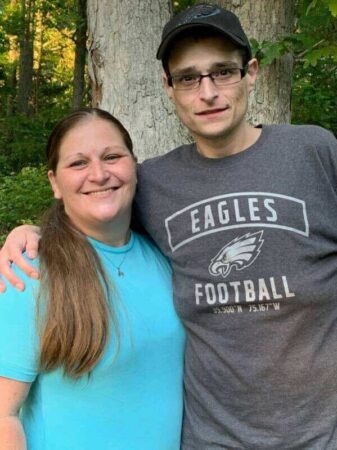
Andrew Drury, left, and Jennifer Barnes had been homeless and struggling with addiction in Kensington for about two years. Drury died on March 9 inside a Philadelphia jail.
The employee labeled Drury as an emergency case, which, according to the records, should have required that he receive one-on-one supervision until he could be evaluated by a behavioral health worker.
Instead, Drury remained in his intake cell for another six hours. A jail guard walking through the area found him unresponsive at 1:45 p.m., and despite administering two doses of Narcan and other lifesaving measures, he was pronounced dead at 2 p.m., according to a spokesperson for the prison.
The Philadelphia Medical Examiner’s Office said Wednesday that doctors are awaiting toxicology results to determine his cause of death.
Drury had long struggled with an opioid addiction, and had been experiencing homelessness in Kensington for about two years, said his longtime girlfriend, Jennifer Barnes.
In an interview this week, Barnes, 44, said she believes he died from health complications related to withdrawal — something that he has been hospitalized for in the past.
When Drury was arrested in October on bench warrants related to the same cases, he was hospitalized multiple times, including for more than a week, after suffering a mild heart attack and other issues while going through withdrawal in jail, according to Barnes and a source familiar with Drury’s care at the time.
After Drury was released in November, Barnes said he was in and out of the hospital because of ongoing chest pains and shortness of breath.
Barnes said she worried about his health as she watched police arrest him that night.
“The withdrawal, it’s not good for him,” she said she told the officers. “He needs medical attention.”
Jennifer Barnes, whose fiancee Andrew Drury died while in jail, shown here in Philadelphia on Tuesday.
Drury’s death comes as the city ramps up enforcement efforts in Kensington, a section of the city that has long experienced concentrated violence, homelessness, and drug use in and around its massive open-air drug market. Mayor Cherelle L. Parker has said her administration would shut down the drug activity in the area and return a quality of life to the neighborhood’s residents.
But some advocates have warned city and law enforcement officials that the withdrawal effects for people who use opioids can be life-threatening, and that the understaffed jails might struggle to respond to people’s health needs in those circumstances.
Barnes said she and Drury were both from South Philadelphia, and had been dating since 2012 after meeting in a luncheonette in the neighborhood. They were not married, she said, but wore rings as if they were.
Andrew Drury and Jennifer Barnes in a photo before they became homeless in Kensington.
Barnes said she has struggled with addiction since about 2008. Drury also used drugs by the time they had met, she said, his troubles beginning after he underwent a weight loss surgery and got hooked on pain killers. For many years, they were both able to hold jobs and hide their addiction.
They bounced between friends’ and families’ homes, she said, until they were kicked out of Drury’s mother’s house in 2021 and she got a Protection From Abuse order against him. They’ve been on the streets of Kensington since about the summer of 2023, she said.
Drury was funny and loving, she said, and helped protect her from the dangers of living on the streets. They had both recently talked about wanting to go to rehab and getting their lives back on track.
Jennifer Barnes holds the sweatshirt of her longtime boyfriend, Andrew Drury, who died in jail on March 9.
Since his death, she said, she feels in a fog. She has connected with a friend who found a bed for her at a recovery house in South Jersey, and she hopes to go next week.
“For myself, and for him, it’s the best thing to do,” she said. “This way he won’t have to worry anymore.”
A 42-year-old man with a history of addiction died inside a Philadelphia jail over the weekend just days after he was arrested in Kensington, officials said.
Andrew Drury was picked up on a bench warrant by Philadelphia police near Kensington and Lehigh Avenues on Thursday night and was found collapsed inside the intake room at Curran-Fromhold Correctional Facility on Sunday afternoon, according to police and prison officials. Officers who found Drury administered two doses of Narcan, among other lifesaving measures, but he did not regain consciousness, officials said.
Drury, whose cause of death remains under investigation, was addicted to opioids and had been hospitalized multiple times for withdrawal-related complications when he was jailed in the fall on similar warrant issues, according to a source familiar with his care who was not authorized to speak publicly.
Philadelphia police arrested Drury in Kensington around 10:30 p.m. Thursday on outstanding bench warrants related to a drug case in Maryland and a 2022 violation of a protection-from-abuse order filed in Philadelphia.
Sgt. Eric Gripp, a spokesperson for Philadelphia police, said Drury was evaluated and “received off-site medical treatment” before he was transferred to the jail on State Road around 2:15 a.m. Saturday.
People who use drugs are often gathered near Kensington and Somerset Avenues, an intersection at the heart of Philadelphia’s opioid crisis.
Drury had been in an intake room at the facility for nearly 36 hours, waiting to be assigned to a cell block, when a jail guard found him unresponsive around 1:45 p.m. Sunday, according to John Mitchell, a spokesperson for the Philadelphia prisons. He was pronounced dead at 2 p.m., Mitchell said.
The cause of Drury’s death was under investigation, he said, but no foul play was suspected. Gripp declined to say where and under what circumstances Drury was treated medically while in police custody, citing an ongoing investigation. It is not clear whether Drury was medically evaluated once he arrived at the jail.
Drury is the first person to die in the custody of the Philadelphia Department of Prisons this year, and his death comes as the city ramps up drug enforcement in Kensington and arrests more people in addiction. Advocates have warned city and law enforcement officials that the withdrawal effects for people who use opioids can be life-threatening, and that the understaffed jails might struggle to respond to people’s health needs in those circumstances.
His death follows that of Amanda Cahill, 31,who died inside a cell at the Philadelphia Industrial Correctional Center in September, days after she was arrested in Kensington on charges related to drugs and open warrants. The Philadelphia Medical Examiner’s Office said Tuesday that an autopsy showed Cahill died from drug intoxication.
At least 29 people in addiction have died in Philadelphia jail or police custody since 2018 for reasons that appear connected to drug intoxication or withdrawal, according to medical examiner records reviewed by The Inquirer.
Amanda Cahill, 31, is seen here in a photo provided by her family. She died in Philadelphia Industrial Correctional Center in September.
Drury’s legal troubles go back to at least July 2021, when he was arrested for possession with intent to distribute drugs in Maryland, according to court records. Then, in July 2022, he was arrested in Philadelphia for violating a protection-from-abuse order that his mother had filed against him. He was later released on bail.
After Drury failed to appear in court in Maryland and Philadelphia, warrants were issued for his arrest. He was picked up by police on Oct. 1, 2024, in connection with those pending cases.
While in custody, Drury was hospitalized at least twice, including for more than a week, after experiencing health issues related to withdrawal, said the person familiar with his care, who had reviewed the records related to Drury’s earlier cases.
He was released from jail in November after authorities in Maryland declined to extradite him, the source said. Because he did not return to Maryland to resolve his case, there was still an outstanding warrant for his arrest. And when Drury did not appear for a December hearing in his Philadelphia case, a second warrant was issued.
The warrants landed him back in police custody on Thursday.
Two of Drury’s relatives, who asked not to be identified for privacy reasons, said they did not know he was struggling with addiction. They described him as a warm and generous person, a good listener, and a helping hand.
“I feel that something is not right,” one relative said. “I don’t know, and I won’t know, I guess, until I can get the coroner’s report. I’m in the dark right now.”
Andrew Pappas, pretrial managing director of the Defender Association of Philadelphia, said Drury’s death underscores the dangerous conditions inside Philadelphia’s jails, which face an ongoing staffing shortage.
“We continue to see the effects of that with yet another death in custody,” he said.
Robert Jordan was playing in his backyard on Aug. 15, 1975, another summer afternoon in his idyllic Delaware County neighborhood, when the panic began to spread from house to house.
Gretchen Harrington, an 8-year-old girl from his Bible camp, was missing.
“I remember being asked, ‘Have you seen Gretchen?’ and saying, ‘No, why?’” Jordan, who was 9 years old at the time, recalled this week.
The Amber Alert system wouldn’t begin for two more decades. There were no cell phones. No Facebook, Citizen or Nextdoor apps.
But through a network of suburban moms, everyone in Jordan’s Marple Township neighborhood seemed to hear the news at nearly the same time.
“It went right down the line, housewives not even getting on the phone, just going to tell each other something had happened,” Jordan said. “We knew something was happening because our mothers were so jittery.”
They sprang into action. Jordan piled into a neighbor’s Volkswagen van with his mother and four other kids. Their search began at a nearby park.
Hundreds of residents from Marple and neighboring towns would later comb wooded areas with no results. Tracking dogs were called in. Even a psychic.
“We haven’t got a thing, not a thing,” then-Broomall Fire Chief Knute Keober told The Inquirer two days after Gretchen’s disappearance. “If she’s in the area, she’s by Jesus well-hidden.”
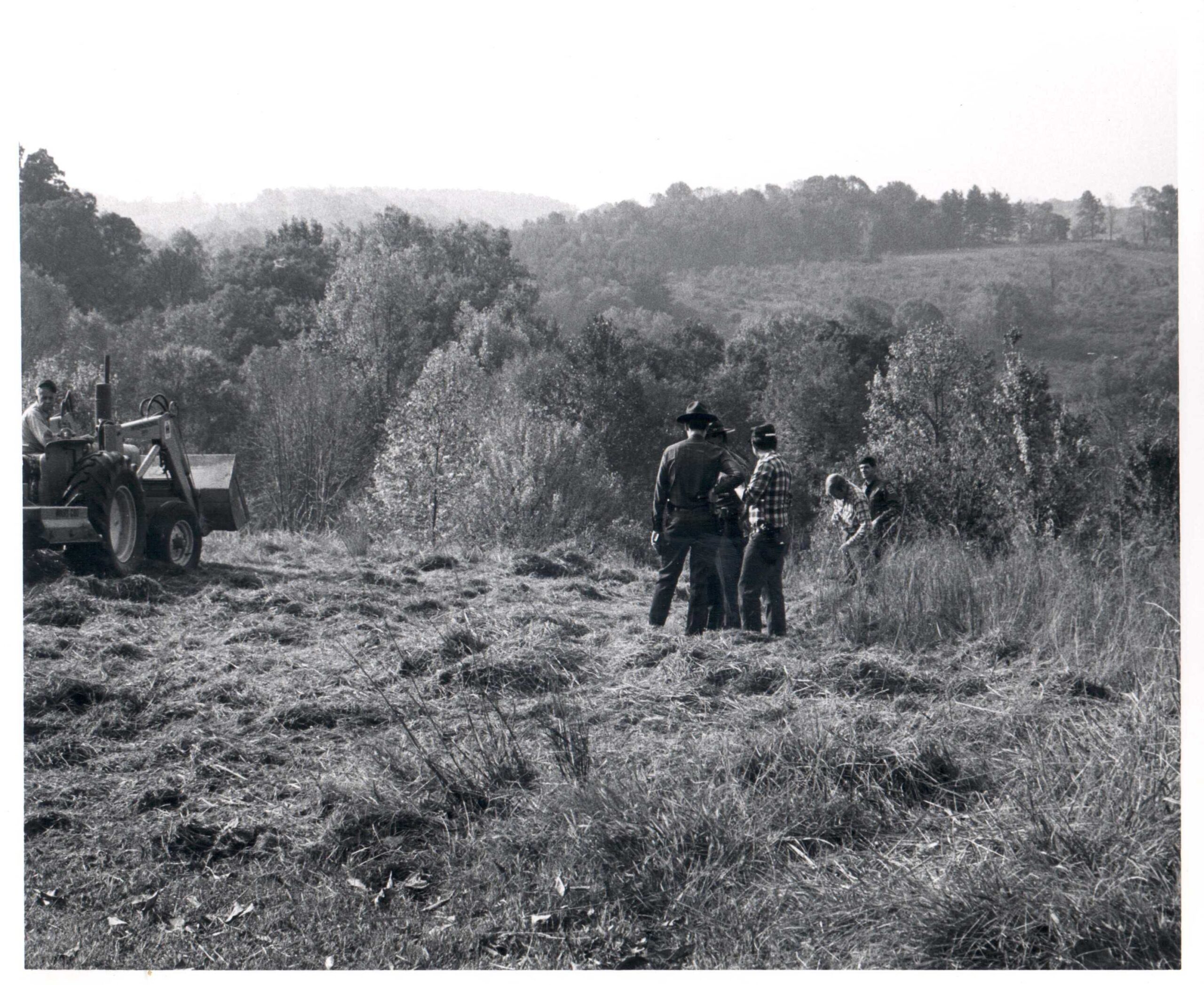
Police search for Gretchen Harrington in 1975. Harrington was reporting missing that August, and found dead in October.
It wasn’t until Oct. 14, 1975, that a hiker found skeletal remains along a path in Ridley Creek State Park. At first, he thought they belonged to an animal.
“I looked closely and saw what I thought was fingernails,” the man told police, according to a new book on the case. The body was positively identifiedas that of Gretchen Harrington. It bore signs of blunt force trauma to her skull. Her death was ruled a homicide.
Jordan, 57, now a health care marketing executive, still thinks of Gretchen and that summer each time he drives down Lawrence Road, the last place she was seen.
He remembers the Bible camp. Hot dogs and baked beans. Kickball and Wiffle ball. Then, an abduction and a murder. It haunted families for years.
“So many young people from the ‘70s still bear that pain and anxiety today,” he said. “She was a lovely girl.”
‘It was always a dead end’
Brandon Graeff was 2 years oldwhen Gretchen Harrington’s body was found. The case had long turned cold by 1997, when he joined the Marple Township police force.
Tips had poured in early on, then slowed. Detectives pursued them all, on and off the clock.
“Everything — and I mean everything — was followed up on,” said Graeff, who became chief in 2020.
The case came up from time to time, in roll call, or when a detective would grab the folder again during a slow week.
“They’d look through it, maybe try to see something different for her,” Graeff said, “But we couldn’t. We didn’t. It was always a dead end.”
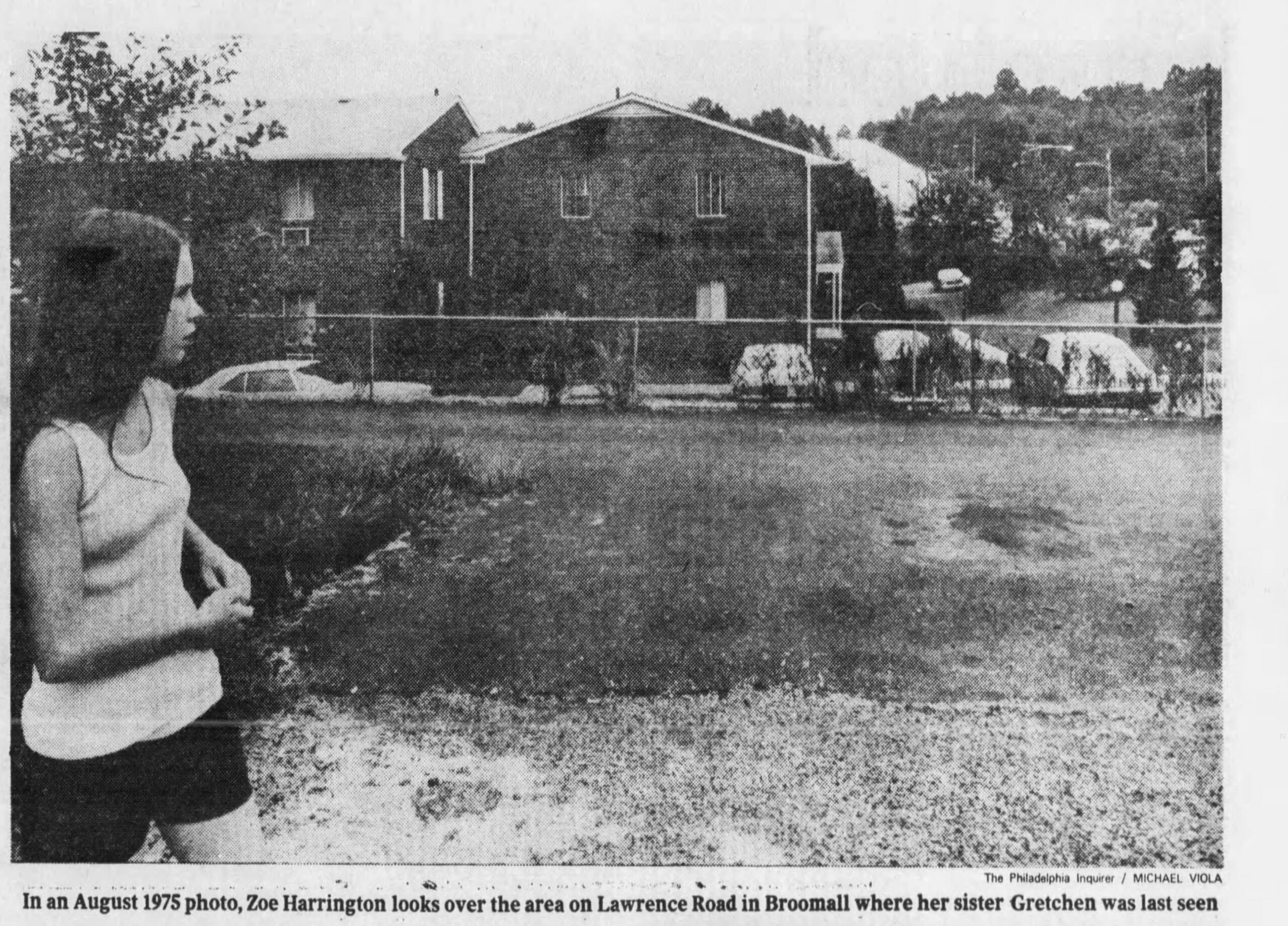
In a 1975 Inquirer photo, Zoe Harrington looks over the area on Lawrence Road in Broomall where her sister Gretchen Harrington was last seen.
Since 1975, the case has proceeded along two tracks: the abduction handled by Marple Police, and the homicide by state police, because the park in Edgmont Township is in their jurisdiction.
In early 2021, Graeff got a call from a man named Mike Mathis, who said he and another former township resident, Joanna Sullivan, were working on a book about the murder and were hoping the department would cooperate with granting them some access to the files.
With little movement in the investigation in decades, Graeff couldn’t think of a good reason to say no.
“We’re dealing with a little girl whose killer was not held to account,” he said. “My question to myself was, ‘Why not? How could it hurt?’”
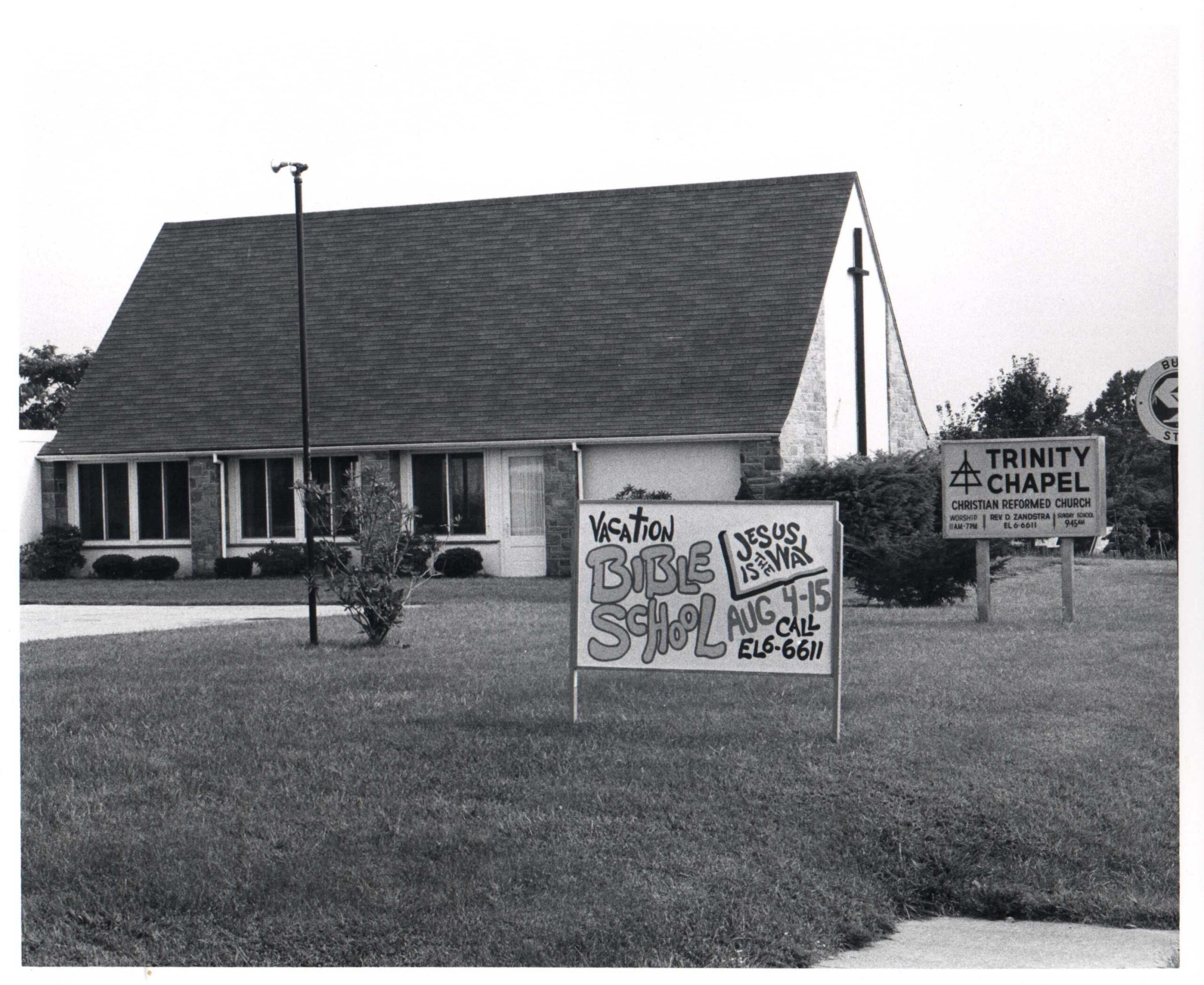
Trinity Chapel, where David Zandstra was reverend.
Sullivan, 57, remembers being at Lawrence Park Swim club the day that Gretchen disappeared. The image of a hovering helicopter was seared into her memory.
“We were just at the pool on a hot summer day and the helicopter was overhead,” she said. “We were wondering what was going on. Then we heard.”
Mathis, 58, remembers his father joining the search for Gretchen. He and Sullivan would meet a few years later at Paxon Hollow Middle School. They were editors at the student newspaper, The Hollow Log.
They kept in touch through high school and beyond. At a reunion decades later, they’d talk about writing a book together about Gretchen.
“It just stayed with me and Mike and many other kids through the years,” said Sullivan, now the editor-in-chief of the Baltimore Business Journal. “I always thought I’d like to write that story.”
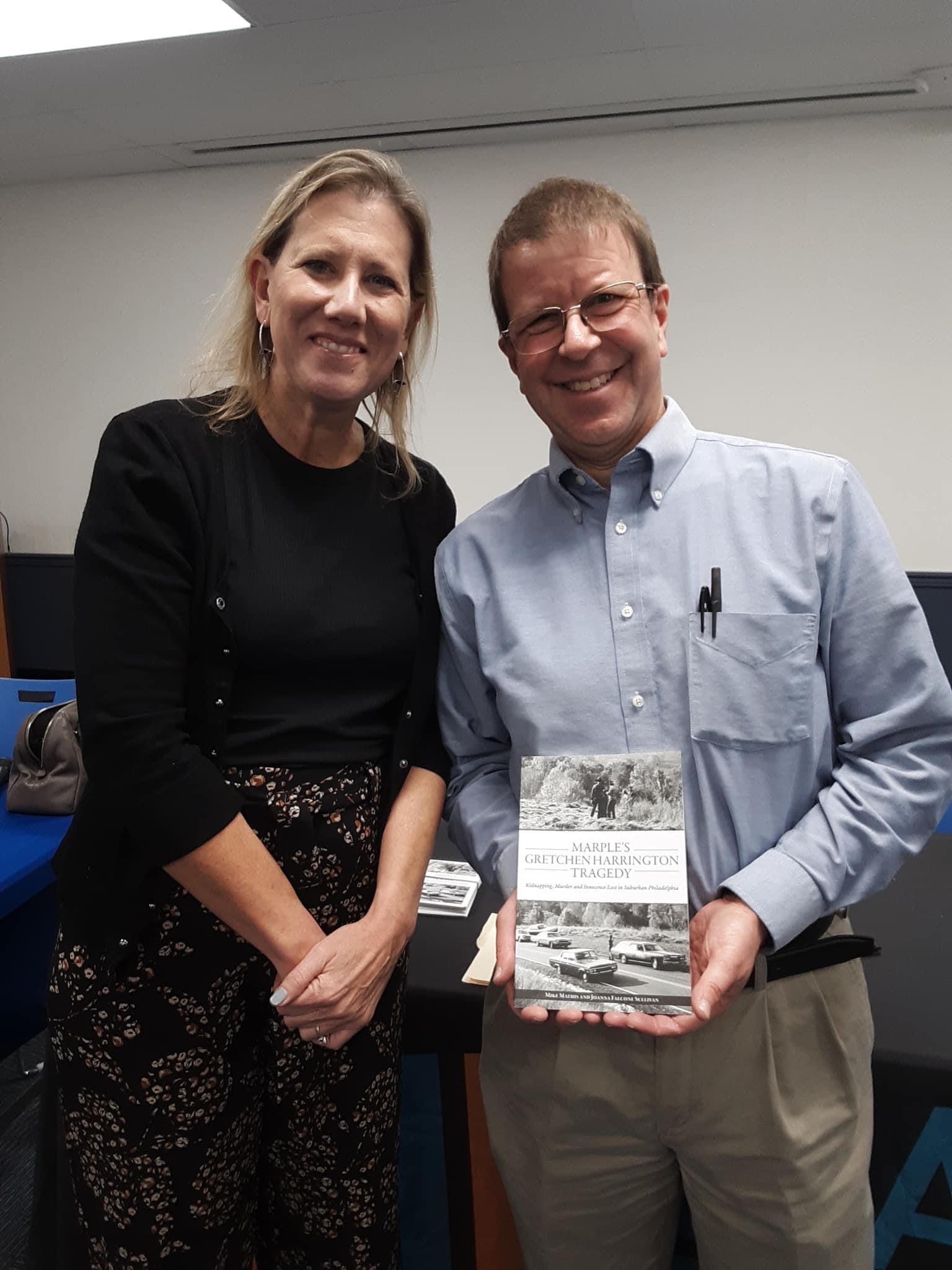
Joanna Sullivan and Mike Mathis, who worked together on the student newspaper at Paxon Hollow Middle School, released a book last year on the murder of Gretchen Harrington. Weeks later, a new witness came forward who enabled state police to elicit a confession from David Zandstra, a former reverend.
When COVID struck in 2020, Sullivan and Mathis suddenly had more time. They got started by creating a list of people they wanted to interview.
“At the top of the list,” she said, “was the Zandstra family.”
The book, Marple’s Gretchen Harrington Tragedy: Kidnapping, Murder and Innocence Lost in Suburban Philadelphia, was published in October 2022. Sullivan and Mathis did a round of public appearances in the area, including a December book signing at the Barnes & Noble in the Lawrence Park Shopping Center — just down the street fromwhere Gretchen was abducted.
They had no idea that, just a few weeks later, a woman would come forward with information that would break the case wide open.
“I think it was Mr. Z”
On Jan. 2, 2023, state police interviewed a woman later identified in court documents only by her initials. She said she’d frequently slept at the home of a local reverend named David Zandstra and his family because she was friends with his daughter.
Zandstra had served at Trinity Chapel Christian Reformed Church, one of two churches on Lawrence Road in Marple Townshipthat were used for the Bible camp that Gretchen attended. The other was the Reformed Presbyterian Church, where Gretchen’s father was the pastor.
It was Zandstra who called police and reported Gretchen missing at 11:23 a.m. on Aug. 15, 1975. He said he was calling at the request of the girl’s father.
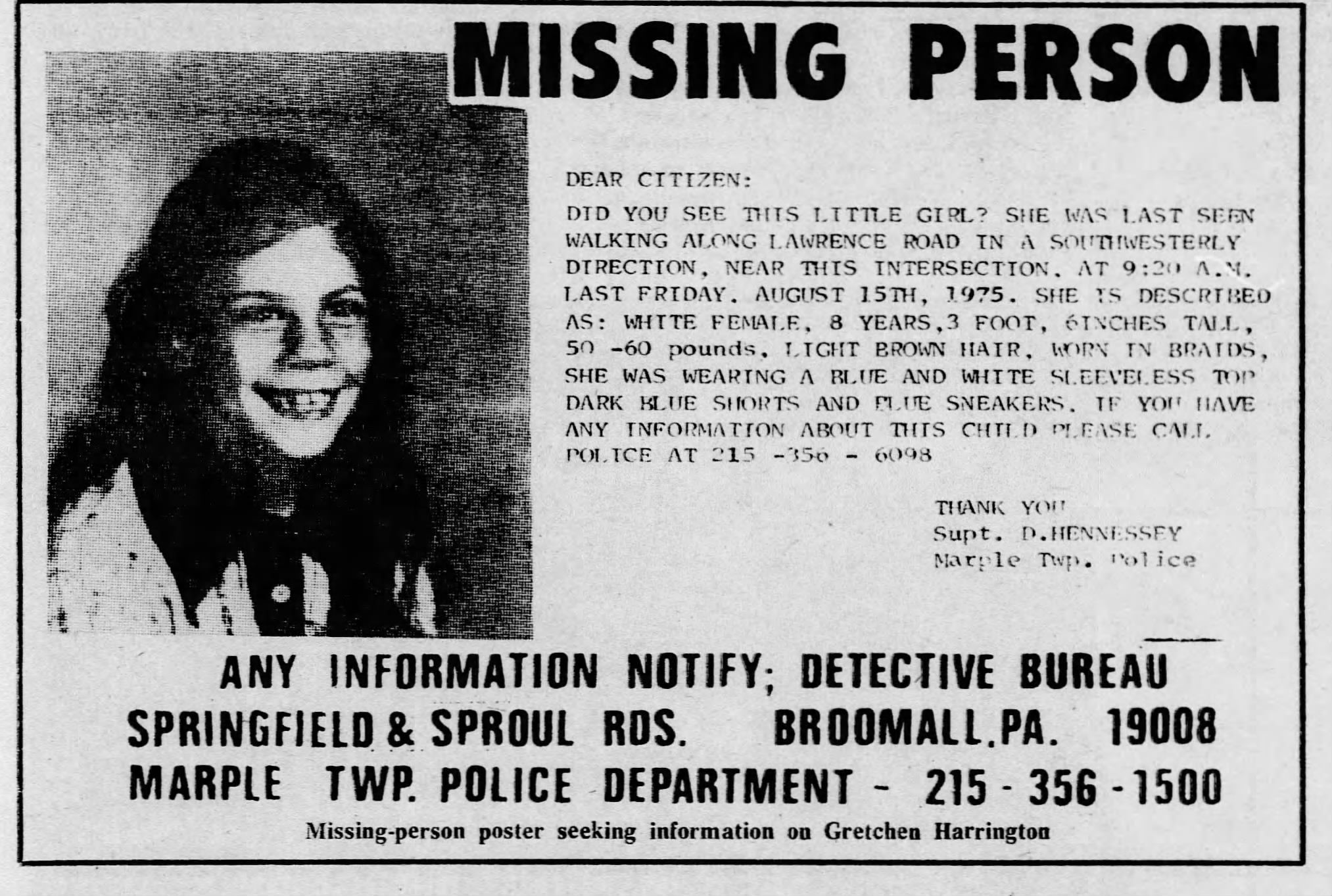
A missing person’s poster for Gretchen Harrington, 8, from a 1975 Inquirer article. The Delaware County District Attorney has announced charges against David Zandstra, currently of Marietta Ga., in Harrington’s murder.
The new witness told state investigators that during two sleepovers at the Zandstra house when she was 10 years old, she awoke to Zandstra touching her. She also showed police a childhood diary she’d kept that mentioned the sleepovers and, in September 1975, her suspicion that Zandstra might have been involved with the attempted kidnapping of a girl in her class, as well as Gretchen’s disappearance.
“It’s a secret, so I can’t tell anyone, but I think he might be the one who kidnapped Gretchen,” she wrote. “I think it was Mr. Z.”
At first, a cordial interview
Earlier this month, David Zandstra, 83 and living in Marietta, Ga., walked into an interview room at the Cobb County Police Headquarters with no reservations about speaking with police. He didn’t lawyer up. It was the department’s “soft” interview room. Couch, comfortable chairs, unlocked.
Two Pennsylvania troopers were waiting for him: Cpl. Andrew Martin, who had picked up the Harrington case about 2017, and Eugene Tray, who’d been called in recently. They’d caught a flight to Atlanta on July 17 to interview the octogenarian suspect, with thenew information in hand.
Trooper Eugene Tray, who participated in the investigation and arrest of David Zandstra, and Delaware County District Attorney Jack Stollsteimer, announcing the arrest.
If Zandstra was worried about the interviewwhen he sat down, he didn’t show it — at least not at first.
Back in 1975, police had interviewed Zandstra twice. He also spoke to Mathis for the book, which focused on a different man as the prime suspect.
“Deep down, I’m sure he was very, very concerned,” Tray said.
The conversation was almost cordial to start. Zandstra denied ever seeing Gretchen on the day she went missing.
But then police told Zandstra about the sexual assault allegations from the girl with the diary. It was the final straw placedon top of nearly a half-century of guilt. He broke down and confessed.
“We asked and he spoke,” Tray said. “He was presented with things I don’t think he expected to be presented with. Then, I think he started to think more on it. I think he just wanted his sick, twisted version of redemption, and to come clean.”
Zandstra admitted to abducting Gretchen as she was walking to Trinity Chapel for morning exercises, according to the criminal complaint. He said Gretchen asked to go home, but he drove her to a wooded area and parked. When she refused his demand to take off her clothes, he struck her in the head with his fist, court documents state.
Zandstra said he checked her pulse and believed that she had died, so he attempted to cover up her half-naked body with sticks and left the area.
“He was two different people,” Tray said of Zandstra, before and after his confession. “He was definitely relieved and happy to get that off his chest, how sick that may be.”
Searching for other victims
Zandstra left Delaware County in 1976, and worked in Texas and California before retiring to Georgia. Cops in and around Marple Township who’d worked on the case, or helped search for Gretchen in 1975, have retired and died.
The case took a toll on many of them, knowing a child killer could have gotten away with it, said Delaware County District Attorney Jack Stollsteimer, who was 12 years old when Gretchen disappeared.
“It’s important to understand law enforcement officers are moved by the trauma they see happen,” he said. “That’s why they’re in this business of trying to bring justice.”
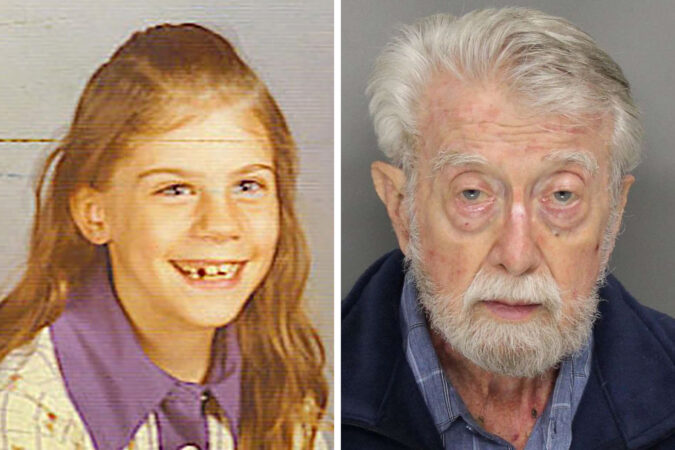
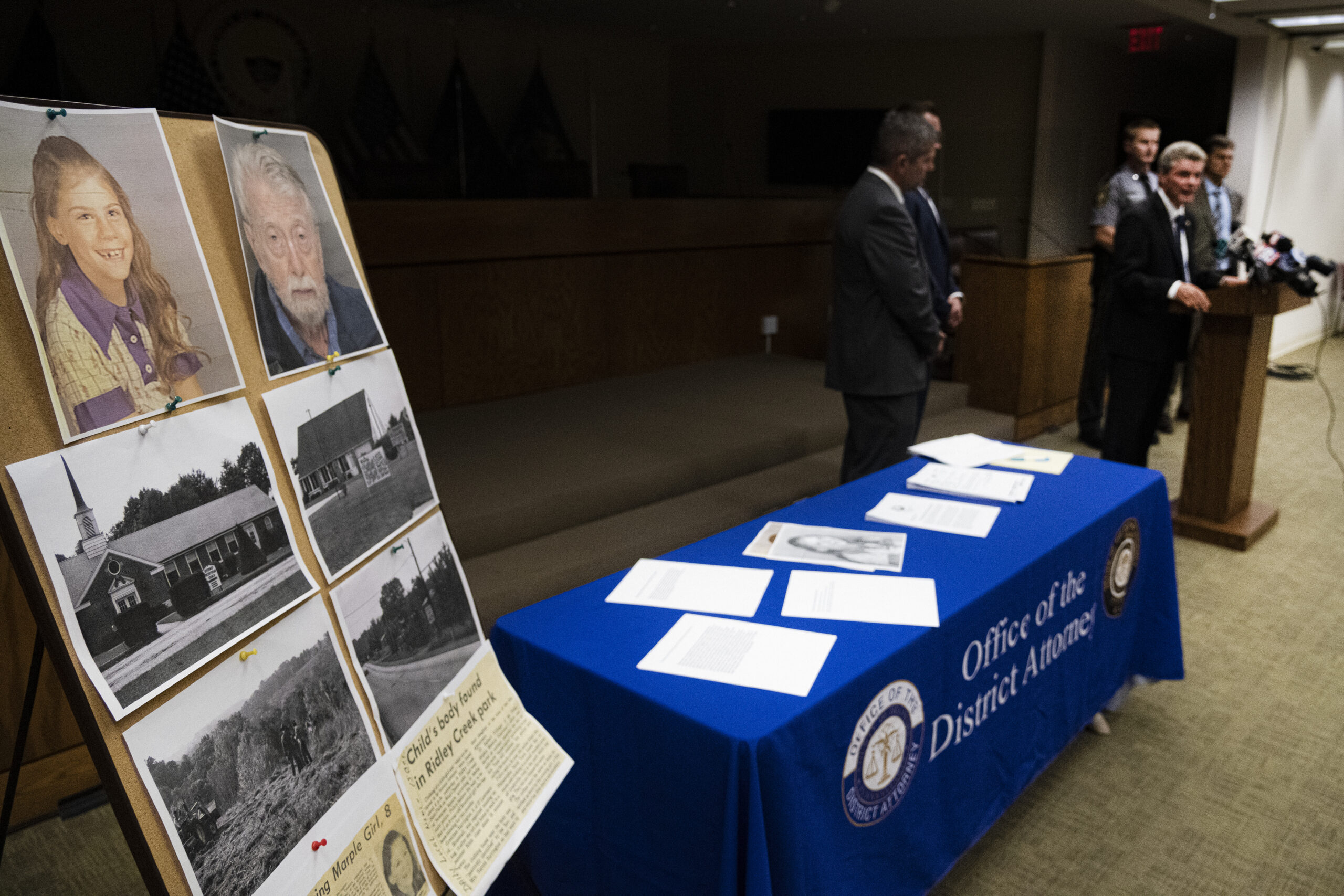
A photo of a victim and her alleged killer are shown during District Attorney Jack Stollsteimer’s news conference on Monday, July 24, 2023.
Stollsteimer described Zandstra’s arrest as a “great relief” to police in Delaware County and praised Martin, in particular, for sticking with the case.
“This is just great, old-fashioned police work,” he said.
Martin was unable to attend the news conference on Monday announcing Zandstra’s arrest and was not available for an interview this week. Tray, however, said the “case would not have been solved were it not for him.”
State police collected DNA from Zandstra when he was arrested, which could prove useful if there are additional victims in other parts of the country.
As part of that effort, the Christian Reformed Church in North America says it is reaching out to Zandstra’s former congregations. He served in Flanders, N.J.; Broomall, Pa.; Plano, Texas; and San Diego and Fairfield, Calif.
After settling in Georgia, Zandstra continued to advise clients of a pregnancy resource center, according to a 2012 religious newsletter in which he wrote a small section titled “Peace to you.” A photo shows him smiling, with gray hair and a closely cropped beard.
“The prospect of peace was and is badly needed in the uncounted and constant conflicts of our world,” he wrote. “Only believers in Jesus are able to find real peace with God.”
“Who knows? This guy was a monster,” Stollsteimer said. “Nothing would surprise me.”
Sullivan, the author of the book on the Harrington murder, has been fielding calls and Facebook messages this week from people in Marple who might have information about other cases of abuse.
“I don’t think it was an isolated case,” Sullivan said.
As for whether the book helped lead to the break in the case, that depends on whom you ask. Some law enforcement officials are convinced that it did. Others cautioned against such speculation. Regardless, a new chapter is planned if the book goes to another printing: Case solved.
On Friday, the Delco DA’s office got word that Zandstra would waive an extradition hearing and agree to be transported from Georgia to Pennsylvania. But his defense lawyer later sought to have the waiver recalled because he was not present with Zandstra when it was signed. Authorities are awaiting a judge’s ruling.
The Harrington family released a statement this week, thanking police for their work and community members for their support over the years. Gretchen’s father, Harold, died in November 2021 at the age of 94.
“If you met Gretchen, you were instantly her friend,” the family wrote. ”She exuded kindness to all and was sweet and gentle. Even now, when people share their memories of her, the first thing they talk about is how amazing she was and still is. At just 8 years old, she had a lifelong impact on those around her.”