Category: Crime

  • Philadelphia man charged with killing woman who reported him for sexual assault, officials say

    Philadelphia man charged with killing woman who reported him for sexual assault, officials say

    A Philadelphia man was charged with murder after fatally shooting his girlfriend in Levittown this weekend, shortly after she told police he had sexually assaulted her, authorities said.

    Yujun Ren, 32, turned himself in to police in Middletown Township Sunday and told them he had been trying to scare the woman, Yuan Yuan Lu, when the firearm he carried accidentally discharged, killing her.

    Investigators believe otherwise, according to the affidavit of probable cause for Ren’s arrest.

    In addition to murder, prosecutors charged Ren with stalking and a gun crime. He is being held without bail.

    Bristol Township police discovered Lu’s body shortly after noon Sunday in the driver’s seat of a white Hyundai in a residential neighborhood, according to the affidavit.

    Lu had been shot in the head. Police found that the driver’s side window had been struck by gunfire, and they recovered an expended shell casing from a small caliber handgun.

    In Ren’s interview with investigators, he told them that Lu had said “hurtful things and took their cats and dogs,” the affidavit said, leading him to pull the handgun in an attempt to scare her.

    A day earlier, Lu had told Philadelphia police that Ren had sexually assaulted her at his home on South Orianna Street in Pennsport.

    The assault, which Lu said happened around 1 p.m. Saturday, led her to end the relationship and pack her things to leave while Ren was at work, according to the affidavit. Lu told police she was afraid of Ren and said “he had a firearm he carried everywhere,” the document said.

    Ren legally owned a Mossberg MC20 9mm pistol, investigators found.

    The day Ren turned himself in, a woman who told police that she was Ren’s aunt turned that firearm over to Middletown Township authorities, according to the affidavit.

    Bucks County District Attorney Joe Khan said in a statement that the killing was a “sobering reminder of the lethal nature of domestic violence.”

    “Our investigation revealed a chilling course of conduct,” said Khan, adding that investigators recovered evidence showing Ren stalked Lu in the early morning hours before shooting her.

    Ren is set to appear in district court Tuesday for a preliminary hearing.

  • Police: Man dies after being shot in North Philly Saturday night

    Police: Man dies after being shot in North Philly Saturday night

    A man died in North Philadelphia Saturday night after being shot, city police said.

    The fatal shooting happened around 7:40 p.m. on the 3200 block of North Howard Street, police said. Officers responding to a call found the man “suffering from multiple gunshot wounds.”

    Emergency medical responders pronounced him dead at 7:45 p.m., police said.

    No arrests have been made, and police have not located the firearm used in the shooting.

    Police ask those with information to call 215-686-TIPS (8477).

    This is the 11th homicide in Philadelphia this year, according to the police department’s crime statistics website. That’s a 50% decrease from the same period last year, the website states. Last year, homicides were at a nearly 60-year low after peaking in 2021.

  • A funeral home stashed 189 decaying bodies and handed out fake ashes. His mother was among them

    A funeral home stashed 189 decaying bodies and handed out fake ashes. His mother was among them

    COLORADO SPRINGS, Colo. — Derrick Johnson buried his mother’s ashes beneath a golden dewdrop tree with purple blossoms at his home on Maui’s Haleakalā Volcano, fulfilling her wish of a final resting place looking over her grandchildren.

    Then the FBI called.

    It was Feb. 4, 2024, and Johnson was teaching an eighth-grade gym class.

    “‘Are you the son of Ellen Lopes?’” a woman asked, Johnson recalled in an interview with the Associated Press.

    There had been an incident, and an FBI agent would fly out to explain, the caller said. Then she asked: “’Did you use Return to Nature for a funeral home?’”

    “‘You should probably google them,’” she added.

    In the clatter of the weight room, Johnson typed “Return to Nature” into his cell phone. Dozens of news reports appeared, details popping out in a blur.

    Hundreds of bodies stacked on top of each other. Inches of body decomposition fluid. Swarms of bugs. Investigators traumatized. Governor declares state of emergency.

    Johnson felt nauseated and his chest constricted, forcing the breath from his lungs. He pushed himself out of the building as another teacher heard his cries and came running.

    Two FBI agents visited Johnson the following week, confirming his mother’s body was among 189 that Return to Nature’s owners, Jon and Carie Hallford, had stashed in a Colorado building between 2019 and Oct. 4, 2023, when the bodies were found.

    It was one of the largest discoveries of decaying bodies at a funeral home in the U.S. Lawmakers overhauled the state’s lax funeral home regulations. And besides handing over fake ashes to grieving families, the Hallfords also admitted to defrauding the federal government out of nearly $900,000 in pandemic-era aid for small businesses.

    Even as the Hallfords’ bills went unpaid, authorities said they bought Tiffany jewelry, luxury cars, and laser-body sculpting, pocketing about $130,000 clients paid for cremations.

    They were arrested in Oklahoma in November 2023 and charged with abusing nearly 200 corpses.

    Hundreds of families learned from officials that the ashes they ceremonially spread or kept close weren’t actually their loved ones’ remains. The bodies of their mothers, fathers, grandparents, children, and babies had moldered in a room-temperature building in Colorado.

    Jon Hallford was sentenced Friday to 40 years in prison. His now ex-wife, Carie Hallford, was to be sentenced in April. Both had pleaded guilty in December. Attorneys for Jon and Carie Hallford did not respond to an AP request for comment.

    Johnson, 45, who’s suffered panic attacks since the FBI called, promised himself that he would speak at Hallford’s sentencing and ask for the maximum penalty.

    “When the judge passes out how long you’re going to jail, and you walk away in cuffs,” he said, “you’re gonna hear me.”

    ‘She lied’

    Jon and Carie Hallford were a husband-and-wife team who advertised “green burials” without embalming as well as cremation at their Return to Nature funeral home in Colorado Springs.

    She would greet grieving families, guiding them through their loved ones’ final journey. He was less seen.

    Johnson called the funeral home in early February 2023, the week his mother died. Carie Hallford assured him she would take good care of his mother, Johnson said.

    Days later, she handed Johnson a blue box containing a zip-tied plastic bag with gray powder, saying those were his mother’s ashes.

    “She lied to me over the phone. She lied to me through email. She lied to me in person,” Johnson told the AP.

    The following day, the box lay surrounded by flowers and photos of Ellen Marie Shriver-Lopes at a memorial service at a Holiday Inn in Colorado Springs.

    Johnson sprinkled rose petals over it as a preacher said: “Ashes to ashes, dust to dust.”

    Caught on video

    On Sept. 9, 2023, surveillance footage showed a man appearing to be Jon Hallford walk inside a building owned by Return to Nature in the town of Penrose, outside Colorado Springs, according to an arrest affidavit.

    Camera footage inside showed a body laying on a gurney wearing a diaper and hospital socks. The man flipped it onto the floor.

    Then he “appeared to wipe the remaining decomposition from the gurney onto other bodies in the room,” before wheeling what appeared to be two more bodies into the building, the affidavit said.

    In a text to his wife, Hallford said, “while I was making the transfer, I got people juice on me,” according to court testimony.

    The neighborhood mom

    Johnson grew up with his mother in an affordable-housing complex in Colorado Springs, where she knew everyone.

    Johnson’s father wasn’t around much; at 5 years old, Johnson remembers seeing him punch his mom, sending her careening into a table, then onto a guitar, breaking it.

    It was Lopes who taught Johnson to shave and hollered from the bleachers at his football games.

    Neighborhood kids called her “mom,” some sleeping on the couch when they needed a place to stay and a warm meal. She would chat with Jehovah’s Witnesses because she didn’t want to be rude. With a life spent in social work, Lopes would say: “If you have the ability and you have the voice to help … help.”

    Johnson spoke with his mother nearly everyday. After diabetes left her blind and bedridden at age 65, she’d ask Johnson to describe what her grandchildren looked like over the phone.

    It was Super Bowl Sunday in 2023 when her heart stopped.

    Johnson, who had flown in from Hawaii to be at her bedside, clutched her warm hand and held it until it was cold.

    A gruesome discovery

    Detective Sgt. Michael Jolliffe and Laura Allen, the county’s deputy coroner, stood outside the Penrose building on Oct. 3, 2023, according to the 50-page arrest affidavit.

    A sign on the door read “Return to Nature Funeral Home” and listed a phone number. When Joliffe called it, it was disconnected. Cracked concrete and yellow stalks of grass encircled the building. At back was a shabby hearse with expired registration. A window air-conditioner hummed.

    Someone had told Jolliffe of a rank smell coming from the building the day before, the affidavit said.

    One neighbor told an AP reporter they thought it came from a septic tank; another said her daughter’s dog always headed to the building whenever he got off-leash.

    It was reminiscent of rancid manure or rotting fish, and struck anyone downwind of the building.

    Joliffe and Allen spotted a dark stain under the door and on the building’s stucco exterior. They thought it looked like fluids they had seen during investigations with decaying bodies, the affidavit said.

    But the building’s windows were covered and they couldn’t see inside.

    Allen contacted the Colorado Department of Regulatory Agency, which oversees funeral homes, which got in touch with Jon Hallford. Hallford agreed to show an inspector inside the next afternoon.

    Inspector Joseph Berry arrived, but Hallford didn’t show.

    Berry found a small opening in one of the window coverings, the affidavit said. Peering through, he saw white plastic bags that looked like body bags on the floor.

    A judge issued a search warrant that week.

    Bodies stacked high

    Donning protective suits, gloves, boots, and respirators, investigators entered the 2,500-square-foot building on Oct. 5, 2023, according to the affidavit.

    Inside, they found a large bone grinder and next to it a bag of Quikcrete that investigators suspected was used to mimic ashes. Bodies were stacked in nearly a dozen rooms, including the bathroom, sometimes so high they blocked doorways, the affidavit said.

    There were 189.

    Some had decayed for years, others several months, according to the affidavit. Many were in body bags, some wrapped in sheets and duct tape. Others were half-exposed, on gurneys or in plastic totes, or lay with no covering, it said.

    Investigators believed the Hallfords were experimenting with water cremation, which can dissolve a body in several hours, the document said. There were swarms of bugs and maggots.

    Body bags were filled with fluid, according to the affidavit. Some had ripped. Five-gallon buckets had been placed to catch the leaks. Removal teams “trudged through layers of human decomposition on the floor,” it said.

    Investigators identified bodies using fingerprints, hospital bracelets and medical implants, the affidavit said. It said one body was supposed to be buried in Pikes Peak National Cemetery.

    Investigators exhumed the wooden casket at the burial site of the U.S. Army veteran, who served in Vietnam and the Persian Gulf. Inside was a woman’s deteriorated body, wrapped in duct tape and plastic sheets.

    The veteran’s body was discovered in the Penrose building, covered in maggots.

    ‘Ashes to ashes’

    Following the call from the FBI, Johnson promised himself he would speak at the Hallfords’ sentencing. But he struggled to talk about what had happened even with close friends, let alone in front of a judge and the Hallfords.

    For months, Johnson obsessed over the case, reading dozens of news reports, often glued to his phone until one of his children would interrupt him to play.

    When he shut his eyes, he said he imagined trudging through the building with “maggots, flies, centipedes. There’s rats, they’re feasting.” He asked a preacher if his mother’s soul had been trapped there. She reassured him it hadn’t. When an episode of the zombie show The Walking Dead came on, he broke down.

    Johnson started seeing a therapist and was diagnosed with post-traumatic stress disorder. He joined Zoom meetings with other victims’ relatives as the number grew from dozens to hundreds.

    After Lopes’ body was identified, Johnson flew in March 2024 to Colorado, where his mother’s remains lay in a brown box in a crematorium.

    “I don’t think you blame me, but I still want to tell you I’m sorry,” he recalled saying, placing his hand on the box.

    Then Lopes’ body was loaded into the cremator and Johnson pushed the button.

    Justice

    Johnson has slowly improved with therapy, engaging more with his students and children. He began practicing speaking at the Hallfords’ sentencings in therapy. Closing his eyes, he envisioned standing in front of the judge — and the Hallfords.

    “Justice is, it’s the part that is missing from this whole equation,” he said. “Maybe somehow this justice frees me.

    “And then there’s part of me that’s scared it won’t, because it probably won’t.”

  • Downingtown dog involved in 4 attacks is euthanized

    A Downingtown dog has been euthanized after it injured multiple people in recent months and made residents feel unsafe, officials said.

    The decision, made the day of a Thursday hearing in district court, stems from a November incident in which the dog bit a child in a neighboring house on the 500 block of Thomas Road.

    Whitley Coggins said her sons, ages 4 and 8, had been playing in the backyard when the neighbor’s dogs were let outside. One mixed-breed dog got through the fence, attacking her youngest son, she said. The boy was bitten on his upper arm and required stitches.

    There are four dogs that had been known to neighbors for aggressive behavior, she said. Though the Coggins family had never personally experienced it until November, the mother said, she warned her sons to run back inside if they ever saw the dogs in the yard.

    After the hearing and the owner’s decision to euthanize, Coggins said she was frustrated that the only positive was that one of the dogs was removed from the house.

    “I feel like I’m supposed to feel like something was done, I’m supposed to feel good that the one dog that attacked my child is gone, and I do feel a small sense of replaced safety or something — that that one dog is not there,” she said. “But that one dog has never been the problem, not the whole problem.”

    Coggins said her sons still feel unsafe leaving the house and are fearful of dogs.

    “Following our time in court, we still had to return — and the rest of the neighbors had to return — to a neighborhood with three dogs who have registered attacks on other people and other animals, and because of the laws and the way the laws are written or interpreted, there is nothing to go forward with to remove these dogs,” Coggins said.

    Reached by phone, the attorney for the dog owner declined comment.

    Brendan Brazunas, Downingtown’s chief of police, said the owner’s defense counsel immediately suggested euthanasia given the seriousness of the 4-year-old’s injury, and the fact that this was the fourth documented bite involving this dog since 2023.

    “The dog that created the most issues at that house is this dog that was euthanized,” Brazunas said. “Obviously, the community is very concerned and they’re afraid, and I think this was the first step with regards to dogs at that house.”

    Brandywine Valley SPCA, which had assisted the Downingtown police in the case, transported and euthanized the dog, a spokesperson for the organization said.

    “This was a tragic situation that never should have escalated to this point,” Erica Deuso, mayor of Downingtown, said in a statement. “I love animals, and I am heartbroken any time a dog loses its life, but public safety comes first.”

    The charges were dropped, as they can only be made for live dogs, Brazunas said. But there are ongoing cases facing the owner’s other dogs.

    A Jan. 20 incident was reported to police when the dogs escaped through an open door and injured an adult man, a tow-truck driver who was returning a vehicle. That case will be heard in the coming weeks.

    The SPCA has six outstanding charges for other dogs in the owner’s home regarding rabies vaccinations, dog licenses, and the dogs getting loose, the spokesperson said.

  • Cumberland County skill game executive pleads guilty to money laundering, tax fraud

    Cumberland County skill game executive pleads guilty to money laundering, tax fraud

    A skill game industry executive who took kickbacks from illegal gambling machine operators throughout Pennsylvania pleaded guilty this week in Cumberland County to money laundering.

    Ricky Goodling, an ex-state police corporal and former national compliance director for Pace-O-Matic, contributed to the “disorganized and problematic” skill game market when he accepted hundreds of thousands of dollars in exchange for quashing complaints about illegal gaming machines, Attorney General Dave Sunday said in a statement.

    Goodling, 59, of Mechanicsburg, also pleaded guilty in federal court to evading more than $100,000 in taxes after falsely claiming the proceeds of the scheme were business travel expenses, according to the U.S. Attorney’s Office in Harrisburg.

    An attorney listed for Goodling in court records declined to comment.

    Pace-O-Matic said in a statement that it was “deeply troubled” by Goodling’s guilty plea. “We are also troubled to know that he violated our trust and intentionally harmed our business interests,” the statement reads.

    According to Pace-O-Matic’s statement, law enforcement has assured the company that it is “not involved in or connected with any of the actions of Mr. Goodling, and they have characterized Pace-O-Matic as a victim of these crimes.” The company terminated Goodling’s employment in November 2023 when it learned of the investigation.

    The powerful and controversial skill game industry has operated largely by its own rules in Pennsylvania for more than a decade, allowing the slot machinelike devices to proliferate in bars and gas stations across the commonwealth.

    Skill games operate in a legal gray area: Courts have ruled that the so-called skill component distinguishes them from games of chance, like slot machines. The state Supreme Court is now weighing the machines’ lawfulness.

    The biggest player in the skill games market, Georgia-based Pace-O-Matic, has claimed for years that its machines are the only “legal” skill games — and spent millions of dollars on campaigns and lobbying for favorable regulation and lower tax rates.

    While some lawmakers want to ban the machines outright, arguing they attract crime and can be addictive, others see it as a potential new revenue stream. Last year, Gov. Josh Shapiro proposed taxing the machines at 52%, which the industry quickly rejected. In his latest budget, the governor said that regulating skill games, coupled with legalizing cannabis, could generate $2 billion annually.

    Illegal gambling enterprises have sought to commingle their machines with Pace-O-Matic’s legal games, in an attempt to give their products a veneer of legitimacy and deflect law enforcement scrutiny, according to an October 2024 state grand jury presentment. Goodling acted as their ally, facilitated straw purchases of Pace-O-Matic games, and laundered the money through a fictitious company, prosecutors said.

    Goodling is scheduled to be sentenced April 28 in the state case.

  • Unmasking ICE in Philly could test the limits of local power over federal agents

    Unmasking ICE in Philly could test the limits of local power over federal agents

    One of the lasting images of President Donald Trump’s mass deportation campaign will be the masks worn by federal immigration agents.

    The widespread use of facial coverings by U.S. Immigration and Customs Enforcement officers is among the suite of tactics — agents dressed in plainclothes, wearing little identification, jumping out of unmarked cars to grab people off the street — that have fueled immigration advocates’ use of terms like “kidnappings” and “abductions.”

    Now Philadelphia lawmakers appear poised to pass legislation that would ban all officers operating in the city — including local police — from concealing their identities by wearing masks or conducting enforcement from unmarked cars.

    The question is whether the city can make that rule stick.

    Legal hurdles loom for municipalities and states attempting to regulate federal law enforcement. Local jurisdictions are generally prohibited from interfering with basic federal functions, and Trump administration officials say state- and city-level bans violate the constitutional provision that says federal law reigns supreme.

    Experts are split on whether the bill proposed by Philadelphia City Council members last week would survive a lawsuit.

    There are also practical concerns about enforcement. Violating the mask ban would be a civil infraction, meaning local police would be tasked with citing other law enforcement officers for covering their faces.

    “No doubt this will be challenged,” said Stanley Brand, a distinguished fellow at Penn State Dickinson Law. “This ordinance will be a protracted and complicated legal slog.”

    Councilmember Kendra Brooks speaks during a news conference at City Hall to announce a package of bills aimed at pushing back against ICE enforcement on Jan. 27.

    Advocates for immigrants say that unmasking ICE agents is a safety issue, and that officers rarely identify themselves when asked, despite being required to carry badges.

    Mask use can also spur impersonators, they say. At least four people in Philadelphia have been arrested for impersonating ICE officers in the last year.

    “You see these people in your community with guns and vests and masks,” said Desi Bernette, a leader of MILPA, the Movement of Immigrant Leaders in Pennsylvania. “It’s very scary, and it’s not normal.”

    Democrats in jurisdictions across America, including Congress and the Pennsylvania General Assembly, have introduced legislation to ban ICE agents from concealing their faces. California is the furthest along in implementing a mask prohibition, and a judge is currently weighing a challenge filed by the Trump administration.

    Senate Democrats negotiating a budget deal in Washington have asked for a nationwide ban on ICE agents wearing masks in exchange for their votes to fund the Department of Homeland Security.

    And polling shows getting rid of masks is popular. A recent Pew Research Center survey found that 61% of Americans believe federal agents should not wear face coverings to conceal their identities while on duty.

    ICE officials say agents should have the freedom to conceal their faces while operating in a hyperpartisan political environment.

    Last year, ICE head Todd Lyons told CBS News that he was not a proponent of agents wearing masks, though he would allow it. Some officers, he said, have had private information published online, leading to death threats against them and their families.

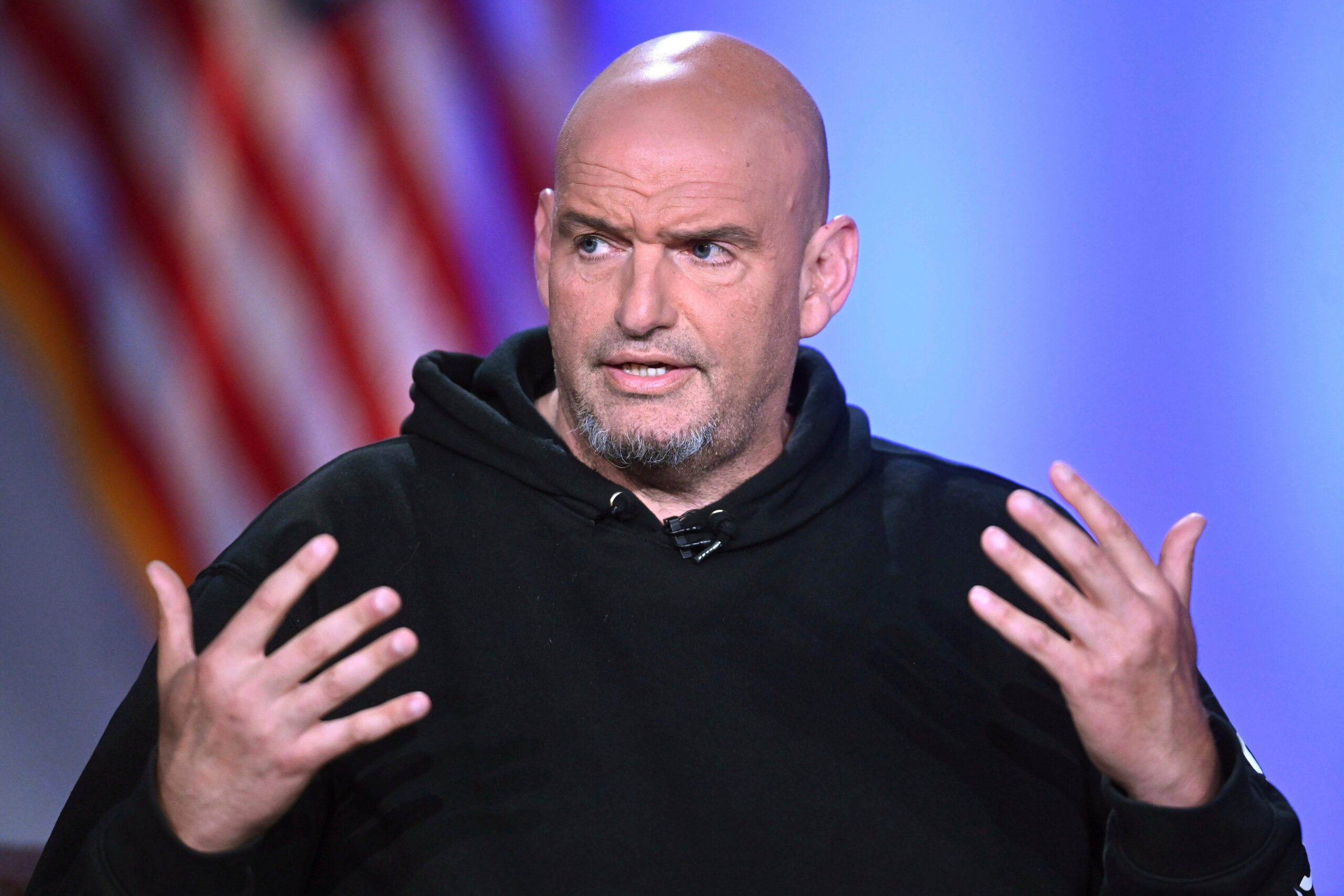
    On Sunday, U.S. Sen. John Fetterman, a Pennsylvania Democrat, defended ICE officers who wear masks and said doxing is a “serious concern.”

    “They could target [agents’] families,” Fetterman said in an interview on Fox News, “and they are organizing these people to put their names out there.”

    Sen. John Fetterman, D-Pa., participates in a debate on June 2, 2025, in Boston.

    The Council authors of the Philadelphia bills say they are responding to constituents who are intimidated by ICE’s tactics, and they believe their legislation can withstand a legal challenge.

    “Our goal is to make sure that our folks feel safe here in the city,” said City Councilmember Kendra Brooks. “We are here to protect Philadelphians, and if that means we eventually need to go to court, that’s what would need to happen.”

    The constitutional limits on unmasking ICE

    The bill introduced last week by Brooks and Councilmember Rue Landau is part of a package of seven pieces of legislation aimed at limiting how ICE operates in Philadelphia. The proposals would bar Philadelphia employees from sharing information with ICE and ban the agency from using city property to stage raids.

    Fifteen of Council’s 17 members signed on to the package of legislation, meaning a version of it is likely to become law. Passing a bill in City Council requires nine votes, and overriding a mayoral veto takes 12. Mayor Cherelle L. Parker has said her team is reviewing the legislation, which can still be amended before it becomes law.

    Anti-ICE activists demonstrate outside U.S. Sen. John Fetterman’s Philadelphia office, Jan. 27, calling for an end to federal immigration enforcement policies.

    One of the two members who did not cosponsor the package was Councilmember Mike Driscoll, a Democrat who represents parts of Lower Northeast Philadelphia. He indicated that he had concerns about whether the “ICE Out” legislation would hold up in court.

    Brooks said Council members worked with attorneys to ensure the legislation is “within our scope as legislators for this city to make sure that we protect our folks against these federal attacks.”

    Brand, of Dickinson Law, said the legislation is a classic example of a conflict between two constitutional pillars: the clause that says federal law is supreme, and the 10th Amendment, which gives states powers that are not delegated to the federal government.

    He said there is precedent that the states — or, in this case, cities — cannot interfere with laws enacted by Congress, such as immigration matters.

    “If I were betting, I would bet on the federal government,” Brand said.

    But there is a gray area, he said, and that includes the fact that no law — or even regulation — says federal law enforcement agents must wear masks.

    Kermit Roosevelt, a law professor at the University of Pennsylvania who is an expert on the Constitution and conflict of laws, said if there is no agency policy, that is “free space” for states and cities to regulate.

    Roosevelt said Brooks’ legislation steers clear of other constitutional concerns because it applies to all police officers, not just federal agents.

    “If they were trying to regulate only federal agents, the question would be, ‘Why aren’t you doing that to your own police officers?’” he said. “If you single out the federal government, it looks more like you’re trying to interfere with what the federal government is doing.”

    Applying the law to local police

    Experts say part of the backlash to ICE agents covering their faces is because Americans are not used to it. Local police, sheriff’s deputies, and state troopers all work largely without hiding their faces.

    “Seeing law enforcement actions happening with federal agents in masks, that’s extremely jarring,” said Cris Ramon, an immigration consultant based in Washington. “Why are you operating outside of the boundaries of what every other law enforcement agency is doing?”

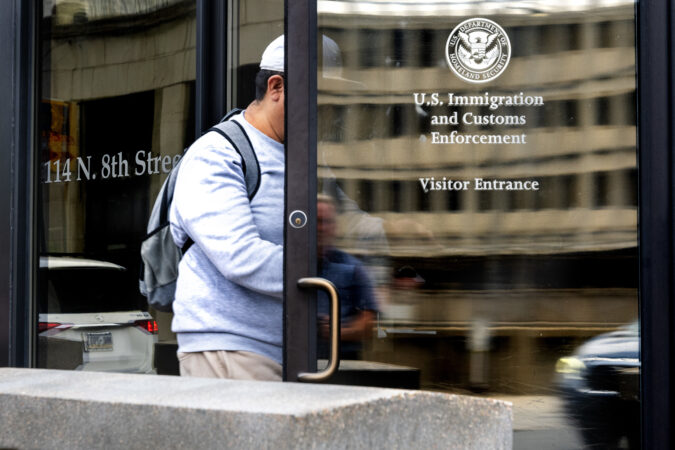
    Protesters march up Eighth Street, toward the immigration offices, during the Philly stands with Minneapolis Ice Out For Good protest at Philadelphia City Hall on Jan. 23.

    The Council legislation includes exceptions for officers wearing medical-grade masks, using protective equipment, or working undercover. It also allows facial coverings for religious purposes.

    However, the federal government could still raise First Amendment concerns, said Shaakirrah R. Sanders, an associate dean at Penn State Dickinson Law.

    The administration, she said, could argue that the city is only trying to regulate law enforcement officers and claim that would be discriminatory.

    Sanders said defending the legislation could be “very costly” and the city should consider alternatives that fall more squarely within its authority. She pointed to efforts like New Jersey Gov. Mikie Sherrill’s announcement that the state would create a database for residents to upload videos of ICE interacting with the public.

    “It looks like the city wants to wield big legislative power,” Sanders said. “My alternative is more in the grassroots work, where you are the first ear for your citizens, not the regulator of the federal government.”

  • Epstein emails show he helped arrange White House visit for Woody Allen

    Epstein emails show he helped arrange White House visit for Woody Allen

    NEW YORK — In 2015, Woody Allen and his wife, Soon-Yi Previn, went on a trip to Washington, D.C. With the help of their friend Jeffrey Epstein, they were able to tour the White House.

    Allen’s friendship with Epstein has been known for years, but emails in the huge trove of records released by the Justice Department in recent days illustrate that relationship in new depth.

    The filmmaker, his wife and Epstein were neighbors in New York City, and the three dined together often, records show. They offered each other emotional support during periods when they were being criticized in the media. They commiserated about being accused — unfairly, they told each other — of sexual misconduct.

    And in 2015, Epstein used his connections to another friend who had been in President Barack Obama’s administration to help the couple get a White House tour.

    “Could you show soon yi the White House,” Epstein wrote in a May 2015 email to former White House counsel Kathy Ruemmler. “I assume woody would be too politically sensitive?”

    “I am sure I could show both of them the White House,” Ruemmler responded, although she doubted whether Epstein, who in 2008 had pleaded guilty to solicitating prostitution from an underage girl, would be allowed in.

    “You are too politically sensitive, I think,” she added.

    White House records show that Allen, Previn, and Ruemmler visited on Dec. 27, a Sunday. Obama was in Hawaii at the time.

    Ruemmler and Allen were among a long list of notable people who maintained friendships with Epstein for years, even though he was a registered sex offender who had been accused of abusing children, and whose legal problems had been widely covered in newspapers.

    Some of the guests who accompanied Allen and Previn to dinners with Epstein included talk show host Dick Cavett, linguist Noam Chomsky, and the late comedian David Brenner. Epstein also attended screenings of Allen’s movies and, according to emails, would visit with Allen so he could watch him edit his latest film.

    “Wide variety of interesting people at every dinner,” was how Allen described some of their gatherings in a letter commissioned for a 2016 Epstein birthday party. “It’s always interesting and the food is sumptuous and abundant. Lots of dishes, plenty of choices, numerous desserts, well served. I say well served often it’s by some professional houseman and just as often by several young women reminding one of Castle Dracula where (actor Bela) Lugosi has three young female vampires who service the place.”

    A message sent to an assistant for Allen and Previn via email seeking comment wasn’t immediately returned. Epstein killed himself in 2019 while awaiting trial on sex trafficking charges.

    Emails suggest that Previn, too, had a close relationship to Epstein and she often served as the intermediary between Epstein and Allen.

    Numerous exchanges among Allen, Previn, and Epstein refer to the scandals that began in the early 1990s when Allen acknowledged he was having an affair with Previn, the adopted daughter of his then-girlfriend Mia Farrow. Around the same time, he was investigated by state authorities over allegations he had assaulted their adopted daughter, Dylan Farrow, while visiting Mia’s Connecticut home.

    A Connecticut prosecutor said in 1993 that there was “probable cause” to charge Allen with molesting Dylan, but that he decided not to pursue the case.

    Allen, who married Previn in 1997 and has since adopted two daughters, has denied any wrongdoing. Dylan’s allegations returned to the news in 2014 when an open letter from her was published in the New York Times. Allen has since been largely ostracized by the American film community.

    In emails in 2016, Epstein, Previn, and Allen compared their own scandals to another celebrity in the news at the time: Bill Cosby, who had denied allegations that he drugged and sexually assaulting numerous women.

    “The crowd needs a witch to burn, and there are not many left,” Epstein wrote.

    Allen replied, in a message relayed through Previn, that his own situation is “radically different” from Cosby’s.

    “I do expect (and get) many ugly unfair accusations, (but) he has to battle 50 women and criminal charges,” Allen said, according to Previn’s email. “I have one irate mother whose case was investigated and discredited,” he said, referring to Mia Farrow.

    Epstein replied that the public scorn Allen received was more likely related to his relationship with Previn, which he called a “publicly broken taboo.”

    “Everything else is noise,” he added.

    Allen, in comments relayed through Previn, responded that if the couple’s taboo relationship was the issue, “there’s nothing to be done.”

    “I’m certainly not going to dump her and I’m not going to apologize because I don’t feel either of us did anything we have to apologize for,” he says. “Our romantic life is our business and not the business of the public so it’s a hopeless situation because there’s no way out if that’s what they’re holding against us.”

    Epstein advised his friends to just enjoy themselves and in life.

    “Some actors or actresses might decline a role,” Epstein wrote. “But, so what.”

    Allen hasn’t been accused of having any involvement in Epstein’s alleged sexual abuse of girls and women.

  • Some GOP-led states seek to bring back death penalty for child rape convictions

    Some GOP-led states seek to bring back death penalty for child rape convictions

    MONTGOMERY, Ala. — The state of Alabama has joined a growing number of Republican-led states seeking to revive the death penalty for child rape, a sentence outlawed by the U.S. Supreme Court in 2008.

    Alabama approved legislation Thursday to add rape and sexual torture of a child under 12 to the narrow list of crimes that could draw a death sentence.

    The Supreme Court in 2008 ruled that such sentences were not a “proportional punishment” and would violate the Eighth Amendment’s ban on cruel and unusual punishment.

    Republican Rep. Matt Simpson, a former prosecutor who is sponsoring the legislation, said getting the Supreme Court to revisit the constitutionality issue will require getting a test case to the high court. He hopes that will happen if enough states pass similar legislation.

    “This is the worst of the worst crime. It deserves the worst of the worst punishments,” Simpson said.

    Five states — Florida, Tennessee, Idaho, Arkansas, and Oklahoma — have passed similar bills in the last three years and at least five more have proposed bills, according to the Death Penalty Information Center, which tracks the use of capital punishment across the United States.

    Florida Attorney General James Uthmeier in November announced the intent to seek a death sentence for a man indicted on charges of multiple counts of capital sexual battery on a child under 12.

    While the Alabama bill passed with widespread support, some lawmakers emphasized that capital punishment for child rape is unconstitutional and taxpayers would have to foot the bill for any court challenge.

    Robin M. Maher, executive director of the Death Penalty Information Center, said there are concerns that such laws could cause children harm instead of protecting them.

    Writing for the majority opinion in 2008, Justice Anthony Kennedy wrote that the prospect of a death sentence for the perpetrator might discourage reporting by victims or “may remove a strong incentive for the rapist not to kill the victim.”

    “The court recognized that these statutes do more harm to children than help them. They actually place them in grave danger of being killed,” Maher said.

    The Alabama Senate on Thursday voted 33-1 for the bill. Alabama Gov. Kay Ivey said she will sign the bill into law because,” we have to do everything we can to protect Alabama’s children.”

    While the bill is currently unconstitutional, Republican Sen. April Weaver likened it to state abortion bans that were considered unconstitutional until the U.S. Supreme Court in 2022 overturned Roe v. Wade and again allowed states to prohibit abortion. The Alabama legislation won approval after a headline-making case of an alleged child sex trafficking ring in Bibb County. Prosecutors said at least 10 children, some as young as 3, were subjected to rape and torture in an underground bunker.

    “I believe there’s a special place in hell for people who do this to our children, and today, we’re one step closer to having a special place for them in Alabama, and that’s on death row,” said Weaver, who represents Bibb County.

  • Philly federal judges are growing frustrated with ICE policy to detain most undocumented immigrants

    Philly federal judges are growing frustrated with ICE policy to detain most undocumented immigrants

    Federal judges in Philadelphia have been unusually outspoken in recent weeks about what they call the “illegal” policy by ICE of mandating detention for nearly all undocumented immigrants — and have been sharply critical of the “unsound” arguments by government attorneys seeking to justify the approach.

    U.S. District Judge Harvey Bartle III has overturned the government’s attempts to detain people in six cases over the last two months, writing in one opinion that Immigration and Customs Enforcement “continues to act contrary to law, to spend taxpayer money needlessly, and to waste the scarce resources of the judiciary.”

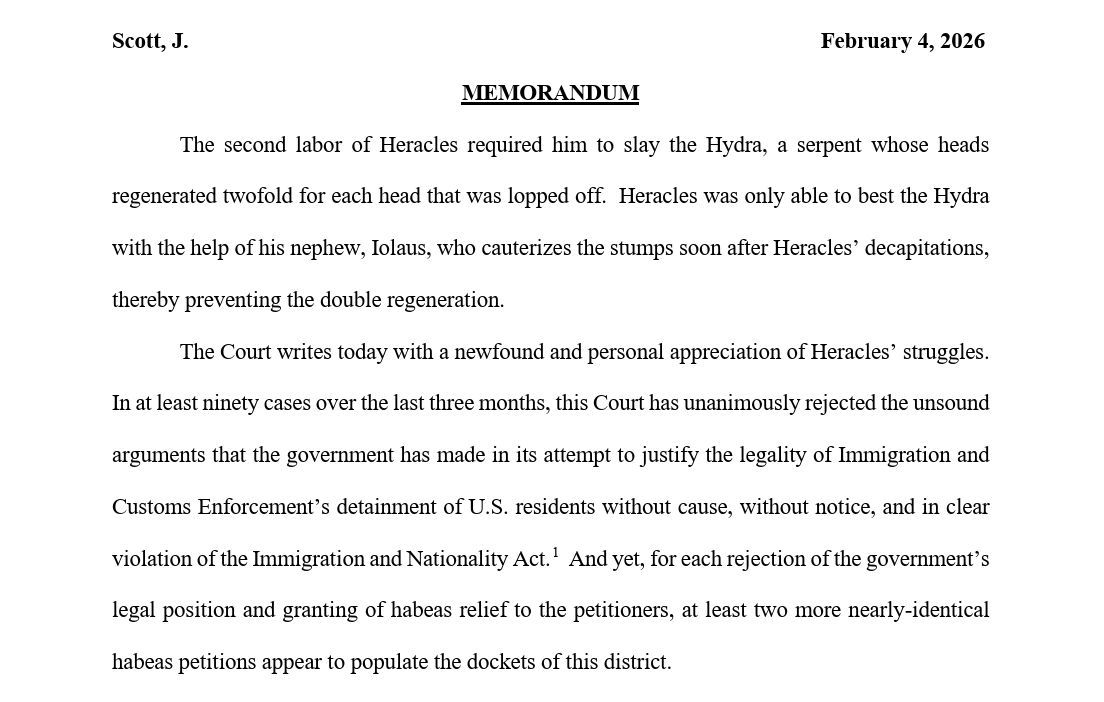
    And U.S. District Judge Kai N. Scott became the latest jurist to equate the ongoing legal battle with the government to Greek mythology, saying she and her colleagues on the bench have been squaring off with the Justice Department in a manner similar to Heracles’ confrontation with Hydra, the serpentlike monster that grew two heads every time one was chopped off.

    Although the region’s federal judges have “unanimously rejected” the government’s attempts to rationalize ICE detention of immigrants “without cause, without notice, and in clear violation” of federal law, Scott wrote, the government has continued to detain people in the same fashion day after day. And after each rejection, she wrote, “at least two more nearly identical” petitions seeking relief pop up on the court’s docket.

    “The Court writes today with a newfound and personal appreciation of Heracles’ struggles,” she said.

    District Judge Kai N. Scott’s Feb. 4, 2026 memo granting another habeas petition filed by an immigrant, and expressing frustration with the federal government’s arguments.

    The judicial rebukes come as immigration authorities have continued sweeping the nation to fulfill President Donald Trump’s promise of mass deportations. The number of detained immigrants has exploded — as has the number of court petitions from people seeking immediate release, which are known as habeas petitions.

    The enlarged legal workload has put a corresponding strain on the nation’s U.S. attorney’s offices, which typically defend ICE’s actions in federal court. Prosecutors from the New Jersey U.S. Attorney’s Office, for example, requested an extension in January to handle part of a class-action suit in order to deal with a surge in immigration release petitions.

    “This Office continues to handle an unprecedented volume of emergent immigration habeas petitions, which we continue to prioritize because of the liberty interests at issue,” the letter said.

    And in Minnesota this week, a federal prosecutor said she wished the judge would hold her in contempt so she could get some sleep in jail. Julie Le seemed exasperated when the judge pressed her on why the government had been ignoring his release orders.

    “What do you want me to do? The system sucks. This job sucks,” Le said, according to a court transcript.

    Le was subsequently fired.

    The issue at the center of each incident involves ICE’s mandatory detention policy. The policy was rolled out over the summer, and it requires that nearly all undocumented immigrants be held in custody as their cases wind through the country’s backlogged and complex immigration system.

    That upended decades of government practice, which typically allowed people who entered the country illegally, but who were otherwise law-abiding, to at least receive a bond hearing and determine if they could remain in the community as their cases moved forward.

    Jeanne Ottoson with Cooper River Indivisible attends an Immigrant rights groups rally outside the Third Circuit Court of Appeals to defend the New Jersey state ban on immigration-detention contracts on May 1, 2025.

    Some of those detained as a result of the policy have filed habeas petitions, arguing that their detention violates the Constitution. And in the Eastern District of Pennsylvania, Philadelphia’s federal court, judges have granted challenges to the policy at a near-universal rate.

    Still, those decisions have been made on a case-by-case basis, with relief extended only to one petitioner at a time. The U.S. Court of Appeals for the Fifth Circuit, which is based in New Orleans and is considered one of the country’s most conservative jurisdictions, heard a broader challenge to the policy. A divided 2-1 court ruled Friday that ICE can detain undocumented immigrants the agency is seeking to deport, even those who have been in the country for years.

    The ruling covers only federal courts in Louisiana, Mississippi, and Texas, and many legal experts expects the matter to ultimately end up before the U.S. Supreme Court.

    In Philadelphia, Scott’s expression of frustration came this week in response to the release petition of Franklin Leonidas Once Chillogallo. The 24-year-old from Ecuador came to the United States in 2020, lives with his partner and his 6-month-old twin daughters in Upper Darby, and works as a construction worker. He has no criminal history.

    After ICE arrested Once Chillogallo outside his home on Jan. 13, he was held in the Philadelphia Federal Detention Center without the opportunity for an immigration judge to review his case.

    Just as happened in the previous 90 cases, Scott rejected the argument that Once Chillogallo, an immigrant who has been in the country for years, was subject to the same bond rules as those who were caught entering without permission. The judge ordered Once Chillogallo’s release, which took place the following day, according to the court docket.

    Inside the federal courthouse Thursday, judges held three hearings on arcane legal questions surrounding habeas petitions.

    Dozens of other habeas petitions remain pending, court records show. In many that were recently decided, judges used terse or brusque language to point out that the government’s interpretation of the law has been repeatedly rejected.

    “Across the board, there is frustration. There is frustration from attorneys. There is frustration from the judges,” said Kimberly Tomczak, an immigration attorney who represented Once Chillogallo. “Nothing seems to be changing on the immigration side in response to the flood of habeas grants across the nation.”

  • A Michigan man who set fire to a Bensalem house to target his ex’s new boyfriend is sentenced to 20 to 40 years in prison

    A Michigan man who set fire to a Bensalem house to target his ex’s new boyfriend is sentenced to 20 to 40 years in prison

    A Michigan man who drove across the country to set fire to a Bensalem family’s home in a targeted attack on a romantic rival was sentenced Thursday to 20 to 40 years in prison.

    Harrison Jones, 22, pleaded no contest to six counts of attempted murder and two counts of animal cruelty for the killing of the family’s two dogs, which perished in the blaze. He also pleaded guilty to a slew of related crimes in connection with the February 2025 incident.

    Bucks County prosecutors said Jones drove more than 700 miles from his native Rockford, Mich., that winter to set the blaze at the home of Alex Zalenski, a man Jones’ ex-girlfriend and high school sweetheart had recently begun a long-distance relationship with.

    Zalenski, along with his father, mother, sister, and grandparents, was sleeping when Jones broke in and set off an incendiary device in the living room and kitchen around 5 a.m. Their dogs, Jett and Trey, barked, waking up the family, who all managed to escape.

    Members of the Zalenski family suffered non-life-threatening burns and injuries, though in court they recounted traumatic memories that they said would not soon heal.

    Alex Zalenski’s sister, Ava, recalled being awakened to the sound of yelling and heavy smoke clouding her room, choking her airways.

    “My dad told me to get down to breathe,” she said. “At age 20, I was ready to accept death.”

    The family had just minutes to escape the blaze, which consumed the property and left them without a home.

    Andrew Zalenski, the father of Alex and Ava Zalenski, recalled telling them to crawl on the floor to avoid inhaling smoke.

    He forced them out of a window before going to look for his wife, Stacy, he said, but could not find her and fled.

    It was challenging to describe the feeling of watching your home ablaze “believing your wife is burning to death inside,” he tearfully recounted.

    Stacy Zalenski had been trying, unsuccessfully, to save the dogs. The woman, who is battling breast and lung cancer, ultimately jumped from a second-floor window to survive.

    Andrew Zalenski suffered from severe smoke inhalation and was put in an induced coma in the hospital, he said.

    Meanwhile, Alex Zalenski — the young man whose relationship with Jones’ ex had enraged the Michigan man — said the attack “shredded any normalcy I had.”

    He had to withdraw from college after the incident, he said, and has since had trouble sleeping.

    “It felt as if my entire world had been set ablaze,” he told the court.

    Jones, wearing a yellow prison jumpsuit and shoulder-length hair, showed little emotion during the Zalenski family’s remarks.

    Given the opportunity to speak, however, Jones took full responsibility for the crime.

    “I need to take accountability,” Jones said, his voice breaking. “I’m guilty — I’ve done what I’ve done.”

    Jones’ family, including his father, mother, sister, stepfather, stepmother, and stepbrother, were in the gallery behind him.

    Jones’ attorney, Paul Lang, said Jones had no previous criminal record and had suffered physical abuse growing up. To cope, he had turned to abusing Xanax and marijuana, Lang said.

    Jones, for his part, alluded to being under the influence of drugs during the attack.

    In addition to sentencing Jones to decades in prison, Bucks County Court Judge Matthew D. Weintraub ordered him to pay more than $500,000 in restitution to the Zalenski family.

    Weintraub told the Zalenskis that the trauma of the attack had clearly bonded their family.

    Addressing Jones, the judge said he believed the young man had attempted to “effectuate maximum damage” that day.