Category: Eagles/NFL

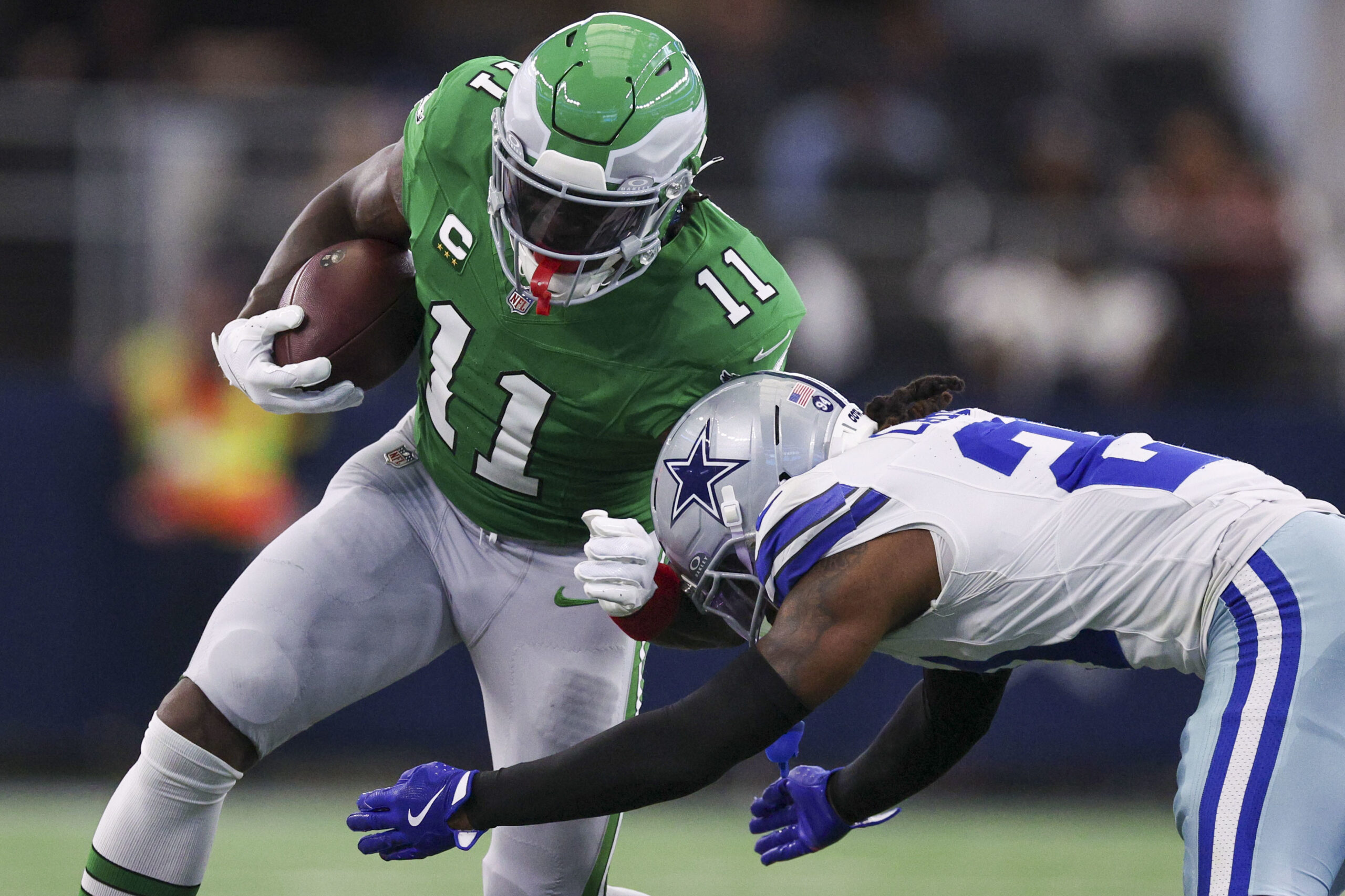
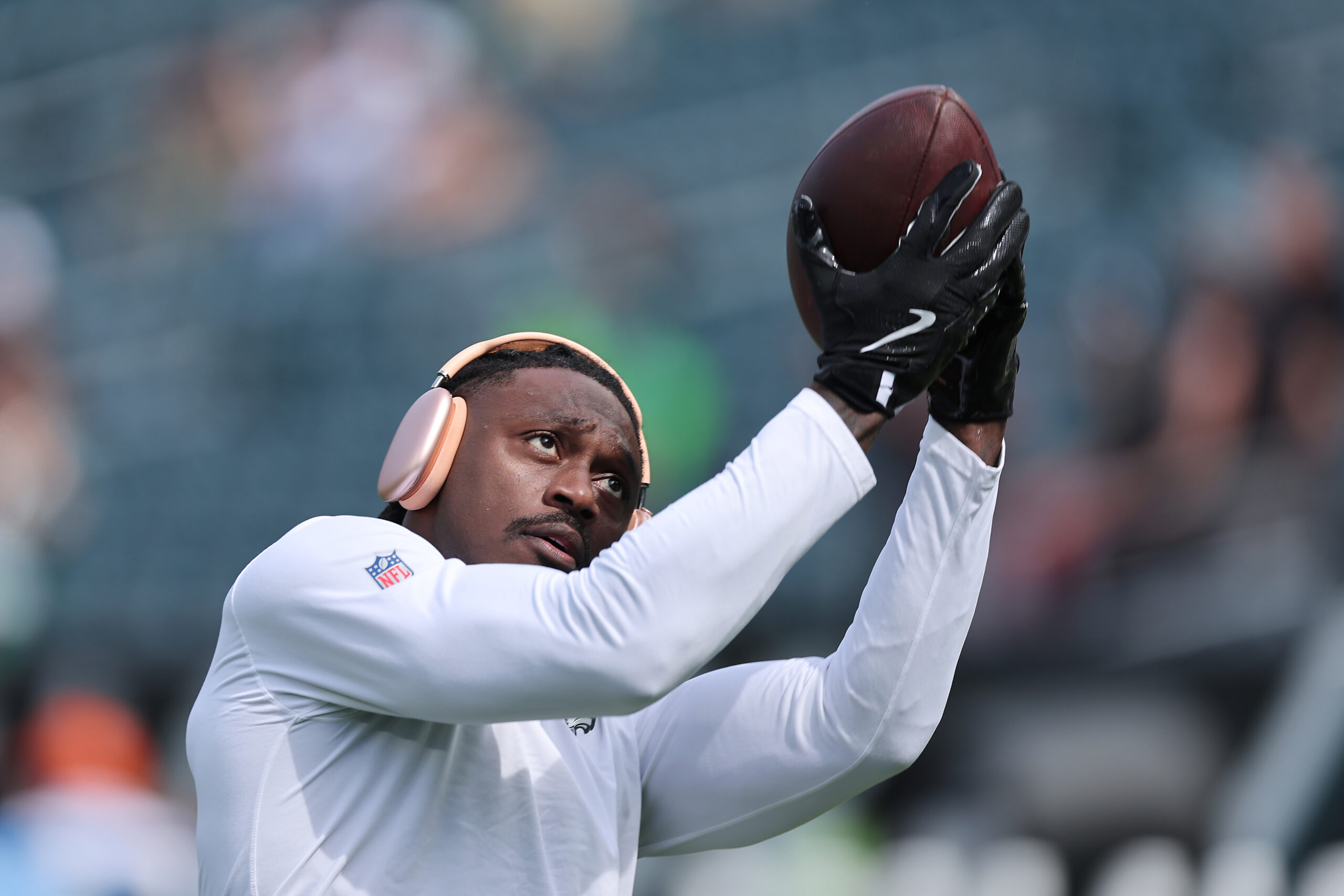
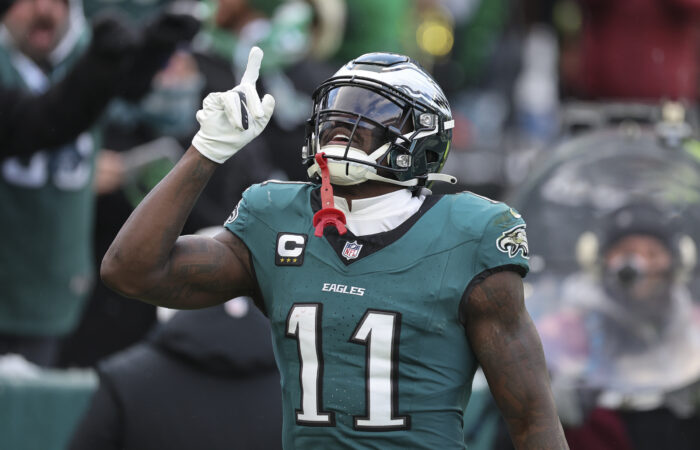
  • A.J. Brown’s pool of trade suitors is smaller after the Bills’ D.J. Moore move. The Eagles must demand a first-round pick for Brown.

    A.J. Brown’s pool of trade suitors is smaller after the Bills’ D.J. Moore move. The Eagles must demand a first-round pick for Brown.

    The biggest Eagles-related takeaway from the D.J. Moore trade?

    A lot of NFL general managers are a lot less capable than Howie Roseman.

    As for A.J. Brown, the impact of the Bills’ acquisition of Moore is being overstated.

    Roseman may get the first-round pick he reportedly is seeking in exchange for Brown, but it’s no more likely now that the Bears have somehow managed to finagle a second-round pick out of the Bills for Moore. If anything, Roseman might deserve credit for driving up the price for Moore, who was the Bears’ fourth receiving option by the end of a season in which he caught just 50 passes for 682 yards. Buffalo had a clear need for a primary receiver. Dealing a second-round pick for Moore might sound more reasonable when your other option is trading a first- and second-round pick for Brown. What we know for sure is that the small pool of teams that made obvious sense as a trade partner for the Eagles just shrunk by one.

    Here’s what else we know:

    The Trent McDuffie trade could be just as much of a harbinger in the opposite direction.

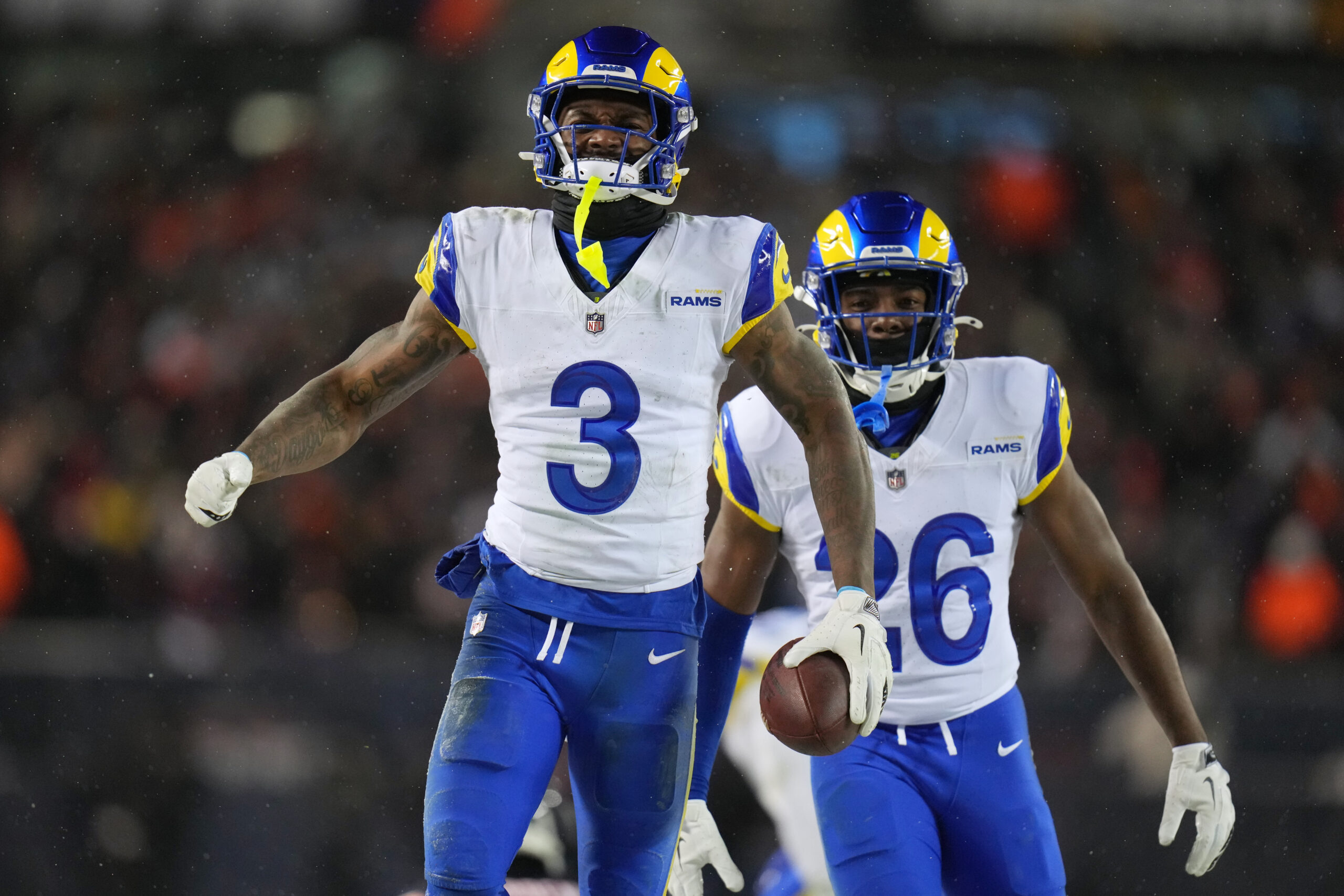
    A two-time All-Pro at a premium position (cornerback) entering his age-26 season, McDuffie is headed to the Rams for the No. 29 pick in this year’s draft, a future third, and change. I don’t think it’s accurate to say that the McDuffie deal is an indication of the elite cornerback market, at least not relative to Brown. Keep in mind, the Colts traded away two first-round picks and Adonai Mitchell for Sauce Gardner at the deadline. One of those picks ended up at No. 16 this year. Who knows what next year’s will be. That’s the elite cornerback market.

    The McDuffie trade does give us a neat and tidy for-instance. Given the sacrifice the Chiefs just made at a more premium position, would they then be willing to turn around and trade the No. 29 pick they received for McDuffie to the Eagles for Brown? Maybe they would. Hey, maybe they will. They sure do need a wide receiver. That said, it seems far more likely that they are looking at that No. 29 pick the same way the Eagles would in justifying a trade of Brown: as a chance to add another five years of well-below-market-rate production in the form of a rookie.

    The overall point is that you can talk yourself silly trying to project the market based on one deal. The Moore deal can just as easily be construed as the price a team is willing to pay to not pay the price the Eagles are asking for Brown.
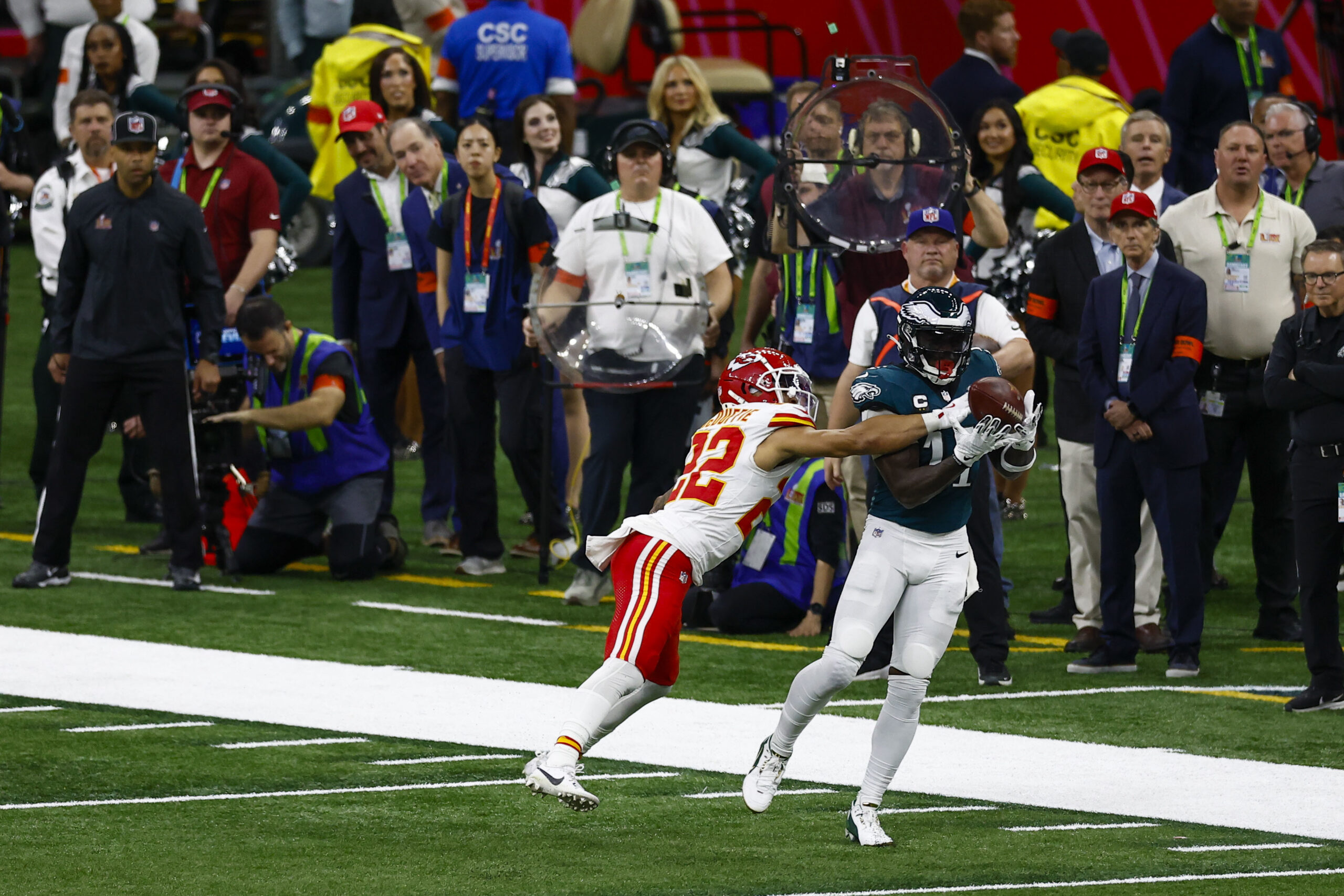
    Chiefs cornerback Trent McDuffie (left) was traded to the Rams for the 29th pick in this year’s draft. Could Eagles wide receiver A.J. Brown fetch a similar haul?

    The Eagles are justified in asking for a first- and second-rounder for Brown, assuming what they really expect is a first-rounder and an assortment of mid-to-late-round picks.

    There are plenty of comps.

    • The Raiders acquired 29-year-old Davante Adams from the Packers for No. 22 overall and No. 53 overall in 2022.
    • The Bills acquired 26-year-old Stefon Diggs for No. 22 overall and change from the Vikings in 2020.
    • The Chiefs acquired No. 29 overall, No. 50 overall and change from the Dolphins for 28-year-old Tyreek Hill in 2022.

    It’s easy to see the genesis of Roseman’s current reported asking price. It’s also easy to see why that asking price has drawn snickers.

    Consider:

    • The first-round pick the Bills traded to the Vikings turned out to be Justin Jefferson.
    • The second-rounder that the Raiders traded to the Packers turned out to be Alec Pierce (after Green Bay traded the pick to draft Christian Watson). The first-rounder was Quay Walker, a four-year starter at linebacker.
    • The Chiefs used the No. 29 pick they landed for Hill to trade up to draft McDuffie at No. 21.

    On the other side of these deals were two of the worst organizations in the NFL (Dolphins, Raiders), and the team that just traded a second-round pick for Moore and has the second-most expensive wide receiver room in the NFL without a true WR1 to show for it.

    There aren’t many other for-instances. The Texans traded away DeAndre Hopkins for No. 40 overall in 2020, but that deal included running back David Johnson in the return and was universally panned regardless. Last offseason, the Steelers traded away No. 52 overall for 27-year-old DK Metcalf, whose four-year averages were worse than Brown’s 2025.

    There aren’t many teams that can give the Eagles what they need.

    I use the word “need” for a reason. The Eagles need a first-round pick to justify trading Brown. The only way they might otherwise justify it is by landing a future first plus a 2026 second, i.e. the “Ravens Scenario.” We’ll get to that in a second. First, let’s explain what we mean when we say the Eagles “need” a first-rounder.

    This is not abstract. Concretely, the Eagles need to be able to replace Brown. The best way to do it is via the draft, where there happens to be a number of players who could help them and who are projected to be within striking distance of No. 23. But the Eagles need plenty else besides a replacement for Brown. We saw that this year, when they had Brown. To justify trading Brown, they need to at least end up with a pick that maximizes their odds of replacing him (even if they end up “replacing” him with a star at another position). Bare minimum is a top-50ish pick. But only if they feel like they need to trade him for the best offer. Right now, their best leverage is their willingness to bring him back. Which is why they are making that willingness known.

    Not many teams are in a position to give them what they need. Cross off the Bills. Presumably the Chiefs, unless Andy Reid and Brett Veach have radically changed the philosophy under which they traded away Hill to pave the way for McDuffie. Nobody is giving up a top-10 pick for Brown, so cross them off too.
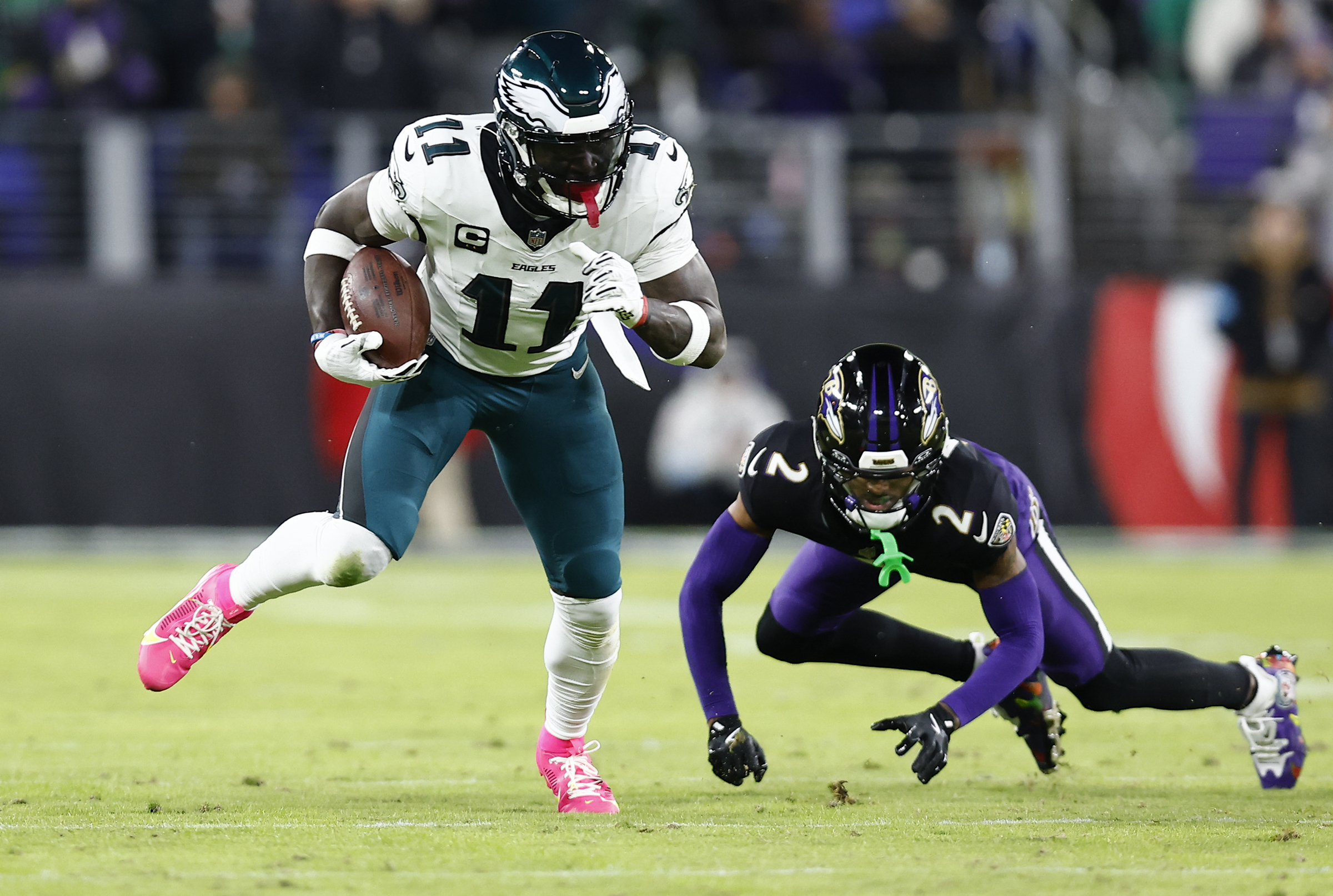
    Could the Ravens be in the market to trade for Eagles wide receiver A.J. Brown?

    The Dolphins (No. 11) are more likely to trade Jaylen Waddle for a Brown-type package than to trade for Brown. The Cowboys (No. 12) don’t need a wide receiver, nor do the Rams (No. 13), who just traded their expendable first-rounder to the Chiefs for McDuffie. The Bucs (No. 15) are brimming with wide receivers, including last year’s first-rounder Emeka Egbuka. The Lions (No. 17) have a lot of needs more pressing than the skill positions. Same goes for the Vikings (No. 18). The Panthers (No. 19) spent significant draft capital on Tetairoa McMillan last year. Brown doesn’t fit their timeline.

    Next up is Dallas again at No. 20, then the Steelers, who just traded for Metcalf and like to build from within. The Chargers don’t have the luxury of trading No. 22 for Brown. Forget the Browns (No. 24). We’ve already covered the Bears (No. 25). Cross off the Texans (No. 28), who have Nico Collins and youth around him.

    That leaves us with the Ravens at No. 14, the 49ers at No. 27, the Broncos at No. 30, the Patriots at No. 31, and the Seahawks at No. 32.

    If the Eagles are reluctant to trade Brown to a fellow NFC contender, that would leave three teams: Ravens, Broncos, Patriots. Denver and New England would need to offer their first-rounder, because the next best 2026 picks are No. 62 and No. 63, which isn’t nearly good enough. The Ravens are in the opposite boat. Their No. 14 overall pick is too high. Their second-rounder (No. 45) is borderline, and would only make sense if coupled with a high future pick.

    The Eagles’ ability to land a first-rounder is contingent on the Ravens’ willingness to give up a future first or the Patriots/Broncos (or Seahawks/49ers) belief in the players who will be on the board at the end of this year’s first round.

    None of that is impacted by the cost of trading for Moore. The Ravens and the Patriots are the two obvious teams, assuming we remove the Chiefs and the NFC contenders. The Ravens aren’t going to give up No. 14 for Brown, and No. 45 is only worth it for the Eagles if they have 45 players they love on their draft board. A future first from Baltimore would give them an opportunity to move up. The Pats’ first-rounder would work if coupled with a pick that also gives the Eagles ammo to move up from No. 23 or No. 31 to draft a guy they covet.

    This is a pass-fail sort of thing. There is a bare minimum return the Eagles need in order to justify the competitive hit they’d take without Brown in 2026. It is a return where only a team’s best available draft pick is good enough. There are only a few teams that might consider it. That was the case before the Bills traded for Moore. It remains the case now.
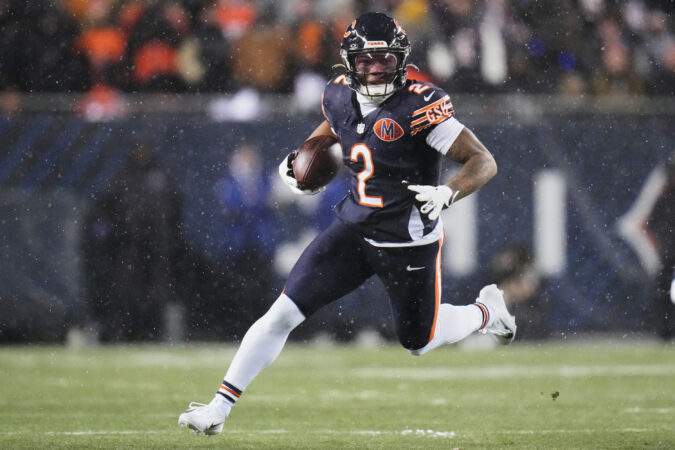
  • Bills to obtain wide receiver D.J. Moore in a trade with the Bears

    Bills to obtain wide receiver D.J. Moore in a trade with the Bears

    The Buffalo Bills agreed Thursday to acquire wide receiver D.J. Moore from the Chicago Bears, two people with knowledge of the trade told The Associated Press.

    Buffalo is sending a second-round pick in the draft this year to Chicago for Moore and a fifth-rounder, the people said. They spoke to the AP on condition of anonymity because the deal cannot become official until the start of the new league year Wednesday.

    Moore is coming off making 50 catches for 682 yards and six touchdowns last season as the Bears made the playoffs in Ben Johnson’s first year as coach. The soon-to-be 29-year-old joins the Bills under new coach Joe Brady after quarterback Josh Allen has thrown to a rotating cast of characters at receiver.

  • Eagles free agency roundtable: Who are some realistic targets — and bigger targets — for the Birds?

    Eagles free agency roundtable: Who are some realistic targets — and bigger targets — for the Birds?

    The 2026 NFL free agency period begins on Monday, when “legal tampering” will give way to a number of reported deals across the league. Free agency will officially begin on Wednesday, and the Eagles will be players — though how aggressive general manager Howie Roseman and Co. will be remains to be seen. With limited available cap space and the specter of a possible A.J. Brown trade adding to the uncertainty, how the Eagles handle this period elicits a wide range of possibilities.

    The Inquirer’s Eagles reporting team of Jeff McLane, Olivia Reiner, and Jeff Neiburg got together for a roundtable ahead of next week’s festivities.

    What’s one practical free agent move you could see the Eagles making next week, given their cap space and personnel situation?

    McLane: Dallas Goedert is slated to become an unrestricted free agent for the first time in his career, but even if he signs with another team, the Eagles won’t have a clean break from their longtime tight end. They still have an approximate $20 million dead money charge from a void year added to Goedert’s contract. That’s a lot of money to eat for a productive player they may want to keep. The Eagles, more than any other team, have been comfortable kicking cash into future years. But Roseman can’t be reckless, and if trading Brown becomes a reality, the general manager would have around $45 million more in dead money on the books.

    Could franchise staple Dallas Goedert run it back in Philly after his career touchdown year?

    Brown’s return, though, could warrant Goedert coming back for a ninth season. He put up solid numbers, catching 60 passes for 591 yards and a team-high 11 touchdowns, despite the Eagles’ pass offense inconsistencies.

    Was Goedert as dynamic as in years past after the catch? No. But he wasn’t given as many chances to run in space. The new Shanahan-McVay parts of the offense could accentuate Goedert’s post-catch abilities. The bigger question is whether he can run block like he once did. The Eagles weren’t happy with his output there. You have to wonder if taking a $4.25 million pay cut last season affected his effort, or occasional lack thereof. Goedert will have suitors on the open market. Is he worth as much as the Ravens’ Mark Andrews, who signed a three-year, $39 million deal in December? If so, it seems unlikely the Eagles re-sign Goedert, unless he wants to end his career in Philly and takes less.

    The draft is believed to be deep at the position and there are other avenues to finding a No. 1 tight end — perhaps a trade? — but there’s an argument to be made for keeping Goedert.

    Reiner: Re-signing Braden Mann. This seems like the football equivalent of a layup (a check down, perhaps). Mann, 28, is coming off the single best season by an Eagles punter in franchise history. He averaged 49.9 gross yards per punt, making his Eagles career average a franchise-leading 49.5. His net yards per punt (subtracting return yardage) finished within the top 10 in the NFL (43.1; No. 9 in the NFL).

    Mann often helped flip the field during a season in which he was forced to punt a lot (72 punts, tied for No. 4). He deserves an extension, which wouldn’t break the bank. The Eagles are just a few years removed from their previous punter woes and they shouldn’t go back down that path by starting over with new contenders for the gig.

    Is Christian Kirk (13) a free agent wideout possibility for the Birds?

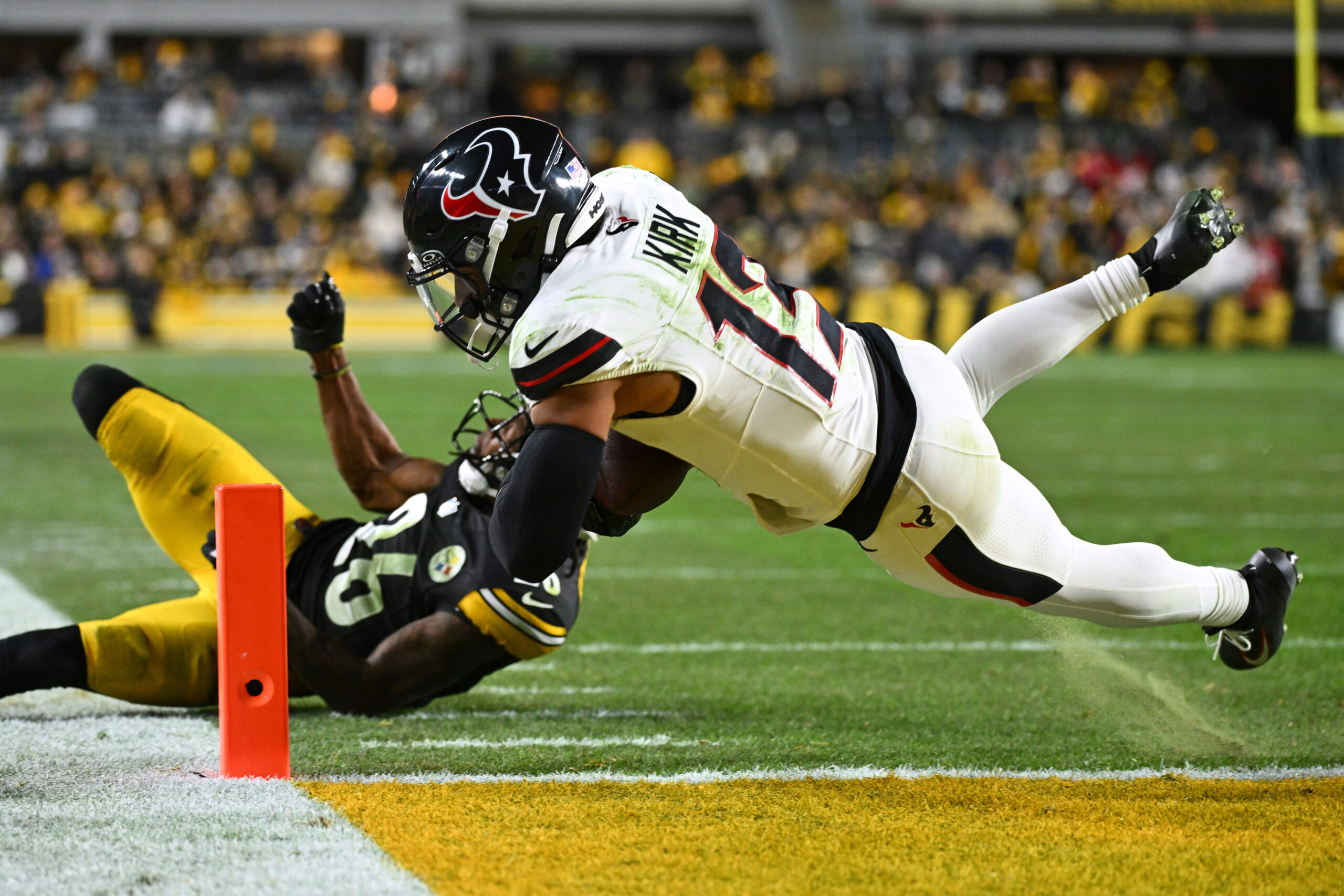
    Neiburg: Signing Christian Kirk to a relatively cheap contract given his talent. This is with or without Brown on the roster. Kirk has been limited by injuries over the last few seasons and ran routes with a crowded receiving corps in Houston. But he had a stretch of really good football from 2021 through 2023, tallying 2,877 yards on 218 catches, 16 of them for touchdowns. Kirk’s alignment favors the slot, but he has played plenty on the outside. The Eagles need to infuse the unit with more young talent, but Kirk, 29, could help bridge the gap, and if Brown is traded he would give the Eagles an experienced running mate for DeVonta Smith.

    What’s a bolder, but perhaps less likely move you could see the Eagles making?

    McLane: Trade for Maxx Crosby. If the Eagles decide they can’t afford Jaelan Phillips, they could be in the market for a top-end edge rusher. Crosby qualifies as a difference maker and would be an upgrade over Phillips or the returning Jalyx Hunt and Nolan Smith. It would cost a lot, of course. The Raiders are said to want two first-rounders and a player (Smith?) in return. But elite edge rushers are rarely available and Crosby’s existing contract isn’t a backbreaker. He has four remaining years at around $29 million per season, but only next season’s $30 million base salary is guaranteed. (editor’s note: Crosby was traded to the Ravens Friday night).

    Crosby has made it clear he wants out of Las Vegas. He has expressed his fondness for the Eagles and Philadelphia as a sports town. Perhaps he would be willing to adjust his deal to expedite a trade. Roseman may be cautious for various reasons. Crosby turns only 29 in August, but he’s logged more snaps than almost any defensive end over the last five seasons. He’s also coming off back-to-back season-ending injuries that required surgery to repair his ankle and a torn meniscus in his left knee. That’s why I think the Raiders’ reported asking price is unrealistic.

    There will be competition for Crosby, but the Eagles aren’t likely to repeat the mistake of going into another season with just Hunt and Smith on the edge. Phillips was a good trade deadline acquisition, but a tepid pass rush was an under-the-radar reason why the Eagles defense struggled in the second half of the playoff loss to the 49ers.

    Jaelan Phillips is a top-5 NFL free agent who could end up with a huge deal in a location other than Philadelphia.

    Reiner: Re-signing Phillips. He might be the Eagles’ top priority among their own group of pending free agents, but he isn’t a slam dunk to return. At 26 years old, he slotted in nicely to Vic Fangio’s defense in a short period of time at a premium position. He made an impact on the pass rush despite posting unassuming sack numbers (two in eight games). He stayed healthy for all 17 games in 2025, with the Eagles and the Miami Dolphins, one year removed from a partially torn ACL (and two years removed from a torn Achilles).

    But the Eagles ought to be realistic about a potential extension. Phillips was a net-positive addition last season, but he was not a game-wrecker. The Eagles likely won’t be inclined to pay him as such, given their lack of cap space in 2026 and their need to extend key defensive players both this offseason and in years to come. The Eagles will likely set a walkaway number for Phillips and move on if another team outbids them.

    Neiburg: Trading Brown … and trading for his replacement. Trading Brown is pretty bold in itself, but if it happens, the Eagles have a big hole to fill. There’s no doubt DeVonta Smith can handle all that comes with being the focal point of the passing game, but the roster is bereft of receiver depth, and if the Eagles aren’t thrilled with the free agent market — like, say, Kirk or someone like Romeo Doubs are more expensive than they prefer — they could go the trade route and trade from their roster or draft picks to acquire a receiver. Who could be available? Here are a couple of names to target via trade: Jacksonville’s Brian Thomas Jr. and Buffalo’s Keon Coleman.

    Does Sean Mannion scheme require a tailoring of the team’s offensive personnel?

    How much do you think the team’s offensive staff changes will inform their free agent and draft approaches?

    McLane: Aside from the quarterback position, the offensive line is the most likely to be affected by the expected scheme changes. New offensive coordinator Sean Mannion is bringing with him a Shanahan-McVay system that will alter blocking in the run game. Will there be a complete whitewash? No. But the Eagles are likely to shift from less mid-zone to more wide-zone blocking. Those terms might not indicate how different the techniques are, but the former emphasizes more reactionary blocking and winning at the point of attack, while the latter features O-linemen firing off the ball and blocking at an angle.

    Asked how the changes may affect his evaluations, Roseman conceded he may be looking for more agile O-linemen. The Eagles already have athletic freaks up front, although injury-riddled left guard Landon Dickerson may not qualify as such.

    I don’t think Roseman will do much at the position in free agency. He does have decisions on reserves Fred Johnson and Brett Toth. I don’t think the scheme change rules out either for a return. But they don’t have an advocate in former offensive line coach Jeff Stoutland anymore. His replacement, Chris Kuper, won’t likely have as big a voice as Stoutland in personnel. But the Eagles are almost guaranteed to expend a high draft pick on an O-lineman with right tackle Lane Johnson closer to retirement than ever.

    NFL Network’s Daniel Jeremiah recently projected seven first-round O-linemen in the 2026 draft and then a drop-off in terms of talent. Maybe one of the top guys slips into the second round and there’s a chance to pick up value, but I’d be surprised if Roseman didn’t expend the Eagles’ No. 23 overall pick — or more in a move up — to secure Lane Johnson’s expected successor.

    Neiburg: It should inform the approach plenty. Especially when it comes to how they address the tight end position. Roseman knows he has long appreciated the receiving component of the tight end, but the new scheme will require a lot better blocking than the Eagles got last year and even in prior seasons from the players behind Goedert. As Jeff mentions, it’s possible Goedert returns in 2026 in free agency, but the Eagles would need to slot players behind him who block a lot better than Grant Calcaterra. One name I could see fitting in well is Jake Tonges, who doesn’t offer a ton in the pass game but was an elite blocker for the 49ers.

    A.J. Brown’s situation could have an impact on the team’s free agency approach.

    Reiner: Given the expected shift in run-game philosophy under Mannion, the tight end and offensive line additions could reflect those changes. I think the prospective wide receiver additions will have layered influences, especially as it relates to Brown’s future. Naturally, the Eagles’ need at receiver becomes much more pressing if (big if) they decide to move the star receiver before the start of the season.

    Otherwise, aside from adding a WR3, the Eagles don’t need to overhaul their receiving corps to fit the scheme. If we’re looking to the Packers offense for clues about what the Eagles might look like in 2026, we can expect to see more under-center play action, pre-snap motion, and misdirection as a means of scheming open space in the passing game. That space helps receivers generate yards after the catch and explosive plays downfield.

    The prosperity of the scheme seems to be rooted more in its design, not so much in the raw talent of its players, a departure from Eagles offenses past. That isn’t to say the Eagles aren’t looking for talented receivers, but more so that the prototype of a talented receiver isn’t likely to change dramatically.

    Besides A.J. Brown, who else could the Eagles trade?

    McLane: This may seem like a reach, but I could envision a world in which Nolan Smith is being floated on the trade market, assuming either Phillips, Crosby or some edge rusher equivalent is on the roster by the draft. Smith hasn’t been a bust — far from it. A shoulder injury limited him during his rookie season, but he blossomed in the second half of his sophomore year. Tricep woes sent him to injured reserve last season and he finished with just three sacks and 11 quarterback hits. He’s good at setting the edge and has a high motor, but he’s undersized and struggles to win consistently as a pass rusher.

    Hunt has a higher ceiling, is one year younger and was drafted two rounds after Smith. It’s going to be tough for Roseman to pay both, especially with defensive tackles Jordan Davis and Jalen Carter slated for possible extensions this offseason.

    Is Nolan Smith Jr.’s long-term future with the team set in stone?

    The Eagles could pick up the fifth-year option (around $15 million) on Smith’s first-round rookie contract after the draft. That isn’t an exorbitant amount for a premium position player. He has potential he hasn’t tapped into. But I’d be worried about his durability. And there will be the occasional casualty after strong drafts on the defensive side and upcoming deals for All-Pro cornerbacks Quinyon Mitchell and Cooper DeJean.

    Reiner: Tanner McKee. Ahead of the combine, Roseman expressed just how much he values the backup quarterback position and the importance of having a competent player in the role. McKee certainly fits the bill despite his limited action in his lone year as the full-time backup. But the soon-to-be-26-year-old quarterback is going into the final year of his rookie deal. If Roseman doesn’t see a future for him in Philadelphia beyond next season, would he be inclined to move McKee at the peak of his value to the team?

    This offseason is a seller’s market at quarterback. The draft lacks high-end talent beyond Fernando Mendoza, who doesn’t have the cachet of other recent No. 1 overall picks. The free-agent market is led by Kyler Murray and Malik Willis. If McKee has a market among teams that want him to compete for the starting gig, the Eagles ought to entertain offers. But Roseman would need to get a strong return for McKee, all the while feeling comfortable about a replacement plan in 2026 for Jalen Hurts’ backup. Perhaps they liked what they saw from Sam Howell in practice enough to warrant a low-cost extension and make him the full-time No. 2.

    Neiburg: Sydney Brown. The Eagles have a few candidates in their secondary who are due for a change of scenery, and Brown might be at the top of the list. The Eagles need help at safety, but they won’t be lining up with Drew Mukuba and Brown at the back of the secondary to start the 2026 season. Brown, who has one year left on his rookie deal, will be a backup again, and will see some work on special teams. But if you can convince a team to part with a Day 3 pick to acquire a player who isn’t part of your long-term plans, you have to do it.

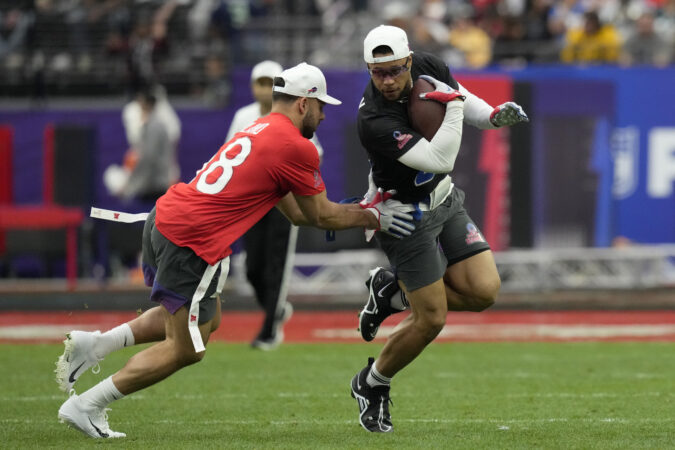
  • Report: Flag football event featuring Saquon Barkley likely moving from Saudi Arabia to U.S. amid Middle East war

    Report: Flag football event featuring Saquon Barkley likely moving from Saudi Arabia to U.S. amid Middle East war

    The Fanatics Flag Football Classic, an event planned by Tom Brady and Fanatics, was originally planned to take place in Riyadh, Saudi Arabia on March 21. Amid the widening war in the Middle East, the games will likely move to the United States due to recent airstrikes and regional travel restrictions, according to Front Office Sports.

    The event, which will be hosted by Philadelphia native Kevin Hart, is expected to feature a lineup of NFL stars, including Eagles running back Saquon Barkley. Other players scheduled to compete include Commanders quarterback Jayden Daniels, Cowboys wide receiver CeeDee Lamb, 49ers running back Christian McCaffrey, Colts cornerback Sauce Gardner, Browns defensive end Myles Garrett, Raiders tight end Brock Bowers, free agent wide receiver Tyreek Hill, Raiders defensive end Maxx Crosby, former Patriots tight end Rob Gronkowski, and former Giants wide receiver Odell Beckham Jr.

    Ahead of the game’s Olympic debut in Los Angeles in 2028, the Fanatics Flag Football Classic will follow Olympic style rules, with players competing in five-on-five on a 50-yard field (plus two 10-yard end zones) for two 20-minute halves. Players will be divided into three teams that will play in a round-robin tournament with Pete Carroll, Sean Payton, and Kyle Shanahan slated to be the coaches.

    Although a new location has yet to be announced, the event is still expected to be broadcast on Fox Sports and Tubi, with a much more friendly air time for the American audience, as FOS points out.

  • Risers and fallers from the 2026 NFL combine (and what it means for the Eagles)

    Risers and fallers from the 2026 NFL combine (and what it means for the Eagles)

    The NFL Scouting Combine doesn’t have quite the same participation that it had before the COVID pandemic, which was further illustrated last week. Several position groups were impacted by the number of players opting to test athletically at their pro days, which made for historically low testing numbers for all but one position group in Indianapolis.

    But for those who did test, it was an opportunity to showcase their skill set in front of NFL personnel for the latest piece of the scouting puzzle. From an Eagles perspective, there were a few potential targets whose stock was impacted.

    With free agency looming, here are some of the risers and fallers leaving the combine:

    Risers

    Chris Johnson, DB, San Diego State

    The predraft process for Johnson has helped elevate his draft stock. Johnson, a sticky coverage player in man and zone coverages who also is competitive at the catch point, showed he was an elite athlete, too, with his athletic testing.

    At the combine, Johnson ran a 4.4-second 40-yard dash, jumped a 38-inch vertical, leaped 10 feet, 6 inches in the broad jump, and tied for the most bench press reps among cornerbacks with 17. He interviewed well for NFL teams meeting with him in Indianapolis.

    His predraft rise is similar to that of Quinyon Mitchell, a Group of Four player who continued checking boxes at every stop. Johnson won’t go as high as Mitchell did in 2024, but he has some late first-round buzz coming out of the combine.

    Monroe Freeling, OT, Georgia

    Freeling, though he has just 16 career starts, feels like he is slipping from the Eagles’ range in the first round. His final game at Georgia, a College Football Playoff quarterfinal loss to Ole Miss, was the most complete performance of his career and he now seems unlikely to get out of the top half of the first round.

    Freeling tied for the fourth-fastest 40-yard dash among offensive linemen at the combine (4.93 seconds), third-longest broad jump (9-7) and fifth-highest vertical (33.5 inches). He slipped a few times during the on-field drills but still looked like a natural athlete with light feet.

    He is going as high as No. 6 overall to the Cleveland Browns in post-combine mock drafts, which indicates just how highly he is thought of in draft circles.

    Omar Cooper, WR, Indiana

    Cooper was a popular Day 2 draft pick for several teams before the combine, including the Eagles, but after hearing the buzz in Indianapolis about the Indiana wide receiver, it is becoming increasingly unlikely he makes it beyond Round 1.

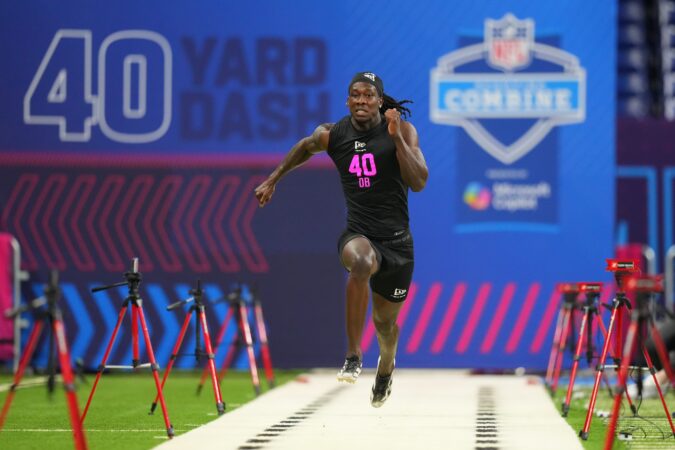
    Cooper only ran the 40-yard dash (4.46 seconds) and participated in the vertical jump (37 inches), but he has checked several boxes for NFL teams and has the skill set and production to match his speed.

    Cooper played primarily in the slot in college, but his vertical catching ability and strong hands with defenders draped over him will translate. Even if the Eagles end up addressing wide receiver early, there’s a good possibility Cooper is off the board by the time they pick in the first round.

    Tennessee defensive back Jermod McCoy (3) has struggled to sufficiently answer questions about his recovery from injury.

    Fallers

    Jermod McCoy, DB, Tennessee

    When healthy, McCoy is one of the best defensive backs in this draft class, but he missed all of 2025 with a torn ACL and elected to skip the combine. Nailing down his draft stock has been difficult because teams are not sure if he is the same player, athletically, postinjury.

    He falls on this list because of the questions surrounding his long-term health, as opposed to other first-round corners including LSU’s Mansoor Delane and Clemson’s Avieon Terrell.

    Stash McCoy’s name in case he doesn’t test as well as expected during his pro day on March 31. The Eagles showed last year with Jihaad Campbell that they are willing to take a swing on a player who had injury concerns before the draft.

    Lee Hunter, DT, Texas Tech

    After a strong Senior Bowl performance, Hunter, a disruptive, run-stopping defensive tackle, was getting late first-round buzz and even appeared in our first mock draft of the cycle. But his subpar testing numbers may hinder him from going that early in the draft.

    Hunter’s 40-yard dash time (5.18 seconds) was as expected for a player who is 6-3, 318 pounds, but jumping a 21.5-inch vertical and 8-4 broad isn’t a first-round athleticism profile. Coupled with his limited pass rushing ability, Hunter feels closer to a late second-round player rather than back end of the first.

    Malachi Fields, WR, Notre Dame

    Like Hunter, Fields was starting to get some late first round, early second round buzz after a standout week in Mobile, Ala., to begin the draft cycle. But even for a taller receiver (6-4, 218), he didn’t run as well as many expected in the 40-yard dash (4.61 seconds), though it’s not the end-all, be-all.

    He did have some nice explosive jumps (38 inch vertical, 10-4 broad) along with an excellent three-cone time (6.98 seconds). But during on-field drills, he had some tightness in his hips when he tried to sink them while changing direction.

    Fields still likely will get drafted on Day 2, could start early in his NFL career, and might be a nice option to replace A.J. Brown if the Eagles trade the star receiver. But it would be surprising to hear Fields’ name called in Round 1 in April.

    Other notes

    • Arizona State offensive tackle Max Iheanachor, a consistent riser during this process, met with the Eagles during the combine and had a strong testing performance on Sunday. He could be one of seven tackles drafted in the first round, along with Clemson tackle Blake Miller, with whom the Eagles also met in Indianapolis. Miller also had a strong testing day.
    • Oregon safety Dillon Thieneman solidified himself as a first-rounder with elite testing at the combine and seems likely to be the second safety selected after Caleb Downs. His range starts in the late teens, with the Minnesota Vikings picking 18th. College teammate Kenyon Sadiq, the draft’s top tight end prospect, also seems to be trending up as a potential top-20 selection, which could be out of the Eagles’ range.
    • Utah tackle Spencer Fano, who could be an Eagles draft target, showcased his snapping ability after position drills on Sunday, which could give him the versatility to play center, guard, or tackle. Teams like the Detroit Lions and Chicago Bears, who lost their centers this offseason, could be in play for Fano if he doesn’t get drafted inside the top 15.
  • Your Eagles guide to free agency, Part II: Get ready for some new faces on defense

    Your Eagles guide to free agency, Part II: Get ready for some new faces on defense

    The new-look Eagles offense may be the buzziest topic of the offseason, but change is coming for the defense, too.

    Of the Eagles’ 19 pending unrestricted free agents, nine are on defense, and four — Jaelan Phillips, Nakobe Dean, Reed Blankenship, and Adoree’ Jackson — were starters for most of the 2025 season. So, more than one-third of the defensive starters could depart Philadelphia, come the start of the new league year on March 11, requiring Howie Roseman to fill their roles either externally or internally.

    Some positions have more clear-cut internal replacements than others. Some pending free agents likely are higher priorities for retention than others. Because the Eagles are set to have approximately $13 million in cap space at the start of the new league year, even those priority players could be difficult to keep, depending on their open-market demand.

    Ultimately, the Eagles could part with the majority of those midrange to big-ticket free agents if they want to extend players like Jordan Davis or Jalen Carter this offseason (and others in coming years such as Cooper DeJean, Quinyon Mitchell, and Jalyx Hunt).

    Here’s a look at where the Eagles stand with their pending defensive free agents and which potential additions might pique their interest:

    The market for Jaelan Phillips could be robust.

    Edge rushers

    The biggest defensive domino of the Eagles’ offseason (and the one that likely will fall first) is Phillips. The 26-year-old pass rusher is one of the better players in this year’s pending free agent class, given his youth, his on-field impact, and the premium position he plays.

    Of the Eagles’ pending free agents, he ought to be the biggest priority to retain. He seamlessly transitioned to a new defense at the trade deadline, and while he didn’t post gaudy sack numbers (two in eight games), he made the players around him better. His injury history could be cause for concern for any organization, but he made it through the 2025 season healthy while playing over 70% of the defensive snaps with the Miami Dolphins and the Eagles.

    Phillips could have other suitors, though, which may drive up his asking price and push him out of the Eagles’ range. The Athletic projected his next contract at four years, $98 million ($24.5 million per year), while Spotrac is more conservative at three years, $52 million ($17.3 million per year). The reality could lie somewhere between those figures.

    Whether Phillips returns or not, the Eagles must add edge rushers through free agency and the draft. Hunt and Nolan Smith are the only two players at the position who were on the active roster in 2025 and are under contract next year. Brandon Graham, Joshua Uche, Azeez Ojulari, and Ogbo Okoronkwo are pending free agents.

    Besides Phillips, some of the other free-agent edge rushers worth considering include:

    Bradley Chubb: On Feb. 16, the Dolphins released Chubb, who turns 30 in June, so he is available now if the Eagles are interested. The veteran edge rusher has ample experience playing for Vic Fangio, first with the Denver Broncos from 2019 to 2021 (including a Pro Bowl season in 2020) and in 2023 with the Dolphins. He rebounded in 2025 from an ACL injury sustained the year prior to collect 8½ sacks in 17 games.

    Khalil Mack: Another former Fangio pupil (with the Chicago Bears). Mack just turned 35, so it seems unlikely that the Eagles would go after him if they also decide to bring back the soon-to-be-38-year-old Graham for another year. But if they move on from Graham and Mack is looking to add a title to his long list of career accolades, the Eagles could make sense as a landing spot. Despite suffering an elbow injury that kept him sidelined for five games in 2025, Mack finished with 5½ sacks and 32 tackles for the Los Angeles Chargers.

    Maxx Crosby: OK, he isn’t a free agent, and his contract with the Las Vegas Raiders is staggering. But according to Sports Illustrated, Crosby could be a candidate for a trade, and the Eagles are among the teams “keeping tabs on his availability.” This would be the splash that Roseman explicitly said was unlikely this offseason. Still, Crosby has had offseason surgery the last two years, which could impact the return for him in a trade. One can dream of what the five-time Pro Bowler would look like in Fangio’s defense, even if it would take some serious maneuvering to pull off.

    Other names to watch: Arnold Ebiketie, Boye Mafe, Kingsley Enagbare

    Could Riq Woolen be a fit opposite Quinyon Mitchell at corner?

    Cornerbacks

    The Eagles are set with DeJean and Mitchell returning as starters, but the secondary has a hole at the second outside cornerback spot. Jackson, 30, is poised to become a free agent after holding down that starting role for the majority of the 2025 season.

    As the season progressed, Jackson’s play improved. He could be a candidate to return to the Eagles in 2026 if they believe he can continue to play at a high level. They also could open the competition internally to Kelee Ringo, who vied for the job last training camp, or Mac McWilliams, who trained at outside cornerback and at nickel in practice last season.

    Or, they could go the external route through the draft or free agency. Seeing as the Eagles have a number of long-term needs on offense (especially at tight end and on the offensive line) that could require premium draft capital, will free agency be the best route to acquire an outside cornerback?

    Riq Woolen: The 26-year-old Woolen was one of the members of the Seattle Seahawks’ Super Bowl-winning “Dark Side” defense. He excelled at locking down his opponent, allowing the fewest yards per snap among outside cornerbacks with at least 250 coverage snaps entering Week 18, according to Next Gen Stats. Woolen is one of the better man coverage cornerbacks in the league, and while the Eagles play mostly zone, they deployed one of the higher rates of man coverage in the NFL in 2025 (24.5%; No. 12, according to Sharp Football Analysis).

    Eric Stokes: Stokes covers two squares on the Roseman Prospective Target Bingo Card: draft pedigree and Georgia ties. The 27-year-old cornerback was the Green Bay Packers’ first-round pick (No. 29)in the 2021 draft. His early career with the Packers was marred by injury, but he stayed healthy as a starter with the Raiders last season. Stokes’ 77.2 passer rating against ranked 14th in the NFL among cornerbacks with at least 500 coverage snaps, according to Pro Football Focus.

    Asante Samuel Jr.: If the Eagles can’t afford Woolen or Stokes, Samuel could be an option. Samuel, 26, underwent spinal fusion surgery last offseason and returned to action with the Pittsburgh Steelers in November. He started three games (in six appearances) in 2025, bringing his total career starts to 50. So long as the Eagles aren’t spooked by his injury history, he could compete for the starting gig on a low-cost deal with the team his father played for from 2008 to 2011.

    Other names to watch: Josh Jobe, James Pierre, Benjamin St-Juste

    Kam Curl (3) could pique the Eagles’ interest.

    Safeties

    Is this the end of the “Exciting Whites”? Blankenship, 27, is set to become a free agent after four seasons (three as a starter) in Philadelphia.

    He has a special story with the Eagles, signing with the team as an undrafted free agent out of Middle Tennessee State in 2022 and playing his way into a prominent role on defense. But he could earn a payday elsewhere — Spotrac projects his next contract at two years, $14.4 million ($7.2 million per year), while The Athletic estimates his potential deal at four years, $42 million ($10.5 million per year).

    If Blankenship walks, the Eagles will be in the market for a safety who can start alongside Drew Mukuba, who is coming off a season-ending fibula fracture. However, given Blankenship’s body of work over the last few seasons and the lack of depth in the room, he could be one of the Eagles’ priorities ahead of free agency.

    The Eagles lack internal replacement candidates, so they may have no choice but to spend money at the position. Sydney Brown could compete for the job again, but he struggled to hold it down at midseason while Mukuba was sidelined.

    Marcus Epps: The 30-year-old safety usurped the starting job from Brown for four of the Eagles’ final five regular-season games and fared well in limited action. He could return on a relatively inexpensive, short-term deal while the Eagles add youth to the position through the draft.

    Kam Curl: It seems unlikely that the Eagles would break the bank for a safety, so the addition of Curl would be a long shot, given that he’s one of the best in this free-agent class. Still, he’s worth checking in on, as he will be just 27 years old in 2026 and has 86 career starts, including 33 over the past two seasons with the Los Angeles Rams. He is a versatile, intelligent player who could provide an upgrade to the Eagles’ back end.

    Kevin Byard: Could a reunion be on the horizon? Even at 32, Byard won’t come cheap, given his standout 2025 season with the Bears (including a league-high seven interceptions). But the Eagles evidently liked him enough to acquire him from the Tennessee Titans during the disastrous 2023 season. He would be better positioned for success under Fangio.

    Other names to watch: Jaquan Brisker, Coby Bryant

    The exit of Nakobe Dean (17) seemingly would pave the way for Jihaad Campbell in the starting lineup.

    Inside linebackers

    No one from the Eagles defense in 2025 exceeded expectations more than Dean. The 25-year-old inside linebacker began the season on the physically unable to perform list because of the patellar tendon tear he sustained in the 2024 wild-card round. Entering the season, he faced questions about whether he would return to the level of play he achieved before his injury.

    He never appeared limited upon his return to action. While most homegrown players of Dean’s caliber would warrant an attempt at an extension, the Eagles could move on from him this offseason. Jihaad Campbell, the 31st overall pick out of Alabama in 2025, is on standby to succeed Dean as the starter alongside Zack Baun.

    After Campbell and Baun, the Eagles have solid depth at the position under contract in 2026, including Jeremiah Trotter Jr. and Smael Mondon. Even Chance Campbell, a 2022 sixth-rounder out of Ole Miss, built a strong reputation throughout his season on the practice squad. It seems unlikely that the Eagles will make any major additions to the unit in free agency.

  • Your Eagles guide to free agency, Part I: What changes and new faces are coming on offense?

    Your Eagles guide to free agency, Part I: What changes and new faces are coming on offense?

    A week from now, the NFL’s new league year begins, the free-agency frenzy kicks off, and rosters for the 2026 NFL season will start taking shape.

    For the Eagles, a crucial offseason is underway. They moved on from offensive coordinator Kevin Patullo after the offense took a big step back in 2025, and replaced him with first-year coordinator Sean Mannion, who will bring a new scheme to an offense in need of a jolt.

    The Eagles have 20 total pending free agents and a few holes to fill, but, as of now, only have around $14 million in cap space, according to Over the Cap, before making any moves to clear room.

    How will they approach free agency? What new faces could be coming to town?

    Let’s start our two-part free agency preview with a position-by-position look at the offense.

    Will A.J. Brown stay or will he go? The answer to that question could have a domino effect for the whole offense.

    Wide receivers

    Why start here? Well, it’s the obvious place to start, because the entire offseason approach sort of revolves around what happens with A.J. Brown.

    Will the Eagles trade him or keep him? They’re certainly going to listen to offers, and it’s likely a resolution comes sooner than later given how the move could shape the rest of the Eagles’ offseason.

    With or without Brown, though, the Eagles need reinforcements at wide receiver. They’re losing Jahan Dotson in free agency and need a WR3 (or WR2, depending on Brown). It’s a position the Eagles likely will add talent to during the draft, but there are options in free agency, too.

    Romeo Doubs surpassed 700 yards for the first time in his career this past season.

    Romeo Doubs: The fit is obvious. Doubs, who turns 26 next month, was with Mannion in Green Bay, where last season he caught 55 passes for 724 yards and six touchdowns. He’s a good route runner who has produced in each of his first four NFL seasons since the Packers drafted him 132nd overall out of Nevada in 2022. It is not a loaded class, which means Doubs could be pricier than he normally would be.

    Deebo Samuel: Perhaps his beef with the Eagles could be squashed. Samuel is 30 now and the burst that made him a big-name receiver with the stats to back it up seems to come and go. Will Samuel’s market be too rich for the Eagles? It’s hard to imagine given his age, but he did still rack up 72 catches for 727 yards and five touchdowns with Washington last season.

    Christian Kirk: Kirk, 29, is due for a pay cut after injuries led to a decline in his statistical output with Jacksonville and Houston over the past two seasons. With the Texans, Kirk was surrounded by talent and that limited his production, too. But with Nico Collins out for the playoffs, Kirk broke out in a playoff win over Pittsburgh, catching eight of nine targets for 144 yards and a touchdown. He caught another touchdown the next week in a loss to New England. Could Kirk be available a little bit cheaper on a one-year deal? The Eagles may want to find out.

    Other names to watch: Jalen Nailor, Kendrick Bourne, Van Jefferson

    Offensive line

    The Eagles are returning all five starters for the 2026 season along the offensive line, but it also may be the most important offseason for roster building at the position in quite some time.

    And it’s all happening without longtime position coach Jeff Stoutland in the fold.

    Lane Johnson and Landon Dickerson weighed retirement until recently. Cam Jurgens flew to Colombia to treat his ailing back. Tyler Steen’s long-term viability at right guard is up for debate.

    There’s a lot to address. Let’s start with Johnson, whose eventual replacement most likely will come via the draft. Don’t be surprised to see the Eagles take a tackle with their first pick. But they also need a swing tackle with Fred Johnson as a free agent. There are two second-year tackles on the roster in Cameron Williams and Myles Hinton, but Johnson’s ability to get through a full season isn’t a lock, so the Eagles need contingency plans.

    They are relatively thin on the interior, more so than at tackle. Long-term replacements for Dickerson and potentially elsewhere are more likely to come via the draft, but the Eagles will need to mine the free-agency market.

    Could Evan Neal be an O-line reclamation project for the Eagles?

    Evan Neal: Neal fits the Eagles’ playbook. No, not Mannion’s playbook. Neal, 25, is a first-round pick (seventh overall in 2022) who has been a bust and even changed positions from tackle to guard. He’s 6-foot-7 and 340 pounds. Hello, Mekhi Becton? Stoutland isn’t around to have the same kind of makeover, but Neal will be a pretty cheap flier.

    Isaac Seumalo: Another guard, Seumalo, an Eagle from 2016-22, is a 32-year-old who made the Pro Bowl in 2024 with the Steelers. Unlike Neal, Seumalo isn’t a project. He’s a player you sign to start over Steen and be in the building for Dickerson insurance.

    Alijah Vera-Tucker: Vera-Tucker has been really solid for the Jets, but he’s coming off a torn triceps that wiped out his 2025 season and could be available on a one-year, prove-it deal. The 14th overall pick in the 2021 draft would push Steen in camp and could earn the starting job while giving the Eagles more plug-and-play depth than they have right now.

    Trey Pipkins III: It’s time to put a tackle on this list. Pipkins wasn’t great with the Chargers in 2025, but he’s started a lot of games in seven seasons and could be an option for a reliable swing tackle behind the Eagles’ starters.

    Other names to watch: James Daniels, Fred Johnson

    Tight ends

    Welcome to the biggest area of need for the Eagles, due respect to Jaheim Bell, Cam Latu, and E.J. Jenkins, the three tight ends on the roster.

    Dallas Goedert is a free agent after coming back last season on a restructured deal and scoring more touchdowns (11) than he had in the previous three seasons combined (8). But while he was a major red-zone weapon running routes, Goedert’s blocking took a step back. Grant Calcaterra, the Eagles’ sixth-round pick in 2022, is also a free agent and is best used as a receiver. The Eagles certainly need to add a pass catcher or two at this spot, but the scheme they’re turning to will also require much better blocking.

    The Eagles probably will draft a tight end, but they need to add in free agency as well. They seem likely to be priced out of the top of the market — think Kyle Pitts, David Njoku — in what is a relatively weak free-agent class.

    Will Dallas Goedert parlay a big scoring year into a bigger deal elsewhere?

    Goedert: What will Goedert command on the open market? How will teams view his 11 touchdown receptions after he finally got through a season mostly healthy? He’s still just 31 years old and thinks some of his best football is ahead of him. If the number isn’t too high, the Eagles could bring him back.

    Isaiah Likely: It’s unclear what Likely’s market is going to be in free agency. The soon-to-be-26-year-old has been playing in Mark Andrews’ shadow in Baltimore, and has probably benefited from having talented pass catchers around him. But Likely has shown flashes, and the Eagles could get in the mix for him. A weak class, though, means he could fetch more than some teams are willing to spend.

    Jake Tonges: Tonges is limited in his catching abilities, but he’s an elite blocking tight end that the Eagles could certainly value as TE2 or TE3. Tonges, who turns 27 in July, has been with the 49ers since 2023 and knows how to block up outside zone concepts.

    Tyler Higbee: Higbee recently turned 33 and has played just 13 games over the last two seasons. He would add an experienced red-zone target to the offense, but most importantly Higbee is a solid blocker in the run and pass game.

    Charlie Kolar: Kolar’s running mate in Baltimore, Likely, is the better and more expensive option on the free-agent market. But Kolar, 27, is one of the better blocking tight ends in the league.

    Other names to watch: Robert Tonyan, Nick Vannett

    Quarterbacks

    This position, like receiver, also has a trade possibility that could impact how the Eagles address it in free agency.

    That depends on whether Tanner McKee fetches a draft pick that makes him worth offloading. The Eagles value the backup quarterback spot, and behind Jalen Hurts, McKee is the only quarterback under contract for 2026. The Eagles probably will take another quarterback on Day 3 at the draft, but they could add to the group in free agency, too, especially for another camp body. Last year, they drafted Kyle McCord in the sixth round and were later forced to part with draft compensation to bring in Sam Howell in the QB3 spot.

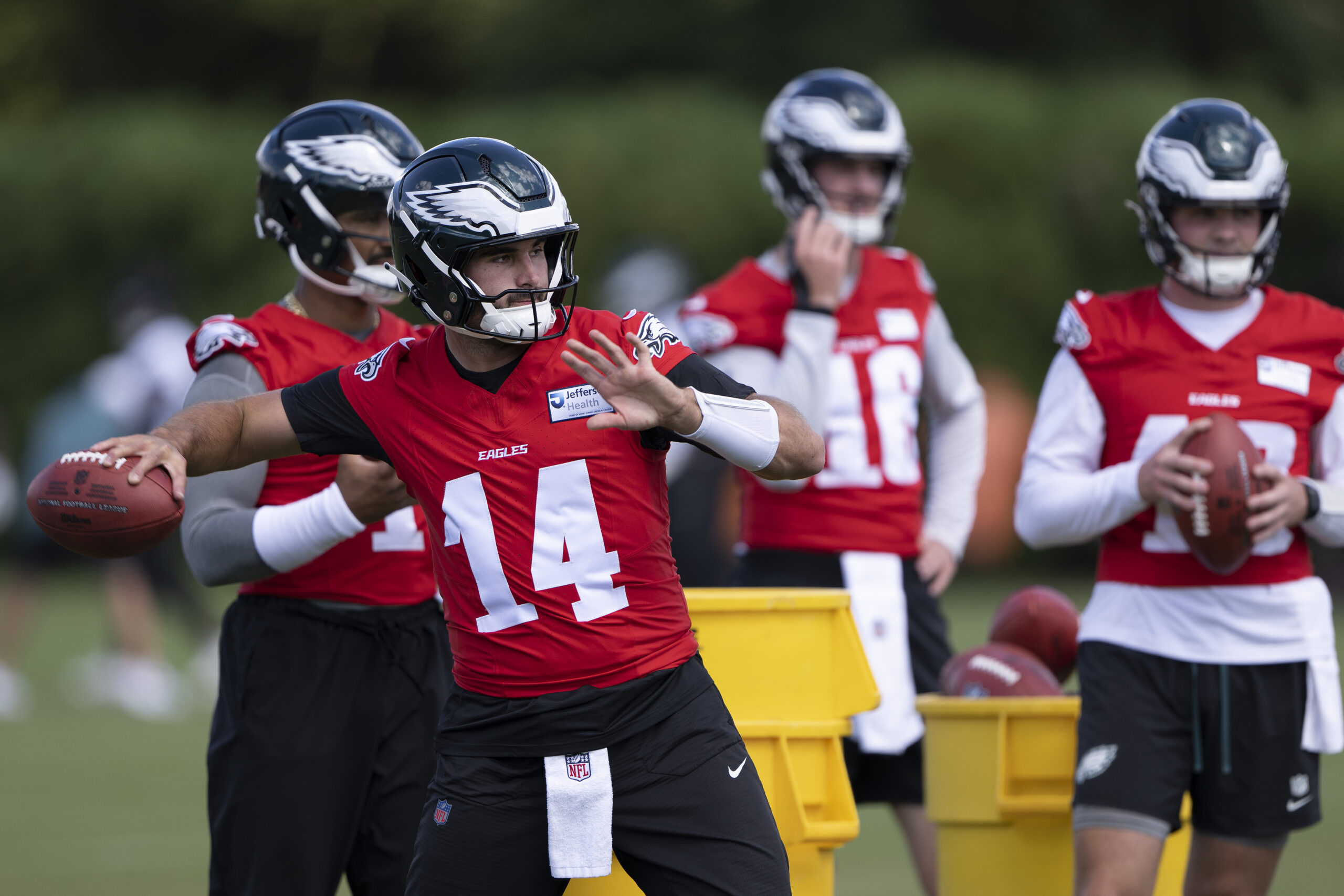
    Will Sam Howell (14) stay in the QB room in 2026?

    Howell: Keep the band together? Howell is a free agent and still has much more NFL playing experience than McKee. He didn’t see the field for the Eagles last season, but they could do worse than bringing him back to the room.

    Trey Lance: The No. 3 overall pick in the 2021 draft is still just 25 years old and was with his third NFL team this season when he backed up the Chargers’ Justin Herbert. Lance spent his first two seasons with the 49ers in the Kyle Shanahan offense, from which the Eagles likely will install elements during the offseason. Can’t hurt to have a player in the building with some experience hearing calls from the man himself.

    Clayton Tune: Another one for the translator category. Tune, a fifth-round pick by Arizona in 2023, was on Green Bay’s practice squad last season and could help Hurts and Co. transition into the Mannion offense and terminology.

    Other names to watch: Kenny Pickett, Brett Rypien

  • 2026 NFL mock draft 2.0: What does the Eagles’ post-combine board look like?

    2026 NFL mock draft 2.0: What does the Eagles’ post-combine board look like?

    With the NFL scouting combine in the rearview mirror, the collective focus will now turn to the fast-approaching free agency period, which will help paint a clearer view of what needs remain ahead of April’s draft.

    But the past week also gave teams an opportunity to meet and learn more about the next group of NFL players. Some team fits have began to materialize, including what the Eagles may end up doing with the 23rd pick.

    Here’s how we’re projecting our second first-round mock draft of this draft cycle:

    1. Las Vegas Raiders: Fernando Mendoza, QB, Indiana

    The buzz coming out of the combine is that Las Vegas is locked in on Mendoza atop the draft. That was the consensus coming into the combine, and the same remains true leaving it.

    2. New York Jets: Arvell Reese, LB/edge, Ohio State

    After an elite testing performance, Reese all but sealed his likelihood of getting selected inside the top 4, and the scuttlebutt from the combine all pointed to the Jets coaching staff favoring the versatile Ohio State player.

    3. Arizona Cardinals: Rueben Bain Jr., edge, Miami

    Bain didn’t test at the combine, but most teams aren’t deterred from drafting the standout Miami edge early in the draft. He can rush from the interior and as an outside pass rusher, and is a stout run defender that can help the rebuilding Cardinals.

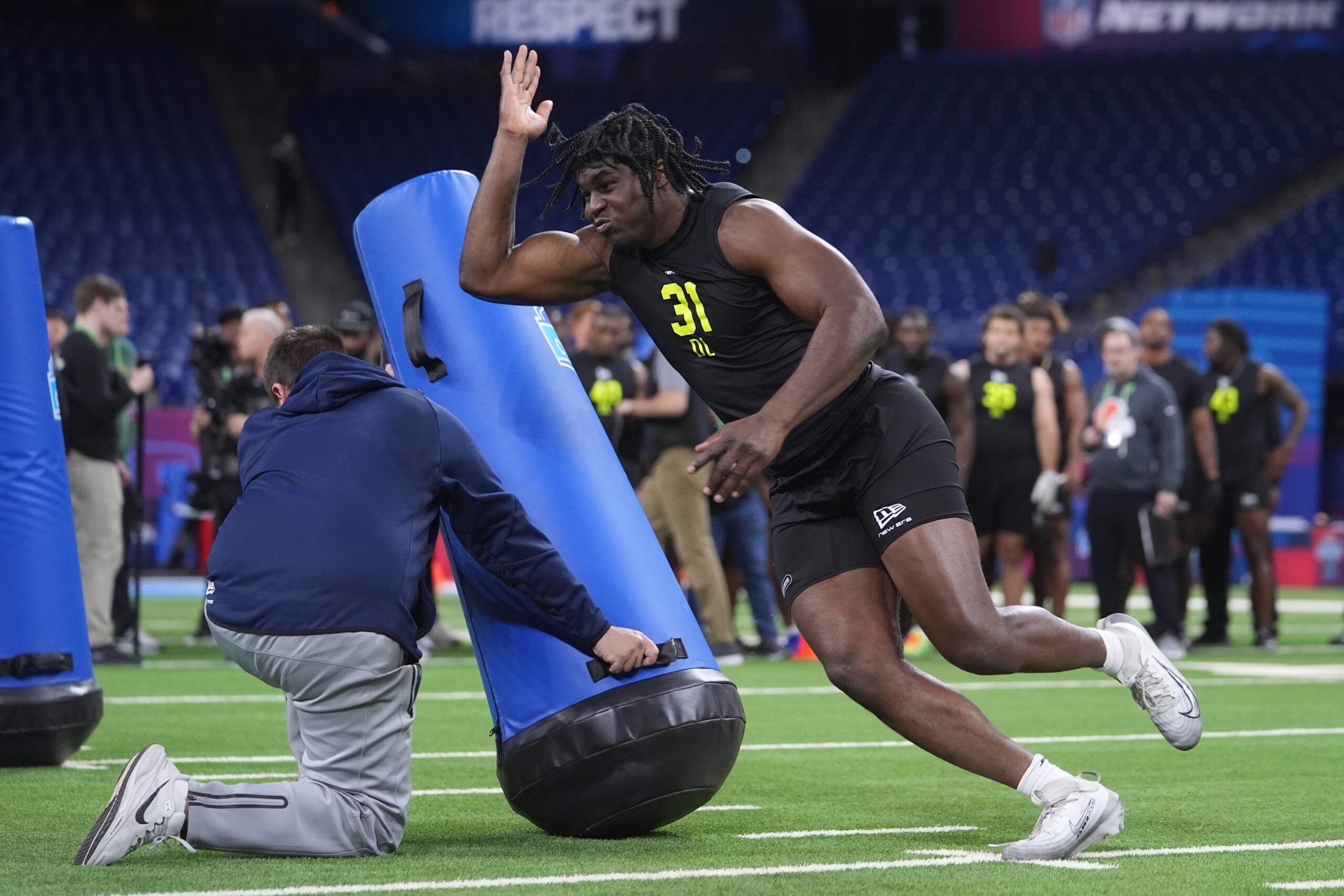
    Defensive lineman David Bailey (31) runs a drill at the NFL Scouting Combine on Thursday.

    4. Tennessee Titans: David Bailey, edge, Texas Tech

    Notre Dame running back Jeremiyah Love’s range begins here, but in this scenario, Tennessee opts to take Bailey, who showed off his linear explosiveness and speed at the combine. Robert Saleh gets his pass rusher to build around for the future.

    5. New York Giants: Sonny Styles, LB, Ohio State

    Styles was already getting top-10 buzz coming into the combine, but his unreal testing performance (4.46 second 40-yard dash, 43.5-inch vertical jump, 11-foot, 2-inch broad jump, and 7.09 second three-cone) and New York’s need at linebacker may be too enticing for them to pass up.

    6. Cleveland Browns: Monroe Freeling, OT, Georgia

    Freeling’s stock continues to rise, despite making just 16 career starts. Cleveland gets a much-needed upgrade at a premium position with an elite athlete who shows promise as a pass protector and blocking out in space.

    7. Washington Commanders: Jeremiyah Love, RB, Notre Dame

    The idea of pairing Love with Jayden Daniels in the backfield would give nightmares to the NFC East and the rest of the conference. Love is a three-down back with elite speed (4.36 second 40-yard dash) and pass catching ability.

    8. New Orleans Saints: Carnell Tate, WR, Ohio State

    Despite running a 4.53 second 40-yard dash, Tate excels as a route runner when matched up one-on-one against defensive backs and gives Tyler Shough another outside receiver weapon to pair with former Ohio State teammate Chris Olave.

    9. Kansas City Chiefs: Francis Mauigoa, OT, Miami

    Kansas City’s offensive line has struggled, and Mauigoa can fill a need at either tackle or guard. He also said at his podium this weekend that he will play any of the five spots on an offensive line, which gives Kansas City the flexibility to play him at tackle or guard.

    10. Cincinnati Bengals: Caleb Downs, S, Ohio State

    Despite not testing at the combine, Downs is the most instinctual player in the draft and received rave reviews in his interviews with teams from across the league. Cincinnati seems to be the floor of where he will be selected in the first round.

    11. Miami Dolphins: Olaivavega Ioane, OL, Penn State

    This one is a bit of a surprise, considering Miami’s needs in the secondary, but Ioane has an argument as the best offensive lineman in the class and could help solidify a group that struggled at both guard spots last season.

    12. Dallas Cowboys: Mansoor Delane, DB, LSU

    One of the worst-kept secrets is Dallas’ intention of drafting a cornerback early, and here that would get them Delane, a smooth cornerback with excellent anticipatory and ball skills that should fit under new defensive coordinator Christian Parker.

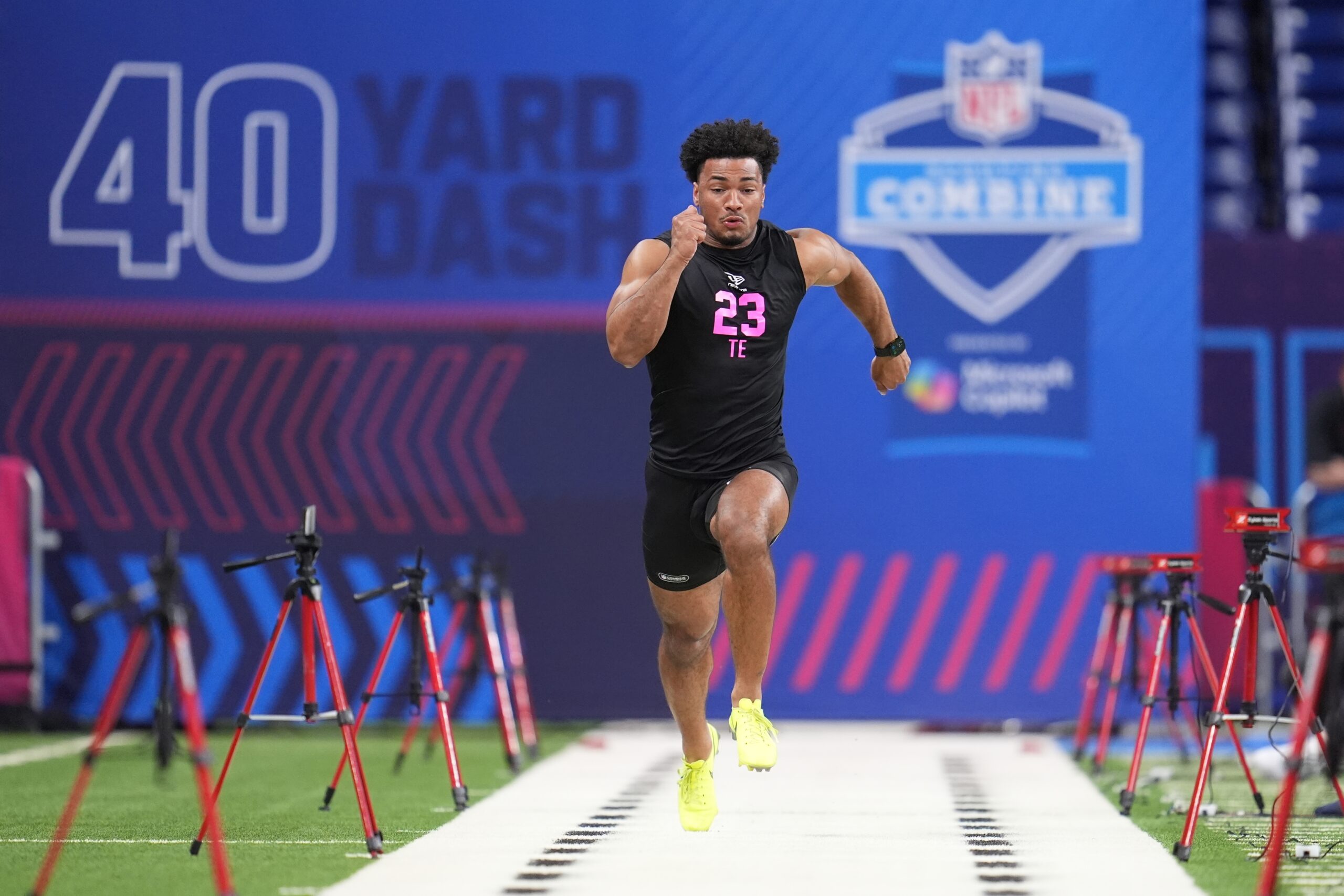
    Kenyon Sadiq runs the 40-yard dash at the NFL Scouting Combine on Friday.

    13. Los Angeles Rams (via Falcons): Kenyon Sadiq, TE, Oregon

    The Oregon tight end tested historically well at the combine for the tight end position, and seems unlikely to make it out of the top 20. In joining Los Angeles, Sadiq gives Sean McVay and Matthew Stafford a receiving weapon that can replace free agent Tyler Higbee’s production.

    14. Baltimore Ravens: Peter Woods, DL, Clemson

    Woods’ stock is difficult to figure out because of his uneven play in 2025, but the Clemson defensive tackle’s pass rushing and gap shooting ability would be a nice addition to a defensive line that features Nnamdi Madubuike and Travis Jones.

    15. Tampa Bay Buccaneers: Cashius Howell, edge, Texas A&M

    Getting more consistent edge rusher production will be among the priorities for Tampa this offseason, and Howell brings that ability, despite having short arms (30¼-inch arms). He has shown the ability to win on a two-way go off the edge.

    16. New York Jets (via Colts): Makai Lemon, WR, USC

    Lemon looked smooth during the on-field combine drills, but there are concerns with his athletic profile. However, New York needs more playmakers in itsreceiver room and Lemon thrives at the catch point and after the catch.

    17. Detroit Lions: Avieon Terrell, DB, Clemson

    Detroit has needs along the offensive line, but Terrell has the fearless mentality, ball skills, and coverage instincts to fit at multiple spots in the secondary. Amik Robertson is set to be a free agent and Terrell played outside corner and nickel in college.

    18. Minnesota Vikings: Jermod McCoy, DB, Tennessee

    McCoy opted to not participate in the combine, and there is no guarantee he will at his pro day either, which could scare some teams from drafting him. He has shutdown corner ability, got his hands on the football in both man and zone coverages and would fit nicely in Brian Flores’ aggressive defense.

    19. Carolina Panthers: Jordyn Tyson, WR, Arizona State

    Tyson’s medical checks could have him go a lot lower than expected, but his fall ends here with Carolina, especially with Xavier Legette’s unclear future with the team. The Arizona State wideout is dynamic at the catch point and can win as a route runner in the slot and as an outside receiver.

    20. Dallas Cowboys (via Packers): Keldric Faulk, edge, Auburn

    Faulk, who showed some lower-body explosiveness at the combine (35-inch vertical, 9-9 broad jump), is an excellent run defender who played in a contain style of defense, which limited his pass rushing ability.

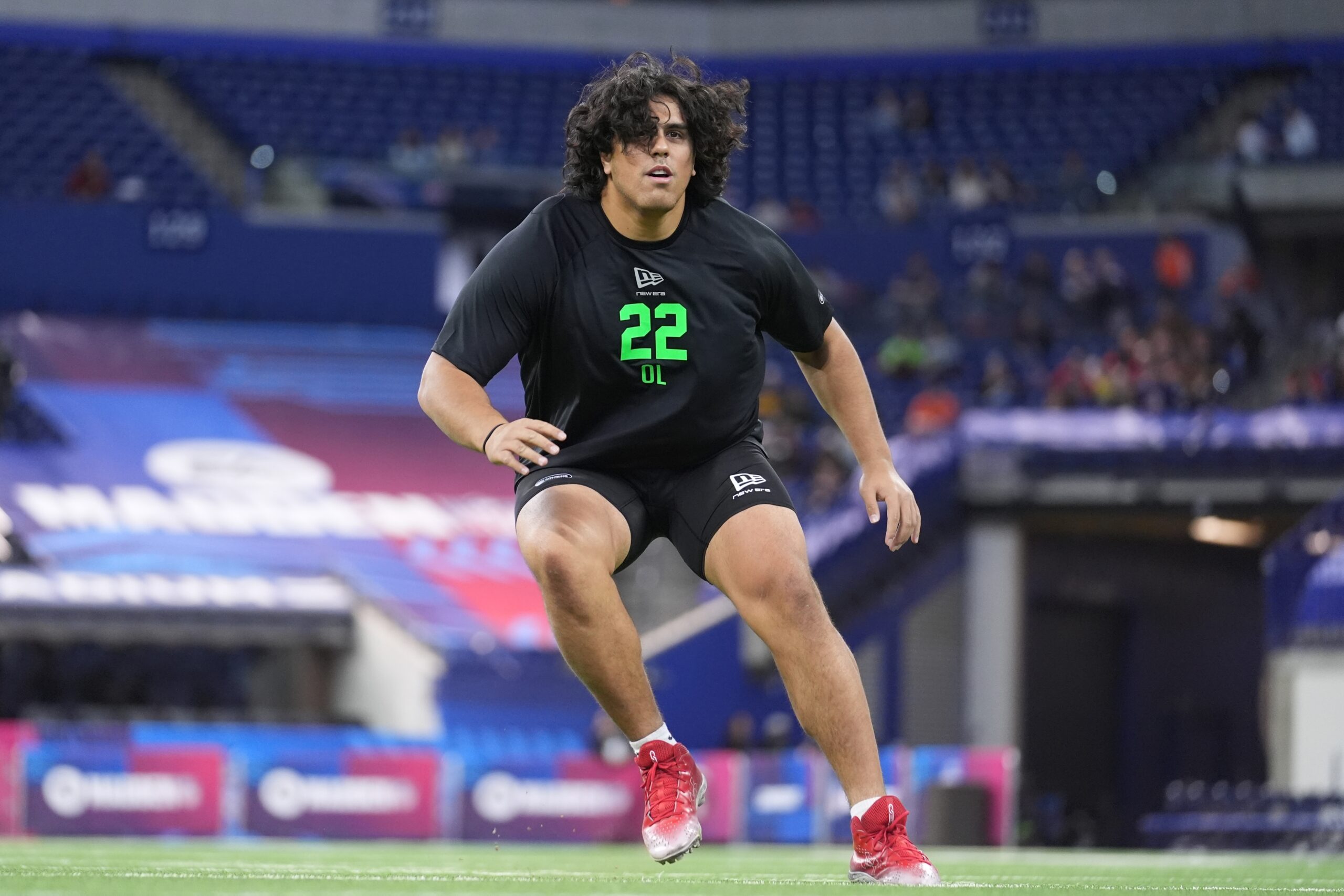
    Utah offensive lineman Spencer Fano runs a drill at the NFL Scouting Combine on Sunday.

    21. Pittsburgh Steelers: Spencer Fano, OT/OG, Utah

    Isaac Seumalo could be on the way out for Pittsburgh, leaving an opening at guard for the Steelers. Fano has great feet and hands as a tackle, but his movement skills and run blocking disposition could be accentuated even more at guard.

    22. Los Angeles Chargers: R Mason Thomas, edge, Oklahoma

    Thomas did not run very well at the combine (4.67-second 40-yard dash) but he’s got an elite first step and can beat tackles on their outside or inside shoulders. Los Angeles desperately needs more juice from its pass rushers.

    23. Eagles: Kadyn Proctor, OT, Alabama

    The Eagles showed significant interest in the tight ends and offensive linemen at the combine, and Proctor was among their formal meetings. The Alabama tackle said the Birds “have expressed a lot of interest in me,” during the process, and rightfully so, considering size, athleticism, and run blocking displacement skills.

    He also admitted he was open to playing in the interior, a spot the Eagles could upgrade this offseason. He certainly checks the box for the “critical factors” the Eagles look for in offensive linemen.

    24. Browns (via Jaguars): Kevin Concepcion, WR, Texas A&M

    Concepcion is a dynamic athlete with the ball in his hands and would give Cleveland’s offense a much-needed vertical threat for whoever is under center next season, whether it’s Shedeur Sanders or a free agent signing like Malik Willis.

    25. Chicago Bears: Dillon Thieneman, S, Oregon

    Thieneman was the pleasant surprise of the combine, testing like an elite athlete (4.35 40-yard dash, 41-inch vertical, 10-5 broad jump) and showcasing the range to play as a single-high safety and the instincts to play a box safety role. With Jaquan Brisker, Kevin Byard, and C.J. Gardner-Johnson hitting free agency, Chicago gets a potential Day 1 impact player.

    26. Buffalo Bills: C.J. Allen, LB, Georgia

    Allen, the standout Georgia linebacker, has good instincts and playmaking skills at the second level of a defense and fills a need with Matt Milano set to hit free agency for Buffalo.

    Washington wide receiver Denzel Boston runs a drill at the NFL Scouting Combine on Saturday.

    27. San Francisco 49ers: Denzel Boston, WR, Washington

    Jauan Jennings is set to hit free agency this offseason, and the 49ers may be looking for his replacement in the draft. Boston is a big receiver who can win vertically and thrives at the catch point with his strong hands and impressive body control on jump balls.

    28. Houston Texans: Caleb Banks, DL, Florida

    Banks tested like a solid athlete at the combine, but he only played in three games in 2025 and needs to improve his pad level and down-to-down consistency. But his skill set will fit nicely in DeMeco Ryans’ defense.

    29. Rams: Blake Miller, OT, Clemson

    The Rams have a big need at corner, but instead they upgrade the right tackle spot with Miller, who has light feet in pass protection and the grip strength to stop pass rushers in his tracks. He also has the athleticism to block in space, a big component of Sean McVay’s offense.

    30. Denver Broncos: Omar Cooper Jr., WR, Indiana

    One name that kept popping up as a first-round player last week was Cooper, who has the speed to run by defensive backs (4.46-second 40-yard dash) and is tough to bring down in the open field after the catch. He would be a nice, complementary piece in Denver’s offense.

    31. New England Patriots: T.J. Parker, edge, Clemson

    The Patriots need more impactful pass rushers, and Parker relies on his power and is a physical run defender that can stack and shed offensive linemen in the run game. He also has experience dropping into coverage.

    32. Seattle Seahawks: Chris Johnson, DB, San Diego State

    Johnson’s rise is similar to Quinyon Mitchell’s a few years ago — Johnson crushed the predraft process first at the Senior Bowl, then at the combine (4.4 second 40-yard dash, 38-inch vertical, 10-6 broad jump). He is a sticky coverage player in man and zone coverages, and is competitive at the catch point, and fills a need for Seattle in the secondary.

  • Why Eagles should target Kenyon Sadiq, KC Concepcion, and Germie Bernard — even if it means trading A.J. Brown

    Why Eagles should target Kenyon Sadiq, KC Concepcion, and Germie Bernard — even if it means trading A.J. Brown

    The next two months will be franchise-defining for Howie Roseman and the Eagles. That’s partly a function of how much they need to accomplish in order to get their offense on a sustainable footing. But it’s also a function of how much opportunity they have to do so. In fact, they have more of it than most teams in their situation can hope to have.

    The decision-making revolves around the draft, as it always does. The most honest thing anybody can say about the draft is that the best decisions are primarily a result of what’s available. Roseman deserves a ton of credit for projecting Quinyon Mitchell as an elite cornerback. But he gets credit for drafting him only because he lasted until the 22nd pick. Same goes for Cooper DeJean in the second round at No. 40. Who knows what this Eagles defense looks like if Mitchell and DeJean weren’t on the board.

    I see a lot of parallels between that 2024 draft and this year’s. The Eagles’ offense is at a similar juncture, particularly in the pass-catching department. DeVonta Smith is great. He’s also the only guy on the depth chart at wide receiver and tight end, if we’re assuming that A.J. Brown is potentially on the way out. The best way to get yourself into trouble when you are on the clock is to focus on immediate needs over expected future value. The Eagles’ opportunity is that this year’s draft looks like it aligns with their needs.

    If the mock drafts are to be trusted, the Eagles could have their choice of one of at least three potential difference-makers at No. 23 and perhaps a second if they can move up in the second round. Last year, I was beating the drum for Missouri receiver Luther Burden III, who ended up going No. 39 to the Bears. This year’s trio is even better.

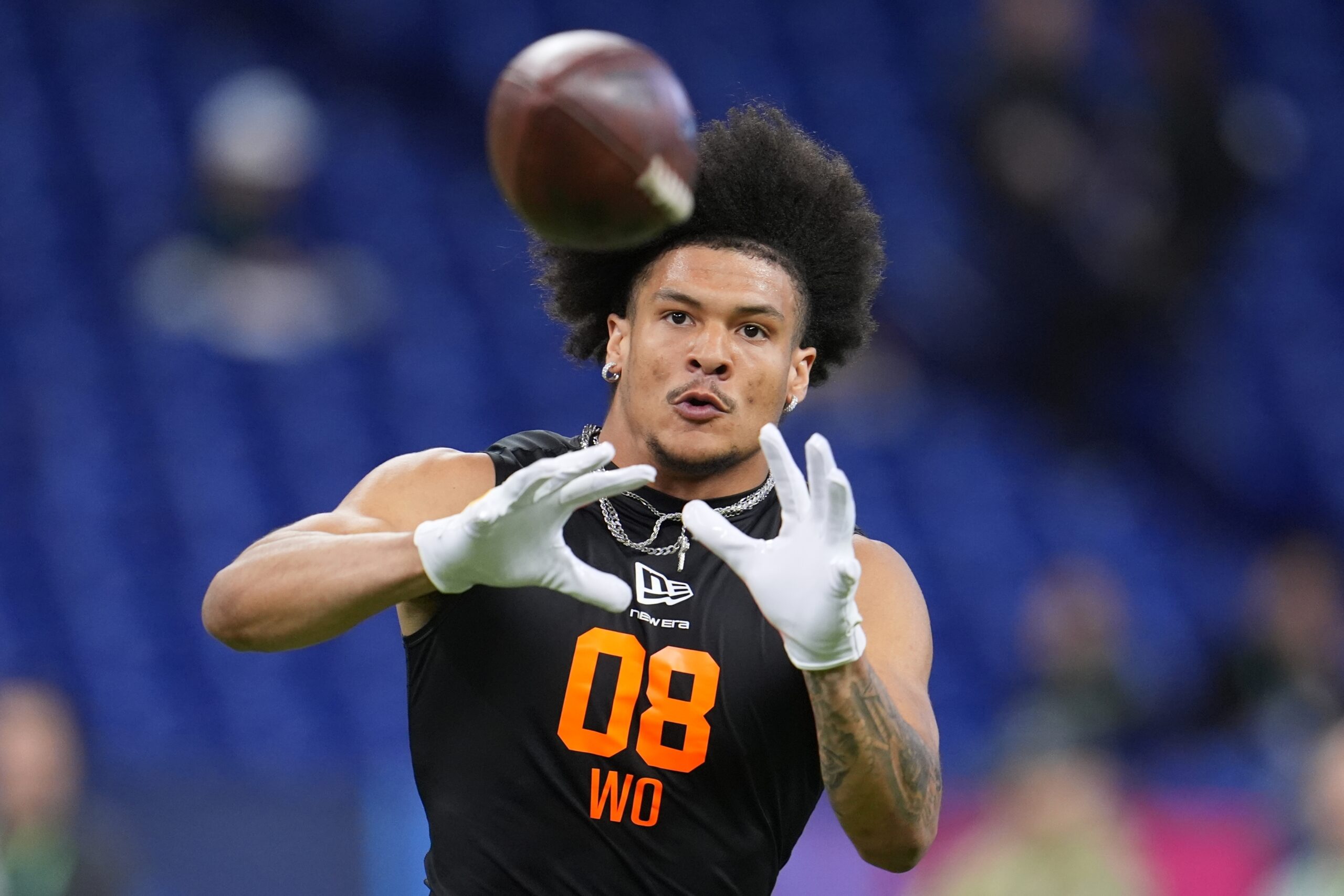
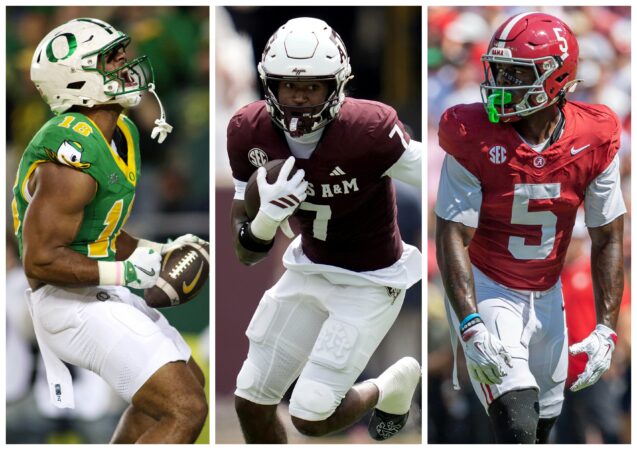
    Oregon tight end Kenyon Sadiq. Texas A&M wide receiver KC Concepcion. Alabama wide receiver/utility man Germie Bernard.

    The comps are Vernon Davis, Antonio Brown/Stefon Diggs, and Deebo Samuel.

    I’m not going to sit here and pretend I have an opinion on any of the linemen who could be on the board in the late first round. If the Eagles have a chance to draft one with a Lane Johnson or Jalen Carter grade, they should obviously do it. What I do know is that the pass-catchers should be a priority, and that there are three guys who could offer the value that Mitchell and DeJean did on the defensive side.

    This draft is better than people are giving it credit for, particularly in the range where things start to look realistic for the Eagles. The precombine consensus had Sadiq going No. 19, Concepcion going No. 27, and Bernard going No. 69. The Eagles have picks No. 23 and 54, but I’m skeptical that they’ll be in position to pick two of the three.

    The idea that Sadiq will last anywhere close to No. 23 always seemed detached from reality. That’s especially true after a combine performance unlike any we’ve seen at the tight end position in recent memory. Sadiq’s 40-yard dash time of 4.39 seconds was the fastest by a tight end since converted quarterback Matt Jones in 2003. His 1.54-second 10-yard split would have ranked him among the Top 12 wide receivers at this year’s combine. He also put up wideout-like numbers in the broad jump and vertical leap.

    It would be one thing if Sadiq’s measurements were at odds with his game tape. But they aren’t. The game speed and explosiveness are there. Most notable is the way they show up off the ball. His combination of acceleration and compact strength allowed Oregon to use him in all sorts of ways in their blocking schemes: out wide on wide receiver screens, across the formation on running plays, etc. It is impressive to watch. This isn’t Kyle Pitts. I have to imagine every cutting-edge play designer in the NFL would love to have Sadiq’s skill set at his disposal. Don’t listen to the folks who try to compare him to fellow workout warrior Eli Stowers. The Vanderbilt tight end is a worthy late-second-round gamble. But watch both of their cut tapes and you’ll quickly realize one of these things is not like the other.

    Kenyon Sadiq’s 40-yard dash time of 4.39 seconds was the fastest by a tight end since converted quarterback Matt Jones in 2003.

    To be clear, Sadiq’s isn’t a conventional skill set. He isn’t anything close to your classic tackle-adjacent receiver-lineman tweener tight end. Which might be one reason why the draft industry rates him where it does. At 6-foot-3 with 31½-inch arms, he is at the negative extreme in terms of length at the position. Of the 14 tight ends who had a 1,000-yard season since 2010, only one was listed at 6-3 or shorter, according to Pro-Football-Reference.com (Delanie Walker, 2015). Sadiq’s arm length measurement ranks in the bottom 10% of tight ends at the combine since 2010. Combined with his chiseled 246-pound frame, he looks more like an H-back than a prototypical pass-catching tight end. That’s only a problem for a scheme that lacks imagination.

    If anything, Sadiq’s overall pass-catching numbers are at odds with his game tape. His 892 career receiving yards in three years at Oregon would be the lowest for any tight end drafted with a top-28 pick since at least 2010. Every tight end drafted in the top 15 since 2010 had at least one season with 58-plus receiving yards per game. O.J. Howard at No. 19 in 2017 averaged 40.1 yards, which is about what Sadiq averaged this season (51 catches, 560 yards, 14 games).

    Thing is, Sadiq looks the part on film. The guy pops in all phases of the game. Look at his two touchdown catches against USC in October. On goal-to-go from the 8-yard line, he beat USC safety Christian Pierce on a perfect in-breaking route and then was in the process of running away from him when he made the catch in the back of the end zone. On the second, he got behind a late rotation on a seam route and then made a great catch in traffic in front of the deep man before being sandwiched. Sadiq finished the season as one of two major conference tight ends in the last five years to have five TD catches of 20-plus yards.

    Sizewise, I see Vernon Davis. The more intriguing comp is George Kittle. Sadiq may never be the blocker that Kittle is, i.e., one of the best ever at the position. But that’s not the point. The point is Kittle as a pass-catcher. In four years at Iowa, he had 48 catches for 737 yards, topping out at 22 catches for 314 yards as a senior. The 49ers drafted him in the fifth round. He would go higher in a redraft.

    No position in the NFL draft is less contingent on college production than tight end. Jimmy Graham played one year at Miami, caught 17 passes, and was drafted in the third round. Antonio Gates never played college football. When Travis Kelce turned 23 years old, he was a senior at Cincinnati who’d caught 19 passes for 247 yards in 25 career games. They are the exceptions, sure. But name another position where three such exceptions went on to become three of the greatest of all time (four if you count Kittle).

    Let’s reiterate our point here. It isn’t that Sadiq is the same type of prospect as the guys I just mentioned. He’s on a much higher level. It isn’t that he is going to become those guys. The point is that Sadiq’s relatively paltry receiving numbers shouldn’t make him fall in the draft. Chances are, they won’t.

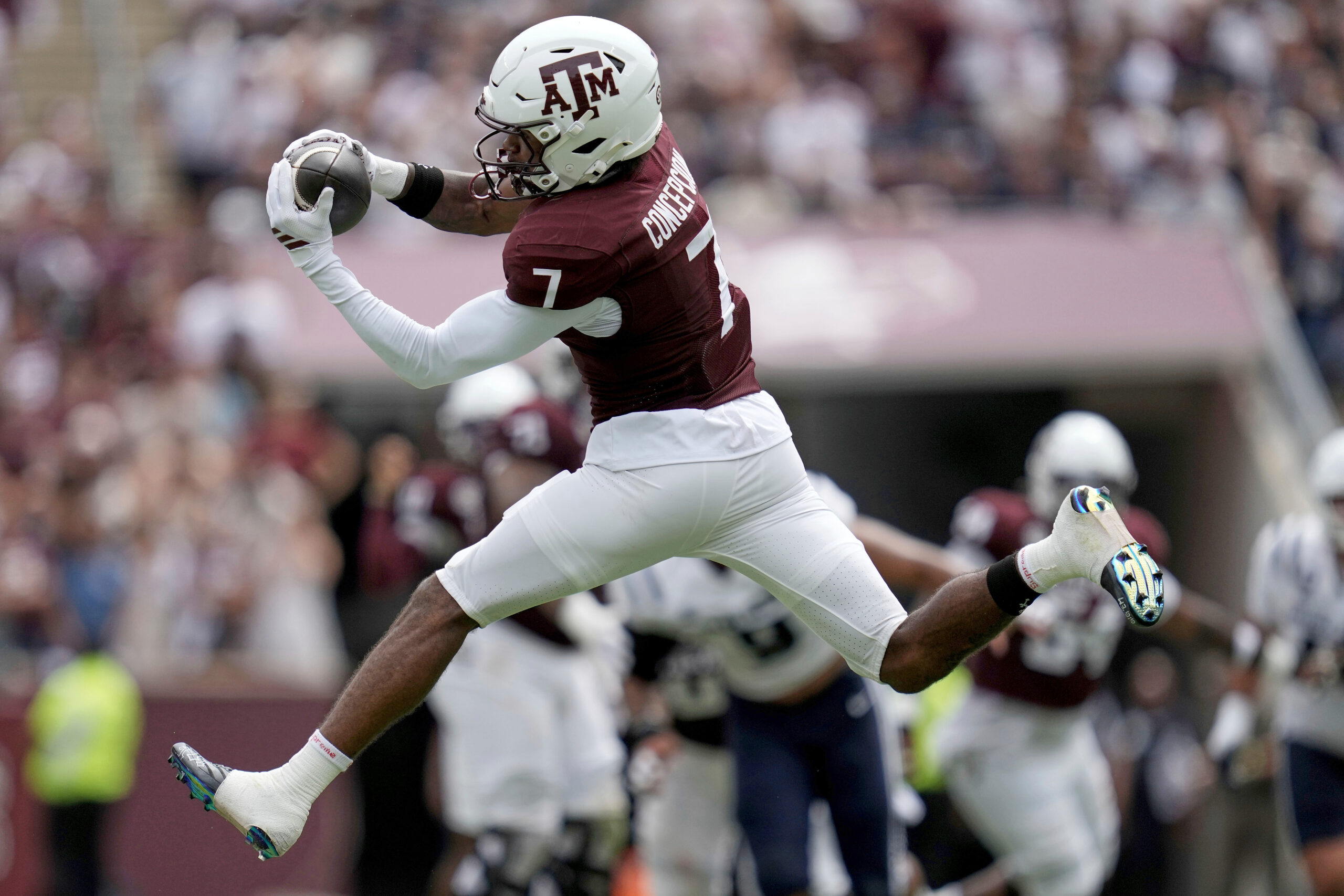
    KC Concepcion had 61 catches for 919 yards and nine touchdowns as a junior at Texas A&M.

    Concepcion is more likely to be there at No. 23. He’s a bit slight at 6-foot, 196 pounds. He didn’t run the 40 or take part in any of the other athleticism tests at the combine. Silence in a court of law, etc. But none of that should matter when you see the film. The ability to create change-of-direction separation is elite. It shows up in the numbers. In addition to his 61 catches for 919 yards and nine touchdowns as a junior at Texas A&M, and his 70 carries for 431 yards and three touchdowns in three collegiate seasons, he is coming off a season where he averaged 18.2 yards with two touchdowns on 25 punt returns after returning just five in his first two seasons. Whatever the physical measurements, his is an NFL frame, and an NFL game.

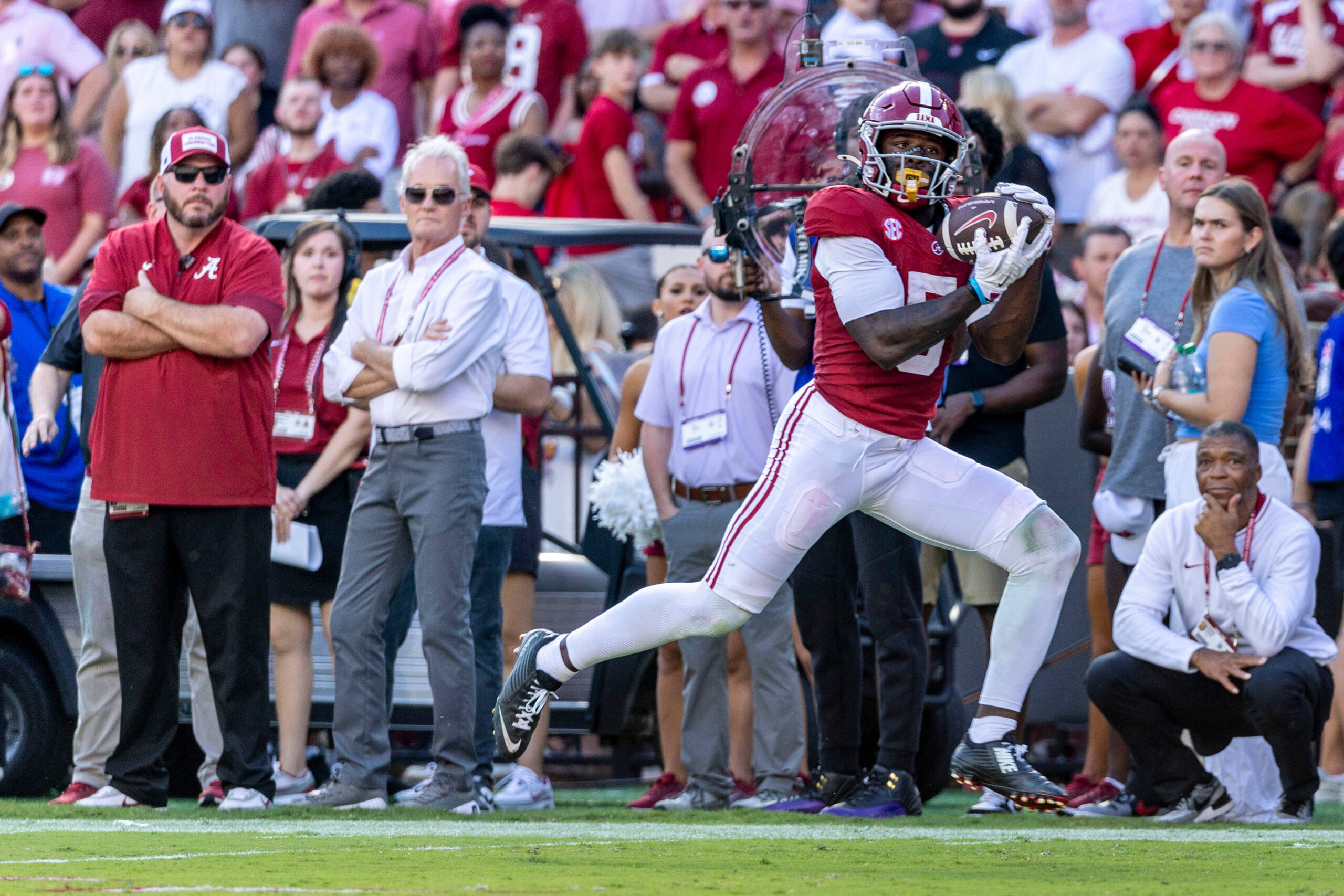
    Bernard is the DeJean of this year’s draft. Midway through his rookie season everyone will look back and say, how did this guy fall as far as he did? Assuming the current projections are correct and he won’t be a first-round pick. Comps are usually fuzzy things. Man, does he look a lot like Deebo Samuel did during his peak with the 49ers. At 6-1, 206 pounds with a low center of gravity and ballcarrier instincts, Bernard could easily pass for a third-down back. But he is a wide receiver, one who averaged 57 catches for 828 yards over his last two seasons at Alabama. He has as high of a floor as anybody can have at his position. Too many GMs chase upside in a draft. The real test is projecting a player’s probability of achieving that upside. Bernard plays the game with a fluidity and instinct that will translate in some meaningful capacity. So much so that the Eagles shouldn’t hesitate to draft him at No. 23 rather than gambling he’ll still be there beyond.

    There is an elephant in the room here, one so large that he has already been mentioned. The Brown thing is simple. Even if he is here next year, he won’t be here much beyond that. Jalen Hurts isn’t one of the rare quarterbacks who makes the pass-catching talent around him better. The Eagles will fail and fail miserably if Smith is his only pass-catcher who is above replacement level. They would be wise to trade Brown if it lands them a draft pick that facilitates the acquisition of someone with the ability to help replace him.

    “If someone is going to give you something you didn’t anticipate and you won’t even have the conversation, I don’t think you’re necessarily doing your job or really servicing the team you’re with,” Roseman said at the combine last week. “You never know what someone is willing to do.”

    The perfect draft for the Eagles is Sadiq first and then one of Concepcion or Bernard second. Given the value that teams place on the trenches, it’s hard for me to believe in a worthwhile certainty/upside ratio with any lineman who would also be available.

    Germie Bernard had 64 catches for 862 yards and seven touchdowns at Alabama last season.

    I’m skeptical that Sadiq will last anywhere close to where the current mock drafts have him going. At this time last year, Daniel Jeremiah and Pro Football Focus both had Colston Loveland going in the 18-20 range. In 2024, PFF had Brock Bowers going 18th. Loveland ended up going 10th and Bowers 13th. Both were among the top nine non-quarterbacks off the board. So, I wouldn’t put too much stock into the current projections, which have Sadiq lasting into the 20s and potentially reaching the Eagles at No. 23. I also don’t think the Eagles can bet on Concepcion being there. Nor can they with Bernard at 54.

    The idea of trading Brown makes a lot more sense from that perspective. It’s only true if Roseman can somehow finagle something like the No. 31 overall pick from the Patriots. Maybe by swapping No. 54 and No. 68 for the Pats’ No. 63. So, the Eagles trade Brown in order to move up 23 spots from No. 54 to No. 31 while moving down nine spots from No. 54 to No. 63.

    There are at least three prospects who would make it worth it.

  • Potential Eagles targets at the scouting combine: Which top tight end, secondary prospects do Birds have in their sights?

    Potential Eagles targets at the scouting combine: Which top tight end, secondary prospects do Birds have in their sights?

    INDIANAPOLIS — In each of the past two drafts, the Eagles diverged from their typical first-round philosophy.

    In 2024, general manager Howie Roseman ended the organization’s 22-year drought in selecting a defensive back in the first round when he drafted Quinyon Mitchell. Last year, Roseman and the Eagles drafted South Jersey native and linebacker Jihaad Campbell, from a position that had previously not been an early-round priority.

    The Eagles roster needs retooling heading into the 2026 season, and among the potential needs are at safety and tight end. The Birds have never drafted a first-round safety and haven’t selected a tight end that early since 1988.

    With tight ends Dallas Goedert, Grant Calcaterra, and Kylen Granson, and safeties Marcus Epps and Reed Blankenship all set to be free agents, could Roseman and the Eagles buck another trend?

    Here is what we’ve learned about the Eagles’ interest in draft prospects so far at the 2026 NFL Scouting Combine:

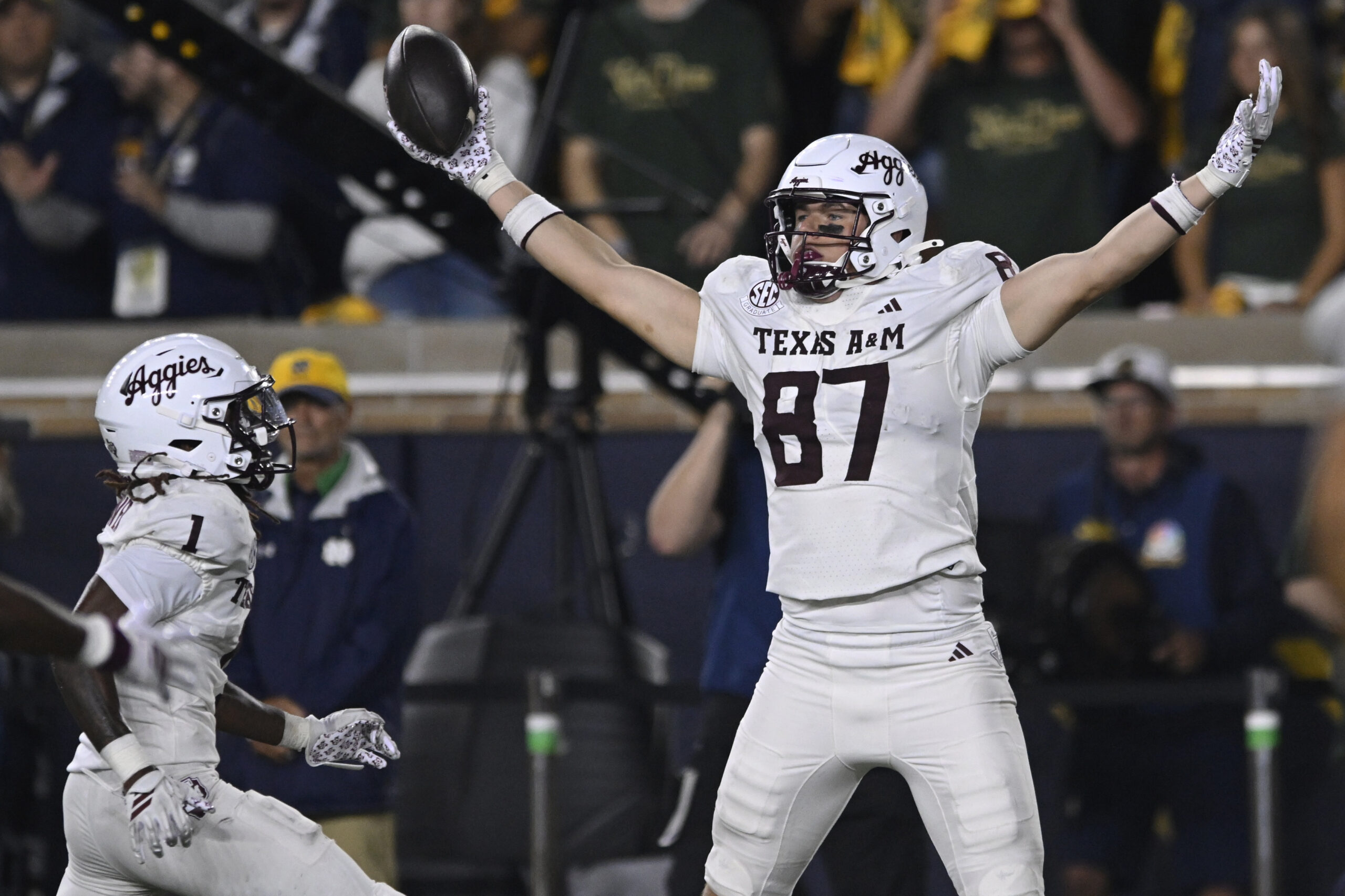
    Texas A&M’s Nate Boerkircher (87) could be an answer for the Eagles at tight end.

    Interest in tight ends is real

    The Eagles have spent a significant amount of time speaking with tight ends this week in Indianapolis. Roseman recently talked about needing “more of a diverse skill set at that position” last season.

    The prized player of the group is Oregon’s Kenyon Sadiq, the consensus top tight end of this class, but he had not yet met with the Eagles when he held his podium session Thursday afternoon.

    There were several other players the Eagles did meet with, informally and formally. NC State’s Justin Joly, Georgia’s Oscar Delp, Ohio State’s Max Klare, Texas’ Jack Endries, Vanderbilt’s Eli Stowers, and Ole Miss’ Dae’Quan Wright were among the players who met with the Eagles this week.

    Klare, Delp, Joly, and Stowers are more like the tight ends the Eagles have drafted in the past, majoring as receivers with deficiencies as blockers, while Endries and Wright are a little more well-rounded as blockers.

    Eagles running backs coach Jemal Singleton coached Texas A&M’s Nate Boerkircher at the Senior Bowl as part of Eagles D-line coach Clint Hurtt’s staff, and Boerkircher met informally with the Eagles this week at the combine. Boerkircher plays a more traditional in-line tight end role and is a physical blocker who revels in doing the dirty work that doesn’t always equate to targets and catches.

    “I think [NFL teams] like my toughness and my high motor,” Boerkircher said Thursday. “I don’t have, you know, crazy stats. So that limited stats thing is brought up a little bit, and we talked about that, but [my film] shows what it needs to show.”

    Ohio State’s Will Kacmarek is one of the best blocking tight ends in the draft class, and while there hasn’t been any reported interest from the Eagles, he would be a welcome addition to a room that needs that type of player.

    Even if the Eagles don’t draft Sadiq in the first round, there are several other players that seem to be piquing the team’s interest.

    Toledo safety Emmanuel McNeil-Warren could follow former secondary teammate Quinyon Mitchell to the Eagles.

    Another Toledo prospect?

    The Eagles struck gold by drafting Mitchell from Toledo, which continues to churn out NFL secondary talent. And there are three more players from the Rockets program in this class.

    There’s one specifically, though, that the Eagles brought in for a formal interview, and that’s safety Emmanuel McNeil-Warren. The 6-foot-3 player is explosive, can defend the run, and has short-area coverage ability. He has excellent ball skills to intercept the ball and force fumbles, and was teammates with Mitchell for two years at Toledo.

    “[Mitchell] was a motivation for us, so he just pushed us to be great, pushed us to work hard every day and be the best person we could be,” McNeil-Warren said of his former teammate. “Just coming in [to Toledo], knowing you got a chip on your shoulder, especially for a small school … just the work ethic we put in, we just got to keep grinding.”

    McNeil-Warren tested well for his size at the combine, running a 4.52-second 40-yard dash, jumping a 35.5 inch vertical, and a 10-foot, 2-inch broad jump. He is among two other safeties that could go in the first round, which includes consensus top-10 pick Caleb Downs and Oregon’s Dillon Thieneman, who had an outstanding testing session.

    Even with limited reported interest in the position group, the Eagles should strongly consider drafting a safety with a deep group this year. They may be waiting to bring other top safety prospects in for pre-draft visits over the next month.

    Wide receiver Deion Burks (4) is a player the Eagles have met with in Indianapolis.

    Quick hitters

    • The Eagles like drafting edge rushers early and often, and it seems like they’re showing interest in bigger body types. They have met with Penn State’s Dani Dennis-Sutton (6-6, 256 pounds), Michigan’s Derrick Moore (6-4, 255), and Duke’s Wesley Williams (6-4, 256). They also showed continued interest in Western Michigan’s Nadame Tucker (6-2, 247), who was praised by Hurtt during the Senior Bowl, and Central Florida’s Malachi Lawrence (6-4, 253), who received interest from the Eagles at the East-West Shrine Bowl.
    • Could fullback be of interest for the Eagles in 2026 under new offensive coordinator Sean Mannion? If he does take elements from Sean McVay and Kyle Shanahan’s offense, it could include a plan for the position. The Eagles met with Michigan fullback Max Bredeson at the Shrine Bowl. He’s a former high school quarterback and models his game after Alec Ingold, who was in Mike McDaniel’s Shanahan-inspired offense the last two years in Miami.
    • The Eagles have met with three receivers so far at the combine, and they’re all in the same mold: slot receivers that can win vertically and over the middle of the field. Clemson’s Antonio Williams, Mississippi State’s Brennan Thompson, and Oklahoma’s Deion Burks are among the list, and Thompson could challenge for being the fastest player at the combine. Williams is particularly interesting considering his ability to block and was a versatile weapon in Clemson’s offense last season.