Category: Economy

  • Trump overturned decades of US trade policy in 2025. See the impact of his tariffs, in four charts.

    Trump overturned decades of US trade policy in 2025. See the impact of his tariffs, in four charts.

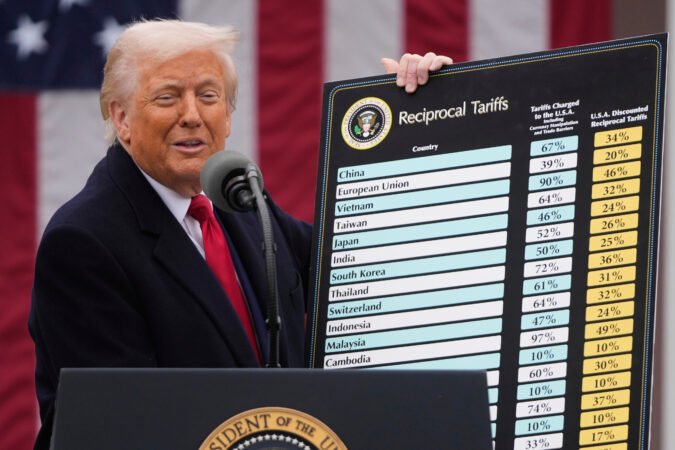
    Since returning to the White House in January, President Donald Trump has overturned decades of U.S. trade policy — building a wall of tariffs around what used to be a wide open economy.

    His double-digit taxes on imports from almost every country have disrupted global commerce and strained the budgets of consumers and businesses worldwide. They have also raised tens of billions of dollars for the U.S. Treasury.

    Trump has argued that his steep new import taxes are necessary to bring back wealth that was “stolen” from the U.S. He says they will narrow America’s decades-old trade deficit and bring manufacturing back to the country. But upending the global supply chain has proven costly for households facing rising prices. The taxes are paid by importers who typically attempt to pass along the higher costs to their customers. That includes businesses and ultimately, U.S. households.

    And the erratic way the president rolled out his tariffs — announcing them, then suspending or altering them before conjuring up new ones — made 2025 one of the most turbulent economic years in recent memory.

    Here’s a look at the impact of Trump’s tariffs over the last year, in four charts.

    Effective U.S. tariff rate

    A key number for the overall impact of tariffs on U.S. consumers and businesses is the “effective” tariff rate — which, unlike headline figures imposed by Trump for specific trade actions, provides an average based on the actual imports coming into the country.

    In 2025, per data from the Yale Budget Lab, the effective U.S. tariff rate peaked in April. But it’s still far higher than the average seen at the start of the year. Before finalizing shifts in consumption, November’s effective tariff rate was nearly 17% — seven times greater than January’s average and the highest seen since 1935.

    Tariff revenue vs America’s trade deficit

    Among selling points to justify his tariffs, Trump has repeatedly said they would reduce America’s longstanding trade deficit and bring revenue into the Treasury.

    Trump’s higher tariffs are certainly raising money. They’ve raked in more than $236 billion this year through November — much more than in years past. But they still account for just a fraction of the federal government’s total revenue. And they haven’t raised nearly enough to justify the president’s claim that tariff revenue could replace federal income taxes — or allow for windfall dividend checks for Americans.

    The U.S. trade deficit, meanwhile, has fallen significantly since the start of the year. The trade gap peaked to a monthly record of $136.4 billion in March, as consumers and businesses hurried to import foreign products before Trump could impose his tariffs on them. The trade gap narrowed to $52.8 billion in September, the latest month for which data is available. But the year-to-date deficit was still running 17% ahead of January-September 2024.

    Import shifts with America’s biggest trading partners

    Trump’s 2025 tariffs hit nearly every country in the world — including America’s biggest trading partners. But his policies have had the biggest impact on U.S. trade with China, once the biggest source of American imports and now No. 3 behind Canada and Mexico. U.S. tariffs on Chinese imports now come to 47.5%, according to calculations by Chad Bown of the Peterson Institute for International Economics.

    The value of goods coming into the U.S. from China fell nearly 25% during the first three-quarters of the year. Imports from Canada also dropped. But the value of products from Mexico, Vietnam, and Taiwan grew year-to-date.

    Market swings

    For investors, the most volatile moments on the stock market this year arrived amid some of the most volatile moments for Trump’s tariffs.

    The S&P 500, an index for the biggest public companies in the U.S., saw its biggest daily and weekly swings in April — and largest monthly losses and gains in March and June, respectively.

  • Stock prices have grown rapidly. So is the market a bubble?

    Stock prices have grown rapidly. So is the market a bubble?

    Is the stock market a bubble?

    The answer to this question is a big deal for the approximately one-third of well-to-do Americans who own most of the stock. However, it also matters to the broader economy and thus by extension to the majority who don’t.

    All of the ingredients that go into making a bubble are evident. Most important, stock prices have been on a tear. Prices never move in a straight line, but they’ve rocketed more or less straight up over the past decade, more than doubling since the COVID-19 pandemic.

    This amount of price growth has happened in only three other decades since the late 1800s, when the Dow Jones Industrial Average index, comprising the 30 largest publicly traded companies, was first published. Those decades were the 1920s, the 1950s, and the 1990s.

    The roaring 1920s, of course, ended terribly in the 1929 stock market crash, which ushered in the Great Depression of the 1930s. That was clearly a bubble.

    In the 1950s, stock market gains were powered by U.S. companies’ dominance of the global economy after World War II. This included companies such as General Electric, AT&T, General Motors, U.S. Steel, and DuPont. That wasn’t a bubble.

    And then there was the 1990s internet craze, which ended soon after Y2K with a dramatic decline in stock prices. No question: That was a bubble.

    The internet was a game-changing technology that resulted in enormous productivity gains and ultimately generated significant profits. However, investors had discounted all this and much more. Stock market valuations — stock prices relative to corporate earnings — surged.

    Valuations aren’t quite as lofty today as they were in the late 1990s, but they are close. And they are still on the rise. My favorite valuation measure is the ratio of the value of all publicly traded stocks, as measured by the Wilshire 5000, to economy-wide corporate profits from the Bureau of Economic Analysis.

    In the 75 years for which this valuation measure can be calculated, stock prices have averaged 12 times corporate profits, a 12-1 ratio. Currently, the ratio is 20-1. The only other time valuations have been higher was at the height of the Y2K bubble, when the measure briefly spiked to 24-1.

    But perhaps today’s extraordinary stock market valuation is justified. After all, this largely reflects the investors’ optimism about the large artificial-intelligence companies. These so-called hyperscalers are nothing like many of the fly-by-night internet companies (think Pets.com) that inflated the Y2K bubble.

    This is undoubtedly the case, but like those internet companies, the stock prices of today’s AI companies are being juiced up by investor speculation. That is, an increasing number of investors are piling into these stocks, driven by the simple logic that since their prices have risen a lot, they will continue to rise. This momentum will continue, and if it doesn’t, they will be smart enough to recognize this and find other unwitting investors to buy their stocks before the bottom drops out.

    Another form of arguably accidental speculation may also be taking hold in the stock market via the fast-growing index funds. These funds passively track a market index, like the Standard & Poor’s 500, by holding stocks in the same proportion as the index. The goal is to match the market’s performance. Index funds offer the benefits of diversification and low fees but aren’t based on an analysis of the underlying companies’ strengths.

    Thus, if the stock price of a company is rising, it will attract more investments from index funds, and its price will rise even further. There is no argument that AI-chip juggernaut Nvidia’s stock price should be up significantly, for example, but it has increased substantially more due to this self-reinforcing dynamic.

    The soaring stock market has been a powerful tailwind to the entire economy.

    The wealthy, who own the bulk of the stocks, are now much wealthier and spending accordingly. In the past year alone, stock wealth has increased by nearly a staggering $10 trillion. This newfound wealth supports a significant amount of spending, which, in turn, supports a substantial number of jobs.

    This brings into clear relief a significant threat to the economy. If the stock market is a bubble and it bursts, wiping out this wealth, consumer spending will suffer a significant blow, triggering a recession. This is precisely what happened after the bursting Y2K bubble.

    So, is the stock market a bubble?

    Well, if it isn’t, it soon will be if the current trends continue for much longer. The final ingredient for a bubble is that nearly all the naysayers are silenced. That happens when they’ve called out the bubble for so long, they are no longer considered credible. Any skepticism is thrown to the side, and the bubble inflates more.

    We aren’t there yet. There are still too many naysayers like me.

  • Resilient U.S. consumers drive strongest economic expansion in two years

    Resilient U.S. consumers drive strongest economic expansion in two years

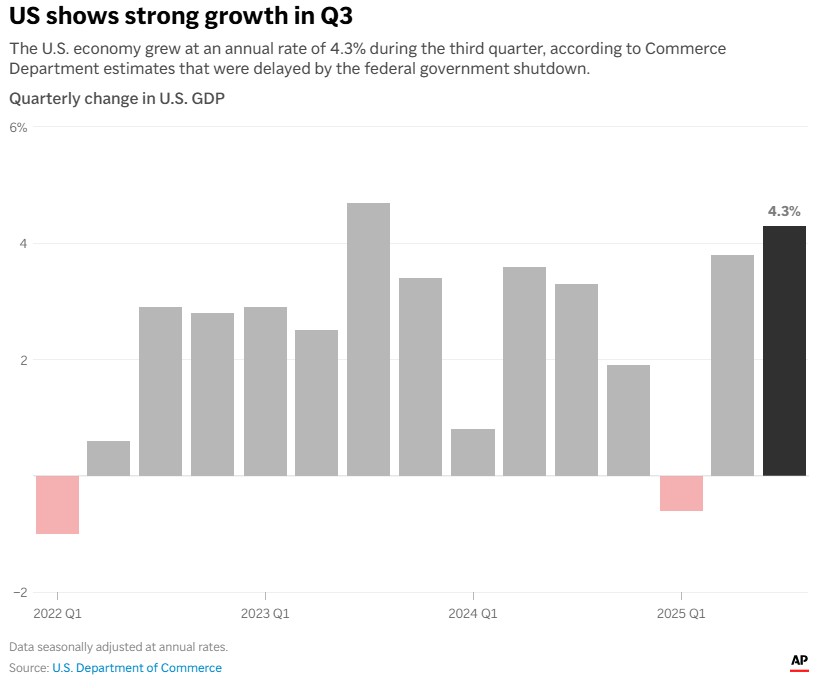
    WASHINGTON — The U.S. economy grew at a surprisingly strong 4.3% annual rate in the third quarter, the most rapid expansion in two years, driven by consumers who continue to spend in the face of ongoing inflation.

    U.S. gross domestic product from July through September — the economy’s total output of goods and services — rose from its 3.8% growth rate in the April-June quarter, the Commerce Department said Tuesday in a report delayed by the government shutdown. Economists surveyed by the data firm FactSet forecast growth of just 3% in the period.

    The U.S. economy grew at an annual rate of 4.3% during the third quarter, according to Commerce Department estimates that were delayed by the federal government shutdown.

    As has been the case for most of this year, the consumer is providing the fuel that is powering the U.S. economy. Consumer spending, which accounts for about 70% of U.S. economic activity, rose to a 3.5% annual pace last quarter. That’s up from 2.5% in the April-June period.

    A number of economists, however, believe the growth spurt may be short-lived with the extended government shutdown dragging on the economy in the fourth quarter, as well as a growing number of Americans fatigued by stubbornly high inflation.

    A survey published by the Conference Board Tuesday showed that consumer confidence slumped close to levels not seen since the U.S. rolled out broad tariffs on its trading partners in April.

    “The jump in consumer spending reminds me a lot of last year’s (fourth quarter),” said Stephen Stanley, chief U.S. economist at Santander. “Consumers were stretching. So, as was the case entering this year, households probably need to take a breather soon.”

    However, at least in recent years, consumer spending has held up even when data suggests they’ve grown more anxious about money.

    Tuesday’s GDP report also showed that inflation remains higher than the Federal Reserve would like. The Fed’s favored inflation gauge — called the personal consumption expenditures index, or PCE — climbed to a 2.8% annual pace last quarter, up from 2.1% in the second quarter.

    Excluding volatile food and energy prices, so-called core PCE inflation was 2.9%, up from 2.6% in the April-June quarter.

    Economists say that persistent and potentially worsening inflation could make a January interest rate cut from the Fed less likely, even as central bank official remain concerned about a slowing labor market.

    “If the economy keeps producing at this level, then there isn’t as much need to worry about a slowing economy,” said Chris Zaccarelli, chief investment officer for Northlight Asset Management, adding that inflation could return as the greatest threat to the economy.

    Another consistent driver in the U.S. economy, spending on artificial intelligence, was also evident in the latest data.

    Investment in intellectual property, the category that covers AI, grew 5.4% in the third quarter, following an even bigger jump of 15% in the second quarter. That figure was 6.5% in the first quarter.

    Consumption and investment by the government grew by 2.2% in the quarter after contracting 0.1% in the second quarter. The third quarter figure was boosted by increased expenditures at the state and local levels and federal government defense spending.

    Private business investment fell 0.3%, led by declines in investment in housing and in nonresidential buildings such as offices and warehouses. However, that decline was much less than the 13.8% slide in the second quarter.

    Within the GDP data, a category that measures the economy’s underlying strength grew at a 3% annual rate from July through September, up slightly from 2.9% in the second quarter. This category includes consumer spending and private investment, but excludes volatile items like exports, inventories and government spending.

    Exports grew at an 8.8% rate, while imports, which subtract from GDP, fell another 4.7%.

    Tuesday’s report is the first of three estimates the government will make of GDP growth for the third quarter of the year.

    Outside of the first quarter, when the economy shrank for the first time in three years as companies rushed to import goods ahead of President Donald Trump’s tariff rollout, the U.S. economy has continued to expand at a healthy rate. That’s despite much higher borrowing rates the Fed imposed in 2022 and 2023 in its drive to curb the inflation that surged as the United States bounced back with unexpected strength from the brief but devastating COVID-19 recession of 2020.

    Though inflation remains above the Fed’s 2% target, the central bank cut its benchmark lending rate three times in a row to close out 2025, mostly out of concern for a job market that has steadily lost momentum since spring.

    Last week, the government reported that the U.S. economy gained a healthy 64,000 jobs in November but lost 105,000 in October. Notably, the unemployment rate rose to 4.6% last month, the highest since 2021.

    The country’s labor market has been stuck in a “low hire, low fire” state, economists say, as businesses stand pat due to uncertainty over Trump’s tariffs and the lingering effects of elevated interest rates. Since March, job creation has fallen to an average 35,000 a month, compared to 71,000 in the year ended in March. Fed Chair Jerome Powell has said that he suspects those numbers will be revised even lower.

  • SEPTA’s board approves 2-year contract with transit agency’s largest union

    SEPTA’s board approves 2-year contract with transit agency’s largest union

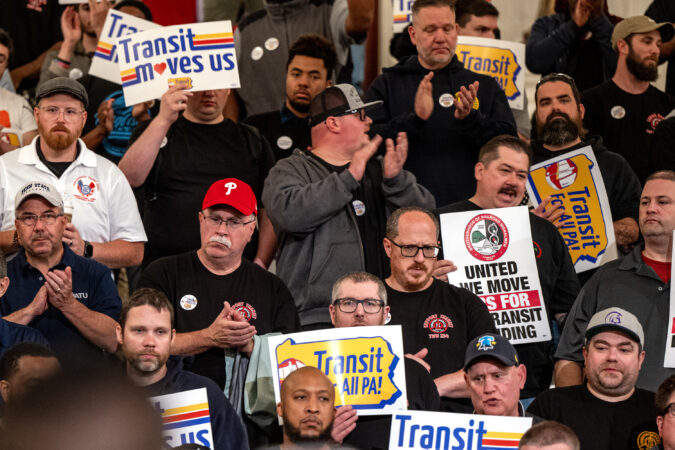
    SEPTA’s board on Thursday approved a new contract with the transit agency’s largest union, Transport Workers Union Local 234, and a second smaller union representing vehicle operators in the suburbs of Philadelphia.

    Members of TWU Local 234 voted Wednesday night to approve a two-year contract that will deliver a 3.5% pay raise, bolster the union’s pension funds, and expand health benefits for new employees.

    SMART Local 1594, which represents approximately 350 operators, reached a deal with the transit agency earlier this month.

    “These contracts are fair to our hardworking frontline employees and fiscally responsible to our riders and the taxpayers who fund SEPTA,” said SEPTA General Manager Scott A. Sauer.

    For TWU Local 234, the two-year contract disrupts a pattern of three consecutive one-year contracts. TWU president Will Vera said that with the FIFA World Cup, MLB All-Star Game, and America’s 250th birthday coming to Philadelphia in 2026, both parties agreed to a two-year contract so as not to interrupt service during these global events.

    The union represents 5,000 operators, mechanics, cashiers, maintenance people, and custodians who work on SEPTA’s buses, subways, and trolleys. Before this latest deal, TWU members were working without a contract since Nov. 7, and members voted unanimously on Nov. 16 to authorize leaders to call a strike if contract negotiations didn’t go as planned.

    Will Vera, vice president TWU Local 234, urged lawmakers in Harrisburg to deliver a budget during a speech in July at the AFL-CIO headquarters in Philadelphia.

    However, Vera said that this contract is a major win, especially for attracting new hires. Before this, new employees could not begin receiving dental and vision care until they completed 15 months on the job. The new contract shrinks that time down to 90 days.

    “I really got tired of explaining to the new hires for 15 months that they just have to clean their teeth,” Vera said. “I wanted this to be a retention contract, to not only keep people here, but to make this an attractive place to come work for SEPTA.”

    Philly’s transit unions don’t hesitate to strike if needs aren’t met. SEPTA unions have struck 12 times since 1975, earning SEPTA the title of one of the most strike-prone agencies in the country. Its last strike was a six-day effort in 2016 that ended one day before the presidential election.

    The negotiations come on the heels of SEPTA’s worst financial period in its history, the agency said. SEPTA isn’t alone, though. Transit agencies throughout the country are in funding crises as inflation rises, federal funding shrinks, and state subsidies fail to increase each year.

    Sauer, SEPTA’s general manager, added: “I am grateful to Governor [Josh] Shapiro and his team for their efforts to help us resolve differences and reach an agreement. Securing two-year contracts provides important stability as we approach the major events coming to Philadelphia in 2026.”

  • The U.S. gained 64,000 jobs in November but lost 105,000 in October as the unemployment rate rose to 4.6%

    The U.S. gained 64,000 jobs in November but lost 105,000 in October as the unemployment rate rose to 4.6%

    WASHINGTON — The United States gained a decent 64,000 jobs in November but lost 105,000 in October as federal workers departed after cutbacks by the Trump administration, the government said in delayed reports.

    The unemployment rate rose to 4.6%, highest since 2021.

    Both the October and November job creation numbers, released Tuesday by the Labor Department, came in late because of the 43-day federal government shutdown.

    The November job gains came in higher than the 40,000 economists had forecast. The October job losses were caused by a 162,000 drop in federal workers, many of whom resigned at the end of fiscal year 2025 on Sept. 30 under pressure from billionaire Elon Musk’s purge of U.S. government payrolls.

    Labor Department revisions also knocked 33,000 jobs off August and September payrolls.

    Workers’ average hourly earnings rose just 0.1% from October, the smallest gain since August 2023. Compared to a year earlier, pay was up 3.5%, the lowest since May 2021.

    Healthcare employers added more than 46,000 jobs in November, accounting for more than two-thirds of the 69,000 private sector jobs created last month. Construction companies added 28,000 jobs. Manufacturing shed jobs for the seventh straight month, losing 5,000 jobs in November.

    Hiring has clearly lost momentum, hobbled by uncertainty over President Donald Trump’s tariffs and the lingering effects of the high interest rates the Federal Reserve engineered in 2022 and 2023 to rein in an outburst of inflation.

    American companies are mostly holding onto the employees they have. But they’re reluctant to hire new ones as they struggle to assess how to use artificial intelligence and how to adjust to Trump’s unpredictable policies, especially his double-digit taxes on imports from around the world.

    The uncertainty leaves jobseekers struggling to find work or even land interviews. Federal Reserve policymakers are divided over whether the labor market needs more help from lower interest rates. Their deliberations are rendered more difficult because official reports on the economy’s health are coming in late and incomplete after a 43-day government shutdown.

    Labor Department revisions in September showed that the economy created 911,000 fewer jobs than originally reported in the year that ended in March. That meant that employers added an average of just 71,000 new jobs a month over that period, not the 147,000 first reported. Since March, job creation has fallen farther — to an average 35,000 a month.

    The unemployment rate, though still modest by historical standards, has risen since bottoming out at a 54-year low of 3.4% in April 2023.

    “The takeaway is that the labor market remains on a relatively soft footing, with employers showing little appetite to hire, but are also reluctant to fire,” Thomas Feltmate, senior economist at TD Economics, wrote in a commentary. “That said, labor demand has cooled more than supply in recent months, which is what’s behind the steady upward drift in the unemployment rate.’’

    Adding to the uncertainty is the growing use of artificial intelligence and other technologies that can reduce demand for workers.

    “We’ve seen a lot of the businesses that we support are stuck in that stagnant mode: ‘Are we going to hire or are we not? What can we automate? What do we need the human touch with?’’’ said Matt Hobbie, vice president of the staffing firm HealthSkil in Allentown, Pennsylvania.

    “We’re in Lehigh Valley, which is a big transportation hub in eastern Pennsylvania. We’ve seen some cooling in the logistics and transportation markets, specifically because we’ve seen automation in those sectors, robotics.’’

    Worries about the job market were enough to nudge the Fed into cutting its benchmark interest rate by a quarter of a percentage point last week for the third time this year.

    But three Fed officials refused to go along with the move, the most dissents in six years. Some Fed officials are balking at further cuts while inflation remains above the central bank’s 2% target. Two voted to keep the rate unchanged. Stephen Miran, appointed by Trump to the Fed’s governing board in September, voted for a bigger cut – in line with what the president demands.

    Tuesday’s report shows that “the labor market remains weak, but the pace of deterioration probably is too slow to spur the (Fed) to ease again in January,’’ Samuel Tombs, chief U.S. economist at Pantheon Macroeconimics, wrote in a commentary. The Fed holds its next policy meeting Jan. 27-28.

    Because of the government shutdown, the Labor Department did not release its jobs reports for September, October and November on time.

    It finally put out the September jobs report on Nov. 20, seven weeks late. It published some of the October data – including a count of the jobs created that month by businesses, nonprofits and government agencies – along with the November report Tuesday. But it did not release an unemployment rate for October because it could not calculate the number during the shutdown.

  • A recession seems increasingly likely in 2026, economist says

    A recession seems increasingly likely in 2026, economist says

    It’s December, which means it’s time for economists to publish their forecasts for the upcoming year. Given all the political, economic, and social concerns, the crystal ball is fuzzy.

    However, the factors that should drive growth in 2026 are fairly clear.

    Tariffs are an unknown and the greatest potential threat

    With inflation remaining stubbornly high and affordability becoming a political battleground, President Donald Trump is faced with some difficult decisions. It is hard to argue that tariffs are not paid for by consumers. Recent actions to lower tariffs on imported food products is an admission that is the case.

    So in 2026, will tariffs be reduced? And if so, how broadly?

    The likelihood is they will be lowered, but the ad hoc nature of tariff adjustments indicates the changes will not likely have much of an impact on prices. And that means inflation is likely to remain well above the Fed’s target rate of 2%.

    The effects of high and rising prices on economic activity cannot be denied. Affordability is not a hoax, at least not for the average household. Consumer confidence recently fell to some of the lowest levels recorded.

    While overall consumer spending has held up, much of the demand is coming from upper-income households. An economy can be supported for only so long by a small percentage of the population. Eventually, the companies that provide goods and services to the average household will feel the pain.

    Without a major turnabout on tariffs, inflation is likely to remain high, further depressing consumer confidence and spending.

    Immigration policy and deportations are slowing population growth

    Whatever you think of the Trump immigration and deportation strategy, there are economic implications.

    When the shutdown in immigration is combined with rising death rates and falling birth rates, the result is the U.S. population may have declined in 2025 for the first time ever.

    Also, restrictions on immigration have slowed labor force growth. When you add in the fear factor affecting both documented and undocumented workers, the negative effects on the labor supply are magnified.

    In an economy with low unemployment rates, the lack of workers puts upward pressure on wages and inflation while reducing income growth and total consumer spending.

    In addition, the labor shortage restricts business growth. Small businesses continue to report that the lack of qualified workers is their biggest problem.

    The administration’s immigration policy will likely continue to limit labor availability, slow hiring, and restrain spending, while putting upward pressure on wages and prices.

    The Federal Reserve faces a difficult choice

    The Fed is in a pickle. If it tries to fight elevated inflation by not lowering interest rates, it risks slowing the economy. If it tries to address a softening economy by reducing interest rates, it risks inflaming inflationary pressures.

    It is clear the monetary authorities would prefer to lower rates back toward trend levels. And they are likely to cut rates next year. But there is little reason to believe inflation will settle down soon, so the Fed cannot be expected to act aggressively.

    The Fed cannot fight high inflation and slowing growth at the same time, so barring a recession, expect it to act cautiously.

    The impact of AI on the economy should accelerate in 2026

    The 800-pound gorilla in the economic forecast is artificial intelligence, the next industrial revolution.

    Next year will likely be make-it-or-break-it for many companies when it comes to AI. The hundreds of billions of dollars being invested must show clear signs of being financially profitable. By this time next year, AI firms must create real value, not just stock market value.

    Previous early phases of industrial revolutions typically led to massive upheaval in the labor market. We are starting to see the outlines of what that might look like once AI becomes embedded in the economy.

    Right now, firms are not firing workers. But many have paused hiring. The next step, though, is layoffs. We could start seeing that by mid-2026.

    Ultimately, hiring should come back. It always happened in past phases of the industrial revolution. Just don’t expect to see that until 2027 or even later.

    As AI spreads thorough the economy, anticipate much slower or even negative job growth, leading to higher unemployment rates, lower consumer confidence, and slower spending.

    Upending traditional international relationships creates tremendous economic uncertainties

    The Trump administration’s desire to reframe international relationships cannot be viewed simply as a political strategy. Its economic consequences are hardly clear now but may show up in 2026.

    A rough summary of the latest national security outline points to a pullback from Europe, an expansion in the Americas, closer relations with Russia, and more competition with China.

    Again, how this plays out is anyone’s guess, but we could see Europe become a major economic competitor, China become more aggressive when it comes to trade, and Russia, well who knows what Vladimir Putin will do?

    How could this affect the U.S. economy? Consider China. It has no qualms about using its economic strength as a cudgel. Its economic war with the U.S. is likely to heat up.

    Think about soybeans. China had been the U.S.’s biggest market but has bought little this year. Instead, China is encouraging other countries to grow soybeans. U.S. soybean farmers are going bankrupt and the huge farm bailout could be needed for other segments of the economy if the economic war heats up.

    Similarly, look for Europe, which Trump wants to set afloat, to start switching its demand for American-made products to other parts of the world. The continent could become a full-throated competitor with no holds barred.

    The Trump administration’s goal of resetting international political relationships is likely to spread into a restructuring of international economic competition.

    The U.S. economy is amazingly resilient, but a number of significant issues could become major problems. How they all play out is uncertain, but given the potential negative impacts on growth, it is hard to think we can skirt a recession next year.

  • Senate rejects extension of healthcare subsidies as costs are set to rise for millions of Americans

    Senate rejects extension of healthcare subsidies as costs are set to rise for millions of Americans

    WASHINGTON — The Senate on Thursday rejected legislation to extend Affordable Care Act tax credits, essentially guaranteeing that millions of Americans will see a steep rise in costs at the beginning of the year.

    As Republicans and Democrats have failed to find compromise, senators voted on two partisan bills instead that they knew would fail — the Democratic bill to extend the subsidies, and a Republican alternative that would have created new health savings accounts.

    It was an unceremonious end to a monthslong effort by Democrats to prevent the COVID-19-era subsidies from expiring on Jan. 1, including a 43-day government shutdown that they forced over the issue.

    Ahead of the votes, Senate Democratic Leader Chuck Schumer of New York warned Republicans that if they did not vote to extend the tax credits, “there won’t be another chance to act,” before premiums rise for many people who buy insurance off the ACA marketplaces.

    “Let’s avert a disaster,” Schumer said. “The American people are watching.”

    Republicans and Democrats never engaged in meaningful or high-level negotiations on a solution, even after a small group of centrist Democrats struck a deal with Republicans last month to end the shutdown in exchange for a vote. Most Democratic lawmakers opposed the move as many Republicans made clear that they wanted the tax credits to expire.

    The deal raised hopes for a compromise on healthcare. But that quickly faded with a lack of any real bipartisan talks.

    “We failed,” said Alaska Sen. Lisa Murkowski, one of four Republicans who voted for the Democratic bill, after the vote. “We’ve got to do better. We can’t just say ‘happy holidays, brace for next year.’”

    A Republican alternative

    The dueling Senate votes were the latest political messaging exercise in a Congress that has operated almost entirely on partisan terms, as Republicans pushed through a massive tax and spending cuts bill this summer using budget maneuvers that eliminated the need for Democratic votes. In September, Republicans tweaked Senate rules to push past a Democratic blockade of all of Trump’s nominees.

    On healthcare, Republicans similarly negotiated among themselves, without Democrats. The health savings accounts in the GOP bill that they eventually settled on would give money directly to consumers instead of to insurance companies, an idea that has been echoed by President Donald Trump.

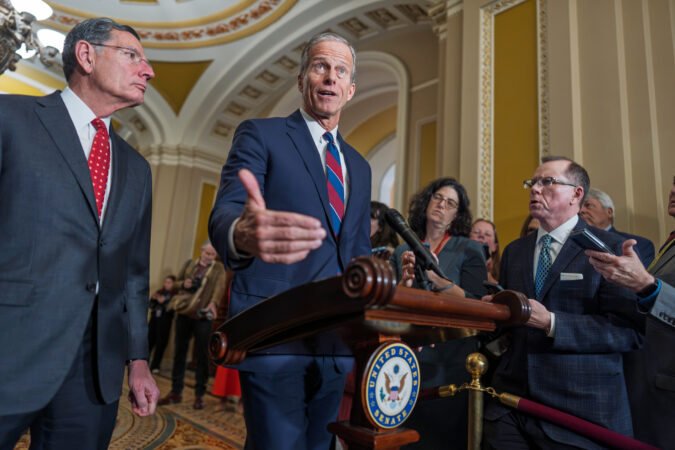
    Senate Majority Leader John Thune (R., S.D.) said ahead of the vote that the Democrats’ simple extension of the subsidies is “an attempt to disguise the real impact of Obamacare’s spiraling healthcare costs.”

    But Democrats immediately rejected the GOP plan, saying that the accounts wouldn’t be enough to cover costs for most consumers.

    The Senate voted 51-48 not to move forward on the Democratic bill, with four Republicans — Maine Sen. Susan Collins, Missouri Sen. Josh Hawley and Alaska Sens. Murkowski and Dan Sullivan — voting with Democrats. The legislation needed 60 votes to proceed, as did the Republican bill, which was also blocked on a 51-48 vote.

    An intractable issue

    The votes were the latest failed salvo in the debate over the Affordable Care Act, former President Barack Obama’s signature law that Democrats passed along party lines in 2010 to expand access to insurance coverage.

    Republicans have tried unsuccessfully since then to repeal or overhaul the law, arguing that healthcare is still too expensive. But they have struggled to find an alternative. In the meantime, Democrats have made the policy a central political issue in several elections, betting that the millions of people who buy healthcare on the government marketplaces want to keep their coverage.

    “When people’s monthly payments spike next year, they’ll know it was Republicans that made it happen,” Schumer said in November, while making clear that Democrats would not seek a compromise.

    Even if they view it as a political win, the failed votes are a loss for Democrats who demanded an extension of the benefits during the shutdown — and for the millions of people facing premium increases on Jan. 1.

    Maine Sen. Angus King, an independent who caucuses with Democrats, said the group tried to negotiate with Republicans after the shutdown ended. But, he said, the talks became unproductive when Republicans demanded language adding new limits for abortion coverage that were a “red line” for Democrats. He said Republicans were going to “own these increases.”

    House to try again

    Republicans have used the looming expiration of the subsidies to renew their longstanding criticisms of the ACA, also called Obamacare, and to try, once more, to agree on what should be done.

    In the House, Speaker Mike Johnson (R., La.) has promised a vote next week on some type of healthcare legislation. Republicans weighed different options in a conference meeting on Wednesday, with no apparent consensus.

    Murkowski and other Senate Republicans who want to extend the subsidies expressed hope that the House could find a way to do it. GOP leaders were considering bills that would not extend the tax credits, but some Republicans have launched longshot efforts to try to go around Johnson and force a vote.

    “Hopefully some ideas emerge” before the new year, said Republican Sen. Thom Tillis of North Carolina, who has been pushing his colleagues for a short-term extension.

    “Real Americans are paying the price for this body not working together in the way it should,” said Alabama Sen. Katie Britt, a Republican.

    Republican moderates in the House who could have competitive reelection bids next year are pushing Johnson to find a way to extend the subsidies. But more conservative members want to see the law overhauled.

    Rep. Kevin Kiley (R., Calif.) has also been pushing for a short extension.

    If they fail to act and healthcare costs go up, the approval rating for Congress “will get even lower,” Kiley said.

  • Trump’s handling of the economy is at its lowest point, according to new AP-NORC polling

    Trump’s handling of the economy is at its lowest point, according to new AP-NORC polling

    WASHINGTON — President Donald Trump’s approval on the economy and immigration have fallen substantially since March, according to a new AP-NORC poll, the latest indication that two signature issues that got him elected barely a year ago could be turning into liabilities as his party begins to gear up for the 2026 midterms.

    Only 31% of U.S. adults now approve of how Trump is handling the economy, the poll from The Associated Press-NORC Center for Public Affairs Research finds. That is down from 40% in March and marks the lowest economic approval he’s registered in an AP-NORC poll in his first or second term. The Republican president also has struggled to recover from public blowback on other issues, such as his management of the federal government, and has not seen an approval bump even after congressional Democrats effectively capitulated to end a record-long government shutdown last month.

    Perhaps most worryingly for Trump, who’s become increasingly synonymous with his party, he’s slipped on issues that were major strengths. Just a few months ago, 53% of Americans approved of Trump’s handling of crime, but that’s fallen to 43% in the new poll. There’s been a similar decline on immigration, from 49% approval in March to 38% now.

    The new poll starkly illustrates how Trump has struggled to hold onto political wins since his return to office. Even border security — an issue on which his approval remains relatively high — has declined slightly in recent months.

    The good news for Trump is that his overall approval hasn’t fallen as steeply. The new poll found that 36% of Americans approve of the way he’s handling his job as president, which is down slightly from 42% in March. That signals that even if some people aren’t happy with elements of his approach, they might not be ready to say he’s doing a bad job as president. And while discontent is increasing among Republicans on certain issues, they’re largely still behind him.

    Declining approval on the economy, even among Republicans

    Republicans are more unhappy with Trump’s performance on the economy than they were in the first few months of his term. About 7 in 10 Republicans, 69%, approve of how Trump is handling the economy in the December poll, a decline from 78% in March.

    Larry Reynolds, a 74-year-old retiree and Republican voter from Wadsworth, Ohio, said he believes in Trump’s plan to impose import duties on U.S. trading partners but thinks rates have spiraled too high, creating a “vicious circle now where they aren’t really justifying the tariffs.”

    Reynolds said he also believes that inflation became a problem during the coronavirus pandemic and that the economy won’t quickly recover, regardless of what Trump does. “I don’t think it’ll be anything really soon. I think it’s just going to take time,” he said.

    Trump’s base is still largely behind him, which was not always the case for his predecessor, President Joe Biden, a Democrat. In the summer of 2022, only about half of Democrats approved of how Biden was handling the economy. Shortly before he withdrew from the 2024 presidential race two years later, that had risen to about two-thirds of Democrats.

    More broadly, though, there’s no sign that Americans think the economy has improved since Trump took over. About two-thirds of U.S. adults, 68%, continue to say the country’s economy is “poor.” That’s unchanged from the last time the question was asked in October, and it’s broadly in line with views throughout Biden’s last year in office.

    Why Trump gets higher approval on border security than immigration

    Trump’s approval ratings on immigration have declined since March, but border security remains a relatively strong issue for him. Half of U.S. adults, 50%, approve of how Trump is handling border security, which is just slightly lower than the 55% who approved in September.

    Trump’s relative strength on border security is partially driven by Democrats and independents. About one-third of independents, 36%, approve of Trump on the border, while 26% approve on immigration.

    Jim Rollins, an 82-year-old independent in Macon, Georgia, said he believes that when it comes to closing the border, Trump has done “a good job,” but he hopes the administration will rethink its mass deportation efforts.

    “Taking people out of kindergarten, and people going home for Thanksgiving, taking them off a plane. If they are criminals, sure,” said Rollins, who said he supported Trump in his first election but not since then. “But the percentages — based on the government’s own statistics — say that they’re not criminals. They just didn’t register, and maybe they sneaked across the border, and they’ve been here for 15 years.”

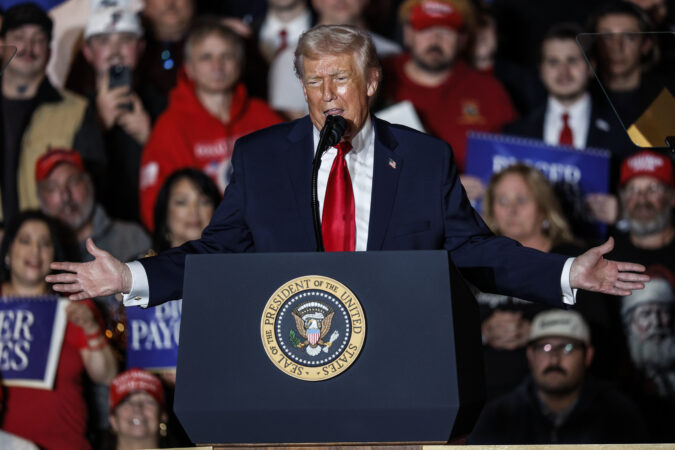
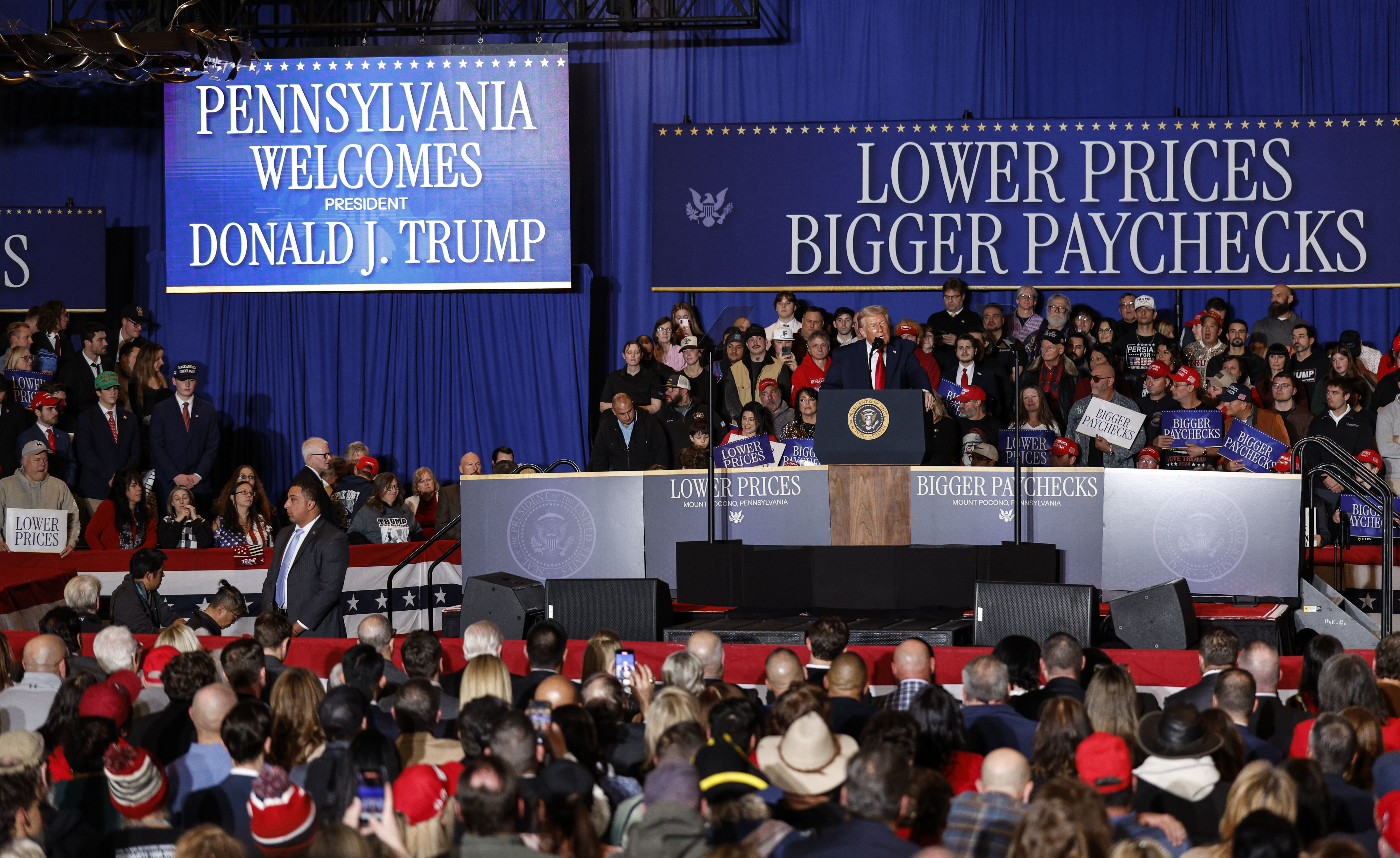
    President Donald Trump made his first stop on an “economic tour” in Mt. Pocono, Pa., on Tuesday, Dec. 9.

    Other polls have shown it’s more popular to increase border security than to deport immigrants, even those who are living in the country illegally. Nearly half of Americans said increasing security at the U.S.-Mexico border should be “a high priority” for the government in AP-NORC polling from September. Only about 3 in 10 said the same about deporting immigrants in the U.S. illegally.

    Shaniqwa Copeland, a 30-year-old independent and home health aide in St. Augustine, Florida, said she approves of Trump’s overall handling of the presidency but believes his immigration actions have gone too far, especially when it comes to masked federal agents leading large raids.

    “Now they’re just picking up anybody,” Copeland said. “They just like, pick up people, grabbing anybody. It’s crazy.”

    Health care and government management remain thorns for Trump

    About 3 in 10 U.S. adults approve of how Trump is handling health care, down slightly from November. The new poll was conducted in early December, as Trump and Congress struggled to find a bipartisan deal for extending the Affordable Care Act subsidies that will expire at the end of this month.

    That health care fight was also the source of the recent government shutdown. About one-third of U.S. adults, 35%, approve of how Trump is managing the federal government, down from 43% in March.

    But some Americans may see others at fault for the country’s problems, in addition to Trump. Copeland is unhappy with the country’s health care system and thinks things are getting worse but is not sure of whether to blame Trump or Biden.

    “A couple years ago, I could find a dentist and it would be easy. Now, I have a different health care provider, and it’s like so hard to find a dental (plan) with them,” she said. “And the people that do take that insurance, they have so many scheduled out far, far appointments because it’s so many people on it.”

    The AP-NORC poll of 1,146 adults was conducted Dec. 4-8 using a sample drawn from NORC’s probability-based AmeriSpeak Panel, which is designed to be representative of the U.S. population. The margin of sampling error for adults overall is plus or minus 4 percentage points.

  • Gillian’s Wonderland Pier property is now under review for possible redevelopment

    Gillian’s Wonderland Pier property is now under review for possible redevelopment

    The saga of Gillian’s Wonderland Pier continues as Ocean City Council voted last night to allow the local planning board to take the next steps in the property’s future.

    Councilmembers voted 4-3 to refer the 600 Boardwalk Avenue site to the Ocean City Planning Board to evaluate its possible rehabilitation.

    “This is basically a first step in what could potentially be an extensive review process, if it were to continue to move forward,” said Doug Bergen, Ocean City’s public information officer.

    City Council President Terry Crowley Jr. and council members Jody Levchuk, Tony Polcini, and Pete Madden voted in favor, while Keith Hartzell, Dave Winslow, and Sean Barnes voted against.

    This means the council is requesting the planning board to deem the property “an area of rehabilitation,” which kick-starts a wave of inspections, public input, and planning.

    In the next 45 days, Bergen said the planning board must assess the site and make a recommendation to City Council on whether the once iconic amusement park property meets the criteria for rehabilitation. If council votes to make that determination, then the site developer and owners can negotiate with City Council to devise a redevelopment plan. “With lots of further review down the road,” Bergen said.

    A coalition of various business associations, from restaurants to boardwalk shops, put pressure on City Council Wednesday in a news conference. Both the presidents of the Boardwalk Merchants Association — co-owner of Surf Mall, Wes Kazmarck — and the local restaurants association — owner of Cousin’s, Bill McGinnity — were joined on Wednesday by the Philadelphian property developer Eustace Mita.

    In 2021, Mita, who owns Icona Resorts, bought Gillian’s Wonderland property from the Gillian family for a reported $14 million after the property was put in foreclosure for nearly $8 million in unpaid loans.

    Since the nearly century-old boardwalk amusement park closed last year, plans for the site’s redevelopment have been swirling around town. Mita initially proposed a 7-story luxury hotel, the “Icona in Wonderland Resort,” but council members refused to send that proposal to the planning board in August.

    A month later, Mita announced that he was considering transforming the site into townhouses, after courting offers from Phillip Norcross (brother of South Jersey power broker George E. Norcross III) and from Virginia-based NVR Inc., to redevelop the site.

    Now, the site’s future will be in the hands of the planning board’s assessment, which, for some business owners, is the right call. In a video posted to Facebook earlier this week, Kazmarck urged Ocean City residents to contact their council members and ask them to vote in favor of the planning board review.

    “This is about City Council being able to make a better decision on what to do with this property. Everyone’s opinion here is a valuable opinion, but I think now we’re at that point where we should bring in experts,“ Kazmarck said. ”That’s the planning board. The planning board hires experts to evaluate the site to decide if the site should be an area of rehabilitation.”

    While it may feel like redevelopment plans are coming swiftly, Kazmarck reassured residents that local business owners have been discussing these next steps since last year, he said in the video.

  • Americans gave $4B on Giving Tuesday 2025 as donations and volunteering gain big over last year

    Americans gave $4B on Giving Tuesday 2025 as donations and volunteering gain big over last year

    Americans gave $4 billion to nonprofits on Giving Tuesday in 2025, an increase from the $3.6 billion they gave in 2024, according to estimates from the nonprofit Giving Tuesday.

    More people also volunteered their time on the Tuesday after Thanksgiving this year, which fell on Dec. 2 and has become a major fundraising day for nonprofits. This year, 11.1 million people in the U.S. volunteered, up from, 9.2 million last year.

    Giving Tuesday started in 2012 as a hashtag and a project of the 92nd St Y in New York and has since become an independent nonprofit. The organization estimates how much was given and how many people volunteer using data from a wide variety of sources, including giving platforms, payment processors and software applications that nonprofits use.

    Woodrow Rosenbaum, the chief data officer for Giving Tuesday, said both the number of people giving and the overall donation amount may have increased this year as people seek a sense of belonging and connection.

    “Generosity is a really powerful way to get that,” Rosenbaum said in an interview with The Associated Press. ”But I think mostly it’s just that when people see need, they want to do something about it and Giving Tuesday is an opportunity to do that in a moment of celebration as opposed to crisis.”

    Overall donations increased 8.1% from last year when adjusted for inflation. Giving Tuesday has also seen the average donation increase in size over time and Rosenbaum said people may be seeking additional ways to give as well.

    “Volunteering is a way that you can add to your impact without it costing you money,” he said.

    Not everyone who volunteers their time does so through a nonprofit. They may volunteer with mutual aid groups or by helping out family members or neighbors, he said.

    Giving Tuesday does not include donations from corporations or foundations in their estimate, Rosenbaum said, as they are focused on the everyday generosity of individuals. That means they did not include the gift from billionaires Michael and Susan Dell of $6.25 billion to encourage families to claim new investment accounts created by the Trump administration.

    President Donald Trump hosted the Dells at the White House Tuesday, calling their commitment “one of the most generous acts in the history of our country.” The Dells will offer $250 to 25 million children 10 years old and younger to invest in accounts that the U.S. Department of Treasury will create next year. The ” Trump accounts ” were part of the administration’s tax and spending legislation passed in the summer.

    A significant portion of charitable giving to nonprofits happens at the end of the calendar year and Giving Tuesday is an informal kick off to what nonprofits think of as the giving season. A combination of economic and political uncertainty has meant it is hard to predict how generous donors will be this year. Rosenbaum said that the generosity demonstrated on GivingTuesday is an extremely encouraging bellwether for how the rest of the giving season will go.

    “What we really hope is that nonprofits and community groups see this as an opportunity that we are in a moment of abundance and that people are ready and willing to help,” Rosenbaum said.