Category: Education

  • Community College of Philadelphia is poised to select its next president Tuesday

    Community College of Philadelphia is poised to select its next president Tuesday

    The Community College of Philadelphia’s Board of Trustees is preparing to select a new president, possibly as soon as Tuesday morning.

    A special meeting has been scheduled for 8 a.m. on Zoom “to approve an offer of employment to a presidential candidate,” according to the board’s website.

    The selection follows daylong interview sessions with the four finalists, who came to campus earlier this month and met with faculty, staff, students, and board members.

    “Each comes with their strengths and weaknesses,” said Sandra Gonzalez-Torres, CCP’s director of articulation and transfer, who attended meetings to hear all four candidates. “At this time, the college really needs strong leadership that will guide us to a strong future. The college needs strong fundraising and ways to support our students in retention and graduation.”

    Two have limited experience as a college president, including the interim CCP president. Three are candidates of color. One candidate has extensive fundraising experience, and another is a native Philadelphian who once worked at the college and has a background in counseling.

    Candidates addressed the college’s low morale and said they had the skills to help it heal following the forced departure of former president Donald Guy Generals after 11 years in the post.

    Here’s a look at the four candidates:

    Lisa Cooper Wilkins
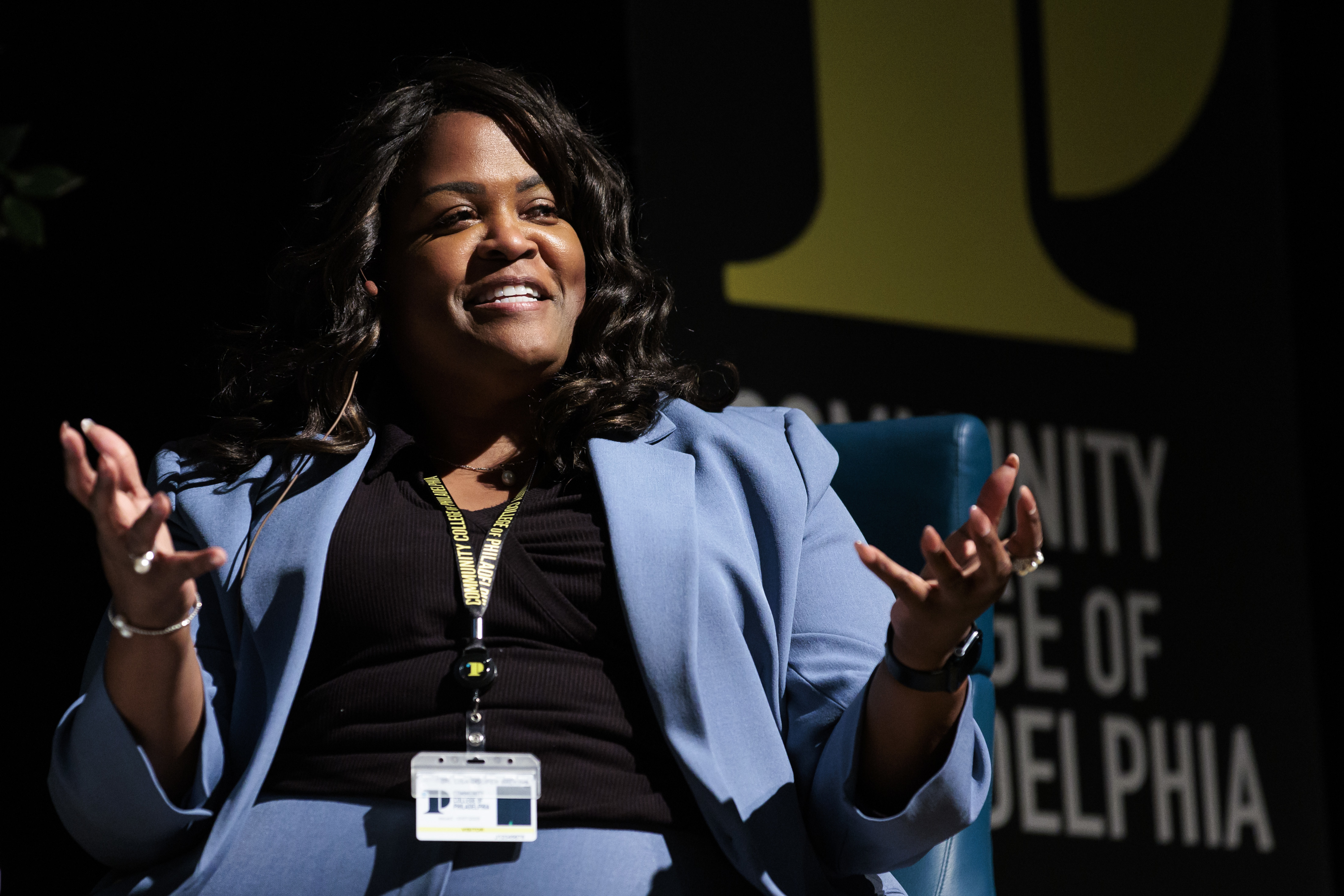
    Lisa Cooper Wilkins, a finalist in the Community College of Philadelphia’s search for a president, speaks at an interview forum last week.

    Lisa Cooper Wilkins touted more than 25 years of higher education experience, from faculty member to dean to her current position as vice chancellor of student affairs at City College of San Francisco — where she has worked since 2020.

    “I consider myself to be a very collaborative leader and one that leans into communication as one of the primary strategies to work effectively across constituencies,” said Cooper Wilkins, a first-generation college student who grew up in a single-parent home.

    Cooper Wilkins, who previously worked at San Joaquin Delta College and the University of the Pacific, cited her background in counseling as a plus. She described herself as a “very calming presence,” which could be helpful in leading CCP out of a tumultuous time.

    She is the only candidate who is a native of the Philadelphia region, having attended the Philadelphia High School for Girls and later CCP.

    Cooper Wilkins also served as a dean at CCP from 2008 to 2010, during which time she said she made a point of visiting the regional centers. She said she would continue to devote time to them if she became president.

    “I’ve worked at institutions where, unfortunately more often than not, they feel like an afterthought,” she said.

    She also was assistant director and senior counselor for student support services at Drexel University in the mid-1990s.

    Cooper Wilkins acknowledged that her fundraising experience has been “limited” but that she had some experience during her time at CCP.

    She received her bachelor’s degree from Goucher College, master’s degrees from Marymount College and Villanova University, and her doctoral degree in higher education administration from George Washington University.

    Alycia Marshall
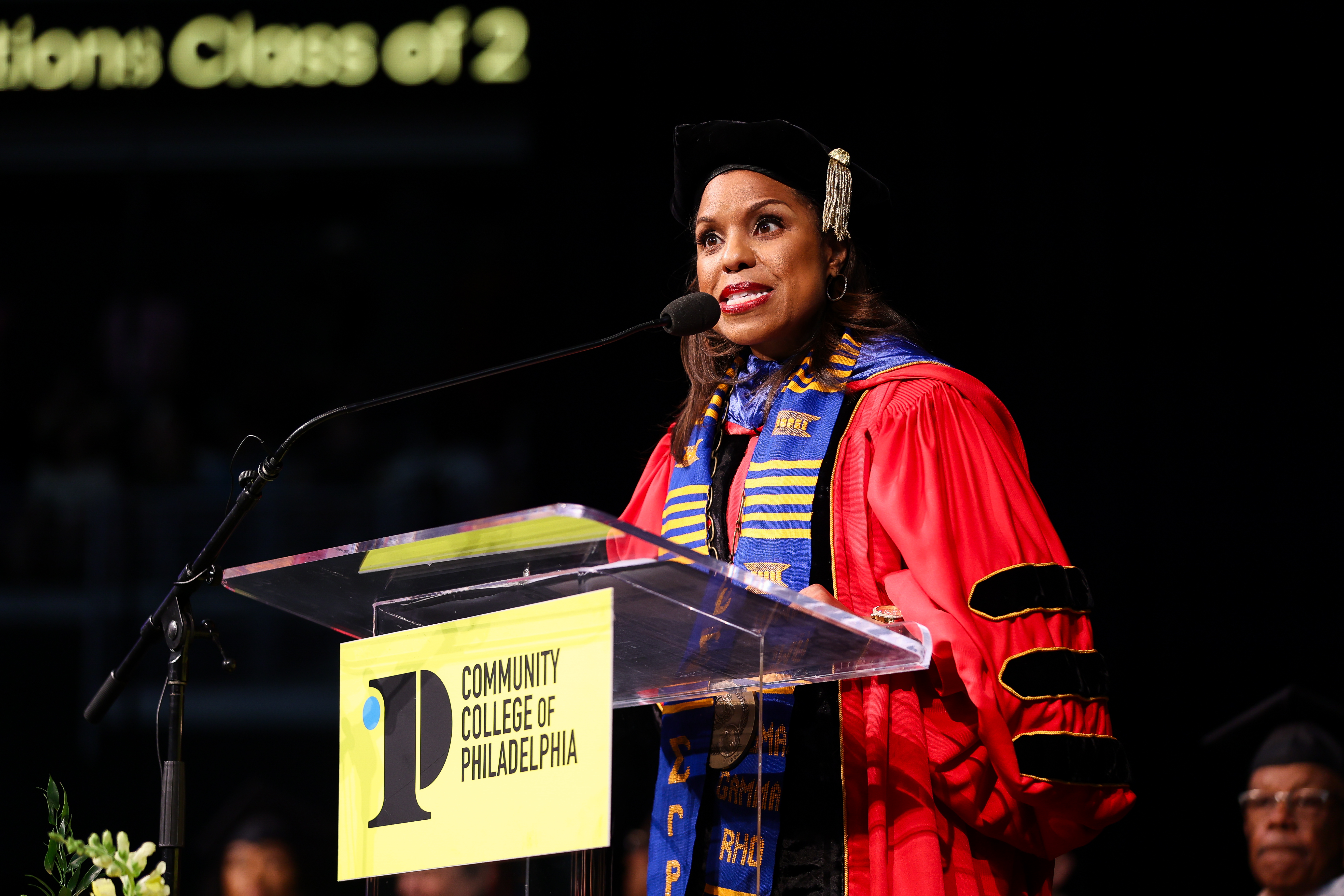
    Community College of Philadelphia interim President Alycia Marshall speaks at commencement in May.

    Alycia Marshall, who has been serving as interim president since Generals’ departure, leaned heavily on her experience in the role and how she stepped in to keep the college running smoothly just weeks before commencement.

    “Having someone who is understanding about the particular state that the institution is in, who sees where the opportunities are, who is supportive and about ensuring a culture of inclusivity, of collaboration … would be a critical piece” for the next president, she said during an interview session.

    Marshall, who was the college’s provost and vice president for academic and student success for nearly three years before becoming interim president, said she would lead both internally and externally, focusing on faculty and staff satisfaction as well as building relationships with funders and donors.

    She said she has already met more than 20 City Council members and state legislators.

    She acknowledged that an employee satisfaction survey that she commissioned when she became interim president showed low morale and promised to address it.

    “Things that would be a priority to me [are] insuring transparency and frequent communication,” she said.

    A native of Maryland, Marshall started her career as an adjunct professor at Anne Arundel Community College in Maryland, near Annapolis, and later became a full tenured professor and chair of the mathematics department. She was promoted to associate vice president at the Maryland community college, where she spent 23 years and founded the African American Leadership Institute.

    Marshall said that over the last six months she learned to be comfortable not knowing what will happen next. After a board meeting earlier this month, a consultant who is the liaison to the presidential search committee said on a still-active microphone that Marshall had not been well-received on campus.

    Marshall said at the interview session that she did not agree with that and that she has developed relationships with people across the college.

    “If you have worked directly with me, you will know I am here for the students and I am here to support faculty and staff,” she said.

    Marshall received her bachelor’s in mathematics from the University of Maryland, Baltimore County, her master’s in teaching from Bowie State University, and her doctorate in mathematics education from the University of Maryland.

    Jesse Pisors
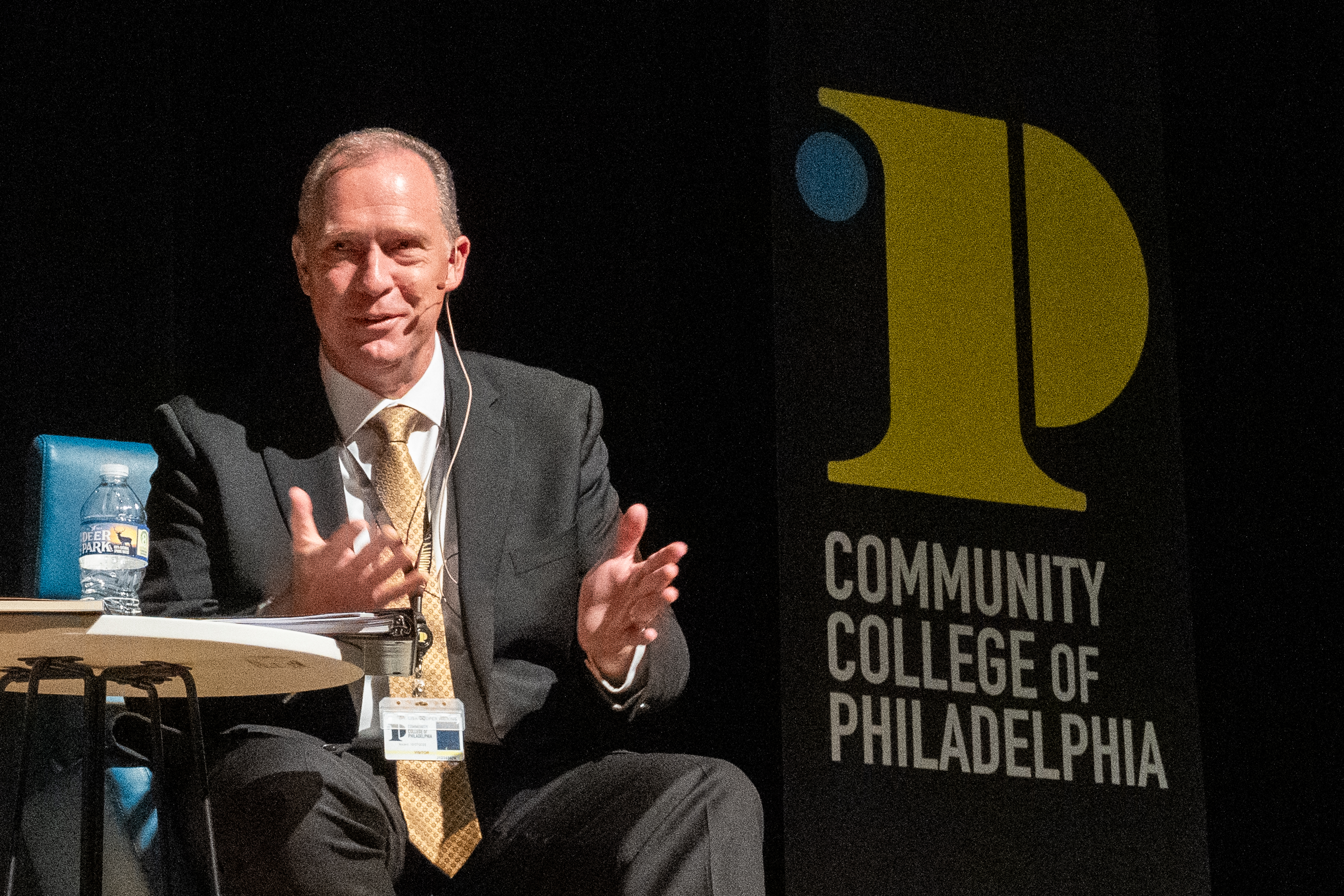
    Jesse Pisors, a finalist applying to be president of the Community College of Philadelphia, speaks at an interview forum on Oct. 9.

    Jesse Pisors most recently served as president of the 10,000-student Pasco-Hernando State College, a community college in the Tampa Bay area, but resigned after less than 18 months on the job.

    His resignation came after Florida Gov. Ron DeSantis’ Department of Government Efficiency found that the college was doing poorly in student retention and the board accused Pisors of hiding information, according to news reports.

    “The political situation in Florida had devolved to a point where I felt I would not be able to continue to be effective as president,” Pisors told the audience at one campus meeting.

    He acknowledged about a half percentage point drop in retention.

    “That is exactly why one of our top 10 priorities in the strategic plan … had improving retention,” he said. “We were working on that.”

    But he said he’s still proud of his time there, noting the creation of a strategic plan and an increase of more than 8% in full-time equivalent enrollment.

    Citing the need for CCP to bring in more money at a time when public funding is tight, Pisors touted his experience in fundraising and marketing, noting his previous positions as a vice president at Texas A&M University-San Antonio and the University of Houston. He also had served as executive director of development and alumni relations at the University of Pittsburgh.

    Though he is the lone white candidate, he noted that he had served as a principal of a school in Mexico is fluent in Spanish, and is married to a native of Mexico.

    Pisors has 27 years of educational leadership experience, from kindergarten through the college level, which he said gives him “wide exposure” and broad “understanding.”

    “Community colleges kind of live in the middle,” said Pisors, who got his bachelor’s in history from Oral Roberts University, a master’s from Oral Roberts, and his doctoral degree in higher education administration from Texas Tech University. “They reach back into high school. They reach forward into universities.”

    Jermaine Wright
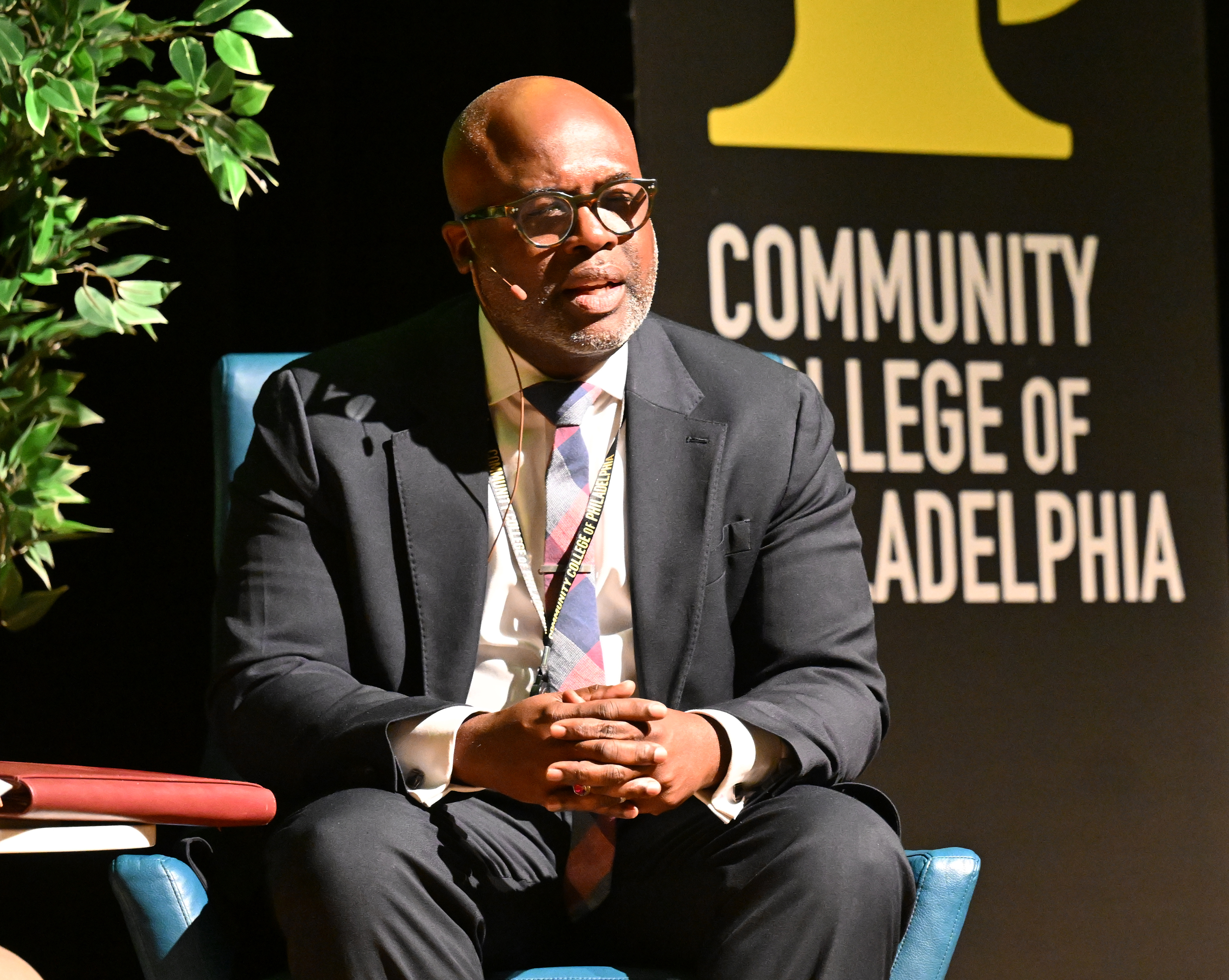
    Jermaine Wright, a finalist for the presidency of the Community College of Philadelphia, speaks during his interview session with faculty, staff, students, and board members on Oct. 13.

    Jermaine Wright, who is vice president for student affairs at City University of New York-Herbert H. Lehman College, said he was drawn to CCP by its mission and its students who have a similar background to his.

    He said he’s a first-generation college student and an immigrant who became a naturalized citizen. His father worked as a porter. and his mother and grandmother cleaned office buildings.

    “I am CCP,” said Wright, who has worked at Lehman for five years and previously held administrative positions at Southern Connecticut State University and City University of New York. “CCP is me.”

    He cited his experience in workforce development and work in programs that help underrepresented students succeed.

    Asked to describe his vision for the college, he cited increasing enrollment, finding different funding streams, ensuring academic excellence, and creating a more inclusive campus environment.

    But he cautioned that any new vision would have to be developed with faculty and staff to get full support.

    He also cited experience in fundraising and said success can be achieved by knowing where people are and meeting them there.

    “We need to have constant face time,” he said.

    Wright said he wouldn’t mind if members of the board of trustees showed up at the college a lot.

    “That means they care just as much as I do,” he said.

    Once an adjunct lecturer at Rutgers-Newark, Wright got his bachelor’s degree from Binghamton University, a master’s from CUNY, and his doctoral degree in public administration from Rutgers-Newark.

  • Cheltenham High’s football season canceled amid deepening hazing investigation; officials allege physical assault

    Cheltenham High’s football season canceled amid deepening hazing investigation; officials allege physical assault

    The remainder of Cheltenham High’s football season has been canceled as officials deepen an investigation into alleged hazing by team members, which the school district said involves “inappropriate physical contact.”

    Superintendent Brian Scriven told families late Sunday night in an email that officials made the call “with a deep sense of regret” as the district extends its investigation.

    “We do not condone or tolerate hazing or abuse of any kind in our sports programs or in our schools,” Scriven wrote. “It is our duty and obligation to protect and prioritize student safety and well being, even when we know that our decisions may come with consequences and disappointment.”

    Scriven canceled Friday’s home football game — the team was supposed to play Bristol Township’s Harry S. Truman High School at nearby Springfield High, as Cheltenham’s field was unavailable — hours before the game was to begin. At that time, he called it a temporary suspension of the season.

    The decision caused shock and anger. Senior Night was scheduled, with recognition ceremonies planned for athletes and members of the cheerleading, pep band, color guard, and drum line programs.

    “We are very sensitive to the emotions of those most directly impacted,” Scriven wrote.

    Only one game remained on the schedule — Friday at Quakertown.

    Officials learned of multiple incidents

    News of the alleged hazing came three weeks ago, Scriven said, when someone reported that a student was assaulted in the football locker room.

    Officials alerted ChildLine, the state’s abuse-reporting system, which they are legally mandated to notify when alleged abuse happens. They also notified Cheltenham police, which began its own investigation.

    At the time, they believed the incident to be isolated, Scriven said in the letter.

    But as the investigation developed, “additional information came to light indicating that hazing and/or inappropriate physical conduct may be occurring more broadly in the program. Last Friday, we received additional information, including reports indicating multiple team members engaged in hazing through physical contact.”

    That’s when officials decided to temporarily suspend the season and investigate further. The district began working with an external consultant over the weekend, Scriven said, and the investigation remains ongoing.

    The police investigation is also ongoing, said Scriven, who urged anyone with information to contact Cheltenham police. He said the district is cooperating with police and has also been in touch with the Montgomery County District Attorney’s Office.

    “Hazing is a very serious and significant issue in school athletic programs and can lead to criminal charges,” Scriven wrote. “We ask for continued patience and respect for our obligation to thoroughly investigate these allegations. We also ask that our school community not rush to judgment against any of our student-athletes or coaches.”

    Saving Senior Night

    Senior Night will be recreated in some ways, Scriven said — for those football players, cheerleaders, and members of the pep band, drum line, and color guard uninvolved in the alleged hazing.

    “We will do our very best to involve students as we develop new plans to honor our seniors,” Scriven said.

    “As a parent, educator, and former coach and student-athlete, I am troubled by this matter on numerous levels,” Scriven said. “This decision is not one that was made lightly. I will continue to communicate as openly as possible as we work through this in the coming days and weeks.

    “We must move forward as a district and school community committed to student safety and respect, and do all we can to uphold those values.”

  • University, heal thyself

    University, heal thyself

    Whew.

    Professors and students at the University of Pennsylvania — where I teach — breathed a sigh of relief on Thursday when the university rejected a compact that would have given us preferential treatment in federal funding. All we needed to do in exchange was comply with the Trump administration’s demands around teaching, student costs, and much else.

    As our faculty senate warned, the compact asked universities to “surrender their institutional autonomy.” I’m delighted — and proud — that Penn joined four other institutions — MIT, Brown, the University of Southern California, and the University of Virginia — in rejecting the offer, which the White House sent to nine schools earlier this month.

    Now comes the hard part: to institute the goals of the compact on our own. The problem wasn’t with the demands of the Trump administration. It was with the mechanism of enforcement, which would have let it determine if we were satisfying them.

    Consider the compact’s requirement that we foster “a vibrant marketplace of ideas” and abolish “institutional units” that “belittle” conservative ideas. Of course, we should aim for a full and free dialogue of all ideas, including conservative ones.

    But do you trust Donald Trump and his disciples to determine — fairly and impartially — whether universities are belittling conservatives? I certainly don’t.

    Trump’s vice president, JD Vance, has already declared that “the universities are the enemy.” The only way to make friends with Trump is to echo his own ideas, which is what the compact would have required us to do.

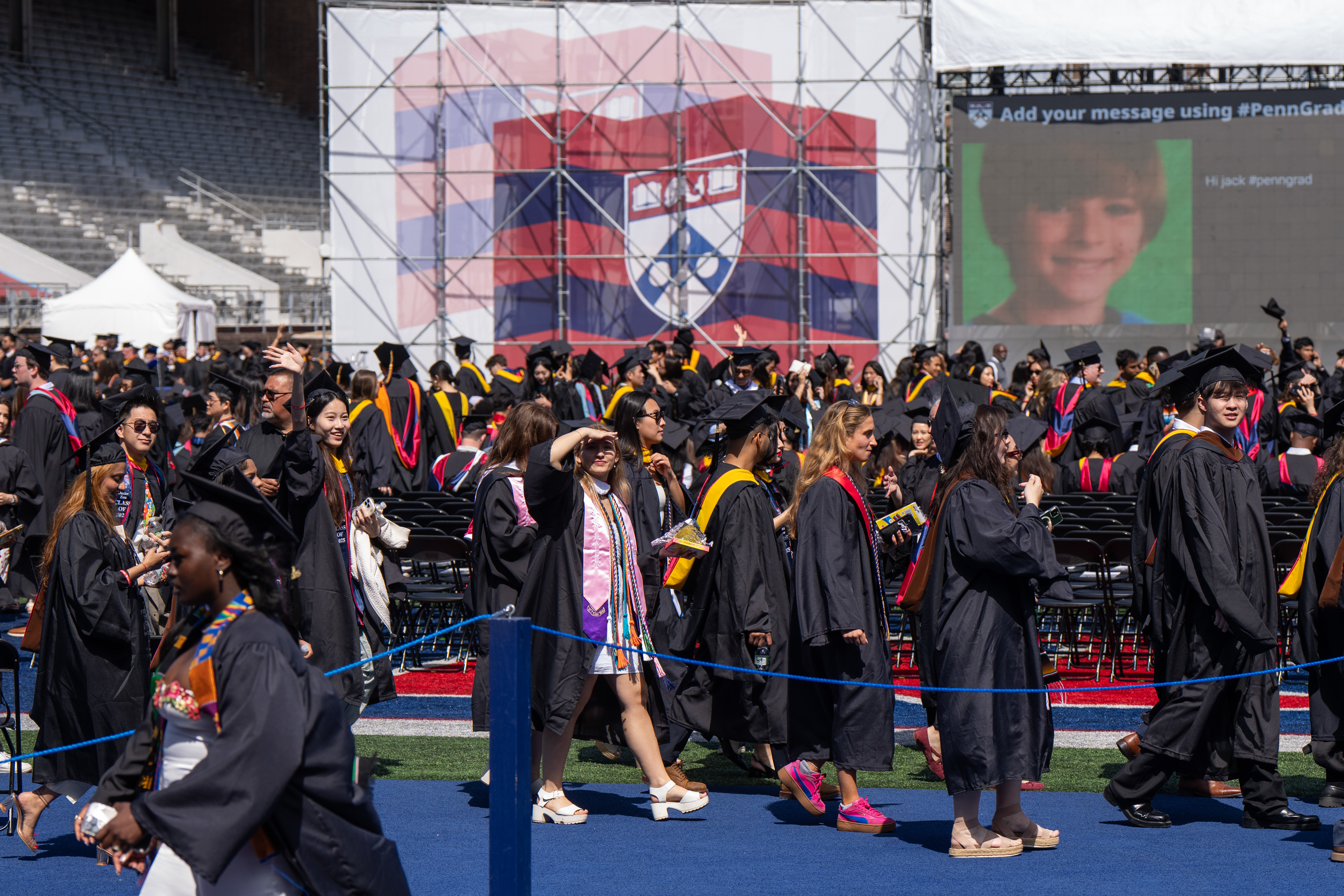
    University of Pennsylvania students at graduation, at Franklin Field, in May.

    But if we’re honest, we’ll also admit that we have indeed belittled — or suppressed — conservatives, via the cultures we have created on our campuses. We talk a good game about the free exchange of ideas. If you think we’re living that ideal, however, you haven’t talked to right-leaning students.

    I have. They come out to me in my office, with the door shut, because they’re afraid of being canceled by their peers or their professors. In a 2024 survey, 12% of Penn students said they planned to vote for Trump. That’s a small fraction, but Penn is a big place; we have about 12,000 undergraduates, which means more than 1,000 students probably backed Trump.

    We almost never hear from them, which harms everyone. We won’t understand the Trump phenomenon if they are biting their tongues. I want my conservative students to speak their minds, especially in class, so they can teach the rest of us.

    But classes have become something of an afterthought at our elite universities, where reading requirements have plummeted and almost everyone gets an A. As the Trump compact correctly notes, grades should reflect “the quality, breadth, and depth of the student’s achievement.”

    They don’t. “When we act as though virtually everything that gets turned in is some kind of A — where A is supposedly meaning ‘excellent work’ — we are simply being dishonest to our students,” Yale philosopher Shelly Kagan told the New York Times in 2023.

    And earlier this month, the Times reported that Harvard students routinely skip classes, and even register for two courses that meet at the same time. When they do show up, they often spend the class period surfing on their phones or laptops.

    It’s not their fault. The problem lies with their professors, who are rewarded for their research rather than their teaching. So we let the students skate by with an easy A so we can get back to our keyboards.

    Again, though, I don’t want the federal government monitoring our “commitment to grade integrity” — to quote the Trump compact — or penalizing us if we fall short. That would give the White House another cudgel to use against a school that said or did something Trump didn’t like. We should instead address the problem on our own, by instituting grade curves and making effective teaching a requirement for tenure and promotion.

    Ditto for college costs, which the Trump compact properly identifies as a huge burden on our students. But the answer is not to freeze tuition for five years, as the compact demands, even as it instructs us to limit our enrollment of international students. Cutting the number of students from other countries — most of whom pay our full sticker price — would make it even harder for us to keep that price down.

    Rather, we need to make a stronger argument for public assistance to all our universities. Over the past four decades, as state governments slashed their aid to higher education, students and their families have had to finance college on their own. What began as a public good — to serve all Americans, and to sustain our democracy — has become a private one.

    But we’ll never make the case for more government dollars unless we can show we’re doing well with what we already have. That will require us to put good teaching — and the free exchange of ideas — front and center. I’m glad we rebuffed Trump’s effort to impose his will on us. Now we’ll find out if we can muster the will — and the courage — to do the job ourselves.

    Jonathan Zimmerman teaches education and history at the University of Pennsylvania. He is the author of “The Amateur Hour: A History of College Teaching in America” and nine other books.

  • Dorothy Womble-Wyatt, celebrated South Jersey teacher and school principal, has died at 84

    Dorothy Womble-Wyatt, celebrated South Jersey teacher and school principal, has died at 84

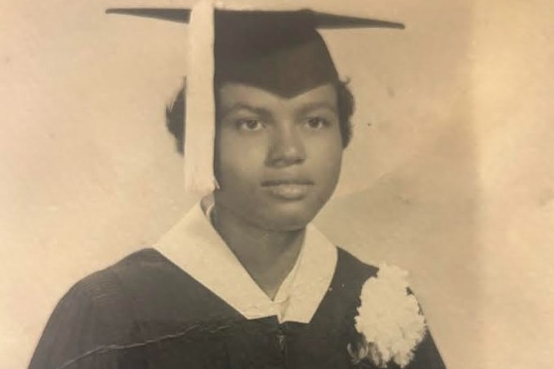
    Dorothy Womble-Wyatt, 84, of Cherry Hill, innovative teacher and celebrated school principal for the Camden City School District, active church member, mentor, and proud graduate of what is now Fayetteville State University, died Tuesday, Sept. 23, of complications from a heart condition at her home.

    For 37 years, from 1968 to her retirement in 2005, Ms. Womble-Wyatt connected with Camden students through progressive teaching techniques, and with classroom colleagues, parents, and nearby residents through her collaborative administrative style.

    She was named principal at the old Bonsall Elementary School in 1977 and became the first principal at the new Riletta T. Cream Elementary School in 1991.

    “She led the Riletta Twyne Cream Family School with distinction,” the Camden City Advisory Board of Education said in a recent resolution, “guiding its opening in January 1991 and building a school culture centered on high expectations, literacy, and community partnership.”

    As a teacher, Ms. Womble-Wyatt focused on elementary school students, and she emphasized how math, geography, spelling, science, English, and other subjects were important in everyday life. She joined the school district in 1968 as a first-grade teacher and served as an administrative assistant before advancing to principal at Bonsall.

    Ms. Womble-Wyatt was active with the Order of the Eastern Star.

    In its resolution, the Board of Education said she “championed professional learning and innovative classroom practices that advanced student growth.”

    Her nephew Micheal W. Moore said: “She was always a teacher at heart. She taught her family when she was young and her classmates in high school. She never stopped.”

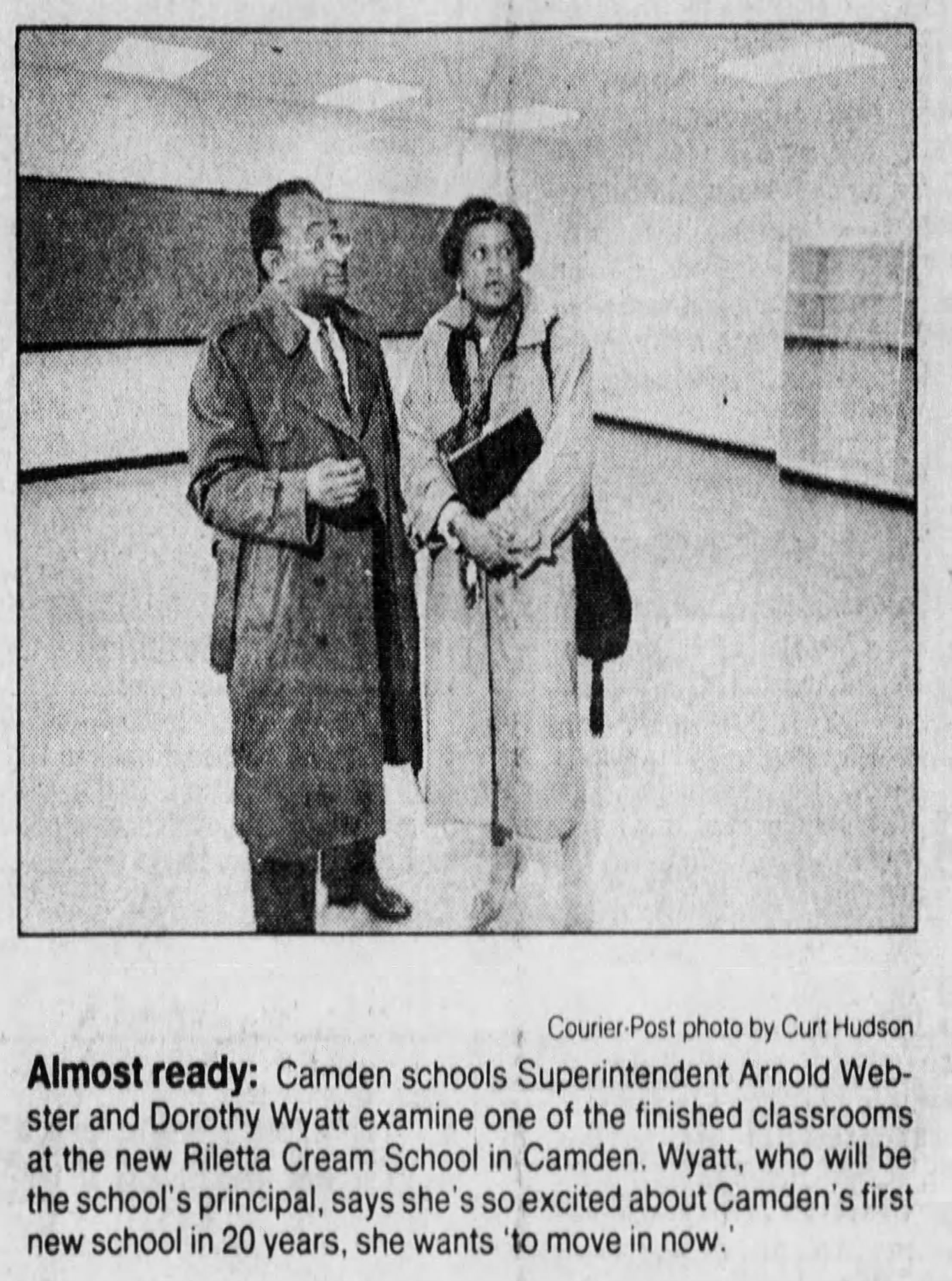
    As principal at the Cream School, Ms. Womble-Wyatt supervised the transfer of 800 students from four other elementary schools during the 1990-91 school year and told the Courier-Post: “I’m just thinking about a smooth transition. … It’s the same as if you’re moving into a new home. You’re excited moving into a new environment. When you get something nice, you want to keep it that way.”

    She supported all kinds of new educational initiatives and lobbied tirelessly for better school supplies and improved healthcare services for Camden students. The Courier-Post covered Cream’s grand opening, and 9-year-old student Bradford Sunkett told the newspaper: “I’m glad to be at a new school. But I’m most glad Ms. Wyatt is here. Ms. Wyatt and the teachers are more important than a school building.”

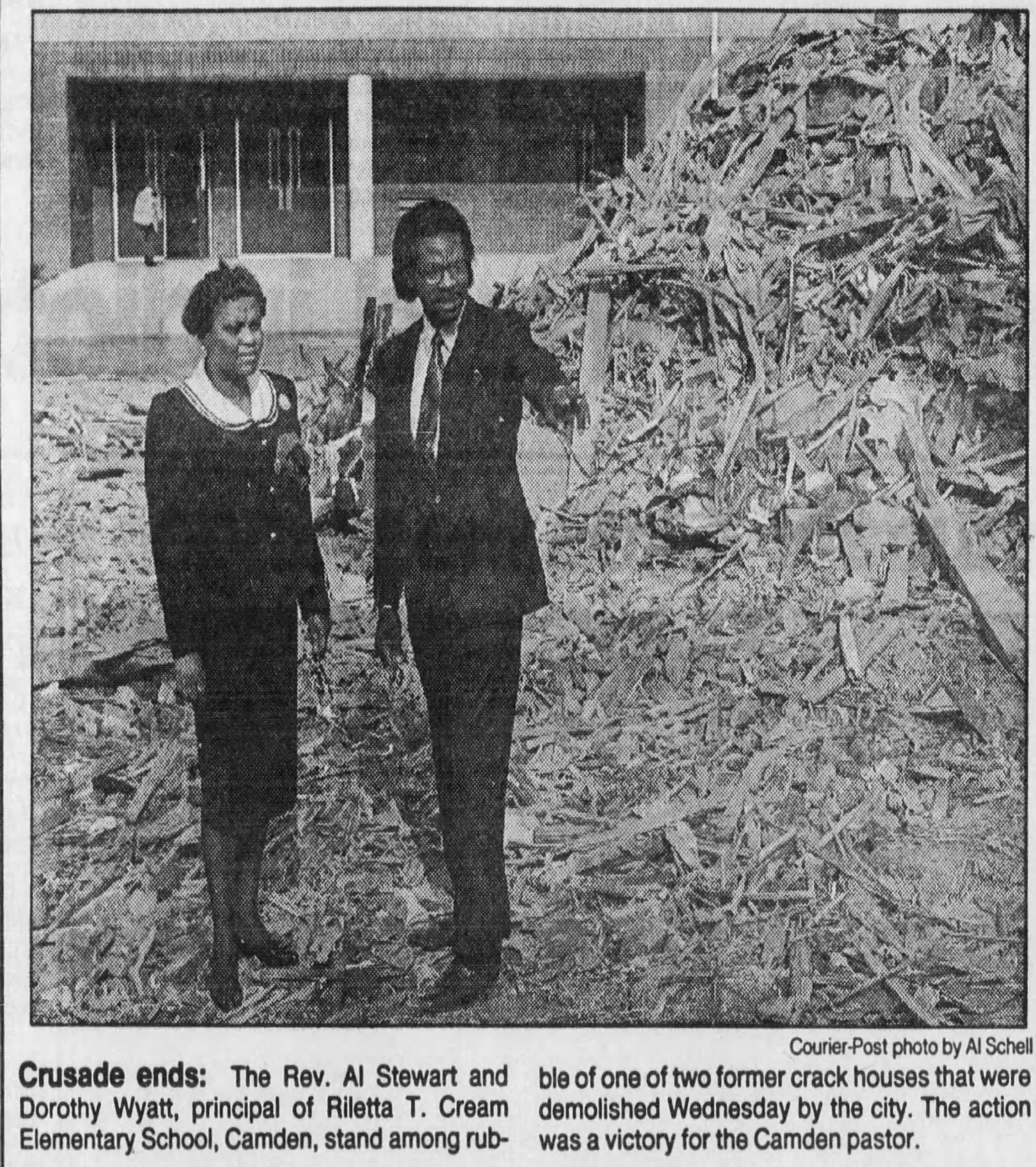
    She cheered in 1992 when community activists cleared a cluttered lot near the school and told the Courier-Post: “It’s a joyful feeling knowing people have listened to what we have to say and did something about it.”

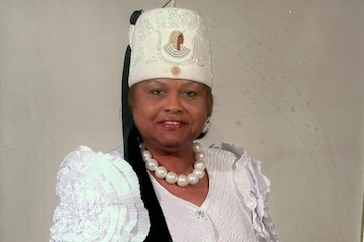
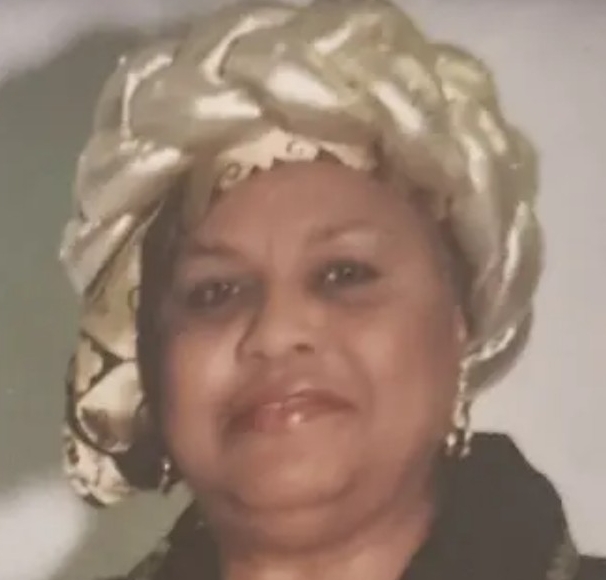
    This photo of Ms. Womble-Wyatt appeared in the Courier-Post in 1990 as she was assuming the role of principal at the Cream School.

    In 1999, she endorsed a New Jersey state reform program that invited parents to help shape school curriculum. “It’s a great thing for parents because many don’t have the experience of what schools are up against,” she told the Courier-Post. “All they hear is that schools are failing. This lets parents become part of the foundation.”

    Ms. Womble-Wyatt was active at Roberts Chapel Missionary Baptist Church in North Carolina, First Nazarene and Zion Baptist Churches in Camden, and New Community Baptist Church in Collingswood. Zion recognized her with a service award in 2008.

    “She loved to invite family and friends to attend worship services with her on Sundays and join her for dinner afterward,” her nephew said.

    She earned a bachelor’s degree in education and leadership at Fayetteville State in North Carolina and recruited new students everywhere she went. In 2003, the university’s Gospel Choir honored her lifelong support with a concert at Camden High School.

    This photo of Ms. Womble-Wyatt was published in the Courier-Post in 1992 during a nearby neighborhood cleanup.

    She belonged to the Alpha Kappa Alpha Sorority and the Order of the Eastern Star, and spoke often at churches and community groups about Black history. She was honored at Camden’s third annual Women’s Recognition Ceremony in 1996 and earned an Outstanding Citizen’s Award from the local Freemasons in 1997.

    “People wanted to be around her,” her nephew said. “She lifted you up.”

    Dorothy Marie Womble was born May 16, 1941, in Goldston, N.C. She earned a master’s degree in education from North Carolina Central University, married Glenmore Wyatt in 1967, and they had a son, Glen. Her husband died in 2021, and their son died in 2023.

    Ms. Womble-Wyatt collected African artifacts, hosted memorable dinners, and never forgot a birthday. She enjoyed casinos, shopping for gifts, and visiting family and friends.

    Ms. Womble-Wyatt earned a master’s degree in education from North Carolina Central University.

    On Instagram, a friend called her “an educator par excellence, a fashionista, and genuine lover of people.” Her nephew said: “She was generous and joyous. She was a queen in every right.”

    In addition to her nephew, Ms. Womble-Wyatt is survived by a grandson and other relatives. A brother died earlier.

    Services were held Oct. 2 and 3 in Camden, and Oct. 12 in North Carolina.

    Donations in her name may be made to Roberts Chapel Missionary Baptist Church, 439 Roberts Chapel Rd., Goldston, N.C. 27252.

    Ms. Womble-Wyatt’s “life was vibrant and ever moving,” her family said in a tribute. “Indeed, her legacy has grown into a gorgeous train of diamonds and appreciation.”
  • Rose Tree Media school leaders hope to finally bring full-day kindergarten to the district with new K-1 school

    Rose Tree Media school leaders hope to finally bring full-day kindergarten to the district with new K-1 school

    The Rose Tree Media School District is moving forward with plans to build a kindergarten and first-grade school in Middletown Township, marking its second attempt in recent years to build a new school amid rising enrollment and shrinking classroom space.

    The district says the school will be necessary to accommodate increasing student numbers and will finally allow the Delaware County community to offer full-day kindergarten. Yet an uphill battle remains before crews can break ground, as the district must receive approvals from Middletown Township’s council, which has signaled apprehension over traffic and development in the growing municipality.

    Why is the district planning to build a new school?

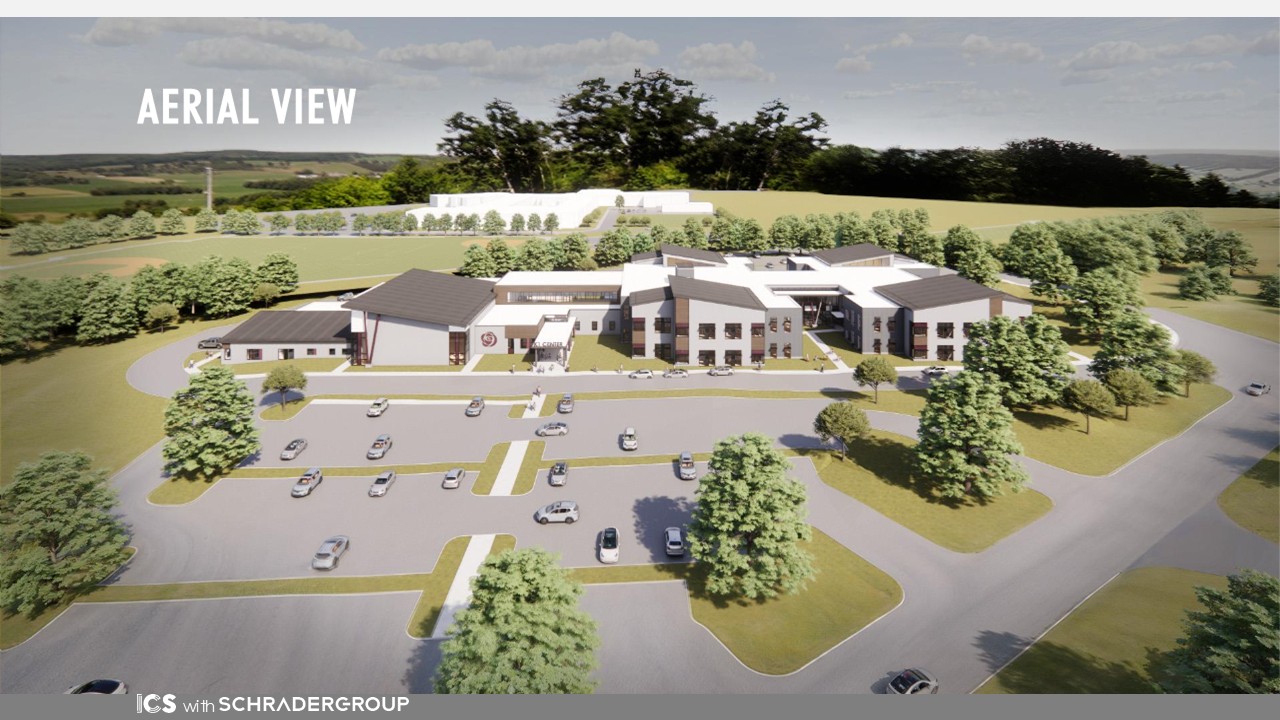
    The Rose Tree Media School District plans to build a new elementary school for kindergarten and first-grade students, known as the K-1 Early Learning Center, on district-owned land behind Penncrest High School.

    Put simply, “We are overcrowded at the elementary level,” said Rose Tree Media School District Superintendent Joe Meloche.

    The school district estimates that more than 600 new homes have been built within its bounds in the last six years, including major developments like Pond’s Edge and the Franklin Mint site. The school district serves Media Borough and Edgmont, Middletown, and Upper Providence Townships. Between 2020 and 2024, Middletown saw a nearly 6% growth rate, due in large part to the new developments. The district projects it will grow by around 300 students in the next 10 years.

    !function(){“use strict”;window.addEventListener(“message”,function(a){if(void 0!==a.data[“datawrapper-height”]){var e=document.querySelectorAll(“iframe”);for(var t in a.data[“datawrapper-height”])for(var r,i=0;r=e[i];i++)if(r.contentWindow===a.source){var d=a.data[“datawrapper-height”][t]+”px”;r.style.height=d}}})}();

    This growth has forced the district to adopt space-saving measures. At Glenwood Elementary School, two modular classrooms were installed in 2023. The school got two more modular classrooms in 2024, then two more in 2025. There are now 10 modular classrooms being used across the district.

    While Rose Tree Media can temporarily expand its classroom space, it can’t expand gyms, cafeterias, auditoriums, nurse’s offices, and other communal spaces. Beyond that, Meloche said, older school buildings aren’t designed to accommodate a modern school day, which includes far more individualized services, breakout groups, and collaborative work than it used to.

    What will the new school look like?

    Rose Tree Media is working with the Schrader Group, an architecture firm that has designed schools throughout the Philly region, including a K-1 school in Phoenixville.

    Having Rose Tree Media’s youngest learners in one building will allow the district to add some “nuanced things” to the school’s design, Meloche said. Small water fountains, tiny sinks, and low-to-the-ground chairs come to mind. The K-1 Center will also place all of the district’s kindergarten and first-grade teachers in one place, making professional development and sharing of resources easier, Meloche said.

    The project is currently estimated to cost $84 million. The district says it plans to sell bonds to build the school.

    Though suggestions have floated around that Rose Tree Media remodel an old school, rather than build something new, district officials say it’s unrealistic. According to the district, purchasing and repurposing an old building “would be costly and would not meet the needs of young children” as it would lack accessibility features, safe play areas, and elements designed specifically for early learners.

    What will this mean for full-day kindergarten?

    Rose Tree Media is one of many districts in the Philadelphia region that have historically not offered full-day kindergarten.

    Citing families’ needs for childcare and the developmental benefits of full-day schooling, many districts in the region have begun implementing full-day programs. The Penn-Delco School District implemented full-day kindergarten in 2023. Lower Merion switched from half-day to full-day last school year. New Jersey Gov. Phil Murphy signed a law ending half-day kindergarten across the state earlier this summer.

    Meloche said bringing full-day kindergarten to Rose Tree Media has been on the table since he came to the district from Cherry Hill in 2023. Full-day kindergarten, Meloche said, will allow the district to “provide a much more substantial foundation for our children.” Under the half-day model, learning is crammed into a shorter period, he said, leaving little time for developmentally important activities like free play, outdoor activities, and specials like art, music, and physical education. Rose Tree Media’s existing elementary schools could not accommodate full-day kindergarten, according to the district.

    What happened to the district’s previous proposal in Edgmont Township?

    Rose Tree Media evaluated 23 potential sites for a new school before landing on a piece of land in Edgmont Township. That plan fell apart after the township denied the school district’s application in 2023, prompting the district to sue. The school district withdrew its legal challenge last spring and pivoted to the K-1 Center proposal.

    Meloche said the district is in the process of selling the 37-acre Edgmont Township property on Route 352. The school district is finalizing the appraisal and has a buyer. They hope to finalize the process, including receiving court approval to sell, by the end of the year.

    What will the approval process with Middletown Township look like?

    Though the district already owns the property behind Penncrest High School, it is required to go through a planning and development process with local and state governing bodies, which can take several months.

    The township has asked the district to undergo an expanded traffic study, which will include evaluations of the intersections of Middletown and Oriole Roads, Rose Tree Road and Hunting Hills Lane, and three access points to Penncrest High School on Barren Road. Once the district completes its expanded traffic study, it will submit a preliminary land development plan to the township. That will kick off a series of public hearings.

    The district plans to hold an Act 34 hearing in January, a public meeting required by Pennsylvania law that gives residents and employees an opportunity to weigh in on the project.

    During public meetings this fall, some residents urged the Middletown Township Council to deny the school district’s proposal, referencing traffic concerns and the desire to preserve green space. Others implored them to approve the school, citing a need to accommodate residents of new apartments and offer full-day kindergarten to working parents.

    Council members noted that the school district will have the opportunity to address community concerns before an official plan is brought to the council.

    Councilmember David Bialek said at a Sept. 17 meeting that the district has implied to the public that the K-1 Center is “a done deal” and “rubber-stamped,” when a preliminary plan has not yet been submitted.

    In an emailed statement, Meloche said, “We have stated multiple times publicly that we have identified the K-1 Center’s location and purpose, and are now in the approval phase, which includes a rigorous process of approvals from Middletown Township, Delaware County, DEP and PennDot. We have been clear that the land development process must be completed prior to obtaining a building permit. The discussion at our Board meetings, the information on the Time to Bloom web page, and our monthly Time to Bloom email updates have laid out the land development process in detail.”

    A rendering of the Rose Tree Media School District’s proposed K-1 center, which the district hopes to build behind Penncrest High School.

    Township council chair Bibianna Dussling said at an Oct. 1 meeting that the “details are going to be key” as the council considers the K-1 Center plans.

    “It’s complicated because you can see the pros and cons,” Dussling said. “There’s a lot of concerns as far as the location, traffic, the neighbors, the neighborhood in very close proximity to it, the roadways there that are already busy.”

    The district has said its professionals are working on creating an “optimal traffic flow,” which may include adding an additional parking lot for athletic fields and routing K-1 Center bus access around the back of Penncrest High School.

    “We believe that we are all on the same side and on the same team,” Meloche said, adding that the goal is “to meet the needs of our community at-large, and to do so in a fiscally responsible but forward-thinking and future-looking way.”

    The district says the new school will open in time for the 2028-29 school year. If the application is denied, a spokesperson from the district said they do not have an alternative plan for the K-1 Center.

    This suburban content is produced with support from the Leslie Miller and Richard Worley Foundation and The Lenfest Institute for Journalism. Editorial content is created independently of the project donors. Gifts to support The Inquirer’s high-impact journalism can be made at inquirer.com/donate. A list of Lenfest Institute donors can be found at lenfestinstitute.org/supporters.

  • Temple’s been part of several high-profile crime incidents recently. President John Fry is getting high marks for communication.

    Temple’s been part of several high-profile crime incidents recently. President John Fry is getting high marks for communication.

    It was a tough two-and-a-half-week period: Students accused of impersonating ICE agents. One student accused of shooting and killing another. A student stabbing a former student 13 times. And a student falling from a light pole during a post-Eagles celebration and dying from his injuries.

    These high-profile incidents involved Temple University students and three of the four occurred on or near campus, posing another test for new president John A. Fry.

    Some say they are gratified that the administration communicated swiftly and thoroughly about the incidents, which wasn’t always the case in the past.

    “That’s been really great to have such a quick turnaround time,” said Ray Epstein, president of student government. “Even if it is the middle of the night, we are getting an email immediately.”

    After Chase Myles, a 20-year-old student from Maryland was shot and killed at about 11 p.m. Feb. 6, Fry notified the campus in an email at 3:46 a.m., and just hours later was on a plane back to campus from an alumni event in Florida so he could be on the ground to talk to the victim’s parents and help coordinate the response.

    By contrast, it took nearly twice as long for the university to get out an email about the shooting death of Samuel Collington outside his off-campus residence in November 2021 even though that happened in the daytime. The email did not come from then-president Jason Wingard, but rather from then-safety chief Charles Leone. The attack put the campus on edge and stirred fear in the Temple community among students, parents, and staff — and social media posts circulated with the hashtag “Where’s Wingard,” who later resigned after less than two years on the job.

    Donna Gray, Temple’s campus safety services manager for risk reduction and advocacy services, greets Temple president John A. Fry during his first day of work Nov. 1.

    That incident ― which happened as part of an attempted robbery and carjacking ― was different in that it involved random violence by a stranger in the neighborhood.

    But even the Temple police officers’ union, which has been critical of university leadership in past years, has noted Fry’s efforts in dealing with the recent multiple incidents.

    “He seems to be handling it well,” said Sean Quinn, president of the Temple University Police Association. “Without a doubt, as soon as these things happen, he’s right on top of it.”

    Fry, who became Temple’s president Nov. 1, said his approach is two-pronged.

    “It is up to us to tell the bad news first, personally to all of our community,” he said. “Number two is just to keep a steady stream of communications following that even when there is not a whole lot to say. It’s worth checking in.”

    Parents on the university’s family council said they are confident in the university leadership’s handling of the incidents, too.

    “It seems like there are the right people in place,” said Allison Borenstein, a Temple alumna whose son, a sophomore, attends the university. “They handled it well, and I think they are on it.”

    Borenstein, an event planner at a synagogue who lives in Cherry Hill, noted such incidents could happen near any college campus and said she feels that Temple sometimes gets an unfair rap.

    “There’s nothing that the school could have done in advance,” she said.

    Emma Legge, an alumna and parent of a senior who lives in New York, said she feels she is kept informed, and she checks in with her son after receiving a communication.

    “I do feel as a parent that Temple is doing what it can within the city of Philadelphia to manage what happens,” said Legge, who got both her bachelor’s and master’s degrees at Temple and met her husband, also a twice Temple alumnus, there. “I have a lot of confidence in the university and the people who are on board.”

    Philadelphia Police Commissioner Kevin J. Bethel and Jennifer Griffin, Temple University vice president for public safety, after graduation ceremonies for the Police Academy Class #402, new officers of the Philadelphia Police Department and Temple University Police Department, at Temple’s Performing Arts Center in June.

    That includes Jennifer Griffin, vice president for public safety, she said.

    “I feel very reassured by the measures police are undertaking to be involved in the neighborhood and be involved with students,” said Legge, who works in student affairs administration at a New York college.

    Griffin said after the recent incidents, she met with the student safety advisory committee and its members said they appreciated the accurate and timely information, which she said she has always aimed to provide since starting at Temple about two and a half years ago.

    “We hope it decreased anxiety,” she said.

    Of Fry, she said, “I thought he handled all the incidents with thoughtfulness and decisiveness and direction that I would expect from somebody with his level of experience.”

    The police union has been critical of Griffin, even calling for her to resign or be fired over staffing issues. University leadership has backed Griffin.

    Quinn said the union now is trying to work things out, noting that the university is amid a police staffing study conducted by an external company.

    “I just don’t want to come to work every day feeling like I’m butting heads,” he said. “I actually would like to work with whoever I have to work with to see if we can accomplish things.”

    Fry said he expects to have the results of the staffing study in a couple months. He said he’s pleased with the work campus police do, noting he had gone on ride alongs with them and wants to make sure they have enough help.

    Ray Epstein, Temple student government president.

    While Epstein, the student government president, endorsed the university’s handling of communication about the recent shooting, she said it also should have issued an alert after a report about a student placing hidden cameras in a fraternity bathroom in late November and recording people without their knowledge. Instead the campus learned of it through social media earlier this month, she said. The student has been arrested and charged in that case.

    “I was not sure when or if the fraternity/university would ever disclose this incident, but I wanted to inform everyone in case this was never announced,” someone posted on a Temple Reddit page, with court documents about the case.

    “Maybe it’s perceived by campus safety as not being an ongoing threat,” Epstein said. “I’d argue that it is because when these things happen in a house, you can’t possibly know until an investigation is concluded who all was involved.”

    Griffin countered that the investigation was handled swiftly, the individual was identified and arrested, and there was no ongoing threat to the community. A Temple alert is sent when there is an immediate threat to the community, she said.

    In this case, people who lived in the house notified law enforcement after the equipment was found, the equipment was taken and the individual who put it there was identified, she said.

    “The people who called in the cameras were cooperative,” she said. “It was an isolated incident at an off-campus residence … and student affairs reached out to those who were impacted.”

  • This week in Philly history: Girard College quietly admits first Black students

    By the afternoon of Sept. 11, 1968, the hostility had faded.

    Neither the Rev. Dr. Martin Luther King Jr. nor Cecil B. Moore was making rousing speeches outside Girard College’s wrought-iron front gates.

    No human barricade of police officers blocked the entrance, and no civil rights groups marched through North Philadelphia.

    After a brutal fight to desegregate the private boarding school, which started with an intense seven-month demonstration and then spent years tied up in the court system, the color barrier was pierced without protest.

    Four little boys, dressed in suits and ties and carrying their favorite board games, walked to the front door of marble-faced Founder’s Hall at 21st Street and College Avenue, and reported for their first day of second grade.

    Mothers and grandmothers and siblings accompanied each child, and a gaggle of photographers and reporters attempting to capture the otherwise-calm moment circled each family.

    “Nice place,” 11-year-old William Lenzy Dade told The Inquirer, “I didn’t expect it.”

    The school was the brainchild of French merchant Stephen Girard, a childless entrepreneur who amassed an immense wealth in Philadelphia in the aftermath of the American Revolution. Upon his death in 1831, he set aside a then-fortune of $2 million to start a boarding school for “poor, white, male orphans.” The school opened in 1848, and offered a premium education at no cost to select students whose families had a single guardian.

    By the 1960s, the campus’ imposing stone walls became a metaphorical obstacle to the enclosed white-columned buildings. Moore, then the Philadelphia NAACP president, led the charge and a lawsuit to force Girard to desegregate. In 1965, the animosity escalated into sometimes-violent confrontations with police. But demonstrators continued undaunted, singing and chanting and marching so those four boys could be the first Black students admitted to the private school.

    Owen Gowans III was 7 when he walked through those gates in his bright, green-and-brown plaid jacket, the last of the four to arrive.

    “Are you nervous?” a reporter asked.

    He just shook his head.

    In 2015, as part of an anniversary celebration of the school’s integration, Gowans found the words.

    “I’m just humbled by what transpired,” he told The Inquirer. “I’m appreciative to the people who put up with beatings and bad words so people like me could go to school here.”

  • Joe Conklin recalls Dougherty, in his own voice

    Joe Conklin recalls Dougherty, in his own voice

    IN OLNEY, there was the Schwarzwald Inn, the Heintz plant, the Olney Times and Cardinal Dougherty. For years I didn’t even know Cardinal Dougherty was a person; I thought it was a giant company.

    Cardinal Dougherty High School was bigger than U.S. Steel. At least it felt that way when I was growing up. I thought it was around for 100 years before I arrived and I figured it would be around for 100 more after I left.

    But this mammoth Catholic institution on 2nd Street above Godfrey, the largest Catholic high school in the world with 6,100 students at its peak in the mid-1960s, will close its doors later this month.

    Named in honor of Cardinal Dennis Dougherty and opened in 1956, the school is survived by more than 40,000 alumni and another 1,000 or so teachers, administrators and staff. In lieu of angry letters to the Archdiocese, please enjoy the experience.

    I’m one of seven in my family to walk the halls of the big CD (Maureen ’69, Jim ’70, Joan ’72, John ’74, Kathy ’78, Joe ’80 and Eileen ’82). Our house was two blocks from the school, so my familiarity with Dougherty started long before my years as a student.

    The school is almost outside the city, just short of Cheltenham Avenue. But we always thought it was cool that you could see all the way to City Hall when you were walking home.

    Dougherty was a constant topic of conversation at the kitchen table. I’d hear my brothers dropping the names of the school’s great athletes: Maurice Savage, Billy Magarity, George Paull, Mike Dennery, Joe Empson, Stevie Conway, Kathy Bess, Kevin Kane, Jim Cooper, Lawrence Reid. CD was the big leagues. To even make one of the sports teams at Dougherty you had to be an exceptional athlete. I played a lot of intramurals.

    I still can hear my sister Joan belting out show tunes from her years in the plays. I still can hear her because she hasn’t stopped belting them out.

    My earliest memory of CD was seeing the world-famous Cardinal Dougherty marching band high-stepping down 2nd Street when I was 5 years old. The band was bigger than life. Bold colors head to toe, dressed like the British Royal Guards, but with our colors: long garnet coats with gold sashes, bright white pants, shiny white shoes. The drum major boldly brandished a gold staff and wore a hat that was a foot tall with a tassle on top, also a foot tall. The band was followed by the drill team: 100 girls with matching berets, suits and boots, marching in lock step. Think Catholic Rockettes.

    They segregated the boys from the girls at the school; it was called co-institutional. One of its most unique physical characteristics was a wall of corrugated steel running straight through the center, dividing the girls’ side and the boys’ side, on all floors. The curriculum was decidedly asexual. (The wall came down in the summer of ’69.)

    I had some great teachers at Dougherty. Mr. Frank Rauscher comes to mind immediately. Junior year, English 3, “Word Wealth.” We had an athletic director who addressed students not by name, but by number. He was a grouchy old priest who set up shop in the little room in the corner of the gym. He would jump out when he heard the clicking of leather soles on the gym floor. If he caught you walking across the hardwood with your shoes on, he’d give you two demerits.

    In my senior year I took advantage of a great opportunity to announce the basketball games for the legendary Bob Harrington, dean of Catholic League coaches. Once during a timeout he leaned over the scorer’s table and said: “Hey, Conk. No funny comments when our guys are on the line, OK?” Yes, Mr. Harrington.

    The student body that topped out at 6,100 kept dwindling, though, to an enrollment of 641 today. The neighborhood has changed and not enough families are sending their kids to this Catholic high school anymore.

    Now the decision to close the school has been made. U.S. Steel started dismantling its Fairless Hills, Bucks County, plant in the early ’90s, but after retooling, the complex still functions today. They got smaller and smarter. The opinion here is that Dougherty could have done the same.

    But I don’t live in Olney anymore and I didn’t send my kids to school there, so I can’t point fingers.

    When I graduated from eighth grade at St. Helena’s School, I brazenly threatened to go to Central High. My mother said: “No, you need the priests at Dougherty.” She was right. I’m richer for the experience.

    Joe Conklin is a comedian and master impressionist, the “Man of a Thousand Voices.” His work is featured most weekdays on the “Morning Show” on WIP (610-AM). You can hear some of Joe’s impressions and see his appearance schedule at www. joeconklin.com. In his words: “I needed the priests, the characters, the rules, the opportunities, the friendships, the microphone, the stage, the right from wrong. So raise a glass [or a can of Schmidt’s] as ‘our sons and daughters hail, we hail Cardinal Dougherty High!’ “