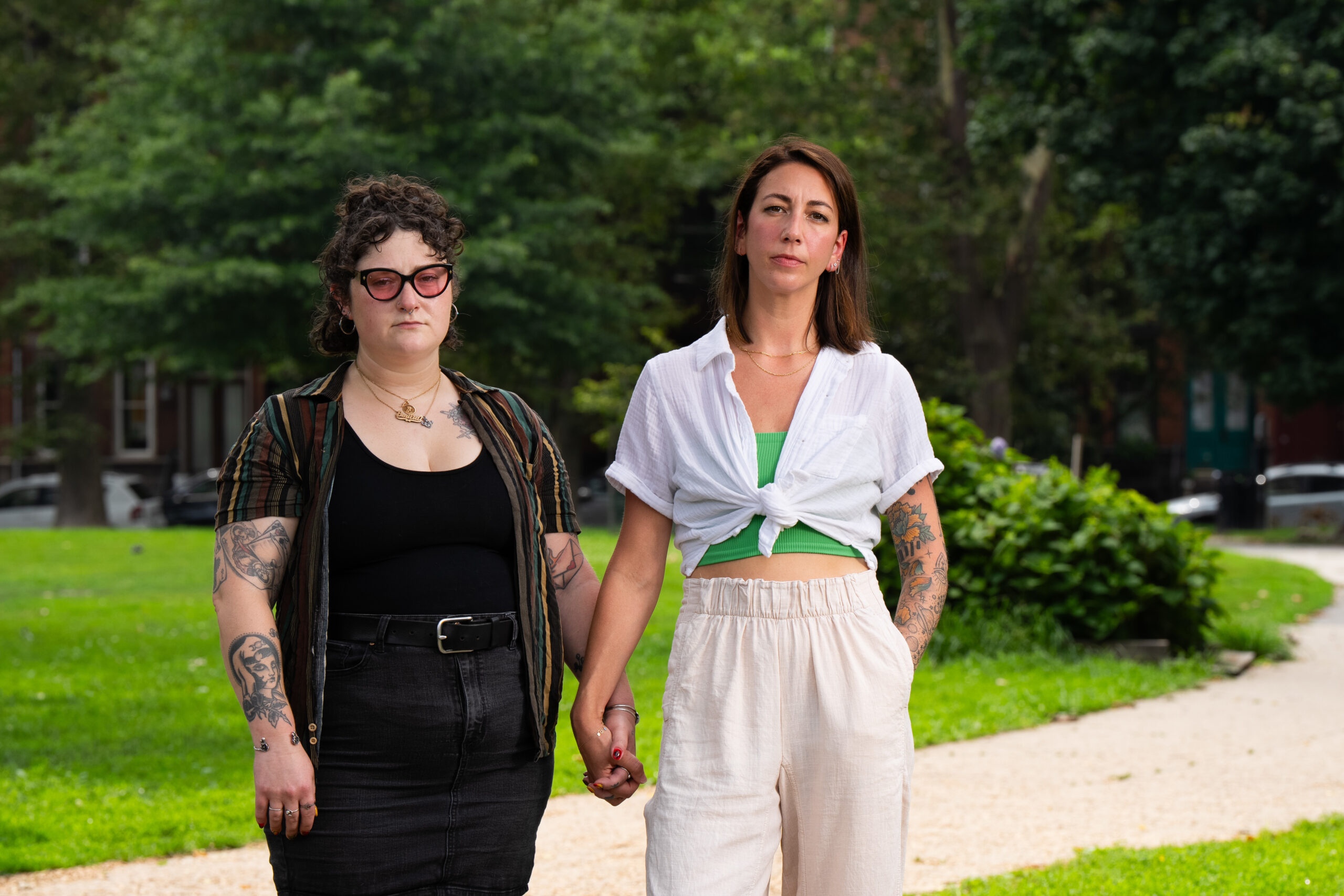
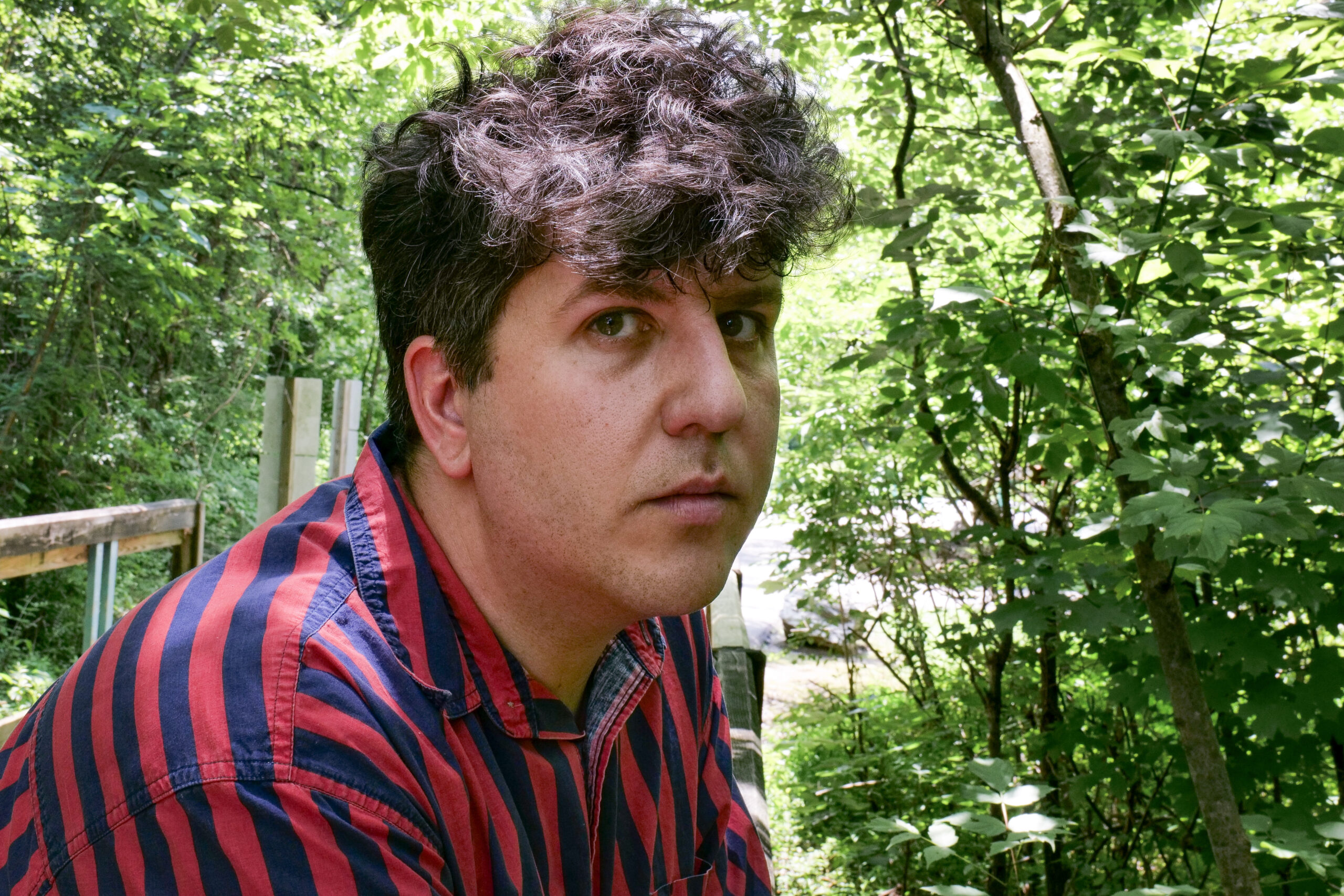
This week in Philly music kicks off in Fishtown with six-time Grammy nominee Leon Thomas, continues in Atlantic City with a Brandy and Monica throwback pop double bill, and continues in North Philly with rising R&B singer and Justin Bieber producer Dijon.
Austin, Texas, hard rock band Die Spitz play the First Unitarian Church on Wednesday.
Wednesday, Nov. 19
Die Spitz
The music gets started on Wednesday with the four women of Austin, Texas. hard rock foursome Die Spitz, who recorded their unrelenting new album Something to Consume at Studio 4 in Conshohocken with producer Will Yip. Boone, N.C., queer punk duo Babe Haven opens. (8 p.m., First Unitarian Church, 2125 Chestnut St., r5productions.com)
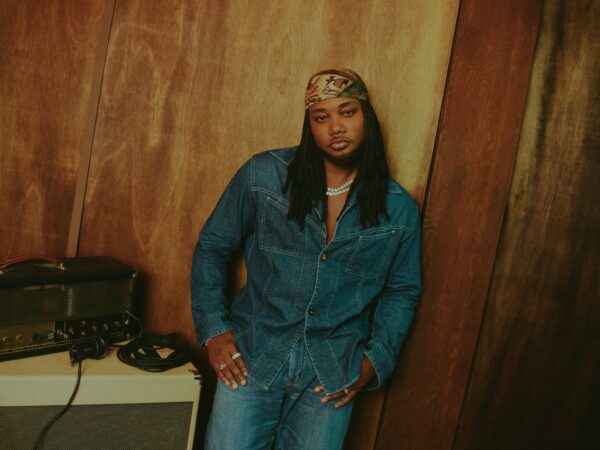
Leon Thomas
There weren’t a lot of surprises among the big names with the most nominations when the Grammys were announced this month. Kendrick Lamar and Lady Gaga topped the list, but Leon Thomas, who got six nods along with Bad Bunny and Sabrina Carpenter, was the surprise underdog.
The crooner and producer, who got his start as a Broadway child actor and star of Nickelodeon’s Victorious, is up for album of the year for Mutt, as well as best new artist and R&B performance for his viral NPR Tiny Desk version of the album’s title song — in which he compares himself unfavorably to a dog. His “Mutts Don’t Heel” tour comes to the Fillmore on Wednesday. (8 p.m., the Fillmore, 29 E. Allen St., livenation.com)
Also: There’s live music at Old City vinyl listening room 48 Record Bar. James Everhart of Cosmic Guilt teams with New York songwriter Keenan O’Meara on Wednesday; Hannah Taylor sings and Jake Zubkoff plays keys on Sunday.
Hannah Cohen plays Johnny Brenda’s on Thursday. Her new album is “Earthstar Mountain.”
Thursday, Nov. 20
Hannah Cohen
Hannah Cohen’s Earthstar Mountain is a dreamy, pastoral album that also delivers a sweet kick. She recorded it with producer partner Sam Evian at their studio in a barn in upstate New York. With Sufjan Stevens and Clairo guesting, it’s a 2025 standout releaser. (Salami Rose Joe Louis opens. 8 p.m., Johnny Brenda’s, 1201 Frankford Ave., johnnybrendas.com)
The New Mastersounds
British funkateers the New Mastersounds are saying goodbye — at least for a while. The band whose tight Hammond organ-heavy soul-jazz sound bears the influences of Philly keyboard greats Jimmy Smith and Jimmy McGriff, plays its “Ta-Ta for Now” tour on Thursday. (8 p.m., Ardmore Music Hall, 23 E. Lancaster Ave., Ardmore, tixr.com)
Now, Gallo has a new album that takes him in a more personal direction, called Checkmate, his second on the Kill Rock Stars label. It’s filled with subtly evocative folk-flavored, even jazzy, music that detours from the bruising garage rock he’s become known for. Gallo plays Free at Noon at Ardmore Music Hall. (Noon, Ardmore Music Hall, eventbrite.com)
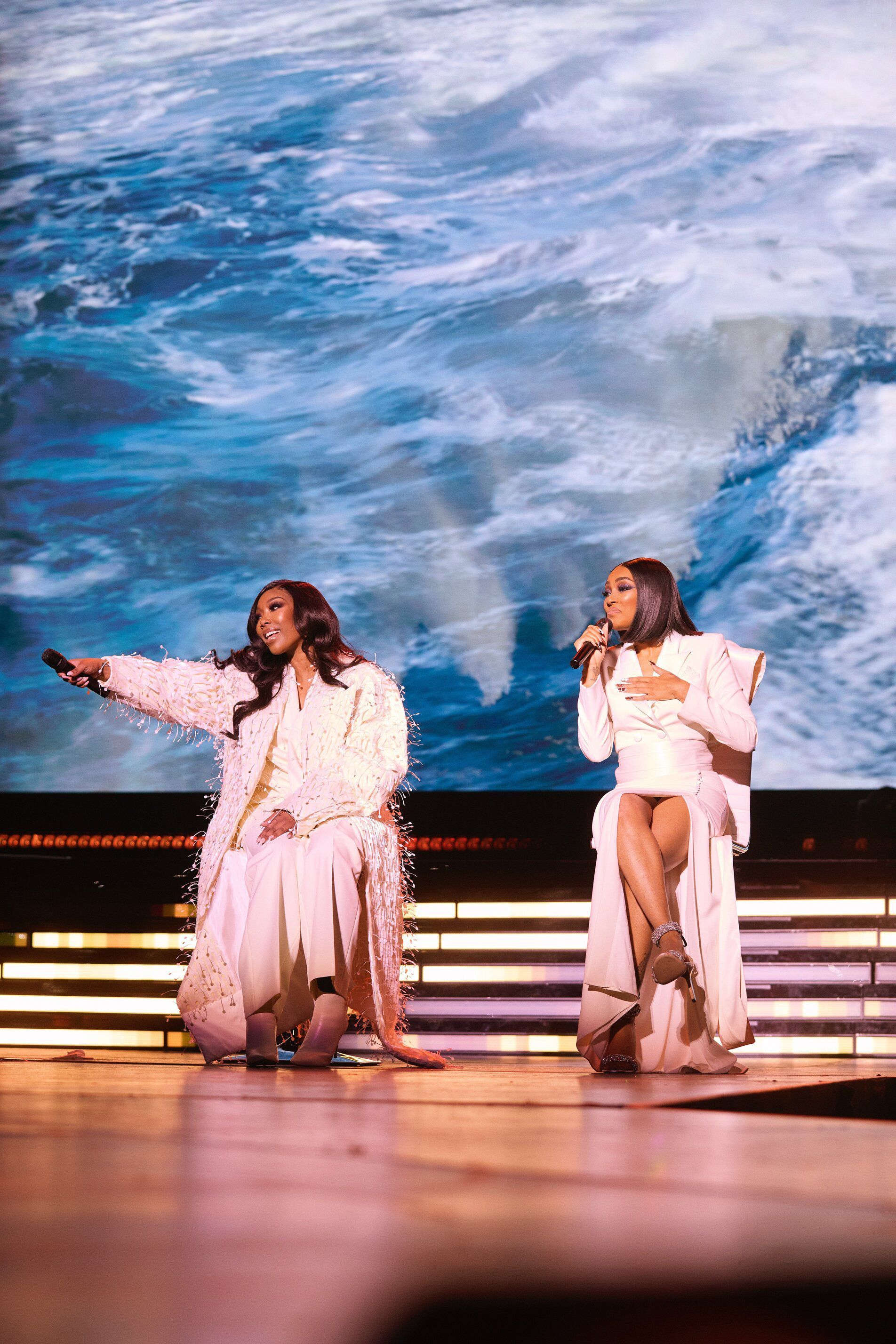
Brandy and Monica performing in Indianapolis in October on “The Boy Is Mine Tour,” which comes to Atlantic City’s Boardwalk Hall on Saturday.
Bar Italia
This month’s edition of David Pianka’s Making Time dance party has an intriguing live band headliner in Bar Italia, the London-based trio named after an iconic Soho coffee bar. The band’s new album, Some Like It Hot, wears the influence of Brit-pop band Pulp on its sleeve. New York rock band Voyeur also plays, along with sets by Dave P., Mario Cotto, Shai FM, and K Wata. (9 p.m., Warehouse on Watts, 923 N. Watts St., wowphilly.com)
Stinking Lizaveta
Longstanding West Philly doom metal trio Stinking Lizaveta‘s name was inspired by a character in Fyodor Dostoevsky’s The Brothers Karamazov. The band released its 1996 album Hopelessness and Shame — recorded by the late Steve Albini — on vinyl for the first time this March. On Friday, they headline Johnny Brenda’s with Deathbird Earth and Channls. (8 p.m., Johnny Brenda’s, 1201 Frankford Ave., johnnybrendas.com)
Tom Morello
Rage Against the Machine guitarist Tom Morello plays the Music Box at the Borgata in Atlantic City. It will be an agit-pop act of resistance in a hotel casino within earshot of chiming slot machines. Morello’s repertoire is made up of roiling Rage songs, Woody Guthrie, MC5, and John Lennon and Yoko Ono covers, plus originals in his rabble-rousing folk singer mode as the Nightwatchman. He’ll have a full band behind him, plus the help of San Diego hip-hop group the Neighborhood Kids as his special guests. (9 p.m., Music Box at the Borgata, 1 Borgata Way, Atlantic City, ticketmaster.com)
Saturday, Nov. 22
Mo Lowda & the Humble
Philly quarter Mo Lowda & the Humble closes out a five-month North American tour for its new album, Tailing the Ghost, with a hometown show. (8 p.m., Union Transfer, 1026 Spring Garden St., utphilly.com)
Brandy and Monica
Back in 1988, Brandy and Monica played out a feud over a dude in the worldwide hit “The Boy Is Mine,” which was cowritten and coproduced by South Jersey’s Rodney “Darkchild” Jerkins. Twenty-seven years later, the pop-R&B singers are on a concert tour together that also features Destiny’s Child’s Kelly Rowland, Muni Long, and 2025 American Idol winner Jamal Roberts. The tour is presented by the Black Promoters Collective. (8 p.m., Jim Whelan Boardwalk Hall, 2301 Boardwalk, Atlantic City, boardwalkhall.com)
Grammy-nominated singer and producer Dijon plays the Met Philly on Sunday.
Sunday, Nov. 23
Dijon
Dijon released his debut Absolutely in 2021 and has quickly made his mark. He regularly works with Mk.gee, the guitarist and songwriter with whom he shares a twitchy, low-fi sensibility. He’s also teamed with Bon Iver and Justin Bieber and is up for producer of the year and album of the year at the Grammys. Sometimes, he sounds like Prince.
His new album Baby! is a joyous, shape-shifting adventure. Two measures of how hip he is at the moment: He’s among the musicians with roles in Paul Thomas Anderson’s One Battle After Another, and on Dec. 6 will be musical guest on Saturday Night Live. He plays the Met Philly on Sunday. (8 p.m., Met Philly, 858 N. Broad St., ticketmaster.com)
Amy LaVere and Will Sexton
Memphis wife-and-husband duo Amy LaVere and Will Sexton are Americana artists who specialize in a brand of smoky Southern noir, perhaps best exemplified by LaVere’s “Killing Him,” about trying to rid oneself of a bad boyfriend only to find that he comes back to haunt you. (8 p.m., 118 North, 118 N. Wayne Ave., Wayne, tixr.com)
“Jefferson How We Adore Thee” will be released to the university community at its annual gala Tuesday. The university held a contest during its bicentennial last year, and Barden’s piece was selected from dozens of entries, the school said.
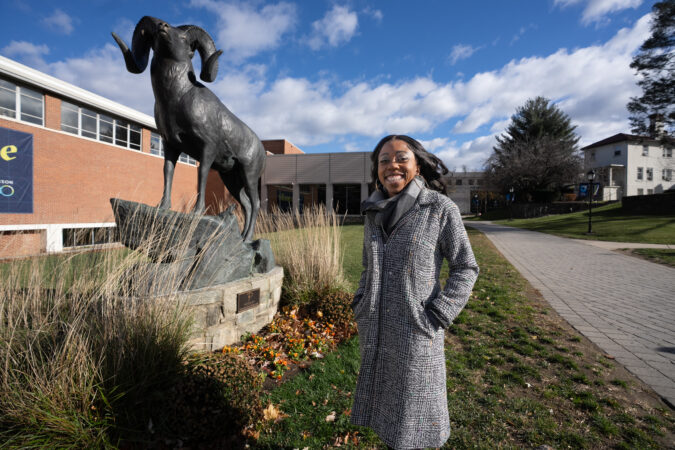
Elizabeth Avril Barden, a customer-experience specialist at Jefferson Health Plans and recent summa cum laude graduate of Thomas Jefferson University, has written the school’s first alma mater song in its 201-year history. “Jefferson How We Adore Thee” will be released to the university community at a gala on Tuesday.
“Elizabeth really captured the essence of the Jefferson community,” said Jefferson President Susan C. Aldridge “Learning, collaborating and innovating are all part of our collective DNA and I couldn’t be happier that we finally have an alma mater which captures who we are as a university as we venture into our third century.”
Jefferson has had a handful of songs that students have written over the years and a processional theme that launched in 1974, but never an official alma mater song, said F. Michael Angelo, Jefferson archivist.
One reason could be that at its founding in 1824, Jefferson was a medical college and over the years evolved into a university. But it was always medically focused until the school merged with the former Philadelphia University, best known for its design, engineering, and health science programs, in 2017.
“Philadelphia University, as far as we can tell through their archives, never had an alma mater song, either,” Angelo said.
Barden, 32, who received her bachelor’s degree in Health Services Management from Jefferson this year, said a colleague encouraged her to enter the contest. She has written about 30 songs, she said, so it wasn’t an off-the-grid venture.
It took her just 25 minutes to write the lyrics and music for the one minute, 55-second piece, she said.
“If you’re creative, you just flow,” she said. “You flow like water because it’s already in you, and you don’t have to overthink what’s already in you.”
And with the help of producer Keegan Myers, who played the music while Barden sang, the chorus goes:
It’s the Jefferson strong and true, where innovation leads us through. Together we achieve our best, as we prepare for what’s next.
“In every step I was taking at the university, it was preparing me for the next level of life,” she said.
Barden has been singing in front of people since age 2 and wroteher first song at 7, she said. Her parents, both Christian pastors originally from Haiti, encouraged her musical talent as she grew up in Brooklyn surrounded by gospel music, she said.
“Me and my six siblings, we were essentially the choir,” she said.
In high school, she won a song-writing contest and got to meet Grammy-winning R&B singer Jazmine Sullivan, who, she said, encouraged her to keep writing. She had written her high school’s alma mater song, too. And when she was a student at Delaware County Community College, she sang the national anthem at two ceremonies.
“Any school I go to, I want to leave a piece of me there,” she said. “Music to me is connection. That’s how I connect to people.”
For winning the Jefferson contest, she received a $200 gift card to the school bookstore, lunch with Aldridge, and a Jefferson mug.
“But the greatest gift was my name being attached to this alma mater song,” she said.
Barden said her aim in writing the song was to give Jefferson a gift.
“Jefferson gave me a lot,” she said, including a scholarship. “There were moments where I needed to talk to professors because life was happening. They were always kind and patient with me.”
Barden attended community college in New York after high school, but left when she got pregnant. When she moved to Philadelphia in 2016, she enrolled at Job Corps and then moved on to the Delaware County college. She continued on to Jefferson, while raising her four children, now ages 2 to 13.
In 2023, she began working there, too. Her job entails focusing on the patient experience and helping patients navigate the system.
“For the most part, I’m kind of like a clean-up person,” Barden said.
She’s currently enrolled in a dual program at Bryn Mawr College and Jefferson to obtain her master’s degrees in social service and public health. She plans to become a licensed clinical social worker and to incorporate music therapy into her work.
As part of her studies, she’s doing research on how music therapy can help those suffering from post-traumatic stress.
“I do believe that the incorporation of music,” she said, “has the ability to communicate with anyone … and help them learn how to cope.”
Katie Crutchfield and MJ Lenderman have struck up a fruitful collaboration as leading lights of the indie Americana music scene. And now, the two singer-guitarists are joining forces for a tour that will bring them to the Met Philly on April 18.
Crutchfield, who records as Waxahatchee, a sobriquet taken from the name of a creek near where she grew up in Alabama, released one of the most acclaimed albums of 2024 in Tigers Blood.
For most of the 2010s, Waxahatchee lived in West Philly. She moved here from Brooklyn along with her identical twin Allison, with whom she formed the band P.S. Eliot when they were teenagers growing up in Birmingham, Ala.
On Halloween, the Crutchfield sisters surprise released a new album under the band name Snocaps, a super group of sorts that also includes Lenderman and producer, multi-instrumentalist Brad Cook.
Next month, Snocaps is doing a brief tour with shows in New York, Los Angeles, and Chicago, but no plans to play Philadelphia.
Which makes this Waxahatchee-Lenderman date at the Met the next best — or maybe even a better — thing than a Snocaps tour. It will include Waxahatchee and Lenderman solo sets, and also feature them playing together.
That most likely will include collabs like Tigers Blood’s “Right Back to It” and well as tracks from the top-flight Snocaps album, which moves Crutchfield back into more of a rock and roll direction than her more recent country-flavored songs.
Lenderman also had a recent moment of social media virality when he brought then New York City mayoral candidate and music nerd Zohran Mamdani on stage at Brooklyn Steel.
Via PLUS1.org, $1 from each ticket sold for the Waxahatchee-Lenderman show at the Met will go to support community-driven nonprofits that work to increase access to nutritious food and housing resources.
On the face of it, the Galilee Chamber Orchestra could be an impossible meeting of musical minds.
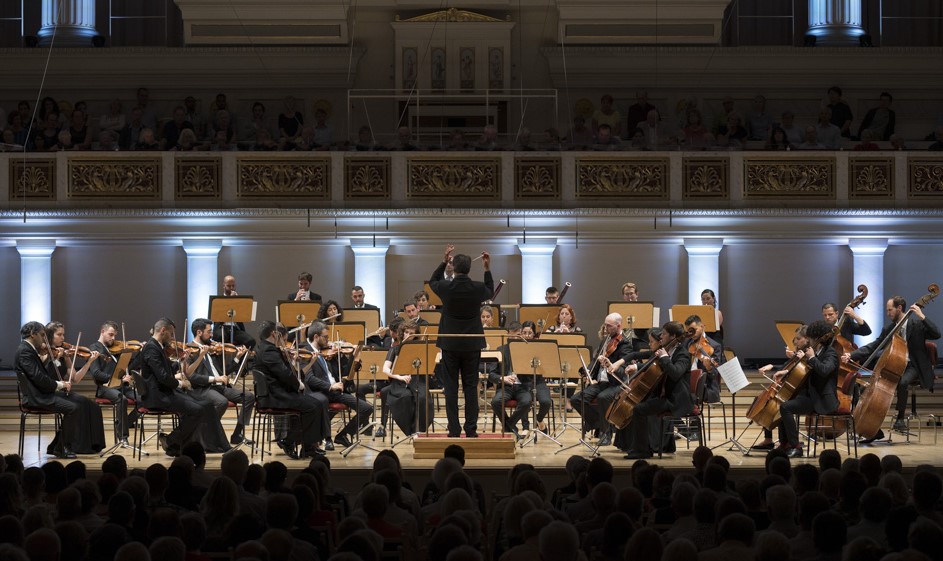
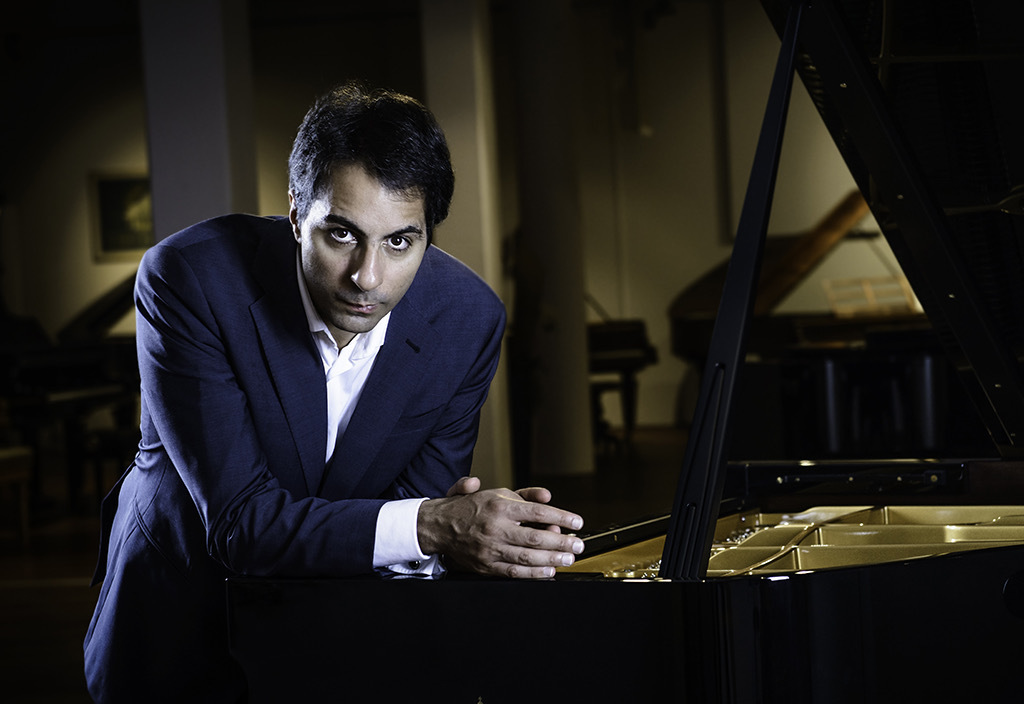
Comprising “equal numbers of both Jewish and Arab musicians,” as its website notes, the orchestra has a 13-year history, and is now on a high-prestige tour with celebrated pianist Bruce Liu that includes the Kimmel Center on Nov. 19 and New York’s Carnegie Hall Nov 20.
Based in Nazareth (known as the “Arab capital of Israel”), the orchestra’s common ground on this tour includes Mozart among other composers whose nationalities, from centuries past, now feel like neutral territory — while still speaking to the present.
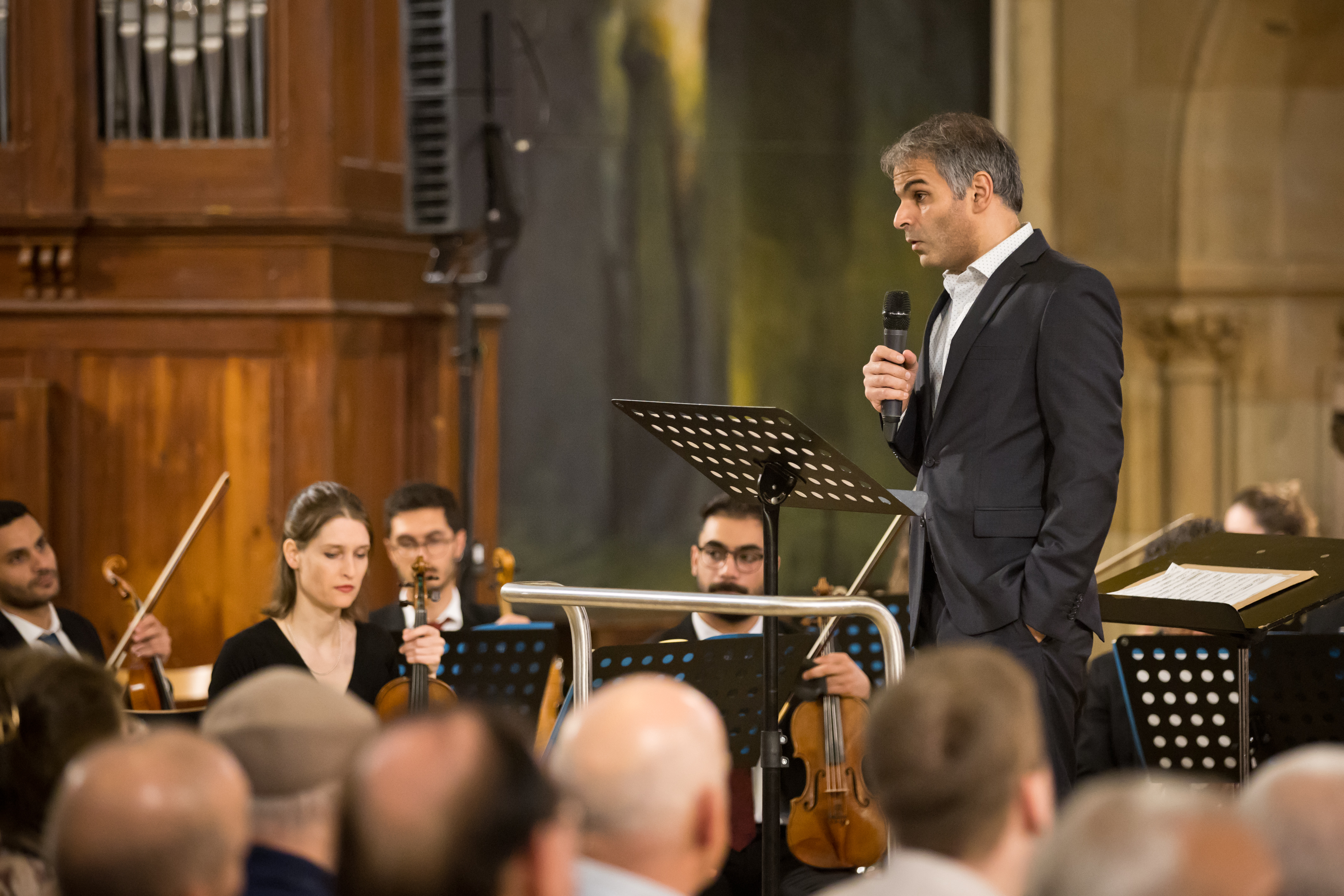
“Classical music has become something that belongs to the world. If you go to Japan or Brazil, they feel that Mozart and Beethoven belong to them as much as anybody else. There’s something very global about it,” said Nabeel Abboud-Ashkar, executive director of Polyphony Education, the conservatory where the orchestra is based.
Nabeel Abboud-Ashkar, executive director of Polyphony Education, the conservatory where the Galilee Orchestra is based, speaks during Bachfest 2025 in Leipzig, Germany.
“Once you’re part of this cultural world, you instantly connect with so many people around the world … you have a lot more in common with so many people.”
With that kind of mandate, it’s no surprise that the orchestra, in its last U.S. tour in 2022, was acclaimed for generating more sound than a typical chamber orchestra. This year, its 42 players draw from Polyphony students, faculty, graduates, and nearby professionals.
The Galilee Orchestra, which is currently on its U.S. tour. The group will perform in Philadelphia on Nov. 19.
Structurally, the conservatory/orchestra setup resembles Venezuela’s much larger El Sistema but also is meant to have an ethnicity mixture more like the Spain-based West-Eastern Divan Orchestra. Galilee Chamber Orchestra is firmly planted in its Jewish/Arab balance and in Israel, a country with a 20% Arab population.
The tour program includes the Mozart Piano Concerto No. 23 with Paris-born, Montreal-raised pianist Liu, a 2021 winner of the International Chopin Piano Competition. The presence of Symphony No. 3 (“Scotch”) by the Jewish composer Felix Mendelssohn isn’t meant to make a statement but is a piece the orchestra has wanted to do for a few years.
Also, Abboud-Ashkar’s brother Saleem Ashkar, conductor of the tour, has considerable history with the composer, having also been the soloist in both piano concertos in a well-received, major-label recording with the Leipzig Gewandhaus Orchestra.
More intentional is the inclusion of Nocturnal Whispers by Arab composer Nizar Elkhater, whose own Israel-based ensemble, named Abaad, seeks to fuse Western and Eastern musical styles
Saleem Ashkar, conductor of the Galilee Orchestra, which is currently on its U.S. tour. The orchestra will perform in Philadelphia on Nov. 19.
The orchestra’s concerts haven’t been subject to the kinds of in-concert interruptions and demonstrations that have greeted the Israel Philharmonic and the Jerusalem Quartet in Europe and the U.S.
But years of war, however, have strained the orchestra and conservatory in tangible ways. Planning is more provisional than ever. Concerts can be canceled on short notice, lessons planned to be in-person can suddenly switch to online, getting home from a European tour can be impeded and delayed by new conflict outbreaks in the Middle East.
Among the musicians, tensions are heightened by constantly seesawing events, said Abboud-Ashkar. After the attack of Oct. 7, 2023, the whole operation was suddenly in unfamiliar territory, he said.
“We don’t live in our own bubble. We experience, we see … we feel everything that is happening around us,” Abboud-Ashkar said in a Zoom interview from Nazareth. “Some people might think we’re being naive and ask … ‘How can you talk about collaboration and partnership being equal … with horrific things happening in Gaza?’ … We believe that what we’re doing has an impact. Even if it’s just making it a little better, we’re moving the needle in the right direction.”
The Galilee Chamber Orchestra performs at Bachfest 2025, in Leipzig, Germany.
The main enemy may well be despair. Within the orchestra and conservatory, lack of hope for war resolution can turn into loss of musical motivation.
“On the other hand, there are cases where people show incredible empathy for others,” said Abboud-Ashkar. “There’s a commitment to having this (musical) dialogue … and having more consideration for each other. When you’re in distress … you’re motivated to continue and to always find a way. You fight for your space and your values and hope there are still enough people out there who shared them. We’re going to stay together because this is what we believe in.”
The Galilee Chamber Orchestra performs Nov. 19, at 7:30 p.m. at the Perelman Theater. Tickets: $39-$89.60. philorch.ensembleartsphilly.org
Philly-raised rapper Armani White is pushing back on the media coverage of his arrest earlier this month.
White, 29, born Enoch Armani Tolbert, was arrested for disorderly conduct on Oct. 12 after police found the artist and members of his tour bus filming a music video on I-75 in Newport, Ky.
TMZ covered the arrest, releasing Tolbert’s mug shot and police bodycam footage of the arrest, as well as remarking on the nature of his hair in the mug shot.
“My father didn’t raise me to be a criminal. My grandfather didn’t raise me to be a criminal. The only reason why I smiled in that mug shot is because I refuse to let anybody paint a picture of me as a criminal on TV, on the internet, anywhere,” White said to a packed crowd in Birmingham, Ala., last weekend.
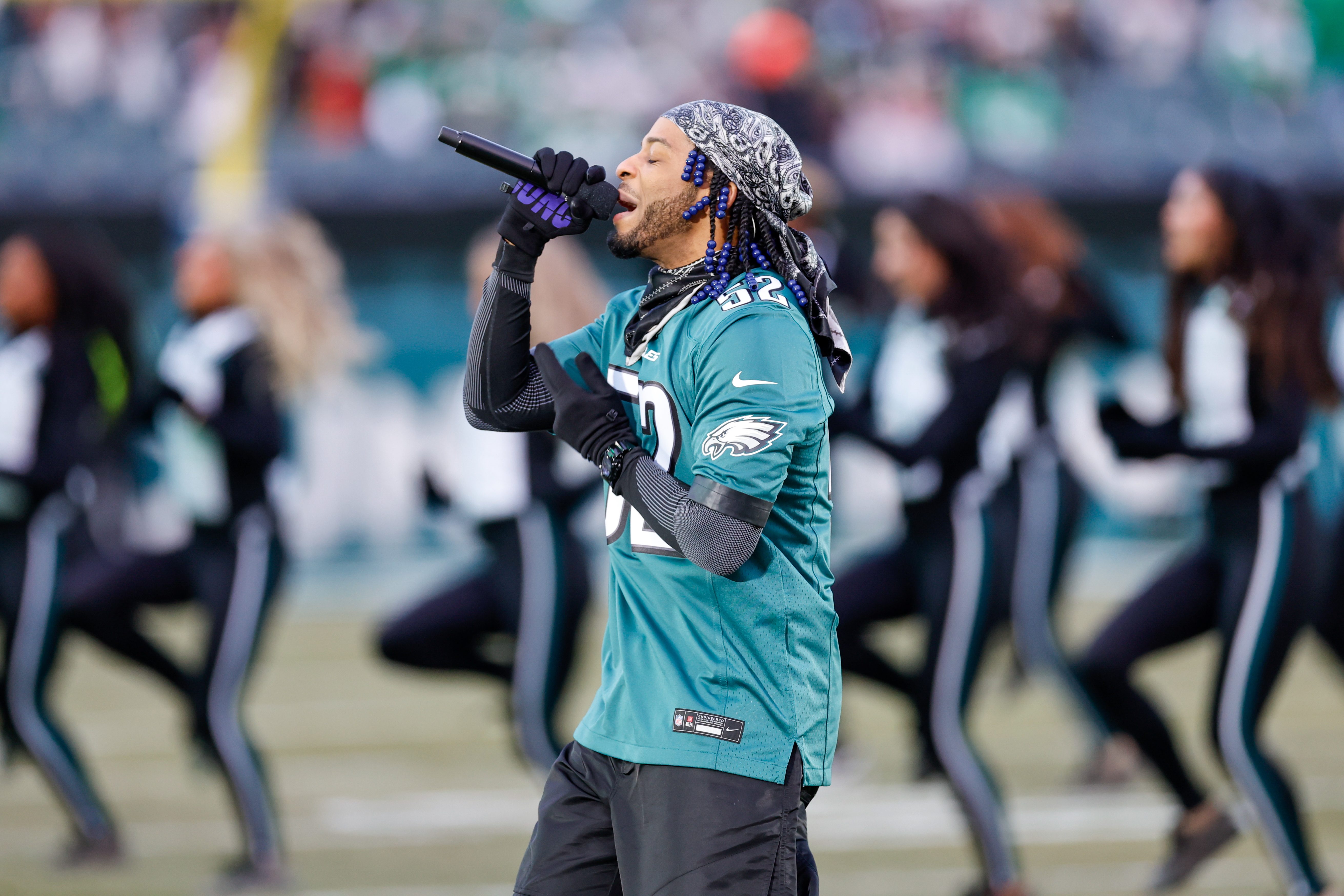
Armani White performs during the NFC Championship show as the Eagles face the Commanders Sunday, Jan. 26, 2025, in Philadelphia.
Tolbert was in Kentucky as part of a nationwide tour alongside Grammy-award-winning singer T-Pain when his tour bus stopped on the interstate to film a music video. White did not respond to a request for comment.
According to a police citation, the police were called to the highway after reports of people running on the road. When they arrived, police reportedly found White dancing on the concrete median of the interstate.
White grew to international fame in 2022 after his bass-bumping, Neptunes-sampled track “BILLIE EILISH” birthed a viral TikTok challenge reaching millions. White later joined the track’s namesake, Billie Eilish, the 23-year-old Grammy and Oscar award-winning singer, to perform the song together in 2023.
Rapping since the 2010s, White grew an underground following before joining the lineup of Jay-Z’s Made In America festival in 2018, which he had been attending as a fan before hitting the stage. Earlier this year, White performed his first NFL halftime show during the NFC championship, with the Philadelphia Eagles against the Washington Commanders.
White released his debut album, Keep In Touch, in 2019, followed by the EP, Things We Lost in the Fire, referring to a house fire in which White lost family members at a young age.
This week, he released a music video for the single, “MOUNT PLEASANT.,” a teaser for what’s to come on the release of his next album on Oct. 31.
“Is it funny?” “Am I just old?” “What does it actually mean?”
Those are common questions you’ll come across while searching for “six-seven” (or “6-7”), a phrase that has eclipsed internet obscurity and made its way into everyday speech, filling timelines, classrooms, and group chats in a way only the chronically online could understand.
The numbers, said out loud together, are really just that. It’s not code, or sexual innuendo. In reality, it’s just a lyric lifted from a song by Kensington-based rapper Skrilla.
The 27-year-old rapper, whose legal name is Jemille Edwards, has over 130 million streams across platforms and continues to rise in popularity.
In 2023, he signed with Priority Records — a Los Angeles-based label significant within the rap scene that worked with N.W.A and Ice Cube. Last year, his album Zombie Love Kensington Paradise earned praise in the industry.
The 19-track album, which he rereleased this year as a deluxe version with eight additional songs, underlines Edwards’ “affinity for the neighborhood while displaying his vocal flexibility and off-kilter delivery,” Pitchfork said in its mostly positive review, calling him likely “on the road to rap stardom.”
Philly rapper Tierra Whack has repeatedly shouted out Skrilla’s work while North Philly’s Lil Uzi Vert has collaborated with him.
In August, Edwards was arrested by Philadelphia Police during a music video shoot where he used a toy gun filled with gel pellets to shoot at an officer. He was charged with assaulting a police officer and related offenses.
One particular single by Skrilla has raised the rapper’s internet prominence.
Where did ‘six-seven’ come from?
Skrilla raps the lyric “six-seven” in his song “Doot Doot (6 7),” a track from the deluxe version of Zombie Love Kensington Paradise about life on the streets, fast cars, money, violence, and loss.
It’s a high-energy track that nods to Skrilla’s drill-rap style. The song’s chorus includes the lines, “6-7, I just bipped right on the highway,” and “pull up, doot-doot.”
What does ‘six-seven’ mean?
Philadelphia Eagles offensive tackle Laekin Vakalahi smiles while taking the field during the first day of Eagles Training Camp at the NovaCare Complex on Wednesday, July 23, 2025 in Philadelphia.
Well, it’s ambiguous. And Skrilla has said in interviews that he kind of likes it that way.
Meme lovers and unofficial lyric decoders have theories. Many think it refers to 67th Street in Philly, where Skrilla grew up (that’s what the Washington Post went with).
Owen Carry with Know Your Meme believes the Philadelphia ties are “largely speculative.”
Others think that it’s a nod to 67th Street in Chicago, where he has family. Taylor Jones, a linguistics and African American English expert, suggested it might be a nod to police radio code, where 10-67 is used to notify of a death. A contributor on Genius, a site dedicated to annotating song lyrics, theorized it was a reference to burial plots, six feet under and seven feet apart.
“Everybody else got their own different meaning,” Skrilla told Complex recently. “But for me, it’s just ‘negative to positive.’”
The most important part here is that it doesn’t really matter.
“Six-seven” has taken on a life of its own in recent months due to the pedestal it’s been placed on across TikTok and other social media platforms.
Why is ‘six-seven’ so popular?
The meme’s origins date back to late last year when Skrilla unofficially released “Doot Doot (6 7)” via Instagram as a leftover track from Zombie Love Kensington Paradise. It quickly started making the rounds on TikTok.
Content creators were using the line from the chorus in different, playful, extremely unserious ways: edits of a 6-foot-7 basketball player, lip dub memes, and scenarios that force someone to say the two numbers together. The creators are often nonsensical and copy Skrilla’s vocal pattern, a singsong “six-seven,” usually coupled with an open-palmed hand gesture.
Experts at Know Your Meme, who have been tracking the phenomenon since its inception, say videos surrounding “six-seven” have been viewed millions upon millions of times.
“The trend started with a series of bait-and-switch LaMelo Ball (of the Charlotte Hornets) edits late last year, which would intro with a random clip that included someone saying, ‘six-seven,’ and then switch to a Ball highlight reel,” said Carry, associate editor at Know Your Meme. “Skrilla’s ‘6-7′ lyric was used to queue the transition (Ball is 6 feet, 7 inches, which is relevant to why he was chosen).”
In turn, Carry said, young boys especially have been saying the numbers on camera in hopes of becoming the next NBA TikTok edit star.
“Six is a perfect number, and seven is a prime number, but only a glutton for punishment would put them together in front of a bunch of 13-year-olds,” the Wall Street Journal wrote in a piece about how the meme is wreaking havoc across campuses.
It’s safe to say the phrase has officially made its way into the mainstream.
“South Park” continued a buzzy season with its latest episode, “Twisted Christian,” on Oct. 15.
“Six-seven” was mentioned in a recent South Park episode where the kids can’t stop using the phrase, leading to an assembly about the Antichrist and satanic numerology.
Pro wrestler Je’Von Evans wore a “67″ jersey during his walk-in entrance last week, Shaq has given the trend his blessing (though he admits he doesn’t totally get it), and Skrilla claims the song will be included in the Grand Theft Auto VI soundtrack, though that hasn’t been made official yet.
Skrilla also performed the track in Philly last month when millennial icon Natasha Bedingfield, who was performing at the Theatre of Living Arts, pulled him on stage for a guest appearance. Bedingfield told Complex she’s a fan of the rapper and would like to get on a remix of “Doot Doot (6 7).”
Skrilla will be back in town at the Fillmore on Nov. 30.
What has Skrilla said about it?
In an interview this week with the Washington Post, he suggested the song referred to 67th Street in Philly, a block where a lot of his friends lived. It’s worth noting there isn’t a 67th Street in Kensington.
“We just rode by a truck that had ‘6-7’ written on it in dust, in Arizona, all the way out here,” the rapper said, speaking from a gas station on the way to Los Angeles.
The Inquirer couldn’t reach Skrilla for additional comment.
Will ‘six-seven’ still be cool by the time I start saying it?
Probably not.
With its place solidified in the mainstream — being analyzed by linguistic experts, printed on merch, and reported on by multiple newspapers (including this one), it’s safe to say the trend is likely on its way out the door.
But at least, for a fleeting moment, you can say you know what it means — which is nothing.
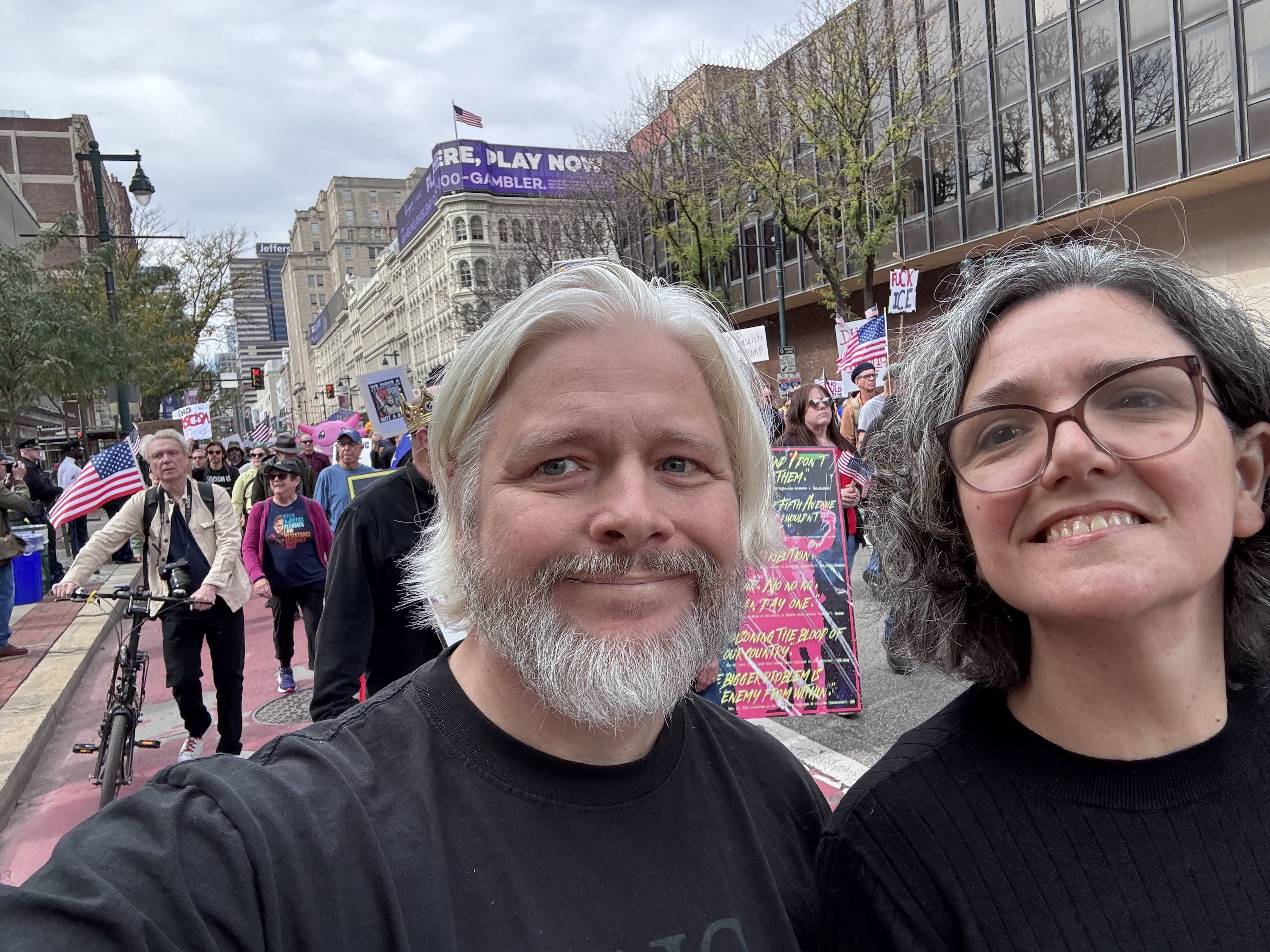
Former Talking Heads front man David Byrne, in Philadelphia for a three-night stop on his latest tour, joined the “No Kings” protest in Philadelphia on Saturday to show support for the anti-Trump movement and snap a few photos with fans along the way.
Several marchers posted photos of themselves on social media with Byrne, who rode a bike during the march, which went from City Hall to Independence Mall.
Ryan Godfrey, a 54-year-old software solutions engineer, was among those who chatted with Byrne, shortly after surreptitiously taking a photo of Byrne behind him.
Godfrey attended one of Byrne’s concerts on Thursday and recognized the singer when he saw him on his bicycle alongside marchers on Market Street.
“I knew he was a big bike guy — and we had just seen him on Thursday,” Godfrey said. He decided to introduce himself.
“I said, ‘Hi, I really appreciated your concert the other night. It was amazing; thank you so much for that.’ He said, ‘Of course, thanks for enjoying it,’ and then I said, ‘And also thank you very much for being here today — this is very important, that you’re doing this,’” Godfrey recalled.
“And he said, ‘Of course. I wanted to be here for this.’”
West Philadelphia residents Ryan Godfrey and Jessica Lowenthal pose for a selfie, surreptitiously photographing singer David Byrne in the background on the left, during the “No Kings” march on Oct. 18, 2025, on Market Street in Philadelphia.
Godfrey regretted not asking Byrne one question: How were the videos at his concert projected around the stage and on the floor without the performers casting shadows on them?
“It was a kind of magic trick that I don’t really understand,” Godfrey said. Godfrey has been a fan of Byrne’s since the ‘80s, but his interest was renewed when he saw the 1984 Talking Heads concert film Stop Making Sense in a theater last year.
“I was sorry that I had waited that long because it was almost certainly the greatest concert film I’ve ever seen,” he said.
He said Byrne was anything but aloof with marchers.
“He was very genial, very kind and very friendly and open to interactions from everyone around him,” he said
Another fan quoted Byrne in the sign they carried in the march, then got to hold the sign next to a laughing Byrne. The message? “Love & acceptance are now ‘punk ideologies.’”
Byrne has been critical of Trump both in his music and in interviews and writings. During Saturday’s show, he mentioned the “No Kings” rally, drawing applause from the crowd, according to social media posts.
One Bluesky poster said Byrne — who can be seen carrying a camera during the protest — showed photos of himself and his band at the march on the stage backdrop during Saturday night’s concert.
With the exception of a sign etched onto a glass window on the ground floor, there’s no indication that an entertainment venue and bar awaits beyond the doors of Media’s predominately office-focused Phoenix building.
Inside is equally vague. There’s just a large sign that reads “Martinique Deux” situated on a staircase leading to the basement. Following it downstairs, there’s an innocuous door that leads to a speakeasy-like bar.
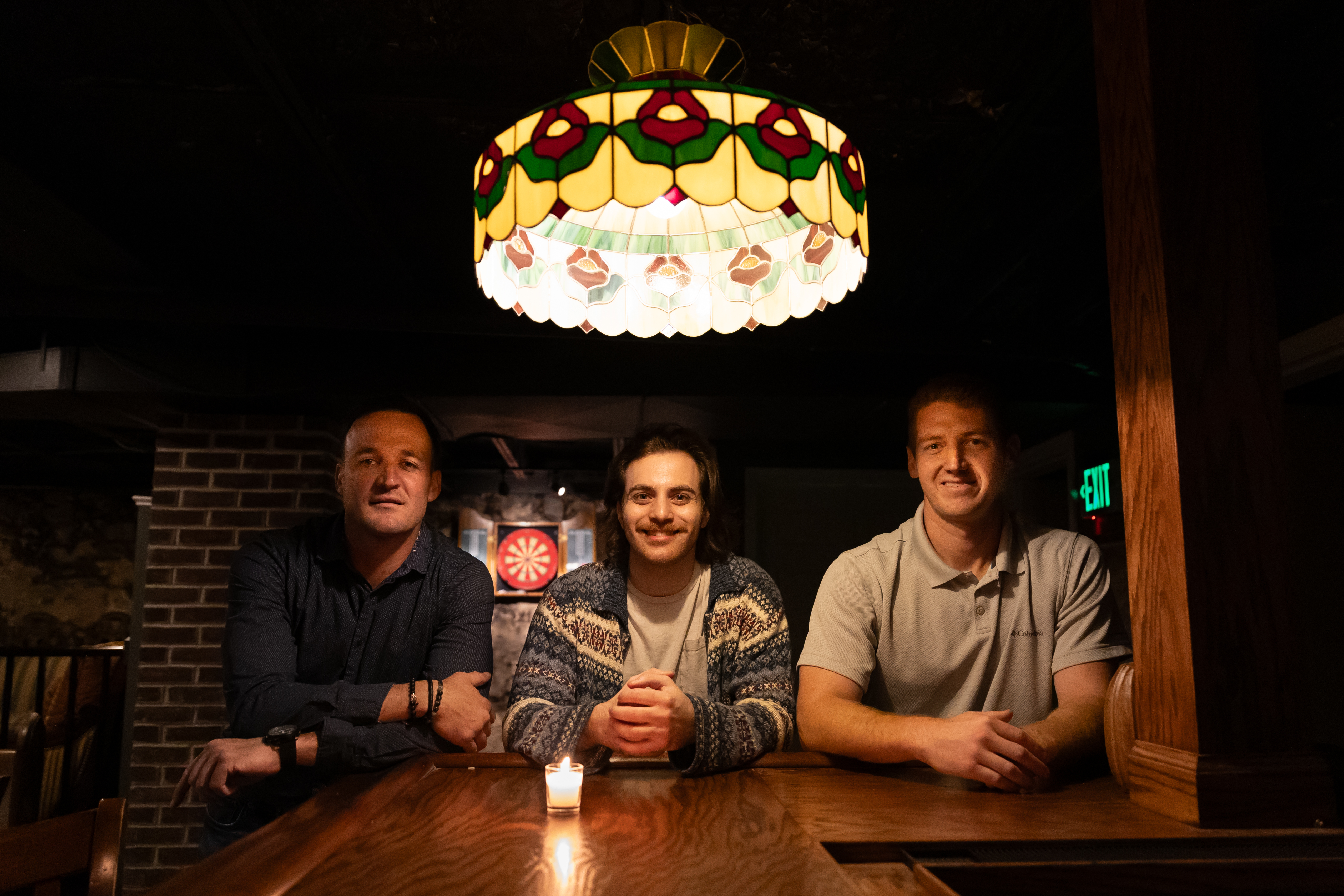
Martinique Deux’s owners — business partners James Matika, Jason Fogg, and Pat Collins — like that it has a bit of a mystique, at least for the time being.
That will change when the entertainment venue and bar debuts on Oct. 17 and Oct. 18, during a soft opening in advance of its grand opening on Oct. 23.
Located at 115 W. State St., the 2,400-square-foot space features a long bar with chairs, high- and low-top tables, including some with church pews for seating, a stage with a piano, as well as a back section with couches and a big-screen TV.
Though largely dark and atmospheric, there are some pop culture nods, like a large painting of David Bowie and a photo of Princess Diana sporting an Eagles jacket.
When Martinique Deux opens, its owners envision it as a lively place where people can grab a drink before or after dinner, watch a game, play darts, and enjoy a music or comedy show. It will be open from 4 p.m. to midnight on Wednesdays, Thursdays, and Fridays, and open earlier on weekends.
A dart board on the wall at Martinique Deux in Media.
The 21-and-over venue will have live entertainment at least three days a week, with music performances on Fridays and Saturdays and comedy shows on Thursdays, though the lineups will vary. They plan to launch with a range of musical acts and comedy, with some being ticketed events and others charging a cover.
Sports fans can also catch games, with a large TV taking center stage during Eagles games.
“If there’s Philly sports on, that’s what will be on,” Matika said.
After football season ends, they’re contemplating adding acoustic performances on Sundays. Weekends may also see Martinique Deux open earlier to accommodate Premier League soccer fans.
Martinique Deux will also be open on Wednesdays starting around Thanksgiving, but largely without planned entertainment.
The bar will offer staple food items like soft pretzels, popcorn, and chips, with plans to partner with neighboring pizza joint Lariele Wood Fired Square Pie. They’re also contemplating a rotating food truck lineup on live entertainment nights.
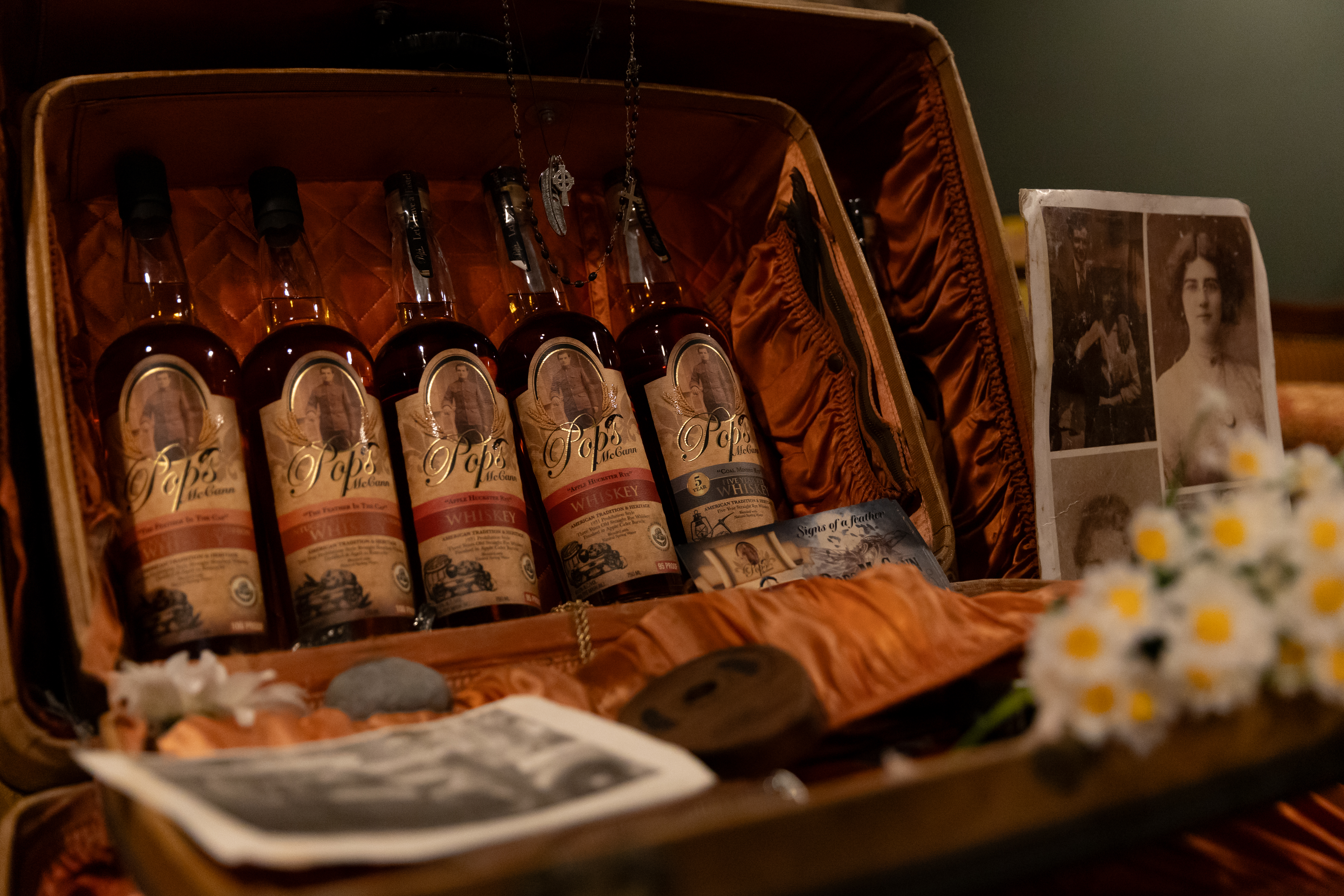
While they’re still finalizing the cocktail list, it will likely be bourbon-forward and feature Pops McCann liquors, Fogg’s Pottstown distillery that produces bourbons, whiskeys, and a rum, and is planning to expand into vodkas and tequilas.
“We’re going to keep it simple,” Matika said.
The bar will feature Pops McCann liquors, Fogg’s Pottstown distillery.
When Martinique Deux opens, it will mark the end of a year-and-a-half-long effort to bring the concept to life. Matika and Collins began working on it together last March after each independently considered similar ideas. They soon connected and set about transforming the space, which was sitting empty after an escape room there closed amid the pandemic.
Both also have experience in the industry — Matika worked at Tap 24 and La Belle Epoque in Media and grew up in the bars his father owned, including The Martinique in Wildwood. Similarly, Collins’ father formerly owned the Clam Tavern in Clifton Heights, and Collins himself said he owned a dive bar in South Philly previously.
They later connected with Fogg through a mutual friend, bringing the entire vision together.
Owners Jason Fogg, James Matika, and Pat Collins pose for a photo at the bar.
“I think it’s going to be one of Media’s staples,” Collins said.
This suburban content is produced with support from the Leslie Miller and Richard Worley Foundation and The Lenfest Institute for Journalism. Editorial content is created independently of the project donors. Gifts to support The Inquirer’s high-impact journalism can be made at inquirer.com/donate. A list of Lenfest Institute donors can be found at lenfestinstitute.org/supporters.
Dozens of former students of the Paul Green School of Rock Music, most long out of touch, have reconnected to talk about their past. They had rock and roll childhoods most kids could only dream about. The epic road trips and European tours. The performances with rock stars like Eddie Vedder and Billy Idol.
But the alumni of the lauded former Philadelphia musical education program are not simply reminiscing about the music. They are coming to terms with the physical, psychological, and emotional abuse they say Paul Green subjected them to while they were children.
Their conversations revolve around a report Air Mail magazine published in May about Green, a former punk rocker who styled himself a brash tastemaker, and the school he founded in 1998. Based on interviews with more than 60 former students, the story described how Green often flew into violent rages, struck students, and fostered a sexually charged environment for his teenage students.
Although Green did not respond to the allegations in the Air Mail story at the time, he announced through a spokesperson soon after that he would not join his students on a summer tour in the U.S. and Europe.
Since, two dozen of Green’s former students and staff members have spoken with The Inquirer to share additional allegations of misconduct. They include a woman who said Green initiated frequent sexual contact that lasted nearly two years with her in 2007, when she was his 17-year-old student.
It is the first time Green, who was the vulgar and volatile subject of a 2005 documentary Rock School, has been publicly accused of having sex with a student enrolled at his school.
Green declined to be interviewed for this story. After The Inquirer emailed Green this week with a list of allegations it would be reporting, Green responded Thursday and denied having sexual relations with anyone underage or who had been a student at the time. He added that he will close his current children’s music academies, including one in Roxborough, and will retire from teaching.
Paul Green and his charges at the Paul Green School of Rock Music in 2005.
Green said in a statement Thursday, “I want to be very clear, however, that some of the more serious allegations being made, particularly those that are sexual in nature, are not accurate. I have never shown students pornography, and while I admit to extramarital relationships with women connected to School of Rock, I have never had a romantic or sexual relationship with anyone under legal age or anyone who was a current student, during that time frame, or ever. I also deny any sexual harassment.”
The age of consent in Pennsylvania is 16, but sexual contact by a person in a recognized position of trust or authority — such as a teacher or school administrator — with someone under 18 is considered a third-degree felony punishable by up to seven years in prison. This was the law in 2007, and it remains the same today.
The woman, who The Inquirer agreed not to name because of the nature of the claims, said Green first began flirting with her when she was 15, with “inappropriate jokes or comments about my appearance.”
As she got older, it escalated.
“Then, winking, touching, hugging,” the woman said. “He would put his hand on my leg and see how high he could go before I stopped him.”
She was a member of the All Stars, the most talented musicians who toured as a band and performed at professional venues and festivals. She said that during her junior year in high school, when she was 17, Green invited her to meet him for sex at a hotel near the former Race Street school, asking if she was going to “chicken out” before texting her his room number.
The ongoing sexual contact that began that day lasted for almost two years, only ending after the woman graduated and moved away, she said.
During their time together, the woman said, Green sometimes provided her with marijuana, Champagne, or cocaine. He rented porn for them to watch and attempted to arrange a threesome with a former student working at the school, she said.
He would joke, “You’re my teenage mistress,” she said.
Two of Green’s former students and two formerstaffers told The Inquirer they had known that Green was engaged in sexual conduct with the woman while she was his student and after graduation. Two of them said Green himself had told them at the time about the sexual contact — both of whom asked not to be named for fear that it could affect their current employment. One former staffer said Green and the student had been intimate on a European tour bus, under a blanket, while chaperones sat rows ahead.
That staffer said they were afraid at the time to speak out against Green, who ruled the school he created like a self-proclaimed “Überlord.” But staying silent is a regret they’ve carried for nearly two decades.
“I didn’t protect her at all,” the former staffer lamented.
‘Total manipulation’
Many of the 60-plus students who described Green’s physical, verbal, and inappropriate behavior to Air Mail, a weekly news and culture newsletter launched in 2019 by alums of the New York Times and Vanity Fair, are now connected in a WhatsApp group. After an Inquirer reporter contacted the former students, they responded with an open letter to explain why they had decided to continue speaking out.
“We entered his programs with trust and hope, but too many of us left with wounds and trauma we’re still working to heal. Some of us have never played music again.”
And despite bonds of life-forming musical experiences, many of them told The Inquirer they went their separate ways after graduation, hoping to forget the pain.
Former Paul Green School of Rock students Emilia Richman (left) and Carolyn Satlow at Dickinson Square Park on July 7.
“It was total manipulation,” said Carolyn Satlow, 37, an All Star who attended the Downingtown branch of the Paul Green School of Rock Music from 2004 to 2006, and is now chief of staff of the Vetri restaurant group. “This web of secrets that kept us all silent.”
Satlow had turned 18 and graduated from rock school when Green began a monthslong sexual relationship with her in 2007. At the time, she was working at the school as an administrator.
Now married with two children, Satlow said Green also told her about his sexual contact with the then-teenage student.
“I thought this adult person was the authority in the room,” she said of Green. “We all trusted him. I was an insecure teenager and Paul knew that and preyed on it.”
Satlow says being able to talk about what happened, and reconnect with other students who went through similar experiences, has been healing.
“We found lives for ourselves, and we’ve become successful in music and outside of music, and just being great human beings,” Satlow said. “Because we’re all just actively trying not to be him.”
‘Paul being Paul’
By constantly discussing his own sex life and the sex lives of students, who were mostly 12 to 18 years old, Green created an environment where even his most outrageous behavior could be normalized, former students and staffers said.
Jen Bowles, an administrator at the school from 2005 to 2007, told The Inquirer that Green had sent her texts asking if she would have sex with him if he booked a fancy hotel, like the Rittenhouse Hotel or the Sofitel Philadelphia at Rittenhouse Square.
Serious about her job at the school, which she initially saw as an empowering, punk rock space for young musicians to express themselves, Bowles, who was then 24, said she had tried to ignore Green’s messages as inappropriate jokes.
Former Paul Green School of Rock students Allie Hauptman and Aaron Sheehan at Rowhouse Grocery in Philadelphia on June 30.
Bowles, who now lives in Vancouver after earning a doctorate in public health from Drexel University, recalls attending a postshow work dinner Green arranged in 2007 at the former Abbaye bar and restaurant in Northern Liberties. Bowles had hoped the dinner would be an opportunity to discuss a potential promotion to manage the Philly school.
After they had just ordered dinner, she said, Green asked her to have sex with him.
“‘It’s finally happening,’” she recalls Green saying, adding that he assumed that they would have sex.
When she rejected his proposition, she said, Green berated her over dinner, referring to her as a “tease,” shouting that he would find a way to fire her. During his tirade, Bowles said, Green told her that her rejection didn’t matter. He had other options for sex, including students, staff, and sex workers, she recalls him saying.
Bowles said Green then bragged about his sexual conduct with former students and staff he had taught since childhood.
“I wait till they’re 18,” Bowles recalls him saying.
Bowles said she did not report back to work the following Monday and resigned within a week.
“I was broken at this point,” Bowles said. “I thought my future was crumbling into a million pieces, and I learned that the young people I cared about were in the hands of a horrible person.”
Bowles’ longtime friend, Ruth Scullion, recalls Bowles telling her about the experience with Green shortly after it happened in 2007.
“She had told me about the culture at the school — and that she felt preyed on,” Scullion. “She told me about going out to dinner with Paul for what she thought was a work dinner, and how he started being overtly sexual with her and propositioning her. She said when she refused, he said, ‘Well, you’re too old for me anyway.’ It still gives me chills thinking about it.”
Julia Rainer, 37, a former All Star guitarist who now lives in South Philly and works as a therapist, also recalled Bowles detailing the incident to her at the time.
Paul Green School of Rock Music emails shared with The Inquirer show that two months later, Green strategized with a staffer on how best to attack Bowles’ credibility if she filed a sexual harassment lawsuit. By then, the circumstances surrounding the popular employee’s departure had started to spread among staff, even as Bowles decided against pursuing legal action.
Green wrote to the staffer in 2007 about the alleged advances, saying of himself, “Once again: Paul being Paul.” Then later adding, “Here is EXACTLY what I need from you: keep your ears way to the ground, do what damage control you can do.”
‘Always part of rock school’
For many former students, the nearly two years since the Air Mail reporter’s initial contacts have included painful revelations to family members, therapists, and each other.
Last year, people who had long avoided reckoning with their past at the Paul Green School of Rock Music began to reconnect on Zoom.
A.Z. Madonna, 32, a former All Star, who originally grew up in Maplewood, N.J., and now writes about classical music for the Boston Globe, said for years she had distanced herself from her rock school friends.
“I didn’t want to be reminded of how Paul made me feel, which was that I was a failure who deserved to fail,” she said to The Inquirer.
But Madonna is now part of the private WhatsApp group chat, where for months the 60 former students shared stories about their experience at the Paul Green School of Rock Music. Some still talk daily, offering messages of support to friends picking up their instruments again.
There have been park meetups and coffee shop get-togethers. In May, a bunch of the former students attended a Metallica and Limp Bizkit concert, the latter a band they say Green would have berated them for listening to as kids, always emphasizing the classics.
“It’s been very healing,” said Emilia Richman, 33, a South Philly musician and former All Star who now works as a mental health administrator. “So many of us had stayed away from each other because of our shame.”
While some former students said Green’s school unlocked opportunities, they also said that he taught them through fear and humiliation.
Allie Hauptman, 38, who attended the Philly school from 1998 to 2005, and is a founding partner of Rowhouse Grocery, a boutique corner store in South Philly, said she would often turn down the volume on her keyboard all the way so that Green wouldn’t be able to hear any possible mistakes so she was “in the clear from the yelling and swearing.”
Rainer recently played her first show after returning to music in the months after the Air Mail story published.
“The culture of humiliating you, bullying you, isolating you — that was always part of rock school,” she said.
So was Green’s controlling behavior, the students said.
“He really became addicted to that power and control he had over all of us,” said Gina Randazzo, 40, of Collingswood, who began guitar lessons with Green in 1999, was an All Star, and eventually worked at Studio House, a now-closed recording studio for students and young people in suburban New York that Green opened in 2010. “It was almost like he couldn’t help himself.”
The former students say they are not after revenge.
“This is about ensuring that no child is ever again put in a position where they are vulnerable to this kind of manipulation, control, and abuse,” they said in their letter. “While he has released a statement closing PGRA and retiring from teaching ‘in this capacity,’ our primary concern is that PG is never again placed in a position of power over children.”
In their open letter against Green, the 60 former students spoke directly to his most-recent students.
“We hope you are safe,” they said.
That’s something Aaron Sheehan, 33, an All Star from 2007 to 2009 and member of Studio House, tried to tell the students himself when he chanced upon Green’s new pupils jamming to Yes at a South Philly street festival three years ago.
Walking toward the music, he decided to confront Green for telling him he was no good until he finally believed it.
But Green hadn’t come. Sheehan tried telling the parents, but they brushed him away. He must’ve had a bad experience, they told him. They love Paul.
It was hard watching the kids play.
“It was like looking at us all over again,” he said.
‘I was an overgrown teenager’
In 2009, Green sold the company he had formed out of his living room to an investment fund in a deal worth $10 million. In 2023, the School of Rock, which now includes 500 schools worldwide, was purchased by Youth Enrichment Brands, a leading youth activities platform.
Stacey Ryan, the current School of Rock president, stressed that the institution has had no affiliation with Green for over 15 years.
“Student safety is our highest priority, and our mission has always been to provide an empowering space where young people can grow — not just as musicians, but as individuals,” she said.
As part of the 2009 deal, Green retained leadership of the All Stars program, but left within a year after a final meltdown with students, when Green allegedly mocked a student’s Catholic faith, threw a metal chair, and referred to Mother Teresa with a vulgar term for a woman’s vagina, said Sam Mercurio, a South Philly musician and former All Star from 2007 to 2010.
“By the end, he had made it all feel so normal,” said Mercurio, who told The Inquirer Green once whipped him with a mic cable during a rehearsal.
After living in Woodstock, N.Y., for a time, Green returned to Philadelphia in 2017, opening up a new venture, the Roxborough-based Paul Green Rock Academy. The academy, which also has locations in Connecticut and the Bay Area, offered students the same chances to tour and jam with musicians, like the former Zappa band members, that the original rock school kids did 20 years ago.
Shortly after the Air Mail article, the academy’s social media went dormant. Scott Thunes, the academy’s longtime assistant musical director and former Frank Zappa bassist, would be in charge of tours and the entire program, according to a spokesperson at the time. Green said that the school would be renamed the Thunes Institute for Musical Excellence.
In late June, the North Philly performance space PhilaMOCA canceled the students’ scheduled performance of “We Love Zappa.” A spokesperson for the venue said that Green’s continued involvement with the school, along with a push from a former student, led them to shut the show down. Thunes said the cancellation only hurt the students.
Despite his statement, when reached by The Inquirer on Monday, Green was with the Thunes Institute students on an August European tour, alongside Gibby Haynes, the lead singer of the Butthole Surfers and a longtime collaborator with Green’s schools. Videos show him in the front row.
In a statement to The Inquirer, Green said he was stepping in for Thunes, who had to leave citing a “personal issue” halfway through the tour. “The students worked so hard and had already experienced so much turbulence heading into the tour, so we weighed the backlash of me attending versus the fallout of canceling,” Green said. “The current parents unanimously requested that I return to ensure a smooth transition until we could implement a suitable replacement.”
Green, who graduated from Temple University Beasley School of Law in 2021, said he did not speak out sooner about the Air Mail allegations because, “I have been reflecting on that time period, gathering my thoughts, and trying to find the right words. I have been balancing how to genuinely apologize and take accountability for my actions from over 15 years ago, while also unambiguously denying the allegations of things that never occurred.”
Long open about his battle with addiction, he had his own dysfunctional childhood — he grew up fatherless in Port Richmond, joined the Philly punk scene by 13, lived on his own by 15, and formed the original school when his music career failed. Green said drug rehab and years of therapy and meditation have helped him grow.
“I started School of Rock in my living room because I love teaching music, and I wanted to create a fun and intensive atmosphere for students,” he said in his statement to The Inquirer. “I had no idea that it would be successful, and I was not at all prepared for that success at such a young age. I was an overgrown teenager when those students needed a responsible adult. That said, despite how it may appear, my inappropriate behavior or language never came from a place of predatory intent as has been insinuated.”
He added that closing the schools “was not an easy decision, as teaching music has been my life’s work and greatest passion. But I believe this is the right moment to close this chapter with gratitude and integrity.”
‘Nobody does what Paul Green does’
Ten parents, who contacted The Inquirer through a spokesperson for the Paul Green Rock Academy, said they never witnessed Green cross a line. None of the children ever told them he did, they said.
“I have seen countless rehearsals and performances in the last seven years,” said one parent, whose child is a longtime student at the academy. “I’ve never witnessed any of those alleged behaviors, nor has my child ever reported inappropriate conduct.”
When speaking to The Inquirer, the parents, whose children are current or former students of the Paul Green Rock Academy, were only responding to the questions about the allegations already published by Air Mail. The Inquirer did not make them aware of the new sexual allegations detailed in this story.
Though Green, in his statement, says he’s changed, parents of current students at the Rock Academy tell The Inquirer that Green didn’t run from his bad boy image.
While assuring them he’s mellowed, he still makes it part of his selling point — and a new generation of parents believe him.
“Paul’s teaching style was addressed right from the very beginning,” said one parent, whose daughter graduated from the academy, in a statement provided to The Inquirer through a school spokesperson after a reporter had contacted the academy about Green. “In my mind there was no question that we all knew what we were signing up for.”
One parent said Green recommended that families considering the Paul Green Rock Academy watch Rock School, which shows him berating and humiliating students busy mastering some of the most complicated rock compositions ever written. In the film, Green also presents a student who described being suicidal with an award for “most likely to kill himself.”
Green can still be “arrogant,” “rude,” and “foulmouthed,” the parents said. He sometimes still screams and storms out of rehearsals, they said. One parent said she had met with Green for throwing a rattle shaker at her child, but that they had moved past it.
The parent, who stressed she did not want to dismiss the former students’ experiences, credits Green’s “grittier” and “edgier” approach for helping her son, who is neurodiverse, flourish socially and musically.
His current students appear heavily devoted. On Instagram, they praise classic rock and quote Zappa. They take each other to prom and form bands. They post tour updates and photos from past performances, where Green could often be seen in the front row.
Green addressed the allegations months ago, they said, removed himself from rehearsals, and met with parents individually.
“Paul’s a pretty open guy — and I was aware that there was stuff in the past he wasn’t proud of,” said one parent, whose two sons are Rock Academy grads. “But I can certainly say this: Nobody does what Paul Green does. No rock school does what the Paul Green Rock Academy does. Nobody offers that experience.”
‘Like Whiplash’
But some of the most successful musicians to emerge from the Paul Green School of Rock Music say nothing was worth the verbal and emotional abuse they experienced from Green.
Eric Slick, 38, a former All Star and now drummer of the Philly-formed rock band Dr. Dog, was also featured in the Air Mail story. A drumming prodigy who grew up in Fairmount — his grandfather was a jazz trombonist who played with Billie Holiday — he had been bullied for his weight at the Masterman School before hoping he found a sanctuary at rock school in 1998.
His talent only made him more of a target with Green. Like on his 12th birthday, when Green suddenly exploded in rage over his Pink Floyd drum solo, spitting, cursing, throwing mics, and kicking amplifiers.
Eric Slick, drummer for the rock band Dr. Dog, says he was bullied by the Paul Green School of Rock Music founder.
“It’s this Whiplash moment where I was like, ‘Oh, I’m not safe here,’” said Slick, who now lives in Nashville, referring to the 2014 film about a young jazz drummer and his explosive teacher.
At his birthday dinner with his parents at Spaghetti Warehouse after practice, Slick said nothing.
“We were these misfit toys who didn’t fit in, who weren’t jocks, who weren’t popular. And then suddenly we have this opportunity to jam and grow as musicians together,” he said. Talking, he thought as a kid, would jeopardize that.
“I would be out of this friend group, and I would be done,” Slick said.
It’s a sentiment shared by many former students.
“I feel like I really shut down,” said Lauren Cohen, 37, of Doylestown, an All Star from 2002 to 2005, and a classical musician who performs regularly in Philadelphia. “I feel like I shoved my emotions down and everything that was telling me, “This isn’t safe.” I kept ignoring it because I made friends.”
The bullying from Green grew constant, according to Slick. About his weight, his appearance, his high school sex life.
“I remember stuffing down all of these extreme sad feelings I was having after the rehearsals,” he said. “You just realized that every facet of your life is manipulated in order for him to get what he wants, which is to sell schools.”
He’s shared stories of the school with his current bandmates. “That’s not normal,” they tell him.
Even now, while playing to tens of thousands, Slick finds himself looking stage left, where Green stood so long judging his every drum groove and fill, set to erupt.
“The fear of his wrath still haunts me,” Slick said.
Kaleen Reading, a drummer with the band Mannequin Pussy, performing at the World Cafe Live in 2024.
Kaleen Reading, 33, an All Star from 2006 to 2009 and drummer for the Philly-based punk band Mannequin Pussy, said Green also often denigrated her about her weight, and left her fearful of pushing the tempo during performances to this day.
In May, shortly after the Air Mail article was published, Reading announced she would not travel with her group on a series of European summer tour dates. At the time, Reading wrote on Instagram that her absence was due to “mental health concerns” — and that the move was necessary for the “longevity of me remaining in the music industry.”
Reading later told The Inquirer she needed the time to process her own memories of the Paul Green School of Rock Music, including verbal abuse.
“Paul Green is not a teacher,” she said. “He is an abuser who can get results from yelling at already talented kids he selected to advertise his school.”
‘Just a child’
Sitting in a car outside her home before work on a gray morning in July,the former student who said Green began ongoing sexual contact with her when she was 17 said she saw Green as more than a teacher. At the time, Green represented the only real adult male figure in her life. Familiar with her battles with depression, anxiety, and an eating disorder, Green encouraged her dreams of becoming a professional guitarist, she said.
“I would have done anything for his approval,” the woman said.
At 17, she and Green would meet at a hotel blocks from the former Race Street school. Or Green would pick her up a short distance away, so no one would see, and drive to a roadside, budget motel with pirate and Hawaiian-themed rooms called the Feather Nest Inn just over the Ben Franklin Bridge. On tour, Green would sometimes sneak her into his room, she said.
The woman tried burying the memories of her experience with Green, but struggled with ongoing depression and feelings of inadequacy. She said she suffered a nervous breakdown “for weeks” last year, after she was first contacted by the Air Mail reporter. Although not ready to speak publicly at the time, the query forced a reckoning.
“If I hadn’t been forced to confront it, I was prepared to bury it forever,” she said.
Instead, with the help of a therapist, the woman began to grapple with what she said Green had put her through when she was underage.
“I let it all out,” said the woman.
She, too, has found strength in her old friends from rock school, whose friendship she packed away with the trauma. For years, she said could not enjoy the experience of music without memories of Green. She’s just now playing again.
“I always thought it was my fault,” she continued. “Still, I have to remind myself that I was just a child.”