Category: Entertainment

Entertainment news and reviews

  • Winter weather is on the way: Tips to prevent frozen pipes, safely heat your home

    Winter weather is on the way: Tips to prevent frozen pipes, safely heat your home

    When it gets colder, it’s not only important to be mindful of your pets and your plants but also your home’s pipes and water heater.

    Yes, those inanimate objects need extra care, too.

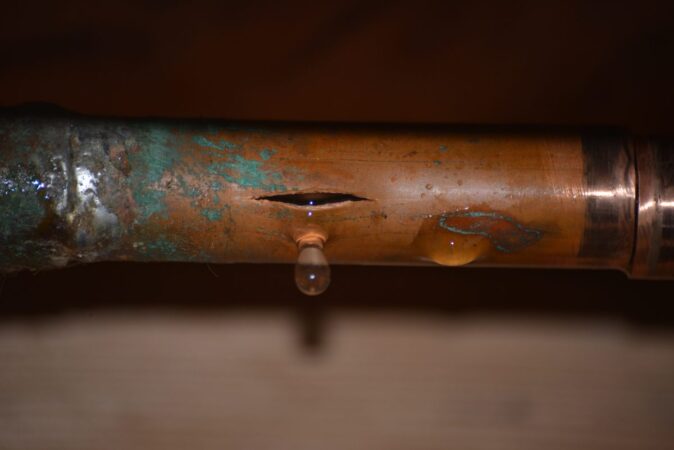
    As temperatures drop across the region, the risk of your home’s pipes freezing increases. There are steps, however, that homeowners can take to help stop that from happening and help you avoid a hefty plumbing bill this winter.

    Here’s a list of plumber-approved tips on how to keep a pipe from freezing, spotting a frozen one, and what to do if it bursts.

    How to prevent your pipes from freezing

    “It comes down to three main things: draining outside faucets, keeping pipes warm, and checking for leaks,” said Vincent Thompson, owner of Thompson Plumbing and Heating. Thompson is a master plumber of more than 50 years and for two decades taught plumbing at Dobbins Vocational School in North Philadelphia.

    💧 Draining outside faucets

    Over the summer, we use outside faucets and hoses to water the plants, rinse of sidewalks, or simply cool down. When the temperature dips, water can freeze and build pressure, ultimately causing a burst pipe, a situation far too common, according to Thompson.

    He recommends disconnecting your hose (and storing it for the winter), shutting off the valve that feeds the faucet or spigot (usually found near the hot water heater), and letting the remaining water in the pipe drain out. You can leave the faucet or spigot slightly open, according to Thompson. Letting the faucet drip is also a good suggestion for inside fixtures.

    “If it’s empty, it’ll never freeze,” Thompson said. “But if there’s water, it can expand and explode. Then you’ll come out in the spring to use your hose and the water will be shooting out of the wall.”

    🌡️ Keep your pipes warm

    When the freezing weather descends upon us, we bundle up to stay warm. Pipes need that treatment too. Ideally, the lowest you want to keep your thermostat set at is 50 degrees, but heating is expensive. According to Thompson, the absolute lowest you can go is 40 degrees, because your pipes will start freezing at 39 degrees.

    Opening the cabinets underneath your bathroom sink can be a good way to keep pipes from getting too cold. And for the ones in extra-cold spots, using electrical heating tape or fitting them with foam and rubber sleeves is a good idea. Be sure to check for any leaks beforehand, because if water is accumulating, they won’t prevent a pipe from bursting and it will become an added step.

    🚽 Check for leaks

    “Every drop that goes down the drain will turn into an icicle and eventually can clog up the entire soil stack,” explained Thompson. Not addressing it can result in frozen pipes, flooding, and even water backing up through your toilet.

    After 50 years of handling these cases, he advises looking at your water meter because sometimes the leak might not be obvious. Make sure no water sources are open, and look at the blue or red triangle (depending on your meter). If it’s turning that can be a sign of a leak.

    If you suspect the culprit is your toilet, he recommends adding a couple of food dye drops into the tank. If the water in the bowl changes color, your suspicions are correct.
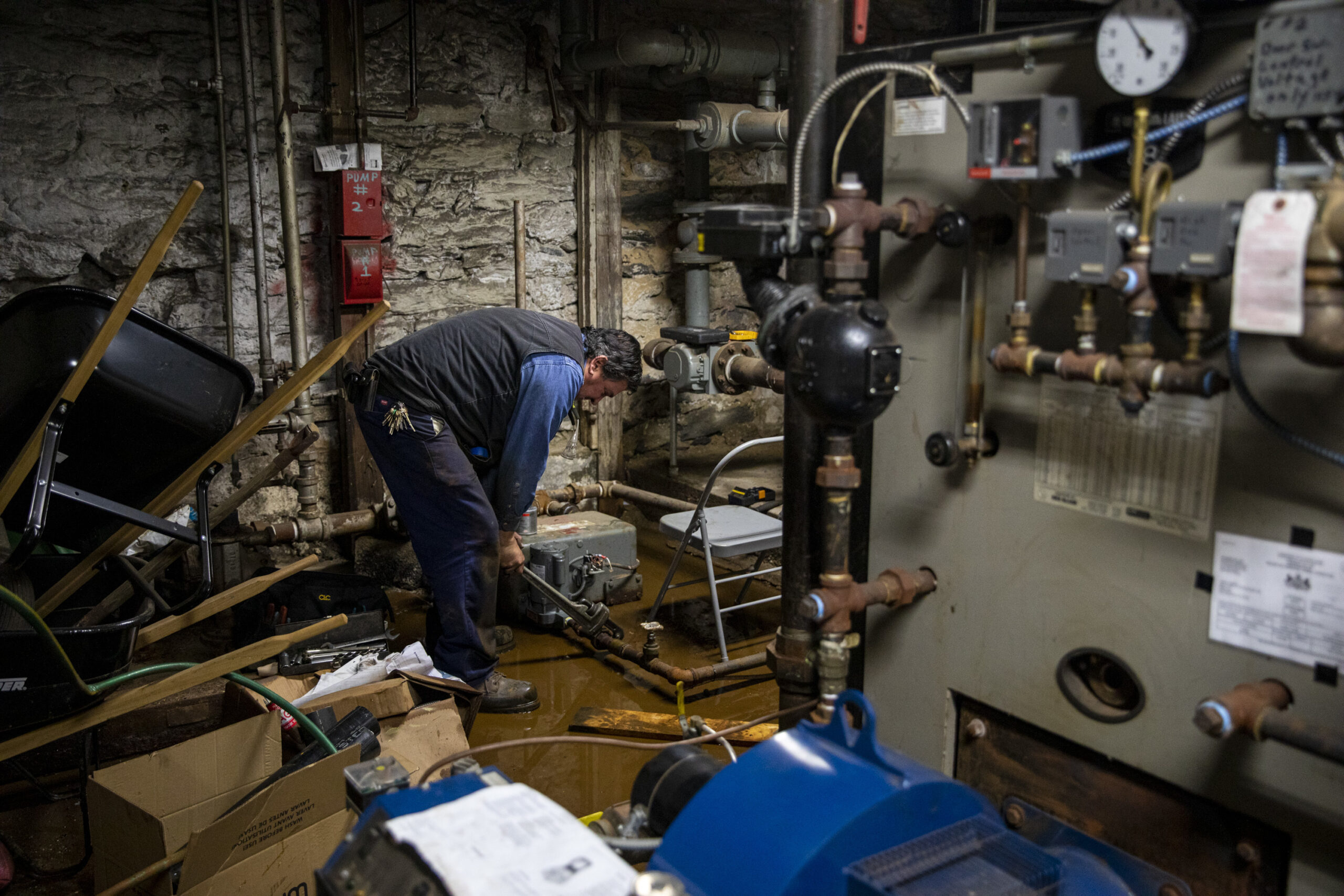
    Andrew Gadaleta, contractor, works on getting the heat fixed at Visitation BVM School in Philadelphia in December 2021 so that students could return to school. Thieves broke into the school Tuesday morning, ripping copper pipes from the walls that caused flooding. The water rendered the school unusable for a week.

    How to spot a frozen pipe

    Your house is filled with water pipes, and while it’s not hard to figure out when you’re dealing with a frozen pipe, it can be tricky to figure out where the frozen section is. If you turn on a faucet and nothing comes out, you’re going to have to do a little detective work.

    The first step should be to try all the other faucets in your house. If all the faucets in a room aren’t working, the freeze is likely in a split from the main pipe. If all the faucets on a floor aren’t working, the freeze is likely between where the first- and second-floor pipes separate. If all the faucets in your house aren’t working, then the freeze is probably near where the main pipe enters the house.

    The frozen section of the pipe, if exposed, will sometimes have condensation over it. You’ll also be able to tell that it’s colder just by touching it.

    How to thaw a frozen pipe

    Before thawing a frozen section of pipe, you should open the faucet to relieve the water pressure and allow the water to escape once it thaws. You should also begin the thawing process close to the faucet and work your way to the blockage. If melted water and ice get caught behind the blockage, the chance that the pipe will burst increases.

    One of the easiest ways to thaw a frozen pipe is with a hair dryer. You can also use hot towels or a heat lamp to warm up the pipe. Never use an open flame.

    What to do if a pipe bursts

    Don’t panic. The first thing you should do is shut off the main water line into your property. This will prevent your house from flooding. The main water valve is usually near your water meter. After you’ve done that, call your plumber. Locating and tagging the valve to your main water line ahead of time can help make the moment less stressful.

  • Where is the Umbrella Man statue that used to reside outside the Prince Theater?

    Where is the Umbrella Man statue that used to reside outside the Prince Theater?

    For almost 30 years, he stood in sun and darkness, rain and snow, on the streets of Philadelphia.

    Known popularly as “Umbrella Man,” he stepped forward, as if signaling a cab in the rain. He was last seen in front of the then-Prince Music Theater in the 1400 block of Chestnut Street.

    But sometime in 2015, along with the Prince, he disappeared.

    Where did he go? Whatever became of “Umbrella Man”? Those questions were posed to us by a reader through Curious Philly — the forum where you can ask our journalists questions.

    Allow us: He’s not in Philadelphia anymore. He’s on tour. But his home is not far away: Hamilton, N.J., as a matter of fact.

    But let’s step back. The actual name of the six-foot-10, 460-pound sculpture is Allow Me. It depicts a man in a three-piece business suit. He’s holding an umbrella in his right hand and gesturing with his very, very long left index finger, as if saying, “Wait a minute.”

    That title, though. Whoever brought down a cab with an “Allow me”?

    Allow Me is the work of American sculptor Seward Johnson II, grandson of the founders of Johnson & Johnson. It’s part of a series Johnson calls “Celebrating the Familiar.” You’ve probably seen many of the pieces in the series, and that’s the way Johnson likes it. He makes multiple copies of daily-life sculptures — boy with ice-cream cone, man with newspaper, senior lady with grocery sack, window-washer, traffic cop — and distributes, displays, or tours them throughout the country. Another one, titled “The Consultation,” is at the campus of the Presbyterian Medical Center just off 39th and Filbert Streets in West Philadelphia.

    The J. Seward Johnson sculpture “Allow Me” when it was near the Warwick Hotel on South 17th Street in photo taken Feb. 15, 2001.

    According to the Johnson Atelier Inc., the organization that tracks and controls Johnson’s productions, the original Allow Me was created in 1981. In 1983-4 a series of copies was made, for a total of seven, from the same cast, which was destroyed thereafter (apparently the casts wear out). The atelier says the Philadelphia Allow Me was the last one.

    Allow Me had a long, rough run in Philadelphia. Its first sojourn here was in an exhibit of Johnson’s works in 1983-4, in front of the Four Seasons hotel on the Parkway. There it charmed lawyer and art collector Joseph D. Shein, who bought it from Johnson and had it set up in 1985 in front of the Shein-owned building where he ran his offices, at the corner of 17th and Locust Streets.

    In this Sept. 6, 1985 image from the Philadelphia Inquirer, lawyer and art collector Joseph D. Shein sits with “Allow Me,” a statue by Seward Johnson II. It had just been installed in front of what were then Shein’s offices at 17th and Locust Streets.

    There, Umbrella Man stood for just about 20 years. Many a cabbie was said to stop, only to curse and move on. Street lore had it that he got the Philadelphia treatment, with generous applications of cigarette butts and gum.

    In 2005, Shein donated the statue to the Prince. Umbrella Man was plunked just to the right of the main entrance, where he remained into 2015. Abuse continued: Luckless pedestrians walked into him, and during the joyous October 2008 street celebrations after the Phillies’ World Series triumph, vandals attempted to uproot poor Umbrella Man, leaving him crooked, graffiti scrawled on his forehead.

    "Allow Me" Statue - Knocked Over During the Phillies Parade

    And then … he went away. In 2010, the Prince declared bankruptcy. After protracted uncertainty, the building was bought by a group of business investors, to be sold in 2015 to the Philadelphia Film Society, its current tenant who changed the name to the Philadelphia Film Center. According to the Johnson Atelier, that year the atelier bought Allow Me back.

    Little by little, people noticed he wasn’t there.

    Although the final price is proprietary, most sculptures in the “Celebrating the Familiar” series, according to the Johnson Atelier, run for $84,000, but Allow Me is now in the Johnson catalog for $130,000.

    Where is he now? His physical home is the Johnson Atelier in Hamilton, N.J., next to Grounds for Sculpture. But Umbrella Man himself is on tour, according to the atelier e-mail: “[T]his sculpture is now actively traveling with the other Johnson pieces in the foundation’s touring exhibits throughout the US and Europe.”