The advent of spooky season brings endless options for driving-distance getaways packed with U-pick orchards, twisting corn mazes, and high-tech haunts. But only Sleepy Hollow, at the gateway to New York’s Hudson Valley, has a reputation so perfectly tied to the macabre.
As the setting for Washington Irving’s The Legend of Sleepy Hollow, the town and its neighboring villages blend American history, small-town autumn charm, and an enduring flair for the supernatural. It’s about a two and a half hour drive from Philly — or take Amtrak to Penn Station, get to Grand Central, and hop on Metro-North’s Hudson Line.
Once you’ve arrived, the mix of colonial history, Halloween pageantry, and riverfront beauty makes it easy to fall under Sleepy Hollow’s spell.
If you’re making a weekend of it, check into Tarrytown House Estate, a historic retreat on a hill above Sunnyside. The estate is home to Goosefeather, chef Dale Talde’s acclaimed Cantonese-inspired restaurant, and combines classic mansions with modern touches — think terraces, firepits, and lounges. It’s one of the few local hotels that’s both stylish and (relatively) affordable. During fall, the property leans into the season with festive touches like pumpkin displays and glowing jack-o’-lanterns scattered across the grounds. It’s an ideal base for exploring Sleepy Hollow’s haunted happenings — close to the action, but tucked away once the lanterns dim.
However you choose to travel, make a morning pit stop at Irvington Station. Grab a matcha latte or flat white from the Australian-accented Ludy Café, and a sage-scented apple-cheddar scone from Red Barn Bakery, walking distance from one another right along the train tracks.
📍 Ludy Café, 7 N. Astor St., Irvington, N.Y. 10533
📍 Red Barn Bakery, 4 S. Astor St., Irvington, N.Y. 10533
Learn: Blue Hill at Stone Barns
Continuing north, head into the woods of Tarrytown to chef Dan Barber’s famous Blue Hill at Stone Barns for a guided Explore Tour of their elysian farm and agricultural center. Take a spin through the market, admiring the hand-thrown ceramics and exquisite preserves, and stay for lunch at the cafeteria. Reservations required.
After arriving in Sleepy Hollow proper, ease into the spookiness at Sleepy Hollow Cemetery, where the one-hour guided tour (in full daylight) leans more history than horror. Not only is the cemetery beautiful, it’s also a great context-setter for the region, providing all the background on its most famous storyteller, Washington Irving, who rests here among other notable figures.
📍 540 N. Broadway, Sleepy Hollow, N.Y. 10591
Solve: The Headless Horseman Files
At the Headless Horseman Files, collect clues from costumed townspeople to unravel what really happened to Ichabod Crane. This live theater-meets-interactive whodunit at Philipsburg Manor is part mystery, part museum experience — and yes, you can exit through the gift shop for a Horseman snow globe.
Bask in the flickering glow of candles and Gothic drama at the Lyndhurst After Dark, the spooky (but not scary) experience at the Lyndhurst Mansion. Guests walk through the riverfront estate, decked in its Halloween best, and encounter live actors in period dress, who share unnerving tales of the mansion’s history.
Pot stickers plumped with dry-aged beef, char siu Berkshire pork belly, and blueberry cheesecake mochi waffles grace the menu at Goosefeather. The free-spirited Cantonese-ish joint comes from Dale Talde, known for his appearances on Top Chef.
With the exception of a sign etched onto a glass window on the ground floor, there’s no indication that an entertainment venue and bar awaits beyond the doors of Media’s predominately office-focused Phoenix building.
Inside is equally vague. There’s just a large sign that reads “Martinique Deux” situated on a staircase leading to the basement. Following it downstairs, there’s an innocuous door that leads to a speakeasy-like bar.
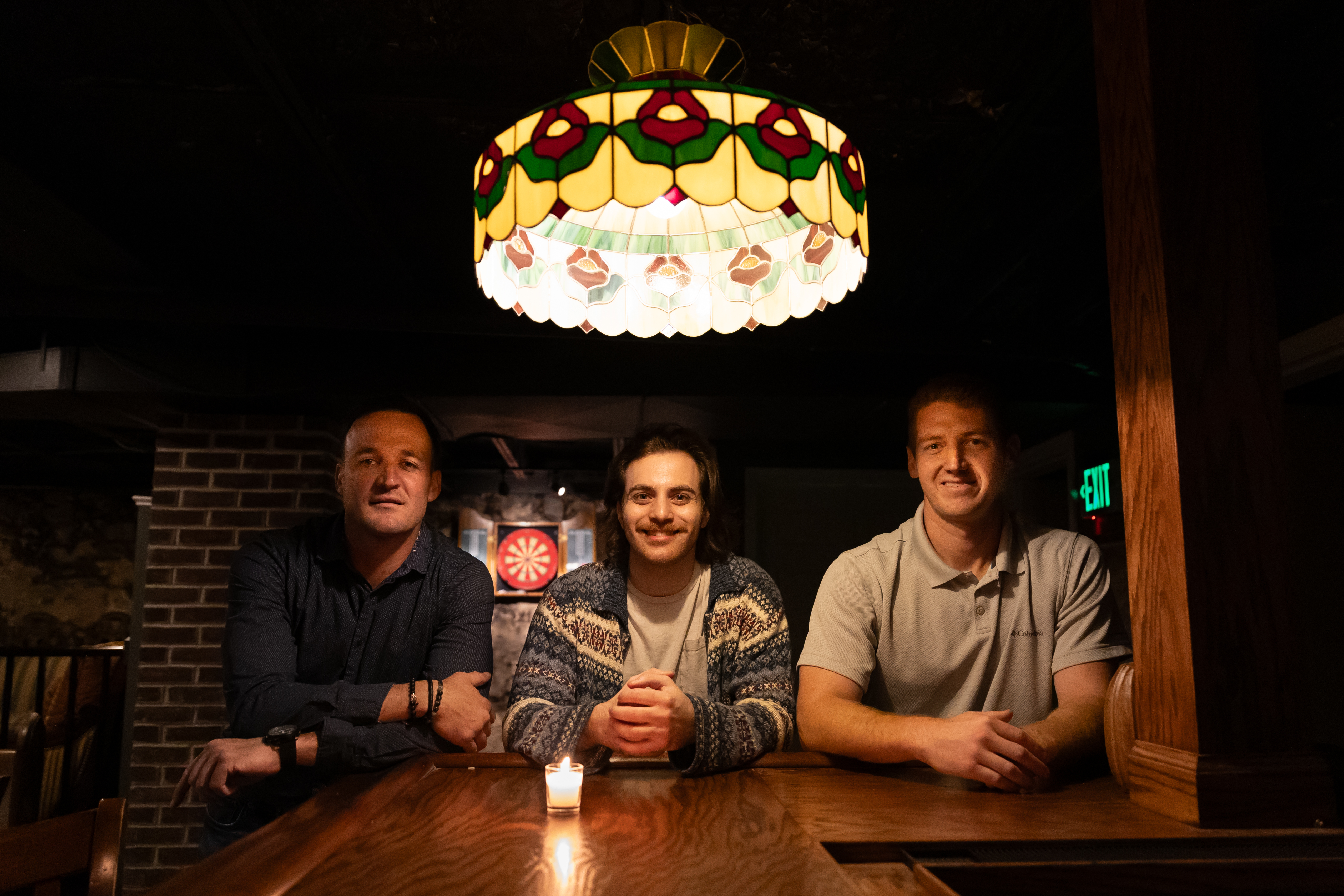
Martinique Deux’s owners — business partners James Matika, Jason Fogg, and Pat Collins — like that it has a bit of a mystique, at least for the time being.
That will change when the entertainment venue and bar debuts on Oct. 17 and Oct. 18, during a soft opening in advance of its grand opening on Oct. 23.
Located at 115 W. State St., the 2,400-square-foot space features a long bar with chairs, high- and low-top tables, including some with church pews for seating, a stage with a piano, as well as a back section with couches and a big-screen TV.
Though largely dark and atmospheric, there are some pop culture nods, like a large painting of David Bowie and a photo of Princess Diana sporting an Eagles jacket.
When Martinique Deux opens, its owners envision it as a lively place where people can grab a drink before or after dinner, watch a game, play darts, and enjoy a music or comedy show. It will be open from 4 p.m. to midnight on Wednesdays, Thursdays, and Fridays, and open earlier on weekends.
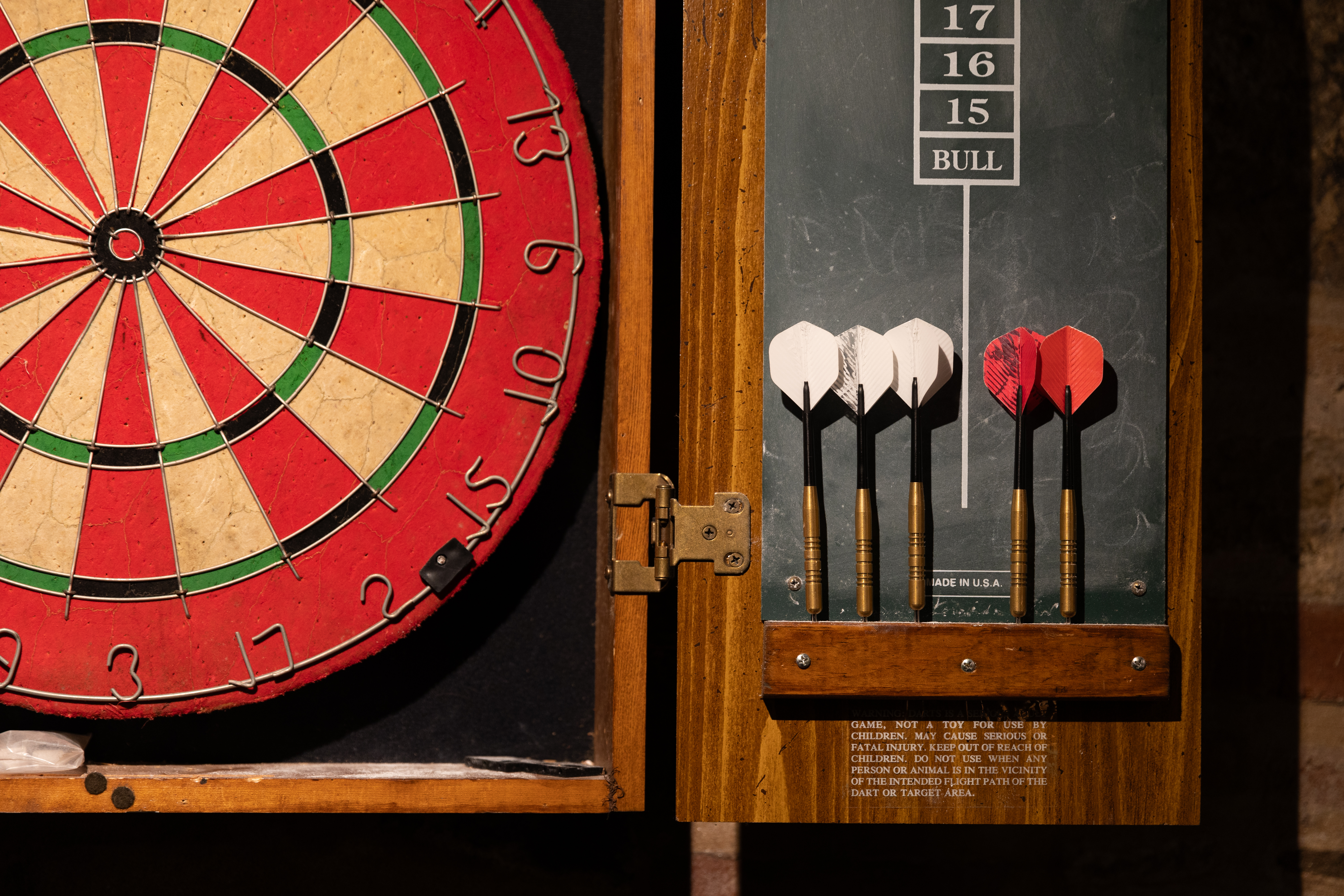
A dart board on the wall at Martinique Deux in Media.
The 21-and-over venue will have live entertainment at least three days a week, with music performances on Fridays and Saturdays and comedy shows on Thursdays, though the lineups will vary. They plan to launch with a range of musical acts and comedy, with some being ticketed events and others charging a cover.
Sports fans can also catch games, with a large TV taking center stage during Eagles games.
“If there’s Philly sports on, that’s what will be on,” Matika said.
After football season ends, they’re contemplating adding acoustic performances on Sundays. Weekends may also see Martinique Deux open earlier to accommodate Premier League soccer fans.
Martinique Deux will also be open on Wednesdays starting around Thanksgiving, but largely without planned entertainment.
The bar will offer staple food items like soft pretzels, popcorn, and chips, with plans to partner with neighboring pizza joint Lariele Wood Fired Square Pie. They’re also contemplating a rotating food truck lineup on live entertainment nights.
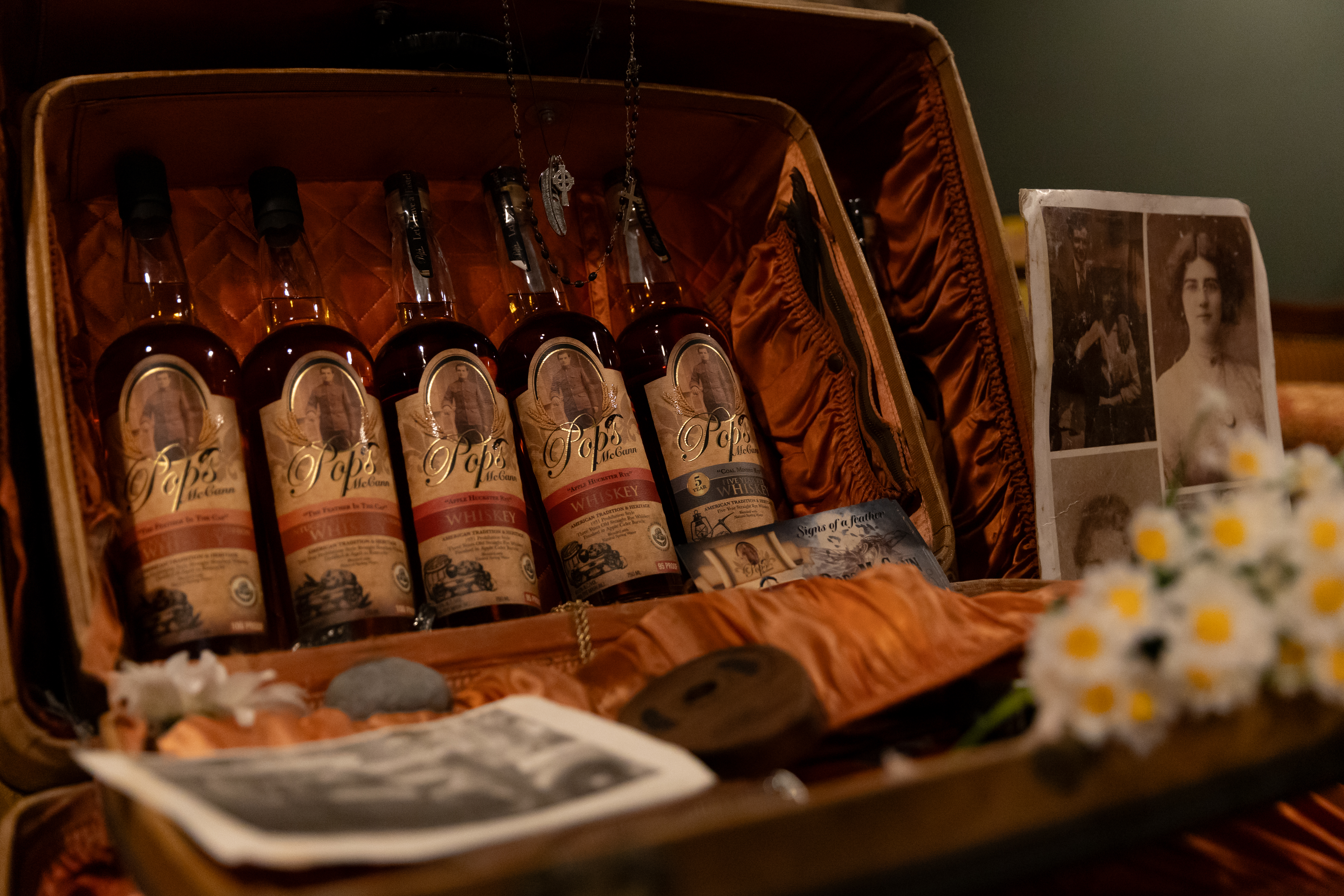
While they’re still finalizing the cocktail list, it will likely be bourbon-forward and feature Pops McCann liquors, Fogg’s Pottstown distillery that produces bourbons, whiskeys, and a rum, and is planning to expand into vodkas and tequilas.
“We’re going to keep it simple,” Matika said.
The bar will feature Pops McCann liquors, Fogg’s Pottstown distillery.
When Martinique Deux opens, it will mark the end of a year-and-a-half-long effort to bring the concept to life. Matika and Collins began working on it together last March after each independently considered similar ideas. They soon connected and set about transforming the space, which was sitting empty after an escape room there closed amid the pandemic.
Both also have experience in the industry — Matika worked at Tap 24 and La Belle Epoque in Media and grew up in the bars his father owned, including The Martinique in Wildwood. Similarly, Collins’ father formerly owned the Clam Tavern in Clifton Heights, and Collins himself said he owned a dive bar in South Philly previously.
They later connected with Fogg through a mutual friend, bringing the entire vision together.
Owners Jason Fogg, James Matika, and Pat Collins pose for a photo at the bar.
“I think it’s going to be one of Media’s staples,” Collins said.
This suburban content is produced with support from the Leslie Miller and Richard Worley Foundation and The Lenfest Institute for Journalism. Editorial content is created independently of the project donors. Gifts to support The Inquirer’s high-impact journalism can be made at inquirer.com/donate. A list of Lenfest Institute donors can be found at lenfestinstitute.org/supporters.
The Mann is getting a new name. With a major sponsorship in hand, Philadelphia’s arts center in Fairmount Park will now be called the Highmark Mann Center for the Performing Arts.
The Pittsburgh-based Highmark insurance company will join the Mann nameplate starting immediately under the terms of a 12-year deal.
“This investment will absolutely help to ensure that the Mann will continue to be an evolving, creative, living, inviting premier destination for our region, for all the artists that we present, and for the audiences that come. This is really an exciting next step for us,” said Catherine M. Cahill, president and CEO of the arts center.
The main entrance to the Highmark Mann as it is envisioned after a renovation and re-opening in the spring of 2026.
Cahill and Highmark declined to discuss how much the company paid for the naming rights and other financial details. “Substantial” is how Dan Tropeano, market president of Highmark Blue Shield in Southeastern Pennsylvania, described the amount of money the company will pay to put its name on the venue.
He noted that Highmark had entered the Philadelphia market recently — in 2023 — and that the company saw an alignment between its customers and the Mann’s patrons.
“They offer programming that appeals to the entire demographic of the folks here in Southeast Pa., whether that’s the orchestra for folks that like that kind of thing, whether it’s other music festivals that cater to other types,” said Tropeano, who recalled attending his first Mann concert in 1991 (the Allman Brothers Band). “We find it to be one of the most diverse venues that really exposes us to the entire community, not just one defined segment.”
The arts center will use the moniker Highmark Mann for short.
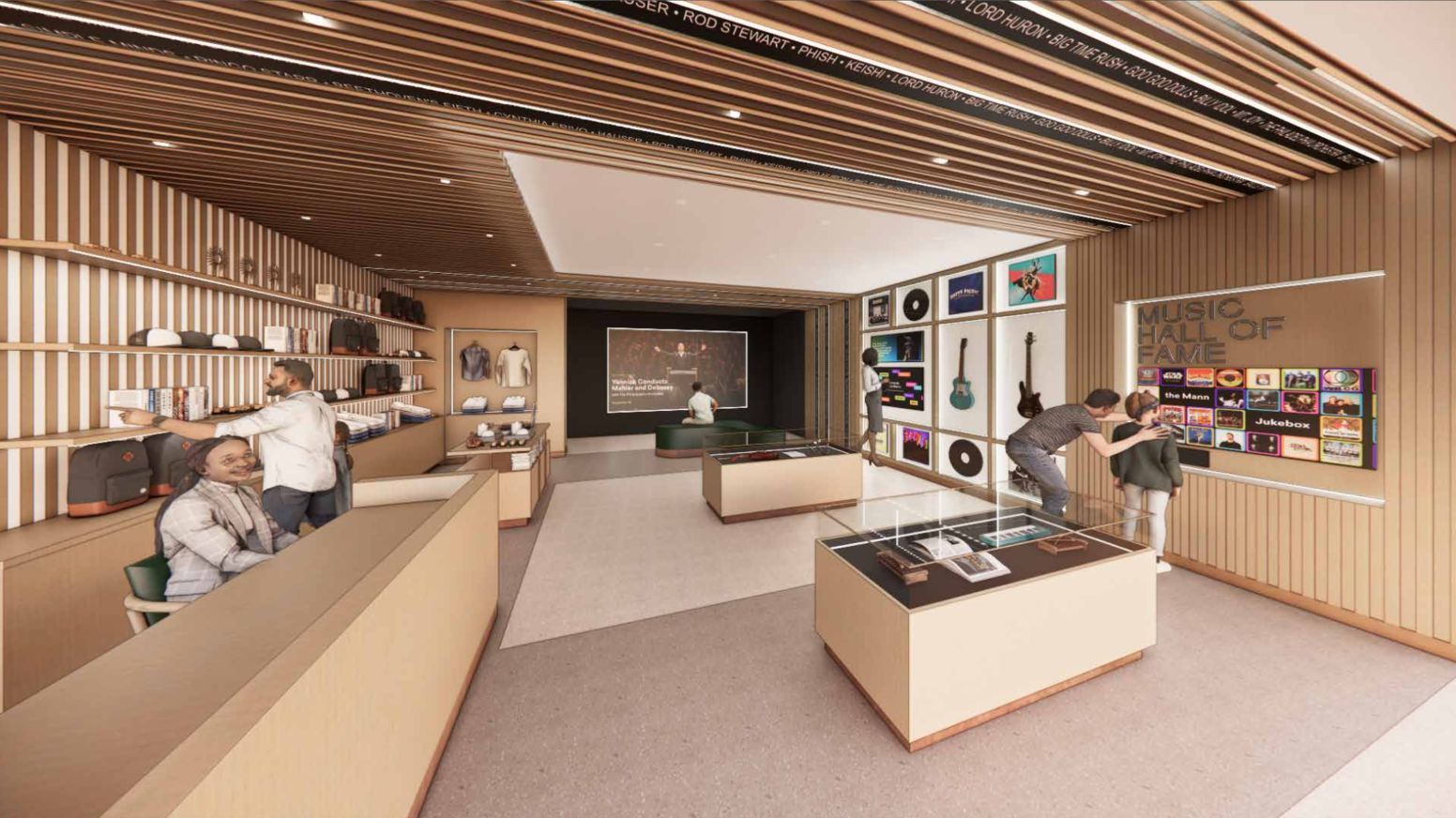
A rendering of a new Welcome Center at the arts center that, when built, will house a Music Hall of Fame Jukebox, gift shop and a continuously running LED ticker with names of performers who have played the center throughout its history.
The new name was announced Wednesday afternoon in a ceremony marking the start of construction on a renovation slated for completion in the spring. The project is part of a $70 million campaign that will also boost endowment and fund operations and artistic projects.
Among the changes coming to the Mann are a new main entry canopy and a plaza three times the size of the current one. A section of the Mann’s angular shed will display a 4,900-square-foot LED screen animated with video and kinetic artwork. Digital pillars, landscaping, lighting, and new way-finding features are on the way.
To date, nearly $60 million has been raised toward the $70 million total, said Cahill, who declined to specify whether the money from Highmark would be paid in one lump sum or in installments over years.
“This is an important component of this campaign, but we still have more work to do. We still have more money to raise,” she said, adding that she expects the $70 million goal to be reached by February 2027.
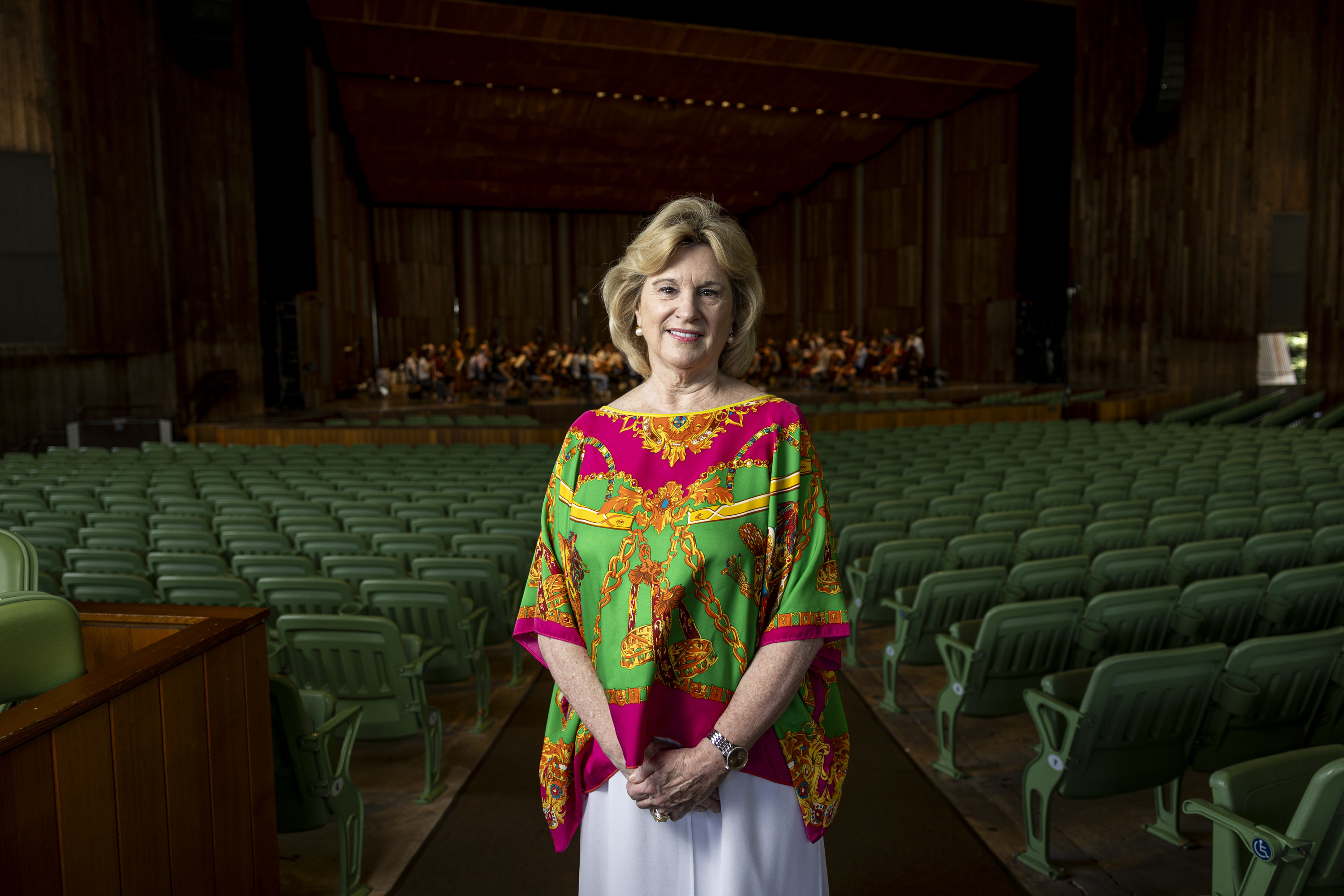
Catherine M. Cahill, president and CEO of what is now called the Highmark Mann, with the Philadelphia Orchestra rehearsing in the background, July 23, 2025.
The new name is the center’s fourth. Called the Robin Hood Dell West at its opening in 1976, it was renamed the Mann Music Center in 1979 for philanthropist Fredric R. Mann and then, in 1998, the Mann Center for the Performing Arts.
The new name will apply not just to the physical campus — which includes the main shed named for TD Bank and a smaller stage at the top of the hill already named for Highmark — but also to the organization itself.
(The name change is a rebranding; the center is not changing its name legally.)
Fans cheer while Black Thought of The Roots performed during day two of the Roots Picnic 2025 at the Mann Center on Sunday, June 1, 2025.
Some major naming opportunities may be spoken for, but others remain, Cahill said.
“We have the plaza that can be named. We have backstage spaces to be named. We have programmatic things to be named. We have a whole laundry list of naming rights.”
Though officials declined to quantify the cost of the sponsorship deal, Cahill said the amount was in line with similar ones elsewhere.
“We did national benchmarking about the world of naming rights, and I can tell you we are absolutely confident that where we landed in this deal is exactly where the Mann should be.”
For more than quarter century, Greta Greenberger ended her tours of Philadelphia City Hall at the tower, just below the bronze buckled shoes of William Penn (1892), the shady colossus that Alexander Milne Calder sculpted.
From there, she’d point up the Parkway to Logan Square, where on hot days children sneak into The Fountain of Three Rivers (1924), created by Calder’s son, Alexander Stirling Calder, to honor the Schuylkill, the Delaware, and the Wissahickon.
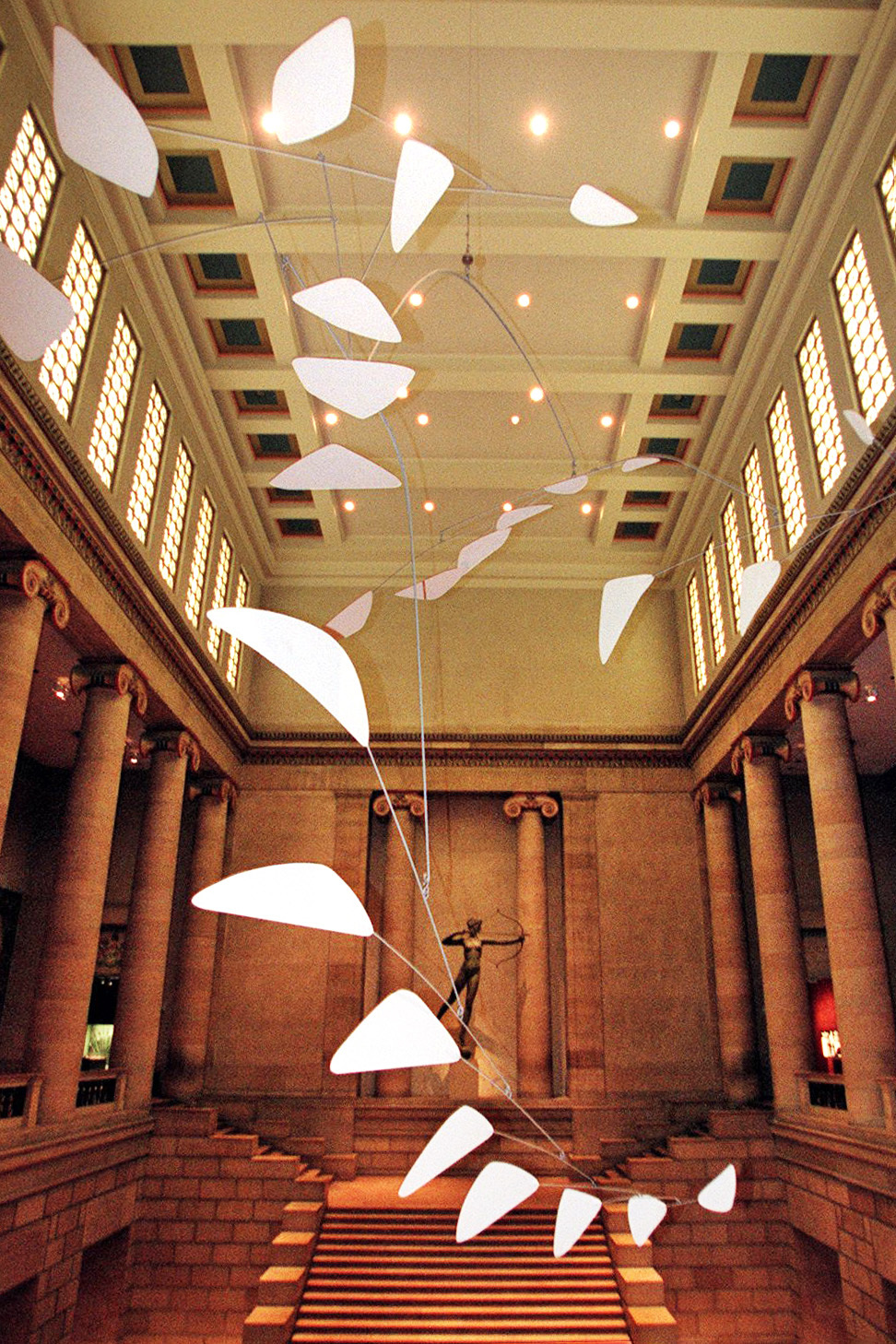
She’d finish her lesson at the Philadelphia Art Museum, where an unearthly, white mobile, Ghost (1964), designed by the third generation of Alexander Calders, Sandy, sways ever so slightly in the Great Stair Hall.
“Sometimes, I’d refer to this as ‘The Father, the Son and the Holy Ghost,’” she says. “It tells such a wonderful story.”
That story will be easier to tell now, with the opening of Calder Gardens at 21st Street and the Ben Franklin Parkway. The Gardens, focused on the work of the youngest Calder, known asSandy, brings another opportunity to celebrate the family dynasty’s in Philadelphia: three sculptors named Alexander Calder who have shaped the look of the city and beyond.
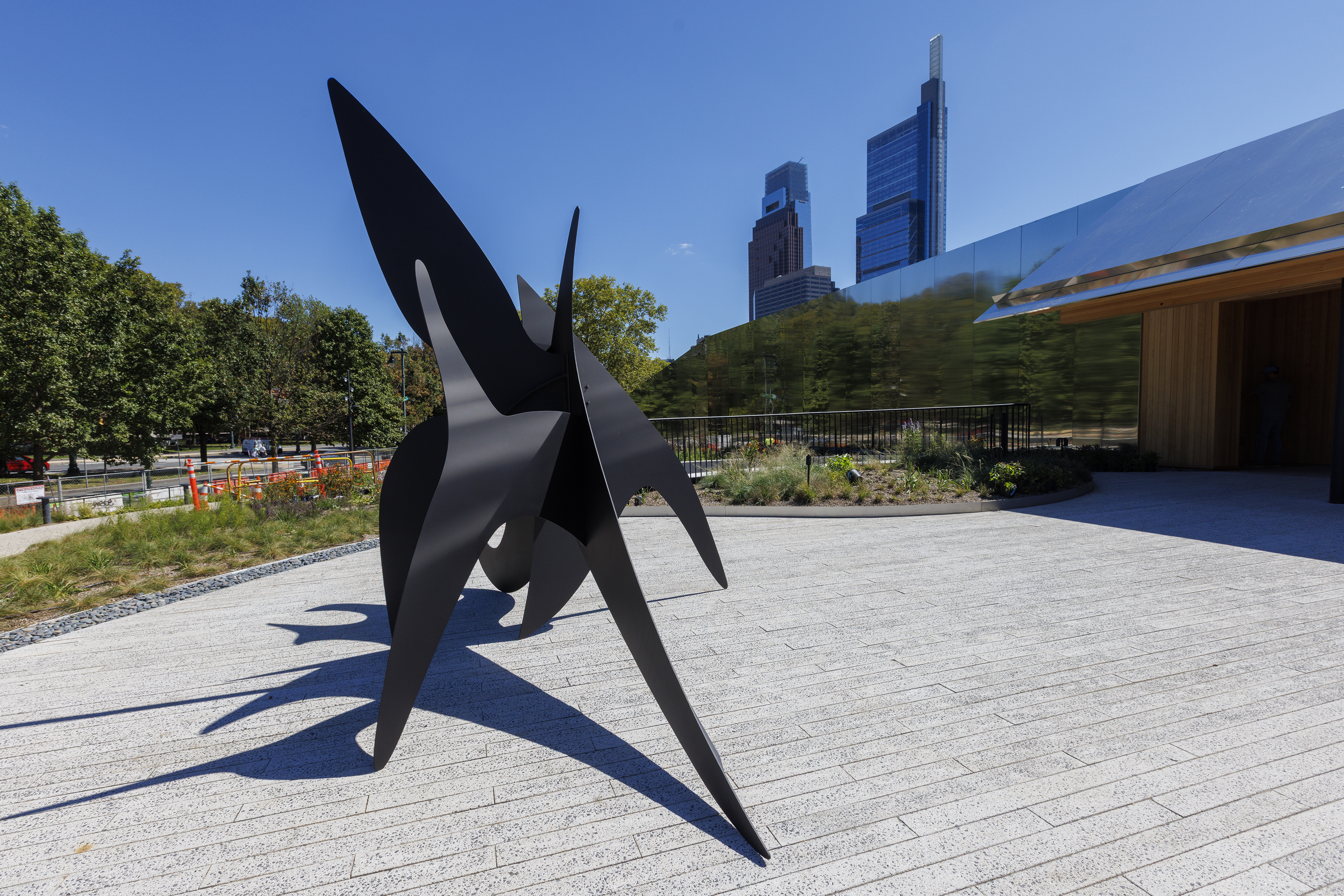
Exterior of the new Calder Gardens on the Ben Franklin Parkway.
“The Calder family is incredibly important to Philadelphia,” said Anna O. Marley, the former chief curator at the Pennsylvania Academy of Fine Arts (PAFA), where so many Calders studied. “They tell us so much about what it means to be an artist in the United States and how an American artistic identify was created in Philadelphia.”
And their work here offers “a pocket history of art,” in the view of Kathleen A. Foster, the Art Museum’s senior curator of American art.
“Between the three of them, you really go from the academic realism of the grandfather through kind of shift into Art Deco and modernism in the `20s with Stirling Calder, and then all the way into modern forms, completely abstract shapes and bright colors.”
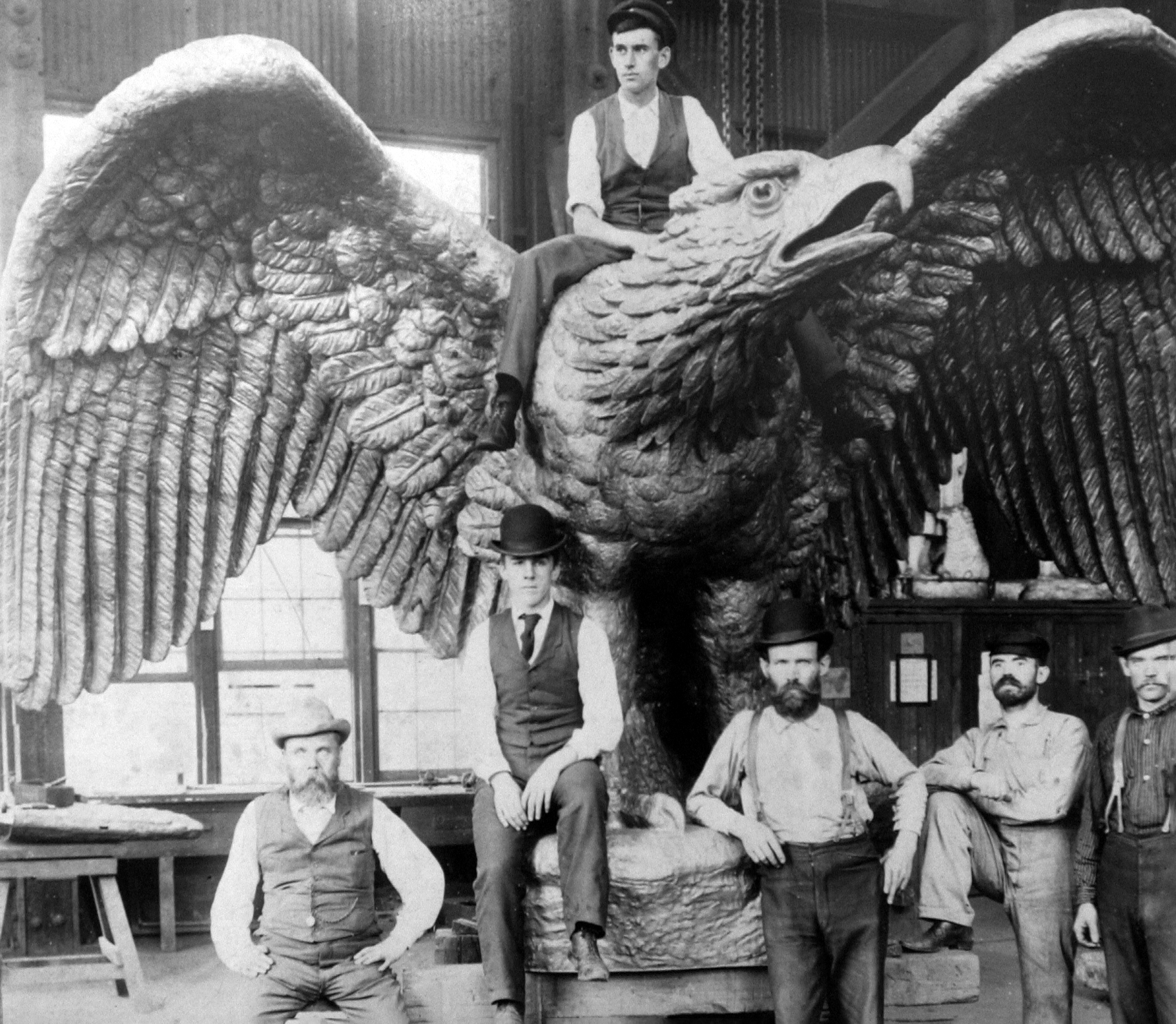
A photograph of workers and an Alexander Milne Calder eagle sculpture before installation around 1894, on display in the tower at City Hall. Calder created the statue of William Penn atop Philadelphia City Hall — and over 250 other works of sculpture on the exterior and interior of the building — from 1871-1901.
‘One of the greatest’
The Philadelphia that Alexander Milne Calder, a Scottish stonecutter’s son from Aberdeen, first saw in 1868 was sorely in need of a makeover. The sprawling metropolis was known for building big things like ships and rail engines and a wealth of small manufacturers that earned it the nickname “Workshop of the World.”
It was also filthy.
“It’s clear that there is no future for a city that is just increasingly based on its industrial might, on the dirt-producing, noise-producing, the squalor,“ says David Brownlee, emeritus professor of the history of art at the University of Pennsylvania.
The boundaries of Fairmount Park had just been established the year before and plans would soon begin for a giant celebration of the country’s 100th birthday, the 1876 Centennial, which would show the world the city’s cultural achievements. The Benjamin Franklin Parkway was unfolding, a broad boulevard lined by art and leading to what Brownlee calls “one of the greatest monumental ensembles of sculpture ever created.”
That would be City Hall, the émigré Calder’s workplace for 22 years as he presided over the creation of more than 250 sculptures from his first floor office in the building’s southwest corner — and the towering figure of the colony’s founder.
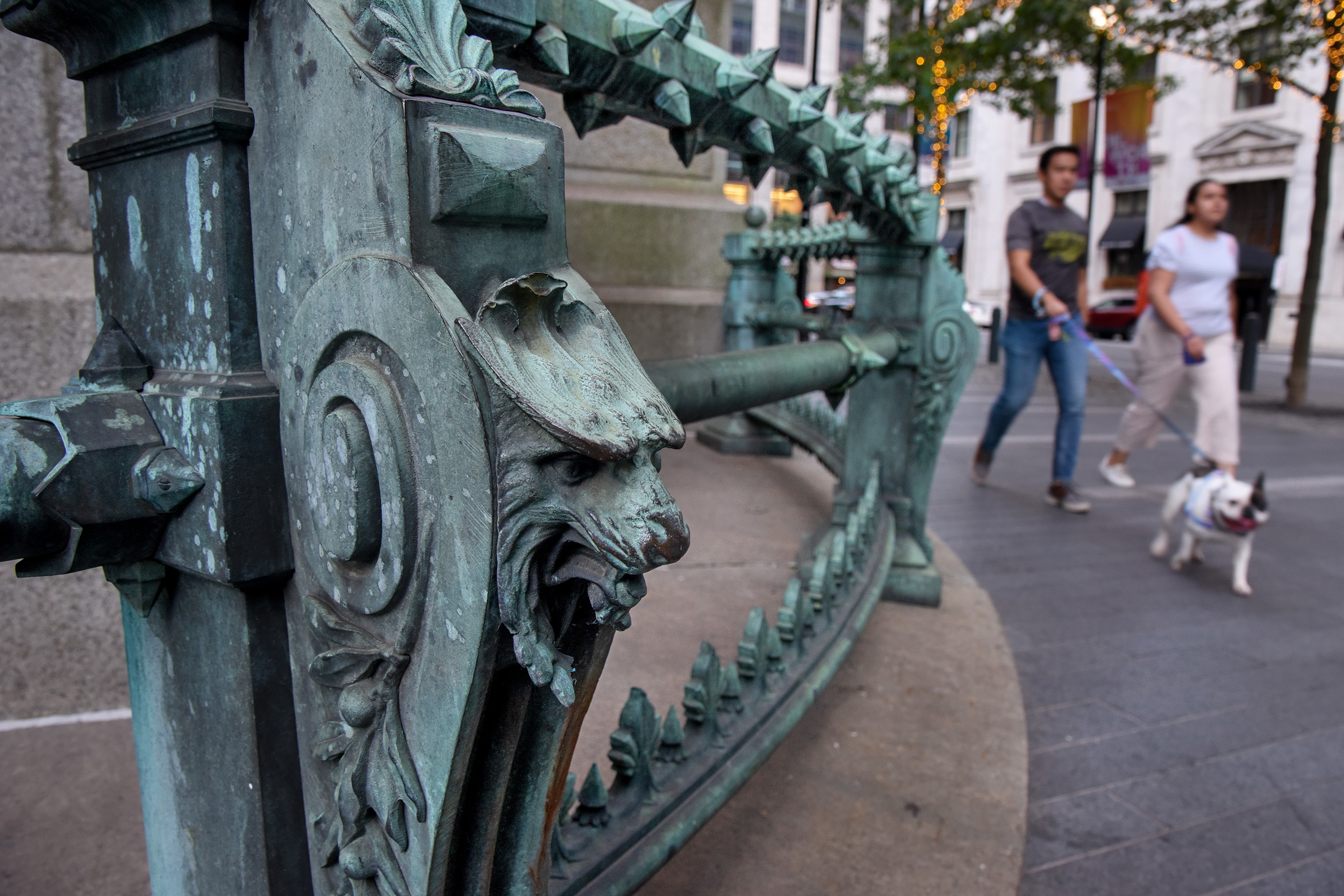
There were once almost 150 small lion heads on the ornate bronze spiked railing that surrounds City Hall. They, like most of the statuary on the building — including the big one of William Penn — were designed by Alexander Milne Calder. Less than two dozen of the lions remain after 100 years.
Calder had worked at the Royal Academy in Edinburgh and on the Albert Memorial in London before sailing to America. He stopped in New York, but chose Philadelphia, armed with a letter of introduction to the city’s most eminent sculptor, Joseph A. Bailly, and to the scion of a monument business, William Struthers. Calder was 22.
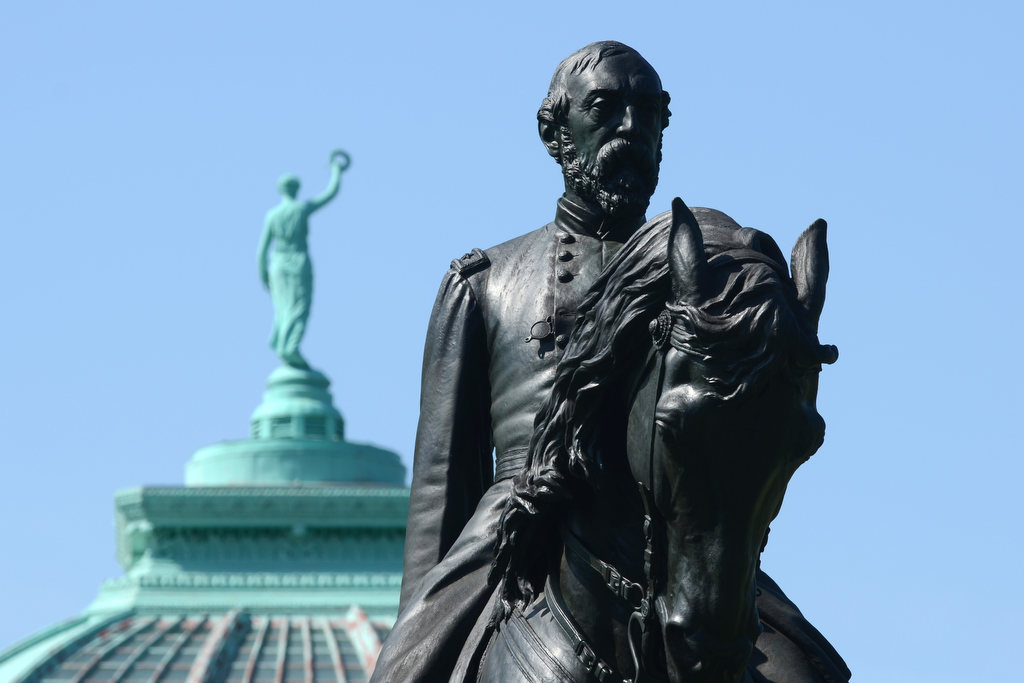
He registered that year at Pennsylvania Academy of the Fine Arts, the nation’s first art school and museum, and studied “antiques,” drawing from plaster casts of classic sculptures. It was not long before Calder won a prized commission over one of his instructors, to sculpt the likeness of Major Gen. George G. Meade atop his horse, Baldy. Meade, who’d defeated Robert E. Lee at Gettysburg, later designed many of the paths and drives of Fairmount Park. His statue stands now behind the Please Touch Museum on Lansdowne Drive.
Alexander Milne Calder’s Meade Equestrian Monument in the rear of Memorial Hall. It was cast using captured Confederate cannon for the bronze. Calder rendered Gen. Meade reining in his horse at a moment of crisis during battle.
When Greenberger gives tours of City Hall — though retired, she still volunteers one day a week — she likes to start in the north portico, where one can sample his expansive vision. Look up to the south, and there are Africans, surrounded by tobacco leaves, a lion. To the east, people from China, Japan, India, and an Asian elephant. West are the Native Americans and pioneers, and a bear. And north is Europe, people from Germany, England, France, maple leaves, and cattle. (She isn’t sure why cattle.)
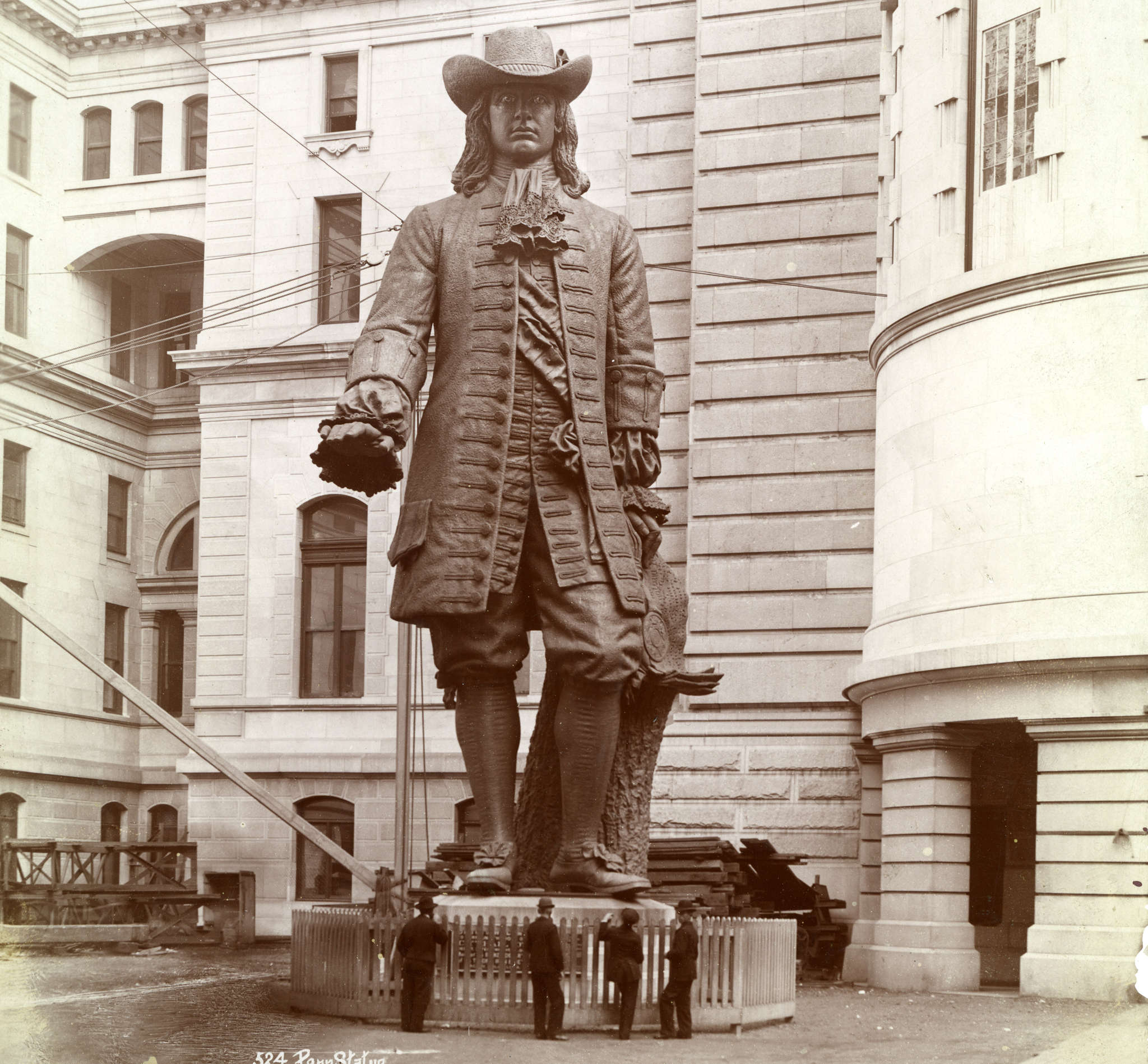
Calder started on the Penn sculpture in 1886. The iconic figure, now visible from miles away, was the fourth version of the colony’s founder that the sculptor created. Calder’s models were one-tenth the size of the 37-foot high statue. His goal, according to an article at the time in The Inquirer, was to create “William Penn as he is known to Philadelphians; not a theoretical one or a fine English gentleman.”
The William Penn statue on display in the City Hall courtyard in 1893, the year before it was hoisted, bit by bit, to the top.
Four teams of horses drew massive plaster sections of the statue up Broad Street to the Tacony Iron & Metal Works. It wasn’t until Thanksgiving 1894 that the head was lifted onto the statue atop the tower, completing Calder’s colossus.
He was not happy with the result.
For most of the day, William Penn’s face is shadowed. That was not the artist’s intent. Calder had wanted Penn facing south, where the sun would light his youthful face and the intricate detail of his garb would be visible for all to admire.
But members of the Public Buildings Commission wanted Penn facing northeast, toward Penn Treaty Park, the site of the 1683 peace agreement with the Lenni-Lenape.
In a letter quoted in the Dec. 14, 1894 Inquirer, Calder wrote “I think that you will agree that is very disappointing from every point of view.”
Calder’s William Penn statue atop City Hall as seen from the Comcast Technology Center in Center City.
While Calder lived in a number of homes around the city — a home at 2020 Bainbridge St. and a studio at 337 Broad — when he registered at PAFA, the address listed was 1903 N. Park Ave., now on Temple’s campus. Decades later, his granddaughter, Margaret Calder Hayes, would remember the North Philadelphia house as “gloomy” — four floors with Empire furniture, a long dark hallway leading to a parlor where children were not welcome unaccompanied.
Calder had met his wife, Margaret Stirling, soon after his arrival in Philadelphia and married her after a brief courtship.
Three of their sons would study at PAFA and become artists — Ralph Milne Calder, and Norman Day Calder, and Alexander Stirling Calder. But it was “Stirling,” the eldest who left the biggest mark on Philadelphia.
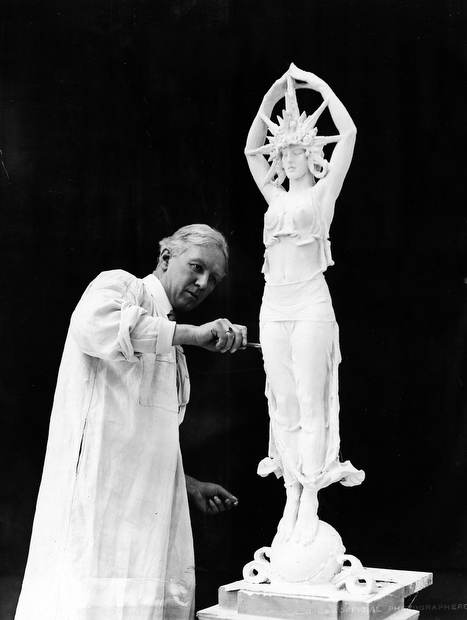
A portrait of A. Stirling Calder.
‘An idealist, somewhat withdrawn’
In a remembrance kept in the PAFA archives, Alexander Stirling Calder describes art as a fallback. Ever since he was 6 and saw the great Edwin Booth play Hamlet, Stirling Calder wanted to be an actor. But he was too shy. In 1885, he enrolled in art classes at the academy’s new building at Broad and Cherry, and years later recalled the first criticism of his teacher, the artist Thomas Eakins: “Attack all of your difficulties at once.” Eakins urged sculptors to paint, painters to sculpt, and to dissect cadavers to learn anatomy.
After studying at the École des Beaux-Arts in Paris, he returned home and won a commission to immortalize Samuel Gross with a statue that first stood on the National Mall in Washington, D.C. (It’s since been moved to the Center City campus of Thomas Jefferson University). At 25, he married a fellow PAFA student, Nanette Lederer, a painter.
To the critic Malcolm Cowley, Stirling Calder was “an idealist, somewhat withdrawn, wholly impractical, creating symbolic figures while brooding on the cruelty of nature.”
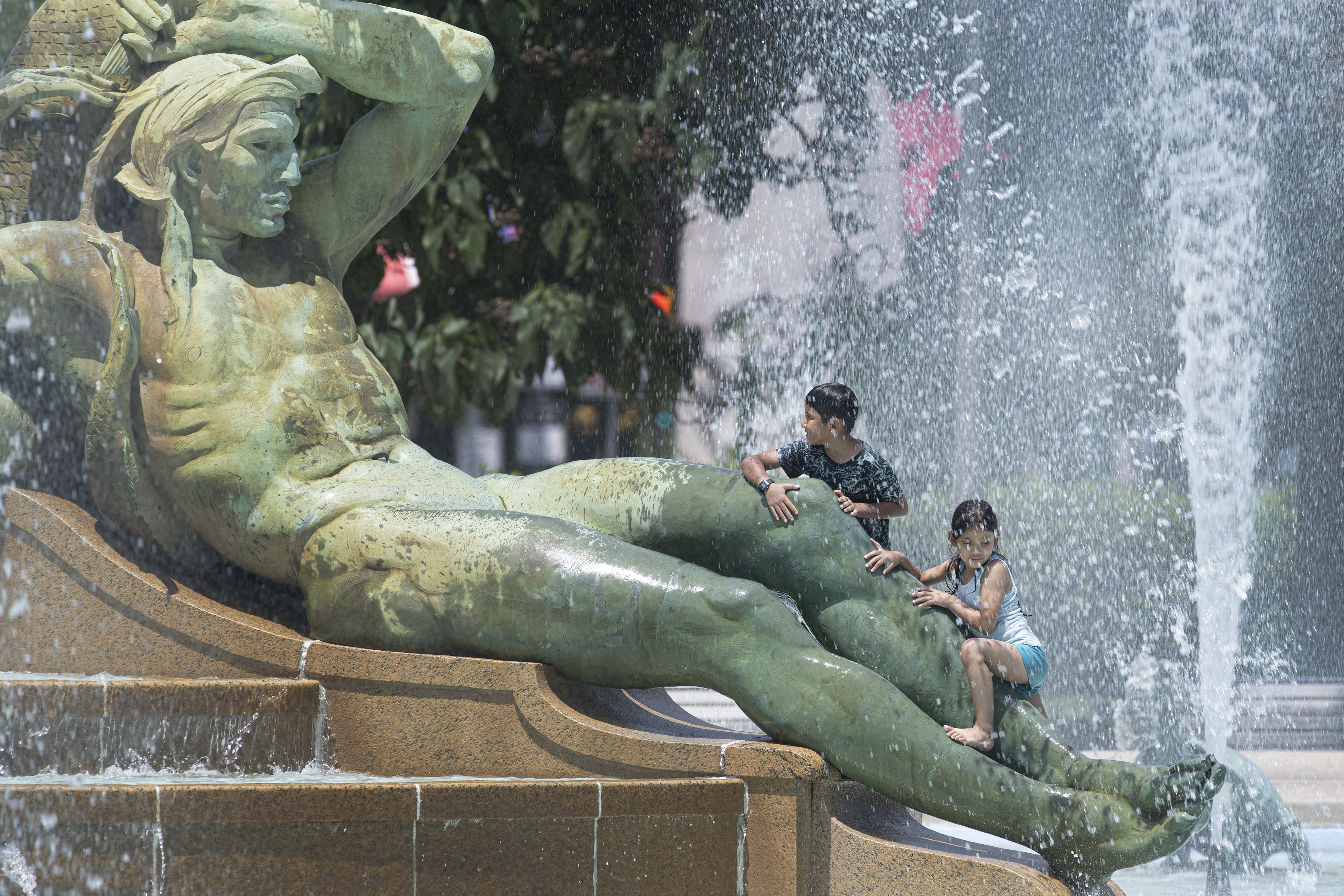
Foster says that looking at the allegorical figures in Logan Square’s Swann Fountain, you can see how Stirling inherited his father’s traditions.
Children cool off at the Swann Memorial Fountain in 2023.
“But the figures have a kind of sleek, modern simplicity to them,” she said. “They’re more stylized. So by the 1920s the Swann Fountain represents a kind of moving from the academic past into a more expressive and abstract style.”
The fence came off the Swann Fountain on a hot July day in 1924. The next evening, 10,000 revelers danced to tangos from a police band. Not everyone was pleased — some wondering if the average Philadelphian would grasp the significance of all that Calder had created.
He was unbothered.
“The meaning of works of art is just as mysterious as life itself. It can be explained in many ways by people of different philosophies. …,” he was quoted in the Evening Bulletin as saying. “There are lots of things in life we do not understand; art is no exception.”
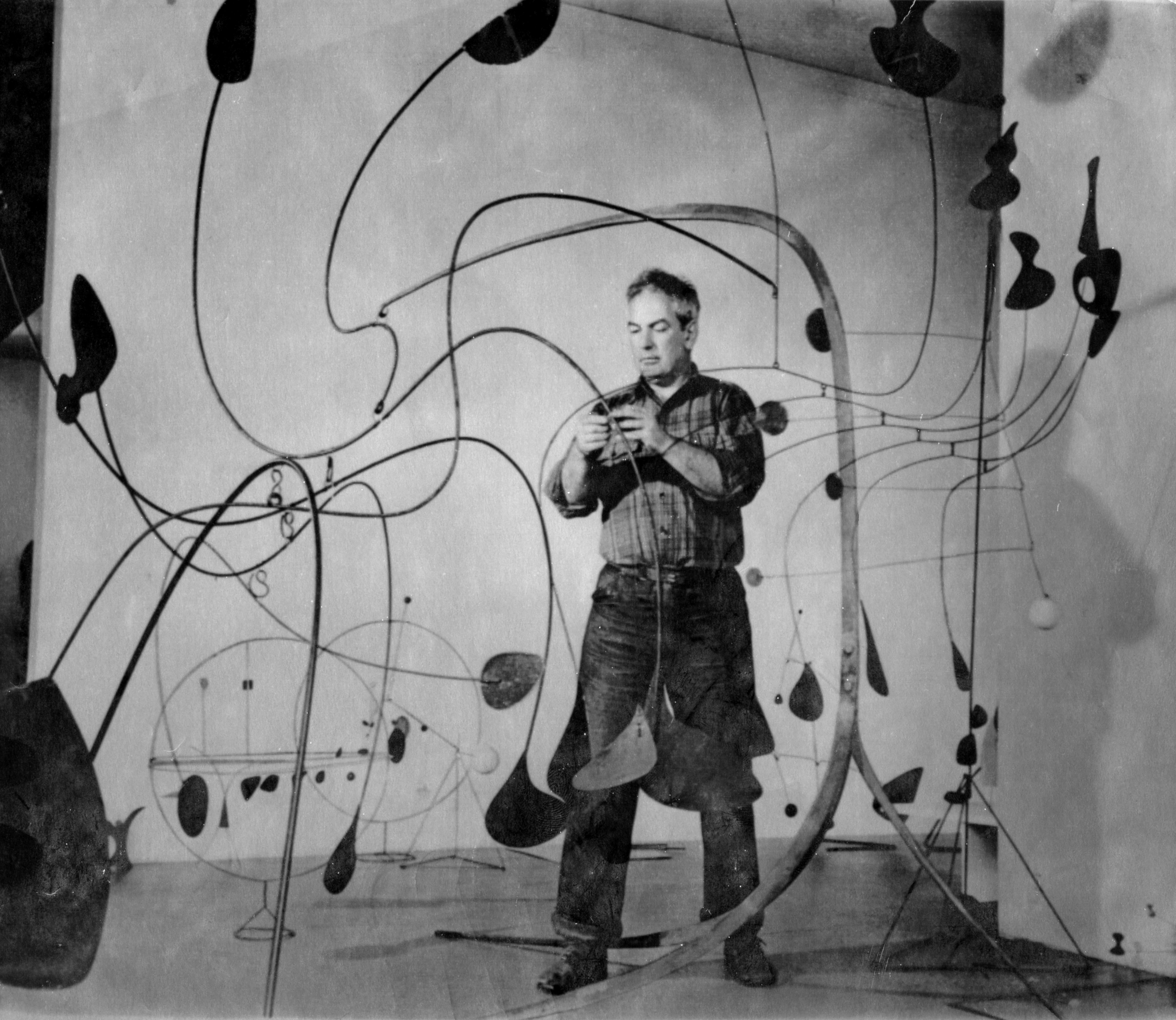
Alexander “Sandy” Calder installs his “Big Spider” mobile at New York’s Museum of Modern Art in 1943.
‘A big child’
In his autobiography, Sandy Calder included a photograph of the sprawling mansion in Philadelphia where he says he was born. He called the place Lawnton. In 1898 when Calder was born, Lawnton was a neighborhood in East Oak Lane, served by the Reading Line and lined with grand homes where the wealthy went to escape the summer heat.
It’s unlikely Calder was born there. David Brownlee has dug into the mystery of the third and most famous Calder’s birthplace. While his family doctor lived in Lawnton, and it is possible that his mother delivered her son nearby, more likely, he was born near the edge of the growing city, at 1203 East Washington Lane in Germantown. City records showed that Stirling Calder rented that country place, while the family still owned a home on North Park Avenue.
In Margaret Calder Hayes’ memoir, she described how Sandy, two years younger, went to school in Buster Brown suits his mother had sewn and by 8 had built a Noah’s Ark of animals. He enrolled in Germantown Academy, when it was still in the city, but left at age 9 before moving to Croton-on-Hudson, N.Y.
“We love to claim him, but he only went to school here as a child,” Foster said of the youngest Calder’s time in Philadelphia.
Yet in some ways, he’s the essence of the city he was born in: practical, playful, unpretentious, no pushover.
He worked as a fireman on a steamer bound for San Francisco, spent a year keeping time in a Washington state logging camp. Trained as an mechanical engineer, he moved to New York City at age 25 to paint.
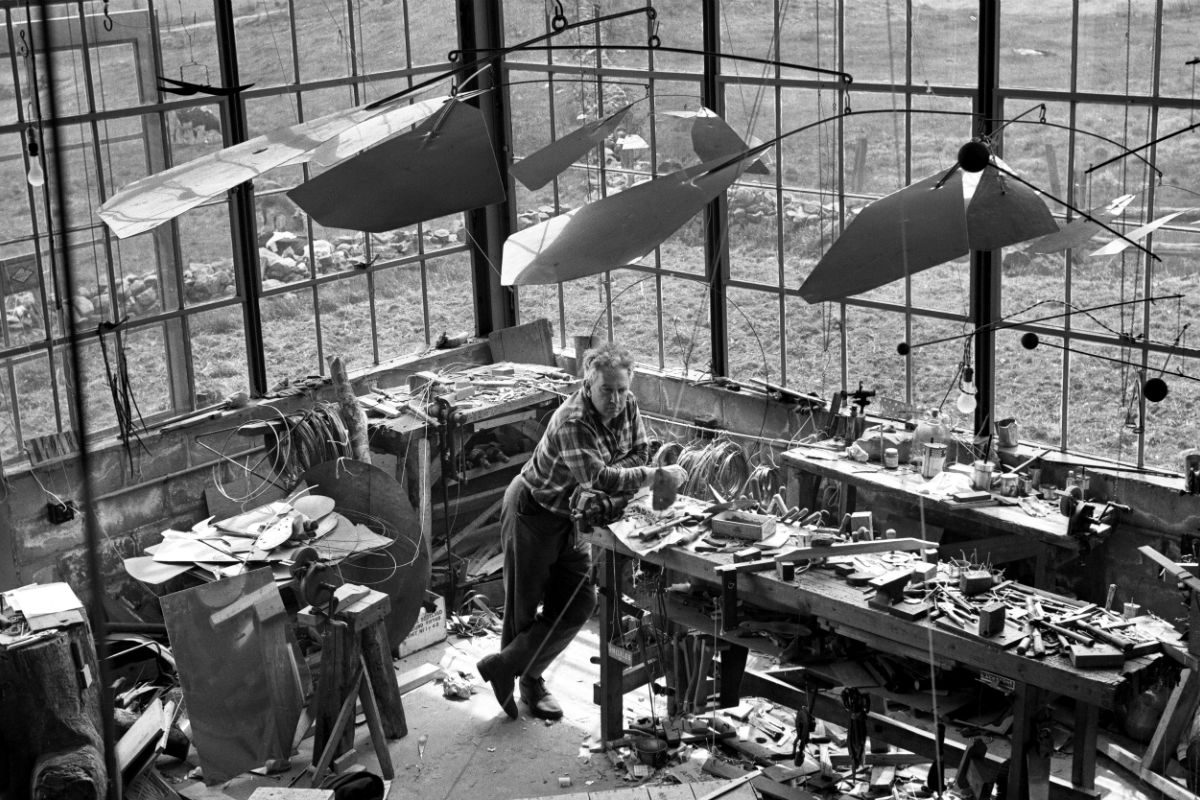
Calder with Mobile in his Roxbury, Ct., studio in 1941.
He is known as a 20th century modernist, the artist who put sculpture in motion.
After visiting Calder’s Paris studio in 1931 and marveling at his sculptures that relied on little motors, Marcel Duchamp coined the word “mobiles” for these kinetic marvels.
Parisians took to him, while they scoffed at other American artists. Cowley, in an introduction to Hayes’ Three Alexander Calders had a theory:
”Of course his work in itself, continually inventive, playful, and enchanting, was his ticket of admission.” But Sandy and his wife Louisa, “a beauty,” Cowley wrote, entertained generously and simply. Calder was in the tradition of the Noble Savage, “who disregards social conventions and judges everything by his instinctive standards.”
“A big child,” as his friend the playwright Arthur Miller once put it.
Sandy Calder created Ghost in 1964 for a retrospective at the Guggenheim in New York City, that included 400 examples of his mobiles, stabiles, toys, jewelry, carvings, tapestries, etc. The Art Museum bought the 34-foot-long showpiece a year later and brought it to the city of his birth.
Ghost, in the Great Stair Hall at the Philadelphia Museum of Art (now, Philadelphia Art Museum). It was created to hang in the center of the Guggenheim Museum in New York for Calder’s exhibition there in 1964.
“It’s a colossal example of the mobile and it’s majestic,” Foster said. “When it moves, it’s just breathtaking, because it, it almost moves like a giant dinosaur or something. In other words, it’s got long spines and fins, and it moves very slowly and grandly in the air currents in the Great Stair Hall. … It’s delightful.”
“When every baby has a mobile hanging over their crib, you don’t think about Calder as being the genesis of this. I think he would be delighted to know that … because he was such a child at heart. He managed to keep that imagination.”
Now, Philadelphia will be home to an institution that celebrates that imagination. It’s a fitting homecoming for an artist whose life and legacy was so shaped by his family, who in turn both shaped and were shaped by Philadelphia.
The weight of a name
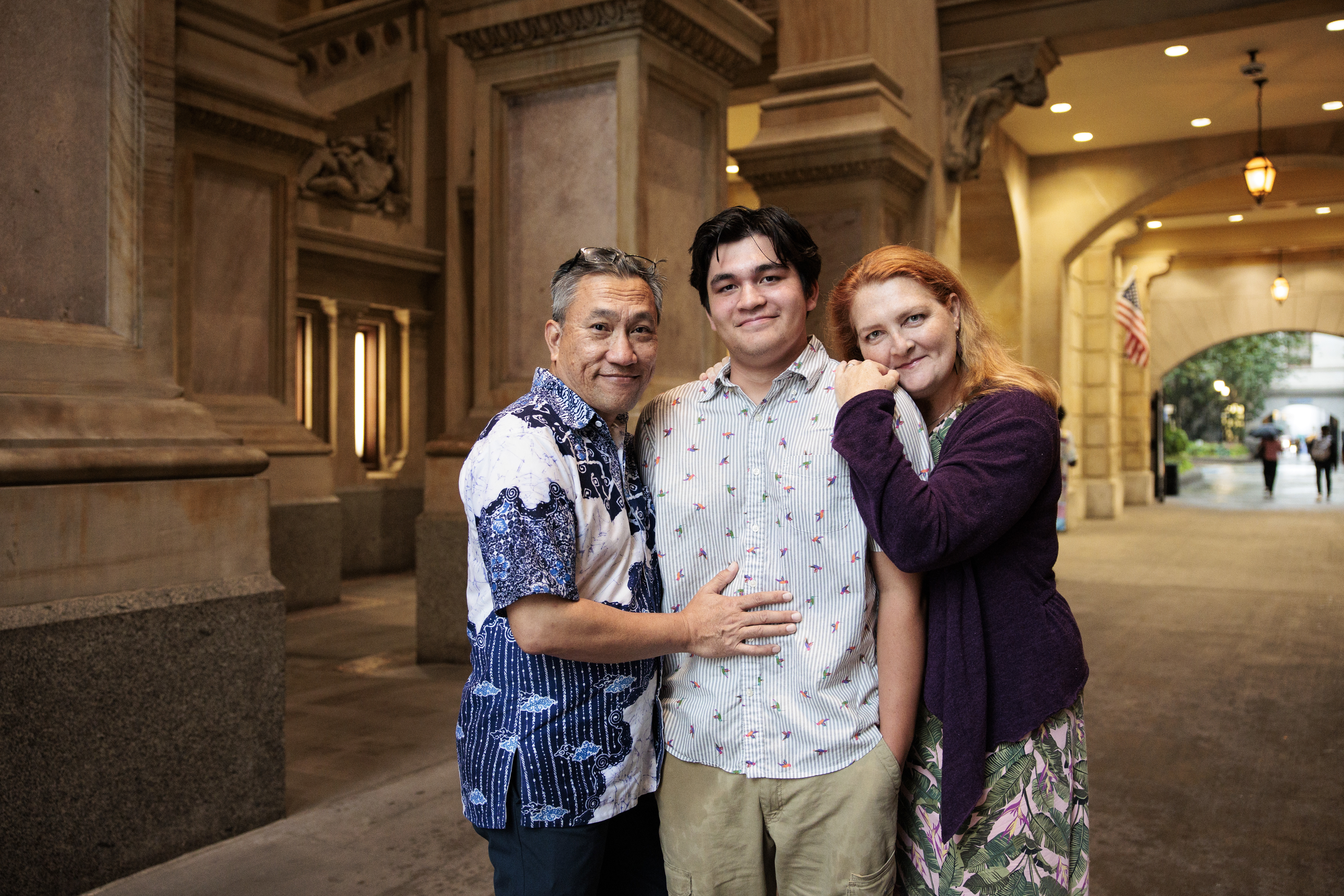
Tú Huynh was working at the National Gallery of Art in Washington, D.C., when he told a job applicant to look for him under the giant Calder mobile that hangs in the East Building.
That was in 1997. The applicant,Kaleo Bird, landed the job — and later, his heart. Three years later they moved as a couple to Philadelphia, where she started grad school. Soon they married.
In 2008, when their son was born, they didn’t take long to decide on a first name:
Calder.
He’s now 17, a senior at Penn Charter School.
Tú Huynh, Calder Huynh, 17, and Kaleo Bird at Philadelphia City Hall where more than 250 of Alexander Milne Calder’s sculptures adorn the building, topped by his statue of William Penn.
“I have yet to meet anyone my age who knows who the whole Calder family was, which is a shame because I feel they’ve had such an impact here, particularly with City Hall,” said the teen. “So many people think Ben Franklin is atop City Hall and don’t know anything about these beautiful sculptures.”
His father now runs the Art in City Hall program.
“I tell people that the true art of City Hall belongs to Alexander Milne Calder,” says Tú Huynh. “This was his Sistine Chapel. There are over 250 sculptures, leafs, busts all over this building. And that’s an homage to his ideal of what this city, state and country is supposed to be about. And he doesn’t sugarcoat anything. There are enslaved Africans, Indigenous populations, Europeans. It tells you the folks who’ve contributed to this extraordinary country.”
Calder Huynh says he feels the weight of his name — in a way that the two generations named after Alexander Milne Calder must have felt.
He paints, draws in charcoal, creates his own comic books — exploring themes with super heroes and Westerns, always with an eye on his father’s works that line the walls of their home.
“Naming me after them is such a big thing to put on someone. For me, it is a weight that Alexander Sandy Calder must have felt. A weight to achieve and create something that differs from what his family members had created, which is kind of cool. … Put something in this world that hasn’t been done yet.”
“The Magic of Calder Gardens” is produced with support from Lisa D. Kabnick and John H. McFadden. Editorial content is created independently of the project’s donors.
To support The Inquirer’s High-Impact Journalism Fund, visit Inquirer.com/giving
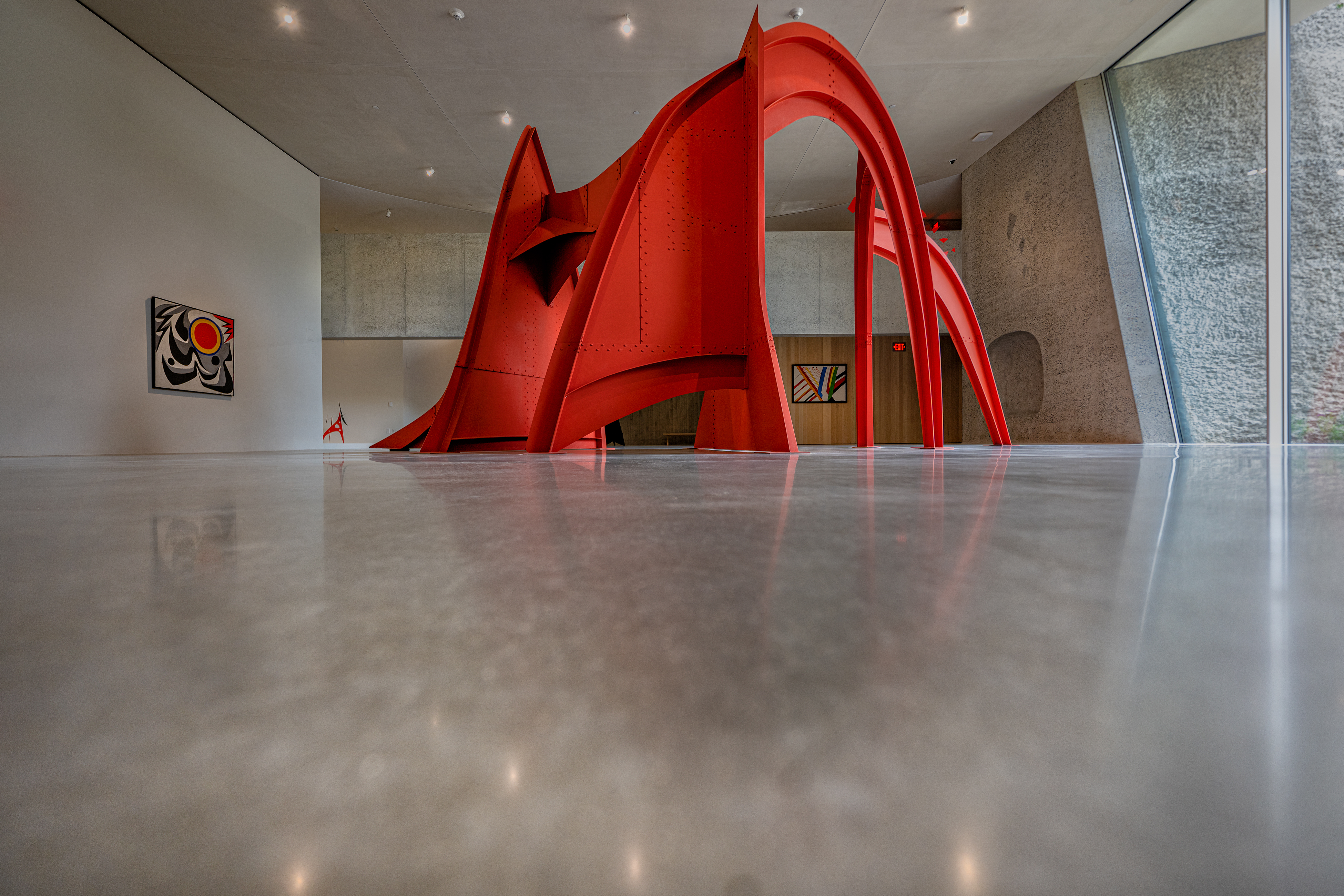
Jerusalem Stabile II, 1976 by Alexander Calder is shown on display at the Calder Museum in Philadelphia.
Too many people in this country think free speech comes with no consequences. A constitutionally protected free pass to say whatever you want with zero repercussions. But that’s not true. There is a cost to speaking out.
On the left, think Colin Kaepernick being blackballed by the NFL for taking a knee during the national anthem. On the right, think every yahoo who’s ever been fired from their job over some racist/sexist Facebook post.
If you think that’s an unfair comparison, write about it. Yell at me about it. That’s how free speech works. I say something, and you can say something back. How it definitely does not work is when the government steps in. The courts have been very clear that the First Amendment protects us from government censorship.
That means calls to boycott comedian Tony Hinchcliffe after he called Puerto Rico a “floating island of garbage” at a Donald Trump rally? Legal. ABC firing comedian Bill Maher for insensitive comments after 9/11? Legal. However much you or I can loathe so-called cancel culture, it’s legal.
What happened to Jimmy Kimmel is something else.
On Wednesday, Disney-owned ABC put the late-night talk show Jimmy Kimmel Live! on indefinite hiatus. This happened soon after Nexstar Communications Group said it would pull the program from its 23 ABC-affiliated stations over a joke Kimmel had made Monday about the MAGA reaction to the killing of Charlie Kirk. The leaders of the conservative-leaning Sinclair Broadcast Group also announced they would be preempting the show.
So far, so wrong, but within these private companies’ rights. The problem is that also on Wednesday, the head of the Federal Communications Commission, Brendan Carr, went on the right-wing podcast The Benny Show and laid out how the government could go after those who gave the late-night comedian his platform.
“There’s calls for Kimmel to be fired. You can certainly see a path forward for suspension over this. And again, the FCC is going to have remedies that we could look at,” Carr told host Benny Johnson. “Disney needs to see some change here, but the individual licensed stations that are taking their content, it’s time for them to step up.”
Now, the FCC cannot go after ABC because, like the other national networks, it does not hold a broadcast license to transmit over the public airwaves (although Disney owns a few stations), but it can absolutely go after local affiliates.
Not only that, but much like in the case of CBS’s cancellation of The Late Show with Stephen Colbert — which put the Trump-mocking show on the chopping block after the network’s parent company needed government approval for a merger — Nexstar is also in merger talks.
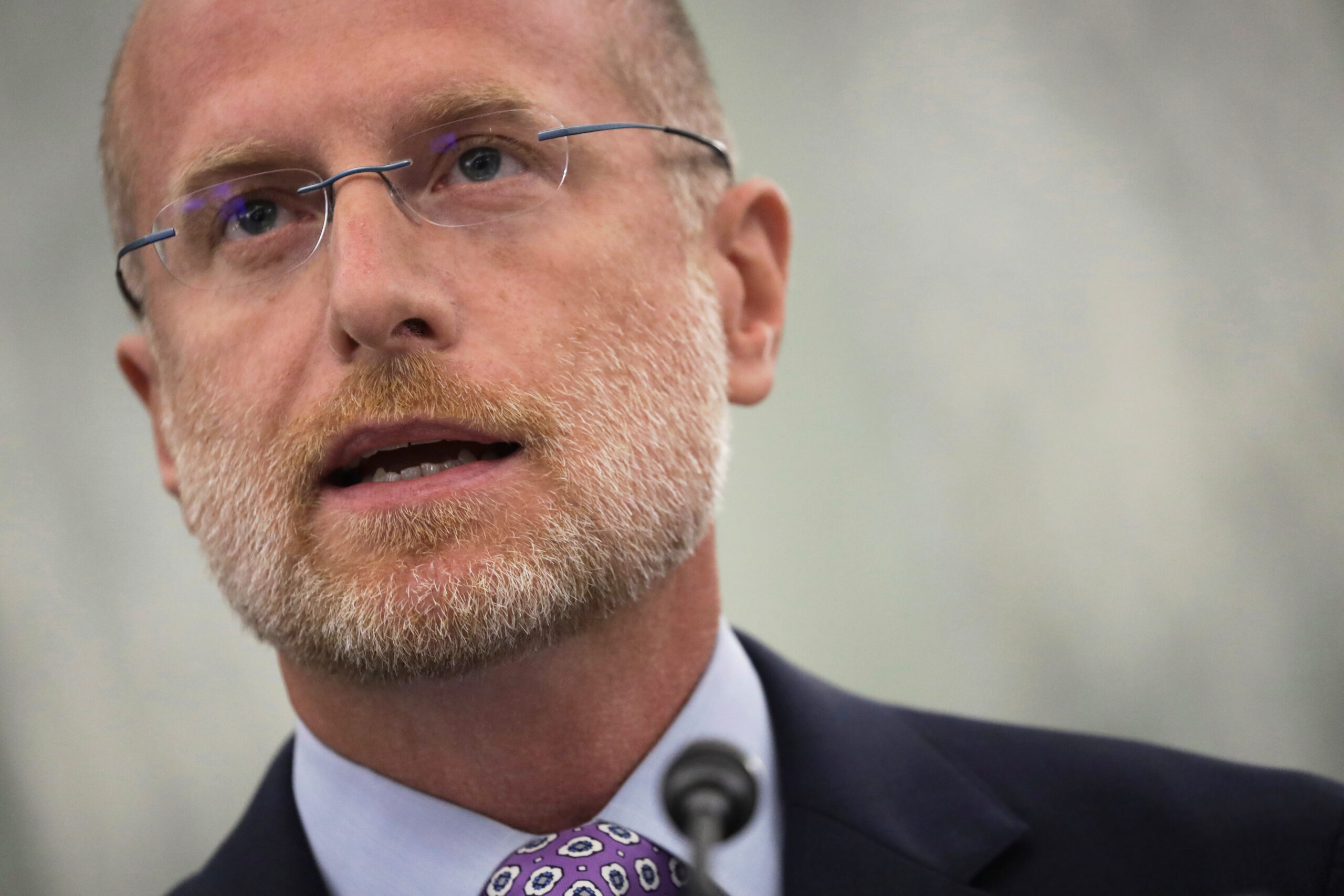
Brendan Carr, then a Federal Communications Commission commissioner, speaks during a Senate Commerce, Science, and Transportation committee hearing on Capitol Hill in Washington, in 2020.
With The Late Show, CBS executives could at least make the case (transparent as it was) that their decision was justified because ratings were down, and they would allow the show to run until the end of the host’s contract next year.
But for Kimmel, there hasn’t been even an attempt at that kind of pretense. He’s been suspended following a barely veiled threat by the guy in charge of allowing TV stations to do business. Now, I think what Nexstar did is cowardly, but it is by no means nonsensical.
Add it to the list of companies, universities, and law firms that have sold out American principles and are fully on board with endangering democracy by enabling Trump’s worst instincts — all for the sake of doing business.
Also, add this incident to the long list of examples of hypocrisy from the Trump administration and the right-wing commentariat. Unsurprisingly, back in 2023, Carr posted on X that “Free speech is the counterweight — it is the check on government control. That is why censorship is the authoritarian’s dream.” The same day Kimmel was suspended, Trump criticized England’s laws limiting speech (he’s right) while praising ABC’s decision.
The president has repeatedly threatened networks over their news coverage, and raged against late-night comedians like Kimmel and Colbert for making fun of him. Of the Big Three networks (sorry, kids, I’m old), Comcast-owned NBC has so far stood its ground.
This is important because Saturday Night Live alone has produced some definitive presidential portraits that have stood the test of time. In my late-night TV-watching lifetime, we’ve seen George H.W. Bush as awkward and out of touch (Dana Carvey), Bill Clinton as hungry horndog (Phil Hartman), George W. Bush as clueless bro (Will Ferrell), Barack Obama as professorial but cool (Jay Pharoah), and Donald Trump as game cue card reader desperate for love and attention (Donald J. Trump).
The show may want to amend Trump’s portrayal, though, to a thin-skinned demagogue who lost his sense of humor about the same time he found love and attention among the vilest peddlers of right-wing vitriol and hate on his way to authoritarianism.
As to what those of us who consider free speech one of the vital ingredients in the American Experiment can do, well, that’s easy.
Speak out, loudly and often — ideally respectfully, but the Constitution doesn’t say you need to be nice. What’s happening is not right, and we need to say so. Damn the consequences.
Dozens of former students of the Paul Green School of Rock Music, most long out of touch, have reconnected to talk about their past. They had rock and roll childhoods most kids could only dream about. The epic road trips and European tours. The performances with rock stars like Eddie Vedder and Billy Idol.
But the alumni of the lauded former Philadelphia musical education program are not simply reminiscing about the music. They are coming to terms with the physical, psychological, and emotional abuse they say Paul Green subjected them to while they were children.
Their conversations revolve around a report Air Mail magazine published in May about Green, a former punk rocker who styled himself a brash tastemaker, and the school he founded in 1998. Based on interviews with more than 60 former students, the story described how Green often flew into violent rages, struck students, and fostered a sexually charged environment for his teenage students.
Although Green did not respond to the allegations in the Air Mail story at the time, he announced through a spokesperson soon after that he would not join his students on a summer tour in the U.S. and Europe.
Since, two dozen of Green’s former students and staff members have spoken with The Inquirer to share additional allegations of misconduct. They include a woman who said Green initiated frequent sexual contact that lasted nearly two years with her in 2007, when she was his 17-year-old student.
It is the first time Green, who was the vulgar and volatile subject of a 2005 documentary Rock School, has been publicly accused of having sex with a student enrolled at his school.
Green declined to be interviewed for this story. After The Inquirer emailed Green this week with a list of allegations it would be reporting, Green responded Thursday and denied having sexual relations with anyone underage or who had been a student at the time. He added that he will close his current children’s music academies, including one in Roxborough, and will retire from teaching.
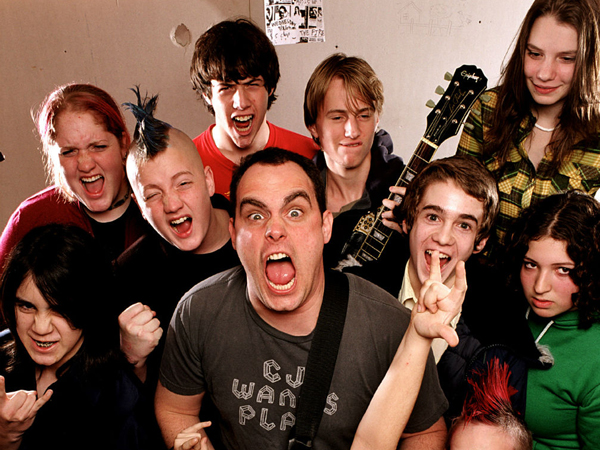
Paul Green and his charges at the Paul Green School of Rock Music in 2005.
Green said in a statement Thursday, “I want to be very clear, however, that some of the more serious allegations being made, particularly those that are sexual in nature, are not accurate. I have never shown students pornography, and while I admit to extramarital relationships with women connected to School of Rock, I have never had a romantic or sexual relationship with anyone under legal age or anyone who was a current student, during that time frame, or ever. I also deny any sexual harassment.”
The age of consent in Pennsylvania is 16, but sexual contact by a person in a recognized position of trust or authority — such as a teacher or school administrator — with someone under 18 is considered a third-degree felony punishable by up to seven years in prison. This was the law in 2007, and it remains the same today.
The woman, who The Inquirer agreed not to name because of the nature of the claims, said Green first began flirting with her when she was 15, with “inappropriate jokes or comments about my appearance.”
As she got older, it escalated.
“Then, winking, touching, hugging,” the woman said. “He would put his hand on my leg and see how high he could go before I stopped him.”
She was a member of the All Stars, the most talented musicians who toured as a band and performed at professional venues and festivals. She said that during her junior year in high school, when she was 17, Green invited her to meet him for sex at a hotel near the former Race Street school, asking if she was going to “chicken out” before texting her his room number.
The ongoing sexual contact that began that day lasted for almost two years, only ending after the woman graduated and moved away, she said.
During their time together, the woman said, Green sometimes provided her with marijuana, Champagne, or cocaine. He rented porn for them to watch and attempted to arrange a threesome with a former student working at the school, she said.
He would joke, “You’re my teenage mistress,” she said.
Two of Green’s former students and two formerstaffers told The Inquirer they had known that Green was engaged in sexual conduct with the woman while she was his student and after graduation. Two of them said Green himself had told them at the time about the sexual contact — both of whom asked not to be named for fear that it could affect their current employment. One former staffer said Green and the student had been intimate on a European tour bus, under a blanket, while chaperones sat rows ahead.
That staffer said they were afraid at the time to speak out against Green, who ruled the school he created like a self-proclaimed “Überlord.” But staying silent is a regret they’ve carried for nearly two decades.
“I didn’t protect her at all,” the former staffer lamented.
‘Total manipulation’
Many of the 60-plus students who described Green’s physical, verbal, and inappropriate behavior to Air Mail, a weekly news and culture newsletter launched in 2019 by alums of the New York Times and Vanity Fair, are now connected in a WhatsApp group. After an Inquirer reporter contacted the former students, they responded with an open letter to explain why they had decided to continue speaking out.
“We entered his programs with trust and hope, but too many of us left with wounds and trauma we’re still working to heal. Some of us have never played music again.”
And despite bonds of life-forming musical experiences, many of them told The Inquirer they went their separate ways after graduation, hoping to forget the pain.
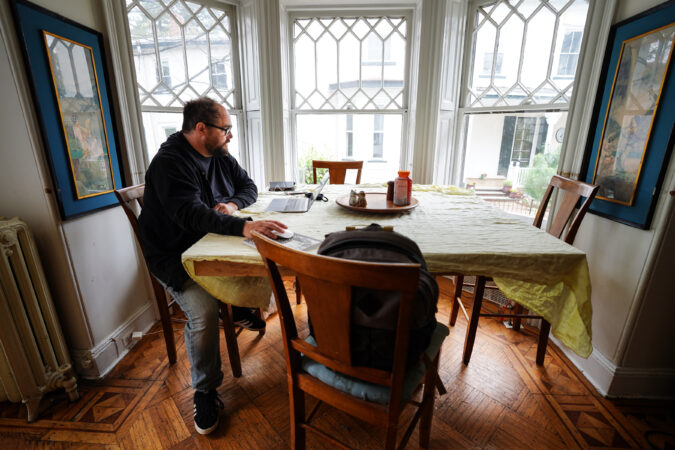
Former Paul Green School of Rock students Emilia Richman (left) and Carolyn Satlow at Dickinson Square Park on July 7.
“It was total manipulation,” said Carolyn Satlow, 37, an All Star who attended the Downingtown branch of the Paul Green School of Rock Music from 2004 to 2006, and is now chief of staff of the Vetri restaurant group. “This web of secrets that kept us all silent.”
Satlow had turned 18 and graduated from rock school when Green began a monthslong sexual relationship with her in 2007. At the time, she was working at the school as an administrator.
Now married with two children, Satlow said Green also told her about his sexual contact with the then-teenage student.
“I thought this adult person was the authority in the room,” she said of Green. “We all trusted him. I was an insecure teenager and Paul knew that and preyed on it.”
Satlow says being able to talk about what happened, and reconnect with other students who went through similar experiences, has been healing.
“We found lives for ourselves, and we’ve become successful in music and outside of music, and just being great human beings,” Satlow said. “Because we’re all just actively trying not to be him.”
‘Paul being Paul’
By constantly discussing his own sex life and the sex lives of students, who were mostly 12 to 18 years old, Green created an environment where even his most outrageous behavior could be normalized, former students and staffers said.
Jen Bowles, an administrator at the school from 2005 to 2007, told The Inquirer that Green had sent her texts asking if she would have sex with him if he booked a fancy hotel, like the Rittenhouse Hotel or the Sofitel Philadelphia at Rittenhouse Square.
Serious about her job at the school, which she initially saw as an empowering, punk rock space for young musicians to express themselves, Bowles, who was then 24, said she had tried to ignore Green’s messages as inappropriate jokes.
Former Paul Green School of Rock students Allie Hauptman and Aaron Sheehan at Rowhouse Grocery in Philadelphia on June 30.
Bowles, who now lives in Vancouver after earning a doctorate in public health from Drexel University, recalls attending a postshow work dinner Green arranged in 2007 at the former Abbaye bar and restaurant in Northern Liberties. Bowles had hoped the dinner would be an opportunity to discuss a potential promotion to manage the Philly school.
After they had just ordered dinner, she said, Green asked her to have sex with him.
“‘It’s finally happening,’” she recalls Green saying, adding that he assumed that they would have sex.
When she rejected his proposition, she said, Green berated her over dinner, referring to her as a “tease,” shouting that he would find a way to fire her. During his tirade, Bowles said, Green told her that her rejection didn’t matter. He had other options for sex, including students, staff, and sex workers, she recalls him saying.
Bowles said Green then bragged about his sexual conduct with former students and staff he had taught since childhood.
“I wait till they’re 18,” Bowles recalls him saying.
Bowles said she did not report back to work the following Monday and resigned within a week.
“I was broken at this point,” Bowles said. “I thought my future was crumbling into a million pieces, and I learned that the young people I cared about were in the hands of a horrible person.”
Bowles’ longtime friend, Ruth Scullion, recalls Bowles telling her about the experience with Green shortly after it happened in 2007.
“She had told me about the culture at the school — and that she felt preyed on,” Scullion. “She told me about going out to dinner with Paul for what she thought was a work dinner, and how he started being overtly sexual with her and propositioning her. She said when she refused, he said, ‘Well, you’re too old for me anyway.’ It still gives me chills thinking about it.”
Julia Rainer, 37, a former All Star guitarist who now lives in South Philly and works as a therapist, also recalled Bowles detailing the incident to her at the time.
Paul Green School of Rock Music emails shared with The Inquirer show that two months later, Green strategized with a staffer on how best to attack Bowles’ credibility if she filed a sexual harassment lawsuit. By then, the circumstances surrounding the popular employee’s departure had started to spread among staff, even as Bowles decided against pursuing legal action.
Green wrote to the staffer in 2007 about the alleged advances, saying of himself, “Once again: Paul being Paul.” Then later adding, “Here is EXACTLY what I need from you: keep your ears way to the ground, do what damage control you can do.”
‘Always part of rock school’
For many former students, the nearly two years since the Air Mail reporter’s initial contacts have included painful revelations to family members, therapists, and each other.
Last year, people who had long avoided reckoning with their past at the Paul Green School of Rock Music began to reconnect on Zoom.
A.Z. Madonna, 32, a former All Star, who originally grew up in Maplewood, N.J., and now writes about classical music for the Boston Globe, said for years she had distanced herself from her rock school friends.
“I didn’t want to be reminded of how Paul made me feel, which was that I was a failure who deserved to fail,” she said to The Inquirer.
But Madonna is now part of the private WhatsApp group chat, where for months the 60 former students shared stories about their experience at the Paul Green School of Rock Music. Some still talk daily, offering messages of support to friends picking up their instruments again.
There have been park meetups and coffee shop get-togethers. In May, a bunch of the former students attended a Metallica and Limp Bizkit concert, the latter a band they say Green would have berated them for listening to as kids, always emphasizing the classics.
“It’s been very healing,” said Emilia Richman, 33, a South Philly musician and former All Star who now works as a mental health administrator. “So many of us had stayed away from each other because of our shame.”
While some former students said Green’s school unlocked opportunities, they also said that he taught them through fear and humiliation.
Allie Hauptman, 38, who attended the Philly school from 1998 to 2005, and is a founding partner of Rowhouse Grocery, a boutique corner store in South Philly, said she would often turn down the volume on her keyboard all the way so that Green wouldn’t be able to hear any possible mistakes so she was “in the clear from the yelling and swearing.”
Rainer recently played her first show after returning to music in the months after the Air Mail story published.
“The culture of humiliating you, bullying you, isolating you — that was always part of rock school,” she said.
So was Green’s controlling behavior, the students said.
“He really became addicted to that power and control he had over all of us,” said Gina Randazzo, 40, of Collingswood, who began guitar lessons with Green in 1999, was an All Star, and eventually worked at Studio House, a now-closed recording studio for students and young people in suburban New York that Green opened in 2010. “It was almost like he couldn’t help himself.”
The former students say they are not after revenge.
“This is about ensuring that no child is ever again put in a position where they are vulnerable to this kind of manipulation, control, and abuse,” they said in their letter. “While he has released a statement closing PGRA and retiring from teaching ‘in this capacity,’ our primary concern is that PG is never again placed in a position of power over children.”
In their open letter against Green, the 60 former students spoke directly to his most-recent students.
“We hope you are safe,” they said.
That’s something Aaron Sheehan, 33, an All Star from 2007 to 2009 and member of Studio House, tried to tell the students himself when he chanced upon Green’s new pupils jamming to Yes at a South Philly street festival three years ago.
Walking toward the music, he decided to confront Green for telling him he was no good until he finally believed it.
But Green hadn’t come. Sheehan tried telling the parents, but they brushed him away. He must’ve had a bad experience, they told him. They love Paul.
It was hard watching the kids play.
“It was like looking at us all over again,” he said.
‘I was an overgrown teenager’
In 2009, Green sold the company he had formed out of his living room to an investment fund in a deal worth $10 million. In 2023, the School of Rock, which now includes 500 schools worldwide, was purchased by Youth Enrichment Brands, a leading youth activities platform.
Stacey Ryan, the current School of Rock president, stressed that the institution has had no affiliation with Green for over 15 years.
“Student safety is our highest priority, and our mission has always been to provide an empowering space where young people can grow — not just as musicians, but as individuals,” she said.
As part of the 2009 deal, Green retained leadership of the All Stars program, but left within a year after a final meltdown with students, when Green allegedly mocked a student’s Catholic faith, threw a metal chair, and referred to Mother Teresa with a vulgar term for a woman’s vagina, said Sam Mercurio, a South Philly musician and former All Star from 2007 to 2010.
“By the end, he had made it all feel so normal,” said Mercurio, who told The Inquirer Green once whipped him with a mic cable during a rehearsal.
After living in Woodstock, N.Y., for a time, Green returned to Philadelphia in 2017, opening up a new venture, the Roxborough-based Paul Green Rock Academy. The academy, which also has locations in Connecticut and the Bay Area, offered students the same chances to tour and jam with musicians, like the former Zappa band members, that the original rock school kids did 20 years ago.
Shortly after the Air Mail article, the academy’s social media went dormant. Scott Thunes, the academy’s longtime assistant musical director and former Frank Zappa bassist, would be in charge of tours and the entire program, according to a spokesperson at the time. Green said that the school would be renamed the Thunes Institute for Musical Excellence.
In late June, the North Philly performance space PhilaMOCA canceled the students’ scheduled performance of “We Love Zappa.” A spokesperson for the venue said that Green’s continued involvement with the school, along with a push from a former student, led them to shut the show down. Thunes said the cancellation only hurt the students.
Despite his statement, when reached by The Inquirer on Monday, Green was with the Thunes Institute students on an August European tour, alongside Gibby Haynes, the lead singer of the Butthole Surfers and a longtime collaborator with Green’s schools. Videos show him in the front row.
In a statement to The Inquirer, Green said he was stepping in for Thunes, who had to leave citing a “personal issue” halfway through the tour. “The students worked so hard and had already experienced so much turbulence heading into the tour, so we weighed the backlash of me attending versus the fallout of canceling,” Green said. “The current parents unanimously requested that I return to ensure a smooth transition until we could implement a suitable replacement.”
Green, who graduated from Temple University Beasley School of Law in 2021, said he did not speak out sooner about the Air Mail allegations because, “I have been reflecting on that time period, gathering my thoughts, and trying to find the right words. I have been balancing how to genuinely apologize and take accountability for my actions from over 15 years ago, while also unambiguously denying the allegations of things that never occurred.”
Long open about his battle with addiction, he had his own dysfunctional childhood — he grew up fatherless in Port Richmond, joined the Philly punk scene by 13, lived on his own by 15, and formed the original school when his music career failed. Green said drug rehab and years of therapy and meditation have helped him grow.
“I started School of Rock in my living room because I love teaching music, and I wanted to create a fun and intensive atmosphere for students,” he said in his statement to The Inquirer. “I had no idea that it would be successful, and I was not at all prepared for that success at such a young age. I was an overgrown teenager when those students needed a responsible adult. That said, despite how it may appear, my inappropriate behavior or language never came from a place of predatory intent as has been insinuated.”
He added that closing the schools “was not an easy decision, as teaching music has been my life’s work and greatest passion. But I believe this is the right moment to close this chapter with gratitude and integrity.”
‘Nobody does what Paul Green does’
Ten parents, who contacted The Inquirer through a spokesperson for the Paul Green Rock Academy, said they never witnessed Green cross a line. None of the children ever told them he did, they said.
“I have seen countless rehearsals and performances in the last seven years,” said one parent, whose child is a longtime student at the academy. “I’ve never witnessed any of those alleged behaviors, nor has my child ever reported inappropriate conduct.”
When speaking to The Inquirer, the parents, whose children are current or former students of the Paul Green Rock Academy, were only responding to the questions about the allegations already published by Air Mail. The Inquirer did not make them aware of the new sexual allegations detailed in this story.
Though Green, in his statement, says he’s changed, parents of current students at the Rock Academy tell The Inquirer that Green didn’t run from his bad boy image.
While assuring them he’s mellowed, he still makes it part of his selling point — and a new generation of parents believe him.
“Paul’s teaching style was addressed right from the very beginning,” said one parent, whose daughter graduated from the academy, in a statement provided to The Inquirer through a school spokesperson after a reporter had contacted the academy about Green. “In my mind there was no question that we all knew what we were signing up for.”
One parent said Green recommended that families considering the Paul Green Rock Academy watch Rock School, which shows him berating and humiliating students busy mastering some of the most complicated rock compositions ever written. In the film, Green also presents a student who described being suicidal with an award for “most likely to kill himself.”
Green can still be “arrogant,” “rude,” and “foulmouthed,” the parents said. He sometimes still screams and storms out of rehearsals, they said. One parent said she had met with Green for throwing a rattle shaker at her child, but that they had moved past it.
The parent, who stressed she did not want to dismiss the former students’ experiences, credits Green’s “grittier” and “edgier” approach for helping her son, who is neurodiverse, flourish socially and musically.
His current students appear heavily devoted. On Instagram, they praise classic rock and quote Zappa. They take each other to prom and form bands. They post tour updates and photos from past performances, where Green could often be seen in the front row.
Green addressed the allegations months ago, they said, removed himself from rehearsals, and met with parents individually.
“Paul’s a pretty open guy — and I was aware that there was stuff in the past he wasn’t proud of,” said one parent, whose two sons are Rock Academy grads. “But I can certainly say this: Nobody does what Paul Green does. No rock school does what the Paul Green Rock Academy does. Nobody offers that experience.”
‘Like Whiplash’
But some of the most successful musicians to emerge from the Paul Green School of Rock Music say nothing was worth the verbal and emotional abuse they experienced from Green.
Eric Slick, 38, a former All Star and now drummer of the Philly-formed rock band Dr. Dog, was also featured in the Air Mail story. A drumming prodigy who grew up in Fairmount — his grandfather was a jazz trombonist who played with Billie Holiday — he had been bullied for his weight at the Masterman School before hoping he found a sanctuary at rock school in 1998.
His talent only made him more of a target with Green. Like on his 12th birthday, when Green suddenly exploded in rage over his Pink Floyd drum solo, spitting, cursing, throwing mics, and kicking amplifiers.
Eric Slick, drummer for the rock band Dr. Dog, says he was bullied by the Paul Green School of Rock Music founder.
“It’s this Whiplash moment where I was like, ‘Oh, I’m not safe here,’” said Slick, who now lives in Nashville, referring to the 2014 film about a young jazz drummer and his explosive teacher.
At his birthday dinner with his parents at Spaghetti Warehouse after practice, Slick said nothing.
“We were these misfit toys who didn’t fit in, who weren’t jocks, who weren’t popular. And then suddenly we have this opportunity to jam and grow as musicians together,” he said. Talking, he thought as a kid, would jeopardize that.
“I would be out of this friend group, and I would be done,” Slick said.
It’s a sentiment shared by many former students.
“I feel like I really shut down,” said Lauren Cohen, 37, of Doylestown, an All Star from 2002 to 2005, and a classical musician who performs regularly in Philadelphia. “I feel like I shoved my emotions down and everything that was telling me, “This isn’t safe.” I kept ignoring it because I made friends.”
The bullying from Green grew constant, according to Slick. About his weight, his appearance, his high school sex life.
“I remember stuffing down all of these extreme sad feelings I was having after the rehearsals,” he said. “You just realized that every facet of your life is manipulated in order for him to get what he wants, which is to sell schools.”
He’s shared stories of the school with his current bandmates. “That’s not normal,” they tell him.
Even now, while playing to tens of thousands, Slick finds himself looking stage left, where Green stood so long judging his every drum groove and fill, set to erupt.
“The fear of his wrath still haunts me,” Slick said.
Kaleen Reading, a drummer with the band Mannequin Pussy, performing at the World Cafe Live in 2024.
Kaleen Reading, 33, an All Star from 2006 to 2009 and drummer for the Philly-based punk band Mannequin Pussy, said Green also often denigrated her about her weight, and left her fearful of pushing the tempo during performances to this day.
In May, shortly after the Air Mail article was published, Reading announced she would not travel with her group on a series of European summer tour dates. At the time, Reading wrote on Instagram that her absence was due to “mental health concerns” — and that the move was necessary for the “longevity of me remaining in the music industry.”
Reading later told The Inquirer she needed the time to process her own memories of the Paul Green School of Rock Music, including verbal abuse.
“Paul Green is not a teacher,” she said. “He is an abuser who can get results from yelling at already talented kids he selected to advertise his school.”
‘Just a child’
Sitting in a car outside her home before work on a gray morning in July,the former student who said Green began ongoing sexual contact with her when she was 17 said she saw Green as more than a teacher. At the time, Green represented the only real adult male figure in her life. Familiar with her battles with depression, anxiety, and an eating disorder, Green encouraged her dreams of becoming a professional guitarist, she said.
“I would have done anything for his approval,” the woman said.
At 17, she and Green would meet at a hotel blocks from the former Race Street school. Or Green would pick her up a short distance away, so no one would see, and drive to a roadside, budget motel with pirate and Hawaiian-themed rooms called the Feather Nest Inn just over the Ben Franklin Bridge. On tour, Green would sometimes sneak her into his room, she said.
The woman tried burying the memories of her experience with Green, but struggled with ongoing depression and feelings of inadequacy. She said she suffered a nervous breakdown “for weeks” last year, after she was first contacted by the Air Mail reporter. Although not ready to speak publicly at the time, the query forced a reckoning.
“If I hadn’t been forced to confront it, I was prepared to bury it forever,” she said.
Instead, with the help of a therapist, the woman began to grapple with what she said Green had put her through when she was underage.
“I let it all out,” said the woman.
She, too, has found strength in her old friends from rock school, whose friendship she packed away with the trauma. For years, she said could not enjoy the experience of music without memories of Green. She’s just now playing again.
“I always thought it was my fault,” she continued. “Still, I have to remind myself that I was just a child.”
Picture it: The Birds game is on, you’re snacking on the couch, and suddenly, you hear it: “This holiday season, my good friend gave to me: seven Powerball tickets — .” With the start of Pennsylvania’s annual showing of its prized lottery Christmas commercial, the holiday season is truly here.
Dating to 1992, the ad, which is titled “Snowfall,” features a group of carolers singing an abridged and heavily modified version of “The Twelve Days of Christmas,” swapping the usual swans a-swimming and geese a-laying for an array of lottery games.
On social media, the return of the ad — which typically begins airing in early November — is celebrated. “It’s practically a holiday tradition,” one Reddit user wrote 13 years ago about the ad (from a Reddit thread in 2011 discussing its return that holiday season). A new Reddit thread posted this week also embraced the holiday ad.
“The moment they hear the carolers sing, many Pennsylvanians reflexively smile, sing along, and mentally count the weeks until they can put up the tree,” Drew Svitko, the Pennsylvania Lottery’s executive director, said in 2016 ahead of the ad’s 25th anniversary. “We are proud that our popular commercial brings back so many warm memories for viewers and has become a Keystone State holiday tradition.”
But the ad we see today is not the exact ad that was shown over three decades ago.
The original version was filmed in Pittsburgh ahead of its 1992 debut. It features an older man, Joe, leaving his place on a snowy night to dole out lottery ticket gifts throughout his neighborhood, including tocoffee- and newsstand owners. Carolers sing. That version was shown from 1992 through 2011.
In 2011, the Pennsylvania Lottery reproduced the holiday commercial in high-definition video and to accommodate modern TV specs. This time, the shoot took place in Philadelphia. But the shot-for-shot remake was so carefully executed, many viewers didn’t notice the difference when it was shown in 2012 until it was pointed out.
“The lottery took great care in recreating the beloved ad,” Pennsylvania Lottery spokesperson Ewa Swope said Tuesday. “By retaining the original audio track and voice-over, along with the shot-for-shot remake, we stayed true to the look and feel of the original spot.”
Local Philly blog Crossing Broad posted a side-by-side comparison of the 1992 and 2012 ads to highlight the matching.
Of course, the 2012 ad has been tweaked slightly over the years to account for changes to the lottery’s game offerings. Swope said a visual card within the ad is also updated annually to spotlight a featured holiday scratch-off game — this year’s is the Jingle Jangle Jackpot.
“Because the original spot is so beloved, we didn’t want to upset anyone by going in a vastly different creative direction,” Connie Bloss, a marketing pro who worked on both the 1992 and 2012 “Snowfall” ads, told the Associated Press at the time of the new spot’s debut. “We meticulously examined each frame to match the outfits, props, location, and other small details. We really wanted to get it right.”
Swope said the ad’s aim has always been the same: to remind consumers that lottery products can be given as gifts. Becoming a holiday classic was just a bonus.
“We could not have imagined in 1992 that this spot would become such a holiday classic,” Swope said. “We routinely hear from players that when they see the commercial, they know the holiday season is starting. We are happy that so many players enjoy and look forward to this spot as a part of their holiday tradition.”
You can watch the latest version of “Snowfall” below:
When it gets colder, it’s not only important to be mindful of your pets and your plants but also your home’s pipes and water heater.
Yes, those inanimate objects need extra care, too.
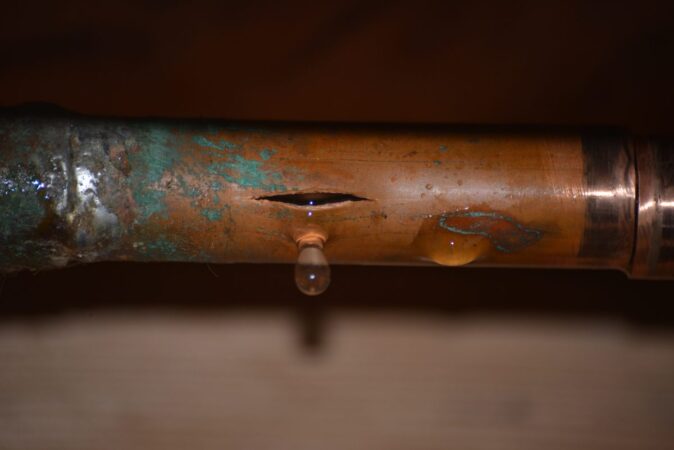
As temperatures drop across the region, the risk of your home’s pipes freezing increases. There are steps, however, that homeowners can take to help stop that from happening and help you avoid a hefty plumbing bill this winter.
Here’s a list of plumber-approved tips on how to keep a pipe from freezing, spotting a frozen one, and what to do if it bursts.
How to prevent your pipes from freezing
“It comes down to three main things: draining outside faucets, keeping pipes warm, and checking for leaks,” said Vincent Thompson, owner of Thompson Plumbing and Heating. Thompson is a master plumber of more than 50 years and for two decades taught plumbing at Dobbins Vocational School in North Philadelphia.
💧 Draining outside faucets
Over the summer, we use outside faucets and hoses to water the plants, rinse of sidewalks, or simply cool down. When the temperature dips, water can freeze and build pressure, ultimately causing a burst pipe, a situation far too common, according to Thompson.
He recommends disconnecting your hose (and storing it for the winter), shutting off the valve that feeds the faucet or spigot (usually found near the hot water heater), and letting the remaining water in the pipe drain out. You can leave the faucet or spigot slightly open, according to Thompson. Letting the faucet drip is also a good suggestion for inside fixtures.
“If it’s empty, it’ll never freeze,” Thompson said. “But if there’s water, it can expand and explode. Then you’ll come out in the spring to use your hose and the water will be shooting out of the wall.”
🌡️ Keep your pipes warm
When the freezing weather descends upon us, we bundle up to stay warm. Pipes need that treatment too. Ideally, the lowest you want to keep your thermostat set at is 50 degrees, but heating is expensive. According to Thompson, the absolute lowest you can go is 40 degrees, because your pipes will start freezing at 39 degrees.
Opening the cabinets underneath your bathroom sink can be a good way to keep pipes from getting too cold. And for the ones in extra-cold spots, using electrical heating tape or fitting them with foam and rubber sleeves is a good idea. Be sure to check for any leaks beforehand, because if water is accumulating, they won’t prevent a pipe from bursting and it will become an added step.
🚽 Check for leaks
“Every drop that goes down the drain will turn into an icicle and eventually can clog up the entire soil stack,” explained Thompson. Not addressing it can result in frozen pipes, flooding, and even water backing up through your toilet.
After 50 years of handling these cases, he advises looking at your water meter because sometimes the leak might not be obvious. Make sure no water sources are open, and look at the blue or red triangle (depending on your meter). If it’s turning that can be a sign of a leak.
If you suspect the culprit is your toilet, he recommends adding a couple of food dye drops into the tank. If the water in the bowl changes color, your suspicions are correct.
Andrew Gadaleta, contractor, works on getting the heat fixed at Visitation BVM School in Philadelphia in December 2021 so that students could return to school. Thieves broke into the school Tuesday morning, ripping copper pipes from the walls that caused flooding. The water rendered the school unusable for a week.
How to spot a frozen pipe
Your house is filled with water pipes, and while it’s not hard to figure out when you’re dealing with a frozen pipe, it can be tricky to figure out where the frozen section is. If you turn on a faucet and nothing comes out, you’re going to have to do a little detective work.
The first step should be to try all the other faucets in your house. If all the faucets in a room aren’t working, the freeze is likely in a split from the main pipe. If all the faucets on a floor aren’t working, the freeze is likely between where the first- and second-floor pipes separate. If all the faucets in your house aren’t working, then the freeze is probably near where the main pipe enters the house.
The frozen section of the pipe, if exposed, will sometimes have condensation over it. You’ll also be able to tell that it’s colder just by touching it.
How to thaw a frozen pipe
Before thawing a frozen section of pipe, you should open the faucet to relieve the water pressure and allow the water to escape once it thaws. You should also begin the thawing process close to the faucet and work your way to the blockage. If melted water and ice get caught behind the blockage, the chance that the pipe will burst increases.
One of the easiest ways to thaw a frozen pipe is with a hair dryer. You can also use hot towels or a heat lamp to warm up the pipe. Never use an open flame.
What to do if a pipe bursts
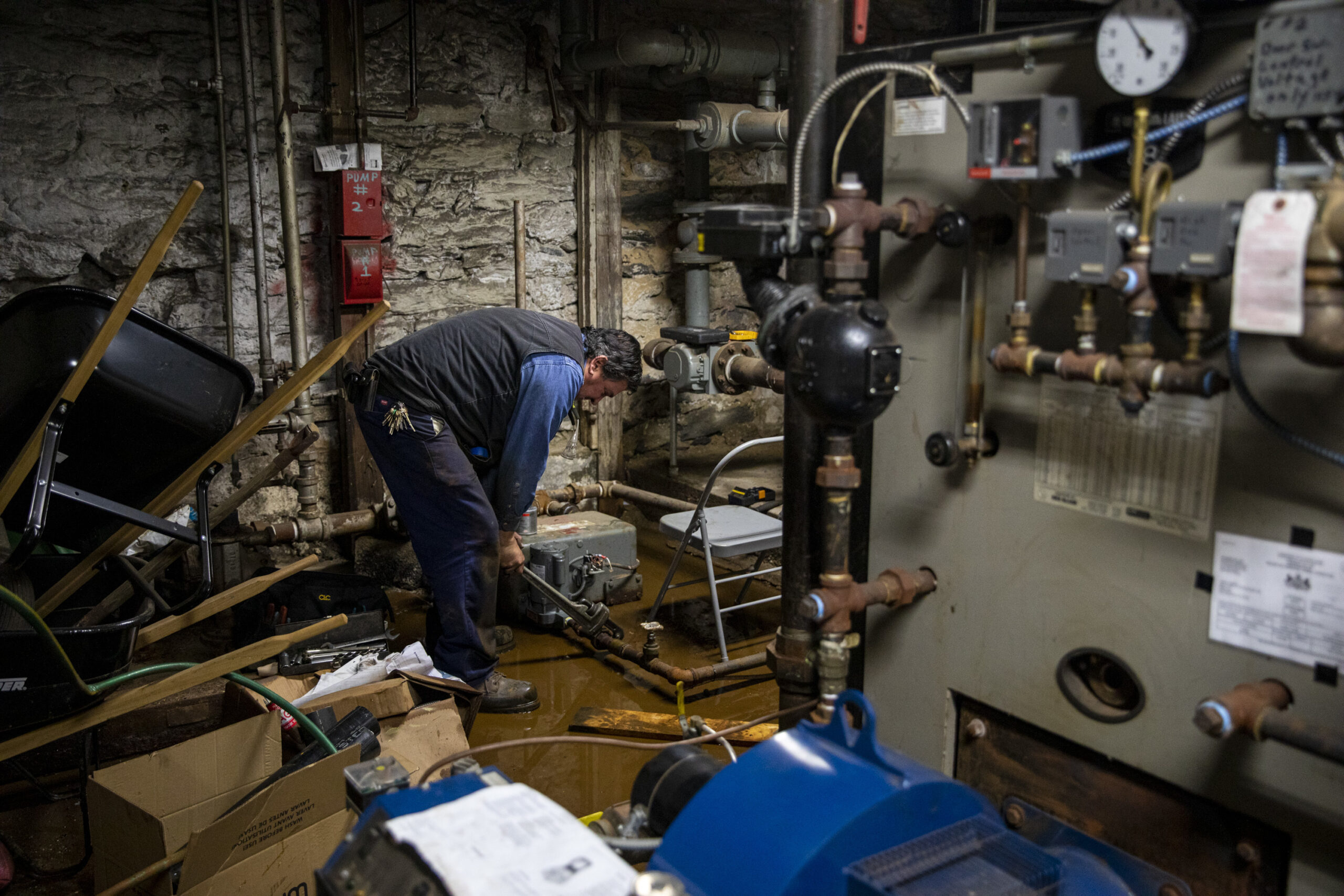
Don’t panic. The first thing you should do is shut off the main water line into your property. This will prevent your house from flooding. The main water valve is usually near your water meter. After you’ve done that, call your plumber. Locating and tagging the valve to your main water line ahead of time can help make the moment less stressful.
For almost 30 years, he stood in sun and darkness, rain and snow, on the streets of Philadelphia.
Known popularly as “Umbrella Man,” he stepped forward, as if signaling a cab in the rain. He was last seen in front of the then-Prince Music Theater in the 1400 block of Chestnut Street.
But sometime in 2015, along with the Prince, he disappeared.
Where did he go? Whatever became of “Umbrella Man”? Those questions were posed to us by a reader through Curious Philly — the forum where you can ask our journalists questions.
Allow us: He’s not in Philadelphia anymore. He’s on tour. But his home is not far away: Hamilton, N.J., as a matter of fact.
But let’s step back. The actual name of the six-foot-10, 460-pound sculpture is Allow Me. It depicts a man in a three-piece business suit. He’s holding an umbrella in his right hand and gesturing with his very, very long left index finger, as if saying, “Wait a minute.”
That title, though. Whoever brought down a cab with an “Allow me”?
Allow Me is the work of American sculptor Seward Johnson II, grandson of the founders of Johnson & Johnson. It’s part of a series Johnson calls “Celebrating the Familiar.” You’ve probably seen many of the pieces in the series, and that’s the way Johnson likes it. He makes multiple copies of daily-life sculptures — boy with ice-cream cone, man with newspaper, senior lady with grocery sack, window-washer, traffic cop — and distributes, displays, or tours them throughout the country. Another one, titled “The Consultation,” is at the campus of the Presbyterian Medical Center just off 39th and Filbert Streets in West Philadelphia.
The J. Seward Johnson sculpture “Allow Me” when it was near the Warwick Hotel on South 17th Street in photo taken Feb. 15, 2001.
According to the Johnson Atelier Inc., the organization that tracks and controls Johnson’s productions, the original Allow Me was created in 1981. In 1983-4 a series of copies was made, for a total of seven, from the same cast, which was destroyed thereafter (apparently the casts wear out). The atelier says the Philadelphia Allow Me was the last one.
Allow Me had a long, rough run in Philadelphia. Its first sojourn here was in an exhibit of Johnson’s works in 1983-4, in front of the Four Seasons hotel on the Parkway. There it charmed lawyer and art collector Joseph D. Shein, who bought it from Johnson and had it set up in 1985 in front of the Shein-owned building where he ran his offices, at the corner of 17th and Locust Streets.
In this Sept. 6, 1985 image from the Philadelphia Inquirer, lawyer and art collector Joseph D. Shein sits with “Allow Me,” a statue by Seward Johnson II. It had just been installed in front of what were then Shein’s offices at 17th and Locust Streets.
There, Umbrella Man stood for just about 20 years. Many a cabbie was said to stop, only to curse and move on. Street lore had it that he got the Philadelphia treatment, with generous applications of cigarette butts and gum.
In 2005, Shein donated the statue to the Prince. Umbrella Man was plunked just to the right of the main entrance, where he remained into 2015. Abuse continued: Luckless pedestrians walked into him, and during the joyous October 2008 street celebrations after the Phillies’ World Series triumph, vandals attempted to uproot poor Umbrella Man, leaving him crooked, graffiti scrawled on his forehead.
And then … he went away. In 2010, the Prince declared bankruptcy. After protracted uncertainty, the building was bought by a group of business investors, to be sold in 2015 to the Philadelphia Film Society, its current tenant who changed the name to the Philadelphia Film Center. According to the Johnson Atelier, that year the atelier bought Allow Me back.
Although the final price is proprietary, most sculptures in the “Celebrating the Familiar” series, according to the Johnson Atelier, run for $84,000, but Allow Me is now in the Johnson catalog for $130,000.
Where is he now? His physical home is the Johnson Atelier in Hamilton, N.J., next to Grounds for Sculpture. But Umbrella Man himself is on tour, according to the atelier e-mail: “[T]his sculpture is now actively traveling with the other Johnson pieces in the foundation’s touring exhibits throughout the US and Europe.”